Carolina Calling, Asheville: A Retreat for the Creative Spirit

LISTEN: APPLE • SPOTIFY • STITCHERAMAZON • YOUTUBEMP3


Asheville, North Carolina’s history as a music center goes back to the 1920s and string-band troubadours like Lesley Riddle and Bascom Lamar Lunsford, and country-music pioneer Jimmie Rodgers. But there’s always been a lot more to this town than acoustic music and scenic mountain views. From the experimental Black Mountain College that drew a range of minds as diverse as German artist Josef Albers, composer John Cage, and Albert Einstein, Asheville was also the spiritual home for electronic-music pioneer Bob Moog, who invented the Moog synthesizer first popularized by experimental bands like Kraftwerk to giant disco hits like Donna Summer’s “I Feel Love.”

It’s also a town where busking culture ensures that music flows from every street corner, and it’s the adopted hometown of many modern musicians in a multitude of genres, including Pokey LaFarge, who spent his early career busking in Asheville, and Moses Sumney, a musician who’s sonic palette is so broad, it’s all but unclassifiable.

In this premiere episode of Carolina Calling, we wonder and explore what elements of this place of creative retreat have drawn individualist artists for over a century? Perhaps it’s the fact that whatever your style, Asheville is a place that allows creativity to grow and thrive.

Subscribe to Carolina Calling on any and all podcast platforms to follow along as we journey across the Old North State, visiting towns like Shelby, Greensboro, Durham, Wilmington, and more.


Music featured in this episode:

Bascom Lamar Lunsford – “Dry Bones”

Jimmie Rodgers – “My Carolina Sunshine Girl”

Kraftwerk – “Autobahn”

Donna Summer – “I Feel Love”

Pokey LaFarge – “End Of My Rope”

Moses Sumney – “Virile”

Andrew Marlin – “Erie Fiddler (Carolina Calling Theme)”

Moses Sumney – “Me In 20 Years”

Steep Canyon Rangers – “Honey on My Tongue”

Béla Bartók – “Romanian Folk Dances”

New Order – “Blue Monday”

Quindar – “Twin-Pole Sunshade for Rusty Schweickart”

Pokey LaFarge – “Fine To Me”

Bobby Hicks Feat. Del McCoury – “We’re Steppin’ Out”

Squirrel Nut Zippers – “Put A Lid On It”

Jimmie Rodgers – “Daddy and Home”

Lesley Riddle – “John Henry”

Steep Canyon Rangers – “Graveyard Fields”


BGS is proud to produce Carolina Calling in partnership with Come Hear NC, a campaign from the North Carolina Department of Natural & Cultural Resources designed to celebrate North Carolinians’ contribution to the canon of American music.

A New Generation of Bluegrass Stars Reflect on ‘O Brother, Where Art Thou?’

The soundtrack to O Brother Where Art Thou? was a phenomenon in the early 2000s, turning bluegrass musicians into superstars and creating an instant mainstream market for old-time music — from folk to gospel to children’s songs to prison chants to blues and everything in between. To celebrate the twentieth anniversary of its astonishing success and to wrap up our Artist of the Month series, we spoke to several musicians about the impact O Brother and its subsequent tours had on their lives and livelihoods.

Sierra Hull: “I grew up in a little town with maybe 900 people, and there used to be a poster section at the Walmart the next town over. You could flip through the posters and there would be pop stars like Britney Spears and Backstreet Boys. I was always convinced that one day I would find an Alison Krauss poster in there. She was as popular in my little kid brain as Britney Spears. So it was cool when O Brother came out and elevated some of those people who were already giants to me, like Alison and Dan Tyminski and Ralph Stanley.

“I was already playing, but I was too young to be touring yet. By the time Cold Mountain came out [in 2003], I was part of that tour. Alison was part of both soundtracks, and she invited my brother and me to go on that tour. So we got to help celebrate that second wave. I was 12, and it was really the first time for me to be out on tour, travel to so many different places, and play Red Rocks and the Beacon Theater in New York. Standing at the side of the stage and listening to Alison sing to hundreds of people every night every night was one of my favorite memories.

“It was amazing to watch people go crazy over Ralph Stanley every night. He had this dazzled suit jacket that he wore every night. Sometimes he would sit his banjo down while his band played and take that jacket off and throw it to me at the side of the stage. I would get to wear that dazzled jacket at the end of the show when everybody came out on stage. It’s one of the most special musical experiences I’ve ever had.”


Sara Watkins: “O Brother was something we somehow became affiliated with. Nickel Creek had just released our band’s first record on Sugar Hill, after years of doing just little homemade projects. Alison Krauss produced it, which had been out maybe a year and a half when O Brother came out. She was a big part of that soundtrack, of course, so our band was gaining a little bit of notoriety. I remember reading a huge New York Times spread, and we were listed among the people on that scene. We were part of that conversation, despite not having been part of the soundtrack in any way. We were just at the right place at the right time, and the awareness of the bluegrass scene just exploded. We were able to reach a different level very quickly. It was a huge advantage to our career. We already had some momentum, but the soundtrack really put the wind in our sails.

“T Bone Burnett [who produced the album], one of his brilliant skills is finding the right people for the right song. He brought in some incredible musicians in a way that really showed the musicianship in our community and made everyone really proud of our scene. We saw our heroes up there, and it was gratifying to see them celebrated by a huge audience. I remember feeling a new respect for Ralph Stanley with that vocal [on ‘Oh Death’]. That actually turned me on to shape-note singing. Someone told me his delivery was reminiscent of those old communities that did shape-note singing and those old preachers who used to sing that way. I’d never heard anything like it. And to this day, whenever I see Dan Tyminski, I make a point to stick around until he plays ‘Man of Constant Sorrow.’ No way I’m leaving before then.”


Dave Wilson (Chatham County Line): “I remember going with our old bass player to see O Brother in the theater. We snuck a bottle of whiskey in and sat in the back row and just laughed and drank. I remember thinking, ‘Bluegrass has arrived!’ We were already a band and playing small gigs around town, but we weren’t at a place where we had dedicated our lives to it. So it was kismet for us. That record came out, and the scene just exploded. Suddenly we had this huge advertisement out there in the world for the style of music we were playing. We definitely noticed a change. There were more strangers coming to see us play gigs, and they were really excited about it. One side effect was people would yell out for us to play ‘Man of Constant Sorrow.’ They did it enough to make me wonder if they had heard the soundtrack or just seen the movie. But we never played it. We didn’t know how! It would have probably shut them up if we had!

“I really got into the record. There are some badass arrangements on there. And it’s not corny. It’s not super traditional. I love that they reached out to the right people. It could have been bad. They could have gotten Toby Keith or someone like that. Oh god, I don’t even want to think about that! One of my favorite parts is that blues song by Chris Thomas King [a cover of Skip James’ ‘Hard Time Killing Floor’]. It makes for such a special moment. Later, they booked that concert film [Down from the Mountain, recorded at the Ryman Auditorium] at our old classic movie theater here in town, and I remember the boys going to see it and we were all just floored. That was almost bigger than the movie as far as having an impact in the folk music scene.”


Sam Amidon: “People in the folk world can be very protective of the music, which I think is valid. But my inclination is that if I find something I’m excited about, I want to share it. I want people to know about it. To have grown up in a world knowing a lot of the corners O Brother explores, it was beautiful to think about how many people all of a sudden were going to discover these field recordings and these great musicians. And I was thankful because until then, portrayals of traditional music in the mass media had just been so bad and so clichéd or so simplistic. Nothing had depicted this stuff on this scale before. Before then, if you told somebody you played banjo, they would think Deliverance. That was their frame of reference.

“For O Brother to do it without messing it up was a miracle. To see these different corners of American music — beyond just blues and bluegrass as the two major industry terms — was a very positive thing, especially because ‘folk music’ can be such a heterogeneous category. Nobody would even really know what you were talking about if it wasn’t bluegrass or blues. O Brother pointed to all of these different areas. It’s singing games and banjo songs and all these different things. O Brother is weirdly inclusive. It cast a wide net. Nowadays it’s easy to go to the soundtrack and hear more problematic elements of the whole Americana genre thing, but I think it’s good to remember that when it first came along, it was much more nuanced compared to what had come before.”


Woody Platt (Steep Canyon Rangers): “It’s interesting that the twentieth anniversary of O Brother is fairly parallel to the twentieth anniversary of our band. We formed in Chapel Hill, North Carolina, when we were seniors in college, right when the movie came out. We all had been exposed to bluegrass and old-time just by being Carolinians. We all had that music around when we were growing up, but none of us in the band really dove into it until we were in college. We’d only been following that music a few years when the movie came out. I’m not sure we were aware at the time of the impact that the movie and the tour had on bluegrass, old-time, string band, mountain music, but we could feel some excitement when we were playing bars on Franklin Street, which is the main drag in Chapel Hill. But we didn’t really have anything to compare it to. There was no before or after. It was just what we were doing, and that’s all we knew.

“I really enjoyed the movie, but I was a big fan of the album. Hearing Ralph Stanley’s voice in a film, or Dan Tyminski’s, or just seeing people I admired in that movie was pretty incredible. Looking back on it, it was good timing for us to be getting off the ground, and we were having so much fun and finding so much joy in it. The music we were playing had been a small niche, but all of a sudden it had this national interest. I have no doubt in my mind that the awareness of the music was fueled by the movie. It’s a fascinating phenomenon to think about, because it wasn’t marketed in any significant way. It just happened. It was just this thing where people were suddenly into this music.”


Molly Tuttle: “The movie came out when I was seven years old, and I remember my dad showing it to me when I was in grade school. I loved it, and the music really stuck with me because I already had an affinity for bluegrass and old-time music. Seeing it performed in a movie was new and exciting. My dad teaches bluegrass for a living, and when the movie came out, he had an influx of new students.

“It’s had a lasting impact on the popularity of bluegrass music. But I was so young that I didn’t know many of the musicians on the soundtrack by name, so it introduced me to a lot of artists who later became my favorites. And the Down from the Mountain documentary further familiarized me with people like Emmylou Harris and Alison Krauss. Many of those artists, like Gillian Welch and John Hartford, have been big influences on me, and that was my introduction to their music. I’ve performed ‘I’ll Fly Away’ and ‘Angel Band’ a number of times, and I got to do ‘Man of Constant Sorrow’ with Dan Tyminski at the IBMA awards one year.”


Dom Flemons: “I actually saw Ralph Stanley on the O Brother tour in Flagstaff, Arizona, in the year 2000. It was at this random high school. I saw the poster on a telephone pole when I was going to college there. I’d started playing the banjo by that point — six-string and four-string banjo, guitar, and harmonica. I remember the place was really packed out, and he gave this amazing performance. I just loved watching the man at work. When he sang ‘Oh Death,’ he pulled this piece of paper out of his pocket, put on his glasses, and made a joke about how old he was. And he just sang it off this piece of paper and blew our minds.

O Brother was very interesting, and I think it’s still a milestone album for several generations. A lot of the old folks who played those old styles and sang those old songs were starting to pass away, so the soundtrack ended up being a perfect vehicle for getting younger people into the music of the ‘20s and ‘30s. It reminded people of the really good old recordings that were available. That’s where I went. I found the old RCA Victor and Columbia recordings, and that was it for me.

“It’s a perfectly structured record, opening with the prisoners on the chain gang and then it goes to that beautiful ‘Big Rock Candy Mountain.’ And then you get into “You Are My Sunshine” with Norman Blake, and then Chris Thomas King presenting ‘Hard Time Killing Floor.’ That in itself was a revival of Skip James. People talk about Ghost World and Devil Got My Woman, but I think O Brother got it going. People just started casually bringing those songs back in at shows and festivals, and it seemed like a lot more people knew them. Of course they would sing them like the recordings on O Brother. Those are just things I observed before I was a professional musician, and it was amazing to see.”
 

With ‘Arm in Arm,’ Steep Canyon Rangers Give Everyone Time to Shine (Part 2 of 2)

Steep Canyon RangersArm in Arm, their first collection of all-new material in two years, is a set of highly grown-up songs, some with storylines that you’d expect from the likes of Drive-By Truckers or Bruce Springsteen. It’s more loose-limbed and less traditional than past Rangers albums, with fine ensemble playing throughout.

BGS caught up with co-leaders Woody Platt and Graham Sharp in separate conversations leading up to the release of Arm in Arm. After starting with Platt yesterday, here is the conversation with Sharp.

BGS: With the band off the road, have you been able to do any songwriting during this time?

Sharp: I started off writing on a real tear the first few months. But then I slacked off a bit, in part because that coincided with me starting to make an album of my own. Switching from writing to recording slowed down that end of it, but working on my own stuff is kind of out of necessity. For the band to survive this and come back when it’s time, we’ve all got to look out for ourselves a little more.

It’s a strange new hustle, but we’re holding up pretty good. We’ve all been forced to sort of pivot, after having not stopped moving in 20 years. This is the longest any of us have stayed put that whole time. It takes a moment to settle, but it’s been eye-opening. Forced me into some new directions that have been good and ought to pay dividends once we can get the band back together. I’m trying to pull out as many silver linings as I can.

That’s a bit of news, about the solo album. What can you tell us about that?

I don’t know where or when it will ever come out, but the solo album is close to done. I’ve been working with Seth Kaufman from Floating Action in his little basement studio here in Black Mountain. It’s mostly new songs, and a handful of tunes the Rangers have been kicking around a while without getting to them. Nothing bluegrassy about it, mostly country to country-soul, because I have definite tendencies in that direction and a deep love for country music of the ’60s, ’70s, ’50s. That’s still among my favorites.

After Charles Humphreys III left the Rangers in 2017, this is the first album where you’ve written all the songs, not just most of them. Was there more pressure on you?

Not necessarily. It did not change my process much, anyway. I always just try to compile as much good material as I can. It is neat that with a band as organic as this one, a song can kick around for years where we’ll never find a place for it and then suddenly it’s revived. The last song on the album “Crystal Ship” was like that. I had that one for a long time and then backstage one day, [Mike] Ashworth just started playing that melody because he remembered it from a year or two earlier. It’s cool to have the band’s collective memory to draw on, where everybody is part of the process.

The first song “One Drop of Rain” is another. I probably wrote that one six or seven years ago and I’d just never taken the time to find the right groove and place for it. Then one night Woody and I were backstage, I had this little banjo roll, he had the phrasing to go with that and we put it together. A lot of songs come together over time like that. The process is more cumulative than me bringing something in, “Hey, I’ve got this new song.”

Do you have any particular favorite songs on this one?

Probably “One Drop of Rain” and “Honey on My Tongue,” for different reasons. I can remember exactly where I was and the situation I was trying to capture with “One Drop,” just shortly after my father-in-law had died very unexpectedly — 64 years old. What it gets at for me is, try to love your way through the hardest situations. And “Honey” is one I wrote with my daughter in mind. She was giving me a hard time, saying I never write songs for her — not true! But yeah, okay, that was written specifically for her. There are several songs about resilience, dealing with loss, setbacks. All to different degrees, tied to different moments in time.

This record sounds very, dare I say it, mature and grown up.

Well, we’re all passing into the point in our lives where we see a lot of past decisions come to fruition as everyone’s lives play out, our own as well as others. That perspective figures into it. As a songwriter, I’m maturing and trying to hone in on the emotional center of a song – and trying not to write about fluff. We were all very aware while making this album that a lot of the songs aren’t necessarily sad, but a little bit heavier.

And on this record, you’ve also got the first lead vocal from new bassist Barrett Smith.

It’s been cool, having him take on a bigger vocal role. With Woody or myself, it’s just us singing songs at this point. But with Barrett, there’s this ability to tailor songs to a new voice in the band. The song he sings, “Everything You Know,” we talked through the lyrics and the story. Woody and I have always done that, gone through songs in detail. Although sometimes, I don’t necessarily want to influence the pictures anybody else sees in their head while singing.

Once a song is written and out there, it belongs as much to the listener as the singer or the writer. Sometimes they come up with something different, too. “Can’t Get Home” from the last record, Woody thought I wrote that for soldiers coming home and he wasn’t the only one. I had not necessarily meant it that way, but I talked to enough other people about it that it kind of changed the song’s meaning for me, which was cool.

Did taking on the production yourself make Arm in Arm more collaborative than past albums?

I feel like what we do on stage is try to give everybody in the band moments to shine while keeping things moving. Producing this record ourselves was like that, more so than us playing while someone else producers. There are songs where I remember, so and so arranged this part, so and so suggested this harmony, so and so came up with the idea for this mix. So many different pieces where I can see everybody’s fingerprints. I’m proud of that.

I’m just psyched to have something to roll out into the world, reach out a little bit. You know, it’s not the best time to be releasing a record because we can’t tour. So I hope this will reach and touch people. I’m definitely prouder of this record than anything we’ve ever done.

Read part one of our Steep Canyon Rangers Artist of the Month interviews here.


Editor’s Note: David Menconi’s Step It Up and Go: The Story of North Carolina Popular Music, from Blind Boy Fuller and Doc Watson to Nina Simone and Superchunk will be published in October by University of North Carolina Press.

Photo credit: David Simchock

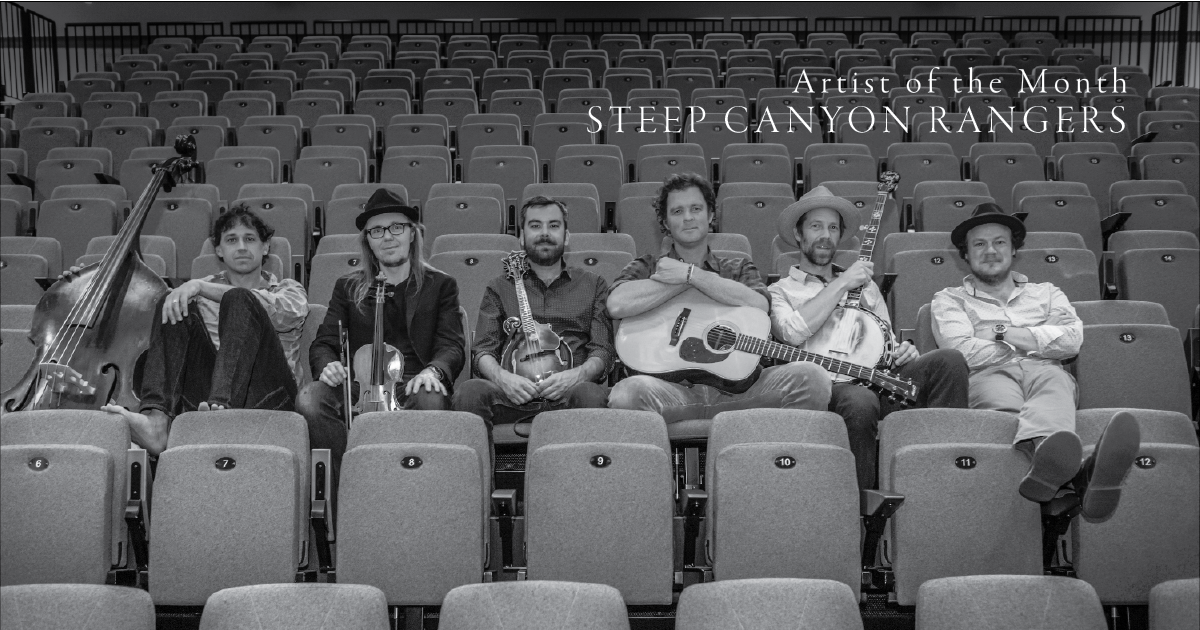
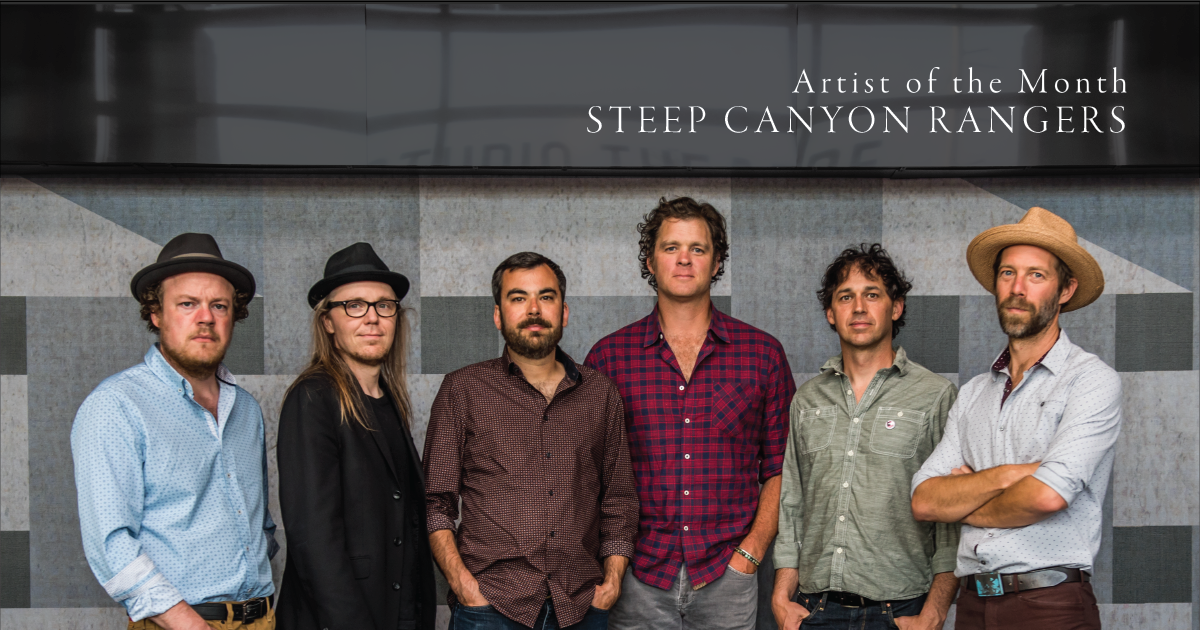
Artist of the Month: Steep Canyon Rangers

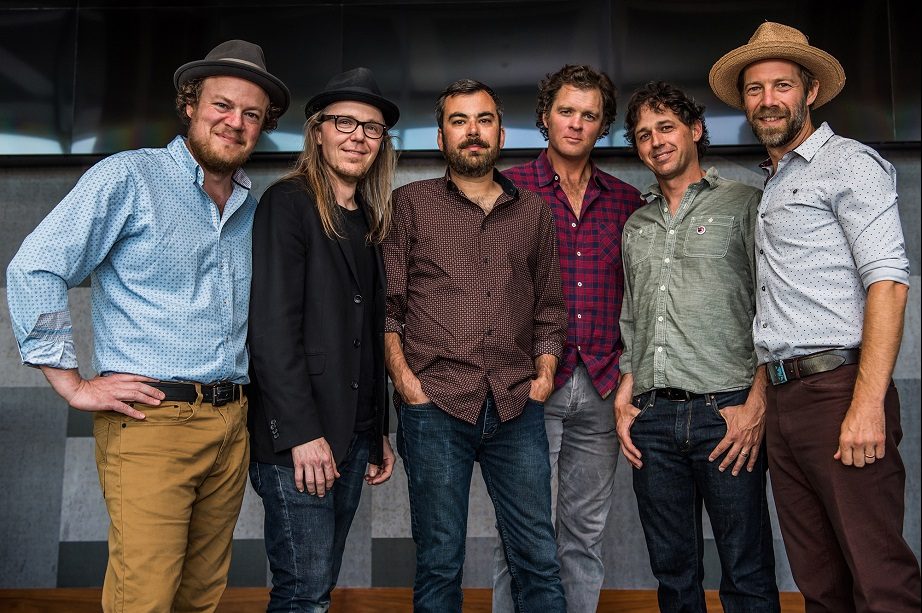
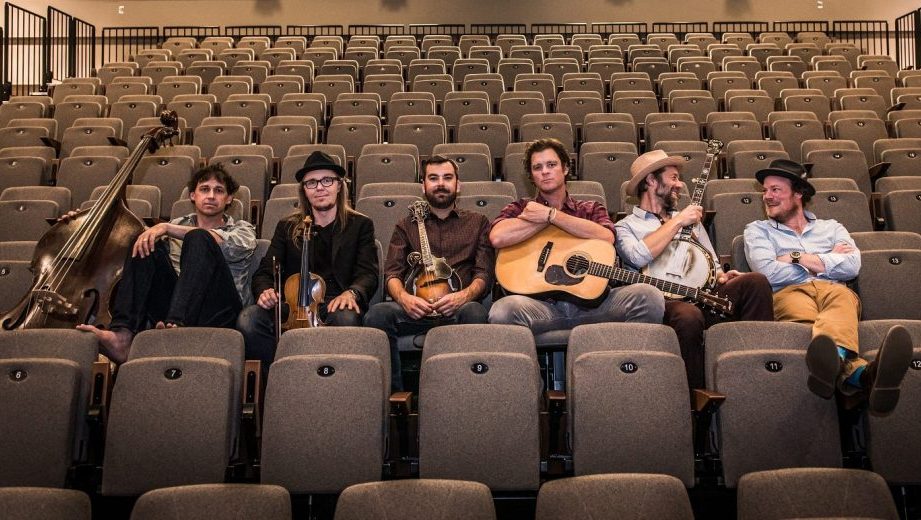
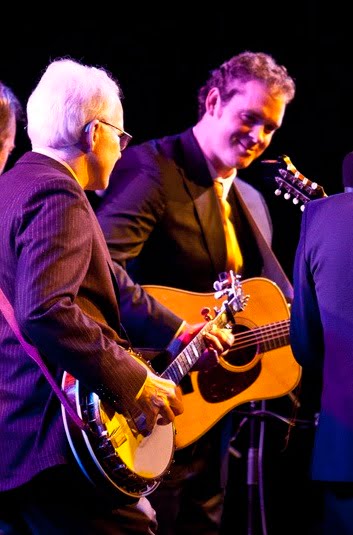
In a state with no shortage of bluegrass bands, North Carolina’s Steep Canyon Rangers have always set themselves apart with compelling songwriting and a camaraderie that feels authentic, whether they’re up on stage headlining Merlefest or at a performing arts center supporting Steve Martin. (The band shared IBMA Entertainer off the Year honors with Martin in 2011.) These guys have integrity, sure, but they also have an adventurous spirit, a subtle sense of humor, and a keen perspective that reflects where they are in life.

On their upcoming album, Arm in Arm, bluegrass fans will find a lot to like, but so will those listeners who pay attention to songwriting. It happens to be the first time they’ve recorded an album outside of North Carolina, opting to work at Southern Ground studio in Nashville, and to produce the album with Brandon Bell. Some of the sonic textures may sound different, but the emotions in their music remain intact.

“We’re not trying to sound like a style or genre,” says Graham Sharp, the band’s banjo player, frequent songwriter, and occasional lead singer. “We’re not trying to fit into a certain mold. For a long time, we were a traditional bluegrass band, and that meant the themes would have to fit into that mold: work songs, heartbreak songs, train songs. But we’ve evolved to play any groove, any style, and it has opened us up to so many more possibilities.”

BGS will spotlight Steep Canyon Rangers as our Artist of the Month with back-to-back interviews with two of its founding band members, Woody Platt and Graham Sharp, conducted by noted North Carolina author and journalist David Menconi. (Read part one with Woody Platt here. Read part two with Graham Sharp here.) Arm in Arm arrives on October 16, but we’ve include a few of its early tracks below in our BGS Essentials Playlist for Steep Canyon Rangers.


Photo credit: David Simchock

LISTEN: Steep Canyon Rangers with Asheville Symphony, “Radio”

Artist: Steep Canyon Rangers with Asheville Symphony
Song: “Radio”
Album: Be Still Moses
Release Date: March 6, 2020
Label: Yep Roc Records

In Their Words: “We’ve been lucky to perform these songs with some great conductors over the last few years, but the opportunity to record them with our hometown symphony and the combination of [producer] Michael Selverne and [arranger] Michael Bearden was too good to pass up. They brought the arrangements to life and helped reimagine some of our older tunes. We’re so grateful for everyone’s efforts in making it happen. To hear the power and sweep of a full symphony behind these songs is truly amazing.” — Graham Sharp, Steep Canyon Rangers

“It was such a cool yet unusual experience to work as a band on a collection of songs we’ve recorded over the years and have performed live hundreds of times, by adding the ASO and producer Michael Selverne. This brought the songs to a new place with an entirely new life and sound. We also recorded with the band in a truly live setting to capture the energy of the performance.” — Woody Platt, Steep Canyon Rangers


Photo credit: David Simchock

Steep Canyon Rangers Salute Their State on ‘North Carolina Songbook’

Steep Canyon Rangers have been musical ambassadors of North Carolina for nearly 20 years, and during this year’s set at MerleFest, they presented a wide-ranging performance drawing on their home state’s diverse contributions to American music. That feel-good Sunday afternoon show is now available as an eight-song live album, North Carolina Songbook.

The collection covers inspirations from jazz musician Thelonious Monk, folk/blues hero Elizabeth Cotten, and enduring acoustic legends such as Doc Watson and Flatt & Scruggs. Replying by email, mandolin player Mike Guggino answered these first five questions, with singer/guitarist Woody Platt rounding up the remainder.

BGS: The music of North Carolina can be an overwhelming subject. What was the audition process, so to speak, when it came time to deciding which songs you wanted to include in your set?

Guggino: We all tried to come to the table with songs that we thought might work for the set. We knew we needed not only good songs, but also songs that worked well together to make the set flow. We needed the set to have some diversity, some highs and lows dynamically. We also wanted to feature different members of the band throughout the show.

These songs are familiar, of course, but how much did you rehearse the set list before singing at MerleFest?

We starting working on the tunes a few months before the show. We tried to incorporate many of the tunes into our shows leading up to MerleFest to get an idea of how they worked within the set.

Naturally it’s important to have Doc Watson and Rosa Lee Watson represented. How often did you cross paths with them, and what do you remember most about them?

We all started going to Merlefest in our college years and Doc would perform every year. Seeing him play live was always a highlight of the festival for us. His was some of the first bluegrass/Americana music many of us in the band were ever exposed to. We starting learning many of Doc’s tunes for our shows early on as a band. Many years later, Doc played our festival (Mountain Song Festival) in Brevard. He was one of the nicest musicians I have ever met. It was an honor to meet him and none of us will ever forget that experience!

“Don’t Let Your Deal Go Down” is a bluegrass staple. Do you remember how you all first heard that song?

That was one of the first Flatt & Scruggs tunes we ever heard or tried to learn. I’ve always loved the ragtime-like chord changes in that tune. Also, Earl played it open and the tune is in F major. It definitely gives it a unique sound on the banjo. I think Graham played the heck out of that one on the record!

What were the conversations like as you were deciding what kind of arrangement you wanted to give “Stand by Me”

We all agreed we wanted to feature that beautiful string solo section in the middle. This required a few extra fiddlers to make it happen and it came off so nicely. Woody really sings it with a lot of passion and that is really what makes the song work, in my opinion. We didn’t end up straying too far from the original arrangement in the end. It’s a simple song and we didn’t want to overthink it.

True to its name, “I’ve Endured” has been around a while. What pulled you toward this song?

Platt: This song was a natural fit — not only was Ola Belle Reed a clawhammer banjo player from Grassy Creek in Ashe County, North Carolina, but this song and several of her others have been pulled into the bluegrass genre. We have heard several versions of “I’ve Endured” and we are proud to now have our own.

This album is coming out on vinyl on Record Store Day. Who is the biggest vinyl collector among you?

Everyone in the band has an interest in vinyl and has a nice collection. Without doing an exact count I’d have to say Graham [Sharp, on banjo] is the biggest collector.

“Sweet Baby James” is a highlight of this album. Who is the biggest fan of James Taylor in the band?

James is from Chapel Hill, North Carolina, where the band was originally formed. All of us have connections to his music in some way or another. I’d guess Barrett [Smith, on bass] is the biggest fan. He did a great job channeling James’s vibe and delivery on this version.

North Carolina Songbook provides a chance for you to share part of your state’s musical heritage with the world. What do you hope fans will take away from the experience of listening to this album?

The takeaway is North Carolina’s incredibly rich and diverse musical history! Also, we have recorded nearly 100% of our own original music throughout our career — so it’s fun to show a different side of the band and how we can interpret other songs and deliver them in the SCR style.

What lies ahead for the Steep Canyon Rangers in 2020?

We have a few new projects coming up in 2020. A collaboration with the Asheville Symphony will be released in early 2020. Later in the year we will be releasing a new project of all original SCR material. Other than that we plan to continue to tour and play theaters, clubs, and festivals all over the country and abroad. There will also be some touring with our banjo buddy Steve Martin.


Photo Credit: David Simchock

MIXTAPE: Woody Platt

WOODY PLATT‘s music is something of a dichotomy.    The sound of his band, The Steep Canyon Rangers, is tight and traditional bluegrass, while their lyrics belie much more contemporary topics (for an example of this, check out their tune with Steve Martin, Atheists Don’t Have No Songs).  Woody and the rest of the Steeps take to the stage with Steve this Saturday, September 1 at the Pantages Theatre in Hollywood, and the band is also hosting the upcoming bluegrass cruise, Mountain Song At Sea in February (The Sitch will be there too!).  Before their Southern California arrival, Woody filled us in on the top five songs he’s listening to right now for this month’s MIXTAPE.  


Artist: Blaze Foley
Track: Oh Darlin’
Album: Live from the Austin Outhouse

‘Blaze has a very warm yet rugged delivery in his voice and a great finger picking guitar style that accompanies this delivery. I heard this live recording several years back and it has been one of my favorites ever since.’


Artist: Doc Watson
Track: St James Infirmary

Album: Remembering Merle

‘This album was my first introduction to Doc and one that helped lead me to becoming a guitar player/singer. Several of the songs on this album were the first that i tried to sing in a bluegrass style. With the very sad loss of Doc this year—i have gone back to enjoy this album. ‘I hope Docs guitar is laying right by his side.’


Artist: Shannon Whitworth and Barrett Smith
Track: Corcovado

Album: Bring it on Home

‘This is a duet collaboration of cover songs by Shannon and Barrett-who are from western NC.  It is a new project and features beautiful vocals and tasteful guitar. On Corcovado Shannon sings with a classic sultry style and Barrett sings in smooth convincing Portuguese. This is a breathtaking version of the jazz standard.’

[Video not available.  Preview Shannon and Barrett’s version of Corcovado here]


Artist: Del McCoury
Track: 50 years of Del McCoury
Album: Eli Renfro

‘I love the Del McCoury band. They have been such great ambassadors for Bluegrass music and have influenced some many artists including me. Eli Renfro is a haunting song that features both Dels high tenor range and his deeper lead range. The melody is contagious.’


Artists: The Viceroys
Song: Fat Fish
Recording: The Viceroys at Studio One.

‘The Viceroys are a lesser know reggae group who recorded in the late 60’s through the early 80’s and although they are not too well known—they made some great recordings and had some major success in Jamaica.  I love roots style reggae and this recoding is just right.  It feels good and has a great groove.’