Courtney Marie Andrews Doesn’t Fear Vulnerability

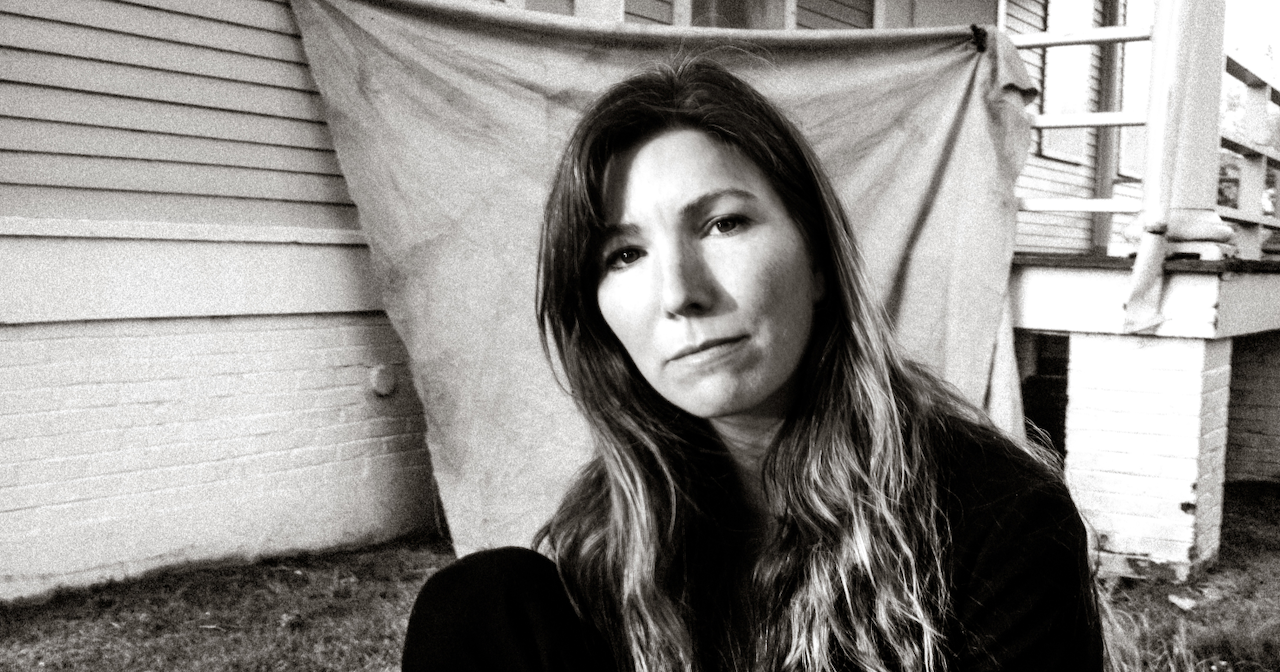
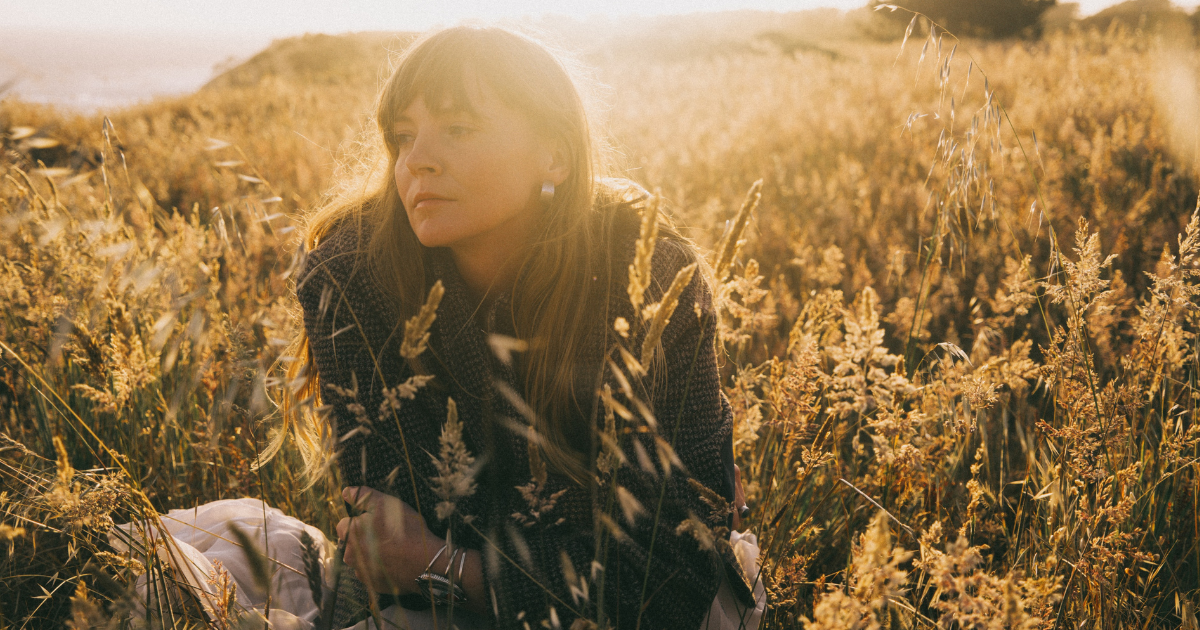
Courtney Marie Andrews’ story begins in Phoenix, Arizona. An only child raised by her mother, she found solace and an outlet for her creativity and imagination in music. She planted her music roots in a self-described “feminist punk band” and began touring while in her teens. Along the way, she recorded a number of albums – best known are Honest Life (2016), GRAMMY-nominated Old Flowers (2020), and Loose Future (2022) – lived in a number of cities, and worked and toured with a number of musicians, including rock band Jimmy Eat World.

Andrews eventually made her way to Nashville, where she now resides. There, she creates music and other art, fueling her soul and inspiration with long walks and her love of animals, bonding with friends’ dogs, and feeding an assortment of “porch animals,” mostly cats, who take up residence outside her door.

In addition to music, Andrews expresses herself through painting and poetry. She has published two collections: 2021’s Old Monarch (2021) and the recent Love Is a Dog That Bites When It’s Scared. Her music, writings, and artwork explore a broad scope of emotions and experiences: loss, grief, fearless love, deep darkness, pure joy, and acceptance of the entire spectrum.

These outpourings are at the essence of her new release, Valentine (out January 16 via Thirty Tigers). Written in the throes of anticipatory grief, the album plummets into the vortex of her trajectory. While the message is raw, the recording is anything but. Valentine is an unfiltered look into Andrews’ heart, filled with waves of sounds and layers of instrumentation.

Among the numerous instruments she plays on Valentine, Andrews is featured on an assortment of guitars and basses, including a 1973 Martin D-28, 1968 Gibson B-45 12-string, 1970s high-strung Japanese Epiphone, Gibson J-45, Epiphone Casino, 1972 Fender P-Bass, 1960s Kay K5915 bass, and 1960s Teisco six-string bass. Longtime friend and colleague Jerry Bernhardt joins her on various instruments, with drummer Chris Bear rounding out the trio. The album was recorded by Michael Harris at Valentine Recording Studios in Los Angeles and produced by Bernhardt and Andrews.

BGS reached Andrews via Zoom for an Artist of the Month conversation.

Has Nashville changed you as a songwriter?

Courtney Marie Andrews: I thought it would deeply shift everything for me, but if anything, it made me want to do other things as well, maybe subconsciously. I started painting and focusing on poetry. But that core sense of self, that songwriter self, will always be with me wherever I go. It’s hard to say how it has shaped me until I’m looking back on my life 20, 30, 40 years from now.

But I will say the community I’ve found here is profound. I’m a Western girl. I’ve lived in Arizona and Seattle up until pretty much my 30s, and I didn’t realize how lonely the West can be. I think that’s apparent in my early work as a songwriter. That subject is throughout the work. When I moved here, I was almost overwhelmed by how much people wanted to hang out. It took a while to adjust and now I can’t imagine it any other way, not having that community to feel into and understand this work, because it is a strange career. So I think more [that] it has affected me personally, but I’ve always continued to write and been on this journey on my own and in my own time.

This is a stripped-down album – only three musicians, including you, and one of them is also your co-producer. Did you know, when the songs were written, that this is how it needed to be done?

I completely funded this album on my own, so if I’m being frank, it was an economical choice. Originally, we would have loved to have a band, but in hindsight, ultimately it created the record it created and I wouldn’t have had it any other way. There’s some power to it being a very condensed group of people, because the focus is a little bit more zoned in, and it becomes a vibe if it’s coming from a few core people, rather than everybody adding their stroke to what you’re doing – which I think is also valid. But looking back, it was probably the best thing we could have done, having Jerry and I playing all the instruments and Chris Bear, of course, on drums.

You played a number of guitars on Valentine. Do the songs determine the guitar, or does the guitar sometimes direct the song?

The songs ultimately lead the way on feeling and vibe. Jerry and I wanted to layer the record. There are a lot of different layers of guitars. We would varispeed one guitar up, so it’s super-high, and then we’d varispeed one guitar lower, so it’s super-low, to create the rounder sound, especially if you’re listening in headphones or on a high-definition speaker system.

But it’s definitely song-driven, whatever the feeling. “Best Friend” is just my guitar and Jerry’s twelve-string. We didn’t go much further than that, because the song was meant to be a bit sparser as far as the depth goes.

“Everyone Wants To Feel Like You Do” is about a certain type of misogyny where it’s, “I do whatever I want and I don’t care about the consequences, nor am I held accountable for the consequences.” The song was written with that feeling, and I thought it would be funny if I played guitar like that, where I didn’t care, so I over-distorted my guitar and played as crazy as I could to assert my power.

How do songwriting, poetry, and painting each fulfill a different side of your artistry and emotions? Is there ever some cross-pollinating?

I wanted to tell the same story with a different perspective, so there is cross-pollinating in terms of the source of the material, where it’s coming from, where I’m at in my life, whatever darkness or lightness I feel. It all sources from the same well of emotion and experience. But there are different ways of telling the same story. I found that when I was songwriting exclusively, I would write the same song over and over again. Whereas if I take a step back, do a different medium, and come back to songwriting, I feel fresher.

Ultimately and forever, I’ll always identify and feel the deepest connection with songwriting. That’s the first thing I fell in love with. It’s the thing I understand the most. But the mystery of these other mediums has really flourished.

There’s a natural through-line between poetry and lyrics. What about painting? Do lyrics sometimes inspire a painting? Does something you create on canvas ever become words in one of the other mediums?

There’s not a lot of crossover. I don’t look at painting like I would look at a page or a song. Painting is, for me, a place to describe emotions that are unexplainable. That’s why painting is so cool. It’s almost equivalent to jazz; it’s more of a feeling that you can’t describe. That was enticing to me. To express myself as a word person who ultimately values words so much, it was important to think outside of the box a little bit. Painting allows that. To not be confined by words is really interesting.

Tell us about your recent Artist in Residence at the Iowa City Songwriters Festival. You performed and did a reading from your new book, but what does “artist in residence” mean at this particular event?

Because Iowa City is a UNESCO World Heritage City of Literature, there’s a heavy college-funded element. I’m not sure if that was their direct funding, but they definitely have more of a collegiate approach to an artist in residence. I’ve done some residencies where they don’t want anything from you. They just say, “Come up and write whatever you want. We don’t care.” But this one was definitely a bit more mentorship-driven. I led a class, a songwriting workshop. I also had one-on-one mentorships with young songwriters, people who are just getting started. They had a packed schedule for me, but it was so lovely.

I think their ultimate goal is to prop up songwriting among the other literature of the world, having songwriting classes in college, and having it there with poetry, fiction, nonfiction, memoirs, memoir writing, and all that. I think that’s ultimately what they’re trying to attain with the residency program. So it was great.

I’ve found that I really love to talk about songwriting in that way. I think that, in our culture, it’s a dying thing, at least from where I’m sitting, to seek out opportunities to learn from elders, from people who’ve been doing it a long time. The more we can do that in our culture, the better off we’ll be. It’s an incredible festival, and I would highly recommend people going. The people who run it are just wonderful.

When you lead workshops and do one-on-one mentoring, is it as much a learning experience for you as it is a teaching experience?

Absolutely. I think to teach is to be a constant student. The moment you feel like you’ve figured it all out … I don’t know if that’s a good thing. Even as I speak about songwriting, I say things that open doors all the time to myself. It’s good to be endlessly curious.

Do you think being an only child contributes to your storytelling ability through songwriting and poetry? Living inside your head, escaping into your own head, in a way that might have been different if you had been surrounded by siblings?

Oh yeah, absolutely. Because I was a latchkey kid, I spent a lot of time alone. If I didn’t have a friend to play with, I had to go into the inner landscape of my mind. That was my way of communicating in a deeper way that I couldn’t quite get in my home life if my mom wasn’t home. I can attribute a lot of my childhood to that. I was a deeply imaginative kid and would create stories all the time. So I think the loneliness also fueled what I do now.

Do you draw from those past emotions when expressing what you’re currently experiencing?

How it manifests is that it’s like a period of reckoning when I’m writing songs. I’m generally alone. I find it very hard to write if I know somebody is even in the next room. I’ve had weird moments in my life where I wrote at soundcheck and stuff, but when I listen back to those things that I’ve written around people, it’s not as dialed in. So when I’m writing, I’m alone and reckoning with the life that I’m leading, or the life of others. It feels like this very quiet thing that needs to happen.

Are you an old-school pen-and-paper writer or have you gone the way of voice memos?

I do both. I exclusively use a green book to write in. It doesn’t matter what color green. They all are green, though, green-colored notebooks, generally the Moleskine variety or that look. I have plenty of them in a pile. [And] I love Micron, the ballpoint art pens. I really don’t like the standard DMV pen. I’m a little bit bougie when it comes to my pens. I like the flow of a Micron. I write and then voice memo. Generally, once I’m done writing a song, I try and always get it down in its unproduced form. I think it’s important to have that, and the phone happens to be the easiest way.

Is playing guitar, just playing, as much a part of songwriting as writing lyrics?

Oh, yeah. I love the guitar. I love open tunings. I love acoustic guitar music, Hawaiian slack key, and classical Spanish-style guitar on a nylon. I love to play and try and emulate that style. And so in certain works, it’s the first thing that happens. There’s many ways to come to a song, but one of them is [to] play a chord progression I like and sing gibberish, and that sometimes leads to a song. In that case, absolutely I need the guitar. But yeah, the instrument can definitely lead the way. It just depends.

When you spoke earlier about adapting to the Nashville community, it brought up the thought that growing up as “an only” maybe affects our social skills to a degree. It can make community something new, as opposed to something you’re used to having around you.

Yeah. I feel that. I have a hard time with small talk for this reason. I want to go immediately for the jugular, as far as intense conversations. I go from zero to a hundred. It’s really hard for me to be like, “Hey, how are you doing?” I feel like such an actor in those circumstances. Of course I’ve learned to do it by way of being a musician – you have to talk to new people every day. But small talk doesn’t do it for me. I have a hard time going in a simple, surface level.

In the bio accompanying this album, you said, “I was in one of the darkest periods of my life and songs were the only way I could reckon with it. I felt cursed and the only mental cure felt like songwriting and painting.” Have you always felt that darkness?

Obviously, as a teenager, I went through a pretty wild part of my life where I felt dark, but I think I actually denied my darkness for a very long time. I lived in a haze of denial and hope, which is a beautiful thing. It can do wonderful things for your mental health. But you also can’t really grow if you’re living in that state.

When I was younger, especially in my early twenties, I always had this hope – “Oh, one day things are going to change.” That denial, that hope, kept me in this holding place, which for a time was really nice, and as a matter of defense and self-preservation, I stayed there for a long time. It wasn’t until I started therapy that I realized I always had this underlying darkness. When I had that, we worked on that, and real things started to happen. Things in life that are so hard that happen to all of us – it became deeply dark and profound to experience that in a more awake state.

How did that help with writing this album?

During a lot of writing this, I was caretaking for my family member who was terminal. If you’ve ever been in that situation, it is all-consuming. The only way I could turn my brain off from that was to write. It wasn’t “I need to write an album.” It was “I need to get back to myself for a moment.” I wouldn’t say it was a conscious decision. It was just I know how I am, and I know that songs are my only way of regulating in these crazy times.

You once said you felt embarrassed by the vulnerability of your songwriting. Where do you draw the line, or do you draw one, between what needs to be said for yourself and what needs to be said for listeners for whom you are the voice? How do you do this and protect your mental health when performing these songs every night?

I’ve always said that once the song is written, it’s not mine. It also transforms for me as I sing it. There are songs I wrote fifteen years ago that I still perform, that have taken on completely new meaning and feel different to me when I sing them. I honestly can’t remember the headspace I was in when I wrote them, or the origin of them, or who I was thinking about, to a strong degree, but I feel differently about them.

As far as what needs to be said, ultimately I try to relate to people, or first myself, and then you put the song out and it becomes a different thing. I try, in an artistic space, to be as true to myself as possible. I try not to put up any walls in that space. As far as my life where I’m not playing music, that’s a different thing. But music is a safe space to say whatever the hell I want to say. That’s the reason it’s such a powerful thing. It’s a safe place for me to communicate. Whatever walls are up in a song are walls that I have up with myself. That’s always very apparent when you write a song. It’s not quite clicking and you’re like, “I’ve got some walls up to my subconscious, clearly.” So the extent to which the boundaries, the walls, are up is truly only the stage at which my heart is at in that moment.

Did that happen with Valentine – the walls, maybe the fear of the vulnerability? It’s deeply personal and powerful, going deeper and deeper into those emotions as your journey is sequenced.

I hate to say it, because I don’t want to sound trite, but making albums, making bodies of work like this, fear is the last thing on my mind. Obviously, natural fears come up: Is it going to be what I wanted, what I envisioned in my dreams? But as far as songwriting and being vulnerable in a song, that’s not the fear. In fact, if I got very close to the heart in a song, it’s generally the ones that I’m like, “That’s a good one. I got there. I got to the essence of this thing I was feeling.”

Being vulnerable in life can be really hard in my personal life, in some ways, and I think that is more where the fear is. But, for whatever reason, the way I direct it is okay in a song, and I’ve made up my mind for that to be true. I don’t know why; I guess it just makes sense to me. Human emotion makes the most sense to me in the backdrop of music.

As far as sequencing, Jerry and I argued quite deeply about the sequencing, but ultimately it did go to a place where once we got the sequence, it was undeniable. Side A and Side B are completely different frames of minds. Side A, you’re fighting for love and you’re desperate. Side B is a resignation – this is how it is, this is how it’s always been, and this is my childhood. By the end, in “Hangman,” you’re just “This is how it is, and you can fight for it or you can walk away.” So the sequencing was purposeful. I wanted it to be a journey. I think records should be like that. They shouldn’t be all one color or palette the whole way through.


Explore more of our Artist of the Month content featuring Courtney Marie Andrews here.

Photo Credit: Wyndham Garnett

Be Part of Our Winter Readers’ Collection

What is your family’s version of a “Lime Jell-O Marshmello Cottage Cheese Surprise”? Did you ever sing a song about it? We’re dying to hear about it!

In anticipation of the holiday season, BGS wants to read your food and music stories, writings, and traditions! We welcome fiction, nonfiction, poetry, and hybrid-form writing (perhaps a recipe with music?) of up to 1,000 words focusing on the crossroads of food and music. Please ensure that your writing incorporates both of these topics in some small way, not either/or (i.e. not just a recipe).

Selected entries will be published in our new, periodical BGS creative writing collection. See our first scary-season-themed collection and its selections here. Selected writers will receive free BGS merchandise and will be invited to present their work on the BGS website and social media. In addition, BGS will retain no rights to your work and creators are welcome to publish elsewhere or on their own channels.

Submissions will close at 50 entries, so make sure to send in your work ASAP!

Deadline: November 24, 2025 at midnight PDT.
How to submit: Please fill out this Google Form and attach your work as a Word file (.docx).


Anna Tivel Makes Poetry in Music From Poetry in Nature

There is something woodsy and nature-rooted about Anna Tivel’s songwriting. It calls to mind mountain hiking, tall pines, mushroom foraging. The clink of a water bottle against a caribiner. The gentle tiptoe sound of dew dropping from treetops. Maybe it’s Oregon that’s seeped into her bones. Maybe it’s just the way her intrinsic poeticism steers things.

Listening to Tivel’s music tends to conjure the words of other writers. Consider some of the final lines from Barbara Kingsolver’s Prodigal Summer:

“Solitude is only a human presumption. Every quiet step is thunder to beetle life underfoot; every choice is a world made new for the chosen.”

Or, consider the poetry of Wendell Berry or Mary Oliver or Andrea Gibson. Each seemed to have plucked their pieces from shrubs and vines – or at least from the air around their foliage. Indeed, some of these names came up in our recent conversation with Tivel about her new album, Animal Poem, which drops August 29 on Fluff & Gravy Records.

Much like a walk through the woods, Animal Poem offers listeners a pathway toward retaining their humanity in a world that can feel inhumane. Though Tivel notes she began writing this album two years ago, she was conscious of the shifting geopolitical landscape and the way the chaos in the news might – or might not – echo into people’s private lives.

In the end, she suggests that life is mostly made of small moments between people who are guided by love and who are trying to understand one another. Those are the moments of dissonance where our commonalities have the best chance of prevailing. To hear Tivel tell it, that is the basis of her job as both poet and songwriter.

With so much going on in the world geopolitically, so many people are struggling with how to make art and why to make art and, of course, feeling compelled to continue to make art. But there’s this existential part of it that I feel like you’re addressing on this album. Maybe also in the creation of this album, which I’m guessing was recorded well before what’s happening today, and will be different from what will be happening when we publish it.

So, when you think about this album now, and what you were working through with these songs in that moment, how has it aged in your mind?

Anna Tivel: That’s funny, I was thinking today how, in this particular year so far, I’m having trouble [writing songs]. I’m having a lot of trouble finding the core of what I mean. I always feel like writing is this search for something a little beyond your understanding. You’re just moving through the world kind of trying to express what you see and what you’re learning and what you’re reaching for. And I’ve been finding, in this particular moment, it’s just so loud and it’s so tangled. I’m writing a lot of angry things that I will never play, [about] not understanding and not even knowing what to reach for to try to understand.

This album was all written like two years ago now, in a state of the world not dissimilar from this one. I was reading a lot of Wendell Berry and just thinking about big, overarching systems and how impossible it is for those to stay about people. [I was thinking] about the earth and kind of thinking about how these smaller communities … function and how things ripple outward. But, the really small things, like your family or your neighborhood. Power lies in these very mundane but magical lives we’re living. How we’re touching the person across the street from us or how we’re figuring out our own hearts, and how powerful that is in the overarching, huge system that [can] become very inhumane so easily.

I think there’s a lot of that there – a lot of love and immense, wild power. All these things are coming out of the technological wavelength that we’re on. And then things like love [that] just can’t be snuffed out.

As you were talking about what we’re reaching for, and the small things, I kept thinking about this image at the end of this record, in the song “Meantime.” The swing set that nobody used and this family that, maybe there was abuse, but the dad built the swing set. Nobody went out to play on it, and they left, and the swing was still there, blowing in the wind.

A swing doesn’t know what it’s reaching, but it’s always there to lift you. What a beautiful thesis that it is for this record, coming as it does, at the end. Can you talk a little bit about that song, “Meantime,” and your decision to place it second to last? Does it feel to you like that’s what this record was reaching toward? I’m always interested in how sequencing tells the story.

Sometimes [sequencing] is really just meaning-based, or it’s sort of sonically based. I really liked the idea of this record kind of starting with this song that expands as much as the whole country. And then going all the way down to the last song, [which] is just very quiet, about love between two people, or what it is to build the language of love with the people nearest to you. I like there to be some kind of journey on a record, where you’re taken through different stories and different lives, for there to be some sort of arc.“Meantime,” to me, feels [like] that’s what I’m trying to say, but it takes place in a very small image. It’s one neighbor. There’s always a lot of neighbors in my music. [I’m a] very voyeuristic neighbor, probably.

There’s this feeling on the record, I think, that we hold all these things and we’re contributing to all these things – such pain and also such beauty. And we’re all sort of trying to separate ourselves from each other [and] from these big forces.

You can recognize yourself in everything, both the good and the bad. But inside of me is so much love and there’s so much cruelty and so much confusion. And becoming part of a family or a community – or a global community – it’s almost like the deeper you [go,] the more you recognize that you are just like everybody. You hold all those things and they hold all those things, even if they feel ugly or small or huge or powerful, they’re in there.

You’re reminding me of the poem by the late, brilliant Andrea Gibson. When I first heard their line, I actually thought of you. And then listening to this album, it came back to me.

The line is, “Do you know how many beautiful things can be seen in a single second?” It’s from the poem, “In the Chemo Room…” It’s thoughts from chemo, which is such a hopeless, awful thing, theoretically. And yet, all of Andrea’s work is so full of hope. I feel like that is so true to what this album conjured for me. I’m wondering if you have any kind of relationship with their poetry or if you were even aware of that parallel.

Yeah, I wish. I wanna take it in, because my good friends in Portland were just telling me to go read their work. I haven’t yet, but I resonate a lot with that. Like, you can just look all around you and see horror upon horror. [But] we are stunningly alive. Full of love and mystery, all at the same time. You’d die if you couldn’t hold that. You can kind of lean in either direction, or you can kind of like just sit there in all directions at once. That’s the journey of the whole thing.

While I’m bringing up poets, you mentioned Wendell Berry. One of my other favorite lines is from him: “Be joyful though you’ve considered all the facts,” Right? Like, this whole idea that we are animals among animals on this planet. Everything’s brutal – and there’s joy. And there’s love, you know. This is such a vital part of what every poet says, right?

There’s a song on here called “Animal Poem,” but the fact that you chose that phrase as the title of the album seemed to resonate. What was it about, to you, to choose those two words as the title of this project?

It’s exactly that. I feel very much like I want to be another being on the earth [who is] trying to express all those things at once, that everybody’s feeling, going through, and finding ways to say to each other.

There’s so many ways that we hold the word “animal”: Wild, untethered, maybe dangerous, maybe instinct[ive], maybe disturbing. … A poem is such an intentional, beautiful way to capture a small part of being. I like the idea that maybe this whole thing is just [us] running around confused, trying to find a little beauty, in what often appears to be utter chaos.

But where is the line, in your mind, between poetry and music? Is there any difference? Is it something intrinsic to the piece? Or, how do you decide what gets music added and what stays a poem?

Yeah, maybe I just think it all comes from the same place – the raw urge to express something. The way that music, or any art form, allows you to express it a little more honestly, because it’s not so straightforward.

When you can live outside the exact facts and use all the colors and the sensory details and emotion of a thing, sometimes that feels more true than being like, “Ted went to the store and bought an egg.” You know? There’s all the other things that happened in that moment that informed the way Ted’s heart was moving, that can be more readily got-at with art. There’s all these ways that people do that.

Ted’s egg was actually quite an experience for him.

Yeah, I mean, why did he go for just one egg? That’s my question.

There’s only one egg left. Poor Ted.

Logistically, when it came to making this record, you noted that it was a group of people in a room just kind of playing together. Was there rehearsal? How many times did everybody else hear these songs? And what was the creative process in that circle?

It was really free. I loved making this record. It felt, to me, like a bunch of freedom. Hearts in a room, just having our thing.
Some of us had toured together a little bit, so we played some of these songs in various ways. Some were new. We sort of just sat and played together for a day or two beforehand. We tried really hard not to make parts. [We were] really trying to at least get comfortable with the forms, so you know where the bridge lives, so it doesn’t surprise you. But [we didn’t do] so much that people settled into things.

Then we just sat in a circle. We didn’t wear headphones, which I loved, and we put my voice through a little monitor in the middle of the room. I’m fairly quiet, so everyone could at least hear the words. We mixed ourselves and just played music in the room together. There was no turning yourself up in the headphones or adding reverb. It just was what it was.

That felt really free. It felt like we forgot we were making a record. Just trying to feel the thing in the moment. I love this group of people. I’ve done a lot of touring with [them] over the years. [I’ve] known them a long time and really respect their musicality, but also their spirits.


Photo courtesy of the artist.

13 Roots Music Book Recommendations From 2024

2024 served up a treasure trove of great music books – too many to encapsulate in a concise way. However, it’s still worth a try! So, here is a look at some notable books (in no particular order) that should hold an appeal to the BGS community. This baker’s dozen hopefully provides a diverse and interesting sampling of what has been published over the past year.

There are biographies of superstars like Joni Mitchell and Dolly Parton alongside important if underappreciated figures, such as guitarist Jesse Ed Davis and the Blind Boys of Alabama. Look into the lives of bluegrass icons Tony Rice and John Hartford led by those that knew them while Joan Baez, Lucinda Williams, and Alice Randall each released memoirs that told their life stories in fascinating ways.

There are books here, too, that examine sub-genres like the world of busking and the outlaw country movement, as well as scenes from the musical history of Greenwich Village and the story of a little-known but significant music project that was part of FDR’s New Deal.

There’s a little something for everyone, whether for your holiday shopping list, your winter break stack of books “to be read,” to use up those bookstore gift cards, or for your 2025 resolution to sit down and read more.

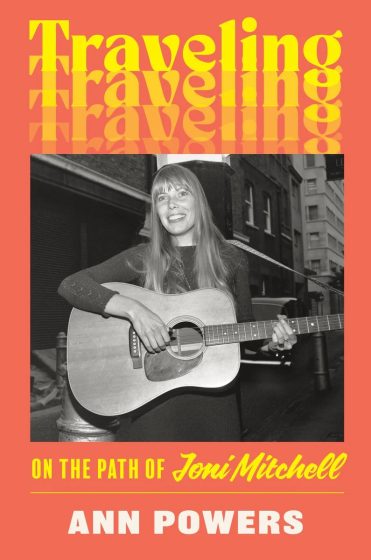
Traveling: On the Path of Joni Mitchell by Ann Powers (Dey Street Books/HarperCollins)

2024 was a big year for Joni Mitchell, with her captivating appearance at the GRAMMY Awards representing another major milestone on her amazing recuperation from her 2015 brain aneurysm. NPR music critic (and occasional BGS contributor) Ann Powers extensively examines the many sides of Joni Mitchell in this stimulating and provocative book. Powers makes it clear from the get-go that she isn’t a biographer and compares her work here to being like a mapmaker. It makes total sense then that Powers entitled the book Traveling. The word not only references Mitchell’s tune “All I Want,” but it also reflects the numerous paths that Mitchell has traveled down during her long, storied career – a journey Powers incisively and insightfully explores over the course of some 400-some pages.

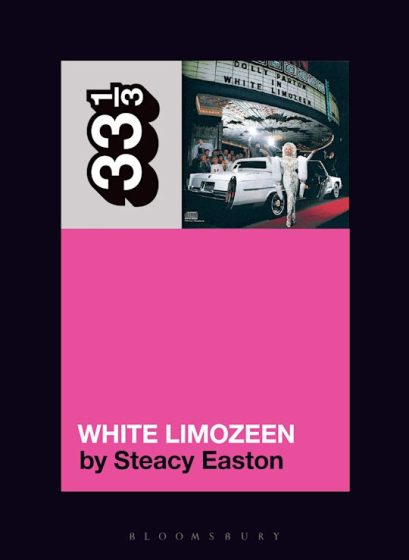
Dolly Parton’s White Limozeen by Steacy Easton (Bloomsbury)

Steacy Easton followed up their Tammy Wynette biography, Why Tammy Matters, by tackling an even larger female country music icon: Dolly Parton. Part of the acclaimed 33 1/3 book series, this compact tome focuses on Parton’s popular 1989 album White Limozeen. Easton views it as a pivotal work for Parton as it represented a triumphant rebound from her roundly disappointing 1987 release, Rainbow. Besides delving into how the Ricky Skaggs-produced White Limozeen found Dolly returning more to her country roots from the more pop-oriented Rainbow, Easton also uses her album as something like a prism to look at Dolly’s wildly successful career and her iconic persona.

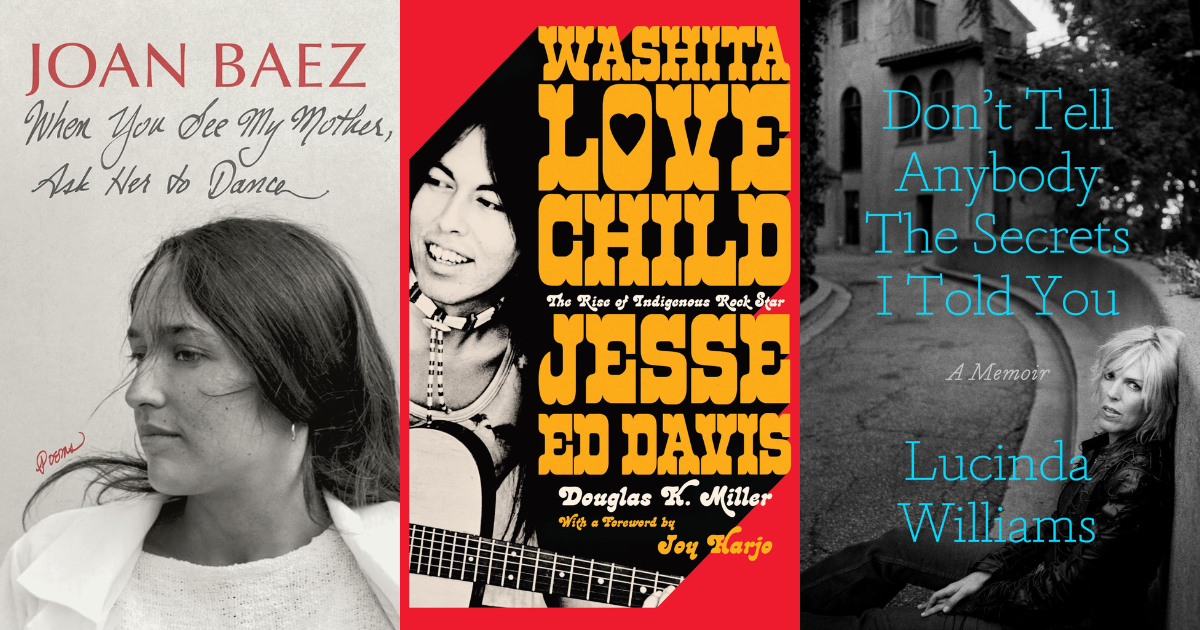
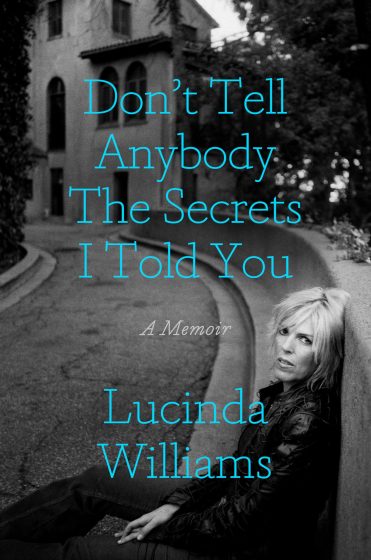
Don’t Tell Anybody the Secrets I Told You: A Memoir by Lucinda Williams (Crown)

Fans of Lucinda Williams’ songs may think they know her through her lyrics, which are often drawn from Lu’s own experiences. Williams’ memoir, however, reveals more about her extraordinary life than even her deeply felt lyrics have expressed. The book is especially strong in covering her quite turbulent childhood involving her father Miller Williams (a poet/professor long in search of tenure) and her mother, Lucille, who suffered from manic depression. Fittingly, Williams prefaces her book by listing the many places where she lived (a dozen before she was 18) which reflects her rootless childhood and set her up for a home in the Americana music pantheon. While the title suggests a racy tell-all, the book feels more like having the great pleasure of listening to Lucinda intimately tell stories from her life – what more could you ask for?

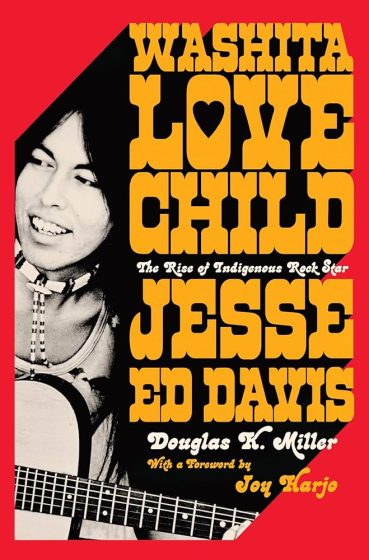
Washita Love Child: The Rise of Indigenous Rock Star Jesse Ed Davis by Douglas K. Miller (Liveright)

Jesse Ed Davis is a name that probably is not familiar to most music fans. Lovers of ’70s rock might recognize his name as a guitarist who worked with the likes of Taj Mahal, Eric Clapton, Neil Diamond, Ringo Starr, John Lennon, and George Harrison (Davis performed at the fabled Concert For Bangladesh). Those who know him from those gigs, however, might not even know that Davis was a rare Native American in the rock ‘n’ roll world. He only really made his Indigenous heritage prominent when he teamed with Native American poet/activist John Trudell during the ’80s in the Graffiti Band. Sadly, Davis’ career was derailed due to alcohol and drug abuse, which also led to his death in 1988 at the age of 48. In this vividly told biography, Douglas K. Miller, a professor of Native American History at Oklahoma State University, turns a spotlight on this ground-breaking and underappreciated musician.

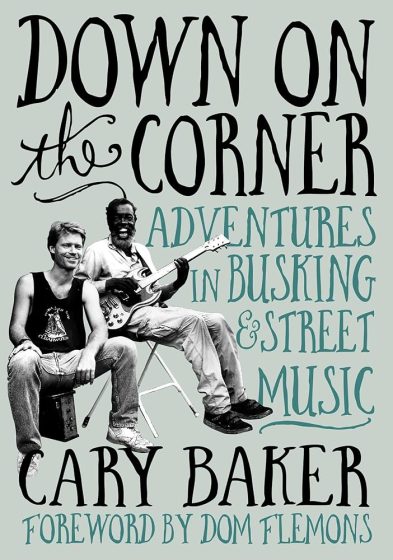
Down On The Corner: Adventures in Busking & Street Music by Cary Baker (Jawbone Press)

For his debut book, longtime publicist and journalist Cary Baker turned to a lifelong music interest of his: street musicians. Early on in this book, he relates the transformative moment when, as a teenager, he was taken by his father to Chicago’s famous Maxwell Street where he saw bluesman Blind Arvella Gray perform on the street. This experience not only led to his first journalism work, but it also launched a love for street music. His enlightening book, which is broadly divided geographically, profiles buskers from across America and Europe. Down On The Corner is populated with colorful characters like Bongo Joe, Tubby Skinny, and Wild Man Fischer along with well-known musicians, such as the Old Crow Medicine Show, Rambling Jack Elliott, Billy Bragg, Fantastic Negrito, and Peter Case, who share tales about playing on the streets.

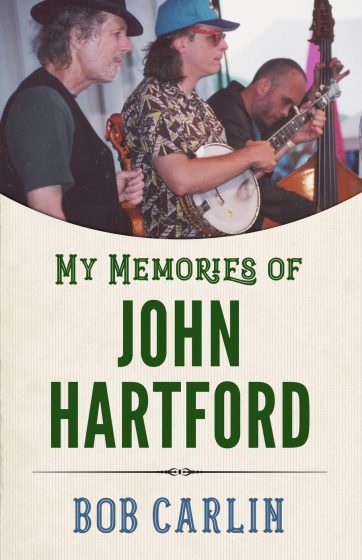
My Memories of John Hartford by Bob Carlin (University Press of Mississippi)

My own memories of John Hartford are of him playing on Glen Campbell’s TV show. He seemed so cool and laidback – and he could play banjo with lightning-fast virtuosity. Happily, Bob Carlin has more interesting memories about the legendary musician, and he comes to this book from a pretty unique perspective. Carlin first met Hartford when he interviewed him in the mid-1980s for the radio program Fresh Air. Carlin (himself an award-winning banjoist) later performed with Hartford and even became his de facto road manager. In his book, he deftly balances his background as a journalist and position as a longtime friend in telling the story of Hartford, who was a true crossover star bluegrass musician of his time.

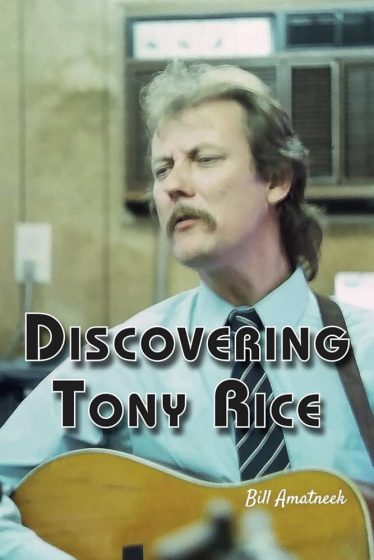
Discovering Tony Rice by Bill Amatneek (Vineyards Press)

Like Bob Carlin with John Hartford, Bill Amatneek has a privileged perspective when it comes to writing about his subject, the late, great Tony Rice. Amatneek, a musician as well as writer, spent several years playing with Rice in the David Grisman Quintet. Rice was one of the best-ever flatpicking guitarists (and a terrific vocalist) whose career was undercut by illnesses and his own personal demons. Amatneek constructed his book as an oral biography, built around stories told to him by fellow musicians who knew Tony, like Sam Bush, Béla Fleck, Peter Rowan, and Jerry Douglas along with Rice family members, allowing readers to discover the bright and dark sides of this bluegrass master.

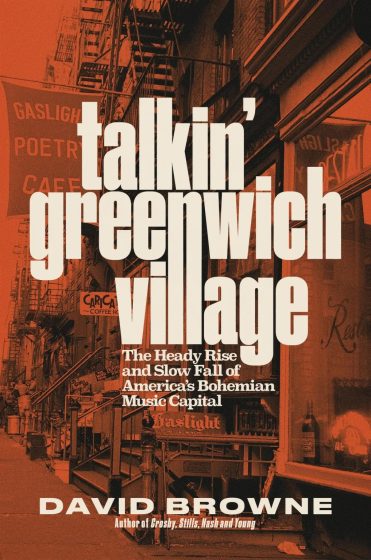
Talkin’ Greenwich Village: The Heady Rise and Slow Fall of America’s Bohemian Music Capital by David Browne (Hachette Books)

As its title plainly states, Talkin’ Greenwich Village discusses the renowned area of New York City that has been a center for bohemian arts culture for decades. The book can be described as a “biography” of both the people (Dave Van Ronk plays a prominent role throughout this story) and the places (particularly the clubs, such as the Bottom Line, Kenny’s Castaways, Gerde’s Folk City, and the Bitter End) that populated the Village’s music scene from 1957-2004. (Browne here basically concentrates on the West Village.) The author of books on the Grateful Dead, CSN&Y, and Sonic Youth, Browne does a masterful job at bringing this neighborhood to life during its many eras. The Village holds a special place in Browne’s heart; he discovered the neighborhood as an undergrad at NYU just as the new folk scene of the early ’80s was brewing. His passion shines through in his storytelling.

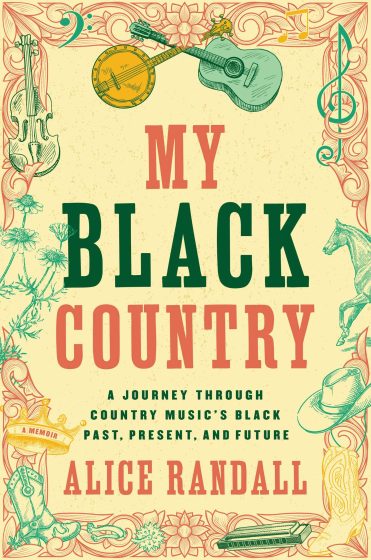
My Black Country: A Journey Through Country Music’s Black Past, Present, and Future By Alice Randall (Simon & Schuster)

You may have already heard about Alice Randall and her book right here, on BGS and Good Country. My Black Country has received great acclaim (NPR listed the book among its “Books We Love” for 2024) and justifiably so. An author, professor, and songwriter, Randall tapped all her talents in creating this inspiring work that addresses her life story and investigates the history of Black country music, which she traces back nearly a hundred years to when DeFord Bailey performed on Nashville’s WSM radio station. It should be noted, too, that this isn’t just a Nashville-centered book; it explores Black country music made all across America. Besides enjoying Randall’s literary creation, you can also enjoy her songwriting craft too; Oh Boy Records released an eponymous compilation of Randall-penned tunes interpreted by such artists as Rhiannon Giddens, Allison Russell, Valerie June, and Leyla McCalla. (Of which, Giddens’ performance of “The Ballad of Sally Anne” is nominated for a GRAMMY for Best American Roots Performance.)

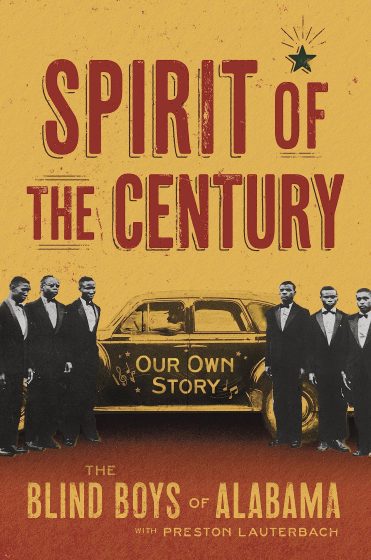
Spirit of the Century: Our Own Story by The Blind Boys of Alabama & Preston Lauterbach (Hachette Books)

The Blind Boys of Alabama are a remarkable story. Remarkable in the sense that the vocal group came into existence around 1940 at the Alabama Institute for the Negro Deaf and Blind and made their way out into the world through the gospel music circuit. And it is remarkable, too, that the Blind Boys of Alabama not only remain a group today (they describe themselves as the “longest running group in American music”), but they have earned five GRAMMYs (and a Lifetime Achievement Award) as well as an NEA National Heritage Fellowship. Preston Lauterbach (author of books like Beale Street Dynasty and The Chitlin’ Circuit) has done an eloquent job weaving together stories from band members and other musical colleagues, and turning them into this absorbing biography.

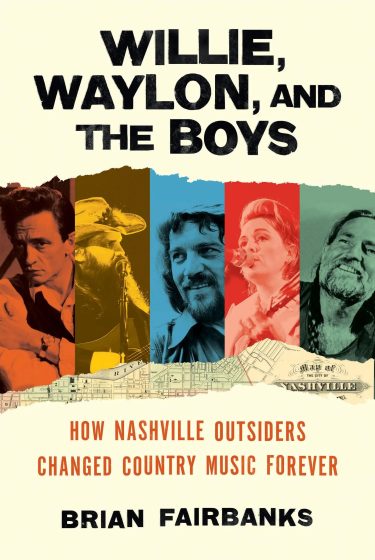
Willie, Waylon and the Boys: the Ultimate Outlaw Country Primer by Brian Fairbanks (Hachette Books)

This book is something of a biographical combo platter. The first nine chapters concentrate on the “Mount Rushmore” of outlaw country: Willie, Waylon, Johnny, and Kris. Those 240 pages are packed with colorful tales of the foursome, whether on their own or together as the Highwaymen. At that point, the book pivots and explores outlaw country’s legacy in the form of the alternative country scene that was burgeoning during the ’90s, as the Highwaymen were ending their run (their third, final, and least successful album came out in 1995). Fans of alt-country and “new outlaw” artists might wish for a deeper dive into this scene. The chapter on “The New Highwaymen” (built upon the idea of guys like Chris Stapleton, Jason Isbell, Ryan Bingham, and Sturgill Simpson as a new outlaw quartet) feels a bit too speculative. Fairbanks, however, is on stronger footing with his “Highwaywomen” chapter, which looks at the actual supergroup collaboration of the Highwomen, featuring Brandi Carlile, Natalie Hemby, Maren Morris, and Amanda Shires that, among other things, countered the male dominance of the original outlaw movement.

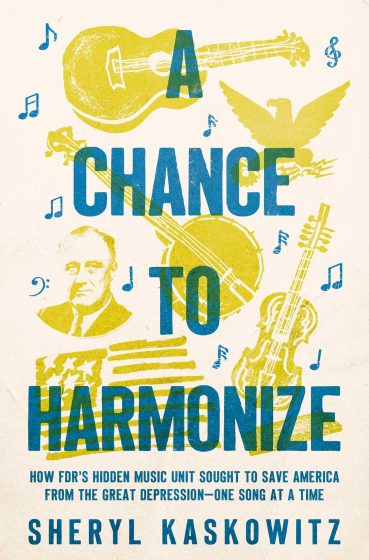
A Chance to Harmonize: How FDR’s Hidden Music Unit Sought to Save America from the Great Depression—One Song at a Time By Sheryl Kaskowitz (Pegasus)

This is a book for history buffs who love music – and vice versa. Author Sheryl Kaskowitz (who previously wrote a book on the history of the song “God Bless America”) has dug up the story on a little-known music unit that was part of the New Deal. This U.S. government program led by Charles Seeger (yes, the father of Pete) sent out musician/agents (noted American ethnomusicologist Sidney Robertson was one prime participant) to gather up folk songs around the country. The goal was to use these songs to build community spirit at homestead communities launched by federal government under the auspices of the Resettlement Administration. The projects were considered radical and controversial back then and, consequently, were very short-lived. Fortunately, however, more than 800 songs were recorded and have been stored away in the Library of Congress.

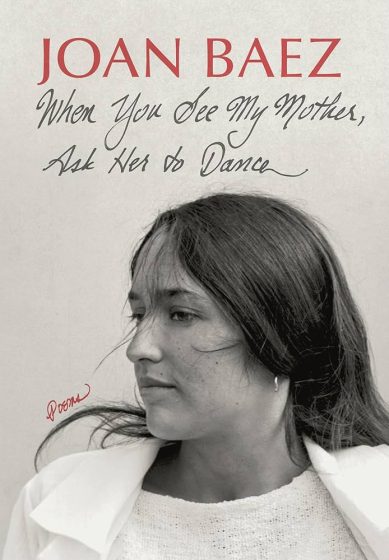
When You See My Mother, Ask Her to Dance by Joan Baez (David R. Godine)

Joan Baez spent over 60 years making music and touring. While she has basically retired from music, Baez hasn’t put an end to expressing her creativity. In 2023, she released a book of drawings and in 2024, she published this book of poetry. There are at least a couple of notable aspects to this poetry project. Baez has long been known more for being an interpreter of songs rather than a songwriter, so it is intriguing to see more of her writer side expressed in this collection. Also, she has struggled with dissociative identity disorder (AKA multiple personality disorder, a topic addressed in the powerful documentary Joan Baez: I Am A Noise). Baez candidly states in the Author’s Notes that some of the poems are “are heavily influenced by, or in effect written by, some of the inner authors,” adding intriguing layers to her creative process – which she displays through the pieces collected in this book.