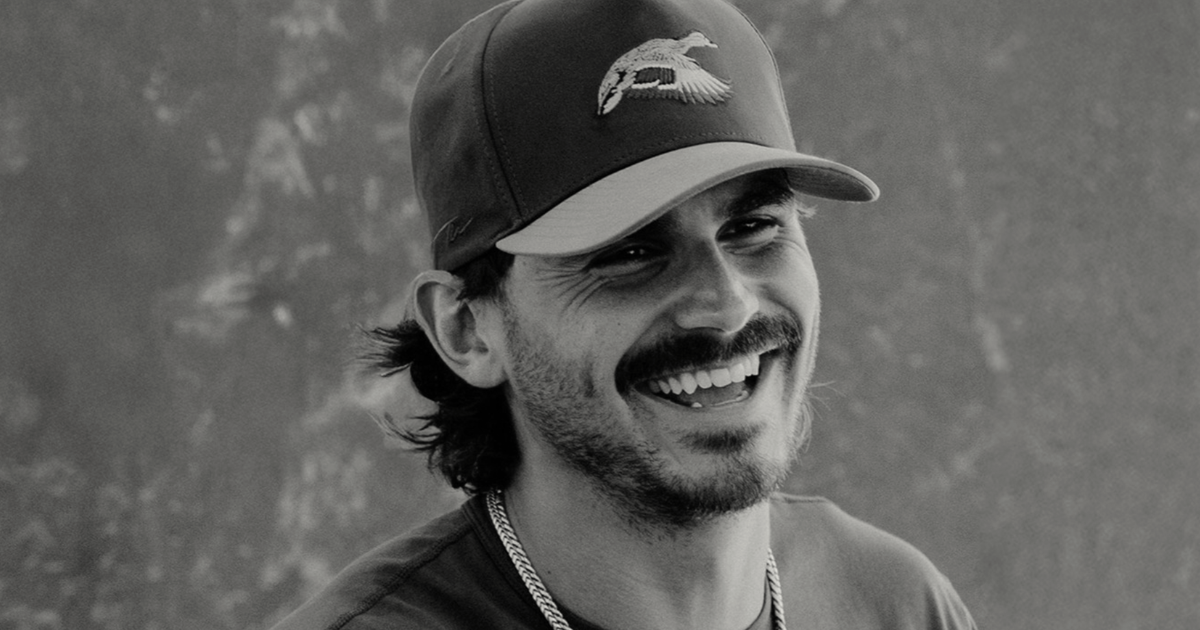
Tucker Wetmore Is Buckled Up for the Ride

If you’ve read about Tucker Wetmore or listened to one of his many interviews, chances are the following subjects were lobbed his way: women, whiskey, blondes versus brunettes.

When the “star-maker machinery” that is the business of music collides with media outlets in search of headlines and algorithm rankings, it can make or break a promising new artist by reducing them to a pretty face with a clickbait story angle, the whole time steamrolling over the singer-songwriter at the core.

Tucker Wetmore is keenly aware of this and proceeds with caution. He’s affable enough to play along and astute enough to know the game. Peel back the layers and you’ll find a thoughtful, hard-working artist rooted deeply in faith and family and with a sense of public image versus personal values, carefully monitoring how and what he presents.

With multiple hit singles, award nominations, over a billion streams, product endorsements and campaigns, television appearances, endless interviews, the 2024 breakout Waves on a Sunset EP, and 2025’s unstoppable nineteen-track What Not To, Wetmore is taking it all in with cautious abandon, savoring the wins as they come.

It’s been a long, hard-fought road in a story now told countless times: he grew up in a small town, was raised in the church, brought up by his mother when his father walked out on the family. Music became vital at a young age, athletic prowess and four state titles led him to college, a severe football injury sidelined his career goals. Back home, he again threw himself into music, moved to Nashville in 2020, and pursued his dream.

On January 25, 2026, Wetmore added another victory to his timeline – this one particularly special, as it brought with it a lifetime of memories. He performed the National Anthem at Lumen Field during the halftime show at a Seattle Seahawks game, in front of a stadium filled with cheering fans.

He was still on that high when he spoke with Good Country only days after – and days before the launch of his Brunette World Tour. “It felt like a full circle moment,” he says of the halftime show. “I’ve been to Seahawks games growing up. I’ve been in that stadium, screaming my face off, cheering for the ‘Hawks. But to be on the field and playing my songs in front of thousands and thousands of people was absolutely surreal, especially for something as big as the NFC Championship. I’ve pretty much seen every NFC Championship since I was born. I was super nervous, but we got through it and we didn’t mess up too bad, so it was a good time.”

You have the biggest country debut album from a new artist in 2025. When did you realize that things were really taking off and it was time to “buckle your seatbelt, because this is happening”?

Tucker Wetmore: I’d say even before the album. The first time I felt like that was when Kameron Marlowe was nice enough to bring me on tour. I had one song out and I hadn’t even dropped “Wind Up Missin’ You” yet. I remember getting onstage at that first show and people screaming my songs back to me, singing every word to the songs I had teased [online]. It was absolutely insane. I was like, “I should probably buckle up. This is getting pretty real.” That’s when I knew I might have a chance to do this.

Can you ever be truly prepared for this level of success?

There’s definitely ways to prepare for certain situations, but there’s curveballs thrown at you every single day, so there’s no way to prepare for that. To put it in sports terms, learning how to sit back on the curve, wait for it to cross the plate, swing, and hopefully hit it.

We know about fan reactions to “What Not To,” and people relating to it from the perspective in which you wrote it. Have you also heard from fathers whom that song is hitting as hard because of what they didn’t do?

I’ve heard stories at meet-and-greets, people spending a little extra time telling me about how much that song has helped them cope. But I don’t think I’ve heard anything from fathers having that realization. That’s a touchy subject, and I hope it moves some fathers to want to be better.

All I can do with my music is write what I’m feeling, produce it the way I think it should sound, and put it out to the world for people to do what they will with it. One of my goals with that song was hopefully this changes some viewpoints on some fathers, and hopefully it helps people learn. It’s a “glass half full” kind of song. It’s saying, “Even though these things happened to me in my life, I can learn from this and use everything as a lesson,” instead of, “Oh, poor me.”

Have you ever fallen into that mindset?

I think we’re all human and we all do it. Not in a really long time, though.

I look at life as an opportunity. Whether it’s good or bad, it’s always an opportunity to learn and grow. I don’t [fall into it] so much anymore, but I remember being young and being pretty upset about some of the cards I was dealt. Luckily, my mom’s great and my family’s super supportive, I’ve got the best friends in the world that think the world of me, and I do the same for them. So I’ve got good people around me to keep my head on straight.

You had to grow up early when your dad left. What are some life lessons you took from those years that apply to your life and career now?

Growing up, I had four sisters and a beautiful mother, so it was a lot of women in the house, but it taught me a lot of things and I wouldn’t have changed it for the world.

There’s definitely times where I thought, “It’d be really nice to go out with another male and throw the ball out in the yard.” But looking back at it now, I learned so much about how to care for women, and how to be a provider, at a really young age, even though there wasn’t much I could do back then. Now I’m taking all those lessons and putting them into real life, like providing for my family, taking care of them, making sure they’re good mentally and financially.

A lot of things I learned at a young age are translating into my life now. Down the road, when I do find that special someone, I want kids someday. I want to build a family and do it right. And so I’d say I’m prepared for when that day comes because I know what to do and what not to do.

In an interview with Billboard, you said about music, “It saved me. It helped me. It was my therapy.” Let’s talk about how music helped you and how it continues to do so.

Music is, in my opinion, the best form of therapy. I think it’s God’s gift to us to be able to create and sing along, or dance, or whatever it is, to a tune. Music has shaped my mindset so much. I started playing when I was 10 or 11 years old and it shaped the way I cope with things. Instead of getting angry or upset or sad or frustrated, whatever the emotion is, I sit down at my piano and I just play for 30 minutes to an hour.

Being creative and having that creative mind, it runs fast and it runs 24/7. It’s … not a double-edged sword, but there’s a yin-yang to it. Music is the thing that drives me crazy because my mind can’t shut up and stop. But at the same time, I was in a write yesterday and the energy in the room was so great for four or five hours straight. We were smiling and laughing and creating the song. So music is my escape from what music does to my brain, if that makes any sense. It helps me ease the craziness of my mind.

During those earlier periods, when music, as you said, saved you, how dark was the darkness?

I lean very strongly on my faith, even during the dark times, and we all get them. I’m the happiest man in the world most days, but I still have days where the weight of the world feels like it’s compressing my spine, in a sense. It’s definitely been dark at times, but I lean on faith and I lean on God, and I lean on my music and other people’s music. It’s easy to snap out of when you have those avenues that are so moving to the soul or the mind.

Has there ever been a time when your faith wavered, or when you questioned it?

Yes. In college … it sounds wrong, and I don’t mean it in this way, but I kind of put my faith on the back burner. I was focusing on other things instead of the most important thing. I was playing football, I was partying a lot with my buddies, I was drinking every weekend to escape whatever it is. I still drink, but I do it with a solid conscience and it’s more celebratory now. There’s a fine line of focusing on worldly things and keeping your eye on the bigger picture of faith and the blessings that God has for us, because there’s so many.

You are giving a portion of ticket sales from this tour to Face The Fight, supporting suicide prevention and mental health treatment for veterans. Why is this the organization you selected to promote and help?

The first time meeting them, I turned to my manager and I was like, “I want a part of this. Let’s find a way to do something.” We put our minds together and it was, “What if we do ticket sales?” I was like, “Yes, a hundred percent.” It’s a huge thing for me because I’ve got a lot of veterans in my family, a lot of men that served and that have given their life on the battlefield.

My grandpa was like my father figure a lot growing up. He ended up taking his life five years ago. He was a very decorated veteran and one of the best people I’ve ever met, but even though it was so many years later, he couldn’t win that battle in his mind.

I think it’s super important to not just shine a light on it, these people that have given so much for our country and the people in it. It is such a selfless act, especially in the heat of war, when you’re fighting for people that you don’t even know, and doing things that no human should do, in my opinion. And then to come home, and 20 or 30 years down the road you’re still thinking about it, and still in that mental space of, “I can’t escape my mind.”

What [Face The Fight] is doing is amazing. It’s a blessing to be a part of. I think if my grandpa had an avenue like that, or knew of an avenue like that, maybe he’d still be here.

In an interview or podcast, you mentioned that you read the comments–

Sometimes.

You must have a really thick skin, because that can wear a person down.

There’s a lot of keyboard warriors out there. I can read the worst comment in the world and it doesn’t get under my skin at all. At the end of the day, I know who I am. The irony behind it is most of the people saying heinous and nasty things online have never created a song. They’ve never sung a tune. They’ve never sat in a room at 3 a.m. because they can’t sleep and put all their feelings on a piece of paper and tried to put a melody behind it. They don’t get it. They see things at surface level. I’m not going to bash on them or say it’s their fault for that. There’s irony behind it and that’s all I take it as. It’s funny to me. It’s almost comical at times.

@tuckerwetmore This one is getting loud live.. #songofthesummer ♬ Brunette – Tuck

I heard you use the words “build your brand” during a podcast. There’s a lot of image in this industry: wear the tight jeans, pose with your shirt up – you know what I’m talking about. How do you make sure this doesn’t overshadow the craft? As a new artist, do you have the autonomy to say no, to not answer a question, to stop an interview, to not want to take this picture?

While building a brand, and while creating something that is larger than yourself, it is more important to say no than it is to say yes. I definitely have the autonomy of saying no, and I do say no to a lot of things that come across the table. It’s saying yes to the correct things that align with not just the goal of what we’re trying to build, or the pillars that we are building it on, but morally. I account for my faith in pretty much all the decisions I make.

If I could give advice to any artist coming up – and I’m still making my way there – my biggest piece of advice is, “Say no to things that don’t feel right or don’t make you look like you.” I think I’ve done that pretty decently. At the beginning it’s really hard to say no to things, because you want every opportunity there is. But now I’m saying no to a lot more, saying yes to the correct things, and trusting my people. They know who I am and what we all want to build together, and it makes it a little easier.

Earlier you mentioned people reacting to song teasers. Before this career explosion, was there pressure to keep up when “everyone” is teasing songs on social media and the algorithm is bombarding people? It can turn into artists chasing numbers, which can also affect your mental health. How did you ride that storm without falling victim to it?

The grace of God, honestly. That’s a tough thing. It’s easy to compare yourself to others, based on a numerical scale of, “This got a million views, and I just posted one that’s got 150,000, it’s not being shared.” It’s very easy to get into that comparison mindset, but I do think it’s important to keep posting your stuff. Luckily, I’m getting to the point where I don’t have to post all the time. Posting is one of the most taxing things to my brain. I can’t stand just sitting there and making TikToks or taking photos or whatnot.

I realize the weight that a viral video can hold to your career and to a certain song or a project. It’s an easy way for millions of people to engage with what you’re trying to create. It’s a great tool. That’s the word I’ll use for it: social media is a tool. Some people idolize it and can’t go through their day without it. I look at it as a tool for people to share my music and hear my music and get excited about the things I’m trying to do.

We can’t do this without talking about your mother. She is such an integral part of your life and your career. Without her support, how different would your trajectory have been?

I don’t think there would be any trajectory at all, honestly. After I got injured playing football and dropped out of college, I was living back home. I remember having that conversation with her. I was like, “Mom, I really want to chase this music thing.” It was like a sigh of relief from her, in a sense. Her shoulders went down, she took a deep breath, she goes, “Finally. Finally. I’ve been telling you this for years now.”

She helped me pack up all my stuff and move, and she supported me financially the first couple years of me moving to Nashville. I would be living on the street if it weren’t for her – metaphorically living on the street, because she would never let me do that. She believed in me before I even had good songs. She believed in my work ethic and my mind and my creativity. One of the biggest blessings God has given me is a mother who cares and wants to see her kids succeed in whatever dream they have.

And now she’s doing podcasts and talking about your childhood.

Yeah. Somebody needs to rein her back a little bit!

You love being on the lake. Is water also a form of therapy for you?

Oh, a hundred percent. I grew up in a super small town, Kalama, Washington. Because it’s built up on a hill, pretty much wherever you are, you can see the Columbia River. I spent so much time on that river, or on the Kalama River, or at the lakes surrounding. I feel happiest when I’m at the ocean or at the islands.

I’ve got a lake house in Nashville and it’s a great escape for me to go back home and be able to sit there and look at the water. It helps not just my creative mind, but [also] my mental health. Another thing God has given us as natural therapy is the beauty of a body of water. It’s the most simple thing in the world, but I do not take it for granted.

Is it a spiritual place for you as well, a natural church?

Yeah. Anything can be a church, as long as you’ve got the spirit in it!

What’s on your heart as you’re getting ready for this tour?

Excitement. It’s been a couple months since I’ve toured and I’m itching and eager to get back to it. I’ve had a great break. I’ve had a very creative break. I finished writing my second album yesterday. Obviously, things change and I get new thoughts or whatever, but right now I feel pretty confident in the songs we got, and I’m excited to get back on the road and maybe tease or play some of these new ones and see how people like them.

And I’m excited to just be on the road. I feel most alive when I’m in the craziness of it all. It does get taxing at times, but it’s truly a drug to not just me, but pretty much all my artist buddies. It’s a feeling you can’t really explain, getting up on a stage in front of thousands and having people scream your creations back to you. It’s the coolest thing in the world. I’m excited to see the fans and be with my band, my crew, and my team. It’s a family that we’ve built, and it’s going to be cool. I’m excited.

Since you brought it up, before we close, what can you tell us about the next album?

It is sonically one of the coolest things I’ve heard in a long time. I don’t want to give too much away. I’ve been doing a lot of thinking about what I want this next record to be for the last year already. I think about what I get in my truck and listen to, and I’m kind of an older soul. So it’s very ‘70s-influenced and early ‘80s, with the guitar tones and drums and weird, synth-y sounding steel guitar licks. It’s really cool and it’s fresh, and I don’t think anybody’s really doing it right now, which I’m excited about but which is also scary, because I don’t know how people are going to feel about it because it is different.

I was thinking about this yesterday, actually: “Proving Me Right” is the perfect bridge into this next chapter, sonically. It’s not too far leaning over there, but it’s still got the old tendencies in it. If you were to listen to anything that gets you excited about this next record, I’d say “Proving Me Right” is a great start.


Want more Good Country? Sign up to receive our monthly email newsletter – and much more music! – direct to your inbox.

Photo Credit: Chase Foster

Southern Avenue: Music for Peace, Empowerment, and a GRAMMY Nomination

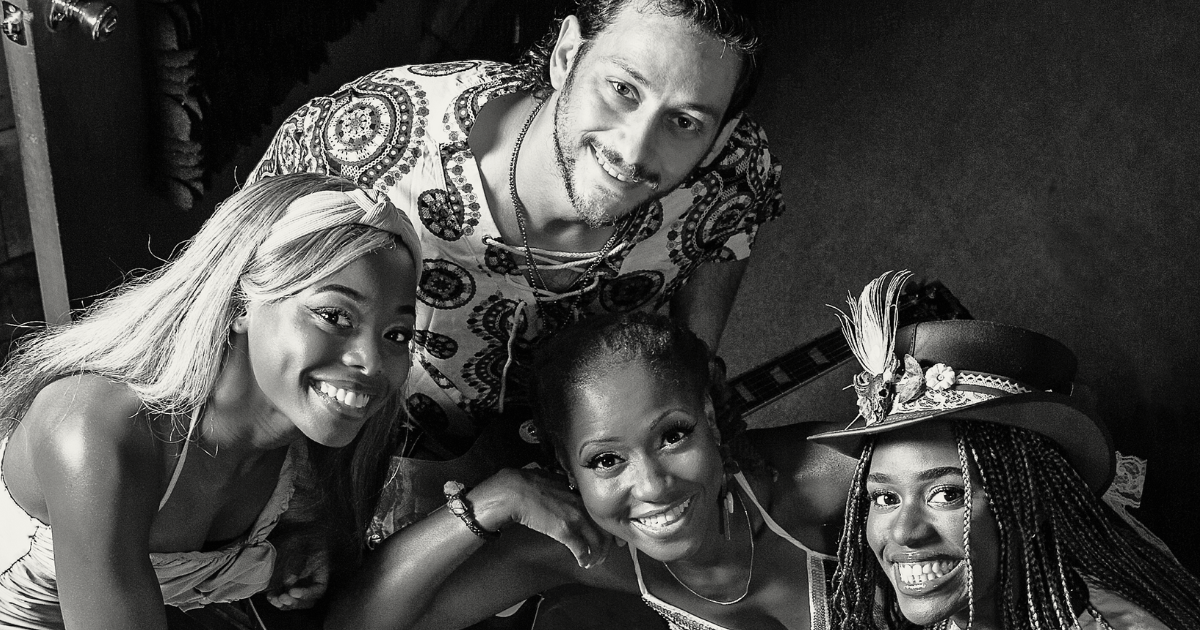
Through joy and sorrow – and they’ve known both in their ten years as a band – Southern Avenue do what they do best: make music. Lead vocalist/songwriter Tierinii Jackson, her husband, guitarist/songwriter Ori Naftaly, and her sisters, drummer/vocalist/songwriter Tikyra “T.K.” Jackson and percussionist/violinist/vocalist Ava Jackson, all reach into their spiritual and emotional wells to tell their stories through song.

It’s there on Family (released in April on Alligator Records), their latest and fourth album. True to its title, it’s a musical journey tracing the band’s personal and professional history. Family was recorded at Royal Studios in Southern Avenue’s home city, Memphis. GRAMMY winners John Burk and Boo Mitchell produced and mixed, respectively.

Southern Avenue write, record, and play with one goal in mind: “We’ve always been a band that speaks about peace and empowerment,” says Tierinii Jackson. “Our music is a place where we can leave the ails of the world outside. We can come together, be equal, and heal.” It’s a noble mission that comes from lived experience and presents in a unique blend of blues, funk, soul, gospel, country, and a healthy serving of guitars.

The rhythmic foundation upon which Southern Avenue is built stems in part from the guitar-and-drums pocket that Naftaly and Tykira Jackson create. “With Ori coming up with really juicy stuff and playing slide, it’s super easy for me to be inspired,” says Jackson. “I feel like what’s actually happening is we all allow ourselves to be creative and truthful to our stories, and we are connected to our ancestors, to our roots, to something much bigger than us. Within that, you get the pocket, because we are locked in.”

Naftaly seconds: “At the end of the day, nothing replaces two people that want to do right by the music, no matter what, and have almost a decade of doing it.”

First interviewed on BGS for Good Country in May 2025, the musicians reunited with BGS just weeks after learning of Family’s GRAMMY nomination for Best Contemporary Blues Album. As requested in their GC 5+5, there were no questions about “how [they] met and how the band started.” You can learn more about that here.

Congratulations on your second GRAMMY nomination. What does this mean to you, musically and personally?

Ori Naftaly: We’re very proud of ourselves, for sure. We felt that this album was special when we were writing and recording it, not just because it’s good music, [but also] because it’s coming from who we are as people. This is the most transparent we ever were. We felt that it is going to resonate. The circumstances for the album are special, and the story behind it. The [nomination] makes us proud because we’ve been so true to ourselves. It confirms our belief that you can create real music, without gimmicks, and it gets appreciated.

Tikyra Jackson: The first time we were nominated [for second album Keep On in 2019], just finding out, in that moment it does something to you that you wouldn’t expect, especially growing up watching the GRAMMYs every year. Five years later, to be nominated a second time, it feels like the first time all over again, because we work so hard.

A lot of times, when you’re the artist, you don’t take time to look at the work you’ve done. You just keep going. With this project being so personal to us, and representative also of our culture and those that came before us, it represents a lot. The GRAMMYs recognizing us also recognizes Memphis in a lot of ways. It gives us hope for the future, that we are becoming the world we live in and not just participants in it; that the world looks like us.

Tierinii Jackson: It makes me feel great. The first time we were nominated, I felt like we had something to prove. We were putting our best foot forward, trying to make everybody happy. But with this project in particular, we really wanted to embrace our roots. It had nothing to do with what people expected of us. It had nothing to do with trying to prove ourselves. It was our time to embrace our lineage, to embrace each other. This nomination is special because it came at a time where we finally found our identity in our journey of self-love. We’re being rewarded for something that’s very, very close to us. We proved we could do it while staying true to ourselves.

Ava Jackson: The previous GRAMMY nomination, I wasn’t [as] involved in the band. I would come in and record background vocals. So the nomination hit, but not as much as it does now. When we found out, my hands were shaking. I had way more involvement in this album as far as contributing to the harmonies, percussion, and fiddle. Having so much of myself involved and getting rewarded with a nomination is something I’m very grateful for. The album is so layered in who we are as individuals and as a family. It’s a triumphant thing to be rewarded and know that you did it wholeheartedly, you put yourself out there, it was authentic. There was so much effort put in even before we stepped into the studio. It’s such a privilege to get a nomination. I’m very appreciative of the process and how everyone has been receiving the album.

In an interview with Rolling Stone, you referred to yourselves as “the spirit of Memphis.” Memphis has a rich musical history … and also a “history.” In those contexts, what is “the spirit of Memphis”?

Tierinii Jackson: The music of Memphis has always reflected the story of Memphis – the struggles, the conflicts, the triumph of being resilient, all the challenges. That’s what we are as a group. We face challenges not only in Memphis, but also in the music business. As young Black women, and for Ori, as a foreigner, we face these challenges, but we turn it into something beautiful.

Our music is uplifting. Our music is positive. No matter what you hear about Memphis and the struggles the city goes through, when you walk into a store, somebody’s smiling at you. You still get that Southern hospitality. It still feels good here. That’s who we are. We are the spirit of Memphis. It doesn’t matter what we’re facing. We come through with this glorious, triumphant spirit. You dance and shout through all those troubles. We have fun. Our crowds – we make sure they’re clapping their hands, and we make it our intention to lift the spirits around us. That’s how you survive in Memphis – by being intentional with your words and how you communicate with your community. That’s how we reflect the spirit of Memphis.

The word “organic” is dreadfully overused, but it’s a bit inevitable with this album. Could you give us some insight into what happens when you create together? Maybe select one track and walk us through the process?

Tierinii Jackson: I would like to start with “Found A Friend In You.” We ladies were raised in church and that was all we knew for years. My father is from Senatobia, Mississippi, and he’s a guitar player. At some point, I wanted to know what the music was like where my father’s from, because I was looking to understand our identity in the blues genre. When I realized that the grooves we grew up playing in church was the sound of North Mississippi blues, we decided to dive in, because that came most natural to us.

“Found A Friend In You” is a Hill Country Blues groove, but it’s also a gospel groove, because blues and gospel are one and the same. That’s what we grew up playing in the church. So, foot-stomping, hand-clapping. It was the easiest to write. The lyrics flowed. The stops you hear right before the choruses – that’s organic. That’s second nature to us. When you hear that “dreadful” word “organic,” [all laugh] it means that when we’re our happiest, that’s the sound you hear, because that’s what comes from inside. That was put in us through generations of rhythms. It’s in our blood.

Tikyra Jackson: Getting into the studio, [there] came organic ideas and things. The tambourines on that song, you’ve got me playing on my hip, and Ava playing as well, and this energy of us being in a setting and worshiping in a way. We’re celebrating. You pull from your environment, and in the environment we grew up in, it was always extra instruments laying around. You just picked up something. In the studio, we came prepared, but a lot was inspired in the moment. When we talk about “organic,” we are so true to the sound and the music that we didn’t have the answers all the time throughout this process, and we trusted that we would find them along the way.

Ava Jackson: We recorded just about everything live and together. We did separate takes of our vocals with separate mics, takes with all three of us on one mic in a booth, and then we doubled all of that. It gives a very dense presence with the harmony. With this song, and in church, we’re hitting tambourines and it’s coming from the Holy Ghost, the spirit, and so you’re hitting it passionately.

What provides the drive in the song is us continuously playing that tambourine rhythm all the way throughout. Sometimes you add rhythmic ad-libs. With the harmonies, it’s like in church – you break out in song and everybody falls into place. I’ll be in the higher range, Tierinii in the mid-range, and TK in the lower range. We break out into that and it continues throughout the song, that reiteration of togetherness and the reflection of how we organically express what we’re singing.

The word “organic”– this style of music is innate for us. You weren’t taught how to do it. You were born into it. The fiddle adds another layer to the harmony and it also feels jovial. So towards the end it’s like you find your way. You’re triumphant. “Found A Friend In You” is like a foot-stomping, hand-clapping, praise type of song, and people receive it that way as well.

Ori, could you address the question from the perspective of guitars within Southern Avenue’s music?

Ori Naftaly: “Found A Friend In You” tells the story of me, Tierinii, and TK meeting and how it felt when we started playing together and finding peace. Past albums were different attempts at “What is the Southern Avenue sound?” When Ava joined full-time, I realized, “We have three singers. This is a family. This isn’t fabricated. This is who we are.” That’s the “organic” we talked about.

We doubled down on what makes us special and that also meant doubling down on guitars. I’ve been listening to Memphis music since I was 6 and I’ve been playing the blues since I can remember. The spirit of Memphis that we talked about earlier also comes from God putting me with Tony Pearson, a Black guitar player from Birmingham, Alabama, for a decade [in Israel], teaching me what it means to play the blues. Many blues purists will tell me that I am not a “blues guitar player,” but the blues is in everything I do; I can’t get away from it. It’s a feeling, not a formula. We play the blues all the time, but we don’t play traditional blues. We play original new music that ends up being blues. So the guitars are a reflection of my existence within the group.

Tierinii Jackson: For years, Ori was the blues guy and me and TK were trying to push the band to be more funk and contemporary. What we’re embracing today, Ori saw years ago. It took us a journey to get to this point where we said, “It’s time for us to embrace our roots and this sound.” We grew up very sheltered, so we were in our rebellious era. We wanted to be rock stars, funk stars, pop stars. We didn’t know who we were. We didn’t know what was special about us. Our fans saw us before we saw ourselves. When we harmonized, they heard the soul, the church, the blues. It took us a while to grow up and ask ourselves, “Who are we?”

When the pandemic set us down and we didn’t have the stage, the crew, the co-writes, and the producers, it was, “Who are we to our core and what can we do?” This is what we came up with. All the tours and festivals that we’ve been through, we haven’t heard anybody do the three-part harmony over the Hill Country grooves. Ori has always been the blues guy. He’s always been trying to get us to see what was special about ourselves. But he also respects us enough to allow us to have this journey.

Given your origin stories, the state of the world, and what you are trying to accomplish – in addition to the stressors of touring, the industry, parenthood, and life in general – how does music help protect your mental health?

Tierinii Jackson: It’s the only tool I’ve had since I was young. I grew up with six siblings. My house was chaos, and I never developed a relationship with my mother where I could talk to her about things and she could give me guiding advice. Music has always been my peace within the chaos. It was always my closest companion. Growing up, I had “friends” at school, but I never had close relationships where I could speak about things. So music has always been my only safe space. When I need to express myself, it’s music that I express myself into. When I need to be hugged, it’s music that will show up in the universe and hit me in the heart. It’s like God’s sign, letting me know I’m not alone. Music is my gift. It’s everything to do with my mental health. It’s the only thing that’s holding me.

Ori Naftaly: All of our albums, we write for our mental health. But there’s two aspects: keeping yourself sane [and] growing spiritually. We do both. We grow spiritually, and we use music as a barrier. We all used music as a gateway when we were kids and as we grew up. We do the same here. We choose to have lyrics that uplift people. If we wrote songs that don’t have messages in them, maybe we wouldn’t touch people the same way.

Ava Jackson: Being raised around music and church, it’s always been a communal thing. There’s always been people jamming and the enjoyment of making music. I think that does provide a certain amount of healing. Music provides release or relief. You hear a song, or you’re singing a song, you’re singing from your heart and soul, and what comes from the heart reaches the heart. Music is where people find true healing and where they can express whatever they’ve been holding in. Music enables you to release all of those emotions or tears. Mentally, I feel a lot better when I’m playing music. If I don’t practice my violin, or if I don’t play for a long time, I start to feel more of a depressive state. But when I do play, I feel that dopamine. I feel the rise in energy and I feel a lot more sharp. To have that at your fingertips is a privilege, and that’s something I know I’ll have forever.

Tikyra Jackson: For me, growing up, music was like drinking water. It was always there. I didn’t know how valuable it was. It was just something I could do. It was music and cinema. We watched so many movies growing up that showed me what the world could look like outside of going to church every day, because that’s really all we did. But in going to church, what did I love about it? The music. Our family was the musicians of the church. My mom was the organist. My dad was a guitar player. My big brother and me — drummers. Then you have the choir. All the girls are in the choir.

Today, music has given me experiences that let me know that as people, it doesn’t matter where you are. We’re all the same. We all want to be understood, we all want to be heard, and we all want to be loved. Music allows me to understand people without having, necessarily, a literal conversation, but a spiritual conversation. Each time you open yourself up in this manner, you evolve, you grow, you expand. Every time you play music, you create new neurological pathways. Within that, I agree with Ava. I have to do this. Music can reach you and touch you in ways that the natural world cannot. It reminds you of what’s important.


Photo Credit: Rory Doyle

50 Years of the Paisley Family Business

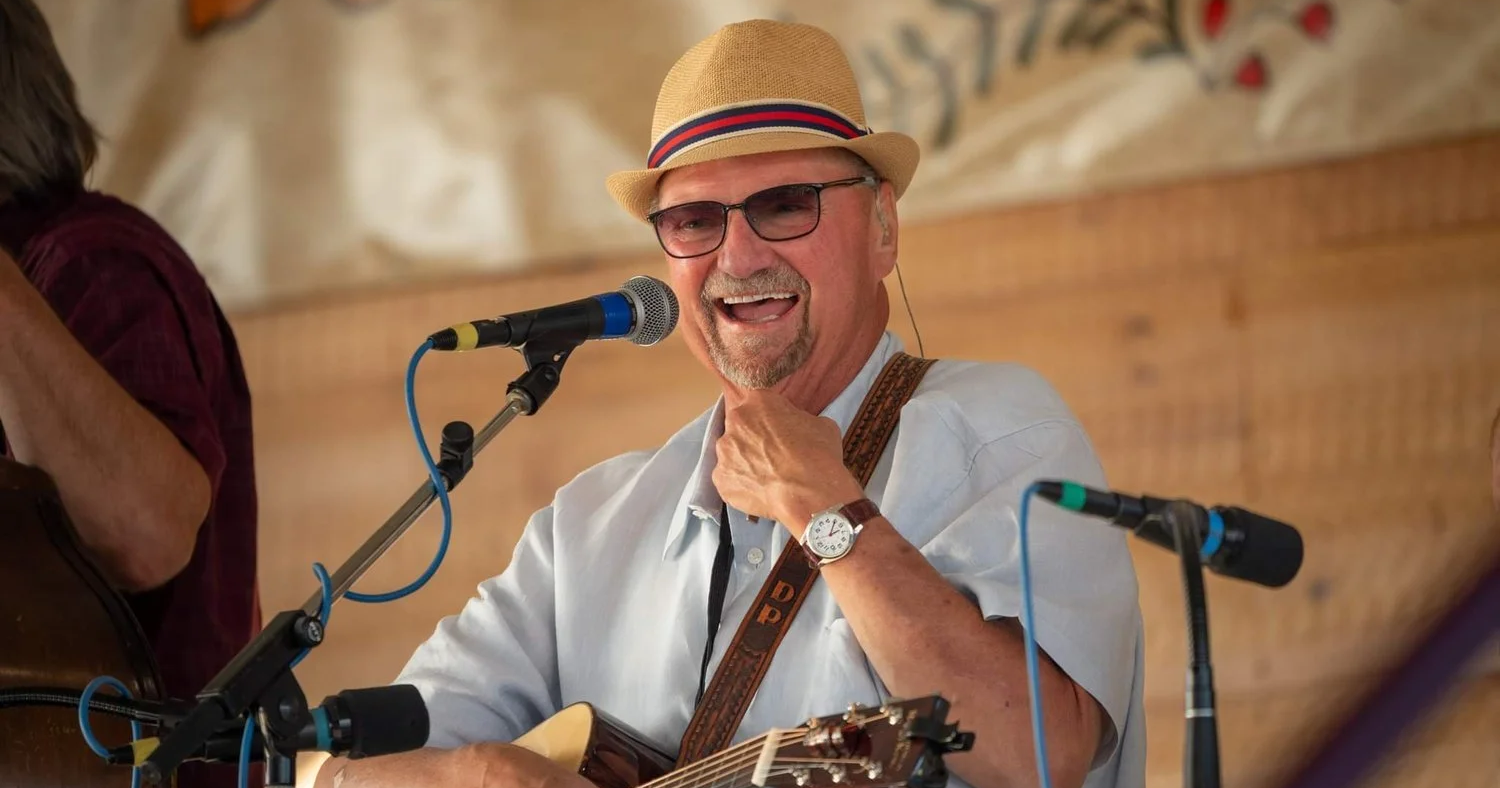
Danny Paisley is a quintessential bluegrass tradesman. He began playing music around the age of 10 and soon after was sneaking into bars and clubs with his dad Bob Paisley, Ted Lundy, and their band, the Southern Grass. Danny was already gigging and touring at the age of 13, and now, five decades later, he’s enjoyed 21 years at the helm of the Southern Grass – with the next generation of Lundys, T.J. and Bobby, and the next generation of Paisleys, his son Ryan, in tow.

Danny learned the bluegrass ropes from his father, crafting and carrying on a traditional sound that draws directly from Bob’s musical foundation but also sounds distinct and personal. When Bob passed away in 2004, Danny had already taken over some of the leadership roles in the band while the elder Paisley had been battling cancer. Danny was determined to continue the group’s legacy, and over the last two decades he’s honored that legacy while consciously expanding it. Along the way, he’s earned four IBMA Awards for Male Vocalist of the Year, while he and the Southern Grass were awarded Song of the Year in 2009 for “Don’t Throw Mama’s Flowers Away.”

His 2025 album, released in May on Pinecastle Records, finds Paisley continuing that expansion, looking for new challenges and focusing in on a fresh sonic sparkle. Bluegrass State of Mind would sound like a straight-ahead traditional bluegrass album to a layperson, but to devoted fans of the Southern Grass, it’s a much more Americana-steeped and forward-looking endeavor. The usual five-piece lineup is augmented by Dobro, snare drum (gasp!), and a healthy dose of “what if we tried… this?” all across the project.

The result is charming, engaging, and downright excellent – it’s one of the finest bluegrass albums of the year, to be sure – showcasing how Paisley’s longevity is built upon a keystone of innovation and looking to the future, rather than being entrenched in the past. For someone who sounds entirely dyed in the wool and is held up by chair-snapping traditionalists as well as jamgrassy rebels, any level of “coloring outside the lines” of the genre would be remarkable. But Paisley isn’t stopping at new challenges and fresh sparkles; he wants to take his Bluegrass State of Mind to as many brand new audiences as he can find.

Fifty years into his career, Paisley is not resting on the assumption that he can keep performing and plying his trade by doing the same ol’ same ol’. No, Danny Paisley & the Southern Grass are still committed to bringing the bluegrass they love and hold dear to anyone and everyone who may enjoy it, by showing folks this kind of music can be for everyone. All the while, he’ll be turning over plenty of new leaves and passing along the family business in real time, too.

We caught up with Paisley at the Industrial Strength Bluegrass Festival in Wilmington, Ohio, between sets, when he and his son Ryan sat down with BGS to chat about his most recent album, what he wants to accomplish next, and the absolute unforgivable sacrilege of including drums on Bluegrass State of Mind.

Right on the album cover for your latest project it says, “Celebrating 50 years of bluegrass music.” To me, you’re a bluegrass tradesman. It’s very clearly your trade, it’s what you’ve done your whole life, and it runs in the family. It began with your father, Bob, and is continuing in the next generation with your son, Ryan. Can you talk a little bit about the meaning that you’re holding right now at 50 years, as you put together this record and were thinking about that anniversary, and that longevity?

Danny Paisley: I didn’t want to do a record rehashing old favorites. I kept hearing different songs and I kept saying, “I want to try this,” just for me to try this new approach. A “new challenge.” We recorded it and some of ’em were not standard Danny Paisley-type songs, but I felt they were awful good songs and I wanted to try it.

So Ryan and I worked it out, and he come up with a different approach for some of the tenor lines I would’ve sang previously. Now Ryan is singing them, so that added a different flavor. We just tried to sparkle the music, just to tweak it.

We added a Dobro for the first time, only ’cause I kept hearing it through so many of the songs. I’m more of a fan of the newer approach to Dobro than the older school. Mike Auldridge was the one that turned me [onto it], the way he was getting tones out of a Dobro.

You’re 50 years into doing this and have such an established sound as your own frontman, your own bandleader. People see you as so solidly traditional, but for you, five decades in, it’s clearly still important for you to turn over new leaves, to find that sparkle you’re describing.

Because I was feeling… maybe I was [feeling] stale, and after my health issues, I felt I really need to do this – for maybe a couple years, now. I regret that I didn’t try it [sooner]. So I tried it and I loved it. Had a great time, had a great producer [Greg Cole] and great help with Ryan and his influence and I think it’s a great CD. Different approach.

You’re still looking for new challenges and you’re looking forward. Obviously, with this record, with the way that you operate as a musician and a creative, you aren’t just somebody that’s like a lot of bluegrass people, with one foot in the past, one foot in the future.

Right.

Looking ahead – ’cause it seems like you’re looking ahead right now – what are the goals you haven’t done yet? Or the bucket list items you haven’t checked off yet?

I want to take our band – and this is a real goal – to reach other audiences. I think there’s a real audience and a real needing, almost, at some of the more jammy festivals. And we’ve done ’em and I’ve realized it really works well, presenting a straight-out, hardcore bluegrass band. We pick out songs that sort of go to that crowd, but we just play ’em in our style and we try to keep it upbeat, just to draw people in for a new audience.

I know the music has gotta move on. I’m a firm believer of it. We revere the past, but we look to the future – and I’m in that category. I look to the future, but I love the past. I don’t want to dishonor it, ’cause it’s the music I love and feel. It’s what’s inside of me. That’s the music I love.

So that’s my goal. I want to bring it out [to new audiences], and I really feel in today’s world, you’ll have to adapt things, but I really wanna make it traditional bluegrass. There’s a real audience for sincere, true bluegrass.

It makes me think of how we have Molly Tuttle, Billy Strings, and Sierra Ferrell–

Exactly.

All who are, at their core, traditionalists. So they’re shining a light on the folks who sound like you. I definitely think there’s space for a band like you in that constellation.

And Billy loves hardcore bluegrass! But he made it an event. People will pay money for an event. He puts it right down in their faces with some straight-out bluegrass, and it’s great.

Our mutual friend Jon Weisberger always talks about how one of the most valuable things you can do as a bluegrass band is to be the most traditional bluegrass band in a non-traditional space. The music can stand out for what it really is and doesn’t fade into the grayness of it all being the same.

There’s so many traditionalists who don’t want any variation, which I respect. We all do. I wanna revere that. But we also gotta realize these people, young folks today, are not coming into the music. With all the outside influences and modern day [stuff], Facebook and all the different Instagrams. [Laughs] They’re not coming into the music the same way. We need to respect that and bring it to them and bring them in.

We can’t expect some young person that’s just getting into music, that’s 18 or 19, to be really drawn in by singing another cabin song. We sing cabin songs, but we can’t [only do that]. And we’ve all had heartbroke and there’s a world of songs about heartbroke. Your lover has passed or left you, boohoo! We have to present it in a fresh way. And meet people where they’re at, for sure. That’s the best line, that’s truly it. And I’m a firm believer in that.

I fully believe in the intrinsic charm of bluegrass. I think everybody’s a fan, they just don’t know it yet. So if you can reach them with music that doesn’t show them or tell them that they’re not allowed to like bluegrass, it happens. Bluegrass can feel exclusive. Or it can feel like, “Oh, that’s music for other people, not for me.”

“Not me,” yeah! Or, “I’m afraid.” “I’m not sure that’s good enough, or that I would be accepted.” Or, “I hear it, but I don’t really want people to know I like it.” Because that stereotype has to go! It has to move on. It’s music for everyone. I don’t care what kind of music you’re in, music is for everyone. And you have to accept that or live in your little corner of the world and think everybody else is wrong.

I’ll probably get in trouble for that. [Laughs]

No, no! But speaking of traditionalism and traditionalists… so, bluegrass drums, huh? [Laughs]

Uh huh! [Laughs]

You’ve got bluegrass drums on the album. And what a lot of people don’t know – maybe our audience on BGS will know – but a lot of people don’t know that bluegrass drums are a traditional bluegrass instrument. I hear the “sparkle” and the difference in these songs, but I also still hear you. It sounds like your personality.

What my approach and my thought is, is I want it to still be me. I’ve had some people criticize it and say they didn’t appreciate that drum. Why? ‘Cause it was listed? [Laughs] It’s there to add some rhythm. And it was only there for a little sparkle, a little snap. And a little rhythm. If you didn’t really know it was there and we didn’t tell you, you probably wouldn’t know it. There’s nothing wrong with that, no. Drums are in a lot of bluegrass.

Exactly. We could list the folks who’ve had drums: Bill Monroe, Jimmy Martin, the Osborne Brothers, J.D. Crowe – the list goes on and on and on.

For you, as a traditionalist, straight-down-the-middle bluegrasser, this album is a few clicks towards Americana. But if you played this album for an Americana audience, it would just sound like traditional bluegrass.

It would be traditional bluegrass, yeah. I’m gonna draw those people in. That’s my goal.

The album sounds so warm and live. You know how bluegrass records nowadays, especially the ones made especially for satellite radio, all sound really compressed. They sound canned and sometimes stale. This album feels really warm and live and fresh.

I think ’cause they all want radio airplay. They have a certain– I don’t know the technical way [to describe it], but sometimes you start compressing the music too tightly. You miss guys like Jimmy Martin who threw his voice real up there and really stood out on a certain line. He popped –I call it popping – he’d pop his voice and stuff. It might have been there, but then they compress it with the recording or the engineering. I try to not let that get too overtaken in the music, even in straight bluegrass, ’cause that adds energy and life.

I do wanna talk about some of the songs on the album. I love these three in the middle: “Diagnosis Broken Heart,” “Two Old Church Pews,” and “Cream in My Coffee.” Let’s start with “Diagnosis Broken Heart,” ’cause that one, I think the sparkle and the challenge you’ve been talking about is there.

We had it recorded and I didn’t really like it. I felt it didn’t really work. So we redid it after we had it all done and mastered, we redid it. That’s a different approach for me. I said, “Let that sink in.” And after it sunk into me, I go, “No, I don’t wanna do it that way. I’m gonna go back and just sing it my way.” And that’s what I did. Then that one, we added the snare. I wanted a little pop – and the groove on that one is great. We brought the tempo up and that one worked.

The most challenging song was “Cream in My Coffee.” David Stewart wrote it along with some other gentlemen and David kept saying, “I want you to do this. I hear this.” And I kept saying, “I do too, but I don’t know if I can.” And so there’s your challenge!

So I did it and it wasn’t right. We’re in the studio and David Stewart’s there and he’s telling me how to do it and I’m not doing it the way I hear it. I’m listening to the way he’s singing it and I go, “I can’t really do it that way.” I’m listening back and forth. Finally, David comes in the studio and he says, “Think of a marching band.” We did a take and next thing I know he’s standing in the [control] room while I’m doing the vocal and he’s in there marching. [Laughs]

More people come and say, “I never thought you would record the song like that,” but I love it. I said that was a challenge, but it was a good challenge.

I also wanted to talk about “Two Old Church Pews.” Can you tell me about where that song came from? That line about how a church is wherever you are, that really resonated.

That was the major part of that song that grabbed me! That song was pitched to me by Brink Brinkman and Daryl Mosley. They sent it and I immediately said, “This is beautiful.” I said, “This wraps up basically how I feel.” You can talk to your deity wherever you are. Some people need to go to church. Some people just go out, have a quiet moment, and sit in the yard or a quiet spot in the house. That’s how I believe. And the two old church pews were [the singer’s] church. He took ’em home and he sat there and he would talk to the Lord in that way.

That’s how I feel and it’s a beautiful song. It rings thanks to Ryan and Greg. It come out excellent. And that’s probably the most traditional feeling, one of the new songs on that CD.

I love the text painting of it. It really feels like you’re seeing the imagery.

That’s what I tried with my singing. Tried to present that way. And the wording of it was excellent. That’s a once in a lifetime song.


Photo Credit: Shot by Rob Wasilewski, courtesy of the artist.

Caroline Spence in Conversation With Lori McKenna

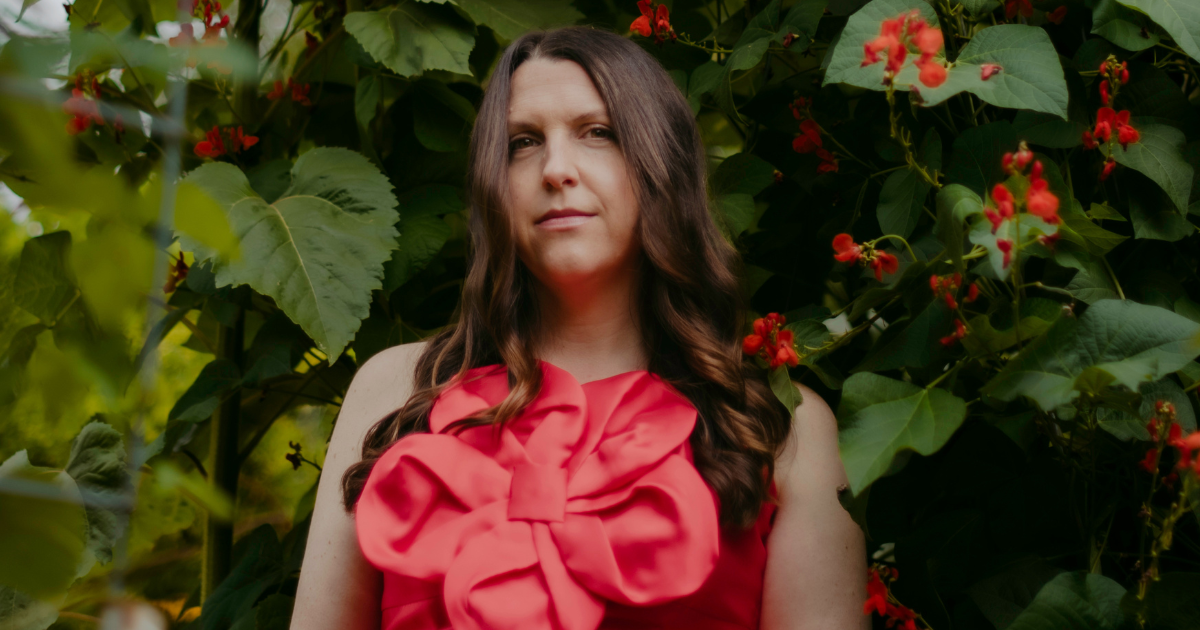
Caroline Spence and Lori McKenna are both lauded for writing songs that cut straight to the heart. In conversation, it’s clear they also share admiration and a generosity of spirit, offering insight into how a life built around family can both coexist with and deepen a life in music. The two met with BGS via Zoom to discuss Spence’s new record, Heart Go Wild, produced by Peter Groenwald, Mark Campbell, and Spence herself.

As Spence charts her first year of motherhood, McKenna reflects on building a catalog of piercingly honest songs while raising five children of her own. Together, they explore the mysteries of publishing, the influence of mentors like Mary Gauthier, and the butterfly effect of one songwriter’s choices on another’s path.

Their exchange drifts from songwriting craft to the role of co-writers in self-discovery into the bigger questions of life: how family and creativity intertwine, how community ripples outward, and how songs become offerings that carry meaning long after they leave the writer’s hands.

What emerges is a portrait of two artists at different points along similar paths, each proving that family life and creative life are not competing forces, but intertwined sources of inspiration and strength.

I know you two have a lot to talk about, but I’d love to start, if we can, with how you know each other? Did you know of each other musically first, and then how did you come to know each other personally?

Lori McKenna: I think the first time we met might have been at breakfast that time?

Caroline Spence: Right. I think that was another Bluegrass Situation connection. I think that was the first time I met you.

I had a good friend from summer camp and we would often trade mixes. She put one of your songs on a CD for me. I had already found Patty Griffin and was having my singer-songwriter love affair. That led me to The Kitchen Tapes, which led me to everything else. And I distinctly remember when Faith Hill cut “Stealing Kisses” and I thought, “Wait, that’s how that works?” I didn’t know what publishing was. I didn’t know how music worked in that way and that became a new little baby dream of mine that I carried with me: to write a song that was good enough that maybe somebody else would want to sing it. I feel like I would not be aware of the job that I have had I not found you, Lori.

LM: That is really cool. I remember not knowing anything about publishing, how it works and all that stuff, too. And I still feel like I know just a tiny bit more.

CS: I know, totally. It’s still a mystery.

LM: We were at a wedding over the weekend and my son Chris, who’s a writer in town, has his first single that he co-wrote that’s going to radio. So we were singing songs and at the end of the night, my brother was like, “Chris sold the song!” I’m like, “It’s not called selling the song.” He’s like, “Well, how does it work?” Nobody knows.

CS: Yeah, nobody knows. They just stream it now into the abyss.

LM: The only reason I knew anything was because of Mary Gauthier. I did know people who had moved to Nashville before Mary, but because I’m in the Boston area, they came back saying, “Yep, it’s very different.” It is very different in Nashville. I didn’t know anyone who had stayed before Mary, you know? I love being inspired by other people. I love it that that’s how life works, that you see someone else do something, and you’re like, “Wait! I can do that! At least I can try!”

CS: I’ve been thinking about that a lot lately, the butterfly effect, and how that happens within our community. Like, if Mary hadn’t done this, then this wouldn’t have happened for you, and if you hadn’t done that, then I wouldn’t have known about this, and I’ve been thinking about that as I’ve been in this creative community for a decade now. There’s so much stuff that you never know your little ripple is doing.

LM: The ripple is such a good word. It’s such a ripple, isn’t it? It’s crazy. We’re really lucky. I know you just had a baby, but the number of people that come up to me and ask, “How did you do this with kids?” Nobody told me that I couldn’t. I know stories of other artists that someone’s told, “You can’t do this and have a family at the same time.” I’ve heard those stories, but nobody ever told me that.

It didn’t seem impossible at the time. But now my son Chris has a baby. I look at them and I’m like, “Wait, how does anybody do that ever? How does anybody have a baby?”

CS: Man, some days it really feels that way. Most days it feels that way. No one ever said that to me either, but those are absolutely the cultural messages you absorb. There are certain gigs I might not get because of my familial obligations, but you just make your choices. And I’m not building my life around what I “might get.” I want to build my life around what I know I want to have. I just feel like all of that is gonna feed your person. You can’t starve yourself of these big, beautiful growth opportunities for some sort of potential. My life is bigger than my career, and I would like it to be as big as possible.

LM: And it’s crazy, right?

CS: Yeah, it’s nuts. Absolutely nuts. The fact that I got a shower this morning is a big win.

LM: Well, that and the fact you’re putting a record out!

CS: Yeah, yeah, and the record!

LM: You did good.

CS: It’s a little bit cuckoo, but it’s been done for a while. A lot of the heavy lifting was done even before I was pregnant, so that was an accidentally smart idea and we’ve just had to be strategic about everything else. I feel like there’ll be a lot of people who assume this is a record about marriage and family, which it’s not. I’m sure I will have that, but this feels like a record that’s more about the chaos before I decided I could do all that.

LM: From the minute I knew who you were, I’ve always loved the way that you express your feelings in such a way that makes other people be like, “Oh! I’ve felt like that! This song makes me realize that I’m not alone in feeling that.”

There’s something in the way that you write that is like arms are reaching out, but they’re also like, “I know you feel this way, too and it’s okay that we all feel this way.” I feel like that’s why music exists. For someone pulling over their car and being like, “Oh my god, okay, I’m not gonna die today because I just heard the song!” It is the biggest reason, the service of songwriting, as Mary Gauthier says. You don’t do it consciously, but it just is your way of doing it. It just seems so innate in the way you write.

CS: That’s so kind and means a lot to me, because that’s really how I feel about it. It’s been a progression. I started writing because I needed to get these hard things out when I was a younger person and as I started putting those out there, I would have conversations where someone would say, “I feel that way, too.” That kind of cemented in me to keep writing from that place, because that’s what music did, and still does for me.

What is personal is universal. I feel like someone smart said that before I did, but it’s so true. And Mary’s perspective of songs as a service resonates so deeply with me. There’s a quote I read when I was doing The Artist Way a few years ago that says, “The artist has to be humble, for he is essentially a channel.” To let the divine in, whatever it is, to flow through you, you have to get small and get in your humanity.

And when I’m feeling really in my head and when I don’t want to perform or I’m feeling self-critical, I think about what I’m doing as an offering, and it makes me feel better and more inside what I’m trying to do.

LM: I love the offering.

CS: People want to feel understood. As a listener, you want to find your soundtrack for your hard time or your good time.

LM: Well, congratulations on doing all this, because the record’s beautiful, as usual. You co-produced this whole thing, right? Did you always co-produce? Because this record seems, and I hate to use the word “rockier,” but it feels like it moves a little bit more. Was that intentional?

CS: I think a lot of that might sort of be a songwriting change for me. I feel like I’ve gotten better at translating what I’m hearing into the actual thing, so I think that’s a skill I’ve slowly developed from my slow folk songs for years.

LM: The transition is so beautiful. With the song “Soft Animal,” if I wrote that song, it would be just the slowest. It wouldn’t move the way [it does].

CS: It totally started on the page, too. It was very much like a poem. Sometimes I sit down to a piece of writing, if I’m going through my ideas, and if something’s sort of dead on the page, I’ll just start playing. That one was one where it sort of just came out that way. The clash of “Soft Animal” to something that felt really thrashy, the irony of that felt celebratory to me, and it was fun. That’s one of my favorites production-wise on the record.

LM: Oh, that’s great. When I work with a producer, you can tell. You can listen to the record and know that this is definitely different. But there’s been this really consistent line with you the whole time, which is kind of remarkable when you think about how much you’ve changed in life and as a person over the years. There’s this vibe that really just comes through where you can tell that you are a big piece of the production of everything.

CS: Thank you for saying that. That was actually a dealbreaker thing for me for this record, that I would only work with people who would give me a production credit, because I felt like over the years – and not to discredit the people who are credited as producers on my albums – but because of who they are as producers, it was collaborative, and there were times when I was making sure that my vision got to the finish line in spite of their initial instincts. I didn’t know it mattered to me until maybe I’d read some press that would bring that person’s name into it and it made me feel a certain way.

Producers are important because I think it’s really helpful to get outside of yourself and your own instincts, and to be challenged. But sometimes what’s helpful is to be challenged, and then you know exactly how firmly you feel about something.

For this record, I really wanted to know that it was collaborative from the jump. That felt incredible, and I worked with two people who had the best energy and a healthy sense of ego, and it was just really fun.

LM: That’s awesome. You come through. I’m exactly the opposite, because I can’t stand being in the studio.

CS: I understand that as well.

LM: I don’t know how you do it, because I literally only hear the song and what it sounds like when I sit at my kitchen table and sing it. People kept telling me over the years that I’d start to hear parts. So I am a person who needs producers… I’m just like, “Here are the songs.”

CS: Yeah, I’ve done that so many times, I’ve given a pile of songs and been like, “I don’t know what I made. What’s speaking to you?”

LM: Well, this morning I was listening to the album again, and I thought, “Oh, she’s gonna produce other people’s records someday.”

CS: That’s very kind and, honestly, a thought I hadn’t really had for myself, but I really did enjoy it. I think if I ever do that, it’s gonna be because of the experience I just had with these people that built up my confidence in that space. It was a lot of fun.

LM: You have this beautiful voice. I have an unpretty voice and you have a very pretty voice that you know how to use really well. You can say the hard things with that beautifully well-orchestrated production and then your beautiful voice, and it still makes you feel all the feels, versus I always feel like no matter what I sing, it’s gonna sound sad.

CS: I feel like a lot of the time I try to be like, “I’m not so sweet,” and grit up the production or avoid certain songs. I was self-conscious about it, which I think may be some internalized misogyny, because I have such a high female voice.

Speaking of songs being of service, babies and children come out singing, you know? It’s such a natural thing to do. We’re meant to do it. It’s joyous; it’s a release. And knowing the way it feels in my body to perform or really sing has changed the way I perceive my own voice.

LM: It is the first thing anybody knows how to do.

CS: Your voice has this wisdom to it. It kind of doesn’t matter what you’re singing; it sounds like you believe what you’re saying and you trust what you’re saying. You have this earnestness to your voice. If you were singing “Red Solo Cup” I’d be like, “That song means a lot to me.”

LM: I actually was at a round at the Bluebird [Cafe] with the Warren Brothers a couple of weeks ago, and they sang “Red Solo Cup.” I am so jealous of songs like that, because I could never write them.

In terms of writing for you, how have things changed since the baby?

CS: I haven’t had the same amount of headspace. My publisher held a sync camp and my mom came to town to help. I wrote for days straight and that felt really good to get back at it. As far as writing by myself, that’s just now kind of coming back.

LM: Is your son enjoying you playing the guitar?

CS: It’s a pacifying thing. I could put him in his playpen if I want to and mess around on guitar, and he’s super happy to listen. The other day, I was practicing for this Springsteen cover night that I got asked to do and I just started kind of riffing around. The flow started and that felt really good. I was like, “Oh, okay, it’s still in there.” I just hadn’t had the circumstances to put myself in the position where I’m visited by that energy. Being in creative spaces with others has been really nice right now, too, to slowly rebuild.

LM: When my kids were little, I actually wrote a lot. They all shared a bedroom and, after dinner, my husband would work on the house while I tried to sing them songs – sometimes terrible ones – or make up songs while they fell asleep. That routine gave me more time to write than I expected.

Two of my kids are songwriters now, though at the time they probably went to sleep just to get away from me singing the same line over and over. But honestly, if I hadn’t had that hour and a half every night with them, I don’t think I would have learned how to write. I wasn’t planning to be a musician. My children gave me the time and space to discover that.

By the time I had five kids, I started doing open mics. I never would have had the courage to get up there if I didn’t have my kids. They were my world, so if people didn’t like what I did on stage, I could always just go home and sing in the living room with them. That gave me the confidence to try.

CS: That balance is so important and it’s hard to reverse-engineer for people. If you move somewhere completely career-focused, you can get lost in that and miss the balance of family and partnership. I feel like any sense of longevity in life or career needs that.

For me, I’ve realized that to be a happy, well-rounded person – good partner, good friend – I need a rich family and personal life. Otherwise, my career just eats me alive. I think the reason you’ve been able to sustain your career and create a catalog of songs full of humanity is that you’ve always had that balance.

LM: Exactly. And it’s not just a woman’s thing. I know men who do it, too. But when you put family first, you have to say no to some things. You can’t always do that week-long tour, for example. But the things you say no to fade away; you don’t remember them. You only remember what you did. Instead, you stayed home and sat in the backyard with your kids and that’s the summer you wrote that one song that you’re still singing years later.

Love is supposed to be the thing you surrender to. It just opens up the universe wider. I’ve seen it happen again and again; even songwriters who know exactly what they want in their twenties, after falling in love or having a child, the world opens up in new ways.

CS: That’s making me emotional. That’s exactly where I am right now. I feel like my life is starting in a really good way. My career feels like it is starting over again. It is making me recalibrate how I want to show up in the world. And it’s freeing to have my compass aligned around my family. It feels like a new beginning. It’s really beautiful.

LM: That’s exactly it. Parenthood gives you a stream of love you hadn’t experienced before and it changes everything creatively. For me, it didn’t really happen until my fifth child, but it always happens. The universe shows up when you do something hard, like having a baby. I remember putting out a record in May, right around the birth of my son, David. By Thanksgiving, I had Faith Hill cuts. It’s like the universe says, “We should remind her that she gets to keep doing this.”

CS: That really resonates.

LM: I always listen to the last song on a record first.

CS: I love that because some of my favorite songs on your records are the last songs.

LM: When I heard “Where the Light Gets Through,” that song is such an offering, such a service. I don’t know if you want to talk about where that song came from, but years from now you are still going to have people tapping you on the shoulder saying “thank you” for that song.

CS: We’d made the record basically and we couldn’t figure out the last one. I said to the producers, “What if we write this one together?” Mark and Peter started building the track. I was going through ideas and I’d been writing a lot about my brother-in-law’s passing away. It just so happened that something I’d written fit almost exactly word for word and we shaped it from there. It couldn’t have just been me on that record, because it needed to feel lighter than I wanted it to.

LM: I know exactly what you are talking about. That’s why I love co-writing. You get perspectives that you could never create alone. Sometimes you can’t do it by yourself, and the song only exists because of that.

I’ve had that experience with Liz [Rose] and Hillary [Lindsey]. I had a song I’d been trying to write for a month by myself and I was so mad I couldn’t. I showed it to them and Liz was writing and singing it immediately. Hillary was like, “Do you know this song?”

CS: Do you feel like that is possible because you know each other so well that they can meet you where your brain is?

LM: Absolutely. And that’s another thing I love about co-writing. You fall in love with each other so quickly in the room. And when you trust yourself with someone, you can say the dumbest thing and it might turn into the smartest thing. I rarely sit with someone who doesn’t make me feel like I can speak my mind. With Liz and Hillary, Liz can read my mind and Hillary is like a musical and emotional genius. They both are.

Parenthood also gives you that focus. You don’t have all the time in the world, so you go straight to the point.

CS: I’ve heard many parents say they become more productive because they have to think differently about time and energy. I feel that now, with my baby being a little more self-sufficient.

LM: Exactly. And think of all the things you can do since having a kid! You weren’t opening drawers with your feet before, were you! Well, I love what you do, and I was genuinely happy when I heard you were pregnant. It’s a good thing for artists to step into family life.

CS: There’s a class of women my age choosing to have families now, balancing careers – it feels like a statement in all the best ways.

LM: Parenthood changes your perspective. You look back and wonder how you managed everything, but the flow and the creative life meet you there. You make the things you have to make because that’s what we’re here for.

CS: Man, there’s a lot of stuff I needed to hear today that you just spouted out. Thank you for spending time with this record.

LM: Congratulations. The record is so good. I hope the biggest challenge with it is all the things you have to say no to.

CS: And I won’t remember them, like you said.


Explore more of our Artist of the Month content on Caroline Spence here.

Photo Credit: Caroline Walker Evans

Cody Jinks:
“You Never Stop Coming of Age”

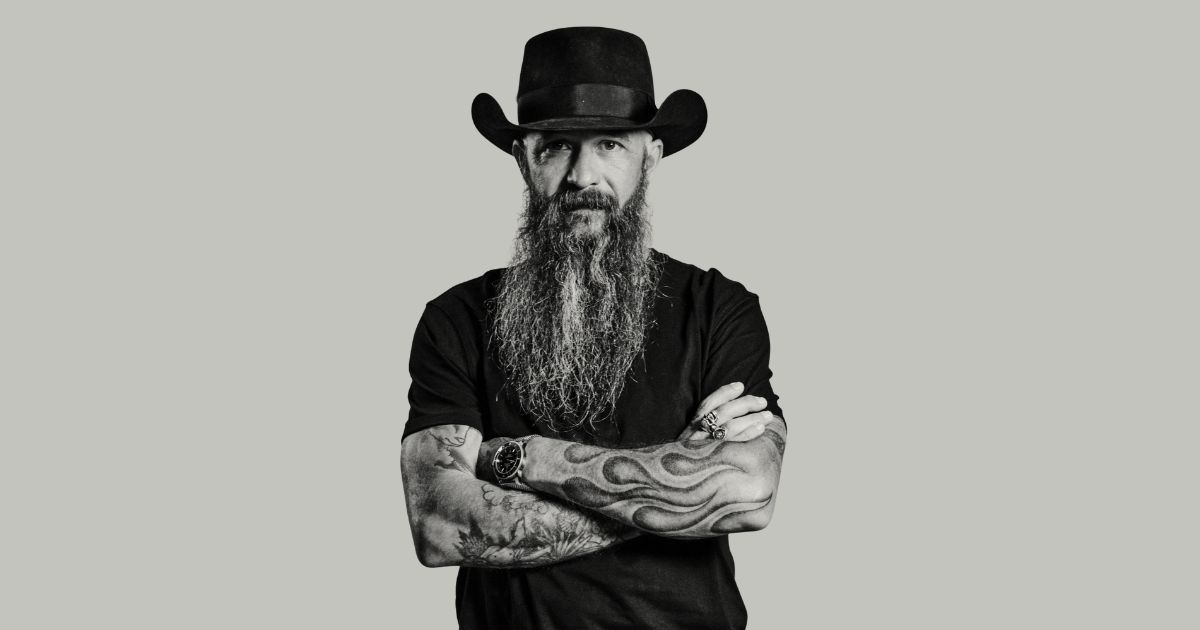
For Texas country star Cody Jinks, his latest album – the fiery and rough-around-the-edges, yet poignant and sorrowful In My Blood – is a liberation of sorts. Not of sound or scope, but of self.

It comes from the eternal quest to find balance within the body, mind, heart, and soul of a singer-songwriter, one trying to understand just what it means to be human in the modern, chaotic world – which is why “Better Than the Bottle” was purposely placed as the opening track on the record.

“Been layin’ things down one habit at a time/ Never thought we’d get old…” Jinks rumbles through the melancholic number. “Now we’re damn sure tryin’/ And makin’ the most of the time that we have left.”

With his sobriety in recent years, Jinks has been taking a hard look at what he sees in the mirror. It’s not about having regrets or cringing at one’s past. Instead, it’s taking personal accountability and professional inventory of the wisdom gained from your existence in real time, all while the calendar on the wall seemingly changes faster and faster each year.

Now 44, Jinks is more focused on what’s just around the corner than continually looking back over his shoulder at the ups and downs along his life’s journey. It’s about a clear head, a keen focus on what matters most – family, friends, fellowship, the freedom to create and perform.

It sounds like you’re in a really good place right now.

Cody Jinks: Yeah. Well, whenever you’re a late bloomer like me, it takes you [til] later in life to figure things out. It’s a practice. I mean, obviously the last couple years I’ve been trying to work on myself, work on my family. I think it’s helped a lot creatively, as well. None of it’s been easy. It’s not like anything’s ever peaches and cream or roses or whatever. The music business is tough, and if it was easy, everybody would do it. I spent much of my marriage while I was on the road. Having been off the road the last four or five years, [not touring] as much as I used to be, I’ve learned that being a great husband and father is even harder than being in the music business.

And it all ties into everything though, because that creative side is also a big balancing act, where you need that outlet in your life.

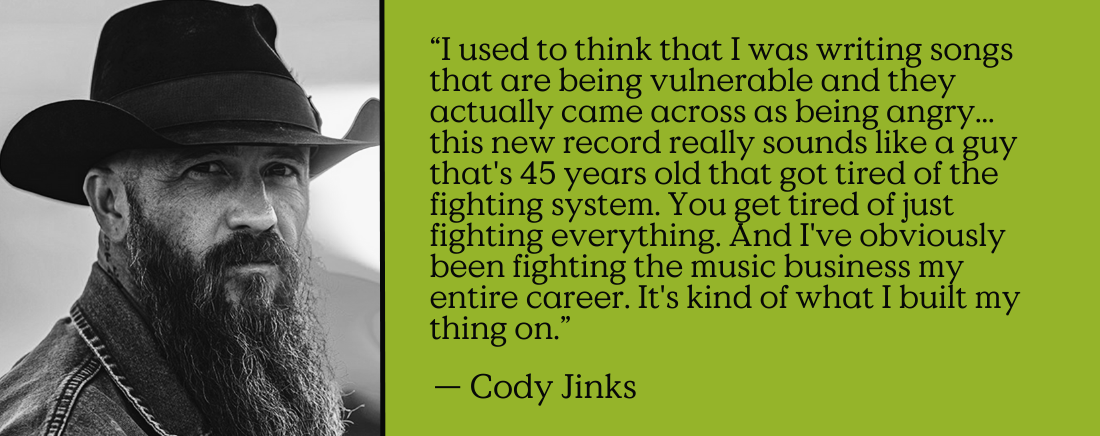
Well, not only the creative outlet, it’s that I used to think that I was writing songs that are being vulnerable and they actually came across as being angry. There was an edge to [the older songs], where this new record really sounds like a guy that’s 45 years old that got tired of the fighting system. You get tired of just fighting everything. And I’ve obviously been fighting the music business my entire career. It’s kind of what I built my thing on.

And, at the same time, I had started bringing the guy in the music business home – that’s who my wife and kids had to live with, as well. So, we’ve been correcting some stuff like that. I’ve been getting some really vulnerable songs out of it. You never stop coming of age. No matter how old you get – when you’re in your teenage years, when you get in your forties – life is a continual movement, man. And if you are not moving forward, you’re going backwards. So, vulnerability is a strength to an extent.

How does that play into the album? I would surmise that the opening track [“Better Than the Bottle”] was purposely placed there.

I was actually going to speak to that track specifically, because that was the second-to-last song written for this record. I wrote it with a friend, Tom McElvain. We both quit smoking cigarettes. We quit doing recreational drugs. We’ve written together a lot over the years. I’ve got several songs with his name on it, but [“Better Than the Bottle”] was a real conversation.

He came over one morning, and in 20-plus years of friendship, it was the first time we had ever been around each other stone cold sober. We were talking about how we used to live versus how we’re trying to do things now and who we’re trying to be now for ourselves and for the people that we love, the friends that we lost along the way that didn’t pull out of it. We’re old enough to have friends that have died from it now. That song made its way to the first slot because it was everywhere – that song’s true. Tom was over here that morning in January and you talk about two grown men in their 40s and 50s just laying all out, teary eyes. Dude, we fucked a bunch of shit up in our lives and there’s a lot. At this point, we’re trying to atone for a lot of things.

That’s one of the beauties about getting older – perspective. There’s this kind of weird intrinsic value to hitting this age, where you still have mobility and your wits about you, but you also got some road miles on the tread.

[Laughs]. Yeah. At 40, I tell people the “check engine” light comes on. It’s not usually that serious, but you gotta change some things. It might be time to trade in the Lamborghini and get an F-150, slow down a little bit.

You have a family, as well, with these personal responsibilities and people that want you around for a long time.

That was really the big player. I quit smoking for my kids. I’d still probably be smoking cigarettes if it weren’t for my kids. I quit drinking for myself and for everybody around me. But, the cigarettes, I finally got that licked about five, six years ago. That was the one my doctor said, “Your kids are gonna thank you.”

This year also marks the 10th anniversary of your breakout album [Adobe Sessions]. I don’t know if you’ve been thinking a lot about the last 10 years, who that person was when you broke into the national scene and then who you are right now.

[I’m] a lot more patient [these days]. It’s been 10 years, [and back then] we’d been [playing for] 10 years by the time that breakout record came out. [I] still have hunger in this business, I just put in a smarter, more calculated manner these days.

I also found it interesting that you’ve mentioned Ray Bradbury as an inspiration for In My Blood. Can you speak to why that is and what he represents for you?

Yeah, absolutely. The focal point of the record, it’s a travel life, right? That’s where the record takes you, on this up-and-down journey of life. And, in that life, in everyone’s life, every fork you come to in the road, you take one way or the other, which leads you to another fork in the road. By the time you’re done, you’ve taken a bunch of forks, you’ve taken a bunch of different roads, and hopefully you took more good forks than you did the bad.

We planted a Ray Bradbury-inspired song (“Something Wicked This Way Comes”) right smack dab in the middle of this damn record, because it was the perfect frickin’ spot for it. It’s the only song that was snuck in the record that wasn’t really based on my life. If you’ve read the [Bradbury] book Something Wicked This Way Comes, it’s part of a series called the Green Town Trilogy. They’re all really good [books], but that one stands out. It’s my favorite. It’s a brilliant book. It’s good and evil.

We all have the same wants, needs, desires. What’s good for us? What’s not good for us? Is it good for me if I try to do this to obtain this or achieve this or to be this or to look like this? And those are the decisions that we make every single day. I had just read the book and I came up with this really badass little blues riff. It feels like a carnival ride.

That also plays into one of the things about getting older, which is that you choose to keep moving forward. When you’re younger, you might feel the pressure. And as you get older you realize there’s a lot of things you don’t need to worry about.

Yes. My parents had told me, “Don’t sweat the small stuff.” And then, when you’re at the age we’re at, the big stuff you thought when you were 20, 25 years old, you’re [now] like, “Well, that’s small stuff.” And then, by the time you get to our parents’ age, they’re looking at stuff we’re worried about in our 40s and they’re thinking, “Oh, that’s small stuff.” We’re gonna get to the point, hopefully, where we’re looking at [things] going, “Ah, man, why was I worried about that?”

Case in point, the other night we had a very mild water leak in the upstairs [of our house]. My daughter came downstairs at two o’clock in the morning and there was dripping on a custom turntable in our living room. This was nobody’s fault. And I got upset about it. We stopped the leak. We dried the water up. I woke up the next morning and there’s flooding in Central Texas and there’s like a hundred families who have lost their children. Let’s not sweat the small stuff, man. Some people got real problems.

There’s probably a lot of weight that’s come off your shoulders in the last couple years, whether it’s personal or professional. Obviously life’s a continued journey. Whether you want to participate in it or not, that’s up to everybody on their own. But, it feels like you’re kind of leaning into life in a really good way right now.

Yeah, I’m living it more, as opposed to getting up and butting heads with [life] every day.

How do you square that with the outlaw image that the media puts on you? Because there’s stereotypes that get equated into that. At your core, you’re a singer-songwriter, you’re a country musician.

You know, my whole career, they’ve been calling me [an “outlaw”]. Look, I know they need an “outlaw,” whatever. I’ve never called myself an outlaw. That was something the media called me, and I just agreed. I’ve kind of gone with it. It’s okay. It’s easy to call me that. I’m not an outlaw, dude. I’m a punk.

And underneath all of that is still your punk rock and metal blood.

Yeah. It’s too big a piece of me. It’s just who I am. It’s the way I run my organization. It’s a family. It’s us against the world. We don’t belong with anybody, so we belong to everybody.


Photo courtesy of The Oriel.

The Road Home: A Documentary Short About Fiddle, Family, and Kentucky

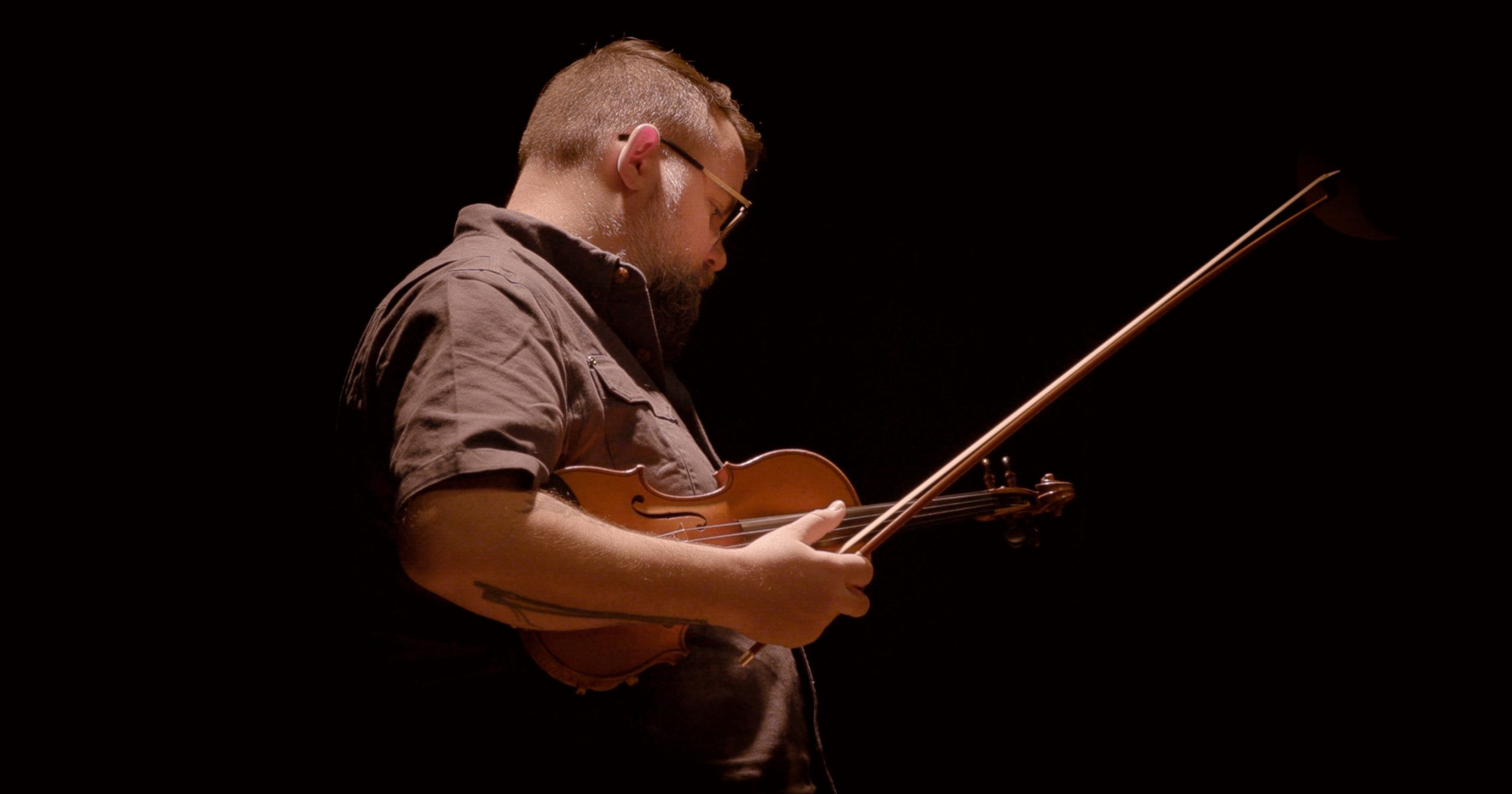
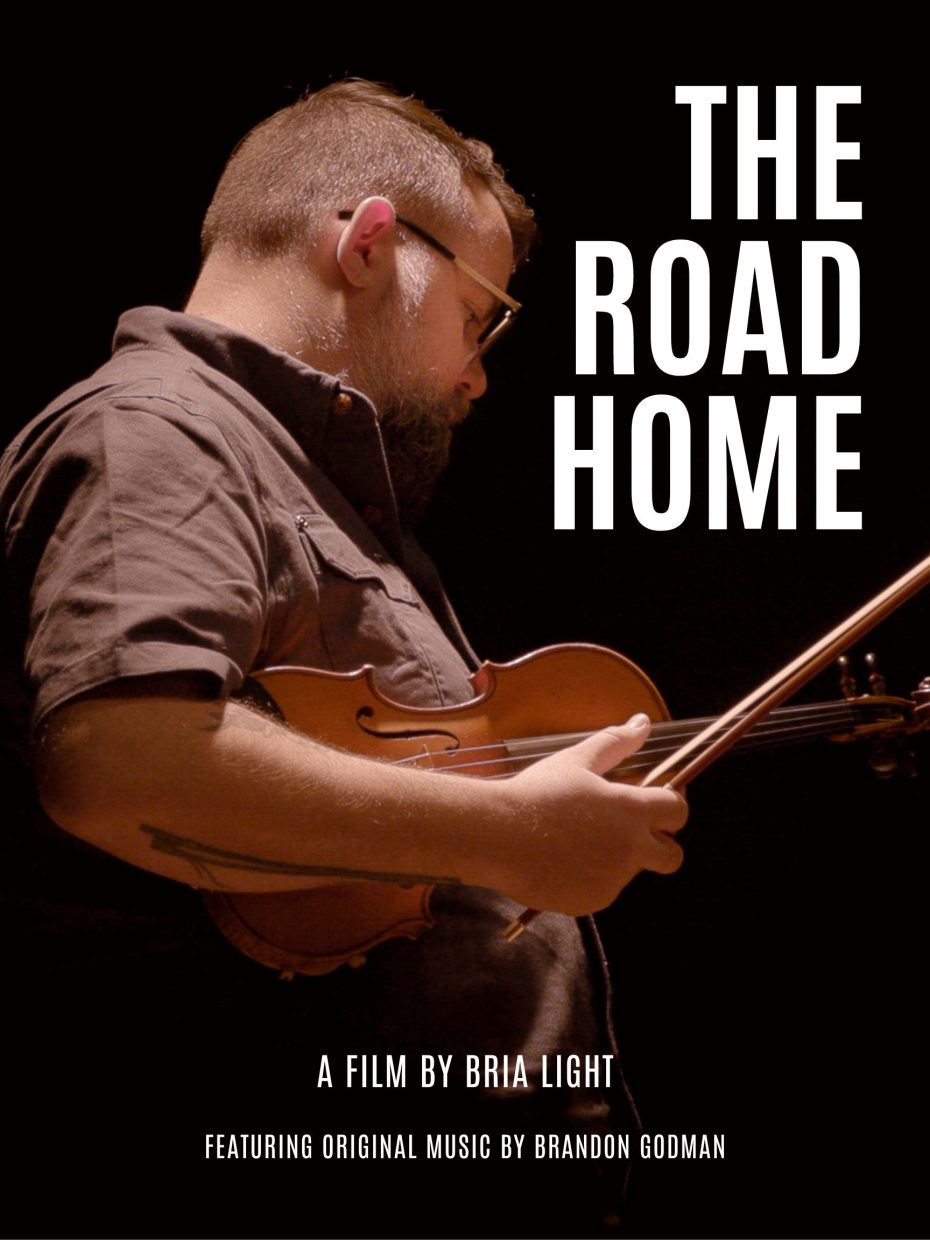
Bluegrass and country fans may recognize Kentucky-born, San Francisco-based fiddler Brandon Godman from touring, recording, and performing with folks like Dale Ann Bradley, Laurie Lewis, Jon Pardi, the Band Perry, the Music City Doughboys, and many more. He’s also an accomplished business owner and luthier, helming two fiddle repair and retail shops based in Nashville (The Violin Shop) and the Bay Area (The Fiddle Mercantile.) In addition, Godman helped found Bluegrass Pride and was instrumental in organizing the non-profit association’s float and marching contingent that won the coveted “Best Overall” ribbon from the 2017 SF Pride Parade.

Godman has played fiddle his entire life, beginning on the instrument as a young child in Northern Kentucky. His skills span old-time, bluegrass, western swing, country, contest fiddle, and beyond, and his career, by necessity often, has been remarkably varied, boasting stories of success, trials, tribulations, and highs and lows beyond his years. Now, filmmaker Bria Light has crafted a remarkable, heartfelt, and stunning documentary short all about Godman and his journey on and with the fiddle.

Shot and crafted in 2022 and 2023 as Light’s thesis film at UC Berkeley’s Graduate School of Journalism, The Road Home is an intimate and gorgeous look at Godman and his relationship with his instrument, his career path, and his rural home in Kentucky. The film includes lovely original music – much drawn from Godman’s acclaimed 2024 solo album, I Heard the Morgan Bell – that offers many varied samples of his expansive skillset on fiddle throughout, a perfect score and soundtrack for the 20 minute-plus documentary. Together, Light and Godman travel from California to Kentucky, visit with Godman’s family, share old memories and stories, and examine the complications and intricacies of family and community, the transient, intangible nature of “home,” and the pains and reliefs of leaving and returning.

Now, for the first time, The Road Home is available to screen online, right here on BGS and on YouTube. (Watch below.)

Light has a deft and artful touch as a filmmaker and director, utilizing the fiddle and Godman’s original compositions as an enormous character in these narratives, propelling the story forward and entrancing viewers with the sights, sounds, textures, and mythos of Northern Kentucky – as could only be delivered by a musician and creative like Godman. The end result is moving and illuminating, subverting expectations of the region, the instrument, the genres we associate with the fiddle, and the communities we expect – or don’t expect – to love these traditions and the people who keep them alive.

We spoke to Light via email about the film, its conception and making, and the twists and turns along the way that led Light and Godman to this stellar piece of visual, aural, and narrative storytelling.

Let’s begin by going back to the beginning. Can you tell us a bit of the story of how this film project came to be? What inspired you and how did you get connected with Brandon?

Bria Light: I made this film for my thesis film in the documentary film program at UC Berkeley’s Graduate School of Journalism and when it came time to look for a story that I would be spending all year working on, I knew I wanted a story that was music-related. But I also wanted to find a story that revealed something deeper about how music can help us find our way through the sometimes fraught path of being human. I eventually got connected with Brandon, who agreed to let me into his life and tell me this slice of his story.

This film tells such an expansive story in a relatively short amount of time. What was it like trying to condense such an interesting and often complicated narrative into this short film “package”?

I’ve sometimes used the metaphor that making a film feels like having the vast expanse and depth of the ocean stretching out before you and your job is to chart the best course from continent to continent. It can feel overwhelming! At every turn there are not only creative decisions to be made (What part of this person’s complex life do I focus on? Do I shoot this scene? Do I interview that person?), but also ethical ones (Who is affected by telling this story and how? Should I or should I not reveal someone’s identity? What impact am I hoping for this film to have and how is that best served?).

While you’re finding and crafting the story, it’s not always self-evident what the best, most meaningful storyline is and you want to explore a million different possible paths. You end up with hours and hours of footage (the ocean) that you have to fully explore to find the best course. And the thing is, you have to try things out to see if they work in a movie and until that golden moment where something works, it, well, doesn’t work. So it is a process of months – or years for feature docs – of trial and error, during much of which you suspect you might be terribly lost at sea and had no business becoming a sailor in the first place, to follow the metaphor… until one fine day you’re like, “Land ho!” and things start coming together and you can sleep again at night. [Laughs]

I feel like you let the music itself, and the tradition of fiddle music and roots music, do a lot of the storytelling here. What is it like translating music to a visual media like film in this way and leveraging it to help advance your narrative?

Absolutely. One of the key elements of my vision of the film from the beginning was to leverage the richness of this musical tradition and Brandon’s music within that to assist in telling his personal story. In fact, I pictured the music almost as a character itself. Music, of course, is a storyteller, even when it doesn’t have lyrics. So thinking of the music almost like the narrator of the story felt very natural.

Of course, Brandon creating his album of original tunes, I Heard The Morgan Bell, is part of the film’s narrative as well, so it all tied together organically. Additionally, since part of the film delves into the past and the creation of the album was the part of the story that was unfolding in the present, it helped provide a narrative thread to follow and to tie Brandon’s musical and personal evolution together from his past to his present.

Can you tell us a bit about what it was like traveling to Kentucky with Brandon?

It was very, very cold! Our trip to Kentucky took place over Christmas week and it just so happened to be during a cold snap that swept the entire country. It was in the single digits temperature-wise, in the negatives with wind chill, and the roads were covered in thick ice. I had envisioned going there and shooting scenes on the family farm with golden winter light sparkling in the crisp air, etc., and instead there was roaring wind so bitterly cold that you could barely be outside for two minutes before your fingers were completely numb. At one point, my camera was having some issues because it was so cold! But of course we filmed mostly inside and Brandon’s family was so warm and welcoming. I ate a copious amount of Mamaw’s famous chocolate peanut butter squares!

The music of the film is so stunning, and some of the selections went on to be included on Brandon’s 2024 album, which you mentioned already, I Heard the Morgan Bell – it was one of our favorite bluegrass albums of last year. Was there a “music supervision” process for the film? Did you leave it up to Brandon? What was it like collaborating on what would become the soundtrack and soundbed for your visuals?

Brandon was so generous in granting me permission to select music from his album, which was still in process, to use for the film. Through the course of our many hours of conversation over the year, he told me many of the stories behind the songs, of the inspiration and ideas that led to their creation. So I used that, along with the general feel and mood of the tune, to inform my choices as to which pieces to include where. Normally, you’re right, there would be a music supervision process, but in this case I had the privilege of working directly with Brandon, who was essentially also the film’s composer!

Do you have a favorite moment in the film? Or from the process of crafting it?

Hmm, there are so many memories attached to the creation of this film! I loved filming and editing the “Morgan Bell” scene in the church. The music is so gorgeous and I knew I would love filming in low light with stained glass church windows as the container for that wordless song that expresses so much emotion.

I also loved the moment in the editing process where I found the old footage of Brandon as a young teen on a local TV show. In Kentucky, his parents had given me a paper bag full of photo albums and old VHS tapes of Brandon at fiddling contests and other things to go through and see what I could use. Late one night, after a full day on campus, I headed back to the edit rooms in the journalism school to continue digitizing and going through the old VHS tapes. I got to one tape, began watching it, and it seemed to be all recorded re-runs of Days of Our Lives. After fast-fowarding through so many episodes of Days of Our Lives, I was wondering if that tape had been mistakenly included. I was about to stop when suddenly it cut to the footage of Brandon on the local TV station. It ended up becoming of my favorite scenes in the film, thanks to the very enthusiastic TV show host and a young, guileless Brandon.

Another favorite part of making the film was simply working with Brandon and getting to know him throughout our many conversations together. He’s such an old soul was a joy to work with, which is of course not always the case when making a film about someone’s real life. He was always open and willing to go along for the ride, despite the vulnerability required.

Filmmaker Bria Light, creator and director of ‘The Road Home.’

Maybe it’s an obvious question to ask, but what’s your goal? Making such an incredible and involved piece of art is goal enough, but where do you hope to take this film? How are you thinking about getting it in front of audiences? What’s next for the project?

I had several goals: I hoped some people might see a bit of themselves in the story and feel that they, too – despite having been made to feel othered in the past – belong in bluegrass and country music, that this music can be a home for everyone.

I also hoped that people would see Brandon’s story and say, “Wow, I didn’t realize there were still folks facing this type of persecution in the music industry.” This wasn’t so long ago. And unfortunately, as we all know, we are seeing today the continuation and resurgence of anti-LGBTQ laws and bigotry all over the country and the world. Another hope I have for the film is that by sharing stories that elevate the depth and humanness of the characters onscreen, folks from all sides of the political spectrum might, over time, begin to think about these issues in a new light.

What’s next? Recently the film screened to lovely and engaged audiences at the Sebastopol Documentary Film Festival and next it will play a bit farther from home at the Sound on Screen Film Festival in South Africa. I’m also hoping to show the film at music events or conferences, to continue to share Brandon’s story with audiences around the country.

What did you learn during the making of The Road Home that was unexpected? What will you take with you into future projects – whether in a similar vein or in another space entirely?

I learned so much! I learned the importance of finding that balance of pre-planning and knowing what the story is about while at the same time going with the flow of real-life, nonfiction storytelling – that is to say, you can’t actually predict how life is going to unfold, so you have to hold your preconceived ideas in one hand, while leaving room for the story to reveal itself to you as it unfolds in real time in the other. One thing I “learned” (in quotation marks because I’m still learning it…!) is to trust the creative process, with its highs and lows, self-doubts, rewarding moments, and ultimately, you find that you have gotten to the end of your creative process and survived! There are really too many things I’ve learned that I’ll be taking with me into future projects, so I’ll just leave it there for now.


Film, poster, and images courtesy of Bria Light.

Watchhouse Found New Rituals Amid the Push and Pull of Change

Chances are you’ve cultivated a few personal routines to help you navigate the world: one for daily life, one for weekly, monthly, and so on. There’s also likely a handful of individual habits that affect how you choose to go about your routine. The former, at times, can influence the latter, fitting within each other like a pair of nesting dolls, adjacent and similar in their roles.

Then there are rituals. Though these three recurring sets of actions – routines, habits, and rituals – would seem like easily overlapping bedfellows, rituals carry an intrinsic quality the other two lack: mindfulness. Rituals bear a sense of intention like the other two, but it’s often coupled with an element of symbolism or custom. It’s not just a matter of doing something and saying it’s done; there are other connotations or expectations that may influence why doing it matters.

Holding this notion in mind, it’s Rituals that Andrew Marlin and Emily Frantz of North Carolina duo Watchhouse have decided to name their new album. Through its 11 tracks, the married musicians posit an abundance of questions and actions, their contemplations placed in settings that are as clear as a simple back porch and as abstract as a space “through the looking glass,” “beyond this to and fro.” Settings that exist outside of not only any kind of routine, but separate from time and space all together.

Though Watchhouse’s new writings don’t seem to present rituals in their conventional form, the title still feels wholly appropriate. Marlin and Frantz’s reflections, wistful pining, and open-ended ruminations don’t lead to a sense of clear, expected structure that rituals would traditionally provide, but each song is lined with an abundance of intention, mindfulness, and hope for various outcomes. Sometimes these are overtly stated – Oh, I’m dreaming of a life with you in the sun/ And I hope our time together has only just begun… – and sometimes they are dressed in metaphors: Go fire your cannonball, go and fire away/ When the ashes fall we’ll start a brand new day.

There are defined ideas that Watchhouse put forth on the album: identity and awareness, the distinction between patterns and truths, how to develop a positive relationship with change, and what it means to evolve. All the same, while our internal responses to these songs may change over time, the very act of revisiting, replaying, and reconsidering their meanings, and how we are affected by them, can be a form of ritual in its own way.

Amid an extensive tour that will take them all over the U.S. and into Canada through summer and fall, Watchhouse spoke with BGS about their collaborative dynamic, how their individual artistic instincts influence the direction of a song, and the prevalence of duality in the album – as well as in their lives.

It’s been about four years since your last album and eight years since both your lives changed from bandmates to family. Given that Rituals focuses on patterns and the perception of change on our lives, how has the ever-growing longevity of your union in marriage — and all the ways marriage transforms a relationship on its own — changed the way you perceive and interact with the music making process?

Andrew Marlin: When you hit the road and join forces with other people to play music, it’s kind of like stepping outside of the norm and stepping outside of the daily life to go up there and almost take on a role or take on a character in order to get inside the music. You kind of just forget everything that the day often requires of you, because all of a sudden those requirements aren’t there. It’s just the stage and the music and the people that are there rooting for you to go deep, you know?

I think finding that zone with Emily has had its challenges in the past, because we’re so closely tied to each other. We raise kids together and we live together, and so doing all this traveling together and playing music together too, it makes it harder – or made it harder for me at the beginning, I think – to leave the daily routine and expectations behind on stage and just shed all of that and take on that character. It’s one thing to look at your bandmates’ eyes and get a little nod or whatever’s happening during the music. It’s kind of like this understanding of, “I’m not here right now. This is just me playing music.”

Getting to that zone with Emily, now that we’re 16 years into it, has taken a while to get to that point to where it’s an acceptance of all of it, instead of just leaving things behind to get on stage. It’s like we’re carrying all of it with us at all points in time. People that come to see us get a real and honest version of ourselves, trying to go deep in the music but also being completely aware of each other too.

Emily Frantz: I was just thinking about how much things changed in 2020 and 2021, living our mundane day-to-day lives in our house, and the transition back into being on the road again and touring. We’ve obviously been doing that for a few years now since COVID, but that experience made us relearn what the relationship is between our daily life at home and touring and [figuring out] how can they coexist in a healthy way.

Ironically, the album’s opening track, “Shape,” avoids the traditional shape or structure of a song (all verses, no chorus) while the actual narrative of the song embraces ideas that lean into a sense of purgatory and a nebulous state of being — the very opposite of what would help establish a sense of shape, boundaries, identity, direction, patterns, or truths. What were the mental and emotional motivations that inspired you to take the song in this direction?

AM: It’s like establishing the shape or the pattern in order to separate yourself from it. That’s what a lot of those verses are doing, kind of outlining the things that often make me feel like I’m in a box and I’m trying to get outside of that box. The only way to do it – because there’s no real form to it – is to imagine the parameters, imagine the spaces that it ends up kind of confining you in, in order to step outside of those [boxes]. I think that was the intention with “Shape.”

EF: And the way that “Shape” came into its final form, at least final the way it appears on the record, was a lot of the things that you said about it: It didn’t ever really conform and it got rearranged and had things added and taken away from it so many times, a lot more so than other songs. But it always did feel like the backbone of this record in a lot of ways, which is why it felt really right as the opening track of this record.

AM: If there was a shape to define that song, I’d say it’s a spiral.


View this post on Instagram


A post shared by Watchhouse (@watchhouseband)

How have you fit rituals into your lives and have they helped you maintain a sense of stable continuity as a family and as musicians?

AM: I feel like since having kids, the day has taken so much more form. Because I think that, and Emily [is] really brilliant about this, giving structure to the day is super helpful for them. So that they don’t have to wonder what’s happening, so that they can really pay attention to what is happening. I’ve watched both of our kids blossom in that environment. Emily’s really good about helping to create that and make sure we stick to it. Carrying that on the road has been really helpful, too and something that I didn’t realize I was going to benefit very much from. Because I definitely, when left to my own devices, am like a sheet left out to dry – just flapping in the wind. To have a little bit of structure to the day, and have to enter into these mental zones with the kiddos, has added a lot of mental structure to my existence. I think that’s the biggest thing for me.

And within that, it’s about realizing what the day actually requires of me, instead of what I imagined today to be expecting of me. Finding those real anchors and a little more gravity to the things I’m working on have helped me shed old expectations of myself and what I think I’m supposed to be doing. I think that’s what led us to be okay with changing the band name and changing up some of the sounds and approaching this thing we’ve been doing for a long time in a whole new way.

EF: I think the thing that we are [focusing on] 16 years in is finding where the balance is between freedom and artistic expression, and also just daily life and figuring out how to have those two things like coexist and make each other better and not be in a constant sort of push and pull.

The first verse in “Beyond Meaning” is intriguing. The statement of your “gentle” disposition is nice, but its seemingly conditional nature gives pause — particularly when considering that life is noisy and out of our control more often than not. What is it that you’re trying to say about your own identity and awareness of how you cope with the noise and bustle of everyday living?

AM: I feel like what I was getting at is to view it as though it’s external noise. But it’s actually internal noise. That’s often the thing that keeps me from my peace and keeps me from being gentle. It’s my own defenses and my own self-consciousness that end up creating all of this noise. It paints the external noise in a negative light. When I can control that and remember to keep my own defenses at bay and be open and actually present, the idea that maybe this external noise is not a malicious one keeps me gentle and then often what comes from that is a gentle interaction. So it’s more about controlling the internal noise in order to actually experience the external factors.

Out of the 11 songs on the album, Emily is the primary vocalist only for “Firelight.” Why was Emily the right fit to sing the story of this one song? And more broadly, what went into your shared thought process on when, and for how long, you two would sing together? Is it a purely harmony and arrangement-based decision, or do the emotions of a song influence how each vocal arrangement is structured?

EF: A lot of times it can be pretty cut and dry. If we’re deciding who should sing lead on a song, it might just have to do with the range or the key, where we think it sounds good. Sometimes that plays into it maybe even more than the lyrics or the subject matter. With Andrew doing the songwriting, he’s always been more of the primary lead vocalist. Oftentimes, by the time we’re arranging a tune and finding out how we want to present it, it’s very cemented in his voice. But then a lot of times, there will be tunes that we’re struggling with and we’re not quite finding it. By switching out who’s singing, it reframes the whole song and allows us to not just change the lead vocalist, but to find a whole different zone for the song in terms of what we hear and how it gets arranged and recorded. That was the case with “Firelight.” We had so many different versions of that song over the years leading up to recording – different time signatures, different instrumentation – and that was one of the last ones that came together for this album. Most of it got done after the initial tracking session because we were searching on it for a long time and I think I like it more and more the longer I sit with it, the more I hear it.

AM: Often people do want to know why Emily’s not singing more tunes or why the roles are what they are. But I think it’s really important to shine a little light on what Emily does behind the scenes when she’s not singing. The way she plays rhythm and plays violin or whatever instrument she’s on, it ends up being this anchor for everyone in the band. The way that offers complete structure to what we’re doing and allows everything else to sway around that a little bit, I feel like even when she’s not singing, her musical voice is such a strong presence in the music. I’ve heard her say this before, like when she’s playing violin, she’d rather not sing lead because it’s almost like having to sing with two voices. That became part of the structure of what we’ve been doing all along, not just with the lead vocal. The feel of the song and the rhythm and the chord structure and the flow of it all often is hinged on what Emily ends up doing. I think that’s just as important as her taking a lead vocal.

EF: I’ve really, over the years of us playing music together, come around to enjoying singing lead when we find the song that feels good in my range. But for the most part, I’d rather be singing harmony to Andrew and that definitely brings me just as much, if not more, fulfillment than singing lead on a song.

Endless Highway (Pt. 1)” and “Sway / Endless Highway (Pt. 2)” leave a much heavier state of reflection than that of “Patterns,” the song you chose as the album’s finale. Were the lighter tone of the music and the lyrics a driving factor for why these last three songs are in this order? Did you want to avoid an ending that leaves the listener with a more uncertain emotional state?

AM: I’ll start off by saying Ryan Gustafson, who produced this record with us, actually ended up coming up with this track order. Having not listened to it that way and then taking Ryan’s perspective on it, it was like being able to listen to these songs in their entirety for the first time. All of a sudden, I was getting feelings from these recordings that I hadn’t gotten yet.

“Endless Highway (Pt. 1)” is a heavier song and talks about a really traumatic event that Emily and I went through and that long drone at the end of it kind of dances around the dread of that. Then into “Sway,” it’s more of a coming out of that [feeling]. How do we peek our heads out of the hole once we’ve gone down and slowly crawl back out? To finally get into “Endless Highway (Pt. 2),” where it feels like a real revelation and a real triumphant part of the record? So, you get to the top of the mountain on this song. But I do believe that while those revelations come, we get to the top of those mountains, everything’s clear, and there’s so much lightness and clarity around us, we still have to wake up the next morning, make coffee, make breakfast, get kids to school, go and run errands and carry that little mountain of revelation with us everywhere we go.

I think that the heaviness and the profoundness of that idea ends up giving way to these smaller, mundane parts of our life. That’s what “Patterns” feels like to me. It’s an admission that if we can hold on to those little revelations and the clarity they offered us, hopefully it’ll keep us light by offering us that little reminder of hope.

EF: Going back to what Andrew was just saying about having these big events or these heavy, emotional things happen, and then having to go on with our lives, and the push and pull of that – there’s frustration and beauty in it. I love the order of those [last few] tracks, because I feel both the “Endless Highways” and “Sway” are songs that were written in the middle of this album being written and there’s a lot of anguish from a lot of different sources in those songs. And then “Patterns” was the last song that was written for the album before we recorded it, so it feels like it has a certain clarity to it. Going down in the trench and making your way back up, even though it’s still really just posing a lot of the same questions [as the beginning of the album], but from a more settled state of mind.

What truths about yourselves and how you view the world have you discovered and accepted since finishing Rituals? How many of the questions you’ve posed through these songs do you feel you’ve managed to settle on answers for?

AM: I don’t think I would often look closely enough at how I was making a person feel, as much as I would look at the way the person was. I think that’s becoming more of my truth these days, just to trust that showing up open-minded with awareness and consciousness, focused on experiencing rather than projecting, is probably the closest to any truths that have come out of writing these songs and getting to the end of this record. The takeaway is that it’s not like we found answers, necessarily.

EF: It’s all just a pursuit, always.

AM: You know, it’s not always about finding answers. It’s about finding out–

AM/EF: It’s figuring out what the question is.


Photo Credit: Jillian Clark

Explore more of our Artist of the Month coverage here.

GC 5+5: Southern Avenue

Artist: Southern Avenue
Hometown: Memphis, Tennessee
Latest Album: Family
Personal Nicknames (or rejected band names): We don’t remember any rejected band names, but being from Memphis we definitely call everybody “mane.”

Answers have been provided by Tierinii Jackson, Southern Avenue lead vocalist and songwriter.

What was the first moment that you knew you wanted to be a musician?

It wasn’t one moment, it was the absence of one. I never imagined not being a singer and a songwriter. I grew up singing in church with my sisters and family and even when I ran away from all of that, the music stayed with me. Beale Street gave me my second education. That’s where I chose to be a full-time musician, even if the world didn’t choose it for me.

What is a genre, album, artist, musician, or song that you adore that would surprise people?

I love musical theater. It’s drama, it’s storytelling, it’s emotion on 10. I used to want to be on Broadway. Sometimes I still do. The song “Flying” on our new album is just about that. My mom actually turned the plane around mid-air so I wouldn’t fly to New York to make my dream come true. I do believe that it all connects and I have plenty of time to still do something special in that world.

What’s one question you wish interviewers would stop asking you?

People always ask how we met and how the band started. It’s everywhere online already. We just hope to get asked about new things now, go a little deeper. But it’s all good, no hard feelings at all. We love it when we have an interview where the person in front of us already has an understanding of who is in front of them.

What’s your favorite memory from being on stage?

When we toured with Willie Nelson, Bob Dylan, and John Mellencamp, it was already unbelievable. But then we found ourselves on stage at FarmAid, after two weeks on the road with them for the Outlaw Tour. I remember standing there thinking, “Am I dreaming?” It was one of those moments where everything just hits you, how far we’ve come, and how real it all is.

Genre is dead (long live genre!), but how would you describe the genres and styles your music inhabits?

We like to describe our music real simple. It’s Memphis music. That’s what raised us. We’re a mix of where we come from, how we grew up, and everything we dreamed of becoming. It all comes together in the sound.


Photo Credit: Rory Doyle

Ron Pope Chases His Dream On ‘American Man, American Music’

It may look rough around the edges, but Ron Pope’s journey through life encapsulates the American dream. He buffs out those spots, uncovering a hefty dose of humility, wisdom, and empowerment on his 11th studio record — American Man, American Music.

On it, the New Jersey-born, Georgia-raised singer uncovers moments from his childhood (like waking up before school to unload semi trucks) to the present day that have shaped him into the man he is and made his musical dreams a reality. But despite its title, the album is anything but exclusionary. Just like our nation’s diversity, American Man, American Music is a patchwork quilt of sounds, stories and experiences that serve to remind us that we’re all dealing with the same struggles and desires no matter what we look like or where we came from.

“I want to make music that other people can take and put into the moments in their lives,” says Pope. “The goal is that if I’m doing it right they’ll feel less alone. I want to put that back into the universe because I’ve taken so much of it out that it’s part of what buoyed me to get me to this point.”

This manifests itself in heartfelt vignettes centered around his family and recently discovered meaning of “home” on songs like the ode to his wife, “In The Morning With the Coffee On,” as well as “Mama Drove a Mustang,” an homage to his mom’s “let it ride” attitude that he wound up carrying into his own musical pursuits. But he’s also not afraid to get political on songs like “Klonopin Zombies,” a story about losing his grandmother that directly calls out the callousness of the pharmaceutical industry and sees him painfully pleading, “I swear there must be a heaven, ’cause where the hell else would someone like you go?”

Speaking by phone from his Nashville home between a mid-morning job and picking his daughter up from school, Pope spoke with BGS about home, family, platforming the next generation of artists and the experience that make up American Man, American Music.

You duet with Taylor Bickett on “I’m Not The Devil.” What spurred you to bring her aboard for it?

Ron Pope: Lately I’ve been finding so much inspiration in new artists. Growing up you tend to fetishize the stuff that came before you, almost like hero worship. Luckily I’ve come up in an era where so many of my contemporaries are masters, from Jason Isbell to John Moreland, which is really cool. But now I’m at a phase in my life where I’m getting more and more inspired by the artists coming in behind us. I remember first hearing Taylor’s songs, reading her lyrics, and seeing people making posts about sunsets and storms with her songs in them and was blown away. That’s what I love about music – you’re always finding new ways to be inspired.

What are your thoughts on the practice of platforming younger artists and what you stand to benefit from it as well?

If you make records your whole life, it’s going to be an ongoing challenge to find things that keep you engaged and excited about making music. It’s like a game that I’m always playing with myself. I want to find things about music that make me feel the way I did when I was a kid. Sometimes when people imagine an artist, they assume you’re only listening to people who sound like the same handful of songs that they know and that’s it, but I listen to all different sorts of music. Just the other night I was making pasta with my daughter in our kitchen listening to Dean Martin. On any given day I’ll move from that to some Tony Rice, Jason Isbell’s new song, Turnpike Troubadours, people like Taylor on Instagram, and then John Prine. I find inspiration everywhere and love that the music I make still feels fun and exciting because of it.

You just mentioned your daughter. I know family plays a big role on this record, from “In The Morning With the Coffee On,” to “Klonopin Zombies,” “Mama Drove a Mustang,” and others. Mind telling me about how that helps to serve as a through line on this project?

The central message is that we all share so many of the same sorts of experiences. For instance, in “Klonopin Zombies” I’m talking about this point in my life when my grandmother passed away eight days after my grandfather, leaving me wildly devastated. In life, we’re all going to experience powerful loss in that way; it’s just a matter of if it has happened to you yet or not. It’s the nature of living. My goal for doing that was to reach people on a more general level. If you are blessed enough to love people, then one day you will suffer because you lose people.

When I was first starting out, one of the complaints that music industry people would have about my music was that my songs were too specific and didn’t feel general enough, which was weird because for me those are the [kind of] songs that I always felt the most attached to.

Think about the Eagles’ – “Standing on the corner Winslow, Arizona/ Such a fine sight to see/ It’s a girl, my lord, and a flatbed Ford/ Slowin’ down to take a look at me…” or James Taylor’s – “Just yesterday morning, they let me know you were gone/ Suzanne, the plans they made put an end to you.” You’re in the room, but you don’t know who he’s talking to or why. It’s like, how many times in your life have you watched someone struggle with the expectations people put on them? Even though he’s telling a very personal and very specific story, you’re brought in and it reminds you that there’s a human being on the other end of this.

We got to go to all these places and meet a lot of people, and what I have found as I have done that is most people want the same things – they want opportunities for themselves and for their children. They want to know that they’re safe, and that their kids are safe and are going to get educated. We have a lot more in common than we do that separates us, which can be hard to see when you’re just watching videos of people yelling or complaining about how differently they believe your neighbor is.

How does that idea tie into the album’s title – American Man, American Music?

It’s inherently political to say “I am an American man and this is American music.” It’s inherently political, but I didn’t want to make something to bash people over the head, because it’s hard to write stories that are both protest songs that feel like they matter and are actually good songs. So I decided to, with the exception of “I Gotta Change (Or I’m Gonna Die)” – which is a pretty open rebuke of the pharmaceutical industry expresses my anger towards it about the opioid crisis – I try to speak in more sweeping terms and not focus in on the things that I was angry about, instead focusing more on humanity and openness.

I’m following myself from when I was a child in these stories all the way to this moment in my life. I’m singing about the car my mother drove when I was six years old in “Mama Drove a Mustang,” then I’m singing a little prayer for my family that I wrote while I was out on the road in “The Life In Your Years” or how my wife and I have been together for almost 18 years on “I Pray I’ll Be Seeing You Soon.” It makes me realize that I have lived the American dream.

I’m just a regular person from a blue-collar family born to very good-hearted, well-intentioned teenage parents who didn’t have a lot of resources and did their best with the opportunities that were in front of them. There was no reason to believe at the start of my story that I would end up in this place. All of that is in there because I am an American and I am an American man, and I am making American music, but I don’t mean any of that to be exclusionary. So many people that are using all of those words do so to exclude others and I have lived the American dream and want others to be able to do the same. On this album I wanted to focus on telling great stories that highlighted my journey and my humanity and what it took for me to get to this place where I got to as a way of showing that I don’t think it’s something that we should hold hostage. We should want other people to be able to reach these things in a nation built by immigrants on stolen land.

What does “home” mean to you – both as a physical place and as an idea – in relation to this album?

My mom loved us a lot, but we also moved often, which can be destabilizing. When I got to the point in my life where I was out on the road I almost felt engineered to do it, because I never had a real sense of home growing up. When I went on tour it felt like I was supposed to be there, which made it easy to wake up whether I was in Lincoln, Nebraska; Minneapolis, Milwaukee, Pittsburgh, or Pompano Beach. For a long time I thought you had to live that way to write songs.

At one point I was living in New York and hung out with my wife during a break from the road, who at that point I’d known since we were kids in Georgia, but had never dated. Suddenly everything changed and I started feeling her no matter where I was and yearned to be back in New York. I didn’t feel at ease unless I was with her, before realizing that she had become home for me. I’d never understood that homesick feeling that others get until then.

I feel that even more now with our little girl. It’s different, because my wife chose me and knew what I was and what I wasn’t, whereas we chose to bring our daughter into this world. Because of that I feel an even stronger pull from home than I have in the past because this little girl doesn’t care that I sing songs for people, and at the end of the day she doesn’t need that – she just needs me to be her father. It’s important that I’m able to make a living with my music, but it doesn’t make up for the fact that I wasn’t there to witness her losing her first tooth and other core memories. You have to grapple with that every day if you’re going to do this for a living. At the end of my life, if people say I’m a family man before they say I’m a musician, then I did it right.

What has the process of bringing American Man, American Music to life taught you about yourself?

There are points in the process of making any record where you look at yourself in the mirror and ask “Am I full of shit? Or can I actually land this thing?” The content on this album, what I’m talking about, it felt heavier and deeper than some of what I’ve done in the past. And I hate the idea of taking myself too seriously. At the end of the day, I’m an entertainer; everyone who makes music is supposed to be one, no matter how much they call themselves poets and stare at their expensive loafers oh-so-thoughtfully. Whether you’re Bob Dylan or Jackie Wilson or Tom Waits, at your core, you’re fundamentally the same as a clown or a breakdancer. Your job is to bring people joy, to entertain them. Walking around with this understanding has always made me sort of sick to my stomach whenever I find myself taking any of this noisemaking I do too seriously.

But on this album? I surprised myself. We are making music about serious things and I didn’t feel embarrassed or disgusted by it. It’s serious because it’s supposed to be serious; I’m not being a self-important asshole. Somebody needs to talk about the opioid epidemic and no one else was doing it in a way that I felt satisfied with. I did it because I felt like I had to, not to feed some inflated notion I had of myself as a capital A “artistè.” So I guess I learned that I’m not full of shit. Or at least, not entirely full of shit.


Photo Credit: Blair Clark