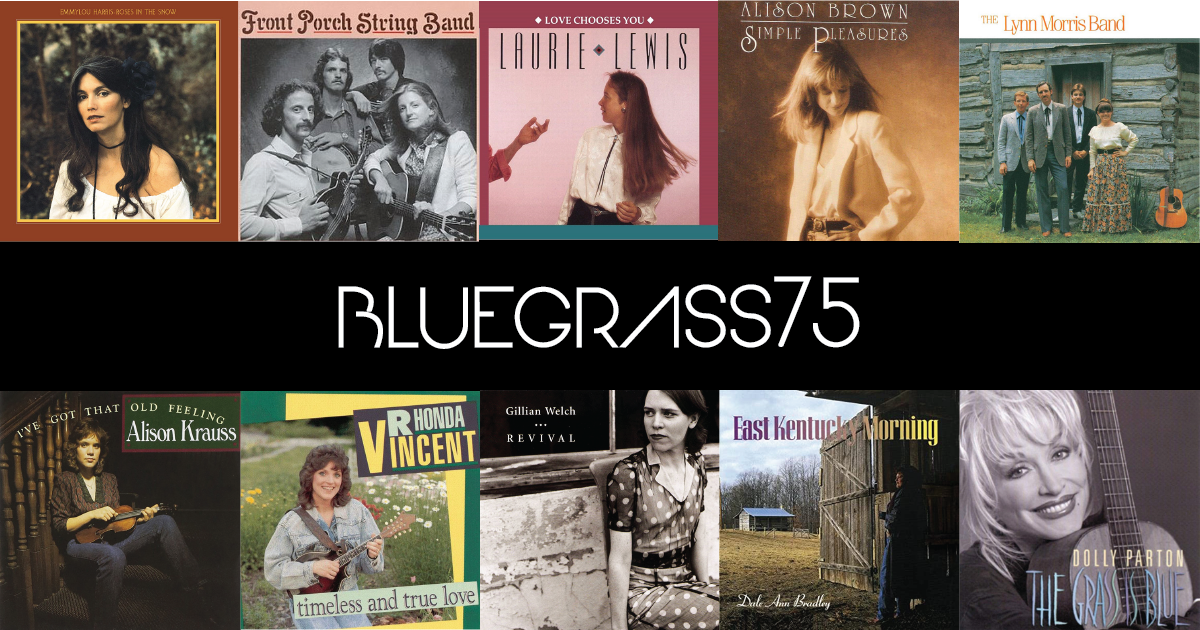
With this year marking the 75th anniversary of bluegrass, it’s remarkable to note that women emerged as a creative force at roughly the halfway point between then and now. Of course, female musicians have been part of the fabric of bluegrass from the start, with Mother Maybelle Carter, Sally Ann Forrester, and Hazel & Alice among those serving as inspirations through the decades.
However, the role of women as bandleaders, rather than in a supporting role, began to change in the ’80s and flourished in the ’90s. As part of our Bluegrass 75 series, BGS commends these 10 women who carried bluegrass forward with a combination of undeniable talent, strong material, and a refreshing new perspective.
Emmylou Harris
One of the most visible country artists of the ’70s turned her attention to bluegrass, with a support team she deserves (Ricky Skaggs, Jerry Douglas, Dolly Parton, etc.) Her material ranges from the Louvin Brothers to Paul Simon, though that exquisite voice makes the album seamless. It’s one of her finest albums in a brilliant catalog.
Claire Lynch
With a crystalline soprano, Claire Lynch first gained notice as a lead vocalist and guitarist with Front Porch String Band, which released an indie album in 1980 that was picked up by Rebel Records in 1983. The poignant track, “Hills of Alabam,” which she co-wrote, shows her gift for melody and her ability to sing with sincerity.
Laurie Lewis
A key figure of the West Coast bluegrass scene, Laurie Lewis can fiddle with the traditionalists, then hush a crowd with a beautiful acoustic ballad like “Love Chooses You.” As the acolyte of a generation before her, Lewis actively takes an interest in the bluegrass scene’s rising talent, as evidenced on her latest work, an album of duets entitled and Laurie Lewis.
Alison Brown
As a picker, Alison Brown has made her mark on countless recordings and won the 1991 IBMA Award for Banjo Player of the Year. She’s also a co-founder of Compass Records, a producer, and a Grammy-winning artist. At times blazing, and other times mellow, Brown consistently finds just the right tone on her albums’ instrumentals.
Lynn Morris
Blessed with a sweet but persuasive voice, Lynn Morris knew how to get the storyline across, whether she’s reminiscing about “Mama’s Hand” or laying down the law in “You’ll Get No More of Me.” As a banjo player, she had incredible chops, and her grace on stage (and off) has made her one of the bluegrass family’s most beloved figures.
Alison Krauss
A gifted vocalist, bandleader, and fiddler, Alison Krauss kept her early career focused on bluegrass, though her material would soon find its way to millions of country listeners, too. Being a former child prodigy herself, she served as a role model for a generation of younger pickers, while showing traditionalists that bluegrass is indeed in good hands.
Rhonda Vincent
Coming up in a family band, singer and mandolin picker Rhonda Vincent has been working in bluegrass for decades, though she’s always finding ways to keep things fresh. Still, her early albums remain some of her most satisfying work. As a bandleader, she keeps the energy up on stage, and her outgoing personality makes her a true entertainer.
Gillian Welch
While few would consider her albums to be bluegrass proper, Gillian Welch has exerted tremendous influence on its community. A 1993 winner of Merlefest’s Chris Austin Songwriting Contest, Welch has seen originals like “By the Mark” and “Caleb Meyer” become standards, and though she didn’t grow up in Appalachia, her songs somehow embody its heritage.
Dale Ann Bradley
A sterling discovery from the New Coon Creek Girls lineup, Dale Ann Bradley launched her solo career by selecting relatable material along with a surprise or two (including a U2 cover). It’s a template that still serves her well. The title track of East Kentucky Morning captures the mood and melancholy that she continues to convey so well.
Dolly Parton
It’s hard to imagine now, but Dolly Parton had dropped off the mainstream radar in the mid ’90s. Then her first bluegrass album proved what her fans knew all along — she represents her mountain people well. A wonderful mix of familiar favorites and new material, The Grass Is Blue solidified her reputation as one of music’s most important voices.
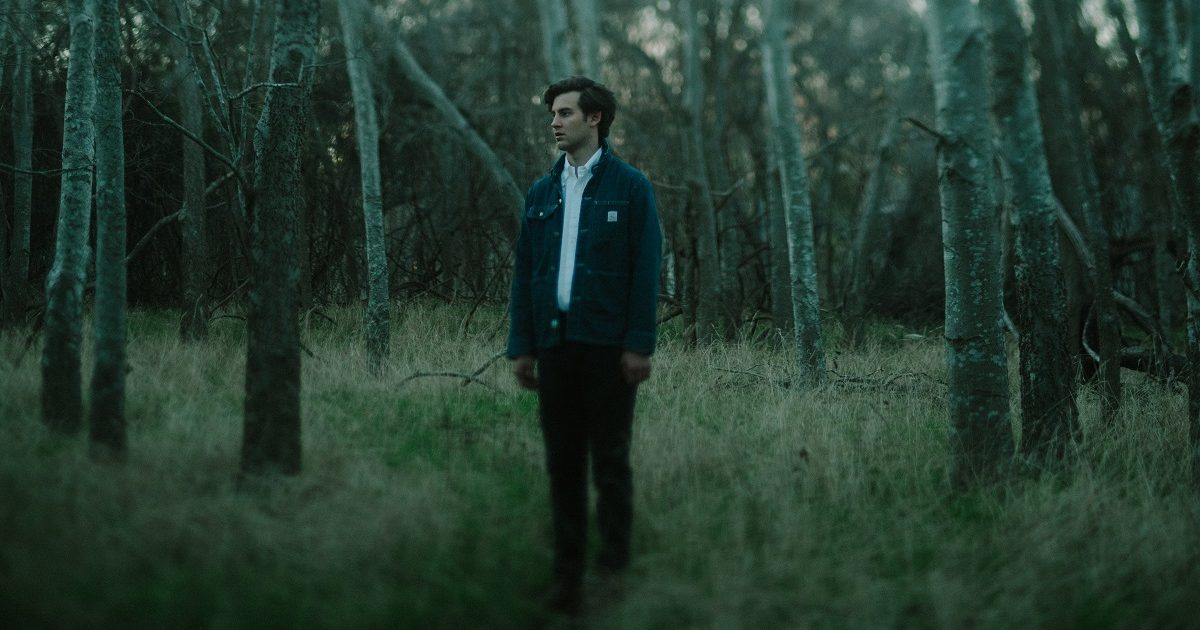
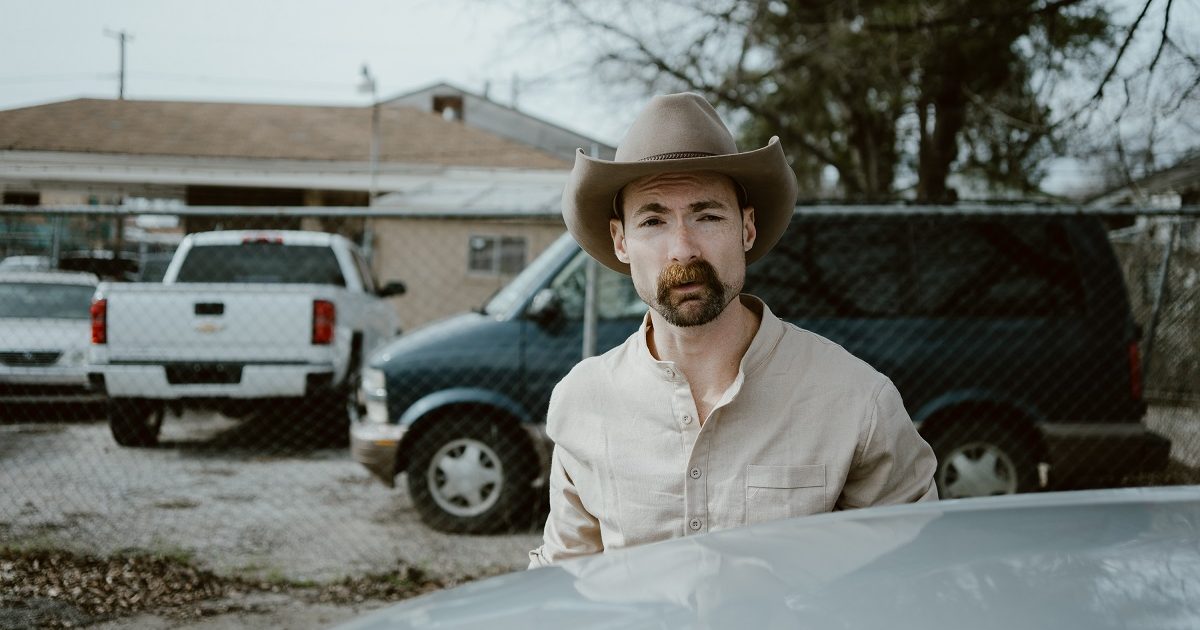
Artist:Thomas Csorba Hometown: Dallas, Texas Song: “What’s Left of Mine” Album:Thomas Csorba Release Date: September 25, 2020
In Their Words: “When Beau Bedford and I sat down to write this song, we fell into a story of a man at a pivotal moment in his life. The speaker in this song is looking his lover in the eye and saying, ‘I love you, but there’s some living I need to do.’ He’s at a crossroads: Do I spend this precious time with the one I love, or do I go and find myself? The risk there is heavy, and you can hear it in every line he utters. I found a big part of myself in this character. As I’ve stepped into marriage, I’ve been thinking a lot about sacrifice. Wherever I devote my time, my love, my energy, I know that another part of me needs to be sacrificed.” — Thomas Csorba
Artist:Two Bird Stone Hometown: Hickory, NC (Liam Thomas Bailey); Nashville (Judd Fuller); New York City (Chad Kelly & Rohin Khemani) Song: “Hands and Knees” (featuring Sarah Siskind) Album:Hands & Knees Release Date: September 11, 2020 Label: Soundly Music
In Their Words: “Featuring guest vocalist Sarah Siskind, this track was written in the spirit of an old-time Appalachian duet and sung entirely in two-part harmony. The song is a declaration between two individuals in a committed relationship attempting to explain their mutual resistance to a necessary compromise between their individual needs and the needs of the other. Originally intended to sound lighter and more humorous, Sarah’s involvement took the song to a deeper place. Sarah and I met at the Station Inn in Nashville in about 2009; I had recognized her face from an article and acknowledged that we had some friends in common. Ten years later, after an embarrassingly tenacious campaign to get her attention, I met her in Asheville, North Carolina, for the second time and I taught her ‘Hands and Knees’ in the control booth before we sang the song live to some basic tracks the band had laid down only minutes before her arrival.
“We cut the song in less than 30 minutes and what I thought might be a bouncy bit of flirty snark between a reluctant couple struggling to commit became a sober promise between two flawed individuals who knew they needed to be together. I expected the booming, laser-focused mountain sound from her voice that I had heard in so many songs (i.e., ‘In the Mountains’), but she sang so softly that I felt the need to find her where she was. I let go of my expectations and stared into her eyes through the studio glass as she watched my mouth for timing cues. Coincidentally, I had to ‘surrender’ to her influence in order for the song to carry its own meaning and become what it needed to be. That is EXACTLY what the song suggests is required by a healthy, dynamic relationship. Most likely, she does not remember this, but it was a very big day for me!” — Liam Thomas Bailey, Two Bird Stone
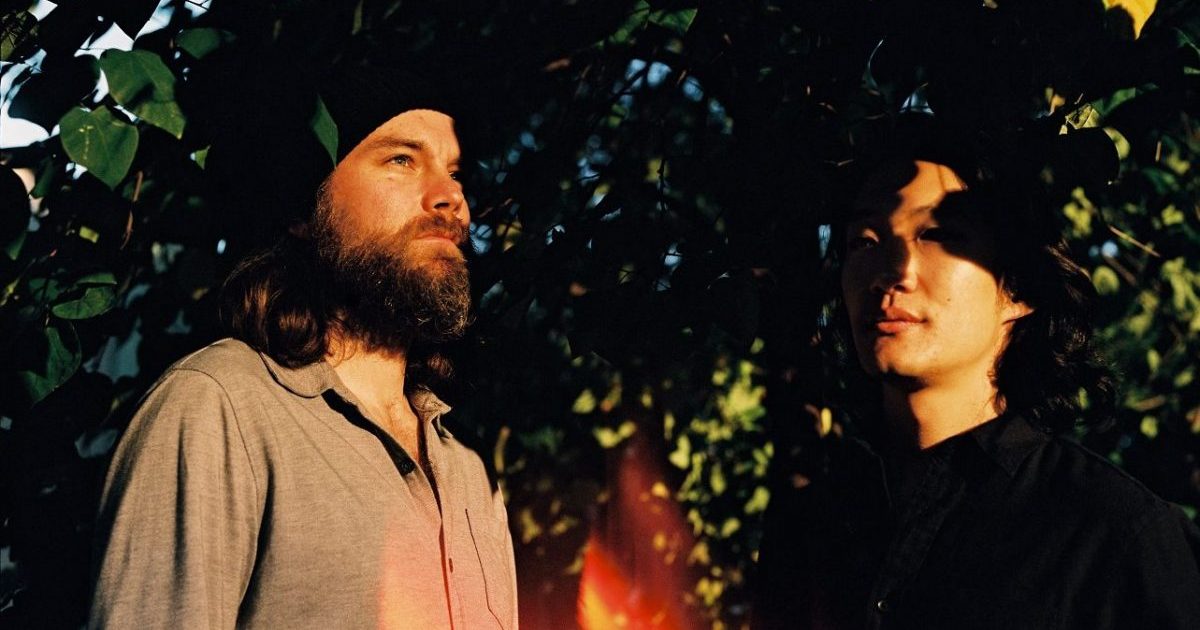
Artist:Handsome Ghost Hometown: Worcester County, Massachusetts Song: “Weeds” Album:Some Still Morning Release Date: September 18, 2020 Label: Photo Finish Records
In Their Words: “‘Weeds’ may be the brightest song on our record. The melody, the production — and the lyrics too. It’s about anticipating the inevitable end of a relationship (sounds sad, I know), but recognizing that you’re both going to move on and find your own way, independent of one another. In the simplest terms, it’s: ‘I’ll be here, you’ll be there — but I’m still going to care about you and I hope you think about me too sometimes.’ The song comes from a good place, a steady state of mind.
Nick Noyes has worked on all of our music videos for Some Still Morning and ‘Weeds’ is his latest creation. Typically the three of us will build up a visual concept together — but ‘Weeds’ is all Nick. He had a vision and we trust him and basically said, ‘Go for it, brother.’ Nick and I didn’t speak about the meaning of the song beforehand — and I’m glad we didn’t — because he interpreted it completely differently. To Nick, the song is about memory. About longing for a moment in time that is no longer there. The visual focuses on that feeling and explores it further…without explicitly referencing memory or flashbacks or anything of the like. I love how the video turned out, I find it very powerful and strange at times. And I mean that as a compliment.
“I also love that listeners, in this case someone extremely close to the band, can interpret a song completely differently than it was intended. That’s the best part about music, in my opinion. Once you put a song out there, it’s any listener’s right to make it their own and define what it means to them.” — Tim Noyes and Eddie Byun, Handsome Ghost
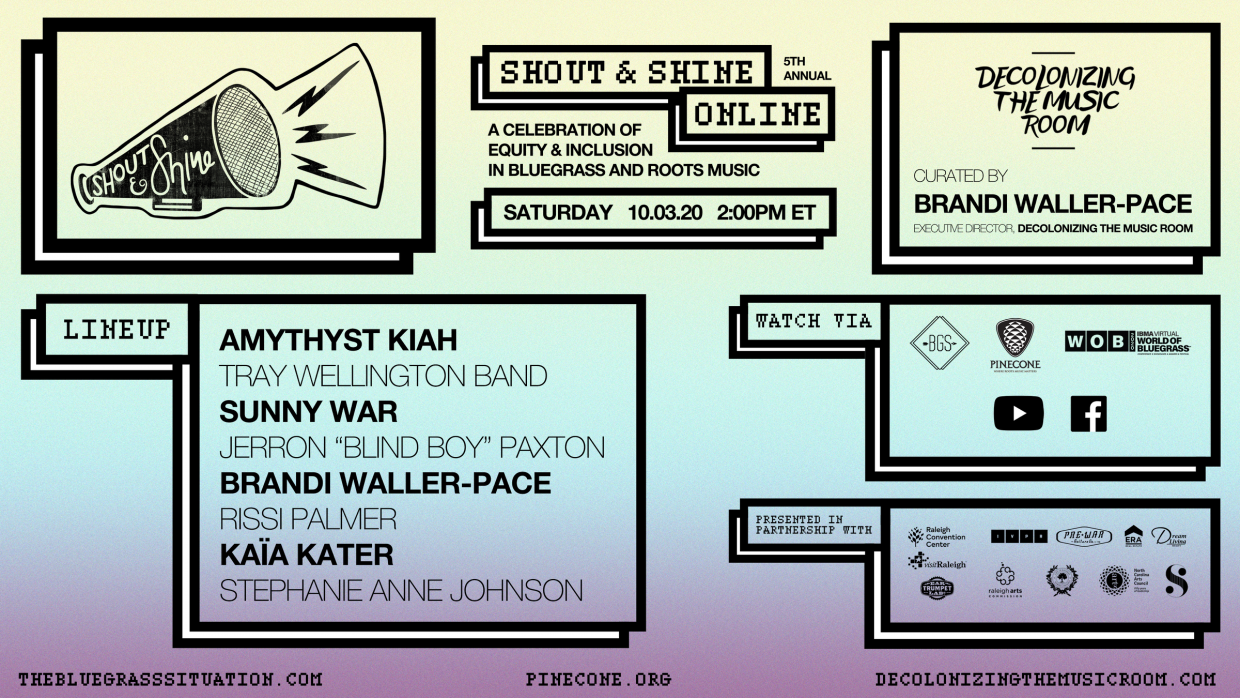
For five years now BGS and our partners at PineCone Piedmont Council of Traditional Music have used our voices, resources, and positivity to lift up and celebrate diversity in bluegrass and roots music through the Shout & Shine showcase. These live performances have given a platform to those artists who have been overlooked, while illuminating the paths of those starting out on uphill journeys in our music community. This year, the event’s 5th annual iteration will follow a format more suitable for a worldwide pandemic — with an all-online showcase as part of IBMA’s Virtual World of Bluegrass.
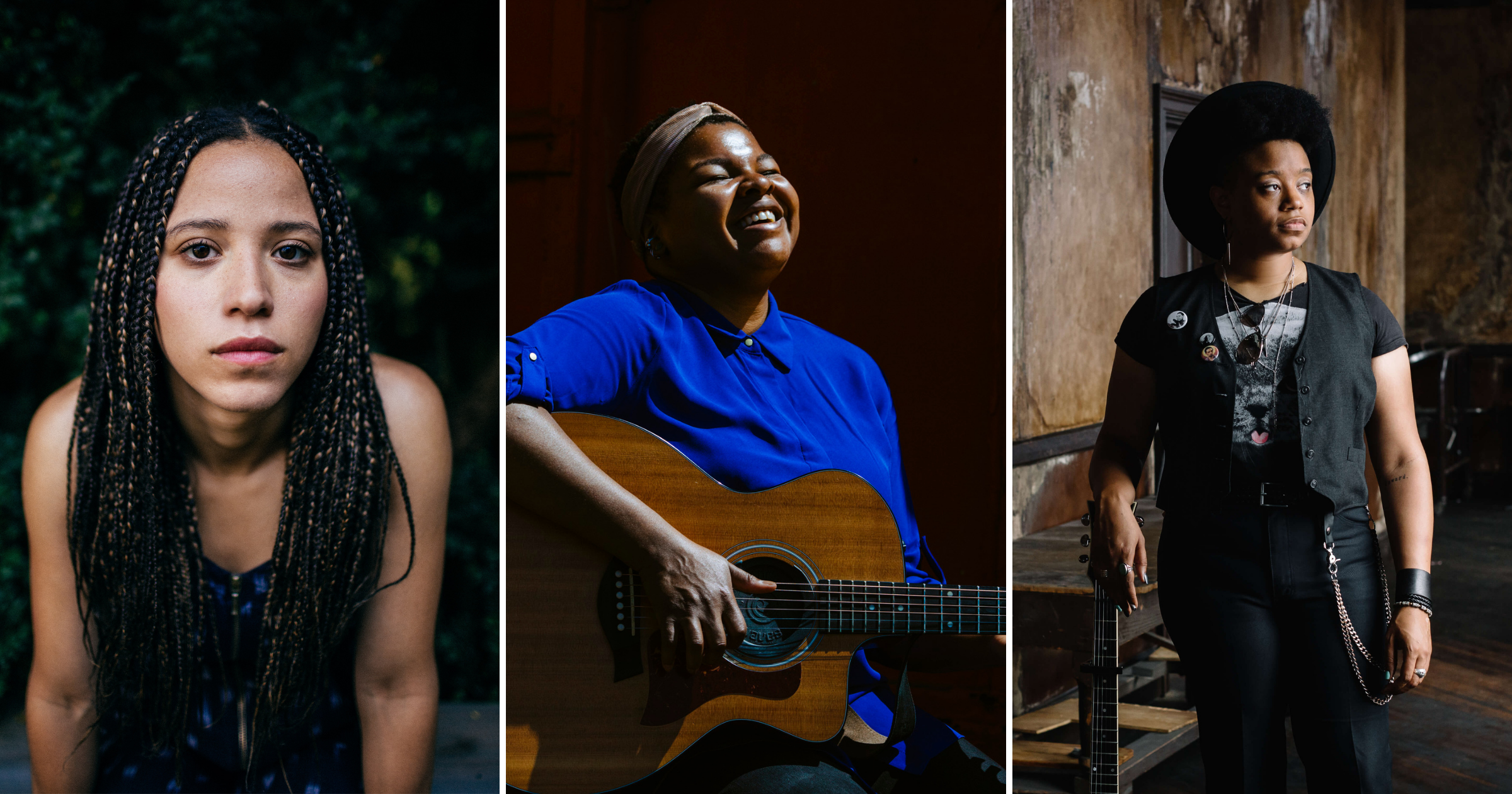
Shout & Shine Online will feature these artists from across the genre map of roots music: Rissi Palmer, host of Apple Music Country’s brand new radio show, ‘Color Me Country‘; IBMA Momentum Award winning banjoist Tray Wellington; punk-influenced fingerstyle guitarist and songwriter Sunny War; down-home blues and old-time musician Jerron “Blind Boy” Paxton; The Voice alumnus and guitar picker Stephanie Anne Johnson; and returning favorites Kaia Kater and Amythyst Kiah, who make their first appearance at Shout & Shine since playing on its debut lineup in 2016.
Shout & Shine Online’s roster is curated by performing musician and Decolonizing the Music Room founder and Executive Director, Brandi Waller-Pace. Shout & Shine Online will take place at 2 pm ET Saturday, October 3. Viewers will be able to tune in right here on BGS, or on our Facebook page orYouTube channel, via PineCone’s channels, and via IBMA’s conference platform, Swapcard (registration available here).
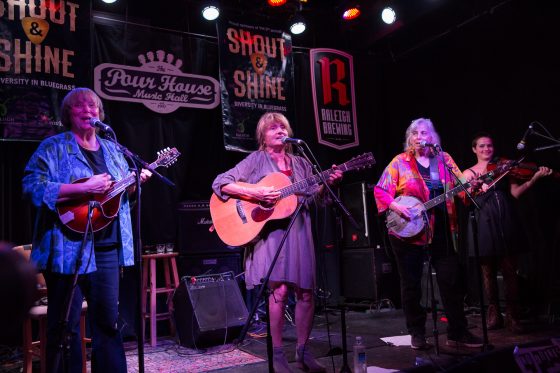
(L to R) Marcy Marxer, Alice Gerrard, Cathy Fink, and Tatiana Hargreaves perform at 2017 Shout & Shine showcase.
While Shout & Shine has continually championed underrepresented and marginalized folks in roots music, this year’s event comes at a time of reckoning in this country’s ongoing battle against institutionalized racism. “This year, Shout & Shine’s mission is as clear and galvanized as ever,” says BGS editor and Shout & Shine producer, Justin Hiltner. “Our lineup is a direct response to this current iteration of the Black Lives Matter movement and the righteous rebellion against police brutality and systemic racial injustice in this country. The greater bluegrass community needs to be having these conversations and needs to be centering the voices and perspectives of Black folks — especially Black queer folks. We saw that as our role this year.”
BGS joined hands with Decolonizing the Music Room’s founder Brandi Waller-Pace to curate 2020’s lineup. “The mission of Decolonizing the Music Room is to center Black, Brown, Indigenous, and Asian voices, knowledge, and experiences within the field of music education,” says Waller-Pace. “In addition to that, it is part of DTMR’s core values that we are an openly LGBTQ+ affirming non-profit organization. I am honored to have served as curator for this year’s Shout & Shine and to have had this opportunity to partner with BGS and PineCone on work that highlights a convergence of our values.”
“In addition to Shout & Shine’s continued work centering the music and stories of underrepresented artists in the bluegrass community, we also continue to work toward making these programs as accessible and inclusive as possible. We’re providing American Sign Language interpretation for the entire Shout & Shine program, modeling what can be done and what we continue to work toward in making accessibility central to our work,” said Jamie Katz Court, Communications & Programs Manager for PineCone, the Raleigh-based roots music organization that has partnered with us on Shout & Shine since 2017. PineCone also produces the festival, IBMA Bluegrass Live! powered by PNC.
The showcase was first conceived in 2016 to celebrate diversity and inclusion at the International Bluegrass Music Association’s business conference and festival in Raleigh, North Carolina. Originally organized in response to the North Carolina General Assembly’s homophobic bathroom bill, HB2, the scope of the event immediately widened to include and celebrate not only the LGBTQ+ community, but any and all marginalized folks in roots music. Shout & Shine stages have included the most exciting emerging talent alongside bluegrass legends and stalwarts, with lineups that have boasted the Ebony Hillbillies, Alice Gerrard, Cathy Fink & Marcy Marxer, Laurie Lewis & the Right Hands, Missy Raines, Amythyst Kiah, Kaia Kater, Che Apalache, and many, many more.
Shout & Shine is also a monthly editorial feature, which debuted with world-renowned drag queen Trixie Mattel’s first-ever interview by a roots music publication. In 2020 the column grew into a monthly livestream series that has already featured harpist and songwriter Lizzie No and fingerstyle guitarist Sunny War, part of a six-month series focused on Black artists and creators in roots music. The next episode will follow Shout & Shine Online in November. Whether on stage, in print, or online, Shout & Shine’s mission has always been celebrating the marginalized and underrepresented folks of all identities, backgrounds, faith traditions, and abilities who make and love bluegrass music.
Tune in Saturday, October 3 at 2pm ET for Shout & Shine Online!
Lede photo (L to R): Kaia Kater (by Todd Cooper); Stephanie Anne Johnson (courtesy of the artist); Amythyst Kiah (Anna Hedges). Poster art by Grant Prettyman, Belhum
Artist:Garrett Owen Location: Fort Worth, Texas Song: “Souvenir” Album:Quiet Lives Release Date: September 18, 2020
In Their Words: “I wrote the opening guitar figure and first verse to ‘Souvenir’ a long time ago. I showed what I had written to a friend — ‘I put our love in a jar and drove it around in my beat-up car….’ He thought it was catchy. I started slowly trying to coax the rest of it out of myself and used it as an opportunity to take some really tricky chord work in the chorus and impose a massive key change for the second chorus. I have a lot of songs inspired by a long-term relationship I was in; the rest of the lyrics are a mix of abstract expressions of pain and emo-dramatic statements about how things with her ended.” — Garrett Owen
Do you remember the soundtrack to your earliest childhood memories? Do you remember the songs that wafted from the car radio to the backseat as you rode along the highway, en route to a family reunion or summer vacation? My earliest memories of seemingly interminable, minivan-filled-to-bursting road trips are often scored by solo acoustic guitar. My older brother, a fingerstyle enthusiast and acolyte, had an equally interminable collection of Phil Keaggy albums. At one point, I could tell you the exact title of the tune that was my favorite to fall asleep to on the road — though by now I’ve long forgotten which one.
Guitarist and Nashville transplant Jordan Tice counts many a virtuosic, acoustic guitar aesthetician (cutaway or not) among his influences, from Norman Blake to Mississippi John Hurt — two pickers Tice references as direct inspirators of his upcoming solo album, Motivational Speakeasy. The record was written pre-pandemic and, despite its “stripped down” nature, feels impetuous, mischievous, and adventure-ready, even in a song as languid and buttery as “Stratford Waltz.” Named for Stratford Avenue in Nashville’s Inglewood neighborhood, the tune immediately recalled to mind the family road trips of my childhood, my brother’s CD carrying case, and my sleepy head bonking against the back window in our circa 2004 Chevrolet Astro Van.
The intimate setting of the album — it’s just Tice and his “beloved and well-worn Collings guitar,” as a press release puts it — and the subtly lush reverb magnify the gentle, magnetic momentum of “Stratford Waltz.” With that motion and the sly adventuresome spirit we know from Tice’s writing, both lyrical and instrumental, it’s no wonder a mind might leap immediately to the open road, with hundreds of miles ahead. And personally, it’s certainly fitting because, nowadays, when I turn off the highway and head south on Gallatin Pike in Nashville towards my current home, my most direct route is down — did you guess it? — Stratford Avenue
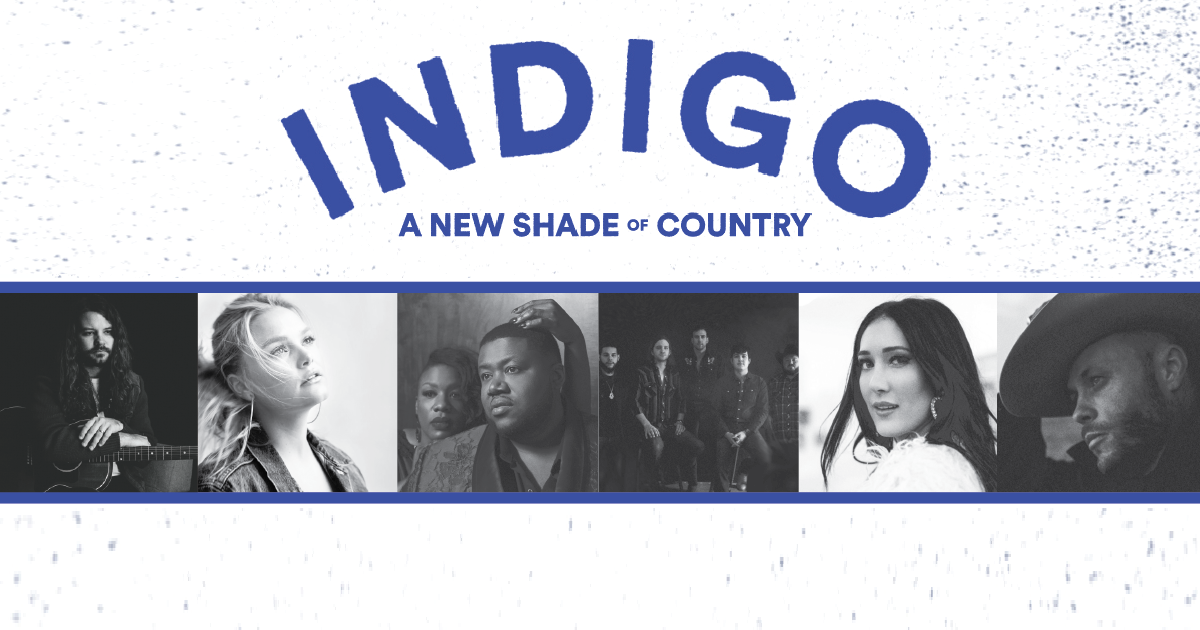
“Our Nashville-based team had been having ongoing conversations since early 2019 regarding just how diverse the taste of our country music audience was. It was clear to us that there were many modern songs in the genre, touching on Americana, rock, roots, and bluegrass, that had sonic and thematic throughlines. We were also seeing many of these artists on the road together (Marcus King Band joined Chris Stapleton, Yola toured with Kacey Musgraves), talking to each other on socials, echoing the strong community within the scene. With this in mind, the goal was to create a playlist brand that reflected these intersections and the audience appetite for a playlist of this nature. With the success of the playlist since its launch in March, Indigo has continued to be a priority for us, which is reflected by enthusiastic listening from users. We’re celebrating the playlist this month with a sizzle video, new video playlist formats, artist sharecards, billboards, and more, in hopes of bringing more fans aboard the Indigo train.” — Laura Ohls, Senior Editor, Folk & AAA, Spotify
(Editor’s note: Listen to Laura Ohls’ Indigo Takeover Mixtape below.)
Zach Bryan – “Heading South”
Twenty-three years old and on active duty in the US Navy, Zach Bryan might not be what one would expect from a country act on the rise. The Oklahoma native’s self-released material from the fall of 2019 is gaining traction on Spotify, creating buzz throughout the Nashville music industry. At the time of its initial release he had no publicist, no manager, no team to speak of whatsoever, yet his live videos sparked the interest of an audience on social media — which ultimately led to the flood of activity on streaming we are seeing today. His biggest song to date, “Heading South,” has been included in our Indigo playlist since its launch in March and remains a consistent tentpole track. Though he hasn’t had the opportunity to tour as a result of deployments and the pandemic, expect crowds of fans when the time comes.
Caylee Hammack – “Small Town Hypocrite”
One of country’s most notable rising stars, Caylee’s powerful and vulnerable ballad proves how strongly personal songwriting still resonates in the genre. A vocal standout in the playlist, you’ll feel her heartbreak and strength throughout the song.
Flatland Cavalry – “War With My Mind”
While the song was not written during the pandemic and this time of quarantine, the Texas band’s newest song lyrics grapple with internal battles we all face due to lack of stability, isolation, or just general disruption, which certainly resonates with listeners today.
Brent Cobb – “Keep ‘Em on They Toes”
A real toe-tapper, this track encourages the listener to follow your own path versus one that has perhaps been laid out for you. The song also suggests taking higher ground when being tested by others, some sage advice we could all use during these stressful times. Cobb’s classic, warm tone shines through this cut.
Hailey Whitters – “Heartland”
The Iowa-native-turned-rising-country-star pays homage to her roots in this nostalgic song about the place she was born and raised. As the saying goes, you can take the girl out of the Heartland…
Cut Worms – “Sold My Soul”
A hint of Neil Young, a splash of Guy Clark, a shake of Gram Parsons, and you get this great tune from Cut Worms, AKA Max Clarke, embodying country-folk storytelling at its finest.
Jonathan Terrell – “Never Makes a Sound”
I have seen Jonathan Terrell’s music described as “Springsteen in a Honky Tonk,” and no song better reflects said description on Terrell’s new record than this one. Passionate and driving, it’s a real rocker on Indigo.
Aubrie Sellers – “Far From Home”
A little bit country, a little bit rock ‘n’ roll, Aubrie makes the kind of gritty Americana that a playlist like Indigo was made for. The title track and opener off her newest album is a more subtle take on her “garage country,” but is exemplary of how dynamic she is as an artist.
The War & Treaty – “Five More Minutes”
The husband-and-wife duo have always written songs that strike a chord and can often bring the listener (me) to tears, but they’ve managed to accomplish this with a song that feels upbeat and… happy? The roots of the song, however, are quite dark. Michael Trotter Jr, after years of mental and financial struggles, contemplated leaving this world. In response his wife, Tanya, pleaded to him, “Just give me five more minutes. Stay with me. Just five more minutes to love you.”
Charley Crockett – “Welcome to Hard Times”
Is there really another song title on this playlist that is more appropriate for our day and age? Following his 2019 album, The Valley, and a severe health scare, Charley’s newest album (and title track) touches on failures and a system that’s rigged for said failures. Crockett is one of those artists that embodies all subgenres and eras under the American roots umbrella, and it’s songs like these that showcase how his art feels old and familiar while simultaneously being new and exciting.
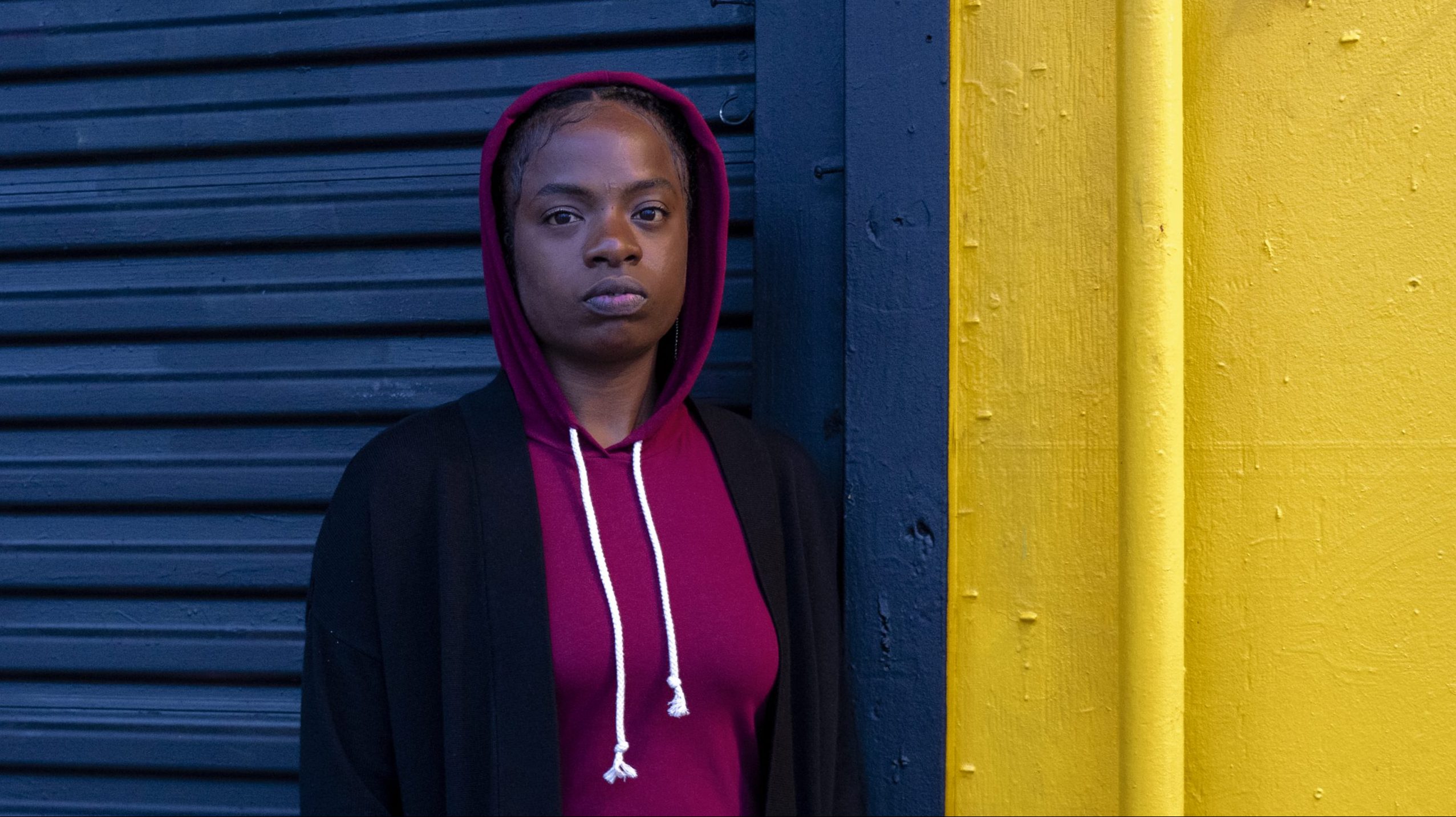
Guitarist and singer/songwriter Sunny War doesn’t necessarily miss performing live, in-person shows — she’s not even sure she ever really liked playing shows that much in the “before COVID-19” times at all. But, as she connects with BGS over the phone in preparation for another pandemic-tailored event, her Shout & Shine livestream show on Wednesday, September 16 (live on BGS, Facebook, and YouTube at 7pm ET / 4pm PT) her general feelings regarding the pandemic and its far-reaching impact on the music industry are very clear: It’s all just really weird.
She, like many creators in the March-and-April maelstrom that swallowed up any/all meaningful work for an interminable period of time, became depressed, distant, and took some time to work her way back into a creative mode that feels respondent to our harsh everyday without being bogged down in it. A punk-influenced and inflected lyricist, she’s once again turning to her songwriting pen as an outlet.
While her peers turn to that same outlet to process many of the myriad daily tragedies and injustices we’re all so attuned to in this global moment, War instead pauses. “I kinda don’t like protest songs from people who didn’t do it before,” she explains, calling to task the frantic and frenzied rush to pivot records, releases, and pressers into more “appropriate,” digestible bits for a newly awakened, activist reality — and consumer.
But War’s identity, her selfhood, as evidenced through every note of her idiosyncratically finger-plucked songs and through her carefully chosen words in her lyrical poetry and our conversation, calls upon her to challenge that propriety. “[Democracy] actually is working” she explains, noting hypocrisy and/or tone deafness in our roots music communities. “It’s working, it’s always been working. It just hasn’t ever been in our favor.”
BGS: I’m a banjo player, I came up through bluegrass, and there’s something about your right hand in your guitar playing that’s really entrancing and relatable to me. It conjures bluegrass and fingerstyle, but it is so unique to you, it’s idiosyncratic. Where did your style come from? What influenced your right hand technique, how did it develop?
SW: I think it came from mimicking banjo, actually. My stepdad’s friend played banjo, so I was around a banjo player sometimes growing up. The first fingerpicking thing I learned was “Blackbird” by the Beatles and that was the first time I thought I sounded kinda good. When I was a kid, I thought, “Wow! This [fingerpicking] sounds way better than just strumming a chord.” I never really learned a lot of chords, I still just play a lot of chords in first position. I was just playing C and G and D open and I thought, “Well now I sound like I’m really playing something.”
I didn’t listen to blues until I was in high school and then I was kind of imitating country, blues, and my stepdad’s friend on banjo. Later, I was trying to be like Mississippi John Hurt; and I kinda wanted to be like Chet Atkins. But I couldn’t ever figure that out.
I see plenty of folks in the scene who idolize Derek Trucks or Joe Bonamassa or even Molly Tuttle and Billy Strings who are coming up. There are these guitar fans that just idolize and adore them. Have you seen guitar fans trying to capture what you’re doing with your playing?
Not really? I don’t know. There are some people on Facebook and Instagram who message [me] and want to talk about my guitar style, but they’re usually just into old-timey blues stuff. Then we just talk about that. Sometimes they ask who I listen to. But I think [the implication is], “You’re really close to maybe being like this person I know of.”
I can think of a lot of shredders out there, but I do the same kind of riffs in every key that I play in. I feel like I can say I really do fingerpick well, but I know people that really do it and can play as well with their left hand as their right. I’m not quite there. [Laughs]
It’s hard to talk about music and performing right now without acknowledging the giant, COVID-19 elephant in the room. It’s interesting to me that this moment of pausing, of stopping everything, especially in the music industry, has given artists a chance to refocus or realign their priorities – have you been thinking about the future? Thinking about the present? How has the pandemic felt to you?
The first three months I was just depressed and drinking a lot and not doing anything. Then recently, I’ve been trying to write. I’ve been jamming with my friend Milo, who plays a lot of lead guitar on two of my albums, and we’re going to make some demos together. I’ve also been thinking about going to school, trying to get into some kind of two-year program. Since music might not [come back], there might not be live music for two more years. I’m thinking about getting a job. [Laughs]
It’s daunting to wake up every day like, “I’m going to keep doing this now, because I believe — I think — it’s going to happen in the future.” It’s a lot!
Yeah, it’s like, “Maybe music is just not essential…” You know? [Sad chuckle]
Then, with the whole Zoom thing and the livestream thing, I’m just not really into it. I’m not enjoying it at all, it feels weird. It’s just like, sitting in a room by yourself, trying to make a video, and then you think, “Should I look into the camera? Should there be talking in between?” You’re trying to imitate a set at a venue, but you’re just sitting by yourself. It just feels weird! I would rather just play by myself, without a camera.
I liked playing shows [before] kind of, but I almost didn’t even like that. At least it felt like there was a reason for doing it. I was talking to my mom and we both realized we used to watch concerts before, too. Just then it was an actual concert on film. Even that would be better! If there were somehow an audience in the livestream… I guess that can’t be, but it’s just awkward [without them.] Seeing a band play off of the energy of the room is more what it’s about.
Well, for your Shout & Shine livestream performance we’ll have to ask our audience to be “loud” in the comments! Use that clapping hands emoji! [Laughs] Who would you like to see as a guest on Shout & Shine? Whose music is inspiring you right now and getting you through the day-to-day?
Have you heard of Yes Ma’am? They’re from New Orleans – the singer sometimes plays solo, but also has a band. They used to busk on the street in New Orleans. It’s just really good, a great kinda folky string band.
I like the new Run The Jewels album. I listen to Elliott Smith still, and a lot of ‘90s music. I like Black Pumas a lot.
What would you like to see from the music community, as far as a response to this moment in our culture’s history — not only the racial injustice and righteous rebellions against police brutality, but also how divided and polarized our musical community is now. It’s like half people who want music to “remain apolitical” and half folks who are like, “Music has always been political, where the fuck have you been all along?” What do you see as the urgent need of our community to reconcile all of this? I know that’s a huge question.
I think it just needs to become about honesty again. That’s something I would like to see. I’m not really that into “Americana” music, but even so I feel like [Americana] musicians are going to be faced with not being able to let these issues go unaddressed anymore. I think that’s interesting. At this point, you can’t just put out your weird corny love song that’s not even about anything that happened in your life, but is actually just something that makes sense pop-wise and hit-wise. You should have to really be honest. People don’t necessarily have to be “political,” they can just write about all the emotions they’re going through. We’re all dealing with the pandemic and with Trump and with police brutality — it’s a lot. Even if people don’t want to write a song about why we should get rid of the police, they could at least write about how scared they are. I don’t know, there’s a different, new kind of folk that could happen about just being freaked out and unsure of your future. I love shit like that.
I kinda don’t like protest songs from people who didn’t do it before. It’s just not hitting right. I don’t want your protest music if you weren’t writing it before. Whatever issue is being highlighted, it’s always like, “Yeah, we’ve BEEN talking about that.” [Expectant pause] This has been the conversation. I’m into punk, I’ve always liked protest music. As far as folk, I do like its protest music, but I mostly like punk or really politically-charged hip-hop. It’s kind of annoying when say, a really poppy country person who’s never said anything about anything is writing a protest song. It’s just cashing in. It’s corny. It’s weird.
And another thing, a lot of people who are going out to these Black Lives Matter protests and stuff, I still don’t feel like they would treat me any differently than they normally would. I saw people posing and taking pictures. This is a weird thing to just be a trend.
Like Breonna Taylor now being a meme.
Yeah. It’s offensive, it’s too much.
And how many times they show those videos [of Black people being murdered by police]. There’s a lot of murder porn going around! People are saying one thing, but showing someone die every day. I was kind of like, “You know, I don’t think they would show a video of a white person being killed, over and over again.” A lot of things happening right now are really dehumanizing and I don’t think people can see it unless they really, really think about it. Or maybe put themselves in that position. It’s murder porn.
I know what happened. I don’t want to see this over and over again. I don’t need to physically see it to be angry about it. Think of all the bad this is doing to our psyches on top of everything else, seeing people murdered every day.
But, a lot of musicians are “activists” now, I guess. I just… don’t really know what that means. They were going to put out a song anyway. That’s what they do for a living. Obviously they can’t just put out the typical love song — that’s what people always write about, love. That would be “offensive.” Or, it wouldn’t be “appropriate.” So they all have to change and pretend to be “activists.” It’s just a reflection of what’s trending right now.
I just want to know: Are they actually going to change in a year? I’m curious to know how long the Black Lives Matter profile pictures are going to stay up.
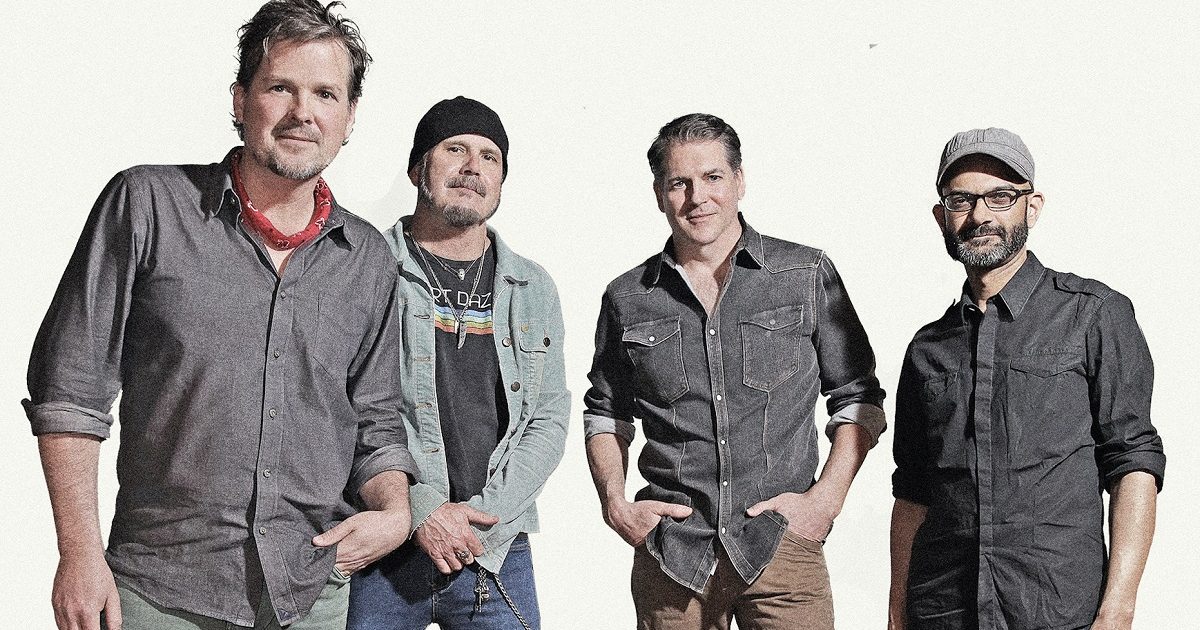
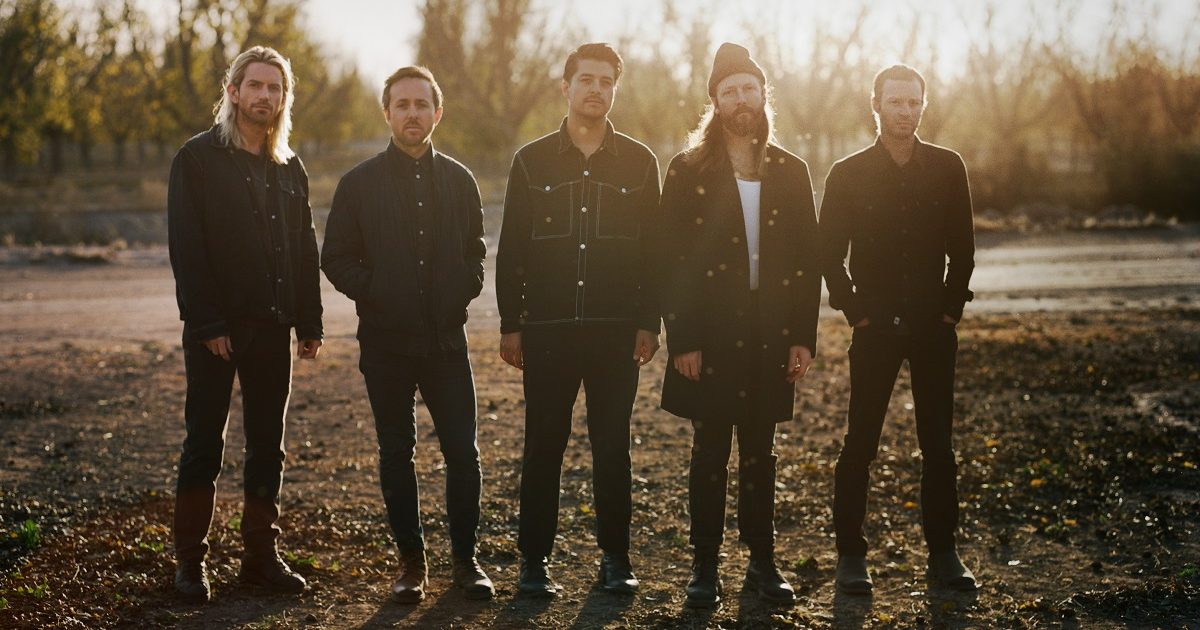
Artist:Delta Spirit Hometown: NYC, Brooklyn, Los Angeles, Austin, Montreal Song: “What Is There” Album:What Is There Release Date: September 11, 2020 Label: New West Records
In Their Words: “’What is There’ is an acrostic poem that I wrote for the guys in the band, with each verse directed at a specific person. I wrote the song in the winter of 2018 while living in Oslo. We had just decided to give the band another go and I was feeling sentimental about the journey we had been on since 2005. We were all just kids trying to break into this business. Each of us had been burned by the major label system with other projects. Starting Delta Spirit with my best friends, traveling the world, and playing music that meant the world to us was such an improbable miracle, but then it felt inevitable. There were moments when we lost our way as brothers and as creative collaborators, but since the break, we have found new and better ways to communicate. And that feeling of inevitability is back.” — Matthew Logan Vasquez, Delta Spirit
Photo credit: Alex Kweskin
This website uses cookies to improve your experience. We'll assume you're ok with this, but you can opt-out if you wish.AcceptRejectRead More
Privacy & Cookies Policy
Privacy Overview
This website uses cookies to improve your experience while you navigate through the website. Out of these, the cookies that are categorized as necessary are stored on your browser as they are essential for the working of basic functionalities of the website. We also use third-party cookies that help us analyze and understand how you use this website. These cookies will be stored in your browser only with your consent. You also have the option to opt-out of these cookies. But opting out of some of these cookies may affect your browsing experience.
Necessary cookies are absolutely essential for the website to function properly. This category only includes cookies that ensures basic functionalities and security features of the website. These cookies do not store any personal information.
Any cookies that may not be particularly necessary for the website to function and is used specifically to collect user personal data via analytics, ads, other embedded contents are termed as non-necessary cookies. It is mandatory to procure user consent prior to running these cookies on your website.