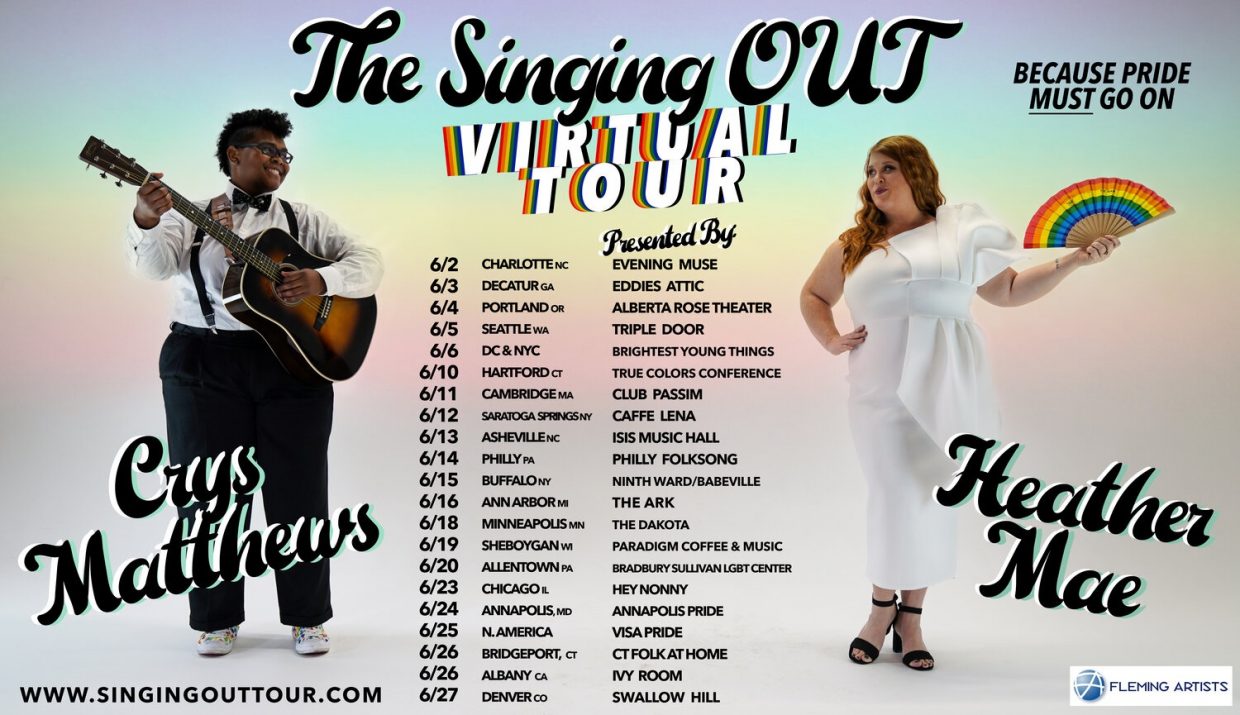
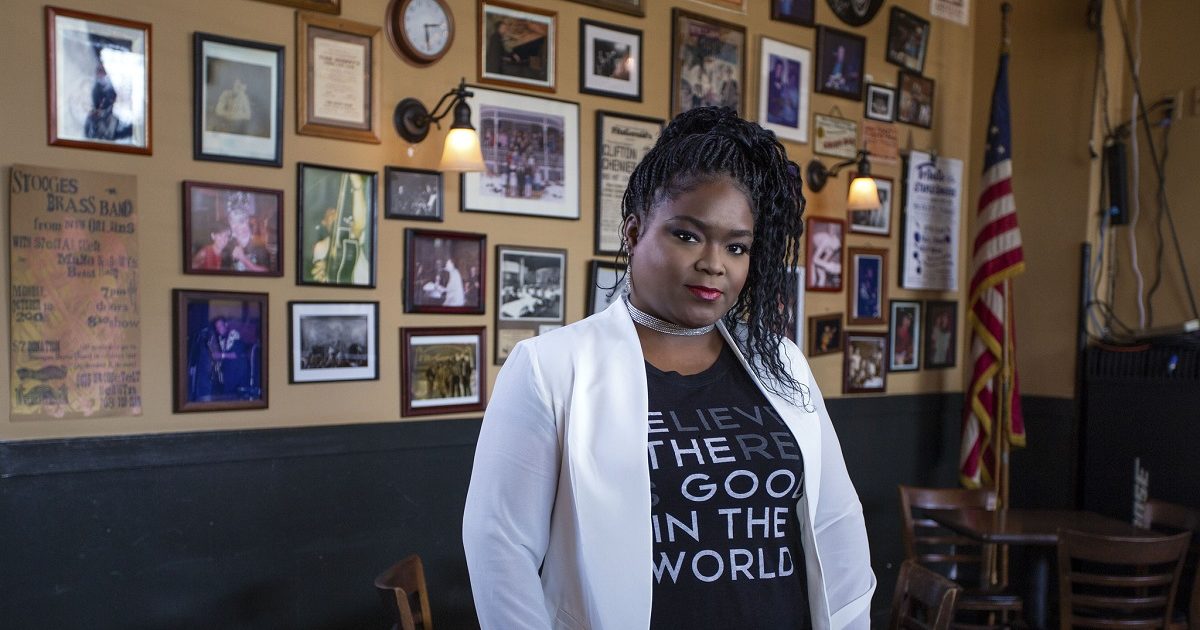
LISTEN: Crys Matthews & Heather Mae, “Six Feet Apart”

Artist: Crys Matthews & Heather Mae
Single: “Six Feet Apart”
Latest Project: The Singing OUT Tour, a celebration of LGBTQ+ Pride

In Their Words: “Until our love is accepted as universally as everyone else’s, LGBTQ+ love songs will, by their very existence, be protest songs. ‘Six Feet Apart’ is a snapshot of the current time: love in the time of a pandemic. It’s about actively making the choice to turn away from fear and lean in to one another. For LGBTQ+ people, Pride is a time to celebrate who we are and how we express, identify, and love. It’s a time for us to lean into our community. Right now, we aren’t able to gather in-person but we don’t cancel Pride — we adapt. This would have been our third year of the national Pride tour — Singing OUT — and when social distancing threatened to cancel all our in-person shows, we went virtual. As our song says ‘six feet apart won’t stop us,’ and it won’t stop the Singing OUT Tour either.” — Crys Matthews & Heather Mae


Photo courtesy of the artists.

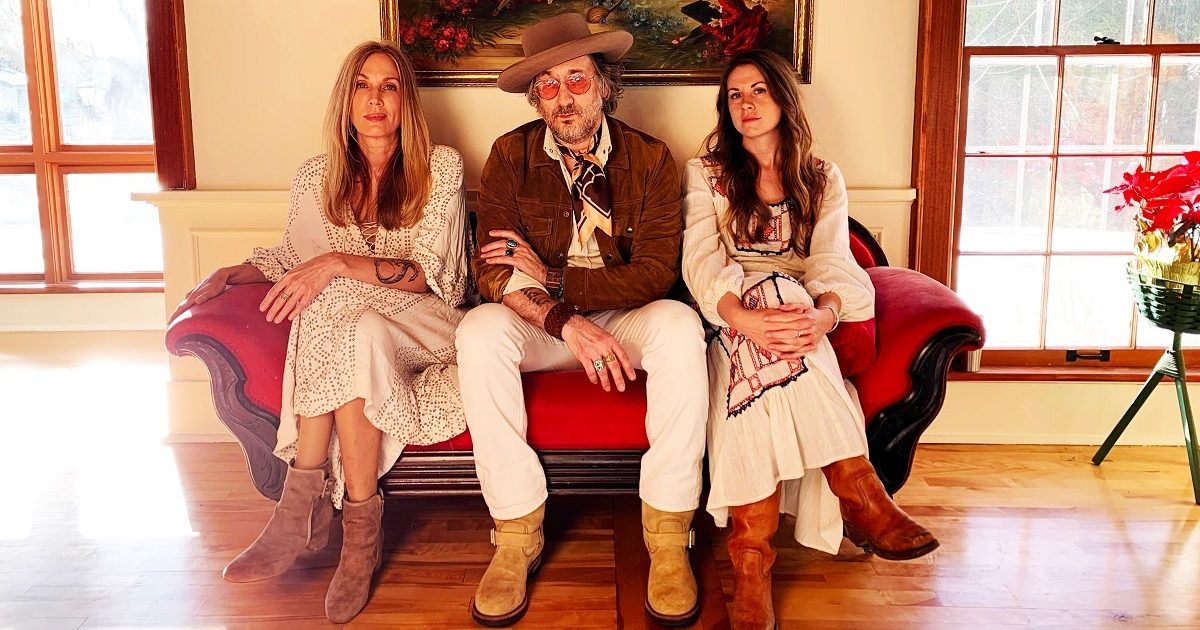
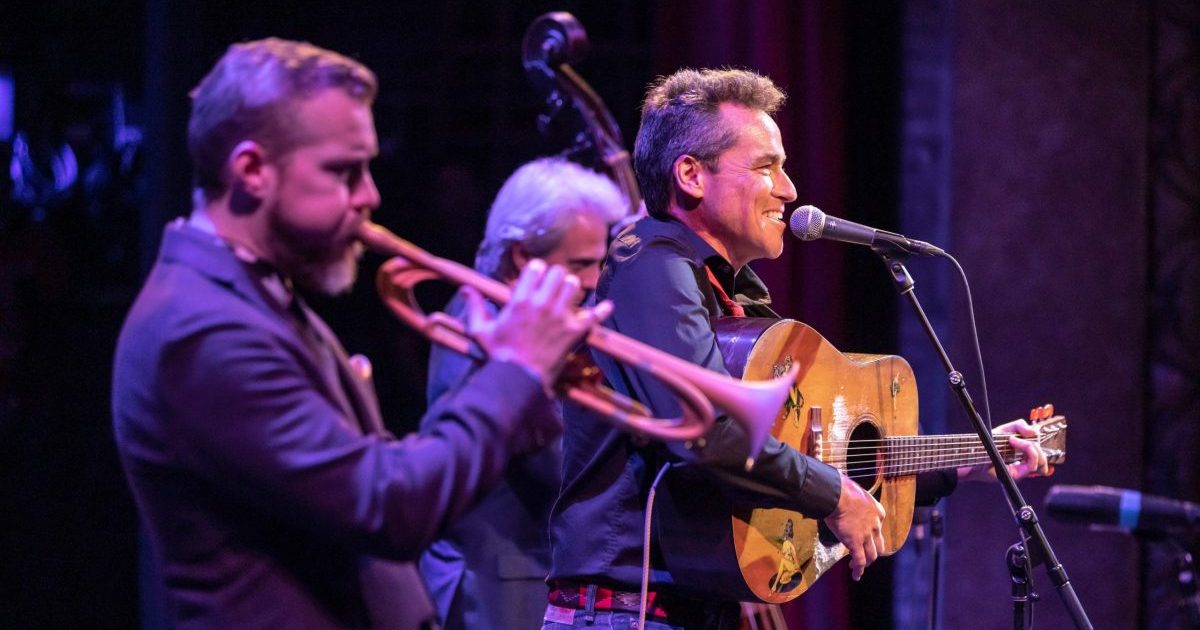
MIXTAPE: Turn Turn Turn’s Sonic Journey

Me and my Turn Turn Turn bandmates Savannah Smith and Barb Brynstad have chosen a mix of music that’s either helped shape us as musicians and songwriters, resonates with us in these uncertain times, or is stuff we keep coming back to, like that lover we can’t seem to shake. It’s old and new like our band — we “turn” to the distant past of early American recorded music, “turn” again to that renaissance of the 1960s and 1970s, and finally “turn” again to the present looking forward. We hope you dig the sonic journey. — Adam Levy

Ry Cooder – “Boomer’s Story”

Probably one of the most influential players of my life. Evocative, funky, reverent of past blues players, but super innovative. All the double stops sound like he’s often imitating fiddlers. I do that on the guitar solo for our song “Fourteen.” This song is the ultimate Ry Cooder groove with Jim Keltner on drums. Reminds me of years listening to it touring in a van with my band, The Honeydogs. — Adam

Luluc – “Controversy”

There’s another level of calm within Luluc’s music I have always appreciated. Nico with modern themes… I don’t know how they do it, but they do it so well. — Savannah

The Staple Singers – “Freedom Highway”

Who can say they HAVEN’T been influenced by the Staple Singers? Unvarnished, insistent, and catchy as hell, it’s no surprise that “Freedom Highway” is as eminently listenable today as it was in 1965. And sadly, although it was written more than five decades ago, this song’s imperative message resonates just as strongly in 2020 as it did during the apogee of the Civil Rights movement. — Barb

Judee Sill – “The Lamb Ran Away With the Crown”

It’s hard to choose a favorite of hers. One of the greatest underappreciated American songwriters. She crosses genres, she sings some of the most profoundly spiritual music and she hooks the listener with amazing harmonic movement and melodies. If you don’t have goosebumps at the rousing end of this gem you might need to check your pulse. As good as anything on Pet Sounds — maybe better. — Adam

Turn Turn Turn – “Delaware Water Gap”

Imagine if Dylan wrote a song about a female serial killer and had Emmylou Harris and Stevie Nicks join him while Grady Martin and Clarence White duel on guitar. — Turn Turn Turn

Sarah Jarosz – “House of Mercy”

I fell in love with multi-instrumentalist Sarah Jarosz a few years ago, when I saw her perform at the Dakota, a renowned live-music venue in Minneapolis. Fresh-faced and not too far out of college (New England Conservatory of Music), she played as a part of a well-oiled trio of seasoned twentysomethings. This particular song appeals to me because it pierces the conventions of traditional bluegrass music — lyrically, vocally, and instrumentally. Importantly, it was my gateway to a deeper appreciation of bluegrass and old-time music. — Barb

Lefty Frizzell – “Treasures Untold”

Lefty is often overlooked in the country music pantheon. His voice is velvety voice and cheeky chords meld honky-tonk gently with Tin Pan Alley pop. This song is nearly perfect to me as a composition. — Adam

Jessica Pratt – “As the World Turns”

Jessica Pratt’s voice and melodies are incredibly ethereal. I’ve always admired her songwriting, especially in this song. To me, I feel the driving, unstoppable passing of time while stuck in a trance of reflection. — Savannah

Turn Turn Turn – “Cold Hard Truth”

Adam wrote this one about deep self-examination and suggested Barb and Savannah do the vocal heavy lifting. We’re pretty proud of this bridge and we bet Phil Spector or Jeff Lynne would give us a nod of approval. — Turn Turn Turn

Dixie Chicks – “The Long Way Around”

I love the Dixie Chicks for their fearless defiance of conformity. And I love this song’s transcendent harmonies, soaring hooks, and in-your-face lyrics (“I wouldn’t kiss all the asses that they told me to”) that serve as a clarion call to all the uppity movers and shakers who refuse to be conventional. — Barb

The Rolling Stones – “Loving Cup”

I came to country music through the Stones. They always had a couple country nods with close harmonies, twangy pedal steel-like riffs and stories about dissipation, loneliness, yearning, and travel. “Loving Cup” is loose and sexy, takes you by the hand, spanks you and just keeps building with that piano-horn driven, drum-tripping outro. — Adam

Laura Stevenson – “Time Bandits”

Laura Stevenson is someone I have always really looked up to. Both her voice and her songwriting are incredibly powerful. This song hit me really hard during quarantine; it’s heartbreakingly hopeful. — Savannah

Big Bill Broonzy – “Glory of Love”

First time hearing this I was struck by the driving rhythm. I thought it was a couple guitarists. I spent a couple days figuring out this relatively simple three-chord song. And I only recently figured out how to get that ragtime banging drive happening — some 30 years after first hearing it. — Adam


Photo credit: Ilia Stockert

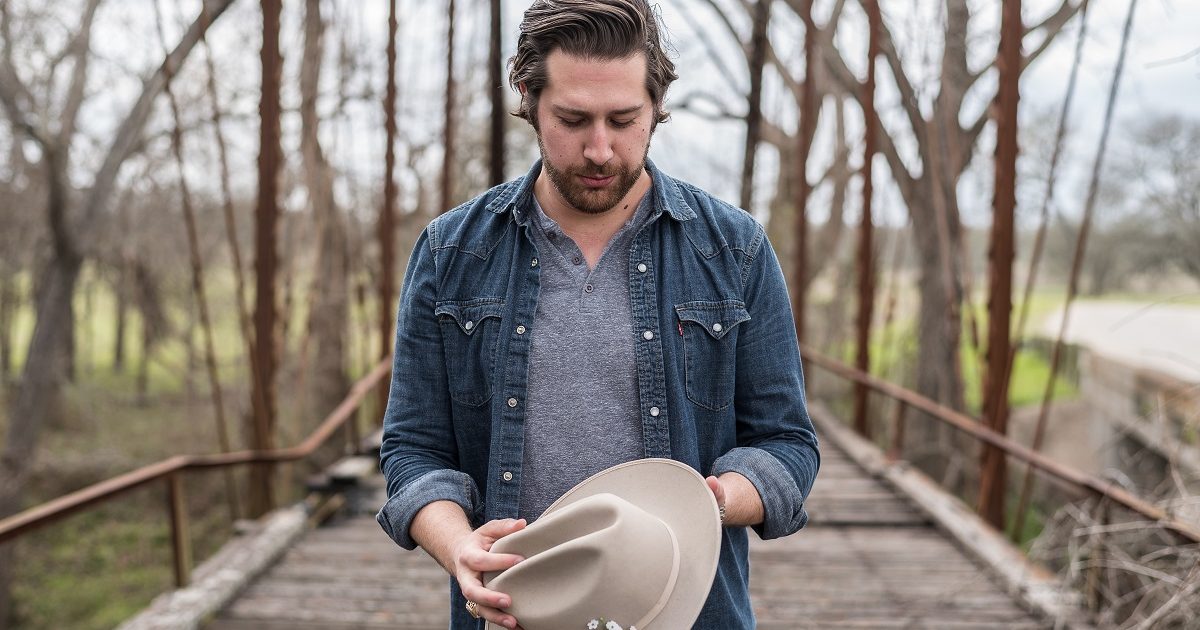
LISTEN: Evan Ogden, “These Songs and a Guitar”

Artist: Evan Ogden
Hometown: Round Rock, Texas
Song: “These Songs and a Guitar”
Album: Undone
Release Date: July 31, 2020

In Their Words: “‘These Songs and a Guitar’ is one of the most personal songs on the album for me. It came at a point where pretty much everything in my life was falling apart. I was having to own up to the fact that the man I wanted to be and the man I was had more differences than similarities.

“There’s a passage in the Bible that weighed heavily on me for about three or four months where Jesus is addressing anxiety and worrying about tomorrow. He tells His disciples to consider the ravens and flowers of the field; He describes God taking care of their needs and claims how much more He will take care of theirs. Faith has always been a central part of my life and this passage set off a season-long struggle to find out how to come to terms with a passion I seldom understand. This song, in a lot of ways, culminates a prayer, or argument I took up with God. I was trying to work through the blessing and curse of having a passion for such an unstable gift. Admittedly, I still struggle a lot with it but this song was very cathartic in a very real sense. I hope this song gives the listener a space to be honest about the struggle we all feel when our blessings are more like anchors than feathers.” — Evan Ogden


Photo credit: Jessica Summerford

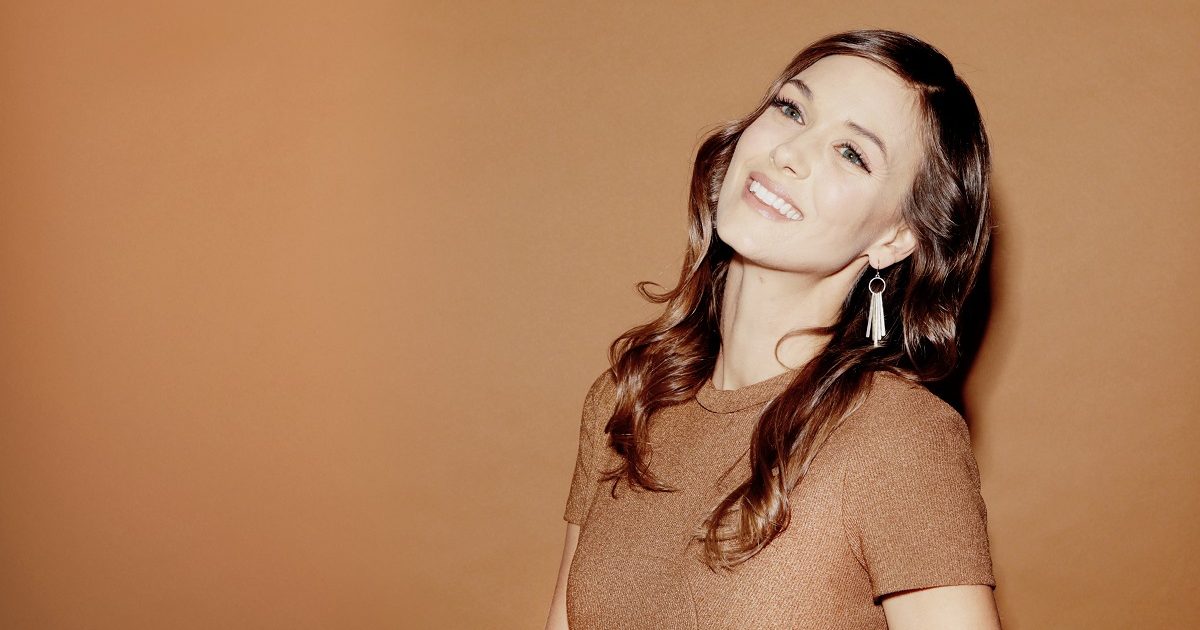
WATCH: Jill Andrews, “The Kids Are Growing Up”

Artist: Jill Andrews
Hometown: Johnson City, Tennessee; currently Nashville, Tennessee
Song: “The Kids Are Growing Up”
Album: Thirties
Label: Vulture, Vulture / Tone Tree

In Their Words: “I snuck away one day during my daughter’s nap to write ‘The Kids Are Growing Up.’ My son and daughter are seven years apart and everyday in both of them, I saw this theme personified. She was tiny in my arms just like he used to be. I wrote it as a reminder to myself to slow down and try to be present for the important moments, the ones that really matter. The video comes from ten found film reels donated to the Prelinger Archives in San Francisco. Nobody knows who the family is but based on the footage they lived in the St. Louis area. In the video, you see a family go through marriage, birth of their first child, raising children, holidays, marrying off their first child, and then their first grandchild being born. It so perfectly fits the theme of the song. I truly cannot believe that the filmmaker, Nathaniel Maddux, found the footage and that this family kept such amazing archives of their lives. He said he really hopes that someone sees the video and lets us know who they are!” — Jill Andrews


Photo credit: Fairlight Hubbard

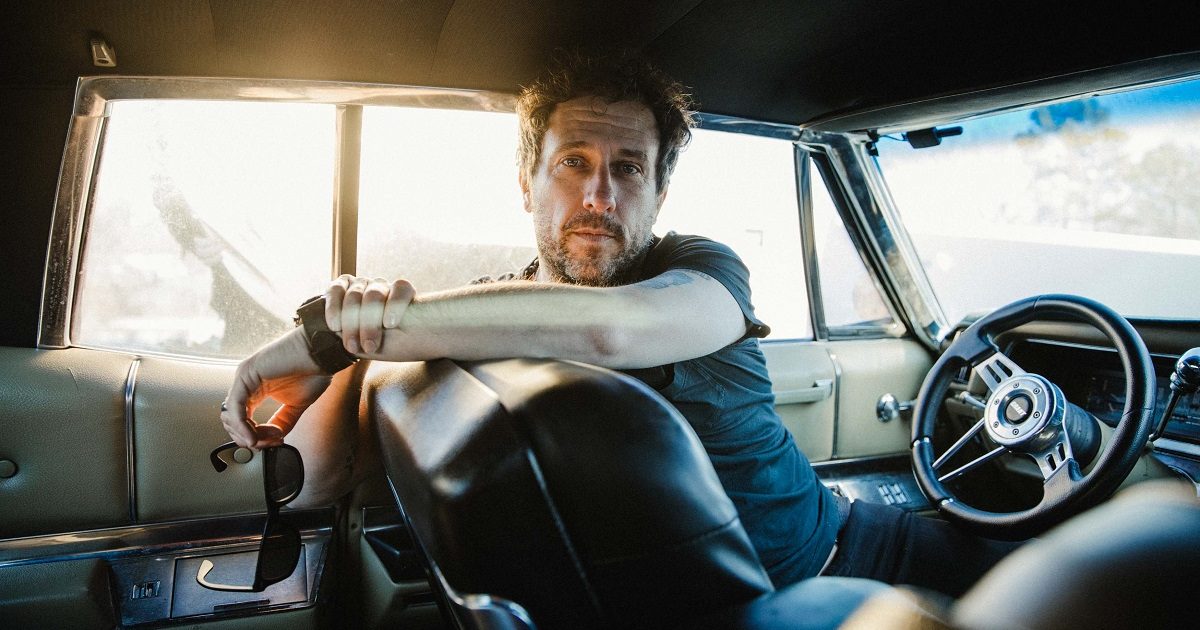
BGS 5+5: Will Hoge

Artist: Will Hoge
Hometown: Nashville, Tennessee
Latest Album: Tiny Little Movies (June 26, 2020)

Which artist has influenced you the most … and how?

My dad. He was a musician before I was born and that carried over into an incredible album collection. Every great album from 1964-1978 was at my disposal.

What’s your favorite memory from being on stage?

Shit, at this point, I’ll repeat a worst memory just to be back on stage. Also any time I get to play at the Ryman.

What was the first moment that you knew you wanted to be a musician?

My dad and my uncle snuck me into a bar to see Bo Diddley when I was about 13. My mind was totally blown. Hard to focus on much else after that.

What’s the toughest time you ever had writing a song?

“Jesus Came to Tennessee.” It had about 15 more verses. Editing that one was a journey.

Since food and music go so well together, what is your dream pairing of a meal and a musician?

Ice cream and Brandi Carlile


Photo credit: Katie Krauss

WATCH: Matt Rollings, “Stay” (Feat. Alison Krauss and Vince Gill)

Artist: Matt Rollings
Hometown: Nashville, Tennessee
Song: “Stay” (featuring Alison Krauss and Vince Gill)
Album: Matt Rollings Mosaic
Release Date: August 14, 2020
Label: Dualtone Records

In Their Words: “I wrote this song with the incredibly gifted singer/songwriter Alisan Porter, who won The Voice in 2016. We wrote it for an album I produced for her that came out in 2014. When Alison Krauss agreed to be a part of Matt Rollings Mosaic, I immediately thought of ‘Stay,’ and that she is the only person (other than Alisan Porter) that I could ever imagine singing it. We cut it live — piano, drums, and vocal — and Alison Krauss did what she always does: Left everyone in the room with their jaw hanging open! Later I added her brother on bass (the insanely talented Viktor Krauss) and enlisted my friend Kris Wilkinson, who did the achingly sparse string arrangement. Finally, the incomparable Vince Gill added a background vocal that perfectly supports Alison’s sublime performance. The result is one of my absolute favorite tracks on the record.” — Matt Rollings


Photo credit: Michael Wilson

LISTEN: Kristen Grainger & True North, “She Flies With Her Own Wings”

Artist: Kristen Grainger & True North
Hometown: Salem, Oregon
Song: “She Flies With Her Own Wings”
Album: Ghost Tattoo
Release Date: June 19, 2020

In Their Words: “I wrote this for Oregon Gov. Kate Brown (I served for two years as her communications director), as well as Elizabeth Warren, Ruth Bader Ginsburg, and every other woman working to make the world better and doing it her own way.” — Kristen Grainger


Photo courtesy of Hearth PR

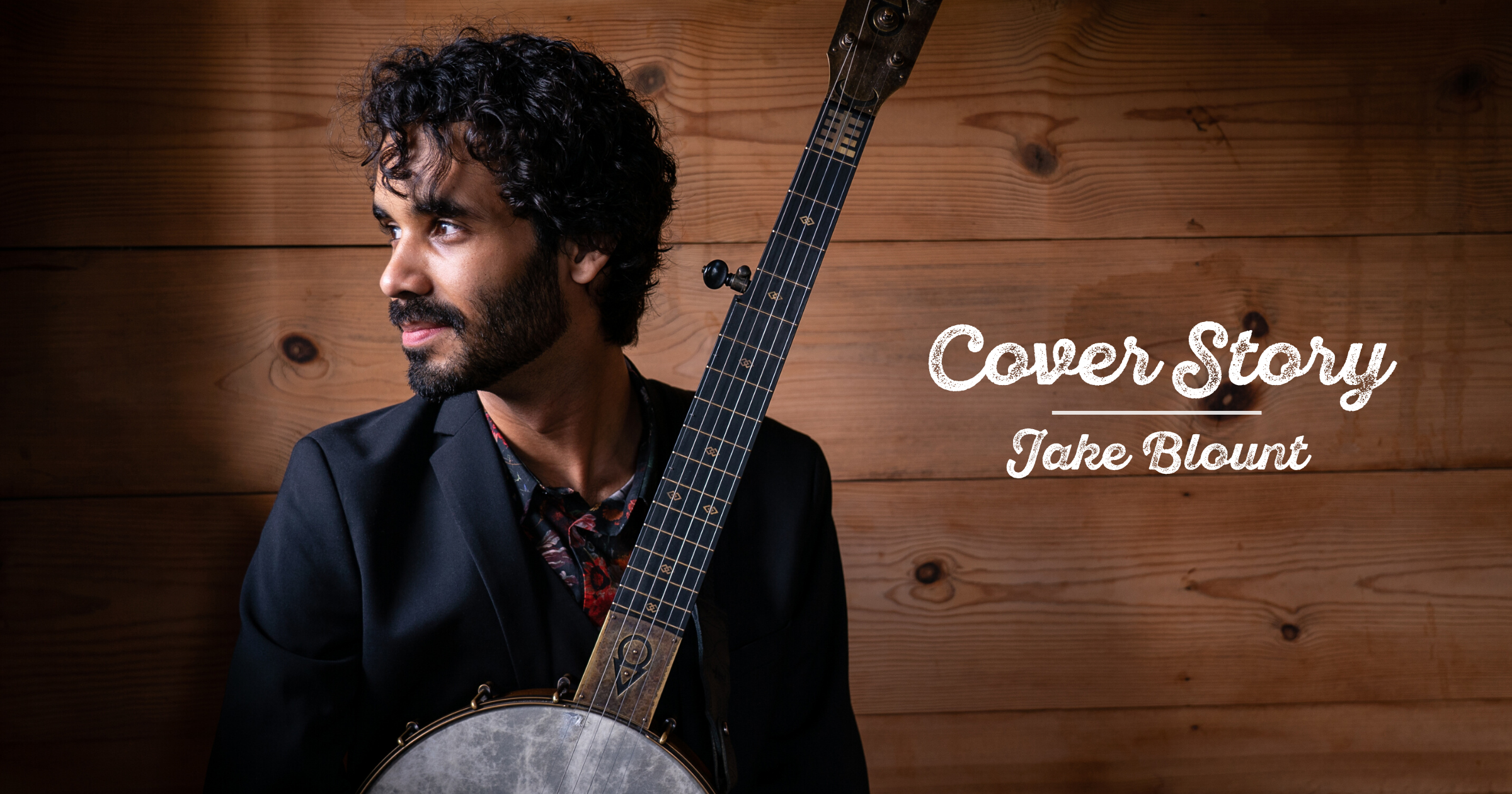
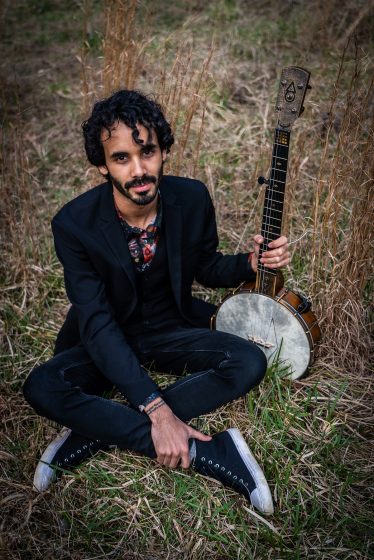
Jake Blount Looks Deeper into the Black Traditions of Old-Time Music

It is long known that Black artists in the twentieth century who spoke out against white supremacy often paid for it with their lives. As a Black man and a queer person, Jake Blount is intimately familiar with this history. In the liner notes of his new album Spider Tales, Blount predicts “escalating patterns of violence and ecological crises that threaten the survival of our species.” In the same breath he urges us to remember the ancestors who felt “the same grief, powerlessness, and fury” — and found a way to survive through wit and wisdom.

Spider Tales features a band of mostly queer artists, with Blount on banjo and fiddle. His tune and song choices introduce us to musicians long ignored. Familiar songs are reinterpreted, their fangs reinstated. Through this process, he takes us on a journey of rage, revolution and muffled voices made louder. We are the better for it.

BGS spoke with Blount, who grew up in Washington, D.C., but is now based in Rhode Island, about Spider Tales and his focus on the marginalized among us.

BGS: The title of Spider Tales is a nod to the trickster of Akan mythology, Anansi, who as you stated in your liner notes, weaponizes his wit and wisdom against oppressors more powerful than himself. And that’s what Black folks have had to do since the Middle Passage. Everything had to be subversive as a matter of survival. Can you speak about your process and musical choices in bringing that subversion to the forefront on this album?

Blount: For me the tricky part of bringing out these kinds of hidden meanings, and the mass significance of a lot of these songs, was that I had to pick songs that spoke in metaphors but put them together in a way that the metaphors became obvious. Finding a way to be loyal to the art form and not just be totally explicit with what was being said, but still make the message apparent to people, was really difficult.

I think a lot of that came down to how I framed things in the liner notes, but also the songs that I picked. Picking some things that were more familiar, some things that were not…some things that are more explicit and more direct and some things that are not. Being mindful of the track order helped tie things together and, I would hope, clarify the common thread between all the songs.

I want to ask you about your arrangement of “Where Did You Sleep Last Night” by Leadbelly. I hear this song a lot at jams. Some people refer to it as “In the Pines” and it’s often framed as being from one embittered lover to another. Your version of the song has this kind of bereft energy, almost frightening. What drew you to interpret this song in the way you did?

It’s partially an artifact of the fact that I first heard the song from hearing Kurt Cobain play it… I’m sure there’s some Nirvana energy lingering from middle school Jake in this recording. [Laughs] But even aside from that, when I listened to the Leadbelly version, I heard that song in a vacuum before I was ever involved in traditional music in any particular depth. I never really thought of it as a love song. It’s spoken, ostensibly, from one romantic partner to another sure, but it seems like it’s about disappearing and dying.

To me, you’re losing somebody — somebody is going away from you. That resonated because I grew up hearing stories from my dad about how there were people who just disappeared. I think we have this picture in our heads of racial violence in the south as lynchings; that of course did happen, but also there’s this other narrative of people just vanishing in the woods, and everyone would kind of have to assume what had happened.

I wound up connecting to that strongly because I came up during high school and college working with LGBTQ advocacy groups, volunteering my time and organizing with other youth. Doing that, you see a lot of people lose their homes, get kicked out of their houses, get incarcerated. You see a lot of people die. That song spoke to me on that level of “these are people who are just going away.” It reminds me of all the times that a friend would just drop off the map. A week or two later, you realize “Oh, I haven’t seen this person.” That kind of thing happened frequently when I was younger. It definitely still happens to people in that age group now, so that’s where my interpretation of the song comes out of.

This version of “Boll Weevil” is one of the best I’ve heard. I always knew it as coming from Tommy Jarrell, but I read in your liner notes that he learned the tune from a Black woman at a festival backstage. He never saw fit to credit her, which is why she’s still unnamed today. Reading that made me feel some type of way about the manner in which Black people — and Black women — have been forgotten by history, forgotten now. I wonder if it was a similar feeling for you. How did you deal with emotionally processing what you were learning while you were researching these tunes?

I think I’ve been so immersed in the ephemera of old-time fiddle music for long enough that it almost doesn’t surprise me anymore, which is sad, but Tommy Jarrell is someone who has a pattern of doing that. I feel like there are multiple older source musicians from that generation who would reference having learned from Black people but wouldn’t name them or wouldn’t give a complete name.

“Brown Skin Baby” is another tune like that on the album. Jabe Dillon learned it from an older Black fiddler and the only name he gave was Old Dennis. You can’t Google “Old Dennis.” There’s very specific information that oftentimes [white musicians] give with other white sources. But Black sources don’t get treated the same way.

Part of the reason I was so meticulous about the liner notes here is to avoid doing that a second time, because it still sometimes happens where people don’t credit the sources or sometimes don’t look up the sources. I’ll be the first to say that you don’t have to learn everything from a source recording — that’s not necessarily honest to the way the tradition has worked throughout history either. But I think it’s important to have a relationship with the musicians who cultivated the music we are now enjoying.

Yeah, I think especially with people like Cecil Sharpe and [John] Lomax, it’s like, Cecil Sharpe made his way through West Virginia. In his diaries he was so obsessed with this purity of old-time music, and white people, and actively refusing to record anyone else. It must have been such a sliver of what was going on at the time and of the knowledge that could have been passed down.

Exactly. Even like the later folks, there are folks who made a lot of recordings of Black people and were like “I need to find the Blackest music that I can so I’m going to go to prisons!” and it’s like, “You’re only really Black if you’re in jail for it.” [Laughs incredulously] That’s the mentality that carries through in that sort of scholarship and even today.

I always think it’s best to focus on the most marginalized among us and it’s really important that the working-class traditions be emphasized and accepted and made part of the canon. But I also think it’s really important for today’s Black people to know that there was prosperity in our communities going back that far. The Black middle class, which was ascendant at the time many of these first recordings were being made, never got examined by the folks making the recordings. It’s a tremendous loss to me because you would get to hear from people who were maybe articulating the experience of navigating how to become, in a capitalist sense, successful for a Black person in the late 1800s and early 1900s.

What would have been the songs about the Greenwood District in Tulsa? There are all of these really incredible things that happened and these really horrifying ways that white supremacists would crack down on Black people for attaining that level of success that are part of the story and ought to be told. Because we focused so narrowly for so long on Black musical traditions that were coming out of super rural country places, even though a lot of Black people had moved to the city by that time — I feel your pain that there is a great deal that is lost when we focus so narrowly on this thing that fulfills our stereotype notion of what we should be looking for.

I love the last song on the album, “Mad Mama’s Blues,” which comes from Josie Miles. That first line, “I want to set the world on fire,” is so great, the melody is flirtatious, but the lyrics are furious. Can you talk about why you chose that song as the album closer?

I feel like the album couldn’t have been timed better if we’d known about what was going to happen in Minneapolis. My whole mission with this album was to show people that this has been coming for hundreds of years. There’ve been warnings and people have been trying to speak on it and they haven’t been heard. I think putting [this song] as the closing note on the album felt perfect to me because it is very explicit in its emotional expression and what it gets across to the listener — but at the same time, it is masked in this jumpy upbeat, sort of silly presentation. It’s like the 1920s “Hey Ya!” [Both laugh] It’s like a bop, and you’re like “Yes Queen!” and then you’re like “Oh, he’s killing people.”

I think that’s a really valuable part of the Black musical tradition. To me it provides us an interesting lens to look back on the fiddle tunes. For so many people when they hear fiddle and banjo, they’re like “Oh this is a happy song! I’m going to start dancing now” and really there can be so much hidden inside of that.

People are sometimes more concerned with their expectations for what a piece of music is going to be than what it actually is. Putting this song at the close is saying: “Your musical assumptions about the content here would not be correct.” You then have to go back and examine the other [songs] with the idea in mind that perhaps you need to look more deeply than you otherwise might in order to understand what’s being said.


Editor’s Note: Blount will be featured in the Bluegrass Situation Presents: A St. Patrick’s Day Festival at New York’s New Irish Arts Center, participating in an opening night jam session with clawhammer banjoist Allison de Groot, fiddler Tatiana Hargreaves, and traditional dancer Nic Gareiss on March 17 as well as a headlining performance with Gareiss on March 18.

All photos: Michelle Lotker
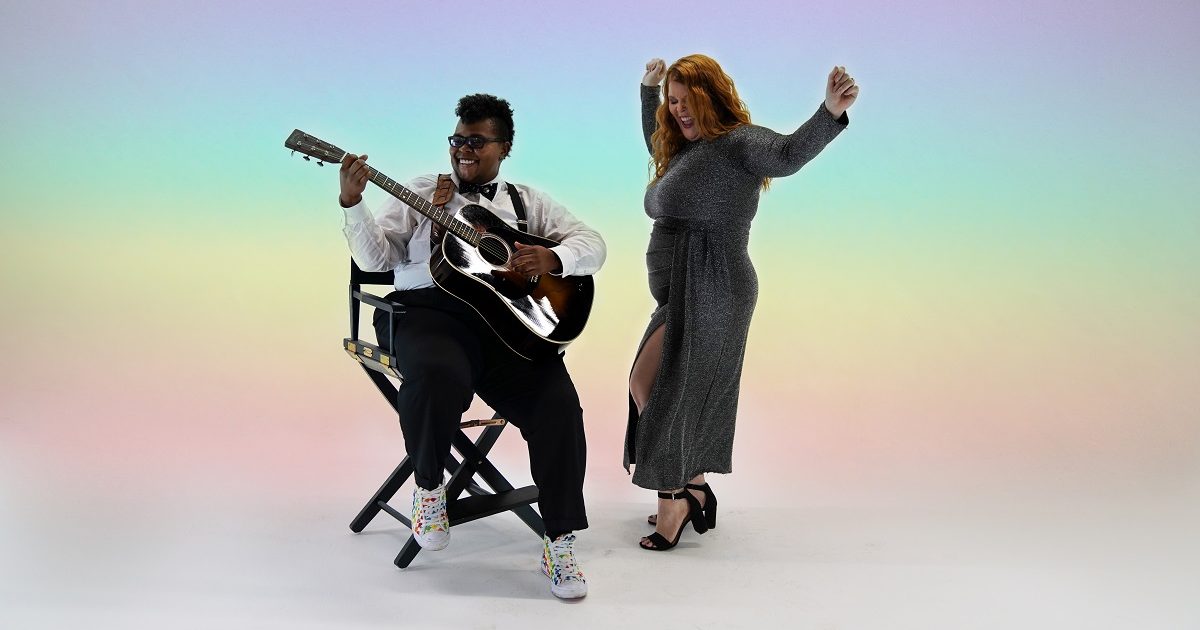
LISTEN: Shemekia Copeland, “Uncivil War” (Feat. Sam Bush, Jerry Douglas, and the Orphan Brigade)

Artist: Shemekia Copeland
Single: “Uncivil War” (feat. Sam Bush, Jerry Douglas, and the Orphan Brigade)
Release Date: June 19, 2020
Record Label: Alligator Records

In Their Words: “It’s not just a song. I’m trying to put the ‘united’ back in the United States. Like many people, I miss the days when we treated each other better. For me, this country’s all about people with differences coming together to be part of something we all love. That’s what really makes America beautiful.” — Shemekia Copeland


Photo credit: Mike White

LISTEN: Monte Warden and the Dangerous Few, “Martini”

Artist name: Monte Warden and the Dangerous Few
Hometown: Austin, Texas
Song: “Martini”
Album: Monte Warden and the Dangerous Few
Release Date: June 19, 2020
Label: Break A Leg Records

In Their Words: “As we first started playing shows, new fans would come up and enthusiastically ask, ‘What do you call this music?!’ We described is as ‘martini music.’ My wife Brandi suggested we write a big, fun up-tempo ode to the martini, so we rode over to Floyd Domino’s house and all did our best to just get the hell outta this song’s way. It’s one of those rare little gems that seemed to write itself. That line ‘country club mosquitoes’ had us all goin’ nuts. I can count on this song to always deliver a musical shovel-to-the-face at any gig.” — Monte Warden


Photo credit: Sean Mathis