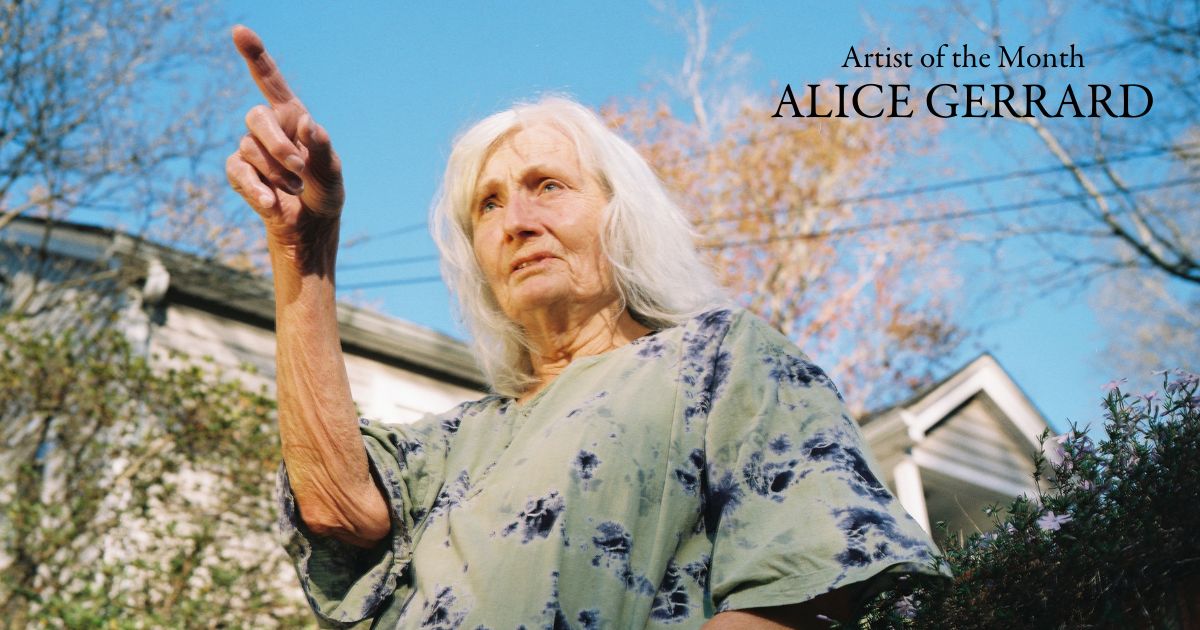
Artist of the Month: Folk Hero Alice Gerrard Is Unafraid to Be a Real Person

(Editor’s Note: Fiddler, songwriter, and creator Libby Rodenbough writes this personal essay on her friendship with and admiration for BGS Artist of the Month, Alice Gerrard, accompanied by her original photos taken for Gerrard’s new album, Sun to Sun.)

I remember first hearing Ola Belle Reed’s “Undone in Sorrow” when I was 19 or 20. I felt like a portal had been opened unto a world that had existed around me my whole life, unseen and unheard. I grew up in North Carolina going to visit my mom’s family in Madison County, along the Blue Ridge, where any of the graveyards on the mountain sides with their little mounds of clay outside my backseat window might have been the one from Ola Belle’s song.

That portal didn’t open for me in the mountains of North Carolina, though – it was in Chicago, at the Old Town School of Folk Music, an institution that had come out of the ‘50s folk revival. I was big on Pete Seeger and John Prine at that time in my life, and had found out my dad had a cousin with a spare room in Chicago, so I went on a little pilgrimage during a recess from college.
It was there that I learned my first old time fiddle tunes, belting the refrain “down in North Carolina” from “Waterbound” at the school’s open jam while the Chicago winter dumped three feet of snow outside. It was there I first learned the rudiments – very rude in my case – of clawhammer banjo. It was also there that I first heard a left hook of a song called “A Few Old Memories” by Hazel Dickens, which appeared on her 1973 duo record with Alice Gerrard, Hazel & Alice.

I went home from Chicago with new eyes and ears. Places I’d known forever became newly populated with epic figures, recast in the light of 200-year-old narratives. My first semester back in school, I was in an introductory folklore course taught by Mike Taylor (of Hiss Golden Messenger) and he started talking about his friend Alice Gerrard, who lived a town over in Durham. I was fairly well tangled up in time and place at that point – even the deceased people I’d been learning about were brand new to me – so I had to blink a few times to digest that she was the same person singing harmony on “A Few Old Memories.”

Today, 10-ish years later, I sit with Alice in preparation for writing this piece and she tells me about driving Ola Belle Reed in her Dodge van on tours through the South in the late ‘60s. She’s my oldest friend (nearly 90), and all competition lags behind her years pretty pathetically. She also makes a lot of the people I talk to seem boring. We’re in the same business: We sing songs and play shows and make records. She’s been doing it a lot longer, and I think she knows about five times as many songs.
Hanging out with Alice helps me understand why she wanted to be friends with people like Elizabeth Cotten and Luther Davis, who were elderly when she met them. She heard the way they played and sang and had to talk to them about their lives. “They knew exactly who they were,” she says. For a young person who had moved across the country from Oregon to Washington, D.C., without maintaining much contact with home, dropped out of college, and had four children, that self-knowledge was aspirational. Though their rootedness in their communities was part of what drew her to them, she didn’t think of them as avatars of bygone primitive ways of life, or as characters in a play – they were people. Elizabeth Cotten was somewhat guarded, but over years traveling and playing together, she told Alice about indignities she had suffered as a domestic worker and as a Black female folk performer, and about subtle acts of defiance she had worked into both vocations. Luther Davis talked about how lonely it was to get old and run out of witnesses to your own life.

Alice is likewise unafraid of being a person. She’ll tell you straightforwardly that she was unprepared to be a mother, that it was essentially impossible to pursue a music career – which was something she knew she wanted for herself – and still give adequate time to her kids. We commiserate about music industry bullshit and engage in light shit-talking about the idea of showmanship.

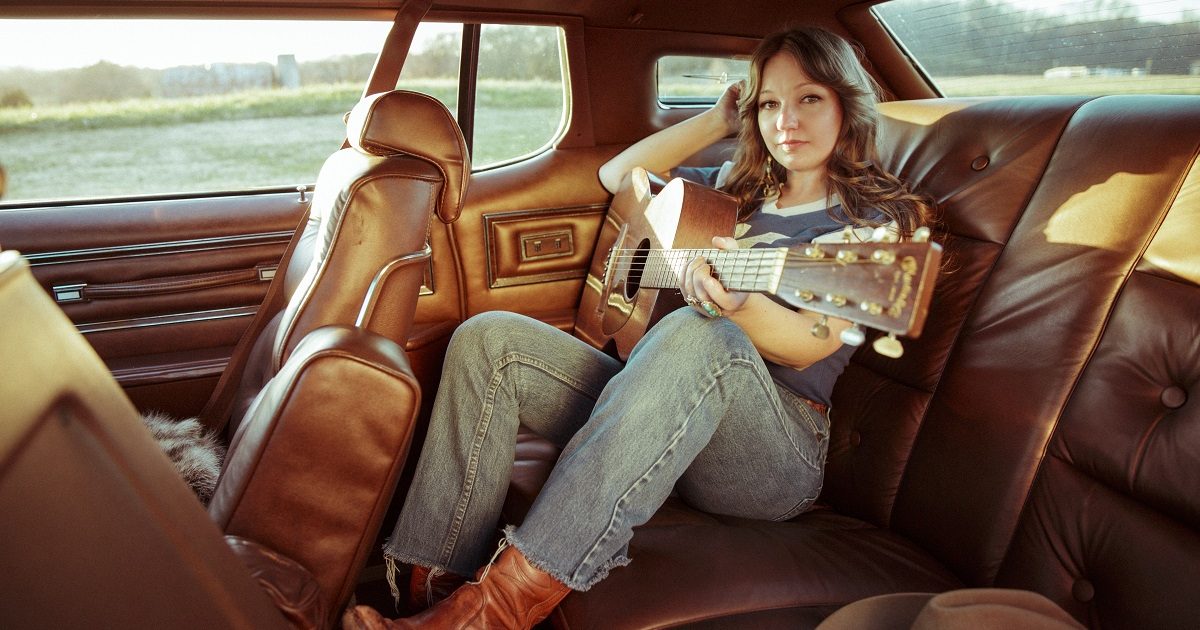
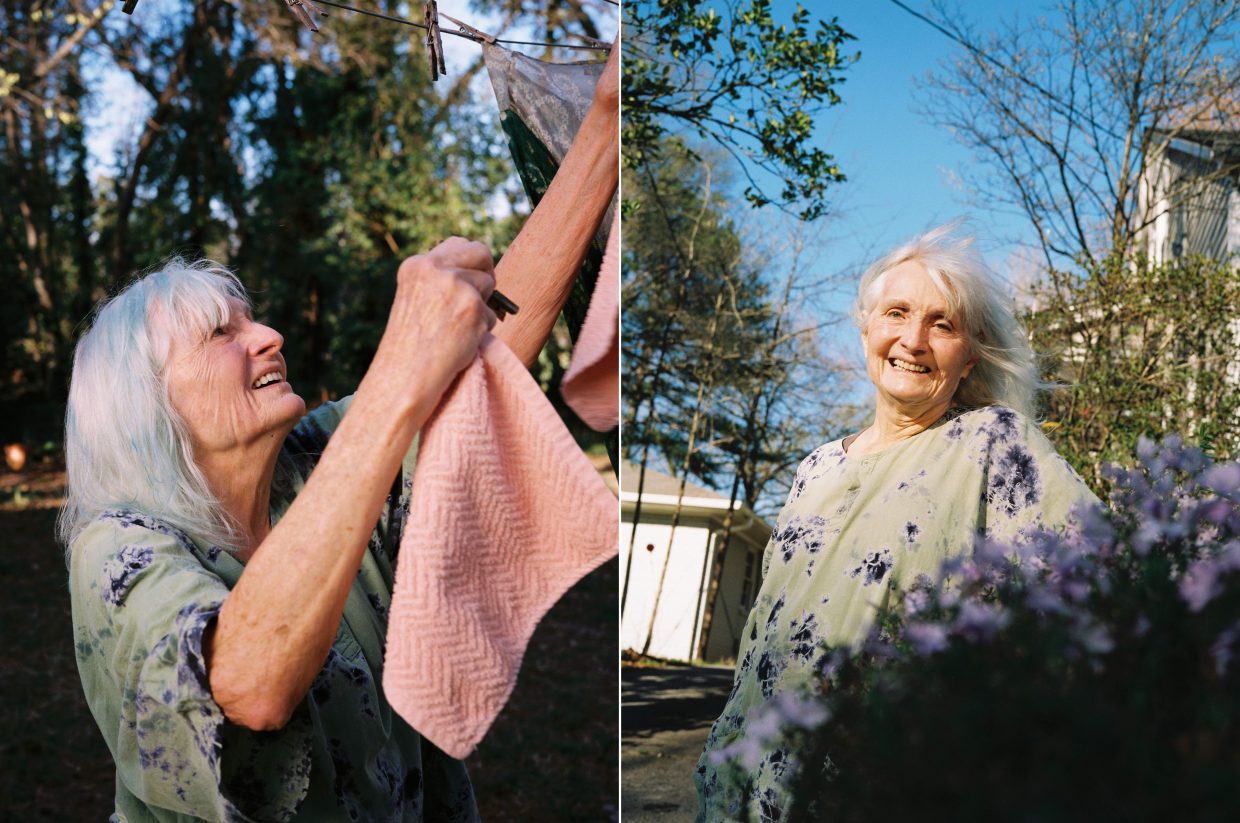
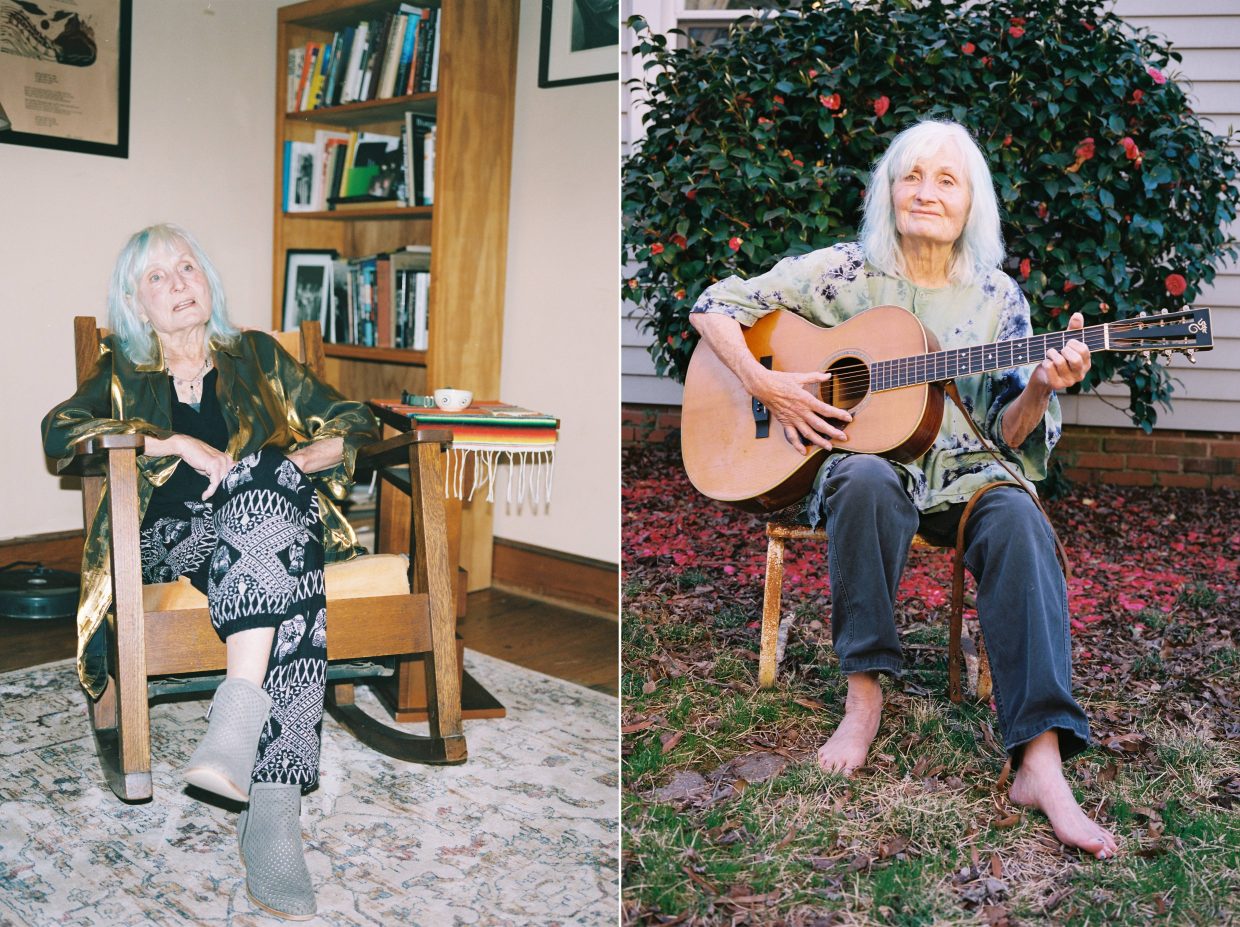
She’s usually wearing one of her collection of t-shirts that pertain to her dog Polly’s agility training facility (“Fast and Furryous”). This past March, when I took these photos of her to use for promotion of her new album, Sun to Sun, we went through her closet together and dug out some gems, including a bedazzled commemorative t-shirt from Obama’s inauguration.
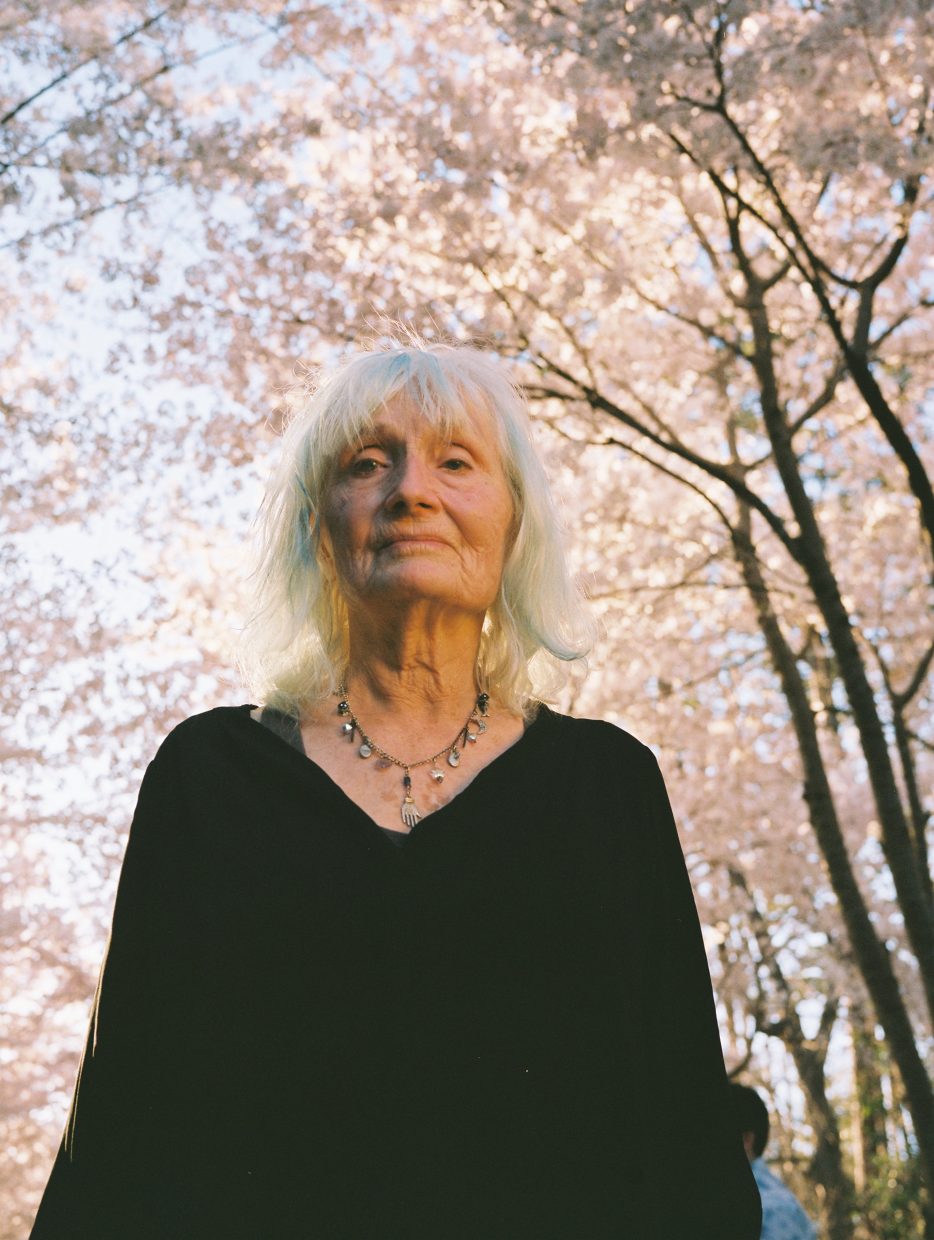
I have no training in photography – I shoot film because I enjoy the feeling of not really knowing how it works. We went to Duke Gardens in Durham, where we both live, on a week when the cherry trees had popcorned into glory. Alice looks radiant in the halo of those glowing blooms. But I also love the photos where she’s at home, standing in front of the brick retaining wall around her front yard, before she realized she still had her Apple Watch on. The sky was so blue that day, her white hair incandescent. She looks like she knows something you don’t, but in a warm way, like she knows you’ll get it eventually.

Alice is unafraid to treat a song like it can handle a little handling. She knows that songs are alive and she’s interested in being a part of their lives, not their memorialization. She smiles talking about how, in an old John Cohen film, the Madison County ballad singer Dillard Chandler starts a song in a key around here (she holds her hand at her waistline) and ends it here (she raises her hand up level with her temple). She’s delighted by the particularity of the human touch. She prefers singing voices with a bit of weirdness over purely pretty ones. Talking about Carter Stanley’s high whine, she says, “Whatever was eating on him from the inside, it was showing up in the way he sang. Nina Simone, the same way.” She tells me what a struggle it is to teach that kind of feeling to people accustomed to singing prettily. “If you’re trying to get somebody out of the soft, breathy voice, you say, ‘Look, your kid is running out into the street and you have to call your kid back.’ You don’t say,” — she coos — “‘Heyyyyy Brian, get back here.’ You say, ‘BRIAN! GET BACK HERE!’”

Whenever I’ve played music with her, Alice seems to lean into what people at the Old Town School liked – actually, loved – to call “the folk process;” she lets arrangements evolve as the spirit of the universe sees fit. I’m lucky she’s not a stickler for tradition, even traditions she could write encyclopedias about, because my fiddling style is distinctly unmoored. I was a half-rate Suzuki classical violin student growing up and then at the Old Town School I learned how to accompany folk singers on songs with three or fewer chords. I came home and started going to the old-time jam at Nightlight Bar & Club in Chapel Hill, where the jam leaders were American Studies PhD candidates who also grew up learning fiddle tunes from their hometown octogenarians. Some of my friends started a band called Mipso that was flirtatious with bluegrass and asked me to join, but I told them up front I didn’t know any licks. (They didn’t seem bothered by that.) I’ve since learned a few licks, and I would rather play an old time tune any day of the week than do almost anything else, but I never could sit still long enough to do what Alice calls “holding the line” — keeping and caring for the tradition.
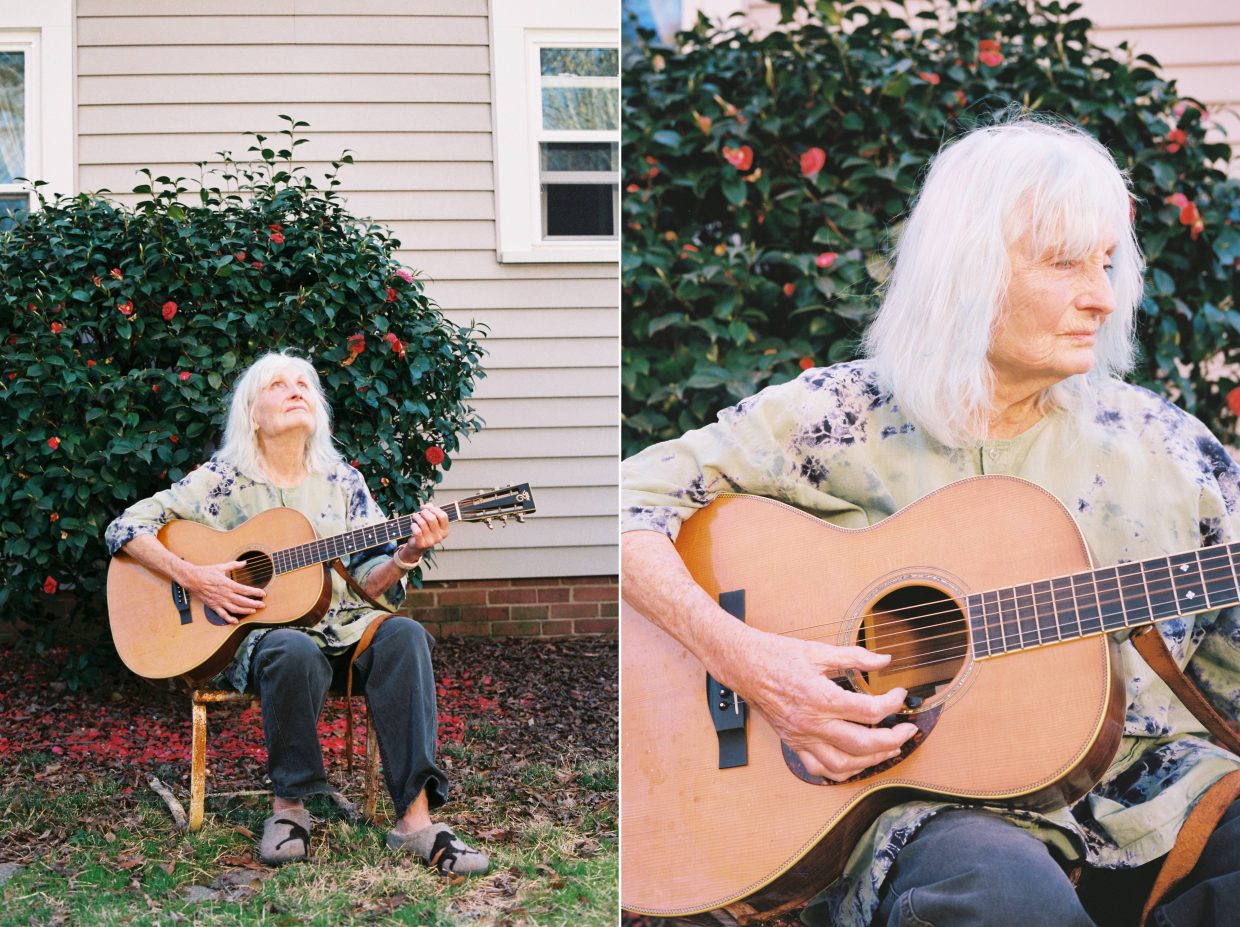
I’m indebted to, and grateful in my heart for, people who do that work. I may roll my eyes at gatekeeping, but it’s more than wide-eyed would-be fiddle players at the gate; it’s the whole monster of monolithic, capitalist cultural imperialism, chomping down on everything small or strange. Songs can, and do, disappear, like cultures and forests, and not just by inertia but by clear-cutting. A lot of days I feel self-conscious about whatever it is I’m doing instead of holding that line. When I listen to Alice tell stories about the many singers and players she’s known over the years, though, I remind myself that they each have a distinct relationship with tradition – and with what it means to be an artist.

For a long time there’s been a divide, rhetorical and sometimes actual, between “the folk” and “the folkies,” which maybe means country people versus city people, or maybe people who grew up in a given musical tradition versus those who came to it later. Alice and I both fall into the latter category, though she’s had considerably sharper focus since her initiation. I’d rather replay a 10-second clip of a Mark O’Connor fiddle solo at one-quarter speed forty-seven times in a row than try to examine that dichotomy in any more detail at this moment, but I did spend a lot of my undergraduate days thinking about authenticity and who’s entitled to do what with old songs. Alice has often found herself among people who look at it from an academic angle – her ex-husband, Mike Seeger, came from a folklorist family – but her view remains that the compulsion to define and categorize is basically academia trying to justify itself. I don’t take that as bitter or glib, I just think she hasn’t found it necessary, in her personal relationship with the music she loves, to try to determine who gets to claim it. Or maybe, for Alice, the claim is in the singing. Talking about what makes a voice “authentic” (a word that sends a chill down my spine), she paraphrases Supreme Court Justice Potter Stewart from 1967 in his definition of pornography: “I know it when I see it.”
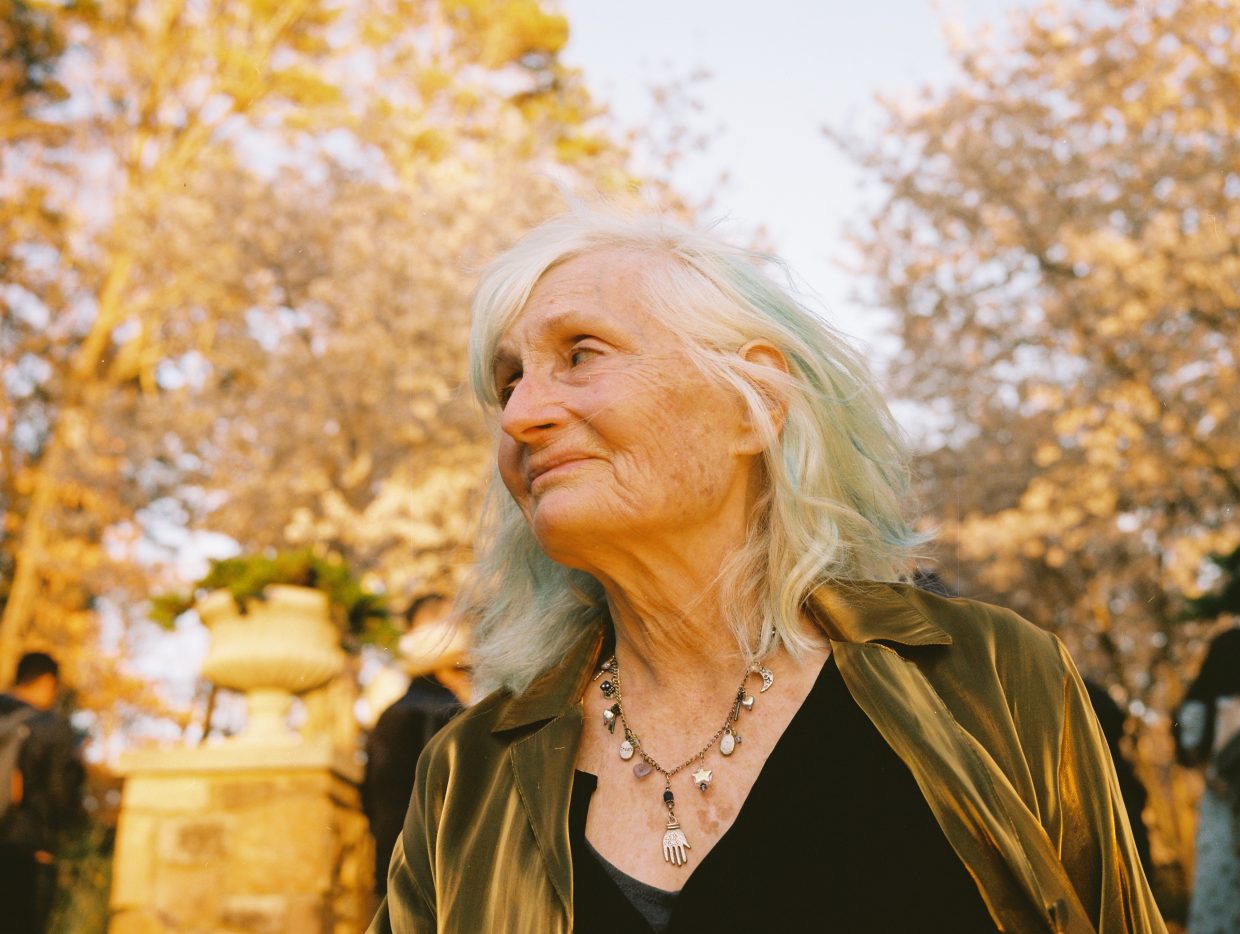
As we clink the ice around our $7 decaf specialty iced lattes, Alice tells me about a song she’d just heard, a haunting falsetto voice with nylon string guitar, in the opening scene of Pedro Almodóvar’s new short film, Strange Way of Life. After some Google sleuthing, she identified it as a recording by the Brazilian artist Caetano Veloso (in fact, the movie is named for it – “Estranha Forma de Vida.”) She’s head over heels for this song, itching to go home and dig into Veloso’s catalog. If they ever meet, I know she will have great questions for him, the type of questions that make a person believe songs must do real work in this world.

I ask her if she thinks of her music as having “a purpose.” “Not really,” she says. But she goes on, “I want people to hear what I hear in this music.”
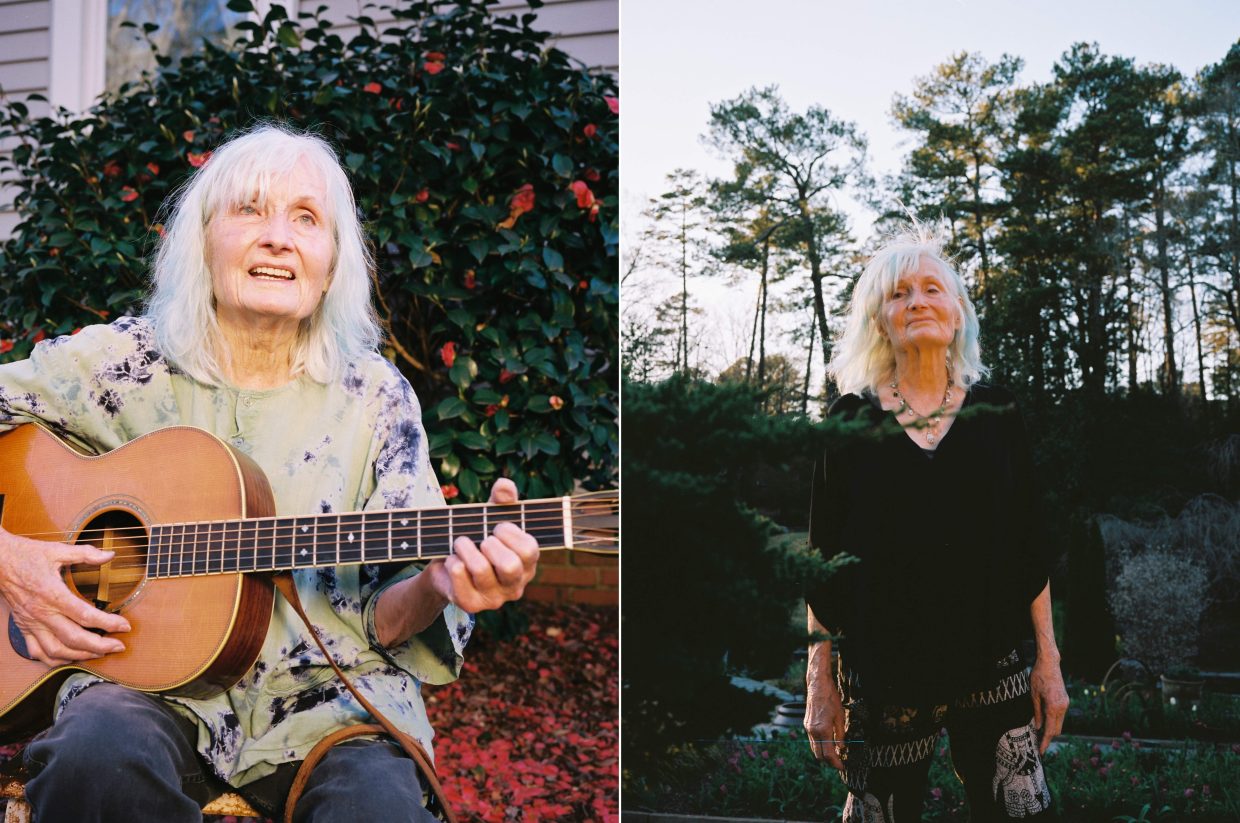
In my view, that’s an altruistic goal, because it’s clear that whatever it is Alice hears in the music, it gives her life its very marrow. I admire the decades she has devoted to learning and documenting traditional music, but what I aspire to most is the way she still loves a song — viscerally, instinctively, with gusto. That’s what makes a line worth holding.

“There was something about the music, the quality of the voices,” she says, recalling first hearing Harry Smith’s Anthology of American Folk Music. “There’s so much beauty in it, it’s like, God, yeah.”

I had that “yeah” moment when I heard “Undone in Sorrow” and “A Few Old Memories” – and now, Sun to Sun. I hope to be saying “yeah” like that about songs for the rest of my life.


All photos: Libby Rodenbough

With Honesty and Openness, Iris DeMent Keeps ‘Workin’ on a World’

Rattled by the 2016 election and its aftermath, singer-songwriter Iris DeMent did what folk singers are supposed to do: She picked up her pen. But it took until February 2023 for Workin’ on a World, her seventh album, to reach listeners — and it might not have happened at all if her stepdaughter Pieta Brown hadn’t intervened. Brown (whose father is DeMent’s husband, Greg Brown), had cowritten “I Won’t Ask You Why” and “The Sacred Now” with DeMent and knew several tracks had been recorded before the project hit a pandemic-induced pause. When Brown inquired about the album’s status, DeMent confessed she’d stalled out and given up.

Brown asked to hear what DeMent and co-producers Richard Bennett and Jim Rooney had recorded, then declared an album did, indeed, exist, and helped shepherd it to completion. Then she joined DeMent on tour, opening a series of dates that included a March stop in Austin at which DeMent introduced her new work to a sold-out audience — who were particularly amused when she sang “Goin’ Down to Sing in Texas,” an oh-so-sharp skewering of open-carry laws, male privilege, one-percenters, racism and “war criminals who get to walk around free/like that president who lied about WMD.” (The Chicks, who famously called out that president, earn her thanks).

DeMent boldly speaks her mind throughout Workin’ on a World, mixing indictments of oppression, greed and the cult of personality with praise for righteous “Warriors of Love.” She also ruminates on love and loss, and addresses God frequently — not surprising for the youngest of a 14-child family raised in the Pentecostal church. But instead of drearily lamenting a world in turmoil or patly claiming prayer is the answer, she strives to induce hope. When she sings “workin’ on a world I may never see,” she’s reminding activists to keep fighting for future generations.

Back home in Iowa several days after her performance, DeMent discussed the facets of a career that took flight 31 years ago with her debut album, Infamous Angel. Two Grammy nominations, one Americana Music Association Trailblazer Award and dozens of collaborations later, she still likes to let the mystery be, so to speak, when it comes to certain aspects of her songwriting process. But when it comes to inspirations and emotions, she spoke just as she does in her songs — with honesty and openness.

BGS: You’ve said this album came about because you wanted to cut yourself a path through the wilderness of despair. Was there any other sense of mission involved?

DeMent: Initially, it was just a level of despair that was not sustainable, and I had to apply myself to something constructive. Beyond that, it was like, I want to fix things. I care about people here; I care about my children, I care about your children, I care about the world. So I want to see it be improved. And I can’t think of a more useful way to spend my time. The best way I know how to do it is to write songs. Because I know from my own experience, songs can energize me and give me hope and confidence to go do my job. I feel like the best thing I can do is contribute to other people — whatever their job is, some inspiring music can help ’em get it done, as we know.

I went through a phase; I did a lot of political, local things — which is incredibly important, don’t get me wrong. But I can’t do both; I noticed that. They’re two different sides of the brain. And I was either doing the phone banks and all that business, or I was gonna be a writer/singer. At some point, that became clear to me. A few people helped me figure that out: “Iris, that’s your gift, stop underrating it and go.” So I just went back into the songs, and as a result, there’s this record. It would not have happened otherwise. I decided to go back to believing in the value of singing some songs.

Did you originally have a target date for an album, or were you just kind of hoping to do something and then Pieta said, “Here it is”?

I think when I was a lot younger and just coming out of the chute, I probably had targets then, because there’s kind of that thing when you’re young; you’ve got to get your ball rolling. I certainly felt that. I had a really intense sense of momentum and urgency, and I don’t think you’ve got to be a songwriter to have that; it’s a time in life thing, in my opinion. And I’m glad to have had that. It was its own, exciting, awesome, wonderful time. But that started shifting, and rather than fight with that, I accepted it. And I’m really glad I did, because I feel like my music’s gotten better; my singing has gotten better.

I feel like allowing myself to relax a little bit, to trust that the songs will evolve as they need to as long as I keep showing up often enough, in my opinion, has worked. A lot of people who talk to me are really focused on these gap periods and all, which to me are not gap periods. It’s the time it took, plain and simple. There’s a lot of records out there; there’s a lot of music. I’m not interested in taking up somebody’s heart and mind space unless I really feel like I have something to say that warrants that.

If I were thinking in terms of a career, I’d have put out a lot more records. Because I’ll build up an audience, then I won’t put out a record for six years. A handful of people stay with me and a lot of others drift off somewhere else. That’s how that works. If I’d even put out a mediocre record here and there, I think I would have kept a lot of folks. People, if they don’t hear from you, they forget about you, by and large. But I’ve been really fortunate that I’ve had enough people who haven’t that I can still go out and play.

I posted a picture from your show on social media, and so many people responded, it was an obvious indicator that they have not forgotten you. Your sold-out show was another. That must be heartening.

Oh, sure. When you feel like you’ve got something to say that you believe somebody needs to hear, it’s a wonderful feeling when that actually happens. I’ll admit it’d be discouraging if I went out there and the rooms were half full. That said, that has never stopped me before, and never will. I’ve always thought that way. I used to get this vision when I started out; I’d conjure up a desperate person, and I have a model in my mind of who this desperate person is, which I won’t get into. But I conjure a picture of them. They walk in, they sit on the back seat, and I’m singing to that person. Nobody knows them. Nobody knows their name. They’re gonna wander out that door, but they’re gonna take something from that room that they needed, and it’s my job to give it to ’em. Yeah, my feelings and my ego and all that stuff come into play, but I’ve gotten really good at overriding all that and thinking of the mission that I’m on and the job that I have to do that isn’t about numbers. It’s about hearts; individuals. I gotta go there with ’em and let the rest go. That rest of it is just not my business.

The list of albums and tracks you’ve contributed to is really astonishing, but you’re probably best known for your duets with John Prine. How did those tend to come about?

John wrote liner notes on my first record. I became acquainted with him through Jim Rooney, who was friends with John, long before I met John. And then when my first record came out, John asked me to go out and open for him, which, of course, I gladly did. Right up till the end, I would always do a couple of shows a year with him, at least. Did quite a lot of shows throughout the years prior to that. And one thing led to another. We got to record those duets together. I just loved John like crazy, and I think he loved me. Singing with him was its own unique thing that’ll never happen again, and I’ll miss that forever.

You cite quite a list of heroes on this album. Did you have to leave many out?

Always. There’s always people. “Warriors of Love,” I could have made it 10 verses long.

How did you choose?

Oh, I couldn’t even begin to explain that. It’s just, you’re sitting there trying to get somewhere and your gut says, “I think this is the direction to go.” Obviously, the people I chose are more universally known. And that helps because you don’t have to write, “here’s the history of this person,” so you can bring people up to speed. Most people are far less familiar with (pro-Palestinian activist) Rachel Corrie than (U.S. Sen.) John Lewis or Dr. King, so that was a little bit of a stretch. But I think I gave enough details to make that picture fairly clear. And there’s lots of information out there if people want to gather it.

With “The Cherry Orchard,” you’re continuing the Russian literature connection you made on your last album (2015’s The Trackless Woods, on which she set poet Anna Akhmatova’s translated words to music; the song is inspired by Anton Chekhov’s play). You’ve got a Russian-born daughter, and you seem relatively steeped in that culture. What drew you to it?

Our daughter was 5½ when we adopted her from Siberia. She’s almost 24 now. So we had a little Russian speaker in our house. There was a lot of mystery there; she had a lot of qualities that were clearly unique to her culture. I can still see them today. So I wanted to understand as much as I could, which is still very minimal; I’m not going to pretend. But I wanted to find a way into that world to the degree that I could. So that’s what I did. I did those Anna Akhmatova poems and took a couple of Russian literature classes. And I found that I love the Russian writers. I must have some sort of natural affinity for the world that made my daughter.

Have you ever seen Chekhov’s plays performed?

I saw Uncle Vanya in Chicago. I cried through the whole damned thing. My husband and my daughter were by my side; they were just looking at me, like, “Is Mom having a breakdown?” I had the same reaction to The Cherry Orchard. I was in my class, this university class with, like, 12 people; I could hardly sit in my chair. There’s just something about the merging of intense elements in so much of Russian life and literature that something in me relates to. I actually had a lot of that in my own family history. Intense drama, poverty, violence, you name it, the whole male-female dynamic, the hierarchies. There’s something in it that is very familiar to me. I’ve just connected with a lot of that literature. Like, just in my body, I mean.

At your show, Pieta said the songs on this album feel really important, and she’s right. They do. You tackle some big topics, and you’re not afraid to name names and focus on divisive issues. I loved hearing you sing “Goin’ Down to Sing in Texas” in Texas, but putting a song like that out in today’s world, do you worry about blowback?

No, I worry about what would happen if I stay quiet. I worry about what will happen if I don’t speak up about these things. I’ve crossed over to that. When I was younger and wrote about the Vietnam War on “Wasteland of the Free,” I wasn’t worried. But then I became the target of a fair amount of hatefulness, to put it mildly, and that was surprising to me. But I’ve got my eyes pretty wide open about what’s going on here now.

No, I don’t feel worried about that. I feel worried about the people who will be hurt if I stay silent. My takeaway from my upbringing and the teachings of Jesus … you’re supposed to care about something bigger than you and invest yourself in it. I wouldn’t go so far as to say, “Oh, I don’t have fear.” Of course I do. But I do feel like that’s what we’re called to do. There’s a power and a confidence and a peace that can come with that as well. I feel that.


Photo Credit: Dasha Brown

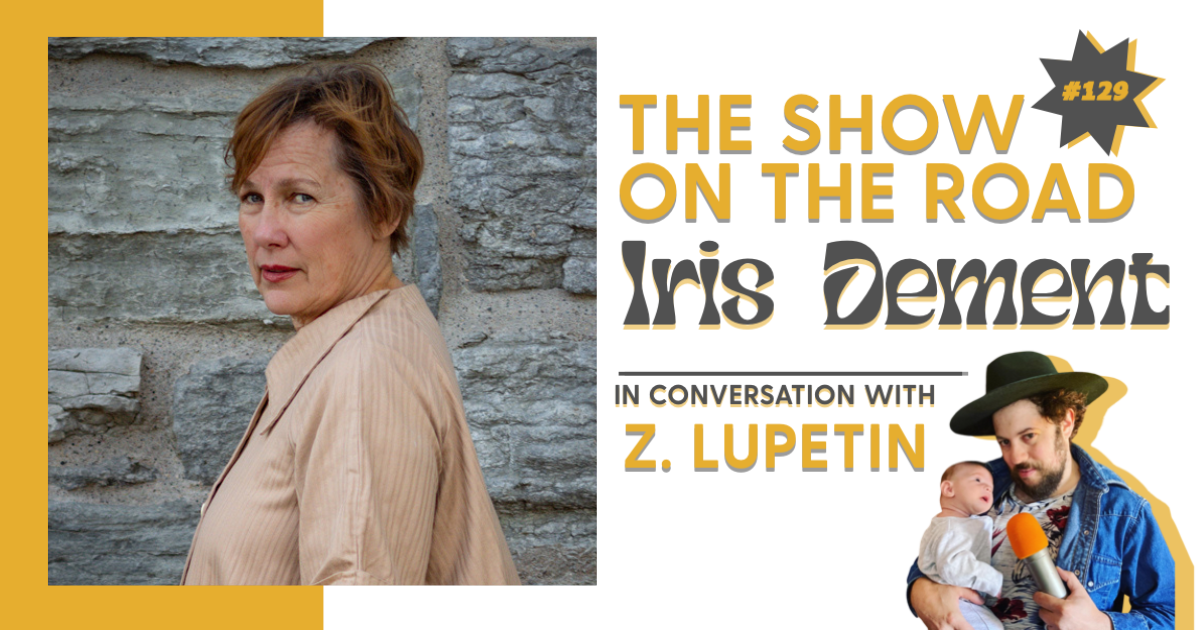
The Show On The Road – Iris DeMent

This week, we feature my conversation with beloved folk firebrand Iris DeMent. Born the youngest of 14 to a singing Pentecostal family in Arkansas and raised in California, DeMent released her iconic 1992 John Prine-endorsed debut, Infamous Angel, and has been creating poetic protest records and warm collaborations ever since (garnering two folk Grammy nominations along the way), culminating in her much anticipated and fiery new LP, Working On A World.

LISTEN: APPLE PODCASTSSPOTIFYSTITCHER

Certain songwriters in the folk field will occasionally speak up about injustice or corruption — but with Working On A World, DeMent puts the protest front and center: honoring luminaries like Mahalia Jackson, John Lewis, Martin Luther King Jr. and even The Chicks for giving her hope that putting your principles and life on the line will help bend history towards progress and righteousness.

DeMent, who is now based in Iowa with her musician and collaborator husband Greg Brown (check out their biting co-write “I’ll Be Your Jesus”), will be the first to say that at times in her wide-ranging career, playing clubs to enraptured but small audiences, she has questioned whether she was doing enough to make a difference. But songs like the epic Dylan-esque take-down “Going Down To Sing in Texas” show that Dement is still at her fired-up best, confronting the Lone Star State’s open carry gun laws that put so many at risk, while also spitting in the face of all the wannabe tyrants who shun the very progress she is still hoping to see. In many ways, Working On A World is a hard-won release of pent-up energy, created over the course of six years with co-producers Richard Bennett, Jim Rooney and Pieta Brown.

While many of her longtime fans are used to her fearless political confrontations — 1996’s seething The Way I Should and its dark anthem “Wasteland of the Free” demand answers from sexual abusers and government war mongers alike — casual listeners may only know DeMent from her playful duets with sonic soulmate John Prine, most notably the foul-mouthed love song “In Spite Of Ourselves.” With a little laugh, she says she’s alright with that too. Life is long and the music, no matter the light or the dark, is equally as powerful.


Photo Credit: Dasha Brown

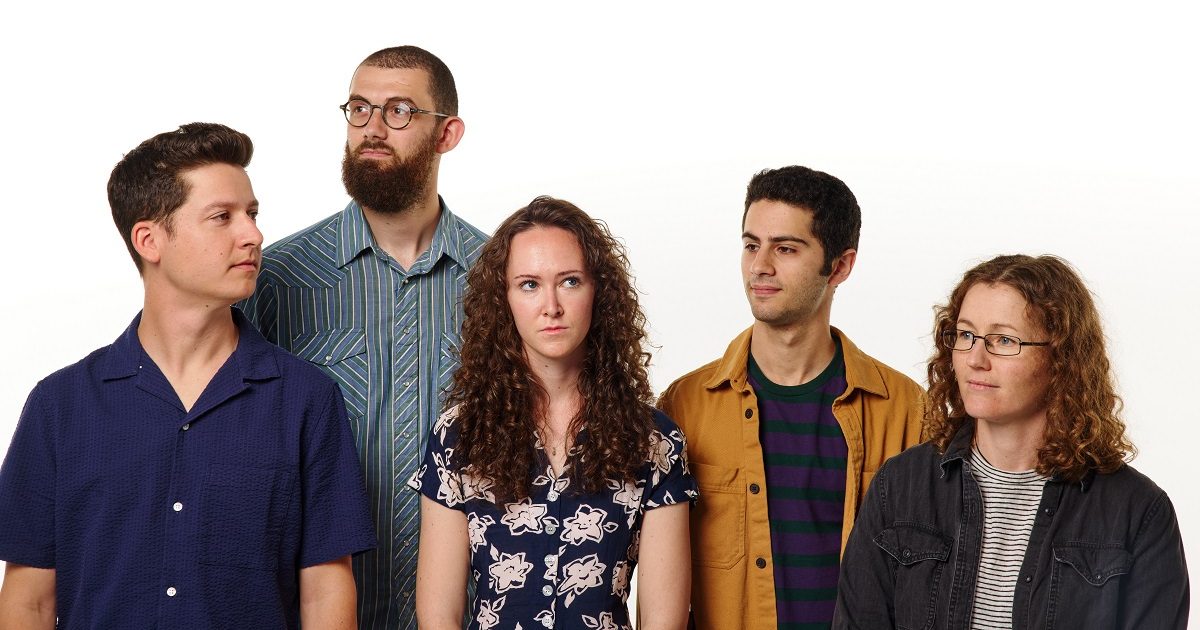
MIXTAPE: Mile Twelve’s Favorite Short Story Songs

Songs can be truly short short stories. There is so little time, so little space to convey a complete narrative. That challenge has always thrilled us when crafting our music. When we were asked to create a themed playlist for The Bluegrass Situation, I thought through our own songs that formed the new album Close Enough to Hear (out February 3) and wondered what common thread tied them together. Many of them really are conveying a story, something with a beginning, middle and end. We all went back to our favorite short story songs and marveled at the writers’ ability to forge a genuine drama, with a plot and characters, inciting events and climaxes, in just a few short minutes. It’s a high wire act, where every single word counts and nothing can be wasted. Here’s a list of our favorite short story songs. — Evan Murphy (acoustic guitar), Mile Twelve

Bruce Molsky (Molsky’s Mountain Drifters) – “Between the Wars”

This song makes me emotional every time I hear it. Bruce delivers this Billy Bragg song so powerfully and honestly, giving it a distinctly American flavor. – Nate Sabat (upright bass)

Bobbie Gentry – “Papa, Won’t You Let Me Go to Town With You”

I was recently turned on to Bobbie Gentry through the Cocaine and Rhinestones podcast by Tyler Mahan Coe (highly recommended) and stumbled on this song while checking out her catalog. She’s done such an incredible job painting a musical representation of that longing, wishing feeling of wanting to be included. And on a dorkier note, listen to how the phrasing of the hook is different on line one of the chorus than it is on line four. So, so good. — Nate

Cy Winstanley – “Little Richard Is Alive and Well in Nashville, TN”

Our good friends of the duo Tattletale Saints are excellent songwriters from New Zealand, now based in Nashville. This song about Little Richard has beautiful, clear imagery that pulls you right into the song. It’s a mellow performance, not trying too hard and resulting in a memorable story about a unique Nashville music legend. – BB Bowness (banjo)

Jean Ritchie – “West Virginia Mine Disaster”

This haunting a cappella song written by Jean Ritchie is sung from the wife’s point of view as she awaits news of her husband’s fate down in the mine. The song captures the anxiety and uncertainty she feels while she imagines a possible future without her husband. — BB

Jason Isbell – “Speed Trap Town”

A dozen cheap roses in a shopping cart, veins through the skin like a faded tattoo. Isbell’s tight, sparse images bloom into vignettes which form a complete story by the end of this song. A man has reached the limits of his patience with a stagnant life. His father lays dying in the ICU, he has no prospects, nothing to stay for. After long years, he finally decides to pack it up and break free. When I am in a period of writing I actually can’t listen to songs this good. They torment me with their lean, sinewy perfection. To use Isbell’s own language, there is no fat on these lyrics. Everybody knows you in a speed trap town. — Evan

Bruce Springsteen – “Highway Patrolman”

“My name’s Joe Roberts, I work for the state” might as well be “Call me Ishmael.” For me, this is the quintessential short story song. There are major motion pictures with plots less deep. It’s the struggle between two brothers, Joe and Frankie, one a state trooper and the other a struggling veteran who can’t seem to stay out of trouble. “I got a brother named Frankie, and Frankie ain’t no good,” sings Joe. Maybe it’s the fact that I have two older brothers, but when Joe watches Frankie’s taillights disappear across the border I cry, even after hundreds of listens. “I musta done a 110 through Michigan County that night.” How desperate was Joe to catch Frankie, to save him from himself? This song has taught me so much about musical storytelling. Springsteen is larger than life, for me and so many others. I wish I could open the back of his head and see how he does it. Thank God we have his music, it’s sacred. — Evan

Gillian Welch – “Caleb Meyer”

“Caleb Meyer, he lived alone in them hollerin’ pines” opens this exquisitely brutal ghost story. Gillian Welch has reshaped the very structure of modern folk songwriting. She and David Rawlings prove that when the song, the vocals and the playing are flawless you really don’t need anything more. “Caleb Meyer” is a haunting murder ballad. A woman fights for her life, finding a broken bottle to slash the throat of her would-be rapist. I am in that room with her when I listen to this, the hair standing up straight on the back of my neck. It’s a full-fledged Western, and she does it in three damn minutes. She is a force of nature. — Evan

John Prine – “Hello in There”

The lives of Prine’s characters are smaller and simpler than the legends of epic folk ballads. There’s no steam drill, no six shooters, no gallows at dawn. It’s just Loretta, Davie and Rudy, a back porch, a TV that plays the same old news. This is Prine’s genius, making the mundane transcendent in its beauty and its tragedy. It’s like watching modern human life itself dancing on top of his gorgeous finger-picked eighth notes. He was one of our great American prophets, observing, critiquing, reflecting, teaching. He is missed so dearly. — Evan

Josh Ritter – “The Temptation of Adam”

“‘If this was the Cold War, we could keep each other warm,’ I said on the first occasion that I met Marie.” Ritter is a favorite of novelist Stephen King. It’s not surprising, given the literary grandeur of his songwriting. The strange, post-apocalyptic tale of Marie and the missile silo transfixed me when I first heard it. It’s more mesmerizing with each repeat listen. How does someone create a world so fully realized, so convincing, with such simple tools at their disposal? What a gorgeously weird tale. — Evan

Cindy Walker, recorded by Bob Wills – “Dusty Skies”

When I was younger, I had four or five Bob Wills CDs that were pretty much on repeat for my whole childhood. This Cindy Walker song was on a couple of them, and every time I heard that fiddle intro, it would stop me in my tracks. I’d sit there completely absorbed in the stark, dusty imagery. This song is lyrically and musically as simple as it gets, but it packs a heavy emotional punch. When this song was recorded by Bob in 1941, the Dust Bowl was barely history, and I can feel the pain it caused in every beat. You don’t always need fancy chords and poetry to make a statement—sometimes you just need a semi-natural disaster. — Ella Jordan (fiddle)

Joni Mitchell – “The Last Time I Saw Richard”

How can you have a playlist without a Joni Mitchell song? The oppressively ordinary yet starkly evocative imagery in the second half (only Joni can put a dishwasher in a song) somehow reminds me a little of some of Lucia Berlin’s writing. This is one of those songs that if you had never heard anybody sing it and you just read the lyrics, it would still be a beautiful poem. One that takes you on a journey, and makes you feel things. One that makes you question your life choices. We all hope it’s only a phase, these dark café days…. – Ella

Randy Newman – “Dixie Flyer”

This is one of my favorite songs from Randy Newman. He sings about traveling around the United States as a child of a Jewish immigrant family in an attempt to find a home and live the American Dream. He deals with themes such as privilege and the issue of losing one’s culture while assimilating. This is the story of many families during the end of the 19th century and beginning of the 20th and continues to be a relatable topic today. – Korey Brodsky (mandolin)

Songwriter Unknown, Recorded by Hazel & Alice – “Two Soldiers”

The story of two Union soldiers during the Civil War who promise each other they will bring news back to their families if one of them does not make it through the battle. The imagery of war is vivid and the storytelling is masterful. Hazel & Alice bring this one to life in their incredible version. — Korey


Photo Credit: Dave Green Photography

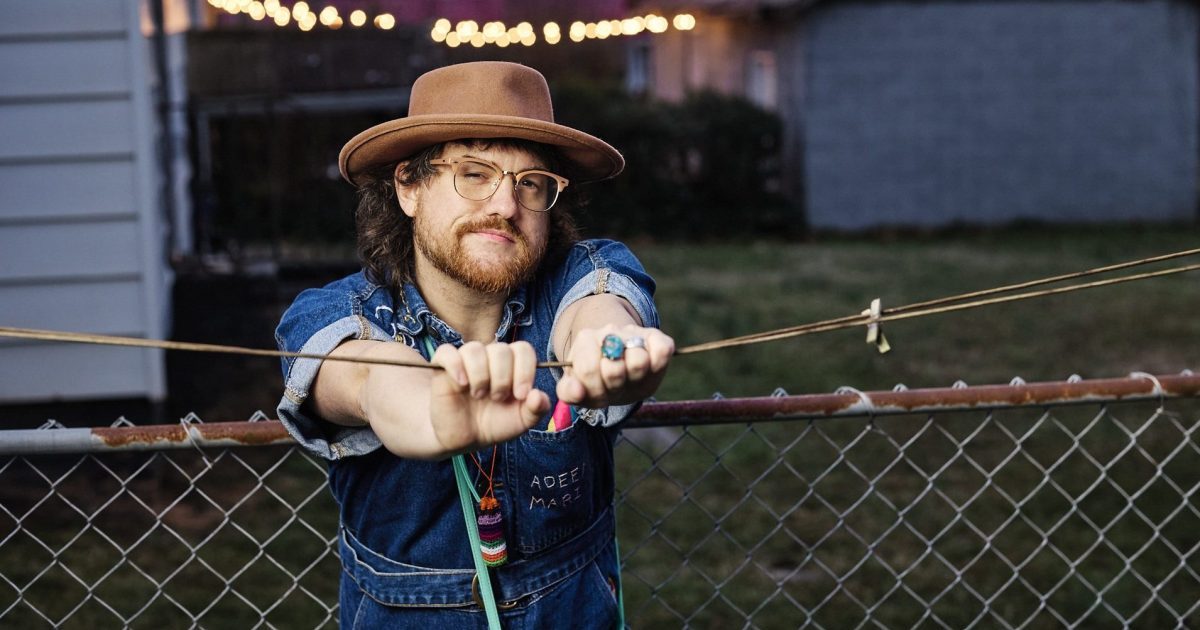
As a Songwriter, Adeem the Artist Found Their True North Through John Prine

Adeem the Artist is not afraid to confront the complex realities that some country songwriters would find more convenient to gloss over. A nonbinary musician who lives in Knoxville, Tennessee, with their wife and young child, Adeem is nothing if not honest. Throughout their new album, White Trash Revelry, they have written songs that feel so deeply personal, yet relatable, exposing pain and struggle in nuanced ways that can make a listener reflect in one moment and laugh in the next.

If you won’t take our word for it, perhaps Brandi Carlile’s will hold more weight: “Adeem the Artist is absolutely incredible. One of the best writers in roots music that I’ve ever heard,” she noted on her SiriusXM radio show, Somewhere Over the Radio. On the last night of a tour supporting William Elliot Whitmore at Off Broadway in St. Louis, Adeem captivated the audience, weaving stories and playful banter between original songs. BGS caught up with them before the performance, and they were generously on-brand with their openness and honesty.

BGS: I read the essay you wrote in the liner notes. From that, and listening to the album, I was struck by the range of emotions with which you reflect on childhood. Can you tell me a little bit about the process of writing these songs and reconciling those mixed emotions?

Adeem: The suffering and celebration thing is important to me. There’s a (Kahlil) Gibran line where he says, ‘the deeper that sorrow carves into your being, the more joy you’re capable of holding.’ That’s something that I’m connected with on this record. They’re not two different things. They’re intrinsically bound.

I mean, this was a frustrating thing for my parents when I was a teenager and a young adult. I was still very plugged into the Christian Church, really passionate about Jesus, and about, you know, building the kingdom of God, and telling ’em they were hypocrites for having a large television and living in a big house and saying like, “You have to give away your money. If you wanna do this, this is what it looks like.” That’s the Christianity that I grew up with. It had a lot of toxic impacts on me, but it is also the reason why I’m who I am. It’s the reason why I care about justice. It’s the reason why I care about equity. It’s the reason why I care about racial equity in country music. The biggest thing for me is to really try to be honest about the experience that I had growing up as a low-income white kid in the rural south.

Tell me a little bit about your songwriting process.

My songwriting process is not exactly rote. I have extensive rules for songwriting, but most of them are kind of unspoken and latent and implicit. I do find the idea that you have to write every day to be a bit obtuse. I think it misses the mark of how much of the experience of writing is sort of adding to your palette. I feel like I’m always working on songs. I just gestate a lot. Louis Hyde talks about the parable of the shoemaker and how you can work and work and work and toil and toil and toil, but sometimes the lightning strikes at night and you wake up and it’s there, it’s done. Your unconscious kind of fulfills the duty of the imagination. I think that’s true. I think about moments that we don’t want to talk about, that we don’t want to address, that we would rather paint over.

I was thinking about the idea of trying to reconcile things as an adult that you learned from your loved ones.

Yeah. I mean, I love Thanksgiving. I like cooking a lot and I like cooking for my friends and the people that I consider family. It’s special to me, and I’ve always loved the Thanksgiving story. You know, my ancestors came over on this big, beautiful boat, and they got here and there were these amazing, interesting indigenous people, and they shared their food with them, and they shared their food back, and then some of them even fell in love and they had this big dinner. It’s beautiful. I think anyone would think it’s beautiful, but it’s just not true. It never happened. The reality is we tried to exterminate them. My ancestors came here and did everything they could to make sure there was no trace of them on the earth, and they survived. Now that’s a special story, but it doesn’t frame my ancestors in the best light.

And I think that what’s important to me is that I figured out that it doesn’t do anyone any good because it assuages us of the responsibility to make things right. That’s the same thing that’s happening with a lot of areas in country music where people are able to rewrite these sort of Thanksgiving stories. What I found was that I would rather tell a story that is still beautiful, that’s still wholesome, that’s not trying to demonize anybody, but is trying to welcome a sort of healing to try and fix the broken pieces.  A lot of country musicians make the choice to tell a lie because they think it’s making things better in some way, and it’s a lie and it’s hurting people in very real ways. I don’t think that telling the truth means I have to sacrifice any compassion or kindness or love for my community or my culture, or my family, my ancestors, my people, nothing. It’s just holding it all.

I want to ask about a song from your last record, Cast Iron Pansexual, in which you address Toby Keith with references to three of his songs, by my count. From “I Wish You Would’ve Been a Cowboy,” it sounds like you were at least somewhat of a fan of Toby Keith. Talk about what it was like to grow up singing along to those songs and then having a sort of epiphany about the lyrics as you got older.

Sure. I mean, for one, I don’t know that I stopped regarding Toby Keith as an excellent songwriter. It’s tough for me to answer that because I went through a really significant change. I grew up in Charlotte. My family’s from the lower Piedmont region, just outside of the city. When I was 12 or 13 years old, we moved to Syracuse, New York. I had been listening to country music but also growing apart from it pretty naturally. I was what some might call “fagish.” I was a bit effeminate. My mom smoked weed and went to metal shows. I got in trouble for swearing in class one time. I didn’t fit in the rural town where I was.

Just all that to say, I felt estranged from it probably before I started interfacing with any of the heaviness of why I was feeling estranged. When I moved to New York it was like, you know, it doesn’t matter what you wear when your accent’s like, (says in a thick southern accent) “Oh, me mama gonna go get the buggy from the grocery.” You know? It’s like I was a good old boy all of a sudden. I was a redneck, which is a really weird thing to interface with. So, country music was something that I shied away from and didn’t think about for a long time.

But as those years went on, [the experiences in New York] became further and further from me. You know, I think about it now, and it’s like, man, I was listening to Garth Brooks sing about how being gay is okay in the ‘90s. Holy shit. You know what I mean? The country music industry became so richly conservative in ways that it wasn’t before, even in the aftermath of 9/11 and with what they did to Natalie Maines, you know? Talk about cancel culture…

Luckily there are many artists out there who have bucked the trend, but there’s certainly a lot of country music that perpetuates misogyny, American exceptionalism, and exalt “the South” in such a way…ideas that you decry in your songs. You touched on it already, but can you talk more about your relationship with country music in general?

There are two things I want to say. The first is a merging of this question, and the last one you asked me, which is, I do want to say I really toiled over whether or not I wanted to release this song (“I Wish You Would’ve Been a Cowboy”). I have jokingly said in the past that it’s because I didn’t want Willie Nelson to be disappointed in me. But the truth is, I don’t know Toby Keith. I don’t know what he’s about. I don’t know how he feels about this. I don’t know if he’s ever thought about it. But most people, when they’re told, “Hey, something you did hurt people,” they’re like, “Well, fuck, I didn’t mean to do that.” I would imagine that he would probably have the same reaction. So, I really hope to have that sort of interaction. I’m not a cancel culture person. I really would like to see people healed in some meaningful way.

My relationship with country music has been estranged until about, I’d say, six or seven years ago. I discovered Roger Alan Wade. He wrote the Jackass theme song, “If You’re Gonna Be Dumb, You Gotta Be Tough,” and “Butt Ugly Slut,” and some other disgusting songs. But he’s written some really stunning poetry. He’s got this song where he describes the West Texas sunset as “spread out like rusted chrome.” It’s really gorgeous. He has such a poetic lens and such a compassionate view at fundamentally broken and lost characters that drew me in. The Mountain Goats are one of my favorite bands, and he seemed to be writing about some of the same riffraff that would cycle a Mountain Goats album.

And through him I got into Guy Clark and John Prine and James McMurtry. John Prine was, in many ways, like coming home. I’d always been really into the marriage of suffering and celebration. That was always kind of like my bag. I think I’m better at it now than I used to be. My mark has been a sort of conglomerate of intense emotional pain interspersed with moments of just chaotic jack-assery and laughter, you know? When I first heard John Prine, it was like a true north. I heard him and I was like, “Oh, he is following something that I’m following. And he’s closer to it.” I felt such a natural kinship with him. And I felt that with a lot of other country musicians too.

On White Trash Revelry, it seemed like you embraced more of a pop-country sound, whereas the prior album felt a lot more folky and subdued. Did that happen organically or was that something you were trying to accomplish in the writing and recording process?

Yeah. I was trying to write some songs. There was a period where I was really into the idea that I might get a publishing deal someday, and I love my family a lot. The idea that I could be able to afford to give my family a good life and not have to be on the road or whatever was like, “Yeah, I would like to do that.” So, I wrote “Baptized in Well Spirits” and “Middle of a Heart.” There are probably four songs on this record that were written pretty strongly…like they were crafted, you know? The intention, when I wrote them, I wanted somebody else to sing them. But then, as this album started taking shape, it became clear they really fit in. So, I don’t know if that’s the direction that I will persist in moving forward or not, you know, incorporating the pop country elements of it. But I like having it on my palette, and I’m not gonna take it off. If it feels right, I’ll keep doing it.


Photo Credit: Shawn Poynter Photography (Top Image)

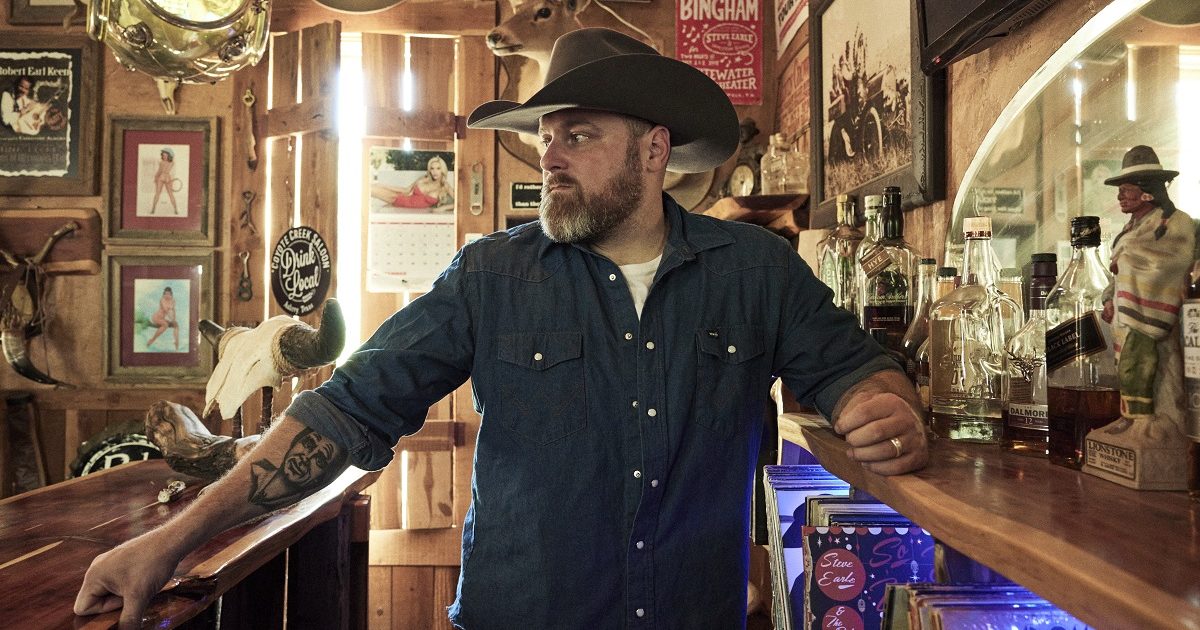
BGS 5+5: Isaac Hoskins

Artist: Isaac Hoskins
Latest Album: Bender
Hometown: I spent the majority of my formative years in Wellington, Kansas. A small wheat-farming town between Wichita and the Oklahoma state line. I’ve lived in Denton, Texas, for 19 years and I definitely call it home now but Wellington still has a great deal to do with the way I see the world.

Personal nicknames: When I was a kid there was another boy who lived down the street who, for some reason, couldn’t pronounce my name instead called me Izeke (eye-zeek). My mother started calling me Zeke and it stuck. To this day, a lot of people in Kansas call me Zeke.

Which artist has influenced you the most … and how?

Oh, man! There are so many. I’d imagine that Steve Earle is probably the biggest influence that I’ve had as a songwriter and performer. Obviously, Steve’s music was and continues to be a massive influence but most any other artist that I became a fan of early on was because they were in and around his orbit. The internet was still a pretty new thing, so discovering music that wasn’t on the Top 40 chart was pretty difficult without some sort of road map. Guy Clark, Townes Van Zandt, Rodney Crowell, Jerry Jeff Walker, all of the usual suspects came to me after reading Steve’s biography (Hardcore Troubadour). Steve Earle was my gateway drug.

What’s your favorite memory from being on stage?

When I was in junior college I was in a choir that was invited to sing a piece of music entitled The Testament of Freedom at Carnegie Hall. The piece was composed by a man named Randall Thompson and inspired by writings of Thomas Jefferson. It was the spring after the 9/11 attacks and the entire experience was incredibly moving. Both the subject matter and setting were something I’ll never forget. I’m told that Kevin Bacon was there so perhaps I’m one degree closer than most.

What was the first moment that you knew you wanted to be a musician?

I knew that I wanted to be a musician from a very early age, but given my surroundings I never felt like it was something that was attainable. I attended a music festival in Helotes, Texas, called Jack Ingram’s Real American Music Festival and that was the day that I knew for sure, that was the day that I felt like it was something that I could do. I was watching all of these incredible performers that, up to that point, I had never even heard of. The Bottle Rockets, James McMurtry, Hayes Carll and so many other people were proving to me that you don’t have to be Garth Brooks to make a life in music and I was immediately obsessed.

What has been the best advice you’ve received in your career so far?

I had the opportunity to talk to Don Schlitz once. He told me, “Write the song you want to hear and you’ll be surprised who wants to hear it too.” I think of that often, so concise, so true. Thanks, Don.

Which elements of nature do you spend the most time with and how do those impact your work?

I’m a duck hunter, and more often than not, I hunt alone on public land. Hunting on public land means that you’ve got to get there earlier than anyone else if you want to be sure that you have your spot. Most days I’ll begin my walk to the lake at four o’clock which means I’ve got somewhere in the neighborhood of three hours to hike in, find my spot, put my decoys out and get a decent hide before shooting time (30 minutes before sunrise). That time before and during sunrise is my favorite. I use it to think about the people, places and things that matter to me and might also matter to someone else. Watching the day come alive is a spiritual moment for me, every time. Living in the business of making noise, it’s nice to soak up a little silence.


Photo Credit: Peter Salisbury

For Bluegrass Fans, Kentucky Offers a Commonwealth of Tourist Attractions

Kentucky music is currently having a moment, but it’s far from the first time. Before artists like Tyler Childers, Sturgill Simpson, and Chris Stapleton made it big, folks like Bill Monroe, Loretta Lynn, Keith Whitley, Crystal Gayle, Tom T. Hall, Patty Loveless, Ricky Skaggs, Dwight Yoakam, and countless others helped build up the Bluegrass State’s rich musical foundation spanning bluegrass, country music, and more.

With so much talent having originated from Kentucky, there’s no shortage of destinations around the Commonwealth to consume this musical history. From the Mountain Arts Center in Prestonsburg in the southeast to the Muhlenberg Music & History Museum in the west, Lexington’s Red Barn Radio and beyond, every nook, cranny and holler throughout the state is full of destinations beckoning to be explored by music fans. We’ve compiled more than a dozen of these attractions below in an epic road trip that could be called the Kentucky Music Trail.

Central Kentucky

Opened in 2002, the Kentucky Music Hall of Fame & Museum in Mount Vernon features exhibits showcasing talent from throughout the state ranging from country and bluegrass trail blazers like Bill Monroe, Loretta Lynn and Keith Whitley along with Black Stone Cherry, The Kentucky Headhunters and Exile, among others. The museum is open from 10 a.m.-5 p.m. daily with an admission of $10.


Also sitting on the same 55-acre property is the Renfro Valley Entertainment Center. First opened in 1939, the massive barn features two unique performance halls that host country, gospel and bluegrass music annually from April through December. Additionally, the venue has been the home of Renfro Valley Gatherin’, a syndicated radio program airing on Sunday nights at 9:30 p.m. EST, since 1943. The show is the third oldest continually broadcast radio program in America and the second longest continuously running such program featuring country music, behind only the Grand Ole Opry.

Back inside the Hall of Fame & Museum, one of the most prominent exhibits is one showcasing Woodsongs Old-Time Radio Hour, an internationally syndicated radio program hosted by folk musician Michael Johnathon in front of a live studio audience at the historic Lyric Theatre in Lexington on most Monday nights at 7 p.m. Launched in 1998, the entirely volunteer-run production spotlights musicians across all genres performing their songs and sharing the stories behind them. Now over 1,000 episodes in (and counting), the program has featured artists like Sam Bush, J.D. Crowe, The Black Opry, Riders in the Sky and Billy Strings. Each show also features a “Woodsongs Kid,” helping to encourage and grow the next generation of Kentucky songwriters.

Another radio program based in Lexington and featuring talent from around Kentucky, Appalachia and the southeast with a similar mix of conversation and performance is Red Barn Radio. Founded in the early 2000s at Renfro Valley’s little red barn (from which the show draws its name), co-founder Ed Commons helped lead the show’s move to its current home inside LexArt’s headquarters in downtown Lexington in 2005. The show has taken off since moving there, hosting everyone from Sam Bush to J.D. Crowe, Tom T. Hall, John R. Miller, Arlo McKinley, Sierra Ferrell, Sunday Valley (led by a young Sturgill Simpson) and Tyler Childers. In the case of Childers, his performance on the show became so revered that he ended up releasing it as a live album, Live on Red Barn Radio I & II, in 2016.

Eastern Kentucky

Out east on the campus of Morehead State University you’ll find the Kentucky Center for Traditional Music (KCTM), a school teaching the next generation of bluegrass and old-time musicians the nuances, history and business side of the music. Founded in 2000, the center offers the only Bachelor of Arts in Traditional Music in Kentucky along with a minor in traditional music. It also features an extensive digital archive of Kentucky and Appalachian traditional music, a recording studio, sound-proofed classrooms and rehearsal spaces. Alumni from the school include Linda Jean Stokley and Montana Hobbs of The Local Honeys, current professor and pedal steel player for Nicholas Jamerson, Thomas Albert; Lauren and Leanna Price of The Price Sisters, and current Assistant Director, Archivist, Instructor and member of Tyler Childers’ band, Jesse Wells.


Just over an hour southeast of the KCTM you’ll find the U.S. 23 Country Music Highway Museum. Located just off of U.S. 23 in Staffordsville just north of Paintsville, the museum features memorabilia from Tyler Childers, Chris Stapleton, Loretta Lynn, The Judds, Patty Loveless, Dwight Yoakam, Billy Ray Cyrus, Tom T. Hall and other artists hailing from the counties that the highway passes through in Eastern Kentucky. The area known as the “Country Music Highway” is distinguished as having the highest number of charting country musicians calling the area home per capita than anywhere else in the world. Admission to the museum is $4.

After another half-hour drive through the area’s Appalachian mountain back roads and hollers you’ll come across Loretta Lynn’s birthplace at Butcher Hollow in the old coal mining community of Van Lear. The humble mountainside cabin features four rooms to explore—one bedroom for Loretta, younger sister Crystal Gayle and her five other siblings; a bedroom for her parents, a tiny kitchen and a cozy dining room—all covered wall to wall in pictures and other collectibles from the Coal Miner’ Daughter’s childhood and life as a musician. Tours are $5 and are typically guided by members of Lynn’s family who still call the holler home.


About a mile up the road from Lynn’s home you’ll find Webb’s Grocery, a general store constructed by the Consolidated Coal Company in 1918 when Van Lear’s coal output was near its peak. In addition to stocking ice cold Coca Cola, Mallo Cups and other quick bites the shop also is stuffed with tons of pictures of Loretta Lynn and her family including a massive banner reading “Welcome Loretta Lynn.” A journey to Butcher Hollow offers not only an incredible look back on the upbringing of one of country music’s most iconic voices, but also a look back on the mountain towns ravaged by the boom and bust of the coal industry that back in the day helped to power our entire country.

Another 30 minutes south of Van Lear is the Mountain Arts Center (MAC) in Prestonsburg. Opened in 1996, the building features a 1,000-seat concert hall, a state-of-the-art recording studio, loads of rehearsal space and will soon be the home to the TV and radio headquarters of CMH23, an organization dedicated to educating people on the history of artists from the Country Music Highway and giving a platform to up-and-coming musicians from the region. According to Executive Director Joe Campbell, the MAC and CMH23 are also partnering with The Country Network on Live From CMH23, a show that will focus on rising artists from around the state.


The MAC is also the home of a family variety show called Billie Jean Osborne’s Kentucky Opry, as well as the Kentucky Opry Jr. Pros. (an educational program for aspiring entertainers ages 6 to 18) and the Appalachian Arts & Entertainment Awards. Kentucky Opry alumni include Chris Stapleton’s longtime bassist J.T. Cure, Jesse Wells, Tyler Childers’ piano/keys player Chase Lewis, Brit Taylor, Marleena Vanhoose and Rebecca Lynn Howard.

Western Kentucky

Just under two and a half hours west of Lexington via the Western Kentucky Parkway is Rosine, a small town in Ohio County with its claim to fame being the birthplace of the Father of Bluegrass, Bill Monroe. In the heart of Rosine, you’ll find several landmarks commemorating the artist starting with the Bill Monroe Museum, which houses countless instruments, outfits, fan letters, photos, personal furniture and even Monroe’s personal Cadillac DeVille in a constantly growing and evolving collection. The museum is open Monday-Saturday from 10 a.m.-4 p.m. Admission is $3-5.


Less than a mile up the road from the museum is the Rosine Barn Jamboree, which hosts free bluegrass jams every Friday night from mid-March through mid-November. A stone’s throw away from the barn sits the Rosine Cemetery, where you can’t miss the grave of Monroe. Featuring an obelisk-style monument and adorned in flowers, Monroe’s grave stands tall over the quaint hillside cemetery as, even in death, he watches over the town that helped to define him. The cemetery also includes several of Monroe’s family members including Birch and Charlie Monroe and Pendleton (Uncle Pen) Vandiver.

Also nearby is Jerusalem Ridge, Bill Monroe’s homeplace. On the compound you can see Monroe and other family member’s childhood homes. Restored in 2001, Bill’s home features guided tours Monday-Saturday from 9 a.m.-4 p.m. and Sundays from 1-4 p.m. The site also features several stages and plays host to the Jerusalem Ridge Bluegrass Celebration, a festival taking place annually in September with some of the region and country’s best traditional bluegrass bands.

Less than an hour west of Rosine in Central City you can learn about icons like John Prine, The Everly Brothers, Merle Travis, Ike Everly, Mose Rager and Kennedy Jones at the Muhlenberg Music & History Museum. In addition to the traditional museum the building features a 1950s era jukebox serving up hits from the aforementioned artists that call Muhlenberg County home along with a towering Everly Brothers monument just outside. It also houses the Kentucky Motorsports Museum.


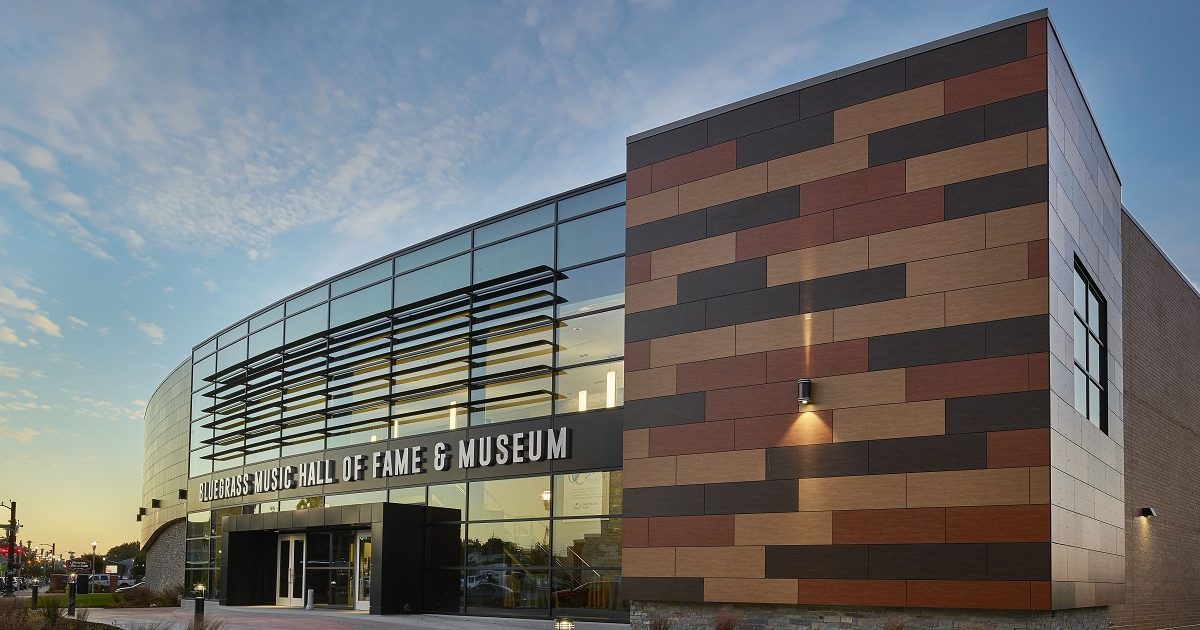
Just under an hour north of Central City is the last stop of our Kentucky Music Trail tour at the Bluegrass Music Hall of Fame & Museum along the banks of the Ohio River in Owensboro. The latest jewel of Owensboro’s transformed downtown, the $15.3 million building opened in October 2018 not only houses the museum and hall of fame, but also the 447 seat Woodward Theatre, a gift shop and several private event spaces along with a 1,500-seat outdoor amphitheater to boot.

When it comes to the museum, the biggest of bluegrass fans could easily spend a day diving into everything the facility has to offer. A self-guided audio tour will inform you on the ins and outs of each exhibit, the roots and impact of artists to bluegrass music, the nuances of the music and more, helping to fully immerse and indulge visitors in the music. On display are items from the likes of Rhonda Vincent, Bill Monroe, Billy Strings, Sam Bush, The SteelDrivers’ fiddler Tammy Rogers, Flatt & Scruggs, The Steep Canyon Rangers, J.D. Crowe, Hee Haw, bluegrass’ cinematic coronation O Brother, Where Art Thou? and more.


Other facilities in the museum include a pickin’ parlor where guests can play on pre-tuned guitars, mandolins, banjos, upright bass and more along with a transcribed and searchable interview database provided in partnership with the University of Kentucky’s Louie B. Nunn Center for Oral History, a massive display honoring banjo maker Jimmy Cox and the Hall of Fame itself. The prestigious space contains 68 plaques honoring those instrumental to bluegrass from its roots to its golden age and everywhere in between. Much like the museum, it offers a tremendous look back at the genre’s roots, where it is now and how it got there.

The same could be said for all of these destinations. I was already in love with my home state prior to visiting all of these places, but after having done so I’ve grown an even greater appreciation for the state, its musical roots and trailblazing artists. I’m confident that you will too upon making the trip for yourself.

A Survivor of Her Dreams, Kelsey Waldon Returns With ‘No Regular Dog’

Kelsey Waldon has a new outlook on life — or at least life as a full-time musician. A native of Monkey’s Eyebrow, Kentucky, she’s charmed audiences all across the country at concert halls and festival stages. But she cut her teeth at plenty of dive bars and honky-tonks along the way, a fact that reveals itself not only in her charismatic, unmistakably country live shows, but also in the independent spirit that courses through her lyrics.

A strong songwriter with the voice and twang to match, Waldon’s musical prowess caught the attention of legendary songwriter John Prine, who signed her to his record label in 2019 — his first signing in a decade and a half — and released the widely acclaimed White Noise, White Lines later that year. This month, she will return with No Regular Dog, her fourth full-length album and her second via Prine’s Oh Boy Records. Brimming with twangy strings, thoughtful imagery, and a tenacious, determined lyrical undertone, the album holds all of Waldon’s usual musical hallmarks. But it also paints the picture of an artist who has grown since her last release; a snapshot of someone who’s stepped back, reconsidered her place in the musical ecosystem, and re-emerged more enthusiastic and clear-eyed than ever.

No Regular Dog was mixed by renowned engineer Trina Shoemaker (“I’m a huge fan,” says Waldon) and produced by Shooter Jennings, who took a highly collaborative approach to the role. “I think Shooter really sees himself much more as a facilitator,” says Waldon. “He felt his job was to stick with my vision but elevate it in any way possible. He really knows how to let the artist be themselves.”

A few days before the release of No Regular Dog, BGS caught up with Waldon about the studio dynamic that molded the album, the life experiences that inspired her, and the daily joys that keep her grounded.

BGS: In the title track, “No Regular Dog,” there’s this great phrase: “survivor of my dreams.” It’s a lyric that could be interpreted a lot of different ways. What did you intend when you wrote it?

Waldon: We wish for so many things. We want them. We work so hard for them. And then, sometimes, we get really lucky from all that hard work and it gets handed to us. At that point, I do think you have to survive it. I don’t mean that in a bad way! Obviously, I’m doing what I love and that’s something I realize is a privilege and a gift. But it comes with its own sacrifices. People always say “livin’ the dream,” and I always joke around and say I’m surviving the dream. [Laughs]

The song was written at a time when we’d been on the road for three months. I was on a plane somewhere, and my poor old manager, who’s one of my best friends now, said something like, “Well, we ain’t no regular dogs.” In my head, I was like, “Yeah. More like a wolf on the kill. We’re going to do this no matter what it takes.”

You work so hard to get to where you are, and then it’s kind of like, “Oh, shit. This is hard.” The road’s not for everybody. But I really wanted it. I wanted it for all the right reasons, and I still do. Especially after taking some distance from my career during the pandemic, I’m finally feeling ready to step into my role. The song is about the idea and the statement that I’m still here. I won’t be put down that easy. I won’t be put down like no regular dog.

You mentioned that some distance from your music career adjusted your perspective. What are some of the things that continue to fill your cup, bring you joy, in between touring or recording?

Well, I’ve always got a pretty lush garden growing. My tomatoes are popping off right now, and we just got a big old mess of greasy beans. I cooked them last night for dinner. Obviously, that’s always brought me joy. I also love this summer heat. I’m one of those people! I really do. I know people hate it, but I love it. I love the bugs at night and everything. That’s bringing me great joy, too. I got to go fishing a little bit, go on some good trips before I left for Europe. And my little cattle dog, Luna, she’s out here on the porch just laying here while I’m talking and that brings me a lot of joy. I love taking care of my chickens out here and being able to spend some time with my partner, Justin. I’ve got a new little niece named PJ, and she is the best. So, aunt life has brought me joy as well.

You recorded this in Los Angeles with Shooter Jennings. How did that come about?

I loved working with Shooter, and that was the first time I’d recorded in Los Angeles — I had done everything in Asheville or in Kentucky thus far. But as soon as I knew I was going to make a new record, I wanted to challenge myself to get out of my immediate bubble and work with someone I didn’t really have any history with. I felt in my gut that I really needed to do that.

Shooter and I met at a Tanya Tucker show in Kansas City at the end of 2019. I was really taken aback that he knew my music. I mean, he was telling me things ​about my songs and I was just kind of like, “OK, he’s actually listened. He’s actually a fan.” I had, of course, heard records he had done. Obviously, I was a big fan of Tanya’s record, and I’d heard that Jaime Wyatt record he had done and I thought it was great. It all felt so natural. We kept in touch. I sent him some voice memos and demos I had done here at the house. It was clear that we were both incredibly excited to make this record. I think he had always kind of wanted to make a deep country record. We both clearly had a common goal and we made it happen.

One of the songs on the record that really stands out to me is the closer, “Progress Again.” What inspired it?

That was one of the only songs on the record that I wrote a while back. I brought it to the studio for White Noise, but it just wasn’t ready yet. But I kept thinking about that song. During the pandemic, I opened up my journal and revisited the tune. I wrote new verses to it. It felt like I was in a different part of my life to finally have the experience I needed to finish it. I mean, everything is progress. I’ve done a lot in my life. I’ve messed up. I’ve had a huge healing time these past couple years — I’ve been off booze for almost two years. There’s a lot that you’re not really able to see when you’re in the thick of things. But being able to look back from a healthy distance, you might realize how many people you were hurting. That you were hurting yourself. “Progress Again” is a little bit about that, but it’s also about accepting that progress is a part of life and just moving on and not dwelling on things. So, you got to learn to let it go and love yourself a little bit.

You say in the song that “there’s hope in persistence.” Has that rung true for you, in your career or otherwise?

Yes, absolutely, in everything I’ve done in life. 100%. Not only in my career, but in my personal life and mental health. It takes a lot of work to turn bad habits into good habits. You have to be consistent, be persistent about it. It’s an everyday thing. But it gets easier, even though it’s still hard. At the end of the day, you’ve got to bet on yourself. You can’t let just one thing fuck it up for you. There’s hope in persistence because something could break through — you just can’t stop.

One of those breakthrough moments for you came a few years ago when you signed with John Prine’s Oh Boy label. You honor him on No Regular Dog with a song written in tribute, “Season’s Ending.” Why was that important to include here?

“Season’s Ending” was the first song that I wrote after John’s death. I couldn’t really do anything for months after that happened. There was so much other death as well. There was a lot of loss; I think it was hard times for a lot of people. I was pretty stricken with grief for a good few months, and I know I’m not the only one. But I finally sat down and that song poured out of me. It was a nod to his song “Summer’s End.” But the seasons were changing and the flowers were blooming and I just started thinking about how everything is cyclical. The song is about coping. Accepting death as a part of life. Maybe everything that dies doesn’t really die. Maybe it comes back. Flowers don’t bloom all year. Some things go dormant, and then they come back. The song was just a way for me to process that. Death is a part of life. John is forever a part of my story, and I’m a part of his legacy as well.

What do you hope this album’s legacy will be—for old fans and new ones?

We’re in really hard times right now, and I hope this album can be a gift to people. I feel like I’m coming to my career with whole new eyes: I’ve been thinking a lot about what I’ve been able to do, what I can do further, and what kind of energy I want to bring. Mostly, I just hope this album makes people’s lives better. I hope they can see the no regular dog in themselves, and I hope it can bring something good to the world.


Photo Credit: Alysse Gafkjen

From the Yukon to the World, Songwriter Gordie Tentrees Builds Bridges

Singer-songwriter and guitarist Gordie Tentrees didn’t begin his career as a globe-trotting performer until he moved to a vibrant, supportive music city – that is, Whitehorse, Yukon. In a town of approximately 40,000, there’s long been a bustling musical economy, one that supported Tentrees even before he had released any recordings.

Place – whether rural northern Canada, or the far reaches of New Zealand or western Europe or Australia – informs so much of Tentrees’ writing and music-making, especially on his most recent release, 2021’s Mean Old World. With a global perspective and a local level of care, he unspools big, often daunting political and social questions with humor, intention, and aplomb. Child welfare, Indigenous rights, solidarity, working class issues, and more are packaged in tidy honky-tonking, blues-inflected, string band songs, making these sometimes gargantuan pills that much easier to swallow.

That Tentrees prioritizes community, building bridges, and human connection in his music makes it that much more compelling. He uses his rural, multi-ethnic hometown as an entry point, a doorway, through which he not only brings folks into his own world, but brings his world to them, too. And in doing so, even with an album titled Mean Old World, he reminds us that living on this earth doesn’t always have to be so forbidding, exclusive, and mean. BGS connected with Gordie Tentrees via phone, while he picked up his Indigenous daughter from school on his bicycle, to discuss this recent album.

BGS: I wanted to start by asking you about place. I’ve been obsessed with place these days, especially as it relates to music and music-making. I was struck by the fact that you didn’t begin songwriting or performing until you moved to the Yukon. How did moving there inform your music-making? To me, it feels like there’s a strong sense of place on this record.

Gordie Tentrees: Well, I blame the Yukon – I credit the Yukon as well as blame it [Laughs] – for the path I’m on. It is a good conduit and supportive community that encourages the arts. Writing songs and playing an instrument is something that’s seen as a valued occupation, one that’s sort of embraced and lifted up. It’s not hard to get on the stage here. Early on, when I started playing, I hadn’t even made my first record yet and I was headlining some northern festival stages. [The Yukon] really gives you a chance to get on a stage and expose yourself to audiences like that. I really believe if I had lived anywhere else in Canada or the world I wouldn’t have been given so much time on the stage. 

The other thing is that a lot of people spend their time creating art here and writing songs here – there are a lot of songwriters here. It’s a highly valued thing. I live in a community full of writers and songwriters. That’s really supported and endorsed. You can knock on someone’s door if you want to learn an instrument and they’ll show it to you. There aren’t barriers for those that are aspiring to be songwriters or musicians. It’s quite wonderful. 

At one point, in our little community of 40,000 people – Whitehorse, Yukon, where I live – we even had up to 25 music venues at various points, all happening. One thing about Whitehorse that not many people know is that it has the highest number of musicians per capita that actually make a living from music in Canada. 

As much as the Yukon has informed your music-making, you travel so much and you play so many shows all around the world, so while there’s this strong sense of place in this album, Mean Old World, I do sense that it’s also informed by your travels. “Danke” clearly references this. How has the cross-pollination of the Yukon and your travels created the musical aesthetic you have now?

I think that’s attributed to what I do, as far as being a performer and musician. I get to go to different parts [of the world] because I’m not just a songwriter and play various instruments. For example, if I play in English-speaking countries they like the songs and the stories. Countries where English is a second, third, fourth language they rely more on melody and stuff like that, so if you have a show that sort of hits people both ways, it allows you to travel as much as I have. Which I really sort of figured out early on, you can play in all these different markets and do different things because you’re not just a one-trick pony. 

As far as playing different genres, there are so many genres of music here in the Yukon; it goes from jazz, blues, and hip-hop to funk music. I get often put into a country festival, bluegrass festival, or a folk festival as the guy who’s kind of on the edge of all those things. But it also touches on all those things. That’s allowed me to travel all over the place and sort of steal genres from all of the artists that have inspired me, whether it’s Southern and Delta blues music or Eastern Romanian dirges.

We are The Bluegrass Situation, so I would be remiss if I didn’t ask you about the bluegrass influences I hear on Mean Old World. I wonder where they stem from for you? It sounds like that type of rural bluegrass that is genre-less and draws from many influences.

Because I’m a guitar player, I’m drawn to flatpicking. I went, “Okay, bluegrass, this genre is like high-speed chess.” Like high speed math along with jazz. We have a local bluegrass festival up here so it’s all around. String band music is quite popular up here. Where I live in the Yukon you’re exposed to it from the jazz scene to the bluegrass scene. If you know music from those genres at all, that’s sort of enveloped and absorbed by the people who live here. 

I wanted to ask you about the stories that went into “Mean Old World” and “Every Child,” not only your own experience in foster care, but also your experience of raising your Indigenous daughter and how that’s informed these songs. Partially because I think these are really heavy sort of big topics, but the way you approach them feels very grounded and very real.

It was all inspired by one song that I wrote, the title track, “Mean Old World.” The song was really about the best interests of every child, which I believe are health, safety, and happiness. Regardless of your background, politics, or the current state of the world, I think those are the most important things. That song is inspired by that, following my journey as a foster child from a broken home and going through the social services system and then also becoming a foster parent to our daughter six years ago. We had no idea [what we were doing], it was a really educational experience. Where I live in the Yukon, 50 percent of the community is Indigenous. I’m not Indigenous, my background is actually Irish. We’re very lucky that we’re educated and exposed to these experiences and our families and our communities – Indigenous or non-Indigenous – are affected by it. So we come together and support each other. 

Through my daughter, being a parent of a female is one thing. It’s difficult for females in this world, [especially] one with brown skin. I think I keep it really simple and I think about what she faces every day and how she would get passed over or looked upon as a child that might need more work or more time, even if she was ahead of everybody else, because of the color of her skin and because of her background. Once that’s in your home, and you’ve experienced that, it’s pretty alarming! At the same time, we’re so grateful that we’ve had this experience and have realized that as parents we are here to bridge the gap between my daughter and her birth parents and her birth family. To build that human capacity to bridge that space that’s been created due to trauma. 

You also bring a lot of lightness – levity, humor, and joy – into your music-making. Why is that important to you in the context of these kind of bigger, sometimes daunting topics? 

When I was a kid, humor was a defensive coping mechanism to get through all the darkness. There were always pretty dark situations that were absurd, and if you could bring some light to it, it always made it easier to deal with. I felt like I was a witness and a passenger to my broken childhood and an observer. I watched it all and would kind of make light-hearted jokes about it even though it was painful, to get through it. I find that humor is my constant companion, also recognizing that even though I use it a lot I still have to deal with some of the reasons that I use it.

One of my favorite writers from early on was John Prine. I heard him in my house when I was a kid, and the way he can use heavy subjects: “There’s a hole in Daddy’s arm where all the money goes.” Everything from that ranging to, “Swears like a sailor when she shaves her legs.” That kind of humor in his songs is something as a kid that I grew up knowing was possible. You can use humor for these heavy subjects. I have a song on my last record called “Dead Beat Dad.” I felt it was ahead of its time because it shocked the audience, at least until I had them in my hand. I would shock them, a little jolt. Just to push them, give them a little poke. Now that song, those taboos are more behind us now. I want to take people down those roads, but I also want to bring them back, usually with humor. 

The quality of the music, being that sort of honky-tonk country meets a back porch jam, really communicates that your priority is establishing these relationships with your audiences so you can have these bigger conversations.

A lot of my audience is a rural audience, teaching, sharing with them that yes, you can grow up in those places and it’s okay. Everything’s going to be okay, you’re going to be okay. You’re going to grow and it’s never too late to learn. It’s just never too late. Once you stop learning, that’s when we’re all in trouble. I’ll have these conversations, most of my audience is rural communities and they’ll expect me to do this hillbilly, honky-tonk, “hold my beer while I kiss your wife” nonsense and I can open the door with that and then they’ll be like, “Wait a minute, he’s not singing about beer, he’s singing about… Whoa!” I love having that effect. I love going through that doorway. 

I recognize my role when I go around night to night in whatever country it is, I realize I walk in and I can lift, change, alter a lot of people’s lives in a short amount of time. I can do it over and over again, repeatedly, and I get to go to bed at night and go, “Wow. That felt pretty good.” I’m really enjoying it. I’m enjoying it more now than I have in the sixteen years I’ve been doing this. I feel really grateful that there’s a place for me – I feel like there’s more of a place for me now than there’s ever been. I’m just so lucky. I get to be a small helper in a larger community.  


Photo credit: GBP Creative

BGS 5+5: Teddy and the Rough Riders

Artist: Teddy and the Rough Riders
Hometown: Nashville, Tennessee
Latest Album: Teddy and the Rough Riders
Personal nicknames: TRR, Teddy

Which artist has influenced you the most … and how?

Well, since there are way too many artists who have had singular, exceptional influences on us, I’ll have to just pick one amongst many! But someone special that comes to mind for me is Bill Monroe. For me he took the song formula to the moon, maybe from speeding up Jimmie Rodgers and other traditionals to breakneck speeds, and singing as high as humanly possible. To me he breaks through bluegrass. As a creator he made these simple, beautiful melodies that can be felt beyond genre, as he certainly was in his day.

What was the first moment that you knew you wanted to be a musician?

Growing up in Nashville there was a plethora of rock house shows and gatherings. One in particular I was around 15 years old when I saw this band Jeff the Brotherhood, and they just had this stripped-down, two-piece, driving minimalist rock sound. The scene around them was exploding and I truly felt like I got to be a part of it right then and there. That made me believe I could actually play music. It took our buddy Carter setting up a honky-tonk night every Sunday 7-9 at Santa’s Pub in 2011 to be fully convinced to play real country music, though!

What rituals do you have, either in the studio or before a show?

Jack and I love to rehearse singing together before a big show. I play mandolin and sing the high harmony, and Jack plays guitar and sings lower. But we do a huge Louvin Brothers routine, kind of doing the high lonesome, blood harmony thing. It’s just great practice and lets us all warm up solidly and relieve stress before a show.

Which elements of nature do you spend the most time with and how do those impact your work?

Nashville is surrounded by great hikes. We go to Sewanee, Tennessee, where a good many friends have family cabins out there. That will put a song in your mind, it’s a pretty special place. We all go out to Percy Priest Lake together and listen to music and sit in the sun and swim. We have access to canoes and a lot of our friends are good at efficiently camping. I definitely write songs about those experiences all the time.

Since food and music go so well together, what is your dream pairing of a meal and a musician?

In Nashville there’s an exceptional Southern-style meat-and-three called Arnold’s Country Kitchen. Well, naturally we go there a good bit, but before his death, and for longer than I know probably, John Prine would go there every Thursday before a writing session and get the meatloaf. We’d go and see him ride in his huge black Escalade and go to town. So to me, John Prine and a big ole meatloaf and three sides from Arnold’s is the stuff of legend!


Photo Credit: Monica Murray