Bluegrass Memoirs: The Earl Scruggs Celebration (Part 3)

(Editor’s note: Read part one of Neil V. Rosenberg’s Bluegrass Memoir on the Earl Scruggs Celebration of 1987 here. Read part two here.)

Boiling Springs, NC on Saturday, September 26, 1987: My workshop in the Gardner-Webb College Library with Snuffy Jenkins, Pappy Sherrill and the Hired Hands ended at 4:30 that afternoon when Dan X. Padgett presented Snuffy with a hat. From my diary:

Afterward I hung around and listened for a while to the Hired Hands’ young banjo picker Randy Lucas play the Bach “Bourrée,” “The Stars and Stripes Forever,” and another classical piece expertly on the banjo.

Here’s a nice example, from Bill’s Pickin’ Parlor, of Randy’s recent work in this milieu:

Then, supper time came.

I went for some barbecue (big regional difference thing — this barbecue was red, vinegary; with shredded pork) with Tom [Hanchett] and Carol [Sawyer] and then was kind of enticed away by Dan X Padgett…

I’d met Padgett the afternoon prior, when I first arrived in Boiling Springs; a respected local banjo elder, he was the teacher of the young banjo player in Horace Scruggs’ band whom I’d met earlier today. Padgett had a long and interesting career, with deep connections to Earl Scruggs and Snuffy Jenkins, as well as memories of an earlier generation of banjo greats. He was interviewed for the Earl Scruggs Center by Craig Havighurst in 2010. 

I went with him…

…to his car (an old Cadillac) to look at various memorabilia like photos of him with various important country and bluegrass people. He also showed me a very worn copy of the very first F&S songbook and when I expressed a strong interest in copying it he loaned it to me. I also talked with him about the possibility of obtaining a banjo like one he played during the afternoon, a miniature Mastertone about the size of a mandolin with an actual tone ring, flange, and resonator. He said he’d see about it and we ended up standing at his trunk trying out various instruments. 

I was picking away on “St. Anne’s Reel” when I noticed there were some people standing around me, and when I finished and looked around there was Doug Dillard looking at me with that big smile. Quite an introduction!

In an edition of the Shelby Star a week or so earlier, Joe DePriest wrote of Dillard’s association with Earl Scruggs, telling how in 1953 the Salem, Missouri teen first heard “Earl’s Breakdown” on the car radio. It hit him so hard “he ran off the road into a ditch.” Dillard got his folks to take him to Scruggs’s Nashville home. “We knocked on the door, and he came, and we asked him to put some Scruggs tuners on my banjo. He invited us in.”
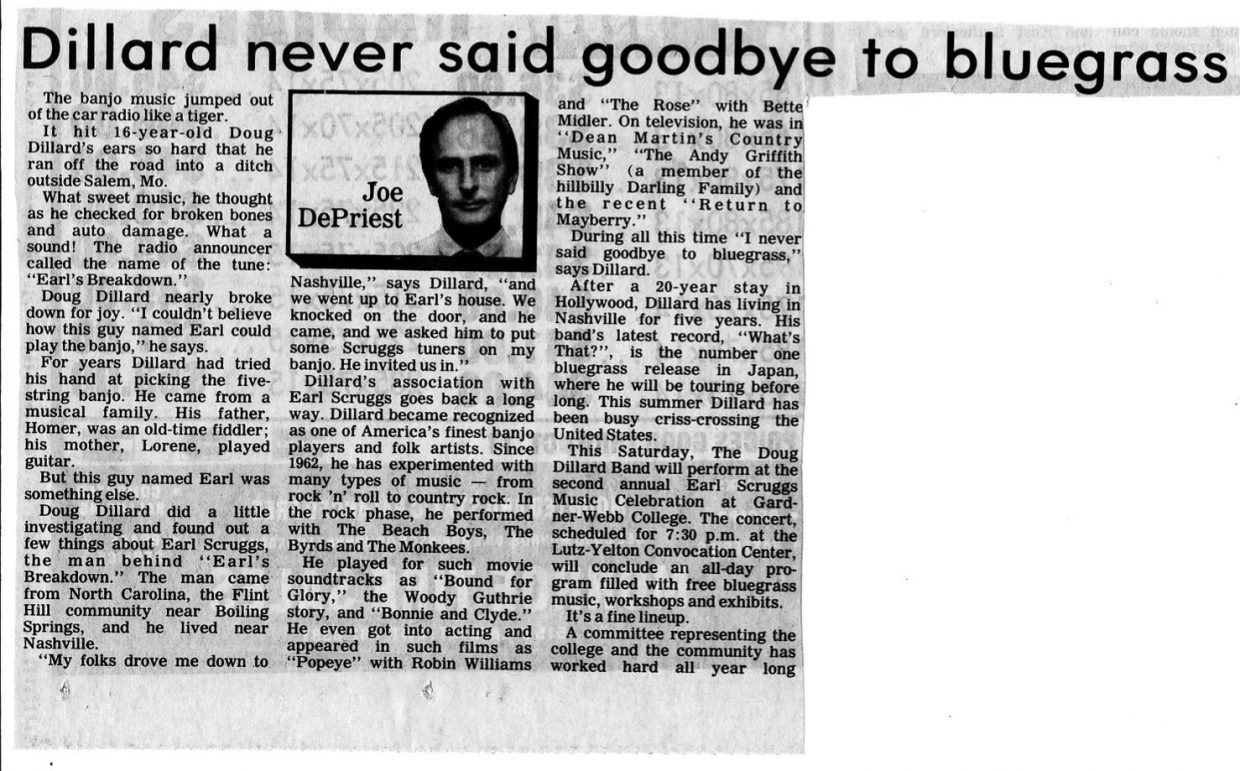
A newspaper clipping from a 1987 edition of the ‘Shelby Star’ of an article by Joe DePriest on Doug Dillard

Earl welcomed banjo pickers to his home, especially if they wanted Scruggs Pegs. In the “Suggestions for Banjo Beginners” on the first page of Flatt & Scruggs Picture Album — Hymn and Songbook from 1958, Earl invited those interested to contact him in Nashville, and many did:
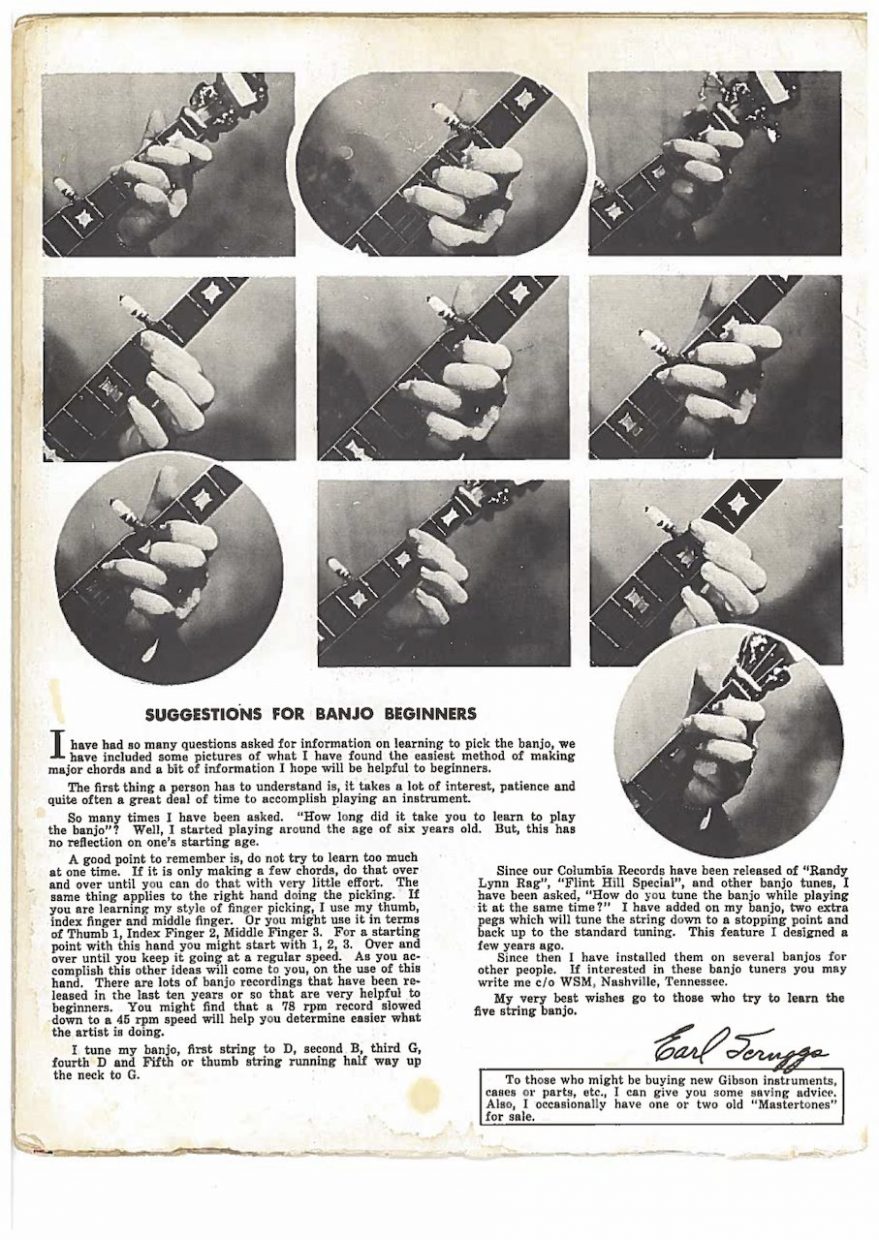
The first page of the 1958 ‘Flatt & Scruggs Picture Album — Hymn and Songbook’

In 1962 Doug and his brother Rodney went with their band The Dillards to LA, where they were “discovered” at the Hollywood folk club The Ash Grove. With best-selling Elektra LPs, they toured extensively in the West and appeared on CBS’s The Andy Griffith Show as “the Darling Family.” 

In 1966 Doug left The Dillards and ventured into what would soon be called “country-rock,” touring with the Byrds and forming a band with former Byrd, Gene Clark. Dillard’s banjo playing had been strongly shaped by his close listening to Scruggs. In the ’60s when players like Bill Keith and Eric Weissberg were pushing banjo boundaries in bluegrass, Doug was pushing boundaries in a different way by finding a place for Scruggs-style banjo in rock. He fitted solid, straight-ahead rolls into pieces like Gene Clark’s “The Radio Song”: 

Dillard was heard often on popular Hollywood studio recordings and movie soundtracks during the ’70s. He even had on-screen roles in Robin Williams’ Popeye and Bette Midler’s The Rose.

DePriest’s article quoted Dillard: “During all this time, ‘I never said goodbye to bluegrass.'” He moved to Nashville in 1983 and started a band. 

The bluegrass music business was booming in Nashville. A bunch of young pickers were there, touring in bands and doing studio sessions. New Grass Revival featured newcomers Bela Fleck and Pat Flynn; John Hartford, Mark O’Connor, Jerry Douglas — all were in town. The Nashville Bluegrass Band started in 1984; that year Ricky Skaggs won a Grammy for his version of Monroe’s “Wheel Hoss.” Up in the Gulch district, between the Opry and Vanderbilt, the Station Inn was serving bluegrass seven nights a week.

I was introduced to the Doug Dillard Band this afternoon right there where Dan X Padgett and I had been jamming. His four-piece outfit drew from a pool of talented bluegrass musicians. 

Rhythm guitarist, vocalist and emcee Ginger Boatwright was a seasoned veteran. During the ’70s she’d toured and recorded with Red White and Blue(grass), and later formed The Bushwackers, an all-female group that began as the house band at Nashville’s Old Time Picking Parlor. Her story is told well in Murphy Hicks Henry’s book Pretty Good for a Girl: Women in Bluegrass. Henry calls her “The first ‘modern’ woman in bluegrass” alluding to her folk revival roots, her styles of humor and dress, and, most importantly, “a softer, smoother, more lyrical quality” of singing.

Having a second guitar as a regular lead instrument in a four-piece band was uncommon at this time. When I met Doug’s young lead guitarist I was surprised to discover he was the son of Lamar Grier, whom I’d hung out with twenty years earlier when he was a Blue Grass Boy. David Grier was 26. He’d studied the lead guitar work of Clarence White (there’s a photo of him with White in Bluegrass Odyssey), Tony Rice, and Doc Watson. He was already an experienced pro.

Playing the electric bass, which was unusual for the time, was Roger Rasnake, a singer-songwriter from Bristol on the Tennessee-Virginia border.

In 1986 Flying Fish released this band’s first album, What’s That? (FF 377). Here’s the title cut. The band is augmented to six pieces by Vassar Clements on violin and Bobby Clark on mandolin; both played on the album. What we see and hear first is Ginger’s dynamic emcee work. Doug’s composition shows a banjo picker who knew fiddle music — a melodic “A” section followed by a punching Scruggs-style “B” part. 

Rasnake made a point of telling me Roland White had sent his regards. 

Roland was an old California friend, whom I’d met in 1964 and gotten to know when he was playing with Monroe. He’d just joined the Nashville Bluegrass Band. It was a pleasant surprise to hear from him.

Roger wanted to buy a copy of my book, so I took him up to the library and he bought one which I autographed. I signed several others during the day, including several that people brought with them.

I rested a bit before heading over to Gardner-Webb’s Lutz-Yelton Convocation Center. 

That evening was the Doug Dillard concert in the gym. It was good, with Ginger Boatwright doing the MC work, Lamar Grier’s son David picking some nice lead guitar, and good singing by Roger, Doug, and Ginger. 

Rasnake did one of his own songs from their album, “Endless Highway.” 

It’s familiar today because Alison Krauss covered it in her 1990 album, I’ve Got That Old Feeling.

There was a grand finale at the end with picking by Horace and the boys, and also fiddler Pee Wee Davis, whom I heard briefly in the back room for a while. I bought a souvenir photo of the Dillards with Andy Griffith. Home and in bed by 11.

On Sunday morning:

Up and away by 7:30, carried my bags to Tom and Carol’s dorm. We hit the road and drove to Shelby where we went, on Joe’s advice, to the Pancake House, a local place on the strip which was sure to have livermush. We went in and sat at a table and when the menu came I eagerly perused it. Sure enough, at the top of the list on the right-hand side was “Livermush and Eggs.” And, in case I’d missed it, about halfway down the same list was “Eggs and Livermush.” So I ordered that and actually ate some. Very peppery, other than that not much taste and what there was didn’t really excite me. I mixed it with eggs, like one does with grits. Maybe it’ll help my banjo-picking, who knows.

In Chapel Hill I stayed the night with Tom and Carol and had a bit of time to visit friends and relations and buy a box of instant grits at a supermarket. Next day I was back home in Newfoundland, writing up my diary.

The weekend at the Earl Scruggs Celebration brought me face to face with a music culture in which bluegrass nestled. Seeing, hearing and talking with Snuffy, Pappy, Horace, and Dan put me in touch with generations older than mine, what Bartenstein has called “The Pioneers” and “The Builders” of this music. I feel fortunate to have seen, met and heard them all. Just as important for me was hearing new younger performers like Ginger Boatwright, David Grier, and Randy Lucas.

This was my first opportunity see my folk guitar hero, Etta Baker. It came near the start of her late-in-life performance career. In 1989 the North Carolina Arts Council gave her the North Carolina Folk Heritage Award; in 1991 she won an NEA National Heritage Fellowship. Wayne Martin produced her first CD, for Rounder, in 1991. Later she collaborated with Taj Mahal. Meanwhile Music Maker Relief Foundation, an organization “fighting to preserve American musical traditions,” gave her the support she needed to pursue her career as a musician up to her passing at the age of 93.

It was also my first time to see Doug Dillard. If Snuffy and Pappy personified the era when bluegrass emerged from old-time, Dillard’s new band blended the contemporary sounds of an era when classic, progressive, and newgrass elements were shaping and blending the sounds heard as bluegrass thrived in a festival-dominated scene. 

Instead of an alpha male lead singer/emcee/rhythm guitarist, he had an alpha female. Replacing the mandolin or fiddle one expected in a band with a banjo was an acoustic lead guitar. Instead of an old “doghouse” upright the bass player had an electric. The lead vocals were shared between male and female. Repertoire ranged from bluegrass classics through old pop and rock favorites to band member compositions. The group was touring widely. State of the art bluegrass, 1987.

So how did all this fit together for me? I recalled the start of my visit when Joe DePriest took Tom, Carol, and me to visit the Shelby graveyard. 

He showed us three graves: first that of Thomas Dixon, the local writer whose The Clansmen was turned by D.W. Griffith into The Birth of a Nation. Not far away was the grave of W.J. Cash, author of the immensely influential The Mind of the South. Joe and Tom pondered how the two men would have felt about being buried so close to each other; the image that sticks with me is one of Cash glaring at Dixon.

Joe gave us copies of the Greater Shelby Chamber of Commerce’s glossy full-color brochure, Shelby…it’s home. In it Thomas Dixon is identified as the author “whose novel Birth of a Nation became the first million-dollar movie” thus avoiding the fact that book and movie inspired the racist revival of the KKK. It describes Pulitzer Prize-winning journalist W.J. Cash simply as “author,” not mentioning his progressive stances in print against the Klan and Nazism.

Tom wondered, what if the paths of Cash (who lived in Boiling Springs) and the young Scruggs had crossed at the time? He told us:

Cash … thought that the South had no “Culture” to speak of — what would he have had to say about Scruggs’s contribution?

Joe took us to a third gravesite, that of a local Confederate colonel killed in a Civil War battle; after detailing that part of his life its headstone:

… describes him as a lover of the arts who twice rode by horseback all the way to a far-off northern city (Baltimore? New York?) in order to hear Jenny Lind sing. This tells you where Cash’s mind was when he spoke of Culture.

The Shelby brochure ended its historical section saying “Cleveland County has also produced two North Carolina governors and an ambassador, but our most famous son is country singer Earl Scruggs.”

So much for official culture in 1987! 

Gardner-Webb’s decision to honor Earl Scruggs reflected a shifting intellectual landscape. A local musician of humble origins — a mill worker — had taken on new meaning and significance because of his national and international recognition and popular culture success. He deserved honor and celebration in his home. I was glad to help.

I don’t know if there were any further Earl Scruggs Celebrations at Gardner-Webb, but today there’s an Earl Scruggs Center in Shelby, which is planning to hold its inaugural Earl Scruggs Music Festival in September 2022. 

(Editor’s note: Read part one of Neil V. Rosenberg’s Bluegrass Memoir on the Earl Scruggs Celebration of 1987 here. Read part two here.)


Neil V. Rosenberg is an author, scholar, historian, banjo player, Bluegrass Music Hall of Fame inductee, and co-chair of the IBMA Foundation’s Arnold Shultz Fund.

Photo of Neil V. Rosenberg: Terri Thomson Rosenberg

Justin Moses, “Taxland”

Multi-instrumentalist, sideman extraordinaire, podcast host, composer, and IBMA Award winner Justin Moses’ presence in bluegrass is as ubiquitous as it is unassuming — that is, in every way except when his picks meet the strings. Moses won Resophonic Guitar Player of the Year from the International Bluegrass Music Association in 2018 and 2020; he’s also recorded on countless sessions and albums, played on the Grand Ole Opry, and has toured with Dan Tyminski, Ricky Skaggs & Kentucky Thunder, and for more than a decade he’s been touring and recording music with his wife of three years, Sierra Hull.

A new track, “Taxland,” which features double mandolins played by Moses and Hull, marries his quiet, often humble virtuosity and his confidence on the mandolin. Moses can command any/all of bluegrass’s staple instruments, resulting in a melody that is all at once careening wildly towards its end and impossibly, impeccably clean. An unfamiliar listener might find it difficult to pick out which instrument belongs to Moses and which to Hull, a testament to their seamless musical gelling after years and years of collaborating. Inspired, loosely, by David “Dawg” Grisman’s new acoustic, post- jazz and swing bluegrass, the tune is housed in a cheerful minor key, as Dawg tunes often are, and Michael Cleveland’s wonky, edge-of-your-seat fiddle solo recalls Vassar Clements’ forays in new acoustic, but not without Cleveland’s own brand of idiosyncratic, bombastic bowing and double-stops peppered throughout. 

That a song could feel so improvisational, melodious, and frenetic while retaining its impossible polish once again points back to Moses’ lifelong career in bluegrass and his endless professionalism not only as a creator, but as a technician of each instrument he commands. With Barry Bales and Bryan Sutton — two more lifelong friends and fellow music makers — rounding out the fivesome, “Taxland” will stick with you for longer than just its nearly three minutes and thirty seconds. If you’re a musician like Moses, it just might last you from April ‘til your extension deadline.


Photo credit: Kady Carter

BGS 5+5: Larry Keel

Artist: Larry Keel
Hometown: Lexington, Virginia for the past 24 years.
Latest album: American Dream, out November 6, 2020
Personal nicknames (or rejected band names): My wife and I call each other “Ange” (pronounced “Aynge” with a long “a”) other nicknames are “Doghead” and “Late-night Man.”

What’s your favorite memory from being on stage?

My favorite memory is standing next to two of my heroes that I had studied all my life up to that point, and getting to collaborate and share in the music we made together on stage… I’m speaking of Tony Rice and Vassar Clements, during a period in my career when both of these iconic musicians played regularly in my band. Other major moments I cherish and will never forget are playing with Little Feat in Jamaica on a beach in Negril, playing Carnegie Hall in New York, playing Red Rocks Amphitheatre, and getting to play live music with my wife and my brother all throughout my career.

What other art forms — literature, film, dance, painting, etc. — inform your music?

I truly love to paint! Bob Ross got to me early in my childhood, and he’s still all up in my soul. I paint with watercolors, markers, pens, anything when I feel the urge. I guess poetry also influences my music, because I lean on that literary form for my songwriting. And I’m currently getting more into designing a meal and preparing the food, then plating it artistically.

What was the first moment that you knew you wanted to be a musician?

I knew I had to be a musician when I was little and I started paying more attention to my father and older brother playing (they both played guitar, my father also played banjo and sang). I loved watching them have such a good time and I could see how everyone playing music with them or listening to them all enjoyed it so much. Then, when I was 7, my brother bought me a guitar, helped me get started with chords and positions, and I never set the instrument down…I was hooked from then on.

If you had to write a mission statement for your career, what would it be?

The mission is to let the art take me and everyone listening on a journey together, to get us all on the same page for the time we’re connecting through the music. If I had to give myself or a budding musician advice, I’d say be ready to work HARD. Do your music and your business your own way. Let your own instincts and your own style guide your decisions. I’m a big believer in “march to the beat of your own drum…” and, be frugal and be kind.

Which elements of nature do you spend the most time with and how do those impact your work?

I spend lots of time in the garden, right here at my home. It’s such a zen feeling to plant seeds, nurture them, watch them grow and then enjoy the fruits and veggies of mine and my wife’s labor. Fishing and being on any water is another zen-like activity that keeps me grounded. All in all, I try to spend as much time as possible in nature, because it charges up my “feel-good” and gives me a connection to something timeless and eternal. I’m always trying to tap that genuine energy when I write and play music. That’s the goal.


Photo credit: Lyric Photography

Bill Keith, “Auld Lang Syne”

Before we turn out the light on 2019 — and the 2010s — let’s celebrate one last Tunesday Tuesday. This column began in 2018 as our instrumental answer to our now-dormant Song of the Week feature, with an understanding that roots music (especially bluegrass, old-time, and country) wouldn’t exist without virtuosic pickers, and that most outlets, by nature being centered on more commercial forms of music, tend to overlook the incredible offerings of instrumentalists.

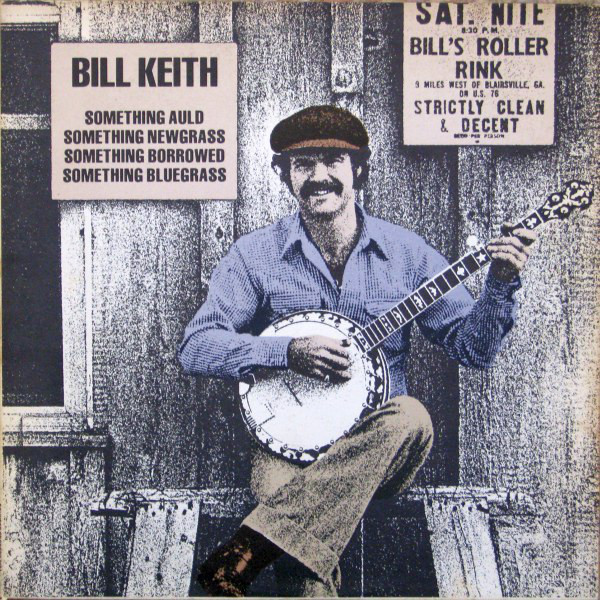
As we look ahead to more tunes, more breakdowns and waltzes and jigs and polkas, in 2020, it’s a fitting time to visit “Auld Lang Syne” as recorded by Bluegrass Hall of Famer and banjoist extraordinaire Bill Keith in 1976 on Something Auld, Something Newgrass, Something Borrowed, Something Bluegrass. (Please, on behalf of the tenor of this column, ignore the sung verse by Jim Rooney — or simply treat it as a once-hollered refrain line in an old-time tune that doesn’t negate the tuney-ness of it all. Everybody good?)

Joined by Tony Rice, David Grisman, Vassar Clements, and Tom Gray, this version of the truly ubiquitous, ingrained melody begins with a jazzy, ragtime flair, circa the late 1800s and banjo’s golden age. Then, as most bluegrass covers of non-bluegrass tunes go, it kicks into time with the chord progression massaged towards diatonic simplicity and the tempo dialed into ideal banjo range. Keith utilizes his namesake tuners and signature melodic style to capture the song in a way that oozes traditional bluegrass, but is still fresh and innovative — even forty plus years on. It’s a perfect banjo-y, bluegrassy way to bring in a new year and say goodbye to the old, too.

Happy 2020!

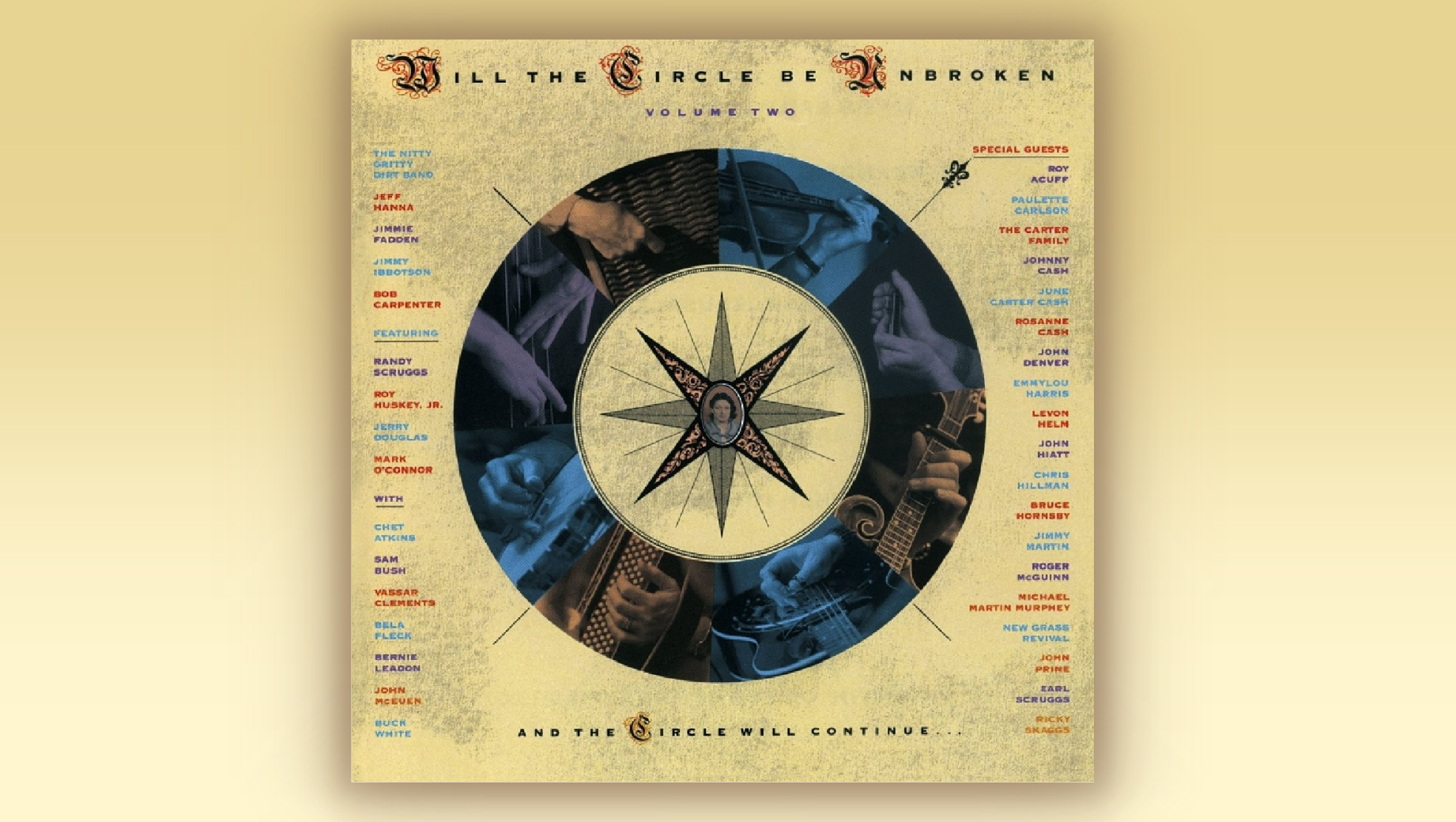
BGS Presents 30 Years of ‘Will the Circle Be Unbroken, Volume Two’ at Americanafest

What started as a music video concept for the Nitty Gritty Dirt Band evolved into a 1989 full-length film documenting the all-star recording sessions for Will the Circle Be Unbroken, Volume Two. Nitty Gritty Dirt Band co-founder Jeff Hanna will present a rare screening of clips from The Making of Will the Circle Be Unbroken, Volume Two at the Country Music Hall of Fame and Museum on September 11 at 11 a.m., during AmericanaFest.

Hanna will be joined by bluegrass virtuoso Sam Bush, who appears in the film and on the album with New Grass Revival. Craig Shelburne, managing editor of the Bluegrass Situation, will moderate.

Produced by Joanne Gardner Lowell and Rosanne Cash, the film captures the band in the studio recording their groundbreaking project. Select clips will show performances by Johnny and June Carter Cash; Jerry Douglas; Emmylou Harris; Bruce Hornsby; Jimmy Martin; New Grass Revival; John Prine; Earl Scruggs; Randy Scruggs; Ricky Skaggs; and others. Will the Circle be Unbroken, Volume Two won three Grammy Awards as well as the 1989 CMA award for the Album of the Year.

Three decades after its release, Joanne Gardner Lowell offered some keen perspective on the film through an email interview with the Bluegrass Situation.

BGS: What was it about the Nitty Gritty Dirt Band and this project that made it a compelling film subject for you?

JGL: ACME Pictures was contracted to make a video for the title track. This is pretty common. We signed the contract and when I asked what day during the multi-week schedule this song would be done, Jeff said, “All of them.” When I realized we would need to go to the studio every day for weeks to get this song, it seemed obvious we should shoot the whole experience — so we did.

How would you describe the mood, or the vibe, in the room during these sessions?

It was joyful in the studio. Each day the musicians came so ready to create and collaborate. We were honored to be in the room with it all. Being live made everyone really stay on top of their game. It felt like a family reunion on many days, and there was always a lot of humor and laughter. Our primary director, Bill Pope, captured so much of the mood with his amazing camera work.

It was also shot during the holiday season, so people were in a happy mood. Emmylou brought a handmade Christmas ornament you can see hanging in some of the shots. And my partner Rosanne Cash came into the studio with her newborn Carrie. I don’t think she was even two weeks old. Rose handed her to me and I held her tight while running sound for the track Rose and John Hiatt did together. Carrie never made a peep!

It was crucial to capture the acoustic nature of these sessions. What was your audio setup like?

I had a simple Nagra tape recorder just to have an edit track to work from and to record interviews. I had a single mic that I would place in the room to catch all the conversation, as some of that was obviously not recorded for the album and we wanted it for the film. Although, during our interview with Emmylou Harris, the band loved what she said so much that those comments ended up on the album.

Do you remember any particularly fun encounters with the legendary musicians in the film?

We caught some great moments and they’re in the film. The ending of a fast-paced “Valley Road” with Bruce Hornsby was a favorite. The band all stops for a second to look at each other — then they realize they got it and they all start shouting and cheering.

After Jimmy Martin’s session one day, he went out for some cocktails and came back into the studio while Ricky Skaggs was working. We captured Jimmy (feeling no pain and wearing a coonskin cap) as he and Ricky ripped into a spontaneous version of “The Old Crossroads.”

This film was Mr. Acuff’s last filmed appearance and that was special. I have to say — each time the song “Will the Circle Be Unbroken” was performed, it was magic. Every single time.

The Dirt Band did a masterful job of keeping things upbeat and fun for everyone. Every one of them was so engaged in each song — and brought individual songs or artists to the project. They were like marathon runners, giving their all each day and then coming back the next day to do it again.

What were some of the hurdles you faced in the film’s creation and release?

The very existence of this film was due to a California record company exec telling me that we would be in breach of contract if we didn’t deliver this video for the agreed-upon budget. When I explained this “song” was going to require us to shoot for several weeks, this delightful woman didn’t seem to care. I think it was meant to be — we HAD to make it work.

Bill couldn’t figure out how to light the dimly lit studio without a pile of light stands in every shot — and in everyone’s way. So, he created a giant light box and hung it from the ceiling. You don’t see a single light stand.

We didn’t have any money to sync up the video with electronic slates or fancy editing gear. I moved a cuts only 3/4″ video editing system into my office and had to sync the shots up by eye more than once… if we didn’t have an audio track running. Watching Mark O’Connor’s fingers or Earl Scruggs’ fingers to make sure you lock each note made for some very long nights. Those fingers were flying!

Rosanne and I sold 50 percent of the film rights to a company who released it on home video. Unbeknownst to us, the entire archive of that company was acquired by another company that isn’t interested in letting us buy the remaining rights, so we remain in limbo.

What do you hope a modern viewer will experience when watching these clips 30 years later?

This is a piece of living history. The first Circle album influenced every single musician I know. Watching the creation of the second — especially thirty years on — reminds you what kind of power music has.

It makes me sad to count off how many artists from this project are gone now: Johnny Cash, all of the Carter Sisters, Earl and Randy Scruggs, Vassar Clements, Chet Atkins, Levon Helm, John Denver, Roy Acuff, and dear Roy Huskey, Jr. In this world of instant technology, I think this 30-year-old film puts the viewer right into the studio for a front row seat at this amazing recording. I’m very proud of it.

MIXTAPE: The Mallett Brothers Band’s Favorite Artists Live

We have just released Live In Portland, Maine and thought it would be fun to put a playlist together of some live recordings of our favorite artists. Live is where it’s at! — Andrew Martelle of The Mallett Brothers Band

JJ Cale – “River Boat Song”

JJ Cale is a favorite late-night cruising soundtrack for TMBB. If we have a late-night drive to the next gig, there’s a fairly good chance JJ Cale’s cool laid back vibe is carrying us down the road.

Jerry Jeff Walker – “Takin’ It As It Comes”

This really should be the anthem of all traveling musicians. On the road whether we’re playing the Continental Club in Austin, Texas, or Brooklyn Bowl in Brooklyn, New York, or Revolution Hall in Troy, New York, we’re all just takin’ it as it comes!

Todd Snider – “Play a Train Song”

Who doesn’t like a good ole train song! Todd Snider is certainly one of the best, his ability to tell a story through his songs is second to none. And, if you haven’t seen him live, you’re really missing out…

Jason Isbell – “Cover Me Up”

Jason Isbell is one of those artists that can cut to your soul. This recording is from the Ryman last year. Whether his time with the Drive-By Truckers or his solo stuff, he can sure write one hell of a song and put on the live show to back it up.

David Mallett – “Hard Light”

Will and Luke’s father David Mallett is one of the greatest songwriters of the last fifty years. This recording is from a live record he did years and years ago. Do yourselves a favor and dig in and see how it’s done!

Bruce Springsteen – “Born in the USA”

This recording is from Springsteen on Broadway. He’s the boss. This rules. There isn’t much more to say.

Dierks Bentley and The Travelin’ McCourys – “From the Bottle to the Bottom”

Dierks and the TMs playing one of Kris Kristofferson’s classic songs. The state of modern country music has been shaped by artists like Dierks Bentley being willing to go back to his roots and put out music that is not only mainstream country but also traditional bluegrass. And the Travelin’ McCourys are just a force, whether it’s playing gigs with their father Del or playing sets of Grateful Dead music.

The War On Drugs – “Holding On”

The War On Drugs gets plenty of airplay in the van and has helped us crisscross the country getting from gig to gig. Their sound is so unique and has a way of drawing you in to that emotional place they so often go.

Waylon Jennings – “I’m a Ramblin’ Man”

Waylon was one of the true original outlaws. He did it his way. He paved the way for so many great artists across the country to break from tradition.

Old & In The Way – “Panama Red”

Our fiddle player wouldn’t be playing fiddle if it wasn’t for this recording. Vassar Clements has a way of bridging traditional and non-traditional fiddling. Mixed with Jerry Garcia’s banjo playing and the powers of David Grisman and Peter Rowan, if this record can’t get you hooked on bluegrass than we’re not sure what can!

Guy Clark – “Stuff That Works”

Guy Clark is on of our favorite songwriting troubadours. He’s another one that gets a lot of airtime in the van. Dig in to his catalog. You’ll be a better person because of it.

Drive-By Truckers – “18 Wheels Of Love”

These guys are a constant point of inspiration for the band. They do it their way, which is usually folk with a healthy dose of rock ‘n’ roll. This is something TMBB certainly prescribes to. DBT doesn’t necessarily fit a mold, but hot damn if it doesn’t grab you by the heart with a shot of whiskey and some loud electric guitars.


Photo credit: Ray Macgregor Photography

Old & In the Way, ‘Old & In the Way Breakdown’

As a genre, bluegrass has always had outward-facing ambassadors — bands and musicians with platforms that enabled them to reach a wider audience than the usually insular ‘grass niche. The Dillards, as “the Darlings,” brought bluegrass to thousands of TV viewers on The Andy Griffith Show; the Nitty Gritty Dirt Band birthed an entire generation of fans with their iconic Will the Circle Be Unbroken album, showcasing the genre’s founders and heroes; Alison Krauss, with her wildly successful crossover-and-back career — she has won more Grammy Awards than any other woman ever — showed the masses that bluegrass can be aesthetic, understated, and artful without sacrificing its raw, rustic energy. It just takes a tiny taste, a glimpse behind the curtain, to hook outside listeners with that high lonesome sound.

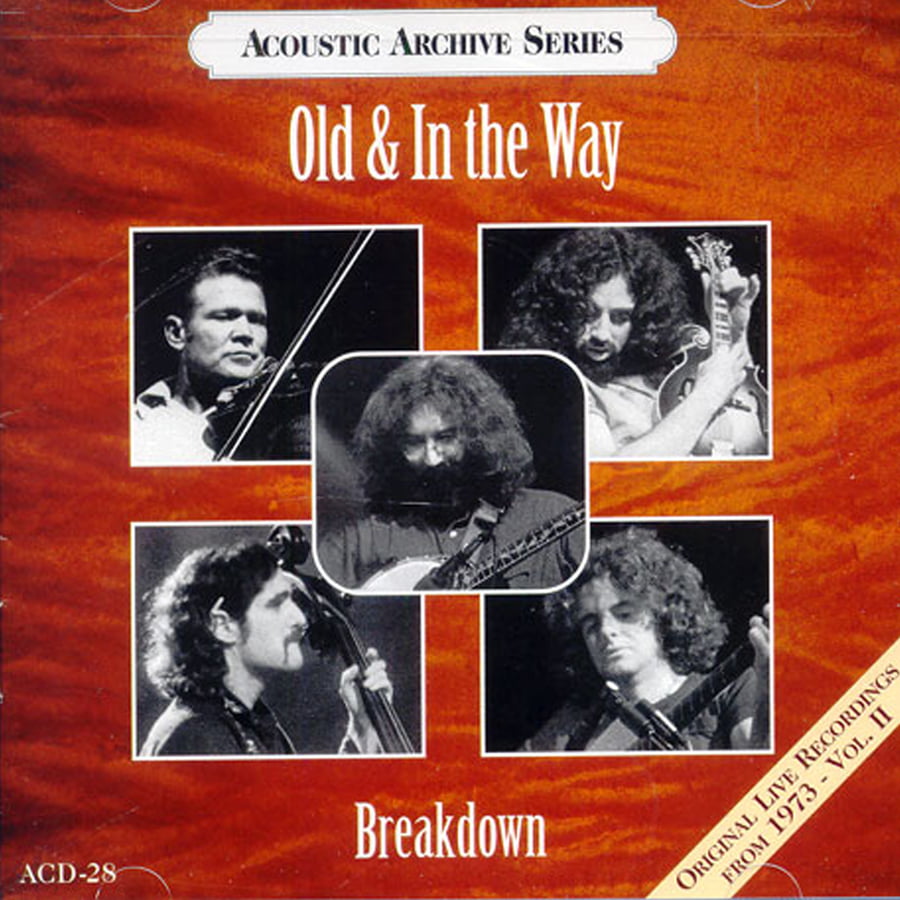
In 1973, Jerry Garcia, David Grisman, Vassar Clements, Peter Rowan, and John Kahn coalesced as Old & In the Way, becoming one of the most influential bluegrass ambassador bands in the history of the music. Their eponymous debut record is widely regarded as the best-selling bluegrass album of all time — before the soundtrack for the infamous O Brother, Where Art Thou? surpassed it. Though Old & In the Way only lasted a year, their legacy lives on, extended and expanded through several live recordings. Released in 1997, Breakdown was recorded live at the Boarding House in San Francisco, California, by Owsley “Bear” Stanley in October 1973. The “Old & In the Way Breakdown” showcases that Garcia was not only a fan of old-time and bluegrass, but he had the chops, too, tearing it up on the five-wire. Budding bluegrass fans take note: We call this tune “Patty on the Turnpike,” too.

Join BGS as we celebrate Jerry Garcia’s songbook, from the Grateful Dead to Old & In the Way and beyond at the Theatre at the Ace Hotel in Los Angeles on March 30. With bluegrassers Sam Bush, Molly Tuttle, Billy Strings, Sean Watkins, and many more. Get your tickets for Jubilee: A Celebration of Jerry Garcia now.

MIXTAPE: Mike Barnett’s Favorite Fiddlers

If you want to know who the best fiddlers in bluegrass and old-time are, ask one of the best fiddlers in bluegrass and old-time … right? Here, Mike Barnett rattles off not just a list of songs by great players, but the reasons they are so great. Enjoy his insider’s view.

“Flannery’s Dream” – John Hartford

Records from John Hartford like Wild Hog in the Red Brush and Speed of the Old Long Bow got me really excited about the energy in old-time music. I never got to meet Hartford, but feel a connection to him through his music. He brings a special vibe that I’ve often tried to channel. I’ve heard stories that he used to have a guideline that nobody in his band could repeat their accompaniment/part for more than one section of a song, everyone had to mix up their playing often, which gives his music a certain drive and breath.

“Black and White Rag” – Johnny Gimble

When I heard Johnny Gimble play at Mark O’Connor’s camp maybe 14 years ago, it was so strikingly Texas, so rooted in that tradition. I particularly remember his feel when playing Texas rags captivating me, like here in the “Black and White Rag.” Johnny helped me understand more deeply the true spirit and community of Texas-style music.

“Bound to Ride” – John Hartford, Tony Rice, and Vassar Clements

Vassar Clements invented his own, incredibly unique style of fiddling. The vibrato, silky tone, double stops and slides … it’s like magic whenever he touches the fiddle, and I can tell within two notes if it’s him. This recording of “Bound to Ride” is a great snapshot into Vassar’s unique way of playing around a melody, backing up the vocal, and lifting the energy of a song.

“Dill Pickle Rag” – Buddy Spicher and Vassar Clements

Buddy Spicher is one of the legends, and one of those fiddlers you’ve probably heard but maybe didn’t know it was him. It was Buddy who got me wanting to play second fiddle — the harmony. This recording of Buddy with Vassar on “Dill Pickle Rag” shows some of Buddy’s genius and virtuosity (and Vassar’s!).

“Lonesome Moonlight Waltz” – Kenny Baker

Hard not to mention Kenny Baker here. I listened to his album Kenny Baker Plays Bill Monroe frequently growing up, and I’m still trying to understand those bowings! His playing is so clean, clear, good tone and time, and great melody player.

“Sally Goodin'” – Paul Warren

“Sally Goodin'” was actually the first COUNTRY hit! #funfact It was Tony Trischka who got me listening to Paul Warren when I was about 17. Another one of the legends in bluegrass fiddle, Paul brings a grit and edge that is often lost in modern bluegrass fiddling.

“Estrellita” – Bobby Hicks

Once Bill Monroe was asked if he had a favorite fiddler of those who’d played in his band. Bill said, “I’ve had a lot of fiddlers come through my band, but I believe Bobby Hicks was the truest fiddler I ever had.” Bobby is the double-stop king, and took a lot from what Tommy Jackson did with his single note playing around a vocal and made it his own.

“Back Up and Push” – “Benny Martin

Benny Martin’s double stops, attack, and full-throttle style really resonate with me. The tone he gets in this version of “Back Up and Push” makes it seem as if he’s got a brick tied to the end of his bow. And when he gets to the shuffle, it’s clear that so many contemporary fiddlers have been heavily influenced by how he did it.

“Raggedy Ann” – Curly Ray Cline

If you’re wondering who ever had the most fun playing the fiddle, all you need to do is search “Curly Ray Cline Orange Blossom Special” on YouTube, and you’ll find that it was in fact Curly Ray Cline! He’s most known for his work with the Lonesome Pine Fiddlers and Ralph Stanley and is as much a treat to watch as to listen to. I love his note choice and where he plays in the beat — what he does with the time.

“Fire in the Mountain” – Scotty Stoneman and Bill Emerson

Scotty Stoneman was a wild man of a fiddler. His double stops and slides, and aggressive approach to the fiddle, are some things I’ve always gone and checked back in with in my listening. You can hear some of what I’m talking about with Scotty’s sound in the recording of him playing “Fire in the Mountain.”

“Learnin’ the Blues” – The Del McCoury Band

The Del McCoury Band is one of the finest — if not THE finest — bluegrass bands still in the business. One G run from Del will set you straight for the whole year. Jason Carter has got the old bluegrass sound, and I love how much he digs in and goes for stuff, and pulls so much sound and soul out of the fiddle.

“Pickin’ the Devil’s Eye” – Bruce Molsky

I’ve always loved this recording Bruce Molsky made with Rushad Eggleston, Darol Anger, and Michael Ducé of “Pickin the Devil’s Eye.” The groove masters! Or maestros! Bruce’s propulsive bowing, groove, and reverence for tradition is really remarkable. He’s basically a one man band, and hearing him here is transcendent.

“Buffalo Nickel” – Béla Fleck and the Flecktones

Stuart Duncan has played on countless recordings so it was hard to choose just one, but Béla Fleck’s Bluegrass Sessions was one of the most influential for me, and a major landmark in acoustic music. “Buffalo Nickel” is gorgeous, and Stuart plays the melody with so much taste, tone, feel, soul, intonation … all the good things. To me, Stuart has always been sort of a perfect combination of all the things I love about fiddling.

“Future Man” – Strength in Numbers

Mark O’Connor is one of the most versatile players on the planet, combining so many styles and influences so flawlessly to create his own incredible voice. Telluride Sessions by Strength in Numbers is another must-have album. The way everyone plays together, and Mark’s precision and virtuosity … amazing. His solo here on “Future Man” is a highlight — a glimpse of what Mark is capable of.

“Ducks in the Millpond” – Aubrey Haynie

Aubrey Haynie is the initial reason why I got into bluegrass. His sound made me want to learn how to do that. One of my favorite fiddle albums out there is Aubrey’s The Bluegrass Fiddle Album. I like this cut of “Ducks on the Millpond” — a really cool instrumental that weaves between three sections. Aubrey mostly plays the melody with so much tone and taste, and varies it slightly toward the end.

“Sweet Georgia Brown” – Billy Contreras

Not everyone is familiar with the fiddle stylings of Billy Contreras, as his genius is less substantially documented. I think he is the greatest improviser on the violin to ever live, and a master when it comes to bluegrass, swing, modern jazz… he can do it all. His brilliant, almost mathematical mind for music, combined with his deep heart for it all, is endlessly inspiring.

“Lee Highway Blues” – Darol Anger and Stuart Duncan

Growing up, I listened to so much music that Darol Anger is responsible for: Republic of Strings, duo with Mike Marshall, his own projects, his work with the David Grisman Quintet, etc. Besides his amazing lead playing, he is known for paving new roads for the violin as a rhythm instrument with his infectious groove and development of the fiddle chop. His album, Diary of a Fiddler, has so many thoughtful duets with great fiddlers of different styles.

“It Don’t Mean a Thing” – Stuff Smith

Matt Glaser, who turned me onto so much priceless music during my time at Berklee College of Music, introduced me to Stuff Smith. I love Stuff’s emphasis on groove and blues, and the grit and directness in his sound.


Photo credit: Justin Canerer