Wanted! The Outlaws
Turns 50

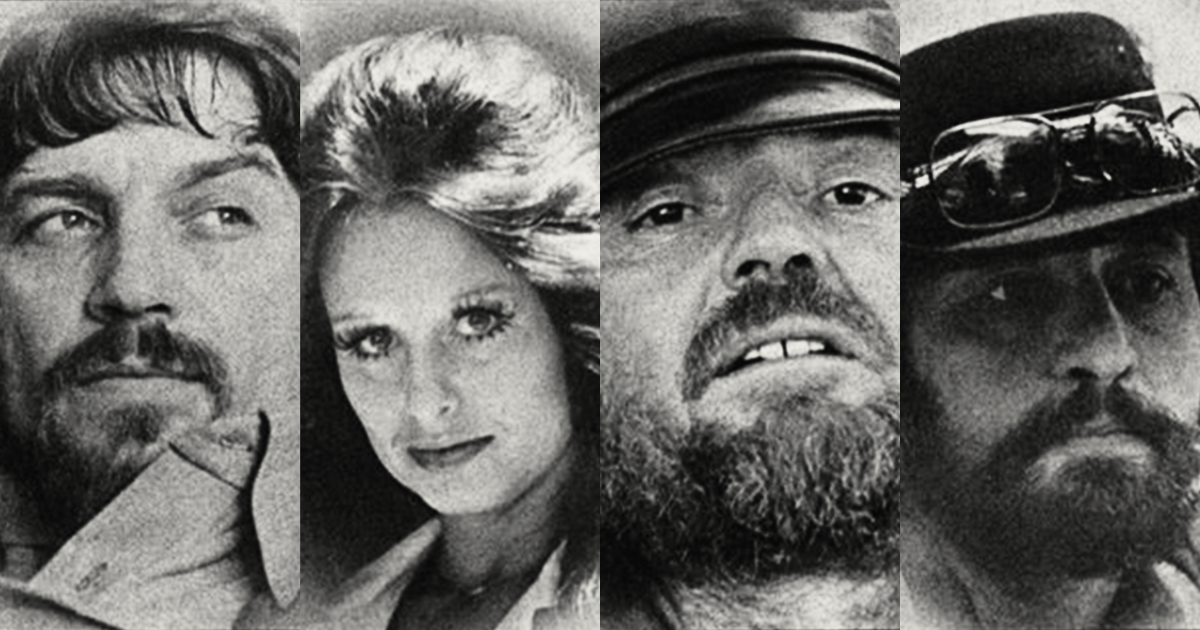
It’s strange to say about an album widely regarded as one of the 20th century’s most iconic, but maybe the most notable element of 1976’s Wanted! The Outlaws was its highly stylized cover. An old “wanted” poster associated with the wild, wild west of the American frontier (or at least movie depictions of the same), it depicted sepia-toned parchment with a trio of bullet holes. And it pictured the album’s four artists in mugshot form with Waylon Jennings as top headliner over Willie Nelson, Jessi Colter, and Tompall Glaser.

That appeared to be an unlikely quartet for a supergroup. But Wanted! The Outlaws turned out to be one for the ages, topping the country album charts and spinning off hit singles the artists performed for the rest of their careers. Wanted! even reached the crossover promised land in reaching No. 10 on the Billboard 200, a pop-chart peak for everyone involved except Nelson. When all the dust settled, it was the first country album to earn the then-newly introduced platinum certification for sales of over 1 million copies.

Despite the album’s thematic packaging, its 11 songs play less like a cohesive, organically conceived new work than the compilation it actually was. Each of the four headliners got a couple of songs, together as well as separately, and whatever unity it had came in the form of a musical vibe much closer to the progressive country coming out of Texas roadhouses than the traditional Nashville sound.

Considered as a collection of songs, Wanted! The Outlaws is a great record. And yet it emerged from a peculiar set of circumstances because it really, truly is a music-industry version of a breakfast sausage – appealing and tasty in spite of rather than because of how it was made. It’s fair to describe the feelings of many observers as mixed.

“More than anything else, it really was a triumph of Nashville marketing,” says Joe Nick Patoski speaking to Good Country. He’s the author of the 2008 biography, Willie Nelson: An Epic Life, and many other key writings about Texas music over the past half-century. “And it kind of crystalized everything Waylon, Willie and others had been doing. It almost seemed like a joke, but it worked and it sold. So who am I to kvetch?”

If Wanted! The Outlaws was a culmination that added up to more than the sum of its parts, it would not be such a key milestone without all the individual breakthroughs of its principals, starting with Waylon Jennings. A longtime journeyman who became a star, native Texan Jennings was only still alive in the 1970s because he’d given up his seat on Buddy Holly’s plane to Jiles Perry “The Big Bopper” Richardson Jr. on that fateful night in Iowa in February 1959. He’d been working the honky-tonks ever since, and by the mid-’70s his brand of too-rock-for-country-but-too-country-for-rock was landing commercially. On the strength of the statement-of-purpose hit “Are You Sure Hank Done It This Way,” Jennings’ 1975 album Dreaming My Dreams was his first to go gold.

And yet Jennings wasn’t even the biggest pop star in his own home. That was his wife, singer Jessi Colter, who had a massive No. 4 pop single in 1975 with “I’m Not Lisa.” That would remain her mainstream peak.

By 1975, however, Willie Nelson was breaking through at an even bigger level than Jennings and Colter put together. Long revered as one of the 20th century’s great songwriters, Nelson penned for-the-ages hits for the likes of Patsy Cline and Faron Young – “Crazy,” “Hello Walls,” “Night Life,” and many more. Yet success under his own name eluded Nelson, though not for lack of trying. He made album after album for RCA Records’ Nashville division, but the city’s prevailing sound just wasn’t a good fit for him. Nelson seemed doomed to be remembered as songwriter first, performer a distant second.

It took parting ways with Nashville and its assembly line – going home to his native Texas and leaving RCA to sign with Atlantic and then Columbia Records – for Nelson to finally establish himself as a viable recording artist. What finally put him over the top was 1975’s Red Headed Stranger, his 18th studio album but first for Columbia, and also the first where Nelson had complete artistic control. Spare, downcast, and terse as a Hemingway short story, the album’s sound and feel was miles removed from the Nashville sound. It was his first to crack the pop charts, selling millions, and “Blue Eyes Crying in the Rain” remains a beloved classic five decades later.

As he watched Nelson’s Red Headed Stranger success, RCA executive Jerry Bradley wanted in on it. Bradley had taken over as head of RCA Nashville from Chet Atkins several years earlier, and chief among his label’s assets was having Jennings under contract. While Nelson was long gone, RCA still had a voluminous catalog of recordings he’d left behind. RCA was already reissuing Nelson’s recordings as best-of compilations and doing some business, but taking them to the next commercial level was going to require an angle. It started with Waylon and Willie’s relationship as kindred-spirit friends and collaborators.

By the mid-1970s, Waylon and Willie had known each other for a decade. Both had artistic identities in contrast to staid Nashville, fitting in alongside other Texas-based acts like Michael Martin Murphey and Jerry Jeff Walker in an upstart wave dubbed “progressive country.” The music came out of that era’s back-to-basics ethos and was scruffier than Nashville’s assembly line. Author Jan Reid captured this particular moment with a landmark book, The Improbable Rise of Redneck Rock, first published in 1974.

Bradley’s idea was to put out an album where Jennings and Nelson joined forces, with songs both solo and in tandem. But if it was really going to take off, it needed fresh branding and a new descriptor beyond progressive country or redneck rock. That’s where old-fashioned marketing necessity entered into the equation.

Nashville writer Hazel Smith, who was working as Jennings’ publicist at that time, is widely credited with coining the phrase “outlaw country.” With that image in mind, Bradley came across a vintage “wanted” outlaw poster in a Time-Life illustrated encyclopedia about America’s 19th century western frontier. He took it to designer Herb Burnette with instructions to model a cover based on that, and then it was time to present the concept to the artists.

“He showed that to Waylon, who told him, ‘This is your idea, do whatever the hell you want,'” Patoski said. “And Jerry said, ‘Thank you’ and walked out the door. That poster on the cover really gave people something to grab onto, and ‘outlaw country’ is easier to say than ‘progressive country’ or ‘alternative country.'”

In Patoski’s telling, Nelson’s manager Neil Reshen was initially less than enthusiastic about the concept. But Bradley made it clear that RCA still had ownership and control of Nelson’s old catalog and an Outlaws album would come out with or without their blessings. It turned out that Nelson was more amenable to the idea, having just bought the Texas Opry House in Austin. He was happy to have an advance payment from his former label to fund its refurbishment.

Jennings regularly produced Colter’s music (including “I’m Not Lisa”), so she was an obvious addition to the lineup. The fourth piece of the puzzle, Tompall Glaser, also came from Jennings’ camp and was added at his insistence. Formerly of the Glaser Brothers, he too was peaking in 1975 with his cover of Shel Silverstein’s “Put Another Log on the Fire (The Male Chauvinist Anthem),” his highest-charting single on the country charts.

And thus The Outlaws were born, with success that was both immediate and long-lasting. The Academy of Country Music Awards named it album of the year for 1976, with “A Good Hearted Woman” winning the Country Music Association’s single of the year, and the album was added to the GRAMMY Hall of Fame in 2007. It also created another niche for country artists.

“My joke when people started telling me we were part of the ‘outlaw movement’ was to say, ‘No, we’re part of the in-law movement,’” said Ray Benson of the long-running Texas swing band Asleep at the Wheel in a conversation with GC. “We all thought it was kind of stupid, because everybody’s music was completely different. It was a style of marketing, not music, but it did create a shorthand to label and sell something. Honestly, the only ‘outlaw’ thing about it was the dope. What did we all have in common? We did drugs. Everybody liked something different, pot or coke or speed. But they were all illegal.”

Released in January 1976, Wanted! The Outlaws was accompanied by all the fanfare and major-label marketing of a new-music release. But the album mostly consisted of previously available material. As selected by RCA’s Bradley, seven of the original album’s 11 songs had been released in different versions as far back as 1970. But it did have a big ace in the hole, the dynamic of the Waylon and Willie show – “a juggernaut that was big and getting bigger,” said Patoski.

The duo’s live version of “A Good Hearted Woman” was one of the album’s four new tracks, and it would be its highest-charting pop single at No. 25 on Billboard’s hot hundred. It also launched Waylon and Willie’s ongoing partnership, which blew up even bigger the following year with “Luckenbach, Texas (Back to the Basics of Love).” They went on to make a series of hugely popular Waylon and Willie albums, plus their Highwayman supergroup with Kris Kristofferson and Johnny Cash.

Jennings opened Wanted! The Outlaws on a somber, solo note with “My Heroes Have Always Been Cowboys.” And yet that song is associated with Nelson, too. Four years later, he’d have a solo hit version of his own in the soundtrack to the 1980 Robert Redford/Jane Fonda movie The Electric Horseman.

Along with serving as foil to Jennings, Nelson’s key contribution to Wanted! was to give the album its main outlaw artifact in “Me and Paul,” a 1971 song chronicling some of his misadventures over the years with his drummer and partner in crime Paul English. That song’s good-natured sense of never-do-well scruff is in the DNA of some of Nelson’s singer-songwriter descendants like Robert Earl Keen and the late Todd Snider.

Colter’s most notable contribution to Wanted! was as Jennings’ duet partner on a cover of the 1969 Elvis Presley hit “Suspicious Minds,” foreshadowing their 1981 duet album Leather and Lace. Glaser’s contributions fall at the very end, with his take on Jimmie Rodgers’ “T For Texas” and “Put Another Log on the Fire” as the final two tracks. They’re classic songs rendered well, but they do feel kind of tacked on.

Wanted! would be enough of a success that the niche it created was soon viewed as problematic. Just two years later, in 1978, Jennings asked in song, “Don’t You Think This Outlaw Bit’s Done Got Out of Hand?” By then, outlaw country was bumping up against disco, and the 1980 movie Urban Cowboy was the result. Mainstream country descended into a not-great state in the early ’80s until the next wave of insurgents came along mid-decade – Steve Earle, Dwight Yoakam, Lyle Lovett, k.d. lang, and other artists who didn’t quite fit in with Nashville’s ways.

Through all of that, Waylon and Willie both kept on keeping on, separately as well as together. Jennings would remain a beloved elder statesman of country music (as well as Colter’s husband) until his 2002 death at age 64. He is still well-remembered. Glaser passed on in 2013 at age 79, but Colter is still around, making music, and released her most recent studio LP in 2023. And Nelson is, at the time of this writing, still kicking at age 92 – The Last Leaf on the Tree, as he put it on the title of his 2024 album.


Although he lives in North Carolina nowadays, San Antonio native David Menconi’s Texas bona fides include co-writing 2011 “Texan of the Year” Ray Benson’s memoir, Comin’ Right At Ya: How a Jewish Yankee Hippie Went Country or, The Often Outrageous History of Asleep at the Wheel (University of Texas Press, 2015); and his University of Texas journalism Master’s thesis, Music, Media and the Metropolis: The Case of Austin’s Armadillo World Headquarters (1985). His most recent book is Oh, Didn’t They Ramble: Rounder Records and the Transformation of American Roots Music (University of North Carolina Press, 2023).

Lead Image: Wanted! The Outlaws via Sony Music Entertainment

Want more Good Country? Sign up to receive our monthly email newsletter – and much more music! – direct to your inbox.
Celebrating Women’s History Month: Emmylou Harris, Mother Maybelle, and More

Our partnership with our friends at Real Roots Radio in Southwestern Ohio continues as we celebrate Women’s History Month. We’re proud to bring you weekly collections of a variety of powerful women in bluegrass, country, Americana, folk, and elsewhere who have been featured on Real Roots Radio’s airwaves each weekday in March, highlighting the outsized impact women have on American roots music. You can listen to Real Roots Radio online 24/7 or via their FREE app for smartphones or tablets. If you’re based in Ohio, tune in via 100.3 (Xenia, Dayton, Springfield), 106.7 (Wilmington), or 105.5 (Eaton).

American roots music, historically and currently, has often been regarded as a male-dominated space. It’s certainly true of the music industry in general and these more down-home musics are no exception. Thankfully, American roots music and its many offshoots, branches, and associated folkways include hundreds and thousands of women who have greatly impacted these art forms, altering the courses of roots music history. Some are relatively unknown – or under-appreciated or undersung – and others are global phenomena or household names.

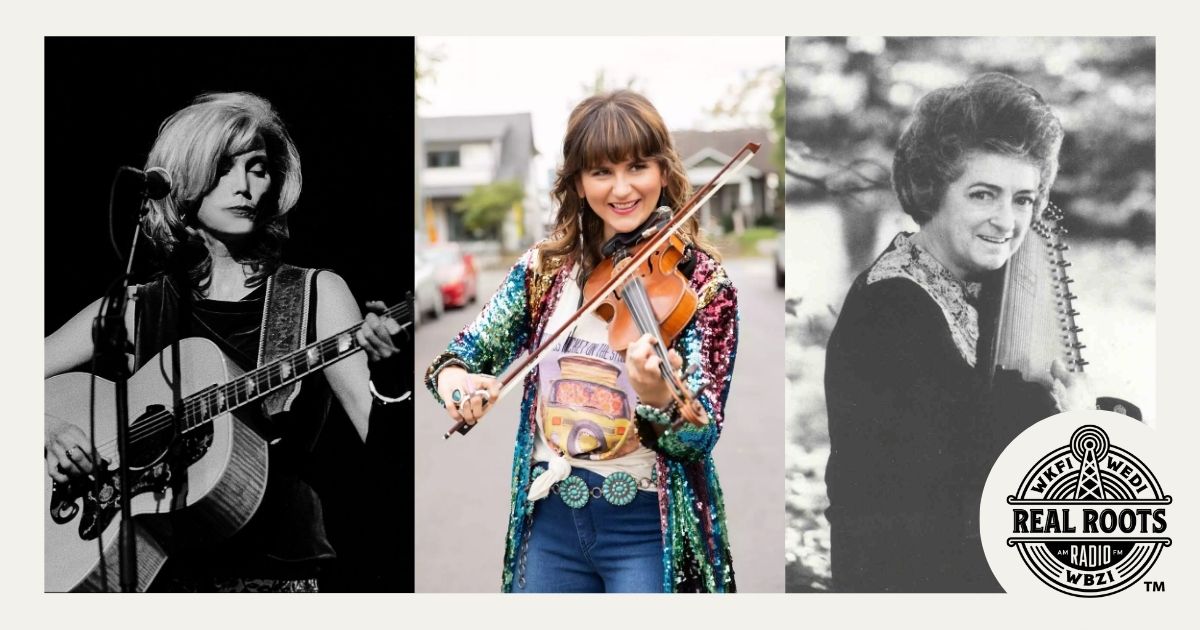
Over the last few weeks, radio host Daniel Mullins, who together with BGS and Good Country staff has curated the series, has brought you just a few examples of women in roots music from all levels of notoriety and stature. Week one featured Dottie West, Gail Davies, and more. Week two shone a spotlight on Big Mama Thornton, Crystal Gayle, Rose Maddox, and more. This week, we’ll pay tribute to Emmylou Harris, Wild Rose, Goldie Hill, Jenee Fleenor, and Mother Maybelle Carter. We’ll return next week for the final installment of the series – with even more examples of women who blazed a trail in roots music.

Plus, you can find two playlists below – one centered on bluegrass, the other on country – with dozens of songs from countless women artists, performers, songwriters, and instrumentalists who effortlessly demonstrate how none of these roots genres would exist without women.

Emmylou Harris (b. 1947)

Let’s spotlight a true legend of American music: Emmylou Harris. Born on April 2, 1947, in Birmingham, Alabama, Emmylou Harris grew up in a military family, moving frequently across the South. A straight-A student and class valedictorian, she initially pursued drama at the University of North Carolina. However, her passion for music led her to the vibrant folk scene of Greenwich Village in the late 1960s.

Her big break came when she collaborated with Gram Parsons, contributing to the birth of country rock as a genre. After Parsons’ untimely death, Harris embarked on a solo career, releasing her acclaimed album Pieces of the Sky in 1975. Over the next four decades, Harris became a musical chameleon, effortlessly blending folk, country, and rock. Her collaborations read like a who’s-who of music legends, including Rodney Crowell, Mark Knopfler, Ricky Skaggs, and as one third of “Trio” alongside Dolly Parton and Linda Ronstadt.

In 1992, Harris recorded an acoustic album at the Mother Church of Country Music. The historic building had been practically abandoned and nearly condemned, but the success of Emmylou’s live project At The Ryman is largely viewed as responsible for saving the historic landmark. Her 1995 album, Wrecking Ball, is also significant for Emmylou, as she leaned into more of an alt-country space, creating a landmark record for what is now referred to as Americana.

With over 25 albums and 14 GRAMMY Awards to her name, Emmylou Harris was inducted into the Country Music Hall of Fame in 2008 and received a GRAMMY Lifetime Achievement Award in 2018, cementing her legacy as one of the most influential artists in contemporary music. ​Her distinctive voice and heartfelt songwriting continue to inspire artists and captivate audiences worldwide. Whether revisiting traditional tunes or exploring new sonic landscapes, Emmylou Harris remains a beacon of authenticity and artistry in the music world.​

Suggested Listening:
Roses In The Snow
Guitar Town” [Live At the Ryman]
All My Tears

Wild Rose (active 1988 – 1991)

A groundbreaking band in country history, do you remember Wild Rose? Founded by several veteran musicians in 1988, Wild Rose proved that a band with girl power can bring some serious fire power, too.

The group featured Pam Gadd (banjo/guitar) and Pam Perry (mandolin), who had cut their teeth in bluegrass as members of the New Coon Creek Girls, plus Wanda Vick (guitar/fiddle) and Nancy Given (drums) who had worked on the road with Porter Wagoner, and Kathy Mac (bass). Originally known as Miss Behavin’, they would change their name to Wild Rose. Combining country-rock, bluegrass, and more, they were full of energy and sass.

The title track of their debut album, Breaking New Ground, was written by Carl Jackson and Jerry Salley and would be a Top 15 Country Hit in 1989 (and a kickin’ music video as well). Their first album would also include the Top 40 Texas-flavored follow-up single “Go Down Swingin’” and the GRAMMY-nominated instrumental track, “Wild Rose.” With their tight harmonies and hot pickin’, Wild Rose was nominated for Top New Vocal Group or Duet at the 1990 ACM Awards. Their lively stage presence would earn them television appearances on Hee Haw, Nashville Now, and more. The band would release two more albums, Straight and Narrow and Listen to Your Heart, before disbanding in 1991. Many of the gals would continue to work in traditional music as session musicians, songwriters, and more. Although their time together was short-lived, their country-grass sound made waves and made history during country’s new traditionalist era.

Suggested Listening:
If Hearts Could Talk
Go Down Swingin’
Wild Rose

Goldie Hill (1933 – 2005)

Goldie Hill is one of country’s unsung legends. Born in 1933, Goldie was a trailblazer and a shining star in the early days of Nashville. She wasn’t just a pretty face–she was a powerhouse vocalist with a heart full of soul.

Goldie’s breakout hit, “I Let the Stars Get in My Eyes,” soared to the top of the charts in 1953. It was an answer song to “Don’t Let the Stars Get in Your Eyes,” so popular in 1952 that Perry Como, Sketch McDonald, and Ray Price all had separate hit renditions. “I Let the Stars Get in My Eyes” made her only the second female country artist to have a Number One hit song.

Goldie Hill would entertain audiences on radio airwaves through the Grand Ole Opry and the Louisiana Hayride and on television screens through the Ozark Jubilee. With a voice that blended sweetness and grit, she became a favorite of fans and fellow musicians alike. She would go on to have several hit duet recordings with Red Sovine and Justin Tubb. She married fellow country star Carl Smith in the late ’50s, releasing some albums under the name Goldie Hill Smith in the ’60s. Goldie largely retired from the music business by the end of that decade. She and Carl Smith were married for 47 years before Goldie’s passing in 2005. Along with her peers such as Kitty Wells and Jean Shepard, Goldie Hill helped open doors for women in country.

Suggested Listening:
Looking Back To See” with Justin Tubb
Blue Lonely Winter

Jenee Fleenor

When you think of today’s great country fiddlers, one name has to be a part of the conversation – Jenee Fleenor! Born and raised in Arkansas, Jenee picked up the fiddle as a kid after she heard Bob Wills’ “Faded Love” and never looked back. She dropped out of college when she landed her first professional gig playing bluegrass music with Larry Cordle & Lonesome Standard Time.

Since then, she has toured with some of the biggest names in country, including Blake Shelton, Terri Clark, Martina McBride, and George Strait, while also doing session work in Nashville, playing fiddle, mandolin, and guitar on all sorts of hit records – such as Jon Pardi’s fiddle-laden “Heartache Medication.” She’s the first-ever female to be named a CMA Musician of the Year – taking home the honors a whopping four years in a row.

Not only is Fleenor a top-tier musician, but she’s also a talented songwriter, penning hits for artists like Miranda Lambert, Blake Shelton, Darin & Brooke Aldridge, Del McCoury, Adam McIntosh, Rebecca Lynn Howard, Kathy Mattea, and more. Recently, she helped form the hit bluegrass and roots band, Wood Box Heroes, where she lends her talents as a picker, songwriter, and vocalist — a true triple threat! Her skills are shaping the sound of modern country and roots music.

Suggested Listening:
This Train” with Wood Box Heroes
Fiddle and Steel

Mother Maybelle Carter (1909 – 1978)

Referred to as the “Mother of Country Music,” there was only one Maybelle Carter. Born in 1909 in the hills of Virginia, Maybelle Carter didn’t just play the guitar – she changed the way it was played. With her signature “Carter Scratch,” she made the guitar a lead instrument, blending melody and rhythm like nobody had before.

Maybelle, Sara, and A.P. Carter formed the original Carter Family. Maybelle was eight months pregnant in August 1927 when the trio made the trek to Bristol, Tennessee/Virginia, to audition for RCA Victor’s Ralph Peer, part of what we now refer to as the “Big Bang of Country Music.” Peer immediately knew the Carter Family were stars.

The Carter Family’s music captured the heart of America – from “Keep on the Sunny Side” to “Wildwood Flower.” Epitomizing the “Sunday morning” aspect of country’s Saturday night/Sunday morning dichotomy, their songs of hearth and home told stories of love, loss, and life in the Appalachian mountains and became part of the bedrock of country, folk, and even rock and roll.

After Maybelle’s cousin Sara Carter divorced A.P. Carter, the original Carter Family went their separate ways by 1944, with Maybelle taking on a matriarchal role – literally! With her daughters Anita, June, and Helen, “The Carter Sisters and Mother Maybelle” began making waves on radio throughout the southeast, even hiring a young guitarist by the name of Chet Atkins as a part of their show in 1949 and bringing him with them to Nashville when they were made members of the Grand Ole Opry in 1950.

By the latter half of the 20th century, Mother Maybelle was a revered figure in American roots music. She would be a special guest of Flatt & Scruggs on their 1961 salute to the Carter Family. Maybelle and her daughters would frequently tour and collaborate with her future son-in-law Johnny Cash, and would find an enthusiastic new generation of fans thanks to the Folk Revival. In 1972, she would appear alongside other musical pioneers as featured guests on the Nitty Gritty Dirt Band’s platinum-selling Will the Circle Be Unbroken, shortly before her passing in 1978. Mother Maybelle’s influence still echoes today in every twang, every strum, and every song that dares to tell a story.

Suggested Listening:
Keep On The Sunny Side” the Carter Family with Johnny Cash
The Storms Are On The Ocean” with Flatt & Scruggs
Will The Circle Be Unbroken” with the Nitty Gritty Dirt Band


Photo Credit: Emmylou Harris by Paul Natkin/Getty Images; Jenee Fleenor by Katie Kauss; Mother Maybelle Carter via the Southern Folklife Collection at UNC.

Bluegrass Memoirs: The Earl Scruggs Revue Beginnings

Nearly 50 years after the Earl Scruggs Revue concert I saw at the University of Maine, an internet search led me to Jaime Michaels of the opening act, Beckett. He still has vivid memories from that night in Orono. I sent him a copy of my report. He wrote back, saying:

I have no idea about the song titles but it was nice that my ’63 Gibson J50 got a mention … I still have it.

He has vivid memories of his time backstage with Scruggs.

… at the very end of Earl’s set as he walked back out for his 3rd or 4th encore he stopped and said to me “If I’d just play the darned thing right, I wouldn’t have to keep going back out …”

A little later as we were all loading out Earl came up to us and said, “Do you guys want to see my new bus?” He took us for the grand tour. I was still pretty young and had never seen a real tour bus before.

He was such a sweet guy with this humble self-effacing humor.

Earl was proud of that bus, I reckon; he’d named an instrumental after it.

When I saw them in 1975, the Earl Scruggs Revue was a polished Nashville rock act that had been together since 1969. Debuting at a folk festival that May, not long after Scruggs split from Lester Flatt, it featured Earl’s sons.

The two oldest, Gary (then 20) and Randy (then 16) were already Nashville recording studio veterans. They’d been in the Columbia studios multiple times (Gary 11 sessions, Randy 15 sessions) since May 1967, helping on the last three albums Lester and Earl made before their split (Changin’ Times, The Story of Bonnie & Clyde, Nashville Airplane).

Also new to Flatt & Scruggs, in the fall of 1967, was Columbia producer Bob Johnston, then 35. Concerned about declining record sales, Columbia had replaced Frank Jones and Don Law, highly regarded Nashville veterans who’d been producing F&S since the fifties, with Johnston, who was producing Bob Dylan.

Dylan had stunned the folk world when he went electric at the Newport Folk Festival in 1965. He first recorded in Nashville in 1966, completing Blonde On Blonde there using mainly Nashville studio musicians. In the next two years he returned, making John Wesley Harding and Nashville Skyline.

Flatt & Scruggs’ final albums reflected their move to Johnston, a leading producer at forefront of Columbia’s move from acoustic folk into electric folk rock.

Later, when asked about what led to the split with Earl, Flatt spoke of his difficulty in singing the band’s new songs. “Johnston,” He said, “…also cut Bob Dylan and we would record what he would come up with, regardless of whether I liked it or not. I can’t sing Bob Dylan stuff. I mean, Columbia has got Bob Dylan, why did they want me?”

Of the final three F&S albums, both Changin’ Times and Nashville Airplane had folk-rock repertoires. At the very first session for Changin’ Times, four folk-rock favorites were cut, three Dylan hits, one by Ian Tyson: “Don’t Think Twice,” “Four Strong Winds,” “Blowin’ In the Wind,” and “It Ain’t Me Babe.” Here, Earl’s boys Gary (singing) and Randy (lead guitar) were together for the first time in the studio with Flatt & Scruggs and Johnston.

Imagine the dismay of Lester (who, soon after splitting with Earl, would record “I Can’t Tell The Boys from the Girls“) at this session! It seemed as if the young longhairs with their strange new music were taking over.

Released in January 1968, the back cover of Changin’ Times was filled with the image of a rock poster. Unsigned notes beside it read:

With their smash appearance at the Avalon Ballroom (a West Coast temple of rock and light-shows) when they turned on the whole of San Francisco, there are no new worlds left for Flatt and Scruggs to conquer. Flatt and Scruggs are for everyone.

One of the album’s 11 tracks was a remake of Earl’s “Foggy Mountain Breakdown,” which had just become a hit through the soundtrack of Bonnie and Clyde. Five tracks were by Dylan; the album closed with Woody Guthrie’s “This Land is Your Land.”

Gary and Randy Scruggs personified the Lovin’ Spoonful’s “Nashville Cats,” but also in the studio for that album were other, older, Nashville cats – Charlie Daniels, Grady Martin, Bob Moore, Charlie McCoy and other A-team studio musicians. Randy and Gary would come to know these men well as they built life-long careers in the Nashville studios. These careers were forged during their years (1969-82) with the Earl Scruggs Revue.

Fortunately, the Revue’s earliest days were chronicled in a television documentary. David Hoffman’s ninety-minute NET TV special, Earl Scruggs: The Bluegrass Legend – Family and Friends, was recorded in 1969-70. It has been issued on DVD several times since then and can be seen on YouTube.

It’s fascinating to watch Hoffman’s documentation of Scruggs as he narrates his past, voices his present, and sets out his future directions. Along the way, Hoffman captures Earl’s music-making with a wide variety of performers and audiences. By the end of those 90 minutes, Scruggs’ cultural and political perspectives are manifest; likewise the breadth of his musical tastes.

Hoffman filmed in New York, North Carolina, Nashville, Washington, D.C., and California. The documentary opens with a five-minute jam session: Earl, Gary, and Randy are in upstate New York visiting Bob Dylan at the home of illustrator and sculptor Tom Allen, who had done many Flatt & Scruggs album covers. After Bob sings “East Virginia Blues,” Earl asks him if he’d like to hear their version of “Nashville Skyline Rag,” the instrumental title track from Dylan’s most recent album. I don’t know when this jam took place, but in mid-August of 1969, when Earl was in the studio with Lester to record Final Fling: One Last Time (Just For Kicks), an album they’d agreed to make after their split, the first track they recorded was “Nashville Skyline Rag.”

The tune became a fixture in the Revue concert repertoire, used, for example, as the show opener at Orono in 1975 and in 1977 when they played PBS’s Austin City Limits. Earl had recorded it again in 1970 for his first solo album, Nashville’s Rock.

After the jam with Dylan, the film’s next twenty minutes take the viewer with Earl and the boys to his North Carolina home with visits to the Morris Brothers (the first group he’d worked with), Doc Watson, and Scruggs family and friends in the Flint Hill community. It closes with a shot in which Earl speaks of how he’d taken the banjo to different types of music: “Now it’s easy to blend with today’s music. It works very well. I’m really happy. I had dreams of this.”

The next five minutes come from a jam session with the Byrds at a ranch outside Nashville. It begins with them doing “Nothing To It” (the title Earl used for “I Don’t Love Nobody,” when he recorded this tune with Doc Watson) followed by “You Ain’t Goin’ Nowhere,” a Dylan tune that was on the Byrds’ Sweetheart of the Rodeo, the 1968 album that is often thought of as a foundational statement of country rock.

It’s followed by four minutes with electronic music pioneer and composer Gil Trythall, who plays along on Moog synthesizer with Earl and Randy doing “Foggy Mountain Breakdown.”

Then comes an interview with Charlie Daniels, at the time an associate of Bob Johnston, soon to become one of country rock’s leading figures. The focus shifts as he, Earl, and the Revue attend the second Moratorium to End the War in Vietnam, held in Washington, D.C. on November 15, 1969 – generally considered to be the largest demonstration ever in Washington. After performing “Foggy Mountain Breakdown” there, Earl speaks of his opposition to the war.

Back in Nashville, Daniels is co-producing (with Neil Wilburn) All The Way Home, the first Scruggs Brothers album, for the New England folk and classical label Vanguard. The film follows them into a Nashville studio.

Earl is also working on an album, his first post F&S solo project, Nashville’s Rock. After listening to a demo of one track at the Scruggs home, we see an old friend of Earl’s, Dr. Nat Winston, give testimony to his character, and then Earl demonstrates how he creates his music, explaining that he’s self-taught. Next, we meet Earl’s wife Louise, who’s worked as his manager for fifteen years. She points out that Earl was immersed in the music from age five and that their son Randy has had the same experience.

A shift of focus to Randy follows, as we see him picking “Black Mountain Rag” (a guitar performance reflecting the Scruggs affinity for Doc Watson), and then go with him to class at Madison High and have a chat with his principal, who talks about Randy’s “skipping school.”

After hearing from Louise about how she met Earl at the Grand Ole Opry, we drive on a spring afternoon (in 1970) with the Scruggs family from home to the Ryman Auditorium in downtown Nashville. Inside, Earl, with Randy, joins Bill Monroe and the Blue Grass Boys in a backstage dressing room for a jam and then we witness the Revue’s debut on the Opry stage.

In the center is Earl on banjo, flanked by Randy on guitar and Gary on bass and vocals. Also in the band is Jody Maphis, a contemporary of the Scruggs brothers and son of country stars Joe and Rose Maphis, on guitar. He would subsequently move to drums and remain in the Revue for about a decade. On piano and tambourine is Leah Jane Berinati. Except for Earl, this was a group of kids, dressed like young flower power types. They perform two very conservative old traditional songs, “Nine Pound Hammer” and “Reuben,” to an enthusiastically appreciative audience.

The last twenty-five minutes of the documentary follow the Scruggs family as they travel, early in 1970, to California’s Bay Area for a visit and a jam in Joan Baez’s home. Joan, with her young newborn son Gabriel nearby, chats with Earl about their 1959 meeting at the first Newport Folk Festival. She sings two songs (both are Dylan compositions) and then, while photos are shown of her husband – Gabriel’s father David Harris, whose Vietnam protests had led to federal imprisonment for draft refusal – she sings “If I Was A Carpenter” with Gary. A heady mix of politics and music.

The film closes with Earl back in North Carolina talking again about his musical aspirations:

Keep up with the times and make as much progress with the banjo along with other instruments as long as it blends in as possible.

As the credits roll, we hear Earl playing “Folsom Prison Blues” using his tuners.

This documentary, aired at the height of the Vietnam war, included a forthright statement of opposition from a leading figure in Nashville, where there was considerable support for the war. The documentary was also a carefully crafted showcase of the Revue’s folk/country rock repertoire, musical style, and cultural connections.

The albums that Earl and his two oldest sons were working on while Hoffman was making the documentary released before its broadcast and both contain songs and tunes that appear in the film. A couple of examples: “Train Number Forty-Five” (F&S’s radio theme in the early days), which is heard in Earl and Randy’s backstage jam with Bill Monroe, is also heard on Earl’s album Nashville’s Rock. Similarly, Randy’s version of “Black Mountain Rag,” an acoustic guitar solo in the documentary, is heard on the Scruggs Brothers’ album, All The Way Home, in an extended version with not only acoustic and electric guitar breaks but also a banjo break in his father’s style.

In the next Bluegrass Memoir we’ll see how, by 1971 and 1972 when this documentary was broadcast, the Earl Scruggs Revue was appearing on a series of albums that realized Earl’s aspirations and helped launch his touring.

(Editor’s Note: Read our prior Bluegrass Memoir on the Earl Scruggs Revue here.)


Neil V. Rosenberg is an author, scholar, historian, banjo player, Bluegrass Music Hall of Fame inductee, and co-chair of the IBMA Foundation’s Arnold Shultz Fund.

Photo of Rosenberg by Terri Thomson Rosenberg. 

Edited by Justin Hiltner.

The Cactus Blossoms’ Modern-Classic Sound Blooms on New Album

With a sound that’s like rain in the desert for fans of early rock and country, the Cactus Blossoms let their modern-classic vibe bloom on their latest album, Every Time I Think About You. But with pair of big shows to help celebrate the launch, this band is living very much in the present tense.

Made up of Minneapolis-based brothers Jack Torrey and Page Burkum, the duo’s new project arrives August 30 and once again captures the full, timeless magic of spacious melodies, tasteful twang, and tightly-wound harmony. That night, they’ll mark the release with a long-overdue debut at the Grand Ole Opry – where they ought to find a few like-minded fans of keeping music’s traditional cool factors alive – and then head home for a milestone gig in St. Paul.

After a trio of well-received albums and more than 10 years of riveting shows, it’s the perfect setup for a duo who seem totally at ease blurring the American roots timeline – and who promise they couldn’t fake it if they weren’t.

“I don’t think we’re very good at striving,” Torrey says, speaking from the verdant midsummer shores of Lake Superior on a much-needed break from the road. “I do think [this record] has a comfort level, especially since we’ve been able to start touring again, and really hit it. It’s been feeling like we’re a unit and we can kind of read each other’s minds a little bit.”

Speaking with BGS ahead of the release of Every Time I Think About You, Torrey and Burkum filled us in on what that telepathic bond helped create, and where it’s coming from.

A lot of Every Time I Think About You features the “modern-classic” sound you have both made a calling card – like it would sound fresh a few decades ago and today as well. But is that dangerous territory for a band? You don’t want to be pigeonholed as a throwback, right? So how do you walk the tightrope?

Jack Torrey: I think there’s an interesting aspect of that from our perspective. I got super into Bob Dylan and Hank Williams and I was singing songs by both of those guys way back, 18 years ago or whatever. Page was into Jimmie Rodgers and those other super old country things. We start singing together and it’s like if you harmonize on a Hank Williams song, it kind of starts to sound like an Everly Brothers song. You’re kind of accidentally falling into that and getting into territory that people went into 60 years ago – but it’s new for us and I think that has kind of kept happening. We’re not recreating or trying to do anything like listening to records and imitating it. It’s almost like we’re carving our own mini canyon, that resembles some of the other ones from the past.

Page Burkum: I was kind of thinking about this as a way of summing up our style and influences: The Band, The Traveling Wilburys. Those are like my four main food groups or something. I love where all those guys are coming from – a little Roy Orbison, a little Bob Dylan. They balance each other nicely. And I was thinking, when that’s your diet, you’re going to make something that comes out [like Every Time I Think About You]. … But we love other totally different kinds of music outside of that realm too, and I hope a little bit of that gets in there, too.

Where is the title track, “Every Time I Think About You,” coming from? It’s got that lovely, warm-and-fuzzy feel of a mid-century romance ballad to it, but maybe something more, too …

JT: That one is kind of a love song to losing a friend – it’s kind of a heartwarming grief, where you’re almost being consoled by the memory of someone. And that’s where that song came from. The way we wrote it, I just had a couple lines, and then Page jumped in and started singing the beginning of the chorus, and then I sang back the next line, “Every time I think about you …”

PB: Sometimes Jack and I have made fun of biopic movie scenes like in Walk the Line, where it’s like Johnny and June or whoever sit down with a guitar and they’re just writing a song in real time. Like, they sing one line and then pause dramatically, and then sing another line and then it cuts to them playing it for a thousand people or something. But in a funny way, that was kind of the closest to that. [Laughs]

JT: I was like, “I didn’t ask you to jump in and work on my song … but that’s pretty good idea. Let’s do it.”

The album kicks off with “Something’s Got a Hold On Me” – which almost has a Southern rock swagger to it. Where does that come from? Is that your Tom Petty influence showing?

PB: When I first had the idea for that one, the very original idea that set it off was actually a weird little piece of a Jimmie Rodgers song. So, I stole that line and that melody, which is about two notes or something, but it kind of inspired the whole song in a weird way. To me there’s some blend of Lead Belly and The Beatles or something in my mind, but then it ends up just sounding like a country-rock two step. That’s just what happens. It’s fun to roll with stuff. … I threw in another Jimmie Rodgers line, that “T for Texas, T for Tennessee,” to kind of keep that tribute going.

Oh that’s right, I should have known. Why did you end up finishing on “Out of My Mind (On Sunday)”? Is there a reason that seemed to wrap things up?

JT: It wasn’t a big dramatic decision, but it seemed like a nice bookend from “Something’s Got a Hold on Me” to end with being a bit of a crazy person. [Laughs]

PB: To me it actually kind of leaves the door wide open. I don’t know if you want to cap things off with the sweetest, most-concise thing you have, you know? There’s something about it that’s a little bit out there to me.

You’ll make your Grand Ole Opry debut the night this album drops. Then you’re having a big hometown party with show at Fitzgerald Theater in St. Paul [on September 13]. What does that mean to you?

PB: We’ve got one of our favorite local bands, Humbird, joining us for that [St. Paul] show, so that’ll be really cool. We’re trying to get some of our collaborators to be involved too, if we can spice it up with an extra ensemble beyond our regular band. So we’re trying to get a piano on stage or something. I mean, it’s a theater show, so it’s a little different. And it’s our first time playing our own show at this theater. It’s a really beautiful building and I never thought I’d play there when I was a kid.

JT: It’s where [A] Prairie Home Companion used to be back in the day. Page and I actually played there when we were first getting started, which was a special time. So it’s cool, and should be fun. Some people can come that don’t like to stand, since we play a lot of clubs. [Laughs]


Photo Credit: Aaron Rice

Bluegrass Memoirs: The Earl Scruggs Celebration (Part 3)

(Editor’s note: Read part one of Neil V. Rosenberg’s Bluegrass Memoir on the Earl Scruggs Celebration of 1987 here. Read part two here.)

Boiling Springs, NC on Saturday, September 26, 1987: My workshop in the Gardner-Webb College Library with Snuffy Jenkins, Pappy Sherrill and the Hired Hands ended at 4:30 that afternoon when Dan X. Padgett presented Snuffy with a hat. From my diary:

Afterward I hung around and listened for a while to the Hired Hands’ young banjo picker Randy Lucas play the Bach “Bourrée,” “The Stars and Stripes Forever,” and another classical piece expertly on the banjo.

Here’s a nice example, from Bill’s Pickin’ Parlor, of Randy’s recent work in this milieu:

Then, supper time came.

I went for some barbecue (big regional difference thing — this barbecue was red, vinegary; with shredded pork) with Tom [Hanchett] and Carol [Sawyer] and then was kind of enticed away by Dan X Padgett…

I’d met Padgett the afternoon prior, when I first arrived in Boiling Springs; a respected local banjo elder, he was the teacher of the young banjo player in Horace Scruggs’ band whom I’d met earlier today. Padgett had a long and interesting career, with deep connections to Earl Scruggs and Snuffy Jenkins, as well as memories of an earlier generation of banjo greats. He was interviewed for the Earl Scruggs Center by Craig Havighurst in 2010. 

I went with him…

…to his car (an old Cadillac) to look at various memorabilia like photos of him with various important country and bluegrass people. He also showed me a very worn copy of the very first F&S songbook and when I expressed a strong interest in copying it he loaned it to me. I also talked with him about the possibility of obtaining a banjo like one he played during the afternoon, a miniature Mastertone about the size of a mandolin with an actual tone ring, flange, and resonator. He said he’d see about it and we ended up standing at his trunk trying out various instruments. 

I was picking away on “St. Anne’s Reel” when I noticed there were some people standing around me, and when I finished and looked around there was Doug Dillard looking at me with that big smile. Quite an introduction!

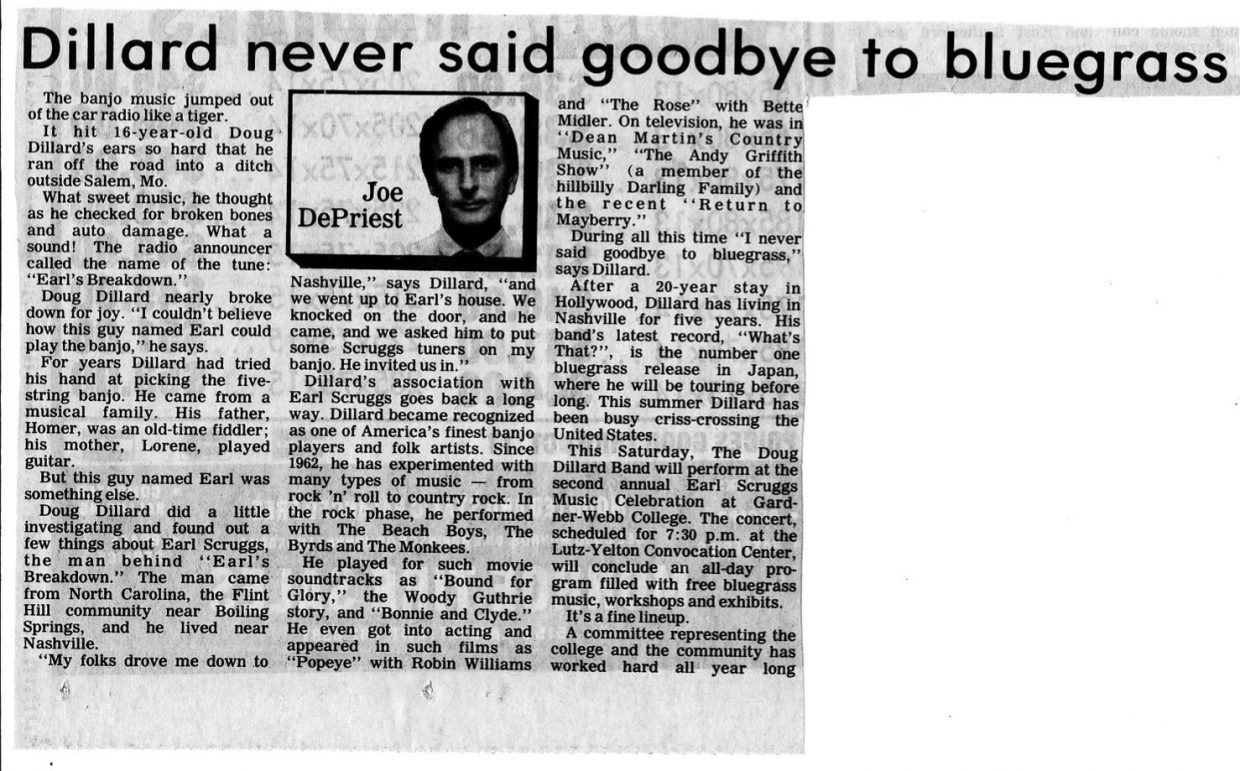
In an edition of the Shelby Star a week or so earlier, Joe DePriest wrote of Dillard’s association with Earl Scruggs, telling how in 1953 the Salem, Missouri teen first heard “Earl’s Breakdown” on the car radio. It hit him so hard “he ran off the road into a ditch.” Dillard got his folks to take him to Scruggs’s Nashville home. “We knocked on the door, and he came, and we asked him to put some Scruggs tuners on my banjo. He invited us in.”

A newspaper clipping from a 1987 edition of the ‘Shelby Star’ of an article by Joe DePriest on Doug Dillard

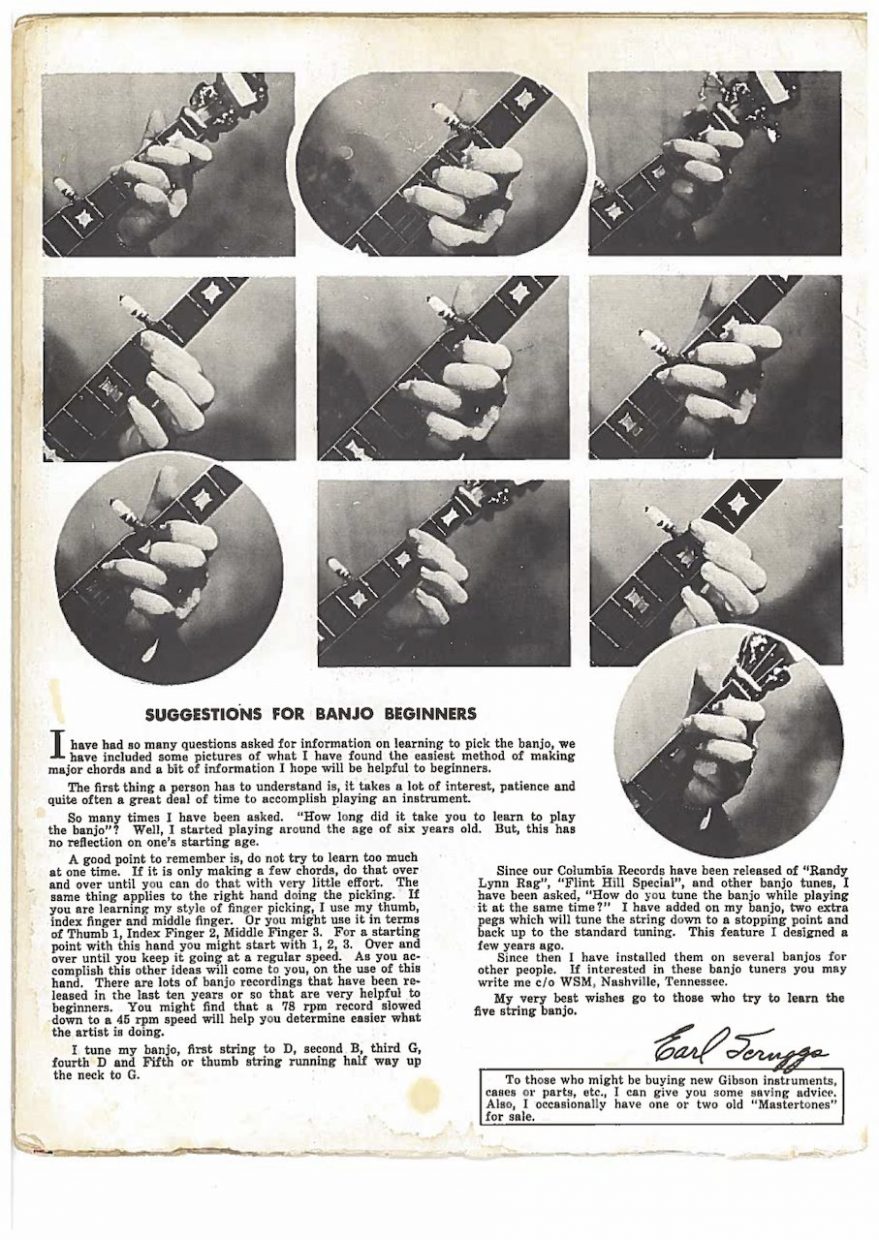
Earl welcomed banjo pickers to his home, especially if they wanted Scruggs Pegs. In the “Suggestions for Banjo Beginners” on the first page of Flatt & Scruggs Picture Album — Hymn and Songbook from 1958, Earl invited those interested to contact him in Nashville, and many did:

The first page of the 1958 ‘Flatt & Scruggs Picture Album — Hymn and Songbook’

In 1962 Doug and his brother Rodney went with their band The Dillards to LA, where they were “discovered” at the Hollywood folk club The Ash Grove. With best-selling Elektra LPs, they toured extensively in the West and appeared on CBS’s The Andy Griffith Show as “the Darling Family.” 

In 1966 Doug left The Dillards and ventured into what would soon be called “country-rock,” touring with the Byrds and forming a band with former Byrd, Gene Clark. Dillard’s banjo playing had been strongly shaped by his close listening to Scruggs. In the ’60s when players like Bill Keith and Eric Weissberg were pushing banjo boundaries in bluegrass, Doug was pushing boundaries in a different way by finding a place for Scruggs-style banjo in rock. He fitted solid, straight-ahead rolls into pieces like Gene Clark’s “The Radio Song”: 

Dillard was heard often on popular Hollywood studio recordings and movie soundtracks during the ’70s. He even had on-screen roles in Robin Williams’ Popeye and Bette Midler’s The Rose.

DePriest’s article quoted Dillard: “During all this time, ‘I never said goodbye to bluegrass.'” He moved to Nashville in 1983 and started a band. 

The bluegrass music business was booming in Nashville. A bunch of young pickers were there, touring in bands and doing studio sessions. New Grass Revival featured newcomers Bela Fleck and Pat Flynn; John Hartford, Mark O’Connor, Jerry Douglas — all were in town. The Nashville Bluegrass Band started in 1984; that year Ricky Skaggs won a Grammy for his version of Monroe’s “Wheel Hoss.” Up in the Gulch district, between the Opry and Vanderbilt, the Station Inn was serving bluegrass seven nights a week.

I was introduced to the Doug Dillard Band this afternoon right there where Dan X Padgett and I had been jamming. His four-piece outfit drew from a pool of talented bluegrass musicians. 

Rhythm guitarist, vocalist and emcee Ginger Boatwright was a seasoned veteran. During the ’70s she’d toured and recorded with Red White and Blue(grass), and later formed The Bushwackers, an all-female group that began as the house band at Nashville’s Old Time Picking Parlor. Her story is told well in Murphy Hicks Henry’s book Pretty Good for a Girl: Women in Bluegrass. Henry calls her “The first ‘modern’ woman in bluegrass” alluding to her folk revival roots, her styles of humor and dress, and, most importantly, “a softer, smoother, more lyrical quality” of singing.

Having a second guitar as a regular lead instrument in a four-piece band was uncommon at this time. When I met Doug’s young lead guitarist I was surprised to discover he was the son of Lamar Grier, whom I’d hung out with twenty years earlier when he was a Blue Grass Boy. David Grier was 26. He’d studied the lead guitar work of Clarence White (there’s a photo of him with White in Bluegrass Odyssey), Tony Rice, and Doc Watson. He was already an experienced pro.

Playing the electric bass, which was unusual for the time, was Roger Rasnake, a singer-songwriter from Bristol on the Tennessee-Virginia border.

In 1986 Flying Fish released this band’s first album, What’s That? (FF 377). Here’s the title cut. The band is augmented to six pieces by Vassar Clements on violin and Bobby Clark on mandolin; both played on the album. What we see and hear first is Ginger’s dynamic emcee work. Doug’s composition shows a banjo picker who knew fiddle music — a melodic “A” section followed by a punching Scruggs-style “B” part. 

Rasnake made a point of telling me Roland White had sent his regards. 

Roland was an old California friend, whom I’d met in 1964 and gotten to know when he was playing with Monroe. He’d just joined the Nashville Bluegrass Band. It was a pleasant surprise to hear from him.

Roger wanted to buy a copy of my book, so I took him up to the library and he bought one which I autographed. I signed several others during the day, including several that people brought with them.

I rested a bit before heading over to Gardner-Webb’s Lutz-Yelton Convocation Center. 

That evening was the Doug Dillard concert in the gym. It was good, with Ginger Boatwright doing the MC work, Lamar Grier’s son David picking some nice lead guitar, and good singing by Roger, Doug, and Ginger. 

Rasnake did one of his own songs from their album, “Endless Highway.” 

It’s familiar today because Alison Krauss covered it in her 1990 album, I’ve Got That Old Feeling.

There was a grand finale at the end with picking by Horace and the boys, and also fiddler Pee Wee Davis, whom I heard briefly in the back room for a while. I bought a souvenir photo of the Dillards with Andy Griffith. Home and in bed by 11.

On Sunday morning:

Up and away by 7:30, carried my bags to Tom and Carol’s dorm. We hit the road and drove to Shelby where we went, on Joe’s advice, to the Pancake House, a local place on the strip which was sure to have livermush. We went in and sat at a table and when the menu came I eagerly perused it. Sure enough, at the top of the list on the right-hand side was “Livermush and Eggs.” And, in case I’d missed it, about halfway down the same list was “Eggs and Livermush.” So I ordered that and actually ate some. Very peppery, other than that not much taste and what there was didn’t really excite me. I mixed it with eggs, like one does with grits. Maybe it’ll help my banjo-picking, who knows.

In Chapel Hill I stayed the night with Tom and Carol and had a bit of time to visit friends and relations and buy a box of instant grits at a supermarket. Next day I was back home in Newfoundland, writing up my diary.

The weekend at the Earl Scruggs Celebration brought me face to face with a music culture in which bluegrass nestled. Seeing, hearing and talking with Snuffy, Pappy, Horace, and Dan put me in touch with generations older than mine, what Bartenstein has called “The Pioneers” and “The Builders” of this music. I feel fortunate to have seen, met and heard them all. Just as important for me was hearing new younger performers like Ginger Boatwright, David Grier, and Randy Lucas.

This was my first opportunity see my folk guitar hero, Etta Baker. It came near the start of her late-in-life performance career. In 1989 the North Carolina Arts Council gave her the North Carolina Folk Heritage Award; in 1991 she won an NEA National Heritage Fellowship. Wayne Martin produced her first CD, for Rounder, in 1991. Later she collaborated with Taj Mahal. Meanwhile Music Maker Relief Foundation, an organization “fighting to preserve American musical traditions,” gave her the support she needed to pursue her career as a musician up to her passing at the age of 93.

It was also my first time to see Doug Dillard. If Snuffy and Pappy personified the era when bluegrass emerged from old-time, Dillard’s new band blended the contemporary sounds of an era when classic, progressive, and newgrass elements were shaping and blending the sounds heard as bluegrass thrived in a festival-dominated scene. 

Instead of an alpha male lead singer/emcee/rhythm guitarist, he had an alpha female. Replacing the mandolin or fiddle one expected in a band with a banjo was an acoustic lead guitar. Instead of an old “doghouse” upright the bass player had an electric. The lead vocals were shared between male and female. Repertoire ranged from bluegrass classics through old pop and rock favorites to band member compositions. The group was touring widely. State of the art bluegrass, 1987.

So how did all this fit together for me? I recalled the start of my visit when Joe DePriest took Tom, Carol, and me to visit the Shelby graveyard. 

He showed us three graves: first that of Thomas Dixon, the local writer whose The Clansmen was turned by D.W. Griffith into The Birth of a Nation. Not far away was the grave of W.J. Cash, author of the immensely influential The Mind of the South. Joe and Tom pondered how the two men would have felt about being buried so close to each other; the image that sticks with me is one of Cash glaring at Dixon.

Joe gave us copies of the Greater Shelby Chamber of Commerce’s glossy full-color brochure, Shelby…it’s home. In it Thomas Dixon is identified as the author “whose novel Birth of a Nation became the first million-dollar movie” thus avoiding the fact that book and movie inspired the racist revival of the KKK. It describes Pulitzer Prize-winning journalist W.J. Cash simply as “author,” not mentioning his progressive stances in print against the Klan and Nazism.

Tom wondered, what if the paths of Cash (who lived in Boiling Springs) and the young Scruggs had crossed at the time? He told us:

Cash … thought that the South had no “Culture” to speak of — what would he have had to say about Scruggs’s contribution?

Joe took us to a third gravesite, that of a local Confederate colonel killed in a Civil War battle; after detailing that part of his life its headstone:

… describes him as a lover of the arts who twice rode by horseback all the way to a far-off northern city (Baltimore? New York?) in order to hear Jenny Lind sing. This tells you where Cash’s mind was when he spoke of Culture.

The Shelby brochure ended its historical section saying “Cleveland County has also produced two North Carolina governors and an ambassador, but our most famous son is country singer Earl Scruggs.”

So much for official culture in 1987! 

Gardner-Webb’s decision to honor Earl Scruggs reflected a shifting intellectual landscape. A local musician of humble origins — a mill worker — had taken on new meaning and significance because of his national and international recognition and popular culture success. He deserved honor and celebration in his home. I was glad to help.

I don’t know if there were any further Earl Scruggs Celebrations at Gardner-Webb, but today there’s an Earl Scruggs Center in Shelby, which is planning to hold its inaugural Earl Scruggs Music Festival in September 2022. 

(Editor’s note: Read part one of Neil V. Rosenberg’s Bluegrass Memoir on the Earl Scruggs Celebration of 1987 here. Read part two here.)


Neil V. Rosenberg is an author, scholar, historian, banjo player, Bluegrass Music Hall of Fame inductee, and co-chair of the IBMA Foundation’s Arnold Shultz Fund.

Photo of Neil V. Rosenberg: Terri Thomson Rosenberg

LISTEN: Saints Eleven, “My Home Is”

Artist: Saints Eleven
Hometown: Denton, Texas
Song: “My Home Is”
Album: This Town EP
Release Date: March 27, 2020

In Their Words: “‘My Home Is’ is basically an apology to my son. I’m not even sure that he was aware of what was going on or why. He’s been around my ‘music career’ all of his life. It was just something Dad did. Maybe I just felt guilty the night I wrote it, in a hotel room, on the road. I’m so passionate about what I do, I sometimes forget what’s really important. This song was more for me I think. I wanted to let him know that even though music has consumed most of my life, he’s still the most important thing to me…. With that being said though, I wouldn’t change a thing. I think you have to stay focused on the goal in order achieve success…. I’m probably wrong, but it’s how I feel.” — Jeff Grossman, Saints Eleven


Photo credit: Texas Red Photography/Melissa Arnold

Canon Fodder: The Beau Brummels, ‘Bradley’s Barn’

Who invented rock ‘n’ roll?

Don’t answer that: It’s a trick question. Rock ‘n’ roll, like most complex sounds and genres and world-conquering forces, wasn’t actually invented. Instead, it germinated and mutated and mushroomed and erupted. It’s not the product of Elvis Presley or Sam Phillips, nor of Jackie Brenston or Louis Jordan. Rather, it is the product of all those people and more — all conduits for larger cultural ideas and desires. Rock wasn’t an invention, not like television or the telephone or the automobile or the atomic bomb. Similarly, its sub-genres and sub-sub-genres in the late 1960s weren’t inventions, more like waves swelling and cresting through pop culture.

The Beau Brummels didn’t invent country-rock in the 1960s, although they did help bring it into being. Long before the San Francisco rock explosion in the late ’60s shot the Grateful Dead and Jefferson Airplane to national prominence, they were gigging around the Bay Area as one of the first American bands to respond to the British Invasion. In 1965, they recorded their breakout hit, “Laugh Laugh,” with a kid named Sly Stewart, later known as Sly Stone. They held their own against Southern California groups like the Byrds, the Standells, and the Electric Prunes (who were marrying their garage rock to liturgical music in one of the most esoteric experiments of the era). While tiny Autumn Records could never fully capitalize on their success, the Beau Brummels did achieve enough notoriety to appear in films and television shows. (The quality of those outlets, however, remains questionable: Village of the Giants, a kiddie flick starring Beau Bridges and Ron Howard, was skewered on Mystery Science Theater 3000.)

They have a full slate of excellent hits, each marked by songwriter/guitarist Ron Elliott’s melancholic lyrics and Sal Valentino’s unusual vibrato, which had a way of turning consonants into vowels and vice versa. The line-up shrunk from a sextet to a trio, which meant fewer harmonies, but a more streamlined sound. Released in 1967, Triangle strips away the electric guitars and, in their place, inserts folky acoustics and chamber-pop flourishes. It’s a song cycle about dreams, simultaneously baroque and austere, and it finds the band stretching in weird directions. For example, they cover “Nine Pound Hammer,” which had been a hit for country singer Merle Travis in 1951. Perhaps more surprising is how well they make it fit into the album’s theme.

In fact, the Beau Brummels had been peppering their sets with country covers since their first shows in San Francisco, and their 1965 debut, Introducing the Beau Brummels, included a cover of Don Gibson’s 1957 hit “Oh Lonesome Me.” They weren’t alone, either. As the “Bakersfield Sound” became more prominent on the West Coast for mixing country music with rock guitars, rock musicians were completing the circle and borrowing from country music. In 1967, Bob Dylan traveled to Nashville to make John Wesley Harding, his own stab at a kind of country-rock.

The trend culminated in 1968, when the Beatles covered Buck Owens on The White Album and the Everly Brothers released Roots. In March, the International Submarine Band released their sole studio album, Safe at Home, and five months later, the Byrds released Sweetheart of the Rodeo. Both were spearheaded by Gram Parsons, a kid out of Florida who was in love with the kind of mainstream country music that most West Coast hipsters had long written off. He is still identified with the country-rock movement, often declared its architect or instigator — and with good cause.

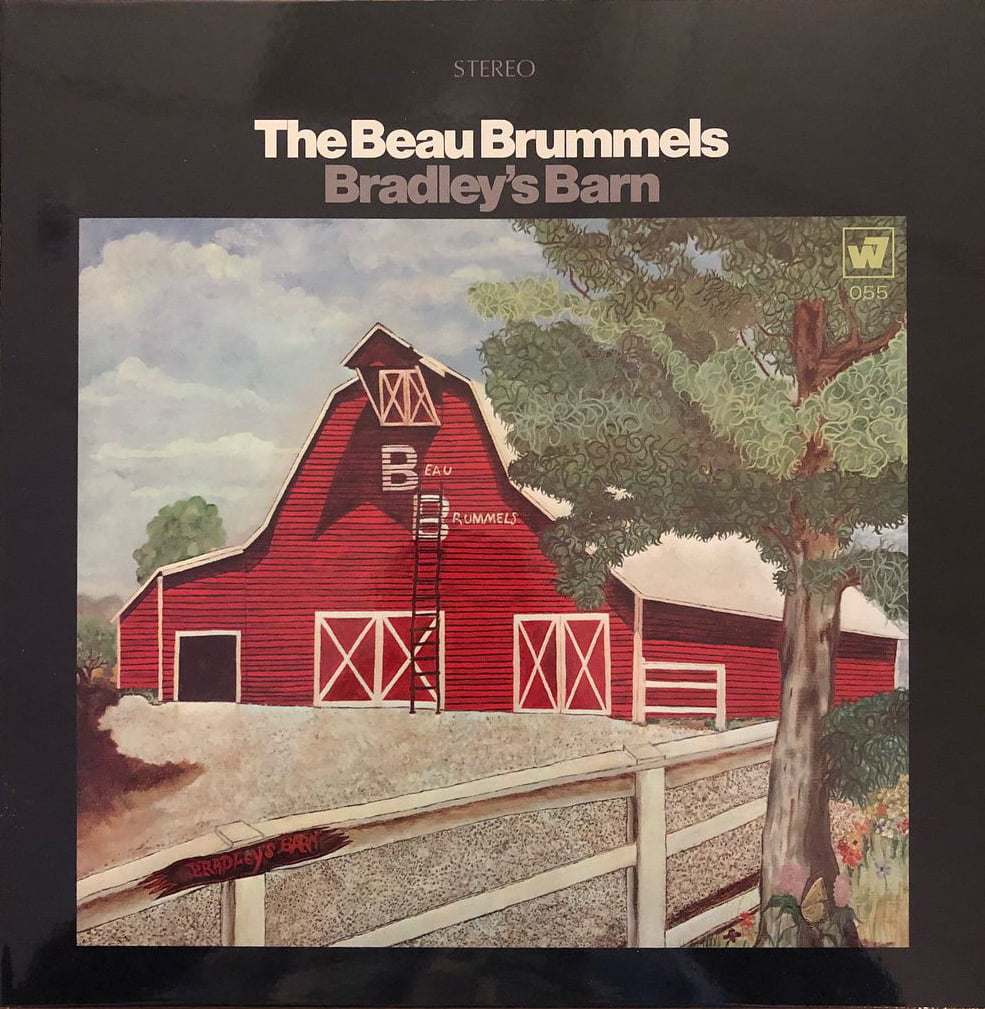
Early in 1968, at the behest of their producer, Lenny Waronker, the Beau Brummels decamped to Nashville — or to rural Wilson County, just outside of Nashville — to record a new album at the headquarters of Owen Bradley. The previous decade, Bradley had helped to define what came to be known as the “Nashville Sound,” a more pop-oriented strain of country music meant to appeal to as wide an audience as possible — not just rural folk, but urban listeners, as well. Even so long after his heyday, he would have been revered for countrypolitan classics by Patsy Cline, Brenda Lee, Loretta Lynn, and Conway Twitty.

Although it bears his name, Owen Bradley didn’t produce the Beau Brummels’ Bradley’s Barn. Instead, Waronker remained at the helm. But working in Nashville meant they had access to local session players, including Jerry Reed on guitar and dobro, Kenny Buttrey on drums, and Norbert Putnam on bass. The Beau Brummels had withered down to a trio at the beginning of the sessions and, by the end, bassist Ron Meagher was drafted into the Army and sent to Vietnam. As a duo, Elliott and Valentino were able to craft a very distinctive sound that’s more than just rock music played on acoustic instruments.

Bradley’s Barn crackles with ideas and possibilities, from the breathless exhortation of “Turn Around” that kicks off the album, to the ramshackle lament of “Jessica” that ushers its close. “An Added Attraction (Come and See Me)” is a loping rumination on love and connection, as casual as a daydream under a shade tree. The picking is deft and acrobatic throughout the album, as playfully ostentatious as any rock guitar solo, and Valentino sings in what might be called an anti-twang, an un-locatable accent that renders “deep water” as “deeeep whoa-ater” and pronounces “the loneliest man in town” with a weeping vibrato.

Bradley’s Barn wasn’t the first, but it was among the first country-rock albums. It was recorded and mixed by March 1968, when the International Submarine Band’s Safe at Home was released, but for some reason, the label shelved it for most of the year. It was finally released in October, perhaps as a means to capitalize on success of the Byrds’ Sweetheart of the Rodeo, which hit stores in August. Once leading the way in country-rock, the Beau Brummels were suddenly playing catch-up. And yet, compared to those two Parsons-led projects, Bradley’s Barn feels like much more of a risk, less self-conscious about its country sound. Safe and Sweetheart were primarily covers albums, with only a few of Parsons’ originals and a handful of Dylan compositions. Their purpose was to define a sound, to translate hits by Merle Haggard, Johnny Cash, and the Louvin Brothers into the language of rock ‘n’ roll. As such, they’re landmark albums, showing just how malleable rock ‘n’ roll could be — how it could stretch and bend to accommodate new sounds and ideas.

Save for the Randy Newman tune that closes the album (and was recorded in L.A. right before the Beau Brummels went to Tennessee), Bradley’s Barn is all originals, each one penned or co-penned by guitarist Ron Elliott. He has a deceptively straightforward style, evoking complex emotions with simple words. Alienation and isolation are his favorite topics, which lend all of his songs, but especially this album, its distinctive melancholy. “Every so often, the things I need never seem to be around,” Valentino sings on “Deep Water.” “Every so often, I pick up speed. Trouble is, I’m going down.”

On “Long Walking Down to Misery,” Reed’s dobro answers Valentino’s vocals with a jeering riff, turning his yearning for love and comfort into something like a punchline. That sadness and the music’s response to it — alternately bolstering it and undercutting it — is perhaps the most country aspect to this country-rock album. Elliott, in particular, understands how country works, just as much as Parsons does or Dylan does. Every song is a woe-is-me lament, lowdown and troubled, but not without humor or self-awareness. Even “Cherokee Girl” uses the imagery that would be identified with outlaw country in the next decade.

Bradley’s Barn flopped, when it was finally released, overshadowed by the Southern California bands and generally abandoned by the label. In 1969, when “Cherokee Girl” failed to register on the pop charts, the Beau Brummels broke up. They’ve reunited a few times since then, most famously in 1975, but generally they live on in reissues and oldies playlists. “We weren’t trying to do country,” Elliott told rock historian Richie Unterberger in 1999. “We were trying to do Beau Brummels country, which was a totally different thing. But it didn’t really catch on.”

Root 66: Chris Stalcup’s Roadside Favorites

Name: Chris Stalcup
Hometown: Acworth, GA
Latest Project: Downhearted Fools

We tend to spend a lot of time in the Southeast and especially around Charleston, South Carolina. There is so much great food to be had there that it is hard to limit our favorites from all over, but there is something to be said about consistency and we hit these spots more yearly than any others it seems, so here goes:

Favorite BBQ: Home Team BBQ — Charleston, SC. Everything is fantastic, but their smoked wings and mac 'n' cheese are the best on the planet! They have three locations now in and around Charleston, and we have played each one of them. On top of great food, they are just awesome places to hang out full of great people. They only book Americana and they certainly know how to take care of the bands.

Health Food: The Tomato Head — Knoxville, TN. We look forward to playing the WDVX Blue Plate Special so we can go eat here after the gig. I don't now if it is considered "Health Food," but it is about as healthy as any of us eat in one sitting together, so we will give it that. Half the band is vegetarian and they have lots of great veggie options.

Cinnamon Rolls: Lost Dog Café — Folly Beach, SC. Cinnamon rolls are a crutch and, if they are made in-house, then I have to try them anywhere we go. The bar is high on this one for us, as our producer/engineer Ben Price's mother makes them from scratch and those just can't be beat, but if anyone comes close, it is most definitely the Lost Dog Café. They are huge and amazing. They are actually called "Awesome Cinnamon Rolls" on the menu and the place is awesome, too.

Tacos: Juanita Greenberg's — Mt. Pleasant, SC. We eat tacos everywhere. Something about Juanita Greenberg's tacos, though, seem so fresh. Plus, they are open late, so we can usually grab a few after a gig. I am a sucker for shrimp tacos and fresh salsa.


Low and Stalcup together again at last!

A photo posted by Chris Stalcup & The Grange (@stalcupandthegrange) on

Favorite Pizza: Basically anywhere that has pizza after a gig. If we find a local pizza spot before a gig and we know they will be closed once we are done, then we get a large cheese pizza to eat for later. There is a spot next to Juanita Greenberg's in Mt. Pleasant we try to hit when we can called Andolini's Pizza. Great, laid-back spot with plenty of room for a band to hang out, too.

Favorite Road Snack: Besides boiled peanuts just about anywhere, Holy City Popcorn in Charleston, SC, rocks my world. I can eat bags of their "Pinckney's Pecan" (caramel and pecan) popcorn while driving with coffee. Anytime we play Charleston, we meet up with them and get about a dozen bags and usually three or four of them are gone the first night.

Listening Room: High Cotton Music Hall — Hartwell, GA. This place has been a bluegrass venue for decades, lined with church pews and stadium seats, and it holds about 100 people — all real music lovers. The staff is laid back and friendly, and the people that come to hear you are some of the nicest folks and biggest supporters you will ever meet. We even had a guy bring us an entire Boston Butt he had smoked for us the last time we played there! If you play here, bring lots of merch!

House Concert: Scott Low's Grouse Mountain House — Clayton, GA. Scott and I have become friends through playing gigs together (and he is one hell of a musician). When he is not on the road hustling it like the rest of us, he puts on these house concerts in his living room in the mountains of North Georgia. Grouse Mountain House is a cabin on top of a mountain with spectacular views. Lots of local folks show up on a Sunday night for a potluck-style dinner and several great local and traveling acts. It is one of the most peaceful and pleasant gigs, packed with the most attentive audience sitting inches from you. No P.A. — just you and your instrument belting out your tunes. (Note: This also contends for best backstage hang.)


Hendershots Coffee. 8pm.

A photo posted by Chris Stalcup & The Grange (@stalcupandthegrange) on

Music Festival: Wildwood Revival — Athens, GA. Just on the outskirts of Athens, on a 30-acre farm, with "the soul of a juke joint, the wild spirit of a honky tonk, and the camaraderie of a supper club." We haven't played it yet (wink wink) but it is our kind of place — laid back and chock full of amazingly talented musicians and artists. Definitely one of the most intimate festival experiences I have ever attended.

Airport: Savannah, GA. The easiest and cleanest, by far. Get in and out with no wait, usually, and so easy to navigate. Quick flights to and from Atlanta make it easy for us to get down to Richmond Hill to write songs like "Ogeechee River."

Driving Album(s): There is no way to pick just one or a few, but here are a couple that I lean on heavily. Hiss Golden Messenger, Poor Moon: This album was on repeat as I drove solo across the West for days. I could actually just listen to the song "Blue Country Mystic" forever. It is the most amazing piece of music I have encountered in a long time. Lucero just slays me. I got to open for them once, and that's another story, but they are as real and raw as it gets for me. And we also listen to any and everything our buddies are doing. We have some amazingly talented buddies making some of the best music right now. Check it out on the playlist. 

Radio Station(s): WNCW out of the North Carolina when we can get it. This is where I first heard Ryan Adams on a radio station, long ago. Driving to Charlotte in the middle of the night, "Oh My Sweet Carolina" came on, and I knew if they were playing him that I had to find out who else they played. My band and I, at the time, would scour WNCW for new music and find tons of great stuff we had never heard of. I am also loving this brand new all-Americana format station in Murfreesboro, TN — 89.5 WMOT. We did an interview in-studio last week at a station next door to them at MTSU with Justin Reed and, after our 7:30 am sleepy performance and awkward pre-coffee banter — sorry Justin — I walked over and, lo and behold, there was John Walker at the helm. It blew my mind, and I didn't know what to say, so I gave him a copy of Downhearted Fools and tried to play it cool. I don't do that very well, so I'm sure it was nowhere near as smooth as I was hoping for.


Rock 'n Roll Breakfast! Thanks @theholycitypopcorn #popcorn #Coffee

A photo posted by Chris Stalcup & The Grange (@stalcupandthegrange) on

Highway Stretch: I-16 in Georgia from Macon to Savannah. Desolate as all hell to drive through the night on, but so good to ponder life and wonder why anyone would choose to do this for a living. It is usually my drummer Paul Barrie and me talking about the expanse of the universe and what it all means while we count the deer.

Coffeehouse: It is a tie between Rev Coffee in Smyrna, GA, and Hendershot's Coffee in Athens, GA. They both make great coffee, but the people and the environment at both feel like a living room — so relaxing. Hendershot's has a great stage and the sound is amazing there. Make sure to try their Nitro Coffee.

Backstage Hang: Awendaw Green Barn Jam — Awendaw, SC. If you haven't been to a Barn Jam at Awendaw Green, I suggest you remedy that immediately. This place is some kind of wonderful with brass instruments hanging from old live oaks, lots of great food, and usually about five to seven bands per night. I am pretty sure they do this every Wednesday night, rain or shine. They have had us down a few times, and we always try to fit it into our runs when we are down that way. I have met some of the most interesting people there and some amazing musicians.

3×3: Nocona on War Heroes, Cowboy Boots, and a Tale of Three Jennifers

Artist Name: Chris Isom (of Nocona)
Hometown: Los Angeles, CA
Latest Album: Long Gone Song
Rejected Band Names: The Sunshine Apocalypse Band


#fbf #sxsw2015 #noconamusic #longgonesong #tgif

A photo posted by noconamusic (@noconamusic) on

If Jesus, Buddha, Krishna, and Mohammed were in a band together, who would play what?
Buddha — Drums, Mohammed — Bass, Krishna — Guitar, Jesus — Lead Vocals

If you were a candle, what scent would you be?
Pine

What literary character or story do you most relate to?
Ulysses S. Grant

How many pairs of shoes do you own?
About seven. Three of them are worn-out cowboy boots.

What's your best physical attribute?
A birthmark that look like Orion's belt

Who is your favorite Jennifer: Lawrence, Lopez, or Love-Hewitt?
Too hard, those are all amazing Jennifers. I refuse to choose.


Taking the bull by the horns #noconamusic #longgonesong #theescondite #dtla #americana #country #rock

A photo posted by noconamusic (@noconamusic) on

Cat or dog?
Cat

Rain or shine?
Shine

Mild, medium, or spicy?
Spicy … Nuclear, Carolina Reaper hot.

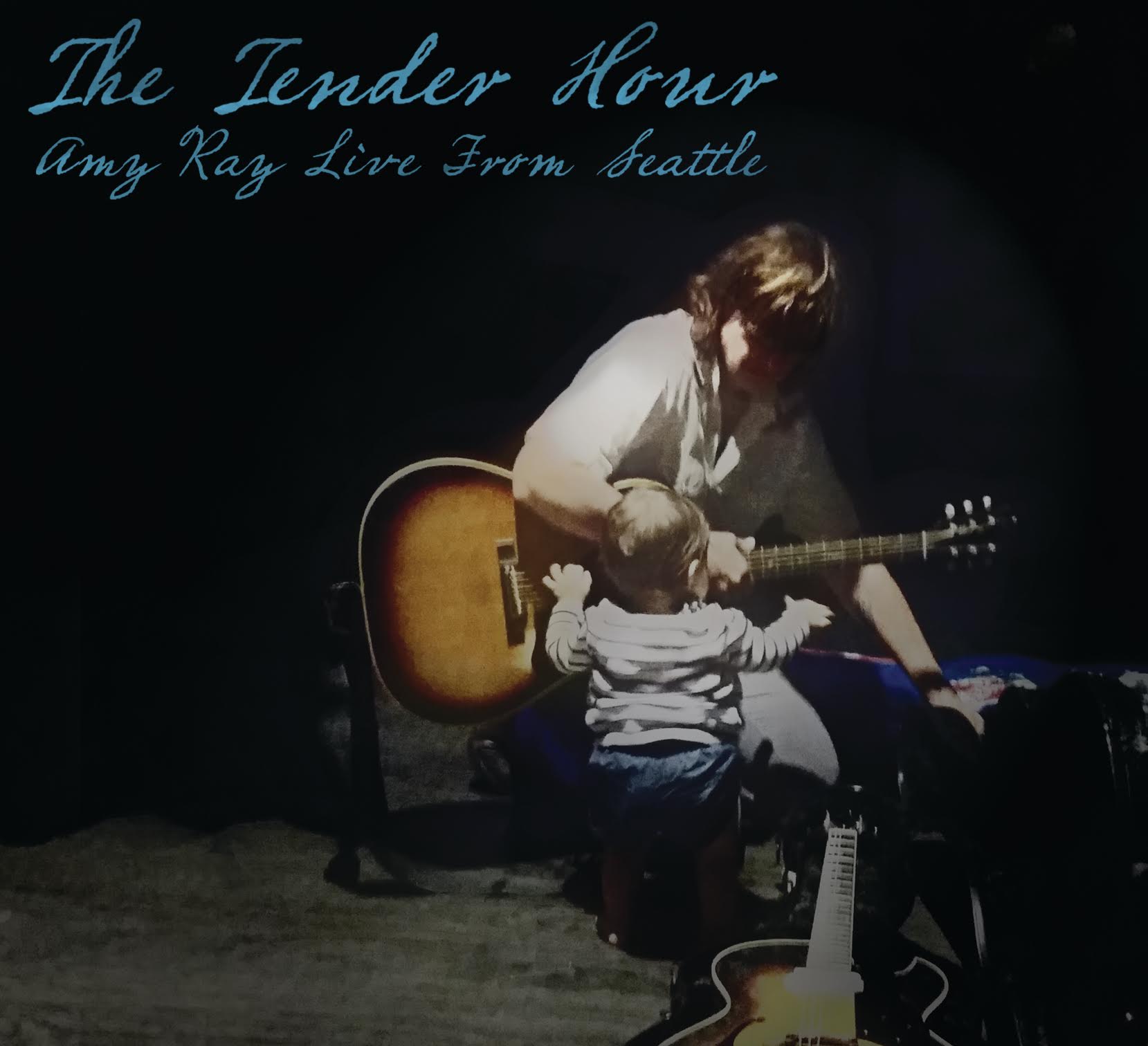
STREAM: Amy Ray, ‘The Tender Hour: Live from Seattle’

Artist: Amy Ray
Hometown: Dahlonega, GA
Album: The Tender Hour: Amy Ray Live from Seattle
Release Date: November 13
Label: Daemon Records

In Their Words: “I asked sound man Craig Montgomery at Seattle’s Triple Door to press ‘record’ and he captured a treasure of a night with my top-notch country band and my 'home away from home’ hometown crowd. My hope is that this new recording, The Tender Hour, does what any satisfying live record should do — put the listener in the room and immerse them in the humanity of the show … complete with stories, blunders, an incredible band, and a energetic heartfelt night of music!” — Amy Ray

Tour Dates
11.18.15 – Benefit for the Pick and Bow School – Crimson Moon – Dahlonega, GA
12.10.15 – Supporting Tedeschi Trucks Band – Jefferson Center – Roanoke, VA
12.11.15 – Supporting Tedeschi Trucks Band – Sandler Center for the Arts – Virginia Beach, VA
12.31.15 – Homeless benefit – First Night – Dahlonega, GA