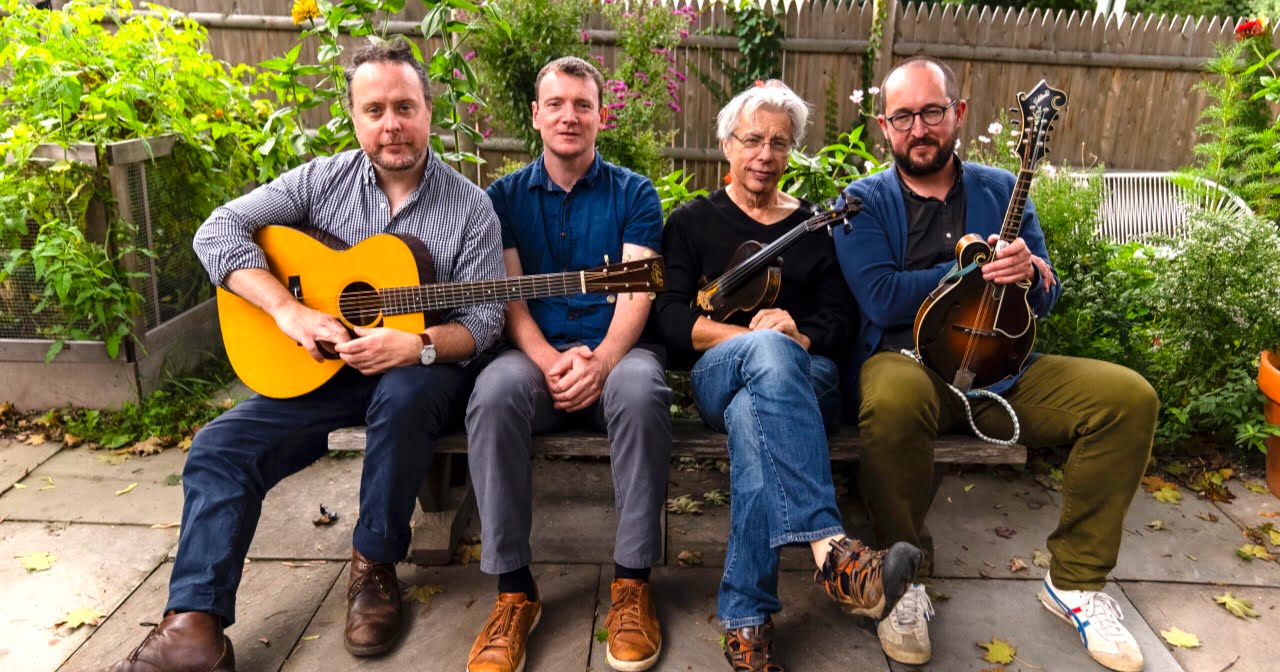
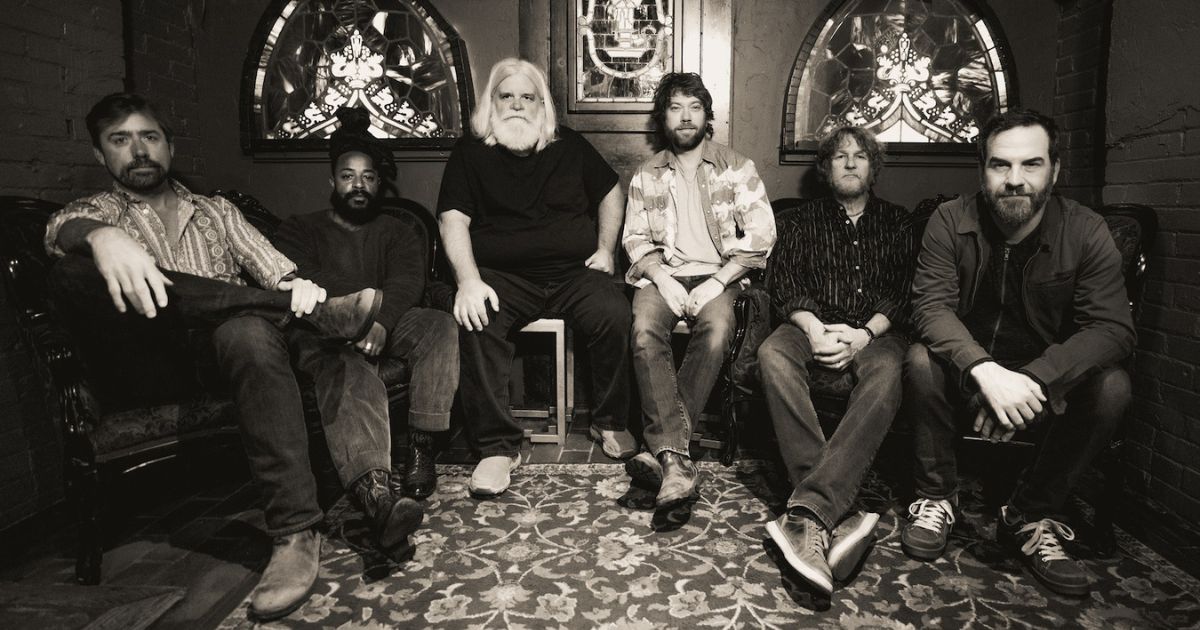
Artist:Mr Sun Hometown: Portland, Maine / Nashville, Tennessee / Brooklyn, New York Song: “Shovasky’s Transmogrifatron” (Ballet Snow Scene) Album:Mr Sun Plays Duke Ellington’s Nutcracker Suite Release Date: December 1, 2023 Label: Adhyâropa Records
In Their Words: “Everybody’s familiar with the Nutcracker Suite, but there’s this really beautiful recording of Duke Ellington and Billy Strayhorn’s arrangement of it – it was a really joyful, playful reimagining of this classic piece… It was an easy idea to propose, not fully appreciating the amount of time it would take to do it. Luckily, everyone in the band brings a tremendous skill set to the project.” – Joe K. Walsh, mandolin
“They basically said, ‘We’re gonna take this essential seed of an idea, but we’re gonna play it like us.’ And we’re doing the same thing – we’re playing it like Mr Sun, without doing anything too verbatim. It’s all about being ourselves. That’s the impression you get from Ellington, and that’s a thing we very much are: Ourselves.” – Grant Gordy, guitar
“It sounds simple, ‘Let’s just play this big band arrangement with four stringed instruments.’ In practice it’s been a little more complicated!” – Aidan O’Donnell, bass
“Duke Ellington of course was volcanically creative. He was one of the most creative musicians ever. He was beyond category. Melody, harmony, and rhythm – if you can put those things together in a way that reaches people, it’s gonna be successful in a way that means something.” – Darol Anger, fiddle
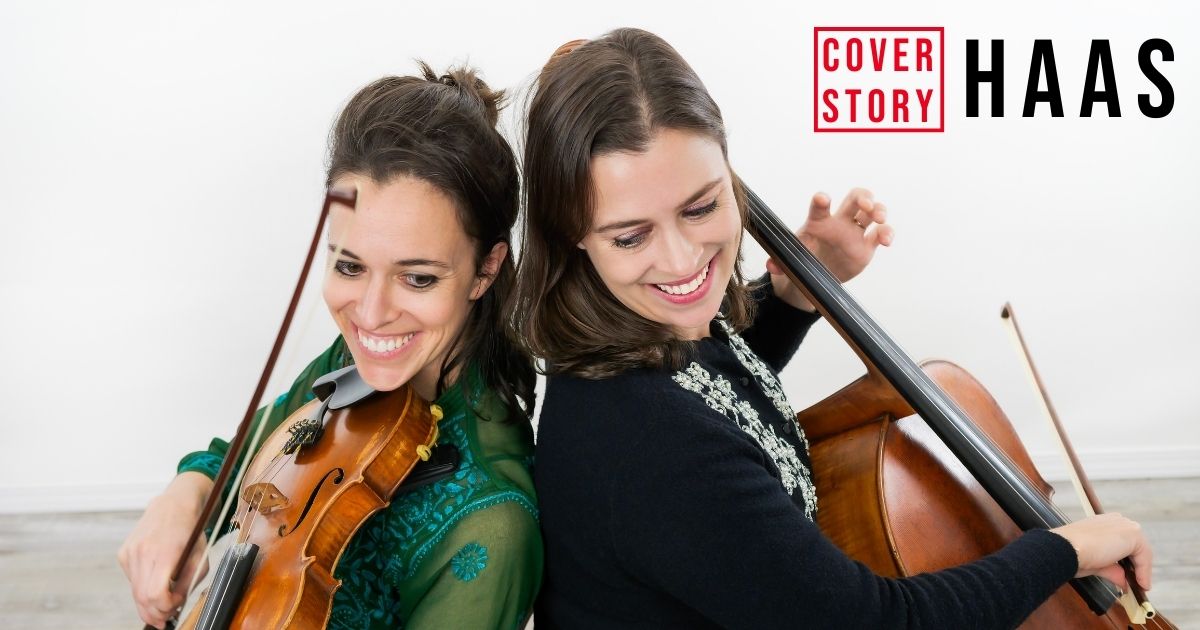
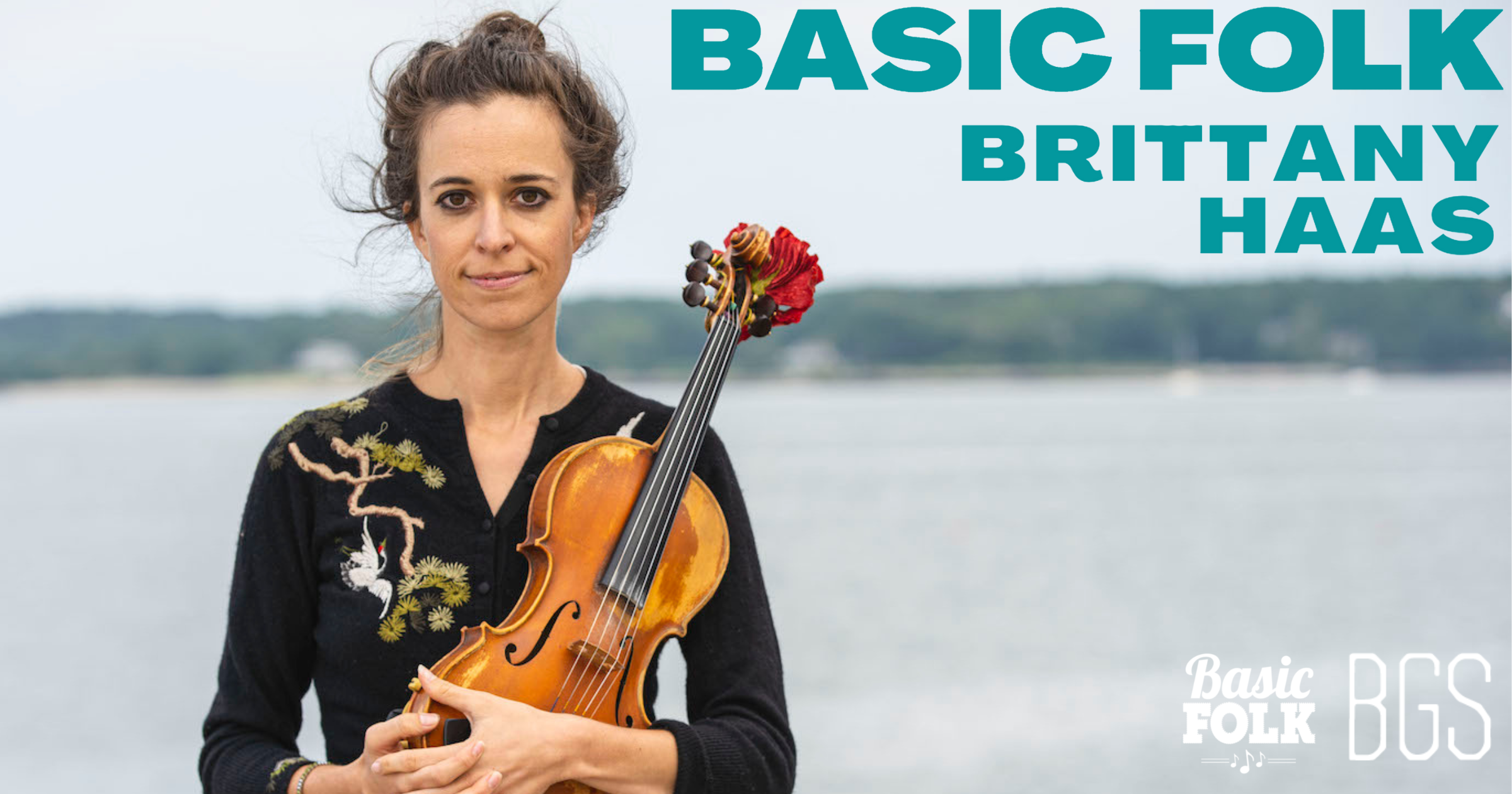
What changes about the oft championed phenomenon of “family harmonies” when the voices entwined together are not voices at all, but strings, plucked and bowed and fingered? It’s a question that immediately comes to mind as you hear the first notes of Haas, the recent duo album released by sisters, fiddler Brittany Haas and cellist Natalie Haas. It’s also a question that immediately came to mind as we chatted via Zoom last month.
“I feel like I connect more deeply with Brittany than anyone else from a rhythmic standpoint,” Natalie responds after a thoughtful pause. “That’s not so much the family harmony thing, but it does play into everything.”
The familial blend they’ve established as adults – in many ways, Haas is their first deliberate and intentional music making as a pair since their teen years – defies any and all boundaries and language, as they swap melodic hooks and call and respond and toggle between accompanying and leading, adding texture and tenderness or vigor and enthusiasm. Their interplay is as comfortable and cozy as you would expect these two sibling virtuosos to be together, their reunion the not-so-subtle underpinning that makes the entire collection of tunes and sets sparkle.
This is family harmony – and family rhythm – but unspooled, complicated, and set to a new acoustic, Celtic, chambergrass sound that defies categorization. Haas also gently and kindly stands in implied opposition to more masculine, performative, and competitive musicians and groups in similar spaces. It’s a brilliant, crave-able album that showcases how much can be accomplished musically when one’s goal isn’t just the cooperative music one creates, but the space one opens up with another in which you cultivate that cooperative music.
I wanted to start by just asking y’all how long it’s been since you put out music together, or since you’ve been in like a creative space together? How does it feel to be “reunited” in this way?
Natalie Haas: We sort of played together as kids in chamber music groups and youth symphony together. And we went to fiddle camps together – that was how we got excited about maybe doing music as a career. That would sort of continue throughout the year, because the way for us to continue all that excitement and motivation that we got at fiddle camps was for us to play together.
We did the odd gig together as teenagers, like farmers markets, school performances, and that kind of thing. Then we sort of went our separate ways and we’re both very busy doing our own thing, but we took every chance we got when other people would hire both of us to be on their gigs. We always said yes because we just wanted to hang out with each other. So this is like the first time that we’ve done anything like this and it’s pretty exciting.
The way that your musical paths have diverged, they don’t feel like they’re that separate from each other. It feels like the vocabulary that you both draw from is very similar. When you started sitting down to think about doing an album together, what changed about the way that you thought about music separately or together?
Brittany Haas: That’s a cool question. I think, it all felt kind of new in a way, but also so familiar, you know? Because it’s us. We have made a lot of music together. I think on my side, it was really cool because Nat already had a bunch of tunes. So some of [our collaboration] was just like, schedule based, it was like, “Okay, we know we want to do this thing, because we’ve been getting odd gigs.” It was really like motivated by the fact that we had shows coming up, and that was a reason to be like, “Let’s have new material for that.”
Then we were like, “Here’s our days when we can put together material.” Nat had just done a writing session where she had all this new stuff ready to go. These are the tunes that she’s cranking out and they feel very much like they come from something or some place that is like so near and dear to me, because it’s from our shared fiddle-camp upbringing. That’s like the source, the well, where the tunes come from, even though they’re new and different. It feels like very homey, I guess? The kind of tunes. And then I think we’ve just both grown a lot over the decades as musicians and as arrangers. We like bring more stuff to the table than when we were teenagers.
NH: I should certainly hope so! [Laughs]
That is the goal. [Laughs] That leads really naturally to my next question, which was going to be about material curation, especially because you both have demanding schedules that kept you apart, I’m sure, during the album creation to some degree. What was it actually like when you were like setting aside that time, like you’re talking about, to get together to make the music? What was the curation process like? It’s all originals, but one, yes?
NH: Yes. And yeah, that’s the nice thing about us both being busy is when you set aside a block of time, that’s all you are focused on. Brittany had all these amazing musical ideas and made all of my tunes better the minute she got her hands on them. The arranging process, it was pretty easy, because we’re both, comfortable switching back and forth between roles. I was just amazed at how much we got done in such a short amount of time, both in the arranging process and in the recording process. It all felt very easy. [Laughs]
BH: We did the bulk of it together, I think we had like a week or maybe slightly under a week when we first met to gather the material. And wasn’t that before we even knew we were making a record then?
NH: Oh yeah, that was preparing for a tour. Our first adult sister tour.
BH: No, no, no – second.
NH: Oh, second. Yeah! Because we toured Ireland. Right. We were playing all of these trad tunes, our shared repertoire from our of teenage years. And then for [Haas], we decided to make it all original. For the most part.
BH: Do you remember the moment when we actually said, “Let’s record this”?
NH: Uh… well, I think we toured it first. Then Brittany brings her handheld recorder to all of those gigs and recorded everything. We listened back to it and decided that it was actually pretty good and that we should make something of it. I think we had another tour coming up, of Australia, and we decided it would be fun to have something for people to take away with them.
BH: At that point, we didn’t meet again until a few days before the studio. We had arranged the material and toured it, so we kind of had it under our hands pretty good. And then a long amount of time passed, but during that time it was good to listen back to stuff and decide what we wanted to change.
We had like a couple days of rehearsals and revisions. That was from listening and emailing and saying like, “I have this idea about this. What do you think of that?” Then we had like three days in the studio before it went back to email, because Natalie lives in Spain and we’re also both busy doing stuff. So it was emailing like, “Do you like this take?” and, “Is it okay if I edit out the second B part on this?”
Did you trip into or over any sort of feeling like, “This reminds me of when we were playing together as kids” or did it feel like you were getting back on the bicycle in a way?
BH: I’d say mostly yes. It’s just really easy. I think in other collaborations, people aren’t always so willing to just try anything. We have this basis of, “I love you no matter what, and even though you’re being really annoying and you’re asking me to do something I don’t want to do, I’m still going to do it, because might as well.” It’s an ease of communication, which I think mostly comes from family. [Laughs]
NH: We were never really a band as kids. We did the odd gig, but it was always just for fun. Our parents weren’t pushing us into performing together. So yeah, no bad memories, really, associated with playing together as kids. But we do have the ease of having this shared history of fiddle camps and learning from the same kind of mentors.
BH: Since we’re both like primarily collaborators, this project was like running our own band. As adults we’ve both come into our own and we’ve probably become more opinionated about musical things as a result of that. So it’s fun to meet again where there’s a lot of give and take.
What do you think of the term, “chambergrass?” Is this album chambergrass? Is that even a thing?
BH: I like the term, but I’m not sure it applies here. I also don’t mind it applying here. I guess maybe that wouldn’t have been what I would have gone to, because from my perspective, it just feels so much more Celtic. It’s still in that sort of “past of American music,” that’s more over there in the Celtic Isles. It doesn’t feel very grassy, but I mean, that’s a part of me as a musician. So, it’s not like it’s not in there.
NH: It does feel like chamber music to me. Yeah… I’m not familiar with all of the myriad grass terms. [Laughs]
BH: We grew up going to Valley of the Moon Fiddle Camp, where there were a lot of genres meeting. So the boundaries were very blurred, and both of us having worked with Darol [Anger] from a young age, he’s all about blurring and negating the idea of boundaries. It’s everything, it’s all of that, it’s all the influences and where they’re going. I know the current Celtic world less than Nat does, but it seems like a lot of the forward-thinking, new tunes on stringed instruments are happening in chambergrass, the new acoustic realm, so it’s definitely an influence on both of us.
NH: It does have a Celtic bent, but it is Celtic from an American perspective – because we’re American. I’ve listened to a lot of stuff in the new acoustic realm – like Brittany said, all of our influences are coming out, and it’s hard to define a genre.
BH: I think Nat, for all of her “I don’t totally play bluegrass” sense of self, she can and she does sometimes. Some of the bluesier tunes that she writes lend themselves to that area.
You make very in-the-moment music, there’s a lot of improvisation, there’s a lot of dialogue, and this kind of music can often feel very – it’s silly to say this cause you’re literally performers – but it can often feel very performative and like there’s a lot of hubris in it. I also feel like new acoustic music, newgrass, jamgrass, and that sort of “Let’s jam out together, let’s be in the moment together!” music, it can often feel really masculine and toxic. How do you go about creating this space you’ve made together, to have those moments, to be together and present and making music, but it doesn’t feel like you’re being self-absorbed or self important?
BH: That is something I think about when I’m listening to music – and sometimes when I’m playing it. Sometimes I do feel like I’m uncomfortable, like that’s not something that I want to do. Even though you think that that’s what the music calls for in this moment, it can feel a little bit too masculine.
It’s like, “No, I don’t want to take a really long solo there.” I think I’m embracing that it’s okay to say, “No, I’m not gonna do that.” It’s a tricky one, because a lot of our heroes in that realm of creating this newer music, they’re men, and that nature is informing the music that they’re making and the way that they’re arranging it. It does have that hubris thing built into it. On some level, that is important and it does work well, for stepping into the moment and taking a great solo. You kind of have to have that attitude. But, it’s not necessarily masculine or feminine. Like it doesn’t have to be either one. It could be both.
What we’re trying to do, it’s a little more tune- or melody-based than based on soloing, so it lends itself well to a tight arrangement. That may not be the right term, because it still is loose, there still is a conversation going on. But, if there is a solo it’s pretty short, it’s this little thing we’re going to do to give a breath of fresh air here. It’s not like, “And now, we will rip for 50 more bars!”
“And now everybody look at me!”
BH: Yeah! I think in a duo especially, because we’re very equal and we like sharing, that’s just kind of part of the vibe. Even when Natalie’s filling more of an accompanist role, it’s still such a powerful, interesting sound. It’s so varied that it doesn’t fade into the background. It’s super interesting all the time. It’s like both voices are very equal, even if mine is higher.
NH: It’s interesting because, like Brittany said, a lot of our heroes are men. That’s definitely a generational thing in the Celtic music world, because like, the people that we grew up sort of – I don’t want to use a phrase like “hero worshipping” – that we admired and wanted to copy were mostly men, with a couple very key exceptions. But then, my generation in the Celtic music world is almost exclusively women. There are some men doing it, but it’s very different than the bluegrass thing.
Also like Brittany said, soloing is not as much a part of it. That changes the dynamic a little bit. But it is kind of a melody>accompaniment hierarchy going on. But I wouldn’t say that that’s necessarily a male thing, I don’t know.
As Brittany said before – and I hate to associate this with just feminine energy – but both of us coming from being collaborators in our other projects rather than soloists, per se, you could say that that is the more feminine approach, maybe, to music making. It does feel very equal because the melody playing is getting passed back and forth all the time. And it does feel very conversational, even though the soloing thing is not as prominent as it might be in some other genres.
I think that’s part of why you can listen through y’all’s entire album and it doesn’t feel stale, it doesn’t feel boring, while it also doesn’t feel like it’s trying too hard. It doesn’t feel like you guys have something to prove.
NH: That’s part of the thing with having done it at this point in our lives, it doesn’t feel like we have anything to prove anymore. We’re doing it because we want to, not because we’re trying to prove anything to the world.
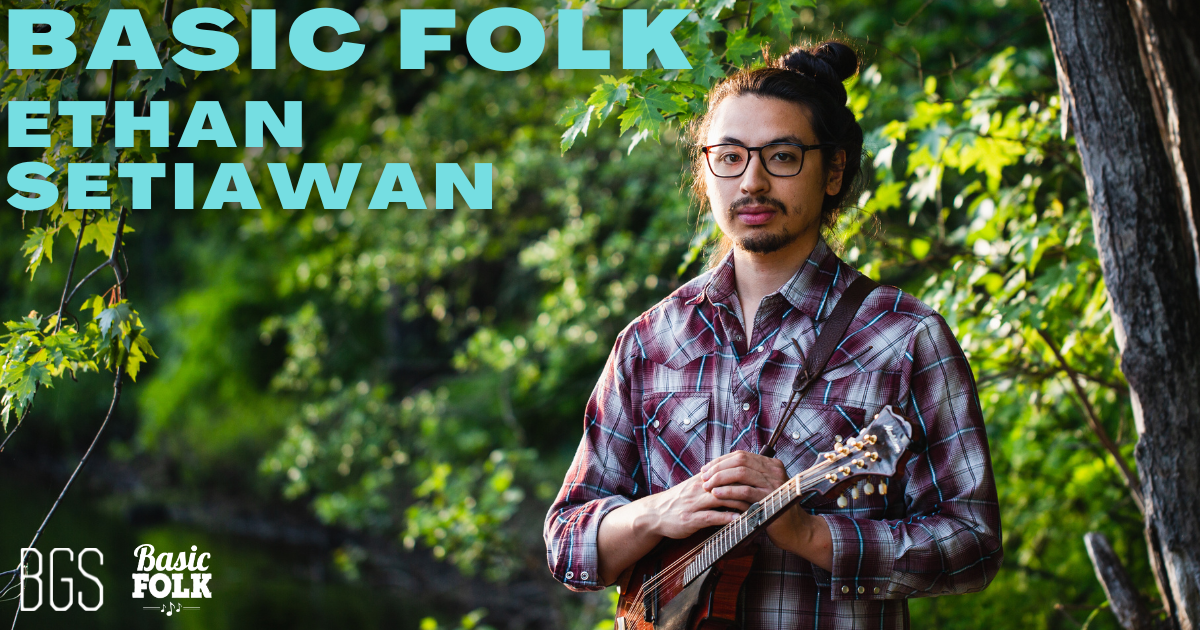
Is mandolinist Ethan Setiawan 100 years old?! The Indiana-born Setiawan’s expert playing will fool you into thinking he’s four times his actual age. Thanks to a supportive family and Mennonite community, Ethan came to the mandolin and folk music at an early age. His impressive proficiency and technical prowess landed him a full scholarship to Berklee College of Music in Boston. There, he was exposed to all different types of music and developed that natural rhythm and groove that only comes with being in a musical community.
His new instrumental album Gambit was produced by his mentor, the legendary fiddler Darol Anger, best known for being in the original lineup for The David Grisman Quintet. Through Darol, Ethan was able to work on a tradition of music built from a foundation of bluegrass. He talks about that AND he explains what the bluegrass vocabulary is on the mandolin for dumb-dumbs like me, who do not play music and are not folk scholars. Setiawan is an in-demand side man and band member, and can be seen playing with his band Corner House, Darol Anger, and Tony Trischka among others. Enjoy Ethan and get to know his new record!
Artist:Missy Raines & Allegheny, featuring Danny Paisley with Darol Anger, Shad Cobb, and Ellie Hakansan Hometown: Short Gap, WV Song: “These Ole Blues” Album:Highlander Release Date: Fall 2023 Label: Compass Records
In Their Words: “I found this gem of a tune while taking a deep dive into Loretta Lynn’s catalog. Loretta wrote the perfect bar room country shuffle, but I immediately thought it could be a great bluegrass crooner and I knew exactly who I wanted to sing it with – Danny Paisley! I grew up listening to Danny and his father, Bob Paisley, sing together. Danny’s high lonesome edge defines a lot of what is bluegrass to me. Recording this duet with him was a personal bucket list item checked off and everything about the song fits perfectly into the theme of my new album, Highlander, which should be out later this year.
“The project is about paying homage to the earliest sounds that inspired me and this version of ‘These Ole Blues’ feels both authentic and genuine to my very core. Rounding out the track are the triple fiddles of Darol Anger, Shad Cobb, and Ellie Hakanson as well as the other members of my band, Allegheny: Tristin Scroggins (mandolin), Eli Gilbert (banjo) and Ben Garnett (guitar).” – Missy Raines
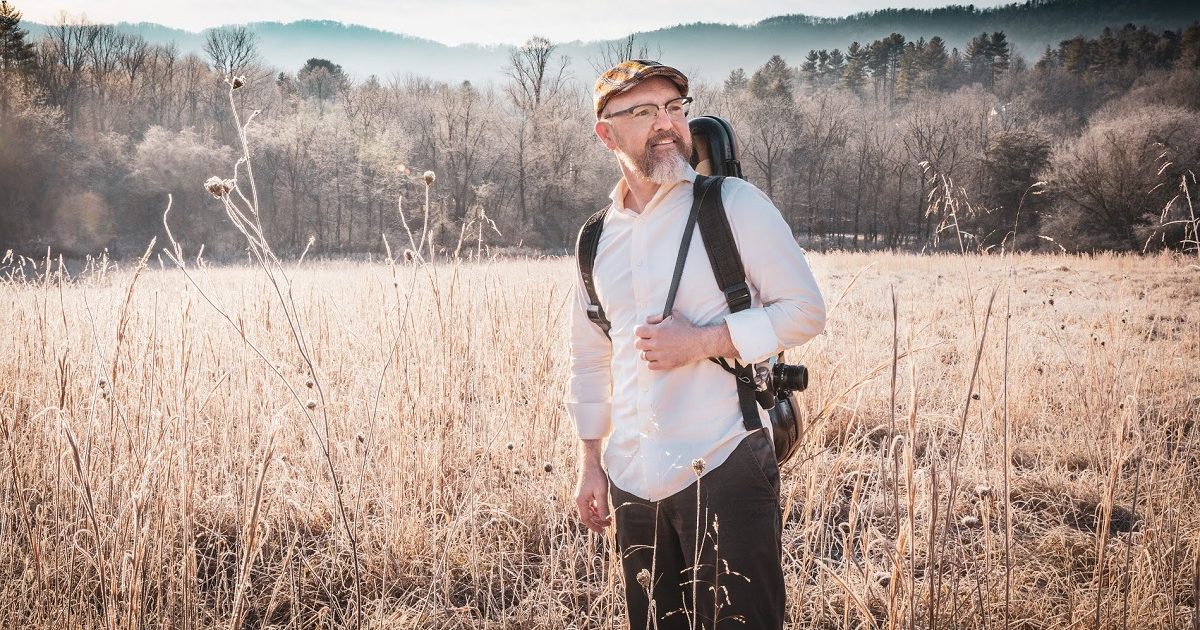
Ethan Setiawan knows the importance of a good pick. The Portland, Maine-based mandolin player has lately been experimenting with changing the entire sound of his instrument through one tiny, flat piece, pinched between his fingers. The material, girth, texture, and weight of his pick all play a crucial role in how his mandolin sounds, sometimes bright and plucky, or dark and full-bodied. “It’s good to have a sound and have gear that you like, but often the thing that helps me be more creative is just being able to change it up,” he says. “Change is helpful for your own growth and can really spark new ideas or keep things fresh.”
On his new record, Gambit, he finds himself somewhere in between, which is fitting given the way he fuses his entire musical background to create something completely new. It isn’t jazz, but it’s not not jazz. It’s bluegrass, but not in the traditional sense. It’s funk, but also old-timey.
The Berklee College of Music grad could easily fool you into thinking he’s much older than his years. A seasoned bandmate to some of bluegrass music’s finest — including Gambit producer Darol Anger, whom he first met as a high school student — Setiawan is beginning to carve out space for his own songwriting. Written in Boston, workshopped in California, recorded in Maine, and then mixed in Nashville, Gambit, as its title suggests, is a joyful mixed bag of the many styles of music that have shaped him into one of the most formidable mandolinists of his generation.
BGS: Darol Anger produced this record, and though you had been playing together for some time, this was your first experience working with each other in this capacity. What led to this partnership?
Ethan Setiawan: We’ve played a bunch of gigs over the years, and it just felt like a good next thing to do was to make a record with him. And he was on board thankfully. We had plans to [record] in August 2020, and then the pandemic started to happen, and it became apparent that wasn’t going to work. So eventually I did make this big road trip out to California where Darol was living at the time, and we had these really nice couple weeks out there, working through the material, just me and Darol kind of playing through the stuff, trying to solidify arrangements and get ideas down on paper to go into the studio with. And eventually in October, we made it into a studio, the Great North Sound Society Studio in Parsonsfield, Maine. We had this four-day session and worked probably 12 to 14 hours a day, every day. And sometimes sessions like those feel like work, you feel tired and drained after a day. But at least for me, those sessions felt really fun, really good. Part of that was not having played music with a band before that time for six months or whatever, and it was cool for me to see these tunes come together, and just working with Darol and seeing how he functioned in the studio. He put in the longest hours of everybody. He was up until 3:00 every night, replacing fiddle parts and working on everything.
The tunes on Gambit are all originals, but there’s so much tradition rooted in these styles of music you’re playing. How do you reconcile that when trying to create your own compositions?
I do a lot of that, pulling from past traditions or old recordings. A lot of the compositional ideas and things that remain the same throughout the record are tunes by people like Matt Flinner and Béla Fleck, other people that have kind of pushed the envelope compositionally. On the record there’s kind of a whole, well, gambit of different styles. There’s old-timey music with fiddle and banjo, Appalachian string band [style] — and kind of in chronological order, I guess the influences would start there. Then you’d move into bluegrass, get into jazz and eventually fusion, funk, that kind of thing. Darol actually summed it up nicely. He was in the David Grisman quartet way back in the day, so he kind of had a hand in forming this style of music. He said something along the lines of, it felt like a journey through the past 40 years of his career. It just ended up this way that all these tunes grabbed from different areas of the past 40 years. The old-timey, the bluegrass, the sort of new acoustic, the jazz. And hopefully by merit of them being my tunes, they kind of hold together as a collection at the end of the day.
How much of creating an original arrangement is improvisational?
For me, there’s always a lot of throwing paint at the wall. There’s a stage that kinda looks like that, where I write a lot of tunes or even just generate a lot of ideas, not even taking the tunes to a completed state. The way I write is kind of two stages: there’s the melody and there’s the harmony, these two sides of the composition. Basically, I write the melody and I try all different combinations of notes and phrase endings. With chords, I’m always trying different stuff. That does a lot to create a mood, I think, for the tune. For any one note, you could harmonize in many different ways, and for any one bar. So I think the important thing for me is just to try all the options, really try to be objective, and see what works the best and what feels the best. Mandolin is the main thing that I play, but I also play some guitar and some cello. So just getting off the instrument I’m most familiar with and getting onto something else can be really helpful in sparking some creativity.
Given this wide range of styles of music you’ve played over the years, how do you describe your sound now?
I’d say that it’s sort of a furthering of the stuff that Darol’s been really involved in, this new acoustic sound. Which is not a label I totally love—just the sound of it—but it’s kinda what we got, I guess. It’s using the attitude of bluegrass in a lot of ways, but not being confined to the stylistic trappings of bluegrass if that makes sense. If you think about how Bill Monroe created bluegrass, he’s kind of the guy that finally took all these influences and put ‘em together and said, ‘here’s the thing.’ He wasn’t even trying to be original; he just was being original. He was just taking all the music that he liked and synthesizing it into what he wanted to hear. And that isn’t often actually the attitude of bluegrass musicians today, but it’s an interesting concept to me and a really interesting way to sort of look at music. So that’s the essence of bluegrass that I’m trying to go after.
How has your relationship with bluegrass evolved since your earliest experience with it?
I think bluegrass is kind of the underpinning of everything that I do, even if it’s not at the forefront of the final product. When I started playing mandolin, I started playing these old-time fiddle tunes, which pretty quickly brought me to bluegrass. When we’re talking about progressions, that is kind of the natural next step for somebody who’s interested in the tunes and the music and improvising especially. You’ll get drawn to bluegrass and then eventually to jazz and so on. That bluegrass vocabulary on the mandolin is really the basis of most of my writing and my playing. And I think that comes through on the record almost more in the way that we approach the tunes and treat how we play the tunes more than the compositions themselves. There are a couple tunes that are a little more bluegrass, but they’re always a little weird. There’s always something a little funky about them. It’s sort of the attitude of the thing that I think has stuck with me the most.
Artist:Leftover Salmon Hometown: Boulder, Colorado Song: “Blue Railroad Train” (Feat. Billy Strings) Album:Grass Roots Release Date: May 19, 2023 Label: Compass Records
In Their Words: “We had a good time making this record. Compass Records has a great studio in Nashville, where some great records have been made. Let’s just say Aereo-Plain by John Hartford was recorded there and Outlaw Country was born there. It’s a good place to make an album about roots, which is what we were after on this one. We cover the music that inspired us to be on this Polyethnic Cajun Slamgrass highway all these years. With guests Billy Strings, Oliver Wood and Darol Anger, we stop in on visits with Bob Dylan, David Bromberg, Link Wray, Dock Boggs and more of the sounds that made us who we are. Hope you enjoy our Grass Roots.” — Vince Herman, Leftover Salmon
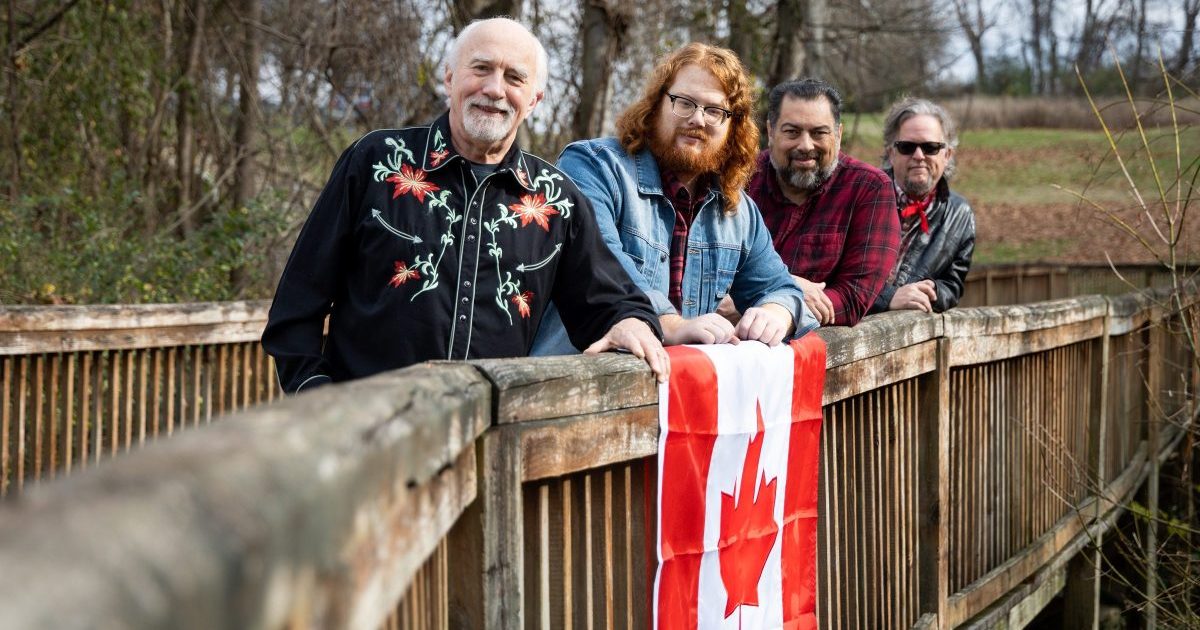
Artist:Special Consensus featuring April Verch, Darol Anger and Alison Brown Hometown: Chicago, Illinois Song: “Pretty Kate and the Rabbit (La Belle Catherine/Jack Rabbit Jump)” Album:Great Blue North Release Date: May 12, 2023 Label: Compass Records
In Their Words: “In our 47 years as a band, Special Consensus has played countless festivals and venues north of the border and we count many Canadian pickers and singers among our dearest friends. On our new project Great Blue North we wanted to offer a tip of the hat to the immense talent in Canada by recording all Canadian songs and featuring Canadian guests on the record. We always include an instrumental on our records and really wanted to collaborate with Ontario-born fiddler April Verch. Our producer Alison Brown knew the tune ‘La Belle Catherine’ from the great Québécois fiddler André Brunet and April suggested that the Métis fiddle tune ‘Jack Rabbit Jump’ would pair well with it to round out a medley. Et voilà, ‘Pretty Kate and the Rabbit’ was born! We asked Darol Anger to join us on twin fiddle and Alison to jump in on twin banjo and we had an absolute blast shooting the video for this track. Keep an eye out for the interplay of the fiddles and banjos on the second tune — I’m not sure I’ve ever laughed harder! We hope you have as much fun watching this video as we did making it.” — Greg Cahill, Special Consensus
Fiddler Brittany Haas has an impressive resume: she started touring at 14 with Darol Anger, recorded her debut album at 17, started performing with Crooked Still before she finished college, has played on Chris Thile’s radio program Live From Here and done stints in David Rawlings and Gillian Welch’s David Rawlings Machine. Currently, she’s teaching workshops and classes in between working with her band Hawktail along with Paul Kowert, Jordan Tice and Dominick Leslie. Their latest album, Place of Growth, is a song cycle in appreciation to the natural elements, which have always intrigued Brittany.
She’s a trailblazer in fiddling and also has an acute awareness of burnout. The past few years have seen her pursuing and obtaining a masters in social work and teaching classes at East Tennessee State University as their artist-in-residence. Our conversation includes a discussion of balance and awareness when it comes to keeping her music joyful. And then there’s science: she has a degree in Evolutionary Biology at Princeton University. Also, Hawktail’s latest album is a journey through the natural world. We talk about the band giving each other the space to be themselves on the record. Brittany is chill, brilliant and generous. Enjoy and then go listen to Hawktail’s new record all in one sitting.
Editor’s Note: Basic Folk is currently running their annual fall fundraiser! Visit basicfolk.com/donate for a message from hosts Cindy Howes and Lizzie No, and to support this listener-funded podcast.
When a music-loving boy from the Bronx was 11 years old, he asked for and received a guitar — his first instrument. He would grow up to become a world-renowned old-time musician, known and respected for his fiddle and banjo prowess and prolific recording career. In February 2022, that career would be punctuated by his first-ever all-guitar album, bringing fingerstyle guitar, a skill oft overshadowed, to the forefront.
Everywhere You Go is far from the first time Bruce Molsky’s musical activities have exhibited influences beyond string bands. From a young age, he has held a deep appreciation for all types of music. Growing up in New York City, itself an intersection of a plethora of musical genres, Molsky was exposed to everything from Motown to Bob Dylan to Bill Monroe, and he absorbed it all through radio, LPs, and live performances.
“I didn’t have any real filters because I didn’t have any expectations for myself. I wasn’t all about playing an instrument yet, I was just kind of about being around the music. I still try to maintain that attitude to keep an open mind,” he says.
Given this curiosity and sponge-like relationship to his sonic surroundings, it makes sense that despite growing up in an urban environment, Bruce ended up playing old-time mountain music.
“I came upon old-time music when I was in my late teens, but I didn’t even think about playing it professionally until I was in my mid-30s. I didn’t grow up with those cultural roots. Roots and folk music were really strong in the northern cities when I was growing up in the ‘60s … the way that I’ve learned about a lot of musicians was reading the back of album jackets, hearing that this person played with that person, or this person learned from that person. All of a sudden you discover whole communities of people that have similar repertoires, and you start to identify communities of people who played a similar repertoire and had similar kinds of expression and ornamentation. Trying to piece all that stuff together is like trying to get to the end of the internet. You’re not going to get there. There’s always something new to discover. That’s the beautiful part. I’ve been doing this music for a long, long time and I still feel like I don’t know anything yet and that’s fine.”
Although his professional reputation is largely dominated by a focus on old-time mountain music, Molsky has avoided musical tunnel vision. He allows his appreciation for multiple genres, styles, and cultural influences to inform his musicianship.
“Over a period of time you develop your own voice, and if you play a specific style of music, you always run the risk of doing that to the exclusion of other things. We do that when we’re first learning to play, or when we’re first embracing a style. At one point, I realized that there was all this other stuff I liked. It wasn’t any big amount of effort to just kind of let it seep in.”
Nowhere are the results of this approach more apparent than Everywhere You Go, released on Tiki Parlour Recordings. This 11-track, all-fingerstyle-guitar album is a masterclass in the way Molsky has been able to weave together a rich variety of sources and influences from all over the globe in order to create something wholly unique. This empowered sense of creative agency he feels with the guitar has given birth to an impeccable result.
“It’s the instrument, of the three instruments that I play, that I’ve never constrained myself style-wise with, and it’s the one I’ve always not been afraid to try anything on … How do you get that thing into the piece that makes it cool, that makes somebody go ‘Oh, yeah, that’s a Swedish melody’? That’s been an evolution for me.”
In addition to its stylistic freedom, the introspective nature of this project sets it apart. Reading the liner notes, one learns that each track is tied to specific memories for this master multi-instrumentalist, yet this was never a conscious intention.
“I didn’t set out for this to be a memoir,” he says. “Honestly, I sat down and made a list of stuff that I liked to play the most and then started thinking about how to put it together. You try to put yourself in the position of the listener. There should be a balanced, well-executed, complete representation of something.”
Truly this is a musically varied project. It is Molsky’s own particular musical voice that ties it all together, and he’s had plenty of time to think about how to pull that off. Everywhere You Go is a long time coming – around 25 years, in fact. Like many musicians, Molsky used the pandemic as an opportunity to pursue a long-considered potential project.
“You know, it’s been swimming around in my head for all this time. Of course, the pandemic shut us at home for a while, and it just seemed like a good project.”
Although this project was born out of isolation, it was also in many ways born out of the deep sense of togetherness and connectivity that characterizes Molsky’s musical life, both as a band member and as a solo musician. In fact, that sense of connection was one of the original catalysts for the project.
“The track that I really, really wanted to include on a CD at some point was ‘Fios Chun A’ Bhàird [‘A Message to the Bard’],’ which is the one that Mary Ann Kennedy sings in Gaelic. That’s the only thing that wasn’t recorded recently. That was recorded ten years ago and I’ve been saving it up for the right presentation all these years. That was kind of the musical tail wagging the dog. That made me realize that I really wanted to do a project that made a piece of music like that make sense in context.”
Kennedy is not the only friend to join Bruce on this record. Darol Anger, internationally known fiddler and “musical brother” to Bruce, is featured on three tracks. Luckily, the ideal recording situation to enable this project to flourish fell into place.
“Just about an hour from home [Beacon, New York] up in the Catskills, the engineer Eli Crews has a piece of property near the Ashokan Reservoir. I’ve never worked with him before, but he came to me through other people that had, and he was easy to work with,” Molsky says. “If you can imagine, not just being in quarantine, being a solo performer locked up in a small space with one other person for a week, the chemistry better be right. It was with Eli. He was just a pleasure to work with.”
When it came to releasing the album, reaching out to David Bragger of Tiki Parlour Recordings was a no-brainer. Molsky and Bragger had collaborated before and developed a great working relationship. Much like Molsky, Tiki Parlour has become known for its focus on old-time music but has expanded professionally in different ways. Partnering on this project was a perfect fit, especially given that this release was going to be very different from anything either of them had done before.
Molsky also brought in fellow musician, longtime friend, and graphic designer Meghan Merker to work on the CD package design, another creative choice that was tied together with music and memory. “[This project] is such a representation of a long period of time. I’ve known Meghan since I was in my early 20s and she knows my trip. I really feel like she nailed the whole thing.”
Memory is inextricably tied to time and space. The things we experience, the places in which we experience them, and the people we experience them with never leave us, especially in a musical context. Whether collaborating with like-minded artists or engaged in solo work, Molsky stays focused on the relentless pursuit of dynamism and excellence while maintaining the utmost respect for his sources and influences. His approach to the creative pursuit of connection is one of curiosity and learning, and this shines through in Everywhere You Go.
“Music is just notes in the air, and people grab it, and they use it as their expression. That’s all I want to do,” he says. “At this point, I got nothing to prove other than trying to leave the world a little better than I found it.”
Artist:Casey Driessen Hometown: Asheville, North Carolina Latest Album:Otherlands:ONE
Editor’s Note: Casey Driessen has released Otherlands: A Global Music Exploration, a self-produced travelogue of on-location recordings, short films and essays that documents collaborations with masters of regional music in Spain, Ireland, Scotland, India, Japan and Finland. Otherlands was filmed and recorded between 2019 and May 2020. During this time, proceeds from the Bandcamp sales of Otherlands:ONE will support music and folk arts rural communities in West Bengal, India.
Which artist has influenced you the most … and how?
I’m going to give some big props to fiddler Richard Greene, by way of Darol Anger. Back in the mid-1960s, while playing in Bill Monroe’s band, Richard invented a percussive bowing technique on the fiddle/violin called “chopping.” Darol Anger was the first person to learn this from Richard, and I then pulled parts of the technique from Darol. Chopping has been an essential part of my musical trajectory and has allowed me to fit into all sorts of exciting musical situations.
What’s your favorite memory from being on stage?
Two polar opposite ones just appeared in my mind simultaneously… 1) Playing a daytime set at the Telluride Bluegrass festival in a trio with Béla Fleck and Bryan Sutton, staring out at the gorgeous Rocky Mountains, when all of a sudden I hear amazing vocal rhythms joining us, and Bobby McFerrin appears by my side. I couldn’t stop smiling. 2) Playing an evening set with Steve Earle & the Bluegrass Dukes (Tim O’Brien, Darrell Scott, Dennis Crouch) when a heckler starts asking for “Copperhead Road.” It’s in the set, and we’ll get to it, but that’s not good enough. Heckles continue. Steve gives him the finger. A full beer can sails through the air (mind you, we’re all around one mic), hits the stage, bounces and hits Dennis’ bass. A fight breaks out in the audience. The guy is taken away. The next thing thrown on stage is a bra.
What other art forms — literature, film, dance, painting, etc — inform your music?
I’m very visual and find inspiration in painting, drawing, and sculpture. The forms, shapes, patterns, lines, colors, and composition all give me ideas about how to approach my instrument or music.
What’s the toughest time you ever had writing a song?
I’ve never written a song, only instrumental compositions. So, I suppose the toughest time is all the time. That said, no particular composition sticks out to me, but the process of applying compositions to a live looping setup (when I was doing my Singularity project) was quite challenging. There are so many parameters to work within, from effects pedal limitations, physical coordination to pressing buttons with your feet while singing and playing, how to create engaging live looped arrangements from song to song without becoming repetitive or boring, and keeping a solo set interesting for yourself. They were some tough puzzles to solve.
If you had to write a mission statement for your career, what would it be?
I think either “A global music exploration in red shoes” or “The fiddle can’t be on everything?…I’d like to try.” I’m hungry for experimentation and inspiration from unlikely sources.
Photo credit: Arthur Driessen
This website uses cookies to improve your experience. We'll assume you're ok with this, but you can opt-out if you wish.AcceptRejectRead More
Privacy & Cookies Policy
Privacy Overview
This website uses cookies to improve your experience while you navigate through the website. Out of these, the cookies that are categorized as necessary are stored on your browser as they are essential for the working of basic functionalities of the website. We also use third-party cookies that help us analyze and understand how you use this website. These cookies will be stored in your browser only with your consent. You also have the option to opt-out of these cookies. But opting out of some of these cookies may affect your browsing experience.
Necessary cookies are absolutely essential for the website to function properly. This category only includes cookies that ensures basic functionalities and security features of the website. These cookies do not store any personal information.
Any cookies that may not be particularly necessary for the website to function and is used specifically to collect user personal data via analytics, ads, other embedded contents are termed as non-necessary cookies. It is mandatory to procure user consent prior to running these cookies on your website.