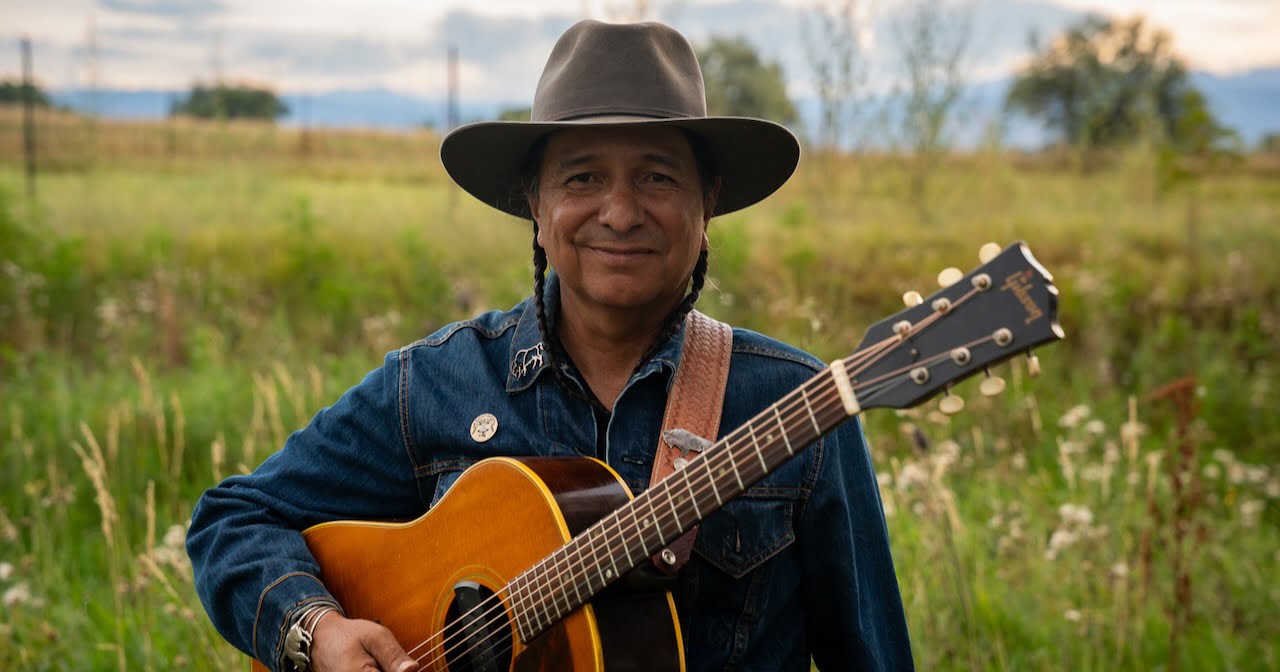
Cary Morin’s ‘Innocent Allies’ is An Unfiltered Palette of the American West

Guitarist Cary Morin’s (Crow/Assiniboine) new album, Innocent Allies, includes a striking painting on its cover created by renowned Western painter/sculptor Charles M. Russell (1864-1926), who spent his formative years as an artist in Morin’s home state, Montana. Innocent Allies, Russell’s work, depicts horses, cowboys, and settlers, routine subjects for the visual artist. The piece references how the iconic beasts of burden, who helped build the American West, were often innocent partakers in the violence, imperialism, and White Supremacy of American empire advancing across the rural, montane, wide expanses of the West.

For the new record, Morin leverages his expansive musical vocabulary – flatpicking, fingerstyle guitar, blues, folk, singer-songwriter, rock and roll and pop textures, and instrumental lyricism – to synthesize more than a dozen of Russell’s paintings and works into songs and tunes. The result is pastoral, evocative, and certainly cinematic. But these songs, as Russell’s body of work, are not sanitizations of the past or representations of American mythmaking and revisionism.

Morin views these paintings with a hefty dose of nostalgia, mentioning throughout our telephone conversation how this art was ubiquitous throughout his youth, his life in Montana, and its influence reaches well into his present, while he tours the country playing guitar from his new home base in Colorado. But that nostalgia isn’t predicated upon turning blind eyes to the atrocities endemic to Americana imaginations of “cowboys and indians,” Manifest Destiny, and the genocide and displacement of Native peoples.
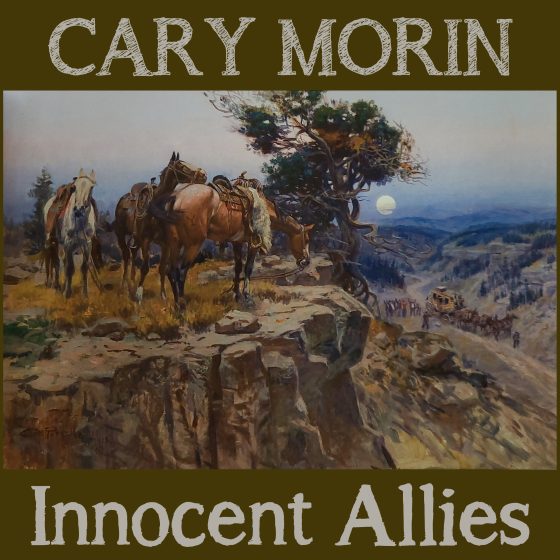
The cover art for Cary Morin’s ‘Innocent Allies,’ including Charles M. Russell’s visual work by the same title.

Like Russell before him, Morin offers a grounded, realistic, and eyes-wide-open perspective not only on Russell’s body of work and those iconic images, but on the entire American societal construction of the West, as well. He does so with a formless and gorgeous genre fluidity and with playing styles entirely his own. Each track is stunning and expansive, even in their moments of intimacy and coziness.

Innocent Allies is a delicious record, made ever more fascinating by its unique concept, its nuanced inspirations and influences, and Morin’s one-of-a-kind voice on guitar. We began our interview chatting about the album’s conception before discussing Montana bluegrass, the constructive uses of genre, Beyoncé’s impeccable choice in Rhiannon Giddens’ banjo playing, and so much more.

I wanted to begin by asking you about the art of Charles M. Russell and how it inspired the new album, Innocent Allies – not only is his work on the cover, but it’s also very clear that these are cinematic and very artful songs. They’re very evocative. How did you take a different medium than your own and translate it into your own art?

Cary Morin: The album and the artwork all comes from my upbringing in Montana in the ‘70s. People from Montana all know that Charlie Russell is our most famous artist that ever came out of Montana. There have been a bunch of [artists] actually, but he’s kind of the top of the pile. When I was a kid – probably even today, too – anywhere in the state, you’re gonna be surrounded by his paintings or his sculptures.

He moved from St. Louis, Missouri when he was, I think 16? His parents gave him a train ticket to go out [West] and they wanted him to work on a sheep ranch owned by a friend of theirs for a while to get this fascination that he had with Montana out of his system. But it kind of backfired. He ended up living out his days there, for the most part. He gradually became a really advanced sculptor and painter, eventually getting to the point where he could really [demonstrate] action in the things that he created. He could [depict] minute muscles and forces and accurate movement – same in his paintings.

He ended up doing thousands of paintings and sculptures. They’re in collections all over the world now. Not only in Montana, but there are some museums around the U.S. that have huge bodies of work from him. When I was a kid, the coffee table books that were soon to follow his work, my dad and my mom ended up having all of them. My dad was a huge fan of his books, his writing, his stories, the letters that he wrote to everybody, the paintings, the sculptures.

With that stuff just always laying around when I was a kid, I became pretty familiar with it. I’m by no means an expert at that, but I just grew up around it all and know it pretty well. With this album, originally I was going to do a tribute album. It was going to be as country as I could make it. I’m not really a country player, I grew up in Montana. I can understand how it’s put together, and I could play some pedal steel. I’m pretty much a novice, but I know enough to get by, at least in the studio. So, [originally], it was all going to be all written by another artist.

After a while, I just couldn’t get my head around putting out an album where I didn’t write a single song on it. I think we were at home listening to Red Headed Stranger and I thought, “Man, I really love the production on this.” That was another favorite of my dad’s. He loved Willie Nelson.

I thought the production feel of [that record] would go along with the paintings in the coffee table book that was sitting right in front of us. It was kind of like a moment and a suggestion. The more I thought about it, the more I was like, “This takes care of everything.” I know a fair bit about Charlie Russell and his paintings are so accurate, they all tell stories. So I just started writing stories about the paintings. Looking at them and trying to imagine that scene and that moment of time that he captured. I wondered what happened before that moment and maybe what happened after that moment. Pretty soon we had a good pile of songs. It was a really fun process. At the time, we didn’t know what we were going to do with it. I mean, maybe I felt like it was a good idea, but after if it ever got done, then what?

Well, it definitely sounds like your own kind of sculptural process to get to this album. Carving something and then seeing where it leads you; starting with an idea, but then following the art wherever it goes.

I want to ask you about genre, because we’re having this conversation in “the zeitgeist” right now with Beyoncé and with Lana Del Rey and other people “going country.” On one hand, genre feels so important in this moment and on the other hand, it feels like we are accelerating ever faster toward being in a post-genre world. When I listen to this album, like you’re saying, it does remind me of Red Headed Stranger. It is straight up and down country to me.

But I wonder how you view genre, yourself? Is identifying with genre useful to you? Do you think it’s kind of a vestige of the past? How do you identify with genre at this point and with this record?

Well, with me in particular, that’s a pretty interesting question, because in the early ‘70s, when I was starting to play music and get interested in music, I lived in Montana. With my dad being a military guy, I didn’t really have access to a lot of albums of a wide, eclectic variety of genres and of sounds. But I did end up listening to classical music and my folks were big country fans. My oldest brother was a rock fan. I would stumble across things. I became a bluegrass fan from the influence of my best friends.

I didn’t really understand genres. I just heard music and I liked it. I didn’t really know how to put labels on it. I wasn’t aware of publications that would outline where the boundaries are on music. I didn’t think of things as a specific genre – although, you know, I sure liked the way that Doug Kershaw played fiddle, however I came across that! Or, I really appreciated the way Chubby Checkers played piano. That was all from Louisiana, but I had no idea what Louisiana was, or what Canadian music was, or any of that. It was all just music that I liked.

Having grown up without all that knowledge, I think it did have an effect on how I play music, because I would kind of bounce from genre to genre. I played with a band for 20 years, and we would play like the way Stevie Ray Vaughan played blues guitar. I didn’t really understand that much about blues music, but I thought what he did on David Bowie’s album was amazing. And so that had an influence on the way I play guitar. I really love Pat Metheny, and that had an influence on how I play guitar. I really love Mark Knopfler. It’s like all these genres couldn’t be any farther apart, but they all had a place in my mind. I maybe didn’t realize it at the time, but all those little influences would end up having an effect on how I make albums.

Genres now, that I hear on the radio – which is really only when I drive around – that’s [usually] like a public station, a community radio station, so I don’t really hear pop music. But, everything’s kind of starting to sound the same. I don’t know why that is. I think that maybe money has something to do with it. You know, “What sells?” What the buying public listens to, in order for advertising to be sold. I guess I don’t really pay attention to it too much. But I think that a lot of it’s driven by money.

You know, I can’t understand why Beyoncé would shout out to the world, “I’m gonna face country music!” and have that feel [like a] benefit. I think that she would only do that if she was motivated by something other than her love of Hank Williams. [Laughs] You know what I mean?

[Laughs] it’s hard to imagine! And then, at the same time, in the 100-ish years country music has been around, this seems to be a routine move. There’s always this moment where the people on the inside aren’t making that much money, or feel like they aren’t making much money, and you see someone like Lana or Beyoncé coming and you think, “Wait… There’s money to be made here? What? Tell me more about this!!”

Exactly!

From listening to your music, I think I would describe you as “genre agnostic.”

But I was curious what your feeling was on the Beyoncé announcement and the press coming out on that.

I found it really interesting, because I’ve known Rhiannon [Giddens] for years. She played with Pura Fé an artist/group that I played with in Europe for like five years. To hear her pick up a fretless banjo and just beat it into submission, I was like, “Holy God!” I had never heard anybody play a fretless banjo before, let alone like that. What a perfect choice for Beyoncé. She picked one of the best banjo players that I’ve ever met. I was surprised and impressed.

Yeah, me too. And also to have Robert Randolph playing steel on the tracks. Beyoncé and her team very clearly knew that she couldn’t appear like a “carpetbagger.” It’s not the most perfect term in this context, you know what I mean. She didn’t want to be viewed as somebody who was interloping – she did a good job at that “authenticity signaling” for sure.

It’s a wild thing to watch happen and to watch the discourse, in the wake of the two tracks, half of the people being like, “That’s not country” and half of the people being like, “Black folks invented country music, Indigenous folks invented country music, this is nothing new.” To watch those factions bump up against each other again, it’s kind of endlessly fascinating to me.

Like John Travolta having a hand in the revival of Texas music! Some idea that somebody somewhere along the line has and it catches on and takes off. I like it, too. I think culturally, I love it when things evolve. I do remember when I was a kid that I would hear on the radio what people call “country music” and go, “Boy, isn’t this happening in what is called Southern rock already?” There’s always players borrowing from other players.

And then it’s the studio musicians that played in that stuff. They may have showed up on a Bob Marley album somewhere along the line, too, because they played in a studio. Hell, man, when I was a kid I didn’t even know who Bob Marley was. I think it’s great that people learn from each other.

I wanted to ask you about bluegrass. You talked a little bit about what bluegrass means to you earlier in our conversation, but also when we premiered your track, “Whiskey Before Breakfast,” but I wanted to give you a chance to talk about your bluegrass influence again – we are the Bluegrass Situation, after all. What does bluegrass mean to you as a genre, as a picker?

That also goes back to the ‘70s. When I was talking about all the music that I either got from my family or from older brothers and my best buddies – bluegrass was a pretty big deal in Montana back in those days. I remember early on listening to these albums that didn’t exist in my friends’ houses. Hearing about Flatt & Scruggs and maybe I heard it on TV. I’d see things on Hee Haw
And it definitely piqued my interest.

But the stuff that was going on in Montana, there was a band called Live Wire String Choir, which was a Montana bluegrass band. There was another one called Lost Highway Band that was a little bit electrified, but still bluegrass. And then there was the Mission Mountain Wood Band, which was kind of the king of all of them. They were straight ahead bluegrass, but from around Missoula. They actually appeared on Hee Haw one time, although I never saw that episode. They had an album called In Without Knocking back in the day and I was maybe around 12 years old, something like that. Everybody was buying that album. We had a copy of it, so I was learning those songs.

I think there was a plane accident and a lot of the band didn’t survive, but there’s one guy, his name is Rob Quist, who was one of the founders of the band. He still plays shows in Montana. His music and that band’s music turned me on to bluegrass. Through investigation and through the help of friends, I learned more and more about it. I got way into flatpicking. I never had an American-made guitar when I was a kid. I didn’t really realize the importance of that.

I was still fascinated with Tony Rice, and still fascinated with the crazy melodies that David Bromberg pumped out. I love John Hartford – so it was, I guess, a personal quest of mine. I have some friends that are pretty good bluegrass players. But I left Montana when I was 18 and I kind of pursued bluegrass for a while, but then I kind of got back into fingerpicking and fingerstyle guitar and eventually electric guitar.

And all that Clarence White stuff that I had heard and the Will the Circle Be Unbroken album, a lot of those artists that were kind of starting to press the boundaries of bluegrass music caught my attention. Eventually, I just abandoned that piece of guitar [playing] altogether and got really into playing electric guitar for many years. It wasn’t until maybe 20 years ago that I started really getting back into playing acoustic guitar. I never really abandoned electric, but I started playing fingerstyle guitar and pursuing it. I’d play for five, ten hours a day, daily. I just couldn’t get it out of my mind, largely thanks to Kelly Joe Phelps.

The early acoustic experiences that I had never really went away and I was really interested in creating music based on all of those influences throughout my life.That’s where the fingerstyle thing came back in.


I think the tune that I like the best on the album is “Bullhead Lodge.” And I love the Charles Russell painting that inspired it. I wondered if you could take us into your composition process for “Bowhead Lodge” and specifically, how you were synthesizing those related paintings while you were improvising, composing the tune – because I think that’s really fascinating.

Well, thank you. I’m glad that that song resonates with you. First of all, Charlie’s painting of his cabin on Lake McDonald – Charlie painted from memory, he’s not a guy that you would see sitting out in the middle of the fields with an easel, as romantic as that looks, he wasn’t that guy. He ended up painting a lot of depictions of his view of the lake from Bullhead Lodge. There are so many of them and they’re all just serene.

I was playing a show with Phil Cook in North Carolina and at sound check, he said, “Cary, we could just play this thing…” and he played this short, open-tuning melody. “We could play this thing for 10 minutes and people would love it,” he said.

We just kind of sat there and tweaked it for a little while. I don’t remember the melody he played. We didn’t do that during the show. But, I always remember him saying, “Play the simple thing and people will love it.” When I was looking at those paintings of Lake McDonald, I just started playing this melody. It wasn’t really written on the spot, I suppose. I goofed around with it for a couple of hours, but then I came up with sort of four variations of a similar melody. I started with a simple one and then changed it and changed it and changed it until the chords finally changed into what tags the song.

Because of that process, I like that song too, because it’s a great memory. I was glad that it made it onto the album. People have been talking about that recording, it seems like it’s resonated with folks.


Photo Credit: Grayson Reed
When You Listen the Land Speaks

(Editor’s Note: Sign up here to receive Good Country issues when they launch, direct to your email inbox via Substack.)

An often nameless, faceless character present in all country music is land. In a genre commonly referred to as country & western, land is a constant presence, whether foreground or background, evoked or painted, longed-for or spurned. Another nameless, faceless character that comes hand-in-hand with country and its relationship to land is colonialism – white supremacy, genocide, and imperialism advanced by music that claims to simply center nostalgia, rurality, and an “old fashioned” way of doing things.

This kind of revisionist history in country music – a sanitization of this nation’s past and present, in order to fit into widespread myths, around which this genre and our national identity is built – is no less pernicious simply because it is common and pervasive. It’s important to not only acknowledge country’s relationship with land, but to also attempt to deconstruct the ways that these roots genres perpetuate colonialist ideals and norms.

Can Good Country exist if it must deny the history of the land it professes to love? Can Good Country exist if it must deny that there would be no “country & western” without Indigenous people? These are questions that we feel are essential to ask, right out of the gate, even if their answers are not so simple. Good Country hopes to be a place that can represent all kinds of country music, but it cannot do that if we accept, uninterrogated and unexamined, that country’s relationship to the land must be good, moral, wholesome, and just.

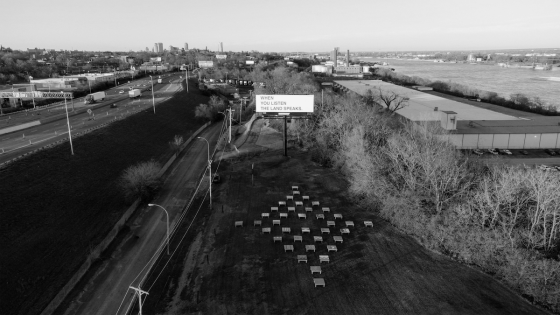
At the heart of the second edition of Counterpublic – an artistic activation described on its website as “a civic exhibition that weaves contemporary art into the life of St. Louis for three months every three years…” – just south of downtown and the towering Gateway Arch, sits Sugarloaf Mound. From April to July 2023, Counterpublic included twenty-five public art installations at a variety of locations, including Sugarloaf Mound, a sacred site for the Osage People and the last intact mound in the city. In earlier eras, the area was home to many thousands of Indigenous people – and the largest city in what would become the United States, Cahokia.

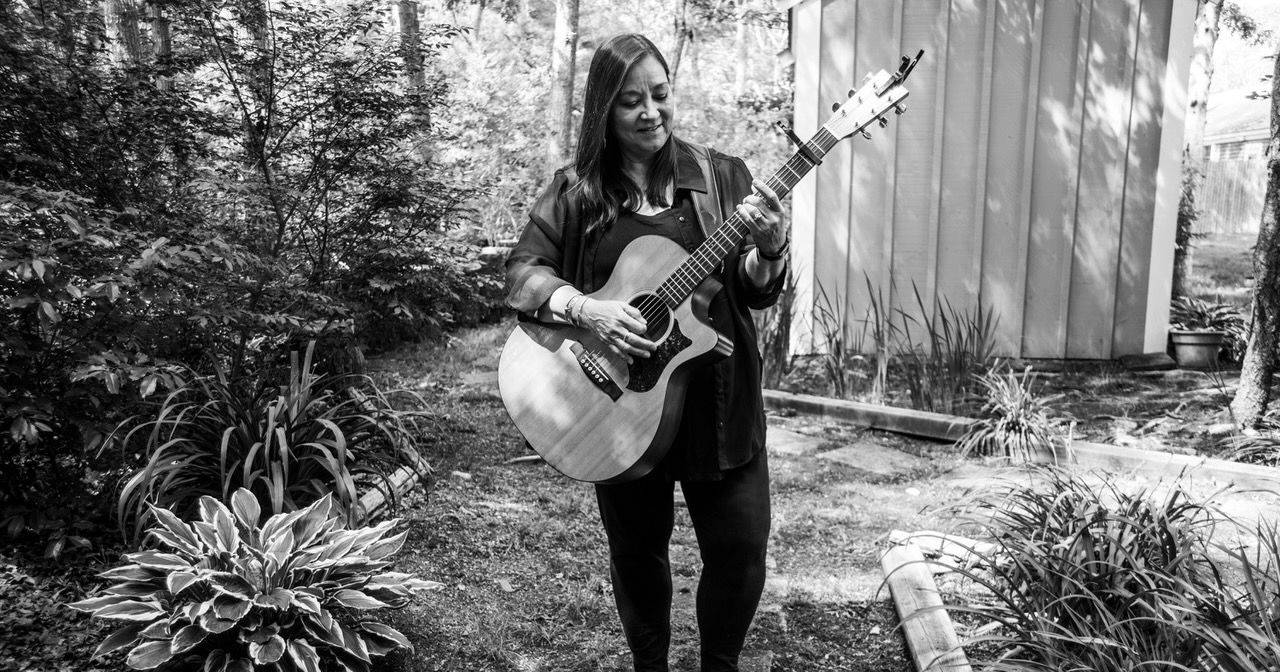
Adjacent to Sugarloaf Mound was the first Counterpublic installation and site, a collaborative piece that wove together sculpture, land, and music by mother-and-son artistic duo, Anita and Nokosee Fields. Anita Fields (Osage/Muscogee) is a fine artist who works in many media, but especially clay and textiles. Nokosee Fields (Osage/Cherokee/Muscogee) is a critically-acclaimed and in-demand old-time fiddler, equally at home in country and Americana as in old-time and string band traditions, and with a great deal of expertise on Indigenous fiddlers and Indigenous fiddling.

Their piece, WayBack, which was curated by Risa Puleo, is synopsized as such:

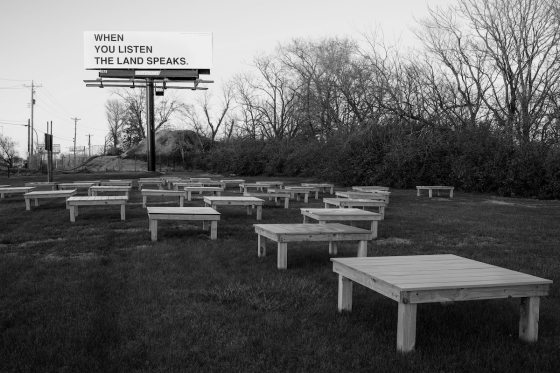
“Created in collaboration with her son Nokosee Fields (Osage/Cherokee/Muscogee), Anita Fields’s (Osage/Muscogee) WayBack invites visitors to gather in physical relation to each other, to Sugarloaf Mound, and to Osage ancestors, history, and legacy. When the Osage Nation purchased part of Sugarloaf Mound in 2007, the sacred site was reabsorbed into the Nation through the auspices of property, extending Osage territory from the site of their displacement in Oklahoma back to their ancestral homeland. Atop this site, forty platforms are installed, modeled after those found at Osage events in Oklahoma. Each platform is embellished with ribbons that reference Osage cosmologies of balance between sky, water, and earth. Nokosee Fields’s composition for wind instruments invites further consideration of the earth from which the mound was constructed, the sky that unfolds above the platforms, the sound of the Mississippi River on the banks below the quarry and the wind that flows through the surrounding trees that transform first into breath. After the exhibition, the platforms will travel from St. Louis to Tulsa where they will be distributed to Osage community members completing the link between the current home of the Osage Nation and its ancestral homelands.”

“Middle Waters,” the labyrinthine composition by Nokosee that acted as soundtrack for the installation, its platforms, and the adjacent mound (listen via the Counterpublic site here), perfectly illustrates how adept country music – and its textures, styles, and traditions – can be at capturing the ineffable, spiritual qualities of land and our relationships with it. Fiddle, field recordings, wind instruments, voices, and more intermingle in a piece that feels as organic and grounded as Anita’s sculptures.

Now, after the installation’s closing, each of the forty platforms constructed by Anita and displayed at the Counterpublic site will be moved to what’s now called Oklahoma, to be distributed to members of the Osage community and to have a continued life, further illustrating how art, music, and land gain all of their meaning from the communities that interact with and rely on them.

On the occasion of Good Country’s inaugural issue, we spoke to Anita & Nokosee Fields about WayBack, “Middle Waters,” the Counterpublic exhibition, and how humans, land, music, and art intersect and combine.

Could you just take me into the inspiration and the conception of WayBack and how you started working together and collaborating on the piece, not only with each other, but also with the land and with the site? Um, maybe Anita, do you want to start?

Anita Fields: Sure. Over two years ago now I was contacted by Risa Puelo, who was one of the curators chosen for the Counterpublic triennial in St. Louis. [Risa] asked if I would like to join and explained their purpose, what they were doing, and what their groundwork was for the triennial. She said, “I know your whole family are artists, so if you would like to invite somebody from your family to participate with you, that would be absolutely fine.”

But let’s begin with what their goal was, and that was to talk about the difficult histories of a place. St. Louis is certainly one of those. The reason that I was asked to join was that, for the Osage People, St. Louis, Missouri – and even further than that – is our ancestral homeland. It’s a large area, including St. Louis, Missouri, Arkansas, and even further than that in the beginning, migration from almost the East Coast to the Ohio Valley, to where our written and documented history begins in Missouri. So that was our homeland and there are documented villages there, still, and lots of history there, because after Lewis and Clark’s expedition we held the trade there. After Lewis and Clark, we started interacting real heavily and marrying with the French, partially because the French were trying to hold onto political power through the fur trade.

That is our history there [in St. Louis]. And then of course came displacement. A series of treaties started moving us out of that area, ‘til we came into Kansas. We had a reservation there and then we sold that reservation and with that money we bought what is our reservation today from the Cherokee Nation in Oklahoma. That’s it in a nutshell, and of course it’s way more complicated than that.

Nokosee and I don’t live in close proximity to one another, so I was like, “Oh my gosh, is this going to be able to work over the phone and Zoom? That’s going to be kind of difficult!” Then an opportunity arrived for me to go to Bogliasco, Italy for a month-long residency. I asked if I could bring a collaborator, and that’s where we landed for a month – on the Mediterranean, in this beautiful, beautiful, beautiful place, on the coast of Italy, not very far from Genoa. We schemed and dreamed and planned. And it was very difficult trying to arrive at a place where we were both happy.

Nokosee, I wonder how, as a songwriter and composer, you began approaching this? How did you take your musical vision and dovetail it with the physical vision, with the sculpture, and with the place? What was the process like as you sat down in Italy to start creating together?

Nokosee Fields: When we were both in Italy, I had a little field recording kit that I had been using. I would just roam around the grounds recording things. There’s the ocean right there, there are all these really intense waves happening, a lot of sounds to be had. There was also a poet, Robin Robertson, who was a fellow there at the foundation and I asked if he wanted to do any collaborating, because we had a lot of time there – it was a testament to the importance of having space and time to have creative thoughts. Which, I feel it’s really rare. For a lot of artists, you have to hustle a lot. We were there for one month, I was getting very regular sleep, I was eating three nourishing meals a day, and getting some exercise. And again, it’s also in this beautiful location, and we were surrounded by really smart artists. It was just a very stimulating, nourishing, and calm environment. I was able to actually have some visions and clarity. And I was able to indulge a lot of things – where, you know, most of the time I’m just barely piecing things together to make money or to pay rent.

It began with [Robertson] reciting a poem, then I started layering him reciting this poem with the waves and different sounds from around the grounds, manipulating them. I like the idea of using really intricate, small, detailed, fine sounds – using a really sensitive mic – and then turning that into something else. Or, pitching it, layering it on top of people’s voices or singing, or maybe something a little more recognizable.

For me, the space and time to have all of that creative flow happening – it took what felt like a month of just space to finally get somewhere with something. It was eye opening, a testament to needing space and time, because we kinda flip-flopped back and forth on what we were gonna do. I wouldn’t say we were struggling, it was just that we were in this new place and jet lagged. Our project was not hands-on, because it was just all conceptual, so it was a little difficult to land on something.

I do want to talk about the site, because – obviously I’ve only seen the photos – there’s an interesting juxtaposition of this kind of dreamlike soundscape for the piece with “Middle Waters” and then the site itself feeling somewhat shoehorned into modernity. You have the river there you have the highway here and of course there’s a billboard incorporated into the piece, as well. Anita, can you talk about how you wanted to play around with that juxtaposition with this sacred site that now is somewhat entrapped by modernity and by settler culture?

AF: There’s always a backstory surrounding my work, and how I came to be. I was born on the reservation and spent a lot of time with my grandmother, who was full blood, and I’ve chosen to be very close to my culture, even as an adult. As much as I could, I did what my grandmother did for me for my children, to make sure they have a place there, [in my culture]. In my own work, as I became older and older, I would be inspired by things that come from our worldview, which is a very complex worldview, but it’s very beautiful.

We still have those values. As a modern person, those values are still in place – you know, where I’m from. You can witness them in how we interact with one another, a lot of times. I think that is a very beautiful thing to know that what my ancestors left for us you can still recognize. A lot of my work surrounds that kind of thought, that there is another way of looking at the world that is not just a tunnel vision of, “We’re all like this and we’re going to go to the mall forever.”

And that’s our worldview; it’s way deeper than that. Through art, that’s a beautiful place to be able to tap into those kinds of thoughts and values. So I wanted, because that is our original homeland and that is such an important site, I wanted to be able to bring in this sense that we’re reclaiming that space again, marking it as ours, and [saying] this is who we are. I want people to know this is who we are.

Those wooden platforms are actually found throughout [our culture]. I’ll describe it to you this way, because this is the way I write about it: They have been around for a very long time. My earliest memories of them are when I was a young person, a young girl going around with my grandmother, and I would see them outside of large Osage homes or outside of our dances.
At camps, people have family camps, and these platforms would be there and you’d see older people putting their blanket down and sitting on it and then maybe somebody giving them a glass of lemonade or a Coke. And then they’d light up a cigarette and they’d be just visiting and laughing away with a relative or a friend.

And it always looked very calming and peaceful to me. Those are the kind of memories too that I often tap into. But it’s also much deeper than that. What I was seeing there was, yes peaceful and calming, that was happening, but I was also witnessing survivors who had gone through a lot just for us to be able to be here. There are always these links.

What better place to be able to bring those [platforms], because that is the place that we had to survive from, to move from St. Louis. I’m always interested in giving people a glimpse into who we are. It’s not my job to talk about ceremony or rituals or any of that kind of thing. But I want people, again, with that thought in mind, I want people to know who we are and that there’s a different way of looking at the world and it comes from very complex, intelligent thinking and is based on observing nature and the cosmos. These values and these systems are still here for us today.

With the platforms, we started by going to Google Maps, downloading maps and images, and the site was kind of big, so it wasn’t working with one platform. And we just kept going, “Guys, that platform is gonna drown in that big space!” It’s beautiful to be able to work with a great curator because between our conversations with all of us we decided, if the money can be found, maybe we can have more – it began there. That is how those arrived and then we topped them with designs that are familiar to us as Osage People. We painted those on there, designs that are used in our ribbon work clothing – which comes directly out of our interaction with the French, when we started trading for ribbons and needles and threads and thimbles and that kind of thing. This kind of interaction with the French and our time there totally changed our culture forever.

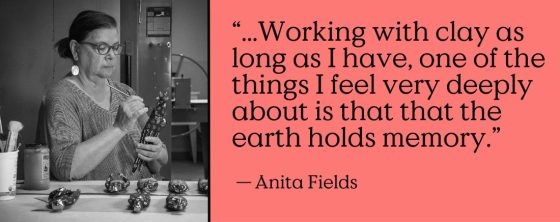
…You know, with working with clay as long as I have, one of the things I feel very deeply about is that the earth holds memory. That has been revealed to me, just because of how clay is made over time. I’m certain it holds the memories of who was there, wherever in the world.

I mean, in Italy, a couple of times when we would travel to these places and then we would read about the history, I felt that there, too. No matter where you’re at there are always the similarities to what has happened in history – “the conqueror” and “the conquered” – these stories are all threaded together and similar. I couldn’t see WayBack without sound in any way, shape, or form. It just wouldn’t have the punch that I was looking for.

I did want to ask, where are we at in the lifespan of the piece? I know that the plan is to distribute the platforms to Osage community members back around Tulsa. I just wonder where you’re at in that process?

AF: Yes, it was temporary and as soon as Counterpublic closed, I think it was within two weeks, they were picked up and shipped back to Tulsa to the [Tulsa Arts] Fellowship. The Fellowship is storing them for me. Then I got a call from the First Americans Museum in Oklahoma City, which is I think in its second year. They have a beautiful courtyard plaza and they have built a mound-like area where you can witness the solstices. The curator was at the Counterpublic closing and she said, “I want to bring these to First Americans Museum, what’s the plan for these as soon as this is over?” Well they took half of them and then half of them stayed here, displayed at a place called Guthrie Green in Tulsa for about a week. Yesterday, the ones from First Americans Art Museum were delivered to the Osage Nation. I want to distribute them to the Osage community. In my mind I’m like, “What am I going to do with 40 platforms when they return? What’s going to happen with these and who owns them?” And actually that was [curator Risa Puleo’s] suggestion: Is there any way these could be returned to the Osage community?

People are excited about it, those that know about it. Not a whole lot of people know. I’m trying to keep it [quiet] ‘til I get it all figured out, but they’re excited about it. I’m excited about it, too, because that is another way to make art accessible. To bring it back to where you come from. Because those folks are totally my inspiration, and I say this at every turn, whenever I have the opportunity. You’re my inspiration. Your grandmother, my grandmother, every interaction I’ve seen throughout my life. This is my inspiration.

Nokosee, I wonder, do you see a similar way of bringing “Middle Waters” to the people? Do you see a lifespan for that piece beyond this installation? Or do you think it’s a moment in time and it’s onto the next work?

NF: Yeah, I think it’s just a moment in time. I might edit it, but I’m pretty pleased with it. If anything, it’s more of a reason to want to do more sound installations, sound art kind of things. I’ve been wanting to transition to that kind of work. As much as I’ve enjoyed touring – and I’ll probably do it for as long as I can – I find it to be pretty taxing. It’s tons of fun, but I think I need something that’s a little more cerebral, a little more isolated, a little more supported, and also a place for my voice and creativity. I feel like I’m kind of waking up from an obsession where I just got into traditional American music, traditional fiddle. Now that I’m steeped in that world and I feel like I’m really a part of it, I also feel like there’s a lot of it I just don’t really care for.

This sounds really uppity, but making traditional fiddle music feels kind of separate from [country], it’s just melody. I like the foundational aspects of music and the research and tone, things like that. And I like it because it’s not really tied to lyrics, it’s not putting on a type of personality, like lyrical content [does].

That, to me, is often just perpetuating settler mythology about old-time music. There are a lot of things that could be said about old-time music that are also problematic. Instrumental music is where I really jive and get into stuff, but I’ve also had to constantly interface and participate in lots of country music or lyrical music that has content that, to me, just feels like propaganda with really rudimentary, basic understandings of the land.

It feels like a type of erasure. It’s just kind of designed that way – maybe not maliciously – but it’s just so deeply woven into how things work in this country. …I find a lot of country music today, a lot of the younger, popular stuff, it feels like it’s about convincing white people that they’re white or something. There’s this pseudo-woke take on country music, which I think is fine, it’s just not radical enough for me or something. It’s like it’s just enough for people to kind of maybe get their outlaw fix.

It still doesn’t work for me and I still find it very rudimentary and actually not very confrontational or very deep, as far as what’s actually going on in the world or on this continent.


Sign up here to receive Good Country issues when they launch, direct to your email inbox via Substack.

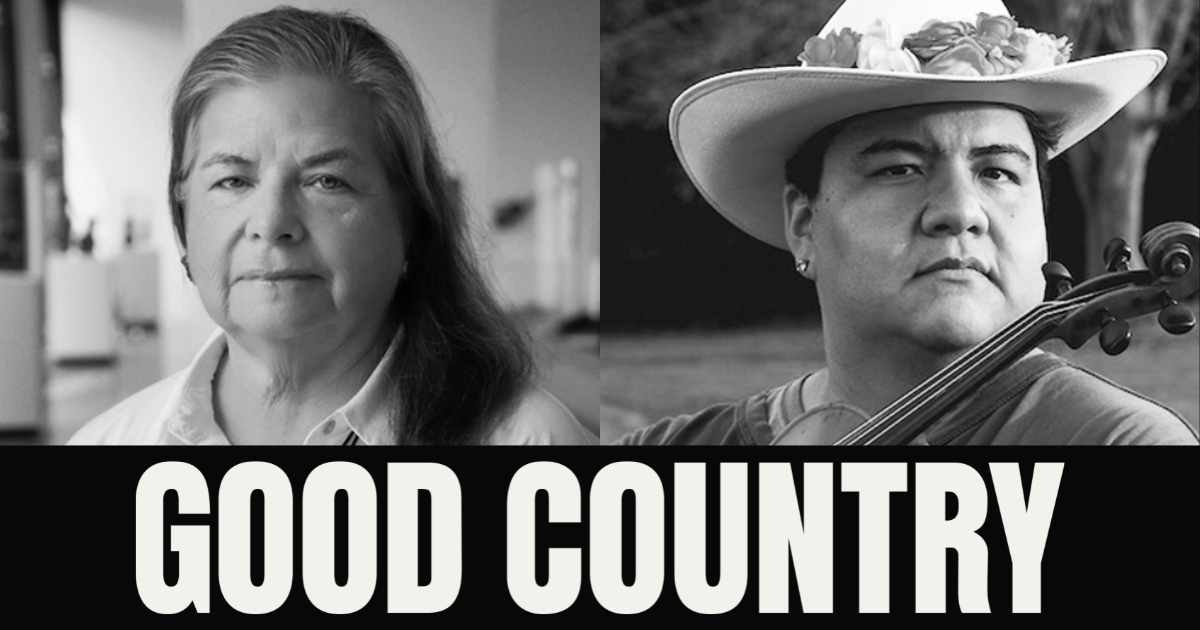
Lead Image: Anita & Nokosee Fields via Counterpublic.
Image of Anita Fields: Courtesy of the Artist.

Headline text from Anna Tsouhlarakis, “The Native Guide Project: STL.” Billboard and digital signage. Curator: New Red Order. Counterpublic 2023, Sugarloaf Mound Site.

LISTEN: Cary Morin, “Whiskey Before Breakfast”

Artist: Cary Morin
Hometown: Born in Billings, Montana; now based in Fort Collins, Colorado
Song: “Whiskey Before Breakfast”
Album: Innocent Allies
Release Date: January 26, 2024

In Their Words: “‘Whiskey Before Breakfast’ is a song that I learned as a child, when my interest at the time was mainly bluegrass music, something I loved very much. Since those early days, I have abandoned the guitar pick and prefer to play fingerstyle guitar. I was inspired to record this old traditional tune by my interest in the famous Montana band, Mission Mountain Wood Band. I loved their combination of bluegrass and other genres of the time. Their album, In Without Knocking, was always on my list of favorite recordings and I particularly liked the album cover, which is the painting by [Charles M. Russell] titled, ‘In Without Knocking.'” – Cary Morin


Photo Credit: Grayson Reed

Texas, Townes, and the Truth

(Editor’s Note: Sign up here to receive Good Country issues when they launch, direct to your email inbox via Substack.)

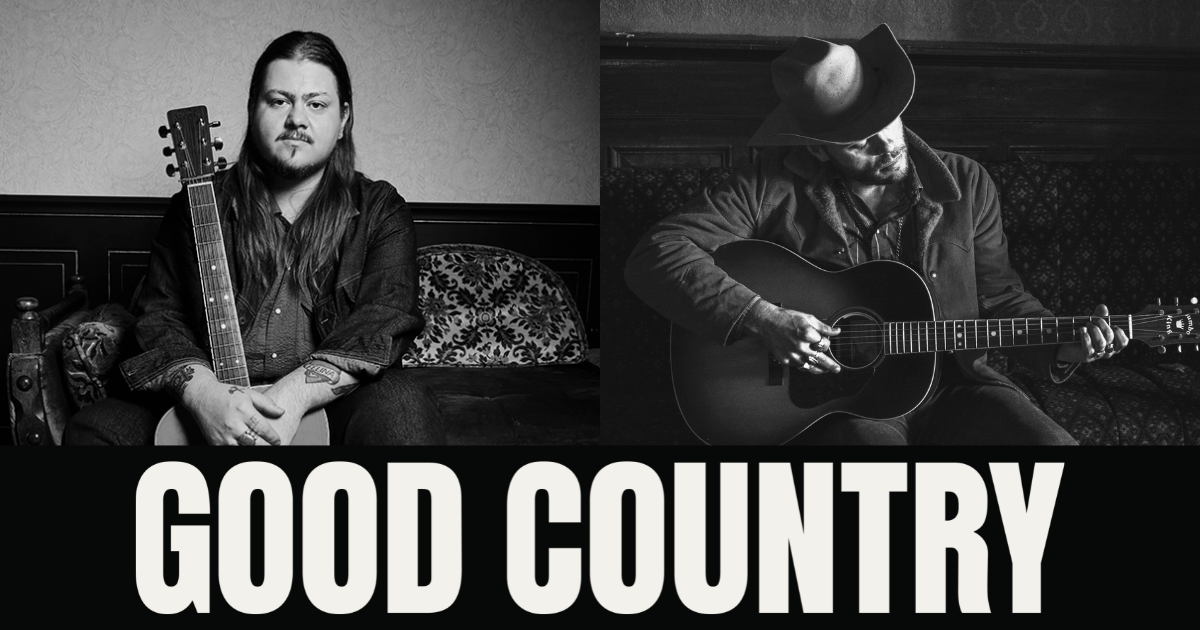
In advance of the release of Vincent Neil Emerson’s latest, critically-acclaimed album, The Golden Crystal Kingdom – which dropped on November 10 – BGS moderated a conversation between VNE and his friend and peer, country & western singer-songwriter and song-interpreter Charley Crockett.

Both artists cut their teeth in music venues in Texas a decade ago. In our conversation, they tell the story of how they came to know each other and discuss ways they protect each other within the business. They talk about covering and cutting each other’s songs and the importance of telling their truths.

Emerson’s new album, produced by Shooter Jennings, veers his sound toward warm ’60s rock and folk influences. He opens up to Charley and BGS about its creation process and what is on the horizon for him.

Charley Crockett: What’s up, Vincent?

Vincent Neil Emerson: What’s up, my boy?

CC: Another day, another dollar.

BGS: Tell me where you both are in the world right now.

VNE: I’m in Asheville, North Carolina, right now, at an Airbnb.

CC: I’m up here in San Luis Valley in Southern Colorado.

Both really nice places to be in the fall.

VNE: You ain’t wrong.

Can you give us a little bit of context about your relationship, where you know each other from, and how long you have been working together?

VNE: Charley, you wanna go?

CC: Oh man, I always tell that story; I wanna hear it from you.

VNE: I met Charley in Deep Ellum. We were playing around town, playing a lot of shows around there and Fort Worth. That was over 10 years ago, maybe?

CC: I was trying to think about it this morning. I think it had to be ’13 or ’14.

VNE: That’s crazy, man.

CC: He remembers it being at Adair Saloon; I remember it being at the Freeman. It really don’t matter, ’cause I’m sure it was both places.

VNE: I’m sure we went and had a drink at Adairs or something like that.

CC: I remember I walked up on him and said, “I like all them Justin Townes Earle songs.” And he said, “I only played one.” I always liked what he was doing, and he used to play solo and do the guitar pools up at Magnolia Motor Lounge all the time. He’d be up there smoking a cigarette, picking through them songs like Townes Van Zandt, and I thought, “Oh lord have mercy, this boy is a force to be reckoned with.”

VNE: Man, I felt the same way as soon as I heard you, brother. I remember a couple of nights I saw you at the Freeman with this band. You had a bunch of guys up on that tiny little stage, and you were just ripping through all these songs, taking all these old honky tonk songs and flipping them on their head and turning them into blues and vice versa. I always thought that was so cool, man.

CC: I don’t remember that well, but I guess you’re right. In those days, every gig we played for both me and Vincent, we ended up getting booked by the same folks, or they were all standing together in some bar, no matter if it was Ft. Worth or Nashville or Los Angeles. One way or another, all them same business folks been standing pretty close to me and Vincent. And that’s the truth.

Well, that’s convenient if you like to work together, I guess. Charley, do you have questions you want to dig in on?

CC: You know, Erin, I don’t even know what the hell we are doing?

Let’s talk about the release of Vincent’s new album.

CC: Well, let me just do this then. Everything he’s been putting out with Shooter [Jennings], like everything else he’s ever done…If you sit there looking at Vincent and he surprises you, it’s like, “Oh damn, I didn’t know old boy was gonna do that.” The very next thing he does, it just happens again — every single time. I remember when he was playing “7 Come 11” way before anybody gave a damn about him and was looking out for his interests or his career. He had all them songs in his pocket way before anybody had ideas or designs on him and his business. I’ve said for a long time that “7 Come 11” is one of the best folk songs written out of Texas in 20 years. Remember Central Track, Vincent?

VNE: Yeah, they did a lot of write-ups on music.

CC: I will never forget that stuff when you did that record and what you were doing live. Erin, he was playing for 50 bucks and a case of Lone Star in them dive bars in Fort Worth, you know? He was living in a 10×10 room. He was hardly ever even standing inside of the damn joint.

A handful of us showed up at the same time, and we are all moving on our own paths, but we’ve all stayed pretty close, or we damn sure weave it together quite a bit even if we get way out there, you know, in the territories, we always come back to each other. I think I met Leon Bridges right around the same time that I met Vincent. I met him in Deep Ellum, too. There is a guy who plays guitar with me now named Alexis Sanchez. He had a band back then, and he was playing at Club Dada there for some little festival, and Leon Bridges was standing there in a trench coat and a bowler hat. I venture to guess that me and Leon and Vincent met each other damn near about the same time. There were a lot of other folks like that. Ten years later, especially for some Texas guys, you know, we’ve all grown a lot, and I think we have always supported each other and loved each others’ music. That’s only grown, and Vincent is standing there as one of the premier, original, authentic talents to come out of Texas since the turn of the damn century. I’m not blowing smoke. I’m just stating what is already happening.

VNE: Man, that is high praise. I appreciate you sayin’ that, Charley.

CC: Well, they want all this shit to write about it, but that’s just the truth. He was playing in Fort Worth and like I said, playing for all that low money. They were calling him Lefty. Why did they call you Lefty? I figured it was because you had a black eye or something.

VNE: Yeah, I had my left eye knocked out of the socket one time, and the nickname stuck for a while.

CC: I remember they wrote about you pretty salaciously there in the Fort Worth Weekly. I know a thing or two about that myself.

VNE: I would say it was because they were trying to sell papers, but it was a free publication.

CC: Shit, they are selling advertisements. I think the Dallas Observer is still doing that to me.

He was playing them bars, we were playing them bars. I don’t know which one of us is which, but more often than not, he sure seems like if I’m Waylon, he’s Willie. I have felt like that for a long time. You could change the names. I think about this stuff a lot. The business folks, it is always hard to tell what they are doing, but you can be sure they are rolling dice and betting and gambling on folks. It ends up being, a guy like Vincent that somebody like me can lean on a lot more. We can trust those guys, and I’m real happy with who I’m working with, and I’m sure Vincent is, too. It is the other artists living life for the song that gets us through. I know I feel like that about Vincent, and I feel like that about a lot of other guys I don’t know as well as him.

Kind of like Johnny Cash said, “We are all family, even though some of us barely know each other.” I think it is because we can see each other and know we are in the same boat and in that way, care more for each other than other people would. I think it is pretty serious. It is life and death.

VNE: That’s a good feeling to not feel so alone in that way and have people out there and doing things similar to you. They probably think a lot of the same thoughts. Me and you are good buddies, Charley, and I feel that way, too. I feel like some guys out there like Tyler Childers – I really respect him, and I feel like he is in the same boat as us. I’m not as well known as you guys, but I think none of that really matters. I think what it comes down to is that we are all songwriters trying to make our own stories happen and be true to ourselves and honest to the world. I think that the reason we can relate to each other is the same reason the fans can relate. Honesty will cut through anything and bring people together.

CC: One way or another, them folks we are selling tickets to, they know.

VNE: You can’t fake the funk, I guess.

CC: Eventually, it comes through. Speaking of Tyler Childers, we ended up on the same plane flying from Nashville to Austin recently… I was there for the Country Music Hall of Fame induction and I didn’t want to go. I get real antisocial and want to hide out from everybody and shit, and I went to Nashville kicking and screaming. Tanya Tucker was getting inducted to the Hall of Fame with a couple of other people. Patty Loveless and Bob McDill, who I wasn’t that familiar with. I had thought that he’d written the Jimmy C. Newman song, “Louisiana Saturday Night”, which I know real well. To be honest with you, it is the only reason I agreed to go out there, ’cause I love singing that song. I made a lot of money writing songs off of that song, so I figured I owed whoever the songwriter was. Long story short, there in the last week, I found out it was a different “Louisiana Saturday Night,” regularly mistakenly attributed to Bob McDill cause he wrote a totally separate song called “Louisiana Saturday Night” that Mel McDaniel had a big hit with, and that’s the one that goes,

“Well, you get down the fiddle and you get down the bow
Kick off your shoes and you throw ’em on the floor
Dance in the kitchen ’til the mornin’ light
Louisiana Saturday night”

That was a big ol hit, right Vincent? He did “Baby’s Got Her Blue Jeans On,” and a bunch of shit like that that I just didn’t realize. My naive, ignorant ass goes up there to Nashville kicking and screaming, and that’s how I feel. A horse gets led to water or something like that. I saw Tanya get inducted. I damn near built my career off of my version of “Jamestown Ferry” when I was younger, and I realized that she had blazed that trail for me, and I had not shown her enough respect. I really hadn’t. Same thing with Bob McDill. All those songs he wrote and the advice he gave in his speech, and my dumbass could really shut up and pay attention to these folks.

Then I ran into Tyler going from there. He was flying to Austin to do a John Prine tribute. That’s how it is. When I see Tyler, I’m on a plane. When I see Vincent, it is at Monterey Fairgrounds. We are ships passing in the night. All these guys like Tyler, Colter [Wall], Leon, Vincent. Whenever I see them, they got a big light around them, and it is shining. You just want it to keep shining for them, and for myself, to keep it going,

I don’t know exactly where you want to go with this, Erin, but I’m excited about this record. Shooter was telling me about your songs and offered to send them and I was like, “No, I ain’t gonna do that. I wanna be like everyone else.” I wanna watch this thing get rolled out, and I wanna be excited. I’m looking forward to going through the songs.

Vincent, can you tell us about working with Shooter on this record?

VNE: I met Shooter a few times. Me and Charley were at this festival in Iowa hanging out, and Shooter came up to me and tapped me on the shoulder. I’d met him before at another festival but I’d never talked to him. He turned me around and said, “Hey man, I really like that thing you did with Rodney Crowell.” He paid me a lot of compliments, and since then, we talked, and when it came time to make another record, Shooter was the first guy I thought of. I thought it would be such a cool idea to work with him on an album. One thing about him is he really is one of the nicest people I’ve ever met, and he is a genuine fan of music. He’s trying to make cool things happen. I’m so lucky I got to work with him on it. That is the big takeaway from the whole thing for me was making a real good friend like that and meeting someone who gets me excited about songwriting and about making an album and making music in general.

Since Charley cut “7 Come 11” and you cut one of Charley’s songs for this record, can you talk about what prompted “Time of the Cottonwood Trees” winding up in this pile of songs?

VNE: Oh man – that song. Me and you were on tour together for three months, was it last summer? We did a bunch of dates, and we were on the road a long time, and I was listening to Charley do that song every night. It was a brand new song that hadn’t come out on his record yet. I got to hear him sing that song every night by himself, and I just think it is one of the best songs I’ve ever heard. It is one of my favorites from you, Charley. I think it is a fine example of songwriting. When it came time to make this album, I always wanted to pay tribute to you and cut one of your songs on a record because you cut “7 Come 11.” That really ties back into that whole Willie and Waylon and all those old timers who cut each others’ songs and lifted each other up like that. I just wanted to pay tribute to you, and that’s why I put it on the album.

CC: Shit, I appreciate it. I’ll be excited to get the check in the mail. You surprised the hell out of me with that one, you really did. I’ve always wanted people to cut my songs. Sometimes, I think I’d be better off that way. I have so many. I’ve always cut a lot of songs that weren’t mine, probably about half of them. And I got about a 250-song catalog of published shit. I would guess about 40-50% are songs I didn’t write. I feel like I’ve caught a lot of heat for that. People have an idea about me that I never wrote a single song. I think that’s because we live in an era where, like what Vincent was talking about, where all those folks back in the day, across genres, and it wasn’t just country it was pop, folk, soul, R&B. It was everything. Everyone was cutting each other’s songs. I just really think that to write a great song, you have to learn great songs from other people.

You have to watch out for these publishers these days. They’ll just put any piece of junk out as long as they’ve got control over it. They figured out they can make money selling junk. If you can make more money than ever before selling junk and you aren’t principled, and you aren’t that close to the music, well, they don’t see the reason not to do it that way. I think it feels like a renaissance.

VNE: Specifically in the genre of country music, there is a lot of junk out there. I don’t want to put anyone down. Most of the time, I just try to ignore whatever I don’t like. I think that’s the best way to go about it. I think there is room at the table for everybody, whatever you are into. I just think it is so cool that Sturgill and Charley and Colter and Tyler, all these other guys that are out here putting out real, honest-to-goodness songwriter songs. And not just that, but real country music. It doesn’t matter if it is your song or someone else’s; if you are telling that story honestly, I think that’s great. I’ve always appreciated you for that, Charley. I think you are a great interpreter of songs, and I think you are an even better songwriter, man.

CC: Damn, I’m glad I talked to y’all this morning. I feel better.

I’m glad that we are talking about cutting songs because that is such a huge part of country music, interpreting other people’s songs or reinterpreting a song. It feels like that art was lost in the past 20 years or so and it is having a resurgence. I’m excited that you guys are at the forefront of that, because great songs have more than one life. And it is an opportunity for songwriters to make more money.

VNE: I think it is one of the greatest compliments that a songwriter could receive – to have an artist who they love and respect cut one of their songs.

CC: There is no question about that. That is the best feeling.

VNE: It is, cause you know that your songs has legs and can go places that you can’t, which is a great feeling.

CC: It really is. It is such a political world, and it is so divided. There is a lot of pressure on people that you step out there into the great mirror of society, and the more out there in front of the public that you get, there is a mirror that starts projecting on you, and it is tough to deal with. It is hard to know what to do, but the thing about it is – being able to write honest songs and tell the truth in your writing; that is the most rewarding feeling. That is why I always look forward to what Vincent is doing. There aren’t a whole lot of people that I anticipate their new works as much as him, if anybody really. That’s the whole deal. You look over, and he’s writing better and better, and it makes me want to write better, too.

Speaking of, Vincent, can you talk a bit about your writing process for this record?

VNE: I kind of pieced together songs over time. Sometimes they jump out real fast; sometimes it takes a while. And thanks for saying that Charley, brother. Damn.

CC: I’ve been saying it for 10 years.

VNE: That’s kept me going a lot of times and I don’t think you realize that. These songs – damn, what was I saying?

CC: You were saying sometimes they come quick, sometimes they come slow.

VNE: I’m very influenced by the music that I’m listening to and that is why I try to be real careful about what I listen to. I think it is like if I’m making a smoothie. I gotta put certain ingredients in my brain, and it comes out me on the other end, hopefully. I was listening to a lot of Neil Young and Steven Stills and David Crosby. A lot of the ’60s rock and roll and a lot of Bob Dylan stuff. That’s just where I was in my headspace, so I was taking in all that. I try to put it all together to make it my own. That’s where I was at when I was making this album.

By the way, I’m excited about this rodeo we are playing together, Charley.

CC: Which one is that?

VNE: The National Finals in Las Vegas.

CC: Oh shit yeah! At the Virgin Theater there? Yeah man, I’m excited about it, too. Thanks for doing it.

VNE: Thanks for having me on.

CC: When it comes to money and shit like that, just any time, whatever you gotta do to make it work cause I wanna keep playing with you as much as we can and build up. I’ve played in some arenas recently, and I really don’t like it. I don’t know if country music belongs in arenas. And I just mean opening. I can’t sell tickets to no damn arena. And I take a cue from Colter cause he and Tyler and them boys, they could be in arenas all day long if they wanted to be. I would rather play rodeos and municipal auditoriums and really special theaters and stack ‘em up. I think we need to get a goddamned Dripping Springs reunion tour going. A real one.

VNE: Man, that’d be great.

CC: You know what I mean, just do some of our own shit. My aunt and uncle and a bunch of people who haven’t been out to see me play in a long time are coming out to Vegas. I used to live with my uncle when I was a kid in Louisiana and Mississippi and shit. He’s gonna flip his shit when he sees you.

VNE: I can’t wait, man, I’ve heard so many stories about him.

CC: He’s wild. We gonna show these folks what country music actually sounds like. They might not be able to tell who is left or right. Nahhh I’m just kidding it is a bunch of cool people.

Thank y’all for letting me be a part of this. I’m just happy to help out or talk about this. I’m real excited about the album for real. The imagery in your writing, man, it’s like everything you write is getting more and more vivid. You paint such a picture. I’ll stop blowing smoke up your ass.

I’m gonna get back on the trail and Vincent, I’ll talk to you soon.

VNE: Thank you for doing this brother, I appreciate you.


Sign up here to receive Good Country issues when they launch, direct to your email inbox via Substack

Photo Credit: Vincent Neil Emerson by Thomas Crabtree; Charley Crockett by Bobby Cochran

WATCH: Ethan Lyric, “I Love You More”

Artist: Ethan Lyric
Hometown: Winnipeg, Manitoba, Canada
Song: “I Love You More”
Album: Saskatoon Berries EP
Release Date: October 13, 2023 (single); December 1, 2023 (EP)

In Their Words: “The music video was shot in Vancouver, British Columbia, throughout the beautiful area of North Van alongside my cinematographer and long-time collaborator, Carter Heintz. Showing the journey and navigation of love through the simple and fun lens my music always tries to provide.

“The inspiration for this project as a whole came from a lot of artists and things in my life at the time. This single and my upcoming EP, Saskatoon Berries, take a lot of inspiration from the musicians I grew up hearing on YouTube – like Conan Gray, Cavetown, and Chloe Moriondo. All these people create music that just makes you feel at ease and want to smile, and that’s how I would love my music to be received as well. I feel this project was also deeply influenced by the process of finding myself and my identity. I always like to say that being an Indigenous artist, whether you write explicitly about Indigenous culture or not, your culture is one of the biggest inspirations to your art so I feel obviously that was a large inspiration as well.” – Ethan Lyric

Track Credits: Songwriter – Ethan Lyric

Musicians: Ethan Lyric – vocals, guitar
Jeremy Haywood Smith (JayWood) – bass
Brett Tizcon – keys
Anil Ramgotra – drums

Producer – Jeremy Haywood Smith (JayWood)
Recording engineer – Jeremy Haywood Smith (JayWood)
Mixing – Art Antony
Mastering – J. LaPointe (Archive Mastering)


Photo Credit: Julio Assis (BNB Studios)
Video Credits: Cinematographer – Carter Heintz

Edited by Ethan Lyric, Carter Heintz
Featuring – Matilda Shanks, Victoria McNeil

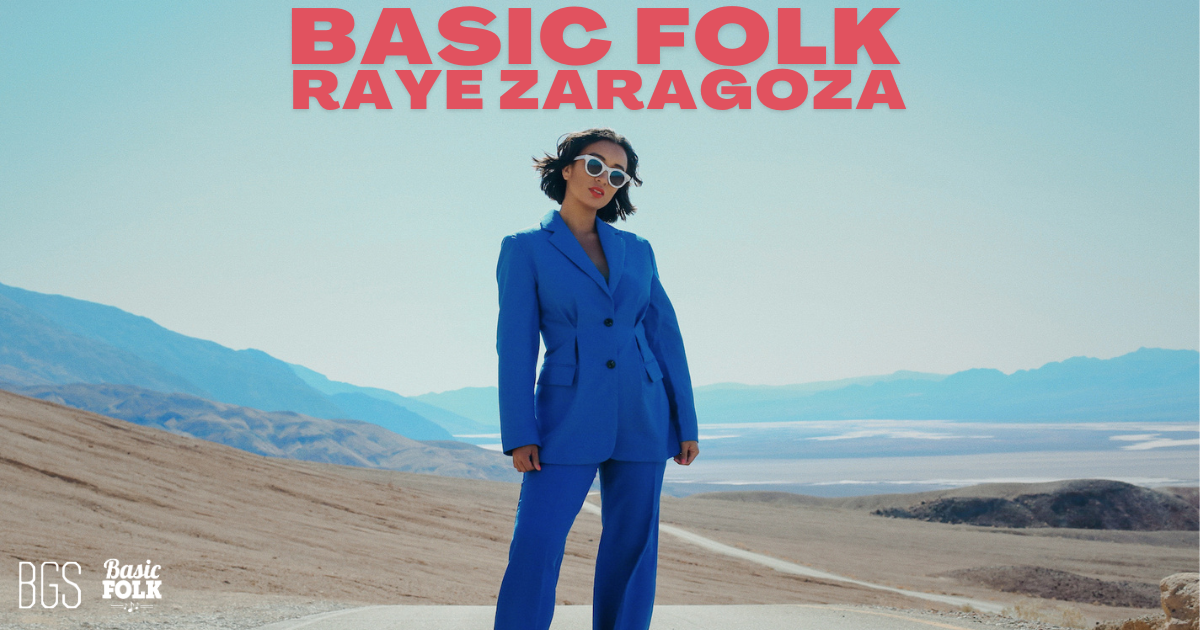
Basic Folk: Raye Zaragoza

The headline for Los Angeles-based Raye Zaragoza’s new album Hold That Spirit is that after she broke off her engagement, she used her wedding budget to fund the recording. She wrote the songs the year she turned 30 while she was thinking of the expectations placed on women in society to have everything together at a certain age: marriage, kids, career, etc. She’s decided to let those expectations go and live in the joy that life offers, and explores her newfound freedom and indigenous identity in these new songs. She’s moving forward as a role model in Los Angeles’ indigenous community, which she has been a part of since she was 14 years old.

LISTEN: APPLE • SPOTIFY • STITCHERAMAZON • MP3

We go through the album track by track covering topics of social justice, eating disorders and perfectionism. She worked exclusively with female collaborators on Hold That Spirit, which allowed Raye a vulnerability in her writing sessions and studio time that she had yet to experience. She found co-writing with other women an easy space to feel emotionally safe. Working with like-minded feminists and activists fueled this album, which has allowed Raye to begin to break through those unfair expectations society places on women. In our conversation, Raye is thoughtful and serious, yet fun and playful even with such heavy topics addressed. Thank you, Raye!


Photo Credit: Bolora Munkhbold

LISTEN: Kim Moberg, “The Eighth Fire – Wings of the Winds”

Artist: Kim Moberg
Hometown: Cape Cod, Massachusetts, the traditional territory of the Indigenous Nauset and Wampanoag Nations
Song: “The Eighth Fire – Wings of the Winds”
Album: The Seven Fires Prophecy
Release Date: August 11, 2023

In Their Words: “The Seven Fires Prophecy teaches us that the Native Elders go to sleep because the people turn their backs on their ancient wisdom and teachings. It also tells us that if we learn to live with one another and our environment in peace and respect, the Seventh Fire will light the Eighth Fire which is the fire of brother and sisterhood.

“It is my never-ending hope that, with a lot of work, we can and will accomplish this.

“I wrote ‘The Eighth Prophecy – Wings of the Winds’ as my vision of hope after hearing a comment by National Indigenous Archbishop Mark McDonald who said, ‘When it is time for Indigenous People to return to the land, it will be the artists who will call them back.’ I believe the time has come for artists — songwriters, musicians, painters, dancers — to awaken the Elders by being open, listening, understanding, and learning from their wisdom and sharing what we learn through our art.

“The song title honors all directions of the winds – north, south, east, west, up and down – winds that carry the ancient wisdom of the Elders to us. That wisdom tells us that we already hold the power to rise up and take action for peaceful and positive change. All we have to do is listen.” – Kim Moberg


Photo Credit: Barry Schneier

Basic Folk – Mali Obomsawin

Y’all ready for a crossover? Basic Folk listeners will remember Mali Obomsawin from their work as a bassist, singer, and songwriter with folk trio Lula Wiles, but today we are celebrating Mali’s debut as a jazz bandleader/composer. Mali’s new album, Sweet Tooth, was inspired by field recordings of elders from Mali’s Wabanaki community.

LISTEN: APPLE • SPOTIFY • STITCHERAMAZON • MP3

Mali’s improvisational approach to creating music results in a remarkable living piece of music that not only illustrates hundreds of years of their people’s history, but also illuminates their hopes for the rematriation of Native lands. One of the most insidious lies about Native people in the Americas is that they are relics of the past, not constantly-evolving communities. Through their music and activism, Mali refutes this claim. The record weaves field recordings with intense instrumentals and Mali’s stunning voice. They even co-wrote a Penobscot language chant to close the album. Sweet Tooth confronts heartbreaking history while insisting upon a path forward. It is at turns heartbreaking, jarring, tender, and fun.

Those who are interested in learning more about the concept of intersectionality will find this episode of Basic Folk fascinating. Mali and I dig deep into what it looks like to embrace gender freedom while remaining loyal to the bonds shared by women of color within a hostile colonial culture.


Editor’s Note: Basic Folk is currently running their annual fall fundraiser! Visit basicfolk.com/donate for a message from hosts Cindy Howes and Lizzie No, and to support this listener-funded podcast.

Photo Credit: Abby and Jared Lank

Carolina Calling: the Wilmington Effect

From Blue Velvet to One Tree Hill, scores of movies & TV shows have been filmed in & around Wilmington, North Carolina. Perhaps the best-known is Dawson’s Creek, the popular late-’90s coming-of-age drama series. While the show tried to tackle progressive storylines, its stark lack of diversity made Dawson’s Creek frequently cited as the whitest show ever. Nearly two decades after it went off the air, tourists still come to Wilmington in search of the show’s landmarks.

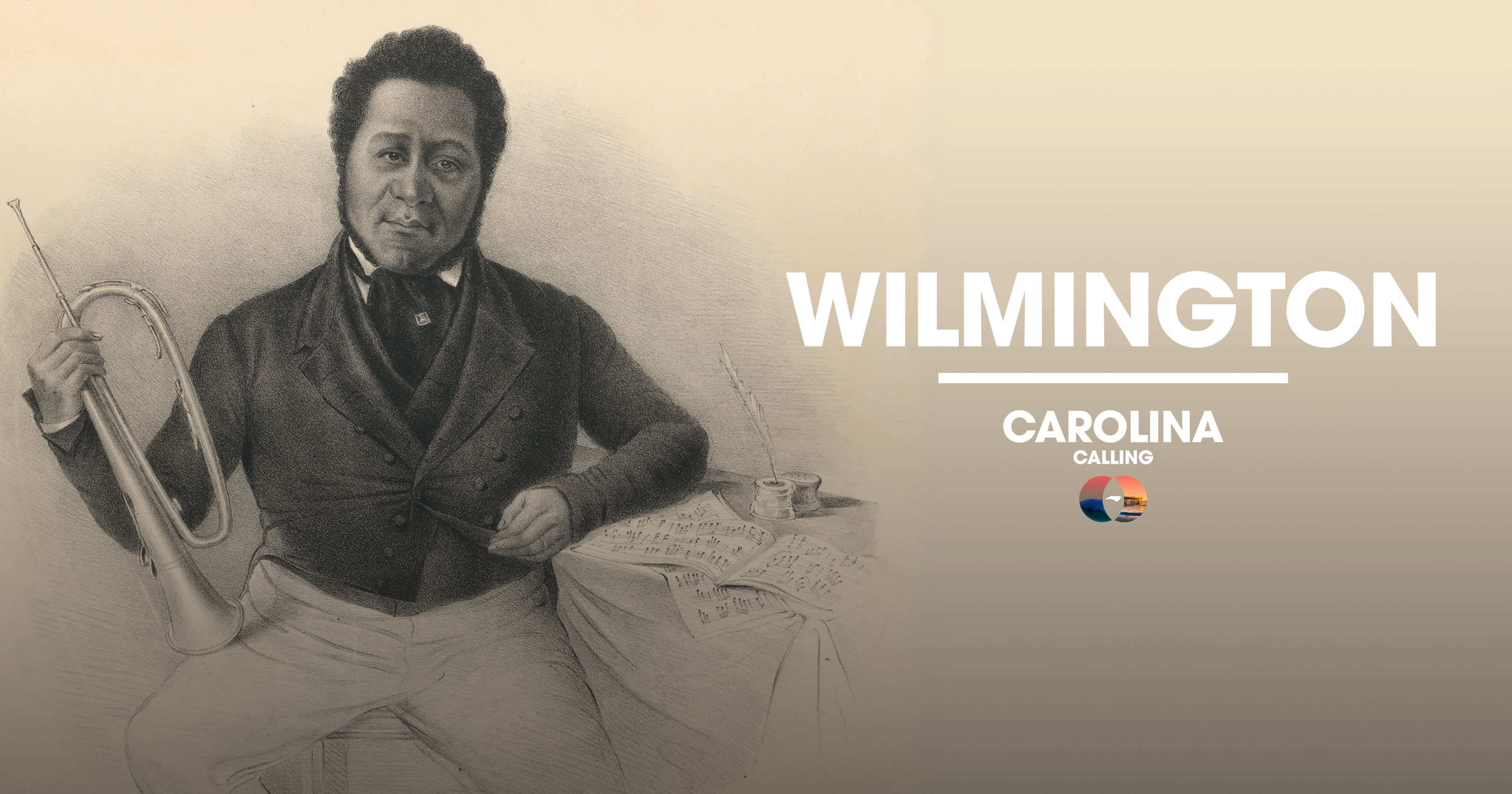
But Wilmington has a more difficult, less visible side to its history, politically as well as culturally, going back to the 1700s. Long before North Carolina became one of America’s original 13 colonies, there were thriving Indigenous communities throughout the region. There was also a time when Wilmington’s most famous musician was a man of color, Frank Johnson: fiddler, composer, and bandleader – and one of the biggest stars in American music in the years before the Civil War.

LISTEN: APPLE • SPOTIFY • STITCHERAMAZON • YOUTUBEMP3
 

During Reconstruction, Wilmington was an unusually progressive, forward-thinking town. In contrast to the state of things elsewhere in the South, Wilmington elected a racially diverse local government, led by both whites and freed Black people.

That came to an abrupt end in 1898 with a white-supremacist coup, a bloody rampage that left numerous people of color dead and Black-owned businesses destroyed. Those the mob didn’t kill, they chased out of town. That left Wilmington with a mostly white population, an all-white local government – and a whitewashed version of the city’s history in which Black people’s contributions were erased from the official story.

This might seem like ancient history, but it’s not. Wilmington’s most famous native-born musician is probably Charlie Daniels, the country-music star who died in the summer of 2020. Daniels was born in 1936 – less than four decades after that 1898 uprising. The real story of the 1898 coup is finally coming to light in recent years, thanks to works like the 2020 Pulitzer-winning book Wilmington’s Lie. But it’s still not widely known.

In this episode of Carolina Calling, we explore Wilmington – a town that keeps its secrets even as they’re hidden in plain sight – through the life and career of Frank Johnson, whose his story and stardom were all but lost to time – or rather, to the erasing effects of the 1898 massacre on Wilmington’s history.

This episode features John Jeremiah Sullivan, a writer and historian who lives in Wilmington and has written extensively about the city’s music and history for The New Yorker and New York Times magazine, as well as Grammy winner Rhiannon Giddens, and musicians Charly Lowry and Lakota John.

Subscribe to Carolina Calling on any and all podcast platforms to follow along as we journey across the Old North State, visiting towns like Durham, Asheville, Shelby, Greensboro, and more.


Music featured in this episode:

Paula Cole – “I Don’t Want To Wait”
“Saraz Handpan C# Minor”
Charlie Daniels – “Long Haired Country Boy”
Traditional – “The Lumbee Song”
Lakota John – “She Caught The Katy”
Ranky Tanky – “Knee Bone”
Lauchlin Shaw, Glenn Glass & Fred Olson – “Twinkle Little Star”
Marvin Gaster, Rich Hartness, Beth Hartness & Harry Gaster – “Rye Straw”
Evelyn Shaw, Lauchlin Shaw, A.C. Overton & Wayne Martin – “Money, Marbles and Chalk”
Marvin Gaster, Rich Hartness, Beth Hartness & Harry Gaster – “Chickens Growing at Midnight”
Rhiannon Giddens w/ Franceso Turrisi – “Avalon”
Rhiannon Giddens w/ Franceso Turrisi – “There Is No Other”
Joe Thompson & Odell Thompson – “Donna Got a Rambling Mind”
The Showmen – “39-23-46”


BGS is proud to produce Carolina Calling in partnership with Come Hear NC, a campaign from the North Carolina Department of Natural & Cultural Resources designed to celebrate North Carolinians’ contribution to the canon of American music.

Portrait of Frank Johnson via the National Portrait Gallery