How Courtney Hartman
Made With You

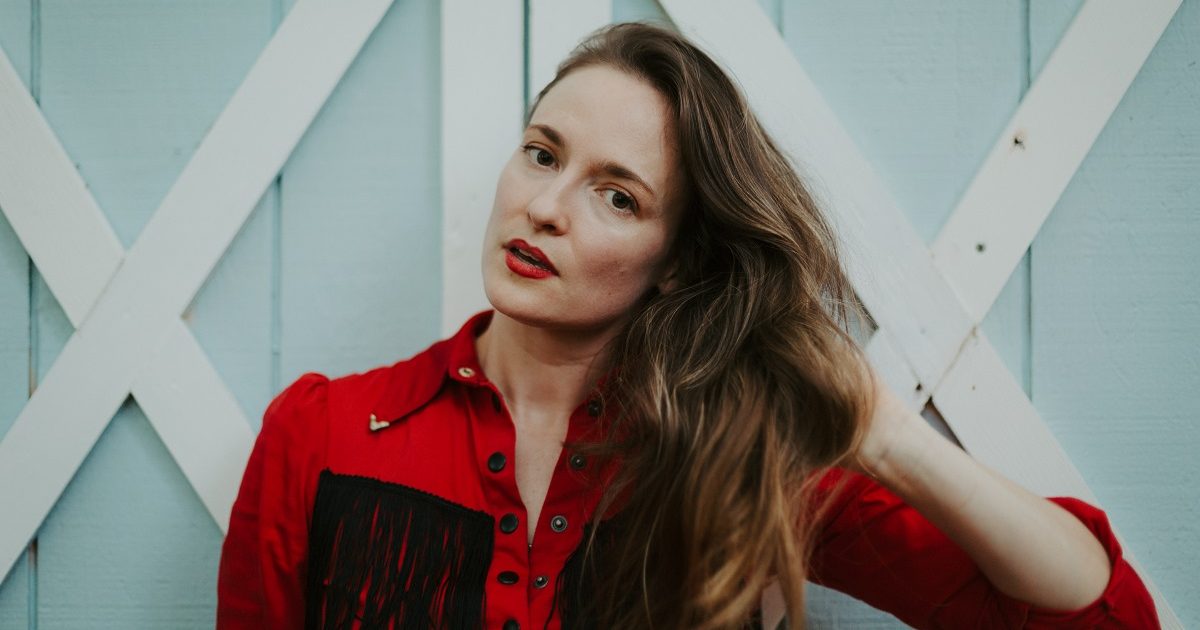
In the late summer of 2022, Courtney Hartman realized that the songs she had written for a new album were not the songs she needed to release. “I had found out I was pregnant a few months earlier, [and already] had a batch of material I was working on for a new record. I felt this quiet urging to set all of that aside and give my attention to what was happening in our life and in my body,” she says.

She discarded everything and began writing her third album, With You, a personal journey through motherhood set to music.

“What was happening in our life” refers to a tumultuous string of events that saw Hartman and her husband, John, through the best and worst of times. Best because the couple were expecting their first child, rebuilding their house in Eau Claire, Wisconsin, and Hartman was on tour; worst because her husband fell off a ladder, could not work for months, lost two jobs, she was dropped by her booking agent, and they totaled their car.

The cumulative effect left the couple in need emotionally, physically, and financially. They soon found themselves uplifted by their community – their immediate one and her music community at large. The experience left Hartman deeply grateful and dedicated to giving back even more than she received.

In September of that year, Hartman began writing “in earnest” the songs that became With You. She and her husband welcomed their daughter in February 2023 – more best of times followed by worst of times as Hartman struggled with postpartum depression.

“At the end of [2023] I had all this material and realized I wanted to invite in other voices and stories and perspectives, specifically those of other mothers,” she says.

Once again, she drew on her community, calling on a fellowship of songwriter mothers – Sarah Siskind, Dawn Landes, Ana Egge, Tift Merritt, Kristin Andreassen, and Emily Frantz Marlin of Watchhouse – to help take her deeply personal new songs to an even higher level.

“I spent another few months, December [2023] to February [2024], writing mostly over Zoom, finishing the material with those other writers,” she says. With You was recorded in June and July 2024, at The Hive studio in Eau Claire, with Hartman producing and Brian Joseph as co-producer and engineer.

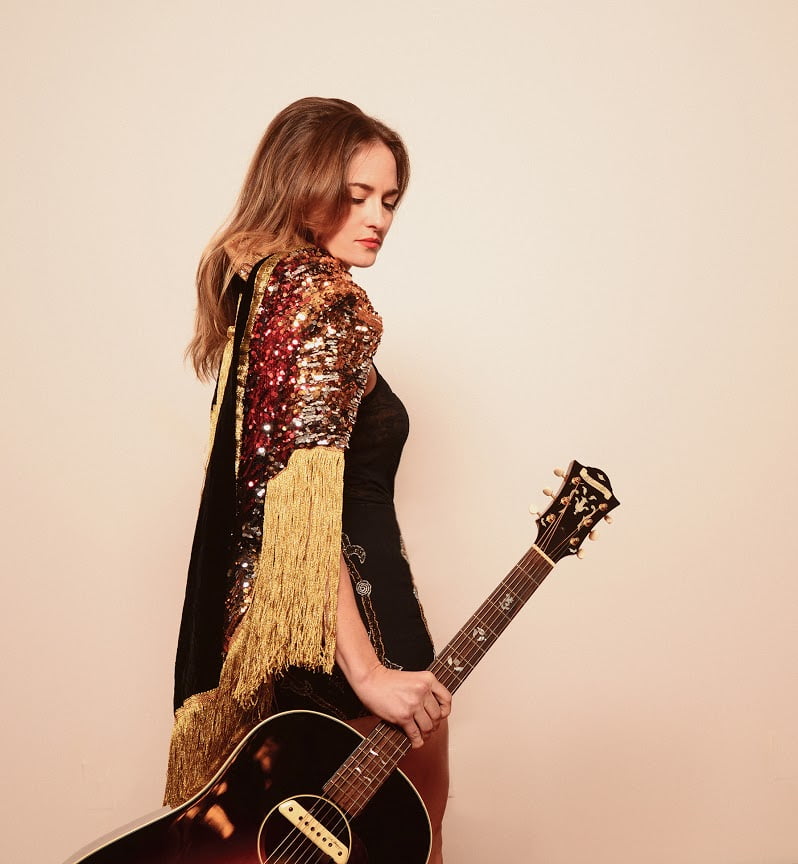
As one might expect from Hartman, there are plenty of guitars on the album – her Lawrence Smart Archtop, Bourgeois Parlor,
PreWar (modeled after a Gibson J-45), Bischoff Dreadnought, Martin 00,
and a Telecaster – but if you’re looking for the lightning flatpicking work that makes her a bluegrass force to reckon with, you’ll be best served on YouTube. With You tells a story that calls for understated guitars as a palette for its songs.

“Things weren’t all bright and shiny in that season,” she says, “but the impetus to write and pay attention helped me pay attention to some of those lighter moments. Not all the songs on With You are about everything being light, because that’s just not how it is. But there was this extra attention to some of those details that do help buoy your spirit when things are a little more challenging.”
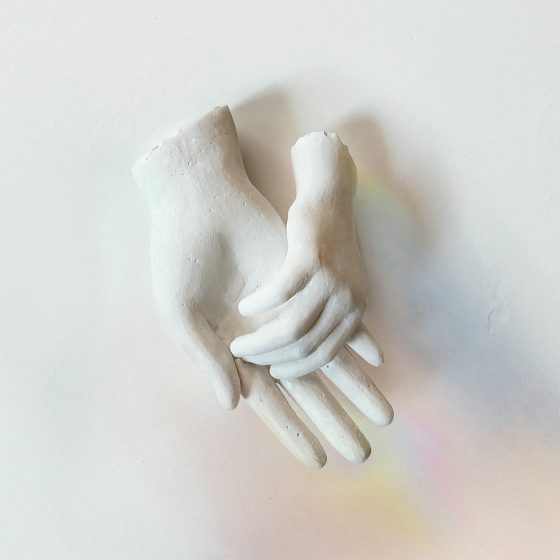
Courtney Hartman’s ‘With You’ album cover art, created by Claire Lindwall.

Completing the journey is With You’s striking cover art. The work of Hartman’s close friend Claire Lindwall captures the music’s delicate intimacy. “Claire is primarily a watercolor artist and illustrator,” says Hartman. “A special part of creating an album, for me, is giving the music to someone who then translates it into a visual piece of art. Every time, it’s surprising and expansive in a new way.”

Lindwall cast her own hand and that of her daughter’s, and positioned the casts so that one holds the other. “We experimented with drawings around it, then having just a splash of watercolor behind the piece,” says Hartman. “That’s all it needed.”

With this album now making its full debut, how do you feel about sharing so much vulnerability?

Courtney Hartman: The processing has happened in phases. I think it started just by saying yes to writing the material. There was an accepting of, “I’m writing about this thing that feels more vulnerable and more naked than anything I’ve written about before.” Bringing those songs to other writers, to collaborators, there was another level of vulnerability there.

A year ago I brought all of this material to my greater community and asked for support, because at that point I needed help putting the album out. Now, to give it to the rest of my community and listeners in the world, there’s a level of vulnerability, but I feel mostly excited. It feels like, “We made it.”

You’ve explained in other interviews that you had to use funding meant for the songs that came before these in order to get back on your feet. Needing financial assistance is also a vulnerable place and one that often brings publicly imposed shame and guilt. How did you process it?

You’re bringing up something that my husband and I have been talking about a lot, just with the news cycle and trying to get an understanding of what we can do for folks in our community. And having had small tastes of that in our life, because I know what we’ve experienced is so small compared to what so many people live through and are currently living through.

An important [word] that you touched on is shame – the shame of needing help; of not feeling like you can do it on your own or you can stand on your own two feet; of needing help for basic things like groceries. I think maybe accepting help and accepting care expands our capacity to feel compassion and to be able to then care for others.

In a podcast for Acoustic Guitar, you used the phrase “the intimacy of sound.” Could you talk more about what that means in the songwriting and guitar playing?

What I hear when you reflect that phrase back to me is the sound of the skin of your finger on the guitar string, or the sound of hands against a percussive instrument. When we went into the studio, I told the friends that were with me there on the first day, “Just as a guiding directive, whenever we imagine a sound that we want to create, let’s see if we can find something natural to create it with.”

Everyone took it in their own way, some on their instruments. Sean Carey was heavily involved on the record and he took that more literally in a lot of the percussion work. He found a nest outside when he was wandering around and that became the percussion on a track. Or even just the sound of skin on skin being a sound that we used as well; bringing in and magnifying some of these quieter sounds and allowing that to be a part of the soundscape [was part of the intimacy of sound].

Did you select the guitars around the songs or did some of the songs develop around your guitars?

Sometimes you think you know what a song wants before going into the studio and then you sit behind a mic and you’re like, “This isn’t serving it quite right.” And sometimes that experimentation takes a little longer than you think it will. Or sometimes you sit down with a first instinct and it’s totally right. That’s part of the reason it’s fun to have a good array of instruments in the studio.

Is the guitar as much a part of expressing your feelings as the lyrics?

It is. I think part of that comes from how long it’s been an instrument that feels like a voice to me. Songwriting came around the same time. I was about 12 when I started writing songs. Singing feels like something I still have so much exploration and learning to do.

How did working with other mothers, and their lived experiences, bring understanding to what you were going through?

What I was given [was the] shared experience and the acknowledgement of, “This is really hard. It’s really beautiful, but it’s also really challenging.”

So much of the caregiving that happens [as a mother], especially in that first year … so much of it is invisible. Maybe an aspect of that applies to all sorts of giving care – that it’s invisible other than to the one giving the care and the one receiving the care. When you feel invisible, it can also make you feel isolated and that can really feed into some of the struggles. A lot of folks have postpartum [depression] and societally we’re not set up to honor and support that season very well at all. It’s something I care a lot about, both from experiences with my family, but also as I’ve delved into work as a birth doula.

When you say, “Societally we’re not set up to honor and support that season very well at all,” what do we need to do?

We need to honor and uphold the importance of rest and nutrition and preparation. Parents are prepared for “Here’s what birth might look like,” but after that six-week checkup [traditional care usually ends]. Postpartum extends far longer than that.

A lot of [postpartum] mental health struggles won’t show up until maybe nine months or a year after a child is born. Better supporting [people postpartum] that would be the first thing I can think of. We live pretty isolated lives, as families in our insular homes, and so we’re not set up to receive support very well.

Or ask for it.

Yes, totally, [we need to be] preparing [people] to know that this is a time to accept and receive care. Preparing your heart for that is such a big piece of it, to know that we, as your village and your community, want to care for you in this time.

You’ve spoken openly about postpartum depression. What was that period of time like for you?

Moments of real happiness, but also moments of hitting my head against the wall … when I was struggling. [It was] hard to admit to myself and then to speak that [struggle] out loud to anybody. It wasn’t until afterwards that I could say, “That was hard.”

All depression is misunderstood and will often make people in your circle run away.

Let’s go back to your community, and the community of mothers, and how they lifted you.

I felt so cared for by our community in a way that was deeply humbling and in a way that somehow prepared me to do some of the caregiving that was going to be required of me. I was receiving so much love and support and meals and folks showing up. That kind of care is life-changing. It changes the way we see the world and our community around us.

My daughter was about nine months old or so when I started reaching out to other mothers, asking if they would collaborate on some songwriting. Having some tether creatively helped pull me through that season. It helped weave together the woman I was prior to having a child with the woman I was in that new space. … Sometimes it feels like … you almost can’t remember who you were before.

I was really afraid of [losing parts of myself]. I was afraid I wouldn’t create music again. There’s all these fears, irrational or not, that show up. Creating and being able to have these conversations that normalize what you’re experiencing. Having women who are [a] few years ahead of me be like, “It might be extra-challenging now, but it doesn’t stay that way forever.”

It’s almost 2026 and society still misunderstands and stigmatizes mental health, certainly PPD, and even some aspects of pre- and postpartum healthcare. Why are we uncomfortable talking about things that are so natural and important to discuss? Are we making progress or going backward?

I hope we’re making progress. It was a lot easier for me to ask, “Why don’t we talk about these things?” when I wasn’t part of the “we.” As soon as it was also part of my story to talk about and share, [I had to come] to terms with my own hesitancy. Why do I not want to talk about something as normal as pregnancy and motherhood in my songs? Why do I feel like if I put this music out, it will be discredited and potentially ignored, even though it may speak to so much of the population? …

I still don’t have an answer. Maybe it’s because there’s so many generations of women having to hide those things for fear of losing wages, or jobs, or discrimination, whatever it might be. For everybody’s sake, there’s so much we have to learn from mothers’ voices, and I hope we’re beginning to really listen.

On a podcast, The Other 22 Hours, you reflected on the period after Della Mae and the realization, at the time, that “Music was not a healing thing.” What role does music now play in your healing and mental health?

It has become healing again. Years ago, I was dealing with physical pain in my hands. That was magnified by touring all the time, being on the road so much, and the strain on my body. So I was speaking about it in a physical way. [Music] has become a lot more than just physically healing [for me]. I think this album exemplifies that.

You have worked with so many people. Who is your wish-list artist or artists?

Oh my gosh. The first person that came to mind – and maybe it’s because I’ve been listening to her record all week – I would love to play music in the same room as Brandi Carlile. She gives all of herself and it’s so good.

We had a listening party [for With You] and as I was listening to the album for the first time with a whole group of friends and collaborators, what I hear on it is my friends and heroes, which is such a joy. There are so many folks on this album that I look up to so much and who have been dream collaborators. So, in that way, a lot of it has been a dream list fulfilled.


Photo Credit: Michelle Bennett
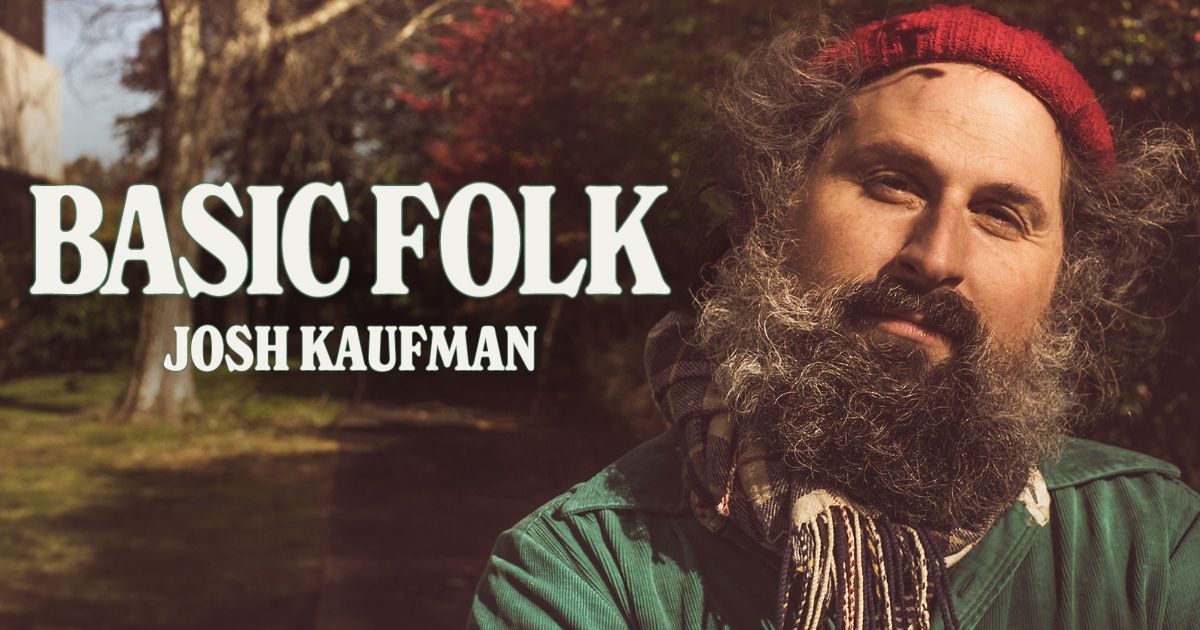
Basic Folk: Josh Kaufman

Multi-talented musician and producer Josh Kaufman is known for his work with Josh Ritter, The National, and his band Bonny Light Horseman. I’ve known Josh for many years, after meeting him in Pittsburgh while he was on tour with Dawn Landes. I felt instant friendship with him (and, honestly, with the entire Dawn Landes band that day). We haven’t seen each other very much over the last 15 years, but since he left that impression on me I’ve always rooted for him in his career.

LISTEN: APPLE • SPOTIFY • AMAZON • MP3

In our Basic Folk conversation, Josh shares anecdotes from his childhood, including memories of his journalist mother interviewing legendary musicians and the backstage snacks that left a lasting impression. He reflects on his early musical influences, the role of music in his family, and how his parents supported his passion for music from a young age. Then we dive into Josh’s experiences playing in bands in New York City during his high school years and how those formative experiences shaped his relationship with music and the city itself.

As a producer, Josh discusses his approach to working with artists by emphasizing the importance of capturing the raw, live energy of a performance. He talks about his instrumental album, What Do the People in Your Head Say to Each Other, and how embracing imperfection has become a central theme in his work. He also touches on his collaborations with notable musicians, including Bob Weir of the Grateful Dead, and the impact of those experiences on his career. Josh Kaufman is the most sought out producer in roots music these days. Look out for him producing some great records in 2025 and beyond.


Photo Credit: James Goodwin

8 Songs for This Exact Moment

Where do we go from here?

When you wake up in a world where hatred and fascism have been resoundingly endorsed by so many of your neighbors and fellow citizens, how do you proceed? That question becomes even more daunting at its second or third or umpteenth asking.

Yes, music will play a vital role over the next handful of years, as we continue the fight for justice, self-determination, and agency for all people, in the U.S. and around the world. But music, the arts, and creativity won’t be enough to save us. They won’t be an end-all, be-all solution to the political and cultural hurdles we will have to clear in the near future.

This is a moment that calls for so much more. Solidarity, first and foremost – the idea that, at the beginning or end of the day, all we have is each other – and community, organizing, and advocating for each other will be essential. Mutual aid will be more necessary than ever. Putting our own privilege on the line in order to protect and ensure safety for those more marginalized than ourselves is the task immediately at hand. Showing up – yes, for our country, but more importantly, for our friends and neighbors – is the very next step. Literally and figuratively.

Still, the soundtrack we will all write, that we will all curate, that we will all partake in while opposing the craven and hateful policies being proffered by our would-be dictator will be a powerful tool. Music – especially roots music, country and bluegrass, blues and old-time, folk with a lowercase and capital F, and more – are traditions steeped in populism, in worker’s rights, in justice, in standing up for the downtrodden and beleaguered. There are no better genres for this exact moment. There are no betters artists, musicians, and songs than those in and made by our very community.

BGS and Good Country include in our mission a commitment to intentionally crafting a roots music space, a bluegrass- and country-centered universe, where everyone is welcome, regardless of identity, background, nationality, ethnicity, disability, class, or belief system. We are determined to continue that work, to be a place where – hopefully – anyone and everyone can feel seen, heard, safe, and valid in their love for and appreciation of all things roots music.

As we summon courage for the work ahead and lean on our community, here are eight songs perfect for this exact moment in history, to hold up as we remind ourselves our goals are the same at the end of this week as they were at the beginning: liberty, agency, and self-determination for all. – The BGS & Good Country Team

“Mercy Now” – Mary Gauthier

A modern Americana classic, singer-songwriter Mary Gauthier shared “Mercy Now” on social media very early on Wednesday morning, after the news broke that Trump had won another term. It spread quickly on social media with many a repost and reshare. The message here, of mercy applied broadly, universally, and without qualification, is more than timely. It’s evergreen.

“Crisis” – Aoife O’Donovan

Connecting our current struggle to those of past generations is exactly how we continue to put one foot in front of the other, despite setbacks and losses and despair. Aoife O’Donovan’s latest record, All My Friends, is a perfect intergenerational connecting of the dots, centering women, girls, and femmes, and shines a light on the non-linear track that leads to victory. We know we will continue to return to this music over and over in the future, as a balm and a catalyst for progress.

And, as our friends at Basic Folk reminded us yesterday, Aoife’s and Dawn Landes’ episode of the podcast – which focuses on their similar albums centering women, feminism, and women’s issues – is an incredibly timely re-listen. Find that episode here.

“Sun to Sun” – Alice Gerrard

Looking to our roots music elders in this moment is exactly what we all need! Alice Gerrard’s most recent album, Sun to Sun, and certainly its title track, indicate a kind of perseverance and long view that we all could take on as we face the uncertain future.

With a loping, almost marching rhythm, there’s a grounded, realistic, and convicting approach here on “Sun to Sun.” While we all talk, and talk, and talk, and talk, the problems we face continue unabated and unchallenged. What will we do besides talk?

While we talk another fool goes and buys a gun…

“Listen” – Kyshona

Speaking of talking… why don’t we take a turn at listening? The challenge has been set by Kyshona, a powerful and restorative singer-songwriter and activist who channels her ancestors, connects generations, and builds community with every note and every word sung. Originally released in 2020, “Listen” is just as encouraging now as it was then, and just as indelible in its striving for a better, more compassionate world. Media, social media, and the internet all incentivize us to speak, to center ourselves, to prefer “me” and “I” over “us” and “we.” Let’s maybe listen more, instead. Especially right now.

“Beautiful” – Sam Gleaves

Appalachian singer-songwriter and multi-instrumentalist Sam Gleaves – who was raised in southwest Virginia but now lives in eastern Kentucky – released one of the most quietly and emphatically radical queer country and old-time albums of this year, Honest. “Beautiful” is the collection’s stunner, a track about how there’s endless beauty, mystique, and life lessons to be drawn from the ways we’re all different from each other. Through the lyrics, you see the world from the eyes of a young Gleaves, singing about sights and sounds unfamiliar and foreign to a boy from the mountains, loved and cherished by his family and shown that love without question.

Seeing beauty in our differences? What a way to live…

“The Numbers” – Mipso

THE ECONOMY! THE ECONOMY! THE ECONOMY!

What about those of us for whom this economy has never worked well or fully functioned? What about the millions who can’t make ends meet right now, under blue or red presidents? From their 2023 album, Book of Fools, Mipso turn over this very question, examining how and why “The Numbers” could be soaring – hiring numbers, the stock market, crypto values, Tesla market cap – while so many are still struggling day to day.

“Put No Walls Around Your Garden” – New Dangerfield

From Black string band supergroup New Dangerfield – which features Jake Blount, Kaia Kater, Tray Wellington, and Nelson Williams – “Put No Walls Around Your Garden” is an Americana-tinged old-time number, written by Kater, with a collectivist stance and a solidarity through line. There may be instincts in the near future to revert to an “every man for himself” sort of survival strategy, but the only way we’ll get through is together. Rather than hoarding, walling ourselves off, retreating, or recoiling, now is the time to throw open our garden gates and welcome each other in. Share our abundance, work through our scarcity and lack, and care for each other’s needs – big or small.

“Trees” – Laurie Lewis

Consider the trees. Consider the birds, the rivers, the oceans, the saguaro, the pikas, the whooping cranes. Did their realities change between Tuesday and Wednesday? Is the world any less or more likely to burn, to flood, to be blown away by hurricanes and tornadoes now than on Monday? Sadly, no. The march towards climate apartheid continues entirely unfettered, regardless of who holds the White House.

Laurie Lewis, a bluegrass forebear who has carried the mantle of climate justice for her entire life, embodies trees in the title track of her latest album. She and her band show how the fight for justice – climate justice, racial justice, gender equality, LGBTQ+ rights, immigrant rights – is a fight not measured by human lifespans and human time, but against earth’s clock. The trees will continue to watch, waiting, for us to either figure it all out or to fail at our mission.

We must not fail. The work continues and we’ll be working – and singing – alongside you all, the entire way.


Photo Credit: Alice Gerrard by Libby Rodenbough.

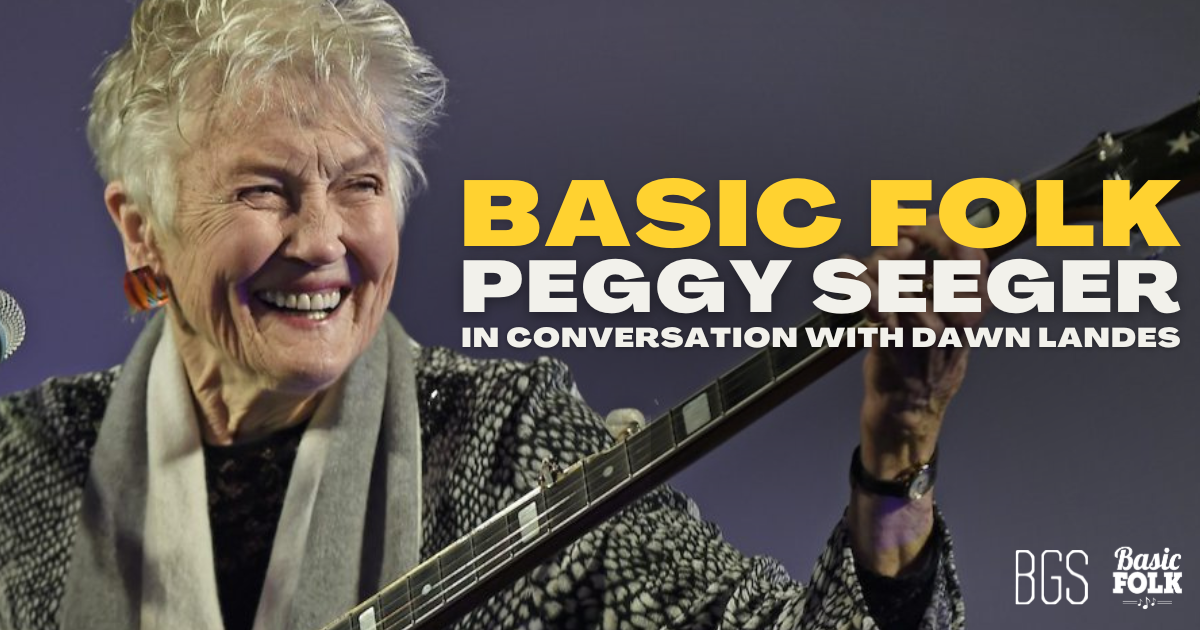
Basic Folk: Peggy Seeger in Conversation with Dawn Landes

(Editor’s note: For this episode, we invited our friend Dawn Landes to interview Peggy Seeger, the perfect choice to interview this feminist folk icon. Landes also recently joined us on a special episode with Aoife O’Donovan to discuss their new feminist-themed albums. We’re thrilled to welcome Dawn back as guest host!)

I can’t believe it took me 40 years to come across Peggy Seeger’s music. I’m a little mad about this honestly, and have been trying to make up for lost time by diving deep into her songs and her story. I’ve been a fan of her older brother, Pete Seeger, since I was a kid, but didn’t realize the depth of talent and reach in the Seeger family. They are truly folk royalty! Peggy Seeger is the daughter of a celebrated modernist composer and a musicologist who grew up with people like Alan Lomax and Elizabeth Cotten hanging out in her family home. At 89 years old, she’s released 24 solo recordings and been a part of over 100 more. She’s built her career on wit, incredible musicianship, and unflappable activism.

LISTEN: APPLE • SPOTIFY • AMAZON • MP3

On this episode of Basic Folk, I am honored to talk with Seeger about her beginnings in feminism, her decades-long partnership with Scottish singer Ewan MacColl, the creation of the BBC Radio Ballads, the importance of hope, and her dream tattoos! She even sang us a song from memory that I doubt she had sung in many years. Peggy is a repository of traditional songs and continues to tour and play music with her family, as she’s done throughout her whole life. Although she claims that she doesn’t write anthems, Seeger’s songs have become synonymous with women’s rights and environmental activism. Coming from a woman who once sang her defense in a courtroom, we should all take Peggy’s advice: “Something wrong? Make a song!” – Dawn Landes


Photo Credit: Laura Page

Aoife O’Donovan & Dawn Landes on Basic Folk

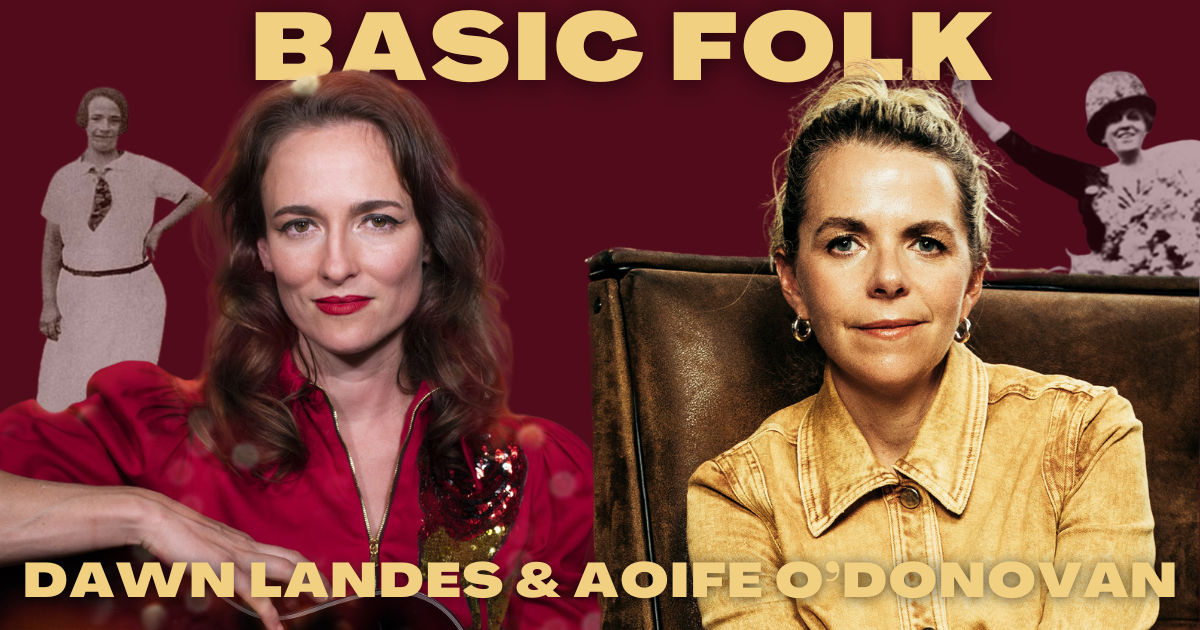
Aoife O’Donovan and Dawn Landes are long-time friends. Coincidentally, they both have new albums with strong feminist themes, so I wanted to interview them together and talk about WOMEN.

Aoife’s album, All My Friends, is specifically centered around Carrie Chapman Catt, a prominent leader in the suffragist movement. Inspired by speeches and letters, one song of Aoife’s, “War Measure,” is based on a letter of support from Woodrow Wilson to Chapman Catt. This album also marks the biggest project Aoife has worked on with her husband Eric Jacobsen, who conducts the Orlando Philharmonic and the Virginia Symphony Orchestras. It’s also the first record she’s released since becoming a mother. Of her song “Daughters,” she says she sings “as a modern woman, not wanting to leave the fight to the daughters of our daughters.”

LISTEN: APPLE • SPOTIFY • STITCHERAMAZON • MP3

Dawn Landes, also a mother, has a broader focus with her new album, The Liberated Woman’s Songbook. It features songs from the 1971 songbook of the same title, intended to inspire second wave feminists’ women’s liberation movement, and modern feminism of the 1970s. The songs span from 1830 (“Hard is the Fortune of All Womankind”) to 1970 (“There Was a Young Woman Who Swallowed a Lie,” “Liberation, Now!“), showcasing how women of the past expressed political activism in the struggle for gender equality.

Both Aoife and Dawn released their albums during Women’s History Month, which led us to a discussion of what that choice means to each of them. We also talk about protest signs, the Taylor Swift movie, gender stereotypes, and of course, all waves of feminism. Chatting about the 19th Amendment, we acknowledge that this only allowed white women to vote, which then leads to talk of how suffragists and feminist protest songwriters – like Meredith Tax – contributed to and gleaned inspiration from the civil rights movement.

Aoife and Dawn are legends! We start with what their internal dialogues were like when first undertaking these ambitious and important projects and end with Aoife putting Barbie on blast. All and all, this one’s a winner.


Photo Credit: Dawn Landes by Heather Evans Smith; Aoife O’Donovan by Sasha Israel.

MIXTAPE: Liberated Women by Dawn Landes

My new album, The Liberated Woman’s Songbook, reimagines folk songs about women’s activism from a songbook published in 1971 at the height of the Women’s Liberation Movement. Songbooks were the playlists of the past. Before people could burn CDs or make mixtapes, if they wanted to share songs they would make books or zines. When I was researching for this project, I consulted a lot of songbooks and zines from the late ’60s and early ’70s and found so many delightful things! Here are a few of my favorite finds (most pre-dating 1971, when the book was published). – Dawn Landes

“Hard is the Fortune of All Womankind (1830)” – Dawn Landes

This traditional ballad was often sung at protests during the Women’s Liberation Movement in the late ’60s and early ’70s. It was recorded by Peggy Seeger in 1954 and Joan Baez in 1961 under an alternate title, “The Wagoner’s Lad.” The lyrics date back to its first printing by English song collector Cecil Sharp.

“Single Girl, Married Girl” – The Carter Family

I first heard this Appalachian song when I worked at a bookstore in NYC and would constantly listen to a Carter Family CD on repeat. Apparently Sara Carter didn’t like the song and didn’t want to record it in 1927, but I’m so glad she did!

“I’m Gonna Be an Engineer” – Peggy Seeger

This masterpiece was written in the ’70s by the great Peggy Seeger, an incredible musician, writer, and keeper of the folk tradition (also, the sister of Pete Seeger). She’s been an advocate for women’s rights throughout her long career and has recorded many folk songs on women’s issues.

“Lady, What Do You Do All Day?” – Peggy Seeger

Seeger’s epic retort to Ewan MacColl’s question at the top of the song is worthy of its own film. MacColl and Seeger were musical and life partners for 30 years and made so many amazing recordings together. Check out her memoir, The First Time Ever, for some wild stories about the two.

“It’s My Way” – Buffy Sainte-Marie

This was the title track to Buffy Sainte-Marie’s debut album in 1964. That whole album is mind-blowing, but this song stands out to me. It’s so self-assured and strong. She’s still performing it in her 80s and even released a rock version in 2015.

“You Don’t Own Me” – Lesley Gore

Lesley Gore was 17 years old when she recorded this in 1963! One of the song’s two writers, John Madera, said its sensibility was shaped by his upbringing and participation in the civil rights movement.

“Oughta Be A Woman” – Sweet Honey In the Rock

Bernice Johnson Reagan said, “June Jordan wrote the words to ‘Oughta Be a Woman’ after I talked about my mother.” I really love the narrators voice in the writing and the uplifting voices of Sweet Honey In the Rock singing this.

“Silver Dagger” – Joan Baez

This song casts such a spell and Joan Baez is one of my all time favorite singers.

“Which Side Are You On (1931)” – Dawn Landes

Here’s a labor song mashup that combines Florence Reece’s lyrics from “Which Side Are You On” with Aunt Molly Jackson’s “I Am a Union Woman.” I’m singing the part of Florence Reece and Kanene Pipkin (of The Lone Bellow) is singing the Aunt Molly lyrics. Both women wrote protest songs during the “Bloody” Harlan County, Kentucky miners strike.

“Custom Made Woman Blues” – Hazel Dickens & Alice Gerrard

I’ve been lucky enough to spend some time with Alice Gerrard and she told me that the first time she and Hazel Dickens performed this song at a women’s festival the audience clapped so loud they had to play it again! Immediately! Legends.

“I Am Woman” – Helen Reddy

The production on this song really places me exactly in the year 1971, when The Liberated Woman’s Songbook was published and Helen Reddy’s song was about to become a huge part of the soundtrack to the Women’s Liberation Movement. There’s a great documentary about her life and this song on Netflix.


Photo Credit: Heather Evans Smith

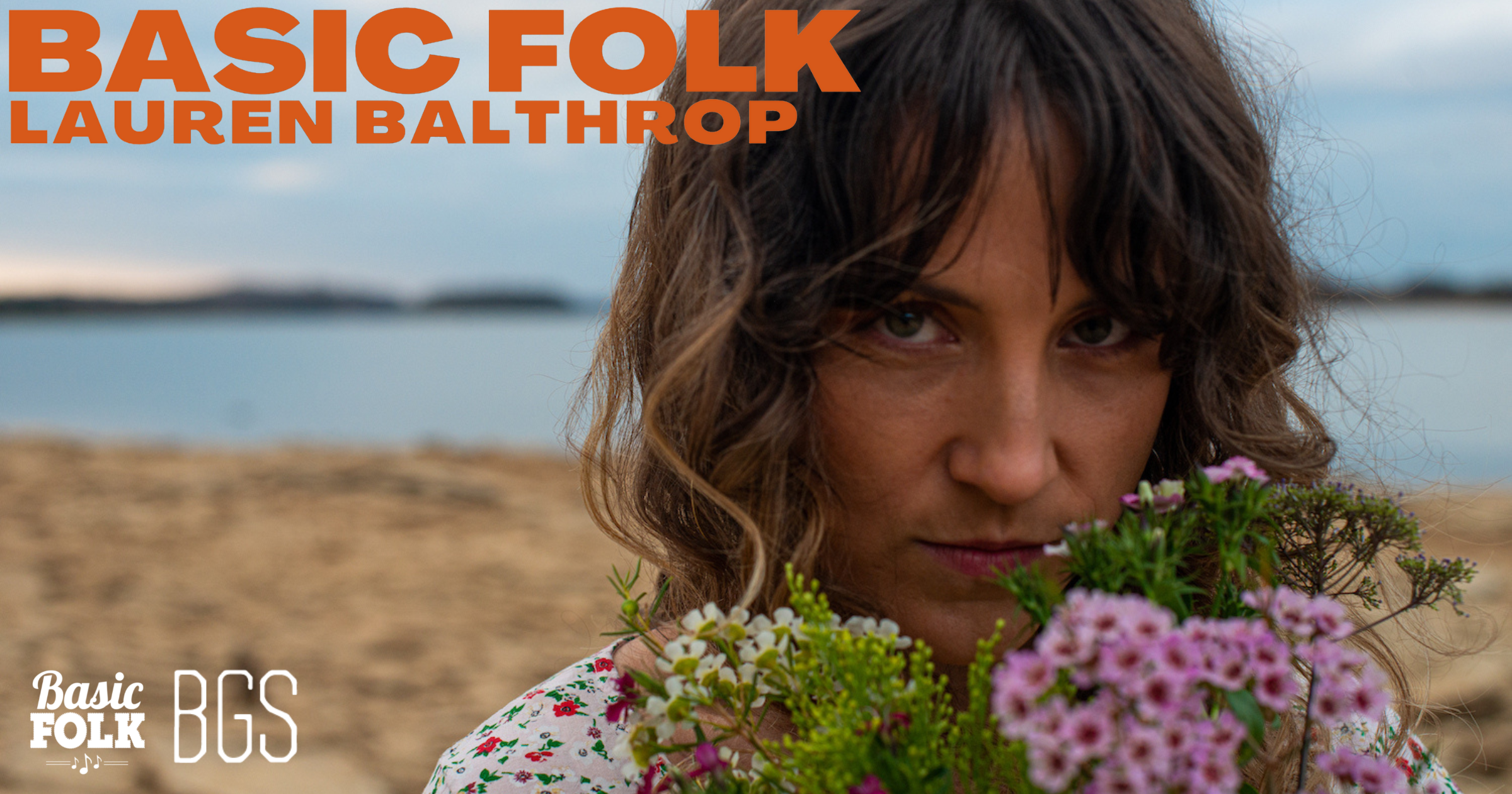
Basic Folk – Lauren Balthrop

Lauren Balthrop’s Mobile, Alabama upbringing saw her soaking in the music of The Andrews Sisters, Steve Sondheim, R.E.M., Elliott Smith and Neil Young. As a child, she was involved in activities that varied from sports, to drama, to music and beyond. She never really settled on a passion, until she found acting and theater. She pursued that dream from fourth grade until after college, moving to New York to go after auditions and acting parts. She found a soft landing in the city by moving in with her brother, Pascal. The two would then go on to form the large band (they called it a traveling small town) of Balthrop, Alabama. From 2007 to 2012 they toured the country with as many as nine band members taking to the road. In this experience, she met Dawn Landes and Annie Nero, with whom she joined up for the harmony centered trio, The Bandana Splits.

LISTEN: APPLE • SPOTIFY • STITCHERAMAZON • MP3

In 2013, she released a solo album under the name Dear Georgiana, which referred to Georgiana Starlington, the pseudonym she used in Balthrop, Alabama (everyone went by a character name.) She called those “the songs her brother doesn’t like,” at least not for their band… After that, she wrote a bunch more songs that felt as though they were written in her own voice, which she released under her name as the album This Time Around. Her new solo album continues the sentence: Things Will Be Different. She’s exploring the themes of change, upheaval and heartbreak while looking towards the future with hope. What’s also cool for Lauren is that she’s finding new meanings in these songs that differ from their original purpose. Lauren is a curious learner who seems like she’s always got her antenna up. I love her new record: the lush sounds and humor are hitting me right. It was great to talk to Lauren in this medium! We have known each other for almost 15 years and have instigated many antics over the years. Enjoy!


Photo Credit: James Paul Mitchell

LISTEN: Dawn Landes, “Dear Heart”

Artist: Dawn Landes
Hometown: Louisville, Kentucky
Song: “Dear Heart”
Album: ROW
Release Date: October 2, 2020
Label: CropDuster/AWAL

Editor’s Note: Landes’ new album offers songs from her anticipated new musical, ROW, which tells the true story of Tori Murden McClure, the first woman to row solo across the Atlantic Ocean. Landes wrote all the music and lyrics for ROW, while playwright Daniel Goldstein wrote the book, based on McClure’s autobiography, A Pearl in the Storm.

In Their Words: “‘Dear Heart’ was one of the first songs I wrote for this project. My collaborator Danny Goldstein (book-writer) and I met with Tori to ask permission to adapt her story into a musical. As a complete stranger, it was a nerve-racking experience to sing this song about one of the darker moments in her memoir, to her face. Something must’ve rang true, because she said ‘Yes!’ Getting to sing this song and tell some of her story at TED a few years ago was one of my most memorable experiences on stage.” — Dawn Landes


Photo credit: Shannon Kelly

LISTEN: Dawn Landes, ‘Meet Me at the River’

Artist: Dawn Landes
Hometown:
Louisville, Kentucky
Album: Meet Me at the River
Release Date: August 10
Label: Yep Roc Records

In Her Words: “I was lucky enough to work with the legendary producer Fred Foster for my new record. Fred has been making hits for most of his 87 years. Merle Haggard once said, ‘he lives in the songs.’ He does, he’s there in ‘Pretty Woman’ and ‘Me and Bobby McGee’ and Dolly Parton’s first hit, ‘Dumb Blonde.’

I learned so much working with Fred on this record and I’m really proud of it. Some of my favorite lessons were:

* ‘Keep it conversational.’ If you can speak the lyric and it reads, it’s all the morepowerful.

* ‘A great song can be sung by anyone in any style and any meter.’ He learned this from the great publisher Fred Rose, who sat at a piano and played him Hoagy Carmichael’s “Starlight” in its popular form, then in 3/4 time, then in a Western swing style. They all worked.

* ‘The feel is the thing. If you’re in the wrong tempo you won’t have the feel.’ The drummer Eddie Bayers who played on the album has said that Fred sets the best tempos of anybody. I believe it.

We recorded everything in Nashville with the heaviest hitters around: Kyle Lehning, Charlie McCoy, Steve Gibson, Bobby Wood, Eddie Bayers, Russ Pahl, Larry Paxton, Larry Franklin and more.” — Dawn Landes


Photo credit: Shervin Lainez