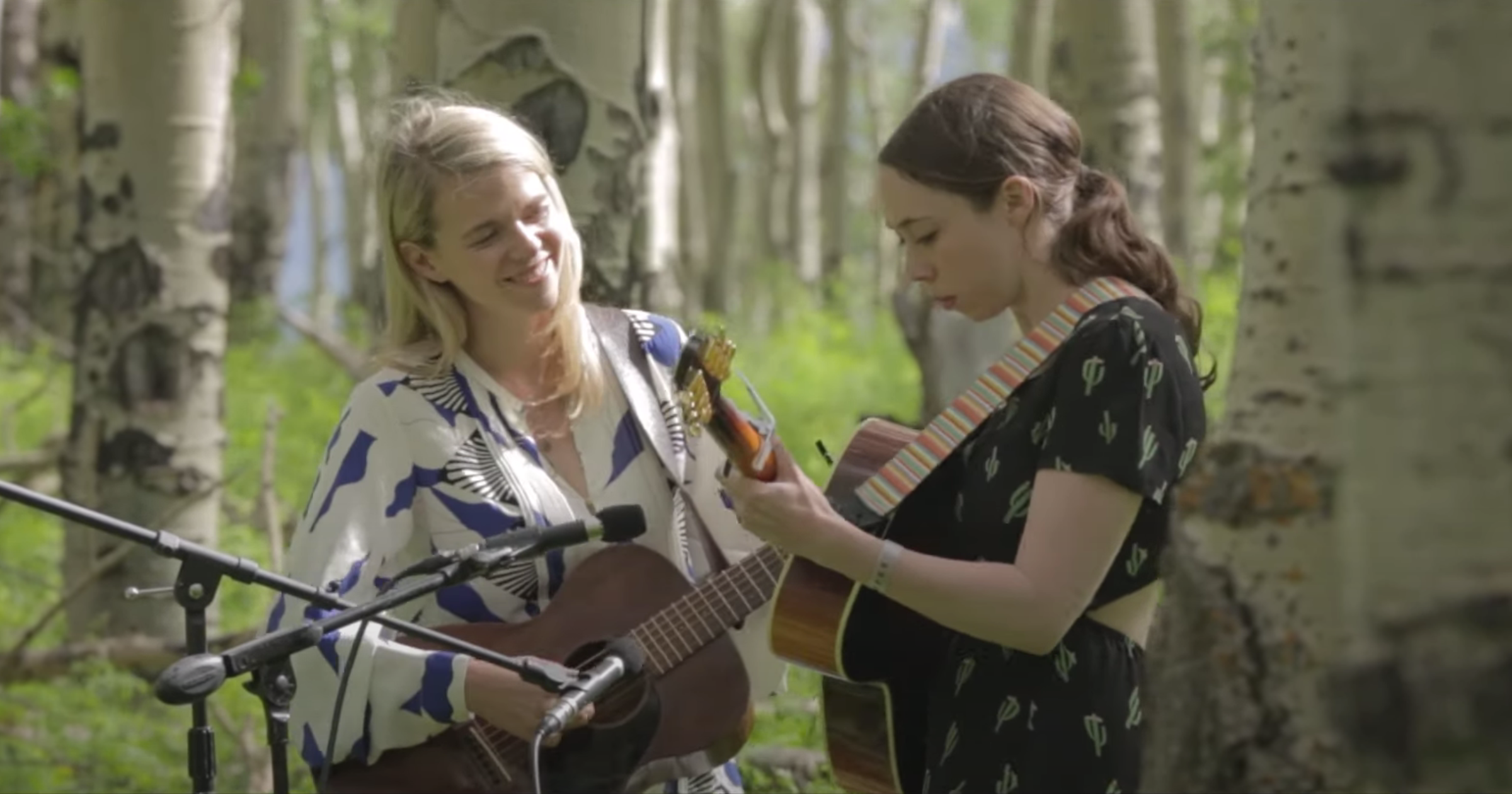
It’s common these days to wring hands over the many ways powerful tech companies have meddled, without permission, in how we discover and listen to music (among other things). It’s just as common to fearfully declare that music’s good old days are past and gone. But after 20 years as a working band, we know that the strength of community through music is much more enduring; and we see it all the time.
There is no greater force than a group of people who are ready to share a joyful experience. It doesn’t matter if they’re gathering to jam, attend a concert, or anything else. People in community can create strong connections in a heartbeat, under almost any circumstances, and music is a powerful vehicle for it. Some days it feels harder than others to find that spark, but it’s always there if we come together and dig for it. Every day the pressure grows to strip the things we all have made and love for parts, but collectively we can raise our voices and push back. As a band, we’re choosing to resist that force and to keep building things. Together.
This playlist features artists that we feel musical and professional kinship with, bands that have been around and are well into their careers. The songs we chose come from albums that are worth spending time with over and over again. These folks have played lots and lots of gigs and revel in the energy of a great show as much as we do. You’ll also find some music from our 9th studio album, The Steel Wheels, too. Music that we made together in a room. – The Steel Wheels
“Easy” – The Steel Wheels
A breezy song with a swirling fiddle intro and a big question at its heart. We live in the future now, with the entire world available to us on the other side of our screens. So why are we lonelier than ever? If everything is supposed to be easy, why does it all feel so hard?
“Talk Is Cheap” – Dr. Dog
Because they inspired me with one incredible Bristol Rhythm & Roots Reunion set probably 15 years ago. Their old amps, their confident trailblazing of their sound that was clearly referential and respectful – but not chasing what a lot of other bands were chasing.
“Los Angeles” – Big Thief
An artist’s job is to remain open and soft to the world and to distill all that pain and joy into work that transmits emotion across space and time. Somehow, Big Thief seems to only become less jaded with time, maintaining curiosity and exploration as part of their creative process.
“Go Back” – The Steel Wheels
All deep relationships come with joy and with pain. To be rid of one you would also lose the other. It’s part of lived experience, this is a reminder to embrace all of it. True connection is worth it.
“Waiting For The Sun” – The Jayhawks
The Jayhawks are a band that prove you can continue to forge your own way and make it through the highs and lows. I was still really just a kid when I discovered them through some older cats I was playing with at the time. Son Volt and Wilco were very much in the alt-country scene and the Jayhawks just had something a bit different going on.
“Worried About The Weather” – Greensky Bluegrass
I love the way this song pivots between the anxiety of pushing forward through uncertainty and the breezy delight of taking a moment to enjoy the journey. There’s momentum to both things and “Weather” has tons of it.
“Keep On Dancing” – The Steel Wheels
Let’s take a break from responsibilities to just see ourselves and each other. Don’t forget to breathe and to appreciate the unadorned peace that can fill the spaces between us.
“I And Love And You” – The Avett Brothers
Even a track like this, one full of solitary stillness, shows the Avetts’ songs are packed with other people. They always remind me that I’m not as alone as I often feel. You can sense the presence of old partners and family throughout this song even though the speaker is alone in their car.
“Valerie” – The Brothers Comatose
These guys are everybody’s friends. Maybe the acoustic Dawes? I don’t know. We’ve known them a long time and they keep bringing joy and fun with warmth and grounded songs that don’t rely too heavily on bluegrass tropes.
“Sway / Endless Highway (Pt. 2)” – Watchhouse
Watchhouse invest deep thought into every lyric and intention into every note without ever seeming to overthink their process or get held back by previous work. “Sway / Endless Highway (Pt. 2)” demonstrates how the band is constantly in conversation, transitioning between tempos and driving down into a deep groove with a breeziness that belies the technical mastery of their acoustic instruments. At a Watchhouse show, the crowd will hang on every note and every silence, sharing a reverence for the song with the band.
“Slow Rise (to the middle)” – The Wood Brothers
Oliver, Chris, and Jano seem to be propelled forward by some groove force that penetrates everything they do and they invite listeners to join in on the funky joy. Their track “Slow Rise (to the middle)” tips a hat to their musical journey. To be in an audience is to get lost in the moment, only to occasionally remind yourself how wild it is that all the sounds coming from the stage emanate from just three musicians.
“Way Down Yonder ” – Chatham County Line
I first heard Chatham County Line when I opened for them at The Livery in Benton Harbor, Michigan, with a jamgrass band I was in, probably 20 years ago. They were tight and had their act together. I was blown away by their professionalism and it made a big impact on me. I will never forget that moment and I’m still inspired by their creativity and longevity as a band.
BGS was founded 14 years ago and from the very beginning, we’ve been covering, collaborating with, and cheering on the Infamous Stringdusters. Our first posts about the group published to our site in 2013 – not even a year after our launch – spotlighting banjoist Chris Pandolfi’s Bluegrass Manifesto, the band’s only-four-years-old marquee event The Festy Experience, and their most recent album at that time, Silver Sky. Now, in 2026, they’re not only our Artist of the Month for the second time, they’ll be headlining our stage at Bourbon & Beyond this September, too. But, our love for the band – and the many partnerships we’ve built together – began, like most, back in 2007 with their now iconic debut album Fork in the Road and a banner year for the group at IBMA’s World of Bluegrass and the IBMA Awards.
Back then, when the Stringdusters took home trophies for Song of the Year (“Fork in the Road”), New Artist of the Year, and Album of the Year, perhaps no one – not even the band themselves – would have predicted the seismic, existential impact they would end up having on bluegrass and the as-yet-unnamed subgenre thereof: jamgrass. Twenty years on, the Stringdusters celebrate their duo of decades with 20/20, an album of 20 songs celebrating 20 years of defining and redefining bluegrass and jamgrass.
For our Artist of the Month coverage, BGS and Good Country co-founder Amy Reitnouer Jacobs sat down with all five members the Infamous Stringdusters for a wide-ranging conversation of a band that epitomizes bluegrass, jamgrass, and psychedelic string band music in the 2000s.
First of all, again, I wanna just thank you for doing this. We are so thrilled to have you guys as our Artist of the Month and congratulations on 20 years of the ‘Dusters.
I wanna start this with Panda actually, and this is not gonna be just an oral history interview, but I think, looking back on 20 years, it feels appropriate to start from the beginning. So let’s talk about origins and start back at Berklee [College of Music], if that’s cool. Tell us a little bit about the beginning of the band.
Chris Pandolfi: I arrived at Berklee in 2001, which was the year that Andy [Hall] had just left Boston for Nashville. I first met Critter [Chris Eldridge] through Zach Hickman, who was playing in Josh Ritter’s band. He went to Oberlin [University] with Critter. We got together and we were playing, and Zach had some free studio time at a spot in New Hampshire and we were gonna go record some music, just for fun. Our careers were not underway in any way, shape, or form. We didn’t have any grand designs here. We were just gonna go record some music and have some fun.
Then, on the precipice of this recording, we went down to the Cantab Lounge to meet this guy named Andy Hall. We went there and–
AH: I don’t remember exactly if I was playing or if you were playing.
CP: And the next day we were in New Hampshire at this recording studio and we made this EP called Stable Horse. Essentially, Andy was already living in Nashville, so around that same time, he had met Jeremy [Garrett] and they were playing together. It was that recording session that got the wheels turning for me. Like, “Oh, we could do this thing with other people our age,” and not fall into the very sort of common thing in bluegrass where you get hired by someone else and you’re essentially a sideman.
We were recording and teeing things up, and we all had other gigs at that time. It was me, Andy, Jesse [Cobb], Critter, and Alan Bartram from the Del McCoury Band. But that was my earliest memory of “We could start a band with our contemporaries.” And Zach Hickman, I give him credit, he facilitated that.
I don’t even think we had the name “Stringdusters” yet. Alan got the offer to go play with Del McCoury and we had met Travis [Book] at IBMA, so we called him up and he came and lived in my driveway for a few months. True story.
Travis Book: You can really get away with a lot if you park your car in someone’s driveway and then try to stay outta the way.
So Andy and Jeremy, what are the origins of you guys starting to play together?
AH: Was it Ronnie Bowman? Was that the first time? I was in Ronnie Bowman’s band and the fiddle player and Ronnie had a bit of a falling out while we were on the road and–
CP: We were all at a festival, so we scooped up Jeremy and he got on the bus with Ronnie Bowman!
Jeremy Garrett: Yeah, I definitely knew about you two beforehand. And, of course, in bluegrass everyone’s a fan of Ronnie Bowman. He’s such a crooner and such a cool cat. I definitely had plenty of experience before, but this was like one of my first major Nashville gigs. And it was eye-opening very quickly that, as a sideman, it’s pretty limiting.
The conversations I remember started happening pretty fast in the back rooms: “Hey, let’s maybe consider doing something of our own. Long-term, how can we make this happen?” But it was just like whispers. I remember going to IBMA – that’s where I met Chris Pandolfi and he blew me away with his melodic banjo playing style and this futuristic sound that he had. I’d really never played with that before, because I came from a very traditional side of bluegrass.
CP: Didn’t I give you a copy of my record? I remember you telling me that.
JG: Yeah. And I listened to that record all the way home from IBMA – I’ll never forget – and my dad was riding with me. I was just like, “This guy’s awesome.” Overall, it felt like all of us coming together through our connection in Nashville and these music parties that used to happen on the reg. I don’t know if they still do. We would have huge jam sessions, especially at Panda’s Pad. There’d be 20-30 people all gathered up in somebody’s backyard, picking. And it was almost every night. So you can’t help but get tight and start seeing the writing on the wall, the possibilities, through those kind of connections.
CP: These days in Nashville are so different. It’s so much “cooler” now. There’s so many young people playing bluegrass and when you hear about a lot of the socializing in Nashville, it’s a lot of young musicians. When we were having these parties, it was a real diverse mix of ages. You had Sam Bush there, you had Scott Vestal, you had Ronnie Bowman, and the McCourys. We were the young cats around and there wasn’t a very vibrant young scene. We were intermingling with a lot of the elder statesmen of bluegrass.
That’s a really special time in Nashville. I can remember that’s when I started hanging out in town and there was like a magic in the air. That intergenerational mix doesn’t organically seem to be happening as much, but maybe it is and I’m just not invited to parties anymore.
So Travis, were you coming to Nashville from Colorado? Where were you before then?
TB: Yeah, I was living in Durango and Anders Beck from Greensky [Bluegrass] and I started playing music together in maybe 2002. There were gigs and we were learning this music and then Andy Thorn and some other friends – that’s Leftover Salmon – they just showed up in a music store one day. Andy was probably 19 on college break and we hung out with him for three days straight. When he went back to North Carolina, we called him up. We’re like, “Dude, you gotta come back! We gotta make a band! We’ll play RockyGrass, you’ll win the banjo contest, we’ll win the band contest.” Anders and I were like, “We can see the future, but we need Andy Thorn,” because he was such a compelling musician and just such a natural. Still is.
We started this band called the Broke Mountain Bluegrass Band with Jon Stickley, who’s also a visionary in our music. We were all picking and almost entering that same path as Leftover Salmon or Yonder [Mountain String Band]. We were already doing this like hippie bro band, just loving playing music and camping and playing festivals and going to hot springs and just fucking around. It was brilliant.
But then we went to IBMA, which at the time was the best way to show off your band and position yourself in the context of the larger [bluegrass] world. Try to get some gigs and go party your absolute brains out for a week. We were pretty rough around the edges, but one night I stepped off an elevator and Chris Eldridge came around the corner. [He] was like, “We need a bass player for this jam. Will you come jam with us?” I went into this little alcove and it was essentially the Stringdusters. It was Critter and Pandolfi and Andy Hall and Jeremy and Jesse Brock. I was just hanging out, holding on for dear life. I’m partying, I have a backpack full of beer, I have no shoes on, and I looked around and all my band mates were just there sitting along the hallway floor listening to the jam.
Andy’s partner at the time, Janice, said, ” Do you ever think about moving to Nashville?” I just laughed. Absolutely not. But I had fixed myself in their mind and once they exhausted all the possibilities of people who could play bass in Nashville – at least this is my understanding – they dug into their collective consciousness and called me up to audition. They’re like, “We think you’re the guy. When can you move to Nashville?” So I went out there to work on Fork in the Road that summer. What was this, 2004? Am I right, guys?
AH: I think that would’ve been 2005.
TB: Yeah, you’re right. 2005. [I] moved out there in September and lived in this guy’s driveway. It was kinda wild.
Falco, I promise we’re getting to you. We’re almost there!
In pretty quick succession though, you’ve got the core crew with Critter and Jesse [Cobb] at that time, you record the album, and get signed to Sugar Hill. And then things just start happening! Can you walk me through the time between recording and the IBMA Awards in ’07?
CP: There’s a lot of extremely disorganized touring. We’re driving around in two cars. I still have the notebook from the gigs – we were getting paid a few hundred bucks a night, maybe a thousand on a good night. Doing everything that we could.
We didn’t have grand designs on anything. The IBMA Awards was a really big moment for our band. Thinking back, it was a moment of legitimacy, of just getting [to] one of the hardest things as a band, which is the collective feeling that this thing is gonna stick together. That’s the peril of starting a band with players who you think are really good: at any time anyone could get hired away for something. But we were playing gigs, we were loving life, we were working on our music, and we were poor as could possibly be. I just remember the IBMA Awards as a big moment of solidity, of that feeling like we could really do this, we could really be in this for a long time.
TB: There was that first summer we had a couple of big anchor gigs, but a lot of it was really just driving around and killing time in between these anchors and hoping that we could reach the right audiences. I think that the big bluegrass scene was ripe for some young pickers who were taking it seriously and committed to each other.
JG: Yeah, getting gas in the tank right off the bat was huge for us, that’s for sure. And we spent a lot of time in between those gigs just going to be in the wilderness and spending time together. I don’t know, for lack of a better way of explaining it, [we were] bonding like a band.
But man, when you’re a real band and you’re not just like a frontman or whatever, you’ve got a real synergy with other guys in a group. It’s special. And I feel like a lot of what brought us together and [what] makes us as tight as we are now was those off times where we were discovering our lives and just doing cool stuff like that. Creating this thing together.
I do need to know who came up with the name. Where did the name come from?
CP: Ben Eldridge.
AH: Yeah!
CP: We were working with a list of pretty mediocre names and Ben came up with “Stringdusters.” After 20 years, I can say there’s a lot of bad band names out there, but the Stringdusters – I think it’s a cool band name and it suits us.
All right. Now we bring Falco into the mix. So how did you get mixed up in all this? Tell us your origin story.
Andy Falco: So, Critter fell off the back of a truck and I got picked up – no! What happened was, I’d known Pandolfi and Andy Hall from the Northeast bluegrass scene. I was playing with this guy, Buddy Miriam, who’s on Long Island, and who actually was friends with Bill Monroe because he got struck by lightning at the Berkshire Mountain Bluegrass Festival, which of course was Grey Fox. And Monroe found out about it and reached out and they became friends. So he learned a lot of mandolin directly from Monroe.
My brother was getting into bluegrass and was like, “You should come to this bluegrass festival.” I went up there and saw Doc Watson and really got into playing bluegrass. I moved to Nashville maybe a year after Panda and Critter did. Andy Hall was already playing in Dolly Parton’s band. And I had met Jeremy, actually by accident, at SPBGMA. My first time in Nashville, some guy came up to me and said, “Hey man, how are you doing? How’s everything been?” I was like, “Great. This is my first time in Nashville. Everything’s been great.” Then he stopped and said, “Man, I thought you were someone else.” And he says, “Come meet my son.” That was Jeremy’s dad, and that’s the first time I met Jeremy.
When I moved to Nashville, these guys were starting the band. I was watching them doing their sets at IBMA. It was killer. Then when Critter left, they asked if I’d be in. I wasn’t gonna start until September and one month later was the IBMA Awards. So I just joined the band and here they are, winning all these awards.
JG: I would like to say, I’ll never forget your first gig. You killed it harder than literally anybody I’ve ever worked with to this day. Absolutely stepped into the role and blew it away. And it was very obvious at that moment that he was the right man for the job, for the Stringdusters.
AF: I had big shoes to fill with Critter – and Critter and I were friends. In fact, I knew Critter before I met anybody in the Stringdusters. We met at seven o’clock in the morning on the last day of IBMA, when we’d pick all night and our door was open. And here comes Critter with his guitar.
CP: Critter introduced us.
AF: Yeah.
CP: He said to me, “Do you want to go hear the fastest guitar player alive?” And I said yes.
AF: I worked with Critter, too. Critter was very supportive of coming over when I was preparing to join the band, showing me the parts that he played on the record. So I had a really good foundation, thanks to Critter, of what he had done. Then I was able to put my stamp on it.
So what is that pivot then? You all mentioned the kind of shift that occurred, moving you away from traditional bluegrass and more towards jamgrass. How did you find your own sound? What was the decision to pivot?
AH: I remember a specific show where we decided we were gonna try and extend some [of the] set. I think it was the Animus Theater in Durango and it was a Colorado bluegrass crowd, which was more of a dancing crowd. They were used to more diverse sounds. I don’t remember, we were just like, “Let’s try and put a jam in this one song,” or whatever. So we’re playing, we’re jamming, and we’re extending whatever song it was. The whole crowd was just dancing. The energy was feeding back and forth and it was like, “Whoa! This is so much more exciting,” in contrast to everyone sitting silently and clapping in between songs. We made a choice one night and we saw the crowd just light up and dance and lose themselves in the music, and that fed our energy.
CP: Also, we were into that stuff.
AH: Yeah.
CP: But we hadn’t really made that connection yet. The real moment that I remember is we opened three shows for Railroad Earth. We played the 9:30 Club. We played Theater of the Living Arts and, I think, and we played Burg Williamsburg, when our van broke down and we showed up last minute. Those are the gigs that I referenced in the Bluegrass Manifesto. When I did the IBMA keynote that grew out of that, it really referenced those. I remember a few shows, too, where we would come off stage and we’re like, “Oh my god, that jam. Let’s do that again.”
We played these shows with Railroad Earth and it connected some dots that didn’t connect automatically, even though we had Grateful Dead, Phish, playing all the time. We were really coming from that IBMA buzz and awards. And, like anything, it took some time to discover, [it took] some experience. That was when some real change started happening around our business. Then the music really followed that trend.
JG: I’ll say, you guys, don’t forget about the Zeltfestivals. They were beyond anything that I personally had ever experienced. We went out and these people were going absolutely bonkers for our music – they had barricades out there and stuff. I’d never seen any of that at a bluegrass show. To me, that was fire in the tank.
AF: I think that also a big part of that is just, I know for myself, not growing up playing bluegrass music and then getting turned onto it by Garcia and Grisman and people like that. But I think it was just like when I started learning bluegrass. There’s a way that you have to do it and then, finally, you get to a certain point where all these dots are being connected, where you start to let these other influences come out, because you start to get more comfortable as a band. You start to allow that like, “Yeah, why can’t we do it? Why can’t we mix these things?” Even just as individual players. Why can’t you play this style? Blending these kind of jammy elements and these rock elements and then seeing how it worked.
You all have such varied individual projects and influences. Do you still think that you’re shifting your sound? What are you listening to and is that influencing what you’re doing?
AH: It’s definitely influencing what we’re doing. I think, to Falco’s point, I feel like I’m allowing [in] more and more of my original influences that I grew up with. I was a metal dude in high school. I think the older I get, the more I enjoy letting in who I am.
AF: Getting away from the “that ain’t a part of nothing” bullshit, right? Like, what? Who’s to say, right?
JG: Yeah, at the end of the day it’s art and you gotta let that lead itself, if you’re a true artist. Otherwise, you’re doing a preservation society kind of thing in the bluegrass world. For the longest time, I felt we were all paying homage to this awesome music, but we’re not letting it breathe like it should sometimes. It’s very fun to be an artist and be able to have the permission to just kinda let it flow, which is what we let ourselves do. We let the art dictate what we did, and we were true to ourselves in that way. That was something that served us very well. Still does.
You all live in different places now. I know the band is not as centered in Nashville as it used to be, but you did talk about the off-times and how that bonded the group early on. How do you stay bonded as a band now? How have things shifted? Being a decentralized band, how has the writing recording process changed for y’all over the last 20 years?
JG: I think that’s an important point. Yes, we’ve changed a lot over the years, but we’ve been able to stay tight because of those early formative years when we were all just broke traveling around in a band. I didn’t have any brothers growing up, but these guys are definitely my brothers and they know more about me than anybody else in this world. To allow each one of us to have the freedom to live where we wanna live and come together the way that we want to come together, I think that has been really one of the main things that have kept us together.
Over the years we’ve all developed little side things outside of the band. I think that’s been healthy. For me, I like to do my own solo music, music that I write and I like to perform – and stuff that wouldn’t necessarily fit within the confines of the Stringdusters. But I still want to get that art out there. We continue to challenge each other. Music can be competitive in a not-healthy way. But I feel like we do it in a healthy way, in the sense that we drive each other to just be the best that we can be at what we do.
CP: I got married last fall and in the run up to my wedding, one of my aunts asked me, “Are all your bandmates gonna be there?” In my mind I had this moment where I was like, “Are my band mates gonna be there?” You might as well ask me if my family is gonna be there! It’s just life at this point. After 20 years, it’s cool to observe the level to which you become each other’s family.
That’s the definition of community and you don’t think about these things when you’re going into this life, but there are some incredible unintended consequences. That informs the music and that informs all the life experiences too.
And here we are, 20 years later. That’s pretty cool.
Explore more of our Artist of the Month coverage of the Infamous Stringdusters here.
On a recent afternoon, Paul Hoffman is standing in a parking lot in Harrisburg, Pennsylvania. Lead singer/mandolinist for Greensky Bluegrass, Hoffman is pacing around the backstage lot before the gig at XL Live that evening deep in reflection about questions posed over the phone – the core of which focus on the upcoming 25th anniversary of the groundbreaking jamgrass outfit. A while back, in the depths of rural New Hampshire, I interviewed Hoffman for another project and I asked him just what the original intent was behind Greensky Bluegrass.
“To play heavy metal music on acoustic instruments,” he replied, a sly grin emerging across his face.
Now, 25 years since its inception, Greensky Bluegrass has adhered directly to Hoffman’s sentiments. These days, the group has become a marquee live act, one which uses its string instruments to transcend all genres of music, whether bluegrass or blues, rock or country, funk or soul – or even heavy metal.
Case-in-point, the ensemble’s latest album, XXV, is not only an ode to a quarter-century of passion, purpose, and performance, but also a mile marker by which Greensky Bluegrass can measure their own road to the “here and now” – this realm where the passage of time doesn’t necessarily matter, only fleeting moments onstage with the ones you love do.
XXV brings together many of those dear friends and collaborators of Greensky – Sam Bush, Billy Strings, Lindsay Lou, Nathaniel Rateliff, Aoife O’Donovan, Holly Bowling, Ivan Neville, Natalie Cressman, and Jennifer Hartswick. Each of these special guests represent chapters of the band’s continued journey to something – somewhere, anywhere – that kind and curious folks congregate in the name of fellowship, compassion, and sonic joy.
With the starting line of Greensky Bluegrass being an impromptu Halloween gig in 2000 in Kalamazoo, Michigan, other pivotal dots pop up quickly along the way. Like the inevitable camaraderie between the group and other Michigan artists like Strings and Lou, who came up in the same scene and have supported each other ever since. Or, like Sam Bush himself – Bluegrass Hall of Famer and the symbolic face of the Telluride Bluegrass Festival – being featured on the project, reminding how the Telluride stage brought Greensky Bluegrass into the national spotlight when they won its famed band contest in 2006.
For Greensky, the friendships made along the way brought endless opportunities to play alongside one another at a show, a festival, or late-night jam. Opportunities that would always be too good to pass up – don’t forget, fun is the original point, and should remain so.
XXV is also a fresh snapshot of Greensky Bluegrass. The songs are pulled from across the entire timeline of the outfit, from their early days in Kalamazoo to the mountains of Colorado. From the bright lights of Nashville to the backroads of Southern Appalachia. From the blue skies of Anytown, U.S.A., to the sandy beaches of some international destination.
After 25 years, what remains is a band of genuine souls where gratitude is only matched by hunger and curiosity for what resides just around the next corner. Greensky Bluegrass, decades later, remain ready to surprise the listener and to carry on the pure intent that emerged those many years ago.
Now that this album’s coming out, whether consciously or subconsciously, the celebration of 25 years is currently underway. What’s been kind of rolling through your mind?
Hoffman: Primarily gratitude. I’d be remiss to not be grateful that we’ve been able to [do this for 25 years]. It’s a celebration, truly. It feels so cool. We’re doing [the anniversary shows] in our hometown and playing the [Wings Event Center in Kalamazoo] for the first time, which we’ve talked about since we were a very young band. And, you know, something interesting I’ve learned is how excited people are about this retrospective project. In true Greensky fashion, it’s this unique, hybrid idea. Like, “What if we did this? What if it took this turn? What if we recorded this and revamped this?”
We didn’t just make a new record, we stopped to reflect and commemorate in a way that was meaningful to us. And it seems like it’s translating. It’s not even out yet. It’s a unique perspective on gratitude that maybe I didn’t expect. [For XXV], I don’t want to say that it was easy or something. Because we did it pretty quickly and we didn’t have to write any material and we didn’t have to make huge choices about how to present it, because there already is an arrangement and an idea. But, in some cases, we did things differently because we could and we were not beholden to some authority on how it needs to go.
[The recording process] was so casual and creative in this really innocent way – “Let’s just record this and see what happens.” And we just kept recording stuff. We didn’t even know what we were going to do next. Every moment is monumental in some way or another, but 25 years is nothing to scoff at. And this all was birthed from, “What could we do?” With making new music and new albums, there’s a pressure to create something better than we’ve ever done. Or genuine to the brand we’ve created and to ourselves, but also exploratory enough [and] a departure from the norm enough that it’s new and exciting. It feels like such a relief to do [XXV], to approach creating new material from a different perspective.
How did you decide on the guests?
I wanted to find guests that celebrate our story, that are close to us and collaborators and such, but also elevated the material in some meaningful way. And there were real pleasant surprises along the way there.
What did it mean to have Billy and Lindsay on the record, seeing as all of you emerged from the same scene in Kalamazoo and have always supported each other?
I mean, to say that it was sort of obvious and natural is probably an understatement. We joked about why we chose “Reverend,” because Billy plays it [live]. But, I also feel it’s an important song. And for me as a writer, it’s kind of a landmark in my journey as a creative. But again, even though I knew [Billy] would crush it on the guitar solo, some of the phrasing choices he makes are subtly different than mine – I love it. And, man, I can’t stress enough, what a gift [“Reverend” is]. I wrote that song almost 20 years ago. It means something different to me now, and it has throughout my life singing that song.
You’ve always been a very sonically elusive band. Was that by design or just how things evolved?
I think that we just have a spirit to not be limited. So, if we want to emulate all the things we love – and we’d love a diverse amount of things, musical things – we honor the acoustic nature of our heritage as a band, but we want so much more. We want [things] to keep us interested and engaged. We’ve allowed ourselves that creative freedom to try anything. And we think we’ve jumped the shark many times. [Laughs]
With getting older, you also start having different perspectives on what you were creating and how you want to present it.
Yeah. You know, art is timeless in some ways, because you can change your opinion about it or the way you relate to it as you mature.
When you had mentioned that you guys “jumped the shark many times,” I think that’s one of the things I appreciate about Greensky – you’re not afraid to just take a leap.
It’s one of my favorite things about musicians I admire, too, are the ones that I watch struggle to either challenge themselves, push themselves, push their boundaries, or convey a message with emotion that’s challenging, you know? If you’re willing to make a mistake, if you’re willing to truly find the line of your capacity, you have to be willing to cross it to know where it is. I’ve always said – in my later maturity – that I wonder if I’ve crossed it too many times, and in sort of a noble quest with noble intentions. [Laughs]
That’s something I love about Billy’s playing a lot. Despite being one of the greatest guitar players I’ve ever seen, I’ve watched him up there grasping for things and struggling. Struggle doesn’t always have to have a negative [connotation]. To not struggle would be complicit and boring.
The upcoming Halloween shows in Kalamazoo are the official 25th anniversary of when the stars aligned, when you, Mike [Bont], and Dave [Bruzza] played together as Greensky for the first time.
When you started asking the question, my brain went to right about now, [25 years ago]. We met [a few] weeks before Halloween. I was a college freshman and I went to this bar called the Blue Dolphin, where there was a bluegrass open mic. I saw Dave and Bont play and approached them after the thing and was like, “Hey, I just bought a mandolin,” that I’d gotten in late August before moving to college. So, I’d only had it for four or five weeks.
I didn’t know what the hell I was doing at all or what bluegrass even was. I bought the mandolin because of David Grisman, who’s so bluegrass-adjacent that I didn’t know who Bill Monroe was. I knew “Shady Grove.” [All of] which is still just a remarkable thing for me to think about. Like, what hell would my life have been had I not made that choice [to play mandolin]? What a bizarre twist of fate and then here we are 25 years later.
So, you guys met and you said, “Let’s jam”?
Yeah. A couple days later, I showed up at Bont’s house for a rehearsal. Him and Dave would just get together and pick. They were both learning bluegrass. Everything was so casual and just for fun. They would have band practices where we would get together and learn songs and stuff. And I just showed up for the next one and then didn’t go away.
What was the name of that [open mic] band?
Greensky Bluegrass. They were already playing as Greensky Bluegrass, which was named by a friend of Dave’s that played mandolin with him a little bit for fun. It was a joke in jest, “Wouldn’t it be funny to have a bluegrass band named Greensky Bluegrass?”
I don’t think I ever knew that you guys were called Greensky before the official [2000] Halloween show.
Well, I mean, what is “official” is interesting to think about. They were already [Greensky]. It wasn’t their first open mic, either. So, the first time the three of us [“officially”] played was the Halloween show. But, I think I joined them at open mics for a week or two or something [before Halloween]. And Halloween was a party. There was a poster made for fun or something. We were on the bill. Dave was in another band called Seeds & Stems. It was a house party in a house that Dave lived in. [Laughs] A pretty wild party, if I may say so.
So, it was billed as Greensky Bluegrass?
“Billed” is still kind of generous. But, yeah, we played a set in the basement and in the living room. I think the living room upstairs was just acoustic and then the jam band played downstairs in the basement, like colleges do, you know? A couple days later, we played a show at a venue in town, Club Soda in Kalamazoo, that was kind of a legendary rock club through the ‘90s and stuff. It was small, but we played there on a triple bill November 5 or something, [just] days later. And that one, I [still] have the poster. I think that was our first paid show.
Were you doing covers or did [Dave and Mike] have originals, too?
They were playing just bluegrass standards for the most part. It’s funny, that [first] night [I met] Dave, he gave me CDs – Seldom Scene, Live at The Cellar Door, a Rounder Records bluegrass compilation, and a Bill Monroe live show. And [he] was like, “Listen to these. See you on Tuesday at Bont’s house.”
In hindsight, man, to be 18 and have that kind of freedom, you know what I mean? I’ve been recently jamming on electric guitar at my house by myself for fun. And I’ve been thinking, “I wonder if I could find some dads around to start a band with for just fun.” And that experience is so foreign to me now, because I’m so immersed in this thing that’s become my life.
Looking back on it, you kind of jumped into the deep end pretty quickly.
I didn’t take a mandolin lesson until COVID. [Laughs] I was self-taught, because I already knew how to play the guitar – “knew how to,” I use that a little loosely, too. Took some [music theory] classes in high school and college and I’m sort of classically trained. But, I was able to teach myself my own instrument for a really long time. I should have sooner harnessed the strength of learning from another, because when I took a lesson during COVID from a friend, I was like, “I should’ve done this a lot sooner.” [Laughs]
You know, so much of what I was learning in those early days was how to express myself as a writer and find my voice. That stuff always superseded my need for technical prowess. I think we all kind of share that sentiment, all five of us – how to present this passion piece is more important than how to do it. We took on this every-other-week gig and stuff like that [in Kalamazoo]. And the commitment to go play shows for the same crowd every other week inspired us to grow, because we needed to. We had that jam band sensibility of satiating the fans. What can we do next week that’ll keep people excited? What can we do that’s new? How can we make this better?
When you look back, you can see where the dots connect. But, when it’s happening in real time, you don’t realize what the domino effect is, where all of a sudden you’ve found yourself in this band that you’re still in 25 years later.
Yeah. I was 18 [when we started the band]. I’ve lived with Dave and Bont for 25 years of my life. I didn’t even live with my parents that long. [Laughs] I’ve spent 200+ days of [every] year of my life with those two guys for 25 years, and the other ones for many years, as well. It’s kind of wild. It’s so cool that we created this project, [which has become] just a celebration of our relationship and that’s so much more important than what it has become. We care about each other and we genuinely have a lot of aligned goals, artistically and personally. We’re still grinding for it, and I’m grateful for what we have.
I think we’ve been very successful. I feel less “grinding” now and more, “Let’s just go and have some fun and play some shows.” Play where people want us to play and not measure our success by how many tickets we sell. And I’m starting to learn that more now. It took 25 years for me to figure out that what we have is great. We’ve got something cool, let’s just keep doing it.
And that’s got to be a nice place to get to, because you don’t get to 25 years by accident. The fact the original three members are still there is amazing, because that story is not that common in the grand scheme of things in this industry.
Even in our culture. It’s not even [common] in business partnerships, families, friendships. And the reality of that – that I’m learning with age – is that relationships change and everything shouldn’t be measured by the testament of time. I want to find value in a moment that is for the sake of “now” and not some transactional [thing]. Like, if I’m nice to you “now,” then we’ll have this friendship that serves us both and we’ll be there for each other. All that kind of stuff is great, but I want to live in the moment.
I think what’s remarkable is that we’ve stayed together, because we’ve all grown and changed in similar ways and our journeys have aligned the whole time, or for the most of the time. We’ve veered away from each other and back to each other many times. But, when one of us has wanted something different, we’ve all kind of shared that desire. In a way, we’ve been able to all be very sincere to ourselves and grow and change together.
I don’t mean to speculate what other bands are like or anything like that, but I don’t have a lot of relationships in my life that have lasted this long. And not just people, but to things like food or activities I enjoy. The only thing maybe is the way I’ve worn my hair for 30 years. [Laughs] When we grow, our tastes change for all things. But, my [creative, intrinsic] tastes for these four other men have not changed.
Michigan music isn’t just Motown or the MC5, Bob Seger or (ugh) Kid Rock. While it’s seldom mentioned as a modern bluegrass hotbed, the Wolverine State has become an unlikely 21st century hub of the latter-day bluegrass offshoot jamgrass. And at the center of this upland strain of music is where you’ll find Greensky Bluegrass, a quintet that is our Artist of the Month for October.
The roots of jamgrass go back to the 1970s, when New Grass Revival took inspiration from the bluegrass adjacency of the Grateful Dead and other proto-Americana rock acts, injecting rock and roll overtones into their music. It was also during this period that Dead guitarist Jerry Garcia went back to his original folkie roots with 1975’s Old & In the Way, a super-session album that would stand as the top-selling bluegrass LP of all time until O Brother, Where Art Thou? a quarter-century later.
Fast-forward to the 1980s, when New Grass Revival banjo maestro Béla Fleck went in some truly idiosyncratic and worldly directions with his new group The Flecktones. Then came the 1990s-vintage H.O.R.D.E. Festival and a generation of bands like String Cheese Incident, Leftover Salmon, and Phish that further obliterated whatever boundary remained between bluegrass and rock.
That set the stage for Greensky Bluegrass, whose emergence in 2000 cued up another chapter of combining traditional bluegrass with rock-band theatrics (to the point of even including a bitchin’ onstage light show). Greensky originally formed as a trio of mandolinist/frontman Paul Hoffman, guitarist Dave Bruzza and banjo player Michael Arlen Bont, convening in the fall of 2000 after meeting at an open-mic show in Kalamazoo, Michigan.
Greensky had plenty of traditionalist bona fides, covering classic bluegrass pantheon cuts by the likes of Stanley Brothers, Charlie Poole, and Bill Monroe. But they’d cover the likes of Pink Floyd, Bruce Springsteen, Prince, Talking Heads, and (yes) the Grateful Dead, too. That has continued over the years as their lineup expanded to a quintet with the addition of resonator guitarist Anders Beck and bassist Michael Devol. As an indicator of their eclectic tendencies, one of the studio producers Greensky has worked with is Steve Berlin (who handled 2016’s Shouted, Written Down & Quoted), best-known as saxophonist of the acclaimed Latino rock band Los Lobos.
One big milestone of Greensky’s first decade came at Telluride, the storied annual bluegrass festival in Colorado, where they won the band contest in 2006. They’ve steadily built themselves up as a live draw playing bigger venues, becoming a major presence at Red Rocks, the Colorado amphitheater that is the high church of jamgrass. This September, Greensky played the 20th headlining show of their career at Red Rocks.
As they progressed, Greensky provided an inspirational example for younger acts following in their wake, most notably a young guitarist from their home state of Michigan. Born William Apostol in 1992 in the college town of Lansing, he adopted the stage name Billy Strings as a teenager. Greensky was well-established by then and served as Strings’ mentors, collaborating frequently and giving him a choice opening-act slot on a 2018 tour. Strings has gone on to become a worldwide arena-level star, something like the jamgrass genre’s Nirvana equivalent to Greensky’s Sonic Youth.
Fittingly, Strings is one of the cameo guests appearing on the new Greensky album, XXV, which marks the group’s 25-year anniversary with all kinds of star power. Nine of the album’s 13 tracks feature guest appearances from some of the top names in the field.
Sam Bush, a co-founder of the previously mentioned jamgrass pioneers New Grass Revival, opens the first track “Can’t Stop Now” with one of his trademark lightning-speed mandolin runs. Americana stars Nathaniel Rateliff and Aoife O’Donovan turn up to provide lead vocals on a couple of songs. Other tracks feature String Cheese Incident drummer Jason Hann, New Orleans scion Ivan Neville and, from Trey Anastasio Band’s horn section, trumpeter Jennifer Hartswick and trombonist Natalie Cressman. Among the guests with Michigan ties are Phil Lesh & Friends pianist Holly Bowling and, from the Great Lakes State supergroup Sweet Water Warblers, vocalist Lindsay Lou.
Greensky has always been more than willing to expand tunes out to epic, near-galactic dimensions, and XXV has more than enough sprawling solos to satisfy the pickiest of jamgrass fans. Most notable is the 14-plus minutes of “Last Winter in the Copper Country,” on which Bowling’s rippling piano takes center-stage. Bowling also stars on “Windshield,” a longtime Greensky favorite that appeared on the band’s 2014 album If Sorrows Swim in an arrangement of just her piano and Hoffman’s powerful bellow – the closest thing to operatic bluegrass this side of The Hillbenders’ bluegrass take on The Who’s Tommy. That’s only one of the songs from throughout the Greensky discography that they reprise in (sometimes drastically) rearranged form for XXV.
In anticipation of the new album’s release date, which is set for Halloween, check out our Essential Greensky Bluegrass playlist below. Plenty of further Greensky content is also on the way, including a feature interview with the group and plenty of excellent picks from the archives, as well. Follow along all month here on BGS and on our social media pages as we celebrate Greensky Bluegrass as our Artist of the Month.
Editor’s Note: Each issue of Good Country, our co-founder Ed Helms will share a handful of good country artists, albums, and songs direct from his own earphones in Ed’s Picks.
Gospel-infused, blues-inspired “swampgrass” from North Georgia, this Americana duo reminds of the Civil Wars, the SteelDrivers, and the Secret Sisters. Even so, they certainly have a sound all their own. Their new EP, Sweet Southern Summer, arrives August 22.
Read more about the Band Loula in conversation with Dierks Bentley here.
Our old favorite Timmy Ty has done it again! Snipe Hunter is a masterpiece of traditional postmodern Appalachian music. It’s hilarious and heartfelt, entirely unserious and devastating, too. No matter the textures and genres he references in his work, Tyler has always been Good Country (and very bluegrass, too).
Bluegrass and jamgrass fans rejoiced in late July when our longtime pals in Greensky announced their upcoming album, XXV, marking 25 years of this incredibly impactful string band. With the announcement they released “Reverend,” featuring their Michigan compatriot Billy Strings. Here’s to the new album – and to the next 25 years! We can’t wait.
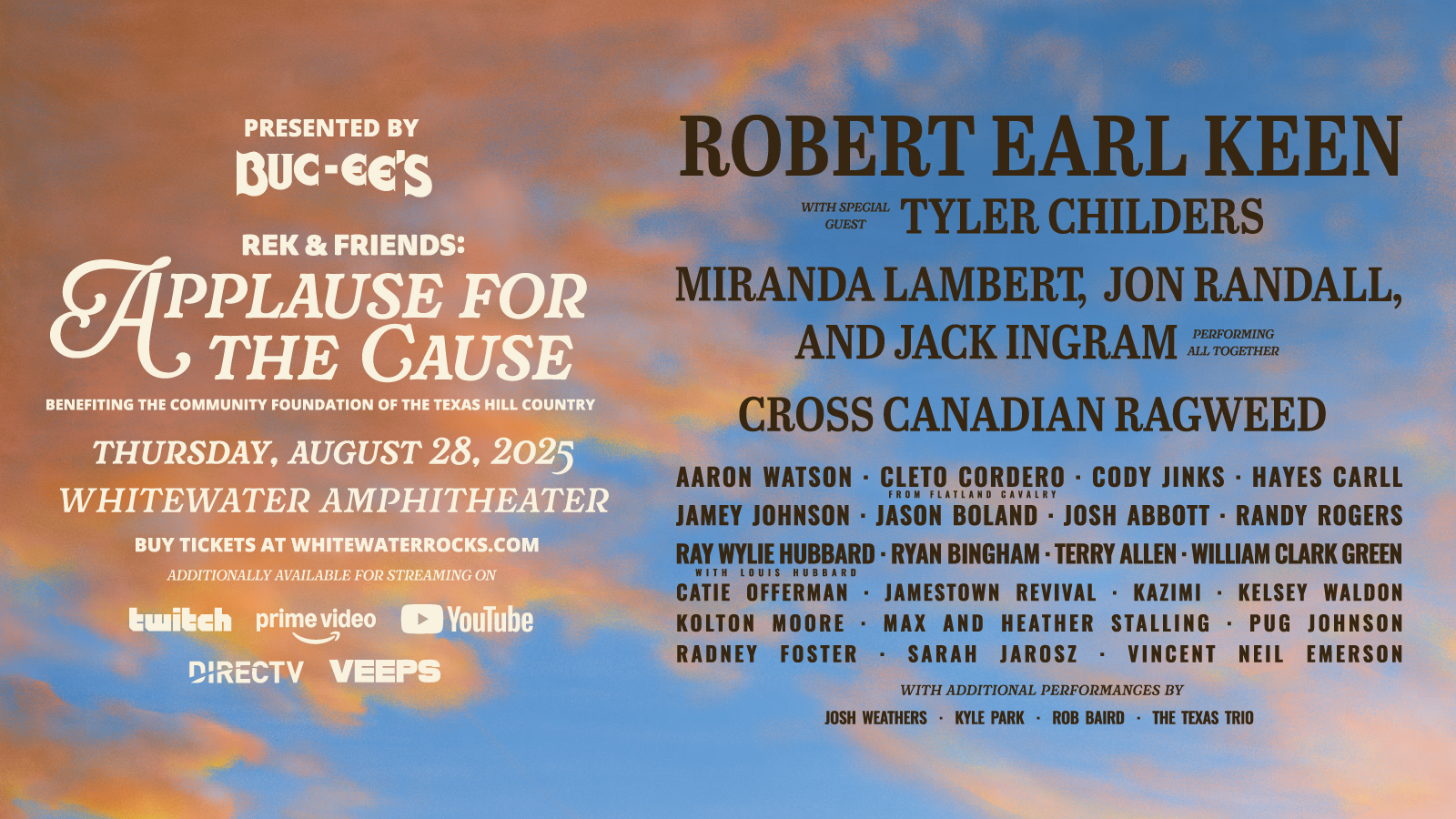
The Texas Hill Country floods devastated fertile territory for roots music and Good Country in west Texas in early July. The artistic community has responded en force, quickly assembling quite a few star-studded benefit shows, concerts, and on-the-ground relief efforts.
Robert Earl Keen – together with a host of partners and sponsors – has convened a superlative lineup for just such an event, Applause for the Cause, to be held August 28 in New Braunfels, Texas. Featuring appearances by luminaries such as Tyler Childers, Miranda Lambert, Cody Jinks, Ray Wylie Hubbard, Kelsey Waldon, Jamey Johnson, and many more, the show almost immediately sold out. The good news is you can watch the performances via streaming (Amazon Music, DIRECTV, Veeps) and REK’s YouTube channel. The even better news is you can still donate directly to the Community Foundation of the Texas Hill Country, beneficiaries of the evening, to support the cause.
Yes, Trisha Yearwood is a country legend of stage and screen, but did you know she’s a stellar songwriter as well? Her brand new album, The Mirror, reflects this fact with 15 tracks all co-written by the Grand Ole Opry member. Plus, the collection features guests like Jim Lauderdale, Charles Kelley, and Hailey Whitters. THIS is Good Country!
Want more Good Country? Sign up to receive our monthly email newsletter – and much more music! – direct to your inbox.
Photo Credits: The Band Loula by Sara Katherine Mills; Tyler Childers by Sam Waxman; Greensky Bluegrass by Dylan Langille; Robert Earl Keen by Emma Delevante; Trisha Yearwood by Russ Harrington.
It’s certainly true that the Grateful Dead were never a bluegrass band, starting with the fact that their lineup had not just one drummer, but two. And yet it also can’t be denied that the group’s musical DNA has a wide streak of bluegrass deep within, both in terms of licks and improvisational flair.
In large part, that’s due to the late Jerry Garcia – “Captain Trips” – who started out as a banjo player before finding his most famous calling as the Grateful Dead’s lead guitarist. Before that, Garcia played in folk circles for years, and his many extracurricular collaborators included David Grisman, Peter Rowan, Don Reno, Chubby Wise and other titans of the genre. More than a quarter-century before O Brother, Where Art Thou? took bluegrass to the top of the charts, Garcia’s 1973 side project, Old & In the Way, stood as the top-selling bluegrass album of all time.
Garcia and the Dead’s bluegrass bona fides are solid indeed, as shown by artifacts like the Pickin’ on the Grateful Dead series (not to mention Grass Is Dead, a tribute act). But maybe the strongest testament to the strength of the Dead’s bluegrass-adjacent side is what other artists have made of their catalog. Countless bluegrass musicians have covered Dead songs in ways that would appeal to even the staunchest chair-snapping purists. Here are some of the best.
“Friend of the Devil” – The Travelin’ McCourys (2019)
This rounder’s tale is the granddaddy of ’em all, a bluegrass staple from almost the moment it appeared on the Dead’s 1970 proto-Americana classic, American Beauty. Long a picking-circle staple at festivals, it’s been covered by everybody from Tony Rice to Elvis Costello. But here is a fantastic cover by one of the finest family bands in all of bluegrass, captured onstage at the Grey Fox Bluegrass Festival in 2019. In contrast to the manic pace of the original, this version proceeds at more of an elegant glide. But it’s still got plenty of get-up-and-go, with killer solos over walking bass and a great Ronnie McCoury lead vocal.
“Dire Wolf” – Molly Tuttle (2022)
Among the most acclaimed young artists in bluegrass, Molly Tuttle is a two-time Guitar Player of the Year winner from the International Bluegrass Music Association. She also won IBMA’s Album of the Year trophy for 2022’s Crooked Tree, which included the 1970 Workingman’s Dead standard “Dire Wolf” as a bonus track. Equal parts folk fable and murder ballad, it’s something like “Little Red Riding Hood” with an unhappy ending. And Tuttle’s vocal is even more striking than her guitar-playing.
“Wharf Rat” – Billy Strings (2020)
Possibly even more acclaimed as a guitarist is William “Billy Strings” Apostol, another IBMA Awards fixture (and multiple Entertainer of the Year winner) who is frequently likened to Doc Watson. But few guitarists have ever conjured up Garcia’s sound, spirit, and all-around vibe as effectively as Strings. A song about a lost soul in a seaside town, “Wharf Rat” first came out on the Dead’s eponymous 1971 live album. Strings’ 2020 live version from the Capitol Theatre in Port Chester, New York, is amazing, as Strings doesn’t sing it so much as inhabit it. The money shot is his guitar solo that begins just after the five-minute mark.
“Scarlet Begonias” – The Infamous Stringdusters (2020)
Gambling is one of the Dead’s recurrent tropes and “Scarlet Begonias” gives it a playful spin with a loping guitar riff. The original dates back to 1974’s From the Mars Hotel and it’s been widely covered in oddball styles by the likes of electronic duo Thievery Corporation and the ska band Sublime. But “Scarlet Begonias” has never had it so well as in this excellent bluegrass version by The Infamous Stringdusters, shot onstage at Seattle’s Showbox just ahead of the pandemic in early 2020.
“Ripple” – Dale Ann Bradley (2019)
More often than not, vocals tended to be the Dead’s weak link. But that is not a problem for Kentucky Music Hall of Famer and five-time IBMA Female Vocalist of the Year Dale Ann Bradley. The elegiac “Ripple” began life as the B-side to the “Truckin’” single and was also a show-stopper on the Dead’s 1981 acoustic live album, Reckoning. Bradley covered it on her 2019 LP, The Hard Way, with Tina Adair providing truly lovely vocal harmonies.
“Uncle John’s Band” – Fireside Collective (2022)
One of the Dead’s folksiest numbers, “Uncle John’s Band” kicked off Workingman’s Dead at an easy-going amble – a clear departure from the psychedelic excursions of the Dead’s earliest work. This live version by the young Asheville, North Carolina, band Fireside Collective reimagines “Uncle John’s Band” as sprawling jam-band fodder.
“Cassidy” – Greensky Bluegrass (2007)
“Cassidy” first appeared on-record as a Bob Weir solo tune on his 1972 side-project album, Ace, but it’s been on multiple Dead live albums over the years. It’s always been something of an enigma, inspired by a young girl as well as Neal Cassady. Michigan jamgrass ensemble Greensky Bluegrass gets to its beat-poet heart on this version from 2007’s Live at Bell’s.
“Tennessee Jed” – Front Country (2018)
A frequent theme for the Dead was being in motion, whether traveling toward something or running away from it. So it follows that homesickness would be an aspect of their music, perhaps most overtly on this wistful song from the double-live LP, Europe ’72. California’s Front Country put “Tennessee Jed” through its paces in this 2018 version from their “Kitchen Covers” series.
“Touch of Grey” – Love Canon (2014)
If the Dead wasn’t a bluegrass band, they most definitely weren’t a pop band, either. But the group had occasional brushes with the Hot 100, most famously with the 1970 statement of purpose “Truckin’” and its “what a long strange trip it’s been” tagline (even though the group had only been together about five years by then). “Truckin’” stalled out at No. 64 and was later eclipsed by its 1987 sequel “Touch of Grey” – an actual Top 10 hit with its bittersweet conclusion, “We will get by, we will survive.”
From Charlottesville, Virginia, Love Canon strips away the ’80s pop keyboards and covers the song well as straight-up bluegrass on 2014’s “Dead Covers Project.”
Photo Credit: Old & In the Way, courtesy of Acoustic Disc.
It’s seven months into the year and music and media outlets are looking back while looking forward, pondering and collating all of the incredible music that’s been released in 2024… so far. From Beyoncé to Zach Bryan to “brat summer,” there’s certainly been no shortage of seismic album drops – and in our bluegrass corner of the roots music world, the same holds true.
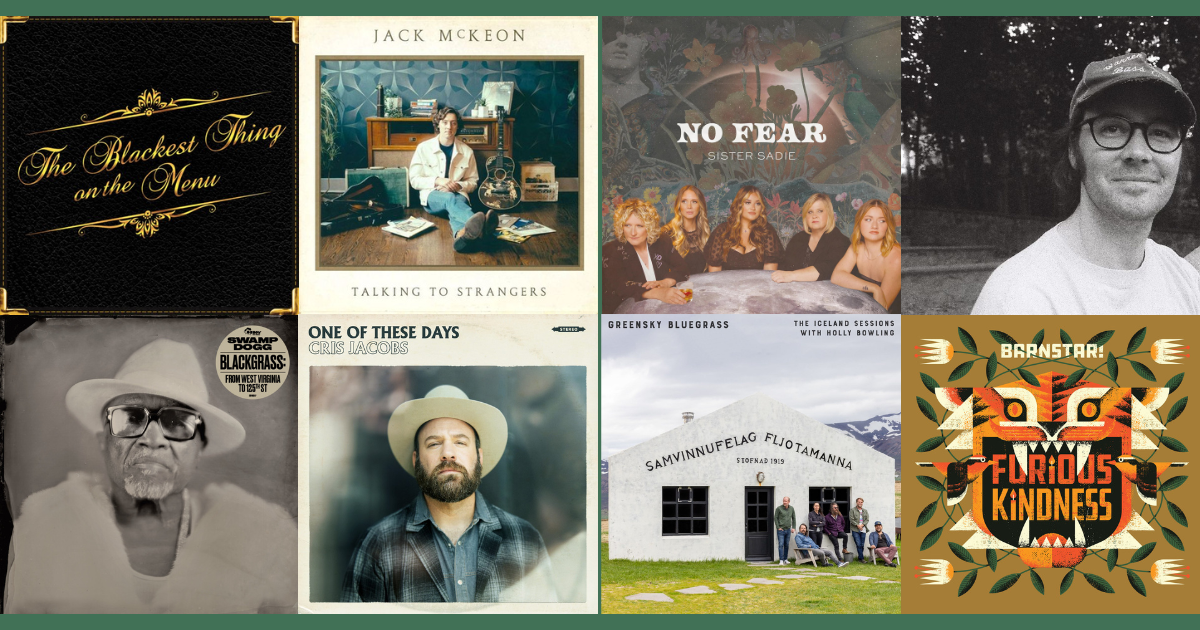
So far this year, there have been stellar releases by the biggest names in the genre, like Béla Fleck, Billy Strings, Tony Trischka, Laurie Lewis, and the Del McCoury Band. Country singer-songwriter Brit Taylor and roots-soul legend Swamp Dogg both released bluegrass titles this year as well, demonstrating how the age-old tradition of various styles and sounds cross-pollinating with bluegrass continues in the present day.
Supergroups like Sister Sadie, Greensky Bluegrass, and Gangstagrass have all unleashed critically-acclaimed projects in 2024, too, while newcomers like Wyatt Ellis and Jack McKeon impressed with records that sound mature and fully-realized for debut releases. And of course there’s plenty yet to come, as anticipation builds for long-awaited albums from bluegrass stalwarts and heroes like Jerry Douglas – who was just unveiled as a 2024 Bluegrass Hall of Fame inductee – and Gillian Welch & David Rawlings, who recently announced a new project, Woodland, their tenth studio album and first release in four years.
No matter how you cut it, 2024 has been a banner year for superlative bluegrass albums – and there is still so much more to come! Take a minute to amble through our favorite bluegrass releases of the year so far (in approximate chronological order), plus a few honorable mentions that pull heavily from bluegrass traditions and inspirations, and we’ll set the table for the albums we can’t wait to arrive later this year, too.
Cary Morin, Innocent Allies
A jaw-dropping acoustic guitarist who toggles between flatpicking, fingerstyle, blues, and many other styles, Cary Morin released a gorgeous visual art-inspired album earlier this year entitled Innocent Allies. The entire project oozes images of the West done up in bluegrass textures and tones, especially so in Morin’s rendition of “Whiskey Before Breakfast.” Read our feature on the album here.
Sister Sadie, No Fear
For a band that boasts alumni like Dale Ann Bradley and Tina Adair, it’s saying quite a lot to make the statement that this may be the best lineup of Sister Sadie yet. Their latest offering, No Fear, brings striking Nashville vibes together with a dash of the Chicks and features collaborations with country stars like Cam and Ashley McBryde. It’s no surprise this supergroup and their newest album are all over this year’s IBMA Awards nominations. Read our March Cover Story on No Fear here.
Wyatt Ellis, Happy Valley
A mere 15 years old, mandolin picker Wyatt Ellis certainly deserves the “bluegrass prodigy” designation he often receives, but dare not sell this young virtuoso short with such a moniker. There’s musicality, touch, and taste evident across his debut album, Happy Valley, well beyond his teenaged years. That’s just part of the reason behind why he’s able to attract such notable collaborators and guests as Marty Stuart, Sierra Hull, Mike Compton, and more. Keep an eye on this one, ‘cause there’s no telling just how far he will go in music, but it’s sure to be way up there!
Brit Taylor, Kentucky Bluegrassed
Pulling a page out of the bluegrass playbook of the ‘60s through ‘90s, country singer-songwriter Brit Taylor demonstrates the inseparable interconnectedness of country and bluegrass with Kentucky Bluegrassed, a reimagination of her 2023 country album, Kentucky Blue, played by a cracking bluegrass band. There are touches of Alan Jackson, Vince Gill, Patty Loveless, and so many more through the project. It certainly reminds of those eras, in which bluegrass artists and bands were just as likely to identify simply as “country” as they were “bluegrass.” The lines between these genres used to be much more blurry; we’re happy to see folks like Taylor – and many others – smear, complicate, and dirty up those genre demarcations once again. Kentucky Bluegrassed is a “don’t miss” album that may not be on every diehard grasser’s radar.
Missy Raines & Allegheny, Highlander
Missy Raines never left bluegrass, but Highlander feels like something of a return by this trophied and exalted bassist, singer, and songwriter after her last few more experimental and Americana-geared outings. This is her first recording with her “new” backing band, Allegheny, who have performed with her now for a handful of years. It’s a rollicking, up-tempo, dynamo of an album, but it’s never one note or stolid – or trying to pander to digital radio. There are calm moments, songs that will bring a tear to your eye, and political tones, too, all bolstering the tightness of the band and the trad-tastic, meta-mash energy herein. “Who Needs a Mine,” the stand out track in a superlative song sequence, will most likely go down in history as one of the best issues-oriented bluegrass songs ever written. Every bit as biting and timely as Hazel Dickens, Jean Ritchie, and so many other activist artists from the regions Raines grew up in. Read our recent feature interview here.
Béla Fleck, Rhapsody in Blue
The most traditional aspect of Béla Fleck’s music-making across his lifelong career is his constant and effortless innovation. As a community, we lose sight so easily of the fact that every first generation bluegrass star was an innovator, so many consummate musicians just “making it up as they go along.” Referring to Fleck’s Rhapsody in Blue as “making it up as he goes along” might raise an eyebrow at first, but one of the most fascinating threads throughout Fleck’s countless albums is his ability to ground whatever musical vocabulary he chooses within the traditions, styles, and physicality of bluegrass banjo. He doesn’t so much care what “does” or “doesn’t” fit on the banjo, he follows his whims, fancies, and inspirations and always makes it work. Perhaps only he could do so with Gerswhin! (And we are so glad that he did.)
Kyle Tuttle, Labor of Lust
Banjo player Kyle Tuttle released his second studio album, Labor of Lust, in February. You may know him from Molly Tuttle’s band, Golden Highway, or from his ubiquitous presence in jamgrass scenes over the past decade or so. The new album demonstrates his particular approach to newgrass, jamgrass, and engaging and exciting improvisational picking. His voice on the instrument is indelible. A modernist banjo player with endless panache, a strong sense of humor, and buckets of stamina and drive. We spoke to Tuttle about the project earlier this year.
Barnstar!, Furious Kindness
New Englander and Northeastern-based bluegrassers will be more than familiar with this raucous outfit, but the national bluegrass scene may need to be put onto the singular sounds of Barnstar! Made up of Mark Erelli, Zachariah Hickman, Charlie Rose, and Taylor and Jake Armerding, Barnstar! started as a side project for these in-demand musicians and songwriters and quickly blossomed into a chaotic, bombastic, and hilarious group that can just as easily go earnest, emotive, and touching. Furious Kindness is another selection here that you may not have yet encountered – and we’re here to rectify that. Need more? We hosted Erelli and Hickman on Basic Folk to chat about the project.
Cris Jacobs, One of These Days
If your first introduction to Cris Jacobs was the above song – “Poor Davey,” featuring Billy Strings – fed to you by the algorithm or a roots DJ or found via the “appears on” section of Strings’ streaming profiles, you certainly aren’t alone. A well-known musician in alt-country, rock and roll, and the often nebulous regions between these genres, Americana, and bluegrass, Jacobs may read as a newcomer in bluegrass, but his Jerry Douglas-produced album, One of These Days, is anything but a one-off or novelty project or ‘grassy interloping. This is deep and broad bluegrass that feels straight ahead and genre-expansive at the same time, drawing on guests like Lindsay Lou, the McCrary Sisters, Sam Bush, and more. The Strings track may be what first grabs you, but this album deserves a deep dive follow-up, immediately.
Greensky Bluegrass, The Iceland Sessions(featuring Holly Bowling)
An EP we loved so much it just had to be included on our Best Bluegrass Albums list. Pianist and keys player Holly Bowling joins illustrious jamgrass group Greensky Bluegrass to revive the often latent, near extinct, and severely underrated tradition of bluegrass piano. Over four tracks recorded in remote northern Iceland in 2023, the band and Bowling have curated a vibe that hinges on the present, focusing in on the exact moments in time wherein they captured these sounds and songs. It’s why we love jamgrass to begin with, right? The way the music calls all of us to be grounded in the present. That’s the exact spirit in which these recordings were made and the translation of that intention is more than just successful, it’s deeply resonant.
Bronwyn Keith-Hynes, I Built A World
Fiddler Bronwyn Keith-Hynes has found her voice – literally and figuratively. While her last studio release, Fiddler’s Pastime (2020), was more instrumental-focused, her latest project, I Built A World, finds her stepping up to the vocal mic with confidence. Her voice is strong and well-practiced while homey and down to earth, too. The song selections are bold, her collaborators are glitzy and first-rate, but each feature, guest, and musician serves the track they’re on and the album as a whole first and foremost. Keith-Hynes has certainly found her groove and her creative community, and we’re all reaping the benefits of her commitment to challenging herself and looking ahead to the future. We recently chatted with Bronwyn and her pal Brenna MacMillan about their respective solo projects – check it out here.
Swamp Dogg, Blackgrass: From West Virginia to 125th St
When the initial announcement of Swamp Dogg’s latest album, Blackgrass, reached the BGS team, electricity and excitement shot through our ranks. Here’s a project that speaks deeply to one of our highest-priority missions in bluegrass: to showcase the multi-ethnic, melting pot, diverse roots of our favorite genre of music. Bluegrass has never been a music for white folks only, no matter how prevalent that narrative is today, and this legendary multi-hyphenate musician, creator, and producer, Swamp Dogg, demonstrates that fact part and parcel over the course of this impeccable collection of music – with a backing band that includes many of the best pickers around today. There are countless remarkable aspects of this album, too many to include in this simple blurb, so head to Lizzie No’s feature on the project to learn more about why this project is purposefully rebellious and revolutionary.
Laurie Lewis, TREES
California bluegrass keystone Laurie Lewis was just announced as one recipient of this year’s IBMA Distinguished Achievement Awards. For decades she has been a center of gravity around which the California and West Coast bluegrass scenes orbit, like a perseverant mother tree from which so many young shoots and saplings have sprung. Her brand new album, TREES, draws upon her wellspring of through-hiking and naturalist knowledge to encounter, process, and challenge so many modern day realities – health issues, the ever-quickening climate crisis, personal and professional life hurdles, and much more. The result is touching, emotional, encouraging, and inspiring, wrapped in traditional bluegrass trappings that feel more in service to the songs than to legalistic genre criteria. Lewis is one of the best to ever make bluegrass and TREES is one of the best releases in her lauded and superlative catalog. We recently published our exclusive interview, which you won’t want to miss.
Tony Trischka, Earl Jam
One of the greatest banjo players today, our current Artist of the Month Tony Trischka has made a career trailblazing on melodic-style three-finger banjo, writing, composing, and recording music that only he could’ve made. For his latest album, Earl Jam, though, he instead leans on the timeless bluegrass task of emulating the greats – namely, Earl Scruggs. The track list is pulled from recordings of casual, at-home jam sessions between Earl, John Hartford, and others, and with his all-star band and fabulous guests, Trischka reiterates Earl’s idiosyncratic playing from these previously unheard recordings. It’s a fascinating context in which to rediscover the limitless intricacies behind Trischka’s playing and the way he synthesizes others’ influences into his own musical vocabulary. Whether stepping into the role – or, shall we say, roll – of Scruggs or making modern banjo compositions out on his own creative limbs, Tony Trischka makes it look effortless and executes everything he does at the highest level. Don’t miss our Artist of the Month feature and our discography deep dive.
Gangstagrass, The Blackest Thing on the Menu
With a band as incisive and forward-looking as Gangstagrass, there will always be countless reasons naysayers will attempt to use to disqualify their music as “bluegrass.” But when viewing this now 15-year-old group through an objective lens, you can see many more bluegrass qualities than not. Innovation (the oldest bluegrass tradition), improvisation, virtuosity, conversational lyrics, a blending of styles, genres, and textures, and the bringing together of creators and inspirations from a variety of backgrounds – that all sounds like bluegrass to us! Gangstagrass’s latest opus, The Blackest Thing on the Menu, finds the critically-acclaimed group at their strongest yet, with a Jerry Douglas track feature (“The Only Way Out is Through”) and plenty of hip-hop-meets-bluegrass excellence. In the present, folks may errantly write off this band as a novelty or an aberration, but in the future we will all view Gangstagrass as they have always been: one of the firsts in the quickly-developing tradition of roots hip-hop, rap string bands, and postmodern bluegrass re-interpreters.
Jack McKeon, Talking to Strangers
In the vein of country songwriters with bluegrass careers – or bluegrass songwriters with country careers (think Shawn Camp, Tom T. Hall, John Prine, Darrell Scott) – Jack McKeon’s debut album, Talking To Strangers, isn’t just bluegrass, but it certainly tracks as first class ‘grassy, down home, front porch music. These thoughtful, introspective lyrics are perfectly set, to a straight ahead bluegrass band like Ashby Frank, Justin Moses, Christian Sedelmeyer, and Vickie Vaughn. McKeon is inaugurating his catalog of recorded works demonstrating that his songs and his voice can be shapeshifters, at home on Music Row and on bluegrass stages and radio, both.
The Del McCoury Band, Songs of Love and Life
Del McCoury is one of the most-awarded personalities in the history of bluegrass and it’s truly no wonder why. He’s spent his entire life honing the family trade: the highest quality bluegrass around. At 85 years-old, every album, concert, performance, and festival we enjoy from Del and the boys is a gift that we’re determined to cherish and savor. His latest full length album, Songs of Love and Life, is sure to be shortlisted for the highest honors handed out by the Grammys and IBMA. This particular track, “Only the Lonely,” is a Roy Orbison cover that showcases Del’s lifelong penchant for not worrying about what is or isn’t bluegrass and instead doing his utmost to serve the song – hence the tasty, honky-tonkin’ bluegrass piano. (Bluegrass piano? Twice in one list??) The record includes a few more charming covers, plenty of brand new tracks, and a Molly Tuttle feature, too.
Brandon Godman, I Heard the Morgan Bell
A killer fiddler from Kentucky who’s performed with Laurie Lewis, Dale Ann Bradley, Jon Pardi, and many, many more, Brandon Godman recently released his first studio album as a solo artist since he was a teenager. Based in San Francisco, Godman is a touring fiddler turned luthier who remains an expert in so many musical styles from his home turf in northern Kentucky. From contest fiddling to western swing to pop country to bluegrass breakdowns and transatlantic hornpipes, Godman’s playing has grit, drive, and aggression, sure, but what stands out the most on I Heard the Morgan Bell, his album of all original compositions, is his emotional range, lyricism, and heartfelt tenderness. Throw in guests like Darol Anger, Patrick Sauber, Sam Reider, and more and you’ve got what will end up being one of the best fiddle-centric albums of this decade.
Tray Wellington, Detour to the Moon
Carrying the banjo innovation banner for millennial cuspers and Gen Z, Tray Wellington is anything but a traditional bluegrass banjo player – and that fact alone is what will always land him in the “solidly bluegrass” camp, by our reckoning. Like fellow listees Trischka, Tuttle, and Fleck, Wellington has found a voice of his very own on the five-string banjo and in recent years his musical offerings – which were already top-notch – have become exponentially more fascinating, fun, and entrancing as a result. His new EP, Detour to the Moon, includes seemingly through-composed, instrumental new acoustic music a la Punch Brothers alongside more straightforward original banjo tunes and a Kid Cudi cover that may just be the best bluegrass cover of a non-bluegrass hit in recent memory. Watching the excited recognition of “Pursuit of Happiness” ripple through the audience at a bluegrass festival while Tray Wellington Band is on stage kicking off the number will certainly never get old.
Billy Strings, Billy Strings Live Vol. 1
The People’s Bluegrass President, Billy Strings, is out with his first live album, Billy Strings Live Vol. 1. No one is doing it like Billy; selling out arenas, coliseums, and gigantic amphitheaters with what’s actually just a five-piece bluegrass band will always be remarkable and noteworthy. Plus, the way he and his team bring his audience into the creative process, feeding their insatiable appetites for content, for music, for four-hour-long tribute shows, is not simply to sell tickets, fill seats, and move product. Strings, at the beginning of the day and at the end of the day, is just a big ol’ bluegrass and guitar nerd. We love that about him. There’s almost no one else in the history of this music from whom we’d tolerate a 13 minute track. (By the way, that’s not the longest runtime on the album!) Keep doing it like only you do it, Billy, and we’ll all stick with you the whole entire way.
AJ Lee & Blue Summit, City of Glass
The last time we had a bluegrass artist take off on our website and socials like AJ Lee & Blue Summit are taking off now, it was Billy Strings playing “Meet Me at the Creek.” We’ve been following this Santa Cruz, California-based string band – featuring AJ Lee, Jan Purat, Scott Gates, and Sully Tuttle – for years, so it’s no surprise to us that the greater bluegrass audience is catching onto the special sound and style of Blue Summit and their brand new album, City of Glass. This is pointedly Californian bluegrass, meaning it is effortlessly traditional and organically inventive and generative. High lonesome harmonies and fiery pickin’ skills combine with soul, groove, emotion, and thoughtful writing. There are country moments, there are barn burners, but overall, it’s clear this young band have hit their stride and know who they are. We aren’t here to tell you the best of the best, per se, but if we were City of Glass would be at the very top.
Andrew Marlin, how dare you surprise release this divine album!? (Seriously, thank you, it was indeed a wonderful surprise.) Out last week with hardly more fanfare than a handful of social media posts, Marlin’s brand new collection, Phthalo Blue, has already charmed its way onto our “Best So Far” list. Featuring Stephanie Coleman, Allison de Groot, Clint Mullican, Josh Oliver, and Nat Smith, this is the perfect kind of bluegrass to put on while you work, tidy the house, or tend to your garden. You’ll find the healing effects herein don’t just come from rabbit tobacco.
Near-Bluegrass Honorable Mentions
Whatever you think about our list so far – and whether or not the albums on it qualify as bluegrass to you – here are just a handful of albums we would have regretted not including, but may have more tangential relationships to the genre than their fellows in this piece. Still, each of these fine records has obvious bluegrass bones, however subtle or overt they may be.
Willi Carlisle, Critterland
Many an old-time troubadour/poet such as Willi Carlisle has been a bluegrass musician, but perhaps Carlisle himself wouldn’t identify in that way. Still, there’s bluegrass throughout the critters and characters on this critically-acclaimed album, Critterland. We did a feature on the project, read that here.
Sierra Ferrell, Trail of Flowers
Her new album is markedly post-genre, but those in the know are already well aware that Sierra Ferrell came up through bluegrass circles. From her patinaed West Virginia voice – that brings Hazel Dickens to mind – to her cutting fiddle bowings, wherever she may roam musically, Ferrell will always have a home in bluegrass.
Rachel Sumner, Heartless Things
Rachel Sumner (formerly of Twisted Pine) is decidedly bluegrass, but somehow that seems too simplistic an umbrella for the nuanced music she creates and the special tones she strikes. She infuses so much of the Northeastern bluegrass, folk, Celtic, and jazz scenes and their respective vocabularies into her songs – they may not be exactly bluegrass, but they certainly don’t fall entirely outside that umbrella, either.
Zach Top, Cold Beer & Country Music
Now, this ain’t no bluegrass album – it’s Good Country, that’s for sure – but there’s a bluegrass story embedded within Zach Top’s hugely popular debut, Cold Beer & Country Music, that we’re determined to tell. Once a winner of SPBGMA’s band contest, Top grew up idolizing Tony Rice and Keith Whitley and playing in a bluegrass family band on the weekends. You can see bluegrass touches throughout this mainstream country record, just like when Ricky Skaggs, Whitley, the Osborne Brothers, and more targeted country radio with their songs and sound. Our Good Country feature interview explores all the ways bluegrass filters into his music.
Kaia Kater, Strange Medicine
Kaia Kater is another genre expander who hasn’t ever quite made bluegrass music, but has never been too far from that sonic space, either. She pulls more readily from indie and old-time and folk traditions, but her new album, Strange Medicine, feels like she’s developed an entirely new thing, where genre is a third space, something liminal, or purposefully transitional. Perhaps the most bluegrass thing about this stunning collection is groove, an ever present character through these gorgeous and intricate songs. Kater was our Artist of the Month in May.
Anticipated Albums Still to Come This Year
There’s plenty more where all that came from! Here are just a few of the as yet unreleased recordings we’re sure will be on our “Best Of” lists when we reach the end of the year. It’s not as far off as you think! Luckily, we’ll have a stellar soundtrack to get us there.
Alison Brown, Simple Pleasures (reissue) – available August 9
Rhonda Vincent, Destinations And Fun Places – available August 9
Bella White, Five For Silver– available August 16
Po’ Ramblin’ Boys, Wanderers Like Me – available August 16
Dan Tyminski, Whiskey Drinking Man – available August 16
Fruition, How to Make Mistakes – available August 23
Gillian Welch & David Rawlings, Woodland – available August 23
Caleb Caudle, Sweet Critters – available August 30
Various Artists, Bluegrass Sings Paxton – available August 30
Willie Watson, Willie Watson – available September 13
Jerry Douglas, The Set – available September 20
Twisted Pine, Love Your Mind– available October 18
Brenna MacMillan, Title TBA – release date TBA
BGS Staff also contributed to and assisted curating this list.
The bluegrass community is collectively grieving two major losses as both Jesse McReynolds and Bobby Osborne – two revered and iconic Bluegrass Hall of Fame-inducted mandolinists and Grand Ole Opry members who helmed first-generation bluegrass bands with their brothers – have passed on. McReynolds, who was 94, died on Friday, June 23 at his home in Nashville with his wife, Joy, at his side; Osborne’s death was announced on social media early Tuesday, June 27 – he was 91. Both pickers were two of the sole survivors of bluegrass’s first generation. They leave enormous musical legacies that will live on, surely into infinity.
In 2017, the Bluegrass Situation team had the incredible honor of inviting Bobby Osborne to join our super jam at the world-famous Bonnaroo music festival in Manchester, Tennessee. To our delight, he said yes.
BGS co-founder Ed Helms and Bobby Osborne
Over more than ten years of creating and holding space for roots music in our industry, there are so many moments of which we are so proud. But one of the most memorable and meaningful BGS achievements from the past decade was hearing 20,000+ audience members and fans, packed into That Tent, roar unfathomably loud for the iconoclastic voice that made a hit of “Rocky Top” – and so many others.
That day, Bobby seemed to bask in the limelight. He was kind, down-to-earth, approachable, and seemed genuinely tickled at the fanfare and excitement that orbited him and his sharp, technicolor suit and sparkly hat. After a storied career that landed him and his brother, Sonny, in so many widely variable musical contexts, from the obscure to the mainstream, Bobby was perfectly at home at Bonnaroo. His audience knew it, and they ate it up. We all did.
Bobby Osborne with Casey Campbell (background) and Mike Barnett (foreground)
In light of his passing, the entire BGS team is holding gratitude for his kindness, generosity, and, most of all, for his music. Rest in peace to one of the most important and impactful first generation bluegrass music makers, Bobby Osborne.
We hope you’ll enjoy these back stage and performance photos, shot by Elli Lauren Photography, from Bonnaroo 2017 and the BGS Super Jam at That Tent.
Bobby Osborne, Paul Hoffman, Ed Helms, and members of Greensky Bluegrass and Bryan Sutton’s house band.
Lillie Mae and Bobby Osborne share a laugh on stage prior to their duet.
Bobby OsborneEd Helms, Casey Campbell, Bobby Osborne, and others
Bobby Osborne and Casey Campbell (background)
Bobby Osborne closes his 2017 Bonnaroo appearance with a bow and a tip of his hat.
Since the beginning, BGS has sought to showcase roots music at every level and to preserve the moments throughout its ever-developing history that make this music so special. One of the simplest ways we’ve been able to do just that has been through our Sitch Sessions — working with new and old friends, up-and-coming artists, and legendary performers, filming musical moments in small, intimate spaces, among expansive, breathtaking landscapes, and just about everywhere in between. But always aiming to capture the communion of these shared moments.
In honor of our 10th year, we’ve gathered 10 of our best sessions — viral videos and fan favorites — from the past decade. We hope you’ll enjoy this trip down memory lane!
Greensky Bluegrass – “Burn Them”
Our most popular video of all time, this Telluride, Colorado session with Greensky Bluegrass is an undeniable favorite, and we just had to include it first.
Rodney Crowell and Emmylou Harris – “The Traveling Kind”
What more could you ask for than two old friends and legends of country music reminiscing on travels and songs passed and yet to come, in an intimate space like this? “We’re members of an elite group because we’re still around, we’re still traveling,” Emmylou Harris jokes. To which Rodney Crowell adds with a laugh, “We traveled so far, it became a song.” The flowers were even specifically chosen and arranged “to represent a celestial great-beyond and provide a welcoming otherworldly quality … a resting place for the traveling kind.” Another heartwarming touch for an unforgettable moment.
Sarah Jarosz and Aoife O’Donovan – “Some Tyrant”
In the summer of 2014, during the Telluride Bluegrass Festival we had the distinct pleasure of capturing Sarah Jarosz and Aoife O’Donovan’s perfectly bucolic version of “Some Tyrant” among the aspens. While out on this jaunt into the woods, we also caught a performance of the loveliest ode to summertime from Kristin Andreassen, joined by Aoife and Sarah.
Rhiannon Giddens – “Mal Hombre”
Rhiannon Giddens once again proves that she can sing just about anything she wants to — and really well — with this gorgeously painful and moving version of “Mal Hombre.”
Tim O’Brien – “You Were on My Mind”
Is this our favorite Sitch Session of all time? Probably. Do we dream of having the good fortune of running into Tim O’Brien playing the banjo on a dusty road outside of Telluride like the truck driver in this video? Definitely.
Enjoy one of our most popular Sitch Sessions of all time, featuring O’Brien’s pure, unfiltered magic in a solo performance of an original, modern classic.
Gregory Alan Isakov – “Saint Valentine”
Being lucky in love is great work, if you can find it. But, for the rest of us, it’s a hard row to hoe. For this 2017 Sitch Session at the York Manor in our home base of Los Angeles, Gregory Alan Isakov teamed up with the Ghost Orchestra to perform “Saint Valentine.”
The Earls of Leicester – “The Train That Carried My Girl From Town”
In this rollicking session, the Earls of Leicester gather round some Ear Trumpet Labs mics to bring their traditional flair to a modern audience, and they all seem to be having a helluva time!
Sara and Sean Watkins – “You and Me”
For this Telluride session, Sara and Sean Watkins toted their fiddle and guitar up the mountain to give us a performance of “You and Me” from a gondola flying high above the canyon.
Punch Brothers – “My Oh My / Boll Weevil”
The Punch Brothers — along with Dawes, The Lone Bellow, and Gregory Alan Isakov — headlined the 2015 LA Bluegrass Situation festival at the Greek Theatre (a party all on its own), and in anticipation, the group shared a performance of “My Oh My” into “Boll Weevil” from on top of the Fonda Theatre in Hollywood.
Caitlin Canty feat. Noam Pikelny – “I Want To Be With You Always”
We’ll send you off with this delicate moment. Released on Valentine’s Day, Caitlin Canty and Noam Pikelny offered their tender acoustic rendition of Lefty Frizzell’s 1951 country classic love song, “I Want to Be With You Always.”
Dive into 8 of our favorite underrated Sitch Sessions here.
This website uses cookies to improve your experience. We'll assume you're ok with this, but you can opt-out if you wish.AcceptRejectRead More
Privacy & Cookies Policy
Privacy Overview
This website uses cookies to improve your experience while you navigate through the website. Out of these, the cookies that are categorized as necessary are stored on your browser as they are essential for the working of basic functionalities of the website. We also use third-party cookies that help us analyze and understand how you use this website. These cookies will be stored in your browser only with your consent. You also have the option to opt-out of these cookies. But opting out of some of these cookies may affect your browsing experience.
Necessary cookies are absolutely essential for the website to function properly. This category only includes cookies that ensures basic functionalities and security features of the website. These cookies do not store any personal information.
Any cookies that may not be particularly necessary for the website to function and is used specifically to collect user personal data via analytics, ads, other embedded contents are termed as non-necessary cookies. It is mandatory to procure user consent prior to running these cookies on your website.