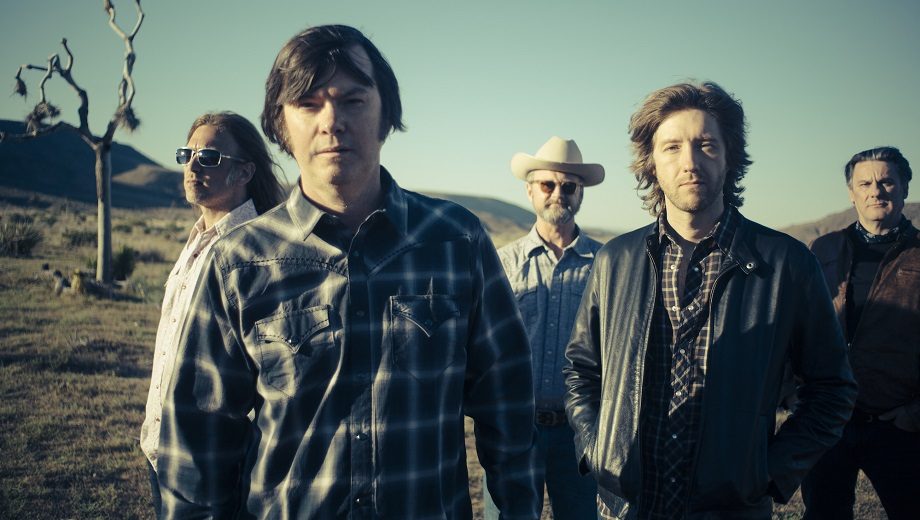
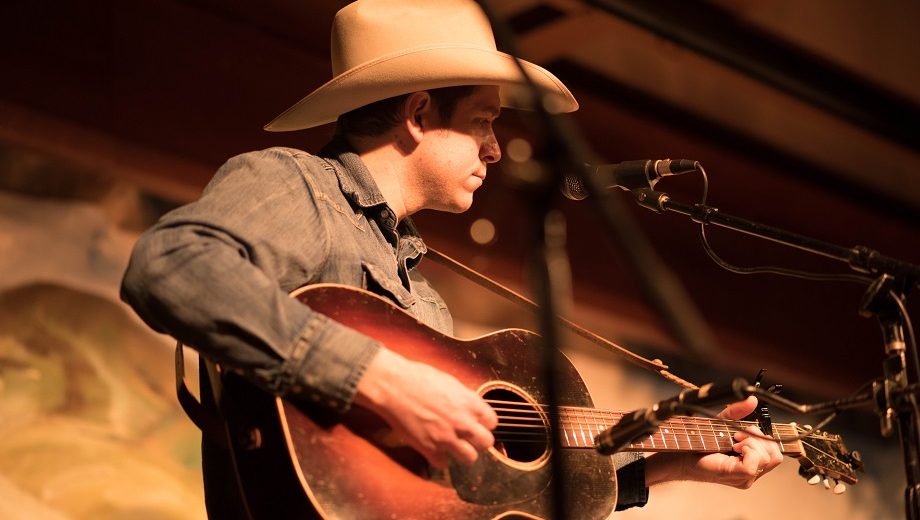
The Secret Sisters Dust Off a 1940 Woody Guthrie Track on ‘Home in This World’

Eighty-one years ago, an icon of American music released a record that has stood the test of time like few other bodies of work. Legendary storyteller and musician Woody Guthrie’s album, Dust Bowl Ballads, is that record, and now Elektra Records has issued an album that celebrates its musical singularity.

Titled Home in this World: Woody Guthrie’s Dust Bowl Ballads, the collection is far more than a restoration, remix, or remastering. Instead, producer Randall Poster tailored a reimagination of the album and rerecorded it with a slew of carefully curated artists such as John Paul White, Colter Wall, and Chris Thile. One of the highlights is “Dust Cain’t Kill Me,” performed by the Secret Sisters. “One of our COVID lockdown highlights was holing up in a hometown studio to record a tribute song to the great American storyteller, Woody Guthrie,” they said. “We loved swampin’ up his folk tune with a little Alabama mud. Hope y’all like it too!”

With such passion at the heart of it, Home in This World brings new life to music that has shaped American culture in the 20th and 21st centuries. An avid fan as well as an experienced music supervisor, Poster cast the artists by drawing on his keen sensibility for film music. “Woody Guthrie’s Dust Bowl Ballads is as relevant as ever,” he stated. “While profiteers exploit our natural resources, there is a growing sensitivity to the harsh farming practices that put our well-being at risk, and a concerted movement toward regenerative agriculture that can reinvigorate the soil and push back on climate change. I asked some of my favorite artists to help render these songs, hoping that this collection will reinforce the enduring power and prescience of Guthrie’s music and reveal the power of song. I tried to think of these songs as the soundtrack to a movie, building a narrative, a story where the world wakes up to the climate threats and unite to combat it successfully. It’s a great movie.”


Photo credit: Alysse Gafkjen

LISTEN: Mike Younger, “Killing Time”

Artist: Mike Younger
Hometown: Halifax, Canada/Nashville, Tennessee
Song: “Killing Time”
Album: Burning the Bigtop Down
Release Date: August 27, 2021

In Their Words: “‘Killing Time’ is a sideways glance at another time and the dreams and people of that time. I had survived the Hall Of Horrors which was the street/squatter experience in New York City in 1992/1993 — and I’d lost more than a few pals along the way. The lyrics take comfort in the remembrance of past friendships forged in the fire of struggle, but swept apart like grains of sand. … I’ve always been deeply affected by the struggles faced by our disenfranchised communities. I greatly admire those writers and creative people in general, who, through their work, have lent their voices to the struggle for equity in our society, like John Lennon, Woody Guthrie, Bob Dylan, Joni Mitchell, Nina Simone, Marvin Gaye, Bob Marley, and others. Artists have nothing to lose by speaking their truth, and doing so unapologetically, especially these days. That’s what I strive for in my work. There are enough great songs about pickup trucks already.” — Mike Younger


Photo credit: Michael Weintraub

LISTEN: Liz Vice, “This Land Is Your Land”

Artist: Liz Vice
Hometown: Portland, Oregon
Song: “This Land Is Your Land”
Release Date: July 2, 2021

In Their Words: “Every time I sit to write a song, specifically on the themes of justice, maybe it’s a romantic idea, but I always think that the song will be outdated by the time it’s released, as if world peace is gonna show up before a battle cry is needed. ‘This Land Is Your Land’ was written with new lyrics with my friends Paul Zach, Orlando Palmer, and Isaac Wardell one day shy of the one-year anniversary of the white nationalist ‘unite the right’ rally in Charlottesville, Virginia; that was nearly four years ago. We wanted to rewrite a popular “American” song to reflect what’s happening now in our nation and tell the story of how America became America: immigration and asylum seekers, the mass incarceration of black people, and the mass genocide of the indigenous people of this land. After much rest and reflection in 2020 and focusing on my mental health, I decided to give these new lyrics breath and now it’s time to release it out into the world.” — Liz Vice


Photo credit: Chimera Rene

BGS 5+5: Riley Downing

Artist: Riley Downing
Hometown: Kansas City, MO
Latest album: Start It Over

Which artist has influenced you the most … and how?

It is hard to pick just one artist that has influenced me the most. I am a fan of all kinds of music and genres as well as underdog musicians, current and long since lost in time. It might sound cliché, but if I had to pick one who influenced me the most it’s gonna be Woody Guthrie. If it weren’t for finding Woody Guthrie in high school, I never would have started to appreciate folk, blues, and roots music that made me think the same way that punk rock did at the time. I also never would have ventured out to Okemah, Oklahoma for the Woody Guthrie Folk Festival when I was 18 and met the guys that eventually would form the Deslondes. Woody is an American hero who tried to save the world with a song that gave people hope, morals, an education, a good laugh, and thoughts to chew on to get them through lean times. Woody, as simple as some of his music seems, was much, much more than just a musician. I never stop finding more and more meaning and inspiration from his life’s work. I always loved his copyright law, too. He basically said, warning, if you sing these songs you might just be a friend of mine, which I do and I am.

What’s your favorite memory from being on stage?

I have a lot of good memories of being on stage, whether late at night in a small club or a backyard or opening up for and getting to hear some of my favorite musicians every night. But I will never forget the first time we got to play the New Orleans Jazz Festival. That was kind of an epitome of all the hard work and hard traveling the band had done in the previous years all leading up to that one moment. It felt good to be accepted and supported by the New Orleans music community all those years and finally playing the biggest show you can really get down there. It was a surreal honor and never stopped being or feeling like it.

What was the first moment that you knew you wanted to be a musician?

The first moment I knew I wanted to be a musician was probably when I learned how to finally tune the guitar. Ha ha. I got my first electric when I was 13 and would just smash my fingers all over the strings and thought to myself, this almost sounds like I’m shredding. I thought all strings must have different sounds and tried out different kinds until my cousin finally showed me how to tune the guitar. Then came the power chords and once I was able to put a few together, I knew I needed to write words over them and attempt to sing them even though I didn’t know how to do that either. I did it anyway. Then came the buddies who also wanted to play music as well as different instruments and the realization that this is what we really love to do. I have been hooked ever since and honestly the process of doing that and the joy I get from it hasn’t changed much.

Which elements of nature do you spend the most time with and how do those impact your work?

The elements of nature that I spend the most time in that affect my work are in the rolling hills of Missouri. I love small town life, sitting in the sun fishing all day, or on a back deck BBQing and taking my time driving slow through the backroads that I don’t have to look up GPS, or listening to music or just making up songs and singing a line over and over until I have to stop and write it down. It is true, there is no place like home. I traveled all over the US and world, wide-eyed and wondering where I should end up, but Missouri is home and I always feel a great weight lifted off my shoulders when I’m there. Even when I’m not there I can always write a song that takes me back. I am sad I missed morel mushroom season this year though, but hopefully that means there will be more to find next year.

Since food and music go so well together, what is your dream pairing of a meal and a musician?

Food and music do go hand and hand. If I had to make a pairing it would be a small BBQ festival that all my friends bands could come play at and ‘lightheartedly’ compete for who does it right. My Alabama buddies will tell you it’s all about the white sauce and my North Carolina friends will argue that it’s all about the hot pepper vinegar or Carolina Gold sauce. I grew up with a BBQ squirt bottle in my hand and it’s one of my favorite pastimes and meals. Whenever people ask me where to get the best BBQ in Kansas City I have a hard time answering that question because the answer is at my house. I’m not sure who invented the red sauce but I first had it in South Carolina and pick it up any chance I get. I am loyal to KC, but South Carolina definitely gives us a run for our money. KC is spoiled though with wide variety of BBQ sauces and seasoning selections at grocery/hardware stores. I have almost successfully left or sent a bottle of Head Country, an affordable Oklahoma dry rub, to all of my friends’ houses all over the US so when I visit it’s always within reach.


Photo credit: Joshua Black Wilkins

MIXTAPE: Music to Drive Your Kids Around (Without Driving Yourself Crazy)

Among the many writer’s hats I wear is one of children’s music reviewer. When my daughter was in grade school, it was fun playing various kids CDs for her. She’s in college now, so those days are gone. I did keep her in mind, however, when putting together this playlist, thinking about songs that she would tolerate listening to now.

A lot of people associate children’s music merely with those simple, preschool music-time tunes about numbers, letters, and other lessons for toddlers. And there certainly a lot of those songs. But, as in any genre, there is a lot of interesting children’s music being made too.

This mixtape is a “mix” in a several ways. It mixes together songs by “adult” musicians who have ventured nicely into the family music world as well as children’s musicians with what some might call “crossover potential.” There are originals and covers. Fast songs and slow ones. And hopefully it’s a mix that Bluegrass Situation families can enjoy on an hour-long drive, whether it’s a fast drive or a slow one.

To create some parameters, I chose recordings released since 2000, only recordings made for children, and, yes, only recordings found on Spotify (I couldn’t find Jessie Baylin’s Strawberry Wind or I Love: Tom T. Hall’s Songs of Fox Hollow or else they might have been represented here). Also, I also stayed away from songs that seem to appear on every fourth children’s album (sorry, “Rainbow Connection”). — Michael Berick

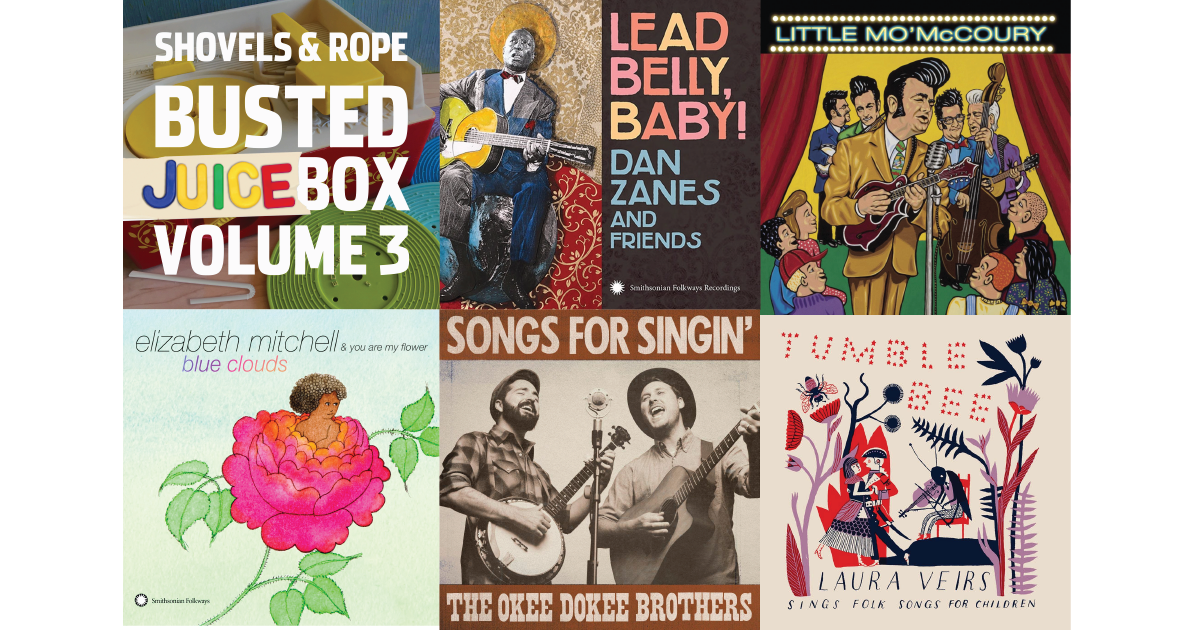
The Okee Dokee Brothers – “Hope Machine”

These “brothers,” Joe Mailander and Justin Lansing, have put out a handful of excellent, old-school, folk-inspired albums that mix originals with traditional tunes. You can hear the Woody Guthrie influence in this cheery, gently philosophical original from their 2020 album, Songs for Singing. Here, as in all their music, there’s a wonderful, easy-going approach that doesn’t dumb down to kids.

Elizabeth Mitchell – “Blue Sky (Little Martha Intro)”

This Elizabeth Mitchell isn’t the actress from Lost, but the singer/guitarist from ’80s indie rockers Ida. Over the past 20 years, she has also made many terrific children’s albums, mainly for Smithsonian Folkways. Featuring nifty guitar playing from her husband and longtime collaborator Daniel Littlefield, Mitchell’s acoustic cover of this Allman Brothers classic hails from her Blue Clouds album, where she also reconceives Bowie, Hendrix, and Van Morrison songs.

Randy Kaplan – “In a Timeout Now”

On his album Mr. Diddie Wah Diddie, Randy Kaplan has great fun taking “poetic license” with old blues tunes and, in this case, the Jimmie Rodgers hit “In the Jailhouse Now.” Kids will love the comical lyrics and parents will appreciate Kaplan’s inventive, child-friendly renovations on roots music nuggets.

Laura Veirs – “Soldier’s Joy”

I read somewhere that “Soldier’s Joy” is one of the most played fiddle tunes of all time — and that it was a slang term for morphine during the Civil War. Veirs, who hails from the Northwest indie rock scene, keeps her version on the toe-tapping PG side. This duet with The Decemberists’ Colin Meloy comes from her highly recommendable, and only, children’s album, Tumble Bee.

Wee Hairy Beasties – “Animal Crackers”

This kooky side project by alt-country all-stars features Jon Langford (Waco Brothers/The Mekons), Sally Timms (The Mekons), Kelly Hogan, and Devil in the Woodpile. Pun lovers of all ages will revel in the wild wordplay running through the title track to this decidedly goofy 2006 album.

Little Mo’ McCoury – “The Fox”

Little Mo’ McCoury arguably stands as the most authentic bluegrass album for children, at least in the 21st century. Ronnie McCoury leads his family band through a set of old-timey tunes plus “You’ve Got A Friend” and “Man Gave Name to All the Animals.” While there are some overly familiar choices (“This Old Man,” “I’ve Been Working on the Railroad), “The Fox” provides a frisky workout of this bluegrass standard.

Meat Purveyors – “The Crawdad Song”

“The Crawdad Song,” along with “Froggie Went A-Courting/King Kong Kitchie Kitchie Ki-Me-O” must rank as the traditional tunes most frequently recorded for children. I included “Crawdad” here because it is the one ingrained more in my brain. And I picked this version because of the Meat Purveyors’ speedy bluegrass-y rendition. You’ll find it on Bloodshot Records’ irreverent kids’ compilation, The Bottle Let Me Down (although parents might want to listen to it before sharing with their little ones).

Red Yarn – “Rabbit in a Log”

Red Yarn (the nom de plume for Oregon-based musician Andy Furgeson) makes rootsy music that appeals to all ages. He frequently travels an early rock and roll route but he follows a more acoustic road on this hopped-up banjo-powered take of the old folk tune that appears on his Born in the Deep Woods album.

Johnette Downing – “J’ai Vu Le Loup, Le Renard Et La Belette”

Louisiana music is a popular Americana style in children’s music, probably because it so easily gets kids dancing. On her album Swamp Rock, the New Orleans musician Johnette Downing does a marvelous job presenting, and explaining, a variety of Louisiana-bred music and culture. This bilingual animal tale (“I Saw the Wolf, the Fox and the Weasel”) showcases two Cajun greats: fiddler Joel Savoy and accordionist Roddie Romero.

Kare Strong & Josh Goforth – “To The Country We Will Go”

Slowing down the tempo a bit, “To the Country We Will Go” offers a leisurely family trip. This song, as with most Kare Strong’s music, contains elements of English folk ballads. Providing the banjo, fiddle and other musical accompaniment is Josh Goforth, a bluegrass vet who has played with David Holt, Appalachian Trail, and Carolina Road.

Francis England – “Blue Canoe”

Sticking in the traveling mode, “Blue Canoe” is a charming little outing from Francis England, who makes consistently excellent music for families. This tune appears on her debut, Fascinating Creatures, an album where I would recommend “Charlie Parker” and “The Books I Like to Read” too.

Dan Zanes featuring Valerie June – “Take This Hammer”

While Zanes is right at the top of the best-known kids musicians today, I couldn’t resist including something by him. He has a whole bunch of fine tunes to choose from and I wound up landing on this one, which he sings with Valerie June, from his 2017 tribute album, Lead Belly, Baby!

Sarah Lee Guthrie – “Go Waggaloo”

I couldn’t exclude the name “Guthrie” from this mixtape. For this title track to her family music album, Sarah Lee (Woody’s granddaughter and Arlo’s daughter) wrote a song using unpublished lyrics her grandfather had written. Starting off like a silly sing along, the tune quickly goes deeper becoming a somewhat autobiographical look at Woody’s life.

Josh Lovelace with Spirit Family Reunion – “Going to Knoxville”

Lovelace took a break from his day job as keyboardist in rock band Needtobreathe to make a kids album. A standout track on Young Folks, “Going to Knoxville” is joy-filled, driving-in-a-car love song, with Spirit Family Reunion’s Nick Panken and Maggie Carson contributing some singing and banjo playing.

Beth Nielsen Chapman with Kid Pan Alley – “Little Drop of Water”

Kid Pan Alley, a Virginia-based nonprofit, sends songwriters into schools to collaborate with students. Chapman wrote this song with a third-grade class. Besides its strong message about water conservation, it’s pretty darn catchy too. My family still remembers it over a dozen years after the disc was last in our car’s CD player.

Justin Roberts – “Rolling Down the Hill”

One of the most skillful songwriters in the children’s music scene, Roberts usually operates in the pop/rock field, so this is a rare tune of his with a fiddle. Roberts injects just enough details into this playful ditty to make it resonate with both parents and kids — without slowing down the momentum.

Shovels & Rope with The Secret Sisters – “Mother Earth Father Time”

The just-released third volume in Shovels & Rope’s Busted Jukebox series is a set of family-oriented covers entitled Busted Juicebox. The husband-wife duo Michael Trent and Cary Ann Hearst partnered with The Secret Sisters for a sweetly sung rendition of this tune from the 1973 animated film version of Charlotte’s Web.

Sarah Sample and Edie Carey – “If I Needed You”

These two singer-songwriters teamed up back in 2014 to make ‘Til the Morning, a lullaby album that shouldn’t just be restricted to nap time. This Townes Van Zandt gem was a particularly inspired choice and their tender interpretation is quite moving.

Alastair Moock with Aoife O’Donovan – “Home When I Hold You”

Moock is a Massachusetts singer-songwriter whose family albums often tackle themes like inclusivity or social action. This track comes from Singing Our Way Through, an inspiring, powerful work he made for families dealing with pediatric cancer. His duet with Aoife O’Donovan conveys a simple yet poignant message of love from parents to a child.

Sara Watkins – “Pure Imagination”

Watkins’ first family album, Under the Pepper Tree, arrives on March 26, and its first single offers an appetizing hint of what’s to come. Watkins’ heavenly, soaring vocals highlight her gorgeous rendering of this Charlie and the Chocolate Factory tune. And celebrating the magic of creativity and the freedom of possibilities seems like a sweet note to leave families with.


 

Bluegrass Memoirs: Thanks to Eric Weissberg

On the morning of March 24, 2020 I learned Eric Weissberg had passed away when a friend posted a long and detailed obit. I found several other substantial ones online — Rolling Stone, Variety, New York Times. It wouldn’t surprise me to learn that Weissberg’s family had a press release ready; he’d been in decline, suffering from dementia. A few days later Jim Rooney posted a very moving memoir focused on his long-time friend Weissberg in mid- and late years; it shed more light on this influential musician. 

Recently Bob Carlin finished a bio on Weissberg. When we spoke at IBMA’s business conference last fall he told me publishers weren’t interested in a book about a studio musician. Too bad, it’s a good story. In 1972 Weissberg won a Grammy for the banjo hit that propelled the growth of bluegrass festivals, “Dueling Banjos,” the theme from the movie Deliverance

I first heard Weissberg’s banjo playing in the fall of 1957. I was an 18-year old Oberlin College freshman who’d gotten into folk music as a high school student in Berkeley, California. This was my first time “back east.” I now had classmates from New York City. One of them, Mike Lipsky, had a new Folkways album, American Banjo Scruggs Style. The final band on the second side was by a friend of his from New York, Eric. 

Weissberg was 17 when he recorded for Folkways, backed by Mike Seeger and Ralph Rinzler. He picked a medley of “Jesse James” and Woody Guthrie’s “Hard Ain’t It Hard,” using Scruggs pegs on the latter. When Lipsky played it to me and my roommate Mayne Smith (fellow Californian and a fledgling banjo picker) he had to explain what Scruggs pegs were. 

Lipsky knew about this music because he was one of a group of New York teenage folk music fans, mainly from elite high schools — Bronx Science, Brooklyn Tech, Music and Art — who socialized together. They’d networked not only in school, but also at leftist summer camps where folk music, spearheaded by Pete Seeger, was an essential part of the experience. They called themselves “The Squadron” and they gathered regularly in Greenwich Village on Sunday afternoons to hear two members of their crowd, Eric Weissberg and Marshall Brickman, picking at the Washington Square folk music jams. Weissberg, a student of Pete Seeger, had been playing the banjo since the age of ten.

Lipsky told us Weissberg and Marshall’s fancy picking confounded Roger Sprung, an older banjoist generally thought to be the best Scruggs picker in New York. And he described their banjos — not long-neck, open-back Vegas like Pete Seeger played, but Gibsons! With resonators, too. And on the fingerboard, down toward the body of the banjo, a little block of mother-of-pearl with “Mastertone” written on it.

This weirdness was all new to me. I’d never heard of “Scruggs picking,” and it was only when I borrowed the LP and read its notes, written by Ralph Rinzler, that I learned this music was called “bluegrass.” 

The following March, at spring vacation, my roommate and I went to New York. I stayed with Mike Lipsky, on this, my first visit to The City. Mayne stayed with another classmate. Among our many adventures — we were rambunctious teen tourists — we went one night to a party for The Squadron in a posh upper East Side residence. 

This was a homecoming party. Attending were young women and men most of whom were like us, on spring vacation from their first year as college and university students at a variety of institutions. Lipsky and Karen, another Oberlin classmate who was part of the group, introduced us to their friends. We’d brought our instruments, leaving them in the anteroom and going up a small flight of stairs to the main floor of this elaborate place. Eric Weissberg and Marshall Brickman, both of whom were freshmen at the University of Wisconsin, did the same. 

Midway through the evening we were encouraged to get our instruments out and sing. Mayne had his banjo — an old Stewart with a resonator — and I, my guitar — a 1943 Martin 000-21. We went back downstairs. This was the nearest thing to a front porch or back room we could find. We did several pieces, and then Weissberg and Brickman came down and got out their banjos. Mayne had taken one or two lessons with Billy Faier, the virtuoso banjoist who’d arrived in the Bay Area from New York the previous August. Faier had introduced him to three-finger picking. Mayne chatted about Scruggs with Eric and Marshall. 

Then they played a banjo duet, a Scruggs tune, “Earl’s Breakdown,” in harmony, with each picking with the right hand on his own banjo while reaching around to fret the strings on the neck of the other’s banjo. This was the first time we’d ever seen anyone play the banjo Scruggs style, much less a fancy stage stunt like that! It was a very impressive tour-de-force. You can get a good sense of what the harmony sounded like from the version on their 1963 Elektra album, New Dimensions in Banjo and Bluegrass (reissued in 1972 as Dueling Banjos from Deliverance) although they weren’t playing the fancy solo breaks in 1958.

Afterwards Weissberg told us that the best way to learn this music was to study Scruggs’ playing on one of his instrumental records like “Earl’s Breakdown” or “Flint Hill Special.” Mastering all those licks note-for-note would take you a long way towards being able to play like Earl.

Weissberg noticed that I was playing the guitar with just two picks on my fingers — thumb and index. He recommended that I add a pick on my middle finger, like he and Marshall used for the banjo. I followed that advice immediately, and the following year, when I began working seriously on banjo, I also took his advice about studying Scruggs closely.

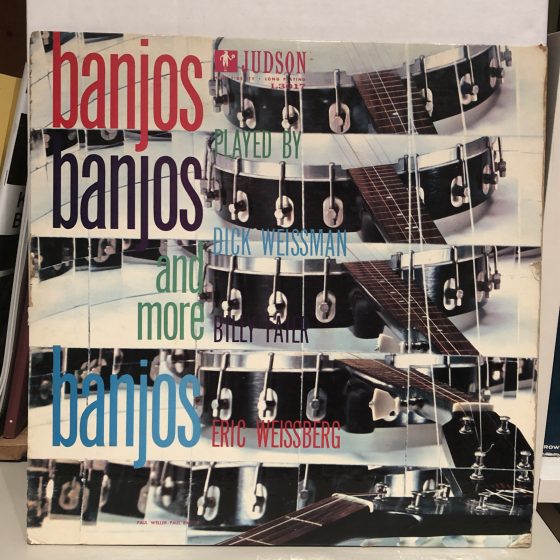
Putting our instruments away, we went upstairs and joined the party. I conversed for a while with Eric. I told him I’d heard Billy Faier in Berkeley last summer, had been very impressed with his music, and was looking forward to his forthcoming Riverside album, The Art of the Five-String Banjo. Eric agreed, Faier is a great banjo player, and said he had collaborated with Billy and another banjo player, Dick Weissman, on an album due out this coming summer called Banjos, Banjos and More Banjos! 

That summer of 1958, Banjos, Banjos and More Banjos! arrived at Art Music on Telegraph in Berkeley where I hung out listening to new folk records. The album was on Judson, a bargain line label owned by Riverside’s Bill Grauer.

Grauer’s Riverside productions catered to the hip college kids of the fifties — a generation that grew up on hi-fi LPs. Riverside reissued historic prewar jazz and blues; released contemporary jazz and folk; and recorded sports car events. This major independent label ended abruptly in 1964 when Grauer, just 42, died. Their catalog is now with Concord Records, which has reissued some jazz recordings on CDs.

Riverside albums were well-produced, with glossy full-color cover art. Back covers — liners — had a standard format: bold head at the top with album title and artist names. Below it, three dense columns giving the playlist along with information about the music and musicians. Lots to read while listening!

Faier’s The Art of the Five-String Banjo liner held a full column endorsement by Pete Seeger, slightly longer notes by producer Goldstein, and Faier’s bio. In contrast the liner of Banjos, Banjos and More Banjos had its playlist followed by three columns of folklorist John Greenway’s flowery history of the instrument, and brief bios for the three banjoists. I bought the album (later reissued on Grauer’s Washington label with new cover and title: Five-String Jamboree: A Treasury of Banjo Music) because Eric Weissberg was playing Scruggs-style banjo on it.

At the bottom of the center column on the liners for both albums was the standard data of the time: 

A HIGH FIDELITY Recording (Audio Compensation; RIAA Curve). Produced by Kenneth S. Goldstein. Cover by Paul Weller (photography) and Paul Bacon (design). Engineer: Mel Kaiser (Cue Recordings). New York: May, 1957.

 Now I look back at the album, listen to it for the first time in years. When I last heard of Faier, about ten years ago, he was busking in Albuquerque. He died in Alpine, Texas in 2016. We’d seen each other and talked at the Tennessee Banjo Institute in November 1990, recalling the summer of 1958 when I guested on his KPFA show and worked as his backup guitarist at an SF coffee house. Dick Weissman, now 85, had distinguished careers: first as a performer, then as teacher and author. He published his memoir, The Music Never Stops: A Journey Into the Music of the Unknown, The Forgotten, The Rich & Famous, the same year Faier died.

These guys must have been in the Cue Recordings studio more than once in May, 1957. Their recordings were made with a single-track tape recorder; no overdubs. Faier made his solo album at Cue with Frank Hamilton playing guitar, and there’s one track on Banjos with that pairing — probably an outtake from The Art. Most of the other guitar on this album is by Dick Rosmini, then considered the hot, young, go-to guitar accompanist.

Weissberg is heard playing Scruggs-style banjo on five tracks, and singing tenor harmony in duets on three of those. One was an old spiritual, “You Can Dig My Grave,” with Faier. With Weissman, Eric harmonized on the old folksong “Chilly Winds.” My favorite was another spiritual, “Glory Glory.” This vocal duet with Rosmini featured great backup guitar and seven banjo breaks by Eric, each a new variation. I played that track a lot for my friends that summer!

He also did a reprise of his 1956 Folkways track, focusing on “Hard Ain’t It Hard” complete with Scruggs pegs, and a cool version of “900 Miles” in G minor tuning. 

Weissberg’s music spoke to me as a young folk fan just getting into bluegrass. He’d mastered the instrument in this new style, and learned the vocal style that went with it. Here he was applying it to music that I knew — Woody Guthrie songs, a tune the Weavers had sung on their famous Carnegie Hall concert album, and familiar Black spirituals. 

The door to bluegrass was newly opened. Eric Weissberg stood just inside, beckoning in. Come on, it’s not that hard, it’ll be fun.


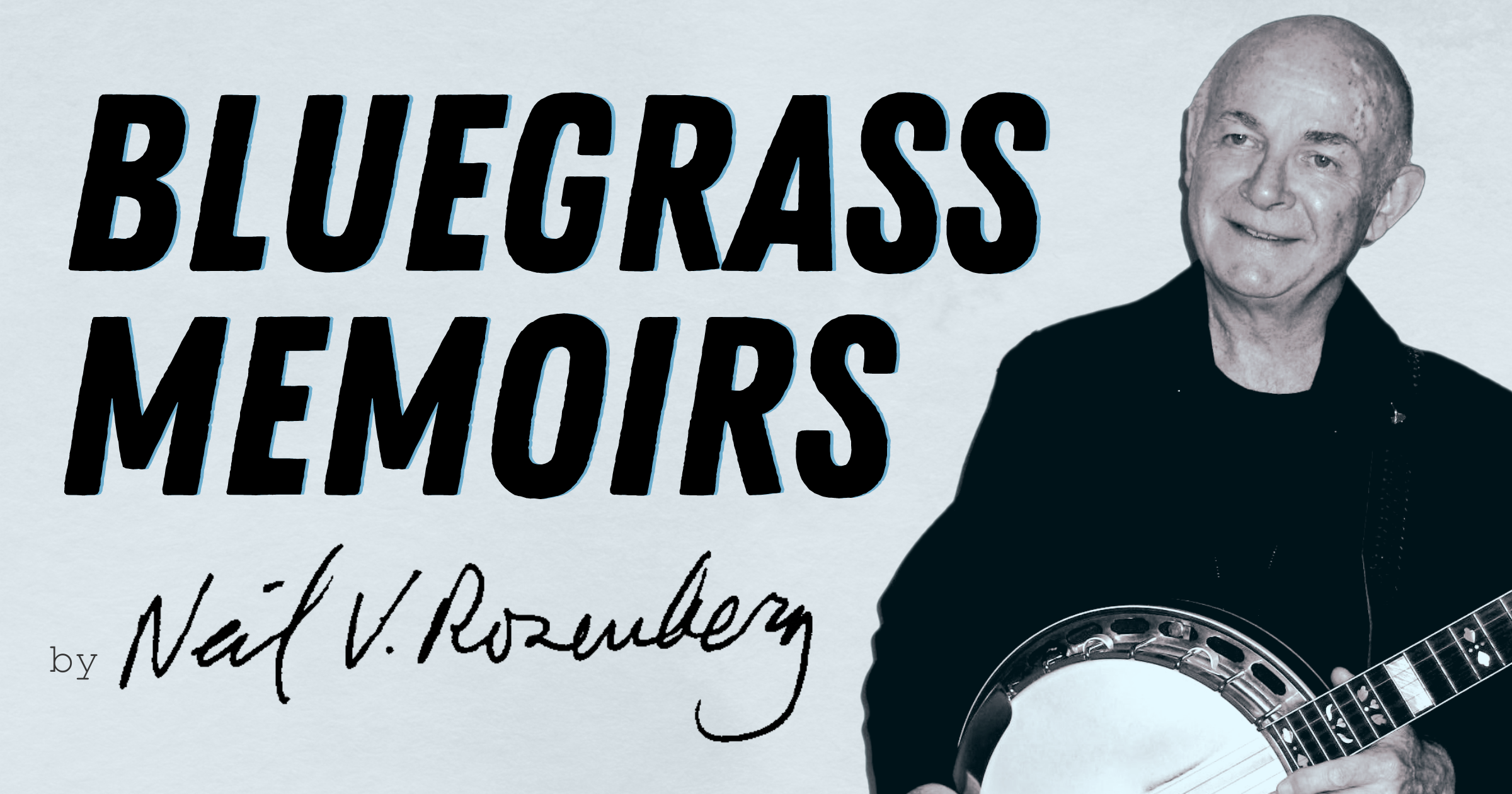
Neil V. Rosenberg is an author, scholar, historian, banjo player, and Bluegrass Music Hall of Fame inductee.

Photo of Neil V. Rosenberg: Terri Thomson Rosenberg
Photo of Banjos, Banjos, and More Banjos: Neil V. Rosenberg

BGS 5+5: Griffin House

Artist name: Griffin House
Hometown: Springfield, Ohio; currently resides in Nashville, Tennessee
Latest album: Rising Star
Personal nicknames (or rejected band names): “Balls” was my nickname, which is part of why I named my 2013 album Balls. I guess you could say it was kind of like a self-titled album. My friend (when we were younger) thought it was funny to add the suffix “balls” onto everything. All nouns, common and proper, including people’s names. Griff-balls apparently had a nice ring to it, since it stuck. Eventually it was shortened to G-Balls and eventually just Balls. It was fun when that album “dropped.” The jokes were endless.

Which artist has influenced you the most … and how?

So many influences, but I think probably Woody Guthrie is the greatest. I do a little more singing than I heard him do, being influenced by guys like Bono and Jeff Buckley, but Woody passed down an American tradition to Bob Dylan, Bruce Springsteen, Wilco, etc; his songwriting influenced [and] shaped how we’ve all done things. I relate to him particularly being a guy with his guitar traveling all around America and singing and telling stories about what’s going on around him. He really paved the way for all of us modern day troubadours singing any kind of folk songs.

What’s your favorite memory from being on stage?

One of the first shows I played when I started was opening for John Mellencamp. I was so nervous I told the crowd I was going to go back behind the curtain and “When I come back out,” I said, “Can you just pretend like you are all here to see me and go crazy?” They gave me a standing ovation and went wild before I even played a note. On the last song, I did a victory lap around the audience of 5,000 people and high-fived everyone and then finished the last song. I mostly did it because I didn’t know if I’d ever if I’d ever have an opportunity like that again and I wanted to make the most of it (and have a good story to tell). It felt like something you’d see happen in a movie.

What other art forms — literature, film, dance, painting, etc. — inform your music?

Lots of film. I love watching movies and disappearing into the scenes that I’m watching. It’s a great escape for me and sometimes inspires a song. Going to museums and looking at paintings and sculpture is a wonderful joy for me too. I also love books; I majored in English Literature in college and learned to really appreciate writing during that time. Poetry and literature probably have the biggest direct influence.

What was the first moment that you knew you wanted to be a musician?

I saw Rattle and Hum and wanted to be Bono, circa 1988. [U2] were just so unbelievable. That set the bar pretty high, but I’m also content just making a living, telling my stories, and being a singer and storyteller playing for smaller crowds.

What’s the toughest time you ever had writing a song?

“Yesterday Lies.” I think it took me a couple years to write. But the toughest ones were the ones I couldn’t write at all. Every one I finish is easier than the ones that never happened.


Photo credit: Gabe McCurdy

A Spirit of Activism Informs Son Volt’s New ‘Union’

Jay Farrar took a field trip to make Union, Son Volt’s ninth studio album. Rather than book more sessions at Red Pill Recording Studio in St. Louis — where the long-running alt-country band recorded 2017’s Notes of Blue — he wanted to take his songs out into America and find fresh inspiration. So the band trekked west to Tulsa, where they cut tracks at the Woody Guthrie Center, then road-tripped north to Mt. Olive, Illinois, to record at the Mother Jones Museum.

The spirit of activism embodied by those two figures informs the thirteen songs on Union, an urgent and at times angry account of American life at the close of the 2010s. More naturally than on any other album, Farrar balances the political and the personal, penning songs about how the media-industrial complex profits by dividing the country alongside songs about how his children are growing into adults.

BGS: Why did you want to record at the Woody Guthrie Center and the Mother Jones Museum?

Farrar: I felt like it was a little too comfortable in the studio where I had recorded before. I was writing about topical issues, so I felt like some of the songs needed to be taken out of the studio. I wanted to take them out into the world. I wanted to record them in a more challenging environment, so we went to Tulsa and Mount Olive to remind ourselves of the contributions Mother Jones and Woody Guthrie made, how each in their own way helped get us where we are today. We just felt like we needed to be inspired.

Those are two very different places. How were those experiences different?

The Mother Jones Museum is pretty small. It’s connected to the City Hall, I think. It’s evolved a lot since I was younger. I remember seeing hand-painted signs on the side of Interstate 55 going north. It was like folk art. Over the years it’s evolved, and I guess they got some funding from the city. They’re continuing to grow and build on it. I think she’s buried in the cemetery there as well.

At the Woody Guthrie Center, they have the new Bob Dylan archives, and we were able go by there after the recording. Amazing stuff there — the tambourine that inspired “Mr. Tambourine Man,” Dylan’s address book from ’63 or ’64. He’s got Lenny Bruce in there. Stuff like that. We geeked out for sure. It’s pretty comprehensive, too, because they have everything archived digitally as well as the physical objects. They wouldn’t actually let us touch anything, of course.

That sounds amazing. And, as you said, inspiring.

It was. And we were looking through some of the materials and had a question about one of the videos we were watching. So the curator said, “Wait one minute and I’ll get an answer for you.” He called Bob Dylan’s business office and talked with someone there. He got an answer straight from the source.

How did those places inform the songs on Union?

The songs were ready to go prior to going in. I didn’t write anything there, but with some of the heavy topical subject matter, this batch of songs needed to be taken out of the studio where I recorded Notes of Blue. We needed to be challenged in every way, but maybe I was just looking for a field trip. But I think those two people really did inspire some of the writing, in a roundabout way. Mother Jones and Woody Guthrie really helped shape our society and really stressed the importance of pushing society forward and not backwards.

How much of a conscious decision is it to write topical songs? Do you sit down and think, “I’m going to write a song about the media”?

It goes in cycles for me. I’ve done some topical writing in the past, but this time around it felt like it was my job to take it on. There’s a lot of turmoil in our society right now. I did a lot of the writing in November 2016, right before Notes of Blue was released in the spring of 2017. So I had a few months to put pen to paper and woodshed, and that’s when a lot of these songs came out.

Probably midway through the writing process, I decided I needed some songs that represented a regular rock ethos — essentially, non-topical songs. There needed to be a balance between topical and non-topical songs. I was thinking about the Replacements, who would fall off the stage on the first note of a song. Or The Who. I was thinking about the essence of what a rock band is. “Devil May Care” came from that approach.

Do you find new shades of meaning the more you live with a song, the more you play it night after night after night?

These new songs will probably evolve a bit from rehearsals to when we start the tour. That’s always one aspect of being on the road that I enjoy: reinventing older songs and playing them in new ways, just to keep things interesting. Certain songs just want to evolve, especially if you’re playing them every day in rehearsals and soundchecks. “Windfall” is one that has changed a lot. There’s a CD out there called Artifacts that has a reggae version. We change that one up pretty regularly, and we changed it up again over the holidays. Actually I think we’ve got reggae versions of almost every Son Volt song. But that one in particular is so well-suited to that style that we put it out on a live CD.

Why reggae?

“Windfall” is conducive to reggae. It’s just a couple of chords. But I think from one day to the next you like to stretch out and just try out different kinds of music that you’re not necessarily playing every night. I think some of the guys in the band would probably like to try some experimental jazz-fusion versions of some songs.

Can we expect to hear “Caryatid Easy” done in the style of Bitches Brew?

That’s one song we plan on resurrecting for the tour, so who knows?

Can you talk about “The Reason”? That song seems to suggest that travel and music can be salves in hard times, which makes me think it’s somewhere between topical and non-topical.

That song reminds me of Dylan’s “Forever Young” or Tom Petty’s “Free Fallin’.” I think it relates to watching your kids become adults, that sort of sentiment. It’s certainly informed by them, to the same degree that those Dylan and Petty songs were informed by their kids. But yeah, in troubled times getting out and traveling is good. You have to find hope wherever you can.

On the other hand, “Union” was inspired by my dad. The chorus goes, “He said national service will keep the union together.” National service is something my dad used to advocate for. Maybe he’s right, I don’t know. There’s a lot of money being made today by media conglomerates hawking divisiveness. It seems like there needs to be a counterbalance somewhere.

You’ve written topical songs in the past, with Uncle Tupelo and on 2005’s Okemah and the Melody of Riot. How different is it to write this kind of song in 2019 than when either of the Bushes were in office?

It’s not the process itself that was different, although I will say I was more focused this time. I had a block of time and was thinking about these issues, so I could be more focused on getting these songs written, maybe more so than I had been in the past. A few topical songs wound up on records in the past, maybe one or two. Okemah had a good amount of them. I guess I’ll keep cranking them out.


Photo credit: David McClister

LISTEN: Andy Hedges, “Song of the Cuckoo”

Artist: Andy Hedges
Hometown: Lubbock, Texas
Song: “Song of the Cuckoo”
Album: Shadow of a Cowboy
Release Date: April 16, 2019

In Their Words: “I first heard the name Billy Faier in Ramblin’ Jack Elliott’s song ‘912 Greens’ about an epic road trip he and some friends made across the Southern United States. I met Billy after playing a show in Alpine, Texas, immediately recognizing his name from ‘912 Greens.’ Billy was born in Brooklyn, spent most of his life based in Woodstock, but always wanted to live in the desert so as an old man he moved to Marathon, Texas. Billy had traveled with Ramblin’ Jack and Woody Guthrie on Woody’s last trip across the US. He was the first person to interview Dylan on the radio. He taught a song to Dave Van Ronk and Pete Seeger once said that he was the best banjo player he had ever heard. Billy and I became fast friends and had some great adventures together. When he passed a few years ago, I ended up with his beautiful old guitar. I played Billy’s guitar on this recording of his song and it seemed fitting to tag it with a line from ‘912 Greens,’ the song that connected me to Billy in the first place: ‘Did you ever stand and shiver just because you were lookin’ at a river?'” — Andy Hedges


Photo credit: David Tau

LISTEN: The Nell & Jim Band, “Dime in My Pocket”

Artist: The Nell & Jim Band (Nell Robinson and Jim Nunally)
Hometown: Bay Area, California
Song: “Dime in My Pocket”
Album: Steel
Release: February 15, 2019
Label: Whippoorwill Arts

In Their Words: “‘Dime in My Pocket’ was written as an exercise in songwriting, and inspired by the book Will You Miss Me When I’m Gone?, the story of the Carter Family. I wanted to try to write a song about A.P. Carter and his feelings about Sara that I gathered from the book. I borrowed a melody, like Woody Guthrie would, which was ‘Rollin’ On’ from the Monroe Brothers, which I recorded with the David Grisman Bluegrass Experience. I changed a few notes of the melody and a couple chords and there you go. I put the words to that and there you have ‘Dime in My Pocket.'” –Jim Nunally, The Nell & Jim Band


Photo credit: Jay Blakesburg