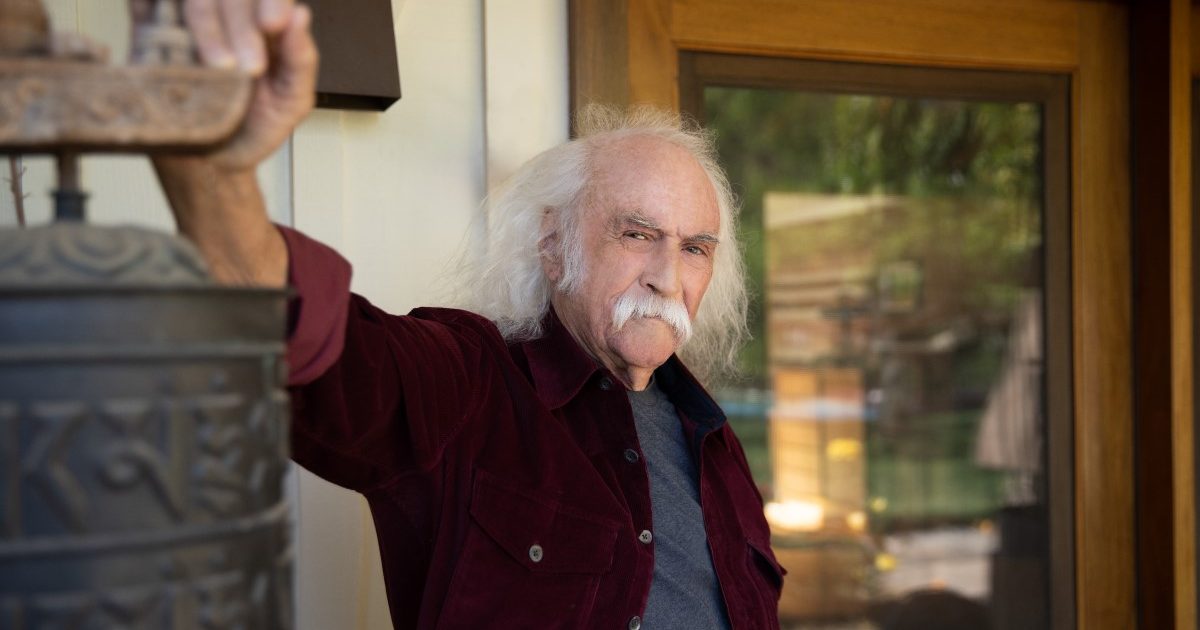
With His Son and Special Guests, David Crosby Finds His Way on ‘For Free’

“I think I found my way.”

When a guy about to turn 80 sings that line, you take note. When that guy is David Crosby, who in fact turns that age on August 14… well…

“I don’t know if I would have sung it at any other time in my life,” Crosby says in a Zoom chat from his home north of Santa Barbara, California, where he lives with Jan Dance, his wife of 34 years.

But sing it he does, in the song “I Think I,” a highlight of his new album, For Free. With this, his fifth album in seven years (after just three solo albums in the earlier part of his career), he comes to his 80th in a remarkable creative run. It’s a strong collection featuring the fruits of several creative collaborations, mostly with his son, James Raymond. Among the guests are Michael McDonald on the shining opener “River Rise,” Steely Dan’s Donald Fagen on the jazzy, dark “Rodriguez For a Night” and Sarah Jarosz, with whom he duets on a gorgeously spare version of the Joni Mitchell song that gives the album its title.

It’s that line from “I Think I,” though, that speaks most profoundly to the state of his life. If you know much about that life, you understand. And you might greet those words with a sigh of relief. He certainly does.

“I do feel happy now,” he says. “The thing I love about the song the most is that it’s up. It’s, you know, happy sounding. Normally I record tortured ballads that go on for days. ‘The dog died’ or ‘my truck broke down.’ This is up and happy and positive and it just captures that mood that’s around. That’s a blessing for me. That’s a great thing.”

The life leading to this moment has been well-documented and much discussed. Most significantly, Crosby created some of the most bracing, beloved, and enduring American music of the past 60 years, first as a founding member of folk-rock pioneers the Byrds and then in the various partnerships with Stephen Stills, Graham Nash and/or Neil Young. Along with the essential, indelible songs CSN(&Y) gave us, there was much discord and discontent and it finally blew up, apparently for good, in 2014, sparked in part by some unfortunate remarks Crosby made regarding Young’s personal life. And Crosby’s history is marked by his years of drug addiction and a consequent prison term and liver transplant — and, thankfully, recovery. This was all covered in Remember My Name, the unflinching 2019 documentary that brought him to some painfully heartfelt reckonings.

For better or worse, Crosby’s legacy is tangled up with groups and partnerships. Asked to untangle it, he turns thoughtful.

“A lot of the musical complexity and strangeness comes from me loving jazz and world music,” he says. “I mean, I like a lot of different kinds of music, man. I like bluegrass. I like blues. I like classical music. And that has influenced me very strongly. Particularly jazz, and particularly jazz keyboard players, McCoy Tyner, Bill Evans, people like that. They have had a very strong influence because they played those real dense, big tone, cluster kinds of chords. And I couldn’t do them in regular tuning on the guitar. That’s what made me start re-tuning the guitar into other shapes so that I could get those kind of chords. So the jazz thing really did stack me up differently.”

That influence has been a constant facet, all the way back to the Byrds (“Everybody’s Been Burned” is almost a template for the folk-jazz explorations Tim Buckley would make) and CSN (“Guinnevere,” with its floating harmonics, was covered by both Miles Davis and jazz flute player Herbie Mann).

These days Crosby is not focused on the past, although with last year’s 50th anniversary of the CSN&Y album Déjà Vu and the expanded deluxe reissue, he’s had to do more of that than he’d like.

“I always prefer when it comes to talking about me, I like it to be somebody else doing the talking,” he says.

He’s not focused on the future, either. He says that he likely won’t tour again and with tendonitis in both hands, he expects he won’t be able to play guitar anymore within a year — a great shame as his guitar playing, with its intricate jazz voicings and inventive tunings, is as stunning as his singing, if not as widely recognized.

He’s certainly not looking forward to his birthday.

“No, no, no, no, no, no, no!” he insists. “Birthdays are not happy when you get old. No, no, no, no, no, no! We don’t celebrate. We mourn those.”

Yet he’s utterly bubbly celebrating the new album, as well as the four leading up to it, by far his most prolific stretch in terms of making and releasing his own music. It’s not often that we can say that about someone’s 70s, let alone someone with such a vaunted career packed with songs and albums cherished dearly by millions.

“Isn’t that weird?” he says. “It’s just completely bass-ackwards. But there you go.”

To what does he attribute this?

“I got out of CSN,” he says, never one to mince words. “It was, obviously, a wonderful band and we did a lot of really great stuff. But when it when sour, it went really sour. And it went sour very fast.”

It was rough, but the silver lining shines brightly.

“I don’t make anywhere near as much money,” he says. “But I’m making good music. And that’s kind of what they put me here to do, I think.”

Cue the title song, Mitchell’s loving portrait of a street musician playing for the pure joy of it. This is the third straight Crosby album to include a Mitchell song, following “Amelia” on 2017’s Sky Trails and “Woodstock” closing 2018’s Here If You Listen. Crosby, who was an early champion (and romantic partner) of Mitchell’s, producing her debut album, Song to a Seagull, sang “For Free” on the Byrds’ 1973 reunion album. Now, though, it has a deeper resonance, reconnecting to the essence of music-making. Rather than an observer, he’s the guy in the song.

“Yep,” he says. “There I am standing on the corner. It’s squarely, smack dab in the middle of who I wanted to be, as me. I love what it says. Putting it on as the title track is also taking a little dig at the streamers. Because it is for free, man. They don’t pay us.”

Crosby had become a fan of Sarah Jarosz via I’m With Her, the group in which she’s teamed with Aoife O’Donovan and Sara Watkins. And he loved Jarosz’s 2020 album, World on the Ground.

“I called her up and said, ‘Listen, Sarah. Can we do something together?’” he says. “And she said, ‘Sure! What do you want to do?’ And I said, ‘I don’t know. I just want to sing with you.’ And she said, ‘Oh, you sweetheart.’”

Crosby quickly suggested “For Free.”

“I’ve sung it a bunch, and I’m confident with it,” he told her. “She said, ‘Oh, I love that song.’ So I sent her a tape of it that I went in to the studio and cut. James made this incredible piano track for it. Just beautiful. Sarah sent it back with her vocal on it, and it completely blew my mind out of my ear. It was unbelievably good.”

Clearly, Crosby still craves collaboration. A sense of joyful purpose is unmistakable in his voice and in the voices and playing of those who helped him make the album. Foremost is James Raymond, the producer-composer-keyboardist who has been at Crosby’s musical side regularly since 1997, five years after learning that Crosby was his biological father. His talents have been showcased not only in his father’s solo projects, but also for years with CSN as a full-time member of the touring band, and in the jazzy group Crosby and Raymond fronted off and on with bassist Jeff Pevar, cheekily branded CPR. On For Free, Raymond wrote or co-wrote seven of its 10 songs, including “I Think I” and the somberly beautiful closer, “I Won’t Stay for Long,” inspired by Marcel Camus’ haunting 1959 film Black Orpheus.

“It’s wild to watch,” Crosby beamed. “He’s gotten to be as good a writer as I am, or better. ‘I Won’t Stay for Long’ is the best song on the record. It makes me cry. It just freaks me out.”

Guitarist Dean Parks adds color to “Rodriguez” and “Shot at Me,” the latter a powerful ballad which he co-wrote from Crosby’s words inspired by an encounter with an Afghanistan war veteran, who told him of the most human costs of war. It’s a strong addition to Crosby’s deep catalog of incisive, biting topical songs.

“I seem to run into those guys and talk to them,” Crosby says. “I ran into this guy at the airport and was drinking in the bar and he looked really bummed, really sad. So sure, I talked to him.”

As for not being able to tour anymore, Crosby is sad but sanguine.

“Singing live is the great joy of my life,” he says. “My family and singing live. That’s the top of my world, you know?”

Even if the shows stop, the music won’t, right?

“I don’t know,” he says. “I can still sing. That’s why we’re doing the records, because we love making music. Right? They obviously don’t pay us for them, so that’s the only reason there could be. We’re not trying to win the ratings war or something. We’re just singing exactly the music that really rings our bell and makes our heart sing. And there you go. And if people like it, great. And if they don’t like it, great, we don’t care.”


Photo credit: Anna Webber.
Album cover painting by Joan Baez.
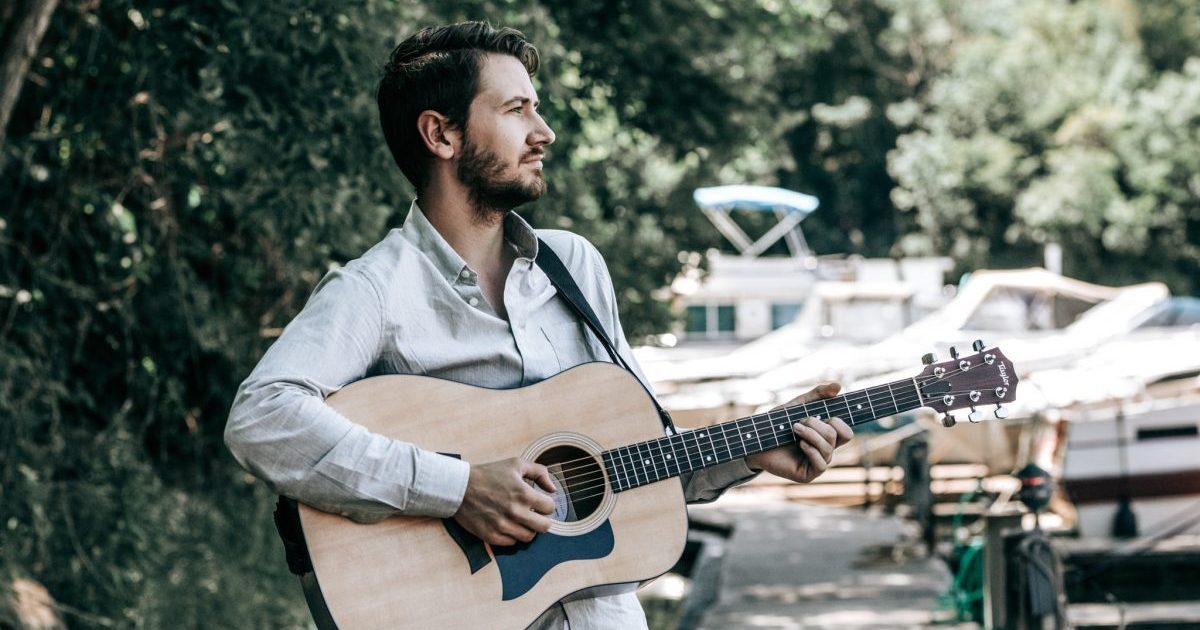
WATCH: Luke LeBlanc, “Same Blues”

Artist: Luke LeBlanc
Hometown: Minneapolis, Minnesota
Song: “Same Blues”
Album: Only Human
Release Date: July 9, 2021

In Their Words: “It was October 2018 and I’d just moved to Nashville. I didn’t know I’d only live there six months, but as proud as I was to have been born and raised in North Minneapolis, I knew I had to explore the Nashville music scene: the songs, the stories, the mystique. It had been a long day, but I had to make my first move. So I called Roy August. I had met Roy about six years prior when I was 16 and visiting Nashville for the first time, playing an open mic near Music Row. Now in his 80s, Roy had co-written the Oak Ridge Boys’ “Fancy Free,” their first #1 on the Billboard country chart back in 1981. He happened to be in the audience and he loved my music. We kept in touch every so often through Facebook.

“Roy told me to meet him at the Hardee’s for brunch in Lebanon, Tennessee, just northeast of Nashville. We didn’t have a goal in mind, just to catch up and say hello. At the end of our conversation, he pulled out a folded piece of paper and told me it was something he’d been working on. ‘See what you can do; we’ll co-write it.’ I went home and wrote the rest of the lyrics, changed some, added others, and put music to it. With regards to the video, we tried to capture what the song is about: the tug between the status quo and what you’re currently doing versus that thing you really want to do. It portrays someone who has ‘fooled himself into working all day,’ knowing that deep down, the ‘fever won’t die young.’ Cody Hansen at Exist Media filmed and edited the video and John Cleve Richardson appears in the video playing piano.” — Luke LeBlanc


Photo credit: Exist Media

LISTEN: Aoife O’Donovan, “More Than We Know” & “Captain’s Clock”

Artist: Aoife O’Donovan
Hometown: Newton, Massachusetts
Songs: “More Than We Know” (featuring The Milk Carton Kids) & “Captain’s Clock”
Release Date: July 19, 2021

In Their Words: “In January of 2021, I reached out to my friend Joe Henry about some new music I was writing. What transpired from that first conversation was a lot of new music… a lot a lot. I’m so excited to share two songs from those sessions! ‘More Than We Know,’ a new song written with Joe, features the crystalline vocals of Joey and Kenneth (The Milk Carton Kids). The second tune ‘Captain’s Clock’ (yes, it’s a Hook reference) features insanely beautiful woodwinds by Levon Henry. My parts were recorded at Full Sail with Darren Schneider.” — Aoife O’Donovan


Photo courtesy of Shorefire Media

Shaped by String Bands and Bluegrass, John R. Miller Delivers ‘Depreciated’

On his new album Depreciated, John R. Miller shows a true appreciation for traditional country songwriting and progressive bluegrass musicianship, even though his music isn’t neatly defined by either one. A West Virginia native who now lives in Madison, Tennessee, Miller unveiled the material at a club show in Nashville just a few days after the album’s release on Rounder Records. His original songs are rich in detail and humor, although his lyrics can get moody enough to satisfy anybody who’s looking for the darker side of acoustic music. Delivered in his rough-hewn baritone, his songs somehow feel like familiar stories that you want to hear again.

Before returning to the road, Miller caught up with BGS at an East Nashville coffee shop to talk about his acoustic heroes, where he found his first guitar, and why he puts a fiddle in a rock ‘n’ roll band.

BGS: You announced this record by releasing “Lookin’ Over My Shoulder,” which is not exactly a happy song, but it does makes me laugh. What was on your mind as that song was taking shape?

Miller: I wrote that after I moved away from the town I’d lived in for a while. It’s a small-town scenario. When you go back after being away, you’re in the mode of trying to avoid some people. It can be tricky to navigate but I thought it was a funny little song that I didn’t think we would end up recording. Then we rearranged it a little bit and turned it into what it is now – and it’s the first song on the record. You just never know, I guess.

Where is your hometown?

The place where I grew up is just off the highway in the eastern panhandle of West Virginia. It has historically been pretty rural. There’s a lot of development around the highway, so it’s turned into a strip mall highway town. Just over the mountain, it gets real country real quick. But for most of my 20s I lived in a river town called Shepherdstown. It’s small, just a couple of bars in town and everybody knows everybody. That was home for a long time, but I felt like I needed a fresh start, so I moved down here. I spent so much time traveling and felt untethered in the first place. A lot of my friends started getting older and moving away. A few of them actually came down here. This was the next place, where I knew the most people and the most couches to crash on for a little while. I decided to give it a shot and I’m still here.

When did you gravitate toward playing guitar?

I was about 14 when I picked up guitar. My dad had a nylon string guitar in the closet that I never saw him play. I was starting to get into music more, and into punk bands that I found out about from my friends. Basically I was trying to learn power chords on this classical nylon string guitar classical guitar. Eventually I wrote that out and got a Stratocaster and tried to do garage bands in high school.

Were you and your friends listening to acoustic music too?

Maybe not when I was a teenager. We were mostly into indie rock and punk rock growing up, like skater kids. It probably wasn’t until I was 19 that my musical interests expanded a little bit. I started getting into songwriters. The real gateway for me was that Steve Earle and Del McCoury Band album, [1999’s The Mountain], which is one of the best out there. I had already found my way into Steve Earle’s music and then that dovetailed nicely with bluegrass and old-time music with that record. That was a big one for me.

Are you a bluegrass fan?

Oh yeah. I’ve lived in the bluegrass world a little bit and during times in my life a whole lot. I used to play in a string band too. It was more like a fiddle-centric string band, but we did some bluegrass stuff as well and got on that circuit for a little while. There were a couple of guys in the string band that were ahead of me in terms of what they knew about and what they liked, so they helped me learn about a whole lot of stuff.

Who were some of your influences in bluegrass?

I’m a huge Jimmy Martin fan. That stuff’s so cool and just kind of ragged in all the right ways. The Stanley Brothers, of course. There are some modern bluegrass bands that I’ve grown to love a whole lot. Town Mountain is one of the best out there. We crossed paths with them a little bit back in the day and it’s cool to see them still doing it. The Seldom Scene’s Live at the Cellar Door record is a classic too. I really love that. I also really love that early newgrass stuff, like Old & In the Way and John Hartford. That Old & In the Way record was a constant in the van.

Speaking of that, how did you get the idea for “Half Ton Van“?

That song in particular, I spent months looking for an old van to get the band moving. I was on Craigslist and Marketplace a whole lot. I feel like I was seeing a lot of the same tricks, you know? I went to look at a lot of terrible vans. It was a few years ago and I had already been through a few vans with other bands, and it always feels like I’m trying to find one at the last minute. I ended up getting one that was full of rust holes and leaking oil and everything like that. So the song is an amalgam of all those experiences of people trying to sell their junk to you.

At your show, the crowd really responded to “Shenandoah Shakedown,” which surprised me. It has that gothic feel, and seems to be the sleeper on the record.

That one seems to be doing pretty good. I wouldn’t have expected that either because it’s kind of different. It doesn’t strike me as an accessible song necessarily. That one is heavily inspired by living on the river out there. It’s more of a collection of vignettes of time spent up there, and some mushrooms and whatnot involved, you know? Some of the characters are composites but there are specific people in it, for sure.

There’s a lot of fiddle on this record too. Why do you like having that in the mix?

I love fiddle tunes and fiddle music and I spend a lot of time at fiddlers conventions, like the Clifftop Appalachian String Band Music Festival in West Virginia, or in Mt. Airy, North Carolina. It’s been a constant in my life for a really long time now. I’ve got a lot of buddies in that world and I play a little fiddle myself too. It’s a great way to just sit down and play tunes with people. The communal feeling and the non-commerciality of it is really cool. So I’m a little obsessive about it. Putting fiddle in a full rock ‘n’ roll band sounds good to my ears, and I also feel like if it wasn’t there, I would miss it — the presence of it.

Why did you want to include a guitar instrumental, “What’s Left of the Valley,” on here?

I’ve definitely written a couple of guitar pieces, but my partner Chloe really liked that one. I played it for her and it was her idea to just try it in the studio. We took a break from doing the stuff we had on the docket and gave that a try. It ended up feeling so nice, I thought it would be a good way to break up the songs on the record. I like that kind of stuff too, like an instrumental interlude.

At your show I was happy to hear you cover a Gary Stewart song, “Single Again.” What is it about that honky-tonk sound that appeals to you?

Man, it just sounds so cool to me. There’s a really wide range of it but that Gary Stewart stuff is so cool and so nuanced. A really high level of musicianship playing pretty accessible music is pretty awesome. I love country music very much. That’s been my soul food. Early to mid ‘70s is the sweet spot for me.

As a songwriter going into a music career, did you always want to have a full-band sound?

I don’t mind playing by myself — it’s kind of its own thing — but I’ve always played in bands and I love that connection. It’s so much fun. I prefer to be making music with my buddies and I’m fortunate to be playing with the band I’ve got now. They’re easygoing folks and great musicians. We’ve been on the road for a little over a week now and this is the first long tour that we’ve gotten to take together. We’re all getting used to it again.

Listening back to this record now, what goes through your mind?

I’m really proud of the work we did and what I love most about it is that I got to actually sit and play the songs live in a room with some of my close friends. Adam Meisterhans, who played guitar with us the other night, co-produced the record. He and I played in bands in West Virginia. I know him from Shepherdstown too. He’s like a brother to me. So it’s been cool to very intentionally work on a project and have it get finished and work out, you know? It’s nice to know that we did it the way we wanted to.


Photo credit: David McClister

LISTEN: Midnight North, “Silent Lonely Drifter”

Artist: Midnight North
Hometown: Bay Area, California
Song: “Silent Lonely Drifter”
Album: There’s Always a Story
Release Date: July 23, 2021
Label: Americana Vibes

In Their Words: “Here we have a folk melody reminiscent of the timeless string music heard in the Appalachian region. Lyrically simple, the tune gives thanks to the inevitable and natural balance that exists in this universe — no matter the day or the moon. I shared the tune with Grahame [Lesh] on a day off down south a few years back. It definitely still needed something on the lyrical side, and Grahame had the idea to identify each verse with different full moons in the yearly cycle. Each full moon carries a unique weight to those surviving down below — so we made a connection from each moment (verse) to each full moon.” — Nathan Graham, Midnight North

“Nathan would play us snippets of ‘Silent Lonely Drifter’ on tour whenever he would get ahold of a banjo, and once he showed me the full song I always hoped we’d get a chance to play and sing it with Midnight North. The song was close to fully formed when he brought it to the band, and the melody and chord progression were so intuitive that we latched onto it quickly when we finally started tracking it in the studio. It really came together when we made Nathan sing the melody as Elliott [Peck] and I wove harmonies around him. Now that we’ve played it live ‘Silent Lonely Drifter’ is one of my favorite of our songs to sing in harmony!” — Grahame Lesh, Midnight North


Photo courtesy of Midnight North

LISTEN: Elijah Ocean, “Honky Tonk Hole”

Artist: Elijah Ocean
Hometown: Nashville, Tennessee
Song: “Honky Tonk Hole”
Album: Born Blue
Release Date: July 23, 2021

In Their Words: “‘Honky Tonk Hole’ is about a guy who has seen better days and whose big dreams have all gone up in smoke. Now he spends all his time drinking and playing country music in bars. Not entirely sure why he’s complaining about it, though. Seems kinda fun and not a bad life. It’s a high-energy shuffle about falling into a rut but also kind of loving it.” — Elijah Ocean


Photo credit: Wolfe & Von

WATCH: Brandi Carlile, “Right on Time”

Artist: Brandi Carlile
Hometown: Seattle, Washington
Song: “Right on Time” (video directed by Courteney Cox)
Album: In These Silent Days
Label: Low Country Sound/Elektra Records
Release Date: October 1, 2021

In Their Words: “Never before have the twins and I written an album during a time of such uncertainty and quiet solitude. I never imagined that I’d feel so exposed and weird as an artist without the armor of a costume, the thrill of an applause, and the platform of the sacred stage. Despite all this, the songs flowed through — pure and unperformed, loud and proud, joyful and mournful. Written in my barn during a time of deep and personal reckoning. There’s plenty reflection…but mostly it’s a celebration. This album is what drama mixed with joy sounds like. It’s resistance and gratitude, righteous anger and radical forgiveness. It’s the sound of these silent days.” — Brandi Carlile


Photo credit: Neil Krug

LISTEN: Dallas Burrow, “My Father’s Son”

Artist: Dallas Burrow
Hometown: New Braunfels, Texas
Song: “My Father’s Son”
Album: Dallas Burrow
Release Date: July 23, 2021

In Their Words: “A real storyteller’s song, this is an autobiographical history of four generations of men in a family line and the influence that fathers have on their sons, sparing no detail. My grandfather was born on the 4th of July and he was a Master-Sergeant in the Army Air Corps, and survived D-Day. They called him Junebug. He’s always been a mythical character in my mind, as I never got to meet him. My dad never saw much of him either, as my grandfather was usually either off at war, or otherwise absent. Then my father was a hippie and a hitchhiker, a rebel and an outlaw, a poet and a songwriter, and later in life, a teacher, a triathlete, and more than anything else, unlike his father, always there for me. So I absorbed all those things; the legacy of having a war hero for a grandfather who was there when our country needed him, but who was absent from his own children’s lives because of it, and the stories my dad told me of his own travels and exploits when America was young and wild and free, in the ’60s and ’70s.

“Then of course there was my own journey, taking up the mantle of being a storytelling musician, the struggles, the trials, the beauty, the wonder, all of that, which would eventually lead me to meeting a woman, and having a son, which ultimately, radically changed my life from one of a wandering troubadour with an insatiable taste for the wild side of life, to a relatively responsible, grounded adult, still a troubadour, and still with a wanderlust, but with an entirely different set of priorities and lifestyle choices. This tune tackles the job of weaving all of those nuances of my family line into a neat little folk song that captures the idea that no matter who our fathers were, we are who we are in part because of those that came before us.” — Dallas Burrow


Photo credit: Ryan Vestil

BGS 5+5: Anya Hinkle

Artist: Anya Hinkle
Hometown: Asheville, North Carolina
Latest album: Eden and Her Borderland
Personal nicknames (or rejected band names): Anyabird

Which artist has influenced you the most … and how?

I guess far and away I have to answer — Gillian Welch. I grew up in the New River Valley of Virginia listening to Tony Rice, Norman Blake, Taj Mahal, Hot Tuna, Muddy Waters, Grateful Dead, and Old and in the Way, loved bluegrass and blues, but also female folk singers like Joan Baez and Judy Collins, pop stars like Madonna and Cyndi Lauper, and songwriters like Sarah McLachlan, Natalie Merchant, and Suzanne Vega. It just took Gillian to come around with her Revival album and put all that together for me, that you could incorporate all those great roots sounds into something completely modern and original. I was living in California at the time I heard her first album. I grabbed my fiddle and headed straight down to 5th String Music in Berkeley and started going to every bluegrass jam I could find. I thank her for giving me the idea that I could do it too — because of her genius, I could begin to imagine myself singing and playing guitar and writing songs too. It’s important to have someone you can look up to and that you can relate to so you can even have the idea in the first place.

What’s the toughest time you ever had writing a song?

For more than a dozen years now, I’ve been hanging around the Cumberlands with my buddy “Hippie” Jack Stoddart, someone who, in his rough and audacious way, brings people together to make a lot of magic. Hippie said to me one day, “I want to introduce you to Zona.” He’d been doing a lot of outreach work out of an old school bus bringing groceries and coats and toys and stuff to people living in former mining towns in Middle Tennessee. So he brought me up the mountain to meet the hardened sweetness that is Zona Abston. We sat around her kitchen table and she told me her life story, a miner’s daughter, growing up with little education and no money, not much luck or hope. When we collapsed back in the truck, Hippie said to me, “You better write this shit down!” And so I did. I wrote every detail: the cancer, the hunger, the cheating, the shining, the debt, the babies, the heartbreak. I came back with a mess of notes and thought, “How do I make a song out of this?” So I sat down and tried to pull out the most specific and moving details of everything she told me and created a ballad for her. I was super nervous to play it for her because, well it was HER life. SHE had to live it. But when I sang it for her the tears rolled down her beautiful face. She said, yup it’s all true, every word of it.

If you had to write a mission statement for your career, what would it be?

I actually thought about this a lot earlier this year, during the pandemic when I was trying to understand what my purpose was in music when it seemed like the industry was going to hell. I decided to focus on three things, and wrote them on a yellow sticky note that is taped in front of my desk for quick reference. The first is authenticity, and a commitment to truth and honesty to who I am as an artist. It’s a challenge to believe that it’s all already inside. I don’t need to grasp at something outside of myself. I just need to continue to learn to trust myself and be myself. The second thing is connection — connection with other artists and musicians, connections with my fans and supporters, and connections with anyone along the path. Those beautiful relationships are the foundation for anything I can possibly hope to accomplish in this lifetime. Saying “yes” and valuing the people that show up for me is oxygen. The third thing is creativity — growth and discovery. Allowing myself to surrender to the journey, giving up thinking I have to have everything figured out and under control. I need to just submit to curiosity, openness, and faith.

Which elements of nature do you spend the most time with and how do those impact your work?

Before I was a musician I was trained as an ethnobotanist. I traveled half the world studying plants and their uses and connections to culture. I love referring specifically to plant species in my songs because they can be so symbolic in our physical world. For example, in the the title track for my new record, Eden and Her Borderlands, I use a couple of plants that carry a deeper meaning. The cedar is fragrant and twisted, it’s green the year round, its oils are used to protect against decay and disease, it is sacred and ancient in its symbolism. I also use the sycamore. It is stately and grand, always grows near sweet water. It is often a boundary and its presence on the landscape signals a threshold that we approach and then cross over. Adding these botanical details to the song is like adding spices to a recipe, it gives more depth, even for those that might not know anything about botany. And who knows, maybe it will inspire people to love plants like I do!

How often do you hide behind a character in a song or use “you” when it’s actually “me”?

I love this question because initially there can be so much fear in exposing your true self. Absolutely mortifying to lay bare the thoughts and emotions of a real human, the one behind the Facebook posts and the stage persona and the person you think you are or wish you were. The real one with all the real flaws, that is the person that is actually interesting. But the songs really push yourself (myself!!!) to look in the mirror and substitute the “you” with “me,” to get personal. Well, it’s a journey of acceptance and insight. Getting personal is the thing that connects us to the rest of humanity and, honestly, the thing that makes a good song, the thing that makes a song relatable.

I recently took a songwriting course with Mary Gauthier. In the song I shared, I kept referring to myself as “babe.” She said, who is babe? She focuses a lot on pronouns, you know, who are we talking about here? Because in our heads, it’s always about us. It can’t NOT be. We are trying to figure out what the hell we are doing here and if we are at all worthy of anything we are pretending to do. It takes a lot of working through fear to write songs. It’s good work.


Photo credit: Sandlin Gaither

LISTEN: Kashena Sampson, “Hello Darkness”

Artist: Kashena Sampson
Hometown: Nashville, TN
Song: “Hello Darkness”
Album: Time Machine
Release Date: September 10, 2021
Label: New Moon Records

In Their Words: “This is a cover song by the Dutch rock band, Shocking Blue. I asked my best friend if she could choose one song for me to cover which one would she choose, it was this. I love Shocking Blue and I think it’s a great song and I connect to the lyrics, especially with what I was going through at that time in my life. To me, this song carries the message of yearning for someone who you cannot be with. It goes along with what a lot of the songs on this record are about. My struggles with codependency, fantasizing in relationships and thinking someone outside of me was the answer to my problems. It is a very heavy feeling when you think that someone else can fix you and you find out that they are not the answer. A good portion of the songs on this record are about a relationship I had with someone I cared for very much, who had gotten into some trouble and was incarcerated. I went into rescue mode and believed I had to save them in order to be ok.” — Kashena Sampson


Photo credit: Laura Partain