Six of the Best: Weird and Wonderful Bluegrass Covers

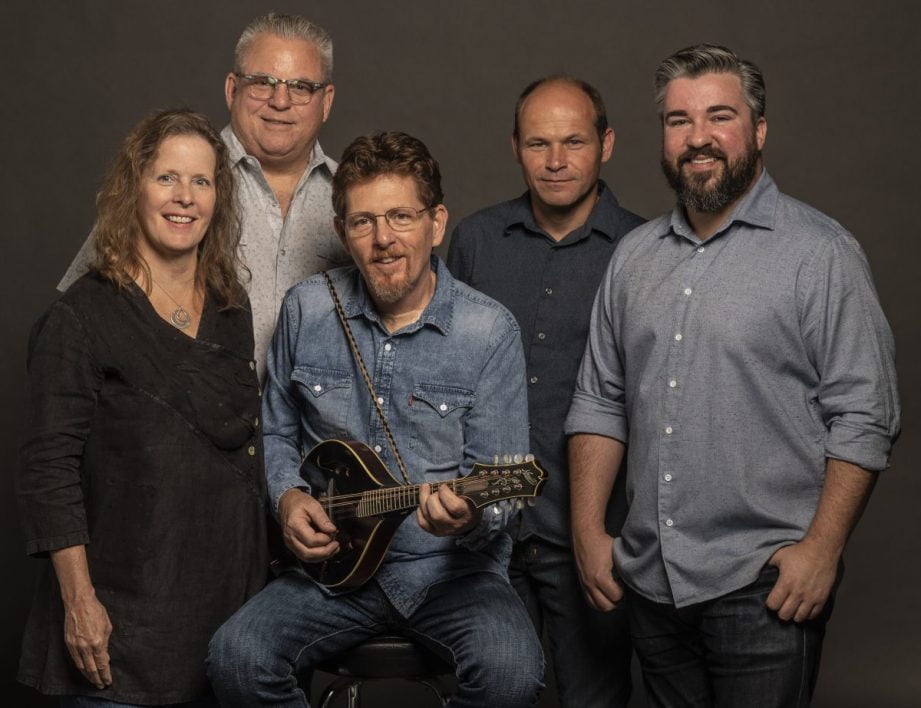
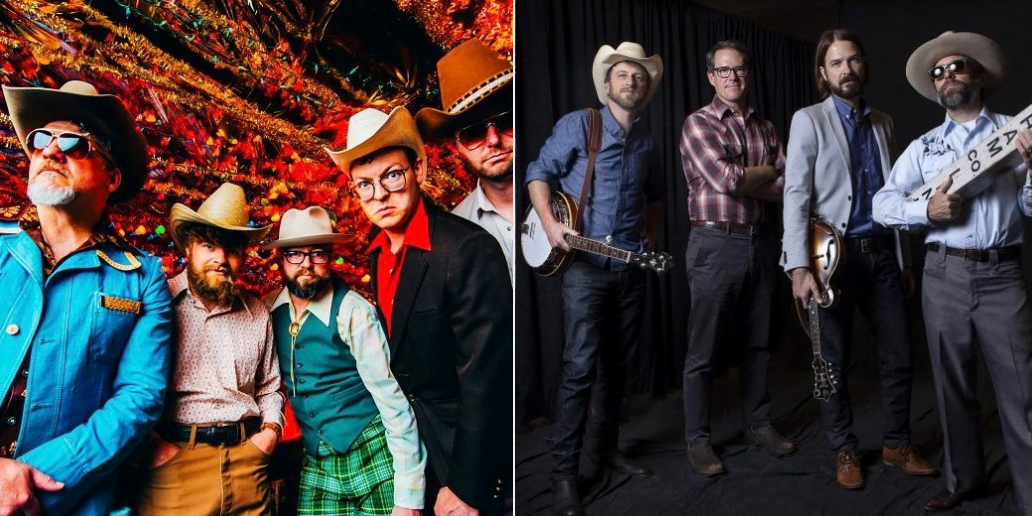
It’s a big month for bluegrass covers. Chatham County Line revealed some of their biggest musical influences (and favourite songs to soundcheck to) when they released Sharing The Covers, their eighth studio album, with arrangements of Beck, John Lennon, Mick Jagger, Tom Petty and Wilco, to name a few. It’s a record that will present the warm glow of familiarity to all those pickers who cut their banjo teeth on Beatles and Stones songs – and which among us has never heard “Norwegian Wood” floating across the festival field at 2am?

Meanwhile The Cleverlys – the reigning kings of the bluegrass pop cover – are putting the Beyoncé back in bluegrass on their latest album, not to mention the Bieber and the LMFAO. Call them a novelty act, call them comedians, but there’s plenty of merit in their musicality – and there’s something about their Ozark twist on Kelis’s “Milkshake” that’s going to stay with you ’til the day you die.

For more envelope-pushing, boundary-breaking, what-were-they-thinking-please-don’t-let-it-stop covers, check out our picks below.

“Super Freak” (Rick James) — Ricky Skaggs & Bruce Hornsby

This one’s a winner from the very first line. Sure, Ricky Skaggs has never let his own freak flag fly, but hearing him sing the words “She’s a very kinky girl” somehow gives you hope that one day, the divide in America might be healed. It’s a nice antidote to all those bluegrass songs about dear, dead old mothers, and one you suspect might have brought on their demise in the first place. Hang on in there for the slick modulation in the final instrumental…

“Price Tag” (Jessie J) — Keller Williams & The Travelin’ McCourys

Presumably this is a song that resonates with bluegrassers – since no one’s in this music for the ker-ching ker-ching or the ber-bling ber-bling. Plus, if the sound of Jason Carter jumping in on the chorus to sing ‘it ain’t about the money-money-money’ doesn’t flood you with instant joy then you may want to get your frontal lobe checked out. We picture him practicing his harmonies as he bumps along on the bus next to Del, trying to explain who Jessie J is. Actually that raises the question – how the heck did he know?

“Piece of My Heart” (Jerry Ragovoy and Bert Berns) — John Hartford

Notable not so much for its inclusion on Hartford’s 1984 album Gum Canoe, but for the rare music video he later shot to accompany it. The man might have been a creative genius on a par with xxx, but there’s something about his black-box realization of this ’67 soul number that’s creepy AF. The Beckettian close-ups of his lips and eyes are made even more sinister by his customary bowler-hat and vest, which here take on a distinctly Clockwork Orange feel. “Break it! Break another little piece of my heart now baby,” sings the dead-eyed droog, as he contemplates his next bout of ultraviolence.

“Honky Cat” (Elton John) — Country Gazette

How can a bluegrass cover be even better than the original – especially when the original is Elton fricking John? And yet this funky upbeat string version was surely what John and Bernie Taupin really heard in their head when they composed the song in 1972. Alan Munde, Byron Berline and the boys were quick to recognize the song’s “redneck” sensibility, recording their cover within the year on Don’t Give Up Your Day Job.

“Stayin’ Alive” (Bee Gees) — Les Claypool’s Duo De Twang

Sure, covering the Bee Gees’ most famous disco number isn’t new. But the mean-and-dirty take Claypool manages to get on it sure is. The Primus bassist manages to turn the ultimate floorfiller – a song as familiar and family-friendly as your dad’s station wagon – into something frantically alien. It’s compelling, unnerving, and completely unclassifiable. Somebody help him please.

“Downtown” (Macklemore & Ryan Lewis) — LBB & The Fancies

If you’re going to parody a major rapper’s already-pretty-nutso music video – one that includes a guy riding a chariot made of four motorcycles – you’re going to have to bring it. But fair play, Laura Bell Bundy did just that. Her loving bluegrass homage to Macklemore’s epic has everything from flat-footing and line-dancing to a honey hanging off a tractor. Even better, when they sing “whitewalls on the wheels like mayonnaise” there’s actually someone eating mayonnaise. Macklemore didn’t have that.
 

Like Father, Like Sons: Del McCoury & The Travelin’ McCourys

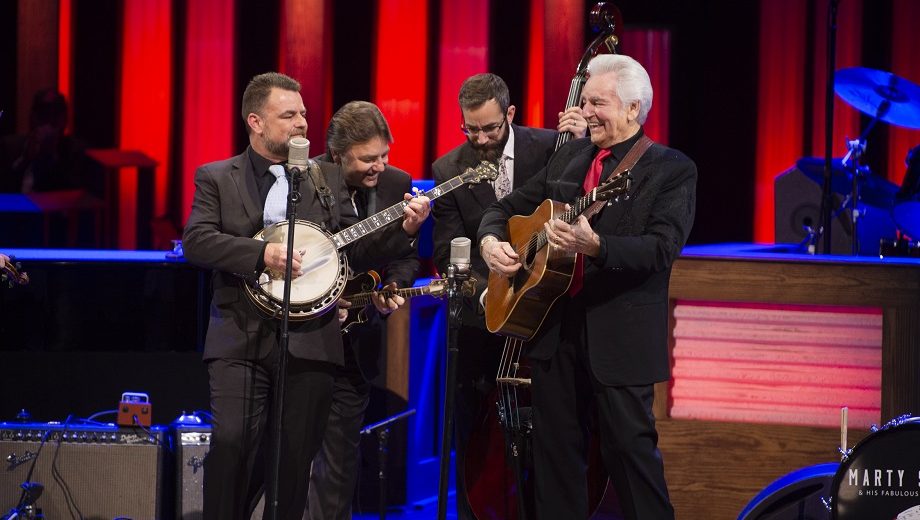
Even after five decades in the bluegrass business, the McCoury family is having a banner year in 2019. In February, Del McCoury turned 80 years old and shared the Grand Ole Opry stage with some of his most famous admirers. That same month, the Travelin’ McCourys – fronted by Del’s sons Rob and Ronnie McCoury — picked up a Grammy award in Los Angeles for their self-titled, debut album. And looking ahead, the 12th annual DelFest music festival in Cumberland, Maryland is slated for May, with performances by both bands on the schedule.

In person and off stage, Del McCoury is as polite and warm as one would expect. Smiling broadly as he enters the Opry dressing room, he’s wearing a Hawaiian shirt, his pompadour is on point (as always), and he seems unfazed by the fact that show time is less than 30 minutes away. To paraphrase another Opry star, he’s just so proud to be here.

“I’ve been listening to the Grand Ole Opry since I was at least 10 years old,” he says. “My brother and my dad would listen because it was before TV, you know? Especially out in the country where we lived. People had TVs, but I don’t remember anybody who did out in the country. We grew up on a farm. Like I said, I’ve been listening to the Grand Ole Opry since then and I’ve always looked up to all the acts on here. Especially the bluegrass acts, like Bill Monroe and Flatt & Scruggs. It’s a big show in my mind! Still is!”

Though the time set aside for the interview is somewhat brief, Del conjures up stories about everything from crusty club owners to playing Carnegie Hall. He cracks up at a memory of Bill Monroe flat-out telling festival promoter Carlton Haney that a bluegrass festival would never work. Thinking even further back to his childhood, he reminisces about being fascinated by Earl Scruggs’ banjo on “Rollin’ in My Sweet Baby’s Arms” when he was around 11 years old.

“Something hit me here,” Del says, touching his heart. “That banjo behind the lead singer was so good. And so I learned how to play that. I was already a guitar player but I heard this record and I thought, ‘Wow, that’s what I want to do!’ So, when I could get a banjo, I started learning it. Just take the record, pick the needle up and put it over, and try to play what Earl was doing. It was not simple!”

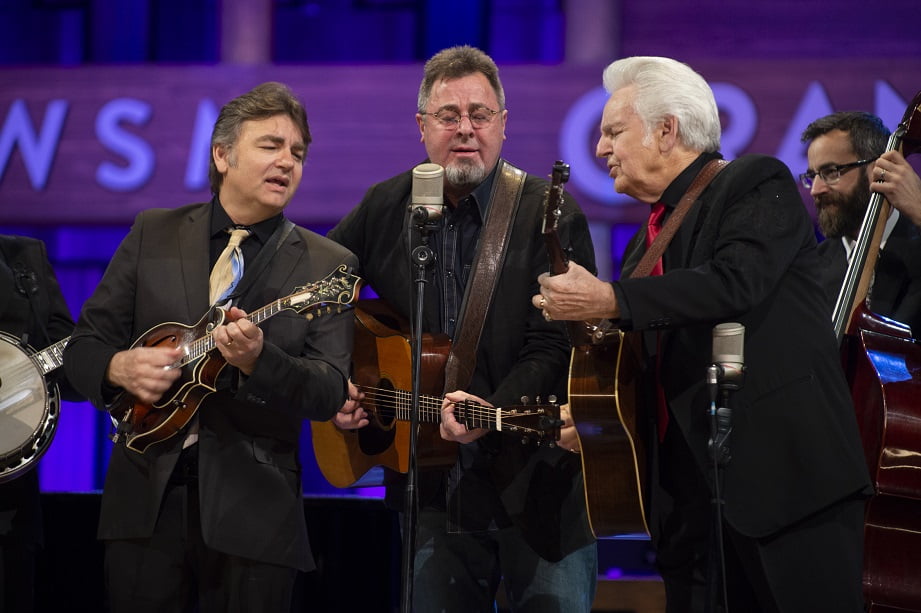
Ronnie McCoury, Vince Gill, Del McCoury
Asked about the decision to spin off a group from The Del McCoury Band, employing everybody except himself, Del says he conferred with manager Stan Strickland about how to make it work.

“I got to an age where I thought, you know, I’m [not] gonna be around here forever,” he noted, just before breaking into his trademark laugh. “I felt good, and I still feel good, but you never know. When you get to 70, you don’t know how many days you got left. I thought, these guys depend on me. My wife and I talked to Stan and I said, ‘You know, if we get them something going on their own, and if something happens to me, then by that time they might be established.’ So we got them a different booking agent than I had, and it seemed like right from the start they were starting to do good already! And I thought, ‘Wait a minute now, I wonder if I should have done that…’”

He breaks into laughter again, before adding, “Especially when they start winning Grammys! And they don’t take me with them!”

Loyal bluegrass fans know that for decades the Del McCoury Band has done its own share of travelin’ – not to mention winning two Grammy awards of their own. Led by Del on lead vocals and guitar, the good-natured group includes Ronnie on mandolin, Rob on banjo, Jason Carter on fiddle and Alan Bartram on bass. Cody Kilby assumes Del’s role as a guitarist in The Travelin’ McCourys, while the vocals in that ensemble are handled in equal share by Ronnie, Rob, Jason, and Alan.

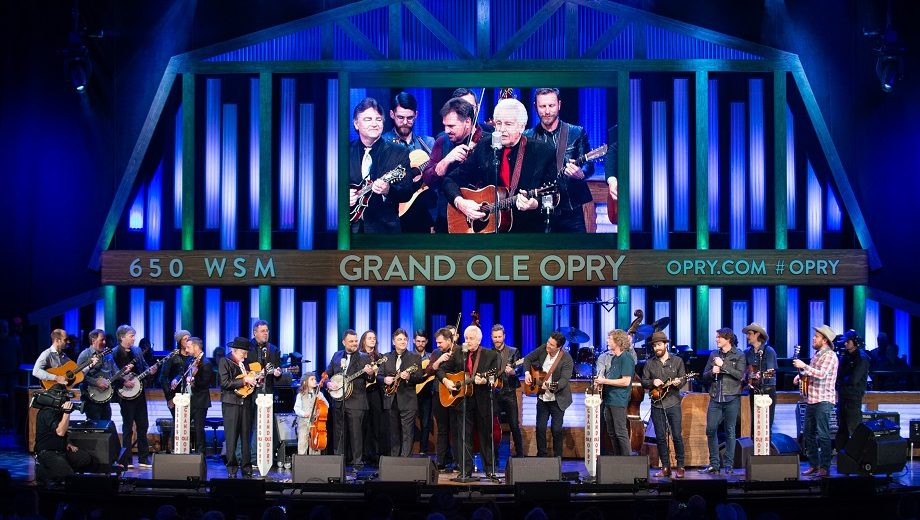
Three days after their Grammy win, the Travelin’ McCourys regrouped with Del when the Opry curated a special show called the Grand Del Opry, in order to commemorate McCoury’s milestone birthday as well as his 15th anniversary as an Opry member. Friends like Sam Bush, Bela Fleck and Abigail Washburn, Vince Gill, Old Crow Medicine Show, Jesse McReynolds, Ricky Skaggs, Marty Stuart, and of course Travelin’ McCourys jammed with the man himself.

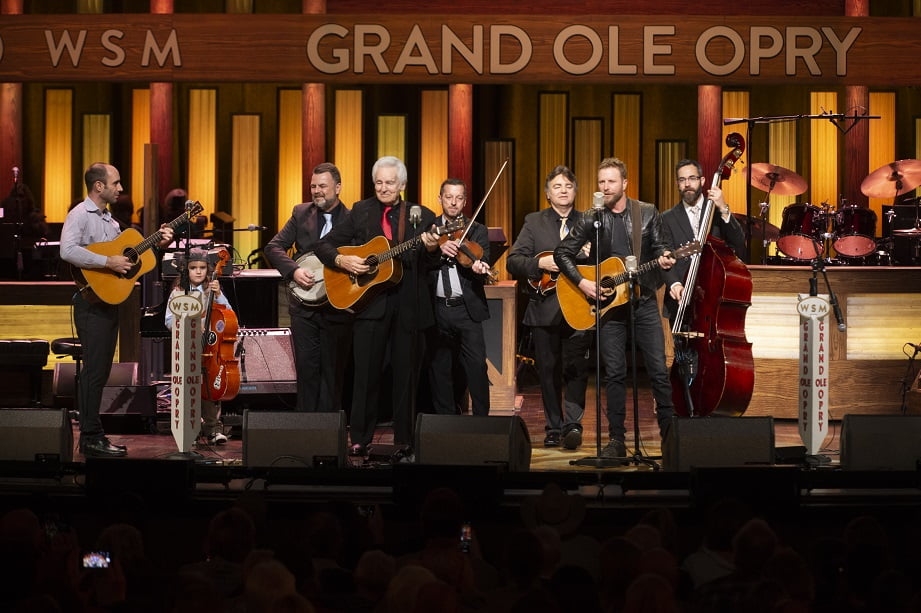
The finale of the Grand Del Opry

In an interview a few weeks after the show, Rob says, “One of the biggest things for me was the finale, and looking at all these people on stage to help Dad celebrate his birthday. And also looking out to see nearly a full house in honor of my father. It made me very proud to see all these folks that have such respect for my dad and the music, and they all took the time to come out to the Opry that night and put on a show in honor of my father.”

Del McCoury made his first appearance on the Grand Ole Opry as Bill Monroe’s guitarist in 1963 – and that performance was only McCoury’s second gig with the esteemed Father of Bluegrass. The first was not long before that, when McCoury subbed for Monroe’s banjo player at a New York show. Although McCoury still preferred playing banjo, Monroe offered him a spot as a guitarist and lead singer – a job he kept for a year. “He’s the reason I’m doing that now,” Del says with a chuckle. “I didn’t think I would be, but once I started playing guitar and singing, I liked it.”

Obviously he still does. McCoury has played a staggering number of festivals over the years, including a few of those seminal Carlton Haney bluegrass festivals of the 1960s. Still he needed some persuasion to launch his own music festival. He recalls, “My manager said to me, ‘Did you ever think about having your own festival?’ And I said, ‘Yeah, I’ve always wanted to, but I don’t want the headache! What a headache that’s got to be!’”

But with persistence, the right location, and a diverse lineup, DelFest has become a major player on the folk festival circuit. This year’s roster includes The String Cheese Incident, Trampled by Turtles, Tyler Childers, Railroad Earth, and more than a dozen bluegrass artists, including Billy Strings, Sam Bush, the Gibson Brothers, Sierra Hull, and the SteelDrivers.

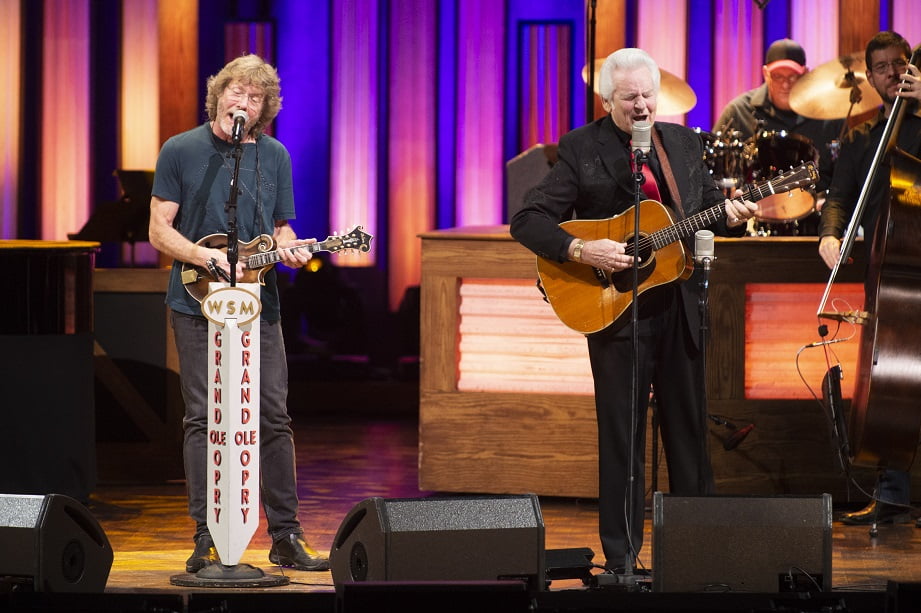
Sam Bush and Del McCoury

“Attendance is staying up there good, and it’s fun,” Del says. “It’s not a bluegrass festival, it’s just a music festival. We have a lot of bluegrass bands there, you know, but we have jam bands, and we have country acts, man, you name it. We had jazz bands, we had a mixture of music, and I like a variety of music my own self. I figured, if we have a variety of bands, some folks will come to see one band, then these folks will come to see another band, and that’s how you get your fans.”

Rob McCoury adds, “I thought having the festival was a great idea. We’ve played hundreds if not thousands of festivals through the years. So I think it was just the natural progression to have a festival of our own. I guess the most surprising thing is, the small details that add up to big things, that no one realizes is going on behind the scenes.”

Asked about the reward of all that work, he answers, “The fans, no doubt about it. All those folks come to DelFest, and anytime dad walks on stage at his own festival he’s a rock star. To me, it’s just the coolest thing.”

Rock star. Bluegrass Hall of Fame member. A nine-time IBMA Entertainer of the Year. Dad. These are just some of the ways you can describe Del McCoury. Winding down the interview backstage at the Opry, he pauses for a moment when he’s asked how he’d like the Opry family to remember him.

Finally, he says, “You know, I guess I’d want ‘em to remember me like a guy that never expected to be an Opry member. I knew I would play music, for years and years, but I thought, ‘The Opry is something is really special and I don’t know if they’d want me there.’ I was fortunate that they did, and I’m just so grateful. I hope they just remember a country guy that really loves the Grand Ole Opry and loves music.”

The Travelin’ McCourys, Vassar McCoury, Del McCoury, and Dierks Bentley
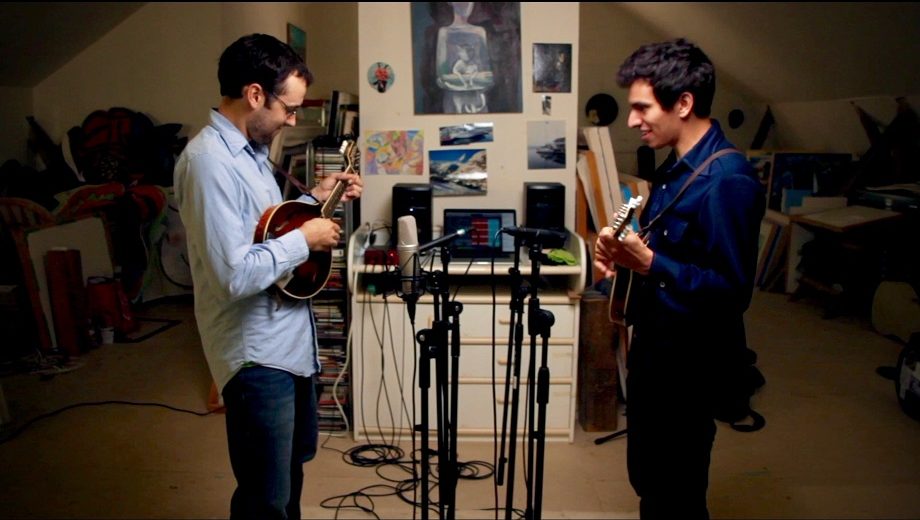

Photo credit: Chris Hollo / The Grand Ole Opry

WATCH: Noah Fishman & Baron Collins-Hill, “Fine Times at Our House”

Artist: Noah Fishman & Baron Collins-Hill
Hometown: Belfast, Maine
Song: Fine Times At Our House
Album: Fine Times

In Their Words: “‘Fine Times at Our House’ is a classic old-time tune that’s been begging for a double mandolin rendition since the dawn of time. To get the tune off the ground, we play it as a jig, and then (spoiler alert) leap into a no-holds-barred, full-speed-ahead strumming fest, nearly smashing our matching A-style mandolins to smithereens. This tune is the title track of our debut duo album: Fine Times is a celebration of the strident versatility of the mandolin, and features six heartfelt originals and traditional tunes from two longtime friends.” — Noah Fishman & Baron Collins-Hill


Photo credit: Jamie Oshima
Video by Jamie Oshima, filmed in the art studio of Alan Fishman, mixed/mastered by Samuel Lundh


BGS 5+5: Songs From The Road Band

Artist: Songs From The Road Band
Hometown: Asheville, North Carolina
Latest Album: Road to Nowhere

Answers by Charles R. Humphreys III

What was the first moment that you knew you wanted to be a musician?

Oddly enough the first moment that I knew I wanted to be a musician was when I was watching Low Country Boil Bluegrass Band from South Carolina perform at The Cave, which was a dive bar in Chapel Hill, North Carolina, in 1995. The band was actually more of a jam band that covered Grateful Dead and New Riders of The Purple Sage songs from the best I could tell. At the time I was not a performing musician but was definitely a diehard music lover. When I felt how much joy this tiny band was bringing me in an empty bar I decided that was what I wanted to be able to do for other people. At that moment I decided to devote my life to learning to play music and write songs.

What’s the toughest time you ever had writing a song?

The toughest time I ever had writing a song that I actually like occurred while writing the title track to Songs From The Road Band’s third studio album Traveling Show. The goal was to write an anthem for a traveling acoustic musician. This co-write with Jonathan Byrd was a struggle until he suggested we look within and write about true life experiences. Then after several months of editing, the material was whittled into a song that made us proud.

What rituals do you have, either in the studio or before a show?

Songs From The Road Band’s pre-show rituals are not incredibly unique, but they do exist! We typically meet in private 5 or 10 minutes before the set to go over song order and transitions. A major goal for the group is to create a musical show that flows. Unlike most bands in our genre, we strive not to talk or emcee at all. We then all join our fists in the middle and yell out something inspiring usually related to Team America World Police. “Do it for your country, Gary!”

Which elements of nature do you spend the most time with and how do those impact your work?

Mountains and hiking trails are the elements of nature that I spend the most time with. Being an ultrarunner means I’m often running mountain trails in distances that extend beyond the marathon length of 26.2 miles. The Bartram Trail which stretches from North Carolina to Georgia is the longest trail I’ve ever traversed continuously without stopping for sleep. The trail traces naturalist William Bartram’s traverse through Appalachia and the Southeast. He encountered Native Americans and many species of animals and plants that had never before been documented prior to 1773. His journey took four years and led him to publish his journal, Bartram Travels. I was able to cover approximately 120 some miles of his trek in 42 hours. Images from these mountains and trails often appear in songwriting like in Song From The Road Band’s recording of “Silk and Lace” on the Traveling Show album.

Since food and music go so well together, what is your dream pairing of a meal and a musician?

My dream pairing of a meal and a musician would be a good ole oyster roast with the The Grateful Dead. Ideally it would be the line up from 1977 or 1989 doing an acoustic set as I think that would pair well with the oyster roast vibe. Hopefully the shucking tables would have crackers, butter, horseradish, and hot sauce. I love the “sters” slightly steamed or raw, but the best part of the experience would be sharing the meal with friends new and old. I guess the current touring line up of The Dead including John Mayer would still be a decent experience.


Photo credit: Ken Voltz

The Tim O’Brien Band Reaches Beyond

Tim O’Brien is only half-joking when he acknowledges, “You know, I have not been known to show up with the same people from date to date.” True enough, considering he’s been with Hot Rize for four decades, played mandolin and sang on the first Earls of Leicester album, issued numerous collaborative albums with family and friends, and carved out a career as a Grammy-winning folk artist. Along the way, he’s also produced notable roots artists ranging from the Infamous Stringdusters and Yonder Mountain String Band, to Kathy Mattea and Laurie Lewis. His multiple IBMA Awards include two trophies for Male Vocalist (1993, 2006), and another for the 2006 Song of the Year, “Look Down That Lonesome Road.”

That road is less lonesome now that he frequently travels with his partner, Jan Fabricius, a mandolin player and singer who makes her leap into professional music with O’Brien’s new album, The Tim O’Brien Band. In an effort to find players adept at both Irish and bluegrass music, the impeccable ensemble is rounded out by Mike Bub on bass, Shad Cobb on fiddle, and Patrick Sauber on banjo and guitar. Released one day after O’Brien’s 65th birthday, the project leads O’Brien and his colleagues toward tour dates in his native West Virginia… and beyond.

O’Brien invited The Bluegrass Situation into his music room for a chat about being a traveling musician, a songwriter and (much to his surprise) a role model.

BGS: Pretty early on this record, you have some traditional tunes. Why did those songs seem right for this album?

O’Brien: Let’s see, we’ve got “Doney Gal” and the two reels, and we’ve got “Pastures of Plenty” – I guess that’s traditional now. You know, I didn’t write a lot of songs this time, and I revisited one that I recorded before. I had recorded “Crooked Road” solo in the past, but I thought it would be really good with a band, and I wanted to hear that. I was happy with the way it came out.

Whenever I started doing gigs on my own in coffee houses, I always mixed it up with traditional songs and covers and my own tunes when I started writing. So it’s kind of a continuation of that. It’s my style of making a record. I’m itching to write some songs, but I didn’t do it much this time.

When you need to round out an album, how do you decide what to record?

I go to the CD shelf over there. Nowadays, I glean ‘em every year and I get rid of the ones that I know I’m never going to listen to much. The ones I keep going back to, there’s often something on there that makes me go, “Oh yeah, I love this song. Maybe I can sing this song…” And I’ll try it. I have one of those Moleskine books that are filled with lyrics of songs that I want to know — and I’ll write the lyrics of the ones that I’ve just sung on a record and need to remember.

I have to say, I’m touched by your rendition of “Last Train from Poor Valley.”

Oh man, Norman Blake is my hero! I saw him first probably in 1972. He was on that first Will the Circle Be Unbroken record and some other friends that were playing bluegrass already knew about him. They had that first Norman Blake record, which came out around the same time. And when I started playing with Hot Rize, we’d play these festivals and we would meet up with him. We got to be friendly and it was like a regular ol’ friend that you’d see. That’s the great thing about the touring community. You see people week to week in the summertime months. That’s why it’s nice to live in Nashville. I used to go home to Colorado and you wouldn’t see those people in the grocery store or the post office. [Laughs]

Norman and Nancy are old friends, and I go back to see them every now and again in recent years. Their music is just so different from what I do, and what Hot Rize did, and yet all these years later, it’s a lot closer. Even though it’s still very different, it’s a lot closer than a lot of the other stuff that’s going on. But I just love the sentiment of that song, and I knew that song from when his record came out. I like to pay tribute to somebody like that. He’s not on the circuit anymore and I don’t want him to be forgotten.

I like the feel of “Beyond.” It sounds to me like a hero’s anthem. What was on your mind when you wrote that?

I had the idea of writing something about, “Let’s get beyond the day to day.” It sounds like a gospel thing, and it fits in there, but if you could find enlightenment within your daily routine, or just get past the stumbling blocks that frustrate you and say, “Hey, man, things are going to be fine… We can go beyond this and look beyond this.” And maybe if we can live there, we can live life more freely while you’re going about the day-to-day.

Do you consider yourself an optimist?

I am an optimist, yeah. Musicians have to be! [Laughs] My friend Chris Luedecke – Old Man Luedecke, a guy I’ve produced some records for and toured with – he says, “Man, we’re the ultimate optimists. We keep getting up in the morning and trying again.” I suppose everybody does it, if you define it that way. We’re all optimists. But yeah, I’m an optimist and I think it’s possible to change, it’s possible to rise above your problems and get around ‘em somehow, and get beyond.

What is your response when younger musicians see you as a role model?

It’s a funny evolution. I guess it’s happened, that I’ve become this role model. It surprises you, but if you look at who my role models were, a lot of them aren’t there anymore. That means I’m getting closer to the checkout line, so I’ve become a role model because I’m still out there doing it. So I guess it’s an honor, but it gets to be intimidating to continue, because you think you’re not coming up with your best stuff all the time, and you wonder if you can even show it.

Hot Rize is that way. It’s hard to go and record a Hot Rize record because of nostalgia. People look at Hot Rize’s repertoire and go, “Sheesh! There are so many great songs!” But it took, I think, eight records to get all those together. It sort of magnifies things in a funny way, and it will intimidate even yourself, as you’re trying to repeat yourself. Hot Rize can repeat ourselves, but the idea of putting a new record out was like, “Oh man… we really need to be good! We better be as good as all that.” You do a lot of soul searching and you take it more seriously.

I wanted to ask you about writing “Hold to a Dream,” because that song has done well for you – it’s something of a standard, I would say.

“Hold to a Dream” is a good one. I had been into Irish music for a while, and that seemed like an Irish tune. The lyric is not necessarily very specific about anything. It’s a love song, I guess, but it’s like the theme of “Beyond” — it’s possible. We can get past everything and we can still do well. I like that one because it’s got a little rhythm, it’s got a little instrumental bit, and it’s got a little bit of a message – and it’s fun. And it’s got a nice chord progression. [Laughs] …

What I’m surprised about some of the songs that I’ve written that have translated so much, there is nothing heavy about them. But people are distracted by music and then they are allowed to think about other things while they are listening to it. And just a few words will suggest something. I think songs like “Hold to a Dream,” or other songs where there’s an instrumental section, lets people go, “Ah, yeah… hmm….” (laughs) You start singing and they might start thinking of something else.

Newgrass Revival does a magnificent version of that song, and you’ve also had cuts along the way by Garth Brooks, Dixie Chicks, Dierks Bentley, Kathy Mattea, Nickel Creek, and others. As a songwriter, what is that like to hear something you wrote come to life through another artist?

It’s really flattering when anybody sings your song, if they want to. There’s a monetary reward, which is nice, but mostly you’re just flattered. Then you realize, OK, what I’m doing is valid. It means something, so continue. That carrot is the one I really want to catch, knowing that what you’re doing is worthwhile.


Photo credit: Michael Weintrob

LISTEN: The Cleverlys, “Blue (Da Ba Dee)”

Artist: The Cleverlys
Hometown: Cane Spur, Arkansas
Song: “Blue (Da Ba Dee)”
Album: Blue
Release Date: March 22, 2019
Label: Mountain Home Music Company

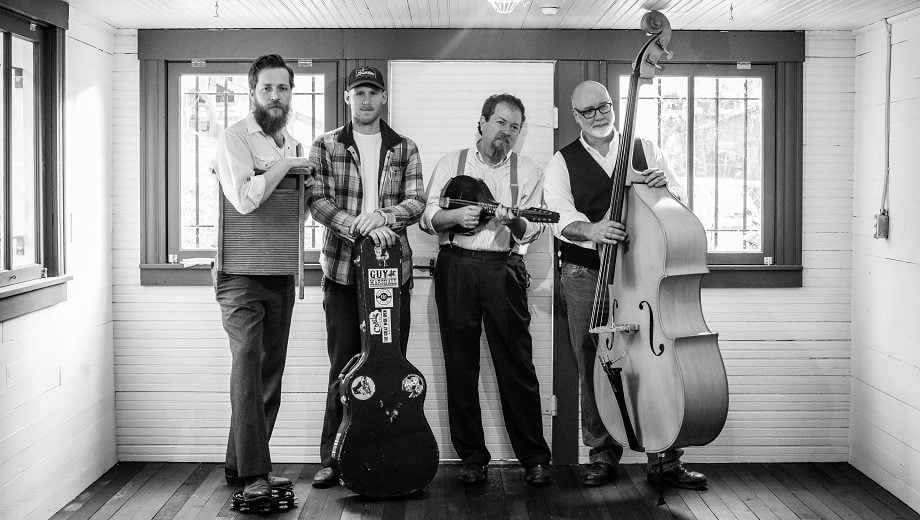
In Their Words: “On the surface, ‘Blue’ is about a guy that lives in a blue world and everything around him is blue. But the educated mind that can mentally peel back the layers of status quo existence can find the hidden meaning behind the song. And that is to stay hydrated.” –Digger Cleverly


Photo credit: Sandlin Gaither

Small Town Therapy, “Cimarrón”

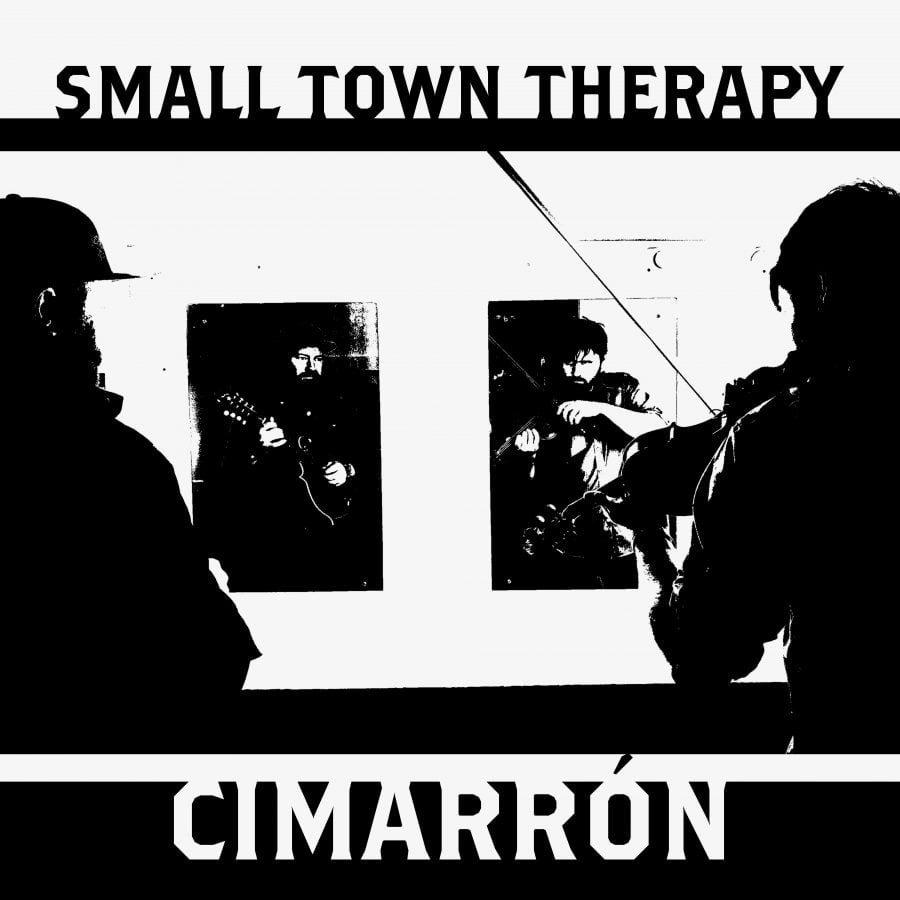
Fiddler Leif Karlstrom and mandolinist Adam Roszkiewicz — both veteran members of Bay Area pop-stringband Front Country — together in their duo form are called Small Town Therapy. Their latest single, “Cimarrón,” is their first studio follow-up to their 2014 debut self-titled album, which was produced by mandolin virtuoso Matt Flinner. “Cimarrón” reveals the pair charging back onto the scene with more new acoustic-inspired goodness with duet-precision that conjures other notable bluegrass-and-then-some twosomes like Darol Anger and Mike Marshall.

Though the title may evoke wild frontiers and raw, feral beauty, immediately listeners realize that Karlstrom and Roszkiewicz are neither untamed nor unpredictable in their execution of the tune. In fact, their impossibly tight, intertwined duet is almost perfectly antithetical to the wildness of the song’s moniker. The melody runs along like a raging river or a stampede of wild horses that while turbulent and fraught up close, are deft, intricate, deliberate choreographies when viewed at a distance.

The song never loses the frenetic, improvisational energy that we’ve come to recognize as a hallmark of these acoustic offshoots of bluegrass and old-time, yet Small Town Therapy are effortlessly in control. Their years spent in bands and on the road together are perhaps to blame — and thank — for this balance. In such a loose format, merely two voices bouncing off of and responding to one another, one might expect that freneticism to inevitably run off the rails, but it never does. And once again, like that coursing river or galloping herd, it sets its passengers down ever so gently at the end of their rollicking, musical journey.

LISTEN: Buffalo Wabs & The Price Hill Hustle, “The Wind”

Artist: Buffalo Wabs & The Price Hill Hustle
Hometown: Cincinnati, Ohio
Song: “The Wind”
Album: Stranger in the Alps
Release Date: March 15, 2019

In Their Words: “‘The Wind’ came quickly as a natural co-writing situation, with Bill Baldock (bass) supplying lyrics and Matt Wabnitz (guitar) on music and arrangement. It’s an introspective departure from some of the high-octane numbers we do. The 12/8 time makes this a lilting waltz, something not akin to anything in our catalog. Scott Risner stretches his chops on the archtop guitar, departing from the bevy of instruments he’s already incorporated into the group, to deliver beautiful counter-melodies.” –Buffalo Wabs & Price Hill Hustle


Photo credit: Kenny Dunn

WATCH: Chris Jones & The Night Drivers, “Looking for the Bridge”

Artist: Chris Jones & The Night Drivers
Hometown: Nashville, Tennessee
Song: “Looking for the Bridge”
Album: The Choosing Road
Release Date: March 29, 2019
Label: Mountain Home Music Company

In Their Words: “This is one of five songs from our upcoming CD that Jon Weisberger and I have co-written. This one is all about trying to find a way back to how things were in a relationship that has turned cold, and feeling lost in the effort. The song contains one of the Night Drivers’ characteristic ‘signature licks’ which had just randomly come into my brain one day, and I recorded it on my phone. This was the most enjoyable video recording experience we’ve ever had. It had lots of the elements we love: railroad tracks, a beautiful North Carolina river, and a dog barking at a drone (the dog does not appear in the video because he refused to sign a release). There was also a bridge, which apparently we couldn’t see.” — Chris Jones


Photo credit: Sandlin Gaither

LISTEN: Shawn Lane and Richard Bennett, “Charlestown”

Artist: Shawn Lane and Richard Bennett
Song: “Charlestown”
Album: Land And Harbor
Release Date: March 8, 2019
Label: Bonfire Recording Company

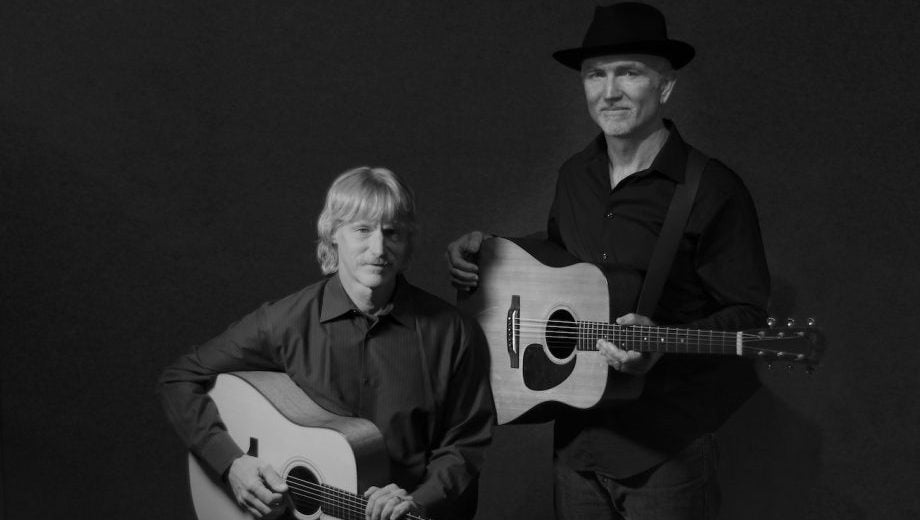
In Their Words: “I had the musical hook portion of this song for a while before we found the subject to start writing about. I played it one day for my son, Grayson. He said, ‘We’ve been studying the history of Charleston, South Carolina, in class. It used to be called Charlestown years ago. I think that’s what this melody says.’ It was like a light came on. That was exactly what it was supposed to be.” — Shawn Lane

“‘Charlestown’ is one of my personal favorites from our recent project. The song is loaded with visual imagery. Shawn’s exceptional vocals really bring it all to life. I’m honored to be a part of the magic.” — Richard Bennett


Photo credit: Nate Smith, Bonfire Recording Co.