MIXTAPE: Dori Freeman’s Waltzes for Dreamers and Losers in Love

Waltzes are my favorite. Can’t explain why, but they touch me in a way that other songs don’t. In honor of my album, Ten Thousand Roses, and its title track, here are twelve of my favorite waltzes — some by dear friends and some by long-gone greats. — Dori Freeman

Erin Rae – “June Bug”

Erin is one of my favorite artists — I just love her voice and the style of her records. This song is so simple (my favorite kind of song), but so sweet and effective lyrically and in the arrangement. The last minute or so of the melody being played on piano is particularly lovely.

Kacy & Clayton – “Down at the Dance Hall”

Kacy and Clayton are dear personal friends and some of the most genuine and truly original people I’ve ever met. This is such a classic-sounding waltz it’s hard to believe it was written only a few years ago. Kacy is also one of my favorite singers *of all time.*

Ric Robertson – “Julie”

Ric is another good friend of mine and easily one of the best songwriters of the time. He writes with a vulnerability and honesty that most people are afraid to share. I also had the privilege of singing harmony on this lovely track with my friend Gina Leslie.

Teddy Thompson – “Over and Over”

I have to include a Teddy song on this playlist since he’s been such a big part of my own music. He produced my first three records and continues to be such a kindred spirit in music making. This song has such a heartbreaking honesty lyrically and a truly haunting arrangement.

Iris Dement – “Sweet Is the Melody”

Iris has one of the most instantly recognizable and unique voices in music. I had this album on cassette tape and used to listen to it driving around in my old Subaru when I was like 19. Such a tender song.

John Hartford/ Tony Rice/ Vassar Clements – “Heavenly Sunlight”

My husband introduced this song to me a few years ago and we’ve been performing it at shows ever since. I never get tired of singing this beautiful song and this is my all-time favorite version. A good gospel waltz is hard to beat.

Linda Ronstadt/ Dolly Parton/ Emmylou Harris – “Hobo’s Meditation”

This song is twofold in its importance to me. First, these are three of the most talented singers ever singing together on one album. All three of these women have had a huge influence on me individually and I think you’d be hard-pressed to find another country singer who wouldn’t say the same. This is also a song that my dad’s band performed and recorded when I was a child. I can vividly remember sitting in the audience listening to them play this song.

The Louvin Brothers – “Blue”

If you want a master class in harmony singing, the Louvin Brothers are it. I love to listen to them dance around each other when they sing, jumping all over the place with grace and finesse. This waltz is a classic heartbreaker with lots of tender swooning falsetto.

George Jones – “Don’t Stop the Music”

Another one of our greatest singers, George Jones. This is one of my husband’s favorite waltzes and makes the cut for me, too. That jump up to the sixth he sings right in the opening gets me every time.

Rufus Wainwright – “Sally Ann”

Most people familiar with my music know that Rufus Wainwright’s music is very dear to my heart. He has a couple beautiful waltzes to choose from, but I included this one from his first record. A weird thing to note perhaps, but I love that you can hear each breath Rufus takes before singing on his recordings.

Lee Ann Womack – “Prelude: Fly”

This album was on heavy rotation when I met my husband in 2016 so when I hear this song I’m reminded of how sweet a time that was. It’s got a special place in my heart. And Lee Ann is one of those singers who makes me cry every time.

Richard Thompson – “Waltzing’s for Dreamers”

My daughter used to like this song when she was littler so that makes it an especially sweet one for me. It has one of my favorite lines — “waltzing’s for dreamers and losers in love.” So funny, so sad, so true.


Photo credit: Kristen Crigger

WATCH: Jordan Tice, “River Run” (Feat. Paul Kowert)

Artist: Jordan Tice
Hometown: Nashville, Tennessee
Song: “River Run” (Featuring Paul Kowert)
Album: Yesteryears
Release Date: October 1, 2021
Label: Padiddle Records

In Their Words: “‘River Run’ started with a little lick I had been carrying around in the key of D — a speedy little cascading thing that felt good to let roll off the fingers that I’d find myself playing in idle moments. I slowly built upon it while sitting around during lockdown and my dear friend, Paul Kowert, tied it all together with his wonderful bass part. To me, the song evokes the lightness and constancy of a swiftly moving river as it passes over rocks, rounds curves, and speeds and slows as its channel widens and narrows. Hope you experience the same sense of motion while listening and are able to glean a little bit of levity from it.” — Jordan Tice


Photo credit: Jacqueline Justice

LISTEN: Skillet Licorice, “3-in-1 2-Step”

Artist: Skillet Licorice
Hometown: San Francisco, California
Song: “3-in-1 2-Step”
Album: Allsorts Orchestra
Release Date: September 10, 2021
Label: Tiki Parlour Recordings

In Their Words: “‘3-in-1 2-Step’ was one of the first East Texas Serenaders tunes that we learned. One listen and you feel transported 100 years into the past. It is so named because it borrows its melody from three other tunes: ‘Dill Pickle Rag,’ ‘The Entertainer’ and ‘I Don’t Love Nobody.’ As such, it’s perfectly emblematic of the ETS. They weren’t jazz players and they weren’t classical players, but these talented Texans were able to seamlessly incorporate elements from disparate genres to create something new, something their own, yet somehow familiar. Our version features a driving yet elegant banjo-mando harmony part played by San Diego old-time wunderkind Clinton Davis.” — Elise Engelberg and Matt Knoth, Skillet Licorice


Photo credit: Sean Kelly.
Skillet Licorice
Allsorts Orchestra Illustration by ‘The Simpsons’ artist Joe Wack

WATCH: Béla Fleck, “Round Rock” (Live)

Artist: Béla Fleck
Hometown: Nashville, Tennessee
Song: “Round Rock”
Album: My Bluegrass Heart
Release Date: September 10, 2021
Label: Renew Records/BMG

In Their Words: “I’ve been saving this tune for a long time, looking for the right band to play it — but nothing seemed right ’til this project. Then it seemed real right! I think it’s at least 20 years old, but I certainly spruced it up as the recording dates loomed closer, writing a pair of bridges — and at the last minute, the night before the session — an intro and outro sequence with apologies to Ravel and Debussy. The title references the circular chord progressions, and with these two bands, it rocks!” — Béla Fleck

Editor’s Note: Filmed by Abigail Washburn, this video features Michael Cleveland, Sierra Hull, Justin Moses, Mark Schatz and Bryan Sutton. The album version features Cleveland, Jerry Douglas, Cody Kilby, Paul Kowert, and Dominick Leslie.


Photo credit: Alan Messer

WATCH: The Kody Norris Show, “Farmin’ Man”

Artist: The Kody Norris Show
Hometown: Mountain City, Tennessee
Song: “Farmin’ Man”
Album: All Suited Up
Release Date: September 10, 2021 (Single)
Label: Rebel Records

In Their Words: “‘Farmin’ Man” is a true-life account of the American farmer from my perspective. I grew up in a tobacco farming family in the mountains of eastern Tennessee, so I guess I had some firsthand experience of farm life and know all to well the ups and downs that come along with it. I feel that with this video we were able to capture on point the day-to-day life of the Farmin’ Man: the hard work, the struggles and uncertainty they face every day. We had such a great time filming this and it brought back so many memories of my childhood. I hope when fans see this they will take a minute to pay homage to one of America’s greatest heroes, the Farmin’ Man.'” — Kody Norris


Photo credit: Amy Richmond

The Bristol Sessions Get Another Look on ‘We Shall All Be Reunited’ CD

For Dr. Ted Olson, Appalachian music has always been much more than a collection of songs. It’s been nothing short of a passion. The Eastern Tennessee State University professor has spent much of his life writing, researching, and documenting the music that has played and recorded throughout the southeastern United States during the 1920s and 1930s. His respected work on Bear Family Records box sets covering sessions in Bristol, Johnson City, and Knoxville, Tennessee, have brought those long-ago recordings to new generations of listeners. For example, the single-disc set Tell It to Me: Revisiting the Johnson City Sessions, 1928-1929 was named Best Compilation Album of 2019 by the Independent Music Awards.

Now, Olson has teamed up again with Bear Family to release We Shall All Be Reunited: Revisiting the Bristol Sessions, 1927-1928, a single CD distillation of these legendary sessions. Commonly called “the big bang of country music,” the recordings in Bristol by the Carter Family, Jimmie Rodgers, and others became unexpected bestsellers, positioning country music as a viable commercial format. Along with reams of new liner notes, the CD delivers not just those familiar names, but also Ernest Stoneman, Blind Alfred Reed, and more, reminding listeners of the diversity that crowded around producer Ralph Peer’s microphone.

BGS: What inspired you to revisit the music from the original Bristol sessions for this album?

Olson: I found that the story of the Bristol sessions had grown significantly, for me. I’ve changed my interpretation of the Bristol sessions, its historical significance, and how one interprets that legacy. This gave me the opportunity to set the record straight about how that story needed to be told. That new narrative is in the liner notes, which are 44 pages. That is the maximum that can fit in a jewel box. I was pretty adamant that this is the story that needed to be told and this is the length it should be.

We have new documents to learn from, new research that was unavailable to us before. New interviews and new artwork. To me, it’s revisionist history in the best sense of the term. When Sony released a single CD of the Bristol sessions in 2003, they focused solely on the 1927 sessions. To my mind, the 1928 sessions are equal to the sessions of the previous year. With this new CD, we celebrate both of those sessions. We have new masters for the songs as well. An engineer in Germany, Marcus Heumann, produced new masters for this release. They’re very exciting and they sound like they were recorded yesterday.

Dr. Ted Olson

What emerges from listening to both the Bristol and Johnson City collections is that they each demand your attention, albeit with different qualities.

The Johnson City sessions were an essential part of the rest of the story. They were echo sessions, just months after the Bristol sessions. They involved many of the same musicians, and yet the Johnson City sessions explored a different side of the Appalachian music that the Bristol sessions didn’t get to. The Bristol sessions accomplished certain things that are valuable and important, but they didn’t explore other facets that Johnson City was able to get more deeply into, because it had a different producer. It also was a different company, with different priorities and fortunes.

Some people prefer the Johnson City sessions to the Bristol sessions. They find the Johnson City recordings wilder, more exciting. Less controlled by the producer. Ralph Peer was a very controlling producer, very interactive in shaping the sounds, whereas Frank Walker of Columbia had the attitude of anything goes in this music. He was more documentarian, in a way. “What do you have? Let’s hear it.” Rather than shaping something into a package, which is what Ralph Peer’s modus operandi was at the Bristol sessions. I love them both. I’m not going to play favorites, but I’m also not going to acquiesce into the idea that Bristol sessions were more important because they were a year earlier.

How did you come to choose one song from each artist for the new Bristol Sessions album?

I knew that I wanted to match the length of the Johnson City CD, which had 26 recordings. I committed to 26 tracks, because that’s as much as we could fit on a CD, but there was also a licensing limitation. I also wanted a new template, where the ’28 Bristol sessions were as important as the ’27 sessions.

There were 28 artists that performed at the Bristol sessions, which meant that I could include one track from everyone except two. I had committed to including performances that in 2020 would be enjoyable by those who aren’t initiated into the sounds of the 1920s musical world. The stylistic approaches back then have changed over the years. We’ve listened to the Carter Family and Jimmie Rodgers through the years, so they sound familiar to us. Other artists from those sessions were such talented performers that we can still appreciate their recordings for talent alone.

How did you select the song from the Carter Family? All six of the songs that they recorded in Bristol are amazing.

I came to the conclusion that while “Single Girl, Married Girl” or “Bury Me Under the Weeping Willow” had gotten a lot of attention from these sessions, it’s “The Poor Orphan Child” that, for me, is the one that has captured my ears as the definitive Carter Family debut performance. A.P. is part of it. He’s not on “Single Girl, Married Girl.” He was out fixing their car tires that morning. To my mind, his best singing at the Bristol sessions was on “The Poor Orphan Child.”

Jimmie Rodgers’ recordings in Bristol have always suggested to me a person with a distinctive musical identity that is still seeking a comfort level in front of the mic. His two songs seem a bit tentative, a little nervous. Rhythmically, he’s very loose, which was always part of his persona. I think those recordings show his great charisma. He didn’t invent the singing yodel, but he first demonstrated it on the track that’s on this CD, “Sleep Baby Sleep.” Several months later, he records “Blue Yodel No. 1 (T For Texas),” and that was his breakthrough record.

The Bear Family box set about the Bristol Sessions received two Grammy nominations in 2011. It should have been a high point for you. How did you come to realize that you had much more to do?

It was fascinating for me to watch the press reaction to the Grammy nominations as well as the box set itself. I found that the press reactions were a little bit uncertain of what the Bristol sessions were. It was as though they were all falling lockstep into rapt amazement at the mythic importance of this thing called the Bristol sessions. It was obvious to me that people were changed by a myth, which revolved around two notions. One was that the Bristol sessions were “the big bang of country music.” But what does that mean? It was where Jimmie Rodgers and the Carter Family made their first records, but there were many other artists there as well.

The other notion was that Bristol is the birthplace of country music, which has been promoted by both Bristol, and the state of Tennessee, but that statement has often left other important sessions to be overlooked. I came to see that critics didn’t know how to unravel the myth. So, there I was at the Grammys, and as a scholar I felt I had only cracked the surface of what these sessions really were. I, too, was under the spell of the myth. And I needed to get past that. It was quite clear to me that there was more to the story. I remember flying home from that event, thinking that this was a life’s work in front of me.


Photo of Dr. Ted Olson by Charlie Warden

BGS 5+5: Della Mae

Artist: Della Mae
Hometown: The United States
Latest Album: Family Reunion
Nicknames: Celia = Squawkbox; Kimber= Fiddler, Kimby, Auntie, Nimmers (Grammy only); Vickie = VV, Double V, Wickie
Rejected Band Names: Big Spike Hammer

What’s your favorite memory from being on stage?

Thanks to my good friend and mentor Rickie Simpkins, I played a show on electric guitar with Emmylou Harris a few years ago. My favorite memory from the gig was actually the soundcheck and rehearsal. It was a really special thing to get to experience how an artist I deeply admire prepares for a performance and then get to be part of how it all came together. — Avril Smith

In 2012, we had the opportunity to go on a six-week tour of South and Central Asia with the State Department. The first show we played was in Islamabad, Pakistan at a women’s college. It was the most incredible energy we’ve ever felt in a room. They’d never heard bluegrass before and erupted in cheers and Beatles-worthy shrieks when we hit the first three-part harmony chorus. — Kimber Ludiker

What’s the toughest time you ever had writing a song?

“The Way It Was Before” took Mark Erelli and I six hours to write (three Zoom sessions). Half of that time was spent talking, looking up stories, getting really emotional about the state of the world. We wanted to make sure that every word counted, so we took our time and tried to honor each of the characters (who are actual people). The pandemic isn’t even behind us, and yet I keep hearing people say that they can’t wait to get back to “the old days.” There’s so much about “the old days” that needs changing. After everything we’ve been through in the last 18 months, I found that writing a song like this felt impossibly huge. I may not have finished it if it hadn’t been for Mark. — Celia Woodsmith

Which artist has influenced you the most…and how?

Missy Raines has influenced me the most. For obvious reasons, but let me explain: I was 14 years old watching Don Rigsby and Josh Williams play at my hometown venue, the Kentucky Opry. I saw her up on stage playing upright with them, so cool and beautiful and a master of her instrument. She was hanging with the boys and giving them all a run for their money. Then and there I decided that I wanted to do that for the rest of my days. When it comes to harmony singing, however? One hundred percent Diamond Rio. — Vickie Vaughn

If you had to write a mission statement for your career, what would it be?

We actually do have a mission statement as a band — to showcase top female musicians, and to improve opportunities for women and girls through advocacy, mentorship, programming, and performance. Our hope is that our music inspires more women and girls to pick up an instrument and use their voices to create art and work together to affect the kind of change they want to see in our world. — Avril Smith

What was the first moment that you knew you wanted to be a musician?

FROM BIRTH. 😉 I’m a fifth-generation fiddler. I could play my first tunes at age 3. My earliest memories are playing fiddle tunes with my grandpa and brother. However, it wasn’t until my last year of college that I decided to make it my life. I saw how people struggled as musicians, and honestly, my brother was a bit of a child prodigy and I didn’t think I was good enough for a long time. I began to realize that everyone has their individual skills and talents, and I had something to contribute. — Kimber Ludiker


Photo credit: Kimber Ludiker

LISTEN: Swamptooth, “The Owl Theory”

Artist: Swamptooth
Hometown: Savannah, Georgia
Song: “The Owl Theory”
Album: B-Flat Earth
Release Date: September 17, 2021

In Their Words: “This song was written by guitarist Jay Rudd. In the Netflix series The Staircase, crime novelist Michael Peterson was convicted of murdering his wife who was found dead at the bottom of the stairs in their home. A few years later a neighbor brought forth a new theory that an owl had attacked Peterson’s wife on her way inside the home and she had fallen down the stairs during the resulting confusion. Many have argued that the theory is plausible due to evidence such as microscopic owl feathers found in her hand. This song manifested after visualizing the owl attack and subsequent fall down the staircase.” — Swamptooth


Photo credit: Kelly Roetto

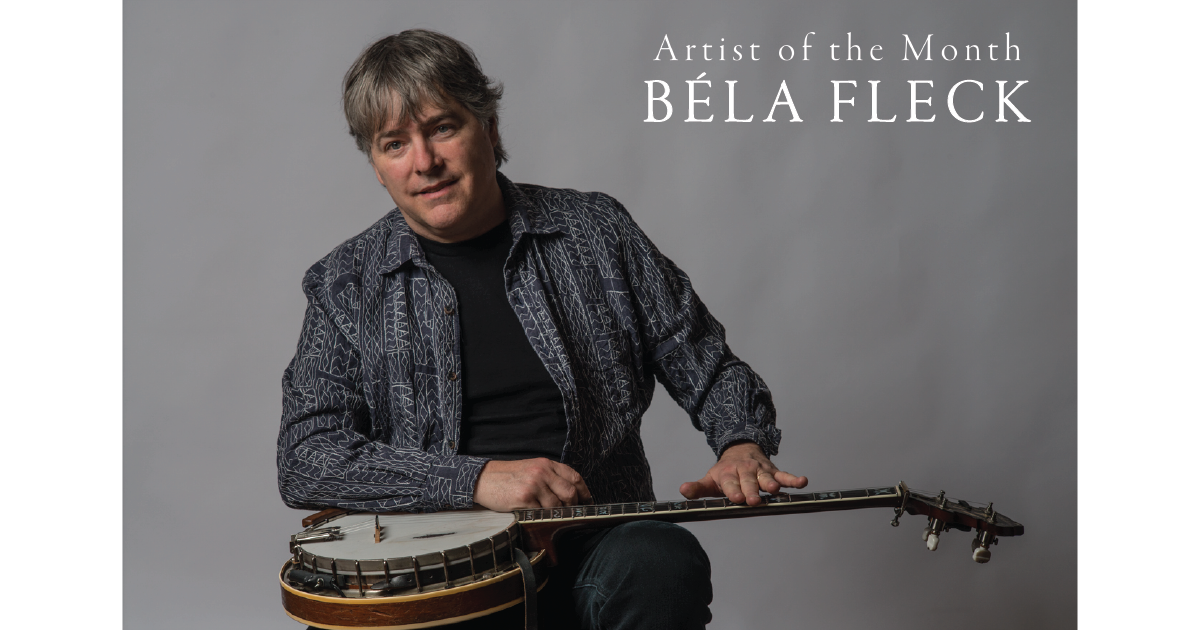
Artist of the Month: Béla Fleck

Banjo maestro Béla Fleck has always followed his muse, jamming with collaborators and crisscrossing continents for decades now. His newest album leads him back to familiar terrain, as My Bluegrass Heart is his first bluegrass record in 20 years. “They nearly always come back,” says Fleck, who composed and produced the album (set for a September 10 release). “All the people that leave bluegrass. I had a strong feeling that I’d be coming back as well.”

The reunion encompasses some of his closest comrades, too, like Sam Bush, Stuart Duncan, Mark Schatz, and Jerry Douglas. As a nod to the newest generation of acoustic all-stars, the project also includes guests such as Chris Thile, Molly Tuttle, Sierra Hull, Billy Strings, and Billy Contreras. Longtime allies like David Grisman, Edgar Meyer, and Tony Trischka get in on the action too.

Speaking from his own bluegrass heart, Billy Strings says, “In my opinion, Béla Fleck is one of the most important musicians of all time. He bridges the gap between bluegrass, classical, jazz, world music, and everything in between. It seems like there’s no limit to what he can achieve on the banjo.”

But as with any project involving Béla Fleck, there’s bound to be some exploration. “This is not a straight bluegrass album, but it’s written for a bluegrass band,” he explains. “I like taking that instrumentation, and seeing what I can do with it — how I can stretch it, what I can take from what I’ve learned from other kinds of music, and what can apply for this combination of musicians, the very particularly ‘bluegrass’ idea of how music works, and what can be accomplished that might be unexpected, but still has deep connections to the origins.”

This month, Fleck will be touring in support of the album with Michael Cleveland, Sierra Hull, Justin Moses, Mark Schatz, and Bryan Sutton, concluding with a festival spot during IBMA World of Bluegrass on October 1. He’ll resume roadwork in late November and December joined by Sam Bush, Jerry Douglas, Stuart Duncan, Edgar Meyer, and Bryan Sutton. And it’s not too early to circle the calendar for January 7, 2022, when he’s headlining the Ryman alongside nearly every musician who makes an appearance on My Bluegrass Heart.

In the meantime, read our two-part Artist of the Month interview feature here and here — and enjoy our BGS Essentials playlist spanning his remarkable career.


Photo credit: Alan Messer

The BGS Radio Hour – Episode 217

Welcome to the BGS Radio Hour! Since 2017, this weekly radio show and podcast has been a recap of all the great music, new and old, featured on the digital pages of BGS. This week we have California country from Elijah Ocean and the Ben Reddell Band, acoustic folk goodness from Anna Tivel, a final farewell to our August Artist of the Month Amythyst Kiah, and much more.

APPLE PODCASTS, SPOTIFY

Amythyst Kiah – “Black Myself”

In our recent two-part interview with our August Artist of the Month, Amythyst Kiah, she spoke with us about faith, about mental health and singing vulnerable, open songs every night, and the intent behind lyrics and songs like “Black Myself.” Plus, she retells the series of events that helped her leave her “shut-up-and-sing” policy behind. Thank goodness for that.

Chris J. Norwood – “Good Guy With a Gun”

On “Good Guy With a Gun,” singer-songwriter Chris J Norwood examines the grief and loss of his father’s suicide while challenging the United States’ gun culture: “Truth be told, we as a country need to talk more openly about suicide. Especially as it relates to the gun debate…”

Ava Earl – “New Light”

One of the first love songs singer-songwriter Ava Earl ever wrote, “New Light” is also a little existential — it deals with the wonder and mystery of the universe as well as that of love.

Elijah Ocean – “Honky Tonk Hole”

As Elijah Ocean himself puts it: “‘Honky Tonk Hole’ is about a guy who has seen better days and whose big dreams have all gone up in smoke. Now he spends all his time drinking and playing country music in bars. Not entirely sure why he’s complaining about it, though. Seems kinda fun and not a bad life. It’s a high-energy shuffle about falling into a rut but also kind of loving it.”

Ben Reddell Band – “12 Bar Blues”

Musician and frontman Ben Reddell recently put together a Mixtape celebrating bands and artists who have played The Grand Ole Echo, a roots music concert series he books at LA’s Echo Park, or who rely on the creative and rehearsal space he manages, Bedrock LA. To quote: “We love our traditional country here in Echo Park, but we also like to let our freak flag fly with the hippie-dippie, pot-smoking types as well.” Check out the community-minded Mixtape here.

Kashena Sampson – “Hello Darkness”

Nashville-based Americana singer Kashena Sampson brings us a Shocking Blue cover that carries a feeling of yearning for someone you can’t be with.

Morningsiders – “This Could Be Good”

Morningsiders began writing their new album after the pandemic lockdowns began. They wanted “This Could Be Good” to be dance-y and delicate while being about aimless nights out with friends.

Anna Tivel – “Illinois”

Singer-songwriter Anna Tivel talked with us about her pre-show rituals (or lack thereof), drawing inspiration from literature and poetry, observing the natural and manmade world, and more in a recent 5+5.

Anya Hinkle – “Why Women Need Wine”

Asheville’s Anya Hinkle told us about the massive influence Gillian Welch had on her musically, combining the spirits of musicians who had influenced Hinkle early on — like Tony Rice, the Grateful Dead, Joan Baez, Sarah McLachlan and Madonna — into one tangible, modern, and original roots sound. Read more in this edition of 5+5.

Jay Nash – “Shine”

Jay Nash wrote “Shine” inspired by the new arrival of his daughter. It took him nearly ten years to return to the song idea: “Because, as all parents know, what followed those calm and quiet moments of parenthood was an all-out sprint… a crash course [of] becoming a parent.”

Dallas Burrow – “My Father’s Son”

On his new track, “My Father’s Son,” self-described troubadour Dallas Burrow tells the four-generation story of the men in his family line — and the influence they’ve had on their sons. It’s a tender, honest, autobiographical history.

Lonesome River Band – “Every Minute Means a Mile”

The Lonesome River Band pays tribute to the Easter Brothers on their upcoming album, Singing Up There: A Tribute to the Easter Brothers. And “Every Minute Means a Mile” is an uncomplicated Easter Brothers classic.

Adeline Stringband – “Hickory”

Adeline Stringband — a veritable old-time supergroup featuring Chris Coole, Mark Kilianski, John Showman, Adrian Gross, and Sam Allison — holed up in a cabin in the woods and recorded old time tunes for three days and three nights. Gross describes it as one of the most off-the-cuff and creative sessions he’s ever been a part of: “Seeing as it was -20º and there was a blizzard outside the whole time, there was nothing to do but pick tunes and roll the tape, and that’s exactly what we did.”

Jackson Melnick – “John the Revelator”

“Apocalypse isn’t to be confused with tragedy. Apocalypse is seeing something in truth, and the pain that might come from having the blinders pulled off.” Jackson Melnick brings us a bluegrass version of this classic blues song.


Photos: (L to R) Elijah Ocean by Wolfe & Von; Amythyst Kiah by Sandlin Gaither; Anna Tivel by Matt Kennelly