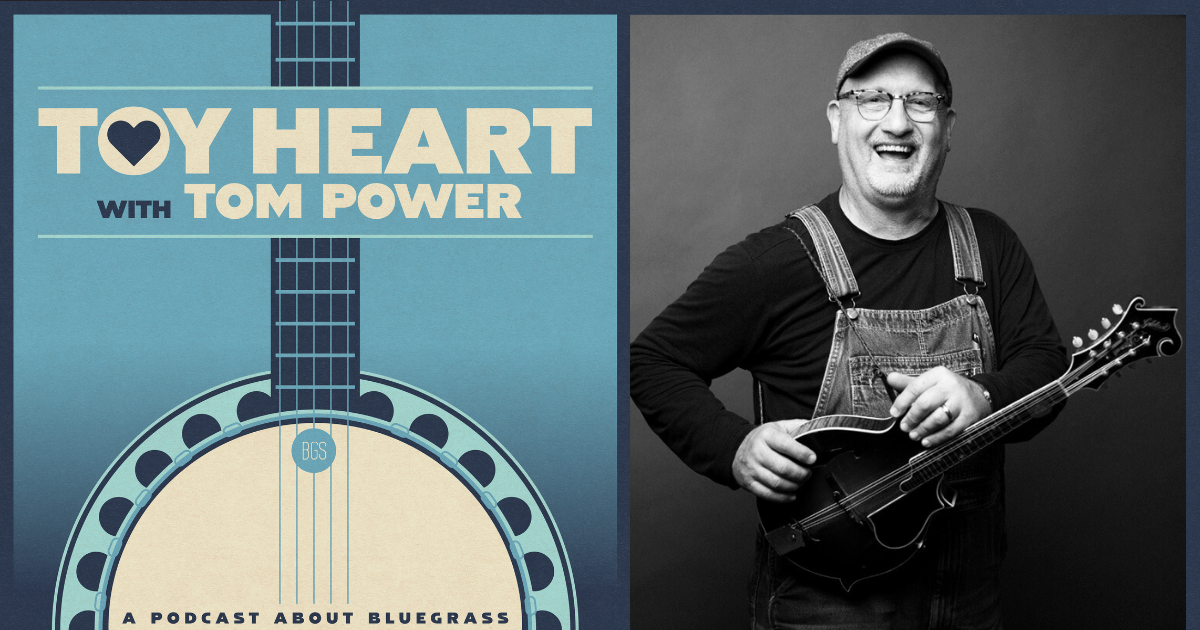
Bluegrass fans know Mike Compton from his long and eclectic resumé, including decades of touring and recording traditional Monroe-style mandolin with greats like John Hartford, Doc Watson, Peter Rowan, Ralph Stanley, Alison Krauss, and David Grisman, as well as venturing into more mainstream music with with Sting, Gregg Allman, Elvis Costello, and many others. He was also heard on the soundtrack for O Brother, Where Art Thou? and traveled with the smash hit tour, Down from the Mountain, which highlighted the artists and musicians on that incredibly popular soundtrack.
But, as Toy Heart host Tom Power points out, it’s not just virtuosity that makes Compton stand out as a mandolinist – it’s just as much about the heart, feel, and grit that he brings to the instrument.
Tom speaks with Compton for over an hour for this exclusive Toy Heart interview, walking through his life and career, from the musical influence of his great grandparents and growing up in Meridian, Mississippi, to the indelible mark left on his own playing style by Bill Monroe. Compton also recalls his childhood, skipping school to hide out in a “dirt pit” to practice all day, his time in Nashville – including a historic visit to China with the Nashville Bluegrass Band – and recounts his collaborations with the legendary John Hartford. You’ll also hear Compton discuss the impact that playing on O Brother, Where Art Thou? had not only on himself and his own career, but on bluegrass as a whole.
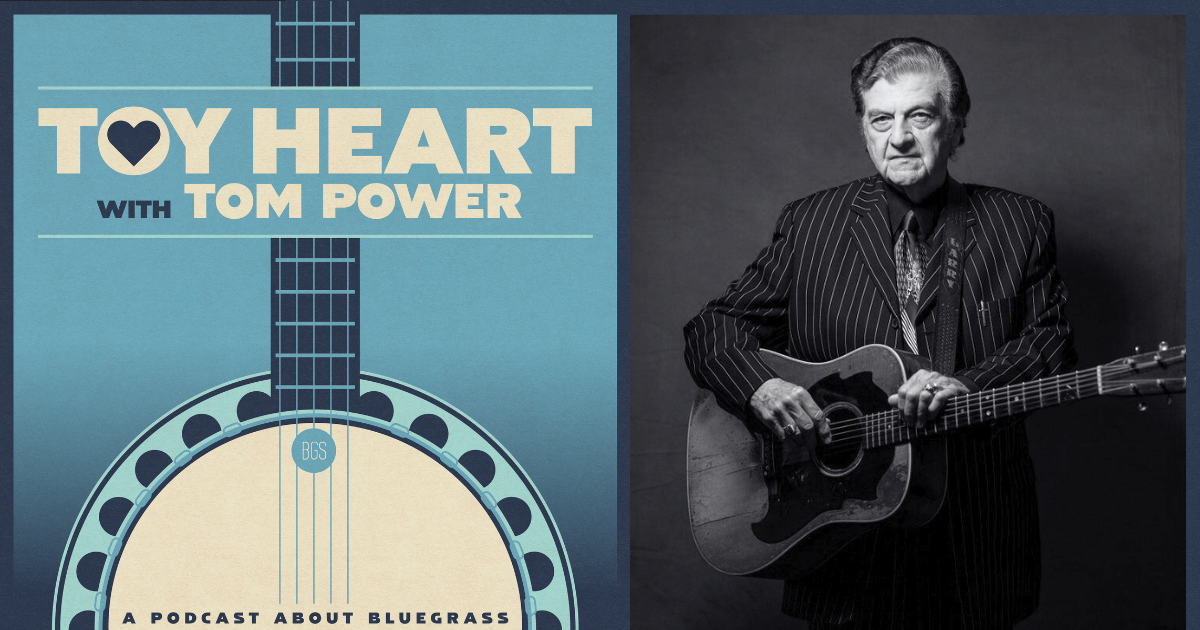
The legendary Larry Sparks, a prominent player in bluegrass for over six decades and a Bluegrass Hall of Fame inductee, joins host Tom Power for this episode of Toy Heart. Sparks shares insightful anecdotes from his early years, touring and performing with the Stanley Brothers and from his tenure with Ralph Stanley & the Clinch Mountain Boys. From traveling in a ‘67 station wagon to the challenges of navigating the music industry over so many decades, Sparks reflects on his particular journey through bluegrass, old-time, and country music. We explore his musical influences, his unique approach to bluegrass guitar playing, and the profound impact of gospel songs on his own soulful, down home sound.
Sparks also offers a glimpse into his Nashville days, highlighting the unique challenges he faced in Music City. His stories reveal a dedication to preserving the essence of bluegrass and his commitment to honest storytelling. Hear Sparks describe making hits like “John Deere Tractor” as well as speaking to the spiritual resonance of gospel music. He paints a vivid picture of a musical legacy that spans more than 60 years, leaving an indelible mark on the heart and soul of the bluegrass community.
In early 1993, David “Dawg” Grisman, Jerry Garcia, and Tony Rice gathered around a few microphones in Dawg’s Mill Valley, California recording studio. It was a casual, after-hours jam session during the recording of Tone Poems (Grisman and Rice), but engineer David Dennison kept the tapes rolling, capturing and preserving one of the most significant moments in American music history.
As a kid growing up in central Appalachia, bluegrass music was, at times, painfully familiar. In childhood memories, I’m being dragged to bluegrass concerts on the weekends by my parents, or even spotting Ralph Stanley dining at local restaurants. But these things weren’t special to a 14-year-old Gen Z, no matter the popularity of new, genre-adjacent bands like Mumford & Sons or the Lumineers.
Sometime though, in those early teenage years, I was digging through my dad’s CD collection (which in 2012, already being rendered obsolete, had been stored in a closet) when I found a copy of The Pizza Tapes. I was vaguely familiar with Jerry Garcia from his association with the Grateful Dead, and remembered seeing Tony Rice as a 7 or 8 year old kid, and despite my dad insisting how important he was, being bored out of my mind. But when I picked up the CD and turned over its pizza-themed cover (“It’s Hot!”), I recognized songs like “Man of Constant Sorrow,” “Knocking on Heaven’s Door,” and “House of the Rising Sun.” This familiarity is what put the CD in my hands, but the mandolin never left them once I heard Dawg’s playing.
The Pizza Tapes, to summarize, was an accident gone right. While these recordings may have eventually been packaged into an album, that certainly wasn’t the case when the bootleg started making the rounds. The story surrounding the tapes was practically folklore, with various narratives centered around a pizza delivery worker getting them in some way from Jerry Garcia. After Grisman’s label, Acoustic Disc, formally released the recordings in 2000 (ultimately providing access to the recordings to even more listeners) their significance in acoustic music was further embedded.
David “Dawg” Grisman, while known primarily as a mandolinist, has a reputation for recording everything, and an equally important legacy as an instigator of collaboration. His friendship with Jerry Garcia, dating back as early as 1964 (when Garcia traveled to the east coast chasing the roots of bluegrass music), led to the bay area bluegrass supergroup Old & In the Way in the early 1970s. Meanwhile in Kentucky, Tony Rice was departing from J.D. Crowe & the New South, and moving to the bay area to play Dawg’s original music – starting the group that in 1977 became known as the David Grisman Quintet.
The Pizza Tapes are special for countless reasons, but the obvious attraction is the coming together of these two legendary guitarists, highlighting the distinctness of their two original playing styles, musically glued together by Dawg, their mutual friend and collaborator. Though the two guitarists already had a large portion of their careers behind them (Rice lost his voice in ‘94, and Garcia died in ‘95), it wasn’t until February 4 and 5 of 1993 that Dawg successfully sat them down together with guitars in hand. As is the dialogue on track 3, “Appetizer:”
DG: Trip seeing you guys together, man. TR: Shoulda happened a long time ago. JG: This is gonna be a hoot!
While both guitarists were of obvious importance to Dawg, their influence extended far beyond his Bay Area recording studio. By the ‘90s, Tony Rice was (and had been for some time) the very definition of bluegrass guitar, with the same being true for Jerry Garcia in the jamband world. For these two genres, which had already begun to cross pollinate, this laid-back jam session was something monumental, a bridge between the musical worlds of Tony Rice and Jerry Garcia.
In a world where recorded music is continually valued by its commercial success, albums like The Pizza Tapes are a breath of fresh air the listener can always return to. There was clearly no goal of marketability or profit in mind when these three sat down to jam – the recordings are intimately casual, made clear by Garcia’s words in the first 10 seconds of the album, when they fumble the kick-off to “Man of Constant Sorrow.”
There are so many lovable moments between and during these songs – Dawg’s slightly out of tune A-strings at the end of “Man of Constant Sorrow,” Tony’s fiery but loose guitar solo on “Rosalee McFall,” or most notably, the album’s fade-out with Jerry noodling on Tony Rice’s famed “Holy Grail,” the 1935 Martin D-28 (#58957) which had previously belonged to Clarence White, another friend and collaborator of Grisman’s.
JG: Tony gets a better tone actually than Clarence did. DG: Don’t say he’s got a better tone – he’s louder. JG: Louder is better David – on this planet, louder’s better. (from “House of the Rising Sun)
As I discovered the rest of Dawg’s discography, I gravitated toward the more intentional David Grisman Quintet (1977) and Home Is Where the Heart Is (1988) as a rubric for my mandolin schooling. But over a decade later, I still go back to The Pizza Tapes to be reminded of why I play the mandolin, and ultimately music. It’s not to make money or achieve popularity, but to be playful, conversational, and to above all else make good music with my friends – tenets that were all exemplified by Dawg, Tony, and Jerry on those winter nights in 1993.
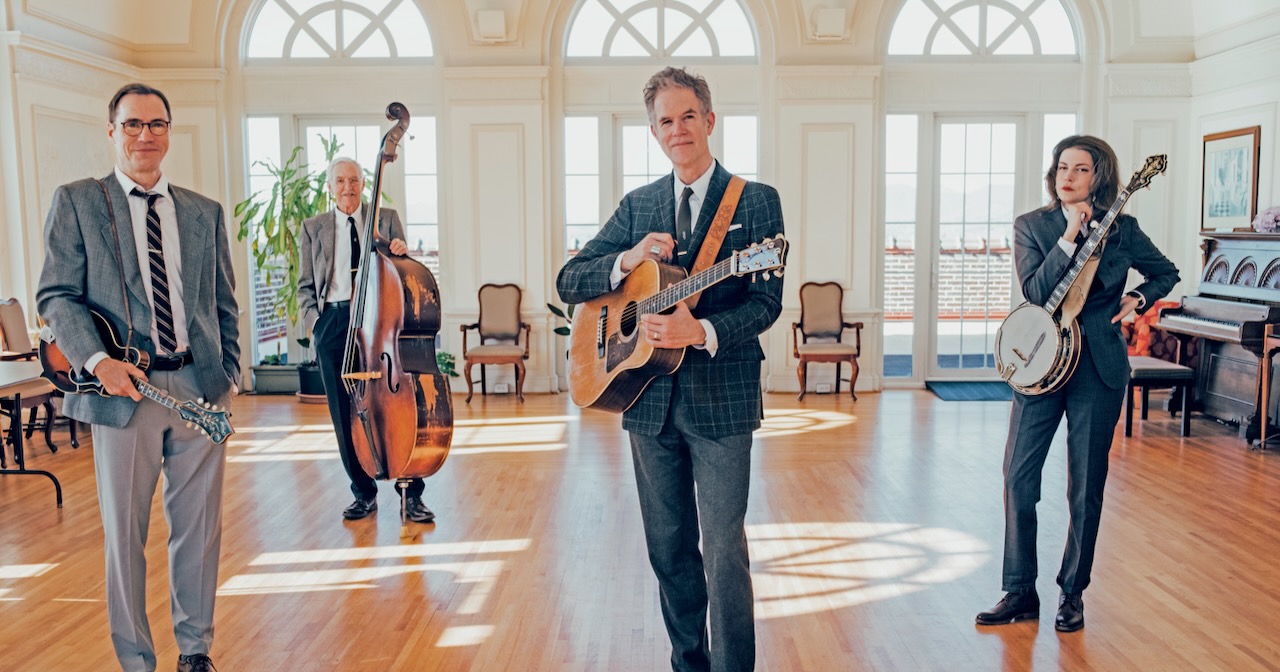
Artist:Chris Jones & The Night Drivers Hometown: Nashville, Tennessee Song: “Step Out in the Sunshine” Album:Pages In Your Hand Release Date: October 6, 2023 Label: Mountain Home Music Company
In Their Words: “Ralph Stanley’s early 1970s Clinch Mountain Boys lineup of Roy Lee Centers, Jack Cooke, Curly Ray Cline, Keith Whitley, and Ricky Skaggs was a golden era for his band, in my opinion, and in my mid-teens their music was a major influence on me as I was just getting serious about playing music. The gospel album they did, Cry From the Cross, was and remains my favorite bluegrass gospel album of all time. It inspired my lead singing and guitar playing, and without consciously trying to do it, I learned to sing the baritone harmony part from Jack Cooke.
“I still have and cherish the original LP that I bought when I was around 15, though the jacket is a little battered and my name is written in brown magic marker on the back — because, you know, other kids in high school were likely to try to steal my Ralph Stanley records. I wanted to record a song from the album that I hadn’t heard anyone else do and that hadn’t become a Ralph Stanley standard, and so I was drawn to ‘Step Out in the Sunshine.’ We rearranged it slightly to fit our sound but it remains a tribute to the Stanley original.” – Chris Jones
Track Credits: Chris Jones – acoustic guitar, lead vocal Marshall Wilborn – bass Mark Stoffel – mandolin, harmony vocal Grace van’t Hof – banjo, harmony vocal
It’s terrifying to imagine now that when I was 18 I got in a station wagon with six other teenagers and drove 12 hours from Toronto to Wilkesboro, North Carolina, to the Merle Watson Memorial Festival. Terrifying because I don’t think any of us had much driving experience, money or sense. I had a big crush on one of the other passengers and would have gotten into the car whichever festival it was going to, but now when I look at the lineup for that year (1994), I’m glad we made it. Over the weekend that crush turned into a romance that lasted for what amounts to a lifetime at age 18, so most of my memories are not of the performers I was listening to who came to dominate my ears for years to come. But the moon-eyed haze I was floating around in tied up my first experience of bluegrass with all the intensity and longing of love and the freedom and excitement of traveling.
I like that bluegrass means such different things to its adherents, but that they all feel it strongly. It can be an exercise in authenticity, an article of faith, a technical jungle gym and an emblem of a time and place in history. It’s a genre that’s small and quirky enough that some people feel they can inhabit, protect and partly own it. Now it’s so embedded in my musical history that I don’t know if I can speak about it intelligibly with anyone who doesn’t already love it as much as I do. Here are some of my favourite songs by some of the artists that were playing at the Merle Watson Memorial Festival in 1994. — Doug Paisley
Tony Rice more than anyone else is the reason I am a guitar player and a musician. His many layers of musicality and his broader interests from modern acoustic instrumental music to restoring Accutron watches to his appearance on stage to his insights and comments in interviews make him a fascinating character. I’m so grateful for his time on earth.
When I began to play bluegrass, the high-water mark of what a bluegrass group could be was for me the Seldom Scene. They were such an assemblage of distinct characters. John Starling and John Duffey are two of my favourite singers.
In my daily life I can connect to so much feeling in Iris DeMent’s music, but if I’m going through a hard time I think I’d approach it very carefully because it’s just so powerful.
Aside from all the great and probably familiar things we can say about Emmylou Harris, I love her forays into more traditional music — especially on “Roses in the Snow” with Tony Rice on guitar.
Once I had finally recovered from the New South lineup with Tony Rice, I then discovered that there was a whole other set of tunes with Keith Whitley on vocals, and my head just about exploded.
Such a beautiful singer. I heard from dobro player Don Rooke that Claire Lynch may be living up in our neck of the woods now. I hope I get a chance to see her play here.
Although I’ve listened to Doc Watson all along I never tried to emulate or learn from his guitar playing the way I did Tony Rice or Norman Blake. There’s something inscrutable and compelling about it for me, and I’d rather take in his music not as a guitar player, but purely as a listener.
On Monday August 7, 1972, with fresh memories of Maritimes old-time and bluegrass, I drove from New Brunswick to New England to join my wife and kids, who were house-sitting for my in-laws in Norwich, Vermont.
On Thursday the 10th I headed south. A fourteen-hour drive brought me to Morgantown, West Virginia, the home of my friend and partner in research, photographer and film-maker Carl Fleischhauer, then employed at West Virginia University. We’d known each other for twelve years. (Our stories are in Bluegrass Odyssey: A Documentary in Pictures and Words, 1966-86 [U of IL Press 2001]). We were about to embark on fieldwork.
During the preceding year, when I began planning for the book Bluegrass: A History, I asked Carl to help me think about photos. In addition to documenting bluegrass festivals and other venues he, with Sandy Rothman, had recently looked for traces of earlier days in a field trip to the old Monroe home in Rosine, Kentucky. Now, we made plans for our own field trip. Carl would take photos. I would make notes and do interviews.
We spent that Friday in Morgantown looking at Carl’s photos and films and listening to LPs as we prepared for the research. At the end of the evening, my notes say,
Did some picking.
Early Saturday morning we piled in my new Toyota with our gear (cameras, tape recorder, axes, tent, sleeping bags) and headed southwest, crossing into Kentucky from Huntington, WV and snaking down through the mountains to Jackson, the seat of Breathitt County. Three hundred miles; we arrived around 2 o’clock.
There we headed just outside of town for Bill Monroe’s Second Annual Kentucky Blue Grass Festival. When I went to Canada in 1968, Bill Monroe had one festival a year at Bean Blossom in Indiana. Now he was running a bunch in other states, as were other artists. Festivals were the big news in bluegrass music in 1972. We sought to document the bluegrass festival experience.
Later others would write about this, like Bob Artis (“An Endless Festival” in Bluegrass [1975]) and Robert Owen Gardner (The Portable Community [2021]). Here’s how my notes from Jackson begin:
West of town on main hwy, down short steep road. Paid camping & Sat. fees, never did pay for Sunday. Parked & walked down to the stage area — tent set up, natural amphitheatre, uncovered stage, bad sound. Lots of cops around on Saturday.
Made contact with Pete & Marion Kuykendall, and agreed to move in next to them to camp. Set up tent, attempted to speak to Monroe but he was busy coping with the Goins Bros. problem of being hassled by the cops for drinking. Later Kuykendall said that cops had asked Monroe for $ (3 or 6 hundred) and he had refused to pay off so they were taking it out in fines. Lots of racing around on Sat. with flashing lights etal, but they stayed away on Sunday.
Listened then to IT’S A CRYING TIME, hot & exciting Japanese bluegrass band. Then back to Kuykendall’s bus/home whatall. Thunderstorm; discovery that cassette recorder didn’t work on batteries because plug distorts switch; got it running eventually. Oldest Kuykendall girl Sam/Ginger comes in with bass player of above-mentioned Japanese band, then leaves. Kuykendalls are a bit worried about this but Carl & I both notice later that a number of young girls (McLain girls, for example) are hanging around, with this group.
Dinner with Kuykendalls. Frank & Marty Godbey come in and are around for the rest of the evening. Mostly we sit & talk, though I went down to the amphitheatre to catch Jim & Jesse and the Japanese bands. Came back, then returned to catch Monroe. Afterwards listened to picking group in tent near us. Did mainly Emerson & Waldron, Newgrass Revival, Bluegrass Alliance, Gentlemen, etc. Chromatic banjo. Noisy night in Carl’s tent, as sessions went on late and busses started early. I got a spider bite.
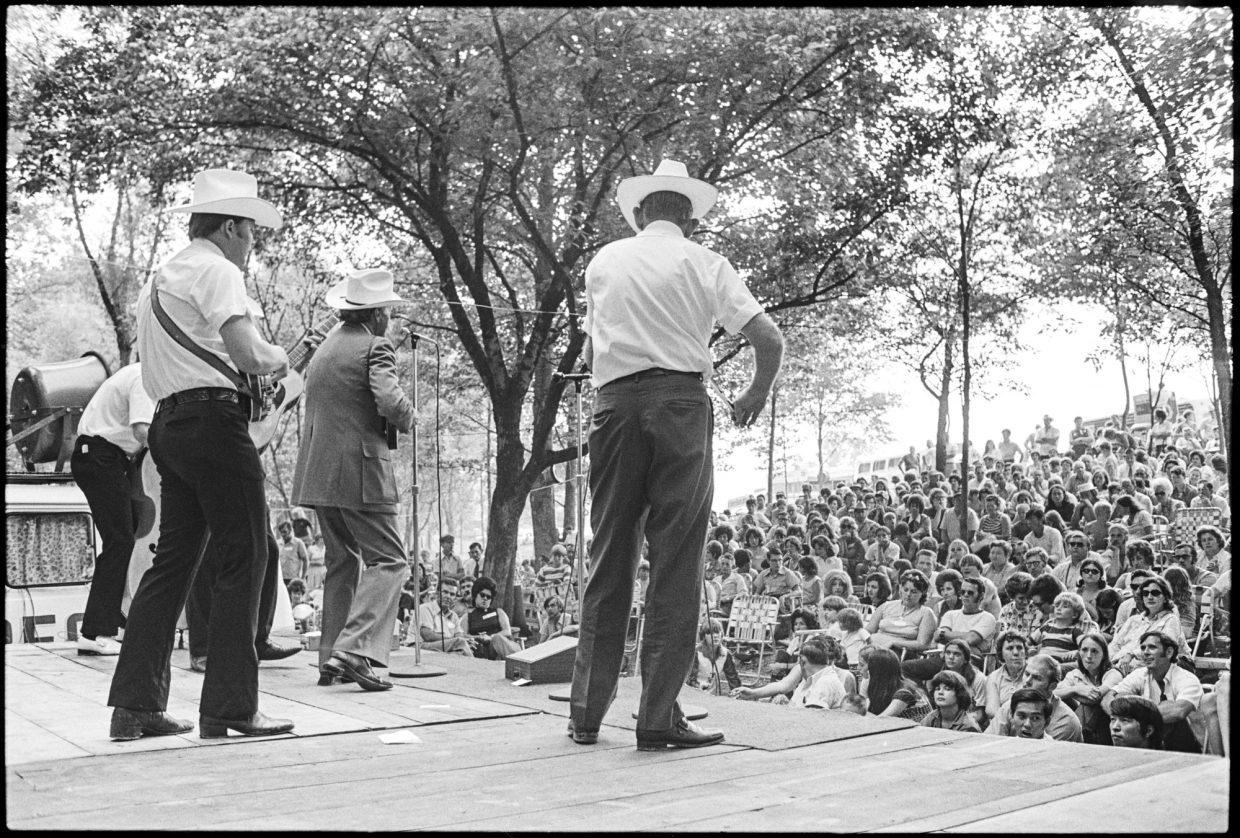
Bill Monroe (center) and the Blue Grass Boys at the Second Annual Kentucky Bluegrass Festival, Jackson KY, Saturday, August 12, 1972. Bandmembers include Monroe Fields, bass; Jack Hicks, banjo; Joe Stuart, guitar (hidden); Monroe, mandolin; and Kenny Baker, fiddle.
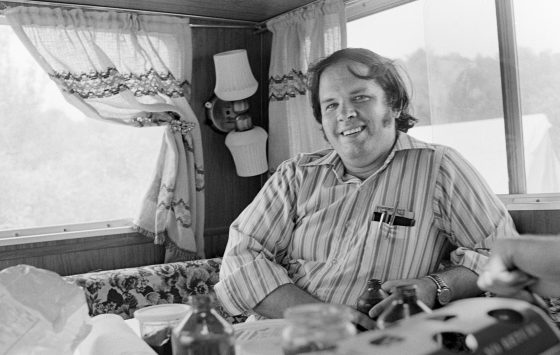
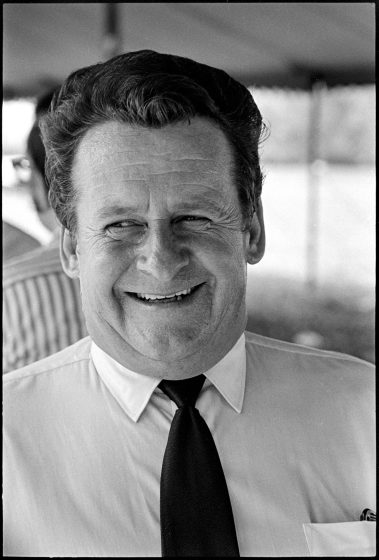
I’d known the Kuykendalls since 1966. Pete, a 1996 inductee to the Bluegrass Hall of Fame, was a musician, record collector, producer, publisher, and, since 1970 owner-editor of the first and leading bluegrass monthly Bluegrass Unlimited.
Pete Kuykendall, editor of Bluegrass Unlimited, in his RV parked in the camping area at the Second Annual Kentucky Bluegrass Festival, Jackson KY, Saturday August 12, 1972.
Pete and I had already been corresponding about bluegrass history when we met on Labor Day weekend 1966 at the second Roanoke Bluegrass Festival. Subsequently, I visited the Kuykendalls in Virginia where Pete encouraged me to write for the then all-volunteer magazine he would later own. I began with a review of the festival, published the following January — the first of eight articles I did for BU in 1967.
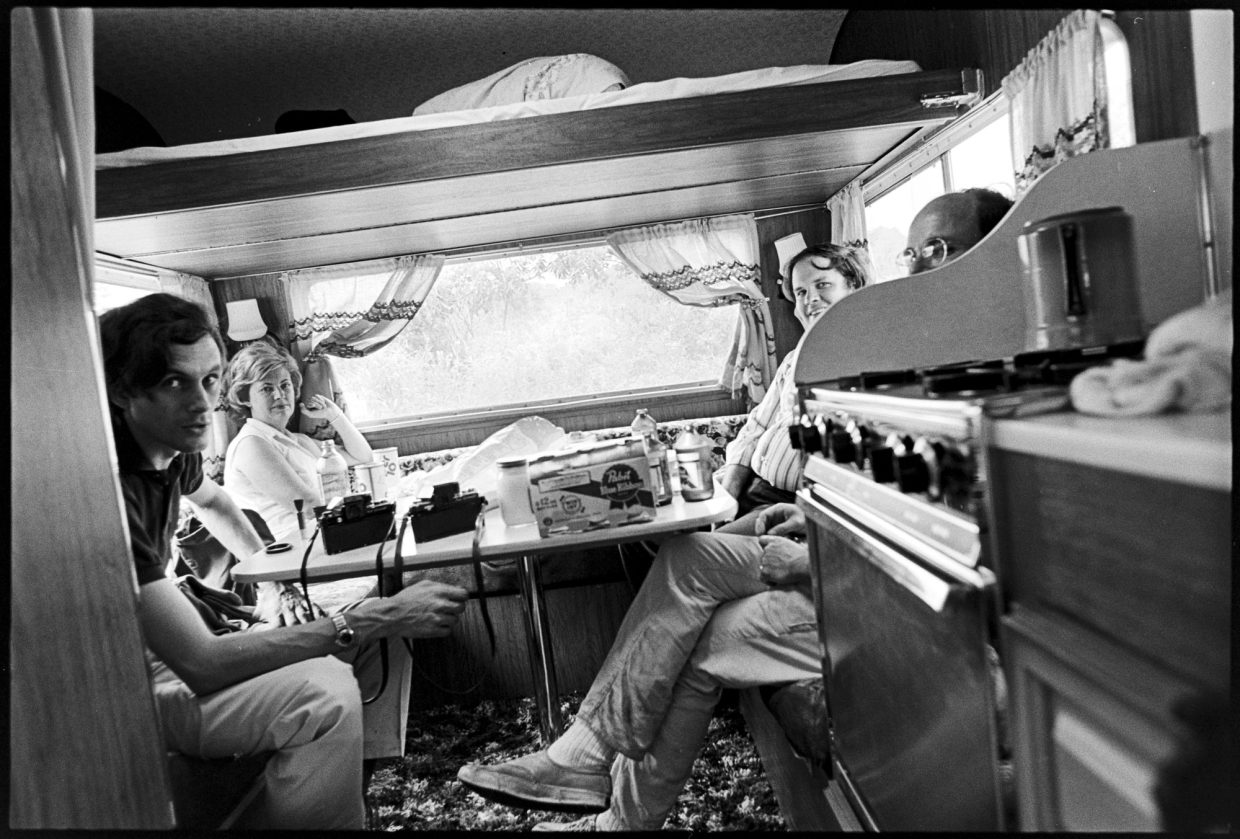
Photo made by Pete Kuykendall’s son Billy with one of Carl Fleischhauer’s cameras. Carl is seated at left with two other cameras on the table. This photo was made at the time of Neil Rosenberg’s (top of head above stove) interview of Pete Kuykendall, editor of Bluegrass Unlimited, in his RV at the Second Annual Kentucky Bluegrass Festival, Jackson KY, Saturday, August 12, 1972. In the background, at left, is Pete’s wife and Bluegrass Unlimited co-manager Marion Kuykendall.
By 1970 Pete and Marion were running BU full-time; I’d done an article for them earlier in 1972 (eventually I would write a monthly column) so we had been in touch recently by mail and phone. Conversations with Pete were never brief! He loved to share the business scuttlebutt and he had plenty since they were selling the magazine at festivals every weekend and had just launched BU’s own annual festival.
I think this may have been the first time I met the Godbeys. From Lexington, and before that, Columbus, Ohio, they had been following the bluegrass scene for a decade. Frank is a musician who is still performing these days. By 1972 he and Marty had begun writing and publishing photos in BU. For them, as for me, hanging out with the Kuykendalls was a good way to keep up on the bluegrass news. People were already talking about starting an industry association, though that — the IBMA — wouldn’t happen until 1986. Pete was one of its founders.
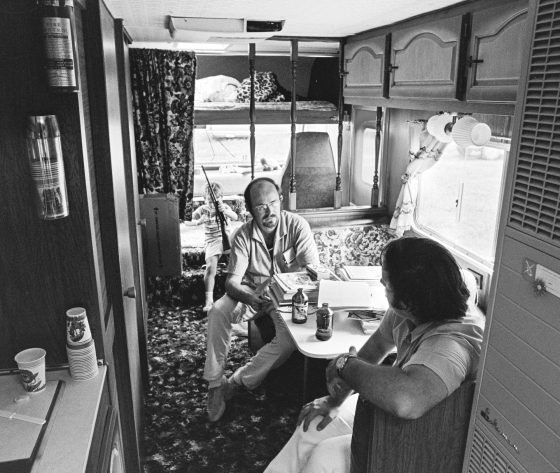
Neil Rosenberg (facing camera) interviewing Pete Kuykendall, editor of Bluegrass Unlimited, in his RV parked in the camping area at the Second Annual Kentucky Bluegrass Festival, Jackson KY, Saturday, August 12, 1972. In the background, with an air rifle, is Pete’s son Billy Kuykendall.
With the growth of the festivals came clubs, newsletters, and magazines. Bluegrass enthusiasts (many of them musicians) followed their favorites to festivals and other venues. Paths crossed; networks grew. The politics of bands was a favorite discussion topic.
Over the course of the festival, I made note of gossip about the always changing bands. Ricky Skaggs had just left Ralph Stanley — there were rumors about where he was headed next. Was Bill working to get Ralph Stanley on the Opry? Some thought so. The II Generation was said to be splitting up. Stories were told of bluegrass festival camp followers.
At this Jackson, Kentucky festival were a bunch of bands that had been appearing at Bill Monroe’s other 1972 festivals — Monroe, Jim & Jesse, Flatt, Reno & Harrell, the Goins, Ralph Stanley — mature musicians who’d been working with this music for a substantial period of time and who stuck close to the early models of which they were, often, the authors. Classic bluegrass, one could say.
What the audience didn’t hear was the kind of stuff we’d heard from the jammers late Saturday night, like “One Tin Soldier,” The Bluegrass Alliance’s cover of a song popularized in the film Billy Jack. Their bluegrass version, with Sam Bush’s lead voice and Tony Rice’s harmonies and guitar work, was a hit, a big step on the road to newgrass.
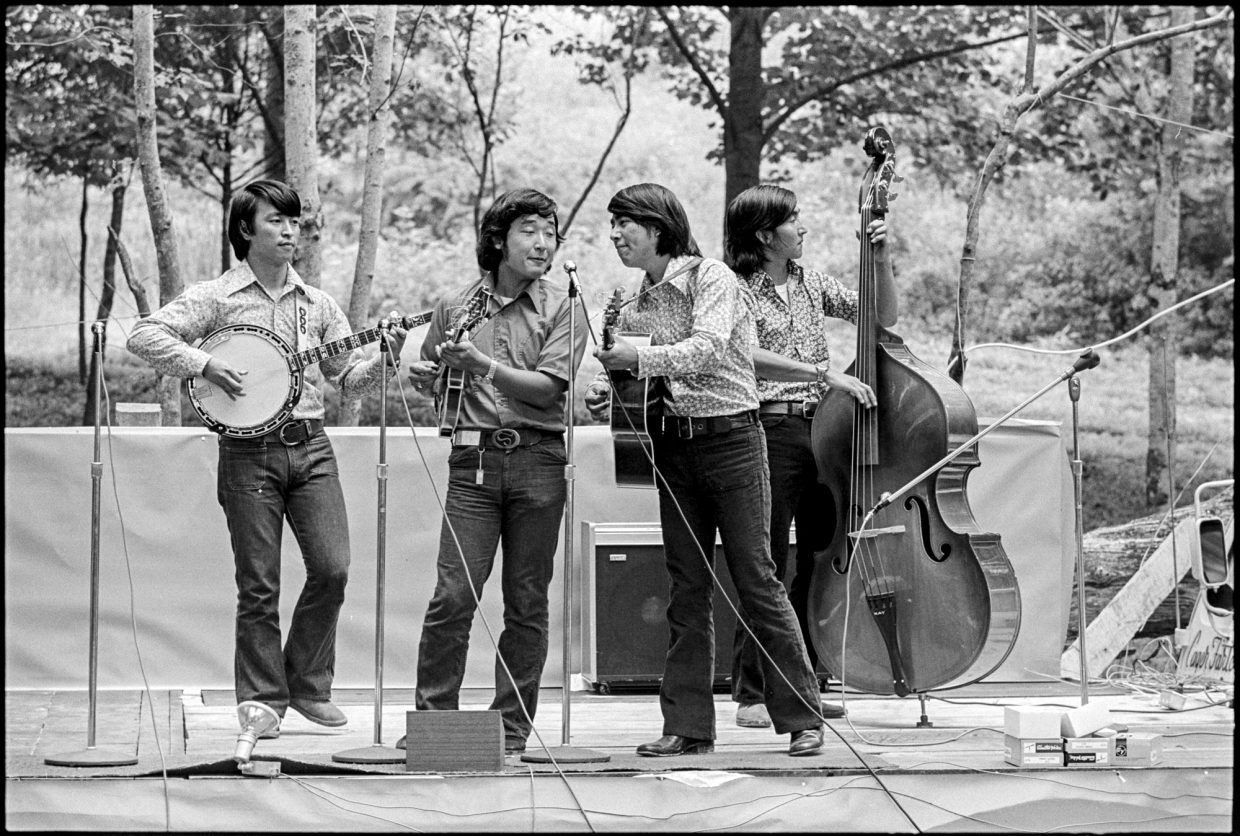
The Japanese bands were new to the scene. Japanese bluegrass began in the early sixties. In 1971, Bluegrass 45 came from Kobe, Japan, with the sponsorship of their label, Rebel, to tour U.S. bluegrass festivals. They made a big hit at Monroe’s Bean Blossom festival with their showmanship and musical savvy. This year they were back, along with another Japanese outfit, It’s A Crying Time.
Visiting from Japan, the band It’s a Crying Time performs at the Second Annual Kentucky Bluegrass Festival, Jackson KY, Saturday, August 12, 1972. Band members include Eiichi “Ei’ Shimizu, banjo; Kazuyoshi “Kazu” Onishi, mandolin; Satoshi “Sato” Yamaguchi, guitar; Akira “May” Katsumi, bass.
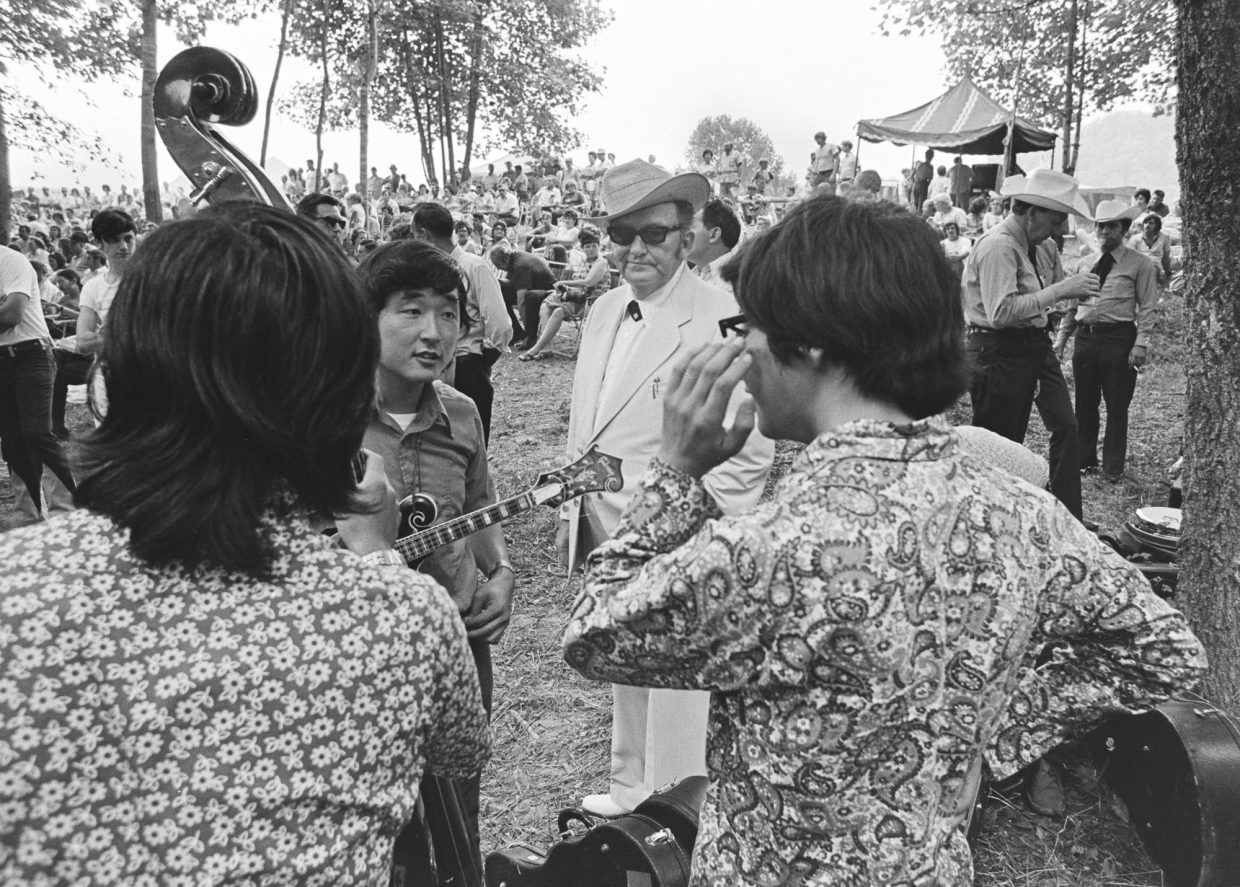
Monroe had booked the Japanese bands as a novelty, something you couldn’t see just anywhere in the bluegrass world. As I mentioned in my field notes, I found It’s A Crying Time’s music “hot & exciting,” and I was not the only one in the audience reacting this way. They came to the attention of Lester Flatt, who, after watching them rehearse, invited mandolinist Kazu Onishi to join him on stage at his final set.
Backstage moment at the Second Annual Kentucky Bluegrass Festival, Jackson KY, Saturday, August 12, 1972. Akira Katsumi, Kazu Onishi, Lester Flatt, and Akira Otsuka. Otsuka was Kazu’s friend from the Japanese scene, a member of the Bluegrass 45.
This video comes from the Bluegrass 45’s appearance at Carlton Haney’s Camp Springs festival:
They are announced at the beginning of the video by emcee, writer, and DJ Bill Vernon. Vernon was here at Jackson, as I learned Sunday morning when I went down to the early morning gospel show. Pete Kuykendall introduced me to Bill there, and we had a long chat about the politics of the bluegrass industry. I wrote in my notes:
A very loquacious and complex person.
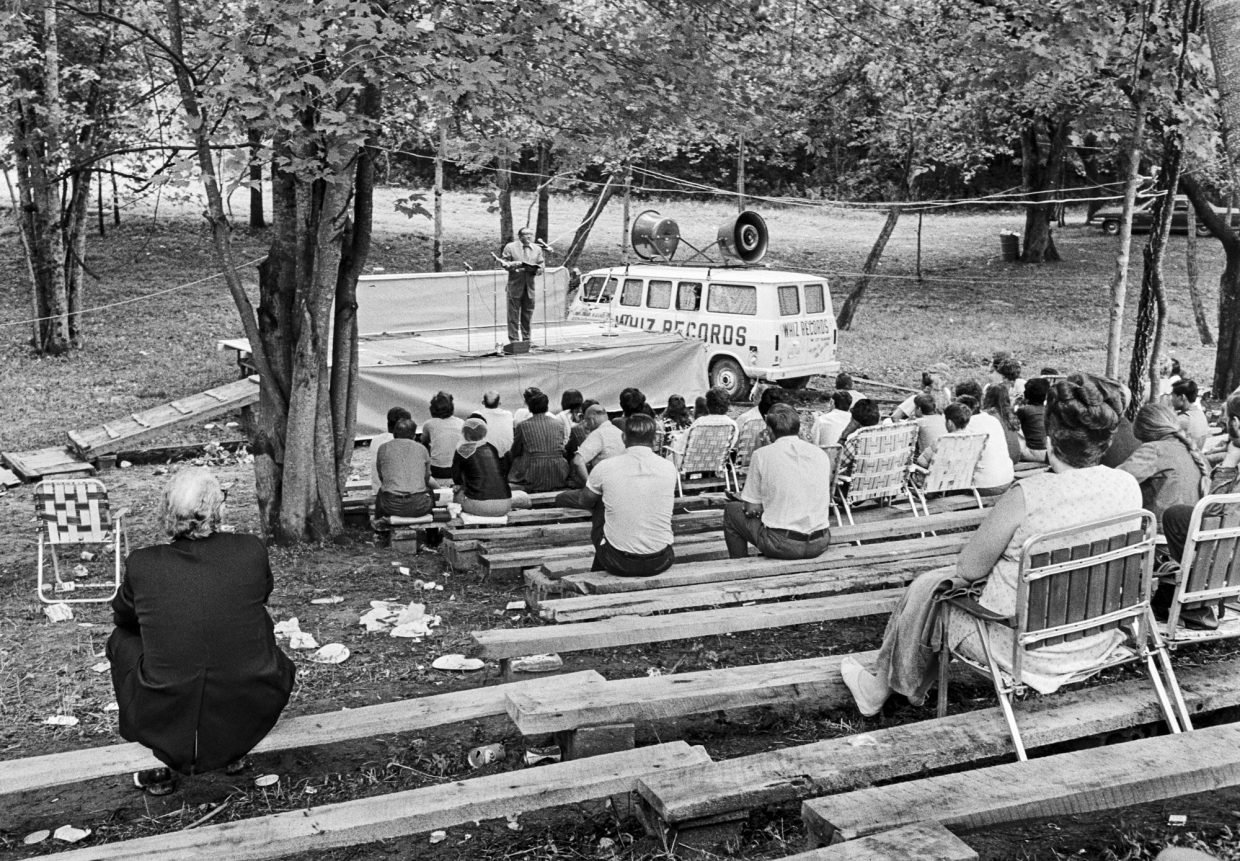
At that morning’s gospel show, the music came to a stop as a fundamentalist preacher began his sermon. At that point, I noted:
Bill Vernon cut out from the morning sermon, he’d had enough…
During the preacher’s sermon at the gospel program at the Second Annual Kentucky Bluegrass Festival, Jackson KY, Sunday, August 13, 1972. Bill Monroe (wearing a black suit) is seated in the audience area at left.
I stayed and heard some good music, noting:
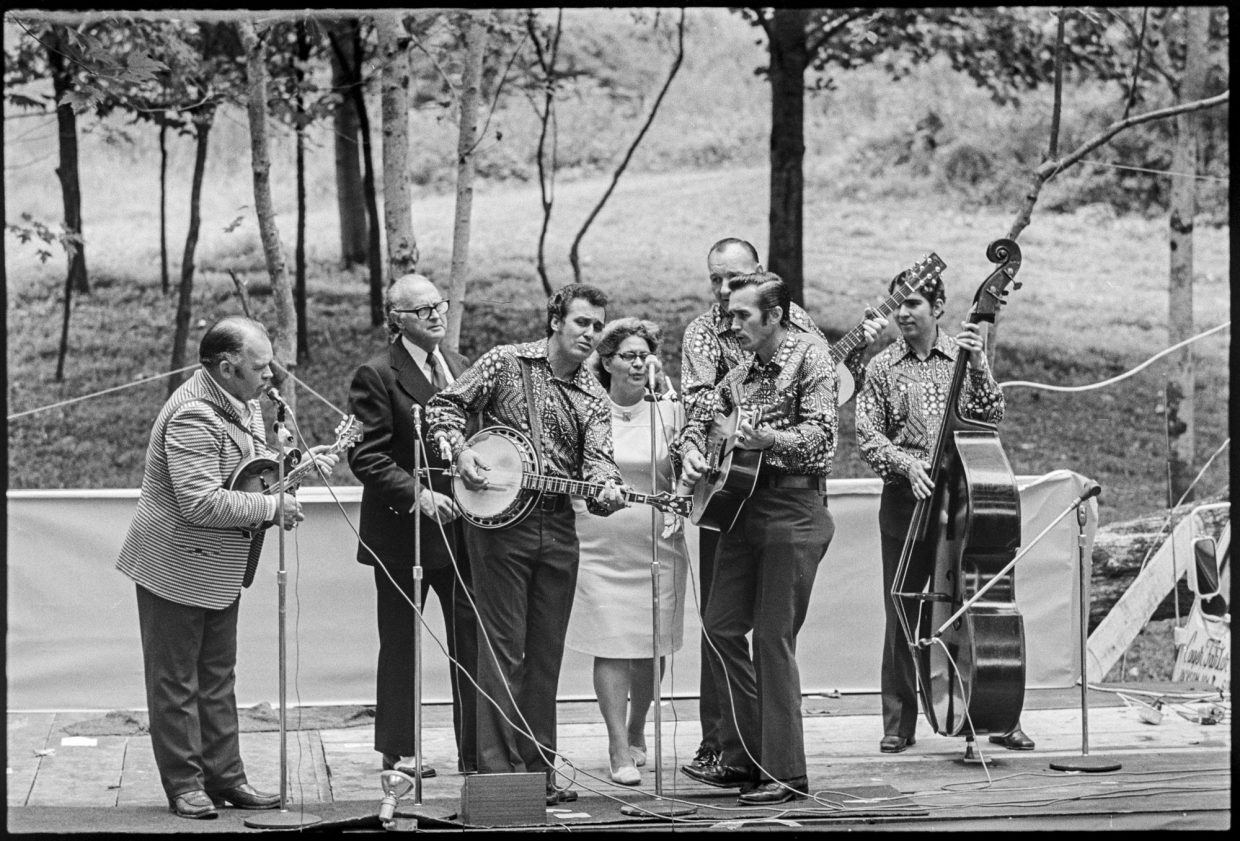
The gospel section’s high point was when the Goins Bros. did “Somebody Touched Me” and Eleanor Parker came on stage & started clapping hands and singing; Monroe caught on and came up to join in too.
During the gospel program at the Second Annual Kentucky Bluegrass Festival, Jackson KY, Sunday, August 13, 1972. When the Goins Brothers band performed “Somebody Touched Me,” they were joined on stage by Eleanor and Rex Parker and Bill Monroe. Eleanor and Bill joined the Goins trio at the main microphone while Rex sang and played mandolin at the “stage right” microphone.
This kind of spontaneity, which gave festivals their appeal, was not there all the time. Jim & Jesse, I wrote, had:
A good show, with Jim Brock sounding especially good, but … a cut and dried quality to it all.
Describing Lester Flatt and his Nashville Grass, I concluded:
To me the whole band sounded tired, lackluster.
But Flatt’s final set was enlivened when It’s A Crying Time mandolinist and tenor Kazu Onishi came on stage to sing “Salty Dog Blues” with him.
During my times around the stage area, I had a chance to talk with Monroe and with some of the musicians I’d gotten to know during my years as a backstage regular at Bean Blossom, like Birch Monroe, Joe Stuart, and Roland White.
I arranged with Birch, who was busy helping Bill run the festival, for an interview, to take place later in the week at his home in Martinsville, Indiana.
Joe Stuart offstage at the Second Annual Kentucky Bluegrass Festival, Jackson KY, Saturday, August 12, 1972.
Joe told me about his experiences playing bluegrass in Canada with Charlie Bailey. He’d even appeared in Newfoundland.
Roland, whom I’d known since his days as a Blue Grass Boy, was now playing with Lester Flatt. He told me they were working solid, playing festivals every weekend.
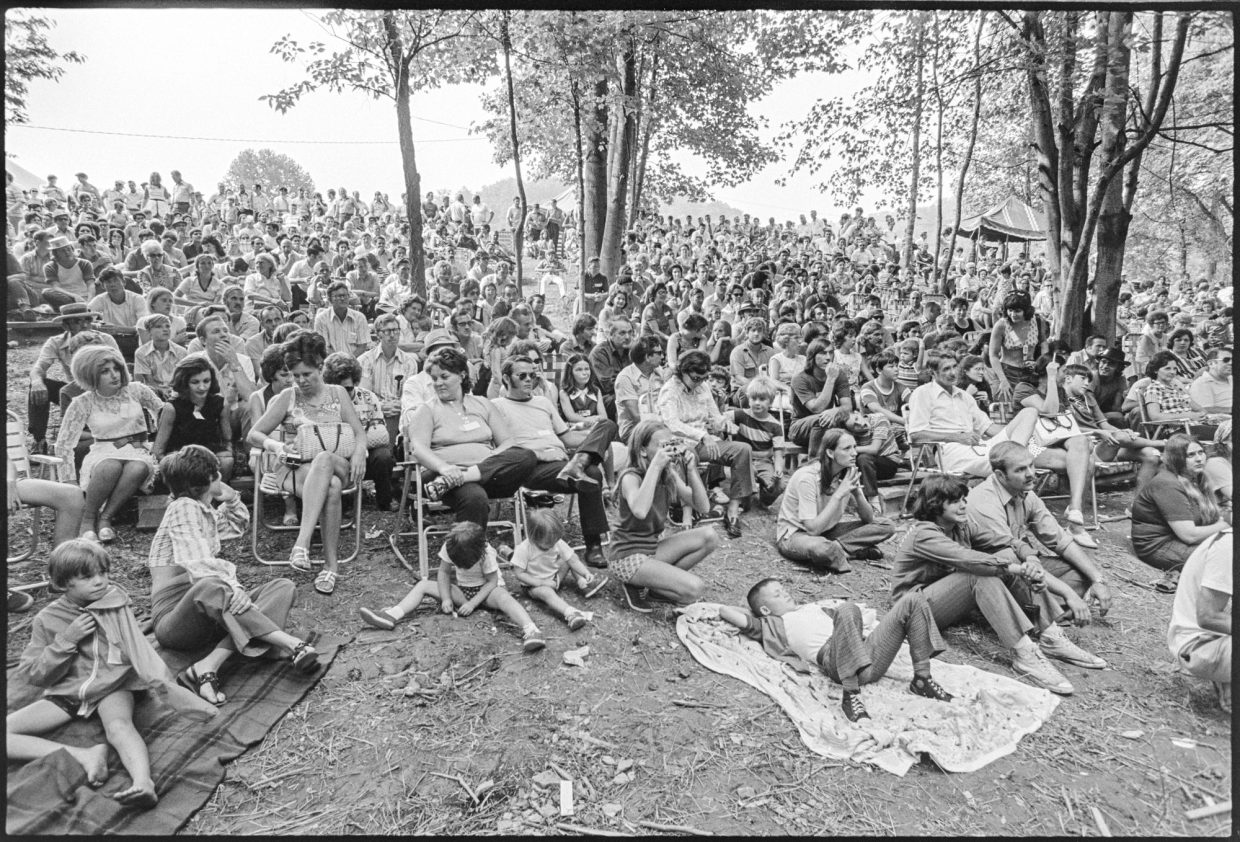
Here’s what I wrote about the audience:
Audience — bluegrass die-hards from Ohio, Ky., D.C., Carolinas. Few freaks. Appear to be about 50% campers, 50% local people. Certainly no more than 1500-2000, on Saturday, though figure of 3000 was bandied about. Bill moved his Ky festival to Jackson from Ashland this year because the turnout at Ashland was dropping. Fact, bluegrass ain’t as popular in Kentucky as it is elsewhere — Ohio, D.C.
Audience on the hillside natural amphitheater at the Second Annual Kentucky Bluegrass Festival, Jackson KY, Saturday, August 12, 1972.
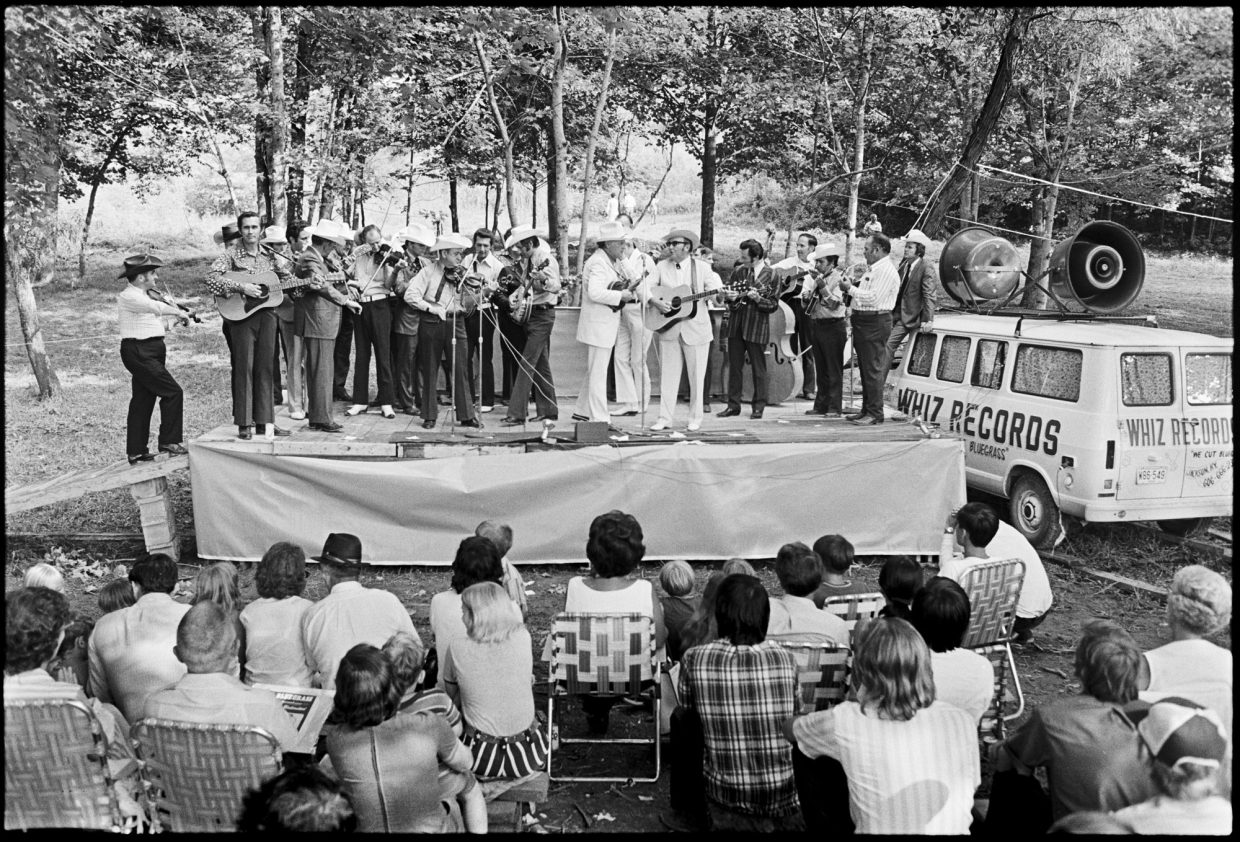
The festival closed with a finale, orchestrated by Monroe. At the first festivals in the mid-60s, which were created to honor Monroe, such events were somewhat spontaneous, but by now, seven years after the first one, these events were highly ritualistic. By the time it happened, I noticed that the Kuykendalls had left. They were not the only ones.
The finale performance at the Second Annual Kentucky Bluegrass Festival, Jackson KY, Sunday, August 13, 1972. At the center, in white suits, are Bill Monroe and Lester Flatt. Here are a few of the other performers, left to right: Curly Ray Cline (on the ramp), Melvin Goins (guitar, facing camera), Kenny Baker (fiddle, white hat, wearing a suit), Joe Stuart (just behind Baker, partly hidden), Buck Ryan (fiddle, white belt), Jack Hicks (banjo, white hat, wearing suit), Paul Warren (fiddle, white hat, at microphone), Vic Jordan (banjo, facing forward), Ralph Stanley (banjo, dark suit, hidden behind McCormick), Haskell McCormick (banjo, in profile), Monroe and Flatt with Don Reno (wearing white) partly hidden behind them, Raymond W. McLain and sister Alice McLain (hidden behind Flatt), Jesse McReynolds (mandolin, wearing striped jacket), Ruth McLain (bass, behind McReynolds), Raymond K. McLain (guitar, no hat), Roland White (mandolin, white hat), Rex Parker (mandolin, striped shirt), and Monroe Fields (leaning on van).
We packed up soon after and headed west for Lexington. I was hoping to interview J.D. Crowe.
Artist:The Kody Norris Show Hometown: Mountain City, Tennessee Song: “Mountain Rosalie” Release Date: October 7, 2022 Label: Rebel Records
In Their Words: “‘Mountain Rosalie’ is a song that I was first introduced to when I was just a kid. I’ve always considered it as one of the underrated gems of traditional country music. It’s a York Brothers number that was recorded by Reno & Smiley and then later cut by Ralph Stanley as well. We have performed it on some live shows in the past with an abundance of positive audience response. When the opportunity of recording some new music came about, ‘Mountain Rosalie’ was definitely at the top of our list.” — Kody Norris
The first Canadian festival, a modest affair billed as a “Bluegrass Jamboree,” took place in August 1972. I was involved in its organization and presentation. Subsequently, the Jamboree grew into an annual festival that’s still running.
The annual family friendly Nova Scotia Bluegrass and Oldtime Music festival is Canada’s oldest, and North America’s second oldest continuously running Bluegrass Festival, and is presented and hosted by the Downeast Bluegrass and Oldtime Music Society, a non-profit organization dedicated to the preservation and promotion of Bluegrass and Oldtime music in Eastern Canada.
Here’s how it happened.
By the summer of 1972 I had been living in Canada for four years, working as a professor of folklore and archivist in St. John’s, Newfoundland, at Memorial, the big provincial university.
Deeply immersed in bluegrass, I now stayed in touch with the music I’d left behind via bluegrass friends in the states, I read Bluegrass Unlimited every month, and I got County Sales‘ newsletters and bought new LPs from them by mail.
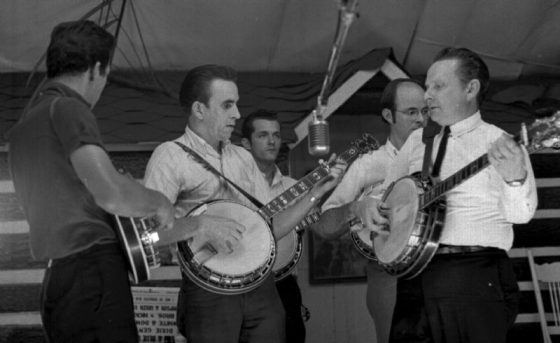
June 22, 1968. Banjo workshop at Bean Blossom, IN: Vic Jordan, Bobby Thompson, Dave Garrett, Neil Rosenberg, Ralph Stanley. (Photo by Frank Godbey)
When I arrived in Newfoundland in September 1968, I’d just published my first academic article — on bluegrass — in the Journal of American Folklore. I’d been writing regularly for Bluegrass Unlimited. That past June, Bill Monroe had included me in a banjo workshop at his Blue Grass Festival in Bean Blossom, Indiana; and a few weeks before coming to St. John’s, I’d been at the Richland Hills fiddle contest near Dallas, Texas, jamming with Alan Munde, Sam Bush, and Byron Berline and the Stone Mountain Boys.
August 18, 1968. Richland Hills, TX fiddle contest: Neil Rosenberg (b), Sam Bush (m), Byron Berline (f). (Photo by David Stark)
During the late ’60s and early ’70s, bluegrass festivals were proliferating (I wrote about this in Bluegrass: A History, 305-339) and bluegrass was having success in the popular music business (I wrote about that too, 305-339).
By 1972 I was hearing at a distance about the adventures of my friends from the U.S. bluegrass festival scene. Alan and Sam had made a popular instrumental LP. Now Alan was picking banjo with Jimmy Martin and Sam was singing and playing mandolin with the Bluegrass Alliance. And Byron, working as a studio musician in Los Angeles, had recently recorded with The Rolling Stones.
As I continued to study and write about bluegrass, I maintained my musical calling, moonlighting in the local contemporary folk and pop music scene. It was several years before I met anyone in St. John’s who played or knew much about bluegrass.
In 1969, RCA Victor invited me to edit an album in their Vintage series titled Early Bluegrass. Aside from some Monroe LPs, this was the first historical bluegrass anthology. I signed its detailed historical liner notes with “Memorial University of Newfoundland” under my name. It got a good reception in the bluegrass world and introduced me to Canadian bluegrass record buyers.
In 1971 I signed a contract with the University of Illinois Press to write a volume on bluegrass history in their new Music in American Life series. It was a book that would take years to write, for I had catching up to do. Not only was I out of touch with the bluegrass scene I’d been in before immigrating, I also knew little about the bluegrass scenes in my new home.
June 22, 1968. Banjo workshop at Bean Blossom, IN: Vic Jordan, Bobby Thompson, Neil Rosenberg, Dave Garrett, Ralph Stanley, Larry Sparks. (Photo by Doc Hamilton)
Learning About Canadian Bluegrass
Even before immigrating to Canada, I knew it had bluegrass, thanks to Toronto’s Doug Benson, who put me on the mailing list of his magazine The Bluegrass Breakdown. The first issue had reached me in spring 1968 while I was still in Indiana. It told of bluegrass scenes in Ontario and Quebec.
En route to Newfoundland in September 1968, we entered eastern Canada via the Maritimes— the provinces of Prince Edward Island, Nova Scotia, and New Brunswick. Picking up our landed immigrant passes from Canadian Customs at the Maine border, we drove through New Brunswick and Nova Scotia, where, in Cape Breton, we caught the night ferry to Newfoundland.
During this trip I got my first taste of Canadian bluegrass in an Antigonish, Nova Scotia motel where we watched Don Messer’s Jubilee, a Halifax-produced CBC weekly TV show starring a fiddler who’d been recording and broadcasting nationally on radio since the 1930s and television later. Messer’s prime-time Jubilee was Canada’s second most-watched show, exceeded only by Hockey Night In Canada.
I was pleasantly surprised to see that Messer’s band included a five-string banjo played bluegrass style! To this immigrant’s eyes and ears, Messer was blending bluegrass into his country and old-time sound. Here’s his performance, taken from Jubilee footage, of “St. Anne’s Reel,” a popular Canadian fiddle tune:
The smiling banjo picker behind Messer was Vic Mullen, the youngest member of his band. Born in 1933 and raised in rural southwestern Nova Scotia, he had been working as a musician since his teens, playing with country bands in the Maritimes and Ontario.
In 1969, Mullen left Messer and began appearing with his own country band, The Hickorys, on another Halifax CBC weekly prime-time show, Country Time. There wasn’t much bluegrass on that show beyond Mullen’s occasional southern-style fiddle pieces.
Getting Acquainted
My first meeting with a Newfoundlander who shared my enthusiasm for bluegrass came early in April 1971 when I had a letter from record collector Michael Cohen of Grand Falls-Windsor.
By the time we met, Michael’s family owned six furniture stores in central Newfoundland. He’d grown up listening to country music on the radio and began collecting records. After attending university in Ottawa, where he’d heard lots of local and touring American and Canadian country music, he returned to Windsor to work in the family business, continue his collecting (he has all of Hank Snow’s recordings) and play in a country band.
He wrote me because he’d been told about me by a friend. “Early bluegrass and string bands … are my main interest,” he said, introducing himself and welcoming me to make tape copies of his rare records.
I wrote back inviting him to visit us on his next trip to St. John’s. This was the beginning of an enduring friendship. Through him I met others interested in bluegrass and Canadian country. The first was Fred Isenor of Lantz, Nova Scotia, a small community north of Halifax, who got my address from Michael and wrote me a few weeks later.
August 18, 1968. Alan Munde, Neil Rosenberg, unidentified fiddler. (Photo by David Stark)
Fred, Vic Mullen’s contemporary and friend, worked at the local brick factory, and had a music store in Lantz. He was a record collector, a Bluegrass Unlimited subscriber, and a musician. He played mandolin and bass in The Nova Scotia Playboys, which he described to me as an “authentic (non-electric) country” band. They had represented Nova Scotia at the 1967 Expo in Montreal.
Fred had purchased his mandolin, a 1920s Gibson F5, for $100 at a Halifax pawn shop in 1960. Only later did he learn that its label, signed by Lloyd Loar, meant that he now owned an instrument like that of Bill Monroe, who’d just been elected to Nashville’s Country Music Hall of Fame.
Our correspondence began with shared unsuccessful attempts to put together a Bill Monroe tour. I’d planned to speak with Monroe at a New England festival that summer. But the festival was cancelled; that plan fell through. In March 1972, Fred wrote of other plans:
There is a possibility of a one day bluegrass jamboree in Nova Scotia this summer. Not really a festival but if we can put it over it will be a start. Perhaps Michael has mentioned this to you. As you played with Bill Monroe and helped run Bean Blossom [I’d told Michael about this when we first met] I thought possibly you could offer some helpful suggestions, in other words some do’s and don’ts.
He explained that with a limited budget the event would have to utilize local talent.
Please do not mention this to anyone as definite … so far Vic Mullen and I just talked briefly about this and will be discussing it further on Monday night.
He asked if I’d be able to visit him and take part in the program.
I responded enthusiastically, calling the jamboree a festival, offering my suggestions, and saying I’d be driving through Nova Scotia in August and hoped to visit him then.
Meeting Vic Mullen
In June 1972, Country Time came to St. John’s to tape some shows. I asked Vic if he’d do an interview, explaining to him that I was working on a book about bluegrass. He agreed.
Still in his thirties, Vic had been playing country music professionally for a quarter century. He’d mastered instruments — mandolin, fiddle, guitar, five-string banjo — as needed, working on the road with a series of increasingly high-profile bands. Bluegrass chops were just one aspect of his professional tools — a flashy banjo piece, or southern-style hoedown fiddle as part of the show, that kind of thing. He’d worked with some bluegrass bands in Ontario, done TV, etc.
In the late fifties he started his own band, The Birch Mountain Boys. Working at first in southwestern Nova Scotia, he teamed up with Brent Williams and Harry Cromwell, young African Canadians from his home county, Digby. They played bluegrass in the Maritimes for several years before Brent and Harry started playing country and Vic joined Messer.
Now Mullen was fronting his own national CBC TV country music show. He liked bluegrass and enjoyed playing it, but as a bandleader he chose it rarely. Most people in his audiences didn’t know the word “bluegrass” when they heard it and even if they liked it, it was just nice country music to them. Bluegrass was a niche genre. It had enthusiastic fans and great performers, but they were in a minority.
Vic was supportive of his old friend Fred; he understood Fred’s enthusiasm. He knew about BU and the bluegrass festivals that were happening in the States, but he didn’t think the festivals were going to catch on in Canada. Of Canadian bluegrass fans, he said that:
Altogether in a group, there’d be a lot of people. But they’re spread out from coast to coast and particularly between here and Ontario … there wouldn’t be enough people for an audience in any one area, it’d be just too far for them to get there.
Still, he was planning to be at Fred’s Jamboree. In our interview, Vic had given me an insider’s introduction to the world of Canadian country music. From him I heard for the first time many names and facts that would become familiar to me later. I was encouraged that a musician of his caliber, experience, and reputation would be there.
A week after the interview, I wrote Fred and told him I’d be catching the ferry to Nova Scotia on August 1, driving to Lantz the next day and staying to get acquainted. I explained that this was just the start of a crowded trip for “some hurried field research on bluegrass music … in Ohio, Kentucky and Indiana.” I closed by mentioning that I’d had a pleasant experience interviewing Vic.
Fred’s reply came a few days later. He was looking forward to my visit, he said, and then, referring to my earlier letter, told me the event would be a jamboree — “outdoors, just one evening.” Referring to a nearby farmer who held dances in his barn, Fred explained:
John Moxom is building an outdoor stage as soon as his hay is made and it appears now that we will be holding it either Friday, August 4th or August 11th. All the local bluegrass musicians are willing to help and take a chance on it being a flop. We hope to find out if there is enough interest to try something bigger and better next year. I know you have a busy schedule but if August 4th turns out to be the date we would sure like to have you present.
By the end of July 1972, I was headed first to visit Fred in rural Nova Scotia. Then I’d drive to New England, stopping near the border at Woodstock, New Brunswick, to see Don Messer’s Jubilee perform at a county fair, and then going to Vermont where my family was vacationing. After a short rest I’d be heading for West Virginia to join my photographer friend Carl Fleischhauer on the trip we described in Bluegrass Odyssey.
On August 1, I headed for the Canadian National ferry terminal in Argentia, Newfoundland, ready to sail west for some bluegrass.
Working on CityFolk’s Dayton Bluegrass Reunion, I heard local terminology for the culture in which this music grew. “Industrial working-class Appalachian migrants” was rarely spoken. “Hillbilly” was said sometimes with disdain, sometimes with pride. The preferred in-group term was “briar.” Briars came from the Appalachian hills, transplants proud of their continuing organic down-home connections. I was told that the call letters of WPFB, where Moon Mullins had represented bluegrass for two and a half decades, stood for “We Play For Briars.”
Don Baker’s introduction to the second act of the reunion framed a dramatic shift of scene from Mullins’ milieu to a younger Dayton band: The Hotmud Family.
Inspired by the New Lost City Ramblers, this band began in 1970 playing old-time music based on pre-war hillbilly recordings. The band included Suzanne Thomas Edmundson, Dave Edmundson, and Rick Good, along with a succession of bassists. Suzanne, born in Dayton of Kentucky parents, was a second-generation briar. According to Jon Hartley Fox the Hotmuds were “perhaps the most significant band to emerge from the vibrant scene of the 1970s in southwestern Ohio” (Industrial Strength Bluegrass, 140-1).
They began including bluegrass in their sound during a 1974 appearance at the Mariposa Folk Festival. In blending old-time and bluegrass, they placed special emphasis on vocal harmonies, something many old-time bands overlooked. Between 1974 and 1981 they made eight albums and appeared widely at bluegrass and folk festivals. Here’s their 1975 bluegrass/old-time blending of “Weary Blues,” a song originally recorded in 1929 in Atlanta by Chattanoogan Jess Young’s Tennessee Band as “Old Weary Blues”:
The Hotmud Family came to be associated with Dayton’s Living Arts Center, described by Hotmud banjoist Rick Good in Industrial Strength Bluegrass (153-57). Established in 1967 by the Dayton Board of Education, this facility offered after-school instruction in the arts for grades 5-12 students in East Dayton.
In 1975 it began providing programs aimed at the local Appalachian-based culture. It turned to the Hotmud Family, now a nationally known band with an enthusiastic local fan base from their weekends at Sam’s Bar and Grill. At the Center, Hotmud gave lessons, ran a song circle, and led informal jam sessions. Once a week they held a live Country Music Jamboree, which was broadcast over WYSO, the Antioch College radio station. The Center closed in 1977, but the Jamboree continued with other performers at other local venues until 1986.
Act Two of the Dayton Bluegrass Reunion opened with a solo rendition of “Red Rocking Chair” by former Hotmud lead vocalist Suzanne Thomas Edmundson. Then came the group’s reunion, when Thomas was joined by the other founding Family members Dave Edmundson and Rick Good along with bassist Gary Hopkins. They did three pieces and an encore. During the 1980s the band gave occasional reunion performances. This was one of their last.
For Act Three, Baker’s stage directions began: “Beer Sign On.”
A borrowed neon sign hung onstage now lit up for the reunion of a band associated with Dayton’s bluegrass bar scene, the Allen Brothers.
Formed in the late ’60s to back their father Red Allen, they began performing without him and were touring in 1974 when brother Neal died. After a brief hiatus, the three other brothers (Harley, Greg, and Ronnie) carried on into the early ’80s, recording Rounder and Folkways albums. The new Smithsonian/Folkways album Industrial Strength Bluegrass — which just won Album of the Year at the 2021 IBMA Bluegrass Music Awards — includes Harley Allen’s “Suzanne,” first recorded by the Allen Brothers in 1982, here recreated by Mo Pitney and Merle Monroe:
They continued to play together in the Dayton area into the mid-’80s, but by then Harley had begun a solo career, first joining banjoist Mike Lilly in a band Jon Hartley Fox calls “one of the best bluegrass acts Dayton ever produced” (Industrial Strength Bluegrass 136). In 1985 the Allen-Lilly Band closed a set at the Berkshire Mountain Bluegrass Festival. Harlan County native Lilly led the way into “Little Maggie” with coon dog and motorcycle as Frank Wakefield watched:
Harley went on to a Nashville career as a singer-songwriter, winning two Grammys and singing on the O Brother, Where Art Thou? soundtrack hit “I Am a Man of Constant Sorrow” before dying at the age of 55.
At the Reunion, the Allen Brothers put together a band with Harley on mandolin, Greg on banjo, and Ronnie on bass, with Wendell Barrett on guitar, and David Harvey on fiddle.
Here’s how they sounded with a similar band (different fiddler and mandolinist), with Monroe’s “Uncle Pen” enlivened by guitarist Harley Allen’s transformation of Jimmy Martin’s “G run” and a fancy ending, followed by a bluegrass trio rendition of the Paul Siebel’s classic “Louise.”
At the Reunion, they did three tunes and an encore. Then it was intermission time.
The second half began with Baker introducing Act Four, the Dry Branch Fire Squad. This band was led by mandolinist Ron Thomason, a Virginian who had migrated to the region as a child. Around since the mid-’70s, it’s still active today. Thomason came up in Dayton’s regional scene in the ’60s, working in bar bands and on the road with Ralph Stanley.
Committed to traditional bluegrass, Thomason, now living in Colorado, has had many talented musicians in his band. He is famous for his emcee work, which regularly grows into humorous monologue. Baker’s directions for this act listed two pieces (including one gospel song), separated by:
“Rap — Ron Thomason”
Here’s a sample of Ron’s “rap” — a comic speech from a 2007 California festival:
At the time of The Dayton Bluegrass Reunion, Dry Branch had four albums on Rounder, the start of a long string with that label. Like the Hotmud Family, they were folk and bluegrass festival regulars.
The band this evening consisted of Ron on mandolin, John Hisey on banjo, Mary Jo Leet on guitar, and Charlie Leet on bass. In 1987 a similar lineup recorded “Aragon Mill,” a Si Kahn song that Ron had learned while working at coal miner’s union rallies with Hazel Dickens:
Act Five brought on another performer still active today, Larry Sparks and the Lonesome Ramblers. Sparks had come up in the Dayton bar scene at about the same time as Ron Thomason. He worked with the Stanley Brothers and Ralph Stanley at the end of the ’60s and made his first album on his own in 1970s. He became a member of the Bluegrass Hall of Fame in 2015 and has a new album out on Rebel.
At this concert his Lonesome Ramblers had a reunion dimension. Mandolinist and singer Wendy Miller, who’d played on Larry’s earliest recordings and was with the band through most of the ’70s, was back for this evening’s concert. Also in the band were banjoist Barry Crabtree and Larry’s son, Larry Dee, on bass.
They did three songs: “Dark Hollow,” “Face in the Crowd,” and “Kentucky Chimes,” all regulars from his albums and concerts. He closed with an eight-tune medley of his other hits. There are many videos of Larry’s great singing and lead guitar work. Here’s one of my favorites:
Acts Six and Seven dramatized the transformations of Dayton’s foundational 1956 band — The Osborne Brothers and Red Allen.
Act Six was all reunion. Red Allen had been officially retired since 1984, although he’d recently recorded four tracks on Home Is Where The Heart Is, David Grisman’s new Rounder album, joined on these tracks by son Harley and banjoist Porter Church, who’d been in his band The Kentuckians.
Red started this band in 1959 with mandolinist Frank Wakefield. In November 1961, in Nashville for the D.J. Convention, they cut six classic tracks at Starday with top bluegrass musicians of the day: Don Reno on banjo; Chubby Wise on fiddle; and John Palmer on bass. The whole great session is on YouTube:
Sierra Hull reprises Wakefield’s “Mountain Strings” on the new Smithsonian/Folkways album Industrial Strength Bluegrass. The track was nominated for IBMA’s 2021 Instrumental Recording of the Year.
In the early ’60s Wakefield and Allen worked out of the D.C. area, with a radio show in Wheaton, Maryland. In 1964 they did a Folkways album in New York, produced by David Grisman and Peter Siegel.
Soon after, Wakefield, whose innovative music is discussed by Ben Krakauer in Industrial Strength Bluegrass (182-183), began working with New York band The Greenbriar Boys and later he relocated to Saratoga Springs, New York. Here’s how he sounded in 2008 — still pushing the boundaries:
Red kept the Kentuckians going in the mid-’60s with a succession of great sidemen, among them banjoist Porter Church and mandolinist Grisman, who produced two albums of the Kentuckians on the County label.
In 1967 Red worked briefly for Bill Monroe and took Lester Flatt’s place in the Foggy Mountain Boys when Flatt had heart surgery. The next year he was in Lexington working with J.D. Crowe and Doyle Lawson.
By the early ’70s he was back in Dayton, working with his sons and playing locally what Rick Good calls “bargrass” (Industrial Strength Bluegrass 156). For tonight’s concert Red and Frank’s Kentuckians included Porter Church on banjo, Buddy Griffin on fiddle, Ron Messing on Dobro, and Larry Nager on bass.
During Red’s four-song set, Red Spurlock and Noah Crase, banjoists who’d played with Red during his early years, sat in for choruses with the band. A reprise of Wakefield’s famous “New Camptown Races” brought guest David Harvey, son of Dorsey Harvey, another influential mandolinist, to play harmony.
The final segment, Act Seven, featured Dayton’s Grand Ole Opry stars, the Osborne Brothers. Two days before the concert the Dayton Daily News said the Osbornes had “achieved the greatest fame of those taking part in this tribute to the flowering of bluegrass music in Dayton.” It would be hard for anyone to follow them. After joining the Opry in 1964 they’d moved from Dayton to Nashville. During the late ’60s and early ’70s, a string of country hits (“Rocky Top” is the best known today) led to industry awards for their vocal work.
With this success the Osbornes’ recordings moved toward a contemporary country radio-friendly sound, mixing pedal steel, piano, fiddle, drums, and electric bass alongside their bluegrass banjo and mandolin. Their live sound also changed. In 1967 they added electric bass; in the early ’70s, a drummer. Next came electric pickups on banjo and mandolin. They did this to make themselves heard in the big country package shows they were playing, where all the other acts were highly amplified. Their “going electric” was viewed with alarm in the acoustic-oriented bluegrass festival world, but it only lasted for a few years.
Throughout these years, their unique vocals remained a constant. They continued to record and tour. Their repertoire drew largely from decades of recordings along with newer material. They now carried a straight-ahead bluegrass band including fiddle and acoustic bass.
This evening, playing with the Osborne Brothers were Paul Brewster on guitar and third voice in the trio, Terry Eldredge on bass, and Steve Thomas on fiddle. They did four songs, all favorites from their earlier recordings, including a version of “Kentucky,” the Blue Sky Boys hit of the ’30s that they’d recorded for Decca in 1964 and which remained in their repertoire right up until Sonny’s 2005 retirement. Here’s an early ’90s Opry performance of it, introduced by Bill Anderson. The band includes future Grascals member Eldredge on guitar and third voice and Terry Smith on bass, along with second guitarist (and bus driver) Raymond Huffmaster, Dobroist Gene Wooten, and fiddler Glen Duncan.
According to Baker’s stage directions, the closing act consisted of:
“Music — Medley”
An earlier draft reads:
“[medley in B natural: each unit from each of the 7 segments chooses a song which they play when their turn comes]”
My memory of this is vague, but I think that’s just how the Dayton Bluegrass Reunion ended, in B natural. But it wasn’t over quite yet. In that day’s Dayton Daily News columnist Nick Weiser had announced:
“Following the Dayton Bluegrass Reunion at Memorial Hall, the Canal Street Tavern, located at 308 E. First St., will have a reception for the audience and the participants of the Bluegrass Reunion Show. Mark Bondurant will open the show at 9:30 with a reception to follow after the show. Many of the musicians from the Memorial Hall show are scheduled to get together and jam at the Canal Street Tavern reception. Admission is $1 at the door.”
Carly Pearce and Sonya Isaacs can both trace their musical roots back to bluegrass, even as their individual careers have introduced them to fans beyond that genre. A rising country star, Pearce is a native of Taylor Mill, Kentucky, who just released her third album, 29: Written in Stone. She cites Isaacs — a sterling vocalist and instrumentalist in the gospel group The Isaacs — as one of her biggest vocal influences. Meanwhile, the Isaacs salute some of their own favorite songs with The American Face, a new album blending new material and well-chosen covers. These artists’ professional paths converged this fall when Pearce and, later, The Isaacs, were welcomed into the cast of the Grand Ole Opry.
Calling in to BGS, Carly Pearce and Sonya Isaacs converse about their formative years as musicians, their education in bluegrass harmony, and their immediate response to “Easy Going,” a cool collaborative cut on 29: Written in Stone.
BGS: Let’s start by talking about “Easy Going.” Carly, what was it about the song that made you want to bring in Sonya and Ben Isaacs to sing with you?
Pearce: When I was writing this song, I could hear the harmony. I grew up loving music and harmony and all of those things. As soon as we finished writing it and knew that we wanted it to be on the project I just heard The Isaacs. I grew up loving them and loving their harmonies. Nobody sings harmony better than the Isaacs family, so I asked Sonya.
Sonya, what did you think when you first heard the song?
Isaacs: I love Carly’s voice, too, and I was like, “Well, I’m sure anything that she wants us to sing on will be amazing. And knowing how she loves harmony singing, I thought, “This is gonna be really fun.” Of course, she’s one of the most incredible female vocalists of all time, I think. So, when she played us the song, I flipped out over it. I absolutely loved the song, and I was like, “I can’t wait to get in the studio!” … It was a good a vocal exercise, a good stretch! [Laughs] And it was a challenge because she’s so good, but that’s my favorite kind of session. We had a blast and I love the song.
I like the arrangement because you’re giving the musicians a chance to step out and do what they do best. It feels like a band record in some ways.
Pearce: Yeah! They were all so inspired in the studio by the song and I remember telling Shane McAnally and Josh Osborne, my producers, “Hang on, hang on, and let them do their thing.” I love instrumental bluegrass music, so I wanted to have that element and that feel in the song.
I do want to explore the bluegrass background that you both have. Sonya, can you kind of tell me how bluegrass fits into your overall musical direction?
Isaacs: Yeah. Our dad has been playing bluegrass all of his life. He’s 74 now and he grew up loving bluegrass. The Stanley Brothers, Bill Monroe, all of the legends of bluegrass. Dad loved it first, and when Carter Stanley passed away, my dad actually filled in for him with Ralph for a while and sang Carter’s part. He really fit that style. Dad always instilled a love for bluegrass music, especially traditional bluegrass music, into us kids. He taught us how to play our instruments. He was very key in teaching us the first things we ever learned. Over the years, with our own writing and different influences and artists that we’ve discovered along the way that had a little more of a contemporary sound, our style morphed and changed a little bit away from the more traditional bluegrass sound, but it’s always been the root of everything that we’ve ever loved.
Let’s talk about your dad a bit because the Isaacs just won an IBMA Award for a recording of “Garden Tomb,” which he wrote. I’m curious how that song came back into the forefront.
Isaacs: Dad moved to Kentucky about 20 years ago after he and Mom divorced. He hasn’t really traveled with us or been in the recording part of what we do for all those years. But, of course, he made pop-up appearances when we were around. So, Joe Mullins reached out to us — we love Joe Mullins and the whole Mullins family — because he was doing this project called Industrial Strength Bluegrass and wanted the Isaacs to be a part of it. [The project was named IBMA Album of the Year in September.] Joe has always loved the song “Garden Tomb” that my dad wrote many, many years ago. It was one of our earlier hits that we had many years ago. So, we thought it would be a good idea to do that song.
Our dad is, to me, one of the most underrated legends of bluegrass music. Mainly I think because he chose to do gospel instead of mainstream bluegrass, he was overlooked a lot. So we said, “We’ve got to get Dad in here to sing on this.” And then we decided to add the Oak Ridge Boys, to give it even more of an inclusive feeling. They agreed to come in and they were so proud of it. And my dad felt so honored that it was his song that was on this project. We’re very proud of this whole album — and to be from Ohio. This whole album is artists that are from Ohio or lived in Southern Ohio. It was a full-circle thing for us.
Pearce: I did, yeah. I sang in a bluegrass gospel band. That’s how I got my start on stage, outside of the childhood talent shows and things like that. I fell in love with it and feel like I understood what it meant to really be able to sing. I learned a lot of things in those years I was in that band, traveling around and watching bands like the Isaacs. There is no faking that harmony in that music! I think it made me a better singer today because of it.
You’re both known now for singing with other people. Carly, you’ve had a couple of hit duets, and Sonya, you’ve been singing with your family for a long time. Did bluegrass help you build that foundation, in terms of being able to blend your voice with another voice?
Isaacs: Absolutely. Anybody that can sing the third part with the Louvin Brothers, or with Ralph and Carter Stanley, it really teaches you to sing harmony and to find the part. You can listen to a Ralph Stanley song and hear all his vocal licks, and you can compare it to a Mariah Carey vocal lick. Even though they’re completely different styles, they’re both working their vocal cords and it takes a great skill and talent to be able to do the runs and licks that they do. So, absolutely, growing up singing along with those old records and finding that third part was very instrumental in me learning to sing harmony.
Pearce: For sure. The joy, for me, of singing is sometimes getting to collaborate with other vocalists and people that I love and adore. I’m such a fan of their voices. Sonya knows this, but so much of what I feel like people know my voice could be — kind of the flip into my head voice — is because I was trying to emulate Sonya’s voice when I was growing up, going to watch her sing. That’s why singing with her is so special for me.
Isaacs: Aww. It’s crazy because… how old are you Carly?
Pearce: I’m 31.
Isaacs: So, I’m 16 years older than her. It’s so funny for me to hear her say that she grew up listening to the Isaacs, and emulating me, because I don’t feel like I’m that much older, but I am. I’m just in denial, I guess, but I am so honored that she would say that! [Laughs]
Speaking of influences, Carly, you have Patty Loveless on your record, singing with you on “Dear Miss Loretta.” What was going through your mind when you heard her voice come in on that song?
Pearce: Oh, I sat in my car and bawled my eyes out. Patty and Sonya are two of my biggest influences and to have them be so gracious to be a part of my album, it’s something you dream of.
And it’s a song about Loretta Lynn no less. You really went for it, making Kentucky proud. Growing up, were you pretty well aware of the bluegrass history in Kentucky?
Pearce: Oh, for sure. My grandpa played clawhammer banjo and I grew up listening to Flatt & Scruggs and Bill Monroe and Ralph Stanley. I definitely understood how many people come out of the state of Kentucky, like the Judds. I think that’s where I really started to fall in love with music — by listening to people who came from Kentucky.
Sonya, on The American Face record, you have six songs from the past and an equal number of new songs. Are there any of those that you’d want a bluegrass fan to check out?
Isaacs: The instrumentation on this record, and that we’ve always done, leans toward that contemporary acoustic sound with the addition of a few extra instruments like piano. But our roots are always going to be that acoustic sound, and that’s how we are live. But I think “We Can Work It Out” — the Beatles cover that we did — is very acoustic and fun. We have a song “More Than Words” that was originally recorded 30 years ago by a rock ‘n’ roll group called Extreme. We did that stripped down with just upright bass, some snaps and vocals. I guess it’s not really considered a bluegrass song but the vocals are definitely influenced by that. There are quite a few songs on here that the bluegrass fans would really, really like.
It feels like you’re both having this moment, where you received an invitation to join the Grand Ole Opry and you’re winning industry awards. People are really noticing both of you right now. What are you enjoying the most about this time in your career?
Pearce: I’m sure that Sonya would say the same thing, but moments like becoming a member of the Grand Ole Opry — that’s something that I wanted and dreamed of and hoped for my whole entire life. And now to say that I am a part of that family is so surreal for me. All of these things, the childhood dreams, are coming true. You hope that when you’re writing music and singing and doing all of these things that it’s impactful and that people are going to care. And the fact that I feel like people care is so special.
Isaacs: Ditto to that. That’s a great answer. Again, it goes back to growing up. Dad instilled a great love for bluegrass music but hand-in-hand with that is that old classic country sound. I think nowadays, the classic country would fall more into a bluegrass category than even current country, because it’s changed and evolved so much since those days. Dad always instilled in us in love for the Grand Ole Opry as well, so it was full-circle again to be inducted and to be an Opry sister with Carly. We’ve known her for years and we’ve written together and we go way back. It is a really neat time to get to share these moments.
Photo credit: Nicole Sherwood
This website uses cookies to improve your experience. We'll assume you're ok with this, but you can opt-out if you wish.AcceptRejectRead More
Privacy & Cookies Policy
Privacy Overview
This website uses cookies to improve your experience while you navigate through the website. Out of these, the cookies that are categorized as necessary are stored on your browser as they are essential for the working of basic functionalities of the website. We also use third-party cookies that help us analyze and understand how you use this website. These cookies will be stored in your browser only with your consent. You also have the option to opt-out of these cookies. But opting out of some of these cookies may affect your browsing experience.
Necessary cookies are absolutely essential for the website to function properly. This category only includes cookies that ensures basic functionalities and security features of the website. These cookies do not store any personal information.
Any cookies that may not be particularly necessary for the website to function and is used specifically to collect user personal data via analytics, ads, other embedded contents are termed as non-necessary cookies. It is mandatory to procure user consent prior to running these cookies on your website.