From “Ghost in This House” to “O Death,” Our 13 Favorite Boo-Grass Classics

Ah! There’s a chill in the air, color in the leaves, and a craving for the spookiest songs in bluegrass — it must be fall. Bluegrass, old-time, and country do unsettling music remarkably well, from ancient folk lyrics of love gone wrong to ghost stories to truly “WTF??” moments. If you’re a fan of pumpkins, hot cider, and murder ballads we’ve crafted this list of 13 spooky-season bluegrass songs just for you:

The Country Gentlemen – “Bringing Mary Home”

THE bluegrass ghost story song. THE archetypical example of “What’s that story, stranger? Well, wait ‘til you hear this wild twist…” in country songwriting. (Yes, that’s a country songwriting archetype.) The Country Gentlemen did quiet, ambling — and spooky — bangers better than anybody else in bluegrass.


Cherryholmes – “Red Satin Dress”

Fans of now-retired family band Cherryholmes will know how rare it was for father and bassist Jere to step up to the microphone to sing lead. His grumbling, coarse voice and deadpan delivery do this modern murder ballad justice and then some. 

One has to wonder, though, with so many songs about murderous, deceitful women in bluegrass — the overwhelmingly male songwriters across the genre’s history couldn’t be bitter and misogynist, could they? Could they?


Zach & Maggie – “Double Grave”

A more recent example of unsettling songwriting in bluegrass and Americana, husband-and-wife duo Zach & Maggie White give a whimsical, joyful bent to their decidedly creepy song “Double Grave” in the 2019 music video for the track. Just enough of the story is left up to the imagination of the listener. Feel free to color inside — or outside — of the lines as you decide just how the song’s couple landed in their double grave. 


Alison Krauss – “Ghost in This House”

Come for the iconic AKUS track, stay for the impeccable introduction by Alison. Equal parts cheesy and stunning, if you haven’t belted along to this song at hundreds of decibels while no one is watching, you’re lying. Not technically a ghost story, we’re sliding in this hit purely because a Nashville hook as good as this deserves mention in a spooky-themed playlist.


The Stanley Brothers – “Little Glass of Wine”

Ah, American folk music, a tradition that *checks notes* celebrates the infinity-spanning, universe-halting power of love by valorizing murdering objects of that love. Kinda makes you think, doesn’t it? Here’s a tried and true old lyric, offered by the Stanley Brothers in that brother-duet-story-song style that’s unique to bluegrass. What’s more scary than an accidental (on purpose) double poisoning? The Stanley Brothers might accomplish spooky ‘grass better than any other bluegrass act across the decades.


Missy Raines – “Blackest Crow”


A less traditional rendering of a folk canon lyric, Missy Raines’ “Blackest Crow” might not feel particularly terrifying in and of itself, but the dark imagery of crows, ravens, and their relatives will always be a spectre in folk music, if not especially in bluegrass. 


Bill Monroe – “Body and Soul”

The lonesome longing dirge of a flat-seven chord might be the spookiest sound in bluegrass, from “Wheel Hoss” to “Old Joe Clark” to “Body and Soul.” A love song written through a morbid and mortal lens, you can almost feel the distance between the object’s body and soul widening as the singer — in the Big Mon’s unflappable tenor — objectifies his love, perhaps not realizing the cold, unfeeling quality of his actions. It’s a paradox distilled impossibly perfectly into song.


Rhiannon Giddens – “O Death”

Most fans of roots music know “O Death” from the O Brother, Where Art Thou? soundtrack and the version popularized by Ralph Stanley and the Stanley Brothers. On a recent album, Rhiannon Giddens and Francesco Turrisi reprise the popular song based on a different source — Bessie Jones of the Georgia Sea Island Singers.

The striking aural image of Stanley singing the song, a capella, in the film and on the Down from the Mountain tour will remain forever indelible, but Giddens’ version calls back to the lyrics’ timelessness outside of the Coen Brothers’ or bluegrass universes and reminds us of just how much of American music and culture are entirely thanks to the contributions of Black folks.


Johnson Mountain Boys – “Dream of a Miner’s Child”

Mining songs are some of the creepiest and most heartbreaking — and back-breaking — songs in bluegrass, but this classic performance from the Johnson Mountain Boys featuring soaring, heart-stopping vocals by Dudley Connell, casts the format in an even more blood-chilling light: Through the eyes of a prophetic, tragic dream of a miner’s child. The entire schoolhouse performance by the Johnson Mountain Boys won’t ever be forgotten, and rightly so, but this specific song might be the best of the long-acclaimed At the Old Schoolhouse album. 

Oh daddy, don’t go to the mine today / for dreams have so often come true…


Emmylou Harris, Alison Krauss, Gillian Welch – “Didn’t Leave Nobody But the Baby”

A lullaby meets a field holler song on another oft-remembered track from O Brother, Where Art Thou? The disaffected tone of the speaker, in regards to the baby, the devil, all of the above, isn’t horrifying per se, but the sing-songy melody coupled with the dark-tinged lyric are just unsettling enough, with the rote-like repetition further impressing the slightly spooky tone. It’s objectively beautiful and aesthetic, but not… quite… right… Perhaps because any trio involving the devil would have to be not quite right? 


AJ Lee & Blue Summit – “Monongah Mine” 

Another mining tale, this one based on a true — and terrifying — story of the Monongah Mine disaster in 1907, which is often regarded as the most dangerous and devastating mine accident in this country’s history. AJ Lee & Blue Summit bring a conviction to the song that might bely their originating in California, because they make this West Virginia tale their own.


Jake Blount – “Where Did You Sleep Last Night”

“In the Pines” is one of the most haunting lyrics in the bluegrass lexicon, but ethnomusicologist, researcher, and musician Jake Blount didn’t source his version from bluegrass at all — but from Nirvana. That’s just one facet of Blount’s rendition, which effortlessly queers the original stanzas and adds a degree of disquieting patina that’s often absent from more tired or well-traveled covers of the song. A reworking of a traditional track that leans into the moroseness underpinning it.


The Stanley Brothers – “Rank Stranger”

To close, we’ll return to the Stanley Brothers for an often-covered, much-requested stalwart of the bluegrass canon that is deceptively terrifying on closer inspection. Just who are these rank strangers that the singer finds in their hometown? Where did they come from? Why do none of them know who this person or their people are? Why are none of these questions seemingly important to anyone? Even the singer himself seems less than surprised by finding an entire village of strangers where familiar faces used to be. 

For a song so commonly sung, and typically in religious or gospel contexts or with overarchingly positive connotations, it’s a literal nightmare scenario. Like a bluegrass Black Mirror episode without any sort of satisfying conclusion. What did they find? “I found they were all rank strangers to me.” Great, so we’re right back where we started. Spooky.
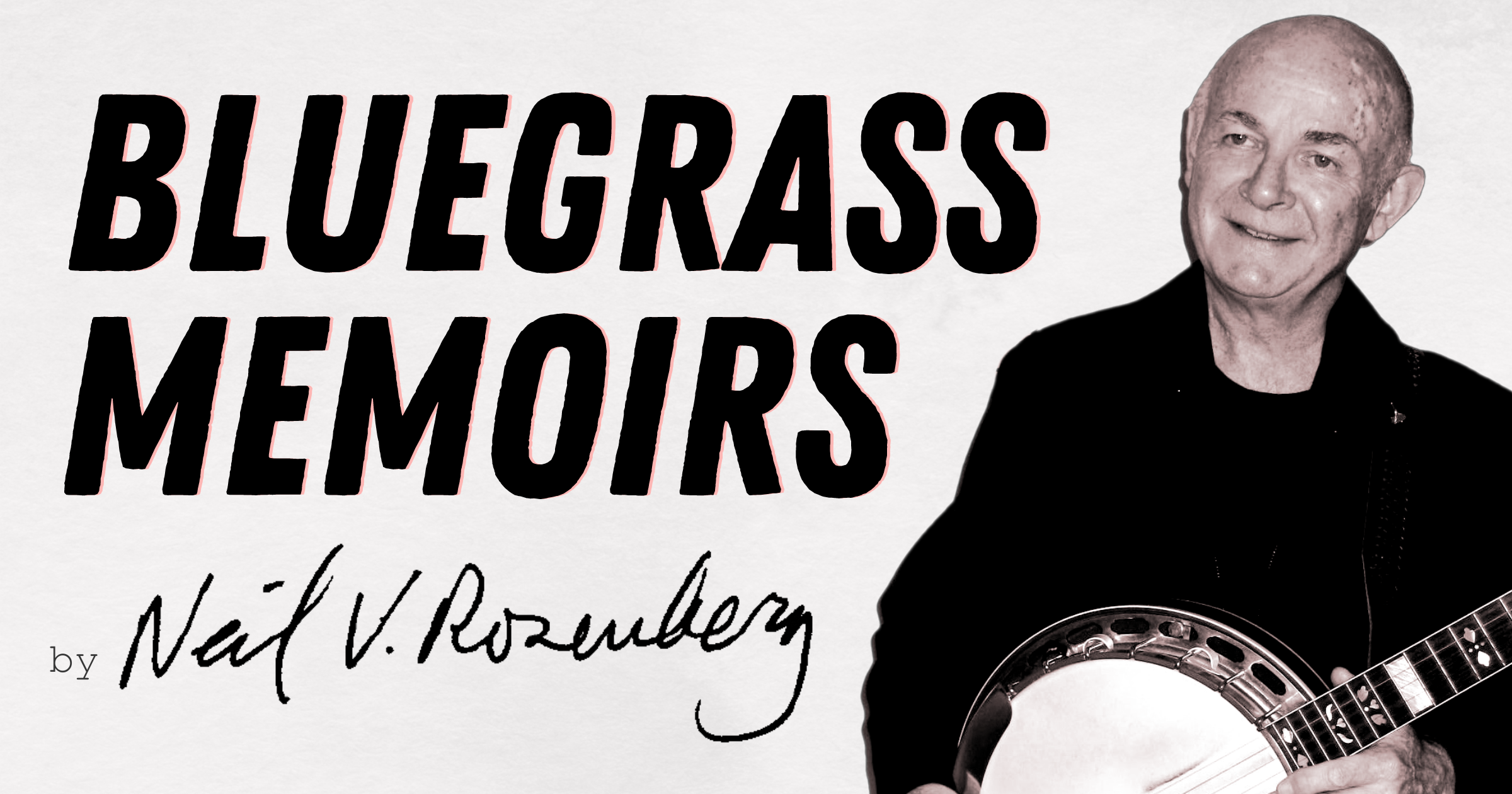
Bluegrass Memoirs: ‘Industrial Strength Bluegrass’ and the Dayton Bluegrass Reunion (Part 2)

Editor’s note: Read part one of Industrial Strength Bluegrass and the Dayton Bluegrass Reunion here

In 1987 I became involved with CityFolk’s Dayton Bluegrass Reunion, “An All-Star Salute to Dayton’s 40 Year Bluegrass History.” Between October 1987 and March 1989, I worked by mail and telephone to help shape the Reunion, planned for April 1989. 

While this was to be called a “concert,” executive producer Phyllis Brzozowska envisioned it from the start as musical theater. I liked her idea — I’d long thought of bluegrass that way. My experience on the stage started at age 12, in a little theater company production of Our Town, Thornton Wilder’s 1938 Pulitzer Prize-winning play about a small community in the early 20th century. Wikipedia describes the play this way:

“Wilder uses metatheatrical devices, setting the play in the actual theatre where it is being performed. The main character is the stage manager of the theatre who directly addresses the audience.”

In Dayton, playwright Don Baker would have a role like that of the stage manager in Our Town, acting the part of a loquacious emcee, telling the story of the Dayton bluegrass community. He would work from a script that Larry Nager was writing. As he spoke, a screen behind him would show slides relating to the narrative’s cultural and historical points.

The concert was divided into seven acts, “Segment/Settings” of 12 to 15 minutes. Each featured a different group of musicians and had room for three to five songs and an encore. Don’s narrations opened each act. Planning reflected concerns about the content and sequence of the acts. How was forty years of artistic ferment to be represented? 

When I spoke of the project to my bluegrass buddies, the first question was always “Will the Osborne Brothers reunite with Red Allen?” This 1957 show gives a good portrait of the band’s sound and repertoire — cutting-edge bluegrass of its era:

As the bluegrass festival movement ramped up in the ’70s, Allen and the Osbornes occasionally crossed paths. The Osbornes were doing well on the country charts with songs like “Rocky Top” that featured Bobby’s solo and trio high lead:

Allen, considered one of the classic bluegrass lead singers, had gone on to work in several good bands. He still approached audiences as he had in Dayton bars. Larry Nager explains: “Red loved the spotlight, making the crowds laugh (often at jokes more fitting for a stag party than a bluegrass club)” (Industrial Strength Bluegrass p.89). An on-stage festival reunion with the Osbornes had been tried, didn’t work out, and was now out of the question. 

Who else would be in the concert? At the start planners thought in terms of contrasts in categories like venues (working-class bars; upscale nightspots, colleges), audiences (industrial working-class Appalachian migrants, yuppies, college kids), and radio (country, folk).

As we’ll see later, these categories overlapped; that’s what gave the region’s bluegrass such vibrancy. Beyond categories lay personal dimensions: certain bands and musicians were like oil and water. The production committee faced artists’ and fans’ differing perspectives, values, and priorities. Terms bandied about during production meetings included “First Generation, Second Generation, Urban” and so on. 

Another planning challenge: the concert featured some working bands, each on their own professional trajectory. But as a reunion it also featured retired individuals and groups. 

The final concert performance sequence reflected our work to keep tension levels low, make things flow, and illustrate the artistic collaborations that had come out of this cultural scene. 

My primary task was writing the introduction for the program, seeking to explain why CityFolk was presenting hillbilly music as heritage.

I was assisted by Barb Kuhns and Larry Nager, who were writing artist bios and gathering illustrations for the program. Musician and producer Nager knew the history from the inside, as his chapter, “Sing Me Back Home: Early Bluegrass Venues in Southwestern Ohio” in Industrial Strength Bluegrass (pp. 77-100) attests. Kuhns, professional librarian and fiddler with the Corndrinkers, an old-time group, had been active in promoting the music of some of the lesser-known pioneers in the local scene of which she’d been part for many years. 

With just over a month to go until the show in April, I spent a March weekend in Dayton helping the planning production staff finalize concert details.

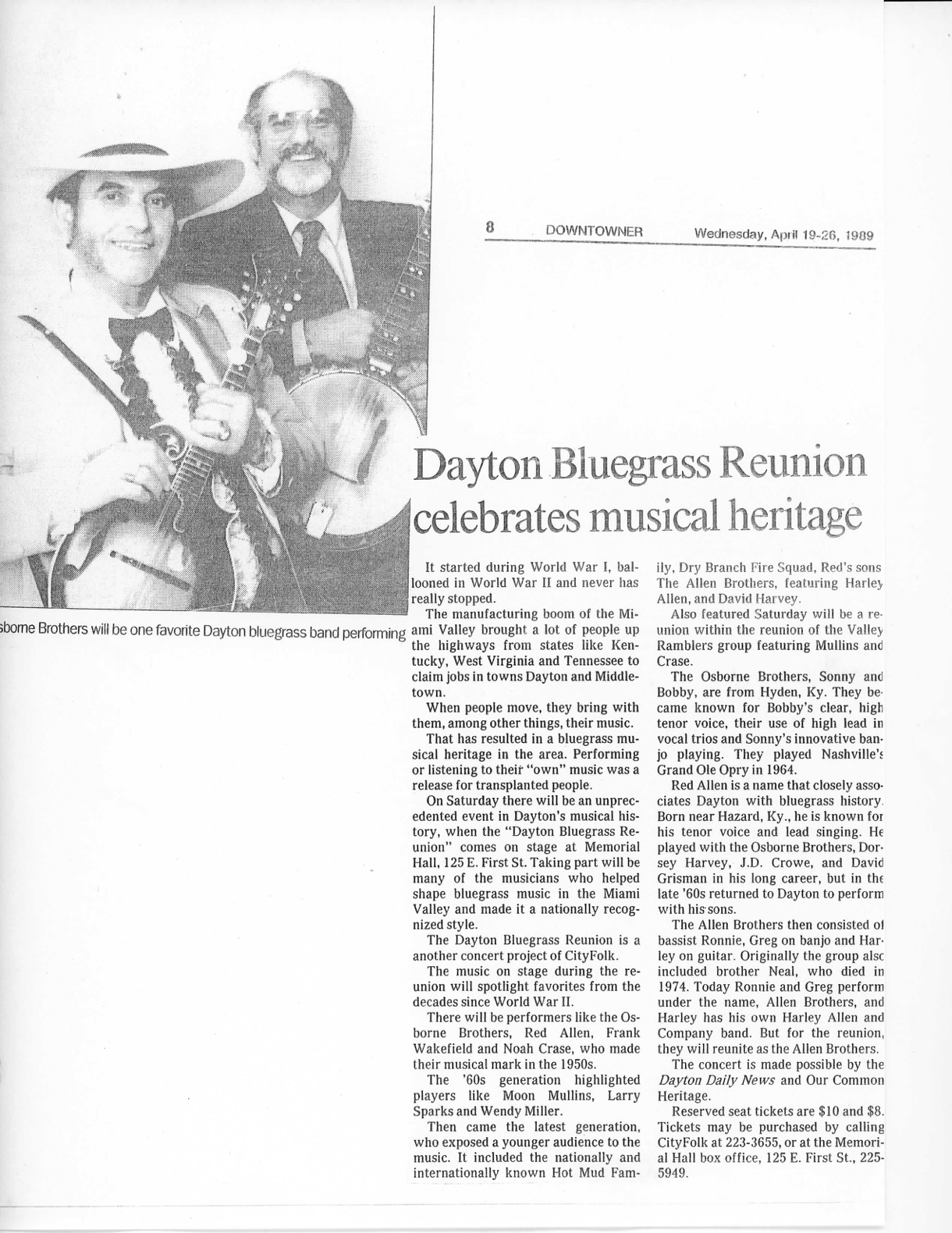
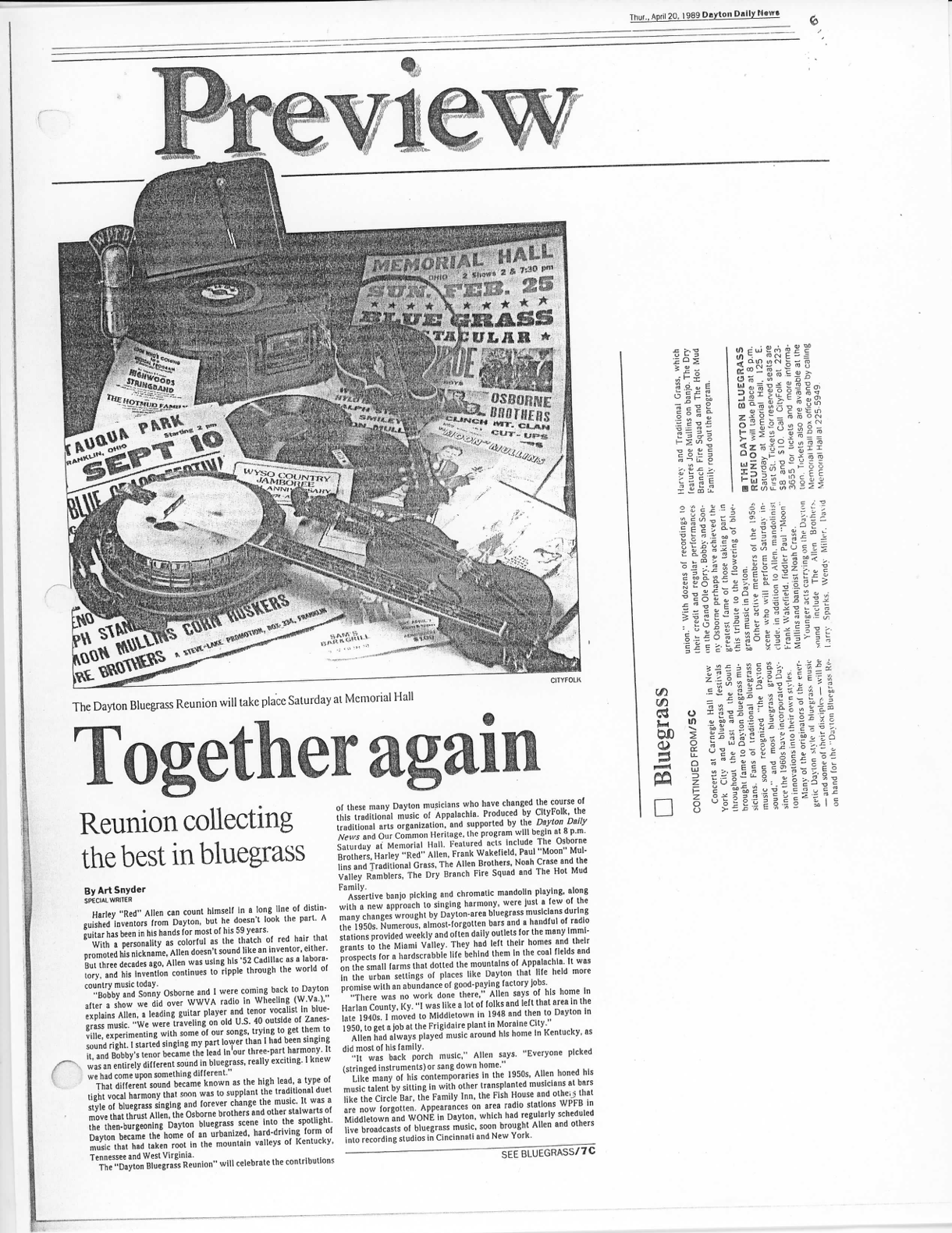
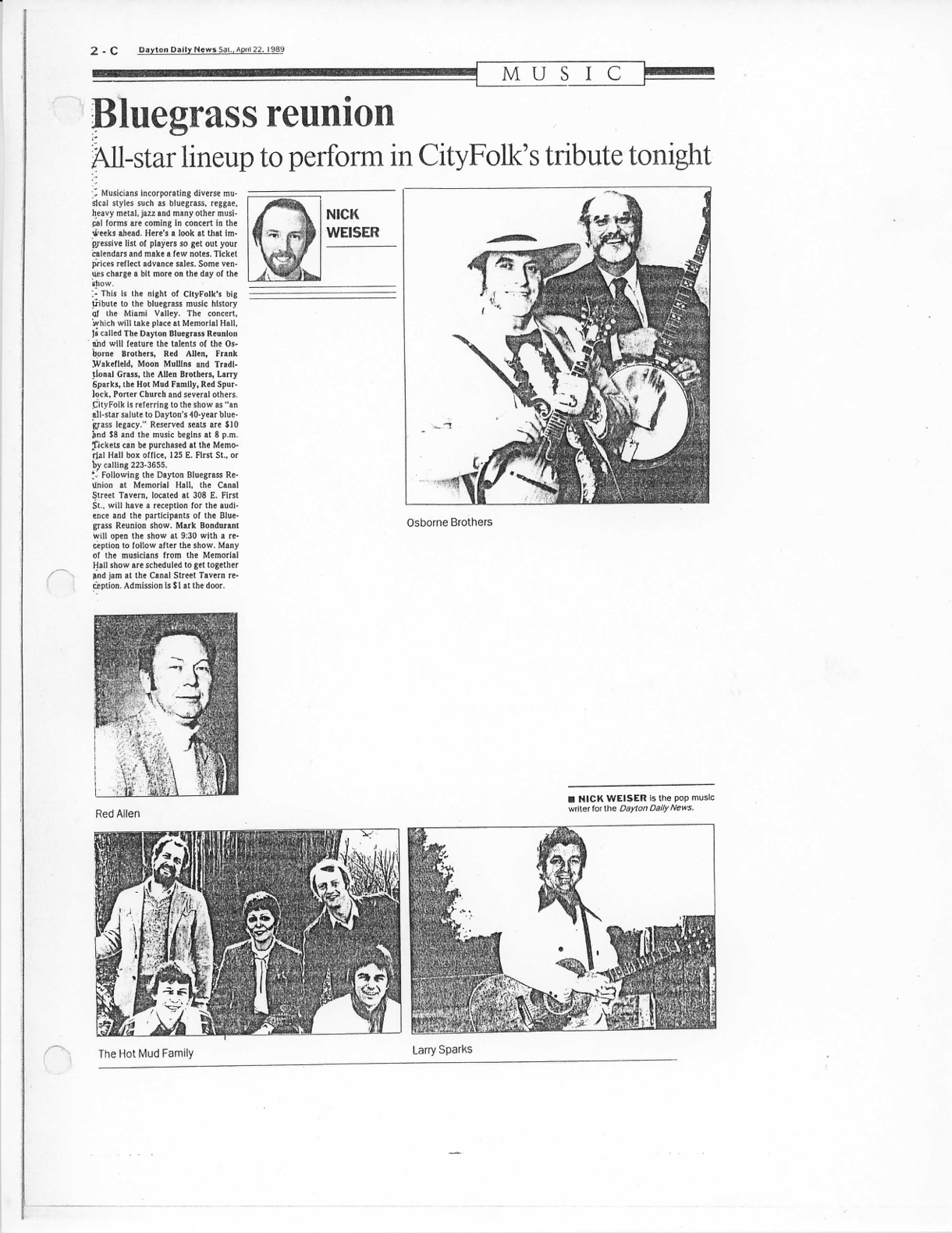
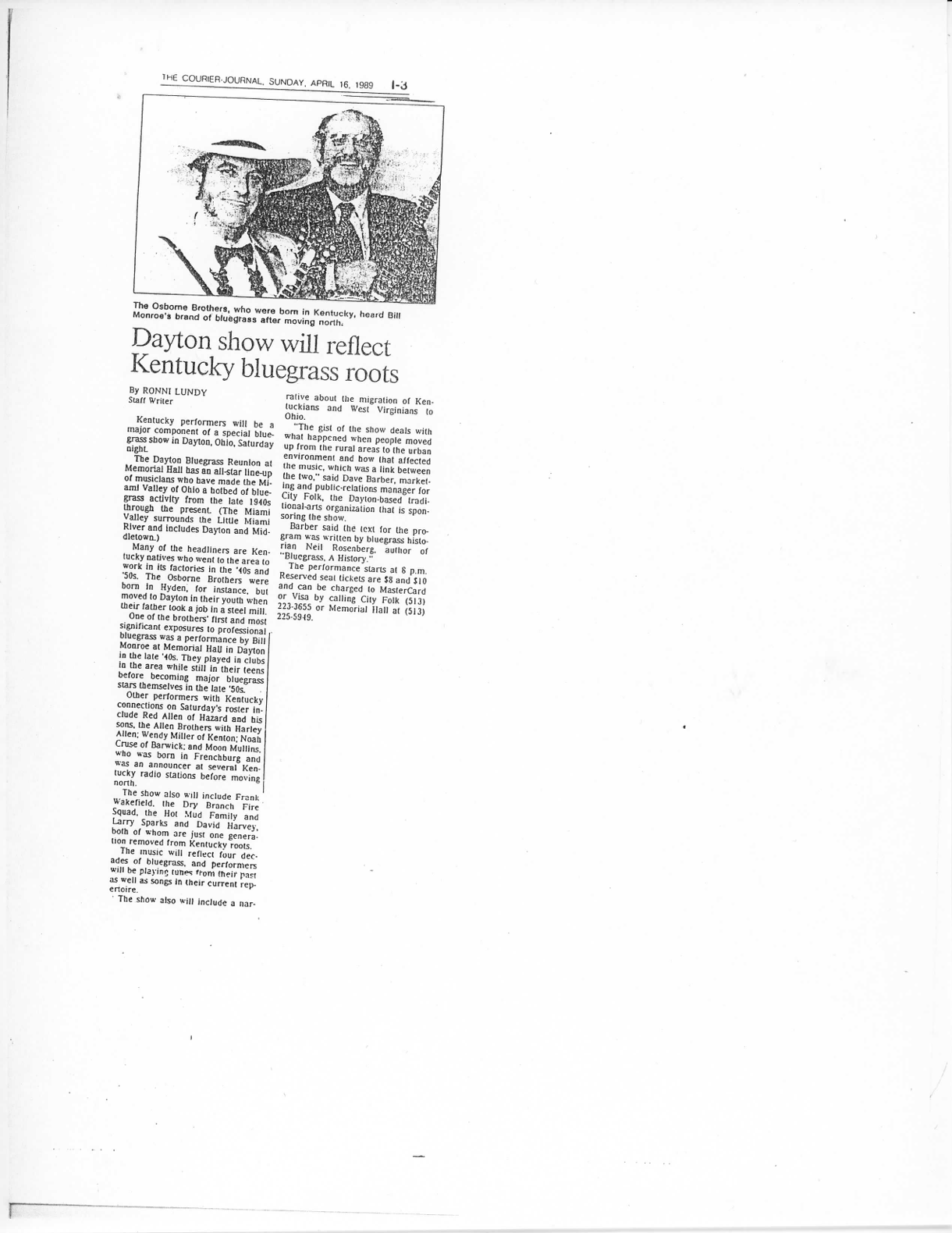
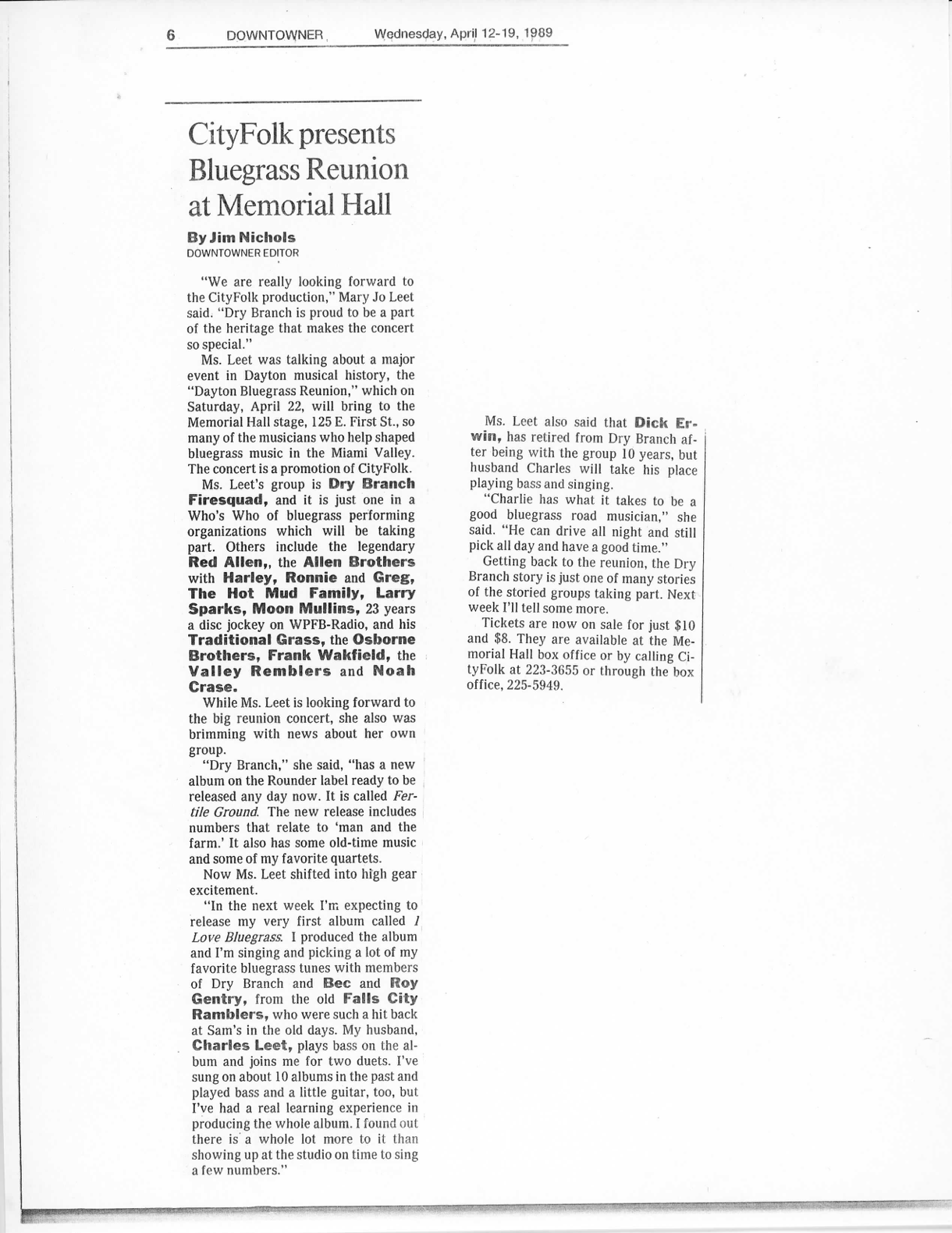
In early April CityFolk sent news to the press of the coming event. “Dayton show will reflect Kentucky bluegrass roots” was the title of a 12-paragraph story in Sunday’s Louisville Courier-Journal, Kentucky’s equivalent of the New York Times. On Wednesday, the Dayton Downtowner, a weekly, carried two stories, and on Friday the Dayton Daily News (a supporter of the event) ran two generous stories.

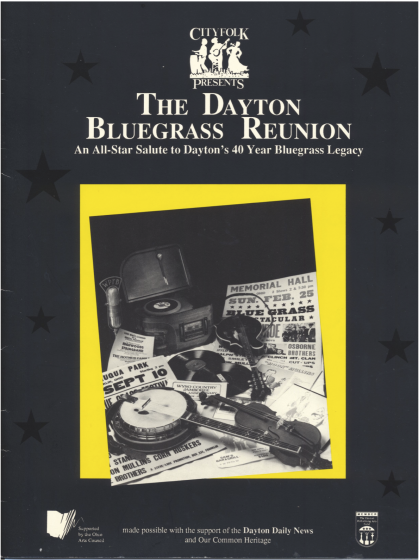
On Friday night April 22, 1989, each of the concert goers who filled Memorial Hall a Beaux-art national historic site (1907) of 2500 seats in downtown Dayton — received a 16-page 8 ½ x 11 program. Its cover duplicated the concert’s posters.

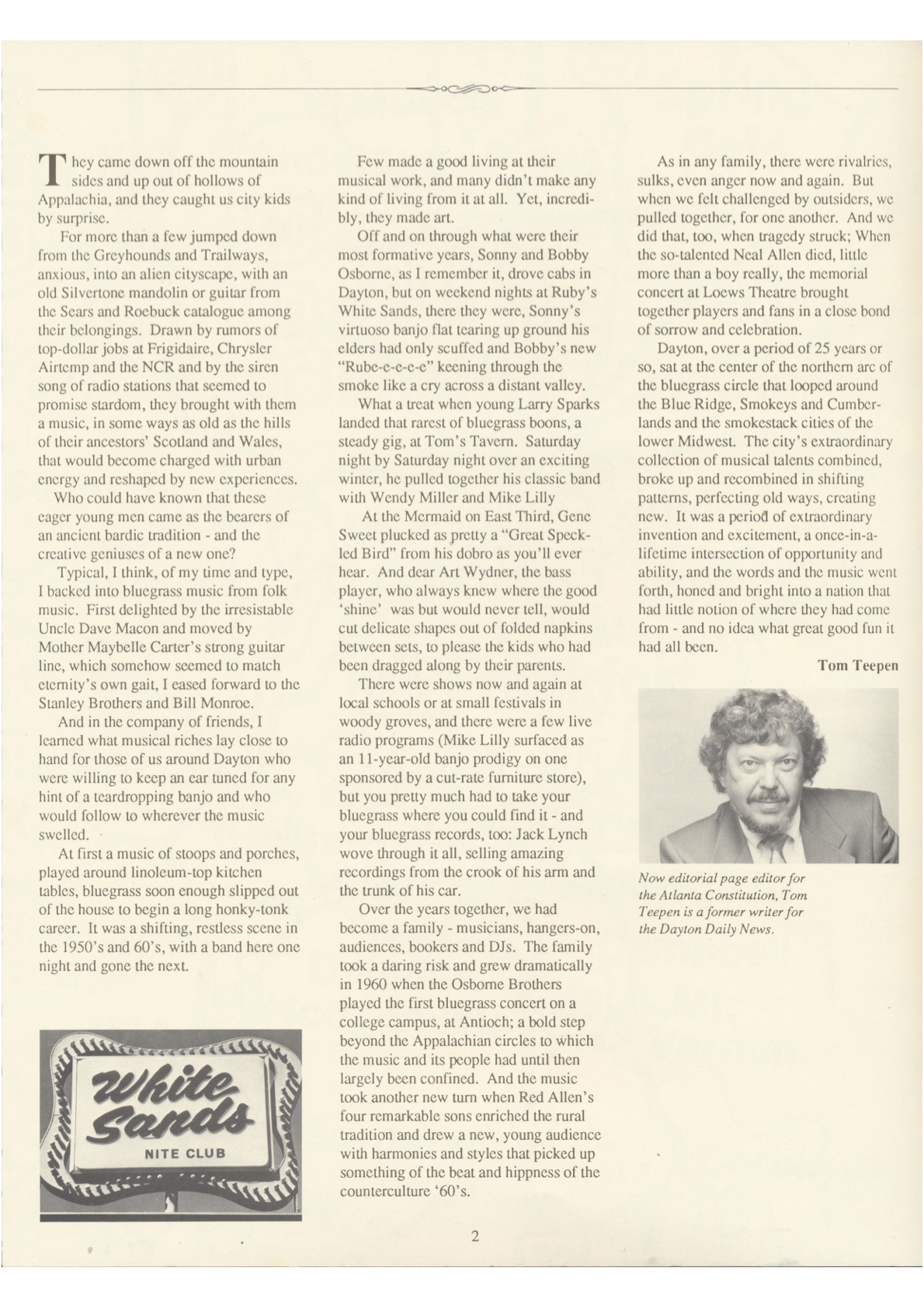
On the first page was Phyllis Brzozowka’s introduction. Next, an essay by former Dayton newspaperman Tom Teepen, who told the evocative story of his experiences with the music in Dayton. 

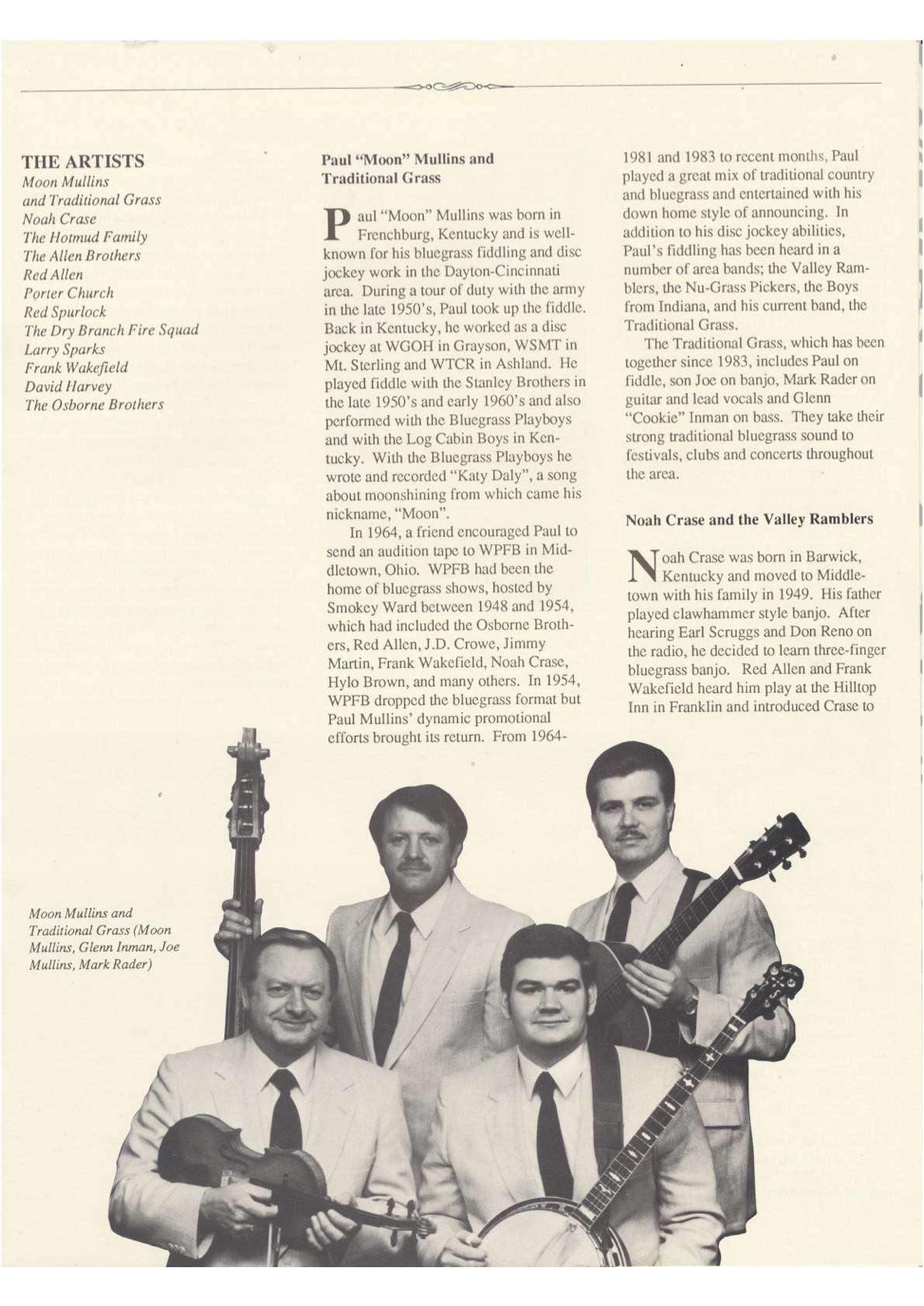
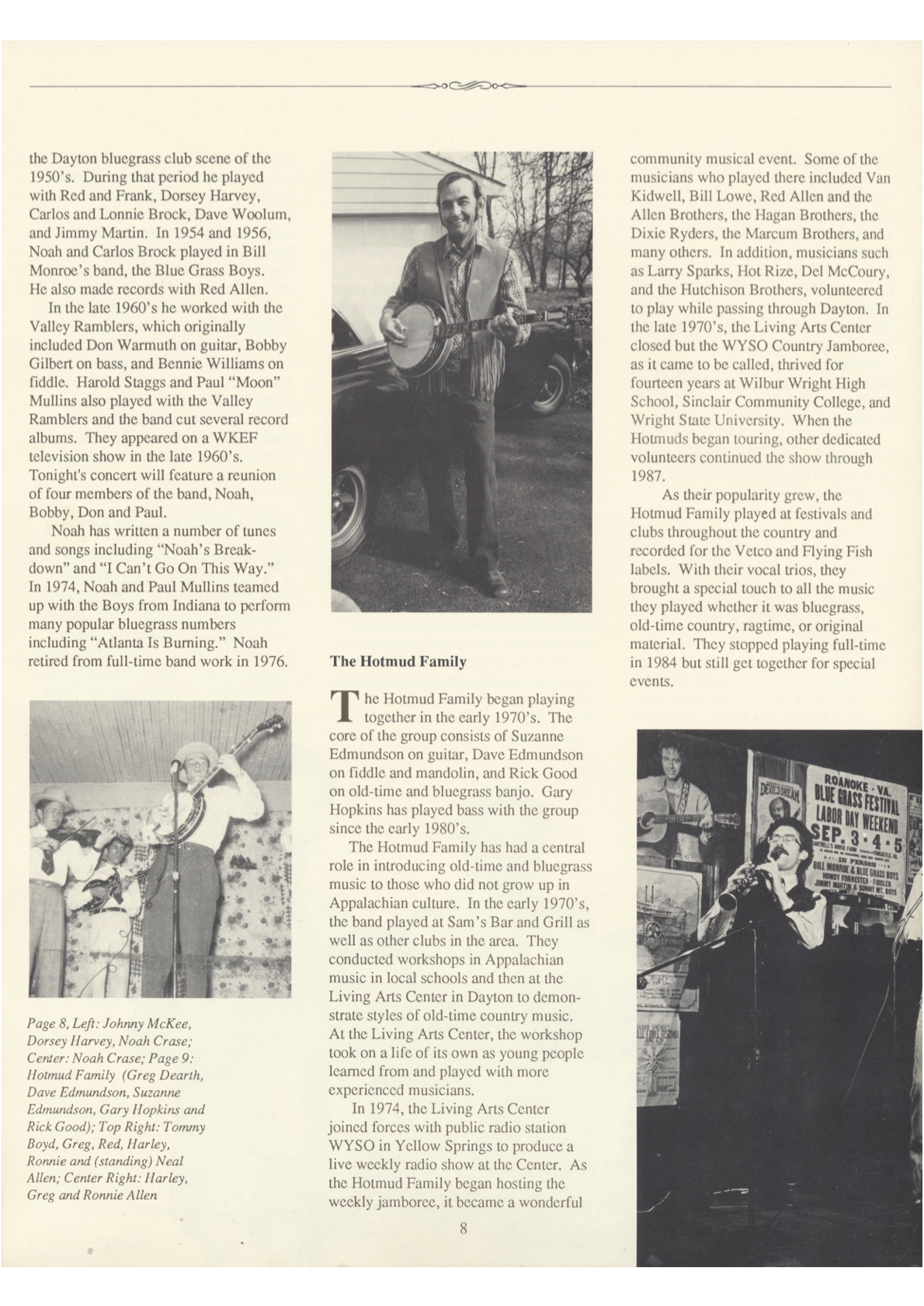
My piece, “Industrial Strength Bluegrass,” filled the next four pages. Then came seven photo-packed pages devoted to “The Artists”: Paul “Moon” Mullins and Traditional Grass, Noah Crase and the Valley Ramblers, The Hotmud Family, The Allen Brothers, Red Allen, The Dry Branch Fire Squad, Larry Sparks and Wendy Miller, Frank Wakefield, David Harvey, and the Osborne Brothers. 

The booklet closed with several pages of lists: a “Selected Discography” including addresses for local and national retailers; planning production staff; thanks for assistance; CityFolk staff; board of trustees. Its endpapers were a map of southern Ohio, with portions of Indiana, Kentucky, and West Virginia. A lot to look at while waiting for the curtain to rise!

Behind the curtain, Baker’s Lime Kiln workers provided lighting and a stage manager. I was part of the backstage crew. And the sound was something else! Afterwards Phyllis wrote:

Pete Reineger, from the National Council for the Traditional Arts and a local crew…ran an equivalent of 4 stages with 36 open microphones throughout the performance.

I have been unable to locate any recordings of this event — no tape, no video. I saved a copy of Baker’s stage directions, which lay out the concert’s sequence. But Larry Nager’s script for his narrative, which told the history of Dayton bluegrass in seven segments, one for each act, no longer exists. In it, he recalled, Don’s role was that of “the omniscient voice of the hillbilly diaspora.” 

Though the Dayton Bluegrass Reunion is now a lost play, its structure can be seen from Baker’s stage directions. However, because I was busy bustling around backstage, I didn’t know how the concert was going over with the audience until later. 

The reunion began with an introduction by Phyllis, following that came sounds from offstage, described in the stage directions as:

Halsey & Meyers Commercial 

Radio Rap — Moon Mullins.

Halsey Myers is still a going concern. Joe Mullins says that the Traditional Grass, the band he worked in with his father Moon from 1983 to 1995, recorded a radio commercial for this Middletown hardware store. It was so popular they got requests for it at personal appearances. Joe and his son Daniel found an old cassette recording of the ad followed by an example of Moon’s colorful on-air WPFB persona:

These radio clips would have been familiar to many in the audience who knew the local bluegrass scene. Paul “Moon” Mullins was the true loquacious voice of Appalachian migrant music — bluegrass — in southwest Ohio. 

As the curtains opened Baker took the stage to tell the story of Mullins and the music. Photos synced to the script appeared on a screen behind him. Some were of Dayton musicians and venues, while others evoked a variety of historical and geographical milieus ranging from Dayton to national and international.

Baker’s light dimmed and focus shifted to the other side of the stage, where Mullins and his band, The Traditional Grass, were highlighted. Mullins had come to Dayton from Kentucky in 1964 to take a job as a DJ at WPFB, a Middletown country station that had been a bluegrass center in the 40s and 50s. Jimmy Martin, the Osborne Brothers and many others had performed there. The short-lived Martin-Osborne band’s hit trio “20/20 Vision” from those days is recreated by Dan Tyminski on the new Smithsonian Folkways album, Industrial Strength Bluegrass

In the mid-’60s WPFB had dropped bluegrass but Mullins brought it back. He’d started his radio and musical careers (he’d fiddled with the Stanley Brothers) in eastern Kentucky. Migrant audiences in southwestern Ohio bonded with him. He revitalized the music at WPFB and began playing with local bands. 

I first saw his name in June 1968 when we were both on the flyer for Bill Monroe’s Blue Grass Festival at Bean Blossom, Indiana. I was in the banjo workshop (with Ralph Stanley, Dave Garrett, Bobby Thompson, Vic Jordan, and Larry Sparks); “Paul Mullins, WPFB Radio, Middletown, Ohio” was emcee for the Saturday shows, co-hosting on Sunday with Grant Turner of the Grand Ole Opry.

Twenty-one years later, on the evening of the Reunion, Mullins had recently left WPFB. He’d started The Traditional Grass in 1983 (they would continue until 1995); it included his son Joe, who was singing tenor, picking banjo, and following his dad’s footsteps in radio. Guitarist Mark Rader was the lead singer, and Glenn “Cookie” Inman, bassist. They opened with “Weary Lonesome Blues,” a popular Delmore Brothers song from 1937:

After three more songs, everyone except Moon left the stage and he was joined by members of The Valley Ramblers, a band he’d co-founded with Noah Crase in the late ’60s. Crase was a highly respected banjo player, a former Blue Grass Boy best-known for “Noah’s Breakdown,” the tune that started Bill Keith on his exploration of melodic banjo. 

Editor’s note: Read part one of Industrial Strength Bluegrass and the Dayton Bluegrass Reunion here


Neil V. Rosenberg would like to thank Barb Kuhns, Daniel and Joe Mullins, and Larry Nager

Rosenberg is an author, scholar, historian, banjo player, Bluegrass Music Hall of Fame inductee, and co-chair of the IBMA Foundation’s Arnold Shultz Fund.

Photo of Rosenberg: Terri Thomson Rosenberg

LISTEN: Jackson Melnick, “John the Revelator”

Artist: Jackson Melnick
Hometown: Crested Butte, Colorado
Song: “John the Revelator”
Album: Abilene
Release Date: September 24, 2021

In Their Words: “Apocalypse isn’t to be confused with tragedy. Apocalypse is seeing something in truth, and the pain that might come from having the blinders pulled off. The Book of Revelation, where the characters in this song first emerged, is worth looking at. Or, if you are like me, you can listen to Blind Willie Johnson play slide guitar and sing ‘John the Revelator’ and read the Bible as a chaser. I was struck that the traditional blues song was never adapted to bluegrass music; the theme of the song fit so well, along with the haunting chorus. Perhaps it never was brought into the pantheon due to a kind of musical red-lining in the past, but for those who really know, bluegrass is rooted in Black music and the blues — Arnold Shultz, Bill Monroe’s musical mentor, is only one well-known example. The traditional song’s lyrics didn’t translate melodically well to bluegrass, so I invented some new ones that fit with an apocalyptic narrative — my apocalyptic narrative — which I think is a little more optimistic. I hope Mr. Monroe’s ghost enjoys this song.

“When I worked the song out over a traditional bluegrass progression, it really became one of the most electric bluegrass songs I had ever heard. Alex Leach, a well-regarded banjoist and songwriter himself, and Christopher Henry, the premier Monroe style mandolinist and producer of the new album (notably in Peter Rowan’s Band for a long while now), both helped to bring to the song the tones that make it feel like a classic. Christopher is somebody who knows Mr. Monroe’s language with perfect fluency, the improvisational spirit of it rather than a note for note reflection of Mr. Monroe’s picking. Alex Leach played in what became of the Clinch Mountain Boys. Christopher and I asked him to be on it as a nod to Dr. Stanley, and he lets it rip. I felt something strange and new writing this song, with the narrative of it being an apocalyptic story, but somehow on the rejoicing side of that story. True believers, or I think anyone with real spiritual faith, will relate to the uplifting quality of the song. Singing through the apocalypse — whatever apocalypse you might encounter — it is quite the spiritual test of real faith and true eternal life, and one I hope to emanate.” — Jackson Melnick


Photo credit: Bellamy Brewster

In a Hypnotic Video, Rhiannon Giddens & Francesco Turrisi Add Life to “O Death”

Upon the release of their new record, They’re Calling Me Home, Rhiannon Giddens and Francesco Turrisi delivered a beautiful music video for their rendition of the old American tune, “O Death.” The video features a series of scrolling paintings done by Maeve Clancy, an Irish artist who specializes in these “crankie rolls.” It’s a suitable vehicle for illustrating Giddens’ performance, as the images match not only the drama of the story but also the pacing of the lyrics and rhythms. In this hypnotic, pre-electricity style, “O Death” comes to life with its own magnetism. It’s the latest installment in the North Carolina native’s ongoing collaborations with Turrisi, a gifted Italian multi-instrumentalist.

During the pandemic, Giddens and Turrisi stayed at home for more than a year in Ireland, and They’re Calling Me Home echoes the many ways that a tumultuous 2020 had many of us yearning for the comforts of home, of the past, or of those that were called home from this world. NPR’s Here and Now raved about They’re Calling Me Home, saying “Rhiannon Giddens’ newest album goes back in time to soothe the soul of listeners today.” In a Q&A with Garden & Gun, Giddens says, “I love the idea of old technology plus new technology. Maeve is cranking one long piece of paper from one side to the other. I hope people realize that! She’s responding to what’s going on in the song. And she found a certain style and then had to draw it so it has the same tempo as the song. I love getting inside another artist’s world for a bit.”

Watch the beautiful visual representation of “O Death” below.


Photo credit: Karen Cox

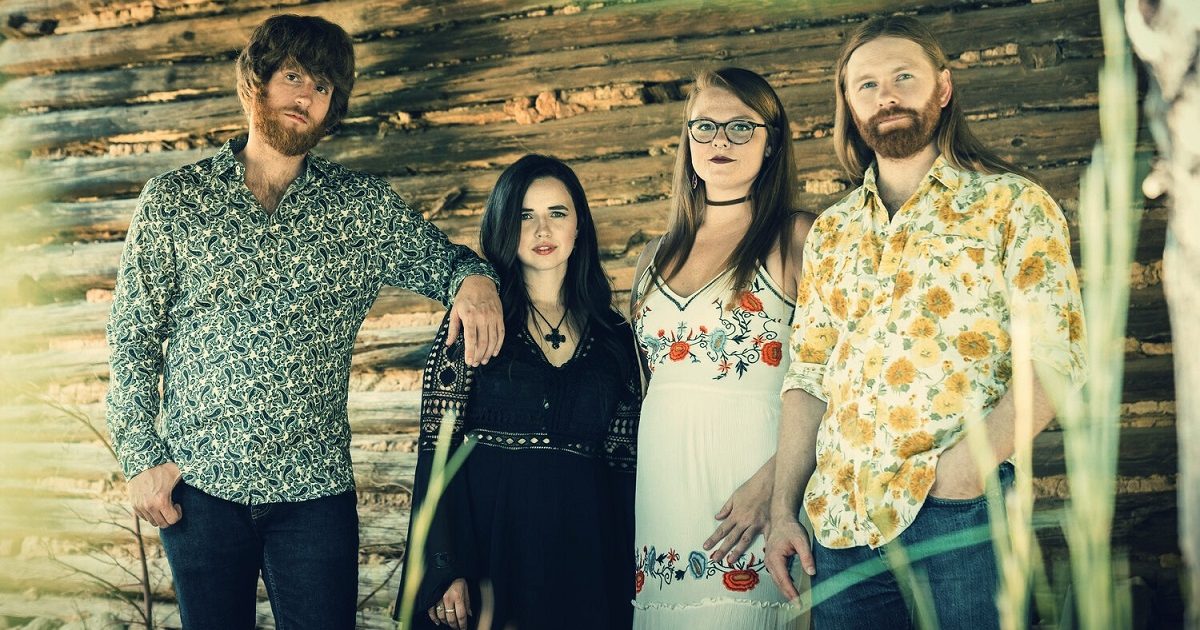
BGS 5+5: Bill and the Belles

Artist: Bill and the Belles
Hometown: Johnson City, Tennessee
Latest Album: Happy Again
Personal Nicknames: I renamed myself Spike (inspired by the bulldog with a spiked collar in Heathcliff) in the first grade and all the kids called me Spike for a few months. That was a big win. — Kris Truelsen

My name can be tricky for people (it’s like Kahlúa, but “kuh-LEE-uh”) and nicknames weren’t much of a thing until Game of Thrones came out and Khaleesi happened. — Kalia Yeagle

Which artist has influenced you the most … and how?

It’s a no brainer: Jimmie Rodgers. He’s been one of our main inspirations for years. His effortless skill in combining the sounds of the blues, jazz, and country will forever be inspiring. My favorite songs from Jimmie are the syrupy love ballads with strings and horns that lean towards being straight pop music of the time like “The Hills of Tennessee” or “Miss the Mississippi and You.” Brilliant stuff. Though I still sing many of his songs, more than ever I use his music as inspiration to break rules and to find the courage to make something unique, not tied to genre or emulating somebody else, but rather trying to be original. — Kris

Jimmie Rodgers was a huge influence on this band. More broadly, that big field of “early country music” (or whatever else you want to call it) is so full of genre-busting sounds and earnest musical experiments. Forming this band, we were very inspired by the folks that used what they had in creative ways, and worked with real fervor. — Kalia

What’s your favorite memory from being on stage?

A little over six years ago at the opening of the Birthplace of Country Music Museum in Bristol, Virginia, we shot the pilot episode of Farm and Fun Time, the PBS television show we host. At sound check I stood at the side of the stage and watched Ralph Stanley sing the entirety of “O Death” in an empty theater. It was literally just me, the sound engineer Josh, and Ralph Stanley in this tiny 100-seat theater. It was absolute magic. — Kris

Similarly, another impactful not-quite-on-stage moment for me was when we shot an audience-less Farm and Fun Time from Kris’s front porch during the pandemic. This was early on enough that folks were still figuring out how to get the most out of livestreams, but late enough that we were all feeling scared about what the pandemic meant for our families and communities, and what it meant for our relationship with live music. Sitting on Kris’s front porch listening to local legend Ed Snodderly sing his songs smacked me good, right in the heart. It had been months since I’d experienced live music, and I don’t think I’ve ever felt so grateful and moved. — Kalia

What other art forms — literature, film, dance, painting, etc. — inform your music?

I’m informed by art that says what it means, and simple, impactful works that don’t feel overwrought. That’s because my head’s a pretty busy place, and I sometimes struggle to distill my thoughts and emotions. I also think that artists can see art everywhere, so yes of course a beautiful piece of writing or gut-wrenching brushstroke can stir up the feels. And so can the chalk drawings neighbor kids make, the way this lampshade shoots light up the wall, or the angles this broom maker created when they gathered the bristles. I’m a pretty emotion-full person, but there have been periods of time when making music was just a motion and not emotion. I’m working on treating music-making more like those little moments of surprising beauty, by staying present and approaching things more playfully. — Kalia

What’s the toughest time you ever had writing a song?

Well, a lot of songs end up in the trash after being reworked to death, but I’m getting better at knowing when to move on and putting less pressure on myself to produce, which inevitably makes the work I do finish stronger. The toughest song I’ve ever written that successfully saw the light of day was probably a jingle I wrote for the regionally beloved soda pop company Dr. Enuf. It’s an herbal, lemon-lime sort of thing like Kentucky’s Ale-8. People in East Tennessee lose their minds for “the Dr.” Not to mention it’s got vitamins. It took me ages to get the jingle honed in just right, but when I did I really nailed it. The hook goes “It’s the lemon-in’, lime-a-nin’, rich in vitamin, original pick me up.” I’ve written over 50 jingles and this one is undoubtedly my favorite. — Kris

If you had to write a mission statement for your career, what would it be?

Write songs that defy boundaries, keep evolving, have faith, and quit working so damn hard all the time. — Kris

Ask, “How is your work serving others? How is it serving you?” And always celebrate growth and abundance. — Kalia


Photo credit: Billie Wheeler

A New Generation of Bluegrass Stars Reflect on ‘O Brother, Where Art Thou?’

The soundtrack to O Brother Where Art Thou? was a phenomenon in the early 2000s, turning bluegrass musicians into superstars and creating an instant mainstream market for old-time music — from folk to gospel to children’s songs to prison chants to blues and everything in between. To celebrate the twentieth anniversary of its astonishing success and to wrap up our Artist of the Month series, we spoke to several musicians about the impact O Brother and its subsequent tours had on their lives and livelihoods.

Sierra Hull: “I grew up in a little town with maybe 900 people, and there used to be a poster section at the Walmart the next town over. You could flip through the posters and there would be pop stars like Britney Spears and Backstreet Boys. I was always convinced that one day I would find an Alison Krauss poster in there. She was as popular in my little kid brain as Britney Spears. So it was cool when O Brother came out and elevated some of those people who were already giants to me, like Alison and Dan Tyminski and Ralph Stanley.

“I was already playing, but I was too young to be touring yet. By the time Cold Mountain came out [in 2003], I was part of that tour. Alison was part of both soundtracks, and she invited my brother and me to go on that tour. So we got to help celebrate that second wave. I was 12, and it was really the first time for me to be out on tour, travel to so many different places, and play Red Rocks and the Beacon Theater in New York. Standing at the side of the stage and listening to Alison sing to hundreds of people every night every night was one of my favorite memories.

“It was amazing to watch people go crazy over Ralph Stanley every night. He had this dazzled suit jacket that he wore every night. Sometimes he would sit his banjo down while his band played and take that jacket off and throw it to me at the side of the stage. I would get to wear that dazzled jacket at the end of the show when everybody came out on stage. It’s one of the most special musical experiences I’ve ever had.”


Sara Watkins: “O Brother was something we somehow became affiliated with. Nickel Creek had just released our band’s first record on Sugar Hill, after years of doing just little homemade projects. Alison Krauss produced it, which had been out maybe a year and a half when O Brother came out. She was a big part of that soundtrack, of course, so our band was gaining a little bit of notoriety. I remember reading a huge New York Times spread, and we were listed among the people on that scene. We were part of that conversation, despite not having been part of the soundtrack in any way. We were just at the right place at the right time, and the awareness of the bluegrass scene just exploded. We were able to reach a different level very quickly. It was a huge advantage to our career. We already had some momentum, but the soundtrack really put the wind in our sails.

“T Bone Burnett [who produced the album], one of his brilliant skills is finding the right people for the right song. He brought in some incredible musicians in a way that really showed the musicianship in our community and made everyone really proud of our scene. We saw our heroes up there, and it was gratifying to see them celebrated by a huge audience. I remember feeling a new respect for Ralph Stanley with that vocal [on ‘Oh Death’]. That actually turned me on to shape-note singing. Someone told me his delivery was reminiscent of those old communities that did shape-note singing and those old preachers who used to sing that way. I’d never heard anything like it. And to this day, whenever I see Dan Tyminski, I make a point to stick around until he plays ‘Man of Constant Sorrow.’ No way I’m leaving before then.”


Dave Wilson (Chatham County Line): “I remember going with our old bass player to see O Brother in the theater. We snuck a bottle of whiskey in and sat in the back row and just laughed and drank. I remember thinking, ‘Bluegrass has arrived!’ We were already a band and playing small gigs around town, but we weren’t at a place where we had dedicated our lives to it. So it was kismet for us. That record came out, and the scene just exploded. Suddenly we had this huge advertisement out there in the world for the style of music we were playing. We definitely noticed a change. There were more strangers coming to see us play gigs, and they were really excited about it. One side effect was people would yell out for us to play ‘Man of Constant Sorrow.’ They did it enough to make me wonder if they had heard the soundtrack or just seen the movie. But we never played it. We didn’t know how! It would have probably shut them up if we had!

“I really got into the record. There are some badass arrangements on there. And it’s not corny. It’s not super traditional. I love that they reached out to the right people. It could have been bad. They could have gotten Toby Keith or someone like that. Oh god, I don’t even want to think about that! One of my favorite parts is that blues song by Chris Thomas King [a cover of Skip James’ ‘Hard Time Killing Floor’]. It makes for such a special moment. Later, they booked that concert film [Down from the Mountain, recorded at the Ryman Auditorium] at our old classic movie theater here in town, and I remember the boys going to see it and we were all just floored. That was almost bigger than the movie as far as having an impact in the folk music scene.”


Sam Amidon: “People in the folk world can be very protective of the music, which I think is valid. But my inclination is that if I find something I’m excited about, I want to share it. I want people to know about it. To have grown up in a world knowing a lot of the corners O Brother explores, it was beautiful to think about how many people all of a sudden were going to discover these field recordings and these great musicians. And I was thankful because until then, portrayals of traditional music in the mass media had just been so bad and so clichéd or so simplistic. Nothing had depicted this stuff on this scale before. Before then, if you told somebody you played banjo, they would think Deliverance. That was their frame of reference.

“For O Brother to do it without messing it up was a miracle. To see these different corners of American music — beyond just blues and bluegrass as the two major industry terms — was a very positive thing, especially because ‘folk music’ can be such a heterogeneous category. Nobody would even really know what you were talking about if it wasn’t bluegrass or blues. O Brother pointed to all of these different areas. It’s singing games and banjo songs and all these different things. O Brother is weirdly inclusive. It cast a wide net. Nowadays it’s easy to go to the soundtrack and hear more problematic elements of the whole Americana genre thing, but I think it’s good to remember that when it first came along, it was much more nuanced compared to what had come before.”


Woody Platt (Steep Canyon Rangers): “It’s interesting that the twentieth anniversary of O Brother is fairly parallel to the twentieth anniversary of our band. We formed in Chapel Hill, North Carolina, when we were seniors in college, right when the movie came out. We all had been exposed to bluegrass and old-time just by being Carolinians. We all had that music around when we were growing up, but none of us in the band really dove into it until we were in college. We’d only been following that music a few years when the movie came out. I’m not sure we were aware at the time of the impact that the movie and the tour had on bluegrass, old-time, string band, mountain music, but we could feel some excitement when we were playing bars on Franklin Street, which is the main drag in Chapel Hill. But we didn’t really have anything to compare it to. There was no before or after. It was just what we were doing, and that’s all we knew.

“I really enjoyed the movie, but I was a big fan of the album. Hearing Ralph Stanley’s voice in a film, or Dan Tyminski’s, or just seeing people I admired in that movie was pretty incredible. Looking back on it, it was good timing for us to be getting off the ground, and we were having so much fun and finding so much joy in it. The music we were playing had been a small niche, but all of a sudden it had this national interest. I have no doubt in my mind that the awareness of the music was fueled by the movie. It’s a fascinating phenomenon to think about, because it wasn’t marketed in any significant way. It just happened. It was just this thing where people were suddenly into this music.”


Molly Tuttle: “The movie came out when I was seven years old, and I remember my dad showing it to me when I was in grade school. I loved it, and the music really stuck with me because I already had an affinity for bluegrass and old-time music. Seeing it performed in a movie was new and exciting. My dad teaches bluegrass for a living, and when the movie came out, he had an influx of new students.

“It’s had a lasting impact on the popularity of bluegrass music. But I was so young that I didn’t know many of the musicians on the soundtrack by name, so it introduced me to a lot of artists who later became my favorites. And the Down from the Mountain documentary further familiarized me with people like Emmylou Harris and Alison Krauss. Many of those artists, like Gillian Welch and John Hartford, have been big influences on me, and that was my introduction to their music. I’ve performed ‘I’ll Fly Away’ and ‘Angel Band’ a number of times, and I got to do ‘Man of Constant Sorrow’ with Dan Tyminski at the IBMA awards one year.”


Dom Flemons: “I actually saw Ralph Stanley on the O Brother tour in Flagstaff, Arizona, in the year 2000. It was at this random high school. I saw the poster on a telephone pole when I was going to college there. I’d started playing the banjo by that point — six-string and four-string banjo, guitar, and harmonica. I remember the place was really packed out, and he gave this amazing performance. I just loved watching the man at work. When he sang ‘Oh Death,’ he pulled this piece of paper out of his pocket, put on his glasses, and made a joke about how old he was. And he just sang it off this piece of paper and blew our minds.

O Brother was very interesting, and I think it’s still a milestone album for several generations. A lot of the old folks who played those old styles and sang those old songs were starting to pass away, so the soundtrack ended up being a perfect vehicle for getting younger people into the music of the ‘20s and ‘30s. It reminded people of the really good old recordings that were available. That’s where I went. I found the old RCA Victor and Columbia recordings, and that was it for me.

“It’s a perfectly structured record, opening with the prisoners on the chain gang and then it goes to that beautiful ‘Big Rock Candy Mountain.’ And then you get into “You Are My Sunshine” with Norman Blake, and then Chris Thomas King presenting ‘Hard Time Killing Floor.’ That in itself was a revival of Skip James. People talk about Ghost World and Devil Got My Woman, but I think O Brother got it going. People just started casually bringing those songs back in at shows and festivals, and it seemed like a lot more people knew them. Of course they would sing them like the recordings on O Brother. Those are just things I observed before I was a professional musician, and it was amazing to see.”


‘O Brother, Where Art Thou?’ Created an Instant Audience for Old-Time Music

The O Brother, Where Art Thou? soundtrack, which was just starting to pick up momentum twenty years ago this winter, was both a forethought and an afterthought. The Coen Brothers had an idea for a film and even a title borrowed from Preston Sturges’ 1940 comedy, Sullivan’s Travels, but no screenplay. They commissioned T Bone Burnett to assemble a sprawling playlist of old-time music for them to use as writing prompts — original recordings from the first half of the twentieth century as well as new recordings of old songs. He gathered some of the finest vocalists and players, including Emmylou Harris, Gillian Welch, Alison Krauss, and members of Union Station, as well as Norman Blake, Sam Bush, and John Hartford. In various combinations they produced around sixty tracks covering hillbilly plaints, gospel numbers, Protestant hymns, children’s songs, labor songs, even prison songs.

From that pool the Coens selected a handful of tracks that served as the skeleton for their screenplay, which became a Deep South retelling of The Odyssey. As three yokel chain-gang fugitives wander the backwoods and cotton fields and gravel roads of Depression-era Mississippi, they inadvertently become country stars thanks to a hasty version of “Man of Constant Sorrow,” originally recorded in 1917 by Dick Burnett and re-recorded for the film by Dan Tyminski. Along the way they encounter a parade of white-clad Christians singing “Down to the River to Pray,” a blues singer who regales them with a campfire rendition of Skip James’ “Hard Time Killing Floor,” and a KKK klavern performing a Busby Berkley routine in white sheets and hoods.

Whittled down to eighteen tracks, the soundtrack hit stores just a few weeks before the film, and it seemed designed to stand alone as an upscale release. As Luke Lewis, formerly chairman/CEO of Universal Nashville, told Billboard in 2015: “When we were putting it together, a bunch of us said, ‘This is probably going to be a coffee table kind of a CD, where people will leave it around and be proud to have it.’ That turned out to be pretty much true… A lot of people that don’t buy records at all, or buy one a year, bought that record.”

Still, no one figured it would sell any more copies than your typical soundtrack, and certainly no one predicted it would so completely eclipse the film. Its success has been astounding: It has sold nearly 9 million copies, hung around the upper reaches of the Billboard Top 200 for several years, won the Grammy for Album of the Year (beating out Bob Dylan and Outkast, among others), spun off a sequel, inspired a series of tours and live albums, and redefined a massive market for traditional music in America.

Twenty years later, the gulf separating film and soundtrack remains remarkably wide. The former is glib to the point of nihilism, as though every line of dialogue and every camera angle is surrounded by quote marks. The soundtrack, by contrast, is sincere to the point of evangelism, as though these old songs were pieces of secular scripture. The music plays everything straight, while the film can’t keep a straight face. The soundtrack became a phenomenon, while the film sits in the lower tiers of its auteurs’ sprawling catalog.

Both are products of a very particular time: They were released during that short window between two defining events — the hand-wringing spectacle of Y2K and the horrific televised tragedy of 9/11. With the benefit of twenty years’ hindsight, they represent a pop-cultural pivot from the irony that defined the 1990s and much of the Coens’ output to the “New Sincerity” that defined the 2000s.

Why did this niche soundtrack become such a massive hit? Some have credited the popularity of O Brother to fin de siècle jitters and a desire to return to a rosier, more comfortable American past (never mind that the past, especially the 1930s, was never rosy or comfortable). Others have chalked it up to a rejection of the late ’90s pop music excess embodied by Britney Spears and the Backstreet Boys.

Perhaps the best reason for its success is also the most obvious: This is a good album, and an accessible one. It’s a well-curated tour through old-time music, a sampler of rural American traditions that serves as a primer on the subject without sounding like a textbook. All of these different styles are presented with an eloquence that is homespun yet modern: a balance that highlights rather than dampens their charms.

Burnett puts such an emphasis on the human voice that even the instrumental tracks sound a cappella. He wants you to hear the exquisite grain in the voices of Emmylou Harris, Gillian Welch, and Alison Krauss on “Didn’t Leave Nobody But the Baby” as well as the weight pressing on Chris Thomas King as he moans through “Hard Time Killing Floor.” Curiously, Dr. Ralph Stanley had to convince the producer to let him sing “Oh Death” without banjo, which was absolutely the right call. His voice is high and keening, a serious a death, shaken by the very subject he’s singing about.

If there’s a breakout song on O Brother — something resembling a hit — it was this very intense performance, which remains one of the finest renditions of this very odd and oft-covered song. Stanley was 73 years old when the album was released, had been playing since 1946, and was already celebrated as one of the fathers of bluegrass, but O Brother gave his career a considerable boost, introducing him to a significantly wider audience. (That said, it always struck me as deeply disrespectful that the Coens have a Klansman lip-synching Stanley’s performance in the film, as though they feared the words might actually mean something.)

Stanley performed the song a cappella at the 2002 Grammys — imagine anything a cappella at such a glitz-bound ceremony — not long before the soundtrack won Album of the Year. It might have been the climax of the soundtrack’s shelf life, but it kept selling and kept selling. It created an instant audience for old-time music, and upstart string-bands found themselves with readymade audiences, many of them shouting “Man of Constant Sorrow” the way they once might have yelled “Free Bird!” Every artist on the album got a boost, especially Alison Krauss & Union Station, who crossed over from bluegrass to pop and launched a series of hit records with the aptly titled New Favorite in August 2001. Similarly, Welch, Harris, and even Stanley enjoyed boosts in album and ticket sales in the wake of O Brother.

As with any sweeping change, there are new opportunities as well as new losses. The alt-country acts of the 1990s had already lost much of their luster, but roots suddenly had no room for punk anymore. Gone were the dark, twangy experiments like Daniel Lanois’s Americana trilogy — Harris’ Wrecking Ball in 1996, followed by Bob Dylan’s Time Out of Mind the next year and Willie Nelson’s Teatro the year after that. All three proved that roots music could accommodate new sounds, that it could look to the future without completely letting go of the past, and all three stand among the best entries in their artists’ remarkable catalogs.

But O Brother seemed to wipe most of those new avenues away, turning roots music into something largely acoustic, uniform, polite, conservative — beholden to the past and largely dismissive of the present. Watching certain acts riding that wave was like watching Civil War reenactors march on a makeshift battlefield, and ten years later groups like Mumford & Sons and the Lumineers were using roots music to sell arena-size sentiments.

Another aspect of old-time lost in the O Brother wave: politics. Previous folk revivals had a populist bent, extolling the music as the sound of the people and as an expression of a specifically American community. Woody Guthrie and Pete Seeger were branded subversives and communists, while Dylan and his early ‘60s cohort found radical possibilities in Harry Smith’s legendary Anthology of American Folk Music. But no one on O Brother is in any danger of being branded a pinko. The film itself nods to issues of race and class, but without really commenting on them in any serious or specific way. The soundtrack, by contrast, foregrounds songs about yearning, about breaking free of turmoil and hardship to find peace and contentment. Often that can be humorous, as on Harry McClintock’s fantastical “Big Rock Candy Mountain,” but more often it’s poignant, as on Krauss and Welch’s “I’ll Fly Away.” It’s a collection more concerned with needs of the spirit than of the flesh, so any earthly implications are largely ignored.

The roots market that sprang up in the soundtrack’s wake was consequently blanched of anything resembling social commentary, despite there being so much to comment on. That wave of bands might have provided a counterpart to the entrenched political conservatism that defined mainstream country music of the early 2000s, but instead it offered merely escapism.

A few artists did manage to question this rosy thinking about the past, in particular the Carolina Chocolate Drops. They traced strains of Black influence, craft, and contribution to old-time music, which is generally considered to be white, and therefore expanded its historical scope and current impact. As players, however, they injected their songs with no small amount of joy, as though taking great delight in what these old forms allowed them to express. The group’s three primary players — Dom Flemons, Rhiannon Giddens, and Justin Robinson — have carried that particular balance into their solo careers.

Any of the soundtrack’s shortcomings weren’t the fault of the musicians, who play and sing these songs much more beautifully and sympathetically than the film ever demanded. Nor is it the fault of the songs themselves, which obviously spoke to people as clearly in 2001 as they did in 1937. And it continues to speak loudly in 2021: The coffee table product wasn’t designed to bear the burden of the market it created, but the songs still inspire subsequent generations well into a new century, with its own tribulations and hardships.


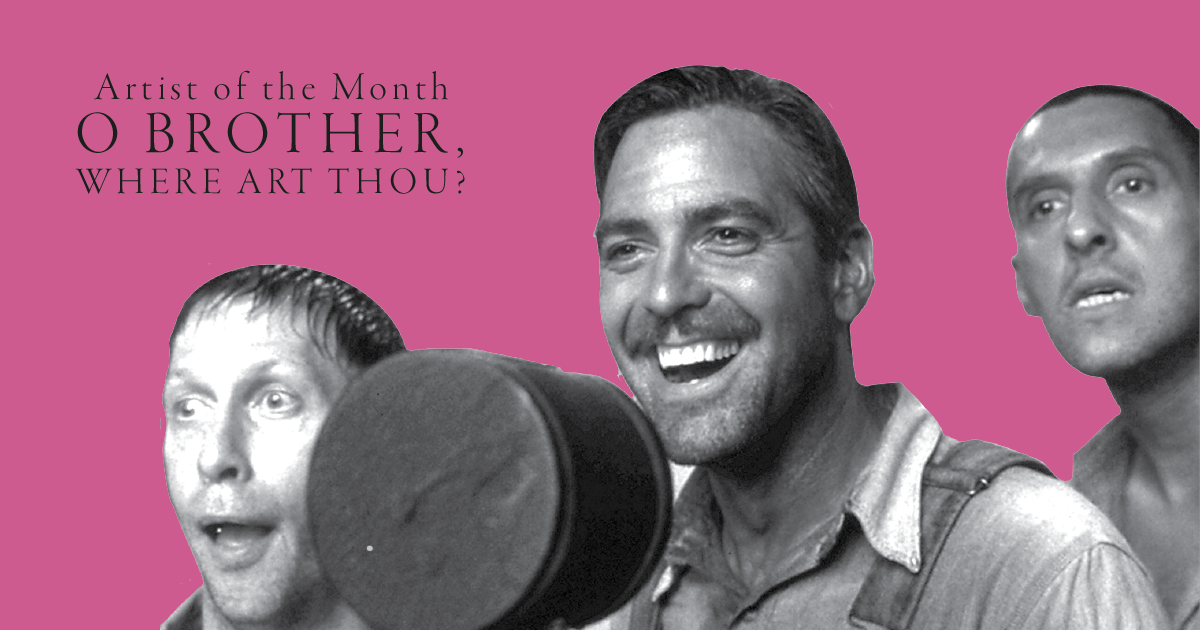
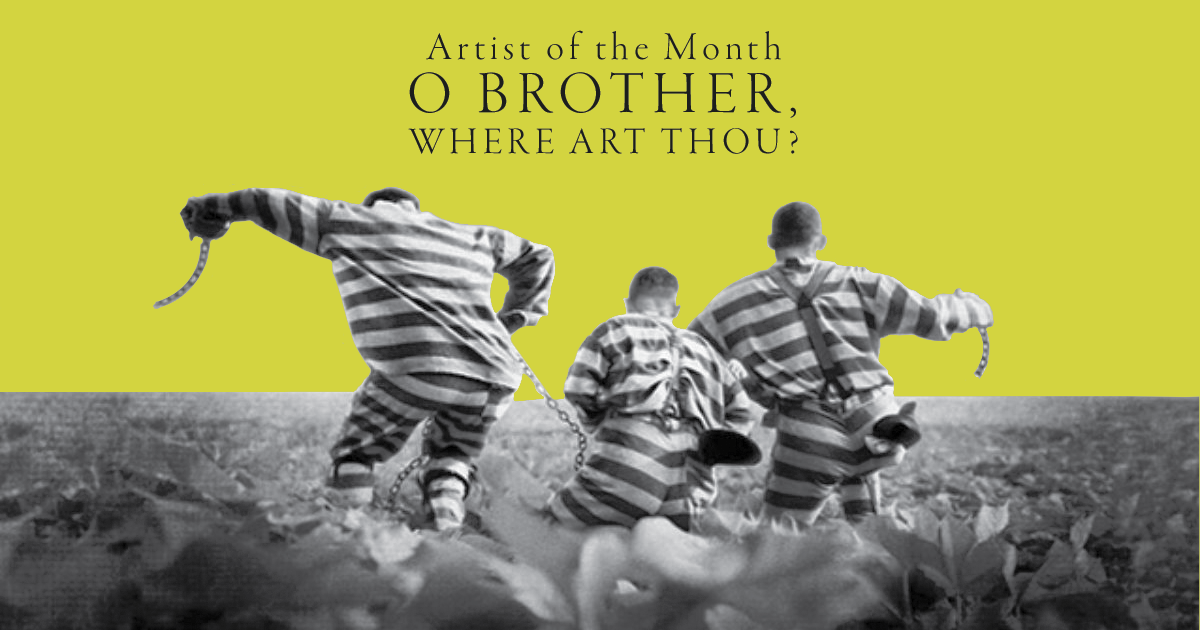
Artist of the Month: ‘O Brother, Where Art Thou?’

Twenty years ago, in 2001, the music of O Brother, Where Art Thou? captivated America and, suddenly, bluegrass appealed to pretty much everybody. We could all sing at least a few words of “I Am a Man of Constant Sorrow,” though admittedly not sound as good as Dan Tyminski or the Soggy Bottom Boys. Roots music heroes Emmylou Harris, Alison Krauss, and Gillian Welch added more positive press to their résumés, and before it was all over, the generation-spanning collection won multiple industry accolades, inspired a national tour, and even led to the first-ever Grammy Award for Dr. Ralph Stanley.

The song choices were largely well-known to dedicated bluegrass listeners, but even so, chestnuts like “I’ll Fly Away” don’t routinely end up on albums that sell eight million copies. Legends like Norman Blake and The Fairfield Four shared the spotlight with rising talent such as Chris Thomas King and The Peasall Sisters. Two decades later, The Whites still perform their version of “Keep on the Sunny Side” on the Grand Ole Opry at nearly every appearance, and to be sure, the audience smiles and applauds to hear it again.

This month, we’ll look at the legacy of that landmark album as an inspiration to a new generation of acoustic musicians, along with an interview with family members of John Hartford, whose name is back on the Grammy ballot this year for the collaborative album, The John Hartford Fiddle Tune Project, Vol 1. We’ll also have a special edition of our Roots On Screen feature about the film. Plus, check out a special IBMA Awards show performance of “Down In the River To Pray” and an archive edition of The Breakdown. And to finish out the month, we asked a crew of young bluegrass and Americana stars what the film means to them. While you’re at it, put down the Dapper Dan and turn up the O Brother, Where Art Thou? soundtrack below.


MIXTAPE: The Barefoot Movement’s Holiday Favorites

To get an idea of how much I love Christmas music, I’ll start with a series of questions. Do I have nearly 700 Christmas songs on my iPod? Why, yes I do! Did I scroll through every one of them in search of ideas for this playlist? I sure did! And did I start with about 75 songs, which I had an incredibly hard time whittling down to a mere 14? Yes, yes I did — I take this playlist business quite seriously. Also, on an unrelated note, do I actually still use an iPod classic? You betcha!

As you can plainly see, I love holiday music. At any other time in the year I might weary of hearing 100 versions of the same song. But at Christmas, anything goes. If a band I love has a holiday album, I’m most definitely buying it. In high school — these were pre-Spotify days mind you — I curated my own “playlists” and grouped them into categories like “Christmas Classics,” “Rockin’ Christmas,” and “R&B/Soul” and burned them onto CDs. Every year I would add more songs ’til eventually, they outgrew the CD format!

So I relished the opportunity to put together this specially curated Mixtape for the Sitch. I tried to stay away from the classic category, even though I love “Jingle Bell Rock” and “Rocking Around the Christmas Tree” as much as the next person. My taste in music is very personal to me, so with every song comes a little story.

I understand that Christmas music is not for everyone. Even some folks who like it in small doses might tire of hearing the same songs year after year. But for me, these annual celebrations — whether Christmas, Halloween, or National Donut Day — give us something to look forward to when the constant toiling of life wears us down. And that is a good and worthy thing, especially in a year when so many joyful things have been canceled. I hope you enjoy this collection and that you’ll get some real enjoyment out of these great songs! Happy listening! — Noah Wall, The Barefoot Movement

Doc Watson, Del McCoury, and Mac Wiseman – “Christmas Time’s A Comin’”

Something about the combination of Doc Watson’s immediately recognizable guitar playing and Del McCoury’s high lonesome tenor, not to mention the great Mac Wiseman (who I just learned was a co-founder of the Country Music Association, who knew?!), transports me directly to a living-room, after-dinner, holiday pickin’ party. This may be the quintessential bluegrass Christmas song and this is my all-time favorite version. I love it so much, it makes me want to learn to flatfoot.

Red Clay Ramblers – “One Rose/Hot Buttered Rum”

The Red Clay Ramblers are a North Carolina-based Americana band who have been making wonderful music since the 1970s. I first heard this song on our local NPR affiliate radio station’s weekend folk show, “Back Porch Music.” I was introduced to many bands on that fabulous little program that is still airing today, from legends like Doc Watson to then-up-and-comers Nickel Creek. It’s been an honor to hear my own music played on there amongst them.

Just once in my life, I’d love to write some lyrics half as good as these, which so beautifully capture the gloom of a wet, cold, melancholy Carolina winter, when even sparkling lights and greenery seem colorless and out of place. Ultimately, it’s a love song, an ode to the ones who keep us warm, no matter the weather. “When dreary Christmas decorations line the streets and filling stations and dime store Santas can’t disguise their empty hands and empty eyes… In the dead of winter, when the tinsel angels come, you’re my sweet maple sugar, honey, hot buttered rum.”

Sufjan Stevens – “That Was the Worst Christmas Ever!”

I am a huge fan of Sufjan Stevens and his wildly imaginative, fearlessly quirky music. I gave his first collection of holiday songs as a Christmas gift to Tommy Norris, our mandolinist and my now-husband, back when we were first dating. It’s since become a staple of our seasonal collection. This song in particular strongly resonated with me, as I can recall moments in my childhood that mirror the lyrics. For many, family relations around the holidays are tense and somewhat less than “holly jolly.” I think that’s okay — holidays can be stressful, and no one is perfect. This Sufjan song offers anyone who has been on the giving OR receiving end of some righteous seasonal stress a lovely cathartic release. Other favorites from this collection are “Only at Christmas Time” and “Hey Guys! It’s Christmas Time!”

Ralph Stanley – “Christmas Is Near”

Ralph wrote this downhome delight himself and originally recorded it with his brother Carter in 1958. This newer version is unabashedly country and I love everything about it. It’s as pure as freshly fallen snow! While some of the songs on my list might highlight the somber side of the season, this one is the exact opposite, with lyrics that round up all the good things that make the holidays special: family, joy, and love. It’s a magical time, if we are lucky enough to be able to focus on these things.

Pearl Jam – “Let Me Sleep (It’s Christmas Time)”

My “Rockin’ Christmas” playlist has all the classic holiday tracks from greats like John Lennon, Eagles, and Queen. It also includes this grunge-era gem. Picture, if you will, 4-year-old Noah, a card-carrying member of the Pearl Jam fan club with a wicked crush on Eddie Vedder. If I remember correctly, this song was on an exclusive vinyl single that was sent to members of said fan club, and I was one of them! It’s such a dreamy tune, and while a look at the lyrics today reveals deeper meaning, 4-year-old me related to the simple joy of taking a cozy nap on a cold day during Christmas vacation. And y’all, I still love naps. Especially Christmas naps. Because I feel like I earn them.

Duke Ellington – “Nutcracker Suite: Peanut Brittle Brigade (March)”

This is a pick from our bassist, Katie Blomarz. She began performing with us in 2015 and brought with her a background in jazz music that was cultivated by her musical family. In her own words, “For me, the Christmas spirit is amplified in jazz/big band arrangements. The Nutcracker Suite interpreted by Duke Ellington and Billy Strayhorn is the perfect harmony of a classical favorite by Tchaikovsky reimagined by a big band for a modern flair. This album has been a special one for my family because my dad, brother and I all grew up playing in big bands, and in non-2020 years, my brother plays this record live every December! It is a swinging change of pace from the pop songs on any Christmas playlist!”

Laurie Lewis & Tom Rozum / Merle Haggard – “If We Make It Through December”

When I was fresh out of high school, I landed a job at a local country music radio station. Though our programming was your typical Top 40 and wasn’t even handled at the local level, we would still get CDs sent to us occasionally, the old school, indie marketing way. This is how I happened upon Laurie Lewis and Tom Rozum’s seasonal album, Winter’s Grace. Believe it or not, this was the first time I had ever heard of Laurie Lewis, and even harder to believe, it was the first time I had ever heard Merle Haggard’s wonderful song (I was only 18, so cut me some slack!) I was an immediate fan of both. The song tells such a relatable story. I am always inspired by the way a song can take a moment in time, no matter how insignificant in the long run, and immortalize it. It’s the perfect healing device that brings comfort and affirmation, even when that moment has long passed. You can’t find Laurie & Tom’s version on streaming services, so we’ll include Merle’s here.

The Jackson 5 – “Give Love on Christmas Day (Group A Cappella Version)”

My R&B Christmas playlists feature tracks by folks like Otis Redding, The Temptations, Stevie Wonder, and of course, the entire Jackson 5 Christmas album. This song is what it’s all about. Whether or not you are religious, the sentiment of spreading love is universal, and that very concept is what lies at the heart of Christmas. I love the original Jackson 5 recording, but this one, a special track from The Jackson 5’s Ultimate Christmas Collection, is stripped down to just the vocals. It goes from being a full-fledged, studio package, to an intimate, almost hymn-like family prayer, sung by an extremely talented group of brothers. The quality of their voices is so palpable and innocent, which lends to the sincerity of the message. “Out of the mouths of babes,” indeed.

Rogue Wave – “Christmas”

I love Rogue Wave so much! And I was today years old when I realized that this Christmas tune of theirs from an awesome collection, put together by their label, Brushfire Records, is a cover of a song by The Who from their rock opera, Tommy. I’ve seen it, but I completely forgot about the song. Rogue Wave’s version sparkles like sun reflecting on a snow covered hillside, peppered with sledders. Seriously, that’s exactly what I picture when I hear it.

The Judds – “Beautiful Star of Bethlehem”

One Christmas Eve, I was attending the annual service held at my great grandmother’s church. One of the performers they had scheduled to sing came down with something, and the other musicians asked me to fill in on this song. It went over so well, it turned into a tradition, and I came back and sang it every Christmas Eve for the next 15 years. Needless to say, it earned a very special place in my heart, especially after we lost my grandmother at age 96 back in 2018. Every time I hear this recording, I remember listening to it in my car in the parking lot, to remind myself which part to sing, and my precious grandmother, beaming with pride in the audience. This is another song that I would file under the label “quintessential bluegrass Christmas listening.” The Judds’ version is perfect, thus I have yet to record a version myself, as I can’t think of one thing I would do differently.

Bob & Doug McKenzie – “The Twelve Days of Christmas”

And now a fun one! One of my holiday playlists highlights things that fall into the humor category. The selections include songs like Porky Pig’s “Blue Christmas,” barking dogs singing “Jingle Bells,” and the parody of Black Sabbath’s Iron Man, “I Am Santa Claus.” I have about five spoofs of “The 12 Days of Christmas” because, well, it just lends itself so well to mockery! This one is my favorite. The characters Bob & Doug Mckenzie are fictional Canadian brothers, created and played by Rick Moranis and Dave Thomas on the sketch comedy show SCTV that aired during the ‘70s and ‘80s. I won’t say too much. You’ve probably heard it, but if you haven’t, you should. My favorite line: “Next year, get me a chainsaw.”

Track Dogs – “How Christmas Was Meant to Be”

We met the band Track Dogs at Folk Alliance International several years ago. I was walking by a hotel room showcase and the sound I heard from within made me turn around and go listen. Their typical instrumentation consists of guitar, trumpet, bass, and percussion, and they are made up of members from England, Ireland, and the US, yet the band came together and now resides in Spain. The fusion of all these elements yields something truly unique. Lead singer Garrett Wall, whom I must be distantly related to (at least I hope so) has one of my favorite voices in modern music. This song is eloquently penned, perfectly arranged, and beautifully recorded. A new Christmas favorite for me, to be sure.

The Seldom Scene – “Silent Night”

No autotune here folks, these guys are the real deal. The Seldom Scene is one of my all-time favorite bluegrass bands. When I was a preteen, and all I listened to was Limp Bizkit and Korn, I went through a phase where music like theirs was “too bluegrassy” for my taste. Then one day, I saw the light, thank God. They have such a signature sound, they were true innovators, with harmonies that stand alone in creativity, even today. This song in particular is the perfect example of why people buy Christmas albums. It’s simply pleasing to hear a band you love sing a familiar song, even one that has been recorded thousands of times and sung for centuries. Oh and by the way, I still love Korn and Limp Bizkit and have absolutely no shame in admitting this. If they had Christmas albums, I’d probably buy them.

Ryan Shupe & the Rubberband – “The Gift”

Ryan Shupe & the Rubberband are described as an American rock/bluegrass band on Wikipedia. The “rock/bluegrass” classification kind of makes me chuckle, but it’s true! Their style marries the two seemingly opposite genres of music. We shared a booking agent with the band for a while and we were able to play a few events with them. Every year when I hear this song, my sincere desire to spend my time on Earth doing good is renewed. It’s so hard to keep this ideal at the center of my attention, when the inevitable storms of life keep me constantly distracted and focused on myself, and my innate introversion pressures me into seclusion. But when I hear this song, it gives me the motivation I need to get back out there and try again, to seek to do better in every way I can, to be a friend, an ally, and a comfort to anyone in need. It’s a lofty aspiration, and I am just a work in progress, but this song gives me hope that I might one day find the strength to live up to it.


Photo credit: Workshop Media Co.

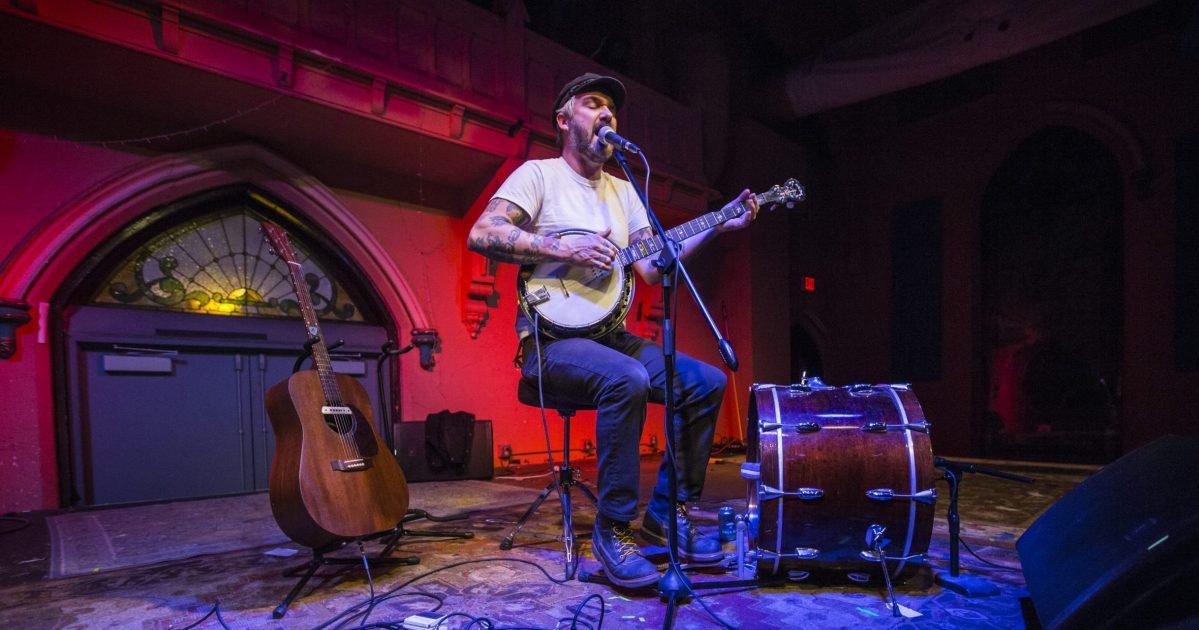
On ‘I’m With You,’ William Elliott Whitmore Puts Family Wisdom to Use

Over the last few years, William Elliott Whitmore has been thinking a lot about how we – as individuals and as a society – have a tendency to repeat our mistakes, and how we’re always trying not to. Yet the tone of his new album, I’m With You, is still infused with optimism, which often stems from the wisdom he’s learned from his family.

I’m With You is Whitmore’s first album of new material in five years, though its material wouldn’t sound out of place alongside his early songs like “Old Devils” or “Don’t Need It.” As always, his banjo and guitar are central to the album’s sound, while his raspy singing voice remains an effective tool at getting his point across.

Though the album does have some heavy themes, Whitmore often points out the silver lining in a situation, and moreover, he’s comfortable chatting up a stranger — a trait not uncommon to the Midwest. He spoke with BGS by phone from his farm in Lee County, Iowa, where he’s quarantining with his wife and their six-month-old baby.

BGS: There are several family relationships that you reference in the album’s first song, “Put It to Use,” and you’ve had family members as characters in your songs for a long time. Why is that bond with your family so inspiring?

Whitmore: Yeah, the bond with my family has always been inspiring. I’m pretty lucky in that I’ve got a big family that’s close by. Aunts and uncles and cousins. My folks were great people, full of wisdom and just caring, beautiful people, but through different circumstances they passed away when I was in my teens. So, that’s when I started writing songs, and in fact, that’s what made me start doing that — to codify what they had always been teaching me. And as a way to deal with it and not just go off the deep end. They pop up in songs a lot, and have since the beginning.

I don’t have them here, so I just think about their words of wisdom and lessons. I think we all get those lessons from someone, whether it’s your folks and a grandparent or a neighbor or a cool uncle or aunt. That cool person down the block that introduced you to The Ramones when you were a kid. [Laughs] It’s like, “Hey, check out Black Sabbath!” So you go, “I should listen up.” Not just music, but lessons, and we can gather that from anywhere. “Put It to Use” is about, OK, you’ve gathered all this good information. Now, put it to use. And more than just music — let’s try to love each other.

Was it someone in your family that introduced you to banjo?

Yeah, both of my grandpas played the banjo. One of them passed away when I was one year old, so I never knew him, but I actually have his old banjo. And one died when I was in my teens, and he was a banjo picker from the Ozark Mountains down in Missouri. My folks loved country music. My mom loved Willie Nelson and Charley Pride – those were her favorites. And in fact, my parents’ first date was a Charley Pride show at a county fair.

But [my interest in] the old-time stuff, Appalachia music and Ozark mountain music, came from my grandpa, and he played the banjo. When he passed away, I got his banjo because I was into playing guitar. I was like, “Oh, the banjo… it’s not THAT different than a guitar.” And I inherited all of his old records. He loved Roy Acuff and the Stanley Brothers. Again, it’s getting that influence from wherever you can.

Were those records your gateway to bluegrass? How did you become aware of bluegrass?

Yeah, those records. … He had a lot of compilations with 15 different artists on one record. You’d find out about a bunch of different stuff, like how Bill Monroe pretty much invented bluegrass by playing old-time music faster than everybody else. [Laughs] And the subtle differences between that and the old-time, slower stuff. A lot of it does have to do with tempo. The feeling is there for all of it, but Bill Monroe kicked it into that next gear.

It’s this whole rich history that’s really cool, and there’s still a lot to learn about, too. So I took that bluegrass influence, but I also liked Minor Threat and Bad Religion and Public Enemy, growing up in the ‘80s and ‘90s. There’s a theme running through all of this — punk and country and bluegrass and blues. Using simple tools to convey a message. No matter where you come from or what color you are, there’s a way to do this.

One thing you do well on this record, in my opinion, is setting the scene. While a lot of songwriters write primarily about themselves, or about love, you are writing about what’s around you. When did you become interested in environmentalism, for example?

That’s a great compliment, first of all. I’m right here on the farm I grew up on, and I’m very lucky to have that. So, the woods and nature and planting gardens — my folks were both naturalists. They wouldn’t have had the word for that, but they loved the land and they appreciated nature. That was passed on to us kids, the appreciation for the trees and the plants and the deer out in the field, and how we live among them and we’re part of it. We’re not above them. The grass in the meadow, the flora and the fauna that we see all around us, we’re just a part of that.

So it just doesn’t make sense to me, as an adult, why anyone would want to pour oil in the water, or level a whole forest, and cut every old-growth oak tree in the forest, just for the money! You want to live in harmony with nature, and sometimes you do have to cut a tree, but you want to be selective and do it in a smart way. … There are so many ways to do it mindfully. That’s my slant on it, and it all comes from living in the woods and living on a farm, and being instilled with those things at an early age.

Listening to your older records, I was struck by how much your singing voice has become more commanding. Did that come from you having to sing on stage, and use it as an instrument? At what point did you sense that your voice was becoming stronger?

That’s another great compliment. I didn’t even know if it was, but you know, it’s funny how things change over 20 years. I first started touring — gosh, it’s been over 20 years ago now. I used to smoke a lot of cigarettes and a lot of weed. … Well, maybe don’t write down “weed.” Oh, whatever, I don’t care. I just had a fucked up voice, but it was all I had. I was like, I wish I could croon like Dean Martin and Morrissey or Ralph Stanley, and have a beautiful voice, and I could never quite get there. So you just work with what you got, right?

So, I quit the cigarettes – and only the cigarettes. [Laughs] My voice changed after that, maybe, but it did come with playing a couple hundred shows a year, for years, and just being on stage, at least in the beginning, where they didn’t know who you are. It’s hard to be a presence when you’re by yourself. I was doing a lot of punk clubs and DIY spaces and bars, where they might not even care that you’re there. So you do have to make your presence known. I had to be more commanding. I am a loudmouth anyway, so it was natural. Put a microphone in front of me and I’ll make you listen! [Laughs] “I’m gonna start singing and you’re gonna wanna listen!” was my attitude, which is funny now.

But that did help me use it as almost a cudgel. Over the years, I’ve tried to sharpen that and make it more of a surgical thing and not a blunt instrument. [Laughs] I mean, I’m only dealing with guitar, banjo, and voice, and a beat — a kick drum now. Each one of them has to count. Any would singer would tell you, you take the time to write these lyrics, and in a live setting they just get lost. You’re just hollering. You have to learn to cut through. … Now it’s a bad habit to break because I’ll be singing in a quiet place, where everyone’s sitting down and listening and no one’s talking, and I’m just yelling like someone needs to hear me ten miles away. It’s those years of screaming over a bar room. I can’t shut it off.


Photo credit: Chris Casella