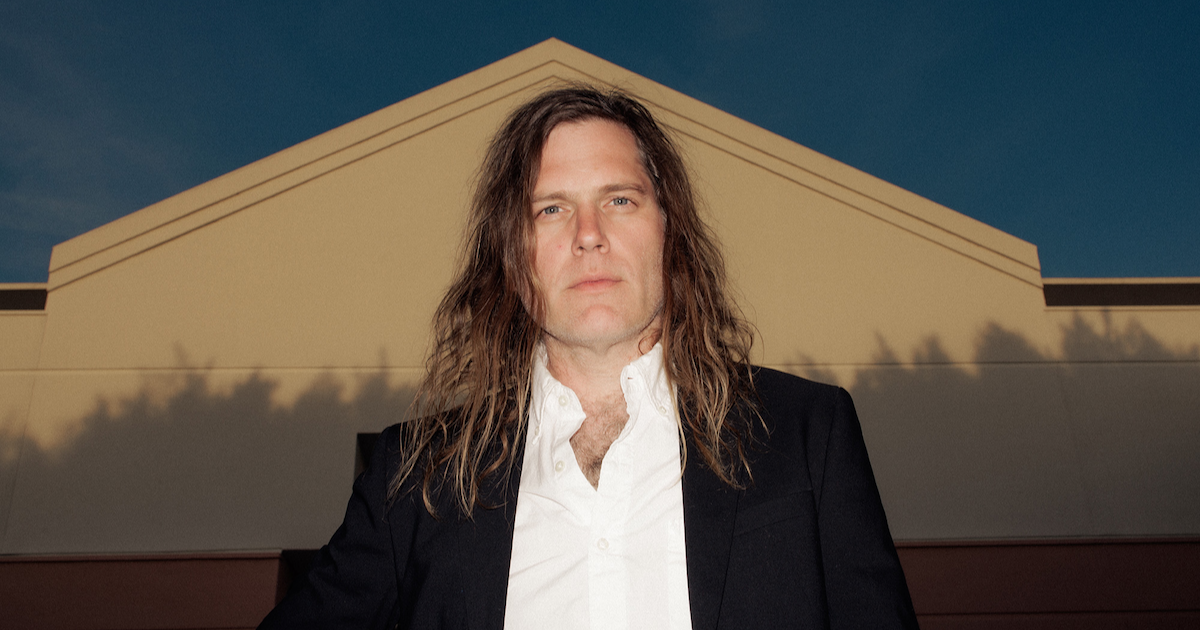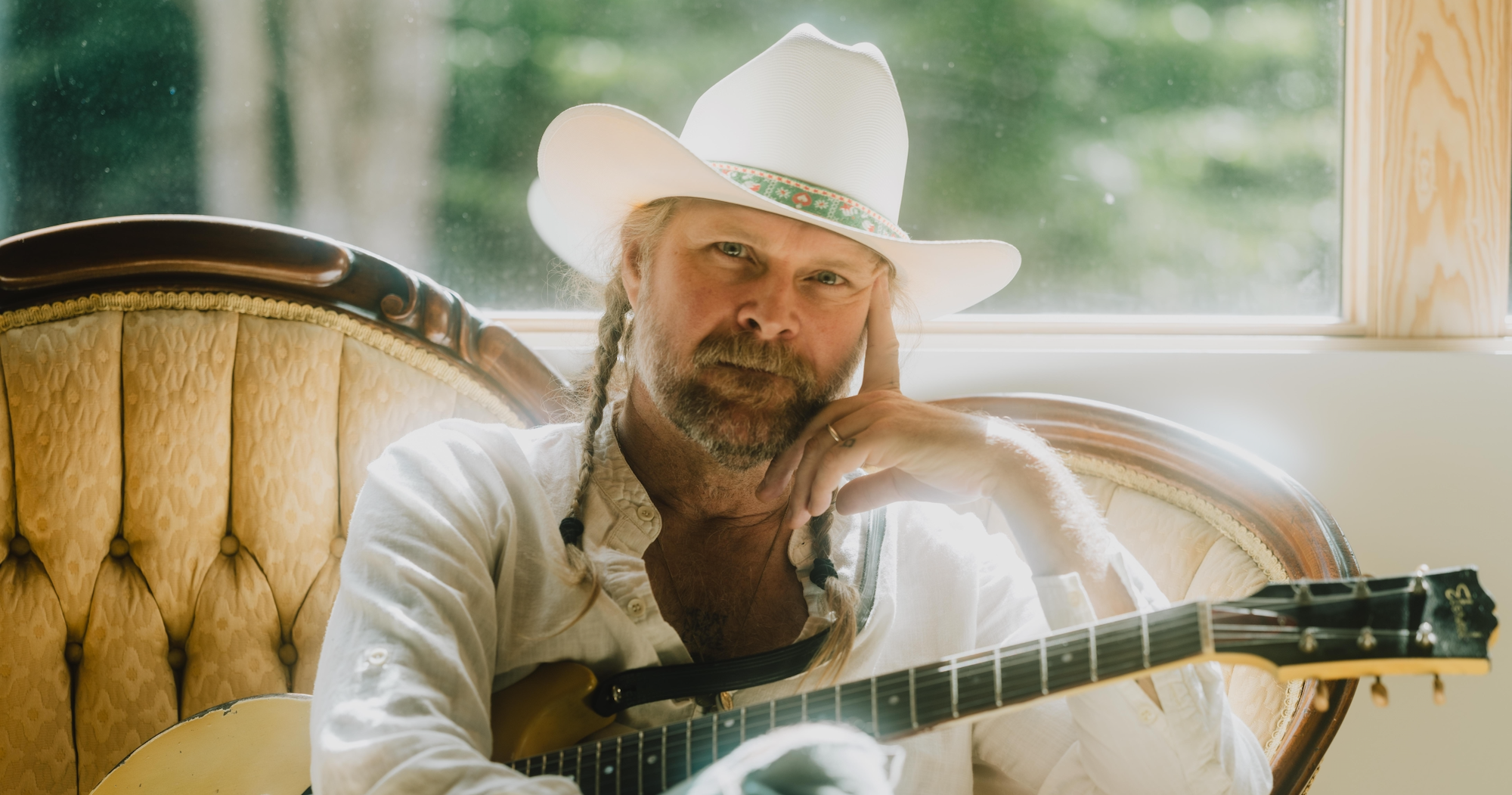
The Expansive Universe of Hiss Golden Messenger

Next year, singer and songwriter MC Taylor will have been leading Hiss Golden Messenger for two decades. For most of that time, critics and listeners have relied on a few familiar narratives about Taylor: that he is a singular figure, for example; or that his move from California to Durham, North Carolina, marked a formal shift from punk to Americana; or even that he thinks slightly more than he feels. Talking to Taylor, from his home in Durham (well, there was a Zoom call involved), I found these cliches about his practices were limiting, factually accurate but emotionally untrue.

Instead of laser-focusing on one narrative, on telling the same stories over and over again, listening to Taylor speak, I encountered a new understanding of his practice, one which placed Taylor in the background and moved his bandmates and genre-play into the foreground – shifting from the centrality of a singular figure to a greater emphasis on generosity and expansiveness.

That the new album is called I’m People is the first clue that Taylor wants to expand the perception of his music; it’s a title that considers mutuality as central to the enterprise of musicmaking. So, how does one expand this thinking – one could consider him geographically or complicate these tales of origin, or think about who is playing on this record, or even refuse the standard narratives of genre.

Instead of focusing on the fact that Taylor began playing in hardcore bands in California, think about the other influences: that he played in a band named after Joni Mitchell’s Court and Spark, an album marked by an urbane distrust of other people’s desires. Or that, around the time he was carefully listening to Mitchell, he was also following that most American portable utopia, the Grateful Dead. Or think about his move to Durham, not strictly to play in a band, but to study folk music academically.

Or, consider how this album was recorded – at least partially – in upstate New York. A more cynical writer would note that Taylor borrows from Dylan’s Nashville Skyline, and that album itself was the foundation of a more isolated, lonely understanding of tradition after abandoning folk music, seeking a slightly more commercial understanding. Recording this in the Hudson Valley could be considered a pilgrimage or homecoming.

I don’t think that it is a homecoming just for Taylor; the record sounds lush, expansive formally, too. Perhaps because the people who sing or play on this record play in a collective of other bands, including Rhett Miller, the Mountain Goats, Bonny Light Horseman, and the Hold Steady.

The expansive nature of the band is not only connected to the history of music they listen to, or the other bands that they play in, but also more unexpected influences like Sade. The idea that Taylor is the band is false, and it is not even that Hiss is the band. Taylor expands the possibility of Hiss, but Hiss itself pushes the possibilities – because of where they come from, their other projects, and even the possibility of geography. Not because Durham is magically a place where music coalesces, but because for a long time it was a college town where rent was relatively cheap and lots of people liked playing music together.

When addressing genres, the promotional material calls the album Americana – but Americana is a useless category, one which might be country or folk or something else entirely. I’m People has a kind of intense richness that is neither of these genres. Listening to the LP, something happens where the expansion or fracturing of those playing on this record becomes its own kind of post-genre.

There are a lot of reasons not to love America right now, but emphasizing the American instead of Americana allows us to consider this album as a consequence of the totality of American music – Taylor addresses the improv nature of jazz as part of this, or traditional folk music, or even 1970s easy-listening. He speaks fondly of the detective novels of Elmore Leonard, and on at least one of his early albums the photography of William Gedney became a powerful totem.

I think of I’m People as a kind of ebbing and flowing for and against tradition, part of that decades-long wrestling with aesthetics and history. Consider the last song, “Depends on the River,” is another of his great songs about waterways. In a 2016 profile of Hiss, New Yorker critic Amanda Petrusich wrote about Hiss’s long tradition of river songs and how it fits into a century of metaphors from blues singer Geeshie Wiley to Joni Mitchell, working this tradition. Petrusich writes: “Taylor frequently evokes river imagery in his work; the river, of course, can be understood as its own kind of road, a direct line to somewhere else, far away.”

I don’t know if that’s wrong, but I also think about rivers as they turn into oxbow lakes, rivers which flow into swamps – literally bogged down – rivers that flow into oceans, and rivers that dry up depending on the season. Hiss’s meandering, deepening quality depends on that river, both the direct line that Petrusich talks about and the larger metaphor, one where Taylor literally talks about whether he dares to cross it. On I’m People, he not only crosses it and crosses it again, but brings along a whole community of other performers. And, an audience who is hungry for the difficulty and ambivalence of so much time playing – and thinking – with him, to the other side.

I know you have a degree in folklore studies, I also noticed that in the last few years there has been a cluster of second- or third-generation performers who have some academic training in folk traditions (see also: Jake Blount, Jake Xerxes Fussell, Willi Carlisle, etc.). Can you talk a little bit about the kind of intersection of formal and informal folk studies and also about your relationship to people who are making this kind of work? I’m thinking about the line on the song “Mercy Avenue” where you talk about the “boys on the corner knowing more than those with PhDs.”

MC Taylor: Well, it’s been a really long time since I was in the academics here. And that universe was one that I feel like I passed through briefly. I wasn’t destined to be in that realm forever. So, I’m not sure that I can totally speak to [that]. Like the place of academic/creative work.

I will say that my time in that space was a really good time for me, when I was restarting my brain and re-centering myself. School was a good way for me to step away from whatever I had been doing previously. I did a lot of field work at that time. I interviewed a lot of people, and I think that it made me a much better listener.

I think that, more than anything else, [that] is what I came away with, this feeling that people really, really like to be heard. So I think I just really tried to develop my listening skills.

Can you talk a little bit about working with a band – especially this band – and about how the bandmates are part of their own creative worlds? Is there a kind of politics there, or a kind of community making?

The basic tracking of the album was done with JT Bates playing drums and percussion, Cameron Ralston playing bass – both electric and upright – and Josh Kaufman, who was producing the record with me, playing guitars, mandolin, piano. My friend Chris Boerner was engineering the record. He plays guitar.

The road version of Hiss Golden Messenger, you know, [are] involved in a whole variety of things. JT, Cameron, and Josh play in Bonny Light Horseman. All three of them have also at various times been members of Hiss and have toured with Hiss. And in fact, that’s where those guys met – playing in Hiss. All of us have known each other for many, many years, so I consider those guys really good friends.

But we’ve never made a Hiss Golden Messenger record before. … They’ve worked on [other] records [together], but we never came together to create a Hiss Golden Messenger record together. It was this funny and unique situation in which we were already old friends, doing something that felt new and fresh. It didn’t feel like a complicated record to make for me. I think Josh Kaufman maybe would say the same thing, but Josh was performing sort of a different task than I was in the situation. It was a complicated record to write, but that was something of the solitary endeavor that took place over probably a year or a year and a half.

I really love those guys and I am delighted that they could be there to play on the record. I think of them as absolute top-tier musicians, every one of them. Cameron is currently playing with the Mountain Goats, he plays all kinds of jazz, he plays in the Spacebomb House Band. JT Bates plays drums with Big Red Machine, which is Aaron Dessner and Justin Vernon. And [he’s] just a legendary drummer in Minneapolis. Josh Galvin plays with everybody.

There are some songs on this album about hope and I wondered about making work about hope in this specific social and political moment? “Shaky Eyes” or “Heavy Worlds,” for example.

[I am interested] in how we [have] the energy to get through the messiness of life. And not only this particular time that we’re living through – although that is the most depressing. But just like life in general. I don’t think that we can do – or I don’t think I can do – life alone. So, in a way this record is me writing to myself. Maybe now [about] how important other people are.

I think I realized that the most important part is moving through, and needs to involve being around [other people]. Over the past few years, just speaking personally, the idea of community has felt like a more and more important part of it.

Thinking about that – and how dense/lush the production here is – though you are marketed as “Americana,” I wonder about how you view genre. And also how your band does – I’m thinking about background vocalist Annie Nero’s bio for radio: “She loves to find the common thread between musical ideas and genres…but also break free of genres because life’s too short to limit ourselves based on perceived taste!”

I listen to lots of different stuff. I think all of that stuff finds its way into what I’m doing. It’s a little tricky. I used to have a stronger stay-in-your-lane [attitude] about the term “Americana,” but I just don’t think that I care very much anymore. It’s not a word that I generally use. But I understand why it exists. Many of my favorite songwriters exist in that world.

What would you call your genre then?

I mean, I wouldn’t. I guess that’s what I’m saying.

Like, if I was at the dog park and I was talking to a stranger, and they said, “Oh, you’re a musician? What kind of music do you play?” I’d probably say, “Kind of rock and roll.” I generally am not describing my music in terms of genre, I guess. If I told someone that I played rock and roll, and they asked me to extrapolate on that, I would say something like, “Rock and roll that’s really swinging.” I try and concentrate on the rhythmic elements. I love singer-songwriter type music from the ’60s and ’70s. I like really oddball stuff. I love Bruce Ruffin reggae; I love free jazz. There’s a lot of music that I have inside of me. There’s a lot of music that Josh, Cameron and Chris – [that] we all have inside of us. I think it’s just a question of how we get it out and put it into use in a way that feels genuine and not forced. …

Thinking about the tension on this album between distinct geographical spaces and a more universal emotions – for example on “Seneca (Time is a Mother, Baby)” or “Mercy Avenue.” And also that becomes a larger theme of your work, thinking about how Amanda Petrusich writes about your decades-long commitment to writing about rivers. There’s even the river song on this album. What do you think your relationship is to the land, to rivers – especially. when you sing “Depends on the River.” Or is there specifically one river?

On previous Hiss records there are specific geographical places like city names mentioned. And not only are those places part of the fabric of the story that I’m trying to tell, but they sort of served as poles, maybe? What I’m trying to accomplish is sort of like a poetic travelog of my life growing up in America. I’ve been traveling as a musician since I was 18. I have been, it seems like, everywhere in this country – more than once or some places 10 times. I’ve been all over every highway. So, maybe the dimension of place names throughout is sort of like carving my name on a tree or something. It’s just kind of like, “I was here.” “This is where we are in this song right now.” “This is where we are in my life.” And then, “Now we’re over here.”

In terms of rivers, a river is always flowing, always changing. A river can kill you if you’re not careful. It can keep you alive and get you to the next place if you treat it with respect and understand its rules. The coda on that song, [“Depends on the River”], the last thing that we hear on the record is “the line depends on the river exactly.” I guess the meaning depends on what river of life we’re talking about. It depends how lucky we get.

I’ve always been impressed by the wide range of your reading, listening, and looking. For example, your careful thoughts on the photos of Gedney. What are you reading, what are you listening to, what are you looking at these days?

Well, you know what I’m reading right now? I’m like about 200 pages into this Gary Stewart biography. Gary Stewart, the country singer. It’s called I Am From the Honky-Tonks. Gary Stewart actually was someone that Chris Smith from [record label] Paradise of Bachelors turned me onto like 15 to 16 years ago. Those of us that are obsessive about him all knew that this book was coming. It’s finally out and yeah, if you’re Gary Stewart fan, it’s kind of like you can’t believe it exists. I’ve been waiting for it.

In terms of what I’m listening to, I’m always listening to all kinds of stuff. I just bought this record [that’s] The Sun Ra Arkestra doing Disney themes. It’s so beautiful, really makes you think about those compositions in a different way, [about] actually how deep they are. I’ve been revisiting some Ted Lucas. I’ve really been liking this McCoy Tyner record called Asante. It’s a 1974 record; might be my current favorite. It’s very deep in the zone with like Alice Coltrane and Pharoah Sanders – that era. Oh, it’s beautiful. [I’ve been listening to] some Paul Brady from ‘78. He’s amazing! I’ve been listening to Welcome Here Kind Stranger. [Also] a record that I was checking out for a while [was] by the Universal Liberation Orchestra. It’s kind of this weird, very minimal– I guess it would be jazz.


Photo Credit: Graham Tolbert
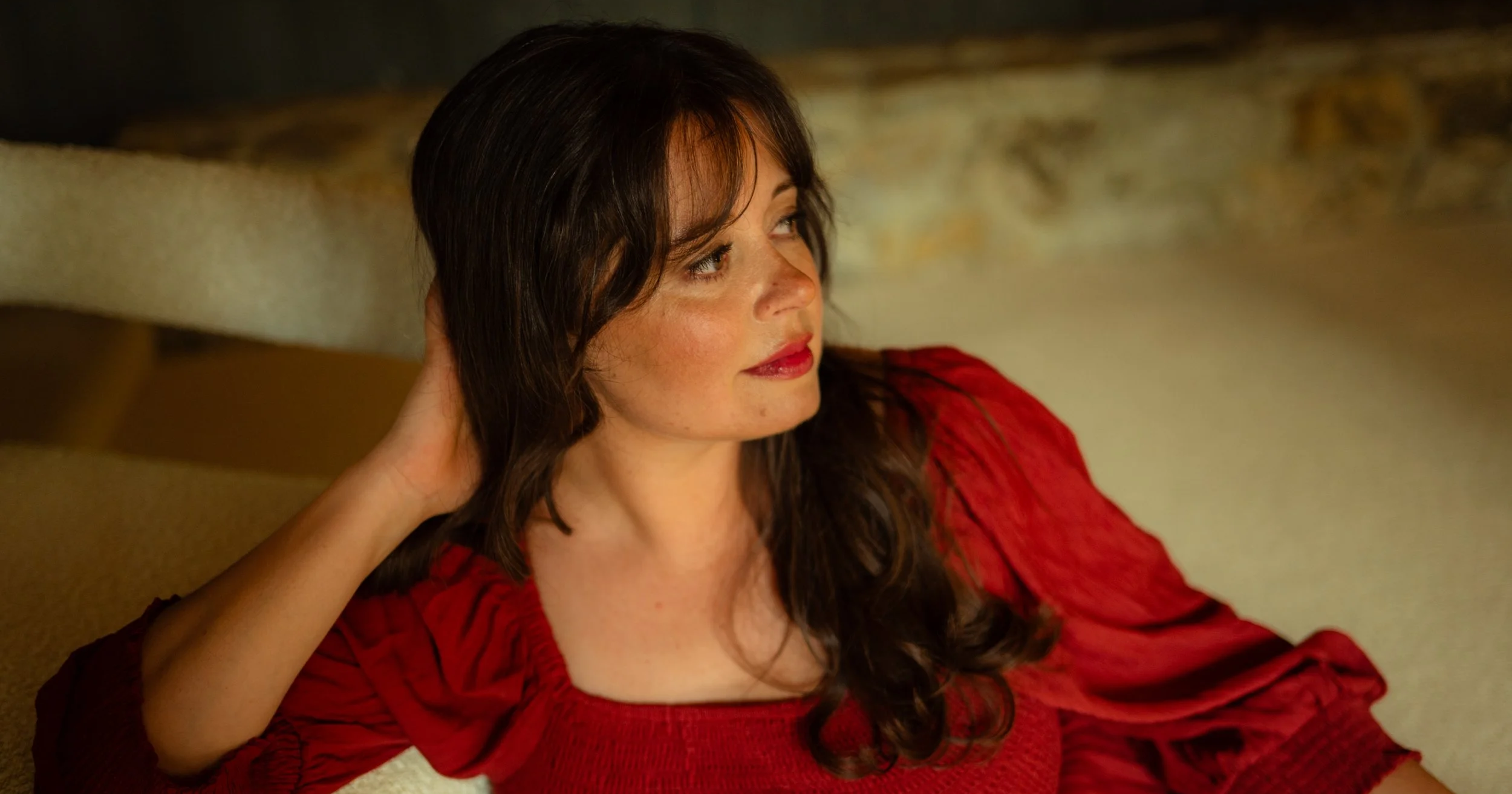
Emily Scott Robinson Stays Hopeful Through the Thick of It

Before embarking on a music career, Emily Scott Robinson worked as a social worker. The two occupations, she says, really overlap with who she is as a person. Talking from her home outside of Telluride, Colorado, Robinson shares that being a performing artist and playing shows has “a similar quality of service to it and connection that being a social worker did…”

“One of the things I loved about being a social worker is being able to help people,” she continues. “[Music] brings me a lot of joy and purpose. I get so much feedback from people that my songs help them. That’s the most important and meaningful thing that my music could do in this lifetime.”

On January 30, Robinson will launch Appalachia, her third release on Oh Boy Records and her fifth album overall. Its 10 tracks reveal her uncanny knack for conveying empathy, comfort, and compassion through a set of songs that explore topics such as a friend’s suicide, a grandparent’s death, her own divorce, and the destructive effects of Hurricane Helene on her home state of North Carolina.

Robinson recorded Appalachia with producer/musician Josh Kaufman (Bonny Light Horsemen, Josh Ritter) in late April and early May of 2025 at his Dreamland Recording Studios, near Woodstock, New York. Having loved his production work on Anaïs Mitchell’s 2022 self-titled album, Robinson wanted to work with him. “I want to make my version of what [Mitchell’s] record is,” she explains. She was thrilled that Kaufman not only was available to produce the album, but was also very excited about working with her.

Robinson’s road to becoming a singer-songwriter began when she was 14, when she went to a “super hippie summer camp,” as she describes it, in northern Michigan. There she fell in love with acoustic music she heard the counselors play at night during “mellow time” – songs by folks like Cat Stevens, Joni Mitchell, Dar Williams, and Ani DiFranco. After camp ended, she learned to play her mother’s old classical Yamaha guitar. Robinson loved to sing, but only played cover tunes whenever she would perform at coffee houses and open mic nights.

Her life changed, in many ways, when she took a Planet Bluegrass Song School workshop in 2014 while working as a social worker in Colorado. Besides learning about the art of songwriting, Robinson also discovered how to make a living as a musician. She quit her social worker job the next year and didn’t look back. “I felt such a strong sense of connection and purpose when I sang for people. Their response was so powerful, and I just thought this really feels like something I should pursue.”

That Robinson has a gift for words feels like a genetic inevitability. Her mother worked as a journalist and her father taught English. As she describes it, Robinson learned how to tell and edit a story from her mother, and how to write in a direct and active style from her father. “My parents taught me how to write… that stuff is burned into my brain,” she states. “I’m my parents’ child.”

2026 represents a significant career moment for Robinson with the new album arriving in January and tours crisscrossing the U.S. throughout the year. She took time out from a snowy winter morning to speak with BGS about Appalachia and the roads she took to make her album.

It has been several years since your last full-length album, 2021’s American Siren. How did this album come into being?

Emily Scott Robinson: It took me about four years to write this record. These are the songs written in the aftermath of a lot of upheaval and change in my life. I went through a divorce in 2021 and then moved away from Telluride the next year. And even though I didn’t move that far – I moved about an hour away – I left the only community that had really been home for me for about a decade.

And there were a lot of endings that felt really sad. Both my grandmothers passed away. [But] I also became a parent. I am now engaged to my partner, who has a nine-year-old son. And that has been amazing. So, my life kind of completely changed. These are all songs written in the thick of that – and [the] surrender and joy and grief all happening at once.

Was there a song that really kickstarted this album?

The first song I wrote for this album – and then it was the only one I had written for like a year and a half – was “Hymn for the Unholy,” which is, of course, the opening track. And that felt like my anthem. I wrote that song [when] I was going through this divorce. It was New Year’s Eve and I just couldn’t even fathom this whole movement of setting plans and goals for the new year when so many things felt like they were ending or becoming really unsure for me. It was the only new song I had for quite a while. And then, in about the last year and a half, I wrote almost all of the rest of the songs.

“Appalachia” I wrote right after Hurricane Helene hit Western Carolina. There were a couple songs that I wrote at a writer’s residency in Texas, [including] “Time Traveler” about my grandmother who passed away. I wrote “Cast Iron Heart” on another songwriting retreat. “And Bless It All” was really one of these songs that emerged that I wrote really quickly, like an homage to this chapter of life [about] raising a kid [and having] parents aging – like my generation is now doing the same.

“The Time For Flowers” is a song that you had for a while. How did that find its way on the album?

“Time For Flowers” is on here because it’s a song that has never lived on a full album. A lot of my fans would come up to me after shows and go, “Which record is ‘Time for Flowers’ on?’” … I released it in 2020 in the summer [during the pandemic as a single] and it grew legs and traveled far and wide. People started to perform it at funerals and with their choral groups and they started to sing it in church and ask for arrangements. It became a song that meant a tremendous amount to a lot of people.

I put a lot of heart and a lot of craft into that song. But the song has taken on its own life and that’s really beautiful for me to be a part of. And it means a lot again in 2025, to people who are living in what feels like an increasingly dark time. I wanted to put that on the album and to sing it in the way that I perform it at my shows, which is just acoustic.

I felt like, on this album, there was a feeling of expressing compassion and forgiveness and reassurance. A message of “finding a sense of strength” not only for yourself, but for listeners as well.

The one cover on the album is “The Water Is Wide” and I was wondering why you chose that old folk song to include.

I love that you wondered that because, to be quite honest, I felt a very strong instinct to put this song on here and I didn’t really know why. Sometimes I just feel a deep sense that needs to happen and so I just trust it and do it. I love that song and I had planned on putting it on there. I think, if I were to explain it on a more logical or grounded level, I would say that I felt that song – as old as it was – still speaks in both a deep and a fresh way. The lyrics strike me as being fresh and a little unusual every time. And it felt very timeless but also fresh, and so I just was drawn to it.

Sometimes I write a song, or I put a song on the record, and I just go, “I will find out later why I had to do this.” But, genuinely, I’ll find out along the way why it is that that song begs to be on this record. Also, Josh Kaufman, my producer, was so excited when I told him I wanted to put that song on there. He loves old folk songs and making them feel a little bit new or breaking them down a little bit and rebuilding them. And so do I, so it just kind of felt like it fit.

“The Fairest View,” which follows “The Water Is Wide,” closes the album. It holds an old folk song vibe although listening to it, you realize that it’s not.

“The Fairest View” was actually not a song that even existed until the last 24 hours that we were in the studio. My friend [songwriter Lizzie Ross] and I have a mutual friend who died before we were in the studio together. He really loved music and had grown up in Western North Carolina. He died by suicide and we were really writing this song for him, and to him. … We finished it the night before the final day. We were in such a great groove of creative flow that this just made total sense

I sent [Josh Kaufman] this voice memo. I think it was like 11:30 at night. I was like, “What do you think about putting this on the album tomorrow?” And he goes, “I dig it. Let’s do it!” He said that there was nothing really like this on the record, but it felt like it still fit sonically, lyrically, and melodically.

What were the important contributions that Josh Kaufman brought to the recording process?

Really the magic of working with Josh – the thing I love the most – is when we first had our first conversation. We were talking about how we work in the studio and he said something along the lines of, “You know, you play the song and we all start just kind of experimenting and playing around on instruments. We’ll know it when we find it, because you can hear it and you can feel it in your body when you have found the thing.” And that for me is exactly how I work creatively and in the studio. I’m comfortable with that kind of workflow and so I was like, “Yep, that’s exactly how I want to work.”

There is a wonderful intimacy to your vocals. I got the feeling I was sitting on a couch and there you were singing from just across the room.

D. James Goodwin, who is the [album’s] recording engineer and who mixed the record, created a specific reverb treatment based on the room in Dreamland, based on the actual recording space. … He started to measure the exact EQ and decay of all these different points in the room and then created his own reverb setting that he calls “the Dreamland reverb setting,” which is just meant to sound exactly how it sounds in the room.

You do a great duet with John Paul White on the track “Cast Iron Heart.” How did he get involved on this project?

John Paul White is a great interpreter of songs, because he doesn’t put too much on them. This is like an acting principle, which is “the more you’re trying to act, the worse it is.” But if you’re allowing the song to come through you, and you’re not getting in the way of that and you’re being honest to that song, then that’s when the powerful performance really happens. And John Paul is experienced enough to really know that.

I knew that I couldn’t have somebody with a fully polished country voice singing this. I wanted it to sound like somebody who had lived. I know John Paul and I know that he has lived and he has a family and he’s been making music for years. He embodies the person singing the song – the actual voice of the narrator of the song – and it was such a gift that he said yes to this. He’s the sweetest, most generous artist and human, so that’s how he got involved.

This is your third release for Oh Boy Records – how did you get involved with them?

I got a message from Jody Whelan [head of Oh Boy Records and John Prine’s son] and he said, “We’re really big fans of yours at Oh Boy and if we can ever help you in any way let us know – we’d love to work with you.” And I was like, “Did I just get offered a record?”

I reached out to Jody and I said, “I would love to talk to you. I have a record that I’m about to make and we should connect.” I’m a huge fan of Oh Boy and John Prine. I signed a fantastically supportive and artist-friendly record deal with Oh Boy. And I go on the record to say that as often [as I can]. … I genuinely hit the jackpot when I signed the deal with Oh Boy. I love working with them. Their heart has been, and always will be, in the right place. I’m really, really lucky.

Are there things you hope listeners take away from the new album, or from your live performances as well?

I hope that people do feel fortified, encouraged, and hopeful when they listen to these songs because this record is about finding those bright spots and finding that hope in the thick of all the other parts of being a human. It’s about leaning on other people and finding that in relationships and in community. I also hope that this record will comfort people who’ve lost somebody they loved recently.

I want this record to be of service to people. I want it to reach them in ways that they need to be reached. I don’t want people to give up hope in this time in history or this time in our country. I don’t want them to give up hope in themselves and each other.

I think we’re increasingly in a corporate media landscape and a very engineered social media landscape that has a lot of voices that say there’s no hope; there’s no reason to fight, it’s too late. And I think the social worker in me and the political activist in me wants to yell, “That’s fucking bullshit!”


Photo Credit: Angelina Castillo

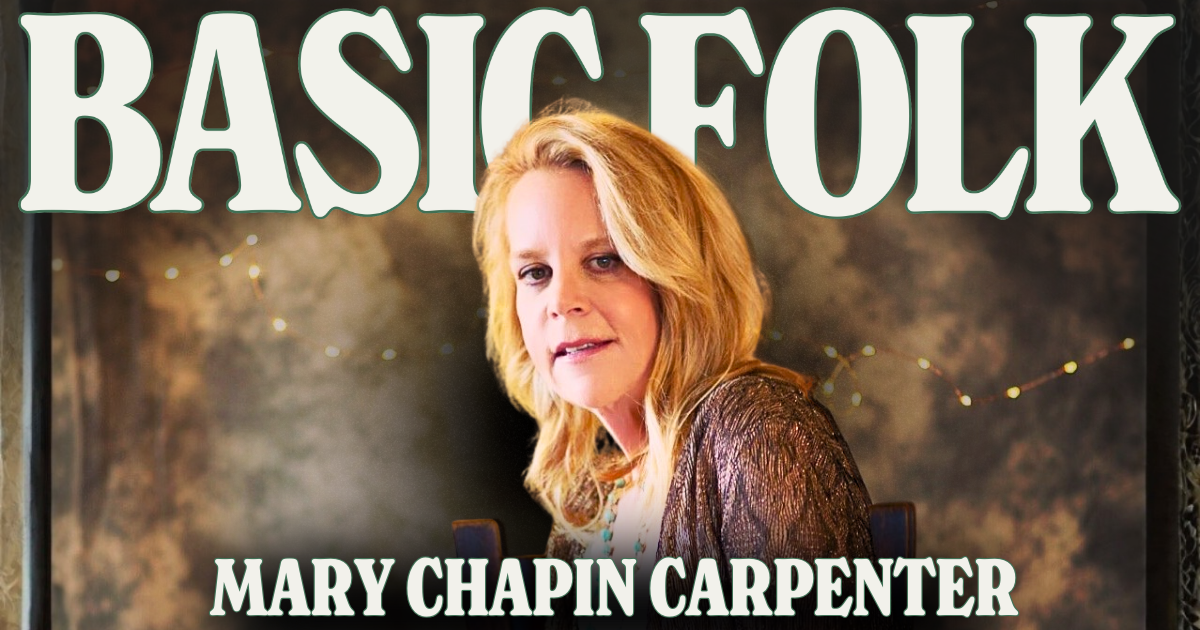
Basic Folk: Mary Chapin Carpenter

Mary Chapin Carpenter’s latest album, Personal History, is as lush in production and color as the beautiful farmland she calls home in Virginia. Carpenter will often wake up early for sunrise walks with her dog, Angus, and one of several daily cups of coffee (of course) to start the day. In our Basic Folk conversation, she reflects on how living in this serene farmhouse has brought her peace, drawing parallels to Carl Sandberg’s “creative hush.” Mary Chapin also discusses her method of “song walking” as a tool to overcome writer’s block, often accompanied by her pets.

LISTEN: APPLE • SPOTIFY • AMAZON • MP3

Carpenter goes on to touch on her evolving relationship with fame and the importance of surrounding herself with grounded people; she reveals her younger self was shy, and talks about how being less concerned with others’ opinions has empowered her over time. We cover her connection to the Celtic music community and how it inspired her collaborative album Looking for the Thread with Scottish musicians Julie Fowlis and Karine Polwart. That record was her first with Josh Kaufman as producer and it worked so well, she decided to have him produce her new solo album, too. We also chat about “hyphen-gate,” due to her double first name, the process of feeling visible and valued, and the impact of Elizabeth Strout on her perspective of songwriting.


Photo Credit: Aaron Farrington

Fruit Bats’ Eric D. Johnson
Loves a Left Turn

The road less traveled is always the road most traveled by singer-songwriter Eric D. Johnson, better known under the performing name of Fruit Bats. Johnson thrives in a world of creative dichotomy: he loves deadlines as much as he cherishes random twists and turns in his process.

He’s been making music this way for years, since time spent on the Chicago music scene, through his days with Califone, The Shins, and the creation and continuation of Fruit Bats. There’s also Bonny Light Horseman, the indie trio where he partners with renowned musicians and songwriters Josh Kaufman and Anaïs Mitchell. Their most recent album, Keep Me on Your Mind/See You Free, was released last year.

Johnson’s latest Fruit Bats project is Baby Man, a full-length album recorded earlier this year with longtime producer and friend Thom Monahan. The album is a reunion of sorts, after Johnson self-produced 2023’s A River Running To Your Heart.

Baby Man, which is his voice, guitar, piano, and little else, was an unexpected project – another deviation from original blueprint onto the less-traveled road. And one that called for Monahan’s expertise and sonic touch. The outcome, says Johnson, is “intimate and yet big. There wasn’t a lot of fuss over arrangements. Everything you hear came out of my hands or mouth earlier that day or the day before.”

It was early morning on the West Coast when Eric D. Johnson settled in to speak with BGS. “This is my second interview on this,” he noted about Baby Man, “so you’re hearing me work this out in real time in my brain.”

You have detailed this many times: iPhone voice memos, demoing, writing, the studio as a writing tool. You like a deadline, you like mistakes, you like left turns. Was this album true to method?

Eric D. Johnson: Yes. This was the leftiest of all left turns you could possibly take, because the original plan was a very lo-fi hair-metal covers album. [It was] basically a midterm project between album cycles.

During the pandemic I had done this full album cover of Smashing Pumpkins’ Siamese Dream. I had no real expectation for it other than a pandemic exercise/fun sort of bedroom thing and it hit a little bit. Everything I do is ambitious in some way, but this was a “throw something at the wall” idea originally and not a big deal.

I was talking to Thom Monahan, my producer/mentor. We hadn’t worked together in a few albums, although we’re still dear friends. I always talk to him before I make something, which is like, “What microphone do I put on this?” I’m asking all these questions, we ended up chatting for an hour and by the end of the conversation I was like, “I think you should do this record.”

This was all over the course of a very short amount of time in February. I started writing songs and I realized I was starting to do what I do, which is write a diary. Most of my records, songwriter-wise, are what’s happening now.

This record turned into something that was me and Thom working for probably a week and a half. It wasn’t a mandate I laid down, but the whole record was written and recorded in that space, which I almost never do. It’s usually fragments of things I’ve been putting together from notebooks or demos or sketches that are a year or more than a year old. So everything you hear is a week in the life.

When we delivered it to the record label [Merge], again thinking it was a midterm project, they were like, “This is really good. This is a real album.” So the hair-metal covers record will happen someday, but instead you get Baby Man.

How has your working relationship with Thom grown and developed?

If I had a breakthrough album, it’s probably Gold Past Life [2019], which was my last thing with Thom before this. I think that was us at the height of our language with each other in some ways.

I’ve learned everything from him. When we were first starting to work together, on Tripper [2011], I was just learning how to use Pro Tools and how to use the studio as a tool for writing. I would make demos and Thom would come in with a blowtorch on them, because I didn’t really know what I was doing yet.

We made a couple more records, and by the time you hear the stuff on Absolute Loser [2016] and Gold Past Life, if you went back and listened to the original demos, they’re surprisingly not that different. That’s Thom trusting me more, being like, “This sounds pretty good.” Obviously he adds an incredible boost to them. There are songs on that record, too, where Thom completely dismantled them and was like, “This sucks,” because he’s not afraid to tell me he thinks something sucks. Which is good. You need the extra pair of ears. So we kind of have a shared mind when we’re working together.

What have you learned from Thom that applies to your own production work? For example, Sarah Klang’s Beautiful Woman album.

I don’t do tons of it, but when I produce other artists, it comes from that demoing process I learned from Thom, where you go from skeleton of song, to demo, to studio project, to finished product. With Sarah, we worked together as writers first. When you write with me, and this has happened a couple times, we’re making demos and we realize, “We’re making a record now.”

That was what happened with Sarah. It was very similar to what Thom and I do together, which is me building a demo and then giving it to him. But in this case, you build a demo, you keep building it, go into a nice, big studio, and all that. So that was what that was about. It started off as a writing session and it snowballed into a record.

You’re taking Baby Man on the road. Alone. Could you strip it down any more than that?

It’s terrifying. I have no idea what to expect. Fruit Bats concerts have become big, rollicking rock shows. The audiences have grown and people have a good time. I think of it as a very intimate experience, but as much as we’re in the folk-rock realm, they’re big rock shows.

I’m nervous about this. I’ve obviously played solo shows, and I think I know how to do it, but there is a certain contract you have to have with the audience for that. You can’t just close your eyes and push through it. You have an extra responsibility to connect.

I’m always concerned with that, and not in a bad way. But if I’m playing to 1800 people, in my mind I still want to make eye contact with every single one of them, even though I know that’s not possible. So with the solo show, where it’s a little more intimate, you probably are going to make eye contact with however many people are there. It’s going to be very exposing and I don’t know what to expect.

You’ve said before that Fruit Bats is half your life and each album is like a chapter, a piece of an autobiography. Which chapter is this?

This chapter is … I am hesitant to say midlife, because I don’t know. My cliché answer is, “I’ve gotten better at making myself understood, but I care less about ma king myself understood.” When you’re a younger writer, you’re like, “You don’t get this!” Now I’m like, “You’ll get it, or if you don’t, that’s cool.”

I think I’m writing really well now. The very early Fruit Bats records are enigmatic because I didn’t know how to write yet. I came from indie rock. I came from Pavement. I loved Stephen Malkmus, and he wasn’t writing about feelings. And I had played in Califone, and those are impressionistic lyrics, very visual, so I was doing that.

When I accidentally wrote a love song with “When U Love Somebody” [Mouthfuls], in 2003, it kind of hit. I was never emo. Even though I’m from the emo generation and from Illinois, where all the emo dudes came from, I wasn’t doing emo. Maybe this is my emo period, I guess you could say. With Baby Man, there is that kind of feel. I’m writing some pretty direct stuff, but I still have my impressionistic side that gets smeared in.

Where does Bonny Light Horseman fit into that?

My work with them is not unlike my work with Thom, which is to say, it’s been an education. Josh Kaufman, as a producer, has been influential on my production and the way I approach albums, too, because he’s totally different from Thom.

Of course Anaïs, as a writer, has had a massive effect on me because she’s meticulous. She makes you be like, “What did you mean by this line?” So I’ve learned writing from her, and production and writing from Josh because he writes as well. Like with everything, you take things from it as you move along. I’m definitely “the guy in a band” in that band, the professional guy in a band.

On “Creature From The Wild,” you address pet loss and grief, which is too often met with “Just get another one,” as if the can opener stopped working, so just buy a replacement. Tell us about Pinto and the song.

Pinto was my first dog and, obviously, once you get a dog, the joys, the familiarity of it, and the relationship is really special. And Pinto was a unique dog. He was sort of a person, sort of a cat, but also a dog.

You raise pets and it’s such a foolish endeavor for us; it’s such a horrible thing that we do to ourselves, because we raise them like our children, but they have a lifespan of 15 years and so you have to understand that. You’re right – some people are like, “Get another one,” but I do think a lot of people get it, if they get it.

That was a song I wrote completely while on a run, into a voice memo, at about 10 a.m. The recording you hear is at 1 p.m., three hours later. The notion that they save you, the “for a while” part, is that these love relationships are destined to be fleeting.

I also wanted to write directly about him. He was a Mexican street dog, so I wanted to write a hero story and think of him as a little heroic hobo and it was a little bit of a hero’s journey for him. I was just trying to write what I know. It’s a love song. Grief really is love. My publicist Colette and I had a Zoom call over it and we both cried.

A portion of sales from the track and pre-orders are going to the Baja Street Dogs rescue.

Yeah. Pinto was a Baja street dog, not from that rescue, but there’s tons down there. This guy, this rescue, is like a shepherd. He has a flock of dogs. He rescues so many; the breadth of his work is really impressive. It’s his life’s work, which is fascinating to see somebody do something like that.

We have a lot of big problems in the world right now, which I totally get, and there’s probably bigger fish to fry in some ways than rescuing dogs. But there’s a certain eye-level universality to loving a dog, for me. They help us. There’s always the cliché of “We don’t deserve dogs.” And I’m like, “Fuck no, we don’t.”

You have spoken about music and mental health in the past. You’ve said that while you find your music riddled with anxiety, people say they find it comforting.

In the press materials, quoting, “Again and again, Baby Man sees Johnson ask a central question: Is any of this worth it? The album is the answer, a resounding ‘yes.’” But some of the lyrics … in “Let You People Down, ” it’s “days that I’ve wished that I cease to exist.”

I can say, with all honesty, that’s not suicidal ideation I’m writing about necessarily, even though it sounds like it might be butting up right against that and I’m trying to speak to it. If someone wanted to take that as that, I would allow it, but that’s not… my other publicist, Jim, really loved the record, but his first question was, “Are you okay?”

I’ve lost friends who ended their lives – Neal Casal and Richard Swift, who died from alcohol. In many ways it was a slow suicide, when you drink yourself to death in that way. So it’s some big, grownup shit, but that specific line isn’t about that per se. It’s “This world is hard.” It’s more like, “I wish I’d never been born,” but that’s not a direct nod to ending one’s life, either. It’s about the burden of living, which, like I said, certainly could butt up against something like that. I’ll let people take what they want from it. It’s a song about wanting to love and be loved.

Then there’s “That’s why I’m trying so hard not to die.” [“Moon’s Too Bright”]

Yeah. Again, the line, “I’ve never been good with goodbyes,” and death is the biggest goodbye, so I’m not singing about killing oneself. I’m saying, “Wouldn’t it be sad to leave? Isn’t it sad to leave? Isn’t it sad to say goodbye?”

I’ve always written a little bit about this stuff, but usually there’s a disco beat, which I love. I love the happy/sad nexus, like “A Lingering Love” [Gold Past Life], which has become this kind of pop hit. It’s really sad, but it’s got the “Dancing Queen” beat behind it. It’s the total cliché of “I’m laying myself bare lyrically.” I always have, but I think because of the production, you’re hearing it more.

I’m not afraid to answer you on those [questions], nor am I denying that I’m talking about some pretty heavy stuff in there. People can hear what they want to hear from it, but the central song of the record in some ways is “Baby Man,” which is some sort of Buddhist notion where I wasn’t alive before 1976. I was gone. I was dead before 1976. “Where were you during the Renaissance?” Those types of questions. “Baby Man” is this cyclical kind of Buddhist song – not to get too heady about it.

So my sad stuff always has an undercurrent of hope, and this record there’s a little bit of that in there, too. But the hope is sometimes buoyed by disco beats, and this one doesn’t have that.

Let’s end on a high note with a lightning round on a topic that comes up in many of your interviews: The Beatles. A Beatles song that always makes you feel good.

Ooh, this is real lightning round! I’m circling back on early Beatles, so “Please Please Me.” I probably would’ve said a Paul song from the White Album, if you’d asked me that not long ago, but I’m into older Beatles. Smash Hits has been my jam lately.

Most underrated Beatles album.

Is there an underrated one? Once again, I’ll say probably the early ones, like Help, but I don’t know if there’s an underrated one, because people who don’t like The Beatles will say they’re overrated, so you can’t say there’s an underrated one, but probably the early ones. Let’s say Help.

Beatles album you most would have liked to be a fly on the wall in the studio while they recorded it.

I probably would’ve said Let It Be, but then we got to be with that movie, which was one of the most astounding pieces of documentary filmmaking I’ve ever seen in my life. I couldn’t believe it. It was like finding the Dead Sea Scrolls. So I’m going to say White Album, because that’s the one that sounds the most like four solo records and I know it was a really fraught process, too. For a long time, in high school and stuff, that was my most influential Beatles record, so I’m going to say White Album.

The throughline from bluegrass to The Beatles.

Oh, that’s easy! A lot of people don’t realize how young bluegrass is of a genre, but the throughline from early American folk and country music to early rock and roll to The Beatles seems pretty simple to me – bluegrass obviously being its own little split-off in the 1950s… not to get all ethnomusicology on it!


Photo Credit: Chantal Anderson

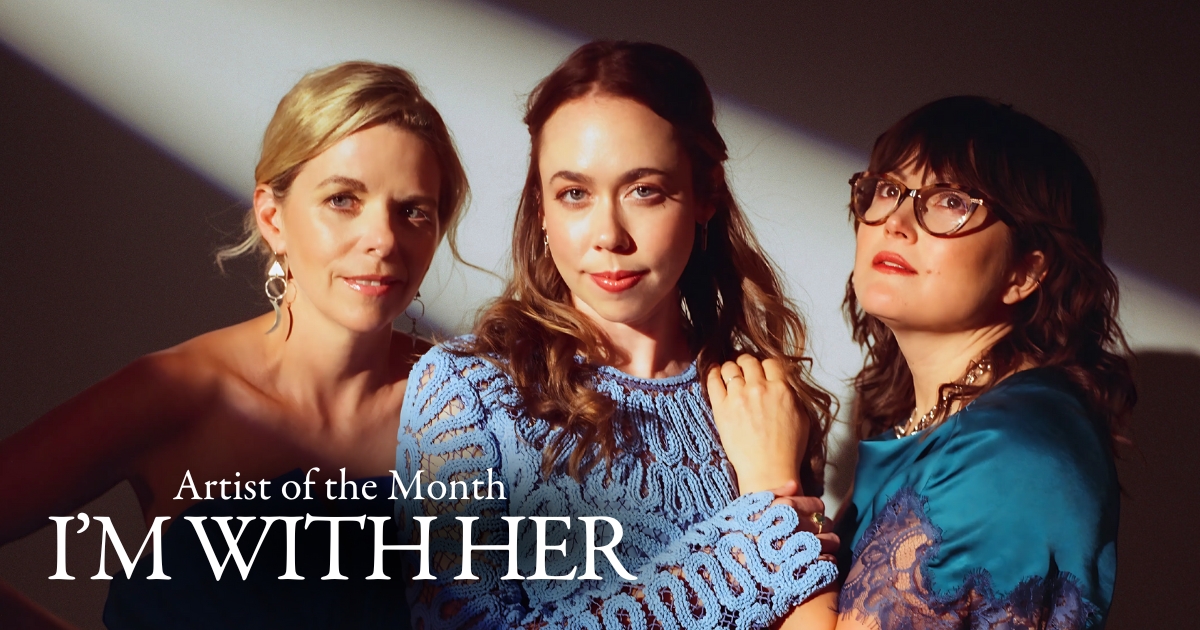
Artist of the Month: I’m With Her

Do you remember the human being you were in 2017? When the “first” North American total solar eclipse of the 2000s criss-crossed the United States, stunning millions of sky-gazers? Do you remember how dissimilar life felt then? When you look back, do your memories contain the same person you are now, or is there a vast difference between who you were then and who you are today?

In 2017, I’m With Her – an iconic assemblage of award winning roots musicians Sarah Jarosz, Aoife O’Donovan, and Sara Watkins – were already a band, but a tangible group identity had yet to fully coalesce – and external viewers, listeners or fans or industry professionals, couldn’t tell if this was a temporary “supergroup” or something greater and long-lasting. Yes, they first collaborated as a trio in 2014 at Telluride Bluegrass Festival and their chemistry, musically and otherwise, was immediately palpable. They wrote, toured, and released music together in 2015, 2016, and 2017, appearing on Prairie Home Companion, Live From Here, and festival and venue stages all across the country and around the world. “Crossing Muddy Waters,” a John Hiatt cover and their first release together under the “I’m With Her” moniker, was released in ’15; “Little Lies” followed in ’17. Then, their acoustic cover of Adele’s “Send My Love (To Your New Lover)” performed live with Paul Kowert on tour with Punch Brothers became a smash viral hit later that same year, barely a month after the moon then blocked out the sun.

By all measures, I’m With Her were a very different group 8 to 10 years ago. Neither Watkins nor O’Donovan were yet mothers. The trio had not yet been nominated for a GRAMMY (“Call My Name” would snag a gramophone for Best American Roots Song in 2020). They wouldn’t put out their debut album, See You Around, until 2018. Yet today, on the precipice of what is somehow only their sophomore album, Wild and Clear and Blue (out May 9 on Rounder Records), whether deliberately looking back or relying solely on one’s memories and recollections, it might seem like I’m With Her has always had this outsized presence and impact in bluegrass, folk, and Americana.

Auspiciously, the celestial and grounded, fantastic and natural Wild and Clear and Blue was tracked in New York State coincidentally during/under the more recent total solar eclipse of 2024. The track of that heavenly alignment almost directly crossed the studio where the trio were crafting the new album with producer Josh Kaufman (Bonny Light Horseman, the National). Leave it to the stars, the universe, and these three otherworldly musicians to convene to build yet another masterwork under such an unlikely omen as an eclipse. The results are truly magical. O’Donovan, Jarosz, and Watkins are already writers and pickers who draw heavily on the natural world, the earth, and their own bodies, hearts, and minds not only as intellectual tools, but also as biological beings to fashion their particular style of roots music. It’s difficult not to see how the ’24 eclipse – along with their journeys together over the last decade – greatly informed this new collection.

Solidarity, women uplifting women, motherhood and family, communion with the world around them, connection to nature, challenging the painful realities of our current day-to-day, and – perhaps above all – convivial, heartfelt fun run through Wild and Clear and Blue like shimmering, cosmic rays of light. Where their past releases together have been quite stark and stripped down, often utilizing only as many voices and instruments as the trio themselves could wield in realtime, Wild and Clear and Blue is expansive, confident, and bold. Are these the same humans who first began creating together only just over a decade ago?

Of course not. None of us are the same beings we were back then. Certainly not I’m With Her. They’re GRAMMY winners now, all three married and beginning families, O’Donovan and Watkins by now veteran moms. They’ve had multiple eras together as a band and multiple solo releases unto themselves, individually, too in the meantime. The miles have sped away underneath their feet as they code switch between being an ensemble and being individual artists – while racking up accolades, awards, and listeners as a collective and separately, too. They’re seen alongside other so-called supergroups like boygenius, Bonny Light Horseman, and more; not as novelties or accessories to the “real” artistry of their constituent work unto themselves, but as a sum greater than their parts. Rightfully so!

How lucky are we to be witnesses to that growth, to each of these women’s ceaseless commitment to challenging themselves – and their communities – to move forward, to crest that next mountain, to sculpt that as-yet-undiscovered song from shapeless musical clay? How lucky are we that these three women bathed in the ancient, timeless light of a solar eclipse and alchemized their experiences into this resplendent album?

The path of this incredible trio, unlike the planets in the sky, has been anything but linear – or concentric, or predictable. Still, there’s endless insight and so much joy to be gained from inhabiting this intersection, the confluence of so many occurrences: the trajectory of the group; the track of a total solar eclipse; the Wild and Clear and Blue writing and recording sessions; the terrifying and shocking burning of our planet; the rapid return of abject fascism in this country; the consideration of how to be artists – family members, mothers, community builders – amid all of these realities. It’s a bewildering intersection, but one we’ve all become undoubtedly familiar with since 2014… since 2016…  since the sun disappeared in 2017 and 2024.

Wild and Clear and Blue is a soundtrack for togetherness. For being present. For capturing the infinitesimal moments that make life what it is. It’s no surprise I’m With Her were able to create such an awe-inspiring and heartening second album with these celestial (and terrestrial) ingredients. It’s impeccable roots music made for bathing in the ancient light, for standing at the fault line, for staring into the wild and clear and blue with courage, with love, and with songs.

I’m With Her, for the very first time, are our Artist of the Month! Dive into our Essentials Playlist below and make sure to spend time with our exclusive interview with Jarosz, O’Donovan, and Watkins on the making of the project. Plus, Watkins is a guest on Basic Folk talking about the album this month, as well – and you can listen to archive episodes with Jarosz and O’Donovan, too.

And, we’ll be dipping back into the BGS archives for all things I’m With Her throughout the month of May! Each of the trio’s members have been featured as AOTM individually and/or in other groups and we have plenty of playlists, articles, interviews, and even Sitch Sessions to return to featuring their supreme talents. Buckle up for a transcendental Artist of the Month celebration.


Photo Credit: Alysse Gafkjen

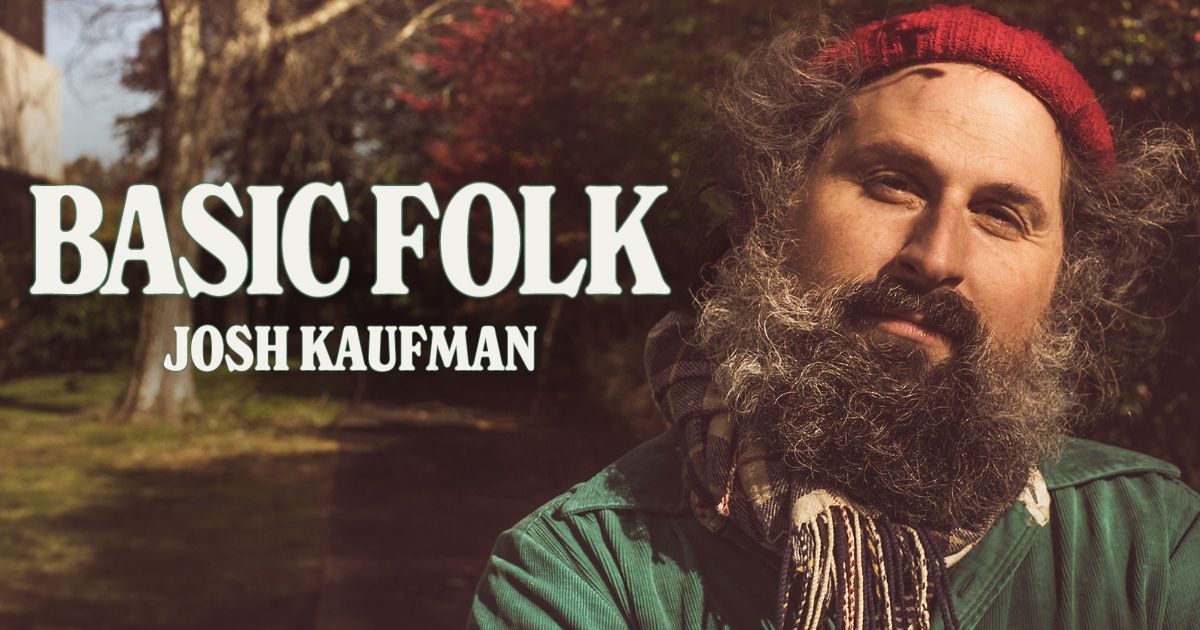
Basic Folk: Josh Kaufman

Multi-talented musician and producer Josh Kaufman is known for his work with Josh Ritter, The National, and his band Bonny Light Horseman. I’ve known Josh for many years, after meeting him in Pittsburgh while he was on tour with Dawn Landes. I felt instant friendship with him (and, honestly, with the entire Dawn Landes band that day). We haven’t seen each other very much over the last 15 years, but since he left that impression on me I’ve always rooted for him in his career.

LISTEN: APPLE • SPOTIFY • AMAZON • MP3

In our Basic Folk conversation, Josh shares anecdotes from his childhood, including memories of his journalist mother interviewing legendary musicians and the backstage snacks that left a lasting impression. He reflects on his early musical influences, the role of music in his family, and how his parents supported his passion for music from a young age. Then we dive into Josh’s experiences playing in bands in New York City during his high school years and how those formative experiences shaped his relationship with music and the city itself.

As a producer, Josh discusses his approach to working with artists by emphasizing the importance of capturing the raw, live energy of a performance. He talks about his instrumental album, What Do the People in Your Head Say to Each Other, and how embracing imperfection has become a central theme in his work. He also touches on his collaborations with notable musicians, including Bob Weir of the Grateful Dead, and the impact of those experiences on his career. Josh Kaufman is the most sought out producer in roots music these days. Look out for him producing some great records in 2025 and beyond.


Photo Credit: James Goodwin

Bonny Light Horseman In Conversation – With Each Other

(Editor’s Note: To mark the occasion of Bonny Light Horseman’s brand new double LP, Keep Me On Your Mind/See You Free – which were released in June – we invite our readers to be as flies on the wall during a special exclusive interview, an entertaining and joyful conversation between the members of this folk supergroup, Eric D. Johnson, Josh Kaufman, and Anaïs Mitchell. 

Read about the band’s memories of their first gigs played for money, about popular bands they don’t really “get,” and so much more below. Plus, dig into their deep and broad discography – together and separately – with our in-depth exploration of their catalog of recordings here.)

Eric D. Johnson:  We totally love each other a lot and we spend a lot of time together and we talk about everything, and I know everything about you guys, pretty much. I got some deep shit on you guys!

But, one question that I didn’t know the answer to, because I have a really funny answer for it is, what was the first show that you ever played where you got paid money? Do you remember? 

Anaïs Mitchell: Oh wow!

EDJ: Can you guys remember that? 

Josh Kaufman: I can remember. I don’t know if it was the very first, but it was certainly early. I played a yogurt shop in Port Jeff. I definitely played a lot of Grateful Dead songs. I think I played “Peggy-O” and like “Friend of the Devil.” I may have tried an ambitious solo acoustic version of “St. Stephen.”

EDJ: Tell me more though, was it a band? Was it you solo? And did you go just under the name Josh Kaufman? 

JK: Just me. I don’t know if I was even booked. I don’t know. I may have just shown up. 

EDJ: And what was the yogurt shop?

JK: I can’t remember the name of it either. I feel like I have a couple of friends that definitely would remember and definitely were there. That was the ‘90s, that was the era of the yogurt shop. It was basically a cafe, but let’s face it, it was a yogurt shop. I don’t know what I got paid, but I did get paid. I was probably 16; at a yogurt shop playing Grateful Dead songs for money. 

AM: I want to see you then, Josh! 

EDJ: I totally want to see him! I want to find the bootleg of that show. How did you get hooked up with the yogurt gig? 

JK: Well, I was kind of in bed with big yogurt–

EDJ: You’re a big deal going way back–

JK: Going way back now! Well, how did I know about [it]? I think my friend Kevin Jones worked there. I think this is what happened. My friend Kevin Jones worked there, who you guys will meet when we play in California, because he just moved to the Bay Area. He’s going to come to our show. I think they were looking to up their game [at the yogurt shop]. And he was like, “Let’s see what happens. Let’s bring in a professional.” It must have been such a hot mess. 

EDJ: I bet you were good from the jump. That’s my guess. 

JK: That’s generous. 

EDJ: Anaïs, what about you?

AM: I think the first time I made money for music was [when I was] 18 years old and I took a gap year. I was going to go to school, but I took a gap year and then I moved to Boston. You guys know this. I know you know this about me. 

JK: You were a waitress. 

AM: I was a waitress. Right. At this diner and then later as a waitress at this Cajun/Mexican place, which really sucked. It was in Central Square and I remember I had that job, because I quit it when I realized that I could make money playing in the subway. I could make equal money to what I made as a waitress. Basically, I would go down – I want to say that I played an Ovation Guitar. I’m sorry. [Laughs]

EDJ: Classic! Love this. I’m just gonna say: Ovation Guitar; yogurt shop. Just as visuals. 

AM: Totally. [Laughs] I love this. They go together. 

JK: You can actually eat yogurt out of an Ovation Guitar. 

EDJ: They are designed for eating yogurt out of – in the ‘90s!

AM: I had a little portable [amp], my first amp. I just started playing electric on tour with you guys, but that’s not my first amp. My first amp was a little Crate amp. Do you know what those are? It was bright yellow. And it was cool. For plugging in your Ovation Guitar when you played in the subway, they were amazing.

So I did that. And the cool thing was I was really just getting going. I had written maybe a handful of songs – that I’ve repressed [since]. Like they were really not good, but if you’re playing in the subway, the audience turns over every 10 minutes. I played the same songs. I would just play them again and again. It was mostly my new songs that I had written. And I think I played a couple of folk songs that I learned from the Rise Up Singing folk music bible. 

EDJ: But were people like throwing in money? What was your haul? Not because I care that much about money, but I’m just asking, is this your first profesh gig? Do you have your case? Do you have a little hat box?

AM: You got your case open and you put a couple dollars in there. You put like a five [dollar bill] to show people that. You don’t put coins, because then that’s what people put. I actually can’t remember,  with inflation, like, what was that? I want to say I would go down there for  an hour or two and make fifty to a hundred bucks. 

JK: Oh, that’s really good. That sounds really good to me. 

AM: That’s why I quit my waitressing job! I was like, this sucks. I’m just gonna do this. 

EDJ: You’re 18, what is that, the year 2000? 

AM: Or something… it was ‘99. Yes.

EDJ: Okay, sick. With inflation, I think that’s good. I think you did really well

AM: I might be misremembering, might be adjusting for inflation [wrong] in my memory. 

JK: I think I got paid, by the yogurt shop, like $46 or something like that, which when I think about it now it’s almost like the tooth fairy or something. I think somebody just felt bad for me. They’re like, “This is 36, 46 bucks, just take it, go.” You know that, “Here’s some gas money.” 

EDJ: I like that it was $46. 

JK: I don’t think it was $50. I think I’d remember it if it was $50. That would have seemed like a lot of money to me. I will say, the guitar I was playing, Eric, and Anaïs, would have been the same guitar that I still play – the Guild that we made our records with and that Eric played on our recent tour.

AM: I spent some time with that guy.

Eric, I want to hear your story. 

EDJ: I got you gonna beat financially by a couple bucks. When I was like 17, my friend Steve and I decided I was going to join Steve’s band just as a singer, but I was too scared to just sing and stand there. I did not know how to play guitar. So, I got a crash course in guitar from Steve. Steve came to one of our shows last summer, I think, or two summers ago when we opened up for [Bruce] Hornsby.

Steve gave me a crash course in guitar, but I didn’t really know how to apply guitar chords to cover songs, you know? I was like, “I guess I’m going to have to write.” I immediately became a songwriter, because I was too dumb to learn how to play a Pink Floyd song or something like that. 

All of a sudden we became this folk duo that played a mix of covers and originals, as I was learning chords. I learned how to play some covers. I think “Ripple” by the Grateful Dead was the first – speaking of Grateful Dead, Josh. We played at this cafe in our little downtown of our funny little suburb called Caffe Trieste. It was actually really cool. It was very ‘90s. When I remember it, it smelled like clove cigarettes in there and herbal tea. It was literally a coffee house, like from the old times where you smoke cigarettes and drink coffee at night and watch music. I’m not saying it was like Greenwich Village or something like that, but it was cool.

We would play there, but for no money. That was kind of like open mics and stuff like that. We played “Tangerine” by Led Zeppelin and we played “Ripple” by the Grateful Dead. I think we played “Wish You Were Here.” And then we played sort of a smattering of my originals, which were terrible. 

But, I was at home [one day] and this is in 1993. My mom was like, “You have a phone call.” And it was some lady and she says, “My daughter, Katie, she’s turning fourteen and she’s a huge fan of your music. And will you play her birthday party?” And I was like, “What?” We don’t have a band or like fans or anything like that. But apparently this girl had seen us at a school assembly – where all we played was the Cheers theme – and she’s turning fourteen. I was like, “What type of money do you usually get for things like this?” But I sort of fumbled and before I could finish and name a price, she was like, “Would $150 be good?”

That was like an unfathomable amount of money. But she also wanted us to play two sets and play for like literally two hours in their living room. We had about 20 minutes worth of material.We went to the house. Her dad owned an automobile dealership, so the house was nice. It was a room full of thirteen and fourteen year old, she was a freshman and we were seniors. I just remember that. So maybe she was turning fifteen.

When we walked in, it was like Beatlemania. They like, screamed and stuff. There were parents, friends, and stuff who were there and they were kind of these wealthy people. My house was very unsophisticated and it felt like we had sort of stepped into this sophisticated realm of our like dumb little suburb. These were the elites! We played our show, only we had not learned more songs in order to play. So we did the Anaïs thing, but without the audience turnover. We just played things over again. And they asked us to play “Rocky Raccoon” by the Beatles. Then there was a set break and we had no more songs. We went out to Steve’s Jeep and got super high and then came back in and just played literally the same set again and doubled up on “Rocky Raccoon.” We played it four times in one night.

Anaïs Mitchell: What were you wearing? Did you dress up? 

EDJ: I’m sure I was wearing something weird. I had a very schizophrenic style at the time. It was the ‘90s! I would wear plaid ‘60s golf pants, but I had this shirt that was a bread truck delivery shirt that had the name “Byron” on it like a name tag. My hair looked like Jason Priestley from 90210. I hadn’t honed my style yet, but I’m sure I just tried to dress up cool.

It was quite a first taste. 

AM: That’s amazing. You might be the only band to play “Rocky Raccoon” four times in a show. 

JK: The Beatles never played it one time in a show, I don’t think. So you beat the Beatles.

EDJ: Someone asked me this question recently – and you don’t have to answer with a modern band, because it could be more controversial – but what’s a band that’s iconic, that people love, that you’re like, “Not that…”

JK: Oh, Annie has a list of these they’re called like, unimpeachable bands that she doesn’t want to listen to. That she wants to impeach. 

AM: I want to know her list! 

JK: For instance, I think the Stones are on there. She’s like, “I mean, sure, the Stones are great or whatever, but I don’t want to listen to them.”

EDJ: For the Situation readers, by the way, this is Annie, Josh’s wife [we’re talking about]. Annie Nero.

JK: Yeah! But, for my own… let me think about that for a second. 

AM: I have one, maybe. Maybe it’s going to be the same. 

EDJ: Mine’s a little bit The Smiths – I actually think that the band sounds great. It’s sort of like The Doors, for me, where I’m not as into the front person [as I am the band], and I have to believe in the front person.

My other one is that I love Bob Dylan, but he’s like my 18th favorite songwriter. It’s still really high up there in the pantheon of songwriters, but probably a very low ranking as far as Dylan goes. I know Dylan’s a big one for you, Josh, but for me I have seventeen others I put above him. That’s an arbitrary number, but yeah. 

AM: I was gonna say Crosby, Stills, Nash, and Young. I’d be interested in hearing Annie’s whole list, ’cause I do wanna say, I feel like it’s a gendered thing. I’m not even gonna be eloquent about it, but I do think we have deified certain male artisan bands. 

Where it’s like, “Aren’t you into this?” And I’m like, “Actually no.” But I sort of feel like they’re unimpeachable. Like I’m supposed to be like, “Oh yeah, CSNY!!” But my feelings are complex about CSNY, because I love Neil Young and I love Graham Nash. I think it’s really David Crosby – rest in peace – that like, for somehow I’m [hung up on]. I read about how he produced the first Joni Mitchell record and, for me, Joni’s like the top of the totem. Reading about their dynamic, back in the day [is troubling.]

Everyone loved Crosby. She had to kind of be like, “Oh my God, it’s Cros!” You know, but she was Joni Mitchell! I couldn’t really feel that stuff. Yeah, that’s gonna be my band. It’s frustrating. 

Sorry, we canceled. [Laughs]

EDJ: No, I think CSNY is a reasonable one!

JK: I was gonna say The Who, honestly. The Who are awesome and everything and certainly there’s ‘60s garage [rock] stuff that’s fun and everything. 

EDJ: I think it’s okay to throw fire at those guys. Dylan can take it and be pissed. They can fucking take it!

JK: I guess I feel like that’s lazy of me. 

I think Anaïs’ comment about this sort of Mount Rushmore of at the time, early 20s baby boomer white men [was well made]. When they were very young with guitars, for some reason, we’ve decided that those guys are the best.

EDJ: It’s like the Rolling Stone magazine “top 40 cool guys” list. It’s like a mural at a guitar center in suburban Atlanta that you stopped at on tour.

But also Anaïs, sidebar, in my seventeen songwriters above Dylan, Joni Mitchell is my number one, so…

JK: She’s at the top of my list for sure, but I think in the top zone. I don’t know if they’re like tiered necessarily, because since it is art and stuff, it does sort of depend on the opening that I have for it on any given day to enter my heart.

AM: I got a couple more. You guys, this is going to be wild. Well, maybe not. I mean, you guys know me pretty well, because it’s some of these things, the music is undeniable and has shaped other music, but it’s not for me, you know? I would put the Beatles in that category.

JK:  I was waiting for you to say that!

AM: I would put both [CSNY and the Beatles] in there. And I sort of appreciate it when I hear it. Like when I hear it coming out of someone’s car or on the radio or whatever, but I will never put that music on myself. 

EDJ: I feel like with Beatles, if it didn’t catch you at a certain moment it’s a tough, massive thing to dig into. I didn’t get into Joni until I was 30, and it was like one of the pivotal musical moments of my life.

That’s not to say, “I think you have to be 38 to get into Joni,” but I think for whatever reason, she’s so deep and cool and crazy that I think it took me having a little life behind me to sort of understand what it was about. Someone who had seen clouds from both sides now, like at that point, it hit me like super hard.

I think Beatles, talk about iconography and stuff like that! It’s like, I totally get it. But I can’t. I love the Beatles. It exists in my musical and our band’s musical DNA. I’m never not thinking about like a McCartney melody.

AM: I had some grand thought while you were just saying that, about when you encounter music and when it speaks to you. Because yes, if you’re fourteen, if you’re fifteen discovering Ani DiFranco as I was. She became like my whole raison d’etre, but then for someone discovering her later, at a different time in their life or whatever, it’s different. You had to be a certain age to get the Joni. 

And, I wanted to talk about the Grateful Dead because, like the Beatles, I might’ve put them in [this category] if we had spoken a different time, but now I know and love you guys. I sort of became like a late-blooming deadhead, because of your love for the dead. I really got into it and  really into the lyrics. I genuinely, really appreciate that music now, in a way that I didn’t like, ten years ago. Part of that is because I love you guys.

I kind of love how your love for people then transfers to your love for the things that they love. And that then becomes a thing that you love. 

JK: I totally feel that. I’m not going to name any names here, because I feel like it could be misconstrued, but I do feel like I remember early on going out and opening up for bands with friends and at the beginning of it having already made up my mind about this music or something. But then, getting to know these people intimately over the course of a month and having these accelerated friendships as a result of being around each other every day and sort of falling for what they’re doing a little bit. Or maybe, at least being way more open to it than I ever would have been just hearing it on the radio or hearing it in a friend’s car.

So much music [from] growing up I associate with people that I love, for sure. Getting into Bob Dylan ‘cause I love my dad. At a young age like, “This guy’s obsessed with this guy!” And I guess I’m kind of obsessed with this guy who’s into this guy. 

A funny one for me is They Might Be Giants. I love the songwriting of They Might Be Giants and I love that band so much, but I wouldn’t expect one of you guys to get into it now if you weren’t into it when you were fourteen. You know what I mean? 

EDJ: I love the point you made Josh, about touring with bands or something, especially in the indie rock days, where you’re really like up in each other’s grills. You bond in a kind of a different way. …

You guys, we have four minutes left. What are your top three favorite foods, Josh. 

JK: My top three favorite foods, um… Today I would say, I like Szechuan Chinese food. I like Greek food. And I like Italian food. You know, all the classic Northern Italian things and all the Roman pasta stuff. I mean, who am I kidding, right? 

I’m going genres, not dishes, because for me, it’s definitely more about a palette than it is about a specific [dish]. You know, grilled fish and lemon and tomatoes and cucumbers. If I want something in that zone, then I want Greek food. If I want spicy, zingy Szechuan peppercorn, it doesn’t really matter what it is, it could be like shrimp or tofu or chicken, or it could just be string beans. I just get in the mood and go in that direction. 

EDJ: Anaïs, what do you got? 

AM: I just got so hungry when you described the fish with the lemon and then the tomatoes, Josh. Now that’s what I want. All right. The first thing I’m going to say is Josh’s food. I want not what you just said, but food that Josh Kaufman cooks. I would like the fluffy eggs that you make sometimes. And also one time you whipped up a chicken soup. Do you remember that? You just whipped it up so fast and it was the best chicken soup I’ve ever had. 

JK: Oh, I love that. That’s so sweet. I love cooking for you guys.

AM:  I also love and I recently had– do you remember the place Wang’s in Park Slope? It’s kind of like fried chicken, Southern stuff, but then also is it Korean? 

JK: Korean fried chicken? I think, right?

AM: I had something like that with Ramona, my older daughter recently, and I was like, “Oh my God, this is very delicious.”

Eric, you tell us yours. 

EDJ: Oysters, shrimp cocktail, nachos… uh, buffalo wings. And that’s it. Love you guys.

AM: Love you. 

EDJ: Love you. Hopefully it’s all turned out awesome and we have so many cool things to talk about. I’ll see yous on Thursday night!

JK: I love you guys so much. 


Photo Credit: Jay Sansone.

Dig Into Bonny Light Horseman’s Striking Discography

Bonny Light Horseman is an indie/folk supergroup that formed in 2018 at the Eaux Claires Music & Arts festival in Wisconsin. Composed of Anaïs Mitchell (Hadestown), Josh Kaufman (Bob Weir, Josh Ritter, The National), and Eric D. Johnson (Fruit Bats), together the band has released two full-length albums. On June 7, their new double album Keep Me On Your Mind/See You Free expanded their studio album catalog by 100%.

Their first self-titled release, from 2020, features the band’s takes on traditional folk songs; the second, 2022’s Rolling Golden Holy, is a fully original body of work. Their music is tranquil, gorgeous, and breath-taking and their powerful blend of voices is just as striking. The trio bring a new light to the beauty of folk music, and truly makes each song their own.

To celebrate the new project, Keep Me On Your Mind/See You Free, we’ve handpicked a few favorite tracks from their past releases – together and separately – to highlight their musicianship, collaboration, and exactly why nearly everyone calls them a supergroup.

“Bonny Light Horseman” – Bonny Light Horseman, Bonny Light Horseman (2020)

The title track off their first album and namesake of their band, it’s a heart-breaking ballad about a love lost to war that was found in the Roud Folk Index (#1185). The group’s arrangement features a low-tuned guitar and subtle textures of harmonica and saxophone which carry Anaïs’ and Eric’s transporting vocals.

“Deep in Love” – Bonny Light Horseman, Bonny Light Horseman

The second song off the band’s debut album is simply illuminating – it feels like a gust of wind on a warm day. Listening to Eric sing, you can hear vocal influences from Joni Mitchell in his jumps and leaps. It has a very freeing feel to it and breathes beautifully.

“The Roving” – Bonny Light Horseman, Bonny Light Horseman

The third track on Bonny Light Horseman also demands inclusion. It’s a song about the singer’s heartache over “Annie,” a woman who once said she would marry them, but over time fell out of love with the singer. The melody is subtle and sweeps the listener into a setting of tranquility. In the arrangement, the band switches between a single, double, and quadruple chorus which is a very sweet and simple way to convey the story to the listener.

“Jane Jane” – Bonny Light Horseman, Bonny Light Horseman

“Jane Jane” was first recorded in 1939 by Lila May Stevens. This arrangement combines Stevens’ lyric with the African American spiritual and gospel classic, “Children, Go Where I Send Thee.” Bonny Light’s rendition is simply breathtaking; Johnson and Mitchell switch voices between the major and minor sections of the song, creating a raw and haunting sound.

“Bright Morning Stars” – Bonny Light Horseman, Bonny Light Horseman

The penultimate song off Bonny Light Horseman is a traditional Appalachian spiritual originally documented by Alan Lomax. This song holds the essence of a church choir belting for their audience and it’s one of the more simple songs on the album, in terms of arrangement. Having only three voices and a piano allows listeners to hear their trading voices on each verse and then the bright light of togetherness on the choruses.

“Gone by Fall” – Bonny Light Horseman, Rolling Golden Holy (2022)

“Gone by Fall” sits directly in the middle of Bonny Light Horseman’s second album, Rolling Golden Holy. Depicting a summer romance, it’s reminiscent of a 1960s folk song you might have heard on the radio during the folk revival. Yet, in listening to it, a veil is seemingly lifted and you can hear it’s an entirely fresh take on such a classic sound. Their voices, which blend so beautifully together, and the crystal clear guitar lines throughout add in the sweetness of a summertime love.

“Someone to Weep for Me” – Bonny Light Horseman, Rolling Golden Holy

Next up is “Someone to Weep for Me,” a song depicting a person going through life craving someone to care for them, but never finding that person. The driving force of the track is the mandolin’s beautiful rolling pattern, a genius touch that’s present throughout the song and adds a sense of stability and a unique texture. Another stroke of genius comes at about 1:40 in, when the electric guitar comes in wailing, bringing the song into a “jam” with Anaïs singing a little line over it. This is such an unexpected vibe change and at the same time it fits so incredibly well.

“Greenland Fishery” – Bonny Light Horseman, Green/Green (2020)

Off the band’s two-track EP release Green/Green comes “Greenland Fishery,” a reimagined traditional sailor song. Bonny Light’s version certainly allows you to float away. The clawhammer banjo throughout is lovely and it’s such a treat as a showcase instrument – it isn’t emphasized often throughout the band’s catalog. It’s also very sweet to hear the second part of the chorus as it echoes the chorus of “Bonny Light Horseman” in such a gorgeous, reminiscent way.

“Willie’s Lady (Child 6)” – Anaïs Mitchell & Jefferson Hamer, Child Ballads (2013)

Delving into some of the band members’ other projects, we come to Child Ballads, an album of duets from Mitchell and collaborator Jefferson Hamer. The project reimagines seven songs from a 19th century folk song collection “The Child Ballads” collected by Francis James Child. “Willie’s Lady (Child 6)” tells the story of King Willie, who marries a woman his mother despises and, in turn, his mother curses the wife. The guitars on the track have such a strong, driving force, excitedly pushing the song while one holds down the rhythm and the other crosspicks during the instrumental sections. Anaïs and Jefferson use their guitars in a way that perfectly compliments the vocal work in the song; it’s sung entirely in duet, the two voices deepening the texture of the music.

“Cazadera” – Fruit Bats, Gold Past Life (2019)

Fruit Bats is Eric D. Johnson’s indie-rock band that he’s fronted since 1997. Off their seventh album, Gold Past Life, “Cazadera” is one of the grooviest songs around. About a person searching for meaning in life and finding it in love, it’s the kind of track that would help paint your surroundings on a joyful walk. It has a great sense of hope and beauty to it and the chill verses coupled with sharp choruses bring energy and excitement.

“Loser’s L-A-M-E-N-T” – Rocketship Park, Off and Away (2008)

Going all the way back to 2008 for a selection from Josh Kaufman’s band, Rocketship Park, a pop-folky project with the intention to play Josh’s original material. The song “Loser’s L-A-M-E-N-T” is off the group’s first album, Off and Away, and immediately displays a very mellow vibe. Jazzy little piano licks come together with electric guitar and pedal steel, creating a western-folk sound. You can truly hear how each instrument is talking to the others and how they all fit together in telling the story.

“When I Was Younger” – Bonny Light Horseman, Keep Me On Your Mind/See You Free (2024)

From the group’s just-released double album comes “When I Was Younger,” which has a sound unlike most of their other music. Combining styles from artists like the Grateful Dead and Billy Joel, the intro riff sounds like it pulls some from the former, yet, once the verse starts, it sounds immediately like the latter – a kind of “Vienna” feeling.

It goes right back into the psychedelic riff before switching voices from Anaïs to Eric, again back to the Billy Joel vibe. The guitar and vocal solo following this verse are so rock and roll, gritty and not at all sparkly like the verses prior. “When I Was Younger” does an incredible job blending musical styles. It’s an absolutely astonishing piece of music, using such few words yet conveying such a strong and vivid story.

(Editor’s Note: Read Bonny Light Horseman In Conversation – With Each Other here.)


Photo courtesy of Chromatic PR. 

Basic Folk: Jenny Owen Youngs

Podcaster, Number One hit songwriter, human and dog mother, gay icon Jenny Owen Youngs returns with her first full length album since 2012! In the last decade plus, Jenny has experienced a wild ride of changes like divorce, extreme grief, moving across the country, remarrying, etc. Her main project — while not writing, recording and touring — is hosting podcasts like the very successful Buffering The Vampire Slayer alongside her ex-wife, Kristin Russo (a Buffy The Vampire Slayer rewatch pod, which is now an X-Files rewatch show called The Ex-Files). She also has songwriting credits for Panic! At the Disco, Pitbull, Ingrid Michaelson and Brett Dennen, thanks to her deal with Dan Wilson (Semisonic and epic co-writer) and his publishing company.

LISTEN: APPLE • SPOTIFY • STITCHERAMAZON • MP3

JOY’s new album Avalanche covers a lot of hard topics (see earlier: divorce, grief, moving, remarrying) and was produced by angel human Josh Kaufman (Taylor Swift, The National, The Hold Steady, Josh Ritter, and so on). Jenny has always been an artist who is not afraid to show her whole self: good and the bad. Case in point: She described the inspiration for her very first breakthrough song, “Fuck Was I,” as “horrible, horrible, horrible decision making,” adding it was “just your classic love gone wrong hell.” Never one to back down from a fight, Jenny’s approaching these songs with honesty, bravery and her biting sense of humor. It’s cliché to say that talking to Jenny is a JOY, but it’s a cliché for a reason. Thanks Jenny!


Photo Credit: Lisa Czech

The Show On The Road – Amy Helm

This week, The Show On The Road places a call into Woodstock, NY, where we speak to a respected singer, songwriter, and sometimes drummer Amy Helm, beloved daughter of Levon Helm of The Band.

LISTEN: APPLE PODCASTSSPOTIFYSTITCHER


Growing up in the home of two working performers (her mother is singer Libby Titus, who wrote songs covered by Bonnie Raitt and Linda Ronstadt) wasn’t always the easiest for the introspective Helm, but it gave her a fertile proving ground to begin exploring creating her own soaring songs in the folk, blues, and soul traditions. She waited until she was forty-four to release her acclaimed first solo record, Didn’t It Rain, with her father lending his signature earthy drums on several tracks — and this year, she teamed up with multi-instrumentalist and producer Josh Kaufman (Taylor Swift, Bonny Light Horseman) to create What The Flood Leaves Behind, her most emotive and lushly-realized project yet.

With her dogs often joining the conversation from her upstate home, Helm dives into her early years trying her hand at singing in New York City cafes, having folks walk out of her folk fest shows because her band was too loud, founding the band Ollabelle, joining her stepdad Donald Fagen’s group Steely Dan onstage, backing up legends like Stax soul artist William Bell and finally reconnecting with her dad in her mid-thirties as he began his late life renaissance, hosting his epic Americana throwdowns called “The Midnight Rambles.” It was being a member of that crack “ramble band” that gave Amy the final push to pursue her own lead voice.

While Levon famously struggled with heroine addiction and the foibles of post-Bob Dylan and The Band fame fallout, it was when he got clean and took Amy under his wing that both of their stars began to rise again. You can hear Amy singing on his gorgeous return in 2017’s Dirt Farmer. Becoming more ambitious, Amy laid down her upbeat rock-n-soul-tinged second album with producer Joe Henry in LA with notable players like Doyle Bramhall II, Tyler Chester, and a vocal choir of Allison Russell and JT Nero (Birds of Chicago) and Adam Minkoff. This Too Shall Light was released in 2018 on Yep Roc Records and Amy began to be recognized as one of the most powerful singers touring the Americana circuit. Her newest record was recorded at her spiritual home, Levon Helm Studios, where each ramble still takes place on the weekends.

During the pandemic, Helm had a unique idea to keep her creative muscles strong, even when live music gatherings were not technically allowed in public. She began setting up “curbside concerts” for her friends and any curious fans who missed her songs, touring around Woodstock with her guitar, bringing a little joy to her shut-in listeners during New York’s darkest hours.

Stick around to the end of the episode to hear Helm introduce the spiritual opening track of What The Flood Leaves Behind, “Verse 23.”


Photo credit: Ebru Yildiz