How-dee! And Happy 100 to the Grand Ole Opry

In 1925, world leaders were signing the final treaties coming out of WWI; Congress authorized work on Mt. Rushmore as a national memorial; the Scopes Trial was held in Tennessee; and the first patent on radio transmission was only 28 years old.

And, in 1925, WSM first broadcast its barn dance – soon to become the Grand Ole Opry.

One hundred years later, the Grand Ole Opry is the world’s longest-running radio program. After a century that saw changes unparalleled in world history, audiences are still drawn to the Opry. Every week thousands make the pilgrimage to the Grand Ole Opry House in Nashville while others tune in around the world. The show continues to inspire new generations of performers to aspire to step “into the circle” on the Opry House stage.
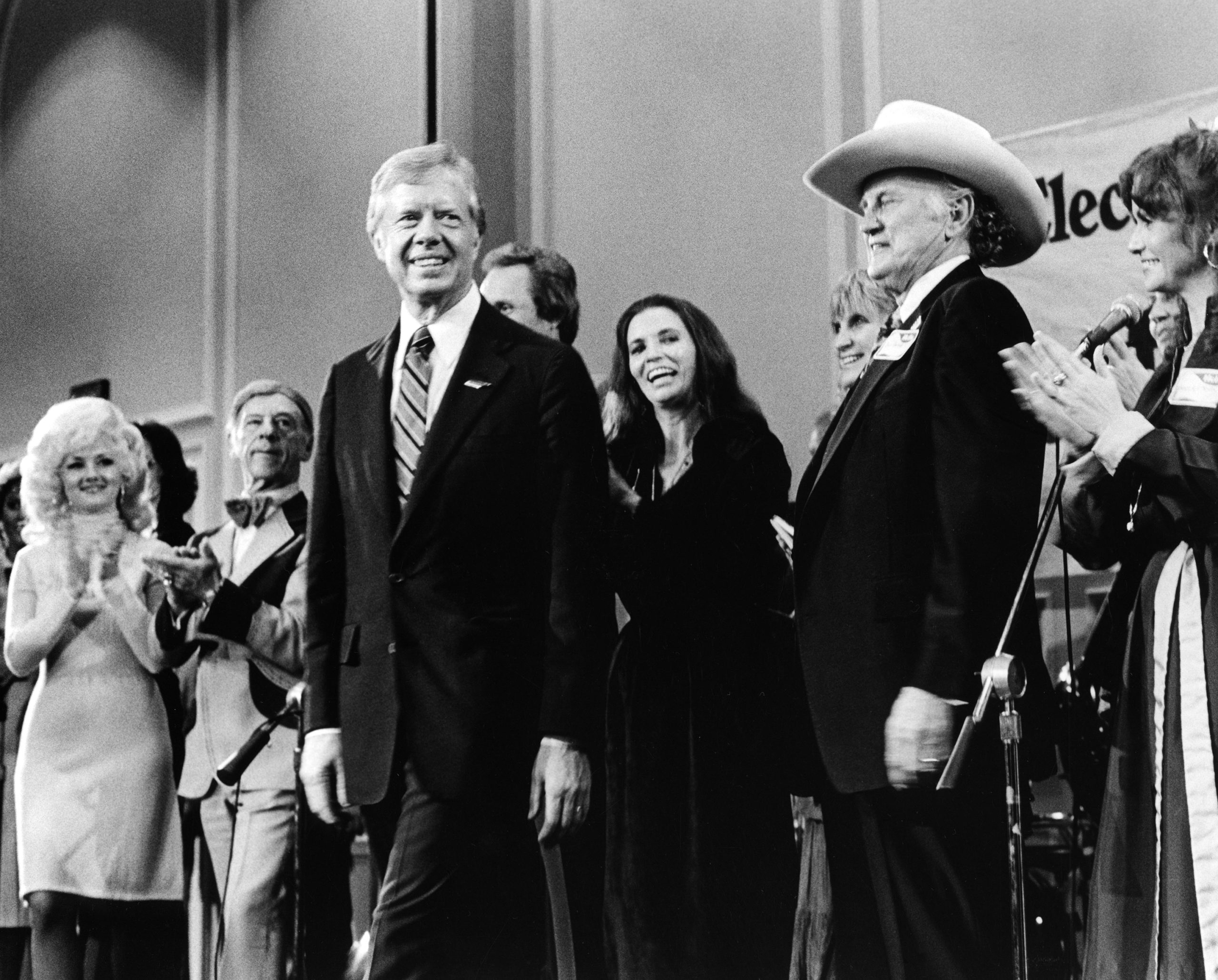
President Jimmy Carter on the Grand Ole Opry stage with Kelly Foxton, Hank Snow, Mel Tillis, June Carter Cash, Skeeter Davis, Bill Monroe, Jeannie C. Riley, and others on October 9, 1980. Photo courtesy of Ryman Hospitality Properties.

In The Beginning Was Insurance

In the 1920s, Edwin Craig was watching radio stations emerge across the nation – and seeing the money-making potential for sponsors and owners. He convinced Cornelius Craig, his father and founder of the National Life and Accident Insurance Company, that a radio station could sell a lot of insurance.

Soon, the fifth floor of the company’s downtown Nashville building held a radio studio. The call letters WSM stood for “We Shield Millions,” the company’s motto. A program that would become the lifeblood of country music started as a way to promote life insurance.

The hiring of George D. Hay away from Chicago’s WLS was the beginning of the WSM Barn Dance. The 30-year-old who called himself The Solemn Old Judge and started every show with a steamboat whistle would set the tone for much of the Opry’s 100 years – including its name.

Which all started with a clash of cultures.

Some upper-crust Nashville residents complained the only radio they could hear on weekends was string band programming from the dominant WSM station. In response, WSM began carrying the syndicated “Music Appreciation Hour.”

The Barn Dance slot followed the classical program, and Hay, not one to pass up a good line, said, “For the past hour, we have been listening to music largely from Grand Opera, but from now on, we will present ‘the Grand Ole Opry.”
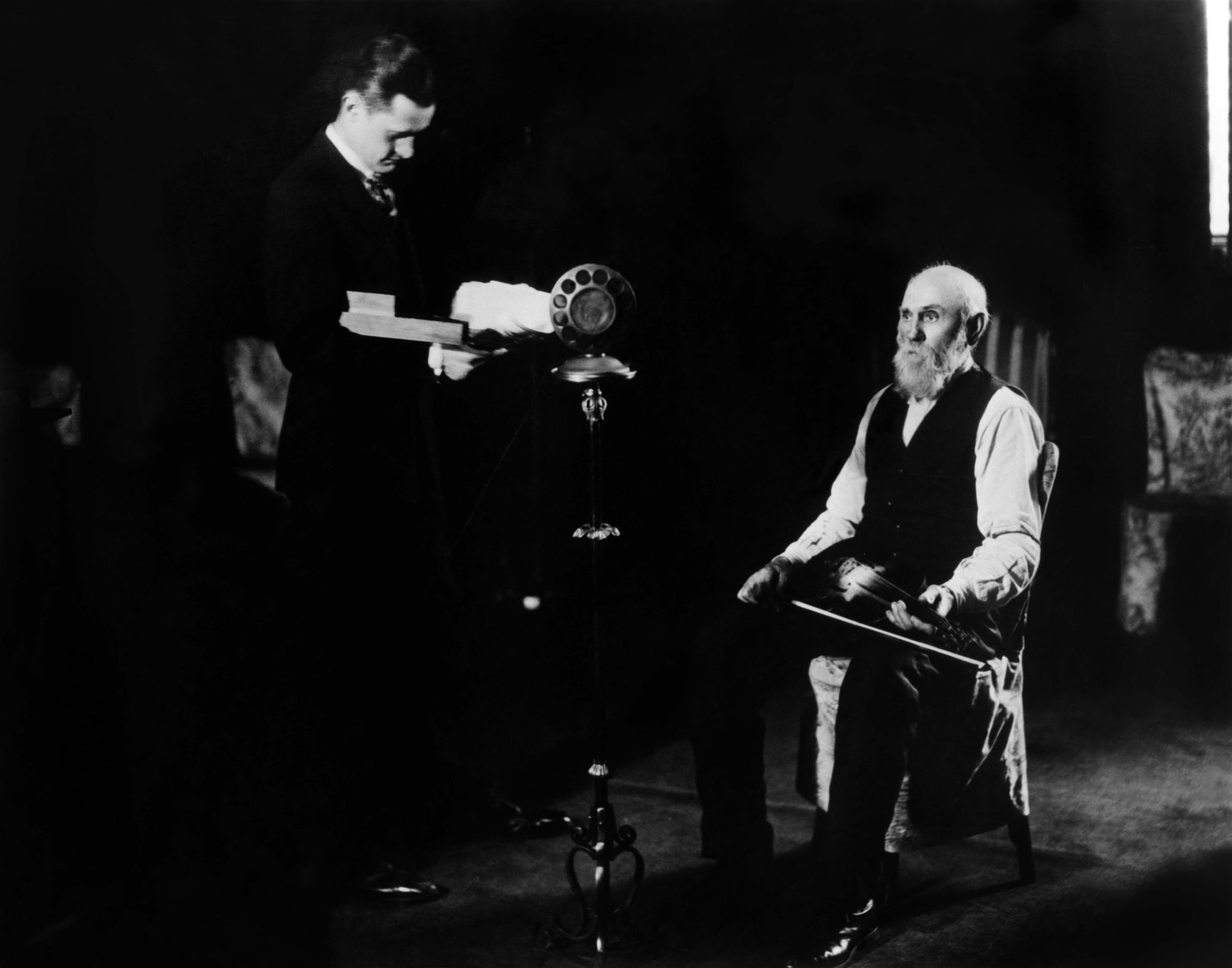
George D. Hay is pictured at microphone with a whistle and Uncle Jimmy Thompson is seated in this 1925 photograph from when the Grand Ole Opry was still the WSM Barn Dance. Photo courtesy of Ryman Hospitality Properties.

For years, the Shield Men – door-to-door National Life and Accident insurance salesmen carrying the company’s shield logo – introduced themselves as representing the Grand Ole Opry. They would even listen outside windows to see who was tuned in to the Opry – and who would be a likely customer.

The earliest WSM shows relied on local talent, running heavily toward fiddlers and string bands. But Hay would invite whoever he thought the audience would like.

DeFord Bailey, a Black musician grounded in both the blues and old-time string band music, became a regular, wowing audiences with his harmonica. Kitty Cora Cline, the first female soloist, performed on hammered dulcimer, and Fred Shriver played the accordion. Uncle Dave Macon on his banjo with Sid Harkreader on fiddle and guitar set the stage for the comedy that would remain central to the Opry’s success, with songs like, “Keep My Skillet Good and Greasy.”

A Beacon

As the recording industry grew, the variety of musicians available to the Opry grew, as well. The show began featuring brother duets, cowboy music, Western swing and solo crooners. Bill Monroe & the Blue Grass Boys were featured stars for decades.

Opry singers expressed the joys of new romance, the happiness of Sunday dinner on the lawn, the sorrow of lost love, and the loneliness of leaving home. Audiences across America listened – and related. The Opry became a focus of family life.

Dolly Parton, like many rural listeners, grew up without electricity. Her family faithfully listened to the Opry on a battery-powered radio. Waylon Jennings’ dad would hook their radio to the car battery. Jeannie Seely’s family would pile in the car and drive up a hill until they could get the signal. Opry history is filled with stories of musicians who listened as children – and dreamed of growing up to perform, like their idols, on the iconic stage.

Opry member Dierks Bentley, who gracefully moves between country and bluegrass, told BGS, “Being invited to join at all is the biggest honor – especially for me, personally. I grew up listening to all the Opry greats on the radio with my dad, so becoming a member is like having the ultimate backstage pass to see the best musicians in the world. And to be invited by Marty Stuart … hands down, it was one of the coolest nights of my life.”

Dan Rogers, the Opry’s senior vice president and executive producer, said the Opry has always been a place to celebrate the good times and be uplifted during the tough times. “Think about,” he said, “the folks who tuned in on Saturday nights during World War II. That was their only source of entertainment throughout the week.” Minnie Pearl, with her signature “How-dee,” and Roy Acuff gave them respite from war news.

On the first show after the 9-11 attacks in 2001, Rogers said, “Our background singers sang an a cappella version of ‘God Bless America.’ And one by one, the people in the audience stood and sang along. And I remember thinking, I bet everybody tuned in across the country is singing along to ‘God Bless America.’”

The Opry’s response to the COVID-19 crisis created desperately needed connection during a frightening time of isolation.

Just a week after deciding that live audience shows weren’t safe, Opry staff arranged a pared-down streaming production with no audience and a skeleton crew. Longtime cast members Bill Anderson, Jeannie Seely and Connie Smith held down the first night alongside Mandy Barnett, Michael Cleveland & Flamekeeper, and Sam Williams.

For the second weekend of restrictions, veterans Vince Gill, Marty Stuart, and Brad Paisley sat on stools spread out across the stage and pulled off what Rogers called “a beautiful, beautiful show.”

Watching from his office, Rogers started reading comments from grateful listeners. For months, people marked their calendars to tune in. They wrote, “I’m in Europe. I set my alarm. It’s 2 a.m. here, but I wanted to experience this with a community.”

Marty Stuart, Vince Gill, and Brad Paisley perform for an empty Grand Ole Opry House during the COVID-19 lockdowns in 2020. Photo by Chris Hollo, courtesy of Ryman Hospitality Properties.

Kathy Mattea, the newest Opry inductee, feels those connections whenever she performs there.

People may have sung along to her hit “18 Wheels and a Dozen Roses” in their car or in the shower, but at the Opry, she says to BGS, “Here’s your chance to sit with an audience and sing this song that everybody knows. Nobody knows who the person next to them voted for and it doesn’t matter at that moment.”

“The Ellis Island of Country Music”

In the early days of radio, what was called hillbilly music was as limitless as the range of a 50,000 watt radio station. And the Opry remains dedicated to maintaining those wide open spaces.

Garth Brooks and Trisha Yearwood, in their forward to the book 100 Years of the Grand Ole Opry, refer to the show as the “Ellis Island of Country Music – a place where all are welcome.”

Contemporary country often has been accused of being homogenous and limited. But despite the factors that have controlled commercial country, the Opry maintains its open-arms attitude. Rogers said, “The two core tenets of an Opry show are celebrating the past, present, and future of country music, and also showcasing multiple genres under the country music umbrella.”

In any show, he said, “You might have something that’s on the top 20 of the country charts today. And you’ll have country classics. You might have a contemporary Christian song, Americana string music, or even something from outside the genre by somebody who just happens to be a country music fan or was influenced by country music.”

In 1974, the R&B-oriented Pointer Sisters included an original country song, “Fairytale,” on their second album. The cross-over hit earned them an invitation to the Opry stage, where they became the first Black group to perform.

Ringo Starr appeared for the first time in 2025 and James Taylor’s debut on November 11 will be remembered as a big part of the 100th anniversary celebration.

And, Rogers said, “Because we can do it, it’s fun to take a chance on a new artist.”

Before his first Opry appearance in July 2022, Zach Top had no hits to his name. But Rogers remembered the programming team saying, “You don’t see an artist like that every day. It sure feels to us like our audience would absolutely eat that guy up!” Today, Top’s music is everywhere.

Bluegrass has been a staple since before it had a name and it has never lost its place on the stage. Bentley and Del McCoury played “Roll on Buddy, Roll On” when the Grand Ole Opry House first reopened after the 2010 flood closed its doors for months.

Charlie Mattos is a 10-year veteran Opry announcer and longtime co-host and producer of WSM’s morning show. He said that on any given night, a portion of the Opry House audience “may truly have never seen a bluegrass band play.”

“And when Del McCoury and the boys finish with an incredible instrumental,” Mattos continued, “or Sister Sadie blisters the stage … the enthusiasm that comes out of that crowd, the immediate standing ovation for the insane musicianship that they have just witnessed …” Mattos said, “it blows their minds.”

Mattea said, “Bluegrass is front porch jazz – the virtuoso playing and the vocals and the harmonies and the trading off of licks. That’s how I fell in love with bluegrass.” And the Opry exposes millions to that brilliance.

A Good-Natured Riot

The Opry show is a complex set of acts and sets requiring precision planning, flexibility, and good nature on the part of the announcers – and commitment on the part of the performers. Rehearsals are brief or non-existent. Timing is everything.

Borrowing a phrase from George D. Hay, the Opry is still sometimes called a “good-natured riot.”

Mattos said, “When you come to see the show live, you see it all. The set changes. The artists leaving as the announcer sends them off. You can see the stage crew out there and usually in 90 seconds they can completely swap things around.”

But while reading a commercial during set changes, Mattos may notice the stage manager giving the “stretch” signal. He might have to keep talking for as long as four minutes – a millennium in radio time.

Sometimes the commercials themselves become the entertainment.

The first time Glad Wags sponsored an Opry segment, Chuck Morgan was announcing. While he stood off-stage reading the dog food commercial, house bassist Bill Linneman came up behind him and started barking. “By my last year there, there were like 20 people behind me going at it,” Morgan said. (The consensus is that Connie Smith does a great chihuahua imitation.)

A Family

Jeannie Seely – who racked up nearly 5,400 performances on the Grand Ole Opry before her passing in August 2025 – remembered it was more than the music that fueled her desire to join the Opry: “That’s hearing these people, like Mr. Acuff and Minnie [Pearl] and Jimmy Dickens and all of them, coming together every week,” she says in 100 Years of the Grand Ole Opry. “They always sounded like they were so glad to be together. They picked on each other and joked, and I thought, that’s just like a family.”

And they were family. When the plane Jim Reeves was aboard crashed in a wooded Nashville suburb, Marty Robbins and Ernest Tubb joined the search party, as did the elegant Nashville socialite Sarah Ophelia Colley Cannon – known as Minnie Pearl.

Opry star Jean Shepard was expecting her second child with husband Harold “Hawkshaw” Hawkins when Hawkins died in the plane crash that also killed Patsy Cline and Cowboy Copas. After months feeling adrift, as Shepard was quoted in the 100 Years book, “I looked down my driveway one day and here come two big black limousines full of the so-called ‘higher-ups’ from the Grand Ole Opry. They said, ‘We want you to come back to the Grand Ole Opry.’ And it really meant a lot to me.”

The family feeling is no accident. In earlier years, Opry members had to perform a specified number of Saturday nights a year. While there’s no set number today, Rogers said they look for a sense of commitment in new members. “It truly is about that relationship,” he said.

Rogers quoted Mattea, upon her invitation to become a member, saying, “These people treat you like family, no matter what.”

One of Mattea’s favorite Opry memories involves a bass player who toured with her. “He was sitting on a stool, playing and singing some old Western swing chestnut, and suddenly Riders in the Sky leaned into the dressing room in full regalia and started singing harmony.

“He was gobsmacked. He felt it was the highlight of his life,” she said.

Bluegrass performer Kody Norris’ music is influenced heavily by first- and second-generation bluegrass. But the band’s preference for flashy suits dates back to a family-friendly welcome Norris received 25 years ago.

His parents took nine-year-old Kody backstage at the Opry, “and I met Bill Anderson. And he had on a red rhinestone suit. That’s the first one I ever saw up close, where I could touch it.”

Later that day, upon meeting his equally rhinestone-clad hero, Porter Wagoner, young Kody got so excited he spit out his chewing gum. Wagoner graciously grabbed two Opry-logoed napkins, one of which the little boy used for his gum. The other one the grown Norris still keeps in perfect condition.

The Circle is Unbroken

In 1974, the Opry left its revered home of decades, the Ryman Auditorium, to move to the deliciously air-conditioned 4,400-seat Grand Ole Opry House.

To honor its longtime home, the Opry crew cut a circle out of the Ryman stage and inset it in the new Opry House stage. The circle symbolizes the Opry’s continuity, respect for the past, and optimism for the future.

Mattea experienced that sense of a completed circle on the day she became an Opry member.

“Suzy [Bogguss] was there. We’ve toured together and sung on each other’s records. She’s my closest artist friend, and she was the only one at the ceremony who was not a member. And I thought how generous it was of her to be there.

“So, while I was overflowing with celebration, to get to invite my friend to the party publicly in the name of the Opry was the sweetest gift. It was a moment I’ll never forget, and I’m going to be there for her induction, too.” Bogguss will officially be inducted as an Opry member in early 2026.
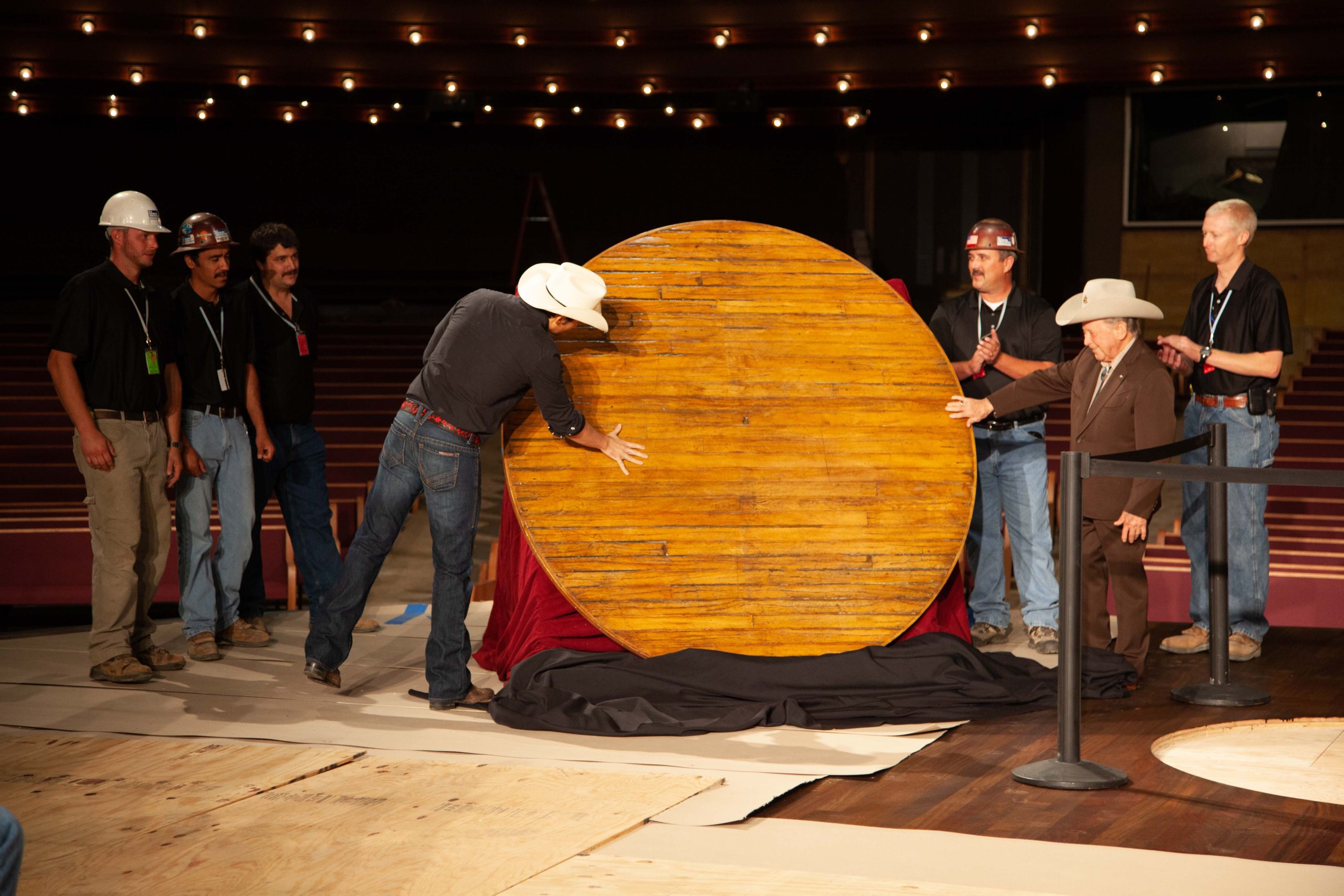
Braid Paisley and Little Jimmy Dickens return the Circle to the Opry stage after the 2010 flood. Photo courtesy of Ryman Hospitality Properties.

Join The Celebration

There’s nothing low-key about the Grand Ole Opry – so in the classic Opry spirit, fans have had plenty of opportunity to celebrate the centennial all year long.

Earlier this year, NBC broadcast a three-hour anniversary special, with dozens of stars ranging from Reba McEntire to Jelly Roll to The War and Treaty. The Opry also took the show to London’s Royal Albert Hall for the very first time. You can stream clips of these and other Opry events on YouTube and social media.

With the Virgin Music Group, the Opry has produced the album Opry 100, Country’s Greatest Songs (released November 7). Among the unforgettable recordings are Vince Gill singing his heart-rending “Go Rest High on That Mountain,” Dolly Parton singing “I Will Always Love You,” and Ashley McBryde covering the classic “Your Cheatin’ Heart.” You can order the album from the Opry site.

Craig Shelburne, Brenda Colladay, and Opry members and employees collaborated on 100 Years of the Grand Ole Opry, a book filled with anecdotes and photos that vividly illustrate the Opry’s remarkable history. And to teach your children well, there’s also a new childrens’ picture book written by Emily Frans and illustrated by Susanna Chapman. Find them in your local bookstore.

And, on November 28, 2025, the official 100th anniversary of the Grand Ole Opry we all hold dear, the Opry is celebrating with two huge birthday party shows featuring country stars and Opry members like Vince Gill, Ricky Skaggs, Trace Adkins, Dailey & Vincent, Bill Anderson, Jamey Johnson, Marty Stuart, and many, many more. Tickets are available here.

Of course, the celebrations will continue in 2026.

“The Opry is the core and soul of country music,” Bentley said. “It’s a place where the past, present and future of our genre all come together. There isn’t anywhere else like it.”


Continue exploring our Artist of the Month coverage of Opry 100 here.

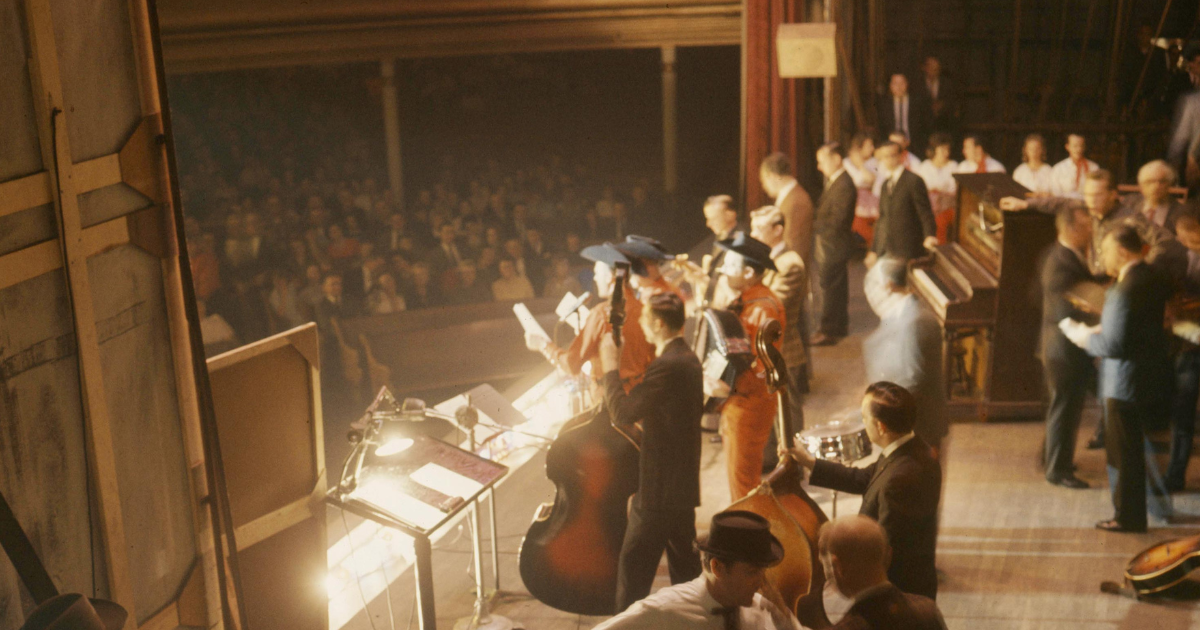
All photos courtesy of Ryman Hospitality Properties, credits and attributions as marked. Lead image: Bill Monroe & the Blue Grass Boys and the Opry Square Dancers take the Opry stage at the Ryman Auditorium in the 1960s.
With New Double-Album, Nefesh Mountain Send Out ‘Beacons’ for Dark Times

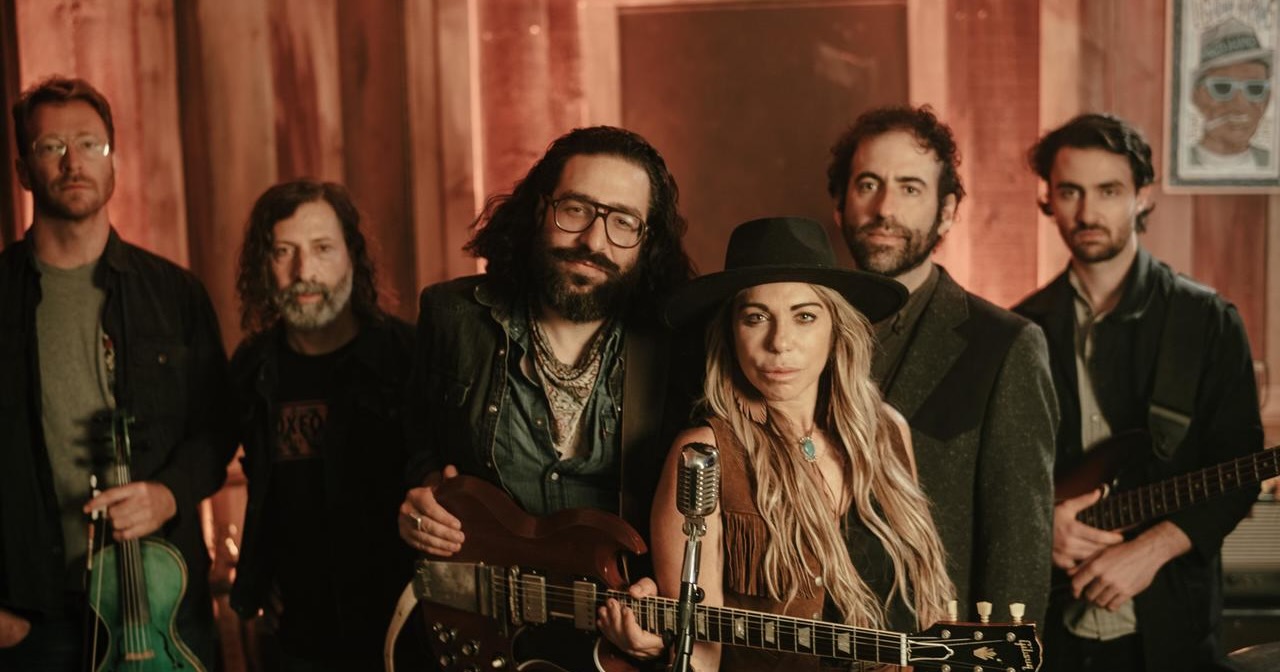
It’s been a decade since Doni Zasloff and Eric Lindberg became musical and life partners, melding her background in musical theater and singer-songwriter music together with his blues, jazz, and banjo-picking roots. Now, with a new double album, Beacons, their band Nefesh Mountain dives deep into the myriad ways music can serve as a light in dark times.

The album’s eighteen tracks across two discs convey not only a ferocious command of numerous roots styles, but also a level of compassion and empathy lacking from so much topical music.

“We’re always trying to … walk that high wire between trying to provide an escape … and not neglect[ing] what’s so clearly happening day by day to all of us, as we watch the news and look at our phones and feel this fear and anger and depression,” says Lindberg. The news, he adds, has become “this thing that we can’t run from.”

For many artists on the folk/roots continuum, this desire to comment on the state of the world might mean focusing entirely on our current political leadership. For Nefesh Mountain, though, it means relating with their audience on an even more personal level than usual.

“That’s really part of our job, I think, as artists right now,” Lindberg says.

This echoes a message of “revolutionary love” that many other artists have gotten behind, courtesy of author Valerie Karr.

“Wonder is where love begins,” Karr wrote in her 2020 memoir, See No Stranger: A Memoir and Manifesto of Revolutionary Love. “When we choose to wonder about people we don’t know, when we imagine their lives and listen for their stories, we begin to expand the circle of who we see as part of us.”

This notion is what inspired Ani DiFranco’s 2021 album Revolutionary Love and seems to be echoed on Beacons, with Nefesh Mountain’s determination to weave radical love into their approach to progressive bluegrass and Americana music. Indeed, Beacons seems to strive toward illuminating our common humanity.

Granted, this mission of “radical love” began with the name Lindberg and Zasloff chose for their band in the first place. “Nefesh” is a Hebrew word denoting life force, the sentience that pervades all living things. Radical love requires as much vulnerable expression as it does being open to the array of scary, emotional, dark trepidation so many people have in common. Among the topics Lindberg and Zasloff breach on Beacons: coming clean about a history of substance use, discussing the hard truths around their seven-year fertility journey, and their shared determination to maintain a sense of wonder in a world that can feel relentlessly staid. (“If we’re looking for some heaven, babe/ There’s some right here on the ground,” Lindberg sings in “Heaven Is Here.”)

The first disc of Beacons features a deft exploration of the group’s Americana tones. Though Lindberg and Zasloff are from the Northeast, their Nashville connections and twang-centric improv skills deliver a set of songs that could play just fine on say WSM, the radio home of the Grand Ole Opry.

The set begins with “Race to Run” – a radio-friendly country song about overthinking the struggles of the creative life (“I’m tired of trying to stay out in front/ But you remind me … it’s your own race to run”). “What Kind of World” is a rumination on a sense so many folks share these days, of powerlessness in the face of climate change. (“Is it just me? Can you feel it too?”) But, the song’s lyrics extend into geopolitics and the sense of divide that leaves so many feeling unstable.

Asked about the song’s vulnerable and rather personal honesty, Lindberg notes: “Remember, it was a year and a half ago when the fires from Canada kind of made their way down. We live in the New York area … so the line in the song is, ‘I saw the golden hour at 11 a.m./ They say it’s from the fires, it’s not us or them.’

“Now, a year later or so,” he adds, linking last year’s fire headlines with those of 2025, this time in California. “We had to sing this in Orange County a few weeks back while they were [still seeing smoke].”

As Lindberg’s proverbial camera pans out, the song considers the role of the average citizen in the face of such behemoth powers as climate and politics. “What’s it all for if we’re not all free,” the lyrics ask, shifting from fear about climate disasters to a purpose of climate justice. This ability to move from complaint to action item in a single verse, all couched in infectious twang, is what sets Nefesh Mountain apart from many others in the country space.

The Americana disc’s finest moment, however, is “Mother,” a song written by Lindberg that addresses so many of motherhood’s side effects. “I’ve lived many lives,” Zasloff sings. “…It’s all part of the job as a mother.”

Zasloff notes that her first two children – from a previous relationship – were practically grown when she and Lindberg began trying for a child of their own. What ensued was a seven-year fertility process that echoes what so many women encounter when they discover becoming pregnant is not always as easy as it seems.

“I burst out crying when [Eric] first shared [‘Mother’] with me,” she says, “because it was so personal and so empowering and beautiful for my husband to write that about me.”

In addition to the way the song tackles their infertility journey, it also reckons with Zasloff’s history with alcohol – something she chose to leave behind in order to become a mother. “I decided in that moment of having that song come into the world,” she says, “that I was wanting to talk about something personal that I had never talked about publicly, ever. Which is the fact that I am sober. I’m an alcoholic and I just celebrated 20 years of sobriety. And I actually became sober to become a mother. It’s part of my whole story.”

Livin’ with that drink, Lord,
Always left me wanting more
But I was saved
When I became a mother

After that high point, the group moves into the traditional “Keep Your Lamp Trimmed and Burning,” which Lindberg notes has long been a part of their live show. “We’d always mess with the arrangement,” he says. “I kind of just called it in the studio. We had a little bit of extra time. I didn’t know it was going to be on the album, but it’s one that the band knew when we were down in Nashville and we kind of arranged it on the fly.”

“We’re all New York guys and jazz players,” he adds. “So we wanted to lean into that a little bit and bring this real Americana spiritual into a different sonic space, really let improvisation take over, and help that add to the obviously beautiful meaning of the song.”

Nine tracks in, Beacons switches to bluegrass, bringing in giants of the form to round out the band. Of course, anytime Sam Bush, Jerry Douglas, Stuart Duncan, Rob McCoury, Cody Kilby, and Mark Schatz come together in any room, the sound is bound to slap. Toss in Lindberg, whose pre-Nefesh background is jazz improvisation, and something truly special crops up.

“Regrets in the Rearview” opens this second disc, feeling like a bluegrass answer to the Americana set’s opener, “Race to Run.” Its instrumental section sets a high bar for the rest of the collection, as the band hands around lead duties, featuring some of the finest bluegrass instrumentals in the biz.

But it’s “This Is Me,” coming in at bluegrass track number three, that delivers one of the double album’s finest moments. Capitalizing on the band’s commitment to building connections and “radical love,” “This Is Me” tells the bluegrass side’s most personal story.

“A question that’s been thrown at us for years now, and especially to Eric,” says Zasloff, “is: How did a Jewish kid from Brooklyn get into bluegrass? … He came to me and he said, ‘I think I wrote a response song so that people will stop asking me that question.”

“I was thinking about it,” Lindberg says. “How did I get into bluegrass? [“This Is Me” is] more about if we’re lucky enough to find that thing that really makes us come alive and makes our soul kind of catch fire –whether it’s writing a song … or painting or sculpture or any trade anyone does. If that’s the thing, then it doesn’t matter, geographically, where we’re from.

“I’m of the belief, nowadays especially, with what we’re trying to do in the roots world, [that it’s important to] try to break down all the barriers,” he continues. No matter where people are from, he adds, “there are people that find this music and go, ‘Wow, that is lighting me up!'”

With that, Lindberg hearkens back to the title of the album. That music might be a light in dark times is, of course, no new concept. (Consider “This Little Light of Mine.”) But the fact that the idea has been floated before doesn’t mean it’s not worth mentioning. At a time when so many folks feel powerless to the onslaught of news and information coursing through the internet and the real world alike, it can be easy to feel like none of us are enough to meet the moment. But Beacons is a reminder that there is no darkness without light.

“No one knows how we become who we are,” Lindberg says, before offering a word of advice. “Everyone just be yourself –regardless of the questions you get or the pain or the hate that you see. You’ve just got to stay true.”


Photo Credit: Kelin Verrette & Rafael Roy   

Celebrating Black History Month: DeFord Bailey, Tina Turner, Keb’ Mo’, and More

To celebrate Black History Month – and the vital contributions of Black, Afro-, and African American artists and musicians to American roots music – BGS, Good Country, and our friends at Real Roots Radio in southwestern Ohio have partnered once again. This time, we’ll be bringing you weekly collections of a variety of Black roots musicians who have been featured on Real Roots Radio’s airwaves. You can listen to Real Roots Radio online 24/7 or via their FREE app for smartphones or tablets. If you’re based in Ohio, tune in via 100.3 (Xenia, Dayton, Springfield), 106.7 (Wilmington), or 105.5 (Eaton).

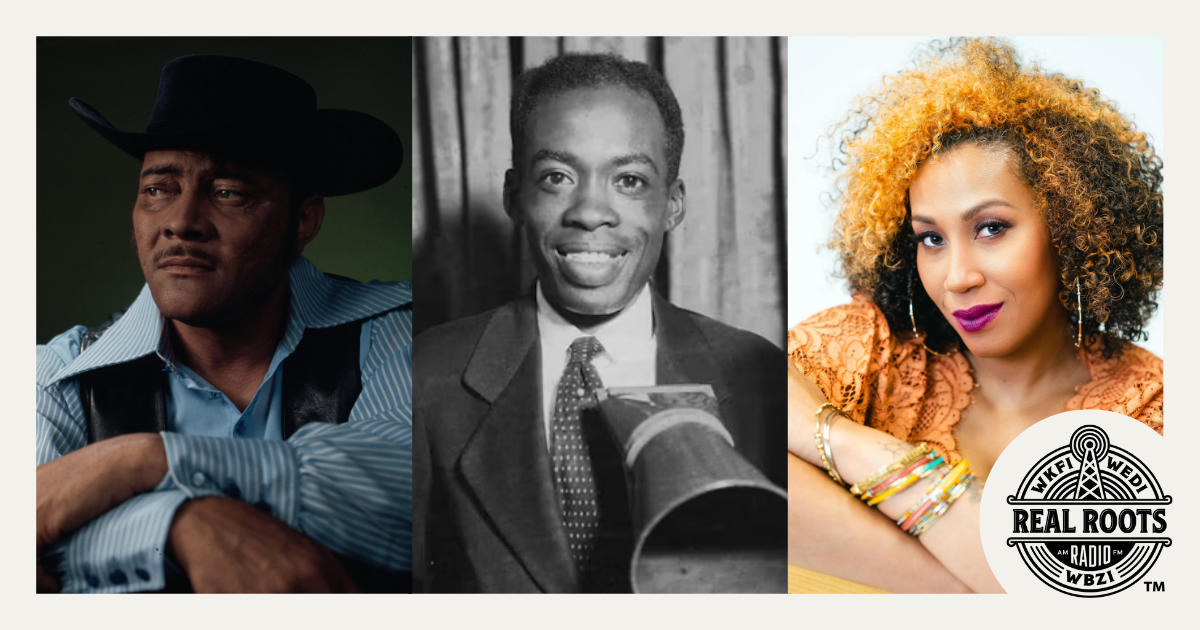
American roots music – in any of its many forms – wouldn’t exist today without the culture, stories, skills, and experiences of Black folks. Each week throughout February, we’ll spotlight this simple yet profound fact by diving into the catalogs and careers of some of the most important figures in our genres. For week two of the series, RRR host Daniel Mullins shares songs and stories of Stoney Edwards, Rissi Palmer, Keb’ Mo’, Tina Turner, and DeFord Bailey. Check out the first week of the series here.

We’ll return each Friday through the end of the month to bring you even more music celebrating Black History and the songs and sounds we all hold dear. Plus, you can find a full playlist with more than 100 songs below from dozens and dozens of seminal artists, performers, songwriters, and instrumentalists from every corner of folk, country, bluegrass, old-time, blues, and beyond.

Black history is American roots music history; the two are inseparable. As we celebrate Black History Month and its legacy, we hope you’ll join us in holding up and appreciating the artists who make country, bluegrass, blues, folk, and Americana the incredible and impactful genres that they are today.

Stoney Edwards (1929 – 1997)

If you don’t know the late, great Stoney Edwards’ name, it’s time to fix that – because his story in country is as powerful as the songs he sang.

Born Frenchie Edwards in Seminole Country, Oklahoma, in 1929, Stoney was part African American, Native American, and Irish. The son of sharecroppers, he was a prominent bootlegger in Oklahoma during his younger years. Stoney had dreams of playing the historic Grand Ole Opry. His big break in music would come later in life, in his early 40s, when he was discovered in California singing his honky-tonk style at a benefit for the King of Western Swing, Bob Wills.

Stoney was signed to Capitol Records in the early ’70s and from there he made history. He scored fifteen charting singles, including a pair of Top 20 hits, one of which – his 1973 hit “She’s My Rock” – is still revered as a bona fide country standard later covered by artists like Brenda Lee and George Jones. His songs were deeply authentic, whether he was singing about love, loss, or his own experiences growing up poor and Black in America. He gave a voice to the underdog, often drawing from his own struggles, including battling discrimination and working blue-collar jobs before music. Edwards would also record several songs saluting his country heroes over the years, including “The Jimmie Rodgers Blues,” “Daddy Bluegrass,” and his Top 40 hit, “Hank and Lefty Raised My Country Soul.”

Stoney’s music wasn’t just about catchy melodies; it was about storytelling. His debut single was inspired by a true story. Before he hit it big as a country singer, Stoney was trying to provide for his family working as a forklift operator at a steel refinery in San Francisco. A workplace accident resulted in Edwards being sealed up in a tank and suffering dangerous carbon dioxide poisoning; he endured an extensive two-year recovery, both physically and mentally. During this time, Stoney was struggling to care for his wife and children, so he planned to leave in the middle of the night. However he tripped over one of his daughter’s toys, and it prompted him to stay. In 1970, backed by the virtually unknown Asleep at the Wheel, Stoney Edwards released his debut single, the autobiographical “A Two Dollar Toy.”

While his career didn’t reach the same commercial heights as some of his peers, Stoney Edwards left an indelible mark on country music. He paved the way for greater diversity in the genre and showed that country music is for everyone – no matter where you come from or what you look like. Stoney Edwards passed away from stomach cancer in 1997 at the age of 67.

Suggested Listening:
She’s My Rock
Hank and Lefty Raised My Country Soul

Rissi Palmer (b. 1981)

She’s a trailblazer in country music, a voice for change, and an artist who refuses to be boxed in – meet Rissi Palmer!

Palmer’s mother passed away when she was just seven years old, but she instilled in her a love for the music of Patsy Cline. Rissi would burst onto the country scene in 2007 with her hit single, “Country Girl,” making history as one of the few Black women to chart on the Billboard country charts. Rissi has built a career on breaking barriers by blending country, soul, and R&B into a sound all her own. She has penned some empowering original songs, helping folks on the margins feel seen, especially her most personal song, “You Were Here,” dealing with the heartbreak of a miscarriage.

Beyond the music, Palmer uses her platform to uplift underrepresented voices in country and roots music. As the host of Color Me Country radio on Apple Music, she spotlights Black, Indigenous, and Latino artists in country music – proving that the genre belongs to everyone. With her powerful voice and unwavering spirit, Rissi Palmer isn’t just making music, she’s making history.

Suggested Listening:
Leavin’ On Your Mind
Seeds

Keb’ Mo’ (b. 1951)

Keb’ Mo’ is a modern blues legend. Born Kevin Moore, this L.A. native blends Delta blues with folk, soul, and a touch of country. With his smooth vocals and masterful guitar skills, he’s kept the blues alive for over four decades.

Mo’ is heavily influenced by the late Robert Johnson, who preceded Keb’ by about 60 years. Keb’ portrayed Robert Johnson in a 1998 documentary and included two Johnson covers on his breakthrough self-titled album in 1994. He has since won five GRAMMY Awards, collaborated with legends like Bonnie Raitt, Jackson Browne, and Taj Mahal, and performed for multiple U.S. presidents.

Mo’ is embedded in country and Americana music as well, working with cats like Lyle Lovett, Old Crow Medicine Show, John Berry, Alison Brown, Jerry Douglas, and Darius Rucker over the years. He has been quick to share his respect for country and gospel traditions, appearing on the critically acclaimed all-star album, Orthophonic Joy, recreating the magic of the 1927 Bristol Sessions – country music’s big bang.

Whether he’s playing a heartfelt ballad or a foot-stomping blues groove, Keb’ Mo’ keeps the genre fresh and timeless. His music isn’t just about the past – it’s about where the blues is going next. We love his passion for all things American roots music. Fifty years into his remarkable career, Keb’ Mo’ is still one cool cat.

Suggested Listening:
To The Work
Good Strong Woman” featuring Darius Rucker

Tina Turner (1939 – 2023)

She was the Queen of rock ‘n’ roll, but did you know Tina Turner had deep country roots?

Born Anna Mae Bullock, she grew up in Nutbush, Tennessee. Tina recalled picking cotton as a youngster during her hardscrabble rural upbringing. Her musical journey began by singing at church on Sunday mornings. She grew up on country, gospel, and blues. Turner and her husband, Ike (who was abusive towards her) had massive success in R&B and rock and roll, but her first solo record was actually a country album.

In 1974, Turner released her debut LP, Tina Turns The Country On!, introducing herself as a solo act. Featuring top musicians, including Country Music Hall of Famer James Burton on guitar, Tina tackled songs from country greats like Dolly Parton, Kris Kristofferson, and Hank Snow. It would go on to receive a GRAMMY nomination for Best Female R&B Vocal Performance in 1975. Over the years, unreleased songs from this groundbreaking album would be dropped, including her powerful take on “Stand by Your Man.”

However, her most enduring impact on country might be as the inspiration behind one of the outlaw movement’s most popular hits. In 1969, Waylon Jennings was staying at a motel in Fort Worth, Texas, when he saw a newspaper ad about Ike & Tina Turner that intrigued him enough to interrupt Willie Nelson during a poker game so they could write a country classic. The phrase that struck Waylon heralded Turner as “a good hearted woman loving a two-timin’ man.” Sound familiar?

From honky-tonks to stadiums, Tina Turner’s fiery spirit left an unforgettable mark on practically every genre – country, rock, and everything in between.

Suggested Listening:
Stand By Your Man
Good Hearted Woman

DeFord Bailey (1899 – 1982)

Let’s go back to the early days of country to a name that shaped the Grand Ole Opry, but is often forgotten: DeFord Bailey, “The Harmonica Wizard!”

Born in 1899 in Smith County, Tennessee, Bailey grew up around banjos and fiddles in a musical family, saying that he learned the “Black hillbilly music” tradition. He overcame polio as a child, resulting in his short stature – he was only 4’ 10” tall – but it was through this ordeal that he found his voice in a harmonica. While recovering from the disease, he was bedridden for a year, and learned to mimic the sounds he heard outside on his harmonica: trains, animals, and the rhythms of life.

In 1927, Bailey became one of the first stars of the Grand Ole Opry on Nashville’s WSM, dazzling crowds with hits like “Pan American Blues.” He was actually the first artist introduced after George D. Hay referred to WSM’s Barn Dance as the “Grand Ole Opry” for the first time to poke fun at NBC’s classical Grand Opera. Bailey would also become the first artist to record in Music City. His hits like “Fox Chase,” “John Henry,” and “Evening Prayer Blues” captivated radio audiences, making him one of the Opry’s most popular performers. He would tour with other stars like Roy Acuff, Uncle Dave Macon, The Delmore Brothers, and Bill Monroe, but would often not be allowed to stay in the same hotels or eat at the same restaurants as his white contemporaries due to Jim Crow laws.

In 1941, DeFord Bailey was unceremoniously fired from the Grand Ole Opry under suspicious circumstances. He would make his living shining shoes in Nashville and would not perform on the Opry again until 1974, the first of only a handful of final performances on the radio program which he helped grow during its infancy, before his passing in 1982.

The Grand Ole Opry would eventually work to reconcile its mistreatment of its first Black member, issuing a public apology to the late DeFord Bailey in 2023 with his descendants on hand. Old Crow Medicine Show was there to celebrate the occasion, performing their tribute song to Bailey led by black percussionist Jerry Pentecost, entitled “DeFord Rides Again.”

In 2005, Bailey was rightfully inducted into the Country Music Hall of Fame and over 40 years since his passing, he is still recognized as the Harmonica Wizard.

Suggested Listening:
Pan American Blues
Evening Prayer Blues


Want more Good Country? Sign up on Substack for our monthly email newsletter full of everything country.

Listen to Real Roots Radio online 24/7 or via their FREE app for smartphones or tablets.

Photo Credit: Stoney Edwards by Universal Music Group; DeFord Bailey courtesy of the Country Music Hall of Fame; Rissi Palmer by Chris Charles.