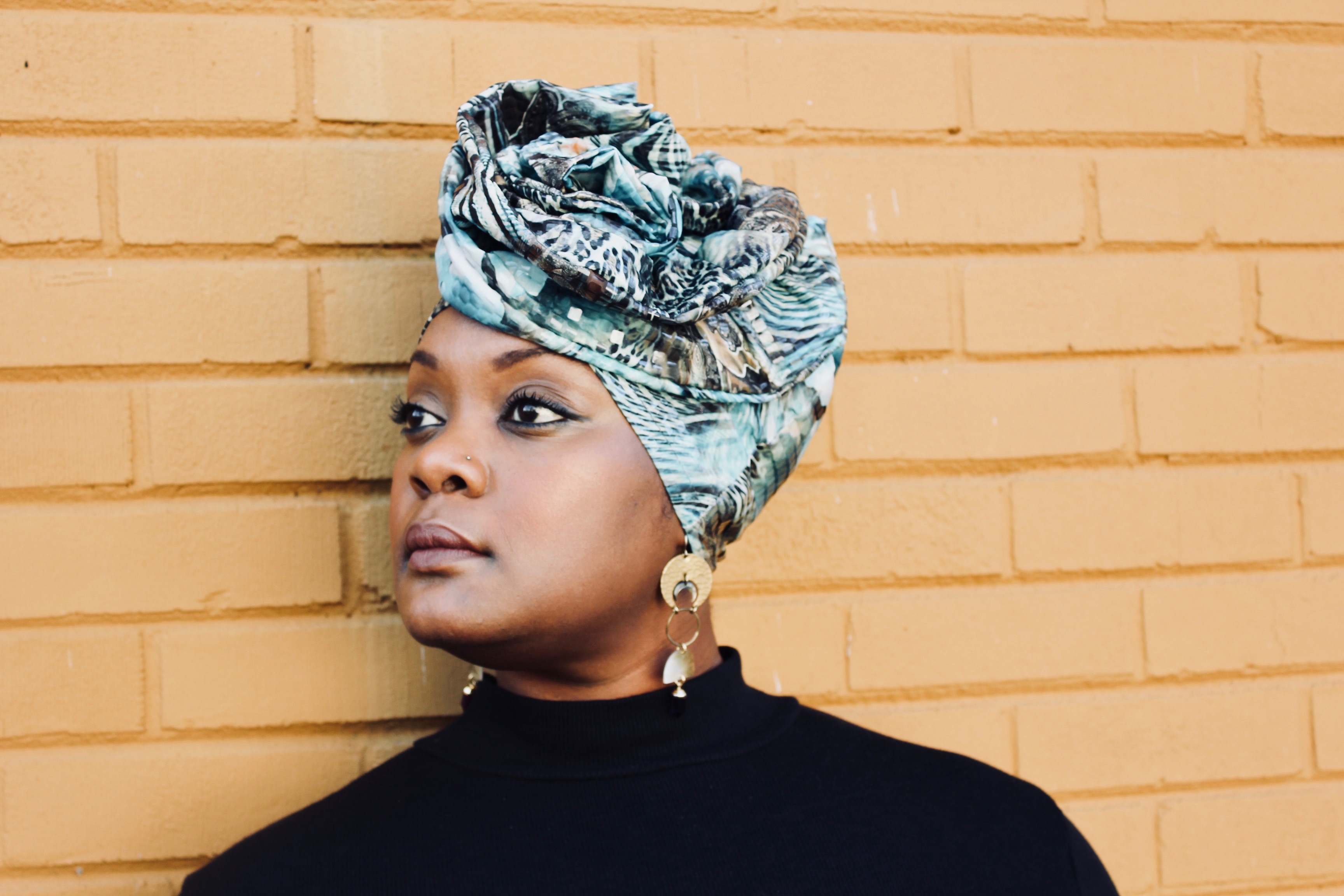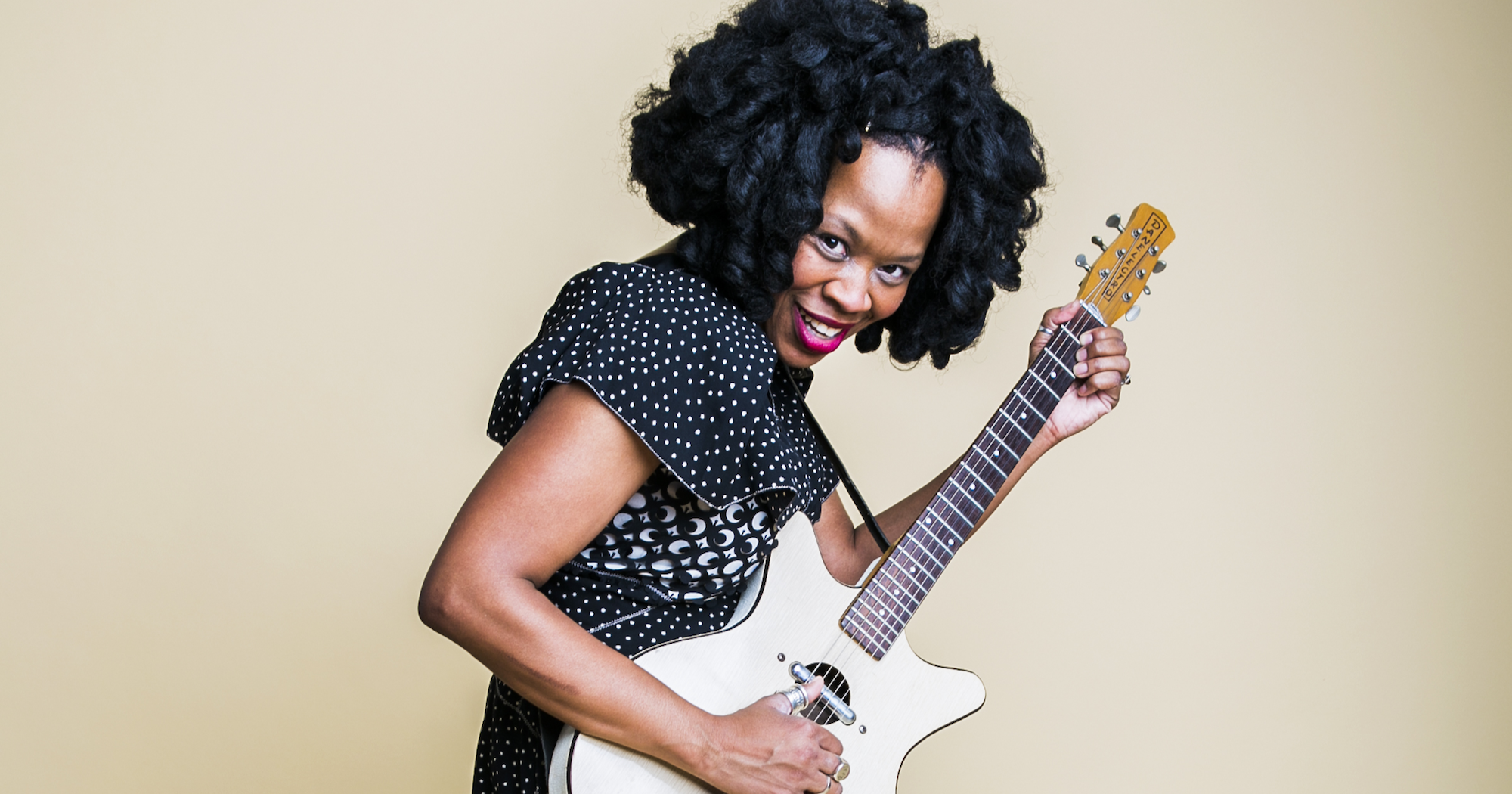
Queen Esther Made a Civil War Album Unlike All the Rest

Civil War albums are all too common in roots music, bluegrass, country, and Americana. Usually, these concept projects romanticize and valorize one of the darkest periods in our nation’s history, while cheerfully and cartoonishly detached from reality and untethered from the nuances of this horrifying and violent period of tumult in the U.S. Revisionism and imperialism are enacted by fiddles and banjos in loose, contrived musical period garb.

Audiences seem to devour this kind of idyllic reimagination of the Civil War and the issues that gave rise to it. Though chattel slavery and its foundational role in our economy were central to the conflict, Civil War concept albums rarely interrogate those facts, instead leaning on listeners’ love for story songs and cursory understanding of “brothers against brothers” narrative paradigms to sell records and tickets. The sketchiness of this practice is overlooked across the board, perhaps due to the sheer ubiquity of such efforts.

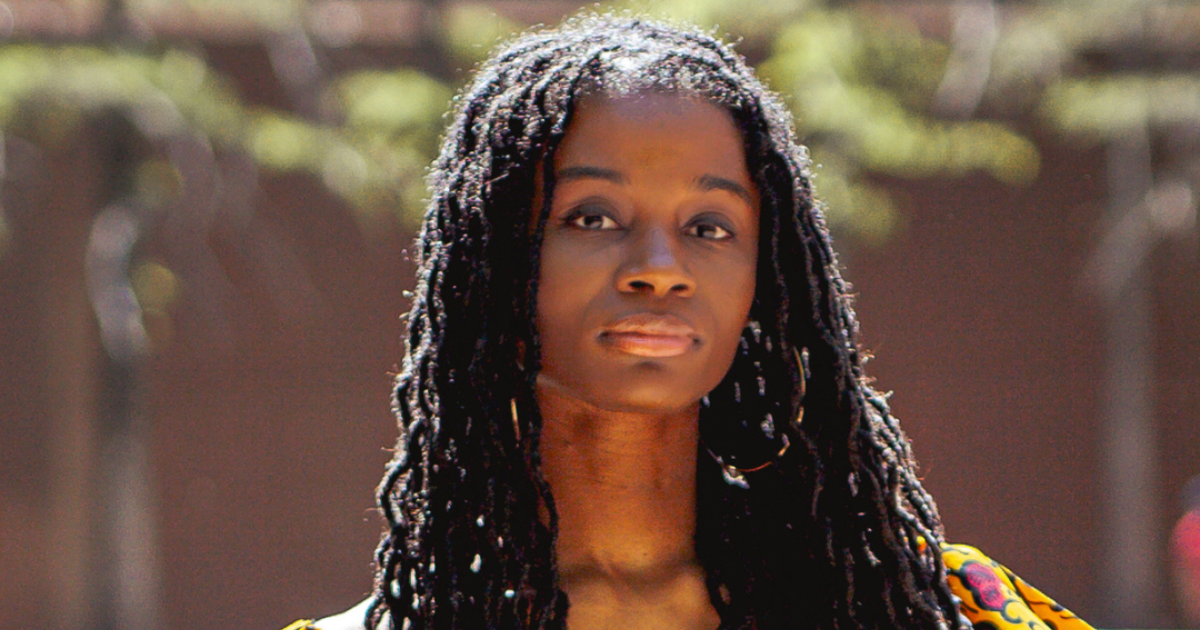
On February 6, artist, musician, songwriter, actor, and playwright Queen Esther released a very different sort of Civil War album, Blackbirding. Enabled by a grant from The National Parks Arts Foundation, Queen Esther worked and lived in residence at Gettysburg National Military Park in Gettysburg, Pennsylvania, for a month in 2020. During that time, she communed with the land, the place, and the losses and griefs seeped into the blood-soaked soil, plumbing stories, myths, memory, and feelings to craft her 12-song reckoning with the Civil War. Original songs, songs from that time period, and fascinating covers combine into a work of roots music and theater, dramatization and storytelling interwoven with knowledge-bearing and memory-keeping.

Queen Esther being a Southern Black feminist multi-hyphenate creative is exactly why Blackbirding stands out among its peers in the curséd Civil War concept album space. There is no idealization or revisionism happening in Queen Esther’s songs. Instead, there’s a tangible humanity and an awe-inspiring alchemy of grief, loss, and crimes against humanity into beautiful, redemptive music.

Queen Esther first brought Blackbirding into the world as a piece of performance art with a staged reading in 2024. Even now, in its LP form, these songs lean forward, doing narrative work perceptible whether on stage or off, and coaxing listeners to abandon passive listening and – as all theater asks – inhabit a third, artistic, creative space together in our interaction with these compositions.

The central point of the album is made over and over again across the 12 tracks and throughout our lengthy and in-depth BGS conversation. “Blackbirding,” the 19th-century practice of kidnapping free Black folks and selling them into slavery or back into slavery, never really went away. The Civil War was not won. Reconstruction failed. Slavery itself was not abolished, but rebranded. As such, Blackbirding, whether from the perspective of its content or its genre aesthetics, isn’t a throwback or time capsule album. This is music made in the present, for the present, about the present, and it calls on all of us – again, in the present – to reckon with and consider how we each contribute to or act in defiance of the continuation of racial apartheid and imperialism in the United States.

Do not fear, though, because Queen Esther’s approach to such musicmaking is remarkably joyous, grounded, and compassionate. It’s clear she’s not only ready to engage in the conversations this music evokes, but that is exactly her purpose. And the ultimate culmination of her many talents. In this way, she yet again distinguishes herself from other such concept albums in Americana.

I’ve been a fan of yours for a few years, ever since we discovered your TED Talk. When I first watched it, it was so revelatory. It felt like you supplied vocabulary – and knowledge and expertise – that I wish I would’ve had my whole life to help describe the multi-ethnic origins of roots music and bluegrass and country. If all of this came from “Scotch-Irish tradition,” then why does bluegrass sound like bluegrass? Why does country sound like country? Why doesn’t it sound like Irish music or Scots music or music from the British Isles? It sounds different.

I just wanted to start by saying thank you for that talk – and thank you for all of the insight, feeling, and emotion that you bring to these intellectual topics that people tend to forget are about real humans, real experiences, and real music.

Queen Esther: Absolutely. I really appreciate you saying that. I think more often than not, Black people have these conversations amongst ourselves. We wait until the door is closed and then we talk. I think we should have more conversations with everyone in the room. As long as they’re willing to listen. That’s a tall order. Much more so than you would think.

I’m really happy about this album, especially because people are starting to have conversations around the songs, topics, and everything that I’m bringing up. The fact is that slavery has never ended. It was just modified. The Civil War has never ended. It just evolved. “Blackbirding” has never ended. It just got a lot more inclusive.

Those three things are standing in the way of America being America. There is the America that is on paper – the one that is in the brochure with the Statue of Liberty, the flag behind it, and mom, and apple pie, and all of this stuff. And none of it is true. It’s all a marketing ploy. The actual America that really exists, that’s the one that Black people have had to endure and survive for hundreds of years. That’s the America that turned its back on us.

You know as well as I do that there are so many Civil War albums in bluegrass, folk, string band music, and Americana. So many are built upon the revisionist history that you’re talking about. The manicured, sanitized “picket fence and 2.5 kids” version of the “American Dream.” So, normally when I get a pitch about an album like this, it just goes straight to my email archive. Knowing you and knowing your work – and especially the way that you bring theater and all of your multi-hyphenate titles into crafting and creating – I was so excited to have a chance to talk about approaching the Civil War and approaching Gettysburg as an inspiration for music.

Blackbirding is set in the present. You’re talking about how slavery never went away, how reconstruction failed, and how the Civil War was not won. You’re contextualizing this art in the present sonically, as well. Because, like you’re saying, the Civil War never ended, slavery never ended, blackbirding never ended. Can you talk a little bit about placing all of this discourse in the present and not just in period garb, as it were?

I have to say perspective is a powerful thing. As a Black woman, as a Southerner, as someone that’s two generations removed from slavery, as a creative, I never heard any of this told from a Black perspective. It was always “the lost cause”: “These Yankees came and they just attacked us from out of nowhere. We were living this beautiful life and they just ruined everything.” When nothing could be further from the truth.

They literally terrorized Black people. They tore us apart, they raped our children. They did all manner of evil constantly, under the guise of Christianity. And it was even uglier than anyone would dare to imagine. Which is why they’re struggling to hide Black history, to hide lost history, to make sure that it stays lost. To not have anyone like me turn over the rock to see what’s underneath.

At the same time, these songs from minstrelsy, these songs from not that long ago, they’re important songs. They should be rediscovered. The problem that I’ve always had is that once you have that technical prowess as a musician and once you plumb the depths with that music, no one was bringing that music forward into the present. Not unless they were … putting it in a historical context, and that’s important, but to bring it into the now [is just as important]. …

Having a sense of intellectual curiosity, it’s really important. It doesn’t matter that you’re not the smartest, but that you are curious intellectually and that you are brave enough to explore that curiosity is way more important. That’s really my bedrock. That’s where I’m coming from now.

I’m a generative performing artist. … We are the ones who generate our work and we perform that work. Some people don’t necessarily perform their work. They just write it or they create it and they’re looking for other people to do the work, to perform the work, so that they can get their work out there. Lots of songwriters like that. Lots of lyricists are like that. That’s beautiful. That’s great. …

The songs would come to me, they would just float up in my head. It’s like a patchwork quilt. You take all these different kinds of fabric and all these bits and pieces. But you’re making this mosaic that turns into this overall image that is bigger than whatever bits and pieces you brought to it in the first place.

Talking about that mosaic, it makes me think that of course we would end up at this point, with a project like this, with a conversation like this, and with a body of work that couldn’t have been made if you had tried to step outside of yourself or your own identity to make it.

Exactly. All of that fueled me. I was reaching out in different genres, not just musically, but in the world. I was doing a lot of alternative theater, I was doing cabaret. I was doing performance art, I was doing solo performance. I was doing storytelling. I’d get up on stage and I would do just about anything. That was a world in and of itself.

Now, after a certain point, when you’re a generative performing artist, you’re looking for grants so that you can develop the work in general. It takes seven to nine years to develop a musical. It takes five to seven years to develop a play. When you see someone go, “Oh yeah, my new play, it’s up.” They put in a heavy grind! That’s five years of rewrites and workshops and readings. Some theater taking them on with their theater company and developing that work until it was ready for a test audience, not even necessarily ready [to open]. It’s just a lot of hard work and a lot of heavy lifting. There are certain grants that make that possible, where you just have to go away and you have to write and create.

I found a grant that would let me do that with this album through the National Park Service. The National Parks Arts Foundation has grants to at least a dozen National Parks. You can go to the park, you can live on the park, and they will pay you.

This project is also a work of theater. What jumped out to me first and foremost in that regard is what you’re talking about – the residency, the grant, being on location. Bluegrass, roots music, country music, they all ask us to be in a place together, but not in the same way that theater does. Theater is very much created so the audience are not passive participants. It actively invites listeners and collaborators and bystanders into a space and into a place.

You are doing that with this body of work – and with your residency at Gettysburg. I thought that was one of the most fascinating things about this project. Using theater, with a capital T, to help do that work of transporting all of us to the battlefield, to Gettysburg, to the geographical place that you are evoking with these songs.

I’ve been doing theater ever since I could stand up straight. Think about the cavemen, just standing in front of their brethren and telling a story about what happened to them that day. If my grandmother were here right now and in on this conversation, she’d tell you that I was telling stories ever since I could talk. I would just make things up. She would be sitting there washing dishes and I would try to distract her by making up something wild or crazy or imaginative. I don’t know, I just gotta say something to make her drop that dishcloth or at least laugh or something. [Laughs]

What is fantastic realism? Fantastic realism is when you have ordinary circumstances and then something extraordinary just pops right in. … So the idea of theatricalizing whatever was happening around me as a little kid, [that’s fantastic realism]. If we were sitting here at a table talking, for example, and then an elephant came along and took the hat off your head – that kind of a thing. Just the outrageous Southern tall tale. Bombastic storytelling is always floating just beyond your reach, I think, as a Southerner. It’s just how we do.

And of course, like everything in the South, this is an African tradition. This is an oral tradition handed down from West Africa. West African traditions [are] something else that people have a really hard time saying out loud and acknowledging. It’s not that other cultures didn’t tell stories, but our influence as Africans, as enslaved Africans, of our African ancestors on the South and on America, is seismic. It’s time for people to make the shift however small, however great, and center that and acknowledge it. They can’t even acknowledge it. …

I’m going to tell you a story. I almost always start [performances] with, “You wanna hear a story? I got a story to tell you.” Sometimes I’ll sing it, sometimes I’ll say it with music happening around me or behind me. But this is a story that you’re gonna want to hear. And every single song on [Blackbirding] is wrapped up in a story. There’s a story that’s around it that’s historical. There’s a story that resonates into the now, and there’s a story that I bring to you as an audience when I’m performing the song itself.

I’m thinking about how there’s so much music made in these genre spaces that is also putting on a costume, or telling a story, or doing theater, but that often isn’t grounded in reality at all. It’s all construction. So where some people might interface with your art and think, “Oh, this is a musical, this is theater, this is going to be a play, this is going to be ‘make believe.’” It’s actually so much further from that.

Oh no, it’s reality!

Exactly. And to me, that’s the whole story here. The thing I wanted to talk about most about Blackbirding is the point that you made right at the top – and that you’ve made throughout this conversation. You’re not talking about something that was happening a while ago and isn’t happening today.

Look, the 13th Amendment said slavery’s over “except.” Except? That’s a gigantic loophole. Except for what? Except for incarceration. That means if you’re incarcerated, you’re a slave. What if someone said to you, “You’re fired except on Tuesdays”? Then I’m not fired. You have to come in on Tuesday for four hours. Other than that you’re fired. You don’t work here. How much sense does that make? No one would hear an employer say that and go, “Am I fired or not?” Am I free or not?

You are free. Except they had to make that exception. They had to. Why? Because when the Civil War ended, this country was in absolute shambles. And because Black people were the actual currency. There were 4 million of us and we were basically worth trillions in today’s money.

We went off and we started our own little hamlets and towns, and we started working for ourselves. Suddenly there was this massive tilt. Black people were the money and had all of these resources, energy, and power. And just by sheer force of will, we started building for ourselves, which is why they started tearing us down. Showing up to each and every single community and just murdering people, burning people [alive] in their homes. Coming up with all of these lies built on pseudoscience to justify all of the things that they did. …

But it never ended. Pulling Black people over on the road, out in the middle of nowhere for no reason whatsoever. Beating them up. Maiming them, murdering them in some instances. This has always been the way. This has always been the case.

I’m imagining you on site at Gettysburg. How do you take that sort of emotional devastation or the intrinsic triggering and challenging nature of these topics and turn them into something beautiful? Do you see them as beautiful to begin with? I’m trying to imagine how you take care of yourself emotionally and psychically as you’re doing this important work. Because I think there must be an emotional toll to it, but you clearly are built for it as well. This feels like your wheelhouse – and the way you talk about it and the comfortability you have in having these conversations.

Simple. I am not an atheist. I am not an agnostic. I believe in God. I believe in Jesus. I’m a Christian, and I know that God is with me. I feel God’s presence upon me. I feel God hovering over me, protecting me divinely. I feel that I’m walking in divine purpose and in divine order. I know that I am divinely protected, that the blood of Jesus covers me everywhere I go. …

There’s this point at which inspiration takes over. There’s a point at which you are no longer there, and inspiration is there instead. An actor prepares– the idea is that you have technique, right? Your technique is there whether you’re playing an instrument or singing or washing the dishes or driving the car.

Let’s say driving the car. I don’t know how to drive. So, every time I get behind the wheel and the car is moving, even if it’s moving slightly, I’m screaming like a banshee. I’m so excited. But when I get in a car [with my partner], he just does what he’s been doing. He doesn’t think about it. He adjusts the window here and he readjusts this here, he puts the key in, and he does all of these dozen or more motions. He just does it automatically.

That’s the idea. When you make art, when you’re on stage, when you’re performing, when you’re creating, there has to be something that takes over. Inspiration takes over. Once you’ve got the technique, set the technique, learning how to drive the car, what do you do? Something else takes over. And I’m telling you, that’s something else for me, personally, is not my ego. For me, that’s the Holy Spirit.

I remember when I got to the house [at Gettysburg], everything was explained to me, and they gave me the keys. I’m sitting there in the parlor, I’m arranging everything, and it’s still light outside. I thought, “You know what? Why not?” I took my camera and I walked to Devil’s Den. The first song that I wrote was “The Devil May Care (But Jesus Knows).” I came back and I wrote that down like I was writing someone a letter. It just poured right out of me.

I can’t even begin to explain the process. I wrote it down and I wrote down the chords. I shaped it around everything that I did and I thought, “This is a complete song.” What is that song about? It’s about Devil’s Den, the Valley of Death, which is what they called that area in between Devil’s Den and Little Round Top. These soldiers would climb into Devil’s Den, which is these hulking, gigantic rocks. There was this big snake that lived there. It was huge. They called it the devil. It was so huge, it was as big around in the middle as a grown man’s waist. There were children that liked to play around that rock, so the townspeople got up the courage and killed it.

They would climb inside of that perfect coverage for a sniper and they would shoot Yankee soldiers that they could [see] from Little Round Top and they would fall into the Valley of Death. That was a run, Plum Creek – a run is a creek – and it was so filled with blood they just called it a bloody run. From where the creek started, all the way past the house that I lived in, all the way through that valley of death, was just nothing but human blood.

To be a soldier caught in [Devil’s Den] meant that you could not be saved. Someone would have to come and get you if you were wounded. More often than not, those soldiers died, not because they were shot and they fell down and they died. They died because no one came to get them. They died because they were wounded and the wounds got infected and they just bled out or [succumbed].

That Valley of Death comes for you, not just at the end of your life. It comes for you at any given moment, at any crisis that you have. Over and over and over again.

Can you talk a little bit about how you approached genre on these songs? Because I really love that you didn’t make a “time capsule” record that’s trying to sound like it came from the 1800s. At the same time, you’re collapsing time musically and creatively so that you can draw on those textures and on those sort of old-timey elements to do that storytelling for you, sonically. How did the production process actually look or feel as you were putting this collection together?

I think that when you have a kid or when you give birth to a kid, you just let that kid be the kid. You’re not sitting there going, “I want this kid to be this,” or “I want this kid to be that.”

That’s a really good metaphor. Just let them be themselves.

And what you’re doing, really, is sitting back and waiting to see what that kid turns into. You have no idea how they got so great at math. This kid is a mathematician. You can’t balance your checkbook. This kid is just explosively running in this whole other direction that you can’t even fathom. You have no idea what your children will do, what they will become. And none of it really has anything to do with you.

It’s the same thing. These songs came to me and when they came to me, sometimes fully formed, I literally wrote down what I heard in my head. And that really is it. Each song is its own world. I just let the song be what it is, whatever it is. However it came to me, I just let it be what it is.

I consider myself to be a transcriber of the song. I’m sitting there. The song is in my head and I’m just writing it down as quickly as possible. I’m someone with a butterfly net chasing the butterfly through the jungle. I’m running after the butterfly and I’m hoping that it doesn’t get away. It’s fluttering. It’s right above my head. Sometimes I capture it, sometimes I don’t. My job as a producer is to make sure that song sounds exactly the way it did in my head.

Even the cover songs, the Olivia Newton John song, “Magic.” When Olivia Newton John is singing that, it’s one way. It’s interesting. But I’m a Black woman and I’m singing that about my ancestors, and my family, and all of us in community. It turns into a completely different song.

You have to believe that we’re magic. Nothing can stand in our way. You have to believe that because, ultimately really, Black people never thought we were supposed to survive any of this.
Toni Morrison says that in an infamous speech that she gave, we were not just supposed to survive any of it. …

When the song comes, it comes as it comes. I knew that I had the goods as a producer, because the song sounded in the room the way they did in my head. That’s the best feeling. But moreover, more than anything else, you have to develop your own aesthetic. You have to know what’s good, what’s not good, and why. You have to know your own mind. You have to know your own aesthetic. And you have to have the courage and the willpower to stand on it.


Photo Credit: Whitney Browne
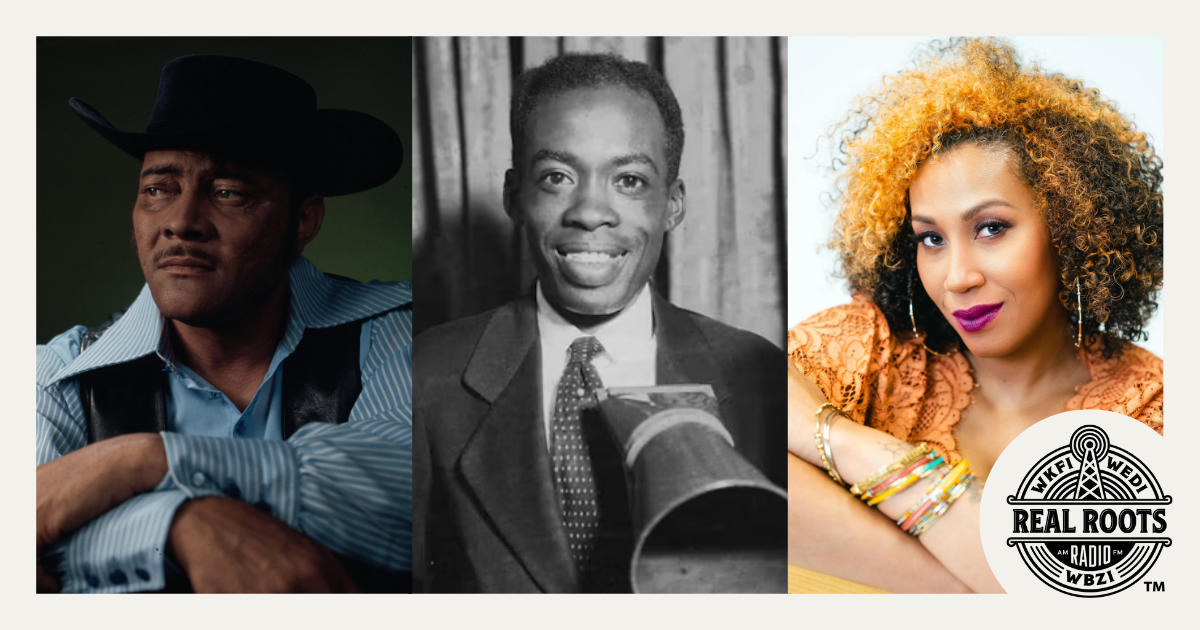
Celebrating Black History Month: DeFord Bailey, Tina Turner, Keb’ Mo’, and More

To celebrate Black History Month – and the vital contributions of Black, Afro-, and African American artists and musicians to American roots music – BGS, Good Country, and our friends at Real Roots Radio in southwestern Ohio have partnered once again. This time, we’ll be bringing you weekly collections of a variety of Black roots musicians who have been featured on Real Roots Radio’s airwaves. You can listen to Real Roots Radio online 24/7 or via their FREE app for smartphones or tablets. If you’re based in Ohio, tune in via 100.3 (Xenia, Dayton, Springfield), 106.7 (Wilmington), or 105.5 (Eaton).

American roots music – in any of its many forms – wouldn’t exist today without the culture, stories, skills, and experiences of Black folks. Each week throughout February, we’ll spotlight this simple yet profound fact by diving into the catalogs and careers of some of the most important figures in our genres. For week two of the series, RRR host Daniel Mullins shares songs and stories of Stoney Edwards, Rissi Palmer, Keb’ Mo’, Tina Turner, and DeFord Bailey. Check out the first week of the series here.

We’ll return each Friday through the end of the month to bring you even more music celebrating Black History and the songs and sounds we all hold dear. Plus, you can find a full playlist with more than 100 songs below from dozens and dozens of seminal artists, performers, songwriters, and instrumentalists from every corner of folk, country, bluegrass, old-time, blues, and beyond.

Black history is American roots music history; the two are inseparable. As we celebrate Black History Month and its legacy, we hope you’ll join us in holding up and appreciating the artists who make country, bluegrass, blues, folk, and Americana the incredible and impactful genres that they are today.

Stoney Edwards (1929 – 1997)

If you don’t know the late, great Stoney Edwards’ name, it’s time to fix that – because his story in country is as powerful as the songs he sang.

Born Frenchie Edwards in Seminole Country, Oklahoma, in 1929, Stoney was part African American, Native American, and Irish. The son of sharecroppers, he was a prominent bootlegger in Oklahoma during his younger years. Stoney had dreams of playing the historic Grand Ole Opry. His big break in music would come later in life, in his early 40s, when he was discovered in California singing his honky-tonk style at a benefit for the King of Western Swing, Bob Wills.

Stoney was signed to Capitol Records in the early ’70s and from there he made history. He scored fifteen charting singles, including a pair of Top 20 hits, one of which – his 1973 hit “She’s My Rock” – is still revered as a bona fide country standard later covered by artists like Brenda Lee and George Jones. His songs were deeply authentic, whether he was singing about love, loss, or his own experiences growing up poor and Black in America. He gave a voice to the underdog, often drawing from his own struggles, including battling discrimination and working blue-collar jobs before music. Edwards would also record several songs saluting his country heroes over the years, including “The Jimmie Rodgers Blues,” “Daddy Bluegrass,” and his Top 40 hit, “Hank and Lefty Raised My Country Soul.”

Stoney’s music wasn’t just about catchy melodies; it was about storytelling. His debut single was inspired by a true story. Before he hit it big as a country singer, Stoney was trying to provide for his family working as a forklift operator at a steel refinery in San Francisco. A workplace accident resulted in Edwards being sealed up in a tank and suffering dangerous carbon dioxide poisoning; he endured an extensive two-year recovery, both physically and mentally. During this time, Stoney was struggling to care for his wife and children, so he planned to leave in the middle of the night. However he tripped over one of his daughter’s toys, and it prompted him to stay. In 1970, backed by the virtually unknown Asleep at the Wheel, Stoney Edwards released his debut single, the autobiographical “A Two Dollar Toy.”

While his career didn’t reach the same commercial heights as some of his peers, Stoney Edwards left an indelible mark on country music. He paved the way for greater diversity in the genre and showed that country music is for everyone – no matter where you come from or what you look like. Stoney Edwards passed away from stomach cancer in 1997 at the age of 67.

Suggested Listening:
She’s My Rock
Hank and Lefty Raised My Country Soul

Rissi Palmer (b. 1981)

She’s a trailblazer in country music, a voice for change, and an artist who refuses to be boxed in – meet Rissi Palmer!

Palmer’s mother passed away when she was just seven years old, but she instilled in her a love for the music of Patsy Cline. Rissi would burst onto the country scene in 2007 with her hit single, “Country Girl,” making history as one of the few Black women to chart on the Billboard country charts. Rissi has built a career on breaking barriers by blending country, soul, and R&B into a sound all her own. She has penned some empowering original songs, helping folks on the margins feel seen, especially her most personal song, “You Were Here,” dealing with the heartbreak of a miscarriage.

Beyond the music, Palmer uses her platform to uplift underrepresented voices in country and roots music. As the host of Color Me Country radio on Apple Music, she spotlights Black, Indigenous, and Latino artists in country music – proving that the genre belongs to everyone. With her powerful voice and unwavering spirit, Rissi Palmer isn’t just making music, she’s making history.

Suggested Listening:
Leavin’ On Your Mind
Seeds

Keb’ Mo’ (b. 1951)

Keb’ Mo’ is a modern blues legend. Born Kevin Moore, this L.A. native blends Delta blues with folk, soul, and a touch of country. With his smooth vocals and masterful guitar skills, he’s kept the blues alive for over four decades.

Mo’ is heavily influenced by the late Robert Johnson, who preceded Keb’ by about 60 years. Keb’ portrayed Robert Johnson in a 1998 documentary and included two Johnson covers on his breakthrough self-titled album in 1994. He has since won five GRAMMY Awards, collaborated with legends like Bonnie Raitt, Jackson Browne, and Taj Mahal, and performed for multiple U.S. presidents.

Mo’ is embedded in country and Americana music as well, working with cats like Lyle Lovett, Old Crow Medicine Show, John Berry, Alison Brown, Jerry Douglas, and Darius Rucker over the years. He has been quick to share his respect for country and gospel traditions, appearing on the critically acclaimed all-star album, Orthophonic Joy, recreating the magic of the 1927 Bristol Sessions – country music’s big bang.

Whether he’s playing a heartfelt ballad or a foot-stomping blues groove, Keb’ Mo’ keeps the genre fresh and timeless. His music isn’t just about the past – it’s about where the blues is going next. We love his passion for all things American roots music. Fifty years into his remarkable career, Keb’ Mo’ is still one cool cat.

Suggested Listening:
To The Work
Good Strong Woman” featuring Darius Rucker

Tina Turner (1939 – 2023)

She was the Queen of rock ‘n’ roll, but did you know Tina Turner had deep country roots?

Born Anna Mae Bullock, she grew up in Nutbush, Tennessee. Tina recalled picking cotton as a youngster during her hardscrabble rural upbringing. Her musical journey began by singing at church on Sunday mornings. She grew up on country, gospel, and blues. Turner and her husband, Ike (who was abusive towards her) had massive success in R&B and rock and roll, but her first solo record was actually a country album.

In 1974, Turner released her debut LP, Tina Turns The Country On!, introducing herself as a solo act. Featuring top musicians, including Country Music Hall of Famer James Burton on guitar, Tina tackled songs from country greats like Dolly Parton, Kris Kristofferson, and Hank Snow. It would go on to receive a GRAMMY nomination for Best Female R&B Vocal Performance in 1975. Over the years, unreleased songs from this groundbreaking album would be dropped, including her powerful take on “Stand by Your Man.”

However, her most enduring impact on country might be as the inspiration behind one of the outlaw movement’s most popular hits. In 1969, Waylon Jennings was staying at a motel in Fort Worth, Texas, when he saw a newspaper ad about Ike & Tina Turner that intrigued him enough to interrupt Willie Nelson during a poker game so they could write a country classic. The phrase that struck Waylon heralded Turner as “a good hearted woman loving a two-timin’ man.” Sound familiar?

From honky-tonks to stadiums, Tina Turner’s fiery spirit left an unforgettable mark on practically every genre – country, rock, and everything in between.

Suggested Listening:
Stand By Your Man
Good Hearted Woman

DeFord Bailey (1899 – 1982)

Let’s go back to the early days of country to a name that shaped the Grand Ole Opry, but is often forgotten: DeFord Bailey, “The Harmonica Wizard!”

Born in 1899 in Smith County, Tennessee, Bailey grew up around banjos and fiddles in a musical family, saying that he learned the “Black hillbilly music” tradition. He overcame polio as a child, resulting in his short stature – he was only 4’ 10” tall – but it was through this ordeal that he found his voice in a harmonica. While recovering from the disease, he was bedridden for a year, and learned to mimic the sounds he heard outside on his harmonica: trains, animals, and the rhythms of life.

In 1927, Bailey became one of the first stars of the Grand Ole Opry on Nashville’s WSM, dazzling crowds with hits like “Pan American Blues.” He was actually the first artist introduced after George D. Hay referred to WSM’s Barn Dance as the “Grand Ole Opry” for the first time to poke fun at NBC’s classical Grand Opera. Bailey would also become the first artist to record in Music City. His hits like “Fox Chase,” “John Henry,” and “Evening Prayer Blues” captivated radio audiences, making him one of the Opry’s most popular performers. He would tour with other stars like Roy Acuff, Uncle Dave Macon, The Delmore Brothers, and Bill Monroe, but would often not be allowed to stay in the same hotels or eat at the same restaurants as his white contemporaries due to Jim Crow laws.

In 1941, DeFord Bailey was unceremoniously fired from the Grand Ole Opry under suspicious circumstances. He would make his living shining shoes in Nashville and would not perform on the Opry again until 1974, the first of only a handful of final performances on the radio program which he helped grow during its infancy, before his passing in 1982.

The Grand Ole Opry would eventually work to reconcile its mistreatment of its first Black member, issuing a public apology to the late DeFord Bailey in 2023 with his descendants on hand. Old Crow Medicine Show was there to celebrate the occasion, performing their tribute song to Bailey led by black percussionist Jerry Pentecost, entitled “DeFord Rides Again.”

In 2005, Bailey was rightfully inducted into the Country Music Hall of Fame and over 40 years since his passing, he is still recognized as the Harmonica Wizard.

Suggested Listening:
Pan American Blues
Evening Prayer Blues


Want more Good Country? Sign up on Substack for our monthly email newsletter full of everything country.

Listen to Real Roots Radio online 24/7 or via their FREE app for smartphones or tablets.

Photo Credit: Stoney Edwards by Universal Music Group; DeFord Bailey courtesy of the Country Music Hall of Fame; Rissi Palmer by Chris Charles.

‘Things Done Changed’ For Jerron Paxton – Now He Writes the Songs, Too

The music, sparse and spooky, sounds at the same time strangely universal and possibly from the last century, but as Jerron Paxton notes in his album title, Things Done Changed. The major difference on Paxton’s fifth album (including his 2021 duet set with Dennis Lichtman) is a big one. He wrote the songs.

“It wasn’t a very difficult decision,” Paxton said. “I had always had a list of tunes to record of my own compositions. I had to get enough cogent tunes to be an album, because you can’t have something that’s all over the place.

“You can’t have overtures with your hoedowns.”

The material on Things Done Changed is evidence that Paxton is no novice songwriter. These are words infused with hard living, what he calls “a good album full of blues tunes.”

In the standout track, “So Much Weed,” Paxton weaves amusement and a little resentment that there are Black people still serving time for minor drug offenses in an era when legal marijuana stores are in many states.

“Things done changed from the ’90s until now/ Lend me your ear and I’ll sure tell you how/ We got so much weed/ And the law don’t care/ My poor uncles used to have to run and hide/ Now they sit on their front porch with pride.”

A telephone call with Paxton is an adventure. He doesn’t back down and enjoys putting you on the spot if you’re susceptible to that.

A lot of your work is in vintage music styles. Why not a more contemporary sound?

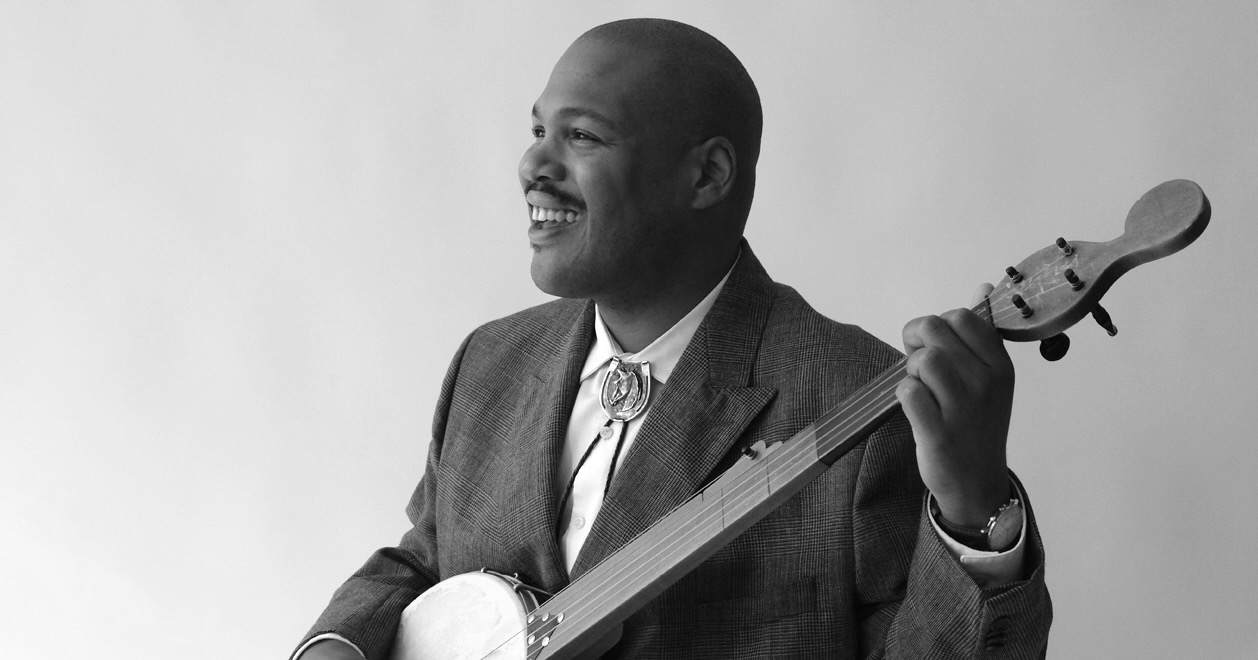
Jerron Paxton: I play a diverse array of styles. I started off playing the banjo and the fiddle. As a matter of fact, I’m one of the few professional Black five-string banjo players in the world.

You have roots in Los Angeles and your family is from Louisiana. How did each of those places affect your music?

Well, I play the music of that culture, so it affected it in totality. It’s like being Irish and playing Irish music.

Could you give me a sense of how you evolved as a musician?

I started off with the fiddle and moved to the banjo and the guitar and piano and things like that. It was just a natural evolution, getting interested in one and that leading to another and to another, growing up in the house that was full of the blues. That’s mostly what my family listened to. [My aunt] almost listened to strictly the blues, while my grandma was kind of eclectic like me, and listened to everything. She liked Hank Williams and all sorts of country music and jazz and everything like that.

… I grew up in, first of all, a family full of Black people. So I got exposed to all sorts of Black folk music and Black popular music of every generation. You were just as liable to hear [Mississippi] John Hurt and Son House and Bukka White in my house as to hear Marvin Gaye, Michael Jackson, and Sam Cooke. If you heard bluegrass, that was mostly me. I was the one blasting Flatt & Scruggs and people like that.

You didn’t grow up in Louisiana, yet your music seems to be tied to music from the South.

My grandparents grew up there. My family migrated to Los Angeles with the death of Emmett Till and they brought their culture with them. But that doesn’t say much, because the majority of the culture in South Central [Los Angeles] is from Louisiana, so it’s not like we went someplace completely foreign. We went someplace where we were surrounded by people who were from where we were from.

I love the song “So Much Weed.” It’s a funny song about a serious thing, that there are many Black people in prison for marijuana convictions on charges that are now legal. Do people laugh when you play it?

I don’t play it live. Well, I don’t play it on stage. I usually play it in small gatherings for close friends.

Would you tell me more about your grandmother and how she influenced your music?

She was a fun, loving lady from northwestern Louisiana. My mother had to work, so I spent most of my time with [my grandmother] and grew up gardening and fishing, and getting the culture that you get when you’re raised in the house with your grandmother. Her mother was across the street. So I had four generations of family on one street.

So some of the songs on Things Done Changed were written some time ago. Why sit on them?

Some of the tunes were kind of personal and I just sort of kept them for myself and my friends. Other ones I had been singing on stage for a little while and said, “Maybe I should record this song first chance I get.” And other ones I had been singing since I was little, since my grandma helped find some words to them. So it’s all kinds of processes. Some of them take a lot of labor.

Do you mostly like to work alone live, or do you like to mix it up with other musicians sometimes?

It depends on the context. If I’m being hired as a soloist, that’s what you do, and that seems to be the most in demand. There’s not too many people who can go on the stage by themselves and hold the audience for 45 or 90 minutes or two hours with just the instrument. So people tend to hire me for that and there’s a lot of solo material unexplored because of that. But I play jazz music, so that’s a collective art. I play country music, which is also a collective art. I play blues music, which is a collective art. So you know, they’re all collective, but the solo is what people ask for. It travels easy.

So how would you like your career to develop? Do you have a plan?

I’d like to be filthy rich, just grotesquely rich and have a mansion with a lake. [Laughs] … But to be honest, I’m kind of enjoying building what I have, and I haven’t really seen any end to it. That might be a good thing. It just seems to be getting better. So I don’t see a need to worry about the end as much as how to make the best parts of what’s happening now last longer.

What kind of rooms are you working? Are you doing clubs for the most part?

I play festivals and basically any place that’ll have it, theaters and places like that. Any place that wants good music, I try to be there to supply.


Photo Credit: Janette Beckman

Putting Black History Month in Perspective with Brandi Waller-Pace

[Editor’s note: To mark the conclusion of Black History Month, we’ve invited BGS collaborator and contributor Brandi Waller-Pace to share her thoughts on how to take the ethos, mission, and action of BHM with us throughout the year.]

Dr. Carter G. Woodson, Black American writer and historian, is known as the Father of Black History Month. One of the first scholars of African American history, he founded the Association for the Study of African American Life and History in 1915 and established Negro History Week in February of 1926. He chose the week of February that contained the birthdays of both Frederick Douglas (February 14th) and Abraham Lincoln (February 12th) as both birthdays were already being celebrated in Black communities. In 1970 The Black United Students organization at Kent State University began a celebration of Black History Month, and in 1976 President Ford declared Black History Month nationwide.”

– Brandi Waller-Pace, Decolonizing the Music Room, 2001 

Dr. Woodson’s selection of Douglass and Lincoln’s birthday indicates how significant they were, especially since the 1920s being just one generation removed from the Civil War – with many formerly enslaved Black people still alive. Even today, we are not nearly as removed from that time period as we think we are. In 1976, the year of the United States’ bicentennial and fifty years after the first Negro History Week, President Ford expanded the commemoration to last an entire month and Black History Month was born. 

Some folks ask, “If Black history is important all the time, why is it just a month?” But the literal history of the month itself, the fact that it exists at all, is part of Black history. It was a push to validate and celebrate the experiences, culture, study, and background of Black people in the land that came to be known as the United States, people who were viewed legally and societally as less than fully human, alongside the denial of their contributions to this country’s foundation and culture. Negro History Week was created to shine light on everything Blackness has created in the U.S. – and that week of recognition itself was created by a Black scholar. We know that Blackness and Black history is broader than just the U.S., and I find it important to look at that expanse in the context of Black History Month. 

When we talk about heritage months in general, we have to think about how we use terms: “Black,” “African American,” and so on. These ideas and terms didn’t all begin at the same point, they didn’t come out of the same movements, and they aren’t all used interchangeably or even in the same fashion. They also are not universally claimed by people we would place under their umbrella.

This is exactly what this month is for, to have these conversations and to open up these spaces, not to relegate Blackness to one month. Celebrating Blackness isn’t geared toward denying other groups their history – framing the month in terms of what it means for the recognition of other groups perpetuates false binaries, as if the only options available are honoring BHM at others’ expense, or ignoring BHM altogether. Celebrating Blackness is just that– acknowledging the history and the continuing traditions, culture, and advances of Black folks, who continue to make history. That sort of celebration is huge, especially considering the erasure and exclusion of so much of Black history in curriculum, media, and literature. 

It’s interesting to consider our ideas around Black History Month as they relate to our changing perceptions of time. As the world became more industrialized, mass communication advanced, and now we’re in the age of the internet where things seem to move lightning-fast and we are inundated with content, with emphasis on trends. This contributes to the impression of even meatier information simply being trends and waves in popular culture or only being flashes in the pan. This helps reinforce the idea that our celebrations of heritage months are just a moment, something for short attention spans, to be consumed in a second before scrolling on. You’ll see memes or posts like, “Now everybody is doing such-and-such a thing!” When that “thing” – almost always mocked as “woke” or “politically correct” – has possibly been around for hundreds of years. 

It’s a function and arm of the myth of white supremacy to present the “other” as invalid, unless there is something about it upon which one can capitalize. Time and time again, Black folks’ creations – our foodways and folkways, our cultural creations, our music, our ways of dress – have been erased, ignored, or derided unless there’s a point at which some kind of value can be extracted from it. It is then taken up by the mainstream, gates are built around it, and Black folks are purposefully distanced from it while others profit from it.

It’s like so many of the linguistic trends that have pervaded TikTok and internet culture, which are referred to as “Gen Z language,” but they are really rooted in African American Vernacular English and Black language that have been adopted by the internet writ large, but without understanding of or general reference to their origins. Because of how quickly the world moves and how information is passed along in the age of the internet, these pieces of culture are picked up, stripped down, and decontextualized so quickly.

Or consider the banjo – which is still represented in the mainstream specifically as a “white Appalachian instrument.” In the past, this representation was even upheld broadly among many trad communities in a factual way. In recent decades – thanks to the labor and diligence of some great humans – the banjo’s true origins have become more and more widely known, along with the story of how it was taken up into mainstream popular culture and how many Black people were distanced from their connection to the instrument while many white people continued to profit materially and/or reputationally from playing it.

In this time, Black cultural appropriation is so often perpetuated that it’s easy to have no awareness of these phenomena as they happen. Part of the work here is understanding that intention – or lack of intention – doesn’t mitigate impact. It’s important for all of us to understand how we perpetuate what we perpetuate and how we co-opt what we co-opt, whether mistruths about the banjo, slang and language trends, or Black History Month.

When we talk about privilege and perpetuation of this sort of appropriation, we tend to individualize, because in our society and culture we are conditioned to think individually. This manifests itself in a lot of ways; for instance, many speak against funding community care for people who need it, against investing in and giving people what they need – income, shelter, nutrition, access, resources. This comes from being taught that each gets their own – if you do, it’s because you are sufficient as a person, if you don’t it’s because you are deficient. While our society individualizes, it’s important to remember these are systemic, holistic, endemic issues that must be solved collectively. We must collaborate to repair the legacy of antiblackness, erasure, and exclusion that Black folks have experienced on this land for centuries.

This doesn’t mean there isn’t individual responsibility. Each of us can and should make individual efforts – as well as collective – to reckon with our privilege and our roles in perpetuating this status quo. And I would caution against positioning the individual against the collective; it’s collective and individual work. People interact with one another individually and interact with collective systems and groups. It’s such a balance; not taking away the need for individual focus and responsibility, but understanding that that same individual is part of the collective and should also drive the collective. Something like voting– when you’re in that booth, you’re by yourself, but your vote is collective action.

So, what is needed for others to make progress toward Black people and their creations being treated equitably? Start by building human relationships, first of all. Representation within ranks shouldn’t just be for “diversity’s sake.” Diversify spaces not just for the sake of diversifying spaces, but so these spaces aren’t just white-dominated and white-led, talking about these issues and what to do about these issues. Having actual human connection, being in relationship with one another, is vital. Have a willingness to invest in real, human relationships with the Black folks that you’re inviting in. There’s a huge difference in how one cares for and handles people they’re in real relationships with – not as just a representative identity, but as a human, a community member. It’s easier to listen to folks and really hear them, if you care about them.

Make sure not to employ a “color avoidant” (AKA “colorblind”) approach. If you care about me as a Black person and my full humanity, don’t erase my Blackness, because it is an important part of my identity, of which I am proud. But it also is something society has painted as negative and caring for me means acknowledging that that affects me. The status quo, white supremacist norms, are intertwined with our particularly fierce brand of capitalism, and it all seeks to completely individualize us and strip away our sense of collective care. So, one must be intentional in building relationships. But don’t stop connecting at those of us who are the easiest to access, who have the most resources and the privilege to already be in exclusive spaces you regularly encounter. That has us tokenized and other Black folks still erased, outside of the gates.

Then, based on these real, personal relationships with Black folks, you can step in when necessary to check your peers who are perpetuating the erasure, marginalization, tokenization we regularly experience among organizations and groups. In bluegrass, old-time, and roots music the number of Black folks present is never equal to the true cultural contributions of Black folks, which can result in heavy tokenization. We can feel actions are being taken just to check a box, versus work being done to make structural change over time. 

There is a great deal of societal resistance against taking deliberate, intentional actions to address antiblackness. It is important to view this work through the lens of reparation, in a real material and financial sense and to direct resources to Black communities, giving Black folks the discretion to use those resources as they see fit, rather than insisting on providing your oversight. At the same time, those who hold this industry and community power should understand that people aren’t always going to want to be hired in or brought on to diversify or as a solution to a diversity problem.

 You can do both at the same time. I had a conversation recently with someone about the festival I founded, the Fort Worth African American Roots Music Festival, about pushes to diversify spaces, versus creating new ones. Both of these strategies are completely valid – if you run a festival, by all means bring on more Black artists next year. But at the same time, donate money to spaces specifically aimed at building a more involved Black community within roots music – ones in which we don’t often get to participate.

It’s also important to address the concept of inclusion. The word “inclusion” can be frustrating, because the baseline for inclusion is, “We made something in which you weren’t included upfront, and now we have to figure out how to put you in it.” The focus can’t always be on bringing Black presence into those spaces; there is also a responsibility to support what Black people are already building, letting us do our thing. If your support is given upon the condition that we stick within your established frameworks, is it really support?

I often remind people that it takes time and energy to process all this information, put it into a historical context, and really understand disparities caused by antiblackness – especially because, for instance, not all white folks are rich, not all privilege is financial privilege, and so on. On the grand scale, huge financial disparities exist between white and Black people in the U.S. Confronting this may cause discomfort; sitting in discomfort is hard. But I see it the way I see physical exercise – when you’re working out, if you aren’t pushing your muscles to failure you can’t grow. This work is building muscle. This is why understanding that you, even as individuals, are part of the collective is so important. Because, at this point, the individual gets fed up. The individual tires when it gets tough. It can feel so insurmountable, but this is when people can remind themselves that they are part of a collective and have others to help with the load.

When discomfort creeps up, one may go to, for lack of a better idiom, black-and-white thinking. So many people who aren’t Black want to ignore that antiblackness is so deeply rooted in the history of our country, in our economy, in this industry, in our perceptions of the world around us – whose full humanity is or isn’t acknowledged; what defines beauty; what defines intelligence; and much more. When we’re talking about these issues more broadly, going back to the original question of “Why Black History Month?” Why is this distinction, this specificity important? If you’re striving for justice, working to dismantle white supremacy, working toward creating pathways to success for Black folks in this industry and within capitalism, but aren’t talking at all about Blackness specifically, you’re missing something major. There’s something distinct about Black people’s position in this society – just as there’s something distinct about the position of Indigenous, Asian, Latine and other non-white folks in this society.

These white supremacist narratives that erase Blackness’ contributions on this land, that heritage months like Black History Month work to interrupt, became what they are today over centuries of very dedicated legal, cultural, and personal efforts to entrench them. That process took hundreds of years, so why do we expect one workshop, one presentation, one article to be all it takes?


Photo courtesy of Brandi Waller-Pace

Chris Pierce Writes an Anthem for the Young, Black, and Beautiful

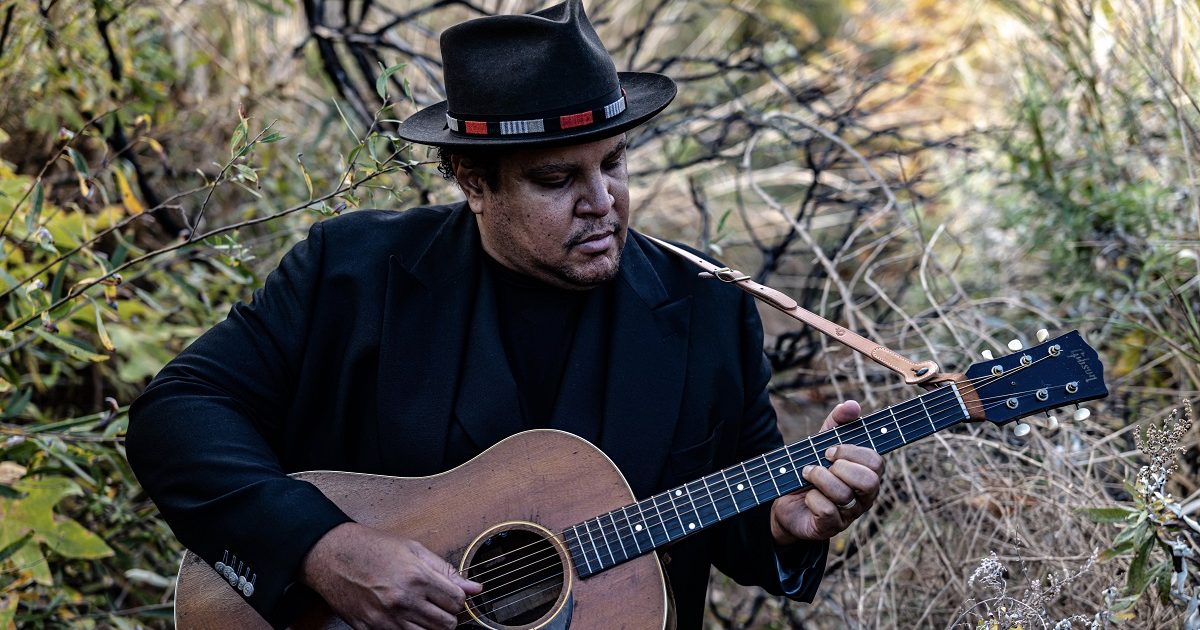
Chris Pierce has cultivated a significant following in the Los Angeles area and beyond, usually writing soulful and emotional songs that have populated fifteen years’ worth of albums and appeared in TV shows like This Is Us. But in 2020, accompanied by little more than his 1949 Gibson J-45 (“Blondie”) or his 1973 Martin D-18 (“Doriella”), the California native recorded the album American Silence with a mission of social activism against racial disparities.

Pierce gained a love of language from his mother, an English teacher who taught at-risk youth. She introduced him to the lyrical writings of Shel Silverstein and Dr. Seuss, as well as essential writers like Langston Hughes and Walt Whitman. The economy of words in all of those authors is immediately evident in original compositions like “American Silence” and “It’s Been Burning for a While,” where Pierce gets his point across directly, and with power. His convictions are never more optimistically presented than in the album’s closing anthem, “Young, Black and Beautiful,” which details the experience of maturing from a cute little kid to a perceived threat.

Calling from Los Angeles, he had a lot to say about American Silence, which is poised to become one of the most resounding folk albums of 2021.

BGS: To me, “American Silence” is like a message from a folksinger to an audience. What was on your mind when you wrote the song?

Pierce: History and resilience, and that cycle of bad things happening and people becoming aware of those things. Jumping on the train of, “Let’s try to end this,” and doing what we can to create awareness about a problem. And then kind of fading away. That song, for me, I was thinking about being young and cuffed on the streets, and stopped for things, and how being a Black kid – and now a Black man – can sometimes feel like a crime in itself, just walking around.

I wanted to write a song that addressed complacency, and remind people like myself, and Black people, and anybody’s been oppressed, to never give up. And also, to remind songwriters and artists that it’s important to not give up on reaching out to people, even though it’s sometimes hard. It’s important to keep that fight going in whatever way you can. And it asks those folks: “Hey, you come to my shows, you say you support, but if something were actually happening to me and you saw it, would you do something? And are you willing to do something in your everyday life that would create a more positive experience for people who aren’t like you?” That’s the short answer. [Laughs]

What has been the response so far?

It’s been getting good response from folks who have had my albums through the years. I’ve been getting emails and notes, and I’ve gotten to speak for a couple of schools, which is great. I’ve been invited to speak at events and play songs, and I think it’s doing a little bit of what I wanted it to do — which is to open up the continued conversation. And through a song, let it be another reminder to not let this moment, and these horrific things that happen, and how appalled you are by them, fade into the distance.

Does it change the vibe in the room when you walk in with a guitar?

Yeah, you know, I’m not a petite individual. I’m 6’4” and I’m a big man! And I’m a Black man, and I think walking into a room with a guitar raises a few eyebrows, to where folks will want to listen to a few lines and open their hearts, and to hear what I have to say. It’s being a gentle giant — a man of stature and size, and having this sensitive heart. In a lot of ways, the core of who I am is somebody who really wants to make music and make a difference and spread love. To get into a room with a guitar and sing about our history, and some of the ways I think we could change for the better, is thrilling for me. I’m really looking forward to walking into more rooms soon to play live. I miss it so much!

“Sound All the Bells” is a call to action, too, but it’s also very personal. What’s that like for you to put those experiences in a song and then share it with people?

All of the songs from this album came out of me last year, and for me it was a moment of clarity. Here I was, at home, trying to be safe and responsible, and in a lot of ways being still forced my heart to open to some of these compartmentalized feelings that I tucked away over the years to survive – and face them in a way that I’ve never faced them before. …

“Sound All the Bells” is almost like a timeline through different experiences that I’ve personally gone through, but it also offers the message of, “You know, I consider myself one of the lucky ones, for getting broken ribs and thrown in jail and stabbed and shot at – I’m still here, to sing songs.” So, I want people to really consider that perspective, in hope that it encourages them to do something about it.

One of the lyrics is about seeing a cross burning in your yard when you were 5 years old. That’s a powerful image.

Yeah, throughout the years I’ve had little flashes of memories about that. And a couple of years ago, I was sitting at lunch with my mom, in the town where that happened. We were talking about how things have changed over the years, and she started walking me through exactly what happened, and what she and my late father felt, being the first interracial couple in the neighborhood and the pushback from that. That wasn’t the only instance of hate that they encountered. And once I came along, there was this protectiveness from both of them, having a young child.

When that happened, from my mother’s perspective, it was something that [told them] they had a choice. And their choice was to be strong and to carry on and stay in the house, and try to be an example of love and acceptance. And that’s what they did. I’m so proud of them. It’s one thing to go through that when you’re a kid, but it’s another thing to imagine young parents having that happen. I feel like, in a lot of way, that example of their strength and resilience carries on into who I am, and the kind of music I make. And just the fact that I keep going is part of that moment.

On this record, it’s essentially just you and the guitar. Why did you choose that approach?

A big part of it was the pandemic and wanting to be safe and responsible, and not add to the problem of people getting sick and dying. It made me want to set up a session like this. And the other thing was, I wanted the listeners to not have anything in the way, and to let the words sink in. I have some extremely talented friends and folks that I’m around that are incredible at their instruments, but instead of picking up the phone and calling them, which was very tempting, I just said, you know, let me sit down with a guitar and sing these truths. Sing them in a way that means something to me and see if that translates.

“Young, Black and Beautiful,” feels like an encore to me. You’re closing the album with a message of encouragement, and I think the strength of your voice is part of that, too. Why did you want to end the album with that song?

The song in general was inspired by reading a friend’s Instagram post. She was talking about her Black son and how he was getting to the age that instead of folks on the street saying, “He’s so cute,” it’s turning into folks feeling threatened by him. That got me thinking about my own history, and what happens in that pivotal moment as a Black child that people are starting to look at you differently. You start hearing doors lock and you see purses clenched, and people walking to the other side of the street.

I wanted to offer something that went along the lines of the old term from the ‘60s, that Black is beautiful. It doesn’t mean that other things are not beautiful! It’s just a reminder that Black is beautiful. It’s about Black self-love, and I feel like it’s a song that I have benefitted from hearing when I was that age. I also wanted it to feel like an anthem that people could sing along to.

And at the end, I wanted to hold the word “Black” as long as I could, to give an example that you should never be ashamed of your Blackness. Sing it loud! And give folks as many examples as you can of your authentic self. And walk on through all these things that you’ve experienced, and that I’ve experienced, and find a new purpose in each days, knowing that your authenticity makes you beautiful.


Photo credit: Mathieu Bitton

This Nashville Museum Shows the Vital Role of Black Music in American History

Nashville’s “Music City” nickname has always been broader and more inclusive than the national impression, which largely has been built on two things: the city’s impressive country music legacy and its equal importance as a hub for the general music business, with major emphasis on recording and publishing. But what hasn’t been as well recognized and celebrated, at least by those outside particular communities in Nashville, is its contribution to numerous other idioms and its role in their evolution and development.

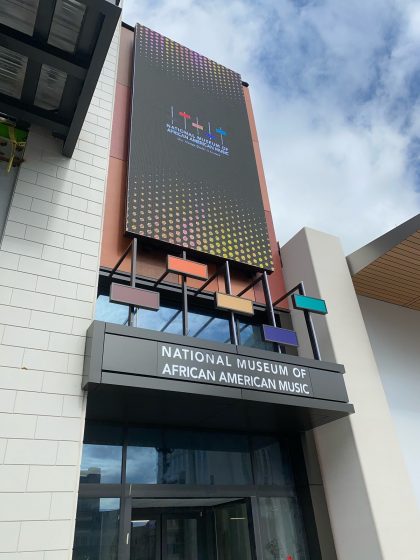
Hopefully that’s going to change with the new National Museum of African American Music (NMAAM), now open across the street from the historic Ryman Auditorium in downtown Nashville. The Fifth and Broadway entrance to NMAAM and its proximity to one of the nation’s music shrines couldn’t be more appropriate, and it is notable that the museum isn’t located in one of the sites better known as a Black music hotbed such as Detroit, New York, Los Angeles or even Memphis. Nashville has always been a major player in the African American music world, from the days of the Fisk Jubilee Singers to radio station WLAC breaking R&B, soul and blues hits, and the Jefferson Street nightclub scene providing both valuable training for emerging artists and a vital showcase for established ones.

However, the museum isn’t focused mainly or wholly on Nashville, nor any single city or musical style. The 56,000-square-foot entity aims to spotlight the entirety of the music made in this nation by Blacks, to demonstrate its impact on the totality of American sounds, and to celebrate its history and multiple influences. As CEO/president Henry Hicks repeatedly told media members who attended tours in January, “We’re showing how music through the prism of the Black experience has played a vital role in the growth of this country and how it’s affected every fabric of the culture.”

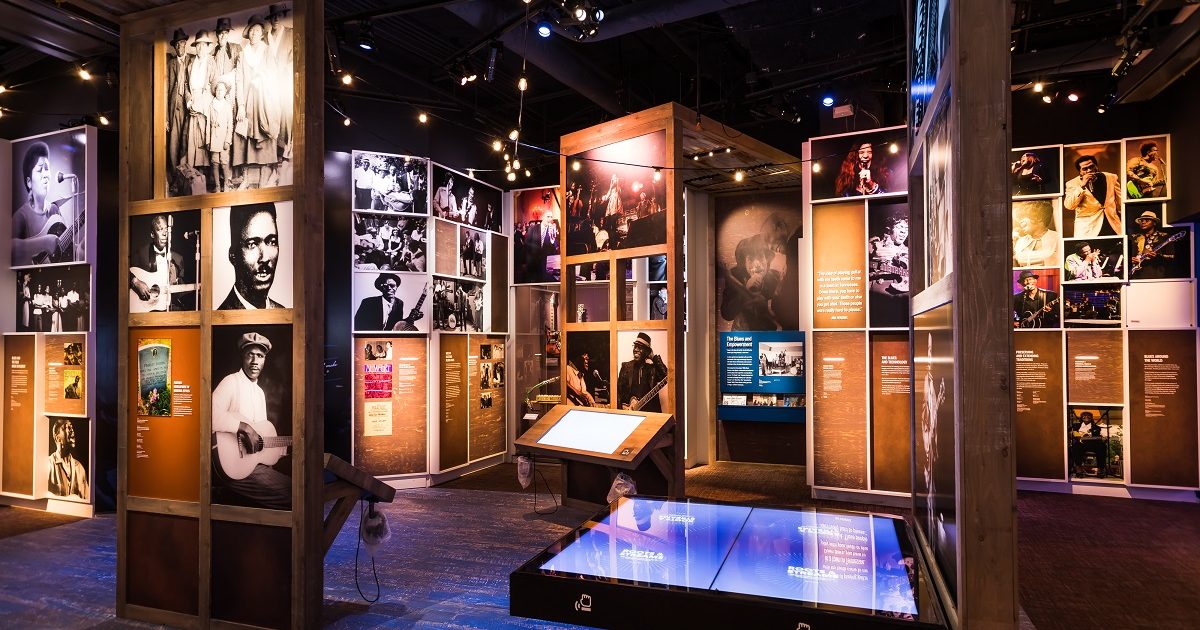
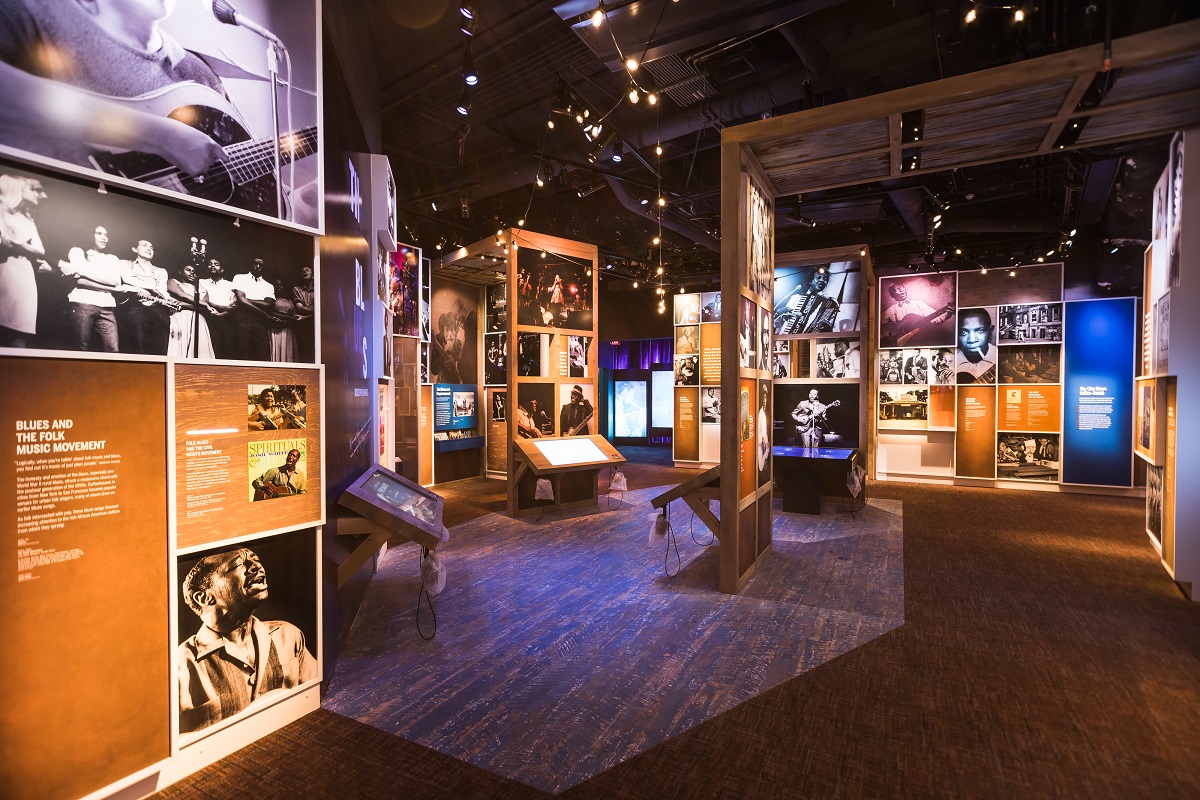
The sleek, architecturally striking building has the same visual splendor and attractiveness as the National Museum of African American History and Culture in Washington D.C. Upon entrance, visitors to NMAAM will be immediately drawn to the central corridor that’s billed as the Rivers of Rhythm. It features touch panel interactive exhibits, something that’s a recurring sight throughout the halls housing exhibits and other items designed to showcase 50 genres and sub-genres of Black music.

The corridor leads into The Roots Theater, which is actually where the museum tour formally begins. There’s an introductory film presentation that provides the African background and heritage of the various exhibits. It also offers a cinematic shorthand of what visitors later see presented in more exacting, visually striking manner: the multiple sounds and styles of notable Black music creators and performers. The theater seats approximately 190, and in later weeks and months will serve as the location for various screenings, lectures, music performances, and concerts.

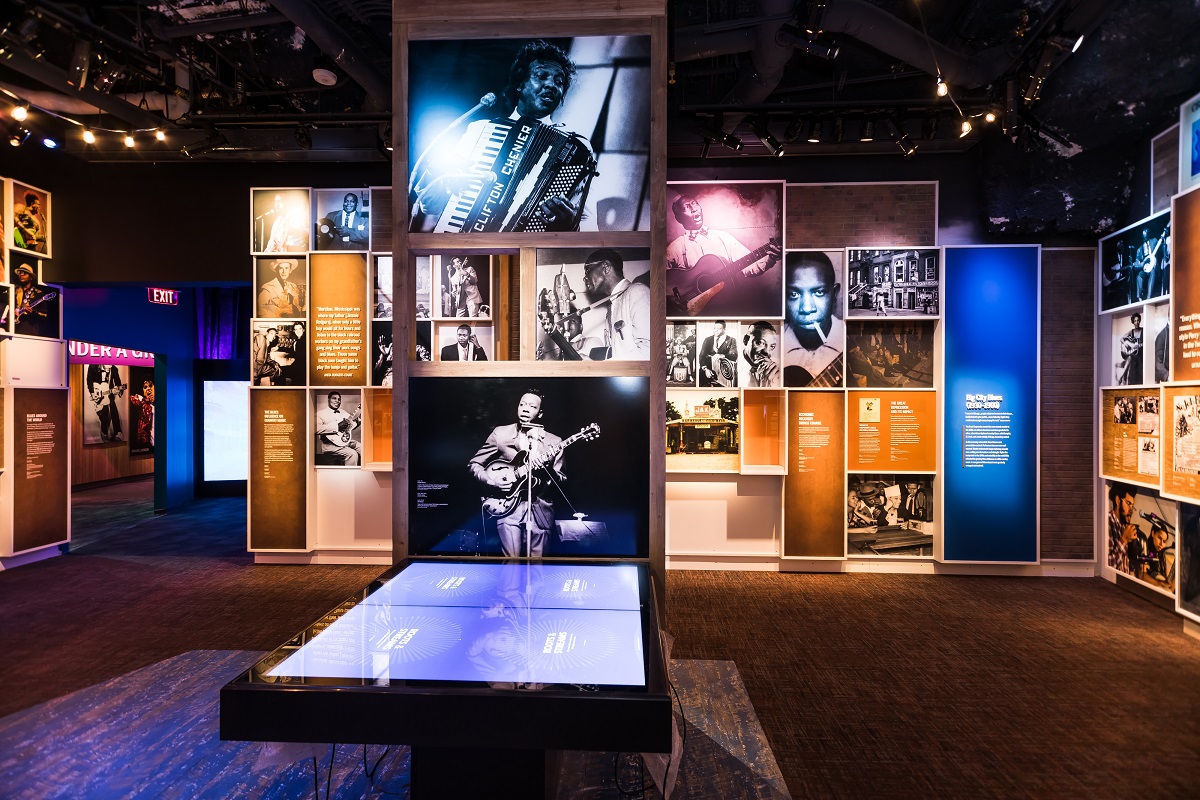
The different genre exhibitions feature everything from more interactive exhibits with timelines to cases containing such items as one of Louis Armstrong’s trumpets, one of B.B. King’s “Lucille” guitars, or costumes worn on key nights by performers like Billie Holiday, Nat “King” Cole, Ella Fitzgerald, Ray Charles, or Aretha Franklin. The museum doesn’t neglect any area of Black music, going from the earliest spirituals to pre-jazz, traditional and modern jazz, blues, R&B/soul, funk, disco, and into contemporary hip-hop and EDM. There’s also a detailed storyboard for every idiom.

The greatest examples of Black music influencing other idioms that are sometimes mistakenly assumed not to have any links with African Americans can be seen in the Crossroads section. It includes an essay that traces how country founding fathers like Jimmie Rodgers and Hank Williams were influenced by the blues, and how the acoustic guitar playing of people like Sister Rosetta Tharpe and the gospel-tinged shouting of Odetta in turn influenced white folkies like Joan Baez and Bob Dylan.

One of Chuck Berry’s biggest hits, “Maybellene,” was a reworked version of Bob Wills’ “Ida Red” with new lyrics, while certainly Elvis Presley, Carl Perkins, Jerry Lee Lewis and other white rock ‘n’ roll and rockabilly types were performing a hybrid of country, blues, and R&B. In both cases, as well as early string band music played by white and Black performers, these artists were hearing and creating a fresh sound based on their love of multiple genres, which the Crossroads section reflects in text and exhibits.

Along the way, depending on your musical preferences, you’re able to become an active part of the experience. There’s a disco dance room that inserts a neon silhouette onto the wall. You can construct your own blues song, improvise within a personal jazz composition, become part of a gospel choir, or craft your own freestyle raps. Any or all of this activity is recorded on a personal RFID wristband and automatically uploaded so that it can be shared online with friends, assuming you really want those efforts heard by others.

But most importantly, the mission, one frequently cited by tour guides and reinforced through the various exhibits, displays, and films, is Black music’s cross-generational links and the way it’s been both a voice of protest and a force for unity across diverse backgrounds. The role music played both in rallying Blacks into the World War II effort and helping inspire and fortify the Civil Rights Movement are just two parts of that underlying joint theme.

Whether it’s “One Nation Under a Groove” or “A Love Supreme,” regardless of spiritual or secular content, Black music has been at the core and forefront of American culture. No single building better exemplifies and reveals that than the National Museum of African American Music. No matter what kind of music you love, or even if you’re tone deaf, this museum will have something of value for you to see, hear and enjoy, as well as valuable lessons to learn and history to remember.


Photo Credit: NMAAM/353 Media Group

LISTEN: Don Bryant, “99 Pounds”

Artist: Don Bryant
Hometown: Memphis, Tennessee
Song: “99 Pounds”
Album: You Make Me Feel
Release Date: June 19, 2020
Label: Fat Possum Records

Editor’s Note: This is the first time Don Bryant has recorded “99 Pounds,” the 1972 hit he wrote for Ann Peebles. They have been married since 1974 and still reside in Memphis. They also co-wrote (with Bernard “Bernie” Miller) her signature song, “I Can’t Stand the Rain.” Peebles retired from performing in 2012.

In Their Words: “This new version is a tribute to Ann, for accepting the song when I wrote it for her. I fell in love with Ann when she first came in to Hi [Records]. But there was so much going on with her — recording, travel, so many around her — it wasn’t my time. And I wasn’t in no hurry — I knew I wasn’t going nowhere! We got to know each other better and better and it opened up. It was a long, drawn-out situation, but for me it was love at first sight.” — Don Bryant


Photo courtesy of Fat Possum Records

Gospel According to Kyshona: Be a Reflection

Everyone is making political records. Everyone is making albums that speak to “this moment.” Too few of them are making music that speaks to the people who inhabit this moment. 

Kyshona does. The explorations on her brand new album, Listen — which are synopsized neatly on the title track — by many other artists could have easily and offhandedly devolved into a reactionary, “woke” gasp into the void. Kyshona (surname Armstrong), though, is a deft and empathetic songwriter, a storyteller with a penchant for shameless self expression and graceful introspection. Listen is not an admonishment. It’s not an imperative, or an oracle-given ultimatum. Kyshona does not implore her audience to hear her, but each other

Over ten original and co-written songs the album carries on this mission with empathy, connection, community, and spirituality (but not proselytizing.) It’s a remarkable feat that though society systemically attempts to render her and women like her invisible, assuming that they’ll stand aside or allow themselves to be tokenized, Kyshona compassionately defies those expectations and opts to design her selfhood — and thereby, her art — to interact with the world on her terms and not the world’s. 

BGS connected with Kyshona over the phone while she created still more music and community on the road in Los Angeles in early February.

BGS: It feels like you’re trying to hold listeners to task here, but there’s also so much grace on the record and there’s so much understanding in the lyrics. How did this idea of grace permeate the album? It feels so tangible to me. 

 Kyshona: Maybe a year and a half ago I had to come up with a mission statement for myself, to help me focus on what my point and purpose is. We all get caught up in the glamor, the whole shiny music business. That mission statement was, “To be a voice and a vessel to those that feel lost, forgotten, silenced, and are hurting.” There is no “right” or “left” to that statement. Those that might feel incarcerated — even if it’s not behind bars, but by their fears, their worries, the rules that they have been taught to live by — everyone has that in common, somehow.

 What I tried to set forth in this album is just: Listen. From every corner that you look at it, we’re all just screaming at each other. Nobody’s really listening. The thing about “Listen.” is that it’s a whole sentence. It’s the most difficult thing to do. When we’re listening to someone share their story we automatically want to relate to them, “I have a story similar to that!” Or, “I know what I can do to help them!” That takes us out the moment with another person. 

Something I learned as a therapist was how to be a reflection for someone else and we’re not really doing that [enough]. A mirror doesn’t try to fix anything.  I wanted this album to be like a mirror. The icky stuff, we’ve all got fears we’re walking in. We all know life can get heavy sometimes. We’re all walking around with some sort of baggage we carry with us from place to place. We all hit moments where we can’t go on.

I’m glad you brought it up, because it felt to me like the redemptive empathy — the listening — you’re trying to inspire with these songs is definitely informed by your therapy experience. How else does the music therapy filter in here?

I teach songwriting now at a women’s jail back in Nashville and when I walk into these classes with these women, they all say, “I don’t have a voice. I don’t have a story. I can’t sing.” That’s something they’ve been told since they were young and they believe it. 

When I’m writing with someone who doesn’t consider themselves a songwriter, I remove myself from the situation. I try to put their words into it. It can be very uncomfortable if I try to put something the way I would say it in there. I’m always battling myself. I have to remember, this is their story, their words. I’m just there to be a reflection. As I learned in my practice, years ago, I was always there to lead people to finding their voice, to lead people to finding their story, and to lead them to finding how their story can help others. That they can take the torch and carry it on. 

When people say they don’t have a story, when they don’t have a voice, I wonder if your experience as a Black woman — someone who is told by society writ large that you don’t own your own story or even have one worth telling — is that what you channel to show other people that they do? Do you feel that connection at all? 

Man. Yeah… 

First, I feel as though I have to walk into a room in a very specific way, because of the way I look. Especially if I’m playing intimate rooms, like house concerts. I have to come in welcoming, as if I’m not a threat: I’m kind — I promise. I’m not going to say anything to put anyone off. When I start my shows I have to find something that all of us have in common, which for me is that we all come from someone. We come from somewhere. I talk about my grandparents and what they’ve instilled in me. I feel like a lot of people — not everyone, but a lot — can relate to that. Someone in their lives has given them guidelines to live by. 

Then, eventually, I get into incarceration, what it’s like being incarcerated, how do we bring light into the darkness. I bring in the heavy stuff. I tell stories of the places I’ve been, the people I’ve seen.

Also, as a black woman, I feel like it’s expected of me to be the “oracle” that’s telling everyone– I don’t want to say it’s a responsibility, but there’s an expectation. 

It’s almost projection, right? That black women are always strong, or magical, or spiritual guides–

Yes, and caretakers. People don’t understand even the complexity of what I’m coming in front of them with. They don’t understand all the different levels of who I am, because I can only really present this one side, which is, “I promise I’m not a threat.” It doesn’t matter where I’m walking into, even when I’m walking behind bars I have to do the same thing. “I’m not a threat. I’m not here to judge you.” 

I notice if I have a guitar on my back people do move out of the way, I get a little bit more respect. If I don’t, it’s amazing how invisible I can be and how I am perceived by others. Carrying a tool, carrying an instrument on our backs, can change or affect the way someone perceives us, off-the-bat, right away. Walking anywhere with a guitar on my back, it’s like, “Huh…” Cause that’s not common, to see a black woman with a guitar. 

It’s always expected of me too, “You must have grown up singing in the church!” No, I did not. I was not leading choirs — people have an automatic story when they see me do what I do! — I was an oboe player and I played piano. That’s what I did. 

This is actually another question I had! I wanted to ask you how gospel influences your music, but I don’t mean doctrine and I don’t just mean genre, either. Maybe the middle space between those two ideas, because that’s what I hear in your music. I hear the activist tinge of gospel, the civil rights aspect of gospel. So what does the gospel thread in the album feel like to you? I did wonder if people projected “gospel” onto you, like I did just now! 

I grew up in a house with gospel music. My dad and my grandpa played in gospel quartets, so I was hearing it all the time. But what I loved about the gospel music that I was surrounded by was the ideas that were given by it: Joy. You’re not alone. The burden is not all yours. And I loved hearing voices blend. There’s something about voices being together, creating this one sound.

My faith doesn’t come into this. My faith is in people. My faith is in the fact that we can be better. [At] shows, people walk up to me like, “You’re a believer, aren’t you?” I’m not here to point anyone to God or guide anyone anywhere, I’m here just to be a reflection.

I have faith in a higher power. That’s what gets me through. But I also know that that’s not how everybody comes at life. Not everybody has the foundation that I do. I’m just here to let people know: I see you. You’re not alone. I know it doesn’t feel good right now, but somebody is out here. You might not even know them, but they get it. And let someone else know that you see them, too. 

I’m glad you brought up being immersed in harmony, because I especially wanted to talk about your background singers on the album, Maureen Murphy and Christina Harrison. You’ve been singing with them for a while, right?

Yes! Well, Christina left us, she moved to Seattle, but yes! Christina and Maureen are who I started out with — like, if I could have a dream team that’s it. 

What I hear in the vocals is almost sibling-harmonies level tight. You’re so in sync, on the same wavelength, and so much of that to me seems like it’s stemming directly from the community you have with these singers and musicians as well. These aren’t just studio musicians to you. 

I consider these women my family. These are my sisters. These are women that I feel can read my looks, I can read theirs, we can say what we need to say and be done. I feel like they lift me up and support me — because I’m not a vocalist! I’m not a singer, I’m a storyteller. I don’t see myself as a singer. People say, “Surround yourself by people that are greater than you.” [Laughs]

Outside of that, these women believe in the message that the music carries. They also know the mission and they’re there for that. They’re ready to walk in it. And, both of these women wrote on the record. Maureen and I wrote “Fallen People” with our friend Jenn Bostic and Christina and I wrote “We the People.” It’s not only my voice, these are also [ideas] that they’ve been carrying around and feeling. 


Photo credit: Hannah Miller