How-dee! And Happy 100 to the Grand Ole Opry

In 1925, world leaders were signing the final treaties coming out of WWI; Congress authorized work on Mt. Rushmore as a national memorial; the Scopes Trial was held in Tennessee; and the first patent on radio transmission was only 28 years old.

And, in 1925, WSM first broadcast its barn dance – soon to become the Grand Ole Opry.

One hundred years later, the Grand Ole Opry is the world’s longest-running radio program. After a century that saw changes unparalleled in world history, audiences are still drawn to the Opry. Every week thousands make the pilgrimage to the Grand Ole Opry House in Nashville while others tune in around the world. The show continues to inspire new generations of performers to aspire to step “into the circle” on the Opry House stage.
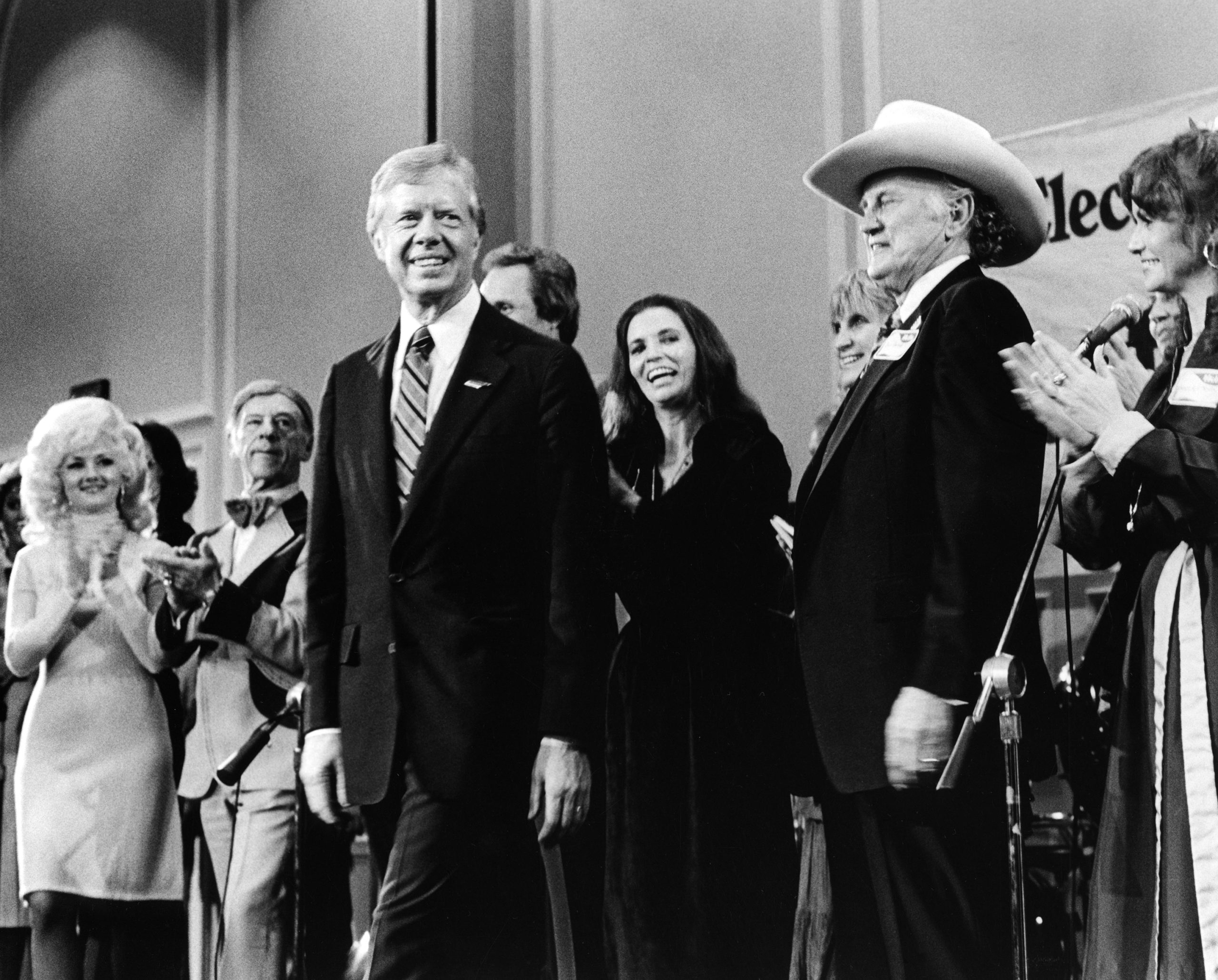
President Jimmy Carter on the Grand Ole Opry stage with Kelly Foxton, Hank Snow, Mel Tillis, June Carter Cash, Skeeter Davis, Bill Monroe, Jeannie C. Riley, and others on October 9, 1980. Photo courtesy of Ryman Hospitality Properties.

In The Beginning Was Insurance

In the 1920s, Edwin Craig was watching radio stations emerge across the nation – and seeing the money-making potential for sponsors and owners. He convinced Cornelius Craig, his father and founder of the National Life and Accident Insurance Company, that a radio station could sell a lot of insurance.

Soon, the fifth floor of the company’s downtown Nashville building held a radio studio. The call letters WSM stood for “We Shield Millions,” the company’s motto. A program that would become the lifeblood of country music started as a way to promote life insurance.

The hiring of George D. Hay away from Chicago’s WLS was the beginning of the WSM Barn Dance. The 30-year-old who called himself The Solemn Old Judge and started every show with a steamboat whistle would set the tone for much of the Opry’s 100 years – including its name.

Which all started with a clash of cultures.

Some upper-crust Nashville residents complained the only radio they could hear on weekends was string band programming from the dominant WSM station. In response, WSM began carrying the syndicated “Music Appreciation Hour.”

The Barn Dance slot followed the classical program, and Hay, not one to pass up a good line, said, “For the past hour, we have been listening to music largely from Grand Opera, but from now on, we will present ‘the Grand Ole Opry.”
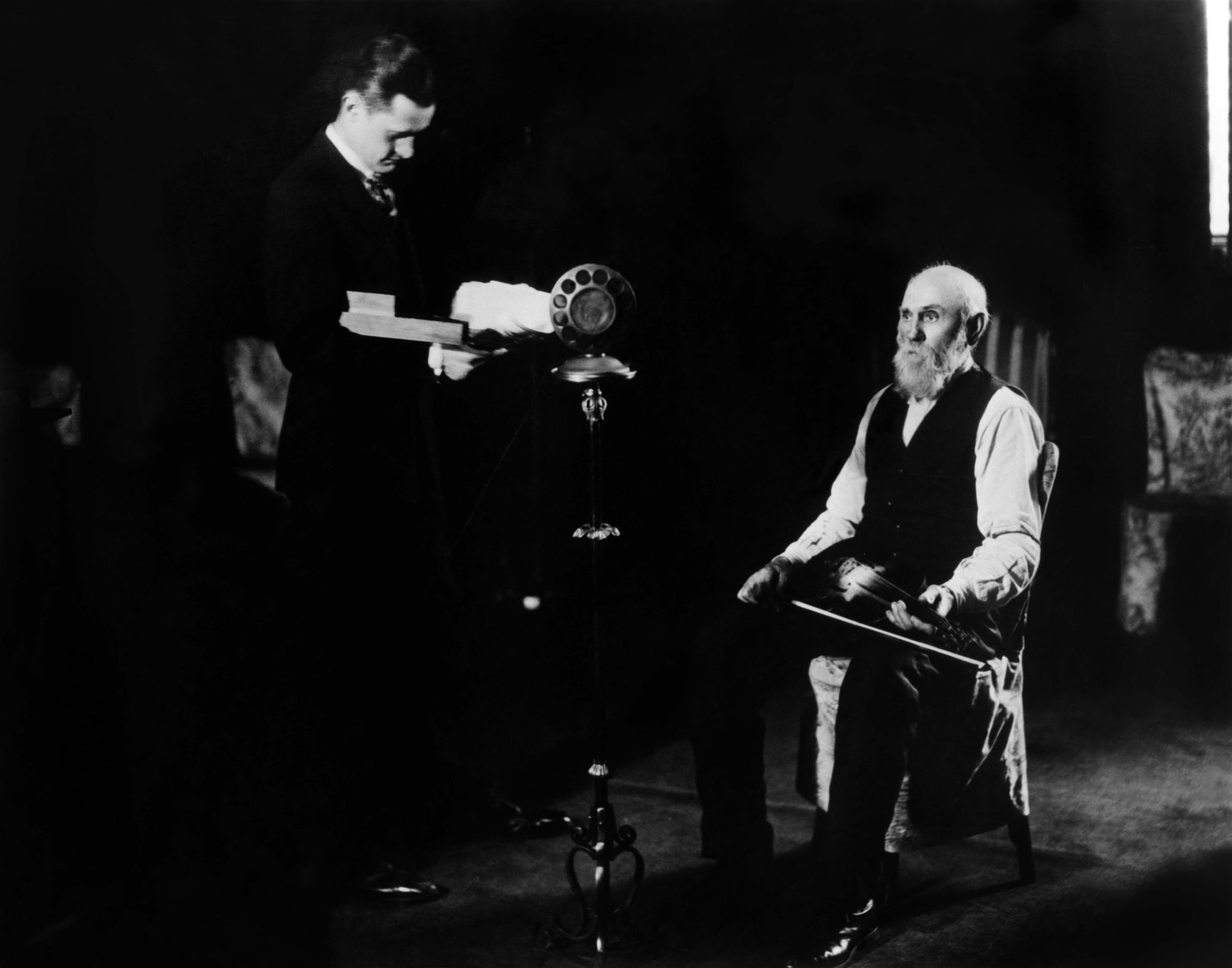
George D. Hay is pictured at microphone with a whistle and Uncle Jimmy Thompson is seated in this 1925 photograph from when the Grand Ole Opry was still the WSM Barn Dance. Photo courtesy of Ryman Hospitality Properties.

For years, the Shield Men – door-to-door National Life and Accident insurance salesmen carrying the company’s shield logo – introduced themselves as representing the Grand Ole Opry. They would even listen outside windows to see who was tuned in to the Opry – and who would be a likely customer.

The earliest WSM shows relied on local talent, running heavily toward fiddlers and string bands. But Hay would invite whoever he thought the audience would like.

DeFord Bailey, a Black musician grounded in both the blues and old-time string band music, became a regular, wowing audiences with his harmonica. Kitty Cora Cline, the first female soloist, performed on hammered dulcimer, and Fred Shriver played the accordion. Uncle Dave Macon on his banjo with Sid Harkreader on fiddle and guitar set the stage for the comedy that would remain central to the Opry’s success, with songs like, “Keep My Skillet Good and Greasy.”

A Beacon

As the recording industry grew, the variety of musicians available to the Opry grew, as well. The show began featuring brother duets, cowboy music, Western swing and solo crooners. Bill Monroe & the Blue Grass Boys were featured stars for decades.

Opry singers expressed the joys of new romance, the happiness of Sunday dinner on the lawn, the sorrow of lost love, and the loneliness of leaving home. Audiences across America listened – and related. The Opry became a focus of family life.

Dolly Parton, like many rural listeners, grew up without electricity. Her family faithfully listened to the Opry on a battery-powered radio. Waylon Jennings’ dad would hook their radio to the car battery. Jeannie Seely’s family would pile in the car and drive up a hill until they could get the signal. Opry history is filled with stories of musicians who listened as children – and dreamed of growing up to perform, like their idols, on the iconic stage.

Opry member Dierks Bentley, who gracefully moves between country and bluegrass, told BGS, “Being invited to join at all is the biggest honor – especially for me, personally. I grew up listening to all the Opry greats on the radio with my dad, so becoming a member is like having the ultimate backstage pass to see the best musicians in the world. And to be invited by Marty Stuart … hands down, it was one of the coolest nights of my life.”

Dan Rogers, the Opry’s senior vice president and executive producer, said the Opry has always been a place to celebrate the good times and be uplifted during the tough times. “Think about,” he said, “the folks who tuned in on Saturday nights during World War II. That was their only source of entertainment throughout the week.” Minnie Pearl, with her signature “How-dee,” and Roy Acuff gave them respite from war news.

On the first show after the 9-11 attacks in 2001, Rogers said, “Our background singers sang an a cappella version of ‘God Bless America.’ And one by one, the people in the audience stood and sang along. And I remember thinking, I bet everybody tuned in across the country is singing along to ‘God Bless America.’”

The Opry’s response to the COVID-19 crisis created desperately needed connection during a frightening time of isolation.

Just a week after deciding that live audience shows weren’t safe, Opry staff arranged a pared-down streaming production with no audience and a skeleton crew. Longtime cast members Bill Anderson, Jeannie Seely and Connie Smith held down the first night alongside Mandy Barnett, Michael Cleveland & Flamekeeper, and Sam Williams.

For the second weekend of restrictions, veterans Vince Gill, Marty Stuart, and Brad Paisley sat on stools spread out across the stage and pulled off what Rogers called “a beautiful, beautiful show.”

Watching from his office, Rogers started reading comments from grateful listeners. For months, people marked their calendars to tune in. They wrote, “I’m in Europe. I set my alarm. It’s 2 a.m. here, but I wanted to experience this with a community.”

Marty Stuart, Vince Gill, and Brad Paisley perform for an empty Grand Ole Opry House during the COVID-19 lockdowns in 2020. Photo by Chris Hollo, courtesy of Ryman Hospitality Properties.

Kathy Mattea, the newest Opry inductee, feels those connections whenever she performs there.

People may have sung along to her hit “18 Wheels and a Dozen Roses” in their car or in the shower, but at the Opry, she says to BGS, “Here’s your chance to sit with an audience and sing this song that everybody knows. Nobody knows who the person next to them voted for and it doesn’t matter at that moment.”

“The Ellis Island of Country Music”

In the early days of radio, what was called hillbilly music was as limitless as the range of a 50,000 watt radio station. And the Opry remains dedicated to maintaining those wide open spaces.

Garth Brooks and Trisha Yearwood, in their forward to the book 100 Years of the Grand Ole Opry, refer to the show as the “Ellis Island of Country Music – a place where all are welcome.”

Contemporary country often has been accused of being homogenous and limited. But despite the factors that have controlled commercial country, the Opry maintains its open-arms attitude. Rogers said, “The two core tenets of an Opry show are celebrating the past, present, and future of country music, and also showcasing multiple genres under the country music umbrella.”

In any show, he said, “You might have something that’s on the top 20 of the country charts today. And you’ll have country classics. You might have a contemporary Christian song, Americana string music, or even something from outside the genre by somebody who just happens to be a country music fan or was influenced by country music.”

In 1974, the R&B-oriented Pointer Sisters included an original country song, “Fairytale,” on their second album. The cross-over hit earned them an invitation to the Opry stage, where they became the first Black group to perform.

Ringo Starr appeared for the first time in 2025 and James Taylor’s debut on November 11 will be remembered as a big part of the 100th anniversary celebration.

And, Rogers said, “Because we can do it, it’s fun to take a chance on a new artist.”

Before his first Opry appearance in July 2022, Zach Top had no hits to his name. But Rogers remembered the programming team saying, “You don’t see an artist like that every day. It sure feels to us like our audience would absolutely eat that guy up!” Today, Top’s music is everywhere.

Bluegrass has been a staple since before it had a name and it has never lost its place on the stage. Bentley and Del McCoury played “Roll on Buddy, Roll On” when the Grand Ole Opry House first reopened after the 2010 flood closed its doors for months.

Charlie Mattos is a 10-year veteran Opry announcer and longtime co-host and producer of WSM’s morning show. He said that on any given night, a portion of the Opry House audience “may truly have never seen a bluegrass band play.”

“And when Del McCoury and the boys finish with an incredible instrumental,” Mattos continued, “or Sister Sadie blisters the stage … the enthusiasm that comes out of that crowd, the immediate standing ovation for the insane musicianship that they have just witnessed …” Mattos said, “it blows their minds.”

Mattea said, “Bluegrass is front porch jazz – the virtuoso playing and the vocals and the harmonies and the trading off of licks. That’s how I fell in love with bluegrass.” And the Opry exposes millions to that brilliance.

A Good-Natured Riot

The Opry show is a complex set of acts and sets requiring precision planning, flexibility, and good nature on the part of the announcers – and commitment on the part of the performers. Rehearsals are brief or non-existent. Timing is everything.

Borrowing a phrase from George D. Hay, the Opry is still sometimes called a “good-natured riot.”

Mattos said, “When you come to see the show live, you see it all. The set changes. The artists leaving as the announcer sends them off. You can see the stage crew out there and usually in 90 seconds they can completely swap things around.”

But while reading a commercial during set changes, Mattos may notice the stage manager giving the “stretch” signal. He might have to keep talking for as long as four minutes – a millennium in radio time.

Sometimes the commercials themselves become the entertainment.

The first time Glad Wags sponsored an Opry segment, Chuck Morgan was announcing. While he stood off-stage reading the dog food commercial, house bassist Bill Linneman came up behind him and started barking. “By my last year there, there were like 20 people behind me going at it,” Morgan said. (The consensus is that Connie Smith does a great chihuahua imitation.)

A Family

Jeannie Seely – who racked up nearly 5,400 performances on the Grand Ole Opry before her passing in August 2025 – remembered it was more than the music that fueled her desire to join the Opry: “That’s hearing these people, like Mr. Acuff and Minnie [Pearl] and Jimmy Dickens and all of them, coming together every week,” she says in 100 Years of the Grand Ole Opry. “They always sounded like they were so glad to be together. They picked on each other and joked, and I thought, that’s just like a family.”

And they were family. When the plane Jim Reeves was aboard crashed in a wooded Nashville suburb, Marty Robbins and Ernest Tubb joined the search party, as did the elegant Nashville socialite Sarah Ophelia Colley Cannon – known as Minnie Pearl.

Opry star Jean Shepard was expecting her second child with husband Harold “Hawkshaw” Hawkins when Hawkins died in the plane crash that also killed Patsy Cline and Cowboy Copas. After months feeling adrift, as Shepard was quoted in the 100 Years book, “I looked down my driveway one day and here come two big black limousines full of the so-called ‘higher-ups’ from the Grand Ole Opry. They said, ‘We want you to come back to the Grand Ole Opry.’ And it really meant a lot to me.”

The family feeling is no accident. In earlier years, Opry members had to perform a specified number of Saturday nights a year. While there’s no set number today, Rogers said they look for a sense of commitment in new members. “It truly is about that relationship,” he said.

Rogers quoted Mattea, upon her invitation to become a member, saying, “These people treat you like family, no matter what.”

One of Mattea’s favorite Opry memories involves a bass player who toured with her. “He was sitting on a stool, playing and singing some old Western swing chestnut, and suddenly Riders in the Sky leaned into the dressing room in full regalia and started singing harmony.

“He was gobsmacked. He felt it was the highlight of his life,” she said.

Bluegrass performer Kody Norris’ music is influenced heavily by first- and second-generation bluegrass. But the band’s preference for flashy suits dates back to a family-friendly welcome Norris received 25 years ago.

His parents took nine-year-old Kody backstage at the Opry, “and I met Bill Anderson. And he had on a red rhinestone suit. That’s the first one I ever saw up close, where I could touch it.”

Later that day, upon meeting his equally rhinestone-clad hero, Porter Wagoner, young Kody got so excited he spit out his chewing gum. Wagoner graciously grabbed two Opry-logoed napkins, one of which the little boy used for his gum. The other one the grown Norris still keeps in perfect condition.

The Circle is Unbroken

In 1974, the Opry left its revered home of decades, the Ryman Auditorium, to move to the deliciously air-conditioned 4,400-seat Grand Ole Opry House.

To honor its longtime home, the Opry crew cut a circle out of the Ryman stage and inset it in the new Opry House stage. The circle symbolizes the Opry’s continuity, respect for the past, and optimism for the future.

Mattea experienced that sense of a completed circle on the day she became an Opry member.

“Suzy [Bogguss] was there. We’ve toured together and sung on each other’s records. She’s my closest artist friend, and she was the only one at the ceremony who was not a member. And I thought how generous it was of her to be there.

“So, while I was overflowing with celebration, to get to invite my friend to the party publicly in the name of the Opry was the sweetest gift. It was a moment I’ll never forget, and I’m going to be there for her induction, too.” Bogguss will officially be inducted as an Opry member in early 2026.
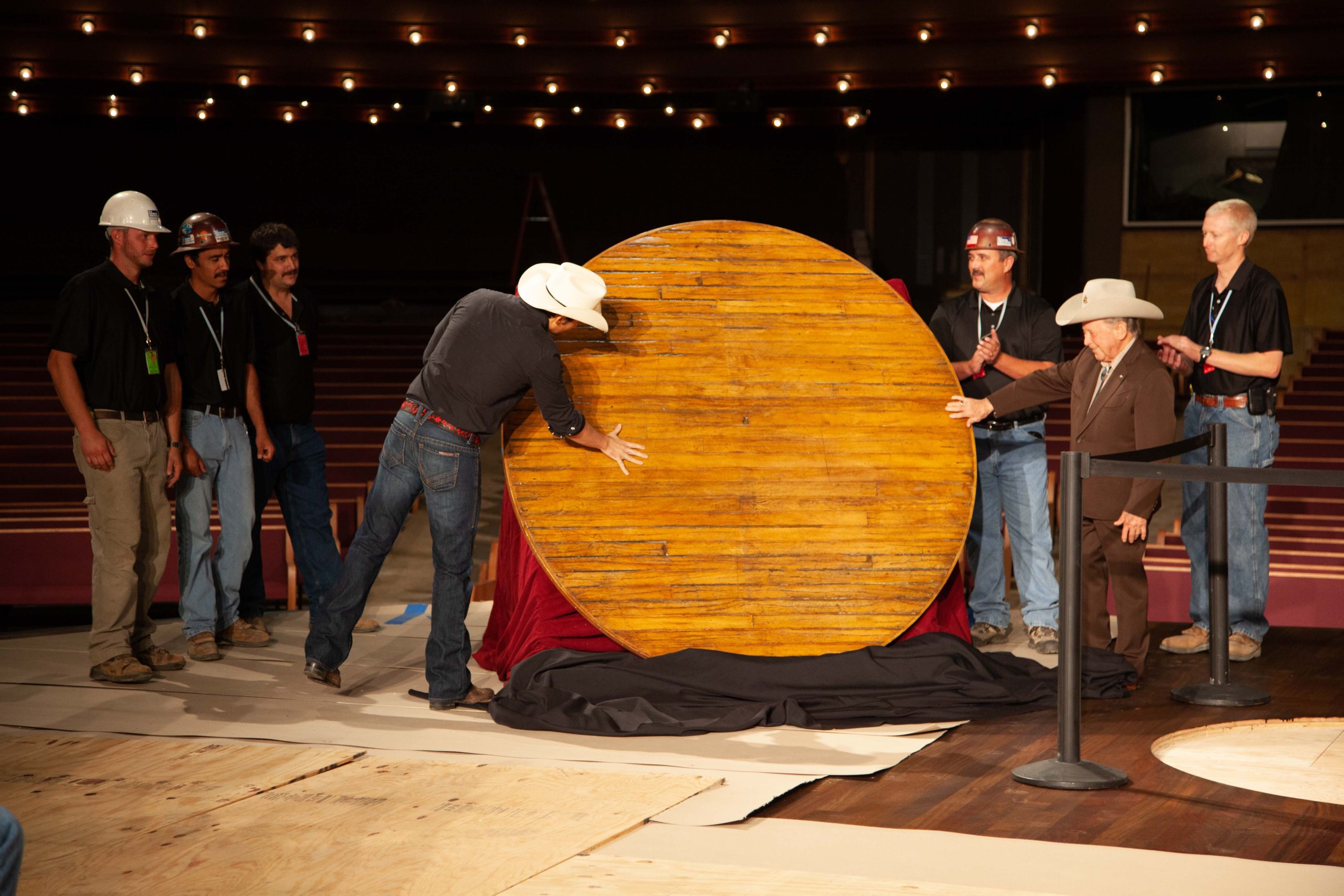
Braid Paisley and Little Jimmy Dickens return the Circle to the Opry stage after the 2010 flood. Photo courtesy of Ryman Hospitality Properties.

Join The Celebration

There’s nothing low-key about the Grand Ole Opry – so in the classic Opry spirit, fans have had plenty of opportunity to celebrate the centennial all year long.

Earlier this year, NBC broadcast a three-hour anniversary special, with dozens of stars ranging from Reba McEntire to Jelly Roll to The War and Treaty. The Opry also took the show to London’s Royal Albert Hall for the very first time. You can stream clips of these and other Opry events on YouTube and social media.

With the Virgin Music Group, the Opry has produced the album Opry 100, Country’s Greatest Songs (released November 7). Among the unforgettable recordings are Vince Gill singing his heart-rending “Go Rest High on That Mountain,” Dolly Parton singing “I Will Always Love You,” and Ashley McBryde covering the classic “Your Cheatin’ Heart.” You can order the album from the Opry site.

Craig Shelburne, Brenda Colladay, and Opry members and employees collaborated on 100 Years of the Grand Ole Opry, a book filled with anecdotes and photos that vividly illustrate the Opry’s remarkable history. And to teach your children well, there’s also a new childrens’ picture book written by Emily Frans and illustrated by Susanna Chapman. Find them in your local bookstore.

And, on November 28, 2025, the official 100th anniversary of the Grand Ole Opry we all hold dear, the Opry is celebrating with two huge birthday party shows featuring country stars and Opry members like Vince Gill, Ricky Skaggs, Trace Adkins, Dailey & Vincent, Bill Anderson, Jamey Johnson, Marty Stuart, and many, many more. Tickets are available here.

Of course, the celebrations will continue in 2026.

“The Opry is the core and soul of country music,” Bentley said. “It’s a place where the past, present and future of our genre all come together. There isn’t anywhere else like it.”


Continue exploring our Artist of the Month coverage of Opry 100 here.

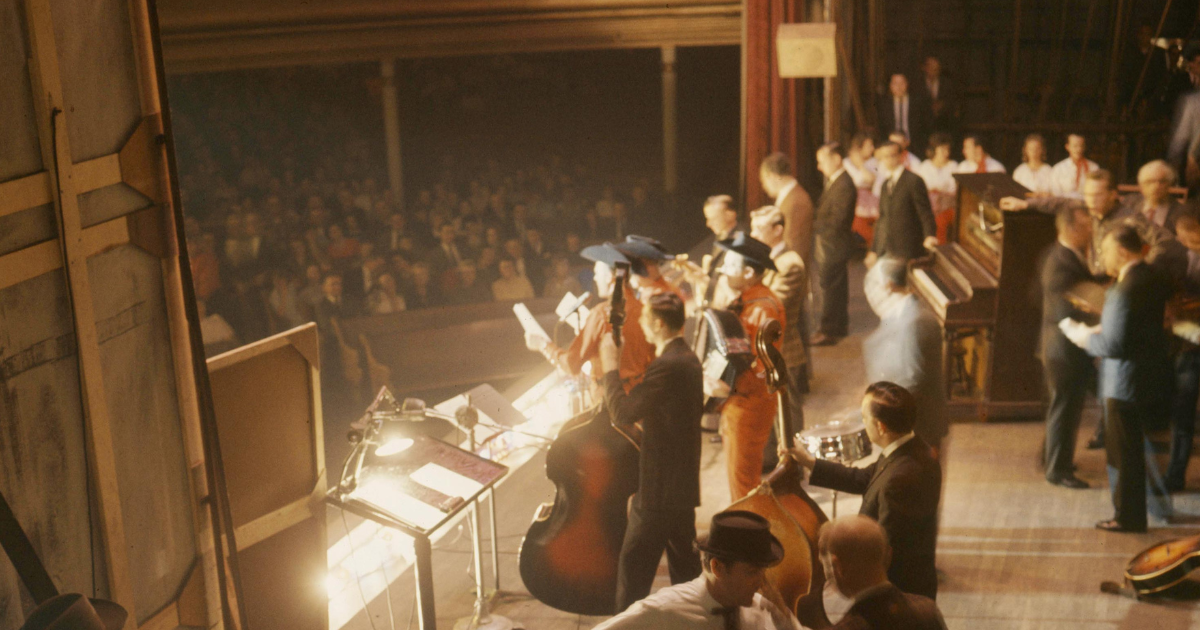
All photos courtesy of Ryman Hospitality Properties, credits and attributions as marked. Lead image: Bill Monroe & the Blue Grass Boys and the Opry Square Dancers take the Opry stage at the Ryman Auditorium in the 1960s.
The BGS Radio Hour – Episode 219

Welcome to the BGS Radio Hour! Since 2017, this weekly radio show and podcast has been a recap of all the great music, new and old, featured on the digital pages of BGS. This week we have a previously unreleased live performance from Emmylou Harris and the Nash Ramblers, as well as Béla Fleck’s return to bluegrass, a conversation on songwriting with Rodney Crowell, and much more.

APPLE PODCASTS, SPOTIFY

Béla Fleck – “Round Rock”

Our current Artist of the Month recently gathered an incredible crew of bluegrass power pickers for a live rendition of “Round Rock,” a tune that he included on his recent album My Bluegrass Heart, but that he had in his back pocket for nearly 20 years. He had been saving the piece for the right band to come along, and with this lineup, he has certainly found the players up for the task.

The Kody Norris Show – “Farmin’ Man”

Kody Norris’ “Farmin’ Man” is a true-life account of the American farmer – from the perspective of Kody himself, who grew up in a tobacco farming family in the mountains of east Tennessee. “I hope when fans see this they will take a minute to pay homage to one of America’s greatest heroes…”

Katie Callahan – “Lullaby”

Katie Callahan wrote “Lullaby” on the edge of the pandemic, before anyone could’ve imagined the way parenting and work and school and home could be enmeshed so completely. The song became a sort of meditation for her amidst the chaos.

Della Mae – “The Way It Was Before”

For Della Mae’s Celia Woodsmith, the process of writing “The Way It Was Before” was one of the toughest. [The song] “took Mark Erelli and I six hours to write (three Zoom sessions). Half of that time was spent talking, looking up stories, getting really emotional about the state of the world. We wanted to make sure that every word counted, so we took our time and tried to honor each of the characters (who are actual people). The pandemic isn’t even behind us, and yet I keep hearing people say that they can’t wait to get back to “the old days.” There’s so much about “the old days” that needs changing. After everything we’ve been through in the last 18 months, I found that writing a song like this felt impossibly huge. I may not have finished it if it hadn’t been for Mark.”

Ross Adams – “Tobacco Country”

The inspiration behind singer-songwriter Ross Adams’ “Tobacco Country” came from the idea of always staying true to your roots and remembering the people who helped you follow your path and dreams.
It’s a track paying tribute to the South.

Swamptooth – “The Owl Theory”

Savannah, Georgia-based bluegrass band Swamptooth wrote this jammy, energetic tune based on a Netflix series and true crime mystery with an unlikely theory that involves an owl. Read more from Swamptooth themselves.

Emmylou Harris & The Nash Ramblers – “Roses In The Snow (Live)”

A September 1990 performance by Emmylou Harris and the Nash Ramblers at the Tennessee Performing Arts Center in Nashville had been lost to time, but now, Nonesuch Records has released it as a new live album, which features a slew of songs that were not performed on the iconic At the Ryman record.

Jon Randall – “Keep On Moving”

“‘Keep On Moving’ started with a guitar lick and a first line,” Jon Randall tells us. “Once I put pen to paper, I never looked back. That’s exactly what the song is about as well. Sometimes I wish I could just get in the car, hit the gas and keep going. I think we all feel that way and probably hesitate to do so in fear of finding somewhere you don’t want come back from. What if there is a place where nobody gives a damn about where you come from and the mistakes you’ve made? That would be a hard place to leave.”

Fieldguide – “Tupperware”

“Tupperware” came to Canadian singer-songwriter Field Guide all at once in about 20 minutes. It’s a song about his early days living in Winnipeg, but it’s also more generally about the beautiful parts of life that aren’t meant to last forever, and coming to terms with that.

Rodney Crowell – “One Little Bird”

Courage and truthfulness. Those qualities permeate Rodney Crowell’s new album, Triage; in fact, it’s safe to say they’ve guided Crowell’s entire career. In our latest Cover Story, we spoke to Crowell about the new project, making amends, mortality, and so much more.

“I learned a long time ago,” he explains, “If it’s coming from my own experience, there’s a good chance I’m a step closer to true. And I can mine my personal truth, but confessional only goes so far. I’ve tried to walk that line; if I can carefully write about my own experience and put it in a broader perspective, then [for] the listener, it becomes their experience…”

Triage, as specific and particular as it gets, feels like it contains truth that belongs to each and every listener. “That’s why I feel like I have to be really careful; if I make it too much about my experience, then I start to tread on the listener’s experience.”

Suzanne Santo – “Mercy”

In a recent edition of 5+5, Suzanne Santo shared her thoughts on the emotional alterations of cinema, the gift of playing music for a living, taking long, rejuvenating walks, and much more.

Jordan Tice (featuring Paul Kowert) – “River Run”

Hawktail members Jordan Tice and Paul Kowert collaborated on an original tune, “River Run,” during lockdown. According to Tice, the song “started with a little lick I had been carrying around in the key of D — a speedy little cascading thing that felt good to let roll off the fingers that I’d find myself playing in idle moments.” The end result evokes the lightness and constancy of a swiftly moving river as it passes over rocks, rounds curves, and speeds and slows. “[I] hope you experience the same sense of motion while listening and are able to glean a little bit of levity from it.”

Skillet Licorice – “3-In-1 2 Step”

Skillet Licorice combined a few different old-timey, ragtime, swinging melodies into a sort of parlor song medley that feels like it came straight out of Texas, complete with banjo and mandolin harmonies.


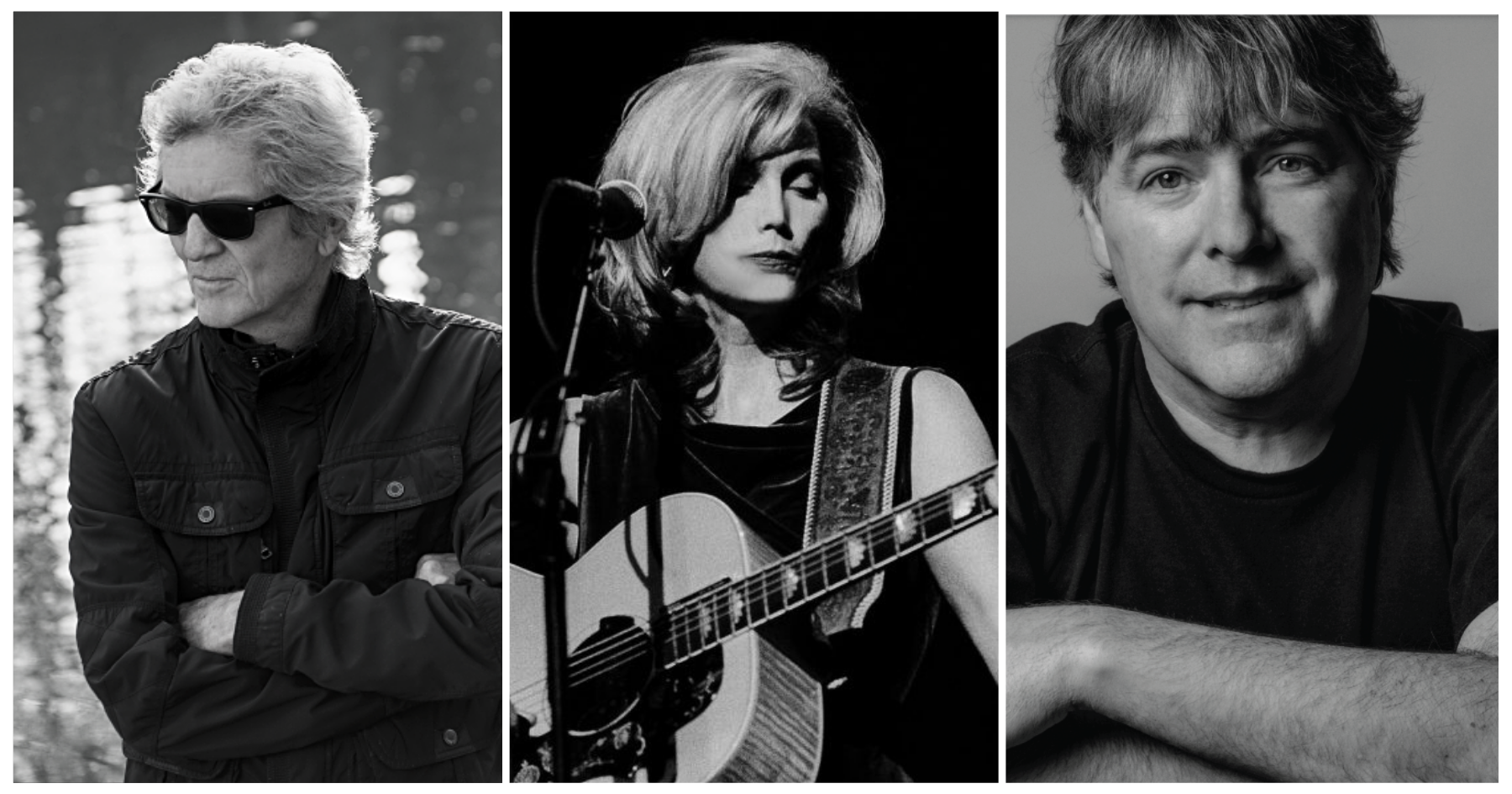
Photos: (L to R) Rodney Crowell by Sam Esty Rayner Photography; Emmylou Harris by Paul Natkin/Getty Images, circa 1997; Béla Fleck by Alan Messer

The BGS Radio Hour – Episode 218

Welcome to the BGS Radio Hour! Since 2017, this weekly radio show and podcast has been a recap of all the great music, new and old, featured on the digital pages of BGS. This week we have a vertigo-inducing bluegrass whirlwind from our Artist of the Month Béla Fleck and an all-star lineup, we take a listen to some energetic and ethereal — yet totally traditional — bluegrass banjo from Jeremy Stephens, we dive into the latest from Watchhouse’s new release, and much more!

APPLE PODCASTS, SPOTIFY

Watchhouse – “New Star”

We’ve watched Andrew Marlin and Emily Frantz go through quite a few changes throughout their career in music, but one of the most joyful to watch has been their journey as parents. Even with COVID-19 halting touring for more than a year, their young daughter Ruby has already been to 34 U.S. states and nine different countries!

After their pandemic hiatus, the family of three is back on the road again as Watchhouse, the duo formerly known as Mandolin Orange, touring their new self-titled album. And Ruby, now a toddler, has perhaps transitioned back to road life even more smoothly than her father, who admits he’s still “struggling to find my sea legs.” For a recent Cover Story we spoke to Marlin about their name change, their new album, creativity through the pandemic, parenthood, and oh so much more.

Bobby & Teddi Cyrus and Billy Ray Cyrus – “Roll That Rock”

Husband and wife duo Teddi & Bobby Cyrus are joined by Bobby’s cousin, Billy Ray Cyrus, on “Roll That Rock,” a grooving bluegrass gospel song that they wrote together. According to Billy Ray, “When I started singing ‘Roll That Rock’ my inner spirit said Bobby Cyrus will know exactly what to do with this. He did. He wrote the gospel truth and then sang the daylights out of it with Teddi and a killer bluegrass band reminiscent of Earl Scruggs and Bill Monroe.”

AJ Lee & Blue Summit – “Monongah Mine”

A new favorite of BGS, California-based bluegrass band AJ Lee & Blue Summit tell the story of the 1907 Monongah, West Virginia mining disaster in this new track.

Béla Fleck – Vertigo

20 years since his last bluegrass album, Béla Fleck just returned this past week with My Bluegrass Heart . Home is where the heart is, after all! All September we’re celebrating Béla as our #ArtistOfTheMonth! Hear tracks from the new project — featuring an all-star lineup — and more on our Essentials Playlist, including this song featuring Sam Bush, Stuart Duncan, Bryan Sutton, and Edgar Meyer.

Paul Thorn – “Sapalo”

In this track with an R&B groove, Mississippi’s Paul Thorn turns the contents of a YouTube video of James Brown high on PCP into a song of redemption. Yes, you read that right! As he puts it, “It’s about being optimistic with whatever time you’ve got left.”

Elder Jack Ward – “The Way Is Already Made”

Elder Jack Ward puts his God-given talents to work on a new album that’s full of joyful gospel and sacred soul — as evidenced on its title track, “The Way Is Already Made.”

“If you’ve got that God-given gift you can do it — your choice if you want to sing rock ‘n’ roll, blues, gospel — but I choose the right side.”

The Grascals – “Maybelle”

“Maybelle” is a song that sounds like it came from deep within the mountains — exactly what The Grascals were looking for. From the haunting words to the clawhammer banjo and fiddle, “Maybelle” will grab your attention.

Hiss Golden Messenger – “Sanctuary”

On a recent episode of The Show On The Road, host Z. Lupetin dials in to North Carolina to chat with Grammy-nominated songwriter MC Taylor, who for the last decade and a half has created heart-wrenchingly personal and subtly political music fronting Hiss Golden Messenger.

The Way Down Wanderers – “Everything’s Made out of Sand”

The Way Down Wanderers recorded “Everything’s Made Out of Sand” in one take, belting and stomping into one antique microphone. The song’s lyric, music, and sonic landscape all capture the inspiration they gathered from the temporary nature of all things.

Seth Mulder & Midnight Run – “Carolina Line”

Seth Mulder & Midnight Run recorded “Carolina Line” with an Osborne Brothers-inspired arrangement that represents many of their various musical influences.

Matthew Fowler – “Going Nowhere”

In a recent edition of 5+5, Matthew Fowler spoke on the bold authenticity of Glen Hansard, a memorable birthday show in his hometown, Orlando, putting himself in the “hot seat” of a song, and much more.

The Felice Brothers – “To-Do List”

The Felice Brothers chose the very first take of “To-Do List” as the keeper, capturing the loose, playful quality of the group just getting the tune under their fingers. “The song was originally a slow waltz with the lyrics: ‘Into the fire that burns them/that’s how the idiots run,’ but I didn’t know where to go from there. I had written down a to-do list on the adjacent page and began to sing it and it seemed to work well with the phrasing. I wrote down many pages of ridiculous things and chopped them up into the melody. This is how the song came into being.”

Mike Younger – “Killing Time”

The lyrics of Mike Younger Music’s “Killing Time” take comfort in the remembrance of past friendships forged in the fire of struggle. Younger believes that artists have nothing to lose by speaking their truth and doing so unapologetically through song. “I greatly admire those writers and creative people in general, who, through their work, have lent their voices to the struggle for equity in our society, like John Lennon, Woody Guthrie, Bob Dylan, Joni Mitchell, Nina Simone, Marvin Gaye, Bob Marley, and others.”

Jeremy Stephens – “Sockeye”

Banjo player and multi-instrumentalist Jeremy Stephens (co-founder of High Fidelity) has an old school, traditional approach to bluegrass that’s anything but backward. His new solo album, How I Hear It, includes several instrumentals that demonstrate this fact. “Sockeye” captures the energy and ethereal quality of Stephens’ live playing in a way many more sterile bluegrass albums, and purposefully more modern sounding records, can only aspire to.


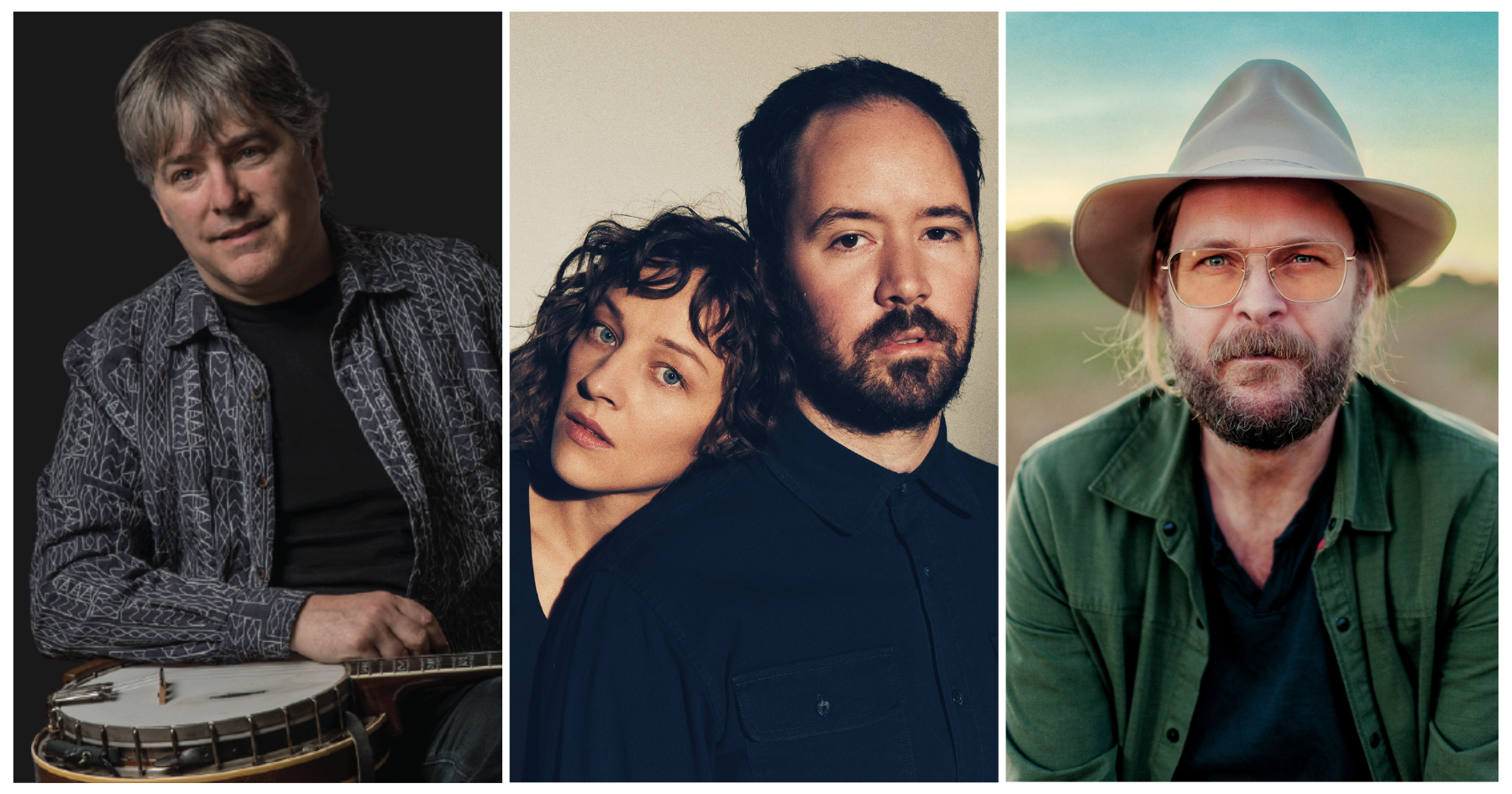
Photos: (L to R) Béla Fleck by Alan Messer; Watchhouse by Shervin Lainez; Hiss Golden Messenger by Chris Frisina

The BGS Radio Hour – Episode 217

Welcome to the BGS Radio Hour! Since 2017, this weekly radio show and podcast has been a recap of all the great music, new and old, featured on the digital pages of BGS. This week we have California country from Elijah Ocean and the Ben Reddell Band, acoustic folk goodness from Anna Tivel, a final farewell to our August Artist of the Month Amythyst Kiah, and much more.

APPLE PODCASTS, SPOTIFY

Amythyst Kiah – “Black Myself”

In our recent two-part interview with our August Artist of the Month, Amythyst Kiah, she spoke with us about faith, about mental health and singing vulnerable, open songs every night, and the intent behind lyrics and songs like “Black Myself.” Plus, she retells the series of events that helped her leave her “shut-up-and-sing” policy behind. Thank goodness for that.

Chris J. Norwood – “Good Guy With a Gun”

On “Good Guy With a Gun,” singer-songwriter Chris J Norwood examines the grief and loss of his father’s suicide while challenging the United States’ gun culture: “Truth be told, we as a country need to talk more openly about suicide. Especially as it relates to the gun debate…”

Ava Earl – “New Light”

One of the first love songs singer-songwriter Ava Earl ever wrote, “New Light” is also a little existential — it deals with the wonder and mystery of the universe as well as that of love.

Elijah Ocean – “Honky Tonk Hole”

As Elijah Ocean himself puts it: “‘Honky Tonk Hole’ is about a guy who has seen better days and whose big dreams have all gone up in smoke. Now he spends all his time drinking and playing country music in bars. Not entirely sure why he’s complaining about it, though. Seems kinda fun and not a bad life. It’s a high-energy shuffle about falling into a rut but also kind of loving it.”

Ben Reddell Band – “12 Bar Blues”

Musician and frontman Ben Reddell recently put together a Mixtape celebrating bands and artists who have played The Grand Ole Echo, a roots music concert series he books at LA’s Echo Park, or who rely on the creative and rehearsal space he manages, Bedrock LA. To quote: “We love our traditional country here in Echo Park, but we also like to let our freak flag fly with the hippie-dippie, pot-smoking types as well.” Check out the community-minded Mixtape here.

Kashena Sampson – “Hello Darkness”

Nashville-based Americana singer Kashena Sampson brings us a Shocking Blue cover that carries a feeling of yearning for someone you can’t be with.

Morningsiders – “This Could Be Good”

Morningsiders began writing their new album after the pandemic lockdowns began. They wanted “This Could Be Good” to be dance-y and delicate while being about aimless nights out with friends.

Anna Tivel – “Illinois”

Singer-songwriter Anna Tivel talked with us about her pre-show rituals (or lack thereof), drawing inspiration from literature and poetry, observing the natural and manmade world, and more in a recent 5+5.

Anya Hinkle – “Why Women Need Wine”

Asheville’s Anya Hinkle told us about the massive influence Gillian Welch had on her musically, combining the spirits of musicians who had influenced Hinkle early on — like Tony Rice, the Grateful Dead, Joan Baez, Sarah McLachlan and Madonna — into one tangible, modern, and original roots sound. Read more in this edition of 5+5.

Jay Nash – “Shine”

Jay Nash wrote “Shine” inspired by the new arrival of his daughter. It took him nearly ten years to return to the song idea: “Because, as all parents know, what followed those calm and quiet moments of parenthood was an all-out sprint… a crash course [of] becoming a parent.”

Dallas Burrow – “My Father’s Son”

On his new track, “My Father’s Son,” self-described troubadour Dallas Burrow tells the four-generation story of the men in his family line — and the influence they’ve had on their sons. It’s a tender, honest, autobiographical history.

Lonesome River Band – “Every Minute Means a Mile”

The Lonesome River Band pays tribute to the Easter Brothers on their upcoming album, Singing Up There: A Tribute to the Easter Brothers. And “Every Minute Means a Mile” is an uncomplicated Easter Brothers classic.

Adeline Stringband – “Hickory”

Adeline Stringband — a veritable old-time supergroup featuring Chris Coole, Mark Kilianski, John Showman, Adrian Gross, and Sam Allison — holed up in a cabin in the woods and recorded old time tunes for three days and three nights. Gross describes it as one of the most off-the-cuff and creative sessions he’s ever been a part of: “Seeing as it was -20º and there was a blizzard outside the whole time, there was nothing to do but pick tunes and roll the tape, and that’s exactly what we did.”

Jackson Melnick – “John the Revelator”

“Apocalypse isn’t to be confused with tragedy. Apocalypse is seeing something in truth, and the pain that might come from having the blinders pulled off.” Jackson Melnick brings us a bluegrass version of this classic blues song.


Photos: (L to R) Elijah Ocean by Wolfe & Von; Amythyst Kiah by Sandlin Gaither; Anna Tivel by Matt Kennelly

The BGS Radio Hour – Episode 215

Welcome to the BGS Radio Hour! Since 2017, this weekly radio show and podcast has been a recap of all the great music, new and old, featured on the digital pages of BGS. This week, the Radio Hour features a song that reclaims the image of the magnolia tree, we enjoy some blues and southern rock from folks like Charlie Parr, Christone “Kingfish” Ingram, and Larkin Poe, plus hear a “Wichita Lineman” cover by Colin Hay, and much more.

APPLE PODCASTS, SPOTIFY

Gregory Alan Isakov – “Salt And The Sea”

To celebrate the birthday of Dualtone Music Group, Gregory Alan Isakov covers The Lumineers’ “Salt And The Sea” on a new compilation record, Amerikinda: 20 Years of Dualtone, which features many of Dualtone’s artists from the past and the present performing each other’s songs in a whimsical, jovial tribute to the work and achievements of this beloved record company.


Adia Victoria – “Magnolia Blues”

On a new track inspired by the last year and its intentional pausing, Adia Victoria explores the magnolia as a symbol of the South: “The magnolia has stood as an integral symbol of Southern myth making, romanticism, the Lost Cause of the Confederates and the white washing of Southern memory. ‘Magnolia Blues’ is a reclaiming of the magnolia…”

Jim Lauderdale – “Memory”

One of the most eloquent tracks on Jim Lauderdale’s new album Hope — a collection reminiscent of dreamy ‘70s folk rock records — celebrates the legendary Grateful Dead lyricist Robert Hunter, a longtime friend and collaborator of Lauderdale’s who died in 2019. As one of the final songs they wrote together, “Memory” arrived on June 22, just one day before what would’ve been Hunter’s 80th birthday.

Carrie Newcomer – “A Long Way Up”

We caught up with singer-songwriter Carrie Newcomer for a 5+5 — that’s five questions and five songs — on growing up creative, writing stories, poetry, and essays, taking comfort in nature and its imagery, and more.

Larkin Poe & Nu Deco Ensemble – “Every Bird That Flies”

Larkin Poe grew up drawing inspiration from a wide range of genres, so they always dreamt of honoring their classical upbringing with orchestral arrangements of their music. Their first ever live album features Nu Deco Ensemble combining those classical elements with Larkin Poe’s Americana, blues, and Southern rock songs.”In hearing our Roots Rock ‘n’ Roll repertoire reinterpreted through an orchestral lens, it felt like a creative circle was being completed.”

Christone “Kingfish” Ingram – “Too Young to Remember”

Christone “Kingfish” Ingram seemed to come out of nowhere with his 2019 Alligator Records debut, Kingfish. At 20 years old, the native of Clarksdale, Mississippi, emerged as a fully-formed guitarist, vocalist, and songwriter and was quickly hailed as a defining blues voice of his generation. Now his new record, 662, pays tribute to his upbringing and his home turf.

Jesse Lynn Madera – “Revel”

Jesse Lynn Madera has written a lot of sad, emotional songs, but writing “Revel” changed the way she approaches songwriting, recognizing the opportunity artists have to positively impact a person. She reflects, “Being human is rollercoaster enough without a pandemic to further complicate the experience. We’ve all suffered through our share, and hopefully we’ve all experienced the sun coming up over the horizon of despair. This will be no exception. The glow shall return, and we’ll all be reveling in it.”

Charlie Parr – “Last of the Better Days Ahead”

Blues picker Charlie Parr reflects on the days he’s currently living in on “Last of the Better Days Ahead.” As he tells us: “I’m getting on in years, experiencing a shift in perspective that was once described by my mom as ‘a time when we turn from gazing into the future to gazing back at the past…'”

Colin Hay – “Wichita Lineman”

“Wichita Lineman” was the first song where Colin Hay (of Men at Work) realized the importance of the written song, in and of itself. He tells us the song “spoke of things I could only wonder at. The geographical vastness of the land, the hopes and dreams of the man working the line, and indeed of all people who inhabit this country. And, a love story contained within achingly beautiful music and melody. I can’t think of a better song.”

Dillbilly – “Countries”

For a big part of their life, Dillbilly grew up feeling like country and bluegrass were genres that they could never be a part of even though the music has always felt like home. But in writing “Countries,” it felt so good for them to lean into those roots.

The Isaacs – “Turn, Turn, Turn”

Powerhouse bluegrass (and beyond) family The Isaacs have returned with new music, including their rendition of a Pete Seeger classic that Lily Isaacs recalls from her days of growing up as a folk music fan in 1960s New York City.


Photos: (L to R) Larkin Poe by Josh Kranich; Charlie Parr by Shelly Mosman; Adia Victoria by Huy Nguyen

The BGS Radio Hour – Episode 209

Welcome to the BGS Radio Hour! Since 2017, this weekly radio show and podcast has been a recap of all the great music, new and old, featured on the digital pages of BGS. This week, we bring you new music off of the beautiful new album Outside Child from Allison Russell, as well as bluegrass songs to celebrate springtime, and much more! Remember to check back every week for a new episode of the BGS Radio Hour.

APPLE PODCASTS, SPOTIFY

Kishi Bashi – “Waiting For Springtime”

To start off this week’s roundup, we visit our conversation with Athens, Georgia-based Kaoru Ishibashi, better known as Kishi Bashi, about his new EP Emigrant. When COVID hit, he and his daughter packed into a camper and hit the road, from the southeastern U.S. all the way to Oregon, over a period of several months. Along the way, he fleshed out the songs that became Emigrant through visiting places like the Ozarks, the Dakotas, and Montana, including Heart Mountain: a World War II Japanese internment camp he visited many times during the production of his documentary Omoiyari: A Songfilm by Kishi Bashi.


Reid Zoe – “When I Go”

This new track from singer-songwriter Reid Zoé is, on the surface, a song about dying, but really it’s about all of the questions that come with being a human on earth.

Full Cord – “Right In Step”

With a catchy melodic hook and low-tuned banjo, “Right in Step” is a lovely bluegrass tune full of love, hope, and togetherness – hopefully a respite from the uncertainty of the pandemic.

Sean McConnell – “Price of Love”

It’s been said that everything in this world comes with a price. For Nashville’s Sean McConnell, that price is reflected in loving someone — be it family, friend, or significant other — and the eventuality and certainty of you losing them. Yet still, he suggests, most of us are willing to take that risk for love, to give up our hearts completely. It’s the price that our heart pays for love in return.

The Deep Dark Woods – “How Could I Ever Be Single Again?”

A new song from pan-Atlantic singer-songwriter The Deep Dark Woods was inspired by English folk band Steeleye Span. Featuring Kacy Anderson on fiddle, the tune asks the titular question, “How Could I Ever Be Single Again?”

Sam Robbins – “Raining Sideways”

“Raining Sideways” is one of Sam Robbins’ most-requested songs, a stream of consciousness lyric that’s one of the most raw and authentic he’s ever written.

Lera Lynn – “A Light Comes Through”

A recent episode of The Show on the Road featured a deep dive with silky-voiced, southern gothic-folk songwriter Lera Lynn. Stick around to the end of the episode to hear Lynn introduce her favorite broken-romance number, “So Far.”

Graham Sharp – “Truer Picture of Me”

BGS recently caught up with Steep Canyon Rangers’ banjo player and songwriter Graham Sharp about the release of his new solo record, Truer Picture. We talked about Steve Martin’s influence on the Rangers and Sharp himself, as well as his approach to songwriting, nature inspirations, and the way literature and music coincide.

Our Native Daughters – “Quasheba, Quasheba”

Our Artist of the Month for May, Allison Russell, wrote this song for her many-times-great-great-grandmother Quasheba, who survived being enslaved, being ripped away from everything she knew, the horrible Middle Passage, having her children taken, and more. Russell says her art and a loving community have inspired her to connect with her ancestors and find connection through intergenerational strength, resilience, and transcendence, despite intergenerational trauma and abuse.

Grace Pettis – “Paper Boat”

Singer-songwriter Grace Pettis literally dreamed up “Paper Boat,” a song about coming of age, trying to fit in, and losing our innocence. She’s joined by her producer, Mary Bragg, on tender harmony vocals.

Allison Russell – “The Runner”

We spoke with our May Artist of the Month, Allison Russell, about the inspiration behind and creation of her honest and stunning album Outside Child, including this track “The Runner.” Read our two-part interview here.

Lost & Found – “Wild Mountain Flowers for Mary”

We hope, wherever you’re reading this from, that snow, frost, and the cold are truly retreating, giving way to longer days, warmer weather, and the gorgeous, humid, cicada-soundtracked days of summer. But, before we get to full-blown bluegrass season – and, hopefully, our first live music forays since COVID-19 shut the industry down in early 2020 – let’s take a moment to intentionally enjoy spring with 12 bluegrass songs perfect for collecting a wildflower bouquet, romping and frolicking in the meadow, and pickin’ on the back porch while the evenings are still cool.

Accidentals – “Wildfire”

The Accidentals spoke with BGS on loving and learning from Brandi Carlile, singing on stage with Joan Baez, the magic in meeting strangers and finding common ground, and much more in this edition of 5+5.


Photos: (L to R) Lera Lynn by Alysse Gafkjen; Allison Russell by Marc Baptiste; Kishi Bashi by Max Ritter

Turning 30, eTown Plans b’Earthday Show and Enters Colorado Music Hall of Fame

The long-running radio series eTown is famous for its finales, but upon reaching its 30th year, the focus is shifting to an upcoming all-star virtual b’Earthday concert on April 22 and the program’s deserving induction into the Colorado Music Hall of Fame. Of course there’s also an eagerness from everybody involved — staff, artists, and audience alike — to get back to staging shows at the beloved eTown Hall, a repurposed church that stands as a centerpiece of Boulder’s cultural community.

Community is key to Nick and Helen Forster, the founders of eTown. Their marriage has proved to be as sustainable as the environmental causes they support, and by never wavering from musical integrity, they have created a destination for musicians and music fans of every stripe. Helen carried a love of theater to eTown following her work with the early years of Telluride Bluegrass Festival. Nick Forster, who found acclaim in the band Hot Rize just before eTown launched, can recall browsing through microfilm in the library to do research for his guest interviews. Now, thanks to the internet, the whole world can feel part of the eTown tribe.

Calling in from Boulder, the Forsters filled in BGS about their ongoing creative venture, the common thread that all eTown artists share, and the warm family feelings behind the scenes.

BGS: What was the musical landscape of Colorado like back 1991?

Nick: In ’91, there were a lot of things that had come into their full power, including Telluride Bluegrass Festival, which is where Helen and I met. There was a pretty vibrant music scene in both Boulder and Denver, but if there was such a thing as the sound of Colorado, it was something around that lineup of the Telluride Bluegrass Festival or RockyGrass or Folks Fest. A loosely defined Americana vibe, with a little bit of a hippie slant. Colorado has always had that progressive, acoustic [feel]. … From John Denver on down, there has been a sense of Colorado being a place where a natural approach to music makes sense.

Helen, what drew you to bluegrass music?

Helen: You know, everything back then in Telluride was so organic that if you didn’t have a radio station, you got together and you started one. The festival started because these guys came back from the Walnut Valley Festival in Winfield, Kansas, and they loved it and said, “Why don’t we do this here?” So they did a Fourth of July celebration and a couple hundred people came. I think there were two or three local bands, and from that it grew into become an actual festival. By the second year of that, a couple of the founders had pulled out and I jumped in to just help, I guess. …

When I first got to Telluride, there were very few places to go, other than the bars. And there were some local bluegrass bands. That’s how I first discovered bluegrass. I was in my early 20s and we’d all jam into these basement bars and listen to the bluegrass. It caught my heart. It’s a beautiful form of music and I was so impressed with the talent and the ability of the players. Not only to play, but to jam. It was almost like jazz, in a sense, and it caught my attention then.

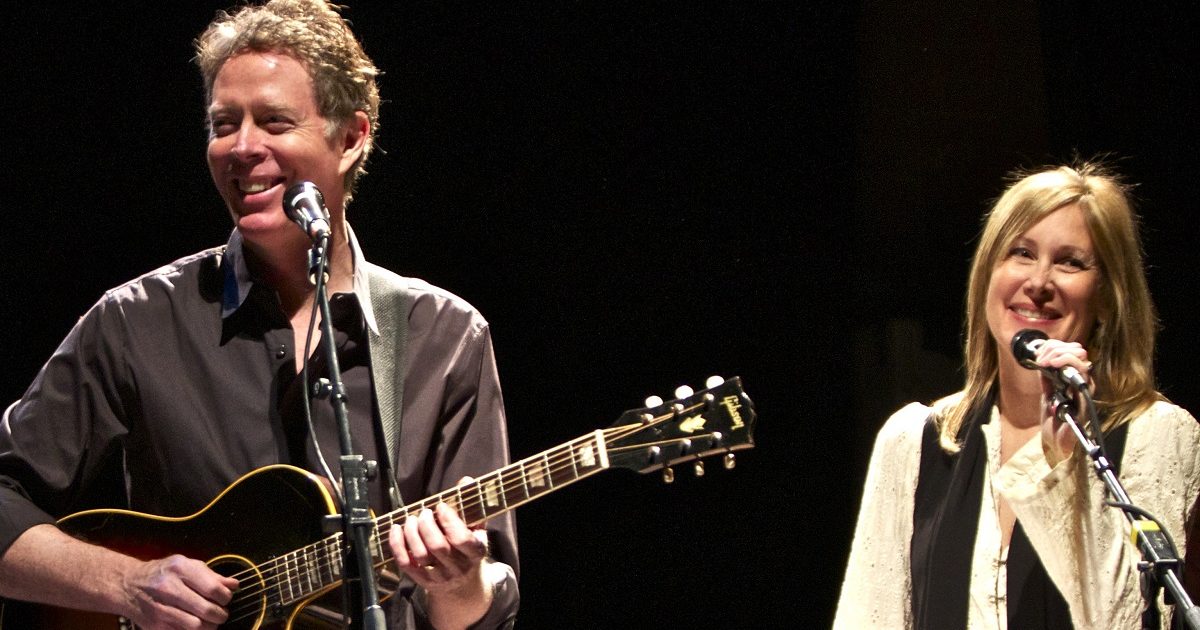
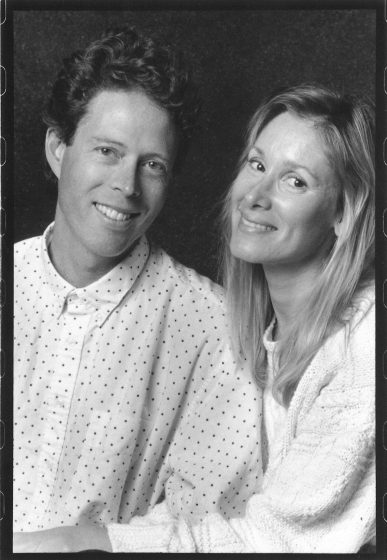
Nick and Helen Forster, 1991. Credit: Laura Lyon

Nick, around this time you had made your mark in Hot Rize, which was the first IBMA Entertainer of the Year back in 1990. So, with your background as a performer, how did you make touring artists feel at home at eTown?

Nick: I was in a unique position being on the road with Hot Rize for years. I had an understanding of what it was like from an artist’s perspective. We’d been lucky enough to play on the Grand Ole Opry, Prairie Home Companion, Austin City Limits, Mountain Stage, and all these shows. I was really enamored with live radio in front of an audience. And when I thought about all the gigs I played with Hot Rize, there were four things that I usually remembered: How was the sound? Was there a decent place to stay? Was the food good? And did the crew have a good attitude?

So, we started with that at eTown, recognizing that we were trying to do two different things. One, we were trying to help these artists basically promote their new records, because everybody who came to eTown was out there with a new record. But we also wanted to have the mission of why we were doing eTown be something they would connect with. And to be inspired by, or at least informed by. So the piece of our show that included conversation about climate change or community or sustainability was another thing that most musicians were really into. Musicians who were traveling have a good world view. A lot of them are avid readers and up to date on world affairs. This was not a giant leap for them to connect with the mission-related part of it.

Tell me about the spirit of collaboration at eTown. What do you like about having more than just the two of you putting a show together?

Helen: It’s interesting, because when I was a little kid, I was doing a lot of theatre. I came from that model that it’s not just the performers; it’s the stage manager, and the props mistress, and the person who manages the set changes. Everybody works together. It’s like a team experience when you do theatre, and having the great crew that we’ve had, I think it’s a great testament to eTown and the model that we created there of being open and [receptive] to our guests. …

That’s what a lot of artists would mention: “My gosh, what a breath of fresh air! We’ve been on the road dealing with disgruntled monitor mixers, then we come here and it just feels like family,” like you’ve been welcomed in. And quite frankly, since we closed the eTown Hall temporarily, now for over a year because of COVID, we all miss each other. Nick organized a Zoom call a couple of months ago so we could catch up and see each other. I know that our crew is really anxious for the hall to re-open so we can all come together again. It’s like a big, extended family.

What are you looking for when it comes to booking artists for eTown?

Nick: We’ve always tried to aim for music that is soulful. That’s music that has integrity, good songwriting, not too many bells and whistles. Not stuff that is overproduced, so you can feel the personality of the songwriter and the singer come through. Our booking philosophy was always, from the very beginning, about featuring some diversity. But for the first 600 or 700 shows that we did at the Boulder Theatre, that’s 800 or 900 seats that we tried to fill. So, sometimes it helped when we had people with name recognition as one of our guests.

We always tried to have one artist with name recognition and one artist that was emerging, and beyond that, maybe one band and one solo. Or one person is playing Americana music, and the other one is playing Celtic or Hawaiian or Afro-Cuban music. The diversity of artists was really important to us, particularly because of our finale. The end of the show was always a joint effort between our musical guests and a lot of times they didn’t know each other. They didn’t have a lot of common ground.

I come from the bluegrass world where, yeah, you’re just going to pick and jam and find a song and play. But particularly for songwriters who have been hiding in their bedrooms writing songs for three years, and then they come out and say, “I don’t know any other songs….” But the finale was always, in some ways, not just an opportunity to have something in real time. It had to be created that day, with those people, under pressure, to find a song, find a key, arrange it, split the words up, and rehearse it, then perform in a few hours later. It was pretty intense! But the other part of it was, eTown’s goal has always been about using music as a way to build community, and to remind people that our community is larger than we might think it is.

Over the last 30 years, music and technology have changed so much. When it comes to eTown, what would you say has remained the same?

Helen: There’s been an agreed goal of maintaining a certain amount of integrity and a certain amount of quality in the ultimate product that we have been putting out all these years, which is the radio broadcast and now podcast. Whether it’s the technical sound end of it, all the way to the content itself. I think that’s what’s kept it going as long as it has. There is this underlying devotion and striving toward excellence.


Lead photo of Nick and Helen Forster by Tim Reese