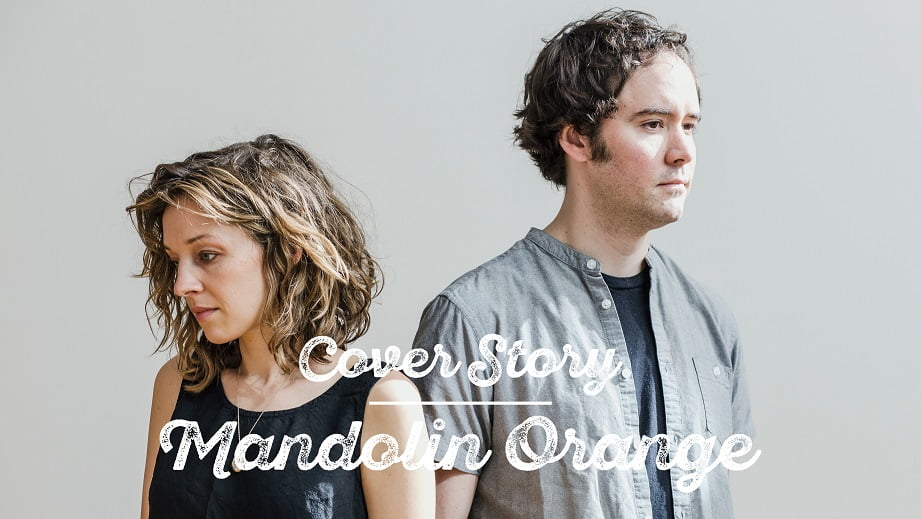
Mandolin Orange: How Bluegrass Brought Them Closer (Part 2 of 2)

Because they have developed a fan base that stretches across genres and generations, it isn’t so easy to, ahem, segment Mandolin Orange into one specific category. But throughout a decade of performing together, bluegrass has been a major part of the music created by the duo’s Andrew Marlin and Emily Frantz. In the second part of our BGS cover story, they discuss their biggest bluegrass influences.

Editor’s Note: Read Part One of the BGS Cover Story with Mandolin Orange.

BGS: There’s a real country feel on “Lonely All the Time.” Are you classic country fans?

Andrew: Yeah. It’s not something I dig into, and really break apart, like I do with old-time and bluegrass music, but I think Emily and I both grew up listening to classic country. My dad is a country music fan, and that was a song that inadvertently got written from his perspective, living alone these days. I wanted to do a classic country duet sound for that, and Emily had the idea to do harmony all the way through it, like a George Jones and Melba Montgomery tune.

Emily: I think our road to classic country has been more roundabout. We listen to a lot of bluegrass, and when you listen to a lot of the older country, it’s a lot more acoustic and smaller-sounding, sonically. A lot of it is not very different than standard bluegrass tunes. It feels like that’s a natural path for us to go down with this band.

Andrew: Yeah. I like Hank Williams and early Johnny Cash, where it’s just a small ensemble playing the music.

Who are some of the bluegrass musicians you return to, just for enjoyment?

Emily: Andrew spends a ton of time listening to Bill Monroe, from a place of really digging into mandolin, and I guess for enjoyment too. But for listening pleasure, I would say a lot of the brother duets – the Stanley Brothers, the Louvin Brothers…

Andrew: Yeah, the Stanley Brothers for the songs, too. They were lonely, man. They were lonely dudes! I think the Stanley Brothers had a natural, bluesy feel, and their songs were so heavy and beautiful. Definitely, for songwriting, the Stanley Brothers would be a big influences, especially on our tune, “Suspended in Heaven,” on the new record. But also the Sam Bush and Tony Rice era. I listen to a lot of Sam Bush and Tony Rice, and just keep getting farther and farther into the Sam Bush catalog. I love his energy and what he brings to whatever ensemble he’s playing. It’s cool that he has a documentary out about him now. He’s getting the respect that he is due.

You may never emerge if you dive too deeply in Sam’s catalog. That stuff is so great, and sounds so good at festivals. He’s like the king of festivals.

Yeah, I think that’s because he’s able to maintain what he wants to do musically, but he’s still energetically appealing to mass audiences. That’s a hard to thing to do at a festival and I feel like he does it well.

That festival crowd can be tough. How many festivals have you all played over the last 10 years?

Andrew: We’ve played a bunch of ‘em. And playing quiet music. That can be an intimidating thing sometimes.

How did you overcome that?

Andrew: We shut our eyes and just hope they don’t mind hearing some quiet music. (laughs)

Emily: I think it was actually realizing that there is a place for that at festivals, even though it doesn’t seem like it. We’d get on stage and feel outgunned at the outset, but the more that we talked to people and realized that they appreciated having that in their festival experience, to offset all the crazy jamming going on. Everybody needs to balance out a bit. Once we realized that, we were able to own it a little more and recognize that that could be our role.

Andrew: It’s more like the hangover weed crowd than the late night drunk crowd, I would say.

I want to go back to “Suspended in Heaven.” It does have that Stanley Brothers sound, but it also has that church music sound, in a way. Are you influenced by music of the church?

Emily: Probably more in that we listen to and enjoy the old gospel tunes that are part of the bluegrass repertoire. We both grew up with church music but it wasn’t necessarily this kind of church music.

Andrew: My mom’s mom was the piano player for the church I went to, growing up, and then my mom took over her responsibilities, then my sister took over for a little while. So it’s like three generations of piano players at this church in Afton (North Carolina) that we went to, growing up. I was around a lot of old hymns and old gospel music, and you can’t really separate my mom from gospel music. I think in wanting to pay homage to her, and to her life, it made sense to write a standard old gospel tune. I guess the lyrics are not traditionally leaning but the sound definitely is.

Tell me how you became interested in bluegrass music.

Emily: For me, it was in the very beginning when I was taking Suzuki violin lessons as a kid. Our teachers didn’t give lessons in the summer but they did fiddle camps. I always played by ear but that was my first experience of being encouraged to learn to play by ear and not being forced to read sheet music. So I learned “Old Joe Clark” and “Bile ‘Em Cabbages Down” – all the first fiddle tunes you learn. And gradually I phased completely out of doing anything classical.

I was able to take more fiddle lessons and play in a local bluegrass band around the time I started high school. And learned a ton from the guys I was playing with, about how to sing tenor and what role the fiddle is supposed to play. It’s cool that traditional bluegrass has pretty hard-and-fast rules about what the given instruments are supposed to do, and I’m really glad that I learned that. We don’t play that way ourselves, on our own tunes necessarily, but it’s really fun to jump in and make a bluegrass song sound just like bluegrass-–if you know the rules.

Andrew, how about you?

Andrew: I’d only just started getting into bluegrass when Emily and I met each other, actually. I grew up with country and switched to rock ‘n’ roll, and then from there I fell into a metal zone. I was in a metal duo, actually, before I moved to Chapel Hill. I don’t think there are any recordings of that out there – hopefully not. I credit the Skaggs & Rice record a lot as being that switch for me that flipped me to bluegrass. When I heard that, I was like, ‘Who is this guitar player?” And the way they are singing together, it’s really quality. Especially Ricky Skaggs’ mandolin playing on that record.

So from there, I found out about Norman Blake and David Grisman and John Hartford and of course Sam Bush. I just fell in love with it, and especially the mandolin. So I think when Emily and I first met, I’d only been playing the mandolin for a year or so.

Emily: Andrew didn’t know very many bluegrass tunes. I was more of the source, at that point.

Andrew: She was showing me a bunch of fiddle tunes to learn on the mandolin, which really helped me figure the instrument out. I’m still figuring it out. So I’d say meeting Emily was a big part of my schooling in bluegrass, in a lot of ways.

After ten years of knowing each other, do you have a good intuition about what the other person is thinking?

Emily: I would say yeah, especially musically. I think all those years, too, of playing just the two of us, it becomes like a second language, and you don’t even necessarily realize it’s happening.

Was there a time when you did realize it was happening? Where you thought, “Wow, this is actually pretty good.”

Andrew: It depends on what we thought the other one was saying. (both laugh)

Emily: I remember reading an interview with Gillian Welch a long time ago, when she was talking about playing with a duo, about how it’s so much harder than playing with a full band, but also how it’s so much easier. And a lot of the things that she said about it made me realize how we were communicating, in a way that I didn’t necessarily realize before.

Andrew: I definitely love the spontaneity of playing in a duo, playing with just one other person. It’s really hard to make that split-second decision to vamp on a chord if you forget a lyric, or to extend a solo section, when there are four other people on stage with you. But when it’s just the two of us, we can kind of look at each other and give an eyebrow raise, and it’s like, “Oh yeah, I forgot the lyrics, so….”

Emily: It’s not even visual sometimes, but if somebody misses something, you automatically compensate for it in some way, and it’s not even conscious. I guess that’s probably possible in larger ensembles but it probably takes ten times as long to get there.


Photo credit: Kendall Bailey
BGS Top Moments of 2018

Ah, to truly live in the moment. These past twelve months often felt like myriad moments were perpetually fighting for our attention all at the same… moment. So at those junctures that did allow — or perhaps they mandated or beseeched or coaxed or compelled — us to take pause and truly be present, we found some of our favorite musical landmarks of the year, each one unified by their arresting message: Stop. Inhabit this moment. You’ll be glad you did.

Mandy Barnett Refreshes “The Fool”
A versatile vocalist who’s mostly known in classic country circles, Mandy Barnett made her newest album in Muscle Shoals, trading out the Nashville Sound for a slow-burn vibe that works particularly well on “The Fool.” This cool Lee Hazlewood/Naomi Ford tune has been kicking around since the late ‘50s when Sanford Clark gave it a rockabilly whirl. Since then it’s been covered by stylists such as Don Gibson, Robert Gordon with Link Ray, Elvis Presley, and Mac Wiseman – and like these guys, Barnett’s persuasive phrasing gives a sizzling guitar riff a run for its money. — Craig Shelburne


Mary Gauthier Joins Forces Against an Empathy Crisis

After decades upon decades of structural and systemic discrimination against LGBTQ+ service members in the U.S. armed forces, it might surprise one to encounter a queer, progressive singer-songwriter like Mary Gauthier releasing such a project as Rifles & Rosary Beads — an album populated entirely by songs crafted and co-written by military veterans and Gauthier herself. These songs are as harrowing as they are illuminating. And heartbreaking. And devastating. The beautiful, raw humanity exposed herein was captured simply by sitting across from another human being, no matter who they may be, and allowing oneself to see the other, and be seen. “The way I know how to create empathy is through song,” Gauthier describes in our Shout & Shine Q&A from early 2018. “Not preachy songs, not songs that tell people what to think, but songs that tell the story of what people are going through, so that we can see inside and know how they feel.” Clearly, Gauthier’s own life experiences — and the empathy (or, at times, lack thereof) she has experienced throughout — have enabled her to be a voice and a vessel for the tantamount importance of these soldiers, these stories, and these songs. — Justin Hiltner


Dead Horses Give “Turntable” a Surprising Spin
During this year’s AmericanaFest, I opted to go see only the bands I’d never heard of. Fortunately for me, that included Dead Horses, a Wisconsin band that caught me off-guard with their striking vocal blend and deep songwriting. Sarah Vos interprets a tumultuous upbringing in a way that even a stranger can relate to. At her side is upright bass player Daniel Wolff, propelling the set along with a steady beat. One of their standout songs, “Turntable,” already had millions of spins on Spotify, but it still felt like a discovery to me. That night also served as a polite reminder to check out the newcomers, because you never know. — Craig Shelburne


Bobbie Gentry Bridges the Generations
Bobbie Gentry’s entire catalog — eight albums in just four years — was remastered and repackaged in what may be the best reissue of 2018. The Girl from Chickasaw County spans 1967 breakthrough Ode to Billie Joe to her 1971 swan song Patchwork, each album transporting you to the fondly remembered South of Gentry’s childhood. She doesn’t just sing about growing up in rural Mississippi; she makes music that conjures up the people and the place, the humidity and the fried food, the mosquitos and the music. It’s a sprawling that presents her as a true visionary, one who used pop and country music to craft a world of her own even when the real world — and the music industry in particular — didn’t know what to do with her. — Stephen Deusner


Hawktail Goes With the Flow
It was a strong year for instrumental string band music, with projects as daring as The Hit Points (see below), which arranged classic video game music for a bluegrass ensemble, and as intimate as Simon Chrisman and Wes Corbett’s banjo/dulcimer music. But nobody brought more of today’s top talent and compositional intelligence together than Hawktail. Established as a trio with fiddler Brittany Haas, guitarist Jordan Tice, and bassist Paul Kowert, the friends brought in mandolinist Dominick Leslie to round out both the rhythmic structure and the improvisational daring of the band. The all-original album, Unless, is more about a flowing ensemble sound than a jam showcase, but the picking is state of the art. Recorded in the grandeur of Nashville’s historic Downtown Presbyterian Church, the album meditates and celebrates in equal measure. — Craig Havighurst


The Hit Points Get in the Game
The Hit Points, an ensemble of like-minded bluegrass virtuosos and video game music nerds, built themselves an album concept that, despite possibly being the most counter-intuitive vision for a record, ended up not only being aurally, aesthetically, and mentally astounding, it actually just works. Flawlessly. Fiddler Eli Bishop and banjoist Matt Menefee assembled a group of friends that would be up for the sometimes mind-numbing task of translating video game music from across the eras and consoles into bits and pieces and parts playable by a bluegrass band, bringing in bassist Royal Masat, mandolinist Sierra Hull, and engineer/guitarist Jake Stargel, among others, to deliver us a perfect nostalgia mash-up of bluegrass’ fiery, impeccable picking with the most iconic and familiar video game themes of the past couple of decades. Against the odds and intuition, it’s a truly stunning testament to the beautiful nerdy minds of bluegrass pickers and their common belief that there is no such thing as “biting off more than one can chew.” — Justin Hiltner


Kathy Mattea Rediscovers Her Voice
For the last few years, Kathy Mattea felt worried that her singing voice had essentially abandoned her. However, with medical guidance and patience, her warm alto returned. And it’s worth a nod to Pretty Bird producer Tim O’Brien, who knew how to make it shine. The folk-focused album offers beautiful songs like Dougie McLean’s “This Love Will Carry” and Mary Gauthier’s “Mercy Now,” while the Wood Brothers’ “Chocolate on My Tongue” brings a sweet perspective to looking for the meaning of life. Closing out the album, her reverential reading of Hazel & Alice’s “Pretty Bird” illuminates Mattea’s rediscovered voice with quiet power. –Craig Shelburne


Michigan Rattlers Deliver a Strong Debut
After hearing one track by Michigan Rattlers a year ago, I wondered when more music would be coming – because it gave me the same feeling as when I listened to Reckless Kelly and Turnpike Troubadours for the first time. This Midwestern band’s debut album, Evergreen, arrived in September, and proved to be a consistently compelling and well-written project. Guitarist Graham Young has just a hint of sadness in his voice, although Evergreen is by no means a sad record. With Adam Reed on upright bass and Christian Wilder on piano, the music falls somewhere between a bar band and a songwriter night, which is right where I live. Check out “Didn’t You Know” and “Baseball” for starters. — Craig Shelburne


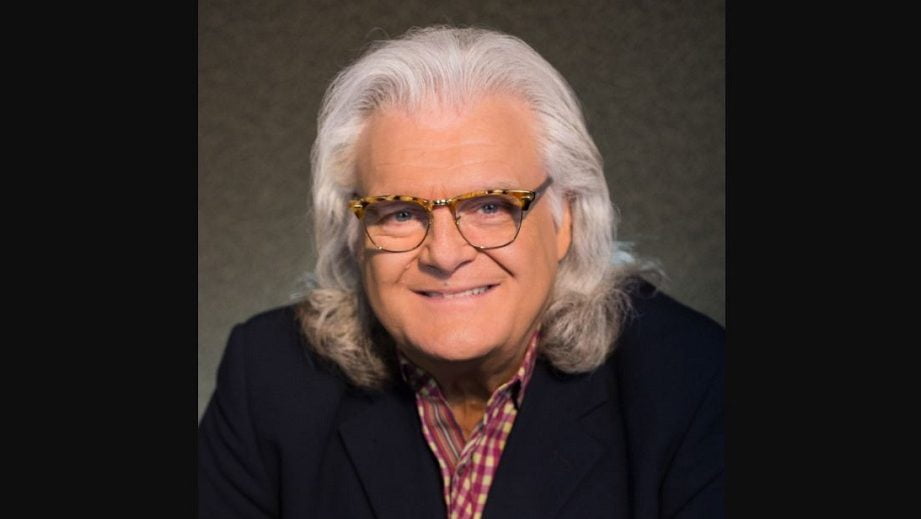
Ricky Skaggs Shows ‘Em How It’s Done
A new member of the Bluegrass, Country, and National Fiddle Halls of Fame this year, Ricky Skaggs has been recovering from shoulder problems, but you wouldn’t know it from this fantastic performance — three songs performed with three bands, including his own Kentucky Thunder. Recapping a rich — and ongoing! — career, the medley featured several generations of musicians, from old band members like Bruce Bouton (pedal steel guitar) to guitar-picking country superstars (Keith Urban, Brad Paisley) to bluegrassers like Sierra Hull and teenaged fiddler Carson Peters. If the best lessons are taught by example rather than lecture, this one was a graduate level course. – Jon Weisberger


Chris Thile Establishes a New Radio Classic
It’s been two and a half years since mandolin virtuoso Chris Thile took the helm of the long-running public radio show A Prairie Home Companion. But it’s been a year since he fully made it his own, rechristening the program as Live From Here. In these twelve months, Thile’s show has become a powerhouse music showcase for acoustic music and far beyond: a place where St Vincent or Vulfpeck can play the same stage as I’m With Her, Brandi Carlile, and Jeff Tweedy. The host himself churns out a brand new song for each episode (an impressive feat in itself), and surrounds himself with a house band and writing staff that’s a who’s who of modern roots: Chris Eldridge, Sarah Jarosz, Joey Ryan, Brittany Haas, amongst others. It’s as if he’s been doing such a show forever, and something we can only hope will continue long into the future. –Amy Reitnouer Jacobs


Colter Wall Captures the Prairie Wilderness
Of course country music isn’t limited to the American South, but it’s been so well established in that specific locale it sometimes feels as if anything else needs an asterisk. Canadian singer-songwriter Colter Wall sets about erasing that mark with his sophomore album, Songs of the Plains. Telling tales about truck drivers, cowboys, and blue collar types at the mercy of automation, Wall uses traditional country influences to sing of his prairie homeland. Working with Nashville’s Dave Cobb, he blends an array of original songs and covers, each of which provides a formidable stage for his voice. Wall’s baritone growl feels like a barroom throwback, the kind of sound you stumble across at dusk when the jukebox finally falls silent and the guy keeping to himself in the corner finally opens his mouth. I put this on when I want to actually feel Canada’s vast prairie wilderness, and think about the ever-widening world of country music. — Amanda Wicks


The War and Treaty Share Their Love Story
In 2010 Tanya Blount and Michael Trotter fell in love after performing, separately, at a Maryland event known as, yes, the Love Festival. In 2018 many fell in love with the Michigan-based duo, now known as the War and Treaty, with the release of their Buddy Miller-produced debut album, The Healing Tide, and even more so from their concerts. Their boundless joy alone is irresistible, but the songs and performances are elevating. “I’m singing with my wife, songs I wrote for us, and we’re on the road helping bridge humanity in our way,” Michael said in an August BGS profile, Tanya adding, “This project is an act of love.” – Steve Hochman

2018: The Year of Ricky Skaggs

Though he’s just now hitting nominal retirement age, Ricky Skaggs has been a virtuosic presence in the worlds of bluegrass, country, and Americana music for close to 50 years. With his childhood friend, Keith Whitley, he began touring and recording with Ralph Stanley while still in high school; by the time he turned 21, he had done a stint with the Country Gentlemen and become a member of the J. D. Crowe & The New South lineup whose eponymous 1975 album was (and is!) so influential that it’s been known for more than 40 years simply by its catalog number, Rounder 0044.

From there he moved on to intensive studio work; partnering with Jerry Douglas in Boone Creek; a stretch with Emmylou Harris’s Hot Band; and then, in 1981, launching a country career so meteoric that he earned, within four years of his debut recording, the Country Music Association’s top Entertainer of the Year award. Fifteen years later, he returned to bluegrass in spectacular fashion with the album Bluegrass Rules!

It’s no wonder, then, that he’s a newly minted member of the Country Music Hall of Fame and the Bluegrass Music Hall of Fame, though it’s a nifty kind of surprise that he was inducted into both this year — and, while it’s less widely known, he hit the trifecta when he was inducted into the Fiddlers Hall of Fame, too. In short, if you were to call 2018 the Year of Ricky Skaggs, it would be hard to mount a real counter-argument.

A conversation with Skaggs is always a journey through a myriad of subjects, and this one was no exception; we touched on many topics, from his nearly complete recovery from shoulder troubles to his recollection of a conversation with Art Satherly, the legendary producer who worked with Bob Wills, Bill Monroe, and many others. Still, a couple of themes emerged, and it’s fitting that one began with an examination of his under-appreciated role as a fiddle player.

It occurred to me that there are fiddle players in the Bluegrass Hall of Fame already—Chubby Wise, Paul Warren, Kenny Baker, Benny Martin, Bobby Hicks—but there are some other members, like John Hartford, who folks might not think of first as a fiddler but who were players, and that led me to you. I think there’s a whole generation of fans and musicians who might not realize how much you’ve done on the fiddle. Is that something you still do from time to time?

When we went out on the Cooder-White-Skaggs tour, I played quite a bit of fiddle, because we were doing so many country things, like Hank Snow’s “Now And Then (There’s A Fool Such As I),” that Chubby Wise played on, and Ry wanted that fiddle. Sharon did songs that I’d play on, and I played swing fiddle on “Sweet Temptation.” So I played quite a bit on that tour. But I haven’t taken it as seriously as I should have, especially in the last 20 years; I just haven’t kept up on it. And you know, when you do pick one up and it sounds like a cat killing, you start thinking, maybe my days are over on this.

But I’ll tell you, when I was just a kid, and I decided I wanted to play another instrument besides the mandolin, my dad got a guy named Santford Kelly to come over to our house, and he recorded him playing—because especially when it came to playing fiddle, he wanted me to sit at the feet of some old cats that he knew. And now, I’ll play something by Santford Kelly for Andy [Leftwich], or now for Mike [Barnett], and their eyes are as big as silver dollars, and they say, “Oh, my god, will you please teach me how to play that? That doesn’t need to die with you—that sound and that bowing style, and that stuff from the mountains of Appalachia, that’s got to live on.”

When that happened a couple of times, I started really seeing how important it was. I’m always thinking maybe too much about perfection, and I’ve gotta tell you, when I heard Santford Kelly—he was 84 or 85 at the time, and he was scratchy. But it didn’t bother me that he was a little flat and sharp here and there, and a little scratchy on the bow. It was what was coming out of him that went into my heart, that moved me deeply. I thought, this is like Elijah coming off the mountain. This man is carrying something.

So I’ve kind of been saying, well, I’m not really up on it, but I need to shut that crap up. I just do need to play more of that.

You’ve entered three halls of fame this year, so maybe this is a good time to look back. One of the things I’d like to get your impression on is the idea that tradition is not a style, but a way of learning. And you did that, learning directly from older guys like Santford Kelly and Ralph Stanley, but it seems like there’s less of that these days. From the beginning of your return to bluegrass, you’ve made having young people in your band a priority. When you talk about Mike or [banjo player] Russ [Carson] hearing these things, is that something you feel is important — to mentor young musicians, be an active transmitter?

It absolutely is. To me, it’s vital — it’s necessary for the journey, it truly is. It’s manna, it’s food. In the tabernacle of David, where there were four thousand musicians and two thousand singers, you didn’t just fall off a turnip truck and then decide, hey, I’m going to be a musician. No! King David said, “My fingers are trained for battle.” To me, there is training that goes into perfection, goes into your craft. There is something that is really spiritual about this; it’s part of our spirit, it’s part of our nature to be trained.

And that’s truly part of what makes my heart beat, is to train up and to pour into young musicians — and not just men. Like Sarah Jarosz told me one time, “Thank you for letting me get up on stage and play with you when I was 12 years old in Austin.” Or Sierra Hull, or how my music affected Alison [Krauss] in her teenaged years — listening to J. D. [Crowe]’s records, and Boone Creek, and my early country stuff, the harmony singing and just the musicianship, how that encouraged her. I was talking to Becky Buller at the IBMA Red Hat [Amphitheatre], and she talked about how influential the music has been, too.

One of the things that I learned from Ralph was to play it like it was recorded. I remember one time, I’d been listening to Jimmy Gaudreau and some of the other mandolin players of that time a little bit, and one night I played a solo that was a little bit out of the ballpark for the Stanley sound. And I caught Ralph’s face move just slightly over toward me. He didn’t eyeball me, he just kind of turned to the right and listened to me. And when we got off he said, “Rick, you know what I do, when I take breaks, I play it just like I sing it. I want them people to know that when I played that break, they didn’t have to hear me sing, they knowed what that song was. That’s the way I do it.” He didn’t say, the way you did it was not cool, or out of bounds. He did not teach that way; it was so soft, and so nurturing.

And now, I’m always showing Mike stuff — even from the first time I met him, when he auditioned. We sat down and I played him the Stanley Brothers’ Starday recording of “Little Maggie”— one lick, one phrase, after [fiddler] Ralph Mayo’s first solo. Ralph kicks it off, sings one verse, and then Ralph Mayo takes a solo. Well, it’s that next verse, on the line “pretty women are made for lovin’,” on the word “lovin,” Mayo plays this counter-note that’s not even in B, where Ralph’s at. That thing came out of him, and that one note just spoke so loudly right there for me. When I really heard that, I thought “What did he just play!?” and it just lifted my heart to such a place. It was something. And I played it for Mike, and he said “play it again,” and I thought, all right, he’s going to get this job, I know. He’s hearing what I heard, so I knew he was the right one for the job. He heard what Mayo was playing, and he heard my passion for it. And those are the kind of things I want to teach.

Looking at your career, the frequency of your record releases seems to have slowed down. And it seems to me that the recorded end of the business is almost going back to the 50s. Are you just too busy to get into the studio, or is it a lower priority because the business is heading away from that?

Well, as a record company owner, it’s become a financial issue. Having a studio of my own, you’d think that I could do records so much cheaper, but it’s just a fact that the numbers just don’t work when I look at putting $30,00 or $40,000 into a CD and the chances of getting it back in the next three or four years. And I’ve got a big name! I don’t know how, well I guess I do know how, a lot of these record companies do them for $10,000. I would feel really bad about having to do a Kickstarter for Ricky Skaggs. But there’s so much music in my heart that I really want to go in the studio and make, and make it with this incredible band.

But here’s what we’re thinking: I guess I’ve probably got nearly every show that I’ve done in the last four or five years—and recorded on separate tracks, where they could be remixed. So I’ve got a ton of stuff. We’ve got Cooder-White-Skaggs, we’ve got Skaggs and Hornsby stuff, we’ve got Ricky Skaggs with Cody Kilby, Bryan Sutton, all kinds of guests that we’ve had. We’ve got all that recorded. So I really do believe there’s ways of doing it, and I don’t have to own everything; I could just have part ownership.

And I just want to get the music out. I want the world to be able to hear Mike Barnett and Jake Workman, Jeff Picker and Russ Carson. And of course Andy, or hearing Jake playing mandolin or banjo. We’ve got all that stuff, and maybe perfection doesn’t matter so much. I can get stuck in thinking about what used to happen in my life, and what used to be—and here again, I’m figuring out it doesn’t have to be that way. There’s a feel thing that we can miss by having endless tracks on ProTools, endless chances to go back and get another take; usually the first thought that comes into your mind on almost anything is the right one. It’s our stinking thinking that gets involved, and we get to overanalyzing stuff when the spirit is saying, “This is the right way, this is what I put in your mind at that time.” Sometimes you’re better off to just go with that.

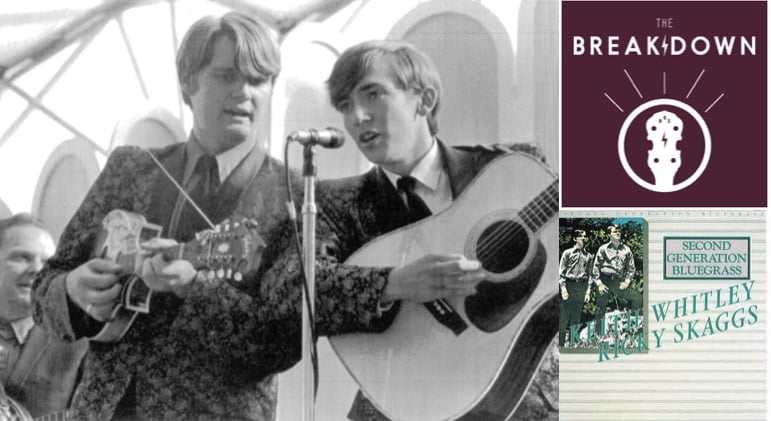
The Breakdown – Keith Whitley and Ricky Skaggs, ‘Second Generation Bluegrass’

Ricky Skaggs and Keith Whitley were both only 17 years old when they recorded Second Generation Bluegrass. Both went on to be country megastars, until Whitley died of alcohol poisoning at 34. Bluegrass legend Ricky Skaggs joins us to explain how two teenagers managed to perfectly replicate the bygone sound of the Stanley Brothers – and he shares his final moments with Keith.

LISTEN: APPLE PODCASTS • MP3

Featured Songs
“Don’t Cheat in Our Hometown”
“All I Ever Loved Was You”
“Poor Monroe”
“Daybreak in Dixie”
“Son of Hobert”
“Rank Stranger” (The Stanley Brothers)
“Memories of Mother”
“Those Two Blue Eyes”
“My Deceitful Heart”
“Dream of a Miner’s Child”
“Sea of Regret”
“No Stranger to the Rain” (Keith Whitley)

IBMA Awards 2018: Read the Full Winners List

Some of the most decorated artists in bluegrass, such as Balsam Range, Doyle Lawson & Quicksilver, and the Travelin’ McCourys, picked up even more International Bluegrass Music Awards on Thursday night (Sept. 27) in Raleigh, North Carolina. Other top winners included longtime favorites like Joe Mullins & the Radio Ramblers, Special Consensus, and Becky Buller.

Instrumentalist awards were presented to Michael Cleveland (fiddle), Sierra Hull (mandolin), Justin Moses (Dobro), Ned Luberecki (banjo), Tim Surrett (bass) and Molly Tuttle (guitar). Hot Rize, the IBMA’s first-ever Entertainer of the Year recipient in 1990, hosted the show.

The recipients of the 2018 IBMA Awards, presented by the International Bluegrass Music Association, are listed below:

ENTERTAINER OF THE YEAR:
Balsam Range

VOCAL GROUP OF THE YEAR:
Doyle Lawson & Quicksilver

INSTRUMENTAL GROUP OF THE YEAR:
The Travelin’ McCourys

SONG OF THE YEAR:
“If I’d Have Wrote That Song” – Joe Mullins & The Radio Ramblers (artist), Larry Cordle/Larry Shell/James Silvers (writers)

ALBUM OF THE YEAR:
Rivers & Roads – Special Consensus (artist), Alison Brown (producer), Compass Records (label)

GOSPEL RECORDED PERFORMANCE OF A YEAR:https://thebluegrasssituation.com/?p=10924&preview=true
“Speakin’ to That Mountain” – Becky Buller (artist), Becky Buller/Jeff Hyde (writers), Crepe Paper Heart (album), Stephen Mougin (producer), Dark Shadow Recording (label)

INSTRUMENTAL RECORDED PERFORMANCE:
“Squirrel Hunters” – Special Consensus with John Hartford, Rachel Baiman, Christian Sedelmyer, and Alison Brown (artist), Traditional arranged by Alison Brown/Special Consensus (writers), Rivers & Roads (album), Alison Brown (producer), Compass Records (label)

EMERGING ARTIST OF THE YEAR:
The Po’ Ramblin’ Boys

RECORDED EVENT OF THE YEAR:
“Swept Away” – Missy Raines with Alison Brown, Becky Buller, Sierra Hull, and Molly Tuttle (artists), single release, Alison Brown (producer), Compass Records (label)

FEMALE VOCALIST OF THE YEAR:
Brooke Aldridge

MALE VOCALIST OF THE YEAR:
Buddy Melton

BANJO PLAYER OF THE YEAR:
Ned Luberecki

BASS PLAYER OF THE YEAR:
Tim Surrett

DOBRO PLAYER OF THE YEAR:
Justin Moses

FIDDLE PLAYER OF THE YEAR:
Michael Cleveland

GUITAR PLAYER OF THE YEAR:
Molly Tuttle

MANDOLIN PLAYER OF THE YEAR:
Sierra Hull

Previously-announced inductees into the International Bluegrass Music Hall of Fame – Ricky Skaggs, Paul Williams, Tom T. and Dixie Hall – were honored at this evening’s show.

At the Special Awards Luncheon earlier in the day, the recipients of the following awards were announced:

BLUEGRASS BROADCASTER OF THE YEAR:
Steve Martin (Northern Kentucky-based host of Steve Martin’s Unreal Bluegrass)

BLUEGRASS EVENT OF THE YEAR:
Bluegrass on the Green; Frankfort, Illinois

BEST LINER NOTES FOR A RECORDED PROJECT (tie):
Craig Havighurst – The Story We Tell by Joe Mullins & The Radio Ramblers
Peter Wernick – Carter Stanley’s Eyes by Peter Rowan

BEST GRAPHIC DESIGN FOR A RECORDED PROJECT:
Lou Everhart
A Heart Never Knows by The Price Sisters

BLUEGRASS PRINT/MEDIA PERSON OF THE YEAR:
Neil Rosenberg

BLUEGRASS SONGWRITER OF THE YEAR:
Jerry Salley

SOUND ENGINEER OF THE YEAR:
Ben Surratt

IBMA Reveals Festival Performers, Extended Stay in Raleigh

Ricky Skaggs, Patty Loveless, and the Earls of Leicester are among the confirmed performers for Wide Open Bluegrass, the two-day music festival that follows the annual IBMA Awards in Raleigh, North Carolina. This year’s festival will be held Sept. 28-29 at the Red Hat Amphitheater as well as seven additional downtown stages.

The organization also announced that its annual World of Bluegrass gathering, which incorporates a trade show, awards show, and multiple showcases, will stay in Raleigh through 2021. The IBMA Awards will be held on Sept. 27 at the Duke Energy Center for the Performing Arts. The nominees, Hall of Fame inductees, and Distinguished Achievement recipients will be announced live on Sirius XM’s Bluegrass Junction on July 25. Hosting duties for the IBMA Awards have not yet been announced.

Ricky Skaggs & Kentucky Thunder’s performance at Wide Open Bluegrass will feature a special appearance from Loveless. The Earls of Leicester have received the IBMA’s top award, Entertainer of the Year, for the past three years. Additionally, the festival will present a special collaboration featuring Alison Brown, Becky Buller, Sierra Hull, Missy Raines, and Molly Tuttle, who are the first women to earn IBMA awards on their instruments. Brown became the first female instrumentalist to receive an IBMA Player of the Year Award, earning a 1991 win in the banjo category. Raines has taken home seven IBMA instrumentalist awards on bass, while Buller, Hull, and Tuttle all earned their honors on fiddle, mandolin, and guitar (respectively) in Raleigh in the last two years.

Wide Open Bluegrass is the principal fundraiser for the Bluegrass Trust Fund, which provides direct financial assistance to bluegrass artists and other industry professionals in times of emergency need. To date, the Trust Fund has given more than $800,000 in direct aid. To benefit this cause, the Main Stage lineup will also include “The TRUST set,” featuring Doyle Lawson & Quicksilver, Balsam Range, Lonesome River Band, Donna Ulisse, Chris Jones & The Night Drivers, Sideline, and Love Canon. These artists will highlight their benefit album, The TRUST, with proceeds benefiting the Trust Fund. Set for release on Mountain Home Music Company, The TRUST features all new, original music written by the bands involved in the project. The songs are about themes of hope, courage, and perseverance and reflect the artists’ commitment to the bluegrass community.

The Golden Age of Bluegrass… The ’90s?!

With the following eleven songs, we will convince you, the bluegrass jury, that neither the ‘40s, the ‘50s, the ‘60s, nor the ‘70s were the golden age of ‘grass. Before the bluegrass gods and all these gathered here today we unabashedly assert: the ‘90s were the absolute best years for bluegrass!! Consider the following evidence:

Lonesome River Band – “Long Gone”

Remember the days when LRB was a quartet and there was a critical mass of mullets among their members? Such a small lineup and still somehow a supergroup: Dan Tyminski and Ronnie Bowman dueting the life out of it, Sammy Shelor pulling for his life, and Tim Austin demolishing the flat-top. Woof.

J.D. Crowe – “Blackjack”

The ‘90s were the golden age of bluegrass and the bluegrass supergroup. The TV show American Music Shop, which ran for three years starting in 1990, often amassed the best star-studded lineups of the time period – like this one: J.D. Crowe, Mark O’Connor, David Grisman, Tony Rice, Jerry Douglas, and Glen Worf.

Laurie Lewis & Friends – “Texas Bluebonnets”

Laurie Lewis won Female Vocalist of the Year from the International Bluegrass Music Association only twice — once in 1992 and again in 1994. We could rest our ‘90s-bluegrass-is-best case on that fact alone, but we’ll let Laurie (and Tom Rozum, Sally Van Meter, Peter Rowan, Alan Munde, et. al.) convince you with this Texas swing-flavored masterpiece.

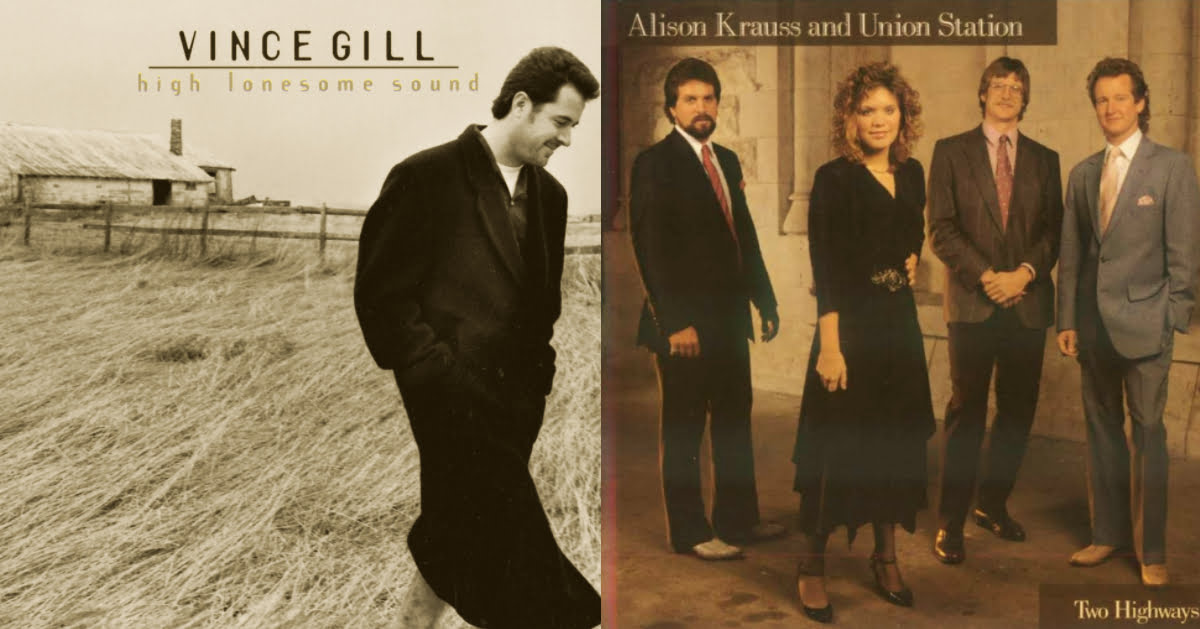
Alison Krauss & Union Station – “Two Highways”

I mean… do we even need to contextualize this one with a blurb? Alison Krauss — before she became the winningest woman in GRAMMY history — with Adam Steffey, Barry Bales, Tim Stafford, and Alison Brown (no, they aren’t sisters, even if they do have the same name) is exactly why ‘90s bluegrass never fails us. If you happened to forget that AK is a ruthless fiddler, too, just listen to any of her stuff from this decade for a reminder.

Strength in Numbers – “Slopes”

We continue with supergroups, for a moment, this time regaling in the new acoustic, esoteric instrumental, 1990s beauty of “Slopes” played by a group of folks you may know: Béla Fleck, Mark O’Connor, Sam Bush, Jerry Douglas, and Edgar Meyer. Makes you wanna time travel, doesn’t it?

Dolly Parton – “Train Train”

Everyone’s favorite songwriter, actor, country star, business mogul, theme park owner, and literacy advocate made one of the best bluegrass records in the history of the genre in 1999 — and of course the world went crazy for it. She took bluegrass places it too-rarely appears with a band that could’ve sold out a nationwide tour themselves. Iconic.

Ricky Skaggs & Kentucky Thunder with the Del McCoury Band – “Rawhide”

Del and the boys cleaned up on the IBMA Entertainer of the Year awards between 1990 and 2000, winning the organization’s top honor a total of five times during that span. Ricky never truly left, but he visibly returned to dominating bluegrass in the 1990s, touring with Kentucky Thunder. Talk about a golden age!

Emmylou Harris, Ralph Stanley, Dwight Yoakam – “The Darkest Hour”

Once again, we thank American Music Shop for bringing together a seemingly disparate yet totally seamless power collab. One of the best things about bluegrass is the shared vocabulary, the commonality of the songs. Just throw a bunch of folks up on stage and have ‘em sing one together!

Nashville Bluegrass Band – “On Again Off Again”

Best decade for bluegrass = best decade for bluegrass music videos, too. (Sure, all music videos, but especially bluegrass ones!) This one is just deliciously retro and it doesn’t hurt that the Nashville Bluegrass Band is not only freakin’ stacked with talent, but they knock out these mid-tempo, sultry, vocal-centered songs better than anybody else.

Lynn Morris Band – “Love Grown Cold”

Lynn Morris has been unconscionably underrated for her entire career. Just listen to this. She had her heyday as an artist and band leader in the ‘90s, winning multiple Female Vocalist of the Year awards and even a Song of the Year, too. That banjo pickin’ definitely deserved better recognition, though. Hell, the whole kit-and-caboodle deserved more recognition. If you take away anything from our journey back through this bygone era of great hair choices and clothes that go zip-zop it should be a never ending love and appreciation for Lynn Morris.

Vince Gill, Alison Krauss – “High Lonesome Sound”

Two roots music icons of the decade, collaborating on a song that tributes the father of bluegrass himself, it’s just too perfect. We rest our case. May 1990s bluegrass live on forever in our hearts, our ears, and our mullets.

9 Bluegrass Songs to Whet Your Appetite

No one really needs any help gearing up for the beautiful gluttony of the holiday season, but in the spirit of gorging oneself on cookies, pie, turkey, ham, and all manner of seasonal treats, here are nine bluegrass songs to get your stomach growling.

Flatt & Scruggs — “Hot Corn, Cold Corn” 

Hot corn goes with your meal. Cold corn makes your meal (and your loud relatives) bearable. If the chickens all a-runnin’ and the toenails a flyin’, this is your best bet.

Ricky Skaggs & Kentucky Thunder — “Pig in a Pen”

Bake them biscuits! Raise a barrel of sorghum! We’re Alabamy-bound!

Reno & Smiley — “Dill Pickle Rag”

Have a pickle with your leftover turkey sandwich!

Doc Watson & Clarence Ashley — “Keep My Skillet Good and Greasy”

The importance of proper cast-iron care cannot be overstated. Do not use soap or any cleaning agents (scrub with salt on stubborn grime when needed), oil after rinsing and washing in warm water, and make sure to re-season regularly.

Lost and Found — “Leftover Biscuits”

Sure, this describes a pretty misogynistic scenario in which the kitchen is dirty because the singer’s wife left him, but maybe also it can just be the day after Christmas when no one wants to even acknowledge the tower of dishes in the sink and everyone’s content to eat cold ham on day-old rolls? Maybe?

Jim & Jesse — “Y’all Come!”

Eating everything from soup to hay! HAY!?

Bruce Molsky — “Shove the Pig’s Foot a Little Bit Further into the Fire”

No one wants an underdone pig’s foot.

David Grier — “Angeline the Baker”

Angeline, could you bake me up some cinnamon rolls, chocolate chip cookies, yeasty rolls, and a pie or three, a fruitcake, a pumpkin roll …

The Nashville Bluegrass Band — “Soppin’ the Gravy”

A clean plate does not count as a truly clean plate, until you’ve taken whatever bread you have on hand and have completely sopped up all that gravy. Soppin’ veterans will then move to the gravy pan and sop up all of that, too. Don’t think about your arteries. It’s the holidays!


Photo credit: Philip Clifford on Foter.com / CC BY-SA

Best of: Grand Ole Opry

When I think of country music, I think of the Grand Ole Opry. As far as I’m concerned, the two are synonyms. What began as the WSM Barn Dance radio show in 1925 has grown into an entire entertainment experience (their YouTube even has style videos), and solidified Nashville as the Country Music Capital. With its rich history, it is no wonder that aspiring country and bluegrass musicians across the globe dream of making an Opry debut. Here are five performances from “country’s most famous stage” for your enjoyment:

Johnny Cash — “Ring of Fire”

Let’s start off with this throwback video of Johnny Cash performing one of his most famous songs, “Ring of Fire,” at the Ryman Auditorium in 1968. While Cash had a tumultuous relationship with the Opry — and was even banned from the show for a period of time in the middle of his career — there is no doubt that his music is always a treat to listen to.

Carson Peters & Ricky Skaggs — “Blue Moon of Kentucky”

While the Opry is an integral part of country music’s rich history, it also ensures a bright future for country music by recognizing young talent. In this 2014 video, then 10-year-old Carson Peters, joined by seasoned Opry member Ricky Skaggs, breathes new life into Bill Monroe’s “Blue Moon of Kentucky.”

Alison Krauss & Jamey Johnson — “My Dixie Darlin’”

Every time Alison Krauss and Jamey Johnson make music together, the result is magical. While Johnson holds down the lead vocals beautifully on this stripped-down rendition of the Carter Family classic, “My Dixie Darlin’,” Krauss’s sweet harmonies and fiddle playing are icing on the cake.

Merle Haggard — “Workin’ Man Blues”

Country music legend Merle Haggard never became an Opry member, but he did perform there many times during his long career. Here, Haggard sings his anthem for the working class, “Workin’ Man Blues,” on the Opry in 1977. Make sure to stick around untill the end to catch an amazing guitar solo!

Steven Curtis Chapman & Ricky Skaggs — “What a Friend We Have in Jesus”

Many musicians across various genres have recorded and performed the old Christian hymn “What a Friend We Have in Jesus,” but this rendition by Steven Curtis Chapman and Ricky Skaggs is my favorite, by far. Chapman and Skaggs deliver the song with a certain tenderness that pairs perfectly with the already comforting lyrics of the song.

MIXTAPE: Casey Campbell’s Mandolin Masters

With his latest release being Mandolin Duets, Vol. 1, who better than Casey Campbell to put together a Mixtape of mandolin masters for us? No one. That’s who. He has studied them all — and played with many — so take his carefully selected collection to heart (and ear).

Bill Monroe & Doc Watson — “Watson’s Blues”

Where else to begin but with the Father of Bluegrass, Bill Monroe. There are hundreds of recordings to choose from, but I’ve always been a big fan of this duo album of Bill and Doc Watson entitled Live Recordings 1963-1980: Off the Record Volume 2. It features some great duet singing from Bill and Doc, as well as a bevy of short, sweet, and to-the-point instrumentals. I am partial to “Watson’s Blues” not only because this particular recording features the writer (Bill) and the inspiration for the tune (Doc), but also because it is a bluesy little number (and I like my bluegrass to be bluesy).

Ronnie McCoury — “McCoury Blues”

Ahhh … it was the mid-2000s. MySpace was all the rage, and we had yet to discover fidget spinners, stick basses, and Netflix. You know, the good ol’ days. I came across “McCoury Blues” while scouring through Rhapsody (the Spotify before Spotify existed), and, in my opinion, it is a 21st-century take on “Watson’s Blues” with Ronnie’s smooth tremolo and Del McCoury’s powerhouse guitar runs. More importantly, this song led me to the Bluegrass Mandolin Extravaganza album. This project, spearheaded by Ronnie and David Grisman, is a mandolin goldmine including Ronnie, David, Sam Bush, Ricky Skaggs, Buck White, Frank Wakefield, Bobby Osborne, Jesse McReynolds, and Del McCoury on rhythm guitar. Of course, growing up in the bluegrass world, I had heard all of these players before, but this album was my introduction to the concept of musical style and the intricate differences between musicians. Throughout my mandolin obsession, I have continually returned to this album to draw inspiration (read: steal licks). If there is one album I would recommend to any mandolin fan, it would be Bluegrass Mandolin Extravaganza.

Mike Compton & David Long — “Tanyards”

If you haven’t picked up on the pattern yet, I’m a big fan of duet recordings. A large part of that came from this album by mandolin masters Mike Compton and David Long. My mother picked me up from middle school in her silver PT Cruiser — yes, we were that cool — with a copy of this album in the passenger seat. We listened to it on the way home, then I listened to it again, and again, and again. Mike and David have such fluid playing styles, and you would be hard-pressed to find other players that could replicate the chemistry on this album. This track does a great job of showcasing each player and also letting the two intertwine as they swap licks. It is one of my favorite albums of all time.

Ricky Skaggs & Kentucky Thunder — “Crossing the Briney”

Adding a little Irish flair to the list, here is a song that starts out bare and ends with a full-on orchestra with all of the bells and whistles (literally). This song is featured on Ricky Skaggs’s Instrumentals albums and, in my opinion, is the standout hit. I mean, where else can you hear instrumentation like this, AND a kickass Andy Leftwich fiddle solo in the middle? This song also opened my mind to how to take what is essentially a pretty standard Irish fiddle tune and raise it to a new level. Admittedly, Ricky doesn’t really get to stretch out on this tune, so it’s not the best representation of his great mandolin playing. But don’t worry: He is one of the best players mixing modern and traditional styles together, and there are plenty of great examples on this album.

The Whites (Buck White) — “Old Man Baker”

Buck White is a national treasure. Not only is he one of the sweetest humans I’ve ever had the honor of spending time with, but he is also one of the swingin’-est mandolin players you will come across. Whether he is kicking up his heels as a special guest with the Grand Ole Opry Square Dancers or playing mandolin on one of his many iconic albums with the Whites, there is no doubt he has a huge smile on his face and joy in his heart. This tune, written for fiddler Kenny Baker, is one that I often play when I am warming up on the mandolin. It’s a tough tune, for sure, with plenty of pinky work and string-jumping, but it is undoubtedly the most fun song on this list to play. Buck’s playing is just like his personality: bouncy, memorable, and always tasteful. If you are at all interested in hearing some Texas Swing mandolin playing, check out more of his catalog.

Strength in Numbers (Sam Bush) — “Texas Red”

Picking one song from the Strength in Numbers album is like picking a favorite child. People in the music business like to throw around the word “supergroup” for every other band, in hopes that it will create some kind of buzz or increase sales. Strength is one of the few occasions where the term accurately applies: Sam Bush, Béla Fleck, Jerry Douglas, Mark O’Connor, and Edgar Meyer. Between the late ’70s and mid-’80s, each of these trail-blazing musicians had helped to established a new frontier of acoustic music. Here they are, together in their prime, with one of acoustic music’s most influential instrumental albums of all time. PS: This album is Sam Bush Rhythm 101. Class dismissed.

David Grisman & Doc Watson — “Kentucky Waltz”

When I am teaching lessons or at a camp, it is without a doubt that I’ll get asked about mandolin tremolo. What is it? How do I do it? How do I make it better? All of these questions (and more) can be answered with Doc & Dawg’s version of the “Kentucky Waltz.” It is one of the most beautiful, simplest recordings of a mandolin and guitar I have come across. For the uninitiated, David Grisman is an icon in the mandolin and acoustic music worlds, heavily influencing today’s top mandolin players like Sam Bush, Ronnie McCoury, and Ricky Skaggs. With dozens of must-have albums spanning throughout his 50-year career, David led the way to the frontier of “new acoustic music” during the ’70s and ’80s. Even today, at 72, he is still going strong. touring with the David Grisman Bluegrass Experience, the David Grisman Sextet, and as a duo with Del McCoury. Despite all of his ground-breaking compositions and albums, when it comes to keeping it simple and making the most of a melody, David is still the king.

Radim Zenkl — “Memory of Jaroslav Jezek”

I couldn’t consider this list finished without introducing you to something a little outside the box. For his Galactic Mandolin album, Czech Republic mandolinist Radim Zenkl (pronounced Ra-deem Zeen-kl) experimented with different mandolin tunings for each song. Because a mandolin has four sets of strings (eight total), it is normally tuned GG-DD-AA-EE. This particular tune has the mandolin tuned in minor thirds. When I first heard this tune, I felt like it was a crazy of mixture of big band jazz and harp music, or something I might’ve heard on the original Nintendo version of The Legend of Zelda. I’m kind of mesmerized by its weirdness.

Andy Statman — “Pale Ale Hop”

While we are spending some time outside the box, now would be a good time to introduce you to Andy Statman. If there is a musical genre out there, Andy has covered it: bluegrass, jazz, Irish, klezmer, rock ‘n’ roll, etc. “Pale Ale Hop” showcases his rockin’ mandolin playing, transforming into something you might hear at a surf-rock dance party in the ’50s. My favorite thing about Andy is that, for all of his experimental compositions, he is a true student of all music and can play the most traditional bluegrass style you could imagine, then turn around and play a John Coltrane solo. If you’re interested in more of Andy’s left-of-center music, check out his earlier LPs, like Flatbush Waltz or Nashville Morning, New York Nights.

Jethro Burns & Tiny Moore — “Flickin’ My Pick”

Here is a classic album with two of the best jazz and swing mandolin players of the past century. Jethro Burns is known primarily as one half of Homer & Jethro, one of the great country comedy duos of the 1930s-60s. Despite all of his joking around, Jethro was a serious musician, playing anything from classical to bluegrass. On this particular song, he is playing the acoustic mandolin and taking the second solo. The other player you’ll hear is Tiny Moore, a pioneer of the electric mandolin. Tiny played with Bob Wills & His Texas Playboys and Merle Haggard’s band, the Strangers. Together, these two legends recorded Back to Back, which would become one of the definitive albums for jazz mandolin enthusiasts.

Norman Blake — “Valley Head”

Getting back to the roots of old-timey mandolin music, here is a tune written and played by Norman Blake. Although he is known mostly as one of the great bluegrass guitarists, both Norman and his wife Nancy are great mandolin players and have recorded quite a bit of mandolin music over the years. Similar to the “Kentucky Waltz” earlier on this list, the thing I love about Norman’s playing and this track, in particular, is the simplicity. Sure, this tune might have a lot of notes, but Norman sticks to the melody the entire way through, letting the song speak for itself. For those interested in more of Norman and Nancy’s mandolin playing, check out Natasha’s Waltz, an album that features a slew of great mandolin tunes.

Chris Thile — “Watch ‘At Breakdown”

Sometimes you’ve got to give the kids what they want … and they want Chris Thile. Between his work with Nickel Creek, Mike Marshall, the Punch Brothers, Michael Daves, the Goat Rodeo Sessions, Edgar Meyer, Jon Brion, Béla Fleck, and Brad Mehldau, among others, Chris has traversed just about every inch of the musical landscape. As if that weren’t enough, he is now the host of A Prairie Home Companion, collaborating with a new lineup of musical guests every week, including Jack White, Jason Isbell, Lake Street Dive, and more. With such a long and diverse resumé, he has become one of the most popular and influential mandolin players in the realm of Bill Monroe, David Grisman, and Sam Bush. “Watch ‘At Breakdown” is the starting track on Chris’s How to Grow a Band album, and shows off his bluegrass chops, while hinting that there are no bounds to his abilities.