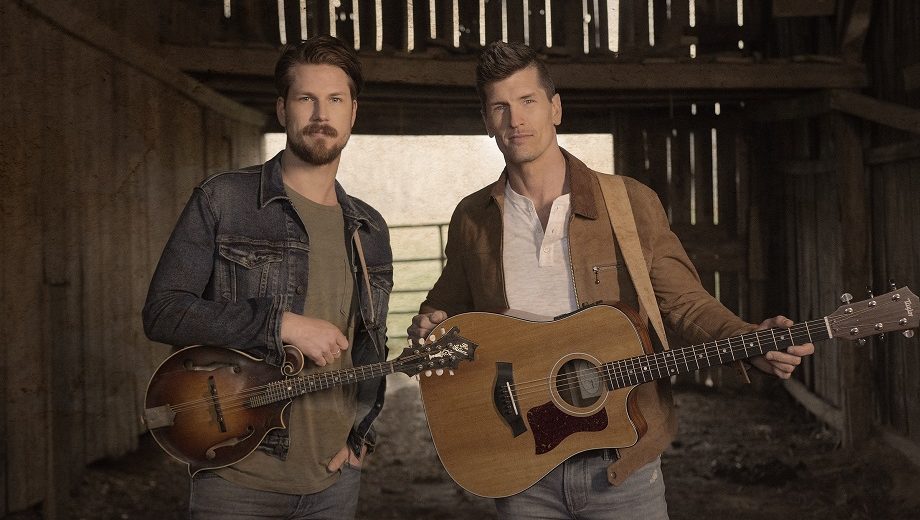
Artist:High Valley Hometown: La Crete, Alberta, Canada Song: “Single Man” (Bluegrass Version) Label: Warner Music Nashville
In Their Words: “We grew up surrounded by bluegrass music. Ricky Skaggs was our hero thanks to a few records our parents introduced to us. When our town finally got a radio station, I spent a few years as a DJ hosting a bluegrass hour. Recently, Curtis and I called up a few of our friends and some of Nashville’s finest bluegrass pickers to turn them loose and let them show off! Recording this bluegrass version of ‘Single Man’ was easily the most natural moment we’ve ever had in the studio. When it came time to work on the mix and make sure everything was produced properly, it was so great to have Ricky Skaggs offer his help as the executive producer on this track. Talk about a full circle moment!” — Brad Rempel, High Valley
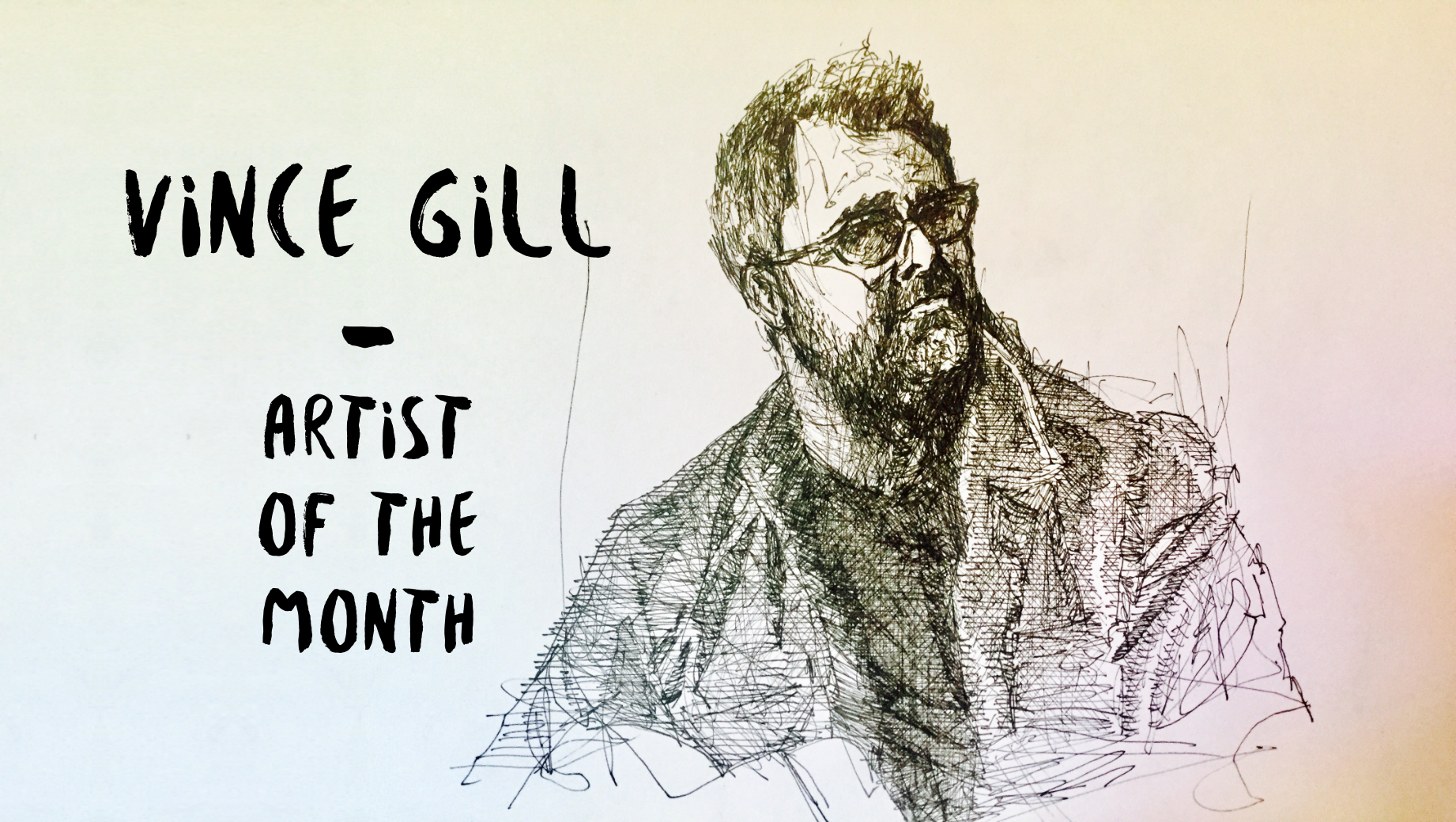
In the second half of our interview with Vince Gill, the country legend reflects on his bluegrass history, explaining how he became interested in the music, what he learned by listening closer, and why it led to one of his most famous songs.
BGS: “Go Rest High on That Mountain,” in my opinion, is going to live forever. And I think the bluegrass audience loves hearing Patty Loveless and Ricky Skaggs sing with you, too.
Gill: You know, I wouldn’t have been able to write that song if I hadn’t played bluegrass music and learned the structure of that music and how it works — and the emotion of it. Bluegrass music is so honest and so real. Some of those morbid murder ballads and the saddest of the sad songs are what I love most. Give me “Mother’s not dead. She’s only a-sleepin’. Patiently waiting for Jesus to come.” That’s about as good as it gets. “The Little Girl and the Dreadful Snake.” I could just go on and on and on.
All these tortured songs, but you know they’re real life. They’re not somebody going, “How can I slip one up on the world and make a bunch of money having a big hit record?” They’re so honest and real. And the fact that my past had so much to do with Ricky and Patty, they were the only two people that I would’ve consider it singing on that song.
I still love it when Patty comes to do the Opry.
There’s a really unique thing that happens when our voices sing together. It’s so… obvious. I sang on her very first record in the early ‘80s. I sang on her first hit record and she sang on my first hit record. So it’s my little sis.
Tell me about how you found bluegrass. Was there an entry point for you?
Yeah, I knew of it because my dad played the banjo a little bit. He never could figure out the three-finger, Scruggs-style banjo. He cussed Earl his whole life because he couldn’t figure it out. He played more of a folky banjo. Not drop thumb, not old-timey, but more of a frailing kind of banjo. So I was always around the music, as best I can remember, forever. There were obviously the Flatt & Scruggs things from The Beverly Hillbillies that were in everybody’s DNA. Then I was playing mostly in rock bands in junior high school and high school.
A kid named Bobby Clark was the one that really got me pointed towards bluegrass. He had a little band in Oklahoma City and his father was a repairman. I had broken the string on my dad’s banjo, messing around with it, and I didn’t know how to change it. So I took it to Charlie and he put a string on it pretty quickly and everything was fine. I wasn’t gonna get my butt kicked. Then I started talking to Charlie, and he says, “You play music, don’t you?” And I said, “Yeah, I love to play. I play electric guitar and play in rock bands and stuff.” He goes, “My son Bobby is a really fine mandolin player and plays bluegrass. You ever played any bluegrass?” I said, “No.”
They stuck an acoustic guitar in my hands and Bobby said, “We just had our lead singer leave the band and we’re looking for a singer.” So they did a pretty good job of raising me and teaching me and showing me how bluegrass worked. I played in their band for the last couple of years of high school. Then in another bluegrassy kind of band called Mountain Smoke. And I started playing all the festivals down around Oklahoma and Texas and Kansas. And ran into all the people that I’ve known in my whole life since I was 15, 16 years old.
Wasn’t that how you met Cheryl White [from The Whites]?
Yeah, I used to carry her bass around the festivals. I always had a thing for the girl bass players for some reason. There was another family band from Missouri called the Calton Family. Got sweet on Brenda. Then I got sweet on Cheryl. And she says I should’ve picked a harmonica player. [Laughs]
Those were such fun days and innocent. I loved the camaraderie that went on in that music. Not only with the people that came to the festivals, but the musicians. Everybody jammed together. There wasn’t a whole lot in it for anybody. Everybody was just kind of getting by. It was amazing, as I look back, what it did for me in the way that I respected other musicians and listened to other musicians. It was really important that I had a lot of that in my past. I haven’t forgotten it.
When I first heard bluegrass, I was just blown away by musicianship of it.
Yeah, I mean Stuart Duncan was as great as he was at 12 or 13. So was Mark O’Connor when he was 12 or 13. And Marty and Ricky and Jerry and on and on and on and on of these wonder kid pickers. Unbelievable. I kind of squeaked in because I could sing a little bit and figured out how play as I went. I kind of played whatever was left over in a lot of the bands I was in, and that was fine.
I saw you play mandolin on quite a few songs when you played Bluegrass Nights at the Ryman. What is it about that instrument that you really enjoy?
I think the mandolin is the most important drive of a bluegrass band. The banjo and that are the two most definitive sounds. In bluegrass, mandolin players are like the drummer, even more so than the guitar player to me. It’s that backbeat and driving it. Sam Bush was a great teacher of how you drive that music, you know? I loved the ferocity and intensity that he played with. When he played, that was powerful to watch as a 15- or 16-year-old kid.
That’s what I like. I like making it dance. I liked the importance of playing that instrument in bluegrass. I’m probably a much better guitar player in bluegrass than I am a mandolin player. But in some bands I had to play banjo. Sometimes I had to play, unfortunately, fiddle on a few things. Terrible! I played Dobro, I played everything. I played bass with Ricky’s band for a minute and then got to play some other instruments, but had a love for all of it. I still do. Probably I love it more now because it reminds me so much of my early days, and those first forays into learning about playing music.
Did Dobro come naturally to you?
It all kind of did. I mean, I put in the hours and I practiced hard. The neat thing was, you had such good people to learn from. I always had big ears and could always hear well and find what I was hearing in my head, figuring out how to play it.
There are so many brother duos that came up in bluegrass. Do you think that rubbed off on you with your harmony singing now?
Absolutely, yeah. I was trying to either be Ralph Stanley or Phil Everly or Ira Louvin or whoever. Don Rich and Buck Owens should’ve been brothers. I was a high singer so bluegrass was a natural fit. There have always been predominant high singers that were the focal point. Whether it was Ralph and Carter or whoever, man, that was a blend. You didn’t understand it when you were 15 or 16, what it was that made that blend so beautiful. It was the blood, you know. The DNA was the same.
I didn’t get to experience that until my oldest daughter was 18, 20 years old and we started singing together. I started calling her my little Everly because I’d spent my whole life trying to be Phil. You know, singing the high parts for everybody else, and blend perfectly, and every nuance they did, I’d do. And I’d just want ‘em to think I was related to ‘em. She wound up naming her daughter Everly because of that, because I called her my little Everly.
But yeah, I love sharing music. I love the collaboration of music more so than I like it by myself. It’s not as interesting by yourself, but when you get to play off somebody, and play with somebody, it’s very powerful.
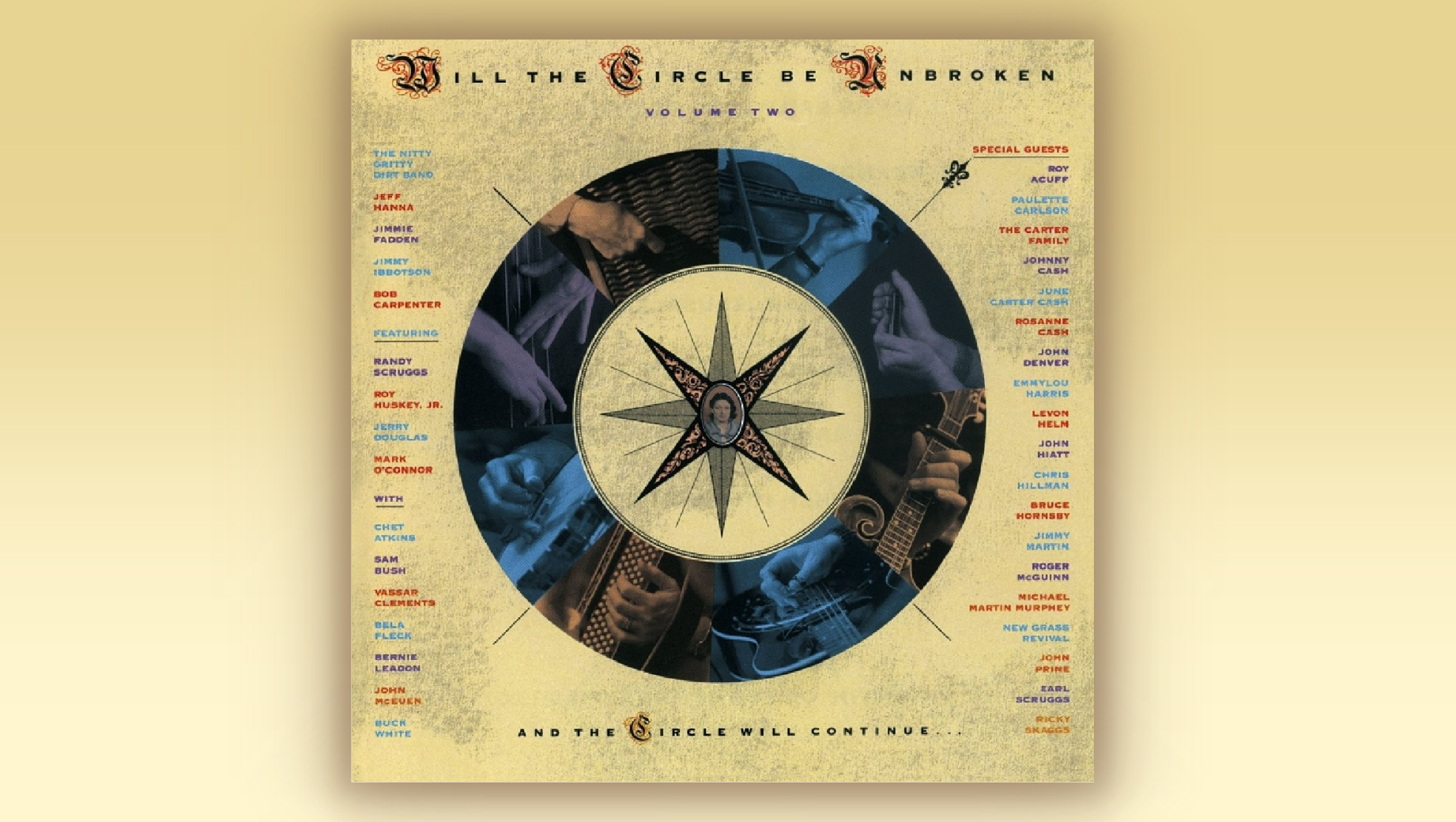
What started as a music video concept for the Nitty Gritty Dirt Band evolved into a 1989 full-length film documenting the all-star recording sessions for Will the Circle Be Unbroken, Volume Two. Nitty Gritty Dirt Band co-founder Jeff Hanna will present a rare screening of clips from The Making of Will the Circle Be Unbroken, Volume Two at the Country Music Hall of Fame and Museum on September 11 at 11 a.m., during AmericanaFest.
Hanna will be joined by bluegrass virtuoso Sam Bush, who appears in the film and on the album with New Grass Revival. Craig Shelburne, managing editor of the Bluegrass Situation, will moderate.
Produced by Joanne Gardner Lowell and Rosanne Cash, the film captures the band in the studio recording their groundbreaking project. Select clips will show performances by Johnny and June Carter Cash; Jerry Douglas; Emmylou Harris; Bruce Hornsby; Jimmy Martin; New Grass Revival; John Prine; Earl Scruggs; Randy Scruggs; Ricky Skaggs; and others. Will the Circle be Unbroken, Volume Two won three Grammy Awards as well as the 1989 CMA award for the Album of the Year.
Three decades after its release, Joanne Gardner Lowell offered some keen perspective on the film through an email interview with the Bluegrass Situation.
BGS: What was it about the Nitty Gritty Dirt Band and this project that made it a compelling film subject for you?
JGL: ACME Pictures was contracted to make a video for the title track. This is pretty common. We signed the contract and when I asked what day during the multi-week schedule this song would be done, Jeff said, “All of them.” When I realized we would need to go to the studio every day for weeks to get this song, it seemed obvious we should shoot the whole experience — so we did.
How would you describe the mood, or the vibe, in the room during these sessions?
It was joyful in the studio. Each day the musicians came so ready to create and collaborate. We were honored to be in the room with it all. Being live made everyone really stay on top of their game. It felt like a family reunion on many days, and there was always a lot of humor and laughter. Our primary director, Bill Pope, captured so much of the mood with his amazing camera work.
It was also shot during the holiday season, so people were in a happy mood. Emmylou brought a handmade Christmas ornament you can see hanging in some of the shots. And my partner Rosanne Cash came into the studio with her newborn Carrie. I don’t think she was even two weeks old. Rose handed her to me and I held her tight while running sound for the track Rose and John Hiatt did together. Carrie never made a peep!
It was crucial to capture the acoustic nature of these sessions. What was your audio setup like?
I had a simple Nagra tape recorder just to have an edit track to work from and to record interviews. I had a single mic that I would place in the room to catch all the conversation, as some of that was obviously not recorded for the album and we wanted it for the film. Although, during our interview with Emmylou Harris, the band loved what she said so much that those comments ended up on the album.
Do you remember any particularly fun encounters with the legendary musicians in the film?
We caught some great moments and they’re in the film. The ending of a fast-paced “Valley Road” with Bruce Hornsby was a favorite. The band all stops for a second to look at each other — then they realize they got it and they all start shouting and cheering.
After Jimmy Martin’s session one day, he went out for some cocktails and came back into the studio while Ricky Skaggs was working. We captured Jimmy (feeling no pain and wearing a coonskin cap) as he and Ricky ripped into a spontaneous version of “The Old Crossroads.”
This film was Mr. Acuff’s last filmed appearance and that was special. I have to say — each time the song “Will the Circle Be Unbroken” was performed, it was magic. Every single time.
The Dirt Band did a masterful job of keeping things upbeat and fun for everyone. Every one of them was so engaged in each song — and brought individual songs or artists to the project. They were like marathon runners, giving their all each day and then coming back the next day to do it again.
What were some of the hurdles you faced in the film’s creation and release?
The very existence of this film was due to a California record company exec telling me that we would be in breach of contract if we didn’t deliver this video for the agreed-upon budget. When I explained this “song” was going to require us to shoot for several weeks, this delightful woman didn’t seem to care. I think it was meant to be — we HAD to make it work.
Bill couldn’t figure out how to light the dimly lit studio without a pile of light stands in every shot — and in everyone’s way. So, he created a giant light box and hung it from the ceiling. You don’t see a single light stand.
We didn’t have any money to sync up the video with electronic slates or fancy editing gear. I moved a cuts only 3/4″ video editing system into my office and had to sync the shots up by eye more than once… if we didn’t have an audio track running. Watching Mark O’Connor’s fingers or Earl Scruggs’ fingers to make sure you lock each note made for some very long nights. Those fingers were flying!
Rosanne and I sold 50 percent of the film rights to a company who released it on home video. Unbeknownst to us, the entire archive of that company was acquired by another company that isn’t interested in letting us buy the remaining rights, so we remain in limbo.
What do you hope a modern viewer will experience when watching these clips 30 years later?
This is a piece of living history. The first Circle album influenced every single musician I know. Watching the creation of the second — especially thirty years on — reminds you what kind of power music has.
It makes me sad to count off how many artists from this project are gone now: Johnny Cash, all of the Carter Sisters, Earl and Randy Scruggs, Vassar Clements, Chet Atkins, Levon Helm, John Denver, Roy Acuff, and dear Roy Huskey, Jr. In this world of instant technology, I think this 30-year-old film puts the viewer right into the studio for a front row seat at this amazing recording. I’m very proud of it.
Everyone knows that in the early days of bluegrass, before that term was even coined, all you needed to make a “band” was two people and two instruments. Fiddle and banjo? Sure. But in those days, they’d take whatever they could get. Duos are still a strong presence in the music today, in brother/sibling duos, spouse-led bands, and legendary collaborations.
Check out these twenty-two bluegrass pairings — and their accoutrement — on BGS:
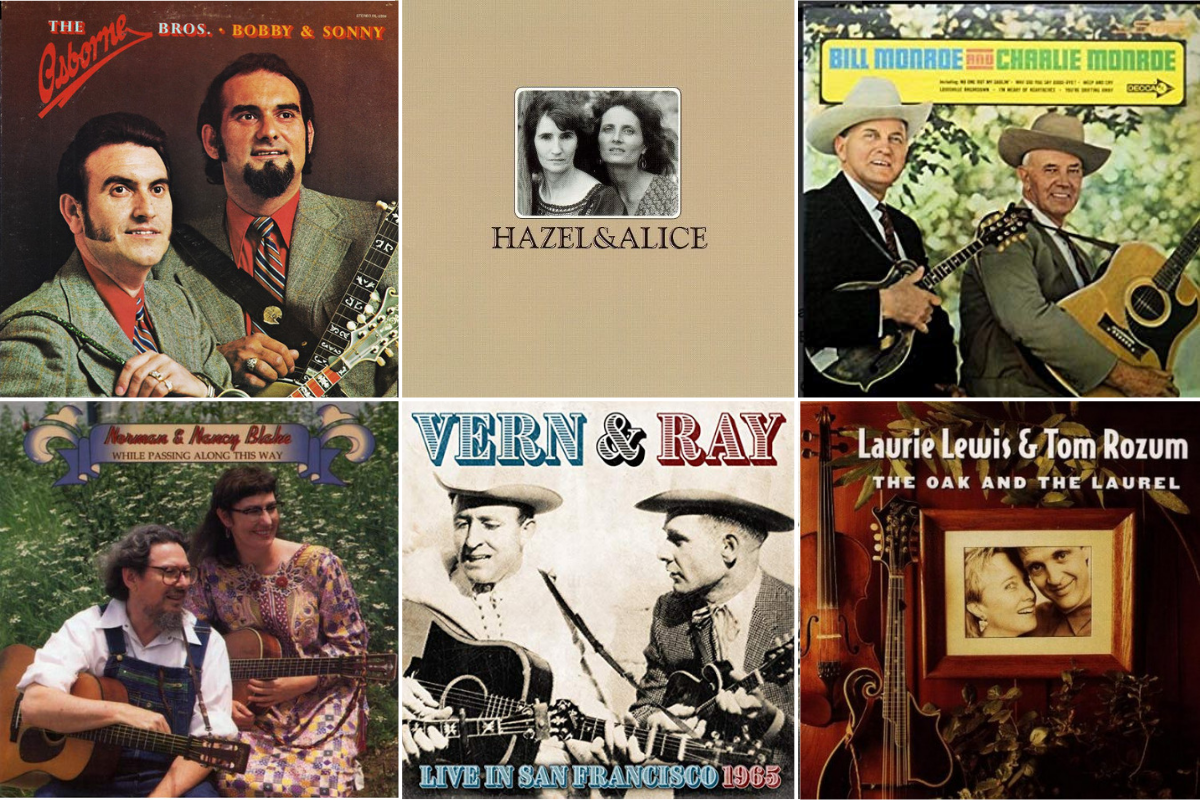
Bill & Charlie Monroe
Before Bill Monroe, the Father of Bluegrass, made his indelible mark on the genre (quite literally giving it its name), he was already a popular performer with his brothers Charlie and Birch. Birch left The Monroe Brothers in the mid-1930s, and Charlie and Bill went on to enjoy success on the road, in the studio, and on the radio — until rising tensions and a fateful fight in 1938 caused them to split ways. But, without that fight, we may not have “bluegrass” at all.
Flatt & Scruggs
December 1945. The Ryman Auditorium. Nashville, Tennessee. Bill Monroe and his Blue Grass Boys stepped on stage for the Grand Ole Opry with Lester Flatt and Earl Scruggs among their ranks for the very first time and bluegrass as we know it today was born. Flatt & Scruggs left Monroe in 1948 to join forces and went on to become one of the few ubiquitous, household names of bluegrass.
Hazel Dickens & Alice Gerrard
Undeniably trailblazers, Hazel Dickens & Alice Gerrard are widely regarded as the first women in bluegrass to capture the “high lonesome” sound popularized by Monroe, the Stanley Brothers, and others. They toured across the U.S., often supporting causes that benefited forgotten, downtrodden people from all backgrounds and walks of life. They were inducted into the Bluegrass Music Hall of Fame in 2017.
The Stanley Brothers
Natives of the music-rich southwest corner of Virginia, Carter and Ralph Stanley were prolific recording artists and touring musicians in bluegrass’s first generation. Countless songs written and/or popularized by the Stanley Brothers and their backing band, the Clinch Mountain Boys, are staples of the genre today. Carter passed in 1966 and Ralph continued until his death in 2016 with the Clinch Mountain Boys — who still tour today with Ralph’s son, Ralph II.
Don Reno & Red Smiley
Unsung trailblazers of the first generation of bluegrass pickers, Reno & Smiley were tireless innovators with a jovial, sometimes silly flair to their songs and instrumental prowess. Their duets are simply some of the best in all of bluegrass. The duo performed together off and on from the early 1950s to the 1970s — but both passed away much too young, Smiley in 1972 at the age of 46 and Reno in 1984 at the age of 58. Reno’s frenetic, electric and pedal steel guitar-infused licks remain unmatched in banjo picking today.
Jim & Jesse McReynolds
With matching suits and impeccable pompadours brothers Jim and Jesse McReynolds often brought rockabilly, rock ‘n’ roll, mainstream country and pop sensibilities to their take on sibling harmonies and bluegrass brother duos. Jesse’s crosspicking on the mandolin was — and continues to be — absolutely astonishing. Jim passed in 2002, Jesse continues to perform on the Grand Ole Opry to this day. At the time of this writing, he is ninety years old.
Laurie Lewis & Tom Rozum
Laurie Lewis often takes top billing — as leader of the Right Hands and before that, the Bluegrass Pals, and others — but since 1986 her musical partner Tom Rozum has almost constantly been at her side on the mandolin and harmonies. Their duo recording, The Oak and the Laurel, was nominated for a Grammy in 1995. Here is the album’s title track:
Bill Monroe & Doc Watson
What is there to say? Two of the folks who paved the way for this genre, laying a foundation so strong and far-reaching that we still can’t fully comprehend its impact. Bill and Doc collaborated on more than one occasion and we, as fans and disciples, are lucky that so many of these moments are captured in recordings and videos.
Del McCoury & David “Dawg” Grisman
At face value, an unlikely combo, but their friendship goes back to the early 1960s and their musical endeavors together began soon after. As Del slowly but surely became a bastion for traditional bluegrass aesthetics applied broadly, Dawg embraced jammy, jazzy, new acoustic sounds that sometimes only register as bluegrass-adjacent because they come from the mandolin. Opposite sides of the same coin, their duet makes total sense while at the same time challenging everything we think we know about the music. In this clip, Dawg sings tenor to Del — not many would be brave enough to try!
Ricky Skaggs & Keith Whitley
They got their start together in the Clinch Mountain Boys with Ralph Stanley, making some of the best recordings in the history of the band’s many iterations. Before they both struck out on wildly successful, mainstream careers they recorded a seminal duo album together, Second Generation. It remains one of the most important albums in the bluegrass canon — especially as far as duos/duets go.
Norman & Nancy Blake
Norman is well known for his flatpicking prowess, which has graced recordings by John Hartford, Bob Dylan, the Nitty Gritty Dirt Band, and so many others. He and his wife, Nancy, were married in 1975 after having begun their musical forays together a year or so earlier. Nancy’s command of many instruments — cello, mandolin, and fiddle among them — balances neatly with Norman’s jaw-dropping, singular style on the flattop. Their inseparable harmonies and timeless repertoire are merely icing on the cake.
Jimmy Martin & Ralph Stanley
How their first album together, First Time Together (cough), is not more well-known is truly impossible to understand. The King of Bluegrass and the Man of Constant Sorrow twining their extraordinary voices must have been ordained by a higher power. It’s a good thing they answered the call. Be careful, Jimmy’s percussive G-runs feel like a slap in the face — in the best way.
Darrell Scott & Tim O’Brien
Their live albums together and their co-written masterpieces belong in every museum and shrine to roots music around the world. Both of these triple threat (Quadruple? Quintuple? When do we stop counting?) musicians are rampantly successful in their own right, but together they are simply transcendent. Their cut of “Brother Wind” deserves a listen right this instant and “House of Gold” gives you the harmony acrobatics gut punch you need every time. It was nearly impossible to choose just one, but here’s a hit that was recorded once by a little group called the Dixie Chicks.
Ricky Skaggs & Tony Rice
Again, words fail. Skaggs & Rice is a desert island record. Each and every time these two have graced a recording or a stage together, magic has been made, from their days with J.D. Crowe & the New South and on. We only wish that they could have done more together.
Vern & Ray
Vern Williams and Ray Park were California’s original bluegrass sons. Though they were both born and raised in Arkansas, they relocated to Stockton, California, as adults. They’re often credited with “introducing” bluegrass music to the West Coast. They disbanded in 1974 (both passed in the early 2000s), but their influence is palpable to this day, even if they’re sorely unheard of east of the Mississippi. This deserves correction! Immediately!
Eddie & Martha Adcock
Eddie is a pioneering banjo player who’s a veteran of both Bill Monroe’s Blue Grass Boys and The Country Gentlemen, two decidedly legendary and influential acts. His style is somewhat wacky, certainly singular, but effortlessly bluegrass and traditional as well. He married Martha in the late 1970s and the pair have toured prolifically as a duo. In 2008, Eddie underwent brain surgery to correct debilitating hand tremors. He was kept awake, playing the banjo during the procedure — and there is jaw-dropping film of this online!
Dailey & Vincent
When Dailey & Vincent burst onto the scene in the mid-aughts after both having notable careers as sidemen, the bluegrass community rejoiced at the reemergence of a wavering art form within the genre — traditional duo singing. However, Jamie and Darrin, whether they knew it at the time or not, had their sights set much higher. Now more of a full-blown stage show than a bluegrass band, their recordings and concerts are a high-energy, charismatic, and downright entertaining mix of classic country, Southern gospel, quartet singing, and yes, bluegrass.
Kenny & Amanda Smith
Husband and wife Kenny and Amanda first recorded together in 2001, going on to win IBMA’s Emerging Artist of the Year award two years later. They’ve now cut eight albums together, all clean, clear, crisp modern bluegrass that centers on Amanda’s impossibly bright vocals, which maintain a personal, country hue alongside Kenny’s fantastic flatpicking. SON!
Tom T. & Dixie Hall
Two of the most recent inductees into the Bluegrass Music Hall of Fame, Tom T. and Dixie Hall wrote hundreds and hundreds of songs cut by country, bluegrass, and Americana artists alike. Tom T.’s reputation and chart-topping originals tend to eclipse Dixie, but he is unyielding in his efforts to point that same spotlight at his beloved wife instead, who passed away in 2015. Though she never performed — definitely not to the extent that Tom T. did — the marks she left on bluegrass, country, and her partnership with her husband are indelible. This number was co-written by the pair:
The Louvin Brothers
Recipients of IBMA’s Distinguished Achievement Award in 1992, the Louvin Brothers are another example of early bluegrassers who enjoyed the amorphous, primordial days of the genre before it became more and more sequestered from mainstream country and country radio. Their duets are iconic, with counter-intuitive contours and lines that bands and singers still have difficulty replicating to this day. Their most famous contribution to the American music zeitgeist, though, might not be their music, but the spectacular cover art for their 1959 album, Satan Is Real. If you haven’t seen it, Google it right now.
Delia Bell & Bill Grant
Natives of Texas and Oklahoma, respectively, Delia Bell and Bill Grant met through Bell’s husband, Bobby, in the late 1950s. Between their band, the Kiamichi Mountain Boys, and their duo project they recorded more than a dozen albums together through the 1980s. Famously, Emmylou Harris became a fan when she heard their cut of “Roses in the Snow,” which Harris went on to record on her eponymous bluegrass record. Bell died in 2018.
The Osborne Brothers
Though they popularized a style of three-part harmony that had never been heard before — the infamous “high lead” harmony stack — their band, no matter who it may have included over the years, was undeniably helmed and anchored by Bobby and Sonny. (Which does explain the name.) You may remember “Rocky Top” and “Ruby” first and foremost in their discography, but the hits they’ve contributed to the bluegrass songbook are innumerable. Here’s one such classic.
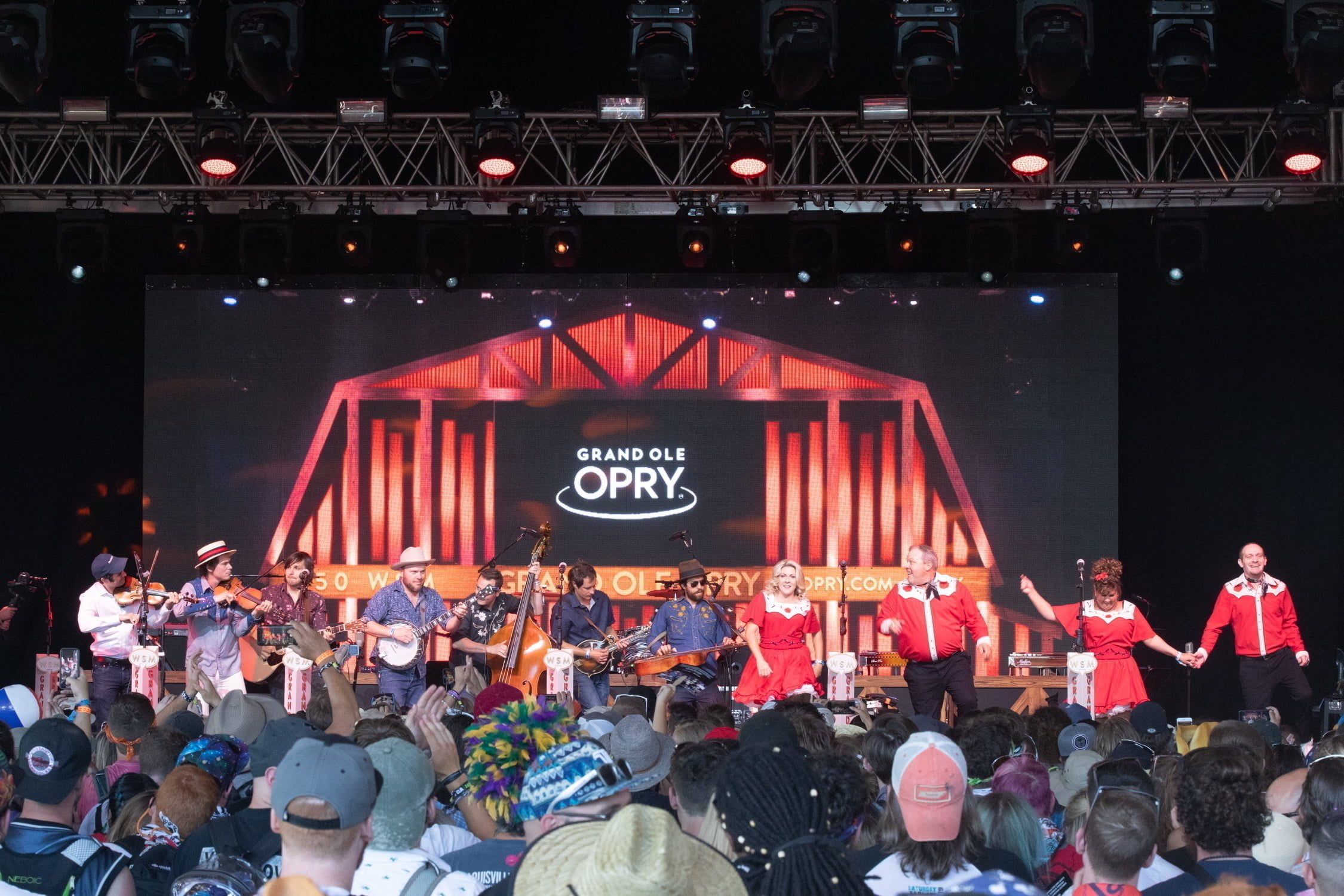
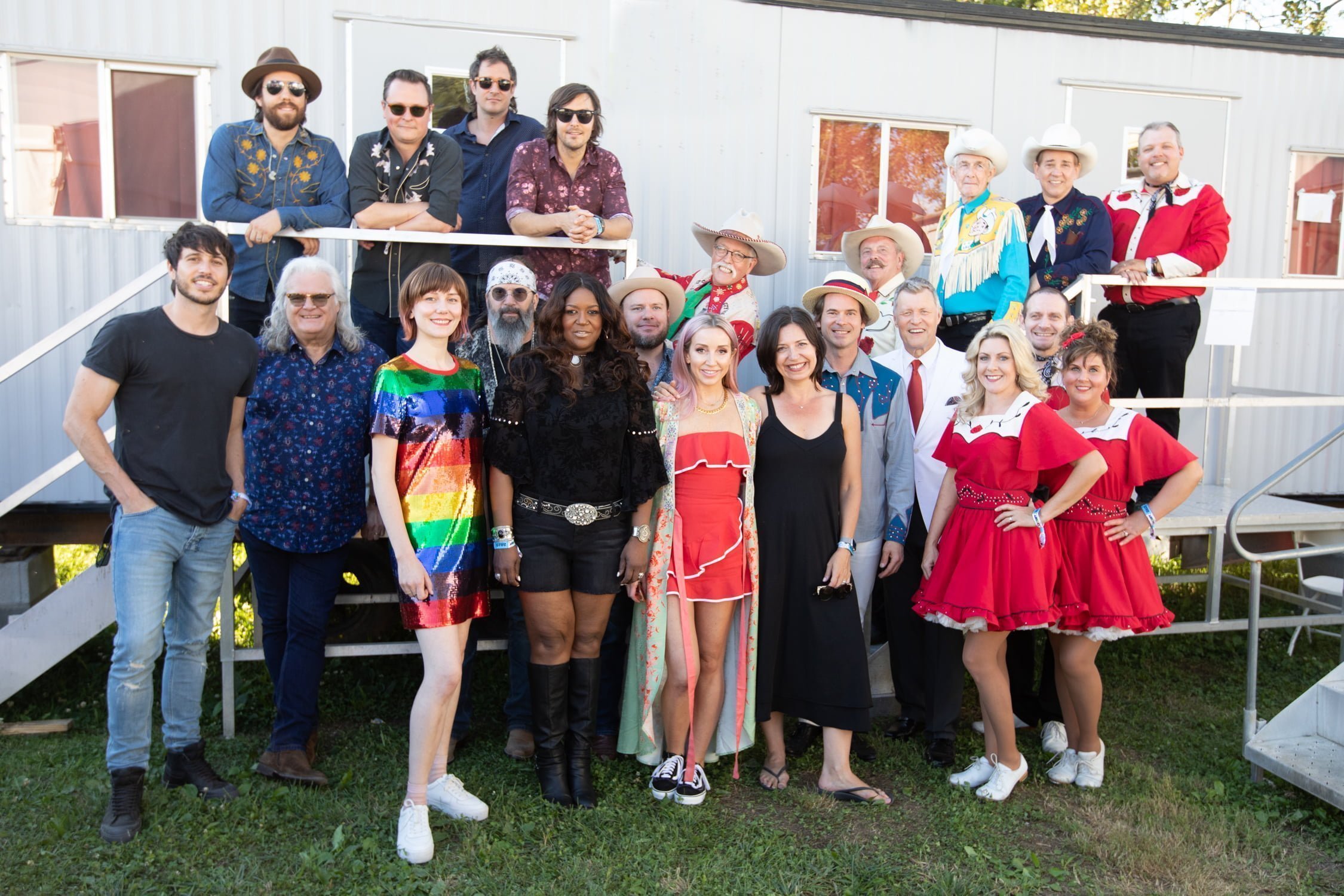
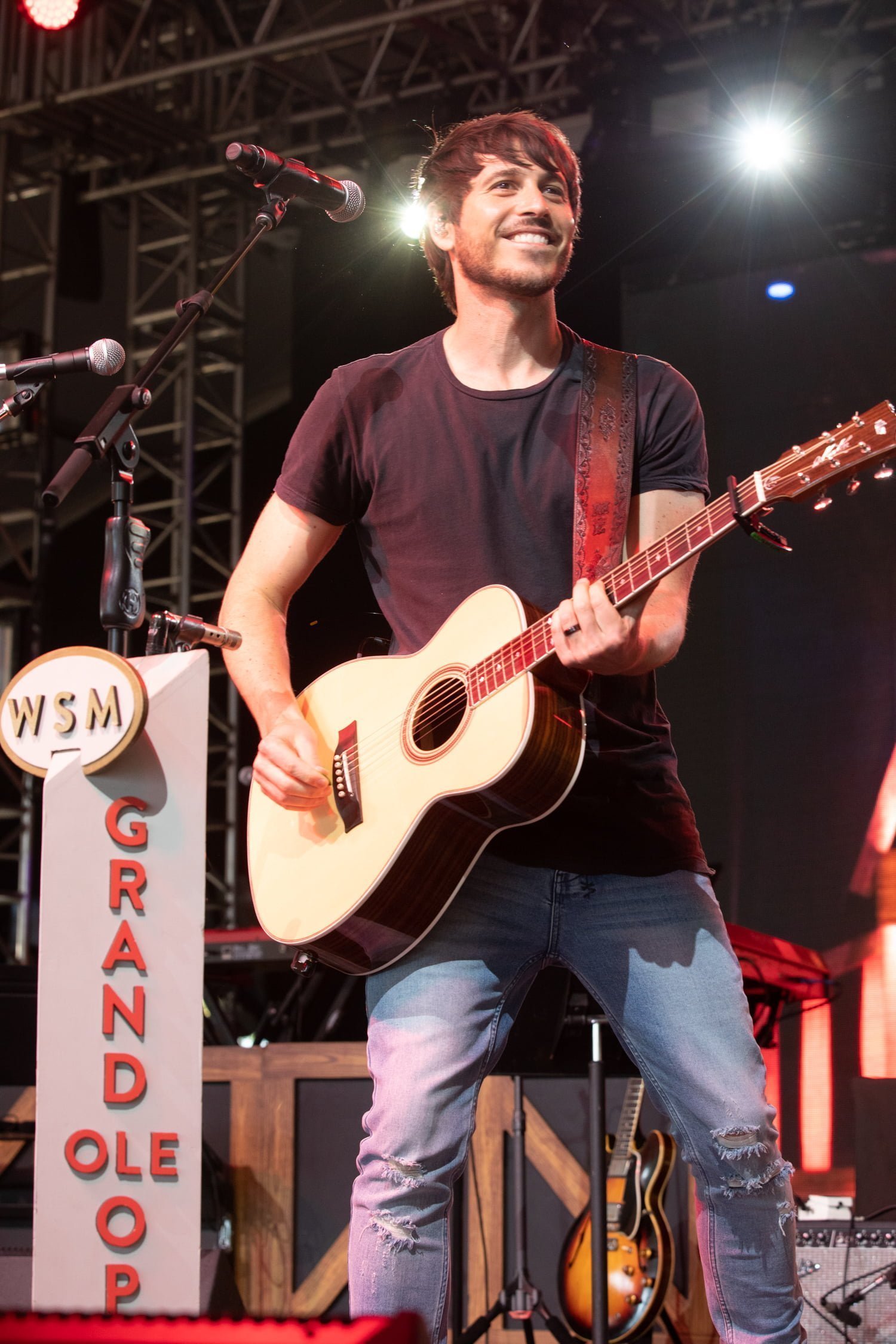
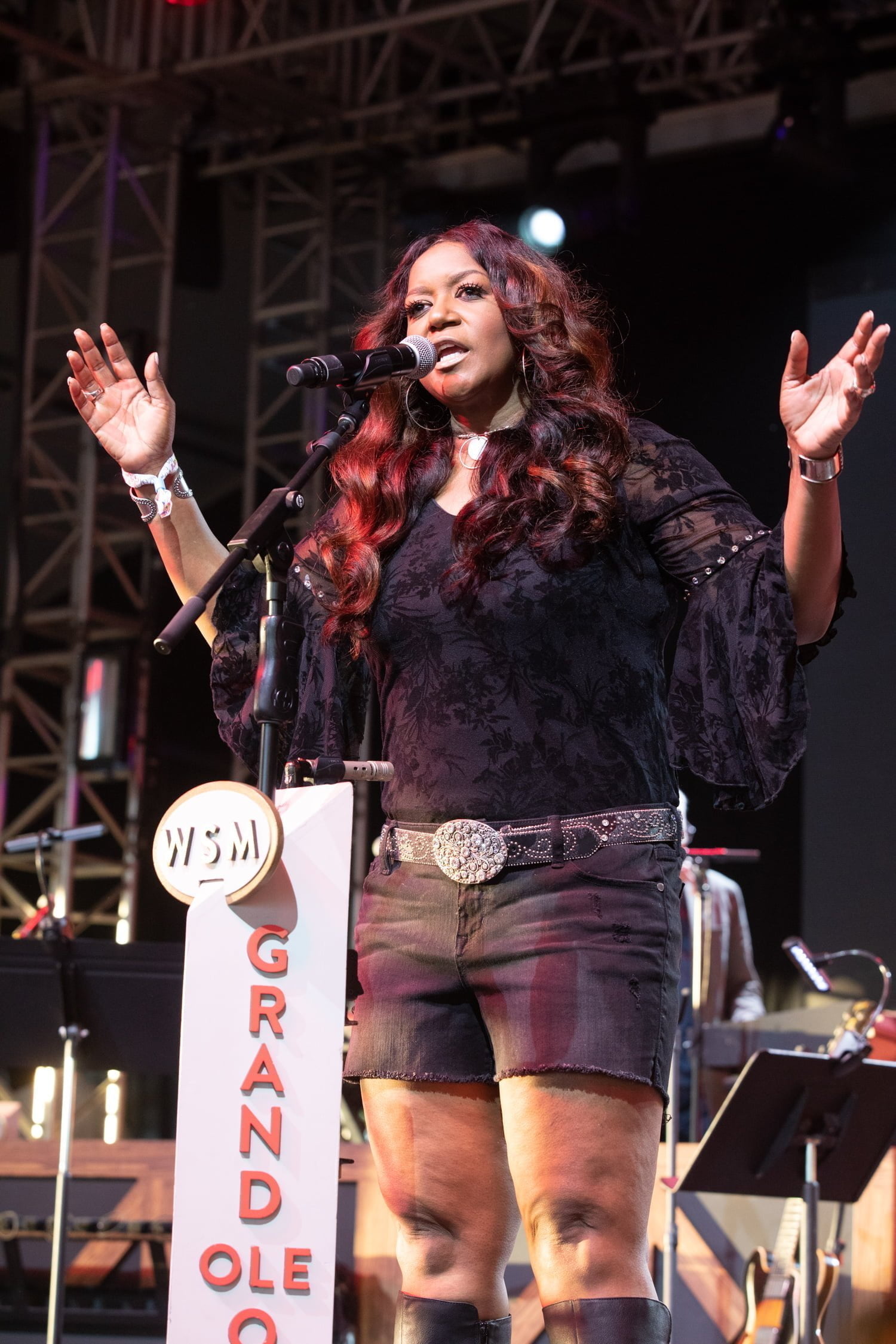
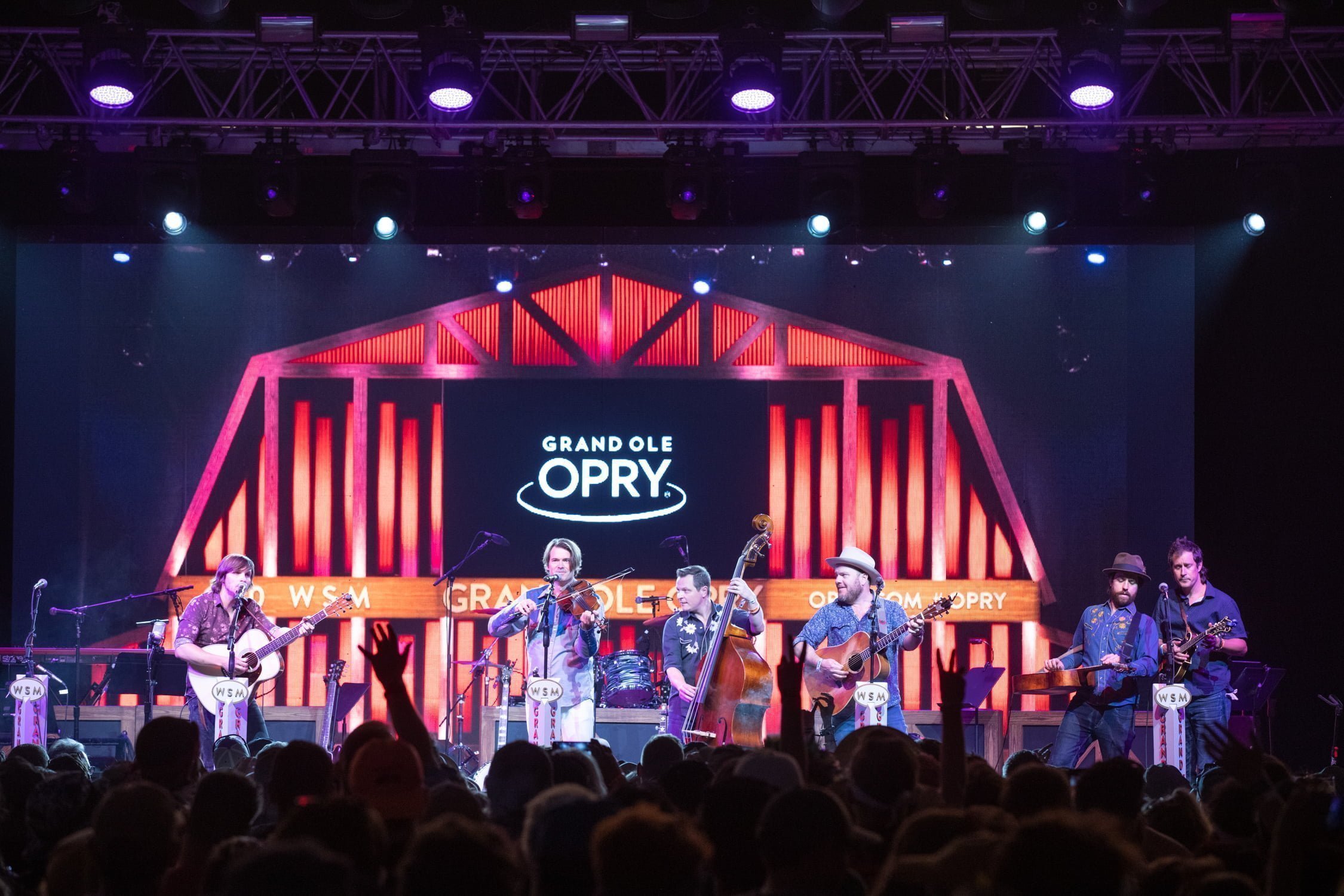
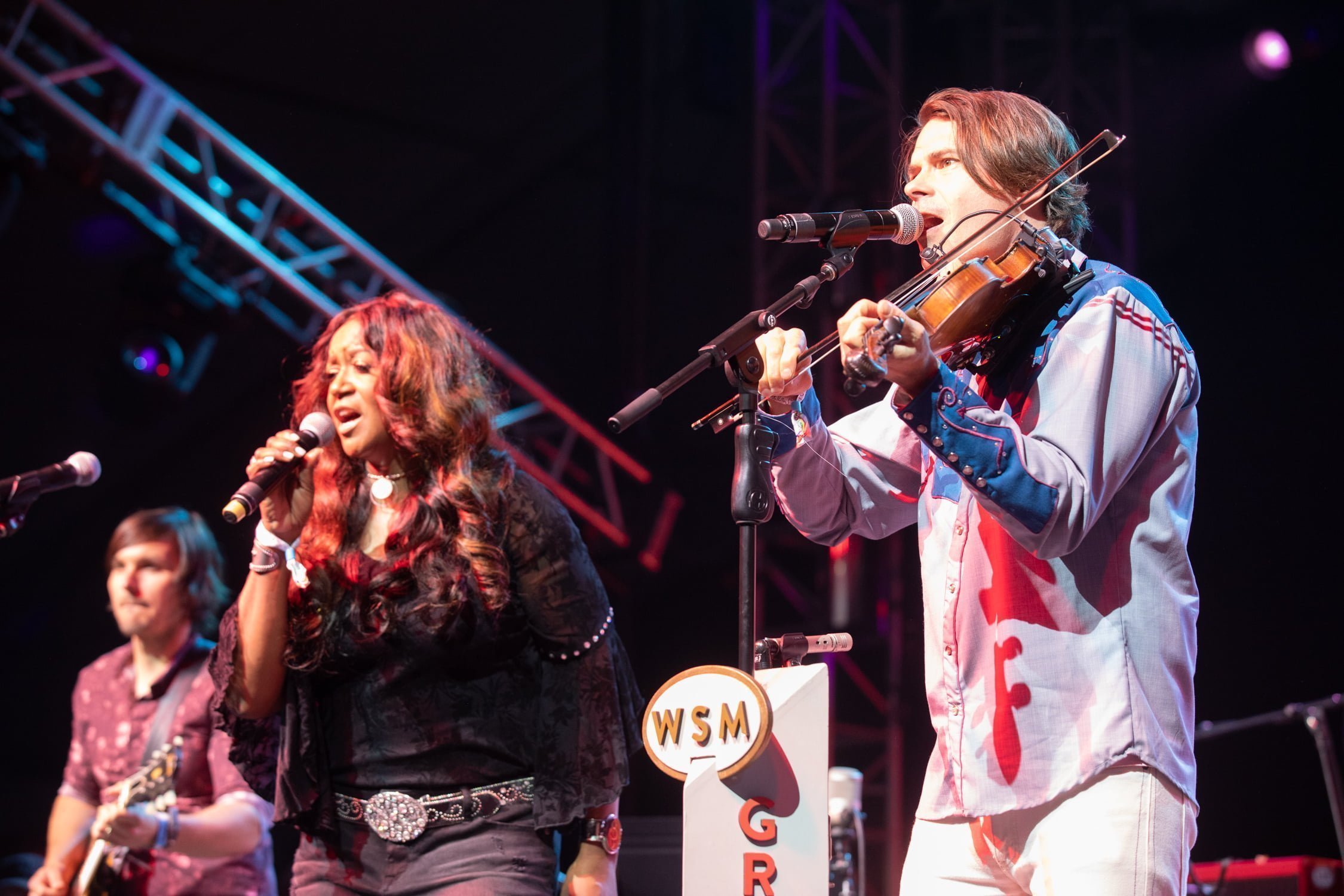
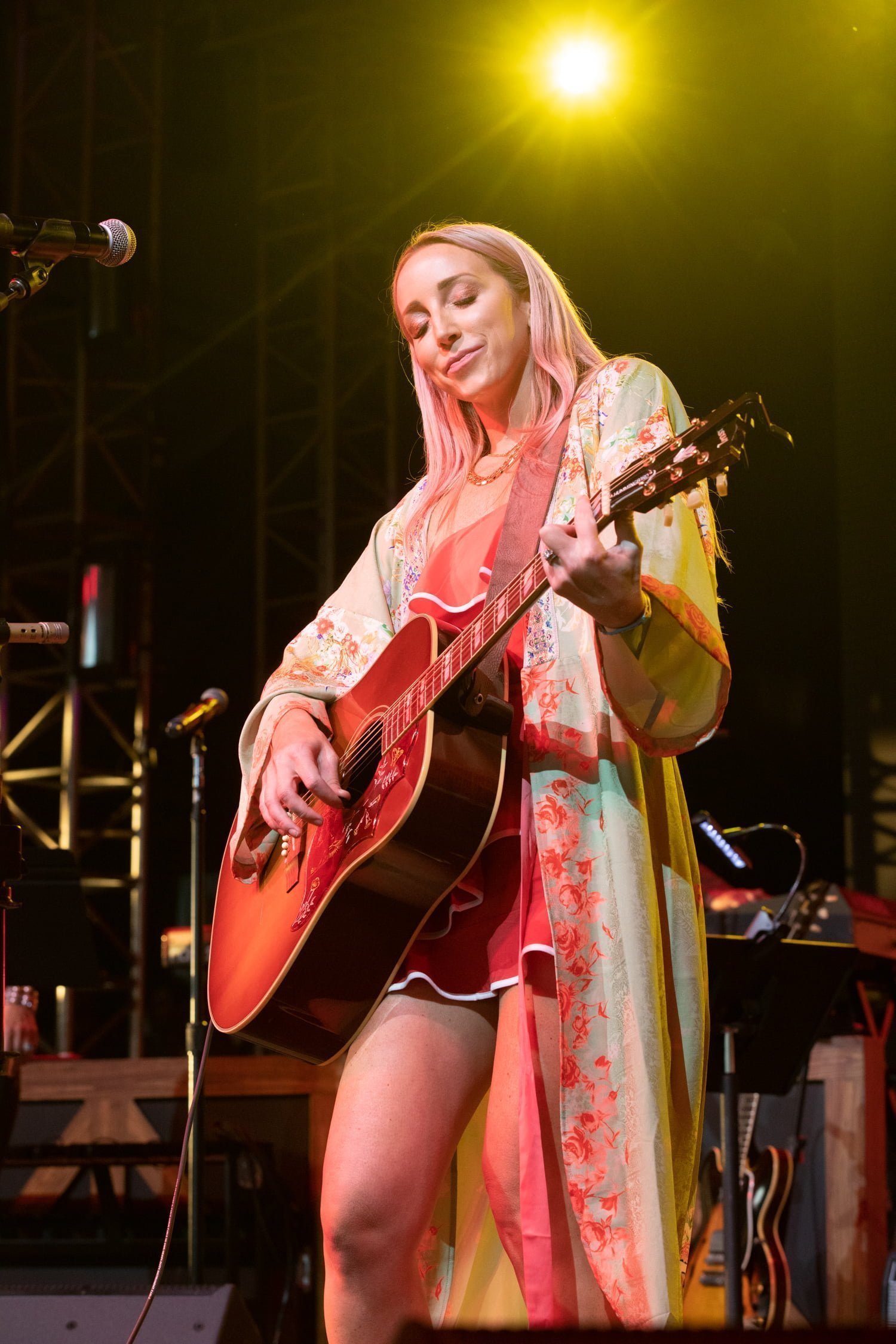
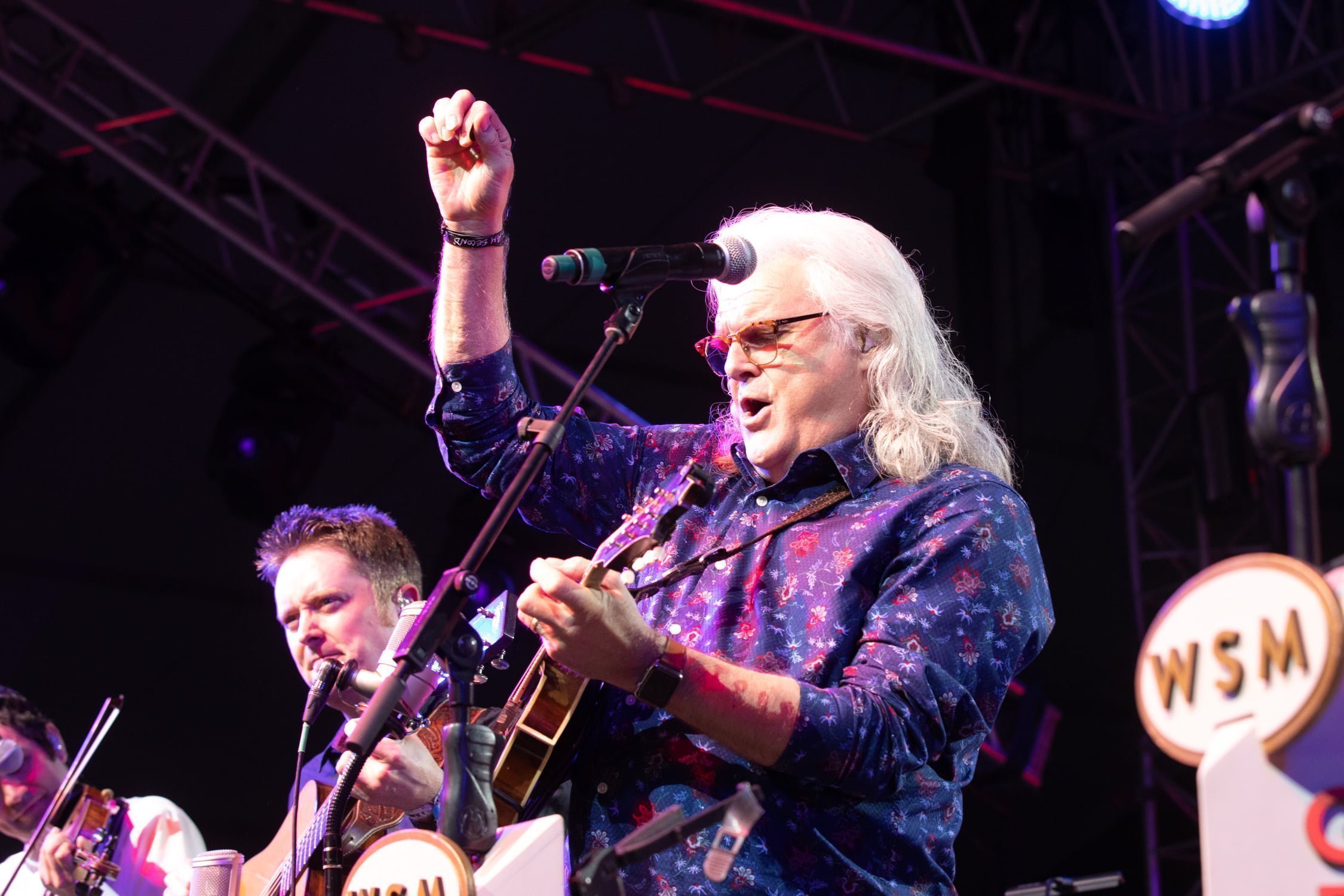
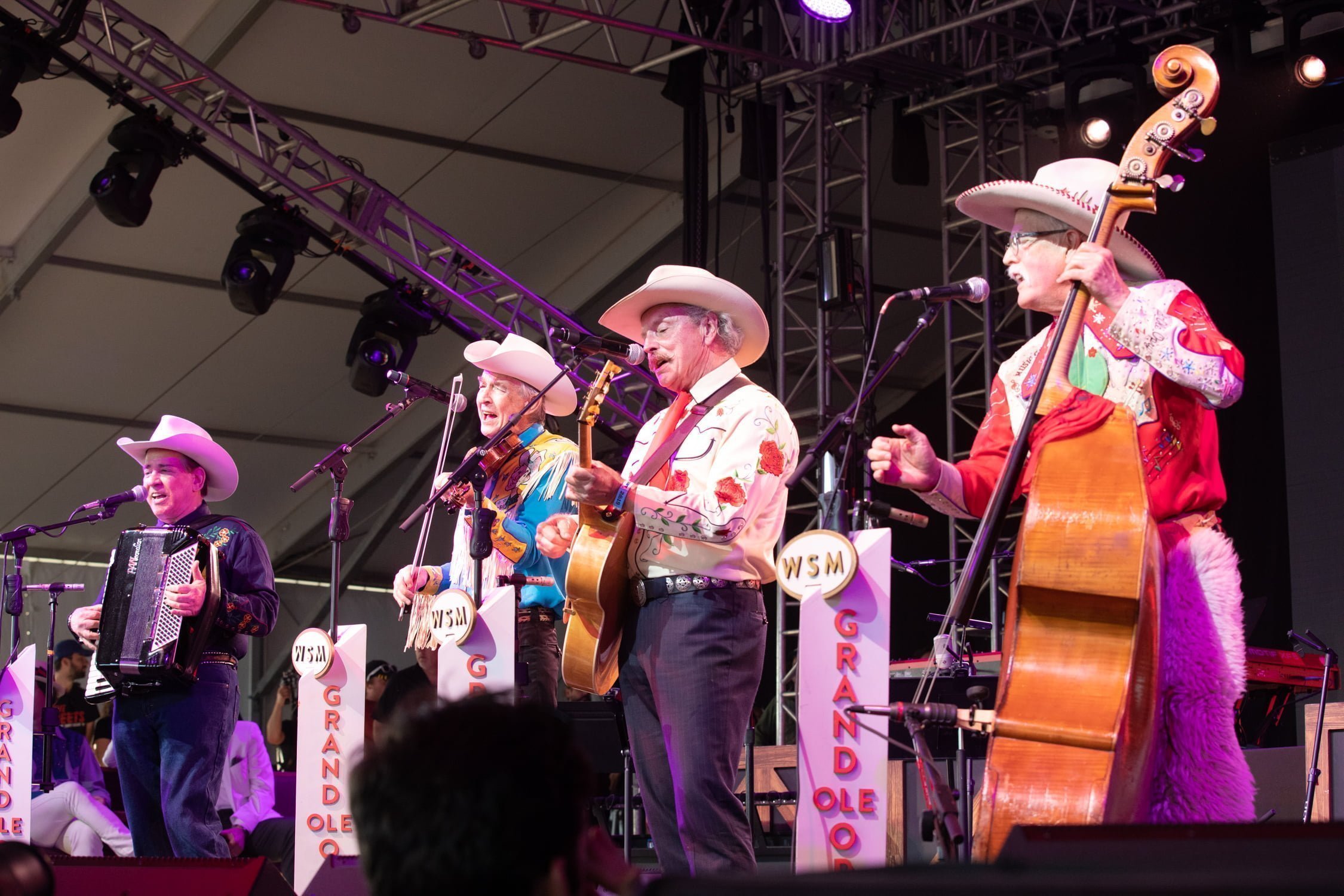
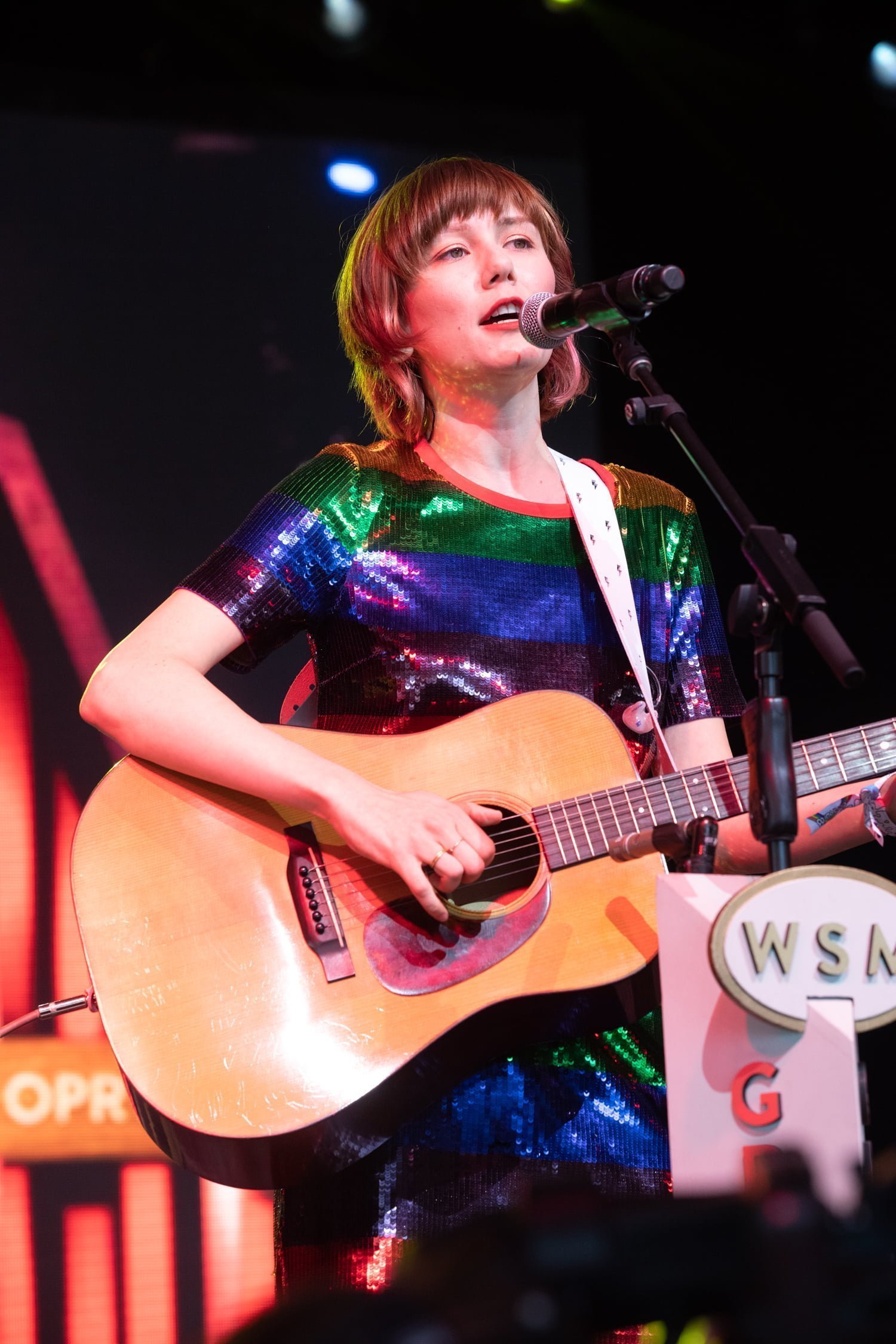
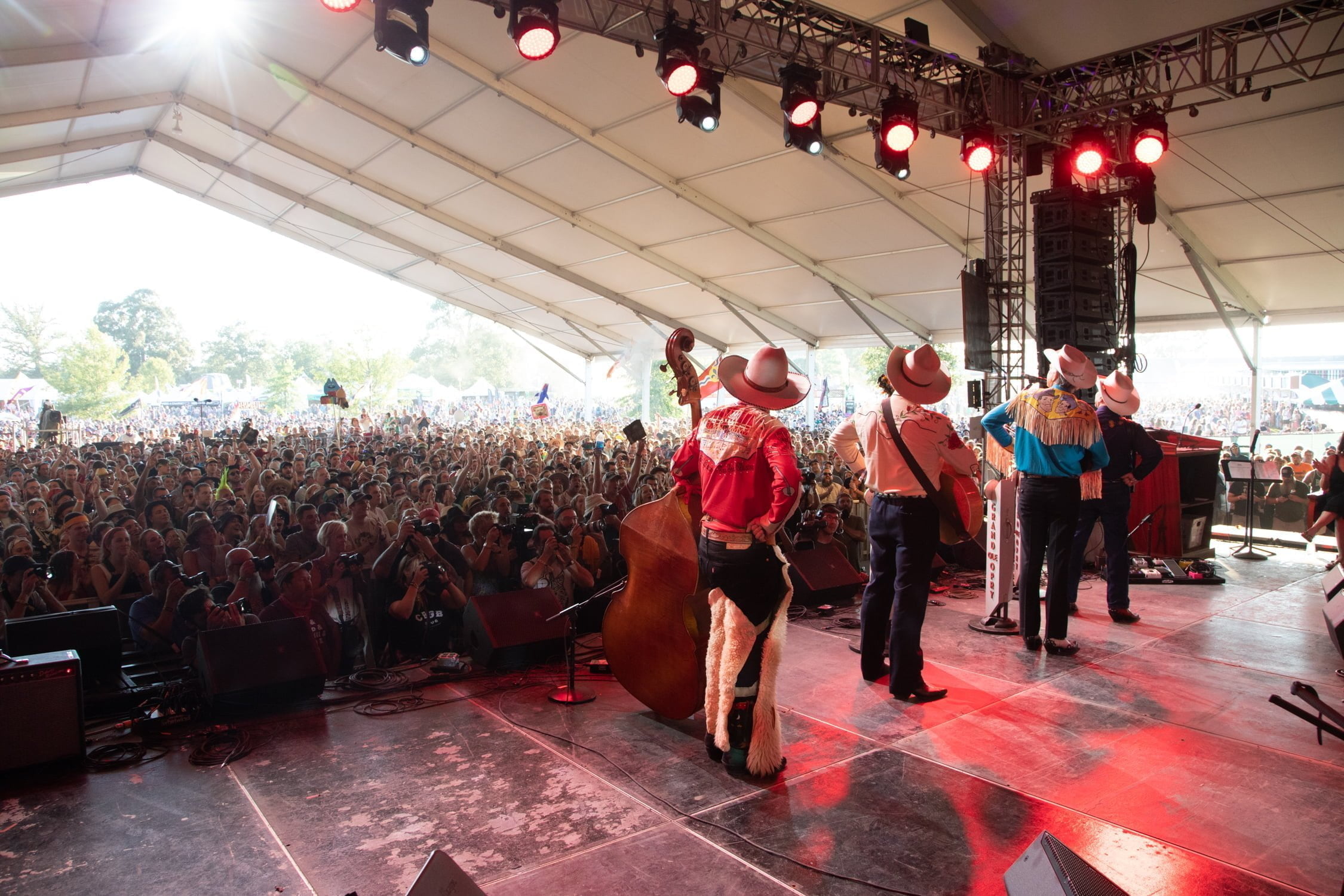
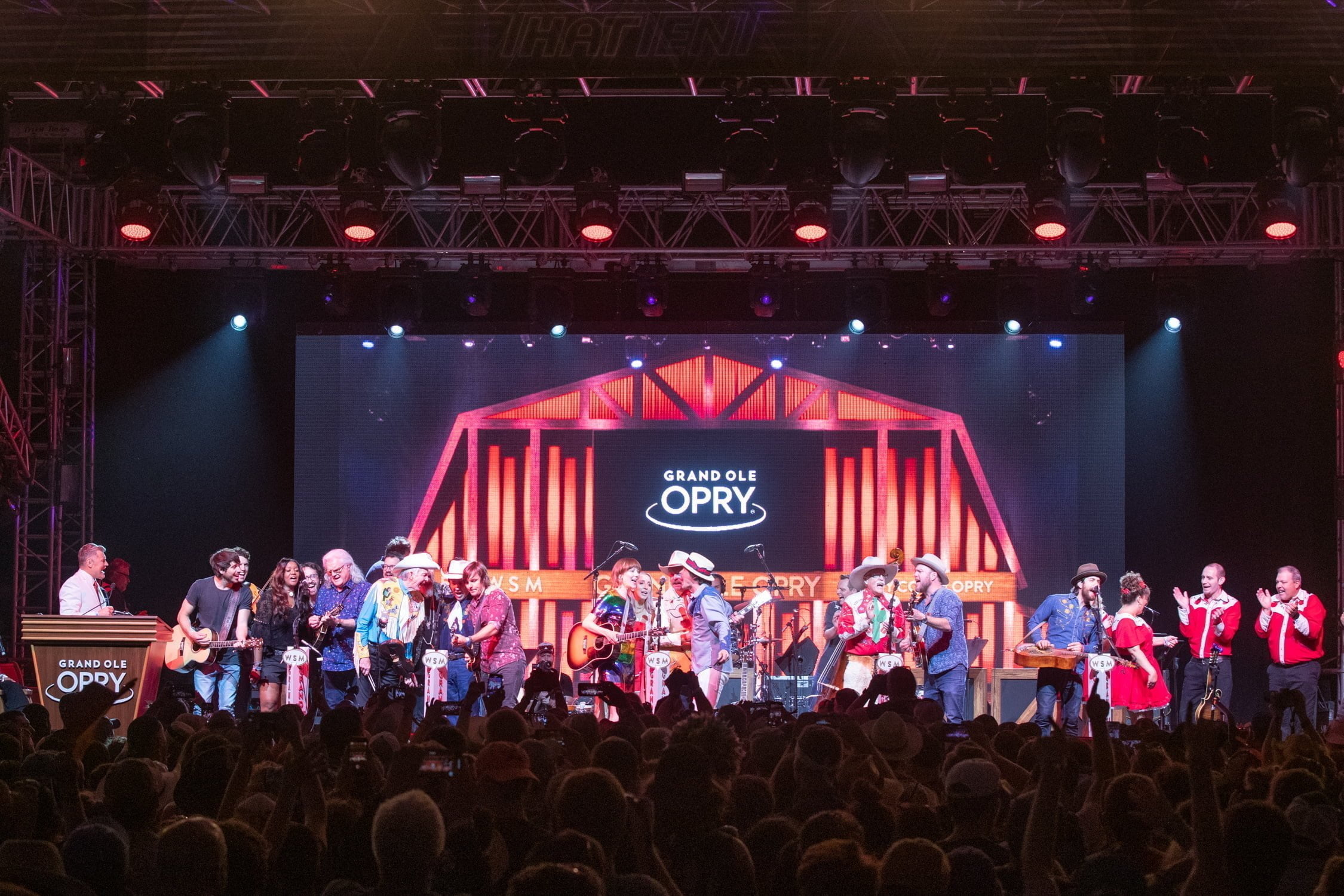
The Grand Ole Opry returned to Bonnaroo Music and Arts Festival this year to headline the festival’s opening night. The Opry carried on the festival’s long-standing tradition of representing country, bluegrass, and roots music with performances by Old Crow Medicine Show and fellow Opry members Ricky Skaggs and Riders In The Sky, plus special guests Steve Earle and the Dukes, Morgan Evans, Ashley Monroe, Wendy Moten, Molly Tuttle, and even the Opry Square Dancers and Opry announcer Bill Cody came along for the ride.
BGS handed off the That Tent torch to the Opry in 2018, after five years of the BGS SuperJam. You can revisit our years of BGS x Bonnaroo goodness here: 2017; 2016; 2014.
The entire cast of Grand Ole Opry at Bonnaroo gather backstage.
Of course the Opry Square Dancers came along.
Morgan Evans.
Wendy Moten
Old Crow Medicine Show acoustically electrify the crowd.
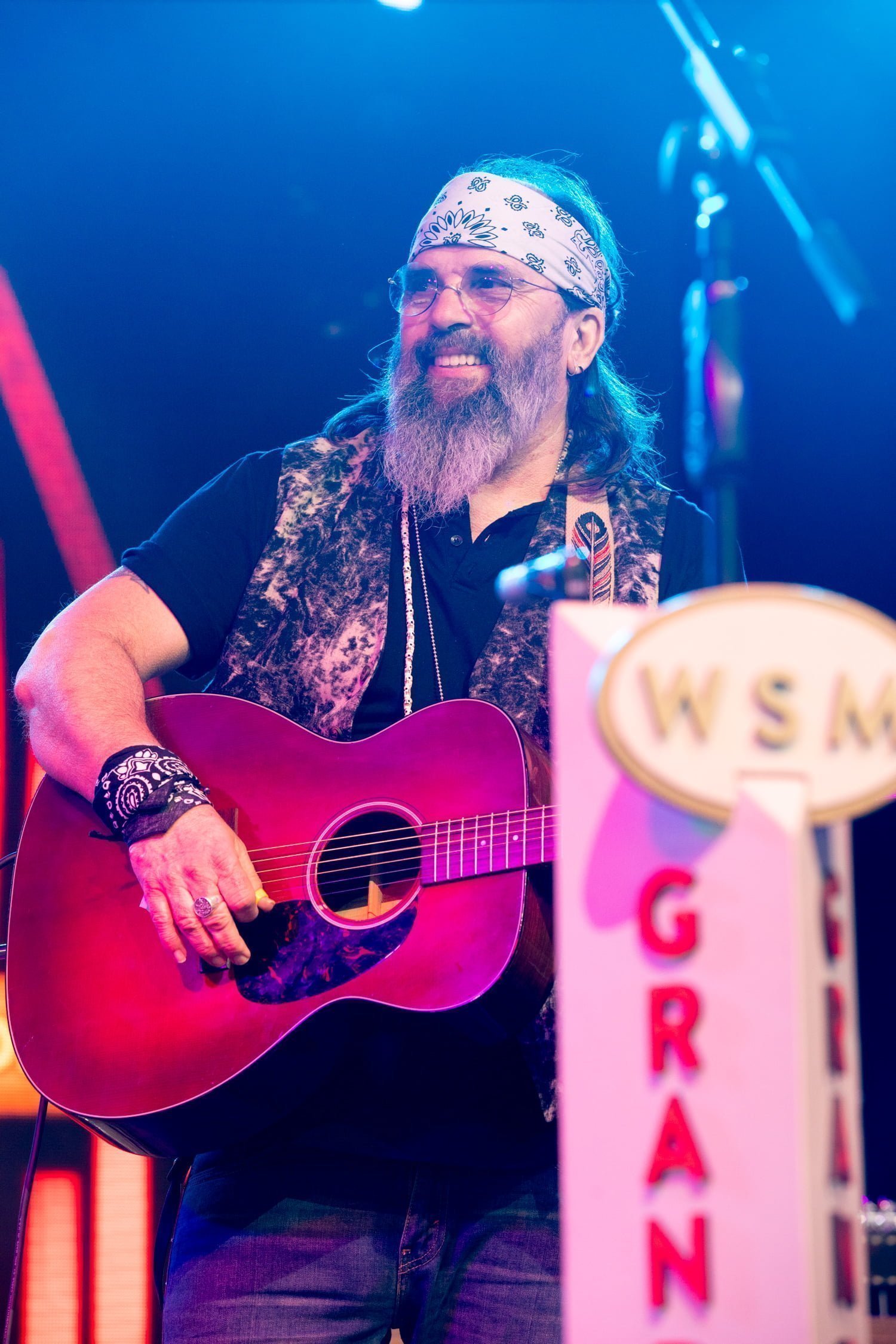
Steve Earle and the Dukes.
Wendy Moten joins OCMS.
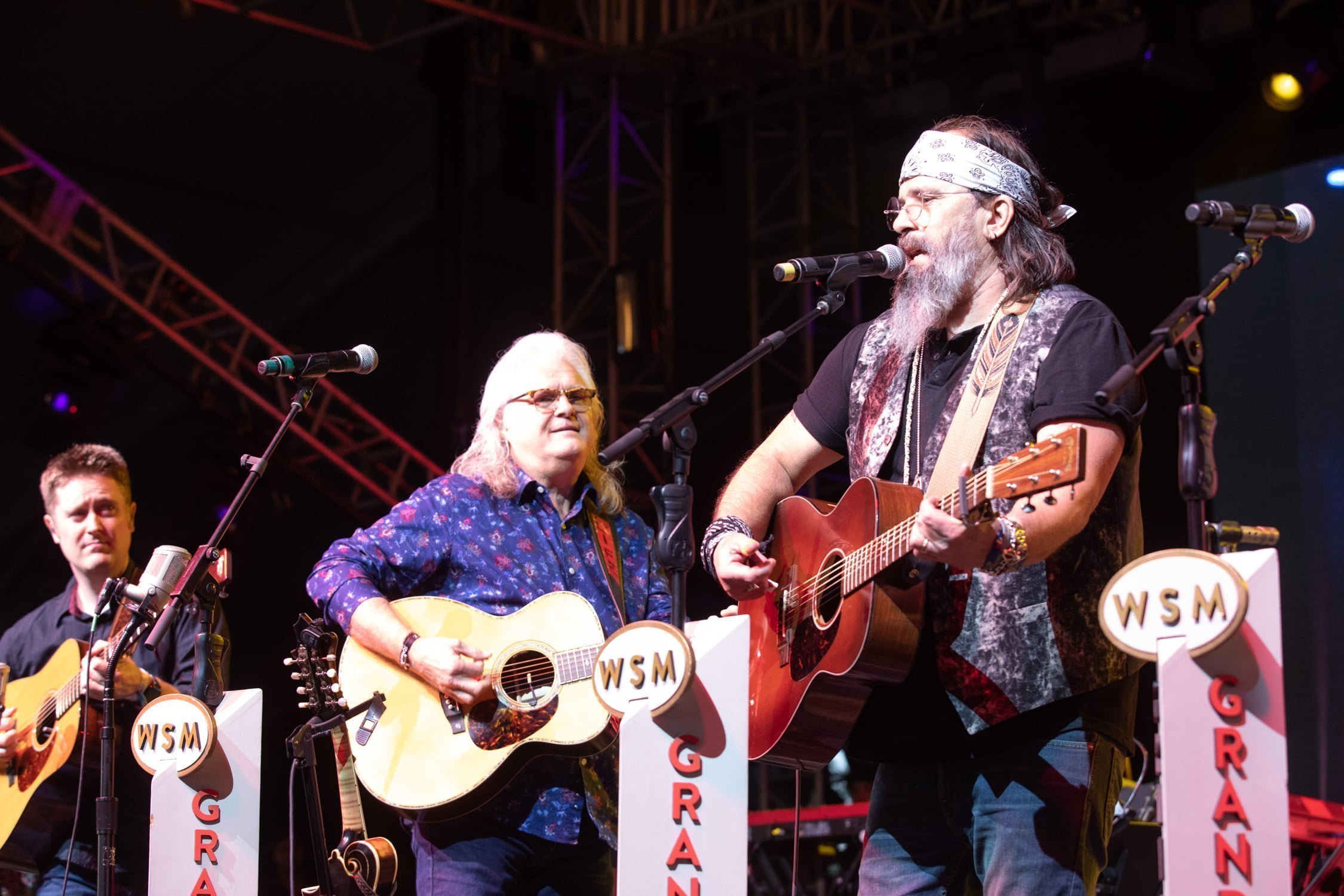
Steve Earle and Ricky Skaggs - a truly legendary duet.
Country singer/songwriter Ashley Monroe.
Ricky Skaggs getting into it.
Riders In The Sky continually doing it the cowboy way.
A rainbowy Molly Tuttle demonstrating her incredible clawhammer guitar style.
Riders In The Sky and the packed-in Bonnaroo crowd.
Only five artists or acts have been inducted into both the Country Music and Bluegrass Music halls of fame, and only one is actively touring and shaping the dialogue around roots music generally. And that’s 64-year-old Ricky Skaggs.
As a fiddler, mandolinist, singer, and band leader he’s bridged the country/bluegrass divide more deftly than any artist alive, and he still does it with sets that split the difference as his band can shift gears on a dime. In a full-hour feature interview, Skaggs reflects on two key periods of his career – the 1970s when as a twentysomething he worked with epic bands like the Country Gentlemen, J.D. Crowe and the New South, and Boone Creek, which he started with a young Jerry Douglas. And we talk about the 2000s, when he turned his full attention back to bluegrass and quickly dominated the industry with awards and era-shaping records.
As purveyors of genre crossing, we like to recognize standouts within a genre that innovated simply by epitomizing a sound with particular skill: tracks that demonstrated what virtuosity could do within a genre, that pushed the genre to new heights (or at least new places) for us, tracks that maybe we used to judge what came afterward. We could list a lot of classics, but this list is really about the tracks that were the standard setters for each of us personally, making a mark in how we thought about a genre or sound. For our Mixtape, we selected a few songs and described the impact the tracks made. — Gangstagrass
Flatt & Scruggs – “Foggy Mountain Special”
Earl’s fast, regular picking in songs like “Foggy Mountain Breakdown” made his three-finger rolls, like the Foggy Mountain roll, iconic. But this heavily-swung tune, while not a slow song by any standard, really explores the bluesy side of bluegrass banjo. The syncopated banjo kick, with the band entering on the second beat, throws off the listener’s perception of time. The main lick itself deserves to be as iconic as any fast-flowing Scruggs roll. And that solo! From the single-string bends to that chromatic octave line, Earl knows to keep playing it just a little bit longer. You couldn’t go back and redo any part of this any better, not in a hundred years. They nailed it.
Norman Blake and Tony Rice – “Little Beggarman/Gilderoy”
Tony Rice sounds his best on duo albums, whether it’s with country superstar Ricky Skaggs on a journey to reconnect with his bluegrass roots, or songster Norman Blake, whose clear-as-a-stream picking and earnest vocals are augmented by Tony’s unparalleled rhythm work and rich baritone. On this instrumental track, guitar and mandolin trade breaks and, unusually, trade tunes. Because they’re both in A, with similar chords and melodies, you almost don’t notice the transition, except that the tune Blake plays on mandolin is minor, while Tony’s guitar tune is major. It’s a beautiful, subtle effect that showcases both artists and enhances the sound of each instrument.
The Steeldrivers – “Ghosts of Mississippi”
Before Chris Stapleton was Chris Stapleton, he was in a band called the Steeldrivers. The mainstream music audience has rightly picked up on his powerful vocals and formidable songwriting, but arguably his best work has been with this band that gave him a perfect setting. From the smoldering growl of the banjo to the searing whine of the fiddle, the sound has not been surpassed by either Stapleton’s pop work or by any other bluesy bluegrass band. This track in particular sets the bar, serving up equal parts groove, emotion, and one hell of a catchy melody.
Béla Fleck and the Flecktones – “Hole in the Wall”
The Flecktones represent Béla’s furthest ventures outside traditional bluegrass, and this late track on their second album, Flight of the Cosmic Hippo, is a representative example of their early sound. Of note, Howard Levy’s keys get more room than on most other tracks which tended to feature more of his admittedly superlative harmonica work. Near the end, there’s enough sonic buildup to justify a fantastic extended banjo solo with fluidly shifting time signatures and tonalities. Banjo players who have tried to emulate this piece will have noticed that, like many Béla tunes, it centers around a particular lick, in a particular nonstandard key, played in open G tuning. But as with magic, sometimes understanding the trick doesn’t make it any less exciting to see it performed right in front of you. — Gangstagrass
Pharoahe Monch feat. Black Thought – “Rapid Eye Movement”
Every now and then there’s a collaboration that you just know is going to be dope just by the parties involved. “That’s what I figured when I saw these two MCs on a track from Pharoahe Monch’s 2014 album P.T.S.D. I wasn’t prepared for HOW DOPE, however,” says R-SON. Pharoahe Monch drops bars about being in a relationship with his ammunition and then filing for divorce and releasing his “ex-calibers.” Not to be outdone, Black Thought starts his verse with the last two lines of Pharoahe’s and goes on to “send shots to ancient Greece to pop Socrates.” Black Thought’s line “the ex-slave sado-masochist/who gave massa my ass to kiss” is, as R-SON puts it, “just another example of Black Thought’s conscious swagger that laces every verse that he blesses a track with.”
Black Star – “Thieves in the Night”
Mos Def and Talib Kweli came together on the Black Star album and created gems but this was the standard for R-SON. Their distinct flows built two very different parts — Kweli’s recounting what his man Louis said and thought and how those thoughts affected Kweli. Mos Def’s verse, on the other hand, had a breakdown of the hook where he responded to the things said in it. The song ends with one of the great lines in the genre’s history: “I give a damn if any fan recall my legacy, I’m tryina live life in the sight of God’s memory.” R-SON notes that “in my younger days the song brought tears to my eyes and I’m happy to say that it still does.”
Mos Def – “Mathematics”
We cannot think of another time when someone counting from 1 to 10 (Dolio the Sleuth on “Ain’t No Stopping” aside) has had more meaning. Mos raps, “5 dimensions, 6 senses, 7 firmaments of heaven and hell, 8 million stories to tell, 9 planets keep orbit around the probable 10th, the universe expands length….” He continues his “…numbers game, but shit don’t add up somehow,” speaking of the number of bars he has to do what he does, and the minimal amount of money he gets from it all. “6 million ways to die for the 7 deadly thrills / 8-year-olds getting found with 9 mils / it’s 10 p.m., where your seed, he’s on the hill/….pumping crills to keep they bellies filled.” His word (and number) play is immaculate.
UGK – “Int’l Players Anthem (I Choose You)”
A seminal “posse cut” that unites two legendary duos of Southern hip-hop, UGK and Outkast, exhibiting four distinct flows and approaches to the subject of being a “player.” Each emcee delivers a memorable verse complete with the stunning street poetry they’re known for, with cadences that ride the beat (or the lack of beat, in the case of Andre 3000’s intro verse) that samples heavily from Willie Hutch’s “I Choose You” from the soundtrack of 1970s Blaxploitation flick, The Mack.
Ralph Stanley and the Clinch Mountain Boys – “Nobody’s Love Is Like Mine”
Rench was listening to 1970s-era Clinch Mountain Boys when he started putting Gangstagrass together as a sound. There’s been a good deal of attention to the Stanley Brothers, but the sound was developed and refined to a new level with the addition of Ricky Skaggs and Keith Whitley. The vocal harmonies are tight and the full string section is on point in a way that epitomizes the best of classic bluegrass sound.
Stuff Smith – “Serenade for a Wealthy Widow”
Stuff Smith is one of the few truly iconic jazz fiddlers. His style is on Charlie Parker’s level. “In an alternate reality, where we weren’t so hung up on jazz’s horn players, I feel Stuff would have been one of the fathers of bebop,” says Brian. Stuff’s style pulls from such a diverse array of influences, from Stéphane Grappelli to the Western swing fiddlers like Bob Wills. The gruffness of his tone and clarity of his lines point to the meld between the character of string band/blues fiddlers players before him like Clifford Hayes and Robert Roberson, and the progressive harmonies that took over jazz after bebop. Stuff is the perfect example of harmonic personality over the harmonic intellectualism that followed. “This track is one of the more off-beat compositions that I love to surprise folks with,” Brian adds.
Slam Stewart – “Oh Me, Oh My, Oh Gosh”
“I feel much the same way about Slam as I feel of Stuff; his musical voice is synergistic of the eras before and after him,” Brian says. The way he rides the rhythm comes from an era of bassists mimicking the sound of tubas in marching bands, indicative of players like Bill Johnson, Wellman Braud, and Pops Foster. His style foreshadows others like Jimmy Blanton, Oscar Pettiford, and Ray Brown with their strong solo personalities. This tune is a favorite; it’s a slick lyric and showcases what Slam can do on all fronts.
Outkast – “Rosa Parks”
This one came out of left field in 1998 — when Southern rap was growing into national attention — and planted a flag with the trademark quirkiness of Outkast style, including a harmonica breakdown in the middle of the song. Their fast-flow style is undeniable and surgical here, while their unabashed Southern drawls in this radio hit opened the floodgates for Southern hip-hop to start dominating the charts.
Wilson Pickett – “Hey Jude”
This has a lot to do with the way the Swampers in Muscle Shoals epitomized the soul sound of the ‘60s in the best way, but this track in particular pushed boundaries by including what would later become familiar Southern rock sounds, courtesy of a young Duane Allman. Of course, the wicked Mr. Pickett kills it with a prime example of soul vocals just owning the track.
“I think my favorite description of bluegrass music is from Bill Monroe: ‘It’s Scottish bagpipes and ole-time fiddlin’. It’s Methodist and Holiness and Baptist. It’s blues and jazz, and it has a high lonesome sound.’ It is that and more to me. It is simple and complex. It is death and life. It is impossible to put together anything close to a definitive playlist of such things so here are a few songs I really like.” — Crowder
“A Far Cry” – Del McCoury Band
Del McCoury is the epitome of the progressive conservation of that “high lonesome” sound.
“Angel Band” – Stanley Brothers
This is it for me. An old gospel song from a poem originally titled “My Latest Sun Is Sinking Fast.”
“The Prisoner’s Song” – Bill Monroe
This origin of this song goes back to the beginning of recorded “hillbilly” music and nothing better than the Father of Bluegrass’ take on it with electric guitar, piano, and drums. Heretical!
“Ruby” – Osborne Brothers
Those falsetto jumps and holds, if you’re not smiling we can’t be friends.
“Shady Grove” – Ricky Skaggs
Mr. Skaggs is one of my favorite humans ever made and he and Kentucky Thunder slay this traditional Appalachian courtin’ song that’s found its way into the repertoire of all the greats.
“Walls of Time” – Bill Monroe
A classic written by Monroe and Peter Rowan, but not recorded until after Rowan left the group. The lyrics are perfectly haunting.
“Freeborn Man” – Jimmy Martin
“King of Bluegrass” after the addition of Gloria Belle. That female vocal sitting above Martin’s cutting tenor is supreme.
“Mama’s Hand” – Hazel Dickens
Known for her singing style as well as her advocate songs for coal miners and the working folk and to be one of the first women to record a bluegrass album. This song tells the story of the day she left her family’s home in West Virginia.
“Carry Me Across The Mountain” – Dan Tyminski
This guy is legend. Popping into the universal ethos and consciousness of popular culture every so often, from his updated version of “Man of Constant Sorrow” to vocal feature on Avicii’s international hit “Hey Brother.”
“Blue Train” – Nashville Bluegrass Band
I love how these guys incorporate black gospel and spirituals. Just a line as simple as “coming for to carry me” brings with it the momentum and mass of a locomotive.
“Salty Dog Blues” – Flatt and Scruggs
The original meaning of “salty dog” comes from rubbing salt into the coat of your dog as a flea repellent. That infers that a “salty dog” would be your favorite person or your best friend. I like that.
“Oh, Death” – Ralph Stanley
No vocalist will ever fit a song more perfectly.
“The Little Old Log Cabin in the Lane” – Fiddlin’ John Carson
The first “hillbilly” song ever recorded with vocals and lyrics. When I moved to Atlanta I landed in Cabbagetown on Carroll Street living in the Fulton Bag and Cotton Mill that he and his children worked in. That’s as close as I’ve ever come to greatness.
It’s a big month for bluegrass covers. Chatham County Line revealed some of their biggest musical influences (and favourite songs to soundcheck to) when they released Sharing The Covers, their eighth studio album, with arrangements of Beck, John Lennon, Mick Jagger, Tom Petty and Wilco, to name a few. It’s a record that will present the warm glow of familiarity to all those pickers who cut their banjo teeth on Beatles and Stones songs – and which among us has never heard “Norwegian Wood” floating across the festival field at 2am?
Meanwhile The Cleverlys – the reigning kings of the bluegrass pop cover – are putting the Beyoncé back in bluegrass on their latest album, not to mention the Bieber and the LMFAO. Call them a novelty act, call them comedians, but there’s plenty of merit in their musicality – and there’s something about their Ozark twist on Kelis’s “Milkshake” that’s going to stay with you ’til the day you die.
For more envelope-pushing, boundary-breaking, what-were-they-thinking-please-don’t-let-it-stop covers, check out our picks below.
“Super Freak” (Rick James) — Ricky Skaggs & Bruce Hornsby
This one’s a winner from the very first line. Sure, Ricky Skaggs has never let his own freak flag fly, but hearing him sing the words “She’s a very kinky girl” somehow gives you hope that one day, the divide in America might be healed. It’s a nice antidote to all those bluegrass songs about dear, dead old mothers, and one you suspect might have brought on their demise in the first place. Hang on in there for the slick modulation in the final instrumental…
“Price Tag” (Jessie J) — Keller Williams & The Travelin’ McCourys
Presumably this is a song that resonates with bluegrassers – since no one’s in this music for the ker-ching ker-ching or the ber-bling ber-bling. Plus, if the sound of Jason Carter jumping in on the chorus to sing ‘it ain’t about the money-money-money’ doesn’t flood you with instant joy then you may want to get your frontal lobe checked out. We picture him practicing his harmonies as he bumps along on the bus next to Del, trying to explain who Jessie J is. Actually that raises the question – how the heck did he know?
Notable not so much for its inclusion on Hartford’s 1984 album Gum Canoe, but for the rare music video he later shot to accompany it. The man might have been a creative genius on a par with xxx, but there’s something about his black-box realization of this ’67 soul number that’s creepy AF. The Beckettian close-ups of his lips and eyes are made even more sinister by his customary bowler-hat and vest, which here take on a distinctly Clockwork Orange feel. “Break it! Break another little piece of my heart now baby,” sings the dead-eyed droog, as he contemplates his next bout of ultraviolence.
“Honky Cat” (Elton John) — Country Gazette
How can a bluegrass cover be even better than the original – especially when the original is Elton fricking John? And yet this funky upbeat string version was surely what John and Bernie Taupin really heard in their head when they composed the song in 1972. Alan Munde, Byron Berline and the boys were quick to recognize the song’s “redneck” sensibility, recording their cover within the year on Don’t Give Up Your Day Job.
“Stayin’ Alive” (Bee Gees) — Les Claypool’s Duo De Twang
Sure, covering the Bee Gees’ most famous disco number isn’t new. But the mean-and-dirty take Claypool manages to get on it sure is. The Primus bassist manages to turn the ultimate floorfiller – a song as familiar and family-friendly as your dad’s station wagon – into something frantically alien. It’s compelling, unnerving, and completely unclassifiable. Somebody help him please.
“Downtown” (Macklemore & Ryan Lewis) — LBB & The Fancies
If you’re going to parody a major rapper’s already-pretty-nutso music video – one that includes a guy riding a chariot made of four motorcycles – you’re going to have to bring it. But fair play, Laura Bell Bundy did just that. Her loving bluegrass homage to Macklemore’s epic has everything from flat-footing and line-dancing to a honey hanging off a tractor. Even better, when they sing “whitewalls on the wheels like mayonnaise” there’s actually someone eating mayonnaise. Macklemore didn’t have that.
Even after five decades in the bluegrass business, the McCoury family is having a banner year in 2019. In February, Del McCoury turned 80 years old and shared the Grand Ole Opry stage with some of his most famous admirers. That same month, the Travelin’ McCourys – fronted by Del’s sons Rob and Ronnie McCoury — picked up a Grammy award in Los Angeles for their self-titled, debut album. And looking ahead, the 12th annual DelFest music festival in Cumberland, Maryland is slated for May, with performances by both bands on the schedule.
In person and off stage, Del McCoury is as polite and warm as one would expect. Smiling broadly as he enters the Opry dressing room, he’s wearing a Hawaiian shirt, his pompadour is on point (as always), and he seems unfazed by the fact that show time is less than 30 minutes away. To paraphrase another Opry star, he’s just so proud to be here.
“I’ve been listening to the Grand Ole Opry since I was at least 10 years old,” he says. “My brother and my dad would listen because it was before TV, you know? Especially out in the country where we lived. People had TVs, but I don’t remember anybody who did out in the country. We grew up on a farm. Like I said, I’ve been listening to the Grand Ole Opry since then and I’ve always looked up to all the acts on here. Especially the bluegrass acts, like Bill Monroe and Flatt & Scruggs. It’s a big show in my mind! Still is!”
Though the time set aside for the interview is somewhat brief, Del conjures up stories about everything from crusty club owners to playing Carnegie Hall. He cracks up at a memory of Bill Monroe flat-out telling festival promoter Carlton Haney that a bluegrass festival would never work. Thinking even further back to his childhood, he reminisces about being fascinated by Earl Scruggs’ banjo on “Rollin’ in My Sweet Baby’s Arms” when he was around 11 years old.
“Something hit me here,” Del says, touching his heart. “That banjo behind the lead singer was so good. And so I learned how to play that. I was already a guitar player but I heard this record and I thought, ‘Wow, that’s what I want to do!’ So, when I could get a banjo, I started learning it. Just take the record, pick the needle up and put it over, and try to play what Earl was doing. It was not simple!”
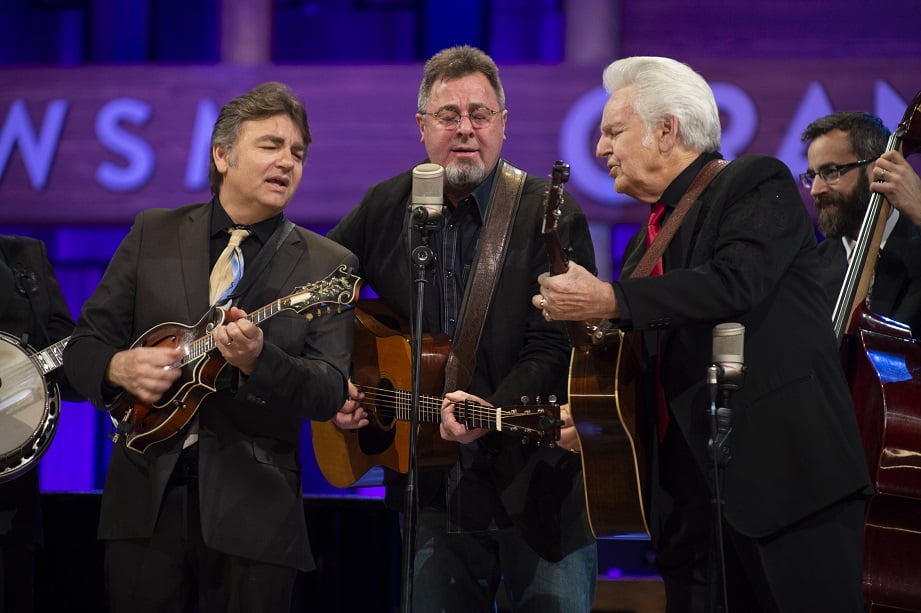
Ronnie McCoury, Vince Gill, Del McCoury
Asked about the decision to spin off a group from The Del McCoury Band, employing everybody except himself, Del says he conferred with manager Stan Strickland about how to make it work.
“I got to an age where I thought, you know, I’m [not] gonna be around here forever,” he noted, just before breaking into his trademark laugh. “I felt good, and I still feel good, but you never know. When you get to 70, you don’t know how many days you got left. I thought, these guys depend on me. My wife and I talked to Stan and I said, ‘You know, if we get them something going on their own, and if something happens to me, then by that time they might be established.’ So we got them a different booking agent than I had, and it seemed like right from the start they were starting to do good already! And I thought, ‘Wait a minute now, I wonder if I should have done that…’”
He breaks into laughter again, before adding, “Especially when they start winning Grammys! And they don’t take me with them!”
Loyal bluegrass fans know that for decades the Del McCoury Band has done its own share of travelin’ – not to mention winning two Grammy awards of their own. Led by Del on lead vocals and guitar, the good-natured group includes Ronnie on mandolin, Rob on banjo, Jason Carter on fiddle and Alan Bartram on bass. Cody Kilby assumes Del’s role as a guitarist in The Travelin’ McCourys, while the vocals in that ensemble are handled in equal share by Ronnie, Rob, Jason, and Alan.
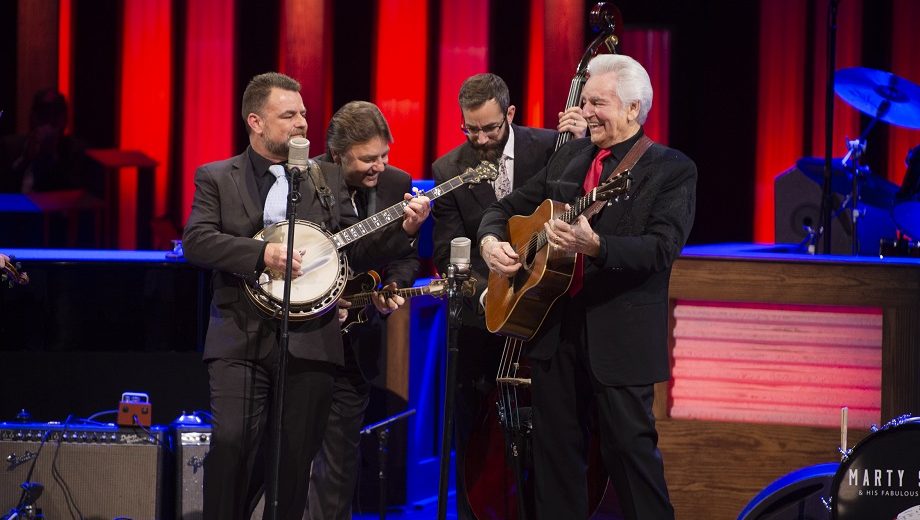
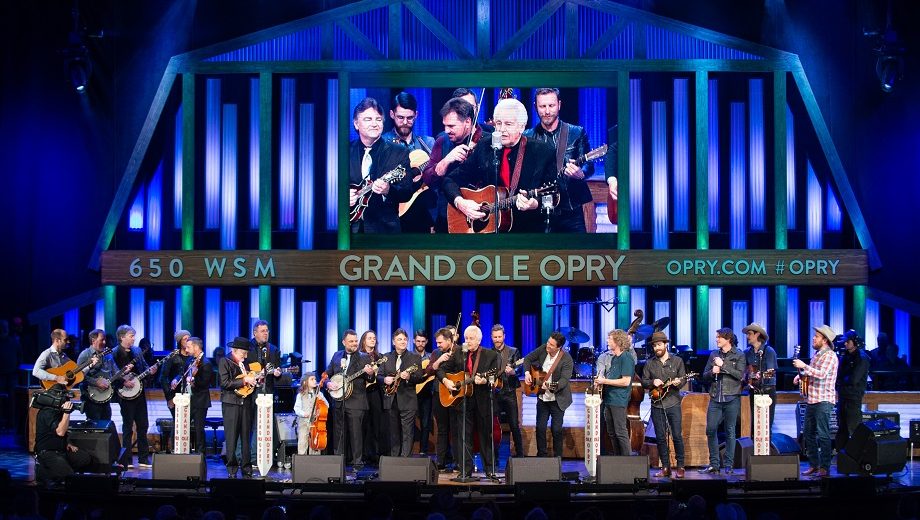
Three days after their Grammy win, the Travelin’ McCourys regrouped with Del when the Opry curated a special show called the Grand Del Opry, in order to commemorate McCoury’s milestone birthday as well as his 15th anniversary as an Opry member. Friends like Sam Bush, Bela Fleck and Abigail Washburn, Vince Gill, Old Crow Medicine Show, Jesse McReynolds, Ricky Skaggs, Marty Stuart, and of course Travelin’ McCourys jammed with the man himself.
The finale of the Grand Del Opry
In an interview a few weeks after the show, Rob says, “One of the biggest things for me was the finale, and looking at all these people on stage to help Dad celebrate his birthday. And also looking out to see nearly a full house in honor of my father. It made me very proud to see all these folks that have such respect for my dad and the music, and they all took the time to come out to the Opry that night and put on a show in honor of my father.”
Del McCoury made his first appearance on the Grand Ole Opry as Bill Monroe’s guitarist in 1963 – and that performance was only McCoury’s second gig with the esteemed Father of Bluegrass. The first was not long before that, when McCoury subbed for Monroe’s banjo player at a New York show. Although McCoury still preferred playing banjo, Monroe offered him a spot as a guitarist and lead singer – a job he kept for a year. “He’s the reason I’m doing that now,” Del says with a chuckle. “I didn’t think I would be, but once I started playing guitar and singing, I liked it.”
Obviously he still does. McCoury has played a staggering number of festivals over the years, including a few of those seminal Carlton Haney bluegrass festivals of the 1960s. Still he needed some persuasion to launch his own music festival. He recalls, “My manager said to me, ‘Did you ever think about having your own festival?’ And I said, ‘Yeah, I’ve always wanted to, but I don’t want the headache! What a headache that’s got to be!’”
But with persistence, the right location, and a diverse lineup, DelFest has become a major player on the folk festival circuit. This year’s roster includes The String Cheese Incident, Trampled by Turtles, Tyler Childers, Railroad Earth, and more than a dozen bluegrass artists, including Billy Strings, Sam Bush, the Gibson Brothers, Sierra Hull, and the SteelDrivers.
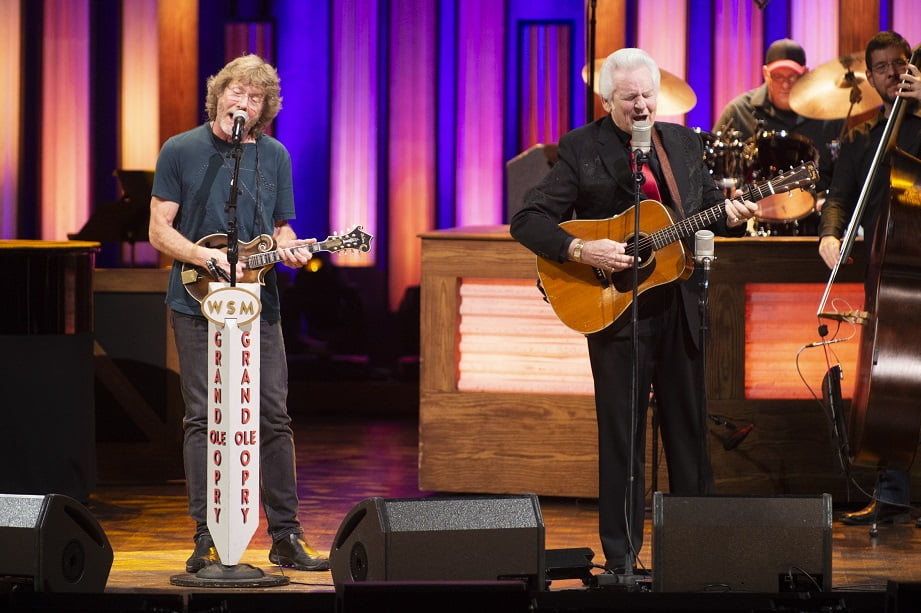
Sam Bush and Del McCoury
“Attendance is staying up there good, and it’s fun,” Del says. “It’s not a bluegrass festival, it’s just a music festival. We have a lot of bluegrass bands there, you know, but we have jam bands, and we have country acts, man, you name it. We had jazz bands, we had a mixture of music, and I like a variety of music my own self. I figured, if we have a variety of bands, some folks will come to see one band, then these folks will come to see another band, and that’s how you get your fans.”
Rob McCoury adds, “I thought having the festival was a great idea. We’ve played hundreds if not thousands of festivals through the years. So I think it was just the natural progression to have a festival of our own. I guess the most surprising thing is, the small details that add up to big things, that no one realizes is going on behind the scenes.”
Asked about the reward of all that work, he answers, “The fans, no doubt about it. All those folks come to DelFest, and anytime dad walks on stage at his own festival he’s a rock star. To me, it’s just the coolest thing.”
Rock star. Bluegrass Hall of Fame member. A nine-time IBMA Entertainer of the Year. Dad. These are just some of the ways you can describe Del McCoury. Winding down the interview backstage at the Opry, he pauses for a moment when he’s asked how he’d like the Opry family to remember him.
Finally, he says, “You know, I guess I’d want ‘em to remember me like a guy that never expected to be an Opry member. I knew I would play music, for years and years, but I thought, ‘The Opry is something is really special and I don’t know if they’d want me there.’ I was fortunate that they did, and I’m just so grateful. I hope they just remember a country guy that really loves the Grand Ole Opry and loves music.”
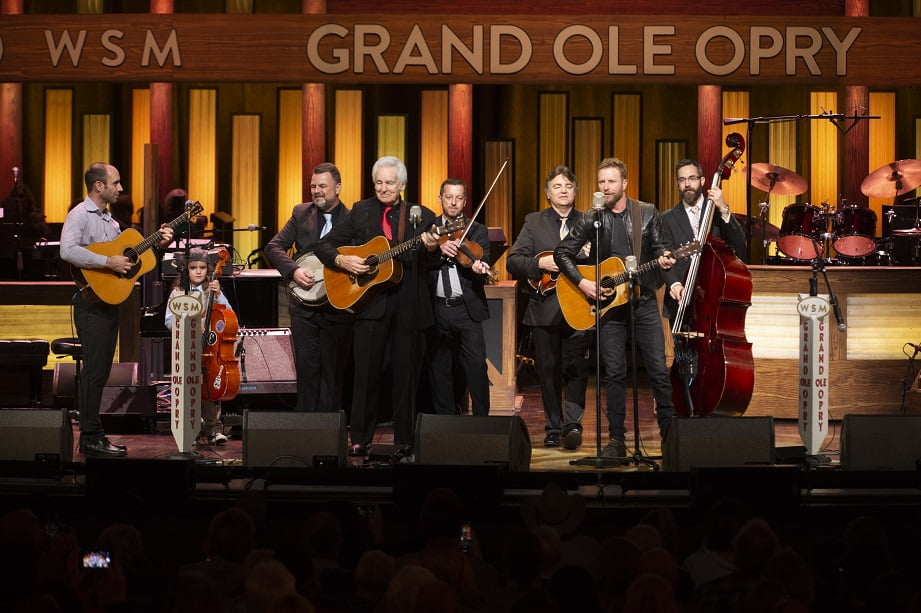
The Travelin’ McCourys, Vassar McCoury, Del McCoury, and Dierks Bentley
Photo credit: Chris Hollo / The Grand Ole Opry
This website uses cookies to improve your experience. We'll assume you're ok with this, but you can opt-out if you wish.AcceptRejectRead More
Privacy & Cookies Policy
Privacy Overview
This website uses cookies to improve your experience while you navigate through the website. Out of these, the cookies that are categorized as necessary are stored on your browser as they are essential for the working of basic functionalities of the website. We also use third-party cookies that help us analyze and understand how you use this website. These cookies will be stored in your browser only with your consent. You also have the option to opt-out of these cookies. But opting out of some of these cookies may affect your browsing experience.
Necessary cookies are absolutely essential for the website to function properly. This category only includes cookies that ensures basic functionalities and security features of the website. These cookies do not store any personal information.
Any cookies that may not be particularly necessary for the website to function and is used specifically to collect user personal data via analytics, ads, other embedded contents are termed as non-necessary cookies. It is mandatory to procure user consent prior to running these cookies on your website.
 Ronnie McCoury, Vince Gill, Del McCoury
 The finale of the Grand Del Opry
 Sam Bush and Del McCoury
 The Travelin’ McCourys, Vassar McCoury, Del McCoury, and Dierks Bentley