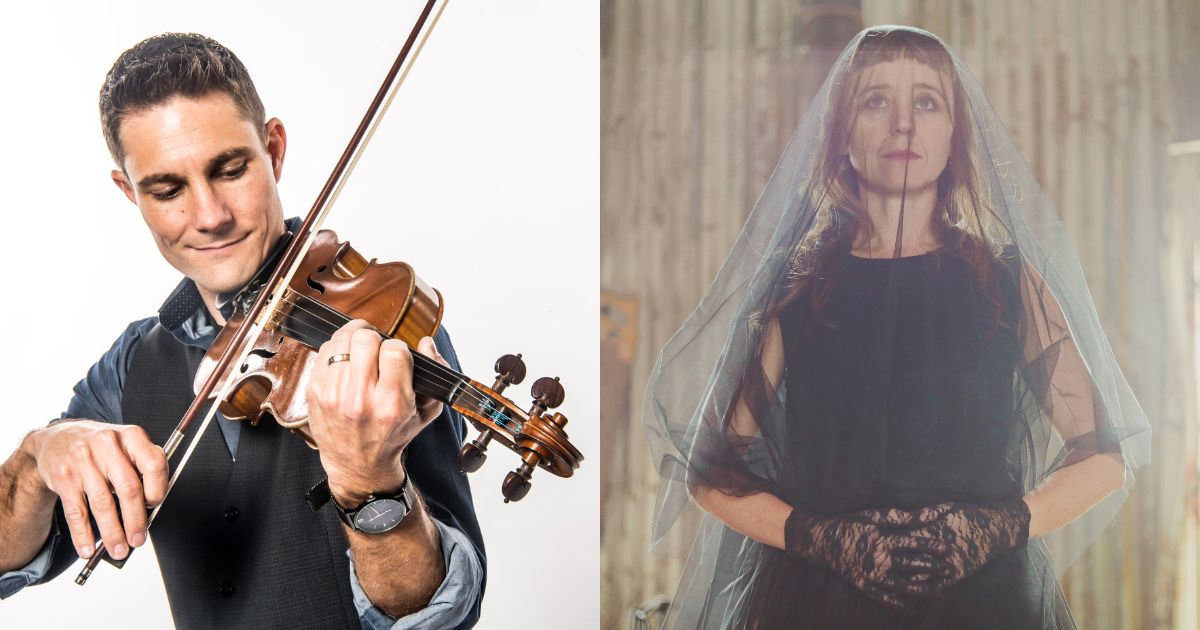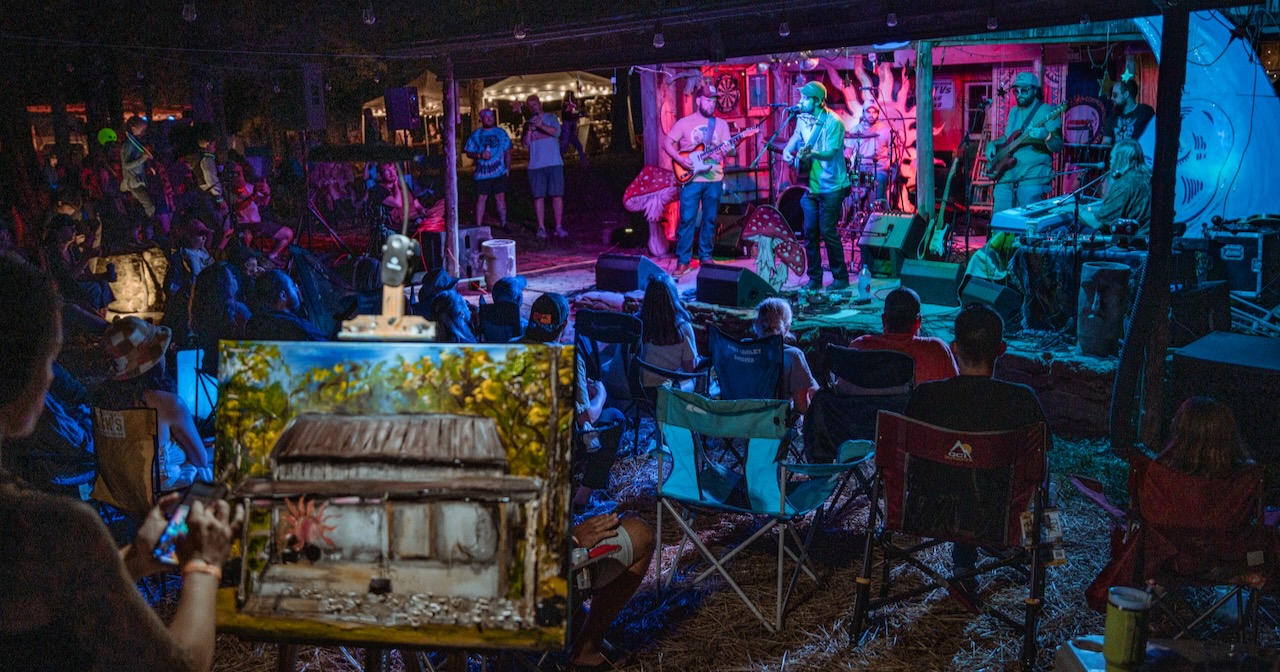
DISPATCH: An Intimate and Essential Kentucky Festival, Sleeping In The Woods

There’s something in the water in Kentucky that’s conducive to making great songwriters, and the second annual Sleeping In The Woods Festival — held May 17-19 in Monticello — was no exception.

Hosted by artist and songwriter Nicholas Jamerson, the gathering has quickly become a can’t-miss attraction featuring a mix of the Commonwealth’s most revered songwriters, as well as the ones they’ll eventually be handing the reins off to. The setting of Hidden Ridge camping — a birch tree-covered campground nestled along Lake Cumberland — further elevated its intimate feeling (in addition to providing a canopy of shade during a deluge of rain Friday).

However, despite Mother Nature’s best efforts on day one, the few hundred in attendance didn’t have their spirits dampened by the soggy forecast, instead filling out a massive tent by the festival’s second stage for a songwriter round to open things up. Featuring Ryan Anderson of Louisville rock band Bendigo Fletcher alongside Jamerson, in a last minute change of plans, the two opted to debut entirely new and unrecorded music during the hour-long round, further putting a microscope on their superb songwriting, the stories behind them, and the creative process at an event built for exactly that. Outside of rain pattering on the tent above, you could hear a pin drop. Even though fans weren’t familiar with these songs, it was obvious they were captivated by the occasion, a sign of the duo’s songwriting prowess and power of getting caught up in the moment.
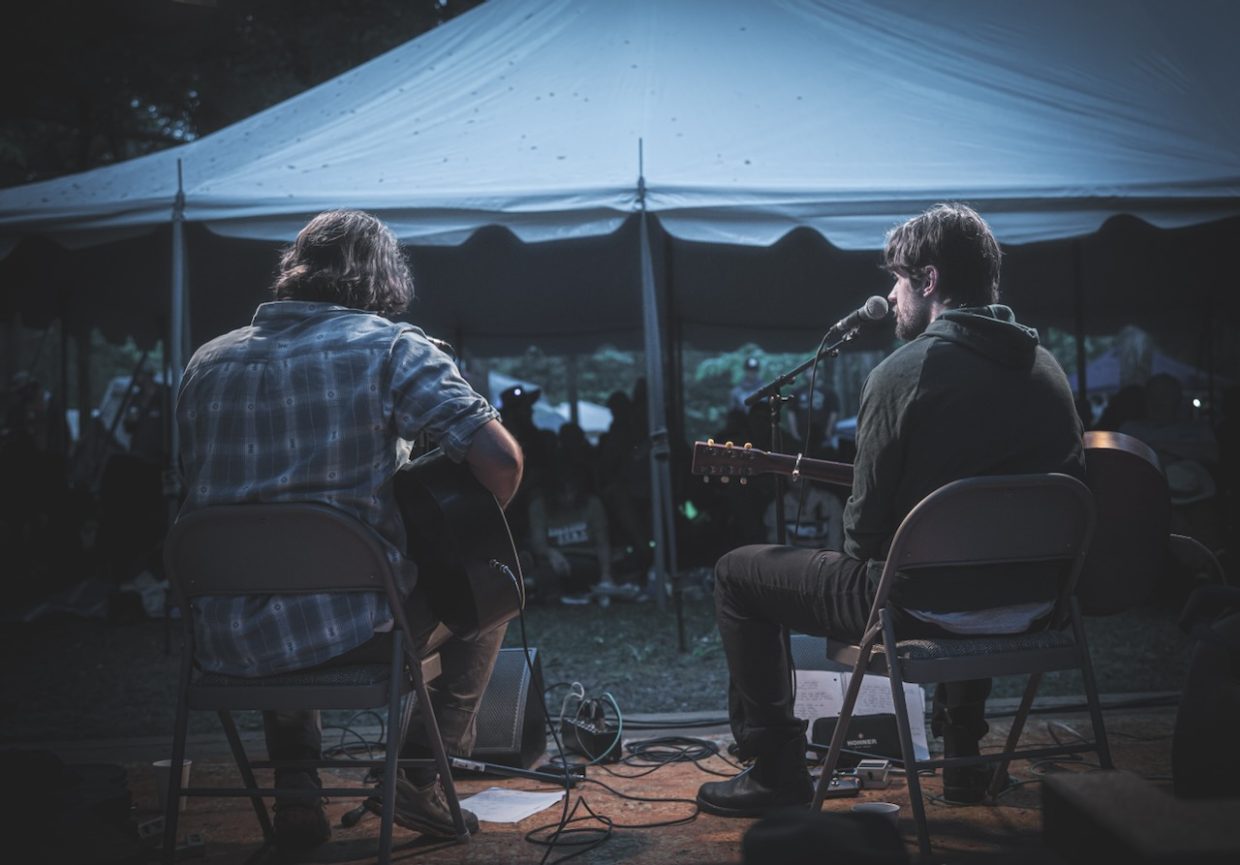
Nicholas Jamerson and Ryan Anderson (Bendigo Fletcher) open Sleeping In The Woods festival with a songwriter round.

“Getting to play all new songs with Ryan Anderson felt like the perfect way to set the tone for the festival,” Jamerson tells BGS. “I’ve admired him so getting to share that space meant a lot.”

Following the round of new material was one of the festival’s few non-Kentucky acts, Cristina Vane. As a result I found myself talking with countless folks as she set up about what to expect from the electrifying slide guitar and banjo picker, but even my best of introductions couldn’t have prepared them for the show she gave them.

Working as a trio with drums and bass guitar, Vane tore through originals like “Blueberry Hill” and “Small Town Nashville Blues” alongside new songs like “You Ain’t Special” and sweltering covers like James McMurtry’s “Choctaw Bingo.” Through it all, she had the crowd at her will, seemingly unaware of the rain falling around them, including myself.
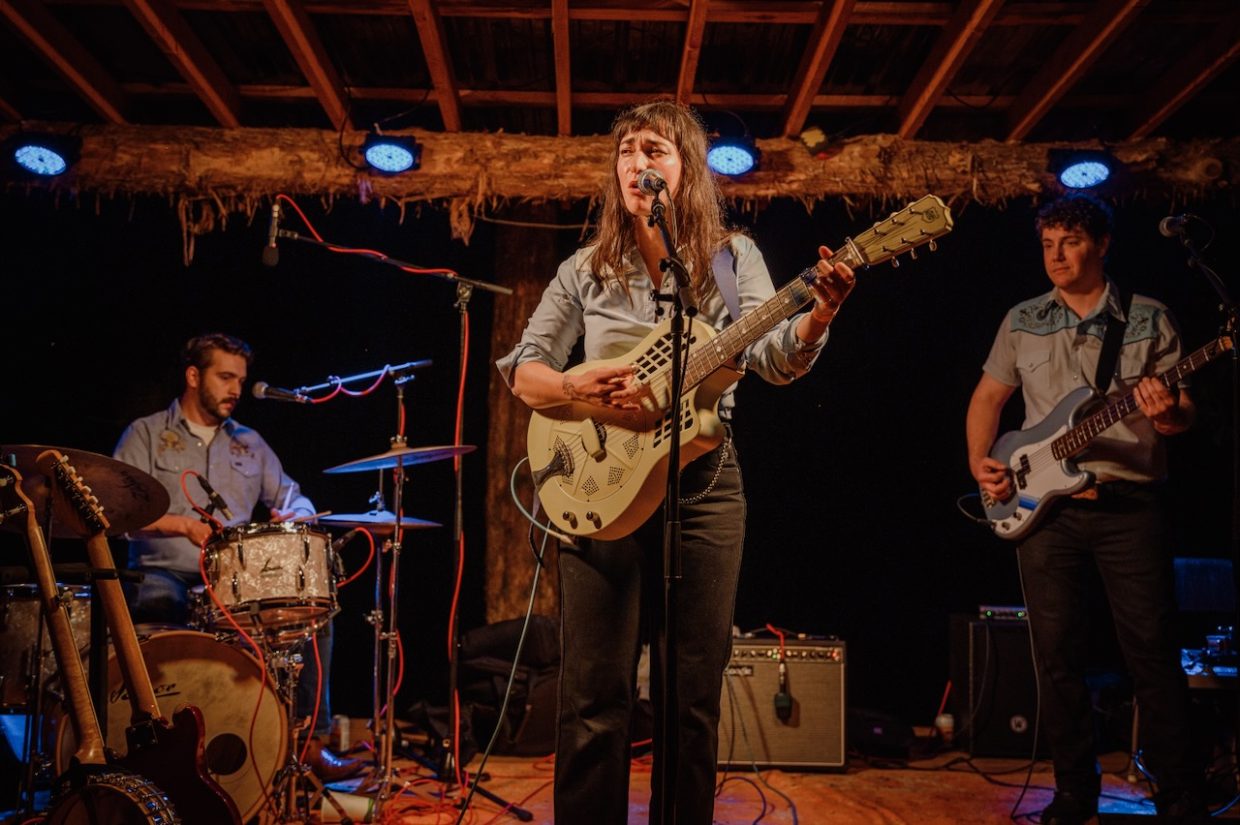
Cristina Vane performs at Sleeping In The Woods.

Although I’ve seen Vane perform several times, each occasion always feels like a first due to the versatility of her band setups. I’ve seen her play solo, with a full electric band, a full bluegrass band, and now as an electric three-piece; each show feels so different. Her songwriting is built for a festival like Sleeping In The Woods, but how she’s able to plug and play, presenting her music in many different ways is what truly sets her apart. Fans on Friday seemed to agree, giving Vane a ferocious standing ovation at her set’s conclusion, something that even she didn’t seem to expect.

“It was cool seeing people react to acts they hadn’t seen,” shares Jamerson. “I felt like Cristina Vane, The Dick and Tammy Show (Justin Clyde Williams and Tyler Hatley), and Josh Slone all made really huge impressions on people.”

Another out-of-state act integral to the weekend was Rachel Baiman. The Nashville-based multi-instrumentalist was everywhere over the three-day event, starting with a songwriter workshop she led to begin Saturday’s musical menu. Attended by around 50 under the tent that Cristina Vane rocked out the night prior, the croissant-fueled workshop saw Baiman working with fellow songwriters and aspiring ones alike to take internal conflicts and turn them into external ones via song.

This drew a mix of interesting inspiration from the heavy — a man trying to fit in with his different groups of friends and a mom and pop trying everything to keep their small business afloat — to tongue-in-cheek ones, like a prompt about how losing your Chapstick makes you feel like an inadequate lover.

“The songwriting workshop was both a complete joy and completely terrifying,” recalls Baiman. “Trying to ‘teach’ songwriting to some of my favorite songwriters felt a little crazy, but I think it really contributed to the class, because we could hear ideas from newcomers and seasoned professionals side by side.”
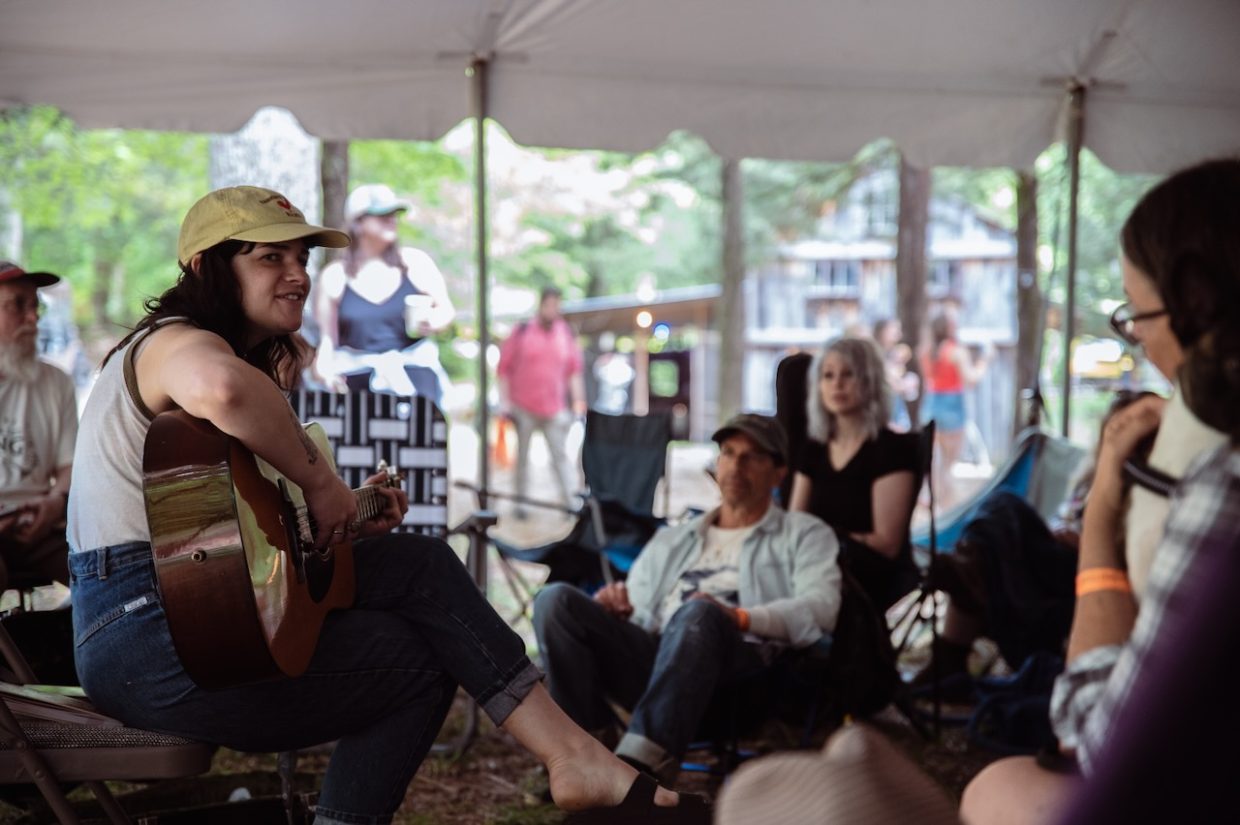
Rachel Baiman leads a songwriting workshop on day 2 of Sleeping In The Woods festival.

Outside of the workshop, Baiman also led a songwriter round of her own on Sunday afternoon that she used to showcase recent co-writes with Pony Bradshaw (“Equine Elvis”), Caroline Spence (“Throw Away The Moon”), and Jamerson, who joined her for a performance of their song, “The Vine That Ate The South,” due out next month. Additionally, she took to the stage with Leah Blevins, an Eastern Kentucky singer by way of Nashville, prior to Sunday’s round, fiddling with the Sandy Hook native on a selection of songs including the nostalgic “First Time Feeling.”

The set was a grounding one for Blevins, who expressed a longing to return home from Nashville in recent months even as she’s hit a breakthrough, signing a publishing and management deal with Major Bob Music in April. She expects to begin recording a new album soon.

“Any opportunity to be back home in Kentucky is a true sense of comfort,” says Blevins. “There are so many unbelievably talented artists there and this weekend was a true representation of that. It’s inspiring and always humbling to share the stage with folks that you genuinely respect like Nicholas. He’s always made me feel welcomed and his kindness alone is influential on a human level.”

Other Kentucky luminaries that stood out included Somerset’s Cody Lee Meece, brothers Wes and Aaron Smith — who were joined by Anderson on synth for an intriguing acousti-tronic sound — along with Ryan Allen & Maggie Noëlle’s stripped down versions of songs from their band, Magnolia Boulevard, and a Saturday evening round featuring three of the state’s stars of tomorrow: Salyersville native Zoe Howard, Hindman’s Josh Slone, and Central Kentucky’s Ireland Owens.

But it was Hunter Flynn, one of the state’s other promising young talents, that garnered the most attention. A local boy from just up the road in Somerset, Flynn’s Sunday afternoon set showcased the singer’s sensational songwriting and holler yell on cuts like “Spanish Street Signs” and “Fucked Up Brain” that have earned him recent gigs on the road with Zach Top and Ian Munsick, among others.
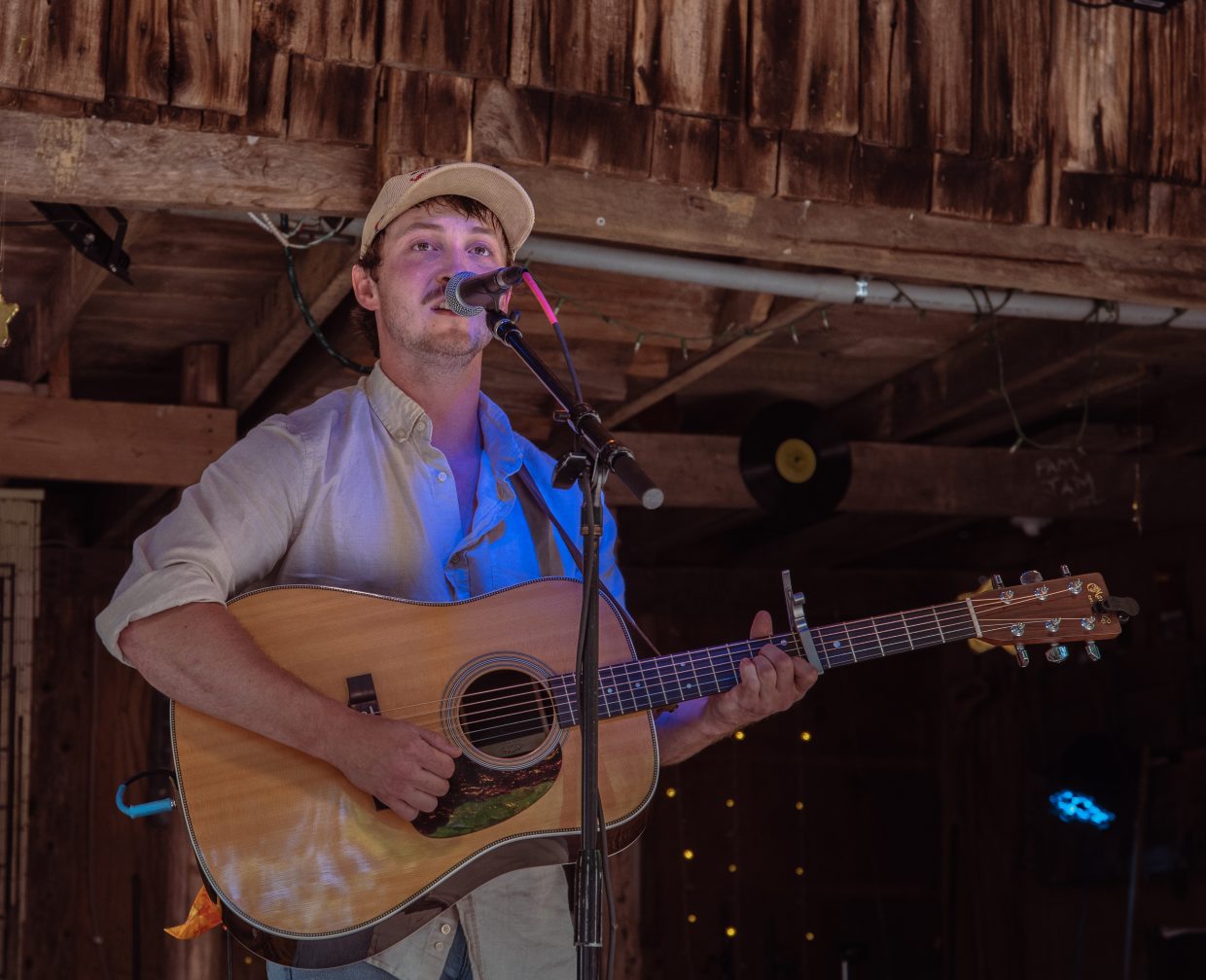
Hunter Flynn performs Sunday afternoon at Sleeping In The Woods festival.

In a pay-it-forward fashion similar to how Jamerson is platforming new artists with the festival, Flynn — who won a recording package from festival sponsor Jamm Nation during the event — plans to serve up his studio time to young artists in need on a collaborative EP that Jamerson will produce. According to Flynn, he wouldn’t be where he is today without Jamerson’s music and guidance.

“Before I knew Childers, before I knew Sturgill, before I knew Stapleton; I knew Nicholas Jamerson,” explains Flynn. “He might not have been the first to do it, but he was the first person that I knew from the Appalachian region that was writing songs and playing them for a living. Now I don’t know a single singer/songwriter from this region who doesn’t cover at least one of his songs. He could win six Grammys next year and it wouldn’t be as much recognition as he deserves.”

A more seasoned Kentucky artist that also turned heads was Henry County’s Joe Clark, who pulled back the curtain on songs typically backed by his country rock band, The Peacemakers, that touch on everything from drug addiction to the love he has for his father. Clark was hard to miss all weekend due to his towering presence, but heartfelt songs like “Wishin’ Well” and “Battlefield” showed a soft side to counter his hard exterior, one of the many things a powerful song can do.
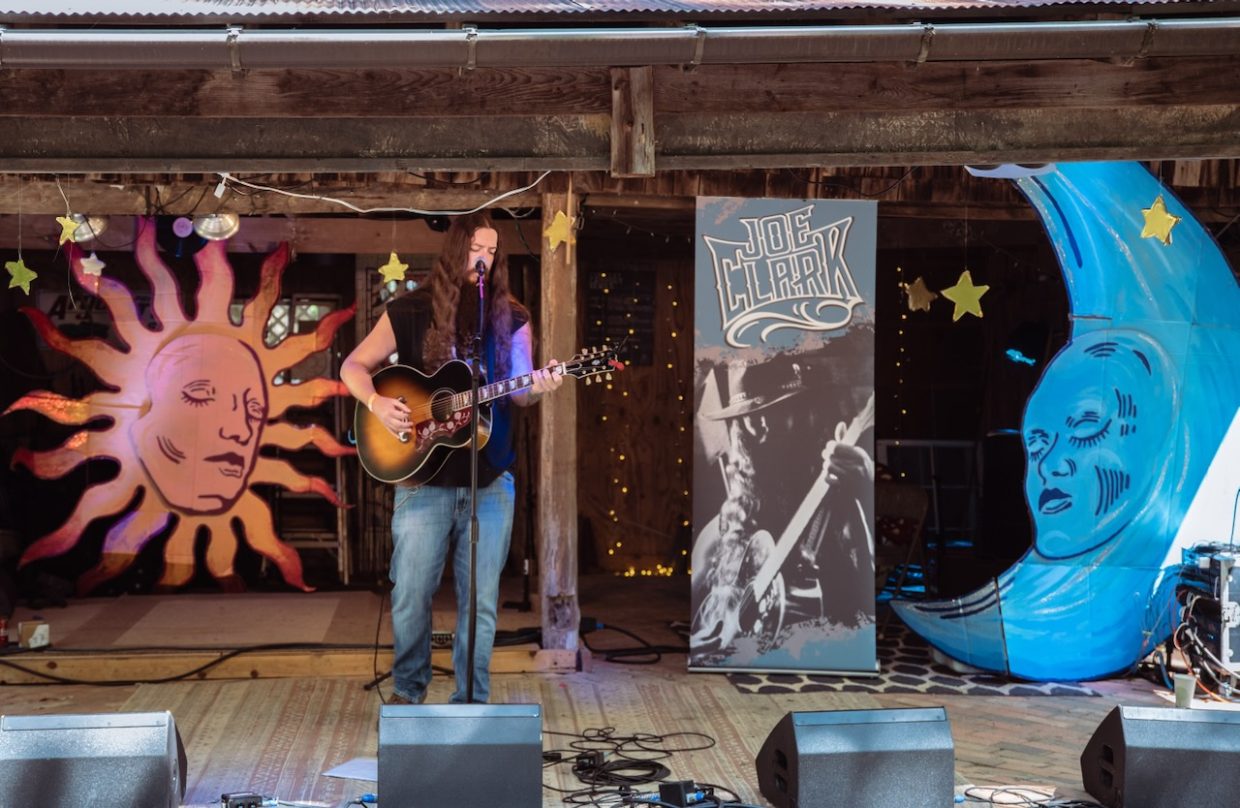
Joe Clark takes the stage at Sleeping In The Woods festival.

“Music is my therapist. Along with my children and family it’s kept me sober and alive for years,” confides Clark. “I owe my life to songwriting. It is a power greater than me and I’m honored to put pen to paper each time a lyric comes to me. My biggest hope is to be able to take my real life experience and translate it through song in a way that someone else can take it and make it theirs and use it in a healing way for themselves. Music is medicine, and I believe everyone needs a daily dose to stay healthy.”

Closing out Sleeping In The Woods was one of the most iconic and influential Kentucky songwriters ever – Darrell Scott. For nearly two hours on Sunday afternoon the trailblazer showed off his fiery picking skills on iconic songs like “Never Leave Harlan Alive” and “It’s A Great Day To Be Alive,” giving all of the artists and fans in attendance something to look up to and aspire to in the process. The performance also left many in the audience visibly emotional including Jamerson, who could be seen tearing up throughout it.

“Having Darrell there really meant a lot,” reflects Jamerson. “It felt like we had the full spectrum of musicians, from green, next generation, seasoned vets and a master in Darrell. We are hoping to expose the youngins to a sustainable path in this industry, so having someone like Darrell was really validating for me.”
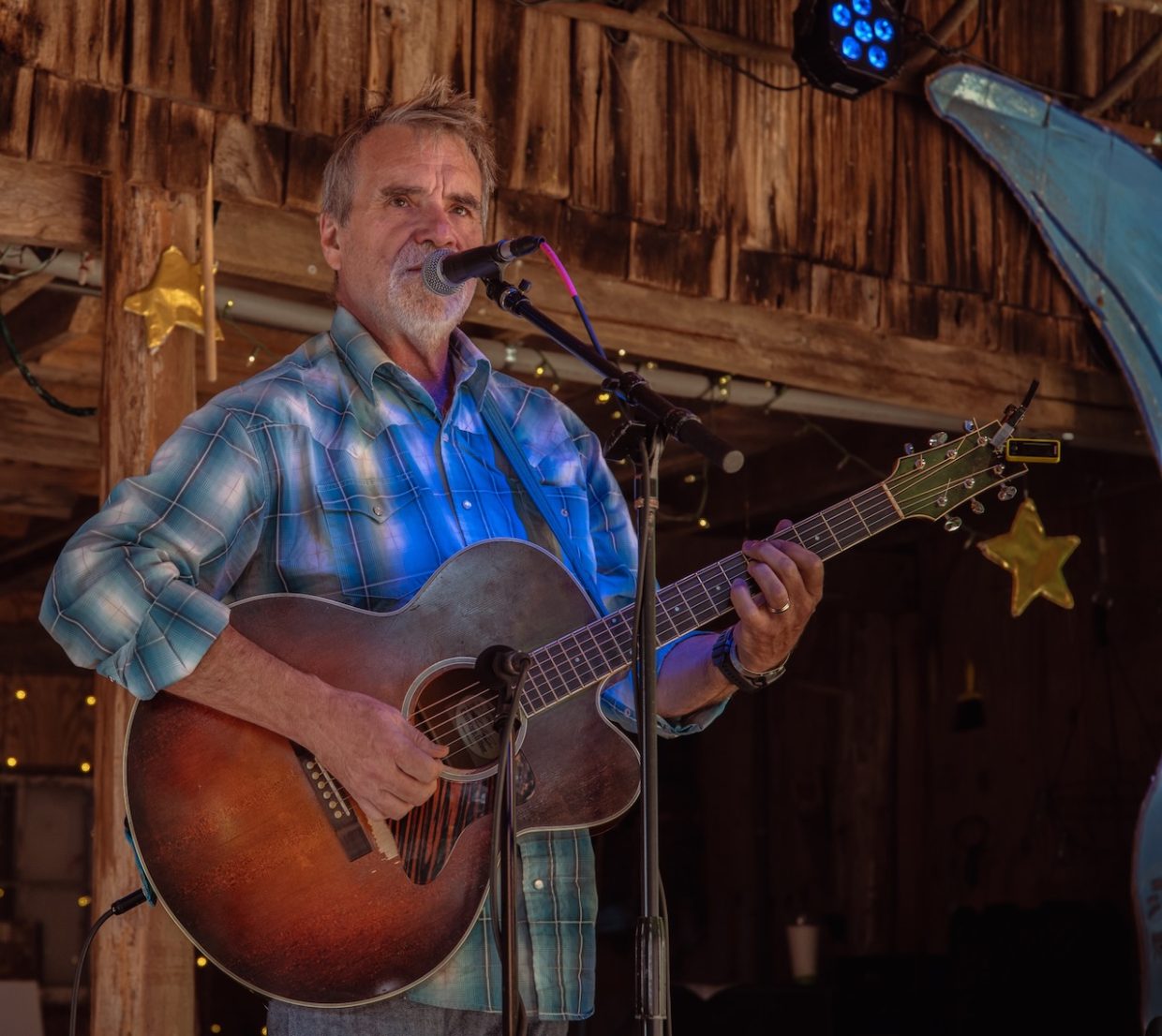
Darrell Scott headlines Kentucky’s Sleeping In The Woods festival.

From vets like Darrell Scott to youngins like Josh Slone, Zoe Howard, and Hunter Flynn, and present day stars like Nicholas Jamerson, Sleeping In The Woods was proof of many things — that Kentucky music is in as good a place it’s ever been, that smaller, niche festivals do have a place in today’s music landscape, and that great songwriting will never go out of style.

“It feels like the best way to kick off the year,” describes Jamerson, who’d been laying low since his two-night Hollerday Gitdown in December. “It’s such a great group of people that makes it all happen. It’s also really grounding, inspiring and a nice reminder of the community of people that I’m a part of, which is uplifting and gives me life going into the busy season.”


All photos by Joe Wilkins, courtesy of Sleeping In The Woods festival. 
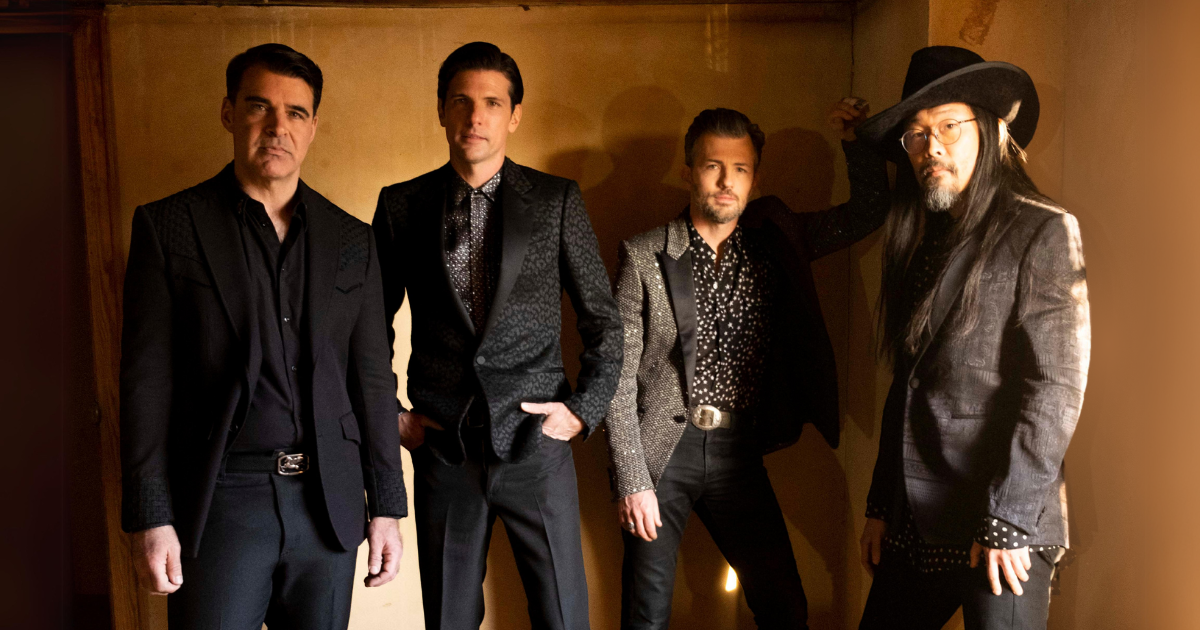
Artist of the Month: The Avett Brothers

(Editor’s Note: On May 17, The Avett Brothers released a new, self-titled album. BGS is proud to bring them back as our Artist of the Month for June 2024.

Below, enjoy a musical exploration of their illustrious career and prolific catalog. Plus, you’ll also find our Essential Avett Brothers Playlist for even more discography digging. And, you can revisit our feature from June 2016, when they were first selected to be our AOTM eight years ago.)

Depending on how you reckon it, you could say The Avett Brothers’ career goes back about two-dozen years – or Scott and Seth Avett’s entire lives. Even if you know nothing at all about them, all it takes is a few seconds of hearing them singing together to realize that they really are brothers.

Elder brother Scott’s voice is usually earthy and down below to Seth’s angelic up above. They meet in the middle to harmonize on songs about a series of quests – for love, redemption, family, pretty girls from far-away places, or just to be seen. Small wonder that one of their latest undertakings is Swept Away, a musical inspired by the mythology of their musical world.

To celebrate our Artist of the Month, here are a dozen songs about The Avett Brothers’ remarkable journey.

“Pretty Girl From Matthews” (2002)

Pretty girls are, of course, a perennial songwriting topic for the Avetts – most of them identified simply as “Pretty Girl From.” It’s taken them far and wide, from Michigan to Chile, Annapolis, San Diego, Cedar Lane, Raleigh, Feltre, Locust and even “at the Airport.” But here is the earliest example in all the Avetts’ early, detuned glory, from a town southeast of Charlotte. Originally titled “Song For Robin,” “Pretty Girl From Matthews” was the opening track on 2002’s Country Was.

“Talk on Indolence” (2006)

Folksy Americana trappings aside, Seth and Scott started out playing in bands that did a lot more screaming and thrashing than crooning and strumming. And even as their music has grown more polished and stately over time, their raw streak still comes out regularly. This breathlessly paced head-banging rant, which kicked off 2006’s Four Thieves Gone: The Robbinsville Sessions at an amphetamine pace, is one they still play at most shows.

“Distraction #74” (2006)

Another Four Thieves Gone recurrent, “Distraction #74” evokes British seafaring vibes seemingly tailor-made for raucous pub sing-alongs. And it has a perfect Avett Brothers lyrical theme: Torn between two lovers, the protagonist mostly wonders which of them he’s going to miss the most. The only certainty is that he’ll blow it with both of them.

“Die Die Die” (2007)

In which the Avetts don’t just make a simple pop move, but pull off what might be the least-likely Beatles rip ever. “Die Die Die” opened 2007’s Emotionalism, their first album to crack the Billboard 200 and a showcase for new cellist Joe Kwon. Among the Fab Four echoes here are Beatle-esque vocal harmonies and a guitar solo that’s pure George Harrison. Onstage, they’ll sometimes make it even more overt by closing with flourishes from “I Want to Hold Your Hand.”

“Paranoia in Bb Major” (2007)

Nothing fancy, just a little banjo and glockenspiel number from Emotionalism that perfectly captures the Avetts’ manic whisper-to-a-scream mood swings. Then it closes with one of their quirkiest recorded moments, wordless falsetto chanting that is somehow adorable.

“Murder in the City” (2008)

From 2008’s The Second Gleam, “Murder in the City” came out right when this cult act was about to go mainstream. It feels like one last look back before stepping into the spotlight, a series of epigrams about love, jealousy, family and forgiveness.

“Murder in the City” remains one of the Avetts’ regular live set-pieces, with lyrics that have evolved to reflect the brothers’ evolution from children to parents themselves. It’s a cinch they’ll still be playing and updating it someday when they’re grandparents, too.

“Head Full of Doubt/Road Full of Promise” (2009)

Fittingly, “Head Full of Doubt/Road Full of Promise” was the song the Avetts played during their star turn with Mumford & Sons behind Bob Dylan at the 2011 Grammy Awards. “Decide what to be and go be it” might be their most durable manifesto, which is a big reason it remains their most-performed song live. According to Avett Brothers super-fan Tim Mossberger’s database, it’s closing in on 1,000 live performances. And it still kills. All it takes is hearing Kwon’s cello riff to bring on chills.

“Laundry Room” (2009)

Like “Head Full of Doubt,” “Laundry Room” is drawn from the Avetts’ 2009 big-league debut, the Rick Rubin-produced I and Love and You – their first gold record. It’s a beautifully poignant portrait of stolen-moment love that may or may not be doomed.

“Tonight I’ll burn the lyrics/ ’Cause every chorus was your name,” Scott sighs, contemplating a “head-full of songs” he dreamed up overnight. The double-time hoedown outro plays like a bittersweet wake. “Laundry Room” ranks second on Mossberger’s live-performance database.

“Live and Die” (2012)

From 2012’s The Carpenter, the Avetts’ first to crack Billboard’s Top 10, “Live and Die” is just about the poppiest they’ve ever sounded – even with banjo as lead instrument. In contrast to the Avetts’ usual outlook, it is surprisingly optimistic, which made it the perfect upbeat closing-credits accompaniment for director Jud Apatow’s romantic comedy, This Is 40.

“Satan Pulls the Strings” (2014)

The studio version of “Satan Pulls the Strings” appeared on 2016’s True Sadness, but this one was around for years before that. In fact, its best incarnation is as entrance music for the live show. Among my favorite in-concert memories of the Avetts was watching the entire seven-piece band enter the stage one by one and start in on this song on New Year’s Eve 2014 in Raleigh, North Carolina. That performance appears on 2015’s Live Vol. Four.

“No Hard Feelings” (2016)

In recent years, “No Hard Feelings” has been the Avetts’ customary show-closer, ending each night on a prayerful, elegiac note. As depicted in the 2017 biopic May It Last: A Portrait of the Avett Brothers (overseen by Apatow and Michael Bonfiglio), recording it for 2016’s True Sadness LP was an overwhelmingly emotional experience. It triggered a meltdown by Scott immediately afterward, a sequence that proved to be the film’s most memorable moment.

“Operator (That’s Not the Way It Feels)” (2022)

On-record as well as onstage, the Avetts have always had splendid taste in covers, dipping into the songbooks of Townes Van Zandt, John Prine, Bob Wills and many others. There’s also “Operator (That’s Not the Way It Feels),” a 1972 Top-40 classic by the late great folk-rocker Jim Croce. Seth started doing a stripped-down acoustic version of “Operator” with bassist Bob Crawford back in 2012, and it’s one they still dust off regularly 12 years later.

Read more about the Avett Brothers’ eleventh and self-titled album here.


David Menconi’s latest book, Oh, Didn’t They Ramble: Rounder Records and the Transformation of American Roots Music, was published in 2023 by University of North Carolina Press.

David would like to thank Tim Mossberger for assistance with facts and figures.

Photo Credit: Crackerfarm

BGS 5+5: Grace Pettis

Artist: Grace Pettis
Hometown: From Mentone, Alabama and Decatur, Georgia. Currently living in Nashville, Tennessee. Spent my formative musical years in Austin, Texas.
Latest Album: Down To The Letter (out June 14)

Personal Nicknames (or rejected band names): I was Gracie Pettis ’til age 8 or so. When I was in the 5th grade, I made everyone call me “Bob,” because I thought it would be hilarious to be a 10-year-old girl named Bob. My Nobody’s Girl bandmate BettySoo calls me “Graceface” sometimes. I really tried to get my first band to go by “The Bluebirds.” Nobody was into it but me. I wanted Nobody’s Girl to be “The Starlings,” but it didn’t stick. I’ve got a thing for bird band names, including a really good one I’m holding on to, because I might use it one day. Robby Hecht and I think “Dessert Island” would be a great band name. (That’s a recent favorite from a long list of possibilities Robby has going on his phone.)

What’s your favorite memory from being on stage?

When I was 24, I was in the Kerrville New Folk songwriting contest. I’d been dreaming of going to Kerrville and getting into the contest since I was a kid, because my dad Pierce Pettis was a winner back in ’87. I remember being so incredibly nervous before playing. I was wondering if the judges would like my songs, if I’d be able to hit all the high notes, etc. And then when I was actually up there on the stage, I had this moment of clarity, where I realized that everyone in the audience was on my side. As in, everyone there was hoping and expecting that I’d be great. They were ready for me to be really good; in fact, they wanted me to succeed, not to fail.

Something about that realization – that the audience is not my enemy – helped me relax. And over the course of a few days, I realized that the other “contestants” were actually the friends I was making that would last me for the rest of my musical life. The word “contest” implies competition. But what I understood in that moment was that music is a collective and collaborative act. The audience and the performer are in it together; everybody wants it to be a great experience. And we artists are a tight knit community. We write together, play together, stay on each other’s couches. Music can be an ecosystem, and not a battle.

What rituals do you have, either in the studio or before a show?

I like to watch a little comfort TV on my phone while I’m curling my hair and putting on my makeup. Popular choices have included Star Trek, The West Wing, and Late Night with Stephen Colbert. It really helps me zen out and relax. That hour before the gig – when you’ve got a million thoughts in your head about the set list, and remembering the sound person’s name, and setting up merch, and making sure you put those names on the guest list – it’s really nice to get to sink into a familiar routine. Curling hair, putting on mascara, etc. It sounds silly, but that time is really important to me.

When I’m playing and traveling with friends, I like to have a “human” moment before the gig – just a second to check in with each other. Maybe tell a few jokes, have a bite to eat, or share how we’re feeling (physically, emotionally, etc.) before we have to be “on” with an audience. It’s easy to forget to check in with each other in the busy hustle of the pre-show and post-show check list.

If you had to write a mission statement for your career, what would it be?

“Make it mean something.” As in, the song, my day, the show, my life. I want the things I make and the time I spend on the planet to mean something, firstly to me, and also to others. I actually wrote that mission statement into a song (“Mean Something”), which I recorded on my album Working Woman (2021). It’s great to have a song that’s also a mission statement. I sing it a lot during sound checks and during shows, when there are obstacles getting in the way of me being able to center myself and be present in the moment. Maybe the sound system is not cooperating. Maybe there’s a disrespectful person in the crowd. Maybe it’s a noisy bar and the game is on the TV overhead. Maybe I’m sick, or tired, or just in a bad mood. “Mean Something” helps me remember why I’m on the planet and here in the room that I’m in. It connects me with my purpose, gratitude, and joy.

If you didn’t work in music, what would you do instead?

When I was a very little kid, I also wanted to be an artist – as in a painter or illustrator. I wanted to write books too. Later, in middle school, I briefly wanted to be a school counselor, but dismissed the idea because I didn’t want to be in the same office every day, five days a week. In high school, I was into the idea of being a truck driver. The whole world is your office and your view changes every day. And you can eat as much junk food as you want and use those cool portable devices that plug into your truck engine. Little stoves and TVs. I love gadgets like that. And I love the idea of listening to audiobooks for hours on end. My music job is pretty similar to truck driving, really. I do a lot of driving, and loading and unloading of gear. More junk food than I would like. And a lot of audiobooks.

What is a genre, album, artist, musician, or song that you adore that would surprise people?

I’ve always been a really big Jennifer Lopez fan. When I was a guest on my bandmate BettySoo’s virtual show during the pandemic, we were asked to play “guilty pleasure covers.” I covered “Love Don’t Cost a Thing.” I maintain that it’s a jam.


Photo Credit: Starla Dawn

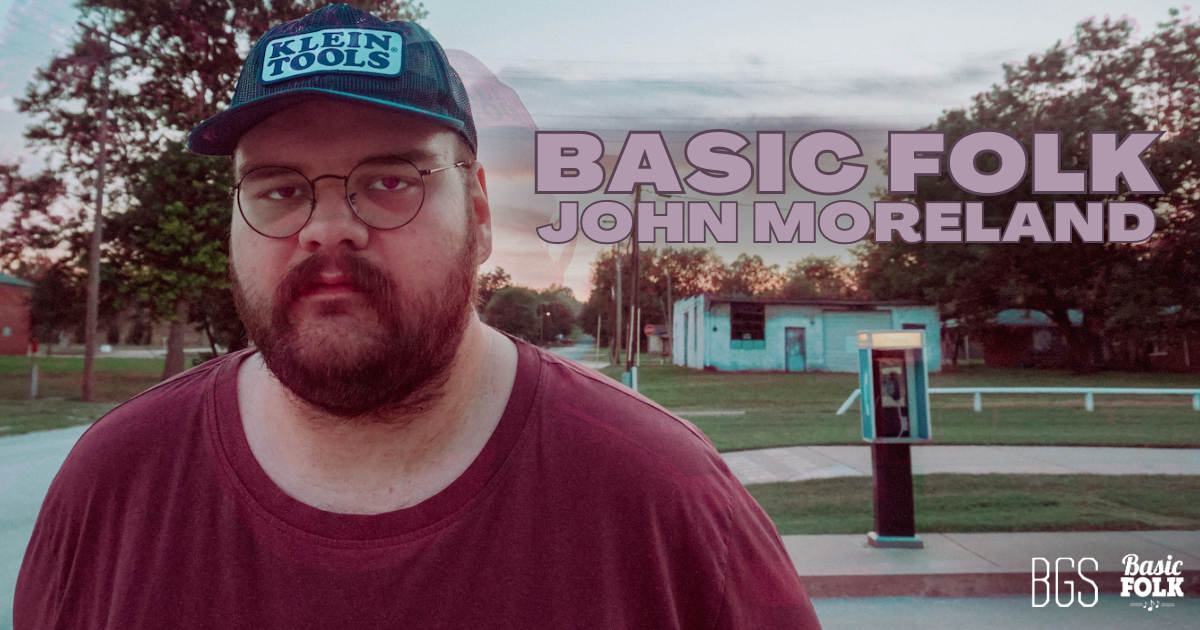
Freedom in a Flip Phone: John Moreland’s Quest for a Simple Life

I hate surprises. However, Oklahoma’s pride and joy John Moreland surprised us in April with his latest album, Visitor, and I guess I’m okay with it. Moreland’s gone back to a sparse acoustic instrumentation, unlike the electronic sound (which I also loved) on his previous release, 2022’s Birds in the Ceiling. Recently, he took a page from his wife Pearl Rachinsky’s and musician (and recent tour buddy) Chris ​Staples’ books and quit his smartphone, took a social media break, and stopped all touring for six months. What ensued was an incredible psychic change discovered through living electronically off the grid. Another thing that came about during this simplicity in life: An album full of songs. He would take long drives at night, bringing along his guitar and making field recordings of his new writing. All this culminated into his beautiful new record.

LISTEN: APPLE • SPOTIFY • AMAZON • MP3

During our Basic Folk chat, Moreland talks about the process of unraveling himself from his smartphone, reconnecting with the acoustic guitar, and getting to know himself again during this period of quiet. He talks about how playing live is very vulnerable for him, to the point where he started taking (and loving) beta-blockers to stave off anxiety and adrenaline. He is very candid with his current thoughts on body image – he has been known to experience body shaming online after performing live. We also get into something that’s been on my mind all year: Is climbing the professional songwriting ladder worth it? Pretty sure we figured out the answer. LOL


Photo Credit: Pearl Rachinsky

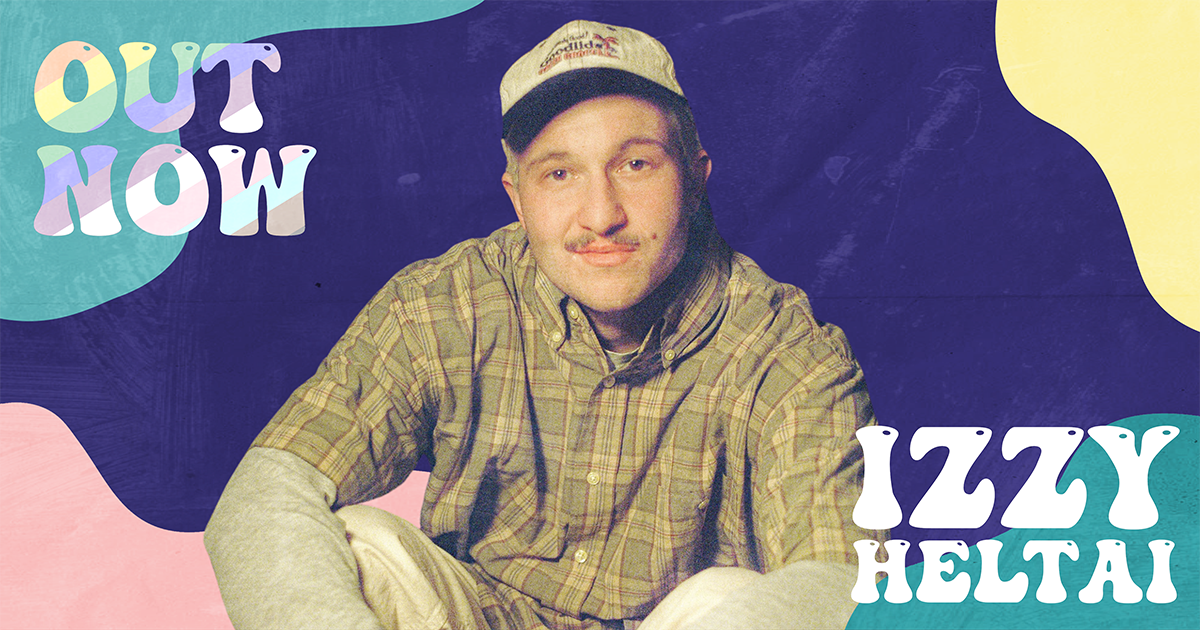
Out Now: Izzy Heltai

Izzy Heltai is an indie-folk artist whose songs touch on themes like growing older, feeling lost, and finding yourself – his music resonates with many people. Izzy played the first Queerfest event, a virtual festival in 2021 hosted in partnership with Club Passim. His latest single, “My Best Friend Sam,” came out on April 25.

Izzy has a debut New York headline show coming up. If you’re in the area, be sure to check out his show at Union Pool in Brooklyn on Friday, June 21. Our Out Now conversation covers work-life balance (a large theme in his new single), his favorite LGBTQ+ artists, and his current state of mind. We’re so excited to highlight this phenomenal artist, Izzy Heltai!

Your lyrics cover themes that many people can relate to such as being anxious, growing older, self-esteem, feeling lost, etc. Do you write with the listener in mind for the relatability of these topics? Are you mostly thinking of your own experiences and emotions? Or are you considering both during the creative process?

Izzy Heltai: I think a lot of what I experience is universal. I think as we get older we all deal with issues of identity, anxiety, a sense of feeling lost, etc. I don’t really think about writing, or creating, for the purpose of being relatable. I think inherently what I write about is relatable, but the only way I can keep it authentic is by simply saying exactly what I’ve experienced. I don’t claim to know, or want to tell other people what they’ve gone through, all I can do is talk about what I experience.

Your single that came out last month, “My Best Friend Sam,” includes the lyrics, “I’ve wasted close to a decade chasing dreams and expectations / I wanna leave, I wanna stop everything / I wanna be hanging out with my best friend Sam.” How are you balancing a demanding career in the music industry with taking time for yourself and personal relationships?

Honestly, it’s been tough. This work exists in oscillations of highs and lows. One day it can feel like you have everything at the tips of your fingertips and the next day it can feel like everything’s falling apart. I’m trying to block out a lot of that. I’m trying to focus on what makes me happy about all of this, creating music with my friends, playing shows and connecting with people.

Recently, I’ve just been focusing on being in one place. Trying to be present, spending time with people I love, working on my next body of work and doing things throughout the day that make me feel the most present I can be. Reading, riding my bike, climbing, and writing songs.

What is your current state of mind?

If I’m honest, it isn’t the best it’s ever been. I broke my hip about a year ago and some things changed in my life that I had a hard time adjusting to. I’ve been refocusing recently and just putting energy into making things I love. Working on new songs I’m really proud of, investing in my friendships, riding my bike a lot, climbing with my friends. Things that make me feel grounded and most myself!

What’s your ideal vision for your future?

I love making my music, I love my friends here in Nashville and my routine, but I also love touring. Touring and playing shows, connecting with people, seeing new things, is such a big part of this for me. My ideal future consists of a balance between a routine at home, bike rides, yoga, rock climbing, writing and creating my next body of work, and a consistent sustainable touring schedule.

What would a “perfect day” look like for you?

This one’s easy. A sunny hot day, a very long bike ride, and cooking with my friends.

Why do you create music? What’s more satisfying to you, the process or the outcome?

I make music, because at one point I was a lonely, confused kid, and for some reason this was the way I processed the world. I’ll always make music regardless of who’s paying attention, but it’s easy to lose sight of that sometimes. I’m fully aware, with my identity, if my music reaches a certain level of success it has the power to really impact a marginalized population quite powerfully. I think my music becomes much more than “just for me,” because of that.

Who are your favorite LGBTQ+ artists and bands?

Lucky and honored to call her a close friend, Katie Pruitt is absolutely at the top of that list. Leith Ross, Ethel Cain, and Chappell Roan are other favorites of mine.


Photo Credit: Cait Frances

Ruth Moody on Canadian Roots Music, Parenthood, and Being a ‘Wanderer’

Ruth Moody has a singular voice, whether she’s joining the soaring three-part harmonies of the Wailin’ Jennys, or carving her own path on her new solo album, Wanderer (released May 17.) The project was almost a decade in the making and finds Moody betting on herself as a songwriter, co-producer, and now-label head for her own Blue Muse Records. The album is parallel to Moody’s own journey at continuing to define herself, with its emphasis on confronting the past and carving away detritus that is no longer needed.

Moody splits her time between Nashville and Vancouver Island. The pull between her sense of place, as well as her identities as artist, wife, and mother, characterize Wanderer. The album was recorded at the legendary Sound Emporium in Nashville and was co-produced with Dan Knobler (Allison Russell, Lake Street Dive) and mixed by Tucker Martine (My Morning Jacket, First Aid Kit, The Decemberists).

As discussed below, Moody waited until the time was right to bring her favorite musicians together for the record: her partner Sam Howard, who plays upright bass and provides backing vocals; her older brother Richard Moody; The Wailin’ Jennys’ touring band member Anthony da Costa (guitars); Jason Burger (drums); Kai Welch (keyboards); Russ Pahl (pedal steel); Adrian Dolan (string arrangements); and duet partner Joey Landreth (on “The Spell of the Lilac Bloom”). Moody’s patient commitment to executing Wanderer the way she wanted to shows in its transcendent arrangements.

In our BGS interview, Moody discusses how she establishes her sense of self amidst the competing demands in her life, the factors that give Canadian roots music their own special quality, and the lessons she’s learned from doing Wanderer exactly the way she intended to.

What do you think it is about Canadian roots music in particular? It does have a different feel than roots music in the States.

Ruth Moody: You know, I’ve been asked this question for so long. It’s a very valid question, because I think there is something, but it’s really hard to have a clear answer. In Canada there’s such a range of geography and music culture. You can’t really pin it to one thing.

I grew up in Winnipeg and the winters are so harsh that I think music and art are one of the things that get people through. It’s something you can do in the winter. I also think that there’s something about the landscape and the winter that creates a certain work ethic because you’re so small against the elements, really. So consciously or subconsciously, that enters into the picture for people. And so I think people tend to work hard and really apply themselves. And when it comes to touring, especially if you’re from Winnipeg, it takes some effort to get to the next town. It’s a six-hour drive before you get to the next major town. So I think right from the start, young musicians know they have to go out in the world to tour and get their music out.

We’re pretty diverse and we’re also influenced by so many different cultures and types of music. So I think there is a very exploratory aspect to Canadian music. And a lot of cross-pollination between genres and scenes. We are very lucky to have government support for the arts and I think that helps artists thrive, obviously, but it also helps to create music communities and bring artists together in collaborative situations.

Well, it’s always good to start an interview out by asking you to speak for your entire country! But Wanderer focuses on the idea of home, and I know you’ve lived many different places. Did I read that you grew up in Australia?

I was born in Australia, and my parents are Australian, but they came back to Canada when I was only a year old. I grew up in Winnipeg, but, as an adult, I’ve moved around a ton and that was what inspired the title track. I’ve been touring for over 25 years at this point. “Wanderer” is a love song that I wrote for my partner, because he helped me have that feeling of home for the first time in my adult life.

There are a number of songs about young love and new love on the album. Was there something that was making you reminisce about those times in your life?

These songs were all written across a long time-span – over 10 years really – since my last record. So the songs come from different stages and sides of love, right into motherhood. Some songs deal with heartbreak too and some are more reflective about the past. During the pandemic, I was reflecting a lot about how we internalize the messages we receive from society, how as a woman I took on the expectations of others and how that has affected my life. I was looking back, looking for clues, curious about where fear comes from, where strength and resilience come from. How we learn how to be our authentic selves when there are so many outside pressures and confusing messages. “Seventeen” isn’t about that, at all, but it ended up coming out of that period of reminiscing. It’s a song that came from my own experiences but that is essentially about being in love and not being ready or able to face it or express it, which I think is probably a pretty common experience.

These are all things I’m thinking about a lot now that I have a child, too, because they become very relevant. You’re trying to model behaviors for a young person and it really makes you face yourself. You have to look at why you do and say certain things and what you want to teach and how you want to be.

Speaking of wandering, I read that you split your time between Nashville and Vancouver Island.

I just got back from British Columbia, and I’ll be back in BC in the summer, so yes, I’m back and forth. I tour a lot, so I try to get home to BC when I’m already out traveling. But I work a lot in Nashville and so does my partner, so we’re still figuring that out.

Do you feel you are different when you are in these two different places?

Definitely. That’s been a real theme becoming a mother, really. Suddenly, you’re responsible for another human life. You have to let go of a lot of ways that you used to do things and prioritize what matters. I’m always shifting modes.

When I’m on tour, I operate in a certain way. When I’m in BC, I’m close to my parents and that brings out certain things. When I’m on my own, I have a bit more freedom to maybe be my creative self and when I’m in parenting mode, that goes out the window. Additionally, a partnership requires a lot of work and time, too. There are a lot of different parts of life that I’m juggling. But it keeps it interesting.

This isn’t meant to be a conversation about being a musician and motherhood and “having it all,” but it is a big theme of the record!

It has been a big theme of my life of late. Actually, I wanted to make this record about eight years ago and then I put it on hold, because I wasn’t able to line up all the musicians I wanted involved. I thought, “I’ll do it next year.” And then I had my son and I just didn’t know that motherhood would be such an all-consuming thing. It doesn’t have to be – and everyone’s different!

I really want to do a good job at everything that I do, and so I found it hard [to balance everything.] I felt like I wasn’t doing a good enough job at being a parent and I wasn’t doing a good enough job at performing. That was really hard on me. And I think now, with this new way of looking at things, I’m just being easier on myself and thinking to myself, “Maybe I was enough. Maybe we can’t be perfect at every single thing.” Maybe we don’t have to attempt to be perfect at everything.

First and foremost I think that any woman should have the choice to [balance motherhood and work] in the way she wants to do it. I am still figuring out how to juggle everything – especially since for this record, I decided to put it out on my own label. It’s really exciting and I think will be really rewarding, but it is a ton of work and the learning curve is quite steep.

Wanderer is your fourth solo album. Do you feel this process is different than when you’re working with another artist or with The Wailin’ Jennys?

It is different. The Jennys – I mean, we’ve been together for so long and we have a certain way of working. We’re talking about making a new record, which is really exciting. It’ll be different, because it’s been a while and we’re all changing all the time, you know? That feels like it will be an exciting new experience.

But it is of course different working on my own, especially in this case, because I co-produced this record. When you’re on your own, you draw on a different part of your brain and even your heart. Wanderer is a really personal collection of songs. With the Jennys, we tend to maybe gravitate towards songs that call for three part harmony, so they end up being a bit more anthemic. With these really personal, intimate songs, I connect to them in a different way.

What lessons do you feel like you can take away now that you’ve finished making Wanderer that you want to take with you on your next project?

I’ve learned so much in doing this. Because it took so long to make it and these songs were waiting in the wings for so long, it felt really important for me to make it. The stakes felt high, because it had been so long in the making.

Now that it’s done and I’m putting it out, I am really excited and proud of it. I want to just keep releasing expectations and I’m very excited to dig into creative work again.


Photo Credit: Jacqueline Justice

You Gotta Hear This: New Music From Andy Leftwich, Vestal Brothers, and More

You know we always have your back when you need new music recommendations, right?

This week, we’re sharing premieres from extraordinary bluegrass pickers like fiddler Andy Leftwich and the Vestal Brothers, Curtis and Scott. Plus, singer-songwriters Eden Brent and Annie Bacon each showcase new emotive and moving songs about family, love, and grief. Bacon wrote “Alone With Grief” to be a comfort and a balm to those who have experienced loss, but without sugar-coating or toxic positivity. While Brent’s “You On My Mind” was written by her husband – and collaborator and bandmate – Bob Dowell, about their long distance courtship.

Don’t miss the Faux Paws reprising a song from their 2023 EP, Backburner, with bassist Zoe Guigueno or the final installment of Meadow Mountains SkyTheory Sessions series, which we’ve premiered in four parts over the last few weeks. You can watch “Backburner” and “Count Me In” below and find links to the Faux Paws’ crowdfunding campaign and the preceding three performances from Meadow Mountains video series, as well.

It’s all right here on BGS and You Gotta Hear This!

Andy Leftwich, “R-26”

Artist: Andy Leftwich
Hometown: Carthage, Tennessee
Song: “R-26”
Release Date: May 24, 2024
Label: Mountain Home Music Company

In Their Words: “I’ve always loved the music of Django Reinhardt and Stephane Grappelli. This fun tune was introduced to me by my wife’s cousin, Luke. It’s one that you don’t hear very often, but has a simple and catchy melody that is extremely fun to improvise and solo over. Django and Stephane have inspired so many great musicians and have had a huge impact on bluegrass music. I first heard about Stephane through David Grisman and their record, Live. I instantly fell in love with that style of music and dove head first into their catalog. The art of improvisation is something that makes bluegrass and swing music so unique and I was thrilled to record this one with Cody Kilby on guitar and Byron House on upright bass. I hope it brings a smile to your face as it does for me each time we play it!” – Andy Leftwich


Annie Bacon & her Oshen, “Alone with Grief”

Artist: Annie Bacon & her Oshen
Hometown: Ann Arbor, Michigan
Song: “Alone With Grief”
Album: Storm
Release Date: June 14, 2024

In Their Words: “Before I wrote this song, I knew this was my grief album and it’s deeply personal. But with the recording sessions approaching, I felt this urgency to say something directly to the listeners and not just share my own experience. I wanted to speak to that strange time in early grief when you need so much comfort, but also you kind of need zero bullshit. For example, I wanted the word dead in this song. No euphemisms. Your loved one is dead. They’re dead. That’s what it is. It’s strange how people struggle to say that word. For me there was a lot of comfort in being able to say it that plainly. But I also knew that my nervous system in that period was so dysregulated all the time. I was a disaster: veering between jumpy and catatonic. So when I was writing this song and channeling that time of grief, I wanted to create as much comfort and emotional safety as possible.

“I listen to a really wide variety of music, and while I didn’t make a conscious decision to give this a samba feel when I was first writing it, that’s definitely the kind of music that soothes me. When it was clear that that was what the song was leaning towards, I leaned all the way in. I’m so lucky that the musicians I was working with (Anson, Thomas and Paul) are really versatile and talented across multiple genres. So it wasn’t a stretch or strain. After I’d received the final master, I saw a friend’s post about her Mom dying suddenly, and I recognized the tone of her writing: a distant numbness from shock, matched with a recounting of the details, and then veering into total heartbreak. I sent her the song and she wrote back, ‘I feel like this was made just for me,’ and that’s about the best compliment I could’ve received. I hope that’s how it feels to everyone who hears it.” – Annie Bacon

Track Credits: Written by Annie Bacon.
Performed by Annie Bacon, Paul Defiglia, Thomas Bryan Eaton, and Anson Hohne.

Produced by Annie Bacon and Paul Defiglia.
Recorded by Paul Defiglia with Kate Haldrup and Wil Tsyon at Daylight, Nashville, Tennessee.
Mixed by Mike Clemow and Wade Strange at SeeThruSound, New York.
Mastered by Piper Payne at Neato Mastering, California.


Eden Brent, “You On My Mind”

Artist: Eden Brent
Hometown: Greenville, Mississippi
Song: “You On My Mind”
Album: Getaway Blues
Release Date: June 21, 2024
Label: Yellow Dog Records

In Their Words: “My husband Bob, who produced and plays bass on this recording, wrote this song for me, so it’s very personal. He is from London and I am from the Mississippi Delta, which means that we spent the whole seven years of our courtship across the Atlantic Ocean from each other. This song expresses the love that made our long separation tolerable. The idea is borrowed from Shakespeare’s Sonnet 44, which is a favorite of mine. In those 14 lines the poet declares that despite distance, one’s true love is only a thought away. When Bob was writing this, we discussed how most songs are remembered for the repeated lyrics and not for the meaning of the song in its entirety. We mentioned ‘When a Man Loves a Woman’ and ‘Don’t Worry Be Happy,’ and discussed John Mayer’s ‘Say.’ Melodically and lyrically, Bob wanted a song that was simple and easy to remember. We joke about this popular songwriting style and sing it like this: ‘Say what you need to say. Say what you need to say. Say what you need to say. Say what you need to say, and get out!’

“Musically, Bob originally envisioned a sort of marching gospel, but once the studio session began, my keyboard part sounded more like a country waltz. Here, Bob plays a warm sostenuto bass and asked the guitarist, Rob Updegraff, to, ‘Make it as country as you can.’ When the tape rolls, Rob bends the Telecaster strings making that lovely cry that opens the track. The drummer, Pat Levett, with his love of New Orleans rhythm, adds a triplet undercurrent and brings the song back into the gospel realm. The resulting landscape is unusual yet familiar and lends the perfect accompaniment to the simple, heartfelt lyrics. ‘Everything is easy with you on my mind.'” – Eden Brent

Track Credits: Produced and written by Bob Dowell.
Recorded by Benedic Lamdin at Fish Factory Studio, London.


The Faux Paws, “Backburner” (featuring Zoe Guigueno)

Artist: The Faux Paws
Hometown: Springfield, Vermont
Song: “Backburner”
Album: Backburner EP
Release Date: April 7, 2023
Label: Great Bear Records

In Their Words: “Hey, have you ever had sad feelings? Have you ever tried shoving those feelings deep down and not feeling them and then everything’s great!? That’s what this song is about! It’s a bop and the title track off our 2023 EP. Noah really cuts loose on the fiddle insanity. Lately we’ve been thrilled to tour and record with bassist Zoe Guigueno (Hadestown, Della Mae, Fish & Bird) and will be hitting a slew of festivals with her this summer. We’ve also got a new album in the works right now and are in the midst of a crowdfunding campaign to make it all happen! Check out the details and other fun content here.” – Chris Miller

Video Credit: Directed and Produced by Rebecca Branson Jones. 


The Vestal Brothers, “Let Those Fingers Fly”

Artist: The Vestal Brothers
Hometown: Duncan, Oklahoma
Song: “Let Those Fingers Fly”
Album: Family Ties
Release Date: May 28, 2024
Label: True Lonesome Records

In Their Words: “‘Let Those Fingers Fly’ is a song written in a reflective mindset thinking back to the days Scott and I would head to Oklahoma to stay with our grandparents for the weekend or off to a festival with grandma and grandpa, Famon Self. He was a fiddle player in a country western band and they played local rodeos, nursing homes, and special events local to the community there in Duncan, Oklahoma. I remember seeing him on a tractor-trailer stage in the parking lot at the mall, and he’d get us up to play with them. Good times!

“We had this song recorded and along with Eddie Sanders of True Lonesome Records, decided it was time we went ahead and work on a record that will be released later this year. Be on the lookout for Family Ties.” – Curtis Vestal

Track Credits:
Curtis Vestal – Lead vocal, bass
Scott Vestal – Banjo, harmony vocal
Tim Crouch – Fiddle
Cody Kilby – Guitar, mandolin
Randy Kohers – Resophonic guitar, harmony vocal


Meadow Mountain, “Count Me In”

Artist: Meadow Mountain
Hometown: Denver, Colorado
Song: “Count Me In”
Album: June Nights
Release Date: May 22, 2024

In Their Words: “I originally conceived of this song as a ‘rewriting’ of ‘Rocky Mountain High’ by John Denver. The first lyric from ‘Count Me In’ is: ‘Twenty-seven came and went like a storm, hanging on by the songs I wrote on the day that I was born,’ which is an homage to Denver’s lyrics: ‘He was born in the summer of his 27th year, coming home to a place he’d never been before.’ From there, the song took on its own life. It is a celebration of life in The Rocky Mountains. You want to go play up in the talus fields and by the ice cold mountain lakes? ‘Count Me In.'” – Summers Baker

More here.


Photo Credit: Andy Leftwich by Erick Anderson; Annie Bacon by Cybelle Codish.

Black Roots

It is clear to me that 2024 will be known for being a landmark year in the evolution of Black roots music. Not only has there been tremendous growth in the number of artists that are throwing their hat in the ring for roots music – whether it be country & western, bluegrass, folk or Americana – but it is also a time where the mainstream music world is responding to this outpouring of talent in a way that hasn’t been seen in a long time. In many ways, it’s not surprising that things have grown in this fashion. Since I started my professional music career back in 2005, I have seen quite a few changes in the general musical landscape that have set the stage for a Black Roots music revolution.

In the early 2000s, the musical fabric of Black Roots had already been woven into the tapestry of American culture. Hidden between the more well-known pieces of Black music, these acoustic styles that didn’t fit into the traditional mold of blues, jazz, and gospel remained unseen and unheard, relegated to the fringes. Even though it was simultaneously considered a quintessential piece of the larger puzzle of American popular culture, Black Roots music was held in greater reverence for its historical significance than for being a living musical tradition played by modern musicians of the African Diaspora.

There were great pioneers who set the stage back in the early 20th century. There were songsters, string bands, folk musicians, storytellers, songwriters, composers, and community historians who shared their stories for the early folk song collectors who were searching for the purest forms of black expression. This happened while the commercial recording companies sent their representatives out to the field looking for music that they could sell to a record buying public who wanted a sound that not only reflected the past, but the future as well.

With all that in mind, my goal in becoming a professional musician came not from a desire to be a stage performer alone, but to also expand the scholarship and visibility of Black Roots music. By becoming a touring musician I found I was filling a void that most people are not aware of today. Having the opportunity to evoke the names of people who had not gotten their due in their own time was empowering. Not only have I advocated for the music, I have played it and arranged it to reflect the rich history of American music while at same time writing my own songs that represent the modern Black experience in all of its phases.

When I first began performing in Arizona, there was no Black Roots community for me to lean on, so I had to teach myself everything. I had to learn to play the guitar, the banjo, and all of the other instruments in my repertoire on my own. Before the internet, the library was my main resource for music and I grew up in a time when a good portion of all of the world’s recorded music throughout history was not readily available on streaming platforms. Sometimes, I had to search far and wide through stacks of CDs, LPs, and 78s to gain access to the music, just so I could learn how to play it. As I began to learn more songs, I found out about the history of the performers and the legacies they left behind. Later on, I met others who held a similar passion and those individuals taught me how to play different styles and shared more parts of the history that I didn’t know about.

We are now in an era where people have access to the music that was once very hard for me to find. In many ways, I was at the forefront of these musical discoveries in the roots music community, because I took what I had learned and planted seeds all around the world with the Carolina Chocolate Drops and on my own as a solo artist over the past 25 years.

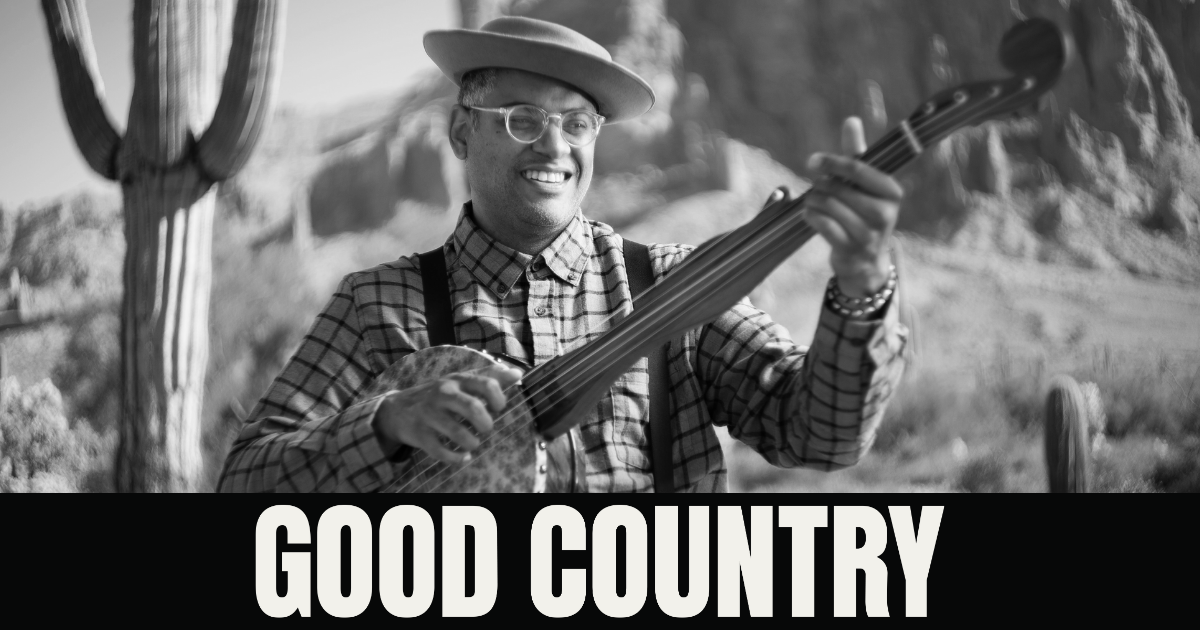
Once I left Arizona and we formed the Carolina Chocolate Drops, we were able to tap into a certain energy in the crowd that changed the paradigm for Black Roots music, so that now people can see the whole picture of American music in a different way. They could see a Black person playing the banjo in the modern world and be inspired to learn more about the African and Caribbean roots of the banjo. We did that for the better part of a decade and then I decided to move on into a new territory: Black Cowboys and Black Western music. This was a new area of music that the Carolina Chocolate Drops were not a part of in any way. The Chocolate Drops had focused on the music of North Carolina and this new musical venture was an exploration into my own family roots in the Southwest.

Back in 2010, I had come across a book called The Negro Cowboys, which encouraged me to research about African American cowboys of the West. In 2018, my research came together in my solo album, Dom Flemons Presents Black Cowboys, which came out on Smithsonian Folkways as a part of the African American Legacy Series. Having grown up in Arizona, I knew that the album needed to be a part of the National Museum of African American History & Culture so that future generations could appreciate and respect the history of the Black West as well as activate the communities that had been there all along.

Back when I released Black Cowboys, I was one of the few artists talking about the contributions of African Americans out west and their varied connections to country music. Not only was I sharing this lesser known history, but I was playing the music that we now celebrate as “Black Country” long before Beyoncé, Lil Nas X, the “Yee-Haw Agenda,” or any of the newer Black artists who have risen to fame in the TikTok era. Now that the concept of Black Cowboys has gone mainstream in music, television, movies, and fashion, it’s another reminder to me that the music I created had made a major impact on American culture in both a conscious and subconscious way.

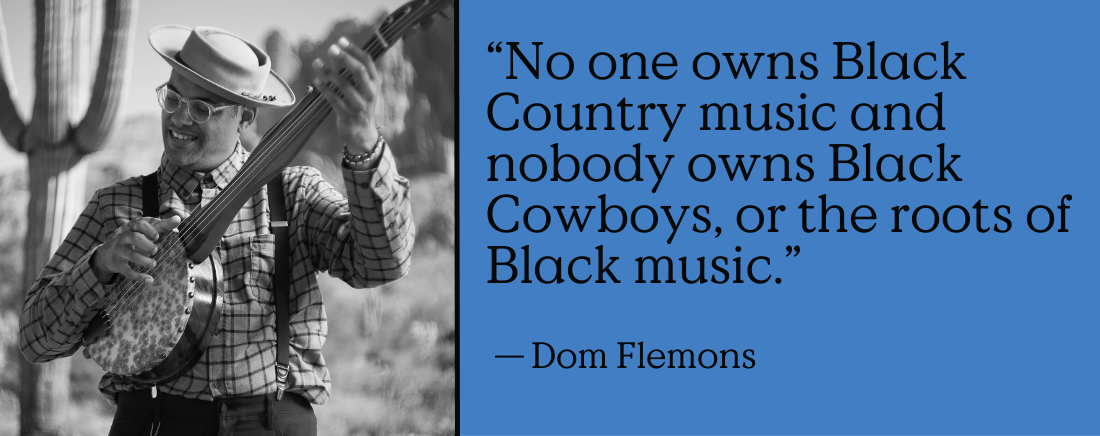
The most important part of it all is that no one owns Black Country music and nobody owns Black Cowboys or the roots of Black music. However, nowadays I am noticing that people are trying to take credit for exposing the history when they have only scratched the surface of it.

What I have learned is that there are so many parts of the Black Country and roots music story that are still missing and are being left out of the media. There are many other artists who should be considered in the conversation and yet they aren’t getting their flowers. I have noticed the Black Country music narrative that has sprung up recently has actively disregarded the work of the many Black artists who are deeply connected to the legacy, including myself on many occasions. My hope is that people will take the time to acknowledge the ones who have paved the way for the current movement and shed light on their individual stories, too.

The main reason I have included extensive liner notes in all of my albums, including my most recent, Traveling Wildfire, is because I always make sure to give credit where it is due. The sources for my traditional songs are clearly laid out for anyone to see and my original songs are exercises in expanding the existing palette of roots music so that both can be presented to a new generation of listeners. I have seen my talking points being used to fuel many of the current conversations, but oftentimes there is no back reference to the work I have done. All of the fanfare has forgotten to give proper credit to someone who has spent the majority of their career trying to set the record straight. As a well known musician in my community, this exposes a general trend that is problematic for the current state of Black Roots music.

If it is acceptable for a mainstream pop star or the media to sidestep and steamroll the pioneers of Black Roots music, it can only lead to a narrative of uplift that will ring hollow in the long term. It will teach the future generations that sleight of hand is the only way to get ahead and that surface level fame is the goal and key to being successful. Bad ideologies take a long time to disperse once they have become a part of the general fabric of society, and if people continue to spout it the integrity of the music can be undermined without them even knowing it.

This is why I am cautiously optimistic for the current state of Black Roots music, because oftentimes it feels more like a one-sided competition than a community of Black artists coming together to be celebrated collectively.

Yet, on a positive note, I believe the current state of Black Roots music is very exciting. People are being activated by the work that has been done by the pioneers of the past one hundred years. They are reinterpreting, reinventing, and showcasing music that is becoming a viable part of the mainstream music industry. They come with a variety of sounds, instruments, and songs that will shift the template of American culture as Black Roots music always has and always will.

More voices are being added every day in places and spaces that would have been unheard of even ten years ago. It can be clearly stated that there are now plenty of young musicians in every field of Black Roots music and there is no shortage of new talent who have proven their worth on the stage, on recordings, and on social media.

The holistic landscape of the modern Black Roots music community is something that I am proud to have helped establish over the past 25 years. Major growth is upon us, but I feel like it can only happen if everyone in the community gets acknowledged, not just the “favorites” or the ones making the most money while begging for all of the attention. The connecting of dots that bind the past and future are within our reach through the technology we have at our fingertips; it is essential for us to use it with great care and responsibility.

I started my journey as the American Songster building a legacy upon a dream. I got the notion to write songs and play the old styles back when I was sixteen years old and this eventually led me to sell everything I own, jump in my car, and drive across America to find where that dream could take me. It then took me all over the world and brought me much acclaim, but I have never lost sight of what inspired me to start this journey.

For me, I’m just getting started and I’ll always be here, no matter who stays and who goes. I’ve done the work to make the music more accessible for others and I can hope that it has reflected well on my own legacy as well as the entire community I have tried to uplift.


Photo Credit: Dom Flemons by Steven Holloway.

You Gotta Hear This: New Music From Rising Appalachia, Tim O’Brien, and More

What a week in music! Not only has our Artist of the Month, Kaia Kater, released her new album Strange Medicine today, but we’ve also got an absolutely incredible premiere round-up filled to bursting with brand new videos, songs, and tracks.

First, there’s transcendent sister duo Rising Appalachia with a James Blake/Bon Iver cover, “I Need a Forest Fire,” and Tim O’Brien pays tribute to iconic folk songwriter Tom Paxton with a song they co-wrote, “You Took Me In.” Plus, don’t miss new songs from Ellorie McKnight, Natalie Spears, and Nick Taylor.

We round out our list with two premieres that debuted on BGS earlier in the week, a new one from Alisa Amador’s just announced album that features Madison Cunningham and Meadow Mountain continue their SkyTheory Sessions series with “Waiting for Tomorrow.”

It’s all right here on BGS and to be perfectly honest, You Gotta Hear This!


Rising Appalachia, “I Need a Forest Fire”

Artist: Rising Appalachia
Hometown: Asheville, North Carolina
Song: “I Need a Forest Fire”
Album: Folk and Anchor
Release Date: May 17, 2024

In Their Words: “‘I Need A Forest Fire,’ is our interpretation of a rich and righteous James Blake track. We have been big fans of his artistry and aural weavings for many years and wanted to do a folk rendition of this striking song. The texture of its sounds stretch far and wide in atmospheric rhythms as well as the lyrics and it took some deep digging to conceptualize what Blake was perhaps trying to say… Our interpretation is this:

“We live in a time of rapidly destructive (and so often man-made) wildfires in many parts of this planet. Singing a song that says ‘we need a wildfire’ felt cautionary, but enticing, as we explored the many metaphors that ‘forest fire’ could represent. We came to believe it is about the burning of the ego, the take down of destructive habits and destructive relationships, even destructive sides of self. In a time where everyone is on one side of the coin or the other, in a highly polarized nation, a burning symbolizes a great reset. A death and rebirth cycle. We hope you enjoy our take on this track as much as we have enjoyed stretching into its different sounds.” – Rising Appalachia


Tim O’Brien, “You Took Me In” (from Bluegrass Sings Tom Paxton)

Artist: Tim O’Brien
Song: “You Took Me In”
Album: Bluegrass Sings Paxton
Release Date: May 17, 2024 (single)
Label: Mountain Home Music Company

In Their Words: “Jan and I came of age listening to and then singing Paxton songs before we ever knew his name. We both learned ‘Last Thing on My Mind’ and sang it around campfires before we met each other. So like a lot of folks, we kinda have Paxton in our musical DNA.

“Tom has been friendly and supportive over the years and in recent years often expressed his desire to write together. With this project, push came to shove and Jan and I wrote ‘You Took Me In’ with Tom on our second session. I had the lyric idea and imagined some Earl Scruggs-style gospel guitar as backing. We had the song in about an hour. When we were done I asked Tom how many songs he’d written that week and he said, ‘I’ve written four songs today!’

“Paxton’s early songs were the kind that sorta begged audiences to sing along. This one reaches in that direction. I love how simple and direct it is. Since that day, the three of us have written another 15 songs, all of which are daring Jan and I to record them, so stay tuned. Songs are like little puzzles that a certain strata of musicians have fun solving. We’re just honored to sit beside Tom, even if only virtually, as he does his masterful thing. He knows to let the song happen. He can pull a lyric from an instrumental riff, he improvises easily, and you can just trust him. When he says to go higher with the melody or go to the four chord, we’re never afraid to follow.” – Tim O’Brien

Track Credits:
Tim O’Brien – Guitar, lead vocal
Jan Fabricius – Mandolin, harmony vocal
Shad Cobb – Fiddle, harmony vocal
Mike Bub – Upright bass


Ellorie McKnight, “Whitepass”

Artist: Ellorie McKnight
Hometown: Whitehorse, Yukon
Song: “Whitepass”
Album: Equinox
Release Date: May 3, 2024

In Their Words: “White Pass is a magical, remote mountainous area connecting Yukon’s southwest with Alaska. If you’re driving from Whitehorse, YT to Skagway, AK, you pass through mountains and boreal forest until you reach the Canadian border crossing, after which the road winds through 25km of treeless, rugged alpine terrain before dropping down towards the ocean, where you then drive through the US border and then into the coastal ecosystem of Skagway. There is no reception on this stretch of road and no sign of humans except for the road and the border patrol buildings.

“This part of the world is like a dream in summer: the sound of creeks is loud and the wild blueberries are everywhere. In the winter, the area is mystical no matter the weather, with meters of snow blanketing the valleys and mountains. I was making the trip from Whitehorse to Skagway in the middle of winter one year, late at night, to visit a friend. There was a raging blizzard and snow drifts forming on the road, it was hard to see more than a few feet ahead and the going was slow. I pulled over to catch my breath and stepped outside. The wind was steady and the sharp snowflakes bit into my cheeks. I looked up and was surprised when I saw a waxing moon in a clear night sky just above the fog of the ground blizzard. It was a moment of awe, of wonder, of feeling so intertwined with the earth and yet also so small. The song ‘Whitepass’ tries to capture the many similar moments I’ve felt spending time in this stunning part of the world.” – Ellorie McKnight

Track Credits: 
Ellorie McKnight – Guitar and vocals
Brigitte Desjardins – Drums
Jeff Dineley – Upright bass
Ryan McNally – Pedal steel and harmonies
Kieran Poile – Fiddle

Video Credit: Midnight Light Media


Natalie Spears, “Hymn Of Wild Things”

Artist: Natalie Spears
Hometown: Carbondale, Colorado
Song: “Hymn Of Wild Things”
Album: Hymn Of Wild Things
Release Date: May 17, 2024 (single); June 28, 2024 (album)
Label: SleeLee

In Their Words: “Early one chilly autumn morning, I awoke to the chortling cries of Sandhill Cranes echoing through our town. Their sound is one like no other, awkward, beautiful, and haunting. It is a sound that we only hear a few times a year as they journey along their migratory path towards warmer shores. Whenever I hear them, I drop everything I’m doing and try to find them. On that particular morning, I got up with my sweet pup and followed their cries to a local nature park near my home. The clouds were sunk low in the valley and although we could hear them close by, we still couldn’t see them. We sat quietly waiting and eventually the sun’s heat lifted the clouds revealing the ghostly shapes of two beautiful Sandhill Cranes. The words to this song began to take shape in my mind and it was then that Hymn Of Wild Things was born.” – Natalie Spears

Track Credits:
Written by Natalie Spears (BMI)
Produced by Jayme Stone

Natalie Spears – Voice
Christine Bougie – Guitars, lap steel
Pat Keen – Bass
Jayme Stone – Synth, drum programming


Nick Taylor, “Dogs”

Artist: Nick Taylor
Hometown: Austin, Texas
Song: “Dogs”
Album: Not Alone
Release Date: June 21, 2024

In Their Words: “As one of the earliest compositions I laid down for the album, it’s personal and cathartic, a reflection of the anxiety that’s been an ongoing part of my persona. Sometimes it gets particularly overwhelming and that’s how this song was born. It speaks to uncertainty — how it manifests, how it’s perceived by others, and how it affects those around us. When we went into the studio to record it, it just came alive. It was important to me to get it out into the world. It’s the song that inspired the album title, Not Alone, but more importantly, it explores topics that society tends to dismiss — especially when it comes to matters having to do with mental health, insecurity and stability. It calls for understanding and in that regard, my hope is that it will help anyone dealing with a similar situation feel less alone.

“‘Dogs’ is such an emotional song, almost a confessional, that we wanted to make sure the video felt personal. Shooting just one scene created a space where the lyrics were being recited directly to the audience and I think that format really works well with the song. Huge thanks to Will and the team for their vision and direction.” – Nick Taylor

Track Credits:
Written by Nicholas Taylor Wimberg

Nick Taylor – Lead vocals
Wayne Killius – Drums
Dave Francis – Bass
David Flint – Electric and acoustic guitars
Chris Nole – Piano/keys

Video Credits:
Produced by Charlotte Avenue Entertainment

Directed by William Gawley
Shot by Austin Boylen and Dominick Sotis


Meadow Mountain, “Waiting for Tomorrow” (SkyTheory Sessions)

Artist: Meadow Mountain
Hometown: Denver, Colorado
Song: “Waiting for Tomorrow”
Album: June Nights
Release Date: May 13, 2024 (single)

In Their Words: “This song attempts to answer the question, ‘What if, instead of starting the band Foo Fighters, Dave Grohl had picked up a mandolin and spent a year exclusively listening to Alison Krauss & Union Station?’ I guess I was doing a lot of thinking and writing about time – the great healer, but also that which brings an end to all things. And then a new beginning. This is a song about time, and hope.” – Jack Dunlevie

More here.


Alisa Amador, “Heartless Author” (feat. Madison Cunningham)

Artist: Alisa Amador
Hometown: Boston, Massachusetts
Song: “Heartless Author” (featuring Madison Cunningham)
Album: Multitudes
Release Date: June 7, 2024
Label: Thirty Tigers

In Their Words: “I love this song. I love it because it acknowledges all of the uncertainties and pain of life and it shines compassion on all of it. ‘It’s okay not to know.’ It was such a joy to sing this one with Madison Cunningham. She learned it right then and there in the studio, and her voice says so much.” – Alisa Amador

More here.


Photo Credit: Rising Appalachia by Syd Woodward; Tim O’Brien by Scott Simontacchi

The True Healing Found in Kaia Kater’s ‘Strange Medicine’

A deep reflection born from a time of the extreme silence and noise of the pandemic, Kaïa Kater’s new album, Strange Medicine (out today, May 17), digs into the feelings society tells us not to feel, imagines healing and revenge from abuses, and reckons with themes of racism and sexism of the past and today. While the undercurrents are heavy, the arrangements are gentle and flowing, juxtaposing our expectations of what we think it means to process the darkness in life with the truth that many emotions can exist simultaneously.

Written from home in Montreal, Strange Medicine takes us on a cathartic journey imagining characters interwoven with parts of Kater and parts of the world she observes. Drawing on inspiration from artists like Steve Reich, Brian Blade, and Johnny Greenwood and partnering with Montreal-based producer Joe Grass (The Barr Brothers and Elisapie), she took a different musical path than in the past.

Leaning into her primary instrument, banjo, Grass and Kater built the framework for each of the tracks slowly, starting with bedroom tracks and expanding to include arrangers like Franky Rousseau (Andrew Bird, Chris Thile) and Dominic Mekky (Caroline Shaw, Sara Bareilles) and musicians Rob Moose (Bon Iver, Phoebe Bridgers, Paul Simon), Robbie Kuster (Patrick Watson), and Phil Melanson (Andy Shauf, Sam Gendel). Kater spoke to BGS via Zoom.

Hi! How are you?

Kaia Kater: I’m okay! A couple of days ago I dropped my phone directly onto my laptop screen and it cracked. I had to go to Apple. So I am without a laptop, but thankfully have my 10-year-old iPad, bless her!

Apple is coming in clutch. Also, Apple product destroying Apple product is kind of funny.

Yeah, it’s an Apple-on-Apple hate crime. It’s terrible. I feel so weird about it. But I have AppleCare, which is good.

With the couple of sentences that you just said it’s no wonder the Department of Justice is looking into Apple as a monopoly. Vertical integration. Well, how are things going other than Apple problems?

The record is out in a week, so I’m excited. Thank you for doing this piece. I never take any press for granted, especially after the pandemic, when things were so terrible and hard.

What a weird time. Is that when you started writing this record?

Yeah, pretty much. I wrote my first song in April of 2020. We finished the record in 2023. So I would say like 2020 to 2022, was the writing window.

This album is a pandemic baby!

It is. Yeah, I’m proud of my little pandemic baby. Born out of a lot of feelings of stasis and confusion, but also just so fun to record. I think that there’s a lot of grief in the lyrics. But you can still vibe to sad songs, especially when they feel groovy. So that was the intent.

So when did you start recording it?

Let’s see, we went in to record in October of 2022 but the official recording days were preceded by a ton of demo days. So throughout 2021 and into 2022, I would go to my co-producer Joe’s studio in Montreal. We would just track stuff and either bring people in or ship the songs out to people and pay them a demo fee and have them kind of like splash around and see what their interpretation of the song was. That was kind of like how we selected personnel. I think we had a pretty strong idea of what we wanted to do by the time we got into the studio, which is so different from other projects I’ve been part of and other records I’ve done.

How was it different?

I guess, with the pandemic, I had the blessing of time, which I never had before really. With Nine Pin, I recorded on my winter break from college in my senior year, and then Grenades was done from start to finish in two weeks. And so with Strange Medicine, it was about two years. There are advantages and drawbacks to that. It is very easy to start second guessing some choices that you’d made in the previous calendar year, but I think it was to me such a novelty to be able to write and then listen back, and send the arrangement to someone and have them send their work back. It was so much more thoughtful because we had the time to do that.

That makes total sense. So you started writing it during the pandemic. What was your writing process like? Did you have ideas that you came into the lockdown with, or were you processing things in real time?

Well, originally I was like, “I’m never gonna play banjo again.” I don’t know what I was thinking. I think I was trying, to a certain extent, to escape my roots, transform, or do this phoenix thing. Where people are like, “Whoa! She was a banjo player and now she’s an electronic pop musician.” That was maybe a facet of my mid-20s to late 20s, having that crackling feeling that all the different paths your life can take feel like they’re narrowing. And so you’re kind of like fighting against that and going, “No, I still can transform again, musically.”

Really what led me to write more songs on the banjo, especially for Strange Medicine, was that it was really comforting to me. I think I went back to it after wanting to spread my wings. Once I was alone in a room I was like, “What do I want to do right now? I just wanna play banjo.” And for a long time that’s all I did. I didn’t really write. The songs trickled in bit by bit. But you know I definitely gave up that idea of trying to metamorphosize in the way that I thought I was going to. I think I did it in a different way.

Can you talk a little bit about what it meant to be in Montreal writing this record and just in general? What influence did the town have on this particular record? And how does the music community there influence you?

Well, it’s very experimental there. And there’s a kind of freedom and risk-taking. People are not afraid to have things fail or to have things not quite work. Even now, I’m sort of deconstructing the idea that I grew up with, this idea of what a songwriter is, which is that you work really hard at your craft, you play the song down. And the way that you improve every night is how you perfect and tighten the song as much as possible. I’ve been getting into this idea of improvisation.

I don’t know if it’s because the rent is cheaper there, so you don’t have to hustle as much. I just felt so much more space to play around.

While we’re on the subject of Montreal, you collaborated with Allison Russell on “In Montreal” about your shared hometown. I was curious since Aoife O’Donovan is from Massachusetts and you’re talking about witches on “The Witch” – was that a purposeful choice?

No, but that occurred to me about a week ago. I was making dinner, and I was like, “Wait. Aoife’s from Massachusetts!” It must have been in some way subconscious. I kind of see people as the roots that they’ve grown from. And definitely, when thinking about the features I wanted, I wanted it to make sense with who that person is. For example, with Taj Mahal, he’s who I learned about the black roots of the banjo from first. He was doing that in the ‘60s, and he has a lot of Calypso and Caribbean influences and heritage. Bringing him into a song about a Caribbean revolutionary felt like, “Well, of course.” I even wrote him a little letter explaining the song, because he’s 80. He doesn’t need to be on anybody’s record. And so I was like, “Let me tell you what the song is about, and maybe you’ll want to sing on it.”

That’s so cool. And how did the collaboration on “The Witch” come about?

Aoife has always been really supportive of me as a person and as an artist, going back to 2017. She’s kept me in mind for a lot of things and she’s suggested me for opportunities. She’s also really community-oriented. She’s very cognizant of supporting women musicians and young musicians. I’m a mega fan of hers.

I had written “The Witch” and I thought she would sound great on it. Fast forward to the end of the process, when all we had left to do was harmony vocals and I was really nervous to ask her because I think I was scared to get a no. But I’ve been practicing. You have to ask, because if you don’t ask you don’t receive anything. I texted her, and she immediately responded yes without even hearing the song. Then she laid down all these like really intricate harmony parts. She’s a genius.

Your voices are beautiful together. It works really well. And the Massachusetts thing — it’s perfect. While we’re on the subject of that song, what connects you to the stories of these women who were accused of witchcraft or adultery and were punished for it?

To me, it is the juxtaposition of having this perceived power in the minds of men as being capable of influence, capable of seduction and luring, and superseding a man’s high intelligence and thoughts of himself and overtaking will power. But then, when women were accused of being witches, their already limited power just absolutely disintegrated and they were executed by mobs. I was thinking a lot about these kind of polar ideas of women having so much power over men, but then we’re struggling to be taken seriously in a workplace or struggling to feel like we are on equal footing.

I think sexism and racism today are much more insidious – as are homophobia and transphobia. It’s so palpable. Being able to give voice to someone in history who may meet a different fate; maybe they try to kill her, and she’s like,”Ha! I survived. And now, aren’t you scared of me?”

The influence came from a lot of different places; the witches from Macbeth, and the Roald Dahl witches. They are all in our popular consciousness to a certain extent, and I think we have a fascination with them.

Absolutely. Let’s talk about the song “Floodlights.” It reminded me of Joni Mitchell for two reasons. One is the sonic palette and the orchestration reminded me of her. Second, I saw a video of her recently and she was talking about how a good song should make a listener think of themselves rather than of her. That’s obviously an objective idea, but this song, though focused on a romantic relationship, reminded me of some of my own, but also friendships and working relationships and how the dynamic of one person’s power over another can be so incredibly detrimental. But there is hope and life on the other side of that. It is a special way you tell the story in a cafe where the protagonist is feeling herself rise over a past love for the first time. I was wondering if you find that you have clarity around power dynamics yourself as you grow older as the protagonist does?

I’ve recently turned 30. And to me, that seems to be the absolute blessing of your 30s, that you have this kind of clarity and understanding of who you are and what you are willing and not willing to tolerate. That song itself is about an age-gap relationship that I was in. We had an 11-year age difference. I was super young. I was 18 or 19 when we got together, and this whole conception that I had was, “I’m mature and I’m actually better than the other women my age, because I have someone who is super mature and who thinks that I’m interesting. I’m also better than the women his age. There’s something special about me,” like I felt chosen.

That was such a powerful feeling at that time when so much of my self-esteem was dependent on what other people thought of me. Slowly, through the course of this relationship, I realized that he chose me, but not for the reasons that I thought I had been chosen.

I mean he was a walking red flag and I just did not trust my intuition to understand that. This wasn’t a good scenario, and now, on the other side of it, at 30, I couldn’t imagine dating a 20-year-old. There’s an inherent power dynamic there. I wrote the beginning of the song two years before I finished it, because in the beginning, I couldn’t think of an ending. I couldn’t have seen him at a bar (which really happened) and just been scared and left. I wanted to give the protagonist a better ending than that.

It sounds like you did a lot of processing on this record through your writing, like maybe you released some frozen anger. I think most women can relate to that in general, because we are so often encouraged or told to suppress that emotion. I was wondering how your relationship with anger and revenge evolved and shifted through the creation of this album?

I think therapy seems to be a theme in a lot of artists’ albums these days. I didn’t realize how much anger I carried until I went to therapy. I had always grown up thinking that any kind of anger is debasing yourself. You’re losing power and you’re not being your highest, most evolved self.

Every time I got angry, I felt like I’d failed to access my more evolved emotions. It was through therapy that I learned that anger is, in many ways, necessary. We are refusing to be treated a certain way.

I think adventuring through these ideas of revenge where it’s like, “Well, what if I don’t choose forgiveness? What about that? Why do I have to be the peaceable one? Why do I have to be the one to absorb all of your violence, and then somehow process it out so that we’re good?” I have to say, it was really fun to write these lyrics and not shy away from some more violent imagery, especially in “The Witch.”

I heard someone say something like, “Anything that’s human is mentionable. And anything that’s mentionable is manageable.” I think singing it out is so nice because it’s mentionable. It’s manageable.

Speaking of, this is a great segue. How does it feel to perform these songs live?

It feels really good. It feels vulnerable too, having lived with them so long during the pandemic. It’s interesting to start sharing them with people. I have this ritual where the day before a single comes out, I listen to the song on a walk. And I’m like, “Okay, this is the last time this is gonna be only mine.” I think that ritual has really helped me. It’s a really personal album in a lot of ways for me.

I’m looking forward to trying it out in many different configurations, continuing the idea of play that we started out with this record, and seeing the different ways it can evolve and change.


Photo Credit: Janice Reid