BGS Top Moments of 2019

If music happened in 2019, but wasn’t a “song” or an “album,” does it make a sound– er… does it warrant real estate in any of the many year-end pieces, wrap-ups, and lists hitting the internet on a daily (sometimes hourly) basis? Why, of course it does! Each year BGS notes Top Moments of roots music — whatever form they may take — as a way of reminding ourselves that the art we each consume, especially of the musical variety, is often at its best when it eschews the formats and media we expect and/or most closely associate with it. What changes about the way we view a year in music when we alter the context as such? First and foremost, we change just that — our viewpoint. Turns out that makes a world of difference.

Speaking of top moments, one of the best for the BGS team took place just last week, as we premiered a brand new look with an updated homepage and logo. A lighter color palate, clean modern lines, and updated fonts usher in a new era for the site, and hopefully a positive reading experience for you, our beloved fans and readers. Not unlike the state of roots music itself, our new look is constantly evolving, but what’s at the heart of it remains timeless. Now, read about more moments that turned our heads and caught our ears over the course of the past 12 months.

Chris Stapleton Creates LEGO Alter Ego

When Chris Stapleton’s music video for “Second One to Know” hit YouTube, I found myself musing, “What are the benchmarks we use to determine someone’s level of notoriety? What are their claims to fame? Owning a tour bus? Having your first number one hit? Being the musical guest on SNL? Having a highway named after you? Or perhaps a proclamation from your local public figures designating a [Named After You] Day?” Seriously, can you imagine getting to a point in your country pickin’ / singin’ / songwritin’ career where your Game of Thrones cameo falls into the background of your music video star LEGO-self?

I would be remiss if in this blurb I did not mention another real-ass country singer/songwriter/rabble-rouser who dabbled in alternative visual media this year, too — that would be Sturgill Simpson’s “Sing Along.” More of this oddball, non sequitur energy in country in 2020, please. – Justin Hiltner


Dolly Parton’s America Podcast Finds Common Ground

Epiphanies in the podcast series Dolly Parton’s America are too many to count, as host Jad Abumrad and his team explore the notion that the Tennessee songbird is a rare unifying force in the fractured socio-cultural universe — everyone loves Dolly! But the fourth episode, titled “Neon Moss,” finding the common ground of Dolly’s Tennessee mountain home and the Lebanon mountain home in which Abumrad’s dad (a doctor who became friends with Parton after treating her in Nashville) grew up is gripping on a cultural and emotional level. Bonus: BGS’ own Justin Hiltner and his banjo pop up as a key part of a later episode. – Steve Hochman


Duos, Duos, and More Duos

Were you seeing double this summer? Mandolin Orange, Tedeschi Trucks Band, and Shovels & Rope offered exceptional albums and sold tons of tickets. From the sweeping San Isabel from Jamestown Revival to the intimacy of Buddy & Julie Miller’s Breakdown on 20th Avenue South, roots duos were having their moment. Personal favorites included The Small Glories and Bruce Robison & Kelly Willis, but the true discovery for me was Dravus House, a Seattle duo who delivered an understated and beautiful album that blends Elena Loper’s vocal with Cooper Stouli’s soft touch on guitar to stunning effect. – Craig Shelburne


Del McCoury Turns 80

At 80 years old, Del McCoury has witnessed the rise of bluegrass while still being actively involved in it. (In fact, he’s got a gig this weekend in New York with David Grisman, Jerry Douglas, Drew Emmitt, Andy Falco, and Vince Herman.) An all-star tribute at the Grand Ole Opry provided perhaps the most musically satisfying night of music this year for me, mostly because The Del McCoury Band has still got it (and they make it look like so much fun). Check out their 2019 performance on Live From Here With Chris Thile. – Craig Shelburne


Hadestown Wins Big on Broadway

In an era when Broadway has seemingly been taken over by jukebox musicals that rehash the catalogs of legacy artists, watching Anaïs Mitchell pick up eight Tony Awards for Hadestown was a surreal triumph. For those of us who have followed Mitchell’s career over the past couple of decades, it was truly remarkable to see a grassroots musical that she first staged in 2006 reach the heights of Broadway, earning her a win for Best Musical and Best Original Score. “Wait for Me,” indeed. – Chris Jacobs


Ken Burns Digs Deep into the Roots of Country Music

Ken Burns has a long history of digging into America’s deepest roots, through documentaries like The Civil War, Jazz, Baseball, and The National Parks. In 2019 he took those roots in a more on-the-nose direction, exploring the long and varied history of American Roots Music through his PBS documentary series Country Music, which premiered in September. As the filmmaker himself said in a recent interview, “Country Music is about two four-letter words: love and loss.” Thanks to Burns, who looks unflinchingly at all of the different stories that have shaped this music, we get to see the love, the loss, and everything in between. – Amy Reitnouer Jacobs


MerleFest and IBMA, Rediscovered

After a long break, I made an effort to reconnect with two of the preeminent roots music festivals  in 2019 – MerleFest and IBMA’s World of Bluegrass. With other obligations in Nashville, it had been five or six years since I’d attended either, and both surprised me for different reasons. At MerleFest, I was struck by the caliber and diversity of artists, in particular for landing a headlining set by Brandi Carlile in her breakout year. Five months later, I returned to North Carolina to see IBMA in action, amazed by the way that the city of Raleigh has embraced the musical experience, from the Bluegrass Ramble to the StreetFest with plenty of outdoor stages. North Carolina, I’ve got you in my 2020 vision. #ComeHearNC – Craig Shelburne


“Old Town Road” Can Lead Anywhere

Is “Old Town Road” country? Like millions, maybe even billions of fans, I’m inclined to answer that question with an emphatic “Of course it is!” But I’m also inclined to ask: What else is this song? Is it roots music? Is it folk? Blues? Yes, yes, and yes. That chorus is powerful in its simplicity, and it’s not hard to imagine Doc Watson singing those lines or Geechie Wiley intoning that sentiment mysteriously from some lost B-side, accompanied by a century of acetate scratches and surface noise. Almost accidentally existential, the chorus speaks to an unnamed American melancholy, and it can mean anything you want it to mean and be anything you want it to be. – Stephen Deusner


Roots Music Don’t Need No Man

No, like literally. After 2019 we can definitively say that roots music as a whole does not need any men. From the first albums of the year (say, Maya de Vitry’s Adaptations or Mary Bragg’s Violets as Camouflage), followed by two indomitable women of the Grammys (Kacey Musgraves and Brandi Carlile), then two universally regarded supergroups (Our Native Daughters, the Highwomen), the resurgence of true legends (like Reba McEntire’s Stronger Than the Truth and Tanya Tucker’s While I’m Livin’), to a Newport Folk Fest collaboration that combined nearly all of our favorites, this year in Americana, bluegrass, old-time, and folk has been defined by women. There were pickers (Molly Tuttle, Nora Brown, Gina Furtado), there were scholars (Allison de Groot & Tatiana Hargreaves, Our Native Daughters), there were poets (Caroline Spence, Jamie Drake) — repeatedly this year I found myself in musical spaces that, if all of the men were subtracted, I would still want for nothing. #GiveWomenAmericana – Justin Hiltner


Yola’s Meteoric Rise

Co-write sessions and frontwoman-for-hire gigs aptly prepared Yola for the non-stop successes she’s had in 2019, from sharing stages with childhood heroes Mavis Staples and Dolly Parton to nabbing a whopping four Grammy nominations, including a coveted Best New Artist nod. Kicking off the whirlwind year was her Dan Auerbach-produced debut solo album, Walk Through Fire, a beginning-to-end stunner and a sure sign that Yola’s star power will only continue to rise. The ample steel guitar on “Rock Me Gently,” the countrypolitan charm of “Ride Out in the Country,” and the buoyant old-school soul of a new bonus track “I Don’t Wanna Lie” show off an eclectic roster of influences and a striking vocal range. But the album standout might be its only number written solely by Yola, “It Ain’t Easier,” a slow-burner with a hell of a bridge that pays tribute to the hard work behind even the greatest of loves. On the stage, in the studio, and in everything she does, Yola is putting in the work — and we can’t wait to see what 2020 holds. – Dacey Orr

Americana Honors & Awards 2019 Nominees Revealed

Lori McKenna, John Prine, The War and Treaty, and Yola are among the artists nominated in multiple categories for the 18th annual Americana Honors & Awards, to be held on September 11 in Nashville.

Meanwhile, Dave Cobb produced three of the four albums in the Album of the Year category. In addition, Rhiannon Gidden received nominations for Artist of the Year, while her ensemble Our Native Daughters earned a Duo/Group of the Year nod.

A full list of categories and nominees for the Americana Music Association’s 18th annual Americana Honors & Awards is below:

ALBUM OF THE YEAR:
To the Sunset, Amanda Shires, produced by Dave Cobb
The Tree, Lori McKenna, produced by Dave Cobb
The Tree of Forgiveness, John Prine, produced by Dave Cobb
Walk Through Fire, Yola, produced by Dan Auerbach

ARTIST OF THE YEAR:
Brandi Carlile
Rhiannon Giddens
Kacey Musgraves
Mavis Staples

DUO/GROUP OF THE YEAR:
I’m With Her
Our Native Daughters
Tedeschi Trucks Band
The War and Treaty

EMERGING ACT OF THE YEAR:
Jade Bird
J.S. Ondara
Erin Rae
The War and Treaty
Yola

INSTRUMENTALIST OF THE YEAR:
Chris Eldridge
Eamon McLoughlin
Chris Powell
Michael Rinne

SONG OF THE YEAR:
“By Degrees,” Mark Erelli, Rosanne Cash, Sheryl Crow, Lori McKenna, Anais Mitchell & Josh Ritter, written by Mark Erelli
“Mockingbird,” Ruston Kelly, written by Ruston Kelly
“People Get Old,” Lori McKenna, written by Lori McKenna
“Summer’s End,” John Prine, written by Pat McLaughlin and John Prine

In addition, the Americana Music Association honors distinguished members of the music community with six member-voted annual awards and with Lifetime Achievement Awards, which will be announced leading up to the event. The Milk Carton Kids and Mavis Staples unveiled this year’s nominations in Nashville.

The winners of each category will be announced during the Americana Honors & Awards at the historic Ryman Auditorium. Americanafest runs from Sept. 10-15. Tickets for the Americana Honors & Awards are currently only available for purchase by Americanafest conference registrants.


Photo credit for John Prine: Danny Clinch

Susan Tedeschi on Evolving, Encouragement, and Electric Guitar (Part 2 of 2)

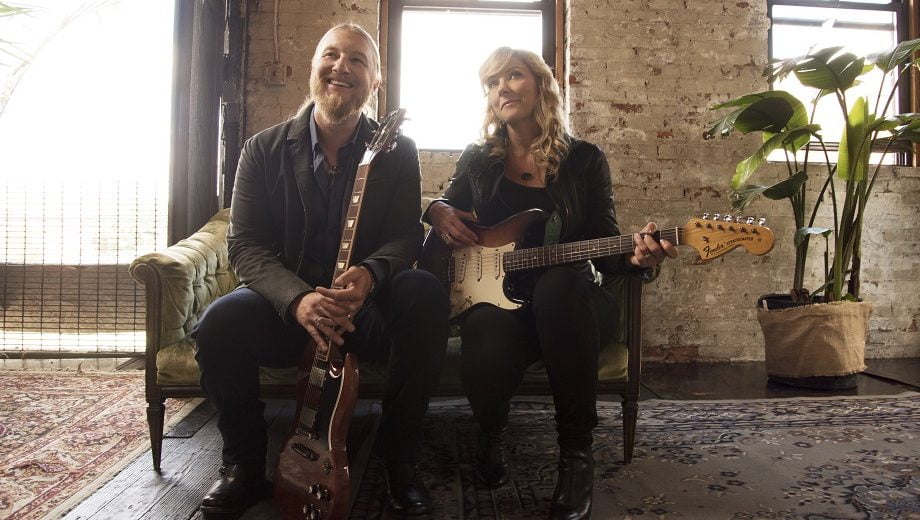
Susan Tedeschi may stand in the center of the Tedeschi Trucks Band but she is quick to give ample credit to her fellow bandmates for setting the right tone on the bus and on the road. With a new album, Signs, she certainly shines as a vocalist and an instrumentalist — and that confidence comes through in conversation, too. Engaged with the world around her, she’s quick to talk about the need to evolve, the encouragement she gives and receives in the music, and the common thread that runs through all 12 members of the Grammy-winning ensemble.

Editor’s Note: Read the first part of our Artist of the Month interview with Derek Trucks. Both interviews were conducted before the death of band keyboardist Kofi Burbridge in February.

BGS: Listening to this record, it was like a reminder of why the word “band” is an important part of this project. On that first track, everybody has a moment – all the vocalists and the musicians. Why did “Signs, Hard Times” seem like the right song to lead this album?

Tedeschi: Basically for exactly what you just said. It’s letting everybody hear a little bit about who the band is. Also, there’s a lot going on right now. And also, there are a lot of obvious signs, whether it’s political or environmental, or just living. So it seemed to fit.

Do you all get into heavy conversations on the bus? There are some topical songs on this record. Does that carry over on the road?

Oh yeah, a lot. This is such an interesting time for me. I was born in 1970 so I’ve seen a lot of different presidents come and go, and a lot of different mindsets and people who think a certain way. And I just can’t believe that this is going on now, in 2019, almost 2020. I feel like, “Come on, people, we can do better than this. We can evolve.” I just feel like we need to evolve as a species. I feel like we’re not keeping up with technology, we’re not keeping up with science and facts. It’s people and their egos that are in power, that are running things and not using common sense. It just doesn’t make sense.

This album has some heavy songs, but there are also messages of encouragement. I’m thinking of songs like “Still Your Mind.” Even as you’re presenting that message to your audience, does it resonate with you as well? Kind of telling yourself to hang in there?

Yeah, that’s a song that Derek wrote. He’s a very Zen character in real life, so it makes sense that he would write that. He’s very good at steering the ship and being a great captain to all of us, and keeping us eyes-forward and moving ahead, and being positive and learning to breathe and take your time. The lyrics of that are really encouraging and positive.

And it started instrumentally. I think Kofi was playing some of the piano stuff at soundcheck and then Derek started playing some of that stuff and it formed organically. Derek started to write words to it and would bring pieces to me and ask, ‘What do you think of this?’ I would say, ‘Oh, that’s great!’ or ‘Maybe move these words around….’ But I tried not to do much because I wanted him to have that tune.

We try to do that a lot with each other. Derek, Mike Mattison and I write most of the songs, but Mike wrote a lot for this record. I mean, he is our scholar so we put him to work. He’s got ideas for days, and it’s amazing because it shows the range of his writing. He’s got a song like “Hard Case,” which is really light and fun, and then you have a song like “Strengthen What Remains,” which is really melancholy and sad, but at the same time, real hopeful. He also write “They Don’t Shine,” which sounds like a pop hit. He has a lot of a different angles in his writing.

I read that you started playing electric guitar in your 20s. Were you playing acoustic before that?

Yeah, I played acoustic growing up, starting at 14 or 15. My dad gave me one of his old Martins when I was about 15 for Christmas one year and I cried because I was so excited. I wrote a bunch of songs on that, and that’s when I first started songwriting. I didn’t play electric guitar until I was about 22 or 23. I had graduated college at 20, so I was out of college for a couple of years before I ever picked up a guitar, other than acoustic. I was playing acoustic at shows but it was more folky and songwriter-y kind of stuff.

Then I fell in love with blues. I had some friends who used to play at Johnny D’s in Somerville, Massachusetts, every Sunday for the blues jam. They needed singers so they asked me to come down, and then I realized, “Well, shoot, this would be a great place to try out playing the guitar.” There weren’t a lot of people there and it was pretty chill, so that’s what I did. I would go down and sing a few tunes, then I’d start playing rhythm. I never really soloed for the first couple of years on electric. I just wanted to learn to learn how to play rhythm and play along with stuff so I could try to accompany myself while singing.

I played along with a lot of Freddie King and Johnny Guitar Watson and Otis Rush and Magic Sam – and I fell in love with blues. I wore out Big Mama Thornton’s Hound Dog record and Koko Taylor and all sorts of stuff. I fell in love with it and I realized, “This is what I want to do. I want to be Freddie King and Johnny Guitar Watson!” It’s funny because I did a tour with Etta James and she asked me, “Who are your influences? Who do you want to be?” I said, “I want to be Johnny Guitar Watson.” And she said, “Ah! That’s who I want to be!” [Laughs]

For guitarists who look up to you, can you give advice on how to play tastefully?

Yeah! Well, for one, don’t play real loud unless you know what you’re doing. A lot of people plow through as loud as they can. It’s like, “What are you doing? That’s not music. You’ve got to blend with the people you’re playing with.” Another thing is to actually play along with records. I did that a lot and it was very beneficial. I can’t get over how much you can learn by playing along with records and listening, so that’s some pretty good advice.

Another thing is, try not to just play riffs. If you’re trying to solo, don’t be like, ‘Oh, I love this riff and I’m going to fit it in here.’ Work on stuff and practice stuff, and then have it be in your arsenal. But think about singing a melody, like you’re trying to tell a story, if you’re going to solo. I mean, I’m still learning how to do all this stuff. I am by no means a badass guitar player. I always have so much to learn, and it’s amazing being able to be in a band with Derek because he’s one of the best.

I just feel like there’s so much to learn on guitar. You can never learn it all. Don’t think you know it all because you don’t. And listen to people like Ralph Towner. They’ll blow your mind, like, “What the heck? That’s one guy playing all those parts?” So, I enjoy it but I know my limits and my strengths on guitar. But I feel like I can sing anything. I’ve been able to sing a lot of different styles of music. I feel very blessed that way. So I’m just learning to get proficient on guitar like I am vocally.

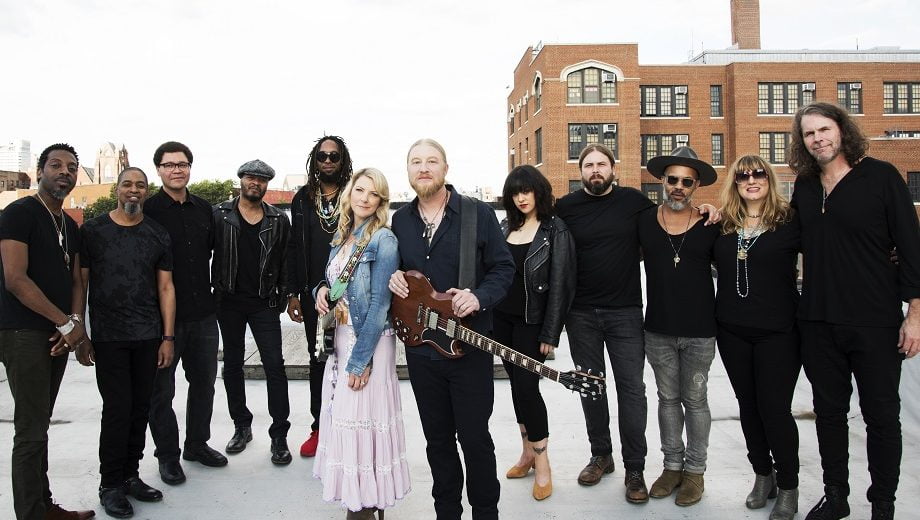
I like the fact that this band has black musicians and white musicians, older musicians and younger musicians, men and women – it looks like the world we live in, you know?

It is, absolutely.

You have 12 people working together every night. Is there a common thread that runs through all of you?

Yeah. We love each other. [Laughs] Everybody’s a good person and communicates well and cares about each other and has respect for each other. Musically we come from a bunch of different backgrounds but we all love blues and gospel and soul music. Some people love jazz, some people love country or bluegrass. There are a lot of different places that people are pulling from. Everybody’s educating everybody all the time in different areas, which is really cool.

And we just like hanging out. We like to go eat together, do laundry together. We’re on the road like a married couple – and we’re actually a married couple and they put up with us, so that’s pretty rad. It’s a really special band, and you know, there is something to that – where people come and see our band and see the variety up there and how we live together and travel the world together. People see us coming!


Photo credit: Shervin Laivez
Illustration: Zachary Johnson

Derek Trucks on Analog, Allman Brothers Band, and Aging Well (1 of 2)

With Tedeschi Trucks Band, you get a partnership. That impressive ability to divide and conquer serves them well on stage, with Susan Tedeschi nailing the vocals and tearing up the guitar, along with Derek Trucks calmly proving his own guitar proficiency. That’s not to mention the other 10 musicians that make this one of the most potent groups on the road right now, as evidenced by their newest album, Signs. (Incidentally, the conversation took place shortly before the death of longtime keyboard player Kofi Burbridge, who passed in February.)

To begin our Artist of the Month interviews, Derek took the phone first — yet frequently praised Susan throughout the conversation, especially her ability to captivate a crowd. Before passing the phone over, he also dug into his preference for analog recording, his history with the Allman Brothers Band, and the reason why age doesn’t really matter.

BGS: I know you recorded this album on two-inch analog tape and you have that Neve console. Why is it important for you to use that vintage gear?

Trucks: I think every time you record, you’re searching for that sound you hear in your head, and what you hear live on the floor. I feel like the more analog we go, the closer we’re getting to that. This is definitely the warmest recording we’ve done to date. You know, I think the beauty of having a studio is that you’re always working toward that and you don’t have to reset and start from scratch every single time.

And there’s something about recording to tape that focuses everybody a little bit differently. You don’t have unlimited tracks, you don’t have unlimited space, and it becomes a little more performance-based. Everything seems to mean a little bit more. Every reel of tape is important! You don’t have a hard drive to fill up, so it’s a different feel all the way around. And it slows things down in a good way. I think it really does put everybody’s head in a different spot.

What does that room look like?

We designed it visually thinking about Levon Helm’s band up in Woodstock. It’s a few hundred feet from our house in the swamp down here in Florida. It’s barn-shaped and the main recording room is a pretty good-sized room. When we rehearse with the 12-piece band, everyone’s set up in the main room. But it’s a bunch of vintage gear and old Fender amps. There’s a few drum kits in there and a B3 set up at all times. You know, it’s ready for action!

Speaking of those drum kits, I noticed at your show that you tour with two drummers. What’s the benefit of that?

There’s something special about that sound, man. It’s a powerful thing when you get those guys playing. The pulse gets really, really thick. When the whole band is firing, it feels like a freight train behind you. I think after years of being on stage with my uncle [Butch Trucks] and Jaimoe [the Allman Brothers’ drummer] and the Allman Brothers, when it really works and it’s really good, there is nothing quite like it. So when we put this band together, I was certainly thinking about those guys and that sound.

The chemistry really has to work when you have two drummers. It can be a freight train or it can be a train wreck! [Laughs] It can be really bad. I’ve been in situations where there have been two drummers and it’s a “less is more” situation sometimes. But Tyler [Greenwell] and JJ [Johnson] have a special chemistry. They really listen hard to each other and complement each other well, and they have a sound that is completely unique to the two of them. It’s a big part of what makes the band unique, I think.

At risk of being too heavy, what’s that experience like when you don’t have Gregg on stage, or knowing that you aren’t going to play with Butch anymore? Was that hard for you to process?

I don’t know if I ever thought of it that way so much. I played with them for so many years and I was always doing my solo groups and other things at the same time, so there were always a few different streams. I knew it wouldn’t be forever, so that part wasn’t a shock, but more recently we started playing a few of those tunes from time to time, and it definitely hits me now. Especially when we’re playing the Beacon Theater or some of these rooms I’ve played with [the Allman Brothers Band] so many times. You certainly miss them, and you miss that sound and that spirit. When we’re making records, there are certain times when for some reason I’ll be thinking about them. They were family, they were friends, and they were musical heroes, too. Those are big losses and I think it takes a while to unpack that stuff.

I’ve heard you and Susan both talk about being “a lifer.” How would you describe what that means?

I was thinking about Del McCoury this morning when I knew I’d be doing this article. It’s the people that you just know are going to be playing and touring and making people feel good as long as they’re on the planet. The Allmans, B.B. King, Willie Nelson –there are thousands of musicians who play in small clubs that are that way. You just know once you start doing it. I knew when I started in my pre-teens. Once I got serious about it, I always got that feeling like, ‘This is what I’m going to be doing. Whether it’s successful or not, I don’t think it’s going to matter.’ [Laughs]

And the beauty of what we do is that we can do it forever. I think about professional athletes sometimes and how they give everything to their sport — and by the time they’re 30, they’re washed up. We’re incredibly fortunate. We can play into our 90s. There are guys out there doing it.

What is it about Del McCoury that you admire?

He’s one of those personalities, man. You just see him and you immediately love him before you meet him. Then you meet him and you love him more. [Laughs] And there’s something to a guy who keeps his family with him. It helps that his family members are incredibly talented too. It says a lot about somebody when music and family intersect like that, and it becomes a way of life. There’s something that really speaks to me about that.

And his sound — I don’t think there’s anyone alive who’s doing it better. Every time I hear those guys, it just makes you feel good. It gives you a little hope. It is authentic and really, really good on every level, and that dude has it in a headlock. We love him. He’s fearless, man. He’ll jump up with anyone. He’s sat in with our band. He’s not a guy that won’t go outside of his genre. Del will step on in.

That’s an interesting point because I don’t think your band can be categorized as one certain thing — you fit in a lot of places, too. That must be a great feeling to not be locked into a certain style.

Yeah, I’ve always appreciated that about this band, and my solo band as well. We were always kind of half-accepted and half-shunned by every genre. They’d put us on a blues festival and we’d hear ‘You all aren’t blues enough.’ Or in the early days, the jam band festivals, but we weren’t jam band enough. Or jazz… they let us in all of them a little bit, but no one would fully accept us, which I appreciate because that’s where my tastes have always been. I think it’s what I naturally come from, so I never minded it.

In the early days, it was a little more difficult because when you get accepted by a certain scene, it makes it a little easier to tour, and there are certainly benefits to that. But I like being able to bounce around, and in the course of a month, play a festival for four or five different genres of music. It makes you a better player because everywhere you go, you hear things that you wouldn’t have heard or known. You see incredibly talented musicians that maybe you weren’t aware of. That makes you double down on what you’re doing when you see somebody new.

I remember the first time seeing Jerry Douglas and thinking, “All right…” [Laughs] “Well, there’s that!” I think it’s important to listen wide.

It’s remarkable to me how poised you are when you play guitar. You make it look easy while some guitarists put their whole body into it. Is that the way you’ve always played, just stand and deliver?

Yeah, and at different times, especially early on when I was a kid playing, I would get people almost every night coming up and asking, “Why aren’t you smiling? Aren’t you having fun?” [Laughs] It’s like, “I’m taking this shit serious, people!” I’ve never had a stage presence that’s going to bring people to the show. I’ve had to do it another way. I don’t know… some of it is just your personality, mainly.

But I remember seeing pictures of Duane Allman as a kid and I always imagined him standing there, getting it done. And I remember seeing footage of John Coltrane when I was in my early teens, just black-and-white footage around the Kind of Blue sessions. He was stepping up and taking a solo, and the look on his face — it just felt really important. It hit me, like, “That’s what I’m after.”

Editor’s Note: Read our Artist of the Month interview with Susan Tedeschi.


Photo credit: Shervin Laivez
Illustration: Zachary Johnson

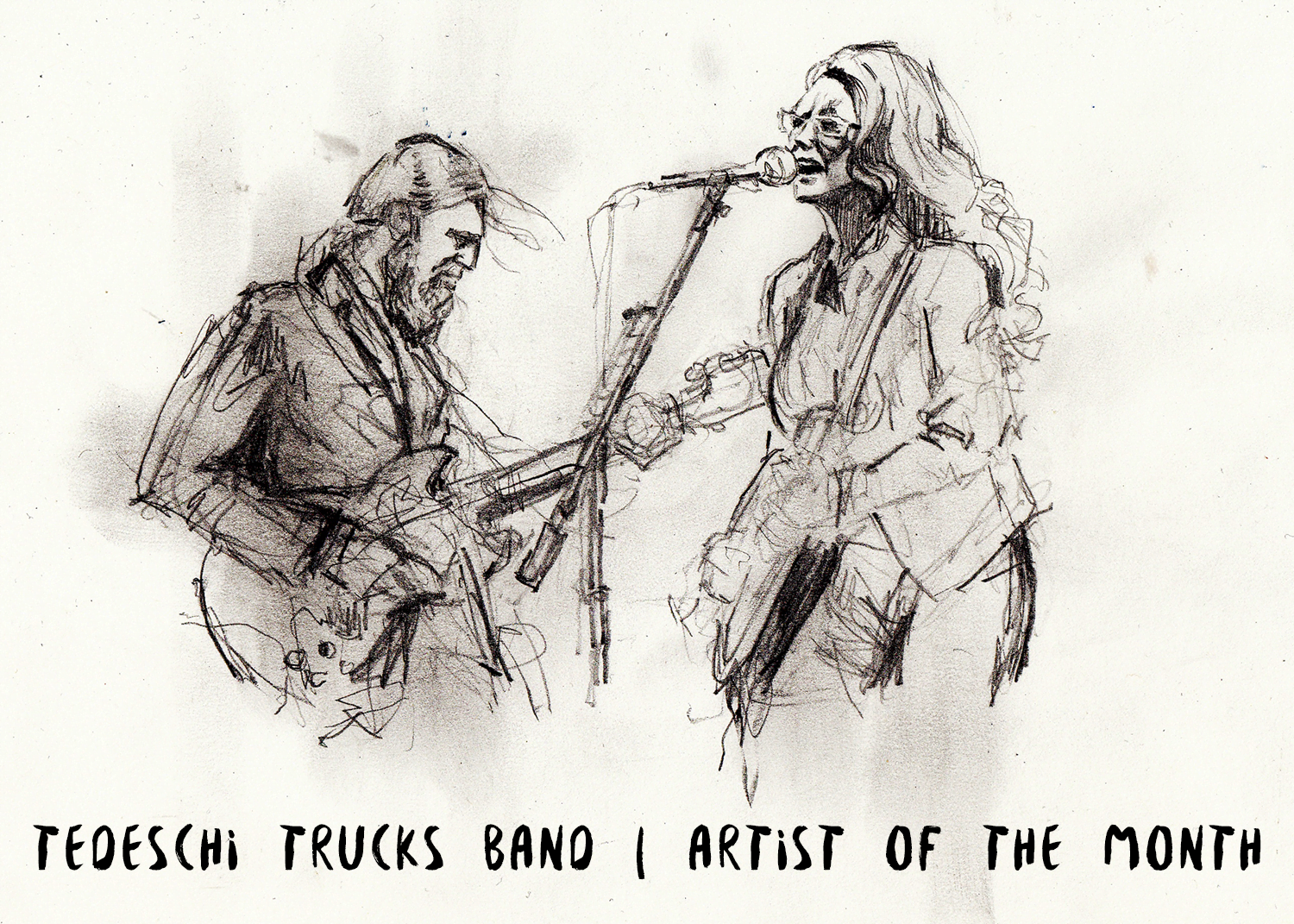
ARTIST OF THE MONTH: Tedeschi Trucks Band

Our March AOTM is Tedeschi Trucks Band: the powerhouse ensemble that just delivered their newest album, Signs. During a tour stop in Nashville, the blues-inspired band zeroed in on the vibe in the room without concern for over-the-top stage effects or eye-catching set design. As Derek Trucks explains it, “I think our MO is always that – it’s always the music and the musicality. That comes first and everything else is in service of that.”

Next week, BGS will post back-to-back interviews on the band – as Susan Tedeschi and Derek Truck both share their perspectives on the new music, as well as the foundations that have brought them here. Although they both pay attention to politics, they had a different idea in mind with Signs. As Tedeschi explains:

“I feel like I have a lot of responsibility being in front but I don’t feel like it’s my position to be political. I feel like it’s more my place to make people feel good. So I try to help people with the stress of everyday life and all of these problems. And I try to make music that is hopeful, and try to make people feel. And if I am angry about something, or something’s going on that I think is really unjust, then I can throw it in there, in a song, or I might make a comment, like ‘Hey, help out your neighbors.’”

For now, get primed for the month ahead with a collection of some of their best work in our new Essential Tedeschi Trucks Band playlist on Spotify.


Illustration: Zachary Johnson