Bluegrass Memoirs: Thanks to Eric Weissberg

On the morning of March 24, 2020 I learned Eric Weissberg had passed away when a friend posted a long and detailed obit. I found several other substantial ones online — Rolling Stone, Variety, New York Times. It wouldn’t surprise me to learn that Weissberg’s family had a press release ready; he’d been in decline, suffering from dementia. A few days later Jim Rooney posted a very moving memoir focused on his long-time friend Weissberg in mid- and late years; it shed more light on this influential musician. 

Recently Bob Carlin finished a bio on Weissberg. When we spoke at IBMA’s business conference last fall he told me publishers weren’t interested in a book about a studio musician. Too bad, it’s a good story. In 1972 Weissberg won a Grammy for the banjo hit that propelled the growth of bluegrass festivals, “Dueling Banjos,” the theme from the movie Deliverance

I first heard Weissberg’s banjo playing in the fall of 1957. I was an 18-year old Oberlin College freshman who’d gotten into folk music as a high school student in Berkeley, California. This was my first time “back east.” I now had classmates from New York City. One of them, Mike Lipsky, had a new Folkways album, American Banjo Scruggs Style. The final band on the second side was by a friend of his from New York, Eric. 

Weissberg was 17 when he recorded for Folkways, backed by Mike Seeger and Ralph Rinzler. He picked a medley of “Jesse James” and Woody Guthrie’s “Hard Ain’t It Hard,” using Scruggs pegs on the latter. When Lipsky played it to me and my roommate Mayne Smith (fellow Californian and a fledgling banjo picker) he had to explain what Scruggs pegs were. 

Lipsky knew about this music because he was one of a group of New York teenage folk music fans, mainly from elite high schools — Bronx Science, Brooklyn Tech, Music and Art — who socialized together. They’d networked not only in school, but also at leftist summer camps where folk music, spearheaded by Pete Seeger, was an essential part of the experience. They called themselves “The Squadron” and they gathered regularly in Greenwich Village on Sunday afternoons to hear two members of their crowd, Eric Weissberg and Marshall Brickman, picking at the Washington Square folk music jams. Weissberg, a student of Pete Seeger, had been playing the banjo since the age of ten.

Lipsky told us Weissberg and Marshall’s fancy picking confounded Roger Sprung, an older banjoist generally thought to be the best Scruggs picker in New York. And he described their banjos — not long-neck, open-back Vegas like Pete Seeger played, but Gibsons! With resonators, too. And on the fingerboard, down toward the body of the banjo, a little block of mother-of-pearl with “Mastertone” written on it.

This weirdness was all new to me. I’d never heard of “Scruggs picking,” and it was only when I borrowed the LP and read its notes, written by Ralph Rinzler, that I learned this music was called “bluegrass.” 

The following March, at spring vacation, my roommate and I went to New York. I stayed with Mike Lipsky, on this, my first visit to The City. Mayne stayed with another classmate. Among our many adventures — we were rambunctious teen tourists — we went one night to a party for The Squadron in a posh upper East Side residence. 

This was a homecoming party. Attending were young women and men most of whom were like us, on spring vacation from their first year as college and university students at a variety of institutions. Lipsky and Karen, another Oberlin classmate who was part of the group, introduced us to their friends. We’d brought our instruments, leaving them in the anteroom and going up a small flight of stairs to the main floor of this elaborate place. Eric Weissberg and Marshall Brickman, both of whom were freshmen at the University of Wisconsin, did the same. 

Midway through the evening we were encouraged to get our instruments out and sing. Mayne had his banjo — an old Stewart with a resonator — and I, my guitar — a 1943 Martin 000-21. We went back downstairs. This was the nearest thing to a front porch or back room we could find. We did several pieces, and then Weissberg and Brickman came down and got out their banjos. Mayne had taken one or two lessons with Billy Faier, the virtuoso banjoist who’d arrived in the Bay Area from New York the previous August. Faier had introduced him to three-finger picking. Mayne chatted about Scruggs with Eric and Marshall. 

Then they played a banjo duet, a Scruggs tune, “Earl’s Breakdown,” in harmony, with each picking with the right hand on his own banjo while reaching around to fret the strings on the neck of the other’s banjo. This was the first time we’d ever seen anyone play the banjo Scruggs style, much less a fancy stage stunt like that! It was a very impressive tour-de-force. You can get a good sense of what the harmony sounded like from the version on their 1963 Elektra album, New Dimensions in Banjo and Bluegrass (reissued in 1972 as Dueling Banjos from Deliverance) although they weren’t playing the fancy solo breaks in 1958.

Afterwards Weissberg told us that the best way to learn this music was to study Scruggs’ playing on one of his instrumental records like “Earl’s Breakdown” or “Flint Hill Special.” Mastering all those licks note-for-note would take you a long way towards being able to play like Earl.

Weissberg noticed that I was playing the guitar with just two picks on my fingers — thumb and index. He recommended that I add a pick on my middle finger, like he and Marshall used for the banjo. I followed that advice immediately, and the following year, when I began working seriously on banjo, I also took his advice about studying Scruggs closely.

Putting our instruments away, we went upstairs and joined the party. I conversed for a while with Eric. I told him I’d heard Billy Faier in Berkeley last summer, had been very impressed with his music, and was looking forward to his forthcoming Riverside album, The Art of the Five-String Banjo. Eric agreed, Faier is a great banjo player, and said he had collaborated with Billy and another banjo player, Dick Weissman, on an album due out this coming summer called Banjos, Banjos and More Banjos! 

That summer of 1958, Banjos, Banjos and More Banjos! arrived at Art Music on Telegraph in Berkeley where I hung out listening to new folk records. The album was on Judson, a bargain line label owned by Riverside’s Bill Grauer.

Grauer’s Riverside productions catered to the hip college kids of the fifties — a generation that grew up on hi-fi LPs. Riverside reissued historic prewar jazz and blues; released contemporary jazz and folk; and recorded sports car events. This major independent label ended abruptly in 1964 when Grauer, just 42, died. Their catalog is now with Concord Records, which has reissued some jazz recordings on CDs.
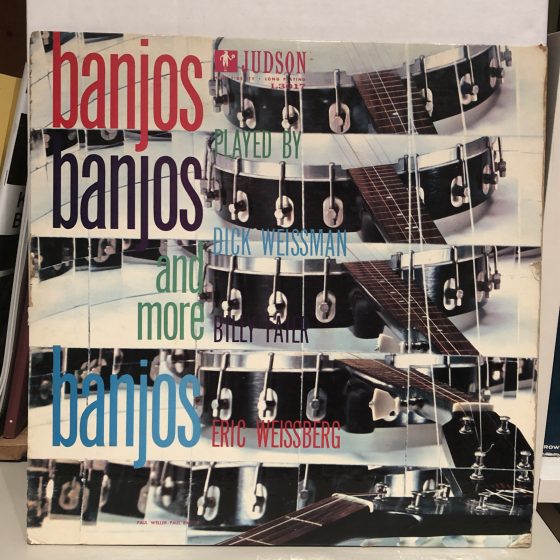
Riverside albums were well-produced, with glossy full-color cover art. Back covers — liners — had a standard format: bold head at the top with album title and artist names. Below it, three dense columns giving the playlist along with information about the music and musicians. Lots to read while listening!

Faier’s The Art of the Five-String Banjo liner held a full column endorsement by Pete Seeger, slightly longer notes by producer Goldstein, and Faier’s bio. In contrast the liner of Banjos, Banjos and More Banjos had its playlist followed by three columns of folklorist John Greenway’s flowery history of the instrument, and brief bios for the three banjoists. I bought the album (later reissued on Grauer’s Washington label with new cover and title: Five-String Jamboree: A Treasury of Banjo Music) because Eric Weissberg was playing Scruggs-style banjo on it.

At the bottom of the center column on the liners for both albums was the standard data of the time: 

A HIGH FIDELITY Recording (Audio Compensation; RIAA Curve). Produced by Kenneth S. Goldstein. Cover by Paul Weller (photography) and Paul Bacon (design). Engineer: Mel Kaiser (Cue Recordings). New York: May, 1957.

 Now I look back at the album, listen to it for the first time in years. When I last heard of Faier, about ten years ago, he was busking in Albuquerque. He died in Alpine, Texas in 2016. We’d seen each other and talked at the Tennessee Banjo Institute in November 1990, recalling the summer of 1958 when I guested on his KPFA show and worked as his backup guitarist at an SF coffee house. Dick Weissman, now 85, had distinguished careers: first as a performer, then as teacher and author. He published his memoir, The Music Never Stops: A Journey Into the Music of the Unknown, The Forgotten, The Rich & Famous, the same year Faier died.

These guys must have been in the Cue Recordings studio more than once in May, 1957. Their recordings were made with a single-track tape recorder; no overdubs. Faier made his solo album at Cue with Frank Hamilton playing guitar, and there’s one track on Banjos with that pairing — probably an outtake from The Art. Most of the other guitar on this album is by Dick Rosmini, then considered the hot, young, go-to guitar accompanist.

Weissberg is heard playing Scruggs-style banjo on five tracks, and singing tenor harmony in duets on three of those. One was an old spiritual, “You Can Dig My Grave,” with Faier. With Weissman, Eric harmonized on the old folksong “Chilly Winds.” My favorite was another spiritual, “Glory Glory.” This vocal duet with Rosmini featured great backup guitar and seven banjo breaks by Eric, each a new variation. I played that track a lot for my friends that summer!

He also did a reprise of his 1956 Folkways track, focusing on “Hard Ain’t It Hard” complete with Scruggs pegs, and a cool version of “900 Miles” in G minor tuning. 

Weissberg’s music spoke to me as a young folk fan just getting into bluegrass. He’d mastered the instrument in this new style, and learned the vocal style that went with it. Here he was applying it to music that I knew — Woody Guthrie songs, a tune the Weavers had sung on their famous Carnegie Hall concert album, and familiar Black spirituals. 

The door to bluegrass was newly opened. Eric Weissberg stood just inside, beckoning in. Come on, it’s not that hard, it’ll be fun.


Neil V. Rosenberg is an author, scholar, historian, banjo player, and Bluegrass Music Hall of Fame inductee.

Photo of Neil V. Rosenberg: Terri Thomson Rosenberg
Photo of Banjos, Banjos, and More Banjos: Neil V. Rosenberg


Brennen Leigh’s ‘Love Letter’ to the Musical, Magical Prairie

Nearly twenty years after leaving home, striking out to make a living in the bluegrass and country scenes first in Texas and now in Nashville, singer-songwriter Brennen Leigh is still longing for the prairie. Born in North Dakota and raised in rural Minnesota, Leigh’s brand new album, Prairie Love Letter, lives up to its name in all but the stereotypical, assumptive ways implied by its title. 

Produced by Robbie Fulks, Prairie Love Letter idealizes Leigh’s harsh, forbidding homeland — as paeans to the prairie are wont to do — but not without the nuance a nomadic, troubadour lifestyle affords, and Leigh’s perspective as a woman in 2020. It’s all underscored by the ever-growing distance between her and the grassy plains for which she pines, marked by months and years, continually ticking by.

Being that the sum of Fulks’ and Leigh’s musical comfort zones lands squarely upon the intersection of old country, bluegrass, Americana, and what we’ll call “alt-roots,” the album cheerfully denies genre ascriptions while reinforcing the Great Plains states’ propensity for birthing country music forged in the furnaces of hard living, firmly-held values (though not necessarily strictly conservative), and a desperate need for the distraction and diversion music brings. 

BGS reached Brennen Leigh by phone at her home in Nashville and began our conversation with the album’s seemingly pugnacious, yet perfectly apt lead track.

There’s something particularly resonant about the album’s opener, “Don’t You Know I’m From Here,” because you’re talking about rural life and how these authenticity signifiers are so important to rural life and identity, but they’re also really important to roots music. There’s a really interesting symmetry to “Don’t You Know I’m From Here” where it seems you’re simultaneously asking that question of the region you’re from — Minnesota, North Dakota, the plains — but also asking that question as a woman in roots music and country. What do you think?

I honestly never thought about it in that specific way, but when you put it that way, that is how I feel. Obviously, the going home, the rural element — what did you call them? Signifiers. That’s huge. We’re all in a sort of “countrier than thou” battle all the time. I try to just write what’s true to me as much as I can, and be affected by that as little as possible. When you talk about country music, it’s something I do feel secure in. I don’t need to show or tell anyone — nor have I ever been accused of lacking that authenticity. However, I’ve struggled just as much as the next independent artist. Sometimes it leaves one feeling, “Well, why has this other person been pushed to the top of the pile?” They say not to compare, but you know. Why is this other person edified, when they’re not country, so to speak? [Laughs] It’s hard not to compare yourself to others and get into that mindset.

Also what you said about women — we women, it’s like there’s only room for one at a time. We all have to fight each other. That’s not how I really feel, but your lizard-brain would make you feel like you have to fight with other women for that one slot they give us. This year, one of the silver linings of this pandemic has been that it’s given me some time to appreciate a lot of my peers in ways that I couldn’t before. Or that I didn’t take the time to before. My fellow performers, that are kind of my same age or similar level of fan base, exploring their catalogs has made me feel more like I’m part of that bigger Americana community. 

I think that’s an interesting way to get at the crux of this question, because on one hand just talking about authenticity is kind of make-believe, right? “Authenticity” is not a concrete thing, we ascribe authenticity. We perceive it. So talking about it is almost propagating the problem, and to step outside of it and look at it objectively is the real question. I think the nugget in “Don’t You Know I’m From Here” is that the speaker in the song isn’t seeking external validation in asking that question, but rather validating themselves internally. 

That’s exactly what it is. I don’t need to go home and have everyone at home validate me for being from there. It’s something that comes from inside. I know where I’m from. I know I’m a Minnesotan and I was born in North Dakota. And yet, I get questions cause my accent has changed and I’ve lived in the south now for I think eighteen years. It’s funny, when I moved to Texas I had a little bit of this fear that my music wasn’t going to be “southern” enough. [Laughs] That people were going to think I was inauthentic. But it hasn’t come into question and up north, that was one of my fears, that people would go, “Who is this person from Nashville singing about our part of the country?” That hasn’t happened either, because they’re starved for people to sing about it, because there aren’t a lot of people singing about it. 

The album is really flexible with which genre aesthetics it aligns with, it feels like the exact kind of country that comes out of the Upper Midwest. That hardscrabble, bootstraps mentality that we all are used to being attributed to the south, that’s how the plains survives, too. The album’s themes feel really similar to the way that southern country music speaks about life and work and pleasures, but it’s still different. To me, the way that’s most tangible is in how the record playfully denies any genre label. How did the bluegrassy, Americana meets old country quality come together and how is it tied to Minnesota and North Dakota’s music?

For one, we didn’t really plan it in a specific way. Robbie Fulks produced it — Robbie and I talked about how to treat each song. We both are believers in stories. The literature of stories. How do I present this little three- or four-minute story in a way that the listener is going to hear and feel what’s going on? We treated it case by case. 

As for the genre… “ambiguity” that you mention, I think it just comes from my influences. I come from old country and bluegrass. The part of the country where I grew up, it’s popular music, but not in the same sense that it is here or in Texas. It’s not as much a part of the culture. It depends on the family. In my family, bluegrass and old country is what we did. We played on the porch and we sang and we went to bluegrass festivals and we went to country music concerts when we could find them. That’s kind of always been in my roots and it came naturally. I’d be curious to see how people would classify it, because we weren’t like, “By golly we’re going to make a country album!” We just did what we knew how to do. 

A song like “Yellow Cedar Waxwing,” that one feels so bluegrassy. What was the balancing act like, with Robbie, whether to lead you to bluegrass or away from it on a song? 

I think we more or less talked about instruments and how they were appropriate to each song. That one is a very vivid memory in my imagination of being a kid and going with my grandmother to pick juneberries on a specific occasion. Here we were, on a gravel road, with buckets over our arms, and we were gonna pick juneberries. Maybe that song was written with thought of the Carter Family, that pre-bluegrass kind of feel. We thought we needed to put a little banjo and stuff on it. The story kinda had a little bit of a bluegrass thing; Grandma, picking berries, it lent itself to that. I’m comfortable with being fluid between the more classic country thing and the more modern thing and the bluegrass thing. I’m not thinking about how it’s going to be taken, I’m not even worried about it too much. But I am interested to know [what listeners think]. 

There’s a striking theatrical quality to these songs and their characters and their stories. Do you feel that as well in this set of songs? Do you see them as something of a soundtrack or a musical in their own way?

That’s an astute observation, because some of what influenced me growing up was old westerns and musicals, like Oklahoma! That western landscape, where you could just see for miles, always had a symphony and horns. Musicals are kind of in my background. I’ve even thought about writing a musical sometime about something. Originally I was thinking, “Oh maybe I can make these songs fit into a musical!” But I made a record instead. [Laughs]

It was something I kind of wanted to do for a number of years. I always thought there was something musical and something magical about that area. I used to eat up those episodes of Prairie Home Companion that had the “News from Lake Wobegon” stories. Those were my favorite part. I remember when I was painting my apartment in Nashville when I first moved here, I binge-listened to a bunch of those stories from Lake Wobegon. Then I read My Ántonia for the first time. It knocked me over. Something about Willa Cather’s writing about the prairie.

To kind of return to the ideas we began with, this record feels like, almost more than anything else, that it’s examining ideas of what it means to be an insider versus an outsider and how the line between each of those positions is often much more blurry than we think. 

I’m coming around to that now. I think in my first few years gone I felt hurt when I would come home. When someone would say, “Well you don’t sound like you’re from Minnesota.” That hurt my feelings, because I wanted to have that stamp of belonging. Now I’m older and I realize that everything that has made me who I am to this point is valid. Living in Texas for fifteen years? I’m proudly part Texan now. I can claim part-Texan. I have some of the same feelings about certain places in Texas [as places in the Upper Midwest.] 

That feeling of belonging, that’s what everybody wants. I mentioned My Ántonia, it takes place in Nebraska on the prairie. The reason I tie that book to the album and give it so much credit for inspiring me is because they do have a lot of the same themes. These characters are homesick, they just want to belong somewhere. There’s a part earlier on in the book when the main character feels blotted out. It’s his first time on the prairie and he looks out and he can’t see any mountains and he feels blotted out. What a beautiful and devastating way of putting it… The funny thing is I never really felt like I fit in that well when I lived there. 

As someone who idealizes this place and loves it and returns to it not only literally, but also with these songs and this album, what is it like to be from there, away for eighteen years, and writing about now?

When you’ve lived away, you realize there’s some beauty in it. Like my mom says, “Brennen, you just don’t remember how cold it was.” It was so cold in the winter. She’s right, I have forgotten! Putting on your long johns and two pairs of socks and snow boots every single day and freeze in a car on the way to school. I have forgotten those things and it has changed a little bit. North Dakota is very conservative, Minnesota is a swing state last I checked, but even the cultural geography of Minnesota has changed since I moved.

There are a lot more immigrants and things have changed politically. Obviously, Minneapolis — I don’t touch on Minneapolis very much [on the record] — but there’s been the unrest there. That’s pretty far from where I’m from. Where I’m from, I guess it’s kind of mixed in terms of politics. There are just a few things, like the pipeline issue, I couldn’t leave that alone. It made me so mad! [Laughs] Mostly because I knew they had chosen that area because it was worthless to them. That area is not worthless. It’s god’s country. I know a song can’t do very much, but I felt angry enough to write it.


All photos: Kaitlyn Raitz

WATCH: Rock Hearts, “Don’t Let Smokey Mountain Smoke Get in Your Eyes”

Artist: Rock Hearts
Hometown: New England area
Song: “Don’t Let Smokey Mountain Smoke Get in Your Eyes”
Album: Starry Southern Nights (Produced by Ned Luberecki)
Release Date: October 30, 2020

In Their Words: “The first time Rock Hearts played ‘Don’t Let Smokey Mountain Smoke Get In Your Eyes,’ we knew we’d stumbled onto something special. It immediately drew each of us decades back to a time when we were falling in love with bluegrass. We each remember being younger and hearing this tune by major influences in our bluegrass lives, the Osborne Brothers. So, we wanted to include it on this album and reintroduce folks to the song as no one was covering it. Mainly, we wanted to include it to pay homage to a couple of our bluegrass heroes, Sonny and Bobby!” — Alex MacLeod, Rock Hearts


Photo credit: Alex MacLeod

LISTEN: Wes Corbett, “Boss Fight”

Artist: Wes Corbett
Hometown: Bainbridge island, Washington; now Nashville, Tennessee
Song: “Boss Fight”
Album: Cascade
Release Date: December 4, 2020
Label: Padiddle

In Their Words: “‘Boss Fight’ was written in 2014 while I was still a professor at Berklee College of Music in Boston. I set out to write a high-energy minor melody in the style of Ronnie McCoury, knowing that I would use it when I finally made this record. It remained unnamed until we finished tracking it in the studio, and while talking over edits we all agreed it felt like the music you hear when you fight the final boss in a video game, thus the title ‘Boss Fight’ was born. Another memory from that day is how I found myself in disbelief hearing how much life this incredible group of my peers breathed into this track, and the whole record for that matter. Chris Eldridge, who produced Cascade, in particular had some invaluable insight on how to make this tune move the way it does. I am so grateful for everyone who made this music possible!” — Wes Corbett


Photo credit: Kaitlyn Raitz

WATCH: Jimmy Fortune, Bradley Walker, Mike Rogers & Ben Isaacs, “I’ll Fly Away”

Artists: Jimmy Fortune, Bradley Walker, Mike Rogers, and Ben Isaacs
Song: “I’ll Fly Away” (from Brotherly Love DVD)
Label: Gaither Music Group
Release Date: September 4, 2020

In Their Words: “We recorded ‘I’ll Fly Away’ on my Blessed hymns album with Ben and Mike on harmonies and thought it’d be good to include on the Brotherly Love DVD as an added bonus. My version is different from how most folks have heard the song, and it comes from one of my favorite artists and biggest influences — The Voice, Vern Gosdin. The harmonies really stand out, and we always have fun singing this together!” — Bradley Walker

“’I’ll Fly Away’ is a classic song that gospel and country music audiences love, and we love putting our twist on it. Bradley has a way of making every song he sings his own. I’ve been singing harmonies on stages and in studios for decades, but singing them with these guys is special every time we get together.” — Ben Isaacs (producer)


Photo credit: Lee Steffen

MIXTAPE: Jeff Picker’s Low End Rumblings on the Bass in Bluegrass

Maybe I’m biased*, but I’ve always felt that the bass is the most important instrument in the bluegrass band. It might not immediately draw your ear, but a bassist’s interpretation of the groove and harmony of a song holds substantial power over how the song is ultimately felt by the listener. Without a great bassist, a band full of shredders can sound anemic and sad; a heartfelt lyric can seem tedious and derivative. But add some tasty low end, and the same band will soar; the lyric will swell with passion! (Attention sound engineers: simply cranking the subs won’t cut it.) As such, the bassist’s importance in a bluegrass band is considerable.

Even so, great bassists are rarely given their due, unless they also happen to be virtuosic melodic players. Well, that ends today! Here are some examples of masterful low end artistry from some of my favorite denizens of the doghouse. Please excuse the shameless inclusion of one of my own tracks, because, well… I have an album to promote. Enjoy! — Jeff Picker

*I’m definitely biased.

Tony Rice – “Shadows” (Mark Schatz, bass)

Mark is one of my favorite bluegrass bassists. His tone is huge and clear, and his bass lines are subtly creative. On this track, listen to the fluid transitions back and forth between standard bluegrass time and a more open feel. Also note his slick fills and voice leading throughout.

Nashville Bluegrass Band – “Happy on the Mississippi Shores” (Gene Libbea, bass)

If aliens came to earth, demanded to know what bluegrass bass sounded like, and stipulated that I had only one song with which to demonstrate it, I’d play this. Gene Libbea’s feel is perfect; his note choices are just varied enough to add a bit of intrigue to the basic harmony of the song, while never sacrificing the pendulum effect that drives the bluegrass bus. The occasional unison fill with the banjo adds to the fun.

Ralph Stanley and the Clinch Mountain Boys – “Loving You Too Well” (Jack Cooke, bass)

I love this approach to the bluegrass waltz. Jack Cooke’s playing here is busier than what you might hear from many bluegrass bassists these days, and there’s a certain playful and casual quality to it, which I find refreshing. He bounces around between octaves, and between full walking lines and half-notes. Old-school, “open air” bass playing.

Matt Flinner – “Nowthen” (Todd Phillips, bass)

This song may sound slow and simple, but make no mistake: to groove like this, at this tempo, in this exposed instrumentation, is HARD. Todd Phillips demonstrates his mastery here: clear tone, impressive intonation, and intentional, direct timing. I also love how softly Todd plays — at times, he seems to barely touch the bass. To me, that conveys maturity and experience.

Patty Loveless – “Daniel Prayed” (Clarence “Tater” Tate, bass)

I had fun studying the bass playing on this track when I got to perform it with Patty and Ricky Skaggs a few years back. Clarence “Tater” Tate played both bass and fiddle for Bill Monroe’s Blue Grass Boys over the years, and had about as much pedigree in bluegrass as can be achieved. I dig the playing here, because it feels like an old-school, 1950s approach (bouncy, busy, slightly loose bass playing), but with contemporary recording quality. If you focus on the bass, you can tell how much fun he’s having with the slightly crooked form and joyous lyric — it sounds like a musical smile.

Anaïs Mitchell and Jefferson Hamer – “Clyde Waters (Child 216)” (Viktor Krauss, bass)

The first time I heard this song, I didn’t even realize there was bass on it. But I found myself coming back to it, drawn by the story-like quality of the musical arrangement, and I realized that the bass plays a major part in that dynamism. Viktor Krauss displays impeccable taste in his musical choices here. He knows when to play, when not to, when to articulate an additional note, when to sustain. For a player as technically proficient as Viktor, such restraint is impressive. His playing serves the song, first and foremost.

Del McCoury Band – “Learnin’ the Blues” (Mike Bub, bass)

As everybody in Nashville knows, when Mike Bub and his Kay bass show up at a gig, a fat groove is imminent. This track showcases Bub’s rock solid hybrid feel — he bounces between 4/4 walking and half-time, triplet and ghost note fills, and even has a little two-bar break in the middle. This is the type of bass playing that makes it virtually impossible to sound bad (not that Del and the boys needed any help in that department). Bub is also a great guy with a sense of humor and tons of knowledge and stories about Nashville’s music history.

John Hartford – “Howard Hughes’ Blues” (Dave Holland, bass)

Bluegrass as a musical style is pretty specific — there’s room for a wide variety of personal voices, of course, but there are definitely some foundational qualities and vernacular that indicate whether a player is truly versed in the style. On this track, jazz legend Dave Holland sounds like exactly what he is: a jazz musician playing bluegrass. Normally a recipe for disaster, here somehow it works. His tone, feel, note choice, and general approach sound foreign in the style, but they actually mesh with Hartford’s loose and jovial manner quite well. A slightly bizarre but enjoyable approach to bluegrass bass.

Ricky Skaggs – “Walls of Time” (Mark Fain, bass)

I’ve spent a lot of time studying Mark Fain’s playing for my job with Ricky Skaggs, and I’m always finding subtle little musical gems in his bass parts. It’s Mark’s tone, taste, and timing that anchor most of the canonical Kentucky Thunder recordings that we all love. This track showcases his mastery of the bluegrass groove at a slow tempo — listen to the way he spruces up what could be a one-and-five-fest with ghost notes, fills, and syncopation.

Jeff Picker – “Rooster in the Tire Well” (Jeff Picker, bass)

When I was making my new record, With the Bass in Mind, one of my musical goals was to find some space for the bass to shine and for me to use some of the technique I don’t use very often as a sideman. As such, the record has many bass solos. This song has no bass solo, however, since this Mixtape isn’t about bass solos! There are some cool bass lines in it, though (if I do say so myself). I tried to choose my notes carefully, to help anchor the band through the song’s many metric changes.

Robert Plant and Alison Krauss – “Let Your Loss Be Your Lesson” (Dennis Crouch, bass)

This track is not exactly bluegrass, but what an incredibly grooving bass part. Here is a rare example of a time when slap bass was musically appropriate! Dennis is a friend of mine and a great guy and bassist. He plays with gut strings, punchy tone, and undeniably solid time. He’s also the master of throwing in a couple creative measures of voice leading at exactly the right moment in the song. I try to catch Dennis out playing in Nashville whenever I can.

Stan Getz and the Oscar Peterson Trio – “I Want To Be Happy” (Ray Brown, bass)

This is obviously not bluegrass, but no bass-centric mixtape would be complete without tipping the hat to King Ray. His half-time feel throughout the melody is flawless, and just listen to that crushing avalanche of groove beginning around 00:37. Ray is a bluegrasser’s jazz bassist because he plays on top of the beat, and his playing has a relentless forward motion, like the banjo playing of Earl Scruggs. I’ve loved this recording since I was 15 — you won’t find better bass playing anywhere.


Photo credit: Kaitlyn Raitz

With ‘Arm in Arm,’ Steep Canyon Rangers Give Everyone Time to Shine (Part 2 of 2)

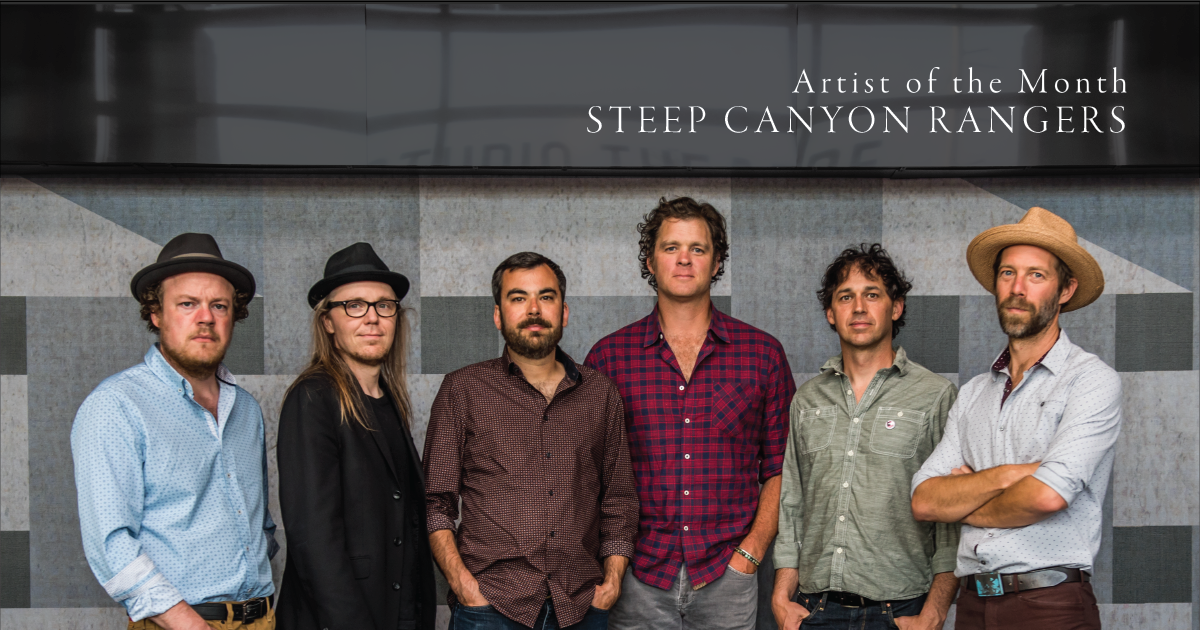
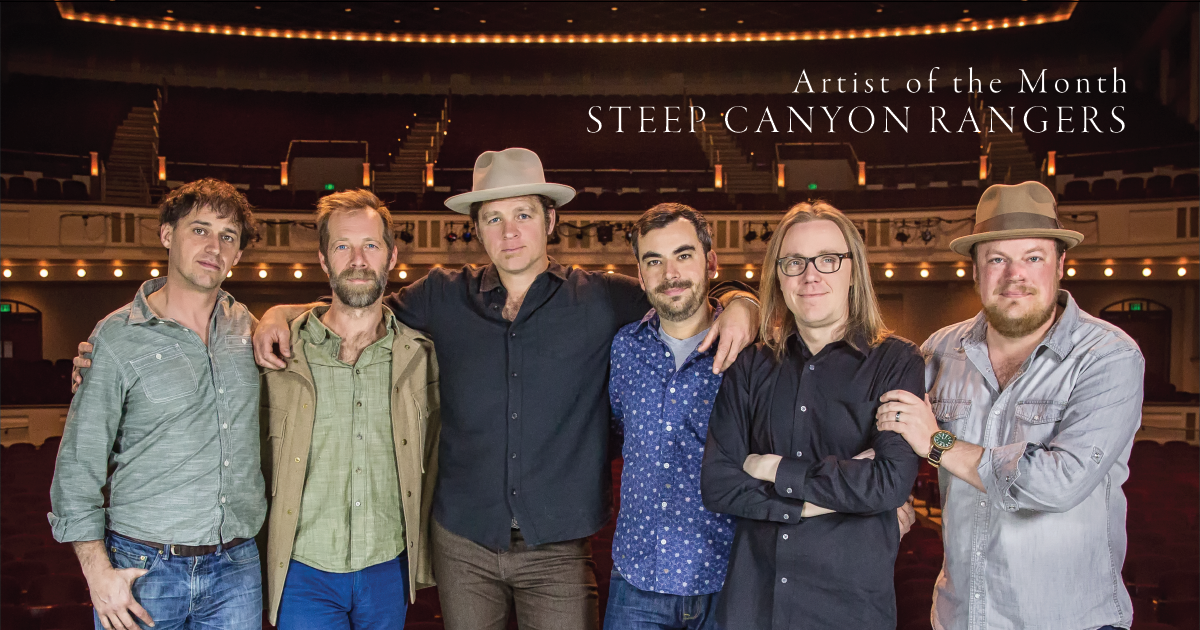
Steep Canyon RangersArm in Arm, their first collection of all-new material in two years, is a set of highly grown-up songs, some with storylines that you’d expect from the likes of Drive-By Truckers or Bruce Springsteen. It’s more loose-limbed and less traditional than past Rangers albums, with fine ensemble playing throughout.

BGS caught up with co-leaders Woody Platt and Graham Sharp in separate conversations leading up to the release of Arm in Arm. After starting with Platt yesterday, here is the conversation with Sharp.

BGS: With the band off the road, have you been able to do any songwriting during this time?

Sharp: I started off writing on a real tear the first few months. But then I slacked off a bit, in part because that coincided with me starting to make an album of my own. Switching from writing to recording slowed down that end of it, but working on my own stuff is kind of out of necessity. For the band to survive this and come back when it’s time, we’ve all got to look out for ourselves a little more.

It’s a strange new hustle, but we’re holding up pretty good. We’ve all been forced to sort of pivot, after having not stopped moving in 20 years. This is the longest any of us have stayed put that whole time. It takes a moment to settle, but it’s been eye-opening. Forced me into some new directions that have been good and ought to pay dividends once we can get the band back together. I’m trying to pull out as many silver linings as I can.

That’s a bit of news, about the solo album. What can you tell us about that?

I don’t know where or when it will ever come out, but the solo album is close to done. I’ve been working with Seth Kaufman from Floating Action in his little basement studio here in Black Mountain. It’s mostly new songs, and a handful of tunes the Rangers have been kicking around a while without getting to them. Nothing bluegrassy about it, mostly country to country-soul, because I have definite tendencies in that direction and a deep love for country music of the ’60s, ’70s, ’50s. That’s still among my favorites.

After Charles Humphreys III left the Rangers in 2017, this is the first album where you’ve written all the songs, not just most of them. Was there more pressure on you?

Not necessarily. It did not change my process much, anyway. I always just try to compile as much good material as I can. It is neat that with a band as organic as this one, a song can kick around for years where we’ll never find a place for it and then suddenly it’s revived. The last song on the album “Crystal Ship” was like that. I had that one for a long time and then backstage one day, [Mike] Ashworth just started playing that melody because he remembered it from a year or two earlier. It’s cool to have the band’s collective memory to draw on, where everybody is part of the process.

The first song “One Drop of Rain” is another. I probably wrote that one six or seven years ago and I’d just never taken the time to find the right groove and place for it. Then one night Woody and I were backstage, I had this little banjo roll, he had the phrasing to go with that and we put it together. A lot of songs come together over time like that. The process is more cumulative than me bringing something in, “Hey, I’ve got this new song.”

Do you have any particular favorite songs on this one?

Probably “One Drop of Rain” and “Honey on My Tongue,” for different reasons. I can remember exactly where I was and the situation I was trying to capture with “One Drop,” just shortly after my father-in-law had died very unexpectedly — 64 years old. What it gets at for me is, try to love your way through the hardest situations. And “Honey” is one I wrote with my daughter in mind. She was giving me a hard time, saying I never write songs for her — not true! But yeah, okay, that was written specifically for her. There are several songs about resilience, dealing with loss, setbacks. All to different degrees, tied to different moments in time.

This record sounds very, dare I say it, mature and grown up.

Well, we’re all passing into the point in our lives where we see a lot of past decisions come to fruition as everyone’s lives play out, our own as well as others. That perspective figures into it. As a songwriter, I’m maturing and trying to hone in on the emotional center of a song – and trying not to write about fluff. We were all very aware while making this album that a lot of the songs aren’t necessarily sad, but a little bit heavier.

And on this record, you’ve also got the first lead vocal from new bassist Barrett Smith.

It’s been cool, having him take on a bigger vocal role. With Woody or myself, it’s just us singing songs at this point. But with Barrett, there’s this ability to tailor songs to a new voice in the band. The song he sings, “Everything You Know,” we talked through the lyrics and the story. Woody and I have always done that, gone through songs in detail. Although sometimes, I don’t necessarily want to influence the pictures anybody else sees in their head while singing.

Once a song is written and out there, it belongs as much to the listener as the singer or the writer. Sometimes they come up with something different, too. “Can’t Get Home” from the last record, Woody thought I wrote that for soldiers coming home and he wasn’t the only one. I had not necessarily meant it that way, but I talked to enough other people about it that it kind of changed the song’s meaning for me, which was cool.

Did taking on the production yourself make Arm in Arm more collaborative than past albums?

I feel like what we do on stage is try to give everybody in the band moments to shine while keeping things moving. Producing this record ourselves was like that, more so than us playing while someone else producers. There are songs where I remember, so and so arranged this part, so and so suggested this harmony, so and so came up with the idea for this mix. So many different pieces where I can see everybody’s fingerprints. I’m proud of that.

I’m just psyched to have something to roll out into the world, reach out a little bit. You know, it’s not the best time to be releasing a record because we can’t tour. So I hope this will reach and touch people. I’m definitely prouder of this record than anything we’ve ever done.

Read part one of our Steep Canyon Rangers Artist of the Month interviews here.


Editor’s Note: David Menconi’s Step It Up and Go: The Story of North Carolina Popular Music, from Blind Boy Fuller and Doc Watson to Nina Simone and Superchunk will be published in October by University of North Carolina Press.

Photo credit: David Simchock

LISTEN: The Honeygoats, “Hummingbird”

Artist: The Honeygoats
Hometown: Plymouth, Wisconsin
Song: “Hummingbird”
Album: Four Years in Three Days
Release Date: October 16, 2020

In Their Words: “’Hummingbird’ was written out of a love for songs that get people dancing and singing along to them the first time they hear them, which makes it great opening track for our album. Upbeat, straight to the chorus, no messing around. It almost sounds innocent enough at first listen, but there’s some innuendo in its theme that gives it some edge when you take a closer listen. The idea was sparked simply by watching some hummingbirds as they buzzed around a feeder one morning, and it turned into a song about a certain type of relationship between two people. Old blues musicians mastered the art of using metaphors to sing about edgy themes in their songs, and that was something that we tried to capture with this.” — Jamie Odekirk, The Honeygoats


Photo credit: Flyover Vigilante

Steep Canyon Rangers Carry On, Without the Suits, ‘Arm in Arm’ (Part 1 of 2)

The COVID-19 virus has pretty much shut down the music industry, with nightclubs and concert venues shuttered across the world. And yet the Steep Canyon Rangers have had their most productive year ever in the midst of it all. October will see the release of their new studio album, Arm in Arm, the Rangers’ third record in less than a year.

Arm in Arm follows last December’s North Carolina Songbook, a live recording taped on the main Watson Stage at the 2019 MerleFest and featuring iconic North Carolina songs by Elizabeth Cotten, James Taylor, Ben E. King, Ola Belle Reed and even jazzman Thelonious Monk. And then early in 2020 came Be Still Moses, another quirky live recording — this one with the Rangers’ hometown Asheville Symphony Orchestra, featuring a memorable vocal cameo from Boyz II Men.

BGS caught up with co-leaders Woody Platt and Graham Sharp (Read part two here.) in separate conversations leading up to the release of Arm in Arm, starting with Platt.

BGS: Since touring can’t happen these days, you’ve had to make do with livestreams and also drive-in shows around your home territory. How have those gone?

Platt: The drive-in shows went great, but they were a lot of work for us. It’s not like there’s a model or handbook: “Here’s what you do for live music in the middle of a pandemic.” So we tried to keep it simple. Since we really wanted people to stay in their cars, we had a short-range FM transmitter and no live PA, trying to keep everybody tethered to their cars.

We were lucky that, through our work with Steve Martin, we know someone who is a leading AV guy. He developed a truck with stage bolts, transmitter and LED screen popped out the top — a mobile rig he’ll keep using all over the country. Sonically, it was like being in the studio. And instead of applause, there’s horns and windshield wipers and headlights, which was amusing. For the encore, they called us back with horns. Ultimately, I think it was joyful — a unique bit of fun for an audience that hadn’t experienced any live music for a long time.

It also appears you’ve had a change in direction, not musically so much as in terms of style. You’re not wearing suits on stage anymore?

I don’t know how to explain that other than that the music evolved, so we did, too. Presentation has always been a constantly evolving thing. We didn’t wear suits at the beginning, then we did for a long time in the middle — and we still do when we work with Steve Martin. But hey, we’re the Rangers and we’re still looking nice even if we don’t regularly dress up in suits anymore. And much like the music, it’s an evolution that was not calculated or contrived. We’ve kind of gone more upper-casual, I guess. Bluegrass business casual.

Was putting out three albums in less than a year part of a master plan?

We never would have planned anything like that, but these three records were all basically done not too far apart. Arm in Arm was all but mixed when the shutdown hit, and that part of it was something we didn’t have to get together for. We could send that around, work on tracks remotely and share them back and forth. The other two were both already in the can, fortunately.

Watching all this come out, you’d almost think it’s just life as usual. If nothing else, it’s been great to be able to continue sharing music with the world. And it’s also kept us productive and in touch with each other and also the idea of pushing forward. Without these projects to focus on, we could have drifted away from each other. But we’ve had things to focus on day in and day out, to stay creative and in communication.

How did you wind up collaborating with Boyz II Men on the Be Still Moses title track?

All credit for that goes to our producer Michael Selverne, a cat from New York who is also an attorney and musician himself. He’s got a lot of connections and he works them all. He called me up one day and said, “You guys are an all-male singing quartet, and I consider you a vocal group. Well, I know another great vocal group for this song, too.” “Oh yeah,” I said, “who?” He said Boyz II Men and my jaw just dropped. But I never want to discourage or squash any idea that seems unobtainable, so all I said was, “Sounds great. If you can pull that off, we’re game.”

He not only pulled it off, he incorporated them and our band and the symphony in a way that worked. It was pretty unusual company for us, but we’re used to that. First time we met, we were set up onstage with the symphony at Schermerhorn [Symphony Center] in Nashville, just milling around, and here they come. Once we started, I had to kick that song off with a little guitar run and sing the first verse — a tall order when a bunch of singers like that are staring at you. But it turned out great.

Since Arm in Arm was the first album you guys produced yourself, without an outside producer, what was that like?

There are a lot of good reasons for using a producer, especially the fact that we’re a democracy and everybody in the band has equal weight in discussions and decisions. I love that, but it can take longer to get from point A to point B while keeping everybody happy. It can help to have an outside person to mediate and help with decisions when time is of the essence. But this record came together very quickly, and we had a lot of faith in our engineer’s skill and his ear.

What’s next after this? Are more live dates with Steve Martin and Martin Short on the docket?

I was talking to Steve recently and he told me they have picked up every date that was on the books. All the shows that were canceled, they’re already rescheduled. We were overseas when the lights went out from the pandemic, supposed to play in London, and it’s been a day-by-day experience ever since. So there’s a lot of optimism in rebooking everything and I hope it all turns out. But I have to admit, I kind of chuckled to myself about already rescheduling. I just don’t know.

It’s been more than 20 years since you guys first got together at the University of North Carolina. Ever think Steep Canyon Rangers would still be going two decades later?

Since we’ve been around for so long, it’s easy to think we should be bigger or more successful by now. But taking a step back and looking at the things we’ve actually accomplished, it all adds up. We’ve had a lot of good things happen, good music and shows and records, and we’ve been recognized in some great ways. I never thought we’d win a Grammy award!

Read part two of our Steep Canyon Rangers Artist of the Month interviews here.


Editor’s Note: David Menconi’s book, Step It Up and Go: The Story of North Carolina Popular Music, from Blind Boy Fuller and Doc Watson to Nina Simone and Superchunk, will be published in October by University of North Carolina Press.

Photo credit: Shelly Swanger

WATCH: Josh Shilling, “(Go to Hell) 2020”

Artist: Josh Shilling
Hometown: Martinsville, Virginia
Song: “(Go to Hell) 2020”
Release Date: October 9, 2020
Label: Josh Shilling Music

In Their Words: “This song wrote itself. It fell out one morning while waiting for a Skype writing session to start with another songwriter. It felt like a personal and heavy conversation with an old confidant. I was positive this would impact people. Each verse is something I’ve faced personally since spring regarding the pandemic: societal unrest, facing loss and grief, and relationship tension throughout 2020. The chorus provides hope and belief that life will get better and ‘someday soon we’ll be free and this will be in the rear view.’ The song is where I am; it’s where I think we all are right now. No tricks, no big production, this was a live take, three chords and the truth … the truth for everyone, I think.” — Josh Shilling


Photo credit: Sebastian Smith