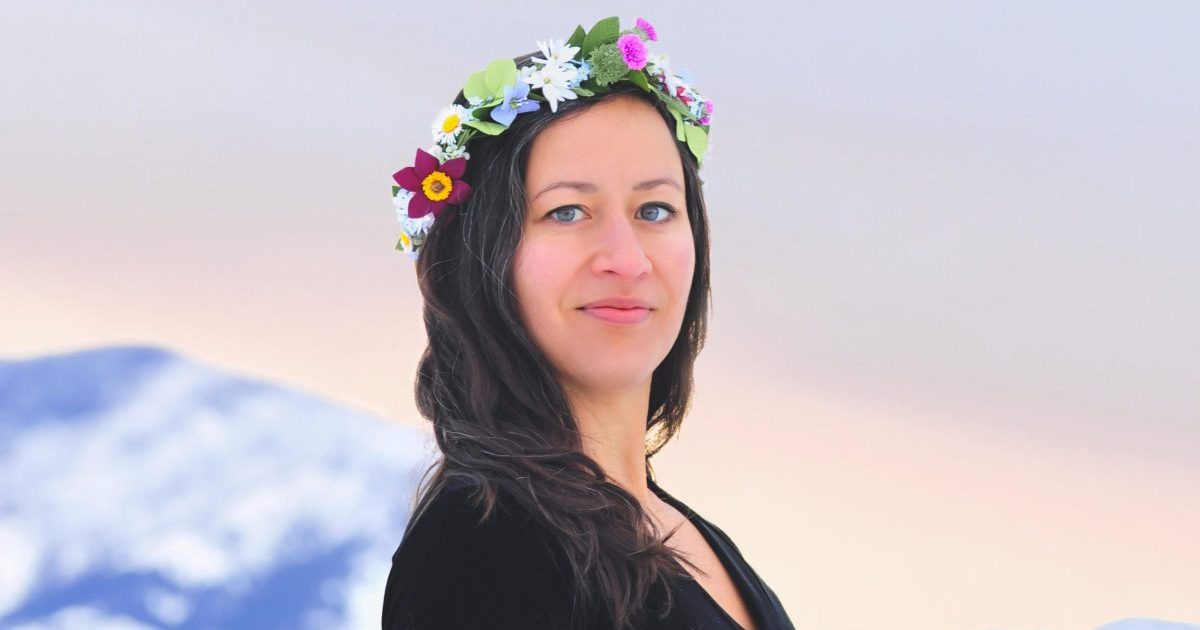
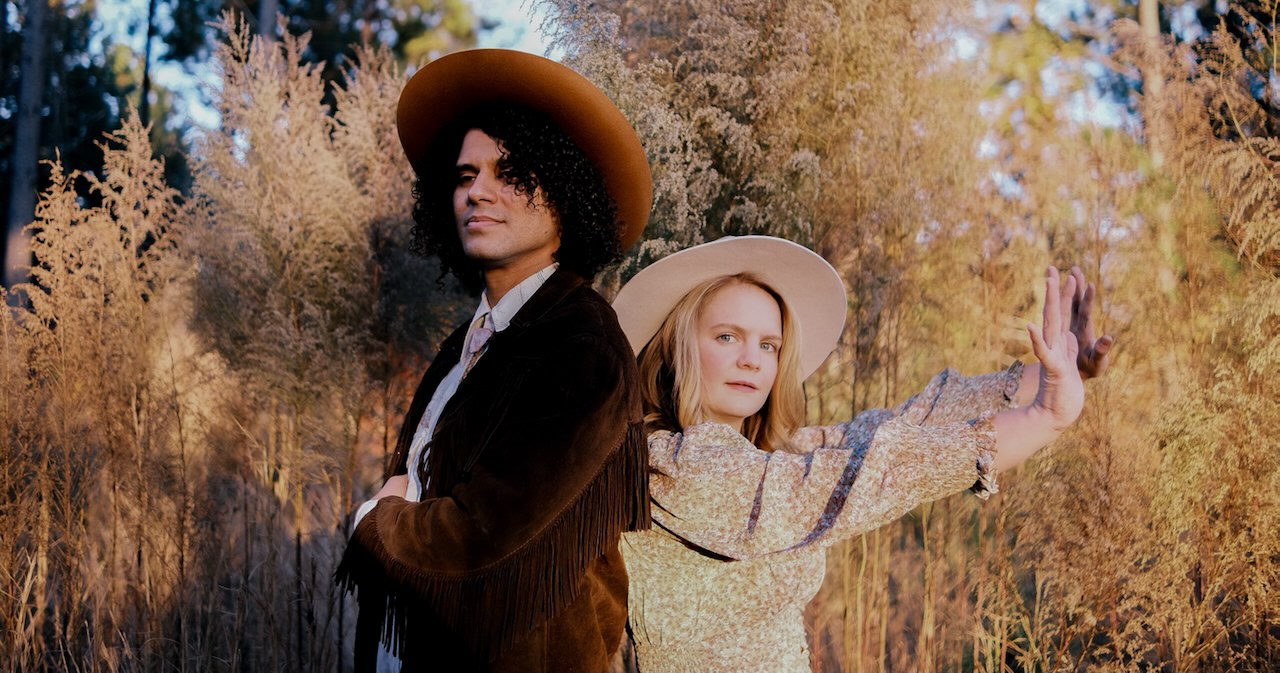
Artist:Natalie Padilla Hometown: Northampton, Massachusetts Song: “Balsamroot” Album:Montana Wildflower Release Date: March 31, 2023 Label: Heartseed Music
In Their Words: “The first tune in this two-tune set is titled ‘Pasqueflower’ and was written as I was recovering from an intense second case of Covid in May of 2022, about one month before Montana Wildflower was recorded. I had barely enough energy to play my fiddle after multiple days stuck in bed, and this tune came as I stared in a daze at a tiny white spider on the table. The original title was ‘Barndance for a Spider.’ However, for this album, all the original tunes have been named or renamed after Montana wildflowers, so I settled on the pasqueflower. They are among the first to emerge each spring, sometimes even popping up through the snow as delicate purple flowers, rising only a few inches from the ground with fuzzy white stems. The second tune, ‘Balsamroot Reel,’ is an ode to one of my most favorite past dwellings, a little red cottage in bright, sunny Lyons, Colorado. The only thing I recall about the writing of this tune is that it was written in the kitchen, and I sure did like that kitchen. Balsamroot is an abundant bright yellow flower that can cover entire Montana mountain sides in early summer.” — Natalie Padilla
Since the beginning, BGS has sought to showcase roots music at every level and to preserve the moments throughout its ever-developing history that make this music so special. One of the simplest ways we’ve been able to do just that has been through our Sitch Sessions — working with new and old friends, up-and-coming artists, and legendary performers, filming musical moments in small, intimate spaces, among expansive, breathtaking landscapes, and just about everywhere in between. But always aiming to capture the communion of these shared moments.
In honor of our 10th year, we’ve gathered 10 of our best sessions — viral videos and fan favorites — from the past decade. We hope you’ll enjoy this trip down memory lane!
Greensky Bluegrass – “Burn Them”
Our most popular video of all time, this Telluride, Colorado session with Greensky Bluegrass is an undeniable favorite, and we just had to include it first.
Rodney Crowell and Emmylou Harris – “The Traveling Kind”
What more could you ask for than two old friends and legends of country music reminiscing on travels and songs passed and yet to come, in an intimate space like this? “We’re members of an elite group because we’re still around, we’re still traveling,” Emmylou Harris jokes. To which Rodney Crowell adds with a laugh, “We traveled so far, it became a song.” The flowers were even specifically chosen and arranged “to represent a celestial great-beyond and provide a welcoming otherworldly quality … a resting place for the traveling kind.” Another heartwarming touch for an unforgettable moment.
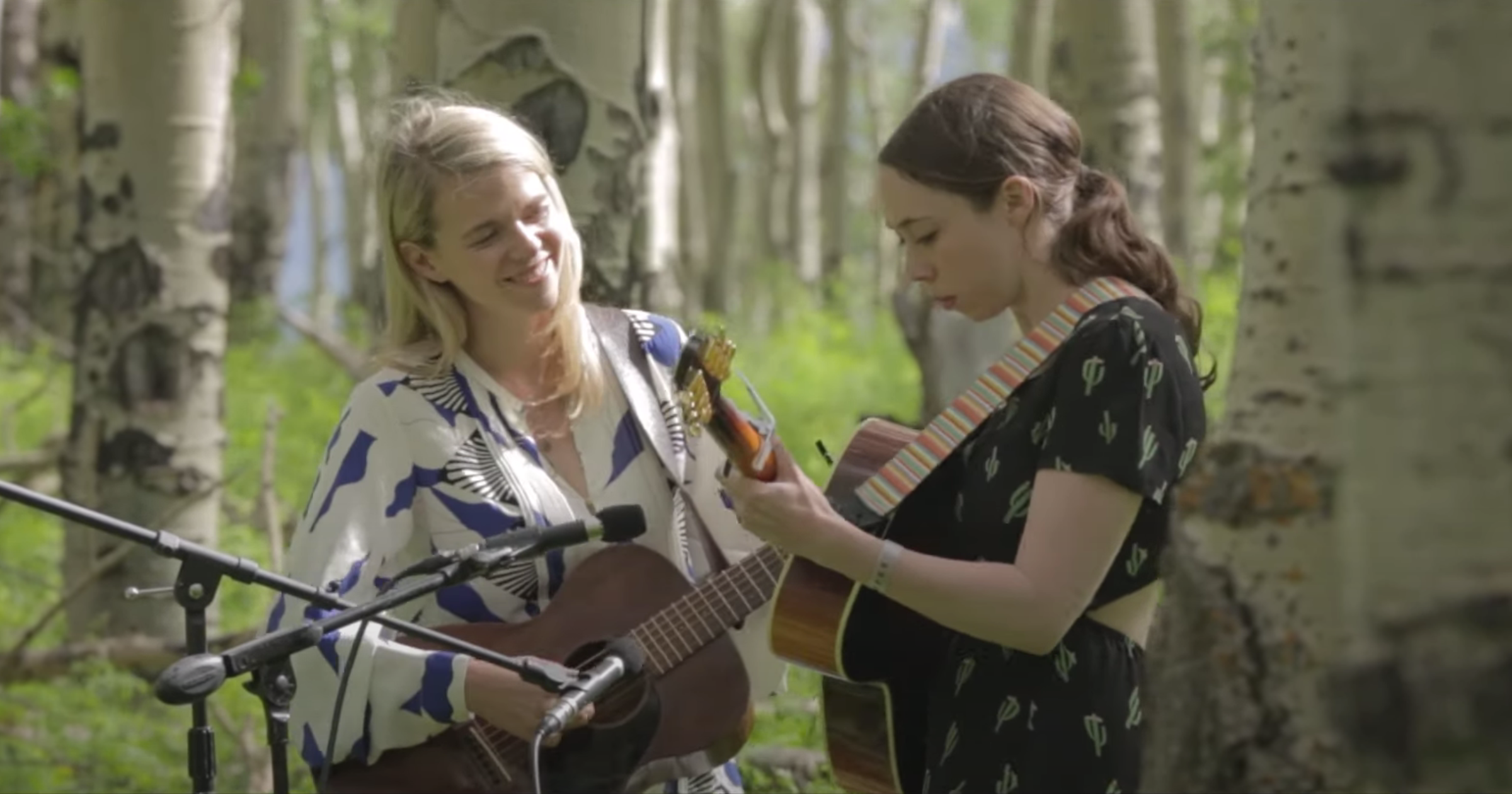
Sarah Jarosz and Aoife O’Donovan – “Some Tyrant”
In the summer of 2014, during the Telluride Bluegrass Festival we had the distinct pleasure of capturing Sarah Jarosz and Aoife O’Donovan’s perfectly bucolic version of “Some Tyrant” among the aspens. While out on this jaunt into the woods, we also caught a performance of the loveliest ode to summertime from Kristin Andreassen, joined by Aoife and Sarah.
Rhiannon Giddens – “Mal Hombre”
Rhiannon Giddens once again proves that she can sing just about anything she wants to — and really well — with this gorgeously painful and moving version of “Mal Hombre.”
Tim O’Brien – “You Were on My Mind”
Is this our favorite Sitch Session of all time? Probably. Do we dream of having the good fortune of running into Tim O’Brien playing the banjo on a dusty road outside of Telluride like the truck driver in this video? Definitely.
Enjoy one of our most popular Sitch Sessions of all time, featuring O’Brien’s pure, unfiltered magic in a solo performance of an original, modern classic.
Gregory Alan Isakov – “Saint Valentine”
Being lucky in love is great work, if you can find it. But, for the rest of us, it’s a hard row to hoe. For this 2017 Sitch Session at the York Manor in our home base of Los Angeles, Gregory Alan Isakov teamed up with the Ghost Orchestra to perform “Saint Valentine.”
The Earls of Leicester – “The Train That Carried My Girl From Town”
In this rollicking session, the Earls of Leicester gather round some Ear Trumpet Labs mics to bring their traditional flair to a modern audience, and they all seem to be having a helluva time!
Sara and Sean Watkins – “You and Me”
For this Telluride session, Sara and Sean Watkins toted their fiddle and guitar up the mountain to give us a performance of “You and Me” from a gondola flying high above the canyon.
Punch Brothers – “My Oh My / Boll Weevil”
The Punch Brothers — along with Dawes, The Lone Bellow, and Gregory Alan Isakov — headlined the 2015 LA Bluegrass Situation festival at the Greek Theatre (a party all on its own), and in anticipation, the group shared a performance of “My Oh My” into “Boll Weevil” from on top of the Fonda Theatre in Hollywood.
Caitlin Canty feat. Noam Pikelny – “I Want To Be With You Always”
We’ll send you off with this delicate moment. Released on Valentine’s Day, Caitlin Canty and Noam Pikelny offered their tender acoustic rendition of Lefty Frizzell’s 1951 country classic love song, “I Want to Be With You Always.”
Dive into 8 of our favorite underrated Sitch Sessions here.
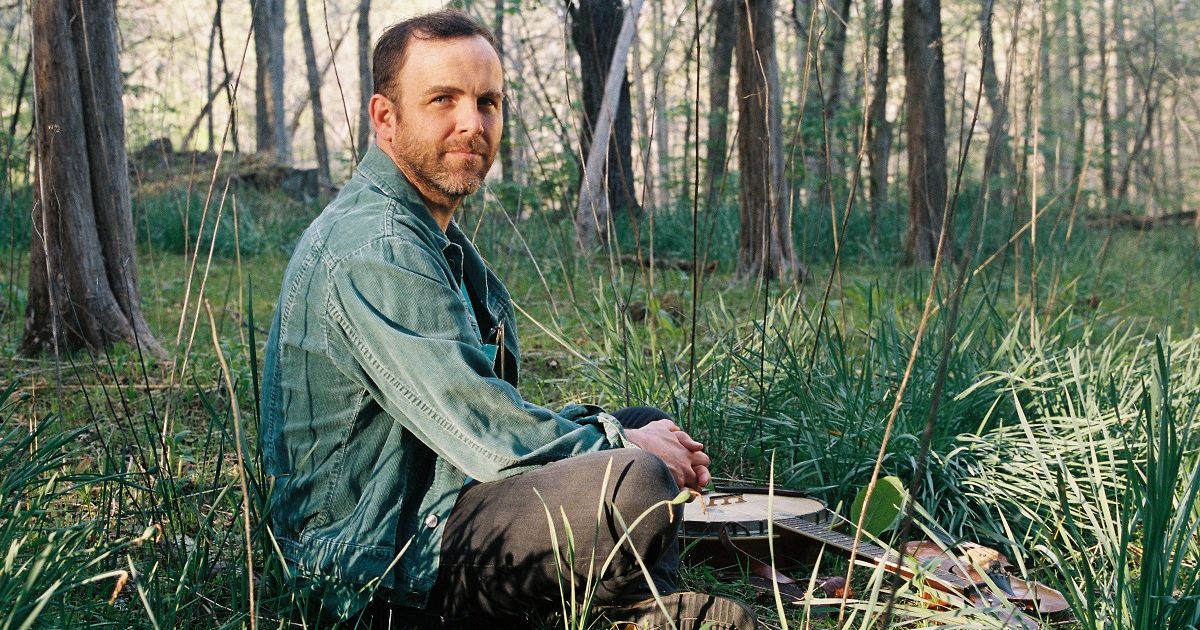
Artist:Joseph Decosimo Hometown: Durham, North Carolina Song: “The Fox Chase / Lost Gander” Album:While You Were Slumbering Release Date: November 11, 2022 Label: Sleepy Cat Records
In Their Words: “Here’s one for all of y’all who’ve lost a dog. I recorded it at home, DIY style, singing and playing all the instruments — fiddles, banjo, pump organ — a while back, thinking it was a lovely pairing of old pieces, but when my dear dog Charlie died last August, this ballad about a dog wandering into the cosmos opened up some space for me to grieve my departed friend. I drew both pieces from the beautiful singing and playing of the Tennessee ballad singer and banjo player Dee Hicks, who sang over 400 songs — 200 of which he learned from his family. An old English hunting ballad, ‘The Fox Chase’ dates to the late 1600s but made its way with the Hicks family onto Tennessee’s Cumberland Plateau, where their hounds sounded out across the tablelands and gorges. The second piece, the ‘Lost Gander,’ is a rare, regional banjo number in a special tuning that allows the shimmering chimes that Dee Hicks said sounded like geese honking in the sky at night. My friend and label pal Gabe Anderson had his departed hound Amos in mind as he put this video together with beautiful watercolors and sketches from N.C. visual artist Larissa Wood. I grew up on the southern end of the plateau and love how her watercolors capture this special landscape.” — Joseph Decosimo
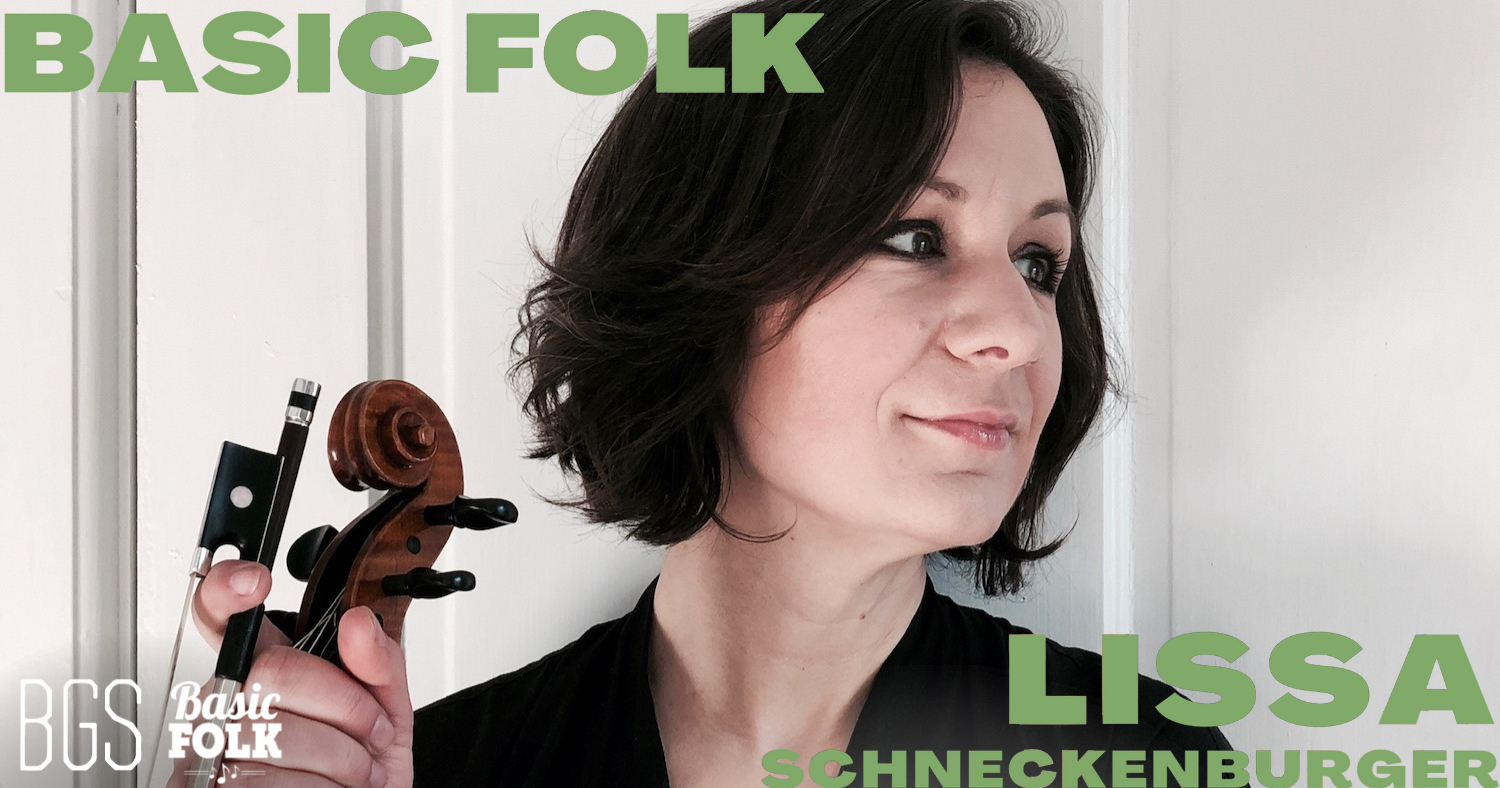
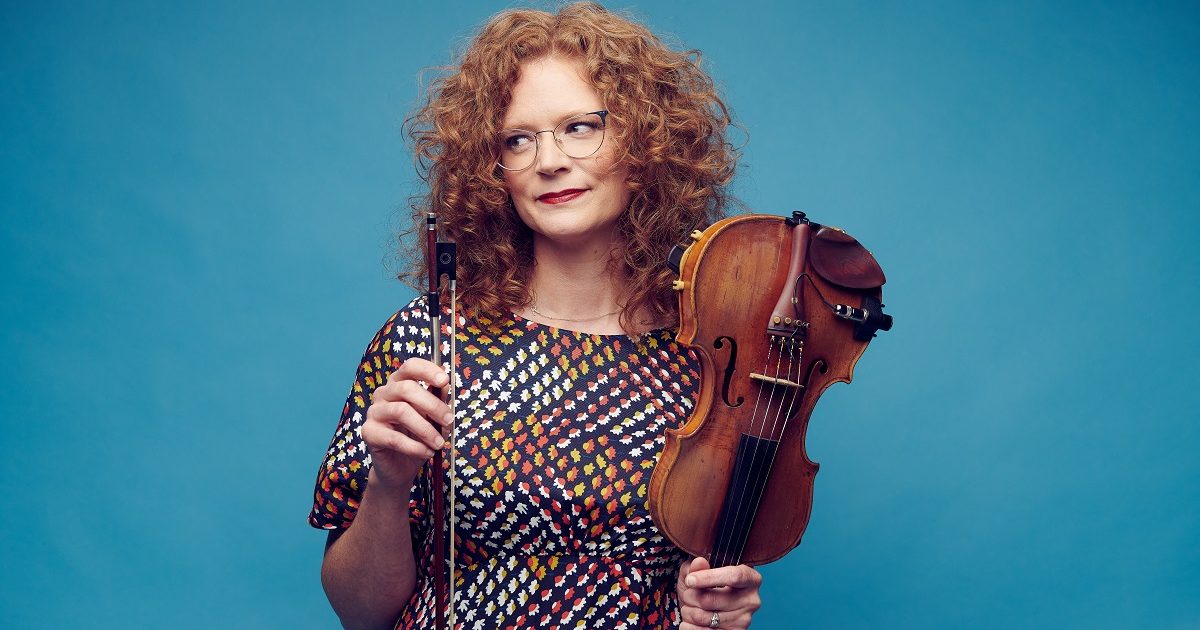
Known as one of the foremost fiddlers of her generation, Lissa Schneckenburger‘s latest release is a huge left turn for the Vermont resident. Thunder In My Arms is unique because Lissa is not only singing her own compositions, but the subject matter is hugely personal. The album chronicles her experiences adopting her son. Through the fostering and adoption process, she came across resources, workshops and books, but no music that specifically was about this experience. Since she processes hard things through music, she decided to step up and create this album for her family and for those in the adoption and fostering communities. Lissa thrives and lives in community through music, so creating and reaching out to this new community came as second nature.
Born and raised in rural Maine, Lissa grew up around music and started on the fiddle at five years old. She competed in fiddle competitions, went to Maine Fiddle Camp and the much revered Valley of the Moon Camp in Northern California. Arriving in Boston for school at New England Conservatory of Music, she found herself among a familiar group of musicians that she’d grown up with at the camps. She teamed up with Laura Cortese, Hanneke Cassel and Flynn Cohen to form the seminal Boston fiddle group Halali, which inspired so many young players and ignited a fiddle renaissance in town. Since then, she has released solo albums and been a part of groups like Low Lily. She now lives in Brattleboro, Vermont with her son and her husband, in-demand upright bassist Corey DiMario (Crooked Still). Lissa has a new fiddle album on the way in 2023, which you can pre-order right from the lady herself. Enjoy Lissa!
Editor’s Note: Basic Folk is currently running their annual fall fundraiser! Visit basicfolk.com/donate for a message from hosts Cindy Howes and Lizzie No, and to support this listener-funded podcast.
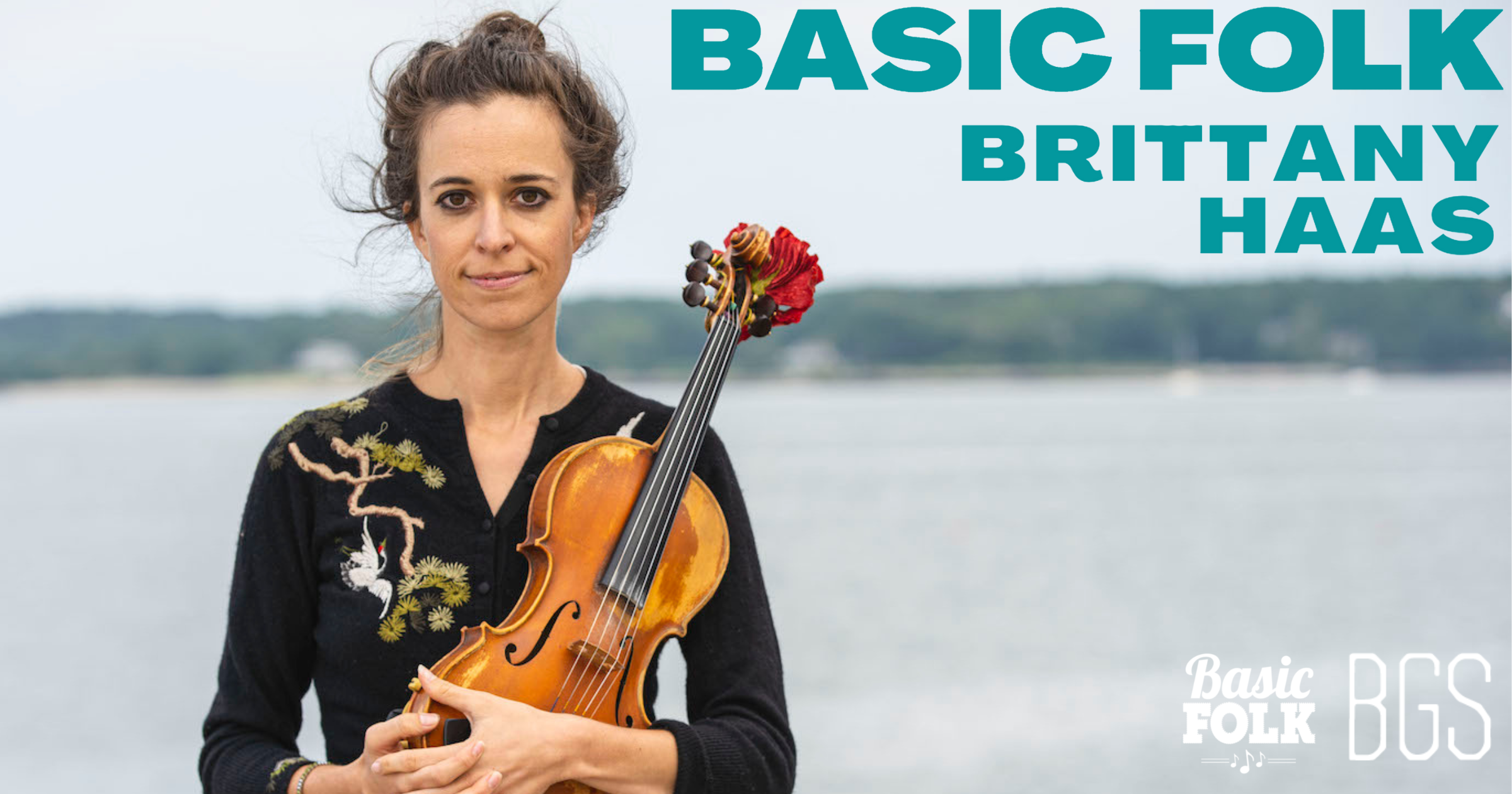
Fiddler Brittany Haas has an impressive resume: she started touring at 14 with Darol Anger, recorded her debut album at 17, started performing with Crooked Still before she finished college, has played on Chris Thile’s radio program Live From Here and done stints in David Rawlings and Gillian Welch’s David Rawlings Machine. Currently, she’s teaching workshops and classes in between working with her band Hawktail along with Paul Kowert, Jordan Tice and Dominick Leslie. Their latest album, Place of Growth, is a song cycle in appreciation to the natural elements, which have always intrigued Brittany.
She’s a trailblazer in fiddling and also has an acute awareness of burnout. The past few years have seen her pursuing and obtaining a masters in social work and teaching classes at East Tennessee State University as their artist-in-residence. Our conversation includes a discussion of balance and awareness when it comes to keeping her music joyful. And then there’s science: she has a degree in Evolutionary Biology at Princeton University. Also, Hawktail’s latest album is a journey through the natural world. We talk about the band giving each other the space to be themselves on the record. Brittany is chill, brilliant and generous. Enjoy and then go listen to Hawktail’s new record all in one sitting.
Editor’s Note: Basic Folk is currently running their annual fall fundraiser! Visit basicfolk.com/donate for a message from hosts Cindy Howes and Lizzie No, and to support this listener-funded podcast.
Musician, folklorist, and instrumentalist Willi Carlisle is a bona fide troubadour in genres often populated by mimics and pretenders. But even so, and quite strikingly, his professional and artistic persona is not at all cast through a “greater than thou” light – or through the self-righteousness with which most creators stake their claim to the outlaw fringes of roots music. His debut album on Free Dirt Records, Peculiar, Missouri, is a testament to this dyed-in-the-wool road dog’s commitment to a populist, accessible, and identity-aware brand of country music.
Peculiar, Missouri is all at once intimate and grand. Brash and rollicking radio-ready singles intermingle with raw, “warts and all” tracks that sound live and visceral, tender and ineffable. Stories of cowhands and wagon-train cooks and circus performers and legendary figures are peppered with queer text and subtext and underlined with a class consciousness. The result is not only inspiring, it will stop a listener dead in their tracks.
But the pause that this album supplies is not due to Peculiar being demonstrably extraordinary. Just the opposite. The simplicity, the downright everyday-ness of this record is its shining accomplishment. The seemingly infinite inputs that Carlisle distills, synergizes, and offers to the listener – regional roots music, old-time country, queerness, vaudeville showmanship, folklore and storytelling, the Ozarks, poetry, and so on – are perfectly synthesized in a remarkably simple and approachable format. Peculiar, Missouri is fantastically free, but not scattered. It’s extraordinary in its refusal to be anything other than ordinary.
We spoke to Carlisle via phone ahead of his appearances this week at AmericanaFest in Nashville, where he’s excited to continue to grow the community that centers around the small business of his music. “I want to play a hundred and twenty, a hundred and fifty shows a year. I want to work my ass off,” he explains, excited for the weeklong conference and festival. “I’ve got a small business and it’s built on this group of people that I really love and that I really trust. Now I get to bring them together. It feels like a really unique and positive situation in a pretty garbage industry, sometimes!”
Our conversation began with Peculiar’s extraordinary simplicity.
BGS: I think the most extraordinary thing to me about the record is that it kind of refuses to be anything other than ordinary. And I hope that that doesn’t seem like a backhanded compliment, because to me the music feels so grounded, raw, and authentic – but in a way that doesn’t just propagate antiquated ideas around what “authenticity” is. So, I wanted to ask you how you crafted the vision for the project, because it did end up so simple, but I know that simplicity doesn’t necessarily mean building the concept for the album was simple at all.
WC: Simplicity is hard to do and I’m the kind of person that has forty ideas and maybe a couple good ones in there, so I had a lot of songs. I give a lot of credit to friends and family in Arkansas and the folks at Free Dirt for helping me figure out how to try to nail [my vision] to the wall. I wanted to play old-time music on the record. I’ve been really lucky to do square dances and play old-time music in the Ozarks for a long time. I want to be old-time music and I want to be country and I want to be queer and I want to be a poet. I want [the album] to be grounded in American literature, and also want it to be grounded in American old-time music, so that it feels like the songs are highly regional and from specific traditions that I’ve learned from.
This might make it sound like getting to simplicity was simple, but it really came down to a series of checkmarks. I want to be able to learn from Utah Phillips forever and his legacy and the legacies of the people that worked with him. So I knew I wanted to do a Utah Phillips song. I wanted to do something that felt more like a square dance call than like a capital S “song.” So we did “The Down and Back.” I’ve been setting poems to music for fun for a long time and that was why we did that song, “Buffalo Bill.” I’d always wanted to just tell a story, too, so we set a story to my own fingerpicking, because there’s a lot of that style in the ‘70s and from people I admire the most, like Steve Goodman and Gamble Rogers. It also came down to what traditions we were working in. “How do we evoke these different traditions in a way that is diverse but is unified?” At the end of the day, it might just be my voice and limited capacity instrumentally that unifies it. [Laughs]
The record feels “agnostic” to me in so many ways: The genre aesthetic (or lack), agnostic. The songwriting perspective, agnostic. The identity narratives, agnostic. The regional qualities, too. And when I say “agnostic” I mean, they all feel very defined and tangible, but not that you’re professing any one of them as traditional or as truth. You’re placing this music so specifically within a longstanding tradition of old-time country and string band music, but you’re doing it in a way that doesn’t feel like it’s trying to ensconce a “correct way” to make music.
Carl Jung, who writes the best shit [Laughs], writes about some kind of “spiritus mundi,” some kind of larger idea of the world that can bind us all together, psychologically. In a lot of these things about America, we receive these overarching stories about what it is to be an American, what it is to be free, what it is to be this, that, or the other. These stories have identity concerns, but they have to be agnostic, because they’re too general to ever be specific. Which is to say, it’s all sort of false.
I guess as I was looking at all of the historical moments that I wanted to underline, I found that the overarching narrative was that there was not going to be one. The title track is about traveling for a long time and having a panic attack in a very specific place, but also a very non-specific place, which was a Walmart. It may be the most unifying place in the country, now. I wanted to take the idea of this universal American spiritus mundi and locate it within as many specific voices that were inspiring to me. And usually those are people that tried to do folk music or vernacular music in this big, all-encompassing way.
That agnosticism, that acceptance of the duality of all things, that’s such a queer perspective. And it’s not just because of the pink album cover. [Laughs] It feels like the undercurrent and overcurrent of this record.
Yeah, it’s designed to be, it has to be inclusive. [The album] also includes voices that are on the very edge of slipping out of existence. It also sort of includes failure and incompetence and foolishness and folly. I think a lot of our “sad bastard,” dude country – which is really one of my favorite genres, it ain’t me ragging on sad, sad country. [Laughs] “Tear in my beer,” I’m 100% behind that! But for some reason we’re willing to valorize those feelings, but not valorize historical discomfort and the total dissipation of huge groups of feelings. And [we valorize] money.
Like, if I was going to do a Utah Phillips song, the one to me that fit the most was “Goodnight Loving Trail.” One, because it’s stone cold banger and two, because it’s about a cook on a wagon train. And if I think that somebody is going to get the idea that I’m going to talk about rootin’ tootin’, gunslinging, and stuff, I wanna fight that with, “Here’s a song about the emotional condition of a pissed off cook who stays up all night playing melancholy songs on his harmonica.” That’s it! There’s nothing else, the only message of that song is we get old and we die. We outlive our youthfulness, and to what end?
“Sad bastard” or, as I like to call it, “sad boi country” – sad boi anything is so, so hot right now. Especially this kind of idea of “sad boi” or “dirt boi” country, and it’s really prevalent in Americana. But I feel like this record is turning that new-ish trope on its ear. Something about straight, cis-, white, privileged men self ascribing “sad boi” or “dirt boi” always rings untrue to me as a listener. But Peculiar, the sadness intrinsic in it doesn’t seem like “sad boi country” to me, because it does have that queer thread. Do you agree or disagree?
Well, the title of the record is intended to be a pun: “Queer sadness, peculiar misery.” I guess I would include that. I think there are perfect sad boi country songs out there. Formally, I don’t really have anything against the form, I just want to do my own version of it. If I’m totally honest, that’s mostly the way it comes out. That tends to be the way it comes out, in this format. I have written songs that go in circles around, I guess, a more normal sort of self-indulgent sadness, but I’ve never felt them to be my best work. It’s nice to lean into the thing that hurts you, I think that there’s power in that.
I think that a lot of that sad boi country is angry at women, or is saying, “I’m no good and women hate me.” Or, “I’m no good and my mama knows I’m no good.” Or there’s “I’ve tried to be good and I can’t.” Instead of like, looking inward and being like, “I want to be better, I need to be better. My problems are my own.”
I want to talk about production, because one of the things I love about the record is that you’re playing with sonic space so much. Some of the songs are placed very close to the listener, like a radio mix. Others are really quite distant and you play around in that space, kind of mischievously at times. Where did that production quality come from and why was it important to you?
Well, I don’t want to take credit after the fact. It was the idea of the producer, Joel Savoy, who essentially was like, “Hey, I’ve got this old vaudeville theater, I’ve never gotten to use it, but I think that you could spread a couple tracks out in this old theater.” It’s like hundreds of years worth of people dancing in this theater, it’s just gorgeous. I also told him, “Look, I want a couple tracks ready for the radio. I want to be able to take a real shot.”
On the other level, it’s just me and an instrument. I want it to sound like I’m sitting on the edge of somebody’s bed and they’re sitting with the covers pulled over them. That’s pretty much what I said [to Savoy]. A lot of the production is me having an interest in the record reaching some kind of minimal commercial viability, I want to say pretty clearly that that’s an intentional move. I know that I can make a record that will never reach commercial viability. I just got nominated for an award in outlaw country and that really just means I’m not ever going to reach commercial viability, but they do agree that I’m country. [Laughs]
I wanted to be able to share the project and create a couple of things that would invite people in that might never normally hear the message on the record. But, if I was only known for the tracks that were radio-produced, I wouldn’t like that at all. The idea is to invite people into the whole record.
I’ve said quite a bit, what’s more outlaw country than being anti-normative, anti-idyll (in this case, read: queer) in country music? That’s what I feel like is coming through in “I Won’t Be Afraid,” because it’s not outlaw country in that it’s professing that you must forsake emotion and forsake heart and forsake these sort of non-masculine, anti-normative ideals to be outlaw. It’s outlaw in a way that embraces otherness and any form of the other can be outlaw. To me, it’s not a song that’s just a personal declaration, but also an industry-wide one. And it’s more than that, too.
The song came out all at once. It was one of those crying fit songs. I was like, “Okay, that’s a crying fit song, I know what that is. That goes deep in the drawer and we don’t really bring that one out.” Well, I did share it with a couple of people and they liked it. At the point I recorded it, I’m still, I’m just… I almost used the phrase “a sack of shit,” but I guess I wanna say I was an absolute mess in that place. I was not able to contain the feelings I was having in order to play a G chord. I think that does give it a quality that I like, but also gives it a quality that I wish I could, oh, slap a little tape or a little rouge or something on it.
As far as outlaw stuff goes, I made up this saying that outlaw shit is kissing your buds and dancing like your grandma is proud of you. [When I came up with that,] I was thinking about how hard it is to do. And what kind of risk it entails, to actually feel happy with yourself and happy with where you come from. …I do agree, on some level, with the maxim from the outlaw country guys early on that it’s about doing things your own way and it’s about not doing what the institution tells you to do. But that’s also a marketing scheme that’s appeared on T-shirts at Spencer’s in the mall ever since I was a kid, right? It’s not going to work for me. I want to revise it. I’ve gotten some kickback over the virulence with which I might be revising it, but we’ll see how it goes. I don’t think my career’s over or anything. [Laughs]
What’s more outlaw than people saying you’re not outlaw?
It’s a snake eating its own tail!
Photo credit: Lead photo by Tim Duggan, square thumbnail by Jackie Clarkson.
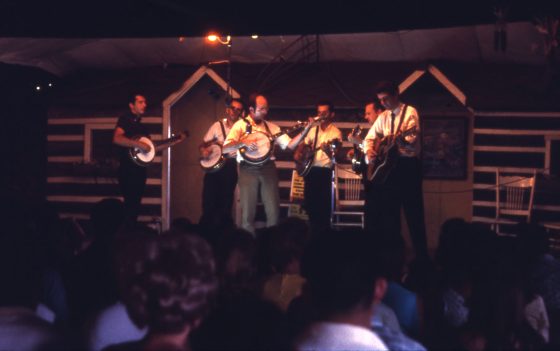
The first Canadian festival, a modest affair billed as a “Bluegrass Jamboree,” took place in August 1972. I was involved in its organization and presentation. Subsequently, the Jamboree grew into an annual festival that’s still running.
The annual family friendly Nova Scotia Bluegrass and Oldtime Music festival is Canada’s oldest, and North America’s second oldest continuously running Bluegrass Festival, and is presented and hosted by the Downeast Bluegrass and Oldtime Music Society, a non-profit organization dedicated to the preservation and promotion of Bluegrass and Oldtime music in Eastern Canada.
Here’s how it happened.
By the summer of 1972 I had been living in Canada for four years, working as a professor of folklore and archivist in St. John’s, Newfoundland, at Memorial, the big provincial university.
Deeply immersed in bluegrass, I now stayed in touch with the music I’d left behind via bluegrass friends in the states, I read Bluegrass Unlimited every month, and I got County Sales‘ newsletters and bought new LPs from them by mail.
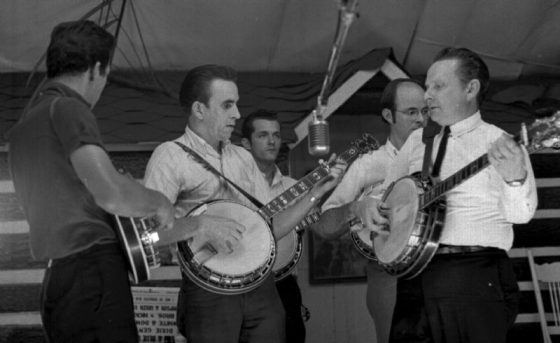
June 22, 1968. Banjo workshop at Bean Blossom, IN: Vic Jordan, Bobby Thompson, Dave Garrett, Neil Rosenberg, Ralph Stanley. (Photo by Frank Godbey)
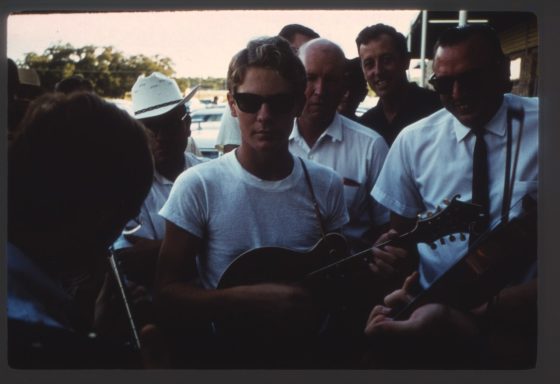
When I arrived in Newfoundland in September 1968, I’d just published my first academic article — on bluegrass — in the Journal of American Folklore. I’d been writing regularly for Bluegrass Unlimited. That past June, Bill Monroe had included me in a banjo workshop at his Blue Grass Festival in Bean Blossom, Indiana; and a few weeks before coming to St. John’s, I’d been at the Richland Hills fiddle contest near Dallas, Texas, jamming with Alan Munde, Sam Bush, and Byron Berline and the Stone Mountain Boys.
August 18, 1968. Richland Hills, TX fiddle contest: Neil Rosenberg (b), Sam Bush (m), Byron Berline (f). (Photo by David Stark)
During the late ’60s and early ’70s, bluegrass festivals were proliferating (I wrote about this in Bluegrass: A History, 305-339) and bluegrass was having success in the popular music business (I wrote about that too, 305-339).
By 1972 I was hearing at a distance about the adventures of my friends from the U.S. bluegrass festival scene. Alan and Sam had made a popular instrumental LP. Now Alan was picking banjo with Jimmy Martin and Sam was singing and playing mandolin with the Bluegrass Alliance. And Byron, working as a studio musician in Los Angeles, had recently recorded with The Rolling Stones.
As I continued to study and write about bluegrass, I maintained my musical calling, moonlighting in the local contemporary folk and pop music scene. It was several years before I met anyone in St. John’s who played or knew much about bluegrass.
In 1969, RCA Victor invited me to edit an album in their Vintage series titled Early Bluegrass. Aside from some Monroe LPs, this was the first historical bluegrass anthology. I signed its detailed historical liner notes with “Memorial University of Newfoundland” under my name. It got a good reception in the bluegrass world and introduced me to Canadian bluegrass record buyers.
In 1971 I signed a contract with the University of Illinois Press to write a volume on bluegrass history in their new Music in American Life series. It was a book that would take years to write, for I had catching up to do. Not only was I out of touch with the bluegrass scene I’d been in before immigrating, I also knew little about the bluegrass scenes in my new home.
June 22, 1968. Banjo workshop at Bean Blossom, IN: Vic Jordan, Bobby Thompson, Neil Rosenberg, Dave Garrett, Ralph Stanley, Larry Sparks. (Photo by Doc Hamilton)
Learning About Canadian Bluegrass
Even before immigrating to Canada, I knew it had bluegrass, thanks to Toronto’s Doug Benson, who put me on the mailing list of his magazine The Bluegrass Breakdown. The first issue had reached me in spring 1968 while I was still in Indiana. It told of bluegrass scenes in Ontario and Quebec.
En route to Newfoundland in September 1968, we entered eastern Canada via the Maritimes— the provinces of Prince Edward Island, Nova Scotia, and New Brunswick. Picking up our landed immigrant passes from Canadian Customs at the Maine border, we drove through New Brunswick and Nova Scotia, where, in Cape Breton, we caught the night ferry to Newfoundland.
During this trip I got my first taste of Canadian bluegrass in an Antigonish, Nova Scotia motel where we watched Don Messer’s Jubilee, a Halifax-produced CBC weekly TV show starring a fiddler who’d been recording and broadcasting nationally on radio since the 1930s and television later. Messer’s prime-time Jubilee was Canada’s second most-watched show, exceeded only by Hockey Night In Canada.
I was pleasantly surprised to see that Messer’s band included a five-string banjo played bluegrass style! To this immigrant’s eyes and ears, Messer was blending bluegrass into his country and old-time sound. Here’s his performance, taken from Jubilee footage, of “St. Anne’s Reel,” a popular Canadian fiddle tune:
The smiling banjo picker behind Messer was Vic Mullen, the youngest member of his band. Born in 1933 and raised in rural southwestern Nova Scotia, he had been working as a musician since his teens, playing with country bands in the Maritimes and Ontario.
In 1969, Mullen left Messer and began appearing with his own country band, The Hickorys, on another Halifax CBC weekly prime-time show, Country Time. There wasn’t much bluegrass on that show beyond Mullen’s occasional southern-style fiddle pieces.
Getting Acquainted
My first meeting with a Newfoundlander who shared my enthusiasm for bluegrass came early in April 1971 when I had a letter from record collector Michael Cohen of Grand Falls-Windsor.
By the time we met, Michael’s family owned six furniture stores in central Newfoundland. He’d grown up listening to country music on the radio and began collecting records. After attending university in Ottawa, where he’d heard lots of local and touring American and Canadian country music, he returned to Windsor to work in the family business, continue his collecting (he has all of Hank Snow’s recordings) and play in a country band.
He wrote me because he’d been told about me by a friend. “Early bluegrass and string bands … are my main interest,” he said, introducing himself and welcoming me to make tape copies of his rare records.
I wrote back inviting him to visit us on his next trip to St. John’s. This was the beginning of an enduring friendship. Through him I met others interested in bluegrass and Canadian country. The first was Fred Isenor of Lantz, Nova Scotia, a small community north of Halifax, who got my address from Michael and wrote me a few weeks later.
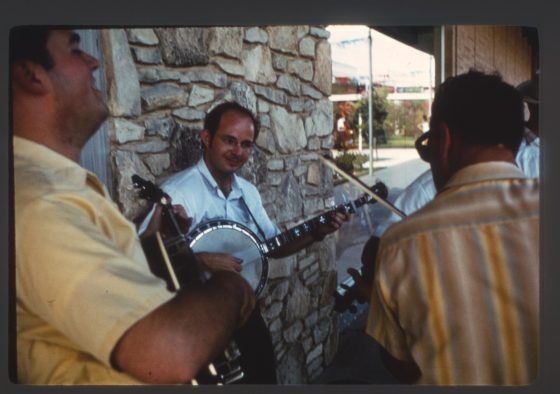
August 18, 1968. Alan Munde, Neil Rosenberg, unidentified fiddler. (Photo by David Stark)
Fred, Vic Mullen’s contemporary and friend, worked at the local brick factory, and had a music store in Lantz. He was a record collector, a Bluegrass Unlimited subscriber, and a musician. He played mandolin and bass in The Nova Scotia Playboys, which he described to me as an “authentic (non-electric) country” band. They had represented Nova Scotia at the 1967 Expo in Montreal.
Fred had purchased his mandolin, a 1920s Gibson F5, for $100 at a Halifax pawn shop in 1960. Only later did he learn that its label, signed by Lloyd Loar, meant that he now owned an instrument like that of Bill Monroe, who’d just been elected to Nashville’s Country Music Hall of Fame.
Our correspondence began with shared unsuccessful attempts to put together a Bill Monroe tour. I’d planned to speak with Monroe at a New England festival that summer. But the festival was cancelled; that plan fell through. In March 1972, Fred wrote of other plans:
There is a possibility of a one day bluegrass jamboree in Nova Scotia this summer. Not really a festival but if we can put it over it will be a start. Perhaps Michael has mentioned this to you. As you played with Bill Monroe and helped run Bean Blossom [I’d told Michael about this when we first met] I thought possibly you could offer some helpful suggestions, in other words some do’s and don’ts.
He explained that with a limited budget the event would have to utilize local talent.
Please do not mention this to anyone as definite … so far Vic Mullen and I just talked briefly about this and will be discussing it further on Monday night.
He asked if I’d be able to visit him and take part in the program.
I responded enthusiastically, calling the jamboree a festival, offering my suggestions, and saying I’d be driving through Nova Scotia in August and hoped to visit him then.
Meeting Vic Mullen
In June 1972, Country Time came to St. John’s to tape some shows. I asked Vic if he’d do an interview, explaining to him that I was working on a book about bluegrass. He agreed.
Still in his thirties, Vic had been playing country music professionally for a quarter century. He’d mastered instruments — mandolin, fiddle, guitar, five-string banjo — as needed, working on the road with a series of increasingly high-profile bands. Bluegrass chops were just one aspect of his professional tools — a flashy banjo piece, or southern-style hoedown fiddle as part of the show, that kind of thing. He’d worked with some bluegrass bands in Ontario, done TV, etc.
In the late fifties he started his own band, The Birch Mountain Boys. Working at first in southwestern Nova Scotia, he teamed up with Brent Williams and Harry Cromwell, young African Canadians from his home county, Digby. They played bluegrass in the Maritimes for several years before Brent and Harry started playing country and Vic joined Messer.
Now Mullen was fronting his own national CBC TV country music show. He liked bluegrass and enjoyed playing it, but as a bandleader he chose it rarely. Most people in his audiences didn’t know the word “bluegrass” when they heard it and even if they liked it, it was just nice country music to them. Bluegrass was a niche genre. It had enthusiastic fans and great performers, but they were in a minority.
Vic was supportive of his old friend Fred; he understood Fred’s enthusiasm. He knew about BU and the bluegrass festivals that were happening in the States, but he didn’t think the festivals were going to catch on in Canada. Of Canadian bluegrass fans, he said that:
Altogether in a group, there’d be a lot of people. But they’re spread out from coast to coast and particularly between here and Ontario … there wouldn’t be enough people for an audience in any one area, it’d be just too far for them to get there.
Still, he was planning to be at Fred’s Jamboree. In our interview, Vic had given me an insider’s introduction to the world of Canadian country music. From him I heard for the first time many names and facts that would become familiar to me later. I was encouraged that a musician of his caliber, experience, and reputation would be there.
A week after the interview, I wrote Fred and told him I’d be catching the ferry to Nova Scotia on August 1, driving to Lantz the next day and staying to get acquainted. I explained that this was just the start of a crowded trip for “some hurried field research on bluegrass music … in Ohio, Kentucky and Indiana.” I closed by mentioning that I’d had a pleasant experience interviewing Vic.
Fred’s reply came a few days later. He was looking forward to my visit, he said, and then, referring to my earlier letter, told me the event would be a jamboree — “outdoors, just one evening.” Referring to a nearby farmer who held dances in his barn, Fred explained:
John Moxom is building an outdoor stage as soon as his hay is made and it appears now that we will be holding it either Friday, August 4th or August 11th. All the local bluegrass musicians are willing to help and take a chance on it being a flop. We hope to find out if there is enough interest to try something bigger and better next year. I know you have a busy schedule but if August 4th turns out to be the date we would sure like to have you present.
By the end of July 1972, I was headed first to visit Fred in rural Nova Scotia. Then I’d drive to New England, stopping near the border at Woodstock, New Brunswick, to see Don Messer’s Jubilee perform at a county fair, and then going to Vermont where my family was vacationing. After a short rest I’d be heading for West Virginia to join my photographer friend Carl Fleischhauer on the trip we described in Bluegrass Odyssey.
On August 1, I headed for the Canadian National ferry terminal in Argentia, Newfoundland, ready to sail west for some bluegrass.
Artist:Becky Buller (With Andrea Zonn and Dan Tyminski) Hometown: St. James, Minnesota Song: “Millworker” (James Taylor cover) Release Date: August 19, 2022 Label: Dark Shadow Recording
In Their Words: “JT is a conjurer of spirits with his words and wistful melody. As I sing, I’m possessed of this woman, looking through her eyes at those work-worn hands. I feel the regret that gnaws at her. I taste the bitter desperation of her situation, how she’s all but given in to cold, leaden resignation that hers is a life wasted. We’re both ensnared by the paths we’ve chosen. How could we know where their whims would lead? Are we doomed to ‘the machine’ for the rest of our lives?
“It’s always a treat to create in studio with my killer road band: Ned Luberecki, banjo; Daniel “The Hulk” Hardin, bass; Wes Lee, mandolin; and Jake Eddy, guitar. I was especially thrilled that Andrea Zonn and Dan Tyminski agreed to add their beautiful harmonies. They are both heroes of mine. Andrea lent her lovely voice and fiddling to my Little Bird album in 2003, coincidentally the same year she joined JT’s All-Star Band. I’ve been enraptured by Dan Tyminski’s voice since his Lonesome River Band days. Mercy, that man can sing!! This was my first time getting to collaborate with Dan, but keep your ears on! There’s more music headed your way soon.” — Becky Buller
Americana duo Violet Bell‘s new album, Shapeshifter – out October 7 – tells a story of the mythological selkie, a mermaid-like creature from Celtic folklore that embodies a form that’s half woman, half seal. In their retelling and reshaping of this ancient folk narrative, they tease out its connections to the transatlantic journey of American roots music, to the cultural and social melting pot of the “New World,” and to agency, intention, and self-possession.
A concept album of sorts, the music is remarkably approachable and down-to-earth, while the stories and threads of the record tell equally ordinary and cosmic tales. At such a time in American history, with fascism once again on the rise and attacks on bodily autonomy and personal agency occurring with greater frequency at every level of governance, Shapeshifter offers a seemingly timeless lens through which to engage with, understand, and challenge the overarching social and political turmoil we all face on the daily. Moreover, it’s an excellent folk record, demonstrating Violet Bell’s connections to North Carolina, Appalachia, and the greater communities that birthed so many of the genre aesthetics evident in the album’s songs.
Shapeshifter is a gorgeous exercise in community building, an artful subversion of societal norms, and a stunning folktale packaged in accessible, resonant music with a local heartbeat and a global appeal. Read our interview with duo members Lizzy Ross and Omar Ruiz-Lopez and listen to a brand new single from the project, “Mortal Like Me,” below.
BGS: I wanted to start by asking you about community, because I know it’s always very present in your music making. I feel it, definitely, in Shapeshifter. Not only because you’ve got Joe Terrell and Libby Rodenbough (Mipso), Joe Troop, and Tatiana Hargreaves on the project, but because I can feel that community is a tent pole of this record. What does community, musical and otherwise, mean to you in the context of this project?
Lizzy Ross: It was such a wild time to be making the record because it was March of 2021, so vaccines hadn’t quite happened yet and we had all been on lockdown for about a year. We were obviously really missing our community and the live music community. There was also this strange thing, where our friends who would normally always be on the road all the time were at home. So we had an incredible opportunity to call up people, like calling up Tati and Joseph and Libby and Joe Troop – who lived in Argentina but came home because of COVID! The way that it worked out, people were around and we were able to convene and make this album in circumstances that probably wouldn’t have been possible, because everybody would have been on the road.
Omar Ruiz-Lopez: Or, [we would have had them] recording remotely. Which is not the same. One of the reasons why I play music is because of the community. That ability to bring people together and share music and hold space together, the energy that comes from that is so vital to the human experience. Getting to create that space, to bring an album to life, there’s not much else in this world that I live for, besides that. Getting the opportunity to bring everybody together, especially after such a big isolation, was so life-affirming and helped bring me back to why I make music in the first place.
That’s definitely palpable in the music itself, but also in the overarching viewpoint that y’all have within this record. I also find that it’s very grounded. You might have heard BGS just released our first season of a podcast called Carolina Calling, about North Carolina’s history through music. One of the through-lines that keeps coming up in all of our interviews is that North Carolina specifically has such a strong sense of musical community. Even though this is kind of a story record and kind of a concept record, it feels very grounded in North Carolina and in the South.
LR: Omar and I are kind of mongrels from the non-South. But we’ve come and steeped ourselves in this land and these traditions and this community, so I think that what our music reflects is the internal sort of “musical diet.” Our musical diet is probably atypical when you consider what most people think of as North Carolinian or Southern music. The music we were listening to going into this even, we were listening to a lot of Groupa–
ORL: Groupa is a Scandinavian folk band that makes these albums based on music from different countries, like Iceland, Finland, and Sweden. I feel like anything that’s not from here is called “world music,” but their brand of folk music is very beautiful and out there and organic and grounded in the different traditions they represent on their albums. It’s mostly instrumental music, it’s pretty powerful. We were listening to that a lot, as well as Julia Fowlis, a singer who sings in Gaelic primarily. Those cultures – Scottish, Irish, Scandinavian folk – they’re related to the music here like old-time, bluegrass, and Appalachian folk traditions of fiddle and banjo.
To bring it back to the question, I’ve been here for twelve years. I was born in Panama and raised in Puerto Rico listening to Spanish and Latin folk. When I say Spanish, I mean Spanish-speaking, the language of our colonizers. But there’s something still not-from-Spain in the native, Indigenous musical and cultural influences in that music. Like in Bachata and Cumbia. Then I moved to the States and fell in love with rock ‘n’ roll and more of the singer-songwriter tradition here.
LR: Originally I came here for school. I grew up in Annapolis, Maryland, where I didn’t really find a musical community. There was one, I just didn’t find it. When I came to North Carolina it was the first time I saw people gathering together over a potluck and music, with like shape note singing and like the Rise Up Singing book. Having this experience of big, group harmonies I had this realization more and more that music could be a part of my daily life in a way it hadn’t been as a child. Or, rather, as a way of public, shared daily life. Because it was always part of my life, but it was part of community life here in North Carolina. That was a big element of how music and North Carolinian music in particular drew me in and captured my heart.
Can you talk a bit about the central storyline of this album and how you picked up the mythos of the selkie and turned it into this project?
LR: The story of the selkie came to us and it’s something that is in the culture, it’s floating around. Many folks have seen the movies Song of the Sea or The Secret of Roan Inish. The first song that came to me, Omar and I were at the beach one day and I was playing on the banjo and this song came out. It was “Back to the Sea.” We were in the Outer Banks of North Carolina at that time, at the ocean, and I was kind of just listening for who this character is and what they are saying. It was a selkie. It was a selkie singing of getting to return home.
I would say that coming home to ourselves is one of the central themes of this album and one of the themes the selkie story really brings into focus. The whole myth is centered around a being, a mystical ocean being, who gets yanked out of her native waters and forced to live in a world that doesn’t understand her and wasn’t built around her existence. To me, there’s a really clear connection. That story is a medicine for the cultural wound of when we don’t fit into the prescribed paradigm of power. If we don’t fit into white supremacy or if we don’t fit into normativity or if we don’t fit into patriarchy. It’s the sense of feeling like we have to cut off parts of ourselves that aren’t compatible with those power structures so that we can be acceptable to the power structure at-large.
This story says, “No, don’t do that.” You can reclaim the parts of yourself that you’ve had to orphan in order to survive. You can reconnect to those pieces of you and you can come home to yourself. It speaks to integrating who we are, the characters of the land and the sea in this story are really powerful to me. The sea, to me, is this cosmic force. It’s a pervasive, creative, destructive, loving, mysterious force that the selkie comes out of. It doesn’t follow the rules of the land-bound world. To me, it’s like the structures and hierarchies of our culture – whether it’s capitalism or something else.
One of my questions was going to be about how queer the record is, and not just Queer with a capital Q, but also a lowercase Q, the idea of queerness as just existing counter to normativity. But it’s not just a story of otherness, it’s a story of otherness in relationship to embodiment. In the South right now especially, but in this country in general, embodiment is under attack. Whether we’re talking about COVID-19 or abortion access or trans rights. There’s something in this record that speaks to all of that.
LR: I think one of my experiences [that informed this music] is that I’m in a female body. There’s a line in one of the songs, “I Am a Wolf” – that song is two parts. First is the fisherman speaking, he’s kidnapped the selkie, taken her out of her native waters, he’s made her come be his bride, and he’s like, “Why isn’t this working?” It sucks, he’s lonely, he thought things would be better. The second half is the selkie responding and she says, “I am a wolf, not a woman.” That’s the first thing she says. That was something I said at one point, when I was connecting with a sense of deep grief and rage within myself around what I felt were the prescribed cultural parameters of my existence.
ORL: The people who made this album were mostly by BIPOC people and [people who fall outside those norms]. Joseph Sinclair and I are not white and Joe, Tati, [Lizzy], and I are not straight. I feel like a lot of different perspectives went into making this album. We didn’t just get white, straight dudes to make this album and it felt good that way, getting different musical perspectives on this. We could have just made it ourselves, that’s the other thing. I’m a multi-instrumentalist and Lizzy is a harmony singer, we could have overdubbed to kingdom come. Part of the reason why we got all these people together into the same room is because of their unique perspectives on the traditions they brought to the table.
LR: This thread about embodiment is really important and by asking this question you’re helping me articulate something that I’ve been sitting with for months, a year, as I’ve been thinking about the writing and the words and characters in this story. And also, what is it for me in this story that I’m trying to unravel with this album. Also on a cultural level, what are we talking about here?
The selkie, her skin is taken away from her in a moment of innocent revelry. The story starts with her dancing in the moonlight on a rock and that’s when the fisherman steals her skin. When I think about the people that I know and love, I think a lot of these systems are violent towards people whether or not they fit within the system’s perception of dominant power. When I think about the six-year-old version of a person or whatever version of a person was able to un-self-consciously dance or feel good or go into their mom’s closet and put on her clothes and makeup and not feel ashamed – there’s a different version of this for literally every person and what that means. That innocent revelry, it’s experiencing oneself not through the eye of an external observer but through the juicy presence of embodiment and joy and a sense of wholeness and rightness in your being.
Everybody’s had the experience of having their “skin” stolen from them. When you get yanked out of your sovereignty, your joy, your bliss. You get catcalled, you get shamed, you get this or that. There’s violence done to you, whether it’s physical or not, there’s that sense of losing your skin, when we start to separate from ourselves and regard parts of ourselves as less than. I think that dysphoria is a really important part of this story and this album. When we don’t experience ourselves or feel ourselves as the cultural perceptions tell us we’re supposed to be, whether it’s a question of gender or color, this feeling of not being at home in our bodies, I think that was a lot of what really resonated with me, even unconsciously, about the selkie. One of the ways that it took root and grew in my consciousness and eventually in our shared consciousness, between me and Omar and the folks who are on this music.
As a picker I have to talk about “Flying Free” and “Morning Girl,” because I think having instrumentals on this record makes so much sense. I have some ideas about how they fit into the story, not just based on the titles, but also based on how the tunes are so evocative like the rest of the project. Why, on a record that feels like a concept record, why instrumental tunes?
LR: Words are our inheritance from so many of the same structures that can oppress us. And they’re also our freedom. Words allow us to develop and communicate concepts and they also contain hierarchies and power structures that we may or may not really need. The name of the song, “Flying Free,” and the fact that it’s instrumental, to me it’s like this somatic sensation of the selkie plunging back into the sea and the joy of being reunited with her home waters. Which to me is her sense of self, her sense of worth and safety and agency.
ORL: Sound, organized sound inside of space, one of the powerful things about it is that we are able to attach emotion to it. It’s kind of beautiful how two people could feel similar things listening to one piece of music. When it came time to put together the songs for this album, there were a handful of tunes that came up that weren’t asking for words. But that totally helped paint the picture of the world of the selkie and what she was going through.
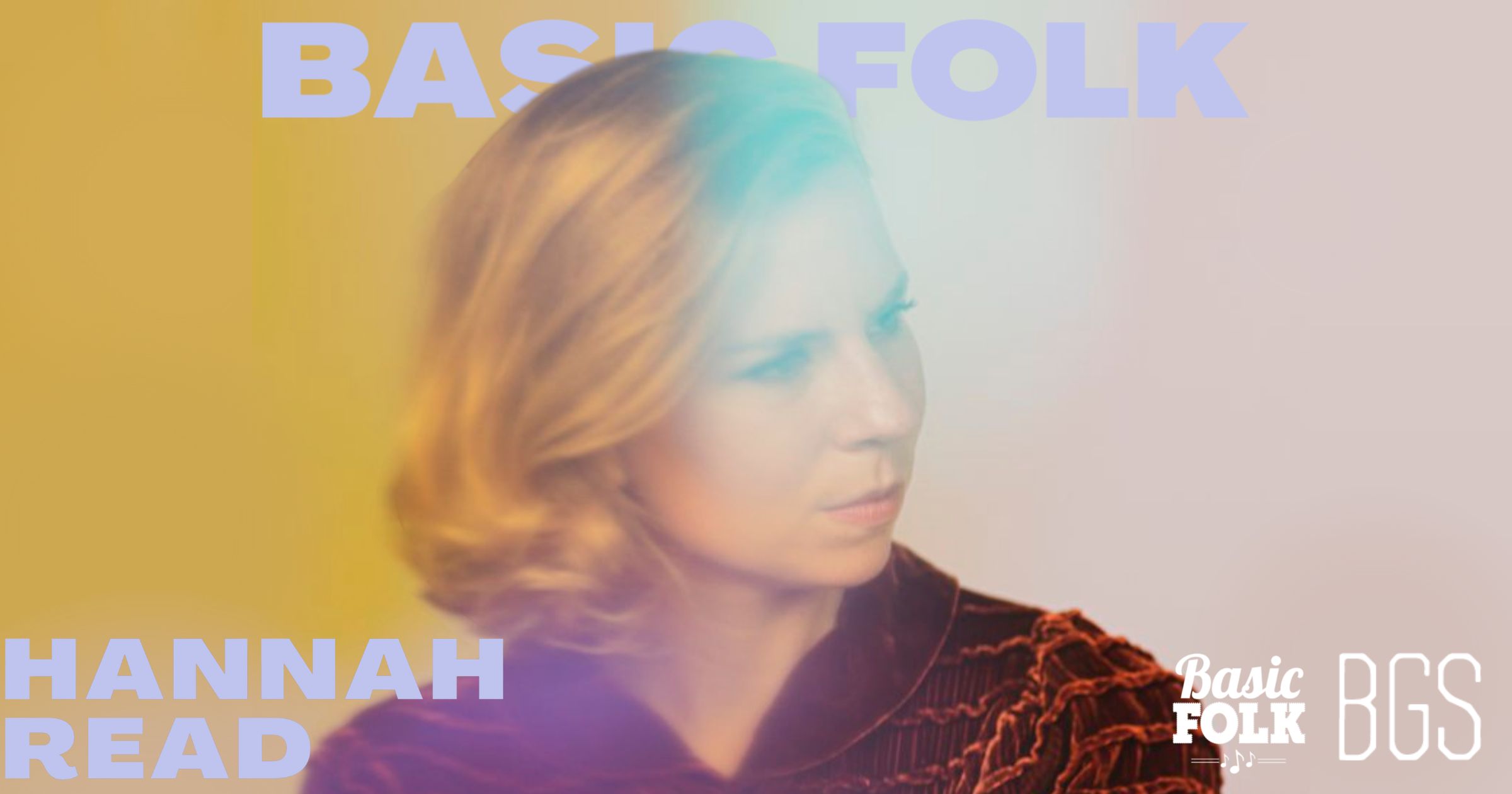
I have been wanting to talk to Scotland-born fiddler and current New Yorker Hannah Read on the pod for longer than Basic Folk has existed. I met her at the very fun camp Miles of Music in New Hampshire. We laughed our faces off all week and I was truly blown out of the water by her fiddling and singing. She’s just released a new duo album with the Scottish banjo player Michael Starkey, so it seemed like a good time to get Han on.
She grew up in Edinburgh as well as on the Isle of Eigg, a remote island off the western coast of Scotland, and she talks about how living simply as a younger person has impacted her adulthood. Growing up, there was a lot of music in the house: in terms of both listening and playing. Her mum played cello, sister played fiddle, and there was also a community of musicians on the island playing who she connected very deeply with. She started playing traditional Scottish music at the age of six and cites her biggest influences as the musicians surrounding the trad scene there. She made her way to America to attend Berklee College of Music in Boston and eventually moved to Brooklyn.
Her new album, Cross the Rolling Water, is filled with old-time fiddle and banjo duets with the Edinburgh-based Starkey. The two met at an Appalachian old-time session in Edinburgh in late 2019. She talks about their musical relationship as well as how Michael only has a flip phone, which is always hilarious to hear about from someone who’s on top of technology. Hannah’s hilarious, kind and has an infectious energy that carries from her personality to her music. Enjoy!
Photo Credit: Krysta Brayer
Would you like to help produce Basic Folk? You can contribute here – and you’ll get a ton of exclusive content as well!
This website uses cookies to improve your experience. We'll assume you're ok with this, but you can opt-out if you wish.AcceptRejectRead More
Privacy & Cookies Policy
Privacy Overview
This website uses cookies to improve your experience while you navigate through the website. Out of these, the cookies that are categorized as necessary are stored on your browser as they are essential for the working of basic functionalities of the website. We also use third-party cookies that help us analyze and understand how you use this website. These cookies will be stored in your browser only with your consent. You also have the option to opt-out of these cookies. But opting out of some of these cookies may affect your browsing experience.
Necessary cookies are absolutely essential for the website to function properly. This category only includes cookies that ensures basic functionalities and security features of the website. These cookies do not store any personal information.
Any cookies that may not be particularly necessary for the website to function and is used specifically to collect user personal data via analytics, ads, other embedded contents are termed as non-necessary cookies. It is mandatory to procure user consent prior to running these cookies on your website.