Few words stir up conflict in country music circles the way “authenticity” does. While debates over authenticity rage within every corner of the arts, the tension is especially potent in country, whose unofficial tagline is, after all, a commitment to honest simplicity: “Three chords and the truth.” While “truth” can be a broad umbrella to work under, within country music it tends to encompass a longstanding commitment to sharing the stories and experiences of everyday people, in particular those of the rural working class.
Accordingly, an adherence to and celebration of the very concept of authenticity – nebulous as it may be – is as baked into country music culture as an anti-establishment sentiment is inherent to punk music. Listen to country radio, though, and you might have a hard time finding it, particularly as the bro country of the mid-teens, though finally waning in popularity, still dominates the majority of terrestrial country airwaves.
It’s 2024, though, and it’s way past time to declare that country radio is irrelevant. Glance at Billboard’s Hot Country Songs chart, which includes sales and streaming data alongside airplay, and you’ll see the top spot isn’t occupied by one of the usual radio favorites like Luke Bryan, Morgan Wallen, or even Luke Combs, the latter of whom has notably found a way to straddle the line between commercial success and critical acclaim.
Rather, at the time of this writing the number one country song in America is “I Remember Everything,” a duet between the relatively new artist Zach Bryan and one of the genre’s more adventurous stars, Kacey Musgraves. As a song, “I Remember Everything” isn’t necessarily groundbreaking. Bryan’s and Musgraves’ voices play nicely off one another, with his achy grit contrasting sweetly with her smooth twang. The production is simple, underdone even, and lyrically the track travels well-trod territory: romantic heartbreak.
So, what, then, has kept “I Remember Everything” firmly situated in that top spot for 14 straight weeks (and counting)?
If you’ve paid even the least bit of attention to country music in the last couple of years, you’ve no doubt encountered Zach Bryan and his genuinely singular approach to the genre. With his raw sound, confessional lyrics, and decidedly DIY approach to business, Bryan radiates the kind of authenticity that fans crave. He joins a host of other recently established and emerging artists – including but not limited to Tyler Childers, Lainey Wilson, Colter Wall, and Billy Strings – who found success by foregoing the traditional route to country stardom, one that typically involves following an out-of-date formula honed over time by profit-driven record labels.
Zach Bryan debuted with DeAnn in 2019, finding an audience online thanks to the viral success of “Heading South” on DeAnn’s follow-up Elisabeth. He quickly built a fanbase on TikTok and YouTube before releasing his 2022 breakout LP, American Heartbreak, which had more opening week streams than any other country album that year. In the lead-up to American Heartbreak, Bryan, who served as an active-duty member of the U.S. Navy for eight years, was honorably discharged in 2021 so he could pursue music in earnest.
In addition to topping charts, American Heartbreak set itself apart from the rest of the year’s crop with its unadorned production, heavily narrative songwriting, and sheer ambition – the record clocks in at a lofty 34 tracks, with less filler than one would anticipate. The album’s biggest single, “Something in the Orange,” earned Bryan a Grammy nomination for Best Country Solo Performance and, for a time, landed him atop Billboard’s Top Songwriters chart.
That record, along with a handful of EPs and loosies released in between, teed Bryan up for his 2023 self-titled LP, a much more focused effort (a mere 16 tracks!) that found Bryan firmly situated as a real-deal country star, one who can tap the likes of Musgraves, the War and Treaty, Sierra Ferrell, and the Lumineers to come join the proceedings. While it no doubt shows the depth of his rolodex, that guest roster also points at the breadth of Bryan’s influence, as each artist comes from a different part of the broader country/Americana ecosystem.
And while he considers himself a country artist, Bryan’s roots are more indebted to the folk-rock revival of the late-aughts and early teens, when acoustic acts like Mumford & Sons and the Lumineers grew so big as to cross over into Top 40, eventually helping spur an explosion in popularity for Americana and roots-adjacent music. It’s fitting, then, that the Lumineers feature on Zach Bryan, joining on the track “Spotless” so seamlessly it isn’t always easy to tell who is singing: Bryan or Lumineers frontman Jeremiah Fraites.
It’s on these collaborations, in particular, that you can hear Bryan’s joy at being able to do what he loves. His vocals are raw, but never phoned in; in fact, sometimes he seems to be straining so hard to communicate a particular emotion that you worry his voice will give out. It never does.
In other words, Bryan is a fan’s musician, one who geeks out about his favorite artists the way his own fans do about him. In a post about the duo the War and Treaty, who joined Bryan on the standout Zach Bryan cut “Hey Driver,” he writes, “I can tell you the first time I heard War and Treaty live and I looked to the person next to me and said, ‘Are you hearing this?’ I talked to them later that night and they were the kindest couple I’d ever met.” In the same post, he says of the Lumineers, “I can tell you about how when my Mom went on home I got the Lumineers tattoo on my tricep after hearing ‘Long Way From Home’ for the first time and how Wes [Schultz] and Jeremiah are some of the most welcoming humans I’ve ever met.”
This post points to a major piece of both Bryan’s appeal and the air of authenticity that surrounds him: His direct line of communication with his fans. He manages his social media accounts himself and is no stranger to getting vulnerable in his messaging, often posting progress updates on new songs he’s working on or taking a moment to express gratitude for his success. For fans, it’s almost like there are no barriers between them and Bryan, which reinforces the relatability at the core of his music.
The beating heart of Zach Bryan, for me, is “East Side of Sorrow,” a song that grapples with hope and religious faith by connecting the grief Bryan felt after losing his mother to his time being shipped overseas while serving in the Navy. Despite – or perhaps because of – these vivid references to specific experiences, like being “shipped… off in a motorcade” and losing his mother “in a waiting room after sleeping there for a week or two,” the song is deeply emotional and relatable, a wrenching but empowering anthem encouraging the hopeless to try to keep it moving. These days, you’d be hard-pressed to find someone who couldn’t use such a message, this writer included – Apple Music tells me it was my most-played song of 2023.
It would be – and for a lot of folks, already is – easy to accept Bryan’s every word, to believe that his hardscrabble songs about “rot-gut whiskey” and manual labor are honest reflections of the life he’s lived and the person he is. Then there’s the cynical interpretation, that Bryan’s anti-marketing is, actually, still marketing, that a young musician could only know so much of the realities of the struggle of the working class, that it’s the same twang to a different tune. Bryan has, after all, had a few bumps along his road to fame, including some less than flattering encounters with police that negate his humble personal.
But the truth, as it so often is, is likely somewhere in the middle. With such personal material, it’s easy to trace one of Bryan’s songs to its point of inspiration – “East Side of Sorrow,” for example, is undoubtedly ripped right out of his lived experience. And Bryan isn’t afraid to admit the gaps in his experience, like when on “Tradesman” he sings, “The only callous I’ve grown is in my mind.” Compare that to, say, the sheer tone deafness of a song like Blake Shelton’s “Minimum Wage” and Bryan’s instances of stretching the truth feel trivial.
Bryan is only the latest in a long line of country artists for whom authenticity is both a blessing and a curse. Genre giants like Johnny Cash and Waylon Jennings are often held up as unimpeachably authentic pillars of the genre, despite weathering their own brushes with the authenticity police earlier in their careers. And these debates, which tend to center white, straight, cisgender men, aren’t nearly as hostile in their scrutiny as they are for marginalized artists, against whom the idea of authenticity is typically wielded as a gatekeeping weapon.
Wherever you fall on Zach Bryan, it’s hard to deny that the gravel-voiced, baby-faced boy from Oklahoma has changed the very fabric of contemporary country music. What he does with that power moving forward could break the genre open for good, making space for artists with unusual paths, atypical backgrounds and a disregard for the flavor of the week. If Zach Bryan is who he says he is, he may very well do it.
I bet in the next few years, an expert taxonomist will come by and tell us exactly what country music is – and that this definition will create endless arguments. In the last few months, this argument about what exactly country music is has been growing louder. Jason Isbell has been fucking around with Nashville for decades, playing the field between rock, country, southern rock, country rock, and classic country. (He has recently said that he considers himself a rock singer). Adeem the Artist, the infamous cast iron pansexual, says that they are a folk singer. Willi Carlisle, a folk up-and-comer, has released Critterland, a certainly country album. On the other hand, Maren Morris released two singles last fall which were about burning Nashville to the ground, yet they’re perhaps the most country songs of her career – in terms of how she tells stories, how the bridges work, her vocal tones, and even some of the instrumentation. It seems lately, country is both everything and nothing.
Amanda Fields’ 2023 project deepens this ongoing problem. The album, What, When and Without, is a complex artifact of her own wrestling with genre, history, and biography. It slides into that complex sorting of genre and feeling that is key to Nashville right now. Fields calls this a country album – lushly produced, thick with strings, and dense with vocals, reminding one of an updated countrypolitan record – but sorting out what that means comes with a history of playing and listening.
Fields has a reputation on the bluegrass circuit, often an insular genre with an insistence on a certain kind of purity. She recognized how those questions of purity often don’t pay the bills, and her first major recordings were on a series of bluegrass cover records, called Pickin’ On – recorded by prominent bluegrass studio musicians, there are dozens of them, the artists covered include the expected (Bob Dylan, Johnny Cash), the unusual (Blink 182), to the fully flummoxing (Modest Mouse). Though Fields did not play on all of these records, she talks about them as an integral understanding of herself as part of a musical team: “When I look back on my experience within the ‘genres’ I’ve taken part in, I think about the groups of people I worked with… When I worked on Pickin’ On, I got that gig because of who I was hanging out with and playing music with at the time. I sang ‘gospel’ when I was growing up, because that was the community within my proximity.”
Proximity is a complex question for Fields. She has close ties to the bluegrass community, and there is something intriguing about the idea that genre is a social category – one about who one is near, or what the audience and the performer agrees to participate in. Yet there is a kind of roving that occurs here too; for Fields, roving is both a history of moving around geographically and, as she says here, moving from music that she considers bluegrass or gospel or country.
Fields moved around a lot as a child. Though she was born in Appalachia and currently lives in suburban Nashville (right next to Loretta Lynn’s old house), the line between these two legendary destinations was not direct.
Asking Fields about these roots – expecting a standard line in response – she honestly describes the complexity of her raising: “I’m originally from the mountains and it was my anchor growing up, but my dad moved us around a lot. He was one of those people who felt there was more to life than what was available to us living in that area, so he took job opportunities that carried us away from the mountains. I didn’t like that, because I was always longing to be ‘home’ with the rest of our family. I lived for summers and holidays when I got to be in Virginia and East Tennessee. Playing and listening to country and bluegrass music was my way to experience home when I couldn’t be there physically.”
This moving and returning is a common note for country musicians. Listening to her talk about the juxtaposition of moving, returning, being forced to leave, and finally finding home in an idea more than a place, I am reminded of Tanya Tucker or Merle Haggard. Tucker’s early childhood had a father who moved her from Arizona to Las Vegas to finally Nashville, chasing an acting and singing career. She broke out as a singer who fused a desire for rock and for country. It is similar to Haggard’s talk of moving – to California with his family as a consequence of economic disenfranchisement – and spending the rest of his career chasing economic stability. That idea was perhaps best written about in his tragic ballad “Kern River,” with its opening line, “I grew up in an oil town, but my gusher never came in.” (A Fields original from well before What, When and Without, “Brandywine,” strikes a similar note.)
This connection to Tucker, Haggard, and other classic country singers suggests that Fields landed not necessarily in a place, but as she says, in a music which has tight connections to place. What, When and Without, a classic country album, is infused with this kind of nostalgic listening.
Asked about her relationship to figures like Loretta Lynn or Haggard, she answers carefully: “Most of the music that really stirs my soul is older. I listen to all my friends’ new music and I’m always hunting something fresh to connect with, but on a day-to-day basis, I’m usually listening to the same stuff I’ve always loved. I’m talking Tammy Wynette, Loretta Lynn, Conway Twitty just about everyday. Classic country is what excites me (especially when I discover something I haven’t heard) and those familiar sounds and voices help me regulate my body’s nervous system.”
The album, rooted in those sounds, contains a deep knowledge of genre. Its ability to move between old school country, bluegrass chops, and deep, modern desire is one of its strengths. Figuring out how to sound both modern and historical is something Fields achieves with some skill. If her commitment to genre has a loose, rootless quality – or at least one which floats and lands depending on aesthetic or social need – then how she considers time has a similar quality.
Maybe her early commitment to bluegrass, a genre who remembers more than it forgets, and faces backwards as much as it faces forwards, and which was complicated by how hungry those covers were, suggests one way of bridging eras. But, her recent work, crafting contemporary studio craft with the careful polish of Studio A aesthetics is another. Asking her about memory and nostalgia, she again answers carefully: “One thing that was very intentional with the album was the pace. I think that going slowly is nostalgic in a way, because society and industry move so fast nowadays. I usually walk slowly and I talk slowly compared to most of my peers. My body responds to tempo and dynamics and I wanted to invite the album’s listeners to slow down with me.”
The slowness of the album can be heard in how she starts many of the tracks. There is often an instrumental intro where one waits a significant time for the vocals to be introduced and on occasion there are gaps, where her vocals recede and the band takes over – though the band itself is also quiet. There is a quality, listening to the work, of a kind of courtly two-step, the band asking Fields to dance, and vice versa.
The very first song, “What A Fool,” begins with brushed drums, and has a quite lovely open-ended moment where the pedal steel becomes central. On “I Love You Today,” the old-fashioned cheating song, heartbreak is introduced via an elegant, western swing sound, not outside of Lovett at his best. The last song, “Without You,” plays drums as solid and regular as a heartbeat. It’s another heartbreak song.
The pedal steel is crafted by Russ Pahl, who has been playing for decades. He has been nominated by the Academy of Country Music for his work on the steel guitar three times and for specialty instrument once, between 2004 and 2021. Before that, aside from being an in-demand studio musician, he was part of legendary Great Plains, another band who was excellent at moving between genres, across time, and throughout modes.
Talking to Fields about Pahl, she noted how good he was at not only playing, but matching vibes in the studio: “He came across very quiet and contemplative in the studio and I think he ‘got’ the vibe right away. After a song or two, he said, ‘…this ain’t Zip A dee Doo Dah.’ And it wasn’t. It was an album created in the midst of global pandemic [and] a time of great suffering for society and for myself personally.”
What, When and Without sounds like Fields has had some rough times, even outside of the lockdowns (regardless of how dense the record sounds, there is a yearning in the vocals that have a certain lockdown edge); but there is also an irony in this loneliness. Megan McCormick, who co-wrote on and produced the record and plays in Fields’ band, shows great intimacy throughout the project – there is a reason for this, McCormick and Fields are personal as well as professional partners. They sound good together, and the track where McCormick sings backing vocals, “Moving Mountains,” is the highest energy, most open of the entire record. It’s a great love song – but it’s a love song which calls to Mother Maybelle Carter as an avatar of country music, as a figure outside of space and time, which can tell the narrator how to love after years of heartbreak.
When asked about McCormick, Fields is still a little coy, but her commitment to their lives and sounds is made clear: “She really has a special gift and believing in her as a producer, as well as trusting her intuitions and abilities, has allowed me to grow as an artist. She’s my toughest critic, because that’s what I’ve asked of her. She’s also my constant cheerleader. We thrive when we get to travel together and both enjoy that feeling of being untethered that you get when you’re on the road.”
One can hear some of the untethered quality in Fields’ work, the road as untethering as much as time or genre, but the closeness that she has with McCormick is another kind of tethering, be it a consensual one.
Throughout the album, there is a quality of choosing which traditions are valuable, which are worth keeping, and which ones might have outlived their usefulness. When she talks about her childhood as a Pentecostal, she says: “I am very spiritual, still, and that energy I saw in church growing up is no different than the energy I feel when I’m composing music or playing music with other people with whom I am ‘tuned in.’”
She is definitely tuned with McCormick, their close contribution seen in how they work together – the harmonies without necessarily the negative consequences of some of that church life. She continues: “Those are universal aspects of the human experience that transcend dogma, class, and denomination and that’s what I carry on and value from my experience in church.”
One can see the universal quality in Fields’ work, and it contains interesting juxtapositions. A rootlessness across genre or time, which lands on something contemporary sounding; or a heartbreak record which rests on multiple commitments to one person; or even a religious tradition which widens and deepens.
Maybe we don’t need that taxonomy. An audience knows what a country record is.
In advance of the release of Vincent Neil Emerson’s latest, critically-acclaimed album, The Golden Crystal Kingdom – which dropped on November 10 – BGS moderated a conversation between VNE and his friend and peer, country & western singer-songwriter and song-interpreter Charley Crockett.
Both artists cut their teeth in music venues in Texas a decade ago. In our conversation, they tell the story of how they came to know each other and discuss ways they protect each other within the business. They talk about covering and cutting each other’s songs and the importance of telling their truths.
Emerson’s new album, produced by Shooter Jennings, veers his sound toward warm ’60s rock and folk influences. He opens up to Charley and BGS about its creation process and what is on the horizon for him.
Charley Crockett: What’s up, Vincent?
Vincent Neil Emerson: What’s up, my boy?
CC: Another day, another dollar.
BGS: Tell me where you both are in the world right now.
VNE: I’m in Asheville, North Carolina, right now, at an Airbnb.
CC: I’m up here in San Luis Valley in Southern Colorado.
Both really nice places to be in the fall.
VNE: You ain’t wrong.
Can you give us a little bit of context about your relationship, where you know each other from, and how long you have been working together?
VNE: Charley, you wanna go?
CC: Oh man, I always tell that story; I wanna hear it from you.
VNE: I met Charley in Deep Ellum. We were playing around town, playing a lot of shows around there and Fort Worth. That was over 10 years ago, maybe?
CC: I was trying to think about it this morning. I think it had to be ’13 or ’14.
VNE: That’s crazy, man.
CC: He remembers it being at Adair Saloon; I remember it being at the Freeman. It really don’t matter, ’cause I’m sure it was both places.
VNE: I’m sure we went and had a drink at Adairs or something like that.
CC: I remember I walked up on him and said, “I like all them Justin Townes Earle songs.” And he said, “I only played one.” I always liked what he was doing, and he used to play solo and do the guitar pools up at Magnolia Motor Lounge all the time. He’d be up there smoking a cigarette, picking through them songs like Townes Van Zandt, and I thought, “Oh lord have mercy, this boy is a force to be reckoned with.”
VNE: Man, I felt the same way as soon as I heard you, brother. I remember a couple of nights I saw you at the Freeman with this band. You had a bunch of guys up on that tiny little stage, and you were just ripping through all these songs, taking all these old honky tonk songs and flipping them on their head and turning them into blues and vice versa. I always thought that was so cool, man.
CC: I don’t remember that well, but I guess you’re right. In those days, every gig we played for both me and Vincent, we ended up getting booked by the same folks, or they were all standing together in some bar, no matter if it was Ft. Worth or Nashville or Los Angeles. One way or another, all them same business folks been standing pretty close to me and Vincent. And that’s the truth.
Well, that’s convenient if you like to work together, I guess. Charley, do you have questions you want to dig in on?
CC: You know, Erin, I don’t even know what the hell we are doing?
Let’s talk about the release of Vincent’s new album.
CC: Well, let me just do this then. Everything he’s been putting out with Shooter [Jennings], like everything else he’s ever done…If you sit there looking at Vincent and he surprises you, it’s like, “Oh damn, I didn’t know old boy was gonna do that.” The very next thing he does, it just happens again — every single time. I remember when he was playing “7 Come 11” way before anybody gave a damn about him and was looking out for his interests or his career. He had all them songs in his pocket way before anybody had ideas or designs on him and his business. I’ve said for a long time that “7 Come 11” is one of the best folk songs written out of Texas in 20 years. Remember Central Track, Vincent?
VNE: Yeah, they did a lot of write-ups on music.
CC: I will never forget that stuff when you did that record and what you were doing live. Erin, he was playing for 50 bucks and a case of Lone Star in them dive bars in Fort Worth, you know? He was living in a 10×10 room. He was hardly ever even standing inside of the damn joint.
A handful of us showed up at the same time, and we are all moving on our own paths, but we’ve all stayed pretty close, or we damn sure weave it together quite a bit even if we get way out there, you know, in the territories, we always come back to each other. I think I met Leon Bridges right around the same time that I met Vincent. I met him in Deep Ellum, too. There is a guy who plays guitar with me now named Alexis Sanchez. He had a band back then, and he was playing at Club Dada there for some little festival, and Leon Bridges was standing there in a trench coat and a bowler hat. I venture to guess that me and Leon and Vincent met each other damn near about the same time. There were a lot of other folks like that. Ten years later, especially for some Texas guys, you know, we’ve all grown a lot, and I think we have always supported each other and loved each others’ music. That’s only grown, and Vincent is standing there as one of the premier, original, authentic talents to come out of Texas since the turn of the damn century. I’m not blowing smoke. I’m just stating what is already happening.
VNE: Man, that is high praise. I appreciate you sayin’ that, Charley.
CC: Well, they want all this shit to write about it, but that’s just the truth. He was playing in Fort Worth and like I said, playing for all that low money. They were calling him Lefty. Why did they call you Lefty? I figured it was because you had a black eye or something.
VNE: Yeah, I had my left eye knocked out of the socket one time, and the nickname stuck for a while.
CC: I remember they wrote about you pretty salaciously there in the Fort Worth Weekly. I know a thing or two about that myself.
VNE: I would say it was because they were trying to sell papers, but it was a free publication.
CC: Shit, they are selling advertisements. I think the Dallas Observer is still doing that to me.
He was playing them bars, we were playing them bars. I don’t know which one of us is which, but more often than not, he sure seems like if I’m Waylon, he’s Willie. I have felt like that for a long time. You could change the names. I think about this stuff a lot. The business folks, it is always hard to tell what they are doing, but you can be sure they are rolling dice and betting and gambling on folks. It ends up being, a guy like Vincent that somebody like me can lean on a lot more. We can trust those guys, and I’m real happy with who I’m working with, and I’m sure Vincent is, too. It is the other artists living life for the song that gets us through. I know I feel like that about Vincent, and I feel like that about a lot of other guys I don’t know as well as him.
Kind of like Johnny Cash said, “We are all family, even though some of us barely know each other.” I think it is because we can see each other and know we are in the same boat and in that way, care more for each other than other people would. I think it is pretty serious. It is life and death.
VNE: That’s a good feeling to not feel so alone in that way and have people out there and doing things similar to you. They probably think a lot of the same thoughts. Me and you are good buddies, Charley, and I feel that way, too. I feel like some guys out there like Tyler Childers – I really respect him, and I feel like he is in the same boat as us. I’m not as well known as you guys, but I think none of that really matters. I think what it comes down to is that we are all songwriters trying to make our own stories happen and be true to ourselves and honest to the world. I think that the reason we can relate to each other is the same reason the fans can relate. Honesty will cut through anything and bring people together.
CC: One way or another, them folks we are selling tickets to, they know.
VNE: You can’t fake the funk, I guess.
CC: Eventually, it comes through. Speaking of Tyler Childers, we ended up on the same plane flying from Nashville to Austin recently… I was there for the Country Music Hall of Fame induction and I didn’t want to go. I get real antisocial and want to hide out from everybody and shit, and I went to Nashville kicking and screaming. Tanya Tucker was getting inducted to the Hall of Fame with a couple of other people. Patty Loveless and Bob McDill, who I wasn’t that familiar with. I had thought that he’d written the Jimmy C. Newman song, “Louisiana Saturday Night”, which I know real well. To be honest with you, it is the only reason I agreed to go out there, ’cause I love singing that song. I made a lot of money writing songs off of that song, so I figured I owed whoever the songwriter was. Long story short, there in the last week, I found out it was a different “Louisiana Saturday Night,” regularly mistakenly attributed to Bob McDill cause he wrote a totally separate song called “Louisiana Saturday Night” that Mel McDaniel had a big hit with, and that’s the one that goes,
“Well, you get down the fiddle and you get down the bow Kick off your shoes and you throw ’em on the floor Dance in the kitchen ’til the mornin’ light Louisiana Saturday night”
That was a big ol hit, right Vincent? He did “Baby’s Got Her Blue Jeans On,” and a bunch of shit like that that I just didn’t realize. My naive, ignorant ass goes up there to Nashville kicking and screaming, and that’s how I feel. A horse gets led to water or something like that. I saw Tanya get inducted. I damn near built my career off of my version of “Jamestown Ferry” when I was younger, and I realized that she had blazed that trail for me, and I had not shown her enough respect. I really hadn’t. Same thing with Bob McDill. All those songs he wrote and the advice he gave in his speech, and my dumbass could really shut up and pay attention to these folks.
Then I ran into Tyler going from there. He was flying to Austin to do a John Prine tribute. That’s how it is. When I see Tyler, I’m on a plane. When I see Vincent, it is at Monterey Fairgrounds. We are ships passing in the night. All these guys like Tyler, Colter [Wall], Leon, Vincent. Whenever I see them, they got a big light around them, and it is shining. You just want it to keep shining for them, and for myself, to keep it going,
I don’t know exactly where you want to go with this, Erin, but I’m excited about this record. Shooter was telling me about your songs and offered to send them and I was like, “No, I ain’t gonna do that. I wanna be like everyone else.” I wanna watch this thing get rolled out, and I wanna be excited. I’m looking forward to going through the songs.
Vincent, can you tell us about working with Shooter on this record?
VNE: I met Shooter a few times. Me and Charley were at this festival in Iowa hanging out, and Shooter came up to me and tapped me on the shoulder. I’d met him before at another festival but I’d never talked to him. He turned me around and said, “Hey man, I really like that thing you did with Rodney Crowell.” He paid me a lot of compliments, and since then, we talked, and when it came time to make another record, Shooter was the first guy I thought of. I thought it would be such a cool idea to work with him on an album. One thing about him is he really is one of the nicest people I’ve ever met, and he is a genuine fan of music. He’s trying to make cool things happen. I’m so lucky I got to work with him on it. That is the big takeaway from the whole thing for me was making a real good friend like that and meeting someone who gets me excited about songwriting and about making an album and making music in general.
Since Charley cut “7 Come 11” and you cut one of Charley’s songs for this record, can you talk about what prompted “Time of the Cottonwood Trees” winding up in this pile of songs?
VNE: Oh man – that song. Me and you were on tour together for three months, was it last summer? We did a bunch of dates, and we were on the road a long time, and I was listening to Charley do that song every night. It was a brand new song that hadn’t come out on his record yet. I got to hear him sing that song every night by himself, and I just think it is one of the best songs I’ve ever heard. It is one of my favorites from you, Charley. I think it is a fine example of songwriting. When it came time to make this album, I always wanted to pay tribute to you and cut one of your songs on a record because you cut “7 Come 11.” That really ties back into that whole Willie and Waylon and all those old timers who cut each others’ songs and lifted each other up like that. I just wanted to pay tribute to you, and that’s why I put it on the album.
CC: Shit, I appreciate it. I’ll be excited to get the check in the mail. You surprised the hell out of me with that one, you really did. I’ve always wanted people to cut my songs. Sometimes, I think I’d be better off that way. I have so many. I’ve always cut a lot of songs that weren’t mine, probably about half of them. And I got about a 250-song catalog of published shit. I would guess about 40-50% are songs I didn’t write. I feel like I’ve caught a lot of heat for that. People have an idea about me that I never wrote a single song. I think that’s because we live in an era where, like what Vincent was talking about, where all those folks back in the day, across genres, and it wasn’t just country it was pop, folk, soul, R&B. It was everything. Everyone was cutting each other’s songs. I just really think that to write a great song, you have to learn great songs from other people.
You have to watch out for these publishers these days. They’ll just put any piece of junk out as long as they’ve got control over it. They figured out they can make money selling junk. If you can make more money than ever before selling junk and you aren’t principled, and you aren’t that close to the music, well, they don’t see the reason not to do it that way. I think it feels like a renaissance.
VNE: Specifically in the genre of country music, there is a lot of junk out there. I don’t want to put anyone down. Most of the time, I just try to ignore whatever I don’t like. I think that’s the best way to go about it. I think there is room at the table for everybody, whatever you are into. I just think it is so cool that Sturgill and Charley and Colter and Tyler, all these other guys that are out here putting out real, honest-to-goodness songwriter songs. And not just that, but real country music. It doesn’t matter if it is your song or someone else’s; if you are telling that story honestly, I think that’s great. I’ve always appreciated you for that, Charley. I think you are a great interpreter of songs, and I think you are an even better songwriter, man.
CC: Damn, I’m glad I talked to y’all this morning. I feel better.
I’m glad that we are talking about cutting songs because that is such a huge part of country music, interpreting other people’s songs or reinterpreting a song. It feels like that art was lost in the past 20 years or so and it is having a resurgence. I’m excited that you guys are at the forefront of that, because great songs have more than one life. And it is an opportunity for songwriters to make more money.
VNE: I think it is one of the greatest compliments that a songwriter could receive – to have an artist who they love and respect cut one of their songs.
CC: There is no question about that. That is the best feeling.
VNE: It is, cause you know that your songs has legs and can go places that you can’t, which is a great feeling.
CC: It really is. It is such a political world, and it is so divided. There is a lot of pressure on people that you step out there into the great mirror of society, and the more out there in front of the public that you get, there is a mirror that starts projecting on you, and it is tough to deal with. It is hard to know what to do, but the thing about it is – being able to write honest songs and tell the truth in your writing; that is the most rewarding feeling. That is why I always look forward to what Vincent is doing. There aren’t a whole lot of people that I anticipate their new works as much as him, if anybody really. That’s the whole deal. You look over, and he’s writing better and better, and it makes me want to write better, too.
Speaking of, Vincent, can you talk a bit about your writing process for this record?
VNE: I kind of pieced together songs over time. Sometimes they jump out real fast; sometimes it takes a while. And thanks for saying that Charley, brother. Damn.
CC: I’ve been saying it for 10 years.
VNE: That’s kept me going a lot of times and I don’t think you realize that. These songs – damn, what was I saying?
CC: You were saying sometimes they come quick, sometimes they come slow.
VNE: I’m very influenced by the music that I’m listening to and that is why I try to be real careful about what I listen to. I think it is like if I’m making a smoothie. I gotta put certain ingredients in my brain, and it comes out me on the other end, hopefully. I was listening to a lot of Neil Young and Steven Stills and David Crosby. A lot of the ’60s rock and roll and a lot of Bob Dylan stuff. That’s just where I was in my headspace, so I was taking in all that. I try to put it all together to make it my own. That’s where I was at when I was making this album.
By the way, I’m excited about this rodeo we are playing together, Charley.
CC: Oh shit yeah! At the Virgin Theater there? Yeah man, I’m excited about it, too. Thanks for doing it.
VNE: Thanks for having me on.
CC: When it comes to money and shit like that, just any time, whatever you gotta do to make it work cause I wanna keep playing with you as much as we can and build up. I’ve played in some arenas recently, and I really don’t like it. I don’t know if country music belongs in arenas. And I just mean opening. I can’t sell tickets to no damn arena. And I take a cue from Colter cause he and Tyler and them boys, they could be in arenas all day long if they wanted to be. I would rather play rodeos and municipal auditoriums and really special theaters and stack ‘em up. I think we need to get a goddamned Dripping Springs reunion tour going. A real one.
VNE: Man, that’d be great.
CC: You know what I mean, just do some of our own shit. My aunt and uncle and a bunch of people who haven’t been out to see me play in a long time are coming out to Vegas. I used to live with my uncle when I was a kid in Louisiana and Mississippi and shit. He’s gonna flip his shit when he sees you.
VNE: I can’t wait, man, I’ve heard so many stories about him.
CC: He’s wild. We gonna show these folks what country music actually sounds like. They might not be able to tell who is left or right. Nahhh I’m just kidding it is a bunch of cool people.
Thank y’all for letting me be a part of this. I’m just happy to help out or talk about this. I’m real excited about the album for real. The imagery in your writing, man, it’s like everything you write is getting more and more vivid. You paint such a picture. I’ll stop blowing smoke up your ass.
I’m gonna get back on the trail and Vincent, I’ll talk to you soon.
VNE: Thank you for doing this brother, I appreciate you.
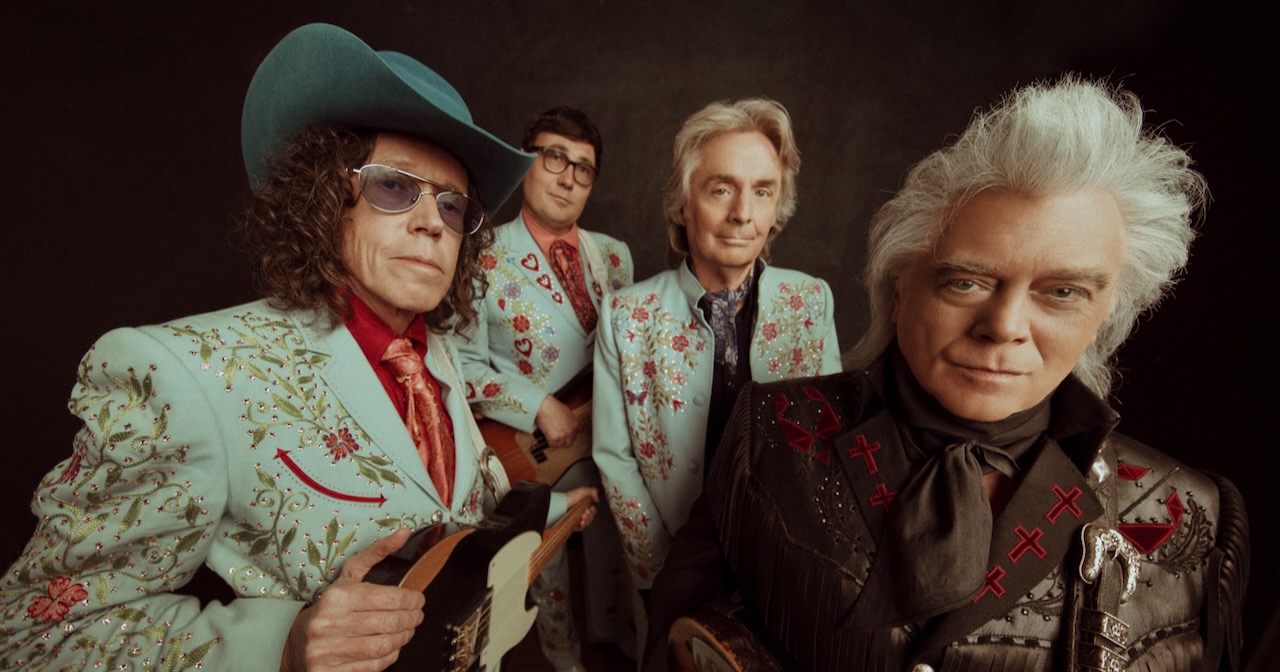
Told that a song on his new album brings to mind The Doors, Marty Stuart is bemused, but open to the idea.
“Did it?” he responds during an interview. “That’s fine. If so, why not?”
“Nightriding,” from new album Altitude by Stuart and His Fabulous Superlatives, kicks off with droning guitars, then evolves to a riff somewhat like that of Jim Morrison’s “Roadhouse Blues”
“Cadillac, sundown,” Stuart intones. “Think I’ll investigate this town.”
To be clear, most of the cuts on the Altitude are more evocative of The Byrds than The Doors. So, is Marty Stuart really a country music traditionalist, as many people perceive him? Yes. And also no.
“I’m totally fine with it,” Stuart says when asked if the country music purist reputation is OK with him. “It’s a self-appointed mission. But my comment would be that country music has broad shoulders.”
Dante Bonutto, who heads up Snakefarm Records, which is releasing Altitude, says that Stuart has earned the right to experiment.
“Since he’s definitely someone who pretty much invented the wheel, he’s allowed to put different spokes on it when he wants to, I think,” Bonutto said.
Stuart, who’s been a bluegrass prodigy, a mainstream country music star, and remains a prodigious collector of country music artifacts, was born in 1958, making him a child of the 1960s, with all that comes with it.
“I still think of when The Byrds and Bob Dylan and all those guys came to Nashville to make their records in the late ‘60s,” he says. “That is like contemporary stuff to me. …That was the stuff that touched me when I was growing up, so it was just a part of country music to me.”
At a recent benefit concert for Northwest Mississippi Community College, Stuart’s base was definitely country — he and the group appropriated the whole history of the genre as their back catalogue, doing songs by Merle Haggard (“Brain Cloudy Blues”), Marty Robbins (“El Paso”), Waylon Jennings (“Just to Satisfy You”) and Stuart’s own hits from the early 1990s such as “The Whiskey Ain’t Workin.’”
The casually virtuosic Fabulous Superlatives band (Kenny Vaughan on guitar, Chris Scruggs on bass and Harry Stinson on drums; all of them sing) wore matching glitter-flecked black suits, and Stuart’s performing style still owes a debt to his former boss and mentor Johnny Cash.
But that wasn’t all. During the hour-long set before a well-heeled audience dressed in tuxedoes and evening gowns, there was also a Woody Guthrie indictment of the rich, a mandatory gospel number, and a big helping of surf rock, obviously a favorite of Vaughan in particular.
“We hereby declare Senatobia, Mississippi, as the surf capital of the world,” Stuart announced before Vaughan launched into a Telecaster version of “House of the Rising Sun.” Also, “Wipeout” was played by Scruggs solo on the upright bass, with Stinson slapping out the drum solo on the cheeks of his face.
“Well, it doesn’t really matter how people categorize us,” Stinson said. “If anybody’s interested in what you’re doing, then they listen a little bit deeper and find a much wider spectrum, in terms of the music. I think Marty is much more than just a traditional country artist. He came from that world and uses that as a place to plant himself, and then branches out in different directions.”
Possibly because the Altitude album hadn’t been released yet during the March 25 concert in Mississippi, that audience didn’t get a taste of its cosmic, sometimes psychedelic country music.
The album’s beginnings go back to 2018, when Stuart, Vaughan, Stinson, and Scruggs toured with Roger McGuinn and Chris Hillman to celebrate the 50th anniversary of the pioneering country rock album Sweetheart of the Rodeo by The Byrds. McGuinn and Hillman were original members, along with the late Gene Clark, David Crosby, and Michael Clarke.
“That was Roger McGuinn’s idea,” Hillman recalled. “Roger had done some dates with Marty; he knew him really well. …He knew the Superlatives would be right on the money because he had done a couple of Byrds songs with them onstage.”
Hillman rates the Superlatives as “the best band probably in this country right now, if not the Western Hemisphere.”
“We had so much fun doing the Sweetheart of the Rodeo Tour,” said Hillman, who was also a member of the Flying Burrito Brothers and Desert Rose Band. “The arrangements were the same as we did on the album in 1968,” he said. “We played the songs better, but we didn’t change anything. It was a joy to go back out and do those songs, especially with the Superlatives.”
Stinson says the tour with The Byrds was “a joyous experience.”
“I got to play with some of my heroes,” he said. “I grew up on those records and so to get to play that music, especially the Sweetheart record, which was kind of groundbreaking. I got to go back through it and really dissect it, and then put it on stage. It was surreal for me.”
The Sweetheart of the Rodeo Tour, coming around the same time Stuart and the Superlatives were opening for Chris Stapleton and the Steve Miller Band, had a profound effect on Stuart’s songwriting.
“It got me in the mood to write songs with all the sounds that were left hanging around in my head,” Stuart said. “We were hot on those ideas, and I just carried the inspiration in with me.”
Like a lot of albums released in the past year, Altitude was recorded while COVID-19 was at its height.
“We rehearsed,” Stuart said. “Most of the producing of this record was done in dressing rooms and at soundcheck and trying songs out there in shows before we ever went to the studio.” The original plan to record was ruined by the coronavirus.
“We were hot, we were ready to go to Capitol Studios in Hollywood (California), and make a record,” Stuart said. “Well the pandemic crashed and Capitol Studios shut down, so we found East Iris Studios (in Nashville). We put on our masks and stood 6 feet apart and soldiered on.”
“I’m glad everybody agreed to do that, because I think this record would not have sounded like it does if we would have had to wait several months and relearn it.”
The album’s Byrd-like sound, complete with the jangling guitars that are McGuinn’s trademark, has Hillman’s endorsement.
“What they’ve done is not a tribute to The Byrds,” Hillman said. “It just has a few little nice, ever-so-tasty hints of what we did.”
Hillman thinks the driving “Country Star,” which also owes a debt to Chuck Berry, has the feel of Byrd’s songs such as “So You Want to be a Rock ‘n’ Roll Star.”
“There’s a lot of influence there — not overtly, but it just is there. Marty doesn’t stray far from the well, meaning the bluegrass well. I never did either.”
Stuart’s ability on mandolin shouldn’t be overlooked, Hillman said. “Marty is an unbelievably gifted musician,” he said. “I love Ricky Skaggs’ playing and Ronnie McCoury,” he added. “But I told Marty when we were on the road, ‘You got that machine gun hand.’ He says, ‘Yeah, that’s Everett Lilly.’”
Lilly (1924-2012), played mandolin and sang tenor with the Lilly Brothers and Don Stover. He also spent a couple years with Flatt and Scruggs.
“(Lilly) had that cool right hand and when he took a break on ‘Earl’s Breakdown,’ when he played with Flatt and Scruggs, it was great,” Hillman said. Factor in Vaughan on guitar in the Superlatives, and “you can’t get any better,” Hillman says. “But it’s two different approaches to music.
“Marty really grasped ahold of the pulled string stylings of Clarence White (who played with The Byrds and Kentucky Colonels before his 1973 death)”, and then Kenny “is so good, all over the place.”
“He doesn’t overblow; he plays just what is needed,” Hillman said of Vaughan.
While Stuart released his last album, Way Out West, on his own Superlatone Records, he’s partnered with Snakefarm, a subsidiary of Universal Music Group, for Altitude.
Bonutto, a journalist and record company executive, heads up the roots-rock focused Snakefarm and its sister label Spinefarm Records, which specializes in heavy metal. In addition to Stuart, Snakefarm has acclaimed Southern rocker Marcus King on its roster.
“(Stuart is) obviously an artist I’ve always been aware of, because I love country music and I’m aware of its legacy,” Bonutto said. “The first time I saw him was when he played the Country to Country (music festival) in London, which is a big annual country music event. I thought his personality was fantastic and his playing is obviously unbelievably good.”
Bonutto wrangled a quick meeting with Stuart at the festival, but had to wait a while before Stuart and his management were ready to sign a new record contract.
“I’m trying to build the Snakefarm label into a global entity [in Americana music],” he said. “The best way you can build anything is to attach yourself to people who are legendary and iconic. Hopefully you do an amazing job for them and they speak well of you and they become part of the fabric of what you do.”
Bonutto noted that Stuart, who is also a photographer and working on a facility to display his country music artifacts, is not “a one-dimensional character.”
“He’s a man with a fantastic vision,” Bonutto said. “I think that comes across in the other things.”
Stuart is a leading collector of country music memorabilia, and he’s working on a $30 million museum to display it in his hometown of Philadelphia, Mississippi. A 500-seat theater is already open, and 50,000-square-feet of exhibit space for 20,000 artifacts will be the second phase. An education center is planned after that.
“I was a fan, going back to those country or gospel groups or bluegrass groups who come through my hometown when I was a kid,” Stuart said. “I’d always buy a record and ask for an autograph or ask one of the pickers if I could grab a pick.”
In the 1980s, he observed that “old timers, the pioneers, the people who had raised me, were being disregarded.”
“Their treasures, their personal effects, their guitars and costumes, were winding up in junk stores around Nashville,” he said. “I found Patsy Cline’s makeup kit for 75 bucks in a junk store on Eighth Avenue in Nashville. I couldn’t believe it.”
Stuart met Isaac Tigrett of Hard Rock Café in London, and he showed Stuart how that restaurant chain was investing in and exhibiting rock music memorabilia.
“Even though it was a hamburger joint, I understood the importance of them collecting and curating stuff from The Beatles and the Stones and The Who. … Beyond the Country Music Hall of Fame, I didn’t see anybody doing it, so it just became a self-appointed mission to start rescuing a lot of those things that were winding up in junk stores.”
Stuart’s collection includes treasures such as the handwritten lyrics of “I Saw the Light” and “Cold, Cold Heart” by Hank Williams Sr., the boots Patsy Cline was wearing during her 1963 fatal plane crash and Cash’s first all-black performance outfit.
Speaking of country music history, Stuart began his career in bluegrass backing up Lester Flatt before joining Cash’s band. He’d like to return to those roots and record a bluegrass album.
“I need to, I need to,” he said. “But it needs to be authentic. It needs to be the real deal, blood-curdling bluegrass.”
Artist:Charley Crockett Hometown: San Benito, Texas Song: “I’m Just a Clown (Billy Horton Sessions)” Album:The Man From Waco Redux Release Date: May 26, 2023 Label: Son of Davy/Thirty Tigers
In Their Words: “Listening back to Waco, I’d had an idea to do a part two in the style of Marty Robbins’ Gunfighter Ballads and Trail Songs or Johnny Cash Sings the Ballads of the True West. I guess I’ve always been turning in these Western folk ballads from the very start. I’ve always been a folk songwriter, and if your tune really holds up you oughta be able to present it with any kind of band or arrangement and have the story show through. On ‘I’m Just a Clown,’ it started out as a three-chord barroom honky-tonk number and then I went soul on it. Here we went and flipped it all around again using the same darker chords but in more of a late-‘60s folk color.” — Charley Crockett
Artist:The Bootstrap Boys Hometown: Grand Rapids, Michigan Song: “Even Though” Album:Hungry & Sober Release Date: April 28, 2023
In Their Words: “‘Even Though’ is me grieving the death of my father and thinking back positively on his memory at the same time. It was an emotional roller coaster to write. I have all these happy memories of playing and singing with my dad, and they’re sitting across the table from sad realizations about how that can’t happen again. He would be proud that I’m doing what I want with my life, venturing off the beaten path.
“It was a harsh realization for me to accept that line ‘even though he had to die for me to be the man that I’ve become.’ Without that painful experience of losing my father at the young age of 30, I wouldn’t have undergone the personal growth I was forced into. Without that sadness and loss, this song wouldn’t exist. I might just still be half-assing poetry over acoustic guitar at a coffee shop for a handful of hipsters. Sometimes it feels like I owe a debt to death for spurring me on.
“My dad played Johnny Cash’s ‘Don’t Take Your Guns to Town’ every time he picked up the guitar practically. The gospel and bluegrass songs he listened to and played (around/with me) when I was growing up carved and shaped me like water does rock. I reference a song from Tom T. Hall [‘Homecoming’] in the second verse. I wondered if being distant from your family and feeling alone and exhausted in this world is just a part of being a country music singer. I identified with that sentiment heavily, decades later. The names and faces have changed but the story stays the same.” — Jake Stilson, The Bootstrap Boys
Sarah Shook laughs at a mention that Nightroamer, the title of their third album with the Disarmers, could refer an activity they pursued as a late teen: after-dark escapes to engage in sexual rendezvous. But the same-named song is about more than breaking free; it’s about moving beyond, as in the lyric, “Don’t know where this road gonna take me/But I’d rather die than ever turn back.”
Several of the album’s 10 songs touch on searching for strength to reject toxic relationships and temptations, and even inspiring others to find that resolve. There’s some backsliding; in “No Mistakes,” they implore a wronged lover to “give me one last try.” But experiencing life at opposite ends of society’s spectrum — going from an ultra-conservative upbringing to identifying as bisexual and they/them nonbinary, and from addiction to sobriety — has toughened the North Carolina native, and Nightroamer’s sharp-edged mix of punk, pop, country and rock reflects that.
“One of the things that I really love about this album is that a lot of it was a surprise to me,” Shook says. “I don’t write albums; I write songs, and I make little stacks, like, this pile is definitely Disarmer songs, and this pile is probably not Disarmers. The last rehearsal we had before we flew to L.A. to make the record, we finished early, and morale was through the roof. Everybody was on cloud nine. The guys were like, ‘Do you have anything else that we could run through just for the hell of it? We’re done early, and it’d feel good to just blow off some steam.’ I was like, ‘I’ve got this song called, “I Got This” and a song called “Been Lovin’ You Too Long.” We ran through them, and they were like, ‘Yeah, those should be on the record.’”
Throughout Nightroamer, producer Pete Anderson adroitly sprinkles in touches such as an unexpected guitar chord, organ tickle or layered vocal; on “Been Lovin’ You Too Long,” he notably emphasizes Will Rigby’s around-the-beat drumming and tight-headed tom tones. On “I Got This,” Shook’s defiant tone also carries a sweetness reminiscent of a post-punk Kirsty MacColl, with hints of vulnerability that somehow reinforce its confident stance. But something else also stands out on the album: a spirit of resilience, even optimism — attitudes a person who’s endured repression, addiction and heartache might embrace once they dump the demons, break those cycles and finally realize, “I Got This.”
BGS: You grew up sheltered in a religious environment and broke out of that. When did you figure out that was not something you wanted to be part of, and how hard was it to get out?
Sarah Shook: It was a process that had many different steps. I’m still unlearning a lot of the stuff that I was raised to believe is true. I started having a lot of questions and doubts when I was a kid. I have two siblings, and I was the one that was always pushing buttons, asking questions that my parents were answering with, “Because I say so,” which, to me, was very unsatisfactory.
There was a lot of stuff in the Bible that wasn’t adding up. Just to clarify, we weren’t a family that (only) went to church every Sunday morning. We read our Bibles and had worship and prayer together every day. So I’m very familiar with the Bible as a text. In my early 20s, I hadn’t been going to church for years; I felt very disconnected from all of that, and pretty turned off by it. But this one day, I was just like, “I’m going to read the Bible one more time. And this time, I’m just going to read it, and everything that in the past I’ve justified with, ‘Well, I just have to trust that God knows best’ or ‘I just have to have faith,’ I’m not going to do that. I’m not gonna give God an out this time.”
I will never forget the moment: I was sitting on my porch in the sunshine, and it was a beautiful day; it was quiet. It was really scary to even be contemplating letting go of all of these beliefs that I was raised with (but) I made that decision on that porch that day. I was just like, “You know what, I don’t agree with this. And even if every word of this is true, I don’t see God as the good guy here; it’s not meshing with my view of humanity and the way that we should treat each other.”
Were you also questioning sexuality at that time?
I knew that I was attracted to girls when I was 8 or 9. Obviously, that wasn’t something I could share with my family. They weren’t openly hostile, but I knew that was not OK in their view. So, it was something that I kept to myself, and it was burdensome to feel like I couldn’t totally be myself, because it was around that time that I also was just, like, “I don’t think I’m a girl. And I don’t necessarily think I’m a boy, either.” But when you’re raised with the belief that gender is binary, if I’m not a girl, I must be a boy. You use the language that you have to try to make sense of your circumstance.
It wasn’t until my late teens that I started sneaking out of the house. I was 18 or 19. We weren’t allowed to date; we weren’t allowed to talk to boys in any romantic capacity. So I was going out and sleeping with people. My coming-out story was my dad asking me if I’d been sneaking out and sleeping with people. And I was like, “Yes.” He wasn’t impacted by that. Then he asked me if I’d been sleeping with women, and I was like, “Yeah,” and then he was just crying and devastated. Because that was, like, the worst thing in the world. At this point, my parents are in a totally different place, and I’m very grateful for that. If my folks, who are pretty conservative and religious, can grow and change and learn, then I’ve got hope for just about anybody.
Did you have to sneak to teach yourself piano and guitar?
I did not. We had a very old and not properly maintained upright piano in our hallway, just a catch-all for clutter. We were allowed to listen to classical and worship music; we weren’t allowed to listen to any contemporary Christian music, nothing with electric guitars or any sort of rock, bass or drums. So I started teaching myself piano when I was 8 or 9. I’m sure the first songs I wrote were religious in nature, because that’s all I knew at the time. When I was 16, I wanted to learn to play an instrument that was a little more portable, that I could take outside with me. So my folks got me one of those old-school posters that has a bunch of (guitar) chord shapes and I just sat in my room and learned chord shapes and strum patterns.
You weren’t allowed to listen to even contemporary Christian?
My parents were very protective. Even in the church setting, my siblings and I weren’t allowed to go to youth group. We weren’t allowed to go on trips that all of the kids our age were going on. They were very, very strict.
The more restrictive parents are, the more they’re pushing children to pursue the forbidden.
It’s almost a chicken-egg situation too, because it’s like, “I wouldn’t have known I wanted to do this if you hadn’t said something!” (Both laugh.)
You’re now part of a wave of artists trying to wake up and shake up attitudes in Americana and country and other realms, musically and socially. How did you get from that musical background to where you are now?
I have somewhat of an advantage because I didn’t grow up playing in bands and wanting to be in bands. This was not ever a career I would have chosen for myself. I’m very grateful to be where I am, and to have accomplished the things that we’ve accomplished as a band. But it does not come naturally to me. I’m introverted; I like my porch. But if I had been immersed in traditional country music from the word go, I probably would have gotten very jaded very fast. And really, there’s a lot of work that needs to be done. I cannot change anybody’s mind, and I’m not out to. But I am out to plant seeds. I am all about sharing whatever information I have with others who might benefit from it. I’m still learning a lot of shit, too. It’s important to be out front about that.
What turned that key that allowed you to hear and draw into this music? And how were you able to stay cloistered for so long? You were never able to turn on the radio and hear something else? I take it you were homeschooled.
All the way through. But yeah, it’s strange, and hard to pinpoint sometimes, because the progression is linear, but it’s evolution in fits and starts instead of one smooth line. The first stuff that I was listening to, I was at the mercy of coworkers. I was a cashier at a grocery store and my coworkers were giving me CDs to sneak into my house and listen to after my parents went to bed. So, my introduction to music was Elliott Smith, Belle and Sebastian, the Decemberists, Yo La Tengo and Gorillaz, and to me, that was just unbelievable. But I don’t necessarily seek out listening to music. I probably only listen to music once or twice a week because I need silence to get my tasks done. That’s just what makes my brain happiest. And I can’t listen to the radio at all because I cannot listen to advertisements.
How did that exploration of music turn into creating your own?
Because I was so sheltered musically, when I first started listening to actual, normal music, it was absolutely mind-blowing. There are no words for that experience, listening to Elliott Smith after having never heard anything like that in your life.
In my early 20s, I started dating this guy. We were sitting on his porch one day, and he had a little record collection and a turntable, and he put this album on. I was just like, “What is this? What is this called?” And he’s like, “This is Johnny Cash.” And I was like, “Yeah, but what kind of music is this?” And he’s like, “Well, this is country music.” And I was like, “I’ve been writing songs like this!” Not exactly, but the same kind of feel. We proceeded to listen to all of these old-school country artists.
I was just blown away because it felt like a homecoming. It was like, “I understand this music; this has already been coming out of me!” — having never heard it before. The second time that happened was with old-school punk. My introduction to punk was Sex Pistols and X-Ray Spex, and Germs and the Adverts. The first time I started hearing that stuff, I was just like, “I understand this. This is me.” Something good came out of all that isolation.
The musical and cultural impact of Ray Charles is extraordinary and spans the pantheon of American popular music. He was an outstanding multi-instrumentalist (though best known for piano and alto sax), vocalist, bandleader, songwriter and composer in the non-lyrical sense. His innovations include helping craft and popularize the secularization of gospel music, now otherwise known as soul, and bringing new attention and expanded audiences to country music, which was the earliest idiom he loved and played before blues, jazz, R&B, or soul.
Though his earliest material was heavily influenced by Charles Brown and Nat “King” Cole, Charles (full name Ray Charles Robinson) quickly developed a highly stylized, immediately recognizable singing and playing approach. He became an expressive, evocative vocalist, one of the finest interpretative singers of all time, and a skilled improviser as an instrumentalist, able to deliver intense and memorable melodic statements or energetic solos while heading either small combos or large bands.
Charles is remembered as a trailblazer on the music business side as well, signing a contract in the early ’60s that gave him creative control over his sessions, something that allowed him to record in genres that many felt Black artists should avoid. The extensive list of Ray Charles’ achievements include 18 Grammy Awards, the Kennedy Center Honors, the National Medal of Arts and the Polar Music Prize, as well as a Lifetime Grammy Achievement Award and 10 recordings inducted into the Grammy Hall of Fame. Among the 2021 inductees into the Country Music Hall of Fame, Ray Charles is finally earning his place in the Veterans Era category.
The Ray Charles Foundation released the new box set, True Genius – The Ultimate Ray Charles Collection (Tangerine), in September, roughly two weeks before what would be Charles’ 91st birthday. The six-disc, 90-song collection is unquestionably the most comprehensive sampler available of his music from 1960 until his passing in 2004. It combines vintage, familiar hits with many previously unissued gems, most notably a 1972 Stockholm concert that’s not available other than through purchase of the set. There’s also a wonderful coffee table book with rare photos and comprehensive liner notes from Ray Charles Foundation President Valerie Ervin and music journalist A. Scott Galloway. A special message from Quincy Jones concludes what’s obviously an essential collection for any serious music fan.
Here are our 10 choices for selections from the set, although if we chose these tomorrow we might easily pick another 10. Ironically, none are Charles compositions, though that wasn’t the intention, and we could certainly go back through and do a separate listing of Charles’ pieces. However I would argue none of those, even some that I’ve loved my entire life, top these 10 renditions of other songwriters’ works.
“Georgia On My Mind”
The official anthem of the Peach State, it was co-written by Stuart Gorrell and Hoagy Carmichael, and was Charles’ first post-Atlantic hit for ABC-Paramount in 1960. It also marked his first collaboration with Sid Feller, who not only produced and arranged, but conducted the recording. Besides being a huge hit, it earned Charles plenty of recognition outside R&B and soul circles while garnering four Grammy Awards.
“Hit The Road Jack”
Percy Mayfield had many immortal R&B hits, but not that many folks are aware he wrote “Hit The Road Jack.” Mayfield even sent it to Art Rupe as an a cappella demo, but Charles transformed it in much the same way Aretha Franklin did Otis Redding’s “Respect.” The song is spiced by the interaction of and exchanges with Margie Hendrix, and it soared to the top of the Billboard pop and R&B charts in 1961, though it had more staying power on the R&B side. It topped that chart for five weeks, and ultimately won a Grammy for Best Rhythm and Blues Recording.
“I Can’t Stop Loving You”
Don Gibson’s original recording from 1957 is tremendous, but Charles’ 1962 rendition introduced a host of listeners who weren’t regular country fans to the song’s lyrical and musical potency, It was also the tune that turned Modern Sounds in Country and Western Music into a powerhouse anthem. The song remained atop the Billboard pop charts for five weeks. When John Belushi did a straight-up masterful imitation of Charles’ singing that tune on Saturday Night Live years later, it cemented how much it resonated in the lives of ’60s music fans.
“You Don’t Know Me”
While Eddy Arnold did a wonderful version of Cindy Walker’s “You Don’t Know Me” in 1955, Charles enjoyed another huge crossover hit off the Modern Sounds LP in 1962. That one didn’t make it to the top as it peaked at No. 2. It also didn’t enjoy as much acclaim or praise, but it’s every bit as magnificent in terms of performance.
“Busted”
Harlan Howard saw his 1962 gem become a hit in two different, yet related styles. Johnny Cash had a country hit, then Ray Charles did a fabulous soul version that earned him the 1963 Grammy Award for Best Rhythm and Blues Recording. Interestingly, the Cash and Charles versions vocally aren’t that far apart, though the arrangements and overall performances reflect the different production approaches.
“Crying Time”
Buck Owens’ original was the B-side of his bigger single, “I’ve Got a Tiger by the Tail,” in 1964. The Ray Charles version two years later proved a much bigger hit, though not a pop chart smash in the manner of some past Charles country covers. It did earn a pair of Grammy awards, plus enjoyed Top 10 pop and R&B success. It was even a number one hit on, of all things, the Easy Listening chart. Charles would later join Barbra Streisand in a duet rendition on a 1973 TV special that wasn’t quite as memorable as the ’66 single.
“Let’s Go Get Stoned”
This song was recorded first by the Coasters in 1965, and later by Ronnie Milsap as the B-side to the single “Never Had It So Good” that same year. But the Charles version, powered by his dynamic lead vocals, soared to number one in 1966. The song actually had an ironic feel for Charles, who recorded it shortly after getting out of rehab, where he kicked a 16-year heroin addiction. This was among the earliest hits for the famed husband/wife songwriting and performing duo Nickolas Ashford and Valerie Simpson, joined on it by Josephine Armstead.
“Living for the City”
The very first album a young, fledgling artist named Stevie Wonder recorded was A Tribute to Uncle Ray in 1962. Some 13 years later, Charles would repay the honor with this glittering cover of Wonder’s valiant hit from the Innervisions album. Charles would eventually win another Grammy for his rendition, though this wasn’t as big a hit on the contemporary R&B side.
“Seven Spanish Angels”
This tune co-written by Troy Seals and Eddie Setser proved a big duet hit for Charles and longtime friend and chess partner Willie Nelson. The song featured Charles doing the first verse, first and second choruses, with Nelson singing the second verse and joining Charles on the outro. Interestingly, this became the biggest country hit Charles ever enjoyed in terms of chart position, as it spent one week at number one and remained on the charts for 12 weeks. It was initially released on Charles’ 1984 LP Friendship, and then again on Nelson’s 1985 compilation release, Half Nelson.
“I Can See Clearly Now”
This is famous more for when it was performed than the fact it was one of the few reggae tunes Ray Charles ever covered. The Johnny Nash original was the first reggae song to top the American charts in 1972, but Charles gave it new fame when he performed it as the musical guest on Saturday Night Live in 1977.
As the go-to producer for some of Nashville’s most enigmatic roots talents, David Ferguson is what you’d call a behind-the-board legend. The studio savant known simply as “Ferg” started out as a protégé of producer and eccentric tape-splicer Cowboy Jack Clement and went on to become Johnny Cash’s favored engineer during his late-career resurgence. More recently, Ferguson has been imparting his old-school wisdom on tastemakers like Sturgill Simpson and Margo Price, while on his own debut album Nashville No More, he puts decades of knowledge to work once more.
With 10 songs full of classic charm and creative whimsy, it’s a loose-feeling project of tunes Ferg’s been falling in love with (and recording for himself) for years, molded into an album during the pandemic doldrums. A rotating cast of Nashville A-listers like Kenny Vaughan, Sierra Hull, Justin Moses, Jerry Douglas, Stuart Duncan, Béla Fleck and Tim O’Brien helped him flesh it out, presenting gruff vocals with tender, honest reverence for the lost art of record-making. In the end, it sounds like a love letter to his life’s work – and maybe the last hurrah of a creative culture.
BGS: So we’ll start with obvious question: Why did you want to make your own record, after so many years of helping others make theirs?
David Ferguson: Well, I’ve really always been a musician at heart. But this one fell into my lap over the pandemic. I had to shut down my studio, the Butcher Shoppe, in Nashville because they sold the buildings. So I set up a control room and an overdub room at my house, then the pandemic came along and there wasn’t much work. I started digging around in my recordings from over the years, got ‘em out and started seeing what I could do. That’s kind of how it came together. I really was just putting it together for family. Like, I was just gonna give it to my mom.
That’s interesting, because I think some people might assume you’ve been wanting to do this your whole life, but it sounds more spur of the moment.
Yeah, it’s a little late in life for me to be launching a solo career. [Laughs] But it’s fun to have one coming out and I’ve got a lot of time on my hands.
It might be late to get started, but you’ve had good teachers. Working with people like Cowboy Jack and Johnny Cash, and more recently Sturgill and Margo, what have you learned about being an artist?
To try to be humble. Even doing interviews, it’s hard to talk about yourself. Somebody who enjoys sitting and talking about themselves, there’s something a little bit wrong with them. I think being humble is a great lesson. Johnny Cash was a very humble man, very humble. So I think that — and trying to be kind to people. And don’t take it for granted, because even if something does happen, it may never happen again. You gotta appreciate what you’ve got.
The people you’ve been known for working with, they’re all artists of very strong vision – ones who didn’t compromise their art. Why are you drawn to people like that?
That’s a good question. I don’t know that I am particularly drawn there, maybe it’s just kind of the way it happened. Stuff comes your way and you have to grab the opportunity if it comes. You’ve gotta be ready to make a fool of yourself if you have to, and learn to grow from mistakes. I made a whole lot of records on a whole lot of people that weren’t any good – tons of them! Not everything you’re gonna do is good. But you do your best for the amount of time or money you have.
I always tried to do my very best. I was a fast engineer and got it going quick, because I didn’t want to waste people’s money. It’s hard to come by, and to get to make a record in a studio is a special thing. It used to be a really special thing. Now anybody can make a record. You can make one in your own house. But back in the day when I started, being able to have the money and resources to go in and record an album was a big deal. I still look at it as a big deal.
I think that comes through on your record.
Thank you, man, I tried not to cut any corners. I could have, and used keyboard strings, things like that. But I had real ones. I tried to do it as real as I could do it.
Did you record this the way you would have back in the day?
Yeah. Everybody’s recording on the Pro Tools format, but I can still fire up a tape machine, I’m not afraid of it. It’s just not economically feasible anymore. And plus, people don’t realize, they always used to say, ‘Oh, tape machines sounded great.’ And it’s true. They did and they still do, but you still wind up with a 16-bit CD. Unless you’re listening to it off the tape machine or on a vinyl record, or some super high resolution format, it’s just not gonna make very much difference.
Tell me about the title you chose. You’re from Nashville and have seen how it’s changed. How did you end up with the title Nashville No More? The whole thing has a kind of weary feel to it.
[Laughs] You know it’s not really a bummer. A lot of them are actually love songs. Like “Chardonnay” is a love song to wine. And then “Looking for Rainbows,” it’s kind of a sad song about love. … Nashville No More means a lot to me, because the Nashville that I used to know is no more. I’m not saying that’s a bad thing, it’s just that things evolve, and Nashville has really evolved. The music has evolved into an unlistenable thing to me. Modern country music, to me, is really difficult to listen to. Top 10 radio, it’s not for me. And I know some of those people who are on those channels, those singers, and I really like ‘em. I’m not saying anything bad about their music or anything … I’m really happy for their success, but it’s not the kind of stuff I’m gonna listen to.
Margo Price is featured on “Chardonnay,” and that has such a lovely sway to it. Where did that track come from?
That was written by my friend Roger Cook, and some years ago I made a demo of him doing the song, and I found it like ‘Jeez, where has this song been? I love this!’ … I finished it up with some real players on it, re-sung a couple of lines here and there and then sent it to Margo, and she said, ‘God, I love that song so much.’ She graciously came over and hung out for the afternoon and sung on that and “Looking for Rainbows.” Margo’s a real sweetheart and she doesn’t live far from me. The other person on there is Harry Stinson. He sings harmony, too, and Harry is in the Fabulous Superlatives. Harry’s singing on “Four Strong Winds,” too. He can blend right in there.
I love that you start off with “Four Strong Winds,” which is such a tender song. The first thing you hear is this gentle piano and a loping drum beat. Why start with that sound?
The album was totally sequenced … and it started off just exactly the opposite of what it is now. It started off with number six being number one, and we swapped the A side and B side.
Really?
That’s an old record trick I learned from Jack Clement and Johnny Cash.
What’s the benefit there?
It just kind of takes the obvious away, and that’s good. I’ve done that on more than one record for the years, and I’ve seen Jack Clement do it a few times. It’s a strange thing, but I mentioned to the guys, “Jack used to sequence it out A and B, then a couple of days later he’d be like, ‘You know, B oughta be A, I think.'” And it works!
You end on “Hard Times Come Again No More.” What’s the message in that ending?
Like I said before, that would have been number five, and we swapped it around. But it just seemed like a natural song to go out with. Sierra and Justin were kind enough to show up on that, and I think she’s just a major talent. Probably one of the most talented people I’ve ever met. She’s got the touch, and she’s not one to nitpick stuff. If you say you’re happy, she says, “OK, let’s move on.” She won’t just wear you out with it.
What was it like trying to produce your own songs, though? Is it hard to be critical of yourself?
It’s nearly impossible. Anybody you talk to who sings or even talks for a living, there’s hardly anything more painful than listening to yourself back. It’s as painful to a singer and artist as it is to anybody — unless they have an ego the size of [spreads his arms wide]. But you get in a situation where you have to be critical, so I learned how to do it on this record. I figured it out.
Artist:Brad Kolodner Hometown: Baltimore, Maryland Latest Album:Chimney Swifts Personal nicknames: B-rad, Dadley, BK
Which artist has influenced you the most … and how?
My father Ken, hands down. As long as I can remember, my father’s music has been the soundtrack of my life. To be fair, I didn’t have much choice in the matter. The living room in our house was filled with the sounds of his hammered dulcimer and fiddle playing (along with the scores of students who banged away on their dulcimers and scratched out tunes on fiddle). I’d be lying if I said my sister and I always loved the ruckus. In all seriousness, the music must’ve been seeping in all those years. When I finally picked up the banjo as a teen, old-time music clicked and it felt right.
My father quickly became a musical mentor and eventually a bandmate and musical peer. His experience playing a multitude of traditional folk music styles through his years with his band Helicon has informed how I approach music with a creative, open mind while respecting the traditional roots of the music. His musicality and sense of dynamics are captivating. He really feels every note and it’s something I strive for in my playing. While piecing together material for my new solo album Chimney Swifts, it was a natural choice to include my father on the project as I wanted to highlight both the groovy and mellow sides of his playing. It’s always a joy to make music with him and I’ll treasure that feeling as long as I can.
What was the first moment that you knew you wanted to be a musician?
Singing “I’ve Been Everywhere” for the student talent show at the Meadowlark music camp in Maine back in 2007 was a catalyst for my love of being on stage sharing music. I had just wrapped up my very first week learning the basics of clawhammer banjo in a workshop with Richie Stearns, who ultimately became a banjo hero of mine. I could only play a very clumsy “bum-ditty” so I wasn’t quite ready to show off my newfound love of the banjo. However, I was eager to share the one song I had memorized in my life up to that point for the student talent show.
Years earlier, I spent weeks memorizing all the places in “I’ve Been Everywhere,” which caught my ear when I heard Johnny Cash’s version in a commercial. Suffice to say, I didn’t do too well in school for those few weeks. With my tail between my legs, I hopped up on stage and sang the song. As a relatively shy kid at that point in my life, I emerged from my shell after belting out each verse with the crowd roaring along the way. I can’t say I knew I wanted to be musician at that moment but it’s certainly the first time I tasted that high performers can get on stage in front of an electric audience. There’s actually a home video of that original performance.
What’s your favorite memory from being on stage?
I’ve been fortunate to have some incredible experiences performing with my father Ken at venues like the Kennedy Center, Winfield, and Clifftop and with Charm City Junction at Grey Fox, IBMA, and the Charm City Bluegrass Festival. However, there is one night that really jumps out: the opening concert at our inaugural Baltimore Old Time Music Festival in 2019. After moving back to my hometown in my early 20s around 2012, I made it my mission to reboot the local old-time music community. I cofounded our biweekly old-time jam with my dad, started the Baltimore Square Dance with some pals, and hosted a monthly house concert series with the long term goal of putting together an old-time music festival someday. Well, that dream became a reality in 2019 when I, with Baltimore Old Time Music Festival in partnership with the Creative Alliance, cofounded an arts organization here in town. I’ll always treasure the memory of standing on stage during the kickoff concert in a packed concert hall rocking out during the encore playing “Tennessee Mountain Fox Chase” with the biggest smile on my face. This year, we’re hoping to have our “2nd” Annual Baltimore Old Time Music Festival in mid-November.
Which elements of nature do you spend the most time with and how do those impact your work?
There’s really nothing more nourishing or magical than the time I’ve spent deep in the dense woods on top of a mountain in Clifftop, West Virginia, at the Appalachian String Band Festival. As an artist, I spend much of my time making music in the context of my work — playing a show, teaching lessons, leading a local jam, etc. While I’m deeply grateful for this lifestyle, I need those soul-nourishing experiences in which I play music simply to play music. Clifftop provides that space. It’s a gathering of thousands of old-time musicians who huddle under soggy EZ-ups ’til the wee hours playing fiddle tunes. The natural beauty of the setting adds to that magic.
There’s something about the shared experience trudging through the mud, square dancing in a dusty dirt road, and watching the sunrise with your buds grooving out on fiddles tunes that can’t be matched anywhere else. I can’t tell you how many times I’ve gotten lost meandering through the woods with sounds of far-off old-time jams swirling around the forest. There’s a hike next to the campground that weaves through a rhododendron grove amidst rock formations atop a ridge before descending to a little mountain stream. It’s the quintessential West Virginia swimming hole and it’s a hike I look forward to every year. Most of all, I’ve made some dear pals at Clifftop who have become my closest musical collaborators including Alex Lacquement and Rachel Eddy who are featured on my latest album, Chimney Swifts. While the music is what draws me in, it’s the people who keep me coming back year after year.
Since food and music go so well together, what is your dream pairing of a meal and a musician?
Well, since you asked… Before I played music, I was (and still am, sadly) a diehard Baltimore Orioles fan. The earliest musical memory I have, besides listening to my father’s music, is seeing John Denver hop up on top of the Baltimore Orioles dugout during the seventh inning stretch to sing “Thank God I’m a Country Boy” back in 1997 just a couple weeks before he tragically passed away in a plane crash. After that performance, my parents gifted me some John Denver CDs and I listened to them more than anything else as a kid — really. I would fall asleep to his albums on repeat and my parents would have to come in and turn them off after I dozed off. So, it would be my dream to sit with John Denver at an Orioles ballgame on a warm summer night while eating a Boog’s BBQ sandwich and drinking a Natty Boh beer (a classic Baltimore combo). Oh, and an Orioles win would be nice, but I don’t want to ask for anything unrealistic…
Photo credit: Joanna Tillman
This website uses cookies to improve your experience. We'll assume you're ok with this, but you can opt-out if you wish.AcceptRejectRead More
Privacy & Cookies Policy
Privacy Overview
This website uses cookies to improve your experience while you navigate through the website. Out of these, the cookies that are categorized as necessary are stored on your browser as they are essential for the working of basic functionalities of the website. We also use third-party cookies that help us analyze and understand how you use this website. These cookies will be stored in your browser only with your consent. You also have the option to opt-out of these cookies. But opting out of some of these cookies may affect your browsing experience.
Necessary cookies are absolutely essential for the website to function properly. This category only includes cookies that ensures basic functionalities and security features of the website. These cookies do not store any personal information.
Any cookies that may not be particularly necessary for the website to function and is used specifically to collect user personal data via analytics, ads, other embedded contents are termed as non-necessary cookies. It is mandatory to procure user consent prior to running these cookies on your website.