BGS Class of 2023: Our Year-End Favorites

Year-end lists can be so problematic – pitting distinct sounds and music against each other, peddling absolutes, attempting objectivity in a demonstrably subjective field. Each year, as we consider the music that impacted us over the course of twelve months, we try to challenge ourselves and each other, as BGS contributors, to think outside the year-end round up “box.” 

For the BGS Class of 2023, our intention is to highlight music, songs, albums, and performances that have stuck with us, or that we know will continue to stick with us into the future. We wanted to deliberately look beyond the music and creators that merely have the resources, networks, and access to reach us; we wanted to utilize genre as a checkpoint or touchstone, but never as a blanket criterion; we wanted to broaden what forms of media or formats are included; and overall, we wanted to attempt a holistic look at what a year of listening, learning, watching, and hearing can look like to this particular group of people. 

You’ll find ravishing and large indie folk, earnest and literary – and raucous and silly – bluegrass, legendary legacy artists and brand new lineups, soundtracks and live shows, and more. Ultimately, whatever the year, we always want our retrospective lists to be a starting point, a springboard, for our readers, followers, and for roots music fans. This is not the end-all, be-all “Best of 2023” list. Instead, it’s a reminder of the music that scored a year absolutely filled to bursting with excellent, exemplary, ecstatic roots songs, albums, and shows. 

boygenius in Pittsburgh, June 2023

When I saw boygenius this summer, I was milktoast about the whole thing going into it. As soon as I arrived, I realized I was surrounded by young people – and not just any young people: All the beautiful freaks were out for Lucy, Julien, and Phoebe. The energy was palpable and something that I have not experienced in over 20 years. Everyone knew every word. They were FaceTiming friends who cried and sang along remotely with these heroes on stage. It was inspiring!

boygenius feels like an important band. I so wish they had been around when I was an outcast teenager feeling such confusing, wild emotions. Music has a way of helping the world make sense. boygenius radiates communion and it felt like an honor to be a part of their world. – Cindy Howes

Caitlin Canty, Quiet Flame

My favorite bluegrass album of the year is often an album that, through no fault of its own, ends up receiving little to no bluegrass radio airplay or IBMA Awards recognition, and as I listened to Caitlin Canty’s Quiet Flame over and over this year, I couldn’t help but expect it would end up criminally underrated by the general bluegrass community. It’s made by bluegrass pickers – Canty assembled Chris Eldridge (who also was the project’s producer), her husband Noam Pikelny, Brittany Haas, Paul Kowert, Sarah Jarosz, and Andrew Marlin for her band – and as a result Quiet Flame, more often than not, is just an unencumbered string band album that’s as much bluegrass as it is Americana and singer-songwriter folk. But while Mighty Poplar, with a similar lineup of folks, takes off in bluegrass circles, it raises an eyebrow that this impeccable, heartfelt, and complicated set of songs hasn’t seen the same trajectory. Not that that was Canty’s goal – it’s obvious her priorities in music making are grounded and community-minded, part of why this album is such a stunner. “Odds of Getting Even,” co-written with another BGS favorite, Maya de Vitry, is one of the year’s best songs, bar none. – Justin Hiltner

A Homeplace Pilgrimage to Earl Scruggs Music Festival, August 2023
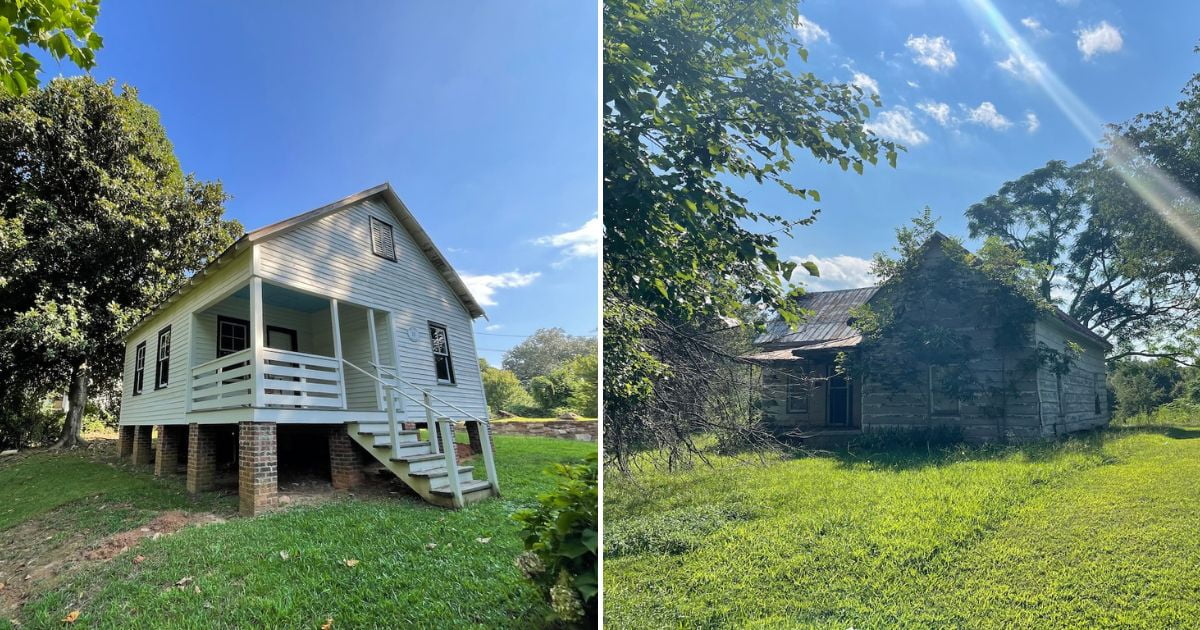
L: Nina Simone’s homeplace in Tryon, NC. R: Earl Scruggs’ homeplace in Boiling Springs, NC. Both photos by Justin Hiltner.

BGS once again co-presented the Earl Scruggs Revue tribute set hosted by Tony Trischka at Earl Scruggs Music Festival, held just outside of Shelby, North Carolina at the Tryon International Equestrian Center in August. On my drive to the festival grounds, I made stops in Tryon proper, to visit Nina Simone’s childhood home, and also in Shelby, to visit the Earl Scruggs Center and to drive by both of the Scruggs homeplaces just outside of Boiling Springs, North Carolina. It was stunning to visit both homes on the same day, to realize the interconnectedness of so much of American popular music. Simone grew up with a view of the Blue Ridge Mountains from her front porch nestled in one of their hollers, yet we place Scruggs as an Appalachian musician and not Simone? 

The festival and Scruggs Center, for their parts, did an excellent job of demonstrating how broad, varied, and intricate American roots music is, even while focusing closely on bluegrass, string band, and Americana music. Listeners of our podcast, Carolina Calling, will know how much BGS loves North Carolina music history – the show features episodes on both Scruggs and Simone. Seeing that history in person, while heading to a first-class, banjo-heavy festival was a favorite musical moment of this year, for sure. – Justin Hiltner

East Nash Grass, Last Chance to Win

East Nash Grass seems to be all the buzz on the bluegrass circuit these days and those who have ventured to Dee’s Country Cocktail Lounge on any Monday night since 2017 can certainly understand why. The band’s long-standing residency at the Madison, Tennessee dive bar has taken them from a weekly pick-up band to performing at the Grand Ole Opry, the Ryman Auditorium, and at bluegrass festivals across the U.S. Their sophomore album, Last Chance to Win, captures the band at their very best (albeit, without their lovable stage antics). Following a 2023 IBMA nomination for Best New Artist, it won’t be a surprise if we see this record, and these musicians, sweeping awards in 2024 and beyond. – Thomas Cassell

Alejandro Escovedo at Cat’s Cradle Backroom, Carrboro, NC, November 2023

There are countless good reasons why you should make a point of seeing the Texas punk/soul godfather if he’s ever playing anywhere near you. But what might be the best reason of all is it’s a lead-pipe cinch that everyone in your town worth hanging out with will be there, too – onstage as well as in the crowd. Escovedo was among a dozen stars drawn to the North Carolina Triangle for an all-star “Nuggets” tribute show overseen by Lenny Kaye in November. So, he came a night early and played a solo show, too, ably supported by local luminaries Lynn Blakey and Pinetops/The Right Profile guitarist Jeffrey Dean Foster. The love in the room was palpable on deeply moving originals like “Sister Lost Soul” and “Wave Goodbye.” And when Kaye and R.E.M.’s Peter Buck came on for a closing Velvet Underground cameo of “Pale Blue Eyes” and “Sweet Jane,” the circle was complete. – David Menconi

Ben Garnett, “Open Your Books” (featuring Brittany Haas and Paul Kowert)

Before I’d listened to the complete #BGSClassof2023 Spotify playlist and realized this track was one of our first additions, the app kept recommending “Open Your Books” to me – and it’s not hard to see why. From guitarist and composer Ben Garnett’s debut album, Imitation Fields, the track features bassist Paul Kowert and fiddler Brittnay Haas and is an example of what bluegrass music can be, and what traditionally bluegrass instruments can do.

The tune opens slowly, with guitar and mandola – provided by Molly Tuttle & Golden Highway’s own Dominick Leslie. Fiddle swells, orchestral arrangements, and dreamy acoustic production make for a piece that feels distinctly intellectual. It’s chambergrass, but it’s also highly listen-able. While there’s a strong melodic thread throughout, the surrounding instruments and their players are allowed to wander off up the guitar neck, throwing in trill-y banjo licks, and detouring outside traditional fills and solo styles. The record was produced by Chris Eldridge and also features Matthew Davis on banjo and additional guitar from Billy Contreras. I’d recommend this tune to low-fi lovers, roots music fans, and anyone looking for a chilled out moment. It’s perfect for an introspective drive or a rainy winter day spent drinking hot tea at the window. – Lonnie Lee Hood

Alice Gerrard, Sun to Sun

Never, over the course of her lifelong career in music, has Alice Gerrard stopped, having reached her musical destination. She has challenged herself, time and time again, not simply for reinvention’s sake, but because she is a consummate old-time and bluegrass musician, someone so solidly bitten by the string band bug that making music requires that constant movement, that aspirational looking into the future, girded by songs of the past. But Sun to Sun, her latest – and perhaps final – album, features songs decidedly of the present. A synthesizer of traditional art forms, Gerrard takes textures and colors we relate to “authenticity” and leverages them to serve the messages in these tracks. Aging, mortality, justice, apartheid, gun violence, community are all woven into this collection. Alice is their nexus point, around which the entire project revolves and reflects the cosmic light she continues to shine on all of us – and on roots music subjects too often hidden in the shadows. – Justin Hiltner

A Good Year for Soundtracks – Asteroid City, The Holdovers, and More

Between the Writers Guild and Screen Actors’ strikes, 2023 was a weird year for the entertainment industry. But for those releases that did make it to the screen, it was a great year for movie soundtracks, especially for roots music fans.

First up, Wes Anderson’s western sci-fi Asteroid City. In addition to the usual cadre of Anderson’s cast, the film was peppered with classic country and bluegrass recordings from the likes of Tex Ritter, Slim Whitman, Bill Monroe, and Johnny Duncan & the Blue Grass Boys (you read that right). That’s to say nothing of the incredibly catchy original ear worm, “Dear Alien (Who Art In Heaven)” which felt as classic as those twentieth century tunes of the frontier written decades ago.

Capping off the year was Alexander Payne’s The Holdovers, a beautiful ode to a particular style of 1970s filmmaking that stars Paul Giamatti. Set in snowy western Massachusetts over a lonely winter break in 1970, the soundtrack plays like an old, soft blanket – familiar and warming.  Newer tracks from Damian Jurado and Khruangbin weave seamlessly alongside ‘70s AM gold and Mark Orton’s pensive, folksy score. But the real standout of this soundtrack is a rediscovery of British folk artist Labi Siffre. His music has been shamefully overlooked in U.S. folk canon. Hopefully this movie can help start to rectify that.

Finally, it would be criminal if I didn’t mention the key placement of Indigo Girls’ “Closer to Fine” in the biggest hit of the year, Barbie. Here’s to another generation of young women finding themselves in Amy and Emily’s music. Thanks, Greta Gerwig. – Amy Reitnouer Jacobs

Kristen Grainger & True North, “Extraordinary Grace”

Take the anvil from my chest…

I am gasping for breath at this opening line. In her extraordinary, intimate voice, Kristen Grainger is pleading, letting us know she has lost hope. And we are right there with her. Whether we believed salvation came from the church or the Voting Rights Act, we believe no more. We are a fractured world, and it seems there is no bringing us together. Kristen’s melodies pull you in as much as her words, and I sometimes wake with this haunting song emerging from my dreams. Her bandmates’ graceful harmonies and instrumental accompaniment support the stunning words. 

I once believed in extraordinary grace
I put my faith in saints and saviors
In the mirror, I can’t bear to see my heroine
Killing time until time returns the favor.

Still, there is cause for hope: the promise of more music from True North. – Claire Levine

Angélique Kidjo at New Orleans Jazz & Heritage Festival, April 2023

“We can’t hear! We can’t hear!” Not what a performer wants to hear an audience chanting – though Angélique Kidjo didn’t hear it for a couple of songs at the New Orleans Jazz & Heritage Festival in April. She was giving it all, singing and dancing with vigor and verve, as she does. But the Benin-born star’s voice and all but the drums and percussion from her band were not reaching the crowd, that had already waited out a 45-minute rain delay. Finally, the stage crew got the message, but it still took some time to get things working. When they did, Kidjo betrayed no frustration – just pure, joyful release as she packed a full set’s worth of spirit into the handful of songs she could squeeze in the remaining time slot, including a few highlights from her re-infusion of Talking Heads’ Remain in Light album. Closing with her idol/mentor Mariam Makeba’s signature “Pata Pata,” she was radiant, as was everyone who stuck around to see and hear her. – Steve Hochman

The Lemon Twigs, Everything Harmony

This album is, without reservation or exaggeration, one of the most beautiful records I have heard in my entire life. Building on inspiration from ‘60s/’70s pop-rock (think the Byrds,Todd Rundgren, the Beach Boys, the Flamin’ Groovies), the Lemon Twigs achieve a layered delicacy of nostalgia and innovation. Their creative impulses are so detailed, articulate, and inspired that the entire album feels unfathomable; how could music reach such timelessness that it tickles at the preterhuman? Brothers Michael and Brian D’addario share the songwriting credits for pieces that feel distinctly matured from much of their earlier work. They’ve pared down the theatrics, tightened the sprawling lyrics, and created from a place that strikes a quintessential balance of self and influence. Their result is something oceanic – music that calls upon its ancestry in a way that is pervasive, striking, and sublimates the query of eternity. – Oriana Mack

Ronnie Milsap’s Final Nashville Concert, October 2023

Ronnie Milsap’s final Nashville concert will resonate with me for many years to come, both because of the multiple memorable performances and because it represented the best of country music from the standpoint of diversity and inclusion. Various performers from across the musical spectrum covered Milsap hits, with songs from every arena – honky-tonk and straight country tearjerkers, reworked doo-wop, R&B, and pop classics, love songs, and slice of life retrospectives. The roster of artists who displayed their love and affection for Milsap’s music crossed racial, gender, and sexual orientation lines, and it was also great to see the legend himself conclude the proceedings. While the Nashville audience and community will miss Milsap’s performances, this last outing provided plenty of wonderful moments and lots of great music that will never be forgotten. – Ron Wynn

New Dangerfield’s Debut at IBMA Bluegrass Live!, September 2023

For years a growing number of Black musicians have entered the trad scene and reclaimed Black traditions key to its development and evolution. Their work has run the gamut from preservation to experimentation. Audiences at this year’s IBMA Bluegrass Live! were introduced to a new Black string band that does it all: New Dangerfield. Made up of powerhouses Tray Wellington, Kaïa Kater, Jake Blount, and Nelson Williams, New Dangerfield has, in their own words, “risen to carry the torch.” In their premiere performance the band delivered an eclectic set of early jazz, early blues — and even a cover of R&B musician H.E.R’s “Hard Place,” led by Kater’s deliciously lush vocals. Each member, proficient instrumentalists in their own right, also showed off their technical chops and drew whoops from the crowd. Their set was something historic, and I’m excited to see what comes next from New Dangerfield. – Brandi Waller-Pace

Railbird Festival, June 2023

Set in the heart of Lexington, Kentucky, under a deep-red Strawberry Moon, the 2023 Railbird Festival was an under-the-radar masterstroke, highlighting the confluence of roots music and the mainstream. Held June 3 and 4 on the spacious lawn of The Infield at Red Mile, a sold-out crowd of 40,000+ enjoyed a non-stop lineup of performers from across the “Americana” pantheon, expertly curated and spread out over three stages. With 32 acts in total, country, rock, folk, bluegrass and more were all represented, as headliners Tyler Childers and Zach Bryan topped a bill including Charley Crockett, Whiskey Myers, Morgan Wade, Nickel Creek, Molly Tuttle & Golden Highway – even Weezer and Sheryl Crow. Combine all that with a well-thought out fan experience and an off-the-beaten path vibe, and the weekend was an ideal kickoff to festival season. – Chris Parton

Sam Shackleton at the Horseshoe Tavern, October 2023

Country fandom has always been ideological, but in the last few years the genre’s politics have felt plainer – clear villains and clear heroes, but also messy interior politics. Through this time, I’ve mostly been listening to folk music far away from the fighting at home, from musicians like Sam Shackleton, a genius singer and banjo player from Scotland. He was supporting the Mary Wallopers, the radical Irish party band, in Toronto in October. Shackleton was great, working the audience, singing his songs, and classic folk tracks. The crowd was restless, the beer he was offered on stage seemed pro forma, but he tried. There was a version of “All You Fascists (Are Bound To Lose)” that gave me hope for a few minutes. We step out for a smoke, and Shackelton is on the patio, nursing a lager. I tell him I loved the show and that I wanted vinyl. He hugs me and thanks me. Walking back in, the room is filled with Irish expats who are singing along to the Wallopers in ways that feel a little hostile. I leave early, going for Chinese food. These couple of hours were country/folk in 2023 for me – inclusive, exclusive, hand shakes, hugs, and isolation – plus enough physical/emotional distance from the world that I didn’t ask exactly how the fascists would lose. – Steacy Easton

Sleeping in the Woods Festival, May 2023
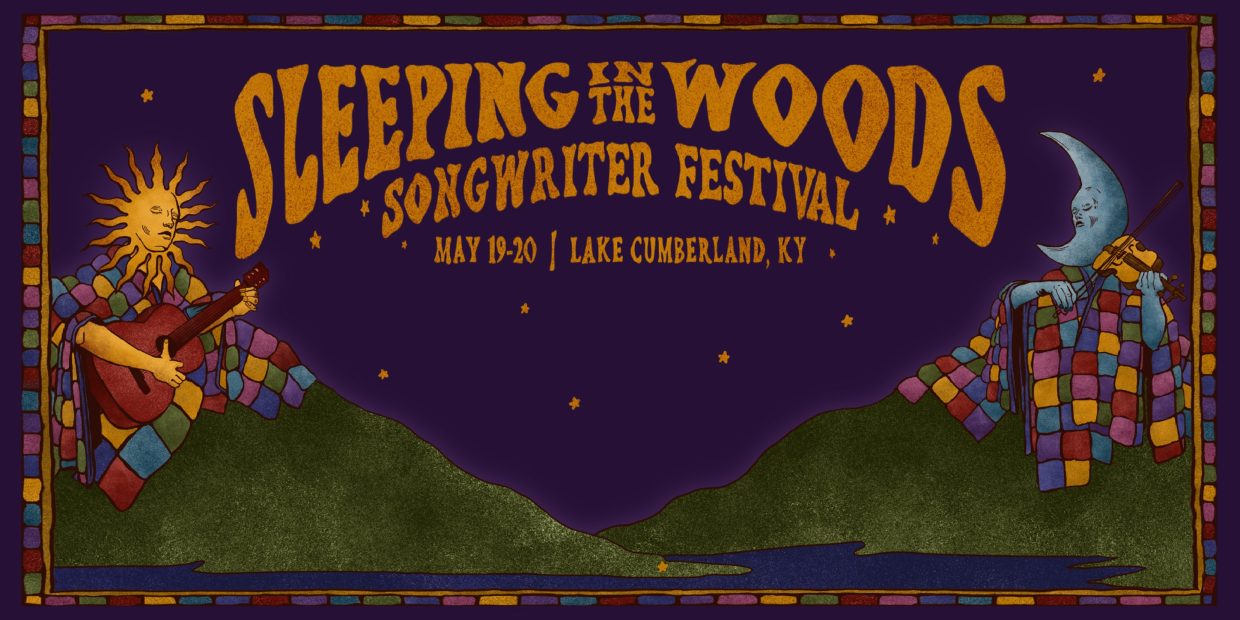
At a time when money in the music industry is at an all time low, and expenses are at an all time high, I have immense gratitude for anyone starting new community projects to showcase and uplift musicians and songwriters. I was lucky enough to get to be a part of Nicholas Jamerson’s Sleeping in the Woods Festival in Cumberland, Kentucky in May of 2023, and this event makes my best-of list. The festival bills itself as songwriter specific and showcases many lesser known Kentucky songwriters and bands. The strategy is to create a listening environment and bring together a Southern audience hungry for more straight-shooting roots music and hard hitting lyrics after becoming fans of Tyler Childers, Sturgill Simpson, and of course, Jamerson himself. After a successful first year, the festival is poised to grow exponentially and become a beloved annual event for all of those involved. – Rachel Baiman

Billy Strings at Bourbon and Beyond, September 2023

After five years of programming the BGS stage at Bourbon & Beyond, the Louisville-based festival has become something of a homecoming for our whole team. But nothing was more special than this year, when we got to see Billy Strings headline the main stage in front of over 50,000 people. It seems like just yesterday (in reality it was more like 2018) that Billy played our own stage inside the Bourbon Tent, a memory made all the sweeter by his surprise appearance this year on our stage during Michael Cleveland’s set. Hopefully it’s one of many happy returns to B&B for Billy, his fans, and BGS for years to come. – Amy Reitnouer Jacobs

Sunny War, Anarchist Gospel

Nobody sounds like Sunny War. As her profile has risen over the past decade, Sunny has held onto her punk rock politics and direct lyricism, grounding her artistry in the blues. Listening to one of her songs is like looking at a diorama of a nearby planet, similar to our own, but with none of human society’s bullshit. 2023’s Anarchist Gospel features Americana heavyweights David Rawlings, Jim James, Allison Russell, and Chris Pierce, but always sounds exactly like Sunny. Her hypnotic guitar work and precise songcraft shine. Her vocals walk a fine line between eerie and inviting. And at the end of a year when riot grrl aesthetics have gone mainstream, Sunny War is a rare reminder of what the real thing sounds like.  – Lizzie No


Photo Credit: Angélique Kidjo by Fabrice Mabillot; Billy Strings by Christopher Morley; boygenius by Matt Grubb.
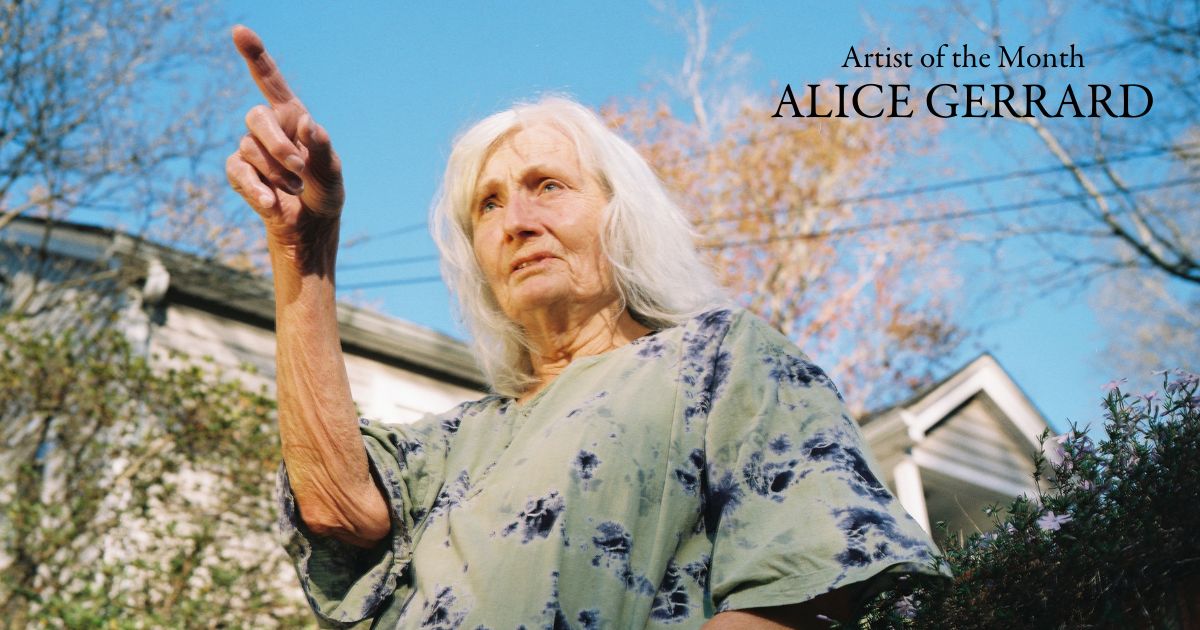
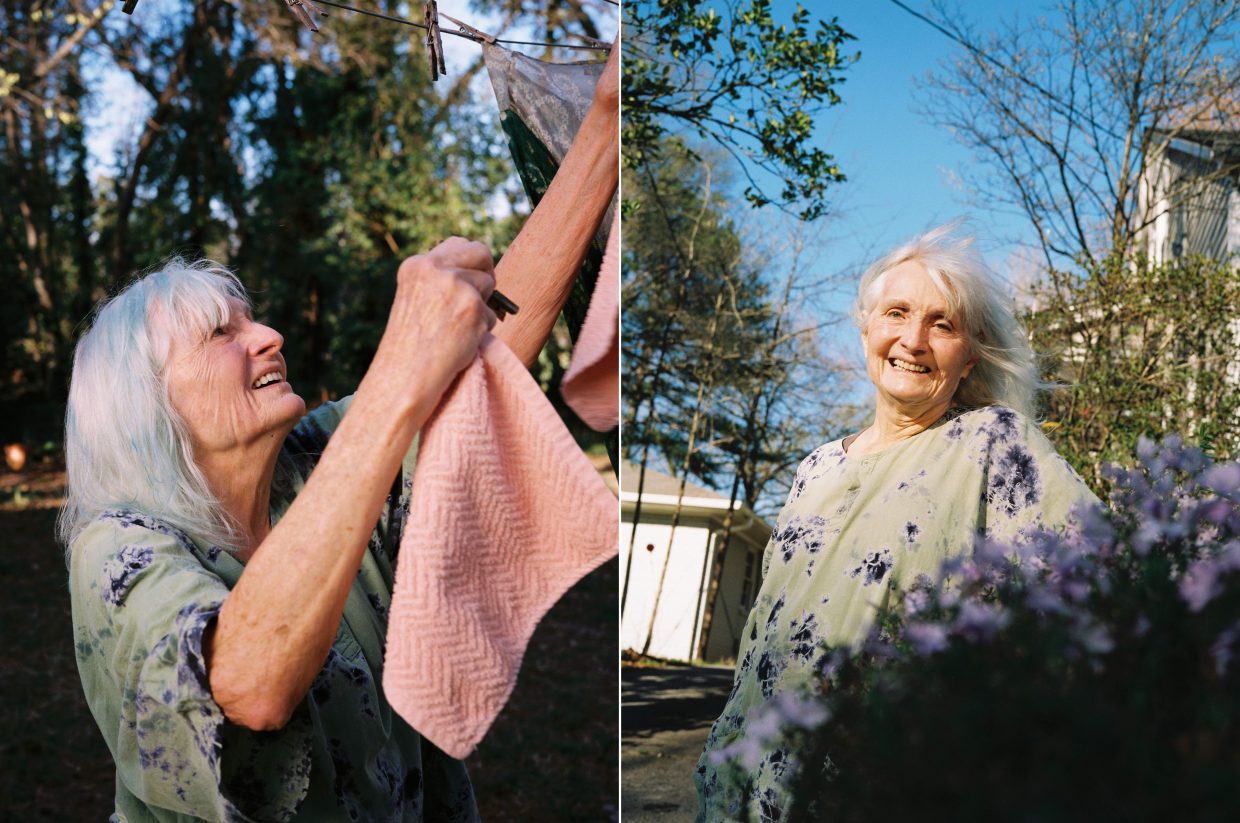
 

Artist of the Month: Folk Hero Alice Gerrard Is Unafraid to Be a Real Person

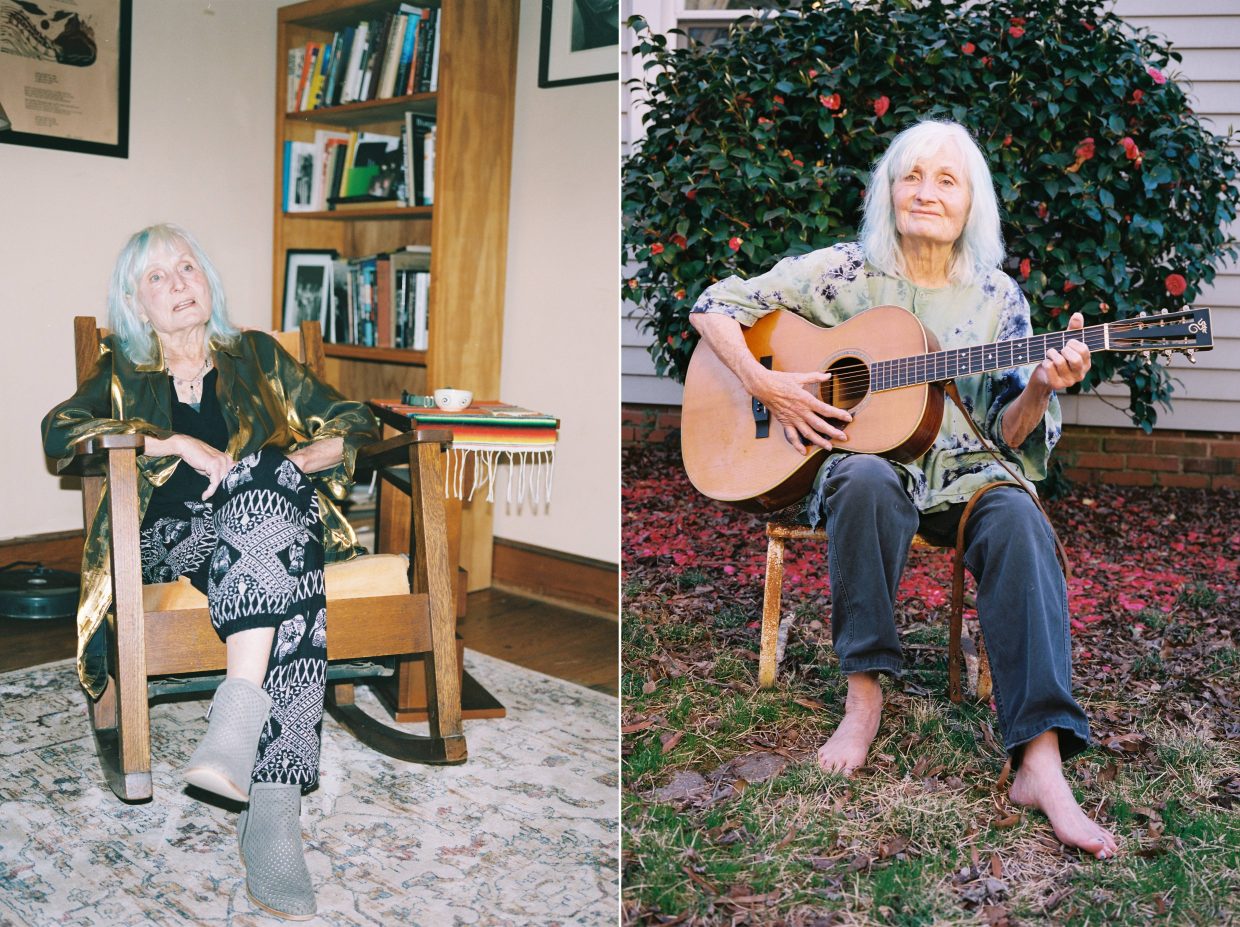
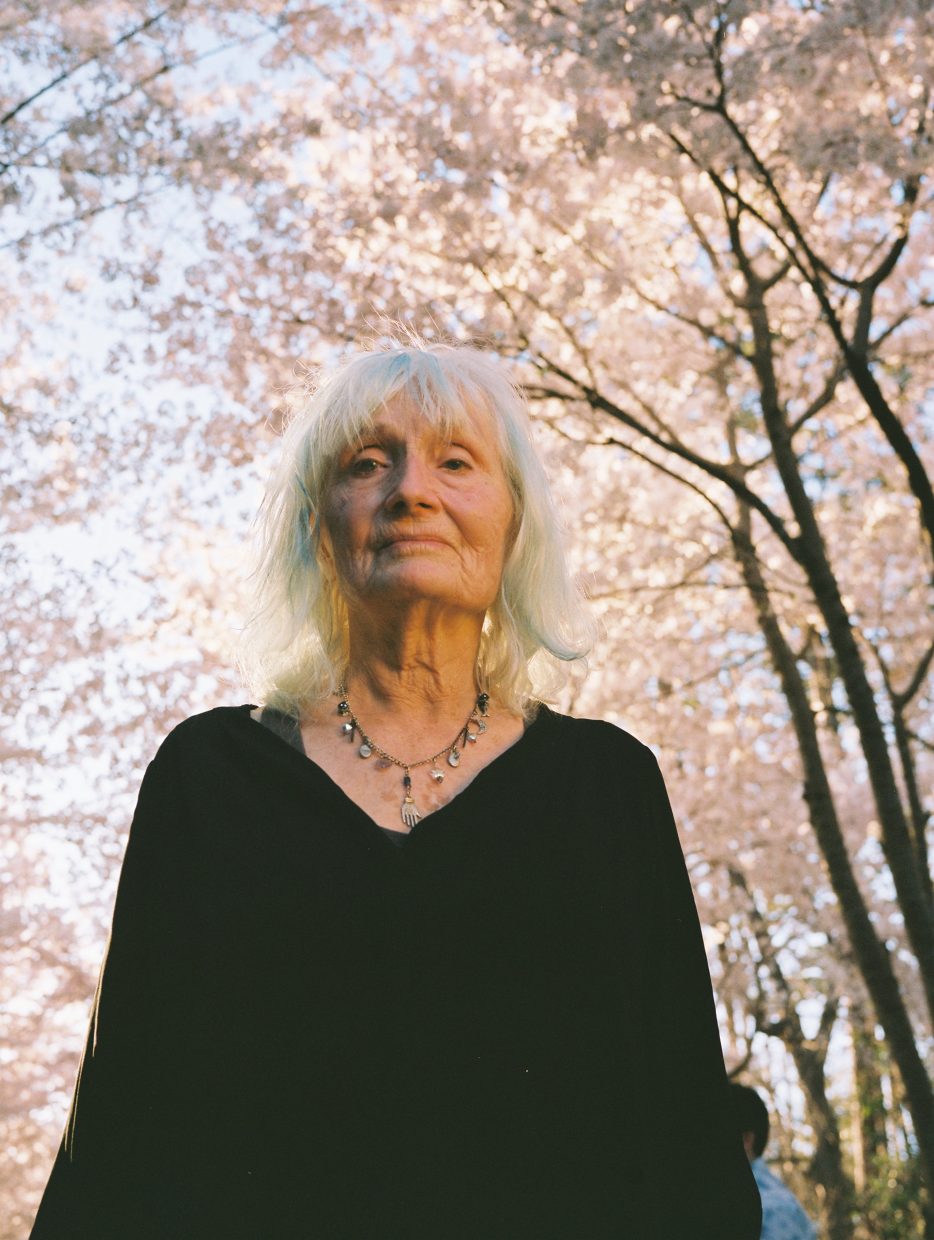
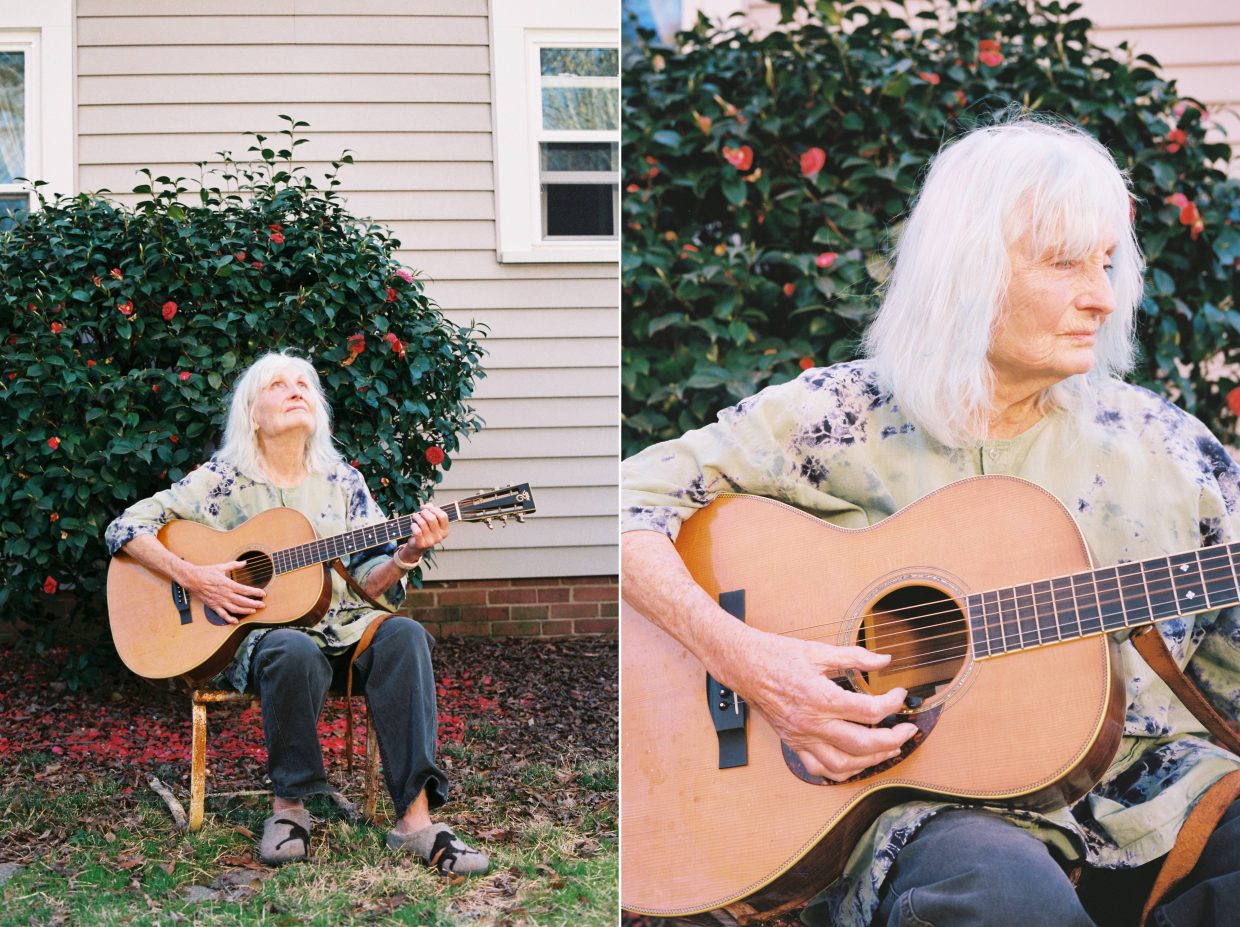
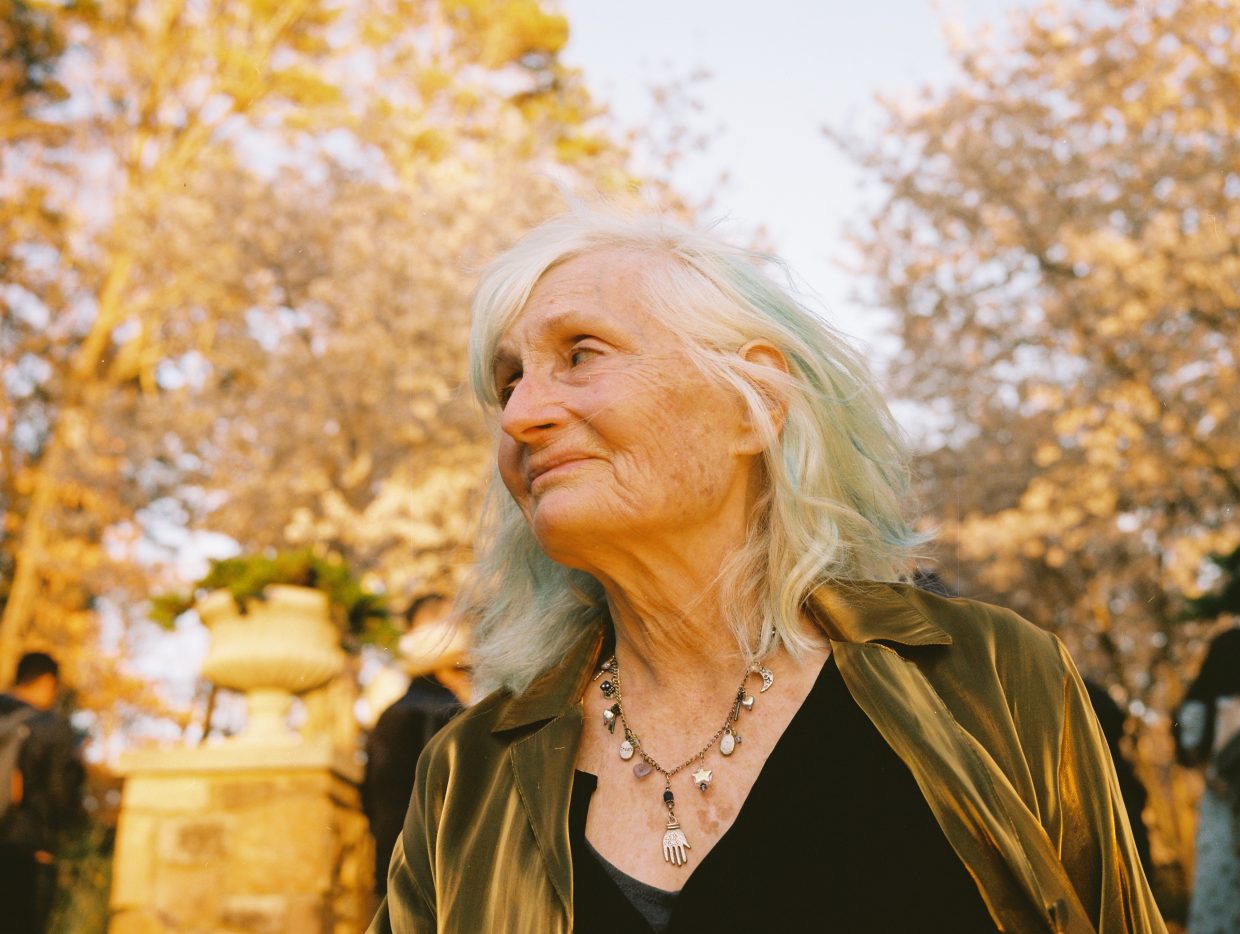
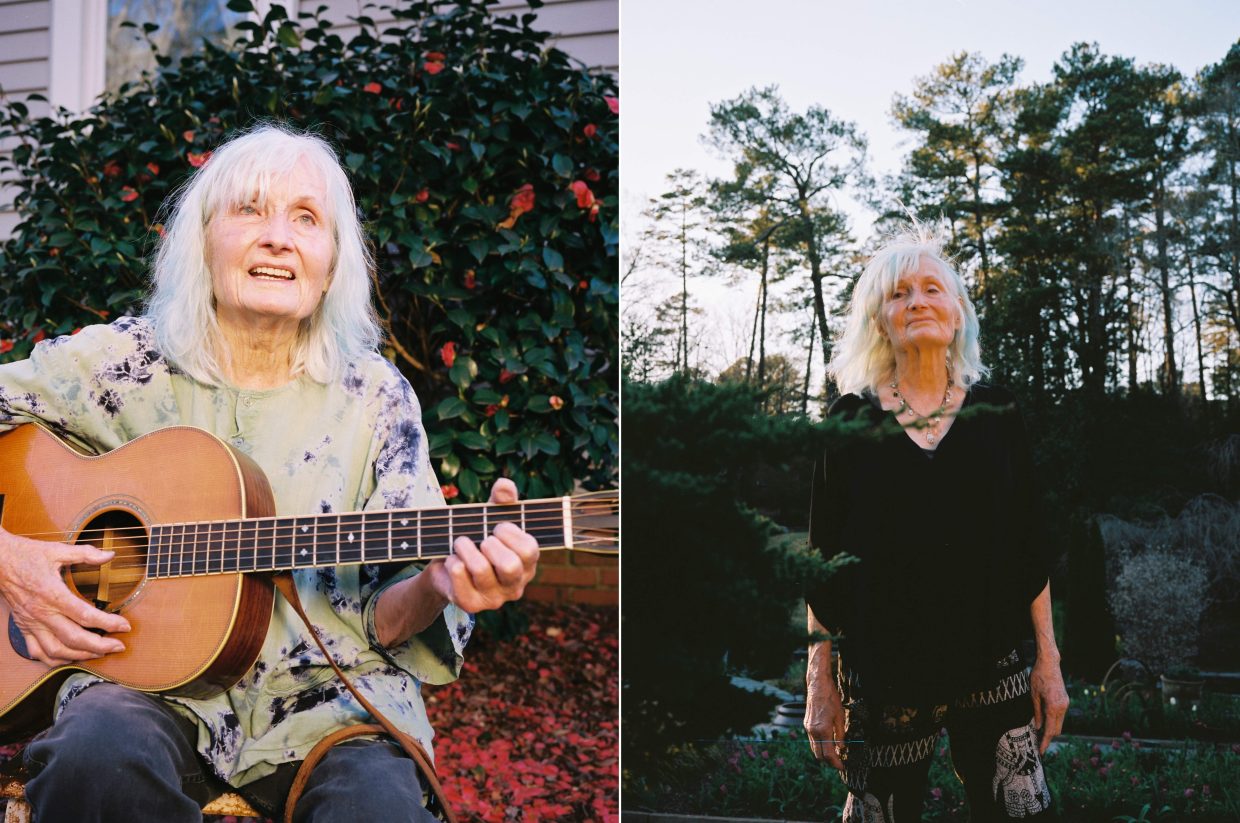
(Editor’s Note: Fiddler, songwriter, and creator Libby Rodenbough writes this personal essay on her friendship with and admiration for BGS Artist of the Month, Alice Gerrard, accompanied by her original photos taken for Gerrard’s new album, Sun to Sun.)

I remember first hearing Ola Belle Reed’s “Undone in Sorrow” when I was 19 or 20. I felt like a portal had been opened unto a world that had existed around me my whole life, unseen and unheard. I grew up in North Carolina going to visit my mom’s family in Madison County, along the Blue Ridge, where any of the graveyards on the mountain sides with their little mounds of clay outside my backseat window might have been the one from Ola Belle’s song.

That portal didn’t open for me in the mountains of North Carolina, though – it was in Chicago, at the Old Town School of Folk Music, an institution that had come out of the ‘50s folk revival. I was big on Pete Seeger and John Prine at that time in my life, and had found out my dad had a cousin with a spare room in Chicago, so I went on a little pilgrimage during a recess from college.

It was there that I learned my first old time fiddle tunes, belting the refrain “down in North Carolina” from “Waterbound” at the school’s open jam while the Chicago winter dumped three feet of snow outside. It was there I first learned the rudiments – very rude in my case – of clawhammer banjo. It was also there that I first heard a left hook of a song called “A Few Old Memories” by Hazel Dickens, which appeared on her 1973 duo record with Alice Gerrard, Hazel & Alice.

I went home from Chicago with new eyes and ears. Places I’d known forever became newly populated with epic figures, recast in the light of 200-year-old narratives. My first semester back in school, I was in an introductory folklore course taught by Mike Taylor (of Hiss Golden Messenger) and he started talking about his friend Alice Gerrard, who lived a town over in Durham. I was fairly well tangled up in time and place at that point – even the deceased people I’d been learning about were brand new to me – so I had to blink a few times to digest that she was the same person singing harmony on “A Few Old Memories.”

Today, 10-ish years later, I sit with Alice in preparation for writing this piece and she tells me about driving Ola Belle Reed in her Dodge van on tours through the South in the late ‘60s. She’s my oldest friend (nearly 90), and all competition lags behind her years pretty pathetically. She also makes a lot of the people I talk to seem boring. We’re in the same business: We sing songs and play shows and make records. She’s been doing it a lot longer, and I think she knows about five times as many songs.

Hanging out with Alice helps me understand why she wanted to be friends with people like Elizabeth Cotten and Luther Davis, who were elderly when she met them. She heard the way they played and sang and had to talk to them about their lives. “They knew exactly who they were,” she says. For a young person who had moved across the country from Oregon to Washington, D.C., without maintaining much contact with home, dropped out of college, and had four children, that self-knowledge was aspirational. Though their rootedness in their communities was part of what drew her to them, she didn’t think of them as avatars of bygone primitive ways of life, or as characters in a play – they were people. Elizabeth Cotten was somewhat guarded, but over years traveling and playing together, she told Alice about indignities she had suffered as a domestic worker and as a Black female folk performer, and about subtle acts of defiance she had worked into both vocations. Luther Davis talked about how lonely it was to get old and run out of witnesses to your own life.

Alice is likewise unafraid of being a person. She’ll tell you straightforwardly that she was unprepared to be a mother, that it was essentially impossible to pursue a music career – which was something she knew she wanted for herself – and still give adequate time to her kids. We commiserate about music industry bullshit and engage in light shit-talking about the idea of showmanship.

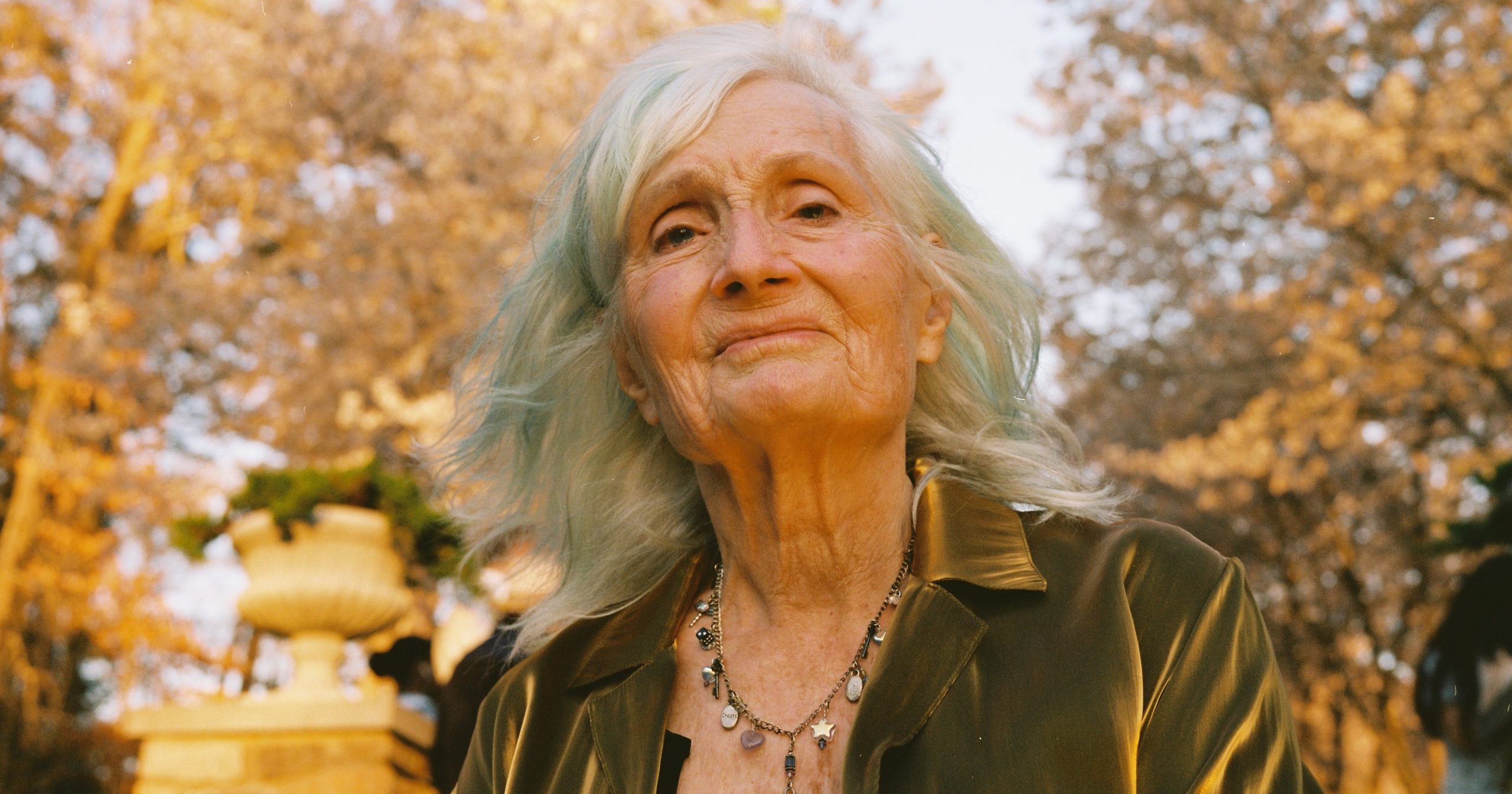
She’s usually wearing one of her collection of t-shirts that pertain to her dog Polly’s agility training facility (“Fast and Furryous”). This past March, when I took these photos of her to use for promotion of her new album, Sun to Sun, we went through her closet together and dug out some gems, including a bedazzled commemorative t-shirt from Obama’s inauguration.

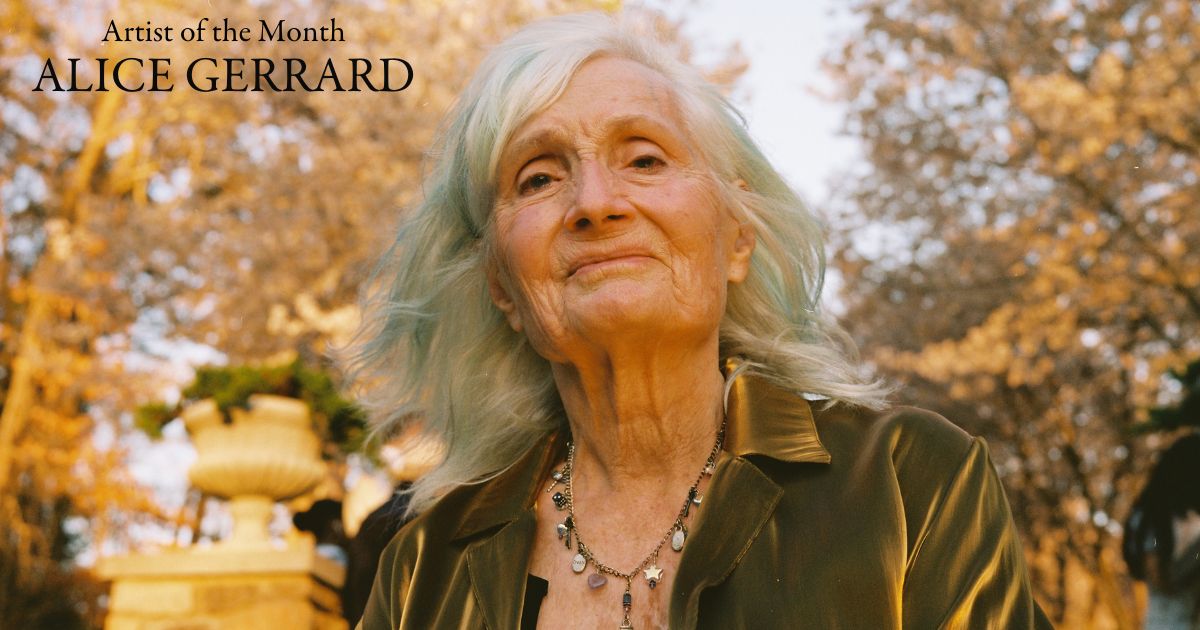
I have no training in photography – I shoot film because I enjoy the feeling of not really knowing how it works. We went to Duke Gardens in Durham, where we both live, on a week when the cherry trees had popcorned into glory. Alice looks radiant in the halo of those glowing blooms. But I also love the photos where she’s at home, standing in front of the brick retaining wall around her front yard, before she realized she still had her Apple Watch on. The sky was so blue that day, her white hair incandescent. She looks like she knows something you don’t, but in a warm way, like she knows you’ll get it eventually.

Alice is unafraid to treat a song like it can handle a little handling. She knows that songs are alive and she’s interested in being a part of their lives, not their memorialization. She smiles talking about how, in an old John Cohen film, the Madison County ballad singer Dillard Chandler starts a song in a key around here (she holds her hand at her waistline) and ends it here (she raises her hand up level with her temple). She’s delighted by the particularity of the human touch. She prefers singing voices with a bit of weirdness over purely pretty ones. Talking about Carter Stanley’s high whine, she says, “Whatever was eating on him from the inside, it was showing up in the way he sang. Nina Simone, the same way.” She tells me what a struggle it is to teach that kind of feeling to people accustomed to singing prettily. “If you’re trying to get somebody out of the soft, breathy voice, you say, ‘Look, your kid is running out into the street and you have to call your kid back.’ You don’t say,” — she coos — “‘Heyyyyy Brian, get back here.’ You say, ‘BRIAN! GET BACK HERE!’”

Whenever I’ve played music with her, Alice seems to lean into what people at the Old Town School liked – actually, loved – to call “the folk process;” she lets arrangements evolve as the spirit of the universe sees fit. I’m lucky she’s not a stickler for tradition, even traditions she could write encyclopedias about, because my fiddling style is distinctly unmoored. I was a half-rate Suzuki classical violin student growing up and then at the Old Town School I learned how to accompany folk singers on songs with three or fewer chords. I came home and started going to the old-time jam at Nightlight Bar & Club in Chapel Hill, where the jam leaders were American Studies PhD candidates who also grew up learning fiddle tunes from their hometown octogenarians. Some of my friends started a band called Mipso that was flirtatious with bluegrass and asked me to join, but I told them up front I didn’t know any licks. (They didn’t seem bothered by that.) I’ve since learned a few licks, and I would rather play an old time tune any day of the week than do almost anything else, but I never could sit still long enough to do what Alice calls “holding the line” — keeping and caring for the tradition.

I’m indebted to, and grateful in my heart for, people who do that work. I may roll my eyes at gatekeeping, but it’s more than wide-eyed would-be fiddle players at the gate; it’s the whole monster of monolithic, capitalist cultural imperialism, chomping down on everything small or strange. Songs can, and do, disappear, like cultures and forests, and not just by inertia but by clear-cutting. A lot of days I feel self-conscious about whatever it is I’m doing instead of holding that line. When I listen to Alice tell stories about the many singers and players she’s known over the years, though, I remind myself that they each have a distinct relationship with tradition – and with what it means to be an artist.

For a long time there’s been a divide, rhetorical and sometimes actual, between “the folk” and “the folkies,” which maybe means country people versus city people, or maybe people who grew up in a given musical tradition versus those who came to it later. Alice and I both fall into the latter category, though she’s had considerably sharper focus since her initiation. I’d rather replay a 10-second clip of a Mark O’Connor fiddle solo at one-quarter speed forty-seven times in a row than try to examine that dichotomy in any more detail at this moment, but I did spend a lot of my undergraduate days thinking about authenticity and who’s entitled to do what with old songs. Alice has often found herself among people who look at it from an academic angle – her ex-husband, Mike Seeger, came from a folklorist family – but her view remains that the compulsion to define and categorize is basically academia trying to justify itself. I don’t take that as bitter or glib, I just think she hasn’t found it necessary, in her personal relationship with the music she loves, to try to determine who gets to claim it. Or maybe, for Alice, the claim is in the singing. Talking about what makes a voice “authentic” (a word that sends a chill down my spine), she paraphrases Supreme Court Justice Potter Stewart from 1967 in his definition of pornography: “I know it when I see it.”

As we clink the ice around our $7 decaf specialty iced lattes, Alice tells me about a song she’d just heard, a haunting falsetto voice with nylon string guitar, in the opening scene of Pedro Almodóvar’s new short film, Strange Way of Life. After some Google sleuthing, she identified it as a recording by the Brazilian artist Caetano Veloso (in fact, the movie is named for it – “Estranha Forma de Vida.”) She’s head over heels for this song, itching to go home and dig into Veloso’s catalog. If they ever meet, I know she will have great questions for him, the type of questions that make a person believe songs must do real work in this world.

I ask her if she thinks of her music as having “a purpose.” “Not really,” she says. But she goes on, “I want people to hear what I hear in this music.”

In my view, that’s an altruistic goal, because it’s clear that whatever it is Alice hears in the music, it gives her life its very marrow. I admire the decades she has devoted to learning and documenting traditional music, but what I aspire to most is the way she still loves a song — viscerally, instinctively, with gusto. That’s what makes a line worth holding.

“There was something about the music, the quality of the voices,” she says, recalling first hearing Harry Smith’s Anthology of American Folk Music. “There’s so much beauty in it, it’s like, God, yeah.”

I had that “yeah” moment when I heard “Undone in Sorrow” and “A Few Old Memories” – and now, Sun to Sun. I hope to be saying “yeah” like that about songs for the rest of my life.


All photos: Libby Rodenbough

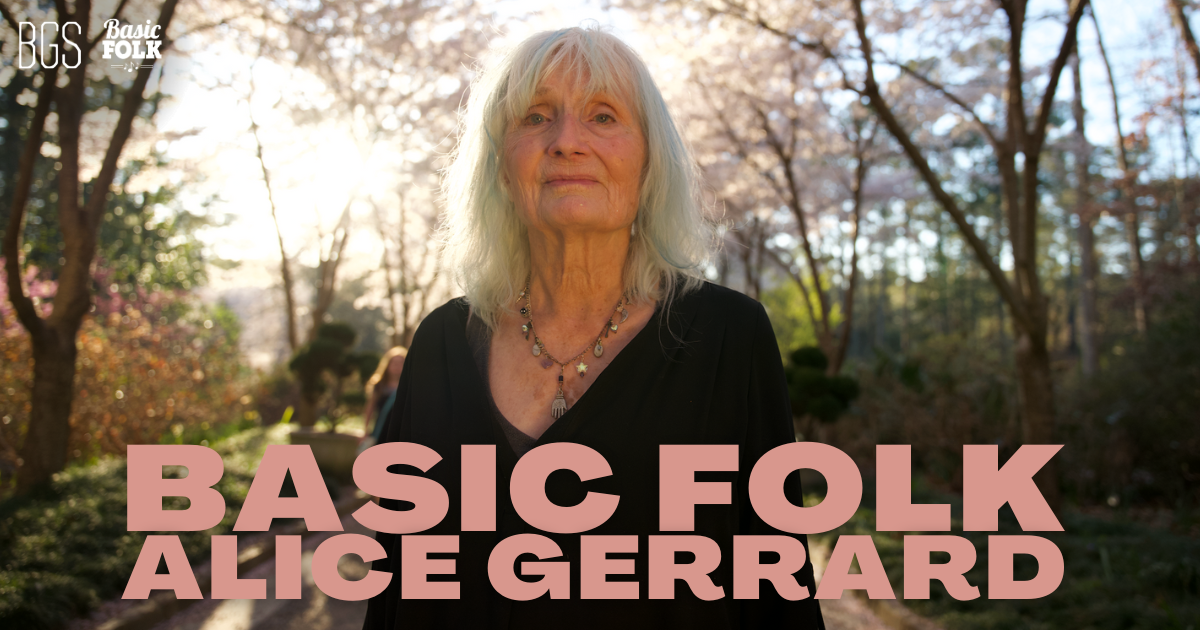
Basic Folk: Folklore Forensics With Alice Gerrard

Bluegrass hero and former weird kid Alice Gerrard strongly believes that traditional music is connected to everyday life. She has said: “When you listen to traditional music you have such a sense of this connectedness of this person’s life. It comes out of the earth.” She was first exposed to folk music while attending Antioch College. Jeremy Foster (her boyfriend at the time, who would become her first husband) introduced her to The Harry Smith Anthology of American Folk Music. Upon listening, she became hooked and more drawn to lonesome and rough folk songs versus pristine vocalists. That mentality of keeping her performance untarnished and imperfect has followed her ever since.

LISTEN: APPLE • SPOTIFY • STITCHERAMAZON • MP3

After she and Jeremy moved to Washington D.C., she became acquainted with Hazel Dickens. She considered Hazel a mentor figure and studied her musicality. The two would record four albums together as the seminal duo Hazel Dickens and Alice Gerrard. The two did not speak for many years after they split in the late ’70s. The breakup was messy and hard for both, particularly Hazel. Years later, they reconciled and would perform and were close until Hazel’s death in 2011. Nowadays, Alice, who lives in Durham, North Carolina, has begun digitizing her huge photo archive for a book as well as performing with younger generations of traditional musicians. People like Tatiana Hargreaves, Reed Stutz and Phil Cook are regulars on her stage. They also contribute to her new album, Sun to Sun. Alice digs in talking about her unorthodox parenting style (which is no secret), imperfectionism, appreciating memory and the fantastic new record.


Photo Credit: Libby Rodenbough

Artist of the Month: Alice Gerrard

At 89 years old, old-time music community leader, Grammy nominee, and Bluegrass Music Hall of Fame inductee Alice Gerrard continues to place her music making and creativity decidedly in the present. While every lyric she utters and every note she picks feels effortlessly timeless, storied, and burnished – by her lived experiences and by days, weeks, and months of toil – her songs are ultimately forward-looking, leaning into the future with intention and wisdom. They also feel paradoxically light and joyous while at the same time they stand at the nexus of “what used to be” and “what will come.” Gerrard holds this position with equal power, agency, and insight.

Her latest album, the upcoming self-produced Sun to Sun, out October 20 on Sleepy Cat Records, captures the ineffable of the particular center-of-the-Venn-diagram that she inhabits, as a song collector, a knowledge bearer, and a folk music synthesizer of the world’s woes and struggles for justice. As witness to more than a handful of iterations of the modern movement for equal rights and racial, gender, and economic justice, Gerrard is able to challenge the systems and powers that be in grounded, measured, and realistic ways – ways that never limit possibilities for the future. (A remarkable trait in a creative who uses “old-timey” media and formats as her primary form of expression.)

Remember Us,” the album’s stunning lead single, is – as Gerrard says via press release – an ode to “all the departed whose shoulders we stand on, whose work and lives we benefit from, who came or were transported against their will to this land.” Sung in stark a capella by Gerrard, Tatiana Hargreaves, and Reed Stutz, the track feels pulled directly from the gospel singing traditions of the American South that each stem from Black and formerly enslaved musical traditions. It speaks into community spaces the names, lives, and souls of so many Black, Brown, and Indigenous folks who lost their lives at the hands of empire and the police state.

“Old Jim Crow” makes the apropos point that segregation and racial apartheid in our country were not that long ago nor that far away, calling the partisan gerrymandering, political divisiveness, and waves of hatred befalling the U.S. exactly what they are: a new kind of the Old Jim Crow. “Keep It Off the Seat,” a Gerrard-penned modern classic, was inspired by the North Carolina General Assembly’s transphobic HB2 measure from 2016 – that also inspired our showcase, Shout & Shine, at IBMA in Raleigh and eventually saw Gerrard singing “Keep It Off the Seat” from the Shout & Shine stage in 2017 with Cathy Fink, Marcy Marxer, Hargreaves, and more. At her live shows, she encourages her audience to sing along during the rousing chorus: “Who cares where you pee? Just keep it off the seat!”

These themes and through lines would be notable in any bluegrass and old-time forebear’s catalog, but here, among Gerrard’s lifelong discography, they are certainly not outliers but continuations of a career that has always been committed to telling untold stories, singing unsung songs, spotlighting and amplifying invisible voices. Gerrard’s age, her position as a roots music elder, reinforces the importance of these subjects, and leaves subtle, existential fingerprints over the entire album. We know Gerrard’s commitment to singing and standing in truth, but in these songs and in this collection, we feel that commitment more than see it, we sense it just as strongly as we view it.

Sun to Sun was tracked in Durham, North Carolina – Gerrard’s home turf for decades, now – with a collection of collaborators and musicians pulled directly from her immediate community. Hargreaves, one of the most prominent fiddlers in the old-time and bluegrass scenes of late, has worked for Gerrard for a number of years as an archivist and assistant of sorts and features heavily on the album; Stutz, an in-demand multi instrumentalist who also straddles the fences between folk, bluegrass, old-time, and Americana, plays guitar and banjo. Other credits include first-rate sacred steel player DaShawn Hickman, Hasee Ciaccio on bass, Marcy Marxer guesting on guitar and cello banjo, Gail Gillespie, Nick Falk, and soulful songwriter, singer, producer, etc. Phil Cook – who collaborated with Gerrard on her 2014 album, Follow the Music – as well.

It makes perfect sense that a community builder such as Gerrard, who has always prioritized the most human aspects of roots music in her creative output, would be able to construct a collection of songs that feels pointed and convicting, but also organic and natural. Sun to Sun approaches heavy topics with ease, as a pair of good friends over a cup of tea on the porch can seemingly solve all of the world’s problems with passion, joy, and unbridled care for the forgotten and invisible among us. Gerrard calls on her folks, her musical and personal communities as well as her listeners and fans, to join with her in the journey she has begun and that we must continue, from sun to sun to sun to sun.

To celebrate Alice Gerrard’s selection as our October Artist of the Month, we’ll be diving back into our archive of Sitch Sessions, interviews, posts, and stories that highlight her incredible music – and her exemplary activism through that music and across the decades. In the meantime, enjoy our Essential Alice Gerrard playlist below, plus two of our BGS favorite Sitch Sessions of all time that feature Gerrard (viewable above), and watch for our Artist of the Month feature to come later in October.


Photo Credit: Libby Rodenbough

One to Watch: Viv & Riley Are Much More Than Just Old-Time or Americana

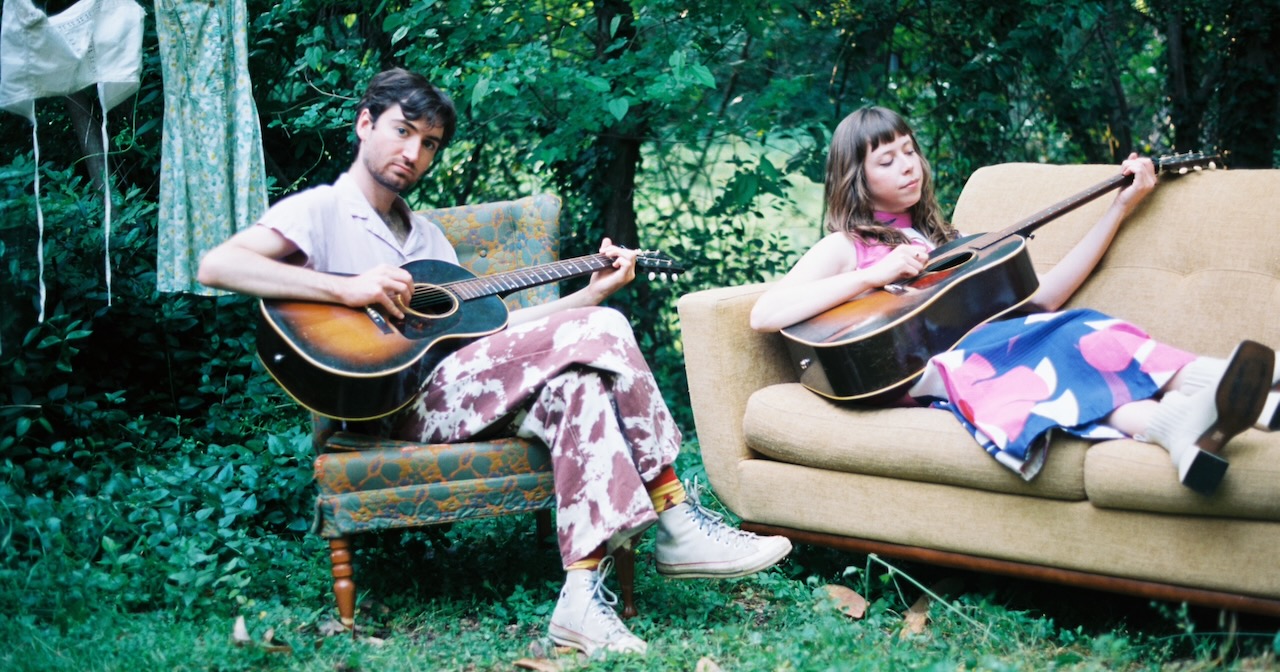
Comprised of singer-songwriters and instrumentalists Vivian Leva and Riley Calcagno, Viv & Riley are an up-and-coming musical duo that defy definition. Their new album, Imaginary People, is a masterful blend that weaves together their shared reverence for traditional Appalachian music alongside indie-folk, pop-leaning adornments. The result is an emotionally potent 10-track album that covers a vibrant range of personal and universal truths — from the bittersweet nostalgia of visiting a beloved childhood hideaway decades later, to the poignant curiosities that accompany reckoning with climate grief.

Based out of the dynamic music scene in Durham, North Carolina, this duo is currently on tour across North America. With their insightful explorations of the past and creative probings of the future, Viv & Riley uncover rich and complicated explorations of what it means to be alive in this precise moment.

So how did the two of you first start making music together?

Vivian Leva: Well, we first started making music together when we first met in 2016, the summer after we both graduated high school. I grew up in Lexington, Virginia, and Riley grew up in Seattle, Washington, and we just happened to meet at a camp in Port Townsend, Washington. It’s one of those camps that has weeks back to back — there was a vocal week that I was teaching with my mom, and then Riley came to teach fiddle the following week. We happened to overlap by a few days, and Riley was there with his band The Onlies. The first night we met, we played music together all night! After that, I joined the band, and we also started playing together as a duo and writing songs.

Riley Calcagno: The origin of our sort of band, our duo, came later that year, in the fall. We had been communicating and texting some music back and forth, and then Viv invited me down to Asheville to play a gig with her and her dad. I was a fan of her dad, James Leva, for his fiddle and singing, so we did that gig. But we thought it’d be also fun to try out some duo material while we were down in the same place, even though we had never played songs just the two of us. We emailed a venue in Asheville called Isis Music Hall, which was a prominent venue there at the time. Somehow they slotted us in, on a Wednesday night, into this big hall that they had — 200-person capacity, maybe bigger. We had never played music together going into that, but we put together some material and we enlisted some friends to play with us. It was a bold move! Talk about faking it until you make it. Only about 15 people came out to the show, and I’m sure it sounded terrible. But it was fun!

That sounds amazing. So how would you describe your musical chemistry? What is it like playing together?

VL: ​​Well, I think our initial musical chemistry initially came from our shared background in old time music and traditional music. That first night that we met, we played a lot of fiddle tunes, old music, and traditional songs. So it kind of began from a place of excitement about being exactly the same age, having never before met, and somehow both being raised around this same music that we have a shared respect and love for. So that was the initial spark of actually finding another young person who’s into the same niche genre and community. But since then it’s totally stretched into other realms. We are both so open to other kinds of music, and we have very similar tastes and aesthetics. It’s very easy to create music together because we come to it from a similar place.

RC: One of our dynamics in making music together has also been sharing our individual strengths with the other person. When we first started playing together, I couldn’t really sing harmony or find a harmony part. Vivian was very patient with me and helped me learn, and I still feel like I’m getting better all the time. That’s exciting!

VL: I just play guitar, and Riley plays every other instrument. He’s a great fiddler, guitar player, banjo player, mandolin player— instrumentally he brings so much to the table. And I feel I bring a lot of singing and songwriting-focused material to the table. We stretch each other, fill in the gaps for each other, and learn from each other.

What a beautiful thing! So what do you each feel like the biggest difference in your respective musicianships is?

RC: Viv is a very natural musician. She grew up traveling around with her parents as they toured, sitting in on harmonica at her dad’s gigs when she was only three or four. I also was born and raised around music, but it was a bit more formalized, whereas Viv’s music just comes very naturally and it’s not forced in any way. She does what she does super well and consistently and steadily, and I’m a bit more erratic. I take chances and get obsessed with things and take big leaps that sometimes fall flat. Every time she steps on stage, Viv can knock out a great performance, and I feel more streaky.

VL: But he tries lots of different things! And like he mentioned, Riley has a more formal background in music. He took lessons, he learned how to read music, he knows music theory, he did classical violin. So I think a big difference is that he technically knows what’s going on, whereas I don’t have the language or skills that he has. I’m definitely more intuition based than technically based.

You really balance each other out! So your new album, Imaginary People, just came out on September 15, and I’m wondering how your songwriting, as it appears on this album, has shifted since you first began as a duo.

RC: Well, in the past, before we started writing music for this record, we were living in different places so it was a lot of collaboration from afar. A lot of the songs on our last record came from texting voice memos back and forth. And you know, it’s not utterly different to work on them in person, but some of these new songs came out playing them together in the moment.

VL: Another big difference is Riley has started writing way more. So I think there’s more of an equal voicing on this record than in the past. There’s more of his perspective in it. And I think now that we’re living in the same place it’s also allowed us to write about a more diverse range of things. We’ve written a lot of intense emotional, romantic songs in the past, but in this recent past couple of years, we’re more interested in other things, like our shared experiences about other parts of life.

RC: And it’s also partly stylistic. Our last record was pretty much a country record. During that time, I was listening to a lot of classic country music, and this time we were listening to a wider range of things. Having a broader array of influences definitely helped us push the narrative forward.

What are you each proudest of on the album?

VL: I think what I am most proud of isn’t a specific track or anything — mostly it’s this feeling that I unlocked something. I think I let go of some fears in the process of making this record. I felt more free to just say yes to trying new things and became less concerned with things like what genre it was going to be considered, or if the people who liked our last record would like this record… and so on. I stopped worrying about categories like, “This doesn’t sound traditional enough,” or “This isn’t country enough,” or “That’s too rocker or indie.” Instead, I was able to adopt the mentality of “Hmm, that sounds interesting, let’s try and just do what feels fun!” I think I’m most proud that I was able to do that. It felt amazing to take things a little lighter and to roll with ideas that felt a little outside of the mold.

RC: When you start making music, being young musicians, you get immediately labeled. It’s not something that I think either of us necessarily anticipated, but when that first record got classified, people said it was Appalachian and classic country. And then the next one was classic country and Americana. Like “Hits-the-Spot Americana,” whatever that means. And I think there’s an urge for musicians, when you get labeled as something, to keep reproducing it. There’s this toothlessness to the modern Americana music label— it’s the creation of music that is literally meant to sound like other music under a category. I don’t have a problem with genre or specifications, I think it’s oftentimes useful, but it’s [useful] when you’re trying to reproduce sounds so that you can cater to an audience, it’s like you’re trying to sell something in a market that’s already been created. I think that can be the “dampification” of art. And while I think there’s been so many amazing things created within the Americana industry, I also think it often leads to less creativity and less interesting music.

Coming out of our last record, we had some buzz in the Americana world, and it would have been easy for us to make another “Hits-the-Spot Americana” record. But I don’t think that we did that, and I feel proud of that. Like Viv was saying, we didn’t just do what we were supposed to do. You know, there’s synthesizers, but there’s also a fiddle track, and personally, I think it all works together. So maybe if you’re an Americana devotee, you’re not going to love this album, but that’s okay with me. I think there’s a power in making an album that the machine doesn’t really know what to do with. The machine can make up albums and spit them out, but I feel proud that this one isn’t something that can just be spit out because of how we combine traditional and non-traditional music. For example, there were super organic moments where we all stood around one mic and sang together, coupled with other moments where we had things locked in, produced, and added synths because a particular song called for it. Making those two things coexist in the same ecosystem was definitely a challenge, but listening to the record, I think it all makes sense together.

It’s an album full of teeth! Now, before we wrap up, I have to ask: you’re our One to Watch, but who are you watching right now? Any creatives, musical artists, or otherwise that are inspiring you right now?

RC: One is our neighbor in Durham, North Carolina, Alice Gerrard. She’s almost 90, and she’s putting out a record on this indie label from the area called Sleepy Cat. She’s collaborating with a bunch of young people and their art for the record, like making these amazing videos. It’s a really cool thing! People around here are really conscious and thoughtful about aesthetics and sound and ethos. Everything is done with integrity, so it’s a cool scene around here in that way. Alice makes amazing music, I’m really excited for her upcoming record — I think we’ll all be glued to it once it comes out. Another one is our friend who we wrote two songs with on our previous record, “Love and Chains” and “Time Is Everything”— often people’s favorite songs of ours. I just had the honor of producing his upcoming record under his band’s name, Preacher & Daisy. I love the music, so I definitely want to give them a bump! The fun thing is that all this music is sourced locally from the Durham, North Carolina area, where we’re based.

VL: Some folks I’m enjoying listening to right now, not that they’re not already being watched, are: KC Jones, Canary Room, Dori Freeman, Alexa Rose.


Photo Credit: Libby Rodenbough

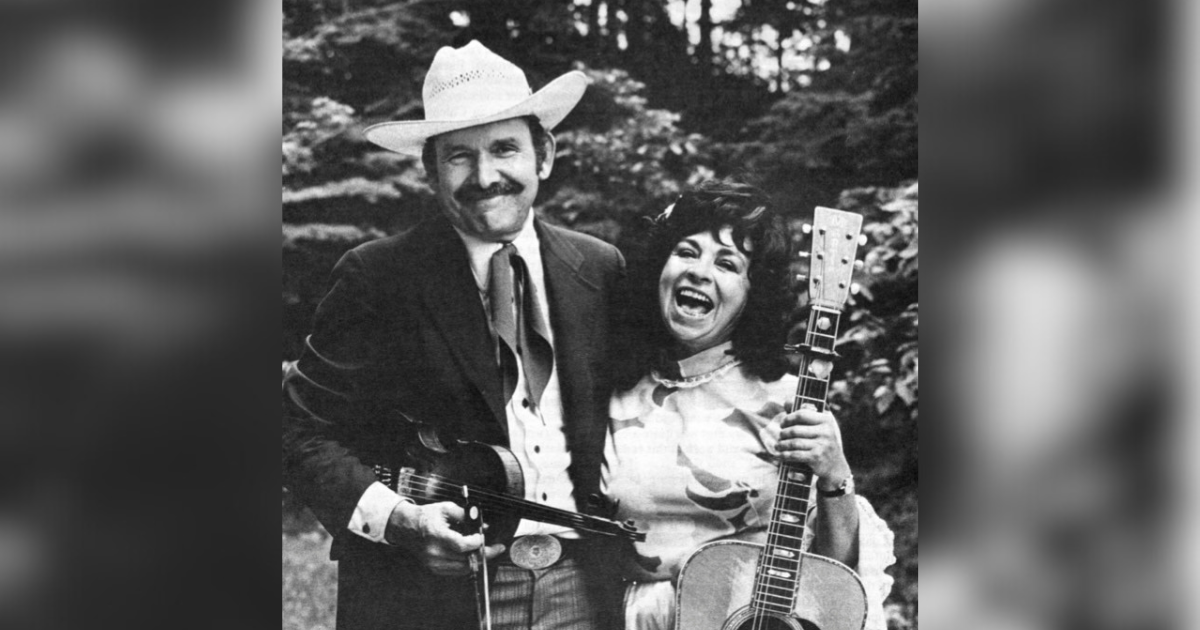
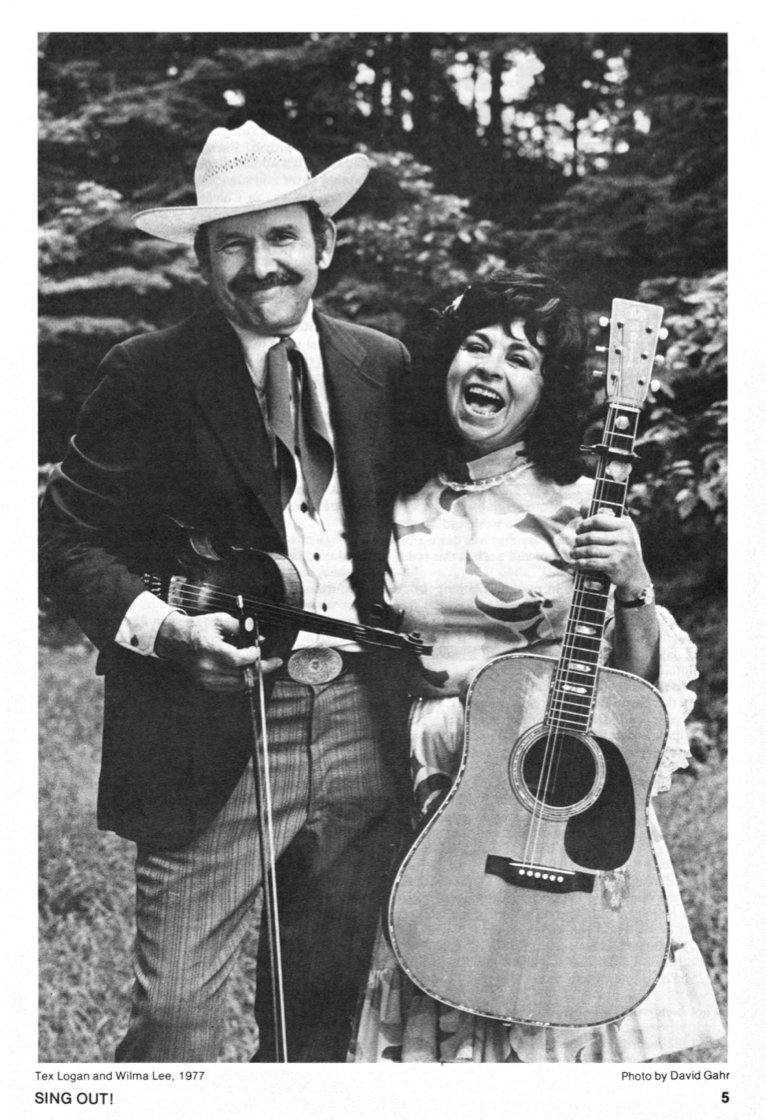
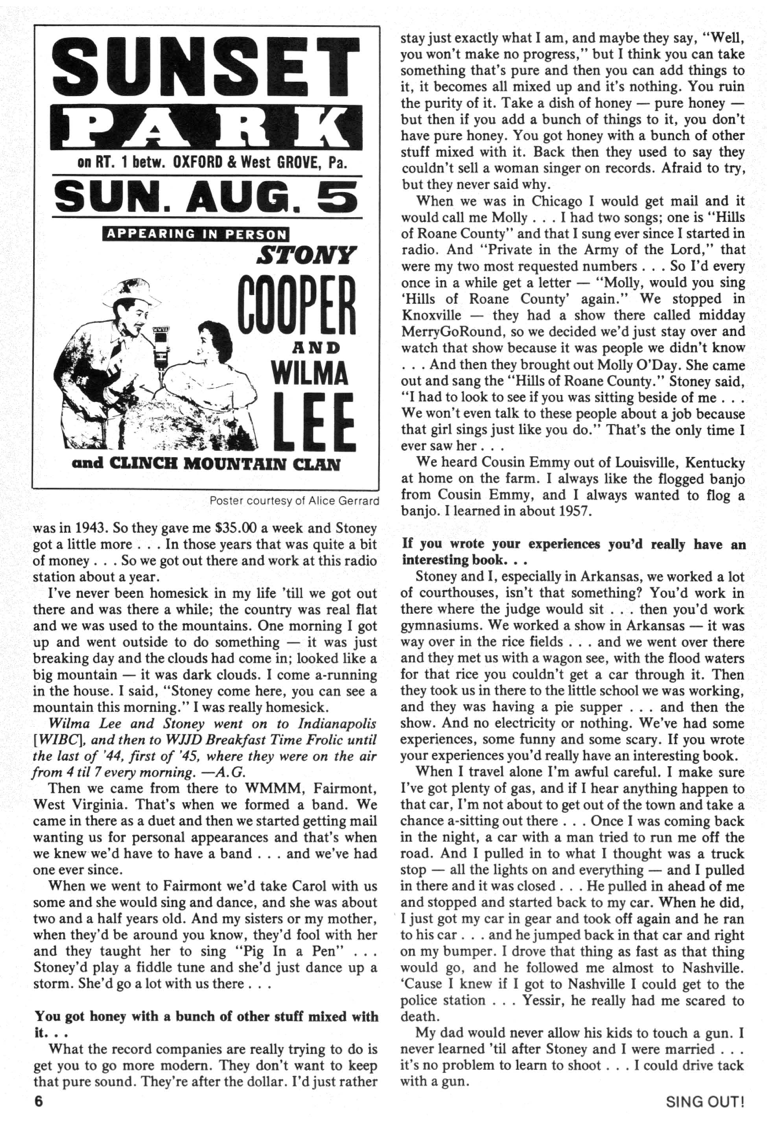
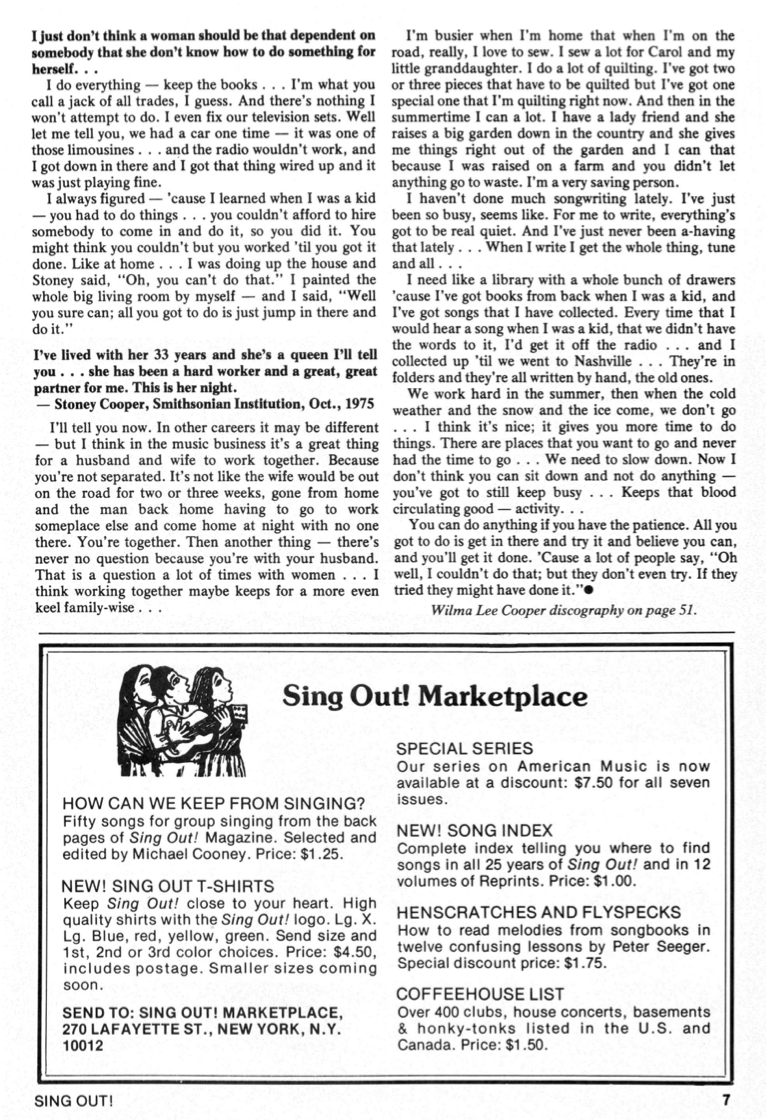
Wilma Lee Cooper: A Mountain Music Star Shining Through the Decades

Wilma Lee Cooper, who died in 2011 at age 90, is being inducted into the Bluegrass Music Hall of Fame this month. Many of her fans, friends and followers say it’s about time.

A snapshot of Wilma Lee. Wilma Leigh (later changed to “Lee”) Leary, was born in West Virginia in 1921. Her first performances were as a young girl in the family band. Her last performance as a band leader was in 2001 at the age of 80, when she had a stroke while singing at the Grand Ole Opry. Determined to finish the song, she was helped off stage to a standing ovation.

Between these times, this tiny woman dressed in home-made ruffled dresses and high heels impressed everyone she encountered in the music world.

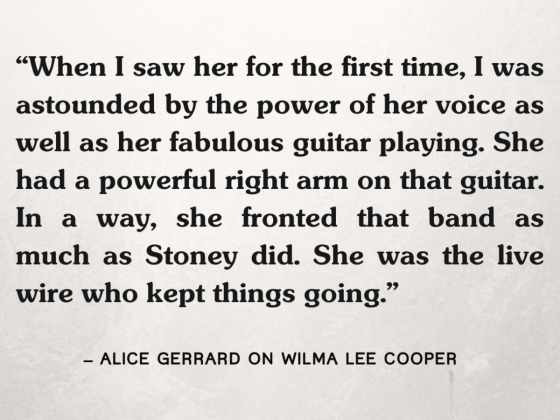
She had a powerful voice and was an equally powerful guitar player. With her inherent smarts (she skipped several grades) and business degree, she successfully navigated the music industry and kept all the band’s books, first with her husband, Dale Troy “Stoney” Cooper, and then on her own after Stoney’s death.

She traveled with a sewing machine and a coffee maker. After every tour, she would wash all her stage clothes and spend 45 minutes ironing each dress.

She also drove the band bus and fixed her family’s television sets. She was a kind and generous boss, a nurturing mother, an ethical and caring woman and a force of nature on stage.


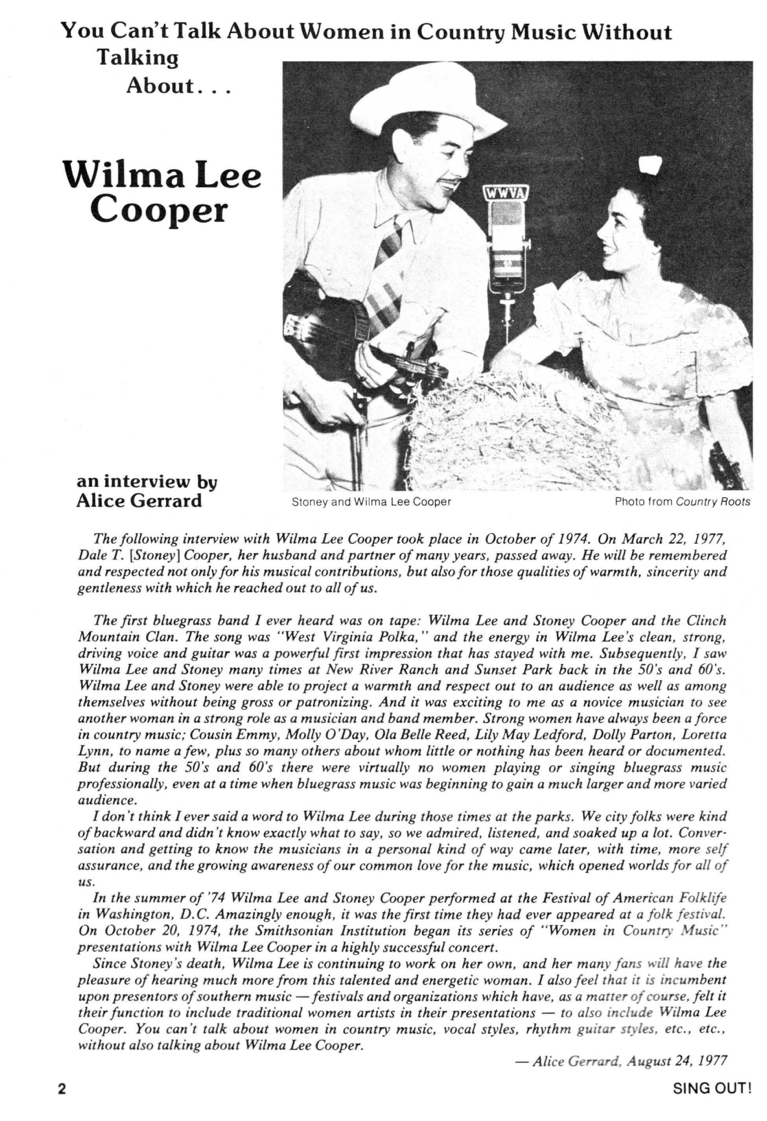
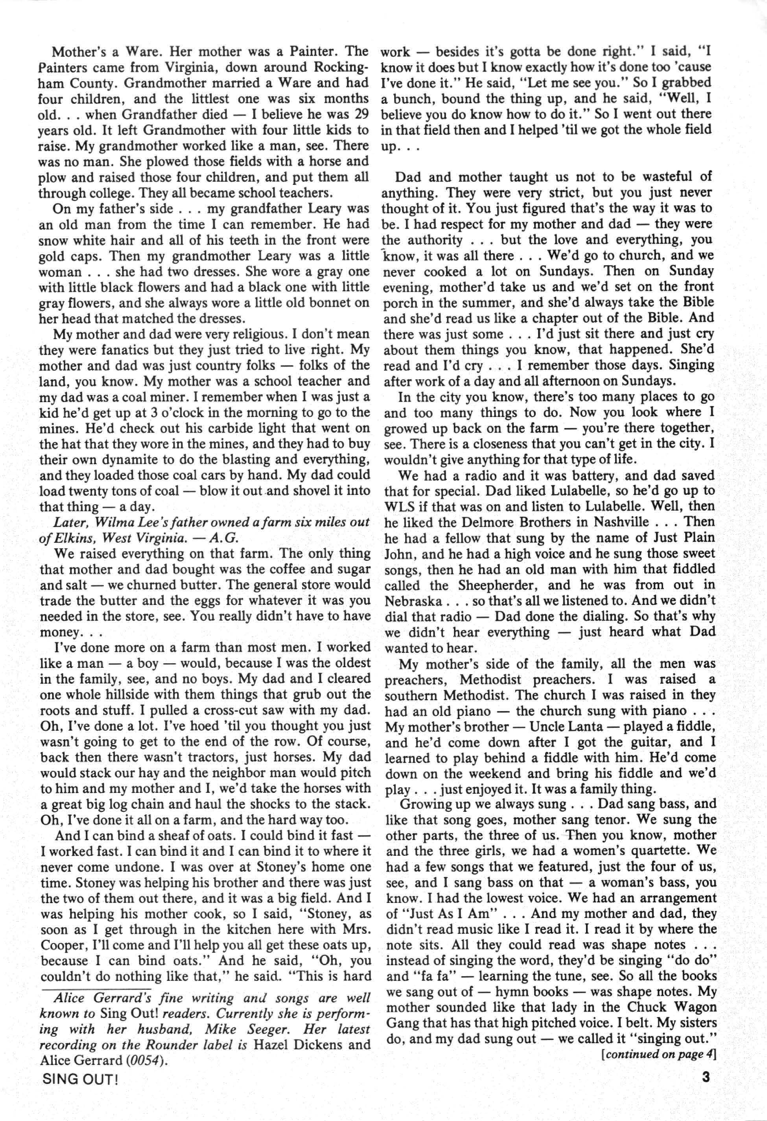
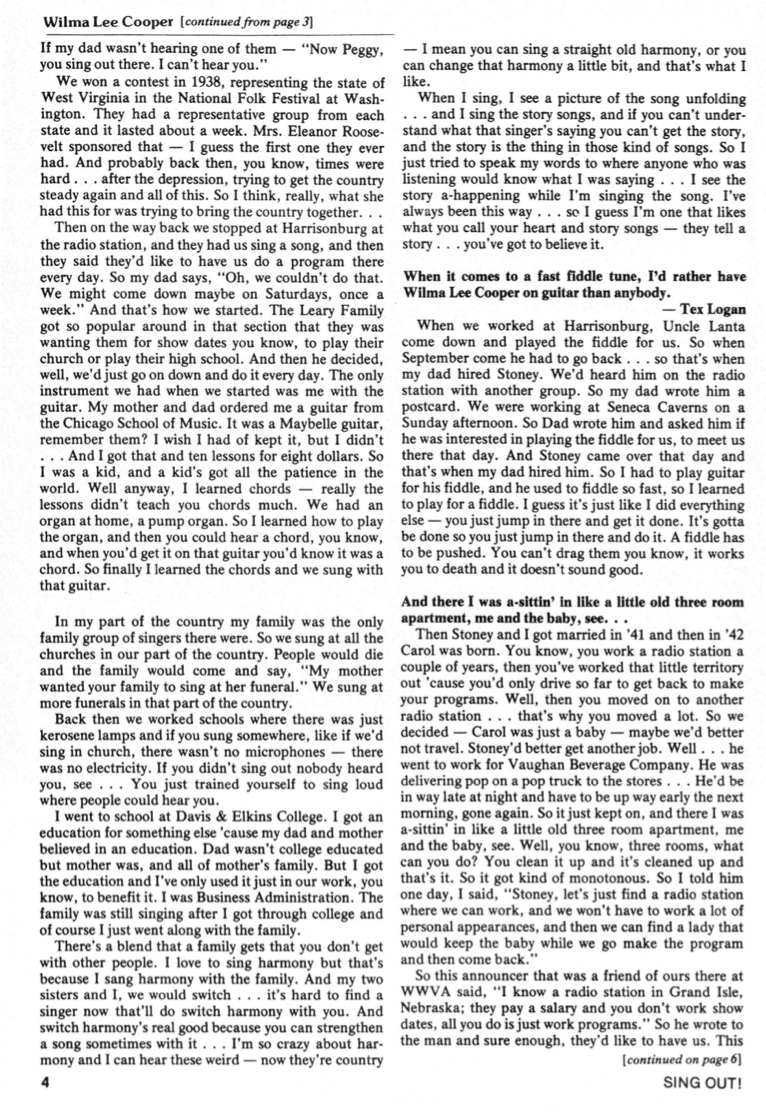
(Above, read an article on Wilma Lee Cooper published in 1977 in Sing Out! written by Alice Gerrard)


From church socials to radio. Reviewing Wilma Lee Cooper’s musical life is an immersion course in the evolution of country and bluegrass music. The Leary Family Band – Wilma Lee’s parents, plus Wilma Lee, her two sisters, and a fiddle-playing uncle – started as a local gospel group. The girls later incorporated secular music sets.

Their prize for winning a statewide contest was the chance to perform at the National Folk Festival in Washington, D.C. A stop at WSVA in Harrisonburg, Virginia, on the way home brought a job offer – and big changes. In one day, the Leary Family went from a local ensemble to professionals with a show of their own. And, when their fiddling uncle returned to his teaching job, the family recruited a young fiddler then called “Smiley” Cooper. (Radio listeners voted for the new name, “Stoney,” to avoid a conflict with a state yodeling champion called Smiley).

Soon, the beautiful oldest daughter and the movie-star handsome fiddler were singing duets with the band. They married in 1941.

Foregoing music to raise their daughter, Carol Lee, in one place was short-lived. Wilma Lee is quoted in Bear Family liner notes as saying, “I was goin’ nuts at home… Stoney wasn’t happy… and it was awful hard to settle down that way.”

On to the Grand Ole Opry. Plunging back into performing, Stoney and Wilma Lee followed the common path of moving from radio station to radio station. They hired back-up players, eventually settling on the band name, “Clinch Mountain Clan.”
In a 2023 Bluegrass Unlimited article, Jack Bernhardt referred to “Stoney’s old-time/bluegrass fiddle and Wilma Lee’s propulsive rhythm guitar and soul-stirring vocals.” Stoney also sang harmonies.

Their 1947 move to Wheeling, West Virginia, and the WWVA Jamboree, broadcast on a 50,000 watt station, propelled the Coopers into the national spotlight. By the mid-1950s, they were charting high on Billboard. Within a year of their 1956 hit record, “Cheated Too,” they joined the Grand Ole Opry. They had seven hit records by 1961, with some of Nashville’s top writers, like Don Gibson and Boudleaux Bryant, writing for them – as well as songs written by Wilma and Stoney, themselves. While the recording business was moving away from what had been called “hillbilly music,” the Grand Ole Opry continued to welcome the eclectic range of country music, from Grandpa Jones and Bill Monroe to “Nashville Sound” crooners.

Dan Rogers, Vice President and Executive Producer of the Grand Ole Opry, said, “It was this cavalcade of great artists, all doing something similar, but also all doing something with their own stamps and styles. It didn’t need characterization. It was just, ‘This is Wilma Lee and Stoney.’ It might have been one of those songs that took them to the Top 10 of the country charts, or it may have been an instrumental or a gospel piece.”

Over time, the Coopers found themselves in conflict with the Nashville labels. Wilma Lee said a producer denied her request to record “I Dreamed of a Hillbilly Heaven,” claiming no one would buy it. It later became a huge hit for Tex Ritter. And they wanted her to record songs she would never perform.

The welcoming bluegrass world. While country radio was pushing away mountain music, new audiences were inviting the Coopers in. Folk and bluegrass fans loved their traditional sounds, as well as their stellar musicianship.

The Clinch Mountain Clan attracted top sidemen. To name a few, Butch Robins, Vic Jordan and Tater Tate went on to play for Bill Monroe, and Jimmy D. Brock later joined the Osborne’s. Dobro master Gene Wooten was in Wilma Lee’s band, as was Woody Paul, shortly before forming Riders In the Sky, and Terry Smith, now of the Grascals.

Marty Lanham (musician, luthier and a founder of the Station Inn) had just moved to Nashville, where he was befriended by Wilma Lee’s sisters, Jeraldine (Jerry) Jonson and Peggy Gayle. They told him the Coopers were looking for a bass player. So, he borrowed a bass, took some lessons – and become part of the Clinch Mountain Clan three weeks later.

The Coopers always gave their audiences what they expected. Lanham said, “Bill Carter would play Dobro and electric guitar, and Mike Lattimore would play either banjo or drums. At a bluegrass festival, they would use the bluegrass instrumentation and then switch over to electric guitar and drums,” at a country booking.

In 1974, the Smithsonian Institution dubbed Wilma Lee, “The First Lady of Bluegrass.” In 1976, Rounder Records – dedicated to promoting roots music – invited Stoney and Wilma Lee to record. Marian Leighton Levy, a Rounder co-founder, remembered Stoney as “tall, dark and handsome,” with an Errol Flynn aura, while Wilma Lee “was outgoing and friendly, in a low-key and down home way. She looked and played the part of a real professional, and yet at the same time she was warm and made you feel welcome.” Wilma Lee also worked with Rounder to select material, and she seemed to be “the business person in the group and in the family,” Levy remembers.

Wilma Lee takes the lead. Wilma Lee was 56 when Stoney died in 1977. She wasn’t ready to sit back and put her feet up. She reassembled a band, which after some initial shuffling included Gene Wooten; Stan (Stanjo) Brown, who later played with Bill Monroe; Gary Bailey; and Woody Paul. (Wilma Lee continued her preference for an electric bass, even after getting pushback from bluegrass critics who hated it on recordings.)

Their first year, the band traveled 110,000 miles, playing about 140 gigs. On one 3,600 mile week-long trip, Wilma Lee drove about one-third of the time.

Brown remembers that Wilma Lee embraced the bluegrass world as it was embracing her. “She was doing the same material (as when Stoney was alive), but it was approached a whole different way. Her guitar really drove the rhythm and the energy in the band. And her voice… it set the timing… it was so precise. I had never played with anybody up to that point who had that much energy and drive.”

And she always connected at an emotional level. She would be sobbing by the end of the song “A Daisy a Day,” about a man who leaves flowers on his wife’s grave. “It was really sincere. There was nothing theatrical about her,” Brown said.

She told Alice Gerrard for Sing Out!, “…I see the story a-happening while I’m singing the song… I guess I’m one that likes what you call your heart and story songs. They tell a story – you’ve got to believe it.”

Rogers of the Opry said, “I always think of her music as pure, and I think that her heart was the same. I don’t think she could have been any other way if she’d tried.”

Wilma Lee continued to record, as well as perform, until her stroke in 2001. In 2010, she appeared on stage once more at the Opry to thank her fans for their years of support.

Wilma Lee and the world of bluegrass. Stoney and Wilma Lee were stars, no matter what genre they were playing. Their partnership was one of a kind. And Wilma – as a singer, as a guitar player, as a fireball on stage and a huge heart off stage – has left a powerful legacy.

In 1994, the International Bluegrass Music Association presented Wilma Lee with its Award of Merit. This year, she will receive its highest honor, induction into the Bluegrass Music Hall of Fame.

Rounder’s Levy said, “There are very few women of her generation in the Bluegrass Music Hall of Fame.” (In fact,
only eight of the current 70 inductees are women or have women members.) And Levy believes Wilma Lee clearly belongs there.

“In terms of being on the Grand Ole Opry, making lots of records, having a substantial career… the uniqueness of her vocal style, playing guitar when most women in bands weren’t playing guitars or instruments… She was a bandleader and a featured voice, face and name, right up there in her own right,” Levy said.

Ken Irwin, another Rounder co-founder, said, “She was an energy source that people didn’t see very often… She would put it all out there. She brought not only the tunes, but the sensibility, of the old-time music that she grew up with, and that she didn’t change.”

Gerrard said the popular female folk revival singers at the time, like Joan Baez and Judy Collins, sounded high and sweet. But Wilma Lee’s voice – like Molly O’Day’s and Ola Belle Reed’s – had grit and strength. “They weren’t holding back. They were letting go – putting their voices out there.” That’s what Gerrard was striving for and what made her duets with Hazel Dickens so compelling.

Andrea Roberts, principal of the Andrea Roberts Agency, was an adolescent when she first saw Wilma Lee perform. “She carried herself so professionally, looked like a star – and backed it up with talent and business leadership. She was a dynamic vocalist – a big, booming voice – and she played the guitar like she meant it! She was not timid… and that left an indelible mark on me even when I didn’t realize it was happening.

“Not until I started my own band as a 21-year-old woman did I realize the significance of Wilma Lee’s role as band leader and front person. At that point in my own career, Wilma Lee’s accomplishments became very important to me, and I looked to her as a role model for persevering in a male-dominated business.”

A daughter’s thoughts. Carol Lee Cooper, Stoney and Wilma Lee’s daughter, who first sang on stage with her parents at age two, has carried on the family musical tradition. As an adult, she joined her parents’ show at the Opry. Eventually, she became a Nashville legend as the long-time leader of the Carol Lee Singers, the back-up vocalists at the Grand Ole Opry. A great vocalist, she was Conway Twitty’s favorite harmony partner.

Carol Lee is proud that her parents’ work is recorded in the Library of Congress and the Smithsonian Institution. Of her mother’s induction into the Bluegrass Hall of Fame, Carol Lee said, “She would be so honored to know that.”


Author’s Note: Many excellent accounts of Wilma Lee’s life and career have been written. A great starting place for anything you want to know about women in bluegrass is Murphy Hicks Henry’s Pretty Good for a Girl. Some other good sources, in addition to the Gerrard interview mentioned above, are Bluegrass Unlimited and liner notes from a Bear Family compilation.

Editor’s Note: “You Can’t Talk About Women in Country Music Without Talking About… Wilma Lee Cooper” by Alice Gerrard (SING OUT! Volume 26 Issue 2, 1977) appears with permission; courtesy of Mark Moss and SING OUT!

Photo Credit: David Gahr, from SING OUT! Volume 26 Issue 2, 1977

‘Jump For Joy’ May Be Hiss Golden Messenger’s Most Autobiographical Album Yet

It’s become commonplace in our culture for certain public figures to claim they speak for wide swaths of humanity – not just themselves and their families, but their community, nation and even beyond.

Then there’s Mike “M.C.” Taylor, guiding-light frontman of the North Carolina Americana band Hiss Golden Messenger. In speaking to the world through his songs, Taylor often approaches transcendence. But as for who he’s speaking for on this musical journey, well, that’s never in doubt. There’s a reason that pretty much every song Taylor writes is in first-person singular.

“It’s just what I find myself doing,” Taylor says when asked about writing in first-person. “I’ve never thought about it before, but it must be something I do without consciously thinking about it. This particular record really makes sense to me in thinking that way because it’s so autobiographical. Not all the scenarios are purely true, or belong to me. But it’s as autobiographically as I’ve ever written on a Hiss Golden Messenger album.”

The album in question is Jump For Joy (out now on Merge Records), the latest entry in what is fast becoming a sprawling Hiss Golden Messenger discography going back more than a decade. As listenable as it is plain-spoken, Jump For Joy is another earthy shot of country-soul love. It brings to mind some of The Band’s best work from their prime, conveying not just a journey of realization but how hard a trip like that can be.

Taylor’s longtime bandmate, Chris Boerner, describes him as “a deep, complicated human being.” And if he has a reputation as zen master, it don’t come easy. “The Wondering” finds Taylor asking his muse if he could “write just one verse that doesn’t feel like persuasion.” And the very first words Taylor utters on the album-opening, “20 Years and a Nickel,” are, “There’s no such thing as a simple song/I’m convinced of it, I should know.”

By way of explaining where that sentiment comes from, Taylor references an old legend about the late Spanish painter Pablo Picasso being interrupted by a fan at dinner one night and asked to dash off a quick drawing on a napkin. So Picasso quickly sketched a goat and named his price for it: $100,000. Stunned, the man asked how less than a minute of sketching could possibly be worth a price that high. Picasso took the sketch back and replied that it hadn’t taken 30 seconds, but 40 years.

“In my experience, I’ve come to realize that no songs are simple,” Taylor says. “Regardless of how long it takes – whether you get lucky and it’s one of those songs that comes in 15 minutes, or three years – I have come to believe that the same amount of complexity goes into both. Even when I’m trying to write a ‘simple’ song, which that one was, it bears the weight of my having worked at it for 30 years. Every seemingly simple line carries that many years and versions of itself beneath the surface.”

At the same time that Jump For Joy is as autobiographical a set of lyrics as Taylor has ever written, the album also has the most outside input of any work in the Hiss Golden Messenger catalog. It has an ensemble feel with a loose-limbed swing to the rhythms, and some genuinely unexpected sonic flourishes. Most notably, “Shinbone” is hung on a synthesizer riff that sounds like it came straight from Talking Heads, circa Speaking in Tongues.

“Mike is definitely responsible for all the lyrics and themes, and he’s the main driving force harmonically,” says Boerner, the group’s lead guitarist as well as Taylor’s main in-the-studio co-pilot. “The rest of it is a lot more contributions from the rest of the band than previously. It’s really something we made together, and I feel like you can hear it. I hope that comes across.”

Scattered across the album are three little atmospheric interludes Taylor inserted late in the process, each of them less than a minute in length. They’re highly idiosyncratic, almost functioning as in-jokes with old field recordings layered in. One of them, “Alice,” features the legendary folk maven Alice Gerrard (whose Grammy-nominated 2014 album Follow the Music was produced by Taylor) counting one to eight so quietly you’ll miss it if you’re not paying attention. She is credited in the liner notes with “counting.”

“I was just looking for a way to let this album breathe a little bit,” Taylor says. “I still try to make long-playing records where you start with side one, track one and let it roll all the way to the end of side two. With that intention comes a desire to let there be a little space between the songs with singing. Like pausing to take a breath. It just felt right.”

Those catch-a-breath in-joke moments serve as respite, too, because Jump For Joy finds Taylor’s thematic leanings as heavy as ever. “Jesus Is Bored (A Teenager Talks to God)” has a reference to the “Starvation Army.” The album-closing “Sunset on the Faders” asks, “Is this how the poets learn to die?” And “Nu-Grape” likens songwriting to stone-cutting.

“When I’m not being zen about it, I do feel like songwriting is that way,” Taylor says. “When I start thinking of it in terms of permanence and lasting forever, it can even feel like gravestone-cutting. When I think in those terms and start feeling like I need to get it exactly right, that kind of pressure is not going to improve the work. So ‘Nu-Grape’ is at root about the impossibility of permanence. A celebration of the attempt to step lightly.”

Indeed, Jump For Joy is actually an apt overall title because, for all the heaviness, it still feels like an attempt to buck up against the long odds of life on planet earth. Times are tough, but redemption is still possible. Or as Taylor puts it in the title track, “Nothing’s a given, in the Book of the Dead or the bed of the living.”

“Each new day seems to contain ever more challenges that can feel insurmountable,” Taylor says, “whether it’s politics, climate, or whatever else. How do I choose to express my energy? Do I look inward and get small? That’s the way I perceive (2021’s) Quietly Blowing It now, turning inward. This one is trying to do something that’s harder for me, which is to be more public-facing. Gather what strands of hope and joy I can and use those to guide me forward even when pessimism feels easier. I have kids, so my perspective on the way the world feels stretches beyond my lifetime. I want to learn to be the person saying, ‘It’s tough out there right now, but there’s still something about humanity that’s worth fighting for.’”


Photo Credit: Graham Tolbert

LISTEN: Alice Gerrard, “Remember Us”

Artist: Alice Gerrard
Hometown: Durham, North Carolina
Song: “Remember Us”
Album: Sun to Sun
Release Date: October 20, 2023
Label: Sleepy Cat Records

In Their Words: “Most of (I would say all) my music has grown from and been influenced by the music of the elders who came before me; by their lives and their experiences. Their daily hard work, whether forced or not, left its mark on everything, and their music reflected and told the story of their lives and their worlds. When I started writing this song, I was thinking about this and about enslaved men, women, and children who were forced onto ships and brought to this country, and how so many were lost. All are gone now but, as I say in the song, [their] ‘Toil and tears touch all you see… we are gone but still our truth remains…’

“We would do well to know the truth, to remember, and to carry on.” – Alice Gerrard


Photo Credit: Libby Rodenbough

Japanese Musician Bosco Maintains the Tradition of Old-Time Fiddle and Banjo

Takaki Kosuke, affectionately known as Bosco, has long been part of the tapestry of old-time music. Growing up in Japan, he found American folk music and began traveling to the United States as a teenager. Now 62, Bosco holds a deep respect for the stories and the people behind the tunes, which is evident in every note he plays. A light heart full of memories and passion infuses his music with flow, solidity, and earthiness. His fiddle style is impeccably drawn from the very best of the “old-timers” yet uniquely marked by his own empathetic nature, making him one of the inimitable old-time musicians of his generation.

Could you introduce yourself?

My real name is Kosuke. Born the 8th of January, 1961. One of my first trips to the States, I stayed with Mike Ross in Michigan. He took me to the Wheatland Festival where he introduced me to his wife Mary: “This is Kosuke from Japan.” We both said hi, nice to meet you, we shook hands and then Mary asks Mike: “Is his name Bosco???” The other people there loved it. And then someone gave me a baseball cap which says BOSCO. It just stuck!

Is your family musical?

My mother’s aunt was a professional singer. She was quite popular in Japan. My mother loves music, she sings a lot. I have an older brother and I got his old guitar when I was 12, 13 years old. Then on my first trip to the States…I wasn’t into music so much around that time, but somehow I picked up the dulcimer.

How did you discover old-time music?

New Lost City Ramblers. The Carter Family. I listened to Japanese contemporary folk music, which is influenced by American folk music, and I started listening to Bob Dylan and Jack Elliot and then I found the Carter Family, Woody Guthrie, the blues…

How did you start playing fiddle?

I started playing fiddle tunes on the dulcimer. And I got a mountain-style banjo and started going to a small coffeehouse in Tokyo. My uncle wanted to be a violinist. He bought a violin, but he just couldn’t play it. So he gave it to me! It was a cheap Suzuki, but I started to learn on that. I already knew some fiddle tunes on dulcimer and banjo, so I started to play the melodies on fiddle.

When did you start coming to America?

My first trip to the States was when I was in high school. I was interested in American pop culture. Then John Herrmann came to Japan. That was BIG. I was 17 when I met John, he didn’t fiddle much, not the way he fiddles now, but it was my first time to be with an old-time musician from the States. After he went back to the States I decided to visit. That’s how it started. I went to the States almost every year in the ‘80s. In the ‘90s I got out of school — I’m an acupuncturist — and then I met my guru of acupuncture and I didn’t go to the States in the ‘90s at all. In ‘02 or ‘01, Alice [Gerrard] put on an International Old Time Music event at Merlefest. Then my coming to the States started again.

Tell me about your early experiences with old-time music in the States.

Old-time music found me. It suits me! Early on I took a fiddle class at Augusta with Gerry Milnes and he brought some real old-time fiddlers like Melvin [Wines] and Ernie [Carpenter], and the first time I heard Ernie: WOWWWWWWW!!!! Oh, Ernest! Totally different from New Lost City Ramblers! The banjo instructor was Dwight Diller. After Augusta he asked me to stay with him and took me to see Hammonses. Hammonses, they’re very poor. I was a kid from Tokyo, and all my images of America were like San Francisco and New York…and this…wow, this is REAL. Where they live. Not only the music. The landscape, and how they live…it just got me.

And then I met someone who took me to see Tommy Jarrell. Tommy…POW!!! So powerful, so energetic. Really different from Hammonses. Hammonses are more laid-back, real country people. But Tommy’s like someone from New York! His sense of humor, and he welcomes everybody. Grandfather to all of us from outside Southern Appalachian culture. Talking about culture is a very deep subject. On the surface, Japan is much like Western culture, not like other parts of Asia. Because Japan lost the War, then all the Western culture changed Japan, covered all the stuff beneath. All of us on the internet now, I don’t feel any difference as far as I am here and you are over there. I stay with old-time friends; it’s community. It feels more comfortable to stay with them than with a stranger in Japan. I visit old-time friends in Europe, and feel very comfortable with them, too. It’s like a lost family.

Has the internet and social media changed the way you connect with the community?

It makes it deeper. Like David Bragger, who produced my CD. The first time I met him: Oh, I know this guy! I felt close to him. And some I met back in the ‘80s, back when I started music…even some I never talked with, we saw each other at festivals, played a couple of tunes…we never talked, but we feel close now.

How would you describe your playing style?

In the ‘80s young people played “hippie style”…what they call “festival style” now. At that time everybody stood up. Now people will sit down, but back then, NEVER. They’d stand in a tight circle and play and play and play. So I was more into that kind of stuff. I almost forgot how Hammonses played. Even the tunes from Hammonses I played in hippie style. Even back in Japan, Round Peak/hippie style. But then! Jimmy Triplett came to Japan one summer to study in Kyoto. We got together almost every week to play. When I heard his fiddle: WOW. This is the kind of music I wanted to play at the beginning, when I was with Hammonses and with Ernie. So now I listen to more of the old stuff, old field recordings…

How did the Tiki Parlour project come about?

I played Quarantine Happy Hour. After the show I had a high time, I really enjoyed the comments. Some people I’ve not seen for 20 years, or people I saw at festivals back in the ‘80s and thought wow, these people, they sound great…They made good comments and so I got really excited. Then David asked me to make a solo CD and I’m like YES! OK! So I recorded it here in my home, straightaway.

It’s just you, solo?

Just me. I got to listen to my own recording and judge it. That’s hard. One day: Oh, this is great! And other days: God, it sucks! Pretty good! Oh, no! This is awful! The hardest part was writing the liner notes in English.

Memory and connection are a big part of the notes.

When I met Maggie Hammons she couldn’t sing or play banjo anymore. But my one and only banjo instruction book had Maggie on the cover…Maggie! There are lots of pictures in the liner notes, photos I took on those first trips. And another thing! When I met Hammonses, Tommy, other old people back then, I couldn’t speak much English. And I had just started fiddle. If I could meet them now I could ask more, not only about the music but about their life. And learn more by watching them. So sometimes I feel: Oh, I wish I could meet them now! But on the other hand, I meet the young people and they’re like: WOW! You met Tommy?!?! You met Burl [Hammons]?!?! You met Hammonses?!?! So I think: I am one of the last generations who met those old-timers who learned the music before the radio days. And I feel lucky to have met them before it was too late.

Is there a message you hope to send with this project?

We talked about community. It’s not divided by nationality. It’s more like something above. Above those individual groups of the nations, groups of the nationalities, groups of the colors. Something above these things. You can connect up there. I can’t be friends with everybody, everybody in the world. I hate some people, some hate me. It’s normal, you can’t be friends with everybody. But you can connect with other people on some level. Maybe if I get older and spiritually if I get much higher I can connect with more people. But now…it’s…steps.

Do you ever wish you had moved to America?

That’s the reason I became an acupuncturist. Ray Alden asked me what my father does. I said, he’s a doctor. “Eastern medicine?” No, Western. “Ohhhh….with Eastern medicine you can make a living here.” That’s when I was still in college. Aha! So I checked out the acupuncture school here. Ray Alden made me an acupuncturist. But then I finished acupuncture school and got licensed and then I met my acupuncture guru and decided to study with him. So moving to the States never happened.

You have an interesting story.

Most people expect a more interesting story, how I found old-time music. But it’s much the same story as people in New York, how they find old-time music, people in Boston, how they find old-time music. It’s just…met the right people at the right time. If old-time didn’t find me I would be a totally different person now. A totally different life, without the music. But it’s not just the music. It’s community.


Photo Credit: David Bragger

MIXTAPE: The Women in Roots Music Who Inspired Justin Hiltner’s ‘1992’

For the past eight or so years I’ve been making this joke that we (the music industry) should “Give women Americana.” As in, if we gave the entire genre — and bluegrass and country and old-time and folk, for that matter — to women and femmes and non-men, I wouldn’t so much miss the men and the music would certainly be well cared for and well set up for the future. 

My point, as I continue to make this joke year after year to many puzzled reactions, is that women and femme roots musicians have and will always be my favorite artists, creators, songwriters, and pickers. As I crafted my debut solo album, 1992 – often with incredibly talented women like producers and engineers (and pickers) Cathy Fink & Marcy Marxer, mastering engineer Anna Frick, photographer Laura E. Partain – the music that inspired, informed, and challenged me most through this release was all made by women. (Ask me sometime about my monthly Spotify playlist, Don’t Need No Man.)

When BGS approached me to make a Mixtape to celebrate 1992, I knew I had to share some of the women who helped me realize, musically, artistically, socially, emotionally, that there could be a home for me in bluegrass, largely because they had created such a home exactly for me. Here are a few of my bluegrass, old-time, and country inspirations, all of whom have filtered into this album in one way or another. – Justin Hiltner

Ola Belle Reed – “High On the Mountain”

1992 was tracked in Ashe County, North Carolina, in a little town called Lansing nestled into the Blue Ridge Mountains, right where Tennessee, Virginia, and North Carolina meet. I love it out there on the mountain, in the wind, in the clouds, on the rocky little road cuts and switchbacks through the hills. Lansing also happens to be the hometown of a legendary Appalachian musician and bluegrass forebear, Ola Belle Reed. A banjo she once owned and had signed hung on the wall beside me while I tracked every song. I definitely see my album as stemming from the lineage of Ola Belle, humbly and gratefully.

Cathy Fink & Marcy Marxer – “Hold Each Other Up”

I’ve been so lucky to collaborate with folk icons, Grammy winners, and children’s music legends Cathy & Marcy in so many different contexts and scenarios, every single one delightful and fulfilling. They’re amazing mentors and encouragers and while we recorded 1992 we had to take the chance to channel their amazing attitudes and worldviews into a COVID-inspired (or -instigated) track, “Hold Each Other Up.” I love getting to pick and sing with these two, and their engineering, production, wisdom, and guidance all made this record possible.

Laurie Lewis – “I’m Gonna Be the Wind”

Long before I ever got the chance to tour and perform with Laurie Lewis she was a hero of mine, someone I looked up to and knew would be a bluegrass legend and stalwart who could or would accept me for who I am. Turns out, often in bluegrass, it is okay to meet your heroes, because when we met and I got to work for her, it turned out I was absolutely right. Her writing style, her artistic ethos, and the way she infuses pure bluegrass energy and her personality into everything she does reminds me I can be who I am, play the music I play, and write the way I write. This song picks me up whenever I’m down and gives me self-confidence and optimism when I need it most.

Alice Gerrard & Hazel Dickens – “Mama’s Gonna Stay”

I never had the honor of meeting Hazel before she passed in 2011, but Alice Gerrard and I have become friends over the past six years and honestly, if 17-year-old Justin knew he’d become friends with this Bluegrass Hall of Famer, he’d die. We happen to share a birthday, too. Alice is a gem, a trailblazer, an unassuming and unrelenting activist and organizer and community builder. She inspires me in all of the above, but especially in her willingness, across her entire career, to write music about things no one else was writing about. This song, which Laurie Lewis turned me onto (she performs it as well), is a perfect example.


View this post on Instagram


A post shared by Justin Hiltner (@hiltnerj)


Elizabeth Cotten – “Wilson Rag”

Playing shows and recording totally solo is often terrifying. Especially as a bluegrass banjo player used to playing in five-piece lineups. It took many years and lots and lots of practice time and experimental shows to figure out how exactly I wanted to arrange songs, build shows, create and ride a storytelling arc during my shows, guide an audience, and do all of that confidently with just a voice and banjo. Artists and pickers like Elizabeth Cotten gave me frames of reference for what I was doing that felt solidly bluegrass, but still building a show and sound that feels fully realized and not lacking for being minimal.

Missy Raines – “Where You Found Me”

Missy Raines is another hero of mine that I feel so lucky to now call a friend. Despite coming from different generations and very different circumstances we have so much in common. It just sometimes astounds me that we can have seemingly endless conversations around if bluegrass (or country or roots music) are accepting and open; meanwhile one of the winningest pickers in the history of bluegrass and the IBMA – that is, Missy Raines – has always been both accepting and open. Who needs the sexist, homophobic, womanizing, problematic elements of bluegrass when you have absolute badass legends like Missy!? I once covered this song for a “Cover Your Friends” show and it continues to devastate me to this day.

Caroline Spence – “Scale These Walls”

When I first moved to town, Caroline Spence was one of maybe four or five people I knew in all of Nashville. We spent a lot of time together in those early years, back in 2011 and 2012, and pretty soon after that we wrote a song together, “Pieces.” We both loved it a lot, performed it here and there with different lineups and bands, but it never landed on a record ‘til now. “Scale These Walls,” from Caroline’s most recent album, is constantly stuck in my head. I love how it showcases her jaw-dropping skill for writing dead-on hooks that feel so organic and never corny. I love this song.

Molly Tuttle – “Crooked Tree”

Molly Tuttle and I wrote “Benson Street,” a track off my new album, together about five or six years ago. It’s a cute little number about longing told through the lens of an idyllic Southern summer. I love every chance I get to make music or write music with Molly. She’s a constant source of inspiration for me and proof positive that you can be a proverbial crooked tree in bluegrass and still carve a pathway to success. Plus, she’s another great example of a picker who can command an entire audience totally solo. Trying to steal tricks from Molly Tuttle? Couldn’t be me.

Rhiannon Giddens – “Following the North Star”

Rhiannon Giddens is the blueprint. When I think about my artistic future and the way I want to be able to glide between media, between contexts, between areas of expertise and subject matter, between pop and roots and so many other musical communities, I think of Rhiannon. The way she has built her career around her artistic and political perspective, so that no matter what she does it feels grounded in her personality and selfhood is exactly how I want to be as an artist and creator. Plus, I always want to be as big of a music nerd and as big of an old-time nerd as her. 

Maya de Vitry – “How Bad I Wanna Live”

Maya is one of those writers and musicians who just makes me feel seen and heard and understood, and I know I’m only one in a huge host of people who would say the same. The vulnerability and transparency in her writing and the emotional and spiritual availability within it are astounding. Plus, she’s almost always, constantly challenging herself to consider the ways she creates and makes music outside of consumerism and art as a commodity. I moved to Nashville to be challenged, musically and artistically, by those around me and I feel so lucky to have Maya around me and a member of my community.

Courtney Hartman – “Moontalk”

Courtney Hartman’s “Moontalk” makes me feel like every single song I’ve ever written about the moon is good and right and allowable. (We both have quite a few songs about the moon, actually.) “Moontalk” feels like Mary Oliver incarnate in bluegrass-informed picking and singing. It feels meditative and contemplative, but not timid or insular – something I’m always trying to accomplish in solo contexts. I’m constantly inspired by Courtney and the way she centers community building in her music and life. She’s another one who, though she thrives performing and making music solo, you know that music came from a multitude of folks pouring through her.

Dale Ann Bradley – “He’s the Last Thing On My Mind”

I thank a few artists who have inspired and influenced me in a huge way in 1992’s liner notes and Dale Ann Bradley is one of them. I feel like I am constantly ripping off and (poorly) mimicking her vocal runs, phrasing, licks, and delivery. I think she might have the best bluegrass voice of all time, or at least it’s very very high up on the list. When I first moved to town I worked as an intern at Compass Records and just getting to be a small part of the team that worked a handful of her records meant so much to me.

Lee Ann Womack – “Last Call”

Lee Ann Womack is another who I thank in the album’s liner notes, another who I emulate vocally as much as I can get away with. I used to wear out this track and this album, Call Me Crazy, listening on repeat over and over. When I found out this song was co-written by an openly gay songwriter, it rocked my world. I already heard so much queerness in LAW’s catalog, and this confirmation came at a time when I needed to feel like I was given permission to exist in bluegrass, country, and Nashville. I know now that no one needs that permission, but it was critical then.

Linda Ronstadt – “Adios”

During the 1992 recording session I recorded a solo banjo rendition of this song, one I’ve been performing for years at shows. It means so much to me and Linda’s performance is stunning in its power and tenderness, a combination I’m often striving for. I hope to release it some time soon as a single, then again on a deluxe vinyl edition of 1992. It will not be the last time I pay tribute to Linda and her incredible career and catalog – plus, she is a huge bluegrass fan! It just makes sense to me.

Dolly Parton, Emmylou Harris, Linda Ronstadt – “Wildflowers”

When I had the pleasure of being a guest on the hit podcast Dolly Parton’s America, I sang this song and “Silver Dagger” among a few other from Dolly’s catalog that I felt had queer under/overtones. The response to my on-air picking was enormous, and there were immediate demands to release my versions of the songs. Cathy, Marcy and I recorded “Wildflowers” together during the 1992 sessions and it’s one of my favorite tracks that resulted from that week on the mountain. It’s gotten quite a lot of play, which I’m so grateful for, and always gives me an opportunity to talk about Trio and Dolly and how the story in “Wildflowers” parallels many a queer journey. It’s the perfect track to round out this Mixtape and I thank you for reading and listening along.


Photo credit: Laura E. Partain