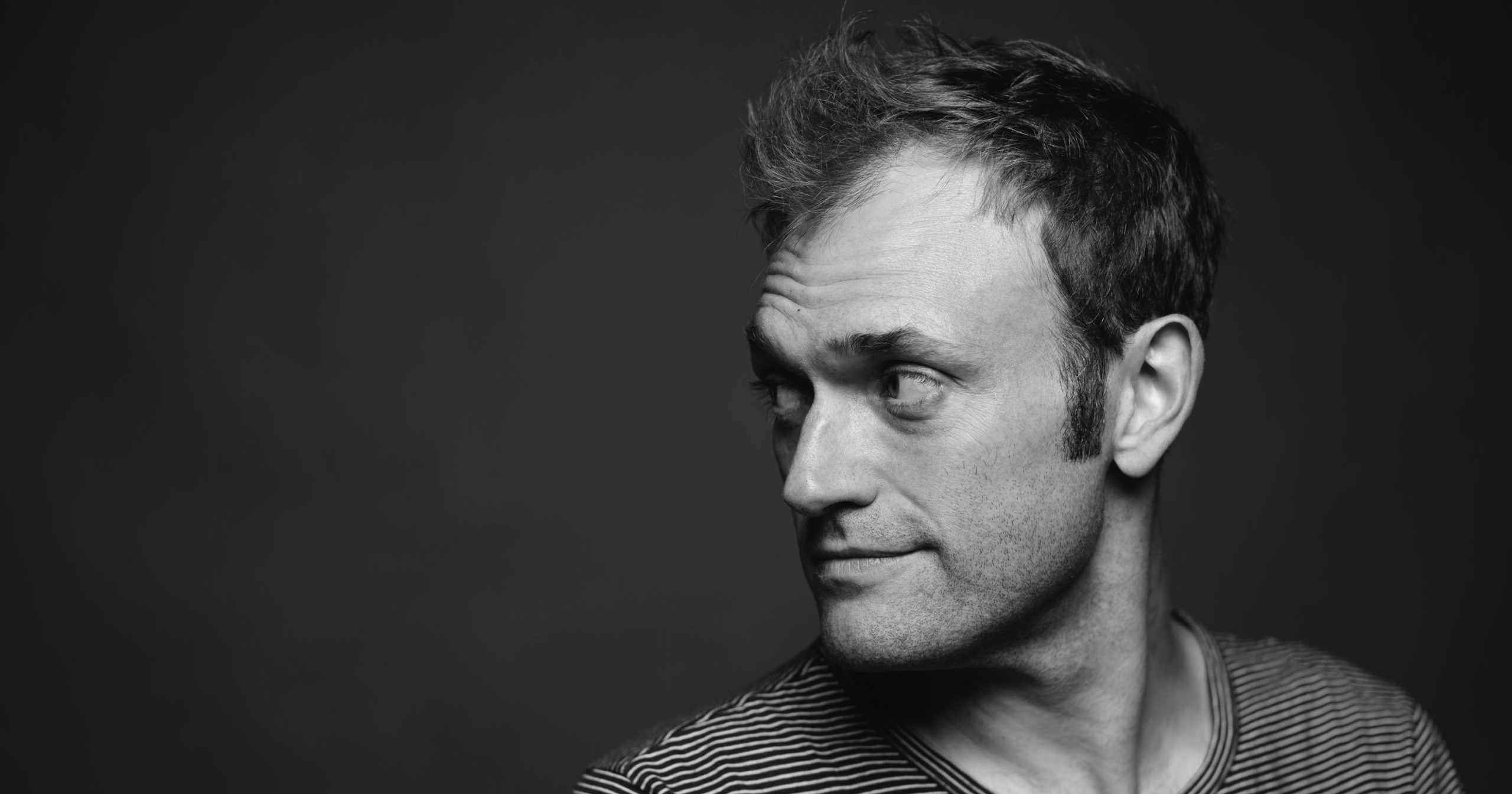
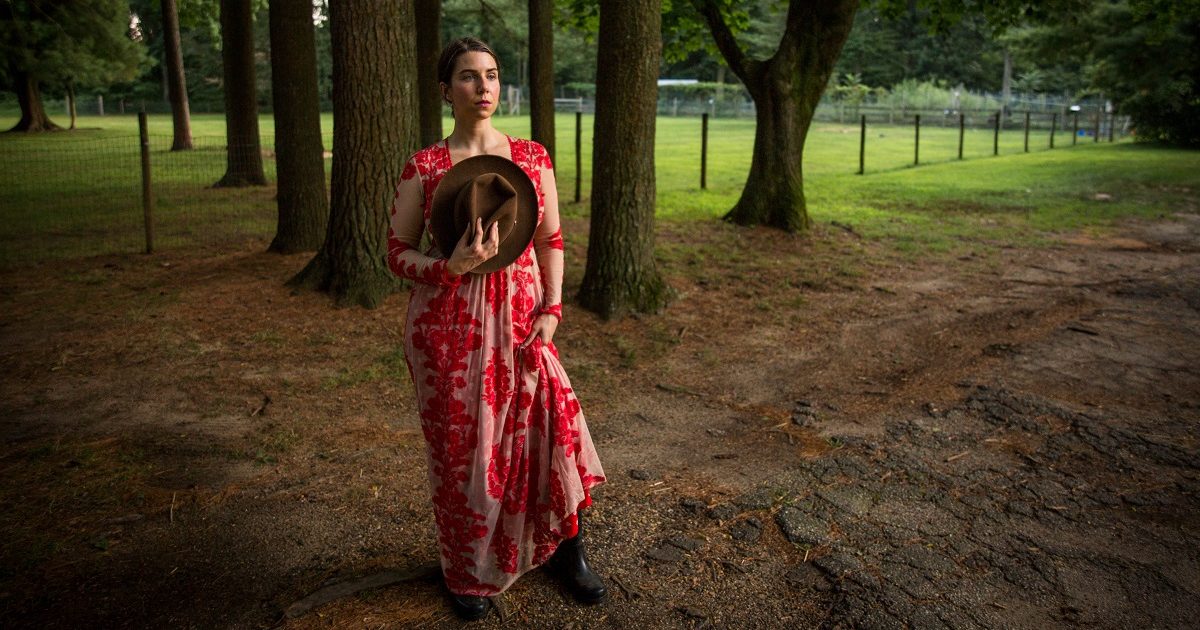
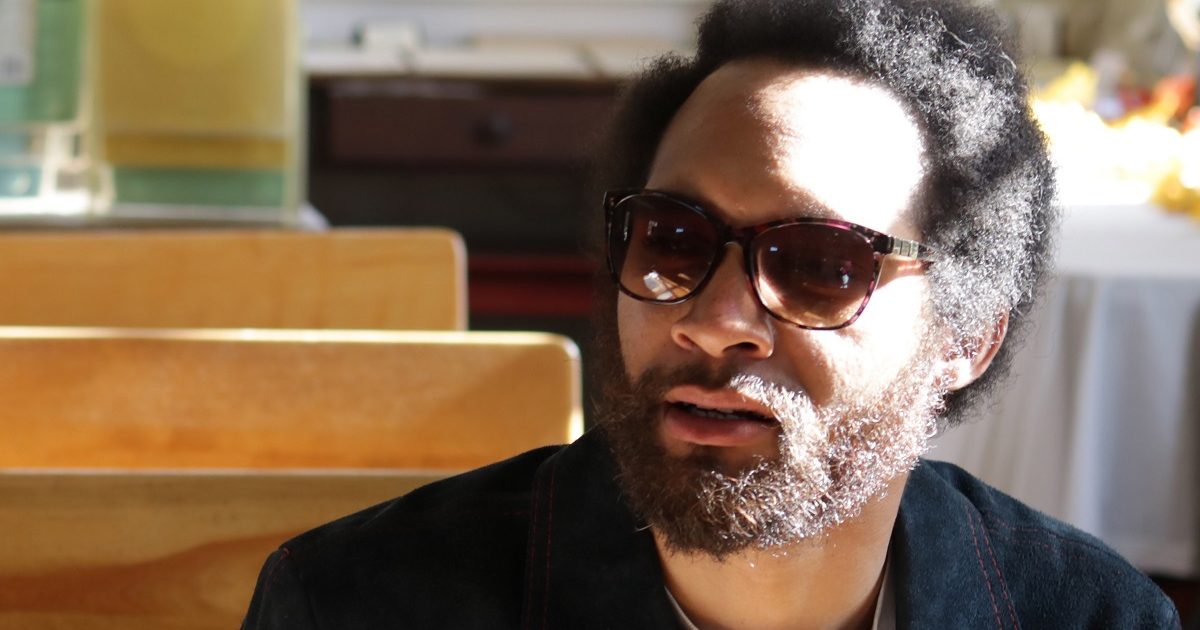
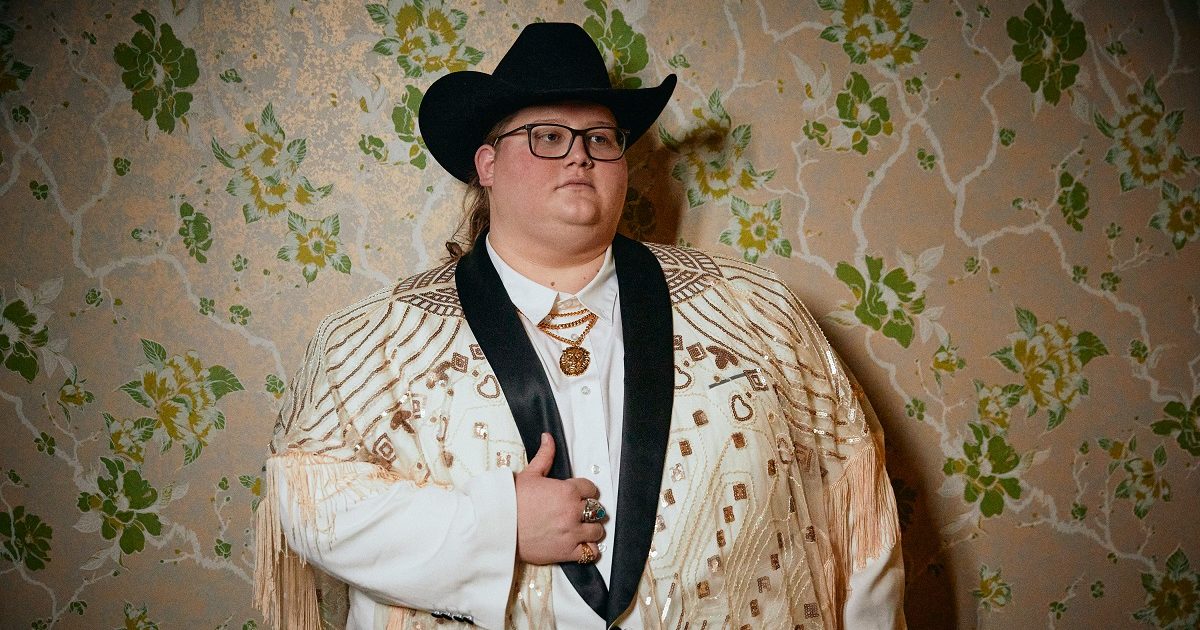
This month brought the unfortunate news that Live From Here, hosted by Chris Thile, has been cancelled.
The American Public Media-produced radio show, previously known as A Prairie Home Companion, has been beloved by listeners since its inception in 1974, and continued in 2016 when the series was rebranded as Live From Here, with Thile leading the way.
The show was cut from production as a result of COVID-19’s widespread impact on the music and entertainment industries. On his socials, Thile graciously acknowledged the decision, stating the purpose of Live From Here as “a celebration of live, collaborative audible art.”
So, without further hesitation, let’s look at 11 of our favorite Live From Here moments.
“Dean Town” – Vulfpeck & Chris Thile
Perhaps one of the most loved Live From Here moments was Thile’s guest performance with Vulfpeck on their classic, “Dean Town.” One has every reason to assume that eye contact between Thile and Joe Dart is still going strong at this very moment.
“Fiddle Sticks” — Billy Contreras
It may be one of the lesser-viewed bits from the show, but this “Fast-AF” fiddle tune feature by Billy Contreras is certainly not short on notes. Two and a half minutes of pure double stops and bass walks.
“Lovesick Blues” — Brandi Carlile, Ben Folds, Chris Thile, & Sarah Jarosz
Ever wondered if Brandi Carlile could yodel on par with Jimmie Rodgers — or everyone’s favorite Walmart yodeling kid, Mason Ramsey? Well, look no further than this early Live From Here collaboration with Carlile, Thile, Ben Folds, and Sarah Jarosz.
“Change” – Mavis Staples
“Say it loud, say it clear!” We’ve shared this powerful performance from the legendary Mavis Staples before, but it is even more relevant now. Things are starting to change around here!
“Toy Heart / Marry Me / Jerusalem” – I’m With Her
Almost 10 minutes of mind blowing harmony and togetherness from I’m With Her, all beloved guests throughout the show’s course. As Thile so happily declares at the end, “There’s not a better band — in the world — than I’m With Her.”
“In Da Club” / Musician Birthdays – Julian Lage, O’Donovan, Thile, and More
What could be better than the composer of 50 Cent’s “In Da Club” jamming with Chris Thile, or Julian Lage playing Django Reinhardt? Oh that’s right: it’s Aoife O’Donovan singing Dolly Parton’s “9 to 5.”
“Blue Skies” – Andrew Bird & Chris Thile
Not only does this pair look quite the same, but their playing together is divine, and one of the last Live From Here moments we were graced with before shutdown.
“Kodachrome” – Paul Simon
This one’ll make you think all the world is a sunny day. Just look at Thile’s face!
“Can’t Find My Way Home (Blind Faith)” – Rachael Price
The tonal map of this moment is pure magic. Lake Street Dive’s Rachael Price supported by Thile’s harmony, Mike Elizondo’s bass lines, Brittany Haas’s fiddle playing — need we say more?
“Winter Boy” – Amanda Brown
Since Thile’s takeover as host, Live From Here has always had a strong female vocalist on stage. From Aoife O’Donovan to Sarah Jarosz to Gaby Moreno to more recent guest Amanda Brown — these women have been an integral part of the show’s cast and performance. Enjoy Brown’s beautiful take on this Buffy Sainte-Marie classic.
“Hard Times” – Chris Thile
It only seems right to acknowledge the many efforts of the Live From Here cast and crew to bring listeners the show, recast as “Live From Home,” in the wake of the COVID-19 pandemic and global shutdown. For the last three months, those at the show worked tirelessly to bring us the weekly program, with the help of dozens of musicians, show regulars, and the #LiveFromHome social media campaign.
All we have left to say is — thank you to Chris Thile, all of the musicians, crew, and those who made Live From Here possible. And we hope these “Hard Times” we’re all living in together come again no more.
Artist:Tara Dente Hometown: Asbury Park, New Jersey Song: “Hill So Steep” Album:Truth in the Mud Release Date: July 17, 2020 Label: Travianna Records
In Their Words: “‘Hill So Steep’ is about a dream I had. In the dream, I was driving up a hill so steep, I felt like I was climbing the steepest roller coaster with no belt on or bar to hold me in and would just fall out. The dream certainly reflected difficult circumstances happening in my life at the time. I was a server at a popular restaurant in my town and did pretty well in tips that day. As soon as I turned the corner walking to my car after work, I noticed it, as well as a slew of other cars, had been towed. The dollar amount it took to get my car back from the auto shop was the exact amount I had made that day in tips. That night, I had the dream. Sometimes you take a step forward, and then take a step right back. But then another day, you’ll take three steps forward. You just have to hang in there the best you can, and look for the next right thing.” — Tara Dente
Artist:Tré Burt Hometown: Sacramento, California Song: “Undead God of War” Album:Caught It From the Rye Label: Oh Boy Records
In Their Words: “I was living in Australia during the 2016 elections and the BLM protests responding to Black lives murdered by police officers, namely Philando Castile and Keith Lamont Scott. The country was wailing in pain, rage and unrest and I could hear it from across the world. With everything in me I wanted to go back home and mourn with my community during such a pivotal time in transition, but I couldn’t yet afford a plane ticket. In the garage shed I was renting out one night I wrote this song, ‘Undead God of War,’ in a state of catharsis. I figure if I couldn’t be home the next best thing I could do was to put it to song. Fast forward four years to the present and nothing’s changed. Today, we are fighting for justice for George Floyd, Breonna Taylor, Ahmed Aubrey, Stephon Clark and the countless others. The Undead God of War is as alive now as it was when colonialists first stole this land and took it for their own. We are not surprised by this, for this is the America we are introduced to as children. It is also the America that I fight for, my first love, my demise, my home.” — Tré Burt
Artist:Joshua Ray Walker Hometown: Dallas, Texas Latest album:Glad You Made It (July 10, 2020) Personal nickname: High Wide and Handsome
What was the first moment that you knew you wanted to be a musician?
I started playing tenor banjo when I was three years old, and guitar when I was five. My grandfather brought a large record collection with him to Texas from Union County, Tennessee, decades before I was born. Every day after school I used to listen to those records in his workshop and try to play along on yard sale instruments he’d find. The first time it really clicked and I could keep up with one of those bluegrass records, I was obviously too young to know then, but I’ve been chasing that feeling ever since.
How often do you hide behind a character in a song or use “you” when it’s actually “me”?
Often. I build characters based on people I know, have met, or parts of my own personality and experiences. It took me a long time to realize that last part, but now that I know, I use it as a way to explore parts of myself I otherwise wouldn’t be brave enough to write about.
What other art forms — literature, film, dance, painting, etc — inform your music?
I would say film has the largest impact on my music. I think of my songs kind of like short stories and they play out in my head like movie scenes. Certain directors have informed the way some of these scenes play out, and the filters and angles by which I view them. Martin Scorsese, The Coen brothers, Quentin Tarantino, Wes Anderson to name a few.
Since food and music go so well together, what is your dream pairing of a meal and a musician?
One of my favorite parts of touring is trying the local dishes in all the places I visit. Nashville is a great food town and I have a whole itinerary of favorite spots I try to hit up every time I’m there. Fourteen-year-old me would be disappointed if I didn’t pick Jack White. He lives in Nashville, I hear we agree on where to get hot chicken in the town that invented it, and I’ve had countless near-miss encounters with him. So I pick the hot chicken basket with fries and coleslaw, extra pickles and a lukewarm Sprite with Jack White at Bolton’s Spicy Chicken & Fish!
It was December 2018 and I had just released “Working Girl” and “Canyon” in anticipation of my debut record, Wish You Were Here. I had played to fairly large crowds as a lead guitarist for other bands, but I had never played my songs live to more than about 150 people at a time and I definitely had never experienced the type of “buzz” surrounding my career prior to that point. I had a string of four preternatural shows booked that, in short, made me believe all the hard work of the previous decade was going to pay off, and instilled a confidence in me that I hadn’t had previously.
The first show was my first time playing a theater at the Kessler Theater in my hometown of Dallas, Texas. The second show was my first time opening for Colter Wall, and my first time playing solo at the Granada Theater. The third show was my first time playing the Tower Theater in OKC, opening for Colter. The last show was my first time opening for American Aquarium, and my first time at Cain’s Ballroom. Each show escalated rapidly in magnitude and capacity, and I’ll never forget how amazing and surreal it all felt.
I’m going to focus on the second show briefly. At that time, I had seen close to 100 shows at the Granada Theater, and it had been a staple in my East Dallas community for years. Spotify had just reminded me that Colter Wall and Paul Cauthen were my most listened to artists of 2018, and when I looked out into the crowd that night it seemed like I saw the face of every person who ever cared about me all in one place, singing along to my songs.
My favorite memory of being on stage actually happened right after I walked off it. I pushed my way through the heavy curtain, and what was in the tunnel waiting for me was truly unbelievable: Colter Wall, Paul Cauthen, Vincent Neil Emerson, Matt Hillyer (Eleven Hundred Springs), Summer Dean, Simon Flory, Jacob Metcalf, and others filled the hallway. They had all been watching me close the set through the curtain, and were there to congratulate me when I was done. That was one of the most heartwarming, and reassuring moments of my career and life.
Me and my Turn Turn Turn bandmates Savannah Smith and Barb Brynstad have chosen a mix of music that’s either helped shape us as musicians and songwriters, resonates with us in these uncertain times, or is stuff we keep coming back to, like that lover we can’t seem to shake. It’s old and new like our band — we “turn” to the distant past of early American recorded music, “turn” again to that renaissance of the 1960s and 1970s, and finally “turn” again to the present looking forward. We hope you dig the sonic journey. — Adam Levy
Ry Cooder – “Boomer’s Story”
Probably one of the most influential players of my life. Evocative, funky, reverent of past blues players, but super innovative. All the double stops sound like he’s often imitating fiddlers. I do that on the guitar solo for our song “Fourteen.” This song is the ultimate Ry Cooder groove with Jim Keltner on drums. Reminds me of years listening to it touring in a van with my band, The Honeydogs. — Adam
Luluc – “Controversy”
There’s another level of calm within Luluc’s music I have always appreciated. Nico with modern themes… I don’t know how they do it, but they do it so well. — Savannah
The Staple Singers – “Freedom Highway”
Who can say they HAVEN’T been influenced by the Staple Singers? Unvarnished, insistent, and catchy as hell, it’s no surprise that “Freedom Highway” is as eminently listenable today as it was in 1965. And sadly, although it was written more than five decades ago, this song’s imperative message resonates just as strongly in 2020 as it did during the apogee of the Civil Rights movement. — Barb
Judee Sill – “The Lamb Ran Away With the Crown”
It’s hard to choose a favorite of hers. One of the greatest underappreciated American songwriters. She crosses genres, she sings some of the most profoundly spiritual music and she hooks the listener with amazing harmonic movement and melodies. If you don’t have goosebumps at the rousing end of this gem you might need to check your pulse. As good as anything on Pet Sounds — maybe better. — Adam
Turn Turn Turn – “Delaware Water Gap”
Imagine if Dylan wrote a song about a female serial killer and had Emmylou Harris and Stevie Nicks join him while Grady Martin and Clarence White duel on guitar. — Turn Turn Turn
Sarah Jarosz – “House of Mercy”
I fell in love with multi-instrumentalist Sarah Jarosz a few years ago, when I saw her perform at the Dakota, a renowned live-music venue in Minneapolis. Fresh-faced and not too far out of college (New England Conservatory of Music), she played as a part of a well-oiled trio of seasoned twentysomethings. This particular song appeals to me because it pierces the conventions of traditional bluegrass music — lyrically, vocally, and instrumentally. Importantly, it was my gateway to a deeper appreciation of bluegrass and old-time music. — Barb
Lefty Frizzell – “Treasures Untold”
Lefty is often overlooked in the country music pantheon. His voice is velvety voice and cheeky chords meld honky-tonk gently with Tin Pan Alley pop. This song is nearly perfect to me as a composition. — Adam
Jessica Pratt – “As the World Turns”
Jessica Pratt’s voice and melodies are incredibly ethereal. I’ve always admired her songwriting, especially in this song. To me, I feel the driving, unstoppable passing of time while stuck in a trance of reflection. — Savannah
Turn Turn Turn – “Cold Hard Truth”
Adam wrote this one about deep self-examination and suggested Barb and Savannah do the vocal heavy lifting. We’re pretty proud of this bridge and we bet Phil Spector or Jeff Lynne would give us a nod of approval. — Turn Turn Turn
Dixie Chicks – “The Long Way Around”
I love the Dixie Chicks for their fearless defiance of conformity. And I love this song’s transcendent harmonies, soaring hooks, and in-your-face lyrics (“I wouldn’t kiss all the asses that they told me to”) that serve as a clarion call to all the uppity movers and shakers who refuse to be conventional. — Barb
The Rolling Stones – “Loving Cup”
I came to country music through the Stones. They always had a couple country nods with close harmonies, twangy pedal steel-like riffs and stories about dissipation, loneliness, yearning, and travel. “Loving Cup” is loose and sexy, takes you by the hand, spanks you and just keeps building with that piano-horn driven, drum-tripping outro. — Adam
Laura Stevenson – “Time Bandits”
Laura Stevenson is someone I have always really looked up to. Both her voice and her songwriting are incredibly powerful. This song hit me really hard during quarantine; it’s heartbreakingly hopeful. — Savannah
Big Bill Broonzy – “Glory of Love”
First time hearing this I was struck by the driving rhythm. I thought it was a couple guitarists. I spent a couple days figuring out this relatively simple three-chord song. And I only recently figured out how to get that ragtime banging drive happening — some 30 years after first hearing it. — Adam
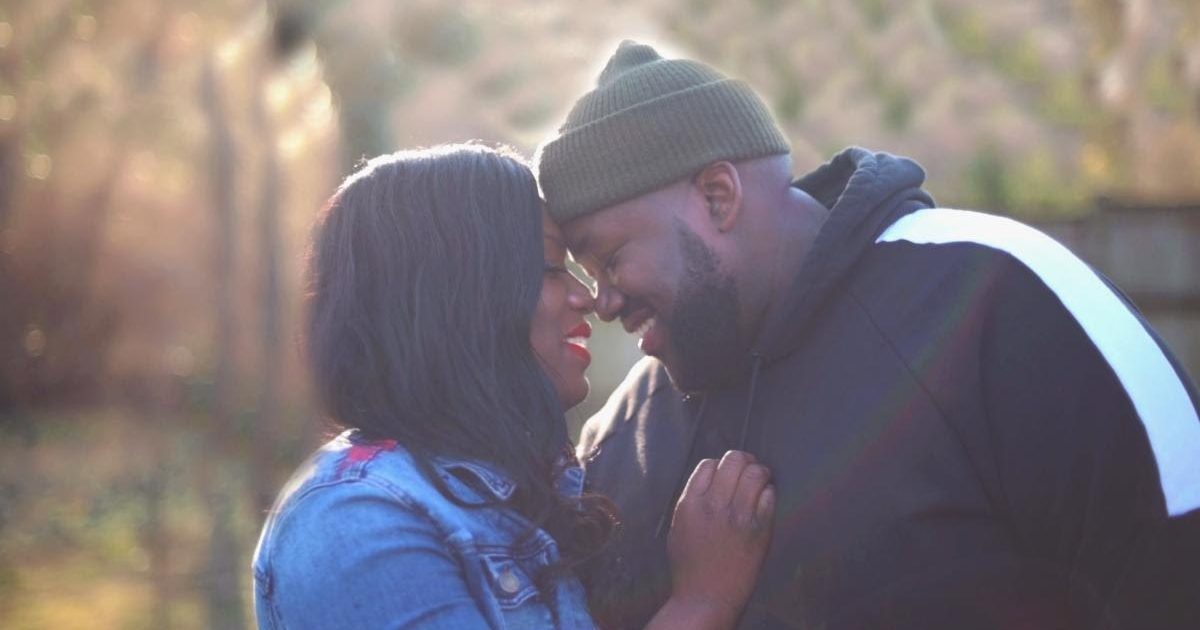
Artist:The War and Treaty Single: “We Are One” Release Date: June 19, 2020 Record Label: Rounder Records
In Their Words: “There were two songs that I remember singing in church that inspired this song: both ‘Jesus Loves the Little Children’ and ‘Make Us One, Lord.’ I feel that in this day and age, we all need to be reminded of the power of oneness and togetherness. [The] power of all of the people in this world coming together and uniting under one umbrella — and that umbrella is the human race.” — Michael Trotter, The War and Treaty
For Black Americans, this day, Juneteenth, has long been a celebration of the momentous historical event of emancipation from slavery — and the nearly two and a half years it took for that news to reach all enslaved peoples in this country. Juneteenth is belatedly gaining wider recognition and arrives at a time of reckoning with systemic patterns of white supremacy, especially police brutality, that remain deeply entrenched.
Like many waves of national protest before it, the uprising in the wake of the deaths of George Floyd, Breonna Taylor, Ahmaud Arbery, Tony McDade and many others has spurred the creation of its own soundtrack, and the following list spotlights the contributions of seven roots-savvy, Black music makers. Some draw on lessons learned from how songs gave spiritual succor to those on the front lines of the 1960s Civil Rights struggle, with righteously raised fists and declarations of passion and purpose. Others opt for expression that feels far more personalized or particular, articulating an adamantly complex range of emotions and letting profoundly unsettled, and unsettling, questions hang in the air. All of them are fleshing out their own vivid, timely incarnations of movement music.
Leon Bridges specializes in sophisticated soul, sometimes artfully retro in presentation and other times landing at the thoroughly contemporary end of that musical lineage. His new song “Sweeter” is an example of the latter, two minutes and 50 seconds during which his buttery vocals glide over a lean drum machine pattern, delicate, gospel-dusted bits of guitar, keyboard, piano and bass and Terrace Martin’s saxophone figures. Bridges’ words land with the devastated finality of a black man whose life is leaving his body, taken from him by police. “I thought we moved on from the darker days,” he sings, his cadence fluttery and tone ruminative. “Did the words of the King disappear in the air, like a butterfly?” The blame-laying next line arrives in a burst: “Somebody should hand you a felony.”
Then, Bridges elongates his phrasing with righteous indignation, before steadying himself to spell out the loss: “‘Cause you stole from me/my chance to be.” The elegance he chose gives his performance subtly striking, emotional heft. “From adolescence we are taught how to conduct ourselves when we encounter police to avoid the consequences of being racially profiled,” Bridges wrote in a statement. “I have been numb for too long, calloused when it came to the issues of police brutality. The death of George Floyd was the straw that broke the camel’s back for me. It was the first time I wept for a man I never met. I am George Floyd, my brothers are George Floyd, and my sisters are George Floyd. I cannot and will not be silent any longer. Just as Abel’s blood was crying out to God, George Floyd is crying out to me.”
Chastity Brown has been honing her ability to create space for emotional resistance within her songs for a while now. She draws on the pointed, confessional potential of folk and soul and the digital texturing techniques of contemporary pop and hip-hop, while depicting the patient pursuit and safekeeping of self-knowledge as a sign of strength — one that differs wildly from the sort of dominance modeled by systemic power.
In her new song “Golden,” created on her iPad in her garage studio and shared with the world this week, Brown sounds willfully unhurried singing over a skittery programmed beat: “I’ve got joy, even when I’m a target/If ya think that’s political, don’t get me started/You know I’m golden and I flaunt it.” That savoring of selfhood is in striking contrast to the furious question she circles around during the chorus: “Why have I got to be angry?”
In the artist notes accompanying the song, Brown explained that she began writing it when her nephew was beaten by four white cops while walking home in Harlem, mere weeks before George Floyd died in her adopted hometown. “This collective trauma that black, indigenous, immigrant, and queer/trans folk feel is real,” she spelled out. “It’s every god damn day. Yet, we still thrive and flourish in our nature beauty, we still have swag and songs for days. We still have wild and wondrous imaginations like we are all the children of Octavia [Butler]. …This is for me, my people, and the UPRISING to defund police here in Minneapolis and thereby set a new standard for how communities want to be protected.”
Shemekia Copeland, one of the brightest stars in contemporary blues, has been deliberate for years about broadening her repertoire and approach to encompass countrified styles, singer-songwriter song sources and statement-making folk and soul sensibilities and, in the process, positioning herself in the midst of roots music discourse. That’s the insightful perspective she brings to her just-released “Uncivil War,” whose string band style accompaniment boasts the contributions of Sam Bush and Jerry Douglas.
Coming from Copeland, and delivered with measured, dignified vibrato, the simple flipping of the name of the nation’s most notorious war to “uncivil” slyly strips a veneer of respectability from the racist and romanticized Lost Cause religion. She strikes a tone of weary but resolute optimism throughout. “It’s not just a song,” she clarified in a statement. “I’m trying to put the ‘united’ back in the United States. Like many people, I miss the days when we treated each other better. For me, this country’s all about people with differences coming together to be part of something we all love. That’s what really makes America beautiful.”
Kam Franklin, on her own and with her Houston horn band The Suffers, has the wide-ranging musical instincts, imagination, nerve, and ear for earthy verisimilitude to make big statements while zeroing in on small interactions. A couple of weeks back, she posted a brand new, self-recorded song fragment to SoundCloud, a platform well suited to off-the-cuff expression, and with it, this comment: “I saw a photo of Breonna Taylor with her homegirls earlier today, and it gutted me. I won’t forget her. I wrote this birthday song for her, her friends that wondered where she was before the news came out, and everyone that loved her.”
Titled “Happy Birthday Breonna,” it’s a pensive, sinuous bit of ‘70s soul that drives home the fact that Taylor was ripped from a web of close relationships. The first, and only verse, lands like a voicemail from a friend who grew worried when she couldn’t reach Taylor. Franklin’s graceful trills and softly insistent phrasing have an understatement that suggests fretful preoccupation. Then she moves into a point-counterpoint refrain, murmuring birthday wishes to Taylor in her breathy upper register and making a devastating declaration beneath: “You should be here.”
Singer-guitarist and actor Celisse Henderson began work on writing, recording, and filming a video for her song “FREEDOM” four years ago, following the slayings of Philando Castile and Alton Sterling, and watched as black deaths and protest momentum multiplied before she finally completed and released her project earlier this month.
In a message on her website, Henderson explained, “I, along with millions of people, watched video footage of these unarmed black men losing their lives in the most horrific ways. The truth that these unjust deaths revealed about our country, including the systemic failings of our criminal justice system, became my personal call-to-action. Then the 2016 election night happened, and the results added a whole new layer to the purpose of this song and project. Now, almost four years later, too little has been done, and the story remains the same. With the horrific and unjust killings of Ahmaud Arbery, Breonna Taylor, and George Floyd weighing heavily on our hearts and minds, it is time to release ‘FREEDOM’ as a rallying cry and a call to action to stand up and fight for our freedom.”
Historic footage of the March on Washington that opens the clip is a reminder of the buoying role that spirituals played in the Civil Rights movement of the 1960s, and serves the narrative function of positioning Henderson to measure the too-meager progress for Black Americans since. The track is gospel-schooled and hard-rocking, powered by a thunderous, syncopated drum pattern and grinding electric guitar attack. With gospel fervor and a touch of theatrical flourish, Henderson summons a spirit of urgency and extends a broad welcome to all who are affected or disturbed by injustice.
Joy Oladokun, a Nigerian-American singer-songwriter who’s quietly carving out her place in Nashville’s professional songwriting community with introspective, melancholy warmth, steered a co-writing appointment with Natalie Hemby toward an expression of grief. The result was “Who Do I Turn To?” a naked airing of fear and distrust.
Oladokun’s reedy, plaintive performance is accompanied only by minimal piano chords. She spends the chorus adding up horrifying realizations that lead her to a resounding question: “If I can’t save myself/If it’s all black and white/If I can’t call for help/in the middle of the night/If I can’t turn to god/If I can’t turn to you/Who do I turn to?” Her voice subtly catches on the word “help,” as though knowing that life-giving protection is unavailable to her constricts her breath. Oladokun underscored the importance of the chorus lyrics to an interviewer: “[I]t’s illustrating that I don’t trust the police since I’m black. I don’t trust the police enough to know that they would think I’m not robbing my own home. I don’t think a lot of people understand what that is like. The feeling sucks.” In a separate statement she summarized her intent: “I wanted to write a firsthand account of how I feel and the question black people like me ask when this happens over and over again while nothing changes. I want it out now to help an already traumatized people cope, heal, and put words to their struggle.”
Wyatt Waddell, a young Chicago music-maker who’s been expertly, wittily, and self-sufficiently arranging home recordings of classic covers and singer-songwriter soul originals for the past few years, wrote “FIGHT!” as an anthem of admiration and uplift for young, Black Americans putting their bodies on the line in the streets and facing off against police force to agitate for change. “This song is me looking at what’s happening and what I’d tell the people protesting,” he specified in a statement. “I had to look outside of myself at what’s going on and how people are being affected. Hearing people’s fears, anxieties, and watching everything happening on TV really helped me write the song. I hope that it can be an anthem for my people as they’re fighting for a better America.”
Waddell begins with gospel-style repetition, creating a call-and-response pattern made up of his own layered vocals over a churchly foot stomp and hand clap groove: “There’s already so much pain/So much pain/So much pain/There’s already so much pain/And there ain’t nothin’ else we can do.” It seems like he could be building up to a confession of helplessness; instead, his funky refrain is bolstered by a sense of resolve and inevitability: “Nothin’ to do but fight.”
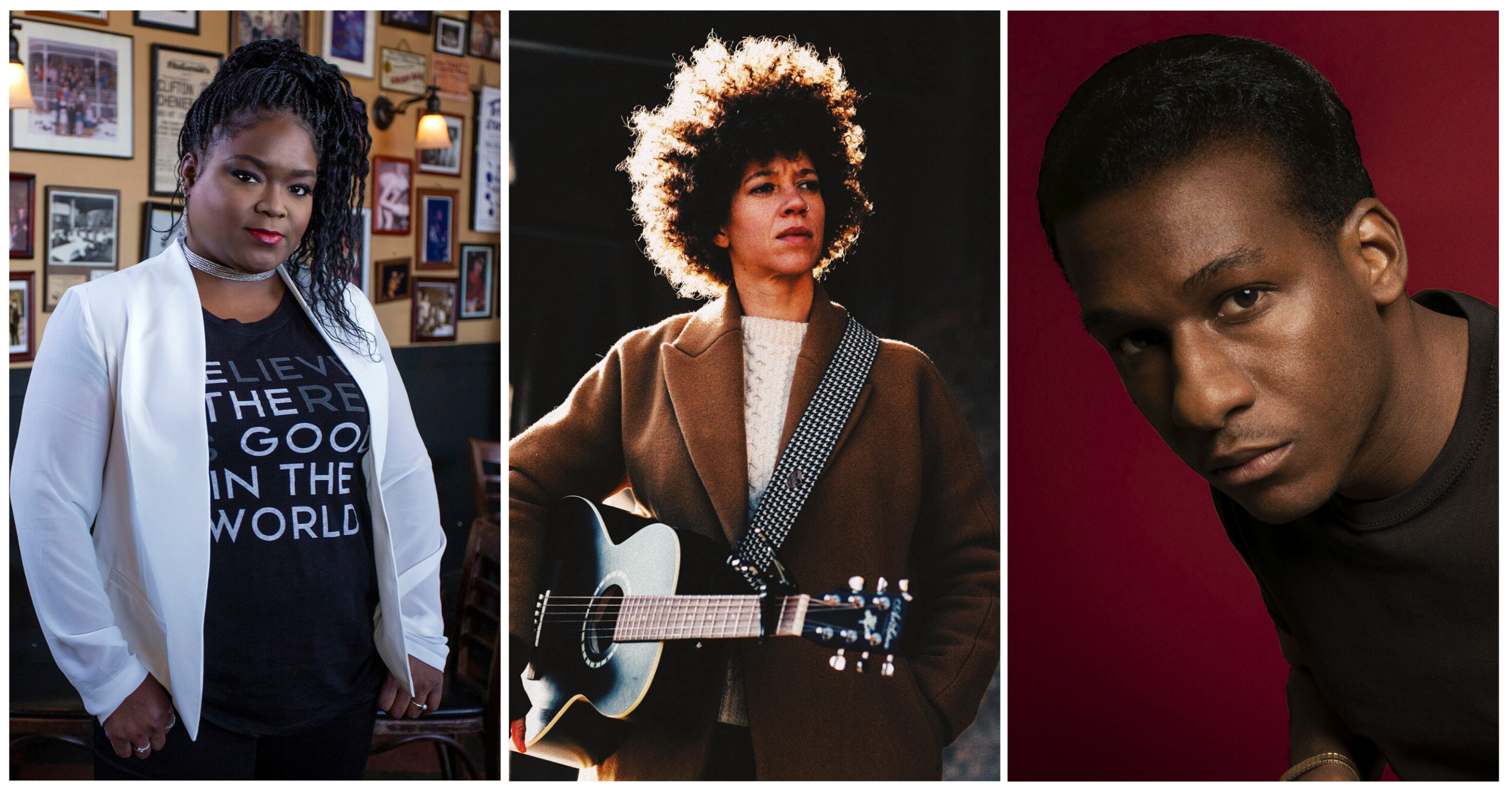
Photo credit: (L to R) Shemekia Copeland by Mike White; Chastity Brown by Wale Agboola; Leon Bridges by Jack McKain.
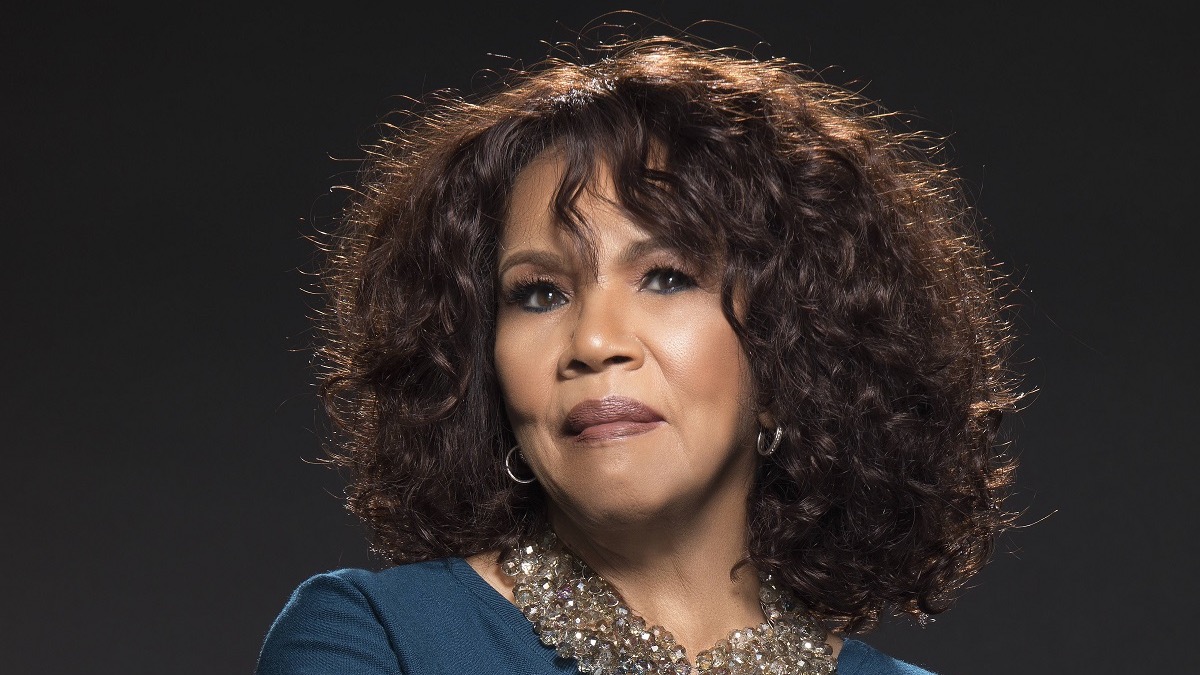
Artist:Candi Staton Single: “I Wonna Holla” Album:It’s Time to Be Free (2016) Release Date: June 19, 2020 (video)
In Their Words: “I’m so proud to be among the men, women and children of all races, marching together to end systemic racism, police brutality, [and] to reform the criminal justice system. When I saw George Floyd literally being lynched by a white police officer in the eyes of the whole world, my soul and my spirit wept. It brought back so many unpleasant memories from my own life.*
“Then I remembered ‘I Wonna Holla,’ a song I wrote years ago. Sometimes it’s hard to describe pain, tears and emotions. It makes you feel like you’re losing it, but this song says it all — ‘It Makes Me Wonna Holla!’ Now I really, really do want to holla! This song represents the language of the unheard. I will be donating to organizations like Black Lives Matter and others who are fighting to further the cause to stop police brutality, and those helping to rebuild small businesses that were looted while protesters were marching against this injustice.” — Candi Staton
*As a teenager in the 1950s, Staton worked the gospel circuit with Sam Cooke, where she and her musicians were victims of segregation and racial profiling. In 1963, she was in Birmingham, Alabama, and experienced the chaos and heartbreak on the day of the 16th Street church bombing.
Out of 270 floats, companies, and queer associations, a roots music organization’s marching contingent was crowned “Best of the Best” at San Francisco’s world-famous Pride parade in 2017. And they did it on their very first try — the only organization to ever achieve such a feat. Who was that overalls-and-rainbow-glitter-clad crew of more than a hundred bluegrass fans, pickers, and professionals? Bluegrass Pride.
The Bluegrass Situation has been proud to support Bluegrass Pride since 2017, with our logo emblazoned on the inaugural float that carried three bluegrass and old-time bands down Market Street to the cheers of thousands of brand new “Foggy Mountain Breakdown” fans. In 2020, the nonprofit organization had planned its biggest Pride celebrations yet (in San Francisco; Portland, Oregon; Raleigh, North Carolina; and Nashville, Tennessee) while still welcoming the rural and non-metropolitan LGBTQ+ folks who love and make these musics, too.
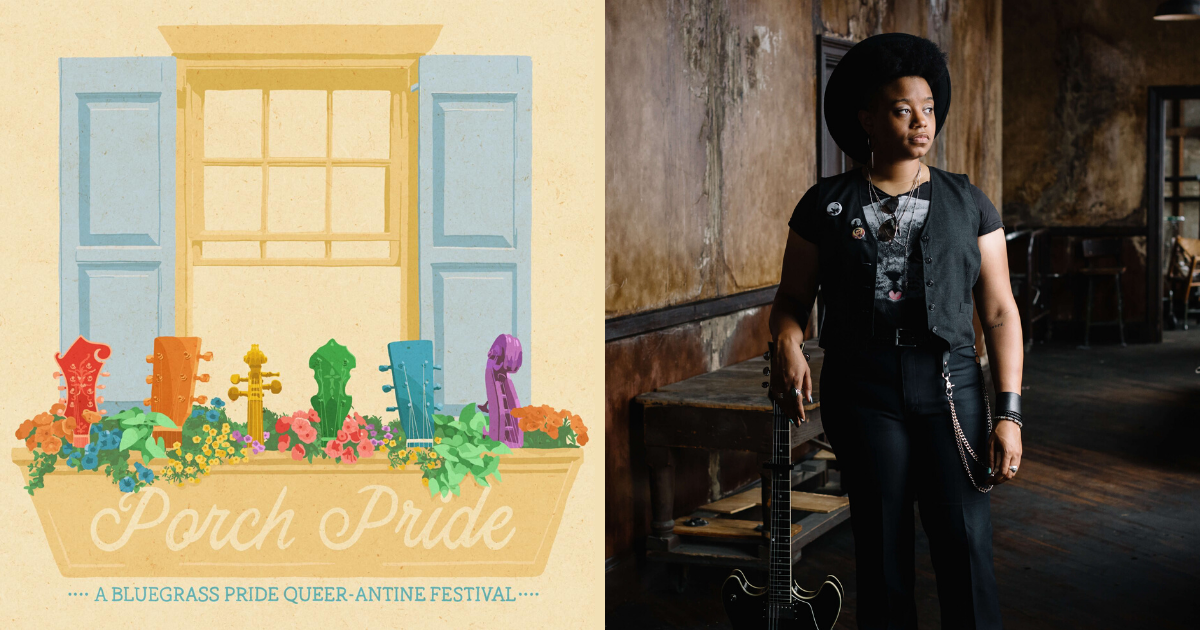
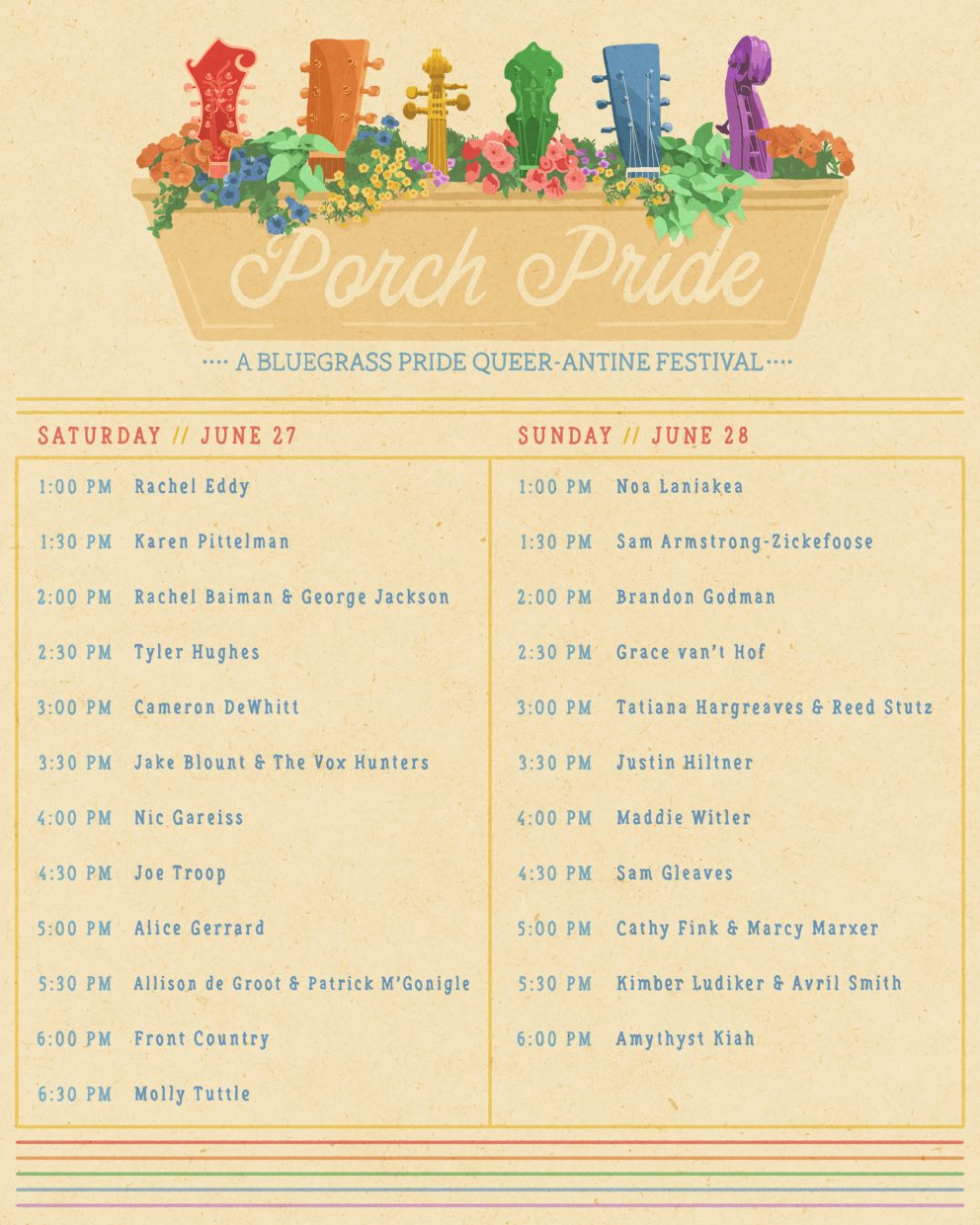
Enter our most familiar villain, COVID-19. In response, Bluegrass Pride has shifted to a new concept, Porch Pride: A Bluegrass Pride Queer-antine Festival. Featuring more than ten hours of music by queer and allied artists such as Cathy Fink & Marcy Marxer, Molly Tuttle, Sam Gleaves, Jake Blount, Rachel Baiman, and more, the livestream event will air June 27 and 28 on Bluegrass Pride’s website, YouTube channel, and Facebook and Instagram pages. Porch Pride will raise money for Bluegrass Pride and all of the musicians on the bill. Fans and followers are encouraged to donate now.
To celebrate Porch Pride with our longtime friends at Bluegrass Pride, we connected with Executive Director Kara Kundert and powerhouse singer/songwriter and the digital festival’s “headliner” Amythyst Kiah.
BGS: For those unfamiliar with Bluegrass Pride, how would you describe it?
Kara Kundert: Oh, what a big question. In a purely statutory sense, I would say that Bluegrass Pride is a nonprofit organization devoted to the advancement of LGBTQ+ people within the bluegrass, old-time, and broader roots music traditions. To get a little bit more descriptive, we work every day to make bluegrass a more welcoming place for people of all backgrounds. Our mission is to show the world that bluegrass is for everyone, so we try to create programs that serve all kinds of people who love and participate in American traditional music. We put on local beginner-friendly jams and create introductory video content to help people get involved with the community even as they’re just starting out, and we host concerts and showcases to create paid opportunities for professional musicians.
Amythyst Kiah: …Simply, my idea of what something like Bluegrass Pride represents: It is about accepting all forms of identity and expression in a style of music that is known for having a more traditional culture, and it’s also an outlet for queer people who don’t fit the stereotype of gay club culture. As iconic and important gay club culture is historically, it isn’t everyone’s experience.
How did the idea for Porch Pride come to you?
Kundert: Via the incredibly talented Jake Blount! Jake is on the Bluegrass Pride board of directors and he came to me back in March (just as everything was starting to shut down and we were holing up for quarantine) to suggest that Bluegrass Pride host a digital festival to support artists in the face of the first round of gig cancellations. He had participated in the first iteration of the Stay At Home Festival and had seen how much energy and support there were for these artists, and thought that it was a natural fit for Bluegrass Pride and our mission.
At that point in time, it was still really unclear how long and how bad the COVID pandemic was going to be — we still believed that SF Pride was going to march down Market Street in June — so I was a little nervous to take on the project. I was worried that we wouldn’t have the resources to do everything and do it well. We started discussing smaller-scale projects, like weekly concert series or short little weekend showcases, things that we would have the budget to do in addition to our regular programming.
But within a couple of weeks, it became pretty clear that our whole season was going to change dramatically, and that was when the plan shifted from being “maybe we’ll host a couple of digital concerts to keep momentum before Pride” to creating Porch Pride and really making it the center of our entire year.
People don’t tend to think of bluegrass or roots music when it comes to Pride celebrations, and obviously y’all think that needs to change! Why? What does bluegrass and string band music bring to the greater LGBTQ+ community?
Kiah: I see this event and organization as a way to formally recognize that LGBTQ+ have always been present in the communities where bluegrass and other roots-based music originated from. Historically, media has projected many ideas of what being queer looks and sounds like, and it’s high time to recognize and celebrate other ways of being and doing when it comes to music.
Kundert: I think that there’s a problem whenever people aren’t being represented. So it was a problem for bluegrass that LGBTQ+ stories and music weren’t being heard onstage. It was a problem when queer folks were being excluded from jams and from gigs just because of their identity. And it’s a problem for the LGBTQ+ community that this portion of our family isn’t being included in the conversation about what “gayness” is. We as a culture have this extremely metropolitan, white, male-centric idea of what the LGBTQ+ community is, which is what you really see on display on these corporate floats at the major cities’ Pride parades, and it leaves out so many people. There are as many ways to be queer as there are colors under the sun, and that’s something that we as a [bluegrass] community need to do more to embrace in order to support and uplift every single person in the LGBTQ+ community.
Amythyst, with your songwriting and your work with Our Native Daughters you’ve been a powerful voice, lifting up Black songs and stories. How does that perspective as a Black woman complement Bluegrass Pride for you? What do these two movements have in common, and what do they combine?
Kiah: Both movements involve recognizing and uplifting marginalized voices, due to the continued generational trauma that both have had to endure. Being Black, a woman, typically gender-nonconformant, and queer, I have experienced some form of questionable actions, treated as if I was invisible, and [received] looks of contempt by other people. I am fortunate that I haven’t experienced much worse, but that being said, I was terrified of my own shadow for years before I really started to embrace myself and be myself. So Bluegrass Pride is about recognizing that we all have value, just as Songs of Our Natives is about.
Kara, planning a Pride event can be a major undertaking. What is the reward for you, on a personal level, after putting in so many hours to prepare?
Kundert: Creating and running these events is always such an emotional rollercoaster. There’s so much anxiety and energy in the planning: Are people going to show up? Is it going to go well? Are people going to connect with it, or are they just not going to care at all? But then in the moment, you get to listen to this wonderful music by talented people, and be with a crowd of people that want to support Bluegrass Pride, and it’s euphoric. So far, I haven’t been let down by that moment of standing in a crowd and experiencing that kind of threefold-payoff of enjoying the music as an audience member, enjoying the crowd and energy as someone standing on stage, and enjoying the sheer relief of not totally fucking up as a producer.
But beyond that very selfish gratification, I also know how much these events mean to people. I know there are people who play bluegrass right now — people who are showing up at jams and forming bands and going to festivals — because Bluegrass Pride made them feel welcome and safe to be there. There are people who found Bluegrass Pride and realized that maybe they could come out after all. I know that these events — our parade float in San Francisco, our LGBTQ+ Musician Showcase in Raleigh, our beginner-friendly jams — they mean something to people. So when I get to stand in the crowd and see people’s smiles and feel people’s energy, both on- and off-stage, it makes me feel like what we’re doing matters to people. That all of the work and the hours and the stress: they add up to something bigger than just myself or my own feelings of relief and exhaustion. And that’s what keeps me going after four years of being a part of Bluegrass Pride.
What are you most looking forward to during Porch Pride?
Kundert: I know this is a cliche to say, but I’m looking forward to all of it — I put together the lineup after all! We have so many talented artists, I’m just looking forward to hearing all of their great music and seeing how people come together to celebrate Pride with us this year.
Kiah: I am looking forward to (hopefully) finding a quiet place outside to share some stories and music! If only it could be done in person, but I’ll take what I can get! Being safe [is a] top priority.
How can we all celebrate Pride “better” this year?
Kiah: I think one thing to keep in mind is that not everyone can safely be out of the closet, and that we should always keep those folks in our thoughts and to remember that [there is] more than one way to live out our truths in a way that we see most fit. Whenever we are waving our rainbow flags or wearing our rainbow suspenders, we’re also wearing them for the ones that can’t be with us.
Kundert: I think the key to best celebrating Pride — and to best doing most things in life — is to take a page from the author John Green and put energy into imagining people more complexly. If we imagine Pride more complexly, we see beyond the metronormative, white, cis, corporate stereotypes of Pride and begin to see new possibilities — for a Pride without all the weird classist, toxic binarism and gate-keeping. If we imagine bluegrass more complexly, we can break out of these same tired tropes that we’ve been falling into years and start telling new stories — using this art form as a way to create authentic and fresh connections with people.
We must do everything we can to see and honor people in all of their nuance. By forming connections with people, we are able to glimpse outside of our own lives. To do so enables us to generate empathy for each other, to see each other as family rather than strangers, or worse, as adversaries. To expand our circles and grow our vision of humanity will help us to better fight for justice for all, rather than justice for a few.
Photo credit: Anna Hedges Artwork: Courtesy of Bluegrass Pride
Summer approaches, the heat and humidity are here, at BGS South in Nashville the fireflies are alight every night, and it’s the perfect season for a porch swing reading session (if you can stand a little sweatin’).
The BGS archives will keep you stocked for just such an occasion! Each week, as we share our favorite longer, more in-depth articles, stories, and features to help you pass the time, we post our #longreadoftheday picks… yes, daily across our social media channels [on Facebook, Twitter, and Instagram]. But of course, here’s the weekly round-up, too. Get your long reads wherever you like!
This week’s stories cast daylight, share wisdom, get toes tapping, revisit old memories, and much more.
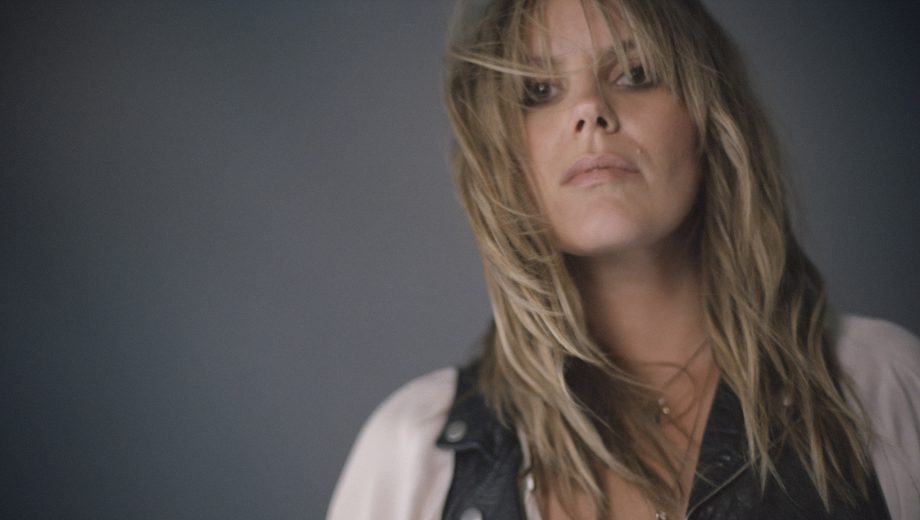
An excellent long read for starting us out, with this one you’ll get a bit of fresh air and a whole lotta Daylight, Grace Potter’s most recent album, which was released last fall. Our interview explores the cinematic quality of the album, how Potter built her band post-Nocturnals, and little things too — like how bluegrass and southern California resonate within her. Grace Potter’s voice is commanding, on the stage or on the page. [Read the interview]
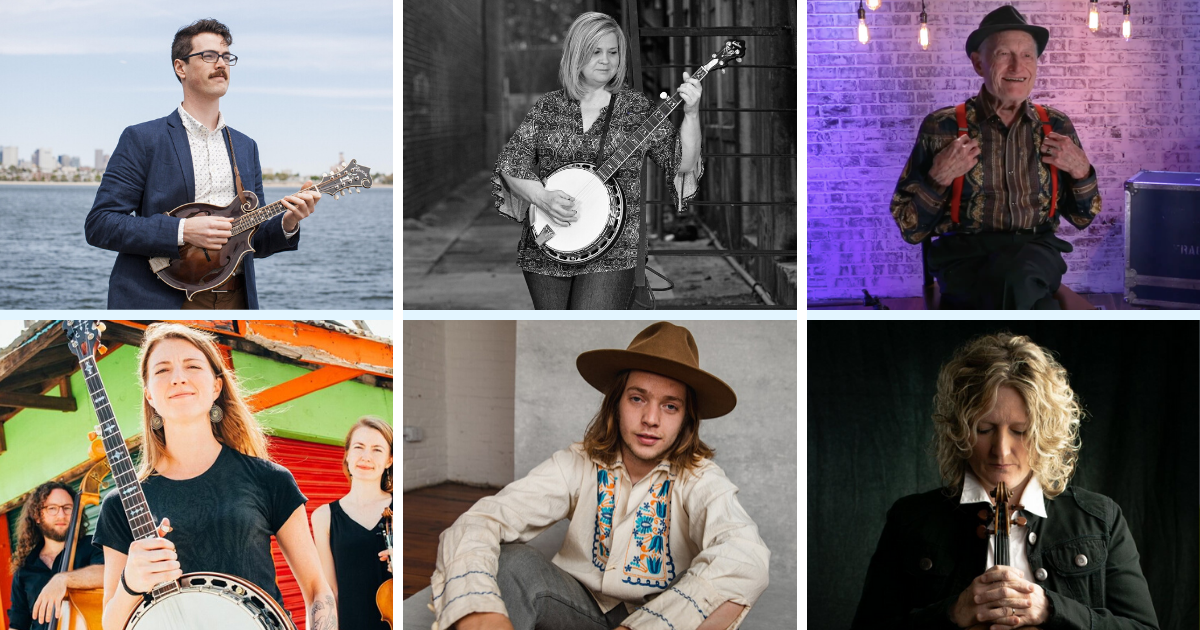
We debuted Tunesday Tuesday in January 2018 for a pretty simple reason. Roots music has a world-class stable of talented pickers, and unlike other more commercial genres, that talent is something of a prerequisite — especially in bluegrass! This short list-formatted Tunesday is a perfect long read/listen, and even though the IBMA Awards’ second-round ballot is now closed, you may need to do some studying for the final ballot still to come this summer! [Get listening]
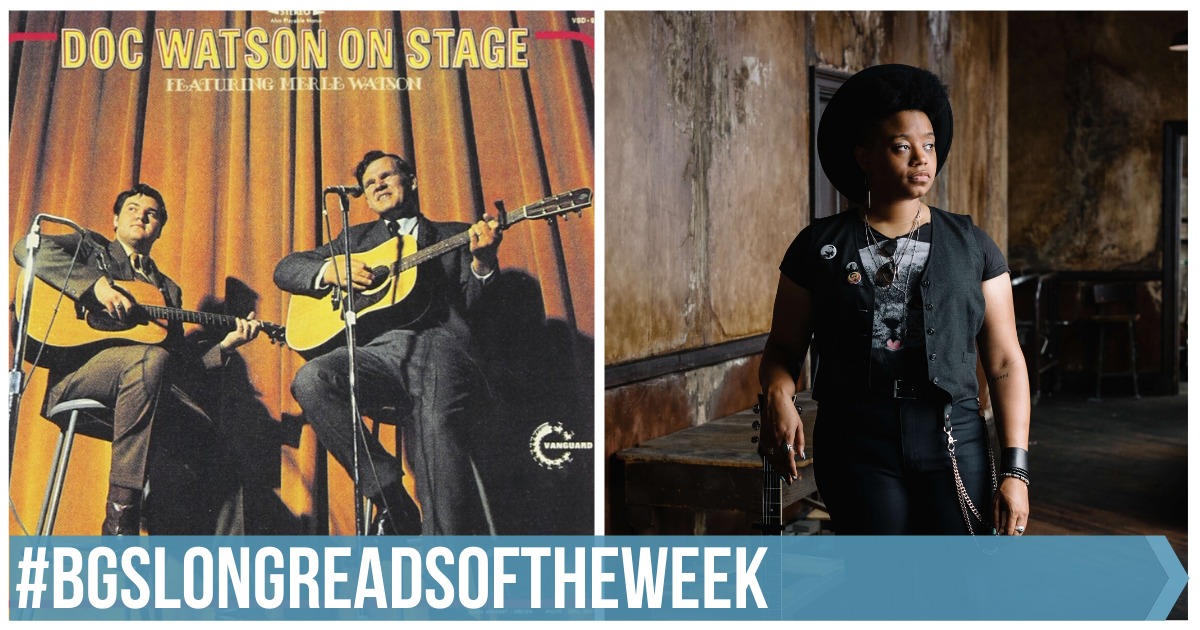
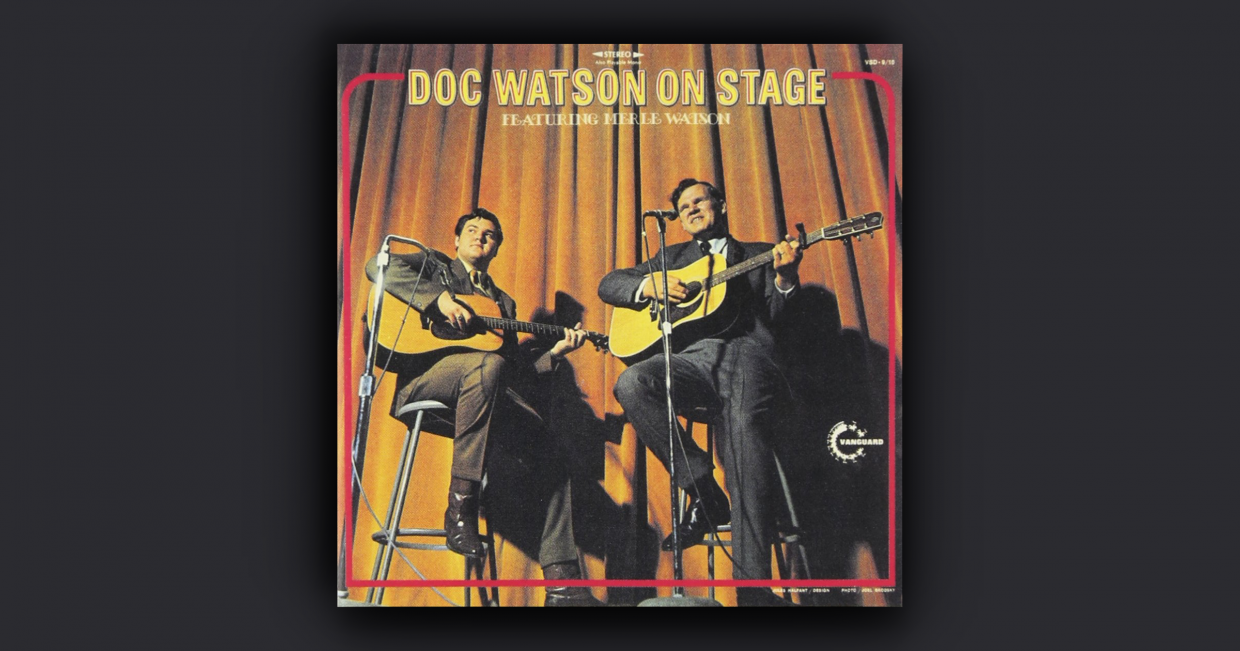
Anyone who ever had the extreme good fortune of seeing Doc Watson perform live can easily recount their favorite moments remembered from his time on stage. Lucky for any of us who can’t get enough of those memories, Watson put so many of them down on recordings and live tapes. Stroll a bit back through the catalog of those live performances with BGS. [Read more]
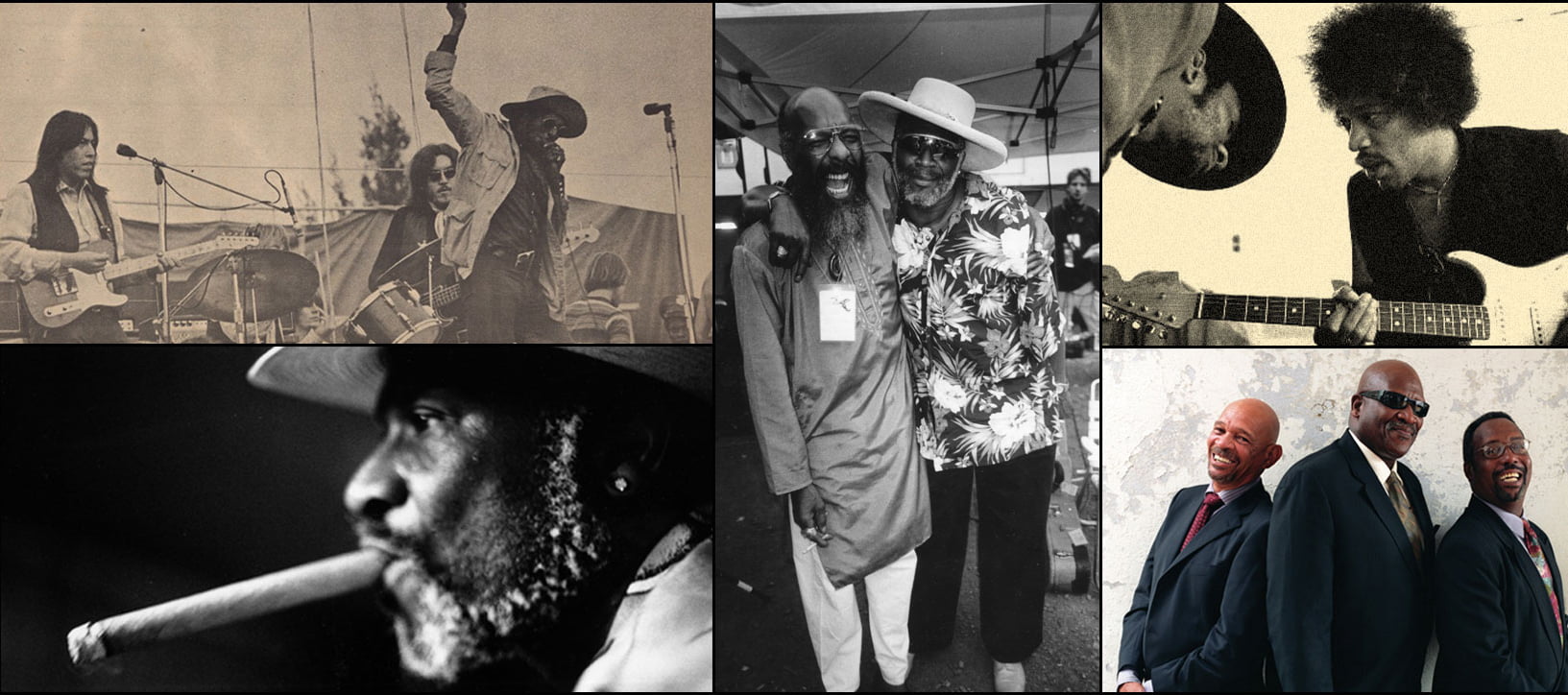
And he understands it! The wisdom and storytelling gifted to us by blues innovator and legend Taj Mahal in this 2016 interview is not only perfect for a long read pick, but it was perfect for a #ThrowbackThursday, too. The voices and perspectives of our elders are vital as we struggle for a more just future, and our musical elders have plenty of insight to pass on, as well. [Read the whole interview]
In a little over a week our friends at Bluegrass Pride will hold their online Pride festival, Porch Pride, featuring performances by queer artists, musicians, and bands and their allies — such as Jake Blount, Tatiana Hargreaves, Cathy Fink & Marcy Marxer, and Molly Tuttle. In advance of the event, we spoke to Bluegrass Pride’s Executive Director, Kara Kundert, and artist Amythyst Kiah about Pride, roots music, and what to expect from the festival. [Read more]
Photo of Amythyst Kiah: Anna Hedges
This website uses cookies to improve your experience. We'll assume you're ok with this, but you can opt-out if you wish.AcceptRejectRead More
Privacy & Cookies Policy
Privacy Overview
This website uses cookies to improve your experience while you navigate through the website. Out of these, the cookies that are categorized as necessary are stored on your browser as they are essential for the working of basic functionalities of the website. We also use third-party cookies that help us analyze and understand how you use this website. These cookies will be stored in your browser only with your consent. You also have the option to opt-out of these cookies. But opting out of some of these cookies may affect your browsing experience.
Necessary cookies are absolutely essential for the website to function properly. This category only includes cookies that ensures basic functionalities and security features of the website. These cookies do not store any personal information.
Any cookies that may not be particularly necessary for the website to function and is used specifically to collect user personal data via analytics, ads, other embedded contents are termed as non-necessary cookies. It is mandatory to procure user consent prior to running these cookies on your website.