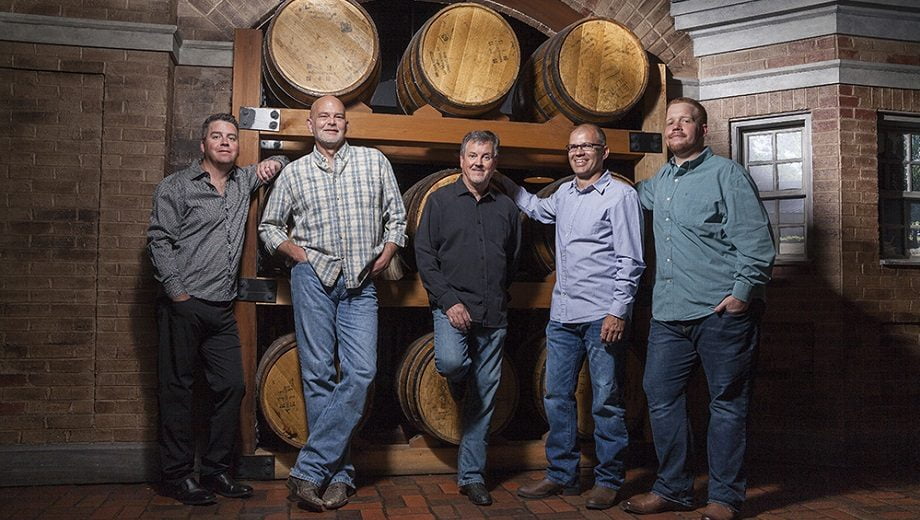
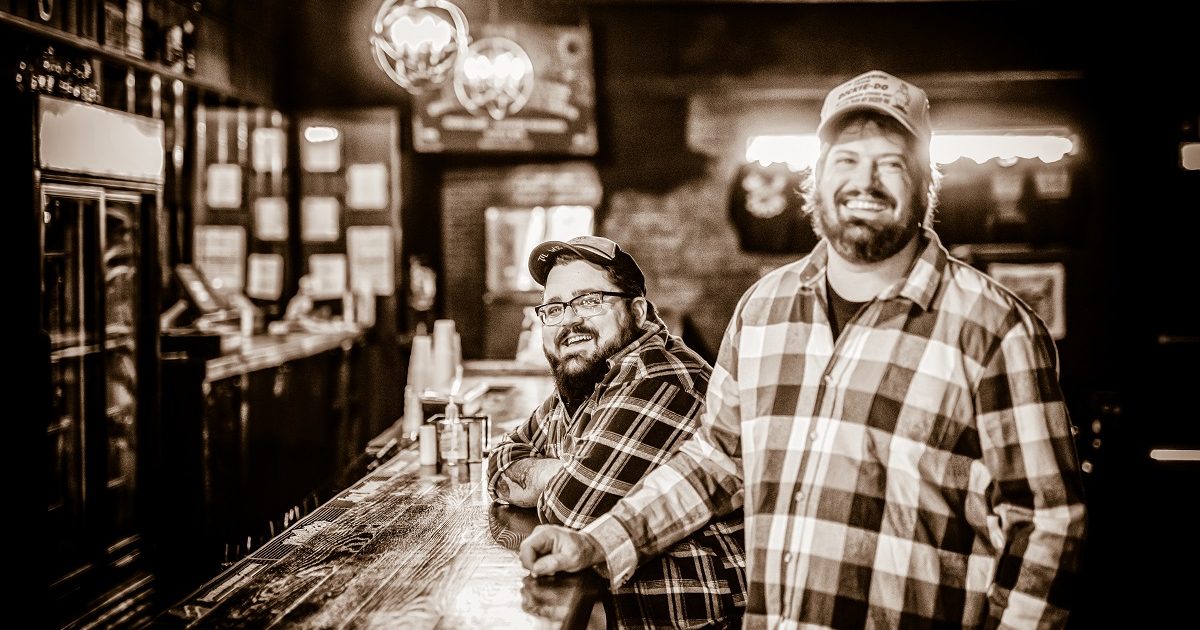
Artist:Lonesome River Band Hometown: Floyd, Virginia Song: “Love Songs” Release Date: February 19, 2021 Label: Mountain Home Music Company
In Their Words: “‘Love Songs’ is another great song written by our friend Adam Wright. It tells the story of a songwriter who has had bad experiences with love and can’t find ways to be positive about it. The lyrics depict the songwriter’s frustration: ‘They say write in what you know / And all I really know is the losin’ and the leavin and the left.’ Adam puts a comedic twist to selling sad songs, and Brandon Rickman, our guitarist and vocalist, portrays it in his unique way.” — Sammy Shelor, Lonesome River Band
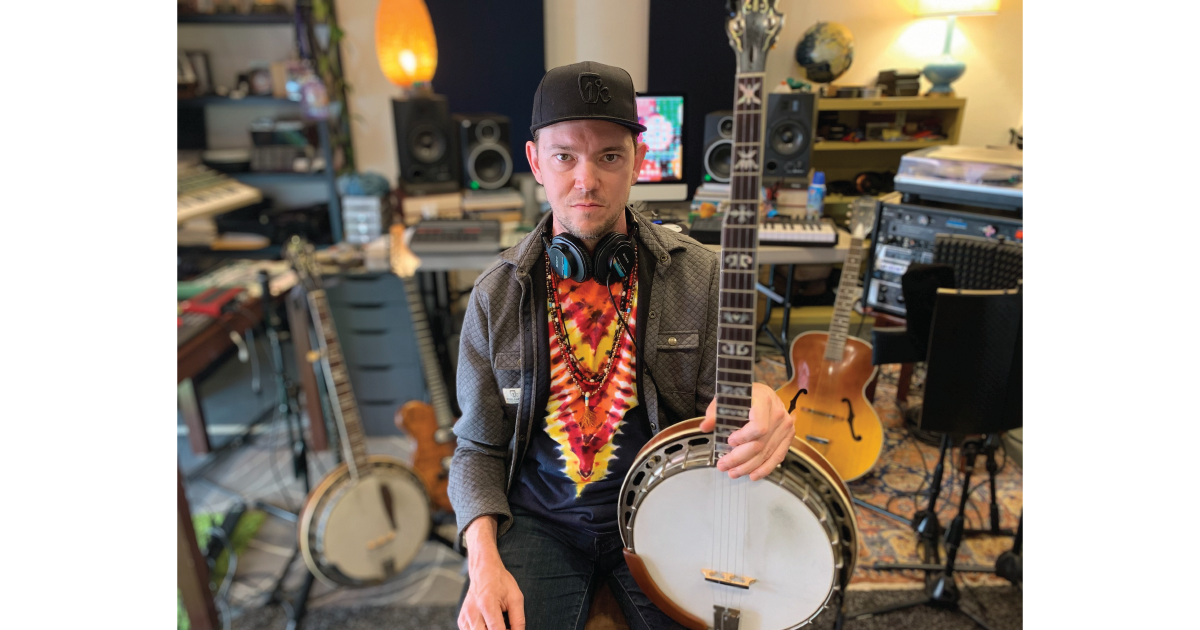
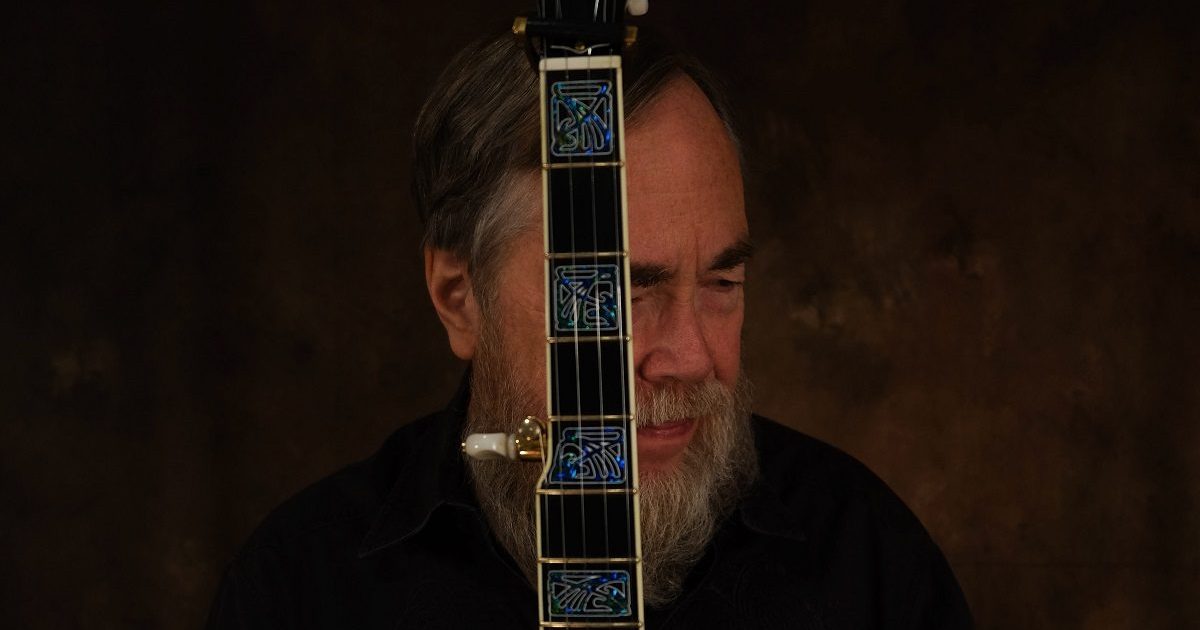
Artist:Chris Pandolfi Hometown: Golden, Colorado Latest Album:Trance Banjo Personal nicknames: Panda
Which artist has influenced you the most … and how?
From one perspective, this is a really tough question for me because there are many sides to my music, and many influences that have factored in really heavily at different periods. But from another perspective, it’s easy. I wouldn’t be playing the banjo if it wasn’t for Béla Fleck. I discovered the Flecktones in high school and was just blown away in every possible way. It was a moment of pure inspiration, and after a handful of shows all I wanted to do was learn how to play the banjo. That was the start of my journey as a musician, and none of that happens had I not discovered Béla’s music.
But his influence doesn’t end there. He’s a legendary improviser on the instrument, and that’s a big part of what the Stringdusters do. But maybe even more importantly, he’s made his mark by recontextualizing the banjo, combining it with so many eclectic sounds and bringing it to many new genres. That’s a big goal of mine as well, and that’s very much inspired by Béla. He didn’t leave too much undiscovered territory! But the bigger your imagination, the more territory there is to explore, and I love that challenge.
What’s your favorite memory from being on stage?
I have many great memories of being on stage, but the night that we played in Covington, Kentucky, in the summer of 2019 stands out. It was an electric show, and the moment we walked off stage we all sort of simultaneously decided that we had just made a live album. That has only happened a handful of times in our career, even though we have had many gratifying shows. But this was one of those stand out nights where something connected on a deeper level. It seemed like everything we did just hit the crowd with maximum power, and then they were feeding us with so much energy and emotion. That’s what can happen at a show. It can happen any night, even when a venue is not packed out, and that possibility is one of the great thrills of this career. On a night like that, everyone there is an equal participant in the performance. There’s no divide between the performers and the crowd, and the possibilities are endless.
What other art forms — literature, film, dance, painting, etc — inform your music?
I get inspiration from a lot of places, but books and visual art are high on that list. I love artists and writers who surprise you. It may not inspire a specific melody or song, but it definitely stokes the idea inside me that anything is possible, and with imagination and creativity you can always find new paths to travel. Lately, I have really enjoyed the work of Clyfford Still. Still was an American, abstract painter whos work is bold and stunning. There’s a beautiful museum dedicated to his work here in Denver, and it turned me into a big fan.
I also love reading science fiction, mainly because the imagination factor of good sci-fi is off the charts. I read a trilogy of books in recent years called The Three Body Problem by a Chinese author named Cixin Liu that blew my mind. The story is gripping and endlessly creative. Two song titles on my new record, Trance Banjo, are references to that trilogy, both from the second book, Dark Forest, which is my favorite. Great art of any kind transports you to a place that feels very free, where there’s no strong sense of self. I get a lot of inspiration from that feeling.
What rituals do you have, either in the studio or before a show?
Playing music is one challenge, but performing is a whole other hill to climb. When I am getting ready to play live or record, I always try to spend some time with my instrument (15-45 minutes or so) playing really mindfully and getting in the zone. That zone of being deeply focused on the music has seemed like a mystery at points in my career, and will forever be elusive in some way. But there is also something methodical about it, and that’s where practice comes in. When I practice I spend some time focusing on more mechanical elements, a new technique, transcribing or that sort of thing. But ultimately, I want to devote a good chunk of every practice session to building that zone. A good practice session should be like a meditation. The more time you can log in that focused zone, the more you know what it feels like and the easier it will be to conjure up in a performance setting. It’s a lifelong journey, and it certainly keeps you humble! But it’s not magic, it just takes practice.
If you had to write a mission statement for your career, what would it be?
I think my most consistent goal is to sound like myself as a player, and craft music that is unique as a producer. Bluegrass is the banjo’s native territory, and a common goal among proficient bluegrass players is to study and copy the styles of the early masters. For banjo players, that’s Earl Scruggs, and I would give anything to sound like Earl! There is so much great knowledge there, and so much expression as well. It’s a bedrock element of the instrument that practically every great player has a deep knowledge of.
While I have spent much time working on the fundamentals of Earl’s style, that is more of a starting point for me, and not an end-game. There are times on stage when I really try to emulate that older sound. But when it comes to crafting my own style and my own music, I try to use those old school bluegrass rudiments — timing, power, tone — but then add my own voice as well. The same goes for producing. It’s all about identifying and connecting with sounds that move you, and then using your imagination to grow from there and utilize those tools to bring your own vision to life.
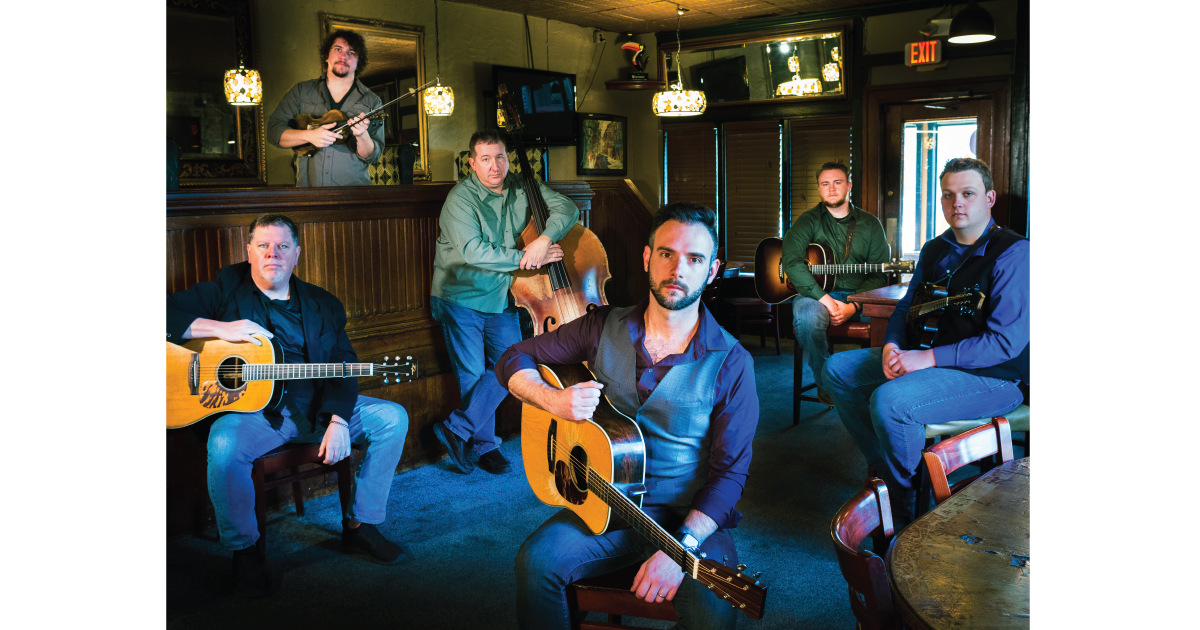
Artist:Sideline Hometown: Raleigh, North Carolina Song: “Just a Guy in a Bar” Label: Mountain Home Music Company
In Their Words: “In both recording and performing this song, we knew needed something special in terms of visual representation. The story speaks for itself, but capturing the emotion and weight of the story required more than just musically performing it on camera. We put our heads together and found a way to play the whole story out, piece by piece. It was a lot of fun working with actors and professionally creative minds that knew exactly what to do to suck the viewer in. It gives an already strong, deep song so much more dimension.” — Skip Cherryholmes
I first heard the music of Etta Baker on a record in 1957. Not until thirty years later did I see her perform live, in the context of a bluegrass-oriented event, on September 26, 1987 at Gardner-Webb College’s Second Annual Earl Scruggs Music Celebration.
Gardner-Webb (G-W) is in Boiling Springs, N.C., an hour’s drive south of Baker’s Morganton home and a few miles southwest of Shelby. Scruggs’ birthplace, Flint Hill, is close by.
In 1986 G-W awarded Scruggs an honorary doctorate. Ill health kept him from attending that Celebration, but his long-time friend John Hartford came and led a seminar about him and performed at a concert honoring him. UNC folklorists taped the proceedings. Their recordings are available online at UNC’s Southern Folklife Collection.
After the success of the 1986 program a committee, chaired by G-W English professor Dr. Joyce Brown and including Shelby journalist and G-W grad Joe DePriest, began planning the 1987 celebration. They received assistance, a grant, from the Folklife Section of the N.C. Arts Council.
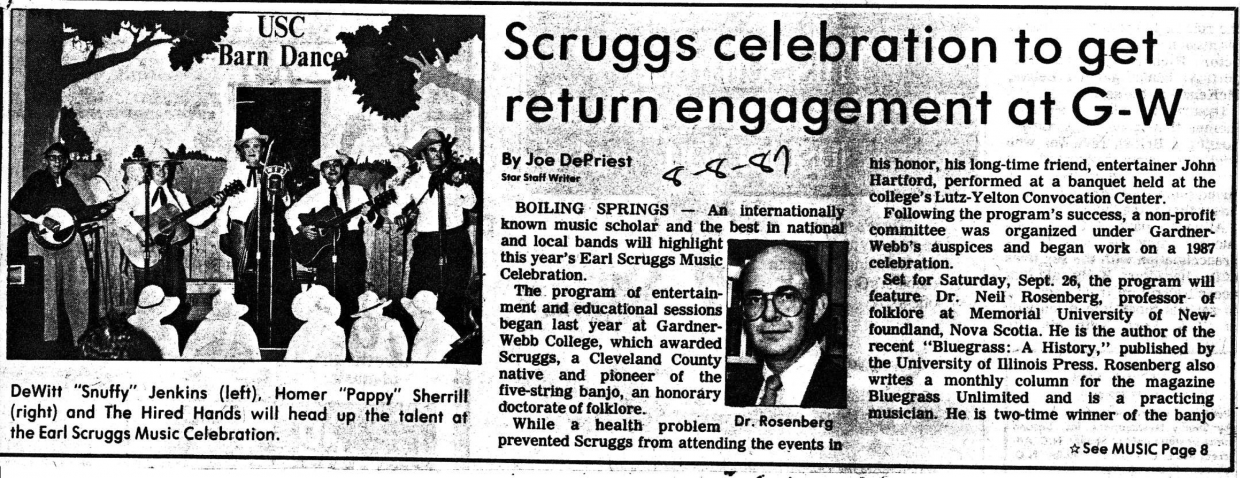
In August, a headline appeared on the front page of the Shelby Star: “Scruggs Celebration to get return engagement at G-W.” An article by DePriest quoted Brown: “We hope to make this an annual event — the most significant bluegrass event in the country. This is the logical place to center a recognition of our musical heritage.” DePriest added: “The program is not limited to bluegrass but will also focus on pre-bluegrass string music along with Afro-American contributions.”
The article described an action-packed day of music, with a morning concert-workshop by Etta Baker; an appearance by Riverbend Grass, the band in which Earl’s brother Horace played guitar; an afternoon of performances by six bands with Snuffy Jenkins, Pappy Sherrill and The Hired Hands opening; and afternoon workshops “on the history of bluegrass, its early radio days, and the Scruggs contributions.” In the evening was a concert by a popular new Nashville-based group, the Doug Dillard Band.
A scan of the first portions of the Earl Scruggs Celebration announcement from the Shelby ‘Star.’
By then Professor Brown had invited me to participate in the Celebration. My name and picture ran with DePriest’s article next to that of Jenkins, Sherrill, and The Hired Hands, who were slated to “head up the talent” of the Celebration. Touted as “an internationally known music scholar,” I was to conduct the workshop on bluegrass history with Jenkins and Sherrill.
I had never been to North Carolina, a formative location for the bluegrass business I began writing about in the ’60s. In 1974 the Country Music Foundation published my illustrated Bill Monroe discography, and in 1981 I began a regular column in Bluegrass Unlimited, “Thirty Years Ago This Month.” Since 1985, when my second book, Bluegrass: A History, was published, I’d been giving public lectures on bluegrass history.
My early bluegrass experience began in the late ’50s as a musician in the Midwest and northern California. Most of the history I wrote about came to me through research. I’d read Billboard from the early ’40s onward, eagerly followed the writing of people like Bill Vernon and Pete Kuykendall in fan magazines, and interviewed key figures.
I first heard of G-W in the early ’80s during one of those interviews. I asked Flatt & Scruggs manager Louise Scruggs when their first bluegrass college concert took place. She paused: “Gardner-Webb, maybe?” But she was tentative, particularly since she didn’t think it would be easy to document — she hadn’t started managing Lester and Earl until 1956. Not until my 1987 trip to Boiling Springs did I learn the full story of Flatt and Scruggs playing the first college bluegrass concert — I’ll say more about that later.
In 1976, when I wrote about my research on folk and country music in Canada’s Maritime provinces, I opened by saying “I attended many events, taking notes in my omnipresent 3 ½ x 5″ notebooks. As soon afterward as possible, a description of the event was written up in a diary-like journal.” Throughout my visit to Boiling Springs I had a notebook in my pocket. Soon after returning home I wrote a detailed diary of the six-day trip based on my notes. Direct quotes (in italics) follow.
Leaving Wednesday September 23rd, I was met at the Raleigh-Durham airport by Dan Patterson, head of UNC’s Folklore Curriculum. The next afternoon I gave a public lecture hosted by the Curriculum: “Reality and Revival in Bluegrass.” After my talk I was introduced to Tom Hanchett who, with his wife Carol Sawyer, was to drive me to Boiling Springs. We made plans for an early start the next day. Here’s what I wrote in my diary:
Tom Hanchett is in his late twenties, grew up in the Blue Ridge of Virginia and in upstate New York. Went to school at Cornell, was introduced to bluegrass by Country Cooking (Trischka, Wernick, etc.), and plays a bit of old-time fiddle. Had, until about five months ago, been working with the Charlotte (N.C.) Mecklenburg Historic Properties Commission as a historian. He had organized “The Charlotte Country Music Story,” a series of concerts there which recognized the town as an early historic center for recording and broadcasting of country music. And he is now working on a Ph.D. in southern urban history at UNC. His wife, Carol Sawyer, is a curator in a Museum of Technological history.
Tom charted our trip from Chapel Hill, in the northeastern Piedmont, to Boiling Springs, in the southwest, with a route that reflected the interest in local history and historic preservation that made him a perfect guide for our trip.
Tom had warned me beforehand that he was not an interstate man, so we followed a route that paralleled the old main railroad line (The Southern) that still runs from Washington to New Orleans.
Near Asheboro we stopped to visit Mac Whatley, mayor of Franklinville. He took us on a tour of this historic textile-mill region. I noted:
Whatley drove us out of town to the North and West, following Deep River, the source of textile mill power. We located the birthplace of Charlie Poole and looked at it from the road. There was a big “no trespassing, keep out” sign there.
We continued on toward Charlotte.
Somewhere along here we were passed by a new Toyota 4-wheel drive pickup with a yellow and black bumper sticker that read “Ralph Stanley for President.”
>We were truly in bluegrass country, I thought. Stopping for lunch and errands in Charlotte, Tom pointed out the hotel where RCA Victor had recorded the Monroe Brothers and many others during the thirties.
We reached the Shelby Star office in the early afternoon and met Joe DePriest, who gave us a quick introduction to the local cultural landscape. A leisurely drive took us to the Cleveland County Historical Museum (lots of famous people there, mainly mill owners), the graveyard, and past the old Lily Mills building in the neighborhood where Earl Scruggs lived while working there. Heading south towards Boiling Springs, we drove past Flint Hill Church. Joe promised Horace would give us a tour of this neighborhood, where Earl grew up, later.
At G-W, I met Dr. Brown, who showed me my room and filled me in on the evening’s itinerary. A group of us involved in tomorrow’s event would be getting acquainted over dinner at Kelly’s Steakhouse, just across the South Carolina line near Blacksburg. At 5:30 we all met outside G-W’s Dover Library to drive there. Here I met Horace Scruggs and his wife Maida. I wrote in my diary:
Earl’s older brother Horace turned out to be a very friendly and easy-going person, not as shy and quiet as Earl, though with (not surprisingly) a very similar voice and accent. His wife, Maida (pronounced May-Ida), is also very friendly. Horace is retired, he worked as a maintenance man for Gardner-Webb and later for the city of Boiling Springs. He is on the Earl Scruggs celebration committee.
Joe and I rode with the Scruggses that night. We both asked questions. I made notes during our drive and dinner. I began by mentioning that Louise had told me Flatt & Scruggs had once played at G-W.
I asked about that and Horace said, yes, they did, that he thought it was when they were working out of Bristol (May 1948 to March 1949, according to my calculations), around 1950. It was a spur of the moment thing, in midweek, and there was not much advertising and not a full house. The crowd was a mixture of townspeople and local students.
Over dinner I asked him a bit about his own musical career.
… he didn’t try music because he didn’t think he could make a living at it. He married in 1941 and went into the army soon after that. His father played clawhammer banjo, and he remembers being awakened in the morning by the sound of his father’s banjo. His father would build a fire in the stove and then play the banjo. Earl and Horace would come in and sit on his knees while he played.
He told me about running the farm after his father died in 1930:
They grew cotton — a crop was 3 bales a year, which they sold at 36 cents a pound (bale is 500 lbs, so that works out to $540.00 a year). They grew corn for feed and meal. Had a mule and a buggy which was originally rubber tired but eventually they ran it on the rims.
He was Earl’s first guitar accompanist, so I asked him if people thought Earl was special as a musician back then.
He said yes, they did, people would come by the house to hear him pick, etc. And when he was still quite young, they entered a banjo contest and Earl beat Snuffy Jenkins. Of course, as Horace was quick to point out, part of this had to do with his age, the youngsters have an advantage in those contests where audience applause decides the issue.
Earl and his mother moved into Shelby when Horace went into the Army, and Earl went to work at Lily Mills.
Earl had been turned down for the draft because he had a nervous stomach. He worked long hours for the mill but later on in the war he would take time off to play music at various places, and, as Horace recalls, was repeatedly lectured by his boss for wasting his time playing the banjo when he should be working to better himself at the mill. His mother was, Horace said, not happy either about Earl’s musical career and just as he was dropping us off at the Library, he told us that his mother had made a prediction which came true that he, Horace, had never told Earl: she said when he left to play professionally that “when I die, he won’t be able to come to my funeral.” And this happened — Earl and Louise were in an accident rushing to her bedside, she died while they were in hospital recovering.
After dinner Horace spoke of Earl’s adventures on the road:
He told me that Earl roomed with Uncle Dave Macon when he traveled to shows with Monroe and the band, and that Uncle Dave always carried with him an old-fashioned doctor’s satchel in which he kept one of his own country hams. He slept on it, used it as a pillow. And he would take it into restaurants, have it sliced and fried for him.
Talk turned to local foodways and Maida and Horace told us about livermush.
This local delicacy consists of hog’s liver and lean hog meat ground and fried, with corn meal, salt and pepper added to taste (some people add a lot of pepper, the seasoning is very personalized); left to harden, it is then sliced and fried. They said Earl eats it, and other natives crave it. It’s found on a north/south line from Blacksburg north to the Virginia border. One native son who now lives in Oregon has a special metal suitcase which he fills with frozen livermush and flies it home with him on yearly visits. It is served at the Snack Shop in Boiling Springs, which is where Earl and Lester and the boys used to stop for meals when travelling though this neck of the woods. Joe remembers seeing the bus there when he was a student, it was no big deal at the time.
As I walked home with Tom and Carol after dinner I proposed that we go for breakfast in the morning to the Snack Shop and see about getting livermush.
They thought I was overenthusiastic I think but they agreed to go.
Welcome to the BGS Radio Hour! Since 2017, the show has been a weekly recap of all the great music, new and old, featured on BGS. This week we’ve got new releases from so many amazing artists on the roots scene today, from Luke Combs to Langhorne Slim to Sierra Hull! Remember to check back every Monday for a new episode of the BGS Radio Hour.
Luke Combs, of country radio stardom, teams up with bluegrass-favorite Billy Strings this week for a new single. “The Great Divide” was written by the duo for Combs’s bluegrass album, one that he hasn’t completed yet. However, both artists agreed that the time to release this song was now, attempting to shine a light of hope in this tough time.
Singer/frontwoman of the Birds of Chicago, Montréal-based Allison Russell brings this Sade cover to the show this week. What she calls an “endlessly expansive and inclusive song of love,” this song brings comfort to Russell – as it does to us, as well.
Nashville-based Jaelee Roberts is one of the quickest rising stars in bluegrass music. Her first single on Mountain Home Music Company, an original song co-written with Theo MacMillan (of Theo and Brenna), brings big promises of more great music to come.
A 5+5 guest this week is none other than Jim Olsen, president of Massachusetts record label Signature Sounds. Celebrating 25 years of the label, and the so many great artists presented by it, Olsen brings us the Golden Age playlist – which includes this jam from Twisted Pine.
Kentucky-based Dale Ann Bradley brought us a new album this weekend! While you may remember her from former BGS Artist of the Month Sister Sadie – an all-female bluegrass supergroup – Bradley is stepping away from the band in 2021 to celebrate this new solo album, just one of so many in her extensive catalog.
“Glory Demon” comes from Brewers Dictionary of Phrase and Fable. “It means war,” Matheson tells BGS. But, this is an anti-war song from the Scottish artist, one about how we never learn and life just keeps endlessly repeating itself.
The Black Pumas are our February Artist of the Month here at BGS! You may recognize them from the Biden inauguration, where they performed this song from their 2019 self-titled album. Stayed tuned all month long, where we’ll be featuring exclusive content on the Black Pumas!
This week on The Show On The Road podcast brings us a conversation with Sean Scolnick – known mostly by his alter-ego, Langhorne Slim. Host Z. Lupetin caught up with Slim to talk about his new album, Strawberry Mansion, creative funk, mental health, and more.
From Snohomish, Washington, Hillary Grace Fretland (of FRETLAND) catches up with BGS this week on a 5+5 segment – that is 5 questions, 5 songs. We talked favorite memories from being on stage, influences, and songwriting techniques.
From her upcoming The Moon and the Stars: Prescriptions for Dreamers, Valerie June brings us this song that she dedicates to us all. Produced by June and Jack Splash – whose resume includes Kendrick Lamar, Alicia Keys, and John Legend – this album makes it clear to June why she makes music.
Nashville-based fiddler Mike Barnett brings us this Bill Monroe twist-up from his upcoming duets album, +1. The record was slated for a fall 2020 release, until Barnett suffered from an unexpected brain hemmorage. After multiple successful surgeries, he is doing well and recovering in extensive rehab where he is reconnecting his brain and fingers. So in listening to this piece of amazing music, let’s all send our best wishes to Mike Barnett and his family. You can support Mike Barnett’s recovery here.
From last year’s Whiskey Sour Happy Hour, this week we’re featuring Sierra Hull’s performance of this Sara Bareilles pop-hit. The Nashville-based singer and songwriter just released Weighted Mind (The Original Sessions), an EP made up of the demos for her 2016 release, Weighted Mind.
“Time traveled on a superhighway,” Chicago-based singer and songwriter tells BGS of the world before the pandemic, “but since March, we’ve all been in a traffic jam.” David McMillin of the group suggests that getting a break from all that movement is actually a good thing, however. This song is all about hitting that pause button.
The Jon Stickley Trio is one of the most exciting instrumental, “jamgrass” groups on the scene today. Made up of drums, flatpick guitar, and fiddle, they continue to push the boundaries of instrumental roots music, while being a festival favorite across the nation. This week, they bring us this new single on Organic Records.
At the end of the Show On The Road podcast episode with Langhorne, he graced us with a performance of this song, accompanied by his cat, Mr. Beautiful. What better way to end this week’s show?
Photos: (L to R) Allison Russell by Francesca Cepero; Sierra Hull by Gina Binkley; Valerie June by Renata Raksha
Artist:Tony Trischka Hometown:: Fair Lawn, New Jersey Album:Shall We Hope Release Date: January 29, 2021 Record Label: Shefa Records
Which artist has influenced you the most … and how?
Earl Scruggs. Pretty much a no-brainer for me. He changed my life when I was 14 years old. His playing is at the heart of everything I do. And on a larger scale, indirectly because of him, I have the wonderful family I have, have had a successful career and many friends around the world.
What was the first moment that you knew you wanted to be a musician?
I can’t say there was a moment like that. I first earned money playing music when I was 14, and continued to do so regularly through college. Though I was a Fine Arts major in school, and had very abstractly thought of a career as a museum curator (who was I kidding?).
What’s your favorite memory from being on stage?
In 1988, our band Skyline was invited to tour communist Czechoslovakia. Since my background is Czech on my father’s side, it was a particularly moving experience. While there, we performed in front of 30,000 people at the Porta Festival in Plzeň. We played a nighttime set and every second or third person in the audience was holding a candle, which made for an unbelievable sight. We were called for a second encore, and the emcee asked us to leave our instruments backstage and just walk to the front of the stage. As we were standing there facing this incredible candle-dappled crowd the emcee said, “You’ve given your gift of music to us, now we want to give you a gift.” He proceeded to divide the audience into thirds and had each third, of 10,000 each, sing a separate note of a major chord for us. Especially considering this was when Czechoslovakia was still communist, it was a profound experience.
If you had to write a mission statement for your career, what would it be?
Push boundaries and explore new areas on the 5-string banjo, but honor the history of the instrument. Don’t get bored.
Since food and music go so well together, what is your dream pairing of a meal and a musician?
Can I bring back Aaron Copland? On an emotional level he has had as much influence on me as Earl Scruggs. As for a meal, we’d have to start with a nice cocktail, and I guess it would have to be a Manhattan. Dinner would be hearty beef brisket with all the sides, and finish off with some good ol’ apple and cherry pie. I think that would cover all of the appropriate culinary bases.
Artist:Lindsay Lou Hometown: Nashville, Tennessee Songs: “Bell Suite” & “Alright Sweet” Album:The Suite Sweets Release Date: February 12, 2021 Label: Alright Sweet Records
In Their Words: “I wrote all the elements of The Suite Sweets during a time when I was practicing with a lot of Immersion Composition Society (ICS) writing lodges. I was dedicating hours to the practice of writing as uninhibitedly as possible, and sometimes I would come out with partial songs that I would go back later to finish. I noticed that there were common themes among them, so I decided to try a smash-up of the two songs that mentioned bells into one song, and a smash-up of the two songs that mentioned being alright into another song, and I was pleasantly surprised by the outcome. It seemed that the Suites had a sort of emergent property, which was greater than the sum of their parts. I made these particular tracks as demos, but loved the raw energy so much I knew I wanted to share them with the world when the time was right. There is the deep thread of my personal journey with mental health in ‘Alright Sweet’ and of the complexities of love in ‘Bell Suite,’ so I can’t imagine a better way to bring them to you than with the benefit show I’ve put together for Valentine’s Day weekend in support of Backline: a music industry-specific resource for mental health and well-being.” — Lindsay Lou
In the final chapter of Toy Heart’s three-part tribute to Tony Rice, host Tom Power speaks to several musicians who have been inspired by Tony Rice throughout their career, pickers and artists through whom Tony’s music will certainly live on.
On episode 3 of Toy Heart: Remembering Tony Rice, MacArthur “Genius” and Punch Brothers frontman Chris Thile tells a story about a jam with Tony Rice backstage that changed his musical life. Chris “Critter” Eldridge (pictured), also of the Punch Brothers, talks about the time he spent living with and learning from Tony — not just about music, but about life. Guitarist and singer-songwriter Molly Tuttle speaks about Rice’s influence on her guitar playing and how she sees his music living on even through musicians like herself, who never knew him personally. Finally, in-demand Nashville guitarist, session player, and sideman Bryan Sutton talks about recording with Tony and how he learned to be himself thanks to Tony Rice’s example.
Editor’s Note: Hear Thile at timestamp 01:58; Eldridge at 33:17; Tuttle at 01:03:17; and Sutton at 01:21:09
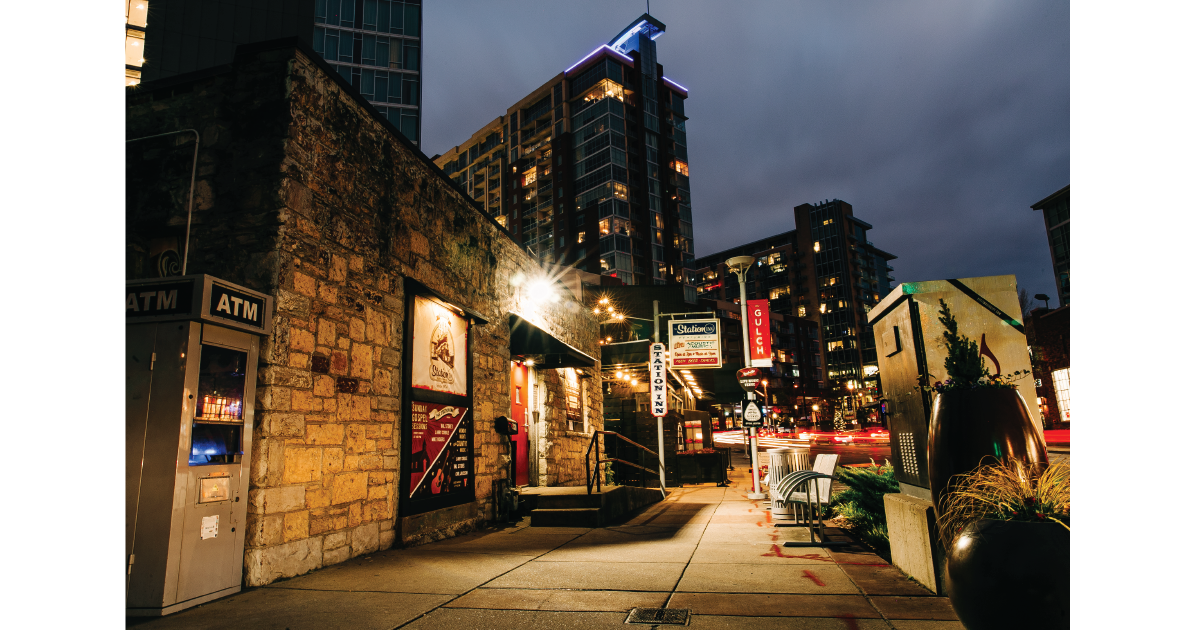
The humble appearance of the Station Inn could never give away the enormity of its legacy and importance to bluegrass music. Nestled between skyscrapers in an ever-growing city, a single story cinder-block building with its windows painted shut sticks out as a relic from the past — when the Urban Outfitters across the street used to be an empty field of waist-high grass.
For nearly 50 years “the World Famous” Station Inn has played a pivotal role in bluegrass as both a venue and community hub, drawing people to Nashville and making connections that had a major impact on the music. Through the rest of 2021, The Country Music Hall of Fame and Museum will honor and present the history and legacy of the venue in their exhibit The Station Inn: Bluegrass Beacon.
“The main reason that we wanted to do this exhibit is because the Station is such a vital and important part of not just Nashville music history, but of American music history,” says Peter Cooper, one of the curators of the new exhibit. The Station Inn has a larger-than-life reputation in the bluegrass community, but this new exhibit endeavors to highlight both the importance of the venue’s history and its welcoming atmosphere.
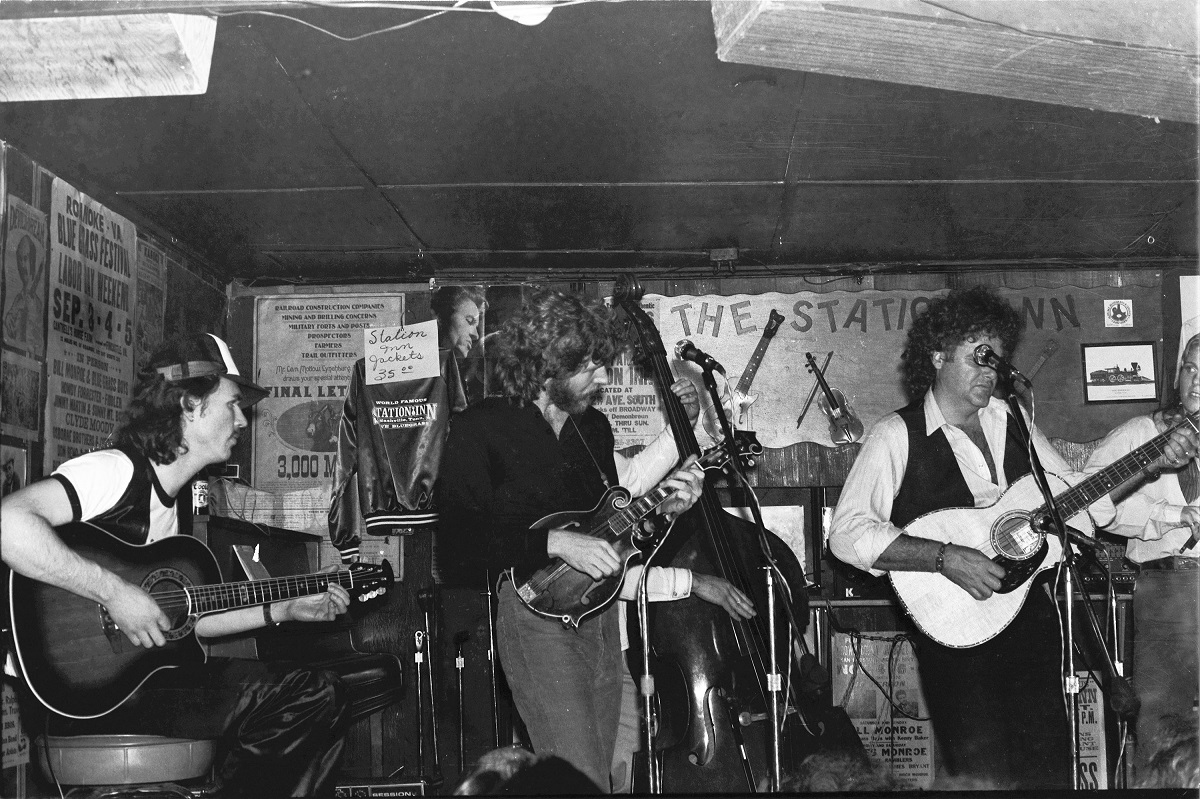
During the mid-1980s, adventurous singer-songwriter and musician Peter Rowan assembled all-star groups he dubbed “Crucial Country” for a series of shows that created a buzz amongst progressive roots music fans and players. In this photo, Rowan (right) is joined by Mark O’Connor on guitar and Sam Bush on mandolin. Photo: Charmaine Latham
It was founded in 1974 by a group of bluegrass musicians and singers — Bob and Ingrid Fowler, Marty and Charmaine Lanham, Jim Bornstein, and Red and Bird Lee Smith — who wanted to provide their fellow musicians and fans with a venue where they could play and hear bluegrass music. At that time the Station was more of a clubhouse where the owners functioned as the house band and guests would come up to jam. They moved to the current location in 1978; three years later, the club was bought by J.T. Gray, who at the time was driving Jimmy Martin’s tour bus.
Gray, who would go on to be inducted into the Bluegrass Hall of Fame in 2020 and was given a lifetime achievement award by the Southeast Regional Folk Alliance, began booking national touring acts to perform. It would be easy and accurate to show why the Inn is significant by pointing to the artists who have played there, including Bill Monroe, the Stanley Brothers, Vince Gill, Alison Krauss, and essentially any other important name in bluegrass. But the clubhouse atmosphere always remained. Countless (as in absolutely too many to count) threads of bluegrass history, both well-known and overlooked, can all be traced back to chance meetings at the Station Inn. J.T. Gray fostered a welcoming atmosphere that led to many locals and visitors from out of town to meet there, including mandolinist Mike Compton.
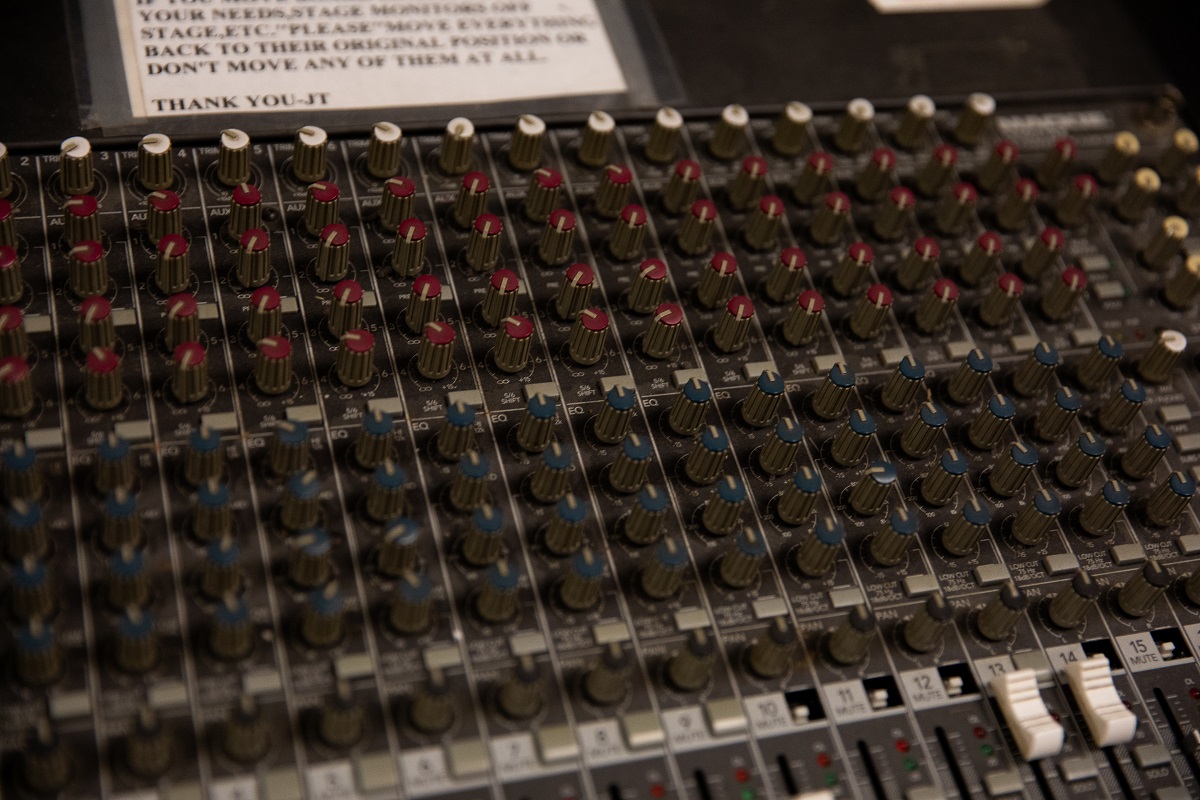
The venue’s sound-mixing console described by Gray as “the first piece of modern sound equipment we ever bought”
“I rode up [to Nashville] with Raymond Huffmaster, a bluegrass guy from Meridian, Mississippi, where I’m from, because I’d been hanging around him trying to learn how to play,” Compton says. They visited the bluegrass spots in town including the Station Inn, and Compton recalls after heading home, “Pat Enright got in touch with me and said they were starting a band and asked if I wanted to join. So I moved [to Nashville] in 1977 and moved in with J.T. Gray.”
Mike and Pat would continue playing together and later go on to form the legendary Nashville Bluegrass Band, which became a staple act at the Station Inn. A predecessor to that award-winning band was performing at the Station the first time future bluegrass star, Kathy Chiavola, came to town in 1979.
“When that door opened, the room was packed and I saw a vision of heaven,” she says, recalling that first night. “I heard these two voices, Alan [O’Bryant] and Pat [Enright], in their prime. And I lost it. I said, ‘OK. I’m moving here.’ There was a notice on the Station Inn bulletin board that a band of women playing bluegrass were looking for a roommate.” That band turned out to be the Bushwhackers, which featured bluegrass pioneers Susie Monick and Ginger Boatwright. Chiavola eventually joined the Bushwhackers playing bass and singing lead and harmony until Doug Dillard moved to Nashville. As the banjo player from the Dillards (who were famous for playing the Darlings on The Andy Griffith Show), Dillard put a band together and asked Ginger Boatwright to join, and about a year later asked Chiavola, too. Both the Bushwhackers and the Doug Dillard Band would frequently perform at the Station.
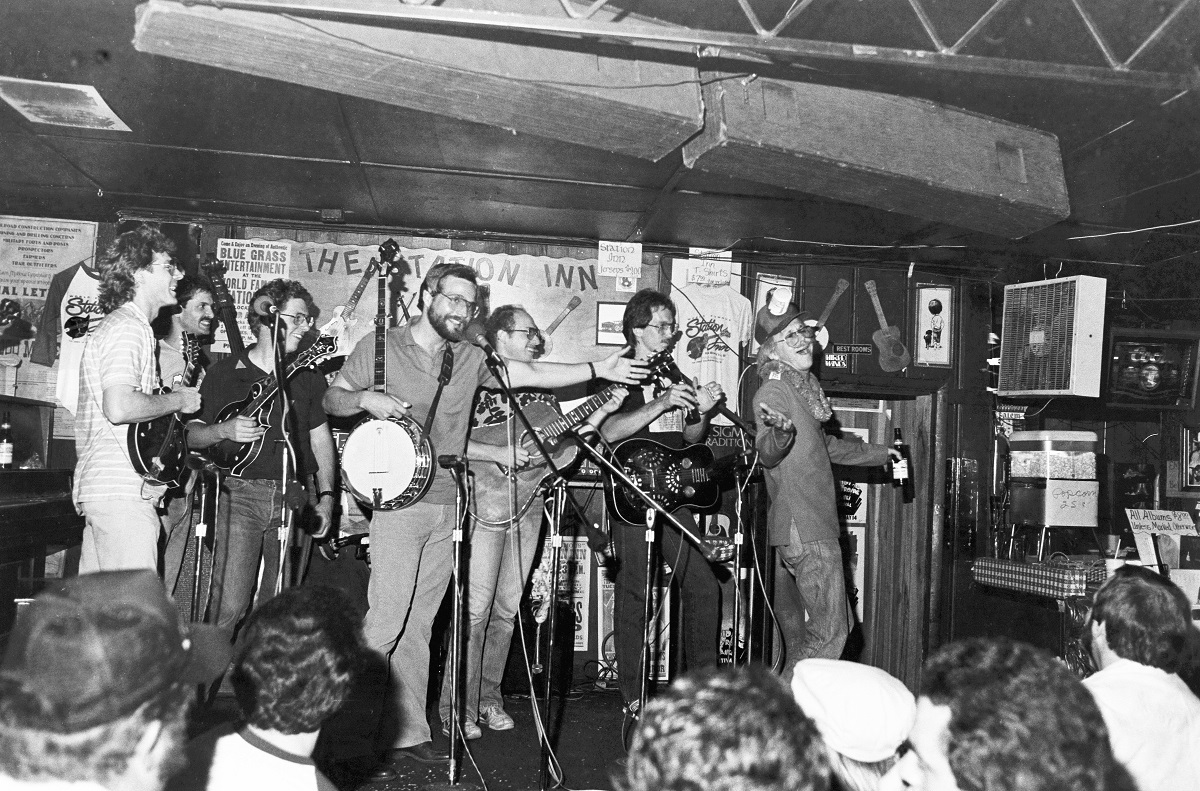
Vocalist, bones player, and madcap entertainer Ed Dye (far right) was a colorful presence at the Station Inn during the 1980s and early 90s. He assembled the Nashville Jug Band with a cast of stellar Nashville musicians from rock, jazz, and bluegrass backgrounds, and hosted wildly unpredictable shows. In this photo, he takes the stage with (from left): Sam Bush, Mark Schatz, Tim O’Brien, Alan O’Bryant, David Grier, and Jerry Douglas. Photo: Charmaine Lanham
Chiavola eventually moved into a duplex next to bluegrass bassist Mark Schatz. Together, they would often play the Station Inn with Charlie Cushman, Stuart Duncan, and Bobby Clark as part of a band called The Satellites. Other times, Chiavola would perform at the Inn with an ensemble called the Lucky Dogs which featured Jerry Douglas, Béla Fleck, Edgar Meyer (who had just moved to town), and sometimes Sam Bush or Mark O’Connor.
“It was beyond belief,” she says. “Sometimes I remember being on stage at the Station and listening to those guys play. I thought it was the most heavenly sound — I can’t even describe it to you. It was perfect music with so much feeling. You could hear a pin drop. It was so beautiful.”
Schatz, on the other hand, often performed at the Station with Mike Compton as part of John Hartford’s band. Hartford had moved back to Nashville to form a string band after a successful songwriting career in L.A. That California connection later landed him the contract to help with the music for the Coen Brothers’ massively successful O Brother, Where Art Thou? Compton’s 1927 Gibson A-Jr. model mandolin, which he played with the Nashville Bluegrass Band, in John Hartford’s string band, and on the O Brother soundtrack, is included in the new exhibit.
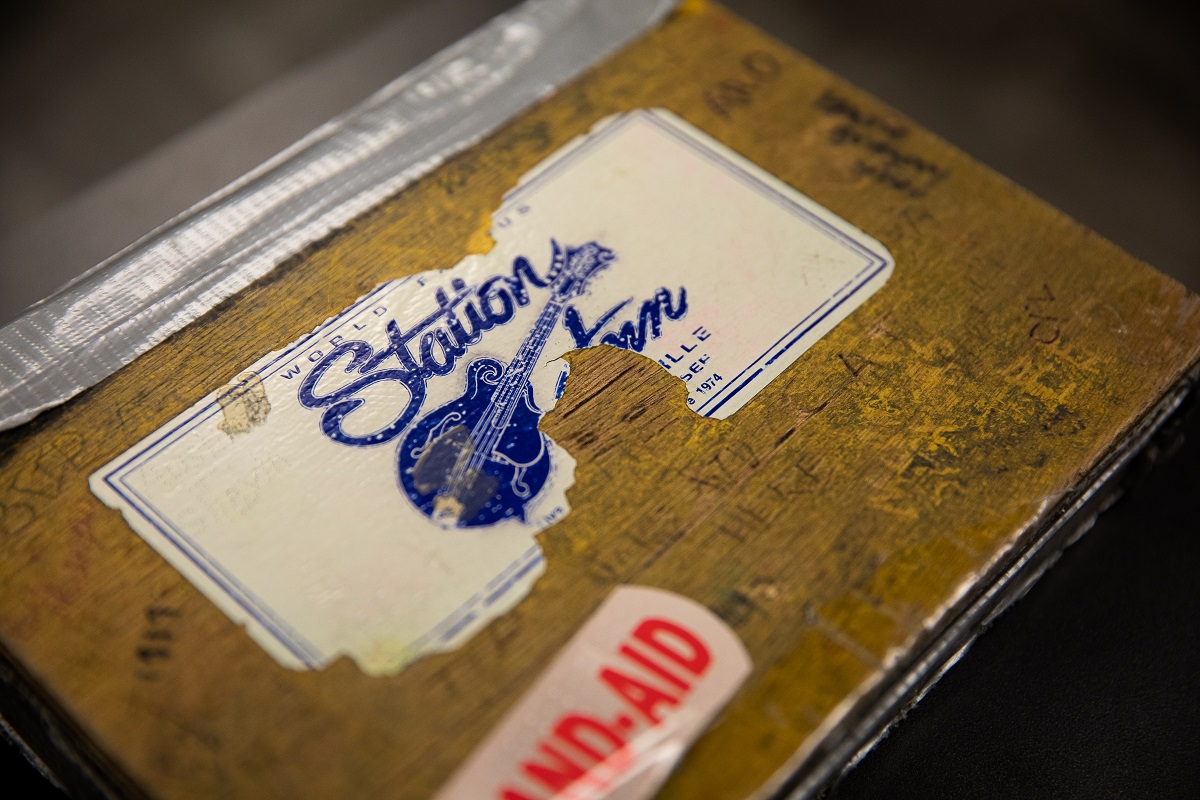
A cigar box used for many years to collect admission fees at the club entrance
Also on display is a small wooden box that was used to collect admission for years, along with some history about former Station Inn employee and local folk icon, Ann Soyars. “Ann embodied what the Station is about,” Cooper says. Soyars worked the door and was “small but fierce.” She was known to throw out rowdy college football players for being too loud, but also welcome regulars and newcomers alike. “Ann’s inclusion in the exhibit is indicative of what we’re trying to do, which is to help people understand not just the facts of the matter, but the spirit of the matter. The Station Inn is an example of musical community building in the most positive way. It’s like Cheers for ‘grassers.”
In addition, the exhibit features other artifacts from both the building and the musicians who have performed there including a fiddle played extensively by Tammy Rogers with the SteelDrivers, Mike Bub’s Kay M-1 double bass, which he played with many groups at The Station Inn — including Weary Hearts (Chris Jones, Butch Baldassari, Ron Block), the Del McCoury Band, and the Sidemen (Terry Eldridge, Jimmy Campbell, Ronnie McCoury, Gene Wooten, Ed Dye, Kristin Scott Benson, and Larry Perkins). Seats from a tour bus used by Lester Flatt, which serve as seating in the venue, are on view as well.
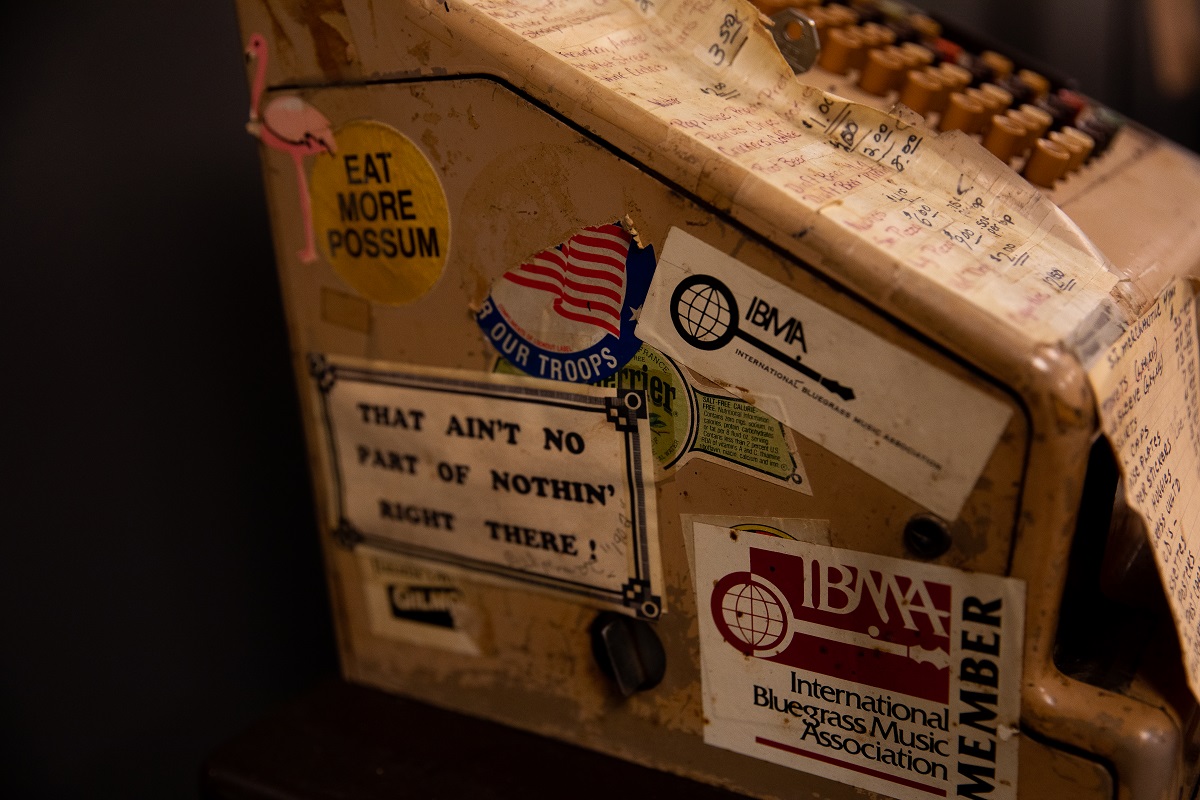
The Station Inn’s cash register
Generations of performers’ children have grown up in the Station’s green room and backstage and have gone on to perform on stage as adults. Newspaper has been put down on the bar to admire someone’s new puppies. Great care has been taken to lovingly craft the perfectly reheated pizza. Beers are shared by locals and honored guests after the doors are closed to the public. (And I have hidden fancy decaf coffee and a pour-over in the back that I take out when I visit.) To this day the Station Inn is a community gathering place where friendships, bands, and lifelong loves of bluegrass are formed. It embodies not only the authenticity of the music but of the community. And often, everyone knows your name.
Editor’s Notes: The Station Inn has endeavored to safely present live music throughout the pandemic. They have reopened to live audiences at a limited capacity and live stream performances through their web portal stationinntv.com.
The Country Music Hall of Fame and Museum will present The Station Inn: Bluegrass Beacon until January 2, 2022. The museum is currently open to the public at a limited capacity.
Photo of Station Inn and artifacts: Emma Delevante for the Country Music Hall of Fame and Museum Other photos: Charmaine Lanham
Artist:Tejon Street Corner Thieves Hometown: Colorado Springs, Colorado Song: “Deal Rag” Album:Stolen Goods Release Date: May 7, 2021 Label: Liars Club
In Their Words: “‘The Deal Rag’ had been a staple in our band since day one. It’s upbeat and fun as hell to play! It’s about when deals go wrong and you end up in a bad situation. Something we’re all too familiar with. We love the ragtime swing and the and the washboard solo rips. This is the first song we decided to put on Stolen Goods. It really sets the pace for the whole album.” — Connor O’Neal, Tejon Street Corner Thieves
Photo credit: Mountain Trout Photography
This website uses cookies to improve your experience. We'll assume you're ok with this, but you can opt-out if you wish.AcceptRejectRead More
Privacy & Cookies Policy
Privacy Overview
This website uses cookies to improve your experience while you navigate through the website. Out of these, the cookies that are categorized as necessary are stored on your browser as they are essential for the working of basic functionalities of the website. We also use third-party cookies that help us analyze and understand how you use this website. These cookies will be stored in your browser only with your consent. You also have the option to opt-out of these cookies. But opting out of some of these cookies may affect your browsing experience.
Necessary cookies are absolutely essential for the website to function properly. This category only includes cookies that ensures basic functionalities and security features of the website. These cookies do not store any personal information.
Any cookies that may not be particularly necessary for the website to function and is used specifically to collect user personal data via analytics, ads, other embedded contents are termed as non-necessary cookies. It is mandatory to procure user consent prior to running these cookies on your website.