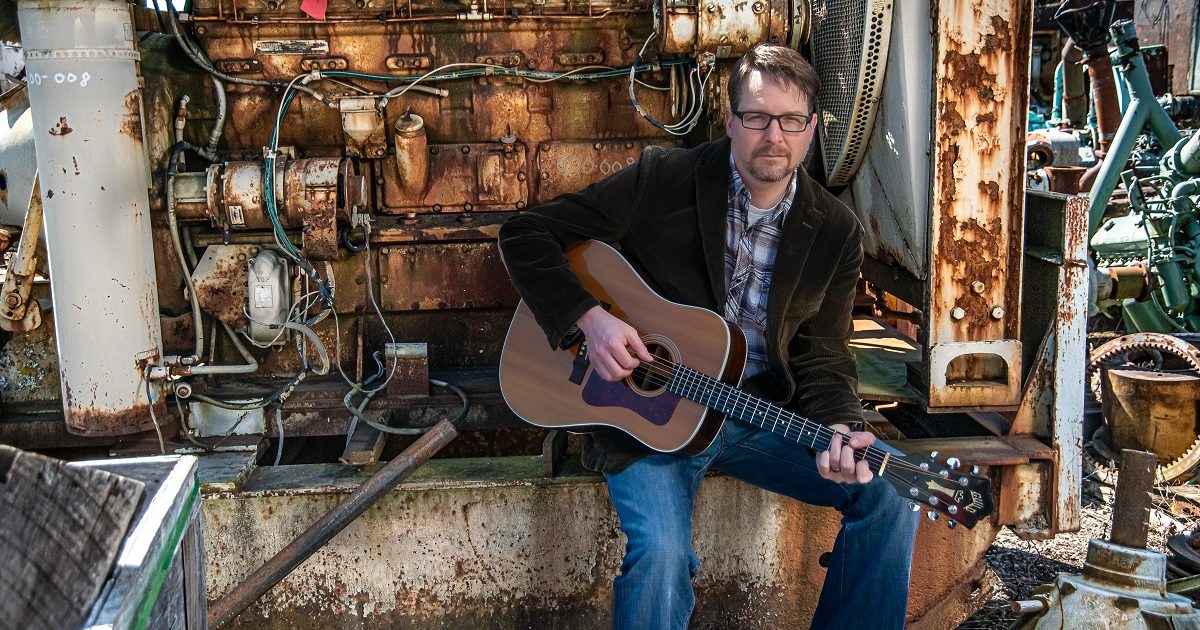
Artist:Stephen Flatt Hometown: Nashville, Tennessee Song: “White County Shine” Album:Cumberland Bones Release Date: April 16, 2021 Label: Flatt Family Music
In Their Words: “My grandparents and great-grandparents resided in White County, Tennessee, specifically Sparta. My great-uncle Lester Flatt and his family also lived in White County/Sparta, not far from my great-grandparents (his brother and sister-in-law). They were a close family and often worked odd jobs together, like working at the sawmill, before Lester struck out as a musician. I doubt Lester was involved in any of the moonshine activities that might have occurred on my side of the family tree, so I’d hate to drag his name into that. Lester was a staunch teetotaler, probably partly due to witnessing the effects of alcohol on friends and family members.
“Although ‘White County Shine’ is a semi-fictional account, it is a very real reflection of my family, my grandfather, the very real mountain moonshine culture, and the potential byproducts that come along with that dark spot of the mountain lifestyle. When the song says, ‘He lost all his money, but he never lost his high,’ that’s real and raw and it’s about my grandfather. I would venture to say that although the song is upbeat and jovial, it probably brings up some bad scars for my dad and my uncles when they hear it. I thought about this as really a generational thing, with generational impacts.
“I went camping with my cousin once on Bon Air Mountain, and he brought a jar of moonshine. When he woke up the next morning, he took a big pull off the shine and exclaimed, ‘You gotta have a shot before breakfast!’ Later, I wrote ‘White County Shine’ with the lyric ‘a shot before breakfast will always do you right’ in the chorus. This song features some of my friends and bluegrass greats, with Charlie Cushman on banjo, Deanie Richardson on fiddle, Justin Clark on mandolin, Steve Hinson on Dobro, Kenny Vaughan on the flattop, and Ronnie Bowman adding some amazing harmony. The song is a fun and entertaining romp!” – Stephen Flatt
Since our first excursion to Bonnaroo in 2013 BGS has been filming, crafting, and releasing Sitch Sessions with the absolute best and brightest musicians and artists in roots music. We’ve been so fortunate to work with new and old friends, freshly discovered and up-and-coming artists, and legendary performers with enormous legacies. After nearly eight years, we’ve amassed quite an archive of sessions, and within that archive more than a few stellar songs and performances have seemingly fallen to the wayside.
These 8 Sitch Sessions from the BGS archives are a few of our most favorite, underrated moments from our years of shooting sessions. We hope you’ll enjoy a few of these “reruns” — and take a deep dive into our past featured videos yourself!
Nathan Bowles – “Burnt Ends Rag”
One of our favorite shooting locations is a rooftop in downtown Los Angeles, where countless BGS Friends & Neighbors have taped their Sitch Sessions over the years. One of our favorites is this clawhammer banjo performance by Nathan Bowles, which demonstrates that old-time music and its trappings can be perfectly at home in modernity — and in urban settings, too. More banjos in DTLA, please and thank you!
Andrew Combs – “Firestarter”
One fine AmericanaFest week in Nashville in September a few years back we partnered with Crowell Floral, Jacob Blumberg, and Dan Knobler on The Silverstreak Sessions, a series of Sitch Sessions set in a vintage Airstream and flanked by gorgeous flowers and verdant foliage. At the time, “Firestarter” had not yet been released — now you can hear it on Combs’ 2019 release, Ideal Man. For this session all Combs needed was his guitar, this heartfelt song, and that honey sweet, aching voice.
Alice Gerrard – “Maybe This Time”
Every opportunity we’ve had to collaborate or speak with Bluegrass Hall of Famer and living legend Alice Gerrard, we’ve taken it! This session is two of a pair we shot with Gerrard, the other a stark, awe-inspiring a capella number that was quite popular on our channels. This Alice original, “Maybe This Time,” is cheerier, lighter, and has that charming old-time bounce in its bluegrass bones.
With a new documentary film available, You Gave Me a Song, perhaps it’s about time for another session with this hero of ours!
Ben Sollee – “Pretend”
Maybe you’ve seen Mark O’Connor play fiddle while skateboarding, or Rushad Eggleston performing all manner of acrobatics and avant garde silliness with his cello, but do you remember when Ben Sollee toured America by bicycle? In this 2016 session, Sollee demonstrates his cello-while-pedaling chops.
We’re firm believers that the world needs more bluegrass, old-time, and Americana cello and we’re happy to return to this archived Sitch Session for that reminder!
Caroline Spence – “Mint Condition”
Another session filmed on our home turf in Los Angeles, Nashville-based singer-songwriter Caroline Spence brought “Mint Condition” to her taping fresh off her debut, eponymous release on Rounder Records in 2019. “Mint Condition” displays Spence’s unique skill for writing strong, unassailable hooks that on almost any other songwriter’s page might trend cheesy or trite. Spence instead displays the simple profundity in her lyrics, a skill evidenced plainly in this session.
Laura Veirs – “July Flame”
Over the years, we’ve partnered with festivals, companies, and brands on tailor-made sessions — like our Portland series, where we partnered with our friends at Ear Trumpet Labs on some of our most popular, most viral Sitch Sessions ever! This beautiful, sunny, summery rendition of “July Flame” by Laura Veirs certainly deserves a re-up.
In 2016, after this session was published, Veirs went on to release case/lang/veirs with Neko Case and k.d. lang. Remember that!?
Kelsey Waldon – “Powderfinger”
We first filmed a Sitch Session with Kentuckian country singer and songwriter Kelsey Waldon in 2015 — after the release of her debut album, The Goldmine, in 2014. In the time that’s elapsed since, Waldon has followed her golden debut with two more impeccable studio albums, the latest being White Noise / White Lines, which was released on the late John Prine’s Oh Boy Records in 2019. On the tail of White Noise / White Lines, Waldon gave us this gorgeous cover of Neil Young’s “Powderfinger” displaying her talent for cover song interpretations as well as original song sculpting.
Sunny War – “He Is My Cell”
Guitarist and singer-songwriter Sunny War has just released a brand new album, Simple Syrup, as charming and entrancing as ever and built firmly, yet again, upon her unique and idiosyncratic guitar picking style. In 2018 she released With the Sun, an album that included “He Is My Cell,” which ended up featured in a Sitch Session in early 2019 on BGS.
War recently appeared as a guest on our Shout & Shine series – read our interview here.
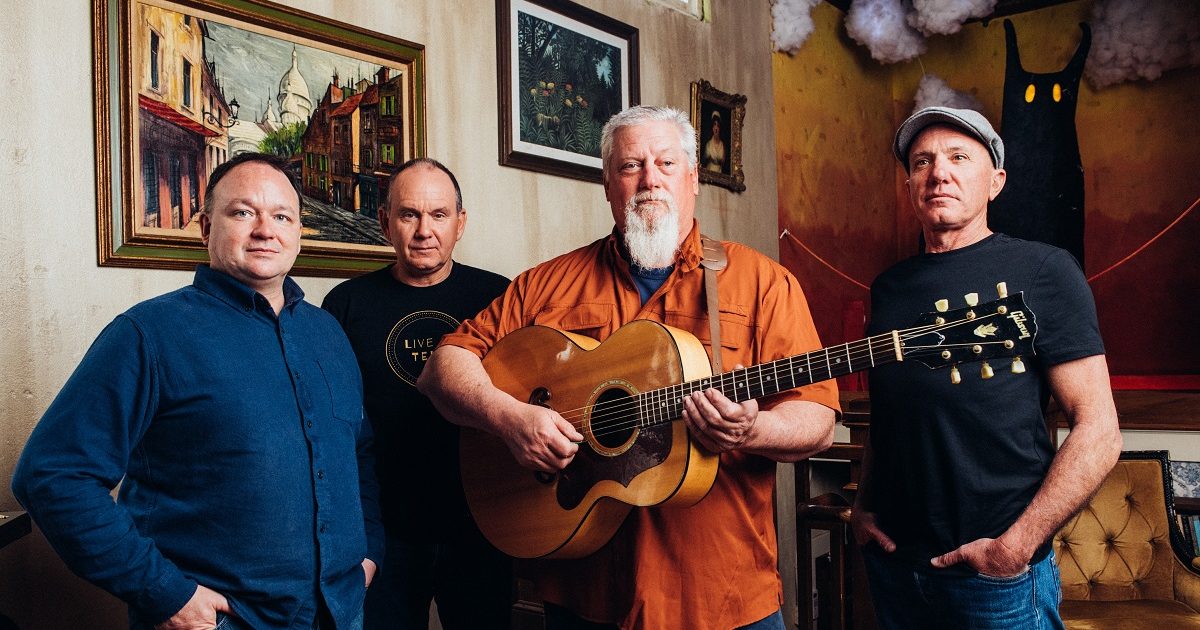
Artist:Acoustic Syndicate Hometown: Shelby, North Carolina Song: “Sunny” Release Date: April 9, 2021 Label: Organic Records
In Their Words: “‘Sunny’ is one of those things that’s been on my ‘list of things to finish’ for quite some time. Based on an idea for a short story that I was working on some years ago, it’s a discussion about love, coping with loss, hope, and ultimately, redemption. I’ve been carrying that melody around in my head for years and finally got lucky enough to find the right words to go with it. The tune was one that I was kinda holding in reserve for a possible solo project at some point. After putting it together and sharing with the other fellas, they were all in to record it. The piano (Brian Felix) and violin (Lyndsay Pruett) were part of the original idea, and it was such a pleasure to watch it materialize in the studio on a super solid track by Fitz, Bryon, and Jay. Being back in the studio after seven years has been a real treat. I love the process of recording, and I have missed it very much. Our engineer, Clay Miller, is a ‘steely eyed missile man’ and has the patience of Job! He makes the recording process an absolute joy. I’m so grateful and honored to be making new music with these dudes again.” — Steve McMurry, Acoustic Syndicate
Welcome to the BGS Radio Hour! Since 2017, the Radio Hour has been our weekly recap of all the great music, new and old, featured on the pages of BGS. This week, we’ve got music from CeeLo Green to Loretta Lynn! Remember to check back every week for a new episode.
Loretta Lynn’s original cut of this song made it to No. 1 on the charts in 1971. When Margo Price teamed up with Lynn to celebrate the latter’s 50th anniversary of “Coal Miner’s Daughter,” Price chose this song specifically, suggesting how legendary it was for Lynn to have sung about women’s rights and birth control in the country music of the ’70s. It’s still legendary today.
“Turn me loose, I’ll never be the same!” is a phrase that rodeo cowboys used to yell when they were ready – something Snider first heard from Jerry Jeff Walker, but fitting himself perfectly. He asked the cosmos to provide a rock to put is foot on, and so the story goes, the new album from Todd Snider: First Agnostic Church of Hope and Wonder.
From Grand Rapids, Michigan, DL Rossi brings us a song from his upcoming album, Lonesome Kind. It’s a kind of youthful innocence, warming up to the harsher realities of life. And while we can’t opt out of our hurtful experiences, as Rossi suggests, we can share them to encourage one another.
North Carolina-based singer and songwriter Aaron Burdett compiled this song by noting quotes that his friend Arlo would say, collecting them for over 10 years. Arlo isn’t necessarily the character in the song, Burdett says, but a character, someone who always has a bold thing to say.
CeeLo Green brings us a video for “Slow Down” from his latest album, CeeLo Green is… Thomas Calloway. From the writing of the song, to the recording and then making of the video, it was a completely expressive process for Green, who called it an “out of body experience.” Ironically titled, the song pulls the listener even closer into the climactic height of the record.
Driving through the rural Mojave, D-Napoleon passed a sign that read “Gasoline and Liquor.” While she knew it would be a song, she thought it sounded like a man’s song, one written via passing lines back and forth with her husband. The video reflects the landscape of the “Wild Wests” of both the American desert and Western Australia, the places between which this artist splits her time.
Danny Paisley is the current reigning prince of Baltimore-D.C.-area bluegrass, a scene with rich history dating back to the 1950s. This week, Paisley and his band the Southern Grass bring us a song from their upcoming release, Bluegrass Troubadour.
Aoife O’Donovan is no stranger here at BGS, or anywhere in the roots community for that matter! Her work with artists like Crooked Still, I’m With Her, and the Goat Rodeo Sessions proves why that is. This week on BGS, she teams up with Scottish artist Kris Drever to bring us a message that we’ll all be together again.
BGS caught up with Brigitte DeMeyer from San Francisco this week on a 5+5 – that is, 5 questions, 5 songs. We talked musical inspirations, songwriting techniques, and her mission statement: being herself.
For Boston-based Will Orchard, this song is about trusting impulses, and the constant questioning of whether or not those feelings are valid. Written on tour in two parts separated by almost year, Orchard was able to combine them with the perspective of time, earning a place on his newly released album, I Reached My Hand Out.
Helena Rose wrote this song while struggling to tell a loved one how she felt about their addiction. Rose offers this song to others who have loved ones battling addiction, giving hope to the struggle, and showing that there is a light at the end of the tunnel.
As March has slipped away and we welcome April, we bid farewell to our March Artist of the Month, Valerie June. This song comes from her latest album, The Moon and the Stars: Prescriptions for Dreamers.
In celebration of his latest album, A Celebration, we caught up with the Bones of J.R. Jones for a 5+5, talking about performance memories, art forms, and songwriting techniques. Jones’ curated playlist brings us everything from Nina Simone to Bruce Springsteen to the White Stripes.
The pandemic was hard on us all, no doubt, but for Wales-based John Smith, it just kept bringing the punches. Trying to make sense of it all, Smith brings us The Fray, his latest album in a 15-year career, teaming up with artists and friends like Sarah Jarosz and Bill Frisell.
Photos: (L to R) Margo Price by Bobbi Rich; Aoife O’Donovan by Rich Gilligan; Todd Snider by Stacie Huckeba
In the wake of his 2020 Streaming Strings tour, Billy Strings shared clips from the tour’s various performance nights across multiple Nashville venues. This particular release is a special one, as Sierra Hull joined Billy and the band for a feature at the Brooklyn Bowl. The song? Bluegrass staple, “Circles” by Post Malone. Or at least they make it seem as if “Circles” was always a bluegrass tune.
In this cooler-than-life cover, Strings sees beyond the gap that divides bluegrass and pop music, connecting his affinity for the spacey to Post Malone’s contemplative vibe. On paper, it seems like a very unusual comparison, but a deeper look might reveal that the mood of Malone’s recording of “Circles” is similar in many ways to the moods of “While I’m Waiting Here” or “Away from the Mire” by Strings. With Malone’s recent country covers going semi-viral (plus rumors of a country double album and social media evidence of a developing friendship between him and Strings), the combination actually makes a lot of sense – besides just being damn cool.
In concert, Billy, his band, and Sierra Hull are able to pull “Circles” off with conviction.
Photo credits: Billy Strings by Emma Delevante; Sierra Hull by Gina Binkley.
My diary for Saturday September 26, 1987 — Earl Scruggs Celebration day at Gardner-Webb College in Boiling Springs, North Carolina — begins with an entry on foodways:
I meet Tom (Hanchett) and Carol (Sawyer) at 7:30 and we walk to the Snack Shop. As Joe had predicted the night before there were lots of pickups outside and quite a few people inside having breakfast. I asked the waitress for livermush and she told me they didn’t have it, that sometimes they did but today they were out of it. It wasn’t on the menu.
After breakfast we walked over to G-W’s Dover Library, Celebration headquarters. Horace Scruggs was there.
Outside Horace took me over to meet his banjo player, and he asked me to play a tune or two. I did “Cumberland Gap” and some other simple tune. The picker then played a lot of fancy stuff and told me about his two banjos.
Inside, people were setting up displays in preparation for the 10:00 opening. It was part museum, part market.
… various people were doing crafts; [an] instrument maker was there with his wife, who played guitar, and his young son (maybe 10) who was a good Scruggs-style banjo picker and played non-stop all afternoon long. They were selling cassettes of him.
Horace had brought in two banjos which Earl had loaned him to be displayed at the Celebration. One was a new Gibson Earl Scruggs model, and the other was the old banjo which had belonged to their father and which Earl had had repaired back in the fifties in Nashville.
Later, Tom would be installing storyboards about the connection between country music and the textiles industry in the Piedmont.
After Horace had set up his display Joe suggested he take us on a tour of the area where the Scruggses grew up. So, Tom, Carol, Joe, and I set out in Horace’s Fury.
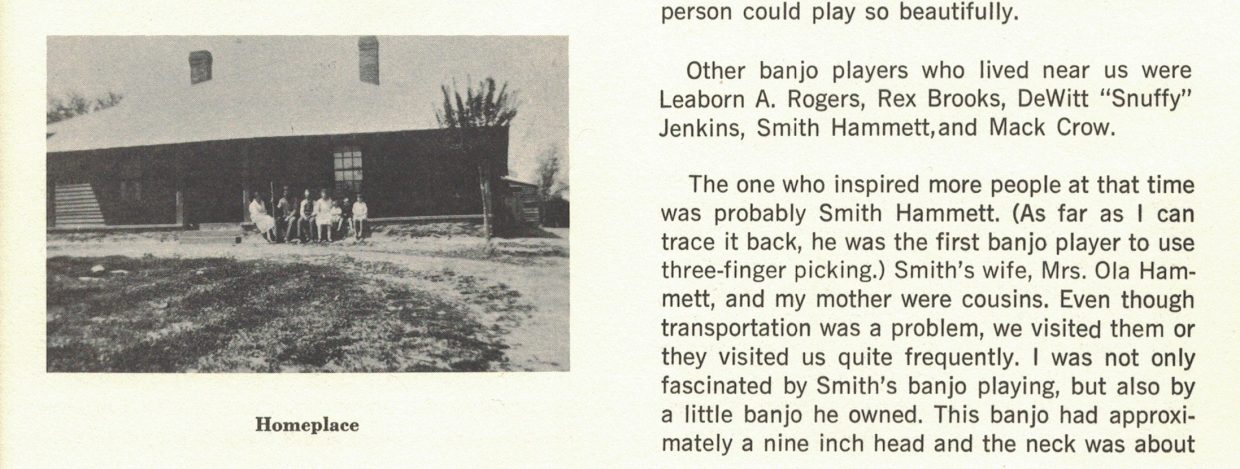
‘Earl Scruggs and the 5-String Banjo’ page 147 shows the Scruggs homeplace
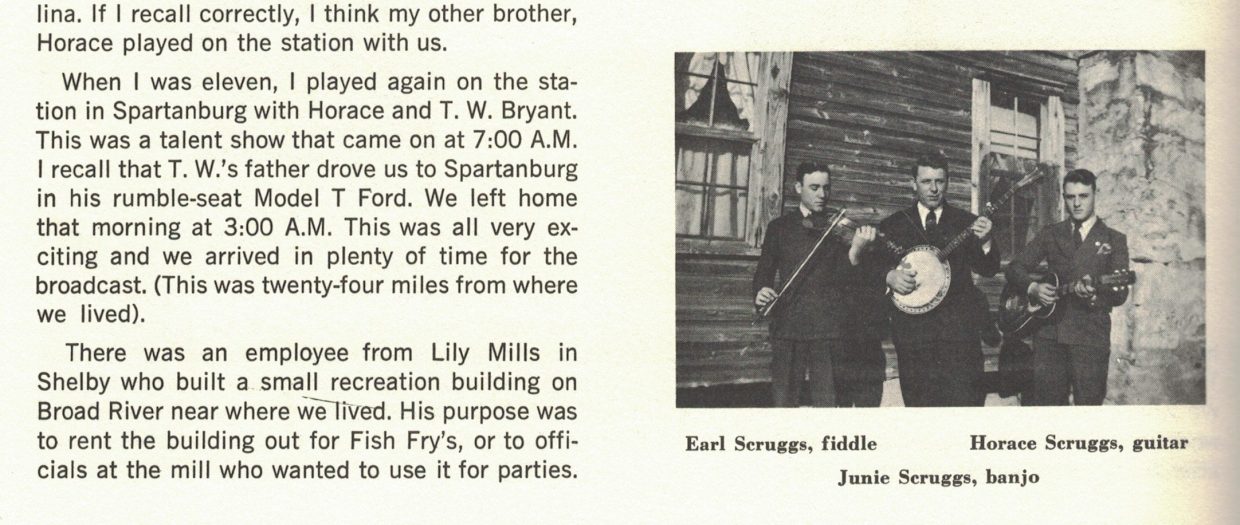
He took us past the Flint Hill Church, their birthplace (depicted in the above photo from p. 147 of Earl Scruggs and the Five-String Banjo), and the house they’d moved to after their father’s death in 1930 (seen below, from p. 150).
The house has the same chimney as in the picture, but the upper part has been rebuilt with brick. A “beware dogs & keep out” sign was posted. Horace said that the family had decided to get rid of the house, but he wished they had kept it. This is the house he and Earl would walk around when practicing time — they would start a tune and each would walk in a different direction playing softly, to see if they could keep their time so they would be together when they met at the back. The right front room, visible from the road, was the one Earl went in when he figured out how to use the third finger in his banjo style.
‘Earl Scruggs and the 5-String Banjo’ page 150 shows three Scruggs brothers, posing in front of their home
Then Horace took us down to the nearby Broad River to point out the site of Earl’s first professional gig, Ollie Moore’s fish camp.
At 10:00 the Celebration began out in front of the Library. Inoted: A beautiful sunny day which was to get up into the low 80s by the feel of it. The president opened the festivities and then Horace and his bandmates in Riverbend performed a few songs.
At last night’s dinner I’d gotten to know a couple from Raleigh, Margaret and Wayne Martin.
Both were old-time musicians. In 1984 they’d joined with two others to found PineCone, the Piedmont Council of Traditional Music, “an organization that would help support traditional roots artists and present their music to the public in a professional and respectful manner.”
An experienced teacher and performer, Margaret was scheduled to workshop with Etta Baker. This was one of the high points of the Celebration.
At 10:30 Margaret Martin set up with Mrs. Etta Baker in the Library lobby and did an hour-long workshop which was very nice. Mrs. B. played banjo some of the time, showing how her daddy picked 2-finger style; then she played the guitar, a D-18 with a built-in pickup, and did her “hits” like “Railroad Bill” and “John Henry” and also some nice Piedmont-style blues like, she said, her sons played. She was low-key but relaxed and effective as a performer, and Martin ran a good workshop, assisting musically but not getting in the way.
In the middle of this Snuffy Jenkins, Pappy Sherrill and the Hired Hands arrived and were standing at the back of the crowd in the lobby. I had a good talk with both of them, trying to give some idea of what I wanted on the workshop.
Banjoist Jenkins and fiddler Sherrill began their careers in the ’30s playing a blend of old-time and country. Snuffy played 3-finger style even before Earl, who acknowledged his influence. Still active after nearly fifty years, they were living history. They’d watched bluegrass develop. What could they say about that? Also, I was particularly interested in having them demonstrate the kind of shows they’d done in their early years — the radio pitches and Snuffy’s baggy-pants comedy.
Unfortunately, Snuffy hadn’t brought along his rig for the full comedy routine but they said they would do some comedy.
I pursued a bit of tune research, wondering about a tune Earl Scruggs had played in his 1945 audition for Monroe. I’d heard that Earl learned it from Snuffy.
I asked Snuffy about “Dear Old Dixie,” which he did play. He told me he learned from a Rutherford County fiddle band, the Barrett Brothers — a group they always beat in contests, he said.
It was noon; Carol and Tom and I took a lunch break. As the afternoon began:
We sat out on the campus green, a broad sloping lawn with a stage at the lower end, and listened to Snuffy Jenkins and Pappy Sherrill along with their band.
The Hired Hands, all younger South Carolinians, included guitarist Harold Lucas; his son Randy, who played banjo and guitar; and Frank Hartley on bass. After a 10-song set, a young guest, Philip Jenkins, was introduced. Philip’s father Hoke was Snuffy’s nephew, a good banjoist who’d recorded with Jim & Jesse in the early ’50s. Philip, playing his dad’s fancy old Gibson, did “Train 45” and “Sally Goodin.”
Snuffy closed out the show by bringing out his “confounded contraption,” a washboard fitted with cowbell, frying pan, wooden block, and an old bicycle horn, on which he played rhythm with eight sewing thimbles as Pappy fiddled “Chicken Reel” and “Alabama Jubilee.”
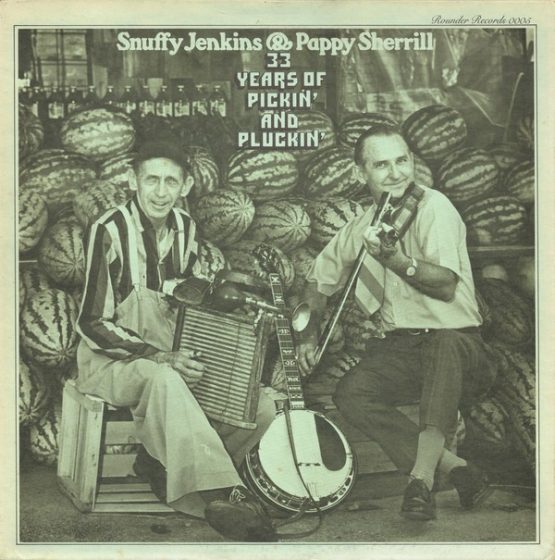
Snuffy Jenkins & Pappy Sherrill on the cover of their Rounder release, ’33 Years of Pickin’ and Pluckin”
Other bands followed. I wandered around at the back of the crowd, taking in the music from different perspectives and meeting fans. Around two I went back to my room, picked up the tape recorder and headed for the seminar room in the library where the workshop was to be held.
I used the recorder, a Sony Walkman Pro cassette machine with an external mike and a C90 cassette, to record the workshop. What follows is based on a table of contents drafted soon after the event. The tape itself, like most of my research materials, is now in Memorial’s archives, out of reach at the moment.
We began at 3:00 with an introduction by Dr. Brown and a speech of welcome from G-W’s Vice President for Academic Affairs. The band opened up with their theme tune, the old fiddle tune “Twinkle Little Star.” Dr. Brown introduced me and I began in emcee style to introduce the band, a leisurely process involving a bit of humor and local place names. Although this was a workshop, Pappy and Snuffy treated it as a show, offering comic relief and virtuoso instrumentals at regular intervals.
I spoke briefly about the band as living history, mentioning that Pat Ahrens, a writer from Columbia, South Carolina, their base of operations, had written a nice little book about them, with photos, and a discography.
I told how the word “bluegrass” had taken on a musical meaning following Earl Scruggs’ years with Bill Monroe and his Blue Grass Boys, and then asked Snuffy to talk about his early history. It was a question he’d been asked before. He and Homer were prepared. Their response was pretty much like the one on this YouTube clip, recorded in 1988 at the Tennessee Banjo Institute:
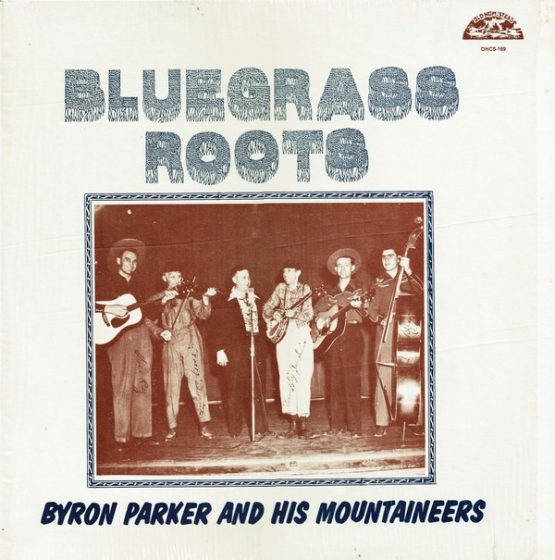
In 1939 Jenkins and Sherrill came together at a radio station in Columbia, South Carolina, as members of the WIS Hillbillies, a band led by Byron Parker, formerly the Monroe Brothers’ emcee and bass singer. Byron Parker and His Mountaineers, a lineup that included Pappy and Snuffy.
Their regular radio shows enabled them to make the bookings that sustained their early career at the small rural schools dotting the countryside around Columbia. Sponsored on the radio by Crazy Water Crystals, a laxative, they recorded 16 tunes and songs — eight 78s — for RCA Victor in 1940 as Byron Parker and His Mountaineers, with fiddle, guitars, mandolin, banjo and Parker’s bass vocal on the hymns. Their broad repertoire included “Up Jumped The Devil” on which Snuffy took banjo breaks which today sound very bluegrassy:
After Parker’s death in 1948, Pappy and Snuffy took over the band and changed the name to The Hired Hands.
Pappy Sherrill was the band’s emcee. He told the history of the band, calling their records “old timey stuff, no extra notes.” Many of their songs and tunes would find their way into bluegrass repertoires. I asked Homer for an example; he played “Carroll County Blues,” the fiddle classic from Mississippians Narmour and Smith that they’d recorded in 1940:
After demonstrating Snuffy’s banjo work, the band did several songs. Here’s how they sounded doing “Long Journey Home” in 1990:
On this song, Snuffy takes all the lead breaks and can also be seen playing clawhammer backup. Regrettably, Homer’s fiddle is in the background here; he usually played lead breaks. Randy Lucas brings in the fingerstyle guitar demonstrated earlier by in the day by Etta Baker. After they’d played four pieces, I posed a question to the band members — what’s the difference between old-time and bluegrass?
Lead singer Harold Lucas began with a joke: “there’s a fine line between old-time and not being able to play at all.” Then, referring to his son Randy, a master of new styles, he described the interplay between old and new generations.
Pappy spoke about growing up listening to the radio. To him, old-time is easier. Bluegrass is fast, with high-pitched singing — not the same. He stressed the importance of duets in old-time.
Randy said “it takes old fellows to play old-time music” and that he got his inspiration from Pappy & Snuffy — “they make music fun.”
As far as he was concerned, said Snuffy, “Ain’t no difference — slow and fast.” He joked about his own “mellow voice — over ripe, almost rotten.”
Returning to the question I’d posed, Pappy and Randy Lucas, now playing banjo, demonstrated the differences between old-time and bluegrass. Pappy fiddled the venerable “Leather Britches” as an example of old-time. Then Randy demonstrated bluegrass with a recent, fancy banjo piece, Don Reno’s “Dixie Breakdown.” Fluent in both styles, each took breaks on both tunes.
I asked about comedy. Pappy described the skits that were an integral part of the Hired Hands show. He said they had a writer, Billy F. Jones, who scripted their comedy pieces, making parts for each member of the band. They weren’t set up to do a skit today, but they did an old traditional musical comic dialogue that originated in 19th century theater, “Arkansas Traveler.” In 1960 the Stanley Brothers had a big record hit with a version that combined the traditional dialogue with new music, titled “How Far to Little Rock”:
Afterward Snuffy and Pappy spoke of their comedy work in the early years — making up, getting into costume, pratfalls, and so on.
Then, after Randy had played “There’s An Old Spinning Wheel in the Parlor” demonstrating his mastery of contemporary banjo styles, Snuffy responded to a request and brought out his “confounded contraption,” the washboard, to play along with Pappy on the popular fiddle favorite, “Down Yonder.” Here’s how Snuffy looked playing washboard on another fiddle favorite, “Alabama Jubilee,” at a festival in 1989:
Pappy reminded the audience that they had mostly played as small local schools with audiences all ages. Their show was for the whole family. “No smut.”
Nearing the end of the workshop, I called for questions. A number came in from the audience — asking about their sponsor, the history of Snuffy’s washboard, other touring bands, and their Columbia, South Carolina, base.
Finally, Pappy explained that their shows always included hymns; he had a box full of Stamps-Baxter and Vaughn gospel quartet songbooks, and taught the parts to the group from them. They were complex, responsorial. Here’s an example from their 1940 RCA sessions, “We Shall Rise,” with Byron Parker singing bass.
On this afternoon, Pappy closed with a simpler hymn, “What a Friend We Have in Jesus” played on the fiddle.
Afterwards he thanked the audience. I concluded with remarks about the band’s role in the change from old to new in folk traditions, and the transition from home and neighborhood to stage and radio.
Just before Dr. Brown formally ended the workshop, well-known local banjoist Dan X Padgett presented a gift — a hat — to Snuffy. I did not note what the hat looked like, and that detail has escaped my memory. But there’s more coming about Dan X Padgett and the rest of the Celebration in Part 3 of this memoir.
Artist:The Infamous Stringdusters Hometown: Denver, Colorado; Brevard, North Carolina; Sayville, New York Song: “My Sweet Blue Eyed Darling” Album:A Tribute to Bill Monroe Release Date: May 28, 2021 Label: Americana Vibes
In Their Words: “During the great pause of 2020, the only way to make music as the Stringdusters was to record remotely, since we’re all scattered around the country. We recently launched our label Americana Vibes, which has been a great vehicle for us to release all of our recorded music (Stringdusters and solo albums), as well as other artists we dig. One of the projects we thought would be fun to record was some OG bluegrass, so of course we turned to Bill Monroe. Without him, there would certainly be no Stringdusters. We each picked some of our favorites, including this one, ‘My Sweet Blue Eyed Darling,’ recorded our parts at home, and I mixed the record in my studio on Long Island to honor the Father of Bluegrass, Bill Monroe.” — Andy Falco, The Infamous Stringdusters
Artist:Sinner Friends (Grace van’t Hof and Conner Vlietstra) Hometown: Detroit, Michigan; Johnson City, Tennessee Song: “Unforgivable You” Album:Sinner Friends Miss You (The Quarantine EP) Release Date: April 1, 2021 Label: Bigtone Records
In Their Words: “When Sinner Friends cut bluegrass, we do it like our heroes did: everyone is in one space, there are no separate vocal tracks, we don’t overdub solos, and the result is a snapshot of one vital moment. Like Page Ross’ lyrics, ‘Unforgivable You’ is raw and compelling. It weaves the messy web of a breakup followed by a one-sided attempt at reconciliation which, by the end, has the listener questioning the boundaries of the narrator’s tenacity. It’s clear that our protagonist has turned antagonist and his love interest would “rather that [he] stay away.” Sentimentality swirled with confusing choices is Sinner Friends’ favorite flavor, and this song is a savory example. We were privileged to be joined on this session at Bigtone Records by Josiah Nelson on fiddle and Max Etling on bass.” — Grace van’t Hof and Conner Vlietstra, Sinner Friends
At the one-year mark of the pandemic drastically changing our daily lives, let’s take a minute to reflect. Sure, we’ve seen more livestreamed content than we ever cared to see, we’ve ordered more takeout than we deem reasonable, and we’ve had far fewer haircuts than we’d like to admit in the last 12 months. Live music has all but disappeared from our lives. Although the brilliant artists we love have found creative ways to connect with their audiences, fans haven’t been able to regularly engage in a person-to-person musical experience in some time. As we reflect on all these things that have come to pass, it is this author’s earnest and sincere hope that we also look forward.
The live music experience is gradually coming back, too, and to remind us of the beauty of an intimate acoustic performance, we’ve dug up this video from Mandolin Orange’s show for the North Carolina Department of Natural and Cultural Resources. Now that spring is here, let the joys of new beginnings fill your home by watching this full set and remembering what it’s like to crowd into a room to hear beautiful music, seeing no mask and fearing no illness. As tumultuous as the last year was, let us remember, celebrate, and continue pressing on, making preparations for the possibility of having intimate musical experiences like this once again in 2021. Watch the lovely concert below.
Artist:Ray Stevens Hometown: Clarkdale, Georgia Song: “Ruby / Ruby Baby” Album:Melancholy Fescue (High Class Bluegrass) Release Date: March 26, 2021 Label: Curb Records
In Their Words: “I’ve been working in my recording studio for the last few years recording songs that I’ve heard all through my life. These new recordings are the ‘soundtrack of my life,’ so to speak. I had a great time making these records and I hope others will enjoy them too. … Taking classic hits like ‘Ruby’ and ‘Ruby Baby’ and putting them together in a different way is really fun for me. It shows that a great song holds on to its greatness no matter how you serve it up. Bluegrass-style takes some songs to another level of enjoyment. I love this process, and I think lots of other people probably like it too. I really hope so!” — Ray Stevens
Photo credit: Angela Talley
This website uses cookies to improve your experience. We'll assume you're ok with this, but you can opt-out if you wish.AcceptRejectRead More
Privacy & Cookies Policy
Privacy Overview
This website uses cookies to improve your experience while you navigate through the website. Out of these, the cookies that are categorized as necessary are stored on your browser as they are essential for the working of basic functionalities of the website. We also use third-party cookies that help us analyze and understand how you use this website. These cookies will be stored in your browser only with your consent. You also have the option to opt-out of these cookies. But opting out of some of these cookies may affect your browsing experience.
Necessary cookies are absolutely essential for the website to function properly. This category only includes cookies that ensures basic functionalities and security features of the website. These cookies do not store any personal information.
Any cookies that may not be particularly necessary for the website to function and is used specifically to collect user personal data via analytics, ads, other embedded contents are termed as non-necessary cookies. It is mandatory to procure user consent prior to running these cookies on your website.