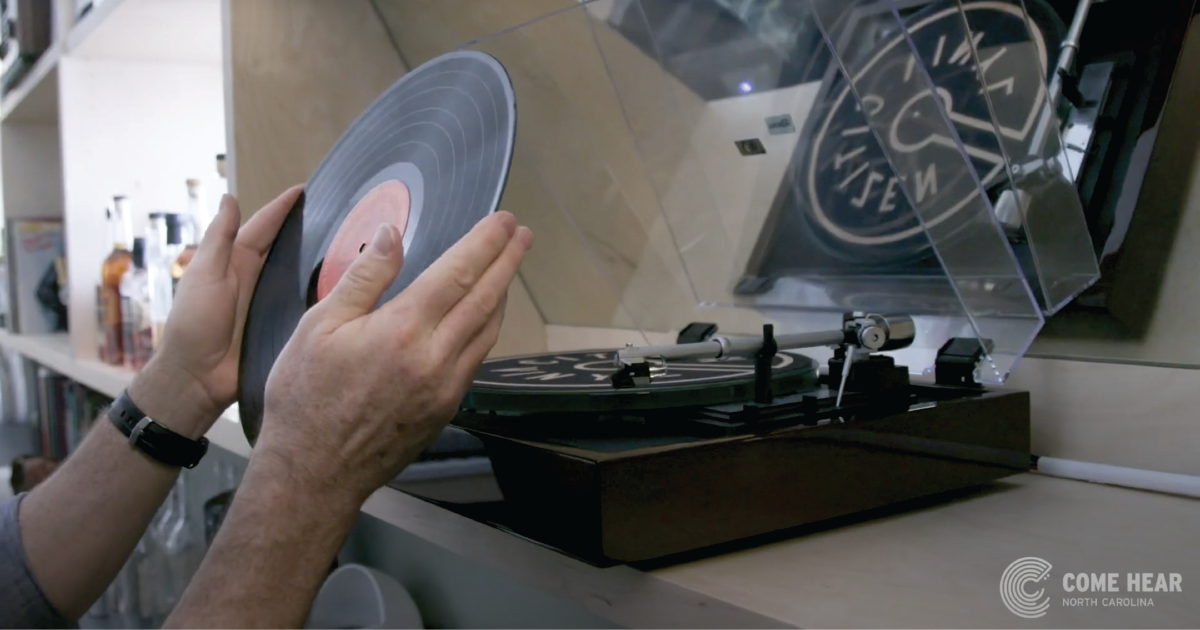
If you want to make an LP in NC, there’s a brand new vinyl destination: Citizen Vinyl, North Carolina’s first record press. Here’s some history about this landmark from North Carolina’s music campaign, Come Hear NC:
“Asheville, N.C., has long been viewed as a special place, funneling new sounds from the mountains to the world. In its heyday, the Asheville-based WWNC was one of the most popular radio stations in the country, and from its studios new bluegrass sound was presented for the first time to broad audiences across the country. It’s possible that Jimmie Rodgers (who lived in Asheville for a while) played ‘Carolina Sunshine Girl’ there, and the fiddles and banjos that have for so long rung out from the hollers and valleys of Western North Carolina found a way to the airwaves from the station’s studios.
“The building’s halls are full of history. Jim Lauderdale said of playing in places where great music has been made, ‘You get the feel about great music, it’s still livin’.’ No longer a radio station, it now houses Citizen Vinyl, North Carolina’s first record press. Mandolin Orange, based out of Chapel Hill, will be first off the press with a new double LP. Their music, full of guitar, fiddle, harmony, and a little twang, would have been right at home in one of WWNC’s old recording sessions.”
Check out the exclusive tour of the Asheville-based facility below:
Discover more about Citizen Vinyl and Come Hear NC here.
In normal times, you might find Kentucky-hearted duet the Local Honeys touring the UK or out on the road with folks like Colter Wall and Tyler Childers. But, like so many, the past year has been a paused their movement, allowing space and time to experience life in a way that most busy artists rarely get to.
Many caught wind of the group after a viral New York Times article in late 2020 about our nation’s cultural depression. But like other defendants of Appalachian people and culture, Montana Hobbs and Linda Jean Stokley, who make up the pair, have been outspoken via their music for a long time. Their new double-sided single continues a demand of accountability from big industry. “It’s a modern anthem of the American working class,” said Stokley.
BGS caught up with the Local Honeys to talk about these two songs — “Dying To Make a Living” and “Octavia Triangle” — as well as the message in their music.
BGS: In the before times, you’ve led pretty busy schedules, including multiple international tours. What have you been up to since the pandemic began?
Montana Hobbs: Well, I can tell you what we’ve be into. We’ve been in our jammies a lot! But you know, we’ve experienced probably a similar story to anybody else that has been in the gig industry. We’ll all remember it as a point in our lives and a point in our careers that was kind of sedentary, if you will. I think our story is not much different, we’ve had more time at home to focus on things that we don’t get to do on the road – like exercise, cook at home, read. At the new year we both decided that we weren’t gonna think so much about what this past year has been, but think more about what this new year is going to be for us.
Linda Jean Stokley: In 2019 we went on about five separate concert tours. So the beginning of 2020 was our last tour, we were all over the UK as well as greater Europe, on our own headlining tour but also supporting Tyler Childers. That was a huge tour, and it really took a lot out of us, so it was kind of welcoming to have a little bit of a break after that. But over this past year, we have done a few cool things. We went on the Tyler tour, we got signed to La Honda Records — that’s a pretty big deal for us. We love everything that they do, and have been constantly inspired by them. Our management and being with a label have proven so helpful, even during this time, to have someone like our manager that is so good about keeping our spirits up. Another thing that we’ve done this past year is put out a Western AFvideo, and that was a highlight. We didn’t get to do much, but what we did was really welcomed.
In a time of so much uncertainty, what inspired this new release?
LJS: We recorded those in October of 2019, and we’d been working on trying to change up our sound a bit, to make our sound bigger but not non-traditional, kind of neo-traditional. So we were thinking in 2020, how are we gonna release these songs? Then in October 2020, our friend Jimmy McCowan, who’s on one of those tracks, suddenly passed away from a heart attack. So, we talked to La Honda and asked if we could finally get these out. That’s kind of what spawned the release of this A-side/B-side single.
These songs show two perspectives on life in the coal mines: working like hell to provide for your family, while enduring personal struggles both medical and mental. What are you trying to tell the rest of the world about these Appalachian issues?
LJS: In July of 2019, there was a blockade in Harlan County, [Kentucky], and over a thousand miners in central Appalachia were out of work, because of the Blackjewel mining company. They went bankrupt, and they didn’t tell anybody. They didn’t tell any of their workers until the day of. In the middle of the day, they said, “this is your last day.” That is completely illegal. It was strange that it had to happen in Harlan County, which is so synonymous with all these bloody labor wars. To have something like this happen with one of the largest coal companies in the nation just shows that they can get away with all kinds of unlawful behavior. These people, their checks bounced. Of course that’s going towards their mortgage or rent, but it’s also going towards their medical costs, because there are so many disabled miners. We started thinking about this song more and more. We sang it a little bit, but didn’t have a need to sing it necessarily because we didn’t have anything to say. When we were on tour a lot, we would tell the story of what was going on, and put song and emotion into what’s happening, to get people to listen.
MH: To add on that, the song became more relevant to us in this time frame. It was a song that we were familiar with, via the band Foddershock, but also Rick & the Po’ Folk, Rich Kirby and his traditional band, and Pierceton Hobbs [who released his own version in 2020]. Basically, we felt like when you’re given the stage to speak on things like this, you might as well take advantage of the time and the attention that you’ve been given. Make that time worth it, and get a message that you feel is important across. When we would go over to England, which is also a very post-coal society that we didn’t know much about, we had firsthand connections where they told us stories of tragedy, how their grandfathers were miners, and so on. It made the whole history of traditional music come full circle for us, to where we had the opportunity to sing a song, but we also had the opportunity to tell a story of where we’re from and what’s happening where we are. Which is what traditional music was in its first iteration.
I know that you both, along with other musicians, visited the miner’s blockade. What was that like?
MH: We went and visited the miner’s blockade in August. We just went down there and hung out with these people, they had their entire families on the train tracks. They had little encampments set up. People like Brett Ratliff, Rich Kirby, Tanya Turner at the time worked for Appalshop, went down there with us. Son, it was so hot. It was very much like third world conditions in what’s supposed to be the greatest country.
The week before, we were at Cowan Creek Mountain Music School in Whitesburg, Kentucky. Jim McCowan has been a member of the faculty there probably as long as the school has been around. This guy in my class asked, “Have you heard the song that Jimmy’s mother wrote?” We were both very close to Jim, he was a very bright light. So I sat on a picnic table with him and said, “I heard that you do a song your mother wrote.” And I’m one of those people that’s a real sneaky recorder with my phone, and I have about a 10 or 15 minute clip of him playing this song called the “Octavia Triangle.” He had such a beautiful delivery of the song.
We were thinking of something that would pair well with “Dying To Make a Living,” which is economic hardship, being pushed under the rug. Even though this work is essential, they’re being treated less than they’re worth. So then I thought that “Octavia Triangle” completely highlighted what it is to actually live, and work, and die, and love, in the coalfields. This was a true story that happened in Pike County, Kentucky. Who’s to blame other than these harmful practices which we still practice today?
As a fellow musician from Central Appalachia, I feel like Foddershock (who wrote “Dying”) rarely get the attention or recognition they deserve. Do you have a favorite album, or a starter pack for those who have never heard the band?
LJS: I absolutely love Foddershock, I’m always trying to find their CDs. I’m waiting on WV [Hill] to send me some recordings. Obviously, I think “Dying to Make a Living” is one of the best places to start. I would also say “Eat Possum & Prosper” is one of my favorite tracks of theirs. And I really love “When Coal Was King.” There’s one that’s called “Live in a Trailer.” “Cahoots,” as well.
Do you have any new goals or ideas to try for when things turn around and we can all get back on the road?
MH: Hmm… we are ready and willin’! Open for suggestions, open for bookings… But like I said before, this is a time that we will all remember as a pause in our lives and a pause in history, even though it’s been a hell of a lot of history put into one year. We’ve been granted this time to kind of work on things, we’ve been writing a lot. It’s always been something we’ve done and tried to practice, but now it seems like it’s at the forefront of our minds. We want to be seen as not just traditional musicians, not just old-time musicians, but we wanna be known as songwriters as well. Carrying on that storytelling, and showing how I feel about what’s going in the time and place I’m from. That’s one of the biggest connectors in music in general, it’s saying you’re not alone. Like when we went to Wales, even our song “Cigarette Trees,” which is about strip mining, people would come up to us and say, “They do that here too, and we don’t like it either.”
LJS: We’re finding so many relatable things to talk about when we tour in the UK specifically. Touring has really given us a way and a platform to connect with all these people around the world that are dealing with similar situations. Every time we go anywhere, we talk to people about the whole idea of ‘saving Appalachia,’ and trying to tell people that no, we have to pay attention to the causes of poverty and suppression that are happening within our state and within the entire southeast region. We don’t need saving, and we don’t need developing — we need somebody to actually understand what is going on in our area. We’re looking forward to reconnecting with people.
Artist:Cristina Vane Hometown: Turin, Italy Song: “Prayer For the Blind” Album:Nowhere Sounds Lovely Release Date: April 2, 2021
In Their Words: “‘Prayer For the Blind’ is inspired by a friendly couple I met while camping on the border of Nebraska and Iowa. She told me her mother suffered from dementia, but that it couldn’t help but make her laugh when her mother claimed that her husband was cheating on her, going dancing with a woman with two peg legs, and that she was going to wring her neck. The anecdote got me thinking about how we try and find levity in heavy situations, and also about the bond between mothers and daughters and the intergenerational burdens that can be passed along through them. I wanted to find a tone that matched the difficult nature of these questions, and the lonesome modal banjo seemed perfect for that, paired with Nate Leath’s great fiddling. The issues of motherhood and illness are no new phenomenon, so I thought old time sounds fit the theme well — you can’t beat a fiddle and banjo!” — Cristina Vane
Photo credit: Oceana Colgan Video credit: Jeremy Harris
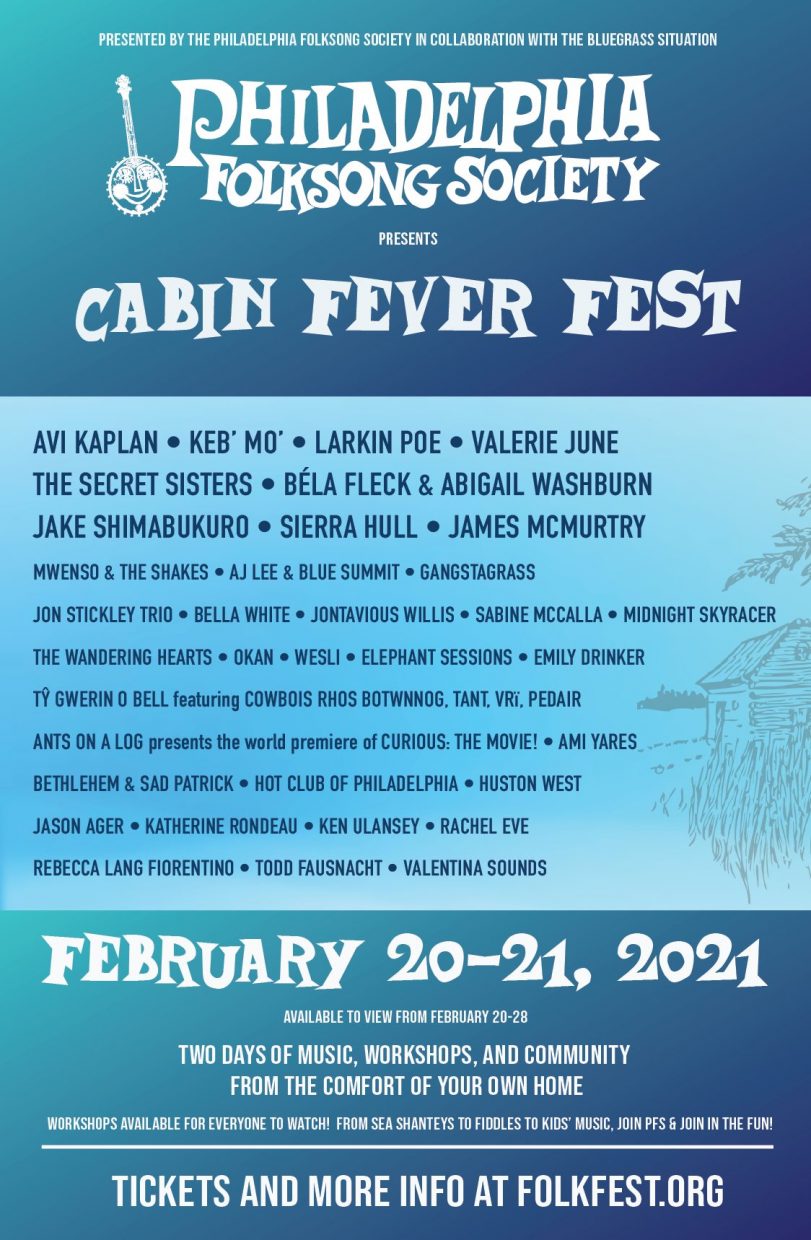
BGS and the Philadelphia Folksong Society, who are presenters of the oldest continuously run music festival in North America, are proud to join together to virtually present Cabin Fever Fest on February 20 & 21. This fully digital, interactive musical experience will include multiple streaming stages, performances by international stars and local favorites, music workshops and lessons, and more. (See the full lineup below.)
Tickets to Cabin Fever Fest are available now, full weekend passes are available for just $45 for PFS Members and $50 for Not-Yet-Members. Your ticket gives you full access to the event from February 20 until February 28, to watch at your leisure and convenience.
To get excited for the launch of the festival this Saturday, we wanted to introduce our BGS audience to some of the amazing folks on the lineup. Hopefully you’ll find a few favorite artists and performers — new and old — to catch this weekend on Cabin Fever Fest, presented by BGS and the Philadelphia Folksong Society!
Avi Kaplan
We first turned our attention to former Pentatonix low-end Avi Kaplan when he released his first rootsy foray, I’ll Get By, last February. In our interview last year, he spoke about his time with the internationally-renowned a capella group, growing up on bluegrass, and how is journey back to folk took shape. We were excited to have Avi on Whiskey Sour Happy Hour episode 3 last spring and we’re so excited to have him on Cabin Fever Fest, as well!
By now a longtime friend of BGS as well as a stalwart of the Americana-blues scene, Keb’ Mo’ has been our Artist of the Month, has been on our podcasts, our live lineups, and our year-end and holiday playlists, and now will join us and our Philly Folksong Society friends for Cabin Fever Fest! Whether he’s sharing a stage with Taj Mahal or swapping licks with Rob Ickes & Trey Hensley, Keb’ Mo’ is an extraordinary picker and collaborator.
Bluegrass family band turned modern blues-rock shredders Larkin Poe are a constantfavoriteon the pages and social media channels of BGS — and we totally see why! They combine fiery, impassioned energy with bluegrass technique and virtuosity for a brand of southern rock and blues that appeals to all kinds of roots music fans. They’ve kept up a constant “touring” calendar despite COVID-19, and we’re so grateful to have them join our virtual festival.
A cosmic, mystical force on banjo, with her songwriting pen, or within the pages of her poetry notebook, Valerie June is another Whiskey Sour Happy Hour alumnus joining us on the Cabin Fever Fest lineup. Her upcoming Jack Splash-produced album, The Moon and Stars: Prescriptions for Dreamers, is generating quite a bit of buzz in folk circles — the single, “Call Me a Fool” features Stax legend Carla Thomas! — so of course we’re looking forward to her Cabin Fever performance!
What would a folk festival be without sibling harmonies!? The way The Secret Sisters — Laura Rogers and Lydia Slagle — blend their songwriting styles, their production and arrangements, and their voices is so effortless — while laser-precise, deliberate, and painstaking.
Lockdown shows from Nashville’s self-professed banjo house (and basement) have kept all of us going through the past year or so — or at least, all of us at BGS and Philly Folksong Society! We’re tickled they’ll be bringing more of their humorous, engaging, double-banjo content to Cabin Fever Fest.
Perhaps the world’s foremost ukulele virtuoso, Jake Shimabukuro represents quite a few American roots music traditions often left to the wayside in folk circles. Shimabukuro has performed with many bluegrass, old-time, and Americana greats including Sierra Hull, Cathy Fink & Marcy Marxer, Alison Brown, Béla Fleck, and more. His prodigious approach to the ukulele — an instrument with skyrocketing popularity at the moment, especially among Gen Z — will surely wow new and old fans alike, no matter your entry point to roots music.
Speaking of Sierra Hull! One of our all-time favorite mandolin maestros, this thoughtful composer/songwriter will headline one day of our BGS stage. Every chance we get to work together, we take it! We can’t wait to see what new, astounding cover songs — like her Whiskey Sour Happy Hour rendition of “King of Anything” — fantastic musical acrobatics, and bluegrass nuggets she’ll pepper throughout her performance.
Our Philly Folk Fest friends turned us onto local favorites, Mwenso & the Shakes, and we’re awfully glad they did. Led by Michael Mwenso, the troupe of global artists present music that’s entrancing, entertaining, and as they put it, “A formidable timeline of jazz and blues expression through African and Afro American music.” Their debut album, Emergence [The Process of Coming Into Being], is available wherever you get music now. We can’t wait to hear from Mwenso & the Shakes!
Based in Santa Cruz, California these fixtures in the Northern California bluegrass scene are making a splash on a national scale, despite the pandemic throwing a wrench in their ascension. Blue Summit’s music is modern, crisp, and precise with a songwriting heart that feels fully realized and mature, despite their relative youth as a group. Lee’s vocals and originals spearhead the ensemble, reminding of Alison Krauss and her former bandmate Molly Tuttle, too. BGS has been waiting for the opportunity to get Blue Summit on a lineup and Cabin Fever Fest was the perfect opportunity!
Check out the full lineup and schedules for Cabin Fever Fest below and don’t forget to head to the CFF website for more information — discover workshops, get your Philly Folksong Society membership, find FAQs, and more!
Saturday, February 20, 2021
(all times EST)
CAMP STAGE presented by the Philadelphia Music Co-op
11:00AM Katherine Rondeau 11:30AM Jason Ager 12:00PM Hot Club of Philadelphia 12:30PM Rebecca Lang Fiorentino 1:00PM Ami Yares 1:30PM Bethlehem & Sad Patrick
CAMP STAGE presented by the Bluegrass Situation
2:30PM The Wandering Hearts 3:15PM AJ Lee & Blue Summit 4:30PM Jontavious Willis 5:45PM Jon Stickley Trio 7:00PM Sierra Hull
MARTIN STAGE / MAIN STAGE
3:30PM Emily Drinker 4:15PM OKAN 5:30PM James McMurtry 6:45PM Mwenso & the Shakes 8:00PM The Secret Sisters 9:15PM Keb’ Mo’ 10:15PM Avi Kaplan
Sunday, February 21, 2021
CAMP STAGE presented by the Philadelphia Music Co-op
11:00AM Ken Ulansey 11:30AM Huston West 12:00PM Rachel Eve 12:30PM Todd Fausnacht 1:00PM Ants On a Log Presents the World Premier of CURIOUS: The Movie 1:50PM Valentina Sounds
CAMP STAGE presented by Eisteddfod Amgen
2:30PM Tŷ Gwerin o bell featuring Cowbois Rhos Botwnnog, Tant, VRi, Pedair
Artist:Lonesome River Band Hometown: Floyd, Virginia Song: “Love Songs” Release Date: February 19, 2021 Label: Mountain Home Music Company
In Their Words: “‘Love Songs’ is another great song written by our friend Adam Wright. It tells the story of a songwriter who has had bad experiences with love and can’t find ways to be positive about it. The lyrics depict the songwriter’s frustration: ‘They say write in what you know / And all I really know is the losin’ and the leavin and the left.’ Adam puts a comedic twist to selling sad songs, and Brandon Rickman, our guitarist and vocalist, portrays it in his unique way.” — Sammy Shelor, Lonesome River Band
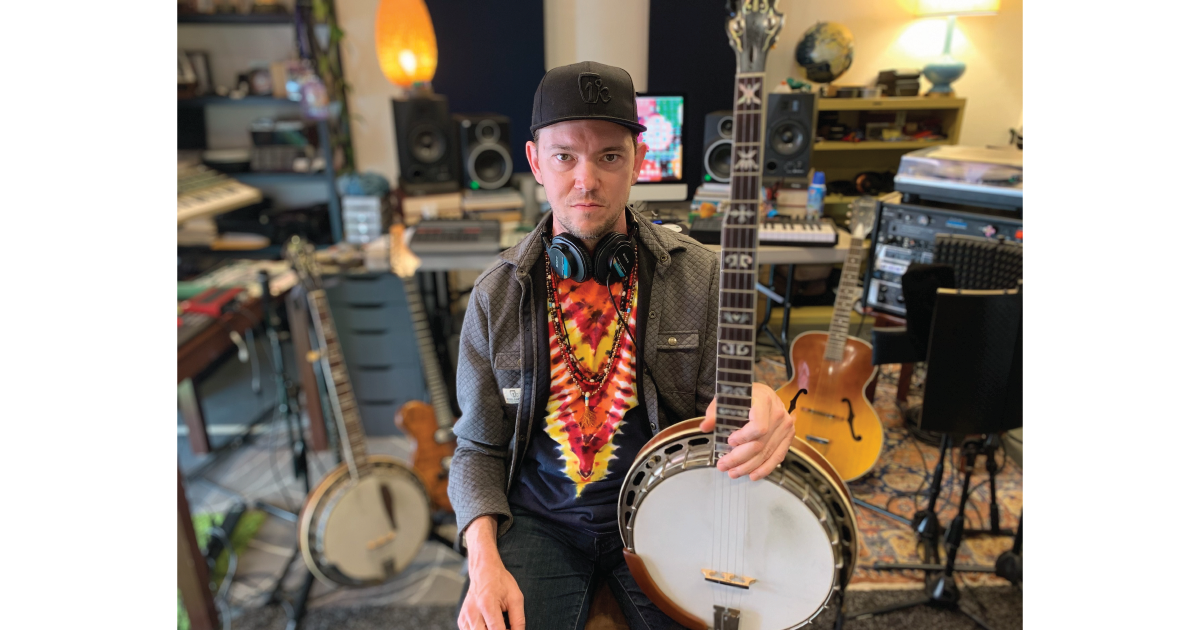
Artist:Chris Pandolfi Hometown: Golden, Colorado Latest Album:Trance Banjo Personal nicknames: Panda
Which artist has influenced you the most … and how?
From one perspective, this is a really tough question for me because there are many sides to my music, and many influences that have factored in really heavily at different periods. But from another perspective, it’s easy. I wouldn’t be playing the banjo if it wasn’t for Béla Fleck. I discovered the Flecktones in high school and was just blown away in every possible way. It was a moment of pure inspiration, and after a handful of shows all I wanted to do was learn how to play the banjo. That was the start of my journey as a musician, and none of that happens had I not discovered Béla’s music.
But his influence doesn’t end there. He’s a legendary improviser on the instrument, and that’s a big part of what the Stringdusters do. But maybe even more importantly, he’s made his mark by recontextualizing the banjo, combining it with so many eclectic sounds and bringing it to many new genres. That’s a big goal of mine as well, and that’s very much inspired by Béla. He didn’t leave too much undiscovered territory! But the bigger your imagination, the more territory there is to explore, and I love that challenge.
What’s your favorite memory from being on stage?
I have many great memories of being on stage, but the night that we played in Covington, Kentucky, in the summer of 2019 stands out. It was an electric show, and the moment we walked off stage we all sort of simultaneously decided that we had just made a live album. That has only happened a handful of times in our career, even though we have had many gratifying shows. But this was one of those stand out nights where something connected on a deeper level. It seemed like everything we did just hit the crowd with maximum power, and then they were feeding us with so much energy and emotion. That’s what can happen at a show. It can happen any night, even when a venue is not packed out, and that possibility is one of the great thrills of this career. On a night like that, everyone there is an equal participant in the performance. There’s no divide between the performers and the crowd, and the possibilities are endless.
What other art forms — literature, film, dance, painting, etc — inform your music?
I get inspiration from a lot of places, but books and visual art are high on that list. I love artists and writers who surprise you. It may not inspire a specific melody or song, but it definitely stokes the idea inside me that anything is possible, and with imagination and creativity you can always find new paths to travel. Lately, I have really enjoyed the work of Clyfford Still. Still was an American, abstract painter whos work is bold and stunning. There’s a beautiful museum dedicated to his work here in Denver, and it turned me into a big fan.
I also love reading science fiction, mainly because the imagination factor of good sci-fi is off the charts. I read a trilogy of books in recent years called The Three Body Problem by a Chinese author named Cixin Liu that blew my mind. The story is gripping and endlessly creative. Two song titles on my new record, Trance Banjo, are references to that trilogy, both from the second book, Dark Forest, which is my favorite. Great art of any kind transports you to a place that feels very free, where there’s no strong sense of self. I get a lot of inspiration from that feeling.
What rituals do you have, either in the studio or before a show?
Playing music is one challenge, but performing is a whole other hill to climb. When I am getting ready to play live or record, I always try to spend some time with my instrument (15-45 minutes or so) playing really mindfully and getting in the zone. That zone of being deeply focused on the music has seemed like a mystery at points in my career, and will forever be elusive in some way. But there is also something methodical about it, and that’s where practice comes in. When I practice I spend some time focusing on more mechanical elements, a new technique, transcribing or that sort of thing. But ultimately, I want to devote a good chunk of every practice session to building that zone. A good practice session should be like a meditation. The more time you can log in that focused zone, the more you know what it feels like and the easier it will be to conjure up in a performance setting. It’s a lifelong journey, and it certainly keeps you humble! But it’s not magic, it just takes practice.
If you had to write a mission statement for your career, what would it be?
I think my most consistent goal is to sound like myself as a player, and craft music that is unique as a producer. Bluegrass is the banjo’s native territory, and a common goal among proficient bluegrass players is to study and copy the styles of the early masters. For banjo players, that’s Earl Scruggs, and I would give anything to sound like Earl! There is so much great knowledge there, and so much expression as well. It’s a bedrock element of the instrument that practically every great player has a deep knowledge of.
While I have spent much time working on the fundamentals of Earl’s style, that is more of a starting point for me, and not an end-game. There are times on stage when I really try to emulate that older sound. But when it comes to crafting my own style and my own music, I try to use those old school bluegrass rudiments — timing, power, tone — but then add my own voice as well. The same goes for producing. It’s all about identifying and connecting with sounds that move you, and then using your imagination to grow from there and utilize those tools to bring your own vision to life.
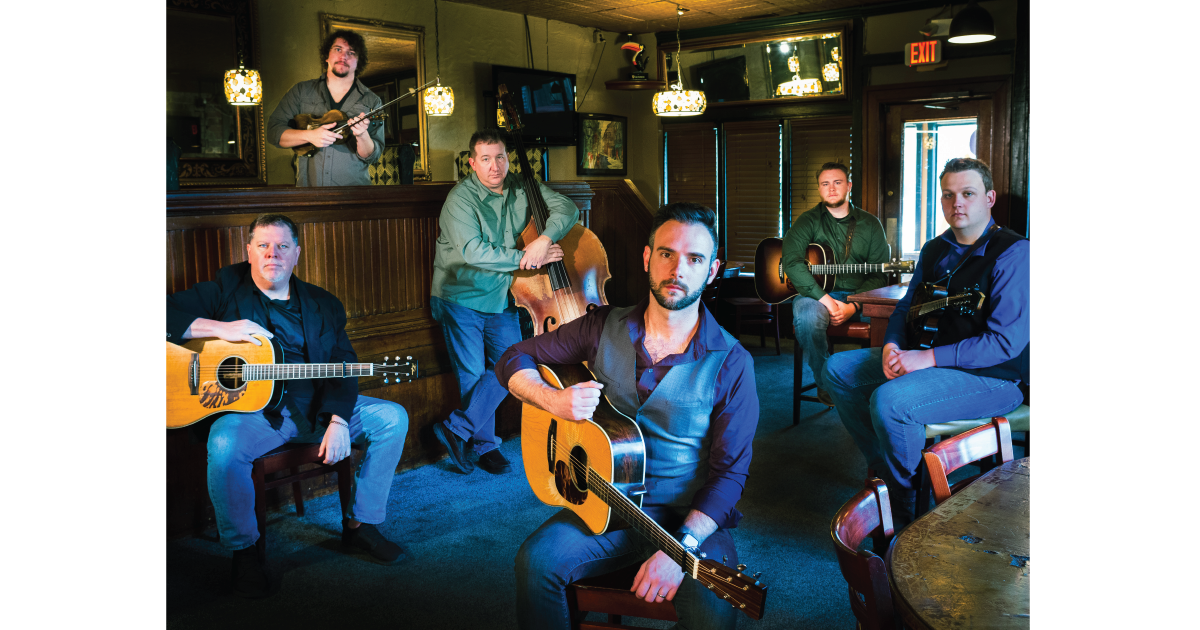
Artist:Sideline Hometown: Raleigh, North Carolina Song: “Just a Guy in a Bar” Label: Mountain Home Music Company
In Their Words: “In both recording and performing this song, we knew needed something special in terms of visual representation. The story speaks for itself, but capturing the emotion and weight of the story required more than just musically performing it on camera. We put our heads together and found a way to play the whole story out, piece by piece. It was a lot of fun working with actors and professionally creative minds that knew exactly what to do to suck the viewer in. It gives an already strong, deep song so much more dimension.” — Skip Cherryholmes
I first heard the music of Etta Baker on a record in 1957. Not until thirty years later did I see her perform live, in the context of a bluegrass-oriented event, on September 26, 1987 at Gardner-Webb College’s Second Annual Earl Scruggs Music Celebration.
Gardner-Webb (G-W) is in Boiling Springs, N.C., an hour’s drive south of Baker’s Morganton home and a few miles southwest of Shelby. Scruggs’ birthplace, Flint Hill, is close by.
In 1986 G-W awarded Scruggs an honorary doctorate. Ill health kept him from attending that Celebration, but his long-time friend John Hartford came and led a seminar about him and performed at a concert honoring him. UNC folklorists taped the proceedings. Their recordings are available online at UNC’s Southern Folklife Collection.
After the success of the 1986 program a committee, chaired by G-W English professor Dr. Joyce Brown and including Shelby journalist and G-W grad Joe DePriest, began planning the 1987 celebration. They received assistance, a grant, from the Folklife Section of the N.C. Arts Council.
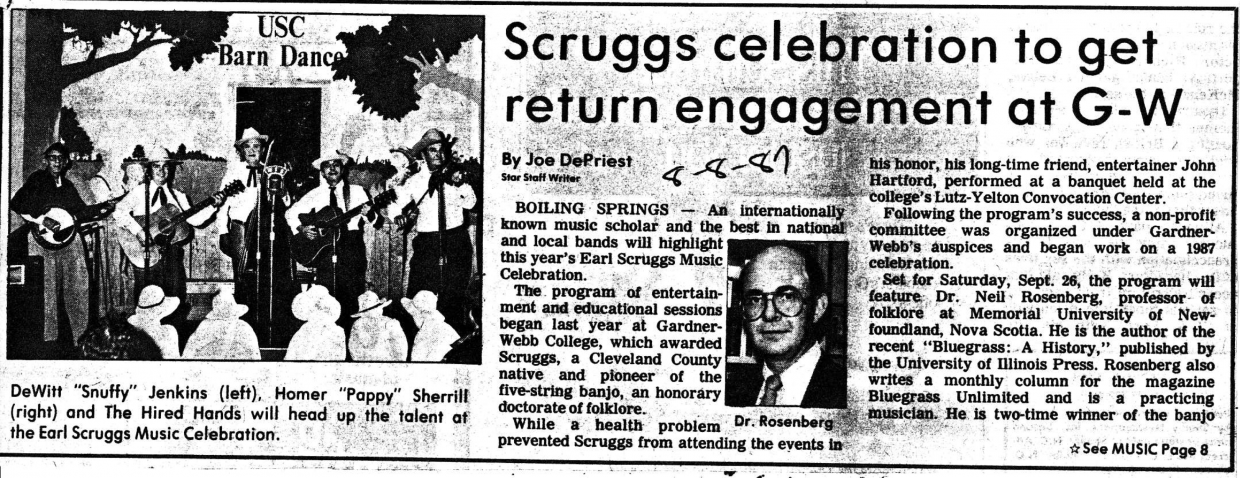
In August, a headline appeared on the front page of the Shelby Star: “Scruggs Celebration to get return engagement at G-W.” An article by DePriest quoted Brown: “We hope to make this an annual event — the most significant bluegrass event in the country. This is the logical place to center a recognition of our musical heritage.” DePriest added: “The program is not limited to bluegrass but will also focus on pre-bluegrass string music along with Afro-American contributions.”
The article described an action-packed day of music, with a morning concert-workshop by Etta Baker; an appearance by Riverbend Grass, the band in which Earl’s brother Horace played guitar; an afternoon of performances by six bands with Snuffy Jenkins, Pappy Sherrill and The Hired Hands opening; and afternoon workshops “on the history of bluegrass, its early radio days, and the Scruggs contributions.” In the evening was a concert by a popular new Nashville-based group, the Doug Dillard Band.
A scan of the first portions of the Earl Scruggs Celebration announcement from the Shelby ‘Star.’
By then Professor Brown had invited me to participate in the Celebration. My name and picture ran with DePriest’s article next to that of Jenkins, Sherrill, and The Hired Hands, who were slated to “head up the talent” of the Celebration. Touted as “an internationally known music scholar,” I was to conduct the workshop on bluegrass history with Jenkins and Sherrill.
I had never been to North Carolina, a formative location for the bluegrass business I began writing about in the ’60s. In 1974 the Country Music Foundation published my illustrated Bill Monroe discography, and in 1981 I began a regular column in Bluegrass Unlimited, “Thirty Years Ago This Month.” Since 1985, when my second book, Bluegrass: A History, was published, I’d been giving public lectures on bluegrass history.
My early bluegrass experience began in the late ’50s as a musician in the Midwest and northern California. Most of the history I wrote about came to me through research. I’d read Billboard from the early ’40s onward, eagerly followed the writing of people like Bill Vernon and Pete Kuykendall in fan magazines, and interviewed key figures.
I first heard of G-W in the early ’80s during one of those interviews. I asked Flatt & Scruggs manager Louise Scruggs when their first bluegrass college concert took place. She paused: “Gardner-Webb, maybe?” But she was tentative, particularly since she didn’t think it would be easy to document — she hadn’t started managing Lester and Earl until 1956. Not until my 1987 trip to Boiling Springs did I learn the full story of Flatt and Scruggs playing the first college bluegrass concert — I’ll say more about that later.
In 1976, when I wrote about my research on folk and country music in Canada’s Maritime provinces, I opened by saying “I attended many events, taking notes in my omnipresent 3 ½ x 5″ notebooks. As soon afterward as possible, a description of the event was written up in a diary-like journal.” Throughout my visit to Boiling Springs I had a notebook in my pocket. Soon after returning home I wrote a detailed diary of the six-day trip based on my notes. Direct quotes (in italics) follow.
Leaving Wednesday September 23rd, I was met at the Raleigh-Durham airport by Dan Patterson, head of UNC’s Folklore Curriculum. The next afternoon I gave a public lecture hosted by the Curriculum: “Reality and Revival in Bluegrass.” After my talk I was introduced to Tom Hanchett who, with his wife Carol Sawyer, was to drive me to Boiling Springs. We made plans for an early start the next day. Here’s what I wrote in my diary:
Tom Hanchett is in his late twenties, grew up in the Blue Ridge of Virginia and in upstate New York. Went to school at Cornell, was introduced to bluegrass by Country Cooking (Trischka, Wernick, etc.), and plays a bit of old-time fiddle. Had, until about five months ago, been working with the Charlotte (N.C.) Mecklenburg Historic Properties Commission as a historian. He had organized “The Charlotte Country Music Story,” a series of concerts there which recognized the town as an early historic center for recording and broadcasting of country music. And he is now working on a Ph.D. in southern urban history at UNC. His wife, Carol Sawyer, is a curator in a Museum of Technological history.
Tom charted our trip from Chapel Hill, in the northeastern Piedmont, to Boiling Springs, in the southwest, with a route that reflected the interest in local history and historic preservation that made him a perfect guide for our trip.
Tom had warned me beforehand that he was not an interstate man, so we followed a route that paralleled the old main railroad line (The Southern) that still runs from Washington to New Orleans.
Near Asheboro we stopped to visit Mac Whatley, mayor of Franklinville. He took us on a tour of this historic textile-mill region. I noted:
Whatley drove us out of town to the North and West, following Deep River, the source of textile mill power. We located the birthplace of Charlie Poole and looked at it from the road. There was a big “no trespassing, keep out” sign there.
We continued on toward Charlotte.
Somewhere along here we were passed by a new Toyota 4-wheel drive pickup with a yellow and black bumper sticker that read “Ralph Stanley for President.”
>We were truly in bluegrass country, I thought. Stopping for lunch and errands in Charlotte, Tom pointed out the hotel where RCA Victor had recorded the Monroe Brothers and many others during the thirties.
We reached the Shelby Star office in the early afternoon and met Joe DePriest, who gave us a quick introduction to the local cultural landscape. A leisurely drive took us to the Cleveland County Historical Museum (lots of famous people there, mainly mill owners), the graveyard, and past the old Lily Mills building in the neighborhood where Earl Scruggs lived while working there. Heading south towards Boiling Springs, we drove past Flint Hill Church. Joe promised Horace would give us a tour of this neighborhood, where Earl grew up, later.
At G-W, I met Dr. Brown, who showed me my room and filled me in on the evening’s itinerary. A group of us involved in tomorrow’s event would be getting acquainted over dinner at Kelly’s Steakhouse, just across the South Carolina line near Blacksburg. At 5:30 we all met outside G-W’s Dover Library to drive there. Here I met Horace Scruggs and his wife Maida. I wrote in my diary:
Earl’s older brother Horace turned out to be a very friendly and easy-going person, not as shy and quiet as Earl, though with (not surprisingly) a very similar voice and accent. His wife, Maida (pronounced May-Ida), is also very friendly. Horace is retired, he worked as a maintenance man for Gardner-Webb and later for the city of Boiling Springs. He is on the Earl Scruggs celebration committee.
Joe and I rode with the Scruggses that night. We both asked questions. I made notes during our drive and dinner. I began by mentioning that Louise had told me Flatt & Scruggs had once played at G-W.
I asked about that and Horace said, yes, they did, that he thought it was when they were working out of Bristol (May 1948 to March 1949, according to my calculations), around 1950. It was a spur of the moment thing, in midweek, and there was not much advertising and not a full house. The crowd was a mixture of townspeople and local students.
Over dinner I asked him a bit about his own musical career.
… he didn’t try music because he didn’t think he could make a living at it. He married in 1941 and went into the army soon after that. His father played clawhammer banjo, and he remembers being awakened in the morning by the sound of his father’s banjo. His father would build a fire in the stove and then play the banjo. Earl and Horace would come in and sit on his knees while he played.
He told me about running the farm after his father died in 1930:
They grew cotton — a crop was 3 bales a year, which they sold at 36 cents a pound (bale is 500 lbs, so that works out to $540.00 a year). They grew corn for feed and meal. Had a mule and a buggy which was originally rubber tired but eventually they ran it on the rims.
He was Earl’s first guitar accompanist, so I asked him if people thought Earl was special as a musician back then.
He said yes, they did, people would come by the house to hear him pick, etc. And when he was still quite young, they entered a banjo contest and Earl beat Snuffy Jenkins. Of course, as Horace was quick to point out, part of this had to do with his age, the youngsters have an advantage in those contests where audience applause decides the issue.
Earl and his mother moved into Shelby when Horace went into the Army, and Earl went to work at Lily Mills.
Earl had been turned down for the draft because he had a nervous stomach. He worked long hours for the mill but later on in the war he would take time off to play music at various places, and, as Horace recalls, was repeatedly lectured by his boss for wasting his time playing the banjo when he should be working to better himself at the mill. His mother was, Horace said, not happy either about Earl’s musical career and just as he was dropping us off at the Library, he told us that his mother had made a prediction which came true that he, Horace, had never told Earl: she said when he left to play professionally that “when I die, he won’t be able to come to my funeral.” And this happened — Earl and Louise were in an accident rushing to her bedside, she died while they were in hospital recovering.
After dinner Horace spoke of Earl’s adventures on the road:
He told me that Earl roomed with Uncle Dave Macon when he traveled to shows with Monroe and the band, and that Uncle Dave always carried with him an old-fashioned doctor’s satchel in which he kept one of his own country hams. He slept on it, used it as a pillow. And he would take it into restaurants, have it sliced and fried for him.
Talk turned to local foodways and Maida and Horace told us about livermush.
This local delicacy consists of hog’s liver and lean hog meat ground and fried, with corn meal, salt and pepper added to taste (some people add a lot of pepper, the seasoning is very personalized); left to harden, it is then sliced and fried. They said Earl eats it, and other natives crave it. It’s found on a north/south line from Blacksburg north to the Virginia border. One native son who now lives in Oregon has a special metal suitcase which he fills with frozen livermush and flies it home with him on yearly visits. It is served at the Snack Shop in Boiling Springs, which is where Earl and Lester and the boys used to stop for meals when travelling though this neck of the woods. Joe remembers seeing the bus there when he was a student, it was no big deal at the time.
As I walked home with Tom and Carol after dinner I proposed that we go for breakfast in the morning to the Snack Shop and see about getting livermush.
They thought I was overenthusiastic I think but they agreed to go.
Welcome to the BGS Radio Hour! Since 2017, the show has been a weekly recap of all the great music, new and old, featured on BGS. This week we’ve got new releases from so many amazing artists on the roots scene today, from Luke Combs to Langhorne Slim to Sierra Hull! Remember to check back every Monday for a new episode of the BGS Radio Hour.
Luke Combs, of country radio stardom, teams up with bluegrass-favorite Billy Strings this week for a new single. “The Great Divide” was written by the duo for Combs’s bluegrass album, one that he hasn’t completed yet. However, both artists agreed that the time to release this song was now, attempting to shine a light of hope in this tough time.
Singer/frontwoman of the Birds of Chicago, Montréal-based Allison Russell brings this Sade cover to the show this week. What she calls an “endlessly expansive and inclusive song of love,” this song brings comfort to Russell – as it does to us, as well.
Nashville-based Jaelee Roberts is one of the quickest rising stars in bluegrass music. Her first single on Mountain Home Music Company, an original song co-written with Theo MacMillan (of Theo and Brenna), brings big promises of more great music to come.
A 5+5 guest this week is none other than Jim Olsen, president of Massachusetts record label Signature Sounds. Celebrating 25 years of the label, and the so many great artists presented by it, Olsen brings us the Golden Age playlist – which includes this jam from Twisted Pine.
Kentucky-based Dale Ann Bradley brought us a new album this weekend! While you may remember her from former BGS Artist of the Month Sister Sadie – an all-female bluegrass supergroup – Bradley is stepping away from the band in 2021 to celebrate this new solo album, just one of so many in her extensive catalog.
“Glory Demon” comes from Brewers Dictionary of Phrase and Fable. “It means war,” Matheson tells BGS. But, this is an anti-war song from the Scottish artist, one about how we never learn and life just keeps endlessly repeating itself.
The Black Pumas are our February Artist of the Month here at BGS! You may recognize them from the Biden inauguration, where they performed this song from their 2019 self-titled album. Stayed tuned all month long, where we’ll be featuring exclusive content on the Black Pumas!
This week on The Show On The Road podcast brings us a conversation with Sean Scolnick – known mostly by his alter-ego, Langhorne Slim. Host Z. Lupetin caught up with Slim to talk about his new album, Strawberry Mansion, creative funk, mental health, and more.
From Snohomish, Washington, Hillary Grace Fretland (of FRETLAND) catches up with BGS this week on a 5+5 segment – that is 5 questions, 5 songs. We talked favorite memories from being on stage, influences, and songwriting techniques.
From her upcoming The Moon and the Stars: Prescriptions for Dreamers, Valerie June brings us this song that she dedicates to us all. Produced by June and Jack Splash – whose resume includes Kendrick Lamar, Alicia Keys, and John Legend – this album makes it clear to June why she makes music.
Nashville-based fiddler Mike Barnett brings us this Bill Monroe twist-up from his upcoming duets album, +1. The record was slated for a fall 2020 release, until Barnett suffered from an unexpected brain hemmorage. After multiple successful surgeries, he is doing well and recovering in extensive rehab where he is reconnecting his brain and fingers. So in listening to this piece of amazing music, let’s all send our best wishes to Mike Barnett and his family. You can support Mike Barnett’s recovery here.
From last year’s Whiskey Sour Happy Hour, this week we’re featuring Sierra Hull’s performance of this Sara Bareilles pop-hit. The Nashville-based singer and songwriter just released Weighted Mind (The Original Sessions), an EP made up of the demos for her 2016 release, Weighted Mind.
“Time traveled on a superhighway,” Chicago-based singer and songwriter tells BGS of the world before the pandemic, “but since March, we’ve all been in a traffic jam.” David McMillin of the group suggests that getting a break from all that movement is actually a good thing, however. This song is all about hitting that pause button.
The Jon Stickley Trio is one of the most exciting instrumental, “jamgrass” groups on the scene today. Made up of drums, flatpick guitar, and fiddle, they continue to push the boundaries of instrumental roots music, while being a festival favorite across the nation. This week, they bring us this new single on Organic Records.
At the end of the Show On The Road podcast episode with Langhorne, he graced us with a performance of this song, accompanied by his cat, Mr. Beautiful. What better way to end this week’s show?
Photos: (L to R) Allison Russell by Francesca Cepero; Sierra Hull by Gina Binkley; Valerie June by Renata Raksha
Artist:Tony Trischka Hometown:: Fair Lawn, New Jersey Album:Shall We Hope Release Date: January 29, 2021 Record Label: Shefa Records
Which artist has influenced you the most … and how?
Earl Scruggs. Pretty much a no-brainer for me. He changed my life when I was 14 years old. His playing is at the heart of everything I do. And on a larger scale, indirectly because of him, I have the wonderful family I have, have had a successful career and many friends around the world.
What was the first moment that you knew you wanted to be a musician?
I can’t say there was a moment like that. I first earned money playing music when I was 14, and continued to do so regularly through college. Though I was a Fine Arts major in school, and had very abstractly thought of a career as a museum curator (who was I kidding?).
What’s your favorite memory from being on stage?
In 1988, our band Skyline was invited to tour communist Czechoslovakia. Since my background is Czech on my father’s side, it was a particularly moving experience. While there, we performed in front of 30,000 people at the Porta Festival in Plzeň. We played a nighttime set and every second or third person in the audience was holding a candle, which made for an unbelievable sight. We were called for a second encore, and the emcee asked us to leave our instruments backstage and just walk to the front of the stage. As we were standing there facing this incredible candle-dappled crowd the emcee said, “You’ve given your gift of music to us, now we want to give you a gift.” He proceeded to divide the audience into thirds and had each third, of 10,000 each, sing a separate note of a major chord for us. Especially considering this was when Czechoslovakia was still communist, it was a profound experience.
If you had to write a mission statement for your career, what would it be?
Push boundaries and explore new areas on the 5-string banjo, but honor the history of the instrument. Don’t get bored.
Since food and music go so well together, what is your dream pairing of a meal and a musician?
Can I bring back Aaron Copland? On an emotional level he has had as much influence on me as Earl Scruggs. As for a meal, we’d have to start with a nice cocktail, and I guess it would have to be a Manhattan. Dinner would be hearty beef brisket with all the sides, and finish off with some good ol’ apple and cherry pie. I think that would cover all of the appropriate culinary bases.
Photo credit: Zoe Trischka
This website uses cookies to improve your experience. We'll assume you're ok with this, but you can opt-out if you wish.AcceptRejectRead More
Privacy & Cookies Policy
Privacy Overview
This website uses cookies to improve your experience while you navigate through the website. Out of these, the cookies that are categorized as necessary are stored on your browser as they are essential for the working of basic functionalities of the website. We also use third-party cookies that help us analyze and understand how you use this website. These cookies will be stored in your browser only with your consent. You also have the option to opt-out of these cookies. But opting out of some of these cookies may affect your browsing experience.
Necessary cookies are absolutely essential for the website to function properly. This category only includes cookies that ensures basic functionalities and security features of the website. These cookies do not store any personal information.
Any cookies that may not be particularly necessary for the website to function and is used specifically to collect user personal data via analytics, ads, other embedded contents are termed as non-necessary cookies. It is mandatory to procure user consent prior to running these cookies on your website.