The International Bluegrass Music Association announced the nominees and recipients of their 34th Annual International Bluegrass Music Awards today at the SiriusXM headquarters in downtown Nashville. Hosted by Bluegrass Junction DJs Joey Black and Ned Luberecki and featuring performances by nominee Lonesome River Band and brand-new Hall of Fame inductee Sam Bush, the ceremony also included announcements of this year’s IBMA Distinguished Achievement Awards, the second highest honor the organization gives out.
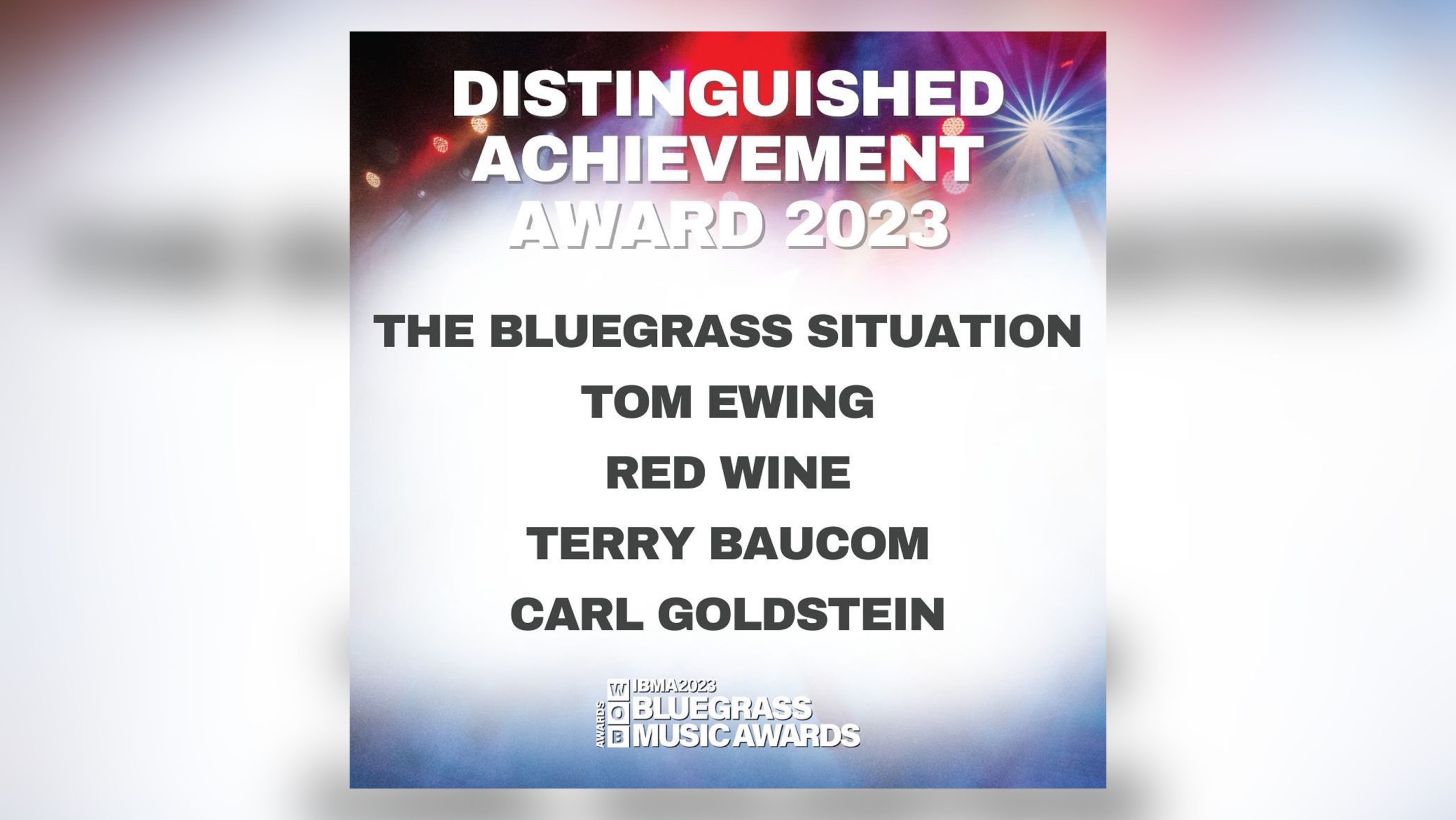
Italian bluegrass forebears Red Wine, banjo player and “Duke of Drive” Terry Baucom, promoter and festival organizer Carl Goldstein, and author and picker Tom Ewing were among this year’s Distinguished Achievement Recipients. Rounding out the field in the Industry category is BGS – The Bluegrass Situation – the world’s foremost online community for bluegrass and roots music.
“Of course, what we do is never driven by a need for accolades,” says BGS co-founder and executive director Amy Reitnouer Jacobs. “However, to be recognized by our peers and community is a humbling honor nonetheless.”
In 2022 BGS celebrated its tenth year of operation, marking the milestone with special anniversary content, articles, shows, and activations throughout the year. What began as a blog for bluegrass fans in Los Angeles – co-founded by actor and musician Ed Helms and Reitnouer Jacobs, who would quickly become a power player in the music industry – has since grown into a national and international community, with hundreds of thousands of followers across platforms and around the world.
“We are so honored and humbled by this recognition,” says BGS managing editor Justin Hiltner. “Bluegrass is all about community, and to have our community – the genre that built us – recognize our efforts in this way means the world. What Ed and Amy have created and brought all of us into is something truly special. Thank you to IBMA, the organization and its membership, for this award.”
BGS has produced and presented stages and concerts at some of the world’s premier events, festivals, and venues, including Bonnaroo, UK’s Long Road Festival, Bourbon & Beyond, MerleFest, Stagecoach, the Theatre at the Ace Hotel in downtown LA, the Irish Arts Center in NYC, and IBMA’s World of Bluegrass. In 2020, their online series Whiskey Sour Happy Hour, hosted by Helms, raised tens of thousands of dollars for frontline healthcare workers and personal protective equipment and, in 2016, BGS founded Shout & Shine, bluegrass’s first ever showcase celebrating diversity, inclusion, and representation in bluegrass, which ran for five years and became a column and video series.
During the presentation of the Distinguished Achievement recipients, IBMA had this to say about the outlet and media company:
The Bluegrass Situation, or more simply “BGS” or “The Sitch” has arguably been the preeminent online media source for bluegrass and roots music for the last ten years. Founded by Ed Helms and Amy Reitnouer Jacobs, The Bluegrass Situation has quickly grown into a national and international home for millions of readers to discover new artists and material, both traditional and progressive, read in-depth interviews and feature articles, and learn the history of bluegrass music. BGS has also been an important event promoter and sponsor in LA and around the country at major festivals such as Bonnaroo, Bourbon & Beyond, and IBMA World of Bluegrass. Members of the BGS team have also been impactful participants in helping the industry, including numerous IBMA education panels and the IBMA Bluegrass Music Awards Show.
The Distinguished Achievement Awards will be presented during a luncheon ceremony as part of IBMA’s World of Bluegrass conference in Raleigh, North Carolina ahead of the International Bluegrass Music Awards show on Thursday, September 28. Tickets for the conference and awards show are on sale now.
BGS is so grateful, honored, and humbled by this recognition handed out by our peers, colleagues, and community. While the musical and editorial scope of BGS has always been broader than just bluegrass, it’s this genre that built us – and it’s the people in this community who we have to thank for all of our successes.
Stay tuned for more announcements to come regarding BGS’s involvement and activities at this year’s IBMA World of Bluegrass conference.
The International Bluegrass Music Association announced this year’s nominees and recipients for the 34th Annual IBMA Bluegrass Music Awards today in downtown Nashville at SiriusXM’s Music City Theater. The announcement ceremony included live performances by nominees the Lonesome River Band and Sam Bush, who will be inducted into the Bluegrass Music Hall of Fame at the IBMA Awards show in Raleigh, North Carolina, this September.
Additional inductees into the Hall of Fame, which is housed at the Bluegrass Music Hall of Fame & Museum in Owensboro, Kentucky, include first-generation bluegrasser and country chart-topper Wilma Lee Cooper and an innovator and virtuoso who has expanded the borders of bluegrass and acoustic music throughout his career, David Grisman.
Recipients of the Distinguished Achievement Awards – IBMA’s highest honor outside of Hall of Fame induction – were also announced, highlighting the significant contributions of artists, musicians, and organizations such as Red Wine (Italy’s foremost bluegrass group), banjo player and band leader Terry Baucom, author and musician Tom Ewing, promoter and organizer Carl Goldstein, and media outlet and online hub BGS, The Bluegrass Situation.
“We are so honored and humbled by this recognition,” says BGS managing editor Justin Hiltner. “Bluegrass is all about community, and to have our community – the genre that built us – recognize our efforts in this way means the world. What Ed [Helms] and Amy [Reitnouer Jacobs] have created and brought all of us into is something truly special. Thank you to IBMA, the organization and its membership, for this award.” (Read more here.)
In the Instrumentalist, Recordings, and Artists’ categories, Molly Tuttle & Golden Highway, Billy Strings (and his father, Terry Barber), Michael Cleveland, Del McCoury Band, and Sam Bush Band lead the nominations. View the full list below and make plans now to attend the IBMA Awards Show in Raleigh, North Carolina, as part of IBMA’s World of Bluegrass conference on Thursday, September 28, 2023.
ENTERTAINER OF THE YEAR:
Appalachian Road Show Billy Strings Del McCoury Band Molly Tuttle & Golden Highway The Po’ Ramblin’ Boys
VOCAL GROUP OF THE YEAR:
Authentic Unlimited Balsam Range Blue Highway Del McCoury Band Sister Sadie
INSTRUMENTAL GROUP OF THE YEAR:
Billy Strings Michael Cleveland & Flamekeeper The Infamous Stringdusters Molly Tuttle & Golden Highway The Travelin’ McCourys
SONG OF THE YEAR: “Blue Ridge Mountain Baby” Artist: Appalachian Road Show Songwriters: Barry Abernathy/Jim VanCleve Label: Billy Blue Records Producer: Appalachian Road Show
“Crooked Tree” Artist: Molly Tuttle & Golden Highway Songwriters: Molly Tuttle/Melody Walker Label: Nonesuch Records Producers: Jerry Douglas and Molly Tuttle
“Heyday” Artist: Lonesome River Band Songwriters: Barry Huchens/Will Huchens Label: Mountain Home Music Company Producer: Lonesome River Band
“Power of Love” Artist: Rick Faris Songwriters: Johnny Colla/Huey Lewis/Christopher Hayes Label: Dark Shadow Recording Producer: Stephen Mougin
ALBUM OF THE YEAR:
Crooked Tree Artist: Molly Tuttle & Golden Highway Label: Nonesuch Records Producer: Jerry Douglas and Molly Tuttle
Lovin’ of the Game Artist: Michael Cleveland Label: Compass Records Producers: Jeff White, Michael Cleveland, and Sean Sullivan
Lowdown Hoedown Artist: Jason Carter Label: Fiddle Man Records Producers: Jason Carter and Brent Truitt
Me/And/Dad Artist: Billy Strings and Terry Barber Label: Rounder Records Producers: Billy Strings and Gary Paczosa
Radio John: The Songs of John Hartford Artist: Sam Bush Label: Smithsonian Folkways Producer: Sam Bush
GOSPEL RECORDING OF THE YEAR: “The Glory Road” Artist: Joe Mullins & The Radio Ramblers Songwriters: Paul Martin/Harry Stinson/Marty Stuart Label: Billy Blue Records Producers: Joe Mullins and Adam McIntosh
“Jordan” Artist: Darin & Brooke Aldridge with Ricky Skaggs, Mo Pitney and Mark Fain Songwriter: Fred Rich Label: Billy Blue Records Producer: Darin Aldridge and Mark Fain
“The Scarlet Red Lines” Artist: Larry Sparks Songwriter: Daniel Crabtree Label: Rebel Records Producer: Larry Sparks
“Take a Little Time for Jesus” Artist: Junior Sisk Songwriter: David Marshall Label: Mountain Fever Records Producers: Junior Sisk and Aaron Ramsey
“Tell Me the Story of Jesus” Artist: Becky Buller with Vince Gill and Ricky Skaggs Songwriter: Fanny Crosby, arrangement by Becky Buller Label: Dark Shadow Recording Producer: Stephen Mougin
INSTRUMENTAL RECORDING OF THE YEAR:
“Contact” Artist: Michael Cleveland with Cody Kilby, Barry Bales, and Béla Fleck Songwriter: Michael Cleveland Label: Compass Records Producer: Jeff White, Michael Cleveland, and Sean Sullivan
“Foggy Morning Breaking” Artist: Alison Brown with Steve Martin Songwriters: Alison Brown/Steve Martin Label: Compass Records Producers: Alison Brown and Garry West
“Gold Rush” Artist: Scott Vestal’s Bluegrass 2022 Songwriter: Bill Monroe Label: Pinecastle Records Producer: Scott Vestal
“Kissimmee Kid” Artist: Jason Carter Songwriter: Vassar Clements Label: Fiddle Man Records Producers: Jason Carter and Brent Truitt
“Scorchin’ the Gravy” Artist: Frank Solivan & Dirty Kitchen Songwriter: Frank Solivan Label: Compass Records Producer: Frank Solivan
NEW ARTIST OF THE YEAR:
Authentic Unlimited East Nash Grass Henhouse Prowlers The Tennessee Bluegrass Band Tray Wellington
COLLABORATIVE RECORDING OF THE YEAR:
“Alberta Bound” Artist: Special Consensus with Ray Legere, John Reischman, Tisha Gagnon, Claire Lynch, Pharis & Jason Romero, Patrick Sauber Songwriter: Gordon Lightfoot Label: Compass Records Producer: Alison Brown
“Big Mon” Artist: Andy Leftwich with Sierra Hull Songwriter: Bill Monroe Label: Mountain Home Music Company Producer: Andy Leftwich
“Foggy Morning Breaking” Artist: Alison Brown with Steve Martin Songwriter: Alison Brown/Steve Martin Label: Compass Records Producer: Alison Brown and Garry West
“For Your Love” Artist: Michael Cleveland with Billy Strings and Jeff White Songwriter: Joe Ely Label: Compass Records Producer: Jeff White, Michael Cleveland, and Sean Sullivan
“From My Mountain (Calling You)” Artist: Peter Rowan with Molly Tuttle and Lindsay Lou Songwriter: Peter Rowan Label: Rebel Records Producer: Peter Rowan
MALE VOCALIST OF THE YEAR:
Greg Blake Del McCoury Danny Paisley Larry Sparks Dan Tyminski
FEMALE VOCALIST OF THE YEAR:
Brooke Aldridge Dale Ann Bradley Jaelee Roberts Molly Tuttle Rhonda Vincent
BANJO PLAYER OF THE YEAR:
Kristin Scott Benson Alison Brown Béla Fleck Ned Luberecki Scott Vestal
BASS PLAYER OF THE YEAR:
Mike Bub Todd Phillips Missy Raines Mark Schatz Vickie Vaughn
FIDDLE PLAYER OF THE YEAR:
Jason Carter Michael Cleveland Stuart Duncan Bronwyn Keith-Hynes Deanie Richardson
RESOPHONIC GUITAR PLAYER OF THE YEAR:
Jerry Douglas Andy Hall Rob Ickes Matt Leadbetter Justin Moses
GUITAR PLAYER OF THE YEAR:
Chris Eldridge Trey Hensley Billy Strings Bryan Sutton Molly Tuttle
MANDOLIN PLAYER OF THE YEAR:
Alan Bibey Jesse Brock Sam Bush Sierra Hull Ronnie McCoury
DISTINGUISHED ACHIEVEMENT AWARD RECIPIENTS:
Terry Baucom The Bluegrass Situation Tom Ewing Carl Goldstein Red Wine
BLUEGRASS MUSIC HALL OF FAME INDUCTEES:
Sam Bush Wilma Lee Cooper David Grisman
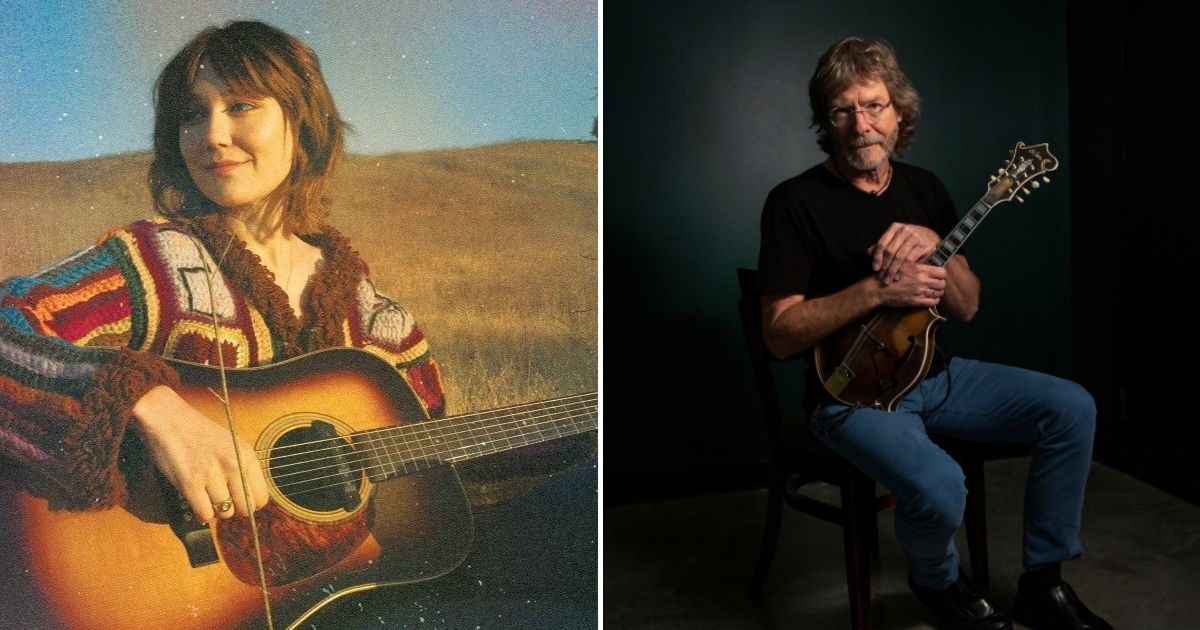
Photo of Sam Bush by Jeff Fasano; photo of Molly Tuttle by Samantha Muljat.
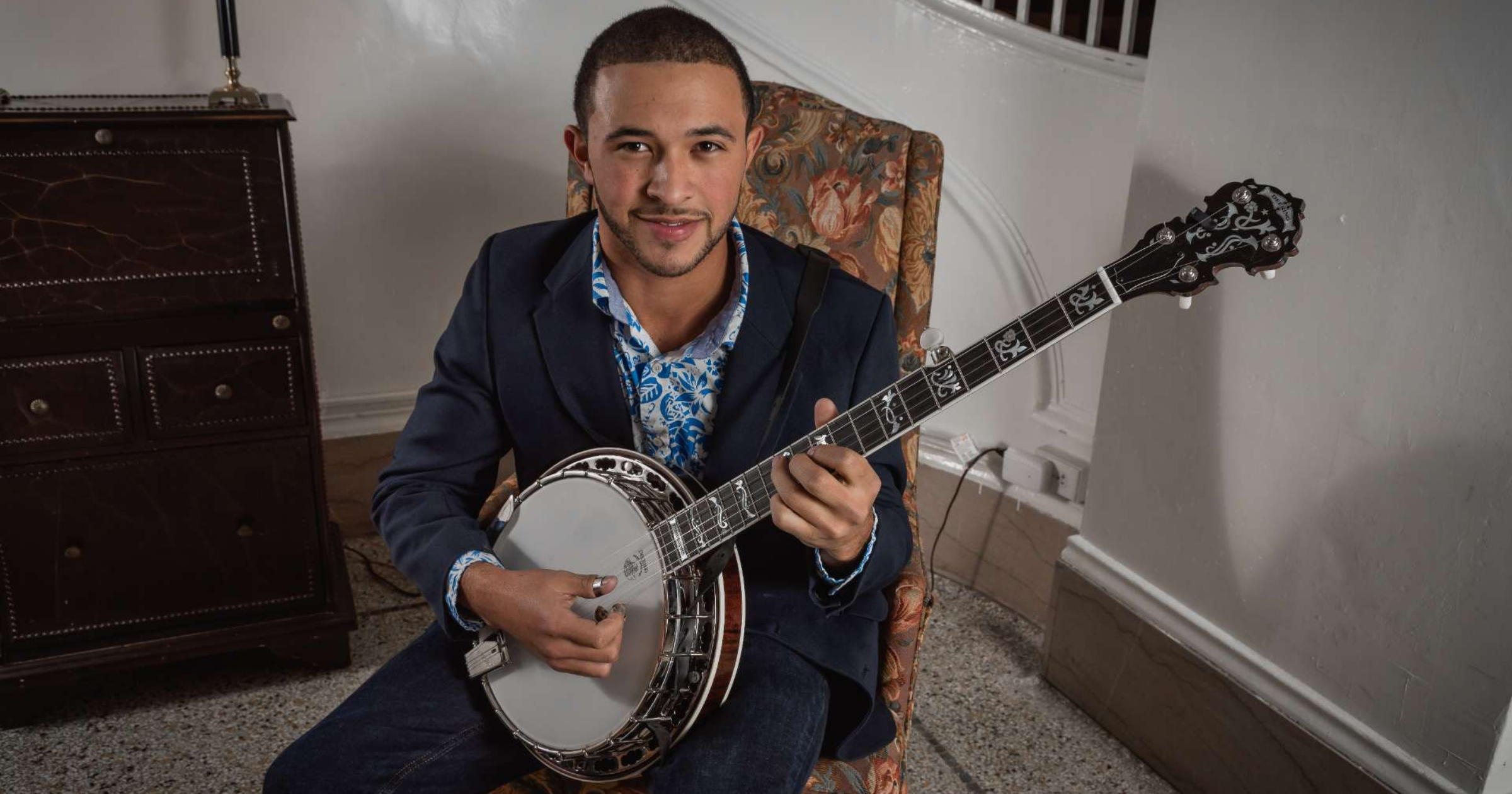
A few short weeks ago the streets of Raleigh, North Carolina, were once again filled with bluegrass lovers at IBMA’s World of Bluegrass conference and festival. Banjoist and Momentum Award winner Tray Wellington was everywhere to be found during the festivities — performing, hosting this year’s Momentum Awards luncheon, and playing a main stage set at the Red Hat Amphitheater. This is remarkable because if you had looked for Wellington at IBMA just a few short years ago, you might not have run into him except on the youth stage or in the halls, jamming.
Catapulted by his prior work with the talented young band Cane Mill Road, his studies at East Tennessee State University’s bluegrass program, and a stable of accomplished and connected mentors and peers, Wellington went from a newbie to a seasoned veteran faster than a global pandemic could subside — and during it. Efforts for better and more accurate representation in bluegrass have contributed to his momentum (no pun intended), but above all, his talent and his envelope-pushing approach to the five-string banjo are the root causes of his mounting and well-deserved notoriety.
Last year, during World of Bluegrass, Wellington performed as part of our Shout & Shine Online virtual showcase. For 2021’s edition of the biggest week in bluegrass, we connected via phone after the conference to talk about these leaps and bounds in his career, the ever-increasing tempo of his music-making and performing, and what’s coming up next for the young picker. We also discuss why making the bluegrass community more inclusive is so important — and how his own progress in the industry over a few short years reinforces that point.
BGS: You were so busy at IBMA this year! Let’s start there — can you talk a bit about the growth that you’ve experienced over the past few years? Because this year you were everywhere and doing everything in Raleigh!
Tray Wellington: [Laughs] Yeah, it was kind of a crazy week! It was a lot of new things, like you said, that I’ve never done before. But I think it really opened me up to a lot more ideas of what I can do in the music industry. I started out the week going to the business conference and then on Wednesday I hosted the Momentum Awards. And that was kind of a crazy thing for me, you know, I’ve never done anything in that regard, as far as hosting a whole awards show. I got asked to do it and I was kind of nervous about actually doing it. I remember getting up there like, “Dang! I can’t back out now!”
It’s a cool experience! Especially when people come up to you afterwards and tell you you did a good job. It makes you feel good about your progress over the last couple of years and I’m glad that people put faith in me and thought I would do a good enough job at it so they did ask me to do it.
You’re going from being an instrumentalist, a sideman, and a technician of the instrument to being a frontman and a recording artist. I wonder how that shift has felt to you? How does it feel to be in charge and “guiding the ship?”
It’s been a really weird experience. Before, when I was just being a sideman, I had a great time with that, because it did open me up to a lot of different types of music and getting to learn a lot of music. But that’s something I still try to do with my band now. I try to incorporate those ideas from my band members, because I did learn so much [when I was in other bands]. I think the most important thing in a band is hearing other people’s perspectives. I love the other band members bringing songs to me and being like, “Hey, can we do this?” Working up their music [is just as important] as working up my music and the arrangements for my stuff.
There have been people who do great front work who choose all of the material for their bands — I’m not saying that doesn’t happen. I just think that when I’ve seen bands that really get along and take each other’s musical perspectives in, it’s been a much more natural and calm feeling. Versus the feeling of, “Oh, somebody messed something up!” That was something I felt more when I was a sideman, I was so serious. It’s good to be serious, but it’s also good to stay relaxed.
To me, you have a very traditional approach to banjo playing while at the same time, you don’t necessarily seem too concerned with what is or isn’t bluegrass. Can you talk about what musically guides you and inspires you as you’re playing more in the bandleader headspace? How do you want to sound and why do you want to sound that way?
It’s interesting that you mention that, because most of the time I usually get feedback that I’m more of a progressive musician, like 95 percent of the time. So it’s interesting that you say that — I love everybody’s observations. I would say, when I was playing with Cane Mill Road I definitely had more of a traditional approach to the banjo. I still get a lot of my attack from that. When I’m thinking about music, though, I love all forms of music and I want to play all forms of music. That’s something I really try to do. I try to incorporate sounds from jazz — I studied jazz a little bit in college. That was a big thing for me, taking in those sounds and inspirations. As well as taking from other forms of music, because that’s the way the genre grows.
I’ve been really getting away from trying to sound like anybody, necessarily. That’s been my big thing. I want to be one of those musicians that tries to make my own voice on the instrument overall and gives my own ideas to it. A lot of that came from studying different players, like Béla Fleck and Scott Vestal and Noam Pikelny. Not just studying them, but studying the old school kind of stuff as well.
You just took IBMA by storm, you’re signed to Mountain Home Music Company — so much is coming down the pipeline for you it almost feels like too big of a question to ask, but I have to ask: What are you excited about? What are you looking forward to as you just finished this really busy, business-y week?
There’s a lot of stuff going on! It’s something I’m still thinking about myself, like what is my next major step? What’s the next move? That’s something I think a lot about. I’m looking forward to getting out and playing music live again next year. I’m playing more music live this year, but not as much with the pandemic. It’s slowed everything down. I’m also looking forward to getting into the studio at Mountain Home and recording — well, finishing my album. We’ve got some stuff recorded, but we’re kind of in the process of planning and trying to finish that project. I think it’s going to be really fun. I’m really trying to get away — not to like, disagree with what you said earlier! [Laughs] — but I’m really trying to get away from people perceiving me as more of a traditional player.
You’re trying to sound like Tray Wellington.
Exactly. I’m trying to branch away. I’m more drawn to the modern sounds, so when I present this new album I am wanting it to be more of an eclectic kind of thing.
I’m also excited about this upcoming performance I did for CNN on W. Kamau Bell’s program, United Shades of America with Nikki Giovanni. We did it at the Highlander Center, which is a historical civil rights school [in East Tennessee]. We went up there and I got to sit with Kamau and Nikki and a lot of great organizers from the area and get to play music for them. It was super fun. I’m wanting to do more stuff there in the future. It’s such a historic place. It’s crazy, before this shoot I didn’t know what the Highlander Center was and I grew up an hour and twenty minutes from there. The government of Tennessee hates the Highlander Center for their work there. It’s such a taboo thing to talk about in East Tennessee. I had never heard of it. They gave me a whole tour of the place and told me a ton of the history and I was like, “I’ve never even heard of this!” They had a building burnt down like two years ago by white supremacists.
I know!! And this is after the state and the KKK trying so many times to run them out. It’s shocking so few people know about it, but that’s all by design. I’m so glad to hear you’re connected there! Especially with the current movement for inclusion in this music, it makes so much sense to partner with an organization like the Highlander Center, which is based in the home region of these musics and has always been a leader in the fight for justice.
Yeah, absolutely. With diversity and inclusion in bluegrass, there needs to be more focus on it. Because the typical bluegrass fan base is white people, no matter what walk you’re from. It’s a lot of white people and white men, just to be honest. I think it’s one of those things where, if you want to get outside people into the music you need to encourage people who are of diverse backgrounds that this music can be inclusive. That’s the way that you move towards more people doing it. There have been a lot of factors that have contributed to this. The biggest problem I’ve seen is not a whole lot of nationwide outreach. There are a few great programs, like Jam Pak in Arizona by Anni Beach, she’s doing great work right now.
We just interviewed Fair Black Rose, of Jam Pak, for the other part of our special IBMA Shout & Shine coverage!
That’s great work they’re doing there! It’s a band of all diverse people from all walks of life. That’s such a great thing to see. I listened to one of their sets and I thought, “This is such a great thing.” Even when I started music I didn’t see anything like that at IBMA. It was such an interesting thing, despite the pandemic and this being a pretty low-attended year of World of Bluegrass. This was the most diverse year I’ve ever seen. … I remember going to IBMA five or six years ago for the first time and looking around and being like, “I’m the only person of color here.”
It’s that way at a lot of bluegrass festivals I go to — which is crazy, cause if you think about it, this is the International Bluegrass Music Association. There are supposed to be people from all over, as well. I’m not talking bad about IBMA, but I think the biggest need is more outreach. To people of color, but the LGBTQ+ community, too. Sometimes it’s a difficult thing to do, it can be easier said than done, but definitely I think it can be done, because other music forms have done it. For years! And they’ve had very big success. I think it just takes that initiative and drive to do it.
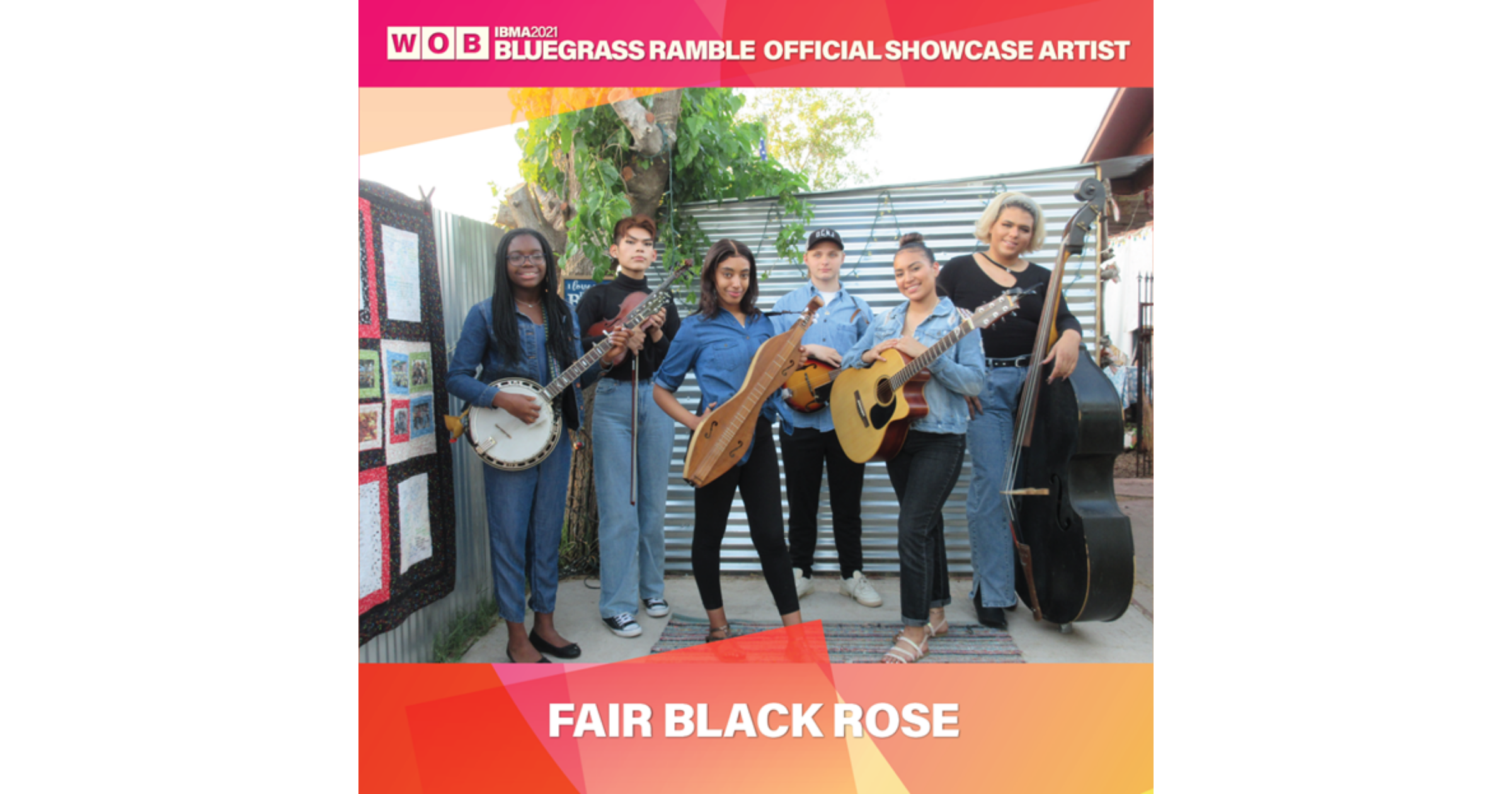
Fair Black Rose is a six-piece bluegrass and old-time string band of young folks from the southwestern U.S. The group grew out of Jam Pak Blues ‘N’ Grass Neighborhood Band, a community and after school program founded by Anni and Vincent Beach in Chandler, Arizona. Anni Beach continues the program to this day, teaching kids about bluegrass, blues, old-time, and the importance of these musics while passing along these folk traditions to a diverse and representative up-and-coming generation of pickers. The impact of Jam Pak has been well known to southwestern bluegrassers now for more than two decades, but its reputation as a first-rate educational program and bluegrass ambassador has garnered national recognition as well; in 2019 Beach won the International Bluegrass Music Association’s Momentum Award for Mentor of the Year.
Jam Pak has had hundreds of children and young adults come through its ranks, many of which have coalesced into different groups and bands within the greater program. Fair Black Rose is just one of those bands, but this year they’re making their debut on the national stage – and rising to that occasion and then some. The lineup of talented teenagers includes Lucy Tanyi on banjo, Carlos Parra, on fiddle, Maxwell Klett on mandolin, Rosy Lopez on guitar, Alasya Zelweldi on mountain dulcimer, and Justin Mizer on bass. Though still cutting their teeth, the group members have a mature sense of self well beyond their ages and are clearly at home within the many stalwart idioms of roots music.
In lieu of our annual Shout & Shine showcase held at IBMA’s conference and festival we’re dedicating two of our Shout & Shine columns to artists appearing during World of Bluegrass and IBMA Bluegrass Live! who represent often-marginalized identities in bluegrass. So, ahead of Fair Black Rose’s Official Showcases and Bluegrass Live! performance in Raleigh this week, we spoke to two of their members, Zelweldi and Mizer, about their music and repertoire, their blossoming band dynamic, what they hope to get out of their cross-country trip to IBMA, and more. Look for an upcoming interview with banjoist Tray Wellington to complete this Shout & Shine IBMA mini-series.
BGS: What are you looking forward to most at IBMA? Is it your first music conference? I know you’ve been to festivals plenty, but have you been to a music conference before?
Justin Mizer: No, this is definitely going to be the biggest conference/music festival/showcase thing that we’ve ever attended. It’s a really big deal for us and we’re really excited.
Alasya Zelweldi: We’re really looking forward to meeting new people, going out there — we’ve never traveled this far for a festival. We’re really excited for what’s to come!
As a band, what are you hoping to achieve at IBMA? Not only showcasing, but also being part of the conference, the hang — everybody being in the same space and pickin’ — but also the festival. I wonder what you’re hoping to get out of the experience?
JM: Something that has been on my mind about the trip is that I really want us to make our mark, to let people see who we are — we are a really diverse band. This trip is a huge opportunity to network, get to know people, and to get Fair Black Rose’s name out there. We are a part of Jam Pak, Jam Pak was the start for us and we’re hoping to keep going with that, too.
AZ: Hopefully we can make people happy with our music.
JM: We will! We definitely will! [Laughs]
AZ: Yeah! Overall, we want to show that bluegrass is for anyone. Like Justin said, we are a very diverse band and we hope to meet the youth out there and show that bluegrass is for anyone.
I feel like that has been the entire point of this showcase and column, to shout, “This can be for everyone!”
JM: Exactly!
Y’all just performed at the Pickin’ in the Pines festival in Flagstaff, Arizona, how was that?
AZ: That was so fun, we got some really great reactions from the audience. That makes us so happy, as musicians. It just makes you want to play. We’re excited for North Carolina and to hear what they have to say to us. It was a lot of fun [in Flagstaff], it’s a great festival.
One thing I wanted to ask you is about your collaboration process as a band, because you aren’t just a traditional bluegrass five-piece. You’re a six-piece band so there is a slightly different dynamic. What does the process look like when you’re taking a song and turning it into something you perform?
JM: If we hear a song we like or we take a song that Jam Pak does or something we already know, we kind of always want to put our Fair Black Rose stamp on it. We basically share ideas and will go around in a circle, like, “Let’s add on to this,” or “Adding onto your idea, let’s do this!” We’ll play it or rehearse it until it sounds good to us. We come up with our arrangements that way. We don’t fight over the songs — but we do fight over who gets to sing lead. [Laughs] That’s one of our issues. Because we all like to sing. We love coming up with our arrangements. That’s what I’d say is really unique about Fair Black Rose, our arrangements for our songs and our covers are unique and different. You won’t always hear it performed that way.
AZ: It’s very much a collaborative effort. We all work together to come up with something. This person will say, “I think we should do this” and this person will say, “I think we should do that” and we’ll go out there and try it out. It’s awesome.
What do bluegrass and old-time and string band music mean to you — not only as a band, but you individually? I know that’s kind of a big question!
AZ: One thing I love about bluegrass is that you don’t need to have anything fancy to play it. You don’t need to have some kind of technology. You just need to bring your voice, your instrument, and a passion for music. You can just go out there and play. I just love that. It’s accessible. You can go anywhere and play bluegrass. You can be in the middle of nowhere.
Another one of my favorite things about bluegrass is the harmonies. The vocals are so beautiful to me. The songs in bluegrass have such touching lyrics and vocals, I think those elements can really make a song.
JM: For me, one thing Ms. Beach has always said is, “You could have nothing, but you will always have your music.” That’s always something you can turn to and you can have, your music. Whether you lose your job or you lose a family member, or you lose this or that, you will always always always have your music. That has really stuck with me for a long time. I could be doing anything in the world and I will always have my music, I’ll always be able to turn to my music and to perform.
Music is a language. It’s a love language. You can play a song and it will make someone’s day. It can put a smile on someone’s face just to hear music. Somebody can not speak the language of the song you’re playing or singing, but they love it! Like with Latin music — I don’t speak Spanish, but I love the music. Music is just a really good way to express who you are. It’s such a good thing for the both of us and for our band.
Photo courtesy of Anni Beach and Jam Pak Blues ‘N’ Grass Neighborhood Band
Artist:Nefesh Mountain (Eric Lindberg and Doni Zasloff) Hometown: Brooklyn, New York City (born & raised); Montclair, New Jersey (current locale) Latest Album:Songs for the Sparrows
If you had to write a mission statement for your career, what would it be?
As a musician, there are times when you have to sit and write, practice and create music — this process can be so inward, so solitary and alone. But these quieter moments are also filled with their own kind of magic, the kind that personally sustains you and over time hopefully also helps define you as an artist. There are other times when you find yourself in this great shared musical community with friends, bandmates, mentors, and of course audiences and fans. In these moments, we get to experience it all together as a community. I love all of it, and this crazy cycle that we go through as artists — it’s a great question, the mission statement. And while we’ve never really thought of our career having a “mission” exactly, there is a word that comes to mind that for me applies to all aspects of our musical life, and that is inspiration. Doni and I both want to inspire new thought and ideas with our music, and hope that through song we’re able to depict a better world than the one we see sometimes these days. But inspiration also flows in all directions, and we can feel it from an audience just as easily as they can feel it from us, which is such an encouraging thought. Ultimately for me, I think it’s the drive to inspire and be inspired that fuels a song, improvisation, lyric, or melody, and I’d consider us so lucky just to continue to keep receiving, and giving inspiration back and forth throughout our career… I guess you could say invent, inspire, repeat! — Eric Lindberg
Which artist has influenced you the most … and how?
For me it’s sometimes hard to separate music from life, and vice versa — and when asked this question, I always seem to come back to the artists that’ve shaped me over the years, especially at pivotal moments in my life. As a child, I remember being obsessed with the songs on “Free To Be You And Me.” The songs, messages, and humor on this album opened up a whole new world of inspiration for me at the time. We still listen to it with our kids today! Being a strong woman in the musical world is something that is just so important to me, and in part this is thanks to my next phase of musical influences: Joni Mitchell, Carole King, Carly Simon, Dolly Parton, Emmylou Harris, and Joan Baez. For me, I came to a lot of bluegrass and old-time musical forms by way of these artists, tracing backwards from them and finding this amazing and wide world of Americana music like the Carter Family, Ola Belle Reed, Doc Watson, and so many others. Today, I’m also beyond proud that both my and Eric’s biggest bluegrass influences have become dear friends and collaborators on our albums: Jerry Douglas, Sam Bush, John Doyle, Bryan Sutton, David Grier, and Mark Schatz among others, have all had such a deep influence on our music, and we’re so grateful for it. — Doni Zasloff
This is such a hard one. There are so many people who have been heroes and “north stars” in my musical life over the years, yet there are two names that always seem to jump to mind when I get asked this question: Pat Metheny and Béla Fleck. I think that I’ve always been drawn to artists who are able to portray their own world on their own terms, and Pat and Béla have done this time and time again, not only defining their sound as composers and improvisers, but all while truly pushing the boundaries of their instruments as well — guitar and banjo, respectively. I also learned early on through them, as well as others like Miles Davis, Bill Monroe, Bill Frisell and more, the importance of composing your own music, and that has been a huge influence on me as it relates to Nefesh Mountain. When I think of Pat and Béla’s music, I actually think of their compositions first. Pat’s “Question and Answer,” “Bright Size Life,” “Farmer’s Trust,” “Letter From Home,” “Last Train Home” and Béla’s “Spanish Point,” “Whitewater,” “Big Country,” “See Rock City,” “Up and Running” to name a few, have all been huge inspirations for me. I’ve learned so much from listening to these two over the years, and not all of it has been exactly music-related. They both always seem to take risks, break rules, and push forward with an inner drive that is just so inspiring to me, and they’ve help pave this musical road out there for other folks, like us perhaps, who also want to build their own world and story on their own terms. — EL
(L-R): Alan Grubner, Eric Lindberg, Doni Zasloff, Max Johnson, David Goldenberg
What’s your favorite memory from being on stage?
We’ve had so many incredible moments over the years, and one that always comes to mind for me was a number of years back at one of our first IBMA Wide Open Bluegrass festivals in Raleigh, NC. Our music, especially in a more traditionally bluegrass environment like IBMA, can be a bit different, to say the least. We were playing the 5:00 pm spot at the Capitol Stage, right in the center of the city, about to play a set that we knew had a few songs with Hebrew in them. I remember standing backstage looking out at a few thousand people at least, and just being terrified, scared that we would not be accepted for who we are. If you’ve never been, Wide Open Bluegrass is kind of a festival meets street fair. There are no tickets, and for these few days, about a million or so people in Raleigh come out to see some of the best bluegrass music around. So I’m looking out at this crowd that is growing by the second — and in my mind just assumed that they would all leave once they heard a lyric in Hebrew. But in the blink of an eye, I feel Eric come up next to me, grab my hand, and whisk me onto the stage — and less than 60 seconds later we were into our first song. I can barely remember any of the music from that particular performance, but what I do remember are the faces in the crowd… the smiles, the applause, the tears, the joy, the hope, and the rapidly growing numbers of people! When we got to our last song the crowd had more than tripled in size and we received our first standing ovation from the city of Raleigh, NC. It was a show and feeling I’d never forget. Of course, we’d played countless shows before and after that one, but there was a different sense of unknowing that day, of a deeper unknown, and felt like a trust fall between us and all the folks in that crowd who overwhelmingly all reached and caught us! – DZ
What other art forms — literature, film, dance, painting, etc — inform your music?
I think about this a lot, actually. I’m always curious about this connection between music, film, dance, literature and sometimes art as well — that all of it takes place, unfolds, and exists over time. A song, album, TV show, movie or book all have a specific and unique length, and I love that it’s our job as creators to ultimately tell a story within the parameters of our own medium. Our newest album, Songs for the Sparrows, is for me our most “cinematic” yet, in that we really wanted the album as a whole to take on the dramatic flow and characteristics of a film. We took a lot of time to write themes and motifs for this album, both melodically and lyrically, that would weave in and out of the songs. For us, these are our “characters” — the different voices and melodies that make appearances throughout. We also wanted a clear and definite beginning, middle, and end to the album, but overall really wanted it to feel like one story and one experience. I think the most exciting part of attempting to make music in this “cinematic” way is that it forces me to think more visually about the songs… to really focus on the images that we’re striving to create with all these beautiful acoustic instruments. There is a piece on the record called “Suite for a Golden Butterfly,” and for this one, Doni and I actually sat down and wrote out a detailed narrative before even a note of music was written. The music to all five movements came from this story that we wrote together about a Jewish family from Eastern Europe who flees to America to escape the Nazis, and for us it was such an exciting way to collaborate — each putting our own visuals, thoughts, and ideas into the music. — EL
Which elements of nature do you spend the most time with and how do those impact your work?
The natural world has had a profound influence on our music and lyrics over the years, and as songwriters and composers, we are always looking for ways to convey feelings, stories, and emotions that will resonate, both with ourselves and the listener. We all in one way or another have such a strong relationship with the world around us, and we often lean on this shared “common ground” in our songs, and really love telling our story through the lens of these universal images of rivers, canyons, forests, fields, and of course mountains! One of the great gifts of being a touring musician is having the chance to see the world. When I sit at home at my desk to write or compose a new piece, my mind will often wander on its own, referencing images of the mountains of Colorado, the coasts of Maine, the California sun, the peaks in Switzerland, the hills and valleys in Ireland. It’s a bit abstract and hard to measure, but for me, these elements of nature and personal memories come out in our work all the time — sometimes in an intended lyric or melody, and sometimes in just a few notes of an improvised solo. — EL
We’re always looking for connections in our music… ways of telling our story and how we see the world while bridging bluegrass music with our heritage as Jewish Americans. One common thread that beautifully runs through Americana music and Jewish tradition is the undeniable reverence shown for our natural world, and that connection is so encouraging for me! We so often only look at our differences these days — our backgrounds, skin color, religion, gender, or even musical genre — but over the years of traveling and making music, I’ve found that we can just as easily look at all the things that connect us, that we have in common. Strangely enough, it’s a choice that we can make every day, and it gives me comfort to know that despite our differences we’re all “Somewhere on This Mountain” all at once, all looking up at the same trees, clouds, and sky every day. — DZ
In the year 2000, a bunch of well-funded music websites were cropping up, with odd names like CDNow and SonicNet, so there was always a steady demand for country-related content — and luckily for me, that included bluegrass. I remember the buzz about O Brother Where Art Thou?, but the older writers claimed those assignments, and since I was still in my 20s, I often landed the interviews and reviews that involved promising new talent, which gave me an opportunity to see a generation of acoustic musicians like Nickel Creek, Michael Cleveland, and Steep Canyon Rangers come of age.
From 2002 to 2015, I had a full-time writing job for a cable network, which led to countless CDs arriving at the office and my name at the door for most country and bluegrass shows, but more often than anywhere I’d go to the Station Inn — and in 2007 ended up writing about the place itself. I’d go see the Infamous Stringdusters while they were still calling themselves Wheelhouse, line up for Old Crow Medicine Show before “Wagon Wheel” became a honky-tonk anthem, and go listen to exceptional singers like Alecia Nugent or Bradley Walker every time they played that stage.
After attending the IBMA conference for the first time in 2002, I watched Doyle Lawson & Quicksilver hit those harmonies on The Hard Game of Love album while I sat on the floor of a Louisville hotel room, literally at the feet of the master. I’d never been to anything quite like it and I did my best to learn everything about the history. I kept my bluegrass CDs in a separate drawer so I could always get to them when I needed to focus or unwind — I’m not a musician myself, but something about acoustic music helps me unplug, so to speak. To see the IBMA World of Bluegrass conference grow into a massive event in Raleigh is thrilling! Now, as managing editor of BGS, my role is to share new roots music with readers, though the 75th birthday of bluegrass seems like the right time to look back on 21st century arrivals on the scene.
Between caring for her two kids and hosting her brand new show, Color Me Country, on Apple Music Country, singer/songwriter and creator Rissi Palmer has had plenty to keep her busy since the touring industry shut down due to coronavirus.
This week, Palmer will take part in our fifth annual Shout & Shine Online as part of IBMA’s World of Bluegrass conference and festival, performing a song from her most recent album, Revival. BGS jumped on the phone with Palmer to talk about the showcase, the musical heritage of North Carolina (her home for the past ten years), her musical community, Color Me Country, and more.
BGS: The production end of things has felt really different this year, putting Shout & Shine Online together virtually rather than in-person, like the last four years. But I bet being a performer feels pretty different to you in a pandemic right now as well?
Rissi Palmer: The performance part of it is extremely strange. I’ll be perfectly honest, I don’t like doing livestreams. [Laughs] I do them, because that’s what we have to do, but yeah. Not a big fan.
As far as the other [aspects], though, I have to say the time at home has been good for getting projects done. I’ll be honest with you, Color Me Country, I had been thinking about doing it for at least a year, but I didn’t have time, ’cause I was out on the road and doing all this stuff. Once we got to be home, once quarantine was happening, I had a little time — not a lot, because I have two children — to start working on it and actually sitting down and focusing. At the same time, with everything that’s going on I found it really hard to write. I’m flooded with a lot of different emotions right now, so I want to be creative, but the easiest thing for me has been channeling a lot of my feelings and frustrations into my show, not so much the music. I hate it, but I’m not being as musically creative as I’d like to be. It’s hard, I’m having a hard time.
I did want to talk about Color Me Country, because Shout & Shine was created to literally provide a space for othered folks, marginalized folks, to exist within these genre formats and communities that have — whether stereotypically or traditionally or both — been white spaces for so long, and straight spaces for so long, and male spaces for so long. Shout & Shine is a space that’s not owned by any of the above, where we can celebrate the marginalized and underrepresented folks who have always been in these musics. I see you doing the same thing with Color Me Country.
That’s exactly what Color Me Country is. That’s what I wanted to do. I feel like so many times, as an artist of color in a genre that is predominately white, you’re mostly talking to white journalists. You’re mostly talking to white outlets. A lot of times you are othered. I don’t think people do it to be mean, I don’t think it’s done in malice or anything like that. It just ends up being one of the more interesting parts of the interview, it’s more interesting to ask an interviewee [about identity or race]. For me, in my experience — and I can’t speak for everybody else — I spent most of my interviews when my album first came out in 2007 talking about being Black, not really talking about my art. That starts to wear on you after a while!
When you’re in a situation where you know that you’re a part of “the system” and you don’t necessarily want to bite the hand that feeds you, you can’t be as honest as you want to be. You don’t want people to be immediately turned off. That’s how I felt as a new artist in a lot of ways. Now that I’m on my own and I’m older, I feel differently about the world and I have lots of opinions. [Laughs] I recognize the power in my platform that I didn’t recognize thirteen years ago. [With Color Me Country] I was just like, there has to be somewhere people can just talk. And not just talk about race, but about music and being a musician. A space free from worrying about alienating anybody or offending anyone. It’s just being honest.
Outside of the fact that I’m Black, outside of the fact that I’m a woman, I’m also a musician. I’ve been in a lot of the same rooms that these other artists have been in. I’ve had a lot of the experiences that they’ve had. So [on the show] we’re speaking to each other as peers. It’s an easier situation, I find. I end up getting stories or confessions or thoughts that people wouldn’t normally share. I think that’s good! I sometimes end up revealing things about myself in these conversations, because we’re being honest with each other. That’s what I wanted, because I didn’t feel like I had an outlet like that. Not that people weren’t kind to me or any of that, I just never felt that safe.
The local connection of Shout & Shine has been a really important part of our mission, in years where we’ve held the showcase during IBMA’s conference in Raleigh in-person, connecting the show to the legacy of North Carolina’s roots music has been a part every year. The stories of bluegrass and country are tied so tightly to North Carolina, so I wanted to ask you about your connection to the state and what about its musical history and community that resonates with you?
First of all, I have been a North Carolinian for ten years now. I absolutely love it here. I live in Durham and specifically in our community — and I’ve lived in Los Angeles, I’ve lived in Nashville, I’ve lived in New York and Atlanta — I have to say this particular music community is my favorite. I say that because there are so many types of music here! There are so many really ridiculously talented people. I think that has something to do with the fact there are so many colleges here — or there’s something in the water! Really, nationally important music is being made here. Everyone is so open and so giving. It’s one of the few music communities that actually feels like a community. I know for me, being here has made me a better artist.
Being in Nashville, being in New York and being a part of the rat race, you tend to think in terms of commerciality and sales and that sort of thing, monetizing your creativity. Whereas here, mind you we want to make money, I’m always looking for ways to make money, but here it’s more like, “How can you use your art to help your community? How can you use your art to collaborate with these people for this cause?” Everywhere I turn there’s a way to use my platform, my voice, my art to elevate something. That’s really awesome and for me, that’s made my art more global.
Just look at the art that comes out of here! Everything is extremely conscious, it’s thoughtful; I think that whatever is happening with the artists here, it resonates. Showing people what’s going on here and exposing it [to the world] is really important, because there’s so much good stuff here.
Speaking of collaborations, your Shout & Shine Online performance includes Omar Ruiz-Lopez on a song you wrote called “You Were Here.” The performance is excellent and exquisite and we won’t give it away entirely, but tell us a bit about working with Omar and the song?
First of all, I’m super excited to be a part of it! I was so excited when I got the email. Omar and Lizzy [Ross] of Violet Bell are two of my favorite people in the world. I think the world of them. They’re so ridiculously stupid talented. It’s not even funny.
In 2018 I was a part of an artist in residency for like a week and we were all put in a house, the Oyster House, out on the coast. It was myself, Violet Bell, XOXOK — Keenan Jenkins, he’s local he’s amazing as well. We were there with a couple of playwrights, some artists, and we were in this house for a week. We got along really well, we’d jam at night, that sort of a thing. We all formed such tight relationships between us musicians, so any time we can perform together we try to make it happen. Omar actually played on the record of the song I did for the performance and so when I got the email and knew I was going to do this I knew I had to call Omar. Not only that, I was just chomping at the bit to have another musician in the shot with me!! I’m so sick of playing things by myself! [Laughs] I wanted to make it big and beautiful.
Another thing I just thought of while we’re talking, the song I’m doing is called “You Were Here.” It’s from my new album, Revival, and it’s about a miscarriage that I had in 2018. I had just met Lizzy and Omar and had just found out I was pregnant when we did the residency. The day that everything started happening I was actually in the studio with them — I didn’t even think about that, I was recording on their record. There was no one else I could do this with.
Omar plays emotionally and that’s what this song needed. I remember when I called him to track on it, he did it in about two takes. We were sitting in the studio just bawling while we were recording it. He did an excellent job. I couldn’t imagine sharing this moment with anybody else.
J.D. Crowe, Jerry Douglas, Sarah Jarosz, and Ronnie McCoury are just a few of the artists taking part in the IBMA Virtual World of Bluegrass, which begins today, Monday, September 28. Kristin Scott Benson, Doyle Lawson, and Mumford & Sons’ Winston Marshall are also confirmed to participate.
IBMA Virtual World of Bluegrass is an annual bluegrass music homecoming and convention that takes place online this year, encompassing the IBMA Business Conference, IBMA Bluegrass Ramble, the 31st Annual IBMA Bluegrass Music Awards, and music festival IBMA Bluegrass Live! powered by PNC running through October 3. See the full schedule.
Check out our General Information page regarding IBMA Virtual World of Bluegrass. You’ll find our full-week schedule…
Conference registration is available at a lower price point than in years past: $99 for IBMA members, and $149 for non-members. Register here.
To stream the following sessions, as well as many others, IBMA Business Conference registration is required. Business Conference registration also allows access to other valuable content: an online version of the Gig Fair (one of the most popular conference events each year) the Songwriter Showcase, two virtual in-the-round Song Circles, the Annual IBMA Town Hall Meeting, the IBMA Virtual Exhibit Hall, and much more.
As previously announced, Sarah Jarosz will deliver the Keynote Address on Monday, September 28 to kick off this year’s virtual IBMA Business Conference. “Having attended IBMA as a young kid just getting into bluegrass, and having returned more recently as a performer at their Raleigh conference, I’m deeply honored to have been asked to be this year’s keynote speaker. I look forward to helping kick things off!” said Jarosz.
Organizers have added three presentations to lead each day’s conference activities, Tuesday through Thursday:
Tuesday at 11 AM ET: Artist-2-Artist with J.D. Crowe, Winston Marshall, and Jerry Douglas
Hall of Famer J.D. Crowe’s infusion of new ideas into bluegrass banjo took the music to a decidedly younger and more diverse crowd, inspiring a new generation of pickers and fans. His music would influence a young banjo player across the Atlantic named Winston Marshall, who would take the banjo to millions of fans worldwide. As a member of Mumford & Sons, Winston has helped completely transform the image of the banjo in popular culture. Jerry Douglas has used his dobro to build musical bridges throughout his storied career. He has shared both the stage and the studio with J.D. Crowe and Winston Marshall, and he invites you to join him and these two groundbreaking banjo players for a fun conversation about how music unites.
We just announced special feature presentations to kick off each day of the IBMA Business Conference:
Wednesday at 11 AM ET: Artist-2-Artist with Doyle Lawson and Kristin Scott Benson
Doyle Lawson has been a leader in bluegrass music for decades. He and Quicksilver played at a festival in Dahlonega, Georgia in the mid-eighties, and it changed the life of a young girl in the audience named Kristin. Three and a half decades later, Kristin Scott Benson is one the most celebrated banjo players of her generation and is the reigning IBMA Banjo Player of the Year. She sits down with Bluegrass Hall of Fame member, Doyle Lawson, to talk about the impact he and his music have had on her and on the bluegrass community at large.
Thursday at 11 AM ET: From the Bay, to Bean Blossom, and Back
Jerry Garcia is unquestionably a towering figure in American culture, and one of the most influential musicians of the 20th century. He and the Grateful Dead set the template for a new style of music that would inspire generations, much as Bill Monroe, The Father of Bluegrass himself, had done. What’s less known about Jerry, is that long before, during, and after the Grateful Dead, he was a banjo player, a bluegrass musician, even an aspiring Bluegrass Boy. Join Ronnie McCoury, filmmaker Brian Miklis and others in a conversation diving deep into the relationship of a true giant of American music, and the music that inspired him.
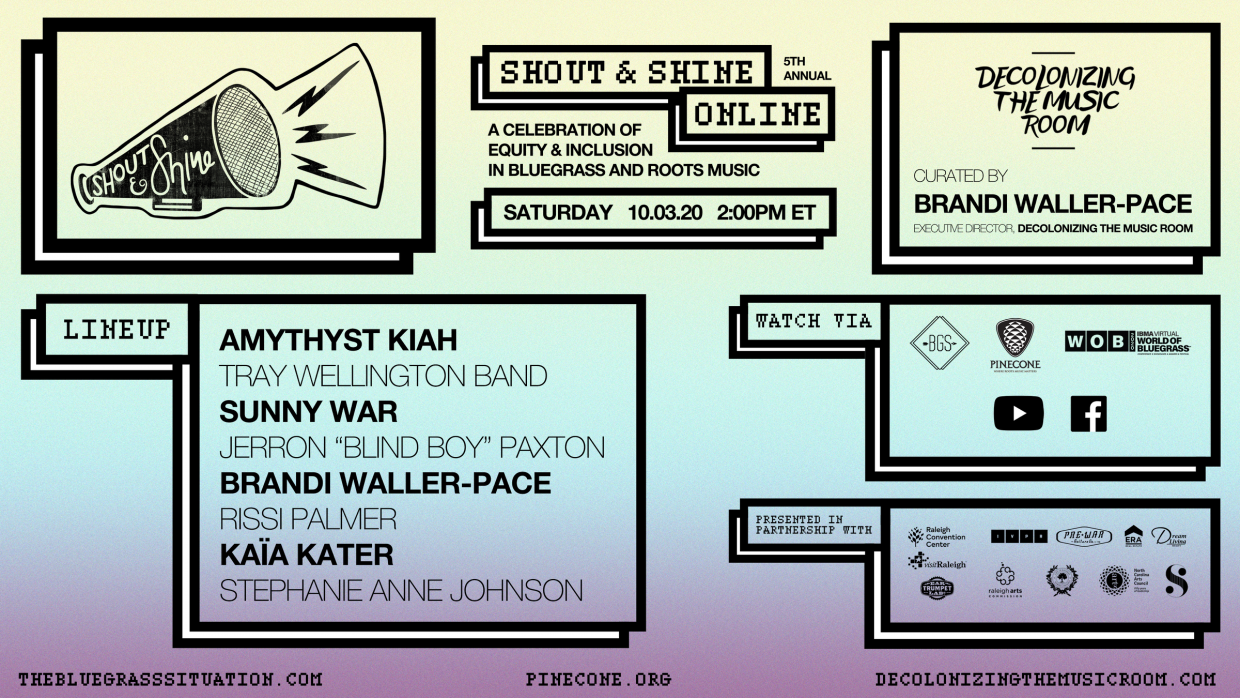
The Bluegrass Situation will proudly present our fifth annual Shout & Shine Online on Saturday, October 3rd at 2pm ET. And at press time, 30 artists have also been confirmed for a series of showcases known as the Bluegrass Ramble.
The virtual music festival IBMA Bluegrass Live! powered by PNC, will take place Oct. 2-3. Special performances by The Travelin’ McCourys with special guest Del McCoury; Steep Canyon Rangers; Jerry Douglas & Odessa Settles; Sierra Hull & Molly Tuttle are just some of the highlights that bluegrass fans can look forward to.
In addition, PNC Bank is boosting its support for the IBMA and bluegrass artists experiencing financial hardship due to pandemic-related performance cancellations. PNC Bank, the presenting sponsor of IBMA Bluegrass Live! powered by PNC, has announced it will match all 2020 donations made to the IBMA organization and the IBMA Trust Fund, for a total up to $50,000. (Donate now.)
IBMA is the nonprofit professional organization for the global bluegrass music community — connecting, educating and empowering bluegrass professionals and enthusiasts while honoring tradition and encouraging innovation worldwide. The organization has suffered financially this year due to pandemic-related health precautions that are preventing the IBMA World of Bluegrass event from being held in Raleigh, N.C. The IBMA Trust Fund, which is administered by IBMA, was established in 1987 as a means to offer emergency financial assistance to bluegrass music professionals. In 2020, requests for assistance have increased tenfold due in large part to COVID-19.
As the presenting sponsor of IBMA Bluegrass Live! powered by PNC since 2013, PNC Bank has helped bring bluegrass music and culture to Raleigh for what has become one of the city’s most beloved live, free events. While IBMA Bluegrass Live! powered by PNC cannot be presented as an in-person event in 2020, PNC remains committed to supporting this event and community tradition by helping deliver bluegrass programming in a virtual setting, Oct. 2-3.
Donations may be made online; additionally, those registering for the free IBMA Virtual World of Bluegrass Music Pass have the opportunity to make a donation during the online registration process. The Music Pass includes access to all music performances during the week, including IBMA Bluegrass Live! powered by PNC, the IBMA Bluegrass Music Awards presented by Count On Me NC, and IBMA Bluegrass Ramble presented by Count On Me NC.
The entire BGS team is pretty stoked for our fifth year of Shout & Shine performances! In 2016 we partnered with PineCone Piedmont Council of Traditional Music in Raleigh, NC to showcase diversity in bluegrass and roots music at IBMA’s World of Bluegrass business conference and festival. In doing so, a wonderful platform has been provided to artists so often overlooked, as well as those just starting their journeys in the music industry.
Things are a bit different this go ‘round, and we’ll be celebrating equity and inclusion in a more pandemic-suited way this year with Shout & Shine Online! The showcase will take place Saturday, October 3rd at 2pm ET — viewers can tune in right here on BGS, or on our Facebook page or YouTube channel, as well as via PineCone’s channels, and IBMA’s conference platform, Swapcard (free music pass registration available here).
In celebration, we’ve put together a preview of what you can look forward to during Shout & Shine Online.
Brandi Waller-Pace
BGS joined hands with Decolonizing the Music Room’s founder Brandi Waller-Pace to curate 2020’s lineup. “The mission of Decolonizing the Music Room is to center Black, Brown, Indigenous, and Asian voices, knowledge, and experiences within the field of music education,” says Waller-Pace. “In addition to that, it is part of DTMR’s core values that we are an openly LGBTQ+ affirming non-profit organization. I am honored to have served as curator for this year’s Shout & Shine and to have had this opportunity to partner with BGS and PineCone on work that highlights a convergence of our values.”
Here you can see Waller-Pace along with Caitlin Hearn playing an old-time standard, “Five Miles From Town.” Waller-Pace’s music is dripping with that sweet, old-timey-ness.
Rissi Palmer
The IBMA isn’t the only thing we love in Raleigh — there’s also Rissi Palmer. In 2007 she released “Country Girl,” making her the first African American woman on the country charts in over 20 years. She’s been releasing consistently powerful music since, leading all the way up to her most recent album, Revival. On top of all of this, Palmer hosts the new Apple Music Country radio show, Color Me Country: a conversation between herself and various Black and Brown women in country/Americana/roots music. We can’t wait to have her right here on BGS!
Sunny War
You may have already seen our friend Sunny War’s episode 2 of our monthly Shout & Shine series. In our interview that came out earlier this month, War speaks about her current outlook on the music scene and how it feels to be surrounded by new “activist” musicians who weren’t doing it before, as well as her incredibly unique guitar style.
Kaïa Kater
Kaïa Kater is no stranger at BGS. She has been featuring in a Cover Story, she’s written an op-ed, and she’s had some important conversations with other musicians. Needless to stay, we’re ecstatic to have this Afro-Caribbean-Canadian songwriter and Appalachian musician back for Shout & Shine Online!
Stephanie Anne Johnson
While Stephanie Anne Johnson’s music is often rooted in America’s painful past, it’s always got down home roots. Maybe that’s why they’ve got the “American Blues.” A veteran of NBC’s The Voice, Johnson is the leader of Tacoma-based band The Hidogs, whose most recent album is entitled Take This Love.
Jerron “Blind Boy” Paxton
Blind Boy Paxton’s music is something of a journey back in time. But his songs and stories aren’t from dusty old books or archives — they are the soundtrack of his growing up in south-central Los Angeles, among the largest Creole and Cajun population outside of Louisiana. Our friend Paxton has been featured in our Shout & Shine column before, but Shout & Shine Online is his appearance on the showcase. We couldn’t be more excited!
Tray Wellington Band
North Carolina’s Tray Wellington is an acclaimed progressive banjo player — and he’s only 21. From his 2019 IBMA awards — one for Momentum Instrumentalist of the Year and another for Momentum Band of the Year with his former group Cane Mill Road — it’s easy to tell what a bright future he’s got in the world of bluegrass and beyond. He’ll be joining us with his whole band!
Amythyst Kiah
You may know her from Our Native Daughters, or our BGS Class of 2019 — either way, Amythyst Kiah is one of the most powerful, raw, and soulful singers and songwriters the roots music scene has today. We’re beyond thrilled that she’ll be joining us to anchor the Shout & Shine Online lineup!
Photos courtesy of the artists Poster design by Grant Prettyman, Belhum
For five years now BGS and our partners at PineCone Piedmont Council of Traditional Music have used our voices, resources, and positivity to lift up and celebrate diversity in bluegrass and roots music through the Shout & Shine showcase. These live performances have given a platform to those artists who have been overlooked, while illuminating the paths of those starting out on uphill journeys in our music community. This year, the event’s 5th annual iteration will follow a format more suitable for a worldwide pandemic — with an all-online showcase as part of IBMA’s Virtual World of Bluegrass.
Shout & Shine Online will feature these artists from across the genre map of roots music: Rissi Palmer, host of Apple Music Country’s brand new radio show, ‘Color Me Country‘; IBMA Momentum Award winning banjoist Tray Wellington; punk-influenced fingerstyle guitarist and songwriter Sunny War; down-home blues and old-time musician Jerron “Blind Boy” Paxton; The Voice alumnus and guitar picker Stephanie Anne Johnson; and returning favorites Kaia Kater and Amythyst Kiah, who make their first appearance at Shout & Shine since playing on its debut lineup in 2016.
Shout & Shine Online’s roster is curated by performing musician and Decolonizing the Music Room founder and Executive Director, Brandi Waller-Pace. Shout & Shine Online will take place at 2 pm ET Saturday, October 3. Viewers will be able to tune in right here on BGS, or on our Facebook page orYouTube channel, via PineCone’s channels, and via IBMA’s conference platform, Swapcard (registration available here).
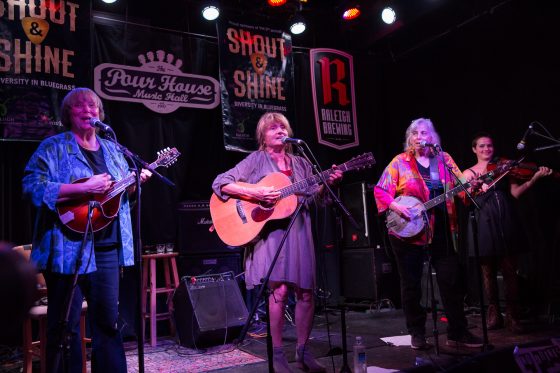
(L to R) Marcy Marxer, Alice Gerrard, Cathy Fink, and Tatiana Hargreaves perform at 2017 Shout & Shine showcase.
While Shout & Shine has continually championed underrepresented and marginalized folks in roots music, this year’s event comes at a time of reckoning in this country’s ongoing battle against institutionalized racism. “This year, Shout & Shine’s mission is as clear and galvanized as ever,” says BGS editor and Shout & Shine producer, Justin Hiltner. “Our lineup is a direct response to this current iteration of the Black Lives Matter movement and the righteous rebellion against police brutality and systemic racial injustice in this country. The greater bluegrass community needs to be having these conversations and needs to be centering the voices and perspectives of Black folks — especially Black queer folks. We saw that as our role this year.”
BGS joined hands with Decolonizing the Music Room’s founder Brandi Waller-Pace to curate 2020’s lineup. “The mission of Decolonizing the Music Room is to center Black, Brown, Indigenous, and Asian voices, knowledge, and experiences within the field of music education,” says Waller-Pace. “In addition to that, it is part of DTMR’s core values that we are an openly LGBTQ+ affirming non-profit organization. I am honored to have served as curator for this year’s Shout & Shine and to have had this opportunity to partner with BGS and PineCone on work that highlights a convergence of our values.”
“In addition to Shout & Shine’s continued work centering the music and stories of underrepresented artists in the bluegrass community, we also continue to work toward making these programs as accessible and inclusive as possible. We’re providing American Sign Language interpretation for the entire Shout & Shine program, modeling what can be done and what we continue to work toward in making accessibility central to our work,” said Jamie Katz Court, Communications & Programs Manager for PineCone, the Raleigh-based roots music organization that has partnered with us on Shout & Shine since 2017. PineCone also produces the festival, IBMA Bluegrass Live! powered by PNC.
The showcase was first conceived in 2016 to celebrate diversity and inclusion at the International Bluegrass Music Association’s business conference and festival in Raleigh, North Carolina. Originally organized in response to the North Carolina General Assembly’s homophobic bathroom bill, HB2, the scope of the event immediately widened to include and celebrate not only the LGBTQ+ community, but any and all marginalized folks in roots music. Shout & Shine stages have included the most exciting emerging talent alongside bluegrass legends and stalwarts, with lineups that have boasted the Ebony Hillbillies, Alice Gerrard, Cathy Fink & Marcy Marxer, Laurie Lewis & the Right Hands, Missy Raines, Amythyst Kiah, Kaia Kater, Che Apalache, and many, many more.
Shout & Shine is also a monthly editorial feature, which debuted with world-renowned drag queen Trixie Mattel’s first-ever interview by a roots music publication. In 2020 the column grew into a monthly livestream series that has already featured harpist and songwriter Lizzie No and fingerstyle guitarist Sunny War, part of a six-month series focused on Black artists and creators in roots music. The next episode will follow Shout & Shine Online in November. Whether on stage, in print, or online, Shout & Shine’s mission has always been celebrating the marginalized and underrepresented folks of all identities, backgrounds, faith traditions, and abilities who make and love bluegrass music.
Tune in Saturday, October 3 at 2pm ET for Shout & Shine Online!
Lede photo (L to R): Kaia Kater (by Todd Cooper); Stephanie Anne Johnson (courtesy of the artist); Amythyst Kiah (Anna Hedges). Poster art by Grant Prettyman, Belhum
This website uses cookies to improve your experience. We'll assume you're ok with this, but you can opt-out if you wish.AcceptRejectRead More
Privacy & Cookies Policy
Privacy Overview
This website uses cookies to improve your experience while you navigate through the website. Out of these, the cookies that are categorized as necessary are stored on your browser as they are essential for the working of basic functionalities of the website. We also use third-party cookies that help us analyze and understand how you use this website. These cookies will be stored in your browser only with your consent. You also have the option to opt-out of these cookies. But opting out of some of these cookies may affect your browsing experience.
Necessary cookies are absolutely essential for the website to function properly. This category only includes cookies that ensures basic functionalities and security features of the website. These cookies do not store any personal information.
Any cookies that may not be particularly necessary for the website to function and is used specifically to collect user personal data via analytics, ads, other embedded contents are termed as non-necessary cookies. It is mandatory to procure user consent prior to running these cookies on your website.