International Folk Music Awards Reveal Nominees, Lifetime Achievement Winners

Folk Alliance International (FAI), the foremost global nonprofit for folk music and the producers of the International Folk Music Awards, have announced the recipients of numerous honorary awards as well as nominees for Album, Artist and Song of the Year.

The Elaine Weissman Lifetime Achievement Awards are presented each year to honor the cultural impact of legendary folk music figures: one Living, one Legacy, and one Business/Academic. This year’s honorees are lauded songwriter and performer Janis Ian; the late folk and blues singer Josh White; and Oh Boy Records, the independent record label co-founded by John Prine in 1981.

The awards show will be held February 1 in Kansas City, Missouri, on the opening night of FAI’s 35th annual conference, and will be broadcast online. Appearances are confirmed by Folk Alliance International Conference keynote speaker Valerie June; The Milk Carton Kids; IFMA honoree Leyla McCalla; and Sam Lee.

ALBUM OF THE YEAR (sponsored by Rounder Records)

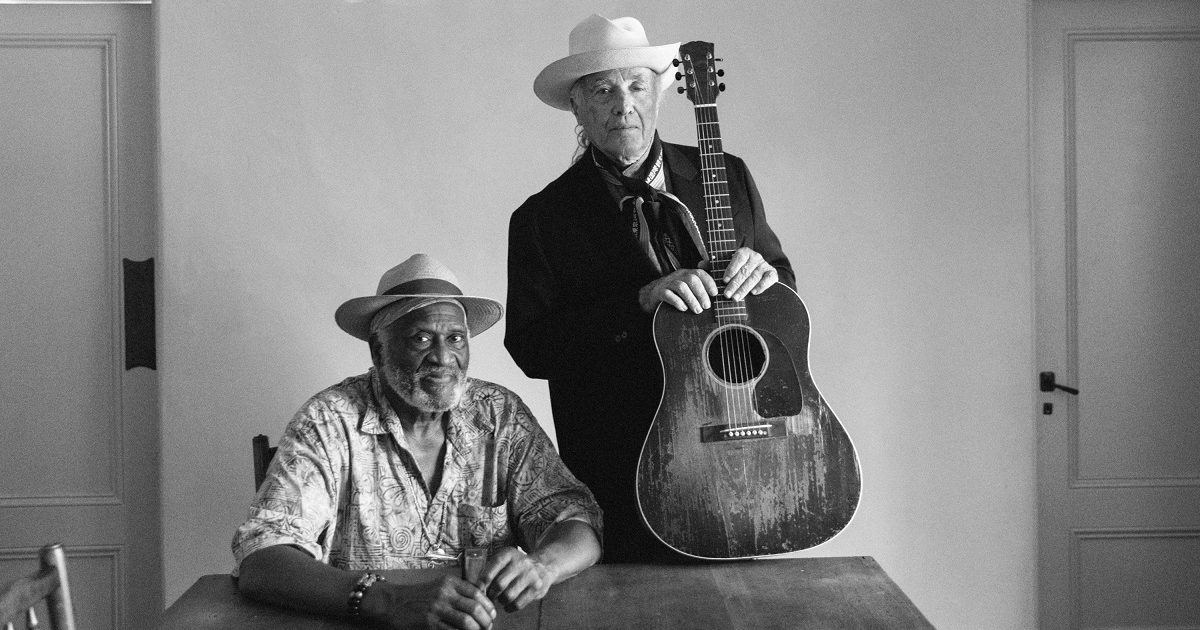
Get on Board: The Songs of Sonny Terry and Brownie McGhee by Taj Mahal & Ry Cooder
Marchita by Silvana Estrada
Queen of Sheba by Angélique Kidjo & Ibrahim Maalouf
Anaïs Mitchell by Anaïs Mitchell
Crooked Tree by Molly Tuttle & Golden Highway

ARTIST OF THE YEAR

Aoife O’Donovan
Jake Blount
Janis Ian
Leyla McCalla
Prateek Kuhad

SONG OF THE YEAR

“Udhero Na” written by Arooj Aftab, performed by Arooj Aftab featuring Anoushka Shankar
“Vini Wè” written and performed by Leyla McCalla
“Bright Star” written and performed by Anaïs Mitchell
“How” written by Marcus Mumford and Brandi Carlile, performed by Marcus Mumford featuring Brandi Carlile
“B61” written and performed by Aoife O’Donovan


The People’s Voice Award is presented to an individual who unabashedly embraces social and political commentary in their creative work and public careers. As an artist, Leyla McCalla has always traveled through time and space, opening the channels between lost or hidden touchstones of roots music and the present day. As a member of the Carolina Chocolate Drops and Our Native Daughters and in her solo work, the multi-instrumentalist and composer brings immediacy to long lost stories and shows how they survive and adapt through the flexible agents of rhythm, language, and intimate human connection. Her work is political and warmly welcoming, cerebral, and highly danceable. Based in New Orleans after growing up in a Haitian family in New York, McCalla makes music that adds detail to music’s maps and gives voice to people whose struggles and triumphs define its diasporic evolution. In 2022 she released the album Breaking the Thermometer, the culmination of her most complex project yet — a multimedia performance telling the story of the first independent radio station in Haiti. Breaking the Thermometer made Best of 2022 lists at NPR Music, PopMatters, and Mojo, in addition to former President Barack Obama’s list of favorite music for 2022.


The Rising Tide Award was launched in 2021 to celebrate a new generation (under 30) artist who inspires others by embodying the values and ideals of the folk community through their creative work, community role, and public voice. Award recipient Alisa Amador points folk music toward its future — a future that’s cosmopolitan, multifaceted, and multilingual; qualities that have in fact been at the community’s heart all along. Amador, who comes from a folk music family, grew up in Boston, Maine, Puerto Rico, and Argentina, and her songs show the influence of all of those places. A native Spanish speaker who’s spent most of her life in the States, Amador moves easefully between the two languages in her songwriting. As a high schooler, she studied jazz, and is known for sometimes scatting during performances. Amador’s ability to blend all of these influences within sharply rendered yet gently flowing songs helped her win NPR Music’s prestigious Tiny Desk Contest and Folk Artist of the Year at the Boston Music Awards.


Shambala Festival will receive the Clearwater Award, presented to a festival that prioritizes environmental stewardship and demonstrates public leadership in sustainable event production. Shambala Festival is a four-day contemporary performing arts festival in Northamptonshire, England. The festival is completely and utterly committed to being sustainable, circular, regenerative, net positive, earth and life respecting, and future thinking. They have reduced the festival’s carbon footprint by over 90%; achieved 100% renewable electricity; became meat, fish, and dairy-milk free; and eradicated single-use plastics. They’ve received many awards for their sustainability work, including the Innovation Award at the 2018 UK Festival Awards, the International A Greener Festival Award, the Outstanding Achievement Award at the Creative Green Awards in 2017, and more. The festival is Creative Green Certified and has committed to measuring and transparently reporting all of their impacts to provide an honest evaluation of their efforts. They work with independent third parties like Julie’s Bicycle to assess their performance and carbon footprint. The Clearwater Award is sponsored by Levitt Foundation.


The Spirit of Folk Awards are presented to honor and celebrate people and organizations actively involved in the promotion and preservation of folk music through their creative work, their community building, and their demonstrated leadership. This year’s recipients are as follows:

Steve Edge has been presenting folk music in Vancouver as a DJ on CiRT since 1985, and concerts and festivals throughout the city since 1986, initially independently, and then as a co-founder of The Rogue Folk Club in 1987 where he continues to present Celtic, folk, and roots music as its artistic director. Steve was an inaugural member of FAI in 1989, is an inductee into the British Columbia Entertainment Hall of Fame, and a recipient of the Unsung Hero award from the Canadian Folk Music Awards.

Amy Reitnouer Jacobs is a founder and the executive director of L.A.-based the Bluegrass Situation, an online music destination and promoter of roots, folk, and Americana music and culture. She joined the board of FAI in 2015 and was instrumental in refining and codifying the recruitment process for board elections as chair of the Nominations Committee. Amy served as board president through the pandemic and supported FAI’s recent strategic plan and executive director transition.

Marcy Marxer is the creator of All Wigged Out, a poignant and witty musical theatre production (and now film) recounting her harrowing triumph over breast cancer. Painfully funny, it is an example of the power of music and humor to inform and heal. Marxer, along with her partner Cathy Fink, is a multi-Grammy Award nominee and recipient, and together they have been recognized with over 60 Washington Area Music Association Awards for their folk, bluegrass, and children’s music recordings.

Adrian Sabogal is an acclaimed musician, producer, and researcher who founded Marimbea, an organization dedicated to the well-being of the Afro-Colombian communities from the country’s South Pacific coast. By arranging music-centered cultural tourism excursions, Marimbea strives to generate alternative sources of income, knowledge exchanges, and support networks for artists in marginalized and remote communities. Adrian’s work has had an impact on the economic development in the region, and the preservation of a vibrant and unique musical tradition.

Pat Mitchell Worley is the President and CEO of the Memphis-based Soulsville Foundation, which oversees the Stax Museum of American Soul Music, Stax Music Academy, and The Soulsville Charter School, all with a mission to perpetuate the soul of Stax Records. She is the longtime co-host of Beale Street Caravan, a syndicated roots radio show broadcast, and she regularly hosts artist Q&As for the Grammy Museum Mississippi and Oxford American. She is a former development director for the Memphis Music Foundation, and a past employee of the Blues Foundation.


The Folk DJ Hall of Fame was established to recognize radio DJs who have made an outstanding contribution to the preservation, promotion, and presentation of folk music, and who have demonstrated and inspired leadership in the broadcast field. Inducted DJs include the following:

Robert Resnik has been the host of All the Traditions, Vermont Public Radio’s folk and world music program, since 1996. Hooked on music since the 1960s, Robert previously spent many years on-air at WRUV at the University of Vermont. All the Traditions is as eclectic as Robert’s musical taste, but is dedicated to promoting music created by people living in the VPR broadcast area, which includes all of Vermont and parts of New Hampshire, New York, and Quebec. Robert also plays more than 25 instruments, and has performed and recorded CDs with a variety of musical combos for kids and adults.

Marilyn Rea Beyer hosted her first concert in junior high as the school band emcee. She got on board The Midnight Special listening to WFMT as a Chicago teenager. She has had careers in education, PR, and high tech. In 1995, Marilyn became on-air host and music director at Boston’s premiere folk station, WUMB-FM, and served on the board of the legendary Club Passim. Returning to Chicago, Marilyn joined WFMT in 2020, hosting The Midnight Special and now Folkstage. The Midnight Special launched in 1953 and maintained legendary status under Rich Warren’s stewardship. She says that judicious risk-taking, nurturing artists, and falling in love with new music make the job fun.

John Platt has hosted the Sunday Supper (formerly Sunday Breakfast) for 25 years at WFUV, New York, and has curated On Your Radar, a monthly showcase for emerging artists at Rockwood Music Hall in New York City for 17 years. He has founded the not-for-profit New Folk Initiative, which has extensive resources for the folk community at newfolk.org. He began his career at WMMR Philadelphia in 1969, programmed WXRT Chicago and WRVR New York, worked at WNEW-FM and WNYC, and produced national radio programs.

Harry B. Soria Jr. was known as a radio personality and walking encyclopedia of Hawaiian music history. The musicologist, award-winning liner notes writer, and record producer was the son of prominent local broadcaster and songwriter Harry B. Soria Sr. Ironically, Harry B.’s interest in Hawaiian music was sparked by hearing “cool” old records far from Hawaiian shores while at college in San Francisco. Upon returning to Hawai’i, he bonded with his dad over his vintage Hawaiian records. Harry B.’s passion for music from this period led to guest spots on KCCN in 1976 and his weekly Territorial Airwaves radio show of recordings from his personal collection. In 2019, Territorial Airwaves became the longest-running Hawaiian music show in radio history. Soria’s record collection and archives are being donated to the Hawaii State Archives.


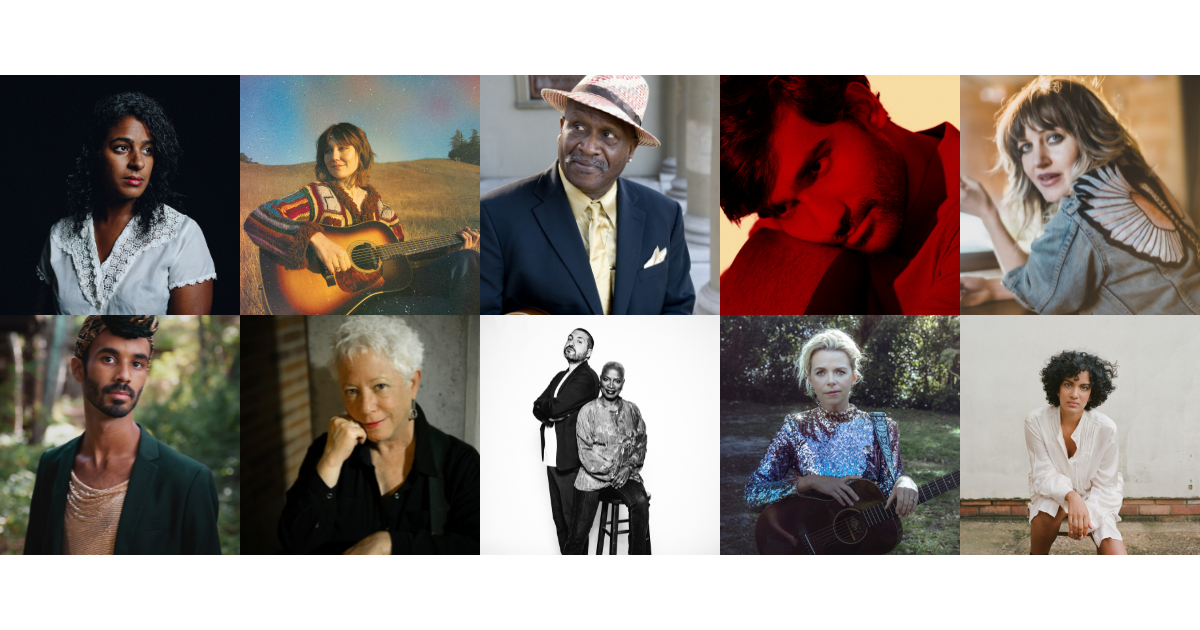
Pictured, top row: Leyla McCalla, Molly Tuttle, Taj Mahal, Prateek Kuhad, Anaïs Mitchell. Bottom row: Jake Blount, Janis Ian, Angélique Kidjo & Ibrahim Maalouf, Aoife O’Donovan, Anoushka Shankar.
MIXTAPE: Steve Dawson’s Crash Course in Slide Guitar and Steel Guitar

Slide guitar has been a lifelong fascination for me. I got into it when my uncle gave me a slide for my birthday when I was about 13. I had no idea how to use it, but eventually figured it out by copying Mick Taylor on Sticky Fingers, and I went from there. I’ve gone pretty deep, and find the roots of slide to be very fascinating. I’d like to share this playlist with you to show you some of the music that has inspired me in my journey. It definitely favors the early generations of players from the ’20s to the ’70s, but this playlist is meant to show you where it all comes from and what inspired me.

There wasn’t much slide going on in the ’80s that I was interested in as a kid, but there certainly are a lot of great players around now in the post-Derek Trucks era. In showing you where my influences are, this is a pretty good list. It covers blues, Hawaiian, jazz, rock, experimental, the whole nine yards. I even get into pedal steel a little bit, as there are a few important ones for me, but I won’t go too far into that world. I like how this playlist works totally out of chronological order, I hope you do, too. Enjoy! — Steve Dawson

King Bennie Nawahi – “Hawaiian Capers”

King Bennie is my favorite of all the pre-war Hawaiian players. He was very creative and inspired, and played in lots of different bands. He was basically a vaudeville/street performer who also recorded. I wrote a song, loosely based on his life on my new album, but this is one of his great performances.

Tampa Red – “Reckless Man Blues”

Tampa Red was probably the most sophisticated player of the pre-war slide players. He had sort of a jazz sensibility but could also get down in the greasy stuff. I like both of those aspects of his playing.

Kevin Breit – “Uncle John’s Third Wife”

Kevin is a brilliant musician from Toronto who I got to know and play with a number of times. He is incredible to watch and can shred with the best of them, but his compositions are often haunting and beautiful like this one. He put out a resonator/slide record some years ago called “empty” that remains one of my favorite albums to this day.

Jim and Bob – “The Song of the Range”

This duo was so creative and impressive. Their arrangements were top-notch and the playing is phenomenal. So fast, clean and sophisticated. They were obviously hip to a lot of the jazz horn players of the day.

Tedeschi Trucks Band – “Made Up Mind”

To me, slide players fall into the pre and post-Derek Trucks camp. There are things that he does as a player that no one did before and pretty much anyone that learned to play since he’s been around has been influenced by him, and you can tell. There’s tons of great Derek Trucks stuff out there, but I always dug this melodic, yet ripping solo.

Bob Wills and his Texas Playboys – “Steel Guitar Rag”

Bob wasn’t the steel player — Leon McAuliffe was. This is basically the bible of electric steel guitar playing. It’s not the most complex, or the flashiest, but most modern steel and slide playing can eventually be traced back to this ripping little number. Dig Bob doing the cat calls throughout!

Sonny Landreth – “Yokamama”

Sonny came out of the Louisiana Zydeco scene and played with John Hiatt on tour and on some great records. This is a very cool instrumental that was a big influence on me when it first came out. He really sent slide guitar in some new directions with innovative techniques.

Elmore James – “The Sky Is Crying”

Elmore basically electrified the slide and popularized the riff that anyone with an open-tuned guitar first learns to play. It’s kind of ruined electric slide guitar if you go and see a blues band at your local bar, but when you hear the guy that invented it do it this well with such tone, it’s a whole different ball of wax!

Ry Cooder – “How Can You Keep on Moving?”

For me, this has everything I like about slide playing rolled up into one song and one solo. It’s probably my favorite piece of recorded electric slide guitar ever made. Sort of simple, but incredibly difficult to play this well. It’s got all the great playing of the early era Ry and the tone is unreal. It’s cool that the solo is acoustic and the rest of the song is electric. And the rhythm playing is insanely cool throughout.

Ben Harper – “Manhattan”

I saw Ben Harper in Vancouver in about ’93 before his first album came out. He was opening for Tommy Emmanuel. There were about 10 people there. Ben played totally acoustic and it blew my mind. I’ve never forgotten that show. For me, and what I like about his playing, which is raw simplicity and soul, his recent album (all instrumental) Wintertime Is For Lovers is the best thing he’s ever done and it brings me back to that concert.

Roy Smeck – “12th Street Rag”

Smeck was a vaudeville guy and also quite widely recorded. He’s a phenomenal slide player and also just as great on regular guitar and ukulele. He had one of the earliest signature model guitars — the Gibson Roy Smeck.

Sol Hoopii – “Patches”

Sol was one of the greatest Hawaiian players and was actually very famous at the time. He came to the mainland in the mid-’20s and kicked off a nationwide Hawaiian craze that influenced music and pop culture. It was said that Sol would get hired to come to movie sets and play songs like this one to make the stars all weepy before their crying scenes. Sol was magnificent.

Muddy Waters – “Long Distance Call”

Muddy was the link between Robert Johnson and Chicago blues — he electrified it and made it commercial and exciting. Not the technical expert that Johnson was, Muddy had tone and feel for days.

David Lindley – “Your Old Lady”

I love Lindley’s electric steel playing, but in the ’90s he devoted himself to more acoustic music, although his instruments are always plugged in and sound massive. He had a few duos with percussionists like Hani Nasser and Wally Ingram that are phenomenal. The Weissenborn playing of this period of his career was hugely influential to me, but none of it is available in the digital realm, so here’s a great one from the ’80s.

Taj Mahal – “Statesboro Blues”

I love Duane Allman, and he’s on this list, of course, but if you can listen to this version of this song and tell me he didn’t get 90% of what he does from Jesse Ed Davis playing with Taj on this one, I’ll buy you a sandwich.

Allman Brothers – “Trouble No More”

Duane Allman at his finest. This one was huge for me.

Mick Taylor – “Sway”

I got into slide because of Sticky Fingers. I had no idea how to do it or what he was doing, or even who he was yet, but it was Mick Taylor who got me into it and especially considering he wasn’t 20 years old at this point, it’s pretty insane. The first solo on this one is Mick playing. And I’m pretty sure it’s Mick Jagger playing the other guitar part, not Keith.

Bill Frisell – “The Pioneers”

This is the song that got me into playing pedal steel. I’m not going to go down the pedal steel rabbit hole on this playlist, but this song and steel solo (by Greg Leisz) definitely changed my life, so I thought I’d include it.

Jerry Douglas – “The Hymn of Ordinary Motion”

Jerry has redefined the dobro as an instrument capable of playing in all genres, not just bluegrass. He came from a bluegrass background, but has gone on to be one of the great instrumentalists of our time. He is also very prolific and has tons of records to pick from, but this is an interesting one and shows his killer melodic playing that everyone who plays the dobro copies to one extent or another.

Blind Willie Johnson – “Dark Was The Night, Cold Was The Ground”

I mean, if one song shows the power of slide guitar at its moodiest, this is the one. Frightening, all these decades later.


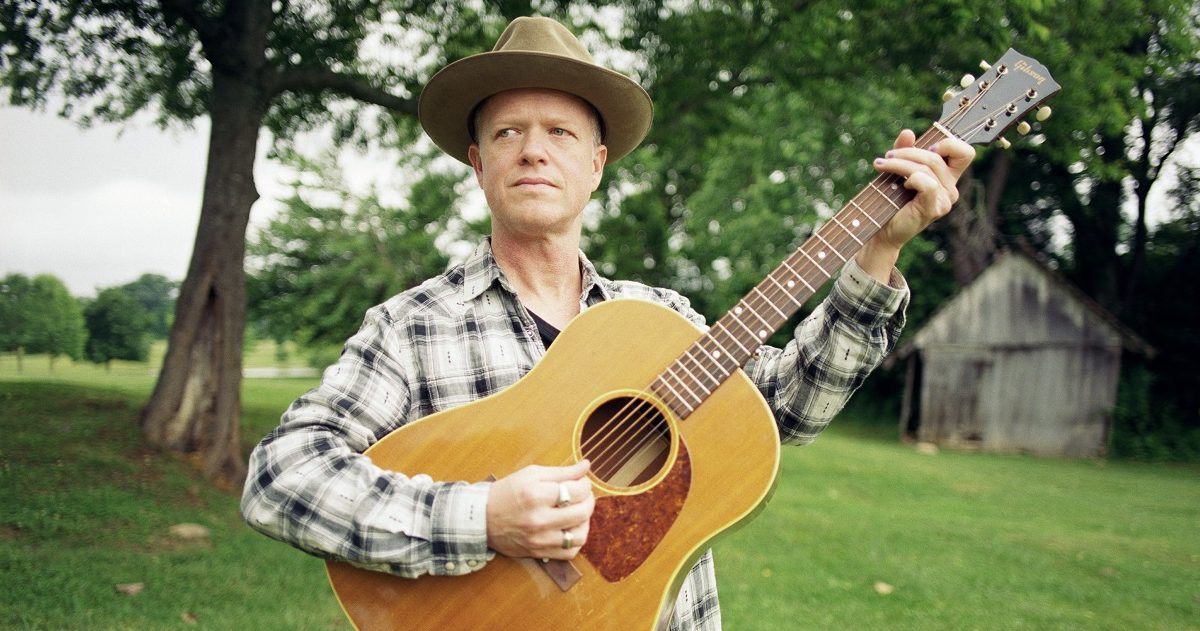
Photo Credit: Laura Partain

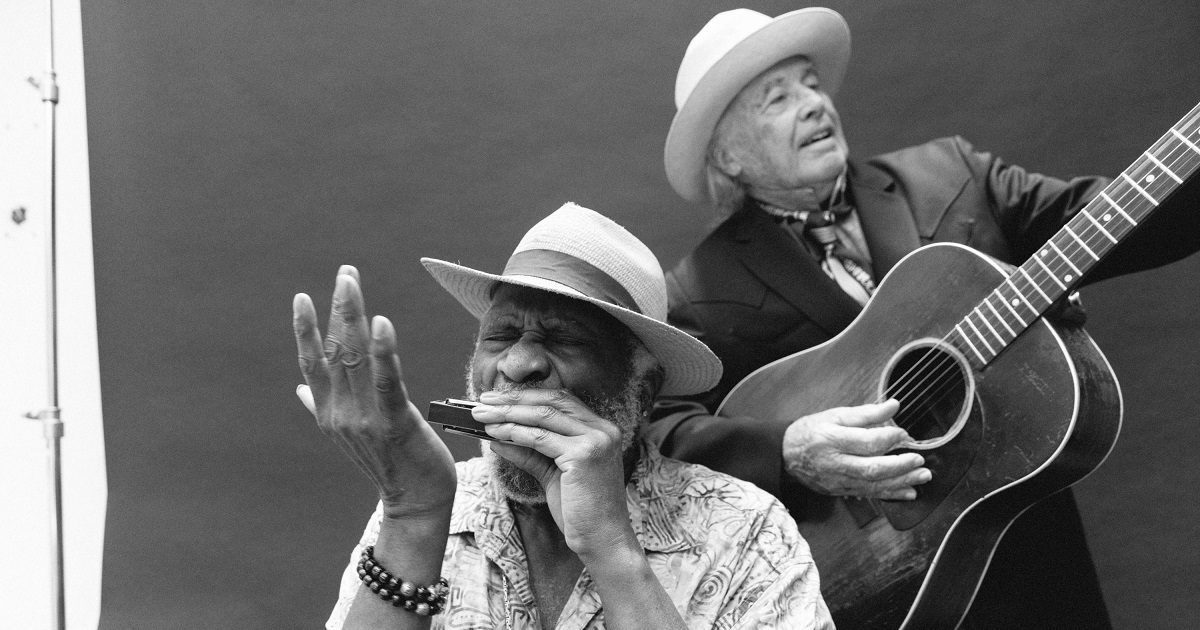
Taj Mahal & Ry Cooder Reunite to Honor a Duo That Few People Have Heard Of

“No, no, no, no.”

Ry Cooder is quick to put something to rest as he talks by phone from his home in the hills above Pasadena, California.

Yes, he and Taj Mahal went a full 54 years between recording projects together — from Cooder playing on Mahal’s 1968 solo debut, which grew from them co-fronting the band Rising Sons, to right now for the duo album Get on Board: The Songs of Sonny Terry and Brownie McGhee. The thing is, in the decades that harmonica master Sonny Terry and Piedmont blues virtuoso Brownie McGhee worked regularly together, from 1939 to the early 1980s, they were often at odds, sometimes not even speaking to each other off stage.

But no, there were no rifts between Cooder and Mahal, no disputes, no bad feelings that kept them apart.

“Nothing like that!” Cooder insists. “No, no, no!”

The time between projects?

“Musicians, you know,” Cooder says. “He travels around all the time.”

Yet, in other regards…

“It’s funny,” says Mahal, on a separate call between tour stops, “because we’ve actually become the men that we admired. We’re the new version of it, you know? So, it’s like full circle. It’s a wonderful thing to have really accomplished that, to be in a life in music.”

The way Cooder and Mahal have become the men they admired, presumably, is in the role of elder statesmen keeping traditions alive. They are honoring and, in highly personalized ways, refreshing the music with deep ties to past generations and cultures. That full circle — global circumnavigations, really — has seen them explore a wealth of music and cultures, from Cooder’s key role in Cuban group Buena Vista Social Club projects, to Mahal’s drawing on the Afro-Caribbean roots of his musician/arranger father. Their individual efforts include collaborations with musicians from Africa and India, just for starters. But with this album they each go back to where the sparks for all that first happened.

For Cooder, it started with the first Terry/McGhee collaborative recording, also called Get on Board, a key release in the essential catalog Mo Asch created on his Folkways label. In fact, the new tribute album not only uses the title but has cover art that is an homage as well. The full title of that 1953 album was the now archaic Get on Board: Negro Folksongs by the Folkmasters.

Sonny Terry had come to some mainstream recognition as part of the original cast of Finian’s Rainbow on Broadway in the late 1940s, and as a pair he and Brownie McGhee were featured in the Broadway productions of Tennessee Williams’ Cat on a Hot Tin Roof and Langston Hughes’ Simply Heaven. They were also championed by Pete Seeger, Woody Guthrie and Harry Belafonte, among other prominent supporters. But for young Cooder, this record was a discovery marked by its vibrant energy, with Terry and McGhee joined by one Coyal McMahan on vocals and percussion.

“It’s a great record,” Cooder says. “You’ve got the mysterious Coyal McMahan on bass voice, sort of a church bass, and maracas. They should have kept him on. I don’t know why they didn’t. He added a whole other quality to it. I don’t know who he was and nobody knows at this point.”

The new album features three of the eight songs on the Terry/McGhee set — “Midnight Special,” “Pick a Bale of Cotton” and “I Shall Not Be Moved.” Its remaining songs are part of the icons’ other recording and live repertoire, from the reverent “What a Beautiful City” to the carousing “Drinkin’ Wine Spo-Dee-O-Dee” to the double-entendre “Deep Sea Diver” to the down-and-out “Pawn Shop Blues.”

Adding their own touches to the songs, Cooder and Mahal recorded mostly live in the living room of Cooder’s son, Joachim, who also played various percussion instruments and bass, sort of filling the McMahan role (and more). They didn’t seek to recreate the originals. What they did do, was have fun.

“That was the intent,” Cooder says. “I mean, it seemed to me that we could pull it off and keep that feeling that those guys had back then. I don’t want to say ‘jolly,’ but foot-tapping, nice music. They had gone for a white audience, I’m pretty sure, at that point anyway. So, you couldn’t very well play very dark music at white people in those days. They wouldn’t know what you were talking about, what it was for. By the time they started recording together, I guess, black popular music had changed radically.”

Cooder is conscious of the radical changes since then in music and culture, in particular noting “Pick a Bale of Cotton.”

“They’re still really good songs,” he says. “And I think people will like hearing them as much now as they liked hearing them back when Brownie and Sonny did them. It’s a different time now. Of course everybody’s consciousness is totally different. I mean, everything is different.”

That’s part of the point, not to let the music that inspired them get lost.

“It just feels like old times,” Cooder says. “I have those records from when I was a little kid, so I can dig it. I remember how it used to make me feel listening to the record, how tremendous it was, how exciting it was.”

The circle for Mahal goes back to the early 1960s, when he was a student at the University of Massachusetts.

“There was a whole network for folk music and blues and bluegrass and country and all that old-time stuff in and around the Northeast sector,” he says. “I was like 19, 20 years old. And those guys were coming through and playing at local coffee houses. You could get to see them quite a bit. And I thought they were just an incredible powerhouse duo.”

A couple of years later, Mahal, who had started playing on the folk circuit himself, encountered a guitarist with a great feel for blues.

“I said, ‘Well, where the heck did you learn how to play like that?’” Mahal remembers. “And he said, ‘Well, you know, I took some lessons from this guy out in California named Ry. I said, ‘Do you think that guy might like to be in a band?’ And he said, ‘Well, he’s only 17 years old.’ I said, ‘Are you kidding me?’ And I said, ‘I guess I have to go to California.’”

And he did. When they connected, a love for Terry and McGhee was one of their bonds. Cooder, too, had seen the duo play a few times by then, the first coming when they played at the opening night of the Ash Grove, a Hollywood club that would become the center of the California folk and blues scene.

“My mother took me down there,” Cooder says. “I was 13 or so. I sat there and watched them. My gosh! It was something to see the whole thing come to life. You know, it was a tremendous impression when you’re young like that.”

And when they’re not-so-young. (Cooder just turned 75 and Mahal will be 80 in May.) They first chatted about teaming for a project after Cooder joined Mahal at the 2014 Americana Music Honors & Awards at Nashville’s Ryman Auditorium on Blind Willie McTell’s “Statesboro Blues,” a staple in the Rising Sons repertoire and a standout on Mahal’s 1968 album. That latter version, which featured Jesse Ed Davis on electric slide guitar, is reputedly the recording on which the Allman Brothers’ rendition was modeled.

When Cooder suggested an album honoring Terry and McGhee, Mahal was, well, on board. “Those guys are foundational titans,” Mahal says. “Here’s a guitarist and harmonica player that spanned 40 years, at least.”

But these musicians are also largely forgotten, which adds a sense of mission to this project, to rekindle interest in the guys whose recordings and concerts meant so much to them.

“If you stood on a corner and did an exit poll and talked to a million people, none of them would know who they are,” Cooder says. “They’ve been completely overlooked. I don’t know anybody that’s ever heard of them or remembers who the hell they were, except for musicians who have made it a point to keep certain things in mind. It’s like bluegrass. If you keep Bill Monroe or Reno & Smiley in mind, it’s that kind of thing. That’s how you live, and that’s how you evoke things, this memory that you have of these records.”


Photo Credit: Abby Ross

WATCH: Taj Mahal & Ry Cooder, “Hooray Hooray”

Artist: Taj Mahal & Ry Cooder
Album: Get on Board: The Songs of Sonny Terry & Brownie McGhee
Release Date: April 22, 2022
Label: Nonesuch Records

In Their Words: “When the folk era came, and Brownie and Sonny started to work folk clubs, my mother would drive me to Haight-Ashbury. And the first time, of course, Brownie came with his limp because he had polio as a child and he had a built-up shoe about yea big. And Sonny was blind, so here’s this guy way-limping, leading this blind man, and they came in — ‘Hello, everybody. Hello, ladies and gentlemen.” And hit it! It was like, ‘God! This is so good!'” — Ry Cooder

“I guess I started hearing them when I was about 19 and they were coming around. I wanted to go to these different coffee houses because I heard that these old guys were playing. I could play a little bit. I learned some stuff from my neighbor, because I wasn’t a guitar player. I knew a few licks on the guitar and played some Jimmy Reed music, but I knew that there was a river out there somewhere that I could get into, and once I got in it, I’d be all right and I could just stay in it. They brought the whole package for me. If we wanted to send somebody out to see somebody who was doing something good — ‘Go out and see Sonny and Brownie.'” — Taj Mahal


Photo Credit: Abby Ross

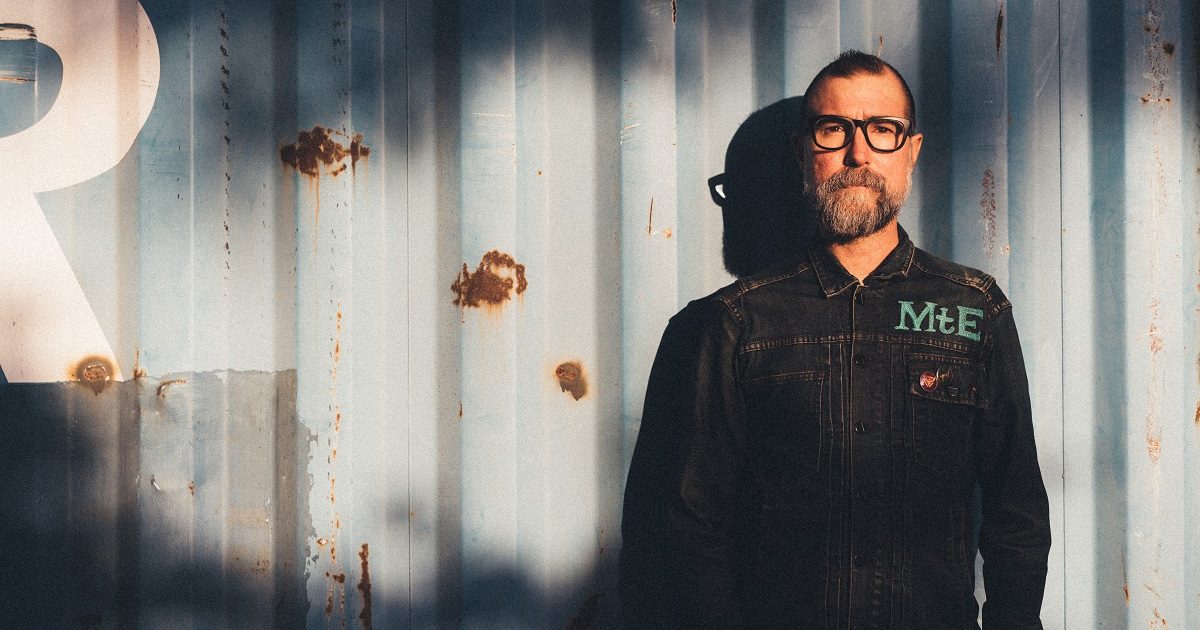
BGS 5+5: Matt the Electrician

Artist: Matt The Electrician
Latest Album: We Imagined an Ending
Hometown: Austin, Texas

Which artist has influenced you the most … and how?

As a songwriter, I have to go with two, often copacetic, though possibly somewhat diametrically opposed forces, Paul Simon and Rickie Lee Jones. The way they both use language in their storytelling has always been inebriating to me, and feels very much like home. They both often stuff words into spaces that feel, all at once, both incongruous and at the same time, absolutely perfect in their placement. It encompasses for me the way I aspire to be as a writer. And musically, they both have a lot of influences in their own songs from early ’50s rock ‘n’ roll and doo wop, which I’ve always felt speaks to me as well. I think that hearing artists that seemed unafraid to change or break whatever rules around the ways you’re allowed to use words and language in a song was always very liberating to me, and made me not feel not quite as weird writing about whatever I wanted to. And all of that freedom, couched in the confines of the pop rock idioms, feels comforting to me, like a cartoon Tasmanian devil wrapped up tightly in a cozy blanket.

What’s your favorite memory from being on stage?

As much as I’m a bit of a planner, I also love it when plans fail, and as a performer, I think I’m often better when I’m improvising. Once when playing a showcase at the Folk Alliance conference, the sound system went out in the room I was playing. It was a smallish room, but was very full of people. The sound guys were gonna go get some more equipment, but knowing I only had a short set time, I stopped them, and did the show unplugged. Everyone gathered in tighter. A friend in the crowd came up on a couple songs and sang backup, unrehearsed. The community vibes were in full effect and the warmth of that particular room is how I wish all shows always felt. I’ve played giant festival stages in front of thousands, and none of it compares to being huddled in a small room with people singing along with you.

What other art forms – literature, film, dance, painting, etc. – inform your music?

I’m a voracious reader and a film buff. I’d say that both inform my music a great deal. It never feels super linear, like I rarely sit down to write a song while directly referencing a movie or book, but I know in retrospect, that quite a lot of both filter into the process all the time. I think I tend not to like looking directly at any of my influences per se, but rather, hope to allow them to seep in sideways, when I’m not paying attention. That being said, book-wise, I’m currently reading John Lurie’s memoir, The History of Bones, and watching lots of 1950s film noir.

What was the first moment that you knew you wanted to be a musician?

Watching my dad play rhythm 12-string electric guitar in a ’60s rock cover band at a pizza joint in Rogue River, Oregon, when I was 4 or 5 years old. A few of us kids were allowed to watch the first set, and then we were relegated to a camper in the parking lot for the rest of the night. There was a sax player in the band named Willie, and although I don’t remember watching him play the trumpet, he had one in a case at his feet, and I decided then and there that I wanted to be a trumpet player. Soon after, my parents found a $5 trumpet at a garage sale and gave it to me for Christmas. I played that same trumpet through sophomore year of high school before getting a new one and went on to study trumpet in college.

Which elements of nature do you spend the most time with and how do those impact your work?

I married into a backpacking family, so we spend a good chunk of time every summer in the Sierra Nevada mountains, and I love those wooded forests, always have. But my main draw is the Pacific Ocean. I grew up alongside it, in California and Oregon, and even being in Texas for the last 25 years, I manage to get back to it at least a couple times a year, every year. The overwhelming power of it absolutely hypnotizes me. I think it is literally the rhythm of my thoughts, and I aspire to my actions falling under its spell someday as well.


Photo Credit: Allison Narro

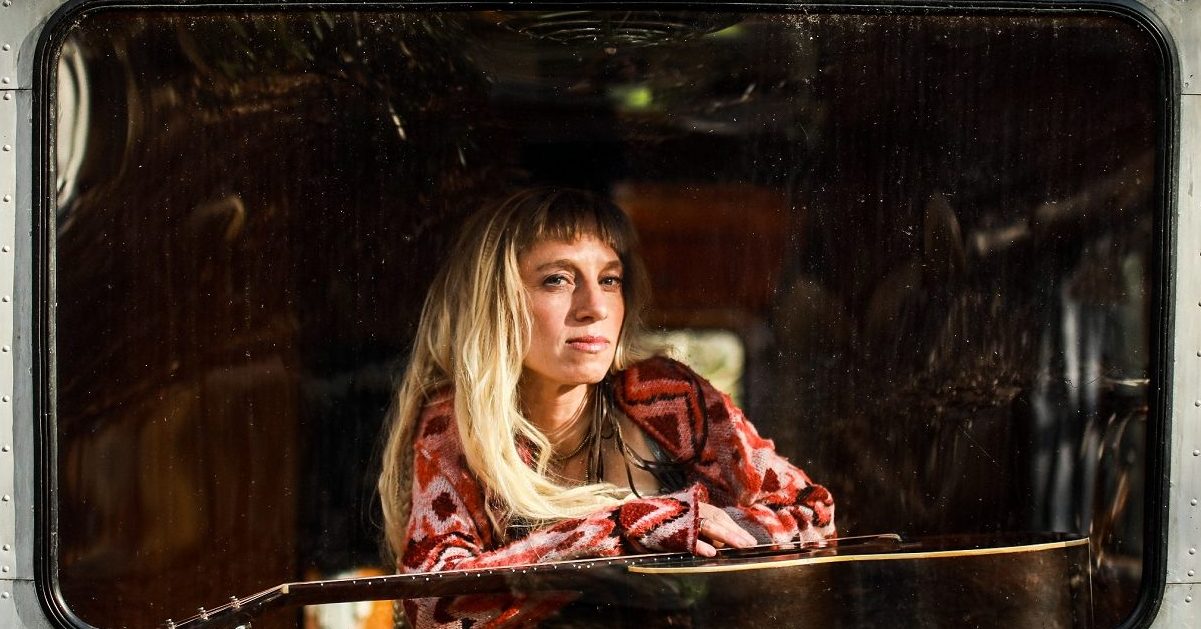
BGS 5+5: Anya Hinkle

Artist: Anya Hinkle
Hometown: Asheville, North Carolina
Latest album: Eden and Her Borderland
Personal nicknames (or rejected band names): Anyabird

Which artist has influenced you the most … and how?

I guess far and away I have to answer — Gillian Welch. I grew up in the New River Valley of Virginia listening to Tony Rice, Norman Blake, Taj Mahal, Hot Tuna, Muddy Waters, Grateful Dead, and Old and in the Way, loved bluegrass and blues, but also female folk singers like Joan Baez and Judy Collins, pop stars like Madonna and Cyndi Lauper, and songwriters like Sarah McLachlan, Natalie Merchant, and Suzanne Vega. It just took Gillian to come around with her Revival album and put all that together for me, that you could incorporate all those great roots sounds into something completely modern and original. I was living in California at the time I heard her first album. I grabbed my fiddle and headed straight down to 5th String Music in Berkeley and started going to every bluegrass jam I could find. I thank her for giving me the idea that I could do it too — because of her genius, I could begin to imagine myself singing and playing guitar and writing songs too. It’s important to have someone you can look up to and that you can relate to so you can even have the idea in the first place.

What’s the toughest time you ever had writing a song?

For more than a dozen years now, I’ve been hanging around the Cumberlands with my buddy “Hippie” Jack Stoddart, someone who, in his rough and audacious way, brings people together to make a lot of magic. Hippie said to me one day, “I want to introduce you to Zona.” He’d been doing a lot of outreach work out of an old school bus bringing groceries and coats and toys and stuff to people living in former mining towns in Middle Tennessee. So he brought me up the mountain to meet the hardened sweetness that is Zona Abston. We sat around her kitchen table and she told me her life story, a miner’s daughter, growing up with little education and no money, not much luck or hope. When we collapsed back in the truck, Hippie said to me, “You better write this shit down!” And so I did. I wrote every detail: the cancer, the hunger, the cheating, the shining, the debt, the babies, the heartbreak. I came back with a mess of notes and thought, “How do I make a song out of this?” So I sat down and tried to pull out the most specific and moving details of everything she told me and created a ballad for her. I was super nervous to play it for her because, well it was HER life. SHE had to live it. But when I sang it for her the tears rolled down her beautiful face. She said, yup it’s all true, every word of it.

If you had to write a mission statement for your career, what would it be?

I actually thought about this a lot earlier this year, during the pandemic when I was trying to understand what my purpose was in music when it seemed like the industry was going to hell. I decided to focus on three things, and wrote them on a yellow sticky note that is taped in front of my desk for quick reference. The first is authenticity, and a commitment to truth and honesty to who I am as an artist. It’s a challenge to believe that it’s all already inside. I don’t need to grasp at something outside of myself. I just need to continue to learn to trust myself and be myself. The second thing is connection — connection with other artists and musicians, connections with my fans and supporters, and connections with anyone along the path. Those beautiful relationships are the foundation for anything I can possibly hope to accomplish in this lifetime. Saying “yes” and valuing the people that show up for me is oxygen. The third thing is creativity — growth and discovery. Allowing myself to surrender to the journey, giving up thinking I have to have everything figured out and under control. I need to just submit to curiosity, openness, and faith.

Which elements of nature do you spend the most time with and how do those impact your work?

Before I was a musician I was trained as an ethnobotanist. I traveled half the world studying plants and their uses and connections to culture. I love referring specifically to plant species in my songs because they can be so symbolic in our physical world. For example, in the the title track for my new record, Eden and Her Borderlands, I use a couple of plants that carry a deeper meaning. The cedar is fragrant and twisted, it’s green the year round, its oils are used to protect against decay and disease, it is sacred and ancient in its symbolism. I also use the sycamore. It is stately and grand, always grows near sweet water. It is often a boundary and its presence on the landscape signals a threshold that we approach and then cross over. Adding these botanical details to the song is like adding spices to a recipe, it gives more depth, even for those that might not know anything about botany. And who knows, maybe it will inspire people to love plants like I do!

How often do you hide behind a character in a song or use “you” when it’s actually “me”?

I love this question because initially there can be so much fear in exposing your true self. Absolutely mortifying to lay bare the thoughts and emotions of a real human, the one behind the Facebook posts and the stage persona and the person you think you are or wish you were. The real one with all the real flaws, that is the person that is actually interesting. But the songs really push yourself (myself!!!) to look in the mirror and substitute the “you” with “me,” to get personal. Well, it’s a journey of acceptance and insight. Getting personal is the thing that connects us to the rest of humanity and, honestly, the thing that makes a good song, the thing that makes a song relatable.

I recently took a songwriting course with Mary Gauthier. In the song I shared, I kept referring to myself as “babe.” She said, who is babe? She focuses a lot on pronouns, you know, who are we talking about here? Because in our heads, it’s always about us. It can’t NOT be. We are trying to figure out what the hell we are doing here and if we are at all worthy of anything we are pretending to do. It takes a lot of working through fear to write songs. It’s good work.


Photo credit: Sandlin Gaither

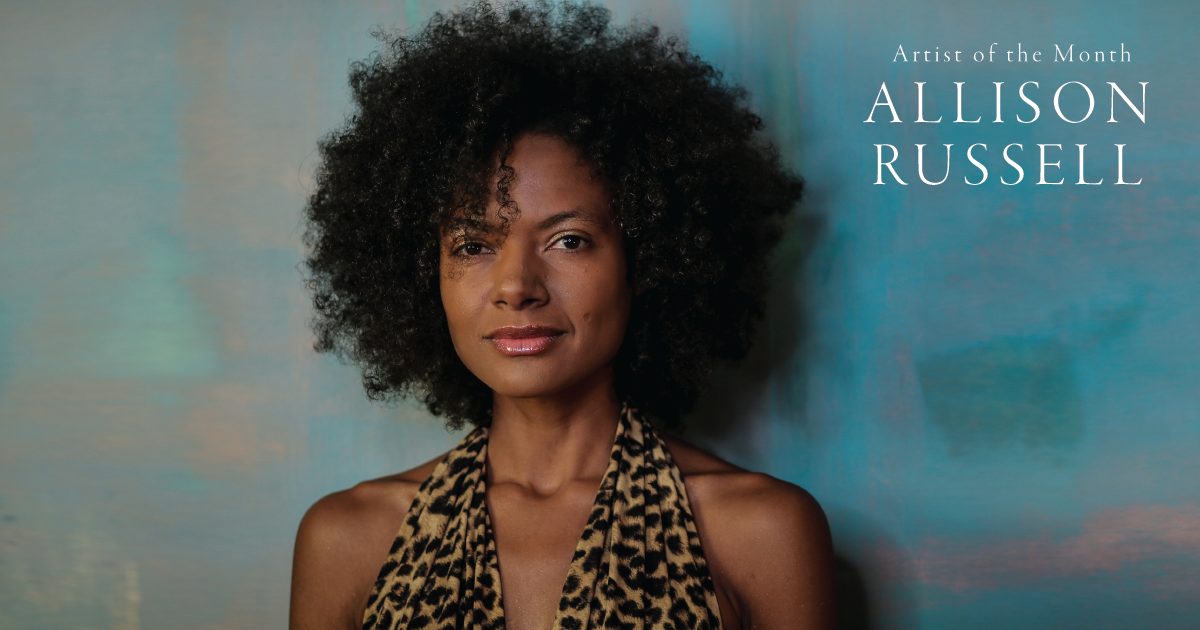
Allison Russell Gives a Voice to Queer Folks and Survivors on Solo Debut (Part 1 of 2)

Within the songs of her new album Outside Child, Allison Russell delves deeply into the extreme trauma she experienced in her youth spent in Montreal both as a mechanism for personal relief, but also in the hopes that it might reach people with similar experiences.

Although she is a member of multiple bands (including Birds of Chicago and Our Native Daughters) and is an accomplished speaker and poet, the release of Outside Child marks Russell’s first solo work as a recording artist. BGS caught up with our Artist of the Month, Allison Russell, from her home in Nashville.

BGS: This is a deeply personal record. What was your writing process like?

Allison Russell: The writing process was having to delve deeply into the most painful parts of my past and childhood and history. I experienced severe childhood abuse, sexual, physical, mental, and psychological. In many ways, I think the psychological is the toughest part to unpack and defang. I don’t know that I am ever going to be entirely free of that and the process of dealing with that. What was very beautiful about this to me is that I didn’t have to go on that fearsome journey alone. My partner J.T. [Nero] was with me every step of the way. He co-wrote many of the songs on this record with me. He scraped me up off the floor when I was in the depths of it.

I have tried at different times in my songwriting life to tackle some of that material and I did on various songs with my first baby band, Po Girl, but I didn’t have the same kind of support and stability at home that I have now. I didn’t have the same amount of distance in time from the events and trauma of my childhood. Time and distance, plus boundless unconditional love that I receive from my partner, were really healing to have that collaborative sense on these songs. It is tough. It is hard to contemplate pain and trauma. That is reflected in the macrocosm of what is happening in our world right now. We are dealing with it every day with each news story of violence towards communities of color. …

We have to go into the pain of it or it perpetuates. The cycles self-perpetuate if we don’t take a stand to stop them. That’s what I’m trying to do personally. Art builds empathy and connection and it helps stop cycles of abuse when we really listen to one another and see and hear one another. It is a lot more difficult to practice abuse and bigotry. I believe in harm reduction. I don’t think we are going to achieve nirvana in this lifetime, in this world, but I do believe strongly in harm reduction and that small things can create mighty ripples. That’s why telling our own stories in our own words under our own names is so important because it can provide a roadmap for somebody else going through similar experiences.

I wish my story was unique. It is not. One in three women, one in four men, one in two trans or non-binary folks have experienced stories very similar to mine.

In “Persephone,” you sing about a lover in your youth who was seemingly a refuge from the trauma you were living through. It feels like a really loving tribute to her. Is that a story you’ve always wanted to tell?

It has become more important to me as I get older to honor those friends of our youth and loved ones of our youth and lovers of our youth who helped shape us and in this case, she literally saved my life. And I wanted her to know that. I also wanted to acknowledge that I am a queer person who is now in a straight passing life and marriage. I fall in the middle of the spectrum of orientation. I’ve been in love with women and I’ve been in love with men and I’ve been in love with trans people and I’ve been in love with non-binary people. I wound up falling in love and committing to share a life with a man, my husband.

One could assume that I’m straight, but I am not and especially in this time of increased polarization and bigotry, it is really important that people understand that nothing is black and white. Nothing is simple and you can’t assume that because I am married to a man and I have a child that I am a straight person. You can’t say homophobic things to me and have it pass. Part of me wanted to really acknowledge that publicly. I am grateful. I don’t get to be here singing today and having my child and my family if it wasn’t for that first love. She taught me how to love and that it was possible. She taught me about kindness and unconditional love. She taught me about acceptance, courage and bravery.

I’d love to know about your influences coming up in music.

Growing up, my mom was my first musical influence. She is a beautiful piano player. We had a really troubled relationship, but one of my first memories is crawling underneath her piano and just listening to her play and watching her feet on the pedals and hearing the resonance under the piano and feeling connected to her in that way, even though she didn’t know I was there. It was a feeling like the music she made was a truer expression of her than the often very hurtful words or violent things she did. That was my first sense of understanding the depth of music, that it goes beyond language.

My grandmother taught me lots of very violent, creepy lullabies from Scotland. She knew a lot of old murder ballads and child ballads and she sang me all of those songs. I loved them. That oral distillation of archetypal stories over generations and time, generally very matrilineal and passed down from mother to daughter, I connected deeply with those songs. That was my first sense of the hidden archive of the world.

My adoptive father was very repressive about what we were allowed to listen to. If it wasn’t Baroque or Classical or maybe Romantic, we would get in trouble for listening to modern music. One of the sort of transgressive things that my mom and I sometimes did was listen to Joni Mitchell or Stevie Wonder together. I have such distinct memories of holding the Ladies of the Canyon album and poring over it and reading the back and seeing Joni’s art. That was very formative music for me.

With Tracy Chapman, I was 9 the first time I heard her. I was on a trip with my uncle and I remember hearing “Behind the Wall” and just bawling because we were the family behind the wall. We were the family where there was violence and abuse and the police were constantly being called. To hear someone writing this and have this sense of recognition that this happens to other people and I’m not alone in the world and hearing her voice and her writing and poetry made me feel I wasn’t alone.

And when I left home at 15, my sonic world exploded. There were all these endless possibilities. I’m a huge Staples Singers fan. John Prine, Lucinda Williams, Emmylou Harris, Taj Mahal (particularly Giant Step/De Old Folks at Home). And Mulatu Astatke, who I’ve been obsessively listening to over the pandemic. His music is expanding my understanding of melody and structure. It is ongoing. The influences never stop and I’m influenced by my brilliant peers as well.

Has your daughter listened to these songs with you? What do you want her to learn about you from the music?

She has listened to it. One of the hard things has been having to talk about abuse with my child. I think it is incredibly important. I think that by the time we start to do that in schools, it is often much too late for the children, including me. I’ll never forget in Grade 4, hearing the song, “My body’s nobody’s body but mine,” and for me that had not been my reality since I was 3. What I want her to know is that we are strong enough to live through hard things and come out the other side of it. I want her to know that she is strong enough, in whatever struggles she faces.

I want her to know that her stories are worth telling and her experiences are of value. She is an infinitely strong being and she is part of a whole long lineage of strong women. I want her to know that. And that she is loved so much and a huge part of why I strive to do anything or be any kind of good ancestor is because of her.

(Editor’s Note: Read part two of our Artist of the Month interview here.)


Photo credit: Marc Baptiste (top); Laura E. Partain (in story)

What Was Tony Rice Really Like? Todd Phillips Reminisces With Robbie Fulks

No BGS reader needs a rundown of Tony Rice’s biography or accomplishments. Earlier this month I chatted with Todd Phillips, Tony’s close friend and bassist across multiple groups (David Grisman Quintet, Bluegrass Album Band, Tony Rice Unit) from 1975 to 1985. During these years Tony used inspiration from mid-century jazz and musical peers, along with his innate willpower, as levers to crack open a stunning new guitar vocabulary. In doing so he rose from a bluegrass badass to a global force, operating well above tribes and vogues.

When Todd emerged in the 1970s, bass guitar was a cross-genre norm. A young upright player who melded Scott LaFaro’s gracefulness with J.D. Crowe’s timefeel was a fairly wonderful anomaly in bluegrass. I started working with Todd in 2014, and grew close with him fast. He brought something rare — a relaxed whiphand — to the feel onstage. In the van, he indulged my ceaseless fanboy questions about the old days. An equable ex-stoner with a mildly grumpy edge, he’s as adept at building an instrument or a chicken coop as analyzing acoustic riddles, and his long experience working with people as unalike as Joan Baez, David Grier, and Elvis Costello gives him a high perch from which to reflect. He reminisced fluidly about Tony over the phone with me for two hours, stopping only twice, once overwhelmed by emotion and once to get a bottle of tequila. (Read more from our conversation at my blog.)

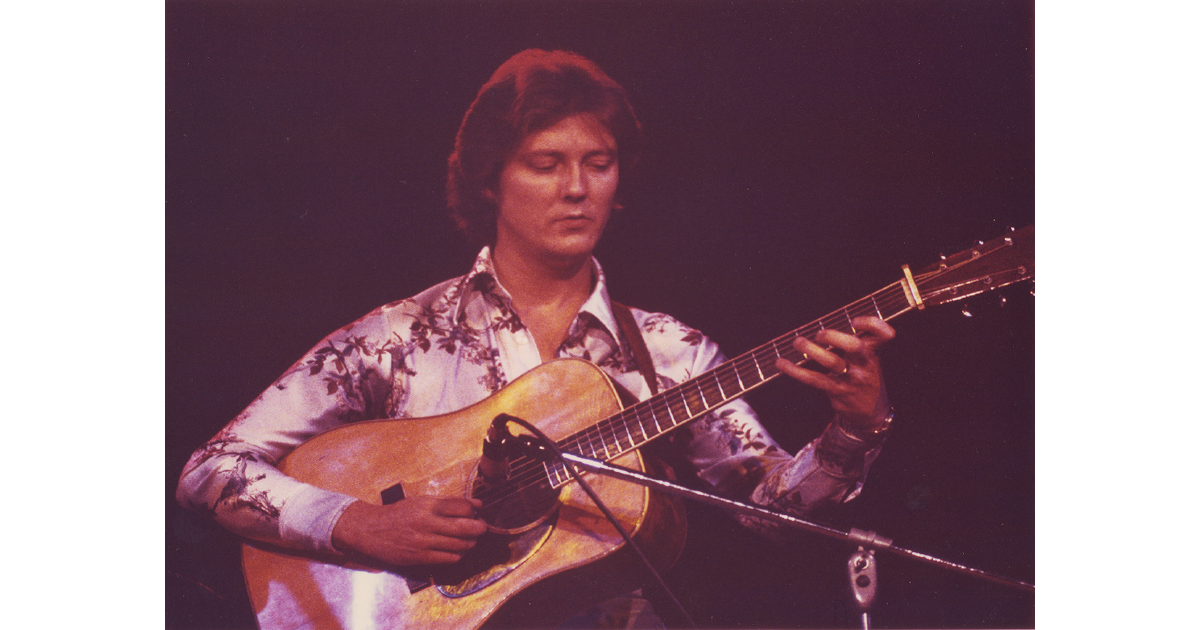
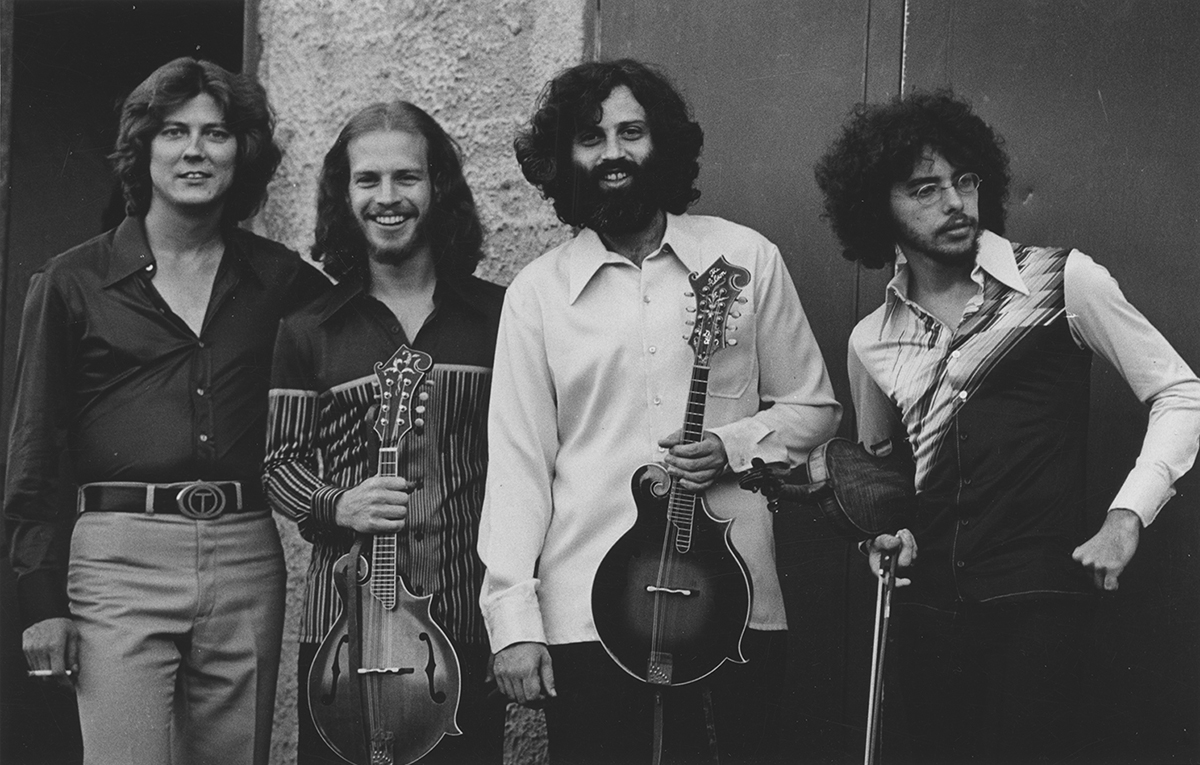
Members of David Grisman Quintet, 1977. L-R: Tony Rice, Todd Phillips, David Grisman, Darol Anger. (Photo by Jon Sievert.)

Robbie Fulks: I listened back today to California Autumn and other records I hadn’t heard for ages, and heard little passages that sounded uncharacteristic of Tony. Did gestures come into his vocabulary, stay there for a while, and then fade off as he went to concentrate on another idea?

Todd Phillips: That’s true, yeah. He would go through cycles, get on a kick. He’d get on riffs, like hearing Billy Crystal: “You look marvelous.” He’d say that 40 times a day, and a year later, drop it for some other riff. The vocabulary would change, according to the era.

That’s fascinating, to compare it to a non-musical example. So let’s dive in, go back to the start. Tell me about meeting Tony — when, where, and how you guys got underway with the Grisman project.

I was a beginning mandolin player, and I was certainly in over my head, playing mandolin with David, but he’d never heard me play bass, which I’d played since I was a little kid. This was 1974, and Clarence White had died the year before. And we just thought, this is a good band, we don’t need a guitar — no one else could fill Clarence’s shoes, and he’d be the only guy that would work in this thing. Then David came home from a Bill Keith recording session and said, “I just met the guy that could do it.”

(Photo by Todd Phillips)

Shortly after that, J.D. Crowe and the New South were on their way to Japan, and they stopped in San Francisco to play one gig. They hung with us for a couple days and… I had never hung with, um, that many guys from Kentucky all at once. [Laughs]

I’ve told you about that Mexican restaurant in Berkeley. The Californians — me, Darol, and David — and the Kentucky guys — J.D., Tony, Ricky, Jerry, and Bobby — were seated at one giant round table. First, Crowe ordered: “Six tacos and a Coke!” Then each New South guy ordered exactly the same. I guess they were used to the little three-inch tacos you can eat in two bites. So this big table ended up covered with plates full of giant tacos, surrounded by a pretty interesting mix of characters. I wish we had a photo. Polyester and tie-dye T-shirts all around.

After they came back from Japan, Tony gave J.D. his notice. He hooked up a little U-Haul trailer — clothes, suitcase, guitar, and stereo system — and got an apartment in Marin County. And we started rehearsing. At that point, we had what we had, but then Tony’s chemistry came into it. And it just catalyzed the whole thing. It was huge. Tony had to learn his harmony and a bunch of chords he hadn’t really played before — but we had to learn to play rhythm like J.D. Crowe. So we probably rehearsed for another six months before we went out and played our first shows.

Recording the first David Grisman Quintet album. (Photo by Todd Phillips)

Tell me about the first gig.

Our first show was in Bolinas [in Marin County], in the community center. We made our own posters and put them up all over Bolinas, so it was sold out. And no sound system. We wanted people to hear us just like we rehearsed. There were probably 200 people there.

So small room, gather round, and somehow the guitar projected through.

We played with dynamics — if Tony was soloing, we shut ourselves up. We got down light and tight under him. Since we hadn’t played through a sound system, we just did what we did every day anyway.

The first on-the-road thing, not long after, was in Japan. Our show was a bluegrass quintet with Bill Keith and Richard Greene, followed by a set of DGQ. Then, as soon as we got back from Japan, we recorded the first quintet record. So it still had that energy. We were still excited to hear it, too, every time — it would raise the hair on our arms! It was kind of a… strong existence. Life felt — pumped up, you know?

First photo of David Grisman Quintet, 1975. (Photo by Todd Phillips)

Close companions in an intense situation. A lot of people have been in a band or in the army. But on top of that, you guys were altering the course of music.

Yeah. Maybe it is a little like an army buddy. I was a cross between his bass player and his little brother. Also his babysitter, sometimes! He had left his old friends, and when he came to California, I seemed to be the guy he gravitated to. On off days, all of a sudden there’s a knock on the door at 10 a.m., and it’s Tony — “Hey man, let’s go the boardwalk, ride the roller coaster. Let’s go to the record store.” We went to the record store a million times. Came home with bags of records and stayed up all night listening — I mean, he taught me to listen close, whether playing music or just listening to records.

Any memories of the 1975 Grisman Rounder album sessions?

Tony was hilarious! We’d go out to eat, and he’d come back with a couple of cloth napkins. He’d fold one up and put it on his head, and put on sunglasses. Looking like a weird Quaker. And then drape another napkin over his left hand and go, “I don’t want anybody to steal any of my licks.” [Laughs] He’d leave that thing on his head, with the sunglasses, for like, three hours.

(Photo by Todd Phillips)

Have you heard guitarists who managed not to sound like Tony, in the years since?

Well, because Tony opened the door, after Clarence, you can’t help but sound like him as a bluegrass soloist. He found those avenues on a fingerboard that you can play with a strong attack and accurate, strong expression. A lot of it is mechanics. A D-28 with semi-high action, there are certain phrases that fall naturally under your fingers, and Tony found those. So I think a lot of guitarists use those avenues because — they’re there. You might hear different phrases but they’re not as strong. They might be more interesting, or more academically pleasing, but the effect — I haven’t heard it as strong as in those passages that Tony found.

Tell me about Manzanita.

There was no preparation that I remember. The guys came to Berkeley and we went to work. We ran a tune for 20 minutes, then recorded it maybe three to six times.

Béla Fleck said Tony didn’t like to rehearse much.

Yeah. Sink or swim.

David Grisman, Todd Phillips, Tony Rice (Photo by Todd Phillips)

Any road memories involving Tony?

He didn’t go out a lot. We went to Japan once, the three Rice brothers — Larry, Wyatt, Tony — and me. And Tony — maybe that’s when he started — he just never left his hotel room.

What was he doing in there?

Ordering room service. Later, traveling with the Unit, he’d stick to the room. I mean…he pretty much lived in front of his stereo, smoking cigarettes and drinking coffee. That’s what he thrived on.

How did you listen to music away from the home stereo back then?

In the early days, he drove a noisy Dodge Challenger. A muscle car, with a cassette player in the dashboard. We’d listen loud. And driving from Grisman’s house back to mine every night, it was pretty much all John Coltrane, the classic quartet.

Interesting!

Yeah, and later, a lot of Oscar Peterson. He’s like Tony: you recognize the phrases, and they’re strong as hell. Meticulous mechanics. Tony never studied music academically — but the sound of it. He took that in and it’d come out later somehow, the power and the attitude, more than specific notes or theory.

(Photo by Todd Phillips)

Did he have any relationship to the written page?

No. Not at all.

Tony cited Miles Davis and Eric Dolphy as favorites, but I don’t hear a strong kinship.

I think those were unique voices. Like Django, or Vassar.

Individualists.

I think that’s it. The attitude. He liked those kind of characters, like David Janssen — he really had an obsession with David Janssen. Or Lee Marvin.

Ha!

I’m not kidding! The Marlboro Man.

People that laid it down.

Exactly.

David Grisman Band in silhouette, 1976. (Photo by Todd Phillips)

I’m curious about the chemistry between Tony and other strong personalities. You’ve told me your take on the Skaggs-Rice dichotomy, the good and bad guys from everyone’s high school…

Yeah, Ricky would be class president and Tony would be Eddie Haskell. [Laughs] There’s a little of that, but musical respect bridges all gaps.

With David, did Tony slip easily into a sideman role?

The chemistry was — not volatile, but exciting. The New Jersey hippie and Mister Perfection. You know, when Tony was new to California, David’s living room was a real event. You never knew who you’d run into — Jethro Burns, Taj Mahal, Jerry Garcia. I think that excited Tony. He’d dig in his heels, just be who he is, and people respected that. He was…I guess I want to use the word “stubborn.” Clear-headed, with his vision.

Were cigarettes it for Tony, or were there harder things he liked to do?

No! He actually went light on the marijuana, compared to everyone else in Marin. He kinda puffed a little bit, just to participate.

Any whiskey?

No, he drank a few beers at home. I don’t remember any hard liquor at all.

New Year’s at Great American Music Hall, 1978-1979. (Photo by Jon Sievert.)

I read in The Guardian obit: “apprentice pipe fitter”…?!

Yeah! His dad was a welder, pipe fitter, and Tony and his brothers did that too.

What did he do to keep his fingers strong besides play?

Nothing. He bit his nails. He had no fingernails, and his fingertips looked like blocks of wood. Like the rounded end of a wooden dowel. The guy played a lot. He had hands that physically, mechanically, work in a different way. He could push down with his thumb, on his right hand, but also push up, with his first finger. You can look at YouTube and see it — a really strong muscular mechanism between thumb and index.

His down and upstrokes weren’t ascribed to the usual beats, weren’t automatized in the normal way — and were equally forceful.

Yeah. And rhythmically, a lot of triplet syncopation on the upstrokes. People just say “syncopation,” but technically it’s playing 3/4 against 4/4, like Elvin Jones’s drumming. You can’t tell if it’s in 3 or 6 or 4 or 2. It’s all of it. It’s all of it! And those subdivisions, I learned that from Tony — you slice that up in all kinds of ways, so those polyrhythms are all churning in your hands or head at the same time. That’s what generates good time, not tapping your foot. Tony had all those superimposed polyrhythms in him.

(Photo by Todd Phillips)

Bluegrassers work hard and live long, on the whole. And with so many players of your generation now in their 70s and performing as energetically as ever, Tony’s story looks more profoundly sad to me.

You know, I don’t know why Tony went the way he went. Why he couldn’t be as youthful as Sam Bush. Who knows, if there was some kind of a depression, or if that desire for perfection wore him out. You know? Because he did play with joy, but it was also that crazy obsession, to be perfect and accurate — maybe he was just too hard on himself.

He was hard on everybody around him. I know that I developed way more than I ever would have developed if I’d never known him. It was not that he was ever mean or harsh to me, but being around him, you put pressure on yourself to live up. I think everybody that played with him was like that. He jacked up the music to this level — and then it was your challenge to get up there with him. Being around him changed me forever.


Lede image by Heather Hafleigh. All photos provided by Todd Phillips and used by permission.

BGS Long Reads of the Week // June 19

Summer approaches, the heat and humidity are here, at BGS South in Nashville the fireflies are alight every night, and it’s the perfect season for a porch swing reading session (if you can stand a little sweatin’).

The BGS archives will keep you stocked for just such an occasion! Each week, as we share our favorite longer, more in-depth articles, stories, and features to help you pass the time, we post our #longreadoftheday picks… yes, daily across our social media channels [on FacebookTwitter, and Instagram]. But of course, here’s the weekly round-up, too. Get your long reads wherever you like!

This week’s stories cast daylight, share wisdom, get toes tapping, revisit old memories, and much more.

Grace Potter Sets the Scene with Dramatic Daylight

An excellent long read for starting us out, with this one you’ll get a bit of fresh air and a whole lotta Daylight, Grace Potter’s most recent album, which was released last fall. Our interview explores the cinematic quality of the album, how Potter built her band post-Nocturnals, and little things too — like how bluegrass and southern California resonate within her. Grace Potter’s voice is commanding, on the stage or on the page. [Read the interview]


Hear Six of Our Favorite Instrumentals on IBMA’s Second-Round Ballot

We debuted Tunesday Tuesday in January 2018 for a pretty simple reason. Roots music has a world-class stable of talented pickers, and unlike other more commercial genres, that talent is something of a prerequisite — especially in bluegrass! This short list-formatted Tunesday is a perfect long read/listen, and even though the IBMA Awards’ second-round ballot is now closed, you may need to do some studying for the final ballot still to come this summer! [Get listening]


Doc Watson: Live Memories and Moments

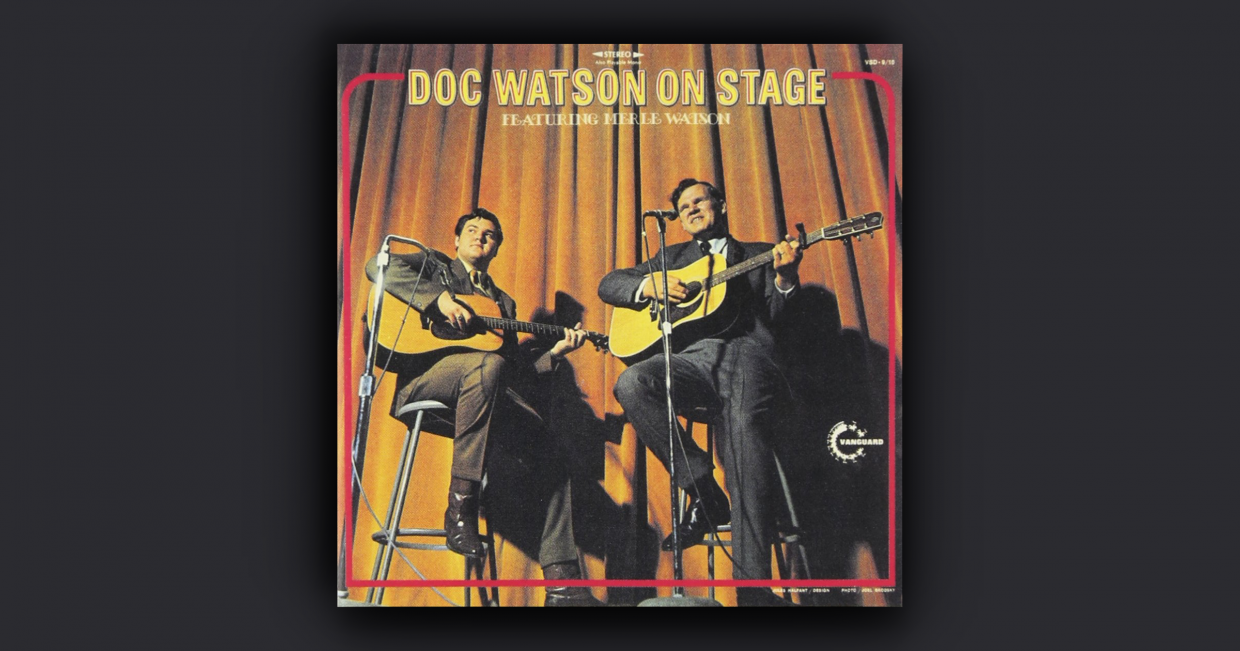
Anyone who ever had the extreme good fortune of seeing Doc Watson perform live can easily recount their favorite moments remembered from his time on stage. Lucky for any of us who can’t get enough of those memories, Watson put so many of them down on recordings and live tapes. Stroll a bit back through the catalog of those live performances with BGS. [Read more]


Counsel of Elders: Taj Mahal on Understanding the World

And he understands it! The wisdom and storytelling gifted to us by blues innovator and legend Taj Mahal in this 2016 interview is not only perfect for a long read pick, but it was perfect for a #ThrowbackThursday, too. The voices and perspectives of our elders are vital as we struggle for a more just future, and our musical elders have plenty of insight to pass on, as well. [Read the whole interview]


Bluegrass Pride Invites LGBTQ+ Roots Music Fans to Porch Pride Festival

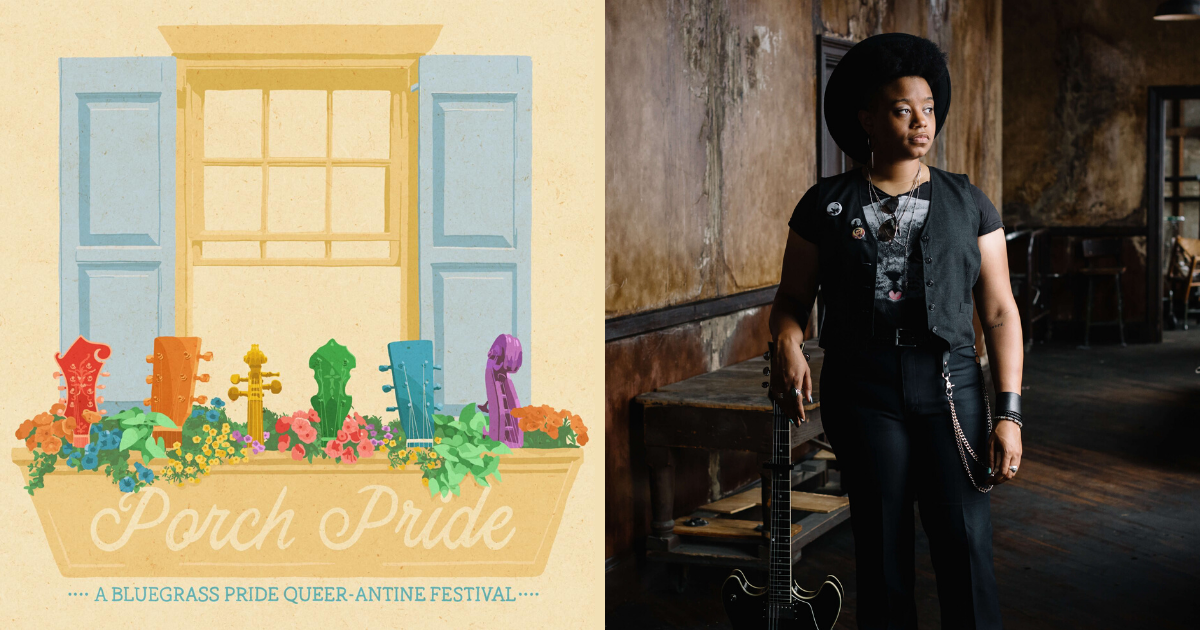
In a little over a week our friends at Bluegrass Pride will hold their online Pride festival, Porch Pride, featuring performances by queer artists, musicians, and bands and their allies — such as Jake Blount, Tatiana Hargreaves, Cathy Fink & Marcy Marxer, and Molly Tuttle. In advance of the event, we spoke to Bluegrass Pride’s Executive Director, Kara Kundert, and artist Amythyst Kiah about Pride, roots music, and what to expect from the festival. [Read more]


Photo of Amythyst Kiah: Anna Hedges

Kauai Folk Festival Will Celebrate Music of Hawaii and Beyond

Even for knowledgeable fans of folk music, the lineup of the Kauai Folk Festival offers plenty of artists to discover from Hawaii and beyond. Along with headliners like Taj Mahal’s Hula Blues Band and Peter Rowan’s My Aloha Bluegrass Band, the two-day roster also features Hawaiian music from Puka Asing, Wally Rita y Los Kauaianos, and more representing the diversity of Hawaiian traditional music.

With five stages running continuously, the lineup also includes Jonny Fritz, Blaine Sprouse, Ed Poullard, Reeb Williams & Caleb Klauder, Mike Bub, and many others. Meanwhile, Kauai Folk Workshops will offer instruction on guitar, fiddle, banjo, ukulele and mandolin, in addition to dance instructors teaching hula, square dance, swing, and two-step, and voice instructors teaching harmony singing, ballads, and Hawaiian song.

Festival director Matt Morelock fielded a few questions by email about the festival, slated for September 28-29 at the historic Grove Farm Museum in Lihue, on the southeast coast of Kauai.

BGS: What inspired the idea to create a folk festival in Kauai?

Morelock: For decades, Hawaiian music has stood on the periphery of the ‘folk’ genre. Its undeniable and indelible influence on all forms of American music deserves to be celebrated. We created the Kauai Folk Festival for such a celebration and invited all of our favorite performers, both local and continental, to sing, pick, dance, and meet one another in this tropical paradise.

When you are selecting artists, do you have a certain audience in mind? In other words, is there a common thread that runs through your lineup and/or your ticket holders?

We’ve attempted to represent the broadest swath of ‘folk’ music and musicians that we could find. From bluegrass to blues – from Cajun to country – we chose the best performers in as many genres as possible to illustrate the diversity of American folk music. The common thread is diversity. Artists were chosen for their enthusiasm and skill.

What have you learned about the process of booking festivals that has really surprised you?

We’ve learned that a worthwhile festival is one with a purpose. Hawaiian music and musicians are fighting against the expense and logistical complication of geographical separation as well as the mass perception of their music and culture as ‘foreign,’ when in truth Hawaiian music and culture is both a product of and strong influence on what we consider ‘American’ culture and music. We’ve learned that a higher purpose can confound the typical challenges that festivals face in finding an identity and audience.

For someone who has never been to Kauai, how would you describe it to them?

In addition to being GORGEOUS BEYOND BELIEF, Kauai is rural and cosmopolitan at the same time. There are more wild pigs than human beings living on this island. The natural beauty and local hospitality are legendary. You can book a hotel and rent a car here just like you can anywhere else in the U.S. Flights aren’t as expensive as you think. Beer is cheap. Fresh food and clean air are abundant. There’s really no reason NOT to visit!

In addition to interest from the locals, you will be hoping to attract people from the mainland as well. What are some of the amenities or unique qualities that will make this festival a destination event?

We’ve opted to keep festival admission affordable rather than spending time and resources on lodging and flight packages. We trust that Kauai Folk Festival attendees from the mainland won’t have trouble booking a flight, renting a car, and finding a hotel room. Kauai itself is a uniquity. The festival and the astounding Grove Farm Museum are an amenity. There’ll be a broad selection of spectacular local cuisine (plenty of accommodations for vegan/vegetarian/gluten-free diets), and extremely creative beverage and local juice options. We’re also ‘on call’ via www.kauaifolk.com to assist with any travel questions or complications!

What do you hope that attendees will take away from the Kauai Folk Festival experience?

We hope that Kauai Folk Festival fans will leave the event with a deeper understanding of the historical interconnectedness between Hawaiian culture and ‘mainland’ culture. In the production process, we are finding similarities and cross-influences on a daily basis!