Bluegrass Memoirs: New Twists & Scruggs Pegs Take Off

In December 1953, Decca released “Plunkin’ Rag” by the Shenandoah Valley Boys. It was the first recording by a banjoist other than Earl Scruggs to use Scruggs pegs: Hubert Davis. 

Born in Shelby, North Carolina, in 1932, Davis grew up in a musical family. He was already playing the banjo when, at the age of ten, his older brother, fiddler Pee Wee, brought Earl Scruggs, a co-worker from Lilly Mills, into the family home for some music. Earl had just moved to town to work at the factory. He was boarding with another Lilly Mills employee, Grady Wilkie. In Earl Scruggs and Foggy Mountain Breakdown: The Making of an American Classic author Thomas Goldsmith tells how Earl’s mother prevailed on her friend Wilkie to help Earl get a job at the mill. Wilkie, a guitarist, and Earl stowed their instruments in the car when they drove to work. In a 1977 interview, Hubert Davis told Bruce Nemerov that Pee Wee, Grady, and Earl: 

…worked on the second shift. They would catch up about supper time and they’d run out to the car and get their music out and run in to the packing house. They’d play for thirty minutes or an hour and go back to work. Swaller their food whole to get more time for pickin’. And I was there, son, at suppertime every evening. I was sitting there against the wall listenin’. 

By the time Hubert was fourteen (1946), he was studying Earl’s playing with Monroe on the Opry. Occasionally Earl came home, visited the Davises, and gave Hubert a banjo tutorial: “he’d show me the parts I didn’t have right.” 

At fifteen Hubert began playing professionally. By 1951 he was working for Virginian Jim Eanes. In 1948 Eanes had been an original member of Flatt & Scruggs’s Foggy Mountain Boys, but was quickly hired away by Monroe. Bluegrass historian Jack Tottle tells what happened after Eanes joined Bill at the Opry: 

His full baritone-range voice turned out to be incompatible with Monroe’s mountain tenor for duet singing. To Jim’s frustration, no matter how high he sang, it was still too low for Monroe’s high vocal harmony. 

Eanes subsequently developed a career as a mellow country singer with a bluegrass band, recording for a small North Carolina label, Blue Ridge. Soon after Hubert joined him Jim had a hit with “Missing in Action,” a Korean war-themed country song. Ernest Tubb’s major-label cover on Decca was also a hit, giving Jim an opportunity to sign with Decca. 

Eanes began recording in Nashville in 1952 with producers Paul Cohen and Owen Bradley. In October 1953, after several country-sound sessions using studio musicians, Eanes returned to record with two members of his bluegrass band, the Shenandoah Valley Boys: Hubert Davis and Bobby Hicks. 

They made two banjo instrumentals: “Ridin’ the Waves” and “Plunkin’ Rag.” These were issued on a 78, credited not to Eanes but simply to The Shenandoah Valley Boys. In “Plunkin’ Rag” Davis used both Scruggs pegs to create the melody. Chet Atkins, playing backup guitar, is heard playing responsorial licks to the melody in its peg sections, and Bobby Hicks — this was his first recording session — contributes fiddle breaks. 

“Plunkin’ Rag” was released in December. By that time Davis had left Eanes, who then advertised over the air for a banjo player. A lanky teenager named Allen Shelton got the job. At the start, Eanes said, “he could only play one tune, but he would play all the time.” An enthusiastic learner, Shelton was a fan of Davis: “he was second to Scruggs as I ever heard it.” 

When the time came for Eanes’ next Decca session in Nashville, on March 2, 1954, Davis had rejoined the band. At this point, probably in February, as Davis recalled, he and Shelton met. Both later spoke of sitting up all night in a hotel room working on “some licks Scruggs was playing.” 

It’s certain that one of the two banjos in that hotel room had Scruggs pegs. Some of the licks they were working on must have involved the pegs, for Davis came to Eanes’ session with two instrumentals that used them: “Cotton Picker’s Stomp” and “There’s No Place Like Home.” 

“There’s No Place Like Home” was the title Decca gave to Davis’s version of “Home Sweet Home.” As with “Plunkin’ Rag,” Davis used the pegs to play the melody. But this was not a new composition, but a very old song, dating back to 1823. The novelty here, its hook, was the idea of using Scruggs pegs to play a familiar melody.

A few months later another banjo picker made a recording using Scruggs pegs. Haskel McCormick was the 16-year-old banjo picker on “Banjo Twist” by the McCormick brothers of Westmoreland, Tennessee. The track was on their first single, released in August 1954 by Hickory Records, Roy Acuff’s new Nashville label. McCormick, who would go on fill in for the hospitalized Earl with Flatt and the Foggy Mountain Boys a few times in 1956, incorporated portions of the hooks from both of Scruggs’ hits, in this, the first of three pieces he recorded that used the pegs. Here’s a brief bio of McCormick by NCTV, which opens with “Banjo Twist:”

Columbia recognized the popularity of Scruggs’ instrumentals that fall by reissuing four of them, including all three Scruggs peg-hook tunes, in their “Hall of Fame” series. While young banjo pickers like McCormick were writing new tunes with his pegs, Earl now took another direction, using one of them in his breaks for Lester’s song, “Till the End of the World Rolls Around.” Columbia released it in December 1954. 

By then Allen Shelton, now in the Raleigh-based band of Hack Johnson and his Tennesseans, had elaborated on the idea of playing “Home Sweet Home” with Scruggs pegs. Early in 1955 Shelton recorded a version of “Home Sweet Home” with Johnson that included a vocal trio on the chorus. Their Colonial single was a regional hit. 

This prompted Reno & Smiley, who recorded for King (a widely distributed independent label) to make a cover. Reno, traveling through North Carolina, heard the Johnson single and called King owner Syd Nathan to tell him about it. Nathan ordered him to get their band into the studio right away and record it. He couldn’t get in touch with his band members… 

…so I went to the studio in Charlotte and cut it by myself. I dubbed in three vocal parts and banjo, guitar, and bass. It took me most of the night and I don’t want to cut any more like that! 

The recording was a bigger hit than Johnson’s, and helped Reno & Smiley, one of the most influential early bluegrass bands — but until that point solely a recording act — launch their touring career.

Although Hubert Davis was first to record “Home Sweet Home” (as “There’s No Place Like Home”) with the pegs, it and the other instrumental he recorded with Jim Eanes didn’t get released until June 1955, after the Reno & Smiley version. By then, Shelton and Johnson had released “Swanee River,” another old familiar song with the same juxtaposition of pegs and vocal trio. Another similar piece, “Old Kentucky Home,” appeared soon after under a new band name. Hack Johnson was gone; now, with the same sound on the same label, they were The Farmhands. 

In the fall of 1955, Earl Scruggs recorded his fourth and last instrumental with a peg hook. In it he reset his peg for the second-string so that it moved up to C from B. His hook riff went through two chords instead of one. “Randy Lynn Rag,” celebrating the birth of his son, was released in February 1956. 

By now the idea of using the pegs to play old familiar pieces had caught on. Early in 1956 Sonny Osborne recorded four tunes using the pegs for Gateway, the Cincinnati label he’d been with since 1952: “Hand Me Down My Walking Cane,” “Jesse James,” “Swanee River,” and “Auld Lang Syne.” Accompanying him in the studio were Red Allen, guitar; Bobby Osborne, mandolin and fiddle; Art Stamper, fiddle; and Les Bodine, bass. These were the last recordings made under Sonny’s name, done just a few months before the first MGM sessions by the Osborne Brothers and Red Allen.

In May Columbia released Flatt & Scruggs’ new gospel single. Earl used the pegs to play his part of the melody in the breaks to the quartet “Joy Bells.” 

It was getting radio play that summer when a letter came to Mike Seeger from Moe Asch, owner of New York’s Folkways Records, asking him “to produce an LP of Scruggs-style banjo playing.” Seeger was certain his older half-brother, Folkways star and folk banjo guru Pete Seeger, “was the reason that Moe wrote me.” 

Living in the Washington-Baltimore area, Mike Seeger had been taping bluegrass shows at local country music parks. “Most bluegrass players were establishing new songs and sounds and so didn’t record the old-time tunes that they played on shows,” he said. Seeger wanted to demonstrate “the connection of the new style to the older music” so he focused on the old-time repertoire for the album. 

He started recording that fall of 1956, with the help of local bluegrass musician and collector Pete Kuykendall. They began after a Monroe show at New River Ranch in Rising Sun, Maryland, where Blue Grass Boy Joe Stuart lingered backstage to play his banjo setting of an old-time fiddle tune for Seeger’s portable tape recorder. Subsequently, eight other DC region banjoists, most of them young, were recorded. A trip south captured pioneers from western North Carolina, including Earl’s older brother Junie. Earl was not on the album. Finally, one picker from New York City’s Washington Square bluegrass scene was recorded. 

Seeger’s friend Ralph Rinzler, living in New York at the time, wrote the album notes. Here for the first time the word “bluegrass” was used in print to describe and explain the music. American Banjo Three-Finger and Scruggs Style, the first bluegrass LP, had a total of 31 tracks by fifteen banjoists. Scruggs pegs are heard on two cuts. 

On side B, band 3, Smiley Hobbs, a North Carolinian virtuoso living in northern Virginia, used the pegs to play the melody of the old folksong “Rosewood Casket” in a vocal-instrumental combination similar to Shelton’s.

The very last track on side B featured the Washington Square picker, seventeen-year-old New Yorker Eric Weissberg. Backed by Seeger on guitar and Rinzler on mandolin, he played a two-song medley, combining the tunes of the traditional ballad “Jesse James” and folk revival star Woody Guthrie’s popular composition “Hard Ain’t It Hard.” He used the pegs on the latter piece, which the Weavers, the most popular folk revival group at the time, had recently popularized. Weissberg’s mix of traditional and folk revival repertoire was a harbinger. 

In the next Bluegrass Memoir, more on Eric Weissberg.


Neil V. Rosenberg is an author, scholar, historian, banjo player, and Bluegrass Music Hall of Fame inductee.

Photo of Neil V. Rosenberg: Terri Thomson Rosenberg

Shout & Shine Online Highlighting Black Roots Artists Set for Oct. 3

For five years now BGS and our partners at PineCone Piedmont Council of Traditional Music have used our voices, resources, and positivity to lift up and celebrate diversity in bluegrass and roots music through the Shout & Shine showcase. These live performances have given a platform to those artists who have been overlooked, while illuminating the paths of those starting out on uphill journeys in our music community. This year, the event’s 5th annual iteration will follow a format more suitable for a worldwide pandemic — with an all-online showcase as part of IBMA’s Virtual World of Bluegrass.

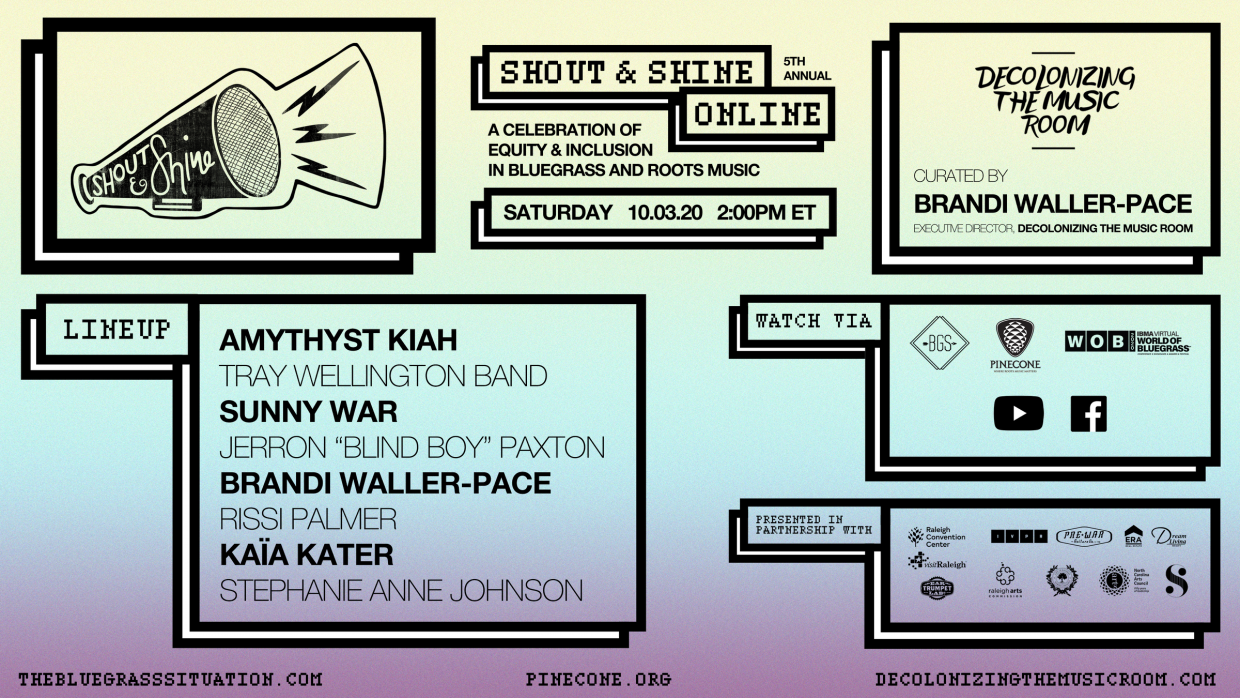
Shout & Shine Online will feature these artists from across the genre map of roots music: Rissi Palmer, host of Apple Music Country’s brand new radio show, ‘Color Me Country‘; IBMA Momentum Award winning banjoist Tray Wellington; punk-influenced fingerstyle guitarist and songwriter Sunny War; down-home blues and old-time musician Jerron “Blind Boy” Paxton; The Voice alumnus and guitar picker Stephanie Anne Johnson; and returning favorites Kaia Kater and Amythyst Kiah, who make their first appearance at Shout & Shine since playing on its debut lineup in 2016.

Shout & Shine Online’s roster is curated by performing musician and Decolonizing the Music Room founder and Executive Director, Brandi Waller-Pace. Shout & Shine Online will take place at 2 pm ET Saturday, October 3. Viewers will be able to tune in right here on BGS, or on our Facebook page or YouTube channel, via PineCone’s channels, and via IBMA’s conference platform, Swapcard (registration available here).

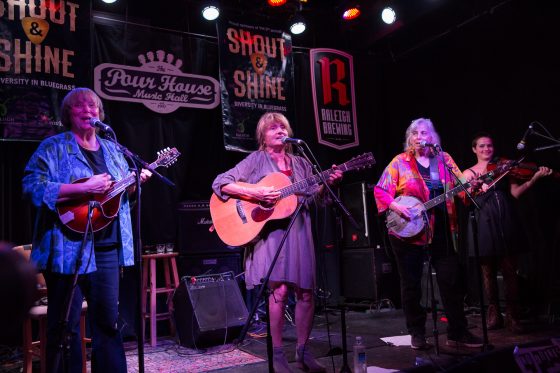
(L to R) Marcy Marxer, Alice Gerrard, Cathy Fink, and Tatiana Hargreaves perform at 2017 Shout & Shine showcase.

While Shout & Shine has continually championed underrepresented and marginalized folks in roots music, this year’s event comes at a time of reckoning in this country’s ongoing battle against institutionalized racism. “This year, Shout & Shine’s mission is as clear and galvanized as ever,” says BGS editor and Shout & Shine producer, Justin Hiltner. “Our lineup is a direct response to this current iteration of the Black Lives Matter movement and the righteous rebellion against police brutality and systemic racial injustice in this country. The greater bluegrass community needs to be having these conversations and needs to be centering the voices and perspectives of Black folks — especially Black queer folks. We saw that as our role this year.” 

BGS joined hands with Decolonizing the Music Room’s founder Brandi Waller-Pace to curate 2020’s lineup. The mission of Decolonizing the Music Room is to center Black, Brown, Indigenous, and Asian voices, knowledge, and experiences within the field of music education,” says Waller-Pace. “In addition to that, it is part of DTMR’s core values that we are an openly LGBTQ+ affirming non-profit organization. I am honored to have served as curator for this year’s Shout & Shine and to have had this opportunity to partner with BGS and PineCone on work that highlights a convergence of our values.”

“In addition to Shout & Shine’s continued work centering the music and stories of underrepresented artists in the bluegrass community, we also continue to work toward making these programs as accessible and inclusive as possible. We’re providing American Sign Language interpretation for the entire Shout & Shine program, modeling what can be done and what we continue to work toward in making accessibility central to our work,” said Jamie Katz Court, Communications & Programs Manager for PineCone, the Raleigh-based roots music organization that has partnered with us on Shout & Shine since 2017. PineCone also produces the festival, IBMA Bluegrass Live! powered by PNC.

The showcase was first conceived in 2016 to celebrate diversity and inclusion at the International Bluegrass Music Association’s business conference and festival in Raleigh, North Carolina. Originally organized in response to the North Carolina General Assembly’s homophobic bathroom bill, HB2, the scope of the event immediately widened to include and celebrate not only the LGBTQ+ community, but any and all marginalized folks in roots music. Shout & Shine stages have included the most exciting emerging talent alongside bluegrass legends and stalwarts, with lineups that have boasted the Ebony Hillbillies, Alice Gerrard, Cathy Fink & Marcy Marxer, Laurie Lewis & the Right Hands, Missy Raines, Amythyst Kiah, Kaia Kater, Che Apalache, and many, many more.

Shout & Shine is also a monthly editorial feature, which debuted with world-renowned drag queen Trixie Mattel’s first-ever interview by a roots music publication. In 2020 the column grew into a monthly livestream series that has already featured harpist and songwriter Lizzie No and fingerstyle guitarist Sunny War, part of a six-month series focused on Black artists and creators in roots music. The next episode will follow Shout & Shine Online in November. Whether on stage, in print, or online, Shout & Shine’s mission has always been celebrating the marginalized and underrepresented folks of all identities, backgrounds, faith traditions, and abilities who make and love bluegrass music.

Tune in Saturday, October 3 at 2pm ET for Shout & Shine Online!


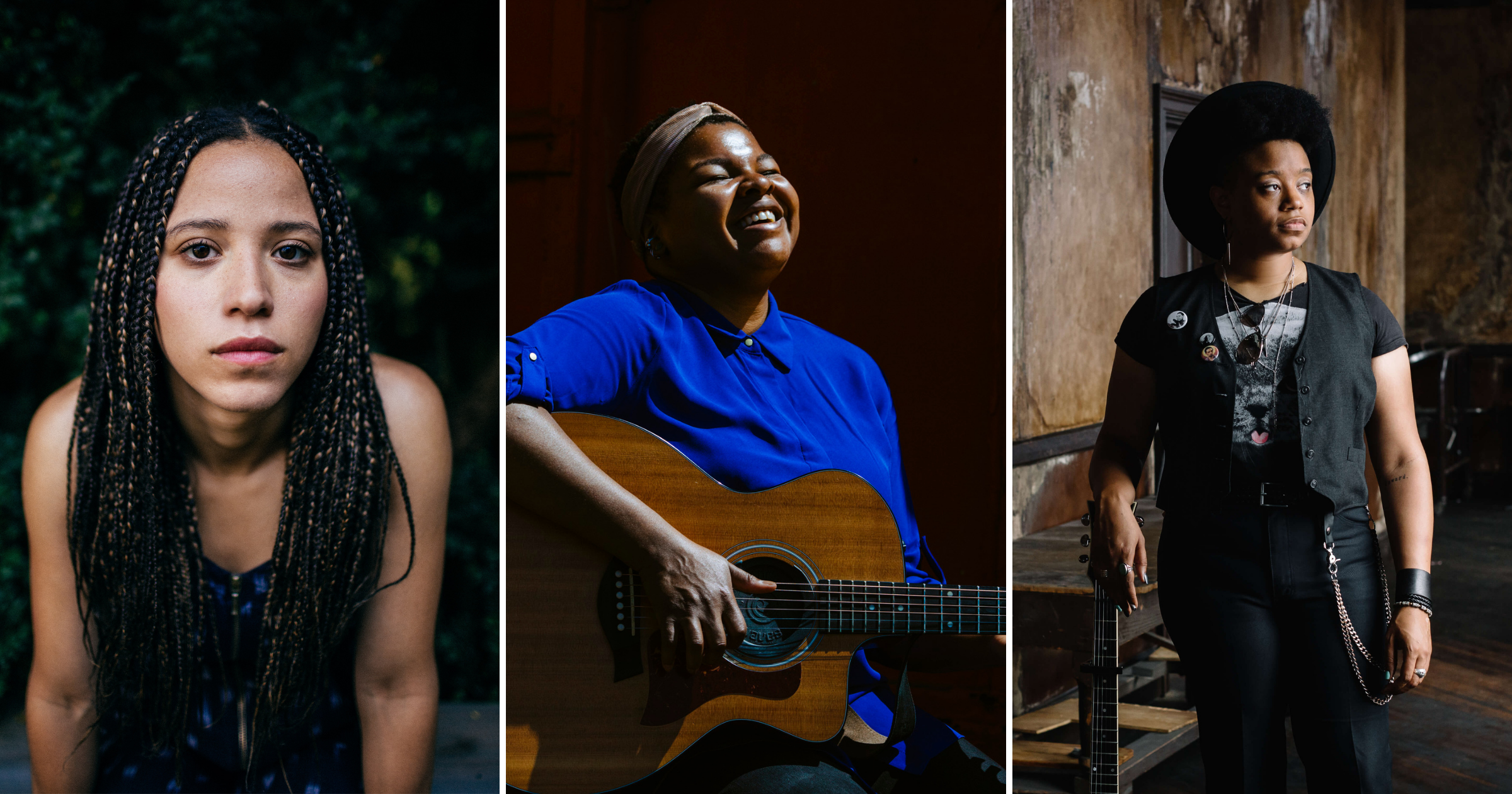
Lede photo (L to R): Kaia Kater (by Todd Cooper); Stephanie Anne Johnson (courtesy of the artist); Amythyst Kiah (Anna Hedges).
Poster art by Grant Prettyman, Belhum

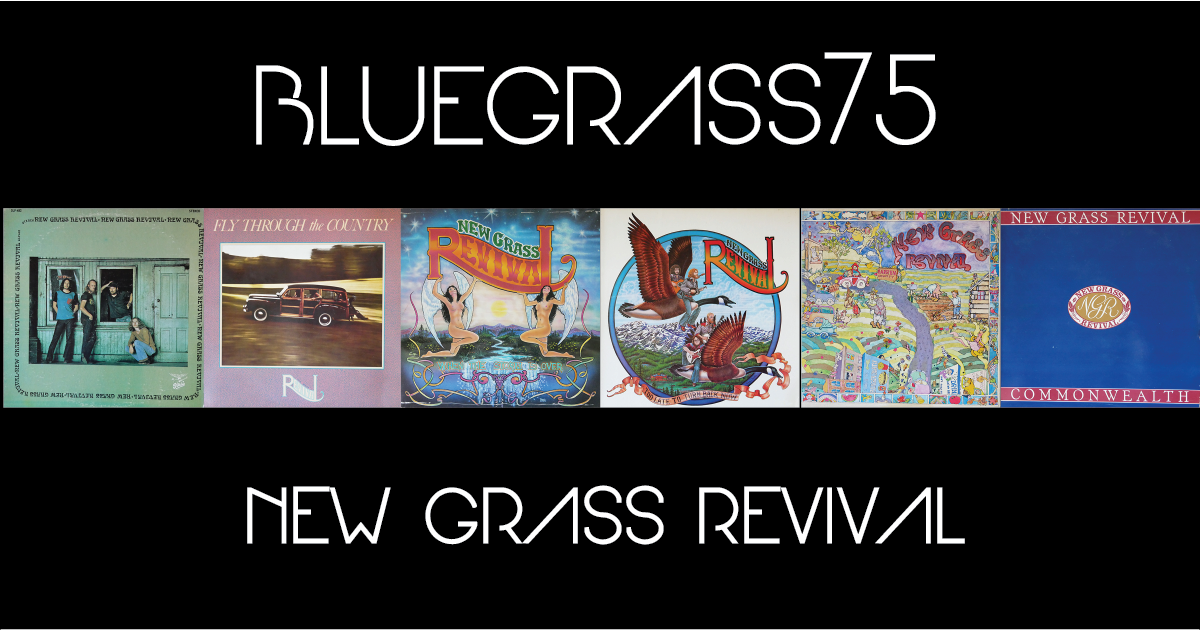
New Grass Revival: Four Members Look Back on Their ’80s Albums (Part 2 of 2)

A beloved band that was perhaps ahead of its time, New Grass Revival will be inducted into the Bluegrass Hall of Fame during the IBMA Bluegrass Music Awards on October 1. In the second half of our oral history with New Grass Revival, we hear from band members Sam Bush, John Cowan, Béla Fleck and Pat Flynn. Read the first half of the interview, which is part of our celebration of the 75th anniversary of bluegrass.

In 1981, founding members Courtney Johnson (who died in 1996) and Curtis Burch left the band after a long tour with rock ‘n’ roll star Leon Russell. As a result, New Grass Revival began its newest incarnation with Béla Fleck and Pat Flynn.

Sam Bush: Courtney and Curtis were older than me and John and they were just burned out. We had worked harder on the road with Leon than we’d ever worked in our lives.

Pat Flynn: New Grass Revival had established a following on the circuit in the late ’70s, but Leon Russell had sucked them into his orbit and taken them away from the bluegrass world. So by the time that band [lineup] broke up, they really had to start over.

SB: I had met Béla in a band he played in called Tasty Licks, and Béla had hired me as the fiddler on his first album, Crossing the Tracks.

PF: Béla was a smart kid. He thought, “If I’m going to come out with a solo album and nobody knows who I am, why don’t I hire high-profile people to play on it?” That’s a smart move!

Béla Fleck: I liked the original band when I heard it, but I admit I was attracted to smoother and jazzier stuff at the time. I have matured a bit since then and now I am a huge fan of the early band, their bravery and iconoclastic spirit, and a poetic expression of their time and place. They were committed to the moment and improvising, and taking the music to a new place that resonated with a lot of folks who loved bluegrass, but it didn’t totally represent them.

SB: Pat and his friend Scott Myers had opened for New Grass Revival on the Colorado tours we did. We loved his guitar playing because it wasn’t like the bluegrass players. He was a rock electric guitar player that could do it on acoustic.

PF: I’d moved from Los Angeles to Aspen, Colorado, and got to know the band at Telluride. Sam had a hand in writing some songs, but they really didn’t have an in-house songwriter. I had always written songs for the bands I was in. And Béla brought a unique and original instrumental vision. So all of a sudden you had two new people that could supply original material.

SB: They were the two musicians who could bring the next step of another sound for us. I called Garth [Fundis, the band’s producer] and said, “You’ve got to come hear these new pickers we’ve got, this is something, this is really good.” I knew it was too hot for me to handle — I didn’t feel I was qualified to produce the four of us. We needed another ear, an outside opinion, because we had so many ideas between the four of us.

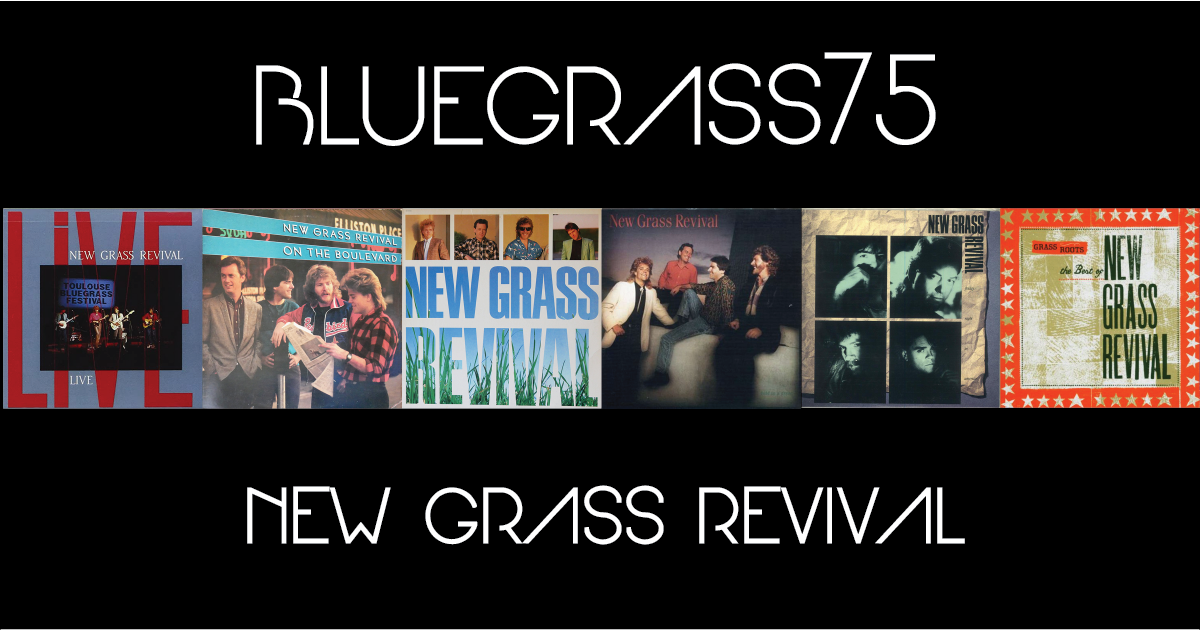
PF: On the Boulevard was the first album we released in the US, but we’d done a live album in France almost a full year prior. Technically Live in Toulouse was the first album we made as a new band.

JC: We’re playing like a well-oiled machine; it’s really a good record. It has one of Sam’s instrumentals on there called “Sapporo” that might be 11 minutes long!

SB: The idea of “Sapporo” started when the band went to Japan for the first time. It was my favorite city over there; it was also my favorite beer. A mandolin player over there taught me a five-note Japanese scale and that is a recurring riff you hear us play as we jam.

JC: The first year we were together with Béla and Pat, the energy and the love and everything was way up, confidence was high. And On the Boulevard is one of my favorites. There’s no drums, it’s just the four of us.

PF: It was very fresh. I remember the recording sessions at Jack’s Tracks studio in Nashville. We had a decent budget from Sugar Hill, enough to record comfortably and take our time. I experimented with different guitars and arrangements. We were able to bring the music into the magnifying glass of a studio and really look at it in depth.

JC: The dynamic of the band had changed so much, because Béla was already miles ahead of everybody in terms of his ability to play. He practiced all the time. In the old band, I was in charge of shoveling coal into the engine and Sam was flying around on top painting whatever picture he wanted to paint. Courtney and Curtis, they were kind of like myself, advanced support players. But now you’ve got two other players who can play at the same level of Sam. So we could take this train anywhere. We could get off the tracks.

PF: I had brought some songs with me to the band and I was very happy with “On the Boulevard.” I had written it prior to joining. It was pretty much autobiographical. I’d been living in Thousand Oaks, California, and there’s a boulevard that runs through the middle of the Valley, and as I watched it from the window it was like its own little world, a parade of passing people. It was one of the earliest things we worked out.

SB: My songwriting partner Steve Brines had died a sudden death of a heart ailment he didn’t know he had. So Steve was gone and I was still writing instrumentals, but I lost my enthusiasm for songwriting.

PF: I was especially happy with “One of These Trains,” the way the material came out, and the band took to it so naturally. I was encouraged that I was in the right place with the right people. I loved Sam’s instrumental “Indian Hills,” and John did a great blues number called “Just Is.” We were discovering each other’s powers and personalities as musicians and friends. I remember it very fondly. We were struggling for employment to connect with the old fans and that album was a big help — when it came out, we created a pretty big buzz.

SB: Toni Foglesong told her husband Jim, who was the president of Capitol Records Nashville, “I heard a band that makes a sound like nothing I’ve ever heard before.” So, Jim came to hear us and he said, “I want you guys to record. I don’t know how we’re going to sell you but I want you to be yourselves.”

Two studio albums followed: New Grass Revival in 1986, and Hold to a Dream in 1987.

SB: Every time new people joined, we encouraged them to bring their influences into the music. When Pat joined he was influenced by those Southern Californian songwriters like Jackson Browne, and the country-rock Telecaster picking he knew. One song where I specifically hear Pat’s southern rock influence is “In the Middle of the Night,” on the ’86 album.

PF: I was very involved in the country-rock sound like the Eagles and the Flying Burrito Brothers and the songs I wrote were well-fitted for a bluegrass approach. I didn’t have to make adjustments musically or lyrically, just in the area of arrangements. I had to make sure the songs I wrote had great solo spots for the instrumentalists and I had to fit the songs to whoever was singing, either John or Sam. So I started to instinctively shape my material where there was plenty of room for improvisational playing and also good range of vocals for those two.

BF: This band was full of guys with very different musical influences. If you didn’t want to be challenged, it was the wrong place for you. Some folks surround themselves with people that love all the same stuff they do, and that can work too. But in New Grass Revival, we were all into different stuff, which we brought to the band to see if we could get our favorite stuff included.

SB: Béla is a jazz player and when he came in his favorite musician was Chick Corea. I had his records, but they didn’t make so much sense to me until then.

BF: I think my interest in jazz gave me some cool tools to work with in a bluegrass context. I wrote a tune called “Metric Lips” [on Hold to a Dream], which was partly in jig time. I feel like that main melody had some Chick Corea influence. Sam was highly influenced by John McLaughlin and his great bands. One of them was Shakti, a collaboration with Indian musicians. This seemed to encourage his interest and ability in odd meters, which I also was quite fond of exploring. So if you look at “Metric Lips,” you have Irish music, Indian music, and fusion jazz represented, along with some raging bluegrass. It’s puzzling that it actually works, but in my opinion, it does.

PF: When you’re in a bluegrass band, it’s blend or die! You’re cramped inside a van together and you’re sleeping feet to nose. You’re in a very confined space together more than you are with your significant others back at home.

JC: We called our bus The Bread Truck. We’d bought it from a dry cleaning business. It wasn’t like the 36-footers I had in the Doobie Brothers; it was less than half of that, closer to a van.

PF: John slept half the time, I would be reading a book or writing a song, Sam would be listening to reggae or some weird eclectic thing, Béla was always fiddling with a new tune.

BF: For me it’s the intention and commitment to the ideas that make them work in this band. The same ideas might not work for a band that didn’t play so confidently. Of course we loved bluegrass and that was the common denominator. Each guy also played with a savage fervor or intensity, and perhaps that was another denominator.

PF: We could really charge each other up with the solos. We admired each other, and when somebody threw a flaming ball out there it would be a challenge. And in that exchange, gosh, we became so much better players. I remember listening back to tapes and thinking I lifted myself up and above myself. We all did.

BF: The new band with me and Pat was a somewhat cleaned-up version of the band. We still improvised and pushed hard, but we also were going for a supercharged, seamless tightness.

PF: The thing I remember that we developed between the first two albums was a hardcore consistency. We could turn it on and it would just come on full-bore despite whether or not there was a good sound system or the weather was bad or the crowd was sluggish. We could always count on each other to present a united front. There were no weak links. We just locked into that energy and never lost it.

BF: And we made singles for country radio, which is hard to imagine the early group doing.

SB: We knew we were going into a country market, but I think there’s a misconception that Capitol Records changed us, when in fact the change came from us. We were the ones that said, “We’ll try this song,” and maybe we wouldn’t have tried it in the past.

BF: We were still too out there for it to work, but we were trying to take the music closer into the mainstream, and that was bringing a lot of new people into the scene and showing them what bluegrass could produce.

PF: We would laugh about that in a sad way. The jocks would come to us and say, “I love your stuff, I listen to it at home,” and we’d say, “What about playing it on air?!” They’d say “Yeah, but it’s bluegrass….” We finally got “Callin’ Baton Rouge” into the top 40 which opened up a lot of shows and airplay for us. But we ended up disbanding before we could really bring that home.

SB: For our last album, Friday Night in America, Wendy Waldman became our producer and we really tried all kind of things on that. It’s hard for an athlete to know when to stop, but I really think our last record might be our best one.

PF: I saw a deepening musically. John’s vocals had got better and better, but he also doesn’t get the props for his bass playing. He was a terrific player — listen to his work on Friday Night in America, see how he connected the melodies, the tone he got and the way he tied together the four instruments. They would get noticed, but the glue was John.

SB: John and I had been together 15 years and we were burned out. We lived on the road and I was suffering responsibility overload. And we couldn’t possibly accommodate all that Béla was writing, the type of tunes he was writing. I physically couldn’t play them and neither could the rest of us! We all loved each other, but it was time for him to go on, he needed to express himself. Because at that point it’s not about making money, it’s about musical happiness and your satisfaction.

PF: We’d got together in 1981, and we played our last job as a band on New Year’s Eve, the last day of 1989. We were opening for the Grateful Dead at the Oakland Coliseum, 10,000 people inside and 5,000 outside. That night was particularly memorable — on the right side of the stage sitting nearest Béla was Bonnie Raitt, on the left side, near to me, was Jane Fonda — and I’d always thought what a shame we didn’t release that. Years later someone walked up to me and said, “Remember when you guys opened for the Dead?” I said yes. He said, “Have you got a copy of that set?” I said no. He said, “Do you want one?” A tape of our concert had leaked out among the Dead fans. I contacted a friend at Capitol Records and then that set was remastered and released on a two-CD set called Grass Roots, which has stuff you wouldn’t find on our records. It had its rough spots as a live tape, but you’ll hear that energy and visceral connection we had with each other on stage, you sure will.

(Editor’s note: Read part one of our New Grass Revival Bluegrass 75 feature.)


New Grass Revival: Sam Bush and John Cowan on the Early Years (Part 1 of 2)

One of the most celebrated and innovative bands of the 1980s, New Grass Revival will be inducted into the Bluegrass Music Hall of Fame during the IBMA Bluegrass Music Awards on October 1. As part of our coverage of the 75th anniversary of bluegrass music, BGS caught up with founding member Sam Bush and vocalist/bass player John Cowan to talk about the early years in this first of two stories exploring their remarkable discography. Read part two of the story here, featuring insight from Béla Fleck and Pat Flynn, as well as Bush and Cowan.

The four founding members of New Grass Revival are Curtis Burch on guitar and Dobro, Courtney Johnson on banjo, Ebo Walker on bass, and Sam Bush on mandolin. They had all played together in the five-piece band, Bluegrass Alliance.

Sam Bush: We wanted to fire our [Bluegrass Alliance] fiddle player Lonnie Peerce, and when we told him this he said, “You can’t fire me, I own the name of the band.” So we said, “Let us put it this way: we quit.” We were already influenced by the Country Gentlemen and the Osborne Brothers and Jim & Jesse and the Greenbriar Boys and a really great record by the Charles River Valley Boys called Beatle Country. That’s one of the reasons we called ourselves New Grass Revival — we were trying to point out that we were reviving a new bluegrass that had already been invented by those people. We were only hoping to further the progressiveness we already dug.

Bush had been friends with Courtney since he was a teenager, when the banjo player was lead singer in a band playing Stanley Brothers tunes.

SB: We had no particular plan to play differently but our very first practice I remember Ebo hitting a bass lick in D minor that we later discovered he got from Dolly Parton’s “Jolene.” We played licks back and forth over it and all of a sudden Courtney went into the melody of “Lonesome Fiddle Blues” by Vassar Clements. That’s how we came to work up “Lonesome Fiddle Blues” for our first album. It was like a band epiphany, that we could improvise over a riff the way rock ‘n’ roll bands did. We were just playing it the way we felt it.

Courtney and Curtis were steeped in traditional bluegrass, but Bush was a musical sponge, soaking up everything from Homer and Jethro to Jefferson Airplane to the Rolling Stones to French jazz violinist Jean-Luc Ponty. The band’s first, self-titled album, from 1972, included covers of Leon Russell’s “Prince of Peace” and Jerry Lee Lewis’s “Great Balls of Fire.

SB: This is the days before cars had cassette players, so Ebo had a tiny cassette player we took with us on the road, and we’d made a tape we could listen to. One side was John Hartford’s Aereo-Plain. And on the other side we had Leon Russell and the Shelter People. Without John Hartford there would be no newgrass. Growing up close to Nashville, I would watch him on local TV, and one night he did a bluegrass version of “Great Balls of Fire” on the Glen Campbell show, and I recorded it from the TV — that was the one we learned. Courtney even played his chromatic run the same way John did it.

While making their first album Bush encountered the man who would be his songwriting partner, Steve Brines.

SB: We lost our Louisville club gig when we ended Bluegrass Alliance, so in order to make a living that first winter in ’70-’71 I ended up playing electric bass with a folk group called the Cumberlands: Harold Thom and his wife Betty, and a banjo player called Jim Smoak. Jim had co-written a couple of songs with this poet-lyricist over in Lexington called Steve Brines and we played one on that early album — “Cold Sailor.” After I made his acquaintance Steve and I started trying to write together. Steve lived up in Lexington and I lived down in Barren County, and he’d send me five to ten sets of lyrics in the mail and I’d make up music, put it on a cassette and send them back. Our rule was I wouldn’t change one word, if he didn’t change one note.

It was a productive partnership – Bush and Brines wrote half the songs on their second album, Fly Through the Country. By then, Walker had left the band and they had gained a new player: John Cowan.

John Cowan: I joined in 1974. I did not grow up in bluegrass. I was a rock ‘n’ roll kid playing in local garage bands. But I had an awareness of New Grass Revival because I lived in Louisville, which was their home, and the woman who became my wife once dragged me to go see them. I didn’t want to go, but I was blown away. Six months later I got a phone call from Sam living down in Western Kentucky with Courtney and Curtis and he said he got my number from this guy, and would I be willing to come down and audition for us?

SB: He was a city guy, and when he pulled up and saw us, it was like “Oh my god what have I got myself into?”

JC: Courtney and Curtis were truly unique individuals. They were from South Georgia, super country dudes, born and raised playing bluegrass. I was wild-eyed and “What is all this stuff?” To their credit they welcomed me with open arms.

SB: We played some tunes together and asked him to join the band and he said, “I sing too — do you mind if I sing a song?” And in the tradition of Barney Fife I puffed up my chest and said, “Well, I’m the lead singer but yeah, go ahead.” And he sang “Some Old Day” in the same key as John Duffey did it in, only with this powerful voice and this beautiful vibrato. At the end of it I said, “John, I used to be the lead singer, now you are.”

JC: The day they hired me we rehearsed with the drummer. The next morning I got up and he was gone! I was like, “Where did Michael go?” Courtney said, “Oh hell, we fired him. We don’t need him with you!” I felt kind of bad about it, he was a really nice guy.

Soon the band’s rock ‘n’ roll influences were coming to the fore.

JC: They were already experimenting with jamming on traditional instruments over songs and it was right up my alley, because I was also a big prog rock fan. I was obsessed with Yes. On the title track of Fly Through the Country, Sam played this little thing that looked like a can of Spam — it was a resophonic mandolin, he played slide on it. When Béla joined, he said the big joke was that you could listen to the first part of the song, go out for lunch, come back, and you’d still be playing it.

SB: People would call us “The Grateful Dead of Bluegrass” because of our long tunes and our experimentation. We had to put it in our contract that we wouldn’t be billed like that, because then we had Deadheads coming expecting us to play their songs, and we didn’t do any.

JC: Our touchstone was the Allman Brothers. Their live album At Fillmore East came out three years before and we both knew it by heart; to this day I could sing every note and every solo. So that was a crucial record for our band. Sam exposed me to Jack Casady’s [of Jefferson Airplane] bass playing. When I joined the band I was 21, and Courtney was already 38, I was so out of my element. I’d only ever played with guitars and keyboards and drums, and I was smart enough to at least say, “I don’t know what I’m doing, you guys have to help me.” They’d give me a joint and say, “Go listen to this stuff — here’s John Hartford, here’s Norman Blake, here’s the Dillards….” It was so foreign and beautiful to me.

SB: One of the first songs John taught us was “These Days.” He sang like Gregg Allman when he first arrived, and his voice and vocal style changed to fit into what he had joined.

JC: I would imitate him [Gregg Allman], Lowell George, Stevie Wonder. But when I got in that band, now what do I do? I was smart enough to realize it wasn’t going to work for me to try and sing like Ricky Skaggs or Bill Monroe, that’s not in me. But Sam was very encouraging to me and the more I sang the more I developed my own voice.

SB: Garth [Fundis, the band’s producer] had introduced me to a piano player, Chuck Cochran, and Chuck played electric piano with us on “These Days” at the end of the Fly Through the Country. It was the last song we recorded, and we went, “Huh… We can make this fusion of more instruments into our sound.”

Their next album, When The Storm Is Over, went further, incorporating more of Cochran’s keyboards, as well as drums and percussion.

SB: We wanted to augment our sound and appeal to a wider audience, and Chuck and Garth introduced us to the great drummer Kenny Malone. He played on our next three records and I started producing the records myself. Stephen and I continued to write. The subject matter of our songs was totally different than bluegrass-style songs. I’ve always just said newgrass music is contemporary music played on bluegrass instruments.

JC: Sam’s going to solo for eight minutes, then he’s going to toss it to Courtney, then Curtis, and I’m the guy who’s in charge of keeping the train on the tracks and keeping the coal in the engine. That was my job and I loved it. To this day, when you’re playing that kind of music and all the players are in sync spiritually and musically and emotionally there’s nothing like it. To me that’s what punk music is: just this tremendous energy of people.

In 1977 their first live album, Too Late to Turn Back Now, was recorded at the Telluride Bluegrass Festival.

JC: It was such a fruitful time for music and we were in the middle of it. Jackson Browne, Miles Davis, the Mahavishnu Orchestra, John Coltrane, Little Feat…. Those people were our models, we listened and listened and it came out in our music. At Telluride we took this Willis Alan Ramsey track off this one solo album he made, the song “Watermelon Man,” and to me that was us doing Little Feat. That’s “Dixie Chicken.” That’s “Fat Man in the Bathtub.” There was a lot of Little Feat groove in what we were doing.

SB: We were trippier on stage than on most of our records, but you can hear it on that live record. Our association with Leon Russell — we’d opened for him in 1973 — had opened the doors. I don’t know that we were psychedelic exactly, but I was trying a phase shifter on my fiddle, like Jean-Luc Ponty, and Curtis would play lap steel with distortion.

JC: We had all grown together. Sam and I were fixated with Delaney & Bonnie at the time. We played “Lonesome and a Long Way from Home,” which Delaney co-wrote with Leon Russell, and we were so obsessed with them vocally that we talked about this: “I’m going to do Bonnie, you’re going to be Delaney.”

The band’s popularity was growing and they were finding their audience, thanks to the support of fellow musicians like the Dillards and Nitty Gritty Dirt Band. In 1979, Leon Russell had dropped in on the band’s soundcheck when they played at the Apollo Delman Theatre in his hometown of Tulsa, Oklahoma. The band released the album Barren County that same year.

SB: Leon saw our name on the marquee and hadn’t seen us for years so he stopped by. We went back to his house that night, we jammed all night, and then we went and recorded with him in Nashville and in Hollywood where his studio was. It was really cool. We were teaching Leon bluegrass songs.

The result was the album Rhythm and Bluegrass, Vol 4, which Russell recorded in 1980 under his country alter ego, Hank Wilson. However, the project stayed unreleased until 2001.

SB: We were always most proud of that record. I co-produced it, I just didn’t know that’s what you called it. Leon had a bluegrass songbook and he’d say, “What do you think, should we do this one?” And I’d say, “Nah, let’s try this one.” So that’s how we started as his backup band. For two years! John and I had so much fun singing harmony with him. I love singing baritone, and vocally we were glued to him. And the way John and I did call-and-response in our singing was very influenced by the way Leon and Mary [his wife] did it on their records.

A live album, recorded in 1981, captures the spirit of their collaboration with Leon Russell.

SB: There were shows where you’d see him bounce up and down on his piano stool and that’s when we knew we were going to go into this Pentecostal church service with him, and the songs would just keep speeding up and speeding up and the audience was getting more and more excited. It was amazing, the rock ‘n’ roll hysteria. We learned a lot about show business from him.

Russell played keyboards on Commonwealth, which was Johnson and Burch’s last album with the band.

SB: Listening to the solo that I played on “Deeper and Deeper” [on Commonwealth], having not heard it for years, that one I managed to go to place I hadn’t planned on. Of course you have a game plan and an outline of what you want to achieve with a solo, but that solo was one of the happiest surprises.

(Editor’s note: Read part two of our oral history of New Grass Revival.)


Jordan Tice, “Stratford Waltz”

Do you remember the soundtrack to your earliest childhood memories? Do you remember the songs that wafted from the car radio to the backseat as you rode along the highway, en route to a family reunion or summer vacation? My earliest memories of seemingly interminable, minivan-filled-to-bursting road trips are often scored by solo acoustic guitar. My older brother, a fingerstyle enthusiast and acolyte, had an equally interminable collection of Phil Keaggy albums. At one point, I could tell you the exact title of the tune that was my favorite to fall asleep to on the road — though by now I’ve long forgotten which one. 

Guitarist and Nashville transplant Jordan Tice counts many a virtuosic, acoustic guitar aesthetician (cutaway or not) among his influences, from Norman Blake to Mississippi John Hurt — two pickers Tice references as direct inspirators of his upcoming solo album, Motivational Speakeasy. The record was written pre-pandemic and, despite its “stripped down” nature, feels impetuous, mischievous, and adventure-ready, even in a song as languid and buttery as “Stratford Waltz.” Named for Stratford Avenue in Nashville’s Inglewood neighborhood, the tune immediately recalled to mind the family road trips of my childhood, my brother’s CD carrying case, and my sleepy head bonking against the back window in our circa 2004 Chevrolet Astro Van.

The intimate setting of the album — it’s just Tice and his “beloved and well-worn Collings guitar,” as a press release puts it — and the subtly lush reverb magnify the gentle, magnetic momentum of “Stratford Waltz.” With that motion and the sly adventuresome spirit we know from Tice’s writing, both lyrical and instrumental, it’s no wonder a mind might leap immediately to the open road, with hundreds of miles ahead. And personally, it’s certainly fitting because, nowadays, when I turn off the highway and head south on Gallatin Pike in Nashville towards my current home, my most direct route is down — did you guess it? — Stratford Avenue


Photo credit: Jacqueline Justice

WATCH: Alan Bibey & Grasstowne, “Hitchhiking to California”

Artist: Alan Bibey & Grasstowne
Hometown: Walnut Cove, North Carolina
Song: “Hitchhiking to California”
Album: Hitchhiking To California (set for release January 2021)
Label: Billy Blue Records

In Their Words: “When I was 16 years old, I got the opportunity to play in a regional band that included a musician named Wes Golding, and the seeds of a lifelong friendship were sown. A few years later, I began playing professionally with the New Quicksilver, and we recorded the original version of a song Wes wrote called ‘Hitchhiking to California.’ That was back in 1985. So when we started to record this new project for Billy Blue Records, I had the idea to redo the song, and Jerry Salley and I both agreed we’d love a third verse, which was not included in the original version. With Wes Golding’s blessing, Jerry and I wrote a new verse and reworked a few other things in the song for its new release.” — Alan Bibey


Photo credit: Tina Farmer
Video by Solid Rock Studios, Point Pleasant, WV

MIXTAPE: An Indigo Takeover by Spotify’s Laura Ohls

“Our Nashville-based team had been having ongoing conversations since early 2019 regarding just how diverse the taste of our country music audience was. It was clear to us that there were many modern songs in the genre, touching on Americana, rock, roots, and bluegrass, that had sonic and thematic throughlines. We were also seeing many of these artists on the road together (Marcus King Band joined Chris Stapleton, Yola toured with Kacey Musgraves), talking to each other on socials, echoing the strong community within the scene. With this in mind, the goal was to create a playlist brand that reflected these intersections and the audience appetite for a playlist of this nature. With the success of the playlist since its launch in March, Indigo has continued to be a priority for us, which is reflected by enthusiastic listening from users. We’re celebrating the playlist this month with a sizzle video, new video playlist formats, artist sharecards, billboards, and more, in hopes of bringing more fans aboard the Indigo train.” — Laura Ohls, Senior Editor, Folk & AAA, Spotify

 (Editor’s note: Listen to Laura Ohls’ Indigo Takeover Mixtape below.)

Zach Bryan – “Heading South”

Twenty-three years old and on active duty in the US Navy, Zach Bryan might not be what one would expect from a country act on the rise. The Oklahoma native’s self-released material from the fall of 2019 is gaining traction on Spotify, creating buzz throughout the Nashville music industry. At the time of its initial release he had no publicist, no manager, no team to speak of whatsoever, yet his live videos sparked the interest of an audience on social media — which ultimately led to the flood of activity on streaming we are seeing today. His biggest song to date, “Heading South,” has been included in our Indigo playlist since its launch in March and remains a consistent tentpole track. Though he hasn’t had the opportunity to tour as a result of deployments and the pandemic, expect crowds of fans when the time comes.

Caylee Hammack – “Small Town Hypocrite”

One of country’s most notable rising stars, Caylee’s powerful and vulnerable ballad proves how strongly personal songwriting still resonates in the genre. A vocal standout in the playlist, you’ll feel her heartbreak and strength throughout the song.

Flatland Cavalry – “War With My Mind”

While the song was not written during the pandemic and this time of quarantine, the Texas band’s newest song lyrics grapple with internal battles we all face due to lack of stability, isolation, or just general disruption, which certainly resonates with listeners today.

Brent Cobb – “Keep ‘Em on They Toes”

A real toe-tapper, this track encourages the listener to follow your own path versus one that has perhaps been laid out for you. The song also suggests taking higher ground when being tested by others, some sage advice we could all use during these stressful times. Cobb’s classic, warm tone shines through this cut.

Hailey Whitters – “Heartland”

The Iowa-native-turned-rising-country-star pays homage to her roots in this nostalgic song about the place she was born and raised. As the saying goes, you can take the girl out of the Heartland…

Cut Worms – “Sold My Soul”

A hint of Neil Young, a splash of Guy Clark, a shake of Gram Parsons, and you get this great tune from Cut Worms, AKA Max Clarke, embodying country-folk storytelling at its finest.

Jonathan Terrell – “Never Makes a Sound”

I have seen Jonathan Terrell’s music described as “Springsteen in a Honky Tonk,” and no song better reflects said description on Terrell’s new record than this one. Passionate and driving, it’s a real rocker on Indigo.

Aubrie Sellers – “Far From Home”

A little bit country, a little bit rock ‘n’ roll, Aubrie makes the kind of gritty Americana that a playlist like Indigo was made for. The title track and opener off her newest album is a more subtle take on her “garage country,” but is exemplary of how dynamic she is as an artist.

The War & Treaty – “Five More Minutes”

The husband-and-wife duo have always written songs that strike a chord and can often bring the listener (me) to tears, but they’ve managed to accomplish this with a song that feels upbeat and… happy? The roots of the song, however, are quite dark. Michael Trotter Jr, after years of mental and financial struggles, contemplated leaving this world. In response his wife, Tanya, pleaded to him, “Just give me five more minutes. Stay with me. Just five more minutes to love you.”

Charley Crockett – “Welcome to Hard Times”

Is there really another song title on this playlist that is more appropriate for our day and age? Following his 2019 album, The Valley, and a severe health scare, Charley’s newest album (and title track) touches on failures and a system that’s rigged for said failures. Crockett is one of those artists that embodies all subgenres and eras under the American roots umbrella, and it’s songs like these that showcase how his art feels old and familiar while simultaneously being new and exciting.


Images and artwork courtesy of Spotify

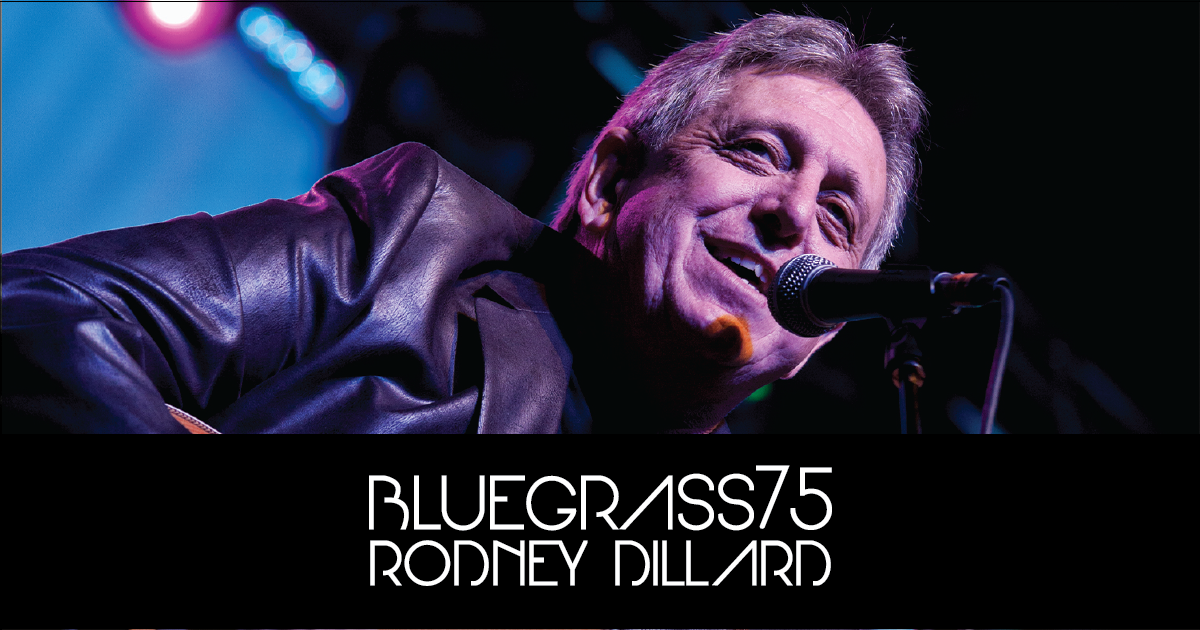
Hello, Darling: The Dillards’ Rodney Dillard Brings New Music to ‘Old Road’

With their landmark 1968 release, Wheatstraw Suite, The Dillards opened the doors for the progressive bluegrass and country-rock movements. In August, Rodney Dillard, the band’s sole surviving original member, released a new album by the Dillards, Old Road New Again, that he describes being a “bookend” to Wheatstraw. Although not as artistically groundbreaking as its predecessor, Old Road still features non-traditional bluegrass instrumentation and, probably more importantly, it finds the 78-year-old musician in a reflective mood about how he sees the world today as well as the Dillards’ legacy.

Talking from his home outside of Branson, Missouri, Dillard shares that “before I was just trying to reflect what rural life was like, but I grew up in it. This one, more or less, is more reflecting an old person’s perspective on life.” It’s a point-of-view that can be heard on “Tearing Our Liberty Down” and “Take Me Along for the Ride,” which offer non-partisan statements on the state of the world, while “Earthlink,” “Common Man,” and “My Last Sunset” find a man taking stock of his life.

“My Last Sunset,” with its vocal nod to the Eagles’ “Already Gone,” also represents the album’s full-circle theme; however, the theme is best epitomized on the title track, a rousing telling of the Dillards’ story. The tune also features several guest artists pertinent to that era: Don Henley (a friend and neighbor from Rodney’s L.A. days), Bernie Leadon (who played in Dillard & Clark with Rodney’s brother Doug), and Herb Pedersen (who joined the Dillards on Wheatstraw and has played with Rodney on and off since).

Adding to Old Roads’ ties to the past are appearances by Sam Bush (founder of the game-changing New Grass Revival) and Ricky Skaggs (who went from bluegrass traditionalist to progressive during the ‘70s) as well as Sharon and Cheryl White. In the past, Rodney had been hesitant about having an album feature lots of big-name guests. “I didn’t want to make it like I was trying to make an event out of it,” he explains. “I did it because I was able to have Henley, Ricky, Herb and Sam Bush with me… people who I truly respected before they were stars.”

Rodney offers some especially kind words for Skaggs for appearing on “Tearing Our Liberty Down,” which makes some pointed statements about America without pointing out particular political parties. “He took a big risk, I think, standing his ground with ‘Liberty Down,’” Rodney relates. “I’m just overwhelmed that he would consider doing it. He could have refused to do it, but he didn’t because he stands his ground.”

He also credits Pederson, who plays on most of Old Road’s tracks, with being a key factor in the Dillards’ breakout sound on Wheatstraw, which was Pedersen’s first album with the band. “When Herb came in, he added his harmonies.” Rodney reveals, “It became a different thing. It became Wheatstraw Suite.”

Featuring full orchestration, drums, and electric instruments, Wheatstraw Suite shook up bluegrass traditions while also being an important touchstone in the burgeoning country-rock scene. The album’s innovative sound was a creative decision, not a commercial one.

“It wasn’t about selling toothpaste. It was music,” Rodney shares. “We were selling what we believed in. It was what we thought was fun, creative and maybe had something to say that no one had said (before).” Don Henley, who covered the Dillards’ “She Sang Hymns Out of Tune” on his Cass County album in 2015, and Elton John, who picked the Dillards as his opening act in 1972, have cited Wheatstraw as a highly influential album. In considering the impact of the album and his band, Rodney says, “I’m just very grateful and thankful that I could play just a small part in the history of what music was in the ‘60s.”

One curious thing about Wheatstraw Suite is that it marked the Dillards’ return to Elektra Records, who released their first three albums, after an abbreviated stint at Capitol Records. The band had left Elektra originally because the label didn’t understand the direction that they wanted to pursue on a single entitled “Hey Mr. Five-Strings.” A cover of a ‘50s hit called “Hey Mr. Banjo,” the Dillards’ interpretation, as Rodney described it, “added knitting needles for rhythm played on a fiddle.”

Capitol was supposed to be greener pastures for the group; however, the label proved to be a worse fit for the Dillards than Elektra. “They assigned us this producer Ken Nelson, who was doing country, but he didn’t understand what we were doing. Then they gave us this guy who produced ‘Danke Schoen’ for Wayne Newton. That’s when Mitch and I looked at each other in a conference with this guy and said we wanted out. And we walked out.”

Rodney readily admits that the band should have never left Elektra. He also is very thankful for the help that Elektra’s founder Jac Holzman provided then and ever since. “If it hadn’t been for Elektra I don’t know what would have happened [with the Dillards]. I’m just grateful to have had that label,” Rodney proclaims, adding Jac “has been instrumental in getting [Old Road] off the ground,” as well as contributing to the album’s liner notes.

Los Angeles in the ‘60s was home to a vibrant, highly synergistic music scene, which Rodney remembers as being spearheaded by people with a passion for what they were doing. Peers like Linda Ronstadt, Leadon, and Henley, he mentions, were “all these guys who just loved music.” One popular musician hangout was the Troubadour’s foyer, which was just a folk room with instruments on the wall and people drinking tea.

“We would sit around, and we would just sing. We had a wonderful time… (people) would come up to the house that Doug, Dean (Webb, the Dillards’ mandolin player) and I had together in Topanga, where we’d pick and played music… Gosh, Herb and I would sit in with Clarence White and the guys down in the King’s Lounge,” he says, remembering a venue in Palmdale, outside of L.A.

The Dillards — Rodney and Doug Dillard, Dean Webb and upright bassist Mitch Jayne — left Salem, Missouri, and headed west to Los Angeles in 1962. Rodney says they chose L.A. because they felt Nashville didn’t respect bluegrass music and country music had a sameness to it back then. They also thought people might be more open-minded in Los Angeles. The drive took three months because they had to stop along the way to make money to continue on.

Once in L.A., however, their story resembled a Hollywood movie. They went to the legendary club, The Ash Grove, which Rodney humorously describes as the “petri dish for folk culture.” Setting up in the club’s lobby, the group started an impromptu performance. When club owner Ed Pearl came over, Rodney thought he was going to kick them out. Instead, they were invited to play that night. In the audience at that show were Jim Dickson, who later produced the Byrds, and an agent from William Morris Agency, which represented Andy Griffith and his TV show.

Within a week or so, the band had secured a deal with Elektra Records as well as an audition for The Andy Griffith Show. When Griffith stopped their audition short, Rodney says he told his brother, “They’re kicking us out.” So he was surprised when Griffith said, “You got the job!” They were hired to portray a hillbilly band, The Darlings, for an episode, but proved so popular that they wound up appearing on the show several more times over the years.

Because Andy Griffith was such a hit TV show then (and has remained in reruns ever since), the Dillards — as the Darlings — became quite well-known and brought bluegrass into millions of homes. Rodney praises Griffith not only for having given the group this big opportunity but also for letting them play their own music on the show.

The Darlings’ fame also got the Dillards booked on network TV programs like The Judy Garland Show and The Tennessee Ernie Ford Show. During a Playboy After Dark appearance, the band intentionally played fast to see if the dancers could keep up, according to Rodney: “So you’ll see those people are busting their chops just trying to look like professional dancers, and they just look people eradicating cockroaches.”

Although they played comical hillbillies on The Andy Griffith Show, the Dillards resisted perpetrating Hollywood’s country bumpkins on TV shows. “If they had haybales and painted freckles on the dancers and everybody looked like Daisy Duke,” Rodney states, “we said, ‘Nope, we’re not standing in front of that.’” The band, particularly in their early days, were known for their humor, but it was more sophisticated than typical hayseed variety. Their Live!!! Almost!!! provides a good example of their comedy style, and it’s referenced a bit on Old Road with Beverly Cotton-Dillard’s comical banjo ditty “Funky Ole Hen.”

While Rodney has always pushed the boundaries of bluegrass, he has great reverence for its traditions too. In 2009, the Dillards were inducted into the Bluegrass Music Hall of Fame. “I love that music,” he states. “I don’t want to see bluegrass die.” But he also says that the music can’t live in the past. “As far as Bill Monroe, the Stanley Brothers, the Blue Sky Boys — all those folks — they did what they did. Any of us who imitate them are just being pastels of what they did.”

Rodney talks excitedly about seeing two kids on YouTube playing old-time music with a contemporary feel. He is happy that younger musicians are interested in bluegrass and roots music and happy, too, that they don’t seem rigid over how to play it. “People now have their own free will over their creativity,” he exclaims.

He references an old Dillards’ tune, “Music Is Music” before talking about how he loves all sorts of music — “if it’s real…if it’s not manufactured.” He mentions how Earl Scruggs, a man he greatly admired, “had no rules. He loved good music; he was not judgmental at all.” Keeping it real and making it good is the type of approach Rodney brought to Wheatstraw Suite back in the day and Old Road now.

Rodney admits that the Dillards have had a rather bizarre career, with people familiar with them from The Andy Griffith Show and those who know them from the band’s work, particularly their trailblazing music on Wheatstraw Suite, along with Copperfields and Roots and Branches. Although the Dillards didn’t have the commercial success achieved by acts like the Eagles, the Nitty Gritty Dirt Band, and New Grass Revival that followed after them, Rodney is quick to note, “I didn’t miss out on being on television and being in somebody’s room every day for 60 years.”

Old Road New Again, which is the Dillard’s first album of new material since 1991, represents Rodney’s long-desired bookend to the Wheatstraw album. And while the title can be interpreted as taking a look back into the past, he also sees a positive, forward-looking sentiment — “I’m an old road but I can still be new again” — in the title’s meaning. The road he’s taken has given him an interesting ride, Rodney says, and he is grateful that Old Road has been attracting some attention because the album “may be my swan song.”

“I’m not trying to be pathetic,” he confides with a spry sense of humor, “but I am 78 years old.”


BGS 5+5: Wood & Wire

Artist: Wood & Wire
Hometown: Austin, Texas
Latest album: No Matter Where It Goes From Here

Answers by Tony Kamel and Billy Bright

Which elements of nature do you spend the most time with and how do those impact your work?

Water, for sure. I mean there’s so many metaphors available there. When writing I tend to lean towards the rivers, but it’s all the same water. We are all just part of the water cycle. — BB

Growing up on the Gulf Coast, the ocean has always been a consistent theme in my writing. I essentially learned to swim in the Gulf of Mexico. A lot of unique characters down there that are easy to tell stories about and put them into song. “John” on the new record is about a friend of mine that split time in Galveston as an artist and Alaska as a salmon fisherman. — TK

What other art forms — literature, film, dance, painting, etc. — inform your music?

Stand-up comedians and the way they work material out on stage. Maybe they don’t inform the music itself, but certainly the idea of putting your art out there, trying things out, adjusting to the audience, making yourself vulnerable, and developing swagger and confidence (especially) when things are going south. Being comfortable being uncomfortable is quite the asset and the best stand-up comedians have that mastered. Recently I’ve listened to all of Tig Notaro’s recorded material. She’s absolutely brilliant. There’s a video of her on Conan where she just pushes around a stool because it makes a funny noise… sounds ridiculous. It is. You should watch it. — TK

Since food and music go so well together, what is your dream pairing of a meal and a musician?

Music and food do pair well. Like if you’re eating a meal and there’s music in the background, or a band, that can be dreamy. Musicians and meals, not as dreamy. Too frequently, they’ll disappear when the bill comes, or are checking their Instagram page the whole meal. All that aside, Trevor has been talking about Sonoran Dogs in Tucson and we have never been able to check that box. So I’d have to say Sonoran Dogs with Trevor Smith. — BB

Definitely Sonoran Dogs in Tucson with Trevor Smith… or maybe Machaca at Lucy’s Cafe in Kings X in El Paso, Texas, with Billy Bright. Oh wait…..I’ve checked that box and it was every bit as dreamy as I could have imagined. (see “My Hometown” on the new record for El Paso references). — TK

What was the first moment that you knew you wanted to be a musician?

I knew from about 10 years old I wanted to create. I didn’t know I wanted to make it the way I (tried to) make a living until I was working a sales job and it came down to doing one or the other full-time. At this point, no matter what I do for living, it’ll have to be on my own terms. Like my bandmates, I’ve never been good at doing what I’m told — and that certainly isn’t getting better with age. — TK

My first band ‘practice’ ca. 1987. But those moments happen all the time. I still want to be a musician someday. I fell down the acoustic music hole for good when I saw The Bad Livers live in 1992. First time I ever saw a banjo played in real life, or ever, like that. — BB

How often do you hide behind a character in a song or use “you” when it’s actually “I”?

I’m not an intentional songwriter, they just come out sometimes and sometimes end up being recorded. I can’t think of a single song I’ve written where I doesn’t mean I. I should try that though. So should you…. — BB

Agreed. I’m not super intentional either. Kinda speaks to the relationship I have with songwriting. I don’t always enjoy it — it’s not always fun. For me personally, if I’m not feeling creative, or I’m not inspired, I don’t even try. It comes in waves. When the wave comes, I really buckle down, let it flow however it comes out, and ride it to the bitter end. And by I, I mean you. — TK


Photo credit: Alison Narro

LISTEN: Balsam Range, “Grit and Grace”

Artist: Balsam Range
Hometown: Haywood County, North Carolina
Song: “Grit and Grace”
Release Date: September 4, 2020
Label: Mountain Home Music Company

In Their Words: “’Grit and Grace’ is the kind of song that every single person who walks this earth can or will likely relate to at some point during their journey. But with determination, courage, faith, and finding the inner grit to overcome struggles, we live to tell another story. One that has a happy ending for us. My desire is that this song provides encouragement and strength to anyone who may be suffering. That they may find peace in knowing they are not alone.

“The inspiration for ‘Grit and Grace’ came from a man who served his country, walked the Bataan Death March, and was a prisoner of war for 3½ years, Walter Middleton. When my mom asked him how he got through it, his answer was simply, ‘I provided the grit and God provided the grace.’ He later in life wrote a book about his time spent as a prisoner of war and he signed the book to my mother with, ‘For folks like you I would gladly do it again.’ It is hard to comprehend the willingness to suffer that greatly for others but many before us have. Life is about learning, teaching, sharing, and helping those along our journey that are experiencing what we may have already experienced and by grace overcame.” — Buddy Melton, Balsam Range (vocalist and fiddler)


Photo credit: David Simchok