Bluegrass Memoirs: Lexington, Kentucky and J.D. Crowe, 1972

[Editor’s note: All photos by Carl Fleischhauer, except publicity shot of Esco Hankins]

On the afternoon of Sunday, August 13, 1972, Carl Fleischhauer and I were in Jackson, Kentucky, at the finale of Bill Monroe’s Kentucky Bluegrass festival where we’d been since Friday. In my notes, I wrote:

We left after talking briefly with Monroe (I bought his new LP [Bill Monroe’s Uncle Pen] and latest single [“My Old Kentucky and You”] from him) and drove [85 miles northwest] to Lexington where we got a motel — the Flora — run by an 85-year-old lady who liked Bill Monroe and told us that Uncle Dave Macon stayed in the Flora whenever he visited Lexington. Dinner late on the [U of KY] campus or near at an Italian restaurant — snuck in leftover wine and had ravioli. Sure was good to bathe and sleep in an air-conditioned room.

Monday morning after breakfast downtown and some cursory hunting in record cut-out bins, we headed to the Esco Hankins Record Shop. Tennessean Hankins, a Roy Acuff-style singer, began his recording career in 1947. He settled in Lexington in 1949 and performed for years on WLAP with his wife Jackie and his band, which included Dobro player Buck Graves. He also performed weekly on The Kentucky Mountain Barn Dance, which started in Lexington in 1949 and was broadcast on WVLK. 
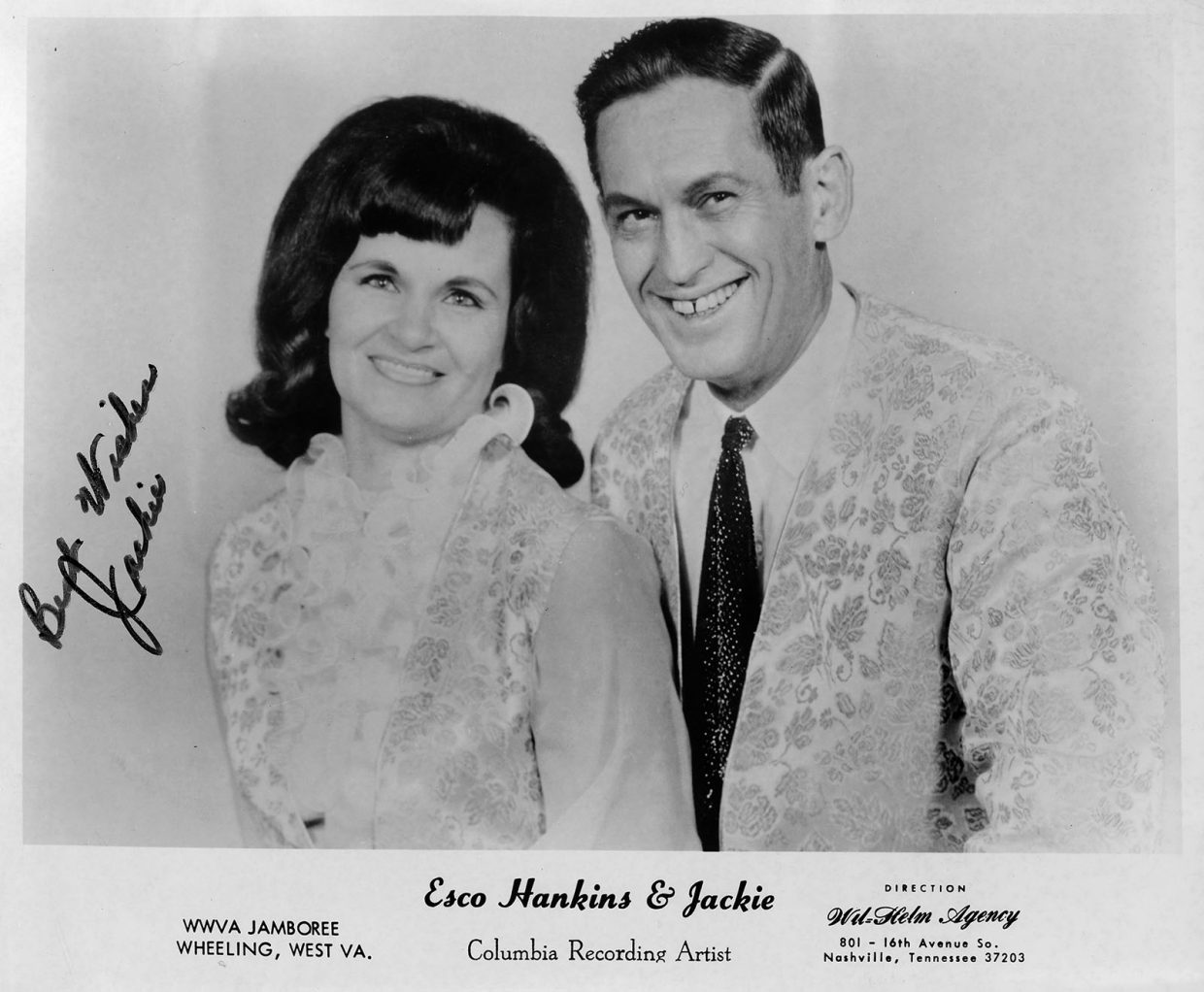
Jackie and Esco Hankins publicity photo, original date unknown.

Flatt & Scruggs joined the Kentucky Mountain Barn Dance cast that year, influencing both Graves – to whom Earl taught his right hand, three-finger roll – and young J.D. Crowe, who was a regular in the audience and often went with his dad to observe Scruggs rehearsing with Flatt for their radio shows at WVLK. In 1950, at age 13, inspired and informally tutored by Earl, J.D. got his first banjo and began practicing what he’d seen watching Earl in action.
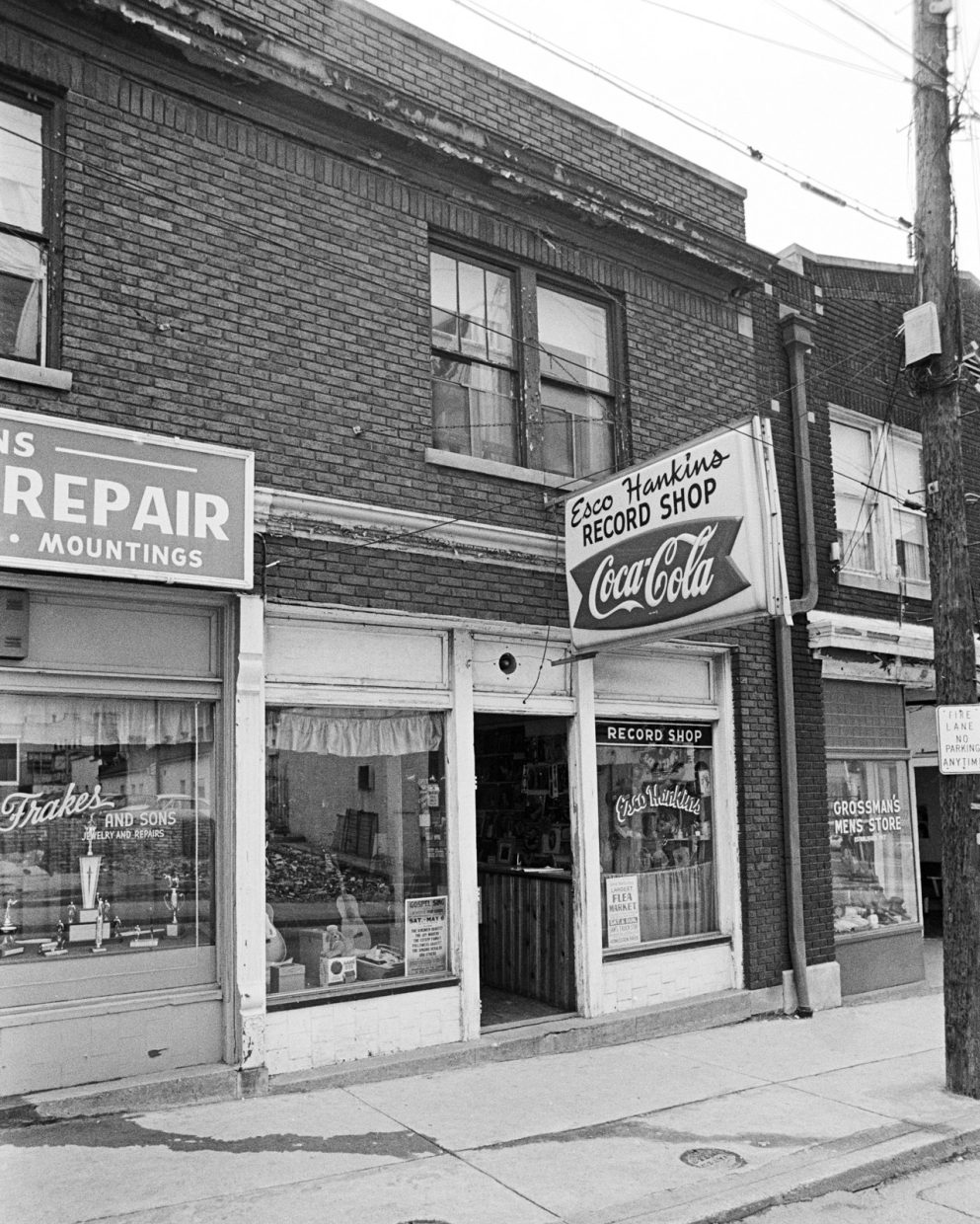
Esco Hankins Record Shop, Lexington, KY, April 1972.

Hankins held amateur country music contests, and at one he discovered teenager Crowe, who soon became part of his band. Marty Godbey’s Crowe On The Banjo: The Music Life of J.D. Crowe (2011) is a fascinating biography that narrates in great detail much of the story I would hear in my interview with Crowe that day in 1972. Early on, Godbey quotes from one of her interviews with J.D.: “I played for him quite a bit, it was my first paying job.” 
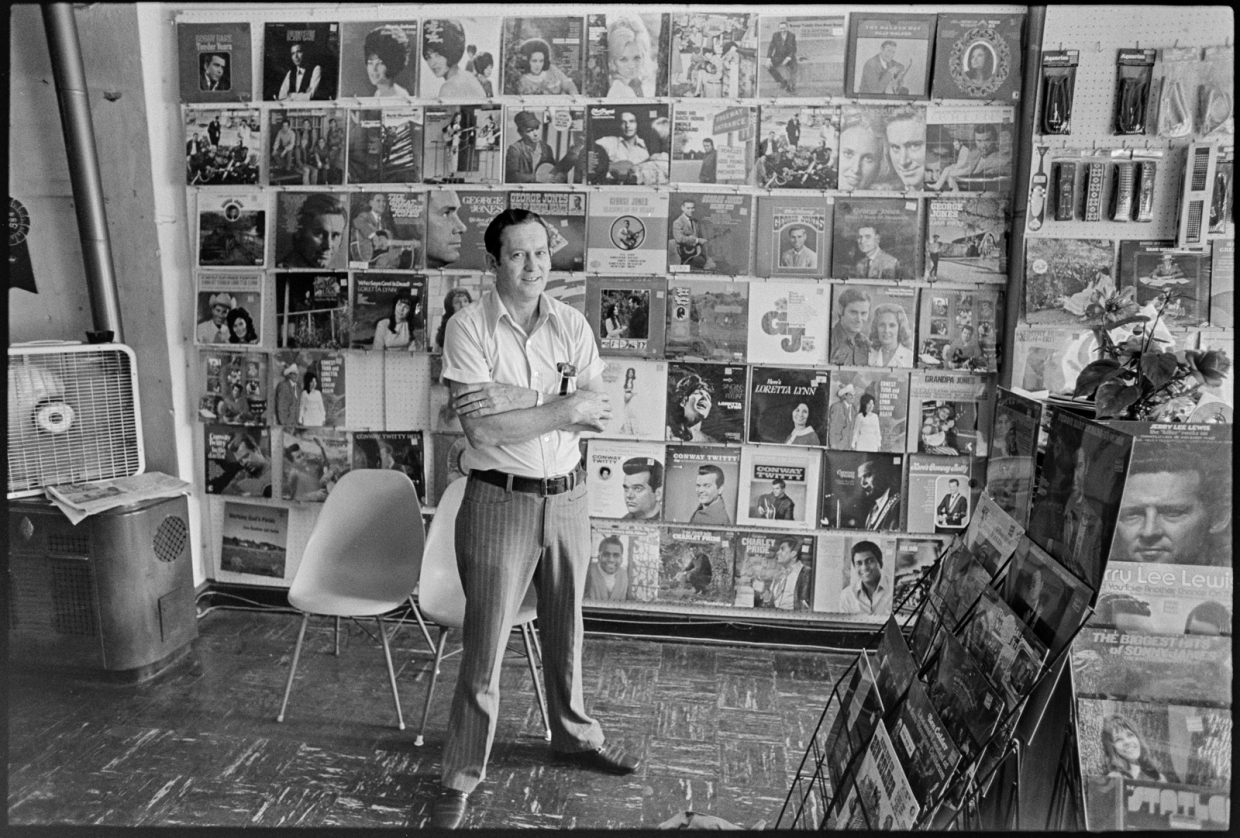
Esco Hankins in his record shop in Lexington, KY, August 1972.

I knew nothing of Crowe’s connection with Hankins on that morning when we walked into Esco’s shop. We browsed, bought some records, and then got into a conversation with him about country music history. He generously gave me a number of old songbooks and then, when we mentioned our interest in interviewing Crowe, he phoned Lemco, the Lexington record company with whom Crowe had recently made three albums and several singles, to get J.D.’s number. My notes:

…he ended up calling first Lemco and then J.D. Crowe and then handing the phone over to me to talk with J.D. — I thought it was still Lemco and went into a long rap about my project and what I was doing and how I would appreciate if they could put me in touch with J.D. — and the voice said, “This is J.D.” and I was embarrassed but maybe it was a good thing…anyhow we made an appt. for 3:00…
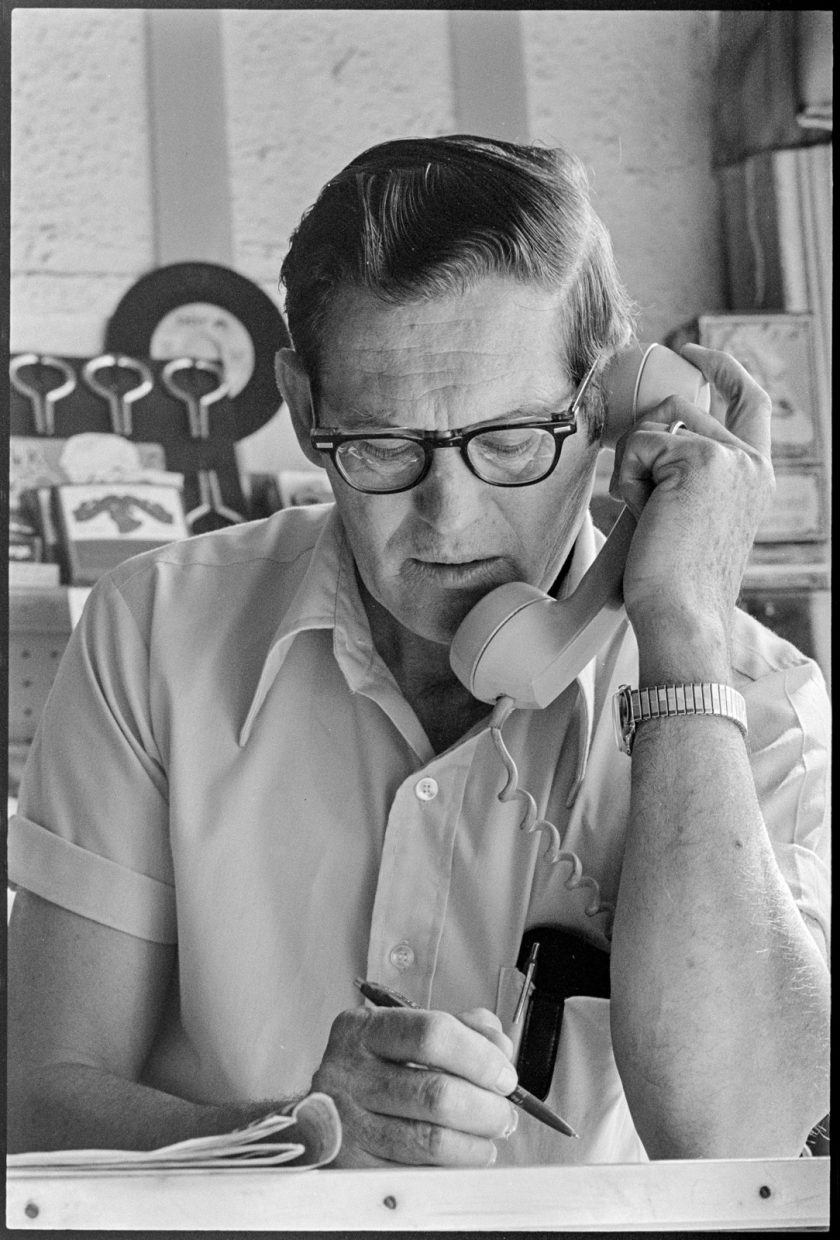
Esco Hankins in his record shop in Lexington, KY, August 1972.

Today, Crowe is best remembered as the banjo picking leader of the progressive New South, whose 1975 Rounder 0044 album with Skaggs, Rice, Douglas and Slone has become a modern bluegrass icon. He also was, in 1980, a founding member of the bluegrass supergroup The Bluegrass Album band, playing solid, perfectly timed, and driving banjo based on the style of Earl Scruggs and singing the harmony parts he’d learned with Jimmy Martin. He died on Christmas Eve, 2021. 

When I interviewed him in 1972, he’d been living in Lexington, his birthplace, since returning in 1961 after a five-year stint with Jimmy Martin and the Sunny Mountain Boys. For the next seven years he’d worked day jobs (with a couple of brief stints back with Martin) while playing in local taverns with his group, The Kentucky Mountain Boys. 

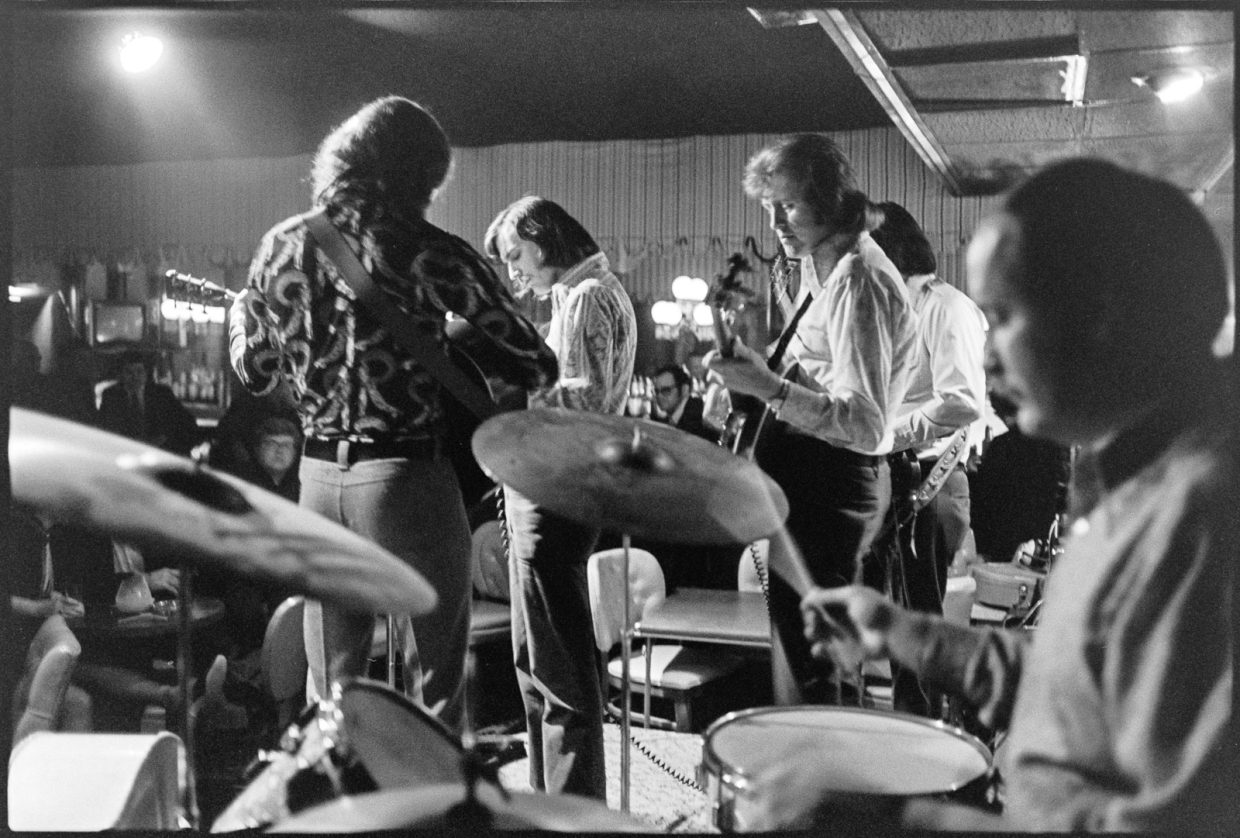
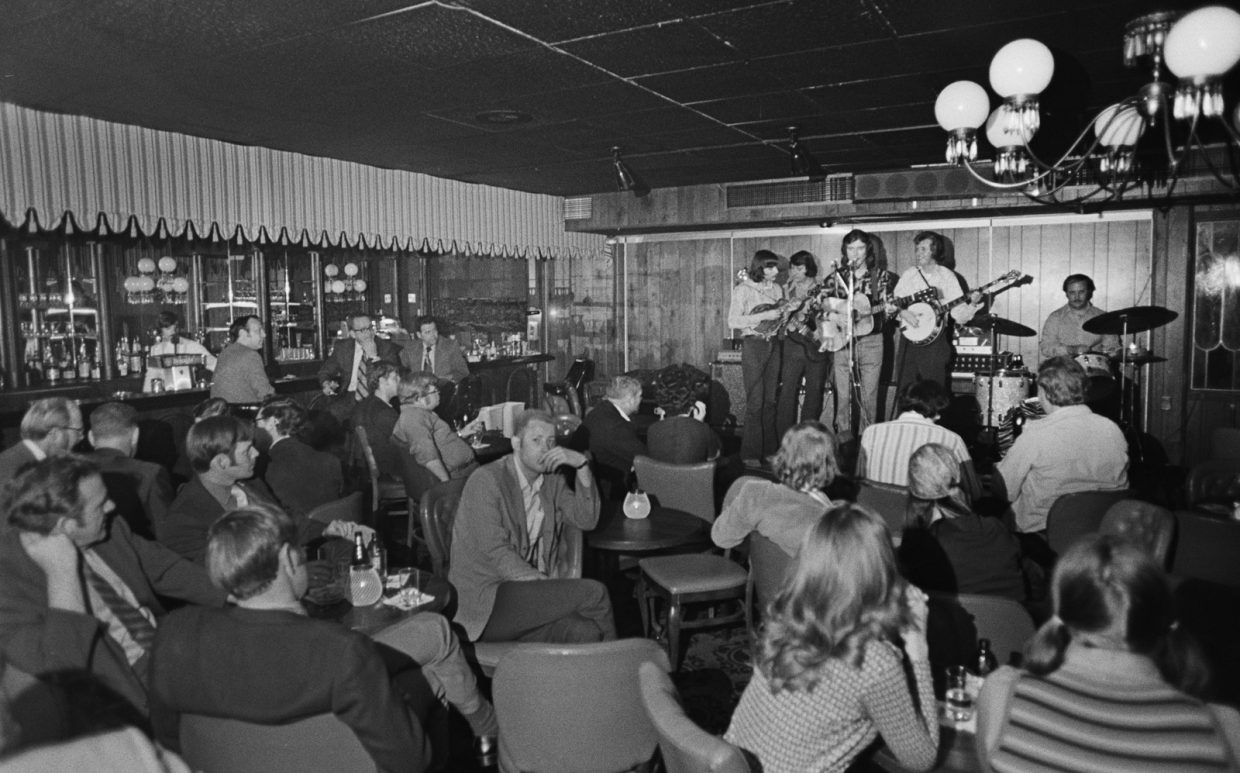
In 1968 they began appearing six nights a week at the Red Slipper Lounge in the Lexington Holiday Inn. It was a change from his former blue-collar tavern milieu – lots of young college students in the crowds. This gig was going strong when Carl and I visited him.
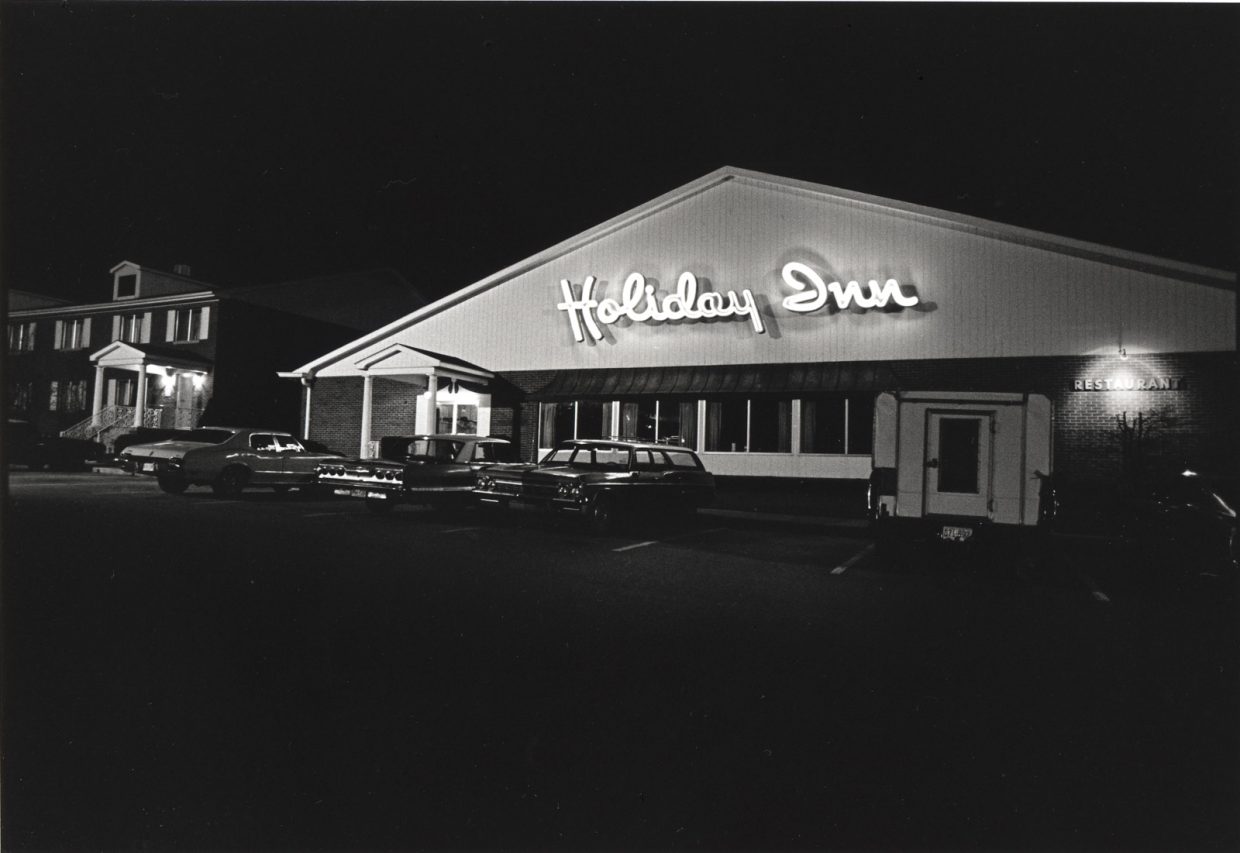
The Holiday Inn, Lexington, KY, April 1972. Featured at the Red Slipper Lounge at the motel that night was J.D. Crowe and Kentucky Mountain Boys.
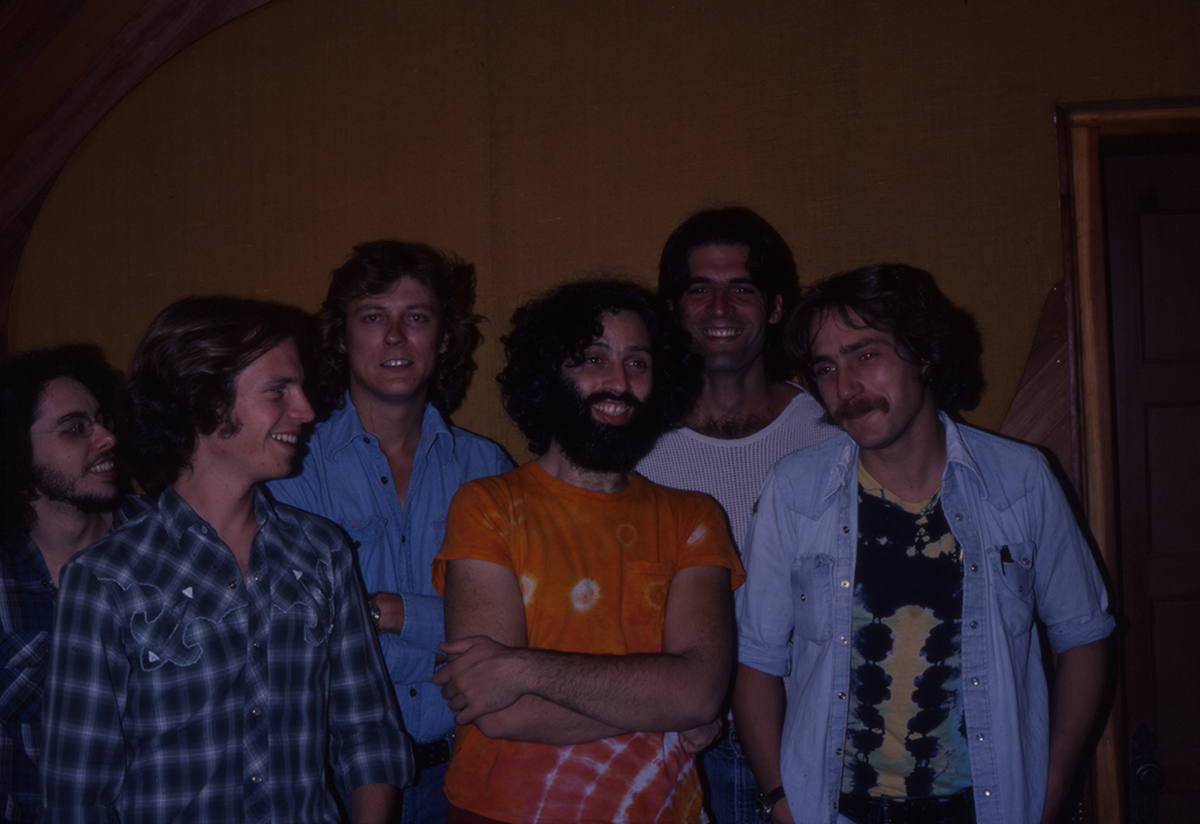
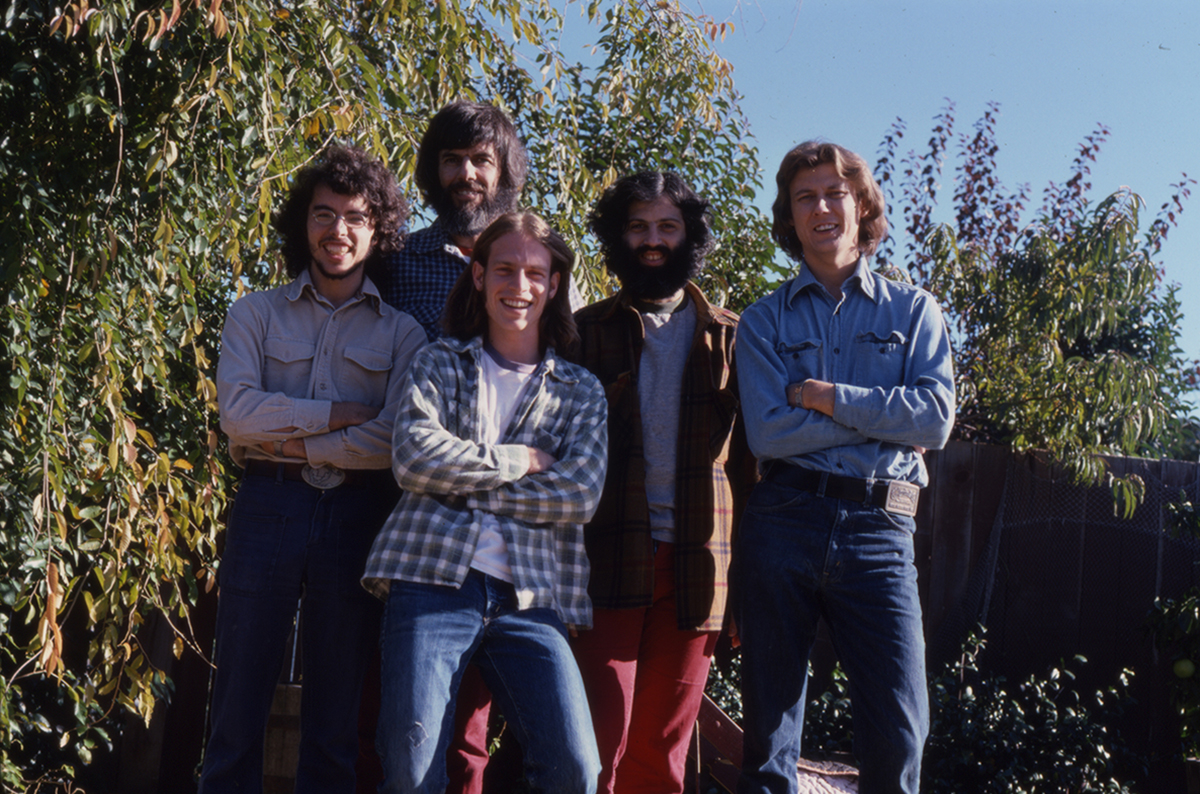
The Holiday Inn, Lexington, KY, April 1972. Featured at the Red Slipper Lounge at the hotel that night was J.D. Crowe and the Kentucky Mountain Boys. Left to right: Larry Rice, Bobby Slone, Tony Rice, J.D. Crowe, and Donnie Combs.

J.D. was now working full-time at his music. A number of notable musicians had worked for him in The Kentucky Mountain Boys, like Doyle Lawson and Red Allen. At this point, in 1972, his band consisted of Larry Rice, mandolin, Tony Rice, guitar, Donnie combs, drums, and Bobby Slone, bass. He had just changed the name of the group to the New South

I had first seen Crowe in April 1960 when I went to Wheeling, West Virginia, with a couple of college friends. A month earlier we had opened for the Osborne Brothers at Antioch College. Bobby Osborne had urged the audience to come see them at the Wheeling Jamboree at WWVA. We took him up on it at spring vacation.

We drove down from Ohio and took a cheap room in a hotel close to the Virginia theater where the Jamboree was held. That evening we saw the Osborne Brothers as expected, but just the two of them were there. Bobby played guitar and sang “Down The Road” while Sonny picked the five. Good music, but no band! We enjoyed some of the country acts like Rusty and Doug and the fiddling of Buddy Durham. But we weren’t expecting any more bluegrass when Jimmy Martin and the Sunny Mountain Boys were introduced. It was the most memorable moment of the evening for us.

The four-piece band – Jimmy Martin, Crowe, mandolinist Paul Williams, and fiddler Johnny Dacus – bounded up to the mic from backstage and opened with Crowe’s the up-the-neck single-string banjo intro to “Hold Whatcha Got,” Martin’s latest single. 

The audience, which included a bunch of young women seated up front who had cowbells and knew how to use them, went bananas. It was a tight band, thought by many to be Martin’s best, and we were very impressed. Crowe’s banjo break was amazing. It marked him as a unique stylist.

Thereafter, when talking with fellow banjo pickers, I identified this single-string work as “J.D. Crowe style.” The success of “Hold Whatcha Got” led Martin to record several more using the same rhythm and banjo break style. 

Following our experience in Wheeling, we began listening to Martin’s late Saturday night show, after the Jamboree, on WWVA. The live sound of new songs like “My Walking Shoes” – driving, up-tempo stuff with Crowe’s banjo out front – caught our ear. 

J.D. told Marty Godbey about watching Earl rehearse: “I was more interested in trying to learn the breaks to songs and backup than instrumentals.” His work on Martin’s Decca recordings was definitive; Martin’s banjoists were told to play it like J.D. 

He began to record on Lemco with the Kentucky Mountain Boys in 1969 when the band included Doyle Lawson and Red Allen. This was the most recent Crowe recording I’d heard at the time of our August 1972 interview. 

That afternoon Carl and I drove to his trailer park home. We set up my cassette recorder and mic, and I began the interview with a few ethnographic questions: “Let me ask you just some of the basic things, like how old you are and where you were born and so on.”
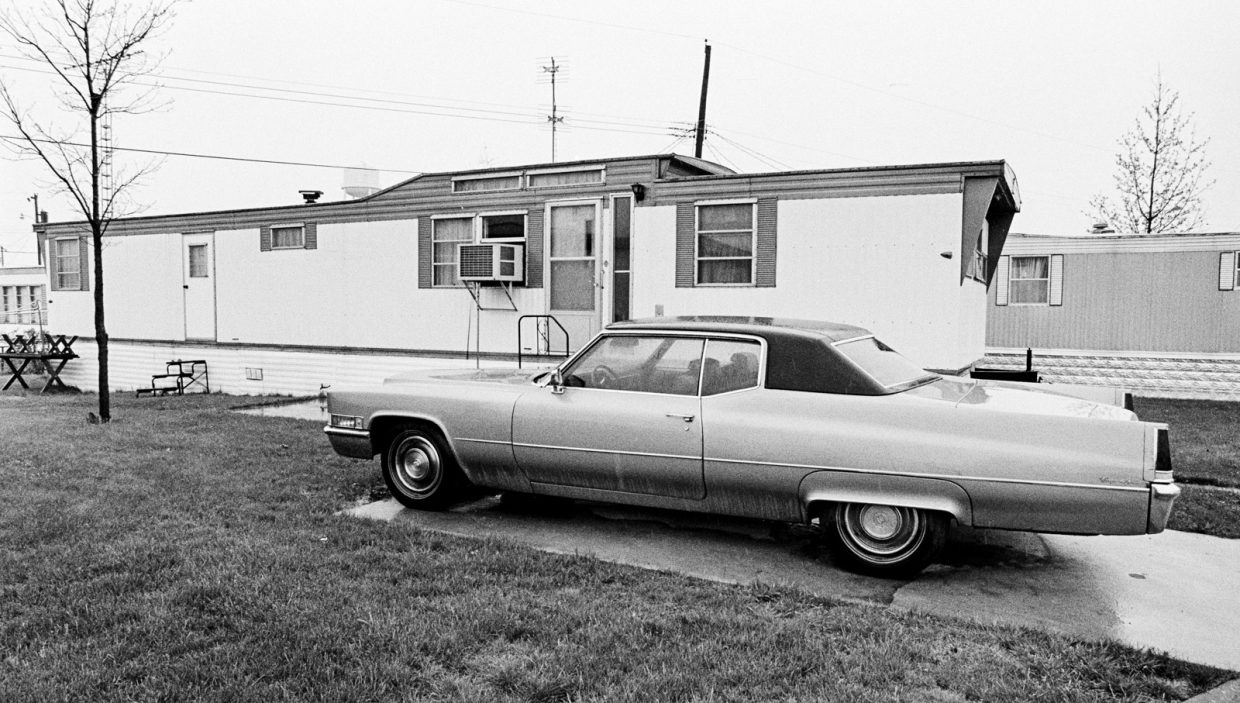
J.D. Crowe home, Lexington, KY, April 1972.

He was 34 and told of childhood with country music on a farm six miles outside of Lexington. Then he described how his musical calling emerged in the fall of 1949 after Lester Flatt and Earl Scruggs came to town. 

I saw them in person before I ever heard their records. Cause, the first record I heard of them was one called “Down The Road.”

“Down The Road” was Lester and Earl’s newest record release in October 1949.

His family were regulars in the audience at the Kentucky Mountain Barn Dance. 

And I saw, they came here — fact, I never heard of ‘em!

They was there one night, and they was so well received that they was hired.

His first banjo was a 39-dollar Kay, but within a year he’d moved up to a Gibson. Scruggs was his informal mentor. At fifteen he was playing dances and at sixteen Jimmy Martin hired him after hearing him playing on the radio with Hankins. “Hankins?” I asked.

Yeah, I guess that was the first person I worked with professionally.
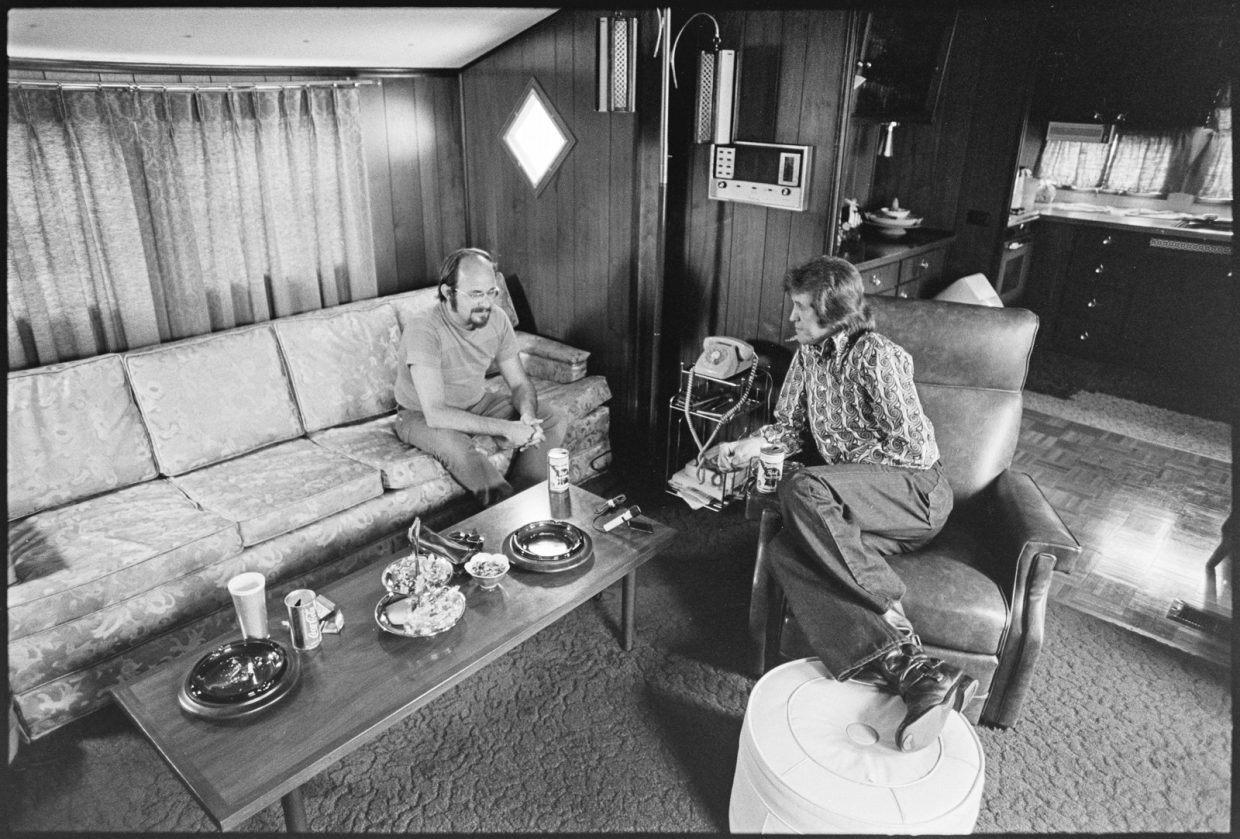
J.D. Crowe at home in Lexington, KY, August 1972, during a visit and interview with Neil V. Rosenberg (left).

After five years working full-time in Martin’s band – in Detroit, Shreveport, and Wheeling – J.D. quit. It was 1961, he was twenty-four.

I think I just, a, kindly got tired, I mean, you know, wanted to try something different. 

This was a phrase he used several times in the interview: I just wanted to try something a little different, he said later, speaking of the band he started. Moving back to Lexington, he got a day job, and formed The Kentucky Mountain Boys, who played five nights a week in local clubs until 1968. Then the Holiday Inn gig came along:

I give up my job and I’ve been doing it full-time ever since.

As a bandleader, he stressed the hard work involved in building a career:

…you know how the music goes, unsure, you know. Which anything is, really when you get down to it. It’s just what you want to make out of it, and how hard you want to work… And a, believe me, it’s, it’s rough. A lot of people, you know, think it’s a lot of, a bowl of cherries, you know, just have a good time, but it’s not like that.

I suppose the picking is only the small part,” I said.

That’s just the smallest part of it, really.

J.D. explained how his full-time band operated – fall, winter, and spring they played six nights a week at the Holiday Inn. Then they took the summers off: 

Work road shows

He told me about his band members — mandolinist Larry Rice, his brother Tony, and Bobby Slone — and explained about the Rices’ California connection:

They were born in Danville, Virginia, but … they went to California when they were just little shavers and they lived out there I guess ten or twelve years in Los Angeles. And that’s where Larry came from, he was living there at the time… Bobby Slone, our bass player, he’s been with me I guess about six years. Well, he used to live in California also, and he had worked with them when they was growing up and so he told me about them. And of course, Tony I met after Larry joined me. He moved back to North Carolina and he came up. 

His band were all veterans of the late ’60s LA scene where folk-rock and country-rock had blended with bluegrass. That musical mindset had a kind of creative vision that Crowe could empathize with. 

I used to be, if it didn’t have a banjo in it, then I’d cut it off. But now, with the exception of rock and roll and blues. I’ve always liked it. I used to listen to blues, just all the time. I like the style of B.B. King, of course he’s still going, you know, and, a Fats Domino, Little Richard, you know … they was in the fifties. And there’s just a lot of ‘em, and of course the rock changed you know, course what they call country rock, which is good, I like that. In fact, we do quite a few numbers of that ourself.

I asked: “When you were leaving Jimmy Martin, were you thinking of putting some of that into your music?” He explained:

That wasn’t out yet … I didn’t have too much choice. You (could) only do country, do bluegrass, or you just do hard rock. But now there’s so much new stuff’s out that it’s just endless, to what you can do, and take over songs and adapt them over, your own little thing, in style.

You can take with what you had and combine it with a couple other forms of music and come up with a little different gimmick, a little different style. That’s the whole thing, that’s what you got to have. 

Perhaps the most novel aspect of the New South sound at this time was the fact that since the prior September – almost a year before – they had been playing electrified instruments.

I had the idea, you know a, maybe that might be the answer, because, like I say, like we couldn’t get any records played on country stations. 

The Osborne Brothers had gone electric in 1969; J.D. said their example had influenced him “a little bit.” Also in 1969, Earl Scruggs had begun playing an electrified banjo with his sons in the Earl Scruggs Revue. Jim & Jesse had done an electric album in 1971. I asked J.D. if he’d recorded with his electric group.

The latest single is. Course I use a steel and a piano and a drummer, the whole works on that. In fact I didn’t play too much banjo, on account, if there’s a lot of banjo, some things, they won’t even, some stations won’t play it.
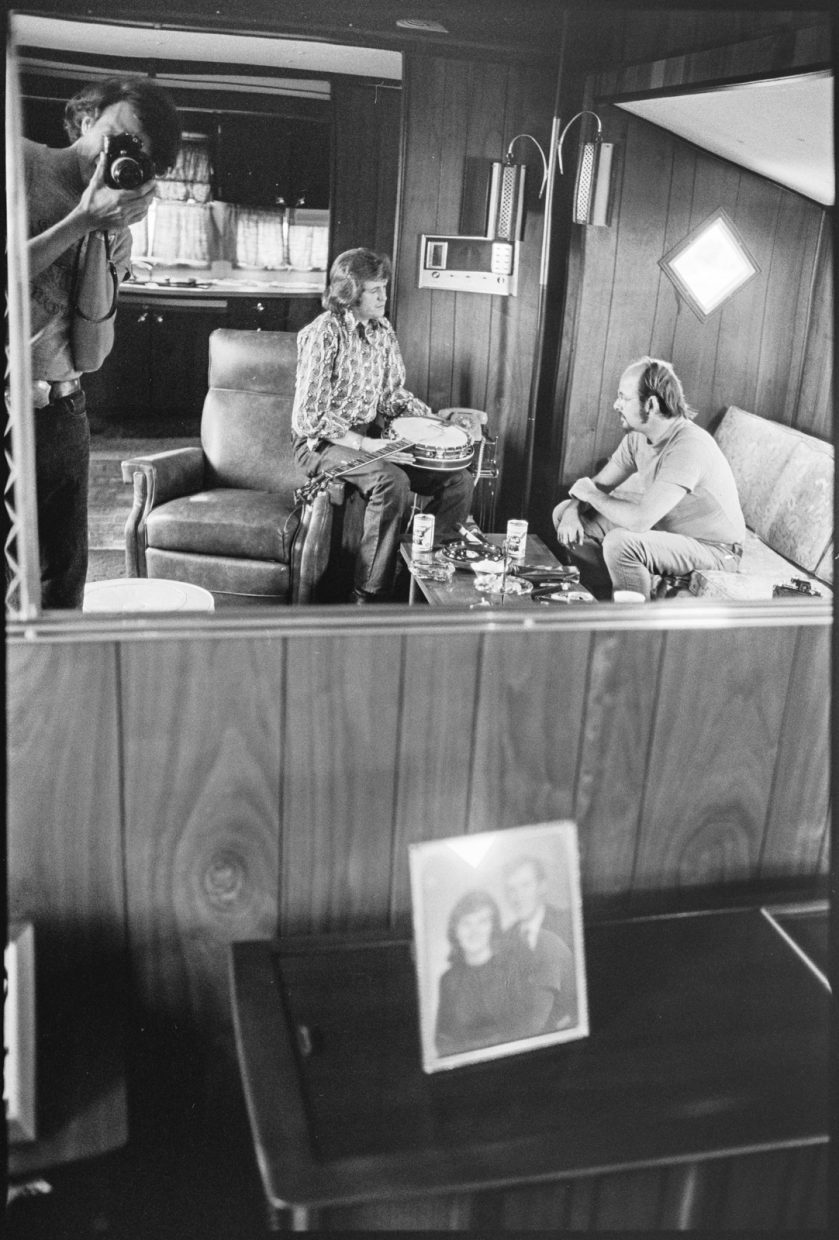
At J.D. Crowe’s home in Lexington KY, August 1972, during a visit and interview with Neil V. Rosenberg (right) as reflected in a mirror that also caught photographer Carl Fleischhauer.

We’d just been at a festival; I wanted to know what he thought about festivals. Had they helped his music?

The festivals have helped to a certain extent. You know. Right now, they’re trying, they’re getting too many of them, in my opinion. Cause you can over do a good thing, you know and, which I know we worked some of ‘em that didn’t turn out so good … most of ‘em, though, we’ve worked this year have all been great big ones, I mean a lot of people. And I figure they will probably continue having that kind of a crowd. And I think that it’s, it’s helped.

“Is it a different kind of crowd than the country music crowd?” I asked.

A, not really, I’d say a people that go to bluegrass festivals would also go to see Porter Wagoner and Conway Twitty and Merle Haggard — Nashville, you know. They like it, course they like bluegrass too. A lot of your country people, you know, like other types. There’s — they like it, but they won’t come out to see it, you know, they don’t like it that good. They can take it or leave it, in other words. That’s what you got to get to, those people, the general public. You know, cause there’s a lot of people come to the festivals and — but you know if you figure, the population of the world and you know, don’t look, it’s not too good a’ odds, so…

An experienced observer of the ongoing bluegrass scene, J.D. was keenly involved in his music business. He spoke of recording studio dynamics, record company practices, broadcasting politics, fan magazine reviews, and other factors in running a band. 

At that point I turned off the recorder and asked if he would show me his electrified banjo. When I turned the recorder on again, he was giving me the history of his banjo, starting with the neck:

This, this is original here, this part as you can see was pieced from a tenor, you turn it over and it’s a great job — see, that’s been pieced.

(N:) Oh, yeah.

(J.D.:) From there up. They matched it perfect, see, you can tell, right there, it starts up on the neck, go right in there, or right here, you can see its smaller up the neck.

(N:) It’s a splendid job.
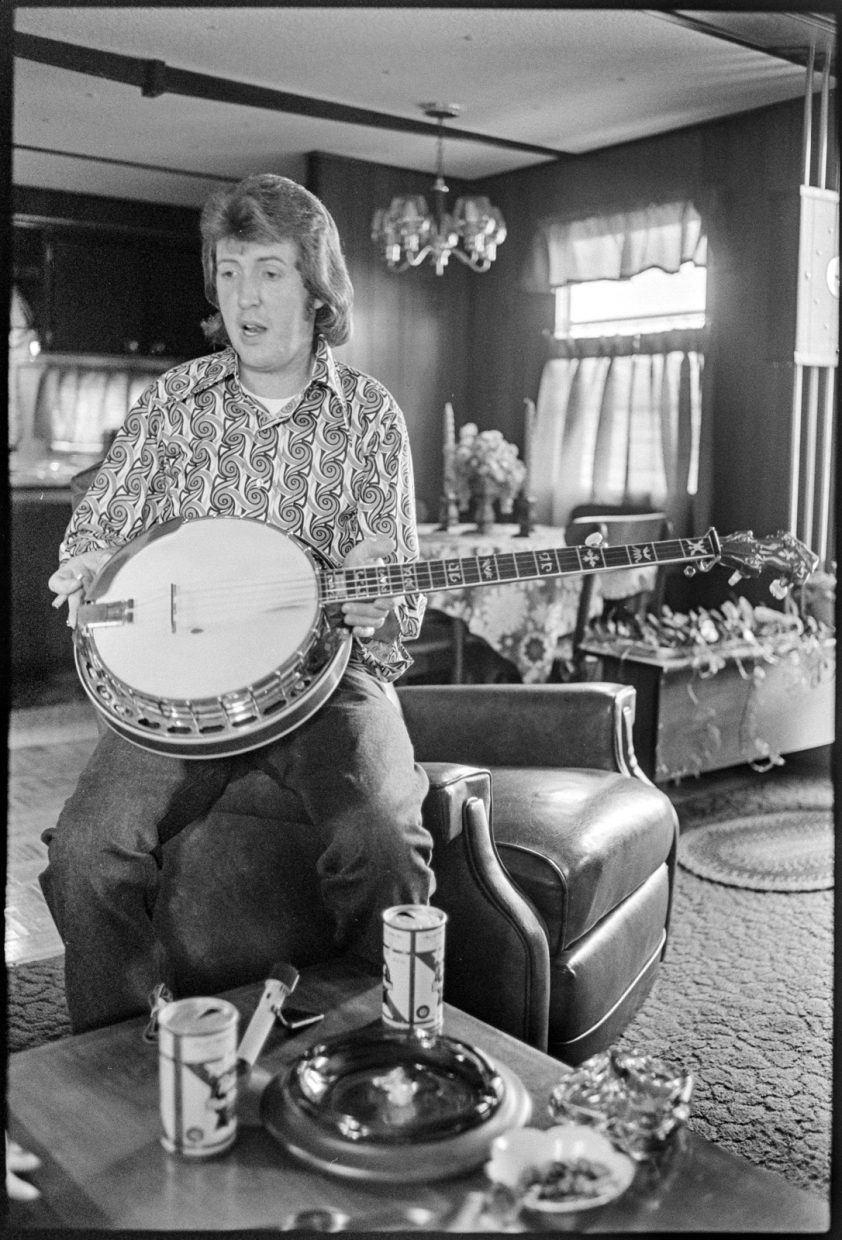
J.D. Crowe at home in Lexington KY, August 1972.

J.D. had seen a lot of old Gibson Mastertones over the years. He knew chapter and verse about wood types and design details. But I wanted to know about his electric setup. I knew nothing about electric instruments, which were anathema to the ’50s folk revival I’d grown up in. He spent some time showing and explaining the details of his still-experimental pickup system (Godbey describes it well, p. 110). Carl asked if he could take a picture, J.D. politely told him no.

He told me what it was like to be playing electric, with the strings closer to the fretboard (“low action”) than on an acoustic:

(N:) Can you do licks that you wouldn’t otherwise do?

(J.D.:) Yeah. You can do a lot of stuff that holds, you know, you can get a sustain. That’s what nice about it. 

Then he announced what he was hoping on for the future:

I’ve got a six-string ordered.

In 1970 Sonny Osborne had added a sixth bass string to his five-string; it was part of a lush sound – string sections, twin steels, etc. – on their latest recordings. J.D. liked the possibilities the added string would enable, especially because he, like Sonny, was playing an electrified instrument. He’d even had to cancel a contract for a bluegrass festival that didn’t allow electric instruments. He told them:

Hell no! We’re gonna play electric…. We played up here electric for nine month and [then] we played acoustical; I sounded like I was playing a two-dollar Kay. Cause your hearing gets accustomed to that volume. And it’d take me three or four months to get back on the acoustical route.

Our interview ended there. Afterward I evaluated it in my notes:

Interview with J.D. Crowe — nothing spectacular, your hr.’s worth of history, but attitudes and early learning gone into pretty carefully. Very friendly but reserved in a reassuring way. Carl busy snapping away.
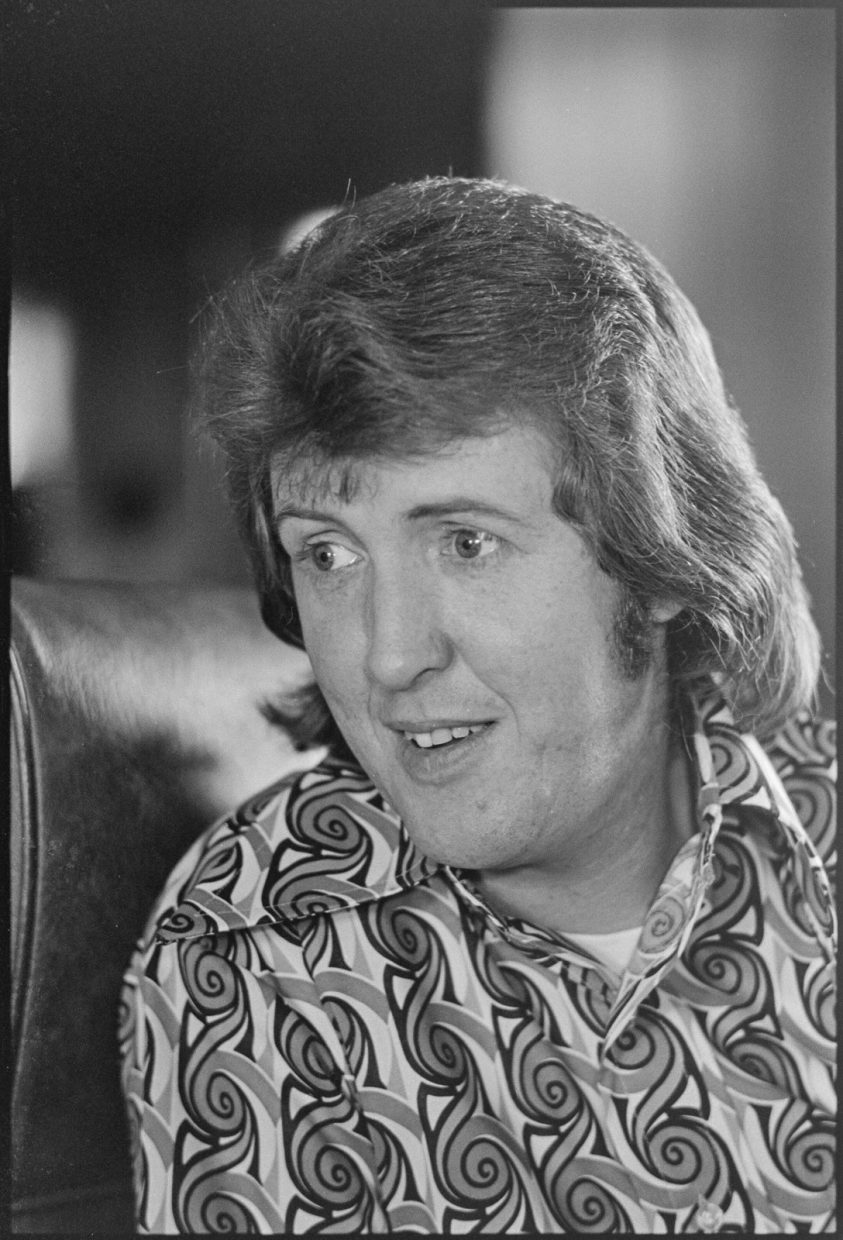
J.D. Crowe at home in Lexington, KY, August 1972.

We left Lexington immediately, heading for Louisville, where we were to stay with friends of Carl’s. Consequently, I didn’t get a chance to see J.D. and his New South in action at the Red Slipper Lounge. 

In 1973, the electric edition of the New South recorded an album in Nashville for Starday. Titled J.D. Crowe and the New South, it was issued on CD in 1997 under the title Bluegrass Evolution. Crowe played his 6-string on two of its ten cuts. Here’s one, “You Can Have Her.

The album wasn’t released until 1977, two years after they stopped playing electric. In 1975 when Larry Rice left the group, J.D’s new mandolin player, Ricky Skaggs, had insisted on “acoustical.” By then J.D.’s vision of “something a little different” was working just fine without the extra electricity; Rounder 0044 came soon after. 
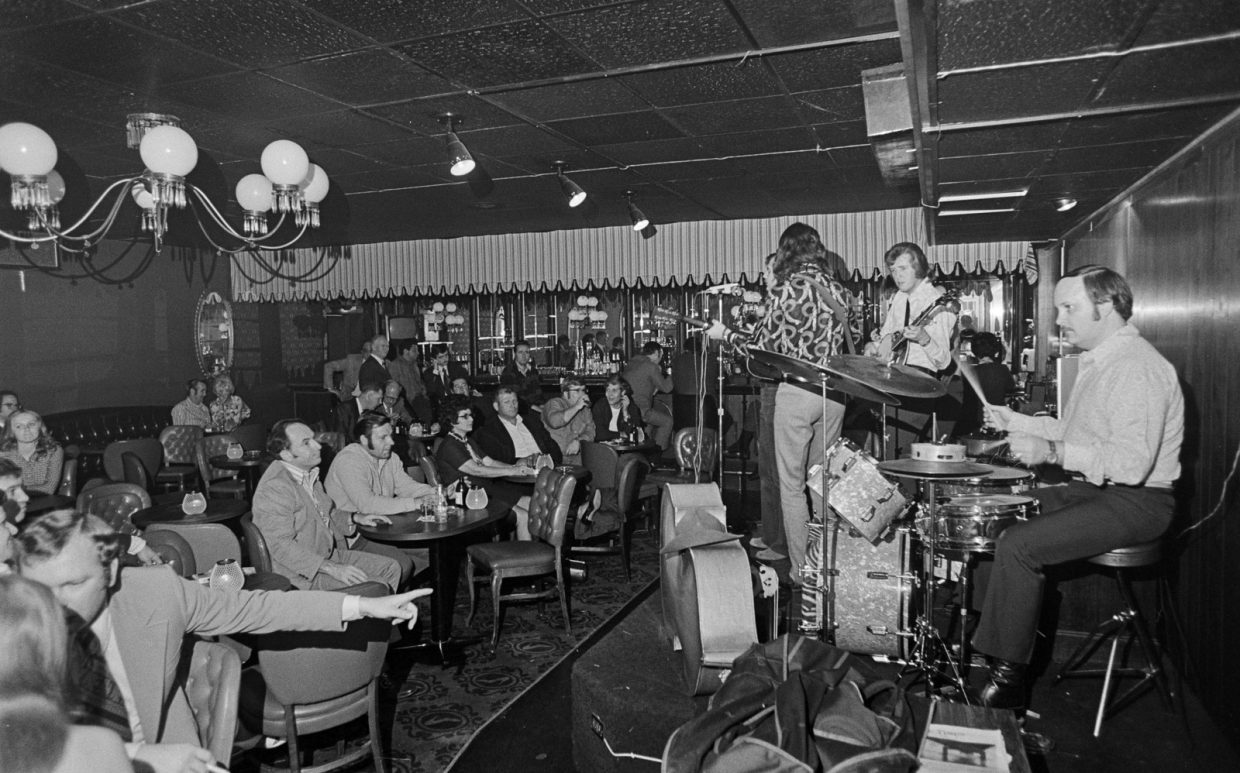
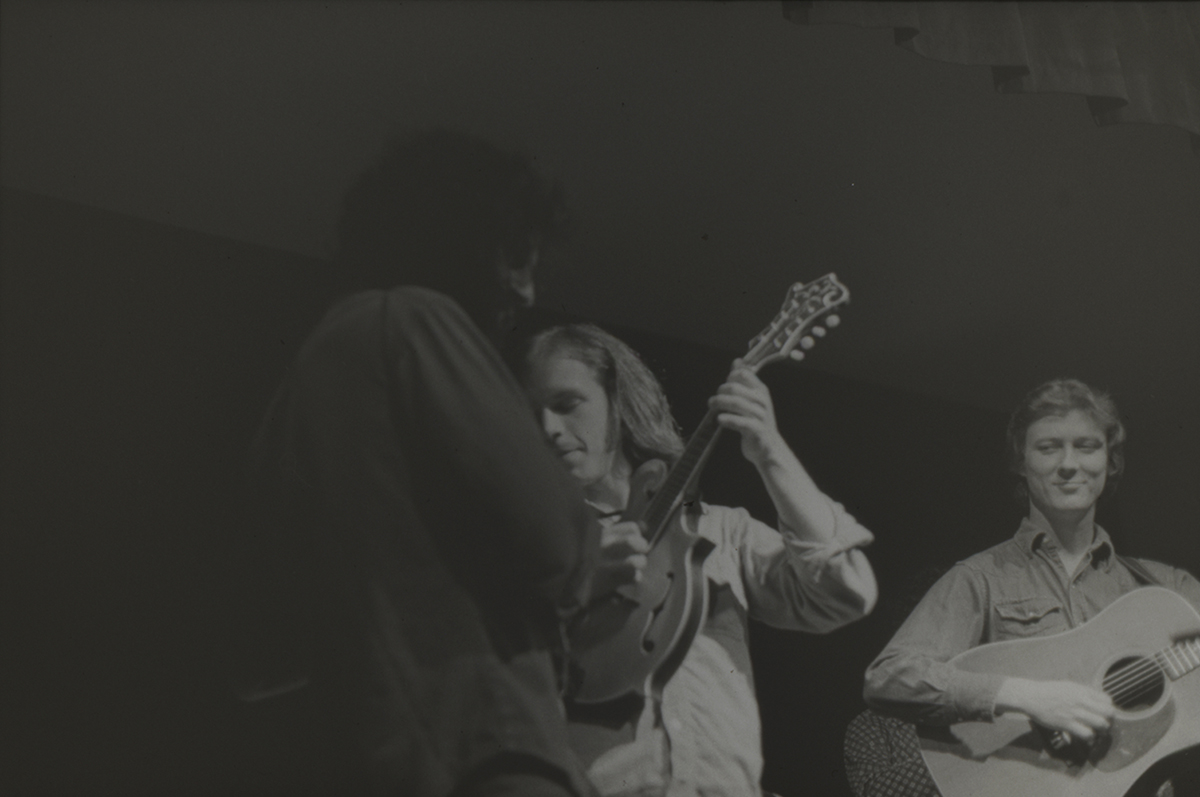
The Holiday Inn, Lexington, KY, April 1972. The Red Slipper Lounge featured J.D. Crowe and Kentucky Mountain Boys; including Tony Rice (back to camera), Larry Rice (barely visible behind Tony Rice), J.D. Crowe, Bobby Slone (hidden), and Donnie Combs, drums.
The Holiday Inn, Lexington, KY, April 1972. J.D. Crowe and the Kentucky Mountain Boys; Tony Rice (back to camera), Larry Rice, J.D. Crowe, Bobby Slone (partly hidden), and Donnie Combs, drums.

That day I wished we’d taken the time to catch the band in action, but we had only five more days for our bluegrass field trip. Kentucky was just the start; our next planned stops would take us to Ohio, Indiana, and Illinois. Recently, a recording of an evening at the Red Slipper was uploaded to YouTube. Here’s the 1972 sound of the electrified New South (with drums): 


Thanks to Tim Stafford and Carl Fleischhauer.

Neil V. Rosenberg is an author, scholar, historian, banjo player, Bluegrass Music Hall of Fame inductee, and co-chair of the IBMA Foundation’s Arnold Shultz Fund.

Photo of Rosenberg by Terri Thomson Rosenberg.

Edited by Justin Hiltner
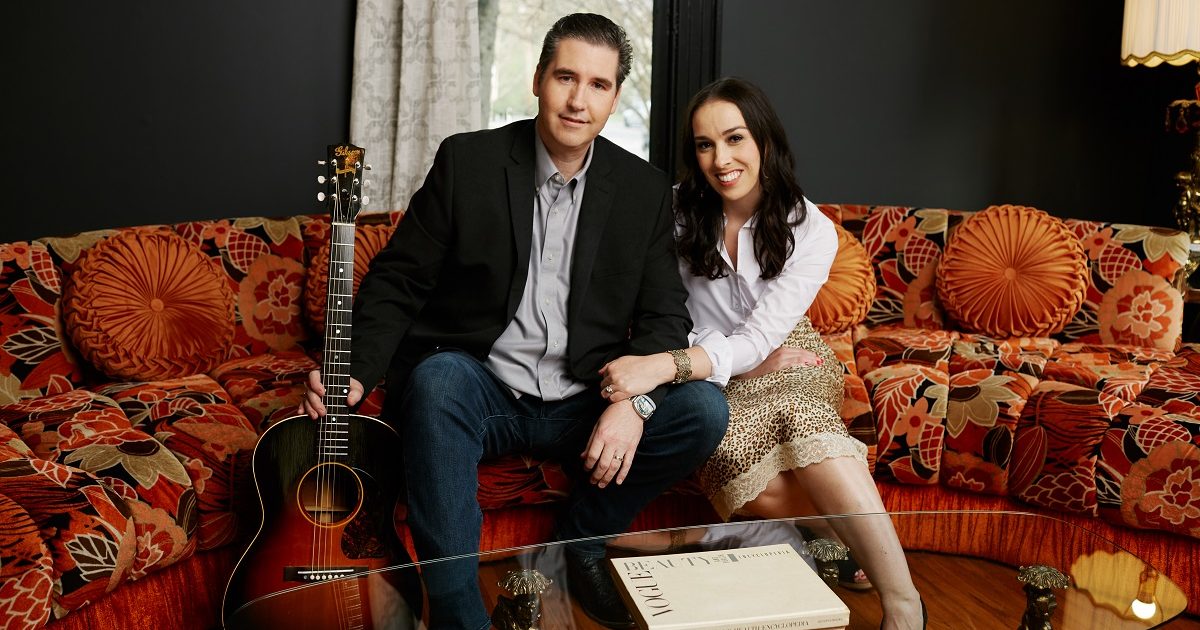
Darin & Brooke Aldridge Sing “Jordan” (Ft. Ricky Skaggs, Mo Pitney & Mark Fain)

Artist: Darin & Brooke Aldridge
Hometown: Cherryville, North Carolina
Song: “Jordan” (feat. Ricky Skaggs, Mo Pitney and Mark Fain)
Release Date: March 24, 2023
Label: Billy Blue Records

In Their Words: “‘Jordan’ is one of those songs that you’re gonna be singing along with the first time you hear it. It’s sure to get stuck in your head, and you might even find yourself trying out all the different vocal parts! This song is a classic, and we couldn’t have been more honored to have Ricky Skaggs and Mo Pitney join forces with us. From the first note, it felt like we had been singing together for years. It all came together so easily! Ricky made some wonderful suggestions that we loved and incorporated into the song. We hope you love it as much as we loved creating it!” — Darin & Brooke Aldridge


Photo Credit: Kim Brantley

WATCH: Mo Pitney, “Old Home Place”

Artist: Mo Pitney
Hometown: Cherry Valley, Illinois (close to Rockford, Illinois)
Song: “Old Home Place”
Album: Ain’t Lookin’ Back
Label: Curb

In Their Words: “The opportunity to record this song, ‘Old Home Place,’ means a lot to me. The first time I ever heard this song was on a JD Crowe & The New South album when I was a young kid. It featured JD, Tony Rice, Ricky Skaggs, Jerry Douglas and Bobby Slone. I learned that version and would play that song with my dad and my brother when we were touring bluegrass festivals. When I was in the studio to record my current album, Ain’t Lookin’ Back, I stepped up to the mic to check it and I started playing ‘Old Home Place’ to warm up. My producer said, ‘Mo, let’s just play through that to get the jitters out and don’t freak out when the band comes in,’ and he recorded it. What was cool, about a week later my producer played it for Marty Stuart and he said he’d love to be on the track and then Ricky Skaggs agreed. We then wanted to recreate as much of the original project as possible and it became a compilation of my heroes playing bluegrass and country music. This track means the world to me and shows the evolution of the music that I want to make now, but also where I came from. I’m thankful for every opportunity I have to be able to do that.” — Mo Pitney


Photo Credit: Jeremy Cowart

Bluegrass Memoirs: Jackson, Kentucky Bluegrass

[Editor’s note: Photos by Carl Fleischhauer]

On Monday August 7, 1972, with fresh memories of Maritimes old-time and bluegrass, I drove from New Brunswick to New England to join my wife and kids, who were house-sitting for my in-laws in Norwich, Vermont. 

On Thursday the 10th I headed south. A fourteen-hour drive brought me to Morgantown, West Virginia, the home of my friend and partner in research, photographer and film-maker Carl Fleischhauer, then employed at West Virginia University. We’d known each other for twelve years. (Our stories are in Bluegrass Odyssey: A Documentary in Pictures and Words, 1966-86 [U of IL Press 2001]). We were about to embark on fieldwork.

During the preceding year, when I began planning for the book Bluegrass: A History, I asked Carl to help me think about photos. In addition to documenting bluegrass festivals and other venues he, with Sandy Rothman, had recently looked for traces of earlier days in a field trip to the old Monroe home in Rosine, Kentucky. Now, we made plans for our own field trip. Carl would take photos. I would make notes and do interviews. 

We spent that Friday in Morgantown looking at Carl’s photos and films and listening to LPs as we prepared for the research. At the end of the evening, my notes say,

Did some picking.

Early Saturday morning we piled in my new Toyota with our gear (cameras, tape recorder, axes, tent, sleeping bags) and headed southwest, crossing into Kentucky from Huntington, WV and snaking down through the mountains to Jackson, the seat of Breathitt County. Three hundred miles; we arrived around 2 o’clock.

There we headed just outside of town for Bill Monroe’s Second Annual Kentucky Blue Grass Festival. When I went to Canada in 1968, Bill Monroe had one festival a year at Bean Blossom in Indiana. Now he was running a bunch in other states, as were other artists. Festivals were the big news in bluegrass music in 1972. We sought to document the bluegrass festival experience.

Later others would write about this, like Bob Artis (“An Endless Festival” in Bluegrass [1975]) and Robert Owen Gardner (The Portable Community [2021]). Here’s how my notes from Jackson begin:

West of town on main hwy, down short steep road. Paid camping & Sat. fees, never did pay for Sunday. Parked & walked down to the stage area — tent set up, natural amphitheatre, uncovered stage, bad sound. Lots of cops around on Saturday.

Made contact with Pete & Marion Kuykendall, and agreed to move in next to them to camp. Set up tent, attempted to speak to Monroe but he was busy coping with the Goins Bros. problem of being hassled by the cops for drinking. Later Kuykendall said that cops had asked Monroe for $ (3 or 6 hundred) and he had refused to pay off so they were taking it out in fines. Lots of racing around on Sat. with flashing lights et al, but they stayed away on Sunday.

Listened then to IT’S A CRYING TIME, hot & exciting Japanese bluegrass band. Then back to Kuykendall’s bus/home whatall. Thunderstorm; discovery that cassette recorder didn’t work on batteries because plug distorts switch; got it running eventually. Oldest Kuykendall girl Sam/Ginger comes in with bass player of above-mentioned Japanese band, then leaves. Kuykendalls are a bit worried about this but Carl & I both notice later that a number of young girls (McLain girls, for example) are hanging around, with this group.

Dinner with Kuykendalls. Frank & Marty Godbey come in and are around for the rest of the evening. Mostly we sit & talk, though I went down to the amphitheatre to catch Jim & Jesse and the Japanese bands. Came back, then returned to catch Monroe. Afterwards listened to picking group in tent near us. Did mainly Emerson & Waldron, Newgrass Revival, Bluegrass Alliance, Gentlemen, etc. Chromatic banjo. Noisy night in Carl’s tent, as sessions went on late and busses started early. I got a spider bite.

Bill Monroe (center) and the Blue Grass Boys at the Second Annual Kentucky Bluegrass Festival, Jackson KY, Saturday, August 12, 1972. Bandmembers include Monroe Fields, bass; Jack Hicks, banjo; Joe Stuart, guitar (hidden); Monroe, mandolin; and Kenny Baker, fiddle.

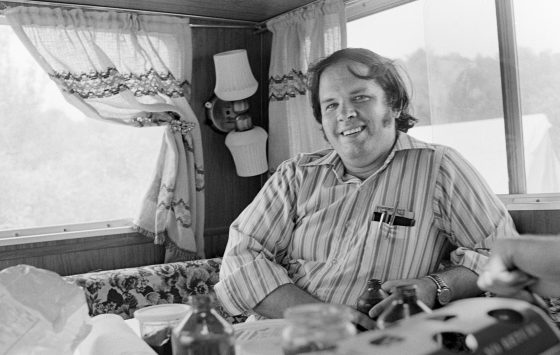
I’d known the Kuykendalls since 1966. Pete, a 1996 inductee to the Bluegrass Hall of Fame, was a musician, record collector, producer, publisher, and, since 1970 owner-editor of the first and leading bluegrass monthly Bluegrass Unlimited.

Pete Kuykendall, editor of Bluegrass Unlimited, in his RV parked in the camping area at the Second Annual Kentucky Bluegrass Festival, Jackson KY, Saturday August 12, 1972.

Pete and I had already been corresponding about bluegrass history when we met on Labor Day weekend 1966 at the second Roanoke Bluegrass Festival. Subsequently, I visited the Kuykendalls in Virginia where Pete encouraged me to write for the then all-volunteer magazine he would later own. I began with a review of the festival, published the following January — the first of eight articles I did for BU in 1967.

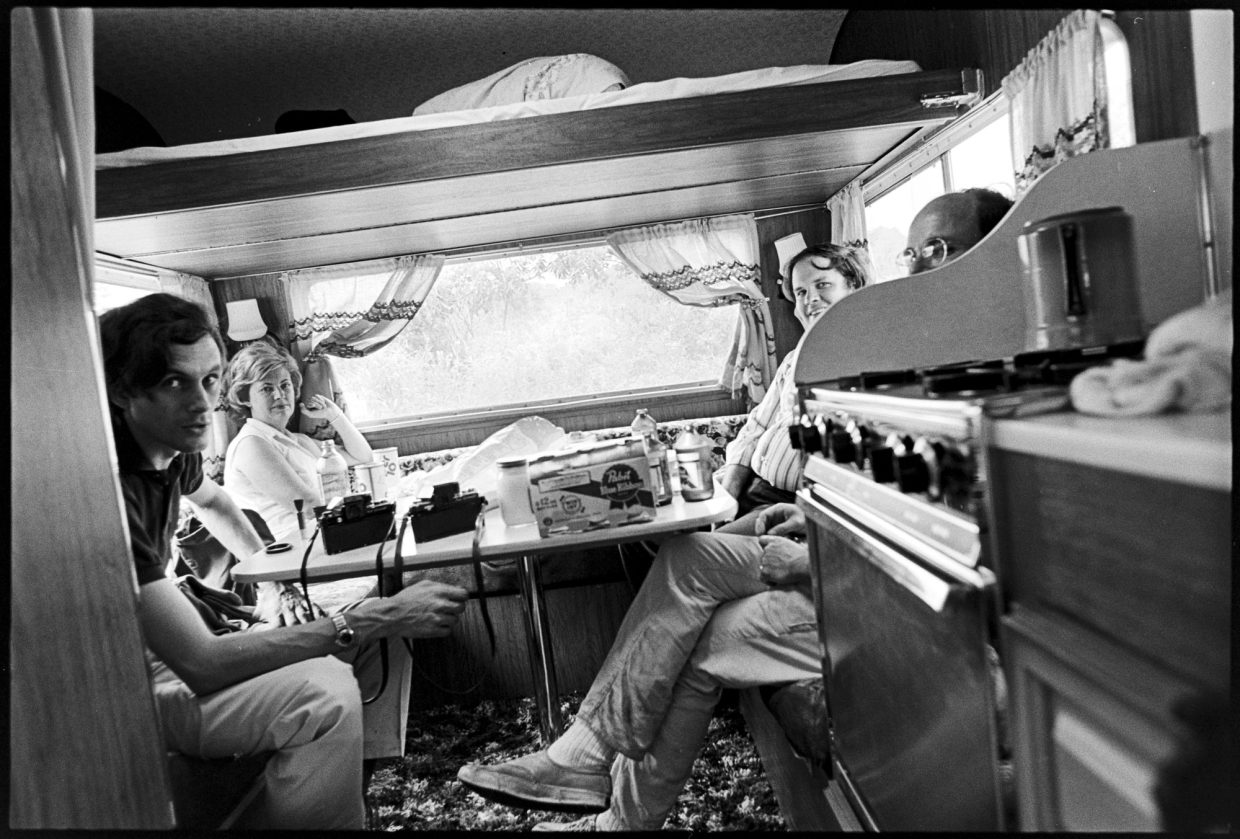
Photo made by Pete Kuykendall’s son Billy with one of Carl Fleischhauer’s cameras. Carl is seated at left with two other cameras on the table. This photo was made at the time of Neil Rosenberg’s (top of head above stove) interview of Pete Kuykendall, editor of Bluegrass Unlimited, in his RV at the Second Annual Kentucky Bluegrass Festival, Jackson KY, Saturday, August 12, 1972. In the background, at left, is Pete’s wife and Bluegrass Unlimited co-manager Marion Kuykendall.

By 1970 Pete and Marion were running BU full-time; I’d done an article for them earlier in 1972 (eventually I would write a monthly column) so we had been in touch recently by mail and phone. Conversations with Pete were never brief! He loved to share the business scuttlebutt and he had plenty since they were selling the magazine at festivals every weekend and had just launched BU’s own annual festival. 

I think this may have been the first time I met the Godbeys. From Lexington, and before that, Columbus, Ohio, they had been following the bluegrass scene for a decade. Frank is a musician who is still performing these days. By 1972 he and Marty had begun writing and publishing photos in BU. For them, as for me, hanging out with the Kuykendalls was a good way to keep up on the bluegrass news. People were already talking about starting an industry association, though that — the IBMA — wouldn’t happen until 1986. Pete was one of its founders.

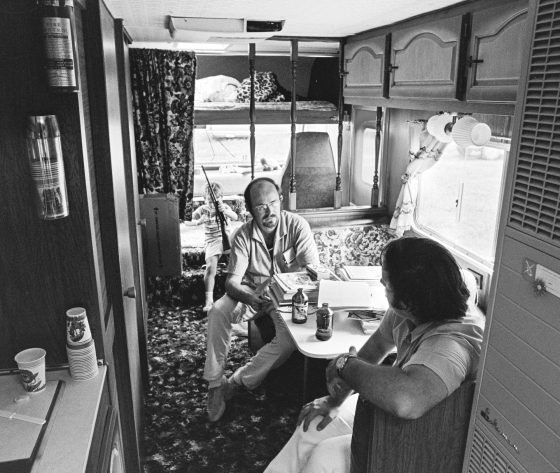
Neil Rosenberg (facing camera) interviewing Pete Kuykendall, editor of Bluegrass Unlimited, in his RV parked in the camping area at the Second Annual Kentucky Bluegrass Festival, Jackson KY, Saturday, August 12, 1972. In the background, with an air rifle, is Pete’s son Billy Kuykendall.

With the growth of the festivals came clubs, newsletters, and magazines. Bluegrass enthusiasts (many of them musicians) followed their favorites to festivals and other venues. Paths crossed; networks grew. The politics of bands was a favorite discussion topic.

Over the course of the festival, I made note of gossip about the always changing bands. Ricky Skaggs had just left Ralph Stanley — there were rumors about where he was headed next. Was Bill working to get Ralph Stanley on the Opry? Some thought so. The II Generation was said to be splitting up. Stories were told of bluegrass festival camp followers. 

At this Jackson, Kentucky festival were a bunch of bands that had been appearing at Bill Monroe’s other 1972 festivals — Monroe, Jim & Jesse, Flatt, Reno & Harrell, the Goins, Ralph Stanley — mature musicians who’d been working with this music for a substantial period of time and who stuck close to the early models of which they were, often, the authors. Classic bluegrass, one could say. 

What the audience didn’t hear was the kind of stuff we’d heard from the jammers late Saturday night, like “One Tin Soldier,” The Bluegrass Alliance’s cover of a song popularized in the film Billy Jack. Their bluegrass version, with Sam Bush’s lead voice and Tony Rice’s harmonies and guitar work, was a hit, a big step on the road to newgrass.

The Japanese bands were new to the scene. Japanese bluegrass began in the early sixties. In 1971, Bluegrass 45 came from Kobe, Japan, with the sponsorship of their label, Rebel, to tour U.S. bluegrass festivals. They made a big hit at Monroe’s Bean Blossom festival with their showmanship and musical savvy. This year they were back, along with another Japanese outfit, It’s A Crying Time.

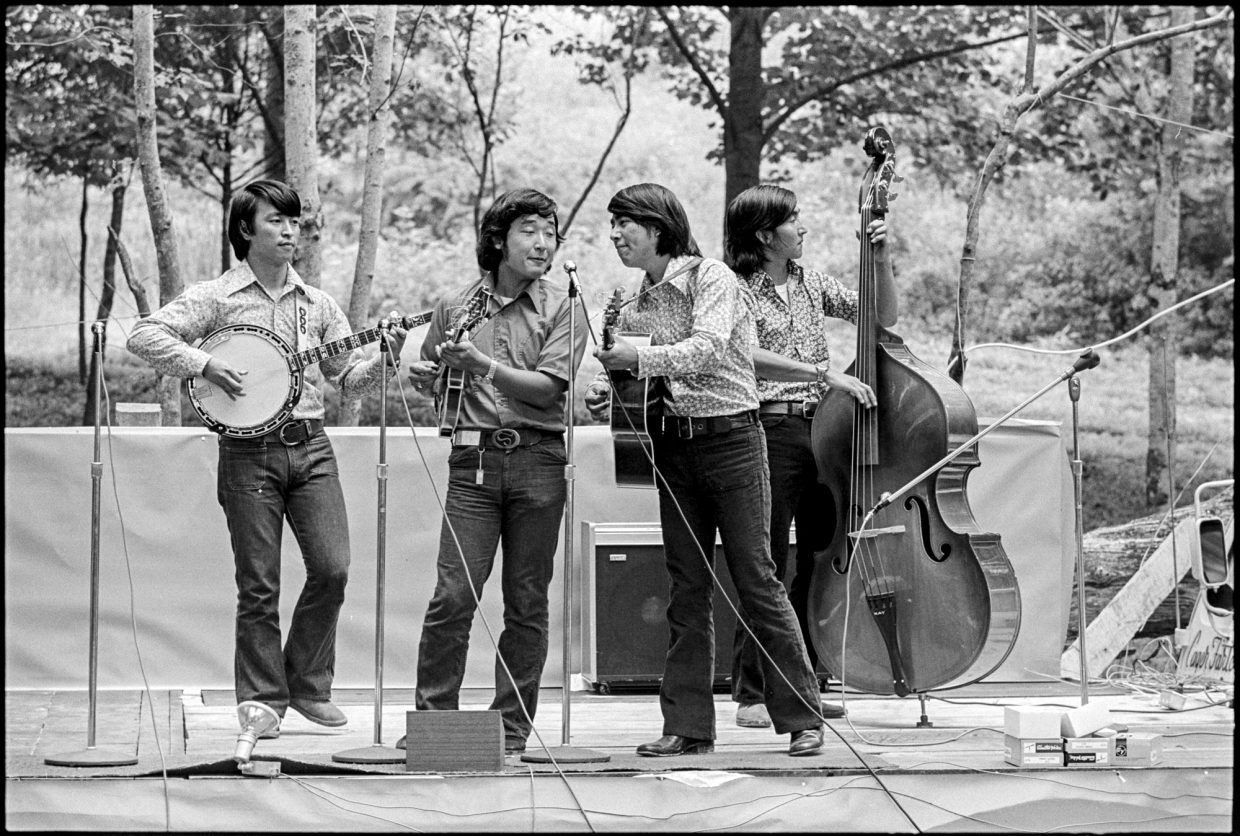
Visiting from Japan, the band It’s a Crying Time performs at the Second Annual Kentucky Bluegrass Festival, Jackson KY, Saturday, August 12, 1972. Band members include Eiichi “Ei’ Shimizu, banjo; Kazuyoshi “Kazu” Onishi, mandolin; Satoshi “Sato” Yamaguchi, guitar; Akira “May” Katsumi, bass.

Monroe had booked the Japanese bands as a novelty, something you couldn’t see just anywhere in the bluegrass world. As I mentioned in my field notes, I found It’s A Crying Time’s music “hot & exciting,” and I was not the only one in the audience reacting this way. They came to the attention of Lester Flatt, who, after watching them rehearse, invited mandolinist Kazu Onishi to join him on stage at his final set. 

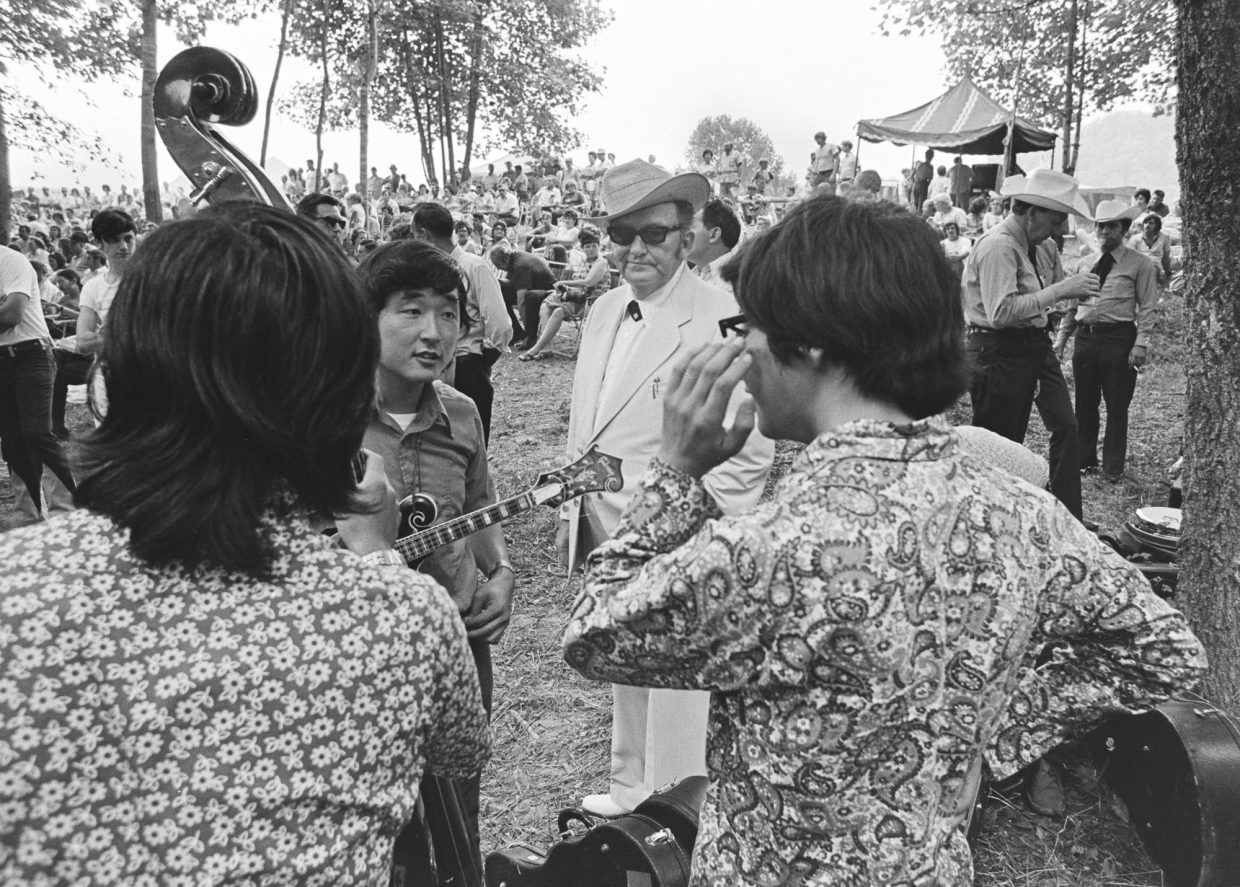
Backstage moment at the Second Annual Kentucky Bluegrass Festival, Jackson KY, Saturday, August 12, 1972. Akira Katsumi, Kazu Onishi,
Lester Flatt, and Akira Otsuka. Otsuka was Kazu’s friend from the Japanese scene, a member of the Bluegrass 45.

This video comes from the Bluegrass 45’s appearance at Carlton Haney’s Camp Springs festival:

They are announced at the beginning of the video by emcee, writer, and DJ Bill Vernon. Vernon was here at Jackson, as I learned Sunday morning when I went down to the early morning gospel show. Pete Kuykendall introduced me to Bill there, and we had a long chat about the politics of the bluegrass industry. I wrote in my notes:

A very loquacious and complex person.

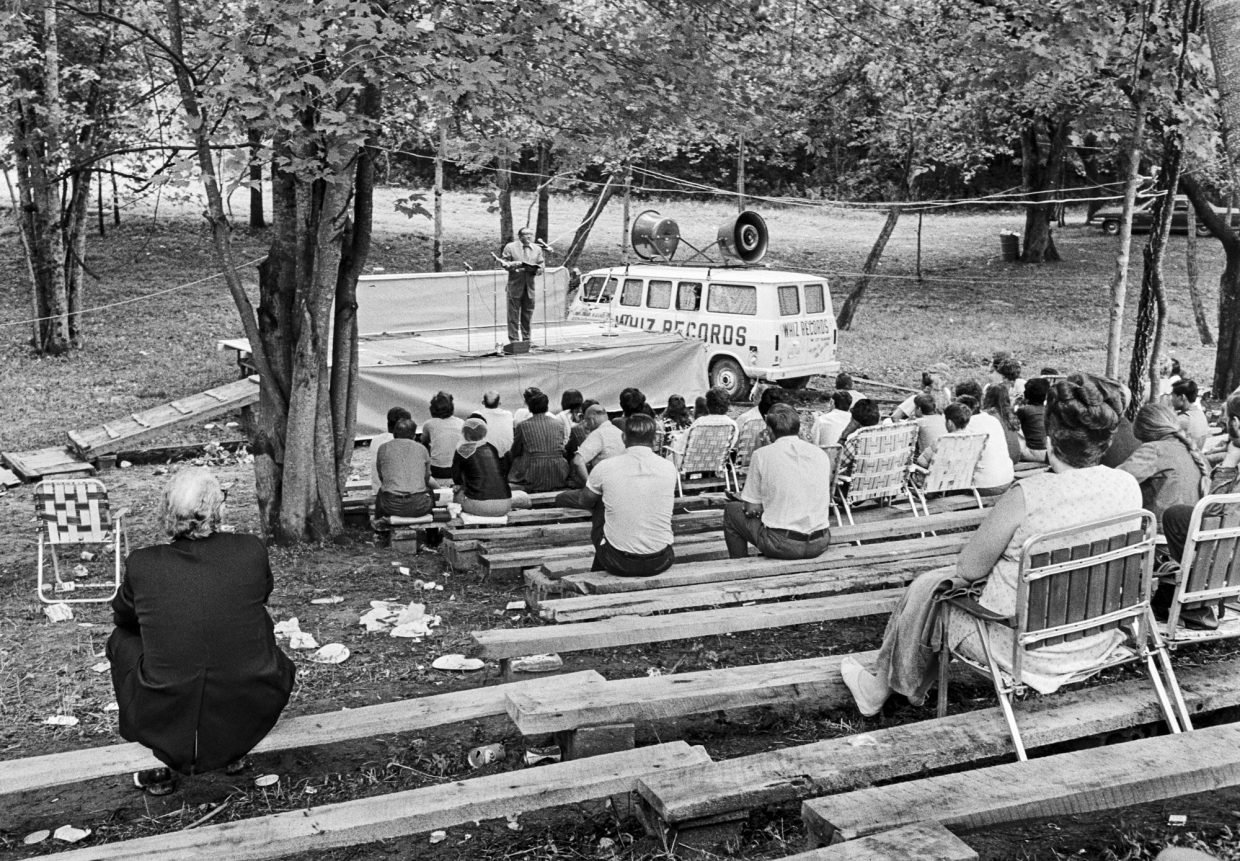
At that morning’s gospel show, the music came to a stop as a fundamentalist preacher began his sermon. At that point, I noted:

Bill Vernon cut out from the morning sermon, he’d had enough…

During the preacher’s sermon at the gospel program at the Second Annual Kentucky Bluegrass Festival, Jackson KY, Sunday, August 13, 1972. Bill Monroe (wearing a black suit) is seated in the audience area at left.

I stayed and heard some good music, noting:

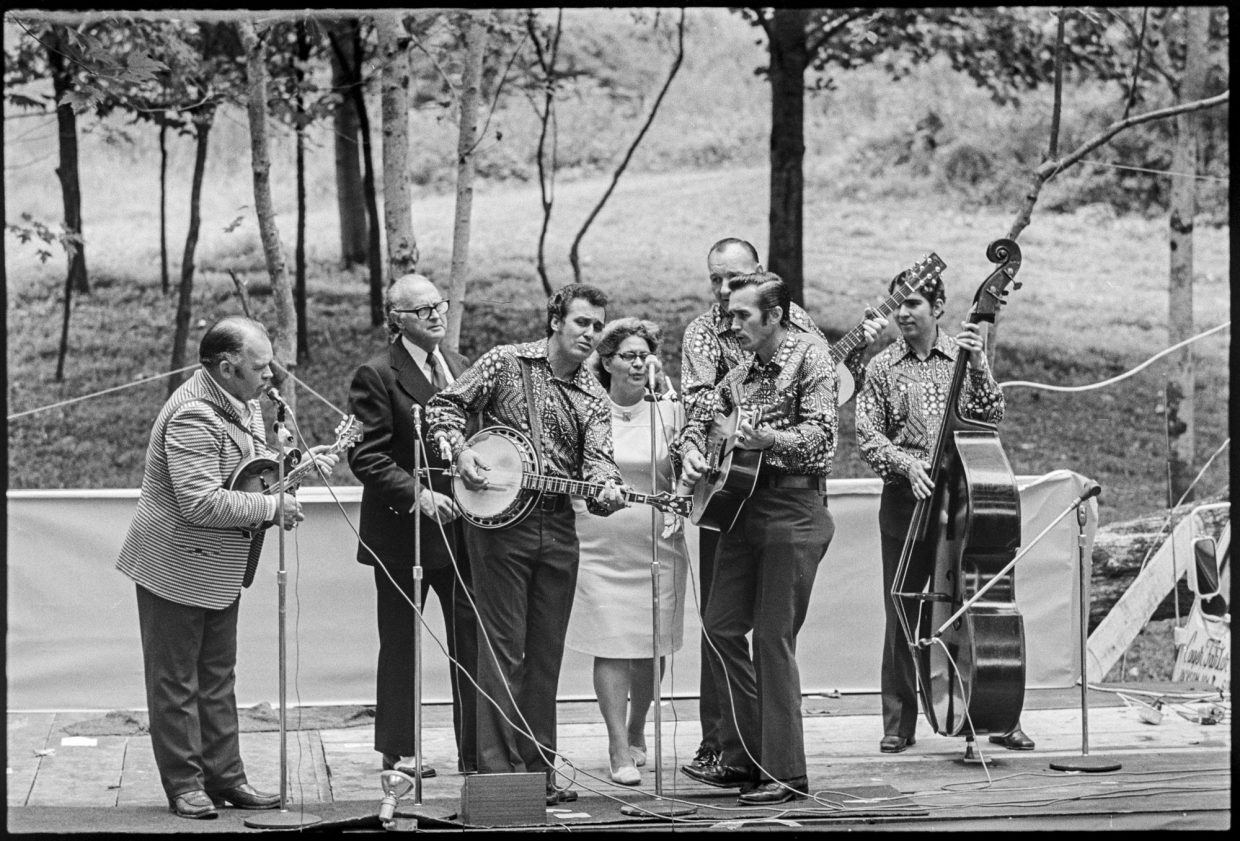
The gospel section’s high point was when the Goins Bros. did “Somebody Touched Me” and Eleanor Parker came on stage & started clapping hands and singing; Monroe caught on and came up to join in too.

During the gospel program at the Second Annual Kentucky Bluegrass Festival, Jackson KY, Sunday, August 13, 1972. When the Goins Brothers band performed “Somebody Touched Me,” they were joined on stage by Eleanor and Rex Parker and Bill Monroe. Eleanor and Bill joined the Goins trio at the main microphone while Rex sang and played mandolin at the “stage right” microphone.

This kind of spontaneity, which gave festivals their appeal, was not there all the time. Jim & Jesse, I wrote, had:

A good show, with Jim Brock sounding especially good, but … a cut and dried quality to it all.

Describing Lester Flatt and his Nashville Grass, I concluded:

To me the whole band sounded tired, lackluster.

But Flatt’s final set was enlivened when It’s A Crying Time mandolinist and tenor Kazu Onishi came on stage to sing “Salty Dog Blues” with him. 

During my times around the stage area, I had a chance to talk with Monroe and with some of the musicians I’d gotten to know during my years as a backstage regular at Bean Blossom, like Birch Monroe, Joe Stuart, and Roland White.

I arranged with Birch, who was busy helping Bill run the festival, for an interview, to take place later in the week at his home in Martinsville, Indiana.

Joe Stuart offstage at the Second Annual Kentucky Bluegrass Festival, Jackson KY, Saturday, August 12, 1972.

Joe told me about his experiences playing bluegrass in Canada with Charlie Bailey. He’d even appeared in Newfoundland.

Roland, whom I’d known since his days as a Blue Grass Boy, was now playing with Lester Flatt. He told me they were working solid, playing festivals every weekend.

Here’s what I wrote about the audience:

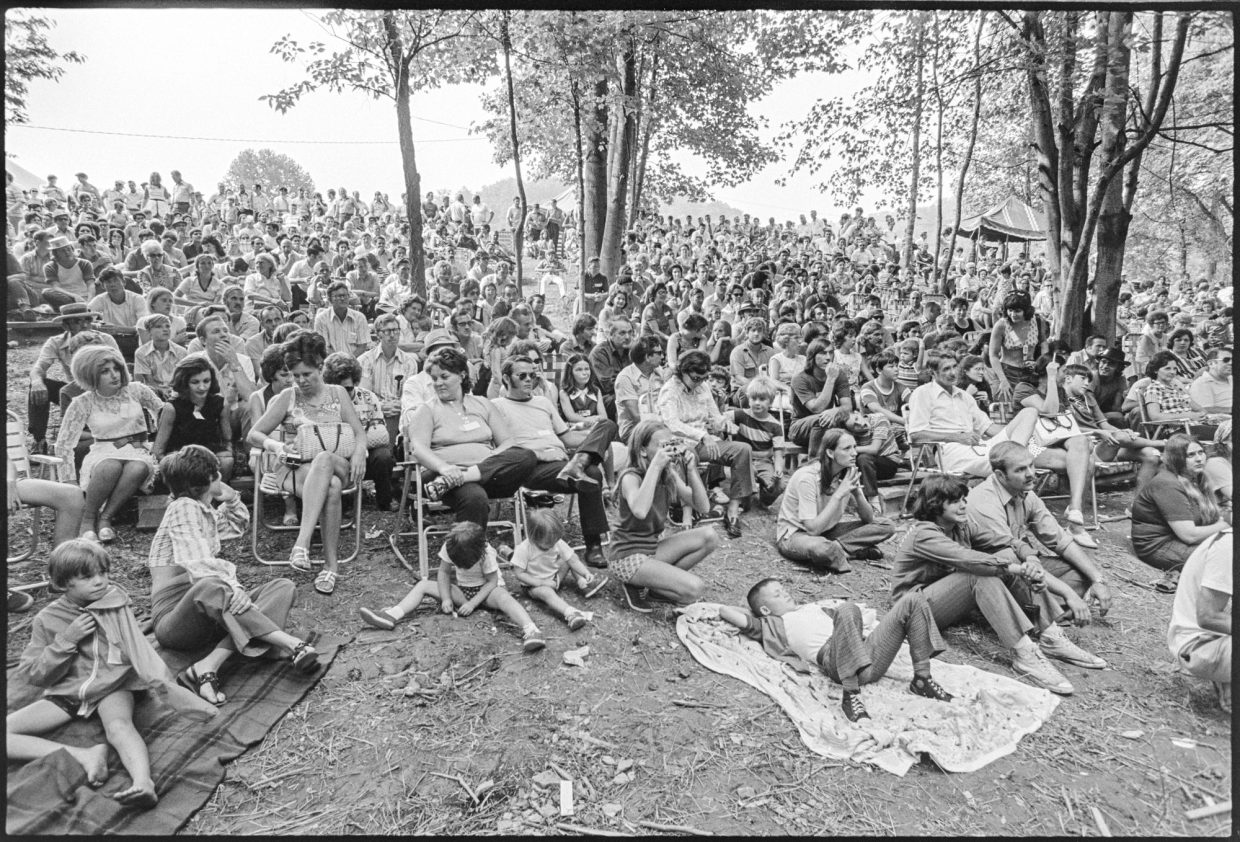
Audience — bluegrass die-hards from Ohio, Ky., D.C., Carolinas. Few freaks. Appear to be about 50% campers, 50% local people. Certainly no more than 1500-2000, on Saturday, though figure of 3000 was bandied about. Bill moved his Ky festival to Jackson from Ashland this year because the turnout at Ashland was dropping. Fact, bluegrass ain’t as popular in Kentucky as it is elsewhere — Ohio, D.C.

Audience on the hillside natural amphitheater at the Second Annual Kentucky Bluegrass Festival, Jackson KY, Saturday, August 12, 1972.

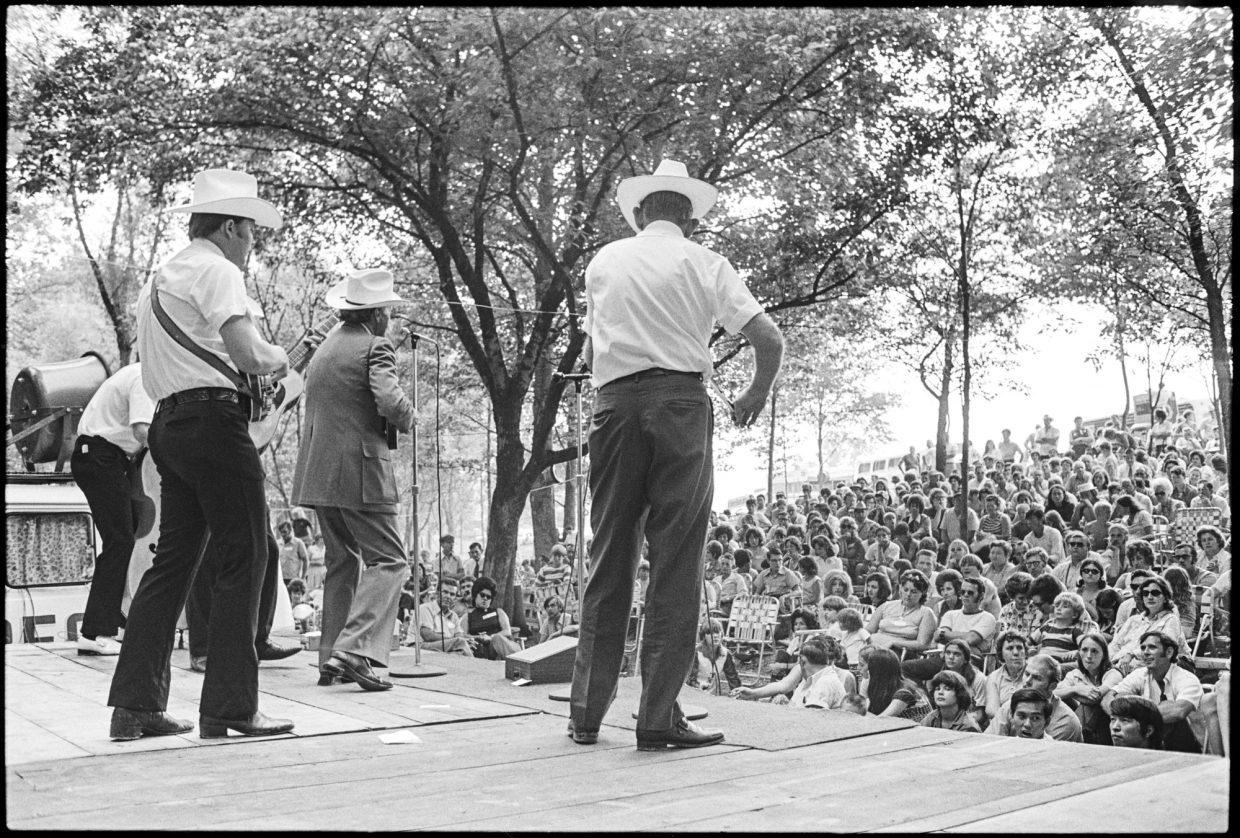
The festival closed with a finale, orchestrated by Monroe. At the first festivals in the mid-60s, which were created to honor Monroe, such events were somewhat spontaneous, but by now, seven years after the first one, these events were highly ritualistic. By the time it happened, I noticed that the Kuykendalls had left. They were not the only ones.

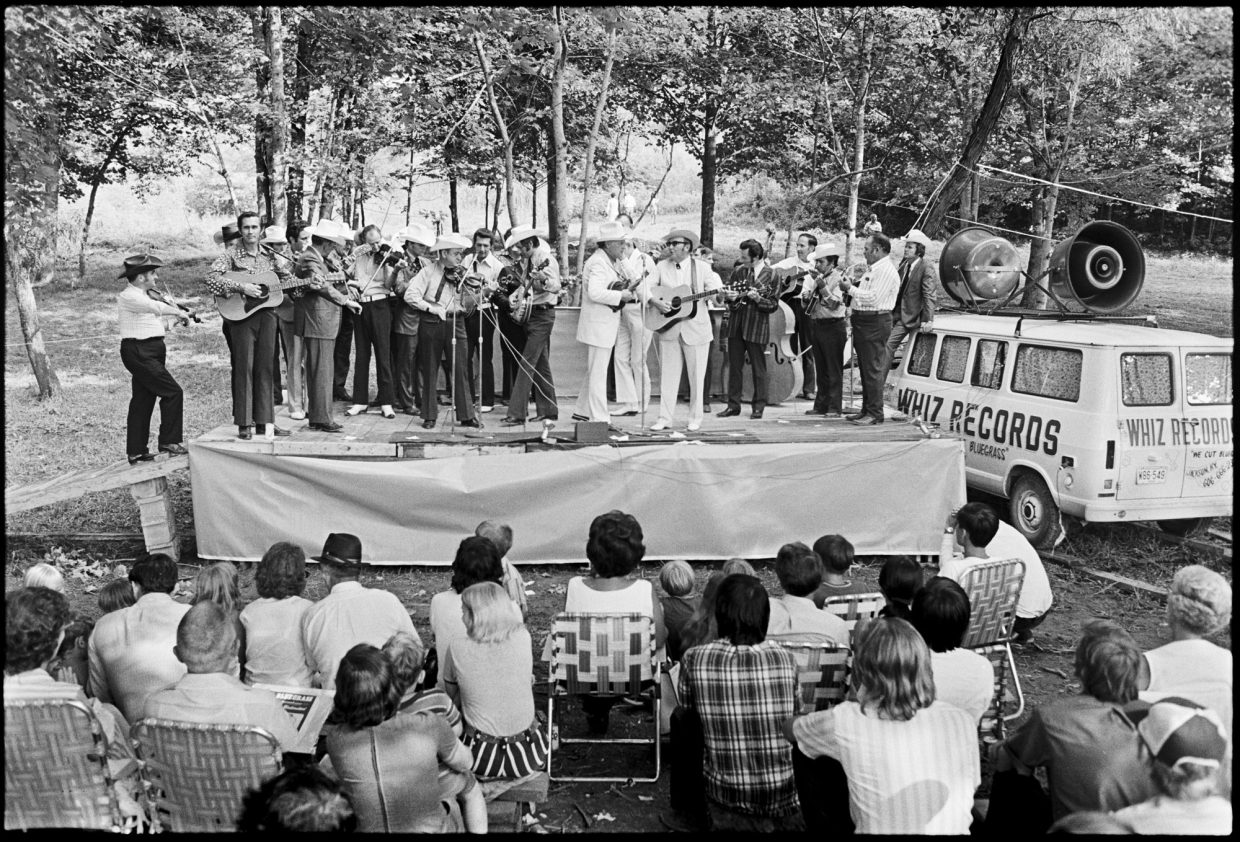
The finale performance at the Second Annual Kentucky Bluegrass Festival, Jackson KY, Sunday, August 13, 1972. At the center, in white suits, are Bill Monroe and Lester Flatt. Here are a few of the other performers, left to right: Curly Ray Cline (on the ramp), Melvin Goins (guitar, facing camera), Kenny Baker (fiddle, white hat, wearing a suit), Joe Stuart (just behind Baker, partly hidden), Buck Ryan (fiddle, white belt), Jack Hicks (banjo, white hat, wearing suit), Paul Warren (fiddle, white hat, at microphone), Vic Jordan (banjo, facing forward), Ralph Stanley (banjo, dark suit, hidden behind McCormick), Haskell McCormick (banjo, in profile), Monroe and Flatt with Don Reno (wearing white) partly hidden behind them, Raymond W. McLain and sister Alice McLain (hidden behind Flatt), Jesse McReynolds (mandolin, wearing striped jacket), Ruth McLain (bass, behind McReynolds), Raymond K. McLain (guitar, no hat), Roland White (mandolin, white hat), Rex Parker (mandolin, striped shirt), and Monroe Fields (leaning on van).

We packed up soon after and headed west for Lexington. I was hoping to interview J.D. Crowe.

[To be continued]


Thanks to Akira Otsuka and Carl Fleischhauer

Rosenberg is an author, scholar, historian, banjo player, Bluegrass Music Hall of Fame inductee, and co-chair of the IBMA Foundation’s Arnold Shultz Fund.

Photo of Neil V. Rosenberg by Terri Thomson Rosenberg.

Edited by Justin Hiltner
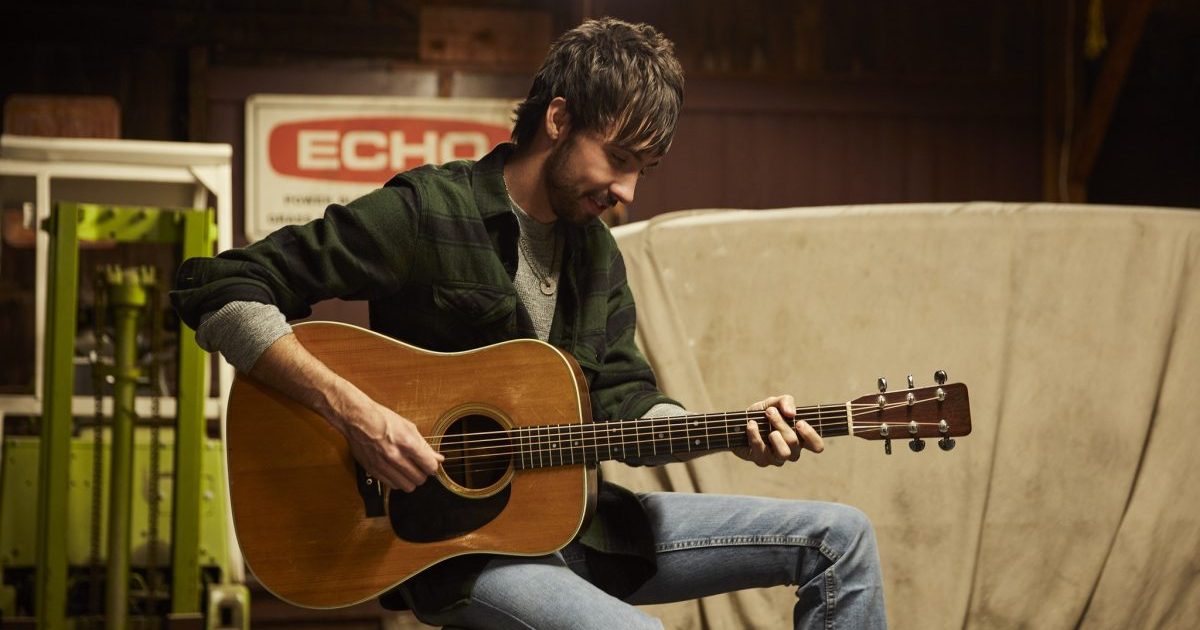
BGS 5+5: Andy Leftwich

Artist: Andy Leftwich
Hometown: White House, Tennessee
Latest Album: The American Fiddler
Personal nicknames: “Ang,” which is an Andy Griffith Show reference. Ricky Skaggs started calling me that and it just stuck!

Which artist has influenced you the most … and how?

I jokingly say I went to “Ricky Skaggs University,” but there’s a lot of truth to that. I joined his band at 19 and it changed the course of my life. Working with him in the studio and playing on stage with him every night was like a master class. He puts his heart into every note and truly loves what he does. That inspires me greatly.

What’s your favorite memory from being on stage?

Hands down, it has to be The Kentucky Theatre in Lexington, Kentucky in February 2001. I had hopped on bus with Kentucky Thunder for the weekend as a sort of audition to be the new fiddle player alongside the legendary Bobby Hicks. At the end of the show, just before the encore, Ricky asked me, “What are you doing the next few years?” and offered me the job right there on the stage in front of the band and about 1,000 people. It was an unforgettable moment!

What rituals do you have, either in the studio or before a show?

The opportunity to play music — in the studio or on the stage — is a gift I don’t take for granted. I never start a show or a session without stopping to pray that God would give me creativity and allow me to be an encouragement to the audience.

If you had to write a mission statement for your career, what would it be?

I am nothing without my faith. Ultimately, I want others to see that in me, whether it’s through music or conversation.

What has been the best advice you’ve received in your career so far?

As musicians, we are so influenced by what we take in from other players that it’s natural to try and emulate or imitate what they do rather than concentrating on our own strengths. I found myself stuck in that mindset when a friend said, “Focus on perfecting what you do well instead of trying to be someone else.” That piece of advice gave me freedom to be the musician God made me to be and not worry so much about pleasing others.

Photo Credit: Erick Anderson

The BGS Radio Hour – Bluegrass Duets, New & Old

Every week for the past few years, we’ve brought you a radio show, and now podcast, revisiting all the great music recently featured on the pages of BGS. This week, we bring you a special episode for our Duos of Summer series — a musical recap of our 2019 collection of the 22 Best Bluegrass Duos.

APPLE PODCASTS, SPOTIFY

We’re listening to some of these classic duos, and exploring bluegrass’ longstanding and continuing tradition of wonderful duet harmony, be it sibling or otherwise. And while most fans of the genre may recognize names like Flatt & Scruggs or the Monroe Brothers, here you’ll also find newer acts that are following the path laid by those hall-of-famers.

Head to the original story to explore the full list while you listen!

The String – String Band Special (Wes Corbett, Jeff Picker, and Andrew Marlin)

Bluegrass has an instrumental tradition going back to its Bill Monroe origins and its old-time forebears. Over time, the playing and composing became more refined and exploratory.


LISTEN: APPLE PODCASTS

This show features three young masters of contemporary acoustic music who’ve released all-instrumental albums in recent months. I speak with Wes Corbett, banjo player currently with the Sam Bush Band, Jeff Picker, bass player for Ricky Skaggs and Kentucky Thunder, and Andrew Marlin, half of the married duo Mandolin Orange. They talk about their new recordings and about the path that led them to write and record without words.


The String Cheese Incident Salute Tony Rice on This ‘Manzanita’ Favorite

The amount of love and respect that has poured out of the music community around the country and the globe for the loss of Tony Rice has been breathtaking to say the least. The breadth of Rice’s legacy cannot be understated as he pioneered not only the guitar’s role in a bluegrass band, but also created a new sound previously unexplored by acoustic musicians. A seminal flatpicker, his touch, timing, and taste are unmatched to this day, and there’s the separate matter of his beautifully rich voice. Here at BGS, we’ve shared Tony Rice memories and stories from the likes of Ricky Skaggs, Todd Phillips & Robbie Fulks, Sam Bush, Jerry Douglas, and David Grisman, and many others.

The latest contributors to our collective debt of gratitude to Tony is the String Cheese Incident, collaborating virtually to cover “Old Train,” the lead track on what many consider his magnum opus, Manzanita. The String Cheese Incident is known for being a genre-bending group, but founding member Bill Nershi had this to say about their bluegrass roots and Rice’s artistry: “Tony Rice’s guitar playing shaped a generation of musicians. His impeccable tone, taste, and timing were unmatched and highly regarded by players and listeners alike. We are very fortunate to have so many great recordings of his life’s work. If you haven’t had the pleasure of hearing him perform, check out The Tony Rice Unit and David Grisman Quintet albums. I recommend you start with Manzanita. We’ll never forget you, Tony!”

Watch the String Cheese Incident perform “Old Train:”


Photo credit: Scott McCormick

What Was Tony Rice Really Like? Todd Phillips Reminisces With Robbie Fulks

No BGS reader needs a rundown of Tony Rice’s biography or accomplishments. Earlier this month I chatted with Todd Phillips, Tony’s close friend and bassist across multiple groups (David Grisman Quintet, Bluegrass Album Band, Tony Rice Unit) from 1975 to 1985. During these years Tony used inspiration from mid-century jazz and musical peers, along with his innate willpower, as levers to crack open a stunning new guitar vocabulary. In doing so he rose from a bluegrass badass to a global force, operating well above tribes and vogues.

When Todd emerged in the 1970s, bass guitar was a cross-genre norm. A young upright player who melded Scott LaFaro’s gracefulness with J.D. Crowe’s timefeel was a fairly wonderful anomaly in bluegrass. I started working with Todd in 2014, and grew close with him fast. He brought something rare — a relaxed whiphand — to the feel onstage. In the van, he indulged my ceaseless fanboy questions about the old days. An equable ex-stoner with a mildly grumpy edge, he’s as adept at building an instrument or a chicken coop as analyzing acoustic riddles, and his long experience working with people as unalike as Joan Baez, David Grier, and Elvis Costello gives him a high perch from which to reflect. He reminisced fluidly about Tony over the phone with me for two hours, stopping only twice, once overwhelmed by emotion and once to get a bottle of tequila. (Read more from our conversation at my blog.)

Members of David Grisman Quintet, 1977. L-R: Tony Rice, Todd Phillips, David Grisman, Darol Anger. (Photo by Jon Sievert.)

Robbie Fulks: I listened back today to California Autumn and other records I hadn’t heard for ages, and heard little passages that sounded uncharacteristic of Tony. Did gestures come into his vocabulary, stay there for a while, and then fade off as he went to concentrate on another idea?

Todd Phillips: That’s true, yeah. He would go through cycles, get on a kick. He’d get on riffs, like hearing Billy Crystal: “You look marvelous.” He’d say that 40 times a day, and a year later, drop it for some other riff. The vocabulary would change, according to the era.

That’s fascinating, to compare it to a non-musical example. So let’s dive in, go back to the start. Tell me about meeting Tony — when, where, and how you guys got underway with the Grisman project.

I was a beginning mandolin player, and I was certainly in over my head, playing mandolin with David, but he’d never heard me play bass, which I’d played since I was a little kid. This was 1974, and Clarence White had died the year before. And we just thought, this is a good band, we don’t need a guitar — no one else could fill Clarence’s shoes, and he’d be the only guy that would work in this thing. Then David came home from a Bill Keith recording session and said, “I just met the guy that could do it.”

(Photo by Todd Phillips)

Shortly after that, J.D. Crowe and the New South were on their way to Japan, and they stopped in San Francisco to play one gig. They hung with us for a couple days and… I had never hung with, um, that many guys from Kentucky all at once. [Laughs]

I’ve told you about that Mexican restaurant in Berkeley. The Californians — me, Darol, and David — and the Kentucky guys — J.D., Tony, Ricky, Jerry, and Bobby — were seated at one giant round table. First, Crowe ordered: “Six tacos and a Coke!” Then each New South guy ordered exactly the same. I guess they were used to the little three-inch tacos you can eat in two bites. So this big table ended up covered with plates full of giant tacos, surrounded by a pretty interesting mix of characters. I wish we had a photo. Polyester and tie-dye T-shirts all around.

After they came back from Japan, Tony gave J.D. his notice. He hooked up a little U-Haul trailer — clothes, suitcase, guitar, and stereo system — and got an apartment in Marin County. And we started rehearsing. At that point, we had what we had, but then Tony’s chemistry came into it. And it just catalyzed the whole thing. It was huge. Tony had to learn his harmony and a bunch of chords he hadn’t really played before — but we had to learn to play rhythm like J.D. Crowe. So we probably rehearsed for another six months before we went out and played our first shows.

Recording the first David Grisman Quintet album. (Photo by Todd Phillips)

Tell me about the first gig.

Our first show was in Bolinas [in Marin County], in the community center. We made our own posters and put them up all over Bolinas, so it was sold out. And no sound system. We wanted people to hear us just like we rehearsed. There were probably 200 people there.

So small room, gather round, and somehow the guitar projected through.

We played with dynamics — if Tony was soloing, we shut ourselves up. We got down light and tight under him. Since we hadn’t played through a sound system, we just did what we did every day anyway.

The first on-the-road thing, not long after, was in Japan. Our show was a bluegrass quintet with Bill Keith and Richard Greene, followed by a set of DGQ. Then, as soon as we got back from Japan, we recorded the first quintet record. So it still had that energy. We were still excited to hear it, too, every time — it would raise the hair on our arms! It was kind of a… strong existence. Life felt — pumped up, you know?

First photo of David Grisman Quintet, 1975. (Photo by Todd Phillips)

Close companions in an intense situation. A lot of people have been in a band or in the army. But on top of that, you guys were altering the course of music.

Yeah. Maybe it is a little like an army buddy. I was a cross between his bass player and his little brother. Also his babysitter, sometimes! He had left his old friends, and when he came to California, I seemed to be the guy he gravitated to. On off days, all of a sudden there’s a knock on the door at 10 a.m., and it’s Tony — “Hey man, let’s go the boardwalk, ride the roller coaster. Let’s go to the record store.” We went to the record store a million times. Came home with bags of records and stayed up all night listening — I mean, he taught me to listen close, whether playing music or just listening to records.

Any memories of the 1975 Grisman Rounder album sessions?

Tony was hilarious! We’d go out to eat, and he’d come back with a couple of cloth napkins. He’d fold one up and put it on his head, and put on sunglasses. Looking like a weird Quaker. And then drape another napkin over his left hand and go, “I don’t want anybody to steal any of my licks.” [Laughs] He’d leave that thing on his head, with the sunglasses, for like, three hours.

(Photo by Todd Phillips)

Have you heard guitarists who managed not to sound like Tony, in the years since?

Well, because Tony opened the door, after Clarence, you can’t help but sound like him as a bluegrass soloist. He found those avenues on a fingerboard that you can play with a strong attack and accurate, strong expression. A lot of it is mechanics. A D-28 with semi-high action, there are certain phrases that fall naturally under your fingers, and Tony found those. So I think a lot of guitarists use those avenues because — they’re there. You might hear different phrases but they’re not as strong. They might be more interesting, or more academically pleasing, but the effect — I haven’t heard it as strong as in those passages that Tony found.

Tell me about Manzanita.

There was no preparation that I remember. The guys came to Berkeley and we went to work. We ran a tune for 20 minutes, then recorded it maybe three to six times.

Béla Fleck said Tony didn’t like to rehearse much.

Yeah. Sink or swim.

David Grisman, Todd Phillips, Tony Rice (Photo by Todd Phillips)

Any road memories involving Tony?

He didn’t go out a lot. We went to Japan once, the three Rice brothers — Larry, Wyatt, Tony — and me. And Tony — maybe that’s when he started — he just never left his hotel room.

What was he doing in there?

Ordering room service. Later, traveling with the Unit, he’d stick to the room. I mean…he pretty much lived in front of his stereo, smoking cigarettes and drinking coffee. That’s what he thrived on.

How did you listen to music away from the home stereo back then?

In the early days, he drove a noisy Dodge Challenger. A muscle car, with a cassette player in the dashboard. We’d listen loud. And driving from Grisman’s house back to mine every night, it was pretty much all John Coltrane, the classic quartet.

Interesting!

Yeah, and later, a lot of Oscar Peterson. He’s like Tony: you recognize the phrases, and they’re strong as hell. Meticulous mechanics. Tony never studied music academically — but the sound of it. He took that in and it’d come out later somehow, the power and the attitude, more than specific notes or theory.

(Photo by Todd Phillips)

Did he have any relationship to the written page?

No. Not at all.

Tony cited Miles Davis and Eric Dolphy as favorites, but I don’t hear a strong kinship.

I think those were unique voices. Like Django, or Vassar.

Individualists.

I think that’s it. The attitude. He liked those kind of characters, like David Janssen — he really had an obsession with David Janssen. Or Lee Marvin.

Ha!

I’m not kidding! The Marlboro Man.

People that laid it down.

Exactly.

David Grisman Band in silhouette, 1976. (Photo by Todd Phillips)

I’m curious about the chemistry between Tony and other strong personalities. You’ve told me your take on the Skaggs-Rice dichotomy, the good and bad guys from everyone’s high school…

Yeah, Ricky would be class president and Tony would be Eddie Haskell. [Laughs] There’s a little of that, but musical respect bridges all gaps.

With David, did Tony slip easily into a sideman role?

The chemistry was — not volatile, but exciting. The New Jersey hippie and Mister Perfection. You know, when Tony was new to California, David’s living room was a real event. You never knew who you’d run into — Jethro Burns, Taj Mahal, Jerry Garcia. I think that excited Tony. He’d dig in his heels, just be who he is, and people respected that. He was…I guess I want to use the word “stubborn.” Clear-headed, with his vision.

Were cigarettes it for Tony, or were there harder things he liked to do?

No! He actually went light on the marijuana, compared to everyone else in Marin. He kinda puffed a little bit, just to participate.

Any whiskey?

No, he drank a few beers at home. I don’t remember any hard liquor at all.

New Year’s at Great American Music Hall, 1978-1979. (Photo by Jon Sievert.)

I read in The Guardian obit: “apprentice pipe fitter”…?!

Yeah! His dad was a welder, pipe fitter, and Tony and his brothers did that too.

What did he do to keep his fingers strong besides play?

Nothing. He bit his nails. He had no fingernails, and his fingertips looked like blocks of wood. Like the rounded end of a wooden dowel. The guy played a lot. He had hands that physically, mechanically, work in a different way. He could push down with his thumb, on his right hand, but also push up, with his first finger. You can look at YouTube and see it — a really strong muscular mechanism between thumb and index.

His down and upstrokes weren’t ascribed to the usual beats, weren’t automatized in the normal way — and were equally forceful.

Yeah. And rhythmically, a lot of triplet syncopation on the upstrokes. People just say “syncopation,” but technically it’s playing 3/4 against 4/4, like Elvin Jones’s drumming. You can’t tell if it’s in 3 or 6 or 4 or 2. It’s all of it. It’s all of it! And those subdivisions, I learned that from Tony — you slice that up in all kinds of ways, so those polyrhythms are all churning in your hands or head at the same time. That’s what generates good time, not tapping your foot. Tony had all those superimposed polyrhythms in him.

(Photo by Todd Phillips)

Bluegrassers work hard and live long, on the whole. And with so many players of your generation now in their 70s and performing as energetically as ever, Tony’s story looks more profoundly sad to me.

You know, I don’t know why Tony went the way he went. Why he couldn’t be as youthful as Sam Bush. Who knows, if there was some kind of a depression, or if that desire for perfection wore him out. You know? Because he did play with joy, but it was also that crazy obsession, to be perfect and accurate — maybe he was just too hard on himself.

He was hard on everybody around him. I know that I developed way more than I ever would have developed if I’d never known him. It was not that he was ever mean or harsh to me, but being around him, you put pressure on yourself to live up. I think everybody that played with him was like that. He jacked up the music to this level — and then it was your challenge to get up there with him. Being around him changed me forever.


Lede image by Heather Hafleigh. All photos provided by Todd Phillips and used by permission.

WATCH: Scott Mulvahill Shows His ‘Creative Potential’ in the Studio

Some instruments tend to have a pretty specific role in the world of roots music. It takes a great deal of ingenuity and skill to challenge these roles, create something truly unique, and expand the capabilities of an instrument. That is exactly what singer-songwriter Scott Mulvahill has done with his growing catalog of solo material. Not only is he a talented both singing and songwriting, but he is also a world-renowned bass player, previously fulfilling low-end duties for Ricky Skaggs’ legendary bluegrass band Kentucky Thunder.

Mulvahill’s creativity and uniqueness shine in his 2020 release, Creative Potential, a project filled with songs that put a smile on your face. Love, happiness, and joy are each subjects of several of the tracks, making this EP a bright spot in a dull year. Smooth singing and skillful playing abound, but an extra treat in this release is the wonderfully thought-out arrangement and presentation of the music. If you haven’t had the pleasure of listening to Scott Mulvahill yet, we highly recommend you get on the train and hear just what is so special about Creative Potential.


Photo credit: Lindsey Patkos