Despite a Sad And Beautiful World, Mavis Staples Still Transcends

Such words as “legendary,” “transcendent,” and “magnificent,” while accurate, only skim the surface in describing the greatness of vocalist Mavis Staples. There’s no idiomatic area where she doesn’t excel and no song, regardless of origin or writer, that she can’t turn into a personal triumph. She’s also a genuine survivor, both in the familial (she’s the last living member of the Staple Singers) and socio-political sense (she’s a cultural warrior and champion of the Civil Rights era whose resonant voice has inspired generations of listeners).

For many artists, claiming they’ve gotten better with age is at best polite overstatement, and at worst woeful exaggeration. But Staples at 86 still has the authoritative edge, tonal quality, and lyrical flair that’s always marked her performances. It seems hard to believe she’s been singing since childhood, and listening to the 10 tracks on her newest release, Sad And Beautiful World (released November 7 by Anti), you hear the confident, jubilant sound of a vocal titan.

That Staples can cover with equal distinction and flair songs penned by Tom Waits, Curtis Mayfield, Gillian Welch & David Rawlings, Leonard Cohen, and Frank Ocean reaffirms her versatility. Producer Brad Cook smartly lets her voice dominate through each setting, regardless of instrumental backdrops, tempo or lyrical setting. Her spoken word narrative adds additional punch to the cover of Ocean’s “Godspeed” and underscores its recurring themes of urgency and redemption that fuel the album’s sensibility.

But the album also contains prominent message tracks, most notably “We Got To Have Peace,” a number whose tone and lyrics couldn’t be more timely in an era where it seems lunacy often runs supreme. “Anthem” and “Satisfied Mind” are just as powerful and energetic in their declarations of the importance of persistence, kindness, and goodwill. “Everybody Needs Love” provides the perfect finale, with Staples superbly punctuating its theme and completing a 38-minute epic work. Indeed, songwriter Kevin Morby has offered perhaps the best tribute to Staples’ brilliance possible, when he gave a press statement about what it meant to have her doing his song “Beautiful Strangers,” which is another memorable and passionate number.

“It isn’t easy to put into words what it feels like having one of the best, most important vocalists and cultural figures of both the 20th and 21st century sing one of my songs,” Morby said. “But hearing Mavis sing ‘Beautiful Strangers’ is hands down the greatest moment and highest honor of my career. Far beyond any kind of accolade or acclaim – having one of my biggest heroes sing something I wrote is the most validating and flattering thing that could ever happen to me as a songwriter and person. Thank you, Mavis.”

Staples has been awesome for so long, sometimes it’s easy to forget how many different periods and genres her artistry covers. The original family unit the Staple Singers were gospel and folk song giants. The unit included her sisters Cleotha and Yvonne, plus her brother Pervis, her father Pops, whose roots reached back to the seminal days of Delta blues, and Charlie Patton, who served as anchor, both vocally and on guitar. The Staple Singers began singing in Chicago churches in the late ’40s, became recording artists in the early ’50s, and earned their first hit with “Uncloudy Day” in 1952, recorded for the Black-owned label Vee-Jay. By the ’60s they were a cornerstone unit of the Civil Rights Movement, often accompanying Dr. Martin Luther King at rallies.

Mavis began really getting noticed as a solo performer during their transition in the late ’60s and early ’70s to a soul and pop unit. The decision to sign with Stax Records and the shift to secular music was one Pops often acknowledged as a controversial one, but it ultimately paid off as the group’s status elevated into crossover stars. They had eight Top hits in the early and mid-’70s; “I’ll Take You There” and “Let’s Do It Again” were chart toppers and “Who Took The Merry Out of Christmas” reached number two. Mavis also cut her first solo single in the late ’60s, then a full self-titled release for Stax in 1969. Their songs were expertly produced, featuring the crisp and outstanding backing of Booker T. & the MGs. Other essential hits included “I’ll Take You There” and “Respect Yourself.”

Slowly but surely, Mavis began to establish herself outside the Staples family trademark. Her soundtrack LP, A Piece of the Action on Curtis Mayfield’s label, helped her reach some new audiences, as did another self-titled mid-‘80s LP. But it was a pair of releases produced by Prince in the ’90s that really helped her reach the next generation of listeners. The second by the duo, The Voice, was another masterpiece. It included her magical version of Prince’s “Positivity,” as well as a cover of “Melody Cool” from the film Graffiti Bridge. Staples returned to the church in 1996 for a marvelous release, Spirituals & Gospels: Dedicated to Mahalia Jackson, that personified the close friendship that Jackson had with the entire Staples family and her influence on Mavis, personally and professionally.

Over the course of the 21st century, Mavis Staples has unquestionably become an iconic figure. The roster of artists with whom she’s worked over the course of her remarkable career is an astonishing one, both in terms of talent and musical approach. She’s recorded with jazz guitarist John Scofield, Los Lobos, Bob Dylan, Johnny Paycheck, Natalie Merchant, George Jones, Delbert McClinton, Aretha Franklin, Nona Hendryx, and Ann Peebles, to cite only a handful. Staples has also continued making emphatic message albums, among them the 2017 dynamo If All I Was Was Black. Her voice has been sampled by rappers and hip-hop and pop artists like Salt ‘N’ Pepa, Ice Cube, Ludacris, and Hozier.

Mavis also been featured in a host of television shows and films, among them The Tonight Show with Jay Leno, The Late Show With David Letterman, Conan, and “CBS Saturday Morning: Saturday Sessions,” and she was the featured performer on the very first episode of The Late Show With Stephen Colbert. Her film resume includes appearances in Martin Scorsese’s The Last Waltz and Antoine Fuqua’s documentary Lightning in a Bottle, about the Salute to the Blues concert at Radio City Music Hall in February 2003.

Mavis!, the first feature documentary about Staples and the Staple Singers, was directed by Jessica Edwards and had its world premiere at SXSW in March 2015. It was later screened in theaters and was broadcast on HBO in February 2016, eventually winning a Peabody Award. Her appearance with Mahalia Jackson at the 1969 Harlem Cultural Festival is among the many highlights in the award-winning documentary Summer of Soul, which was released in 2021. Staples has even been portrayed on film, played by Laura Kariuki in the 2024 hit film, A Complete Unknown.

Staples has rightly won numerous awards. The array includes three GRAMMYs and a GRAMMY Lifetime Achievement Award, induction into the Rock and Roll, Gospel Music, and Blues Halls of Fame, and having been a Kennedy Center Honoree. The Rock and Roll Hall of Fame honored her a second time in 2019 with the inaugural Rock Hall Honors Award for her solo work. Rolling Stone named her 56th among the “100 Greatest Singers of all Time” in 2008, though there was already no question about her inclusion in that select company.

Amazingly, there doesn’t seem to be any slowing down for Mavis Staples. She celebrated her 80th birthday at the Apollo Theater in 2019, returning to the famed venue where she first appeared as a teenager 63 years before that date. She did a series of collaborative birthday concerts that year with special guests that included David Byrne and Norah Jones. She also collaborated with Run the Jewels on the track “Pulling the Pin” from their studio album RTJ4. In 2022, Staples released Carry Me Home, a collaborative effort with the late Levon Helm that they recorded together at Helm’s Midnight Ramble in 2011.

She’s already announced upcoming tour dates for 2026 at three famous sites: Chicago’s Chicago Theatre, Nashville’s Ryman Auditorium, and New York’s Beacon Theatre. Mavis Staples also remains a voice for social justice. Way back in 2010, she performed at the Rally to Restore Sanity and/or Fear alongside singer Jeff Tweedy. In 2011, she was joined onstage at the Outside Lands Music And Arts Festival by Arcade Fire singer Win Butler. The two performed a version of “The Weight” by The Band. Shortly after the release of her 2016 LP Livin’ On A High Note, produced by M. Ward with songs written for her by Nick Cave, Justin Vernon, Neko Case, and others, Staples issued these prophetic words:

I’ve been singing my freedom songs and I wanted to stretch out and sing some songs that were new. I told the writers I was looking for some joyful songs. I want to leave something to lift people up; I’m so busy making people cry, not from sadness, but I’m always telling a part of history that brought us down and I’m trying to bring us back up.

These songwriters gave me a challenge. They gave me that feeling of, “Hey, I can hang! I can still do this!” There’s a variety, and it makes me feel refreshed and brand new. Just like Benjamin Booker wrote on the opening track, “I got friends and I got love around me, I got people, the people who love me.” I’m living on a high note, I’m above the clouds. I’m just so grateful. I must be the happiest old girl in the world. Yes, indeed.

Anyone paying attention to the songs on Sad And Beautiful World knows that’s still the case with Mavis Staples’ music.


Photo Credit: Elizabeth De La Piedra

Confidence Is the Hallmark of Magnolia Boulevard’s Album Debut

While Kentucky is the birthplace of the father of bluegrass and as a hotbed for country artists, it also has much more to offer. Proof lies with Magnolia Boulevard, who’ve been turning heads with their mix of Appalachian soul and southern rock since their formation in 2017.

Led by powerhouse vocalist Maggie Noëlle – whose voice has drawn comparisons to everyone from Susan Tedeschi and Bonnie Raitt to Grace Potter and Amy Winehouse – the Lexington-based group has experienced highs like winning the band competition at Virginia’s FloydFest, hitting the road with Blues Traveler, and earning the personal endorsement of Paul Reed Smith and PRS Guitars – not to mention Noëlle becoming a mother. However, they’ve also experienced the lowest of lows, from having some of their biggest shows to date cancelled during the COVID pandemic to the unexpected death in 2021 of their drummer and founding member, Todd Copeland, that have done everything but derail them.

But instead of crumbling under the pressure, the band – now comprised of Ryan Allen (keys), Roddy Puckett (bass), Austin Lewis (lead guitar), Brandon Johnson (drums), and Noëlle – have fought through those trials and tribulations to deliver their long-awaited debut album. The self-titled effort looks at strength and perseverance in its many forms, from leaving relationships that are no longer serving you (“On My Own”) to learning to overcome and adapt regardless of the circumstances (“Strong-Willed Women”) and forgiving Noëlle’s father for never being around (“Nomad”).

According to Noëlle, the album marks a noticeable shift in her songwriting that reflects a much more personal tone and side of herself that she’s refrained from showing fully on stage, going all the way back to her days before the band when she sang in the bluegrass outfit Moonshine District.

“It’s taken a long time, but I’m finally realizing that songwriting for me is very much therapy,” she says. “Writing things down and getting it out and releasing it is just so gratifying and feels so empowering after being scared to do so for so long.”

During a candid conversation at an indoor market on Lexington’s north side, Noëlle spoke about everything from the long road to the band’s first album. We chat about how the sudden loss of Todd Copeland rocked the band’s world, the confluence of Appalachian and Southern music that informs the band’s sound, and more.

Why was now, eight years into the band, the right time to release your debut record?

Maggie Noëlle: I’ve wanted to put out a full-length record for years and years now. A lot of why we hadn’t yet was due to the age of streaming and constantly fighting the algorithm to get our name in front of people. Because of that, we’ve focused a lot on single releases as a way to gain more traction and win the algorithm over. But we also have a good, hard-working group of guys that are 100% for the music as a collective. Playing with them just comes so naturally, which has made everything from playing to writing together a lot easier. It’s about damn time! [Laughs]

Indeed it is! Regarding the song “It’s About Damn Time,” is it a reference to that long road to bringing the album to life, or something else entirely?

Ryan and I actually started “It’s About Damn Time” when we were driving to New Orleans to play an acoustic duo set at JazzFest. The idea was to portray the feeling of waiting around for things to change but ultimately realizing it’s you who has the control to change what you want in life. Even though it wasn’t originally meant for us as a band, it’s definitely shed some light on the progression of the group. It’s about damn time we finally have a full-length album!

You’ve had a lot of turnover in the band since 2017, from members coming and going to Todd Copeland’s death in 2021. What’s it been like continuing to make music as all of that has happened around you?

First and foremost, this band was Todd Copeland’s baby. He had an idea and knew he wanted to essentially give me a platform for my voice that I’d never had before with electric music. We kind of peaked during COVID after winning FloydFest’s On The Rise band competition in 2018 and going on tour with Blues Traveler in November 2019. But soon after, the world shut down, leading to the summer being letdown after letdown as we watched all the huge festivals we had lined up get canceled.

When 2021 rolled around, we were all excited to get back into the world until Todd’s unexpected passing, which shook all of us up in a way that we didn’t even understand. Obviously we were mourning our brother and friend, but it definitely shifted a lot of our energy. We’ve dealt with some more heavy punches since then, but we’ve also overcome a lot as well. Having someone in the group now like Roddy, who was close with Todd and played with him in the band Green Genes during the ‘90s, has made everything feel very full circle.

This album will also mark the band’s first vinyl release. What are you most excited about with that?

It’s something that fans have been asking us for for a while, so we’re thrilled to finally be giving it to them. We started taking some with us to sell at shows earlier this month and have already gone through a bunch of what we ordered. At the same time, though, it bugs me that so many songs from it are already released as singles. With records, I love listening to them front to back because oftentimes the track sequencing tells a story. But with how we approached releasing this it feels like it’s stealing some of the magic even though the full album still features three tracks – “Nomad,” “Anything,” and a cover of Robinella’s “Man Over” – that won’t be unveiled prior to it coming out.

Tell me about the Robinella cover?

When I was really little my aunt and uncle took me to Bristol Rhythm & Roots and I saw her perform. I was only 11 or 12 and fell madly in love with her and have been listening to the band ever since. She has a song called “Man Over” that I’ve long covered in my solo sets that Ryan really likes, so we decided to bring it to the band and put our own spin on it.

How did you decide which songs to put out as singles and which ones you wanted to save for the full album release?

Aside from the cover, “Nomad” and “Anything” are definitely two of my favorites that we recorded for the album. The latter is one that Ryan actually co-wrote with Madelyn Baier, who I didn’t meet until after the fact. When I did I told her how much I loved the song and she told me she thought it was meant for me to sing it. When Ryan first sent it to me I remember replaying it over and over. Before long, it turned into a mantra of sorts to help me acknowledge the special people and moments in my life and not turning a blind eye on things just because shit gets hard.

“Nomad” is also a very special song. Something I’ve always struggled with in my songwriting is opening up about my personal life, mental health, and emotions. That tune is a bit of a forgiveness song for my dad, who’s never really been a presence in my life. Rather than be bitter about it, I wanted to write a song that forgives him for that absence and reflects on how good a person I’ve turned out to be despite that.

“Strong-Willed Women” is another song that appears to take on a similar tone of highlighting strength to overcome adversity. Mind telling me about it?

I initially wrote that song when I was 17 or 18 about a health scare the women in my family were dealing with. It’s a song I never really expected to throw at this band, but Ryan always liked it and even helped me rewrite the bridge portion of it. It’s one we’ve been playing since the start that I don’t think I’ll ever get tired of. Lyrically it’s very close to what you described – about a person going through something really hard and overcoming it. Strength and resiliency are both really big parts of not just this track, but of the whole album.

You just mentioned how old “Strong-Willed Women” is compared to the other songs on the record. How do you feel you’ve evolved as a songwriter since penning that song in comparison to the newer tracks it joins here?

The difference is night and day and confidence is a big reason why. Ryan has always been in my corner encouraging me and trying to light a fire under my ass. He tells me that I have good songs inside me, I just need to practice and learn to use the tool correctly. I think a lot of what held me back in the past was being afraid to let all my dirty laundry out – not that I have much to begin with anyway. It’s taken a long time, but I’m finally realizing that songwriting for me is very much therapy. Writing things down and getting it out and releasing it is just so gratifying and feels so empowering after being scared to do so for so long.

With that in mind, what does it mean to you to be celebrating the album’s release back home with your biggest fans and earliest supporters at The Burl during your second annual Soul Stuffing Friendsgiving?

Being able to finally have a full length record out is such a personal achievement for me, and to share that with the community and people that have stood with us for eight years now is the icing on the cake. There’s some people – like you – who’ve been coming to all of our local shows and then some since the very beginning that have been begging us for this moment. There’s nothing more gratifying to have this moment with them back where this journey began. We’re also just very blessed – not only in Lexington, but Kentucky in general – to have so many talented musicians and other folks that we call friends who’ve been championing us for a long time too. It all feels like we’re one big family, which will make this celebration just after Thanksgiving all the more special.

What has the process of bringing this record to life taught you about yourself?

Like I said earlier, it’s taught me to have more confidence in myself – both on and off the stage. It’s taught me that I’m capable of letting people in more than what I have in the past and that I still have so much to learn. I’m always going to be my own worst critic, but when you have so much great feedback from great musicians and engineers like Duane Lundy it’s made it easier for me to accept their praise and keep my own thoughts and criticisms to myself.


Photos courtesy of the artist.

Basic Folk: Frazey Ford

Frazey Ford has always loved soul music. She fell in love with Otis Redding at age 11 and discovered people like Ann Peebles along the way, but it was Al Green that really knocked her out. She loved the layers, the expression, and especially his voice. She completely dove in and even started an Al Green cover band.

Although she had been perfecting her soul sound, the band that took off for Ford was, of course, The Be Good Tanyas. She talks in our Basic Folk interview about how the trio really worked to perfect quiet, beautiful country music rooted in her love of soul. She took that love into her solo career with her first record, Obadiah. Even though her solo debut was mostly a folk record, documentary filmmaker Robert Gordon heard one of those songs on the radio. He sent her an email and invited her to work with Al Green’s band, The Hi Rhythm Section. That invitation was the inception of her second album, 2014’s Indian Ocean.

LISTEN: APPLE • SPOTIFY • AMAZON • MP3

Now seeing a deluxe edition release in 2025, Indian Ocean captured Ford coming into her own as a solo artist. Working with brothers Charles (organ), Leroy (bass), and Teenie (guitar) Hodges, The Hi Rhythm Section taught her so much about groove, space, and collaboration. In our conversation, Frazey revisits those sessions and the lessons they brought. She talks about how the brothers had always wanted to record with a folk artist and what kind of care and attention they brought to her songs. She reflects on her time working with Teenie, who died before Indian Ocean was released, but not before it was finished. We also get into her early life with her hippie family, her many creative outlets, and her fashion ethos.


Photo Credit: Lauren D Zbarsky

Sex, Drugs, and
Country Music

Editor’s Note: Each issue of Good Country, our co-founder Ed Helms will share a handful of good country artists, albums, and songs direct from his own earphones in Ed’s Picks.

Carter Faith
Carter Faith

Rolling Stone describes young country phenom Carter Faith as “a bright light for the future of country” – but she’s definitely illuminating the genre in the present! Her debut full length album, Cherry Valley, released earlier this month, displaying in full her gritty, fun, down-to-earth, and modern brand of Good Country.


Ghost Hounds
Ghost Hounds

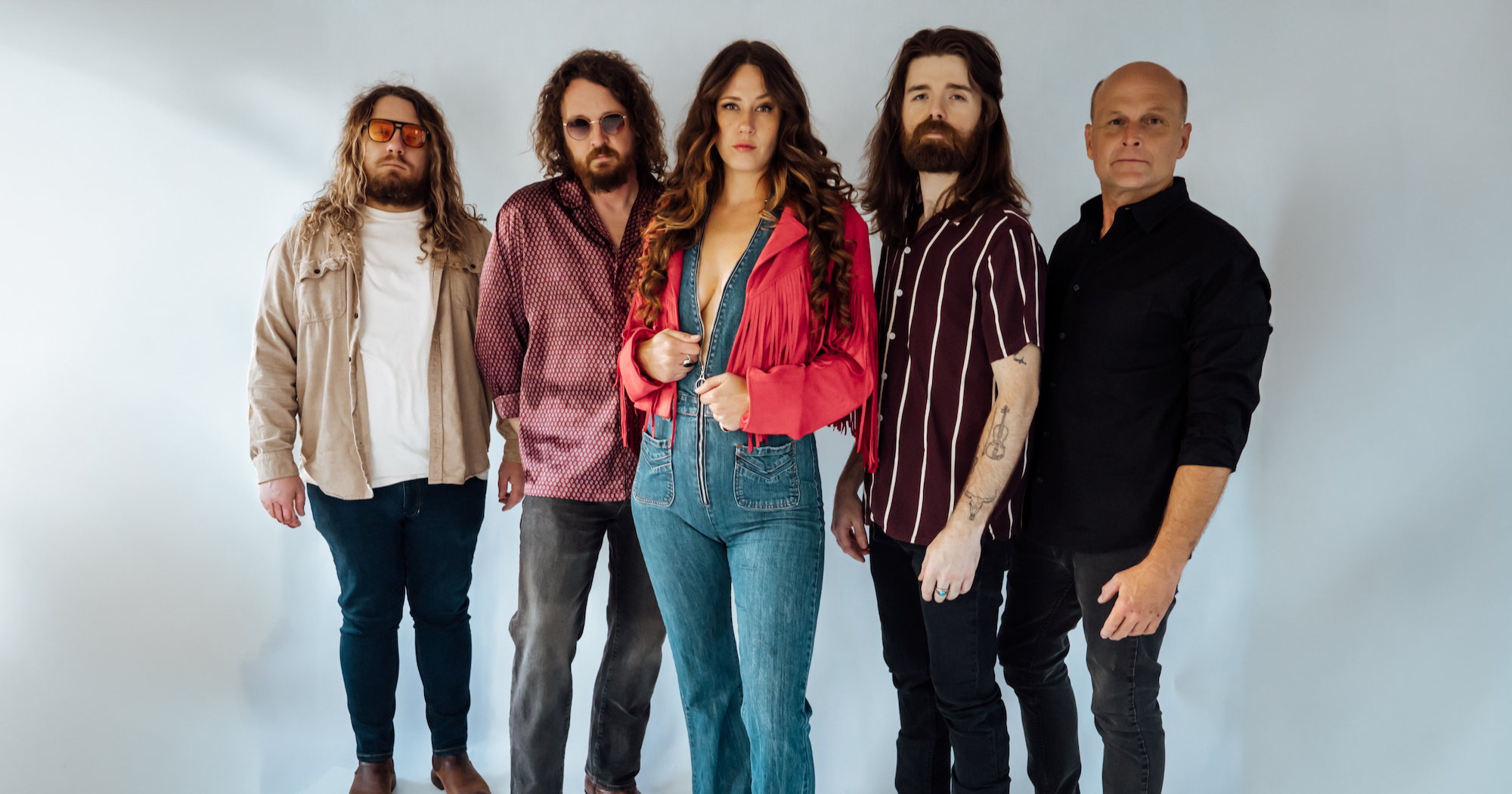
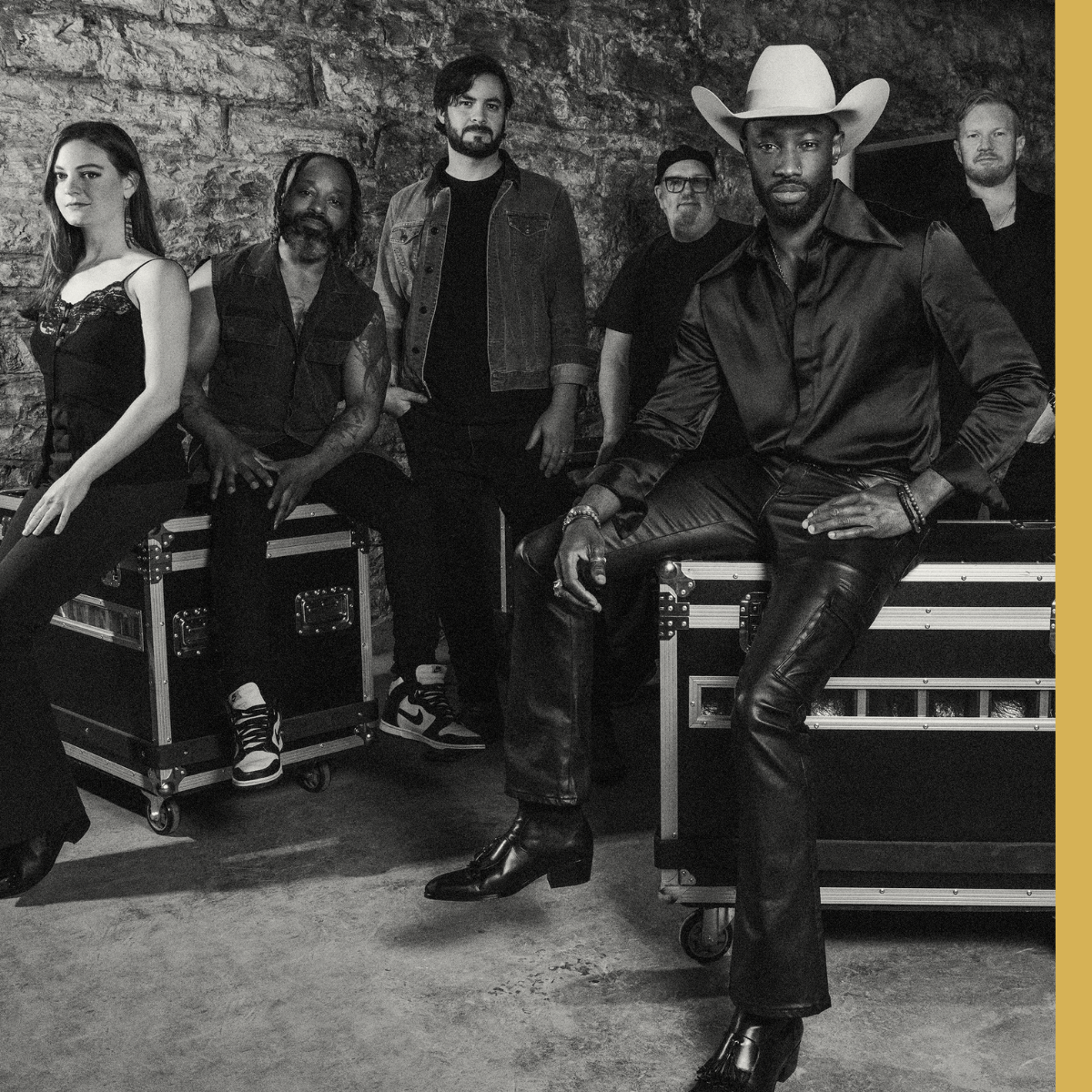
Something special is happening with Ghost Hounds, a Pittsburgh Americana outfit combining blues, rock and roll, alt-country, soul, and much more. Their latest album, Almost Home, features the group’s new lead singer and frontman, SAVNT; a lineup change isn’t foiling this dynamic band, it’s building their momentum. They just made their Grand Ole Opry debut this week!


Vince Gill
Vince Gill

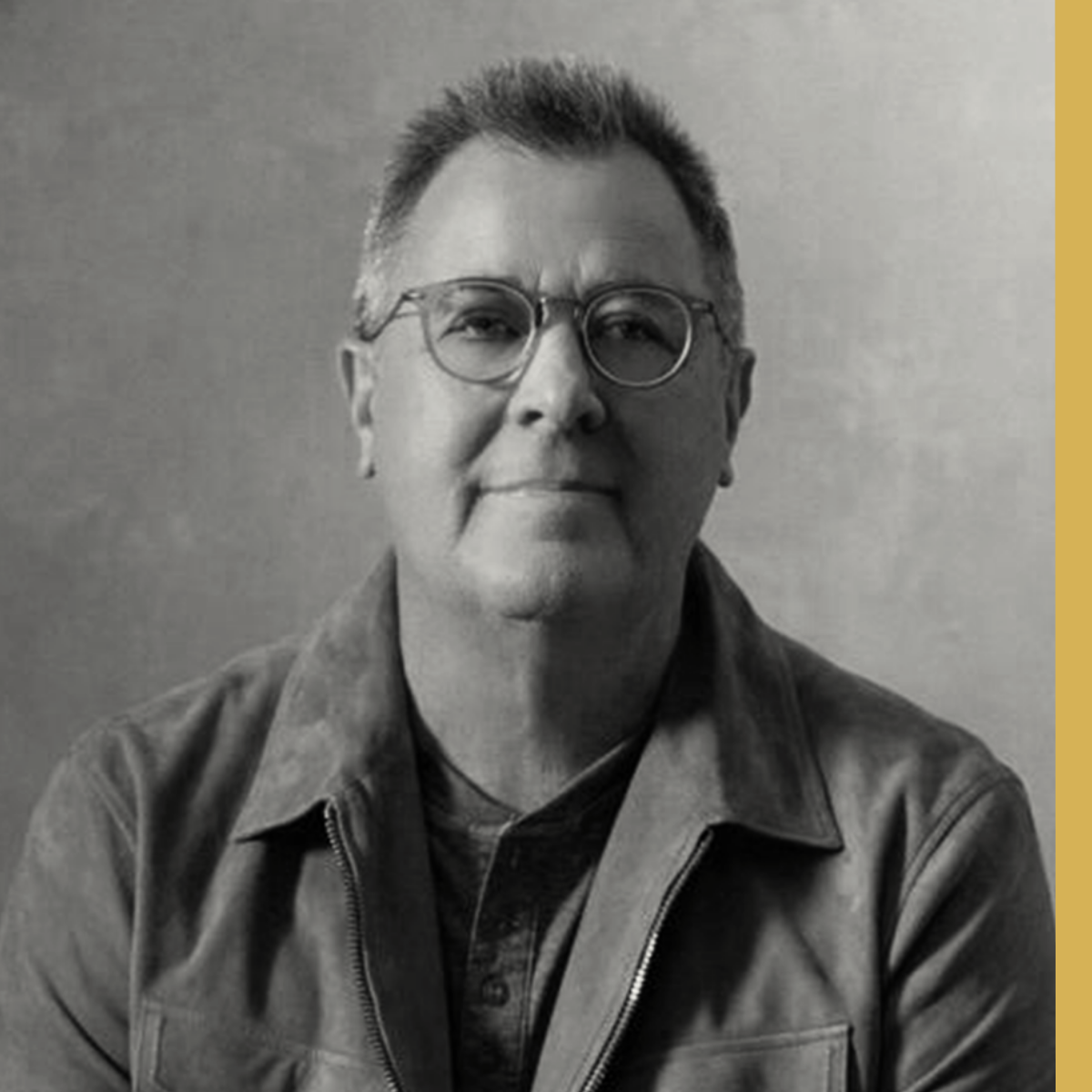
Perhaps our first repeat Ed’s Pick, but Vince Gill is always Good Country, right? The singer-picker-Country Hall of Famer-Eagles vocalist just announced a new series of EPs celebrating his lifelong career in music. The series, titled 50 Years From Home, begins with its first EP, I Gave You Everything I Had, today. We’re so grateful for all the years, all the music, and all you’ve given all of us, Vince!


Nick Shoulders
Nick Shoulders

Singer-songwriter-artist and Gar Hole Records co-proprietor Nick Shoulders is the real deal. He’s part of a broad movement of country musicians recentering the industry, its stakeholders, and its fans so the music better reflects all of the kinds of folks who love it. If you like Good Country that sticks it to the man, seeks justice, imagines a better world, and still sounds like “Grampa Music,” look out for his upcoming album, Refugia Blues (out October 31).


MORGXN
MORGXN

From Broadway in NYC to Lower Broadway in Nashville, MORGXN has done it all, but we find the singer-songwriter-performer thriving as he “reclaims his Nashville roots,” subverts expectations of musical and cultural stereotypes of country, and unabashedly celebrates queerness – especially so on his new twangy EP, Heartland: Part II. More MORGXNs like this in country, please and thank you.


Want more Good Country? Sign up to receive our monthly email newsletter – and much more music! – direct to your inbox.

Photo Credits: Carter Faith by Bree Marie Fish; Ghost Hounds courtesy of the artist; Vince Gill by David McClister; Nick Shoulders by Shelby Merry; MORGXN by Gabriel Starner.

BGS 5+5: SAVNT of Ghost Hounds

Artist: SAVNT (lead singer of Ghost Hounds)
Hometown: Englewood, New Jersey
Latest Album: Almost Home (released by Ghost Hounds in March 2025)
Personal Nicknames (or rejected band names): Sav

What’s your favorite memory from being on stage?

My favorite memory from being on stage was back in 2018. A close friend of mine, Mitchell Lee, asked me to help him close his show at Music Farm in Charleston, South Carolina. I sang a song which we now know as “You’ll Never Find Me,” on our album Almost Home. By the time I got to the second chorus of the song, people were vibing so much that they were singing the chorus back to me. To witness a song no one had heard before make such an impact – that will forever be one of my favorite memories.

Which elements of nature do you spend the most time with and how do they impact your work?

Water is the element in nature I connect to the most. When I start writing a song, I am either walking in the rain, washing dishes, taking a shower, or standing by a body of water, and that’s when inspiration comes to me the most.

What’s the most difficult creative transformation you’ve ever undertaken?

Stepping into this new space as the lead singer of Ghost Hounds has been the most difficult yet rewarding creative transformation I’ve ever undertaken. As a solo artist you are often told to pick one lane, stick to it, and simplify your words so people can understand you; that doesn’t really work for someone like me, who is not only inspired by many genres of music and appreciates great storytelling.

With Ghost Hounds, I get to move wherever inspiration takes me. I get to explore my love of soul, folk, rock, blues, and country without apology. After coming from a world that was so restrictive, this type of freedom can be scary and you may feel like you are out of place. But with the support of my bandmates I realize the more authentic I am, the more real the music feels – in a world that teaches us to hide our emotions, this music thrives when you expose them.

What is the most random interview question you’ve ever been asked?

The most random question I’ve been asked was, “Is cereal a soup and is a hot dog a sandwich?”

If you were a color, what shade would you be – and why?

If I was a color I would be a shade of electric blue – the color of Iron Man’s heart piece. It reminds me of lightning and, for whatever reason, it makes me feel extremely powerful, like a storm.


Lead Image: Ghost Hounds by Allister Ann. Alternate image: SAVNT by Sergio Colon.

Brent Cobb
Ain’t Rocked In a While

He might be a renowned lyricist and self-proclaimed songwriter-singer (not singer-songwriter). His typical sound may simmer with a supremely chill mix of country, blues, and soul. But Brent Cobb got his start with the crunchy thunder of guitar-driven rock ‘n’ roll and his seventh album takes him back.

Tapping the raw rage of garage rock, the distorted domination of ‘70s proto-metal, and more, Ain’t Rocked In a While finds this GRAMMY-nominated master of phrase returning to a world where the guitar riff is king – his first love as a musician. Co-produced with Oran Thornton and recorded live, 10 songs combine Cobb’s laid-back style with the immortal edge of bands like Black Sabbath, Metallica, and heavier inspirations still. But while old metalheads do tend to get rusty, this project is razor sharp.

Speaking with Good Country, Cobb explains the change of pace, as well as his abiding love for the rock ‘n’ roll spirit and new appreciation for classic-rock lyrics. Plus, the long-haired country boy explains how Ain’t Rocked In a While could fairly be considered “dad rock.”

I want to get the story behind this record. Ain’t Rocked in While is one of those projects that really seems to do what it say it’s going to do. How much of a creative release was this for you?

Brent Cobb: Well, this project was cool because I was focused more on riff and just really digging back into the foundation of what I grew up on. My first band was a rock band with my best friend Justin, who played guitar. He was real into Pink Floyd and AC/DC and Black Sabbath, and had me learning all those songs to sing. So when I was writing riffs and lyrics for this album, I sort of went back and was rediscovering those songs that I grew up learning.

Back then, even though I was learning the lyrics, I was just learning them to sing it. I wasn’t really paying attention to what they were saying and I didn’t think of those songs as very lyrical songs. I just enjoyed the groove. With this go ‘round, it really took all the pressure off of trying to write a lyrical song – which in turn made the lyrics come way easier. It also made me aware of just how lyrical those old classic rock songs were.

Oh, right!

I didn’t notice it or I didn’t appreciate it, but I don’t guess you would as a teenager. So that was the whole process – I was just trying to write a riff album and wanted to rock a little and show the audience a reference for a live show when they came, but wound up writing lyrical songs anyway.

I guess you just can’t help it. You’ve always been known as a storyteller and a songwriter first, and you even did a gospel record just a few cycles ago. Where does hard rock fit into your listening habits?

It all has always coexisted in my little world. My mom’s from Cleveland, Ohio, and my uncles – her brothers – they were all rockers into Led Zeppelin, The Beatles, and just the classic stuff. But then here, my dad was in a band with his brother – my other uncle – and my dad would cover the early ‘50s and ‘60s rock ‘n’ roll and my uncle would do classic country. So I grew up around that, but if you looked at any of my playlists, it’s just always been real eclectic that way for sure. For this album, Master of Reality [by] Black Sabbath was probably the biggest influence and the one that I would keep returning to for inspiration. And not just in riffs, but in the way that they structured that album to ebb and flow.

This might be a hard question to answer, but how heavy do your tastes get? What do you think would be the hardest hitting band in your collection?

Oh man. Well, [for] modern [artists], I’d probably say the band Sleep. Have you ever listened to much of them?

I don’t think so. I’m going to have to check that out right after this.

It’s like stoner metal. That’s probably the hardest stuff that I’ll listen to right now. But I don’t know – I mean, Sabbath is so hard still to this day. Those first five albums are unreal. … With Sleep, that’s some heavy stoner metal.

Yeah, I’m looking on Spotify right now. They’ve got songs like “Marijuanauts’s Theme.” [Laughs] That’s an awesome title.

Dude, I know! But that stuff is like, you can go find sections of old Sabbath songs and it’s kind of like [Sleep] built a whole sound on little sections of Sabbath songs. But then if you go further, it’s all blues – that’s all it is.

For any true rock record, the recording itself is so important – trying to capture the energy. I know you recorded live-to-tape and that seems like the rock ‘n’ roll dream, right? Was that experience different from digital recording?

Well, honestly, each of my albums have always been recorded to tape except Keep ‘Em On They Toes. But with that said, it is a modern world and we still record to tape and then dump all that into Pro Tools to where it’s easier to edit, then take that and dump it all back to tape. You get the original physical, sonic difference that is recording to tape when each tape is completely different, because the needle’s hitting different, the amp was hotter, or whatever. But then we fast forward to the modern world to where we can just really be quicker and more efficient.

I think we had 10 days blocked off to record, and then I got sick on the first two days. And then Oran [Thornton], my co-producer and head engineer, he got sick for two days. And so we wound up recording in seven or eight days.

That is a plus of the modern age for sure. In any case, it came out sounding really tight – you recorded as a band, right?

That’s right. It’s the touring band [The Fixin’s] I’ve had for a while now. … The studio we recorded at in Springfield, Missouri, was this little bitty, almost broom-closet size live room, and they were all in the main live room together. I did want to isolate myself, so I was in an even smaller little isolation booth with a window where we could still see each other. … I obviously am not as experienced in singing those type songs and playing those type riffs at the same time, so I knew I was going to screw up some lyric phrasings and I didn’t want to mess everything else up. So I was the only thing I isolated.

Where’d that title track come from? “Ain’t Rocked In a While” – this definitely has that Black Sabbath feel, stretching out to five minutes.

Straight up. It started because I had bought my son a little drum kit for his fourth birthday a couple years ago. He just loves the drums … and then I would set my amp up and get my guitar out and we’d just be jamming in his room. One day he was like, “Dad, play some rock ‘n’ roll guitar.” And I’d hit a little lick and he’s like, “No, no, rock ‘n’ roll.” I’d play another little lick. And he said, “No, dad, like Mattman” – which is [the Fixin’s guitar player] Matt [McDaniel]. I was doing the best I could, really just trying to prove to him that daddy could rock.

That’s funny!

So I came up with that “Ain’t Rocked In a While” riff and then it turned into me proving to my son, “I have rocked before, boy. It just ain’t been a while.” I thought it would be funny, but I also thought, “Well, all of us are sort of that way.” I’m nearly 40 and a father of two, so you could definitely consider this album Dad Rock, but all our kids don’t know. We all had some rock eras, whether that be in life or musically or whatever it is.

Well, you still got the hair, so I think it’s easier to make that case.

[Laughs] Hell yeah. It’s funny you say that. My mama just yesterday, she used to be a hairdresser and had her own business, and she was like, “You need to let me cut your hair.” And I was like, “Look, I’m going to keep it growing until it don’t grow no more.” I’m barely gray and I ain’t thinning too much yet. Until that happens, I’m going to keep rocking the long hair.

A little earlier you mentioned how [hard rock is] all blues at the bottom, right? I think that really comes through in a song like “Do It All the Time.”

Man, I’m going to have to give my son some co-writing credit on this album, I guess. That riff did come out very Skynyrd-esque, but … I was actually trying to do my best James Gang feel with the riff, the melody, and the double vocals on that chorus. That early James Gang stuff is so badass – but I think Skynyrd also was probably trying to do their best James Gang on some of their stuff.

Anyway, the idea of that song is from when [my son] Tuck was even younger, we’d be like “Oh man. Look dude, you ate all your food!” And he would say, “I did it, and I do it all the time.” So I always had that. I started saying “I do it all the time!” And then I don’t know how much I should say, but sometimes when you’re parents, you and your other half may not be on the same page. … You’re just both sleep-deprived and sometimes it’s hard to see. And so I think we were having a little moment of that and I was going, “I tried then and I try now and I try all the time. I did it and I do it all the time, babe!” So that’s where it came from.

Okay, one more thing here. For fans who come out and see you live, do you think this is going to change the shows? Are you guys going to rock out more or what?

I mean the only way that we’ll rock out more is we just have more songs to rock out to. But no, in every album that I’ve ever put out all the way back to 2006 with No Place Left to Leave, there’ve always been rock leaning songs in my catalog – including songs that others have recorded; some of the Whiskey Myers stuff, or The Steel Woods stuff. For a little bit there seemed like a disconnect, because I don’t think [people at my shows] were aware of that rock stuff, but it’s just a funner show to me and for us especially.

Now we just have more to pull from, and for people who show up, it’s the same show. I try to do songs from every album and I’ll take requests, too. I don’t turn those down. But now, I think people will show up and they won’t be taken by surprise at all if it does drop.


Photo Credit: Jace Kartye

Finding Lucinda: Episode 6

Ismay travels from Texas to Mississippi to visit the studio where Lucinda Williams made her first record. There, Ismay interviews Wolf Stephenson, who was the engineer that day in 1978, to learn about what happened during the session and whether Lucinda was confident through that initial challenge of recording. They discuss what results when artists get rejected and what keeps certain artists moving forward in spite of various roadblocks. Stephenson oversaw the development of Malaco Records, which produced R&B, soul, and gospel hits. Elsewhere in the episode, Ismay also takes time to visit the stretch of country between Austin, Texas, and Jackson, Mississippi, in order to understand the landscape that informed Lucinda’s work.

LISTEN: APPLE • SPOTIFY • AMAZON • MP3

Produced in partnership with BGS and distributed through the BGS Podcast Network, Finding Lucinda expands on the themes of Ismay’s eponymous documentary film, exploring artistic influence, creative resilience, and the impact of Williams’ music. New episodes are released twice a month. Listen right here on BGS or wherever you get podcasts.

Finding Lucinda, the documentary film that inspired and instigated the podcast, is slated for release in the fall. Both the film and podcast showcase never-before-heard archival material, intimate conversations, and a visual journey through the literal and figurative landscapes that molded Lucinda’s songwriting.

Credits:
Produced and mixed by Avery Hellman for Neanderthal Records, LLC.
Music by Ismay.
Artwork by Avery Hellman.
Jackson, MS Recording: Recorded at Malaco Studios.
Sound Recordist: Rodrigo Nino
Producer: Liz McBee
Director: Joel Fendelman
Co-Director & Cinematographer: Rose Bush
Special thanks to: Mick Hellman, Chuck Prophet, Don Fierro, Jacqueline Sabec, Rosemary Carroll, Lucinda Williams, & Tom Overby.


Find more information on Finding Lucinda here. Find our full Finding Lucinda episode archive here.

Sho-Bud Steel Guitars Relaunches, A Family Business Once Again

Tone: it’s the Holy Grail for musicians, and it’s the cornerstone of Sho-Bud, the iconic pedal steel guitar company founded in 1955 by Harold “Shot” Jackson and Buddy Emmons. When Emmons moved on, Jackson continued with sons Harry and David, handcrafting instruments integral to the sound of country music.

In the early 1980s, Sho-Bud was acquired by Fred Gretsch. In 2005, after twenty years away from the business, Harry and David Jackson, joined by David’s daughter, Dawn Jackson, resumed building instruments. As Jackson Steel Guitar Company, they introduced new pedal steel, lap steel, resonator, and slide guitars.

In December 2024, the third generation of Jacksons, siblings and co-CEOs Dawn and Will Jackson, reacquired the company name and family legacy. “We knew that the name carried a lot of weight,” says Dawn Jackson. “It’s our heritage, and we wanted to bring it back while Dad and Harry were still building.”

“I want to acknowledge Fred Gretsch, his wife Dinah, his family, and his team,” says Will Jackson. “A lot of people approached him to acquire the Sho-Bud name over the years, and he didn’t do it. He saved it for us. We very much appreciate what he did in terms of preserving the name, keeping it intact, and not selling it to someone else. We’ll be eternally grateful to him for that.”

Sho-Bud relaunched this year with new and classic gear, plus several projects across platforms and generations. The reach stretches from traditionalists devoted to the classic instruments they saw on the Opry stage, to young musicians incorporating steel in everything from country to metal.

Central to all of this, of course, are the instruments, which include the high-level, traditional, maple cabinet Pro V; bender-equipped, stand-up SlideKing LS lap steel; and best-selling Maverick II.

“It’s not the Maverick of old,” says Will Jackson of the Maverick II. “The original Maverick was designed to be a low-cost, entry-level, beginner guitar. With the Maverick II, our objective was to build one of the sweetest-sounding guitars. We developed a front and rear extruded aluminum panel that has a hard rock maple soundboard that sits between them. On top of that, the one-piece aluminum neck now binds the key head and tail plate together.

“When you sandwich all that together, this particular guitar, as Dawn describes it, cuts through all the other noise. It’s distinctive, it’s clear, it rings and resonates. It has that Nashville sound because we still utilize the exact same pickup design that Shot developed back in the ’50s. When you marry that to this modern design cabinet, it is incredible. The Maverick II definitely stands out in terms of its tonal qualities. It’s pretty much unmatched. It’s quite an advancement in terms of pedal steel guitar technology.”

Sho-Bud plans a reissue of the signature Lloyd Green model, the LDG, which the Jacksons describe as “a continuation of the original classic design,” and a limited-edition LDG, cut with modern components and updated mechanisms, each one signed by Lloyd Green, David Jackson, and Harry Jackson. Other reissues will follow, including Jimmy Day’s Blue Darlin’.

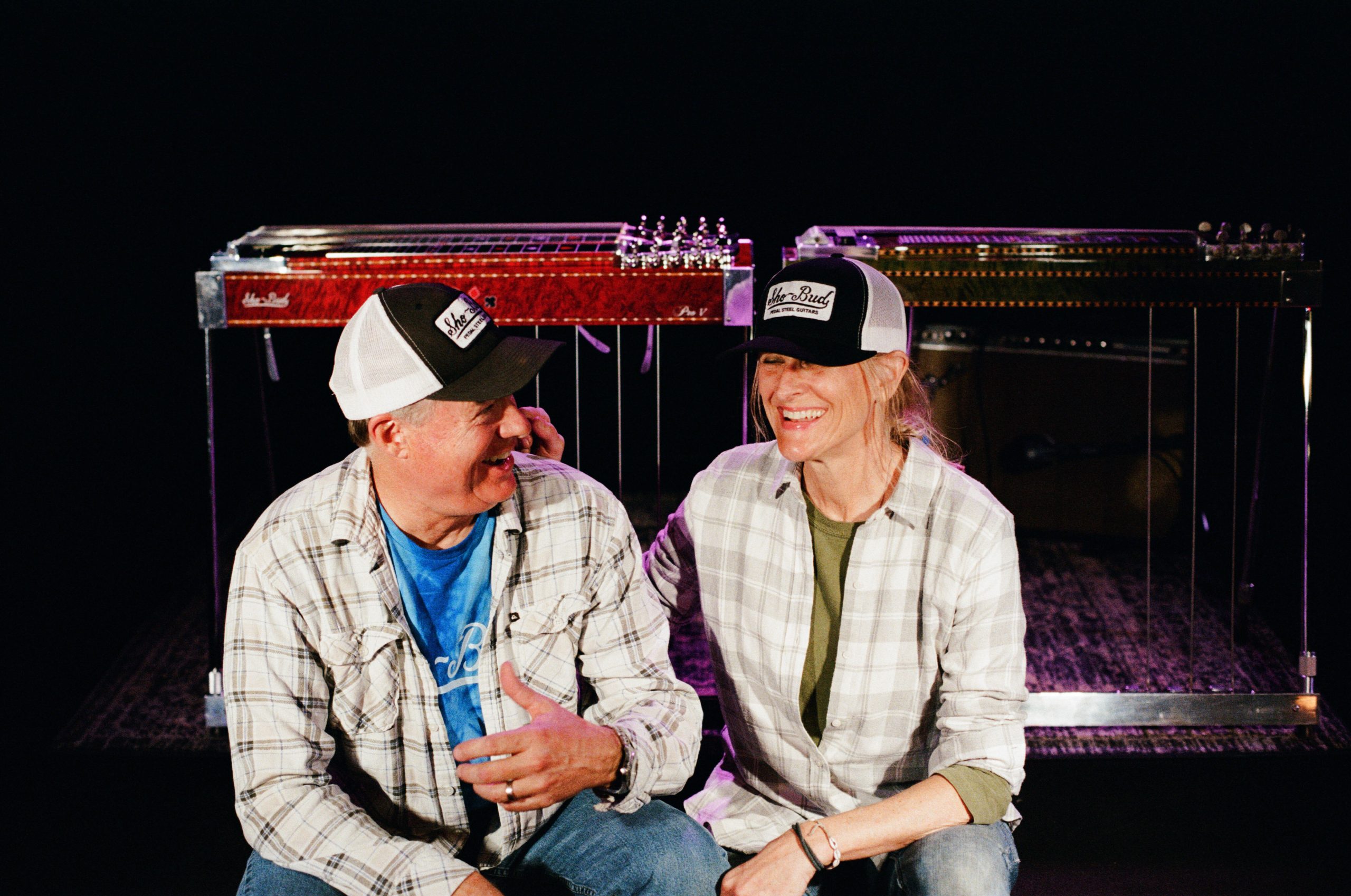
Sho-Bud co-CEOs and siblings Will Jackson and Dawn Jackson.
 

“Relaunch,” in Sho-Bud vernacular, is all about name recognition, product reputation, and upholding a decades-old legacy. “We built steels for the past twenty-five years under the name Jackson Steel Guitars,” says Dawn Jackson. “So the relaunch, for us, circles around the Sho-Bud name.

“What’s happened in the months since we secured the name again, the outpouring of support from the guitar industry in general has been overwhelming,” she says. “That lends itself to the weight this brand carried around the world, and how throughout the years of its ‘dormancy,’ it maintained a true following, and not only from older generations. Younger people love the brand too. When we mention Sho-Bud, every door is open. So that’s really the relaunch. We maintained building these amazing instruments during our Jackson Steel era, but the [Sho-Bud] brand itself has the leverage and momentum behind it.”

“A lot of people have asked, ‘Is this just a rebranding of Jackson Steel Guitars?’ Definitely not,” says Will Jackson. “We’ve been sitting on a few patents that we’ve obtained over the last couple of years. They’ve got about fifteen years or so left on them while we fine-tune these components.”

Those components include a tunable vibrato, on-the-fly D Drop, The EDGE® multi-bending system, and Core-Over™ strings, all of which they’ve introduced to Sho-Bud artists with positive response.

“When a traditional, fretted-instrument guitarist is, say, holding a chord, when they use an old-school vibrato — let’s say a Bigsby, for example — when they hit that thing, all those strings are falling out of tune,” says Will Jackson. “Our tunable vibrato doesn’t destroy the chord. When they’re holding a chord and they go down, all those strings fall in tune now.

“We’ve got a Drop D tuner that allows an artist, again on a fretted instrument, to simply roll their E down to a D while they’re playing. They don’t have to take their fretting hand off and adjust anything on the key head. They don’t have to stop and tinker around with their picking hand to adjust anything. They’re able to use the palm, the heel, of their hand, roll it right down to a D, and roll it right back up to an E. So it’s very novel, very easy to use.

“With our Core-Over strings, we take the winding off up to where it passes the bridge and on the pickup side of the nut, so it’s just the core of the string going across those two touch points. It creates incredible amounts of sustain. The sound profile of the string is much rounder, bigger, fuller. It’s amazing.”

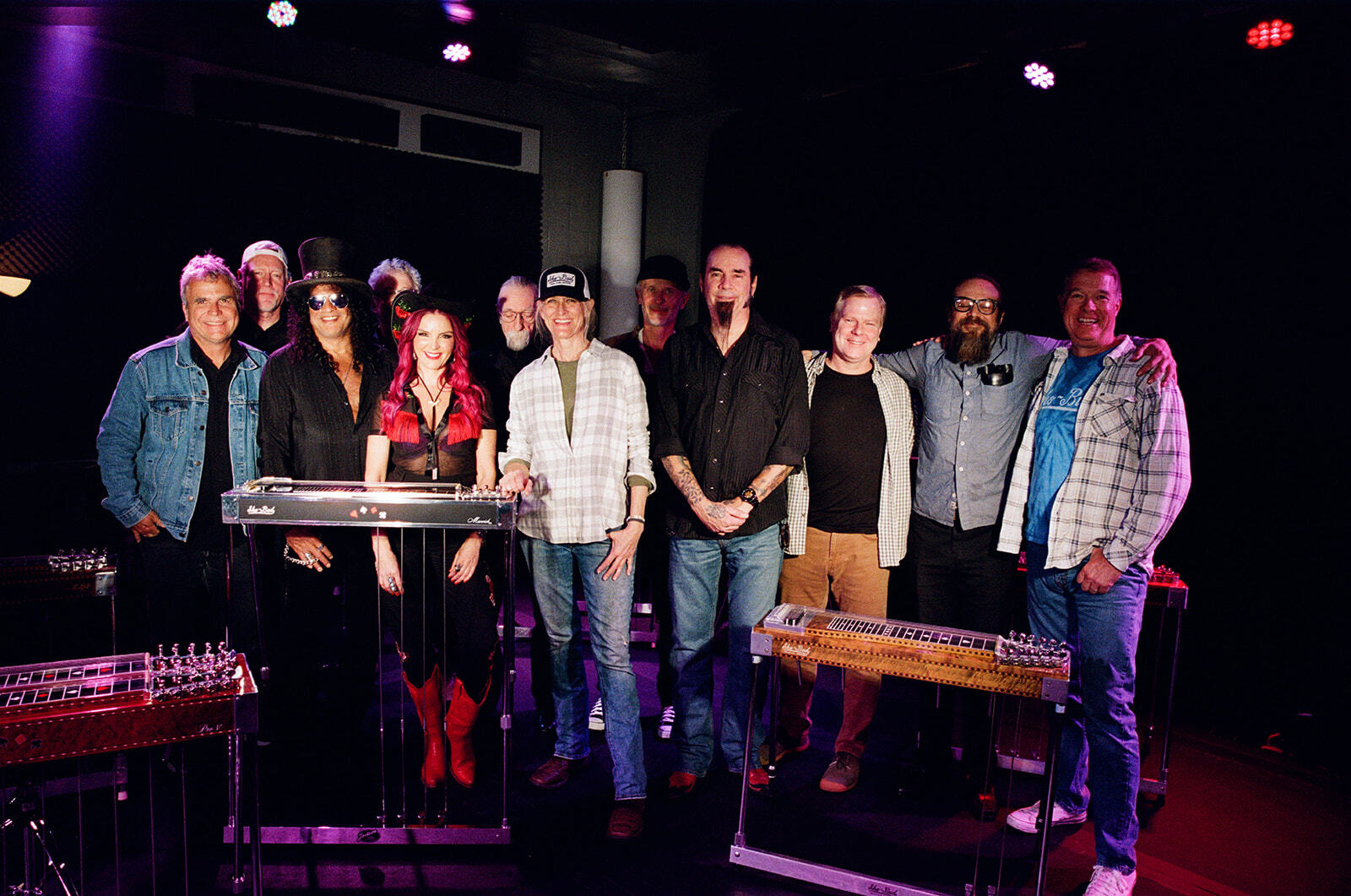
(L to R) Kyle Ince, Bob Sheehan, Slash, Ted Stern, Andrea Whitt, Skunk Baxter, Dawn Jackson, Pavel, Hexx Henderson, Mark Tucker, Rocco DeLuca, and Will Jackson pose for a group photo at the Sho-Bud Showcase Live at the Desert 5 Spot in Los Angeles.
 

On April 24, in Hollywood, the company celebrated the return of Sho-Bud Showcase Live, national concerts spotlighting steel-centric artists in all genres. The series kickoff, Sho-Bud’s first live event in over forty years, included, among its many participants, Jeff “Skunk” Baxter, Robert Randolph,
Andrea Whitt, Rocco DeLuca,
Hexx Henderson, Hatfield Rain, Shooter Jennings, and Slash.

Sho-Bud Music is a record label and publishing company originally established by Dawn Jackson to release an album by her band, the aforementioned Hatfield Rain. “Around that time, I started working with Dad and Harry on Jackson Steel and never did anything with the [album] mixes,” she says. “It’s getting ready to come out after all this time, so I’m super-excited.” Along with that recording, Sho-Bud Music is promoting other Sho-Bud artists.

Coming soon is Shot Jackson’s Sho-Bud Showcase radio program, which will now become a podcast featuring music, interviews, and over 150 digitized reels from the original 1970s and early 1980s WSM broadcasts. “We have all the reels and we’re going to start releasing them,” says Dawn Jackson. “The podcast will also include interviews with today’s Sho-Bud artists and, of course, our dad and Harry.”

Harold “Shot” Jackson built Sho-Bud on a foundation of superior instruments, customer service, customer satisfaction, and customer loyalty. Those values remain at the core of Dawn and Will Jackson’s goals, whether putting instruments in the hands of internationally renowned musicians or newcomers learning their way around pedal steel.

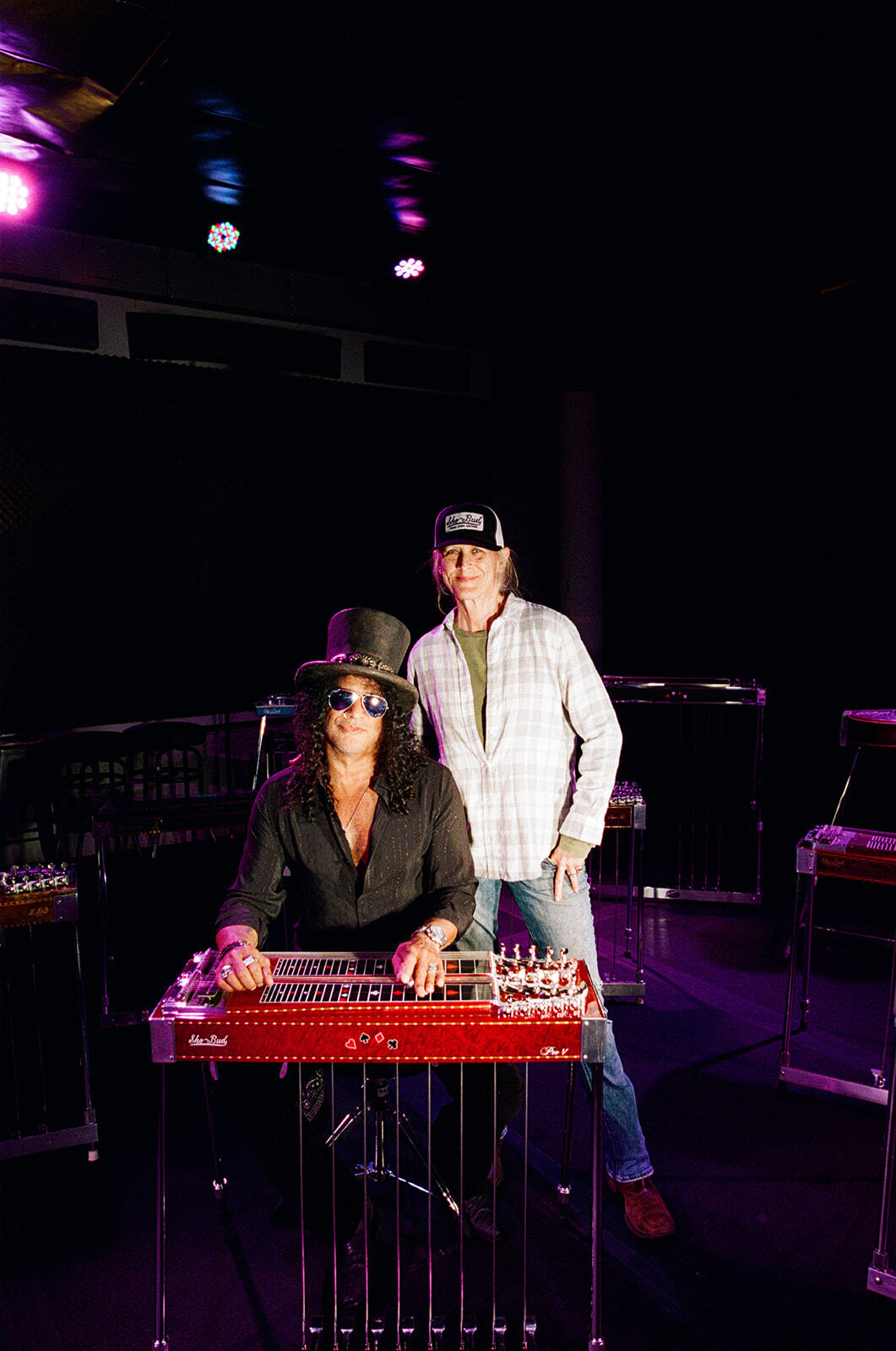
Sho-Bud CEO Dawn Jackson poses with Slash and a Sho-Bud Steel Guitar.
 

“These instruments are not like traditional fretted instruments,” says Will Jackson. “Fretted instruments don’t have moving parts per se. But these do. Because they have those linkages and mechanical pulling mechanisms, as they’re used, they wear. Anytime you make a change to these instruments, you have to be careful, because in the interest of trying to maximize performance or life on one end, you can impact tone on the other end, and that is something we can’t sacrifice.

“Sho-Bud has always been known for that Nashville sound, the tone that we got. The story I recall as a kid was Shot sitting there on a pickup-winding machine, which was made out of an old sewing machine motor. He had apple bushels next to his workbench. He would wind a pickup, plug it in, and if it gave him the tone he was after, performed the way he wanted it to, it went in the keeper bushel. If it didn’t, it went into the discard bushel.

“That is how our family has built these things. There are no Rhodes Scholars over here or MIT graduates in engineering. These guys developed these instruments through pure trial and error and using their ears to develop that tone. Again, we can’t sacrifice mechanical advantages over tone. Some guitar companies do, but we cannot do that. For us, it is about tone, tone, tone. We live and die by that.”

“We’ve always maintained the tradition and look of our guitars — the beautiful cabinets, our certain inlays, the finishes,” says Dawn Jackson, “but aesthetics are second. Tone has always been number one for us.”

“These instruments require maintenance,” says Will Jackson. “If there is a nut, a screw, a bolt, it will get turned by someone. When these things leave the shop, they’re set perfectly. People will start adjusting things, and that’s what they’re for. You need to fine-tune things ergonomically to make it fit. But, because these things can be very sensitive, sometimes they overdo it, or they have trouble chasing the tuning back to where they wanted it.

“We are here to support them in terms of Zoom calls, where they can show us exactly what they’re doing, what the instrument is doing, or what it’s not doing that they would like it to do. We can help walk them through that, using a blend of modern technology to help them fine-tune some of these traditional instruments. We’re always looking for ways to make it easier for them to keep these guitars maintained.”

As a family-owned and operated company, versus a multi-department corporation, the Jacksons are front and center when phones ring, texts chime, and emails arrive – no call centers, AI assistants, or being transferred through a half-dozen departments and hold times. They field calls, walk customers through setups, stay active via social media, keep up with forums, provide instructional videos, and cherish human-to-human relationships.

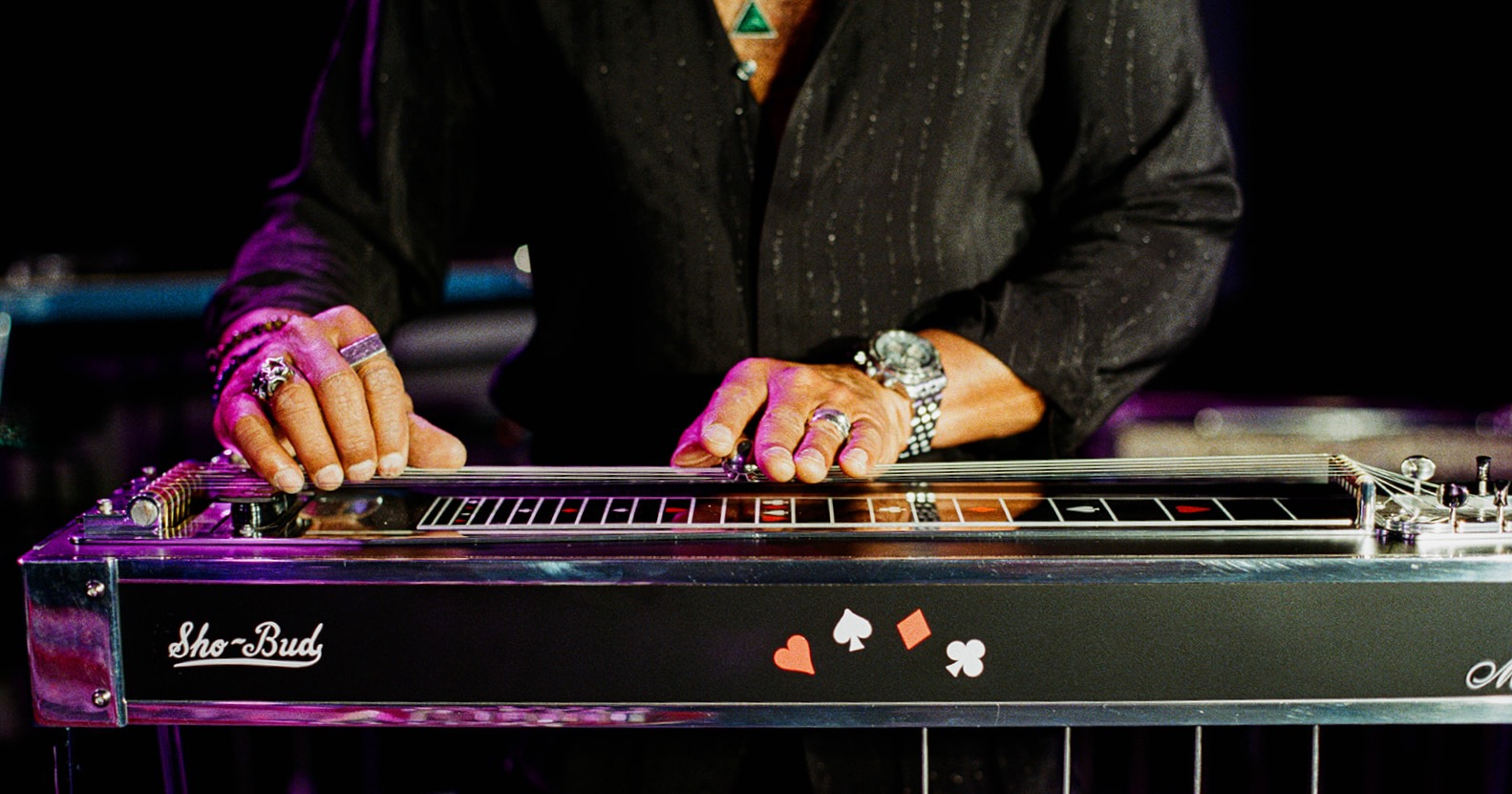
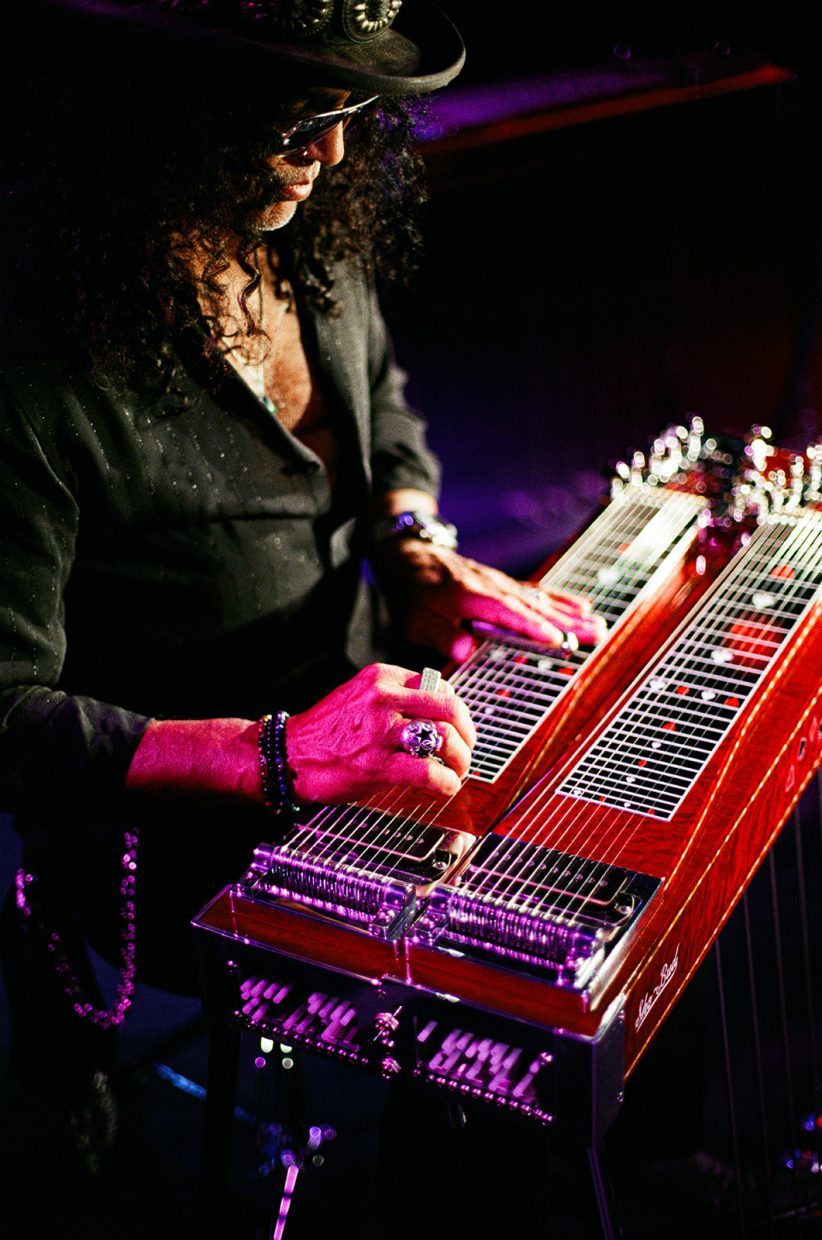
Slash plays a Sho-Bud Steel Guitar.


“Will and I have been a team since we were kids playing football in the backyard,” says Dawn Jackson. “We really believe in team efforts, and that’s why we’re so big on using the words ‘Team Sho-Bud.’ The dynamics between us, our father, and our uncle – we’re all creators and passionate about the things we do.

“We have the same objective in mind, which is to maintain our family heritage,” she says. “I am so proud that Sho-Bud is still a family business, and that people love and respect that. We work together, play off of each other, and it just works and works well.”

“I’m proud of my family – our dad, our uncle – for the sacrifices they made over the years to build these instruments, and to deliver the tone and the sounds that everyone enjoys,” says Will Jackson. “I’m very proud of the work they put into this, and of Dawn for rolling up her sleeves and helping them. I’m proud of the way Sho-Bud has evolved. It’s fun to be a part of the rebirth of Sho-Bud. These instruments, these new components, are going to be total game changers. I’m very proud to represent these products and wear the old brand. It’s exciting times.”


All Photos: Ashley Marie Myers, courtesy of Sho-Bud. Lead and alternate images: Slash plays a Sho-Bud pedal steel guitar.

You Gotta Hear This: New Music From Tift Merritt, Kyshona, and More

Folk, country, and Americana join together in this week’s edition of our new music and premiere roundup. You Gotta Hear This!

The lovely and ethereal Tift Merritt is celebrating 20 years since the release of Tambourine this year with an upcoming vinyl reissue and a special collection of demos to go alongside it. Kicking off our new music collection today is one of those demos, “Good Hearted Man,” an intimate kitchen recording of just piano and vocals.

From the country realm, two impeccable artists and singer-songwriters have new albums out today, William Beckmann and Kelsey Waldon. Kentuckian Waldon sings about family ties, generational cycles, and finding oneself on “My Kin,” available today on her stunning new project, Every Ghost. Texan Mexican American Beckmann, for his part, brings a gorgeous, retro-styled music video for “Lonely Over You” that draws inspiration from classic television variety shows and huge musical personalities like Roy Orbison and Elvis.

Elsewhere in our collection you’ll find Steve Gillette paying tribute to his friend, musician and songwriter Gamble Rogers with the touching homage, “Song for Gamble.” The bluesy, energetic track is paired with vintage clips of Rogers set alongside photos and performance and recording footage of Gillette.

To celebrate Juneteenth yesterday, Kyshona released a new single, “More In Common (Live From the Blueroom Studio),” contextualizing the track saying, “I’m releasing ‘More in Common’ on Juneteenth as a reminder that none of us are truly free until all of us are free.” It’s an excellent, all-too-timely reminder – and you’ll be sure to enjoy the performance video shared below.

We always love wrapping up the week with the best new roots music. And you know what we think– You Gotta Hear This!


Tift Merritt, “Good Hearted Man (Kitchen Recording)”

Artist: Tift Merritt
Hometown: Raleigh, North Carolina
Song: “Good Hearted Man (Kitchen Recording)”
Album: Time and Patience (a collection of demos releasing in tandem with the 20th anniversary vinyl reissue of Tambourine)
Release Date: June 18, 2025 (single); August 29, 2025 (album)
Label: One Riot Records

In Their Words: “When I hear my 27-year-old self singing this song, after just having finished writing it, recording in the kitchen on an ADAT machine, I hear my dreams. I can’t help but smile – at my big dreams, the raw reaching, the no costume. I am enormously proud of these kitchen recordings and Tambourine, so happy they are coming out to the world this fall.” – Tift Merritt

Track Credits:
Tift Merritt – Piano, vocals


Kyshona, “More In Common (Live From The Blueroom Studios)”

Artist: Kyshona
Hometown: Nashville, Tennessee by way of Irmo, South Carolina
Song: “More In Common (Live From The Blueroom Studios)”
Release Date: June 19, 2025
Label: Lamiere Records/Moraine Music Group

In Their Words: “I’m releasing ‘More in Common’ on Juneteenth as a reminder that none of us are truly free until all of us are free. What if we took ‘I,’ ‘mine,’ ‘them,’ and ‘me’ out of our vocabulary—just for a moment? It’s so easy to tune out, to disassociate from the chaos we’re witnessing. But what if we remembered that we are under attack? That every child is our child?

“After a full year of touring the Legacy album, it’s been deeply moving to see how my own family’s story – of freedom, land ownership, and the wisdom of our elders – resonates with people from all backgrounds. No matter your race or religion, there’s a common thread in how we were raised and what we’ve inherited.

“When we peel back the layers that divide us and look closer at our shared values and stories, we begin to reconnect. The conversations that have come out of this tour have been powerful. People aren’t talking about differences – they’re talking about what unites us.

“As a society, I think we’ve gotten lazy. We’ve stopped looking for what ties us together. My hope is that this song reaches the quiet few who’ve been asking, ‘What happened to us? May it serve as a gentle nudge to follow the thread instead of cutting the seams.

“There’s a lot of noise in the world right now, and I know this message may not reach everyone. But if it reaches even one person – someone overwhelmed by it all – let it be a reminder: we can make ripples of good.

“All it takes is open eyes, open ears, and the courage to show up for each other. Let people know they are seen. Let them know their existence matters.” – Kyshona

Track Credits:
Larissa Maestro – String arrangement, cello
Kristin Weber – Violin
Kyshona Armstrong – Vocals, songwriter
Simon Gugala – Songwriter

Video Credits: Recorded at The Blueroom Studios.
Videographer – Jesse Carr
Edited by Caryn Johnson, Tiny Sunshine Studios.


William Beckmann, “Lonely Over You”

Artist: William Beckmann
Hometown: Del Rio, Texas
Song: “Lonely Over You”
Album: Whiskey Lies & Alibis
Release Date: June 20, 2025
Label: Warner Music Nashville

In Their Words: “I wrote ‘Lonely Over You’ with Jesse Frasure and Jessie Jo Dillon. It’s probably my favorite song that I wrote for this album. To me, it feels reminiscent of Roy Orbison, and there’s definitely some Elvis influence in there too. I love the way it was tracked and recorded—there are a lot of stacked harmonies, which give it that lush sound. It’s a new direction I was able to discover and bring to this record. I also think the music video for ‘Lonely Over You’ is my best yet. We shot it all on film in Austin, Texas, and aimed to capture the vibe of the Elvis comeback special. The set design was incredible and made it feel like we were in the late ’60s or early ’70s. Altogether, it’s a special song. I’m very proud of it, and the video that goes with it is a great piece of art as well. We’re looking forward to sharing it.” – William Beckmann

Track Credits:
William Beckmann – Lead vocals, background vocals, acoustic guitar, songwriter
Chad Cromwell – Drums, percussion
Craig Young – Bass
Jedd Hughes – Electric guitar, acoustic guitar
Jesse Frasure – Baritone guitar, background vocals, songwriter, producer
Jimmy Wallace – B3, piano, synth
Jon Randall – Acoustic guitar, producer
Todd Lombardo – Acoustic guitar
Jessie Jo Dillon – Songwriter


Kelsey Waldon, “My Kin”

Artist: Kelsey Waldon
Hometown: Monkey’s Eyebrow, Kentucky
Song: “My Kin”
Album: Every Ghost
Release Date: June 20, 2025
Label: Oh Boy Records

In Their Words: “I am the best of my kin and I am the worst of my kin. I got all of it. It took me a long time, but now, I love that for me. That means I got all of the character, the resilience, the grit, the beauty, the spirit, the humor, the independence, the self-sufficient ideals, the wisdom, and so much more. That, unfortunately, also means I also got the generational trauma, the demons, the stubbornness, the guilt, the defensiveness, and the thing that makes me want to push away anyone who tries to help or love me. I got the gene that makes me want to self-destruct a little bit, for sure. This song is saying, ‘I am all that, and I do have these issues, but the difference is that I am willing to learn and grow, and I am finally willing to break these cycles as well.’ These things are a part of me, and you will have to take me as I am, to a certain extent, and have patience with me. And don’t you love that all these things make me who I am? We just have to learn how to reign them in and use them for good.” – Kelsey Waldon

Track Credits:
Kelsey Waldon – Rhythm acoustic guitar, lead vocals
Junior Tutwiler – Electric guitar, baritone, high strung guitar, lead acoustic guitar
Cooper Dickerson – Pedal steel guitar
Blakely Burger – Kentucky fiddle
Erik Mendez – Electric bass, Rhodes, and Wurlitzer electric piano
Evan Kesel – Drums, percussion
Kristen Rogers – Background vocals


Steve Gillette, “Song for Gamble”

Artist: Steve Gillette
Hometown: North Bennington, Vermont
Song: “Song For Gamble”
Album: Steve Gillette – The Best Of…
Release Date: June 20, 2025
Label: Compass Rose Music

In Their Words: “I met Gamble [Rogers] at the Bitter End in New York in 1967 and we bonded over songs and Merle Travis’ guitar finger picking that became known as ‘Travis Picking.’ Over the years, we would often run into Gamble at festivals or when he was in the New England area. One time stands out for me, when I arrived in Kerrville in 1984: Gamble was booked to perform on the main stage, but he also gave a special one-hour workshop on his guitar technique and his performance ideas. He was so generous about sharing the secrets of his showmanship, and of course, that was consistent with his selflessness as a person. Sadly, it was just his willingness to consider others before himself that contributed to his losing his own life while trying to help another. He was with his family for a day at the beach just south of St. Augustine, Florida, when a little girl ran up to him in tears, begging him to help her father, who was in trouble in the surf. Gamble went into the water, but was unable to help the man and, sadly, both were drowned. That beach is now known as the Gamble Rogers Memorial State Recreation Area.” – Steve Gillette

Track Credits:
Steve Gillette and Charles John Quarto.

Video Credit: Thank you to Rick Davidson, Cathy Roberts, and Sherry Boas for their photos and video contributions.


Photo Credits: Tift Merritt by Alexandra Valenti; Kyshona by Anna Haas.

Sawtooth
Country Soul

To say Kashus Culpepper’s life has changed over the last five years is an understatement. A former state champion wrestler, firefighter, and EMT, the Alabama native developed a raspy, smoke-and-voodoo vocal while stationed in Spain with the U.S. Navy in 2020, forced to pass the pandemic in his bunk. Since then, he’s knocked over one milestone after another.

With a distinctive mix of country, blues, Southern rock, and soul, the 27-year-old cites Robert Johnson, Bill Withers, and Hank Williams as inspirations and is now bringing his roots-renegade instincts to mainstream fans. Despite only releasing his first official track in June of 2024, the music industry short-timer has earned big-time appreciation.

That includes the respect of heroes like Elton John and John Mayer, a Grand Ole Opry debut, tour dates around the country, and inclusion on 2025 “artist-to-watch” lists at GRAMMY.com, Apple, Billboard, Pandora, and more. Culpepper just finished a run of dates with Leon Bridges and he’ll hit the road with Whiskey Myers in June before joining tours by Sierra Ferrell, Darius Rucker, and others later on in the summer. It would all be overwhelming, if he had time to think about it.

“I’ve just been taking it day by day,” Culpepper tells Good Country with a hearty laugh, waiting to perform at a community festival in Arkansas last month. “I think that’s the best course of action. Don’t think too far in the future and just take each show, each writing session, each recording session one at a time. Just pray everything works out and keep going. … Because when things started happening, I was like, ‘Oh, snap.’”

We wanted to get to know Culpepper before anything else “happens,” and figure out what’s fueling the hype. As it turns out, this all-natural talent is just going with the flow.

I read that you didn’t even start playing guitar until you were in Spain for the Navy, right? What made you want to do that?

Kashus Culpepper: Yeah, in Spain we got shut down and I didn’t have nothing else to do, man. I mean, literally I was bored out my mind. It’s a different type of boredom, because during COVID you couldn’t do nothing. It’s not like you can just go outside or go to a bar or hang with your friends. We couldn’t do nothing. So this was a weird point in my life and my buddy had a guitar in the barracks. I was like, “Well, this is a perfect time. I literally have nothing to do.” I just went on YouTube and looked up covers I wanted to learn. Music has always been something I go back to whenever life is hard. So I resorted back to music and that ended up leading me to learn guitar, eventually learn to write songs.

Thank God for YouTube, huh?

Shout out Marty Schwartz!

You seem to have a lot of diverse tastes, but that bluesy, soulful country thing – why did that speak to you?

I think maybe that’s just my music taste. My first taste of music was gospel, and I’m from Southern Alabama, so gospel there, it’s really rootsy already. It already sounds like a folk song. And the way they sing it sounds so bluesy, like old Son House type of vibes. From there I got into blues music outside of church. I got into country music and R&B and folk music a little. I’m all over the place when I listen to music. I can go from Allman Brothers to a Conway Twitty song really quick.

But I know you like John Mayer and all that stuff, too, right?

Yeah, yeah. I mean, I love so many of those rock artists, ZZ Top, Led Zeppelin, Skynyrd. People ask me all the time my influence and I’m just like, “Bro, it’s so hard to name everybody.” John Mayer was a huge thing for me. Recently I went back to Norah Jones, I’m like, “Man, I used to love this record.” But with my music, at the end of the day, it’s just centered on my lyrics. I just want it to feel as rootsy as possible, because all the music I come from – blues, folk, R&B, soul, gospel – it’s all roots music at the end of the day.

Your voice is so good at expressing these really raw emotional states, I think. Is that how you are naturally? Or does that only come out in your music?

Most of the time? Honestly man, it’s just with the music. It’s hard to open up to the people. I think for me music has been great, just to express how I actually feel through my singing and my lyrics. I don’t usually just tell people.

So you’re from Alabama. After the Navy, did you go home and keep playing?

I got out the Navy in 2022 and by that point I already had gigs booked on the Mississippi Gulf Coast. I was booked at all these casinos, all these bars. I was booked out for a year in advance. I got out and went straight to full-time doing cover band shows pretty much for another year, until I literally couldn’t take any more of it. Then that’s when I decided I really want to write songs. Literally, I decided “I’m going to move back home to save as much money as I can and move to Nashville.” I was home for maybe a week or two and posting a lot on TikTok and I remember I was in my mom’s living room. I posted a TikTok, I went out because I had an interview for a job, I got back home, and it had reached 100,000 views. From there it was just, “Oh, snap. It’s going on.”

@kashculpeppermusic Replying to @Casey Wayne One week till “Man of His Word” drops! Appreciating all the support on this one❤️ Pre-save link in bio🔥 #country #singersongwriter #original #kashusculpepper #newmusic #livemusic #countrymusic #countrymusiclover #tour #soul #newcountry ♬ original sound – Kashus Culpepper

That’s awesome. Congratulations on how that all turned out. I think one reason for it might be that your music seems so unconventional, almost untamed. Maybe because you did it on your own? Do you feel like fans are hungry for that?

I think so. We talked about John Mayer. John Mayer is kind of like that. He’s all over the place. Sometimes he’ll do a blues song and then straight up pop, and then an R&B song with Leon Bridges. I think people just love that from artists. Artists just being artists. Just do whatever the song feels like. That’s how I feel with songs.

“A Man of His Word” is super soulful, with lots of that gospel influence and a big raspy vocal. Tell me about being the man a girl deserves. Where’s that theme coming from?

I wrote that song with Natalie Hemby and at the time we was just talking about life. The song is from a perspective of a guy looking into a girl and she’s going through hardships, because she don’t have a man of his word. She’s drinking a lot, doing a whole bunch of stuff. The song has a lot of me in it. I grew up with a single mother and you don’t know how those things can affect you without having somebody in your life you can trust. You get the feeling you can’t really trust nobody, because that’s not part of your life, and that leads to mental health problems or substance abuse. You don’t even notice it at the time, until you look back and you’re like, “Dang, that’s why I feel that way.”

After that comes “Broken Wing Bird” with Sierra Ferrell and it’s on the opposite end of the spectrum. Very threadbare and folky, right?

Oh man. So I’m a huge fan of Willie Nelson. One of my favorite songs is “Funny How Time Slips Away” – I just love so much the crooner era that he was doing – and I wanted a song that felt like that.

I wrote the song about somebody that’s not really good for you and you just keep taking ‘em back regardless, because you love them and no matter what they do, you’re always going to. So she’s like my broken-winged bird – no matter what she does, she’s flying back and I’m always going to help her out and then she’ll probably be on her way again.

It’s been good getting to know you a little. Big picture, what do you hope people take away from your music?

I think overall, I hope they can see I’m just an artist trying to express the way I see things, and I hope in some way they can find music that can fit every part of their life. Whether they’re trying to have a good time out partying, or if they want to soak into the sadness of a lover they lost, I just hope my music can fit some aspect of their life. And I hope they can enjoy it.


Photo Credit: Cole Calfee

Sign up here to receive Good Country’s email newsletter direct to your inbox.