These Artists Take Irish Banjo Beyond Four Strings

Editor’s note: Tunesday Tuesday is changing slightly in 2021. What began in 2017 as a bi-weekly tune feature and short review will now be expanded into a monthly roundup of interesting, engaging, and groundbreaking instrumental music and the themes we trace within it. 

One of the most thoughtful and virtuosic clawhammer banjoists around, Allison de Groot (Molsky’s Mountain Drifters, The Goodbye Girls) has released a brand new video with fellow Canadian, guitarist Quinn Bachand. The two old-time musicians found themselves with free time hunkering down on British Columbia’s coast last fall and joined together on a gorgeous rendering of a couple of tunes — not rousing old-time or bluegrass fiddle melodies, though. Instead they chose a pair of Irish jigs: “Tom Billy” and “Trip to Athlone.” 

“I love working up fiddle tunes outside of the American old-time repertoire,” de Groot relays via email. She arranges old-time and bluegrass with a striking, clean precision and unmatched rhythmic pocket for a frailing banjo player — facets of her playing style which might not seem to lend themselves to the often staccato or triplet-heavy or frenetic flurries of licks and trills in Irish music. 

“When I’m playing in a new style,” she goes on, “I try to capture aspects of what makes the music special to my ear while still embracing the unique qualities of clawhammer banjo.” And on “Tom Billy” and “Trip to Athlone,” she does just that, impeccably so. De Groot is a player that at times can perfectly disappear into her source material, but her obvious embrace of clawhammer’s idiosyncrasies is what makes these Irish forays so entrancing.

 “Adapting jigs to the five-string banjo is not a historically new endeavour, but there is lots of room to explore clawhammer banjo in this setting. I find a lot of freedom in that space!” That freedom is perhaps the most charming aspect of this set of tunes — second only to the joy always apparent in de Groot’s picking. 

Though perceptibly rare, other banjo players have indeed been enticed by that very same freedom (de Groot is right that it’s not a new endeavor). The five-string banjo, especially post-Earl Scruggs, is an instrument with intrinsic qualities of innovation, acrobatics, and thinking outside the box. The physical instrument itself and the lore driving the mystique behind it lend it perfectly to Irish and Celtic folk music. 

Ron Block, longtime member of Alison Krauss’s band, Union Station, and an award-winning multi-instrumentalist, has long been an acolyte of five-string Irish banjo. On a 2018 duo release with Irish songwriter and picker Damien O’Kane entitled Banjophony, the pair explore not just the mind-bending beauty created by a five-string banjo’s interpretations of traditional Irish musical vocabularies, but also the ways in which the five-string and four-string instruments bump into each other — often delightfully — in these contexts. The linear-laid-out four-string banjo and the more bouncy, melodic five-string each naturally settle into their roles in this dialogue, like old-time and bluegrass’s primordial band structure of fiddle and banjo, but with more aggression and dissonance — and a heavy dose of the stark sort of beauty that grows from the spine-tingling friction between such gregarious and bold instruments.

Irish music fully embraced the banjo — the four-string iteration of the instrument, most often tuned in fourths (C, G, D, A) — by the mid-twentieth century, closing a transatlantic feedback loop that began in Africa, landed the banjo’s precursors in the Americas brought by enslaved Africans, and then transported the instrument in its modern form back across the Atlantic to Ireland. This conclusion occurred after the four-string banjo (and any/all banjos with varying counts of strings) skyrocketed to the height of fame in America’s popular music of choice throughout the nineteenth century: minstrelsy.

Its punchy volume, its bubbly, single-string triplets, the low buzzing of the wound strings were each folded into the greater sound of Irish folk so naturally, from the purest traditional instances to the most daring punk affectations. The banjo’s subversive, trailblazing tendencies are ripe for exciting forays and experiments. One such experiment is banjo player, builder, and inventor Tom Saffell’s behemoth Infinity 8-String Banjo.

In this 2007 video with acoustic Irish-bluegrass band Plaidgrass, Saffell demonstrates how the Infinity 8-String Banjo combines Irish banjo approaches on both four-string and five-string instruments. The two lower, wound strings, while droning or being picked, round out the natural high-end of five-string banjos, bringing in some of the punch and gravel we know and love in Irish banjo. Meanwhile, the higher strings — with one additional above the typical D first string — equip Saffell to efficiently execute Irish turns of phrase with a simple bluegrass roll of the right hand. 

Whatever it is about Irish banjo playing that just works, these pickers demonstrate there’s an entire world to be discovered not just in other genres that may be seen as outside of the norm for our instruments, but even more so in the space created between those genres. That’s as close to a definition of American roots music as we might get, the “melting pot” quality we all know and love, evident and flamboyant in each of these examples of Irish banjo on more than four strings. 


Photo credit: Patrick M’Gonigle  

LISTEN: Barry Gibb and Jason Isbell Share “Words of a Fool”

Legendary artist Sir Barry Gibb of Bee Gees fame has now fulfilled one of his greatest artistic visions. Gibb, the sole remnant of the pop music paradigm, is a self-avowed lifelong bluegrass and country music fan, and his new album bears testament to that affinity. The record, titled Greenfields: The Gibb Brothers Songbook, Vol. 1, offers twelve Gibb brothers classics reimagined with voices from across the bluegrass and country music realms. Guests include Brandi Carlile, Tommy Emmanuel, Jason Isbell, Alison Krauss, Dolly Parton, and Gillian Welch & David Rawlings, to name only a few.

The magnitude of creative power is manned by none other than Nashville producer Dave Cobb, whose expertise and track record ensure that the new album will be nothing short of magical. Remembering his late brothers, Gibb says the collection is something that “Maurice and Robin would have loved… for different reasons.” To promote the January 8 release, Gibb shared an insightful trailer for the album, in which he details the influences, goals, and parts of the recording process that created Greenfields. Watch the trailer and listen to “Words of a Fool” featuring Jason Isbell below.


Photo credit: Desiree Prieto

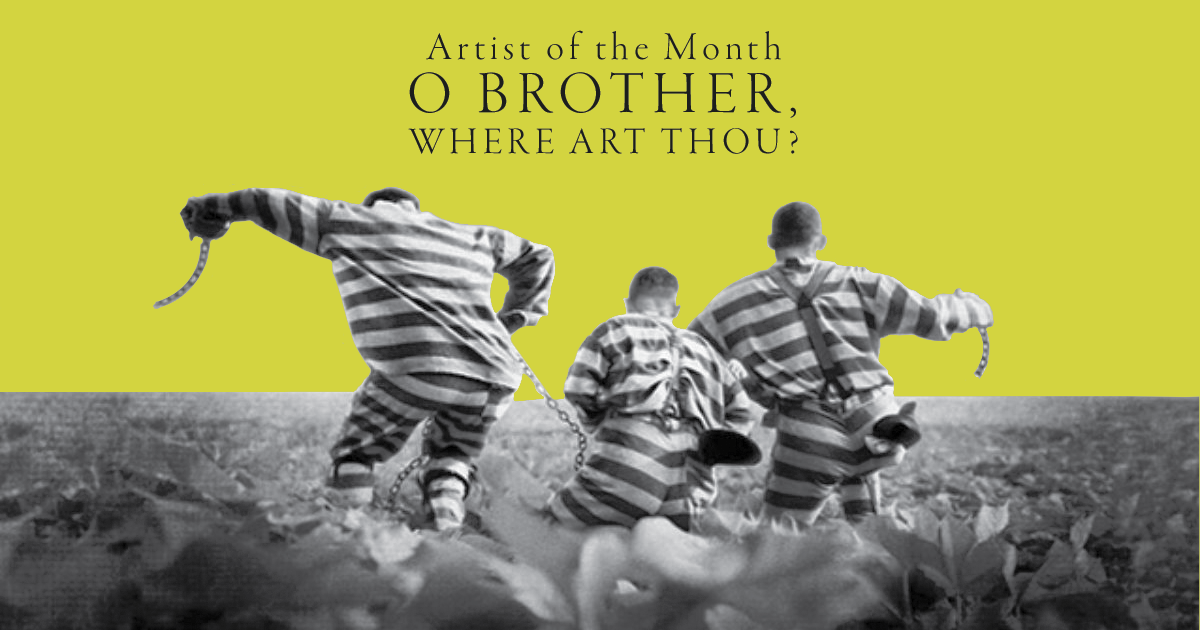
Artist of the Month: ‘O Brother, Where Art Thou?’

Twenty years ago, in 2001, the music of O Brother, Where Art Thou? captivated America and, suddenly, bluegrass appealed to pretty much everybody. We could all sing at least a few words of “I Am a Man of Constant Sorrow,” though admittedly not sound as good as Dan Tyminski or the Soggy Bottom Boys. Roots music heroes Emmylou Harris, Alison Krauss, and Gillian Welch added more positive press to their résumés, and before it was all over, the generation-spanning collection won multiple industry accolades, inspired a national tour, and even led to the first-ever Grammy Award for Dr. Ralph Stanley.

The song choices were largely well-known to dedicated bluegrass listeners, but even so, chestnuts like “I’ll Fly Away” don’t routinely end up on albums that sell eight million copies. Legends like Norman Blake and The Fairfield Four shared the spotlight with rising talent such as Chris Thomas King and The Peasall Sisters. Two decades later, The Whites still perform their version of “Keep on the Sunny Side” on the Grand Ole Opry at nearly every appearance, and to be sure, the audience smiles and applauds to hear it again.

This month, we’ll look at the legacy of that landmark album as an inspiration to a new generation of acoustic musicians, along with an interview with family members of John Hartford, whose name is back on the Grammy ballot this year for the collaborative album, The John Hartford Fiddle Tune Project, Vol 1. We’ll also have a special edition of our Roots On Screen feature about the film. Plus, check out a special IBMA Awards show performance of “Down In the River To Pray” and an archive edition of The Breakdown. And to finish out the month, we asked a crew of young bluegrass and Americana stars what the film means to them. While you’re at it, put down the Dapper Dan and turn up the O Brother, Where Art Thou? soundtrack below.


With ‘Distance and Time,’ Becky Buller Gives Us More Heart, More Fiddle

In the business of bluegrass, it’s one thing to have a song on the radio or win some fiddle contests. But when you have a total of 10 IBMA awards between your fiddling, singing, and songwriting, then you might really have something. And Becky Buller has it.

Her new record, Distance and Time, is out now on Dark Shadow Recording, following 2018’s acclaimed Crêpe Paper Heart, while 2014’s Tween Earth and Sky ended the 10-year gap after her debut Little Bird. Known of us, Buller included, knew that we’d be spending an eternity in 2020 socially-distanced, yet Buller’s new set of songs is just the thing to keep us company as we head into winter.

BGS sat down with Buller to talk about the new album, her songs, and fiddlers — lots of them.

There is so much collaboration on this album and your work in general, between your songwriting and the featured guests. Why is that important to you?

Oh, it’s just fun to have a chance to work with these people. And of course, my band is doing the bulk of the work on the record, and they’re amazing! I do a lot more co-writing these days than I used to do, it just helps me get in the right headspace. Making that appointment forces me to sit down and write, which is really hard to do these days, because I’m wearing so many hats. It’s hard to focus on the writing as much as I’d like to. When I have the songwriting appointments, it’ll get me all excited about writing. I’ll even do some writing on my own, afterwards. 

“The Ride” is quite jammy, and “I Dream in Technicolor” is, well… technicolor! Knowing you, I wasn’t surprised to hear such diversity in the aesthetic. What’s inspired you to take this unique approach towards bluegrass?

With this record we were trying to stay rooted in the bluegrass tradition, but reach a little further forward. Most of the songs feature my band, standard bluegrass instrumentation. We did include drums on “Salt and Light” — Chris Brown and his drums of renown — that’s a first for me. Of course the Isaacs just added angelic harmony to that song. “I Dream in Technicolor” was a stretch, that’s more the progressive side of bluegrass music.

And of course we’ve got the more traditional, “The Barber’s Fiddle,” so I feel like there’s something for everybody on this album. We just tried to put together a collection of songs that offered diversity, but had that common thread of bluegrass. I personally like it when the songs on a record are diverse, it keeps me listening. So, that’s what I wanted to present. We recorded a cover, “Woodstock,” the day before the world shut down. The very last track that we tracked for the record.

Your voice fits so well with the Fairfield Four. What’s it been like to work with them multiple times now?

I just love their music so much. There is so much soul, and depth. I just feel the spirit moving when they sing. So it was a thrill to get back in the studio with them. It’s also the first time I’ve recorded a co-write with Jon Weisberger. We’ve had a really good track record of getting cuts with other artists, but this is the first time I’ve recorded one of our co-writes.

For someone who’s just getting interested in bluegrass, who are some of the fiddlers that you’d suggest as a gateway into bluegrass? Bluegrass Fiddle 101.

Well, Stuart Duncan. Particularly the Nashville Bluegrass Band’s Waitin’ For the Hard Times to Go record. Alison Krauss, Every Time You Say Goodbye for an album reference. It’s so good. Jason Carter, on Del & the Boys. Anything by Michael Cleveland! Kenny Baker’s Kenny Baker Plays Bill Monroe. And Eddie Stubbs on the Johnson Mountain Boys’ Live at the Old Schoolhouse.

Your show on the road is fierce, and I can already envision the way these songs will fit in. What does this set of songs mean to you now, though, when there aren’t many live performance opportunities?

Well, especially the song “More Heart, Less Attack,” I’ve been performing for a few years now. We finally had a chance to record it, and it’s so timely. It’s fortuitous that it came out when it did. It just encourages people to be kind to one another, and we need that so much now. Also, we chose the title Distance and Time before the pandemic. Ironic…


Photo credit: Jason Myers

MIXTAPE: Jeff Picker’s Low End Rumblings on the Bass in Bluegrass

Maybe I’m biased*, but I’ve always felt that the bass is the most important instrument in the bluegrass band. It might not immediately draw your ear, but a bassist’s interpretation of the groove and harmony of a song holds substantial power over how the song is ultimately felt by the listener. Without a great bassist, a band full of shredders can sound anemic and sad; a heartfelt lyric can seem tedious and derivative. But add some tasty low end, and the same band will soar; the lyric will swell with passion! (Attention sound engineers: simply cranking the subs won’t cut it.) As such, the bassist’s importance in a bluegrass band is considerable.

Even so, great bassists are rarely given their due, unless they also happen to be virtuosic melodic players. Well, that ends today! Here are some examples of masterful low end artistry from some of my favorite denizens of the doghouse. Please excuse the shameless inclusion of one of my own tracks, because, well… I have an album to promote. Enjoy! — Jeff Picker

*I’m definitely biased.

Tony Rice – “Shadows” (Mark Schatz, bass)

Mark is one of my favorite bluegrass bassists. His tone is huge and clear, and his bass lines are subtly creative. On this track, listen to the fluid transitions back and forth between standard bluegrass time and a more open feel. Also note his slick fills and voice leading throughout.

Nashville Bluegrass Band – “Happy on the Mississippi Shores” (Gene Libbea, bass)

If aliens came to earth, demanded to know what bluegrass bass sounded like, and stipulated that I had only one song with which to demonstrate it, I’d play this. Gene Libbea’s feel is perfect; his note choices are just varied enough to add a bit of intrigue to the basic harmony of the song, while never sacrificing the pendulum effect that drives the bluegrass bus. The occasional unison fill with the banjo adds to the fun.

Ralph Stanley and the Clinch Mountain Boys – “Loving You Too Well” (Jack Cooke, bass)

I love this approach to the bluegrass waltz. Jack Cooke’s playing here is busier than what you might hear from many bluegrass bassists these days, and there’s a certain playful and casual quality to it, which I find refreshing. He bounces around between octaves, and between full walking lines and half-notes. Old-school, “open air” bass playing.

Matt Flinner – “Nowthen” (Todd Phillips, bass)

This song may sound slow and simple, but make no mistake: to groove like this, at this tempo, in this exposed instrumentation, is HARD. Todd Phillips demonstrates his mastery here: clear tone, impressive intonation, and intentional, direct timing. I also love how softly Todd plays — at times, he seems to barely touch the bass. To me, that conveys maturity and experience.

Patty Loveless – “Daniel Prayed” (Clarence “Tater” Tate, bass)

I had fun studying the bass playing on this track when I got to perform it with Patty and Ricky Skaggs a few years back. Clarence “Tater” Tate played both bass and fiddle for Bill Monroe’s Blue Grass Boys over the years, and had about as much pedigree in bluegrass as can be achieved. I dig the playing here, because it feels like an old-school, 1950s approach (bouncy, busy, slightly loose bass playing), but with contemporary recording quality. If you focus on the bass, you can tell how much fun he’s having with the slightly crooked form and joyous lyric — it sounds like a musical smile.

Anaïs Mitchell and Jefferson Hamer – “Clyde Waters (Child 216)” (Viktor Krauss, bass)

The first time I heard this song, I didn’t even realize there was bass on it. But I found myself coming back to it, drawn by the story-like quality of the musical arrangement, and I realized that the bass plays a major part in that dynamism. Viktor Krauss displays impeccable taste in his musical choices here. He knows when to play, when not to, when to articulate an additional note, when to sustain. For a player as technically proficient as Viktor, such restraint is impressive. His playing serves the song, first and foremost.

Del McCoury Band – “Learnin’ the Blues” (Mike Bub, bass)

As everybody in Nashville knows, when Mike Bub and his Kay bass show up at a gig, a fat groove is imminent. This track showcases Bub’s rock solid hybrid feel — he bounces between 4/4 walking and half-time, triplet and ghost note fills, and even has a little two-bar break in the middle. This is the type of bass playing that makes it virtually impossible to sound bad (not that Del and the boys needed any help in that department). Bub is also a great guy with a sense of humor and tons of knowledge and stories about Nashville’s music history.

John Hartford – “Howard Hughes’ Blues” (Dave Holland, bass)

Bluegrass as a musical style is pretty specific — there’s room for a wide variety of personal voices, of course, but there are definitely some foundational qualities and vernacular that indicate whether a player is truly versed in the style. On this track, jazz legend Dave Holland sounds like exactly what he is: a jazz musician playing bluegrass. Normally a recipe for disaster, here somehow it works. His tone, feel, note choice, and general approach sound foreign in the style, but they actually mesh with Hartford’s loose and jovial manner quite well. A slightly bizarre but enjoyable approach to bluegrass bass.

Ricky Skaggs – “Walls of Time” (Mark Fain, bass)

I’ve spent a lot of time studying Mark Fain’s playing for my job with Ricky Skaggs, and I’m always finding subtle little musical gems in his bass parts. It’s Mark’s tone, taste, and timing that anchor most of the canonical Kentucky Thunder recordings that we all love. This track showcases his mastery of the bluegrass groove at a slow tempo — listen to the way he spruces up what could be a one-and-five-fest with ghost notes, fills, and syncopation.

Jeff Picker – “Rooster in the Tire Well” (Jeff Picker, bass)

When I was making my new record, With the Bass in Mind, one of my musical goals was to find some space for the bass to shine and for me to use some of the technique I don’t use very often as a sideman. As such, the record has many bass solos. This song has no bass solo, however, since this Mixtape isn’t about bass solos! There are some cool bass lines in it, though (if I do say so myself). I tried to choose my notes carefully, to help anchor the band through the song’s many metric changes.

Robert Plant and Alison Krauss – “Let Your Loss Be Your Lesson” (Dennis Crouch, bass)

This track is not exactly bluegrass, but what an incredibly grooving bass part. Here is a rare example of a time when slap bass was musically appropriate! Dennis is a friend of mine and a great guy and bassist. He plays with gut strings, punchy tone, and undeniably solid time. He’s also the master of throwing in a couple creative measures of voice leading at exactly the right moment in the song. I try to catch Dennis out playing in Nashville whenever I can.

Stan Getz and the Oscar Peterson Trio – “I Want To Be Happy” (Ray Brown, bass)

This is obviously not bluegrass, but no bass-centric mixtape would be complete without tipping the hat to King Ray. His half-time feel throughout the melody is flawless, and just listen to that crushing avalanche of groove beginning around 00:37. Ray is a bluegrasser’s jazz bassist because he plays on top of the beat, and his playing has a relentless forward motion, like the banjo playing of Earl Scruggs. I’ve loved this recording since I was 15 — you won’t find better bass playing anywhere.


Photo credit: Kaitlyn Raitz

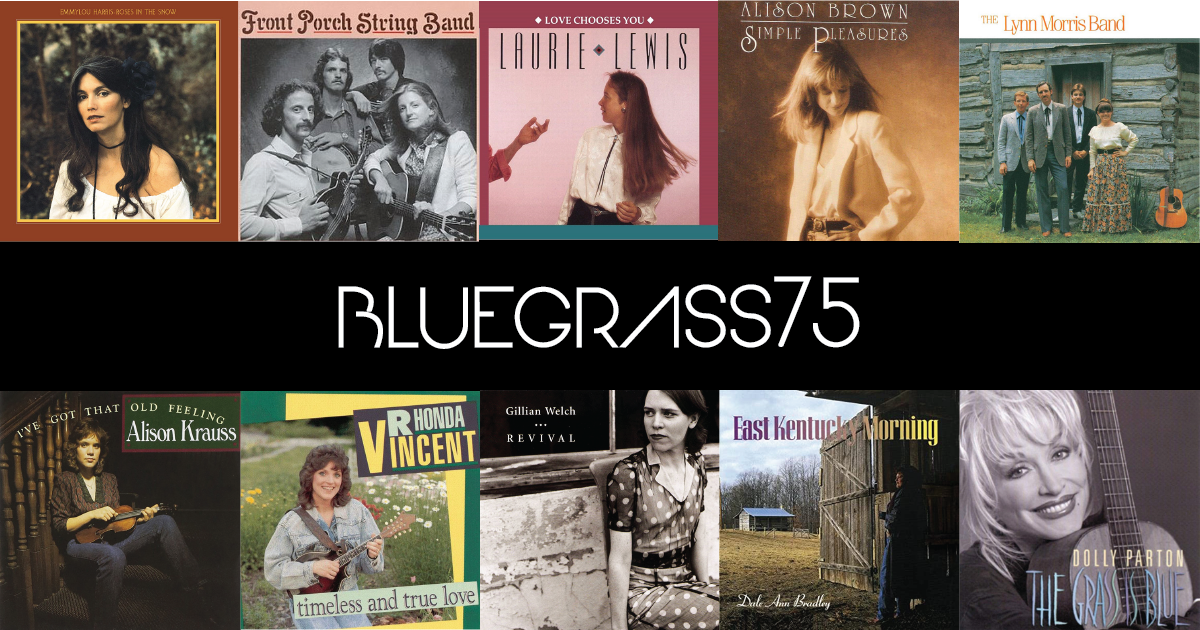
In the ’80s and ’90s, These 10 Women Made Bluegrass Better

With this year marking the 75th anniversary of bluegrass, it’s remarkable to note that women emerged as a creative force at roughly the halfway point between then and now. Of course, female musicians have been part of the fabric of bluegrass from the start, with Mother Maybelle Carter, Sally Ann Forrester, and Hazel & Alice among those serving as inspirations through the decades.

However, the role of women as bandleaders, rather than in a supporting role, began to change in the ’80s and flourished in the ’90s. As part of our Bluegrass 75 series, BGS commends these 10 women who carried bluegrass forward with a combination of undeniable talent, strong material, and a refreshing new perspective.

Emmylou Harris

One of the most visible country artists of the ’70s turned her attention to bluegrass, with a support team she deserves (Ricky Skaggs, Jerry Douglas, Dolly Parton, etc.) Her material ranges from the Louvin Brothers to Paul Simon, though that exquisite voice makes the album seamless. It’s one of her finest albums in a brilliant catalog.


Claire Lynch

With a crystalline soprano, Claire Lynch first gained notice as a lead vocalist and guitarist with Front Porch String Band, which released an indie album in 1980 that was picked up by Rebel Records in 1983. The poignant track, “Hills of Alabam,” which she co-wrote, shows her gift for melody and her ability to sing with sincerity.


Laurie Lewis

A key figure of the West Coast bluegrass scene, Laurie Lewis can fiddle with the traditionalists, then hush a crowd with a beautiful acoustic ballad like “Love Chooses You.” As the acolyte of a generation before her, Lewis actively takes an interest in the bluegrass scene’s rising talent, as evidenced on her latest work, an album of duets entitled and Laurie Lewis.


Alison Brown

As a picker, Alison Brown has made her mark on countless recordings and won the 1991 IBMA Award for Banjo Player of the Year. She’s also a co-founder of Compass Records, a producer, and a Grammy-winning artist. At times blazing, and other times mellow, Brown consistently finds just the right tone on her albums’ instrumentals.


Lynn Morris

Blessed with a sweet but persuasive voice, Lynn Morris knew how to get the storyline across, whether she’s reminiscing about “Mama’s Hand” or laying down the law in “You’ll Get No More of Me.” As a banjo player, she had incredible chops, and her grace on stage (and off) has made her one of the bluegrass family’s most beloved figures.


Alison Krauss

A gifted vocalist, bandleader, and fiddler, Alison Krauss kept her early career focused on bluegrass, though her material would soon find its way to millions of country listeners, too. Being a former child prodigy herself, she served as a role model for a generation of younger pickers, while showing traditionalists that bluegrass is indeed in good hands.


Rhonda Vincent

Coming up in a family band, singer and mandolin picker Rhonda Vincent has been working in bluegrass for decades, though she’s always finding ways to keep things fresh. Still, her early albums remain some of her most satisfying work. As a bandleader, she keeps the energy up on stage, and her outgoing personality makes her a true entertainer.


Gillian Welch

While few would consider her albums to be bluegrass proper, Gillian Welch has exerted tremendous influence on its community. A 1993 winner of Merlefest’s Chris Austin Songwriting Contest, Welch has seen originals like “By the Mark” and “Caleb Meyer” become standards, and though she didn’t grow up in Appalachia, her songs somehow embody its heritage.


Dale Ann Bradley

A sterling discovery from the New Coon Creek Girls lineup, Dale Ann Bradley launched her solo career by selecting relatable material along with a surprise or two (including a U2 cover). It’s a template that still serves her well. The title track of East Kentucky Morning captures the mood and melancholy that she continues to convey so well.


Dolly Parton

It’s hard to imagine now, but Dolly Parton had dropped off the mainstream radar in the mid ’90s. Then her first bluegrass album proved what her fans knew all along — she represents her mountain people well. A wonderful mix of familiar favorites and new material, The Grass Is Blue solidified her reputation as one of music’s most important voices.

(Editor’s note: Explore more of our Bluegrass 75 Artist of the Month coverage.)


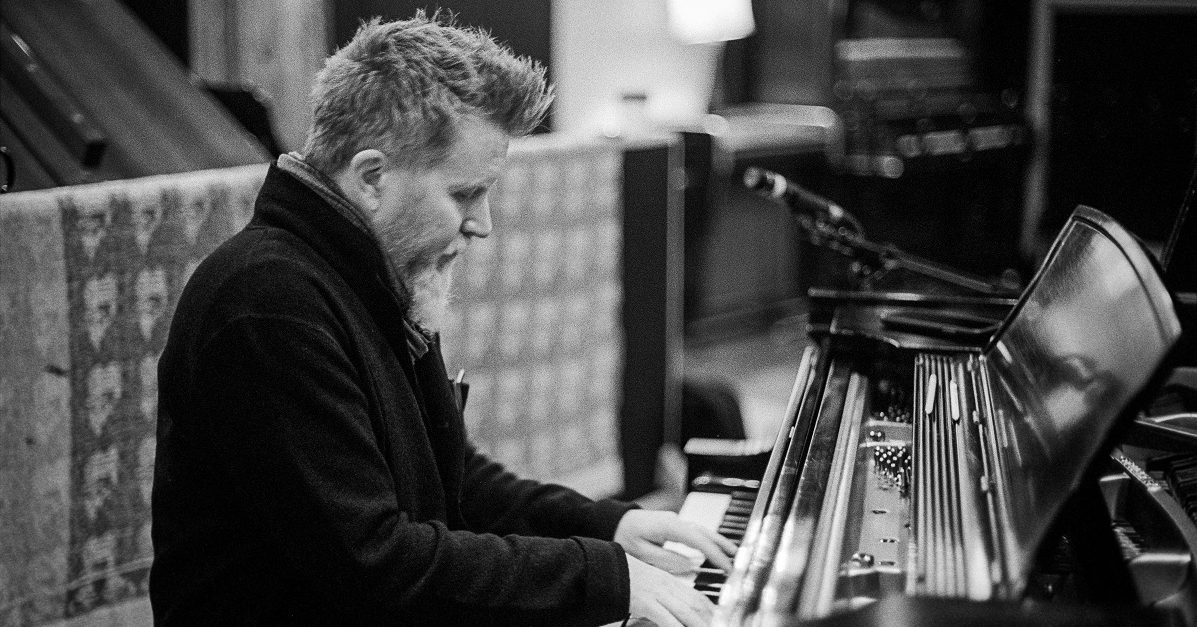
The String – Matt Rollings

Matt Rollings says his role as the leading studio piano playing sideman in Nashville from the late 1980s onward made it hard for him to forge his own taste and sensibility as an artist.


LISTEN: APPLE PODCASTS

Now that he’s slowed that work and broadened his projects, he’s made his first album as a leader in 30 years, Matt Rollings Mosaic, with a bunch of friends and collaborators who happen to be superstars, including Alison Krauss, Lyle Lovett and Willie Nelson. Our talk covered the fascinating ways and means of the A Team Nashville session players and much more. Also in the hour, emerging singer songwriter Shannon LaBrie, who’s about to release an album produced by the guy who brought us The Judds and SHEL among many others.

WATCH: Matt Rollings, “Stay” (Feat. Alison Krauss and Vince Gill)

Artist: Matt Rollings
Hometown: Nashville, Tennessee
Song: “Stay” (featuring Alison Krauss and Vince Gill)
Album: Matt Rollings Mosaic
Release Date: August 14, 2020
Label: Dualtone Records

In Their Words: “I wrote this song with the incredibly gifted singer/songwriter Alisan Porter, who won The Voice in 2016. We wrote it for an album I produced for her that came out in 2014. When Alison Krauss agreed to be a part of Matt Rollings Mosaic, I immediately thought of ‘Stay,’ and that she is the only person (other than Alisan Porter) that I could ever imagine singing it. We cut it live — piano, drums, and vocal — and Alison Krauss did what she always does: Left everyone in the room with their jaw hanging open! Later I added her brother on bass (the insanely talented Viktor Krauss) and enlisted my friend Kris Wilkinson, who did the achingly sparse string arrangement. Finally, the incomparable Vince Gill added a background vocal that perfectly supports Alison’s sublime performance. The result is one of my absolute favorite tracks on the record.” — Matt Rollings


Photo credit: Michael Wilson

Jerry Douglas – Toy Heart: A Podcast About Bluegrass

For the final episode of season one of Toy Heart, we have host Tom Power’s 2019 sit down with legendary artist, musician, and sideman Jerry Douglas at the International Bluegrass Music Association’s annual business conference in Raleigh, NC.

LISTEN: APPLE PODCASTSSPOTIFY • MP3


Douglas talks all about hearing “Uncle Josh” Graves for the first time with Flatt & Scruggs and, in the early days, using a toothbrush to turn his own guitar into something like a Dobro. He tells stories of his father’s band, the The West Virginia Travellers, and being discovered by the Country Gentlemen. He shares about his lifelong friendship with Ricky Skaggs — and his connections with Tony Rice, J.D. Crowe, Alison Krauss, Ray Charles, to O Brother, and more. Jerry Douglas will go down as one of the finest American musicians of his generation, but for this episode we focus on his true love — his life in bluegrass.

Alison Brown – Toy Heart: A Podcast About Bluegrass

Banjoist and record label head Alison Brown speaks with host Tom Power from her studio at Compass Records headquarters in Nashville, Tennessee. They begin with her early records made with Stuart Duncan, “finding her people,” and winning the Canadian National Banjo Championship (as an American).

LISTEN: APPLE PODCASTS • MP3

Brown then headed to Harvard, and playing banjo became “something you’d talk about at cocktail parties.” She describes the moment she decided to leave investment banking and commit to music full time, her cocktail napkin dream, and playing with Alison Krauss, Indigo Girls, and Michelle Shocked.

Power and Brown talk women in bluegrass, women in banjo, and the First Ladies of Bluegrass. The story they dive into together is ultimately about figuring out what makes you happy, and pursuing it bravely, against all odds.