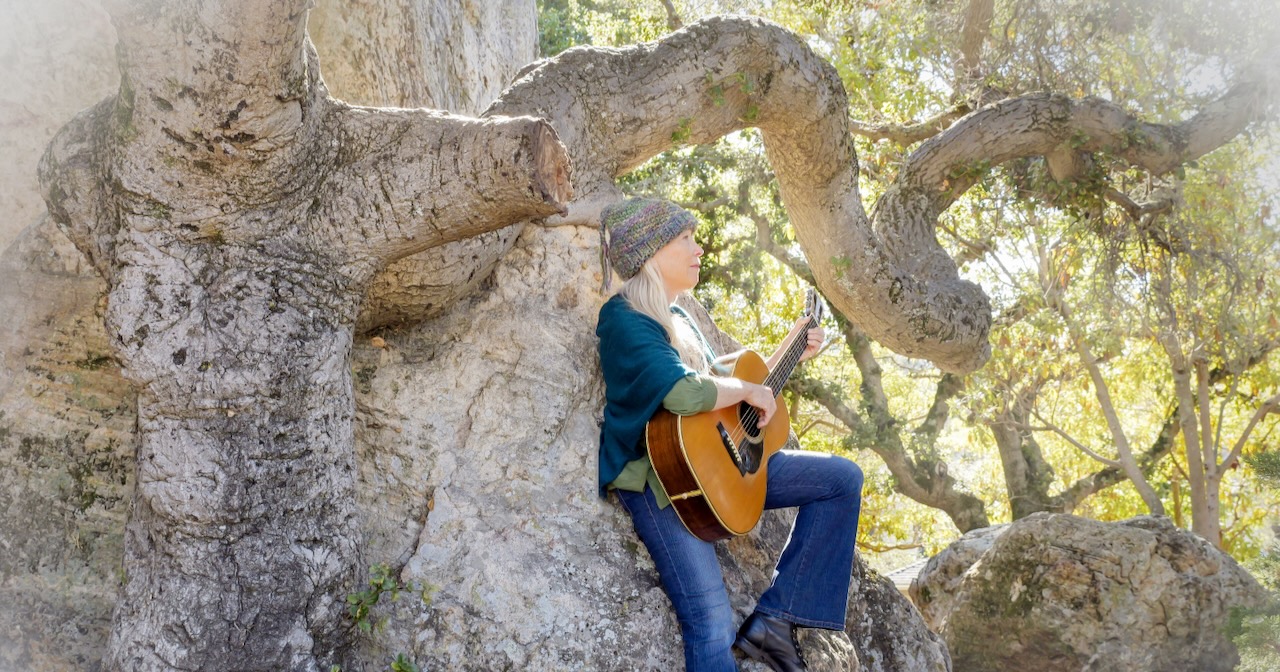
Laurie Lewis Chooses Tenacity Over Hope on New Album, ‘Trees’

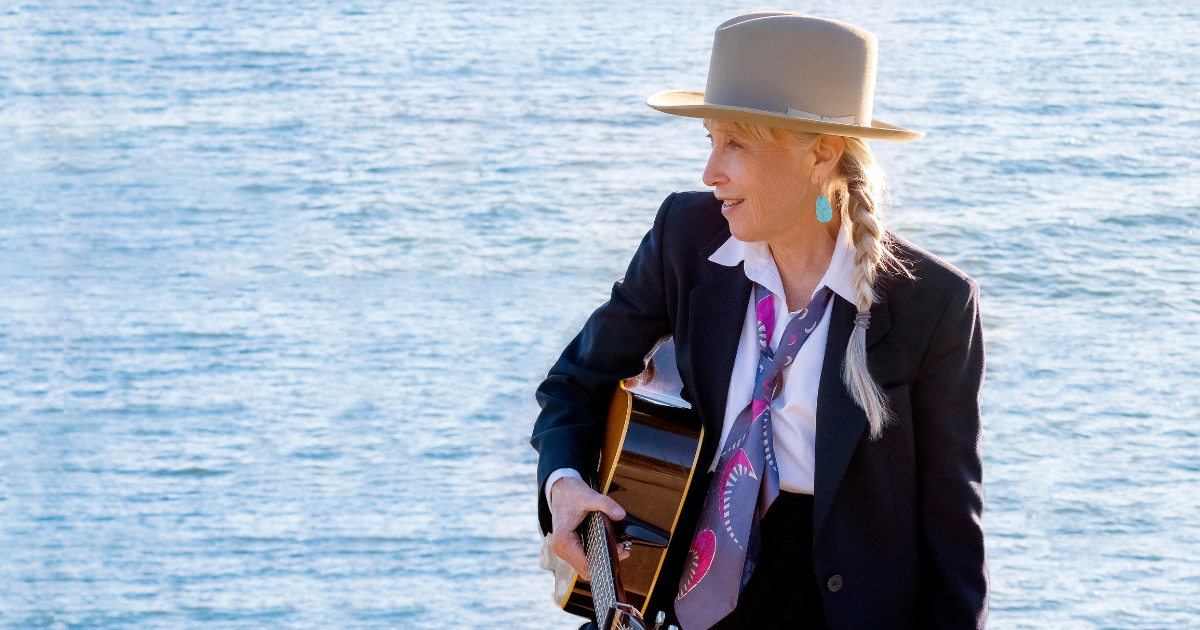
Counting John Prine, Linda Ronstadt, and Wendell Berry among her fans, Laurie Lewis is arguably one of the most diversely influential figures in American roots music culture. She’s a songwriter, fiddler, frontwoman, performer, producer, teacher, and mentor. She’s been nominated for multiple Grammy awards and graced the stage at the Grand Ole Opry. The International Bluegrass Music Association has twice named Lewis Female Vocalist of the Year, and the association’s former executive director, Dan Hays, once called her “one of the preeminent bluegrass and Americana artists of our time and one of the top five female artists of the last 30 years.”

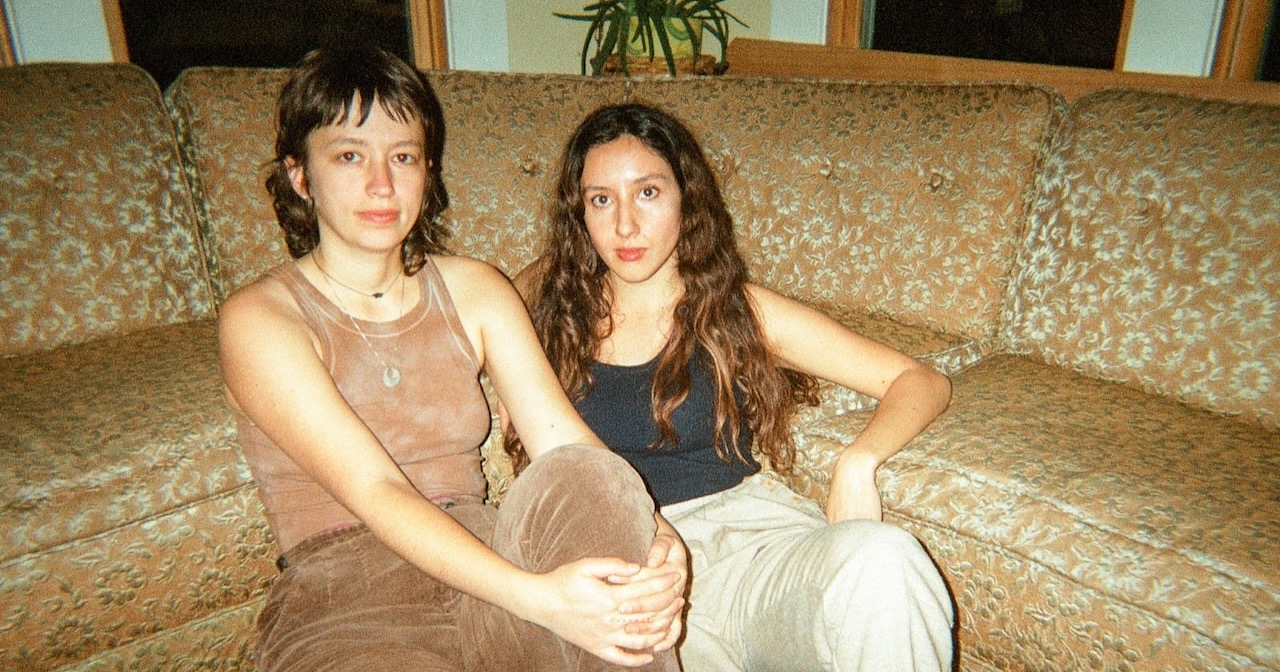
Lewis’s latest release — her 24th full-length record — pairs the artist’s musical mastery with her willingness and courage to face the full spectrum of life’s experiences. From personal grief to environmental despair, Lewis does not shield her eyes from difficult truths. In many ways, the album pays homage to its namesake, trees. When asked why, Lewis notes their tenacity. When something is tenacious, it grips firmly, with determination and persistence. Even in the face of immense challenge and uncertainty, trees abide in their purpose and work — and so does Laurie Lewis.

TREES is a long-play collection of songs that tenderly, earnestly, and sometimes joyfully explore what it means to exist on a vulnerable planet through times of loss and love. Supported by a band of masterful collaborators — Haselden Ciaccio (bass, vocals), Brandon Godman (fiddle, vocals), Patrick Sauber (banjo, vocals), George Guthrie (banjo, vocals, guitar), Tom Rozum (vocals, cover art), Andrew Marlin (mandolin), Sam Reider (accordion), and Nina Gerber (guitar) — Lewis dives into the deep end of sorrow and change with tenderness, authenticity, and Americana storytelling prowess.

In the album’s liner notes, Lewis shares that TREES is the first project she’s made in nearly 30 years without the mandolin accompaniment of her partner Tom Rozum, who recently developed Parkinson’s disease. “This collection represents a difficult transition in my musical life,” Lewis shares. “Think of it as ‘Music Minus One.’”

From bright bluegrass tracks like “Just a Little Ways Down the Road” to the somber invocations of “Enough” and “The Banks Are Covered in Blue,” this album is intricate and complex, much like a healthy forest. The album brings us “Quaking Aspen,” showcasing Lewis’s characteristic lyrical fiddle style, and title track “Trees,” an a cappella bluegrass-gospel ballad that gently yet hauntingly denounces the violence of industrial civilization.

Always looking to the natural world for strength and guidance, TREES is about love — for life, for land, and for people. But love isn’t a purely hopeful or romantic thing; it encompasses both loss and pain, and Lewis gracefully and vulnerably reckons with both on this album.

You just returned from a string of shows playing songs from the new album. Where did you go?

Laurie Lewis: My string of shows was actually mostly a river trip. So I did play every night, but I was mostly spending the days in the canyons… On the Yampa River, which starts in Colorado and goes into Utah and flows into the Green River. It’s a really, really beautiful canyon.

I love that. When you were playing shows, how did it feel to share these new songs with the world?

I’ve been doing a lot of songs from the new album, yeah, and I’m really enjoying that. But also, in any of our sets with my band, we pull out the old ones, too.

Speaking of the older stuff, I listened to your first solo record, Restless Rambling Heart, directly after listening to your newest record from start to finish. The first thing I noticed was that the tempo has downshifted quite a bit from that first release. Does TREES feel more introspective to you than other records you’ve made?

Oh yeah, it definitely does — especially compared to Restless Rambling Heart.

You’ve collaborated with the great poet, writer, and activist Wendell Berry — he asked you to set some of his poems to music. What was that experience like?

It was really fantastic. I’m such a fan of Wendell Berry’s writing. It came about because I was putting out a songbook and the publisher said, “Well, you need to get some blurbs for the back.” I happened to be at a writing workshop and one of the writers there said, “Hey, do you know Wendell Berry?” And I said no, and he said, “Well, he’s a big fan of yours.” [He had been] at a writing conference with Wendell and Wendell asked if he knew me and, you know, small world sort of thing.

So I thought, Well, how do I get in touch with him? Maybe he could write me a blurb, who knows? But [Wendell] famously doesn’t do e-mail or anything like that, so I got his mailing address and wrote him a long-hand letter on one of those yellow legal pads, you know, and I sent it off to him. And lo and behold, he wrote back. He said, “Well, I really don’t know anything about music, and my wife says I can’t carry a tune in a bucket, so hadn’t I better say no to writing a blurb?” And I thought, Well… that’s a question, so it deserves to be answered. So I wrote back and said, “Of course you should say yes, because really, the only prerequisite for saying you like something is that you actually like it. It doesn’t matter that you don’t have a background in music. It’s a personal response.”

And he said, “Well yeah, okay. I’ve been telling people I’m not writing blurbs anymore because too many people ask me, but didn’t I write something in that first letter that you could take out [and use]?” And there was this really nice thing…

So we just ended up having this back-and-forth conversation. He sent me some books. I sent him some CDs. I finally got a chance to meet him, but eventually I just felt like this is a person who is so conscientious, he’s going to respond to whatever I write. And he’s so busy, and he’s got so much stuff to do, I don’t want to bother him anymore. So I kind of dropped the correspondence. I wish I hadn’t, but it felt like the right thing to do. I just didn’t want to be that pestering voice that he felt he had to write back to.

Did he get back in touch with you at some point? Is that how his request came to light?

In the midst of all our back and forth, he sent me a poem in the mail and asked if I wouldn’t mind terribly trying to put it to music. So I did. That was “Burley Coulter’s Song for Kate Helen Branch.” It was quite a puzzle, because it’s not a standard rhyme scheme or anything. I had to make it loop around like a little crooked fiddle tune to make it really work.

Trees aren’t just the theme of this album — they’re growing all over your creative imprint. Your label is called Spruce and Maple Music, for example. What is it about trees specifically that inspires you?

I love the tenacity of trees — the way they just wait ‘til you get out of the way and then come back. … There are too many humans on the earth. We take up way too much space and way too many resources and we’re crowding everybody else out. And by “everybody else” I mean all the animals and plants and everything that also shares our earth. I just feel that, you know, trees are these beneficent beings that just wait and take their time and come back whenever they’re given a chance. They’re responsible for the oxygen we breathe and for taking in the CO2 we release. They’re sort of purifying everything. So it makes me feel very hopeful… If we just get out of the way a little bit, trees can come in and help set the planet right again.

Speaking of trees, the title track on this album is written from such a unique perspective. You literally embody the voice of the trees. How did this idea come about? Had you written from the perspective of the natural world before?

Well actually, “The Maple’s Lament” … I think that was the first time I tried to embody a tree. But I’ve done a few songs like that since. “American Chestnuts,” from my Skippin’ and Flyin’ album is from the voice of the American chestnut trees, which were the main tree along the Appalachian Mountains before the Chinese chestnut blight.

Have you read The Overstory by Richard Powers?

You know, I have, and I thought, Well, this is my song! [Laughs] But I wasn’t inspired by the book.

I personally take comfort in the knowledge that the world will go on spinning without us, despite how powerful we imagine ourselves to be. What sustains you as a sensitive person who feels the weight of what’s happening in and to the world? What carries you through?

Well, that’s that hope – [in] the other beings on the earth, their ability to repair the damage we’re doing. But I don’t hold out a lot of hope for human beings to rein in our excesses. I just don’t. I unfortunately do not see that happening in a timely enough manner to prevent, for instance, desertification of much of the earth’s crust. I’ve never said this stuff in an interview before, but yeah– I do not hold out a lot of hope.

I really appreciate you saying that. I feel like we’re often pressured to feel hopeful, but sometimes it feels more important to just be present with our grief about what’s happening to the world. Where did your deep relationship with and love for the natural world begin?

Oh boy, well, lots and lots of places. From ages three to eight, I lived in Ann Arbor, Michigan, in this new subdivision a block from the country. I loved to ramble in the woods and just see the farms and stuff like that. When my family [moved to] Berkeley, California, it was really a shock for me, and I have to say, Tilden Park probably saved my life. It’s a big regional park that’s up over at the top of the Berkeley Hills. It’s a huge park — you could get lost in it for days. Being able to take the bus to the top of the hill and disappear into Tilden Park when I was a kid was the best thing ever, and it really helped me through a lot. So I would say Tilden was maybe the first place where I really sought refuge in the natural world.

In addition to environmental grief, you’ve spoken about the role personal grief played in the creation of this album, and the presence of these feelings is very tangible throughout. Has some part of you had to practice becoming more vulnerable as an artist over time, or did the process of sharing your pain through your songwriting come naturally?

I have been accused throughout my career of writing songs that are a little bit too easy to figure out, you know, where they’re from. They’re personal songs — people have noted that. [But] maybe they’re putting stuff in them that’s not actually there, and I believe that to be the case on some of the stuff. Writing has always been my best source of communication with the world and I think I’ve always just written from an emotional place. If my songs are deeper now, it’s because events in life are a lot harder when you’re 73 than when you’re 23 or 33 or 43.

One of the more uncommon forms of grief is the grief over the loss of one’s own voice. A few years ago, you lost your singing voice for six months. What was that experience like for you, as someone who’s spent so much of your life using your voice to connect with the world?

It was terrible. It was paresis, [so] the right side of my neck muscles were paralyzed, and I couldn’t move my larynx on the right side. It made singing very, very difficult, until it got to a point where my voice just quit. And I thought, I’m not gonna sing anymore. It took about six months to recover, and it hasn’t completely recovered. My voice is different now.

It was a very difficult time. I went to many doctors, and one said, “Well, you have about a 50/50 chance of getting your voice back.” And I’m going, “Those odds are just not good, you know? It could happen or not — it’s a coin toss.” That freaked me out.

But some amazing things happened in that time. I have an annual gig, the concert I do at the Freight & Salvage here in Berkeley, my hometown, over Thanksgiving weekend. When I had no voice, I didn’t want to give up my night, so I asked my friends to come and sing my songs. I put together a folder of tons of songs and nobody picked the same song. It was amazing. It was the most incredible healing night of music for me. I mean, it was really the best Laurie Lewis show ever and I never opened my mouth except to speak a little bit. It was really lovely. Out of anything, I think that helped me get my voice back.

I’m honestly tearing up a little hearing you talk about that. It really speaks to the power of community. Speaking of community and audiences, who do you write music for? When you’re writing a song or recording an album, do you have a particular listener or audience in mind?

Just myself, really. It’s very selfish. [Laughs] I mean, I just write for myself, what I’m feeling or what I’m observing. … That’s always the starting point. If I think up a story, it’s because I want to tell the story, you know? I want to hear the story. If it’s an emotional thing, it’s because it’s something I’m dealing with or going through. But after the initial thought, I try and use my craft to make the songs better so that somebody can actually understand what I’m singing about and talking about in my music. And that’s really the most gratifying thing, when a listener really responds. It’s just great.

You’ve described your music, particularly on this album, as a way of interpreting the voices of the landscapes you adore. How do you experience or receive the voices of the natural world? How did you learn to listen for these much-needed voices?

I’ve always been a fairly quiet person. I listen more than I speak. I’ve had to actually learn to speak, you know, out loud. But I think I just have an observational approach to the world. I would rather listen and observe people talking to me than jump in and add my own spin or make a lot of noise myself. The same thing is true in my relationship with the natural world. I’m an avid walker and I find that walking and listening and looking in the natural world is my favorite thing to do.

Do you have a favorite song on the album?

I like a lot of them actually. You know, they’re different moods. Speaking of walking, “Just a Little Ways Down the Road” I find to be just so fun to sing and play. And of course, “Enough.” It’s heart-wrenching for me. It’s still hard for me to play that song in public. It requires a really different audience. It’s not a festival song. It’s much quieter, so I hold it back a lot. I just love the sound of the instruments on that cut. But I really like them all, from “Just a Little Ways Down the Road” to “Rock the Pain Away.”

It depends on the mood too. If I talk about John Prine and I sing that song [“Why’d You Have to Break My Heart?”], that really goes over well with audiences. I truly appreciate that people connect with that song.

Do you have a favorite tree?

[Laughs] No. I do not have a favorite tree.

Fair enough. [Laughs]

The California buckeye – I think it’s the prettiest little tree ever. But then I see another, you know? I was just out in Colorado among the junipers. That was the main tree alongside the river, junipers and cottonwoods. Every one of those trees was astoundingly beautiful – and so tenacious.

Is there somewhere special close to home where you’ve been going recently to be with the trees?

Well, yes. I stick around home quite a bit, because I have a lot of caregiving to do with my partner. We had to cut down a tree in our yard a couple of years ago and I was very, very sad about cutting down this great big old blackwood acacia. But we had to do it – it was gonna fall over and wreak havoc. But it cleared the way for me to view these two enormous birch trees that are like four-stories high in the neighbors’ yard. Those two trees are just remarkable, through all the seasons. They’re so graceful, and they change so much. I’ve been enjoying those trees a lot from the kitchen.

And Tilden Park is still my go-to. It’s five minutes up the road, so I can get out and walk amongst the oaks and the laurels and, unfortunately, eucalyptus, which is an invasive fire-hazard tree around here, but they’re still beautiful.

It’s so special that you still get to spend time in the same place that meant so much to you as a kid. There’s really so much we could talk about, but is there anything else you’d like to share about the album?

I did it mostly with a very small group of fantastic musicians – my bandmates Hasee Ciaccio on bass, Brandon Godman on fiddle, Patrick Sauber on banjo, and then George Guthrie also on banjo and some guitar. It’s just been really great working with these wonderful people. What they bring to the songs and how they help shape the music, they really are part of the fabric of what makes this album what it is, and it feels important to me to share that.


Photo Credit: Irene Young
You Gotta Hear This: New Music From Laurie Lewis, Lonesome River Band, and More

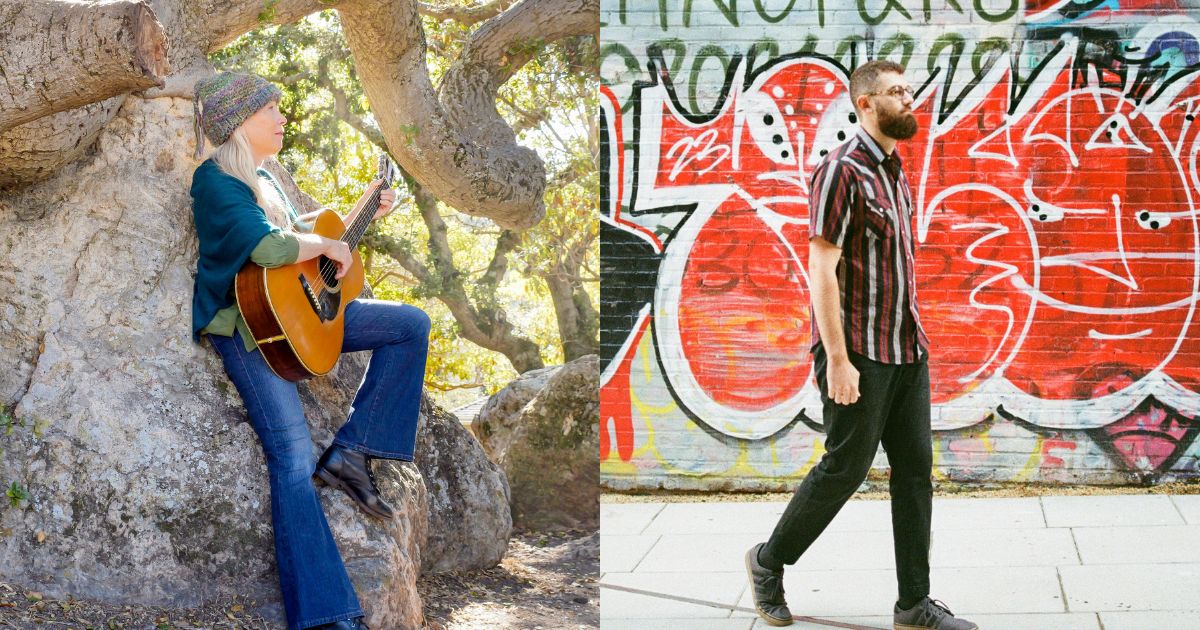
This week, to mark New Music Friday, we have a bevy of brand new music videos from folks like bluegrass legend Laurie Lewis, bassist Nate Sabat, country outfit Jenny Don’t & The Spurs, and flatpicker Rebecca Frazier, who gathers an all star lineup for a new track set to a brand new video. The Reverend Shawn Amos also brings us a delightfully psychedelic visualization to pair with a modern blues and gospel inflected track, “It’s All Gonna Change (For The Better),” that highlights how life on this planet is a gift, not a given. (We couldn’t have said it better ourselves.)

Plus, you won’t want to miss a brand new heartbreakin’ track from first class bluegrassers, Lonesome River Band. And, if you missed our post featuring The Bygones earlier this week, you can check out the duo’s song, “If You Wanted To,” below as well.

It’s all right here on BGS and, to be quite honest, You Gotta Hear This!

Laurie Lewis, “Long Gone”

Artist: Laurie Lewis
Hometown: Berkeley, California
Song: “Long Gone”
Album: Trees
Release Date: March 29, 2024 (single); May 31, 2024 (album)
Label: Spruce and Maple Music

In Their Words: “I have loved ‘Long Gone’ since I first heard Bill Morrissey sing it a couple of decades ago. Recording it was a blast, and I think that as a ‘returning’ song, it is particularly resonant in these post-pandemic times. We’ve all be long gone, from each other and the world at large. Every time I hear Brandon Godman’s fiddle kick-off, I get excited all over again, to be returning from the virtual to the corporeal world.

“Making this video was about the most fun there is, driving an aging 5-speed stick shift truck up and down Sonoma County backroads in the late winter green of Northern California. I love my job!” – Laurie Lewis

Track Credits: Written by Bill Morrissey.

Laurie Lewis – Guitar and lead vocals
Brandon Godman – Fiddle
Patrick Sauber – Banjo
Hasee Ciaccio – String bass

Video Credit: Bria Light


Lonesome River Band, “Hang Around For The Heartbreak”

Artist: Lonesome River Band
Hometown: Floyd, Virginia
Song: “Hang Around For The Heartbreak”
Release Date: March 29, 2024
Label: Mountain Home Music Company

In Their Words: “This song was sent to us from my good friend, Barry Hutchens, who has been writing some material with his son, Will, and Jerry Salley. I call it a ‘Happy Heartbreak’ song as the chorus goes, “If we chase this feeling down whatever road it leads us/ We’ll never have regrets about a chance we didn’t take/ But if we’re just pretending this might be a happy ending someday/ I’ll still hang around for the heartbreak.” It’s a great perspective put together by Barry, Will, and Jerry and it feels like classic Lonesome River Band. We hope you enjoy it as much as we do!” – Sammy Shelor

Track Credits:

Adam Miller – Mandolin, lead vocal
Sammy Shelor – Banjo, vocal
Jesse Smathers – Acoustic, vocals
Mike Hartgrove – Fiddle
Kameron Keller – Upright bass


Nate Sabat, “Sometimes”

Artist: Nate Sabat
Hometown: New York, New York
Song: “Sometimes”
Album: Bass Fiddler
Release Date: March 27, 2024
Label: Adhyâropa Records

In Their Words: “Until last September, I was playing a completely different version of this song. Written by the great Abigail Washburn, my initial version was essentially a bass-and-voice rendition of the original. In a prep session with my producer Bruce Molsky, we both agreed that it just wasn’t landing. He pulled out a fretless banjo, and suggested I try leaning into a bluesy, modal sound instead. That idea lit a fire in me, and two hours later we had something completely new.” – Nate Sabat

Track Credits:

Nate Sabat – Bass, vocals
Recorded at Spillway Sound in West Hurley, New York.
Engineered and Mixed by Eli Crews.
Produced by Bruce Molsky.
Mastered by Dave Glasser at Airshow Mastering.


The Reverend Shawn Amos, “It’s All Gonna Change (For The Better)”

Artist: The Reverend Shawn Amos
Hometown: Dallas, Texas
Song: “It’s All Gonna Change (For The Better)”
Album: Soul Brother No. 1
Release Date: May 3, 2024
Label: Immediate Family

In Their Words: “There’s a famous comedy bit from George Carlin addressing humans’ disgraceful treatment of Earth. It ends with the punchline, ‘The planet is fine. The people are fucked.’ This song takes a page from Carlin’s book of dark humor. It’s a conversation amongst non-human life counting down the days until these dumbass humans are out of the way. It’s also a simple reminder to ‘WAKE UP!’ as Spike Lee would say. Life on this beautiful planet is a gift – not a given. You dig? Say it with me, ‘We got to all stand up, ain’t gonna take too long. Keep your mind strong.'” – The Reverend Shawn Amos

Video Credit: David Sheldrick


Jenny Don’t & The Spurs, “Pain In My Heart”

Artist: Jenny Don’t & The Spurs
Hometown: Portland, Oregon
Song: “Pain In My Heart”
Album: Broken Hearted Blue
Release Date: June 14, 2024
Label: Fluff & Gravy Records

In Their Words: “Inspired by the writing style of Johnny Paycheck and his classic delivery of telling a story while the band keeps it rollin’ on. I love how some of those old classic country singers charm their way through a song where even though they might be in the wrong you still want ’em to win in the end. ‘Yeah, I know, I’m a jerk – but I love ya. Come on, come back home…’ (Not me personally! But you get the idea…)

“While my usual inspiration when it comes to songwriting tends to lean towards the female icons of the genre, for this album, I veered towards more male influences such as Chris Isaac, Lee Hazelwood, Johnny Paycheck, Buddy Holly, John Fogerty, and Link Wray. These diverse songwriters contributed to the inspiration behind the album.

“I’d also like to emphasize that while I take the lead in songwriting, the songs wouldn’t have evolved into what they are without the invaluable input, musical direction, and insight from my bandmates, Kelly Halliburton, Christopher March, and Buddy Weeks. I’m truly grateful for their contributions and thrilled to have collaborated with them on this fun album.” – Jenny Don’t

Track Credits: Written by Jenny Don’t.

Jenny Don’t – Vocals, rhythm guitar
Kelly Halliburton – Bass guitar
Christopher March – Lead guitar
Buddy Weeks – Drums
Rusty Blake – Pedal steel guitar

Recorded at Revolver Studio in Portland Oregon by Collin Hegna, September 2023.


Rebecca Frazier, “Make Hay While the Moon Shines”

Artist: Rebecca Frazier
Hometown: Nashville, Tennessee (originally Richmond, Virginia)
Song: “Make Hay While the Moon Shines”
Release Date: March 25, 2024
Label: Compass Records

In Their Words:“Growing up in Virginia and spending much of my childhood by the Chesapeake Bay, I’ve always felt an ethereal connection to the moon. To me, it feels like there’s magic in the air when the moon is full. Getting together with Jon and Bob to write this song was a reflection of that excitement – we were all laughing and cutting loose as we came up with double entendres. We wanted to express that light-hearted, anticipatory feeling of a spirited full moon night – after all, the song is a twist on the phrase “make hay while the sun shines,” which means “get your work done.” What is the opposite of that?

“Bill Wolf produced the track with his innate talent for bringing out the best in musicians – he did such an intuitive job bringing musicians in the room who would create and build the climactic moments with their improvisation. I was floored by the performances of Béla, Stuart, Barry, Sam, and Josh. Christopher Gunn’s videography was beyond my imagination. He captured the imagery of a lighthearted, spirited mood while maintaining a dream-like quality, and I think it’s beautiful.” – Rebecca Frazier

Track Credits: Written by Rebecca Frazier, Jon Weisberger, and Bob Minner.

Produced by Bill Wolf.
Rebecca Frazier – Guitar
Béla Fleck – Banjo
Sam Bush – Mandolin
Stuart Duncan – Fiddle
Barry Bales – Bass
Shelby Means – Harmony vocal

Video Credit: Christopher Gunn Creative


The Bygones, “If You Wanted To”

Artist: The Bygones
Hometown: Brooklyn, New York & Nashville, Tennessee
Song: “If You Wanted To”
Album: The Bygones
Release Date: April 4, 2024
Label: Tonetree Music

In Their Words: “‘If You Wanted To’ encapsulates the feeling of longing for acceptance and approval from someone you love that has known you through many chapters of life. People change and grow over time, and one of the biggest pains is when the ones closest to you don’t grow with you or want to get to know the current person you are. Over time, I’ve realized that you can’t make someone see you and love you for the current walk of life you’re in and not for a previous version of yourself, they have to choose to get to know you. Sometimes the ones you love just want to hold on to the version of you they knew that is no longer here.” – Allison Young


Photo Credit: Laurie Lewis by Irene Young; Nate Sabat by Jules Miranda.

MIXTAPE: Paper Wings’ Folk Rebels Playlist

While we could easily be mistaken for “a pair of demure young ladies playing in a mid-19th century parlor” as thoughtfully observed by Bluegrass Today some years ago, we are in fact drawn to folk music not for its wholesomeness, but for its realness and its capacity to have you at the edge, staring down the rocky cliffs of life into the depths of your humanity. The songs that endure and have been carried into the future often tend to have a lot of darkness balanced with beauty (reverence and irreverence), because that’s what resonates with folks. It’s what we’re made of. And anyone who dares to sing complex truths and carry stories around in their heads can be a folk rebel.

On our new album, Listen to the World Spin, we stopped worrying about how traditional we sound or “should” sound and just made the music we wanted to make. These songs tend to have themes of the contrast between connection, solitude, our personal struggles, and how we relate to the greater world around us. We ask a lot of questions on this album, the answers to which could be complicated, but ultimately are simple because there is no answer. Sometimes the best thing one can do in life is just listen.

This playlist of songs features friends, heroes, and legends; inspiratoria from our pasts and present. As we refuse to put ourselves into a musical box, so too do the artists on this playlist. Best enjoyed on a long walk or drive, preferably alone or with someone who gives you company without robbing you of your sense of solitude. Much love, – W & E, Paper Wings

“Same Old Man” – Karen Dalton

I love this combination of rough old-time banjo and electric guitar. What a voice. – EM

“Nine Hundred Miles” – Barbara Dane

I remember hearing this track for the first time on Democracy Now and it hit me as being so so cool… a feeling I only really get from punk music and raw, gritty folk. If you haven’t heard of Barbara Dane, you must look her up. She was a very involved activist during the civil rights movement and also wrote some very sharp political songs. – WF

“Sunlight” – Rushad Eggleston

I am a huge fan of the cello goblin’s love song era. – EM

“I don’t love nobody” – Elizabeth Cotten

Nobody plays guitar this good. Elizabeth Cotten is a legend, not much else to say. – WF

“I’ll Wash Your Love From My Heart” – Hazel Dickens & Alice Gerrard

Hazel & Alice are such heroes of ours! Independent, fierce, deeply committed humanists and musicians who have shone light on the path of living a life that is true to those values. – EM

“What Will We Do?” – Foghorn Stringband

Reeb Willms and Nadine Landry are true modern badasses. This track features them singing a capella on this foghorn record, and somehow it’s just as energetic and captivating as when the whole band is playing. They are incredible instrumentalists, but they don’t even need their instruments to make really good music. – WF

“No Reason” – Sunny War

I first heard Sunny play this song live in Nashville and the guitar part instantly stuck in my head. It’s so satisfying, my brain craves it. – EM

“Bad Repetation” – Woody Guthrie

From the spelling of the title, to the pronunciation of “window,” to the fact that the timing changes on every refrain and I still haven’t worked it out, Woody is the epitome of bad-boy-American-folk-singer-fun-rebel-friend. – WF

“Say Darlin’ Say” – Laura Veirs

It was bold to do this song this way with electric guitar. The hook at the end gets stuck in my head from time to time. There are so many poorly reimagined/re-harmonized trad songs, and to me, this one works because it is sparse, it is catchy, and it isn’t perfect. – WF

“Lopin’ Along Through the Cosmos” – Judee Sill

Our friend John Mailander turned me onto Judee Sill in 2019 and I listened to nothing but her for months, absolutely obsessed. The words to this song mean so much to me, “However we are is ok.” Nobody writes a melody like Judee. – EM

“Cumberland Gap” – Spencer & Rains

I remember hearing Howard and Tricia practicing this version of “Cumberland Gap” at Clifftop as they were camped next to me and being totally obsessed. I don’t know where they dug up this version, but it’s so fun and a good reminder that even when you think you know the coolest version of a song, there is probably a cooler one still out there. Also, this whole album is fun and you can even hear Emily play bowed bass on it, watch out. – WF

“Chewing Gum” – The Carter Family

I dare you to jump rope with your best friend to this song and try not to laugh when you sing the words, “I wouldn’t have a doctor, I’ll tell you the reason why/ He rides all over the country and makes the people die.” – WF

“Left Hand Lane” – Paper Wings

We wrote this song on a night drive home to Berkeley, talking about doing our taxes and being afraid of accidentally doing them wrong. We had borrowed a car from our friend Vynce. I somehow managed to live in the San Francisco Bay Area for 7 years and never had a Fastrak beeper (the toll taking company for bridges, express lanes, IYKYK) but we got to live that Fastrak life on this particular trip and it made it into the song. Thanks Vynce!! – EM

“Pretty Bird” – Laurie Lewis & Linda Ronstadt

I listened to Laurie’s albums growing up and long before I even played music. I am lucky now to call her a dear friend. I love her writing and her taste in covers. To some this might be a song about a little bird but it takes next to no imagination to hear it cautioning a young woman “he would only clip your wings.” – EM


Photo Credit: Kale Chesney

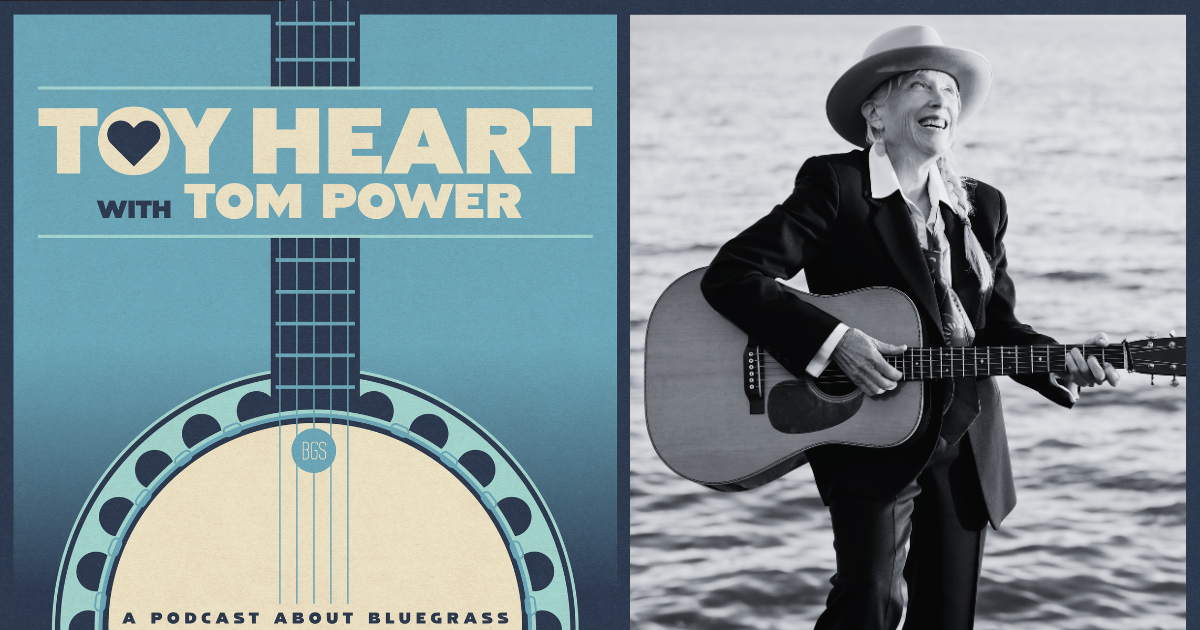
Laurie Lewis – Toy Heart: A Podcast About Bluegrass

In the latest episode of Toy Heart, we explore the roots and evolution of bluegrass in the modern era by examining the story of legendary bluegrasser, singer-songwriter, and recording artist, Laurie Lewis.

From her tales of growing up in Berkeley during what Lewis jokingly calls the “folk scare” of the ’60s to finding the joy of music through her father’s classical background and eventually becoming a pioneer for women in the genre, her lifelong career in American roots music is a perfect example of how the innovation and tradition-bending tendencies of bluegrass’s first generation continue full force today. Lewis’s musical transformation over the course of her life shows the entrancing power of bluegrass to steer and alter the course of hers and so many others’ lives.

LISTEN: APPLE PODCASTSSPOTIFYMP3

In our Toy Heart interview, Lewis chats with host Tom Power about the magnetic pulls of Chubby Wise’s fiddle tunes, of albums by the Greenbriar Boys, and of a formative live show by the Byrds. She talks about studying modern dance, “disappointing” her father by “rebelling” and choosing folk music forms over classical, and what eventually led to late-night jams, fiddle contests, and navigating the Bay Area’s bustling bluegrass, folk, and women’s music scenes.

Their conversation closes with a reflection on the ways bluegrass has affected Lewis the most, and, how it continues to shape the identities of its artists and listeners with an intractable, ineffable pull. Power and Lewis point out how current generations – from Molly Tuttle to Tatiana Hargreaves, both mentees and collaborators of Lewis – continue in these same traditions. Plus, Lewis shares what it was like to tour and sing with Dr. Ralph Stanley, himself.

This Toy Heart episode dives deep into the many layers of the genre, helping to demonstrate just some of the many ways bluegrass interweaves itself into musicians’ and fans’ personal and musical identities. Lewis shows there are countless joys in staying true to one’s artistic vision amidst an industry that is always in flux; her insights offer a soulful perspective on continuity and change within the genre, echoing the sentiments of a community that, much like a family, supports and evolves with its members – and that continues to rightly hold Lewis up as a trail-breaker and standard-bearer for the entire genre.


Photo Credit: Irene Young

Missy Raines & Allegheny’s ‘Highlander’ is Effortlessly Bluegrass

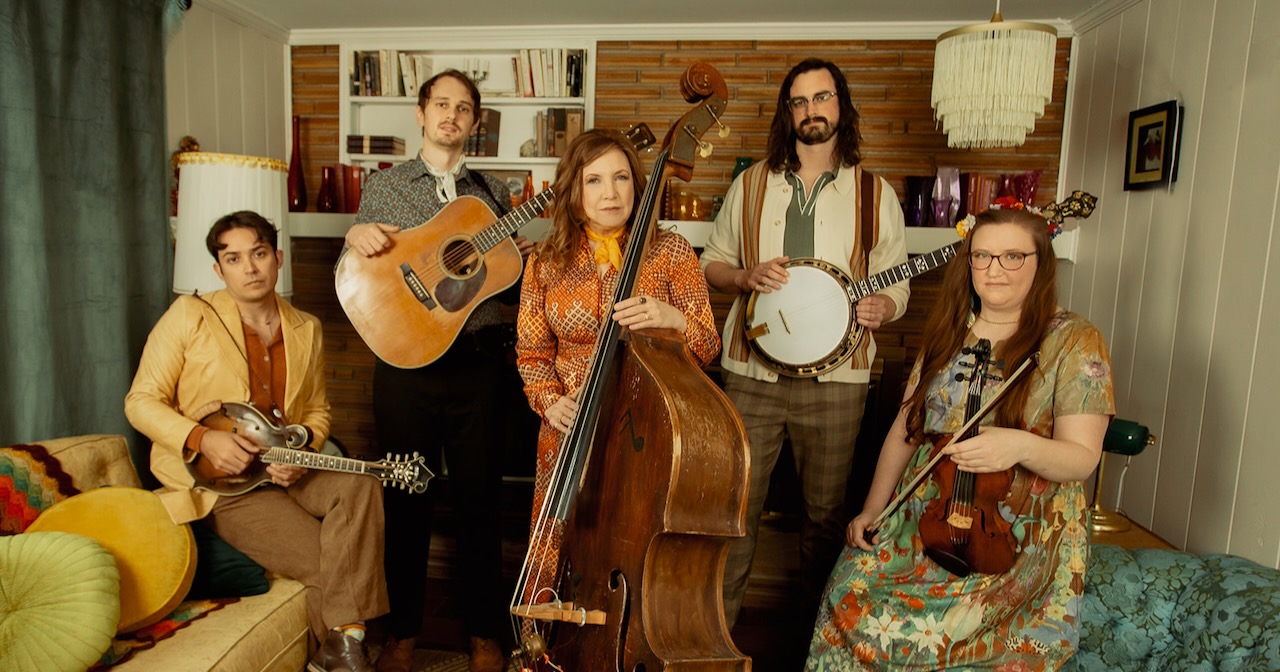
Missy Raines is one of the winningest musicians in the 30+ year history of the International Bluegrass Music Association’s annual awards. She’s a 10-time recipient of the Bass Player of the Year trophy and has taken home a couple of Collaborative Recording of the Year and Instrumental Recording of the Year awards, too. She’s been an omnipresent creative in bluegrass, in Nashville, and in American roots music as a whole for the majority of her life. Even so, many are heralding her new album, Highlander, made with her new band, Allegheny, as a “return to bluegrass.” The thing is, Raines never left.

It’s true that she spent more than a handful of years touring with an experimental, new acoustic-inflected string band, The New Hip, intentionally devoting more than a decade to highlighting her songwriting, her role as front person, and her smoky, patina-ed alto. Throughout that time, no matter how far afield the music may have explored beyond the stone walls and steel bars of bluegrass, Raines always had both feet firmly planted in the genre. While fronting and touring the New Hip, she remained a mainstay at bluegrass and acoustic camps across the country, founded and performed with several bluegrass and old-time supergroups, and “moonlit” as a bassist-for-hire for a laundry list of notable bluegrass, country, and Nashville stars.

So, however exciting it may be – and, it is truly, very exciting – that Raines and Allegheny have intentionally guided her sound back to traditional, straight ahead, mash-tastic bluegrass for her new album, Highlander, it’s important to remind Raines’ audience, the new initiates and diehards alike, that whatever music may emanate from the strings of her upright bass or from her tender and expressive voice, she has always been and will always be bluegrass. And effortlessly so. Highlander isn’t so much a return to the genre as it is a reminder that Missy Raines’ goal in music, first and foremost, is to make great bluegrass music for great bluegrass folks – her kind of folks.

This is your first album with the new band and I wanted to talk about how your creative process and how your collaboration process looks nowadays. I sense a lot of changes in how you’ve approached making music as an ensemble, but I wonder how it has felt to you, on the inside of the sonic and lineup shift from the last album to this new lineup, with Missy Raines & Allegheny?

Missy Raines: The collaboration process we have within this band, Allegheny, and for this album is the collaboration process that I’ve always dreamed of and wanted to have in a band setting. You know, I wanted to have my own band for years and years and then, after I waited a really long time, when I finally did do it in like 2009, I had in my mind that it would be like this, that it would be this collaborative thing and I’d have people who were invested. The short story is that I have that now, and that’s the beauty of it.

In the past, I did have elements of that, for sure. There were definitely folks who came into the different configurations that I had who were invested and collaborative. [That] was definitely there, but I will say, to have a moment in time when you have actually like five people sitting in the room and they’re all equally invested – that is pretty magical.

So yeah, the process for this record was very different than for Royal Traveller, because on Royal Traveller I didn’t really have a band when I started that recording. I was sort of ending the New Hip and I knew that that record wasn’t going to have the sound that the New Hip had, it was going to be very mixed, in terms of styles. There were all these different guests on every single song and there was no one solid backing band, because I actually wasn’t touring at the time. All of the main decisions and stuff were basically made by me and [producer] Alison Brown.

I think part of why this album feels so strongly like a band album is not just because of the Missy Raines & Allegheny rebrand, but also because you’ve been playing with this lineup – Ben Garnett, Eli Gilbert, Ellie Hakanson, and Tristan Scroggins – now for several years. This project feels like it was made by a band. And I think part of that feeling comes from you having worked together for as long as you did before you made the album.

I think it does. I don’t know if it also has anything to do with the fact that me, just by default– yes I’m the leader, but I’m also a bass player and my tendency and my way of thinking about any band is I come into it as a support player, because that’s what I’ve done all my life. This came up the other day online, because we’re getting lots of really great reviews from the record. Like one reviewer called my “backing” band “magnificent.” They are magnificent, but I don’t think of them as a backing band. I told them that and of course, Tristan said, “Well, that’s what we are.” And I was like, “No!” I still don’t think of [the band] that way. I don’t know if it’s just because I’m maybe still a little uncomfortable being out front, or it’s a combination of things.

It’s also just been this bass player mentality that – not that bass players can’t be out front, it’s just like, “No, we’re making this stuff together. We’re making this together.” And so I don’t see it as me standing up there doing something and they’re backing me up. I feel that if I’m not playing with them and they’re not playing with me, then we have nothing.

What was the process like as you sat down with this sequence of songs and were imagining who you wanted to have guest on the album? How did you navigate that with your producer, Alison Brown? This is a stout lineup of special guests appearing with you and Allegheny.

The only thing I knew in the very beginning, before I even talked to Alison about making the record, was that I wanted to do “These Ole Blues” with Danny Paisley. [Laughs] That was already in my head. I had this vision, I heard Loretta Lynn’s version of it and then I also knew that I wanted to change it a bit to make it more bluegrass. And it came out exactly the way I was hoping. I wanted to sing it with Danny Paisley. That was an easy one. Well, all of them were easy, because when we sat down we just listened, thought about the song, and thought who would be the right singer. And, who would also represent what it was that I was trying to say with this record.

Like, Dudley Connell on “Ghost Of A Love.” Of course, he’s playing with the Seldom Scene these days – he’s just so good that he can do anything. And no one loves the Seldom Scene more than me, but what I was looking for was Johnson Mountain Boys Dudley. [The Seldom Scene] was one of the big inspirations to this band, but so were the Johnson Mountain Boys and nobody captures that better than Dudley.

And I did want to say something about Laurie Lewis, too.

I wanted to ask you about “I Would Be a Blackbird,” the track that features Laurie, so yes, please, let’s definitely get into that!

So, Nathan Bell, he’s a friend, a great songwriter, and he wrote “American Crow” [from 2013’s New Frontier]. He wrote “I Would Be a Blackbird.” He’s written several songs with bird themes, but this song, he actually sent to me literally years ago and I loved it, but I couldn’t make it happen before, because it just didn’t fit whatever I was doing at the time. But it found its way to this band and it felt right.

Then again, when we thought about who I should sing with it, I thought of Laurie Lewis and it was perfect. I also really wanted Laurie to be part of this record because she was so much a part of Royal Traveller, she wrote “Swept Away” and it was like the star of that album. Laurie said to me, “You need to record ‘Swept Away,’ you should do that! It would be a great song for you.” So that felt extra special, that she thought of me for that.

When I was just starting out to play, when I was a teenager and stuff, I didn’t really know much about her music, because at that time I was such an east coaster and she was such a west coaster. I didn’t really know much about what was going on out there. But then soon after that, when I started hearing more of her music, got to meet her, and heard Love Chooses You, that was one of the first moments that I had in my mind that made me go, “Oh, you know… I would like to do something like this on my own someday.”

And then she became a really dear friend! Anyway, it was just really important to have her on this record.

I wanted to ask you about “Who Needs A Mine?” Not only because of Kathy Mattea joining you on that track, but also because of your ties to West Virginia and the very ideas behind Highlander. When I first heard you play that song probably a year and a half ago now, I think my jaw hit the floor. It’s such a perfect song and it’s so clearly in this tradition of women songwriters from West Virginia, from Central Appalachia, and the Mid-Atlantic who use folk songs and folk lyrics as a vehicle to speak truth to power. For me, it’s the focal point of the record. I think it’s one of the best socially aware and politically aware bluegrass songs that’s ever been written, in my humble opinion.

Wow. Well, your humble opinion means a lot over here. So, thank you.

I definitely thought of Kathy immediately, because of the West Virginia part, but also because she has championed this drug crisis for a long time. Her own life has been affected by it, personally, with family members. She speaks openly about that and has done a lot of really great things. That resonated with me.

One of the really extra special things that happened the day that Alison brought us together in the studio, I walked in and [Kathy] was there and she looked at me and she said, “I really, really love this song.”

I felt the sincerity in her voice. Like she said, it is really, really meaningful and powerful. I was just overwhelmed with that. Then she also said, “And it’s really nice to hear another alto singer!” [Laughs] I thought, “Well, that’s cool that you would even put me in the same breath as you.” I’ve always been drawn to singers like her, with the range of her voice and stuff. It seemed like a very natural fit for the song.

And as for me wanting to write it, I’ve been thinking about this song for probably the last five, six years or maybe a little bit more. I tried to write this song on my own, right from the beginning, but I realized that I was just way too close to it and I needed to have some perspective. I still wanted to have a bit of control over it, because I knew what I wanted from it. But I realized I also needed somebody to give me some perspective. So, I thought of who I knew that I would like to write with and who would get it and come from that same place, and I very wisely chose Randy Barrett. He was absolutely perfect to help me write that.

Of course, you know I cited Hazel, because she’s such a hero and my ties to West Virginia will be forever. I honestly don’t ever see myself living back there ever again, but on the other hand, I will always cherish all the things precious from my early life there. This issue is just so incredibly important to me and the reasons it happened – that people can Google, as to why this is such a horrific and atrocious thing. And it wasn’t just by accident, [opioid marketing] was actually targeted.

I’m glad you bring up Hazel. I think she is such an important touch point for this song. And I also think of Jean Ritchie, but there’s also this current moment happening where songwriters and roots musicians from rural places are taking up similar issues in their music. I’m thinking of Dori Freeman’s “Soup Beans Milk and Bread,” of Willi Carlisle’s “When the Pills Wear Off.” I think that there’s this really important moment of songwriters telling stories about these regions that are critical and that are seeking justice and a better future, but are also approaching it from love.

There’s something really interesting about “Who Needs A Mine?” because it feels like there’s some sarcasm and sass in it, but I still sense that the song is very, very loving – even in the way that there’s bitterness and anger in it. Do you see that too?

I love that you bring that up, because I was just sitting here thinking that I grew up listening to Hazel and hearing her songs, mostly about poverty and about mining and black lung and all of the travesties that came with the mining industry. While I knew that was part of my state’s history, it really wasn’t part of my own story, because my family weren’t miners. They were farmers and they were railroad men, but they weren’t actually miners.

The part of West Virginia where I grew up had more strip mining than it did deep coal mining. And so there was some level of understanding for me, but at the same time, I was fascinated. When I was a teenager, I used to read all the stories about the mines and unionization – and Mother Jones. I was really into that. And again, one of the reasons that I loved Hazel is because she championed all of that so much. At the same time, it wasn’t my story. When I started becoming emotionally involved with what was happening in the world today, seeing the West Virginia that I knew and the devastation when I go back home to see my family. I hear the stories about the drug infestation and all that. I see the poverty and see the children and all those things. Then I started getting angry and started getting upset about it. I realized this is my story. This is my time. This is what’s happening now. We all thought that the mines were going to be the worst thing that ever happened to us, but we at least kind of lived through that.
And in many ways, we triumphed through that. But now, this is more powerful – a pill that makes you feel like nothing, a pill that takes you out of reality is way more powerful than anything else.

I love the joke going around regarding this lineup of your band being “Mashy Raines.” I think it’s hilarious.

[Laughs] Thank you.

I think it’s interesting, because it seems like people use that joke to note how trad this band sounds, because you’ve spent a lot of time dabbling on the fringes of bluegrass. So it’s notable that you’re making bluegrass straight down the middle with this lineup. I think part of why it works so well is because you’re using this really trad aesthetic with such emotionally intelligent songs.

That is exactly what I was trying to go for, to have this hopefully artistically and intellectually interesting subject matter on top of really traditional sounds and aesthetic. That’s the most fun in the world to do, and hopefully you get some messages across without folks even knowing it.

I understand why some people might think this is new for me or something, the mashing thing, but we, of course, know that it’s not. I’ve been doing this for a long time, but it’s just that a lot of the mashy stuff or the real traditional stuff I started out with. I was doing it back then, you know, when not everything that anyone ever did was recorded and put online. There’s so much of that in my history that only the people who were there will remember. When I finally did start to make records and stuff, either on my own or with other people, yeah, it tended to be a lot more explorative, for sure. I had already played a lifetime of traditional bluegrass before I even made my first album.

The New Hip was bluegrass, but I never tried to make it be bluegrass. I just knew that I was bluegrass and I was a bluegrass bass player and I was playing this other kind of music. The entire time, I was thinking of all of it as a bluegrass bass player. In my mind, I never left bluegrass, but I do understand how it was perceived that way by some.

When Highlander started coming out, I started seeing the stuff being written and they were using this “return to bluegrass” thing. I fought it a little bit, at first. But now I’m like, “It’s okay, because you’re right.” This is unique. This band and this sound, it is unique. In that regard, it is a definite return to something that I haven’t done for a long time – with a specific sound that we have now. It’s exactly what I was looking for, but because of the people involved, it’s better than I ever imagined it could be.


Photo Credit: Natia Cinco

Nora Brown and Stephanie Coleman Bring Old-Time to NPR’s Tiny Desk

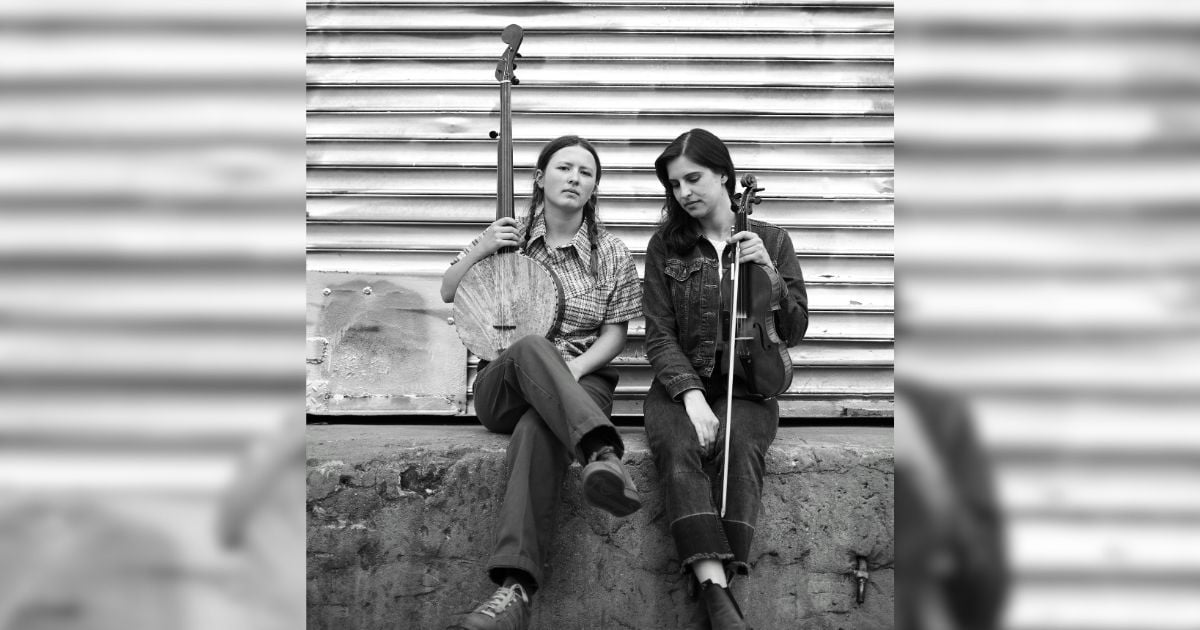
Perhaps the most remarkable skill of New York-based old-time duo Nora Brown and Stephanie Coleman is their ability to place canonical old-time material – fiddle tunes, ballads, breakdowns, hornpipes, transatlantic lyrics, and more – firmly in the present. Aided and abetted by their youth and their now longstanding musical collaboration, the two deftly entwine together timelessness and the fleeting, effervescent moment, leaving listeners on the edges of their seats as we cling to the temporal and seemingly miraculous space that opens up between them.

Brown and Coleman thrive behind NPR’s fabled Tiny Desk, all at once broad and bold while tender and understated, simple. Unadorned, but flush and full. Their new EP together, Lady of the Lake, features two of the numbers they performed at NPR’s headquarters in D.C., the title track and “Copper Kettle.” But they open their mini concert with a set, “Across the Rocky Mountains” and “The Old Blue Bonnet,” with Brown on guitar, before switching to her signature clawhammer banjo. For being so young – she only recently dropped the “Little” from her former stage moniker, Little Nora Brown – her voice carries an ancient ache. As their vocals resonate together in close harmony, Brown and Coleman remind of so many old-time, string band, and bluegrass duos that came before them, like Hazel & Alice, Laurie Lewis & Kathy Kallick, Cathy Fink & Marcy Marxer, and many more.

We hope then, like those impactful and influential duos that came before them, that Nora Brown and Stephanie Coleman continue to gift us with gorgeous music such as this for many decades to come.


Photo courtesy of Nick Loss-Easton Media

The Inspirations and Issues Behind Molly Tuttle’s ‘City of Gold’

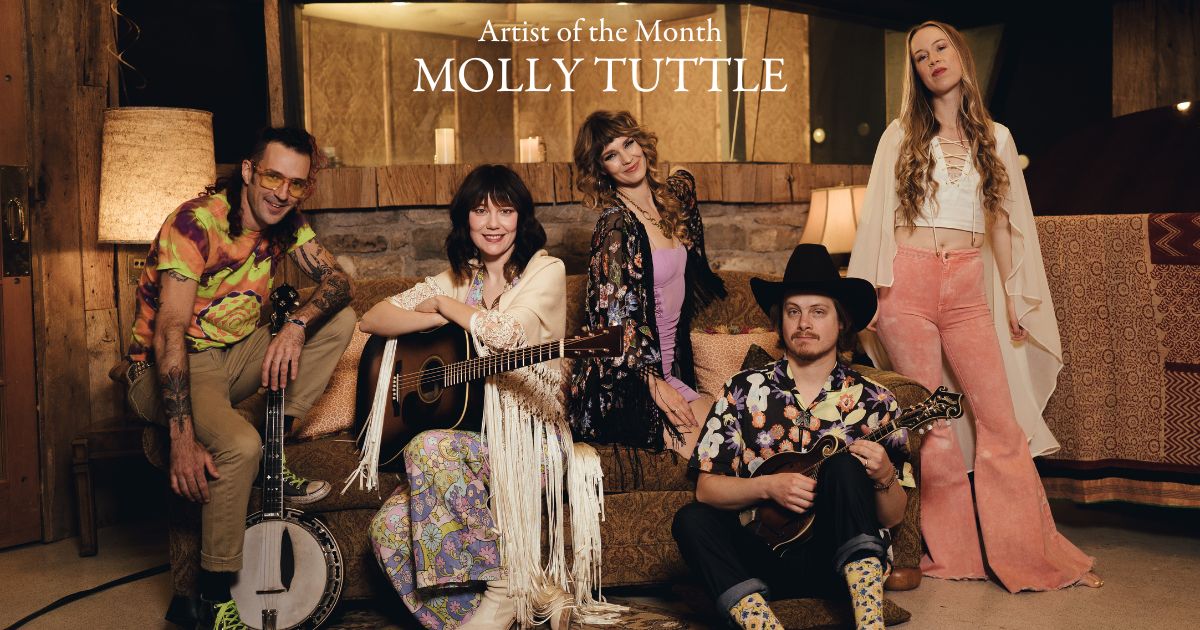
Over the course of her lifelong career in bluegrass, Americana and roots music, we’ve had the pleasure of interviewing and connecting with Grammy Award winner Molly Tuttle on quite a few occasions. When we selected Tuttle and her band, Golden Highway, as our Artist of the Month, we wanted to open a space to discuss her career and music in a fresh light – and we could think of no better context for such a conversation than Basic Folk. 

We asked Basic Folk podcast hosts Cindy Howes and Lizzie No – who featured Tuttle on the show once prior, in 2022 – to sit back down with the International Folk Award and Americana Award winner to discuss her brand new album, City of Gold, and to dig deeper into the creative output of this buzzworthy guitar player, songwriter, and business woman. 

Watch for the full podcast episode to drop later this month, but for now enjoy these excerpts from Cindy and Lizzie’s conversation with Molly Tuttle. 

Cindy Howes: Molly Tuttle, welcome to Basic Folk again. It’s so great to have you back on the podcast. 

Molly Tuttle: Thank you so much for having me back. It’s great to be here with you guys.

CH: Before we start our interview, I want to set the tone for our conversation. Molly Tuttle is being highlighted as Bluegrass Situations’ Artist of the Month, which is so awesome. The tone of our interview today is LYLAS. Do you know what LYLAS is?

Lizzie No: It’s spelled L-Y-L-A-S.

MT: LYLAS. Okay. I don’t know that.

LN: What it means is: “Love you like a sister.”

CH: Oh yeah. So we are total LYLAS. This is like a fun trip to the mall. This is like a really fun cruise around the harbor with your gal pals.

MT: Oh my gosh, that’s so fun. Well, it’s perfect because I’m actually in a hotel outside of Missoula. And there’s a strip mall nearby. So shopping has been on my mind today. Great.

CH: We’ll all get mani pedis together.

LN: Yes. French tip.

CH: So, when approaching the writing on City of Gold, you asked yourself, “How do I tell my story through bluegrass?” Which I can relate to, as somebody who’s sort of tried to distance themselves from folk music for a really long time. And now I am fully leaning into it. So, I take [it as] you asking that question of yourself, like “How can I fit my Molly Tuttle-ness into a world that can be rigid, patriarchal, and maybe different from what you stand for.” So how true is that? And how have these songs helped you take control of the bluegrass narrative and tradition?

MT: I think that’s something I’ve always kind of struggled with. I remember when I first started writing songs, I just thought, “I don’t know how to write a bluegrass song.” I can write a song, but they never ended up sounding like bluegrass to me and I just didn’t feel like my story fit into the bluegrass narrative of the songs that I grew up singing. 

I always loved songwriters like Hazel Dickens, who wrote bluegrass songs from a woman’s perspective, wrote songs about the struggles that she had as a woman in the music industry and as a working woman, and songs about workers’ rights and things she believed in. I grew up with two really strong role models, Laurie Lewis and Kathy Kallick, out in the Bay Area. I remember early on I would go out to [Kathy Kallick’s] house and she would make me tea and listen to my songs. She always told me that when she was first getting started writing bluegrass songs, she kind of felt the same way as me. Like, maybe her story didn’t belong in the genre. But she met Bill Monroe, and he encouraged her, “Don’t try to write a song that sounds like a song I would have written, write a song from your own perspective.” 

So she wrote a song called “Broken Tie” about her parents getting a divorce. She said every time she was at a festival with Bill Monroe, he specifically requested that song. That was an inspiring story to me. But when I started writing songs for Crooked Tree, it was suddenly like a floodgate opened. I think I just found my people to write with, found my groove, and ended up with a collection of songs that kind of told my story, [told] about things I believed in, and [told] my family history and personal experiences. And then other songs that were just, you know, from a woman’s perspective, or from a perspective that I resonate with. 

For [City of Gold], it was fun to kind of continue that and also expand it to be songs that I felt like were inspired by my band members, or inspired by experiences we’d had on the road. This felt more like a collective vision in a way.

LN: Okay, let’s talk about Crooked Tree. The title track from your last record was partly inspired by your experience living with alopecia. You’ve said that as a kid you would wear hats and then wigs, and then you learned to talk about your wig. Eventually, you started to get more comfortable going without. Now that you’re touring with Golden Highway a ton, you sometimes take your wig off when you play that song, which is such a powerful moment of joy, courage, and vulnerability. As a performer, I can relate to those moments where you bring a little bit extra of yourself and you share a part of yourself that you might normally keep private. How do you get to that right mood? How do you gauge if the crowd is like the right crowd to share about your alopecia experience?

MT: It’s also based on how I’m feeling. I took off my wig a few times last year. But I didn’t do it as much as maybe I wanted to, or maybe I should have, just because I wasn’t always sure what to say. I’ve had so many experiences of trying to explain alopecia to people and they still think I’m sick or still feel bad for me. And it’s so hard sometimes to put it in words that aren’t going to bring the mood down at the show, you know, I want people to be having a good time. I want it to be this fun, inspiring moment, not a moment where people can go, “I feel so bad for you.”

Recently, I performed and told my whole story [for] a keynote speech at this alopecia conference out in Denver, Colorado. I think that was such an important step for me. Just getting to share my story and reflect on the pain of growing up having this really visible difference, but also like, the joy and why it’s so important to me to share that with others and share the message that it’s okay to be different. It’s okay to be a “Crooked Tree.” This last weekend, we played in Michigan, and I did take off my wig and I felt like I finally nailed what I said and the perfect mood. Everyone was cheering and it was just a moment of celebration. I think I’m gonna just continue doing that more and more, but I find that it’s so helpful for me to check in with the alopecia community and feel that support from other people who know exactly how I feel. That makes me feel confident to share my message with the world and maybe sometimes be like, “I don’t care how it’s received, maybe I’m not sure how it’s gonna be received, but I’m going to do it anyway.” That just comes with time. And I guess I’ve had to grow kind of a thick skin. It used to be a lot harder for me.

CH: The new album, City of Gold, the songs were mostly written by you and your partner Ketch Secor of Old Crow Medicine Show. What is the writing process like with you and Ketch? Like, how do you bring out the best in each other’s writing?

MT: We’re both quite different writers. He’s very fast paced. He throws out ideas and lines. [While I’ll] think it over. I’m kind of more internal. I think about the lines. We balance each other out in a way where I might think a lot about what exactly we are saying, and then he’s good. If I get stuck on something, [he can] kind of keep it moving. But our writing process is always different. It’s nice, because we’re together a lot. So we can write in a lot of different circumstances. Some of the songs we wrote in the car, like on a road trip, just throwing lines back and forth. Maybe he’d be driving, I’d be writing the lines on my phone. Maybe we’re talking about something at home or listening to music and sitting down with instruments, kind of more the conventional way of writing. I find it so hard to fit writing into my life, especially when I’m on tour and I’m on the go so much. [It’s so nice that] we got into a groove with it, where we were just doing it all the time, and it felt more naturally intertwined into my day-to-day life.

LN: The bluegrass community was a huge source of inspiration for you. Of this record, you said, “One of the things I love most about this music is how so much of the audience plays music as well.” And that you hope that people will sing along and maybe play those songs with their friends, almost like we’re all a part of one great big family. Now, how do you walk the line of making a sophisticated, bitchin’ bluegrass record, while keeping it simple enough for others who might not be musical geniuses to play along?

MT: The beauty of bluegrass music is that most of the songs have like three or four chords. You can play them really simple, you can just strum along and play as slow as you want. Beginner bluegrass musicians might go to a jam of people at the same level as them and play these songs in a lot simpler of a way. Then, as you get better and better you can play it faster, you can play more complicated solos, you can really play with the dynamics. There are infinite ways to make the songs more and more complex and sophisticated as you progress in your musical abilities. 

On City of Gold, I did kind of stray away from that “three chords and the truth” format a little more than I did on my last record. It was fun, because we were working on these arrangements as a band, which was a lot different process than I’ve ever done before in the studio. I’ve always gone in with my songs and gathered musicians that I don’t normally play with on the road – studio musicians. I have a lot of my bluegrass heroes on the record, and you’re kind of learning the songs and playing them by a chart, but for this album, we really took the time to develop more complicated arrangements and add in new sections that stray away from the key. These songs are a little less accessible to the standard bluegrass jam. But I think there’s still a few that people could learn to play at any level.

• • •

CH: Okay, now we’re going to talk specifically about some of the songs on the new album, City of Gold, starting with the first song, “El Dorado.” Right now I am rewatching Deadwood, so I am super into this song. As a kid, you took a field trip to Coloma, the site of California’s first gold strike and it was the first time you heard about the legendary El Dorado, the City of Gold. In the song you sing, “El Dorado, city of gold, city of fools.” You said, “Just like gold fever, music has always captivated me.” So who are the characters in the song – like gold rush Kate from the Golden State – and how do you connect with these fools?

MT: I wrote the song with Ketch and I don’t know [exactly] how it came about… [But I told him,] when I was a kid, every school would send the kids off to gold country. You’d go to different places. The person who taught my class how to pan for gold, for some reason I have like a very vivid memory of him. He had this gold nugget on a chain around his neck and he showed us how to pan for gold. He was like, “You might find a flake of gold, but if you find an actual nugget of gold, we’re not gonna let you keep that, you have to give it back to us.” [Laughs] I remember being like, I really want to find like a nugget of gold and just squirrel it away and not tell this guy about it. So that kind of stuck with me. 

CH: Literally every kid in your class thought that!

MT: Yeah! Like, we’re gonna strike it rich at this goldmine!

We were kind of doing some research on Coloma and found that it’s in El Dorado County. That seemed like a good place to start with a song just inspired by that character, but also thinking about all these characters who came together and we’re all trying to strike it rich. I feel like that is such a theme in our society. You know, we have these like little, mini gold rushes – everyone being like, “This is the next big thing. We’re all going to make so much money off of this.” But for me, I didn’t get into music thinking this is gonna make me rich, but it is something I’ve chased after for many years now.

CH: What do you think is the current gold rush? Is it dispensaries? Vape stores?

MT: The thing that just popped into my head, it’s a couple years old, maybe like a year past its prime, is crypto currency. I think I don’t know where that stands. But I think we’re a little bit past that.

• • •

LN:  The second track on this album is “Where Did All the Wild Things Go?” Which is a song about gentrification’s corrosive effect on the character of once-vibrant neighborhoods nationwide – which I can very much relate to living in Brooklyn. I’d love to hear about your neighborhood where you live now. Is there a specific tradition or neighborhood institution or restaurant or store that is so special about your neighborhood? That you’re passionate about preserving? And how are you and your neighbors trying to keep your neighborhood weird and wild?

MT: Well, my neighborhood is East Nashville, and before I got there, it was totally different. It’s just in constant flux. It really changed so much when we had the tornado hit [in 2020] that took out tons of the local businesses that never returned. A lot of people moved out. The pandemic just kind of sped all of that up. Coming out of lockdown I was like, “Whoa, this is so different. Like, where do I even live anymore?”

I don’t really know how to answer how I’m trying to preserve it. I feel like I’m living in a different city every time I come back from tour, basically. Nashville’s always changing, just constantly growing, so many businesses are moving here. I do feel like there’s this constant sense of everyone missing the old Nashville. I don’t think that I was even around for the like “old Nashville” as many people who grew up in the city know it. So maybe I’m part of the problem in a way, really. I moved there just eight years ago…

• • •

CH: The next thing we want to talk about is “San Joaquin,” a new, old-style railroad song. There’s such a romance surrounding trains in song. You’ve always loved singing about trains. There is that long tradition of trains and folk songs. What do you think it is about trains that have captured artists’ hearts since they’ve been around?

MT: I think as artists, especially as musicians, we kind of have this roving spirit, where we want to see the world, we want to travel. I feel like a lot of musicians, myself included, we romanticize trains as this early way of getting across the country. And still, you’ll see musicians from time to time doing a train tour. Of course you have buskers who might hop on a train across the country and play all over the place. Now, I’ve never done that, but I think it’s just this thing that’s romanticized, especially by musicians. I’ve always loved singing [train songs]. There’s so many bluegrass train songs, but I didn’t know a specifically California bluegrass train song, so I felt like it was time to write one.

CH: What’s your favorite train song?

MT: That’s such a good question. The first one that popped into my head was Larry Sparks’ song, “I’d Like To Be A Train.” He doesn’t just want to ride a train. He wants to be a train.

• • •

CH: The song “Next Rodeo” you say, “…Reflects the miles I’ve put in with my band, Golden Highway, which has clocked in well over 100 shows.” That’s in the press release, so it’s probably 200+ shows at this point, and we’ll give a shout out to Bronwyn Keith-Hynes. Let me know if I’m mispronouncing anyone’s name–

MT: We have so many nicknames for Bronwyn in the band. We saw a YouTube comment on one of our videos where I introduce her and someone said, “What’s the fiddle player’s name? I couldn’t catch that.” Someone wrote “Ron Winky Pies.” We often call her Ron Winky Pies.

CH: Yes, that sounds right. Well, she is a hell of a fiddler. Also Dominick Leslie on the mandolin, Shelby Means on bass, and Kyle Tuttle, who is playing banjo. Can you talk about the ease and connection you feel with Golden Highway? What’s the feeling that you get when you’re on stage – and, when did it start gelling for everyone?

MT: After I made Crooked Tree, first I started thinking about who I wanted to take the songs on the road with. On the record I had the band name Golden Highway, but I didn’t actually have a band yet, so it’s kind of funny. I did it in reverse a little bit. 

Dominick played on the whole record. I called him and I was like, “Hey, do you want to play with me next year?” And he said yes. So I had one band member. I was just trying to fill in the rest of the band thinking like, “Who’s gonna bring the most personality to this project? Who’s gonna bring a unique voice?” The whole record was all about being who you are, [about] individuality. I wanted to choose people who I felt like their personalities really shine through – and their music and their playing and their stage presence.

I got my dream band. We’ve all been friends in one way or another for like the past decade, so it was a cool experience. I’ve never had that before where I have this band in my head, I imagine the people playing together, and then it happens and it’s better than I could have imagined. It felt really cool. In the past I’ve had wonderful bandmates, but it’s never been this kind of brainchild where I’m trying to concoct my dream bluegrass band that will have this unique personality to it. 

We all got together and everyone already knew each other and already played together in different configurations just through the bluegrass scene over the years. It all kind of started gelling really quickly. Our first couple shows we’re just kind of like, “Wow, this is something special!”

• • •

CH: We do want to ask a question about Jerry Douglas, who co-produced the record with you and is the master of the Dobro. How has your relationship with him as a producer shaped how you think about your own recordings?

MT:  On this record, especially on “Stranger Things,” I just felt like I needed to hear him play on it. We had this funny thing we’d say in the studio, “Make us AKUS” – make us Alison Krauss and Union Station – cause they’re like our heroes. [Laughs]

When we got to that song we’re like, “We need that iconic Jerry Douglas dobro part.” It’s such a spooky song and he just knows how to accompany a song [like that] so well and that’s part of why I felt like he was the dream producer. He understands the musicianship side of things. He’s such a master of his instrument, but then he also has this deep connection to songs and vocalists and just knows exactly what to play behind the vocal.

That’s something I really kind of leaned on him for, just getting the best performance out of everyone, instrumentally. He has just the greatest ear. He hears a pitchy note here or like a wrong note there and really pushes everyone to do their best performance, but then he also has this side of him that’s extremely tasteful and he knows how to get behind a song and not overpower it.

LN: I want to talk about “Down Home Dispensary,” which is such a fun song. I’m fascinated by the way you’ve framed this issue, which is very hot in the news… legalizing marijuana. The way it’s framed in “Down Home Dispensary” is like a very fun political pitch about how Southern culture can evolve and is evolving. Why did you feel it was really important to frame this as a “Down Home Dispensary?” And do you notice an evolution in the way that Southerners and your audiences, more broadly, are relating to marijuana use? 

MT: I think like the South is still the holdout. It’s not legal in most places in the South, but I feel like it’s become almost a bipartisan issue, where people are getting behind it. We play it and we’ve been playing it live and people are cheering no matter who they are. They’re like cheering for the “Down Home Dispensary,” because it’s this thing that’s become normalized in our society, but it still is technically not legal. That was one that Ketch and I originally wrote to be an Old Crow [Medicine Show] song and then they didn’t cut it. It’s so much fun!

CH: It’s sort of like a book end to “Big Backyard.” The world can be your down home dispensary, your  backyard. You can make home and freedom anywhere. 

MT: I thought it was like a funny angle to to go about it. You’re talking to a politician and just being like, you should really do this, because you’re gonna make a lot of money like this is in your best interest.

LN: How has living and working in Tennessee changed how you see your responsibilities as a feminist artist?

MT: I’m confronted with things in Tennessee that I never imagined would happen. Where I live, abortion is not legal in Tennessee at all, it was one of the first states to basically ban it for any reason.

That was really like a dark moment in our history as a country to just be going backwards completely. It’s something that I’ve feared since I was a teenage girl, like, what if this got taken away? And what if I couldn’t make decisions for my body? I can’t [access this healthcare] in the state where I live, I could maybe travel somewhere else if needed, but who knows if [someone else] could. They could make it more and more impossible to have access to this. It just breaks my heart for all the people who now don’t have that choice and don’t have the privilege of being able to go somewhere where they can get this health service.

[When writing “Goodbye Mary”] I was thinking about a story my mom told me growing up of my grandmother, whose name was Mary. She had a friend who was in an abusive relationship and she wanted to leave this relationship, but she ended up getting pregnant. So my grandmother and her friend, she would push her friend down the stairs, they would try anything to get rid of the baby. It’s a really, really dark story. But it’s somewhere that we’re going again, as a nation. When we were writing it, we were talking about my grandmother. That’s not something that happened to my grandmother personally, but it’s something that her generation had to deal with.

LN: I think it’s so important to link abortion access to women’s experiences of intimate partner violence. A lot of people who claim to be pro-life don’t want to admit that access to abortion is also access to freedom and the ability to leave an abusive situation. It’s just one more way of actually having freedom in your own body. That’s a really powerful story. It’s just so important, I think, for musicians to be talking about this issue, especially those of us that live in Nashville or are working in country and folk and bluegrass.

MT: It’s really scary to talk about, I was so scared to put that song on my record. Jerry was the one who was like, “We have to.” It was his favorite song. He was like, “If we’re gonna record one song, it needs to be this one.” And I was like, “I’m scared.”

This issue is one I care about so deeply. And it’s one of the most important social issues to me. But it’s also like, you get kind of the most backlash for it.

LN: Have you played this live yet? 

MT: We haven’t, no. We’ve worked it up. And once the record is out, I think we will start playing it. But we haven’t tried it live yet.

LN: You got this. 

MT: Yeah, totally. Thank you. 

LN: Thank you. Thank you for this telling this story. I think that the bluegrass community needs to hear it and the world needs to hear it. I think it’s really important.

• • •

(Editor’s Note: This conversation has been abridged and lightly edited for flow and grammar. Cindy Howes’ and Lizzie No’s full Basic Folk conversation featuring Molly Tuttle will be available next week on BGS – or wherever you get podcasts.)


Photo Credit: Chelsea Rochelle

MIXTAPE: The Women in Roots Music Who Inspired Justin Hiltner’s ‘1992’

For the past eight or so years I’ve been making this joke that we (the music industry) should “Give women Americana.” As in, if we gave the entire genre — and bluegrass and country and old-time and folk, for that matter — to women and femmes and non-men, I wouldn’t so much miss the men and the music would certainly be well cared for and well set up for the future. 

My point, as I continue to make this joke year after year to many puzzled reactions, is that women and femme roots musicians have and will always be my favorite artists, creators, songwriters, and pickers. As I crafted my debut solo album, 1992 – often with incredibly talented women like producers and engineers (and pickers) Cathy Fink & Marcy Marxer, mastering engineer Anna Frick, photographer Laura E. Partain – the music that inspired, informed, and challenged me most through this release was all made by women. (Ask me sometime about my monthly Spotify playlist, Don’t Need No Man.)

When BGS approached me to make a Mixtape to celebrate 1992, I knew I had to share some of the women who helped me realize, musically, artistically, socially, emotionally, that there could be a home for me in bluegrass, largely because they had created such a home exactly for me. Here are a few of my bluegrass, old-time, and country inspirations, all of whom have filtered into this album in one way or another. – Justin Hiltner

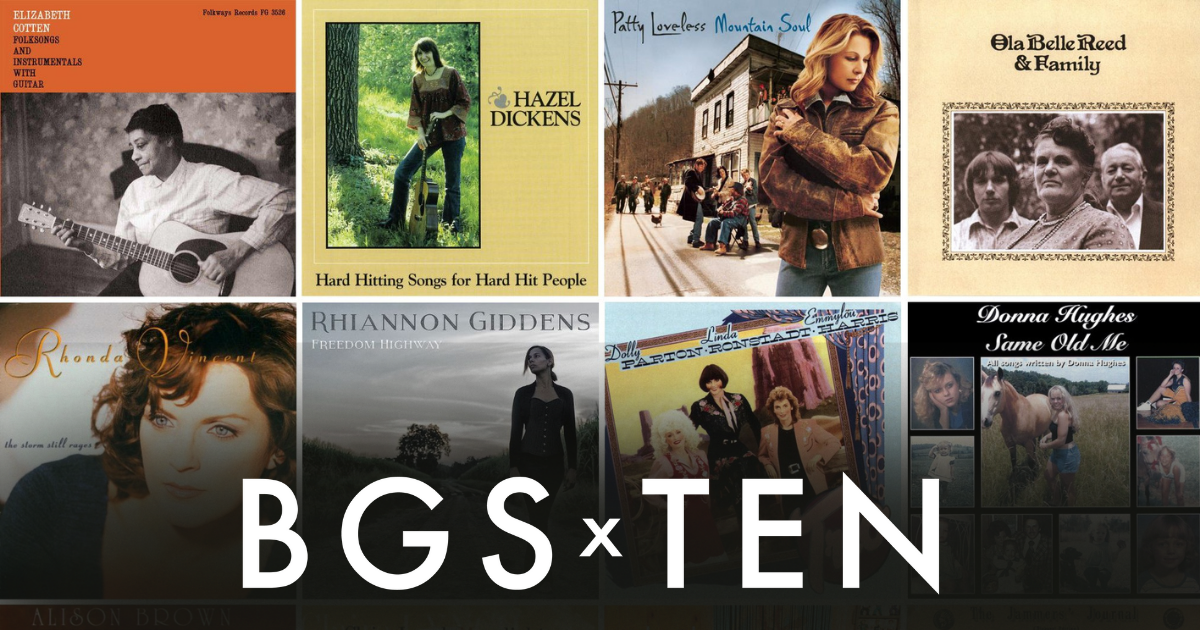
Ola Belle Reed – “High On the Mountain”

1992 was tracked in Ashe County, North Carolina, in a little town called Lansing nestled into the Blue Ridge Mountains, right where Tennessee, Virginia, and North Carolina meet. I love it out there on the mountain, in the wind, in the clouds, on the rocky little road cuts and switchbacks through the hills. Lansing also happens to be the hometown of a legendary Appalachian musician and bluegrass forebear, Ola Belle Reed. A banjo she once owned and had signed hung on the wall beside me while I tracked every song. I definitely see my album as stemming from the lineage of Ola Belle, humbly and gratefully.

Cathy Fink & Marcy Marxer – “Hold Each Other Up”

I’ve been so lucky to collaborate with folk icons, Grammy winners, and children’s music legends Cathy & Marcy in so many different contexts and scenarios, every single one delightful and fulfilling. They’re amazing mentors and encouragers and while we recorded 1992 we had to take the chance to channel their amazing attitudes and worldviews into a COVID-inspired (or -instigated) track, “Hold Each Other Up.” I love getting to pick and sing with these two, and their engineering, production, wisdom, and guidance all made this record possible.

Laurie Lewis – “I’m Gonna Be the Wind”

Long before I ever got the chance to tour and perform with Laurie Lewis she was a hero of mine, someone I looked up to and knew would be a bluegrass legend and stalwart who could or would accept me for who I am. Turns out, often in bluegrass, it is okay to meet your heroes, because when we met and I got to work for her, it turned out I was absolutely right. Her writing style, her artistic ethos, and the way she infuses pure bluegrass energy and her personality into everything she does reminds me I can be who I am, play the music I play, and write the way I write. This song picks me up whenever I’m down and gives me self-confidence and optimism when I need it most.

Alice Gerrard & Hazel Dickens – “Mama’s Gonna Stay”

I never had the honor of meeting Hazel before she passed in 2011, but Alice Gerrard and I have become friends over the past six years and honestly, if 17-year-old Justin knew he’d become friends with this Bluegrass Hall of Famer, he’d die. We happen to share a birthday, too. Alice is a gem, a trailblazer, an unassuming and unrelenting activist and organizer and community builder. She inspires me in all of the above, but especially in her willingness, across her entire career, to write music about things no one else was writing about. This song, which Laurie Lewis turned me onto (she performs it as well), is a perfect example.


View this post on Instagram


A post shared by Justin Hiltner (@hiltnerj)


Elizabeth Cotten – “Wilson Rag”

Playing shows and recording totally solo is often terrifying. Especially as a bluegrass banjo player used to playing in five-piece lineups. It took many years and lots and lots of practice time and experimental shows to figure out how exactly I wanted to arrange songs, build shows, create and ride a storytelling arc during my shows, guide an audience, and do all of that confidently with just a voice and banjo. Artists and pickers like Elizabeth Cotten gave me frames of reference for what I was doing that felt solidly bluegrass, but still building a show and sound that feels fully realized and not lacking for being minimal.

Missy Raines – “Where You Found Me”

Missy Raines is another hero of mine that I feel so lucky to now call a friend. Despite coming from different generations and very different circumstances we have so much in common. It just sometimes astounds me that we can have seemingly endless conversations around if bluegrass (or country or roots music) are accepting and open; meanwhile one of the winningest pickers in the history of bluegrass and the IBMA – that is, Missy Raines – has always been both accepting and open. Who needs the sexist, homophobic, womanizing, problematic elements of bluegrass when you have absolute badass legends like Missy!? I once covered this song for a “Cover Your Friends” show and it continues to devastate me to this day.

Caroline Spence – “Scale These Walls”

When I first moved to town, Caroline Spence was one of maybe four or five people I knew in all of Nashville. We spent a lot of time together in those early years, back in 2011 and 2012, and pretty soon after that we wrote a song together, “Pieces.” We both loved it a lot, performed it here and there with different lineups and bands, but it never landed on a record ‘til now. “Scale These Walls,” from Caroline’s most recent album, is constantly stuck in my head. I love how it showcases her jaw-dropping skill for writing dead-on hooks that feel so organic and never corny. I love this song.

Molly Tuttle – “Crooked Tree”

Molly Tuttle and I wrote “Benson Street,” a track off my new album, together about five or six years ago. It’s a cute little number about longing told through the lens of an idyllic Southern summer. I love every chance I get to make music or write music with Molly. She’s a constant source of inspiration for me and proof positive that you can be a proverbial crooked tree in bluegrass and still carve a pathway to success. Plus, she’s another great example of a picker who can command an entire audience totally solo. Trying to steal tricks from Molly Tuttle? Couldn’t be me.

Rhiannon Giddens – “Following the North Star”

Rhiannon Giddens is the blueprint. When I think about my artistic future and the way I want to be able to glide between media, between contexts, between areas of expertise and subject matter, between pop and roots and so many other musical communities, I think of Rhiannon. The way she has built her career around her artistic and political perspective, so that no matter what she does it feels grounded in her personality and selfhood is exactly how I want to be as an artist and creator. Plus, I always want to be as big of a music nerd and as big of an old-time nerd as her. 

Maya de Vitry – “How Bad I Wanna Live”

Maya is one of those writers and musicians who just makes me feel seen and heard and understood, and I know I’m only one in a huge host of people who would say the same. The vulnerability and transparency in her writing and the emotional and spiritual availability within it are astounding. Plus, she’s almost always, constantly challenging herself to consider the ways she creates and makes music outside of consumerism and art as a commodity. I moved to Nashville to be challenged, musically and artistically, by those around me and I feel so lucky to have Maya around me and a member of my community.

Courtney Hartman – “Moontalk”

Courtney Hartman’s “Moontalk” makes me feel like every single song I’ve ever written about the moon is good and right and allowable. (We both have quite a few songs about the moon, actually.) “Moontalk” feels like Mary Oliver incarnate in bluegrass-informed picking and singing. It feels meditative and contemplative, but not timid or insular – something I’m always trying to accomplish in solo contexts. I’m constantly inspired by Courtney and the way she centers community building in her music and life. She’s another one who, though she thrives performing and making music solo, you know that music came from a multitude of folks pouring through her.

Dale Ann Bradley – “He’s the Last Thing On My Mind”

I thank a few artists who have inspired and influenced me in a huge way in 1992’s liner notes and Dale Ann Bradley is one of them. I feel like I am constantly ripping off and (poorly) mimicking her vocal runs, phrasing, licks, and delivery. I think she might have the best bluegrass voice of all time, or at least it’s very very high up on the list. When I first moved to town I worked as an intern at Compass Records and just getting to be a small part of the team that worked a handful of her records meant so much to me.

Lee Ann Womack – “Last Call”

Lee Ann Womack is another who I thank in the album’s liner notes, another who I emulate vocally as much as I can get away with. I used to wear out this track and this album, Call Me Crazy, listening on repeat over and over. When I found out this song was co-written by an openly gay songwriter, it rocked my world. I already heard so much queerness in LAW’s catalog, and this confirmation came at a time when I needed to feel like I was given permission to exist in bluegrass, country, and Nashville. I know now that no one needs that permission, but it was critical then.

Linda Ronstadt – “Adios”

During the 1992 recording session I recorded a solo banjo rendition of this song, one I’ve been performing for years at shows. It means so much to me and Linda’s performance is stunning in its power and tenderness, a combination I’m often striving for. I hope to release it some time soon as a single, then again on a deluxe vinyl edition of 1992. It will not be the last time I pay tribute to Linda and her incredible career and catalog – plus, she is a huge bluegrass fan! It just makes sense to me.

Dolly Parton, Emmylou Harris, Linda Ronstadt – “Wildflowers”

When I had the pleasure of being a guest on the hit podcast Dolly Parton’s America, I sang this song and “Silver Dagger” among a few other from Dolly’s catalog that I felt had queer under/overtones. The response to my on-air picking was enormous, and there were immediate demands to release my versions of the songs. Cathy, Marcy and I recorded “Wildflowers” together during the 1992 sessions and it’s one of my favorite tracks that resulted from that week on the mountain. It’s gotten quite a lot of play, which I’m so grateful for, and always gives me an opportunity to talk about Trio and Dolly and how the story in “Wildflowers” parallels many a queer journey. It’s the perfect track to round out this Mixtape and I thank you for reading and listening along.


Photo credit: Laura E. Partain

BGS Top 50 Moments: The 50 Greatest Bluegrass Albums Made by Women

March is #WomensHistoryMonth (although, let’s be honest, shouldn’t we be celebrating 51% of the population’s history every month?!) so it seems like a fitting time to revisit our comprehensive — but by no means exhaustive — list of the 50 Greatest Bluegrass Albums Made By Women.

Published five years ago as an unofficial extension of NPR’s Turning the Tables project, our list included a wide array of female talent from over a century of bluegrass, old time, string band, and other traditional styles of recorded music, from Ola Belle Reed to Laurie Lewis & Kathie Kallick to Molly Tuttle and everything in between.

“We dare not be so bold as to claim that every important bluegrass album created by women is included. We are simply striving to illustrate the far-reaching, undeniable influence that these incredible artists have had on the music, as a whole. Each contributor, many of them groundbreaking, trail-blazing artists themselves, has chosen albums that are personally impactful. Glaring omissions and oversights are almost guaranteed, but therein lies the beauty of this conversation: This collection is merely a starting point, a springboard for a greater dialogue about the place of female creators, artists, musicians, and professionals in the telling of the history — herstory — of bluegrass.”

There’s no question that there are plenty of amazing albums that should be added to the canon since 2017, but each new addition wouldn’t have been given an inch of foothold in the genre without the strength, determination, heart, and amazing music of the women who came before them.

Revisit our list of the 50 Greatest Bluegrass Albums Made By Women here.