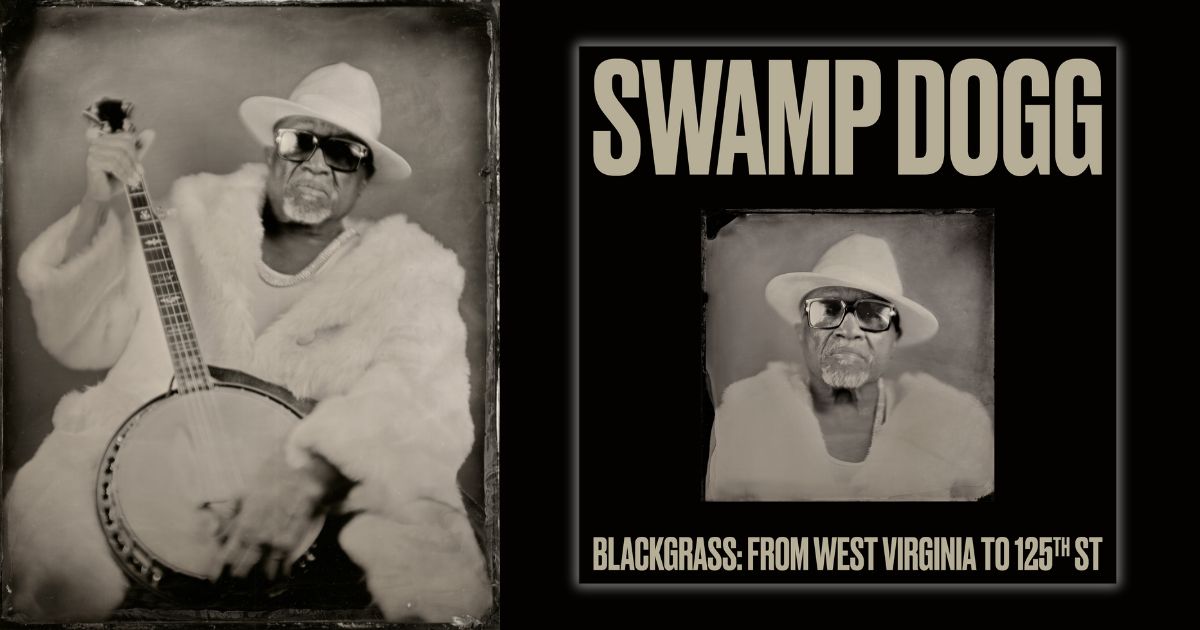
The Delightful Rebellions of Swamp Dogg’s ‘Blackgrass’

Early in my recent interview with Swamp Dogg, the iconoclastic singer-songwriter and producer makes a self-aware confession: “I have read columns about Swamp Dogg and so forth, and I try to find out what they classify me as,” referring to the veritable grab-bag of hyphenated micro genres that music writers use to classify him. We connected a few days out from the release of his latest album, Blackgrass: From West Virginia to 125th St, and the artist, born Jerry Williams Jr., seems unbothered. Later he adds, “When I do the Swamp Dogg albums, I really don’t try to please anybody but myself.”

He has known from the jump that the music industry doesn’t know what to do with him. Working as a singer and songwriter under the name Little Jerry Williams, Swamp enjoyed some success with his 1964 soul 7 inch, “I’m The Lover Man,” and was subsequently invited to perform at clubs in the Midwest. As Swamp remembers, “When I showed up they found out I was Black and the audience was lily white. They were good about it, they paid me and said I didn’t have to do a second show.” The small-mindedness of industry gatekeepers would follow him into his first musical steps as Swamp Dogg.

In 1971, Swamp released his second album, Rat On!, on Elektra Records. He was dropped from the label immediately after the release. At issue was the provocatively titled, “God Bless America For What,” track six on the album, which Elektra had pressured Swamp to leave on the cutting room floor. He kept the song, and his brief stint with Elektra was over. (The album cover, featuring Swamp in a victory pose astride an enormous white rat, might also have earned him some detractors in the office.) Asked if he considered caving to the label’s demands, he quickly sets me straight. “No! No. Nuh-uh. I’m dealing in truth!”

The controversy surrounding Rat On! did nothing to slow Swamp’s momentum as a creative force and in the years since its release, has proven itself a classic of left-of-center soul. He produced artists like Patti LaBelle, Z.Z. Hill, and Irma Thomas. Swamp also continued working in A&R. He signed a still-mostly-unknown John Prine to Atlantic Records in 1968, later reuniting with Prine for what would turn out to be the final recording made by the legendary storyteller. Swamp built a cult following among indie music fans in the know, collaborating with artist-tastemakers Justin Vernon and Jenny Lewis – the latter of whom returns as a guest on Blackgrass, as well. He dunked on the snobbier side of the mainstream with albums like Love, Loss, and Auto-Tune, and I Need A Job… So I Can Buy More Autotune.

A list of Swamp’s credits tells the story of one of the most fascinating music careers of the last century, but he himself tells an even deeper one. He speaks about painful failures, like when he became a millionaire in the 1970s and the sudden reality of wealth gutted his mental health. “The right word is obnoxious, I really became obnoxious, my wife pointed out to me. I was running so much that I would run in my sleep and run out of the bed.”

When the nine cars in the family garage proved insufficiently curative, she got him to see a therapist, a “who’s who psychiatrist” in Swamp’s words. He tells me so many sweet things about the great love of his life, Yvonne Williams. “My wife, she was a Leo. She was a strong Leo, she was a leader. Everybody loved her. Everybody feared her when it came to brain-to-brain. She could knock your shit right out the box. She was the reason I made a little money. Her name was Yvonne and I still think about her.” Subsequent girlfriends have told him he is still in mourning, and a second marriage was short-lived.

Discussing his musical roots, Swamp lists “blues, soul, R&B, pop, just about everything except classical and polka, and gotta add country there, cause country is what I was listening to growing up as a kid.”

His brand new record, Blackgrass, released May 31 on Oh Boy Records, is an inventive, often moving exploration of the genre. Sensitive instrumentation by Jerry Douglas, Sierra Hull, Chris Scruggs, and Noam Pikelny, among others, pairs beautifully with Swamp’s varied vocal performances across all 12 tracks. “The Other Woman,” featuring Margo Price, is an elegant update of the classic written by Swamp and first performed by Doris Duke. And Swamp himself is at home as a country vocalist, playing characters like the neighborhood ne’er-do-well on “Mess Under That Dress,” the lovelorn crooner on “Gotta Have My Baby Back,” and delivering a breathtaking country gospel performance on “This Is My Dream.”

Even as Blackgrass offers country music moments that should please even the most determined traditionalists, Swamp Dogg remains committed to surprising his listeners. “Rise Up,” for example, a Swamp original first recorded by the Commodores – “Atlantic didn’t know what to do with them!”– is reincarnated as a country-meets-alternative rock and roll foot stomper, with a guitar solo by Living Colour’s Vernon Reid, which readers should listen to in a safe and seated position.

One of the great rebellions of Blackgrass is the singer’s assumption, on an album that is being marketed to country and roots media, of a Black audience. He explains, “I’m calling it Blackgrass … mainly because of the banjo. When I was coming up the minute somebody said ‘country music’ or ‘banjo’ … we turned our nose up at it, way up until Charley Pride came along.”

As Black listeners, we are being made to understand that this record is for us, decades of deliberate exclusion from the genre be damned. Its creator is equanimous about how the art will be received. “If this one sells enough, there will be a next record. If it doesn’t, there will still be a next record. I’ll put it out myself.”

Fifty years since “I’m The Lover Man,” Swamp Dogg remains curious about, and frequently explodes, the boxes into which small-minded gatekeepers of popular music have attempted to place him. As he recalls some of the more colorful antagonists along his musical journey, Swamp is gracious in the knowledge that he has had the last laugh. He speaks with refreshing pettiness about his early critics, reasoning, “The people that I dealt with back in the day are either dead or don’t know who they are. And I know I’m in line for that, but I keep jumping out of line. When I see myself getting near the front of the line I jump out and go to the end of the line.”

As usual, Swamp Dogg plays in his own time. He has finally outlived the haters.


Photo Credit: David McMurry
10 of the Best Deep Voices in Country

No matter where you look in the history of country music, you’ll find some common themes – working-class stories, banjos, an appreciation for the simple life. But there’s something else fans of country music then and now all seem to love, and that’s a deep, rich singing voice.

In this roundup, we’ve gathered just 10 of the all-time best deep voices in country music, from smooth baritones to booming basses. Whether you’re a fan of outlaw country, pop country, or something a bit more classic, there’s a voice for you on this list.

Amythyst Kiah

Combining elements of Americana, old-time, folk, and country, Amythyst Kiah has spent the past decade proving she has one of the most powerful deep voices in roots music. Whether she’s sharing an arrangement of a traditional ballad or innovating Americana, Kiah brings her unique, rich, and haunting voice to everything she does. Her song “Black Myself” even earned her a Grammy nomination in 2020 for “Best American Roots Song.”

Accompanied only by banjo, Kiah’s take on the traditional ballad “Darlin’ Cory” highlights the literal and emotional depth of her one-of-a-kind voice.

Waylon Jennings

Known as a pioneer of outlaw country, Waylon Jennings got his start in country music when he was just a 14-year-old kid in Texas. He then spent six decades gracing the world with his soothing baritone voice, earning himself a permanent place in country music history – and the Country Music Hall of Fame. Alongside frequent collaborators Willie Nelson, Kris Kristofferson, and Johnny Cash, Jennings recorded some of the most legendary songs in the modern country canon, including “Highwayman” and “Mammas Don’t Let Your Babies Grow Up to Be Cowboys.” Jennings passed away in 2002, but his deep and powerful voice remains one of the most recognizable sounds in country music.

Scotty McCreery

Newer to the scene, North Carolina-born Scotty McCreery got his industry start in 2011 after winning the 10th season of American Idol. Since then, he’s enjoyed a successful career as a country singer-songwriter – he even became a Grand Ole Opry member earlier this year – thanks largely to his smooth, deep vocals. Fitting in perfectly with the modern Nashville sound, McCreery’s most recent single, “Cab in a Solo,” showcases this young country star’s keen skill as a baritone crooner.

Orville Peck

A mysterious character in the alt-country realm, Orville Peck has one of the most stunning deep voices in country music, genre-wide. Boasting an impressive vocal range (baritone to falsetto), Peck is best known for his resounding lower register. Teaming up with country stars like Midland and Sheryl Crow, Peck has quickly made a name for himself since the release of his debut album, Pony, just five years ago. Inspired by ’60s- and ’70s country (à la Jennings and his collaborator, Willie Nelson), Peck’s brooding, emotive, and theatrical voice is a must-hear for appreciators of high-quality baritone country singers.

Trace Adkins

First rising to fame in the mid-’90s, Trace Adkins continues to reign as a big name in pop country. His gruff-yet-soothing voice sounds like a day on the farm in the hot sun — and that’s exactly why he’s on this list. A songwriter, singer, and dynamic performer, Adkins wields an unmistakable baritone voice that helped shape the sound and direction of Nashville in recent decades. If you’re looking for a chance to relive the glory days of early pop country, Adkins has the voice you’re looking for.

Randy Travis

One of the most popular country singers of all time, Randy Travis is known for his earnest songwriting style and velvet-smooth baritone voice. After getting his start in the 1980s, Travis recorded over 20 albums and charted on the Billboard Hot Country Songs chart over 50 times. In 2013, he experienced a tragic, life-altering stroke, affecting his ability to sing and perform. With the help of AI, producers recently teamed up with Travis to record and release his first new single in over a decade, “Where That Came From.” Using AI to combine past existing recordings of Travis’s vocals with contributions from another singer, James Dupre, the new single captures the singer’s spirit and depth, giving listeners a newfound opportunity to appreciate a living legend.

Johnny Cash

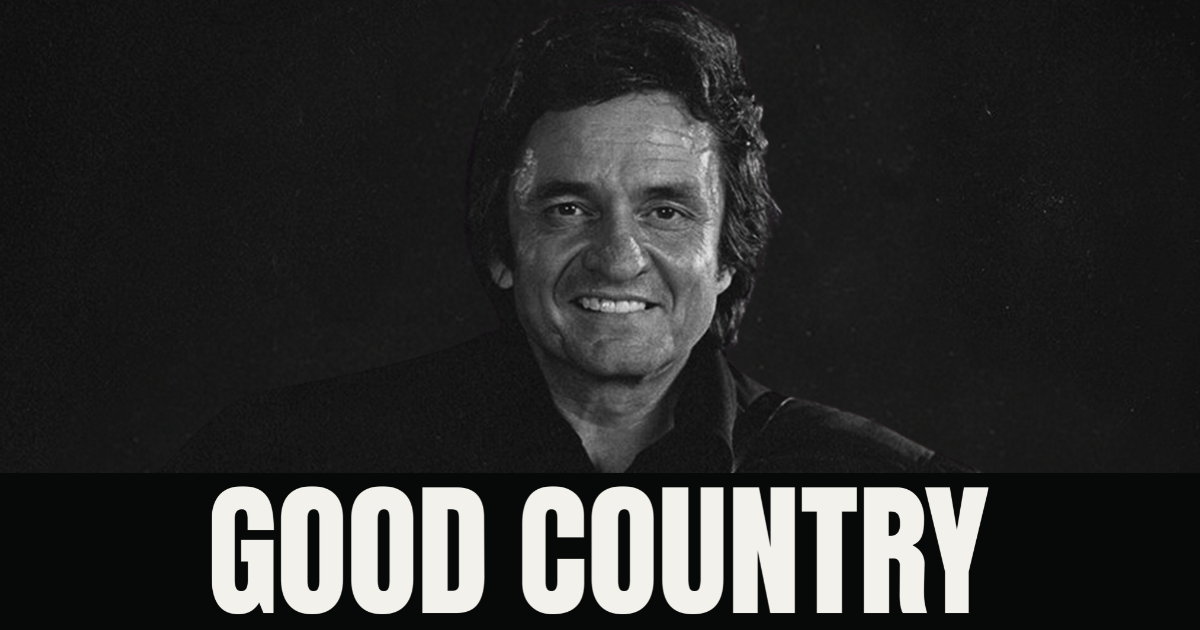
Let’s be real: This list would not be complete without Johnny Cash. Arguably the most famous country music star to ever live, Johnny Cash is known near and far for his deep, rich voice that straddled the border between baritone and bass. Cash had a storyteller’s voice, and he used it proudly to tell the stories others weren’t telling. As time went on, Cash’s voice settled into its lower register, which can be heard on his final non-posthumous album American IV: The Man Comes Around. But there’s no better way to showcase the rumbling voice of Johnny Cash than through his infamous recording of “Folsom Prison Blues,” recorded live at Folsom State Prison in 1968.

Jim Reeves

One of the forefathers of country music, Jim Reeves wielded one of the most beautiful baritone voices in the genre. A true crooner and country & western artist, Jim Reeves’s voice is smooth, deep, and unforgettable. Arguably the most technically accomplished singer on this list, Reeves topped the country charts throughout the ’50s, ’60s, ’70s, and ’80s. A dynamic and masterful baritone with a gentle stage presence, Reeves played a huge role in shaping the sound of Nashville and his influence is still felt today.

Colter Wall

Canadian singer-songwriter Colter Wall released his first single, “The Devil Wears a Suit and Tie,” in 2015 when he was just 20 years old. Showcasing Wall’s impossibly deep and weathered voice, the single swiftly launched the young artist into the limelight, mostly via a live performance video on YouTube. Treading the country and Americana borderlands, Wall has one of those voices that makes you think, “How is that sound coming out of that person?”

Since his debut, Wall has released five full-length albums, including his 2023 release, Little Songs. Throughout his catalogue, Wall never misses a beat or fails to remind us that he has one of the deepest and richest bass voices in country.

 Josh Turner

For Josh Turner, bass singing is old hat. He grew up singing bass parts in church choirs and gospel quartets, then debuting at the Grand Ole Opry when he was just 24. Now in his 40s, Turner has spent over half his life making waves in the industry as one of the only true bass singers in the genre — and a top-notch one at that. In May 2024, Turner released a brand-new single, “Heatin’ Things Up,” proving he still deserves the title of the man with the most satisfying deep voice in country.


Photo Credit: Johnny Cash courtesy of JohnnyCash.com.

It’s a Great Time for Roots Music on Broadway

Utter the phrase “Broadway musical” and most folks are likely to assume you’re referring to the jazz-hands-inspiring works of Richard Rodgers and Oscar Hammerstein; the emotionally manipulative drama of Andrew Lloyd Weber; or the inventive playfulness of Steven Sondheim. But folk and roots music have a long legacy on the great white way — and a bit of a folk boom has been happening in those storied theaters lately.

Granted, Broadway producers have long presented shows that pull in the music of roots-informed artists. Folk-pop singer-songwriter Duncan Sheik delivered a stunning musical score for the groundbreaking Spring Awakening, cementing the careers of Broadway stars Lea Michelle and Jonathan Groff back in 2006. Let’s not forget brief runs of musicals that pulled from the catalogs of Dolly Parton (2009’s stage adaptation of 9 to 5) and Bob Dylan (Girl from the North Country, which debuted in 2020).

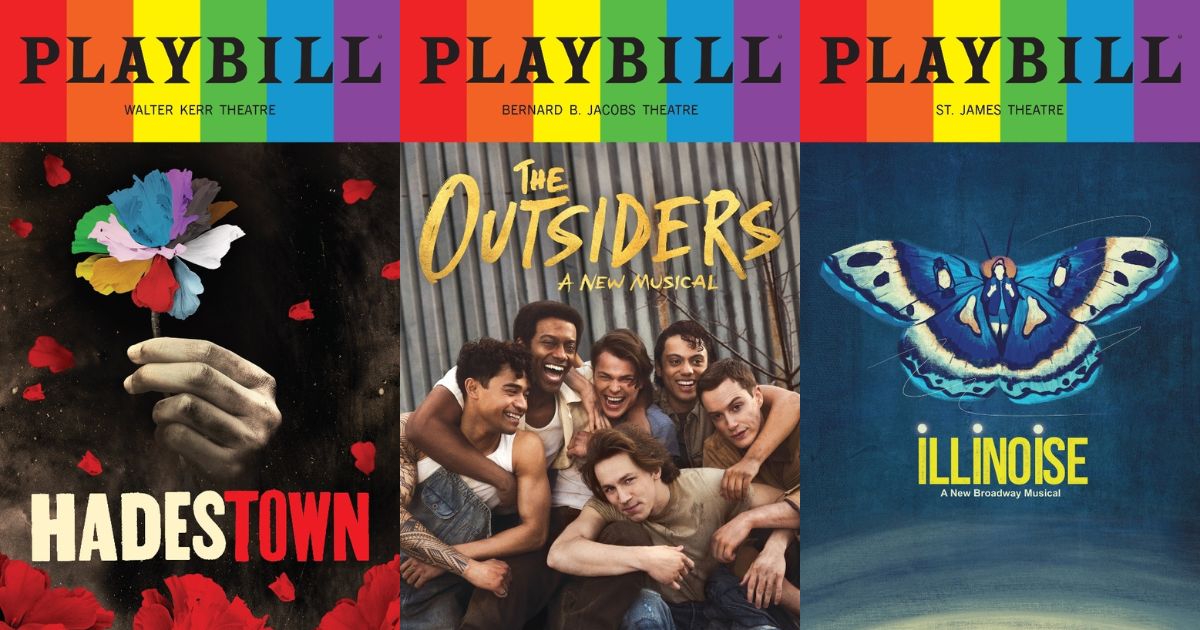
Of the shows currently occupying midtown theaters, Anaïs Mitchell’s Hadestown has run the longest, having just passed its five-year mark. With eight Tony Awards from its 2019 debut, the musical pairs the Greek myth of Orpheus and Eurydice with that of Hades and Persephone. Though its original cast has scattered to other projects, beloved folksinger Ani DiFranco spent a bit of her winter and spring this year offering a stunning run as Persephone.

Ani DiFranco and Anaïs Mitchell outside the Walter Kerr Theater in New York City. Photo by Matthew Murphy.

Fans may know DiFranco trained for many years as a dancer, even as she was building her singer-songwriter street cred. She proves to be a triple threat in the role, embodying the storied arbiter of summertime with a deeply rooted, empathic swagger. And though her June 30 departure feels like the end of an era for the musical, her latest album Unprecedented Sh!t (released May 17 on Righteous Babe Records) charts some new sonic territory via her political POVs.

Further, it’s hard to mourn DiFranco moving on when it was recently announced that British country favorite Yola will replace her in the role of Persephone, beginning July 2.

Hadestown was briefly joined last year by fellow roots musical Shucked, which came and went too soon. Awash in silly corn puns and Tampa-centric storyline, its earworm score was penned by Nashville mainstays — and Grammy darlings — Brandy Clark and Shane McAnally.

Last month, Illinoise opened at the St. James Theater on 44th St. Pulling tracks from Sufjan Stevens’s sprawling, ambitious 2006 album of the same name, the show reorders the songs to depict a group of friends sharing stories around a campfire. There is no dialogue. Instead, a 12-piece band and a trio of vocalists in magical butterfly wings perform the music in the background.

Upstage, Illinoise tells its stories through exquisite choreography that runs the gambit from lyrical contemporary to hip-hop, some sweet Broadway jazz, and even one number (“Jacksonville”) with a lightning-fast tapper in pinstripes. Dancers touch on love and loss, fear and transcendence.

“Zombies” becomes a scene about the immigrant experience, as dancer Jeanette Delgado (“Jo”) tries to outrun the ghosts of America’s founders, whose complex legacies still haunt the present day. “The Man of Metropolis” becomes a comical superhero-themed character romp. And former Billy Elliot star Ben Cook (“Carl”) delivers a heartbreaking and inspired series in Act II to track an emotionally complex love triangle.

By show’s end, there is a pervasive sense of the opportunity art grants us to transcend our selves and build a better world together. It’s no wonder the show was nominated for four Tony Awards, including Best Musical. If it wins, it will be the first time a dance musical has won the prestigious award.

The Outsiders, meanwhile, is running now just one block away, at the Bernard B. Jacobs Theater. It sets to music the novel by S.E. Hinton, which was immortalized in a 1980s film by Francis Ford Coppola. Produced in part by Angelina Jolie, with a book by New York theater fixture Adam Rapp (Wolf in the River, The Sound Outside) and music by Americana mainstays Jamestown Revival, this musical version unfortunately doesn’t measure up to the other two roots musicals in the neighborhood.

Granted, perhaps it doesn’t have to. The Broadway League and American Theater Wing don’t seem to be anything less than impressed, having nominated the musical for a whopping 12 Tonys this year. It may not translate seamlessly to the Broadway stage, but The Outsiders is a story that has been beloved by numerous generations. It was a treat to witness members of Generation Alpha giddy with excitement to take in the narrative arc of Ponyboy and the other Curtis brothers — a story that feels to this writer as though it’s rooted in Gen X sensibilities, despite being set in the 1960s.

Choreography by Rick and Jeff Kuperman was athletic and stunning — plenty of leaps and jumps and long, denim-clad legs spinning in the air like human helicopters. The Kuperman brothers’ martial arts background comes through even beyond the inventive dance-fight scenes. There is water on the stage, somehow, and it splashes up from time to time, for some reason. It doesn’t matter why. The effect is properly dramatic.

Brent Comer, who plays “Darryl,” steals the show with his powerful Zac Brown-reminiscent twang. He has some of the most compelling solos, embodying the exhaustion of a stay-at-home-mom as he folds clothes and laments his lot in life, “somewhere between brother and father” since their parents died. Jason Schmidt as “Sodapop” matched his rootsy musicality with the second-act heart grabber, “Throw in the Towel.”

But it is Joshua Boone’s “Dallas” who is perhaps the show’s greatest revelation, with his Bill Withers-esque vocals on solos like “Little Brother.” Brody Grant as Ponyboy seemed a bit lacking during the matinee performance this writer recently caught, but it could have been an off moment. Eight shows a week requires almost superhuman amounts of energy reserve.

Or perhaps it was a side effect of Grant being in his 20s while his character is supposed to be 14. Indeed, despite the electricity of The Outsiders’ score and choreography, the script doesn’t feel as authentic as its emotional realities demand. Hinton’s book offered readers a revolutionary view of teen struggles, written by a teenager. Perhaps the Broadway show should have brought in some teenagers to consult.

Regardless, both Grant and Boone were nominated for Tonys (as was Sky Lakota-Lynch, who delivers a haunting performance as Johnny). For folks just interested in what Jamestown Revival did for the show’s score, an Original Broadway Cast Recording is available now.

All told, there is no indication Broadway is going to break its love affair with roots music anytime soon. The Avett Brothers are set to make their Broadway debut with shipwreck-themed musical Swept Away this fall. The show has previewed in California and Washington, D.C., and has received critical praise already. Swept Away’s score is drawn from the Avetts’ 2004 album, Mignonette, plus four other songs from their canon — a treat for the band’s incredibly loyal fanbase and Broadway subscribers alike.

Further on the horizon is an adaptation of the classic labor movement-inspired film Norma Rae, with music by Rosanne Cash. In an email, her manager indicated a possible 2025 opening. One can only hope. And, just last week, Dolly Parton announced an upcoming original musicalHello, I’m Dolly, set to arrive on Broadway in 2026.


The 77th Tony Awards will be held on Sunday, June 16, 2024 and will air on CBS. Find out how to watch here.

Playbill images courtesy of Playbill.com

You Gotta Hear This: New Music From Gangstagrass, Jaelee Roberts, and More

This week, it’s a tale of two Mothers in our premiere round-up! First, Gangstagrass bring us their latest single, “Mother,” ahead of their full album release next week, then Portland, Oregon-based string band Never Come Down bring us their own track, “Mother,” performed live at Ear Trumpet Labs. The serendipitously themed selections couldn’t be more distinct and unique, relative to the other, demonstrating the depth and breadth of these roots genres.

Plus, elsewhere in our collection of new music, hear fresh tracks from Jaelee Roberts, Kate Prascher, Karen Jonas, and Eddy Lee Ryder – a taste of bluegrass, a dash of singer-songwriter, a heaping helping of reckless abandon, and so much more.

It’s all right here on BGS and, honestly, You Gotta Hear This!

Gangstagrass, “Mother”

Artist: Gangstagrass
Hometown: All over the USA! Rench: Brooklyn with Oklahoma roots; Dolio the Sleuth: Pensacola, Florida; R-SON the Voice of Reason: Philly; Danjo: Washington, D.C.; Farrow: Omaha; Sleevs: Baltimore.
Song: “Mother”
Album: The Blackest Thing on the Menu
Release Date: June 7, 2024 (single); June 14, 2024 (album)
Label: Rench Audio

In Their Words: “It started as a poem I wrote one day on tour. We were in the north of France, and just as described, I was sitting under a tree looking around me thinking about the world, our place in it, and what major changes we’d have to make in order to ensure the survival of humanity. My younger brother was actively deployed at the time and since my family has generations of men who’ve served, including my father, grandfather, great-grandfather, and numerous uncles and aunts and cousins, there is always real concern about why the country is involved in active aggression, especially when that same country is obsessed with committing violence against its own citizens, my community in particular. I shared it with the crew, and Rench cooked up a haunting oeuvre.” – Dolio the Sleuth


Karen Jonas, “Gold in the Sand”

Artist: Karen Jonas
Hometown: Fredericksburg, Virginia
Song: “Gold in the Sand”
Album: The Rise and Fall of American Kitsch
Release Date: June 7, 2024 (single); August 9, 2024 (album)
Label: Yellow Brick Records

In Their Words: “My dreamy Las Vegas wedding song; it’s an against-all-odds love story, a starry-eyed late-night wedding, the sweet optimism of love at first sight. I pictured a very zoomed-out and very zoomed-in Vegas as I wrote this, a drone image of a city rising from the desert and her hand tightly in his as they walk down the neon-lit midnight strip. We stumbled into Benji Porecki’s bittersweet piano intro during our live-in-the-studio recording session, with fiddle by Bobby Hawk and a tearing solo by guitarist Tim Bray capturing the intimacy and boldness of this love story. The monochromatic gold-washed video by videographer Ryan Poe feels like a retro dream sequence, pairing performance with delicate details.” – Karen Jonas

Track Credits: Written by Karen Jonas.
Karen Jonas – Vocals, acoustic guitar
Tim Bray – Electric guitar
Benji Porecki – Piano
Bobby Hawk – Fiddle
Seth Morrissey – Bass
Ben Tufts – Drums
Ahren Buchheister – Pedal steel

Video Credit: Ryan Poe at Oddbox Studios in Fredericksburg, Virginia

Never Come Down, “Mother”

Artist: Never Come Down
Hometown: Portland, Oregon
Song: “Mother”
Album: Greener Pastures
Release Date: June 7, 2024

In Their Words: “I wrote ‘Mother’ after finding myself living back at home, at my Mom’s house, and with my sister there, too. I had just left an emotionally turbulent relationship and was kind of broke and starting over at 29, but also extremely hopeful and grateful that I had my life back and could decide what I wanted to do with it. Having my sister and my mother around was really important for me at that time, to get me back to a place of feeling unconditionally loved and safe. The song came out of my subconscious need for those women to tell me what to do and to be there for me as I figured out what to do.

“I feel like it’s a really simple song, actually. I think most of us can relate to needing a parent or a mother figure or somebody that’s not family that’s a mother figure to be guided by. In this day and age, we all need mentors and guides more than ever and the age old wisdom of women, of mothers, of nurturers, of ‘kissing it to make it better’ and softness and the divine feminine.

“I hope all that comes through in this song. Because when I was writing it I wasn’t thinking about all those things, I was just singing my own little mantras out of my head, things that were just making me feel safe and loved. I hope this song makes people feel safe and loved. I hope people relate to it in all the ways that we relate to our mothers. Sometimes it’s hard, sometimes it’s lovely. I think if we all lived like our mothers were still watching over us or were in their presence, we’d all be happier and kinder human beings.” — Crystal Lariza

Video Credit: Ear Trumpet Labs


Kate Prascher, “Mary Ellen”

Artist: Kate Prascher
Hometown: Hudson Valley, New York
Song: “Mary Ellen”
Album: Shake The Dust
Release Date: August 30, 2024

In Their Words: “This song names the sensations of a summer’s day when she decides to leave, a taxi ride and the cigarette smoke that both soothes her and sets her free. Banjo and drums and the steady rhythm of driving wheels.” – Kate Prascher


Jaelee Roberts, “Georgia Rain”

Artist: Jaelee Roberts
Hometown: Nashville, Tennessee
Song: “Georgia Rain”
Release Date: June 7, 2024
Label: Mountain Home Music Company

In Their Words: “I wrote ‘Georgia Rain’ after experiencing my first breakup/heartbreak when I was 16 years old. Interestingly enough, I had the melody come to me first and then the lyrics, which isn’t the normal songwriting process for me. I really do love this melody and the little twist in the chord structure. If you know me or have followed my musical journey so far, you know that I absolutely love a good ole heartbreak song and having rain be part of the scenario makes a heartbreak song even more lonesome and sad! When I wrote ‘Georgia Rain’ it really came to me like a movie and the words are really visual and I hope that y’all will be able to hear it and see it along with me when you listen.” – Jaelee Roberts

Track Credits:
Jaelee Roberts – Vocals
Stephen Mougin – Harmony vocal
Byron House – Bass
Cody Kilby – Acoustic guitar
Andy Leftwitch – Mandolin
Stuart Duncan – Fiddle
Ron Block – Banjo
John Gardner – Drums


Eddie Lee Ryder, “Bad Decisions”

Artist: Eddy Lee Ryder
Hometown: Woodstock, New York (current); Irvington, New York (hometown)
Song: “Bad Decisions”
Album: Sweet Delusions
Release Date: June 6, 2024 (single); July 19, 2024 (album)

In Their Words: “The song is a collection of fragments from a story marked by a string of bad decisions, beginning with falling for someone who misled me about their relationship status. However, the song sat in the dust-bin for a long time until I knew it would ultimately be a story about crashing and burning. I began noticing his intense jealousy, which you will find in lines woven into the song like, ‘Don’t ask me how I know those guys you wouldn’t like to know.’ The song is about being reckless and wild, which is the state we were in when we fell for each other. But when I was ready to move past being reckless and wild, to just stay home and watch crime shows together, that’s when he left. So anyways, I’m back to making ‘Bad Decisions’ and it’s going great.” – Eddy Lee Ryder

Track Credits: Written by Eddy Lee Ryder.
Produced, Engineered, mixed by Dave Cerminara.
Mastered by Adam Ayan.

Daniel Chae – Bass, guitar
Dan Bailey – Drums
Eddy Lee Ryder – Vocals
Rich Hinan – Pedal steel
Todd Caldwell – Organs


Photo Credit: Gangstagrass by Melodie Yvonne; Jaelee Roberts by Eric Ahlgrim.

DISPATCH: An Intimate and Essential Kentucky Festival, Sleeping In The Woods

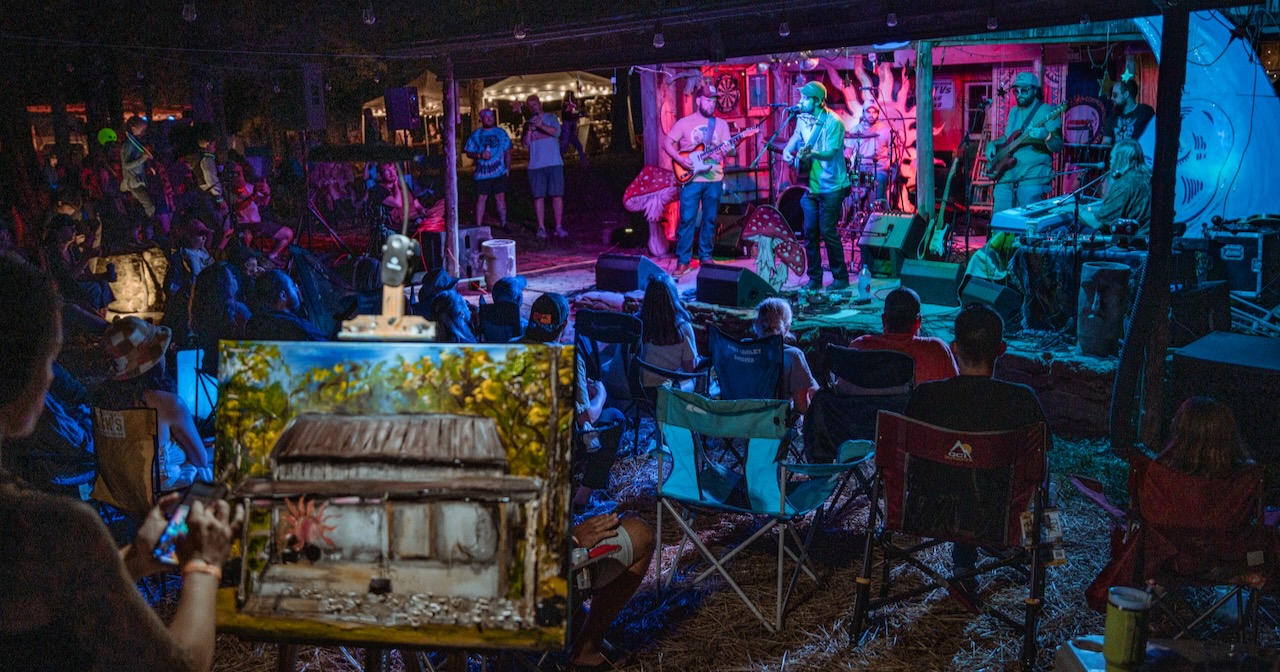
There’s something in the water in Kentucky that’s conducive to making great songwriters, and the second annual Sleeping In The Woods Festival — held May 17-19 in Monticello — was no exception.

Hosted by artist and songwriter Nicholas Jamerson, the gathering has quickly become a can’t-miss attraction featuring a mix of the Commonwealth’s most revered songwriters, as well as the ones they’ll eventually be handing the reins off to. The setting of Hidden Ridge camping — a birch tree-covered campground nestled along Lake Cumberland — further elevated its intimate feeling (in addition to providing a canopy of shade during a deluge of rain Friday).

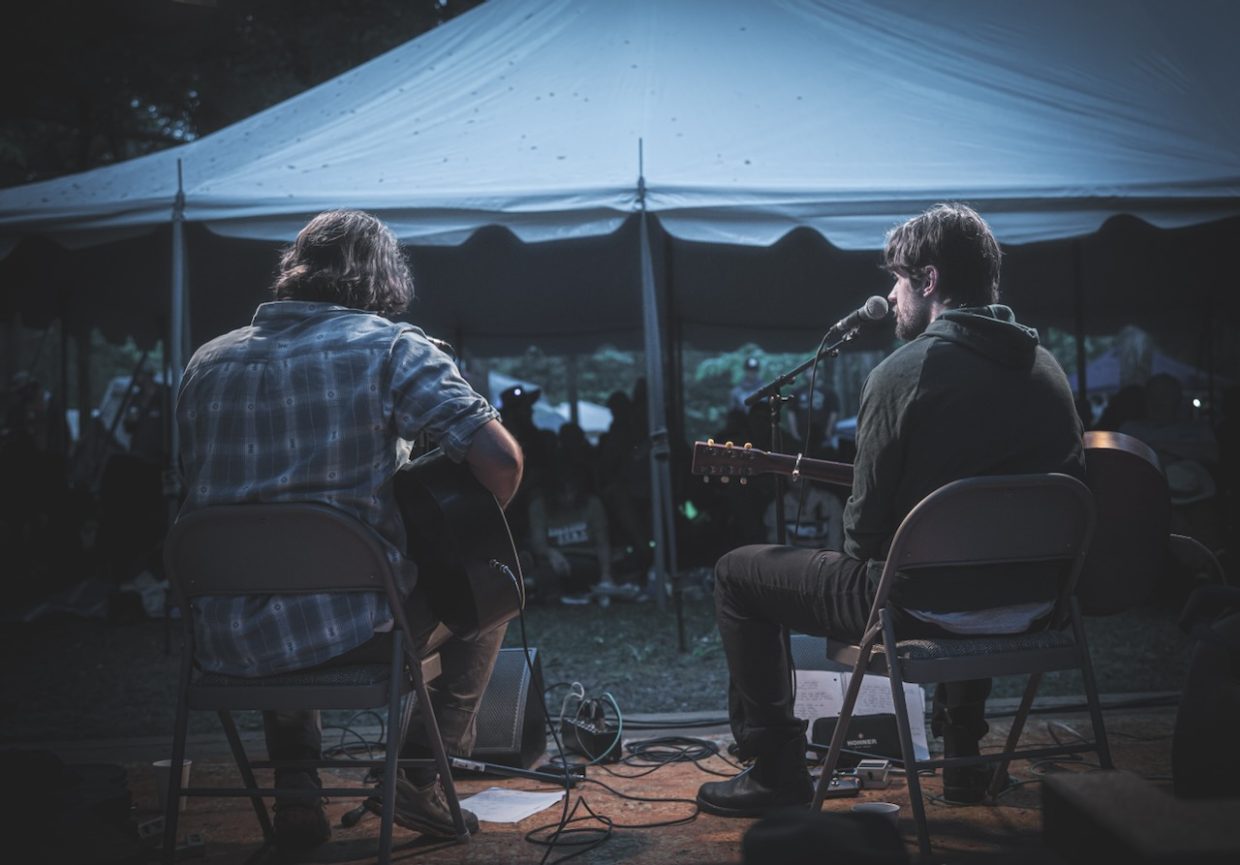
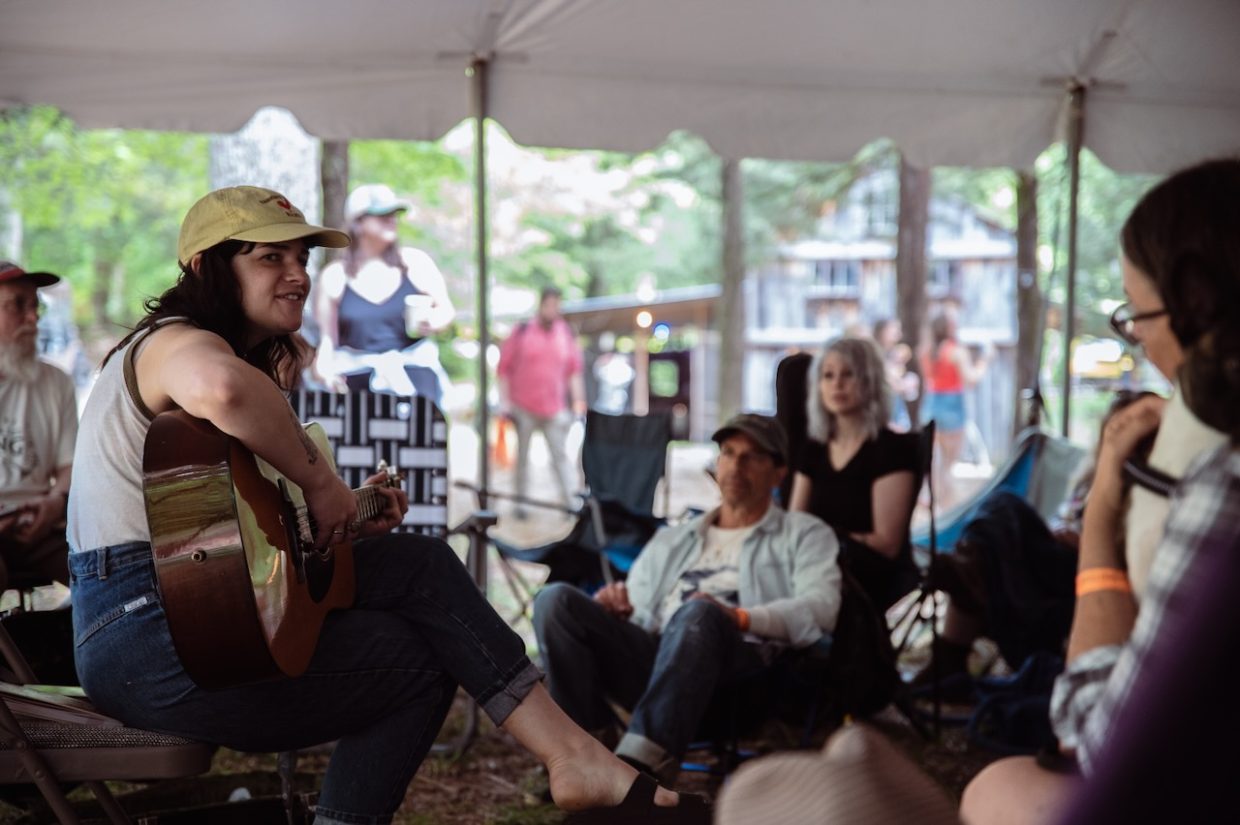
However, despite Mother Nature’s best efforts on day one, the few hundred in attendance didn’t have their spirits dampened by the soggy forecast, instead filling out a massive tent by the festival’s second stage for a songwriter round to open things up. Featuring Ryan Anderson of Louisville rock band Bendigo Fletcher alongside Jamerson, in a last minute change of plans, the two opted to debut entirely new and unrecorded music during the hour-long round, further putting a microscope on their superb songwriting, the stories behind them, and the creative process at an event built for exactly that. Outside of rain pattering on the tent above, you could hear a pin drop. Even though fans weren’t familiar with these songs, it was obvious they were captivated by the occasion, a sign of the duo’s songwriting prowess and power of getting caught up in the moment.

Nicholas Jamerson and Ryan Anderson (Bendigo Fletcher) open Sleeping In The Woods festival with a songwriter round.

“Getting to play all new songs with Ryan Anderson felt like the perfect way to set the tone for the festival,” Jamerson tells BGS. “I’ve admired him so getting to share that space meant a lot.”

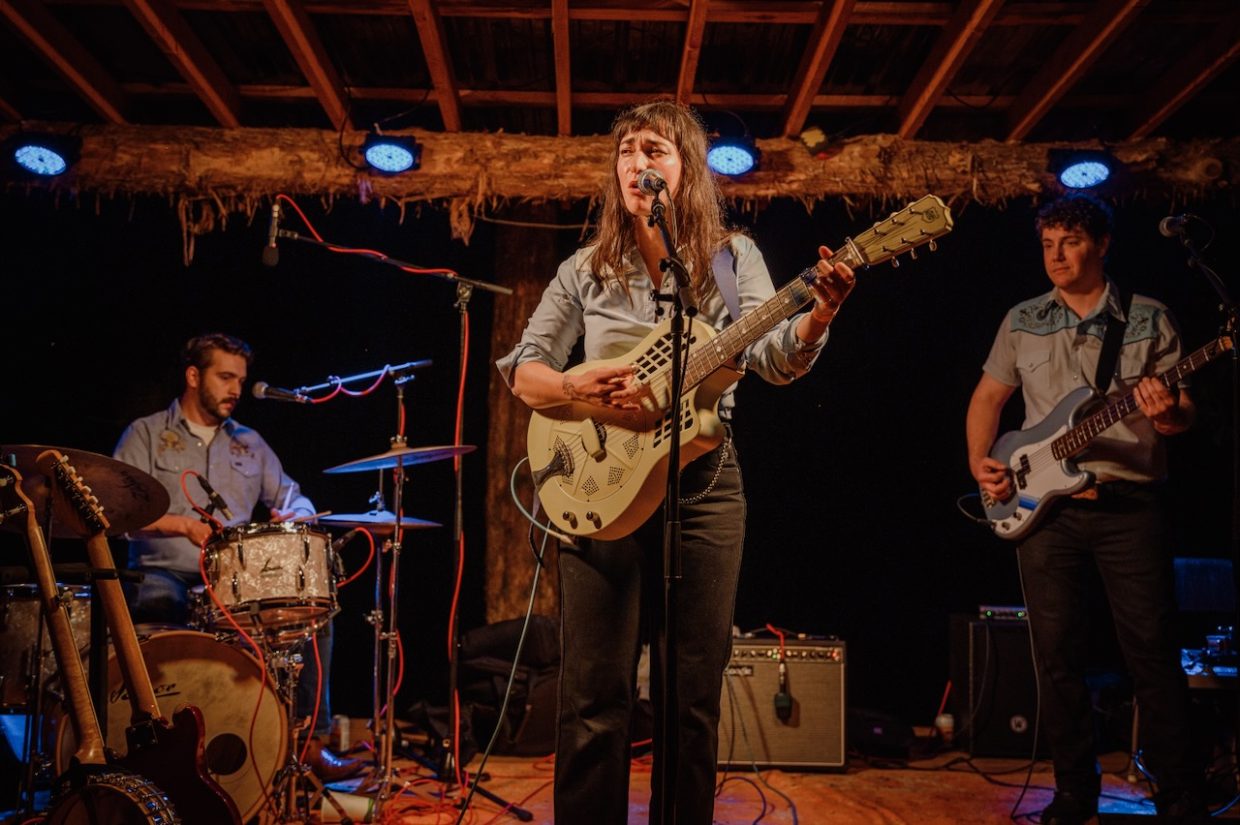
Following the round of new material was one of the festival’s few non-Kentucky acts, Cristina Vane. As a result I found myself talking with countless folks as she set up about what to expect from the electrifying slide guitar and banjo picker, but even my best of introductions couldn’t have prepared them for the show she gave them.

Working as a trio with drums and bass guitar, Vane tore through originals like “Blueberry Hill” and “Small Town Nashville Blues” alongside new songs like “You Ain’t Special” and sweltering covers like James McMurtry’s “Choctaw Bingo.” Through it all, she had the crowd at her will, seemingly unaware of the rain falling around them, including myself.

Cristina Vane performs at Sleeping In The Woods.

Although I’ve seen Vane perform several times, each occasion always feels like a first due to the versatility of her band setups. I’ve seen her play solo, with a full electric band, a full bluegrass band, and now as an electric three-piece; each show feels so different. Her songwriting is built for a festival like Sleeping In The Woods, but how she’s able to plug and play, presenting her music in many different ways is what truly sets her apart. Fans on Friday seemed to agree, giving Vane a ferocious standing ovation at her set’s conclusion, something that even she didn’t seem to expect.

“It was cool seeing people react to acts they hadn’t seen,” shares Jamerson. “I felt like Cristina Vane, The Dick and Tammy Show (Justin Clyde Williams and Tyler Hatley), and Josh Slone all made really huge impressions on people.”

Another out-of-state act integral to the weekend was Rachel Baiman. The Nashville-based multi-instrumentalist was everywhere over the three-day event, starting with a songwriter workshop she led to begin Saturday’s musical menu. Attended by around 50 under the tent that Cristina Vane rocked out the night prior, the croissant-fueled workshop saw Baiman working with fellow songwriters and aspiring ones alike to take internal conflicts and turn them into external ones via song.

This drew a mix of interesting inspiration from the heavy — a man trying to fit in with his different groups of friends and a mom and pop trying everything to keep their small business afloat — to tongue-in-cheek ones, like a prompt about how losing your Chapstick makes you feel like an inadequate lover.

“The songwriting workshop was both a complete joy and completely terrifying,” recalls Baiman. “Trying to ‘teach’ songwriting to some of my favorite songwriters felt a little crazy, but I think it really contributed to the class, because we could hear ideas from newcomers and seasoned professionals side by side.”

Rachel Baiman leads a songwriting workshop on day 2 of Sleeping In The Woods festival.

Outside of the workshop, Baiman also led a songwriter round of her own on Sunday afternoon that she used to showcase recent co-writes with Pony Bradshaw (“Equine Elvis”), Caroline Spence (“Throw Away The Moon”), and Jamerson, who joined her for a performance of their song, “The Vine That Ate The South,” due out next month. Additionally, she took to the stage with Leah Blevins, an Eastern Kentucky singer by way of Nashville, prior to Sunday’s round, fiddling with the Sandy Hook native on a selection of songs including the nostalgic “First Time Feeling.”

The set was a grounding one for Blevins, who expressed a longing to return home from Nashville in recent months even as she’s hit a breakthrough, signing a publishing and management deal with Major Bob Music in April. She expects to begin recording a new album soon.

“Any opportunity to be back home in Kentucky is a true sense of comfort,” says Blevins. “There are so many unbelievably talented artists there and this weekend was a true representation of that. It’s inspiring and always humbling to share the stage with folks that you genuinely respect like Nicholas. He’s always made me feel welcomed and his kindness alone is influential on a human level.”

Other Kentucky luminaries that stood out included Somerset’s Cody Lee Meece, brothers Wes and Aaron Smith — who were joined by Anderson on synth for an intriguing acousti-tronic sound — along with Ryan Allen & Maggie Noëlle’s stripped down versions of songs from their band, Magnolia Boulevard, and a Saturday evening round featuring three of the state’s stars of tomorrow: Salyersville native Zoe Howard, Hindman’s Josh Slone, and Central Kentucky’s Ireland Owens.

But it was Hunter Flynn, one of the state’s other promising young talents, that garnered the most attention. A local boy from just up the road in Somerset, Flynn’s Sunday afternoon set showcased the singer’s sensational songwriting and holler yell on cuts like “Spanish Street Signs” and “Fucked Up Brain” that have earned him recent gigs on the road with Zach Top and Ian Munsick, among others.

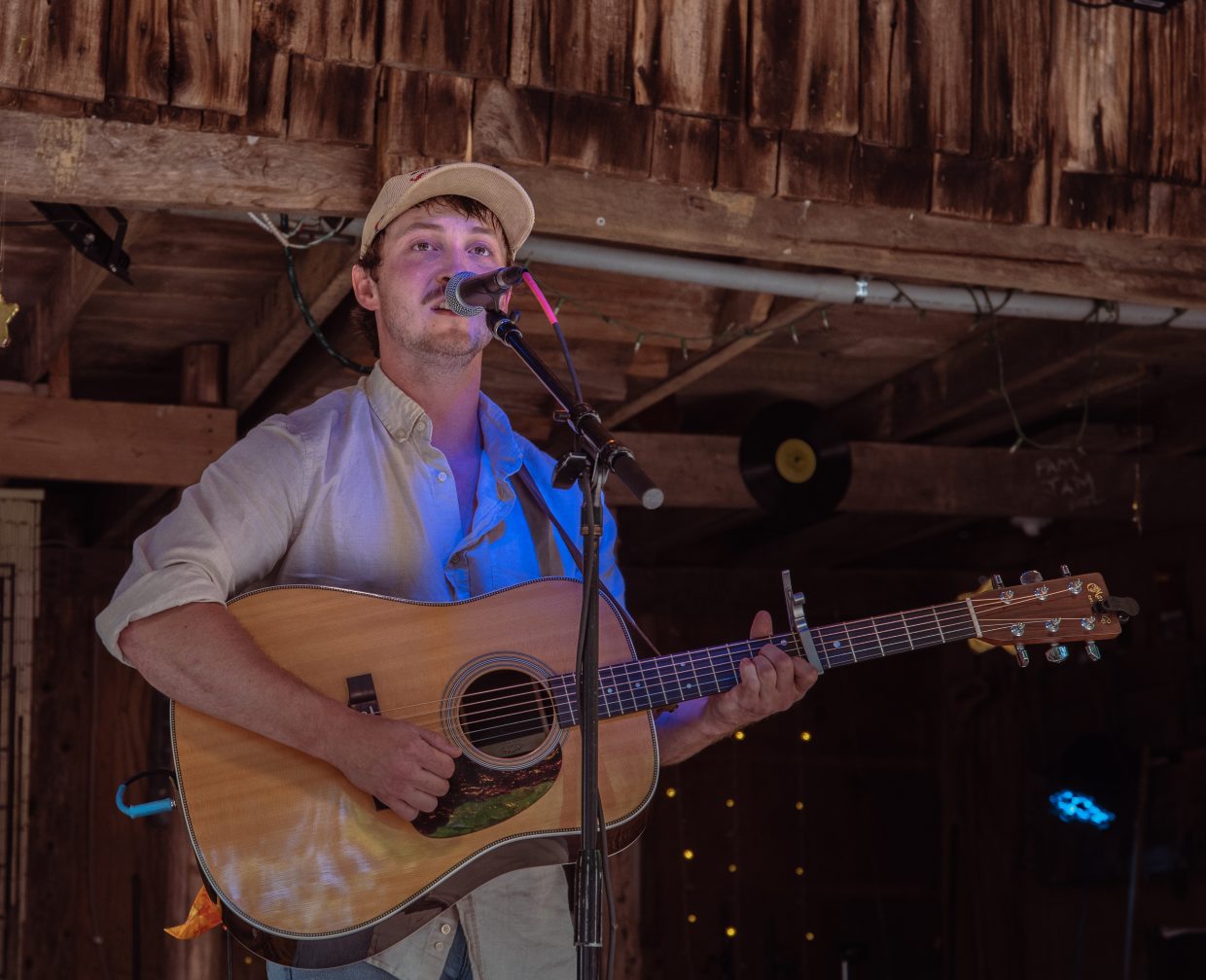
Hunter Flynn performs Sunday afternoon at Sleeping In The Woods festival.

In a pay-it-forward fashion similar to how Jamerson is platforming new artists with the festival, Flynn — who won a recording package from festival sponsor Jamm Nation during the event — plans to serve up his studio time to young artists in need on a collaborative EP that Jamerson will produce. According to Flynn, he wouldn’t be where he is today without Jamerson’s music and guidance.

“Before I knew Childers, before I knew Sturgill, before I knew Stapleton; I knew Nicholas Jamerson,” explains Flynn. “He might not have been the first to do it, but he was the first person that I knew from the Appalachian region that was writing songs and playing them for a living. Now I don’t know a single singer/songwriter from this region who doesn’t cover at least one of his songs. He could win six Grammys next year and it wouldn’t be as much recognition as he deserves.”

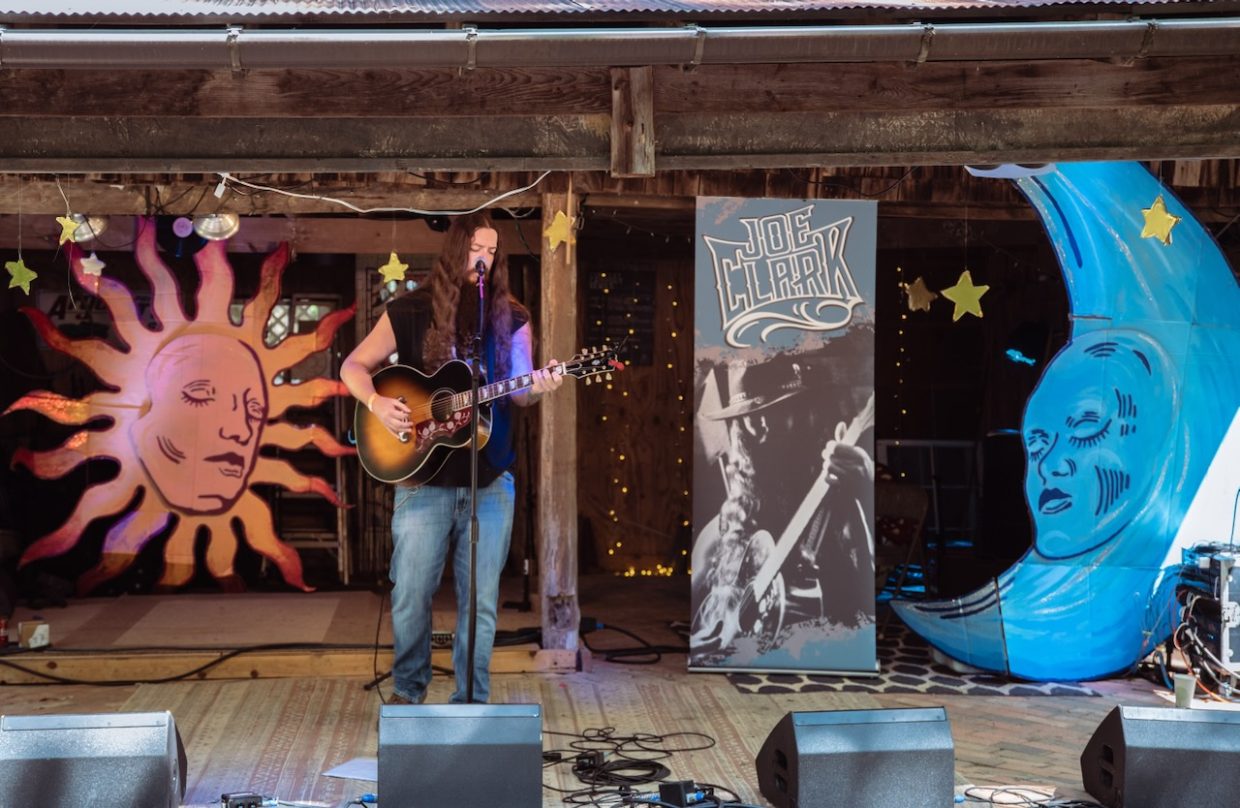
A more seasoned Kentucky artist that also turned heads was Henry County’s Joe Clark, who pulled back the curtain on songs typically backed by his country rock band, The Peacemakers, that touch on everything from drug addiction to the love he has for his father. Clark was hard to miss all weekend due to his towering presence, but heartfelt songs like “Wishin’ Well” and “Battlefield” showed a soft side to counter his hard exterior, one of the many things a powerful song can do.

Joe Clark takes the stage at Sleeping In The Woods festival.

“Music is my therapist. Along with my children and family it’s kept me sober and alive for years,” confides Clark. “I owe my life to songwriting. It is a power greater than me and I’m honored to put pen to paper each time a lyric comes to me. My biggest hope is to be able to take my real life experience and translate it through song in a way that someone else can take it and make it theirs and use it in a healing way for themselves. Music is medicine, and I believe everyone needs a daily dose to stay healthy.”

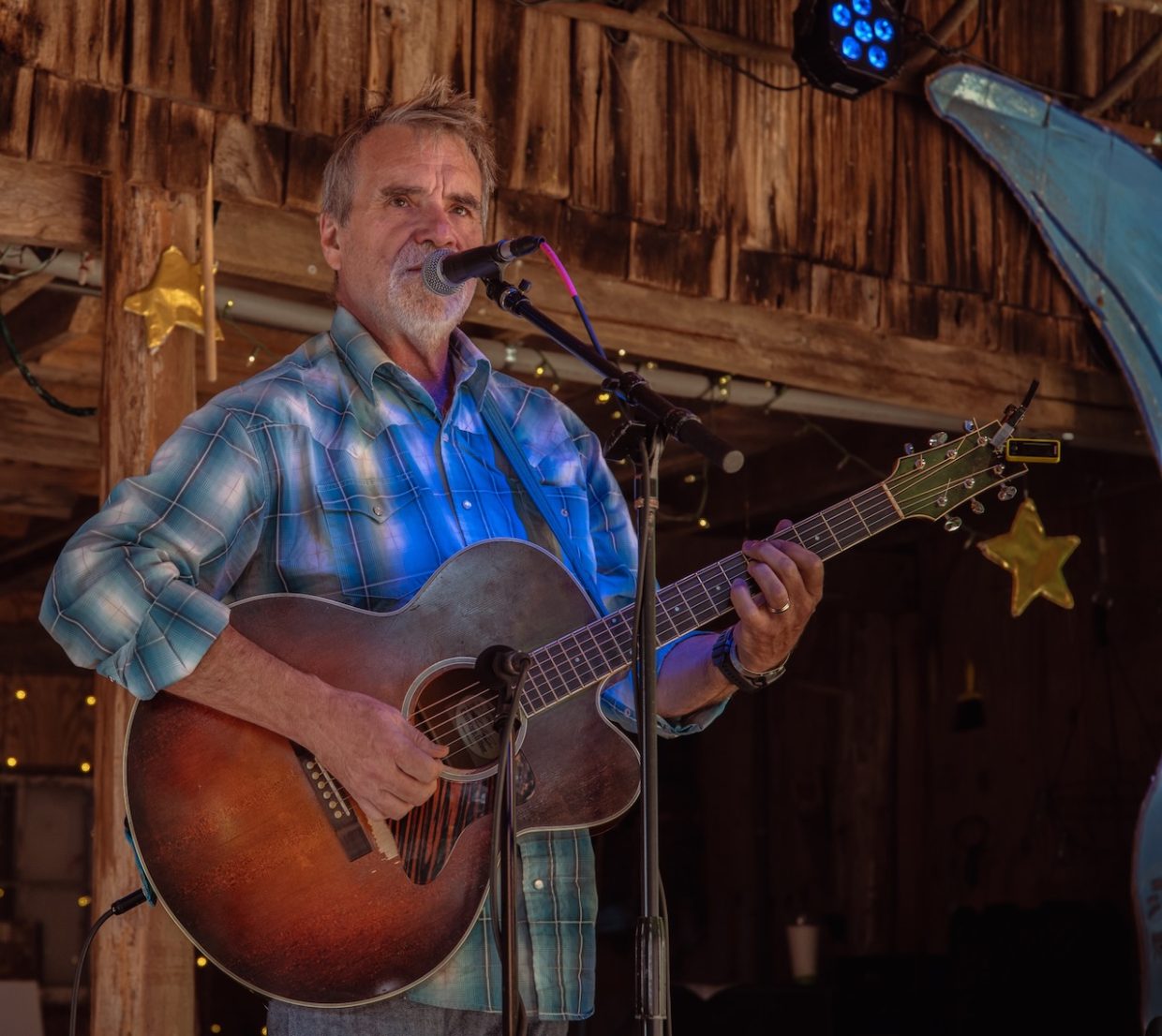
Closing out Sleeping In The Woods was one of the most iconic and influential Kentucky songwriters ever – Darrell Scott. For nearly two hours on Sunday afternoon the trailblazer showed off his fiery picking skills on iconic songs like “Never Leave Harlan Alive” and “It’s A Great Day To Be Alive,” giving all of the artists and fans in attendance something to look up to and aspire to in the process. The performance also left many in the audience visibly emotional including Jamerson, who could be seen tearing up throughout it.

“Having Darrell there really meant a lot,” reflects Jamerson. “It felt like we had the full spectrum of musicians, from green, next generation, seasoned vets and a master in Darrell. We are hoping to expose the youngins to a sustainable path in this industry, so having someone like Darrell was really validating for me.”

Darrell Scott headlines Kentucky’s Sleeping In The Woods festival.

From vets like Darrell Scott to youngins like Josh Slone, Zoe Howard, and Hunter Flynn, and present day stars like Nicholas Jamerson, Sleeping In The Woods was proof of many things — that Kentucky music is in as good a place it’s ever been, that smaller, niche festivals do have a place in today’s music landscape, and that great songwriting will never go out of style.

“It feels like the best way to kick off the year,” describes Jamerson, who’d been laying low since his two-night Hollerday Gitdown in December. “It’s such a great group of people that makes it all happen. It’s also really grounding, inspiring and a nice reminder of the community of people that I’m a part of, which is uplifting and gives me life going into the busy season.”


All photos by Joe Wilkins, courtesy of Sleeping In The Woods festival. 

“Guitar Prodigy” Doesn’t Quite Resonate with Grace Bowers

Boasting an Instrumentalist of the Year nomination at the 2024 Americana Music Association Honors & Awards (held September 18), Grace Bowers may be one of the most exciting new guitar players on the planet – with extra emphasis on “new.”

Still in her teens, the Bay Area native has made a splash with soulful-beyond-her-years playing and the enthusiasm of youth, but she’s proving to be more than just a six-string specialist. Now leading a funky blues-rock outfit called The Hodge Podge, Bowers dropped a strutting, co-written debut single – “Tell Me Why U Do That” – and has a cosmic follow up to come. Plus, she’s not afraid to speak her mind.

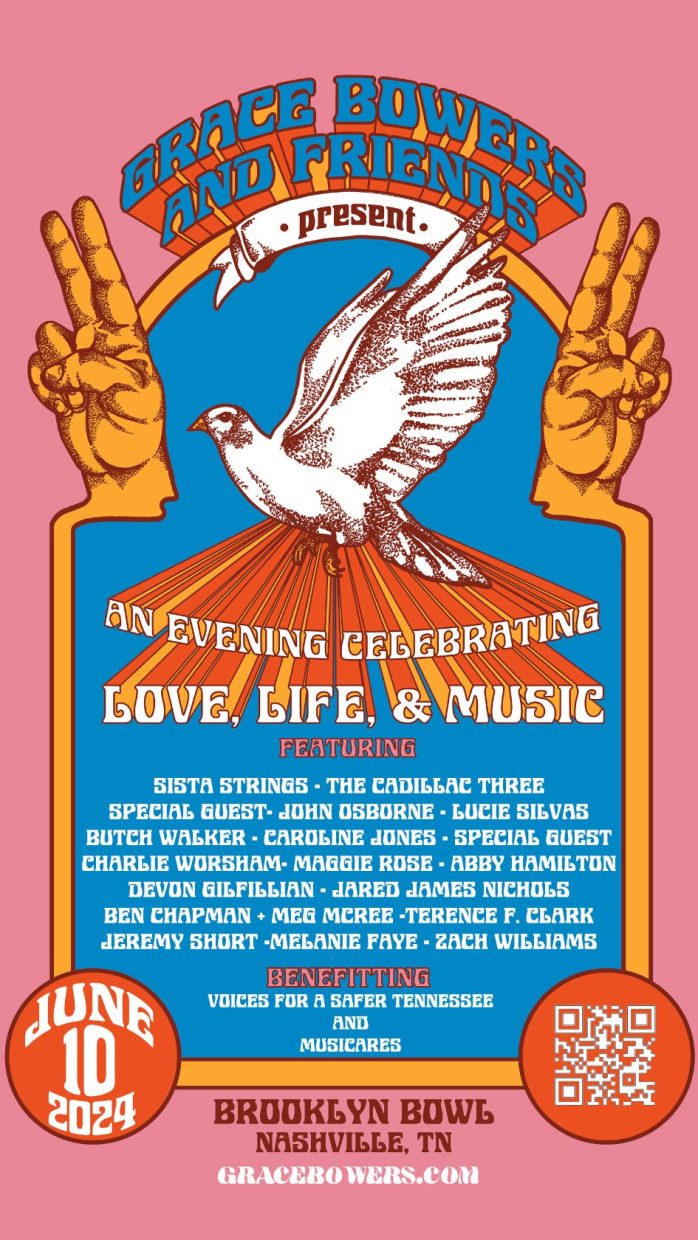
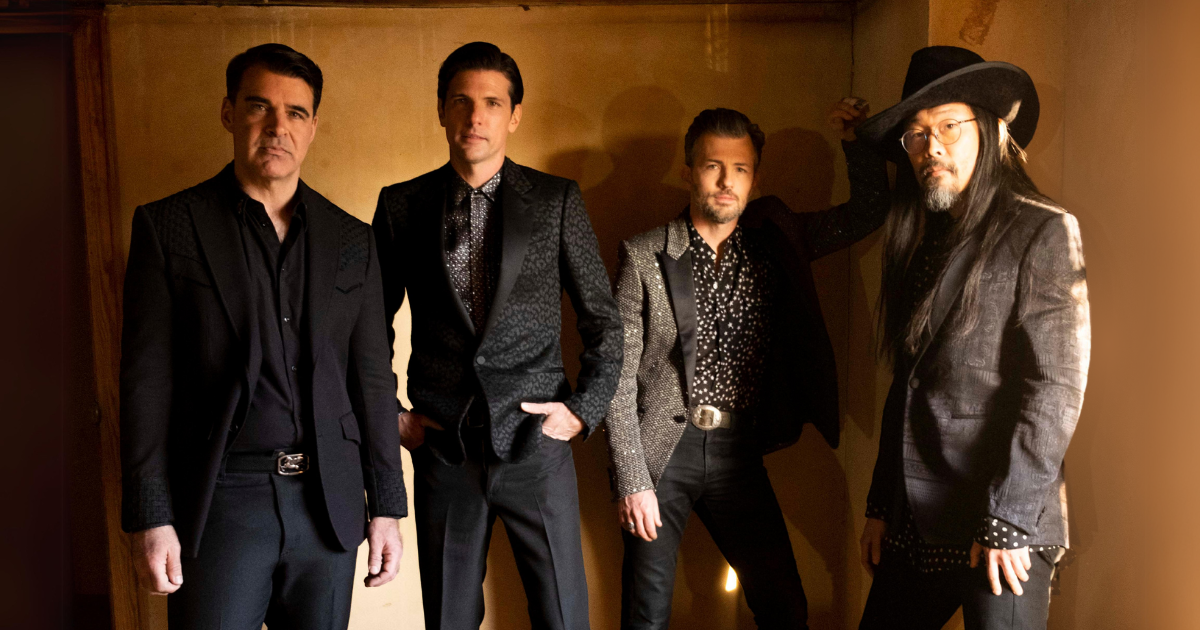
Already using her platform for positive impact, Bowers will host the 2nd annual An Evening Supporting Love, Life & Music benefit concert at Nashville’s Brooklyn Bowl June 10. Founded to support victims of the Covenant School Shooting and now benefiting Voices for a Safer Tennessee and MusiCares, the show will feature Bowers and The Cadillac Three, Devon Gilfillian, Caroline Jones, Meg McRee, Jared James Nichols, John Osborne, Lucie Silvas, SistaStrings, Brittney Spencer, and Butch Walker, as the rising star looks to leverage her “prodigy” label attention.

BGS caught up with Bowers just as the summer festival season kicked into gear, getting to know an exceptional breakout talent who seems primed for a long career to come.

After blowing up on social media during the pandemic, you’ve done a lot in the last few years – but, you still have a few months before you turn 18, right? How have you managed to balance this music career with growing up and just being a teenager?

Grace Bowers: It’s definitely a weird balance, and especially since I don’t go to school anymore. I started doing [school] online a year-and-a-half ago … and I don’t miss homework, but I definitely miss being around people my own age and just a normal experience. But at the same time, I’m getting to do this stuff that I love almost every night, and I would take that over anything. Some people look at it like I’m doing it too fast, or someone’s pulling strings for me, and it’s not true. This is what I love and I can’t imagine doing anything else.

What drew you to guitar in the first place? I know people like to compare you to the female guitar greats, like Bonnie Raitt or H.E.R., but I feel like it doesn’t have to be just women. I hear a lot of Prince’s style in you, or even Derek Trucks.

Yeah, I love all those players that you just mentioned! The first time I was drawn to a guitar or just to music in general was when I was 9 years old, and I saw Slash on YouTube. Which is kind of a basic answer, but that’s how it happened. I was watching the “Welcome to The Jungle” music video.

Really? So did you just rush right out and say, “Hey, mom and dad, I need a guitar”?

That’s pretty much how it went. I think I tried almost every other hobby there was. I got kicked out of soccer, hated Girl Scouts. I’m pretty sure I got kicked out of softball, too. I was not good at gymnastics. I tried everything and my parents tried everything. So when I came to them and said I wanted a guitar, they were like, “We’ll get you a guitar.”

Were you ripping leads within months, or how long did this take?

Oh, no, no. People call me a prodigy a lot and it’s entirely not true, because for the first three years I was so bad. I was awful, and I wasn’t even really passionate about it. It was just kind of something that I did. I never really practiced or dug into other music styles.

But when I was 13 and COVID had just started, I heard B.B. King for the first time – “Sweet Little Angel” – and that song starts off with three notes. I was so hooked on that, and it was a sound I had never heard before, because I didn’t grow up around music. I don’t have any players in my family, so it was a completely new thing to me, and that’s what really made me passionate about it. I started actually learning things on guitar, but it was not an immediate light bulb moment for me.

I think that’s actually a good message for people, because it’s easy to get burned out trying to learn an instrument.

Yeah, it takes time.

Was it a shock to get this Americana Music Association nomination? You’re up for Instrumentalist of the Year, right?

Yeah, I forgot. I didn’t even know I was nominated, to be honest with you. I had no idea. I opened Instagram one day and I was tagged in the post. I’m like, “Holy shit, this is insane.” Because the year before that, I was in the audience at the Ryman watching the Americana Awards. So now that I get to be there, that’s insane.

Tell me about getting the band going and working on songwriting. You’re known for your guitar playing, but it seems like you’ve been trying to diversify. Does that come natural?

Songwriting was a bit of a learning curve for me, but it is something I’m very, very much into these days. I feel like people just look at me as a guitar player, but I don’t really feel like I’m just a guitar player. And even at that, I’m not some bright virtuoso guitar player. I wouldn’t consider myself that at all. I lead this band, I wrote all the songs or co-wrote them. So I think that that’s something that a lot of people don’t realize when they’re leaving hate comments online.

Your band sounds amazing – I love how much funk and soul is in the mix. It’s also cool you present yourselves as an ensemble. It’s not just Grace Bowers and then some people behind her.

That was my goal, because like I said, I don’t want to be known as just a guitar player. If you think of Derek Trucks, you think of Susan [Tedeschi], too. Tedeschi Trucks Band would not be what it is without one another, and I love that. And since I don’t sing right now, I want to be known for this amazing band.

The first single, “Tell Me Why U Do That,” came out a little while back. It’s super funky and light – what did you write that about?

It wasn’t written about a single person. It sounds like it is, but I wrote it with John Osborne and his wife Lucie [Silvas], and honestly, we wrote it in an hour and we were kind of just bullshitting lines. … Normally I’m like, “Well, the lyrics have to mean something.” But I kind of let that go for this one. It’s just a fun song.

Does that speak to the other stuff you’re doing?

For the most part, the lyrics were very intentional. My second single that’s coming out is called “Wine on Venus,” and this one has a cool story behind it. It was written about my Nana who passed away a bit ago. I’m from California, so we went home for Christmas this year and it was the first year not having her at Christmas. Everyone was talking about her, and my uncle said she always told him that when she died, she’d be drinking wine on Venus. It’s the brightest star.

Oh, wow.

Yeah, and I thought that was such a cool thing to think about. So I brought it back here and I was writing with Ben Chapman and Meg McRee, and I told them this story, and this song just flowed right out of us.

Your grandma sounds like she was awesome.

Yeah, she was kind of crazy, but there were some good nuggets in there from time to time.

John Osborne is producing your work, and he’s an amazing guitarist in his own right. Does that have an impact on what you’re doing?

Absolutely. I don’t think enough people are talking about how good a guitar player John Osborne is. He’s on a whole ‘nother level, and I don’t hear his name mentioned when people are talking about great guitar players, but I can’t imagine doing it with anyone else. I think he just completely understood my vision and the sound I was going for, and I’ve worked with producers before who have a sound and they’ll try to mold you into their sound, and John wasn’t like that at all. I mean, he gave us direction and some really great ideas, but really let me and the band lead the ship on where it was going. So I really appreciated that.

Tell me about the benefit you put together for June 10 – An Evening Supporting Love, Life & Music. Why did you want to do this so early in your career?

This is my second year doing it, and the first year I put together after the Covenant School shooting. I have two little brothers in school, and I remember the day it happened, they were texting me like, “There’s a school shooting.” And at first they didn’t tell me what school, so my heart dropped thinking it was at their school. They eventually told me, but that brief moment of panic I had – I can’t imagine if you were a parent with a kid at Covenant on that day. Just to even think about that is awful. And it really upset me seeing how much of a divide there was, because coming from the Bay Area in California, we have different viewpoints.

I don’t know, it just upset me that it seemed to be such a divided issue, and really I think there’s a lot of common ground to be found. The first year I did it, the money went directly to the school and MusicCares, and it went amazing. So much so that the school is no longer accepting donations. They received so much support. So this year we’re donating [proceeds] to an organization called Voices for Safer Tennessee, and they’re non-partisan so it’s not political in any way, and they’re advocating for safer gun laws – which Tennessee needs some of that. I’m just doing all I can to support something that I’m passionate about, and I want to see some change.


Photo Credit: Cedric Jones

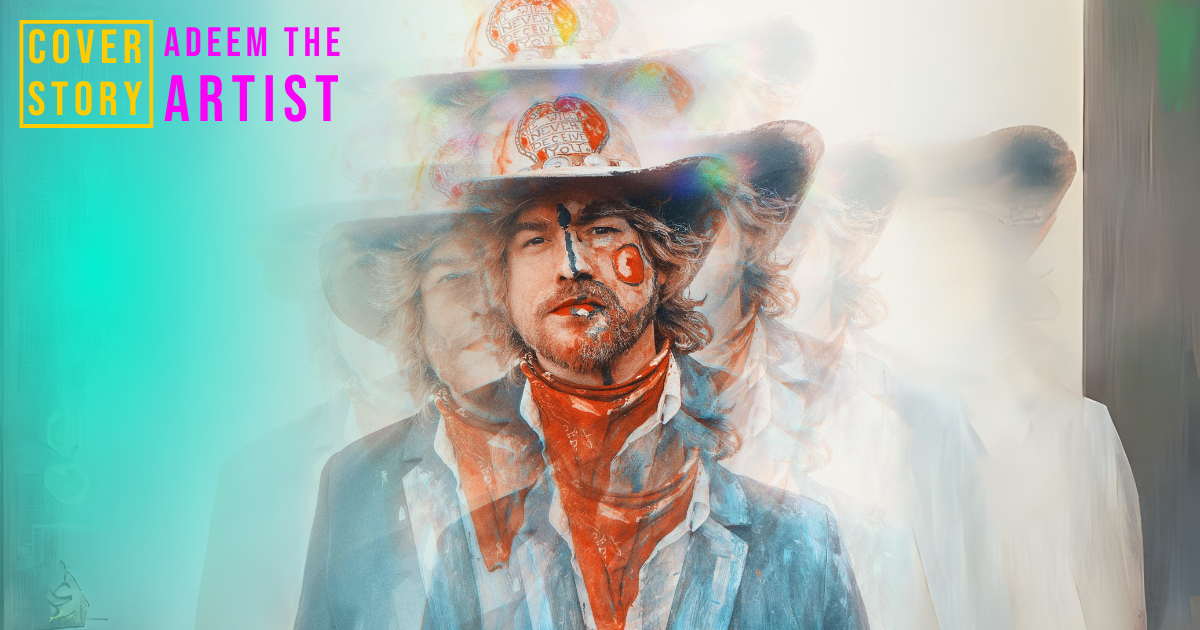
Adeem the Artist’s ‘Anniversary’ is a Complex, Deeply Moving Homecoming

In the press release for their 2024 album Anniversary, Adeem the Artist, the non-binary, self-described “cast iron pansexual” singer-songwriter, mentions that the album is queer country – as a genre, not simply as music made by queer people, but as a whole new thing. They also mention recording and creating with their child, their partner, and their tour manager, in a week off from touring in semi-rural Texas. The album is a deeply moving, hauntingly specific, and profoundly sophisticated look at the interweavings of family and a (literally) hostile landscape.

This is queer country – queer as a sexuality and gender and musical identity, but also as an indication of being a little askew, not really fitting plumb, as a political and personal identity. Here, a genre, Adeem notes, is a way of working against expectations or histories:

“Country music is important to me, because it’s so much tied into the dirt of where I grew up. It feels like a place I can comfortably speak from, in the authority of my testimony as a Southerner and a child of Confederates. That’s my responsibility, my calling. That’s why I’m making country records right now. It’s where I need to be, to be processing the things I’m processing.”

One of the ways of keeping safe in this landscape, while acknowledging and trying to make amends, is to move inwards, to lean on the “cast iron” of “cast iron pansexual.” This album moves from the outside – a world that is toxic and violent – toward one that is domestic. In the coruscating rock breakdown of “Plot of Land,” with its minute-long, Tom Petty quoting coda, Adeem sings:

And the politicians cast their lies like street craps,
And they sweep up every time
So baby I’m gonna find us a plot of land
With a little home to put a family in …

The plot of land is a long term plan, but there are moments in this record where you can see possibilities – of a loving home, of a rock and roll life, of a genderqueer Southern utopia, of the perfect dive bar meetup – falling out of an ambitious set of recordings. The too muchness of the album can be understood given it was made in a week, in a hostile place.

Adeem talks about how they made “Nightmare” in Texas, incorporating all the elements in their surroundings including “Isley’s laughter [their daughter], Kyle’s gentle presence [their tour manager], Hannah’s bouncing energy [their wife] as she pitche[d] hymns we could reference irreverently. That week away from the internet and the news cycle was a little insulation bubble that gave us so much room to breathe and feel safe. I don’t think this song could’ve been delivered with a different midwife.”

The midwife analogy is especially relevant to understanding some of these songs, particularly “Carry You Down,” where Adeem writes gorgeously about having and raising babies. The song is so gentle, so respectful of the autonomy of the child, but also filled with the details of domestic life that have become rare in country lately. In an album about adult pleasures and pains, it is a rest song, about carrying a child down the stairs when they ask to be carried, even if that interrupts “chorin’,” doing dishes or work in the garden.

If “Carry You Down” is a waltz, then “The Socialite Blues” is a romp about “staying up to the break of dawn/ making out of tune songs with you” – another kind of domestic, with “out of tune” its own kind of queerness. These songs have a sweetness, a refuge from harm, a way to escape not outside, but within.

The invocation of “out of tune songs” is a euphemism, but there are spaces on the album where Adeem is explicit about desire, as explicit as a country song has ever been, like in “Nancy,” which expresses exactly how difficult it is to fuck while on pharmaceuticals; or “One Night Stand,” about relationships that happen between last call and sunrise, but whose memory might, out of mercy and grace, stay on for “a lifetime of nights with him;” or “Part and Parcel,” where they sing, in gentle but urgent tones:

Take it all apart, it’s part & parcel
I came here with a strange and honest feeling
Chase all of these contradicting versions
Childhood perversions, & dreams that never steered
Let them drive a little while so that I can disappear

Those “contradicting versions” include being a child from the South, so the history here is not only personal, but social and political. There is a cluster of artists working out the history of the South right now – Justin Hiltner’s “1992,” Miko Marks’ Race Records, Willi Carlisle’s recitations of the failures of Appalachian and rural drug work, the entire career of Jake Xerxes Fussell, all of the ancestor work in Beyoncé’s Cowboy Carter. It might seem like Adeem’s work is personal, but all of this historical work flows from the personal to the corporate, an understanding of history that includes both last week and last century, trauma and joy twisting into a complex homecoming.

Homecoming for Adeem also includes the history of Knoxville, Tennessee; on the album’s last song “White Mule, Black Man,” they begin by asking if it’s too much to do one more, but after the end of the track, it’s clear that nothing could be more proper. Here, Adeem telling stories of the South, from Confederation onward, means taking racial politics seriously.

In almost exactly three minutes, they tell the story of a white mob rioting after a foiled lynching, the eventual coverup of that lynching, and the layers of myth-making and storytelling to prevent the truth from being revealed. Moving from talking to singing, somewhere between Peggy Lee’s “Is That All There Is” and Dylan’s “The Lonesome Death of Hattie Carroll,” the story in this final song laments, “But if the Tennessee River runs red with blood/ ‘Til the city runs white again/ Well, a white mule’s curse means more round here/ Than the last words muttered by murdered Black men.”

Adeem has been blunt like this before, tearing down the charnel houses of violent American racism and its myths, and this song is a deepening and extending of that practice. By ending the album on this note of violence, not as a lecture but as a moral accounting, that history work is ensuring that everyone is seen and known, their family is known, and the origins of their family’s prosperity is known.

Such knowledge is the necessary, sometimes haunting, sometimes delightful, attraction of Adeem as a person and “the Artist” – earning that sobriquet.


Photo Credit: Hannah Bingham

Artist of the Month: The Avett Brothers

(Editor’s Note: On May 17, The Avett Brothers released a new, self-titled album. BGS is proud to bring them back as our Artist of the Month for June 2024.

Below, enjoy a musical exploration of their illustrious career and prolific catalog. Plus, you’ll also find our Essential Avett Brothers Playlist for even more discography digging. And, you can revisit our feature from June 2016, when they were first selected to be our AOTM eight years ago.)

Depending on how you reckon it, you could say The Avett Brothers’ career goes back about two-dozen years – or Scott and Seth Avett’s entire lives. Even if you know nothing at all about them, all it takes is a few seconds of hearing them singing together to realize that they really are brothers.

Elder brother Scott’s voice is usually earthy and down below to Seth’s angelic up above. They meet in the middle to harmonize on songs about a series of quests – for love, redemption, family, pretty girls from far-away places, or just to be seen. Small wonder that one of their latest undertakings is Swept Away, a musical inspired by the mythology of their musical world.

To celebrate our Artist of the Month, here are a dozen songs about The Avett Brothers’ remarkable journey.

“Pretty Girl From Matthews” (2002)

Pretty girls are, of course, a perennial songwriting topic for the Avetts – most of them identified simply as “Pretty Girl From.” It’s taken them far and wide, from Michigan to Chile, Annapolis, San Diego, Cedar Lane, Raleigh, Feltre, Locust and even “at the Airport.” But here is the earliest example in all the Avetts’ early, detuned glory, from a town southeast of Charlotte. Originally titled “Song For Robin,” “Pretty Girl From Matthews” was the opening track on 2002’s Country Was.

“Talk on Indolence” (2006)

Folksy Americana trappings aside, Seth and Scott started out playing in bands that did a lot more screaming and thrashing than crooning and strumming. And even as their music has grown more polished and stately over time, their raw streak still comes out regularly. This breathlessly paced head-banging rant, which kicked off 2006’s Four Thieves Gone: The Robbinsville Sessions at an amphetamine pace, is one they still play at most shows.

“Distraction #74” (2006)

Another Four Thieves Gone recurrent, “Distraction #74” evokes British seafaring vibes seemingly tailor-made for raucous pub sing-alongs. And it has a perfect Avett Brothers lyrical theme: Torn between two lovers, the protagonist mostly wonders which of them he’s going to miss the most. The only certainty is that he’ll blow it with both of them.

“Die Die Die” (2007)

In which the Avetts don’t just make a simple pop move, but pull off what might be the least-likely Beatles rip ever. “Die Die Die” opened 2007’s Emotionalism, their first album to crack the Billboard 200 and a showcase for new cellist Joe Kwon. Among the Fab Four echoes here are Beatle-esque vocal harmonies and a guitar solo that’s pure George Harrison. Onstage, they’ll sometimes make it even more overt by closing with flourishes from “I Want to Hold Your Hand.”

“Paranoia in Bb Major” (2007)

Nothing fancy, just a little banjo and glockenspiel number from Emotionalism that perfectly captures the Avetts’ manic whisper-to-a-scream mood swings. Then it closes with one of their quirkiest recorded moments, wordless falsetto chanting that is somehow adorable.

“Murder in the City” (2008)

From 2008’s The Second Gleam, “Murder in the City” came out right when this cult act was about to go mainstream. It feels like one last look back before stepping into the spotlight, a series of epigrams about love, jealousy, family and forgiveness.

“Murder in the City” remains one of the Avetts’ regular live set-pieces, with lyrics that have evolved to reflect the brothers’ evolution from children to parents themselves. It’s a cinch they’ll still be playing and updating it someday when they’re grandparents, too.

“Head Full of Doubt/Road Full of Promise” (2009)

Fittingly, “Head Full of Doubt/Road Full of Promise” was the song the Avetts played during their star turn with Mumford & Sons behind Bob Dylan at the 2011 Grammy Awards. “Decide what to be and go be it” might be their most durable manifesto, which is a big reason it remains their most-performed song live. According to Avett Brothers super-fan Tim Mossberger’s database, it’s closing in on 1,000 live performances. And it still kills. All it takes is hearing Kwon’s cello riff to bring on chills.

“Laundry Room” (2009)

Like “Head Full of Doubt,” “Laundry Room” is drawn from the Avetts’ 2009 big-league debut, the Rick Rubin-produced I and Love and You – their first gold record. It’s a beautifully poignant portrait of stolen-moment love that may or may not be doomed.

“Tonight I’ll burn the lyrics/ ’Cause every chorus was your name,” Scott sighs, contemplating a “head-full of songs” he dreamed up overnight. The double-time hoedown outro plays like a bittersweet wake. “Laundry Room” ranks second on Mossberger’s live-performance database.

“Live and Die” (2012)

From 2012’s The Carpenter, the Avetts’ first to crack Billboard’s Top 10, “Live and Die” is just about the poppiest they’ve ever sounded – even with banjo as lead instrument. In contrast to the Avetts’ usual outlook, it is surprisingly optimistic, which made it the perfect upbeat closing-credits accompaniment for director Jud Apatow’s romantic comedy, This Is 40.

“Satan Pulls the Strings” (2014)

The studio version of “Satan Pulls the Strings” appeared on 2016’s True Sadness, but this one was around for years before that. In fact, its best incarnation is as entrance music for the live show. Among my favorite in-concert memories of the Avetts was watching the entire seven-piece band enter the stage one by one and start in on this song on New Year’s Eve 2014 in Raleigh, North Carolina. That performance appears on 2015’s Live Vol. Four.

“No Hard Feelings” (2016)

In recent years, “No Hard Feelings” has been the Avetts’ customary show-closer, ending each night on a prayerful, elegiac note. As depicted in the 2017 biopic May It Last: A Portrait of the Avett Brothers (overseen by Apatow and Michael Bonfiglio), recording it for 2016’s True Sadness LP was an overwhelmingly emotional experience. It triggered a meltdown by Scott immediately afterward, a sequence that proved to be the film’s most memorable moment.

“Operator (That’s Not the Way It Feels)” (2022)

On-record as well as onstage, the Avetts have always had splendid taste in covers, dipping into the songbooks of Townes Van Zandt, John Prine, Bob Wills and many others. There’s also “Operator (That’s Not the Way It Feels),” a 1972 Top-40 classic by the late great folk-rocker Jim Croce. Seth started doing a stripped-down acoustic version of “Operator” with bassist Bob Crawford back in 2012, and it’s one they still dust off regularly 12 years later.

Read more about the Avett Brothers’ eleventh and self-titled album here.


David Menconi’s latest book, Oh, Didn’t They Ramble: Rounder Records and the Transformation of American Roots Music, was published in 2023 by University of North Carolina Press.

David would like to thank Tim Mossberger for assistance with facts and figures.

Photo Credit: Crackerfarm

You Gotta Hear This: New Music From John Cowan, Jason Carter & Michael Cleveland, & More

To close the month of May, we have an absolutely stacked round up of premieres this week!

It’s lovely any time natural and organic themes twist their way through our batches of premiere. This week, it certainly seems like cutting-edge bluegrass is front and center, with new tracks and videos from John Cowan, Jason Carter & Michael Cleveland, and husband-and-wife duo, Benson.

Plus, we have a trio of songs about touring, coming and going, leaving and returning – Rob Baird asking his listeners to “Hold Tight” ’til his return, Evan Boyer longs for home and hearth in a song for his wife, “Home to You,” and Rose Gerber pays tribute to a vagabond period in her own life with “Off to See America.”

Finally, don’t miss a danceable rockabilly number, “If I Didn’t Have You,” from Matt Hillyer and roots duo Native Harrow bring us a new music video for “Borrowing Time.” It’s a packed premiere round up this week and You Gotta Hear This!

John Cowan, “Fiction”

Artist: John Cowan
Hometown: Nashville, Tennessee
Song: “Fiction”
Album: Fiction
Release Date: June 7, 2024 (single); Fall 2024 (album)
Label: True Lonesome Records

In Their Words: “The genesis of the song is that Eddie [Sanders] and I had sat down to write a song for this new recording that eventually was titled ‘Fiction.’ I have been a voracious reader my whole adult life. I was discussing with Eddie the problem of living in a world at this time, which is confounding, scary, and frustrating. My expansive bookcase is loaded with non-fiction books. I had just said to him that I can hardly stand to pick up these two new books I’d bought, ’cause I didn’t feel like I needed any more affirmation about the state of our country and the world. What I needed was an escape to a place of commonality with the people I’ve encountered and my loved ones. I think we did a good job on it and that’s all I know for now except, I always believe in hope and grace.” – John Cowan


Jason Carter & Michael Cleveland, “Give It Away”

Artist: Jason Carter & Michael Cleveland
Hometown: Floyd, Kentucky, now living in Hendersonville, Tennessee (Jason); Charlestown, Indiana (Michael)
Song: “Give It Away”
Release Date: May 8, 2024
Label: Fiddle Man Records

In Their Words: “I feel that the world we live in is a beautiful place, but it takes all of us to make that world. Every time I hear this song it brings a smile to my face, thinking of the day we recorded it. The room was filled with friends making music and the joy that was shared between us really comes through in the recording. This song was written by two of my favorite fiddlers, Tim O’Brien and Matt Combs, and that was another thing that made me feel like it was right for Michael and I to record it.

“Every time I’ve been around Sam Bush, I feel the love he puts out into the world and I thought he’d be the perfect person to sing this song with. I feel the same way about Michael, it’s always such a joyful experience to get to play or even hang out with him. With that said, ‘Give It Away’ sets the tone for the entire record, I hope you enjoy it.” – Jason Carter

“‘Give It Away’ is a hard driving bluegrass song in the key of B, except this time nobody leaves or dies. Instead, it reinforces the valuable lesson that if you want to ever find love, you have to learn to give it away. I would like to thank Bryan Sutton, Cory Walker, Alan Bartram, and Sam Bush for creating one of the most grooving tracks I’ve ever been a part of, they really made this song come to life. This song was a natural for twin fiddles, and Jason and Sam’s vocals are absolutely incredible.” – Michael Cleveland


Rob Baird, “Hold Tight”

Artist: Rob Baird
Hometown: Austin, Texas
Song: “Hold Tight”
Album: Burning In the Stars
Release Date: June 21, 2024
Label: Hard Luck Recording Company

In Their Words: “Early on in my career, I spent a lot of time in a van, touring all over God’s green earth. This song, ‘Hold Tight,’ is a reflection of those times. It’s about the chaotic feeling of driving through the night to get back home to one who’s been waiting for you. I wanted that feeling of desperation and determination to build every second of this song. Hold tight and hold on for just a few more hours.” – Rob Baird

Track Credits:
Produced by Brian Douglass Phillips.
Jacob Hildebrand – Electric guitar, slide guitar
Z Lynch – Bass guitar
Brian Douglas Phillips – Pedal steel, background vocals
Fred Mandujano – Drums, percussion
Sean Giddings – Organ


Benson, “Donner Pass”

Artist: Benson
Hometown: Boiling Springs, South Carolina
Song: “Donner Pass”
Release Date: May 31, 2024
Label: Mountain Home Music Company

In Their Words:“‘Donner Pass’ is a tune I wrote while traveling with IIIrd Tyme Out. We were heading back east after a west coast string of gigs and, with a little time to kill, decided to stop in Reno, Nevada. We parked in the same general area where the Donner Party had been trapped over the winter, so this felt like a great song title for a minor-key melody. I had been working on the tune itself for a few days as we played out our gigs in California, but the original cell phone demo was recorded at Donner Pass where we parked overnight before driving into town.” – Wayne Benson

“This is one of my favorite tunes that Wayne has written. It feels dark, which is appropriate considering the title and location that it’s written about. The track moves a lot dynamically and I always enjoy that — I love taking a fairly simple melody and working with it to create different moods.” – Kristin Scott Benson

Track Credits:
Wayne Benson – Mandolin
Kristin Scott Benson – Banjo
Cody Kilby – Acoustic Guitar
Tony Creasman – Drums
Kevin McKinnon – Bass


Evan Boyer, “Home to You”

Artist: Evan Boyer
Hometown: Somers, Connecticut originally; Dallas, Texas since 2010
Song: “Home to You”
Album: The Devil in Me
Release Date: June 7, 2024 (album)
Label: Medicine for Mary Records

In Their Words: “‘Home to You’ is a special song to me for a few reasons. First, the writing – it was the first song I really wrote for my wife. I’ve had others kind of about us or about our relationship, but I had never written one that focused on the fact that she’s my rock. Another is the production and the players I have on this track. Jenee on fiddle absolutely blew me away. Tim wrote that solo on the floor and then was able to perfectly replicate it two other times so that we could layer it three times. It’s stuff like that that’ll keep me making records for as long as I can.” – Evan Boyer

Track Credits:
Lyrics and music by Evan Boyer.
Produced by Bradley Prakope.
Recorded at The Panhandle House, Denton, Texas.
Evan Boyer – Vocals, acoustic guitar
Timothy Allen – Electric Guitar
Nate Coon – Drums
Bob Parr – Bass
Jenee Fleenor – Fiddle
Drew Harakal – B3 organ


Native Harrow, “Borrowing Time”

Artist: Native Harrow
Hometown: Philadelphia, Pennsylvania
Song: “Borrowing Time”
Album: Divided Kind
Release Date: September 13, 2024
Label: Different Time Records

In Their Words: “This is one of those songs that was written in a few minutes, recorded in an afternoon, and came together like it was always a song. The rhythm signifies a lazy, hazy walk through the fields, lost in thoughts and daydreams. It is loose and meanders its way with pedal steel swirls (Joe Harvey-Whyte) and a single snare drum played with brushes while the bass thumps its way along the dusty trail. I go on daily walks to clear my head and to be in nature. I never want them to end and am always a little melancholy when they do and I have to return to my to-do list. I feel things very deeply and in trying times it often feels like life is a giant wheel rolling down a road and I am either being plowed over by it or chasing to keep up and it doesn’t pay any mind to my own struggles. In writing this song I realized that maybe being lost is better than having it all figured out and we’re all just borrowing time.” – Devin Tuel

“We recorded ‘Borrowing Time’ on a hot, dry day last summer (2023), setting up in the living room, with the windows wide open to take in the little bit of breeze that snuck in over the hills that afternoon. We started with Devin’s vocal and guitar and my Hofner Beatles bass (no click track, of course), sitting a foot away from each other. So close in fact, that you can hear the faint clack of my pick on the flat-wound bass strings bleeding into the vocal track. Next, we added a simple snare drum with brushes (myself) and shaker (Devin), again around the same mic. Finally, we added the electric guitar overdub, my black Gretsch hollowbody guitar through our old Fender amp, with its drippy reverb and dense tremolo, before sending the track up to our buddy Joe Harvey-Whyte in London where he added his cosmic outer space pedal steel. Sometimes we like to spend weeks working on a track, adding as many layers as it needs, and sometimes a finished song (as in the case of ‘Borrowing Time’) comes together in a single afternoon. Either way, we’ll take them as they come.” – Stephen Harms

Video Credits: Photography by Rosie Lord.
Edited by Devin Tuel & Stephen Harms.


Matt Hillyer, “If I Didn’t Have You”

Artist: Matt Hillyer
Hometown: Dallas, Texas
Song: “If I Didn’t Have You”
Album: Bright Skyline
Release Date: June 7, 2024 (single); June 21, 2024 (album)
Label: State Fair Records

In Their Words: “I got my start playing rockabilly music. I’ve enjoyed playing many different styles of roots music over the years, but I always seem to gravitate back to that rockabilly swing. It just feels good and puts a smile on my face. It’s even better being able to have some great players and even better friends on it: Heather Stalling on fiddle, Kevin Smith on bass, Lloyd Maines on steel guitar, and Arjuna Contreras on drums. The song itself is a love song, and in my opinion, you can’t have enough of those. I was thinking about my wife when I wrote it. I was imagining a way to tell her how lost I’d be if I didn’t have her in my life.” – Matt Hillyer


Rose Gerber, “Off to See America”

Artist: Rose Gerber
Hometown: Portland
Song: “Off to See America”
Album: Untraveled Highway EP
Release Date: July 5, 2024

In Their Words: “When I was 17, I set out on a road trip that had no planned end. I was a high school drop-out running from a broken home and thought the romance of the road would save me. You can’t run from life though and the road wears you down. After thumbing around, riding freight trains and some lean times, I finally threw in the towel; but can’t say I regret a minute of it. This song is a tribute to that time of my life.” – Rose Gerber

Video Credits: Starring Mary Krantz and Just Clark.
Directed By Benjamin Olsen.


Photo Credit: John Cowan by Madison Thorne; Jason Carter & Michael Cleveland by Sam Wiseman.

Freedom in a Flip Phone: John Moreland’s Quest for a Simple Life

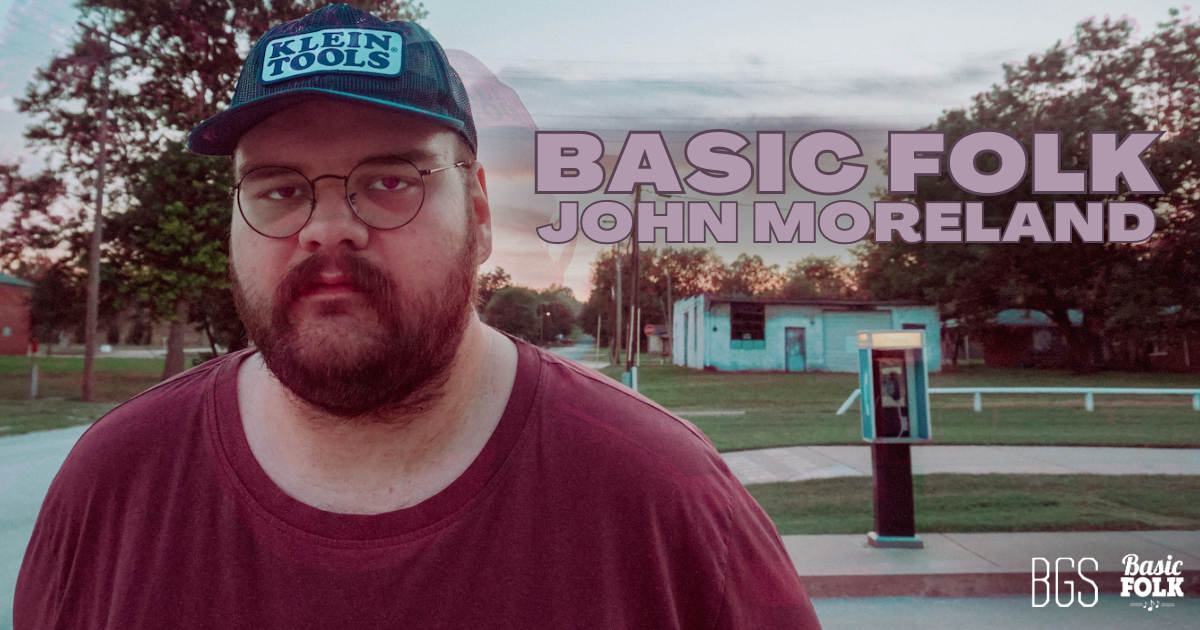
I hate surprises. However, Oklahoma’s pride and joy John Moreland surprised us in April with his latest album, Visitor, and I guess I’m okay with it. Moreland’s gone back to a sparse acoustic instrumentation, unlike the electronic sound (which I also loved) on his previous release, 2022’s Birds in the Ceiling. Recently, he took a page from his wife Pearl Rachinsky’s and musician (and recent tour buddy) Chris ​Staples’ books and quit his smartphone, took a social media break, and stopped all touring for six months. What ensued was an incredible psychic change discovered through living electronically off the grid. Another thing that came about during this simplicity in life: An album full of songs. He would take long drives at night, bringing along his guitar and making field recordings of his new writing. All this culminated into his beautiful new record.

LISTEN: APPLE • SPOTIFY • AMAZON • MP3

During our Basic Folk chat, Moreland talks about the process of unraveling himself from his smartphone, reconnecting with the acoustic guitar, and getting to know himself again during this period of quiet. He talks about how playing live is very vulnerable for him, to the point where he started taking (and loving) beta-blockers to stave off anxiety and adrenaline. He is very candid with his current thoughts on body image – he has been known to experience body shaming online after performing live. We also get into something that’s been on my mind all year: Is climbing the professional songwriting ladder worth it? Pretty sure we figured out the answer. LOL


Photo Credit: Pearl Rachinsky