Cody Jinks:
“You Never Stop Coming of Age”

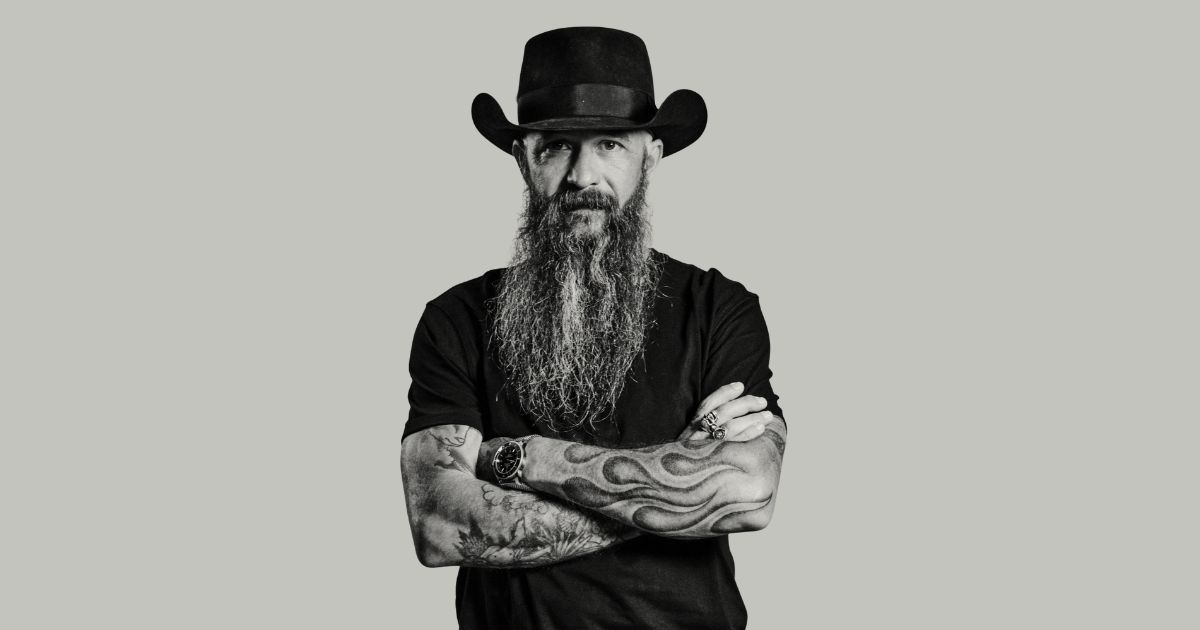
For Texas country star Cody Jinks, his latest album – the fiery and rough-around-the-edges, yet poignant and sorrowful In My Blood – is a liberation of sorts. Not of sound or scope, but of self.

It comes from the eternal quest to find balance within the body, mind, heart, and soul of a singer-songwriter, one trying to understand just what it means to be human in the modern, chaotic world – which is why “Better Than the Bottle” was purposely placed as the opening track on the record.

“Been layin’ things down one habit at a time/ Never thought we’d get old…” Jinks rumbles through the melancholic number. “Now we’re damn sure tryin’/ And makin’ the most of the time that we have left.”

With his sobriety in recent years, Jinks has been taking a hard look at what he sees in the mirror. It’s not about having regrets or cringing at one’s past. Instead, it’s taking personal accountability and professional inventory of the wisdom gained from your existence in real time, all while the calendar on the wall seemingly changes faster and faster each year.

Now 44, Jinks is more focused on what’s just around the corner than continually looking back over his shoulder at the ups and downs along his life’s journey. It’s about a clear head, a keen focus on what matters most – family, friends, fellowship, the freedom to create and perform.

It sounds like you’re in a really good place right now.

Cody Jinks: Yeah. Well, whenever you’re a late bloomer like me, it takes you [til] later in life to figure things out. It’s a practice. I mean, obviously the last couple years I’ve been trying to work on myself, work on my family. I think it’s helped a lot creatively, as well. None of it’s been easy. It’s not like anything’s ever peaches and cream or roses or whatever. The music business is tough, and if it was easy, everybody would do it. I spent much of my marriage while I was on the road. Having been off the road the last four or five years, [not touring] as much as I used to be, I’ve learned that being a great husband and father is even harder than being in the music business.

And it all ties into everything though, because that creative side is also a big balancing act, where you need that outlet in your life.

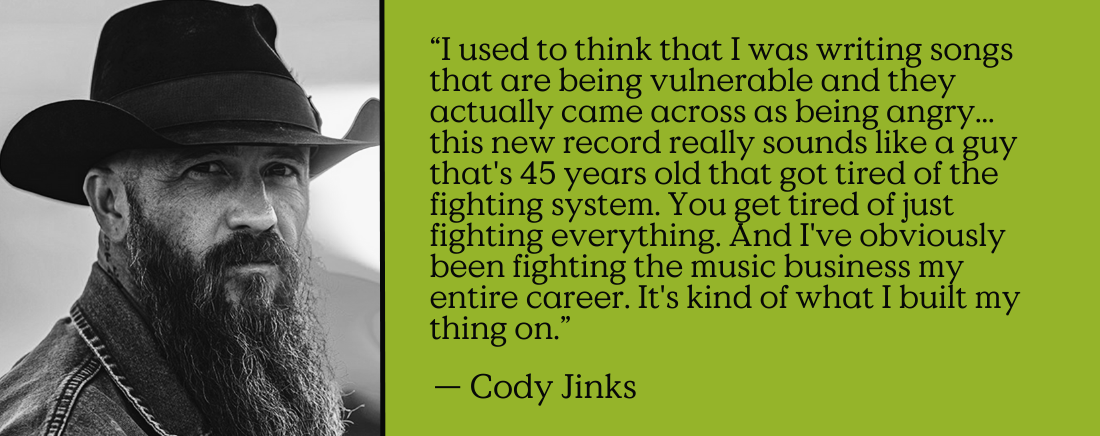
Well, not only the creative outlet, it’s that I used to think that I was writing songs that are being vulnerable and they actually came across as being angry. There was an edge to [the older songs], where this new record really sounds like a guy that’s 45 years old that got tired of the fighting system. You get tired of just fighting everything. And I’ve obviously been fighting the music business my entire career. It’s kind of what I built my thing on.

And, at the same time, I had started bringing the guy in the music business home – that’s who my wife and kids had to live with, as well. So, we’ve been correcting some stuff like that. I’ve been getting some really vulnerable songs out of it. You never stop coming of age. No matter how old you get – when you’re in your teenage years, when you get in your forties – life is a continual movement, man. And if you are not moving forward, you’re going backwards. So, vulnerability is a strength to an extent.
How does that play into the album? I would surmise that the opening track [“Better Than the Bottle”] was purposely placed there.

I was actually going to speak to that track specifically, because that was the second-to-last song written for this record. I wrote it with a friend, Tom McElvain. We both quit smoking cigarettes. We quit doing recreational drugs. We’ve written together a lot over the years. I’ve got several songs with his name on it, but [“Better Than the Bottle”] was a real conversation.

He came over one morning, and in 20-plus years of friendship, it was the first time we had ever been around each other stone cold sober. We were talking about how we used to live versus how we’re trying to do things now and who we’re trying to be now for ourselves and for the people that we love, the friends that we lost along the way that didn’t pull out of it. We’re old enough to have friends that have died from it now. That song made its way to the first slot because it was everywhere – that song’s true. Tom was over here that morning in January and you talk about two grown men in their 40s and 50s just laying all out, teary eyes. Dude, we fucked a bunch of shit up in our lives and there’s a lot. At this point, we’re trying to atone for a lot of things.

That’s one of the beauties about getting older – perspective. There’s this kind of weird intrinsic value to hitting this age, where you still have mobility and your wits about you, but you also got some road miles on the tread.

[Laughs]. Yeah. At 40, I tell people the “check engine” light comes on. It’s not usually that serious, but you gotta change some things. It might be time to trade in the Lamborghini and get an F-150, slow down a little bit.

You have a family, as well, with these personal responsibilities and people that want you around for a long time.

That was really the big player. I quit smoking for my kids. I’d still probably be smoking cigarettes if it weren’t for my kids. I quit drinking for myself and for everybody around me. But, the cigarettes, I finally got that licked about five, six years ago. That was the one my doctor said, “Your kids are gonna thank you.”

This year also marks the 10th anniversary of your breakout album [Adobe Sessions]. I don’t know if you’ve been thinking a lot about the last 10 years, who that person was when you broke into the national scene and then who you are right now.

[I’m] a lot more patient [these days]. It’s been 10 years, [and back then] we’d been [playing for] 10 years by the time that breakout record came out. [I] still have hunger in this business, I just put in a smarter, more calculated manner these days.

I also found it interesting that you’ve mentioned Ray Bradbury as an inspiration for In My Blood. Can you speak to why that is and what he represents for you?

Yeah, absolutely. The focal point of the record, it’s a travel life, right? That’s where the record takes you, on this up-and-down journey of life. And, in that life, in everyone’s life, every fork you come to in the road, you take one way or the other, which leads you to another fork in the road. By the time you’re done, you’ve taken a bunch of forks, you’ve taken a bunch of different roads, and hopefully you took more good forks than you did the bad.

We planted a Ray Bradbury-inspired song (“Something Wicked This Way Comes”) right smack dab in the middle of this damn record, because it was the perfect frickin’ spot for it. It’s the only song that was snuck in the record that wasn’t really based on my life. If you’ve read the [Bradbury] book Something Wicked This Way Comes, it’s part of a series called the Green Town Trilogy. They’re all really good [books], but that one stands out. It’s my favorite. It’s a brilliant book. It’s good and evil.

We all have the same wants, needs, desires. What’s good for us? What’s not good for us? Is it good for me if I try to do this to obtain this or achieve this or to be this or to look like this? And those are the decisions that we make every single day. I had just read the book and I came up with this really badass little blues riff. It feels like a carnival ride.

That also plays into one of the things about getting older, which is that you choose to keep moving forward. When you’re younger, you might feel the pressure. And as you get older you realize there’s a lot of things you don’t need to worry about.

Yes. My parents had told me, “Don’t sweat the small stuff.” And then, when you’re at the age we’re at, the big stuff you thought when you were 20, 25 years old, you’re [now] like, “Well, that’s small stuff.” And then, by the time you get to our parents’ age, they’re looking at stuff we’re worried about in our 40s and they’re thinking, “Oh, that’s small stuff.” We’re gonna get to the point, hopefully, where we’re looking at [things] going, “Ah, man, why was I worried about that?”

Case in point, the other night we had a very mild water leak in the upstairs [of our house]. My daughter came downstairs at two o’clock in the morning and there was dripping on a custom turntable in our living room. This was nobody’s fault. And I got upset about it. We stopped the leak. We dried the water up. I woke up the next morning and there’s flooding in Central Texas and there’s like a hundred families who have lost their children. Let’s not sweat the small stuff, man. Some people got real problems.

There’s probably a lot of weight that’s come off your shoulders in the last couple years, whether it’s personal or professional. Obviously life’s a continued journey. Whether you want to participate in it or not, that’s up to everybody on their own. But, it feels like you’re kind of leaning into life in a really good way right now.

Yeah, I’m living it more, as opposed to getting up and butting heads with [life] every day.

How do you square that with the outlaw image that the media puts on you? Because there’s stereotypes that get equated into that. At your core, you’re a singer-songwriter, you’re a country musician.

You know, my whole career, they’ve been calling me [an “outlaw”]. Look, I know they need an “outlaw,” whatever. I’ve never called myself an outlaw. That was something the media called me, and I just agreed. I’ve kind of gone with it. It’s okay. It’s easy to call me that. I’m not an outlaw, dude. I’m a punk.

And underneath all of that is still your punk rock and metal blood.

Yeah. It’s too big a piece of me. It’s just who I am. It’s the way I run my organization. It’s a family. It’s us against the world. We don’t belong with anybody, so we belong to everybody.


Photo courtesy of The Oriel.
Basic Folk: Olive Klug

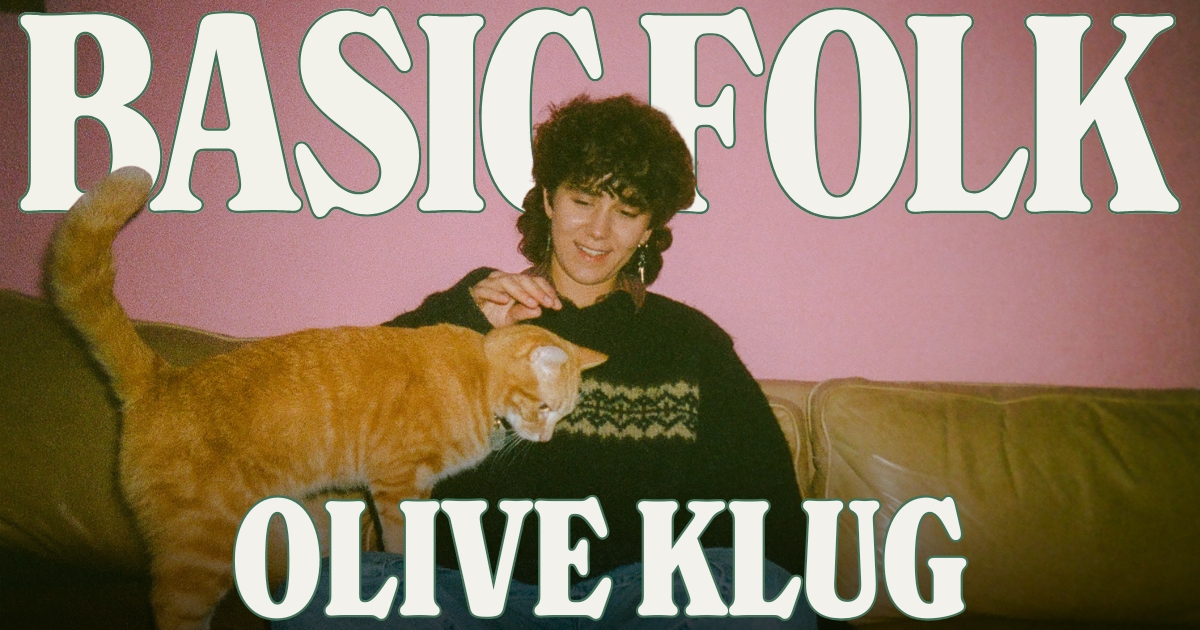
Olive Klug and I recorded this interview in my closet while they were in Portland, Maine, to play a show. Along with their band Cori, Haley, and Payton they stayed with us and it was a real pleasure to be around them for a few days. You can tell that Olive is at their best around their band and it is a true collaboration on stage. Shoutout to the whole crew for leaving such a remarkable impression on me and my wife and for assembling some baby furniture while they were staying at our house.

In our conversation for Basic Folk, Olive takes us on a journey through their musical upbringing, exploring their childhood influences, including their father’s eclectic taste in ’60s and ’70s rock and folk. Olive discusses their love for Joni Mitchell and Taylor Swift, which inspired them to learn guitar and develop their own musical tastes. They provide insights into their early internet presence on platforms like YouTube and Tumblr, and how these shaped their creative expression and online identity.

LISTEN: APPLE • SPOTIFY • AMAZON • MP3

Olive also touches on their experience of transitioning to a music career, going viral on TikTok, and the emotional and practical challenges that come with it. Additionally, they delve into how their psychology background and neurodiversity inform their songwriting, live performances, and day-to-day life. Our conversation wraps up with thoughts on the productive chaos of touring, the importance of community in the folk world, and their aspirations for long-term, sustainable growth in the music industry. Everyone belongs at the Olive Klug show. They leave their glow wherever their travels take them.


@oliveklugThe gay cowboys keep leaving nashvillea title=”♬ original sound – Olive Klug” href=”https://www.tiktok.com/music/original-sound-7519310944065817375?refer=embed” target=”_blank” rel=”noopener”>♬ original sound – Olive Klug


Photo Credit: Alex Steed

Artist of the Month:
Tyler Childers

Next to fellow Kentuckians Sturgill Simpson and Chris Stapleton, you’ll be hard pressed to find a singer more influential on the Commonwealth – or on all of Appalachian music – than Tyler Childers.

The Lawrence County-born artist first began cutting his teeth on dark corner stages inside diners across Eastern Kentucky and in grainy YouTube videos prior to laying the foundation for the cult-like following that’s been enamored with him since with 2011’s Bottles & Bibles and 2016’s Live On Red Barn Radio I & II. The following year he burst onto the national scene with his Simpson-produced studio debut, Purgatory.

From a voice as gritty and raw as the black gold he sings about on songs like “Nose On The Grindstone” and “Coal” to lyrics that shatter stereotypes and perceptions cast down on his home region by those outside of it, it’s easy to see why Childers’ music has become a soundtrack for not just part but all of Appalachia.

Whether it be the combination of humility and holler-bred antics within Purgatory, the intimate honky-tonk vignettes of Country Squire, the fiddle tunes of Long Violent History, the gospel-fueled experimentation of Can I Take My Hounds To Heaven? or the spiritual embodiment of Elvis on Rustin’ In The Rain, Childers has found success by shaking expectations at every turn, keeping old fans on their toes and bringing new ones in along the way.

When violence perpetrated by police was front and center during the aftermath of George Floyd’s death in 2020, Childers opted to cap off that fiddle album with its only vocal track, the protest anthem “Long Violent History.” During a heated societal moment, he approached the tune from an angle of empathy rather than pretentiousness as he tried contextualizing everything going on with past events like the Battle of Blair Mountain. Then in 2023 he had his first hit on country radio with “In Your Love,” an epic love tale that he recast as a gay one with the help of then Kentucky Poet Laureate Silas House in 2023.

While some fans have been turned off by his “political” statements, his viewpoints ultimately led to more people going down the rabbit hole of Childers’ catalog than ever before. This growth has culminated in sold-out shows at fabled venues like New York City’s Madison Square Garden, Lexington’s Kroger Field, London’s O2 Arena and the Los Angeles’ Hollywood Bowl. It also resulted in recording a track for last year’s TWISTERS soundtrack, collaborating with Olivia Rodrigo for a cover of “All Your’n” during a GUTS tour stop in Kentucky, and performing during The White House’s Fourth of July celebrations in 2024. Close to 10 years removed from his breakthrough moment, the singer is as popular and influential as ever.

That influence is sure to grow with the release of his latest studio album, Snipe Hunter. Recorded with and produced by Rick Rubin in Hawaii in early 2024, the 13-song compilation charts the red-headed stranger’s creative and spiritual coming of age with stories of the band’s success. The project is sprinkled with a bit of anti-capitalistic sentiment (“Eatin’ Big Time”), a yearning to escape on a trek to India (“Tirtha Yatra”), his fear of Koalas (“Down Under”) and hunting for whitetail deer (“Dirty Ought Trill”).

Much like its predecessors, Snipe Hunter captures Childers signature sound while also sounding like nothing he’s released before it, a fact no doubt aided by Rubin’s knack for crafting material that sticks to the cultural zeitgeist like superglue. Songs like “Nose On The Grindstone” and “Oneida” – a story about falling for an older woman – have been in Childers’ performance rotation, on YouTube playlists for years, and traded as coveted bootlegs, but the versions captured for Snipe Hunter, with their additions of organ, synths, and other studio toys, has each feeling reborn and completely new again.

Collectively, the album feels rooted in country funk bands of old like Goose Creek Symphony just as much as it incorporates more modern influences like Charlie Brown Superstar (whose remixes for Can I Take My Hounds To Heaven? are sublime) and Eric Church, serving up the perfect combination of past, present and future sounds in the process while sticking to the deeply personal Appalachian flavoring that has long highlighted his grand storytelling.

To celebrate the release of Snipe Hunter, we’ve named Childers our Good Country and BGS Artist Of The Month for August. Throughout the month, we’ll celebrate Childers by going back into our archives for all-things-Tyler, plus we put together a retrospective look at his catalog of songs and recordings here, have shared a thoughtful examination of whether or not Snipe Hunter was created as a musical “prank,” and of course, don’t miss our Essential Tyler Childers Playlist, below.


Photo Credit: Sam Waxman

You Gotta Hear This: New Music From Sunny Sweeney, Hannah Delynn, and More

Somehow we’ve already arrived at August!? How did that happen? At any rate, there’s no better way to kick off the month than another brand new edition of You Gotta Hear This.

This week, we have a small but mighty collection of country and folk. Just a couple of days ago husband-and-wife duo Alyssa & Wayne Brewer announced an upcoming album, Lonesome & Blue, slated for release in September. To celebrate the announcement, they dropped the title track and lead single and for our roundup they’re sharing its accompanying music video for the first time. Watch below.

Plus, singer-songwriter Hannah Delynn gives a sneak preview of “Jealousy,” her third and final single from her upcoming September release, Trust Fall. Out next Friday, the number was produced by Maya de Vitry and is anchored by emotive piano, exploring the depths and catacombs of often squashed emotions.

To wrap things up, Texan country veteran Sunny Sweeney releases her new album Rhinestone Requiem today, so we’re spotlighting an as-yet-unreleased track, “Find It Where I Can,” that’s twangy, honky-tonkin’, and rocking and rolling, too. Congrats on the new LP, Sunny!

It’s all right here on BGS – and You Gotta Hear This!

Alyssa & Wayne Brewer, “Lonesome & Blue”

Artist: Alyssa & Wayne Brewer
Hometown: Nashville, Tennessee
Song: “Lonesome & Blue”
Album: Lonesome & Blue
Release Date: July 31, 2025 (single); September 12, 2025 (album)
Label: Sony/Orchard

In Their Words: “‘Lonesome & Blue’ is our first original offering as A&W Brewer. This song is our interpretation of a classic country tune written in our modern-day time. It’s a forbidden love, sad country song that was written to closely mirror the tumultuous relationship of George Jones and Tammy Wynette. In the video, we not only act out the tune as the characters, ‘Lonesome’ & ‘Blue,’ but also act out the characters’ daydream fantasy of being together as shiny country music stars. In the end, because of life, it doesn’t work out.” – Alyssa & Wayne Brewer

Track Credits:
Alyssa Brewer – Vocals
Wayne Brewer – Acoustic guitar, vocals
Gary Brewer – Electric guitar
Tom Killen – Pedal steel
Mason Brewer – Drums

Video Credits:
Director of Photography: Kevin Bryan, Visual Poet Studios
Dave Santiago – Bartender
Alyssa Brewer – Video editing, production
Wayne Brewer – Executive producer


Hannah Delynn, “Jealousy”

Artist: Hannah Delynn
Hometown: Nashville, Tennessee
Song: “Jealousy”
Album: Trust Fall
Release Date: August 8, 2025 (single); September 5, 2025 (album)

In Their Words: “‘Jealousy’ is a journey through emotional alchemy, I’d say. It’s certainly a vulnerable one and when Maya suggested we put it on the record, I was admittedly a little scared!

“So often, I think we shy away from difficult emotions because they feel shameful. They’re hard to look at, definitely – but I believe that beneath any feeling, even those which are seemingly abhorrent or benign, is an innocent desire. There is a deep chasm of pain with gold waiting within it. If we can just push past the discomfort, we can find what we’re really looking for. It’s a freeing reframe.

“Perhaps the feeling of jealousy, deep down, is a desire to be seen and recognized, to feel we belong. Who doesn’t want that? Instead of getting curious, however, we often bury or project these things in unhelpful ways, creating distance instead of closeness with ourselves and with others. Jealousy isn’t about what anyone else has; it’s about what we already have inside –we’ve simply lost sight of it.

“Following it as a sort of internal compass can connect us with that desire underneath, to recognize ourselves instead of seeking it elsewhere. It can free us from comparison and allow us to embrace our own light and celebrate the light of the other luminous creative beings all around us. (That’s everyone). Besides, the glory of a night sky is billions of stars beaming back at us… What fun would there be in seeing only one single light shining up there all by its lonesome?

“I’m so grateful to my dear, brilliant friends Alex Wilder and Lizzy Ross for sharing their bright light with us all. Alex created the beautiful piano parts within the song. I love, so very much, that the harmonies were a spontaneous unfolding between us three friends who love singing together. Also, it says quite a lot about Clare that we could write a song about jealousy together. The trust, the openheartedness, the non-judgment… may we all be that kind of friend and collaborator to one another. This whole team is bursting at the seams with bright, beautiful stars. Making this with them feels like I made a wish and it’s coming true.” – Hannah Delynn

Track Credits:
Hannah Delynn – Vocals, guitar, harmonies, songwriter
Alex Wilder – Piano, harmonies
Lizzy Ross – Harmonies
Clare “Lollies” Reynolds – Songwriter
Maya de Vitry – Producer
Ethan Jodziewicz – Engineer


Sunny Sweeney, “Find It Where I Can”

Artist: Sunny Sweeney
Hometown: Houston, Texas
Song: “Find It Where I Can”
Album: Rhinestone Requiem
Release Date: August 1, 2025
Label: Aunt Daddy Records

In Their Words: “‘Find It Where I Can’ is about that ache you get when love turns cold and you start looking for warmth anywhere you can find it. It’s not about being reckless… it’s about being human. I heard Jerry Lee Lewis’ version of this song at a time when I had just gotten out of a long relationship filled with lonely nights – not single, just lonely. There’s a specific kind of ache that comes from loving someone who stopped reaching for you a long time ago. This song doesn’t point fingers. It just says, ‘Hey, I’m still here, and I still need something real. If you can’t give it to me, I’ll find someone who will.’ It’s really just a line in the sand.” – Sunny Sweeney


Photo Credit: Sunny Sweeney by Nash Nouveau; Hannah Delynn by Betsy Phillips.

Finding Lucinda: Episode 7

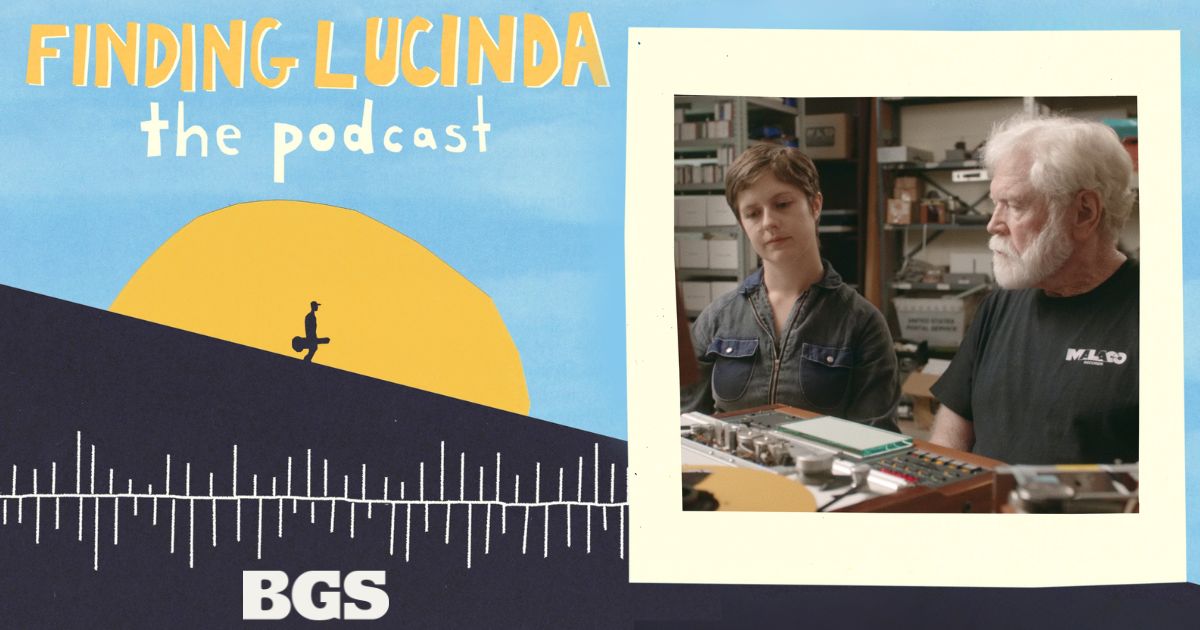
In the most exciting moment of the Finding Lucinda road trip thus far, Ismay hears from interviewee Wolf Stephenson that there is some archival material he wants to share from the concrete tape vault. After sitting on the shelf for 40 years, Wolf has finally brought three boxes down to review. He finds that there is something mysterious and unexpected in the third box, so Wolf and Ismay try to get to the bottom of what in the world this mystery box contains. This piece of never-before-heard material gives Ismay insight into Lucinda’s musical development and the choices she made as a creative person. But most importantly, discovering this treasure gives Ismay an opportunity to see themself in a way they never have before.

LISTEN: APPLE • SPOTIFY • AMAZON • MP3

Produced in partnership with BGS and distributed through the BGS Podcast Network, Finding Lucinda expands on the themes of Ismay’s eponymous documentary film, exploring artistic influence, creative resilience, and the impact of Williams’ music. New episodes are released twice a month. Listen right here on BGS or wherever you get podcasts.

Finding Lucinda, the documentary film that inspired and instigated the podcast, is slated for release in the fall. Both the film and podcast showcase never-before-heard archival material, intimate conversations, and a visual journey through the literal and figurative landscapes that molded Lucinda’s songwriting.

Credits:
Produced and mixed by Avery Hellman for Neanderthal Records, LLC.
Music by Ismay.
Artwork by Avery Hellman.
Jackson, MS Recording: Recorded at Malaco Studios.
Sound Recordist: Rodrigo Nino
Producer: Liz McBee
Director: Joel Fendelman
Co-Director & Cinematographer: Rose Bush
Special thanks to: Mick Hellman, Chuck Prophet, Don Fierro, Jacqueline Sabec, Rosemary Carroll, Lucinda Williams & Tom Overby


Find more information on Finding Lucinda here. Find our full Finding Lucinda episode archive here.

Kristi Grider on
Only Vans with Bri Bagwell

Quite possibly the most talented guest we’ve had on Only Vans so far, Kristi Grider is a good friend of mine from the New Braunfels, Texas, area and we dig into topics like playing and teaching piano, being a substitute player, singing harmony, high-profile gigs, The Finishing School, therapizing your friends, and the benefits of walking.

LISTEN: APPLE • SPOTIFY • AMAZON • MP3

This is such interesting timing, having my friend Kristi Grider join me this week on the podcast. We recorded this episode right before the devastating floods in Kerrville, Texas, which happens to be Kristi’s hometown. Her heart is so big for her community, and she has encouraged everyone to go to CommunityFoundation.net to donate to this unimaginable tragedy.

Kristi is married to fellow Las Crucen (that’s where I’m from!) Josh Grider and we have gotten really close in recent years living in the same city here in Texas. In addition to her own writing, recording, and solo shows, she performs in cream-of-the-crop cover bands, plays shows with Josh, teaches piano lessons, and is a great mom. I’m so glad that she clarified that Josh is really supportive of her career; it’s the perfect example of how people can make incorrect assumptions from the outside. Kristi talks about being in my songwriting accountability group – where you force yourself to write a song every two weeks – which I stole from my producer Rachel Loy, who we give a lot of well-deserved love to on this episode.

Give Kristi a follow on Instagram and be sure to stream her new EP, All Right – and all her music – wherever you listen. She’s as beautiful as she is talented, so my joke about her being ugly is… a joke.


Photo Credit: AnneMarie Creative

The Earl Scruggs Revue Made a Movie Soundtrack

The Earl Scruggs Revue’s only movie soundtrack, Where The Lilies Bloom (1974), is not well known. That’s a pity because in 1973, when it was recorded, the band had been together for four years and was a very solid outfit. At the beginning of 1973 the group included Earl, Randy, and Gary Scruggs, Josh Graves, and Jody Maphis. Steve Scruggs was an occasional member. Vassar Clements’ last credited appearance on record with the Revue was on Earl ScruggsDueling Banjos (C 32268), released early in 1973, and he was still with them when they recorded the soundtrack.

The movie was filmed between May and August 1972 and released in 1974 through United Artists. The soundtrack album, Columbia KC 32806, is credited to the Revue and their longtime producer, Ron Bledsoe. Movie soundtrack recordings are made after the film has been edited; the musicians perform in a studio setting while the film is rolling. This is a precision business, obviously; I have yet to find accounts of the Revue’s involvement in this process, which must have taken place in early 1973.

Soundtrack albums focus on eliciting memories of the film. Viewing and listening are, in the final analysis, two very different things. The music in Where The Lilies Bloom was, in the first instance, the musicians’ responses to the visuals, shaped by the movie producer and director.

Earl came up with new tunes and restatements of old ones; Randy contributed deft and creative electric and acoustic guitar, both flatpicked and fingerpicked; Vassar performed masterful fiddle from a point in his career when he was doing the old-time tunes brilliantly while developing his new jazz-inflected style; and Josh played the creative and brilliant Dobro that a generation would follow.

The film’s producer, Robert B. Radnitz, based the picture on Vera and Bill Cleaver’s award-winning young adult novel of the same title. It tells the story of the struggle of the Luther family siblings, four young Appalachian country youths – the oldest is 16 – to live at home together following the death of their widower father. They do this by “wildcrafting,” gathering and selling wild herbs as health supplements. The narrative focuses on the two teen daughters’ growth and relationships.

Where The Lilies Bloom was shot on location in Watauga County on North Carolina’s northwestern border. Producer Radnitz strove to employ workers from Appalachia, such as screenplay writer Earl Hamner Jr. and actor Harry Dean Stanton, who had a leading role as the older “Kiser Pease.” The young actress who had the leading role as 14-year-old “Mary Call Luther,” Julie Gohlson, was a Georgia native chosen after a nationwide search. She was nominated for a Golden Globe in 1975. This was her only movie appearance.

Radnitz worked with toymakers Mattel on this co-production, their second. The first was Sounder, released in 1973. That acclaimed film about young teens in Black Mississippi propelled Cicely Tyson to stardom and featured blues star Taj Mahal for its soundtrack. For his second movie’s soundtrack, Radnitz again sought music reflecting the cultural background of the film’s narrative – in this case, the oral traditions of Appalachia. He chose the Earl Scruggs Revue.

The film got a good reception, with prizes and nominations of various sorts. It’s well worth watching – not only is there a DVD with commentary, it’s also available VOD on YouTube and is available to watch via select streaming services. The album, on the other hand, pretty much sank like a stone – no ripples. But if you want to hear what the Earl Scruggs Revue sounded like when they were together just playing by themselves, with no added stars in the studio, this is the album to try. There’s plenty from them to appreciate on the film’s soundtrack, as well. A lot of nice creative moves here!

This was a hard album to find. By the time I finally got it in the ’80s I wasn’t as interested in the band as I’d been earlier. I listened once, filed it away, and only listened again recently. Holding and looking at the album cover during this playback reminded me why I only listened to it once before. The liner notes must have been composed by some 9-to-5er at United Artists. There’s nothing there about the music. Who’s the female vocalist? What’s the band doing? No mentions. The visuals and most of the copy are from the movie. Not much of a musical souvenir!

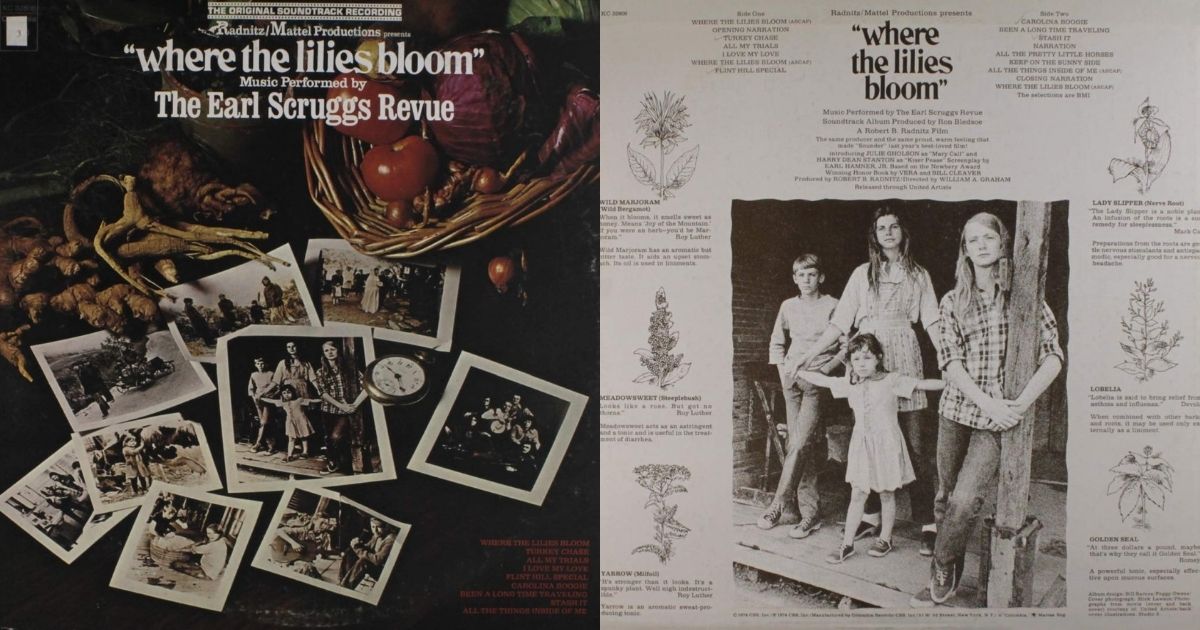
The album cover of Columbia KC 82806 announces at the top: “The Original Soundtrack Recording.” Below that comes “Radnitz /Mattel Productions presents, where the lilies bloom (all in large lowercase), then: “Music Performed by” and finally “The Earl Scruggs Revue.” All this is printed over a collage of color shots of herbs, along with nine little black and white stills from the film – one of which is the Revue.

On back of the album cover, we are told this is a ”Soundtrack Album Produced by Ron Bledsoe [for] A Robert B. Radnitz Film.” Cast members (but not band members) are listed. Next to this info are small columns, left and right, that list the tracks. Filling the center below all this is a large still of the film’s young lead actors; on either side of this are illustrations of wild herbs – three on each side.

In spite of the Revue’s lack of prominence on the album’s notes, I think that the band did a good job of coming up with new compositions and old-time tunes that represent their music in imaginative arrangements relating to the context of the film.

After relistening to the LP, I bought the film’s DVD, which was remastered and released in 2022 with an audio commentary by filmmaker and historian Daniel Kremer. The film opens (as does album track A1) with song “Where The Lillies Bloom” sung by its composer, Barbara Mauritz.

Singer-songwriter Mauritz (1949-2014), originally from Texas, was the vocalist with Lamb, an avant-garde folk-jazz-rock fusion group active in San Francisco in the early ’70s. Her first solo album, Music Box, was released on Columbia in 1972.

How did she end up on this movie’s soundtrack? I wish I knew! Being a Columbia artist was probably not coincidental. As we hear, she’s paired with another Columbia artist, Earl Scruggs, on the theme song at the opening. The Revue is laid-back in the track’s background at the start; eventually Randy’s guitar plays the melody, while Earl’s banjo sneaks up to end with beautiful 6/8 triplets in the background, and a few of Josh’s Dobro licks can be heard.

This is music meant to be heard in accompaniment to the visuals that open the film, aptly demonstrated by its trailer, which opens with the character “Devola Luther” (the oldest sister, played by Jan Smithers) singing “A Long Time Traveling” a cappella. The guitar is very much in the background, as is the banjo, which comes up only at the end.

The album contains three “Narrative” tracks by lead character Mary Call Luther which explicate the dramatic turning points in the film’s story. Following the first narrative track, A2, comes “Turkey Chase”, track A3, which plays beneath a scene in which the Luther children are trying to catch wild turkeys.

The Revue is actually playing the traditional fiddle tune “Chicken Reel,” led by Earl with brief interludes by Randy (lead guitar) and Josh Graves (Dobro). This is two minutes of really good straightforward old-time music, which the Revue knew well but rarely recorded.

The next track (A4) presents slow, moody instrumental music that plays behind scenes pertaining to the father’s death: “All My Trials,” a traditional spiritual with Bahamian connections popularized by Joan Baez in the ’60s. Randy’s lead guitar mixes with some nice piano, probably by Mauritz. It’s a pretty performance.

Track A5, “I Love My Love,” which plays behind a romantic sequence, was also popular in the folk revival. English composer Gustav Holst described it as a “Cornish folksong” in his arrangement of it. It’s sung here by Mauritz, over a finger-picked guitar which could be hers, or maybe that of Randy or Earl.

Track A6 repeats the theme, “Where The Lilies Bloom,” as a slow instrumental piece in 4/4 time. Randy’s finger-picked guitar plays it twice, and then Gary’s bass and Earl’s banjo join for two more verses. It really demonstrates Earl’s artistry – such control, economy, lyricism!

In the film’s soundtrack, The Revue plays Earl’s “Flint Hill Special” behind several action scenes – countryside automotive rambles – as Mary Call and the family are in conflict with Kiser. Here’s what that sounds like as played by Earl, Josh, and Vassar on the soundtrack:

The original pressing of the LP diverges from the movie soundtrack at this point, on Track A7, which is also identified as “Flint Hill Special.” No doubt that garnered Earl some royalties for his composition of that name, but the tune played on the original album is the traditional “Sally Ann,” a piece Earl recorded on his 1961 Foggy Mountain Banjo release. (This seems to have been corrected on digitally distributed versions of the album. Hear the LP’s version of “Sally Ann” below.)

It’s an interesting new version, opening with a couple of fiddle licks and then shifting to the percussive sound of the banjo strings being played with right-hand fingerpicking (a “roll”) while the strings are muted with the heel of the left hand. Then the fiddle steps up while at the same time Dobro, bass, and guitar enter – a powerful old-time bluegrass sound. Earl’s banjo takes over second time through, then the fiddle returns and finally Earl closes as he began, percussively. The “shave and a haircut” ending is dominated by Randy’s fancy guitar.

Side two of the album (track B1) opens with music from a scene in which the four Luthers, who’d been at the grocery store learning about wildcrafting, get a ride home from the store owner “Mr. Connell” (played by Tom Spratley). Here, the Revue is heard playing “Carolina Boogie,” basically an update of Earl’s up-tempo blues in G, “Foggy Mountain Special.” It features the entire Revue with a considerable amount of call-response between Randy and Vassar and a great ending.

The family’s funeral for the mountainside burial of their father includes “Been A Long Time Traveling” (track B2) sung a cappella by oldest daughter character, Devola. It’s heard twice, at the beginning and the close of the burial scene.

Following this, the film’s narrative shifts to wildcrafting, with Mary Call’s next visit to the grocery store to sell herbs backed by the Revue playing (track B3) Earl’s “Stash It,” a catchy banjo tune which starts slowly and speeds up.

Next, Mary Call’s poem about witnessing a starburst is heard on track B4, with subtle guitar and piano backup. It’s followed (track B5) by “All The Pretty Little Horses,” a traditional lullaby of African American origin, performed solo here by Randy’s fingerpicked guitar. In the film this plays behind a tender scene in which the Connells visit the Luther home.

Later, as the Luther children are depicted gathering herbs, the melody of the old Carter Family song “Keep On The Sunny Side” (track B6) is heard. First, it’s finger-picked by Randy on guitar, then Earl’s banjo comes in doing harmony. Neat! This is the ultimate father and son duet; Gary, on bass, is close by.

As the narrative approaches climax, we hear Barbara Mauritz singing her “All The Things Inside of Me” (track B7), accompanied by fingerpicked guitar, probably by Randy but possibly by Mauritz herself.

Mary Call’s final narrative (track B8) leads to the full band playing the theme; it’s heard at length as the film’s credits roll.

The preceding description, based on the album, does not point out all the places where the Revue’s music is heard on the film soundtrack – scenes where Randy’s guitar, Gary’s harmonica, Josh’s Dobro, and Vassar’s fiddle add aural nuances to the screenplay. Throughout the film, music editor Robert Takagi places in the aural background little quotes taken from performances like the final version of the theme. Randy’s guitar, in particular, is heard behind several scenes.

Other musical segments in the film are not heard on the album at all, but play a central role in evoking the film’s cultural milieu. Thus, while rambling in the car, they turn on a local radio station: the Revue is heard playing county-rock. Elsewhere, as they are walking home from wildcrafting, there’s a nice a cappella performance of “Feast Here Tonight” by youngest Luther daughter “Ima Dean” (played by Helen Harmon).

These musical segments remind us that the Revue, while featured on the album, is really playing in support of a story, a visual drama. As such their music here is different from that found on all their other albums. It does not sell the sound of the band – it speaks for images of the region’s atmosphere and its culture that emerge in the film’s narrative.


Read more about the Earl Scruggs Revue and find our entire archive of Neil’s Bluegrass Memoirs column here.

Neil V. Rosenberg is an author, scholar, historian, banjo player, Bluegrass Music Hall of Fame inductee, and co-chair of the IBMA Foundation’s Arnold Shultz Fund.

Photo Credit: Terri Thomson Rosenberg

Edited by Justin Hiltner.

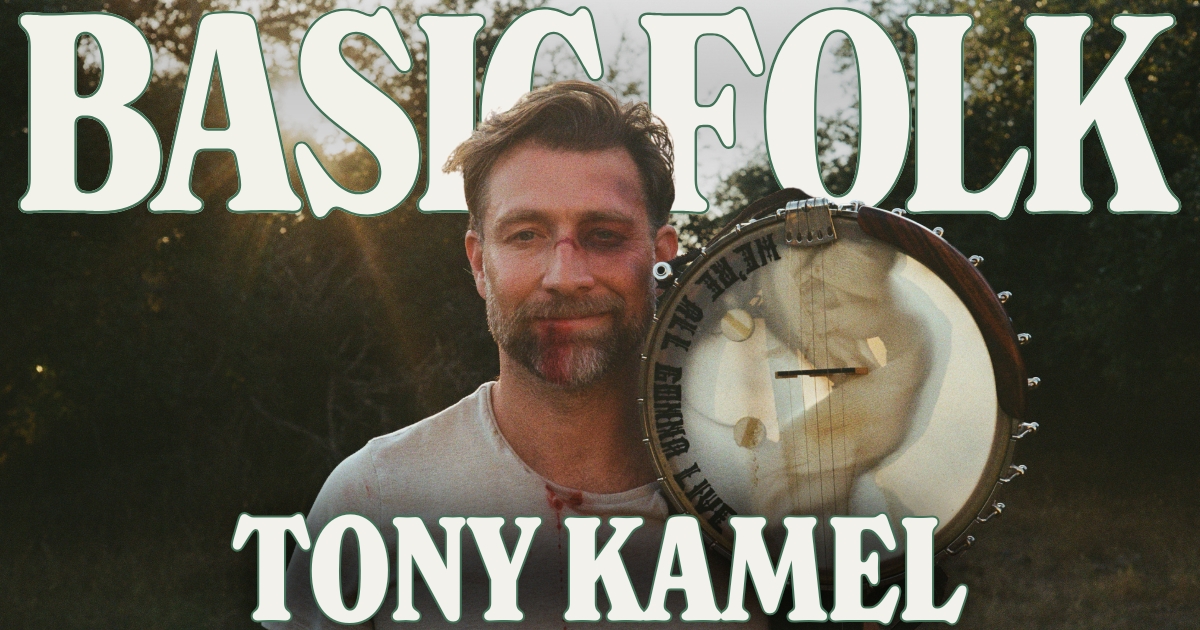
Basic Folk: Tony Kamel

You may recognize the voice, face, and vibe of wonderful human being Tony Kamel from his acclaimed bluegrass group, Wood & Wire. But Tony is on Basic Folk to talk about his wonderful solo albums, including his latest, We’re All Gonna Live. The project, which just came out, is a realist-optimist’s guide to navigating a complex and often heartbreaking world. There’s something remarkably encouraging about the songs, which are so humane and so empathetic. The music is rooted in bluegrass, but I found it to be really well-rounded contemporary country-folk with great singing and songwriting. It’s actually a super fun album even though it deals with some heavy topics.

LISTEN: APPLE • SPOTIFY • AMAZON • MP3

One of the most though-provoking parts of the interview was talking to Tony about the differences between being in a band and being a solo artist. When he got into bluegrass, he really just wanted to be able to gel with and collaborate with other musicians. He claimed that they let him hang out because he was a great singer and then he started really figuring out the guitar. There’s a culture in bluegrass where people want to master being a picker and Tony didn’t wanna show up and not have the goods. He had his voice to get his foot in the door, then he just got to work and honing all of his skills. While he says he’s still not a good guitarist, I really enjoyed his playing on this album.


Photo Credit: Josh Abel

Ketch Secor
Contains Multitudes, Too

After a quarter century fronting the frenetic bluegrass and jug band outfit Old Crow Medicine Show, Ketch Secor is finally breaking out on his own with his solo debut Story The Crow Told Me. The retrospective record looks back on the past few decades, from his own journey to stardom spurred by a chance encounter with Doc Watson to the certified platinum hit “Wagon Wheel,” through the lens of a soundtrack that’s equal parts bluegrass and contemporary country.

“Because the band [recently] celebrated 25 years, I was already in the mindset of a retrospective look,” Secor tells BGS. “I was thinking about everything that’s happened and transpired over that time and started writing about it. In fact, at first I really thought it was going to be a spoken word record before the music eventually took over.”

Talking over the phone, Secor spoke about the timing for his debut project, its connections to both Old Crow and contemporaries like Dierks Bentley, becoming the new host of Tennessee Crossroads on Nashville PBS, and more.

You mentioned this album was initially envisioned as a spoken word compilation. What led to its transformation into a fully realized album?

Ketch Secor: I was working with Jody Stevens. We had written a couple songs that were largely based around spoken word and others we were looking to add background sounds on. Those sounds started getting more and more like what I already do, which is writing songs with choruses and verses and hooks. It just evolved out of the beat poetry version of the album, which was probably a little less listenable but closer to what I was striving for. The musicality of it is a bit of a compromise to be like “Well, I’m going to make this an actual record people might want to listen to” because the spoken word records I enjoy are not highly listened to.

I recently was trying to find them again since my record collection got lost in the 2010 floods we had in Nashville. I went on Spotify, which I’d never used before, to find all these songs in my head like Amiri Baraka’s “It’s Nation Time” or Moondog – a 1950’s renegade beat poet from New York – in trying to get an understanding of how the spoken word music I heard as a kid was being utilized today. It quickly became clear that nobody listens to that stuff anymore. [Laughs] So it seemed like making it musical would make it more fun for people.

It seems a bit ironic that you had to look up all these songs – many of which would be considered part of the Great American Songbook – on a digital streaming platform like Spotify. Talk about two very different worlds colliding!

I talk a little bit about that phenomenon on the song “Junkin’.” A lot of the experience of making music with Old Crow, especially in the beginning when we were still developing a canon, was about music’s physical form. When the band first started the internet was still new and we were still selling cassettes. The last time I made a solo record was on tape, the band didn’t have a website and none of us even used email when all of this started. It meant that searching for the physical was really important.

There’s another song on the album called “Thanks Again” that highlights the personal relationships that you develop out on the road – these chance encounters that are very much real and put the wind in your sails. There’s something to be said about having to come of age in a time when information was so tactile and often involved a human touch.

With the emergence of the internet and things like streaming and social media it really is an entirely different world for artists to navigate nowadays.

I realized that I had a kind of time capsule in my mind I had yet to crack open in the days before going in to make this record, which was done quickly and often with me writing the songs as we were recording them. Opening it up was really cathartic and essential for me to process and move past because the experience of coming to Nashville when we did and the kind of band we were in was, at times, slightly traumatic. It was a very intense quest similar to a military deployment, being a minor league ball player fighting your way through the ranks or even being a teenage whaler in Moby Dick. You end up leaving everything else behind in search of this one pursuit.

It’s not unique to come to Nashville to make it big, but what made our experience unique was that we were trying to do it with these traditional sounds in an era in which technological changes were happening as we were doing it. It was almost like we were going against the literal tide with our choices and artistic motivation.

You just mentioned writing these songs as you were recording them. Is that something you’d done before?

That was a very new way of going about things. I understand that record-making has changed a lot since we first started – our most popular Old Crow records that gave us a career were the early ones we made with Dave Rawlings on analog tape that we cut with a razor blade. Making a record the way Gillian [Welch] and Dave do is very studious, labor and time-intensive. But now the technology exists to do it super fast.

This record almost felt like a throwback to the seminal recordings of the 1920s and ‘30s that are the headwaters of our sound. Those records were made in three minutes oftentimes without knowing what the arrangements would be. Three minutes wasn’t the time frame of hillbilly music until the record company said it was – they just sat there, watched the light turn on and played. Writing a song and building a track like that actually felt really on par with what it would have been like going to Camden, New Jersey, in 1928 on a train when you’d never left your county before that. The challenge is keeping one foot in the past and one in the present. When you play fiddles and banjos and blow harmonica for a living the instrument kind of does it for you.

You name dropped Jody Stevens a few minutes ago. How’d y’all come together and what was it like working with him?

We met through my publishing company. I was going to do a co-write with him and knew he’d written a lot of songs for contemporary country artists, so I brought my bag of tricks that I bring out when I try to pretend I’m going to write the next big, top 10 country smash, except for this one time with Darius [Rucker]. I love country music even though I feel that in the past 25 years I have a whole lot less in common with it than I did when I was a kid, in terms of what it sounds like today in its mainstream output versus when I was singing along to Jo Dee Messina when I was 19. It was interesting to circle the wagons with Jody because he brought such a unique perspective in record making that comes from contemporary country music even though his roots are in hip-hop.

The other thing that brought us together was that Jody had seen Old Crow a lot, especially in our early days from 2000-2005, which is the sweet spot I try to explore on this record. He’d been there at the Station Inn and the festival Lightning 100 used to do downtown and some of these other places that have since been replaced by high rises. The fact that he had been a first-account witness to the band was really helpful to bounce ideas off of. His sister was also a big Old Crow fan and even though I’ve never met her I thought about her as my target demographic – someone who saw us back in 2001 and wanted to know what that time capsule looked like.

The fact that Jody had done all this work with people that rapped – only to find that 25 years later the tapes and demos he’d made with Jelly Roll were now part of a pop culture consciousness that hadn’t been there when he first started working on them – gave him a similar orientation to country music that I have about Americana. When I got started there was nothing called Americana and nobody lived outside of contemporary country music unless you were alt-country. Coming into this period of time in Nashville where it wasn’t yet determined that anyone with a banjo could make it that wasn’t bluegrass is another place where Jody and I shared commonality. The rap game has since become a massive component to contemporary country music similar to how Americana has become the tastemaker for anything roots-related.

In terms of the sound on this record, the way you move between more Old Crow-esque bluegrass and those pop country flavors reminds me a lot of Dierks Bentley, another person who excels at showcasing the best of both sides of roots music.

I came up with Dierks and remember witnessing his arrival. Before [“What Was I Thinkin’”] came out there was an issue of CMA Up Close that had a story about us on the page opposite one about Dierks and I thought to myself, “Well, if a guy named Dierks Bentley can make it, then probably a guy named Ketch Secor can, too.” Surely Nashville has the appetite for two oddly-named boys. [Laughs] Then I went on and took a moniker that wasn’t my name. Because of that I feel very much like a brand-new artist now and have developed a strong sense of empathy for the young guns who are out there trying to put their stuff out for the first time, because it’s so much harder now than when I was a kid.

What are some of those major hurdles you’ve noticed for new artists today compared to what you first encountered with Old Crow?

Now the way you stand out in a crowd is through visual means that often require the least amount of artistic acumen and the most amount of social media acumen. So far, I’m not sure it’s helping the cream rise to the top, though. The skill set should be how good can you pick a banjo, not how good can you pick the keypad on your iPhone, even though you have to do both to be successful today. When I was a kid it was about making these connections with people, knocking on doors so many times that every time something good came to me [it did] on account of me showing up and being in the right place at the right time.

Seeking a viral moment has an undue effect of potentially limiting the number of new entrants into the arena. For one generation, what was once divinized is now digitized. I’m sure that if there’s a God above that He or She can use the binary code to reach people and connect their children. I can pick up The New York Times and feel like there’s a closeness with the loss in Texas right now, which is only amplified by me having swam in the Guadalupe before and having a personal connection to the area. If you’ve plunged in the waters yourself then you’ll share something so much more vital with those who are experiencing the loss.

It’s really a metaphor for how we all have a shot at playing the Grand Ole Opry or going from the Station Inn to the Ryman like I did. There’s a turnstile in front of that and I want to see it spinning wide so that artists of all stripes can find their way up to that stage where they belong. As a steward of those stages, I want to see the people show up who have found music as the great connector that, regardless of the speed of the computer in your pocket, the speed of music breaks all other forms of sonic barriers.

In terms of personnel, what motivated you to bring in past and present Old Crow members like Willie Watson, Critter Fuqua, and Morgan Jahnig to record these songs with?

I really wanted to have all the past members of Old Crow on the record, because it felt like a bit of an offering to the gods to say “thanks.” So I really wanted a little bit of all their spirits on it. Not only that, but I read through a lot of old journals and called up some people I’d met hitchhiking, but hadn’t talked to in 25 years. I went and visited the guy who coined the term “Wagon Wheel,” because that song was always called “Rock Me Mama” until I met James Sizemore – a wonderful rascal and drug-dealing Vietnam vet.

I went to see him on his deathbed and recorded phone conversations late at night with old friends. While none of that stuff is necessarily on the record in its physical form, it all went into the process of trying to bake something that really felt like I was living in the past and bringing it to the present through these songs. I think a lot about cairn stones that the Inuit people up north call inuksuit, which are like sign posts that tell you where to turn, but they’re also spiritual. So imagine a road sign that could say “300 miles to Memphis,” but also told you the ancestral route of the settlers who first brought buffalo down 7,000 years ago, sort of like the duality of a time signature.

That duality of time reminds me of one of the album’s songs, “What Nashville Was,” which highlights how much Nashville has changed over the decades while also highlighting how no matter how many venues are replaced with condos, music will always be the city’s heartbeat.

A lot about the way Bob [Dylan’s] record Nashville Skyline had a way of pointing out Nashville for the first time to anyone who didn’t live in the South or listen to country music. He was really pointing to Nashville from a unique perspective and certainly Bob Dylan’s Nashville was the kind of Nashville that I was looking for when I first started playing on the street corner there in 1996.

Similarly, I was also looking for Dolly Parton’s Nashville. I wanted the Nashville that Dolly got when she stepped out of the pickup truck and married the first guy that honked his horn at her, the kind of Nashville where Willie Nelson was laying down in the street in front of Tootsie’s thinking he’s gonna kill himself because nobody wants his songs.

I used “Girl From The North Country” as the template for a love letter to a changing place and a cityscape that has gone on to do so much stuff that it itself is largely oblivious to the price it pays for its constant reinvention. And the price is that who we’re ushering in … is probably because you were on a reality TV show more consistently than because you had a song that people couldn’t stop singing at summer camps. Not that those things are good or bad, they just change. But we’re at a point now where the legend and lore of Nashville has grown so much that we’re at risk of the bubble bursting and it being something like Seattle after grunge or Austin after it wasn’t weird anymore – which is a glass, monolithic, industry executive business center. Oftentimes those forces stand in opposition to the ability of songwriters, hucksters, showmen, and the survival spirit that goes into creating the next Bob Dylan of a generation. I’m hoping that we, the architects of Nashville, can endeavor to build a place that still allows a hearty hero or heroine to come through the gates just like Loretta Lynn or Jack White did.

You were recently named the new host of Tennessee Crossroads on Nashville Public Television. How’d that opportunity come about and what’s it mean to you?

When PBS called me about this unique role that had come available with the sudden and sad loss of Joe [Elmore] – who ran the show for 30 or so years – it only made sense to find someone else to step in who’s also run a business for around 30 years that’s similar to Tennessee Crossroads. Old Crow Medicine Show has been criss-crossing the American south getting inspired by quilters, gee-haw whimmy diddles, carvers, and folks that plant by the lunar signs – those are the kind of folk heroes that go into our music. They’re also the same kind of stories that this show loves to tell.

I love public broadcasting and care a lot about access to it in this country. I made my television debut on our local PBS affiliate up in the Shenandoah Valley of Virginia when I was in fifth grade. I fell in love with my own backyard because Ken Burns showed me what was so rich about it and so frightening and tragic, which was the bones of the Union and Confederate armies right here, just past the fence. Ken Burns really illuminated that for me and ever since I’ve been the biggest fan of public broadcasting.

What has the process of bringing this record to life taught you about yourself?

I was born about 35 miles outside the birthplace of Walt Whitman and always wondered why I like the guy so much. Then I recently rode my bicycle there and thought, “God, this guy’s place is really popular!” There were people sleeping on a stoop and waiting for a free sandwich in the parking lot. And it turns out where Walt Whitman used to live is like the center of the drug-addled corpse that is parts of Camden, New Jersey. It looks a bit like the Dickerson Road corridor, at least as it was in about 1999.

I feel like Walt really said it best when he said he contains multitudes on “Song Of Myself, 51.” I feel as a picker of banjos and fiddles and guitars and dulcimers and auto harps; and a blower of jugs and juice harps and harmonicas; and a singer of ballads and lamentations pretty songs; and [an attender of] corn shuckins, frolics, and cotillions, that I am like you, a container of multitudes.


Photo Credit: Jody Stevens

The Roots Music of
Ryan Coogler’s Sinners, Explained

(Writer’s Note: If you haven’t seen Sinners yet, be warned – there are significant spoilers below.)


“There are legends of people born with the gift of making music so true it can pierce the veil between life and death, conjuring spirits from the past and the future…”


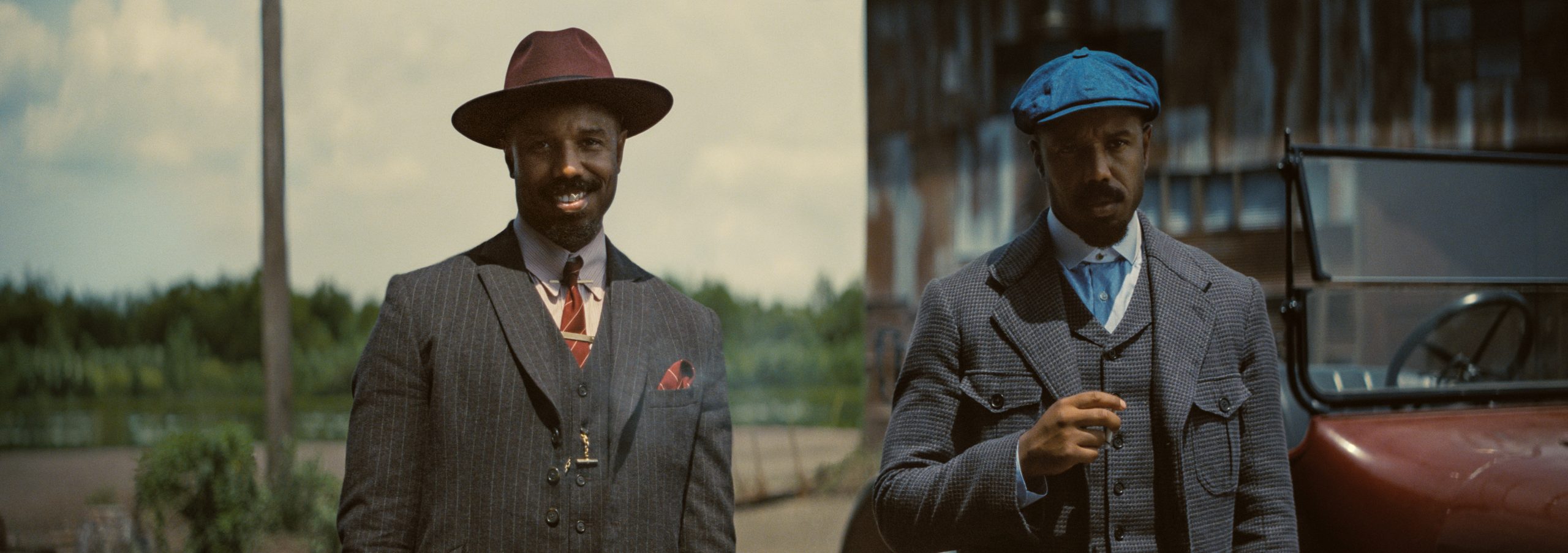
So begins the film Sinners, the epic Southern gothic horror film from acclaimed director Ryan Coogler (Fruitvale Station, Black Panther). Sinners tells of twins Smoke and Stack Moore (both played by a fantastic Michael B. Jordan), who open a juke joint with the help of their cousin Sammie (Miles Caton) in their small Mississippi hometown in 1932. Driven by a love for blues music and a desire to create a safe gathering place for other Black people, the twins establish Club Juke at a defunct sawmill, unwittingly setting into motion a sinister chain of events.

That opening narration, which points to Sammie and his prodigious musical gifts, accompanies an evocative montage of folk imagery, as the narrator outlines the importance of musical storytellers within tight-knit communities. One such folk figure is the West African griot, a protector of oral tradition who also often served as leaders in their communities. The montage is backed by haunting resonator guitar, a musical motif that will repeat throughout the film.

Coogler tapped the GRAMMY- and Oscar-winning composer Ludwig Göransson to score Sinners, continuing the creative partnership the two began with Coogler’s 2013 film Fruitvale Station (which also stars Michael B. Jordan). Rootsy and atmospheric, the score takes blues influences and ratchets up the tension with strings and percussion to suit the horror themes that unfold midway through the story.

Artists who perform on the Sinners soundtrack include Brittany Howard, Cedric Burnside, Rhiannon Giddens, Alice Smith and Rod Wave. Players on the Sinners score include Buddy Guy, Bobby Rush, Justin Robinson, and Leyla McCalla. Roots musician and actor Lola Kirke appears in the film as Joan, a member of the KKK who becomes a vampire.

Sinners is set in Clarksdale, Mississippi, a Delta city famous for its rich blues music history and for its role in the Great Migration, which, on the whole, found over six million Black Americans leaving the Southeast for large cities in other regions – including Chicago, Detroit, New York City and Cleveland – in order to flee racial segregation, Jim Crow laws and racial violence like lynching.

Dense with musical references, Sinners incorporates blues history into the naming of its characters, too. Stack’s name likely references the classic American folk song “Stagger Lee,” also known as “Stagolee” or “Stack O’ Lee Blues.” That tune tells the story of a real-life man and professional procurer, Lee Shelton, who lived in St. Louis, Missouri, in the late 1800s. Friends called Shelton “Stag” because of his perpetual bachelorhood, and, at times, “Stag” became “Stack.” On Christmas Day, 1895, Stack shot and killed a man named Billy Lyons after Lyons stole Stack’s Stetson cowboy hat, and the rest would soon become musical history.

Michael B. Jordan as Smoke and as Stack, in Warner Bros. Pictures’ ‘Sinners.’

The song’s original writer is unknown, and it has been recorded and performed by a bevy of artists in the intervening decades. One of the most popular recordings is performed by Mississippi John Hurt, a pioneering blues artist. In 1957, Louisiana-born R&B singer Lloyd Price rewrote the song as an upbeat rock number, scoring a number one Billboard pop hit. When Price performed the song on American Bandstand, host Dick Clark had him tone down the “violent” lyrics by giving the song a happy ending.

While Stack’s name is loaded with meaning, the name Smoke is more ambiguous, though as a pair the twins’ names could point to “Smokestack Lightning,” a 1956 song by another Mississippi blues artist, Howlin’ Wolf.

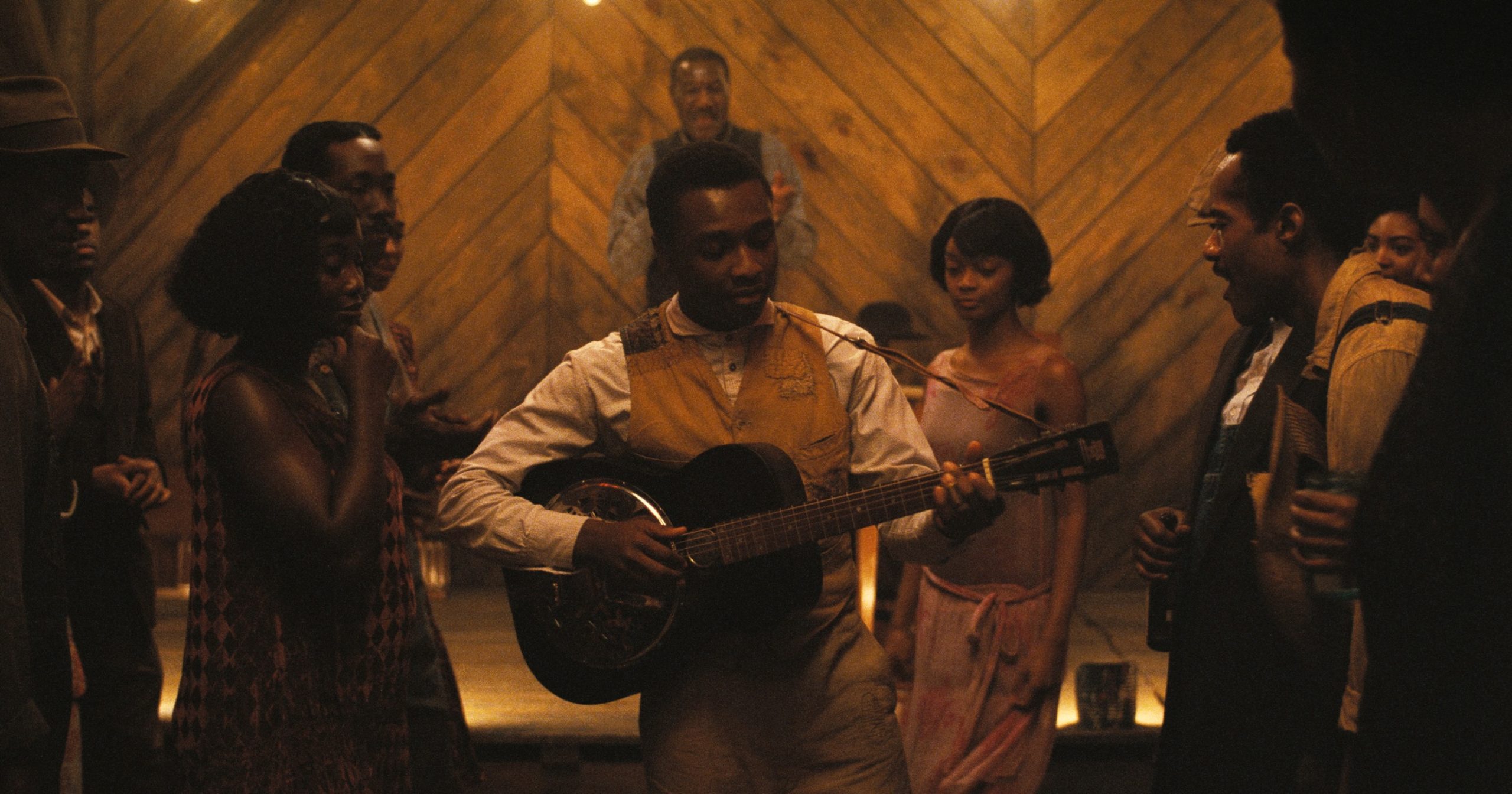
The plot kicks off in earnest when Stack and Smoke return to Clarksdale from Chicago, where they hoped to escape the Jim Crow racism of their home state. Disillusioned by the racism they still encountered once there, the brothers decide to move home to establish Club Juke, recruiting their cousin Sammie to be part of the house band. Sammie is rarely seen without his guitar, a 1932 Dobro Cyclops resonator that Göransson used to record much of the film’s score.

Stack claims that the guitar he and Smoke give to Sammie once belonged to Charley Patton, the Mississippi-born singer and guitarist widely considered to be the “father of the Delta Blues.” (At the movie’s end, Smoke reveals the truth to Sammie: that the guitar actually belonged to his and Stack’s father all along.) Showing Stack his chops, Sammie performs “Travelin’,” a song original to the film.

The emotional and artistic high point of Sinners is a surreal, mid-party musical number that connects the blues to Black music traditions from past and future eras, including hip-hop and rock and roll. The scene begins at Club Juke, with Sammie performing the original song “I Lied to You.” The character Delta Slim soon delivers a short monologue, telling Sammie, “Blues wasn’t forced on us like that religion. Nah, son, we brought this with us from home. It’s magic, what we do. It’s sacred, and big.”

When the opening narration replays after Slim’s speech, things get psychedelic. An electric guitarist dressed in ‘70s rock and roll regalia appears, shredding licks while Club Juke dances around him. A DJ booth appears, with a man in ‘80s hip-hop-inspired clothing behind the boards. B-boys dance among club-goers, and a West African griot appears carrying a drum. Time dissolves as boundaries between musical traditions blur, capturing the essence of 20th-century Black music in one stunning scene.

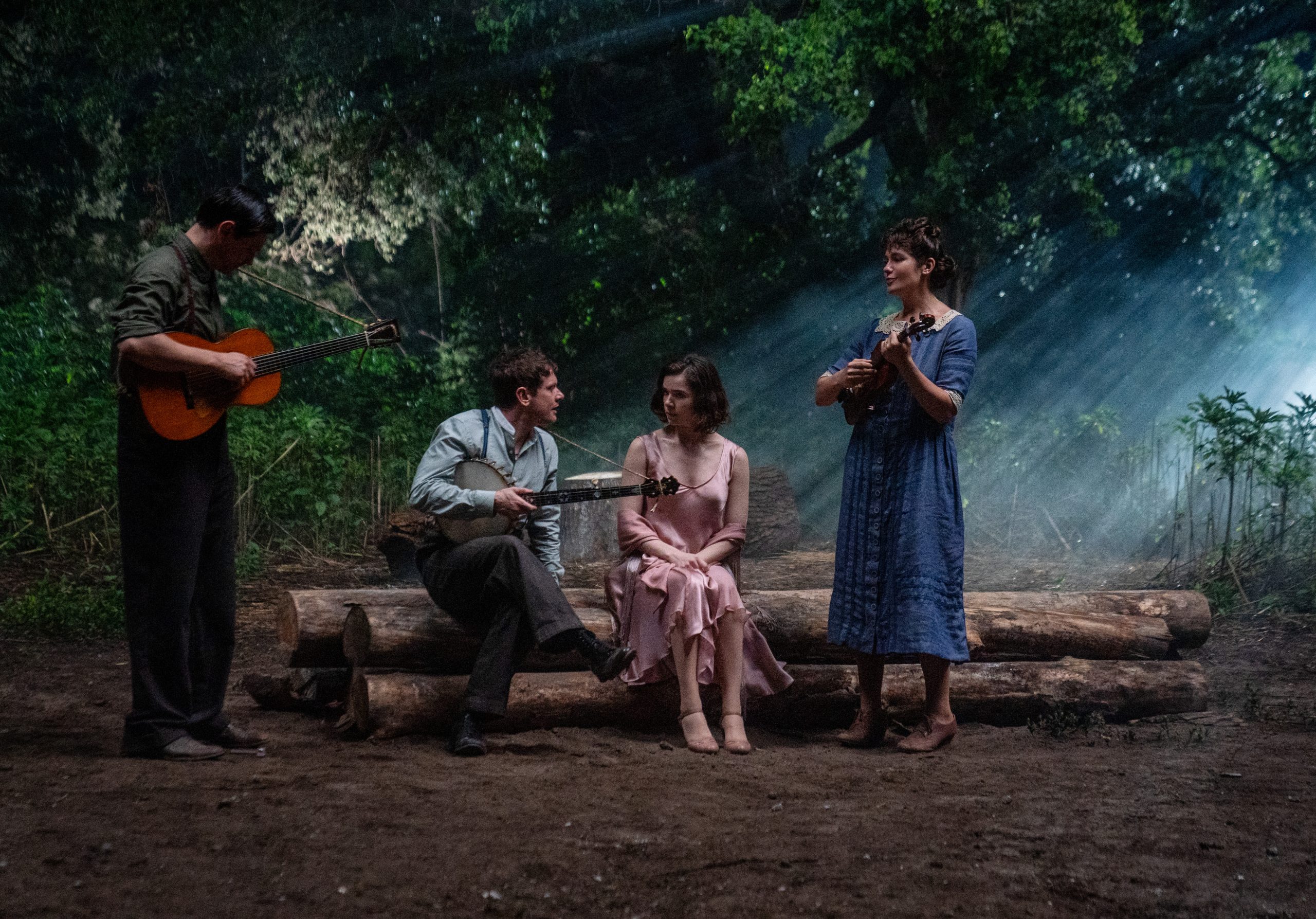
Trouble starts when a trio of vampiric folk musicians (yes, you read that right) tries to enter Club Juke, hoping to perform. That image of a literal blood-sucking monster in no small part resembles the white colonization of Black music, particularly blues music, adding gravitas to the unexpected plot development. The trio tries to woo their way in with a folksy version of the traditional blues song “Pick Poor Robin Clean,” made popular by Virgninia-born blues artist Luke Jordan in 1927 and the artists Geeshie Wiley and Elvie Thomas – from Louisiana and Texas, respectively – in 1931.

(L to R) Peter Dreimanis as Bert, Jack O’Connell as Remmick, Hailee Steinfeld as Mary, and Lola Kirke as Joan in Warner Bros. Pictures’ ‘Sinners.’

After being denied entry to Club Juke, the trio retreats, performing a hypnotic rendition of the Scottish/Irish folk song “Wild Mountain Thyme” outside the club grounds. The song was especially popular during the American folk music revival and has been recorded by Bonnie Dobson, Judy Collins and Joan Baez, among many other artists.

As the vampire plot unfolds, the musical story takes a bit of a backseat, though a major fight scene between the remaining Club Juke revelers and the ever-growing contingent of vampires does include another major musical number. Led by Remmick, the group performs a chilling, spirited version of the hop jig “Rocky Road to Dublin,” an Irish folk music standard with roots dating back to the mid-19th century.

The next big musical moment comes after the film’s end when, taking a cue from his MCU days, Coogler includes a post-credits scene. Set in Chicago in 1992, the scene features two familiar faces: blues legend Buddy Guy, who plays elderly Sammie, and contemporary blues star Christone “Kingfish” Ingram, a member of the elder Sammie’s band.

Guy, who also performs a version of “Travelin’” on the Sinners soundtrack, was born in 1936 to Louisiana sharecroppers and moved to Chicago to pursue music when he was 21. Shortly after relocating, Guy would meet Chicago blues legend – and Mississippi native – Muddy Waters, who would become his friend and mentor. It’s a full circle moment to close out the film, and one that reinforces the importance of lineage to the blues music tradition.

Unsurprisingly, Sinners is a movie that rewards rewatches. Coogler and his collaborators built a musical world rich with detail and allusion, and did so with what was clearly an enormous amount of love and passion. If you’re a music fan, Sinners is well worth your time – just be careful if you hear a late-night knock at your door.


Sinners is now available to stream on HBO Max and is available to rent VOD. The film is also still showing in a limited number of theaters in select markets.

All images courtesy of Warner Bros. Pictures. Lead Image: Miles Caton as Sammie Moore in Warner Bros. Pictures’ Sinners.