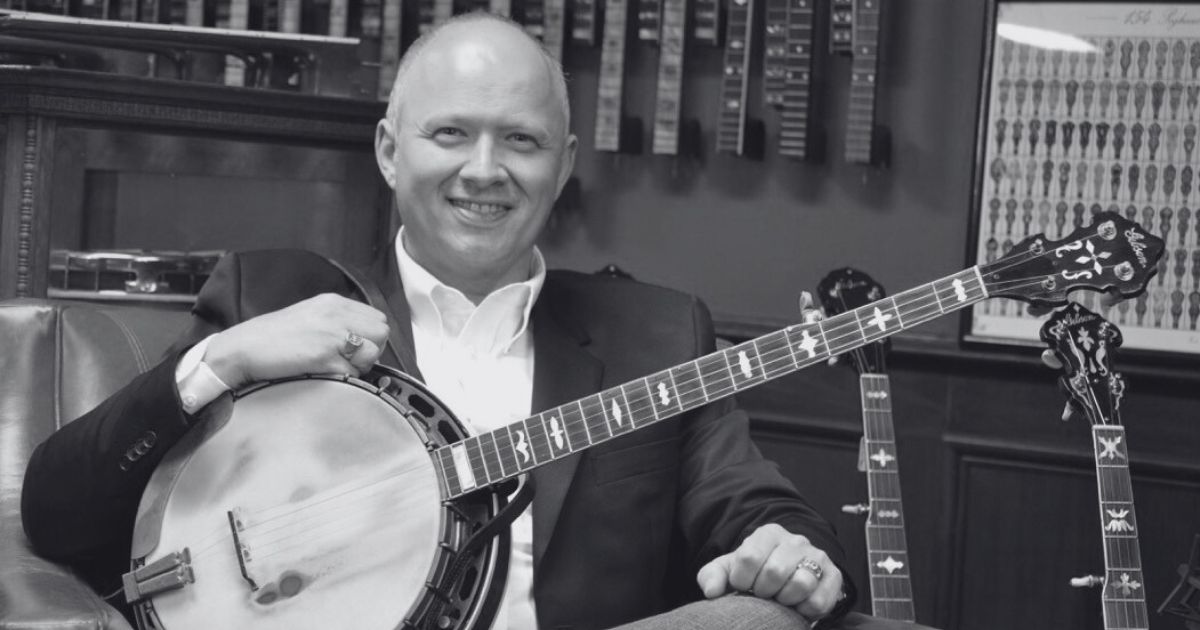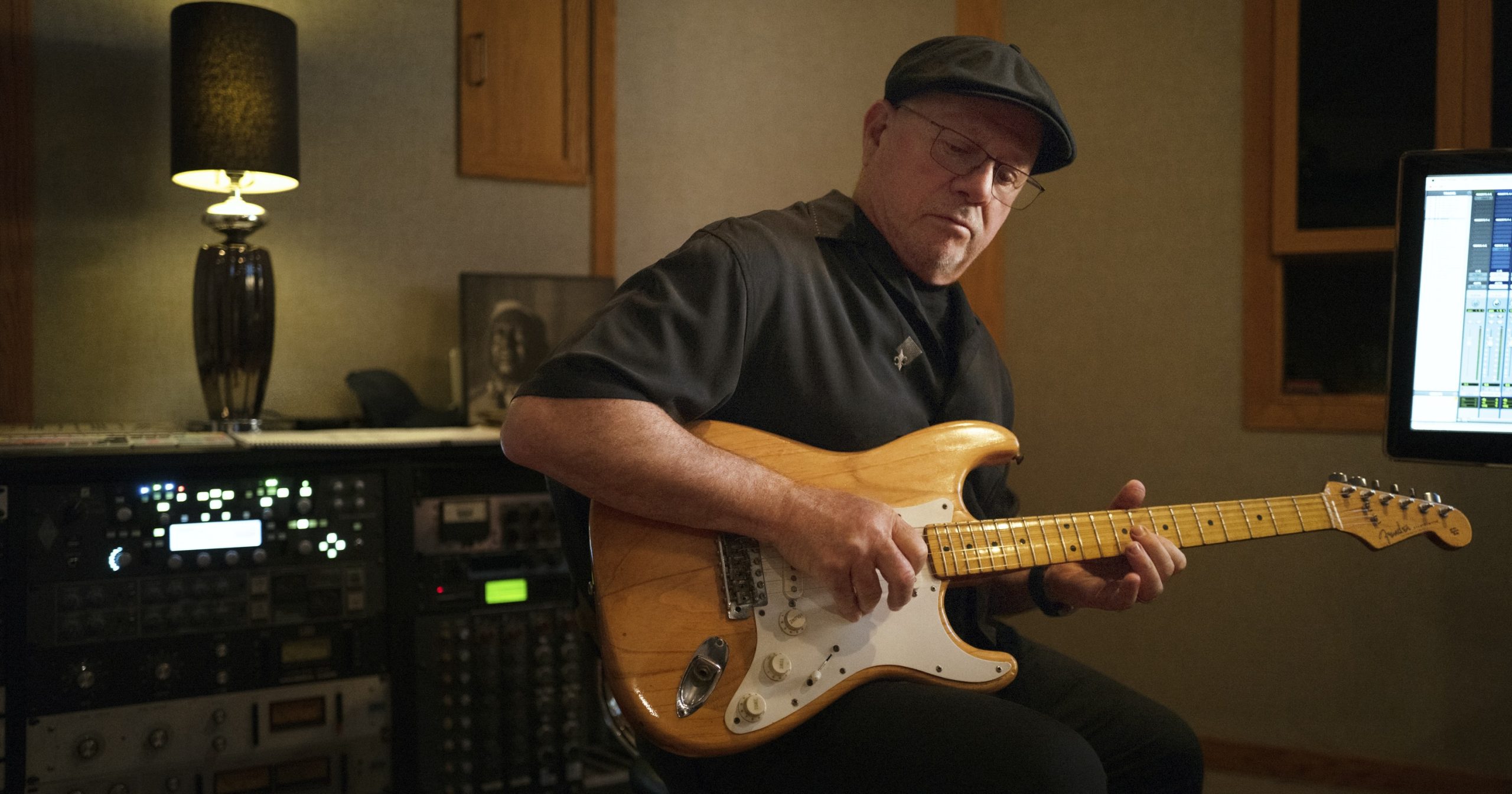
Jim Mills: A Remembrance – By Tim Stafford

(Editor’s Note: Below, Grammy award and IBMA award winner, guitarist, songwriter, and author Tim Stafford pays tribute to his friend, collaborator, and one-of-a-kind banjo picker and historian, Jim Mills, who passed away at the age of 57 on May 3.)

I started out as a banjo player, but switched to guitar early on; our little group got a better banjo player. But I’ve always loved the banjo, especially pile-driving, inventive players like Earl Scruggs, J.D. Crowe, Paul Silvius, Ron Stewart, Ron Block, Sammy Shelor, Jason Burleson, so many others. I especially like playing rhythm guitar with a great banjo player – it’s like a bluegrass drum track. I’ve not enjoyed that feeling any more than when I got to play with Jim Mills.

Jim was a force of nature on the banjo. He was such a fluid, powerful player and he could be very aggressive on the instrument, which stood in strict opposition to his demeanor – they didn’t call him “Smiling Jimmy Mills” by accident. He played things on record that I had to continually rewind. How did the banjo survive that?

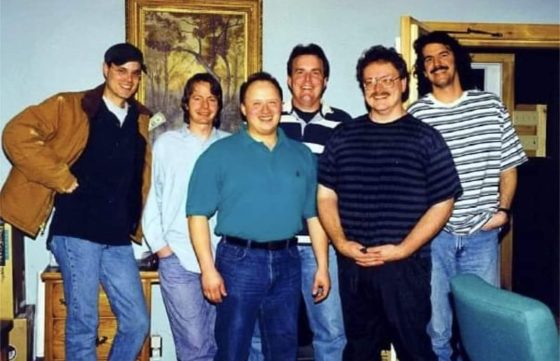
(L-R:) Barry Bales, Stuart Duncan, Jim Mills, Adam Steffey, Tim Stafford, and Brent Truitt, Nashville, TN 1998. Photo by Mike Kelly.

Once in the studio, I remember Jim breaking a string on the intro to “Bear Tracks,” a pretty hilarious outtake. It sounded like the world had exploded in the headphones. Jim just said, “What the ?!??!?” and Barry Bales let out a huge laugh – we had never heard anything like it.

It amazed me how eloquently Jim could talk in quiet rapid stretches and at length about everything related to old, Gibson flathead banjos. Like most vintage instrument topics, it’s a field of deep arcana, and the club sometimes seems too exclusive even if you truly love the sound of the things. But Jim never made it seem like anything but pure joy when he spoke, always returning to that million dollar smile. He was sharp, his collection of instruments was unrivaled, and he turned the basement of his house into a showroom.

And boy, did he know Earl Scruggs and his playing – inside out, all his instruments, all the bootleg recordings, even ephemera related to Flatt & Scruggs. He collected it and treasured it all, because it had never really gotten any better than Earl as far as Jim was concerned. The fact that Jim’s “desert island banjo” was Mack Crowe’s 1940 gold-plated RB-75 was validated for him by the fact that Scruggs himself mentioned Crowe as an influence on his playing in his 1968 book Earl Scruggs and the Five-String Banjo. Of course, Jim wrote his own definitive book, Gibson Mastertone: Flathead Five-String Banjos of the 1930s and 1940s.

Extremely intelligent, driven people are usually good at whatever they put their minds to. Tony Rice’s passion was restoring and repairing Bulova Accutron watches, and he was considered an authority in that area of expertise by people who had no idea he even played guitar. Ricky Skaggs told me that Mills was very involved in buying and trading antique shotguns as well as banjos and was just as well known in that arena.

It was all part of one cloth for Jim, though. A third-generation banjoist, a native son of North Carolina – the homeplace of the bluegrass banjo and a place so many great players still call home. When he joined Ricky Skaggs’s Kentucky Thunder, it was on one condition — he was staying in North Carolina.

We first met in the early ’90s when he was playing with Doyle Lawson and I was part of Alison Krauss and Union Station. He, Barry Bales, Adam Steffey, and I jammed for hours one day in Tulsa, Oklahoma as I recall. One of the songs he wanted to do repeatedly was “John Henry Blues.”

A few years later, the three of us played on Jim’s first solo record, Bound to Ride, for Barry Poss and Sugar Hill records. We tracked it at Brent Truitt’s Le Garage studio along with Stuart Duncan. Later Jerry Douglas overdubbed and Ricky Skaggs, Alan O’Bryant and Don Rigsby came in for guest vocals. And I sang “John Henry Blues.” It was such an honor to be on this record. Later on he did an instructional DVD for John Lawless and Acutab and I ended up backing him up on some tunes there.
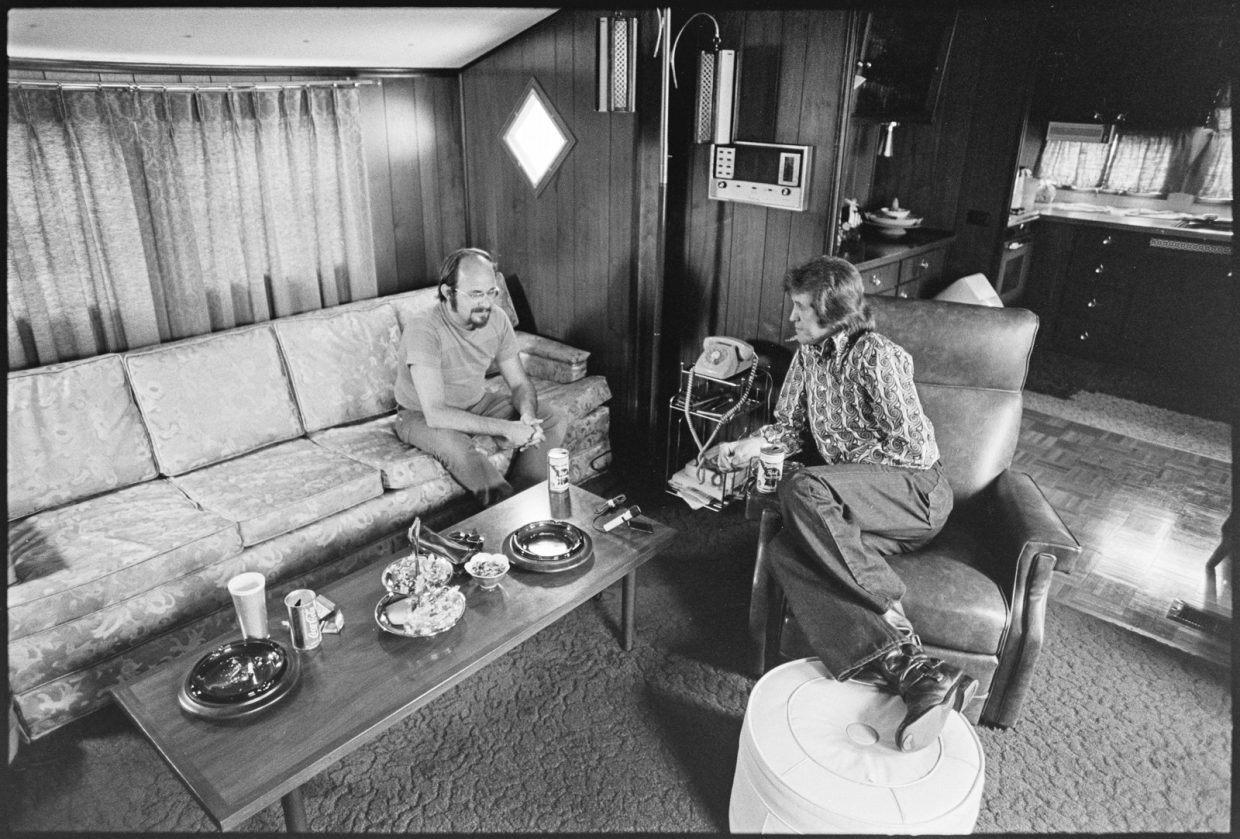
I also played on a few records with Jim during this time, including Alan Bibey’s In the Blue Room. Near the end of a Patrick McDougal song called “County Fool,” after the last chorus, I knew Jim was going to come roaring in, taking us out to the end of the song. In anticipation, I hit a G-run that ended on the downbeat, on the bottom root note, a very unusual place for a G-run. I was sure engineer Tim Austin and producer Ronnie Bowman would want me to do it over, but they liked it so it stayed. Today I listen to that track and I’m the one who’s smiling – Jim could make you do things like that.
Jim wasn’t just a banjo player – he was a fine all-around musician and singer. His lead, fingerpicked guitar playing was superb and he was a fine songwriter. One year he came up to me at IBMA and said he had a demo of a song he’d written that he was sure Blue Highway could do. The demo was just him playing all the instruments and singing and it knocked my socks off. He had pitched it to Skaggs, but the boss man passed. The tune was based on a documentary Jim had seen and was called “Pikeville Flood.” We cut it on the Midnight Storm record and it remains one of our most popular live songs.

It was always a pleasure to see Jim and just get to hang out with him. Can’t believe I won’t get the chance to do that again. RIP buddy.


Photo Credit: Richie Dotson

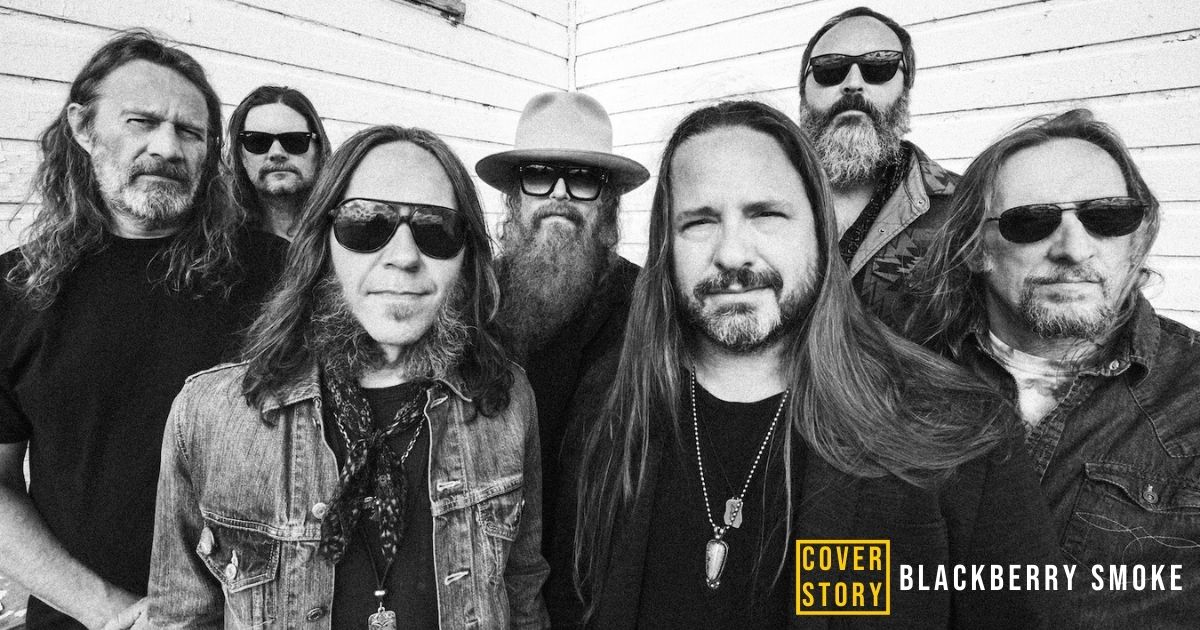
Blackberry Smoke’s New Album Offers a Crunchy Continuation of String Band Traditions

With 23 years behind them, Blackberry Smoke are still one of the best examples of Southern rock in the modern era – but what does that even mean, right?

Led by singer, guitarist, and primary songwriter Charlie Starr, the band does indeed have roots pointing straight to hard-driving ‘70s icons like Lynyrd Skynyrd, the Allman Brothers Band, and more. That’s true, but they also pull inspirations from farther back. And to Starr, Southern rock, at its core, is a continuation of the Appalachian tradition: “String band music and storytelling.”

With their latest album, Be Right Here, some of that old-time tradition shines through the cracks of a warm, distorted wall of sound, with heartfelt song craft and acoustic-guitar melodies front and center. Meanwhile, the band continue to prove crunchy, doubled guitar solos, thundering drums, and anthemic vocals never go out of style.

BGS spoke with Starr before Be Right Here was released, to see what has changed (and what will always stay the same) for one of the most dynamic Southern rock bands in history – a history they know all too well.

I thought I’d kind of start just seeing how you’re feeling at this point. You’ve been burning up the road for over two decades now, which seems crazy to me. How do you feel about where you’ve have been, and where you are now?

Charlie Starr: I mean, I’m tired. [Laughs] No, I feel good. We all do. It doesn’t seem like it’s been that long. It’s surreal to think it’s been 23 years. I don’t feel like I’m old enough to say that I’ve been doing anything for 23 years other than breathing, but I’m proud of what we’ve accomplished. It feels good.

Blackberry Smoke is one of the best pieces of evidence that Southern rock is still alive and well. But I was just wondering, do you think there’s still more to say in that? Is the form still inspiring to you?

Totally. Just listen to any song from those amazing early Skynyrd records or Allman Brothers or Marshall Tucker Band records, Blackfoot – all those bands are so different, and it really was just geography that tied ‘em all together. They all had their own fingerprint. And I think that we do, too.

I was listening to Patty Loveless in an interview and she was talking about bluegrass – which I grew up playing and I dearly love also – and she was talking about how those first generation bluegrass bands, like Bill Monroe and the Blue Grass Boys, Flatt & Scruggs, and the Stanley Brothers, they came from this rich musical heritage of the mountains where they grew up in Kentucky, Virginia, Tennessee, North Carolina. And what they were drawing from was acoustic string band music and storytelling.

Well, now, fast forward all this time, and modern bluegrass musicians not only have that, but they also have Led Zeppelin and the Beatles and the Rolling Stones and all this. There’s so much more. So I kind of look at it in a similar fashion with “Southern rock” bands, because those guys were listening to not only what I just mentioned, with the hillbilly country music and string band music, but also the British invasion and then traditional country and the Beach Boys. As time moves along, there’s just more and more that gets poured into the soup. So to answer your question in a very long-winded way, I think that it can go on forever.

So you’re kind of the third wave of popular Southern music, taking all that was done before and adding in the new influence, too.

Yeah, if we were a tribute band that just dressed up like some old ‘70s band and played their songs, then it would suck. But since we have the freedom to explore our own musicality, it can never end.

The new album is called Be Right Here. What was the spark that got this one going?

In my case, it’ll usually be a little explosion of songs. I’ll know that album time is coming, and so I’ll get to work on writing a batch of songs. It doesn’t always come quickly but it usually seems to work out, which I’m happy to say, because it kind of falls on me – which I don’t complain about that at all. I dearly love to write songs and I’m glad that it’s my job. There are worse jobs to have. Writing songs for Blackberry Smoke is much easier than working in a body shop, which I did for years.

At this point, 23 years on, are you still writing about the same stuff?

Well, I guess stories can all be new, stories of love and loss and frustration and women and men and drinking – or not – whatever. But if you look at popular music as a whole, there are new subjects that enter our culture, like cell phones and the internet and Facebook. I don’t know if I’ve ever used the word Facebook in a song. I probably won’t. But no matter what comes along technology wise, time stays the same. It’s still moving at 60 seconds per minute, and that’s not going to ever change. And human beings behave really the same way.

That said, the internet’s changed everything really. Not entirely, but it’s added a new accent to everything we do. I think John Mellencamp said it best, he goes, “I’m not sure if we’re supposed to hear this many voices at all at once.” That complicates life, really. It might push me back into my hermit hole a little more. As a songwriter even, it pushes me to the old ways more, melodically and musically. I don’t think anything really new can be said. We’re just trying to find an interesting slant on the way we say it.

You teamed up with Grammy-winning producer Dave Cobb for the second time, and he’s famous for live recording and loving first takes. Does that work well for a band like you guys, who are very live-show oriented?

It does. And in this case, it’s very interesting. We went back to RCA Studio A again, and he said, “This time I’m going to put the drums and amps and you guys all in the big room, so we’re all going to be in a little cluster.” And I was like, “Really?” As soon as we started playing together, it was like, “Oh man, okay, this is working. We don’t necessarily need all the separation.”

Some producers would be like, “Hell no. There’s no way I’d ever make a record like that.” It can be too sloppy. But Dave was like, “Well, we’re capturing this one sound. Let’s capture it all in the room, like a ‘60s record or even a ‘50s record.” So that’s what we did.

Tell me a little bit about “Dig a Hole.” It was the first track written, the first track on the album and the first one released, with a theme of choosing your own path – for better or worse. Is that kind of what you have done as a band?

We have. It’s been our only choice, really, because nobody’s ever come around with a different idea. [Laughs] It’s funny, I put together a [track list] and sent it to Dave, and I had “Hammer at the Nail” first. And Dave goes, “Are you insane? ‘Dig a Hole’ is first. Why would you think that ‘Hammer at the Nail’ should be first?” I said, “Because it’s faster.” And he said, “I don’t give a shit about fast. ‘Dig a Hole’ is like you guys are winding up to kick somebody’s ass!”

Azalea” leans more into the folky aspect of what Blackberry Smoke does. It’s got that acoustic shimmer of a classic-rock ballad. Where does that come from for you?

Man, I just love that kind of acoustic music. Again, that kind of stuff was my upbringing, and I’ll never turn it loose. That song lyrically was about fatherhood, because here we are now, our children are all growing up. I’ve already seen one go to college, graduate, now get married, so it’s like, “Well you hold on tight, but you don’t want to smother ‘em.” They have their own path to forge, so all you can do is try to be there for ‘em.

I’ll leave you with the big picture. After 23 years, what you hope people take away from this particular record?

I just hope they dig it. I mean, I don’t know if I expect people to experience it in a different way than I do or not. I don’t know. But I do get a lot of enjoyment right now listening to it.


Photo Credit: Andy Sapp

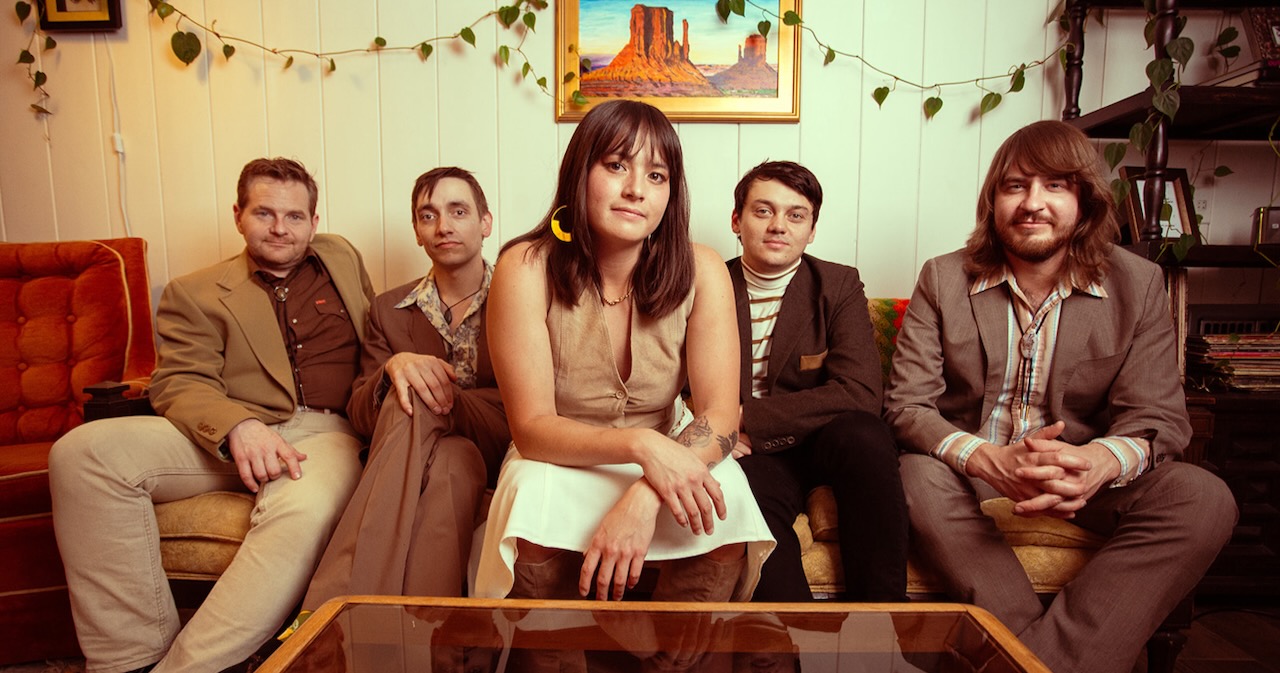
One to Watch: AJ Lee & Blue Summit

With citrusy melodies full of zest and spark, AJ Lee & Blue Summit demonstrate that California bluegrass is alive and well. Based in the Bay Area, they first took to the stage in 2015. Though the group has morphed in shape and size over time, they have delivered musical excellence for nearly a decade.

Currently, the band is composed of four tremendous musicians – AJ Lee (vocals and mandolin), Scott Gates (guitar and vocals), Sullivan Tuttle (guitar and vocals), and Jan Purat (fiddle) with a couple of rotating bassists. AJ’s velvety vocals blend seamlessly atop the many textures and tones this uncommon instrumental lineup can accomplish.

With their third studio album set to be released sometime this year, AJ Lee & Blue Summit set sail for their tour across North America earlier this month. Their emotive, erudite songwriting is brought to life by the band’s natural compatibility.

What is the nature of your musical chemistry? How would you describe it?

Scott Gates: Well, we all grew up going to California bluegrass festivals, and that gives us kind of a through-line. We all grew up with similar mentors and similar principles, so we all have similar ideas of what bluegrass is and what it isn’t, and how to bend those boundaries.

What do you think makes the bluegrass scene in the Bay Area distinct from other bluegrass scenes?

SG: Yeah, I think that there’s more homogeneity in a lot of other bluegrass associations across the country. You know, Tennessee is known for its singers. North Carolina is known for its banjo players, and they turn out some serious musicians. But something I’ve noticed with a lot of Tennessee singers is that many of them sound the same. And it allows for incredible blend and unity in sound, but California tends to reward individual individuality. When somebody has a really unique voice, they’re exalted.

Jan Purat: In the Bay Area scene, there’s a surprisingly large interest in bluegrass that dates back a long time. There’s this really thriving jam scene with lots going on. People in California as a whole tend to really nerd out on bluegrass from from the mid ’40s to the ’60s, that era of the Stanley Brothers, Bill Monroe, Flatt & Scruggs, and such. A lot of reverence for traditional sound and energy, I think, is a big part of why people really gravitate towards it. And in California, trying to channel that kind of fiery energy that you find in the more traditional stuff is definitely part of the sound, as opposed to more of the second gen and third gen newgrass circuit.

A pretty cool aspect of the California scene has been discovering that amazing lexicon of music, especially as the one band member that got into bluegrass a little bit later. I came into it during my college years, but the rest of these guys all grew up together. I met Scott busking when he was like 19, and I met AJ and Sully shortly after I first started going up to Grass Valley, around when I was 22. I started out with second-generation exposure to bluegrass, like John Hartford and similar acts, but going to the festivals and getting turned onto all this amazing music from earlier definitely feels like a big part of why I fell in love with the California bluegrass scene.

So you all share similar roots – on the flip side, what would you say the biggest difference in your respective musicianship is?

AJ Lee: Well, we all like to listen to different things, even though we’re in the same band and we unify on bluegrass. I listen to a lot of indie punk on Spotify, and I know Sully listens to some dark metal. Jan is a little bit more cultured, and Scott likes hip hop. So, there are a lot of bases covered, but we also can all appreciate what the others listen to, which is also unifying in a way.

JP: Yeah, although we love bluegrass, after a certain point we play it so much, but we don’t always listen to it that much.

AJ: I don’t think I’ve actually had a listening session of bluegrass for maybe five years.

Fair enough! What is your collaboration process like with songwriting and figuring out arrangements?

AJ: Since the early days, I’ve been the primary songwriter. I do a lot of my own original material, but since Scott’s joined, he’s brought a lot of his original material to the table as well. And I think nowadays, the songwriting process is more like a collective band arrangement. I’ll bring an unfinished song to the band and someone will say something like, “There’s a part here that I’m not really too sure about. I think it needs this,” and then together we’ll come up with something. Unlike before, when we would mostly just play all of my finished songs, now it’s more of a collective Blue Summit songwriting style.

SG: And we’ve got to give credit to the original guitar player, Jesse Fichman, who definitely helped arrange and put together some serious parts for AJ’s earlier originals.

AJ: Yeah, for a while Jesse was really the only one that I would ever write with. So he had a lot of hand in the first album.

So the first two albums are pretty different in style and tone. Can you talk about what we should expect for your third?

Sullivan Tuttle: Well, the first one had a lot of electric and a lot of drums, basically on half of the songs. And then the second one was all acoustic, all the way through. This one’s maybe somewhere in between. It’s mostly acoustic, but with a little pinch of other things.

JP: Yeah, Lech Wierzynski from the California Honeydrops produced it, so there’s definitely some of his influence. He brought in a cover for AJ to sing and it ended up being really successful and a really good choice. It’s a bluegrass instrumentation take on an old school soul song – some new territory that I haven’t really heard too many bands do. So it’s pretty exciting. And it’s just super nice working with a producer for the first time. He’s also an amazing hang, and one of the funniest people and a great buddy. It was awesome to work with him.

SG: I would say that variety is the main name of the game. When we craft a set list for a show, our goal is to bring as much to the table as possible, so that we don’t have songs that sound similar or the same over and over and we’re not fighting ear fatigue at all times. So we try to bring as many different sounds and approaches and genres together as possible. And I think this album reflects that, more so than any of the others.

Okay, here’s a silly question for you. If we were in an alternate universe, and you guys were all still a group of some sort, but it wasn’t a musical group – you’re connected by some other thing, premise interest, etc. – what would it be?

ST: Could see like a Scooby-Doo type of scenario where we all investigate things together. [AJ, Jan, and Scott emphatically agree.]

JT: We’ve got our next Halloween costume now! I know I have to be Shaggy, it’s fine.

[Laughs] I can definitely see it. I’ve heard that you have famously had to navigate some tricky traveling situations. What’s your favorite one to tell people about?

JT: Rockygrass is a good one to talk about, because it was the second time that we had to do an all-night drive from somewhere like New York City or Boston to an entirely different city like six hours away. Our Boston flight kept getting delayed, so we drove all the way to Philly overnight and got the last flight out. It was brutal. We did not sleep a wink and barely got to Rockygrass in time to play our set on the main stage. And it was our first time playing the main stage there. We were just so haggard, but apparently it was good! I had no perspective because I was so sleepy, but people liked it!

ST: I think that was my favorite, because we actually made it. Other ones didn’t have a happy ending.

Wow. You all must be really great traveling companions.

AJ: Well, we have the perfect travel attire that a lot of people tend to notice.

What is it??

AJ: I think Scott is gonna take the lead on this one. [Scott dons an incomprehensibly fashionable and utilitarian navy blue robe.]

SG: It’s a towel. It’s a blanket. It’s a robe. It’s a pillow. It’s everything that you might possibly need on the road. It keeps you warm. It keeps you dry. You can sleep at noon facing the sun.

AJ: We all have one. And everyone is always asking, hey did you guys come from a pajama party?

Okay, I feel like the Scooby-Doo thing is making more and more sense. You’re coordinating and you’re tackling obstacles!

So the two guitars situation – how did that come to be? And how do you go about arranging with two guitars?

ST: We just formed the band with two guitars – me and Jesse Fichman. When we started, I was already used to playing with two guitars because I played in the family band with my sister, [Molly Tuttle], and we usually had two guitars for that, other than when she played banjo. So it felt pretty natural, to me at least. And then when Jesse left, Scott joined, and we already had all the parts arranged for two guitars. We wanted to keep him on guitar even though he also plays mandolin. When one guitar solos you still have the rhythm guitar behind it. And as long as we’re not both just slamming away on rhythm the whole time, it works out.

It does! No complaints here. So do you guys hate banjos?

AJ: No, we actually really like banjo! Just not in our band.

SG: It’s kind of nice having it this way, because it means that when we’re at a festival, and we have a buddy that plays banjo, then we can just invite them up to play with us. There’s definitely a banjo slot for certain songs, and we can interchange that whenever we want.

AJ: I would also say that when seeing other bluegrass bands without banjo, it feels kind of refreshing to not have that sonic space filled. It gives the music opportunities to go other directions if you wanted to. And the banjo can scratch an itch, for sure, but you can’t scratch for too long or it’s going to make a rash!

So you’re our One to Watch, but who are you watching? Are there any artists, creatives, musicians, etc. that you’re appreciating especially right now?

AJ: Crying Uncle!

SG: Yeah, best band at IBMA. Hands down!

AJ: Yes, definitely the best thing I saw at IBMA. Also, another young band that’s great is Broken Compass Bluegrass. They’re up and coming as well.

JT: I like Viv & Riley – really great music. And their old time band, The Onlies, is great as well. I hope that project continues.


Photo Credit: Natia Cinco

WATCH: The Earls of Leicester Behind the Walls at Newport Folk Festival

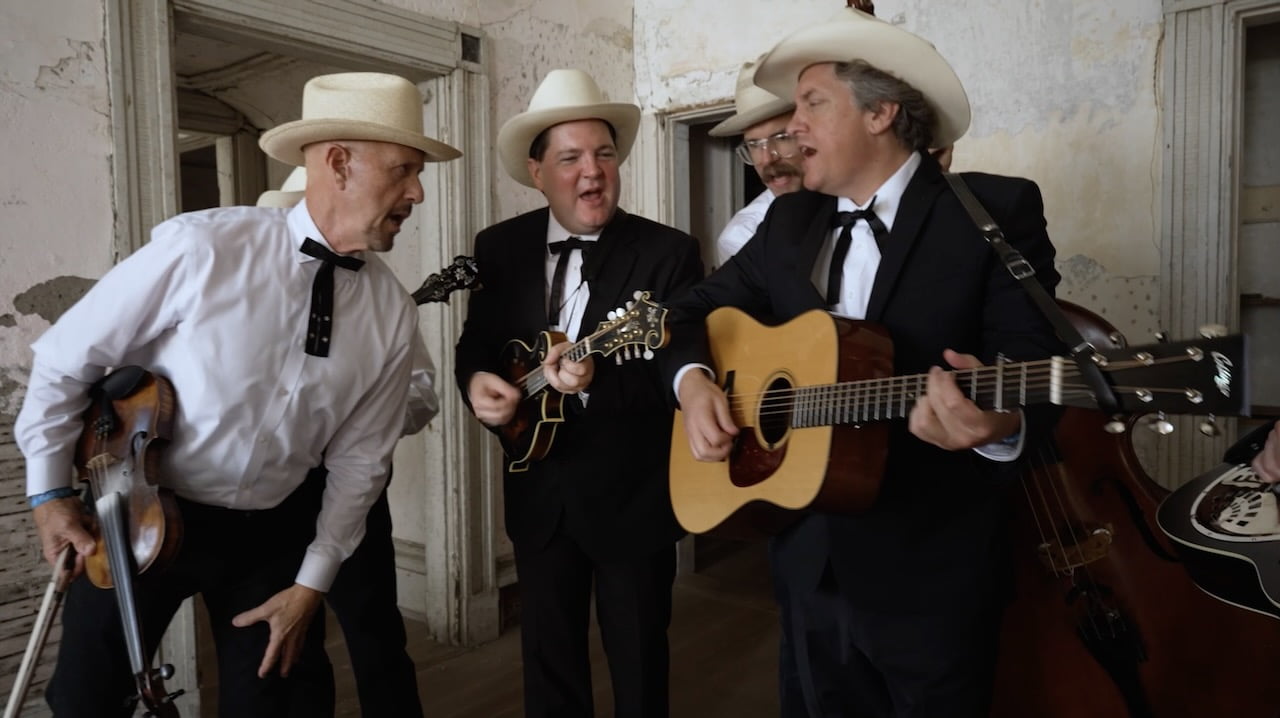
(Editor’s Note: Enjoy this exclusive video premiere from the team at Newport Folk Festival and their Behind the Walls series, featuring a performance of Flatt & Scruggs’ version of “Rollin’ in My Sweet Baby’s Arms” by award-winning Flatt & Scruggs bluegrass tribute band, the Earls of Leicester.)

Artist: The Earls of Leicester
Hometown: Nashville, Tennessee
Song: “Rollin’ in My Sweet Baby’s Arms”

In Their Words: “The song ‘Rollin’ in My Sweet Baby’s Arms’ has long been a staple in the bluegrass canon. It’s a good, hard driving song about traveling and returning home to the one you love. Down to the details of some of the family members’ occupations. Also there is a slight Romeo and Juliet effect in the line, “I know your parents don’t like me.” Flatt & Scruggs probably had the best version, but it’s a crowd pleaser and works in any situation.” – Jerry Douglas

“The Earls Of Leicester are living embodiments of the traditions of bluegrass that have graced our stages for over 60 years. We’re grateful that they recorded a backstage Behind The Walls session with us at last year’s Newport Folk Festival. And big thanks to The Bluegrass Situation for sharing it far and wide.” – Christopher Capotosto, producer, Newport Folk Festival


Lead image courtesy of Newport Folk Festival.

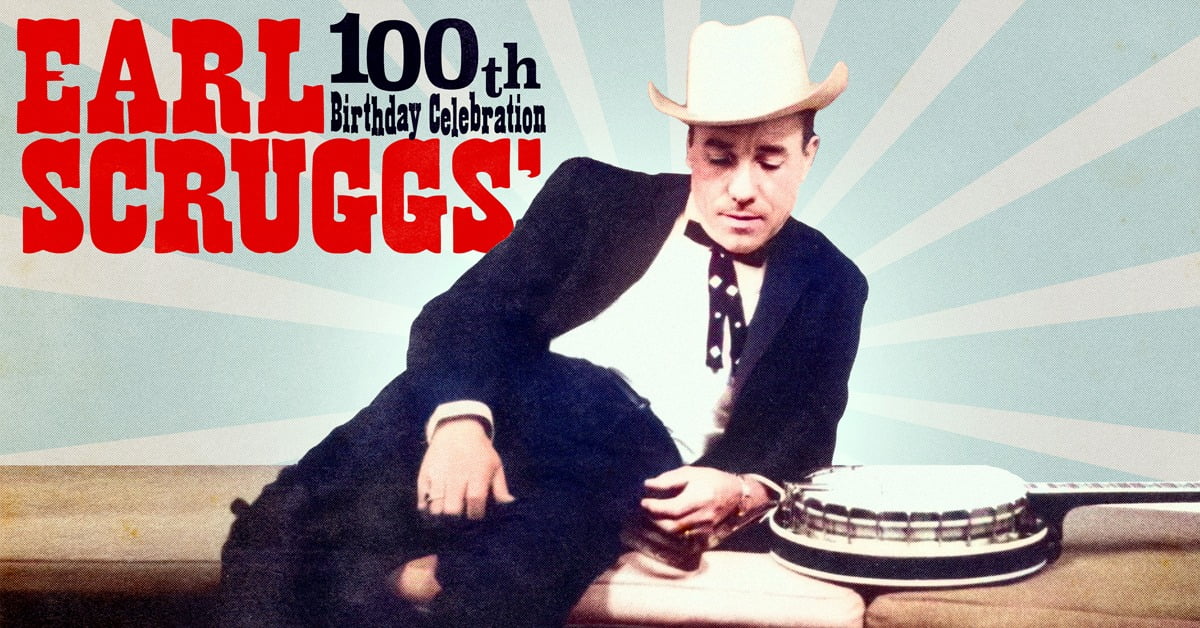
How to Watch Earl Scruggs’ 100th Birthday Celebration

January 6, 2024 would be the 100th birthday of Earl Scruggs, a musician and artist who helped create bluegrass music and who was and is perhaps the most prominent and well known banjo player to have ever lived. Scruggs passed away in 2012, but this posthumous celebration – to be held at Nashville’s Ryman Auditorium – speaks to his undying musical legacy. The performance will benefit the Earl Scruggs Center, a museum in Shelby, North Carolina that’s dedicated to Scruggs, the local community, and its residents, and inhabits the former courthouse just up the highway from unincorporated Flint Hill, where he was raised.

The show, with musical director Jerry Douglas, will feature performances by bluegrass and roots music luminaries such as The Earls of Leicester, The Del McCoury Band, Gena Britt, Alison Brown, Sam Bush, Michael Cleveland, Stuart Duncan, Jimmie Fadden, Béla Fleck, Jeff Hanna, Sierra Hull, Bronwyn Keith-Hynes, Jim Mill, Justin Moses, Jerry Pentecost, Todd Phillips, Harry Stinson, Bryan Sutton, Tony Trischka, Abigail Washburn, Pete Wernick, and more. Limited tickets are still available and, for those who may not be able to attend in person, the entire show will be livestreamed via Veeps.com for $14.99.

It promises to be a quintessential Nashville evening, a star-studded lineup with endless appearances, special guests, and with certainly plenty of heartfelt remembrances and tributes in store. Livestream viewers will get a rare chance to be invited “flys on the wall” for a magical and one-of-a-kind concert.

Earl Scruggs’ legacy will certainly live on – for another hundred years and, we hope, beyond. BGS and many other roots music and bluegrass communities and organizations will continue to celebrate Scruggs’ centenary throughout the year, so keep an eye out for upcoming content that celebrates Earl Scruggs and his three-finger style.


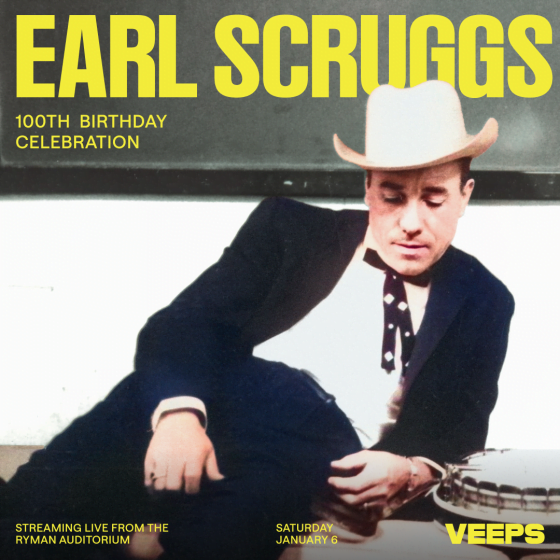
Lead image courtesy of the Ryman Auditorium; inset graphic courtesy of Veeps.

You Have to Hear Tray Wellington Band Cover Kid Cudi

It’s that time, when music writers everywhere are thinking and writing about the best of the year’s music, blurbing away for year-end round ups. (Speaking of, our BGS year-end picks will be unveiled next week.) While it’s right to view ranking, commodifying, and objectifying music with a degree of skepticism, there is certainly something constructive and generative about reflecting on the songs, albums, and performances that have stuck with us throughout a year. It’s especially illuminating when certain music immediately jumps out from the rest, requiring no particular organization or intention to be a constant presence throughout a year or to be remembered among the cream of the crop.

Tray Wellington Band’s cover of Kid Cudi’s “Pursuit of Happiness” is one such song. When the group performed it earlier this year at FWAAMFest in Texas, it wasn’t the first time I had heard their rendition, but it was the first time I noticed an audience hearing it themselves for the first time. I was struck by the reactions, in a non-bluegrass audience they varied from utter shock to outright glee – even other bands and artists on the lineup were beside themselves, as Tray Wellington Band laid out their one-of-a-kind cover of such a recognizable melody. Later this year, I saw TWB perform again at Earl Scruggs Music Festival in Tryon, North Carolina, and yet again, down the road a handful of weeks later at IBMA’s Bluegrass Live! festival and conference in Raleigh. Each time, regardless of the audience’s starting point or their baseline understanding of bluegrass, of the banjo, of cover songs such as this, “Pursuit of Happiness” would generate electricity in the crowd.

There’s a reason why hearing a North Carolina-born, Raleigh-based (via east Tennessee) Scruggs-style banjo player’s take on “Pursuit of Happiness” reminds of Reno & Smiley performing Johnny Cash and Elvis hits and Flatt & Scruggs recording buckets of Bob Dylan songs. This is a tradition in bluegrass as old as the genre itself. Executed as artfully as this, it has the potential to bring countless new fans of string band music into the fold. That “Pursuit of Happiness” retains its impact, no matter the audience – thanks, in large part, to this band’s remarkable musicality as an ensemble – at bluegrass festivals, African American music festivals, or even in Earl Scruggs’ home county, speaks to that ineffable quality of this music that we all hold so dear. Sometimes, a bluegrass song just grabs you and it won’t let go. “Pursuit of Happiness” is destined to grab more than its own share of ears, and Tray Wellington and band deserve it and then some, for bringing this track to the world.


Bluegrass Memoirs: Visiting Rusty York (Part 2)

(Editor’s note: All inset photos by Carl Fleischhauer.)

In my previous memoir I described what I knew of Rusty York when Carl Fleischhauer and I arrived at his Jewel Recording Studios in Mt. Healthy, Ohio, on the afternoon of August 15, 1972.

We had walked into the midst of a recording session. In the studio was the Reverend Bobby Grove (née Musgrove), his wife Fayette, oldest son Bobby Junior (a drummer), some other friends, and five studio musicians – Eddie Drake, lead guitar; Junior Boyer, pedal steel; Bob Sanderson, bass; Jack Sanderson, rhythm guitar; and Denzil “Denny” Rice, piano.

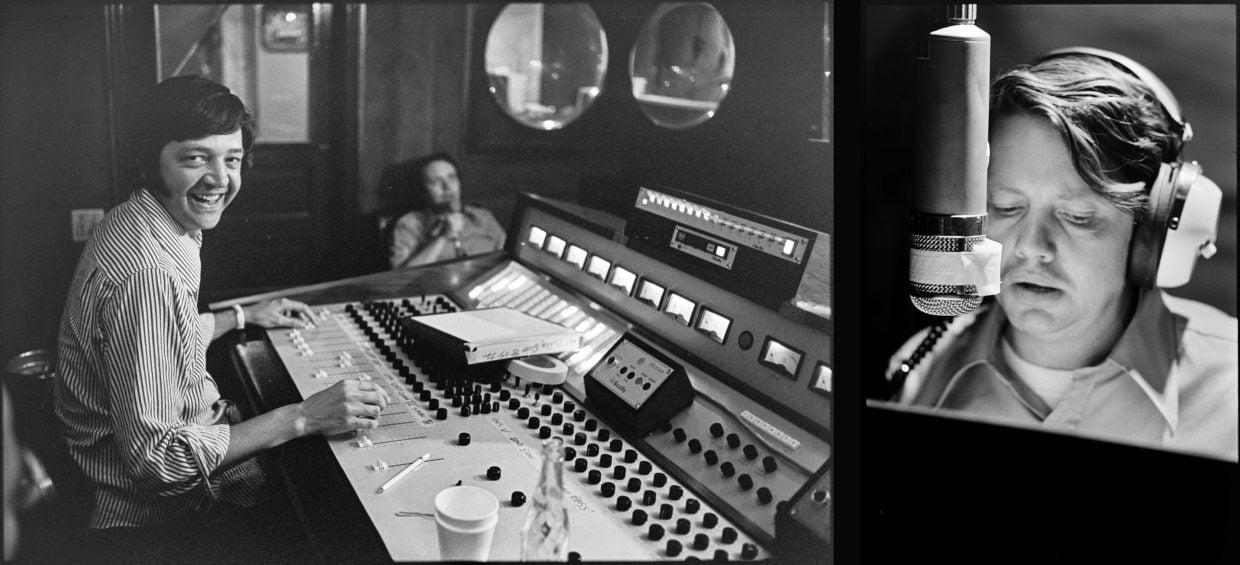
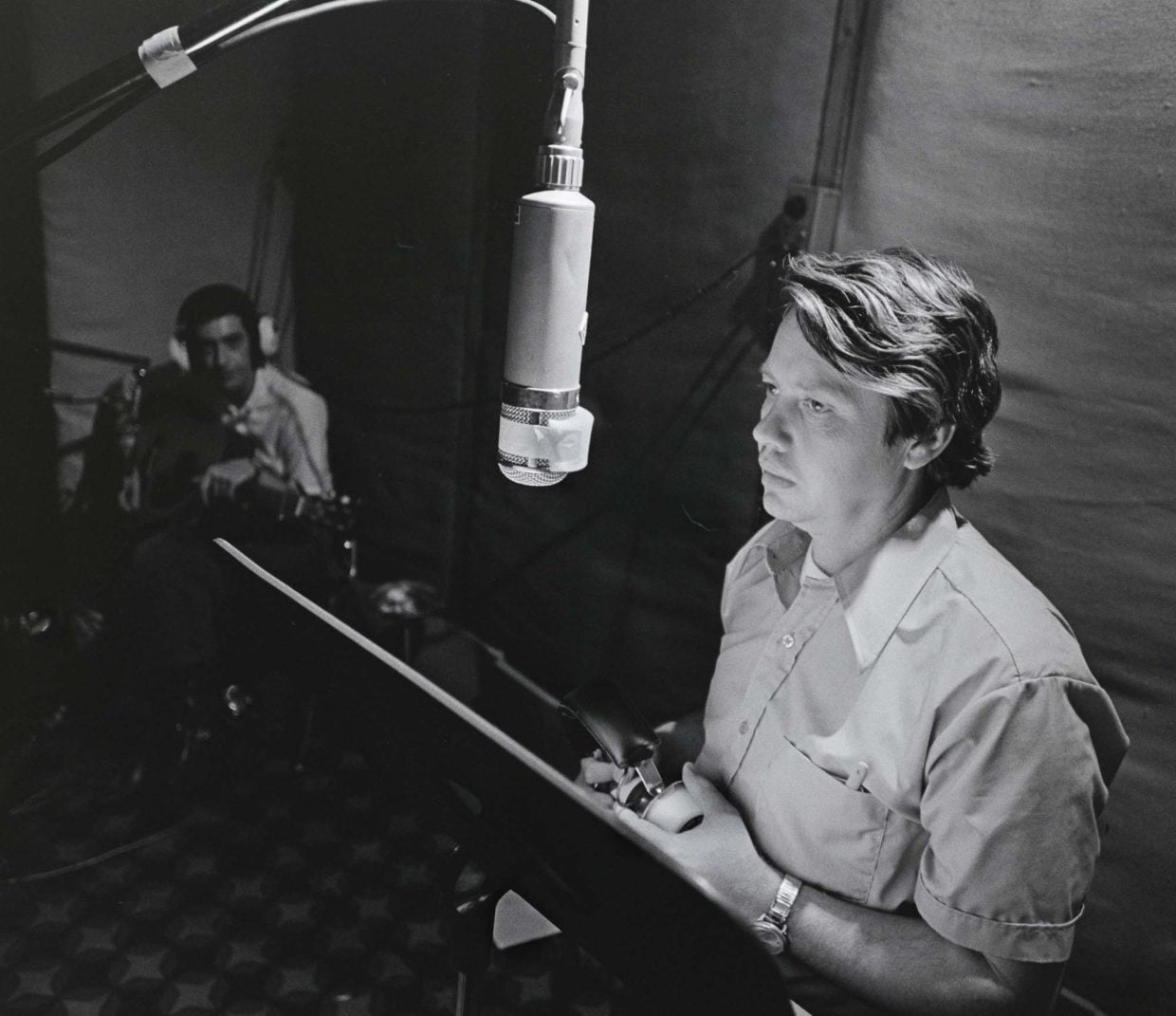
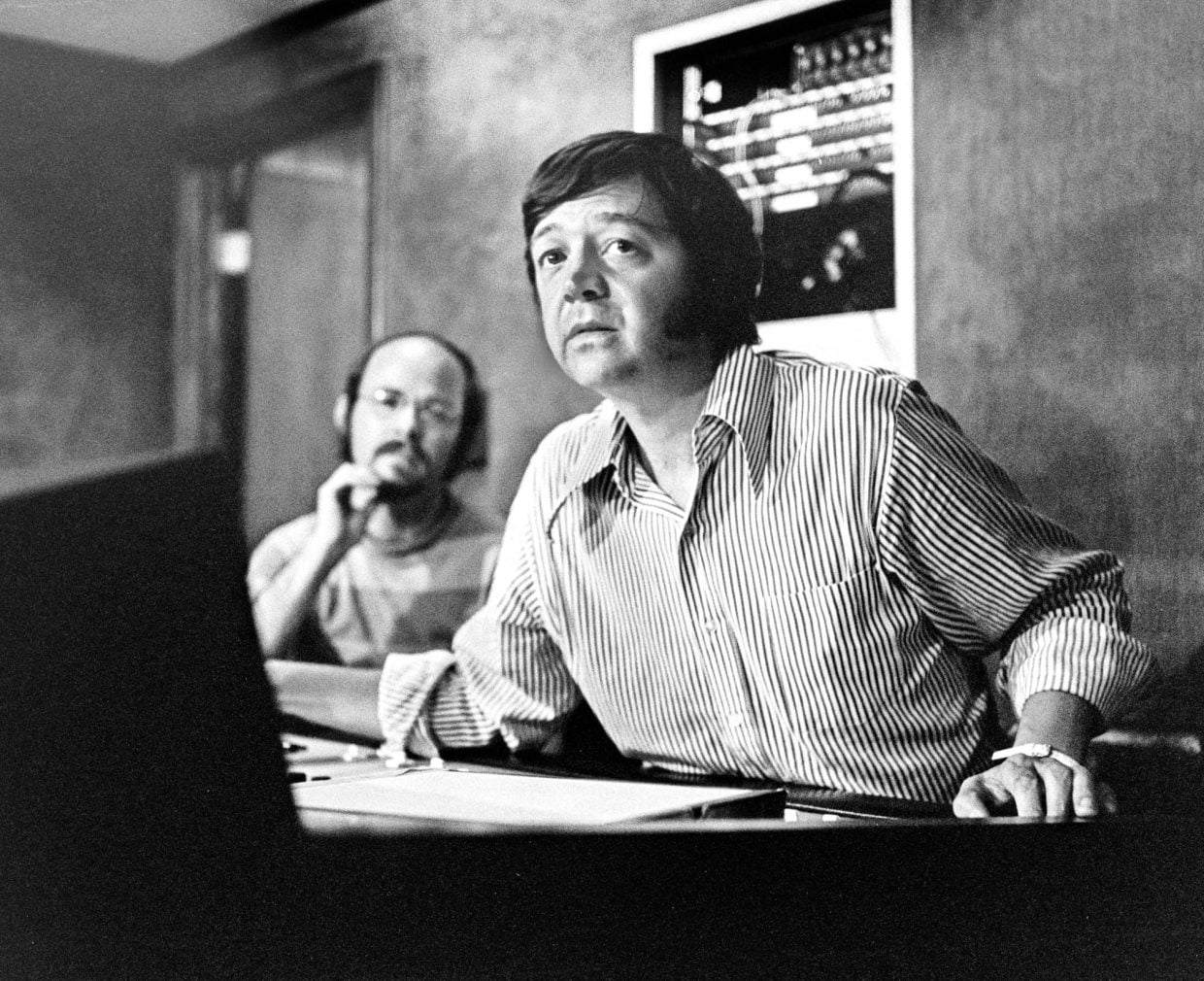
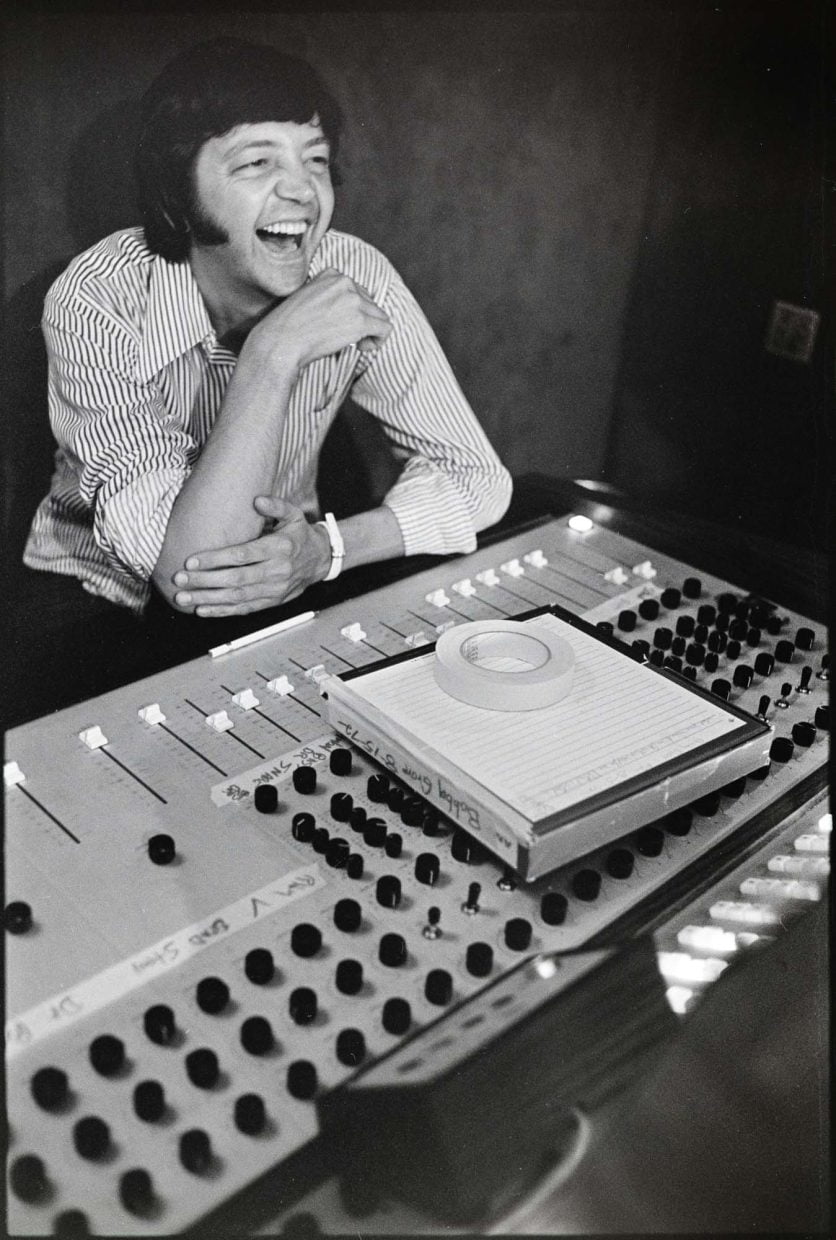
L: Rusty York in the studio control room recording overdubs by Bobby Grove, seated. R: Bobby Grove during a recording session. At the Jewel Recording Studios in the Mt. Healthy suburb of Cincinnati, Ohio, August 15, 1972.

Later I wrote in my notes:

Grove has made 35 LPs. Has a “club” – he mails out each record to a list of 10,000, with a request for a minimum contribution of $4.00.

Originally from Kentucky, the Groves now lived in Hamilton, Ohio, where Bobby had opened his own church about four years earlier. I noted:

Rusty makes up soundtracks for him from the LP masters which are minus the voice tracks – he uses these in personal appearances.

Bobby’s wife Fayette described this process to me. “Really cuts down on the expenses. He just takes the soundtrack along. It’s really marvelous,” she said.

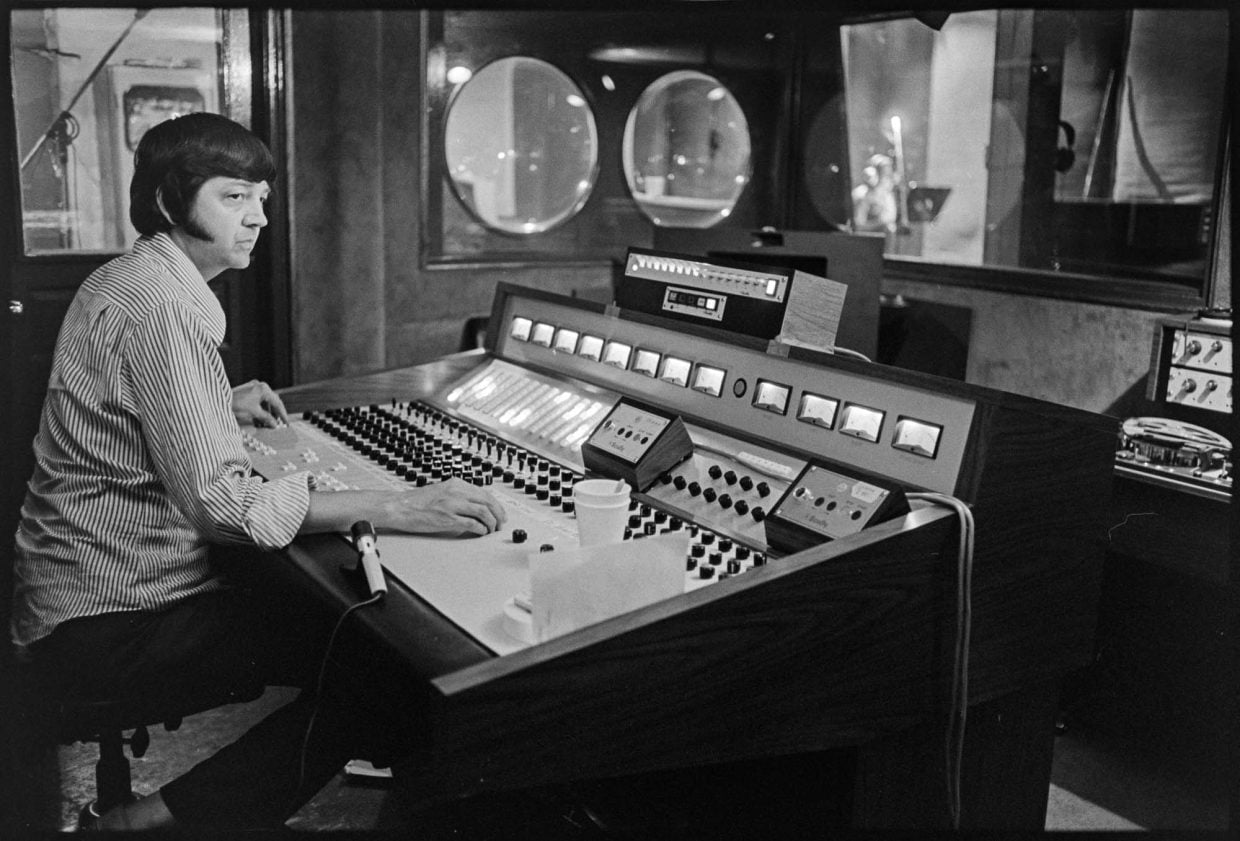
The studio was probably about a fifty-foot square, with the master panel occupying a quarter, the studio space an “L” around it… In the recording room, where I set up my cassette (it looked ludicrous!), was an 8 track, a 16 track and a 2 track. The recording was being done on 8 tracks.

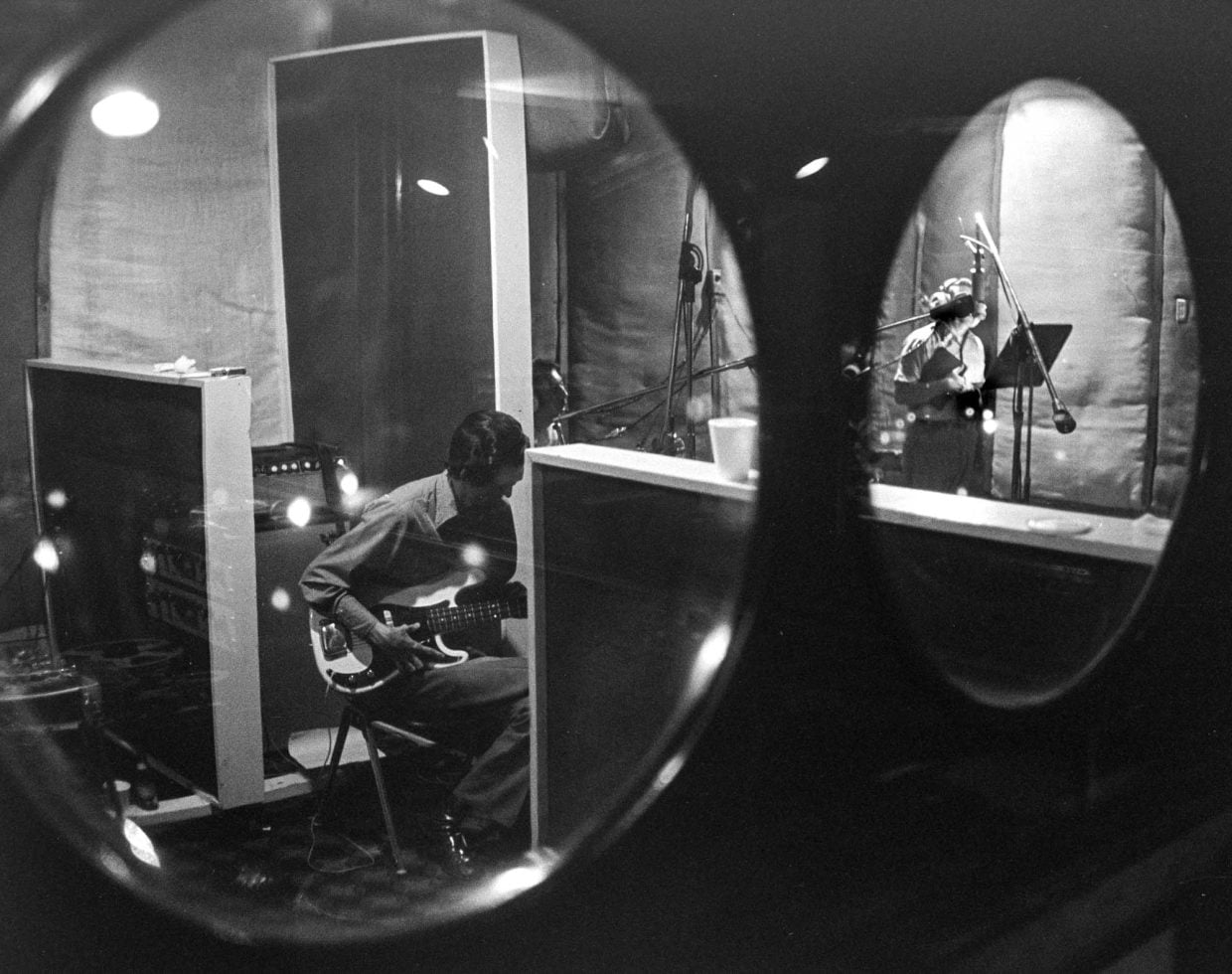
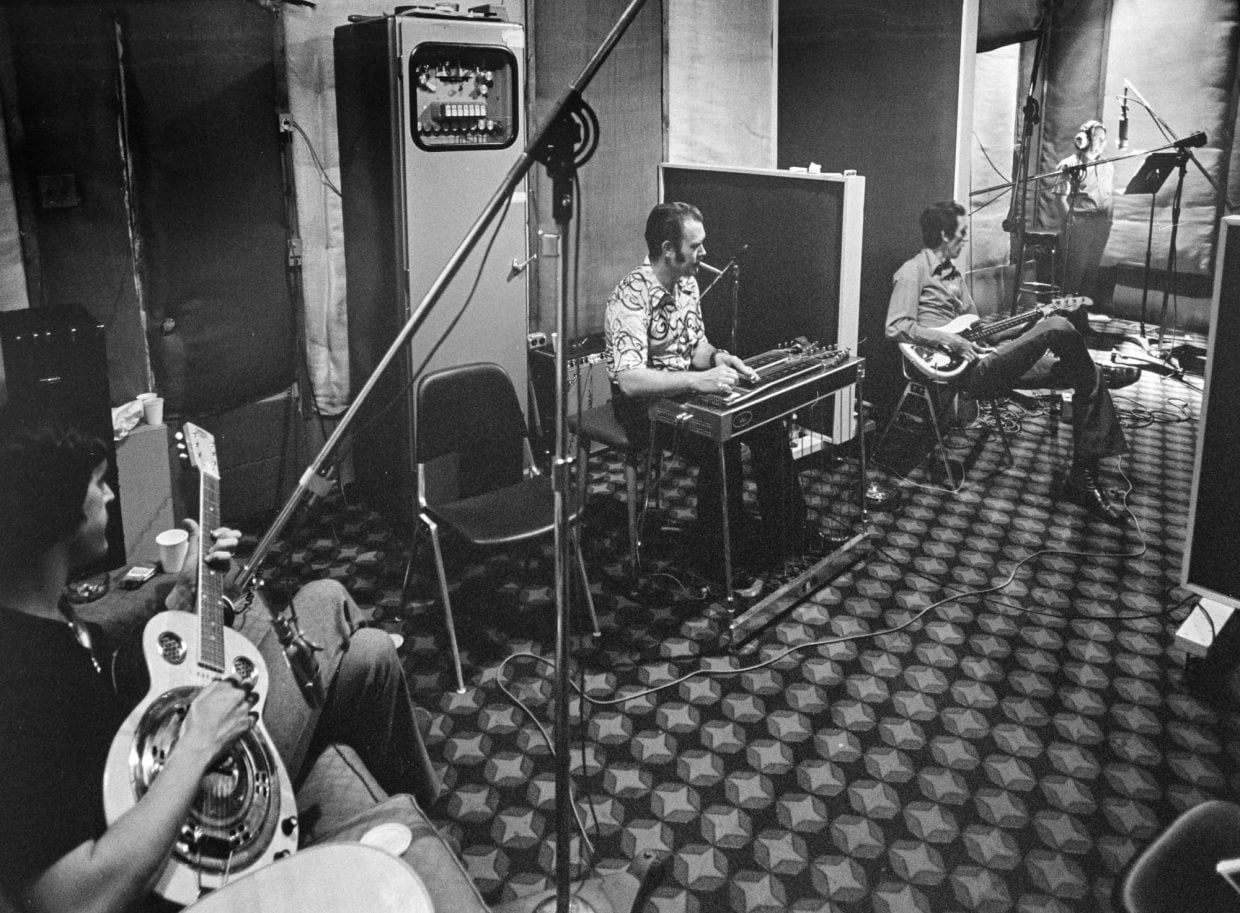
Recording session at the Jewel Recording Studios in the Mt. Healthy suburb of Cincinnati, Ohio, August 15, 1972. At left, Bob Sanderson, bass guitar; right, singer Bobby Grove.
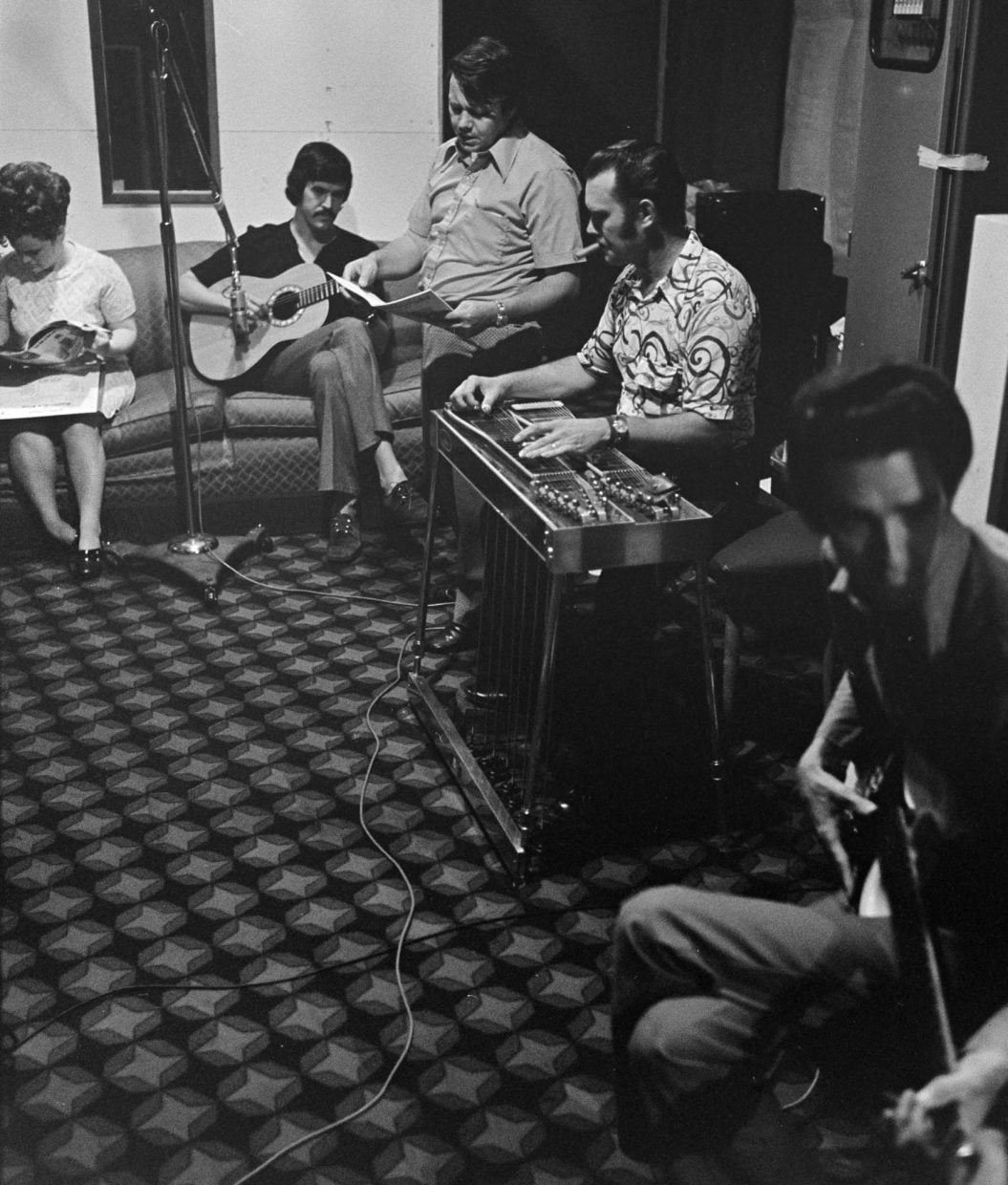
Recording session at the Jewel Recording Studios in the Mt. Healthy suburb of Cincinnati, Ohio, August 15, 1972. Performers shown here include Fayette Grove, Eddie Drake, Bobby Grove, Junior Boyer, and Bob Sanderson.

I ran the cassette intermittently trying to get snatches of conversation and brief interviews between phone calls, takes and visitors which never seemed to ruffle Rusty’s feathers. Obviously, he is a person of tremendous energy and talent, starting with his musical abilities (from rock to ‘grass) going to his present recording activities.

During this session Bobby had his bible tucked under his arm during every “take.”

After recording several songs, he asked Rusty: “Would it be all right, these next three songs, if I just sang the words — the country words — and then come in and do ‘em, like that? Then I’ll write ‘em. That way I’ll do something that we know real quick and we’ll just go through it and I’ll go home and write ‘em. And when I come in and mix it down just dub it in real quick?”

Rusty said, “Yeah that’s fine.”

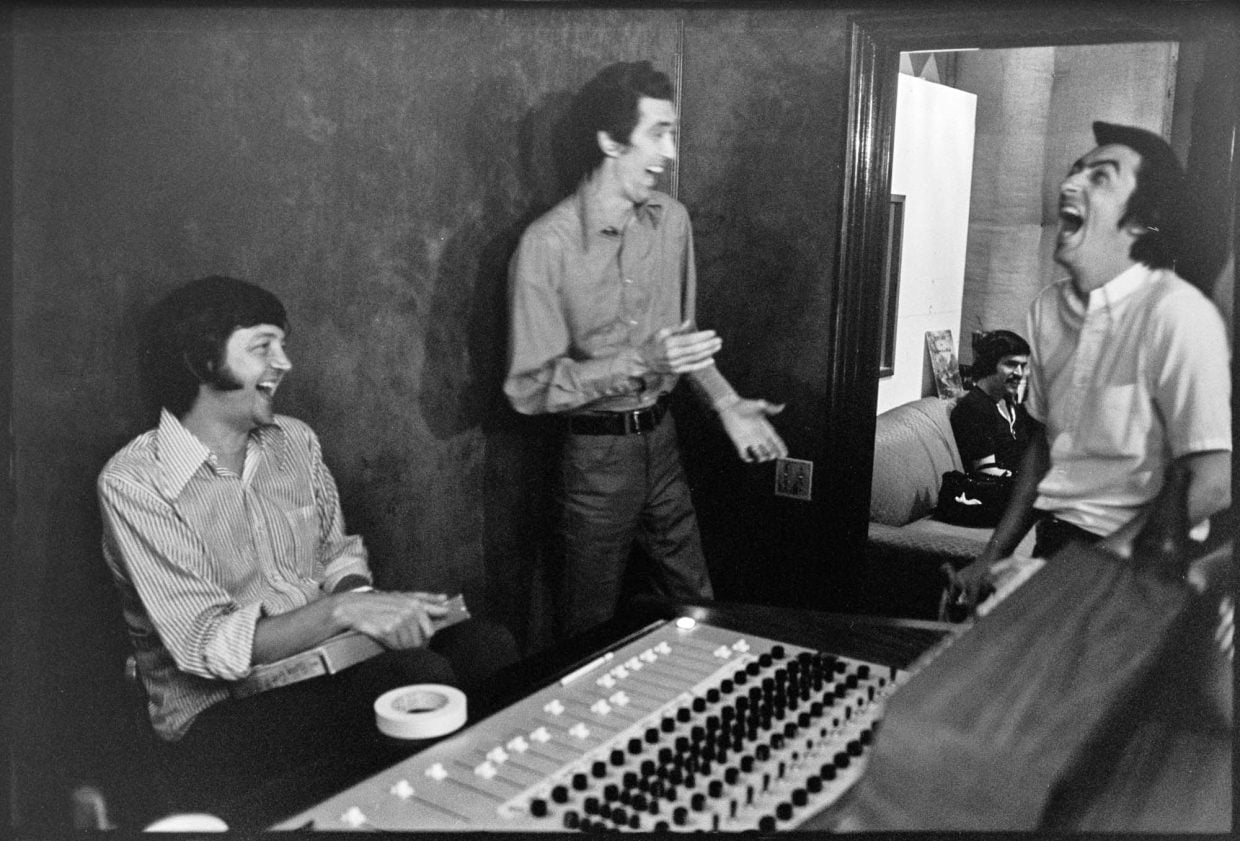
During a break at a recording session at the Jewel Recording Studios in the Mt. Healthy suburb of Cincinnati, Ohio, August 15, 1972. Rusty York, recording engineer; Bob Sanderson; Jack Sanderson. In the background, Eddie Drake.
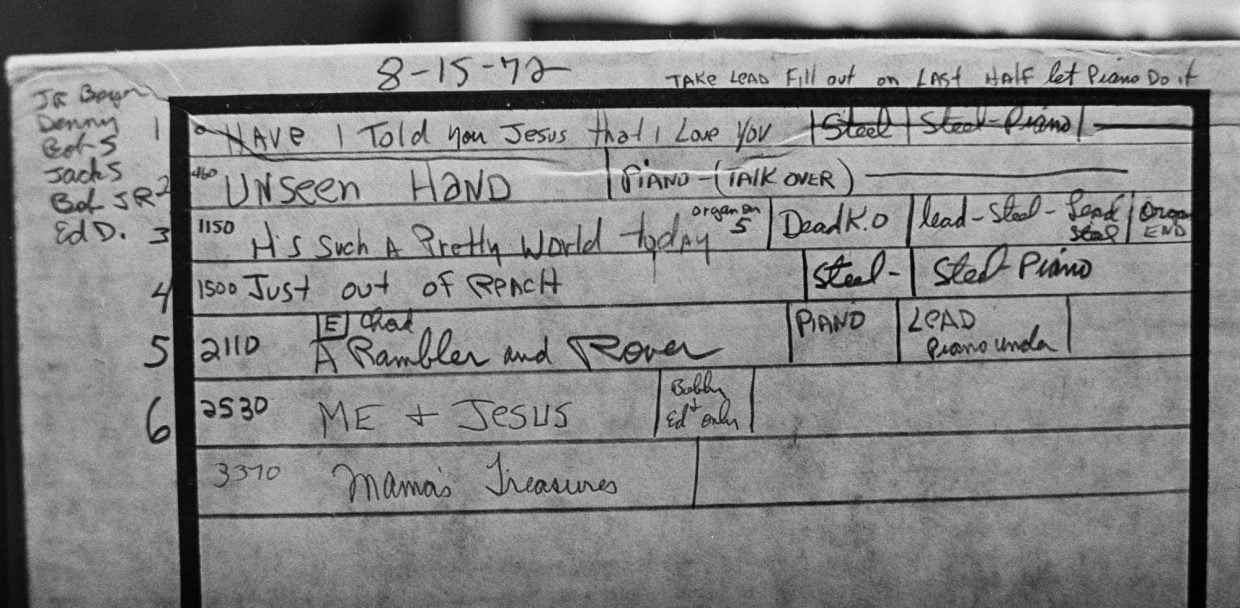
Tape box from the recording session for singer Bobby Grove at the Jewel Recording Studios in the Mt. Healthy suburb of Cincinnati, Ohio, August 15, 1972.

In the five years since I had seen him, York had expanded…to two studios (the other, bigger, in Hamilton) with loads of sophisticated equipment.

Rusty: “I bought a professional recorder in ’61, just in my garage. In fact, you know, you were out there.”

“So, you got into it kind of gradually,” I respond.

He nodded: “I didn’t just go and buy a hundred thousand dollars’ worth of equipment like a guy I knew here in town. He’s hurting; but I’m booked, you know, all the time.”

“Since you do this all the time,” I said, “you probably get rates from the pressing people, and so on?”

“I’m their biggest customer, yeah.”

What drew him into recording, I wondered.

He explained: “It just happened. It was really nice to make fifty extra dollars on Sunday, you know, by doing our own album, you know. Or some kind of session. Still, I still play music, I thought that’s what I want to do, you know. It got to be a, where I could make so much more money and not be the big hassle, like getting stoned every night that you played, chicks all over your body.” [Laughter]

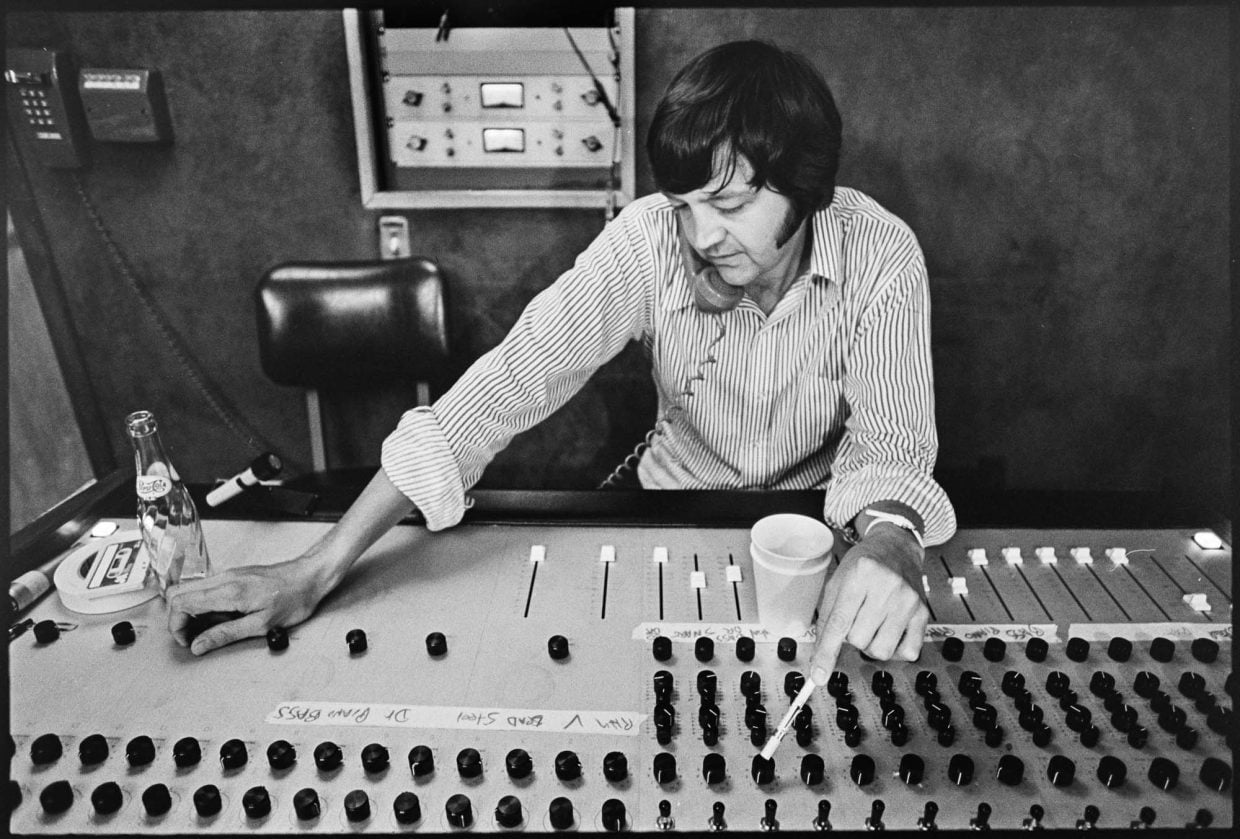
Rusty York at the mixing board at the Jewel Recording Studios in the Mt. Healthy suburb of Cincinnati, Ohio, August 15, 1972.

Rusty appeared to be paying only scant attention to the recording session but every once in a while, would pinpoint out-of-tune instruments (…he can isolate mikes from the fairly well-baffled studio and hear exactly who’s doing what), suggest drum riffs, etc.

Rusty explained to us that his connections with Bobby Grove reached back to his earliest days in Kentucky:

“Yeah, we’ve all worked together at one time or another. Willard and I worked at Bobby’s father’s, he had a little barn dance and that, the Stanley Brothers –”

Grove’s son interjected: “Grandpa!”

Rusty said, “Huh?”

“You met my grandpa.”

“Yeah, probably before you was born.”

I asked: “What was his name?” “Jason Musgrove,” Rusty said.

Grove’s son recalled the venue well: “Did you know in that barn he had a sign, said no alcoholic beverages allowed in this area? He stayed drunk there all the time.”

“No!” Rusty replied in a mock serious whisper.

“That’s right”

“Well, we had a bottle or two out in the front of our car all the time.”

Grove: “I can picture him wrestling a bear.”

Rusty: “We saw a bear-wrestling match in there.”

Grove: “Was you there when that happened?”

Rusty: “Yeah. Were you around?”

Grove: “No, that was when I was born. ‘56” [Laughter]

Bobby Grove recording session at the Jewel Recording Studios in the Mt. Healthy suburb of Cincinnati, Ohio, August 15, 1972. Left to right: Eddie Drake, rhythm guitar; Junior Boyer, pedal steel guitar; Bob Sanderson, bass guitar; Bobby Grove, vocal.
Guitarist Jack Sanderson and singer Bobby Grove at a recording session at the Jewel Recording Studios in the Mt. Healthy suburb of Cincinnati, Ohio, August 15, 1972.

Rusty explained: “His grandpa ran a, what did he call it? Green Valley Barn Dance. And right now, that place is worth millions of dollars, and he lost it cause he couldn’t make the payments or something. Forty-two dollars a month payment.”

Grove: “Kent Valley Lake”

“Now it’s, you know, you could probably get twenty, thirty million dollars for the place. Got a big lake –”

“I started playing, I guess, when I first come to Cincinnati, about ’52. I just picked up an old guitar. My father bought me an old five-dollar guitar.”

“I went to see Lester Flatt and Earl Scruggs first time up in Jackson theater in about ’53, I guess. And I just couldn’t believe man, anybody could play a banjo like that, I just… Boy! I stayed for both shows that night… I mean it was just like heaven then, ‘cause nobody, you couldn’t never see it. There’s so much of it now, you know. Everybody can play good now, you know. But then, it was only him. I had a tenor banjo, I put fifth key on it. It was a Mastertone too, Gibson. Four-string.”

Folklorist Neil V. Rosenberg and recording engineer Rusty York at the Jewel Recording Studios in the Mt. Healthy suburb of Cincinnati, Ohio, August 15, 1972.

The only five-string banjo style he’d known before Scruggs was that of his Grandma. He recalled that she’d made the head of her banjo from a groundhog skin.

“Willard Hale was from Somerset. Where I met Willard, I stopped into a little bar out in Cincinnati, and they had music. They set up a little amplifier and the mandolin with the guitar. Willard and this other fellow were singing duets and one guy played the mandolin. I set in with my banjo and then this one guy left and I – every weekend, I’d go out and play with them. Like Friday, Saturday night. Boy, free beer! I couldn’t believe it, you know, getting free beer and a, I found out later that this guy was getting paid for me all the time I wasn’t getting any bread.”

“Willard and I used to just stand on the stage, two of us, and play banjo and guitar and sing duets. Then Elvis came along and they started saying, ‘Hey you know “Hound Dog”’ and you know, man, ‘You from the country, you shouldn’t be asking for a song like that.’ And even country boys started liking Elvis, you know. And we had to switch over to electric guitar and a guitar and then switch over to bass, and we finally had to add drums, then turned into modern country. Although we were the highest paid ones in Cincinnati for a long time, just Willard and I. …Our salary was on ten-fifteen bucks apiece a night, but the kitty would be the kind of money, might be fifty bucks a night. And that was a lot then.”

“The highlight of our whole night was when we got the banjo and upright bass and Martin guitar out. And boy people really dug it, but we didn’t give ‘em too much of it, cause they still like to dance. [Otherwise] I played electric guitar and the other boy played bass. And we might play, sometimes an hour of bluegrass. Really it was a treat, you know, a change for the people.”

“I played banjo – ‘Down The Road’ and things like that. And every, the whole place would swarm the floor, you know. They’d do this soft-shoe backstep buck and wing hoedown. That’s what I call it. It’s almost like square dancing without any organization. Everybody just doing their own thing. But it, it’s that clog, what I call – the soft-shoe backstep buck and wing hoedown.”

I was curious about “Sugaree,” that jukebox single I’d bought in Oberlin back in 1960. Rusty explained:

“I was doing, you know, some bluegrass stuff and this guy came to me, said — that’s when the Chipmunks were popular [1959] — he said let’s go and record this ‘She’ll Be Coming Round The Mountain’ we’ll go ‘She’ll be dum da da, Do diol lu’ (etc. — imitates twangy guitar doing first line of that song) and the Chipmunks go ‘Cha Cha Cha’ (high pitch).”

“On the way out there [to the studio] he says, what are we gonna do on the other side? I says, I don’t know. He said, well do ‘Sugaree’ or ‘Long Tall Sally’ or something, I said I don’t even know that. That was just decided on the way out to the studios. It was a bad record – shoo! I, I can’t stand to hear it.”

Rusty York at the mixing board at the Jewel Recording Studios in the Mt. Healthy suburb of Cincinnati, Ohio, August 15, 1972.

“We recorded it at King records studio. Paid for the session ourself. Forty bucks it cost. We tried to peddle it to everybody – RCA and Mercury – and nobody wanted it. So, we put it out ourselves on my [own label], started Jewel. It got to be number two in Cincinnati, and they said something must be happening, you know we pressed the thousand, sold them, pressed a few more and this guy, Pat Nelson negotiated with Chess Records and we leased it to them.”

“I did another record and they never released it. I died, as far as — I did the Hollywood Bowl, and American Bandstand with Dick Clark.”

I was also curious about those “Bluegrass Special” EPs he’d done in the early ’60s. Did he still have copies?

“Ah, I’ve got ‘em on tape, but I don’t have the actual records. You know, those sold a lot of records. Like 200,000… Used to hear Jimmie Skinner and I on that fifteen-minute thing [Wayne Raney show on WCKY], selling the package.”

Rusty told me about the next chapter in his story, which was new to me at the time:

“I went with Bobby Bare; you know I was front man for his show. Played Reno, Las Vegas and just about every state in the Union and I went to Europe, about ten countries. … in ’64 and ‘5. It don’t seem that long ago.” …

I replied, “It doesn’t to me either.” I asked, “You’re not playing any, now, then, are you?”

“No, I started back playing about two months ago in one of the biggest nightclubs here. I just couldn’t take it, ‘cause I’d have to get early do a session and I make 90 buck an hour here, over there I might make – I was playing for the door. Sometimes we would make six hundred bucks a night for the band and sometimes a hundred, split five ways. So–”

“I enjoy just sitting around and playing, but I don’t know, as far as getting before a crowd and doing a thing, I’m not crazy about it. It’s really work, to me. … Most people, I’ve found, have an ego problem. I don’t know if it’s ego or insecurity, but they want to get up before a crowd and sing and–”

“Work it out, up there?” I interjected.

“Yeah. Most, most people that are in the business are very insecure and [play to/depend on] the crowd a lot. Bobby Bare was … he was a nice guy but he was kind of a, well was insecure. He’d like to sleep maybe eighteen hours a day, escape from reality.”

I was struck by York’s insightful comment about musicians having an ego problem. In later years I’ve characterized it in this way: the musician, selling himself or herself, is both product and salesperson. It’s a vision that has stuck with me, like “Don’t Do It.

Since my research was focused on bluegrass, I was eager to hear what Rusty had to say about it. He began by talking about recording bluegrass.

“Here I don’t do a lot of bluegrass now. Most of them don’t have the money to afford to record. … I try to give ‘em a real good break. Something that’s gonna be around for a long time, I mean a bluegrass record is gonna be around forever, because there always will be somebody that likes bluegrass. I charge them a flat rate you know – sixteen hundred bucks or so for a thousand albums. In other words, they could not afford to pay studio time and do an album and pay for the tape and the mix so I just give them a flat break, price.”

I suggested, “You must know most of the good bluegrass musicians in this area.”

“Yeah, I do. They all want to record with me because they, I understand it a little bit better than some engineers.”

He told me that it’s the most difficult stuff to record, explaining:

“Well, most of ‘em play and sing at the same time. You got a mic for the banjo over here and voice up here — you got two mics, you’re gonna have phase cancellation between them. A mandolin player, you’re gonna have to do the same thing. The bass leaks into the voice mics, cause he’s got to sing too, and it’s really difficult. … And they want to get, this space is big and they all like to get right together.” Pointing to the spread-out, country sidemen working with Grove in the studio, he said: “See how far apart these guys are now? And they won’t overdub. It’s a real challenge, I’ll say that. To get a real group in here, that’s really got good harmonies, you know that’s really nice. I’d almost do it for nothing.”

I asked, “Do the country DJs around here play much bluegrass?” “The Osborne Brothers,” he said, adding “Paul Mullins plays a lot of bluegrass. He’s very well liked and a lot of people listen to him. He’s got little witty – you’ve heard him – little witty sayings and he’s about that… Yeah, I’ve got an album by him coming out by him. It should be out any day now, that he cut here.”

Rusty York at the mixing board at the Jewel Recording Studios in the Mt. Healthy suburb of Cincinnati, Ohio, August 15, 1972.

I closed my notes for that day summarizing the work at Jewel:

Rusty’s operation involves packages – he sells 1,000 finished LPs for $1600 (more or less, depending on studio time, number of tracks – the latter a function of tape since 16 tracks takes 2” tape, etc.) and he sees to recording, mixing, pressing, printing, art, etc. The musician who is buying the package pays for the sidemen though Rusty often (as in Grove’s case) sets up the session sidemen too. He assigns master numbers, keeps records of his operation, etc.

In Bartenstein and Ellison’s book, Industrial Strength Bluegrass (Illinois, 2021), Mac McDivitt devotes a section to Jewel, saying that by 2008, when Rusty retired, “Jewel had cemented a reputation as the ‘go to’ place to record in the Cincinnati area” (53-55). Selling the business, York moved to Florida. He died in 2014. Bear Family has released two CDs of Rusty’s rockabilly recordings.


Neil V. Rosenberg is an author, scholar, historian, banjo player, Bluegrass Music Hall of Fame inductee, and co-chair of the IBMA Foundation’s Arnold Shultz Fund.

Photo of Rosenberg by Terri Thomson Rosenberg. All other photos by Carl Fleischhauer.

Edited by Justin Hiltner.

Pickers and Dancers Gather for Tennessee’s Summertown Bluegrass Reunion

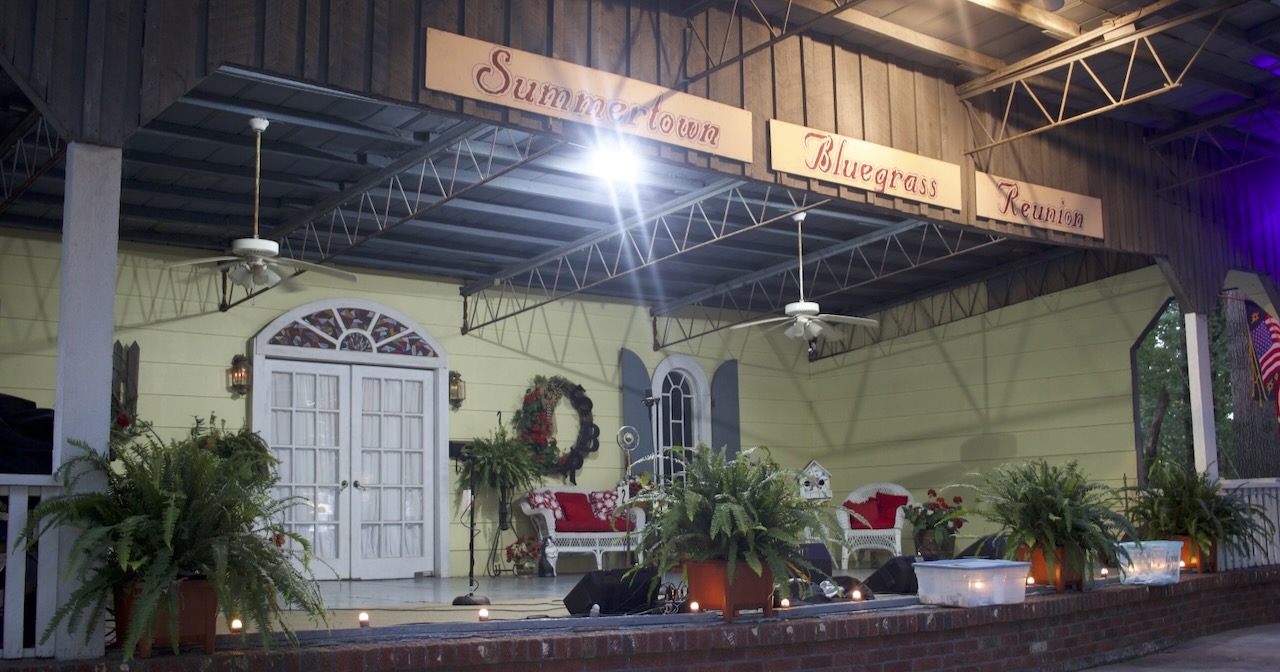
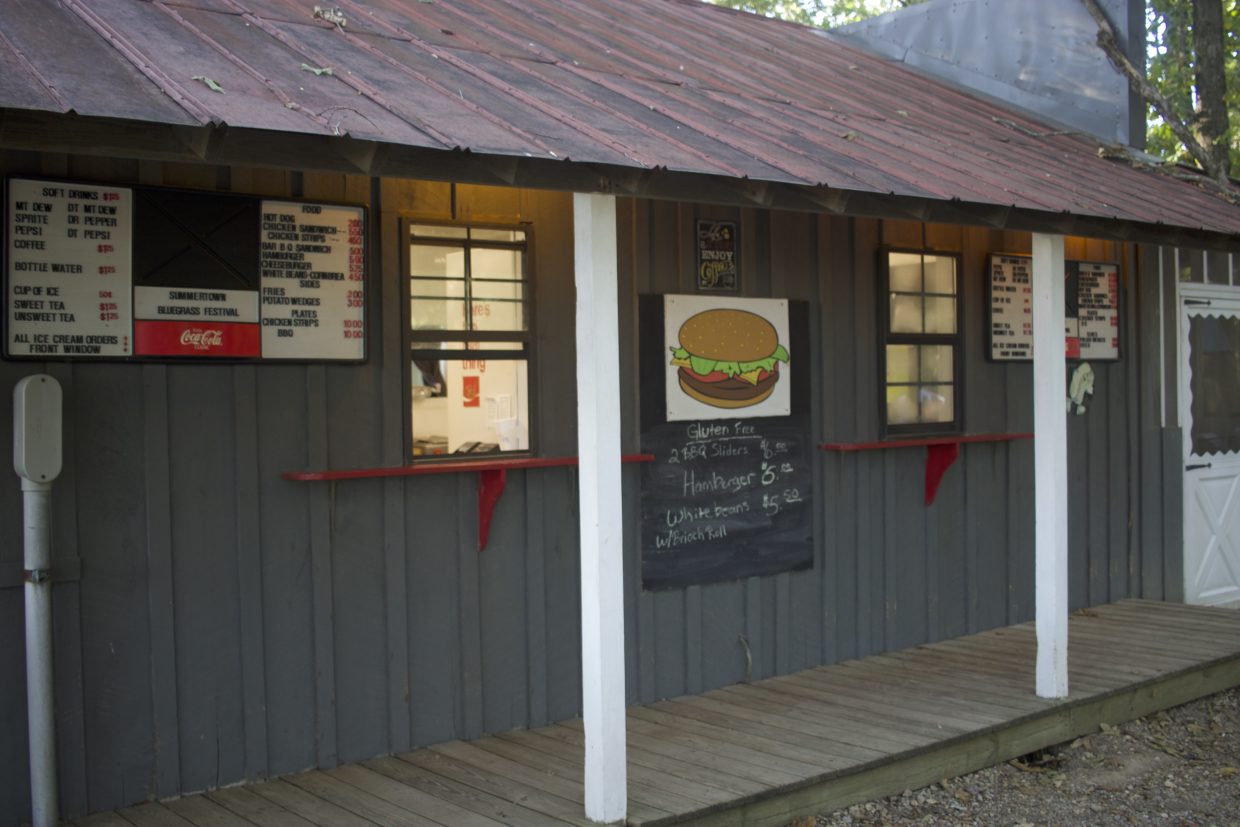
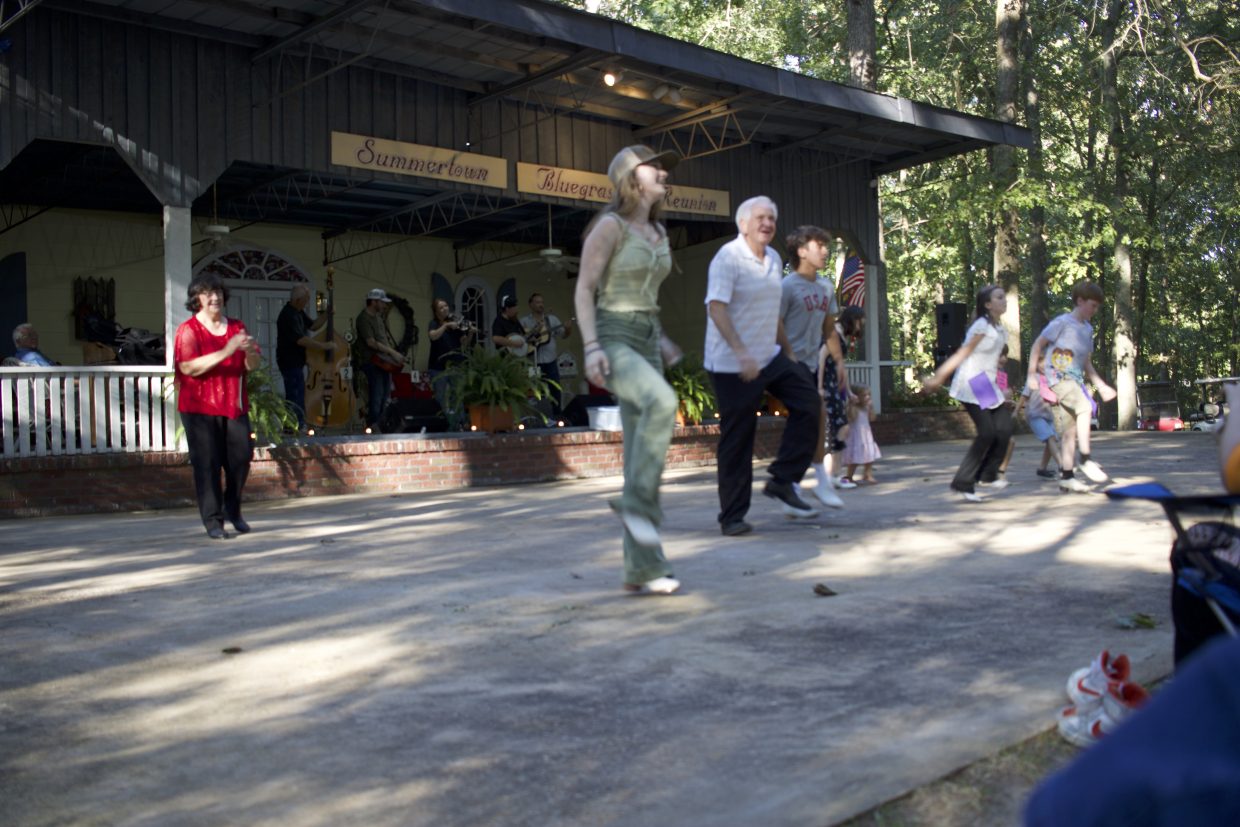
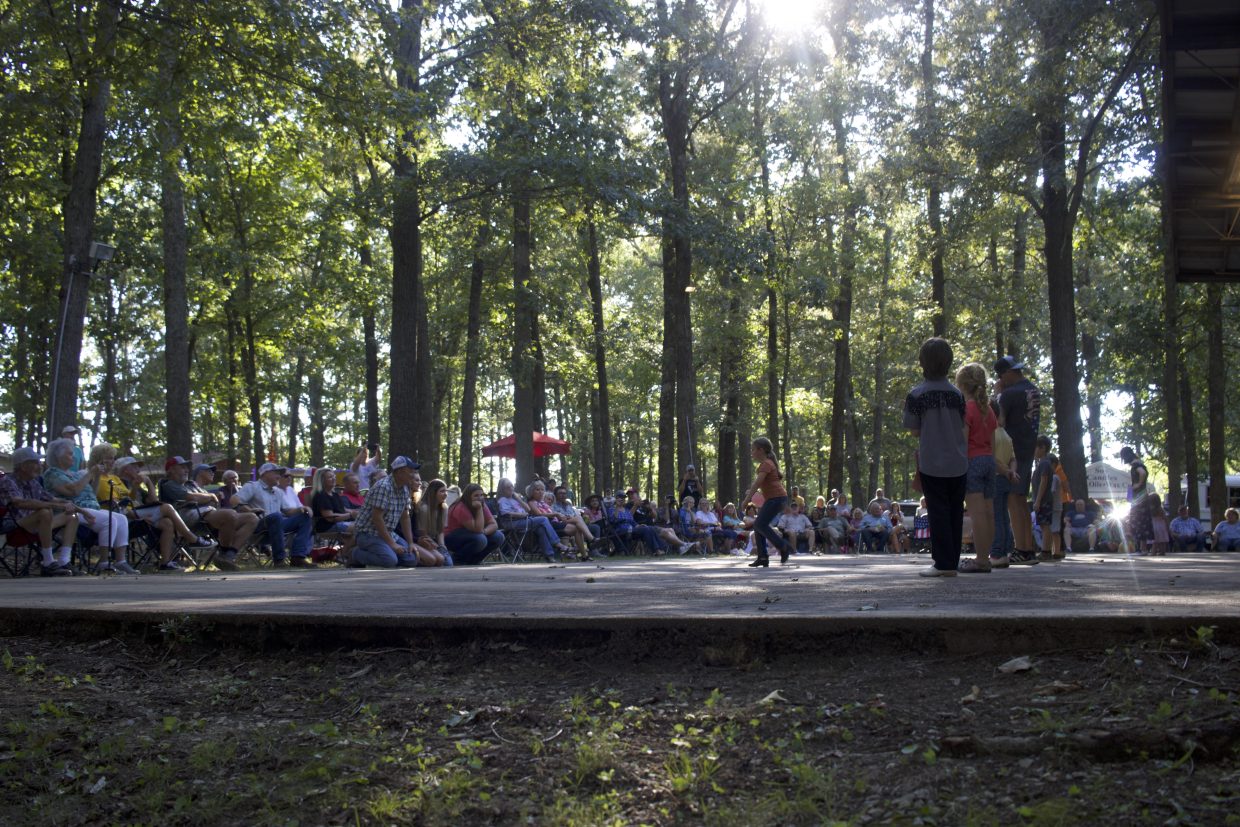
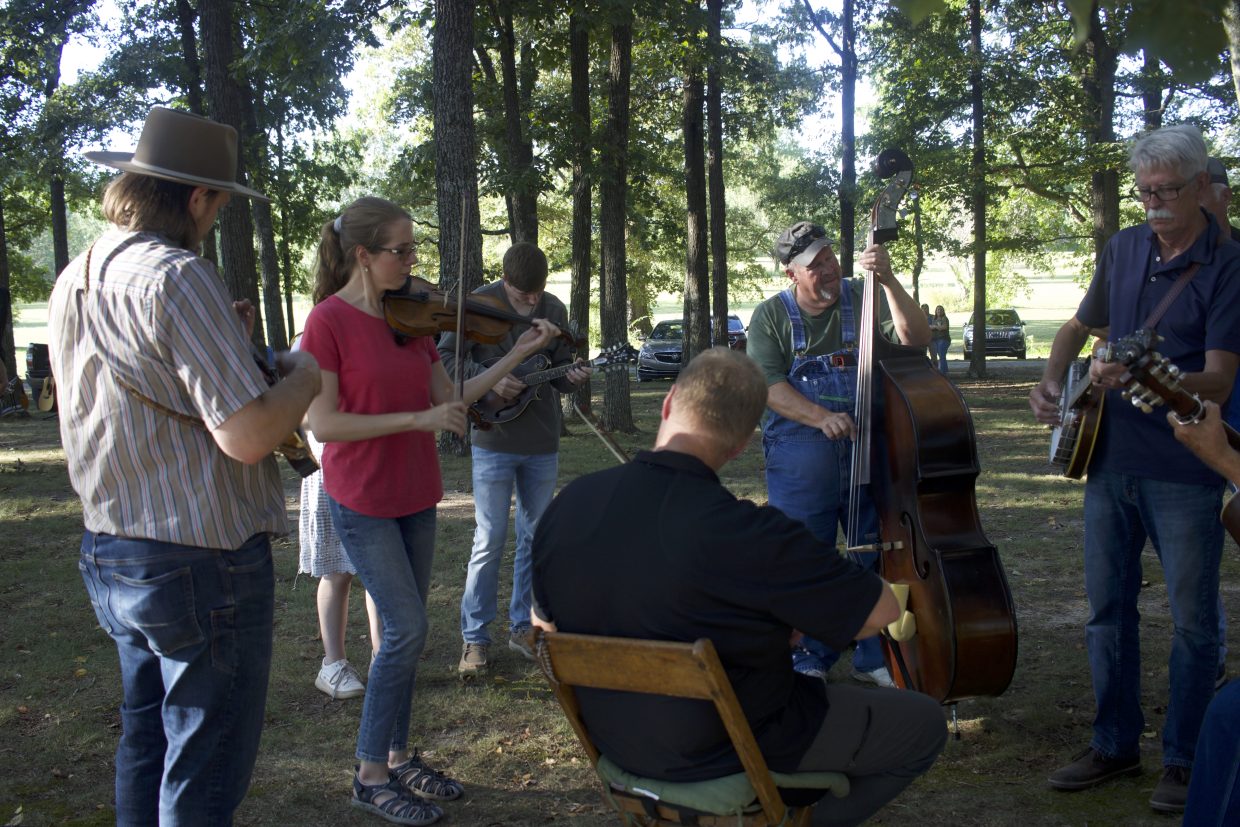
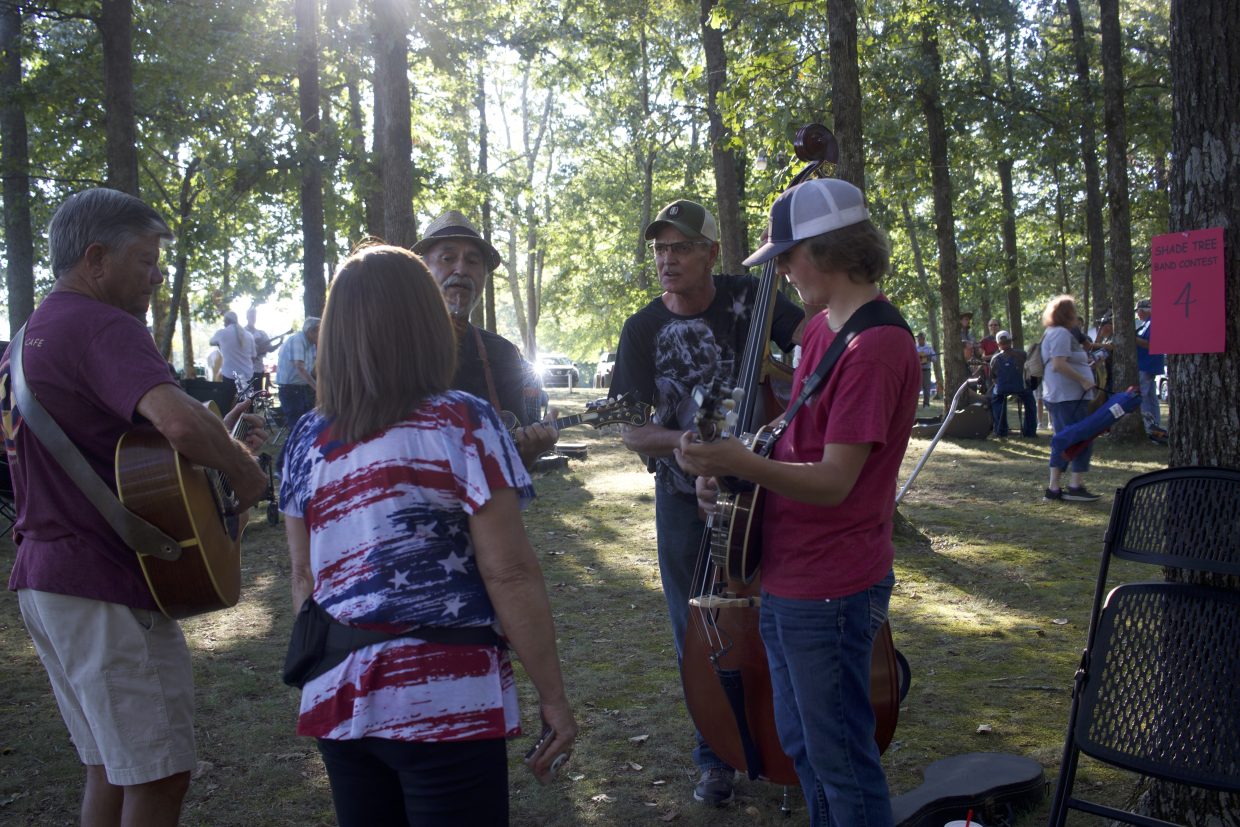
The annual Summertown Bluegrass Reunion brought together local pickers and dancers of all ages in Summertown, Tennessee, over Labor Day weekend. Located just off Highway 64 in a forested Middle Tennessee field flanked by wooden fencing, pasture, and brightly colored bunting, the festival hosted a dance competition, shade tree band competition, and a main stage with open dancing for music lovers, as well as a snack shack slinging their famous white beans.

The Summertown Bluegrass Reunion snack shack, serving famous white beans and more.

Saturday afternoon, Grand Ole Opry dancer Sarah Harris and her band took the stage, performing Stanley Brothers tunes like “I Think I’ll Just Go Away” and Flatt and Scruggs’ “Head Over Heels.” 

Saturday evening saw several hundred campers and ticket holders pour into the rural festival while event organizer and founder Terry Pierce wandered through the crowd to catch up with old friends and ensure everyone was having a great time. The fest has been a staple for more than two decades, and it’s always a hub for local musicians to gather.

An open dance at the Summertown Bluegrass Reunion’s main stage.

Dancers from Tennessee and Alabama joined in the buck dancing competition as well, with some so young they needed a little assistance from a parent. Other youngsters held their own, showing off kicks, heel clicks and other moves. Two seniors competed as well. Flatfoot legend and 2017 NEA National Heritage Fellow Thomas Maupin attended, although he didn’t perform. Afterwards, guests were encouraged to take a dinner break and listen to the shade tree bands as they competed under the property’s canopy.

The “Lil Doll” (age 10 and younger) dance competition.
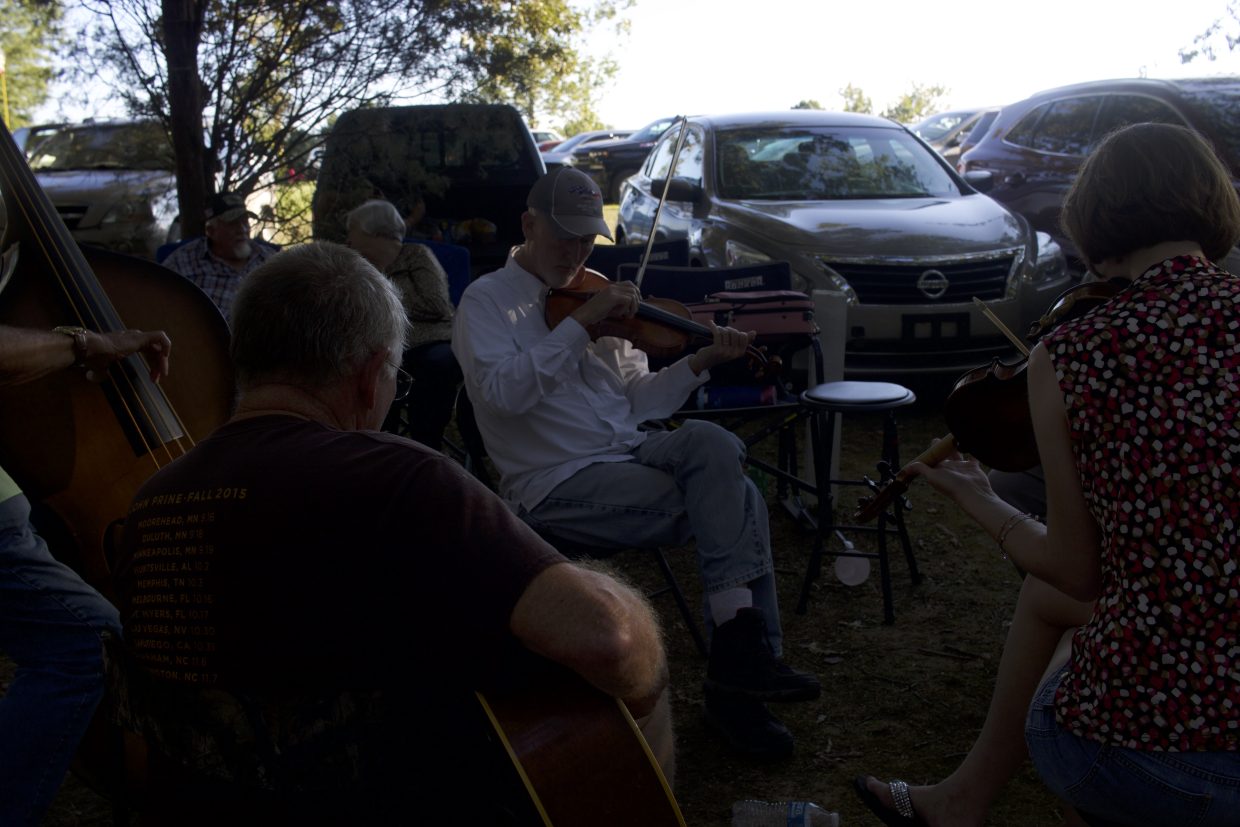
A band performs during the Shade Tree Band Competition.
Another local bluegrass band performs in the Shade Tree Band competition.

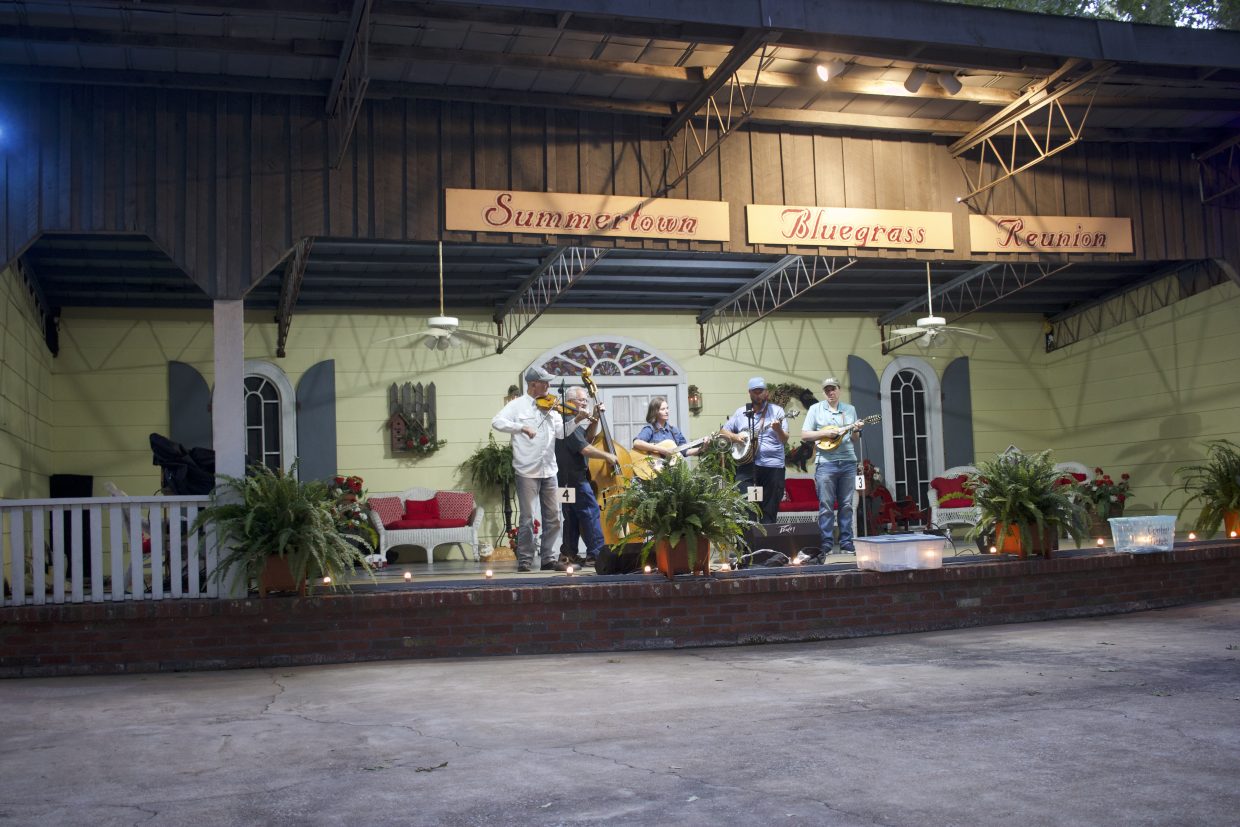
During the evening’s main show, Lawrenceburg, Tennessee, fiddle teacher Andy Spearman and his band, Wildcat Ridge, took the stage, and the crowd was treated to a performance by Tommy Jackson’s Rocky Top Revue, an award-winning square dancing team based in Franklin, Tennessee.

Fiddler Andy Spearman jams during the Summertown Bluegrass Reunion.
Fiddler Andy Spearman and band, Wildcat Ridge, perform on the Summertown Bluegrass Reunion main stage.

While Summertown Bluegrass Reunion may not be the largest festival in the state, it’s full of homegrown music that fans have loved for generations, and they continue to turn out each year for the good tunes and fun times.


All photos by Lonnie Lee Hood.

Bluegrass Memoirs: Lexington, Kentucky and J.D. Crowe, 1972

[Editor’s note: All photos by Carl Fleischhauer, except publicity shot of Esco Hankins]

On the afternoon of Sunday, August 13, 1972, Carl Fleischhauer and I were in Jackson, Kentucky, at the finale of Bill Monroe’s Kentucky Bluegrass festival where we’d been since Friday. In my notes, I wrote:

We left after talking briefly with Monroe (I bought his new LP [Bill Monroe’s Uncle Pen] and latest single [“My Old Kentucky and You”] from him) and drove [85 miles northwest] to Lexington where we got a motel — the Flora — run by an 85-year-old lady who liked Bill Monroe and told us that Uncle Dave Macon stayed in the Flora whenever he visited Lexington. Dinner late on the [U of KY] campus or near at an Italian restaurant — snuck in leftover wine and had ravioli. Sure was good to bathe and sleep in an air-conditioned room.

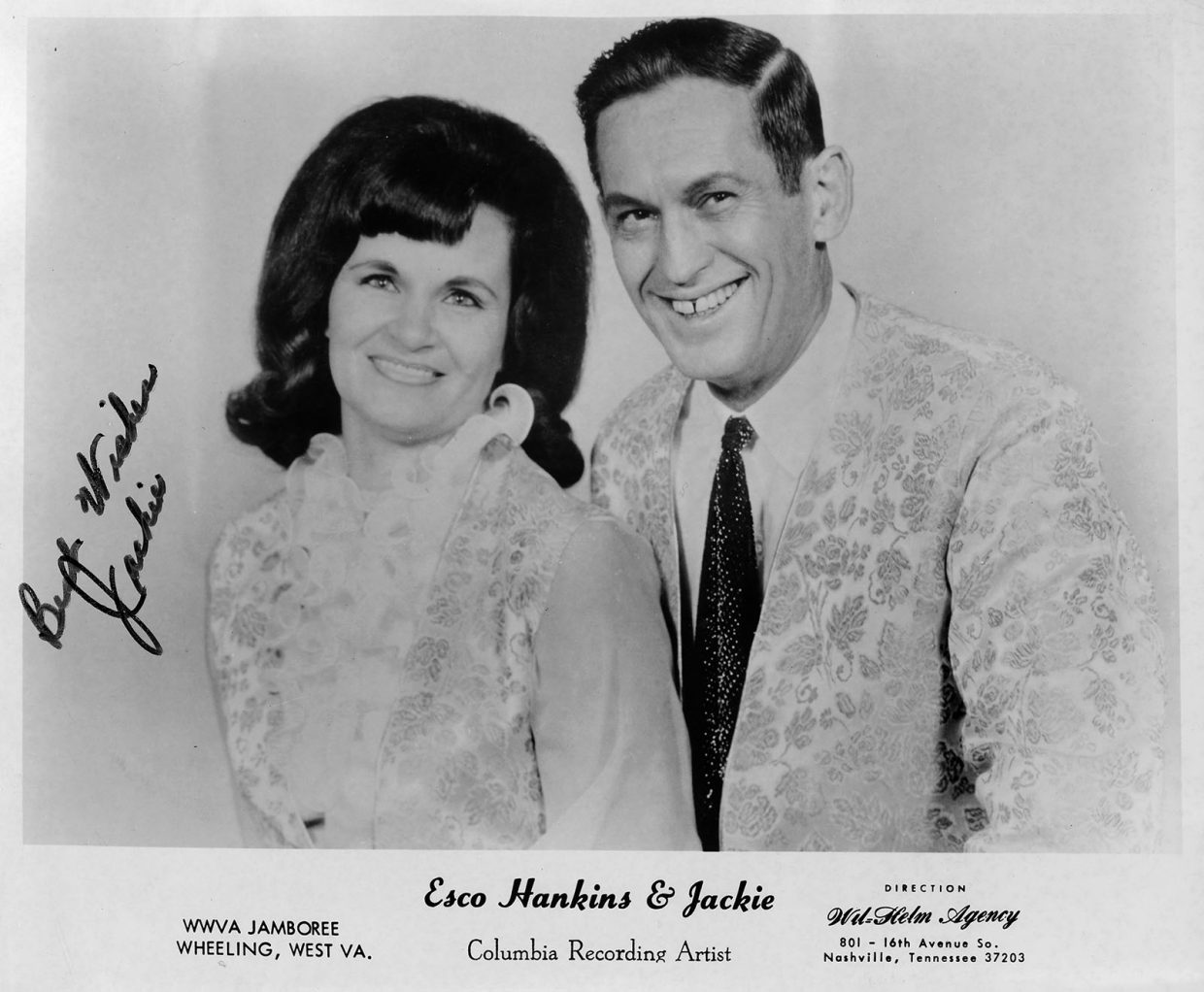
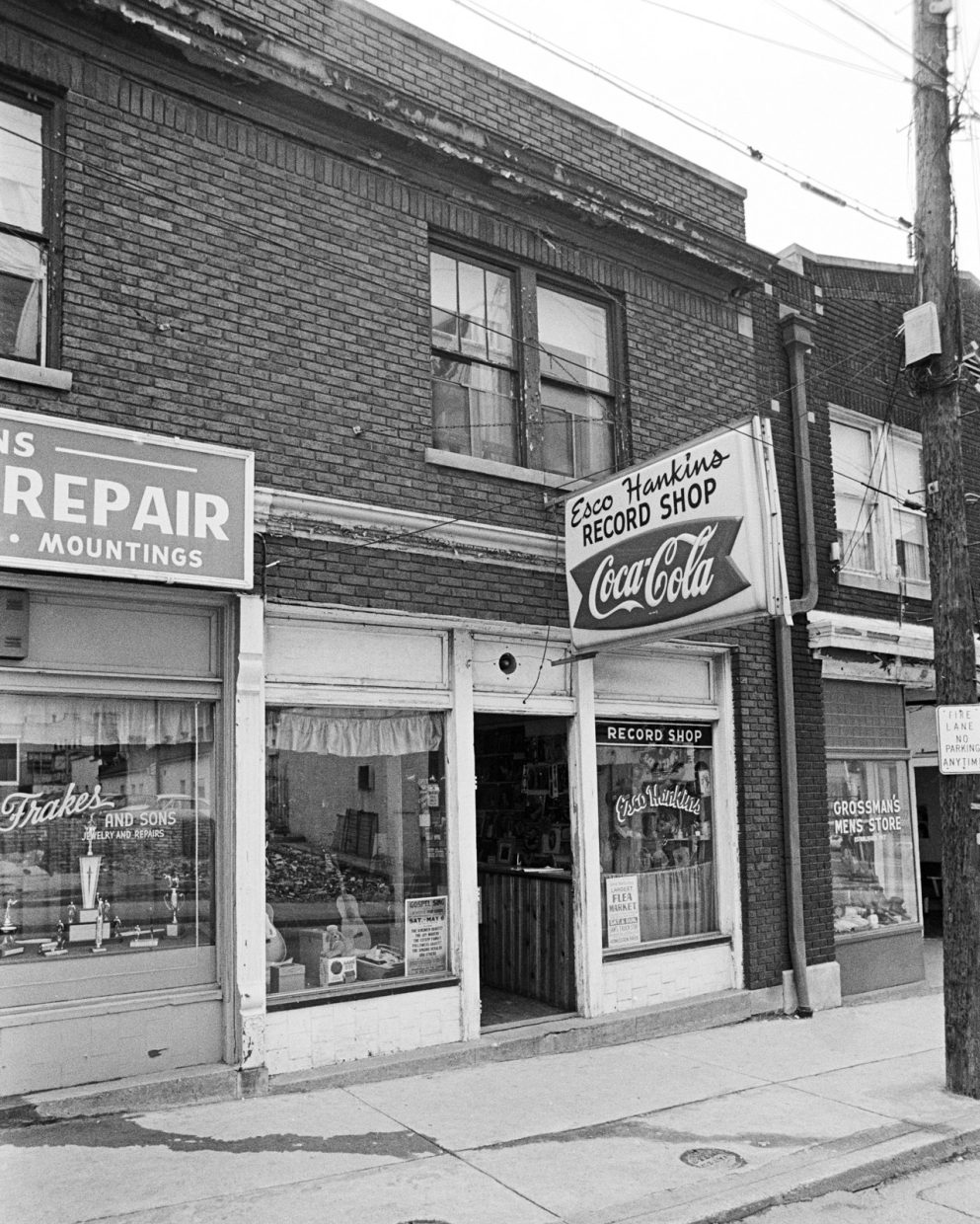
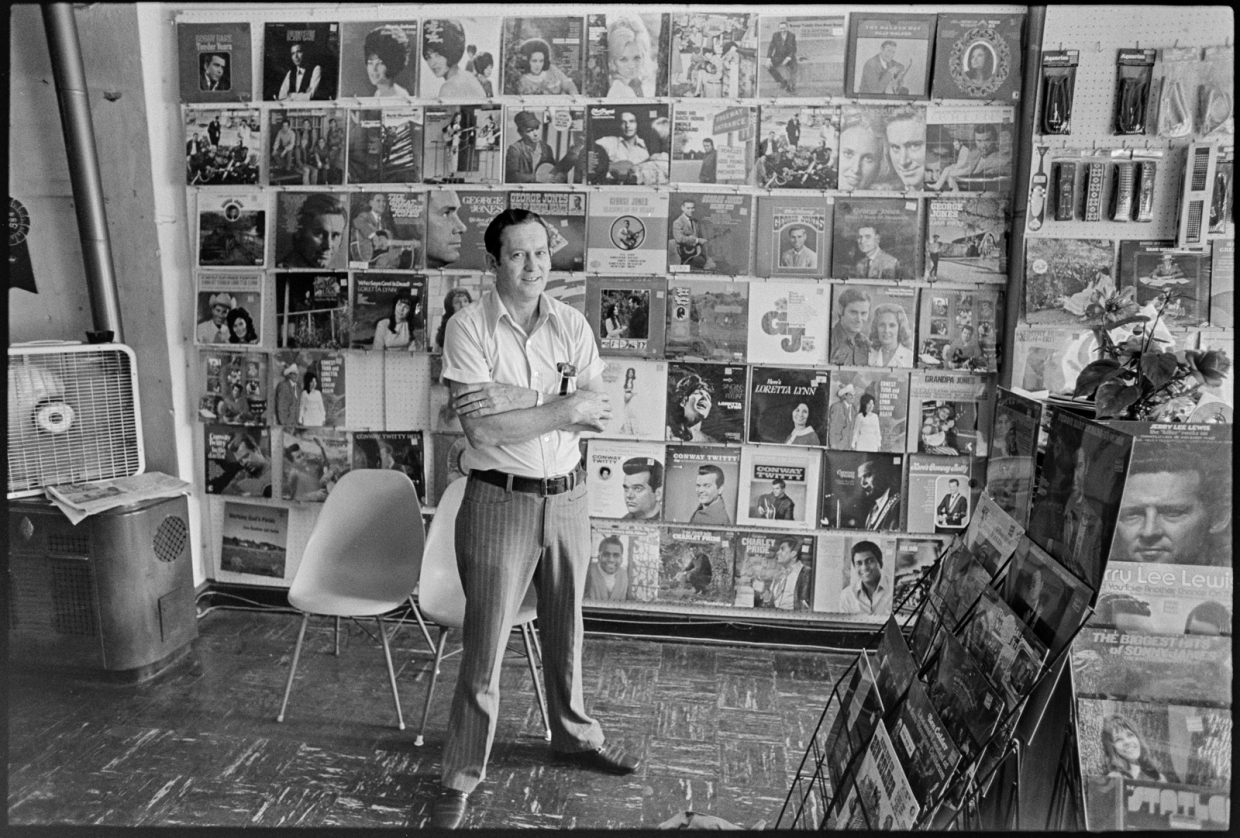
Monday morning after breakfast downtown and some cursory hunting in record cut-out bins, we headed to the Esco Hankins Record Shop. Tennessean Hankins, a Roy Acuff-style singer, began his recording career in 1947. He settled in Lexington in 1949 and performed for years on WLAP with his wife Jackie and his band, which included Dobro player Buck Graves. He also performed weekly on The Kentucky Mountain Barn Dance, which started in Lexington in 1949 and was broadcast on WVLK. 

Jackie and Esco Hankins publicity photo, original date unknown.

Flatt & Scruggs joined the Kentucky Mountain Barn Dance cast that year, influencing both Graves – to whom Earl taught his right hand, three-finger roll – and young J.D. Crowe, who was a regular in the audience and often went with his dad to observe Scruggs rehearsing with Flatt for their radio shows at WVLK. In 1950, at age 13, inspired and informally tutored by Earl, J.D. got his first banjo and began practicing what he’d seen watching Earl in action.

Esco Hankins Record Shop, Lexington, KY, April 1972.

Hankins held amateur country music contests, and at one he discovered teenager Crowe, who soon became part of his band. Marty Godbey’s Crowe On The Banjo: The Music Life of J.D. Crowe (2011) is a fascinating biography that narrates in great detail much of the story I would hear in my interview with Crowe that day in 1972. Early on, Godbey quotes from one of her interviews with J.D.: “I played for him quite a bit, it was my first paying job.” 

Esco Hankins in his record shop in Lexington, KY, August 1972.

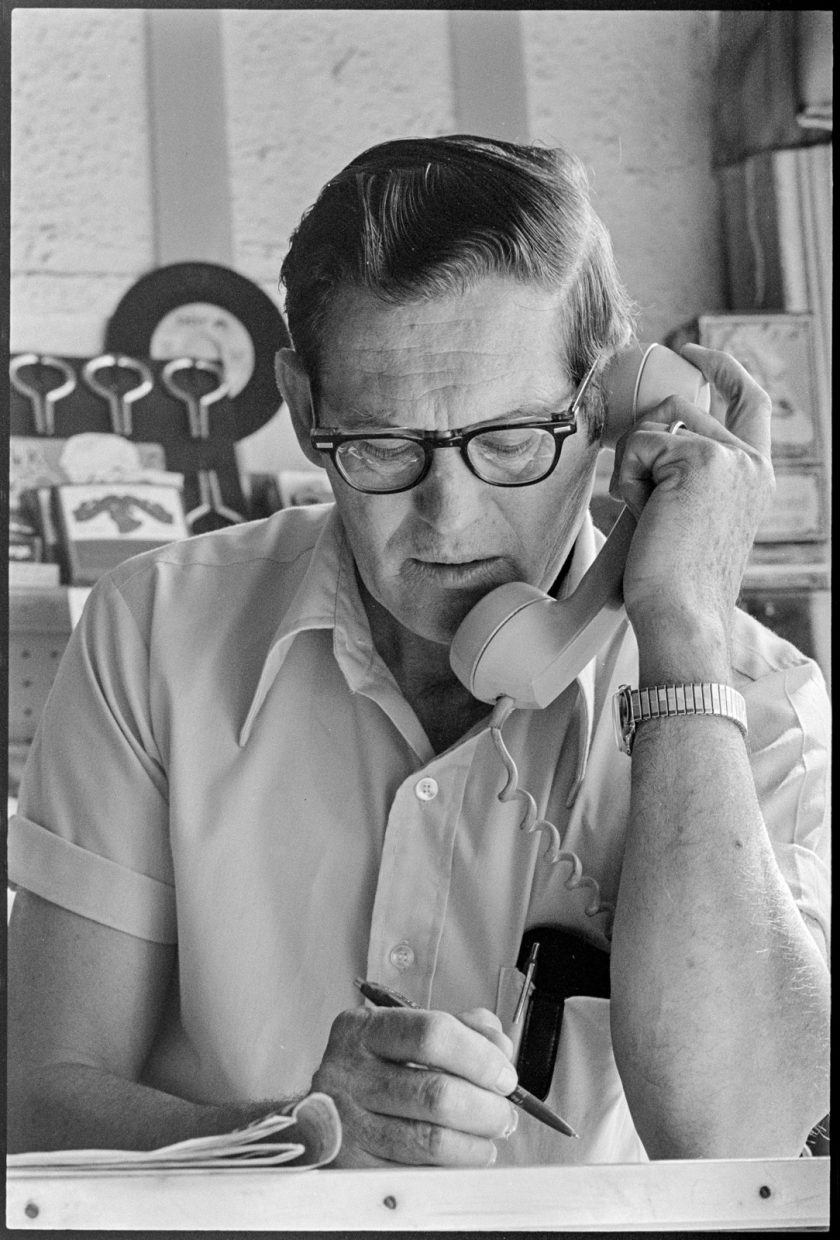
I knew nothing of Crowe’s connection with Hankins on that morning when we walked into Esco’s shop. We browsed, bought some records, and then got into a conversation with him about country music history. He generously gave me a number of old songbooks and then, when we mentioned our interest in interviewing Crowe, he phoned Lemco, the Lexington record company with whom Crowe had recently made three albums and several singles, to get J.D.’s number. My notes:

…he ended up calling first Lemco and then J.D. Crowe and then handing the phone over to me to talk with J.D. — I thought it was still Lemco and went into a long rap about my project and what I was doing and how I would appreciate if they could put me in touch with J.D. — and the voice said, “This is J.D.” and I was embarrassed but maybe it was a good thing…anyhow we made an appt. for 3:00…

Esco Hankins in his record shop in Lexington, KY, August 1972.

Today, Crowe is best remembered as the banjo picking leader of the progressive New South, whose 1975 Rounder 0044 album with Skaggs, Rice, Douglas and Slone has become a modern bluegrass icon. He also was, in 1980, a founding member of the bluegrass supergroup The Bluegrass Album band, playing solid, perfectly timed, and driving banjo based on the style of Earl Scruggs and singing the harmony parts he’d learned with Jimmy Martin. He died on Christmas Eve, 2021. 

When I interviewed him in 1972, he’d been living in Lexington, his birthplace, since returning in 1961 after a five-year stint with Jimmy Martin and the Sunny Mountain Boys. For the next seven years he’d worked day jobs (with a couple of brief stints back with Martin) while playing in local taverns with his group, The Kentucky Mountain Boys. 

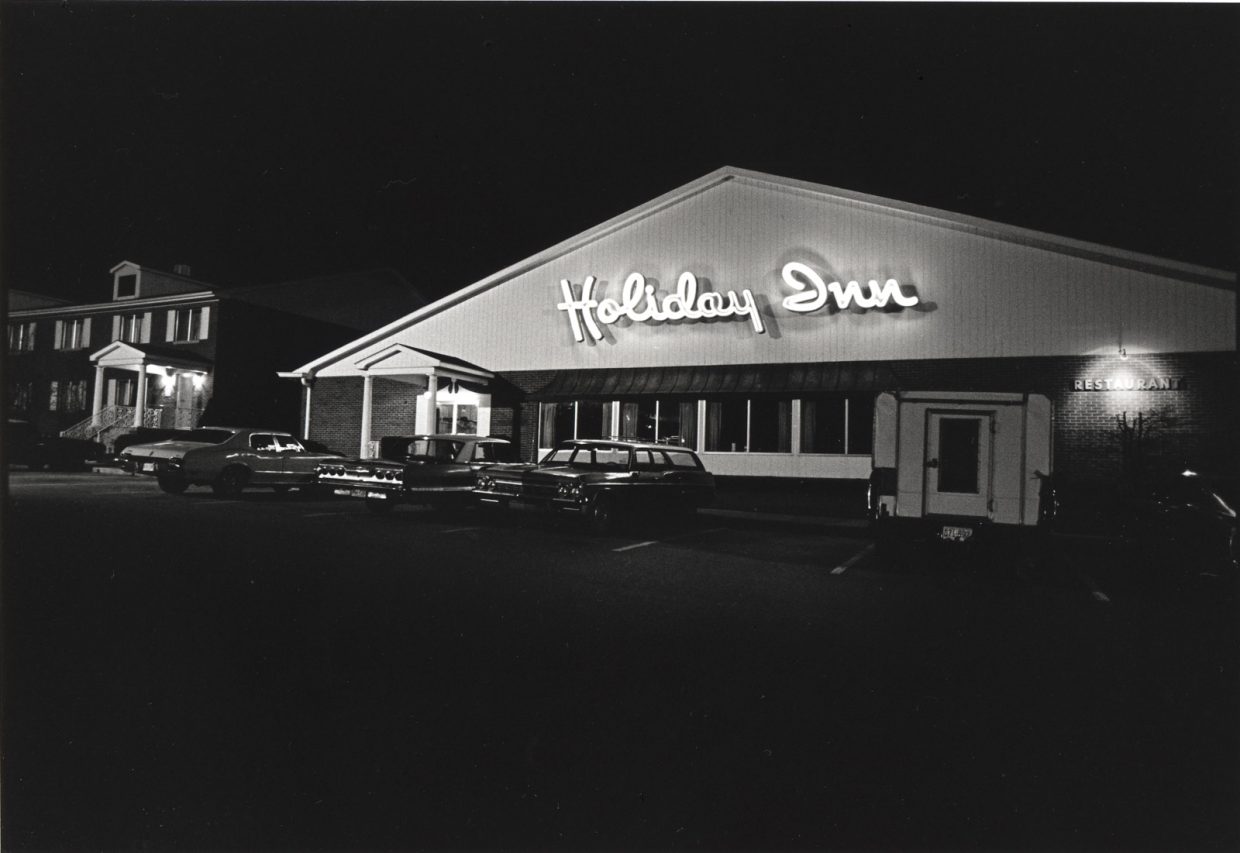
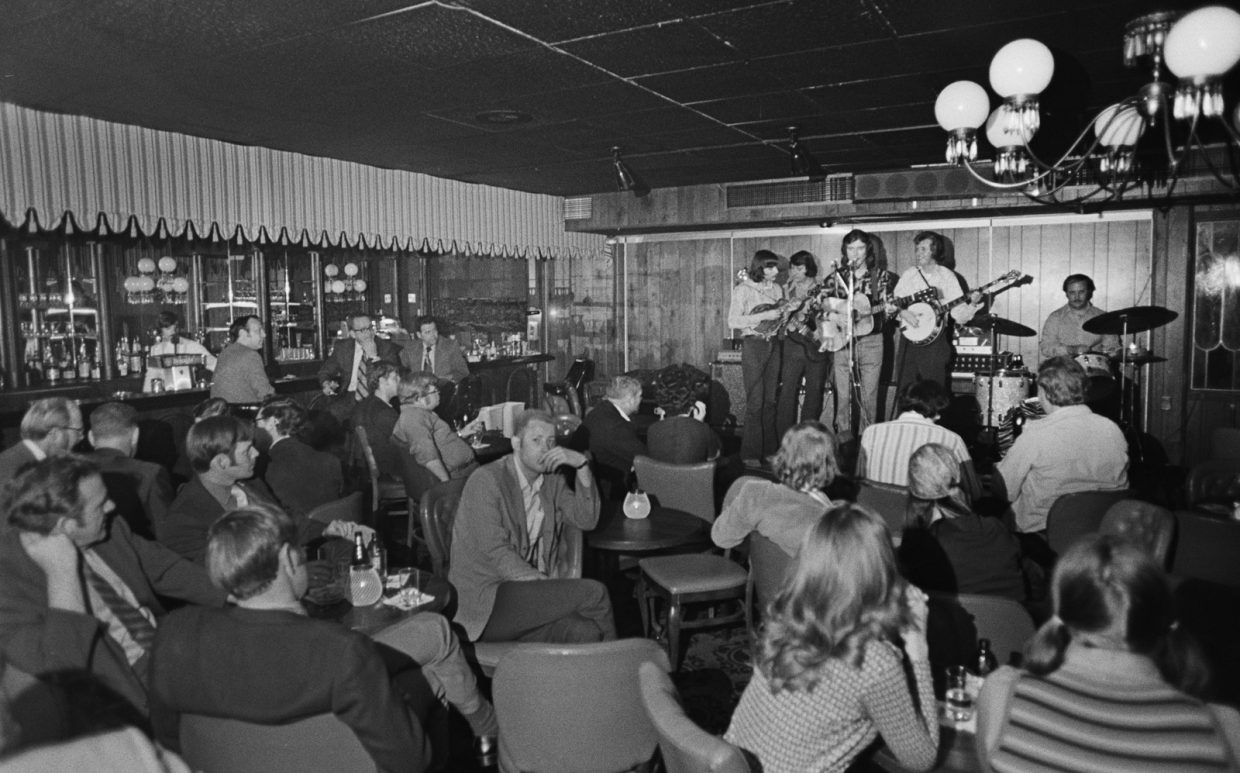
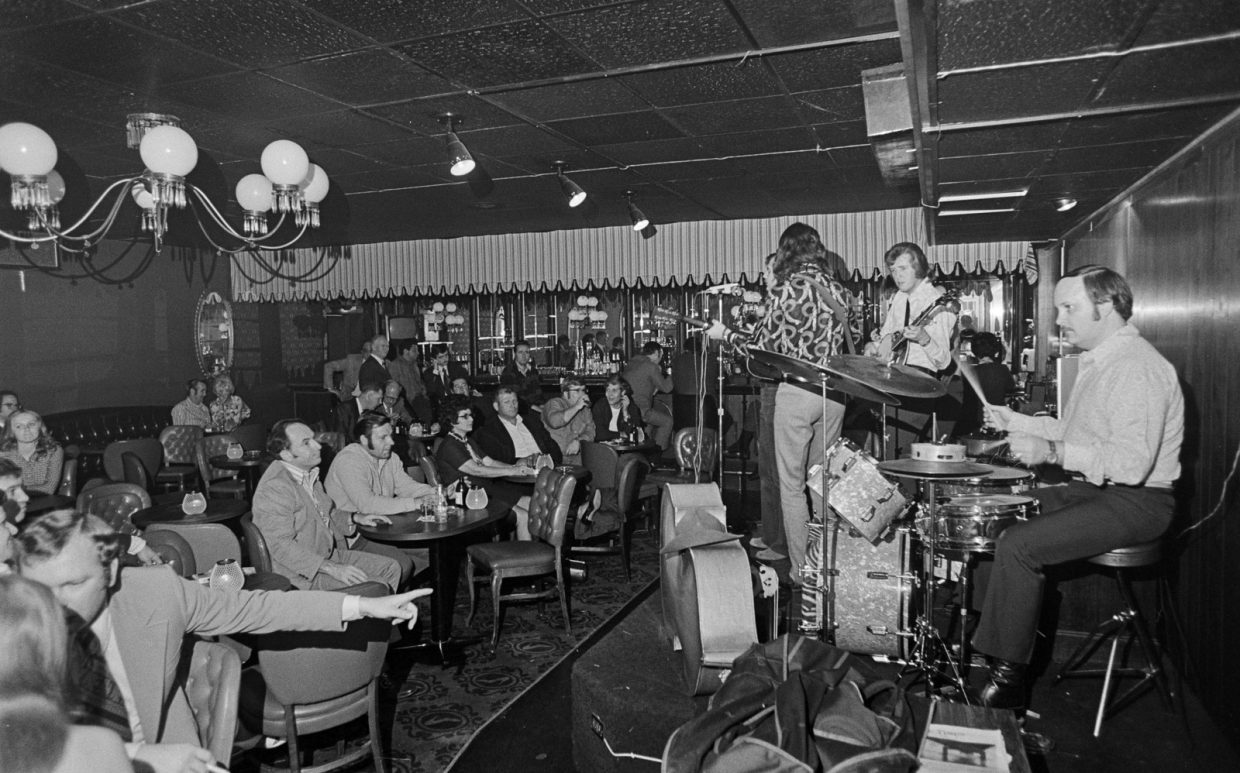
In 1968 they began appearing six nights a week at the Red Slipper Lounge in the Lexington Holiday Inn. It was a change from his former blue-collar tavern milieu – lots of young college students in the crowds. This gig was going strong when Carl and I visited him.

The Holiday Inn, Lexington, KY, April 1972. Featured at the Red Slipper Lounge at the motel that night was J.D. Crowe and Kentucky Mountain Boys.
The Holiday Inn, Lexington, KY, April 1972. Featured at the Red Slipper Lounge at the hotel that night was J.D. Crowe and the Kentucky Mountain Boys. Left to right: Larry Rice, Bobby Slone, Tony Rice, J.D. Crowe, and Donnie Combs.

J.D. was now working full-time at his music. A number of notable musicians had worked for him in The Kentucky Mountain Boys, like Doyle Lawson and Red Allen. At this point, in 1972, his band consisted of Larry Rice, mandolin, Tony Rice, guitar, Donnie combs, drums, and Bobby Slone, bass. He had just changed the name of the group to the New South

I had first seen Crowe in April 1960 when I went to Wheeling, West Virginia, with a couple of college friends. A month earlier we had opened for the Osborne Brothers at Antioch College. Bobby Osborne had urged the audience to come see them at the Wheeling Jamboree at WWVA. We took him up on it at spring vacation.

We drove down from Ohio and took a cheap room in a hotel close to the Virginia theater where the Jamboree was held. That evening we saw the Osborne Brothers as expected, but just the two of them were there. Bobby played guitar and sang “Down The Road” while Sonny picked the five. Good music, but no band! We enjoyed some of the country acts like Rusty and Doug and the fiddling of Buddy Durham. But we weren’t expecting any more bluegrass when Jimmy Martin and the Sunny Mountain Boys were introduced. It was the most memorable moment of the evening for us.

The four-piece band – Jimmy Martin, Crowe, mandolinist Paul Williams, and fiddler Johnny Dacus – bounded up to the mic from backstage and opened with Crowe’s the up-the-neck single-string banjo intro to “Hold Whatcha Got,” Martin’s latest single. 

The audience, which included a bunch of young women seated up front who had cowbells and knew how to use them, went bananas. It was a tight band, thought by many to be Martin’s best, and we were very impressed. Crowe’s banjo break was amazing. It marked him as a unique stylist.

Thereafter, when talking with fellow banjo pickers, I identified this single-string work as “J.D. Crowe style.” The success of “Hold Whatcha Got” led Martin to record several more using the same rhythm and banjo break style. 

Following our experience in Wheeling, we began listening to Martin’s late Saturday night show, after the Jamboree, on WWVA. The live sound of new songs like “My Walking Shoes” – driving, up-tempo stuff with Crowe’s banjo out front – caught our ear. 

J.D. told Marty Godbey about watching Earl rehearse: “I was more interested in trying to learn the breaks to songs and backup than instrumentals.” His work on Martin’s Decca recordings was definitive; Martin’s banjoists were told to play it like J.D. 

He began to record on Lemco with the Kentucky Mountain Boys in 1969 when the band included Doyle Lawson and Red Allen. This was the most recent Crowe recording I’d heard at the time of our August 1972 interview. 

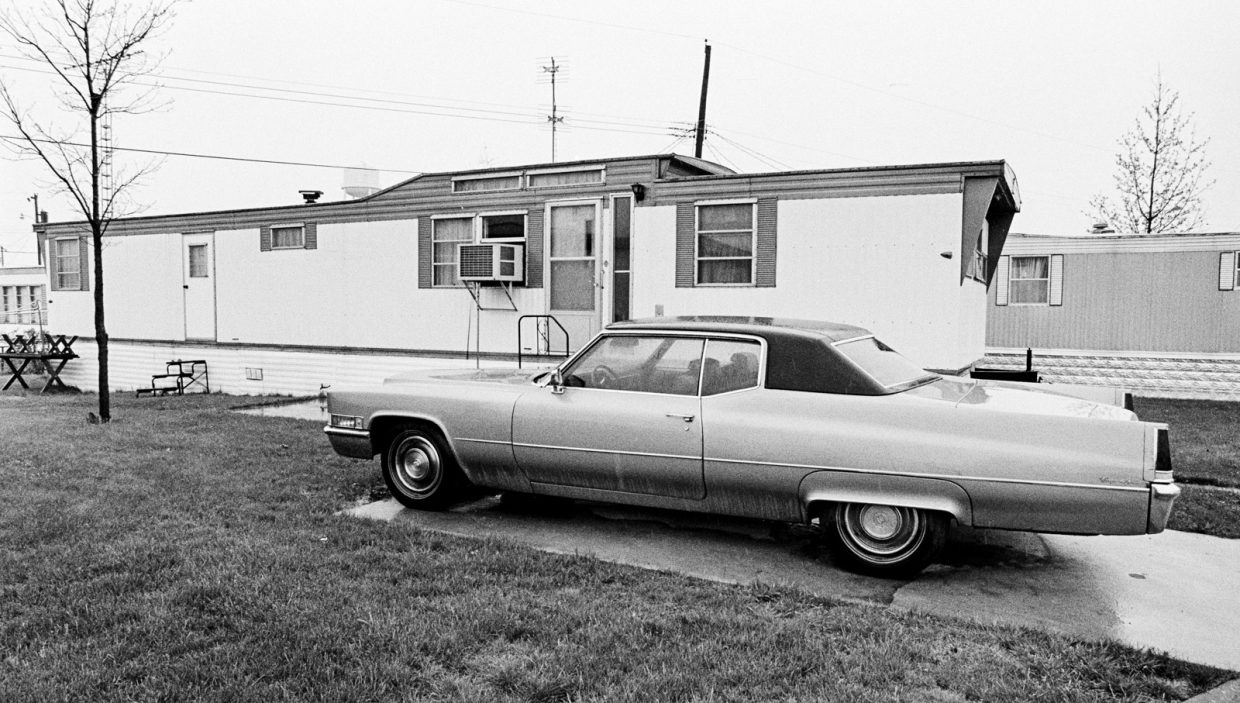
That afternoon Carl and I drove to his trailer park home. We set up my cassette recorder and mic, and I began the interview with a few ethnographic questions: “Let me ask you just some of the basic things, like how old you are and where you were born and so on.”

J.D. Crowe home, Lexington, KY, April 1972.

He was 34 and told of childhood with country music on a farm six miles outside of Lexington. Then he described how his musical calling emerged in the fall of 1949 after Lester Flatt and Earl Scruggs came to town. 

I saw them in person before I ever heard their records. Cause, the first record I heard of them was one called “Down The Road.”

“Down The Road” was Lester and Earl’s newest record release in October 1949.

His family were regulars in the audience at the Kentucky Mountain Barn Dance. 

And I saw, they came here — fact, I never heard of ‘em!

They was there one night, and they was so well received that they was hired.

His first banjo was a 39-dollar Kay, but within a year he’d moved up to a Gibson. Scruggs was his informal mentor. At fifteen he was playing dances and at sixteen Jimmy Martin hired him after hearing him playing on the radio with Hankins. “Hankins?” I asked.

Yeah, I guess that was the first person I worked with professionally.

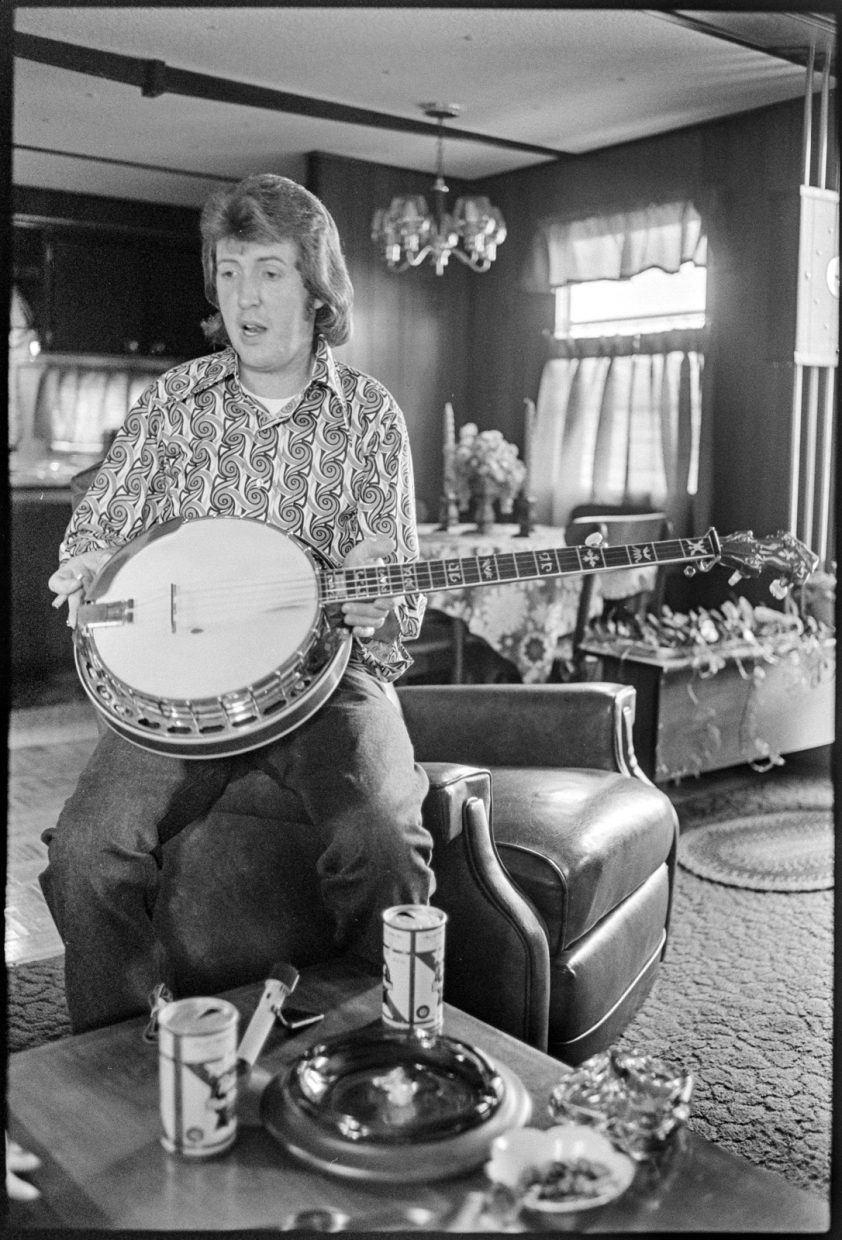
J.D. Crowe at home in Lexington, KY, August 1972, during a visit and interview with Neil V. Rosenberg (left).

After five years working full-time in Martin’s band – in Detroit, Shreveport, and Wheeling – J.D. quit. It was 1961, he was twenty-four.

I think I just, a, kindly got tired, I mean, you know, wanted to try something different. 

This was a phrase he used several times in the interview: I just wanted to try something a little different, he said later, speaking of the band he started. Moving back to Lexington, he got a day job, and formed The Kentucky Mountain Boys, who played five nights a week in local clubs until 1968. Then the Holiday Inn gig came along:

I give up my job and I’ve been doing it full-time ever since.

As a bandleader, he stressed the hard work involved in building a career:

…you know how the music goes, unsure, you know. Which anything is, really when you get down to it. It’s just what you want to make out of it, and how hard you want to work… And a, believe me, it’s, it’s rough. A lot of people, you know, think it’s a lot of, a bowl of cherries, you know, just have a good time, but it’s not like that.

I suppose the picking is only the small part,” I said.

That’s just the smallest part of it, really.

J.D. explained how his full-time band operated – fall, winter, and spring they played six nights a week at the Holiday Inn. Then they took the summers off: 

Work road shows

He told me about his band members — mandolinist Larry Rice, his brother Tony, and Bobby Slone — and explained about the Rices’ California connection:

They were born in Danville, Virginia, but … they went to California when they were just little shavers and they lived out there I guess ten or twelve years in Los Angeles. And that’s where Larry came from, he was living there at the time… Bobby Slone, our bass player, he’s been with me I guess about six years. Well, he used to live in California also, and he had worked with them when they was growing up and so he told me about them. And of course, Tony I met after Larry joined me. He moved back to North Carolina and he came up. 

His band were all veterans of the late ’60s LA scene where folk-rock and country-rock had blended with bluegrass. That musical mindset had a kind of creative vision that Crowe could empathize with. 

I used to be, if it didn’t have a banjo in it, then I’d cut it off. But now, with the exception of rock and roll and blues. I’ve always liked it. I used to listen to blues, just all the time. I like the style of B.B. King, of course he’s still going, you know, and, a Fats Domino, Little Richard, you know … they was in the fifties. And there’s just a lot of ‘em, and of course the rock changed you know, course what they call country rock, which is good, I like that. In fact, we do quite a few numbers of that ourself.

I asked: “When you were leaving Jimmy Martin, were you thinking of putting some of that into your music?” He explained:

That wasn’t out yet … I didn’t have too much choice. You (could) only do country, do bluegrass, or you just do hard rock. But now there’s so much new stuff’s out that it’s just endless, to what you can do, and take over songs and adapt them over, your own little thing, in style.

You can take with what you had and combine it with a couple other forms of music and come up with a little different gimmick, a little different style. That’s the whole thing, that’s what you got to have. 

Perhaps the most novel aspect of the New South sound at this time was the fact that since the prior September – almost a year before – they had been playing electrified instruments.

I had the idea, you know a, maybe that might be the answer, because, like I say, like we couldn’t get any records played on country stations. 

The Osborne Brothers had gone electric in 1969; J.D. said their example had influenced him “a little bit.” Also in 1969, Earl Scruggs had begun playing an electrified banjo with his sons in the Earl Scruggs Revue. Jim & Jesse had done an electric album in 1971. I asked J.D. if he’d recorded with his electric group.

The latest single is. Course I use a steel and a piano and a drummer, the whole works on that. In fact I didn’t play too much banjo, on account, if there’s a lot of banjo, some things, they won’t even, some stations won’t play it.

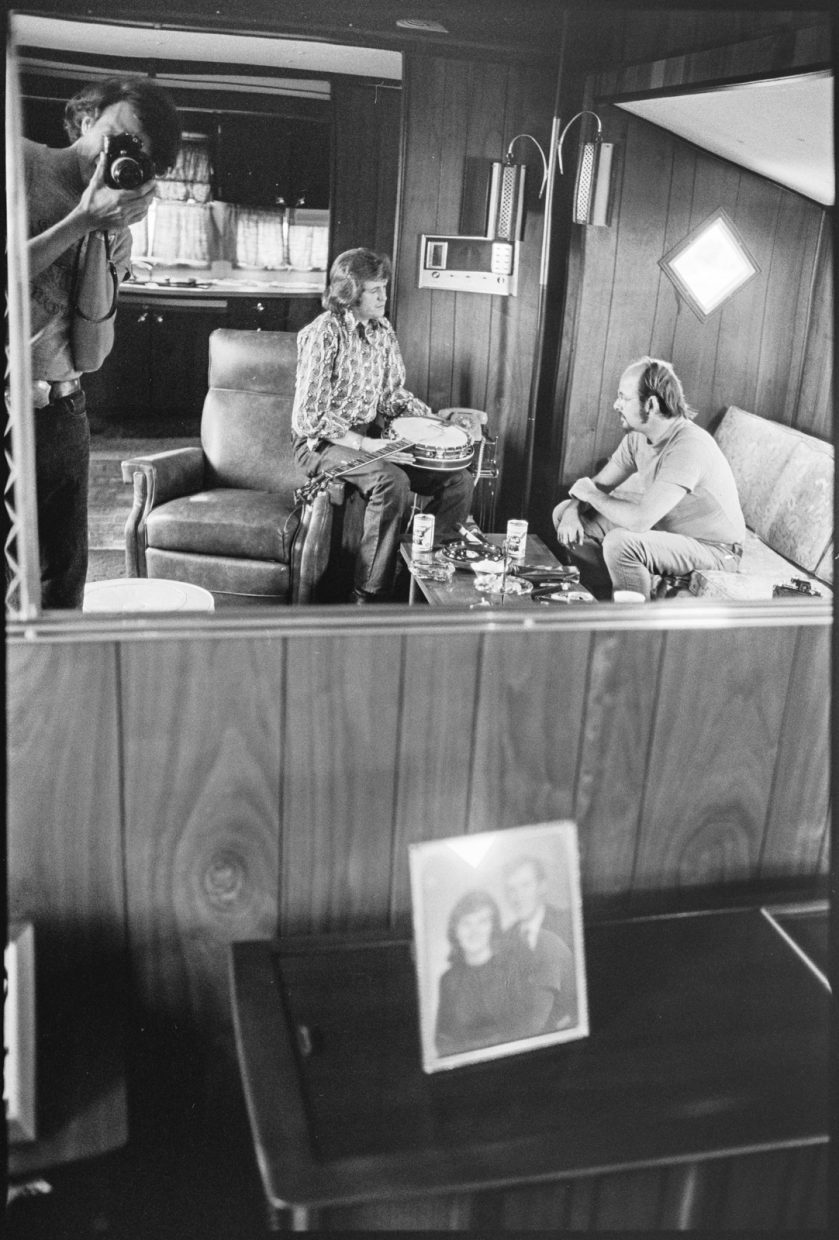
At J.D. Crowe’s home in Lexington KY, August 1972, during a visit and interview with Neil V. Rosenberg (right) as reflected in a mirror that also caught photographer Carl Fleischhauer.

We’d just been at a festival; I wanted to know what he thought about festivals. Had they helped his music?

The festivals have helped to a certain extent. You know. Right now, they’re trying, they’re getting too many of them, in my opinion. Cause you can over do a good thing, you know and, which I know we worked some of ‘em that didn’t turn out so good … most of ‘em, though, we’ve worked this year have all been great big ones, I mean a lot of people. And I figure they will probably continue having that kind of a crowd. And I think that it’s, it’s helped.

“Is it a different kind of crowd than the country music crowd?” I asked.

A, not really, I’d say a people that go to bluegrass festivals would also go to see Porter Wagoner and Conway Twitty and Merle Haggard — Nashville, you know. They like it, course they like bluegrass too. A lot of your country people, you know, like other types. There’s — they like it, but they won’t come out to see it, you know, they don’t like it that good. They can take it or leave it, in other words. That’s what you got to get to, those people, the general public. You know, cause there’s a lot of people come to the festivals and — but you know if you figure, the population of the world and you know, don’t look, it’s not too good a’ odds, so…

An experienced observer of the ongoing bluegrass scene, J.D. was keenly involved in his music business. He spoke of recording studio dynamics, record company practices, broadcasting politics, fan magazine reviews, and other factors in running a band. 

At that point I turned off the recorder and asked if he would show me his electrified banjo. When I turned the recorder on again, he was giving me the history of his banjo, starting with the neck:

This, this is original here, this part as you can see was pieced from a tenor, you turn it over and it’s a great job — see, that’s been pieced.

(N:) Oh, yeah.

(J.D.:) From there up. They matched it perfect, see, you can tell, right there, it starts up on the neck, go right in there, or right here, you can see its smaller up the neck.

(N:) It’s a splendid job.

J.D. Crowe at home in Lexington KY, August 1972.

J.D. had seen a lot of old Gibson Mastertones over the years. He knew chapter and verse about wood types and design details. But I wanted to know about his electric setup. I knew nothing about electric instruments, which were anathema to the ’50s folk revival I’d grown up in. He spent some time showing and explaining the details of his still-experimental pickup system (Godbey describes it well, p. 110). Carl asked if he could take a picture, J.D. politely told him no.

He told me what it was like to be playing electric, with the strings closer to the fretboard (“low action”) than on an acoustic:

(N:) Can you do licks that you wouldn’t otherwise do?

(J.D.:) Yeah. You can do a lot of stuff that holds, you know, you can get a sustain. That’s what nice about it. 

Then he announced what he was hoping on for the future:

I’ve got a six-string ordered.

In 1970 Sonny Osborne had added a sixth bass string to his five-string; it was part of a lush sound – string sections, twin steels, etc. – on their latest recordings. J.D. liked the possibilities the added string would enable, especially because he, like Sonny, was playing an electrified instrument. He’d even had to cancel a contract for a bluegrass festival that didn’t allow electric instruments. He told them:

Hell no! We’re gonna play electric…. We played up here electric for nine month and [then] we played acoustical; I sounded like I was playing a two-dollar Kay. Cause your hearing gets accustomed to that volume. And it’d take me three or four months to get back on the acoustical route.

Our interview ended there. Afterward I evaluated it in my notes:

Interview with J.D. Crowe — nothing spectacular, your hr.’s worth of history, but attitudes and early learning gone into pretty carefully. Very friendly but reserved in a reassuring way. Carl busy snapping away.

J.D. Crowe at home in Lexington, KY, August 1972.

We left Lexington immediately, heading for Louisville, where we were to stay with friends of Carl’s. Consequently, I didn’t get a chance to see J.D. and his New South in action at the Red Slipper Lounge. 

In 1973, the electric edition of the New South recorded an album in Nashville for Starday. Titled J.D. Crowe and the New South, it was issued on CD in 1997 under the title Bluegrass Evolution. Crowe played his 6-string on two of its ten cuts. Here’s one, “You Can Have Her.

The album wasn’t released until 1977, two years after they stopped playing electric. In 1975 when Larry Rice left the group, J.D’s new mandolin player, Ricky Skaggs, had insisted on “acoustical.” By then J.D.’s vision of “something a little different” was working just fine without the extra electricity; Rounder 0044 came soon after. 

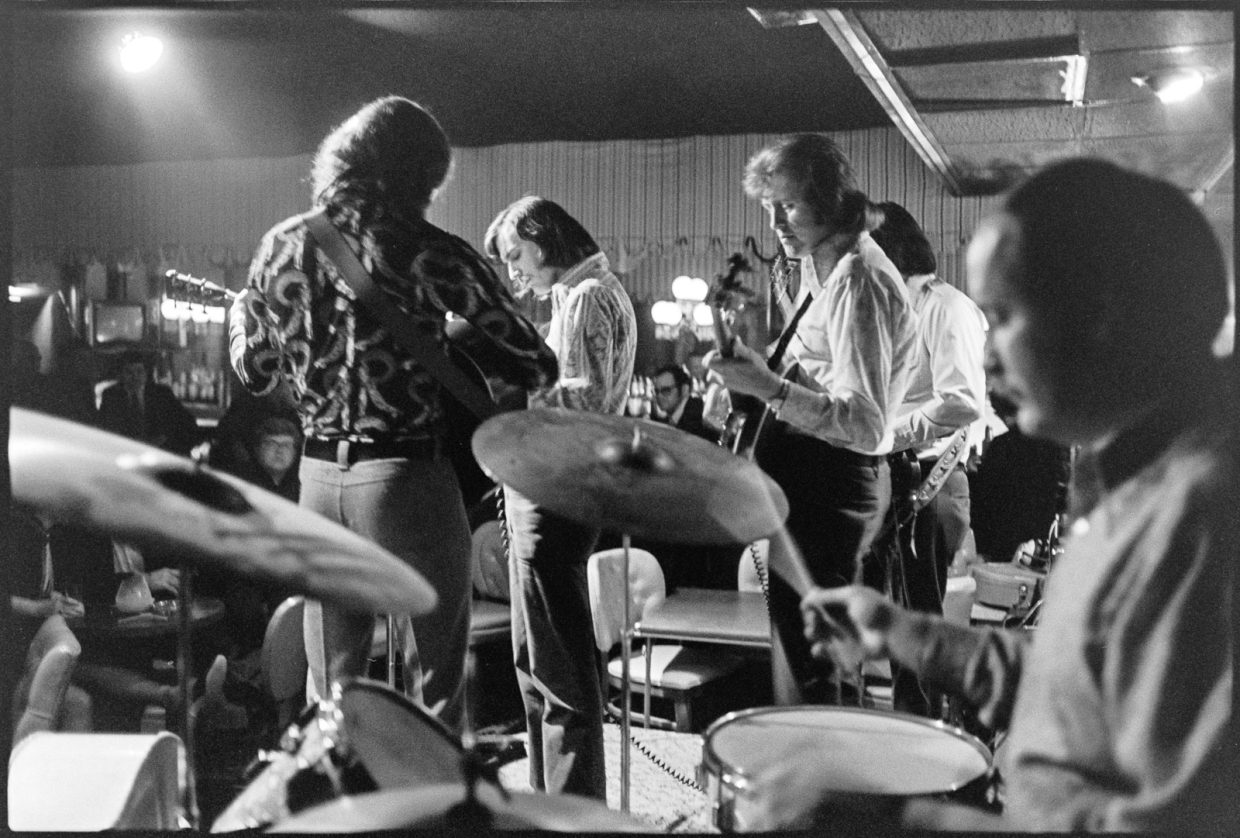
The Holiday Inn, Lexington, KY, April 1972. The Red Slipper Lounge featured J.D. Crowe and Kentucky Mountain Boys; including Tony Rice (back to camera), Larry Rice (barely visible behind Tony Rice), J.D. Crowe, Bobby Slone (hidden), and Donnie Combs, drums.
The Holiday Inn, Lexington, KY, April 1972. J.D. Crowe and the Kentucky Mountain Boys; Tony Rice (back to camera), Larry Rice, J.D. Crowe, Bobby Slone (partly hidden), and Donnie Combs, drums.

That day I wished we’d taken the time to catch the band in action, but we had only five more days for our bluegrass field trip. Kentucky was just the start; our next planned stops would take us to Ohio, Indiana, and Illinois. Recently, a recording of an evening at the Red Slipper was uploaded to YouTube. Here’s the 1972 sound of the electrified New South (with drums): 


Thanks to Tim Stafford and Carl Fleischhauer.

Neil V. Rosenberg is an author, scholar, historian, banjo player, Bluegrass Music Hall of Fame inductee, and co-chair of the IBMA Foundation’s Arnold Shultz Fund.

Photo of Rosenberg by Terri Thomson Rosenberg.

Edited by Justin Hiltner

LISTEN: Water Tower, “My Little Girl in Tennessee” (Flatt & Scruggs Cover)

Artist: Water Tower
Hometown: Los Angeles, California
Song: “My Little Girl in Tennessee”
Album: Live From Los Angeles
Label: Water Tower Records

In Their Words: “We love traditional bluegrass with all of our heart. That is part of the reason we chose to release this Lester Flatt/Earl Scruggs song. When we met our second banjo player Jesse Blue Eads (we have two on stage with us usually; Tommy Drinkard plays the other banjo) we were busking and this was a tune that we all knew. We recorded this version in one take after a 55-date tour. On the way to the Palomino Recording Studio our van broke down, so we got the car towed. Then when we arrived at the studio, the bridge on the bass had fallen off and cracked. It was ‘one of those days.’ This all contributed to the raw feeling in the room as we recorded.” — Kenny Feinstein, Water Tower


Photo Credit: David K. Cupp