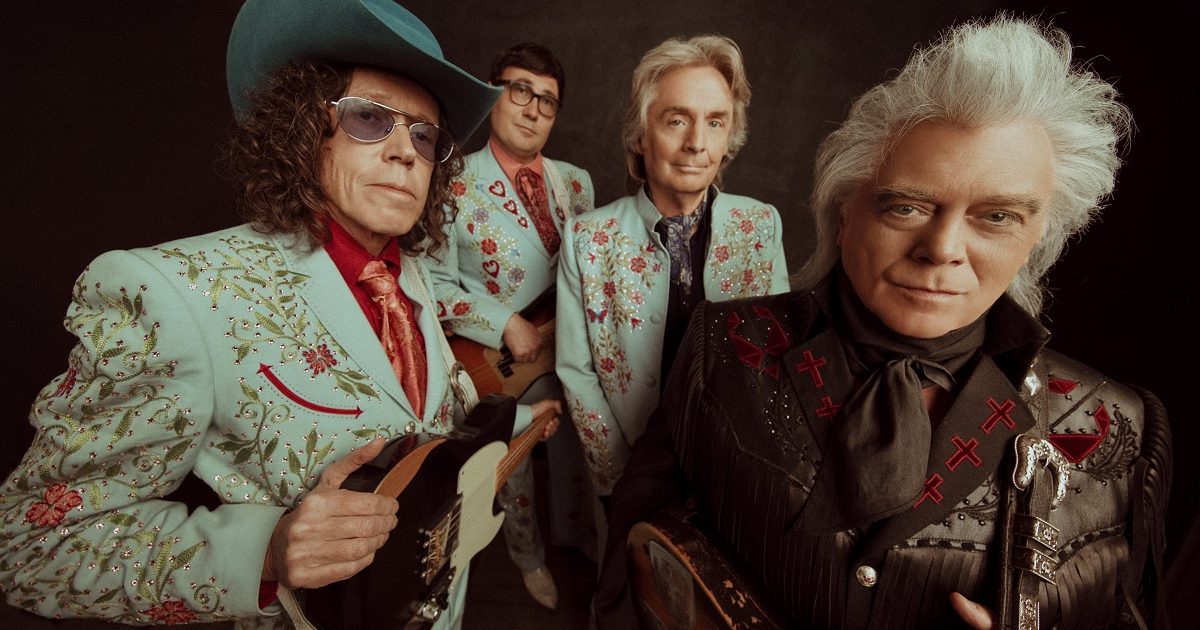
LISTEN: Marty Stuart and His Fabulous Superlatives, “Altitude”

Artist: Marty Stuart and His Fabulous Superlatives
Hometown: Nashville, Tennessee
Song: “Altitude”
Album: Altitude
Release Date: May 19, 2023
Label: Snakefarm

In Their Words: “I’ve been quoted as saying the most outlaw thing you can possibly do in Nashville, TN, these days is to play country music. It can be done. On Altitude, there’s twin fiddles, steel guitar, and the legendary Pig Robbins playing piano on what turned out to be one of his last recording sessions. The song is a reminder to me, and to anyone else still interested, that there’s a few of us out here who still know how to make authentic country music. I have an absolute belief that there’s a world of people out there who still love it. As my wife Connie Smith says it’s the ‘cry of the heart,’ Harlan Howard said it’s ‘three chords and the truth’—that’s country music.

“I’ve always loved songs that feel like old friends but still sound new and fresh. The beautiful thing about country music is that the blueprint Jimmie Rodgers laid down—rambling, gambling, sin, redemption, Heaven, Hell—it’s all just as relevant now as it ever was. It’s the human condition, and if you’re honest about it and you’ve got a real band around you, you can make something that’s uniquely yours and stands the test of time.” — Marty Stuart


Photo Credit: Alysse Gafkjen

Connie Smith Carries a Classic Country Sound to “A Million and One” Video

Grand Ole Opry member Connie Smith is offering a gift to country music purists and enthusiasts: a new album, The Cry of the Heart. It’s Smith’s third endeavor with her husband and producer Marty Stuart, whose acumen and prowess in country and roots music pairs well with the sovereign voice of this Country Music Hall of Fame inductee. Ahead of the album’s release, she released “A Million and One,” paired with a music video filmed in part at Ernest Tubb Record Shop in downtown Nashville. The video starts with a trip down memory lane and an immersion into the lore of that classic country sound as an old clip shows Ernest Tubb himself welcoming Connie Smith to the stage.

Before Smith even sings a note, a new stage is revealed including Marty Stuart’s Fabulous Superlatives dressed in country-chic turquoise and backing her up with a bed of dreamy steel guitar and hypnotic upright bass. When the strings come in, the reanimation of this rendition of Billy Walker’s 1966 classic country hit is complete, showcasing Smith’s timeless brand of country. Smith’s decorations span half a century of incredible music, work that has earned her accolades, awards, and a seat among the highest tier of country music artists. The Cry of the Heart is a celebration of the sound that shaped the genre and, in many ways, American culture. Truly a living legend, Smith says, “People ask me, ‘What is country music?’ I say, ‘To me, country music is the cry of the heart.’ We all have these experiences in our hearts and I’m trying to identify and communicate with people so they know they’re not alone.”


Photo credit: Alysse Gafkjen

The BGS Radio Hour – Episode 207

Welcome to the BGS Radio Hour! Since 2017, this weekly radio show and podcast has been a recap of all the great music, new and old, featured on the digital pages of BGS. This week, we bring you new music from our Artist of the Month, Allison Russell, an exclusive live performance by Madison Cunningham from BGS’ Whiskey Sour Happy Hour, and much more. Remember to check back every week for a new episode of the BGS Radio Hour.

APPLE PODCASTS, SPOTIFY

Sunny War – “Losing Hand”

Coming out of COVID isolation with fingers crossed and masks on, many artists are releasing new and exciting music. We’re particularly thrilled about Sunny War’s latest release, Simple Syrup. We caught up with the LA-based guitarist and singer for an edition of 5+5 and talked everything — from Elizabeth Cotten’s guitar playing to eating black-eyed peas with Nina Simone.

Ted Russell Kamp – “Lightning Strikes Twice”

Singer-songwriter Ted Russell Kamp originally wrote “Lightning Strikes Twice” in the style of Billy Joe Shaver, as a honky tonk number. But, for his upcoming album Solitaire, he decided to rework the track, bluegrass style.

No-No Boy – “Gimme Chills”

A student of singer-songwriter, multimedia artist, and scholar No-No Boy (AKA Julian Saporiti) once called his song “Gimme Chills” a “fucked up love letter to the Philippines.” No-No Boy agreed. The track is part history lesson and part tribute.

Yola – “Diamond Studded Shoes”

Yola’s roots-pop outing “Diamond Studded Shoes” is a song that explores the divides created to distract us from those few who are in charge of the majority of the world’s wealth. It calls on all of us to unite and turn our focus to those with a stranglehold on humanity.

Dale Ann Bradley – “Yellow Creek”

BGS recently caught up with Kentucky’s own Dale Ann Bradley, discussing her recent album, Things She Couldn’t Get Over — her first release since departing group Sister Sadie. Each of the songs on the project deal with hard times, and finding the courage that gets us through. “Yellow Creek,” a song about the forced removal of Native Americans from their land, finds Bradley giving us a reminder to walk with empathy.

Josephine Johnson – “Where I Belong”

“Where I Belong” by singer-songwriter Josephine Johnson was inspired by characters from British Navy novels set during the Napoleonic wars. Love and high seas adventure, to be sure!

The Wandering Hearts – “Gold”

Inspired by their song “Gold,” The Wandering Hearts created a Mixtape for BGS, entitled The Golden Tonic, it’s a selection of songs that have helped them through tough situations, inspired them, and take them back to specific moments in time. They hope that the Golden Tonic will work its magic on the listener after this heavy and hard year.

Eli West – “Brick in the Road”

In a recent 5+5, multi-instrumentalist and singer-songwriter Eli West discusses the influence of Paul Brady and Irish folk music, understated chaos in visual art, and drunk BBQ with Sting and Mark Knopfler.

Allison Russell – “Nightflyer”

Our Artist of the Month Allison Russell has already made a mark on the modern roots scene through various powerhouse groups, like Birds of Chicago and supergroup Our Native Daughters. Now, she’s stepping out with her first solo record, Outside Child. Stick around all month long for exclusive content from Russell.

Bhi Bhiman – “Magic Carpet Ride”

Bhi Bhiman reimagines iconic rock song “Magic Carpet Ride” in the style of old country blues players – artists like Mississippi John Hurt, Lightnin’ Hopkins, and others who’ve played a huge role in Bhiman’s evolution as a guitarist.

Parker Millsap – “Vulnerable”

Parker Millsap, one of our recent guests on The Show On The Road, is a gifted singer-songwriter who grew up in a Pentecostal church and creates a fiery gospel backdrop for his tender (then window-rattling) rock ‘n’ roll voice.

Madison Cunningham – “L.A. (Looking Alive)”

Last spring, on our debut episode of Whiskey Sour Happy Hour, Los Angeles-based, Grammy-nominated guitarist and singer-songwriter Madison Cunningham kicked off the entire series with an acoustic rendition of “L.A. (Looking Alive).”

Stash Wyslouch – “Lord Protect My Soul”

From bluegrass mad scientist Stash Wyslouch, formerly of progressive string band the Deadly Gentlemen, here’s a traditional number turned upside down, taking a Bill Monroe tune and contrasting it with polytonal backup. Wyslouch told BGS that while he gravitates towards gospel standards in the bluegrass world, his own style drifts to the absurd and unexpected. Like a bluegrass Frank Zappa!

Bob Malone – “The River Gives”

Singer-songwriter and pianist Bob Malone wrote “The River Gives” after the devastating 2016 flooding in West Virginia, but he never had a chance to produce the track like he wanted to – until now!

Marty Stuart – “One In A Row”

Marty Stuart’s new project, Songs I Sing In The Dark, is a collection of twenty songs that he curated that helped him through the tough times that we all saw in 2020. Stuart says this Willie Nelson song has followed him around since he first heard it over twenty years ago. “I think of it as an old friend, same as Willie. It’s a friend for the ages, and an excellent song to sing in the dark.


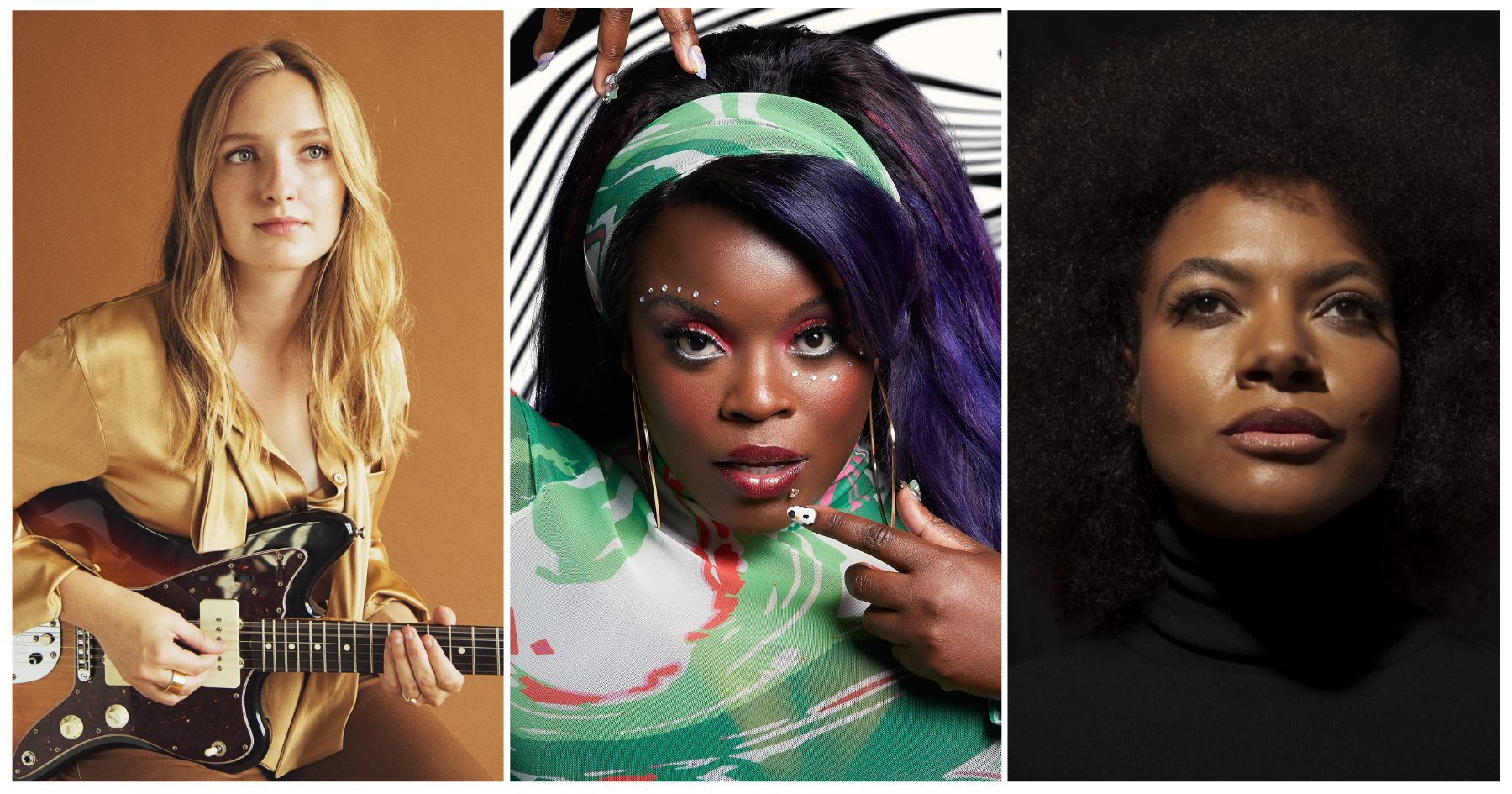
Photos: (L to R) Madison Cunningham by Claire Marie Vogel; Yola by Joseph Ross Smith; Allison Russell by Marc Baptiste

The BGS Radio Hour – Episode 195

Welcome to the BGS Radio Hour! Since 2017, the show has been a weekly recap of all the great music, new and old, featured on BGS. This week, we look forward to new releases coming in 2021 as we continue to celebrate roots Grammy nominations and as we bid farewell to our January Artist of the Month. Remember to check back every Monday for a new episode of the BGS Radio Hour!

APPLE PODCASTS, SPOTIFY
Sheryl Crow – “Woman in the White House”

One thing we can celebrate this January is the first ever presence of a woman in our nation’s second-highest office. So, what better way to begin our show this week than with this song from Sheryl Crow’s re-release of “Woman in the White House?”

The Burnt Pines – “Diamonds”

A collaborative effort between Boston and Lisbon, the Burnt Pines bring us this week a twist on the typical love song. “Love isn’t easy,” they told BGS, celebrating their just-released, self-titled album.

Colin Macleod – “The Long Road”

From the Isle of Lewis in Scotland, singer-songwriter Colin Macleod weaves in and out of regret with “The Long Road.” From his upcoming album, Hold Fast, this music video is one of our most recent features here at BGS.

Dolly Parton – “Shine”

Dolly Parton – queen of country music and COVID-vaccine backer – just celebrated 75 years! And what better to celebrate than with her classic bluegrass trilogy of albums (newly made digitally available) and this song, which earned itself a few 2001 Grammy noms, as well as Best Female Country Vocal Performance for Dolly herself!

Jimbo Mathus & Andrew Bird – “Sweet Oblivion”

Diving into 2021, we’re excited about all of the new releases heading our way. One that sticks out in particular is the collaborative This Thirteen coming in March from Jimbo Mathus and Andrew Bird, two musicians who call each other heroes. This week, we have a sneak peek with “Sweet Oblivion.”

Matt Urmy – “Lightning”

NYC-based Matt Urmy caught up with BGS this week on a recent 5+5 – that’s five questions, five songs. We talked all things Cowboy Jack Clement, weird rituals, the dream meal pairing of French food and Leonard Cohen – and, this song from his upcoming South of the Sky. 

The Bright Siders (Featuring Ed Helms) – “The Mad Day”

Nashville-based musician Kristin Andreassen (Uncle Earl) has teamed up with Brookyn’s Kari Groff, MD, child-psychiatrist and violinist for A Mind of Your Own. The album, which focuses on children’s mental health, features a wide range of guests, including the Punch Brothers, the War & Treaty, and none other than BGS co-founder Ed Helms!

Adam Klein – “Halfway to Heaven”

Not that long ago, we featured Athens GA-based singer and songwriter Adam Klein and his Low Flyin’ Planes release. Well, this song was meant to be there, but things never work out like we expect. Klein gives us the best of both worlds with his new EP, Little Tiger: Outtakes from Low Flyin’ Planes, out now!

Lizzie Weber – “Blue Wave Boom”

Lizzie Weber takes us from her St. Louis home to the California-coast for “Blue Wave Boom,” from her just release How Does It Feel EP. The song was inspired by the bright blue colors enveloping the black sea after the red tide, which served as a metaphor for the toxicity in one’s own mind, especially during the long shutdowns of 2020.

The Secret Sisters – “Cabin”

We revisit our March 2020 Artist of the Month, The Secret Sisters, in celebration of their Grammy nomination for Saturn Return, produced by Brandi Carlile and the Hanseroth twins. The sisters recently gave “Cabin,” which is also nominated for best American roots performance, an acoustic makeover.

Marty Stuart – “I’ve Been Around”

King of Country Cool, Marty Stuart brings us a previously unheard Johnny Cash song from the new collective tribute, Forever Words Explained. This song was lined up to be recorded before Johnny Cash’s death, but was never brought to light. When this tribute came around, well, who better than Marty Stuart?

Pony Bradshaw – “Foxfire”

From Chatsworth, Georgia, Pony Bradshaw wrote “Foxfire” out of 19th century historical inspiration after reading Down by the Riverside: a South Carolina Slave Community and Shared Traditions: Southern History and Folk Culture. Celebrating his new album Calico Jim, we’ve featured the song and Bradshaw on BGS this week!

The Stanley Brothers – “Angel Band”

There’s nothing quite better to wrap up our January Artist of the Month tribute to the soundtrack of O Brother, Where Art Thou? than end the show with the song that ends the movie. So from all of us here at BGS, we honor 20th anniversary of the momentous film and soundtrack with the Stanley Brothers “Angel Band.”


Photos: (L to R) The Stanley Brothers; Dolly Parton, ‘Little Sparrow’; The Secret Sisters by Alysse Gafkjen

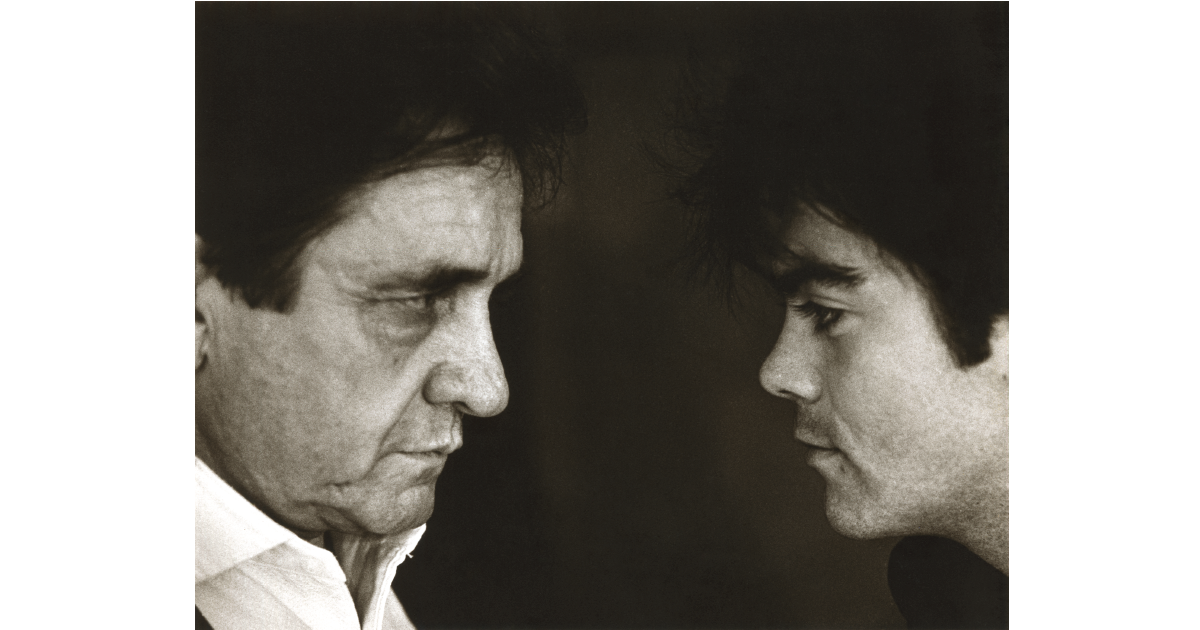
WATCH: Marty Stuart Shares the Johnny Cash Song He Dearly Loves

Artist: Marty Stuart
Song: “I’ve Been Around”
Album: Forever Words (Expanded)

In Their Words: “I dearly love ‘I’ve Been Around.’ The song and video are both filled with that unexplainable charisma that John R Cash specialized in. He was such a great writer. A true poet at heart. It’s hard to believe that he never got around to recording this song. The words are cinematic, timeless, classic JR.

“When John Carter Cash first presented me with the raw lyrics the music seemed to dance off the page. I instantly heard the sound of Johnny Cash and the Tennessee Three in my mind. They were the north star band of my musical youth; in reality, they still are. They were my Beatles. I wanted the spirit of that group and the essence of that sound to follow me to that microphone. At the time the song was recorded the Tennessee Three’s drummer, W.S. ‘Fluke’ Holland, was the last band member standing. He played on the session and brought that classic sound with him to the studio. Fluke since passed away. ‘I’ve Been Around’ was to be his last recording and I will forever treasure it. The old line in Nashville is: It all begins with a song. And once again, Johnny Cash knocks one out of the park from 10 million miles away.” — Marty Stuart


Photo credit: Bill Thorup

Ricky Skaggs Reunites With Bill Monroe’s Mandolin for ‘BIG NIGHT’ Event

On Wednesday, October 28, music fans had the chance to see and hear some of the most historic instruments in bluegrass played once again during an all-star fundraiser, BIG NIGHT (At the Museum). The Country Music Hall of Fame and Museum presented performances captured in the museum’s galleries and performance venues while the museum was closed, with select artists paired with instruments from the institution’s collection. The event debuted on the museum’s YouTube channel.

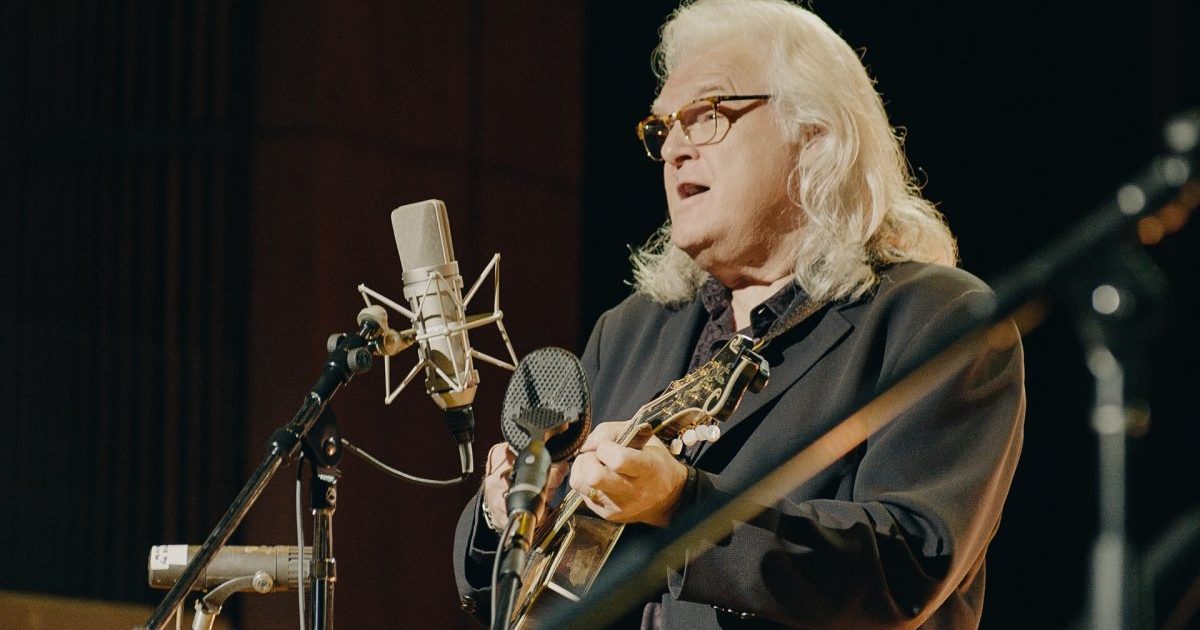
One such performance includes Alison Brown playing Earl Scruggs’s 1930 Gibson RB-Granada banjo, Ricky Skaggs playing Bill Monroe’s 1923 Gibson F-5 mandolin, and Marty Stuart playing Lester Flatt’s 1950 Martin D-28 guitar. Skaggs was elected to the Country Music Hall of Fame in 2018.

“I think it’s important to do anything we can to support the museum not as just members of the Hall of Fame, but as lovers of country music history,” Skaggs tells BGS. “I think it’s kind of our job to do that and it’s a privilege to know that my grandkids will be able to go there to see that history that we celebrated — and some of it I even got to be a part of. I’m thankful to be a part of it. It’s a wonderful thing.”

BIG NIGHT (At the Museum) generated support for the museum’s exhibitions, collections preservation, and educational programming. A closure of nearly six months due to COVID-19 caused significant loss of revenue for the museum, which was forced to cancel in-person educational events. During the BIG NIGHT program, viewers were encouraged to donate to the museum.

BGS spoke with Hall of Fame member Ricky Skaggs and museum CEO Kyle Young about the event.

BGS: Kyle, how have things been at the museum since the shutdown?

Young: We’re hanging in. We were closed for about six months. We opened back up September 10 under very limited capacity. As I look at the year, I think we will end up looking at lost revenue approaching thirty five million dollars, so it’s a matter of trying to navigate through and I’m hoping that we can stay open, even though it’s very limited.

Ricky, it’d be hard to imagine such an event without you there considering that you have such a deep connection to this music. What does it mean for you to get to play Mr. Monroe’s mandolin?

Skaggs: I can’t believe I’m getting to play it one more time. Every time I play it I’m sure it’s the last time, but then they’ll drag it out again and I’m always like, “Oh, God, thank you.” The first time I played it, I was 6 years old. So I didn’t really know that much about how priceless it was even then. And he wouldn’t just take it off and give it to you to play. He wasn’t that way, you know? Sometimes we’d shared a dressing room together. And he’d have the lid open in the case, but it would be pushed down in the case. I would always ask his permission if I could play it and he’d let me.

But, I didn’t play it that much when he was alive. I’ve played it so much more since he passed. There was a time before it went into the museum that the Opry House had it in a vault. There was a guy there that would let me play it, and two or three times a year, I’d go out and make sure that the bridge was OK and maybe I’d put new strings on it and stuff like that. But I played it quite a bit back then. When it went into the museum, I thought, “This is it.” You walk by and see it in the case and think, “Well, that ain’t ever coming out.” But I’ve been able to play it a few times and I’m always thankful.

It’s an amazing sounding instrument. And I made sure to mention, when I was inducted into the Hall of Fame, that Mr. Monroe did not create this music by himself. That instrument was his partner. That was his number one instrument from the time that he got it. He and that instrument created the sound of bluegrass. I mean, he was so creative after he got that instrument. If you think about the instrumentals that he wrote before when he had that F-9 with that short scale you can tell he was very limited. But when he got that 14 fret neck — goodness gracious! It gave him the room and the tone and the whole Loar experience to work with. It was meant to be. It was a heavenly meeting of two instruments: Monroe being one instrument and the mandolin being the other.

Listen to Ricky Skaggs on Toy Heart with Tom Power: APPLE MUSIC • STITCHER • SPOTIFY • MP3

That’s a beautiful sentiment and a good point about how inspiring that instrument was for him. That connection between instrument and musician existed with all of these instruments, so it’s going to be special to watch all of these performances. Were you all excited to get to perform a bit?

Skaggs: We were. None of us three — me, Marty or Alison — have had COVID, and we’ve certainly been pent up and cooped up. I recently did a video for Camping World with Steven Curtis Chapman, and after one of the faster instrumentals we played, I remember thinking, “Man, I have got COVID fingers,” you know? Kentucky Thunder hasn’t played a show since March 11 and that’s just crazy. So, it was a lot of fun to play with Marty and Alison. I think it’s going to be a really, really great show, and I hope it raises a lot of money for the Hall of Fame, because even though they’ve had to shut down, the building must be paid for every month like nothing happened. But, something has happened and that’s another example of how hard this virus has been on America in general, and which has been really, really unfortunate.

https://www.youtube.com/watch?v=Y1j5JYpSfTc

I know that those instruments almost never leave their display cases so what were the circumstances that allowed the instruments to get played for this event?

Young: We knew that there were a lot of things we couldn’t do while we were closed, but we tried to focus on what we might be able to do under these circumstances and what opportunities there might be. I don’t know if you remember this or not, but very early on in the shutdown, the Shedd Aquarium let a couple of penguins out and let them walk around the aquarium and posted videos of them looking at the other exhibits. That got us to thinking about what we could do. We are a very active museum with lots of programming, but we realized with an empty museum, we can carefully take these instruments out of their cases.

So, the penguins were the germ of it, to tell you the truth. We wanted to do something that looked like us and felt like us. The backbone of the museum, as you know, is the collection — and the collection is unbelievable. The curatorial staff enjoyed carefully choosing which instrument they wanted to take out and allow to be played. From that point, we decided which artists made sense.

That’s so special because I know it’s such a rare thing. The only time I can remember something like it was when Ricky played Bill Monroe’s mandolin at the Medallion Ceremony back in 2018.

Young: That was very, very unusual. And after a lot of discussion, we thought that’d be a great thing to do with Ricky that afternoon. And likewise, this is something we never do. It is only because we were closed and able to really control the circumstances by which we were moving these instruments and carefully handling them and letting the artists play them. They’re behind glass for a reason. That’s the best way to protect them. And they are in an environment that is intensely controlled from temperature to humidity to light exposure and so on. But we did feel like under these circumstances, and only these circumstances, could we see our way clear to take them out for a little while and let them be played.


Photos courtesy of the Country Music Hall of Fame & Museum


This article was updated on November 12, 2020

First Generation: Meet the Bluegrass Music Hall of Fame’s Earliest Inductees

Though it’s not that hard to find some who will argue the point, bluegrass is widely held to have originated when banjo phenom Earl Scruggs joined Grand Ole Opry star Bill Monroe’s band in early December, 1945. Bill Monroe and His Blue Grass Boys — the possessive wasn’t just there for show — were already among the anchors of the radio show’s cast, but contemporary accounts (and a handful of bootleg recordings) make clear that, to the ears of an almost instantly enraptured audience, Scruggs’ rapid-fire banjo playing elevated the group’s sound to a new level.

Almost instantly, groups sprang up — or reoriented themselves — in pursuit of the new sound, and although banjo players and fiddlers were the most obvious converts, the truth is that virtually all of the intricacies the band brought to their sound were soon emulated. By the time Scruggs and guitarist/lead singer Lester Flatt left the Blue Grass Boys at the beginning of 1948, the quintet’s live performances and a handful of recordings had already inspired some notable followers, who, out of artistic desire and commercial necessity, quickly busied themselves in developing their own distinctive takes on the sound of the “original bluegrass band.”

As we near the 75th anniversary of this foundational origin story, BGS will be looking back across the sweep of those years — and first up, of course, a clutch of true pioneers that share a common accomplishment: they are the acts honored by induction into the IBMA’s Hall of Fame in its first five years and their plaques proudly hang at the Bluegrass Music Hall of Fame & Museum in Owensboro, Kentucky.


Bill Monroe (inducted 1991)

A complex personality with a skill set that included equal measures of innovation and synthesis, the mandolin-playing Monroe (b. 1911) moved from a mid-1930s duo with his brother to assembling a hot string band during World War II to fronting that original bluegrass band — an achievement which earned him his “Father of Bluegrass” title. Though it’s easy to discern the elements he brought together in that music — old fiddle tunes; Scotch-Irish ballads; African-American blues, jazz and gospel; western swing and more — his creativity extended beyond simply stirring them together and kept him a central figure from its inception until his death in 1996.

Indeed, while his early classics are essential to the bluegrass canon, even his late-life instrumental compositions have enjoyed a growing influence among today’s hottest young players. In fact, he collected his first Grammy for 1988’s “Southern Flavor.” Monroe was inducted into the Country Music Hall of Fame in 1970, and as the composer of “Blue Moon of Kentucky,” he joined the Nashville Songwriters Hall of Fame in 1971, received a Lifetime Achievement Award from the Grammys in 1993, and entered the Rock and Roll Hall of Fame as an early influence in 1997.

Representative tracks: “Blue Yodel No. 4,“I’m Going Back to Old Kentucky,” “Lord Protect My Soul,” “Midnight on the Stormy Deep,” “Southern Flavor”


Earl Scruggs (inducted 1991)

Though he wasn’t yet 22 years old when he joined Monroe’s band at the end of 1945, Earl Scruggs (b. 1924) was ready to step into the spotlight, and, with the exception of a stretch of ill health in the late 1980s and early ‘90s, he never relinquished it until his death in 2012. Unlike many instrumentalists who change their approach according to musical context, Scruggs believed that his picking style — built around right-hand patterns called “rolls” — could fit anywhere, and after his groundbreaking years with Monroe and then Lester Flatt, his career seemed devoted to proving the point.

Having created much of the musical vocabulary for bluegrass banjo picking, he moved on to playing with his sons in the Earl Scruggs Revue, a country-rock-bluegrass fusion band that was arguably more successful — at least in commercial terms — than Flatt & Scruggs had ever been. In the 21st century, Scruggs championed a broad variety of younger musicians while continuing to play those same sweet rolls he’d created as a young man. He was awarded a Lifetime Achievement Award from the Grammys in 2008.

Representative tracks: “Blue Ridge Cabin Home” (Flatt & Scruggs), “Foggy Mountain Chimes” (Flatt & Scruggs), “Travelin’ Prayer” (Earl Scruggs Revue), “The Engineers Don’t Wave From the Trains Anymore” (with Tom T. Hall), “The Angels” (with Melissa Etheridge)


Lester Flatt (inducted 1991)

With an expressive, emotive voice and an impressive array of demeanors that ranged from dry and sly to devout and down-home, rhythm guitarist Lester Flatt (b. 1914) was the perfect musical complement to Earl Scruggs, and their 1948-1969 output was at least as influential as Monroe’s. Flatt & Scruggs won a 1968 Grammy for their classic recording of “Foggy Mountain Breakdown.”

But where Scruggs was not only interested in playing with his sons, but also interested in putting his banjo into a wider range of contexts, Flatt preferred sticking to the country side of bluegrass. In the aftermath of their breakup, Flatt’s drawl deepened and slowed as he presided over a series of gifted lineups that included peers like Josh Graves and Vassar Clements, alongside young up-and-comers from banjoist Kenny Ingram to a teenaged Marty Stuart. Flatt & Scruggs were inducted into the Country Music Hall of Fame in 1985.

Representative tracks: “I’ll Never Love Another” (Flatt & Scruggs), “I’ll Go Stepping Too” (Flatt & Scruggs), “On My Mind” (Flatt & Scruggs), “You Are My Flower” (Flatt & Scruggs), “Gonna Have Myself a Ball”


The Stanley Brothers (inducted 1992)

The career of Ralph Stanley (b. 1927) and Carter Stanley (b.1925) illustrates both the profound impact that the original bluegrass band had on their peers, as well as the complementary artistic and commercial drives that impelled those successors to create their own unique style. In their first recordings, made while Flatt and Scruggs were still Blue Grass Boys, you can hear the Virginia-born Stanley brothers revamp their old-time string band approach into an approximation of the pioneers’ sound, yet within a matter of months, they had found a compelling variant.

The Stanley sound was built in part around Ralph’s stolid but driving banjo and soulful tenor singing, but even more around Carter’s mournful lead vocals and powerful songs. Over the years, while they moved from the Nashville-based Columbia and Mercury labels to scrappy (and multi-racial) Cincinnati indie, King, their sound became even more recognizable, as owner Syd Nathan hectored them into de-emphasizing the fiddle and leaning more into the innovative work of flatpicking lead guitarists like George Shuffler. The brothers’ partnership came to an end in late 1966 with the early, alcohol-related death of Carter; Ralph would continue on with his own twist on the Stanley Brothers’ sound until his death in 2016.

Representative tracks: “The Lonesome River,” “Our Last Goodbye,” “Let Me Walk, Lord, By Your Side,” “I’ll Just Go Away,” “Pig in a Pen”


Reno & Smiley (inducted 1992)

The first banjo player to follow Scruggs, albeit briefly, in the Blue Grass Boys, Don Reno (b. 1926) deliberately sought to create a distinct and instantly recognizable style of his own on the instrument. By the time his partnership with singer-guitarist Red Smiley (b. 1925) had settled into regular recording for King Records in the early 1950s, he had succeeded completely, and for good measure had done the same with flatpicked guitar solos, too. As Grand Ole Opry announcer Eddie Stubbs once put it, Reno & Smiley were a country band with a banjo instead of a steel guitar.

Though Reno could and sometimes would blister a banjo solo, many of the band’s signature numbers were heart songs, country shuffles, earnest gospel outings and more, including occasional flashes of rockabilly and jazz. Reno wrote many of them, sang tenor and occasional leads, and shared the instrumental limelight with their steady fiddler, Mack Magaha, and occasionally with one or another mandolin player, including his son, Ronnie. The partners split for a few years in the mid-‘60s, then reunited for a brief period before Smiley’s death in 1972. Reno continued to record and perform with partners ranging from Bill Harrell to his sons until he passed away in 1984.

Representative tracks: “I’m Using My Bible for a Roadmap,” “I Know You’re Married,” “Little Rock Getaway,” “Please Remember That I Love You,” “Just About Then”


Jim & Jesse (inducted 1993)

Though Jim McReynolds (b. 1927) and Jesse McReynolds (b. 1929) were born just a few dozen miles from the Stanley Brothers, the music of Jim & Jesse could hardly have been a more different kind of bluegrass. The duo’s singing was smooth and refined — especially guitarist Jim’s silvery tenor — while the instrumental sound was driven by Jesse’s innovative mandolin cross-picking and their overall approach by the latter’s eclectic tastes and influences (he appeared, for instance, on The Doors’ 1969 album, The Soft Parade).

The brothers were comfortable in reaching for a more countrified sound, helped by banjo players like Allen Shelton and Carl Jackson, who were adept at playing radio-friendly licks on a dobro-banjo as well as ‘grassier fare when that was called for. Smart businessmen as well, the duo were among the first to appear on television in the early 1950s, recorded an entire album of Chuck Berry songs in the mid-1960s, started their own label in the early 1970s, and remained a popular fixture on the Grand Ole Opry until Jim’s death on the last day of 2002. As of this writing, Jesse McReynolds continues to perform — and to innovate, too, with releases like a 2010 Songs of the Grateful Dead collection.

Representative tracks: “Pardon Me,” “Are You Missing Me,” “She Left Me Standing on the Mountain,” “Cotton Mill Man,” “Memphis”


Mac Wiseman (inducted 1993)

Nicknamed “The Voice With a Heart,” Virginia’s Mac Wiseman (b. 1925) was a founding member of Flatt & Scruggs’ Foggy Mountain Boys in 1948, but soon left to join Monroe (and Don Reno) in the Blue Grass Boys. By the early 1950s, he’d started his own career, recording for Gallatin, Tennessee’s Dot Records — and then going to work for the label. A consummate professional, he also served as a musicians’ union official for a time, and was a founding member of the Country Music Association. He frequently recorded material other than bluegrass, especially when rock ’n’ roll and the pop-country Nashville sound beckoned in the late 1950s and early 1960s, and throughout his career, he was never afraid to use a variety of instruments besides the archetypal bluegrass ones.

Still, as a performer, bluegrass was his bread and butter from the mid-1960s on, and rather than carry a band, he would recruit players from other acts (and occasionally skilled amateurs, too) and lead them on stage with a heavy guitar strum and a quick “watch me, boys!” Wiseman’s songbook included old folk numbers, songs he heard on the radio as a polio-stricken child, big band tunes, Music Row compositions and much more. In later years, he recorded several memorable projects that highlighted songs his mother had taught him and songs that told his life story, before his death in 2019.

Representative tracks: “I Still Write Your Name in the Sand,” “I Wonder How the Old Folks Are at Home,” “Mother Knows Best,” “My Little Home in Tennessee,” “’Tis Sweet to Be Remembered”


The Osborne Brothers (inducted 1994)

Bobby Osborne (b. 1931) and Sonny Osborne (b. 1937) were among the first of what might be called “semi-second generation” bluegrass artists; unlike those who preceded them in the Bluegrass Hall of Fame, neither had performed professionally before 1950. By 1954, though, they’d hooked up with Jimmy Martin for a memorable set of recordings, and 1956 found them signed on to MGM on their own. Together with singer-guitarist Red Allen, the Brothers — Bobby singing lead and playing mandolin, Sonny singing baritone and playing banjo — had come up with an inventive new vocal arrangement that put the spotlight pretty much on them alone.

Lest that sound too cold, it should be noted that they deserved it, for not only was Bobby a formidable lead singer and Sonny brilliant in the support role, but their fearless, try-anything (the two recorded separately with avant-garde jazz vibraphonist Gary Burton in the mid-’60s) instrumental skills were profoundly original. The Brothers joined the Grand Ole Opry and signed with Decca Records in 1964, and spent the next decade fusing bluegrass and country in a way that eventually earned them a CMA Vocal Group award. Irascible, opinionated, and both artistically and commercially successful, the Osborne Brothers were at the forefront of the music until Sonny’s 2005 retirement — and while Bobby continues to perform to this day, the influence of their duo continues to grow, too.

Representative tracks: “Once More,” “The Cuckoo Bird,” “Tennessee Hound Dog,” “Pathway of Teardrops,” “Sweethearts Again”


Jimmy Martin (inducted 1995)

East Tennessee native Jimmy Martin (b. 1927) hungered to perform with Bill Monroe as a youngster, then got his chance in 1949 when Mac Wiseman quit the Blue Grass Boys. As lead vocalist and guitarist, he helped to make some of Monroe’s most memorable recordings, then partnered in various settings with Bobby and Sonny Osborne before taking the helm of his Sunny Mountain Boys in the mid-1950s. A brash, colorful guy who could boast with the best and then back it up, Martin served in the cast of the Louisiana Hayride (alongside Elvis) and the Wheeling (W.V.) Jamboree before a growing bluegrass festival circuit threw him a lifeline in the absence of a Grand Ole Opry membership.

Among early Hall of Fame inductees, he may be considered more influential than most of his peers. Service in his Sunny Mountain Boys constituted the training ground for several generations of musicians, from banjo man J.D. Crowe to newgrass pioneer Alan Munde to Americana favorite Greg Garing — and his appearance on the Nitty Gritty Dirt Band’s Will the Circle Be Unbroken was legendary. Martin was an unstoppable force of nature who knew exactly what he wanted from a musician, yet was unable to clearly explain it. Still, he did well enough that his records are instantly recognizable, even when you’ve never heard them before.

Representative tracks: “That’s How I Can Count on You” (with the Osborne Brothers), “Rock Hearts,” “You Don’t Know My Mind,” “Tennessee,” “Freeborn Man”


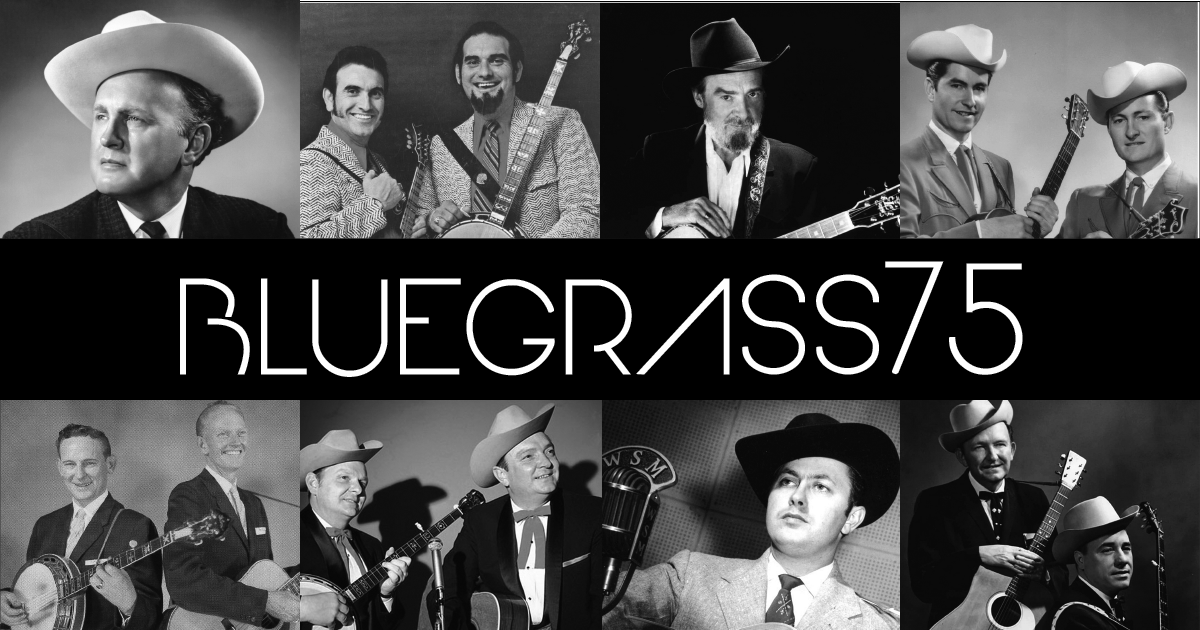
Pictured above, first row (L to R): Bill Monroe, The Osborne Brothers, Mac Wiseman, Jim & Jesse; Second row: Reno & Smiley, The Stanley Brothers, Jimmy Martin, Flatt & Scruggs

The String – Amy Speace plus Marty Stuart

Songwriter Amy Speace was entirely absorbed in theater, studying to be a Shakespearian actress in NYC. Then some fates and muses intervened and she began leaning into folk music.

LISTEN: APPLE PODCASTS

Before long she was recruited and mentored by the great Judy Collins, cultivating a voice that stands out even in the crowded songwriter scene of today. Now in Nashville, her story took another turn recently when she had her first child, a son, at age 50. Her complex observations about the world and herself pour out of the speakers on her newest, Me And The Ghost of Charlemagne. Also, a short phoner with Marty Stuart teasing the new mega-documentary Country Music by Ken Burns.

Like Father, Like Sons: Del McCoury & The Travelin’ McCourys

Even after five decades in the bluegrass business, the McCoury family is having a banner year in 2019. In February, Del McCoury turned 80 years old and shared the Grand Ole Opry stage with some of his most famous admirers. That same month, the Travelin’ McCourys – fronted by Del’s sons Rob and Ronnie McCoury — picked up a Grammy award in Los Angeles for their self-titled, debut album. And looking ahead, the 12th annual DelFest music festival in Cumberland, Maryland is slated for May, with performances by both bands on the schedule.

In person and off stage, Del McCoury is as polite and warm as one would expect. Smiling broadly as he enters the Opry dressing room, he’s wearing a Hawaiian shirt, his pompadour is on point (as always), and he seems unfazed by the fact that show time is less than 30 minutes away. To paraphrase another Opry star, he’s just so proud to be here.

“I’ve been listening to the Grand Ole Opry since I was at least 10 years old,” he says. “My brother and my dad would listen because it was before TV, you know? Especially out in the country where we lived. People had TVs, but I don’t remember anybody who did out in the country. We grew up on a farm. Like I said, I’ve been listening to the Grand Ole Opry since then and I’ve always looked up to all the acts on here. Especially the bluegrass acts, like Bill Monroe and Flatt & Scruggs. It’s a big show in my mind! Still is!”

Though the time set aside for the interview is somewhat brief, Del conjures up stories about everything from crusty club owners to playing Carnegie Hall. He cracks up at a memory of Bill Monroe flat-out telling festival promoter Carlton Haney that a bluegrass festival would never work. Thinking even further back to his childhood, he reminisces about being fascinated by Earl Scruggs’ banjo on “Rollin’ in My Sweet Baby’s Arms” when he was around 11 years old.

“Something hit me here,” Del says, touching his heart. “That banjo behind the lead singer was so good. And so I learned how to play that. I was already a guitar player but I heard this record and I thought, ‘Wow, that’s what I want to do!’ So, when I could get a banjo, I started learning it. Just take the record, pick the needle up and put it over, and try to play what Earl was doing. It was not simple!”

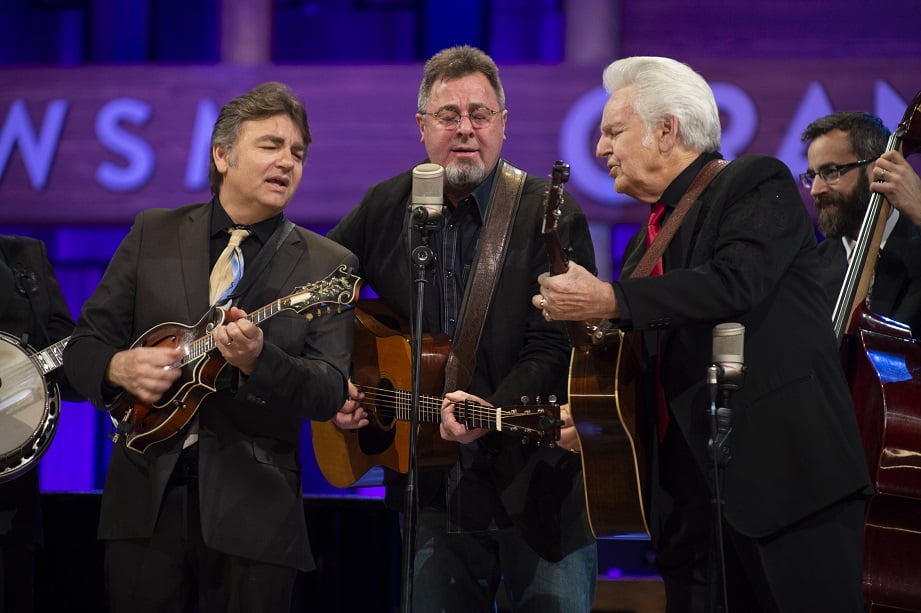
Ronnie McCoury, Vince Gill, Del McCoury

Asked about the decision to spin off a group from The Del McCoury Band, employing everybody except himself, Del says he conferred with manager Stan Strickland about how to make it work.

“I got to an age where I thought, you know, I’m [not] gonna be around here forever,” he noted, just before breaking into his trademark laugh. “I felt good, and I still feel good, but you never know. When you get to 70, you don’t know how many days you got left. I thought, these guys depend on me. My wife and I talked to Stan and I said, ‘You know, if we get them something going on their own, and if something happens to me, then by that time they might be established.’ So we got them a different booking agent than I had, and it seemed like right from the start they were starting to do good already! And I thought, ‘Wait a minute now, I wonder if I should have done that…’”

He breaks into laughter again, before adding, “Especially when they start winning Grammys! And they don’t take me with them!”

Loyal bluegrass fans know that for decades the Del McCoury Band has done its own share of travelin’ – not to mention winning two Grammy awards of their own. Led by Del on lead vocals and guitar, the good-natured group includes Ronnie on mandolin, Rob on banjo, Jason Carter on fiddle and Alan Bartram on bass. Cody Kilby assumes Del’s role as a guitarist in The Travelin’ McCourys, while the vocals in that ensemble are handled in equal share by Ronnie, Rob, Jason, and Alan.

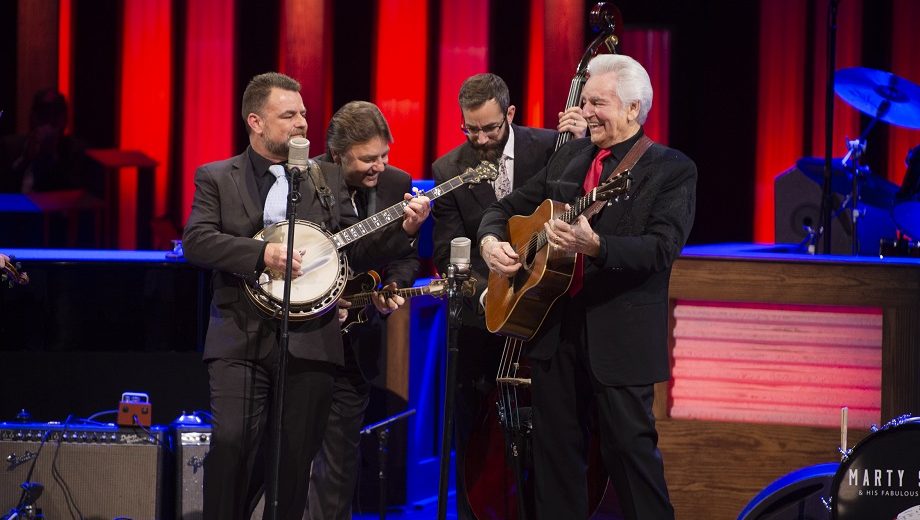
Three days after their Grammy win, the Travelin’ McCourys regrouped with Del when the Opry curated a special show called the Grand Del Opry, in order to commemorate McCoury’s milestone birthday as well as his 15th anniversary as an Opry member. Friends like Sam Bush, Bela Fleck and Abigail Washburn, Vince Gill, Old Crow Medicine Show, Jesse McReynolds, Ricky Skaggs, Marty Stuart, and of course Travelin’ McCourys jammed with the man himself.

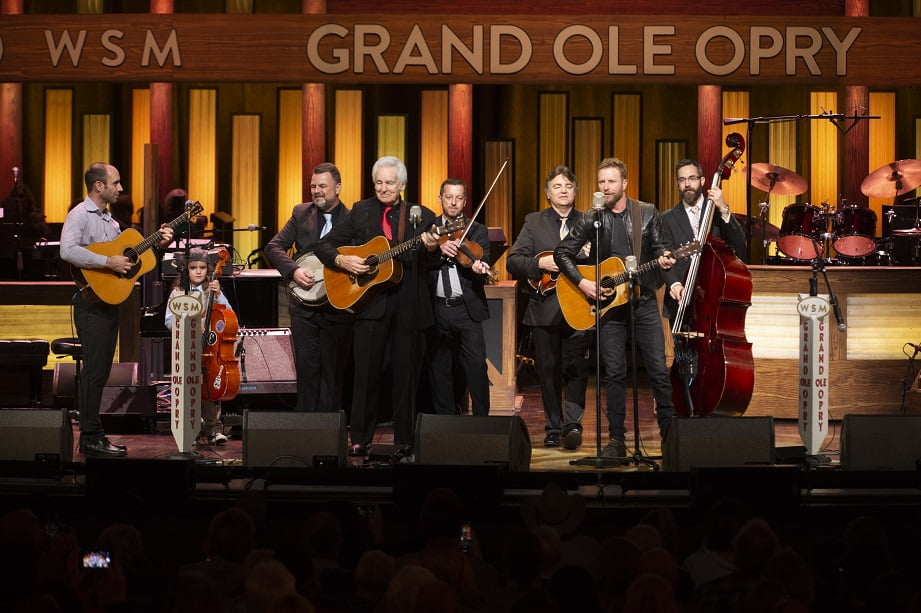
The finale of the Grand Del Opry

In an interview a few weeks after the show, Rob says, “One of the biggest things for me was the finale, and looking at all these people on stage to help Dad celebrate his birthday. And also looking out to see nearly a full house in honor of my father. It made me very proud to see all these folks that have such respect for my dad and the music, and they all took the time to come out to the Opry that night and put on a show in honor of my father.”

Del McCoury made his first appearance on the Grand Ole Opry as Bill Monroe’s guitarist in 1963 – and that performance was only McCoury’s second gig with the esteemed Father of Bluegrass. The first was not long before that, when McCoury subbed for Monroe’s banjo player at a New York show. Although McCoury still preferred playing banjo, Monroe offered him a spot as a guitarist and lead singer – a job he kept for a year. “He’s the reason I’m doing that now,” Del says with a chuckle. “I didn’t think I would be, but once I started playing guitar and singing, I liked it.”

Obviously he still does. McCoury has played a staggering number of festivals over the years, including a few of those seminal Carlton Haney bluegrass festivals of the 1960s. Still he needed some persuasion to launch his own music festival. He recalls, “My manager said to me, ‘Did you ever think about having your own festival?’ And I said, ‘Yeah, I’ve always wanted to, but I don’t want the headache! What a headache that’s got to be!’”

But with persistence, the right location, and a diverse lineup, DelFest has become a major player on the folk festival circuit. This year’s roster includes The String Cheese Incident, Trampled by Turtles, Tyler Childers, Railroad Earth, and more than a dozen bluegrass artists, including Billy Strings, Sam Bush, the Gibson Brothers, Sierra Hull, and the SteelDrivers.

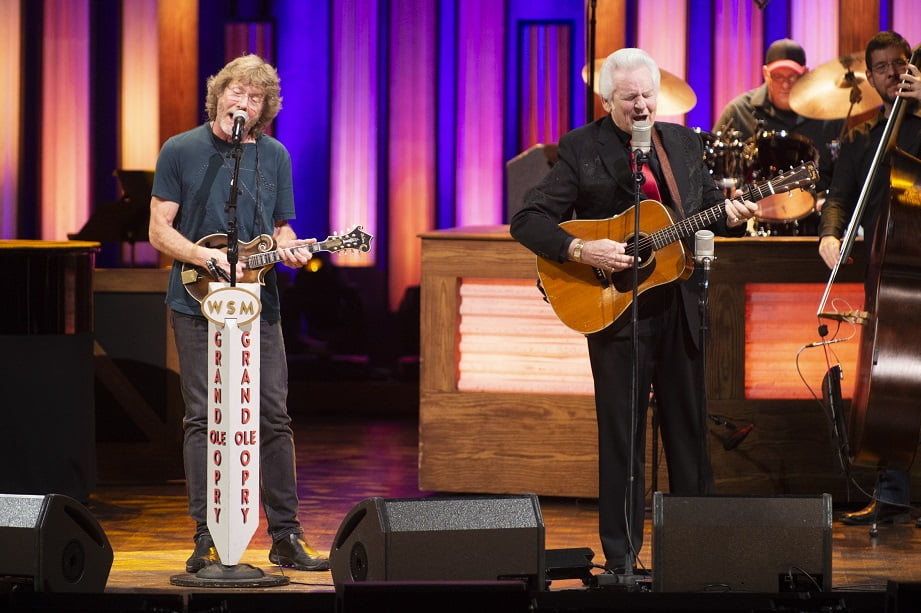
Sam Bush and Del McCoury

“Attendance is staying up there good, and it’s fun,” Del says. “It’s not a bluegrass festival, it’s just a music festival. We have a lot of bluegrass bands there, you know, but we have jam bands, and we have country acts, man, you name it. We had jazz bands, we had a mixture of music, and I like a variety of music my own self. I figured, if we have a variety of bands, some folks will come to see one band, then these folks will come to see another band, and that’s how you get your fans.”

Rob McCoury adds, “I thought having the festival was a great idea. We’ve played hundreds if not thousands of festivals through the years. So I think it was just the natural progression to have a festival of our own. I guess the most surprising thing is, the small details that add up to big things, that no one realizes is going on behind the scenes.”

Asked about the reward of all that work, he answers, “The fans, no doubt about it. All those folks come to DelFest, and anytime dad walks on stage at his own festival he’s a rock star. To me, it’s just the coolest thing.”

Rock star. Bluegrass Hall of Fame member. A nine-time IBMA Entertainer of the Year. Dad. These are just some of the ways you can describe Del McCoury. Winding down the interview backstage at the Opry, he pauses for a moment when he’s asked how he’d like the Opry family to remember him.

Finally, he says, “You know, I guess I’d want ‘em to remember me like a guy that never expected to be an Opry member. I knew I would play music, for years and years, but I thought, ‘The Opry is something is really special and I don’t know if they’d want me there.’ I was fortunate that they did, and I’m just so grateful. I hope they just remember a country guy that really loves the Grand Ole Opry and loves music.”

The Travelin’ McCourys, Vassar McCoury, Del McCoury, and Dierks Bentley
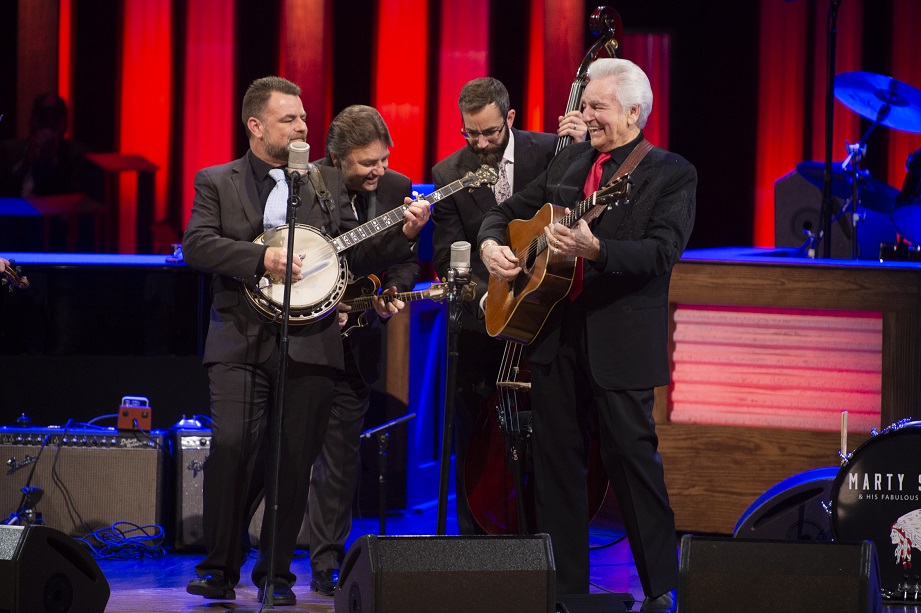
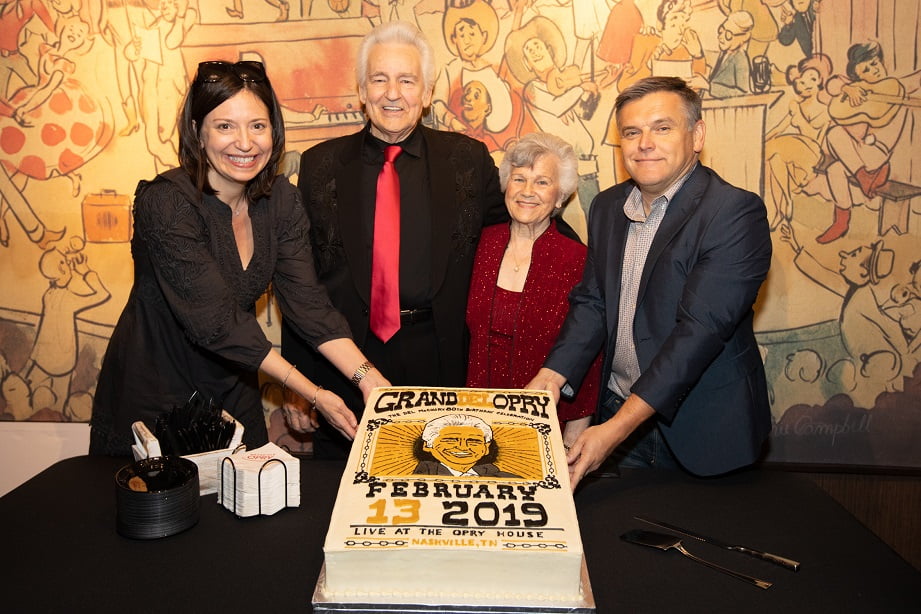

Photo credit: Chris Hollo / The Grand Ole Opry

Del McCoury’s 80th Birthday at the Grand Ole Opry in Photographs

As bluegrass fans know, Del McCoury is kind of a big deal — in fact, the Grand Ole Opry briefly renamed itself on Wednesday (February 13) in his honor when the “Grand Del Opry” event gathered good friends like Dierks Bentley, Sam Bush, Béla Fleck & Abigail Washburn, Vince Gill, Jesse McReynolds, Old Crow Medicine Show, Marty Stuart, and the Travelin’ McCourys to celebrate the legendary musician’s 80th birthday. Happy birthday, Del!


The Travelin’ McCourys’ Ronnie McCoury, Rob McCoury and Alan Bartram with Del McCoury


Sally Williams, Grand Ole Opry; Del and Jean McCoury; Dan Rogers, Grand Ole Opry


Del McCoury Band with Dierks Bentley and special guest Vassar McCoury on “upright bass.” 


Sam Bush and Del McCoury


The finale of the Grand Del Opry


Photo credit: Chris Hollo, The Grand Ole Opry