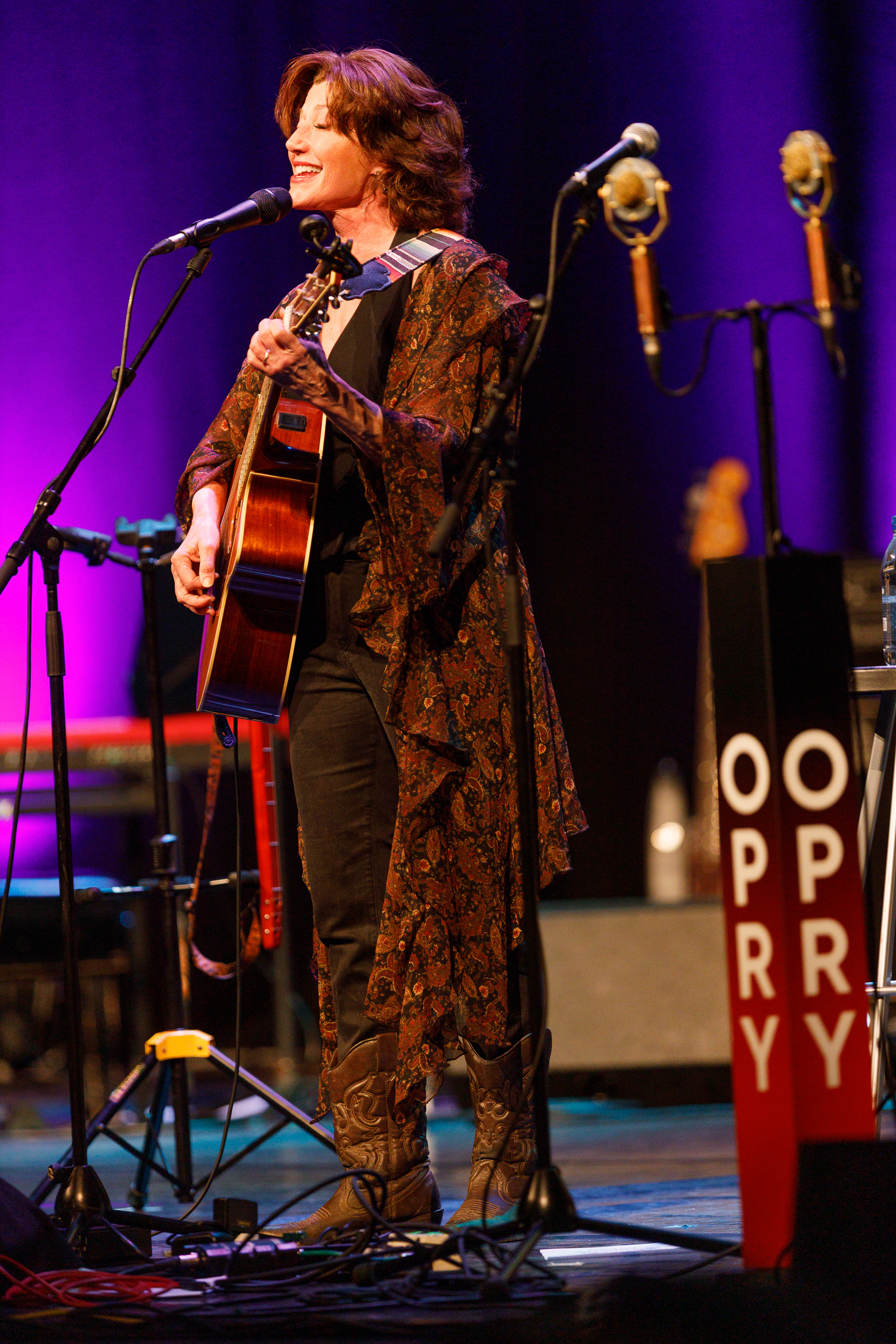
Amy Grant didn’t set out to make her first album of original material in more than a decade. What started as a way to reconnect with herself gradually became The Me That Remains (released May 8), a deeply personal collection of songs about healing and finding ourselves again.
As a compendium to the project and in tandem with host Khalil Ekulona, Grant has launched a new podcast that invites listeners to delve deeper into the stories behind the songs and learn more about what and who shaped the record. (Watch the first episode of the podcast, which has just premiered, below.)
I recently sat down to speak with Grant about the unexpected path that led to The Me That Remains, which she created alongside producer Mac McAnally – full disclosure, that’s my dad. Her candid reflection on some of her life’s most difficult moments was crafted into something that deeply resonates with her fans and is a great reminder that sometimes, when we close a door or two, we open new ones.
Well, I feel very honored to have been tapped to do this, and I also think it’s an interesting perspective because I got to have a backseat to the making of this record through Dad’s eyes. I know he’s told you, but he was just so thrilled and joyful to work on this. We had some screen-free, dedicated listening sessions in the studio and he gave me lots of behind-the-scenes stories about the recordings and some of the stories behind the songs. It was a really special time for me to get to see him through that process, and I hope you know how much it meant to him.
But I was curious as to what led you to pick him for this project.
Amy Grant: I didn’t realize we were doing a project. I reached out to Mac when I had written a song, really the first lyric that I wrote as I was launching into being creative.
To me, this whole project was such a chapter of life that was a recovery journey. I had a bike wreck the summer of 2022 and then not quite two years later I had to go back to Vanderbilt to see a neuropsychologist to get my new baseline. I did a day of testing. I received three different scores. Two were in the 90s, and a third was under 30 percent. I was like, “Oh my gosh, this makes total sense to me.” It makes sense how I’m experiencing life. Everything is happening in the family room, and I’m down the hall in a back bedroom, three steps behind.
The doctor asked how it was exhibiting in my life and I said, “I feel a slow withdrawal in me from everything.” And his advice was, “Lean in. Lean into the things that matter to you, even when you feel uncomfortable. If you feel like you are three beats behind, lean in.”
Within a few weeks, I had created a space in my home to be creative, because creativity is leaning in for me. My watercolors. My dress-up clothes. I know it sounds silly, but my grandkids and I dress up. And I have a record player and my 45 collection and my instruments. Creativity always grounds me, always makes me glad to be alive.
When I created that space, I sat down in the only chair in the room – which is a child’s chair – and top to bottom, I wrote the lyrics to “The Me That Remains.”
Wow.
I was just talking to myself and said, “Hey, this is who you are.” At the time, I was bored with my own musical ideas and still dealing with my short-term memory. I reached out to Mac to say, “I’ve got a lyric. Any chance you would help me with some music?” I think I instinctively reached out to him because he’s fun to be with and a great storyteller. On some level, I trusted him as a person and I felt at ease.
He said, “I’m so busy right now; this could take a while.” Weeks would go by, but he’d say, “I think I’m on to something.” Months went by. I told him, “No sacred cow. Change anything you want.”
In the meantime, I was leaning into creativity and lyrics were coming. So I initiated more conversation with Mac and let him know I was writing more songs. By the end of 2024, life was busy for all of us, but I reached back out and told him that I had two songs I would love to record. “Any chance you would put together a rhythm section? Would you oversee this?” It was such a natural step, and he said yes. But we didn’t have a contract. I didn’t have a record deal. That’s how the whole rest of the record emerged. Weeks would go by, and I would reach out and tell him I had more songs.
“Any chance we can do that again?”
Six weeks later, he’d booked a double session. By then, he was saying, “Hey, I’ve got some songs I’d like to play you.” A month later, we had another session, and then he said, “Hey, we’ve got a whole record.” I so appreciate Mac and his style of producing. It is “come as you are.” He’s very welcoming of everyone’s ideas.
My friends joke about me that it feels like I could hobble together my life, clearly and completely, with a roll of duct tape and a roll of twine. I couldn’t care less if things are perfect. And I really found a great creative match in Mac. He’ll work on something exhaustively. He’ll sing every potential background part until he knows what he wants, and that’s what he’ll ask the singer to do. But he’s also open to things. He looks for honesty and believability over perfection.
And Mac and Vince [Gill] are old friends, and they get in the same room, and the storytelling starts. You feel lucky to be in that space.
That’s wonderful. I find it very inspiring that creating the space for yourself and pulling together the things that make you feel like you helped open those gates. Do you feel like they’re still open?
I do. Yes. I was in that space today. It’s funny. It’s just a little pass-through room, but you can actually close the doors. We live in a house that’s very open and sprawling. There’s not a space that I can close the door and feel like nobody’s going to walk in. I think sometimes, for some of us, that’s important creatively.
I nicknamed that space “Craftopia,” and I was encouraged to create that space by my youngest daughter. She pointed out that there are lots of places to sit, but no place that I can cloister away. She said, “This house, you’ve got a lot of places to sit.” I love to cook, but our kitchen’s wide open. I’ve got my desk with all my books, but it’s a pass-through area. It’s like my life is an open passageway. And just to say it was okay for me to close the doors, be alone, and welcome myself. That’s good for everybody.
Well, that’s a good segue, talking about your daughter. One of the things that gave a twinkle to Dad’s eye was your daughters singing on this record. He loved that process. Can you talk a bit about what that was like for you, and what brought that about?
Well, I have two daughters singing on this project and my daughter Sarah was singing on a song that I wrote with Tom Douglas. Sarah sang underneath me on the song, “The Other Side of Goodbye,” and I wanted Corinna to sing above me. She quietly asked Mac, “I’m not asking to be on the record, but would you let me have the experience of going into the vocal booth? Can I sing with my mom on this song, ‘Beautiful Lone Companion’? I listen to it all the time, and I have all these parts that I sing.”
And I’ll never forget what Mac said to Corinna. He said, “Corinna, you will spend the rest of your life taking what is in your head creatively and getting it out, and then deciding if you like it. I got nothing but time.” She went and got her journal and she had done a chart, just like with solfège. I don’t really know the do-re-me-fa-sol-la-ti-do, like I wouldn’t know how to make a chart with that, but she had made a vocal chart. She ran through it once and asked if she could have another track to double the part and Mac said, “You just saved me from asking you to do that.”
Here’s what was so beautiful. Mac had hired an arranger to do what he was calling a “mandolin symphony” that took up that same space as her parts. His openness to hearing what she had was so lovely. To watch him look at that song, or listen through her lens. At one point, she asked me to come into the vocal booth to listen, and I wrapped my arms around her and she burst into tears. Vince was in the doorway and he came in and we had this three-way hug.
It is true that music comes to us and through us. Creativity is a sacred space. With songwriting, I find that if I’m writing with someone in the same room, you can have an idea musically or lyrically and they’ll say, “Okay, sing it to me.” But I’ll get choked up, even if it is a fun song, because the emotion of landing on something is, well, hard to explain. But it is emotional.
I have this very silly thing that I’ve had since I was a kid, where if I sing gibberish, just words flowing out of my mouth, I cry. It can be the silliest noises coming out. It makes my husband laugh so hard. I can do it at the drop of a hat. Immediately, tears stream down my face. It feels like a deep emotion that I can’t really put my finger on. Not joy, not sadness.
Free. It’s free. We’re all born with a freedom to just be. To classify, not categorize. And we lose that. I think anything we can do to return us to being childlike is good.
Now I want to hear you sing gibberish. I’m not going to ask you to do it right now, but I think I want to try that. It’s funny because, six months ago I started doing a pattern of movements in the mornings, and I do it consistently. It is basically just moving like a child. I call it child’s play. It always makes me laugh.
That’s wonderful.
It is a pattern that I do four times a day: first thing in the morning, last thing at night, and a couple of times during the day. I’m just mimicking the way children move. If you want to be exhausted, follow a 2-year-old around for five minutes and do what they do. There is not a pilates workout that will put you through [that]…
Well, I’m actually really excited that we’re talking after the release of this album, because I’m curious to hear about how you feel about it now that you’ve been able to play this in front of audiences. What has it been like to be out in the world with these songs?
Well, it has felt so comfortable. The response I’ve mostly gotten is that people say, “I feel like I’m stepping into a conversation that’s already going on in my head. You are singing my life.”
I know that there’s such a welcoming, honest observation of life in all these songs. And the songs that are hard are never “us and them.” You know, whatever we’re sitting in, we helped create it. And if there’s moving on, then we will think of a way to move on. The record is very observational and honest and hopeful.
It just makes me so glad to be making music at 65, because my intention is not to try to be center stage anywhere. Job well done is just the experience of creativity. You can’t control it. This project has been met with exponentially more positive feedback than I ever imagined. Well, I didn’t imagine anything. I was just glad for the experience, and that was the gift. The gift was being in the studio with all those incredible musicians, and with Mac.
At the end of the third day of recording, we were just sitting around and Glenn Worf said, “You know, when I first came to Nashville, I wanted to be in a band and I had several misfires, and then that dream kind of went by the wayside. I became a studio player and that’s been great. Time and technology are kind of editing that experience in all of our lives. But we all just had the experience in the studio of feeling like we are in your band.”
I had that same experience. I love my road band. Music truly creates road families. But that experience of being in the room with everyone, Chris Stone at the soundboard, I mean, everybody. I’m so glad we had that.
Yeah, that was a lovely group of deep-feeling people in one room.
Has your relationship to the songs evolved now that they’re out in the world? Have you fallen more deeply in love with any particular song on the album since it’s out there?
Well, first off, these songs all wear well with time, and the relationship I had to develop with the songs was to not get choked up because you can’t sing with a lump in your throat. With “How Do We Get There From Here,” I got to sing that with the Staten Island PS22 fourth- and fifth-graders. I had to steel myself. It’s just hard not to get emotional. Kind of the same as when you are doing your gibberish singing. I feel a greater appreciation for each one of the songs.
The songwriting, whether it’s the songs I wrote alone or with other people, nothing happens without great patience, intention, and time. I know that each one of the writers on this took a great deal of time and attention and patience writing these songs, and I feel very grateful for it.
I’m reminded of the story about Sherwood Anderson and William Faulkner when Faulkner was experiencing some misses, and Anderson encouraged him to write about what he knew. And that is when he created Yoknapatawpha County. It doesn’t matter how specific something is to you. It will resonate with others.
I feel like this record is a great example of that because it is very specific to you. To that pass-through room with the closed doors. To everything that you have been through in the past few years. It is resonating because it is specific.
Let’s talk about the new podcast, The Me That Remains, hosted by Khalil Ekulona. It’s a wonderful companion to the record. Tell me how it came about with Khalil and what it was like to make it.
I met Khalil when he was a guest in our home for Easter one year. My sisters and I all cook. My nieces and nephews add to it. It is definitely a big spread, and I’m always meeting people in my home because somebody else invited them.
I was on a Southwest flight not too long ago, and the flight attendant said, “I came to a party at your house once.” And I said, “I thought you looked familiar.” I’m the youngest in my family, and there were just always people in my parents’ house. And so an open door is the way I grew up.
I met Khalil, and then he invited me to be on [the show he hosted on WPLN], “This Is Nashville.” It’s such a rich exploration of Nashville, and I so enjoyed talking to him that when it was time to create some material, we chose him as the interviewer. He’s such a lovely human, and so thoughtful. I enjoyed my first conversations about these songs being with him.
That’s wonderful. I particularly loved the episode about the album artwork. The way it was pulled together is really beautiful. I strongly encourage readers to check out that episode. It’s wonderful.
Every one of our lives should be turned into a multimedia art piece, because only you know what is important to you.
That’s right.
When you see it all gathered together, it’s extraordinary. I had so many collections when I was younger. Now I’m kind of at the point of passing things on or letting go, and I do think there are stages in our lives.
There’s a collection stage, when you are appreciating that season of life, whatever it is, and the things that you’ve collected. And then there comes a time to lighten the load. And to leave a minimal imprint in some areas, you know?
Photo Credit: Ed Rode