The Station Inn Earns an Exhibit at the Country Music Hall of Fame and Museum

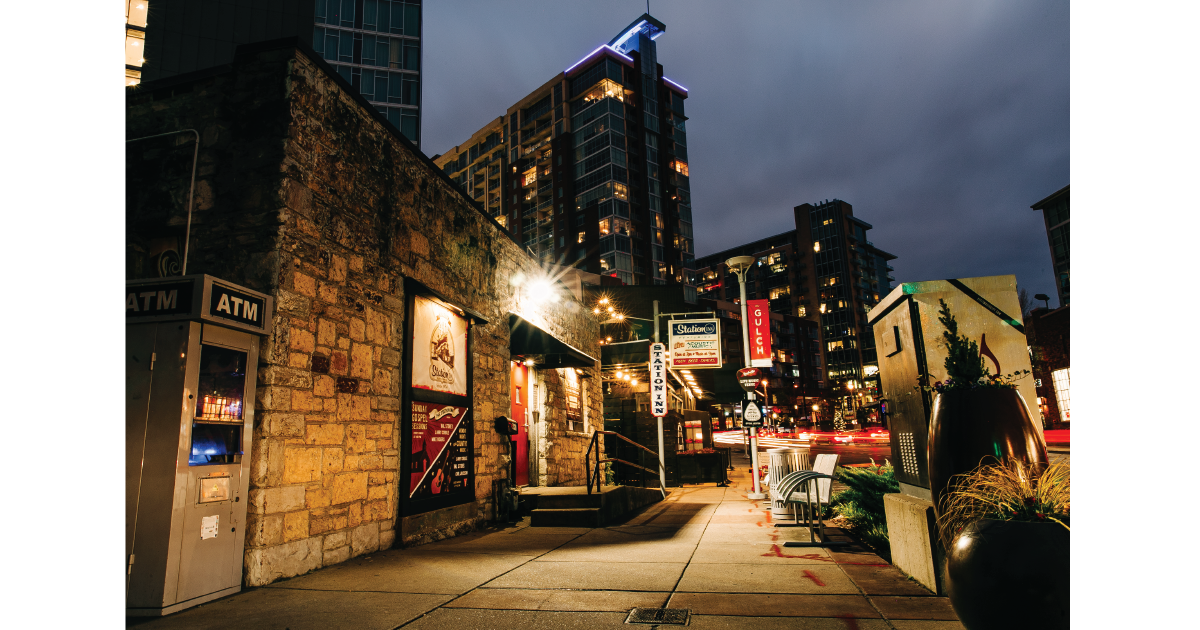
The humble appearance of the Station Inn could never give away the enormity of its legacy and importance to bluegrass music. Nestled between skyscrapers in an ever-growing city, a single story cinder-block building with its windows painted shut sticks out as a relic from the past — when the Urban Outfitters across the street used to be an empty field of waist-high grass.

For nearly 50 years “the World Famous” Station Inn has played a pivotal role in bluegrass as both a venue and community hub, drawing people to Nashville and making connections that had a major impact on the music. Through the rest of 2021, The Country Music Hall of Fame and Museum will honor and present the history and legacy of the venue in their exhibit The Station Inn: Bluegrass Beacon.

“The main reason that we wanted to do this exhibit is because the Station is such a vital and important part of not just Nashville music history, but of American music history,” says Peter Cooper, one of the curators of the new exhibit. The Station Inn has a larger-than-life reputation in the bluegrass community, but this new exhibit endeavors to highlight both the importance of the venue’s history and its welcoming atmosphere.
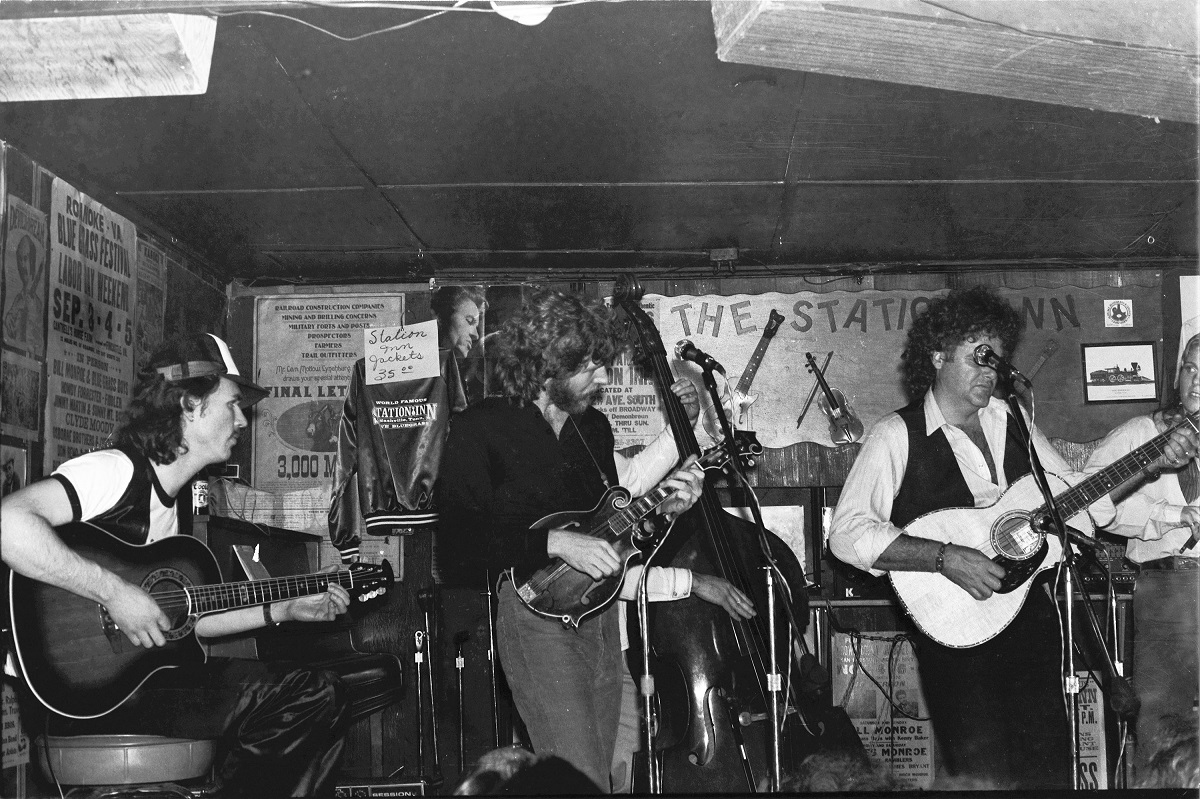
During the mid-1980s, adventurous singer-songwriter and musician Peter Rowan assembled all-star groups he dubbed “Crucial Country” for a series of shows that created a buzz amongst progressive roots music fans and players. In this photo, Rowan (right) is joined by Mark O’Connor on guitar and Sam Bush on mandolin. Photo: Charmaine Latham

It was founded in 1974 by a group of bluegrass musicians and singers — Bob and Ingrid Fowler, Marty and Charmaine Lanham, Jim Bornstein, and Red and Bird Lee Smith — who wanted to provide their fellow musicians and fans with a venue where they could play and hear bluegrass music. At that time the Station was more of a clubhouse where the owners functioned as the house band and guests would come up to jam. They moved to the current location in 1978; three years later, the club was bought by J.T. Gray, who at the time was driving Jimmy Martin’s tour bus.

Gray, who would go on to be inducted into the Bluegrass Hall of Fame in 2020 and was given a lifetime achievement award by the Southeast Regional Folk Alliance, began booking national touring acts to perform. It would be easy and accurate to show why the Inn is significant by pointing to the artists who have played there, including Bill Monroe, the Stanley Brothers, Vince Gill, Alison Krauss, and essentially any other important name in bluegrass. But the clubhouse atmosphere always remained. Countless (as in absolutely too many to count) threads of bluegrass history, both well-known and overlooked, can all be traced back to chance meetings at the Station Inn. J.T. Gray fostered a welcoming atmosphere that led to many locals and visitors from out of town to meet there, including mandolinist Mike Compton.
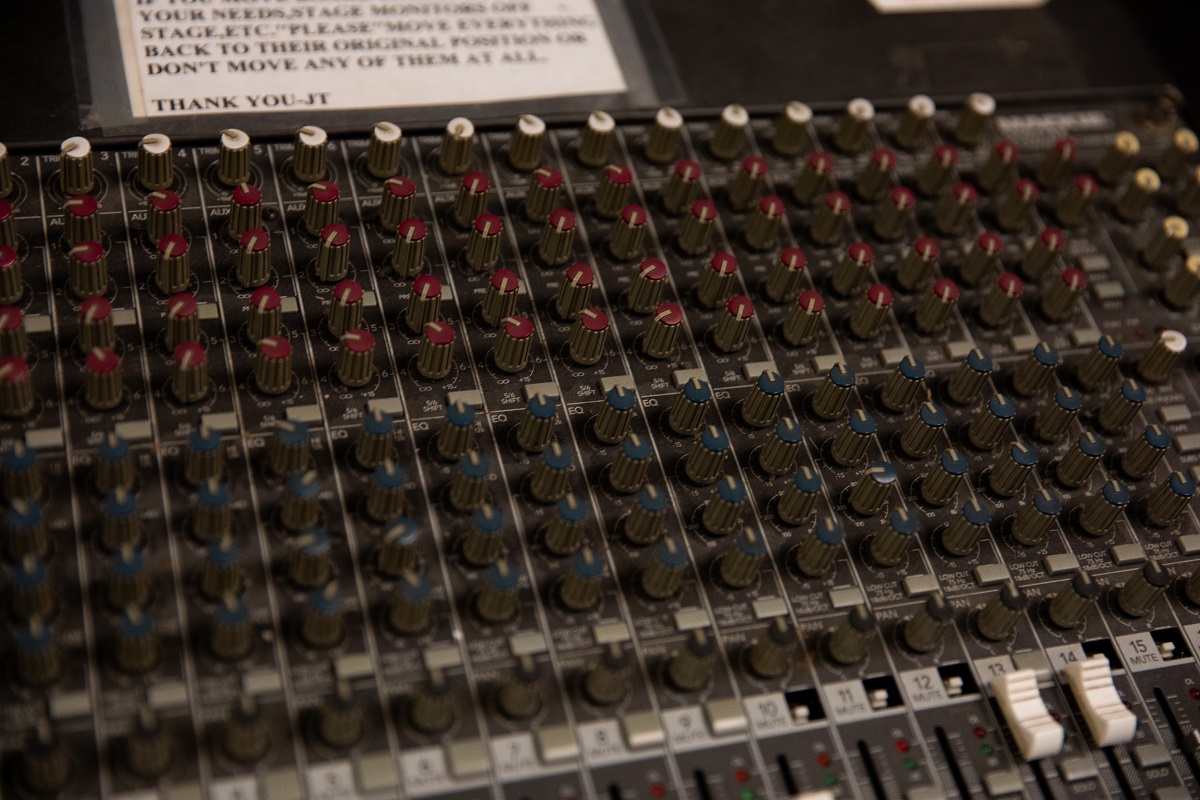
The venue’s sound-mixing console described by Gray as “the first piece of modern sound equipment we ever bought”

“I rode up [to Nashville] with Raymond Huffmaster, a bluegrass guy from Meridian, Mississippi, where I’m from, because I’d been hanging around him trying to learn how to play,” Compton says. They visited the bluegrass spots in town including the Station Inn, and Compton recalls after heading home, “Pat Enright got in touch with me and said they were starting a band and asked if I wanted to join. So I moved [to Nashville] in 1977 and moved in with J.T. Gray.”

Mike and Pat would continue playing together and later go on to form the legendary Nashville Bluegrass Band, which became a staple act at the Station Inn. A predecessor to that award-winning band was performing at the Station the first time future bluegrass star, Kathy Chiavola, came to town in 1979.

“When that door opened, the room was packed and I saw a vision of heaven,” she says, recalling that first night. “I heard these two voices, Alan [O’Bryant] and Pat [Enright], in their prime. And I lost it. I said, ‘OK. I’m moving here.’ There was a notice on the Station Inn bulletin board that a band of women playing bluegrass were looking for a roommate.” That band turned out to be the Bushwhackers, which featured bluegrass pioneers Susie Monick and Ginger Boatwright. Chiavola eventually joined the Bushwhackers playing bass and singing lead and harmony until Doug Dillard moved to Nashville. As the banjo player from the Dillards (who were famous for playing the Darlings on The Andy Griffith Show), Dillard put a band together and asked Ginger Boatwright to join, and about a year later asked Chiavola, too. Both the Bushwhackers and the Doug Dillard Band would frequently perform at the Station.
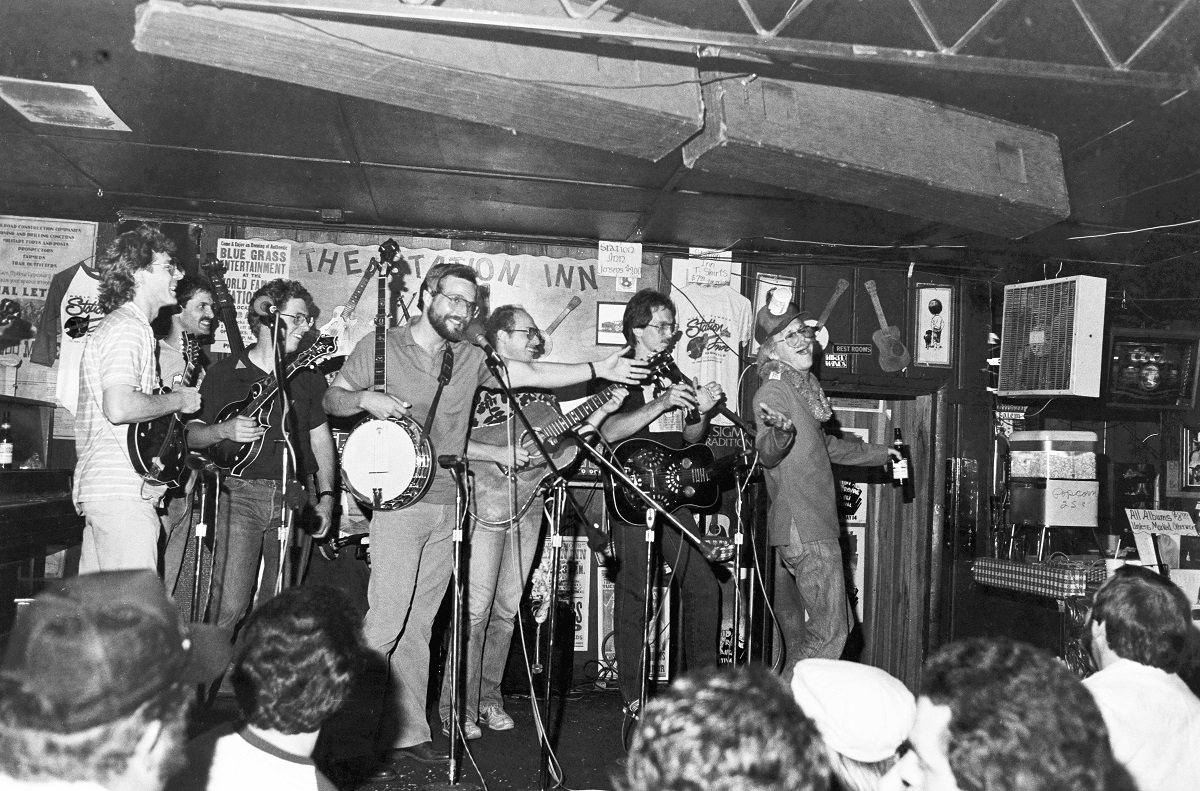
Vocalist, bones player, and madcap entertainer Ed Dye (far right) was a colorful presence at the Station Inn during the 1980s and early 90s. He assembled the Nashville Jug Band with a cast of stellar Nashville musicians from rock, jazz, and bluegrass backgrounds, and hosted wildly unpredictable shows. In this photo, he takes the stage with (from left): Sam Bush, Mark Schatz, Tim O’Brien, Alan O’Bryant, David Grier, and Jerry Douglas. Photo: Charmaine Lanham

Chiavola eventually moved into a duplex next to bluegrass bassist Mark Schatz. Together, they would often play the Station Inn with Charlie Cushman, Stuart Duncan, and Bobby Clark as part of a band called The Satellites. Other times, Chiavola would perform at the Inn with an ensemble called the Lucky Dogs which featured Jerry Douglas, Béla Fleck, Edgar Meyer (who had just moved to town), and sometimes Sam Bush or Mark O’Connor.

“It was beyond belief,” she says. “Sometimes I remember being on stage at the Station and listening to those guys play. I thought it was the most heavenly sound — I can’t even describe it to you. It was perfect music with so much feeling. You could hear a pin drop. It was so beautiful.”

Schatz, on the other hand, often performed at the Station with Mike Compton as part of John Hartford’s band. Hartford had moved back to Nashville to form a string band after a successful songwriting career in L.A. That California connection later landed him the contract to help with the music for the Coen Brothers’ massively successful O Brother, Where Art Thou? Compton’s 1927 Gibson A-Jr. model mandolin, which he played with the Nashville Bluegrass Band, in John Hartford’s string band, and on the O Brother soundtrack, is included in the new exhibit.
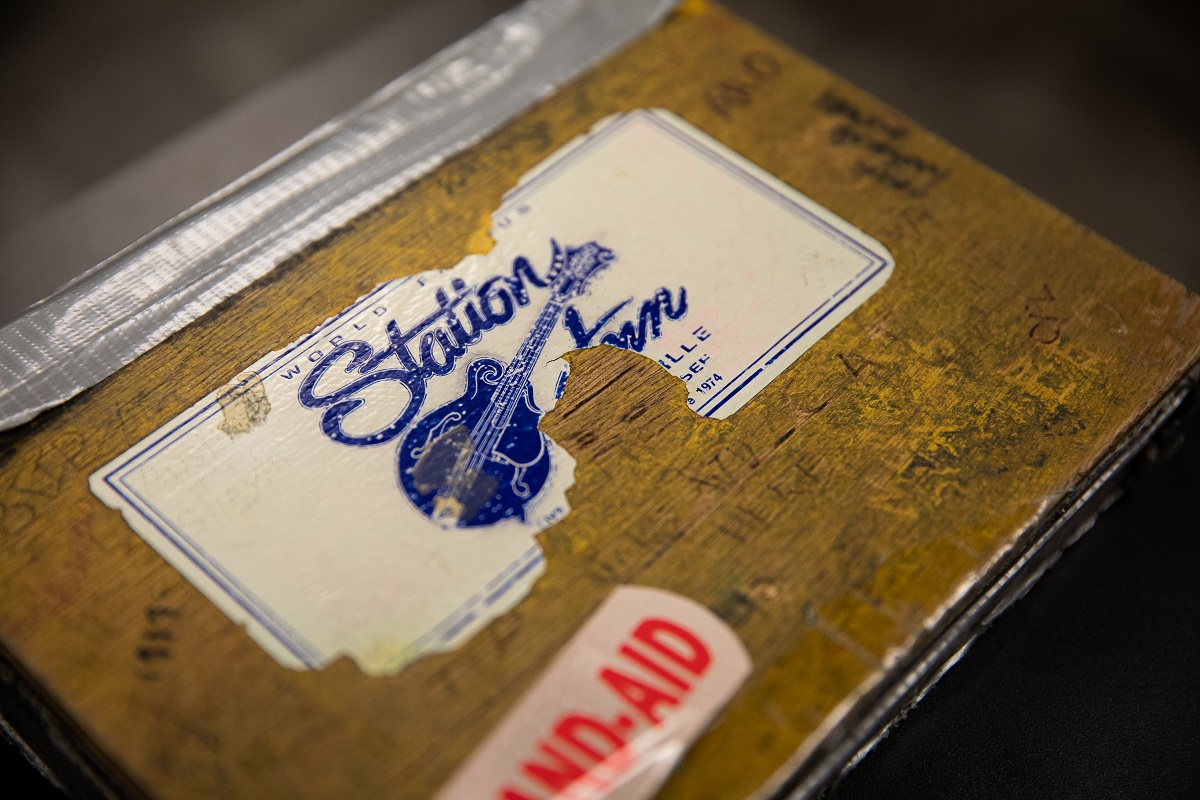
A cigar box used for many years to collect admission fees at the club entrance

Also on display is a small wooden box that was used to collect admission for years, along with some history about former Station Inn employee and local folk icon, Ann Soyars. “Ann embodied what the Station is about,” Cooper says. Soyars worked the door and was “small but fierce.” She was known to throw out rowdy college football players for being too loud, but also welcome regulars and newcomers alike. “Ann’s inclusion in the exhibit is indicative of what we’re trying to do, which is to help people understand not just the facts of the matter, but the spirit of the matter. The Station Inn is an example of musical community building in the most positive way. It’s like Cheers for ‘grassers.”

In addition, the exhibit features other artifacts from both the building and the musicians who have performed there including a fiddle played extensively by Tammy Rogers with the SteelDrivers, Mike Bub’s Kay M-1 double bass, which he played with many groups at The Station Inn — including Weary Hearts (Chris Jones, Butch Baldassari, Ron Block), the Del McCoury Band, and the Sidemen (Terry Eldridge, Jimmy Campbell, Ronnie McCoury, Gene Wooten, Ed Dye, Kristin Scott Benson, and Larry Perkins). Seats from a tour bus used by Lester Flatt, which serve as seating in the venue, are on view as well.
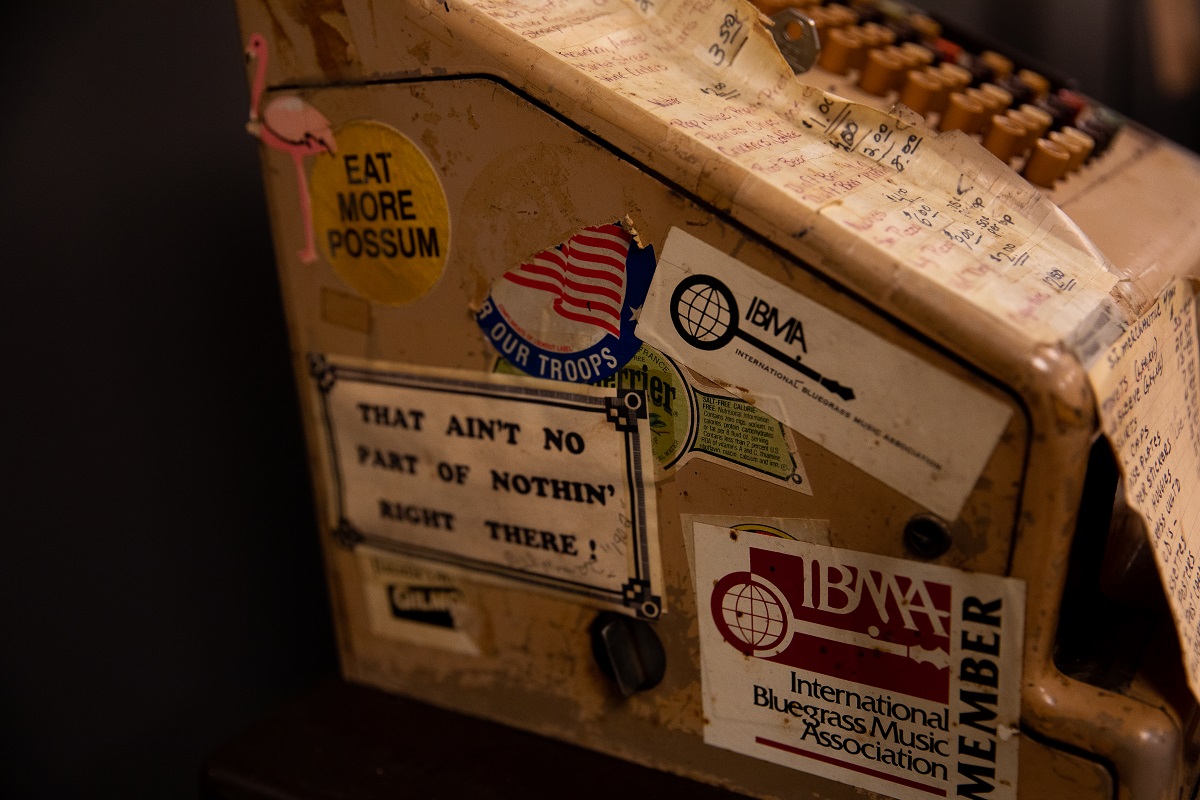
The Station Inn’s cash register

Generations of performers’ children have grown up in the Station’s green room and backstage and have gone on to perform on stage as adults. Newspaper has been put down on the bar to admire someone’s new puppies. Great care has been taken to lovingly craft the perfectly reheated pizza. Beers are shared by locals and honored guests after the doors are closed to the public. (And I have hidden fancy decaf coffee and a pour-over in the back that I take out when I visit.) To this day the Station Inn is a community gathering place where friendships, bands, and lifelong loves of bluegrass are formed. It embodies not only the authenticity of the music but of the community. And often, everyone knows your name.


Editor’s Notes: The Station Inn has endeavored to safely present live music throughout the pandemic. They have reopened to live audiences at a limited capacity and live stream performances through their web portal stationinntv.com.

The Country Music Hall of Fame and Museum will present The Station Inn: Bluegrass Beacon until January 2, 2022. The museum is currently open to the public at a limited capacity.

Photo of Station Inn and artifacts: Emma Delevante for the Country Music Hall of Fame and Museum
Other photos: Charmaine Lanham
Peter Rowan, Béla Fleck, Sharon Gilchrist, Josh Williams – Toy Heart: Remembering Tony Rice

Host Tom Power speaks with Peter Rowan, Béla Fleck, Sharon Gilchrist, and Josh Williams all former bandmates, collaborators, and peers of Tony Rice, in the second edition of our special tribute, Toy Heart: Remembering Tony Rice.

LISTEN: APPLE PODCASTSSPOTIFYMP3

On episode 2 of our limited series, Toy Heart: Remembering Tony Rice, host Tom Power begins with Béla Fleck, talking about the making of two legendary albums: Drive and The Bluegrass Sessions: Tales from the Acoustic Planet, Vol.2. Fleck relates what it was like to work with Tony in studio and some wild stories about their touring together.

Also in the episode, mandolinist and instructor Sharon Gilchrist displays a rare perspective on Tony’s life. Something of a recluse, Tony would often drive by himself after gigs, hours and hours overnight. Gilchrist had the rare opportunity to join him for some of these drives and tells some stories of what she learned on those trips to and from Quartet shows. Later in the episode, a conversation with Peter Rowan about his early memories of Tony – and how he compared with his mentor Clarence White. To conclude, Josh Williams talks about being Tony Rice’s “voice” in his band, the Unit, how Tony helped him get through one of the darkest periods in his life, and why Tony was and is his hero.

Editor’s note: Heart part three of our special tribute to Tony Rice here


Photo credit: Michael Sheehan


LISTEN: Ray Wylie Hubbard, “Hummingbird” (Feat. Peter Rowan)

Artist: Ray Wylie Hubbard
Hometown: Wimberley, Texas
Song: “Hummingbird” (feat. Peter Rowan)
Album: Co-Starring
Release Date: July 10, 2020
Record Label: Big Machine Records

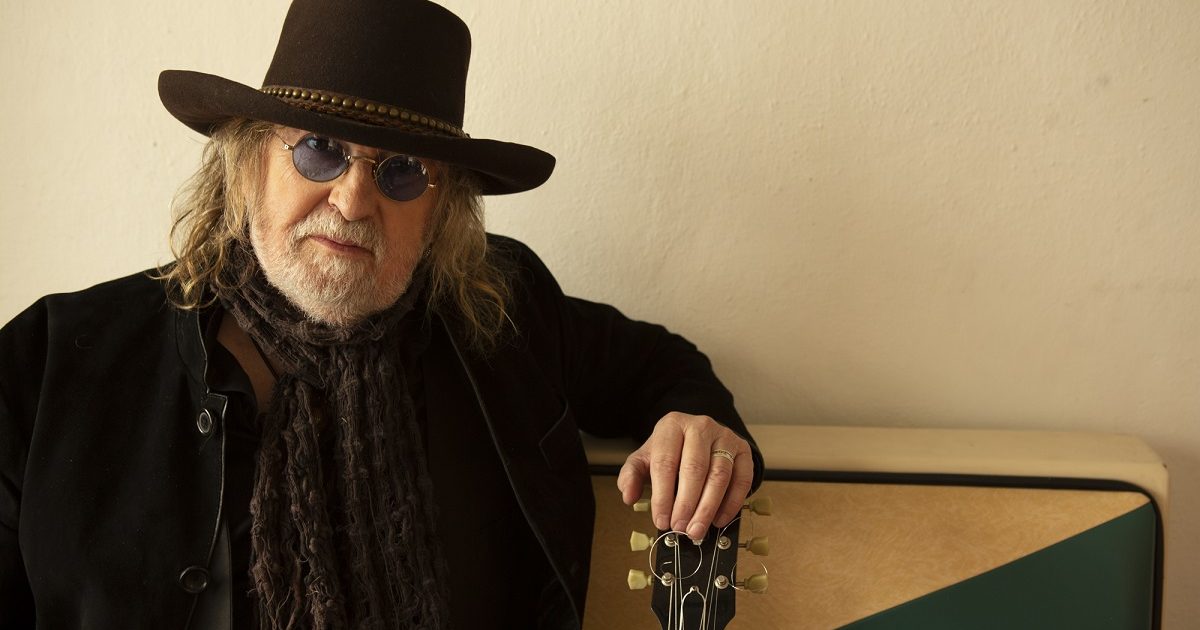
In Their Words: “My son, Lucas, gave me a Gibson Hummingbird guitar and one morning as I was playing it in our log home living room, there was a hummingbird zooming around my wife Judy’s feeder and the muse said, ‘Here ya go. It’s obvious…write it.’ So I did in about 20 minutes! As played it for the first time, I wondered who should play and sing on it and the only name that popped up in my head was…Peter Rowan! So I sent it to him and asked if he would play on it. I’m guessing he probably played his licks on a Martin D-18 but whatever it was, it was perfect and I am so grateful he said yes.” — Ray Wylie Hubbard


Photo credit: David McClister

Laurie Lewis & Friends, “Dear Old Dixie (Live)”

This edition of Tunesday turned out to be an oddly circuitous task. We often take this space to highlight our Artists of the Month, pointing out instrumentals from throughout their catalogs and across their careers, but for singer, songwriter, guitarist, poet, frontwoman, and long-distance hiker Laurie Lewis, the tunes are simply in too-short supply. Not because they don’t exist, but because Lewis’ cosmic level lyricism tends to eclipse her virtuosic command of the majority of bluegrass’s titular instruments. You may most often see her with a dreadnought strapped around her shoulders, but rest a fiddle there instead and you’re bound to enjoy some of the best bluegrass fiddling — with an even sprinkling of contest style, West Coast country, and the melody-driven old-time of the Pacific Northwest throughout.
In this clip from a live performance on The Texas Connection in 1992, Lewis is joined by longtime musical partner and bandmate Tom Rozum as well as Sally Van Meter, Alan Munde, Peter Rowan, Peter McLaughlin, and Cary Black on a sleek and stupefying rendition of “Dear Old Dixie.” It’s a banjo number, naturally, so Munde kicks it off with an uncharacteristically normative, Scruggs-like play through the melody. The remaining bandmates each take a turn, but the fire’s really lit when Lewis saws out her own solo, reminding all of us that she only ends up placing herself behind the guitar more often than not because she chooses to. With slippery, deliciously dissonant double stops she capitalizes upon the signature energy and showmanship concentrated within every note, every bow stroke, and every string pluck she issues.
While a quick stroll through her catalog, especially on streaming platforms, may not immediately land you in a pile of recordings of burning Bill Monroe tunes, or contemplative waltzes, or danceable hornpipes, you’ll probably find yourself confounded by the natural imagery, tender emotion, and raw spiritual power of her lyrics instead. That’s understandable. With a little digging, though, that picture of a legendary artist’s work can be expanded to include lifelong rations of indomitable pickin’ like this, too. And it ought to.

Photo courtesy of the artist.

BGS 5+5: Hot Buttered Rum

Artist: Hot Buttered Rum
Hometown: San Francisco, California
Latest album: Something Beautiful

What’s your favorite memory from being on stage?

Years ago, we were at Bean Blossom, Indiana. We were a very new band at that point and we played a set in the afternoon. We’d been hanging a bit with Peter Rowan, so he invited us to play in his set that evening. I stepped onstage to find myself next to Tony Rice! I felt completely out of my league, and by every measure, I was. At one point, solos were being passed down the stage. Tony took a ripping solo, of course, and then it was my turn. Yes, I had to take a guitar solo after Tony Rice. The audience was empathetic and gave me a sympathy clap. And Tony said “haw!” — Nat Keefe

What rituals do you have, either in the studio or before a show?

Coffee is very important. Even if I have a set at midnight, 1 a.m. — whenever — I get good coffee in me an hour beforehand. No matter how much I drink before I play, I never have trouble burning through it on stage. I set myself up with a cup and I get my right hand going with the rolls. Caffeine with the left hand, banjo with the right. If I have time to drink that coffee slow enough and play those rolls fast enough, I walk onstage feeling damn near superhuman. — Erik Yates

If you had to write a mission statement for your career, what would it be?

“Give it up.” That’s about it. All the artists I love have their own way of talking about this. When I give, I end up creating so much more, instead of dragging down the next round of work with what I want, whether I’m good enough, whether I’m gonna make as big a splash as my friend or my hero or the new voice on the scene. None of that matters to the damn song. What matters to the song is that it gets made, that it gets out into the world and that other people get to hear it and do what they wanna do with it. Maybe they’ll walk down the aisle to it. Maybe they’ll laugh at it. Maybe they’ll close their eyes and sway back and forth when they hear it. All of that is fine, all of that is welcome. What I want is to give it up, give it away, set it free. — Erik Yates

How often do you hide behind a character in a song or use “you” when it’s actually “me”?

Actually, it’s often the opposite. Early on, my dad challenged me to write songs from different points of view. It’s liberating! You can be an observer, and it’s not always about you and your feelings. A good example of this is my tune, “Desert Rat.” — Nat Keefe

Which elements of nature do you spend the most time with and how do those impact your work?

I’m a mountain person at heart. I think we all are, the band guys. That was how this thing started with us. Since bluegrass is from the old mountains in Appalachia, when we first started writing together we went up as high as we could in the new mountains out West, our Sierra, and listened as closely as we could to what those places were saying. We had this grand idea of making mountain music out here that could reach across time to the mountain music out there, and maybe tickle the Rockies too on its way past. Our best towns have always been mountain towns. This music speaks so well there. — Erik Yates


Photo credit: Matt Sharkey

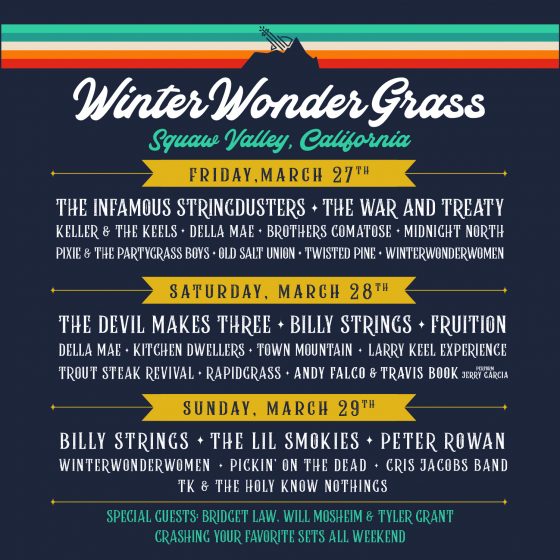
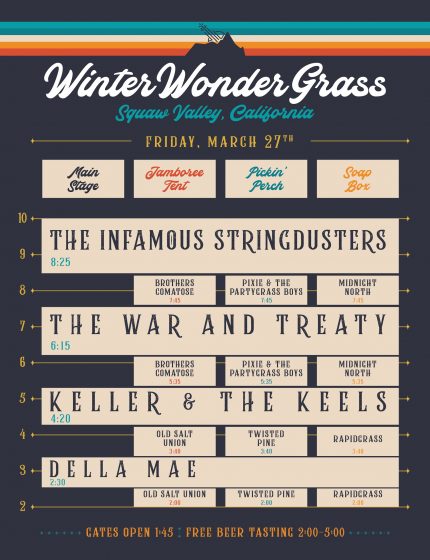
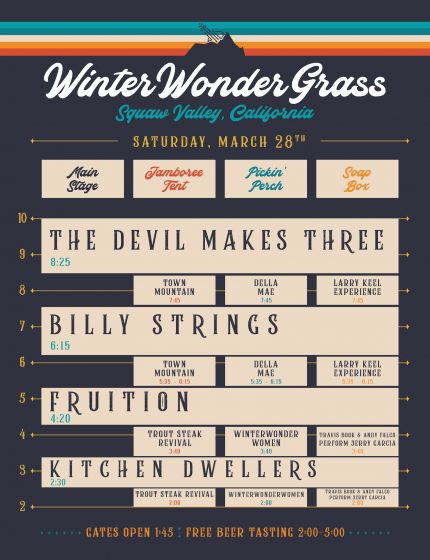
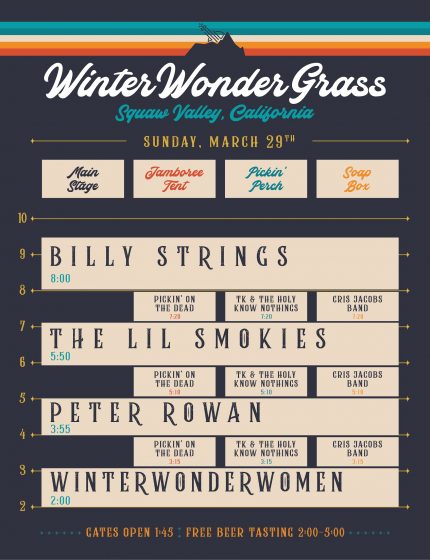
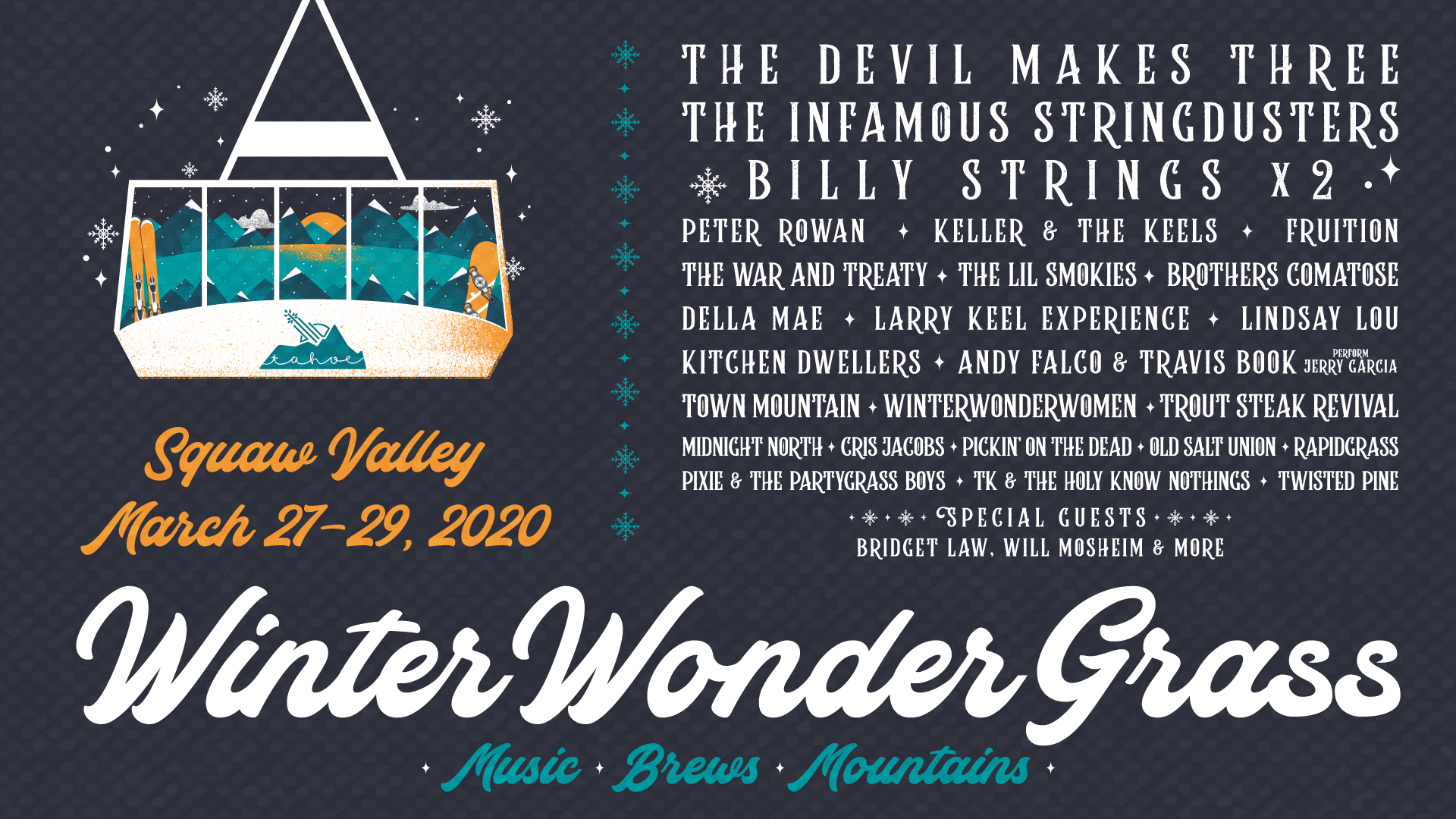
ANNOUNCING: WinterWonderGrass California Schedule is Here

WinterWonderGrass 2020 is on the horizon and BGS is excited to share the official daily schedule for their California edition, taking place March 27-29th in Squaw Valley, California.

WinterWonderGrass California is excited to present not one, but two headlining sets from rising star Billy Strings, who was named International Bluegrass Music Association’s Guitar Player of the Year in 2019.

In conjunction with the daily schedule announcement, WWG plans to release a limited quantity of single-day tickets starting Thursday, January 23, and weekend General Admissin passes will move to tier 2 pricing the same day. Tickets and more info available here.

“WinterWonderGrass continues to honor the pillars of bluegrass while creating space for the evolution of the genre to flourish. I feel this lineup speaks to that ethos,” festival founder Scotty Stoughton remarks in a press release. “I’m super excited to see first time bands like The War and Treaty, Cris Jacobs Band and Twisted Pine as their jaws drop from the stunning Squaw Valley views surrounding their stage. It’s also an honor to watch Billy Strings continue to grow, and welcome back legends like Peter Rowan.”

Sentimentally, Peter Rowan himself adds, “When the music hits the crystal air at WinterWonderGrass and echoes off the mountains, we are home.”

Gates open at 1:45 PM each day during the 3-day music festival with Friday and Saturday nights’ programming will last until 10:00 PM, and Sunday ends slightly earlier around 9:30 PM. Performances across the Soapbox, Pickin’ Perch and Jamboree stages will see many artists perform two consecutive sets, and each night, performances on the Close Pick stage will close the festival.

Tickets for all three stops are now on sale and moving fast: Colorado | California | Vermont.

VIP tickets to Steamboat’s stop are already sold out, but fans are encouraged to check out the official fan-to-fan ticketing exchange powered by Lyte if they’re in search of tickets as more of the dates and tiers sell out.

See the daily schedules below:


Photo credit: Molly McCormick

GIVEAWAY: Win tickets to WinterWonderGrass (Squaw Valley, CA) Mar 27-29

IBMA Reveals Award Nominees, Hall of Fame Inductees, Distinguished Achievement Winners

Five of the top bands in bluegrass earned IBMA Entertainer of the Year nominations from the International Bluegrass Music Association. The ballot was revealed on Wednesday morning in Nashville.

The Entertainer of the Year nominees are Balsam Range, Sam Bush Band, The Earls of Leicester, Del McCoury Band, and Joe Mullins & the Radio Ramblers.

Due to a tie, seven titles will compete for the Song of the Year category. The IBMA Awards will take place Thursday, September 26, at the Duke Energy Performing Arts Center in Raleigh, North Carolina, with hosts Jim Lauderdale and Del McCoury.

Mike Auldridge, Bill Emerson, and the Kentucky Colonels have also been named as inductees into the Bluegrass Hall of Fame.

Distinguished Achievement Award recipients include radio personality Katy Daley, Mountain Home label founder Mickey Gamble, former IBMA executive director Dan Hays, The Lost and Found founder Allen Mills, and Japanese language magazine Moonshiner, now in its 37th year covering bluegrass and acoustic music.

The full ballot is below.

ENTERTAINER OF THE YEAR

Balsam Range
Sam Bush Band
The Earls of Leicester
Del McCoury Band
Joe Mullins & the Radio Ramblers

VOCAL GROUP OF THE YEAR

Balsam Range
I’m With Her
Doyle Lawson & Quicksilver
Russell Moore & IIIrd Tyme Out
Sister Sadie

INSTRUMENTAL GROUP OF THE YEAR

Sam Bush Band
Michael Cleveland & Flamekeeper
The Earls of Leicester
Ricky Skaggs & Kentucky Thunder
The Travelin’ McCourys

NEW ARTIST OF THE YEAR

Appalachian Road Show
Carolina Blue
High Fidelity
Mile Twelve
Billy Strings

SONG OF THE YEAR (7 nominees, due to a tie)

“Dance, Dance, Dance”
Artist: Appalachian Road Show
Writers: Brenda Cooper/Joseph Cooper/Steve Miller
Producers: Barry Abernathy, Darrell Webb, Ben Isaacs
Executive Producer: Dottie Leonard Miller
Label: Billy Blue Records

“The Girl Who Invented the Wheel”
Artist: Balsam Range
Writers: Adam Wright/Shannon Wright
Producer: Balsam Range
Executive Producer: Mickey Gamble
Label: Mountain Home Music Company

“The Guitar Song”
Artist: Joe Mullins & the Radio Ramblers with Del McCoury
Writers: Bill Anderson/Jamey Johnson/Vicky McGehee
Producer: Joe Mullins
Associate Producer: Jerry Salley
Label: Billy Blue Records

“The Light in Carter Stanley’s Eyes”
Artist: Peter Rowan
Writer: Peter Rowan
Producer: Peter Rowan
Associate Producer: Tim O’Brien
Label: Rebel Records

“Next Train South”
Artist: The Po’ Ramblin’ Boys
Writer: Mac Patterson
Producers: The Po’ Ramblin’ Boys, Dave Maggard, Ken Irwin
Label: Rounder Records

“Take the Journey”
Artist: Molly Tuttle
Writers: Molly Tuttle/Sarah Siskind
Producer: Ryan Hewitt
Label: Compass Records

“Thunder Dan”
Artist: Sideline
Writer: Josh Manning
Producer: Tim Surrett
Label: Mountain Home Music Company

ALBUM OF THE YEAR

City on a Hill
Artist: Mile Twelve
Producer: Bryan Sutton
Label: Independent

Del McCoury Still Sings Bluegrass
Artist: Del McCoury Band
Producers: Del and Ronnie McCoury
Label: McCoury Music

For the Record
Artist: Joe Mullins & the Radio Ramblers
Producer: Joe Mullins
Associate Producer: Jerry Salley
Label: Billy Blue Records

I Hear Bluegrass Calling Me
Artist: Carolina Blue
Producers: Bobby Powell, Tim and Lakin Jones
Executive Producers: Lonnie Lassiter and Ethan Burkhardt
Label: Pinecastle Records

Sister Sadie II
Artist: Sister Sadie
Producer: Sister Sadie
Label: Pinecastle Records

GOSPEL RECORDING OF THE YEAR

“Acres of Diamonds”
Artist: Joe Mullins & the Radio Ramblers
Producer: Joe Mullins
Associate Producer: Jerry Salley
Label: Billy Blue Records

“Gonna Sing, Gonna Shout”
Artist: Claire Lynch
Producer: Jerry Salley
Label: Billy Blue Records

“I Am a Pilgrim”
Artist: Roland White and Friends
Producers: Ty Gilpin, Jon Weisberger
Label: Mountain Home Music Company

“I See God”
Artist: Marty Raybon
Producer: Jerry Salley
Label: Billy Blue Records

“Let My Life Be a Light”
Artist: Balsam Range
Producer: Balsam Range
Executive Producer: Mickey Gamble
Label: Mountain Home Music Company

INSTRUMENTAL RECORDING OF THE YEAR

“Cotton Eyed Joe”
Artist: Sideline
Producer: Tim Surrett
Label: Mountain Home Music Company

“Darlin’ Pal(s) of Mine”
Artist: Missy Raines with Alison Brown, Mike Bub, and Todd Phillips
Producer: Alison Brown
Label: Compass Records

“Earl’s Breakdown”
Artist: The Earls of Leicester
Producer: Jerry Douglas
Label: Rounder Records

“Fried Taters and Onions”
Artist: Carolina Blue
Producers: Bobby Powell, Tim and Lakin Jones
Executive Producers: Lonnie Lassiter and Ethan Burkhardt
Label: Pinecastle Records

“Sunrise”
Artist: Sam Bush & Bela Fleck
Producers: Akira Otsuka, Ronnie Freeland
Label: Smithsonian Folkways Records

COLLABORATIVE RECORDING OF THE YEAR

“Burning Georgia Down”
Artist: Balsam Range with Atlanta Pops Orchestra Ensemble
Producer: Balsam Range
Label: Mountain Home Music Company

“Darlin’ Pal(s) of Mine”
Artist: Missy Raines with Alison Brown, Mike Bub, and Todd Phillips
Producer: Alison Brown
Label: Compass Records

“The Guitar Song”
Artist: Joe Mullins & the Radio Ramblers with Del McCoury
Producer: Joe Mullins
Associate Producer: Jerry Salley
Label: Billy Blue Records

“Please”
Artist: Rhonda Vincent and Dolly Parton
Producers: Dave Cobb, John Leventhal, Frank Liddell
Label: MCA Nashville

“Soldier’s Joy/Ragtime Annie”
Artist: Roland White with Justin Hiltner, Jon Weisberger, Patrick McAvinue, and Molly Tuttle
Producers: Ty Gilpin, Jon Weisberger
Label: Mountain Home Music Company

MALE VOCALIST OF THE YEAR

Shawn Camp
Del McCoury
Russell Moore
Tim O’Brien
Danny Paisley

FEMALE VOCALIST

Brooke Aldridge
Dale Ann Bradley
Sierra Hull
Molly Tuttle
Rhonda Vincent

BANJO PLAYER OF THE YEAR

Gina Furtado
Mike Munford
Noam Pikelny
Kristin Scott Benson
Scott Vestal

BASS PLAYER OF THE YEAR

Barry Bales
Mike Bub
Beth Lawrence
Missy Raines
Mark Schatz

FIDDLE PLAYER OF THE YEAR

Hunter Berry
Becky Buller
Jason Carter
Michael Cleveland
Stuart Duncan

RESOPHONIC GUITAR PLAYER OF THE YEAR

Jerry Douglas
Andy Hall
Rob Ickes
Phil Leadbetter
Justin Moses

GUITAR PLAYER OF THE YEAR

Kenny Smith
Billy Strings
Bryan Sutton
Molly Tuttle
Josh Williams

MANDOLIN PLAYER OF THE YEAR

Alan Bibey
Sam Bush
Sierra Hull
Ronnie McCoury
Frank Solivan

Kauai Folk Festival Will Celebrate Music of Hawaii and Beyond

Even for knowledgeable fans of folk music, the lineup of the Kauai Folk Festival offers plenty of artists to discover from Hawaii and beyond. Along with headliners like Taj Mahal’s Hula Blues Band and Peter Rowan’s My Aloha Bluegrass Band, the two-day roster also features Hawaiian music from Puka Asing, Wally Rita y Los Kauaianos, and more representing the diversity of Hawaiian traditional music.

With five stages running continuously, the lineup also includes Jonny Fritz, Blaine Sprouse, Ed Poullard, Reeb Williams & Caleb Klauder, Mike Bub, and many others. Meanwhile, Kauai Folk Workshops will offer instruction on guitar, fiddle, banjo, ukulele and mandolin, in addition to dance instructors teaching hula, square dance, swing, and two-step, and voice instructors teaching harmony singing, ballads, and Hawaiian song.

Festival director Matt Morelock fielded a few questions by email about the festival, slated for September 28-29 at the historic Grove Farm Museum in Lihue, on the southeast coast of Kauai.

BGS: What inspired the idea to create a folk festival in Kauai?

Morelock: For decades, Hawaiian music has stood on the periphery of the ‘folk’ genre. Its undeniable and indelible influence on all forms of American music deserves to be celebrated. We created the Kauai Folk Festival for such a celebration and invited all of our favorite performers, both local and continental, to sing, pick, dance, and meet one another in this tropical paradise.

When you are selecting artists, do you have a certain audience in mind? In other words, is there a common thread that runs through your lineup and/or your ticket holders?

We’ve attempted to represent the broadest swath of ‘folk’ music and musicians that we could find. From bluegrass to blues – from Cajun to country – we chose the best performers in as many genres as possible to illustrate the diversity of American folk music. The common thread is diversity. Artists were chosen for their enthusiasm and skill.

What have you learned about the process of booking festivals that has really surprised you?

We’ve learned that a worthwhile festival is one with a purpose. Hawaiian music and musicians are fighting against the expense and logistical complication of geographical separation as well as the mass perception of their music and culture as ‘foreign,’ when in truth Hawaiian music and culture is both a product of and strong influence on what we consider ‘American’ culture and music. We’ve learned that a higher purpose can confound the typical challenges that festivals face in finding an identity and audience.

For someone who has never been to Kauai, how would you describe it to them?

In addition to being GORGEOUS BEYOND BELIEF, Kauai is rural and cosmopolitan at the same time. There are more wild pigs than human beings living on this island. The natural beauty and local hospitality are legendary. You can book a hotel and rent a car here just like you can anywhere else in the U.S. Flights aren’t as expensive as you think. Beer is cheap. Fresh food and clean air are abundant. There’s really no reason NOT to visit!

In addition to interest from the locals, you will be hoping to attract people from the mainland as well. What are some of the amenities or unique qualities that will make this festival a destination event?

We’ve opted to keep festival admission affordable rather than spending time and resources on lodging and flight packages. We trust that Kauai Folk Festival attendees from the mainland won’t have trouble booking a flight, renting a car, and finding a hotel room. Kauai itself is a uniquity. The festival and the astounding Grove Farm Museum are an amenity. There’ll be a broad selection of spectacular local cuisine (plenty of accommodations for vegan/vegetarian/gluten-free diets), and extremely creative beverage and local juice options. We’re also ‘on call’ via www.kauaifolk.com to assist with any travel questions or complications!

What do you hope that attendees will take away from the Kauai Folk Festival experience?

We hope that Kauai Folk Festival fans will leave the event with a deeper understanding of the historical interconnectedness between Hawaiian culture and ‘mainland’ culture. In the production process, we are finding similarities and cross-influences on a daily basis!

The Show On The Road – Peter Rowan

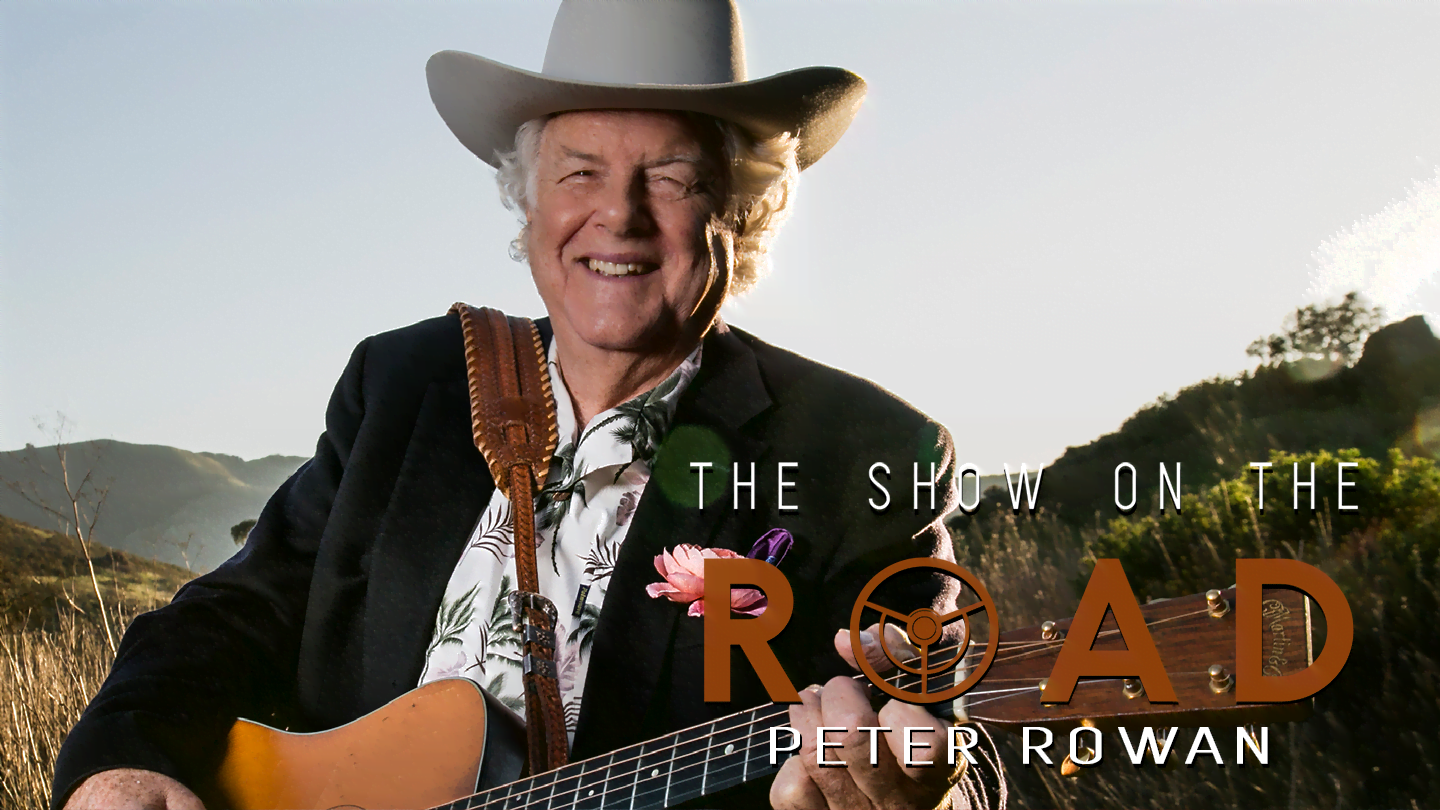
In this episode, host Z. Lupetin speaks with Peter Rowan, the affable elder-statesman of roots music, who was there at the crucible beginnings of bluegrass and has joyfully jaunted across a plethora of folk music styles over the course of his five decade-long career.

LISTEN: APPLE PODCASTS • MP3

These days, despite it getting harder for him to get around, he’s still on the road constantly, and you can see him at Telluride Bluegrass Festival, Red Wing Roots, Rockygrass, and wherever young folks and old folks are still gathering around whatever stew folk music is cooking these days. Stick around to the end of the episode to hear Peter set up outside in the sun with his Free Mexican Airforce Band to perform a sweet Tejano tune under the trees.