Sweet Petunia Grew Into Their Foggy Mountain Mental Breakdown

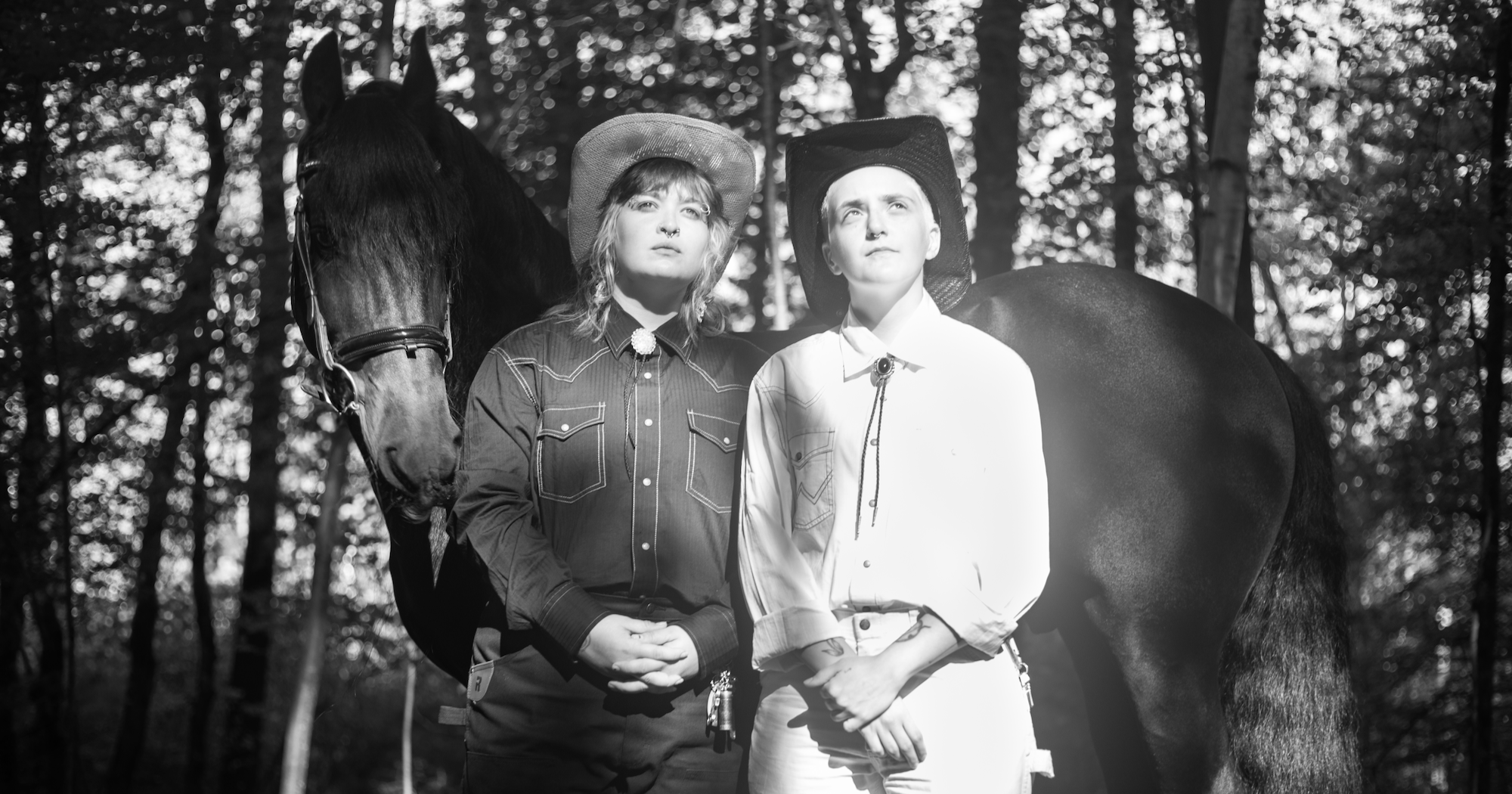
Little did Mairead Guy and Maddy Simpson know upon enrolling in Greg Liszt’s 21st Century String Band ensemble at Berklee College of Music that the course of their musical careers were about to be forever altered. Upon being paired up for a rehearsal by chance, Mairead and Maddy unearthed their musical synastry quickly. The two wove a vocal blend of sibling-like precision and their musical instincts coalesced with ease. After several jam sessions, the inevitable was clear – Mairead and Maddy were meant to make music together. With banjos in hand, the two joined forces to establish the cherished Boston alt-folk duo, Sweet Petunia.

2026 sees Sweet Petunia unfurling its petals even further – on March 13, the duo released their inaugural LP, Foggy Mountain Mental Breakdown via Ani DiFranco’s Righteous Babe Records, their first release since their 2021 EP, Lovingly. Laden with ripe lyrics and expansive sonic landscapes, Sweet Petunia harvests new growth with 12 tracks navigating dynamic emotional thresholds and lyrics that cover themes from gender identity to toxic relationships to heartbreak and beyond.

BGS was elated to sit back down with Sweet Petunia and discuss all things Foggy Mountain Mental Breakdown.

We last got to chat in 2024 for One to Watch. What has the shape of the last two years looked like for y’all?

Maddy Simpson: Lowkey pretty crazy! We started working with a booking agent and got hooked up with our label, Righteous Babe. We’re also in talks with a manager, so we’ve kind of legitimized in that way. I think the last time we spoke we didn’t have any of that.

So exciting! How has that changed the scope of your project?

Mairead Guy: They’ve been doing this so much longer and the range of people that they can connect us with is so vast compared to what we’ve been able to build so far, which is really cool.

MS: Yeah, it’s interesting to have other perspectives to bounce off of, too. The team is very thoughtful in many ways and they think of things that we would have never thought of. It does feel like this has legitimized the record and the band in a big way. Not that we weren’t legit before, but now we’re thinking about things on a much wider scale.

Speaking of which, congratulations on the new record! What about this moment in time do you feel like influenced the birth of Foggy Mountain Mental Breakdown?

MS: Truly, once we started working with the label, we just wanted to get it out as quickly as possible. March just worked best for them to slot it in, so we went with it!

MG: And March 13th must be a cosmically good day to put out an album, because we have a couple friends putting out albums that same day – Anjimile and Grace Givertz.

How fortuitous! So what was it like putting this album together? How was it different from the process for your EP, Lovingly?

MS: We recorded Foggy Mountain Mental Breakdown essentially four years ago at this point. It was our first try recording a full-length album and we did it in a kind of hybrid format – some in a couple different home studios, and then an actual recording studio. It was the first time we really brought in additional people to play on it, which was cool. We were much more thoughtful about the arrangements and the production and all that. It was the biggest thing we’ve ever done, and it was a lot, but it was incredible to see how it all turned out.

MG: We definitely learned a lot about what works and what doesn’t and what we want for next time. Even if all that was the only thing that came about from this process, it would have made it worth it.

Could you say more about what you learned?

MS: I think we both grew a lot. I learned a lot more about what I wanted and how I want things to sound. It was really awesome to work with some really close friends of ours; I learned more about collaborating, which was really cool. I also learned that it takes a really long time to put out a full-length record. Even once it’s finished, it takes quite a while, which I already knew in theory, but then to live it – it can take years sometimes, which is crazy.

MG: I feel similarly. It is cool to have the time to dedicate to thinking about the way that you want things to sound in their recorded form. That was great to learn about, especially differentiating between the ways in which that can be helpful and then also the ways in which you can get stuck in a loop of overthinking.

Now I have to ask, the title of the album is Foggy Mountain Mental Breakdown, and I’m curious if there’s anything you’d like to say about the influences behind that – Earl Scruggs, mental health, etc.?

MG: We thought it was funny! We were around a lot of bluegrass at the time – I think we came up with it at a bluegrass festival, and then a lot of our songs are pretty sad. There was sort of this trend where a lot of people were giving their projects jokey names that were plays on words, like Dolly Spartan or Chet Faker. Stuff like that was popular at the time.

MS: And it’s a little bit of an “if you know you know” vibe, because nobody knows “Foggy Mountain Breakdown” unless you play roots music and if you do, it’s the most old news bluegrass song. It’s like “Free Bird.” But then normal people have no idea what it means, which is kind of silly. It’s also a nod to our origins. Though we never really played bluegrass music, for the first three or so years that we were a band, we were almost exclusively around traditional roots music and a lot of those people were playing bluegrass. It is a huge part of our band, even though we’re more so old-time people, we love bluegrass.

The folks over at BGS definitely catch your drift!

So on FMMB, there’s a ton of lush instrumentation — what was that like? How did you find the additional musicians for all of these orchestrations?

MS: Most of the people that played on the album were people that we knew who were friends and musical collaborators of ours already. We know a lot of musicians, so it was pretty easy to put a lineup together. For example, we knew Lucy Nelligan – who plays all the fiddle on the album – from college and had played with her before. It was really a no-brainer to just have her come in and track a bunch of fiddle, just letting her go and do whatever she was gonna do. It’s cool to have that trust built with people where you know they’re going to produce quality tracks. We’re lucky that we are around so many amazing and talented musicians.

“Wilting” is the track with all the woodwinds and that was really cool because our producer, Leah Gutman, found a bunch of people to play on that session. All those people are now friends of ours, though at the time we didn’t really know any of them that well. It’s wonderful to see how our relationships have grown over time with the people that live in our community and play in our scene. For “Wilting,” our friend Christian Schmidt, who’s my roommate, played flute, but then our friend Brendan Wright from the band Tiberius was playing clarinet. And Miles Chandler from Clifford came in and played, our friend Nate Scaringi and our friend Maria – all these people that we’ve gotten to know over the years, but they were virtually strangers when they came in and tracked that song.

Do y’all have any dream collabs?

MS: Dolly Parton. Sabrina Carpenter got to do it, so…

Oh, and Willie Nelson! I’d really love to play Luck Reunion.

MG: Paul Simon. Or like, Simon & Garfunkel 30 years ago. When they reunited at Central Park we could’ve opened. Or Rhiannon Giddens would be cool.

MS: Gillian Welch and Dave Rawlings would also be awesome.

What track on the album do you each feel a deepest kinship to? Or is that like asking a parent to choose their favorite child?

MS: Hmm. I really like how “In David’s Living Room” turned out. I really love all of the auxiliary stuff that happens. I remember when Leah and I were cooking on that, I was just very excited with the direction that track was going in, because it felt like our indie moment in a record that’s pretty traditional. Though there’s other moments like that too, I think that’s my standout right now.

MG: For me, it’s probably “Grub.” That’s just one of my favorite songs that we’ve ever worked on together. You know, there’s a lot of songs on the album that, because they’re so old, don’t necessarily feel as relevant to where I am now, but “Grub” is one that I feel very protective of. The flute that Christian put on it is just so beautiful. It was also really fun to record — we did it on a 4-track while sitting on Maddy’s washer-dryer. Plus my roommate, Riley Halliday, made a beautiful stop-motion puppet music video for it.

Oh, tell me more about the music video.

MG: Yeah, so my roommate Riley – they’re an incredible visual artist, and they are really good at making puppets. We came to them about three years ago, probably, and asked them if they’d be interested in making this video. They did a combination of stop-motion, claymation, hand-drawn animation, and puppets that they built completely themself. They handbuilt everything and made this perfect video that I feel just represents the song so well.

Talented friends seriously make the world go round! Was there anything outstandingly difficult about making this album?

MG: Well, I was living in Maine at the time, so I was commuting down every weekend. In terms of life, it was great for me to be down there every weekend, but it definitely made things take a little bit longer. And it was harder, for sure, because we couldn’t just pop in really quick and do something. Everything had to be planned out pretty far in advance.

MS: Yeah, that was tough. Also, it’s really expensive to put out a record. Often it’s something most people can’t do unless they crowdfund or save up hella money for. For us, it just took a lot of saving and being very smart with money – and lowkey we ran out of money in the process. So if anyone wants to buy some merch!

A hypothetical for you – if you each could wake up tomorrow having mastered any instrument, what would it be?

MS: I’ve actually been thinking about this a lot lately, because I kind of want to learn how to play the drums. Our friend Andre M is so crazy on the drums. He has this beautiful technique – it’s very beautiful to watch him play. Every time I see his band, I’ll have like one Miller High Life and then I’ll be like, “I’m gonna do that!” So yeah, I’d definitely love to learn how to play the drums better.

MG: I always thought that I maybe have the vibe of a bass player, so that could be fun. Maybe we’ll start our drum and bass era – we could be a drum and bass duo.

I’d so be here for that. How would you each sum up FMMB in five words?

MG: College angst and bad dreams.

MS: Lowkey sad, but it’s chill.

Okay, y’all killed that.

So what’s coming up for y’all? Where can the good people find you?

MS: We are going on an album release tour in April. We’ll be out for most of April and the beginning of May all over the place – the Northeast and the South. We’re so excited to be playing five dates supporting Ani DiFranco. Our full list of tour dates is out now. Come through!


Photo Credit: JJ Gonson

The Working Songwriter: Ricky Montgomery

Our guest this week on the Working Songwriter resides in Los Angeles, but spent many of his formative years in St. Louis, Missouri. Ricky Montgomery first built an audience on Vine in his early twenties before releasing his self-titled debut album in 2016. That bedroom pop album was a cult favorite until 2020, when several of its songs exploded on TikTok, leading to a deal with Warner Records.

LISTEN: APPLE • SPOTIFY • LIBSYN • MP3

Montgomery’s singles, “Line Without a Hook” and “Mr. Loverman,” are RIAA-certified platinum and, all told, his catalog has collected more than a billion streams worldwide. That grassroots support has led to headlining tours with stops at the Wiltern in Los Angeles, Irving Plaza in New York City, and the Pageant in St. Louis, to name just a few.

This interview was recorded nearly 18 months ago and has been delayed due to a snafu on my end, but I’m so glad we get to hear it now. I think you’ll very much enjoy hearing about Ricky’s musical journey through his own words.


Photo courtesy of Prelude Press.

You Gotta Hear This: New Music From John R. Miller, Eilen Jewell, and More

Welcome to another edition of our weekly roundup of new roots music! You Gotta Hear This…

First up, country singer-songwriter Erin Gibney gives us a preview of a brand new version of “Risk It,” one of the first true love songs she had ever written. In this iteration, it’s stripped back to a more simple and acoustic approach, but still with a pop country sheen and plenty of big, energetic moments. Also in country, Carly King has announced her upcoming album, Loving You Is Easy, with a lovely and tender lead single, “Three Martinis.” King wrote the song about a fated trip to New York City where she fell in love with the man who would become her fiancé. It’s full of memories, nostalgia, and lush with imagery of falling head over heels, all wrapped in a cozy and gauzy folk-country package.

In the bluegrass world, North Carolina’s Unspoken Tradition highlight their working-class bluegrass bent with a new single, “Company Man,” which celebrates and interrogates the reality of blue-collar, hard working folks in this day and age. As they describe it, “The song tells the story of a man who seems to live to work, not work to live. There’s pride in that, but also a sense of stoic sadness.” Also speaking to the social and political climate of today, folk artist and singer-songwriter Eilen Jewell has released her own version of Woody Guthrie’s important and sadly still applicable song, “Deportee.” Jewell’s rendition is twangy, honky-tonking, and plaintive, drawing inspiration from the first time she ever heard the song as a teenager. She tells us that story – and about how the number has “haunted” her since – below.

Roots music fans will also enjoy watching singer-songwriter Adam Klein perform “Burnin’ Love,” an original song, in a brand new music video. Previously released in 2015, Klein returned to the track with collaborator Adam Poulin for a simple duo, acoustic reimagination of the song, which Klein wrote while on a Peace Corps mission in Mali in West Africa. And be sure you don’t miss a brand new single – and live performance video, to boot! – from West Virginian Americana troubadour John R. Miller. “If You Could Only See Me Now” is Miller’s take on a song written by a dear friend and musical compatriot, William Matheny. It’s another two-stepping, honky-tonk ready track perfect for sliding across the shiny floorboards or leaving a tear in your beer. Miller inhabits the lyric intuitively, with languid and laid back phrasing while the lyric, fiddle, and pedal steels pull him along.

There’s plenty to listen to and love. You Gotta Hear This!

Erin Gibney, “Risk It (Stripped)”

Artist: Erin Gibney
Hometown: Southington, Connecticut and Nashville, Tennessee
Song: “Risk It (Stripped)”
Release Date: April 3, 2026
Label: Rock Ridge Music

In Their Words: “I wrote this song after meeting my now-fiancé and it is one of the first true love songs I have ever written. ‘Risk It’ really describes the feeling of falling in love knowing that it could either end in marriage or the greatest heartbreak of your life. During the beginning of the relationship, I felt all the fears and excitement that come in the early stages of love. I brought this experience to Kipp Williams when we began working together and this became the first song we created. It was so much fun to not only try something new with my sound, but explore new themes in my music. This song is so close to my heart and I can’t wait for the world to hear this reimagined version of it!” – Erin Gibney

Track Credits:
Kipp Williams – Producer, songwriter, all instruments
Erin Gibney – Vocals, songwriter


Eilen Jewell, “Deportee”

Artist: Eilen Jewell
Hometown: Boise, Idaho
Song: “Deportee”
Release Date: March 24, 2026
Label: Signature Sounds

In Their Words: “I first heard ‘Deportee’ when I was a teenager. I can’t recall which version it was, but I remember I was babysitting a little girl who was about six years old. She put it in the CD player, cranked it up, and started singing along loudly in a sweet and mournful tone. I could tell it really resonated with her so I listened closely and realized it resonated with me too – the grief in the sudden separation of friends, the ripping away of a shared humanity – it’s haunted me ever since. I’ve heard just about every version of it there is, searching for one as anguished as the one in my memory of that night with the little girl howling along.

“My search never yielded one that quite fit so I altered the song a bit by putting it in a minor key and choosing only the verses that felt closest to the bone. It’s disheartening to think that Woody Guthrie wrote ‘Deportee’ nearly 80 years ago and it still rings true. What can I do but join him in fighting fascism the only way I know how? With my conscience, with my guitar, with my voice.” – Eilen Jewell

Track Credits:
Eilen Jewell – Acoustic guitar, vocals
Jason Beek – Drums, vocals
Jerry Miller – Electric guitar
Matt Murphy – Upright bass


Carly King, “Three Martinis”

Artist: Carly King
Hometown: New Jersey and Nashville, Tennessee
Song: “Three Martinis”
Album: Loving You Is Easy
Release Date: March 25, 2026 (single); May 15, 2026 (album)
Label: First City Artists

In Their Words: “I wrote this song about the first time I went to New York with my fiancé, who at the time was my boyfriend of one month and my brother’s best friend of 15 years. We stayed in a tiny hotel room and spent the whole day wandering Manhattan, falling in love, and ducking into dive-y music shops. I found a guitar I fell in love with and bought it and we carried it around the city all day – well, mostly he did. I remember feeling how simple and lucky everything was. Later, over martinis at the Carlyle Hotel (my namesake), guitar beside us, we talked deeply about our past, our families, and our future, and I knew I wanted to build a life with him around music. This song is the first date – it’s the taxi cab that takes you into the album.” – Carly King


Adam Klein, “Burnin’ Love”

Artist: Adam Klein
Hometown: Tucker, Georgia
Song: “Burnin’ Love”
Album: Live at Leesta Vall Sound Recordings
Release Date: April 3, 2026
Label: Cowboy Angel Music

In Their Words: “This album is a mix of previously released and unreleased songs. ‘Burnin’ Love’ was originally released on my 2015 album, Archer’s Arrow, with a full band presentation. Here, like all the songs on this new record, it’s stripped back to just acoustic guitar, vocals, and violin. But it still feels like it packs a punch. It randomly occurred to me to play it on tour in this duo format a couple nights before the session at Leesta Vall, so it’s fresh and a bit off the cuff. If the Archer’s Arrow version gave a nod to Neil Young & Crazy Horse in the sound of the electric guitar, somehow Adam Poulin’s fiddle playing here achieves something similar in its abandon.

“The song itself was written on my first full day in the village I lived in for two years during my Peace Corps service in rural Mali in West Africa. I was listening to the metal roof of my two-room mud house crackle from the blistering sunlight and questioning all my decisions – did I really want to spend two years here on my own in this curious land? It all loomed before me like a joke. I remember thinking of the feeling of solitude and emptiness that accompanies the end of love, and channeled it into this two-chord song.” – Adam Klein

Track Credits:
Adam Klein – Acoustic guitar, vocals
Adam Poulin – Violin, vocals

Video Credits: Filmed and edited by Jeff Shipman.


John R. Miller, “If You Could Only See Me Now”

Artist: John R. Miller
Hometown: West Virginia
Song: “If You Could Only See Me Now”
Release Date: March 27, 2026
Label: Rounder Records

In Their Words: “I’ve been fortunate to collaborate with William Matheny for a majority of my musical life at this point. Probably 15 years or so now, definitely in the widest variety of musical situations. The first time I saw him play at 123 Pleasant Street in Morgantown, West Virginia, in 2004 I passed out on a bench and somehow remembered his set that night. I’d get to meet him a few years later and we’ve been playing shows together ever since.

“William’s been playing in bands since he was in the single digits, and his body of work as a songwriter is huge and detailed, with recurring motifs and great riffs. His way of zooming in on the minutiae of viscerally familiar settings in his writing is something I have always admired, and his songs are imbued with literary and philosophical references that reward repeated listening.

“This is my take on a country song of his, one that we recorded some years back for his album That Grand, Old Feeling. I’ve always loved this song, feels like some unearthed forgotten classic country gem every time I hear it. It’s an evocative, tongue-in-cheek ode to the gutter that reads like a drunk postcard to a lost loved one back home.” – John R. Miller

“I’ve played a lot of music with John R. Miller over the years. Sometimes it was my band, sometimes it was his, and sometimes it was something else entirely. When the subject comes up, I usually tell people that we’ve been giving each other the same hundred dollars back and forth for 15 years. I say that completely in jest, of course. We’ve only recently started making that kind of money. When John played [the song] for me, I was incredibly flattered. I mean, it’s certainly not as if he’s hurting for material. On a completely selfish level, I got a huge kick out of hearing such a great singer interpret it and the Tulsa players putting their own spin on it.

“I love songs that bury the lede on the listener a little bit. Stuff like Tom Waits’ ‘Christmas Card From a Hooker in Minneapolis,’ Tom T. Hall’s ‘The Homecoming’ or ‘The Green, Green Grass of Home’ by Tom Jones. I didn’t want to let guys named Tom have all the fun, so I wrote this.” – William Matheny


Unspoken Tradition, “Company Man”

Artist: Unspoken Tradition
Hometown: Western North Carolina
Song: “Company Man”
Release Date: March 27, 2026
Label: Mountain Home Music Company

In Their Words: “When Unspoken Tradition first started trying to find our niche, we branded ourselves as ‘working class bluegrass.’ Though we’ve grown and evolved, that is still very much who we are. ‘Company Man’ perfectly exemplifies this slogan. Our nation was built by folks just like the man portrayed in this song. I’ve known and was even raised by a few of them. I’d like to think that the men and women this song was written about would appreciate our music.

“The song tells the story of a man who seems to live to work, not work to live. There’s pride in that, but also a sense of stoic sadness. The lines, ‘Only thing waiting is a watch and chain’ and, ‘Old men are really what the company makes’ hit so hard, and could have only been written by Tim Stafford and Mark Bumgarner. These guys are two incredibly talented songwriters and we’re honored they shared this song with us. Evoking images of the hard-working people we all know and love, this song is a bittersweet reminder to work hard but not make work your master.” – Audie McGinnis

Track Credits:
Audie McGinnis – Acoustic guitar, lead vocal
Sav Sankaran – Upright bass, harmony vocal
Tim Gardner – Fiddle, harmony vocal
Ty Gilpin – Mandolin
Zane McGinnis – Banjo


Photo Credit: John R. Miller by Larry Nieuhes; Eilen Jewell by Damu Malik.

Joshua Burnside’s It’s Not Going To Be Okay is an Absolutely Shattering Album

Irish folksinger Joshua Burnside has always shown an affinity for expressing grief, once calling it the reason he began writing songs as a precocious 13-year-old. He’s 36 now, and that sense of grief has never felt as overt as it does on his latest music. Burnside’s It’s Not Going To Be Okay is absolutely shattering, an album that more than lives up to its title. Written and recorded in the wake of the death of Burnside’s best friend Dean Jendoubi, who died of a drug overdose in August of 2024, the album is a bittersweet requiem.

Burnside’s previous albums combined Irish folk with electronic flourishes, worldly rhythms, and elements of sonic collage. His multi-layered experimentation reached a peak with 2025’s Teeth of Time, a record that felt like a major statement and milestone. Barely a year later, It’s Not Going To Be Okay could almost be his Nebraska move – bare-bones stark with minimal embellishment, focused on unadorned voice and guitar in the service of deep, deep mourning.

It’s a state of mind where everything brings back memories of the departed, like the opening of “The Last Armchair”:

Oh, the last armchair you ever sat on
Before you overdosed
Is the one I sit in every morning
To eat my egg and toast…

Ahead of the album’s release on March 20, 2026, we caught up with Burnside for a Zoom interview about his musical past, present and future plans.

It’s Not Going To Be Okay is quite a title. How did that come to be the name of this body of work?

Joshua Burnside: These songs are about the inevitability of pain, suffering, and death, which is what I was dealing with while accepting the loss of my friend. But it was at least a little bit tongue-in-cheek, too, such a ridiculously depressing statement to make. I thought it would be funny in a way. In Northern Ireland, we have a very strong sense of gallows humor. So I was drawing on that a wee bit. I don’t think it’s supposed to be taken literally.

How did you and Dean Jendoubi first meet?

Our paths crossed briefly in school and then we met playing music. Formed a band with a few other people. He and I were maybe 14 and got on immediately. Then there was a trio when we were 16. He played drums, I played guitar, and another friend played bass. We didn’t really gig, just played for the fun of it at his parents’ house. He was a great musician and songwriter himself. His music is amazing and beautiful and weird and dark, like him in many ways. He released a few EPs. The last one is called Skin Hunger and I sing on one of those tracks. Recorded in his mum’s greenhouse, our summer shed 10 years ago.

Since it’s been not much more than a year since Teeth of Time was released, when did you make It’s Not Going To Be Okay?

My sense of time has been so terrible the last few years. It was maybe a few months after Dean passed away in 2024, which is strange to say now. So, end of 2024 is when I started writing and recording and I finished it up autumn of 2025. I was recording it as I was writing it, and the last song I wrote was “It’s Not Going To Be Okay.” It was in the last month of making the record that that one happened.

Is it unusual for you to be working ahead like that, on the next record before the last one was even released?

It’s not typical. It was five years between Teeth of Time and Into the Depths of Hell. That one was a similar dark-humor title, but then COVID hit not long after I’d written those songs. That was some strangely perfect timing. So no, it’s not really normal for me to write and record this quickly. But I just felt an urgency, because one of the main ways I’ve always processed painful feelings is writing and singing about them.

The songs came quickly and easily. I had not planned to focus on just one topic, but most of what came out happened to be that. It felt natural to have them all together like this, almost like a grief journal. That’s the story. A lot of people thought some songs on Teeth of Time had been about Dean’s passing, but they were all written before that. Some of those songs seem resonant with this new record. That seems to happen to me a lot, I’ll write a song and then it seems like life imitates it. If I were not of sound mind, I’d start to worry about ever writing anything tragic or sad.

Was it your intention from the start for this one to be so sonically spare?

Absolutely. I’d been listening to Bill Callahan and Smog, A River Ain’t Too Much To Love. I love how sparse his records are – guitar and cymbal and voice – and they’re still so alive and rich. So sparse, you hang on every word. His voice is so clear. I wanted to do something like that.

Teeth of Time had a lot going on, so I wanted to go with more of a less-is-more principle. See if I could make the songs simpler, almost minimalist, and keep attention with straightforward and very to-the-point lyrics. So I challenged myself. Before that, I was almost hiding behind production and layered instruments. I’d maybe felt a little insecure. But after all these years, I’m feeling more confident.

What has the response been to this record and these songs?

It’s been interesting. I’ve already been playing a lot of these songs live, and so many people come up afterward to say how they lost a friend, dad, uncle, and how much it means to them to connect with my music in a time of grief. That’s powerful, makes me think it’s worthwhile to make music and do this at all. It’s special. I feel a great responsibility not to take this lightly.

I did send the album to Dean’s family, my family, his closest friends, to make sure it’s okay and wouldn’t upset anyone to put this out in the world. My brother and dad knew Dean as well and they told me they couldn’t finish it at first. Just too painful. It took them a while to come around to it. It’s so raw for people who knew him. A bit of an emotional whirlwind in general.

Touring with a record this intimate and personal seems like it would be challenging. Does it feel like you’re delving into difficult feelings every night?

Actors have an ongoing debate about performance technique, whether you should act an emotion or actually feel it. I think it’s similar to performing as a musician. I don’t know what’s more correct or authentic, but the main thing seems to be to stay present in the moment. Playing these songs does make me revisit those feelings a little bit. But I have to be careful with that because I only have so much emotional bandwidth. In performance, I try to remain as present as possible with the feeling of the song, the melody, sound of the words, and craft of the song, as opposed to tapping directly into the original emotion. Sometimes I’ll do that and it’s powerful. But I can’t do that the whole gig or every night, because then touring would be too much.

How many of these It’s Not Going To Be Okay songs will be in your every-show setlist this go-round?

I’ve been toying with the idea of playing all of it start to finish. I was thinking of it that way while writing these songs, how I wanted to play every track and have it hold up even if it was just me. I need to get into the rehearsal room with my bandmates to see if we can crack it. Would be nice to make some different arrangements with electric guitar and cello. We’re a three-piece most of the time.

What were you listening to while growing up?

Lots of heavier stuff, hardcore and post-hardcore, new metal, funk, grunge. Nirvana, Offspring, Fall of Troy. An endless list of screaming, shouting, loud bands, which I still love. But alongside that, I also got a heavy dose of what mom and dad were listening to – Simon & Garfunkel, Fleetwood Mac, Alanis Morissette. Jagged Little Pill was a favorite of my mom’s and I still love that one. Great pop record.

You’ve often cited the experimental duo The Books as a major influence and the source of some of your experimental tendencies.

I saw The Books playing when I was a student in Manchester 15 years ago and they just knocked my socks off. It did not sound like any music I’d ever heard before. All the sampling and found-sound collaging was just eye-opening, a completely different way of making music. I loved the aesthetic, the sound, the folksiness of banjo and cello with all that. It was just inspired.

I would not think about music the way I do without The Books. I still listen to them all the time, and you can hear their influence on loads of my tracks. “Under the Concrete” has city noises I recorded in a park in Belfast, sirens in the distance. I wanted that song to have the feeling of being set in that park in that city. It felt like that’s where it had to take place emotionally.

After two such vastly different records back to back, what’s next for you?

I don’t know yet. I need a bit of time for gestation and recalibrating why I make music and to try to come at it from a different angle. I’m very excited at the prospect of making something new that goes away from what I’ve done before, something a bit more experimental. That’s where my head is at now. Maybe someplace percussive. At the moment all I’ve got are loose imaginary mental soundscapes, but that’s enough to keep me happy for now.


Photo Credit: Tom Johnson

Stephen Wilson Jr.’s Dreams Have Been Outdreamed

Stephen Wilson Jr. knows he doesn’t fit the mold of your typical mainstream country artist. But honestly, who needs that?

A 46-year-old former microbiologist and Golden Gloves boxer, the Southern Indiana native stands out with probing lyrics and an experimental sound to match. Grunge and jazz combine with country inside a drop-tuned gut-string guitar, powering the 2023 album søn of dad to critical acclaim and a slow build of career momentum. But Wilson has now reached exit velocity.

After a viral, six-minute solo performance of Ben E. King’s classic “Stand By Me” at the 59th Annual CMA Awards – so stark and surging it stunned Nashville’s Bridgestone Arena into complete silence – Wilson has followed up with the equally enigmatic single, “Gary.” Like his album debut (which was a tribute to his multi-faceted father), “Gary” takes an almost scientific approach to detailing the mythical class of people who don’t do fancy, but do get things done.

“When life gets very real, like your plumbing or your electricity goes out for two weeks like we experienced [in Nashville’s January ice storm], you need a Gary,” Wilson explains.

“Gary” is now climbing up the country radio charts and it will eventually become part of Wilson’s next album, currently in the works. But we wanted to catch up with him now. Wilson spoke with Good Country about his musical worldview just before the launch of his headlining Gary the Torch Tour, which kicked off March 6 in Columbus, Ohio – and just added dozens of dates through the summer and fall, including appearances in Europe and the United Kingdom.

I was hoping you could tell me a little about how your sound developed. I mean, you play a gut-string acoustic guitar, but not the way Willie Nelson does, right? It’s down-tuned and you have these very hypnotic sections that I really love. Have you always played guitar like that?

Stephen Wilson Jr.: Yes and no. I’ve been a guitar player of all ilks over the years. I’ve been an electric lead guitar player, a jazz nerd in college. And I was an indie rock guitar player for a long time. A lot of soundscaping and stuff like that. And I was super technical for a long time. I still am very much into Apocalyptica and Al Di Meola and the John McLaughlin Trio.

Oh, ok!

I used to go to sleep to the song “Mediterranean Sundance” [by Al Di Meola, Paco de Lucía] all the time. That was the soundtrack to my late teen years. And just because I love that kind of music, there’s a lot of percussiveness in the style that I play. Influencers like Dave Matthews, a lot of acoustic players like that, they kind of treated the guitar like a drum as much as they did a melodic instrument. …

I was also very influenced by the Seattle sound, all the drop tunings. The fundamentals of my guitar playing I kind of learned from the Superunknown record by Soundgarden. I learned it from front to back, and there’s so many different tunings and so many droney riffs that had a huge inspiration on me, too. So it’s really a combination of Seattle and then a bunch of Spanish-style guitar players.

Wow, I had no idea.

Then, I discovered Willie Nelson. I grew up listening to tons of country music, but it was more like George Jones and Johnny Cash and Hank Sr. and a lot of ’90s country. Willie wasn’t a big part of my soundtrack growing up. But I saw him at the Ryman Auditorium the year I moved to [Nashville] and it changed my life. I saw him playing a gut-string through two Baldwin [amps] with a pick and I’ve been pretty much chasing that ever since. I play a gut-string through an amp, too, but not the same way. It’s a lot heavier and a lot grungier. And, obviously, I use these drop tunings, which Willie doesn’t do, which has made for a lot of challenges in the production department. It’s like trying to figure out how to tame that animal, which is honestly kind of the point. I didn’t really want it to be tame. I want it to be wild. I liked that it always has the ability to get away from you.

I think it tells – definitely on stage.

That’s kind of what I learned from Willie when he would solo. He would just fly real close to the sun. He had no problem taking the 18-wheeler right to the edge of the cliff and seeing how far he could take it before it almost goes off the edge. And he’d always somehow pull it back on the track. I really lean into that every night and every song – every time we produce a song, we kind of go in hoping that the wild animal will show up. And it does all the time on stage, there’s a lot of unpredictable things that happen, but we kind of welcome them.

The untamed wildness of it. I would say you can even hear that in your lyrics. Tell me a little bit about “Gary” and why you felt the need to say this. You write about the value of blue-collar folks, how loyal, selfless, and capable they are. But also how they’re not appreciated enough sometimes.

Well, yeah, I grew up in a body shop. I’m a son of a body man.

Really? Me too.

Yeah. Grandson of a body man. All my uncles are auto body repairmen. I grew up in body shops. I grew up in a house that was surrounded by a cornfield, like the movie Signs. And there was farmers all around me. The blue-collar influence was everywhere. I grew up in a John Mellencamp song, literally. I grew up in a town where there was an abundance of these “Garys,” as I call them. I kind of started thinking about Garys as a subspecies of humanity, and I started to observe them in the wild, similarly to how Jane Goodall would observe chimpanzees and other greater apes. That’s kind of the approach with the whole song, but it was all inspired by a tragedy, really.

I was driving down a highway and I saw a memorial billboard sign and it said “in memory of Gary,” and there was a picture of a boy who was probably 16 years old. It was just really heartbreaking. I could feel the sadness and the heartbreak and the family’s plea to keep this boy alive in any way possible. I understand that plea. That’s why I made that album. I mean, søn of dad is a sonic monument to my father. That’s my billboard that I put on the side of the road to keep my dad alive, to keep his memory alive. So I really understood that sentiment behind it, just on the foundational level. And then when I saw it, I couldn’t help but say out loud in the car, “Dang, there ain’t a lot of boys named Gary these days.”

That’s where my brain started subconsciously turning Gary into a subspecies of human. And then honestly, the song just fell out. Because of my upbringing, it wasn’t really written. It was subconscious. I guess my brain just started writing, and that’s how I write pretty much all my songs. Generally, I write them fast and I write all the lyrics first. I wrote the whole chorus in my car right there and I just kept driving around and I kept writing it. Then I put it to music a couple hours later and it was 85 percent done.

It seems like people have really latched onto the “Gary” theme. Those people you can depend on, but they’re not flashy.

There’s a lot of truth to this Gary thing. There’s a lot of people coming up after the show or whatever. I was getting overwhelming evidence to basically prove that this Gary thing was real. … You really couldn’t deny the conclusions that, yeah, I’m not the only person that has seen this Gary theme. Because I had so many people like, “Dude, I know exactly who you’re talking about.” It wasn’t a couple months after we started playing and people were chanting “Gary” in the audience. The song wasn’t even recorded yet, let alone released. … Now it’s being played all over the country. It’s pretty wild.

And the song is sad. I mean, that’s the thing. I’m definitely celebrating a working-class human, but at the same time, it’s a very sad story. I wasn’t trying to make Gary some superhuman. I wanted to try to be real about the situation, because the Garys are endangered. We experienced that when we had this ice storm in Tennessee [in late January 2026]. We had to import Garys from all over the country to get everybody’s power back on. There’s logistical evidence that we just saw recently to prove that, yeah, these Garys? We’re running out of them, and maybe we should pay attention to that because we rely on them to fix things. … Instead of just letting them drive off into the abyss to go save another person’s day, how about we give them a moment and celebrate them?

You’re starting the Gary the Torch Tour in March, and that should help. I was wondering, what’s your favorite setting for listening to music? Do you consider that when you’re putting your tour together?

I guess I prefer vinyl, and I listen a lot in my vehicle as I’m driving. But also, I don’t listen to a lot of music. It probably will shock a lot of people, not that it matters to them, but I wouldn’t say that I just sit around and listen to music all the time. I listen to a lot of silence, and I think it’s really important for musicians to listen to as much silence as they do sound, because that’s where the inspiration for me really comes from – the silence, not the sound.

That’s actually fascinating.

As much as I want to sit around and listen to bops, I got to listen to nothing, too. I’ve never had a song come to my head from listening to another song, ever. It’s always come from silence.

@stephenwilsonjrwent loco tryna open my møuth more for y’all this time. “Cuckoo” live acoustic version out now. love y’all. 🖤🥕🏃🏻‍♂️♬ original sound – Stephen Wilson Jr.

I saw you at the Ryman Auditorium in November and I know those were special shows, but you had a boxing ring on stage there. Where do you go creatively from something like that?

That was very much an ode to my father and getting to that stage was all I ever dreamed of, really since I moved to town. Back to the first part of this conversation, seeing Willie Nelson at the Ryman? I’ve been dreaming about that show since I moved to town.

Typically I tend not to rely on a lot of spectacle for the show. I tend to rely on something divine. … The real light show is what descends into the room during those shows. That’s really what I try to focus on more than laser beams and a bunch of production tactics. I do have a really quirky stage design that I created. I have my own little world up there. And ideally, full-time, there will be a boxing ring on stage. We’re working out the logistics of bringing that around full-time because it’s quite the undertaking.

But I mean, I think it’s all about feeling at home up there. I’m not really supposed to be here in this world. I’m not a natural-born star, as they would call it. My goal is to try to feel comfortable up there, and get people feeling things. That’s what people really remember. I’m in the emotion business, not the music business.

You’ve been working on some new music, right? What do you hope people will take away from that?

Well, I’m working on a whole new record, which is more just the continuation of conversations and observations from where I left off. Because it would’ve been really easy to never make another record again after søn of dad.

Oh yeah?

I never was trying to be an artist in the first place. And there was a big part of me that was … I mean, honestly, when I was making that record that’s what I was thinking, if I’m going to be perfectly honest with you. “I’m going to make this and then I’ll never make another record again,” because why would I? Then the story of søn of dad just was so much a God thing. It was so divinely orchestrated that I just had a hard time thinking, “What would I do from here?” Everything I ever wanted to do was already done.

But that was my own stuff, and I don’t believe God put me in this position for me to do that. It took me some time to figure that out. I’ve got to give “Gary” the credit for that because when “Gary” showed up, that’s when I knew I wasn’t done. If “Gary” hadn’t showed up to show me that, I’m not sure I would’ve ever recorded another song ever again. Like I said, I’m not supposed to be here. None of this was supposed to happen. So for me to have any expectation of what is down the road is pretty comical. My dreams outdreamed me a long time ago. I really just want to focus on being there for people and being where I’m supposed to be.

That’s one thing I learned from being a scientist and doing all these things over the years: There’s where you can be and then there’s where you’re supposed to be. And there’s nothing wrong with being in either place. There’s no guilt to be had in being where you can be because, man, we’re all just trying to survive. But then there’s where you’re supposed to be, and that can be a very difficult place to be. But I’ve chosen to be there and for whatever reason, I intend to stay there until the day I die.


Photo courtesy of Missing Piece.

Buck Meek’s Musical Worlds Collide

Buck Meek doesn’t give the whole game away. It’s not guaranteed he’ll tell you exactly what his songs are about. However, he will expound, in detail no less, on how he gets himself in alignment to write them and what the mechanics of his songwriting process look and feel like. After six albums with Big Thief and four solo albums, most recently The Mirror, he has more than earned the right to hold back in some ways while sharing deeply in others.

Born and raised in Wimberley, Texas, Meek grew up playing guitar, singing, and writing songs surrounded by a community of old-guard outlaw songwriters, western swing players, and barrelhouse blues musicians who took him under their wing at a young age, taught him how to play it how he felt it, and gave him his first gigs around the Texas Hill Country. At the same time, annual trips to the nearby Kerrville Folk Festival introduced him to the rich traditions of Texan folk music.

As the grandson of scholars who studied the two Williams – Shakespeare and Faulkner – and the son of a child psychologist and a glass sculptor, it’s easy to surmise he was never short on literature and art. His depth of influence and fluency come through in how he speaks about his musical practice and his commitment to it.

When he was 17, Meek left Texas for Boston, where he studied jazz at Berklee College of Music before finding community with a generation of young musicians who wanted to write their own songs and play sweaty rock shows in basements. Later, he moved to New York, where he began performing with Adrianne Lenker. The two musicians lived in a van, singing their songs across the country before forming Big Thief. Fourteen years later, the East Coast’s long-standing punk and rock traditions are as much a part of his musical DNA as the Americana, country, folk, and blues he was raised on. The eureka moment came when he let his two worlds collide musically.

Produced by Big Thief drummer James Krivchenia, The Mirror features a stunning cast of family and friends turned collaborators, including his brother Dylan, Lenker, the hauntological harpist Mary Lattimore, Adam Brisbane, Germaine Dunes, Staci Foster, and the Avant-Americana icon and former BGS advice columnist Jolie Holland.

Opening with the range-roving rhythms and bittersweetly sung melodies of “Gasoline,” Meek digs into the intricacies of relationships and communication throughout the album, rendering them in a traditionalist alt-country and western style, underpinned by modular synthesis and subtle electronic textures from Krivchenia and engineer Adrian Olsen.

On “Can I Mend It,” he describes a deeply regrettable moment where raw emotions crystallize, before shattering into a million potentially irreparable fragments. As he laments on the chorus, “Can I mend it?/ Can I make it whole?/ Now that you’ve seen into the dark side of my soul.” Later, when Meek looks in the mirror on “Demon,” Olsen’s modular synthesis briefly overpowers the band with a not-so-subtle squelch. As with all parts of the album, there’s a reason for this.

By the time The Mirror closes with the summery, sunset shuffle of “Outta Body,” we’ve lived with Meek for a spell. Although, as he argues in this interview, we never really fully know anyone else, or even ourselves for that matter. Sometimes, when you look at someone from that right angle, or let our communication move beyond words, we achieve brief but precious moments of understanding.

On a Wednesday morning in early March, Meek spoke with Good Country by video call about all of the above and more.

How are you doing? What do your days look like at the moment?

Buck Meek: I just moved to Los Angeles. I got this big old yard, but the fence is kind of patchy. My little dog keeps running away. I’ve just been chasing my dog around every day. She keeps escaping and there are peacocks everywhere in my neighborhood. So my dog is just chasing peacocks all day long. I’ve also been trying to learn how to garden a little bit, planting some plants, and doing lots of interviews.

It’s one thing to be in a band that succeeds, but it’s a whole other thing to be able to have a solo career as well. What’s the difference between how things have played out for you and the future you imagined when you were younger?

I grew up playing blues, ragtime, and jazz manouche with some local cats, Django Porter and Brandon Gist, and playing in icehouses around the Texas Hill Country. I felt really happy when I played the guitar, and that was enough. I didn’t really have any idea what it even meant to be a musician in the world. When you’re a kid, you don’t know how any of that works. Of course, I idolized Jimmy Page and the like, but that felt completely out of reach.

Do you think what you’re describing was a common experience for musicians your age growing up in Texas?

I think the bar bands of the world are the modern folk musicians. Really, the people who are keeping the songs alive are the ones who have never made an album, or nobody’s ever heard of. The people who play in bars around the world in small towns. They’re the ones who keep the spirit of music alive. There is this incredible relationship between the elders at the bars and the little kids coming up as guitar students. Inevitably, the star kid, the kid who works the hardest, gets taken under the wing by the old-timer as their protege. There are these beautiful relationships that pass down knowledge. I think you find that pretty much everywhere.

I’ve gone on to have bands with names and travel around the world, but when I’m on stage playing guitar, it still feels the same as it did back then. It’s just me and my guitar. It’s a very simple form of happiness. It’s very fulfilling, whether people show up or not. There’s a life cycle to attention, but as long as I have my guitar, I don’t care.

At the heart of it, it’s about your relationship with your instruments and the musicians you play with, right?

Totally. In the words of Tom Sachs, the reward for good work is more work. As long as I get to do it again the next day, I’m good.

When you think about your career in Big Thief and as a solo artist, do you feel like you’ve mostly been able to do it on your own terms?

Yes, for the most part, but we’ve done it collectively. Everyone in Big Thief is very uncompromising in our own ways, but we all have blind spots. Because we’re a group of people, we’re able to call each other out on our blind spots, maintain our collective lack of compromise, and never sell out, never sell our souls. I’ve been lucky to be surrounded by people who have a perspective on that. We’ve done it on our own terms. I’ve definitely learned the power of that over the years.

Do you ever feel like you were born in the wrong era?

No, I don’t feel that way. I’m stoked.

What do you think the era you emerged within has afforded you that a previous era might not have?

Of course, it’s a two-headed monster, but access to communication, for example, how we’re talking now, helps so much. Not being beholden to a record label giving you a budget, and being able to record your own music at home is huge as well. Now, people are able to hear that music on Bandcamp or the like, which allows you to go and play shows around the world. That’s a very new phenomenon. It’s been a huge part of building my career.

When we started booking tours, we recorded our first album at our friend’s house. We were burning copies to CD-R, putting them in brown paper bags, and passing them out to anyone we could think of. We basically asked all our friends in Brooklyn if they had friends in other towns and got their email addresses. We’d email them our record and ask if we could play a show in the town where they lived. We just kind of pieced this tour together around the country.

We used the internet as a tool to get started, but we’d drive to these towns, meet these people, shake their hands, and become friends. Eventually, we moved out of our apartments, bought a crappy van, hit the road, and played a lot of shows: parties, basements, whatever. Getting in a room with people was essential.

How do you feel about going on the road by yourself?

Lately, I really enjoy traveling with a band. I’ve had some really good solo tours, especially down in the desert and around the Southwest. My friend Tony Presley, who runs the label Keeled Scales, released my first two solo records. He’s an Austin kid. He’s a booking agent as well, but he primarily books small towns and DIY venues. He booked a few tours for me around the Southwest. Taos in New Mexico, out in the desert, El Paso and Santa Fe. Little towns in Arizona, and out in the Hill Country of Texas, stuff like that. That’s always a lot of fun.

How much impact do you think the people you meet through these experiences have had on your music?

I think they’ve made me who I am, which has a big impact on my music. I mostly think of songwriting as the time I spend away from my guitar and my songs. I really try to put it down and just go out into the world and live my life. That’s the real work, living your life as a person in the world.

How close do you think we can get to truly knowing another person?

We never fully get there. I think the closest we can often get is by looking at them sideways or trying to find oblique solutions to communication. I think language is really powerful, but it’s limited. The space between words and conversations, and unspoken communication, often adds up to more of an understanding. The truth is, we never fully know ourselves either. So how can we know someone else? Often, I feel like it’s easier to understand someone else than to understand yourself. I think it’s just shifting constantly. There are moments of understanding, but there’s never any kind of permanence.

Tell me about the conditions under which your new album came together.

I spent a couple of years just living my life. I was living in a log cabin in Topanga and booked a recording date with my band about six months in advance. I sat on the porch every day for eight hours and wrote these songs. I’m blessed to have the resources to do that thanks to my label, 4AD. I put in the time to write the tunes, and then I brought the band together in the cabin.

We set up the big living room with the drums. I stood on the front porch and recorded the vocals outside with a big window into the living room. So there was enough isolation for the drums. Our producer, James Krivchenia, had this setup of electronic instruments and modular synths in the control room with our engineer, Adrian Olsen. They were using the live band as triggers for modular synths and some electronic synthesis feedback in the mix. The album was made live with my band. We moved pretty quickly. There was about a week and a half of tracking.

The other thing I’m the proudest of is how much fun we had making it. It was a great group of people. We had a blast cooking good meals, playing cards, and running around the woods. The music was just a small part of it. I’m glad I can share it as an artifact, but the experience was really the best part.

I thought it was interesting how subtle the use of modular synthesis was.

The entry point for the idea was to be pretty bold, but in practice, the band held a lot of space for the songs. James wanted to focus on the songs as the primary force. There were certain moments where the modular synth took the lead. At one point in the song “Demon,” it kind of takes over and swallows the band for a second. There’s this battle between the two worlds.

For the most part, it’s pretty subtle. For me, it represents the subconscious. The band is the conscious world – a structured, acoustic-instrument world. The electronic elements represent the subconscious. I speak about this in the lyrics of these songs, this kind of play between the conscious and subconscious, intention and intuition, and all these things. It’s subtle, but if you were to remove the electronics, the impact would be great.

It’s like Ernest Hemingway’s iceberg theory. You only ever see the 20% of the iceberg that floats above the surface.

I think having a nod to this limitless space, this ambient world where there’s no grid, no structure, not as much transient energy, this textural, abstract, liquid aspect of the album, opens up the subconscious a little bit in the listening experience.

While listening to The Mirror, I thought about how no one has a monopoly on interiority. Just because someone doesn’t say much in a conversation doesn’t mean they don’t have a lot going on upstairs.

I like playing with that in songwriting. I feel this pressure to be precise and create a very clear map and logic for people to follow. My ideas have to be very concrete, but that’s a rule I’ve imposed on myself. It’s exciting to be able to, to some degree, reveal an abstract inner world amid structure and logic.

I know that pressure is self-imposed or has been projected onto me by society at large. It’s something I try to push back against, while still honoring the medium. There’s a reason that people want some form of relativity or underlying structure. There is always a need for a starting point in communication, but I think we must know when to depart from that structure to express the full spectrum of our ideas and truth. There’s a balance. It’s important to honor it, because otherwise you’re just isolating yourself.

When did you start thinking about songwriting in the sort of terms you’ve just articulated?

I started writing songs in high school as a confession to my high school crush. I just wrote a love song for love’s sake. It was no more complicated than that. I think that’s really the heart of a song. Ideally, for me, a song has a reason to be. It comes from some form of compulsion, or a need to articulate something or to create an artifact, to be able to pull something out of your body and observe it as some form of catharsis. To me, those are the best songs, but there are no rules for the context.

How did you develop your approach to it all?

As I started writing, my self-education was mining the world for songs that, for lack of a better term, felt good. I was trying to find songs that really moved me. Intuitively, I started trying to understand why a song makes me feel something. I’d unpack every word and learn the song and the melody while trying to understand the relationship between them. I wanted to understand how the melody sanctified the lyric and what the rhythm had to do with it.

Let’s talk about taste. There’s a constructed taste you can use as a tool to help people understand where you are. Then, there are those songs that you might not even think you like, but they make the hairs stand up on your neck.

The older I get, the more willing I am to accept those things for myself and really listen to that intuition. As a young kid, I was obsessed with pop country. In my teenage years, I rejected it. When I listen now, it still hits me in the same way it did when I was six. I’ve learned to embrace that. Sometimes, you’ve got to be able to come home. I think with this album, I was thinking about moments when my body wanted to say something, but my mind would kick in and say, “Oh, the critics won’t think that is cool, hip, or smart enough.” I had to lean into those lines and say them twice, say them louder. If you can do that, no one can touch you.

Have you ever thought about how lakes and streams were the original mirrors?

Yeah, ponds and lakes and puddles and things. Good point. They’re still enough to provide a reflection, but also fluid enough that you can throw a rock in and diffuse them. There’s still a relativity to it, which is more true to what a reflection really is. There’s some form of objectivity, but to some degree, it’s just a construct.


Photo Credit: Germaine van der Sanden

BGS 5+5: Cold Chocolate

Artist: Cold Chocolate
Hometown: Boston, Massachusetts
Latest Album: Not Gonna Stop (released February 13, 2026)

(Editor’s Note: Answers supplied by Cold Chocolate’s Ethan Robbins.)

What’s the toughest time you ever had writing a song?

In May of 2020, smack dab at the beginning of the pandemic, my wife and I were expecting our second daughter. At the time, among other things, we were worried about whether or not I would be allowed to accompany my wife to the hospital to give birth – that’s the way the protocols were set. Fortunately I was able to, but unfortunately the birth didn’t go as smoothly as one always hopes it will and Casey, our daughter, had to remain in the hospital for 17 days after she was born. Because of the protocols at the time, my wife and I were not allowed to stay with her. So all we could do each day was call the hospital to find out when she was coming home. If you recall, back in the early pandemic days, each day felt like a year. Those 17 days really felt like 17 years.

It was an incredibly emotional time. I’d find myself crying out of nowhere, in the middle of the day, without any warning. It was during that emotionally charged period that I wrote “How You’re Feeling Today,” and although it was hard to find the right words to write and sing, it was incredibly cathartic in that moment. Through the writing of that song, I was able to start to see the light at the end of the tunnel. Now, when we play that song live, I get to revisit some of those feelings, but in a much more positive light – because Casey is 5 years old now. Incredibly healthy, incredibly beautiful, incredibly hilarious, and one of the best dressers I know.

Genre is dead (long live genre!), but how would you describe the genres and styles your music inhabits?

We call our music Americana. It’s a broad term that’s meant to encapsulate many different genres, as does our sound. Our band goes back a long way, over a decade, and has evolved considerably over that time. When we began the band over 10 years ago, we had a banjo player and an upright bass player and the music we were playing was very much bluegrass-forward – or at least, that’s what we considered it to be. We always had drums, so some people may never have considered us a bluegrass band, but we did.

The issue for us back then was that the entire time our banjo player was touring with us he was also studying to get his PhD in Physics from Harvard University. So when he graduated and became a doctor, he had to make the very difficult decision whether to pursue his career in science or his career in banjo. He made the wrong decision that day – and we obviously continued on as a band and our music continued to evolve as anything and everything does over 10+ years of time.

We began to get enthralled by the music of bands like the Wood Brothers and the Black Keys, and I started playing electric guitar live more than ever before. Ariel [Bernstein] and I delved pretty far into what this electric sound allowed us to do. We found we were now able to play things and express things that we’d been unable to achieve before. So we went forth as an electric “power duo” (trademark pending) and wrote and performed a ton in that duo setting. Then, bam! – pandemic hits, and we don’t see each other for more than two years.

In May of 2022, I showed up at Ariel’s house and he says, “Oh, I play banjo now!” Through his banjo and my mandolin’s addition to our band, we were able to revisit some of the bluegrassy material that we’d started with so many years ago. We breathed fresh life into tunes that were as old as the band itself and now they feel like some of our newest songs. It’s added an arc to our albums and live shows that we adore. So in a live setting, we’ll play everything from electric funk and rock with a drum kit and guitar amp to acoustic bluegrass and folk with banjo and mandolin around a condenser mic. It’s hard to put one word on what we do. It’s all… us.

What was the first moment that you knew you wanted to be a musician?

I started classical violin lessons when I was 4 years old. I studied with the same teacher until I went to college at 18. At the beginning, although there was certainly a level of enjoyment that I was aware of, I never connected with classical music in a way that made me want to take complete ownership of my music education. When I was 14, I started teaching myself guitar and my love of playing music started to grow. I was finally able to play things that I wanted to play. At the time, that was a lot of Dave Matthews Band – but it was the first time I realized that music could be so soul-fulfilling.

When I got to college at Oberlin, at that point listening to a lot of Grateful Dead, I met some people who were really into bluegrass. I didn’t know what that was at the time, but the first time I heard Old & In the Way I was sold. I went to the very first DelFest in 2008, right before spending the summer working for HeadCount – the voter registration organization – on a six-week tour with the Dave Matthews Band. It was that juxtaposition, seeing my favorite childhood band rock out every night then going to sleep listening to Peter Rowan and Vassar Clements in my headphones, that I started to visualize a life path for me as a musician.

It certainly took us some time as a band to figure out how to make that dream a feasible reality and, in some ways, we are still figuring that out. But truthfully, I just met the right friends at the right time, saw and listened to the right music when it mattered most, and that sparked the dream.

What is a genre, album, artist, musician, or song that you adore that would surprise people?

When I was at IBMA in 2024 in a meeting setting, as an icebreaker, someone asked what the first album each person had ever purchased was. Most people responded on-brand with a classic bluegrass or newgrass album, Bill Monroe’s Uncle Pen or Alison Krauss & Union Station’s Paper Airplane. For me, it was an easy answer: Third Eye Blind’s self-titled record. I know all of the words to all of the songs on that record and it’s still a personal fave of ours as a band. During late-night drives, we’ll blast that album front to back in the van. It still pumps us up, sets the vibe and energy high, and keeps us going full-speed ahead toward our next destination. ’90s pop, across the board, is a winner for this band, but that album specifically will always and forever hold a special place.

Since food and music go so well together, what is your dream pairing of a meal and a musician?

Great question. My top act to have seen live, hands down, would have to be the Band. Certainly Cold Chocolate’s musical vibe has been modeled after those raw, rootsy sounds of theirs. Their songs transcending genre, while being just so totally “them.” I’m not sure what food would pair best with seeing them. At The Last Waltz it was a Thanksgiving dinner, which is honestly one of my favorite meals of all time. But [with] a heavy meal, I’d want to dance my ass off at that show.

Southern BBQ is another obvious choice for Levon’s Arkansas-growl, but again maybe too heavy. I think I could get down with a fish boil at a show by the Band, thrown out across a table, family-style. Then I could grab little bites throughout the show while belting out “The Shape I’m In” with my idols on that stage.

WBUR recently wrote about us that our song “I Know This Girl” has “enough grit, drive and backbeat to make Cold Chocolate worthy heirs to The Band,” which is maybe the best thing ever written about us in the media.


Photo Credit: Lead image by Kelly Davidson, alternate images by Joe Navas.

10 Sonically Diverse Covers of Lucinda Williams Songs

Befitting Lucinda Williams’ stature as one of the greatest songwriters of modern times, she might be the most covered artist this side of Bob Dylan (who, as far as I can tell, might be the only major artist never to have covered one of her songs).

From “Are You Alright?” to “You Can’t Rule Me” and all points in between, Williams’ catalog is broad, deep, and multivalent, with lavish emotional content to dig into. Truly, the woman’s body of work contains multitudes.

Where she’s coming from is no mystery, because Williams has always been generous about showing off her own influences and idols. She has covered too many other artists’ songs to count, by the likes of Dylan, Nick Drake, Howlin’ Wolf, and more. She has also done multiple tribute albums in her Lu’s Jukebox series, covering the Beatles, the Rolling Stones, Tom Petty, and even Christmas songs, among others.

There’s almost too much to choose from, but here is a small sampling of what other artists have done with Williams’ songs over the years – focused more on stylistic departures than faithful readings.

“Passionate Kisses” – Saintseneca (2014)

It’s hardly surprising that a great deal of this list of covers will come from 1988’s breakthrough album Lucinda Williams, starting with this forthright statement of purpose. The obvious “Passionate Kisses” cover choice would be Mary Chapin Carpenter’s 1993 hit version, which put both women on the map. But let’s go more left-field with the sprawling, atmospheric grandeur of the cover by Ohio indie-folk band Saintseneca. It’s never sounded more wide-open cinematic, to the point that I kind of can’t believe no one has put it onscreen yet. Cue opening credits.

“Bus To Baton Rouge” – Amos Lee (2023)

This Philadelphia-born soul man thinks enough of the Williams oeuvre to have covered 12 of her songs for an album, Honeysuckle Switches: The Songs of Lucinda Williams. Williams’ original appeared as the penultimate track of her 2001 release, Essence. The lyrics yield up the title phrase of Lee’s tribute LP, and it makes a stunning album-closer here.

“Side of the Road” – Ben Folds (2005)

In Williams’ hands, “Side of the Road” conveys stoic resolve on her 1988 self-titled joint. North Carolina native virtuoso Ben Folds transposes it to winsome piano pop for his 2005 solo album Songs For Goldfish, and the transition works beautifully.

“Change the Locks” – Tom Petty (1996)

Originally titled “Changed the Locks” on her eponymous album, this is in the conversation for Williams’ greatest songs. Her version coursed with undercurrents of the sort of domestic violence that would inspire a woman to, well, change her locks. So it’s interesting that so many men have taken a crack at this song in the decades since, including Silos, Vampire Weekend, Rostam, and Elvis Costello. But maybe best of all is Tom Petty, who recorded it for the soundtrack to 1996’s She’s The One, getting the defiance just right.

“Joy” – Bettye LaVette (2005)

As good as all of Williams’ records have been, it wasn’t until 1998’s GRAMMY-winning Car Wheels on a Gravel Road that she finally got herself a gold record. “Joy” was a high point, equal parts angry and exuberant. Still, powerhouse soul woman Bettye LaVette took it to a whole new level with a swamp-blues rendition on her 2005 comeback LP, I’ve Got My Own Hell to Raise.

“Abandoned” – The Lemonheads (2019)

While The Lemonheads’ troubled leader Evan Dando is a decidedly problematic figure, there’s no denying his taste in covers. The Lemonheads have released two volumes of cover collections with good, bad, and ugly songs by everyone from Townes Van Zandt and Yo La Tengo to Florida Georgia Line and GG Allin. From 2019, Varshons 2 also features a fuzz-toned version of Williams’ very forlorn “Abandoned” (yet another Lucinda Williams song).

“Concrete And Barbed Wire” – Bella White (2022)

There has always been a stateliness to the Car Wheels on a Gravel Road track “Concrete And Barbed Wire,” which was in Canadian songbird Bella White’s onstage setlist years before she released a studio version on 2024’s Five For Silver. The song’s waltz tempo makes a perfect fit for bluegrass – recorded live at the Green Mountain Bluegrass and Roots Fest in Vermont.

“Metal Firecracker” – Mary Lou Lord (2015)

Everybody’s favorite busker, Mary Lou Lord is best-known for solo deconstructions of songs from the indie-rock canon. But on her 2015 LP Backstreet Angels, Lord goes full-band indie-rock for “Metal Firecracker” (which Williams originally cut on Car Wheels on a Gravel Road). Lord sounds dreamy to Williams’ earthiness – but both versions come down to, “All I ask, don’t tell anybody the secrets I told you.”

“People Talkin’” – Hurray For the Riff Raff (2012)

Maybe the acid test of a song’s worthiness is how well it holds up if stripped all the way down to voice and quiet strumming. As if there could be any doubt, Williams’ “People Talkin’” (from 2003’s World Without Tears) is superb in this guitar-and-fiddle version that Hurray For the Riff Raff recorded in a London kitchen for an edition of “notes from mt. pleasant.”

“Fruits of My Labor” – Waxahatchee (2021)

“Fruits of My Labor” seems like a song that’s still going to be played around campfires a century from now. Its structure and vibe bear passing resemblance to that classic spiritual, “A Change Is Gonna Come,” and it’s been covered numerous times since first appearing on Williams’ 2003 LP World Without Tears – fine, fine versions by Margaret Glaspy, Mia Dyson, and Rostam, among others. But Waxahatchee (Alabama-born Katie Crutchfield) gets closest to the song’s soul with her cover from 2021’s Saint Cloud +3 album.

“The Last Time” – Lucinda Williams (2021)

We’ll break the format here at the end and give Williams herself the last word, showing everyone how one pays proper cover homage. From her 2021 tribute LP, You Are Cordially Invited…A Tribute to the Rolling Stones, “The Last Time” is a song with a long and winding road behind it. Originated by the Blind Boys of Alabama, it was famously covered by the Staple Singers in 1961. Four years later, the Stones fit it with a snarling lead-guitar hook that took it out of church – and here Williams moves it right on over to the honky-tonk.


Continue exploring our Artist of the Month coverage of Lucinda Williams here.

Photo Credit: Mark Seliger

The Steel Wheels’ Songs for Humans, by Humans

It’s common these days to wring hands over the many ways powerful tech companies have meddled, without permission, in how we discover and listen to music (among other things). It’s just as common to fearfully declare that music’s good old days are past and gone. But after 20 years as a working band, we know that the strength of community through music is much more enduring; and we see it all the time.

There is no greater force than a group of people who are ready to share a joyful experience. It doesn’t matter if they’re gathering to jam, attend a concert, or anything else. People in community can create strong connections in a heartbeat, under almost any circumstances, and music is a powerful vehicle for it. Some days it feels harder than others to find that spark, but it’s always there if we come together and dig for it. Every day the pressure grows to strip the things we all have made and love for parts, but collectively we can raise our voices and push back. As a band, we’re choosing to resist that force and to keep building things. Together.

This playlist features artists that we feel musical and professional kinship with, bands that have been around and are well into their careers. The songs we chose come from albums that are worth spending time with over and over again. These folks have played lots and lots of gigs and revel in the energy of a great show as much as we do. You’ll also find some music from our 9th studio album, The Steel Wheels, too. Music that we made together in a room. – The Steel Wheels

“Easy” – The Steel Wheels

A breezy song with a swirling fiddle intro and a big question at its heart. We live in the future now, with the entire world available to us on the other side of our screens. So why are we lonelier than ever? If everything is supposed to be easy, why does it all feel so hard?

“Talk Is Cheap” – Dr. Dog

Because they inspired me with one incredible Bristol Rhythm & Roots Reunion set probably 15 years ago. Their old amps, their confident trailblazing of their sound that was clearly referential and respectful – but not chasing what a lot of other bands were chasing.

“Los Angeles” – Big Thief

An artist’s job is to remain open and soft to the world and to distill all that pain and joy into work that transmits emotion across space and time. Somehow, Big Thief seems to only become less jaded with time, maintaining curiosity and exploration as part of their creative process.

“Go Back” – The Steel Wheels

All deep relationships come with joy and with pain. To be rid of one you would also lose the other. It’s part of lived experience, this is a reminder to embrace all of it. True connection is worth it.

“Waiting For The Sun” – The Jayhawks

The Jayhawks are a band that prove you can continue to forge your own way and make it through the highs and lows. I was still really just a kid when I discovered them through some older cats I was playing with at the time. Son Volt and Wilco were very much in the alt-country scene and the Jayhawks just had something a bit different going on.

“Worried About The Weather” – Greensky Bluegrass

I love the way this song pivots between the anxiety of pushing forward through uncertainty and the breezy delight of taking a moment to enjoy the journey. There’s momentum to both things and “Weather” has tons of it.

“Keep On Dancing” – The Steel Wheels

Let’s take a break from responsibilities to just see ourselves and each other. Don’t forget to breathe and to appreciate the unadorned peace that can fill the spaces between us.

“I And Love And You” – The Avett Brothers

Even a track like this, one full of solitary stillness, shows the Avetts’ songs are packed with other people. They always remind me that I’m not as alone as I often feel. You can sense the presence of old partners and family throughout this song even though the speaker is alone in their car.

“Valerie” – The Brothers Comatose

These guys are everybody’s friends. Maybe the acoustic Dawes? I don’t know. We’ve known them a long time and they keep bringing joy and fun with warmth and grounded songs that don’t rely too heavily on bluegrass tropes.

“Sway / Endless Highway (Pt. 2)” – Watchhouse

Watchhouse invest deep thought into every lyric and intention into every note without ever seeming to overthink their process or get held back by previous work. “Sway / Endless Highway (Pt. 2)” demonstrates how the band is constantly in conversation, transitioning between tempos and driving down into a deep groove with a breeziness that belies the technical mastery of their acoustic instruments. At a Watchhouse show, the crowd will hang on every note and every silence, sharing a reverence for the song with the band.

“Slow Rise (to the middle)” – The Wood Brothers

Oliver, Chris, and Jano seem to be propelled forward by some groove force that penetrates everything they do and they invite listeners to join in on the funky joy. Their track “Slow Rise (to the middle)” tips a hat to their musical journey. To be in an audience is to get lost in the moment, only to occasionally remind yourself how wild it is that all the sounds coming from the stage emanate from just three musicians.

“Way Down Yonder ” – Chatham County Line

I first heard Chatham County Line when I opened for them at The Livery in Benton Harbor, Michigan, with a jamgrass band I was in, probably 20 years ago. They were tight and had their act together. I was blown away by their professionalism and it made a big impact on me. I will never forget that moment and I’m still inspired by their creativity and longevity as a band.


Photo Credit: Monik Geisel

Foy Vance’s The Wake Is Really a Celebration

The second track on Foy Vance’s new album, The Wake, is simply titled, “Hi, I’m The Preacher’s Son.” Among a beautifully intricate and incredibly serene record dealing with overcoming deep grief and prolonged sorrow, the tune hits at the core theme and genuine emotion offered up within the entire body of work – learning to love yourself as you grow older.

“I am no fortunate son/ I am no favoured one/ I am but a loaded gun/ Fired into a world gone wrong,” the Northern Ireland-raised singer-songwriter rumbles through the song. “Face down in the dirt I learned/ You don’t always get what you deserve/ I can hide, I can try to run/ But I am what I have become.”

Captured by acclaimed British producer Ethan Johns, The Wake closes the door on the artist’s 26-year trek, both physically and emotionally, in dealing with the death of his father – what it means for Vance to let go of the pain and finally set his parent free, and himself, as well, within that process.

This journey began in January 1999 on the Spanish island of Lanzarote. Vance was in the midst of a performance when he slipped into this surreal, overwhelming trance, one that felt like the line was being blurred between reality and the cosmos above. The following day, Vance was informed of his father’s passing from a heart attack the previous evening.

“Only time will tell if I know you well/ Or if I did not know you at all,” Vance ascends on “I Think I Preferred the Question,” a selection from the album that squarely aims to put Vance’s past behind him. “It’s heaven, it’s hell/ It is well/ The spell dispels the more that I talk about it.”

The key to The Wake is the number seven. There’s a reason this chapter of Vance’s existence concludes on the seventh of his albums, all of which were inspired by his father. It’s directly linked to an ancient saying often used by Vance’s father, a traveling preacher, which eventually soaked into his son’s heart and soul: “Give me the boy to the age of seven, and I will give you the man.”

“You’ll be up high on the mountain’s peak/ Seeing everything that you just might seek,” Vance rolls through the final track, “Bathed in Light,” an uplifting tent revival number of redemption and closure. “When it gets time for town again/ I’m gonna tell you how you’ll feel right then/ Like nothing will ever bring you down.”

What Foy Vance has presented with The Wake is a raw and real album of sheer vulnerability and human strength, all wrapped up in melodies of such creative depth and sonic splendor. It’s a ceremonial, hallowed shedding of spiritual skin by one of the great songwriters of our day.

Where’s your head space at right now?

Foy Vance: Very good, the field is open. I feel like I walked a narrow road for 26 years, pretty single-minded and focused on one thing. And I don’t think I was even as aware of that at the time I was coming up on the seventh album, realizing that I’d set out on that journey and that was it. So, as you can imagine, finishing a journey that you self-imposed came with a sense of pleasure. Completing something feels good, but there was a bit of dread also, if I’m honest pretty straightaway. But, as is always the way, the end always reveals the new beginning, you know?

You talk about 26 years since your father passed away. What was that heaviness? Was it the relationship you had with him? Things that weren’t said? Things that could’ve been?

I came out [of the womb] singing. There were tapes of me singing at three years old, shutting my brothers up ‘cause they were singing it wrong, saying “No, I’m doing it well.” Music was huge in my life [growing up]. I had just turned 24 when my dad died. I was already playing music and trying to sing a career in it and trying to write songs. And I moved to Lanzarote to try and get away from the humdrum, the comfort zone of life. At home, it was just too easy to become comfortable. I wanted to go and find some time away from all that to seek songs.

And boy, did I find them, but I didn’t expect to find them the way I did. I think it was all the stars aligned at that moment. The moment my dad died, I’d already begun the song the night before as he was dying, and I didn’t even know that bit until the next day. But, the second I found out, I went back and I wrote the first song that mattered to me, the first song that was healing.

It’s like when those musicians were on the Titanic and they played “Amazing Grace” as it was going down. They weren’t playing that for a fee or for applause. Why were they doing that, Garret? You know what I mean? Therein lies something inherent in music that we’ve all but forgotten for the most part. And I think I had that moment [when my dad died] – everything became clear. I realized I’ve been sort of conning music into trying to make it fit my regime. And the whole time, it’s quietly beckoning me to grow and learn and glean. I’m glad I can pay my rent with [music], but that’s not what this is about. It’s not what music is. It’s not what it means.

Did you know that when your dad died or was it this revelation that came in later years?

No, I think I realized immediately, the second that song came and you realize it can come that way. It was like my antenna was out. A thin space was created between me and my dad. And obviously there’s a lot of things going on when you have that shock of grief, a monumental figure like a parent. I’m sure there are a lot of similarities between bouts of great creative inspiration and bouts of mental instability. Like an episode, if you will. So, I was making all kinds of connections that day. I guess I was grasping at anything to make sense of something and give myself something to hold onto and stick to and walk a narrow road with, and just stay focused. My dad was a big figure, and without him it was sink or swim – music was a vehicle for that.

Was he a tough love, hard to read kind of guy?

No. Tough love with three older brothers, for sure. But not so much with me. I think they wore him down by the time I came along. He was very soft and gentle, but he was a rough man. He was from East Belfast, born in 1945. He came from a tough background.

What is it you’re letting go of this far down the road since his departure?

The fact [the album] is called The Wake, it’s the end of it. Where I come from, [at a wake] you go to celebrate the life of someone, not to commiserate the death. You go and tell stories and you laugh your hole off. You raise pints and you sing songs and you have a wake. I realize it’s not the end of “the grief journey,” it’s the end of a grief journey – it’s never going to go away. I hope it doesn’t, because he’s been my co-writer, and I hope it remains that way. But, it just changed. It’s hard to put my finger on what lifted. Something lifted.

You know, I never went to college, I never even passed my school exams. I just left and got a job, didn’t even show up for the exams. I think this is as close as I’ll feel to walking [at graduation]. Like, setting out on a journey and then completing it and there’s your certificate.

In a short documentary about the album, one of the things you mentioned that really struck me was what your father would say to you, “Give me the boy to the age of seven, and I will give you the man.” How has that statement affected you as you’ve gotten older?

Well, because I have two boys. One of ‘em is still under five and I know that by the age of seven, that’s him – he’s locked and dialed. Whoever he is, it’s in there. I’m aware of that and I want to put as much good information in there as you possibly can, all the strong stuff that will be core beliefs when he grows up. [And] being very careful about how you speak to them, the tone you take, making sure that when they hear your voice in their head and you’re not around, it’s a comforting one, it’s a welcoming one. That all takes time and attention to detail and nuance.

I think it’s the same in work in art, like making those seven albums. It was like the making of me as an artist, I guess in my mind. Give me the artist of the age of seven albums and I’ll give you whoever he is. I guess I was making those sorts of connections in my mind. Like, I will have become whatever I am probably by then, I’ll be settled into something.

I have a lot of solidarity with that statement because it plays into another statement that “you learn most everything you need to know in life in the sandbox.” When you look back at who you were at seven, how much of that person is still who you are?

Garret, I’m 51 now. It’s taken me a long time to wander through some wild places, but I finally got back to [myself]. I was right at seven. You can trust your seven-year-old self.

One of the things I’ve noticed as I’ve gotten older is how much, in certain ways, I’m turning into my father. Do you notice anything like that?

Well, I think that’s what I got caught up with on “Hi, I’m the Preacher’s Son.” No matter how much you get away, try to run away from what your dad did. What I do is not a million miles away. Let’s face it, I’m just not preaching any truth of any sort, just talking about what’s happening, reflecting my own experience here or whatever. But, it’s not a million miles away [from what he did], that you go off and you dig for details and you articulate them. He always spoke in parables and riddles, so it’s not surprising that I became a songwriter.

Well, whether you perform onstage or you’re in a pulpit, you have everyone in that room facing the same direction, and everyone’s in there for a different reason. In the church or at a live concert, they’re focused on what you have to say and hopefully walk away with a better feeling of themselves.

Yeah. I guess the main difference is I’m not trying to sell them anything. I’m there having an experience, too. I’m caught up in the music. I, too, get lost in those two hours that we’re onstage. I go there. You can’t take anyone anywhere you’re not willing to go yourself.

Do you look at The Wake as maybe a death of an ego?

I’ve never really thought about it like that, but yeah.

It’s also a shedding of your own skin.

Yeah. Perhaps every album is a bit of a death of an ego. Putting to bed, marking the end of that journey and heading out into the next one. At the end of The Wake, I genuinely didn’t know if I was just going to take a few years off or what was going to happen. And then, I exploded, just absolutely exploded. By the time I got into the car [at the recording studio] in Bath, [England], and got home, I just wrote for the next two weeks. Endless ideas. What I thought was going to be the end was very quickly becoming a beginning.

It became fuel on the fire.

It really did.

What would your dad think about where you’re at right now?

It’s hard to gauge, because my dad applauded anything I did. If I boiled rice, he’d be calling my mom in to see how well I boiled the rice. He was very proud, so I don’t know if he could handle this. And I think it’s sort of sad that he doesn’t get to see it. But, at the same time, I wouldn’t have it without his passing – it’s the strangest gift I’ve ever been given.

There’s a lot of heaviness with the album. But, it does feel like, at the same token, there’s a big sense of release. It sounds like you’re in a good place right now.

Yes, I am. I’m done commiserating. I’m ready to celebrate. It’s the wake, you know what I mean?


Photo Credit: Gregg Houston