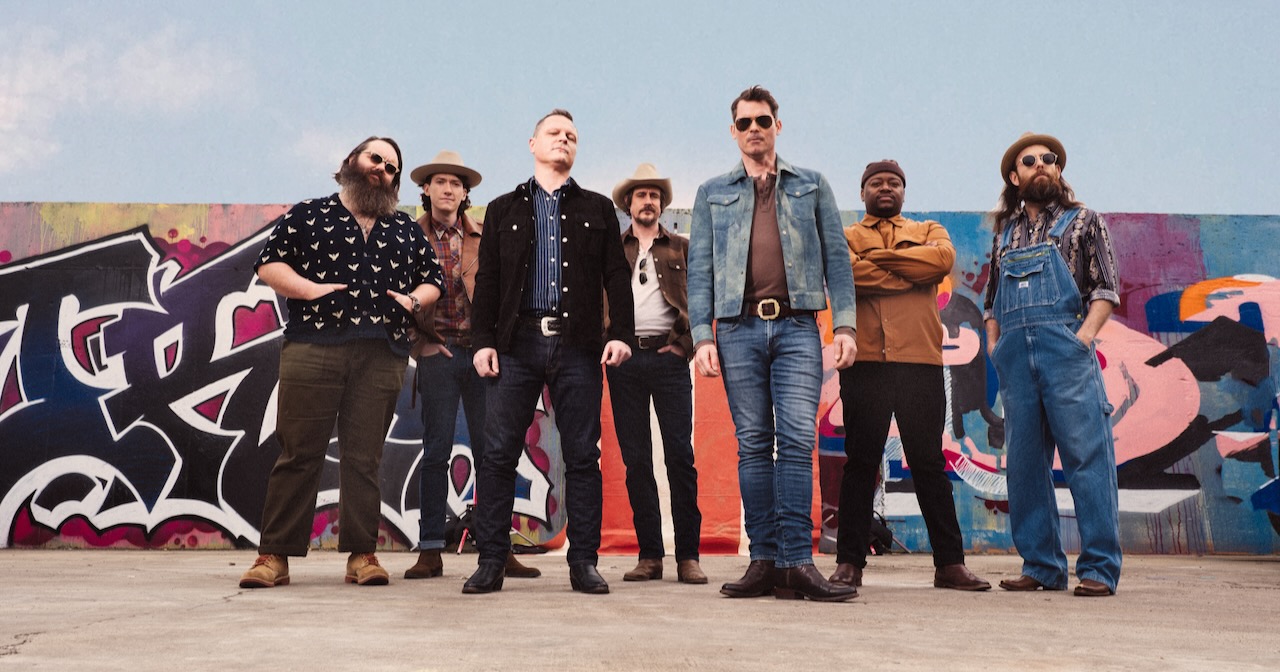
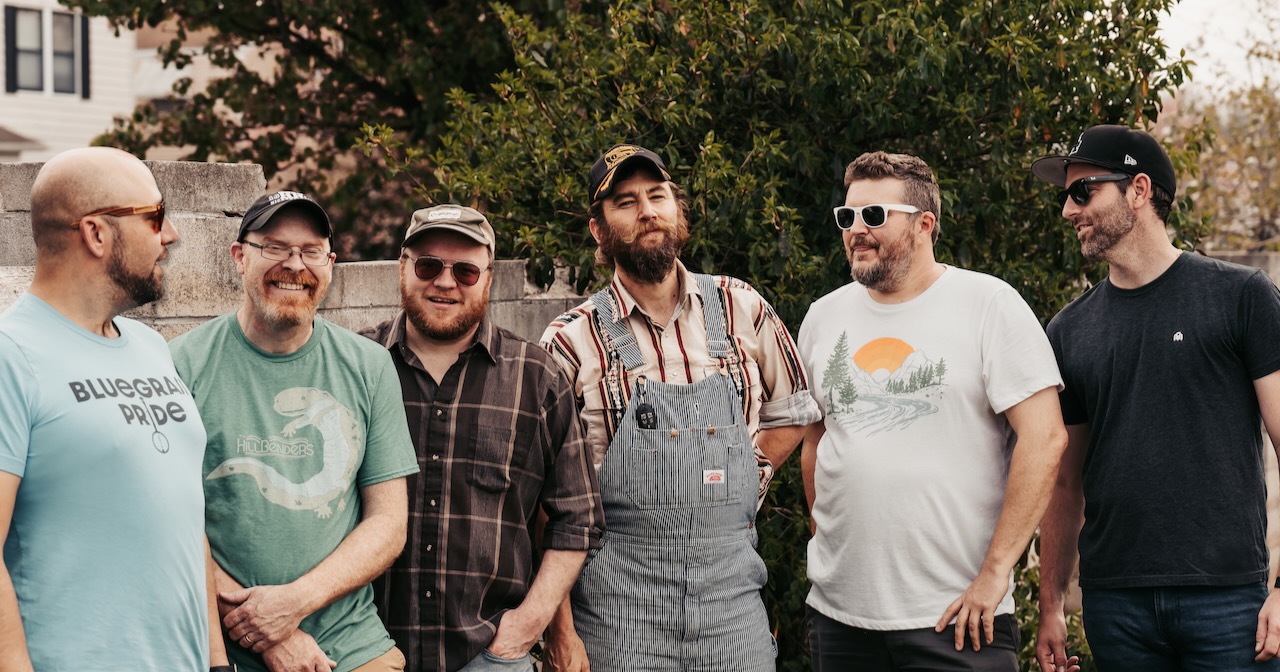
Artist:Lonesome Ace Stringband Hometown: Toronto, Ontario, Canada Latest Album:Try to Make it Fly
(Editor’s Note: Answers provided by Lonesome Ace Stringband banjoist Chris Coole.)
Which artist has influenced you the most … and how?
Although I think the answer for each of us individually would be different, I think the most obvious single influence on us as an ensemble would be John Hartford. Specifically, the last several albums he made with the “John Hartford Stringband” (which featured Bob Carlin and Mike Compton, among others). Their approach to playing old-time fiddle tunes, especially on the albums Wild Hog In the Red Brush and Speed of the Old Long Bow, was based on a highly improvised and reimagined way of playing backup that Hartford called “Windows.” Although it wasn’t a conscious decision, and we don’t follow the approach to the letter, I think the spirit of those albums really influenced the way we play and perform old-time music, especially (instrumental) fiddle tunes.
What other art forms — literature, film, dance, painting, etc. — inform your music?
As a band, I think the art form outside of music that has had the biggest impact is the crank (prank) phone call. For years we’ve been listening to the Jerky Boys. We are old enough to remember the late ’80s and early ’90s when underground Jerky Boys cassette tapes were passed around organically and treasured by all who were lucky enough to possess them. About five years ago, the guys from The Henhouse Prowlers introduced us to Longmont Potion Castle, who has been anonymously releasing psychedelic crank calls since the ’80s (he’s still at it). You might think I’m being tongue in cheek when I say that these influence us as a band, but the attention to detail – especially in regard to language – and the level of improvisation are both relatable to music and inspiring. Most importantly though, it’s a great reminder that we live in a crazy world, and it’s best not to take yourself or anyone else too seriously.
What rituals do you have, either in the studio or before a show?
We like to get our heart rates up before a show if possible and maybe a bit of stretching. This often involves us having an aerobics dance party to ’80s pop and new wave. “Betty Davis Eyes” by Kim Carnes is a favorite, as is “Dance Hall Days” by Wang Chung. [John] Showman favours doing some version of the “Mountain Climber” while Max [Heineman] and I are usually doing jumping jacks, dancing on the spot, or some sort of hippie clogging. Seeing three middle-aged men dancing around in the green room to The Pretenders or Blondie seems to warm the hearts of promoters and venue staff and there are probably bootlegged videos of us doing it circulating around.
If you had to write a mission statement for your career, what would it be?
The title of our new album is Try to Make it Fly. That is a line from one of the songs called “Sweeter Sound.” I’d say that song encapsulates what our mission as a band is. We are all in our 50s and have been playing music professionally (mostly full time) since we were teenagers. That song is about not giving up, even when everything might seem to be pushing you in the other direction. It’s about keeping sight of what’s important – community, friends, family, art – and letting the quality of those things in your life be the gauge of your success. With where we are in our lives and careers, that seems to be the only way forward.
Since food and music go so well together, what is your dream pairing of a meal and a musician?
There’s a song on the new album called “Smoke on the Shoulder” which is basically a recipe for smoking pork shoulder. We all love to cook and appreciate good food. We rarely miss a chance to stop at a good BBQ joint when tour routing allows. With this in mind, I’m going to say the food would be smoked brisket and pulled pork with sides of coleslaw, beans, and macaroni. The musical accompaniment to this meal would be provided by, none other than, George Jones.
Old Crow Medicine Show co-founder and frontman Ketch Secor is always busy. In September, Secor and flatpicking master Molly Tuttle co-hosted the Annual IBMA Bluegrass Music Awards, a brief respite from the ongoing national tour Secor and Old Crow are currently on. They hit the road earlier this year after releasing Jubilee, their latest record, celebrating 25 years as a band. With a few recent lineup changes, their energy is still fresh and exciting — and in this exclusive BGS interview, Secor explains that you really just have to see them live to fully understand and appreciate the bit.
This will be the second tour with the current lineup, right? What do you think will be different with touring Jubilee?
Ketch Secor: In typical Old Crow fashion, an 11th-hour lineup change occurred as we were putting the finishing touches on this album. We’ve hired two new players, and that’s Dante’ Pope on drums and piano, and PJ George as a utility player, so with these two additional players we have yet another iteration of Old Crow that has subtle differences from any other one we’ve had before. This kind of thing just makes it fun. That fluidity of the lineup has made it a lot more palatable — it’s still Flagstaff in the fall, but getting to see it with somebody who’s never been before, and getting to share the stage with people who bring out something new in you musically.
I feel like music for the old-time string band – and maybe this is the same for bluegrass – but music is really relational. It’s about who you’re with. I play different with different people. The pitcher isn’t gonna play differently because of who the shortstop is, but in a string band, the fiddler’s following a groove that the banjo sets, and if there’s a great mandolin player with chops then the fiddler is going to weave in and out of something differently.
How did you choose the guest appearances on this album, like Sierra Ferrell and Mavis Staples?
KS: That kind of thing just evolves. Making records in the 21st century, collaborations are what’s on the menu more so than when we were kids. We didn’t think about who was going to be the guests when we were kids. For Sierra, we thought that song needed something, and we realized it was a duet. I’d been sitting on that one for a couple years. I rewrote it as a duet, and we called the best woman to sing on a cock-fighting song — we called out to West Virginia.
Why are collaborations more necessary now?
KS: If I could be frank, it’s because labels are trying to do anything they can to sell albums. It adds to social media platforms. It increases the scope in ways that are much more specific to these times than just making great music. When Lita Ford came out with Ozzy Osbourne, that probably had a different purpose to it than it does today. Independent labels are taking a cue from hip-hop artists who experiment with this all the time. Bluegrass and old-time and traditional music tends to be 10 years behind those types of styles, so it makes sense that nowadays we’re all making collaborative contributions.
Were there any surprising or touching moments working with Willie Watson in the studio again? Was the chemistry there after 12 years?
KS: Yeah, I think that having Willie back is just important to the ethos of Old Crow Medicine Show, and celebrating its 25th anniversary. We’ve been working together since COVID on some things from live streams to concert appearances, and this was sort of the next frontier for Old Crow and Willie in burying the hatchet and making music together. When you’re in a 25-year-old band you get a lot of ex-boyfriends. Hindsight is 20/20, and I just know that nowadays it’s better to be back on stage together.
How has your fiddling changed over the years? What are some of the areas you focus on when you practice? Old-time is known for being scrubby, but there’s a lot more going on there.
KS: Well, it’s changed over the years as I’ve gotten to be a lot better and gutsier as a violin player. I play it harder and stronger and faster than I did when I was 18 when I learned. For 25 or some years it’s been my dance partner. At the quarter century mark as a violin player, I feel like I know my partner well. I know where to take it, where on the neck to go. I know how to get the sounds that I’m looking for.
But I’m not a player who practices. My practice is just playing 95 concerts a year for 25 years and making 15 records in that period of time and being a special guest on 50 other records. I’ve grown up like a plant in the window when it comes to my violin playing. I see where the light is and I’ve grown towards it, and it’s bushier and brighter than it used to be when I was just a little twig. It just keeps growing all the time, but it’s not because I’m changing anything. There’s no additive to the soil.
You play old-time, but do you ever try other genres?
KS: I’ve played a few jazz gigs, but it’s not what I do well. I listen to all manner of songs. As a fiddle player, I like to think about all of the music that I’m channeling into the way I play, and a lot of it is traditional fiddle music, but a lot of it’s not. I feel like there’s Public Enemy and Nirvana and Bosco and the Carter Family, and other things that are not fiddle playing in my playing. But mostly what there is in my fiddle playing is mileage. It’s experience. It’s rust. It’s calcified. That’s the case with people who’ve played music for a lifetime. They get better not because they’re doing something different, but because they’re doing the same thing again and again.
You mentioned that folk music should be topical — not kept in a museum case. Do you think that kind of folk has a special place in the world right now given the political and economic hard times we’ve been seeing?
KS: I think that anybody who’s making genuine art has a reflection of the world around in that work. We the artists are sort of like poetic mirrors of what we see. There’s lot of songs now that reflect the discord, either in a lamentation or in a protest or in just a pure reflection. My music tends to talk about the plight of the people who are most associated with this music, so that can be the people of the Southern Highlands. It can be the hardship of the African American co-inventors of this music. But I’m also a real vessel for global topics, and I say that because when I read the news it’s almost like it starts riding on my back. So I’m thinking about flood waters in Libya and earthquakes in Morocco and school shootings in Nashville. To me they’re all part of a human struggle to find peace in the world.
What change do you hope comes about from songs like “Allegheny Lullaby?” How do people take that sentiment and make it actionable?
KS: That’s a song about a limitation of choice. That’s a matter of equity or inequity. So the equitable solution is: More choice. It’s widening the spectrum of options for people who live in the coal district, and that’s a very doable action item. It’s just a hard thing to do and live the exact same way, without a change in economics, but that’s the story of the American people. We adapt. And so I think the natural adaptation cycle in the Southern Highlands is in flux right now because of some strident efforts to hold it back. The results of those actions are that you got an opioid epidemic, a fentanyl epidemic — so many dysfunctions. I’m looking forward to the people eventually standing up and getting what they need. I wouldn’t put it past the people to get that. They got it before. They unionized in those situations and fought for livable wages, and they can do it again.
You talk a lot about nature, like mountains and feral critters, in your music. Is that an intentional part of folk or where does that come from?
KS: When I think about what made [American music] so rich, I know it’s the land and the soil and the people and the stories. So to evoke the same is just a natural link in the chain forged anew. And that’s all I’m doing. I’m just singing about the rivers that mean something to me when I sing them. I don’t think you’re ever going to get tired of thinking about the Big Sandy River, no matter if it’s clean or dirty. It’s called the Big Sandy, doesn’t that sound like freedom?
What do you hope listeners will take away from this album?
KS: You know, we make music because we’re a live band. We make albums because we’re a live act. Come and see us. If you like this record, go buy a ticket. We’re coming to your town; we have for a quarter of a century. We loved you then, and we love you even more now. And if you hear something on this record you like, then that’s just one more reason to come buy that ticket and see us when we come to your community and make a unique and special community in yours for one night. This is an age-old P.T. Barnum routine. The hat is magic, the ring is heavenly. Once you gaze on what lies behind the curtain, you will be dazzled. That’s where the magic is. The album is a big arrow.
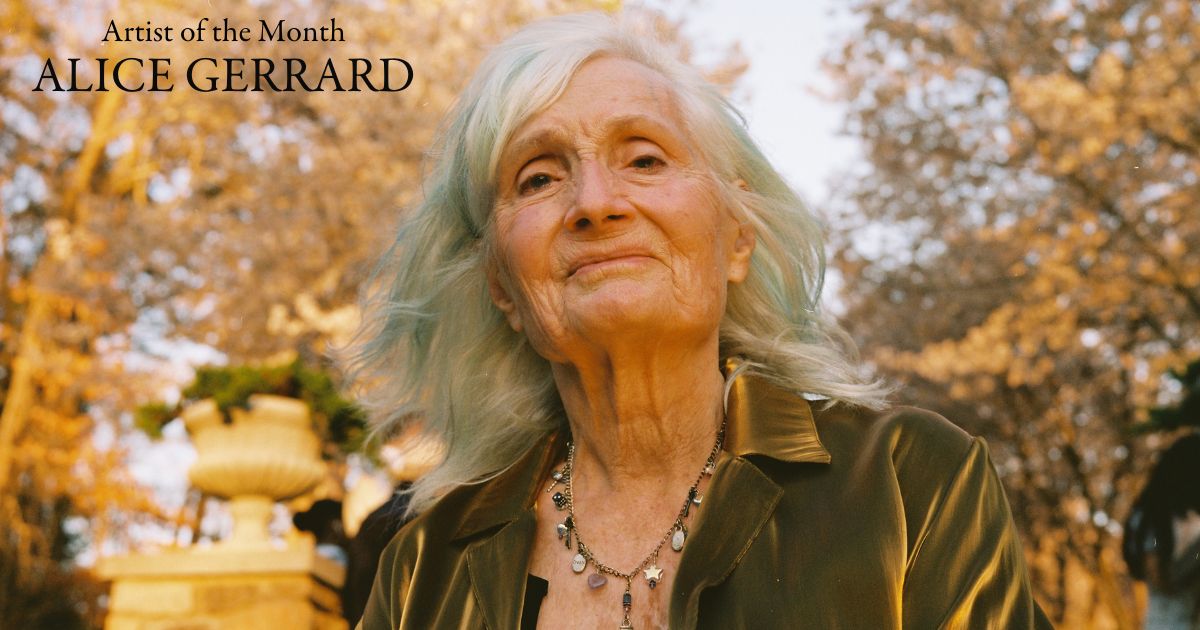
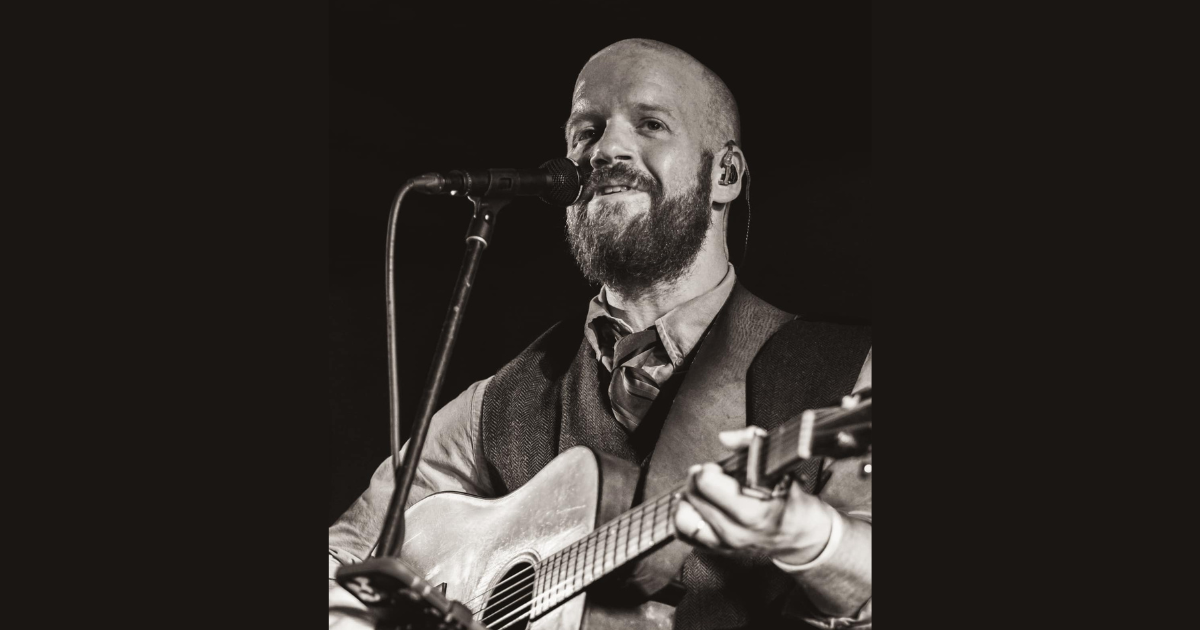
At 89 years old, old-time music community leader, Grammy nominee, and Bluegrass Music Hall of Fame inductee Alice Gerrard continues to place her music making and creativity decidedly in the present. While every lyric she utters and every note she picks feels effortlessly timeless, storied, and burnished – by her lived experiences and by days, weeks, and months of toil – her songs are ultimately forward-looking, leaning into the future with intention and wisdom. They also feel paradoxically light and joyous while at the same time they stand at the nexus of “what used to be” and “what will come.” Gerrard holds this position with equal power, agency, and insight.
Her latest album, the upcoming self-produced Sun to Sun, out October 20 on Sleepy Cat Records, captures the ineffable of the particular center-of-the-Venn-diagram that she inhabits, as a song collector, a knowledge bearer, and a folk music synthesizer of the world’s woes and struggles for justice. As witness to more than a handful of iterations of the modern movement for equal rights and racial, gender, and economic justice, Gerrard is able to challenge the systems and powers that be in grounded, measured, and realistic ways – ways that never limit possibilities for the future. (A remarkable trait in a creative who uses “old-timey” media and formats as her primary form of expression.)
“Remember Us,” the album’s stunning lead single, is – as Gerrard says via press release – an ode to “all the departed whose shoulders we stand on, whose work and lives we benefit from, who came or were transported against their will to this land.” Sung in stark a capella by Gerrard, Tatiana Hargreaves, and Reed Stutz, the track feels pulled directly from the gospel singing traditions of the American South that each stem from Black and formerly enslaved musical traditions. It speaks into community spaces the names, lives, and souls of so many Black, Brown, and Indigenous folks who lost their lives at the hands of empire and the police state.
“Old Jim Crow” makes the apropos point that segregation and racial apartheid in our country were not that long ago nor that far away, calling the partisan gerrymandering, political divisiveness, and waves of hatred befalling the U.S. exactly what they are: a new kind of the Old Jim Crow. “Keep It Off the Seat,” a Gerrard-penned modern classic, was inspired by the North Carolina General Assembly’s transphobic HB2 measure from 2016 – that also inspired our showcase, Shout & Shine, at IBMA in Raleigh and eventually saw Gerrard singing “Keep It Off the Seat” from the Shout & Shine stage in 2017 with Cathy Fink, Marcy Marxer, Hargreaves, and more. At her live shows, she encourages her audience to sing along during the rousing chorus: “Who cares where you pee? Just keep it off the seat!”
These themes and through lines would be notable in any bluegrass and old-time forebear’s catalog, but here, among Gerrard’s lifelong discography, they are certainly not outliers but continuations of a career that has always been committed to telling untold stories, singing unsung songs, spotlighting and amplifying invisible voices. Gerrard’s age, her position as a roots music elder, reinforces the importance of these subjects, and leaves subtle, existential fingerprints over the entire album. We know Gerrard’s commitment to singing and standing in truth, but in these songs and in this collection, we feel that commitment more than see it, we sense it just as strongly as we view it.
Sun to Sun was tracked in Durham, North Carolina – Gerrard’s home turf for decades, now – with a collection of collaborators and musicians pulled directly from her immediate community. Hargreaves, one of the most prominent fiddlers in the old-time and bluegrass scenes of late, has worked for Gerrard for a number of years as an archivist and assistant of sorts and features heavily on the album; Stutz, an in-demand multi instrumentalist who also straddles the fences between folk, bluegrass, old-time, and Americana, plays guitar and banjo. Other credits include first-rate sacred steel player DaShawn Hickman, Hasee Ciaccio on bass, Marcy Marxer guesting on guitar and cello banjo, Gail Gillespie, Nick Falk, and soulful songwriter, singer, producer, etc. Phil Cook – who collaborated with Gerrard on her 2014 album, Follow the Music – as well.
It makes perfect sense that a community builder such as Gerrard, who has always prioritized the most human aspects of roots music in her creative output, would be able to construct a collection of songs that feels pointed and convicting, but also organic and natural. Sun to Sun approaches heavy topics with ease, as a pair of good friends over a cup of tea on the porch can seemingly solve all of the world’s problems with passion, joy, and unbridled care for the forgotten and invisible among us. Gerrard calls on her folks, her musical and personal communities as well as her listeners and fans, to join with her in the journey she has begun and that we must continue, from sun to sun to sun to sun.
To celebrate Alice Gerrard’s selection as our October Artist of the Month, we’ll be diving back into our archive of Sitch Sessions, interviews, posts, and stories that highlight her incredible music – and her exemplary activism through that music and across the decades. In the meantime, enjoy our Essential Alice Gerrard playlist below, plus two of our BGS favorite Sitch Sessions of all time that feature Gerrard (viewable above), and watch for our Artist of the Month feature to come later in October.
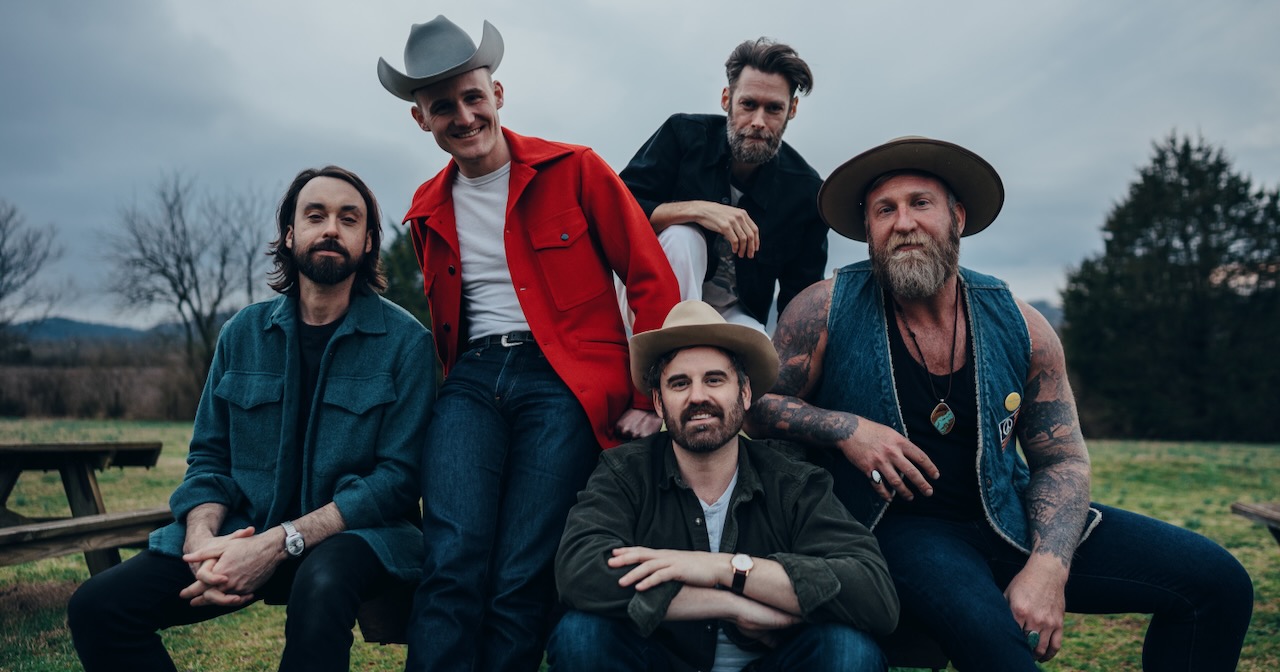
Artist:Hogslop String Band Hometown: Nashville, Tennessee Song: “Mississippi Queen” Release Date: October 6, 2023 Label: Tone Tree Music
In Their Words: “‘Mississippi Queen’ is a story about an escaped inmate during the construction of the Richmond-Danville railroad. I wrote it years ago, and we have occasionally worked on it over the years, but we recently came up with a new arrangement of it that felt really good. The main character escapes on foot, follows the Tennessee River south, then across Alabama to find his family in North Mississippi. Ultimately, it’s a story about being separated from loved ones and doing whatever it takes to make it back home, which I think a lot of people can relate to.” – Daniel Binkley, banjo
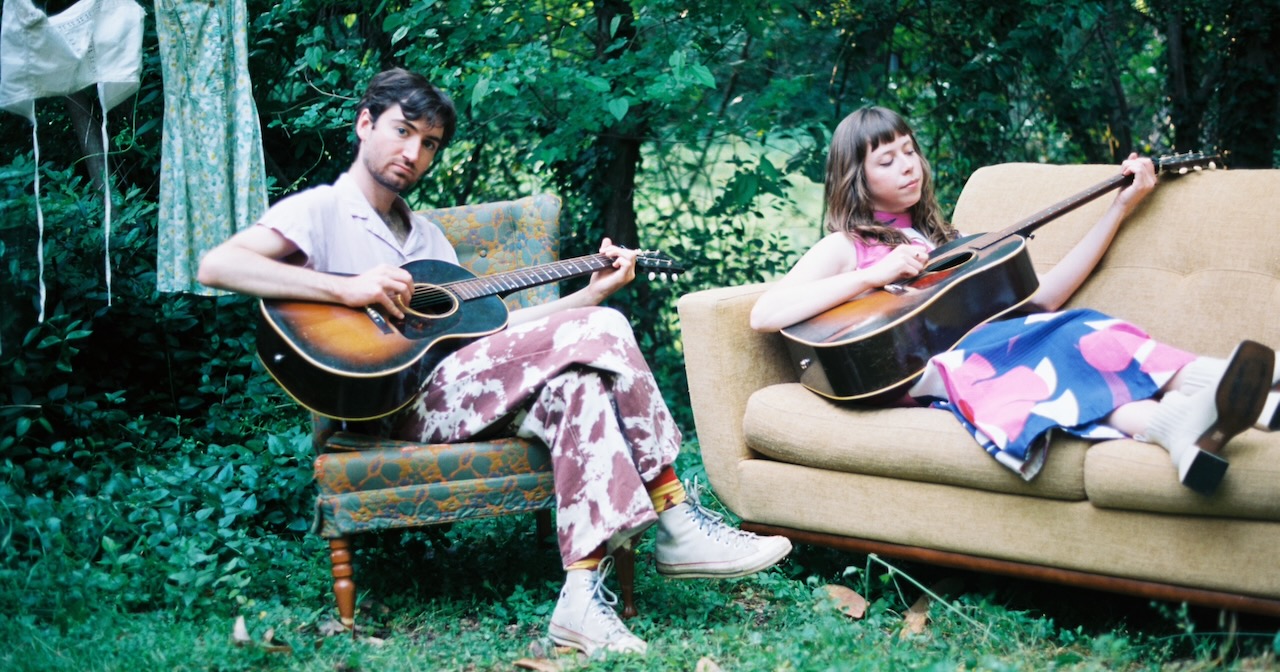
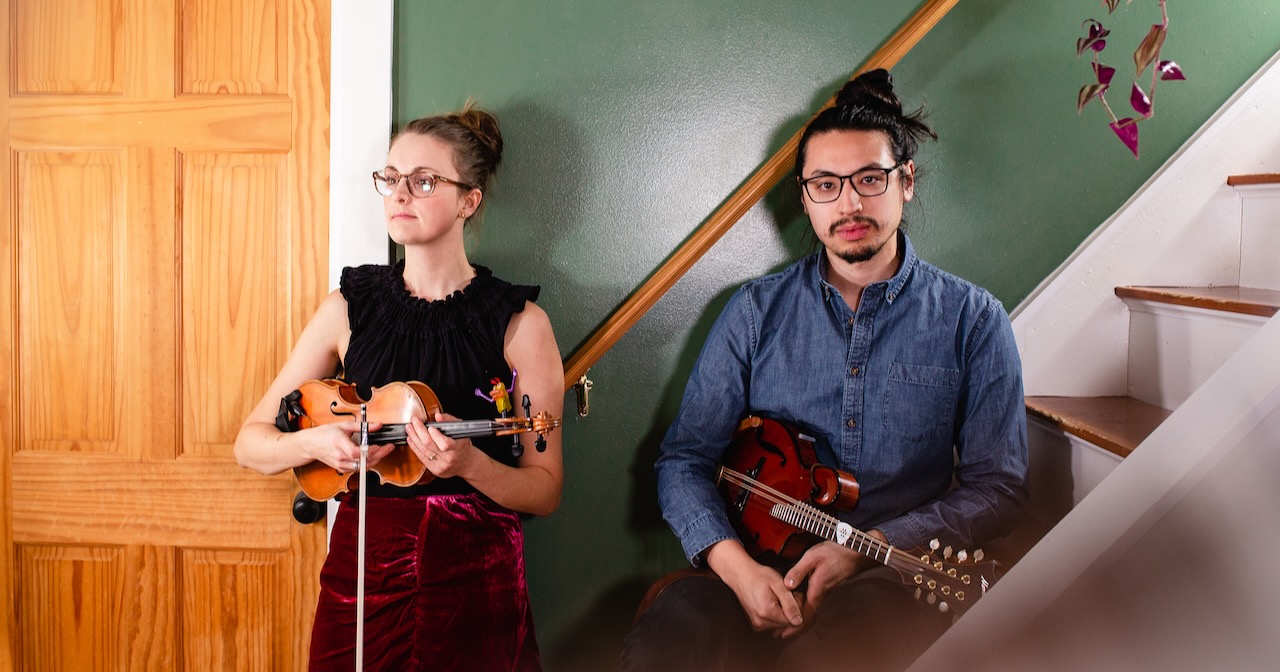
Comprised of singer-songwriters and instrumentalists Vivian Leva and Riley Calcagno, Viv & Riley are an up-and-coming musical duo that defy definition. Their new album, Imaginary People, is a masterful blend that weaves together their shared reverence for traditional Appalachian music alongside indie-folk, pop-leaning adornments. The result is an emotionally potent 10-track album that covers a vibrant range of personal and universal truths — from the bittersweet nostalgia of visiting a beloved childhood hideaway decades later, to the poignant curiosities that accompany reckoning with climate grief.
Based out of the dynamic music scene in Durham, North Carolina, this duo is currently on tour across North America. With their insightful explorations of the past and creative probings of the future, Viv & Riley uncover rich and complicated explorations of what it means to be alive in this precise moment.
So how did the two of you first start making music together?
Vivian Leva: Well, we first started making music together when we first met in 2016, the summer after we both graduated high school. I grew up in Lexington, Virginia, and Riley grew up in Seattle, Washington, and we just happened to meet at a camp in Port Townsend, Washington. It’s one of those camps that has weeks back to back — there was a vocal week that I was teaching with my mom, and then Riley came to teach fiddle the following week. We happened to overlap by a few days, and Riley was there with his band The Onlies. The first night we met, we played music together all night! After that, I joined the band, and we also started playing together as a duo and writing songs.
Riley Calcagno: The origin of our sort of band, our duo, came later that year, in the fall. We had been communicating and texting some music back and forth, and then Viv invited me down to Asheville to play a gig with her and her dad. I was a fan of her dad, James Leva, for his fiddle and singing, so we did that gig. But we thought it’d be also fun to try out some duo material while we were down in the same place, even though we had never played songs just the two of us. We emailed a venue in Asheville called Isis Music Hall, which was a prominent venue there at the time. Somehow they slotted us in, on a Wednesday night, into this big hall that they had — 200-person capacity, maybe bigger. We had never played music together going into that, but we put together some material and we enlisted some friends to play with us. It was a bold move! Talk about faking it until you make it. Only about 15 people came out to the show, and I’m sure it sounded terrible. But it was fun!
That sounds amazing. So how would you describe your musical chemistry? What is it like playing together?
VL: Well, I think our initial musical chemistry initially came from our shared background in old time music and traditional music. That first night that we met, we played a lot of fiddle tunes, old music, and traditional songs. So it kind of began from a place of excitement about being exactly the same age, having never before met, and somehow both being raised around this same music that we have a shared respect and love for. So that was the initial spark of actually finding another young person who’s into the same niche genre and community. But since then it’s totally stretched into other realms. We are both so open to other kinds of music, and we have very similar tastes and aesthetics. It’s very easy to create music together because we come to it from a similar place.
RC: One of our dynamics in making music together has also been sharing our individual strengths with the other person. When we first started playing together, I couldn’t really sing harmony or find a harmony part. Vivian was very patient with me and helped me learn, and I still feel like I’m getting better all the time. That’s exciting!
VL: I just play guitar, and Riley plays every other instrument. He’s a great fiddler, guitar player, banjo player, mandolin player— instrumentally he brings so much to the table. And I feel I bring a lot of singing and songwriting-focused material to the table. We stretch each other, fill in the gaps for each other, and learn from each other.
What a beautiful thing! So what do you each feel like the biggest difference in your respective musicianships is?
RC: Viv is a very natural musician. She grew up traveling around with her parents as they toured, sitting in on harmonica at her dad’s gigs when she was only three or four. I also was born and raised around music, but it was a bit more formalized, whereas Viv’s music just comes very naturally and it’s not forced in any way. She does what she does super well and consistently and steadily, and I’m a bit more erratic. I take chances and get obsessed with things and take big leaps that sometimes fall flat. Every time she steps on stage, Viv can knock out a great performance, and I feel more streaky.
VL: But he tries lots of different things! And like he mentioned, Riley has a more formal background in music. He took lessons, he learned how to read music, he knows music theory, he did classical violin. So I think a big difference is that he technically knows what’s going on, whereas I don’t have the language or skills that he has. I’m definitely more intuition based than technically based.
You really balance each other out! So your new album, Imaginary People, just came out on September 15, and I’m wondering how your songwriting, as it appears on this album, has shifted since you first began as a duo.
RC: Well, in the past, before we started writing music for this record, we were living in different places so it was a lot of collaboration from afar. A lot of the songs on our last record came from texting voice memos back and forth. And you know, it’s not utterly different to work on them in person, but some of these new songs came out playing them together in the moment.
VL: Another big difference is Riley has started writing way more. So I think there’s more of an equal voicing on this record than in the past. There’s more of his perspective in it. And I think now that we’re living in the same place it’s also allowed us to write about a more diverse range of things. We’ve written a lot of intense emotional, romantic songs in the past, but in this recent past couple of years, we’re more interested in other things, like our shared experiences about other parts of life.
RC: And it’s also partly stylistic. Our last record was pretty much a country record. During that time, I was listening to a lot of classic country music, and this time we were listening to a wider range of things. Having a broader array of influences definitely helped us push the narrative forward.
What are you each proudest of on the album?
VL: I think what I am most proud of isn’t a specific track or anything — mostly it’s this feeling that I unlocked something. I think I let go of some fears in the process of making this record. I felt more free to just say yes to trying new things and became less concerned with things like what genre it was going to be considered, or if the people who liked our last record would like this record… and so on. I stopped worrying about categories like, “This doesn’t sound traditional enough,” or “This isn’t country enough,” or “That’s too rocker or indie.” Instead, I was able to adopt the mentality of “Hmm, that sounds interesting, let’s try and just do what feels fun!” I think I’m most proud that I was able to do that. It felt amazing to take things a little lighter and to roll with ideas that felt a little outside of the mold.
RC: When you start making music, being young musicians, you get immediately labeled. It’s not something that I think either of us necessarily anticipated, but when that first record got classified, people said it was Appalachian and classic country. And then the next one was classic country and Americana. Like “Hits-the-Spot Americana,” whatever that means. And I think there’s an urge for musicians, when you get labeled as something, to keep reproducing it. There’s this toothlessness to the modern Americana music label— it’s the creation of music that is literally meant to sound like other music under a category. I don’t have a problem with genre or specifications, I think it’s oftentimes useful, but it’s [useful] when you’re trying to reproduce sounds so that you can cater to an audience, it’s like you’re trying to sell something in a market that’s already been created. I think that can be the “dampification” of art. And while I think there’s been so many amazing things created within the Americana industry, I also think it often leads to less creativity and less interesting music.
Coming out of our last record, we had some buzz in the Americana world, and it would have been easy for us to make another “Hits-the-Spot Americana” record. But I don’t think that we did that, and I feel proud of that. Like Viv was saying, we didn’t just do what we were supposed to do. You know, there’s synthesizers, but there’s also a fiddle track, and personally, I think it all works together. So maybe if you’re an Americana devotee, you’re not going to love this album, but that’s okay with me. I think there’s a power in making an album that the machine doesn’t really know what to do with. The machine can make up albums and spit them out, but I feel proud that this one isn’t something that can just be spit out because of how we combine traditional and non-traditional music. For example, there were super organic moments where we all stood around one mic and sang together, coupled with other moments where we had things locked in, produced, and added synths because a particular song called for it. Making those two things coexist in the same ecosystem was definitely a challenge, but listening to the record, I think it all makes sense together.
It’s an album full of teeth! Now, before we wrap up, I have to ask: you’re our One to Watch, but who are you watching right now? Any creatives, musical artists, or otherwise that are inspiring you right now?
RC: One is our neighbor in Durham, North Carolina, Alice Gerrard. She’s almost 90, and she’s putting out a record on this indie label from the area called Sleepy Cat. She’s collaborating with a bunch of young people and their art for the record, like making these amazing videos. It’s a really cool thing! People around here are really conscious and thoughtful about aesthetics and sound and ethos. Everything is done with integrity, so it’s a cool scene around here in that way. Alice makes amazing music, I’m really excited for her upcoming record — I think we’ll all be glued to it once it comes out. Another one is our friend who we wrote two songs with on our previous record, “Love and Chains” and “Time Is Everything”— often people’s favorite songs of ours. I just had the honor of producing his upcoming record under his band’s name, Preacher & Daisy. I love the music, so I definitely want to give them a bump! The fun thing is that all this music is sourced locally from the Durham, North Carolina area, where we’re based.
VL: Some folks I’m enjoying listening to right now, not that they’re not already being watched, are: KC Jones, Canary Room, Dori Freeman, Alexa Rose.
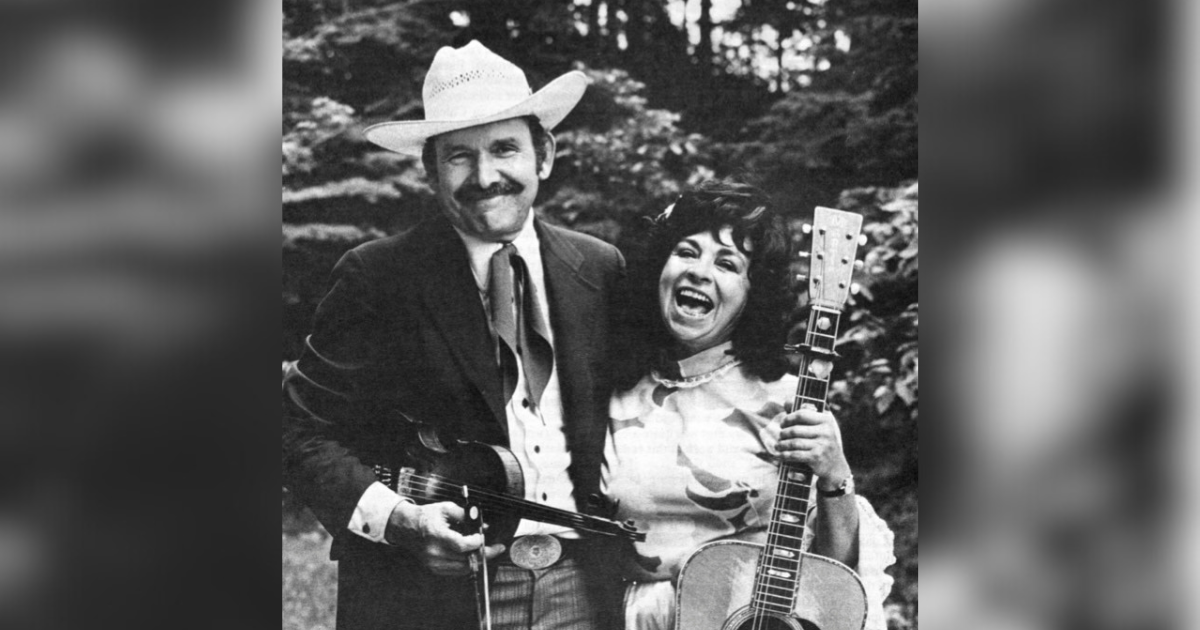
Wilma Lee Cooper, who died in 2011 at age 90, is being inducted into the Bluegrass Music Hall of Fame this month. Many of her fans, friends and followers say it’s about time.
A snapshot of Wilma Lee. Wilma Leigh (later changed to “Lee”) Leary, was born in West Virginia in 1921. Her first performances were as a young girl in the family band. Her last performance as a band leader was in 2001 at the age of 80, when she had a stroke while singing at the Grand Ole Opry. Determined to finish the song, she was helped off stage to a standing ovation.
Between these times, this tiny woman dressed in home-made ruffled dresses and high heels impressed everyone she encountered in the music world.
She had a powerful voice and was an equally powerful guitar player. With her inherent smarts (she skipped several grades) and business degree, she successfully navigated the music industry and kept all the band’s books, first with her husband, Dale Troy “Stoney” Cooper, and then on her own after Stoney’s death.
She traveled with a sewing machine and a coffee maker. After every tour, she would wash all her stage clothes and spend 45 minutes ironing each dress.
She also drove the band bus and fixed her family’s television sets. She was a kind and generous boss, a nurturing mother, an ethical and caring woman and a force of nature on stage.
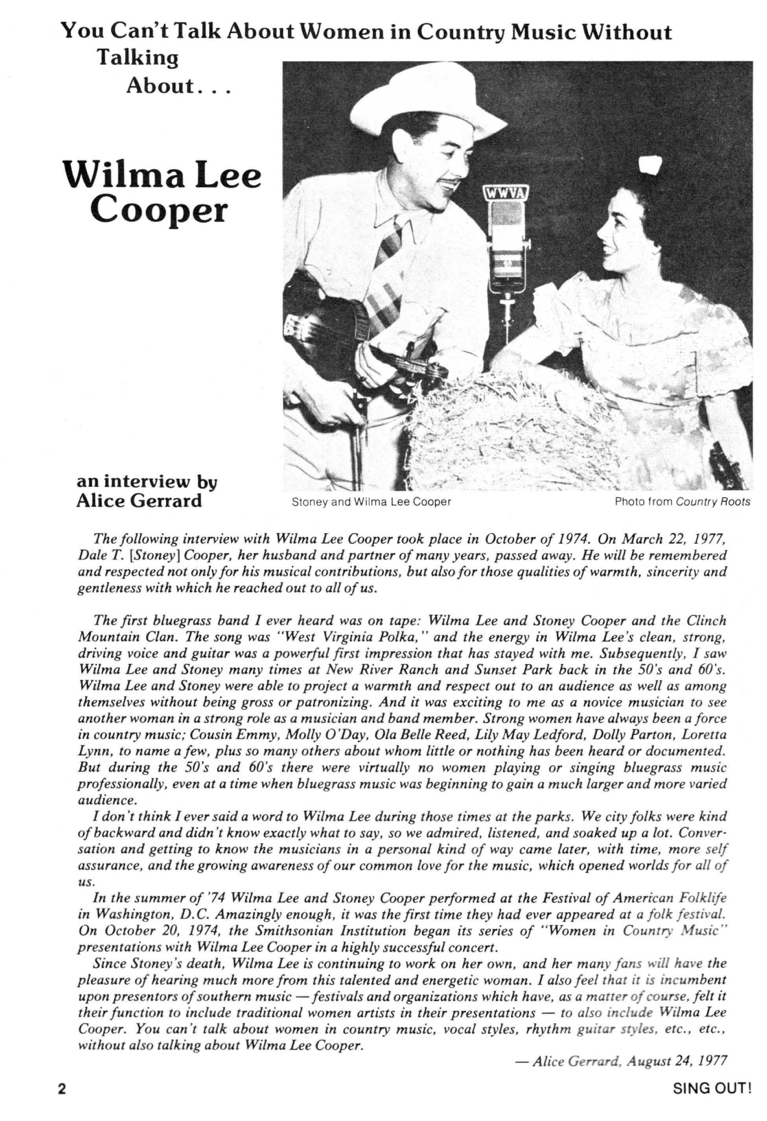
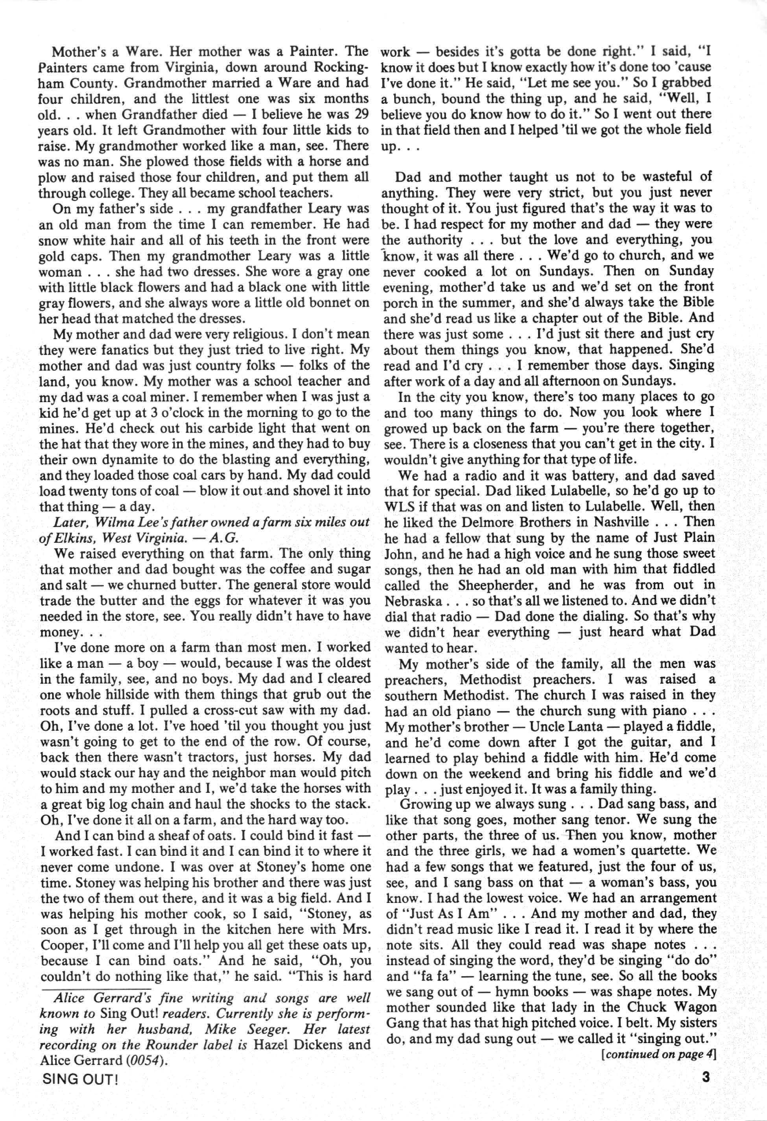
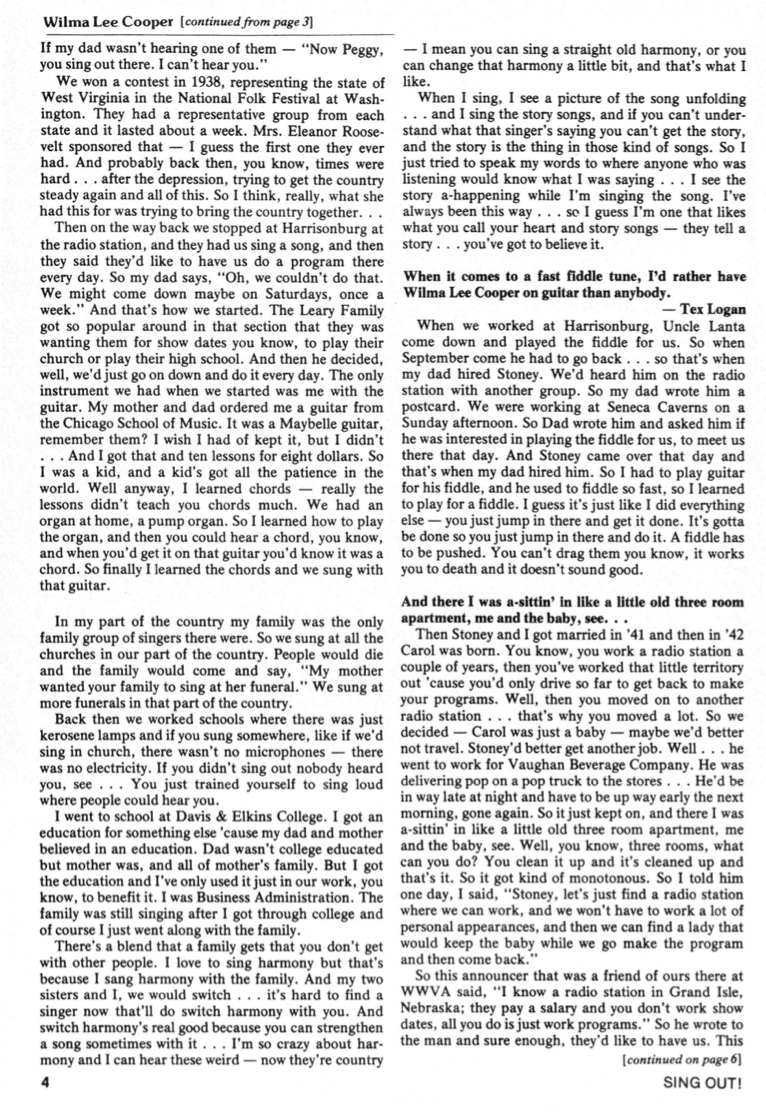
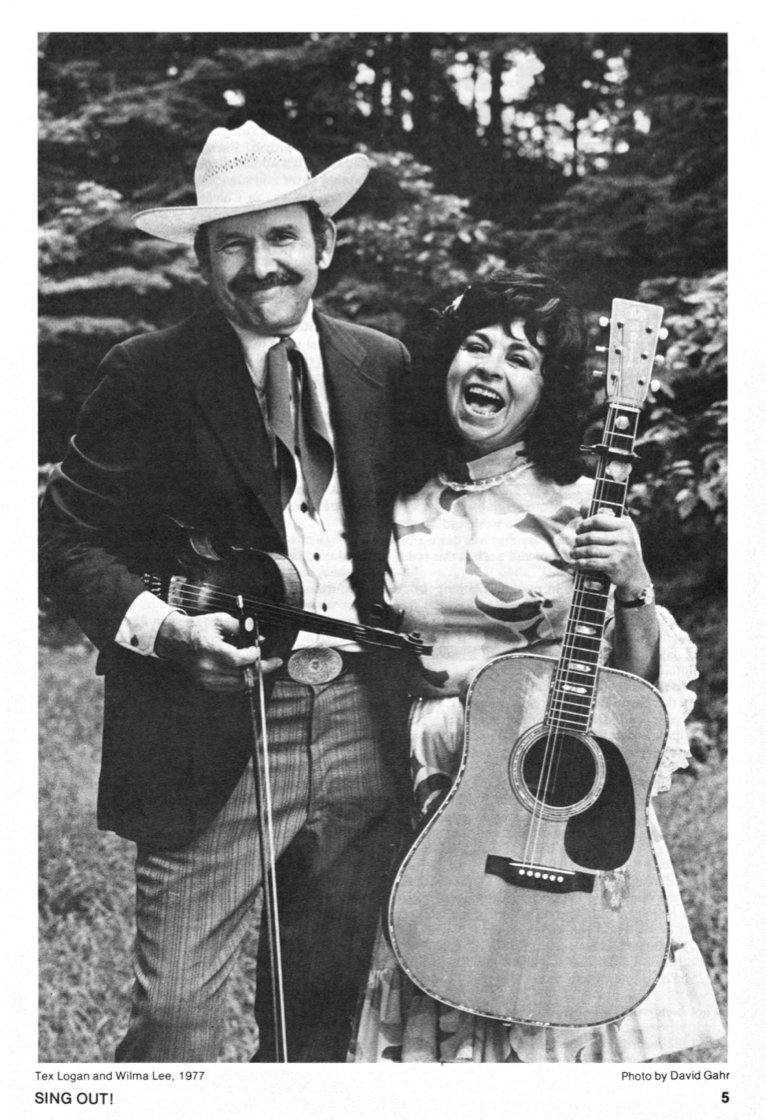
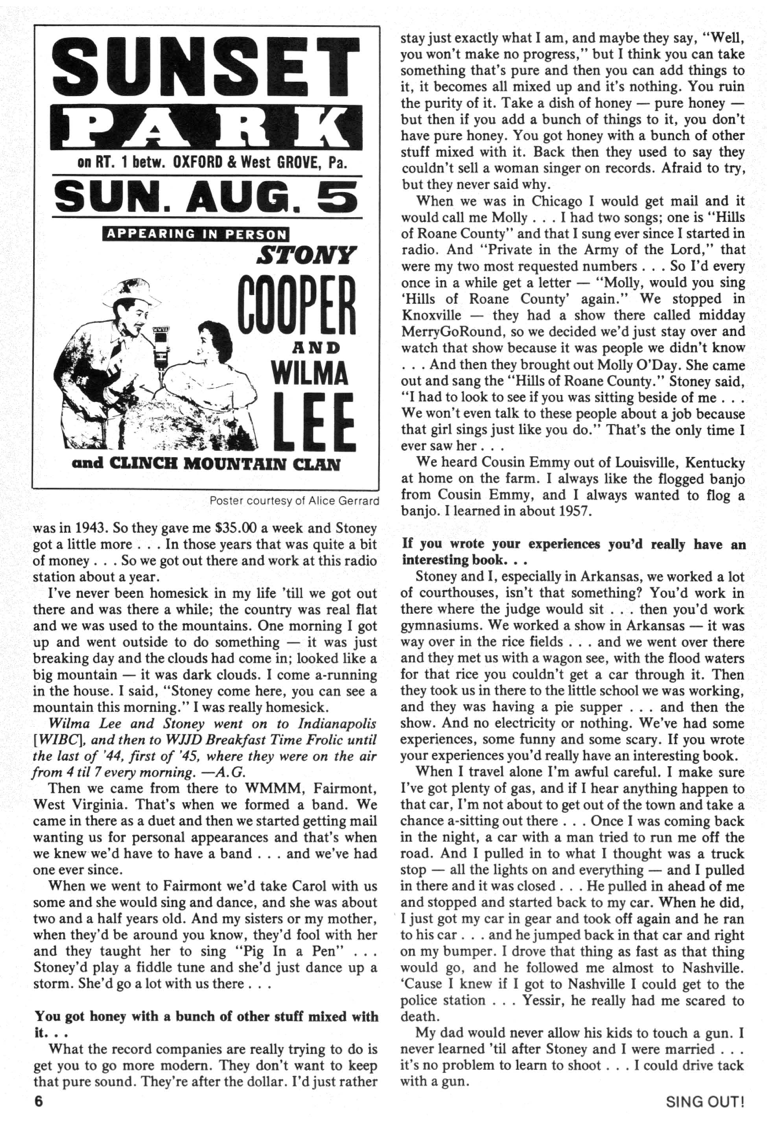
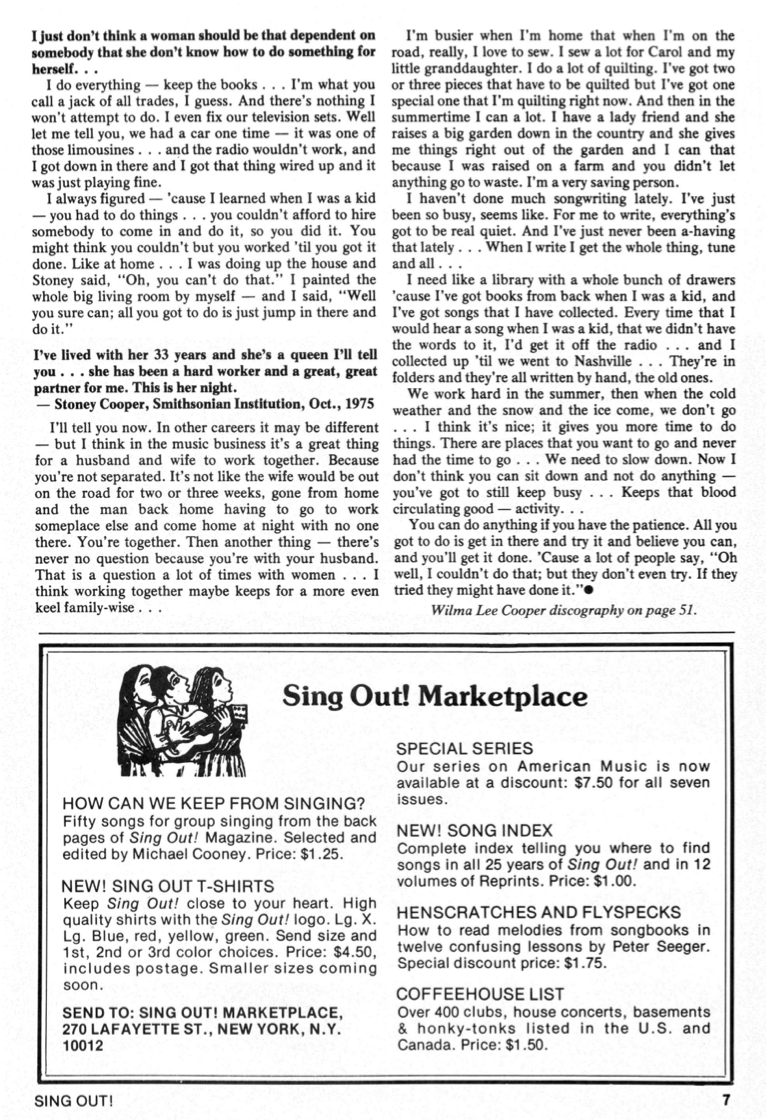
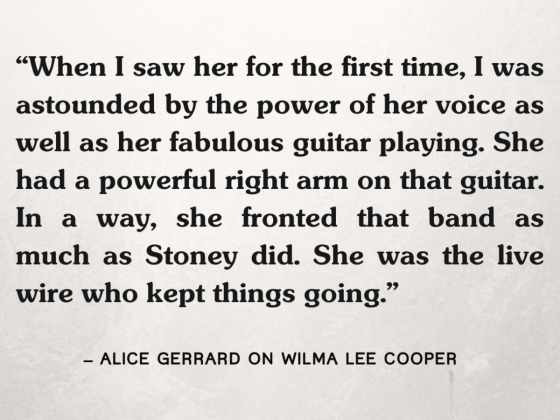
(Above, read an article on Wilma Lee Cooper published in 1977 in Sing Out! written by Alice Gerrard)
From church socials to radio. Reviewing Wilma Lee Cooper’s musical life is an immersion course in the evolution of country and bluegrass music. The Leary Family Band – Wilma Lee’s parents, plus Wilma Lee, her two sisters, and a fiddle-playing uncle – started as a local gospel group. The girls later incorporated secular music sets.
Their prize for winning a statewide contest was the chance to perform at the National Folk Festival in Washington, D.C. A stop at WSVA in Harrisonburg, Virginia, on the way home brought a job offer – and big changes. In one day, the Leary Family went from a local ensemble to professionals with a show of their own. And, when their fiddling uncle returned to his teaching job, the family recruited a young fiddler then called “Smiley” Cooper. (Radio listeners voted for the new name, “Stoney,” to avoid a conflict with a state yodeling champion called Smiley).
Soon, the beautiful oldest daughter and the movie-star handsome fiddler were singing duets with the band. They married in 1941.
Foregoing music to raise their daughter, Carol Lee, in one place was short-lived. Wilma Lee is quoted in Bear Family liner notes as saying, “I was goin’ nuts at home… Stoney wasn’t happy… and it was awful hard to settle down that way.”
On to the Grand Ole Opry. Plunging back into performing, Stoney and Wilma Lee followed the common path of moving from radio station to radio station. They hired back-up players, eventually settling on the band name, “Clinch Mountain Clan.” In a 2023 Bluegrass Unlimited article, Jack Bernhardt referred to “Stoney’s old-time/bluegrass fiddle and Wilma Lee’s propulsive rhythm guitar and soul-stirring vocals.” Stoney also sang harmonies.
Their 1947 move to Wheeling, West Virginia, and the WWVA Jamboree, broadcast on a 50,000 watt station, propelled the Coopers into the national spotlight. By the mid-1950s, they were charting high on Billboard. Within a year of their 1956 hit record, “Cheated Too,” they joined the Grand Ole Opry. They had seven hit records by 1961, with some of Nashville’s top writers, like Don Gibson and Boudleaux Bryant, writing for them – as well as songs written by Wilma and Stoney, themselves. While the recording business was moving away from what had been called “hillbilly music,” the Grand Ole Opry continued to welcome the eclectic range of country music, from Grandpa Jones and Bill Monroe to “Nashville Sound” crooners.
Dan Rogers, Vice President and Executive Producer of the Grand Ole Opry, said, “It was this cavalcade of great artists, all doing something similar, but also all doing something with their own stamps and styles. It didn’t need characterization. It was just, ‘This is Wilma Lee and Stoney.’ It might have been one of those songs that took them to the Top 10 of the country charts, or it may have been an instrumental or a gospel piece.”
Over time, the Coopers found themselves in conflict with the Nashville labels. Wilma Lee said a producer denied her request to record “I Dreamed of a Hillbilly Heaven,” claiming no one would buy it. It later became a huge hit for Tex Ritter. And they wanted her to record songs she would never perform.
The welcoming bluegrass world. While country radio was pushing away mountain music, new audiences were inviting the Coopers in. Folk and bluegrass fans loved their traditional sounds, as well as their stellar musicianship.
The Clinch Mountain Clan attracted top sidemen. To name a few, Butch Robins, Vic Jordan and Tater Tate went on to play for Bill Monroe, and Jimmy D. Brock later joined the Osborne’s. Dobro master Gene Wooten was in Wilma Lee’s band, as was Woody Paul, shortly before forming Riders In the Sky, and Terry Smith, now of the Grascals.
Marty Lanham (musician, luthier and a founder of the Station Inn) had just moved to Nashville, where he was befriended by Wilma Lee’s sisters, Jeraldine (Jerry) Jonson and Peggy Gayle. They told him the Coopers were looking for a bass player. So, he borrowed a bass, took some lessons – and become part of the Clinch Mountain Clan three weeks later.
The Coopers always gave their audiences what they expected. Lanham said, “Bill Carter would play Dobro and electric guitar, and Mike Lattimore would play either banjo or drums. At a bluegrass festival, they would use the bluegrass instrumentation and then switch over to electric guitar and drums,” at a country booking.
In 1974, the Smithsonian Institution dubbed Wilma Lee, “The First Lady of Bluegrass.” In 1976, Rounder Records – dedicated to promoting roots music – invited Stoney and Wilma Lee to record. Marian Leighton Levy, a Rounder co-founder, remembered Stoney as “tall, dark and handsome,” with an Errol Flynn aura, while Wilma Lee “was outgoing and friendly, in a low-key and down home way. She looked and played the part of a real professional, and yet at the same time she was warm and made you feel welcome.” Wilma Lee also worked with Rounder to select material, and she seemed to be “the business person in the group and in the family,” Levy remembers.
Wilma Lee takes the lead. Wilma Lee was 56 when Stoney died in 1977. She wasn’t ready to sit back and put her feet up. She reassembled a band, which after some initial shuffling included Gene Wooten; Stan (Stanjo) Brown, who later played with Bill Monroe; Gary Bailey; and Woody Paul. (Wilma Lee continued her preference for an electric bass, even after getting pushback from bluegrass critics who hated it on recordings.)
Their first year, the band traveled 110,000 miles, playing about 140 gigs. On one 3,600 mile week-long trip, Wilma Lee drove about one-third of the time.
Brown remembers that Wilma Lee embraced the bluegrass world as it was embracing her. “She was doing the same material (as when Stoney was alive), but it was approached a whole different way. Her guitar really drove the rhythm and the energy in the band. And her voice… it set the timing… it was so precise. I had never played with anybody up to that point who had that much energy and drive.”
And she always connected at an emotional level. She would be sobbing by the end of the song “A Daisy a Day,” about a man who leaves flowers on his wife’s grave. “It was really sincere. There was nothing theatrical about her,” Brown said.
She told Alice Gerrard for Sing Out!, “…I see the story a-happening while I’m singing the song… I guess I’m one that likes what you call your heart and story songs. They tell a story – you’ve got to believe it.”
Rogers of the Opry said, “I always think of her music as pure, and I think that her heart was the same. I don’t think she could have been any other way if she’d tried.”
Wilma Lee continued to record, as well as perform, until her stroke in 2001. In 2010, she appeared on stage once more at the Opry to thank her fans for their years of support.
Wilma Lee and the world of bluegrass. Stoney and Wilma Lee were stars, no matter what genre they were playing. Their partnership was one of a kind. And Wilma – as a singer, as a guitar player, as a fireball on stage and a huge heart off stage – has left a powerful legacy.
In 1994, the International Bluegrass Music Association presented Wilma Lee with its Award of Merit. This year, she will receive its highest honor, induction into the Bluegrass Music Hall of Fame.
Rounder’s Levy said, “There are very few women of her generation in the Bluegrass Music Hall of Fame.” (In fact, only eight of the current 70 inductees are women or have women members.) And Levy believes Wilma Lee clearly belongs there.
“In terms of being on the Grand Ole Opry, making lots of records, having a substantial career… the uniqueness of her vocal style, playing guitar when most women in bands weren’t playing guitars or instruments… She was a bandleader and a featured voice, face and name, right up there in her own right,” Levy said.
Ken Irwin, another Rounder co-founder, said, “She was an energy source that people didn’t see very often… She would put it all out there. She brought not only the tunes, but the sensibility, of the old-time music that she grew up with, and that she didn’t change.”
Gerrard said the popular female folk revival singers at the time, like Joan Baez and Judy Collins, sounded high and sweet. But Wilma Lee’s voice – like Molly O’Day’s and Ola Belle Reed’s – had grit and strength. “They weren’t holding back. They were letting go – putting their voices out there.” That’s what Gerrard was striving for and what made her duets with Hazel Dickens so compelling.
Andrea Roberts, principal of the Andrea Roberts Agency, was an adolescent when she first saw Wilma Lee perform. “She carried herself so professionally, looked like a star – and backed it up with talent and business leadership. She was a dynamic vocalist – a big, booming voice – and she played the guitar like she meant it! She was not timid… and that left an indelible mark on me even when I didn’t realize it was happening.
“Not until I started my own band as a 21-year-old woman did I realize the significance of Wilma Lee’s role as band leader and front person. At that point in my own career, Wilma Lee’s accomplishments became very important to me, and I looked to her as a role model for persevering in a male-dominated business.”
A daughter’s thoughts. Carol Lee Cooper, Stoney and Wilma Lee’s daughter, who first sang on stage with her parents at age two, has carried on the family musical tradition. As an adult, she joined her parents’ show at the Opry. Eventually, she became a Nashville legend as the long-time leader of the Carol Lee Singers, the back-up vocalists at the Grand Ole Opry. A great vocalist, she was Conway Twitty’s favorite harmony partner.
Carol Lee is proud that her parents’ work is recorded in the Library of Congress and the Smithsonian Institution. Of her mother’s induction into the Bluegrass Hall of Fame, Carol Lee said, “She would be so honored to know that.”
Author’s Note: Many excellent accounts of Wilma Lee’s life and career have been written. A great starting place for anything you want to know about women in bluegrass is Murphy Hicks Henry’s Pretty Good for a Girl. Some other good sources, in addition to the Gerrard interview mentioned above, are Bluegrass Unlimited and liner notes from a Bear Family compilation.
Editor’s Note: “You Can’t Talk About Women in Country Music Without Talking About… Wilma Lee Cooper” by Alice Gerrard (SING OUT! Volume 26 Issue 2, 1977) appears with permission; courtesy of Mark Moss and SING OUT!
Photo Credit:David Gahr, from SING OUT! Volume 26 Issue 2, 1977
Artist:The HillBenders Hometown: Springfield, Missouri Song: “Take On The World (Give ‘Em Hell!)” Release Date: September 29, 2023
In Their Words: “‘Take On The World (Give ‘Em Hell!)’ embodies the age-old tale of a directionless, troubled soul. We’ve all been there in one way or another. Maybe doing things you ought not be doing just for the excitement of doing it. But then comes along someone that shows you how much more there is to life. It’s almost like you’ve turned into a completely different person after falling in love with them. Like you’re under some sort of spell of theirs. And all of a sudden, all that trouble doesn’t seem as fun anymore. How long it lasts is maybe for another song.” – Mark Cassidy, banjo
“The tune was recorded at Red Rock Studios in Saylorsburg, Pennsylvania, while having a rare day off on tour. Primarily used to record jazz music, the studio had a beautifully organic design nestled in the quiet rural countryside. We asked Jeremey Garrett (of the Infamous Stringdusters) if he would lay some fiddle down on the song and he cut some buttery tracks at his studio, including a twin fiddle part that made the final mix. Jeremy is a great cat and his involvement really elevated the song as a whole. Since adding our new drummer, John Anderson, we have explored all sorts of new musical possibilities — but it was nice to return to our bluegrass roots on this number.” – Jim Rea, guitar
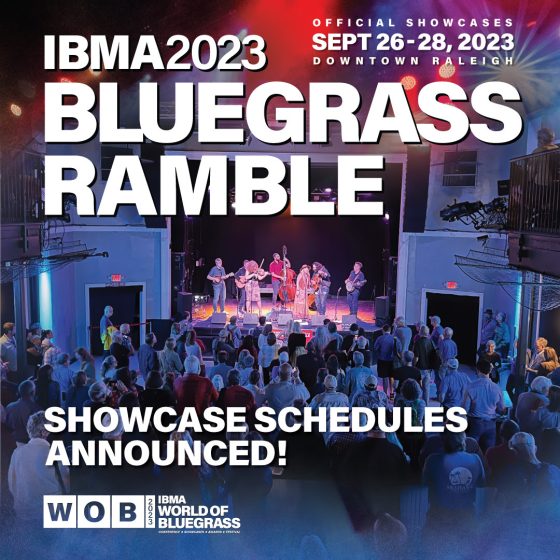
The biggest week in bluegrass has arrived. The International Bluegrass Music Association’s annual business conference and festival begins tomorrow, September 26, and continues through Saturday, September 30, in Raleigh, North Carolina. It’s the 10th year the event has been hosted in the music-rich state of North Carolina.
From Tuesday to Thursday, industry professionals, artists, musicians, songwriters, lawyers and more will participate in panels and professional development during Wide Open Bluegrass, the conference portion of the week’s programming. Highlights will include a keynote address by Matt Glaser of Berklee College of Music (Tuesday), the Momentum Awards Luncheon (Wednesday) and Industry Awards Luncheon (Thursday) — plus a BGS-presented panel on podcasts, An Essential Guide To Podcasting (Wednesday), which will be moderated by Keith Billik of Picky Fingers and will feature Basic Folk hosts Cindy Howes and Lizzie No, among others. During the evenings, when conference events have concluded, attendees and fans will enjoy the Bluegrass Ramble, IBMA’s roster of more than thirty showcasing acts and bands at venues peppered throughout downtown Raleigh.
On Thursday evening, it’s the so-called “Bluegrass Prom,” the 34th Annual IBMA Bluegrass Music Awards, held at the Martin Marietta Center for the Performing Arts just steps away from the conference center and host hotel. Hosted by Ketch Secor and Molly Tuttle, the biggest night of the biggest week in bluegrass will see artists and bands like Billy Strings, Sister Sadie, Tray Wellington, Del McCoury Band and many more vie for awards like Entertainer of the Year, Vocal Group of the Year, Best New Artist and beyond. The Bluegrass Music Hall of Fame & Museum will also induct three new members during the ceremony, mandolinist Sam Bush, innovator and stylist David Grisman and the legendary and chart-topping Wilma Lee Cooper.
The awards show marks the week’s transition from conference to festival, as Bluegrass Live! takes over the Red Hat Amphitheater and all of downtown Raleigh on Friday and Saturday. On the main stage, enjoy headliners like Mighty Poplar, Molly Tuttle & Golden Highway, AJ Lee & Blue Summit, Missy Raines & Allegheny and an all-star banjo collaboration of Tray Wellington, Jake Blount and Kaïa Kater. Vendors, artisans, food trucks and more will line the streets of downtown, where dozens more bands will perform for the second-largest bluegrass festival audience in the world – nearly 200,000 bluegrass and roots music fans will make Raleigh their destination this weekend.
Below, find our short list of events, bands, panels, showcases, presentations and shows not-to-be-missed at IBMA’s World of Bluegrass and Bluegrass Live!
Panels & Conference Events
The World of Bluegrass business conference gets going bright and early tomorrow morning, with a New Attendee Orientation at Raleigh Convention Center room 304 at 9 a.m. Once you have the lay of the land, check out these conference programs and panels throughout the week. Don’t miss your IBMA professional member constituency meeting – they’re held throughout the week for the various constituencies – and don’t miss the exhibit hall, full of vendors, organizations, festivals and more. It opens Wednesday at 1 p.m.
IBMA KEYNOTE ADDRESS & RECEPTION BY MATT GLASER TUESDAY 4PM – 5:30PM | RCC BALLROOM
Matt Glaser, who served as chair of Berklee College of Music’s String Department for 28 years and has pioneered its American Roots Music Program, will give a “dynamic” presentation for this year’s keynote entitled, Hidden Threads: Bluegrass in the American Musical Tapestry.” Glaser will explore the many styles, genres and formats that influenced and informed the creation of bluegrass – jazz, blues, gospel, old-time and so much more.
SUPERSESSION – WOMEN IN THE BUSINESS OF BLUEGRASS WEDNESDAY 9AM – 9:50AM | RCC 306
An absolutely star-studded panel will explore how women and femme folks continue to carve out spaces for themselves, professionally, in these roots music communities. Panelists include: Deering Banjos chief executive Jamie Deering, event planner and promoter Claire Armbruster (Planning Stages), the owner/operator of Elderly Instruments, Lillian Werbin, broadcaster and radio host Michelle Lee, BGS contributor and collaborator Brandi Waller-Pace, a non-profit founder, organizer and educator (Fort Worth African American Roots Music Festival & Decolonizing the Music Room), Rounder Records co-founder Marian Leighton Levy, Mary Beth Martin of the Earl Scruggs Center and Carly Smith of the Bluegrass Music Hall of Fame & Museum.
Each year during World of Bluegrass the Wednesday luncheon is devoted to awarding up-and-comers in the bluegrass industry, from bands and instrumentalists to industry involved professionals and mentors. You can see the full list of Momentum Awards nominees here. Plus, hear luncheon showcases by a fine selection of Bluegrass Ramble bands.
SUPERSESSION – OH, DIDN’T THEY RAMBLE: THE BLUEGRASS SIDE OF ROUNDER RECORDS WEDNESDAY 1PM – 1:50PM | RCC 306
BGS contributor and Carolina Calling host David Menconi will release his new book, Oh, Didn’t They Ramble: Rounder Records and the Transformation of American Roots Music, next month, so it’s perfect timing for this panel examining the historical significance of this record label. The lineup will feature Rounder founders and IBMA Hall of Fame members Ken Irwin, Marian Leighton Levy and Bill Nowlin along with broadcaster Daniel Mullins and, of course, Menconi himself.
AN ESSENTIAL GUIDE TO PODCASTING WEDNESDAY 2PM – 2:50PM | RCC 304
We are so excited to convene Keith Billik of Picky Fingers Podcast, Lizzie No and Cindy Howes of Basic Folk, and more BGS team members from our Podcast Network to talk about the essentials of bluegrass and roots music podcasting. If you’re interested in learning about distribution, sponsorships, syndication, editing, production, pre-production and so much more, this conversation is for you.
On Thursday, the Industry Awards luncheon will recognize achievements and contributions of the industry’s sound engineers, broadcasters, writers and more. Plus, IBMA will hand out their second-highest honor, the Distinguished Achievement Award, to a small handful of honorees – of which we’re one! BGS is so humbled and honored to be one recipient of this year’s Distinguished Achievement Awards. Watch for a feature on BGS and the award presentation later this week.
Plus, a few more panels and programs starred on our calendar include:
AVOIDING TOKENISM IN TRAD MUSIC WEDNESDAY 2PM – 2:50PM | RCC 306
DIVERSITY, EQUITY, & INCLUSION (DEI) TOWN HALL WEDNESDAY 4PM – 5PM | RCC 306
IBMA TOWN HALL MEETING THURSDAY 9AM – 10:30AM | RCC 306
YOUTUBE: FINDING YOUR COMMUNITY, GROWING YOUR AUDIENCE THURSDAY 1:30PM – 2:20PM | RCC 305
30+ bluegrass, old-time, and roots music bands will showcase throughout downtown Raleigh during IBMA’s World of Bluegrass. These shows are open to both conference attendees and the general public. Find out more about ticketing and admission here.
Not sure where to begin? Here are a few bands worth your attention – and perhaps a hasty jog down Fayetteville Street!
ALEX LEACH
Multi-instrumentalist, songwriter and Clinch Mountain Boys alumnus Alex Leach brings a delightful ’60s and ’70s flair to his brand of central Appalachian bluegrass. We recently premiered his latest single, “Summer Haven,” and look forward to catching him live this week during the Bluegrass Ramble.
GOLDEN SHOALS
Golden Shoals are Nashville-based duo Amy Alvey and Mark Kilianski, another group we were fortunate enough to recently feature in a video premiere for “Bitter,” a song co-written by Alvey and Rachel Baiman.
RACHEL SUMNER & TRAVELING LIGHT
You may recognize Rachel Sumner from her time in zany, jazz-inflected string band Twisted Pine. She’s since ventured out on her own as a solo artist with her music centered on her New England-influenced songwriting and chambergrass aesthetics – though she originally hails from the Southwest U.S.
SEQUOIA ROSE
“Bluegrass is for everyone,” after all, and we’re so glad to see Sequoia Rose on the official showcase lineup for IBMA! We were first introduced to her jamgrassy music via submission earlier this year and have been itching for a chance to hear it live.
THOMAS CASSELL
Mandolinist, writer and songwriter Thomas Cassell – who, you may know, is a BGS contributor as well – makes his home in Nashville, Tennessee, though he was raised in the bluegrass-steeped mountains of Southwestern Virginia. His brand of bluegrass is all at once timeless and forward looking with its keystone being his honeyed voice, like a youthful Dan Tyminski with a dash of Russell Moore.
VIOLET BELL
North Carolina string duo Violet Bell are both ethereal and grounded. Their latest album, Shapeshifter, is a stunning conceptual work that is never burdened by the nuanced stories it tells. (Read our feature on the record here.) Omar Ruiz-Lopez and Lizzy Ross subtly and deftly complicate the roots music forms that infuse their music. A must-see at IBMA.
WYATT ELLIS
Our readers, followers and fans can’t get enough of mandolin prodigy Wyatt Ellis, who gracefully and virtuosically continues the now generations-old tradition of fleet-fingered youngsters shredding the mando. Like Ricky Skaggs, Marty Stuart, Chris Thile, Sierra Hull and many more before him, Wyatt enjoys cross-generational collaboration and has his sights set on a lifelong career in this music. Catch him showcasing at IBMA and tell folks thirty years from now you “saw him when.”
Artist:Hildaland Hometown: Portland, Maine Song: “Trains/Fin’s” Album:Sule Skerry Release Date: September 26, 2023 (single); November 3, 2023 (album) Label: Adhyâropa Records
In Their Words: “This set is comprised of ‘Trains’ by Ethan Setiawan and ‘Fin’s Foley’ by Louise Bichan. We decided these tunes would fit well together as they’re both in three parts, and both about movement. It was an honor to get the great Neil Pearlman on the track on keyboard as well. Ethan says of the first tune, ‘”Trains” was written during some discussion with the great harpist Maeve Gilchrist about hornpipes. I tried to integrate some of the stylistic ups and downs, using arpeggios to create a melody rather than something linear.’ And Louise wrote “Fin’s Foley” for her brother, after a wheel mishap. I had forgotten all about the unofficial title until I came across the original sheet music while rummaging through things at my folks’ house: Rover’s Revenge!'” – Hildaland
Artist:Jesse Smathers Hometown: Floyd, Virginia Song: “Sing Darling Sing” Release Date: September 22, 2023
In Their Words: “I believe that simple melodies and simple stories relate across generations and all walks of life. That’s the true beauty of string music: its relatability. This song was composed with that aspiration.
“Being raised in piedmont North Carolina, family roots in Western Carolina, and now living in Southwest Virginia, string music always surrounded me and the tunes that always struck a chord were the fun melodic tunes, and happy songs. ‘Sing Darling Sing’ is just that, a happy tune with a loving story.
“I am so very proud of this recording, musically and personally, for it draws inspiration from my own marriage as well as relationship examples I see set by older generations. I hope the music and imagery takes the listener to a simpler and scenic time when life didn’t move as fast, and communication wasn’t at our fingertips. However, the young man in the tale is chomping at the bit to marry the girl of his dreams, the day can’t come quick enough and nothing’s gonna stop him!” – Jesse Smathers
Track Credits:
Jesse Smathers – Guitar/ Lead Vocal Nick Goad – Mandolin/ Harmony Vocal Corbin Hayslett – Banjo Hunter Berry – Fiddle Joe Hannabach – Bass
Photo Credit: Laci Mack
This website uses cookies to improve your experience. We'll assume you're ok with this, but you can opt-out if you wish.AcceptRejectRead More
Privacy & Cookies Policy
Privacy Overview
This website uses cookies to improve your experience while you navigate through the website. Out of these, the cookies that are categorized as necessary are stored on your browser as they are essential for the working of basic functionalities of the website. We also use third-party cookies that help us analyze and understand how you use this website. These cookies will be stored in your browser only with your consent. You also have the option to opt-out of these cookies. But opting out of some of these cookies may affect your browsing experience.
Necessary cookies are absolutely essential for the website to function properly. This category only includes cookies that ensures basic functionalities and security features of the website. These cookies do not store any personal information.
Any cookies that may not be particularly necessary for the website to function and is used specifically to collect user personal data via analytics, ads, other embedded contents are termed as non-necessary cookies. It is mandatory to procure user consent prior to running these cookies on your website.