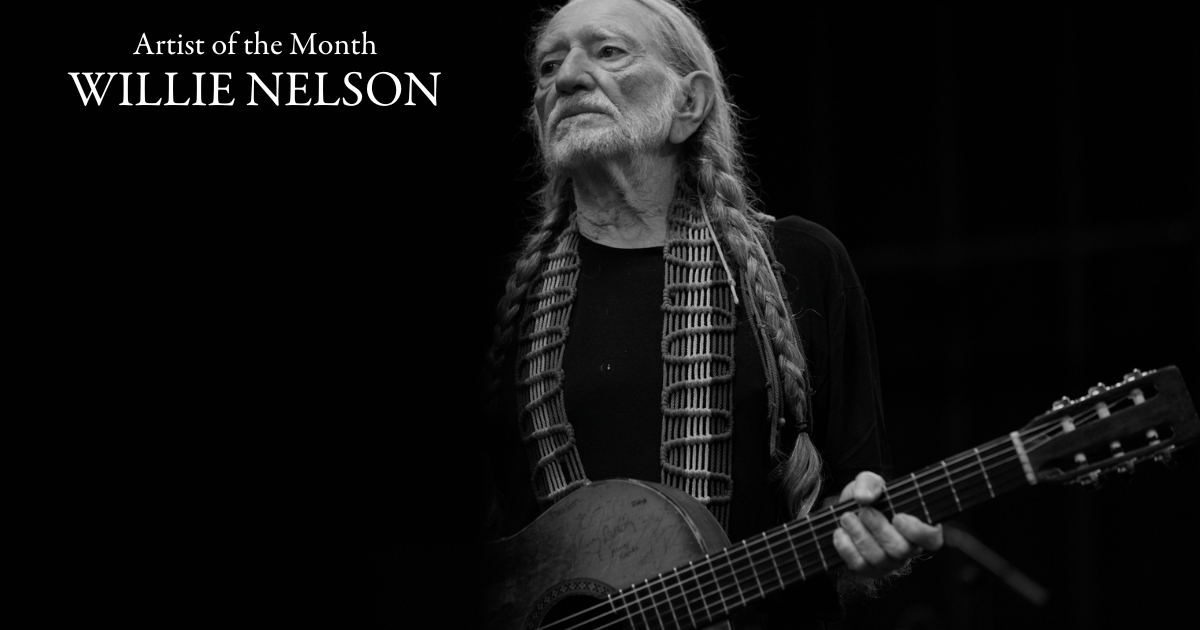
Artist of the Month: Willie Nelson

Earlier this year legendary musician, songwriter and recording artist Willie Nelson announced his 151st studio album would be a return to bluegrass, this time reimagining 12 of his own originals with a string band lineup. Available September 15 and simply titled Bluegrass, the Buddy Cannon-produced project reinforces the career-long relationship Nelson has had with bluegrass and bluegrass pickers, calling on old friends and collaborators like Barry Bales, Ron Block and Dan Tyminski, as well as band members and vocalists Aubrey Haynie, Rob Ickes, Josh Martin, Mickey Raphael, Seth Taylor, Bobby Terry, Wyatt Beard and Melonie Cannon.

Nelson is a revered song interpreter and cross-genre adventurer, covering and recording songs from all across the American roots music landscape, from the Great American Songbook to blues and soul, from jazz to Texas swing. No corner of Americana in any/all of its forms has been left untouched by this prolific music maker. But his relationship to bluegrass – similar to his peers like Dolly Parton or Lee Ann Womack, or his acolytes and emulators like Sturgill Simpson and Kacey Musgraves – speaks to the primordial relationship between country and bluegrass, more than just musical touristing or a genre-based gimmick. Nelson doesn’t put on “bluegrass” as a costume, he brings it forward from the earliest days of country music as a genre, before sub-genres like bluegrass had stratified and coalesced as identities somewhat separate from country as a whole. It’s part of what makes Bluegrass a compelling collection, tracks like “Still Is Still Moving to Me,” the album’s lead single, don’t feel like songs wearing bluegrass drag, but rather feel like country gone back to its roots.

Across a career that has touched so many other musicians, singers, and creators – from Waylon Jennings to Ray Charles to Snoop Dogg – it follows that Nelson has counted many bluegrass greats among his album guests, track features, and show bills. He’s toured extensively with Alison Krauss & Union Station over the past two decades; it’s no surprise to find a handful of Union Station alumni on Bluegrass. He’s recorded with Rhonda Vincent, Billy Strings and all the McCoury boys, Del, Rob and Ronnie – the latter two have toured with Willie, too. Country Music, a 2010 release from Nelson produced by Americana superstar T Bone Burnett, was also a bluegrass-centered album, pulling from the deep and broad repertoire of early country, old-time and bluegrass – when the three genres could be represented by a Venn diagram of one circle.

There are so many facets of Nelson’s music making that feel patently bluegrass: his love of borderless, boundless cover songs; his ability as a picker standing equal with his songwriting and one-of-a-kind vocal interpretations; his endless output of personal, meaningful music; his mutual admiration of his compatriots, adorers and mentees. The list could go on ad infinitum. It makes perfect sense that this year he’ll join the father of bluegrass, Bill Monroe, in the Rock & Roll Hall of Fame.

It’s rare that a multi-hyphenate musician and songwriter such as Willie Nelson can shift so effortlessly between contexts, gathering and maintaining a diverse following that understands great music can – and should – transcend not only genre, but all of the trappings of the music industry. It’s part of why Bluegrass feels grounded, honest and resonant. Willie Nelson isn’t playing pretend, he’s just being himself – and that might be the most bluegrass thing about him.

Watch for our Artist of the Month feature, an in-depth exploration of Willie Nelson’s relationship with bluegrass across his life and career coming later this month, and enjoy our Essential Willie Nelson Playlist, featuring many of his bluegrass forays among his popular recordings and our BGS favorites.


Photo Credit: James Minchin
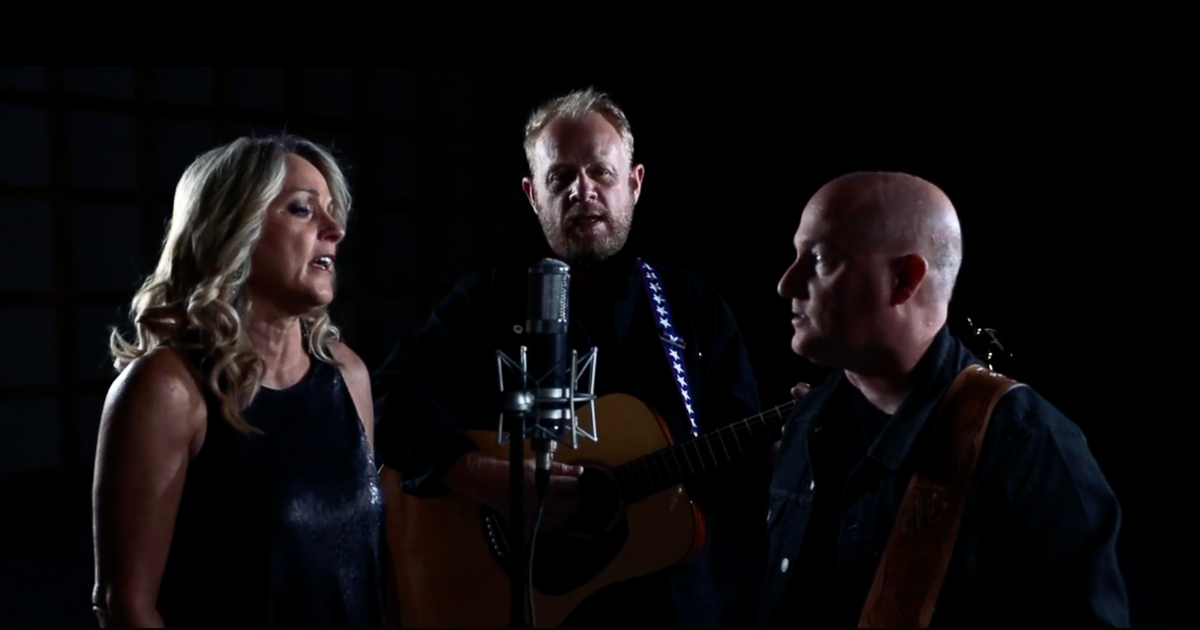
WATCH: Dailey & Vincent, “Those Memories of You” (Feat. Rhonda Vincent)

Artist: Dailey & Vincent
Hometown: Jamie Dailey, Gainesboro, Tenn.; Darrin Vincent, Greentop, Mo.
Song: “Those Memories of You”
Album: Let’s Sing Some Country!
Release Date: September 16, 2022
Label: BMG

In Their Words: “‘Those Memories’ has been one of my favorites songs since I was a kid. Recording this gem took me back to some wonderful times as a child. Having Rhonda Vincent harmonize with us on this song made it even more special to us! After all these years, we finally got to shoot our first video with our Opry sister, who’s also Darrin’s real sister! What a treat to also have guitarist Seth Taylor lend his talent to this fun project!” — Jamie Dailey

“‘Those Memories’ has always been an iconic song since Bill and his son James Monroe recorded it in 1978… Then in 1987, it reached the No. 5 spot on Billboard as a single for Dolly, Emmylou, and Linda. We’re so pleased Rhonda joined Jamie and myself with our updated take on the tune!” — Darrin Vincent


Photo Credit: Tyler Vandervort

BGS 5+5: Kristy Cox

Artist: Kristy Cox
Hometown: Nashville, Tennessee, by way of Mount Barker, South Australia
Latest album: Shades of Blue
Personal nicknames: Nil

Which artist has influenced you the most … and how?

This would have to be one of the hardest questions to answer. I grew up listening to a HUGE range of music styles. My parents are big ’70s rock fans, and my pop listened to old time Australian country music and bluegrass. I feel I have been influenced in a different way from all of the artists that shaped my childhood, from Meatloaf and Queen to Slim Dusty and Merle Haggard; they each have given me something. I would say my idol is Emmylou Harris. I love her rawness, her songs and her voice. She is fantastic!

What was the first moment that you knew you wanted to be a musician?

I was around 4 years old when I first told my mum and dad that I was going to be a singer when I grew up. From an even younger age there are photos of me playing the guitar. I think I always knew that it was what I wanted to do. I first performed on stage at the age of 11, and was completely hooked from that moment on. I have a law degree and studied to ensure I had a “backup plan” but I have never wanted to do anything else.

What’s the toughest time you ever had writing a song?

I am currently halfway through writing a song for my children, Adelaide and Ryman. I have been halfway through for two years now and just cannot think of enough words to describe what they mean to me, or how their little fingerprints will forever be on my heart. I think as a songwriter it is hard sometimes to find the words you want to say, no matter how hard you look. One day I know it will come to me and I will be able to finish it as a gift to them.

What has been the best advice you’ve received in your career so far?

I was extremely lucky to meet my idol Emmylou Harris at the IBMA convention in 2013. It was my first trip to the United States, and I was able to go backstage and meet her. At the time I thought I had to perform country pop music, as that was what all the girls my age were doing, even though I was not the biggest fan of it. Emmylou told me that if she could give me one piece of advice, it would be to play music that I enjoy, and if I ever stop enjoying it … that is the moment to stop. I left that day and decided to start recording bluegrass music, because bluegrass made me happy! I am so glad I listened to her. I am not sure I would still be going if it was not for that advice.

Which elements of nature do you spend the most time with and how do those impact your work?

I need sunshine and the beach in my life. Being an Australian and living landlocked in Tennessee has made me realize this. There is something about the sound of the ocean, I do not even have to get in, that settles me. I have begun to notice that if I do not get enough sunshine and don’t do at least four trips to an ocean each year, I become almost depressed and distracted. These elements ground me and help me concentrate on my goals and inspire me to do more.


Photo Credit: Katrina Burgoyne

Grammy Nominations 2022: See the American Roots Music Nominees

The Grammy Awards have revealed their nominees, and the American Roots Music ballot is especially diverse this year. Take a look at nominations for the 2022 show, which will air January 31 from Los Angeles on CBS. (See the full list.)

Best American Roots Performance

Jon Batiste – “Cry”
Billy Strings – “Love and Regret”
The Blind Boys of Alabama and Béla Fleck – “I Wish I Knew How It Would Feel to be Free”
Brandy Clark Featuring Brandi Carlile – “Same Devil”
Allison Russell – “Nightflyer”

Best American Roots Song

Rhiannon Giddens, Francesco Turrisi – “Avalon”
Valerie June Featuring Carla Thomas – “Call Me a Fool”
Jon Batiste – “Cry”
Yola – “Diamond Studded Shoes”
Allison Russell – Nightflyer

Best Americana Album

Jackson Browne – Downhill From Everywhere
John Hiatt with the Jerry Douglas Band – Leftover Feelings
Los Lobos – Native Sons
Allison Russell – Outside Child
Yola – Stand for Myself

Best Bluegrass Album

Billy Strings – Renewal
Béla Fleck – My Bluegrass Heart
The Infamous Stringdusters – A Tribute to Bill Monroe
Sturgill Simpson – Cuttin’ Grass Vol. 1 (Butcher Shoppe Sessions)
Rhonda Vincent – Music Is What I See

Best Traditional Blues Album

Elvin Bishop and Charlie Musselwhite – 100 Years of Blues
Blues Traveler – Traveler’s Blues
Cedric Burnside – I Be Trying
Guy Davis – Be Ready When I Call You
Kim Wilson – Take Me Back

Best Contemporary Blues Album

The Black Keys Featuring Eric Deaton and Kenny Brown – Delta Kream
Joe Bonamassa – Royal Tea
Shemekia Copeland – Uncivil War
Steve Cropper – Fire It Up
Christone “Kingfish” Ingram – 662

Best Folk Album

Mary Chapin Carpenter – One Night Lonely (Live)
Tyler Childers – Long Violent History
Madison Cunningham – Wednesday (Extended Edition)
Rhiannon Giddens with Francesco Turrisi – They’re Calling Me Home
Sarah Jarosz – Blue Heron Suite

Best Regional Roots Music Album

Sean Ardoin and Kreole Rock and Soul – Live in New Orleans!
Big Chief Monk Boudreaux – Bloodstains and Teardrops
Cha Wa – My People
Corey Ledet Zydaco – Corey Ledet Zydaco
Kalani Pe’a – Kau Ka Pe’a


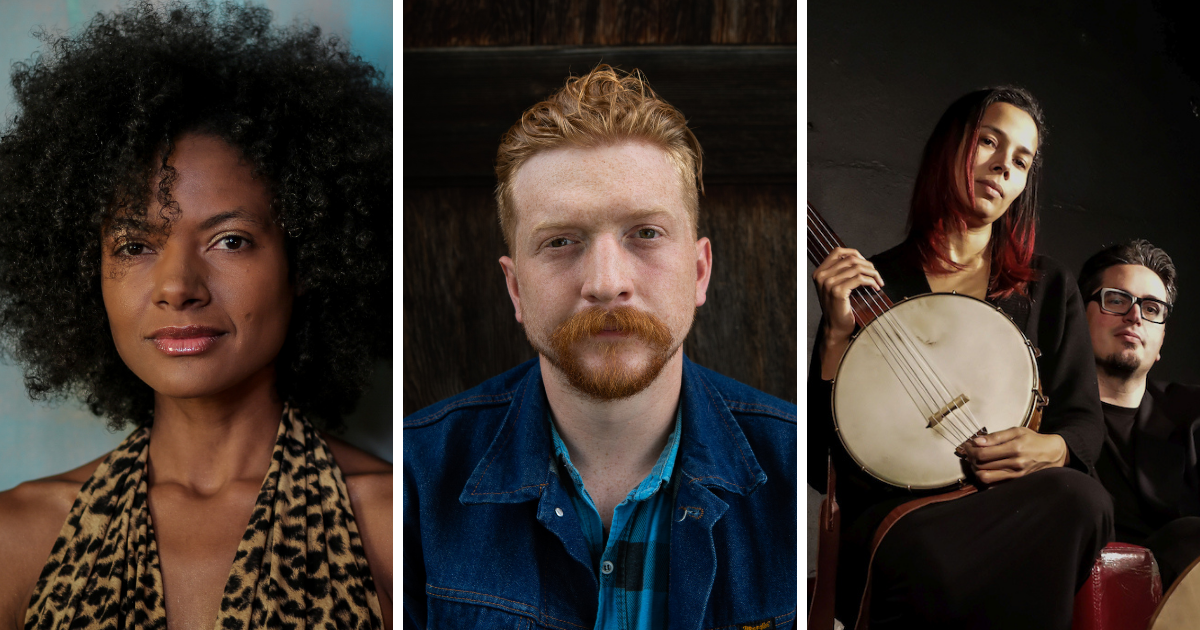
Photo of Allison Russell: Marc Baptiste
Photo of Tyler Childers: David McClister
Photo of Rhiannon Giddens and Francesco Turrisi: Karen Cox

IBMA Bluegrass Music Awards Reveal Nominees, Hall of Fame Inductees

Nominees for the 32nd Annual IBMA Bluegrass Music Awards presented by Yamaha were announced today, with Balsam Range, Billy Strings, Doyle Lawson & Quicksilver, Del McCoury Band, and The Po’ Ramblin’ Boys landing in the top category of Entertainer of the Year. Alison Krauss, Lynn Morris, and the Stoneman Family will be inducted into the Bluegrass Music Hall of Fame during the show as well.

Five people who have made significant contributions to bluegrass music were named as recipients of the IBMA Distinguished Achievement Award: industry leader Nancy Cardwell Webster, broadcaster Lee Michael Demsey, Czech luthier/performer Jaroslav Prucha, musician/performer Cliff Waldron, and Boston Bluegrass Union’s Stan Zdonik.

The IBMA Bluegrass Music Awards on Thursday, September 30, at the Duke Energy Center for the Performing Arts in Raleigh, North Carolina. Awards are voted on by the professional membership of the International Bluegrass Music Association (IBMA), the professional nonprofit association for the bluegrass music industry.

ENTERTAINER OF THE YEAR

Balsam Range
Billy Strings
Doyle Lawson & Quicksilver
The Del McCoury Band
The Po’ Ramblin’ Boys


MALE VOCALIST OF THE YEAR

Ronnie Bowman
Del McCoury
Danny Paisley
Junior Sisk
Larry Sparks


FEMALE VOCALIST OF THE YEAR

Brooke Aldridge
Dale Ann Bradley
Sierra Hull
Molly Tuttle
Rhonda Vincent


VOCAL GROUP OF THE YEAR

Darin & Brooke Aldridge
Balsam Range
Blue Highway
Doyle Lawson & Quicksilver
Sister Sadie


INSTRUMENTAL GROUP OF THE YEAR

Appalachian Road Show
Billy Strings
Michael Cleveland & Flamekeeper
The Infamous Stringdusters
The Travelin’ McCourys


NEW ARTIST OF THE YEAR sponsored by Ron & Nancy McFarlane

Appalachian Road Show
Carolina Blue
Gina Furtado Project
High Fidelity
Merle Monroe


SONG OF THE YEAR

“Banjo Player’s Blues”
Artist: High Fidelity
Songwriter: Charlie Monroe
Producers: Jeremy Stephens, Brad Benge
Label: Rebel Records

“Hitchhiking to California”
Artist: Alan Bibey & Grasstowne
Songwriters: Wes Golding/Alan Bibey/Jerry Salley
Producers: Jerry Salley, Ron Stewart, Dottie Leonard Miller
Label: Billy Blue Records

“Just Load the Wagon”
Artist: Junior Sisk
Songwriter: J.R. Satterwhite
Producers: Amanda Cook, Junior Sisk, Mark Hodges
Label: Mountain Fever Records

“Leaving on Her Mind”
Artist: Doyle Lawson & Quicksilver
Songwriter: Jack Clement
Producer: Rosta Capek
Label: Billy Blue Records

“Richest Man”
Artist: Balsam Range
Songwriters: Jim Beavers/Jimmy Yeary/Connie Harrington
Producer: Balsam Range
Label: Mountain Home Music Company


ALBUM OF THE YEAR (Tie)

Bluegrass 2020
Artist: Scott Vestal, Patrick McAvinue, Cody Kilby, Dominick Leslie, Curtis Vestal
Producers: Scott Vestal, Ethan Burkhardt, Lonnie Lassiter
Label: Pinecastle Records

Distance and Time
Artist: Becky Buller
Producer: Stephen Mougin
Label: Dark Shadow Recording

Fall Like Rain
Artist: Justin Moses
Producer: Justin Moses
Label: Mountain Fever Records

Industrial Strength Bluegrass: Southwestern Ohio’s Musical Legacy
Artist: Various Artists
Producer: Joe Mullins
Label: Smithsonian Folkways Recordings

Load the Wagon
Artist: Junior Sisk
Producers: Amanda Cook, Junior Sisk, Mark Hodges
Label: Mountain Fever Records

Still Here
Artist: Steve Gulley & Tim Stafford
Producers: Steve Gulley, Tim Stafford
Label: Mountain Home Music Company


BANJO PLAYER OF THE YEAR

Gena Britt
Gina Furtado
Rob McCoury
Kristin Scott Benson
Scott Vestal


BASS PLAYER OF THE YEAR

Mike Bub
Todd Phillips
Missy Raines
Mark Schatz
Marshall Wilborn


FIDDLE PLAYER OF THE YEAR

Jason Carter
Michael Cleveland
Stuart Duncan
Bronwyn Keith-Hynes
Deanie Richardson


RESOPHONIC GUITAR PLAYER OF THE YEAR

Jerry Douglas
Andy Hall
Rob Ickes
Phil Leadbetter
Justin Moses


GUITAR PLAYER OF THE YEAR sponsored by Yamaha

Trey Hensley
Billy Strings
Bryan Sutton
Molly Tuttle
Jake Workman


MANDOLIN PLAYER OF THE YEAR

Jesse Brock
Sam Bush
Sierra Hull
Ronnie McCoury
Tristan Scroggins


COLLABORATIVE RECORDING OF THE YEAR

“Birmingham Jail”
Artists: Barry Abernathy with Vince Gill
Songwriter: Traditional
Producers: Barry Abernathy, Jim VanCleve, Dottie Leonard Miller
Label: Billy Blue Records

“In the Resurrection Morning”
Artists: Sacred Reunion featuring Doyle Lawson, Vince Gill, Barry Abernathy, Tim Stafford, Mark Wheeler, Jim VanCleve, Phil Leadbetter, Jason Moore
Songwriter: Mark Wheeler
Producers: Barry Abernathy, Jim VanCleve, Dottie Leonard Miller
Label: Billy Blue Records

“My Baby’s Gone”
Artists: Justin Moses with Del McCoury
Songwriter: Dennis Linde
Producer: Justin Moses
Label: Mountain Fever Records

“Tears of Regret”
Artists: High Fidelity with Jesse McReynolds
Songwriters: Jesse McReynolds/Lucille Hutton
Producers: Jeremy Stephens, Corrina Rose Logston, Brad Benge
Label: Rebel Records

“White Line Fever”
Artists: Bobby Osborne with Tim O’Brien, Trey Hensley, Sierra Hull, Stuart Duncan, Todd Phillips, Alison Brown
Songwriters: Merle Haggard/Jeff Tweedy
Producers: Alison Brown, Garry West
Label: Compass Records


INSTRUMENTAL RECORDING OF THE YEAR

“The Appalachian Road”
Artist: Appalachian Road Show
Songwriter: Jim VanCleve
Producers: Jim VanCleve, Barry Abernathy, Appalachian Road Show, Dottie Leonard Miller
Label: Billy Blue Records

“Foggy Mountain Chimes”
Artists: Scott Vestal, Patrick McAvinue, Cody Kilby, Dominick Leslie, Curtis Vestal
Songwriter: Earl Scruggs
Producer: Scott Vestal
Label: Pinecastle Records

“Ground Speed”
Artists: Kristin Scott Benson, Skip Cherryholmes, Jeremy Garrett, Kevin Kehrberg, Darren Nicholson
Songwriter: Earl Scruggs
Producer: Jon Weisberger
Label: Mountain Home Music Company

“Mountain Strings”
Artist: Sierra Hull
Songwriters: Frank Wakefield/Red Allen
Producer: Joe Mullins
Label: Smithsonian Folkways Recordings

“Taxland”
Artist: Justin Moses with Sierra Hull
Songwriter: Justin Moses
Producer: Justin Moses
Label: Mountain Fever Records


GOSPEL RECORDING OF THE YEAR

“After Awhile”
Artist: Dale Ann Bradley
Songwriter: Public Domain
Producer: Dale Ann Bradley
Label: Pinecastle Records

“Grit and Grace”
Artist: Balsam Range
Songwriters: Ann Melton/Milan Miller/Beth Husband
Producer: Balsam Range
Label: Mountain Home Music Company

“Hear Jerusalem Calling”
Artist: Joe Mullins & The Radio Ramblers
Songwriters: Marty Stuart/Jerry Sullivan
Producers: Joe Mullins, Dottie Leonard Miller
Label: Billy Blue Records

“In the Resurrection Morning”
Artists: Sacred Reunion featuring Doyle Lawson, Vince Gill, Barry Abernathy, Tim Stafford, Mark Wheeler, Jim VanCleve, Phil Leadbetter, Jason Moore
Songwriter: Mark Wheeler
Producers: Barry Abernathy, Jim VanCleve, Dottie Leonard Miller
Label: Billy Blue Records

“When He Calls My Name”
Artist: Alan Bibey & Grasstowne
Songwriters: Alan Bibey/Ronnie Bowman
Producers: Alan Bibey & Grasstowne, Ron Stewart, Jerry Salley, Dottie Leonard Miller
Label: Billy Blue Records


Photo of Billy Strings: Jesse Faatz
Photo of Alison Krauss: Capitol Records
Photo of Molly Tuttle: Zach Pigg & Chelsea Rochelle

Bluegrass Memoirs: ‘Industrial Strength Bluegrass’ and the Dayton Bluegrass Reunion (Part 1)

On April 22, 1989, Cityfolk, a Dayton, Ohio-based concert series, mounted their most ambitious evening to date, The Dayton Bluegrass Reunion, “An All-Star Salute to Dayton’s 40 Year Bluegrass History.” It was held at Memorial Hall in downtown Dayton.

I’m reminded of this concert now because of an essay I wrote for its program booklet: “Industrial Strength Bluegrass.” That is the title of a new book by Fred Bartenstein and Curtis W. Ellison, subtitled “Southwestern Ohio’s Musical Legacy.” This anthology presents a remarkable in-depth portrait of a key regional bluegrass scene, which co-author Bartenstein has likened to seminal regional scenes in other genres like blues (Chicago) and jazz (New Orleans).

In March, Smithsonian Folkways released a 16-track album with the same title, edited by Joe Mullins and son Daniel Mullins. On it are 16 contemporary recordings by today’s leading bluegrass artists, doing the region’s key repertoire — like “Once More,” the Osborne Brothers and Red Allen’s 1958 high lead trio, recreated on the album by The Grascals; and “20/20 Vision” by Jimmy Martin and Osborne Brothers in 1954, done here by Dan Tyminski. Joe Mullins opens the album with his band, The Radio Ramblers, doing “Readin’, Rightin’, Route 23,” an anthem to the Appalachian migrants who nurtured bluegrass in the region.

My experience with the Dayton Bluegrass Reunion began in Albuquerque, New Mexico, in the fall of ’87 at an annual meeting of the American Folklore Society (AFS). One month to the day after the Earl Scruggs Celebration, I met Phyllis Brzozowska, executive director of Cityfolk, “an arts organization,” as she later wrote, “working full time to bring to the public the variety and excellence that exists in traditional arts today.” 

Phyllis grew up with Irish dancing in Dayton. By 1978 she had a Celtic music radio show on WYSO-FM, the Antioch College station, and began booking bands. “A band I knew from Pittsburgh called ‘Devilish Mary’ was coming through town. They were a great dance band that played ole’ timey music and Irish traditional music.” She and a friend organized a “ceili” at a downtown club in Dayton. By 1981 she’d formed Cityfolk. 

By 1987, Cityfolk had branched out from Irish to include other roots music in their events — including bluegrass. In the 1980s a broadening of interest in the traditional arts was nurtured through public sector folklore lobbying in Washington. The Festival of American Folklife, established in 1967 by Ralph Rinzler at the Smithsonian, led to the establishment of a Folk Arts department at the National Endowment for the Arts and the creation of the American Folklife Center at the Library of Congress. The National Folk Festival, around since the ’30s, moved to Washington and became the National Council for Traditional Arts (NCTA) in 1976. 

These national institutions supported performing arts markets for traditional artists. Local and regional arts organizations like Cityfolk and PineCone grew and flourished during the ’80s, and public folklorists were active in the AFS. Phyllis was wanting to talk with me because I’d written a book about bluegrass. She was planning a reunion concert to celebrate 40 years of bluegrass in Dayton, applying for funding from the Ohio Arts Council and the Dayton Performing Arts Fund. She asked me if I would work as a consultant and writer for this event’s program. 

Brzozowska wanted to tell the story of bluegrass in Dayton as dramatically as possible, so they were hiring Don Baker, “one of the leading theater directors in the South.” Baker had grown up in Appalachia and started his career at Appalshop in Whitesburg, Kentucky. In 1984 he co-founded Lime Kiln, a theater in Lexington, Virginia. 

For the Reunion, Brzozowska later recalled, Baker “constructed a theatrical foundation on which the music and narrative would be presented. He also designed the set, contributed input to the script, set the pacing of the show and when the lights went up, was the perfect stage M.C. for the evening.” 

In producing the show Brzozowska took counsel from three Dayton old hands — Harley Allen, Fred Bartenstein, and Paul “Moon” Mullins. Additional input came from old-time fiddler and Dayton City librarian Barb Kuhns and writer-musician Larry Nager. As a consultant and writer, I worked with them on the planning of the concert and on program booklet. I also helped backstage on the night of the concert. 

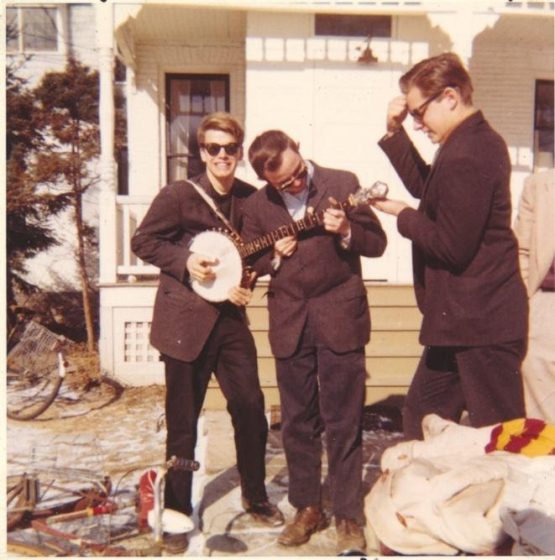
My experiences with southwestern Ohio bluegrass began in the late fifties. Oberlin classmate Jeff Piker came from Cincinnati as a freshman in ’58. Inspired by a Pete Seeger concert at Antioch, he’d bought a used Vega banjo at a music shop in the Appalachian migrant neighborhood of Over-The-Rhine that Nathan McGee writes about in Industrial Strength Bluegrass (pp. 164, 166). It had homemade Scruggs pegs

That made Piker a popular guy with us campus bluegrass jammers. We all borrowed the banjo to learn how to use the pegs. During the January 1959 winter break we took it with us when we went to Yellow Springs to visit Antioch College friends. Bluegrass was catching on there. 

Chuck Crawford, Neil V. Rosenberg, Franklin Miller III at Pyle Inn, Oberlin, Ohio, January 1959

A year later, in March 1960, our band opened for the Osborne Brothers at Antioch. I’ve written about that in Bluegrass: A History (pp. 155-58). In 1962, another band I was in opened at Antioch, for Sid Campbell and Frank Wakefield, and I’ve written about that too, in Bluegrass Generation: A Memoir (119-123).

One detail from that 1960 concert I didn’t mention: when Jeremy Foster called to invite us to open the show for the Osbornes, he said he’d booked the Osborne Brothers because they were nearby and available. We knew of this band only from the sound of their MGM album, The Osborne Brothers and Red Allen. Jeremy was disappointed that they had changed — Red Allen was no longer with them. That made their music less appealing to him. But, as I learned later, Bobby and Sonny didn’t want fancy guitar backup and didn’t need a flashy lead singer. They were focused on their trio.

In the fall of 1963, when I was managing Bill Monroe’s park, the Brown County Jamboree, in Bean Blossom, Indiana, we got reacquainted when they gave their first show there (Bluegrass Generation, pp. 224-226). With Benny Birchfield playing guitar and singing the lowest voice in the trio, they had moved from MGM to Decca. Their first single, “Take This Hammer,” had just come out. Their final MGM album, Cutting the Grass, was due out soon.

They were polishing the high lead trio they’d been working on for five years. That winter I taped them guesting on the WSM’s after-the-Opry broadcast, Ernest Tubb’s Midnite Jamboree. Their harmonies were attracting attention in country music circles.

At Bean Blossom, Bobby and Sonny had told me about their regular Thursday night gigs Ruby’s White Sands in Dayton and invited me to come over some time. In May ’64, Jim Work and I took friends from California, Jerry Garcia and Sandy Rothman, to see them there. 

The Osbornes joined the Opry a few months later. By then they were coming to Bean Blossom twice a year and we’d gotten better acquainted. “Banjer” talk with Sonny was always entertaining. He had experimental bridges, banjos, and capos. On stage, he had great new licks for every show. 

With Bobby I shared an interest in bluegrass history. One Sunday in 1964 I invited the band back to our apartment in Bloomington for supper. While they were there I showed Bobby the work I was doing on the Bill Monroe discography and asked him if he was interested in doing something like that for the Osborne Brothers. He was. We began corresponding about their discography, and started trading tapes.

Benny Birchfield left the Osborne Brothers at the end of ’65. The following spring, in Cincinnati for an academic meeting, I ran into him at the Ken-Mill Café in Over-The-Rhine. He was playing bass in a band that included lead singer and guitarist Jim McCall, with Vernon McIntyre Jr. on banjo. Benny introduced me to the band as a banjo picker from Bean Blossom and invited me to sit in for a set on banjo. That was fun.

On Labor Day, 1966, Carlton Haney held his second Roanoke Bluegrass Festival in Fincastle, Virginia. The Osborne Brothers were there — riding high with their first charted Decca hit, “Up This Hill and Down.” Their Sunday trio on “I Hear A Sweet Voice Calling” with Bill Monroe was one of the high points of the festival that year — a religious experience for many who heard it. 

At that festival, my first, I finally met Pete Kuykendall. We’d been corresponding and trading tapes for several years, and he’d published bluegrass discographies in the mimeo magazine Disc Collector. Now he was promoting a new bluegrass monthly, Bluegrass Unlimited. I told him about the Osborne Brothers discography, and he agreed to publish it in BU (it appeared the following July). Promoter Haney invited me to join him, Ralph Rinzler, and Mayne Smith in introducing Bill Monroe and the Blue Grass Boys and The Osborne Brothers in a special broadcast about the festival on the local TV channel.

In April 1967 I saw them at a club outside Indianapolis. The third voice in the trio was now being sung by Harley Gabbard, later the co-founder of The Boys from Indiana. His name comes up often in Mac McDivitt’s chapter on the southwest Ohio recording scene in Industrial Strength Bluegrass (pp. 43-76). One of Gabbard’s contributions to the regional repertoire, “Family Reunion,” written with his nephew, Aubrey Holt, is performed on the new Folkways CD by Rhonda Vincent and Caleb Daugherty. 

I saw Gabbard again the following October when he dropped in and sang bass on one cut we were recording for George Brock’s gospel album at Rusty York‘s Jewel Records in Mt. Healthy, Ohio. McDivitt’s chapter also devotes a section (pp. 63-65) to Jewel and York’s remarkable careers in bluegrass and rockabilly. Here’s Harley Gabbard with the Osbornes doing what was, as of May ’67, their new single: “Roll Muddy River.”

So, during the years I’d lived in Indiana (1961-68) I’d dipped into the Southwestern Ohio bluegrass scene a number of times. I knew some of the music, some of the people and some of the history. But I had been living in Newfoundland for twenty years. Fortunately Barb Kuhns (Dayton City librarian) and Larry Nager knew the Dayton region scene deeply in a way I didn’t, which was essential, because the sequence and repertoire of the concert had to reflect the drama of the reunion story.

(Editor’s Note: Read part two here.)


Neil V. Rosenberg is an author, scholar, historian, banjo player, Bluegrass Music Hall of Fame inductee, and co-chair of the IBMA Foundation’s Arnold Shultz Fund.

Photo of Neil V. Rosenberg: Terri Thomson Rosenberg

At the Ryman, Four of Bluegrass’ Finest Sing “Down in the River to Pray”

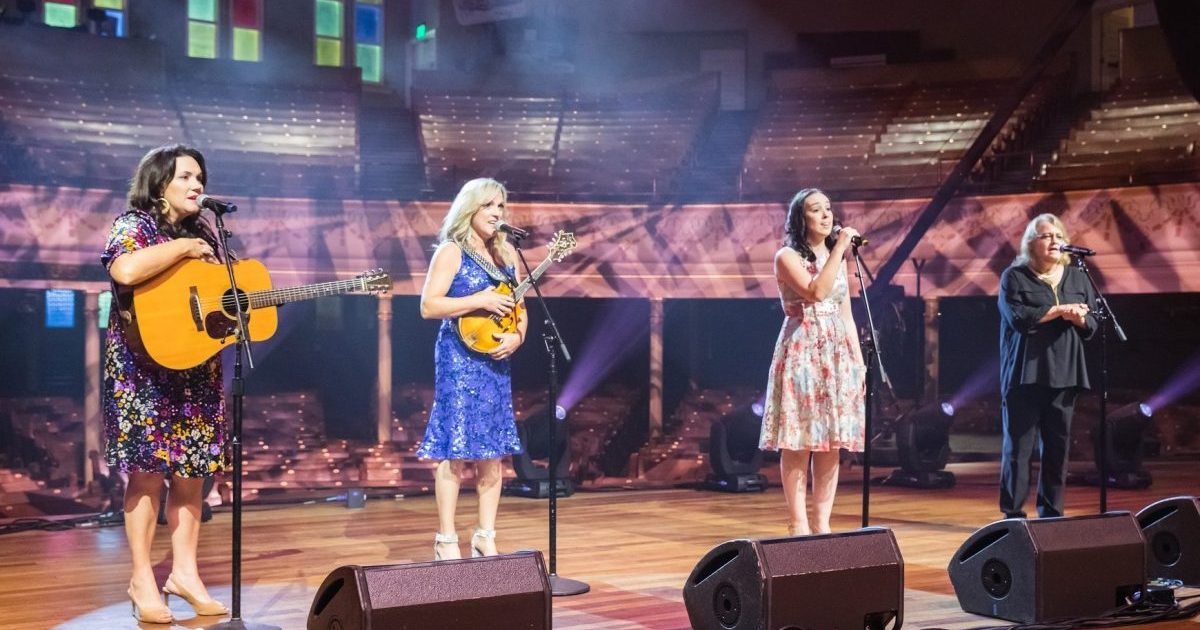
In our celebration of the movie that returned bluegrass to the spotlight of pop culture, we’re throwing it back to the 31st Annual IBMA Awards from October 2020. During the ceremony, four of the five women nominated for Female Vocalist of the Year banded their angelic voices together to pay tribute to the 2000 landmark film O Brother, Where Art Thou? In the video below, Amanda Smith, Rhonda Vincent, Brooke Aldridge, and Dale Ann Bradley stand stoically on the stage of the famed Ryman Auditorium to deliver a brilliant rendition of “Down in the River to Pray.”

This a capella performance is a reminder of not only the music featured in the film, but also the unique characteristic that bluegrass and old-time music can have, feeling simultaneously nostalgic and modern. The women’s gentle voices are wonders to behold in their own rights, but sparks fly when they harmonize, emanating a warmth and life into the historic venue where bluegrass was born. Watch these four eminent women of modern bluegrass interpret an all-time classic recording from our BGS Artist of the Month, O Brother, Where Art Thou?

Editor’s Note: The 2020 IBMA Bluegrass Music Awards will air on Circle TV on Monday, January 18 at 8pm ET / 7pm CT. The ceremony will be broadcast on Circle and Gray TV stations and can also be seen on DISH Studio Channel 102, Sling TV, and other TV affiliates. Circle TV is also available on 275 million smartphones and tablets via the Roku Channel and XUMO apps in addition to a companion livestream on Circle All Access Facebook, YouTube and Twitter.


Photo credit: Shelley Swanger. Pictured L-R: Amanda Smith, Rhonda Vincent, Brooke Aldridge, Dale Ann Bradley

IBMA Awards 2020: See the Full List of Winners

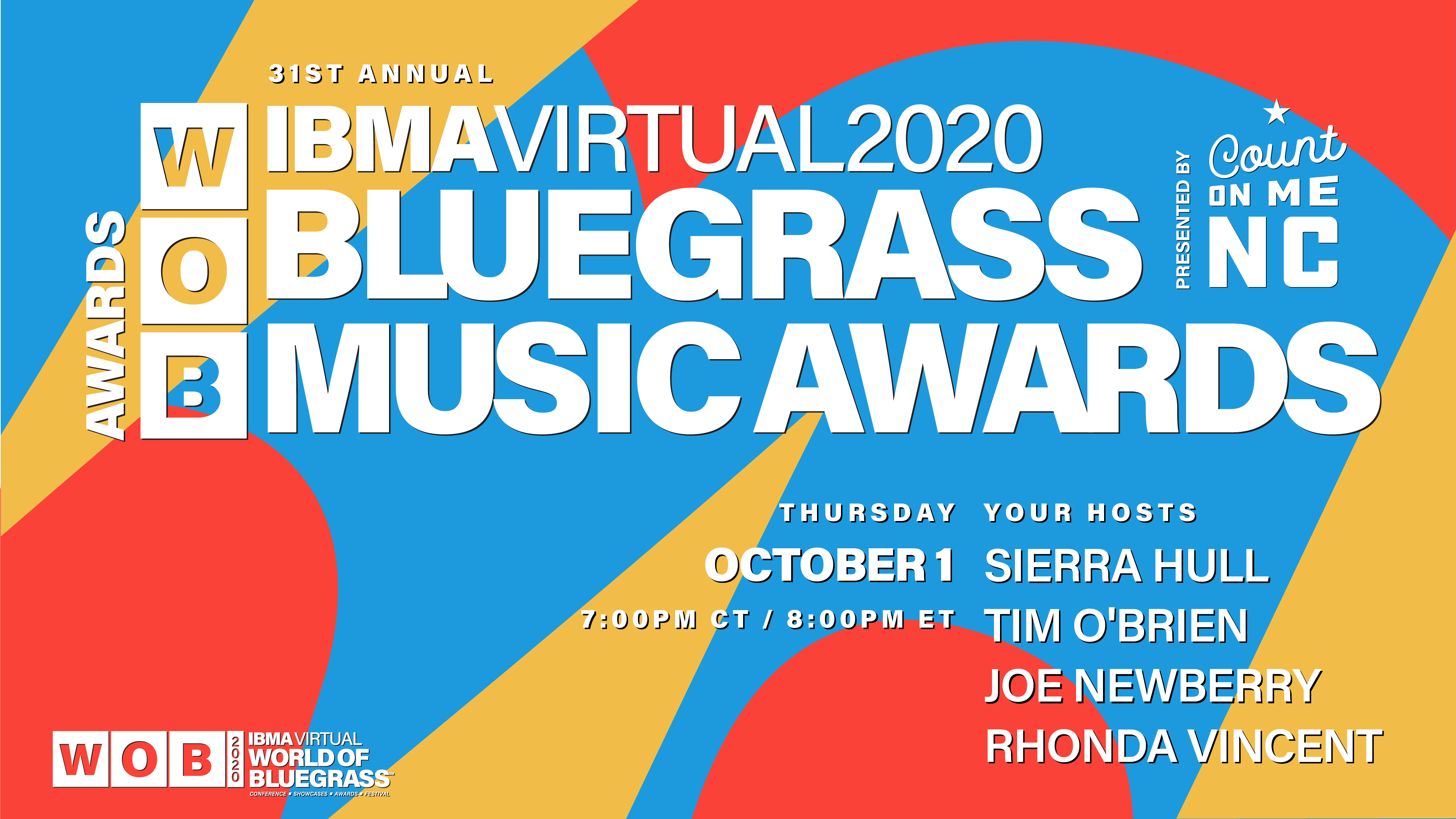
The winners of the 31st annual IBMA Bluegrass Music Awards were announced Thursday night via video awards show, hosted by Sierra Hull, Tim O’Brien, Joe Newberry, and Rhonda Vincent.

The “biggest night in bluegrass” was well-adapted to its virtual setting and boasted three Hall of Fame inductions, guitar and banjo tributes to Doc Watson and J.D. Crowe, a continent-spanning collaboration by Rob Ickes & Trey Hensley and Taj Mahal, and celebrations of the 20th anniversary of O Brother, Where Art Thou? and the 75th anniversary of the birth of bluegrass. Marking the occasion, Del, Ronnie, and Rob McCoury opened the evening from an empty Ryman Auditorium, regarded as the birthplace of bluegrass and a former home for the show.

Special performances were shot live at home, in studios, and at various small venues — as well as the Station Inn and the Ryman. Billy Strings paid tribute to Hall of Famer and Male Vocalist of the Year nominee, Larry Sparks, with a cover of “John Deere Tractor” — with double pickguards, to boot. In the Doc Watson tribute, each of the five Guitar Player of the Year nominees (Trey Hensley, Billy Strings, Bryan Sutton, Molly Tuttle, and Jake Workman) took their turn virtually swapping solos on “Black Mountain Rag,” with T Michael Coleman, Watson’s longtime friend and bandmate, holding them all together through the webcams and headphones. Many other unique collaborations, tributes, and performances were peppered throughout the award announcements. The most stunning performances, though — like Vocal Group of the Year and Entertainer of the Year winner Sister Sadie’s “900 Miles” — were from the mother-church setting of the Ryman, where in a pandemic twist, the bands each performed not facing an audience, but with the auditorium’s empty pews as a background.

As IBMA Executive Director Paul Schiminger put it in his speech from the Ryman stage, in a virtual conference year and a pandemic, returning to the birthplace of the genre was “an unexpected gift through it all.” 75 years of bluegrass were poignantly brought together beneath the rafters of the hallowed, though empty, Ryman Auditorium.

Here are the winners of the 2020 IBMA Bluegrass Music Awards, in the order they were announced:

New Artist of the Year

Mile Twelve

Instrumental Group of the Year

Michael Cleveland & Flamekeeper

Gospel Recording of the Year

“Gonna Rise and Shine”
Artist: Alan Bibey & Grasstowne
Label: Mountain Fever Records
Producer: Mark Hodges

Banjo Player of the Year

Scott Vestal

Resophonic Guitar Player of the Year

Justin Moses

Fiddle Player of the Year

Deanie Richardson

Bass Player of the Year

Missy Raines

Mandolin Player of the Year

Alan Bibey

Guitar Player of the Year 

Jake Workman

Collaborative Recording of the Year

“The Barber’s Fiddle”
Artists: Becky Buller with Shawn Camp, Jason Carter, Laurie Lewis, Kati Penn, Sam Bush, Michael Cleveland, Johnny Warren, Stuart Duncan, Deanie Richardson, Bronwyn Keith-Hynes, Jason Barie, Fred Carpenter, Tyler Andal, Nate Lee, Dan Boner, Brian Christianson, and Laura Orshaw
Label: Dark Shadow Recording
Producer: Stephen Mougin

Instrumental Recording of the Year

“Tall Fiddler”
Artist: Michael Cleveland with Tommy Emmanuel
Label: Compass Records
Producers: Jeff White, Michael Cleveland, and Sean Sullivan

Vocal Group of the Year

Sister Sadie

Song of the Year

“Chicago Barn Dance”
Artist: Special Consensus with Michael Cleveland & Becky Buller
Writers: Becky Buller, Missy Raines, Alison Brown
Label: Compass Records
Producer: Alison Brown

Album of the Year

Live in Prague, Czech Republic
Artist: Doyle Lawson & Quicksilver
Label: Billy Blue Records
Producers: Doyle Lawson and Rosta Capek

Female Vocalist of the Year

Brooke Aldridge

Male Vocalist of the Year

Danny Paisley

Entertainer of the Year

Sister Sadie


Also honored during the broadcast were three inductees into the Bluegrass Music Hall of Fame: owner of the Station Inn, J.T. Gray, The Johnson Mountain Boys, and New Grass Revival.

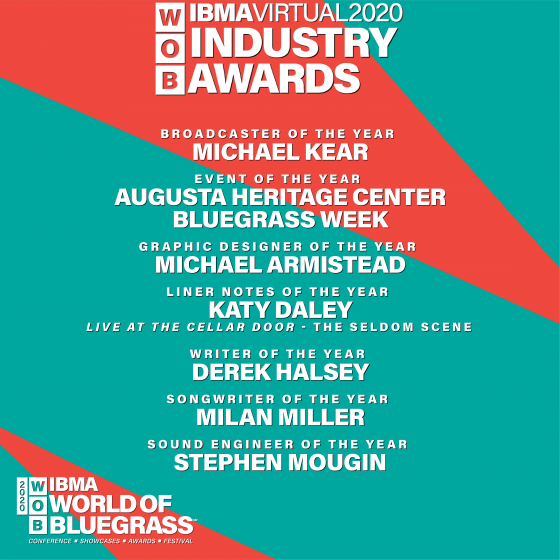
The Industry Awards were held on Wednesday, September 30. Hosted this year wittily and absurdly in video format by Béla Fleck and Abigail Washburn, the Industry Awards recognize outstanding professional work within the many arms and branches of the bluegrass industry at large. 

The Industry Awards recipients:

Broadcaster of the Year

Michael Kear

Event of the Year

Augusta Heritage Center Bluegrass Week, Elkins, WV

Graphic Designer of the Year

Michael Armistead

Liner Notes of the Year

Katy Daley, Live at the Cellar Door – The Seldom Scene

Writer of the Year

Derek Halsey

Sound Engineer of the Year

Stephen Mougin 

Songwriter of the Year

Milan Miller

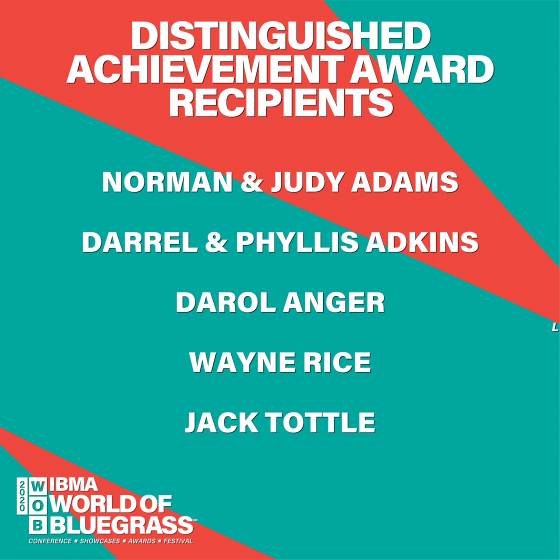
The recipients of the Distinguished Achievement Awards, honoring lifelong contributions by forerunners and ambassadors for bluegrass music, were honored with presentations on Wednesday as well: 

Norman & Judy Adams, Adams Bluegrass Festivals

Darrel & Phyllis Adkins, Musicians Against Childhood Cancer

Darol Anger, fiddler/educator

Wayne Rice,  San Diego’s KSON “Bluegrass Special” host

and Jack Tottle, band leader and educator at East Tennessee State University.

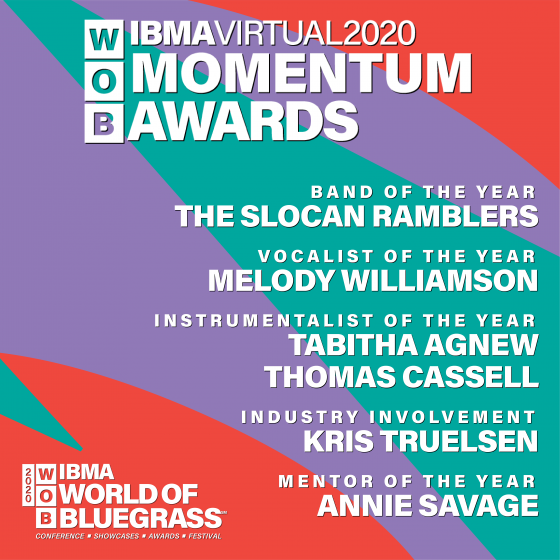
The Momentum Awards, handed out via video ceremony on Tuesday, September 29, focus on artists and industry professionals who are in the early stages of their bluegrass careers and the mentors who have helped them reach their young success.

The Momentum Awards recipients:

Industry Involvement

Kris Truelsen

Mentor

Annie Savage

Instrumentalist (2 recipients in this category)

Thomas Cassell

Tabitha Agnew

Vocalist

Melody Williamson 

Band

The Slocan Ramblers


In the ’80s and ’90s, These 10 Women Made Bluegrass Better

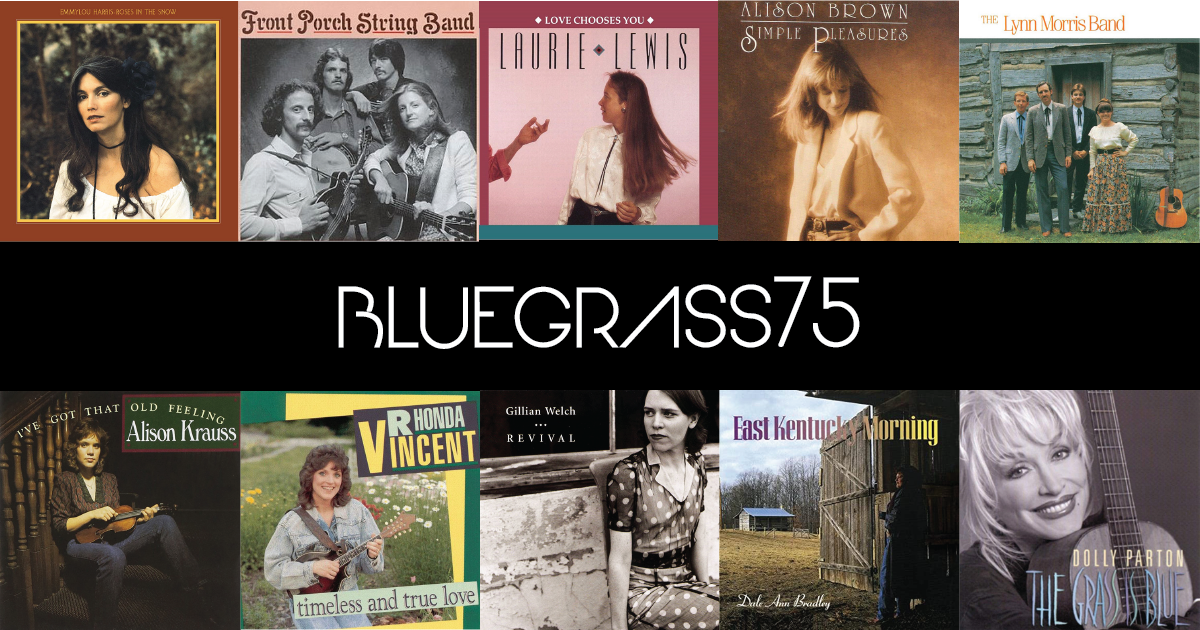
With this year marking the 75th anniversary of bluegrass, it’s remarkable to note that women emerged as a creative force at roughly the halfway point between then and now. Of course, female musicians have been part of the fabric of bluegrass from the start, with Mother Maybelle Carter, Sally Ann Forrester, and Hazel & Alice among those serving as inspirations through the decades.

However, the role of women as bandleaders, rather than in a supporting role, began to change in the ’80s and flourished in the ’90s. As part of our Bluegrass 75 series, BGS commends these 10 women who carried bluegrass forward with a combination of undeniable talent, strong material, and a refreshing new perspective.

Emmylou Harris

One of the most visible country artists of the ’70s turned her attention to bluegrass, with a support team she deserves (Ricky Skaggs, Jerry Douglas, Dolly Parton, etc.) Her material ranges from the Louvin Brothers to Paul Simon, though that exquisite voice makes the album seamless. It’s one of her finest albums in a brilliant catalog.


Claire Lynch

With a crystalline soprano, Claire Lynch first gained notice as a lead vocalist and guitarist with Front Porch String Band, which released an indie album in 1980 that was picked up by Rebel Records in 1983. The poignant track, “Hills of Alabam,” which she co-wrote, shows her gift for melody and her ability to sing with sincerity.


Laurie Lewis

A key figure of the West Coast bluegrass scene, Laurie Lewis can fiddle with the traditionalists, then hush a crowd with a beautiful acoustic ballad like “Love Chooses You.” As the acolyte of a generation before her, Lewis actively takes an interest in the bluegrass scene’s rising talent, as evidenced on her latest work, an album of duets entitled and Laurie Lewis.


Alison Brown

As a picker, Alison Brown has made her mark on countless recordings and won the 1991 IBMA Award for Banjo Player of the Year. She’s also a co-founder of Compass Records, a producer, and a Grammy-winning artist. At times blazing, and other times mellow, Brown consistently finds just the right tone on her albums’ instrumentals.


Lynn Morris

Blessed with a sweet but persuasive voice, Lynn Morris knew how to get the storyline across, whether she’s reminiscing about “Mama’s Hand” or laying down the law in “You’ll Get No More of Me.” As a banjo player, she had incredible chops, and her grace on stage (and off) has made her one of the bluegrass family’s most beloved figures.


Alison Krauss

A gifted vocalist, bandleader, and fiddler, Alison Krauss kept her early career focused on bluegrass, though her material would soon find its way to millions of country listeners, too. Being a former child prodigy herself, she served as a role model for a generation of younger pickers, while showing traditionalists that bluegrass is indeed in good hands.


Rhonda Vincent

Coming up in a family band, singer and mandolin picker Rhonda Vincent has been working in bluegrass for decades, though she’s always finding ways to keep things fresh. Still, her early albums remain some of her most satisfying work. As a bandleader, she keeps the energy up on stage, and her outgoing personality makes her a true entertainer.


Gillian Welch

While few would consider her albums to be bluegrass proper, Gillian Welch has exerted tremendous influence on its community. A 1993 winner of Merlefest’s Chris Austin Songwriting Contest, Welch has seen originals like “By the Mark” and “Caleb Meyer” become standards, and though she didn’t grow up in Appalachia, her songs somehow embody its heritage.


Dale Ann Bradley

A sterling discovery from the New Coon Creek Girls lineup, Dale Ann Bradley launched her solo career by selecting relatable material along with a surprise or two (including a U2 cover). It’s a template that still serves her well. The title track of East Kentucky Morning captures the mood and melancholy that she continues to convey so well.


Dolly Parton

It’s hard to imagine now, but Dolly Parton had dropped off the mainstream radar in the mid ’90s. Then her first bluegrass album proved what her fans knew all along — she represents her mountain people well. A wonderful mix of familiar favorites and new material, The Grass Is Blue solidified her reputation as one of music’s most important voices.

(Editor’s note: Explore more of our Bluegrass 75 Artist of the Month coverage.)


LISTEN: Rhonda Vincent, “Like I Could”

Artist: Rhonda Vincent
Hometown: Greentop, Missouri
Song: “Like I Could”
Release Date: June 19, 2019
Label: Upper Management Music

In Their Words: “As soon as Jeannie Seely started singing ‘Like I Could’ to me, I instantly loved it. It felt like it was written just for me and my vocal style. As we were recording the tracks, it just felt right. You know when you can feel that something is just right for you; like trying on that perfect dress, or pair of shoes. This song was just the right fit.

“The recording session was very impromptu. I had just finished recording a duet for Grand Ole Opry star Jeannie Seely’s new project. There was a cancellation of the afternoon session, and I quickly asked if I could book that time. I called musicians, and it was like it was destiny. The musicians and engineer were there with only an hour’s notice. I sent a message to ask Jeannie for the lyrics and demo. It was really amazing how everything came together.

“I feel that many people will relate to this song and its tremendous heartbreak and sadness. My hope is that there are people who hear this song, namely those in the midst of the devastation of a breakup, who will reconnect and renew their love with each other. It has a very desperate message, asking, ‘What happened, I thought you could see us together forever?’ Maybe this is the perfect song and question they need to hear to bring them back together.” — Rhonda Vincent


Photo Credit: Sharp Images/Rebecca Sharp